
Tag: Made By History

  • How Washington learned to pressure Iran without war

    How Washington learned to pressure Iran without war

    Since Israel and the United States bombed Iran’s nuclear facilities in June 2025, President Donald Trump has vacillated between war, sanctions, and diplomatic negotiations in order to thwart Iran’s nuclear capabilities. Trump opened his second term by signing National Security Presidential Memorandum 2, which imposed maximum pressure on Iran as multiple rounds of indirect talks continued. In February, the U.S. and Israel struck Iran again, this time killing Supreme Leader Ali Khamenei and targeting nuclear and military infrastructure.

    No U.S. missiles over the decades had ever directly struck the Iranian mainland itself.

    A ceasefire followed within days, but subsequent fighting and failed attempts at diplomacy have made it impossible to sustain.

    It is unsurprising that the Trump administration is struggling to reach a deal on nuclear proliferation with Iran that matches the scope of the 2015 Joint Comprehensive Plan of Action (JCPOA), more commonly called the Iran nuclear deal. President Barack Obama’s negotiators secured not just Iran’s cooperation but also Russia’s, China’s, and Europe’s to effectively and broadly secure U.N. Security Council authorization and policy. In return for JCPOA-related sanctions relief, Iran reduced its enriched-uranium stockpile by 98%, capped enrichment at 3.67%, and accepted expanded atomic monitoring.

    Over the past three and a half decades, American presidents have created a system to pressure Iran that works through relationships with everyone but Iran.

    Sanctions let presidents extract cooperation, concessions, and leverage on a variety of issues from other nations and corporations in the process. War extracts nothing from anyone but Iran.

    The system of selective pressure against Iran took shape during the 1990s. After the Cold War came to a close, the George H.W. Bush and Bill Clinton administrations worked with Congress to forge a range of options short of war for handling Iran. American sanctions traditionally traced a simple logic: punish whoever sold Tehran weapons and the means to build them.

    The first measures focused on proliferation. In the aftermath of the Iran-Iraq War, Congress worried that Tehran was rebuilding its military by acquiring sophisticated weapons and dual-use technology abroad. The 1992 Iran-Iraq Arms Non-Proliferation Act, signed by President Bush, made it U.S. policy to oppose transfers that could contribute to Iranian acquisition of chemical, biological, or nuclear weapons.

    This law continued a convention of giving Washington a way to penalize weapons transfers without going to war, but its limits soon became apparent. Weapons sanctions could harm suppliers after the transfer, but they did not necessarily deprive Tehran of the money to purchase the technology or expertise in the first place.

    By 1996, Congress went after ordinary trade. Congress and President Clinton increasingly viewed Iran’s energy sector as the financial bedrock that allowed Tehran to fund the actions Washington sought to deter. Rather than solely punish whoever supplied Iran with weapons, Congress sought to limit the revenue and investment.

    The Iran and Libya Sanctions Act (ILSA) threatened any foreign company with complete exclusion from American credit, export licenses, and government contracts if it invested more than $40 million in Iran’s oil and gas sector — regardless of whether the company did anything weapons-related.

    For the first time, ordinary commerce with Iran became a foreign relations trigger with the United States. The leverage was not a naval blockade, but access to the American economy itself.

    The Russian-American relationship led to the testing and development of these new mechanisms. Washington and Moscow had three main issues over Iran: nuclear reactor technology and training, a multibillion-dollar natural gas field, and missiles.

    The two governments did not have identical agendas. Americans wanted to prevent Iran from acquiring nuclear weapon expertise and missile technology, while also maintaining its relationship with Russia. Russians wanted to preserve valuable commercial and strategic ties with Tehran, including nuclear and energy contracts, without sacrificing its relationship with the United States.

    They both aligned on a functional U.S.-Russian relationship with some limits on proliferation, but differed sharply over how much Russian cooperation with Iran was acceptable.

    Nuclear reactors, gas, and missiles all received different political treatments. Classic diplomatic negotiations led to Russian President Boris Yeltsin agreeing to remove the uranium enrichment feature from Russia’s contract, even though the Bushehr reactor’s sale was legal under international law. As a light-water plant under International Atomic Energy Agency safeguards, it fell under the long-standing international nonproliferation treaty, leaving the United States unable to block the sale but still able to negotiate parts.

    When Russia’s state-owned natural gas company Gazprom, alongside other international companies, sought a contract to develop the South Pars gas field, the largest natural gas field in the world, it put ILSA to its first real test. The $2 billion project involved several state-owned energy companies: France’s Total, Russia’s Gazprom, and Malaysia’s Petronas.

    In response, Clinton issued a waiver for the international gas companies investing in Iranian energy. The administration pointed specifically to increased cooperation from the European Union on counterterrorism and nonproliferation to issue the waiver.

    While the United States never formally used ILSA to sanction a company during this period, the atmosphere could then help the Clinton administration to negotiate with Russia on missile concessions.

    Deputy Secretary of State Strobe Talbott captured the strategy in a sentence: “In a sense we are linking the two [missiles and energy], and in another sense we are not.” The vagueness was deliberate and useful for the differences in agendas on both sides.

    Talbott pressed Russian Foreign Minister Yevgeny Primakov to blacklist Sanam, the Iranian missile entity attempting to acquire the technology, and the Russians did. Russia enacted new laws to pursue weapons and nuclear proliferation crimes, while increasing arrests and coordination between the FBI and Russia’s Federal Security Service. Clinton’s veto and the related tools gave American negotiators something to offer and Russia something to gain.

    These policies helped the American-Russian relationship endure. Every waiver, every delay, every selectively enforced sanction since 1992 had been less a negotiation with Iran than a negotiation with someone else about Iran.

    Waiving petroleum sanctions became the unspoken rule for the next 12 years. Until 2010, no American administration ever sanctioned a foreign company for investing in Iran’s energy sector.

    The ILSA was renamed the Iran Sanctions Act (ISA) and expanded under the Comprehensive Iran Sanctions, Accountability, and Divestment Act in 2010 (CISADA); the Iran Freedom and Counter-Proliferation Act of 2012 (IFCA) toughened the consequences even more. These later acts added stricter enforcement measures and sanctioned major non-Western oil providers from China, Belarus, and Venezuela, while a special rule exempted allied companies in exchange for promises to halt investments.

    By 2015, Washington could bargain with a sanctions system far broader than the ILSA. The JCPOA, or the Iran nuclear deal, either waived portions or removed designated Iranian institutions from the ISA, CISADA, and IFCA. The relief was substantial and conditional: Foreign firms and nations could again partake in specified oil, banking, shipping, and investment transactions with Iran while the underlying American statutes remained available if the bargain collapsed.

    Made By History sponsorsInquirer Staff

    Meanwhile, sanctions tied to terrorism, human rights abuses, and ballistic missiles continued.

    Discretion applied to war, as well. Bush considered strikes and held back for more nuclear enrichment proof. Obama rejected the military option as a matter of philosophy by arguing that war would buy less than diplomacy and cost the international coalition to enforce sanctions. Trump himself, in his first term, ordered a strike and called it off 10 minutes before execution, and Joe Biden sought to de-escalate. These four administrations had varying rationales and scenarios, but all were aligned in keeping force as a reserve option.

    In his second term, Trump had access to the same policy options, including specific sanctions on industry sectors, supply-chain options laws, and relational pressure.

    The lesson? A mix of pressure and exemption — not blanket coercion — worked. It allowed American presidents to lean hard on some part of a foreign nation’s relationship with Iran while tolerating others. Even the JCPOA, for all the criticism it drew, followed this strategy: it converted decades of accumulated third-party pressure into a deal. War trades a system built on the compliance of others for a strike that compels nothing from anyone but Iran itself.

    Holly Harris is a doctoral candidate in history at Southern Methodist University, where she studies the collapse of the post-Cold War security relationship between the United States and Russia.

    Made By History takes readers beyond the headlines with articles written and edited by professional historians. Opinions expressed do not necessarily reflect the views of The Inquirer.

  • Democratic socialism has been rising in the U.S. for over 50 years

    Democratic socialism has been rising in the U.S. for over 50 years

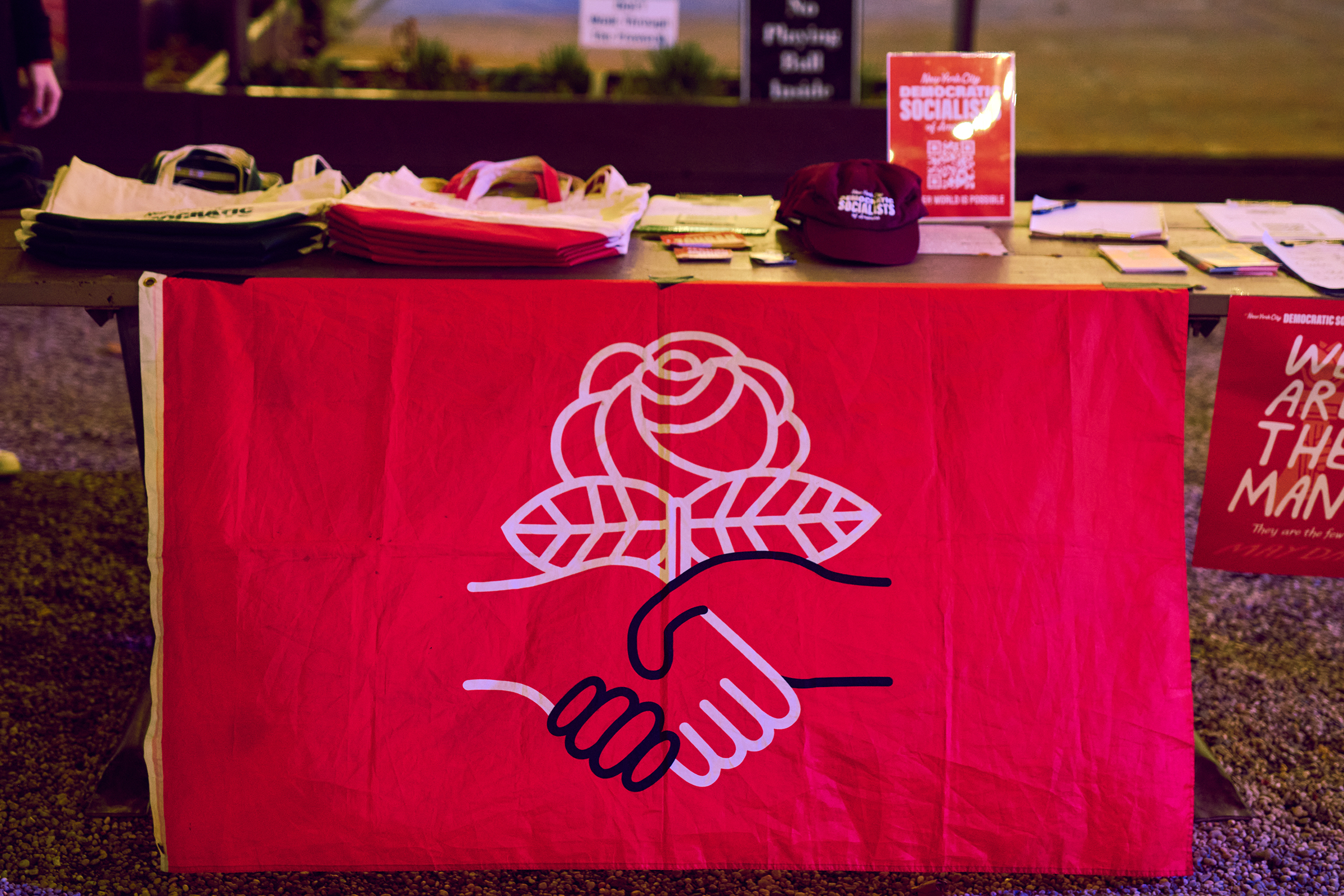
    The Democratic primaries leading up to the midterm elections in November have so far been a high point for the American left. Building on the momentum produced by Mayor Zohran Mamdani’s election last year, three insurgent congressional candidates on the left won their primaries in New York City in June. Two of these candidates were endorsed by the local chapter of the Democratic Socialists of America (DSA), while the third ran with Mayor Mamdani’s strong support. Weeks later, a DSA-endorsed candidate defeated a longtime Democratic member of Congress in Colorado. And although the Democratic U.S. Senate nominee from Michigan, Abdul El-Sayed, did not seek DSA’s endorsement, he won on a platform similar to those of several DSA challengers — including the candidate who unseated the Democratic incumbent in the state’s 13th Congressional District on the same night.

    These advances for democratic socialists, along with numerous victories at the state and local level, have spooked establishment Democrats protective of their positions — as well as moderate-to-liberal commentators worried about the party’s chances in November. A new and alien force, they claim, has entered the Democratic Party, displacing its traditional constituencies and candidates.

    Except nothing could be further from the truth. DSA’s strategy is not new, and democratic socialists made inroads in the Democratic Party decades ago.

    There are many historical moments to which we can trace the origins of the present democratic socialist moment, but 1973 may be the most pertinent. That year, a new democratic socialist organization sought pragmatic ways to engage with electoral and party politics, racking up achievements that have been long overlooked.

    In the early 20th century, the Socialist Party of America, founded in 1901, ran its own candidates in U.S. elections, famously Eugene V. Debs in 1912 and 1920, and Norman Thomas between 1928 and 1948. But by the 1960s, members of the party disagreed about how to achieve a democratic form of socialism during the Cold War. In general, the American left was undergoing tumult and conflict, with the emergence of the New Left, associated with the student movements of the ‘60s. The Vietnam War and nationwide urban crises added more pressures, and Nixon’s defeat of George McGovern in 1972 brought the party to a breaking point.

    The 1972 election exposed fault lines within the Democratic Party and within the Social Democrats, USA (SDUSA), the successor organization of the Socialist Party. Most SDUSA members were militantly anti-communist and believed McGovern’s foreign policy agenda was tantamount to appeasement of global communism. Organized labor was also not enthused, and the AFL-CIO refused to endorse the Democratic nominee.

    In 1973, the public intellectual and social activist Michael Harrington broke with SDUSA and founded the Democratic Socialist Organizing Committee (DSOC), taking with him a number of prominent leftists as well as labor leaders who dissented from the AFL-CIO’s neutrality in 1972. Harrington had come up in the anti-communist Old Left and clashed with Tom Hayden at the famous 1962 Students for a Democratic Society convention in Port Huron, Mich. Figures associated with this Old Left like Harrington and Dissent editor Irving Howe (who joined DSOC) rejected the New Left’s tactics as well as what they saw as its most extreme elements, including supporting revolutionary movements in Cuba, China, and the Middle East that were not democratic.

    But while DSOC was to the right of this New Left, they were decidedly to the left of the Democratic establishment. They believed that neither the mainstream of the labor movement nor the liberals in the Democratic Party, both tainted by support for the Vietnam War, would be able to mobilize the broad center-left coalition necessary to expand economic opportunity in the 1970s as the long postwar boom entered into crisis.

    DSOC, in Harrington’s words, sought to be “the left-wing of the possible” in the Democratic Party, and pursued what he and socialist leader Bayard Rustin called “realignment.” (Rustin himself, however, did not join Harrington’s new group.) Building on alliances with allies in the labor movement, DSOC sought to shape the Democratic Party at a time when the liberal accomplishments of the 1960s were coming under threat. As Harrington’s biographer Maurice Isserman writes, “Michael and his comrades were doing for liberalism what it could not seem to do for itself, which was to set forth a coherent response to the conservative attack on the welfare state.” This took the form of, for example, the Democratic Agenda conferences that DSOC held in Washington. At these confabs, DSOC brought together activists, elected officials, and progressive labor leaders to apply pressure on Democrats on issues ranging from full employment to universal healthcare to affordable housing.

    DSOC participated in Democratic Party midterm conventions, electing delegates and working the room to influence the party platform. Both the party establishment and the “New Democrats,” an insurgent group of centrist, market-oriented Democrats elected in the wake of Watergate, opposed them. But DSOC found allies among traditional liberals like Sens. Ted Kennedy (D., Mass.) and Hubert Humphrey (D., Minn). They also gained allies in Congress who were willing to affiliate with the organization, including Reps. Ron Dellums (D., Calif.) and John Conyers Jr. (D., Mich.), leading members of the Congressional Black Caucus.

    The 1976 nomination of Jimmy Carter, a moderate Democrat from Georgia, was a disappointment to Harrington and DSOC. But it was during the Carter administration that its strategy began to bear some fruit.

    The economic crisis of the 1970s had hit poorer and minority communities especially hard, producing disproportionately high unemployment rates. In response, civil rights activists like Coretta Scott King promoted the Humphrey-Hawkins bill, named after sponsors Sen. Humphrey and Rep. Augustus Hawkins (D., Calif.), that committed the federal government to achieving full employment, with the creation of new public sector jobs as a last resort. The Carter administration was reluctant to get behind this effort, fearing that more spending would fuel inflation, and Harrington and DSOC played a key role in the coalition to pressure the president into supporting the measure. Although the bill was watered down by the time it reached Carter’s desk — the mandate it imposed on the administration lacked teeth — the campaign for a full employment bill demonstrated the promise of the realignment strategy.

    At the start of the Reagan administration, DSOC merged with the New American Movement, a post-New Left formation, to form DSA. This attempt to heal the wounds of the 1960s with those on the New Left who now accepted working within the Democratic Party, however, foundered on the shoals of the 1980s. Historical circumstances, particularly hyperinflation, meant that the Democratic Leadership Council, an organization of the “New Democrats,” ended up pushing the Democratic Party to the right on issues like support for public programs, taxation, and urban crime, rather than DSA moving the party to the left, as Harrington envisioned.

    Made By History sponsorsInquirer Staff

    It would take a new economic crisis, that of 2007, and its aftermaths to revive democratic socialism in mainstream politics, in the form of Bernie Sanders’ 2016 presidential campaign. Following Trump’s election, many volunteers for Sanders joined DSA in 2017, where they found both an organization and a strategy with which to continue their work. In 2018, DSA member Alexandria Ocasio-Cortez shocked the establishment by ousting the high-ranking incumbent Rep. Joe Crowley from his House seat in Queens. While some in the DSA membership do not favor working within the Democratic Party, the organization, through its local chapters, has continued the realignment strategy favored by Harrington and DSOC in the 1970s.

    The victories of democratic socialists in Democratic primaries echo the 1970s in an important respect. Then, as now, Democratic leaders in Congress struggled to respond to a right-wing movement intent on drastically reshaping American society in its image. With the Cold War now in distant memory, American democratic socialists have been much more successful in filling the leadership void and capturing the discontent of Democratic primary voters. But they are nevertheless building on the political and strategic foundations of those who came before them.

    Abe Silberstein is a doctoral student in the joint program in history and Hebrew and Judaic studies at New York University. He is researching socialism and Jewish politics during the Cold War. He is also a member of DSA in New York City.

    Made By History takes readers beyond the headlines with articles written and edited by professional historians. Opinions expressed do not necessarily reflect the views of The Inquirer.
  • Philadelphia is the birthplace of the all-American cupcake

    Birthdays call for cake and the country’s 250th is no exception.

    America250, the federal agency behind the Semiquincentennial celebration, cut the official national birthday cake in a July 4th ceremony at the Library of Congress. Online, Goldbelly created “America’s Official 250th Birthday Cake Collection.” In Philadelphia, the Independence Visitor Center arranged 5,000 cupcakes into a flag formation.

    When Philadelphia served cupcakes, it was doing more than choosing the simplest way to apportion cake. It was remaining true to its roots as the birthplace of all-American cupcakes.

    The “cup cake” was the brainchild of Eliza Leslie, an accomplished Philadelphia author of cookbooks, fiction, and other prose. Leslie’s cupcake appears in her category-defining 1828 book, Seventy-Five Receipts for Pastry, Cakes, and Sweetmeats, considered the first baking book published in the U.S. and published at a time when recipes were called receipts.

    The small-cakes genre predates Leslie; the first known American cookbook author, Amelia Simmons, included a “light cake to bake in small cups” in her 1796 American Cookery. Simmons didn’t specify the type of baking vessel, so the “small cups” reference in the recipe title is the only allusion to a cupcake-sized cake.

    There are other records of similar baking practices, but Leslie was the first to call the petite cake a cupcake. Not only is her recipe titled “cup cake,” but she also includes specific instructions to bake in “small tins.” Cupcake history thus begins here, in this printed record of the name and form recognized today.

    A chocolate Eagles cupcake from Carlino’s Market in Ardmore.Craig LaBan / Staff

    Leslie was born in 1787 in Philadelphia’s historic core. She learned to read by age 5, educated at home by her father, Robert Leslie. U.S.-born of Scottish ancestry, Robert was a polymath who owned a clock and watchmaking company. Her mother was an American of Swedish descent.

    Eliza wrote that her father was an intellectual who “obtained the custom of the principal people [of Philadelphia], including that of Washington, Franklin, and Jefferson; the two last being his warm personal friends.” He likely debated revolutionary values with politicians, for “[i]t was by Mr. Jefferson’s recommendation that my father was elected a member of the American Philosophical Society,” Eliza wrote in her autobiography, published in Godey’s Lady’s Book in 1858.

    In her late 30s, she enrolled in cooking school, a decision that would change the course of her life. She learned to bake from Elizabeth Goodfellow, a respected Philadelphia pastry chef who owned a bakery and candy store. Leslie took notes and kept the recipes from her studies at Mrs. Goodfellow’s cooking school.

    In response to repeated requests to share the recipes she learned from Goodfellow, Leslie compiled them into a book, having grown tired of handwriting copies for friends. Seventy-Five Receipts was authored anonymously by “a lady of Philadelphia.” Leslie didn’t credit Goodfellow and Goodfellow herself never authored a cookbook.

    Leslie acknowledged her teacher in later books and dropped the anonymity to write under her real name or the pen name of Miss Leslie. Bucking social norms, Leslie was a lifelong childfree, never-married woman who earned her living as a writer.

    Leslie’s was the first American cookbook to list ingredients separately at the beginning of a recipe, a style she copied from Goodfellow. The previous convention was to state the ingredients within the narrative directions.

    She intended to write simple, logical recipes that resolved the common pain points American cooks faced. “There is frequently much difficulty in following directions in English and French Cookery Books, not only from their want of explicitness, but from the difference in the fuel, fire-places, and cooking tools generally used in Europe and America,” she wrote in the Seventy-Five Receipts preface.

    She prioritized locally grown, accessible, affordable ingredients and stressed the economic savings in home baking as opposed to buying cakes from a bakery. “Many of the European receipts are so complicated and laborious that our female cooks are afraid to undertake the arduous task of making anything from them,” she lamented. Confidently patriotic, Leslie affirmed that her recipes were, “in every sense of the word, American.” Her dishes could compete with the standard bearers, she insisted. They “will not be found inferior to any of a similar description made in the European manner,” she declared.

    While statesmen instilled independence in the U.S. political culture, Leslie and other women adopted the same mentality in American cooking. Their DIY spirit was creative, rebellious, defiant, and nonconformist vis-à-vis European culture. For example, Leslie was among the authors to publish an Election Cake recipe, fusing the political and the culinary.

    “Election Cake became the first food strongly associated with American politics,” wrote historian Gregg Mangan, who argued that this baking provided women with an opportunity to express themselves politically long before they got voting rights. Food and gender scholar K.C. Hysmith noted, “While women couldn’t vote, they could bend the ear of the voting-eligible men they hosted on election day. And at the very least, serving slices of cake allowed them access to political conversations they might otherwise miss.” More than just an item in the baker’s repertoire, Election Cake was an “exercise in everyday politics” and “statement of community organizing.”

    “Through their production of Election Cake and other recipes, including Independence Cake, Franklin Gingerbread, and Democratic Tea Cakes, women projected their influence into the public sphere and helped ingrain patriotism into our national culture,” Mangan wrote.

    Food historian Stephen Schmidt locates Leslie in the historical arc extending from America’s infancy to an evolving nation edging towards civil war. “By the end of her career, the tiny, parochial, overwhelmingly culturally English America of Leslie’s youth had been swallowed up by a far larger, rapidly industrializing and urbanizing, and increasingly diverse and factionalized America,” wrote Schmidt. “Food and cooking had changed in tandem, the prevailing taste of the times, at least as exhibited in the many cookbooks now on the market, having shifted from an essentially British, upper-class, 18th-century cuisine, freighted with rich, expensive ingredients and many practical difficulties, to a much simpler, easier, more naturalized cuisine that truly was ‘in every sense of the word, American.’”

    Leslie would go on to write juvenile fiction, etiquette guides, short stories, and a novel, while continuing to author smash-hit cookbooks. There’s broad consensus that her third, Directions for Cookery, was the most popular American cookbook of the 19th century.

    The must-have cookbook “passed through 60 editions from its first appearance in 1837 until 1870, a dozen years after the author’s death,” wrote Dover Publications in its 2013 reprint. According to historian Liz Susman Karp, it sold more than 150,000 copies.

    Made By History sponsors. FOR USE ON MADE BY HISTORY STORIES ONLY.Inquirer Staff

    Leslie spent her later years holding court in a fashionable hotel lobby, having established herself as a lifestyle influencer and public figure. “Long before her death, Miss Leslie had become a Philadelphia institution,” wrote Mary Tolford Wilson in a 1971 biography. “Grown portly and walking with difficulty, she lived for about a decade at the United States Hotel, where she not only met every visiting celebrity, but was herself sought out as one.”

    More than one modern authority has likened Leslie to Julia Child, another American author and chef who taught Americans to cook. In the introduction to a 2022 reprint, chef and author Dorie Greenspan wrote, “As I read Seventy-Five Receipts, I was reminded over and over of Julia. Both are a pleasure to read. Both clearly love sharing what they’ve learned. Both have a generous spirit — you sense it each time they comfort and encourage us as we follow their instructions. And both have an intelligence that sparkles on each page and within each recipe.”

    Leslie died in 1858 at the age of 70 and was buried at St. Peter’s Church in Philadelphia. Her 200-year legacy is baked into all the cupcakes Americans have eaten since she coined the term.

    Andrea Adleman is a journalist specializing in the cultural history of cupcakes. Her forthcoming Cupcake Nation book is based on her award-winning Washington Post story “The psychology of cupcakes.”

    Made by History takes readers beyond the headlines with articles written and edited by professional historians. Opinions expressed do not necessarily reflect the views of The Inquirer.

  • Many of Trump’s predecessors also trafficked in rumor mongering and demonized their opponents

    Many of Trump’s predecessors also trafficked in rumor mongering and demonized their opponents

    President Donald Trump recently accused Democrats of being “godless Communists,” building on his previous denunciation of his opponents as the “enemy from within.” These “Communists” were allegedly plotting to destroy Mount Rushmore once they seized control of the government. Such assertions reflect Trump’s willingness to peddle disinformation and rumors designed to paint the opposition as politically unacceptable.

    But while Trump spreads disinformation to an unprecedented degree, he is far from the first president to do so. Ambitious politicians’ intent on proving their populist bona fides have circulated unfounded conspiracy theories since the birth of the American republic — including many of Trump’s presidential predecessors. Their experiences reveal that while Trump’s rumor mongering has unique elements, especially his focus on eroding practices essential to a functioning republic, similar tactics have long been highly effective.

    Five of Trump’s predecessors stand out as serial conspiracy mongers: Thomas Jefferson, Andrew Jackson, Andrew Johnson, Woodrow Wilson and Franklin Roosevelt. These presidents represented many points on the ideological spectrum but shared one thing in common: their conspiracy mongering was rooted in their perception that the opposition was disloyal. All five men were also willing to peddle such claims because they believed they were saving America from a major threat.

    Thanks to his prominent role in the founding, Jefferson felt a certain ownership of the American experiment. That shaped the ruthless way in which he dealt with those who stood in his way. He claimed, for example, that Federalist leader Alexander Hamilton, “bewitched and perverted by the British example,” had betrayed the “Spirit of 1776.” Hamilton, Jefferson held, was not only a “monarchist” but an advocate for a monarchy “bottomed on corruption.”

    At the time, tradition prohibited public figures from directly attacking one another. Instead, Jefferson employed newspaper surrogates to circulate damaging and often unfounded information. These surrogates claimed that Hamilton’s goal was to destroy the republic and replace it with “an unlimited hereditary” government. Jefferson’s willingness to do anything to ruin his opponents became clear when one of his surrogates exposed Hamilton’s involvement in an extramarital affair.

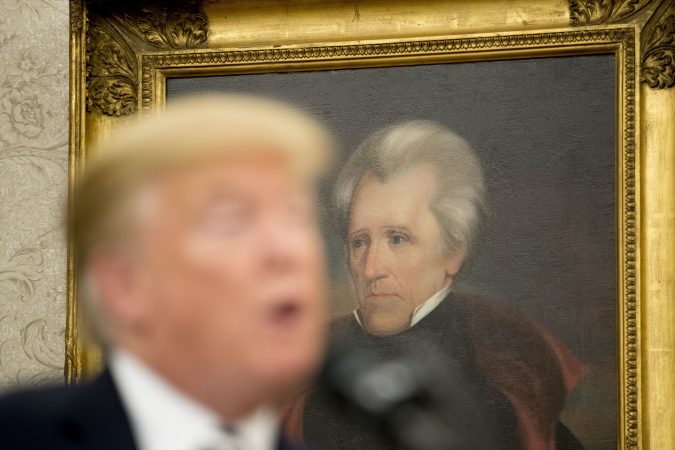
    Unlike Jefferson, Andrew “Old Hickory” Jackson’s dark view of his opponents and his willingness to engage in conspiratorial thinking stemmed from his defeat in the 1824 presidential election. Jackson charged that a “deep state” had stolen the presidency because he believed he received the most popular votes and, then, after no candidate received a majority in the Electoral College, the House of Representatives had handed the election to John Quincy Adams. Jackson claimed that the selection stemmed from a “corrupt bargain” between Adams and Speaker of the House Henry Clay, in which Adams promised Clay the position of Secretary of State.

    Losing in this fashion to Adams, the Harvard educated son of a former president, convinced “Old Hickory” that the system was stacked against self-made frontiersman like himself who were looked down upon by East Coast elitists. Jackson’s contest with, as the Jacksonian press called him, “John the Second” was “a struggle between the honest yeomanry of the country, and an aristocracy” intent on “perpetuat[ing] in certain families” all government positions. One Jacksonian paper told its readers that Adams and his supporters were creating a system that was “fast tending to monarchy.”

    Taking a page from Jefferson, Jackson’s surrogates claimed that Adams was somehow un-American. They based this charge on the amount of time the president had spent working as a young man at his father’s side in Europe and serving overseas as an American diplomat. Much was also made of Adams’ private purchase of a billiard table —— a purported sign of decadence and creeping European sensibilities. One Jacksonian editorial claimed that Adams admired “monarchy and aristocracy” and had learned his “contempt of republics and democracy” from his father and from his elitist education at home and abroad.

    By 1828, having been falsely accused of election theft and doing the bidding of East Cost elites, Adams lost decisively to Jackson.

    Forty years later, Jackson’s fellow Tennessean Andrew Johnson blamed “traitorous” Radical Republicans for undermining the Constitution and conspiring to oppress the white South by establishing “Negro supremacy.” In Johnson’s mind, they were traitors on par with, if not worse than, Confederate President Jefferson Davis.

    Made By History sponsors. FOR USE ON MADE BY HISTORY STORIES ONLY.Inquirer Staff

    In Cleveland, Ohio, on Sept. 4, 1866, Johnson asserted that Republican leaders Thaddeus Stevens and Wendell Phillips should be executed. Johnson’s overtly racist rhetoric emboldened various white supremacist organizations, including the Ku Klux Klan, leading to a reign of terror throughout the South.

    As with Jackson and Johnson, racial considerations were central to President Woodrow Wilson’s conspiratorially inclined approach to interpreting the nation’s past and present. In that sense, the nation’s first and only PhD president shared some surprising similarities with earlier presidents who lacked his extensive formal education and could rightly be accused of being provincial nativists. The president who vowed to “make the world safe for democracy” presided over an administration that was openly contemptuous of the civil rights and civil liberties of his fellow citizens.

    Wilson saw plots by “hyphenated” Americans designed to undermine the government and claimed that opponents of American entry into World War I — especially immigrants — were on the German kaiser’s payroll. In his 1915 State of the Union message, Wilson claimed that “there are citizens of the United States, I blush to admit, born under other flags but welcomed under our generous naturalization laws to the full freedom and opportunity of America, who have poured the poison of disloyalty into the very arteries of our national life.”

    Echoing Wilson, two decades later, Franklin Roosevelt accused American isolationists of disloyalty and argued they were placing themselves at the disposal of the German government in the lead-up to the Second World War. Roosevelt’s public and private statements about American businessmen, journalists and the Supreme Court, often involved circulating rumors and innuendo. His critics were “selfish men, jealous men, fearful men,” “big chiselers,” who were also “rumor-mongers” and “poison peddlers.” These “privileged princes … thirsting for power” were in some cases potential” would be dictators,” intent on creating a “new despotism.”

    Roosevelt believed that groups opposed to his initiatives lacked virtue and patriotism and were undermining self-government. This was particularly true of his Republican opponents, who by the time of his 3rd reelection campaign in 1944, the president saw as emulating Hitler and Mussolini.

    Each of these presidents used the “bully pulpit” to persistently question the patriotism of their opponents or to ascribe criminal motives to them. These presidents aimed to persuade the public that their opponents were un-American, if not outright traitors. That was possible, in part, because the five presidents saw no distinction between themselves and the state. What was good for them was good for America.

    These tactics proved to be highly successful for each of these presidents, except for Johnson: Jefferson, Jackson and Wilson all won reelection to a second term, while Roosevelt went on to be elected a record four times.

    Trump has much in common tactically with this group of presidents, as he too indulges in fear mongering, trafficking in rumor and innuendo and smearing the opposition. However, he lacks the accomplishments of many of them: Jefferson, for example, was the poet laureate of the American founding, while Roosevelt arguably saved American capitalism during the Great Depression and deftly guided the U.S. crusade against fascism during World War II. Some also have doubts about Trump’s commitment to the public good as he seems to profit from his office, adds his name to public places and focuses on things like a new White House ballroom.

    Yet, it would be a mistake to latch onto these differences and to miss the lesson from these conspiracy mongering presidents from the past. Their success in using many of the same tactics Trump is deploying in 2026 serves as a stark warning for his opponents. History shows that rumor mongering works and one should never underestimate the threat presented by a president whose unbridled rhetoric is used to destroy those who dare to dissent.

    Stephen F. Knott is author of Conspirator in Chief: The Long Tradition of Conspiracy Theories in the American Presidency (2026)

    Made by History takes readers beyond the headlines with articles written and edited by professional historians. Opinions expressed do not necessarily reflect the views of The Inquirer.
  • The border can’t block air pollution — but environmental diplomacy can

    The border can’t block air pollution — but environmental diplomacy can

    In July, Republican candidates in Michigan were lining up to excoriate Canada for the wildfire smoke wafting across the international border. “They MUST PAY and PUT OUT the fires!” wrote gubernatorial candidate John James on X, after declaring he would introduce legislation to impose sanctions on the neighbors to the north. Other politicians made similar claims about how they would deal with Canada. Meanwhile, Donald Trump moved to impose new tariffs on Canada in response.

    Such political posturing shows little understanding of the actual situation. For example, it overlooks the fact that the scale and magnitude of these fires is surely linked to climate change, which the United States is arguably doing less to combat under the Trump administration than any other industrial nation in the world.

    This is not the first time the two countries have dealt with cross-border air pollution. However, in the Great Lakes-St. Lawrence region historically, it was more often American emissions that were afflicting Canada.

    By the mid-20th century, air pollution across the Michigan-Ontario border in the St. Clair-Detroit River corridor was raising significant concerns. At the request of both nations, the International Joint Commission (IJC), which had been created by the 1909 Boundary Waters Treaty, formed a joint St. Clair-Detroit Air Pollution Board in the 1960s to investigate the precise sources of air pollution in this region.

    In a 1971 report, this board found that sulfur dioxide and particulate matter from Detroit’s auto and steel industries were crossing over to Windsor, Ontario. Along the St. Clair River, the joint board reported that Sarnia’s Chemical Valley south of the city, which had already developed into an enormous petrochemical complex that befouled both air and water, was the main pollution culprit. Certainly some of the poisons drifted into Michigan, though the board determined that the primary victims were in Ontario. The IJC duly recommended that the two federal governments create pollution boards and establish national air quality standards.

    A similar dynamic played out in other transboundary air disputes between Ontario and adjoining U.S. states, with both sides (though more often the United States) found to be the culprit. Ontario Hydro built a large coal-fired power station at Atikokan in the northwest part of the province that threatened cherished recreational areas across the border, such as the Boundary Waters Canoe Area Wilderness in Minnesota. In another instance, the Reynolds aluminum smelter in Massena, N.Y., was accused of contaminating the nearby binational Mohawk community, including the parts in Canadian territory.

    Over time, the air quality issues stemming from these specific sources mostly either fell off the public’s radar or became subsumed within wider debates about acid rain and national air quality agreements (such as the 1970 Clean Air Act). Indeed, by the 1980s acid rain dominated not only the Canada-U.S. environmental relationship, but general bilateral relations.

    Acidified precipitation is created when sulfur and nitrogen oxides (SO2 and NOx) emissions, often from coal plants, are transported through the atmosphere and transformed into sulfuric and nitric acids. This acid rain fell onto terrestrial and aquatic environments where it had a range of short- and long-term negative consequences. Melting acidic winter snows produce an “acid shock” in streams during the spring run-off, for example, which is predictably bad for aquatic species.

    While both countries generated pollution that fell in the other’s territory, acid rain originating in the United States and descending to earth in Ontario was the biggest problem. Ongoing bilateral studies established that 70%-80% of it came from the United States. That acid rain affected cottage country north of Toronto — where many of the country’s elite have vacation homes — helps explain why this problem gained so much public traction.

    But the two countries could not agree on solutions, such as the need for emission limitations and controls. As the primary contributor, the United States would have had to bear the brunt of any necessary changes, and the Reagan administration was ideologically opposed to any environmentally motivated regulations on economic activity. Washington stalled the talks, calling for more research.

    The United States proved more amenable to addressing the problem after George H.W. Bush entered the White House in 1989. Negotiations began on what would emerge as the 1991 Canada-United States Air Quality Agreement (AQA), which permanently capped emissions at approximately 13.3 million tons by 2010 in the United States and 3.2 million tons in Canada. While the United States would not make any legal commitments to reduce emissions in Canadian territory, it did pledge to follow the requirements of its recently updated Clean Air Act, which reduced the emissions that created acid rain.

    Made By History sponsorsInquirer Staff

    Ultimately, the results of the 1991 Air Quality Agreement were mixed. SO2 emissions did go down by almost 70%. Granted, this decrease probably had more to do with domestic regulations and technological changes on both sides of the border. In the long run, neither country has fully followed through on its commitments.

    The AQA also created a framework that could incorporate other air pollution issues, such as particulate matter and ozone. In that vein, Canada and the United States signed an “Ozone Annex” to the Air Quality Agreement in 2000. There was also a different type of ozone problem — the hole in the ozone layer — involving Canada and the United States; both were adherents to the 1987 Montreal Protocol on Substances that Deplete the Ozone Layer, considered by many to be the most successful global environmental treaty ever.

    To be sure, the United States and Canada have had the world’s most consequential environmental and energy relationship over at least the last century. No two nations have exchanged resources and collectively modified ecosystems on the same scale — which, by extension, has created harmony in wider U.S.-Canada relations and established many important precedents for international environmental law and governance. Yet, both countries are also petro states and climate villains, with their societies and economies organized around deeply unsustainable industrial practices and consumption patterns.

    The amity that has long characterized U.S.-Canada relations has been eroding with Trump at the helm. And this recent strife about transborder smoke is representative of the ways that breakdowns in U.S.-Canada environmental and energy relations can undermine the rest of the relationship.

    Daniel Macfarlane is professor in the School of Environment, Geography, and Sustainability at Western Michigan University and the author or coeditor of six books, including “Natural Allies: Environment, Energy, and the History of US-Canada Relations.”

    Made By History takes readers beyond the headlines with articles written and edited by professional historians. Opinions expressed do not necessarily reflect the views of The Inquirer.
  • Pete Hegseth is resurrecting a brand of military masculinity that dominated debates a century ago

    Pete Hegseth is resurrecting a brand of military masculinity that dominated debates a century ago

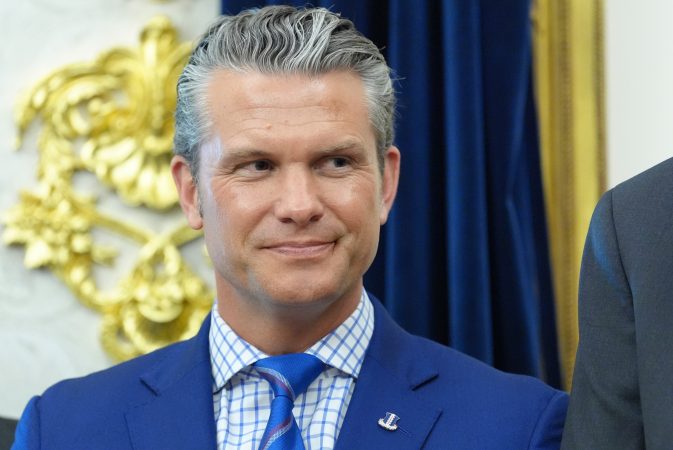
    On July 15, Defense Secretary Pete Hegseth announced that his department will test all military personnel over the age of 30 for low testosterone. In his video posted on X, he explained the move in terms of military dominance. It would give U.S. soldiers an “edge of lethality” and ensure they “have the biological foundation” to maximize their performance.

    This decision ties into larger concerns on the political right about the need to foster manhood, emphasizing aggression and physical strength. Testosterone has long served as a cultural marker of traditional masculinity, so it’s not surprising that Hegseth would focus on the hormone. After all, he’s performed pull ups on camera and issued a DOD-HHS fitness challenge with Secretary Robert F. Kennedy Jr.

    Yet, Hegseth’s move isn’t just a reflection of his personal priorities for the military. It’s also part of a long history of rhetoric about American manhood in military medicine that has elevated traditional ideas about masculinity and aimed to exclude gay men and women from military service. Indeed, dating back to the late 19th century, decisions about U.S. soldiers’ health have exposed fierce debates over definitions of American manhood.

    At the dawn of the 20th century, disagreements over imperialism dominated American politics. Proponents of American expansionism, like Sen. Albert J. Beveridge (R-Ind.), wanted to see the U.S. acquire territories in the Caribbean and the Pacific.

    Worries about manhood and the health of military personnel were at the core of these debates. Many Americans linked military power to the male body and, in turn, the inability or unwillingness to fight or govern “dependents” to boyhood. Champions of imperialism like Beveridge associated the physical strength of enlisted men as synonymous with the strength of the nation, and they framed territorial acquisitions as a way for the U.S. to demonstrate its manliness to other nations.

    Even anti-imperialists, who opposed territorial expansion, worried about American manhood. One of their main arguments against acquiring the Philippines was that it would degrade both individual and national manhood. They feared an imperial project in the Pacific would mean American soldiers would succumb to drunkenness and venereal infections in the tropics.

    Army officers, for their part, argued that the military could improve the nation’s men. During the 19th century, many people had seen military service as debasing partly because low pay and harsh punishments meant those who joined the Army were men on the margins of society with few alternatives. But now, medical officers explained, through efficient military hygiene, soldiers would become better citizens as they learned discipline, cleanliness and order.

    The imperialists won the foreign policy debate. After the Spanish-American War of 1898, Spain relinquished all claims on Cuba and the U.S. gained sovereignty over Puerto Rico, Guam and the Philippine Islands. Yet, that didn’t end the contest over manhood.

    In fact, once the U.S. took over these lands and sent military personnel abroad, concerns over soldiers’ behavior and masculinity only intensified.

    Gendered rhetoric saturated debates about whether enlisted men’s consumption of alcohol would improve or harm their health. Purity Reformers cheered the passage of legislation that ended the sale of alcohol at the army canteen. They saw drunkenness as unmanly. Additionally, inebriated men contracted sexually transmitted infections (STIs) at higher rates, which, the reformers believed, emasculated soldiers by rendering their bodies weak and infertile.

    Military medical officers who opposed the anti-canteen law feminized their male political opponents, complaining that these “abstinence ladies” were trying to tell officers how to run the army.

    These debates became especially intense over the Philippines, which U.S. troops oversaw in the years after the war. The problem was, by 1907, roughly one in three enlisted men serving in the Philippines had an STI. For those who saw the experience of military service not only as a place to prove one’s manhood but also to improve it, these rates of infection posed a problem that was at once medical and gendered.

    In response, the U.S. military followed in the footsteps of European colonizers and launched a system of regulated prostitution whereby medical officers inspected women who sold sex to soldiers, sent them to a designated hospital if they found signs of infection and, otherwise wrote “free from disease” on their inspection booklets. The Army thus sanctioned a manhood marked by heterosexual sex with Asian women in a colonized territory.

    When reports of this approach hit the anti-imperialist and temperance press in America, however, the public outcry pressured political and military leaders to stop the most visible aspects of this program. Progressive Era reformers fiercely opposed what they saw as government-run prostitution. They decried the sexual double standard that punished women suspected of selling sex but did nothing to stop either the men profiting from women’s sexual labor nor the male consumers. They also challenged claims that men had to have sex with women in order to be healthy.

    Made By History sponsors. FOR USE ON MADE BY HISTORY STORIES ONLY.Inquirer Staff

    While the efforts to regulate prostitution didn’t completely abate, the military also launched a push to divert enlisted men in the Philippines away from sex and the risk of STIs, especially by creating alternative avenues for recreation. Military authorities built boxing rings and established baseball diamonds to fill men’s leisure time with traditionally masculine physical activities marked by aggression, strength and speed.

    By the time the U.S. joined the First World War in 1917, social reformers had formed the American Social Hygiene Association to fight prostitution and stop the spread of STIs. Many occupied positions of leadership in the Army, and a definition of military masculinity based on restraint held political sway.

    General John J. Pershing, for example, who led the American Expeditionary Force, declared the French maisons tolérées off-limits to his soldiers. The military also enacted strict protocols requiring men who admitted to sexual activity with women in France to report to prophylaxis stations immediately following “exposure” to prevent the spread of disease.

    At the same time, Raymond B. Fosdick, a Progressive reformer, served as chairman of the Commission on Training Camp Activities (CTCA) overseeing educational and recreational programming for enlisted men. He promoted competitive sports as crucial to ensuring soldiers’ health. Fosdick claimed, “it does not do any good in dealing with red-blooded young men merely to erect a series of verboten signs along the roadside; you must have something positive for them to do.”

    As in the Philippines, U.S. troops constructed arenas for boxing and wrestling, along with football and baseball fields at camps in France. In 1917, the Army released Fit to Fight, an educational film for soldiers. The film’s hero Billy Hale was a former college quarterback who refused contact with prostitutes, embodying the ideal of strength in chastity.

    It was a vivid example of how military leaders tried to frame the combination of athletic pursuits and sexual restraint as the key to healthy manhood and military success. They also argued that living up to this ideal was a necessity so that soldiers could become husbands and fathers after the war.

    As reformers and officers openly discussed manhood and soldiers’ health they simultaneously painted a bleak portrait of womanhood. They saw women near training camps as sexual predators with dangerous intentions and as the locus of disease. Meanwhile, women at “home” had a purity that needed protection from soldiers who had worked elsewhere. In neither case were women “fit to fight.”

    A full century later, testosterone testing is resurrecting many of the stereotypes that saturated these debates. It paints a picture of soldiers as masculine and virile in a way that excludes openly gay men and women. And this is coming only a decade after all combat jobs opened to women and 15 years after the end of Don’t Ask Don’t Tell, which had required gay and lesbian soldiers to hide their sexual orientation. Additionally, it links the health of male soldiers — through their sex drives and sexual activities — to the bodies of women.

    Hegseth’s emphasis on testosterone follows on the heels of striking women from promotions lists in both the Army and Navy. Testosterone testing, in tandem with this move, as well as Hegseth’s criticisms of women in combat roles and his aversion to openly gay men in the military, bolsters a manhood that reserves power for cisgender, heterosexual men and relegates women to roles with less authority.

    Experts have pointed out the decision’s departure from evidence-based medicine. Testosterone levels are actually poor indicators of actual strength. But the decision nevertheless has political purchase thanks to longstanding images about what constitutes the ideal soldier.

    Pamela Maddock is an affiliate of the History Department at the University of Sydney and is working on a book, “Access to Women: Sex, Race, and Disease in the U.S. Army, 1853-1919,” that examines the U.S. Army’s management of sexually transmitted infections in different geographic contexts outside the US. She teaches at the Williston-Northampton School.

    Made by History takes readers beyond the headlines with articles written and edited by professional historians. Opinions expressed do not necessarily reflect the views of The Inquirer.

  • Medicare was one of the most successful civil rights laws in history

    Medicare was one of the most successful civil rights laws in history

    When Americans think of the seminal Civil Rights legislation of the 1960s, they think of laws like the 1964 Civil Rights Act and the 1965 Voting Rights Act. Yet, there is one piece of historic 1960s legislation that unleashed a powerful civil rights tool that rarely gets remembered as “civil rights” legislation: Medicare.

    Hospitals desegregated — some almost overnight — worried that they would get cut off from Medicare funds. “White Only” signs came down, white-only facilities and segregated wards admitted patients without regard to race and Black clinicians received admitting privileges.

    And yet, a racial healthcare crisis persists. Over the past two decades, Americans have made no progress in narrowing racial disparities in medical care, although we know more about them today than ever.

    Black patients are less likely than white patients to receive pain medication, emergency cardiology care, lung cancer surgery, a kidney transplant, an appropriate mental health diagnosis and end-of-life home hospice care. Black people are disproportionately hospitalized for psychiatric services, excessively diagnosed with schizophrenia and more likely to have amputations. Surgery is more likely to kill Black patients, including children, than white patients, and Black mothers are three times as likely to die in childbirth as white mothers.

    These disparities remain after accounting for other characteristics that influence health.

    The history of Medicare, which turns 60 this year, offers a suggestion of how to rectify some of these problems. The desegregation of hospitals didn’t come when experts recognized that they were segregated, or even when courts declared such practices unlawful. Instead, the changes came when the government required hospitals to do better, verified compliance and withheld Medicare funding when they failed.

    This transformation forged by Medicare was as unexpected as it was abrupt.

    Hospitals, especially in the South, had been segregated before the Civil Rights Act. The federal government didn’t formally even document the practices and, in many cases, willfully ignored them.

    Title VI of the 1964 Civil Rights Act aimed to address this problem. It prohibited discrimination in federally funded institutions. Medical school-affiliated hospital facilities, which received much of their funding from federal government training and research grants, quietly began taking steps toward integration. Yet, at all other facilities, passage of the law changed little.

    Nationwide, but most dramatically in the South, Black patients continued to struggle to get care. Hospitals still hung “White” and “Colored” signs, separated patient records by race and shunted Black patients into basements or separate buildings, if they’d treat Black patients at all. Black women continued to give birth in dangerous conditions. Sometimes, while in labor, they had to solicit care from multiple white-only hospitals or facilities with limited beds for Black patients until one perhaps admitted them.

    Civil rights organizations filed hundreds of Title VI complaints. Yet, the federal government had no staff assigned to enforce compliance. As a result, the complaints accomplished very little.

    There were also several other impediments preventing progress. While healthcare facilities had long received federal funds through programs like the Hill-Burton Act, which paid for the construction of segregated hospitals, mostly in the South, Washington could not easily claw back federal dollars that had already been distributed to hospitals. Further, Title VI had no built-in enforcement mechanism. The Johnson administration, which in its first two years had been consumed with passing and implementing an array of ambitious legislation like the Civil Rights Act and the Voting Rights Act, was faced with going after individual hospitals on a case-by-case basis.

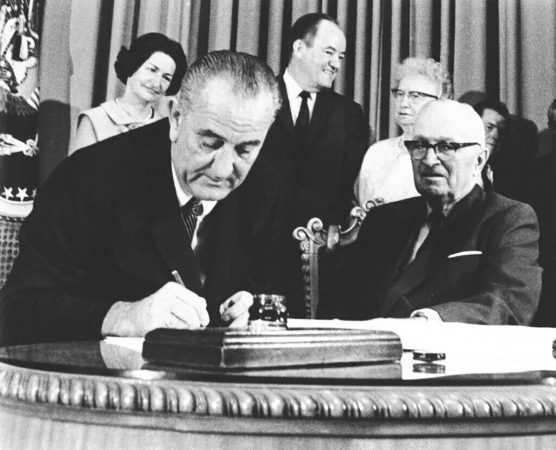
    Everything changed after Congress passed Medicare in 1965. Urged on by civil rights organizations, John Gardner, secretary of the Department of Health, Education, and Welfare (HEW), announced that to receive Medicare dollars, hospitals must comply with the Civil Rights Act. The new health insurance program covered 19 million seniors and promised to pay billions to healthcare facilities — but only if they complied. To Gardner, it was an unprecedented enforcement tool.

    HEW devised a process for determining compliance. Federal workers would inspect facilities. Were patients admitted and assigned the first bed available, regardless of race? Did hospitals extend admitting privileges to Black doctors? Were there disparities between their patient population’s racial composition and that of their service area?

    Made By History sponsors. FOR USE ON MADE BY HISTORY STORIES ONLY.Inquirer Staff

    Hospitals clearly in compliance would receive Medicare dollars. Others clearly out of compliance would not.

    Gardner did not have enough HEW staff to dispatch to inspect the nation’s 4,000 hospitals. So he put out a call for federal employees willing to volunteer in his department and conduct inspections. Over 1,000 came forward including tax accountants, veterinarians and scientists.

    In April 1966, civil rights movement activists trained them. Some violations would be obvious. That included “whites only” signs above entrances, bathrooms and in cafeterias, racially separate medical records and infants segregated by race.

    But trainers warned that hospital administrators might disguise a facility as integrated for the visit. Some did. One put a white administrator in a patient gown in a room with a Black patient. Another placed four comatose patients, each a different race, next to each other.

    Doing the “HEW shuffle” of fixing signs and shifting a few patients was insufficient, the inspectors explained. Facilities needed to be race-blind.

    The combination of a strict standard coupled with inspections worked.

    In three months, nearly all hospitals ended formal segregation and had been Title VI-certified as Medicare providers. After July 1, hospitals that had not been certified as Title VI compliant — those that lagged transforming their facility or refused on principle to do so — could not provide care for Medicare patients.

    The lives of Black people in the South radically changed. Before the intervention Black infants below the Mason-Dixon line died at twice the rate of whites. By 1971, however, Black infant mortality halved, largely because they more readily received care for treatable conditions and their mothers had access to hospitals for the first time.

    Yet, even as Medicare proved enormously successful in erasing formal segregation, racial stratification patterns remained apparent in hospitals throughout the U.S., exacerbated by residential segregation and referral networks systems.

    Ironically, we know this from Medicare itself. The program has long served as a tool for researchers to investigate disparities in healthcare: beneficiaries share a common insurance which makes it easier to isolate inequities.

    And racial separation persists among Medicare patients. Black Medicare patients are disproportionately treated at hospitals with fewer resources and worse outcomes. In some hospitals, certain teams treat only Black Medicare patients. Other teams treat only white ones.

    Starting in 2003, Medicare Advantage expanded the enrollment of Medicare recipients in commercial insurance alternatives. In Medicare Advantage, the federal government pays insurance companies fixed amounts for each enrollee and the companies then manage benefits. These programs, separate and unequal, also expose racial double standards.

    Even within the same Medicare Advantage plan, care is worse for Black and poor enrollees. Black enrollees tend to have worse follow-up care and chronic disease management than white enrollees. Additionally, they experience higher rates of preventable hospitalizations than white beneficiaries and are more likely to be readmitted.

    The 60th anniversary of Medicare should remind us that our greatest advance in health equity came from enforceable commitments to providing equal care, regardless of race. Racial disparities in healthcare can be eliminated if the federal government requires compliance — and then enforces it.

    For hospitals and physicians in 1966, equal treatment suddenly became a condition of financial survival. The immediate gains Black patients received suggest that if the federal government required healthcare systems and insurers to make real, measurable progress toward addressing racial health disparity, it would produce immediate and significant gains once more.

    The question is whether Americans — and their government — are willing to demand such accountability as they did 60 years ago?

    David Barton Smith is emeritus professor of health management and policy at Temple University. He was the recipient of a Robert Wood Johnson Health Policy Research Investigator Award and is author of three books and numerous articles related to this topic.

    Leila Morsy is an economic justice research fellow at the Legal Defense Fund Thurgood Marshall Institute and a senior lecturer at Flinders University. She is writing a book about the history of the exclusion of Black doctors and its contemporary consequences.

    Made by History takes readers beyond the headlines with articles written and edited by professional historians. Opinions expressed do not necessarily reflect the views of The Inquirer.