
Tag: Made By History

  • The federal government typically left gambling to the states — until the prediction markets

    The federal government typically left gambling to the states — until the prediction markets

    Prediction markets are rewriting the rules of American gambling.

    These platforms have taken the country by storm, enabling users to stake money on the outcome of real-world events — everything from who will win a baseball game to the location of Taylor Swift’s wedding.

    For users, prediction markets operate almost indistinguishably from online betting platforms. However, they are technically investment sites. As such, they are not constrained by state and tribal gaming law. They are available in all 50 states — even those with no gambling — and the prediction market companies pay no state taxes.

    States have been fighting back. Twenty-six states are engaged in active litigation against prediction market companies, and several have passed increasingly creative laws attempting to restrict or remove them. Yet, most of these attempts have been thwarted by the Commodities Futures Trading Commission (CFTC), the federal regulator that oversees prediction markets. The Commission insists that, as investment platforms, companies like Kalshi and Polymarket need not concern themselves with state regulation.

    The CFTC position reverses over a century of precedent in terms of how the federal government approached gambling policy. Throughout American history, gambling has generally been treated as a state issue. Where the federal government has intervened, it has been to protect states from gambling — even if doing so meant protecting states from themselves.

    But the current CFTC has flipped this equation. A federal agency is doing its utmost to effectively nationalize gambling, leaving states powerless to control what has historically been under their domain.

    The first federal foray into national gambling policy came in response to an interstate lottery scheme.

    In the 1700s, lottery tickets were almost as easy to find in the U.S. as they are today. “Every part of the United States abounds in lotteries” a Boston newspaper observed in 1791.

    Around the turn of the 19th century, however, the public soured on lotteries. A surge of religious fervor brought with it a wave of anti-gambling furor. By the late 1870s, only a single state licensed a lottery: Louisiana.

    The Bayou State did not just run any lottery. The state government licensed its operation to an entity known as the Louisiana State Lottery Company, better known as “the Serpent” or “the Golden Octopus.” It came by these monikers honestly.

    The LSLC was notoriously corrupt, having slithered its way to political invulnerability through bribes to state officials. The lottery, which nominally existed to raise money for a children’s hospital, actually lined the pockets of its proprietors on the back of $28 million in sales in 1890 alone (modern equivalent: $1.02 billion).

    The Golden Octopus nickname was fitting for another reason: the Louisiana lottery’s tentacles reached well beyond the state’s borders. Operating through the U.S. mail, the LSLC sold roughly 90% of its tickets to residents of other states. The Golden Octopus filled the market void for people without other access to legal lottery tickets, becoming a de facto national lottery.

    This created an uproar because other states were powerless to do anything to stem the tide of lottery tickets into their states. The Louisiana legislature was beyond their control, and it was impractical to crack down on every dreamer clutching a ticket or every piece of mail with a Louisiana return address.

    In late 1890, President Benjamin Harrison condemned how the mail system overflowed with “fraudulent and demoralizing appeals and literature emanating from the lottery companies.”

    The only body truly capable of slaying the Golden Octopus was Congress. It did so with bills in 1890 and 1895 that prohibited the mailing and interstate transportation of lottery tickets, advertisements or paraphernalia.

    States could decide the question of lotteries for themselves, but other states could not decide the question for them. Congress overrode Louisiana’s state gambling law to protect gambling laws in the 43 other states.

    The anti-lottery bills set a clear precedent — one that would be replicated almost exactly a century later, when congressional involvement in gambling even more clearly overrode state authority.
    Made By History sponsors. FOR USE ON MADE BY HISTORY STORIES ONLY.Inquirer Staff

    In the 1960s, states once again began operating lotteries. By the late 1980s, as states experimented with new lottery games, a few began considering sports pools. These were games in which players could attempt to predict the outcome of between three and 14 football or basketball games, with the payout dependent on the amount put up both by the bettor and by all other players.

    The only trouble was that, to the professional sports leagues, these games represented a dangerous wedge that could open the door to legalized sports betting. At the time, the leagues were deeply opposed to all things gambling, viewing any association between it and their product as a threat to the integrity of American sports.

    The leagues mobilized in multiple states to attempt to stamp out sports pools. But by going to Congress, they could pull the weeds out by the root. In 1992, Congress obliged, passing the Professional and Amateur Sports Protection Act (PASPA). The bill did not ban gambling. Rather, it banned states from legalizing sports gambling, leaving a few exceptions for states that had already authorized a form of betting, most notably Nevada.

    Anyone who has watched a sporting event in the last eight years knows that PASPA did not last. In 2018, the Supreme Court overturned the bill on the grounds that, according to Justice Samuel A. Alito Jr.’s majority opinion, Congress had usurped state authority as enshrined in the Tenth Amendment: “A more direct affront to state sovereignty is not easy to imagine.”

    Congress could regulate sports gambling. But in creating a patchwork set of rules that banned states from deciding the issue for themselves, it had gone too far in asserting authority over states’ rights. The decision has led to an explosion in online sports betting, with the major sports leagues now embracing gambling and integrating it into their telecasts.

    A few years after legal sports betting took off, prediction markets endeavored to broaden the base of gambling options. Though the Biden administration tried to restrict them, the Trump White House has taken a different approach, authorizing the platforms to expand their offerings from bets on political events like elections to sports, pop culture and seemingly every imaginable topic. It has done so with the direct support of President Donald Trump, whose son, Donald Trump Jr. has financial stakes in both Kalshi and Polymarket.

    For some states, the federal government has once again gone too far on gambling, this time in the opposite direction. Instead of prohibiting states from legalizing gambling, the CFTC has created a national system of de facto gambling in contravention of state and tribal gambling law.

    One direct result is that while most states set the legal gambling age at 21, investment platforms are available to anyone over the age of 18, meaning the CFTC has effectively lowered the national age to legally bet.

    The current CFTC rules are even more vulnerable than PASPA was. Because they’re regulations, not laws, a change in presidential administrations — and by extension, the leadership of the CFTC — could lead to an overhaul of the Commission’s approach to prediction markets. Additionally, passage of any one of the bipartisan bills that have been proposed in Congress to rein in prediction markets could swiftly constrain the experiment in federally-mandated gambling.

    As history shows, gambling law is not forever. States have generally been left to decide for themselves how much gambling they want to offer, with the federal government setting a limit as it sees fit. Odds are that arrangement could return.

    Jonathan D. Cohen leads gambling policy for the American Institute for Boys and Men. He is the author of Losing Big: America’s Reckless Bet on Sports Gambling. Made by History takes readers beyond the headlines with articles written and edited by professional historians. Opinions expressed do not necessarily reflect the views of The Inquirer.
  • History shows how negotiations with Iran can achieve American goals

    The memorandum of understanding (MOU) between the United States and Iran is far from peace. It hasn’t even ended the fighting.

    But that is not the right way to judge the MOU.

    The real question is whether it eventually creates a political process that can do what force and pressure have repeatedly failed to do: give both sides a way to step back from escalation without appearing to surrender. For the United States, that means restraining Iran’s nuclear capabilities and behavior in the region. For Iran, it means something just as important: preserving sovereignty and political dignity, while moving from confrontation to negotiation.

    History provides a pathway for both sides to achieve what they want. At key moments in the past, Iran has engaged in constructive diplomacy because it could present negotiation not as a capitulation to outside powers, but as a means of defending national rights, territorial integrity and political independence.

    In other words, Iran will negotiate for sovereignty, not surrender. And this insight from the past should guide the current negotiations.

    After World War II, Soviet troops remained in northern Iran and supported separatist movements there. Tehran resisted the fragmentation of its territory and brought the issue before the newly created United Nations.

    For Iran, this was not a passive appeal for outside rescue. It was an effort by a weaker state to use international diplomacy to resist the pressure of a much stronger power. Tehran’s strategy mattered because it allowed Iran to defend its sovereignty through political means rather than by accepting fragmentation or relying on force alone.

    The crisis ended with Soviet withdrawal and became one of the earliest tests of the postwar international system.

    The outcome did not erase the imbalance between Iran and the great powers, but it showed that diplomacy didn’t mean accepting humiliation. Instead, it could offer Iran a forum in which its territorial integrity and political independence could be asserted and protected. That, in turn, allowed Tehran to frame compromise and de-escalation as the defense of its sovereignty.

    Forty years later, the newly declared Islamic Republic again used diplomacy to counter a threat — this time to end a war.

    Iran and Iraq had been at war for most of the 1980s. The conflict was devastating. Iran suffered enormous human and economic losses, and the fighting was increasingly difficult to sustain.

    In 1988, Iranian leaders accepted a ceasefire under the auspices of the United Nations.

    That decision was painful. It did not reflect trust in Iraq, the United States or the broader international system. Nor did it mean that Iran had suddenly abandoned the revolutionary language through which it had justified years of sacrifice. Instead, it reflected a sober recognition that endless war no longer served Iran’s survival, sovereignty or national welfare.

    Iranian leaders weren’t eager for compromise. But it became possible, because they could sell the ceasefire as a way to preserve the state rather than to surrender it. It allowed Tehran to move from war to diplomacy while still claiming to have defended the nation.

    This pattern of diplomacy continued after the Sept. 11, 2001 terrorist attacks. Despite decades of hostility, the United States and Iran found overlapping interests in Afghanistan. Both opposed the Taliban, and Iranian diplomats played a constructive role following the Taliban’s initial defeat. Iran wanted a stable Afghanistan that would not again become a Taliban sanctuary on its eastern border; the United States wanted help building a post-Taliban order without getting bogged down immediately in another regional confrontation.

    Made By History sponsors. FOR USE ON MADE BY HISTORY STORIES ONLY.Inquirer Staff

    The episode demonstrated something important: Iran could work with the United States — a bitter adversary — when it could pursue its concrete interests, and when the U.S. was not demanding that the Iranian regime humiliate itself.

    Cooperation over Afghanistan did not require Iran to surrender sovereignty or accept an American-dominated regional order. It allowed Tehran to advance a security interest while being treated, however briefly, as a political actor whose interests mattered. For the United States, it showed that limited engagement with Iran could serve American goals without requiring trust or friendship.

    This cooperation did not produce a new era of U.S.-Iranian friendship. Rather, it soon collapsed under the weight of mistrust, ideological hostility and American domestic politics.

    Fourteen years later, the 2015 nuclear agreement offered a more formal version of the same lesson. It did not end disagreements between Washington and Tehran over sanctions and Iran’s role in the Middle East. But it showed that verification, sequencing and reciprocal concessions could reduce one of the world’s most dangerous nuclear confrontations.

    The agreement was possible because it gave both sides something they could defend politically. Iran could say it had preserved its right to a civilian nuclear program and won sanctions relief. The United States and its partners could argue they had imposed limits, inspections and verification mechanisms on Iran’s nuclear activities. Each side could present the deal as a hard bargain that protected national interests.

    As in 2001, the agreement eventually collapsed. That exposed how diplomacy with Iran will always be vulnerable because mistrust runs deep, domestic opponents on both sides can always repackage compromise as surrender and powerful regional actors continue pressing for conflict.

    Despite these vulnerabilities, those working on the current MOU should recognize that diplomacy has been the only thing that has worked in the past — so long as Iranian leaders can sell negotiations as defending national rights and sovereignty, and outside powers like the U.S. can show that they have made Americans and their allies safer.

    While history does not guarantee success, it does suggest that it’s possible to forge an outcome in which the conflict between the U.S. and Iran can be managed politically — if each side recognizes the other side’s political constraints.

    Zach Battat is a historian of the modern Middle East whose work examines diplomacy, empire and external power politics in the region.

    Made by History takes readers beyond the headlines with articles written and edited by professional historians. Opinions expressed do not necessarily reflect the views of The Inquirer.
  • JD Vance has a lot in common with one of his predecessors

    JD Vance has a lot in common with one of his predecessors

    Speaking to an applauding audience at the Richard M. Nixon Library on June 27, Vice President JD Vance favorably compared himself to the 37th President, “a young Senator, Vice President, writes some best-selling books, is hated by the media, it kind of sounds like JD Vance.”

    But in actuality, it’s not Nixon who Vance resembles. It’s Nixon’s vice president, Spiro Agnew. Agnew, a dour-faced hatchet man, was known as “Nixon’s Nixon.” Our current dour political hatchet-wielder is Trump’s Agnew.

    Vance and Agnew share similar resumes. Both were elevated to the national ticket well ahead of their times to appeal to particular electoral constituencies and took on remarkably comparable foes during their vice-presidential terms.

    Like Vance, Agnew came from humble beginnings. The son of a Greek immigrant father and Virginia-born mother, his family owned a diner in Baltimore. Before joining the military and serving in World War II, he Americanized his foreign sounding first name to “Ted” and returned from combat to attend law school on the GI Bill. In 1966, Agnew won the Maryland governor’s race.

    Despite scant political experience, Agnew came to the attention of influential Nixon adviser Pat Buchanan, who recognized that there was national political appeal to the governor’s tough response to rioting in Baltimore following the assassination of Martin Luther King Jr. Agnew had pointedly criticized what he charged was the weak response of local Black leaders to civil disorder. Given that he wasn’t unacceptable to any of the feuding wings of the GOP — unlike many more prominent figures — this was enough for Nixon to make Agnew his running mate.

    Once on the ticket, the Nixon campaign deployed Agnew to counter the alarming momentum of third-party candidate, segregationist and former Alabama Gov. George Wallace. On a campaign swing through North Carolina and Florida, Agnew rallied the crowd with “speeches that sounded not unlike Wallace texts,” the New York Times reported. In 1969 Wallace quipped, “I wish I had copyrighted my speeches. I would be drawing immense royalties from Mr. Nixon and especially Mr. Agnew.”

    Agnew struggled in his first few months in the national spotlight and became known more for campaign trail gaffes than for policy positions.

    Even so, Agnew successfully connected with nervous white suburbanites, primarily in the Midwest and South, who feared civil rights, mistrusted the metropolitan elite and wanted the anti-Vietnam War protesters put in their place. This group of voters — who Nixon later referred to as “the silent majority” — became Agnew’s biggest supporters.

    Agnew’s penchant for gaffes and awkwardness continued after he and Nixon entered office. At a ceremony welcoming President Nixon home from a European trip in March 1969, Agnew slipped on an icy tarmac and smashed his nose. He then stepped up to the mic “bleeding profusely,” according to White House aide H.R. Haldeman.

    Yet, Agnew’s response to his (literal) stumbles helped him to connect even more with anxious white Americans. He refused to stand by and let well educated elites or the news media mock him. Instead, the vice president lambasted them as “an effete corps of impudent snobs” and “the nattering nabobs of negativism,” respectively. Agnew started delivering blistering speeches with the help of Buchanan and his fellow White House speechwriter William Safire, excoriating precisely those forces who anxious white Americans loathed.

    In November 1969 in Des Moines, Agnew made what a poll of leading scholars considered one of the 50 most significant American speeches of the 20th century. The vice president publicly called out the media, what he dubbed “this little group of men who not only enjoy a right of instant rebuttal to every Presidential address, but, more importantly, wield a free hand in selecting, presenting, and interpreting the great issues in our nation.” It would launch a more than half-century-long GOP crusade against mainstream journalists.

    In other speeches, Agnew hammered universities for what he described as the coddling of student radicals, calling them ”circus tents [and] psychiatric centers for overprivileged, under-disciplined, irresponsible children of the well to do blasé permissivists.” Agnew warned, “The criminal left is not a problem to be solved by the Department of Philosophy or the Department of English — it is a problem for the Department of Justice.”

    By the 1972 election, Nixon loathed the pugnacious Agnew and regularly disparaged him privately. He questioned his vice president’s intelligence, judgment and loyalty. Nixon, according to Haldeman, felt “Agnew doesn’t really have it” and had become convinced that “he can’t do the job” of president, should it come to that. The president even contemplated replacing Agnew on the ticket with Texas Gov. John Connally.

    Yet, he demurred, because Nixon recognized how popular the vice president was with his “silent majority” base. Observers initially touted Agnew as a front-runner in the 1976 Republican presidential sweepstakes. Instead, however, the vice president’s political career crashed and burned.

    Made By History sponsors. FOR USE ON MADE BY HISTORY STORIES ONLY.Inquirer Staff

    In 1973, 10 months before Watergate ended Nixon’s presidency, Agnew pled no contest to tax evasion, stemming from unreported bribes he had received while governor of Maryland. Agnew slunk away from public life, disbarred and disgraced, to an odd final chapter of his life that included writing a steamy novel, lobbying for tin pot dictators and engaging in antisemitic conspiracy-mongering.

    A half century after Agnew left office, Vance is having a very similar vice presidency.

    He, too, comes from working class roots. The vice president grew up as James David Hamel in a working-class household in an Ohio Rust Belt town. There, he experienced poverty and domestic instability. Like Agnew, he served in the military, went to law school and spent only two years as an elected official — in Vance’s case, two years in the Senate — before being chosen as the GOP’s vice presidential nominee.

    Just as Pat Buchanan sold Agnew to Nixon as a Silent Majority kindred spirit, pundit Tucker Carlson promoted Vance to Trump as a fellow America Firster. Like the former Maryland governor, Vance joined the Republican ticket in part because he could speak to “blood and soil” Americans.

    Additionally, like his predecessor, Vance has experienced verbal stumbles. In 2021, anticipating a future Kamala Harris run for the presidency, he claimed that America was run “by a bunch of childless cat ladies who are miserable at their own lives and the choices that they’ve made, and so they want to make the rest of the country miserable too.”

    In 2025, the vice president broke the national championship trophy in a ceremony with the Ohio State University football team. That year, the newly converted Catholic also earned gentle but firm pushback from Pope Francis for Vance’s jaw-dropping misinterpretation of the Church’s message on immigrants.

    Trump has also deployed Vance as an attack dog, going after the same universities and media outlets Agnew regularly tangled with. Even before he was elected to the Senate, Vance told the National Conservatism Conference that “if any of us want to do the things we want to do for our country and the people who live in it, we have to honestly and aggressively attack the universities in this country.” As vice president, he has frequently targeted the media, charging that journalists have a “political bias” and cannot be trusted.

    And like Nixon before him, Trump doesn’t seem 100% sold that his vice president is the rightful heir to his political legacy. Most recently, Trump talked about his decision to have Vance serve as the lead negotiator to end the war with Iran by throwing him under the bus, saying, “If it works out, I’m going to take the credit. If it doesn’t work out, I’m blaming JD.”

    Vance’s post vice presidential chapter has not yet been written but it is a good bet that he will run for president in 2028.

    If he decides to seek the top job, he will run, not as a Richard Nixon Republican, but as a Spiro Agnew one. Nixon’s Watergate cover-up and general paranoia overshadowed a more moderate side: the diplomatic achievements, support for environmental protections and the creation of Title IX.

    Agnew, by contrast, was an emblem of the pugilistic, populist politics that Vance has made his calling card. Those, and not substantive policy achievements, constitute Agnew’s historical legacy. Vance’s is likely to be the same.

    Chuck Holden is a professor of history at St. Mary’s College of Maryland. Zach Messitte is the former president of Ripon College where he was also a professor of Political Science. Jerald Podair is professor of history and Robert S. French professor of American studies emeritus at Lawrence University. They are the co-authors of Republican Populist: Spiro Agnew and the Origins of President Donald Trump’s America (University of Virginia Press, 2019)

    Made by History takes readers beyond the headlines with articles written and edited by professional historians. Opinions expressed do not necessarily reflect the views of The Inquirer.
  • Why the Liberty Bell still rings true

    Why the Liberty Bell still rings true

    In 2025, Pennsylvania updated its license plate design to feature the Liberty Bell, a prescient move for this year’s Semiquincentennial, where the Liberty Bell continues to play a central role—not as a relic of revolutionary history, but as a surface on which Americans have inscribed their ideals, disappointments, demands, and dreams.

    The Liberty Bell’s provenance is unique: by 1751, the Pennsylvania State House needed a bell to summon lawmakers to session, gather citizens for announcements and town meetings, and signal special commemorations and events by ringing through the air. Tolling bells could also serve as warnings of fire or other dangers. To be a fully functioning statehouse, a bell was ordered from the famous Whitechapel Bell Foundry in London, which finally closed shop in 2017, after 450 years of business. The bell famously sailed into Philadelphia in one piece, only to crack significantly upon its first ring.

    In response, artisans John Pass and John Stow melted down the original bell and recast a new one. This bell remained intact for almost 100 years, until sometime in the early 1840s, when it cracked again. This time, instead of melting the bell down, foundry workers tried to repair the crack by widening it to prevent further spread. Instead, a second crack appeared, and the bell was silenced forever.

    One would think a bell without a ring was a literal death knell. Instead, and rather miraculously, the bell took on another life, and another, and another after that in historical memory.

    In 1755, Benjamin Franklin mentioned the bell in correspondence with Catharine Ray, writing, “Adieu. The Bell rings, and I must go among the Grave ones and talk Politicks.” Like many others, he did not consider the bell’s association with liberty during the Revolution, perhaps because Philadelphia was under British control for nearly nine months and, for most of the war, he was across the Atlantic, working for freedom in another way.

    As far as we know, the bell was not rung when the Declaration of Independence was read. But throughout the long 19th century that followed the Revolution, political activists of all stripes rallied around the words inscribed on the bell: “Proclaim Liberty Throughout All the Land Unto All the Inhabitants Thereof” (Leviticus 25:10).

    The Biblical phrase, perhaps commemorating William Penn’s 1701 Charter of Privileges, which granted broad religious freedom and representative government to (some) of the people of Pennsylvania, was adopted, for example, as a symbol of freedom to end slavery. The bell was given the name “Liberty” in the sense of liberation—striving for self-rule in the most basic and humane sense by promoting abolition.

    In other words, it was not the Revolution that gave the bell its lasting significance, but the Americans who, thereafter, kept the pursuit of freedom ringing in our ears. Women seeking suffrage. Civil Rights campaigners invoking its biblical call for equality. Cities pursuing community, memory, and history. Its transformation continues today, 250 years beyond the revolution.

    Given this history, we understand why the Liberty Bell is visible again during the Semiquincentennial—on our license plates, in commemorative materials and public celebrations, and even as a giant inflatable balloon at the No King’s Rally on the steps of the Pennsylvania State Capitol Building in Harrisburg on March 28. Despite the blustery, cold day filled with flags and a large, grounded eagle puppet, the Liberty Bell remained firmly in place at the top of the steps, where people below gave speeches and rallied for freedom. Of course, nylon ropes secured the inflatable to the ground, but the massive yoke’s symbolic presence, attached to the bell, felt strong and unrelenting.

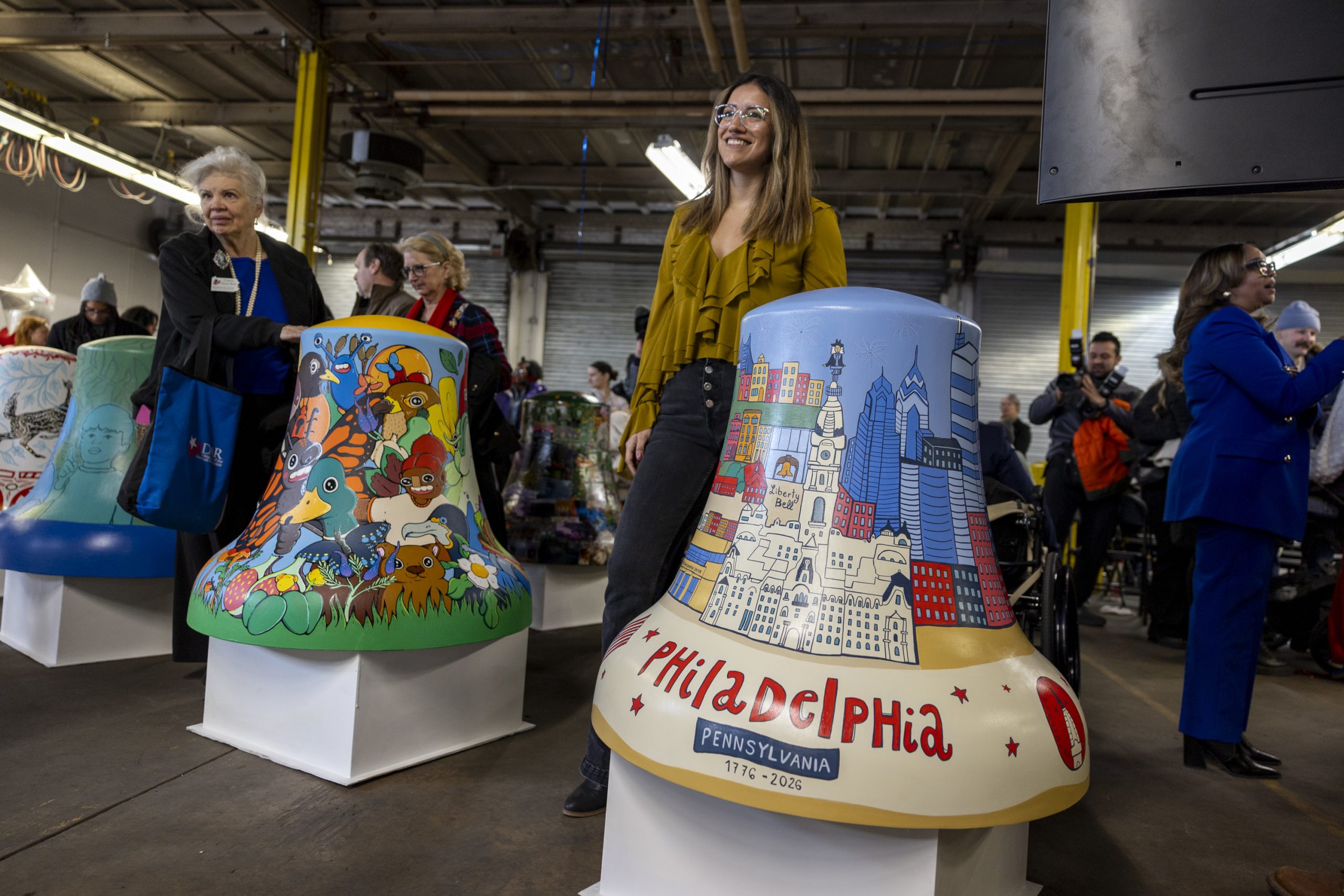
    Ana Thorne, of Center City, 37, is next to the bell they made during the Bells Across PA event in celebration of America’s 250th Birthday in Philadelphia earlier this year.Tyger Williams / Staff Photographer

    The Liberty Bell also appears in the Commonwealth’s Semiquincentennial public art initiatives. In Bells Across PA, fiberglass bells decorated by communities across the state appear in each of Pennsylvania’s 67 counties. This kind of collective work, common in community-made public art, remains popular because the project’s scale is manageable and the local scenes painted on the bells carry meaning for those who decorate them. In this case, it is not monumental art by trained artists, but rather youth and adults who hope to create something everyone can recognize and enjoy.

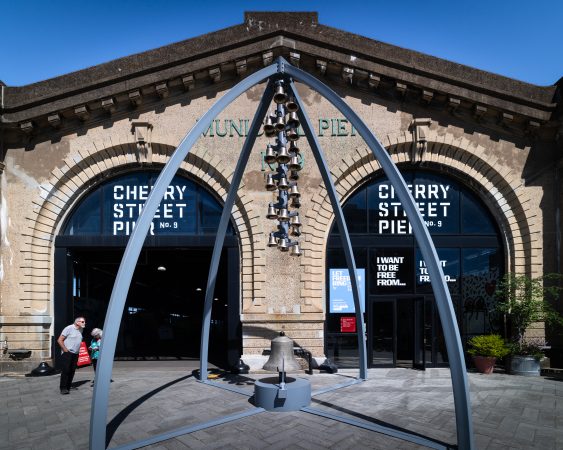
    Philadelphia’s most compelling contribution to this conversation may be the public artwork Let Freedom Ring by artist Paul Ramírez Jonas. Originally commissioned by Monument Lab in August 2023 for the National Mall in Washington, D.C., the reinstallation of Let Freedom Ring by the Association for Public Art is on view at the Cherry Street Pier through Sept. 27. The monumental bell tower plays “America (My Country, ‘Tis of Thee)” but intentionally omits the final note. Visitors must ring a Liberty Bell-inspired bell to complete the song. The work poses a deceptively simple question: for whom does freedom ring? The answer is left unfinished and requires public participation.

    Made By History sponsors. FOR USE ON MADE BY HISTORY STORIES ONLY.Inquirer Staff

    Public art succeeds where monuments sometimes fail by fostering participation rather than passive observation. Rather than presenting history as settled and complete, it invites people to join a conversation across time. The Liberty Bell has always functioned this way. Its inscription is not a statement but a challenge. Its crack is a visual reminder that we must work to close the distance between us.

    Today, that challenge and the distance feel especially urgent. The words “Proclaim Liberty Throughout All the Land Unto All the Inhabitants thereof” prompt Americans to consider who is included in that promise and who remains excluded. Each generation has answered differently and struggled to reconcile the nation’s aspirations with its realities.

    The stories of the Liberty Bell’s creation, its cracking, its inscription, and its use as a symbol across generations remind us that public art and history can commemorate, criticize, and build community. They can also transform a historical artifact into a forum where each generation redefines liberty. In this Semiquincentennial year, everyone pursuing happiness can make the Liberty Bell their own.

    Editor’s note: This story has been updated to clarify that Let Freedom Ring was reinstalled by the Association for Public Art during the semiquincentennial.

    Laura A. Macaluso, PhD., is the creator of the digital humanities project Objectify Benedict Arnold: Making Memory of America’s Traitor.

    The “Road to 250” series is an initiative of Historians for 2026, a group of early American academics, public historians, archivists, and educators devoted to shaping an accurate, inclusive, and just public memory of the American Founding for the 250th anniversary.

    Made by History takes readers beyond the headlines with articles written and edited by professional historians. Opinions expressed do not necessarily reflect the views of The Inquirer.
  • History suggests LGBTQ Republicans are making a mistake in Texas’ Senate race

    History suggests LGBTQ Republicans are making a mistake in Texas’ Senate race

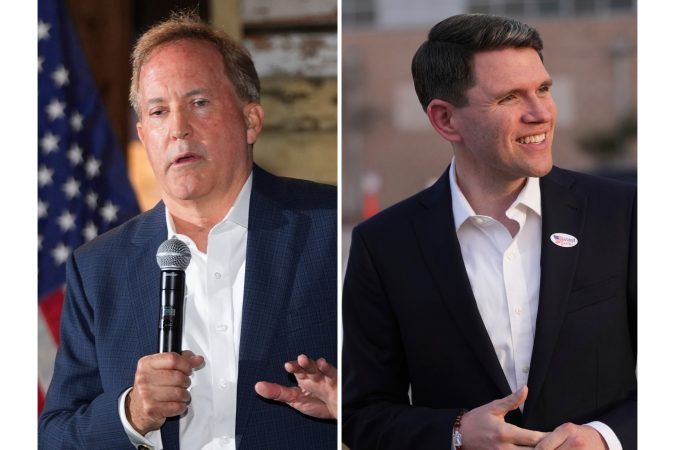
    With more than three months until Election Day, the Republican campaign against Texas Democratic Senate candidate James Talarico has already made national news for its ugliness.

    The baseless accusations against him have included claims that he’s a vegan — a near blasphemy in the beef-loving state. But the centerpiece of the campaign has been repeated assertions that he is gay or trans.

    Not long after Talarico won the Democratic primary, White House Deputy Chief of Staff Stephen Miller posted on X, “The Democrats made history in Texas by nominating their first transgender senate candidate,” an attack he later repeated in an appearance on Fox News, in which he added that Talarico was “clearly transitioning into a female.”

    And Miller is far from alone. Talarico’s opponent, the scandal-plagued state Attorney General Ken Paxton, dubbed Talarico “six-gender Jimmy” and “Talafreako,” claiming he’s “too low-T for Texas.” Texas Gov. Greg Abbott even posted pictures of Talarico as a woman.

    Amid all of this mudslinging, one group has been noticeably silent: LGBTQ Republicans. Their failure to speak out against the assault on Talarico — which seems more an attempt to delegitimize his masculinity than to actually question his sexuality — signals a capitulation to Republican homophobia and anti-LGBTQ bigotry, not to mention a risky betrayal of their own history.

    Gay Republican organizing began in California in the 1970s as an attempt to offer an alternative to liberal gay organizations that often worked closely with the Democratic Party. The activists hoped to show that they were loyal Republicans and, in the process, stamp out the antigay “family values” politics that was beginning to take shape within the GOP.

    Two particular events in 1978 hastened this development. One was Ed Davis’ run for the Republican nomination for California governor. As Los Angeles police chief, Davis had directed the city’s law enforcement to harass gay and lesbian people. Running for political office, Davis often railed against “fruits” and “fairies.”

    That same year, a ballot initiative, Proposition 6, sought to make it illegal for any gay person to work in California’s public school system. Its sponsor, conservative Orange County state legislator John Briggs, regularly equated homosexuality with pedophilia and charged that gay teachers would molest schoolchildren.

    Gay Republicans sprang into action, taking great personal and professional risks to publicly organize and mobilize against these threats.

    They wanted to send a strong message to the GOP to reject the emerging religious right. In their view, religious conservatives who were trying to use the government to regulate and sometimes criminalize private matters, including sexuality and reproductive decisions, were anathema to the Republican Party’s tradition of individual rights and personal freedom. But they knew if an antigay ballot initiative won in a large state like California, it would make it even harder to stop the GOP’s national slide from social moderation to conservatism.

    Both Davis and Proposition 6 lost, signaling that gay Republican activism could work.

    The activists recruited other gay and lesbian people to register as Republicans to vote against outspoken homophobes in the party’s primaries and support its moderate candidates. And they insisted to party officials and Republican politicians, including Ronald Reagan, that allowing homophobic language and endorsing antigay legislation would alienate thousands of moderate and independent voters.

    Gay Republicans were thrilled when Reagan declared during his 1980 presidential campaign that although he did not support “homosexual rights,” he also believed there was no “place in our society for intolerance and discrimination.” Despite the seeming contradictions in this position, gay Republicans thought it gave them the leverage to nudge the party in a more progressive direction.

    With that goal in mind, gay Republican groups formed across the country in the 1980s, culminating in the creation of the Log Cabin Republicans, the nation’s oldest and largest LGBT Republican organization. The national organization and its state and local chapters worked against antigay efforts around the country as they sought to root out homophobia and antigay bigotry within the party.

    These groups continued to argue that abandoning bigotry could provide electoral benefits. “Republicanism is a philosophy that is closer to the hearts of gay people than is the extreme liberalism of the Democrat Party,” one pamphlet asserted. But for many gay voters, the GOP was off-limits because “of the extreme hate expressed toward gay people by certain elected GOP persons.”

    Made By History sponsors.Inquirer Staff

    When socially moderate and gay-friendly Republicans won races, especially in Democratic strongholds, gay Republican activists touted the victories as proof that they were right. After Rudy Giuliani narrowly won the 1993 New York City mayoral race, for example, they pointed out that he did so with nearly a third of the city’s gay vote.

    These victories emboldened gay Republicans, who continued to target antigay Republican politicians and encourage the GOP to prioritize economic and national security issues over culture war resentments. For decades, the Log Cabin Republicans saw themselves as existing to hold the Republicans’ feet to the fire until they eliminated — or, at least, effectively marginalized — the party’s homophobic voices.

    Leading gay Republicans, like Log Cabin president Rich Tafel, regularly squared off against religious right figures on television, shaming their homophobic views as un-American and a disaster electorally. “The gay-bashing party of Falwell and Pat Robertson will never be the majority party in this country,” Tafel contended.

    Gay Republicans scored a major victory when George W. Bush committed that the 2000 Republican National Convention would include no antigay talk in the proceedings — a significant result given that just eight years earlier, commentator Patrick Buchanan had delivered a blistering keynote address while some delegates waved signs that read “Thank God for AIDS” and “Family Rights Forever / Gay Rights Never.”

    The Bush administration still went on to work diligently against the legalization of same-sex marriage. Even so, gay Republicans saw changing the tone within the GOP as a crucial first step toward conservative Americans eventually supporting basic rights like same-sex marriage. And as Republican voters, especially critical suburban moderates, became more accepting of homosexuality and gay rights, gay Republicans pressured the party to avoid homophobic messaging and antigay language, if not to abandon antigay politics altogether.

    And when the GOP refused to listen, gay Republicans fought back. During the 2004 presidential campaign, Log Cabin Republicans refused to endorse Bush because of his support for a constitutional amendment to ban same-sex marriages and his tolerance of antigay language in the party platform. Gay Republicans felt they had to make their opposition clear. “If you remain silent while people are kicking you in the stomach,” Log Cabin’s executive director explained, “you become completely irrelevant.”

    But this sort of opposition has come to a screeching halt in the Donald Trump era. Ironically, LGBTQ Republicans have a particularly close relationship with the president and unusual access to this White House. Additionally, gay men occupy numerous high-profile positions within the Trump administration, including Treasury Secretary Scott Bessent. Yet, these gains have scrambled how gay Republicans navigate their peculiar place within the party.

    On the one hand, they continue to speak out against some homophobia from elected Republicans, such as Rep. Andy Ogles’ (R., Tenn.) posting on X at the start of Pride Month that “Homosexuality has no place in America.” Yet, their decision to remain silent about the attacks on Talarico may speak even louder.

    It’s unclear whether they see the campaign against Talarico as an unserious attempt at humor or worry that scolding the party would be an embrace of the “political correctness” Trump has made anathema in the GOP.

    Yet, whatever their reasons, their silence signals a troubling return to the Republicanism of the past that used outright homophobia for political gain — and a forewarning of things to come. Even worse, it’s coming at a moment when Americans are exhibiting declining support for LGBTQ issues, and Republicans’ backing of same-sex marriage has plummeted, down 18% from just four years ago.

    Undoubtedly, gay Republicans have always made compromises and chosen their battles carefully in order to exert influence within the GOP. Yet, none of this included turning a blind eye to Republican homophobia; instead, they directly confronted it — even when it came from lukewarm allies like Bush.

    Gay Republicans may believe that by overlooking the attacks on Talarico, they can show themselves to be good sports who are not easily offended, true conservatives who know the difference between campaign hijinks and serious political threats, unlike LGBTQ liberals. Yet, they may soon discover that the slurs against Talarico were not an isolated swipe at a political opponent — and, worse, that their silence has facilitated the return of the GOP’s assault on LGBTQ rights.

    Neil J. Young is the author of “Coming Out Republican: A History of the Gay Right.” He lives in Los Angeles.

    Made By History takes readers beyond the headlines with articles written and edited by professional historians. Opinions expressed do not necessarily reflect the views of The Inquirer.
  • Philly’s public toilets are important in lots of ways. We need more of them.

    Philly’s public toilets are important in lots of ways. We need more of them.

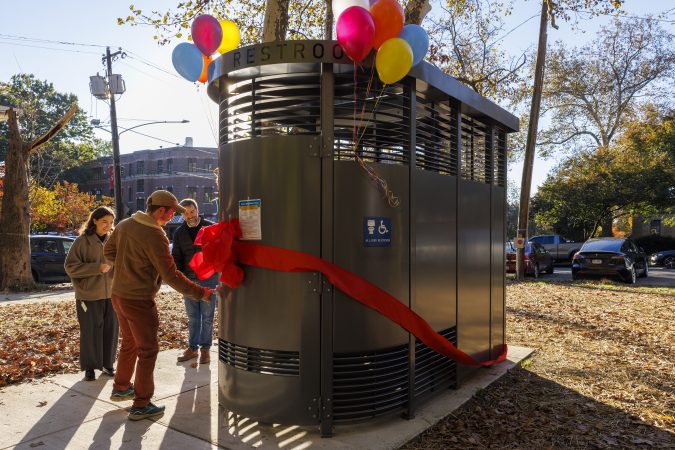
    I am a toilet scholar, and I live in West Philly. No surprise, then, that my interest was piqued when I read about, Philly Phlush, the city’s cheekily named new public bathroom program. Starting in 2023, the city promised to build six stand-alone, single-user “Portland Loos.” I was even more interested the next year when I heard that one of these new public toilets would be opened near my house in Clark Park.

    By that time, I had been looking into the history of public bathrooms in the United States for more than five years, digging through archives and pouring over digital records, including countless Philadelphia Inquirer articles from over the past century.

    My research revealed that public bathrooms in Philly (and everywhere else) mattered because they were a prerequisite for making the city accessible. That meant where city leaders placed these facilities was critical and reflected which residents and communities they cared about the most.

    But also, I knew that the state of public bathrooms is a kind of real-time test of how far governments are willing to go, or not go, in the service of the most basic needs of their citizens. Really, public bathrooms uncover who is included and excluded at a given moment. These same dynamics made clear why that Portland Loo in my neighborhood said something about what Philly is currently doing right, and what other cities can learn from it.

    The story of public bathrooms, toilets built and maintained by local governments and generally open to all, started 150 years ago as the United States was set to celebrate another milestone, its 100th birthday. Like other cities, Philadelphia was getting bigger and denser as the 19th century ended. Bricklayers heading to a ball game or a job, the faithful in search of a charismatic preacher, and nickelodeon patrons went further from home each day for work, worship and fun. As they did, they needed bathrooms. But many quickly realized that the existing network of privately-operated toilets in restaurants, department stores, hotels and saloons were not extensive enough, or clean enough, to support the growth of the city. Temperance groups, ethnic clubs, women’s organizations and business associations in Philadelphia, as in other cities, pressed for municipal leaders to filled in the gaps with new, publicly-financed “comfort stations,” as the first public bathrooms were called.

    Cities responded, and not begrudgingly. Local officials held ribbon-cutting ceremonies and bragged to reporters about the marble countertops and hand-crafted mahogany doors in the new facilities.

    Few of these comfort stations reached into working-class, immigrant or Black neighborhoods. The sparkling new facilities were meant for salesmen, bankers and bakers, train travelers and female shoppers. These people comprised “the public” that turn-of-the-century city officials had in mind when they allocated funds for well-appointed, away-from-home toilets.

    But they weren’t the only people who showed up at the stall doors and urinals of newly-built public bathrooms. As early as 1905, police officers and civil servants complained that the costly new comfort stations attracted an unanticipated crowd of drinkers, smokers, slackers, vagrants and sex-seekers. They pushed for more surveillance and more arrests, and they learned, without openly admitting it, what officials would learn again at the end of the 20th century: it is difficult to arrest your way out of a problem. In the face of failure, municipal leaders shifted gears; they pulled back funding and cut back on maintenance for public bathrooms, making these places unacceptable to the middle-classes.

    Eventually, they took a final, drastic step to keep the unwanted away. City officials across the country closed public bathrooms to stop men and LGBTQ people from having sex in the relative privacy of stalls and out-of-the-way facilities. They closed them to prevent angry teens and drunken adults from also taking advantage of the privacy of these places and smashing sinks and pulling down towel dispensers. By the 1980s, as Reagan-era budget cuts ripped holes into the social safety net and drained the coffers for public housing, cities closed even more public bathrooms to try to “disappear” the unhoused, and bathroom-less, from downtown streets and up-and-coming financial districts.

    But in the drive to edit the public, municipal leaders made the city inaccessible for workers, students, families and shoppers, as well as those deemed undesirable.

    With no public bathrooms near Independence Mall or Rittenhouse Square, the private sector that had failed decades before once again took over. But only to the advantage of some. Those who could paid for bathrooms, first with coins slipped into lock boxes drilled onto toilet stall doors, and later with credit cards for lattes and iced coffees for a “free” trip to the bathroom. Those who couldn’t afford the “latte tax” or lived in an area without a Starbucks or a Bass Pro Shop had only the street, bushes and the spaces between cars “to go.”

    Toward the end of the 20th century, American cities experienced something that they hadn’t dealt with since before the American Revolution: open defecation and public urination, all day long and not just when the bars emptied in the early morning hours. This forced the hand of policymakers. They once again had to fund public bathrooms or face capital and population flight. But they didn’t put funds into public toilets to make the city more open or accessible; they did it, largely, to contain the unhoused and their bodies and to clean up central business districts and keep commerce flowing.

    That’s what Los Angeles did. That’s what Albuquerque, N.M., and Cambridge, Mass., did. They built new public bathrooms—not the ornate facilities of the past, but functional ones, like Portland Loos with steel toilets, or hard plastic porta potties. These new toilets, unlike their early 20th century predecessors, weren’t meant for middle-class tourists visiting the Constitution Center, suburban lawyers in town for a trial, or even for Walnut Street shoppers. They weren’t there to solve the housing crisis or to deal with the problems of addiction or cuts in spending on mental health—some of the key factors leading to jumps in homelessness. They were there to contain the failures of the system and the bodies of the poor and unhoused, and to make the city look and smell better for everyone else.

    Philly joined in this trend but with a twist.

    The first Philly Phlush toilet opened in Fotterall Square, a revitalized park with basketball courts, walking trails and movie nights on 11th Street in North Philadelphia. The second was located at 15th and Arch Streets in Center City across from Love Park, not far from bustling Suburban Station. The third was the one in my neighborhood, just north of the corner of 43rd Street and Woodland Avenue.

    Made By History sponsors. FOR USE ON MADE BY HISTORY STORIES ONLY.Inquirer Staff

    By placing public toilets in North and West Philly, Philadelphia did something markedly different from most other cities. It sited its bathrooms not just so they could control people considered problematic, but to meet the needs of city residents in their neighborhoods. These toilets outside of Center City promised to make parks and squares available to parents and kids; they made it easier to stroll through a farmer’s market, watch a film on a summer’s night and play basketball all day long without the risk of discomfort, embarrassment or even arrest.

    Philly, and every other city, should fund and maintain public bathrooms. The more the better. They should put them where people are and where they live. They should maintain them, because infrastructure needs ongoing care, and everyone needs clean spaces to attend to their bodies away from home.

    Public bathrooms can’t solve every problem created by decades of government neglect, and they shouldn’t be expected to. But they can address the health and safety of city residents right now. Even more, away-from-home toilets, situated both in business districts and neighborhoods, are fundamental building blocks to a city open and equal to all, to a Philadelphia that shows through investment and maintenance that it cares about the people who visit and live here.

    Bryant Simon is the academic chair of the Honors Program and a history professor at Temple University. He is the author of the forthcoming book, For Customers Only: Public Bathrooms and the Making of American Inequality.

    Made by History takes readers beyond the headlines with articles written and edited by professional historians. Opinions expressed do not necessarily reflect the views of The Inquirer.
  • Will MLB’s outreach to Black fans with the HBCU Swingman Classic at Citizen’s Bank Park resonate?

    Will MLB’s outreach to Black fans with the HBCU Swingman Classic at Citizen’s Bank Park resonate?

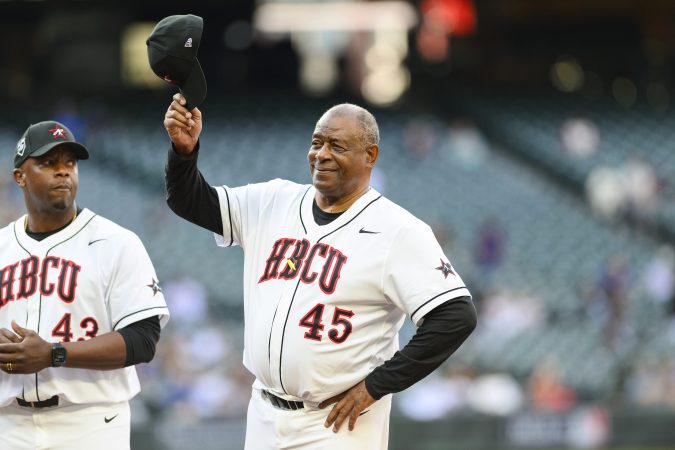
    In honor of the nation’s 250th anniversary, Major League Baseball (MLB) is bringing the Mid-Summer Classic to the place where the Declaration of Independence was signed. Among the kick-off events is the HBCU Swingman Classic on July 10, an event showcasing the past and present of historically Black college and university (HBCU) baseball programs.

    The event, intended to increase interest in baseball among Black Americans, reflects MLB’s complicated relationship with Black fans. Across the 20th century, team owners and executives have tried periodically to draw Black fans to the ballpark. Yet, to maintain the game’s appeal to its traditional fanbase, much of it white, owners simultaneously created environments that did not fully welcome Black fans. This history shows that if MLB truly wants to draw more Black Americans to the game, it has to alter the culture of the game and do more than just stage one-off events like the Swingman Classic.

    Until the 1940s, some Major League teams racially segregated their ballparks. As early as 1920, Black fans could sit only in the outfield seats at Sportsman’s Park in St. Louis, home to the National League’s Cardinals and the American League’s Browns. Following decades of advocacy by St. Louis’s Black community, the policy changed in 1944. Yet even after it ended, Black fans who still felt the sting of being segregated did not go to Sportsman’s Park in large numbers.

    Even at ballparks where Black fans had not been formally segregated, MLB executives marginalized them by making it clear they did not believe Black fans deserved the same respect from players as white fans. For example, one Black fan recalled that as a child in the 1930s, “I was called a ‘black bastard’ by St. Louis Cardinal left-hander Clyde Shoun,” and in a demeaning move harking back to a common practice of slave owners, his “head was rubbed for good luck by St. Louis Cardinal right-hander Fiddler Bill McGee as he walked out of the clubhouse past the bleachers.”

    Racism permeated the sport, inside and outside the ballpark. In a radio interview in 1938, despite not actually working in law enforcement, Yankees outfielder Jake Powell (who ended his career with the Phillies in 1945) claimed that he stayed in shape in the offseason by claiming to be a police officer who would beat Black people “over the head with my blackjack.” His comments provoked outrage and although Powell was suspended and forced to apologize, he remained with the Yankees through the 1940 season.

    Yankees General Manager Ed Barrow told The Philadelphia Tribune, “No owner of a business permits his employees to be pert or insulting to the customers patronizing the business,” indicating that the team was happy to take money from Black fans but would prefer their players not share racist views on the air. Evidently, the team concluded that they should angle for revenue from Black fans—but keep Powell on the roster all the same.

    As Jackie Robinson tore up the minor leagues in 1946, several MLB owners had another concern: too many Black fans if he were moved up to the majors. As they wrote in what was intended to be an internal document, they feared that “the preponderance of Negro attendance in parks such as the Yankee Stadium, the Polo Grounds, and Comiskey Park could conceivably threaten the value of the major league franchises owned by these clubs.”

    The next year, when Robinson broke MLB’s color barrier with the Brooklyn Dodgers, Black fans regularly made up as much as one-third of the crowd at his games. But as scholar Gerald Early recognized, it was “not the desire of any major-league baseball owner to have blacks make up the kind of attendance percentage they did when Robinson debuted in 1947. It would, indeed, be a cause of unease, if not downright unrest.”

    Owners couldn’t stop Jackie Robinson and the waves of talented players of color who followed him to the majors. Instead, they made it more difficult for Black fans to attend games by building stadiums farther away from Black communities. Scholars Alan Sager and Arthur Culbert determined that the demographics of the neighborhood around a team’s ballpark was the deciding factor for whether or not a team moved in the decades after Robinson’s debut. Teams that moved between the 1950s and 1970s left neighborhoods that were on average 44.1 percent Black. By contrast, teams that did not move were in neighborhoods that were 17.6 percent Black. Almost all teams that relocated in this era moved to far whiter neighborhoods, including the Phillies who moved from Connie Mack Stadium in North Philadelphia to Veterans Stadium in South Philly after the 1970 season.

    By contrast, in Houston, owners of a yet-to-be-named franchise secured vital Black voter support for the bonds needed to construct what would eventually be called the Astrodome. They promised that unlike many other public accommodations in Houston in 1961, it would be desegregated. But MLB owners continued to display bias against Black fans. Roy Hofheinz, who led the franchise and was the driving force behind the Astrodome, told a reporter, “We did a lot of research before choosing the colors [of the luxury suites]. We made sure the color complemented the complexion and clothing of women. It took us two weeks to get the right color of blue. Many blues would give ladies a pasty-looking complexion.” His concern reveals that he did not expect Black women to sit in the most exclusive part of the dome.

    When the Baltimore Orioles opened Oriole Park at Camden Yards in Baltimore’s downtown in 1992, it seemed to signal a shift in ballparks’ relationship to urban spaces and their Black populations. Yet in other ways, the team continued MLB’s pattern of marginalizing potential Black fans. Maryland state representative Howard P. Rawlings noted that the Orioles had “neglected the city’s black majority” in the park’s opening festivities and argued “it’s a reflection of [the team’s] lack of awareness that” the city “is more than 60 percent African-American.” Ballparks evolved, but many MLB executives’ attitudes about potential Black baseball fans did not.

    Made By History sponsors. FOR USE ON MADE BY HISTORY STORIES ONLY.Inquirer Staff

    Even this year, new barriers to Black fan attendance were added, such as when the Texas Rangers installed the “One Riot, One Ranger” statue at their ballpark. The statue depicts a member of the original Texas Rangers, the state law enforcement organization the baseball team is named after, that was modeled on E. J. Banks, a ranger best known for being dispatched by the state’s governor to keep Black students from enrolling in an all-white public school in 1956. Banks stood by and watched as white segregationists threatened violence against any Black child who tried to enter the school.

    Yet MLB is also making efforts to attract Black fans with events like the HBCU Swingman Classic at Citizens Bank Park. The Swingman Classic, named in honor of Black Hall of Famer Ken Griffey, Jr., is open to 50 current players from 17 historically Black Division I colleges and universities. The players will be divided into two teams, each coached by a Black former MLB player including, Phillies legend Jimmy Rollins.

    Unlike the Home Run Derby and the All-Star Game being played a few days later at Citizens Bank, tickets for the Swingman Classic are comparatively affordable and cheaper than some Phillies games, an admirable and encouraging choice. History cautions, however, that MLB is usually only interested in extracting revenue from Black fans when doing so does not threaten the game’s largely white fan base. While the Swingman Classic will likely draw a higher percentage of Black fans to Citizens Bank Park than an average Phillies game, only time will tell whether it helps to shift MLB culture towards greater inclusion of Black fans.

    Seth S. Tannenbaum is a Philadelphia native, historian, and associate professor of sport studies at Manhattanville University. His book, Bleacher Seats and Luxury Suites: Democracy and Division at the Twentieth-Century Ballpark was published this spring by the University of Illinois Press. He will be speaking at the Roxborough Branch of the Free Library of Philadelphia on Friday, July 17 at 3:30pm and at the Joseph E. Coleman Branch on Saturday, July 18 at noon.

    Made by History takes readers beyond the headlines with articles written and edited by professional historians. Opinions expressed do not necessarily reflect the views of The Inquirer.
  • Philadelphia’s politics were reshaped by the effort to win the 1936 Democratic Convention

    Philadelphia’s politics were reshaped by the effort to win the 1936 Democratic Convention

    In late April, Ken Martin, chair of the Democratic National Committee (DNC), visited Philadelphia to assess the possibility of the city hosting the 2028 Democratic National Convention. He toured Xfinity Mobile Arena and met with Mayor Cherelle L. Parker and business leaders, who rolled out a “blue carpet” aimed at charming him.

    It seemed natural to see business leaders working with local politicians to try to convince the DNC to choose Philadelphia, as well as helping to raise the funds required for the city to be eligible to host the convention. Democrats dominate the city’s politics, and its elected officials tend to share local business executives’ visions for economic development.

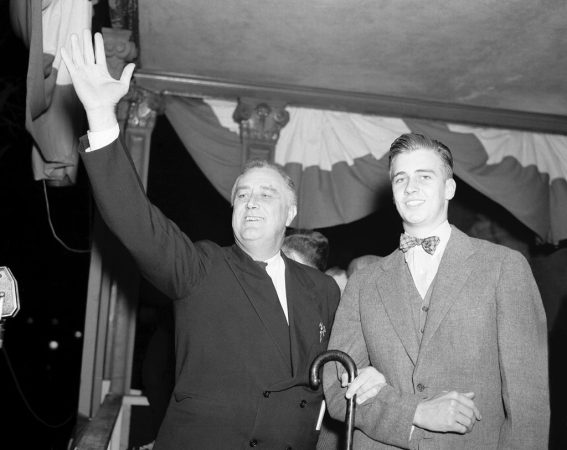
    But these groups weren’t always aligned. In 1936, when Philadelphia made a similar push to host the Democratic Convention, the effort aroused skepticism in a city that had been a Republican stronghold for decades. Much of the skepticism was centered in the business community — where many vehemently opposed the policies of President Franklin D. Roosevelt.

    It took a push by coalition builders like Albert Greenfield, a powerful business leader, to win over skeptics. Greenfield sold his fellow businessmen by framing the pursuit not as something partisan or political, but as a venture in civic boosterism. This argument proved compelling, and business support helped land the convention for Philadelphia. Today, Greenfield’s efforts provide a model for how to bring diverse interests together to boost a city, even in times of polarization.

    Before the 1930s, Philadelphia was firmly a Republican city. In this era, the national party’s platform was dominated by pro-business politics, aligned around policies aimed at enhancing economic growth and competition.

    A thoroughly corrupt political machine led by William Vare dictated the city’s politics. Each ward had Republican committee people who purchased individual votes at a going rate of one dollar. Loyal to the Vare machine, they also ensured voters headed to the polls on Election Day. In exchange, many of these committee people were rewarded with spots on the city payroll.

    The flow of money linked voters and committee people alike to Vare and the GOP. The machine’s dominance meant that the Republicans won most local elections, and the city gave its votes to their party in federal and state contests, including in every presidential election dating back to 1856. That even included in 1932 when Roosevelt was first elected by a large margin nationally.

    The Democratic Party — which, in other cities, drew power from local machines — remained weak and made little headway because Democrats, too, relied upon patronage favors from the dominant Republicans. That made them hesitant to rock the boat or wage an assault on the Vare machine and the status quo.

    At the beginning of Roosevelt’s first term, however, the city’s politics began to shift thanks to the new president and his New Deal. Struggling Philadelphians started to feel the tangible effects of New Deal policies at precisely the same moment that changes began to occur in both parties’ leadership locally. The result was a restoration of genuine two-party competition.

    The same Depression-era pressures loosening working-class loyalty to the Republican machine also began to pull Greenfield — who had once been a staunch Republican, but had soured on Herbert Hoover — toward the Democratic Party. The businessman benefited from several million dollars in funding from the Reconstruction Finance Corporation, the governmental lender of last resort, to prop up his business enterprises. Experiencing the benefits from New Deal policies firsthand, Greenfield started to express cautious support of Roosevelt.

    From his position as chairman of the Philadelphia Chamber of Commerce Convention and Tourist Committee, Greenfield also launched an effort to recruit the Democratic Convention to Philadelphia.

    His colleagues in the Chamber of Commerce shared Greenfield’s vision of landing a party convention in 1936 — but they didn’t care which party. Greenfield himself, however, remained focused on the Democrats in part because of his friendship with the liberal newspaper publisher J. David Stern.

    In December 1935, he began soliciting donations from the city’s business leaders with the goal of raising $150,000 (more than $3.6 million in 2026 dollars) to help lure the Democrats. He framed the convention not only as an opportunity to increase business activity, but also as a means of enhancing the city’s national reputation.

    Greenfield appealed to a wide range of constituencies, at times striking an unrelenting tone in his correspondence with business leaders. In one letter, Greenfield wrote that members of the Chamber, “feel that each individual enterprise has a moral obligation and responsibility with respect to the financial requisites for securing the convention.”

    Made By History sponsors. FOR USE ON MADE BY HISTORY STORIES ONLY.Inquirer Staff

    Greenfield’s efforts quickly bore fruit. Ledgers show contributions from both businesses and individual donors in sectors ranging from dentistry to distilling and hospitality. He also sold his fellow businessmen on their contributions being a non-partisan investment that would be “returned manyfold” to those who donated. This framing made it easier for many of his still staunchly Republican peers to support the bid.

    In January 1936, after the Chamber formally invited the Democratic National Committee to hold its convention in Philadelphia, news headlines reflected the importance of the incentive package organized by Greenfield. When Philadelphia won the bid — with a financial package that ended up totaling $200,000 — The New York Times characterized the proceedings as an “auction and now a poker game.” The money Greenfield raised ultimately compelled national Democrats to shift their preference from Chicago to Philadelphia as their host city.

    Greenfield soon became the chair of the city’s convention planning committee. In that role, he assembled a cohort of other prominent business and financial figures to orchestrate the programming surrounding the convention. He promised them pomp and circumstance — which he delivered.

    When the convention finally arrived in Philadelphia in June, flags bearing the names of U.S. states and festive decorations lined Broad Street; ceremonial stamps depicted a triumphant, sun-illuminated city; press photographers documented a ceremony in which city officials registered a donkey that was part of the New York delegation to vote. The city even suspended its blue laws to allow Sunday drinking.

    In bringing the convention to Philadelphia, Greenfield constructed his own alliance that worked to replace the system long sustained by Vare and the Republican machine. While he did not offer jobs and cash to individuals in exchange for loyalty like Vare did, he created a mechanism by which the success of the convention became materially valuable to the city’s business establishment.

    If members of the city’s business community sought to access the economic benefits of this national political event, they had to do so through Greenfield, further aligning Philadelphia’s commercial interests with an individual who wanted the convention to succeed not only financially but politically as well.

    What may have begun as tentative, pragmatic support for hosting the convention evolved into a more explicit embrace of the Democratic Party, with many businesses ultimately associating themselves with Democratic messaging. One newspaper advertisement praised the efforts of Roosevelt as a force behind Philadelphia’s economic revitalization. That message received endorsements from more than a dozen small businesses, whose names were featured alongside the message of support for the president.

    At the close of the convention, Greenfield told delegates that their enthusiasm might one day lead historians to view the city as a Democratic stronghold — a prediction that ultimately proved correct. By constructing a new network of support within Philadelphia’s business community, Greenfield helped rally backing for a convention that proved to be far more than an economic boost or mere “convention fireworks.” Instead, the gathering would serve as an engine for a realignment that would hold the city for the Democratic Party through the next two decades.

    The day after the 1936 election, the city of Philadelphia awoke to stunning results. Roosevelt had carried 43 of the city’s 50 wards and the city that the Philadelphia Bulletin had confidently described as unlikely to depart from “its long tradition” as a Republican stronghold had broken sharply with it. In 1940, when the city again explored hosting either the Republican or Democratic convention, the same committee which had led fundraising in 1936 initiated both efforts. Reflecting the changes in Philadelphia politics, however, the fundraising effort to attract the Democratic convention was far more successful than efforts to court its GOP counterpart. The business community in a city that had voted reliably Republican just four years earlier now raised three and half times as much money for potentially hosting the Democratic convention as the Republican one.

    As business leaders in Philadelphia work to bring the convention back to the city, they are drawing from Greenfield’s playbook 90 years ago that brought together a new alliance of business leaders in support of a convention that proved to be a political inflection point.

    Ethan Young is a rising senior at the University of Pennsylvania studying history and political science.

    Made by History takes readers beyond the headlines with articles written and edited by professional historians. Opinions expressed do not necessarily reflect the views of The Inquirer.
  • The real reason the colonists declared independence

    The real reason the colonists declared independence

    This month marks the 250th anniversary of the Declaration of Independence, an anniversary well worth celebrating. It is not, however, the anniversary of the start of the American Revolution. That began on April 19, 1775, with the battles of Lexington and Concord Bridge. It took over a year of fighting to convince colonists to accept that the time for compromise, for reconciliation, for any kind of reversion to the previous state of existence — for half-measures — was gone and the only path forward was independence.

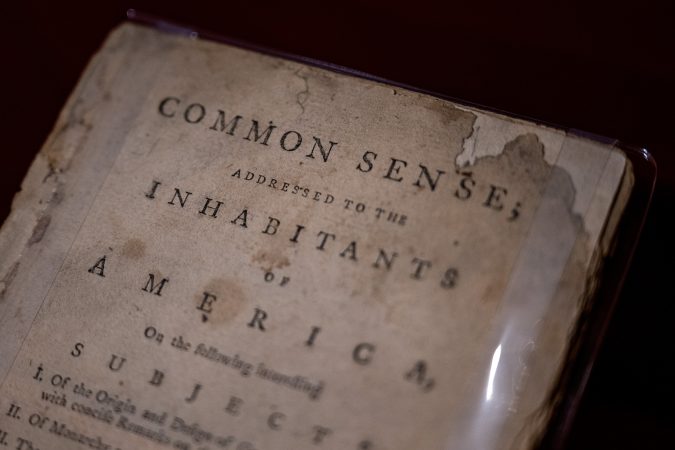
    That’s where Thomas Paine and Common Sense played a role. Since his arrival in Philadelphia in 1774, Paine had watched American politicians try to reason with England, hoping to reshape the relationship with George III and with Parliament, rather than to sever it. It did not work. “Why is it that we hesitate?,” Paine asked his readers. “From Britain we can expect nothing but ruin.”

    Paine wrote Common Sense at the end of 1775 — between when the Revolution began and when the colonists declared independence — and he wrote specifically to convince the colonists to break their ties with England. “Nothing can settle our affairs so expeditiously,” he told his readers, “as an open and determined declaration for independence.”

    In the winter of 1775-1776, a growing number of colonists were ready to meet the British Army on the battlefield. The colonists and the British government had been at odds with each other for a decade, fighting over taxes and over jurisdiction. The government in London, though, seemed only to be pushing things further to the brink, especially when they began stationing soldiers in Boston.

    Still, and much to Paine’s chagrin, through the rest of 1775 most colonists thought that declaring independence was a step too far. Three months after the fighting began, when the Continental Congress set out to explain the “causes and necessity of taking up arms,” they tried to assure “our friends and fellow-subjects” in the British Empire that “we mean not to dissolve that union which has so long and so happily subsisted between us, and which we sincerely wish to see restored … We have not raised armies with ambitious designs of separating from Great-Britain, and establishing independent states.”

    Five months later, when Paine wrote Common Sense, he still worried that “the sentiments contained in the following pages, are not yet sufficiently fashionable to procure them general favor.” And so, Paine made a case not just outlining England’s crimes, but also explaining why they had rendered any sort of half-measure or compromise impossible.

    We tend to associate the lead-up to the American Revolution with the colonists’ complaints about British taxes and duties, which certainly led to disputes about jurisdiction and the relative authority of the crown and the colonial governments. We also remember the catch-phrase of the era, “no taxation without representation.

    Those debates and those issues, though, were not part of Common Sense. Paine focused on what, for him, was Britain’s unforgivable crime: setting the British Army against the colony’s own citizens. “The independancy of America,” Paine wrote, “should have been considered, as dating its æra from, and published by, the first musket that was fired against her.”

    This was a point that Paine returned to again and again.

    “No man was a warmer wisher for reconciliation than myself before the fatal nineteenth of April 1775.” But once he learned that British troops had attacked the people of Lexington and Concord, he knew that “a new era for politics is struck; a new method of thinking hath arisen. All plans, proposals, & c. prior to the nineteenth of April … are like the almanacks of the last year; which, though proper then, are … useless now.” As for King George II, “I rejected the hardened, sullen tempered Pharaoh of England for ever; and disdain the wretch, that with the pretended title of father of his people can unfeelingly hear of their slaughter, and composedly sleep with their blood upon his soul.”

    Made By History sponsors. FOR USE ON MADE BY HISTORY STORIES ONLY.Inquirer Staff

    Paine’s message was clear: setting troops against the people demanded resistance. And this message was the key to getting the colonies to unite and declare independence. The disputes about taxes and jurisdiction went back to 1765. The colonists’ leaders had fought British policies on every issue, without ever wanting to stop being a part of the British Empire. But now that the British had sent their own army against the colony’s British citizens, Paine’s calls for independence found an eager audience among American readers.

    When Paine wrote of moderates calling for reconciliation with England, he urged them to think closely about the violence which the British Army had inflicted on the colonists, and if that level of violence had made reconciling impossible. “Tell me,” he wrote, “whether you can hereafter love, honour, and faithfully serve the power that hath carried fire and sword into your land?”

    In January 1776, his answer was no. In July 1776, that became the Continental Congress’s answer, as well — colonists from New Hampshire to Georgia were united enough in their horror at the British army’s violence that they declared their independence not as 13 colonies, but as 13 united states.

    This concern about state-sanctioned violence resonates again today. Paine’s reference to British soldiers as “Highwaymen and Housebreakers” brings up images of agents from U.S. Immigration and Customs Enforcement barging into homes without warrants and dragging out their terrified inhabitants.

    In 2026, there is no foreign power from which we can declare independence, but as state violence persists, so too does the legacy of resistance by colonists who heeded Paine’s call to reject Britain’s “long and violent abuse of power.”

    The “Road to 250” series is an initiative of Historians for 2026, a group of early American academics, public historians, archivists, and educators devoted to shaping an accurate, inclusive, and just public memory of the American Founding for the 250th anniversary.

    Noah Shusterman is associate professor of history at the Chinese University of Hong Kong. He is the author most recently of Armed Citizens: The Road from Ancient Rome to the Second Amendment.

    Made by History takes readers beyond the headlines with articles written and edited by professional historians. Opinions expressed do not necessarily reflect the views of The Inquirer.

  • The demand for purity in Trump’s GOP comes from the death of the party’s moderate wing

    The demand for purity in Trump’s GOP comes from the death of the party’s moderate wing

    With the 2026 midterm elections shaping up to be one of the most consequential in recent memory, President Donald Trump has gone on offense — not only against Democrats, but also against Republicans who he has accused of disloyalty. In fact, in recent primary elections, Trump has targeted candidates in his own party, from those running for state office to U.S. senators seeking reelection, including John Cornyn and Bill Cassidy.

    Most of those targeted by Trump have lost, which has sent a clear message: there is no longer room for debate within the GOP; only complete allegiance to MAGA orthodoxy — and by extension to Trump himself — is acceptable. This is a far cry from the GOP of yesteryear, which comfortably included staunch conservatives like Barry Goldwater and Ronald Reagan, as well as a robust moderate-to-liberal wing centered in the Northeast, upper Midwest and on the West Coast. In Pennsylvania and New Jersey alone, moderate Republicans like Hugh Scott Jr., Arlen Specter, Thomas Kean Sr. and Christie Whitman, routinely won Senate and gubernatorial elections into the 21st century.

    In fact, an often-forgotten chapter in the career of Richard Nixon — the president most often compared with Trump — vividly illustrates that the ideological boundaries in the GOP were once quite malleable. Nixon regularly shapeshifted and operated across multiple wings of the GOP as he rose from congressman to senator to vice president, and finally, to president. Yet, as Republicans have become more ideologically rigid, such moves have become increasingly difficult, replaced by debates over who qualifies as a “real Republican” — and who is a Republican in Name Only (RINO).”

    The Richard Nixon who embarked on a political career in 1945 was nothing like the figure who resigned the presidency in disgrace three decades later. When he launched his first campaign in California’s 12th Congressional District, Nixon pledged to local Republicans that he would wage an “aggressive, vigorous campaign on a platform of practical liberalism” to defeat the popular incumbent congressman, Jerry Voorhis.

    At this time, Nixon modeled himself on Republican Harold Stassen, the former “boy wonder” governor of Minnesota. Stassen had built a national reputation in the late 1930s for his bipartisan “middle way” approach to governance, which blended fiscal discipline, civil service reform and bipartisan labor legislation. By 1943, when he resigned from the governorship to serve in the Navy during World War II, Stassen had become one of the country’s most prominent progressive Republicans.

    In Stassen’s success, Nixon saw a model for how a newcomer could win over liberal and independent voters in California. He wrote to the Minnesotan, “I have been very interested in following your campaign to liberalize the Republican Party because I feel strongly that the party must adopt a constructive progressive program in order to merit the support of voters.” Key to this program was retooling the principles of Democrat Franklin D. Roosevelt’s vaunted New Deal instead of rejecting them outright like many conservative Republicans did.

    This formula included accepting popular New Deal programs like Social Security — and even bolstering them. It also involved advocating against American isolationism and in favor of increased international cooperation. On labor rights — another thorny issue — Nixon, like Stassen, sought a middle ground: he supported arbitration to avoid strikes, while balancing the interests of workers and management. In a campaign speech, Nixon claimed that he “would not be a candidate if he were not strongly in favor of unions and small business.”

    This platform proved successful for Nixon, who the Minneapolis Star Tribune dubbed a “Stassen Candidate.”

    Shortly after he upset Voorhis and became the representative-elect for the 12th District, a former Whittier College classmate wrote to Nixon to offer “hearty congratulations” — despite being a Democrat who hadn’t voted for him. Nixon’s progressive message resonated with his former classmate, who expressed hope not only for Nixon’s success but “for the success of the progressive and liberal elements” within the Republican Party.

    In the coming years, Nixon would dash this hope as he illustrated the ease with which politicians moved between ideological camps in the GOP. During his early years in Congress, Nixon hung his hat not on the progressive vision of Stassen, but on staunch anti-Communism and red baiting. In 1947, Nixon joined the House Un-American Activities Committee (HUAC), where his pursuit of former State Department official Alger Hiss generated national attention. The case helped transform Nixon from an anonymous freshman congressman into one of the nation’s most prominent anticommunists.

    In 1950, Nixon further cemented his anti-Communist reputation during a successful Senate campaign against Rep. Helen Gahagan Douglas, who he portrayed as soft on Communism by repeatedly linking her voting record to that of left-wing Congressman Vito Marcantonio.

    Nixon’s reputation as an anti-Communist crusader compelled Dwight Eisenhower to select him for the 1952 GOP ticket as an olive branch to disgruntled conservatives after he beat their preferred candidate for the nomination, Ohio Sen. Robert Taft.

    Eisenhower’s election was a victory for progressive Republicans as he promised an era of “Modern Republicanism” — which paired a commitment to free enterprise with a belief that the government had an obligation to improve society and provide a basic social safety net.

    The GOP’s right flank derided this philosophy, and Nixon often spent time mediating between the two wings of the party. His ability to move comfortably between the camps reflected the ideological flexibility that still characterized the Republican Party during the 1950s.

    Made By History sponsors. FOR USE ON MADE BY HISTORY STORIES ONLY.Inquirer Staff

    Yet, even as he tried to reassure conservatives, Nixon embraced Modern Republicanism; he represented the Eisenhower administration abroad, including during his highly publicized exchanges with Soviet Premier Nikita Khrushchev. This engagement reflected the desire to contain communism through diplomacy and alliances, and the administration’s internationalist approach.

    Domestically, Nixon served as the administration’s point man on civil rights, supporting measures such as the Civil Rights Act of 1957 and overseeing efforts to combat employment discrimination through his leadership of the President’s Committee on Government Contracts. In 1958, Martin Luther King Jr. expressed his belief that “Nixon would have done much more to meet the present crisis in race relations than President Eisenhower has done.”

    In 1960, Nixon embarked on his first presidential campaign. During an October question-and-answer session at the University of Southern California, the vice president turned to the question of whether he considered himself a liberal or a conservative.

    He started by offering a definition of liberalism from Roosevelt. “A liberal is a man who wants to build bridges over the chasms that separate humanity from a better life,” Nixon explained. To him that meant, “we’re all liberals … We all want a better life.” Nixon concluded his answer by describing himself as a “practical progressive” — an echo of the “practical liberalism” he embraced during his 1946 campaign.

    Nixon went on to lose that race narrowly. But in 1968, he rebounded, by once again successfully navigating the party’s competing factions. He appealed to conservatives with his Southern Strategy and rhetorical emphasis on “law and order,” while reassuring moderates that he remained an experienced and pragmatic Republican.

    As president, he did some things that were progressive by today’s standards, including enacting the first federal affirmative action program and signing the Clean Air and Clean Water Acts. Simultaneously, however, he tangled with the liberal wing of his party over Vietnam and several Supreme Court appointments, and he vetoed legislation to provide federally funded daycare for children.

    Nixon is typically remembered for helping to usher in the populist conservative tide that would eventually sweep GOP politics. Today, he’s often compared with Trump because of his embrace of white grievance politics, his demands for personal loyalty and his abuse of power.

    Yet, his career also highlights how the Republican Party once had a vibrant and popular progressive and moderate wing. When Nixon launched his career, the idea of branding someone a RINO would have been far-fetched because the GOP comfortably managed to include staunch conservatives like Taft, as well as progressives like Stassen. The progressive or moderate wing of the party survived into the 1990s and 2000s; in Pennsylvania, Specter won the first of five Senate terms in 1980, while in New Jersey, Kean and Whitman both served as governors in the 1980s and 1990s.

    Yet, their careers tell the story of what happened as the brand of populist conservatism that Nixon capitalized on to win the presidency gained steam: In 2009, Specter switched parties and became a Democrat for his last years in the Senate, and Whitman is now a national co-chair of the Forward Party, and has endorsed Democrats in the last three presidential elections.

    Their departures reflected the rise of a new hard-line conservative Republican base with little tolerance for moderation or compromise. The collapse of the GOP’s liberal wing made today’s battles of who counts as a “real Republican” not just possible, but inevitable.

    Gaetano V. Della Torre is a New Jersey-based historian and educator. His article “Nixon’s Practical Liberalism: How Richard Nixon Tapped Harold Stassen’s Progressive Vision in 1946” is forthcoming in the Southern California Quarterly.

    Made by History takes readers beyond the headlines with articles written and edited by professional historians. Opinions expressed do not necessarily reflect the views of The Inquirer.