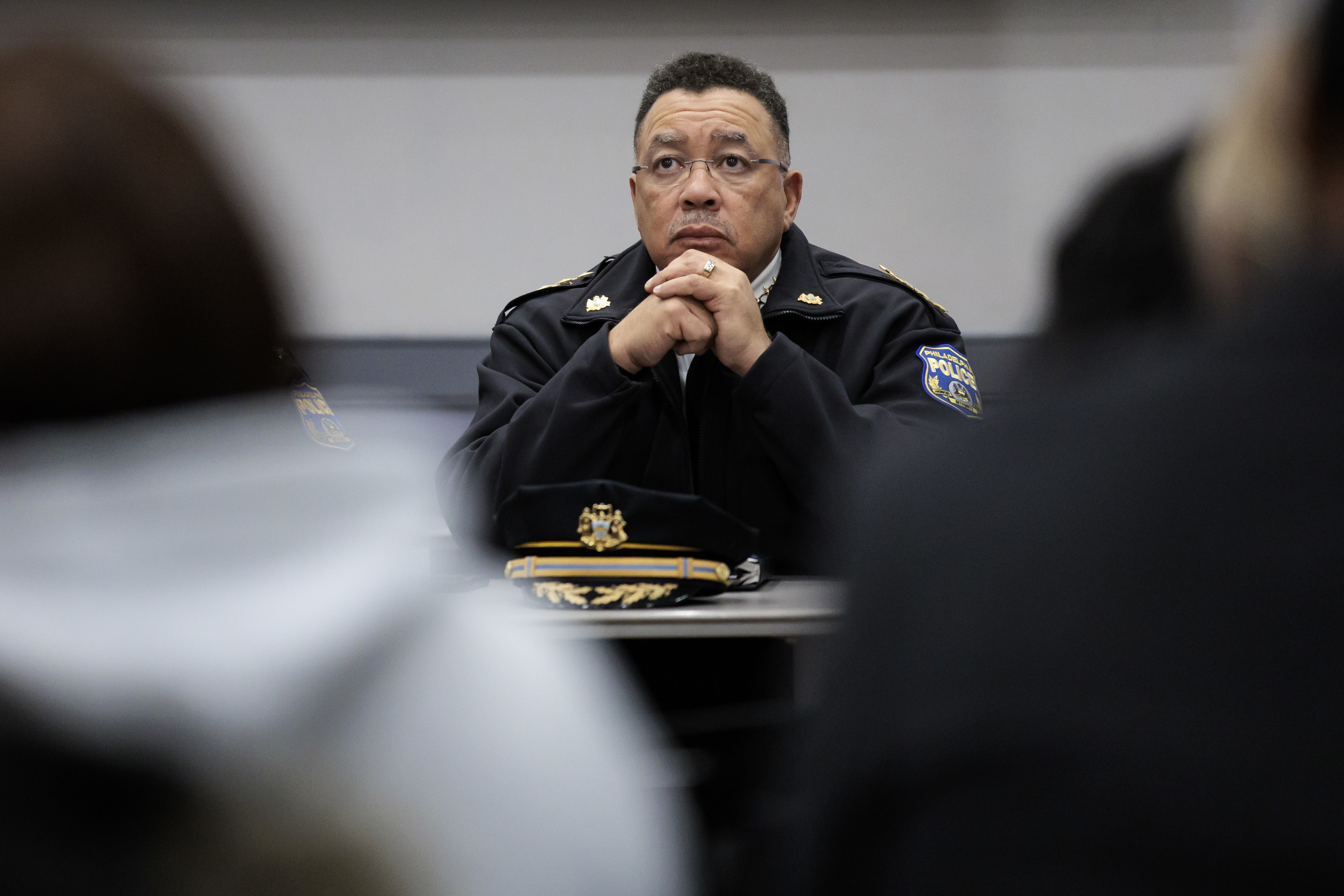
Addressing criticism of his department’s handling of crowd control at a Pride celebration in the Gayborhood over the weekend, Police Commissioner Kevin Bethel said Friday that his officers became overwhelmed by dueling events and unruly behavior from large groups of teenagers.
The turmoil — which led police to arrest 15 people and shut down street festivities in the LGBTQ+ neighborhood earlier than anticipated — stemmed from a change in the way the city celebrated Pride this year, Bethel said in a news conference at police headquarters.
The decision to hold Philadelphia’s official Pride celebration on the Benjamin Franklin Parkway on Sunday deviated from the tradition of holding it in the Gayborhood, according to Bethel, who said the competing events created a public safety risk.
In retrospect, he said, barricades that police set up on the Gayborhood sidewalks — another deviation from past celebrations there — might not have been a wise move.
“We now know that might not have been the right decision,” he said, noting they caused ‘frustration” among guests.
Bethel said the evening took a turn when large groups of people began arriving at both the Parkway and the Gayborhood,overwhelming the 600 officers dispatched across both events.
And in the Gayborhood, that included crowds of teenagers, some breaking out into fights, he said.
The commissioner said commanding officers made the decision to close down the streets near popular gay bars like Woody’s around 8 p.m. as a consequence.
To underscore the point, Bethel played a video of one of those altercations, which showed a throng of young people acting erratically, some yelling and pushing each other.
He called the arrival of young people to the Gayborhood a “surge” that saw teens “taking over” a parking lot and getting on top of cars.
“At that point there are some decisions that have to be made,” Bethel said. “We can’t have thousands of individuals swirling together.”
Bethel also acknowledged public outcry over images of police officers on horseback and motorbikes engaged in crowd control. Those officers had been dispatched to the Gayborhood from the Parkway event once crowds began to get out of hand, he said.
“That is not pretty — it is not pretty when you move people,” he said.
Responding to questions over the department’s enforcement at LGBTQ+ festivities, Bethel repeated his earlier assertion that the nature of the event had nothing to do with police response.
“All of this is not about Pride, it is not about the Gayborhood, it is not about anyone’s feelings about anything,” he said. “It is about safety.”
Prosecutors have dismissed at least 24 firearms cases after defense lawyers challenged the legality of stops conducted by two Philadelphia police officers who they say systematically targeted Black men for unlawful searches.
Lawyers with the Defender Association of Philadelphia say former partners August Gershwin and John Lee initiated hundreds of pedestrian investigations in Northwest Philadelphia without sufficient legal justification — ordering Black men to submit to searches during interactions that were supposed to be voluntary, delaying activation of body-worn cameras until after stops were underway, and rarely documenting investigations unless they yielded illegal guns or contraband.
The allegations come more than a decade after Philadelphia entered into a federal consent decree aimed at curbing unconstitutional stop-and-frisk practices. The agreement requires officers to document investigative stops for review by independent monitors and encourages police to handle low-level violations through so-called mere encounters — voluntary interactions with officers in which people are free to ignore questions and walk away.
The lawyers contend that Gershwin and Lee exploited that distinction, routinely detaining people without the legal justification required for a stop while avoiding the scrutiny those interactions would otherwise receive.
Their review, detailed in recent court filings, has prompted prosecutors to abandon dozens of cases tied to the officers, while the fate of dozens more remains uncertain.
The dismissals began with the case of Namir Mack, charged with firearms offenses and evading arrest after a March 2025 stop by Gershwin and Lee led to the recovery of an illegal handgun.
According to court filings, the officers stopped Mack as he walked along West Erie Avenue. Body-worn camera footage showed Mack lifting the back of his sweatshirt after the officers ordered him to expose his waist.
Mack then ran. During a brief chase, he was struck by an SUV on Hunting Park Avenue, and officers recovered a handgun. A supervisor’s body-worn camera footage captured the aftermath.
“What is this?” Sgt. Christopher Bloom asked. “A mere encounter turned into a foot pursuit?”
Defender Association lawyers characterized the pattern of conduct discovered in their review as deeply concerning.
The officers’ actions were “flying in the face of everything that’s supposed to be happening with this march toward more equitable policing in Philadelphia,” said Michael Mellon, who, along with Paula Sen, leads the association’s police accountability unit and conducted the review.
Efforts to reach Lee, who left the department last November, were unsuccessful. Gershwin directed inquiries to his supervisor, who declined to comment.
The police department declined to comment on the dismissed cases and the Defender Association’s findings.
Police Commissioner Kevin J. Bethel declined an interview request, and police union leaders did not respond to requests for comment.
The district attorney’s office, too, declined to comment.
Police spokesperson Sgt. Eric Gripp said that pedestrian stops must be based on something more than a “hunch,” and that “the mere presence of a firearm” or “a person being in a particular area does not, standing alone, automatically justify a detention or frisk.”
Department policy also requires officers to activate body-worn cameras at the outset of investigative stops. But the lawyers found that in every reviewed stop for which footage was available, the officers activated their cameras only after the interaction had begun, obscuring the moments most critical to determining whether the stop was lawful and whether citizens had voluntarily complied with police requests.
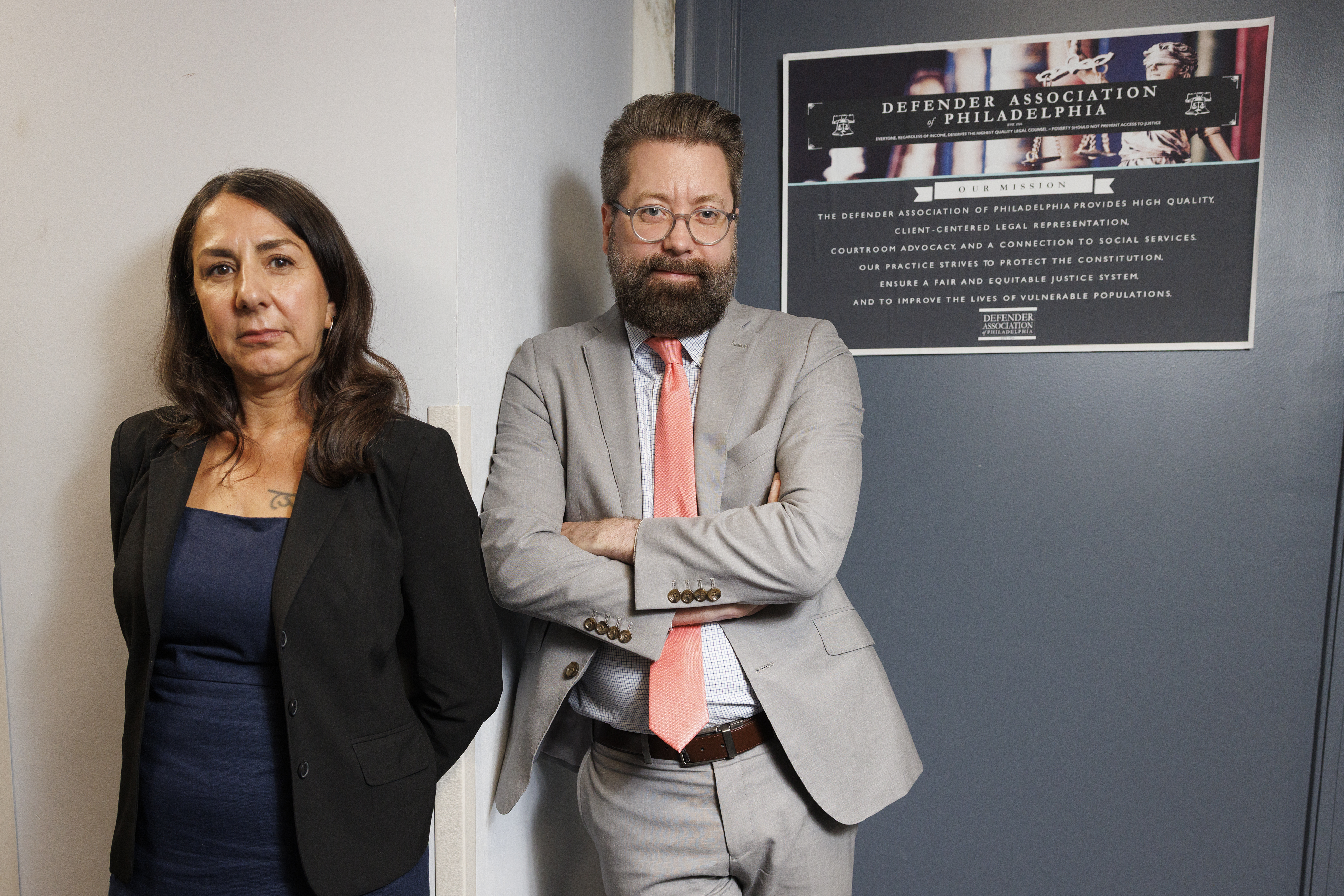
Paula Sen and Mike Mellon, who lead the police accountability unit of the Defender Association of Philadelphia, at their offices.Alejandro A. Alvarez / Staff Photographer
According to the lawyers’ legal filings, the department sustained at least three investigations for body-worn camera violations against both Gershwin and Lee during the two-year period reviewed by attorneys.
Of the nearly 500 pedestrian interactions reviewed by Mellon and Sen, only 130 were documented as investigative stops. The officers recorded an additional 320 as mere encounters.
After reviewing body-worn camera footage, police paperwork, and other materials, the lawyers concluded that 277 of the interactions described as mere encounters should have been classified as investigative stops and subjected to consent-decree review. Of those, 218 involved weapons license investigations. None resulted in the recovery of an illegal firearm.
The lawyers also found that all but one of the nearly 500 people the officers stopped during the review period were Black. All but two were men.
<div data-analytics-viewport="autotune" data-analytics-label="stops-06-11-26" id="stops-06-11-26__graphic" data-iframe-fallback="https://media.inquirer.com/storage/inquirer/ai2html/stops-06-11-26/fallback-mobile.jpg" data-iframe-fallback-width="350" data-iframe-fallback-height="1062" data-iframe="https://media.inquirer.com/storage/inquirer/ai2html/stops-06-11-26/index.html" data-iframe-height="1038" data-iframe-resizable></div> <script type="text/javascript">(function() { var l = function() { new pym.Parent( 'stops-06-11-26__graphic', 'https://media.inquirer.com/storage/inquirer/ai2html/stops-06-11-26/index.html'); }; if(typeof(pym) === 'undefined') { var h = document.getElementsByTagName('head')[0], s = document.createElement('script'); s.type = 'text/javascript'; s.src = 'https://pym.nprapps.org/pym.v1.min.js'; s.onload = l; h.appendChild(s); } else { l(); } })(); </script>
In one encounter classified as voluntary, body-worn camera footage showed Gershwin asking to search a man’s bag outside a beer deli. When a woman in the group objected, Gershwin searched the bag anyway before walking away, having found nothing.
In another supposedly voluntary encounter, Gershwin warned two teenage boys that if they did not lift their shirts, “we’re gonna cuff you.” Neither teen was found to have a weapon.
“They know they don’t have reasonable suspicion,” Sen said, “so they’re simply not documenting them.”
Gripp said the department’s internal affairs bureau conducted six investigations involving Gershwin and four involving Lee related to pedestrian stops and searches. Two allegations against Gershwin were sustained, he said, and none of the cases against Lee was sustained.
David Rudovsky, a civil rights lawyer who helped secure the consent decree, said he is “concerned that at least some officers in the department are doing an end run around the consent decree.”
Rudovsky said he plans to press the department to investigate Gershwin, Lee, and other officers who appear in body-worn camera footage reviewed by defense attorneys.
“If we’re not satisfied,” he said, “ultimately we can seek relief from the court.”
The Citizens Police Oversight Commission also said it plans to analyze department data on mere encounters and conduct audits as a result of the Defender Association’s findings and complaints from residents.
While most active cases handled by the Defender Association have been dismissed, Mellon and Sen estimate that an additional 30 to 40 cases involve private defense attorneys. They said they next plan to press the district attorney’s office to review closed cases tied to the officers’ arrests and broaden their analysis to other officers.
Mayor Cherelle L. Parker says she is looking for answers after Philadelphia police arrested 15 people at a Pride celebration in the Gayborhood on Sunday that drew anger from community members over police use of force.
“I know that members of our LGBTQ+ community are hurting, frustrated, and looking for answers. … I want everyone to know that I hear you, I see you, and my Administration is taking your concerns seriously,” Parker said on social media Tuesday evening.
Images and videos spread across social media of police using crowd control tactics to disperse Pride-goers in the neighborhood, in what some considered to be an outsize and aggressive law enforcement presence.
In one image shared on X, a police officer on a motorcycle appears to push against a woman’s chest, and, in a separate photo, another officer pushes the same woman against a storefront security door while arresting her.
Other videosposted on social mediashowed police on horseback dispersing young people from a sidewalk, as well as officers physically struggling with a man outside the gay bar Woody’s. Another clip shows a row of police officers — two of them wearing face coverings — forming a line to clear a barricaded Gayborhood street while officers on motorbikes rode along the sidewalks.
On Wednesday, Sgt. Eric Gripp, a spokesperson for the police department, said that officials had identified five officers who wore face coverings during the enforcement, and that those officers had violated department policy by doing so.
The department is still working to determine what type of corrective action will be taken depending on the outcome of an internal investigation, he said.
On Tuesday, Parker said she and some of her top staff, Director of LGBTQ+ Affairs Tito Valdes, and Philadelphia Police Commissioner Kevin Bethel had met to “review the information available to us and discuss next steps.”
“In the days ahead, we will meet with community leaders as part of that effort. As we move forward, we must reject the notion that public safety and accountability are mutually exclusive,” Parker said in the statement posted to social media.
Commanding officers at the scene gave orders to disperse crowds, according to Gripp, the police spokesperson.
The crowd control tactics used on Sunday drew ire from local elected officials like City Councilmember Rue Landau, who said she has been in talks with city departments and police to understand why PPD used this strategy. “Police brutality has no place at Pride,” Landau said.
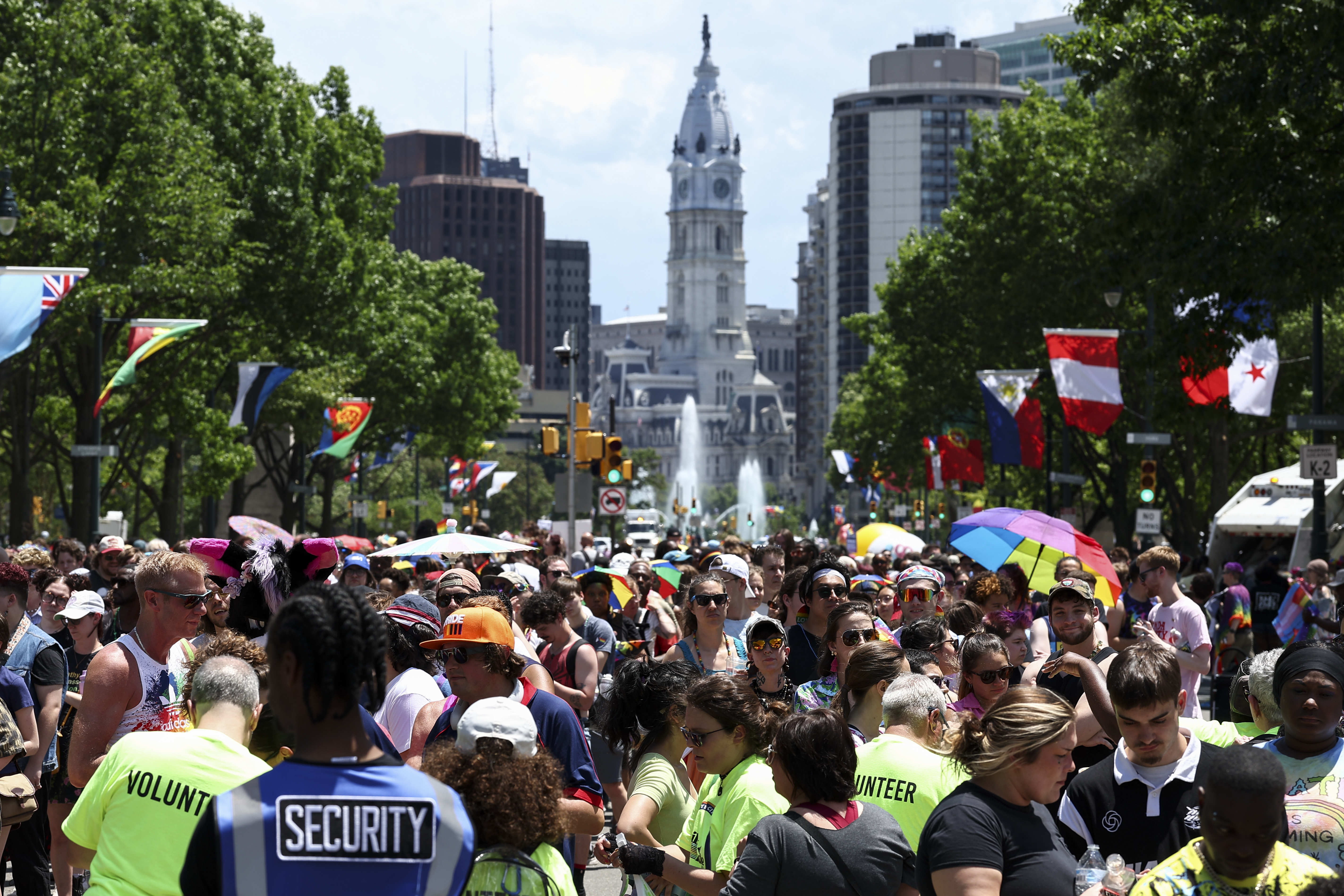
People wait to enter the Philly Pride Festival at 21st Street on the Ben Franklin Parkway on Sunday.Monica Herndon / Staff Photographer
A different Pride this year
This year’s Pride looked different from that of earlier years. Usually, Philadelphia Pride celebrations and parades occur within the Gayborhood in Center City, east of Broad Street. But this year Philly Pride 365 and the city moved the parade and festival to the Benjamin Franklin Parkway because of security concerns over crowd sizes that had grown to more than 150,000 people, among other reasons, festival organizers said.
The festival portion of Pride also asked attendees to pay $10 to enter an event that for years had been free to attend.
Before and after the official celebrations ended, Pride-goers gathered in the Gayborhood, patronizing bars and spilling into the streets — a common practice during the celebration. But guests were surprised to find that several Gayborhood blocks around 13th and Walnut Streets were blocked with metal barricades, limiting crowds to sidewalks, said Joshua Stokem, a New Jersey resident who regularly attends the city’s Pride celebrations.
Stokem said the layout caused large groups to pack into the corridors outside bars and restaurants and, in his view, created confusion and exacerbated some of the issues attendees had with police.
On Sunday, police had 600 officers assigned to Pride celebrations with around 150 officers in the Gayborhood monitoring festivities, Bethel said.
“By all accounts, [it was] a successful event attended and enjoyed by thousands of people. As crowd sizes increased in the Gayborhood, officers responded to a growing number of public safety concerns, including fights, disorderly behavior, blocked roadways, and the challenges associated with safely managing large crowds in a confined area,” he saidin the statement.
Bethel said the department had expected the Parkway celebration to gradually transition to the Gayborhood event, but that did not happen.
Instead, he said, two separate gatherings were essentially happening at once, creating a situation that was “challenging to manage safely” and led to the decision to clear parts of the neighborhood.
“That decision was not made in any way, shape, or form because people were celebrating Pride,” he said.
Most of the arrests during Sunday’s event were for disorderly conduct, according to Bethel, while one person was charged with aggravated assault of a police officer.