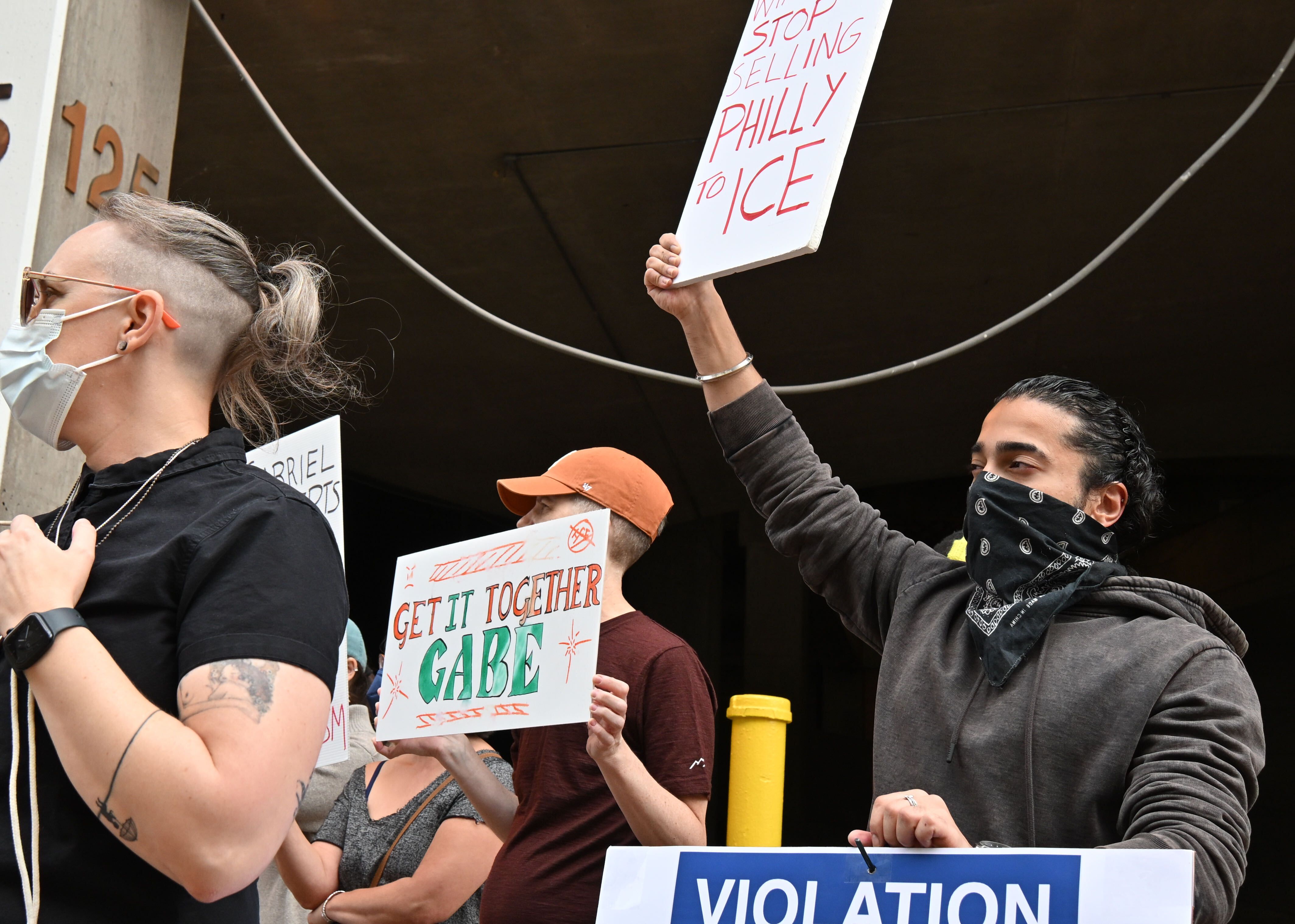
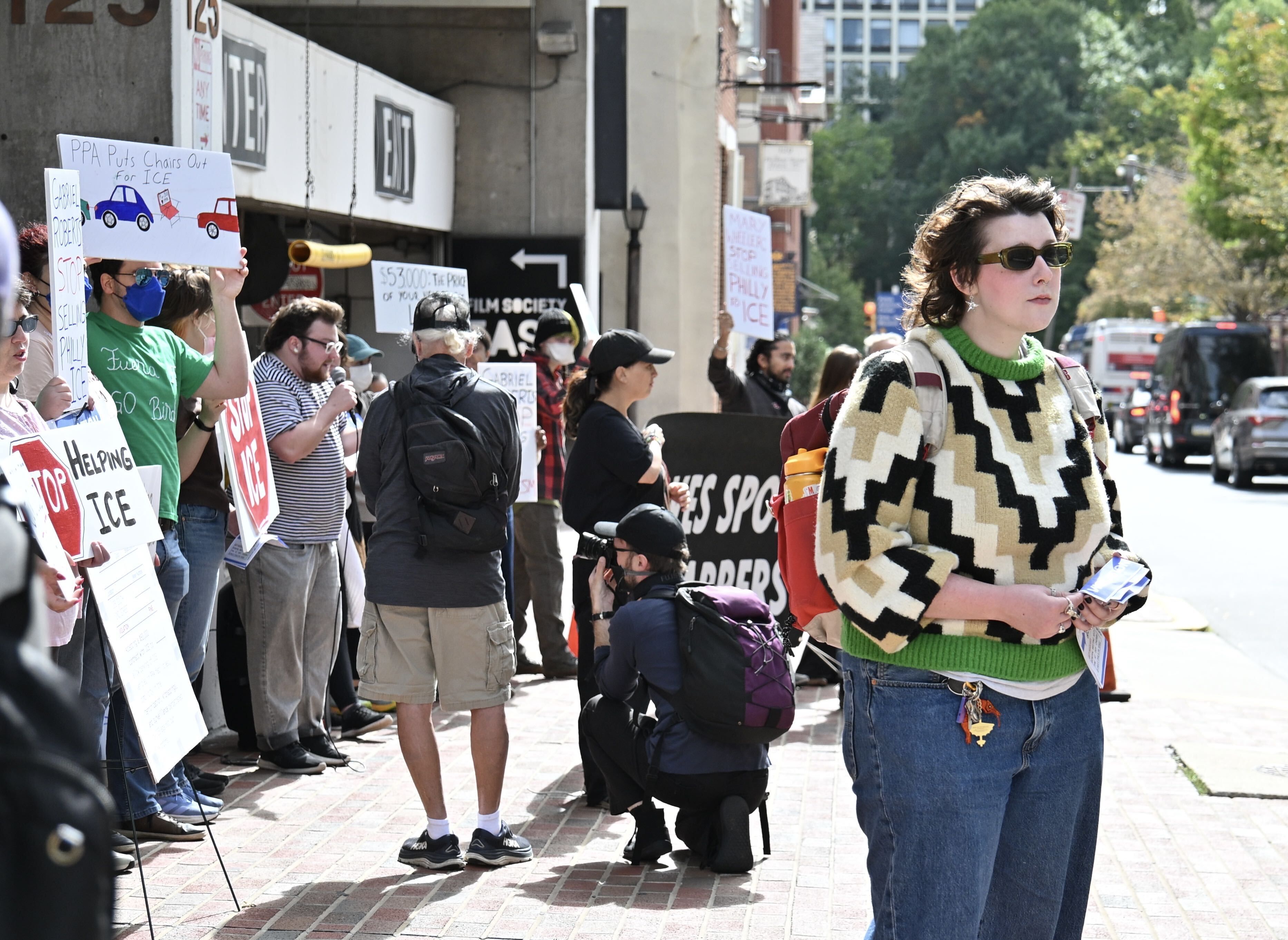
About two dozen No ICE Philly activists gathered Saturday outside a parking garage in Old City, demanding the Philadelphia Parking Authority end an arrangement with Immigration and Customs Enforcement.
At issue are 16 parking passes at the federally owned garage on Second Street, which is managed by the PPA. The group sang protest songs, held signs, and passed out informational flyers that resembled oversized PPA parking tickets.
“Who doesn’t know what these things look like, you know?” said one activist handing out flyers.
Group organizer Jay Bergen said the rally is meant to pressure the PPA — and to let people know that ICE is using the parking garage.
“It’s scary that you could be parking downtown, and unbeknownst to you, parking next to an ICE agent,” Bergen said.
Bergen, a 34-year old pastor at the Germantown Mennonite Church, pointed to public records showing a $53,520 contract that allows “for parking of government vehicles for ICE Homeland Security investigations” at the garage.
That contract was set to expire at the end of September, but another one, beginning in October and running through at least next September, gives Department of Homeland Security “16 leased parking spaces,” records show. ICE is part of DHS.
PPA spokesperson Martin O’Rourke declined to comment on the contracts.
An activist holds “violations” resembling PPA parking tickets to pass out to people, while a crowd gathers to demand the PPA stop leasing parking spaces to ICE.Brett Sholtis
Bergen said the group opposes ICE for “kidnappings” of immigrants and others, including people who have lived legally in the community for decades. One recent example is a 30-year-old nurse from Delaware County, who was arrested while taking her son to Disneyland.
Bergen said most people detained by ICE did nothing wrong. Some had minor lapses in paperwork or had been convicted of summary or misdemeanor crimes.
“Their goal is terror. It’s not public safety in any meaningful way,” Bergen said.
The local ICE field office did not respond to a request for comment Saturday.
At the rally, protester Akarsh Balaji said that the amount of money PPA makes on the contracts is “less than what they spend every year on salt to de-ice the streets.”
Balaji said he’s seen ICE harass his Puerto Rican neighbors in West Kensington. Puerto Ricans are Americans — so is Balaji, who is of Indian ethnicity — but that doesn’t seem to matter, he said.
“Nobody should have to live in fear, or be told that they’re harmful to society,” Balaji said.
Balaji said he got involved with the group in February after feeling a need to do something, “and be part of a movement that is so much bigger than I was.”
“We want to make it as difficult as possible for ICE to do its job,” Bergen said.
In Philly, ICE has faced obstacles from residents and elected officials. In April, the city adopted some of the nation’s most aggressive polices aimed at restricting ICE. The legislation took effect in July but the federal Department of Justice sued the city over some of its directives.
Bergen said ICE has changed its tactics since early this year, when its Operation Metro Surge in Minnesota — and the killings, captured on video, of U.S. citizens Renee Nicole Good and Alex Pretti — led to overwhelming public opposition to the agency.
“But the fear has not gone down. I heard this week about someone whose mother is afraid to go to doctor’s appointments, because she’s afraid ICE might grab her,” Bergen said.
This week’s column covers the ongoing Washington West Historical District saga, a 1,000 mayoral days, a City Council member who should retire, and an NFL coach who is a secret urban planning enthusiast.
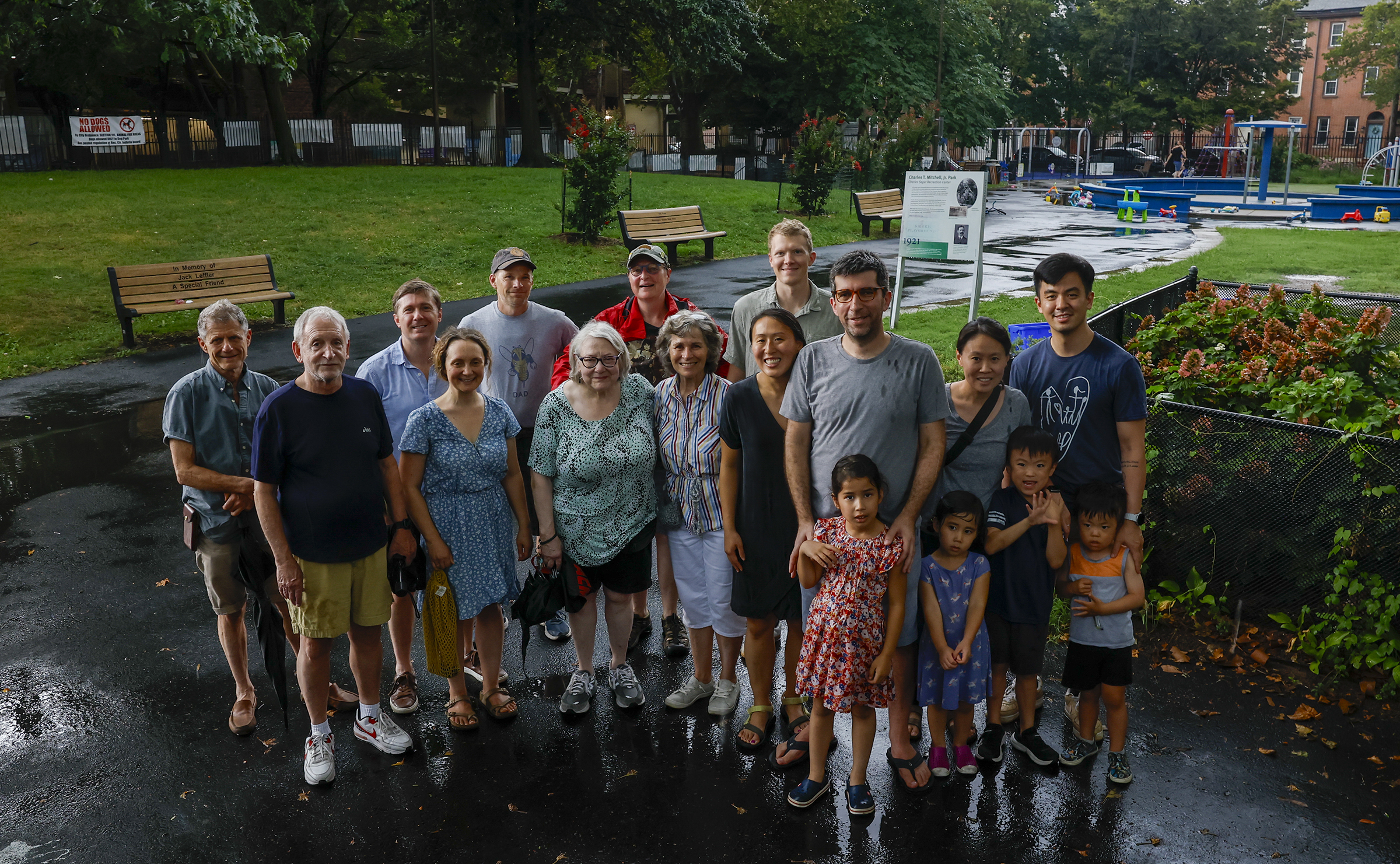
Members of the Philadelphians for Rational Preservation gather at Seger Park in the Washington Square West neighborhood in July 2025. The group opposes the Washington Square West Historic District designation.Yong Kim / Staff Photographer
People vs. preservation
In a City Hall courtroom, lawyers for the city and the preservation alliance sought to defend the designation of the Washington West Historic District against a coalition of homeowners who have claimed the decision has cost them time and money. The outcome could have significant ramifications for such districts across Philadelphia.
Dan Auerbach, a lawyer for the homeowners, says the district was created without sufficient evidence, and that a historic commissioner’s participation in drafting the document represents a conflict of interest. Attorneys Leonard Reuter and Paul Toner, who represented the defendants, took a different approach.
When Common Pleas Court Judge Christopher Hall repeatedly asked for evidence, beyond the nomination itself, for the district’s historic significance, Toner replied, “I don’t need to.” The commission’s decision to approve is apparently all that’s required. They also argued that historic designation does not impose significant costs on homeowners.
Hall seemed to take a skeptical view of these claims. As Auerbach pointed out, most pages of that document simply inventory the existing properties. Often, newly designated homes have no specific justification at all, or just a few words.
Personally, I also find the dismissal of the real costs imposed on homeowners to be unconvincing. According to evidence supplied by Philadelphians for Rational Preservation, the group that formed in opposition to the district, homeowners who have been added to the district are already seeing adverse impacts. Door and window replacements now require permits, for example, and homeowners must spend considerably more to acquire historically accurate versions. This costs real time and real money.
It may be that this district is simply too large and too broad. The period of significance covers nearly the entire history of Philadelphia, and many of the newly designated buildings are frankly unremarkable. While the city and the preservation alliance may feel the urge to appeal the matter to the Commonwealth Court, my suggestion is that they don’t.
While I am skeptical of this particular nomination, I do think historic districts have a role to play in our city. Many of them are popular with residents, or have existed for so long that most homeowners were aware of the restrictions before purchasing.
In the case of Washington West, however, the commission may simply have been too ambitious. The geographic range is just too large, the period of significance too extensive, and the residents themselves too strongly opposed.
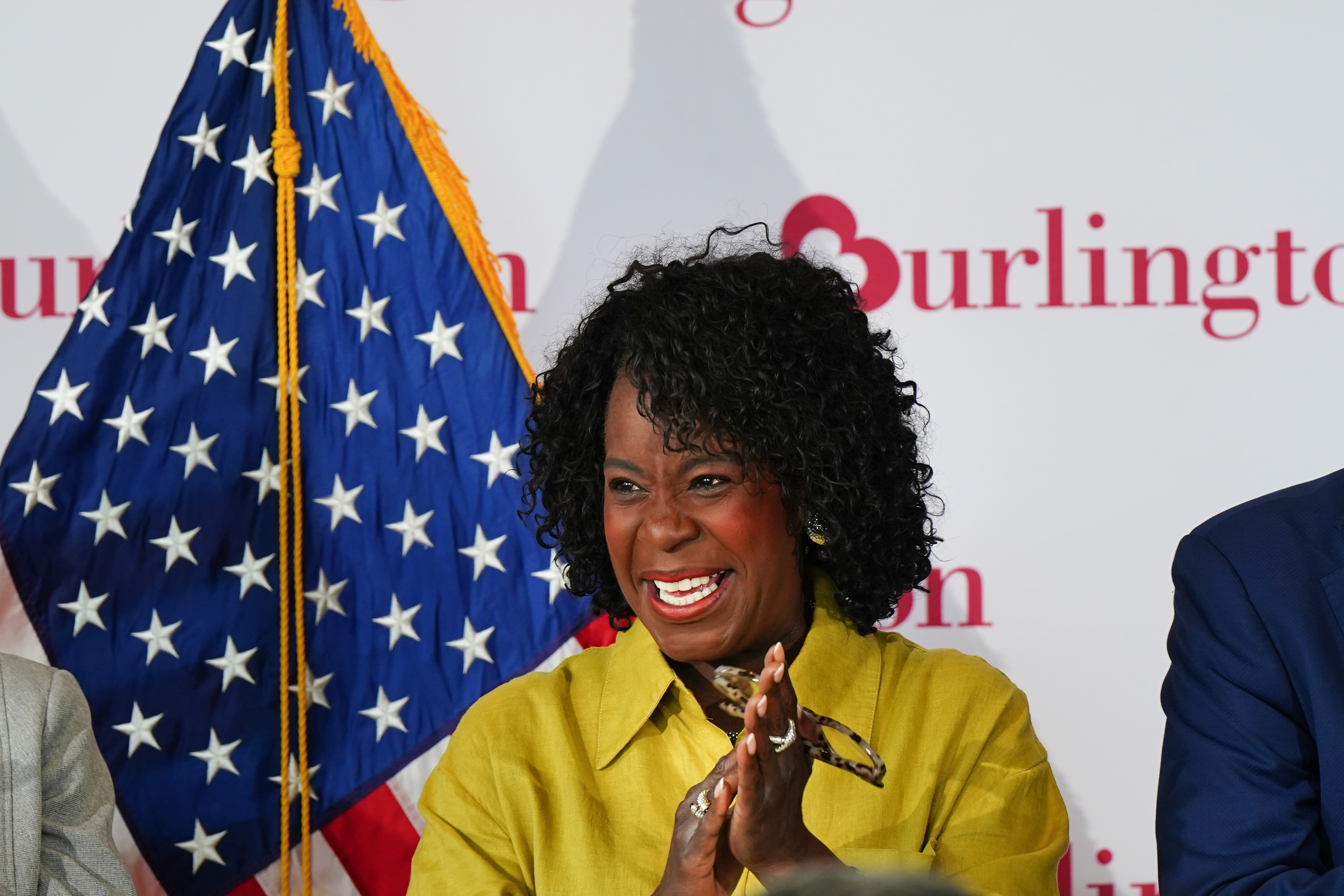
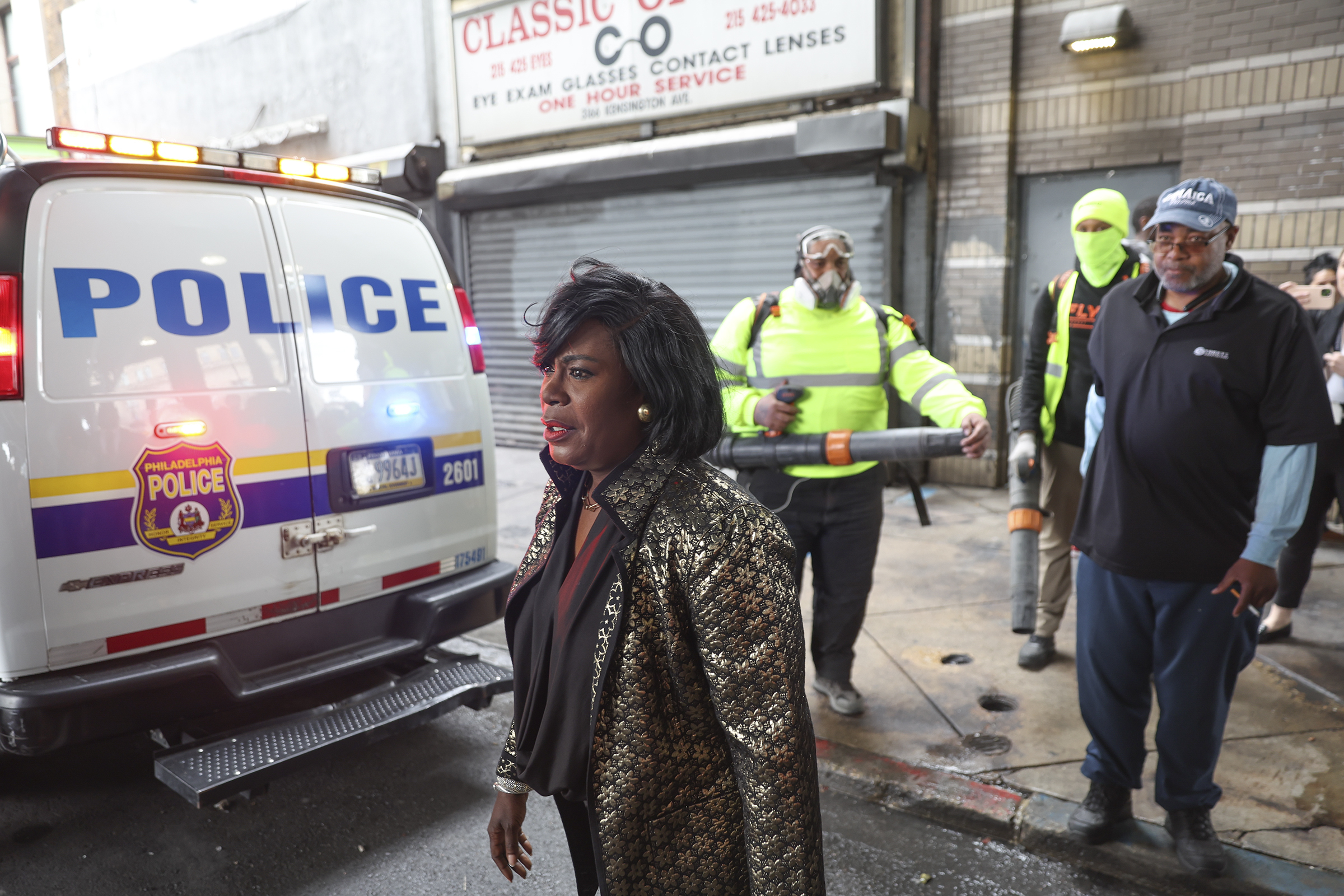
Mayor Cherelle L. Parker at a news conference in September.Jessica Griffin / Staff Photographer
Mayoral milestone
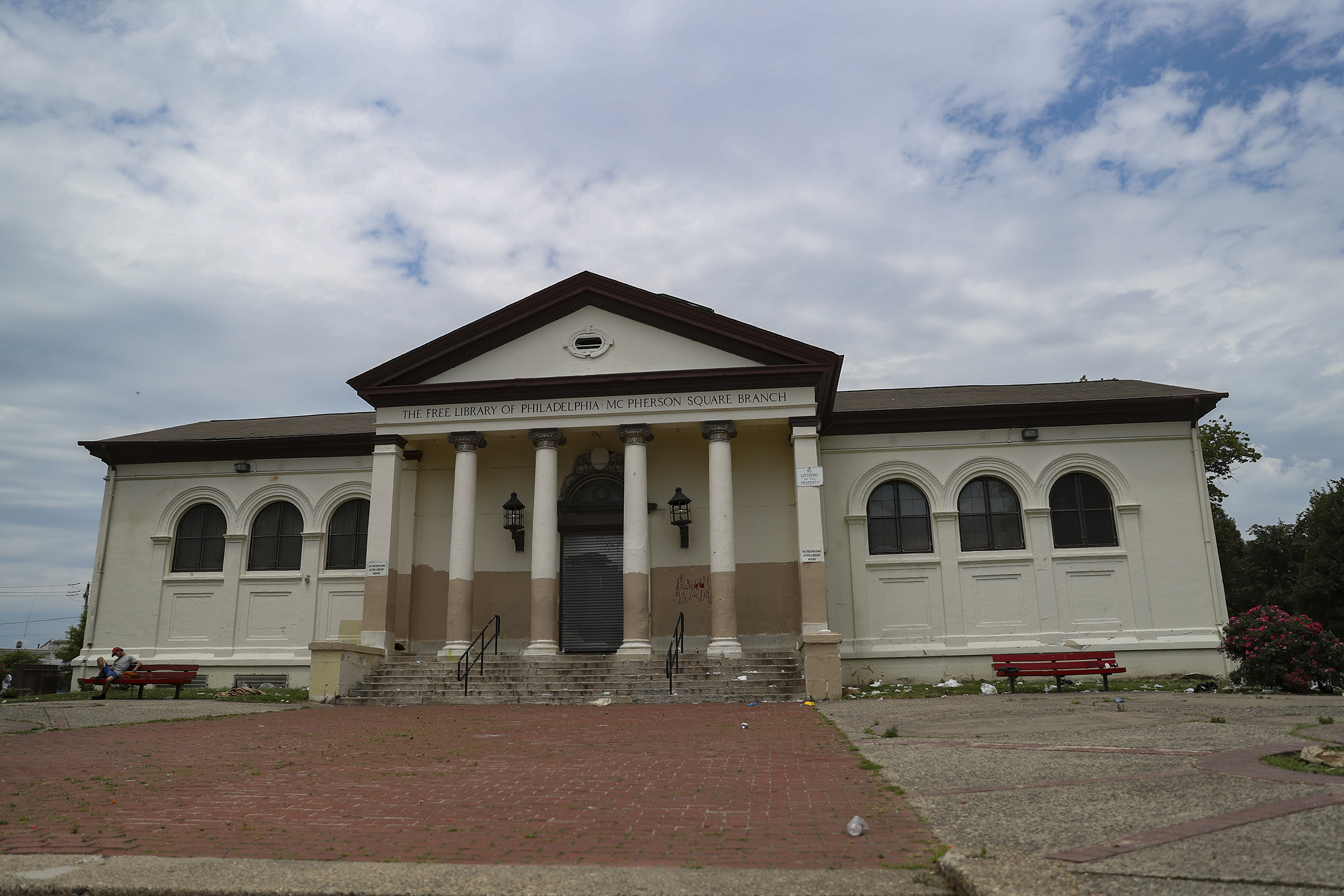
Mayor Cherelle L. Parker celebrated her 1,000th day in office earlier this week at McPherson Square Library in Kensington, which is set to receive a $21.7 million renovation. Parker has made investing in Kensington a priority in her administration, although some of her priorities have been contested.
She’s added police patrols to the neighborhood, sought to dismantle the drug market, and increased cleaning and greening efforts. She’s also come under fire from harm reduction advocates for eliminating funding for the nonprofit Prevention Point and city efforts to rein in a network of services built to alleviate the struggles of addiction, which some residents have blamed for the drug market’s continuing presence in their community.
In many ways, Kensington is a microcosm of Parker’s tenure.
Her administration has made genuine progress. Violent crime is at historic lows, with decreases in the city’s most dangerous neighborhoods driving the decline. Surveys suggest residents believe the city has gotten cleaner under her leadership. Yet discontent, some legitimate and some not, continues. Parker’s approval rating sits at 44%, a number that is likely high enough for reelection next year, but isn’t strong enough to give her the political capital she needs to take on and win fights with City Council.
The biggest factors in whether residents approve or disapprove of the mayor seem to be their age and race. Among Philadelphians of color and those older than 45, Parker is popular. For those under 45 and white voters, she’s not.
It is easy to say this divide is based on style. As Parker herself has said, she’s unapologetic about who she is and where she came from. To residents who may be fans of New York’s Zohran Mamdani, Parker may seem old-fashioned and unexciting. Of course, Mamdani also has a municipal budget of $126 billion at his disposal, while Parker makes do with just $7 billion.
But a lot of it has to do with substance. Small-business owners have lost a crucial tax exemption; her vaunted ability to work across the aisle has not resulted in sustainable transit funding or enabled the school district to avoid closing 17 schools; and Parker has shied away from the ambitious civic reformer causes embraced by predecessors like Michael Nutter.
If the mayor intends to reach 2,000 days in office without becoming yet another tired and unpopular chief executive, she’ll have to step up her game.
Councilmember Curtis Jones Jr. in chambers as City Council meets in December.Tom Gralish / Staff Photographer
Jonesing to stay
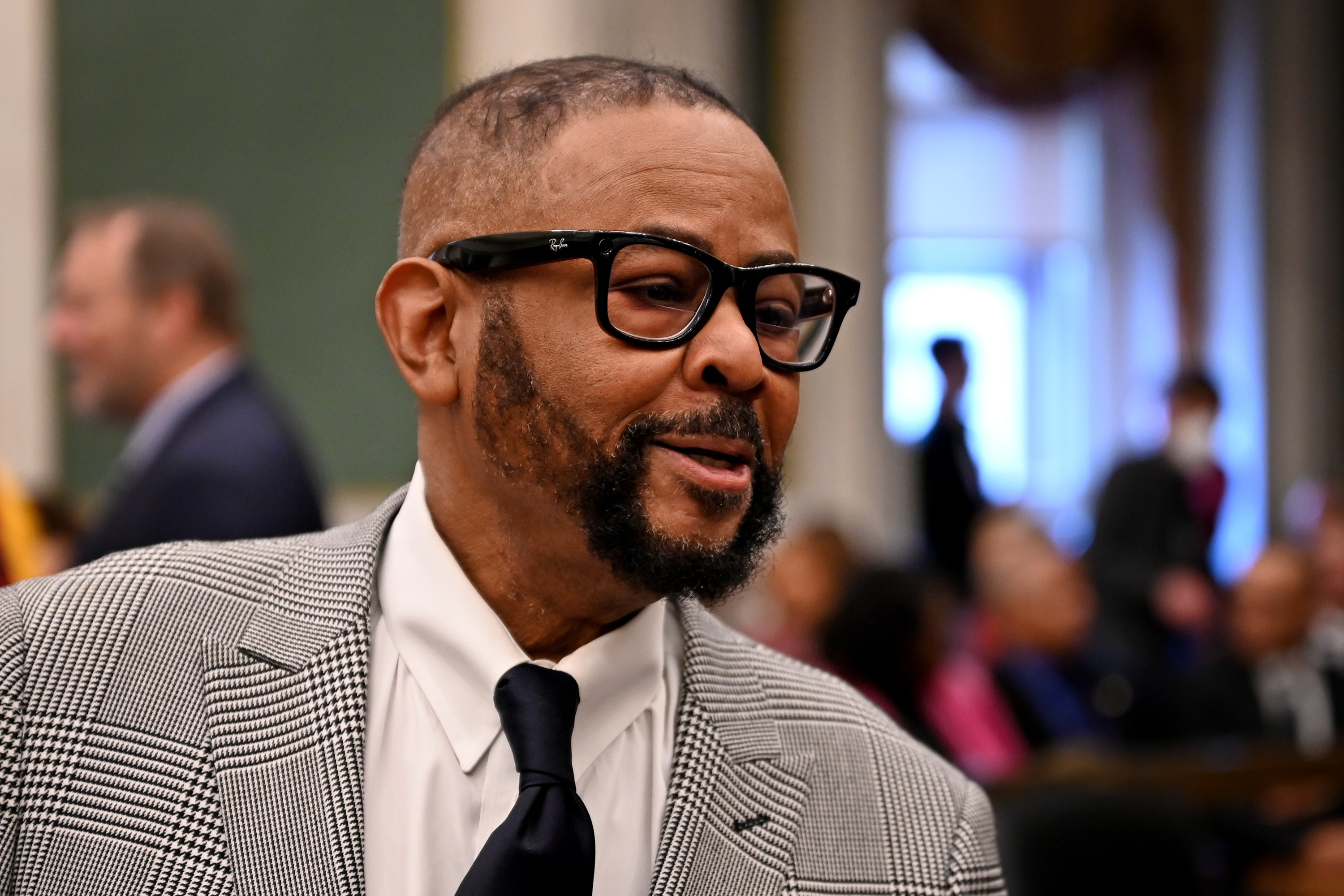
Fourth District Councilmember Curtis Jones Jr. has had a long and often laudatory career in public service. But it is now time for it to end.
Jones cited his ongoing health issues as justification to The Inquirer, saying he needed the money to pay for treatment. I certainly sympathize with anyone struggling to maintain their health. However, Jones represents a city where the median household income is just over $60,000. At 69 years old, he is also eligible for Medicare.
Retirement would also give Jones a chance to relax and focus on staying healthy. For his sake and ours, he should listen to his friends.
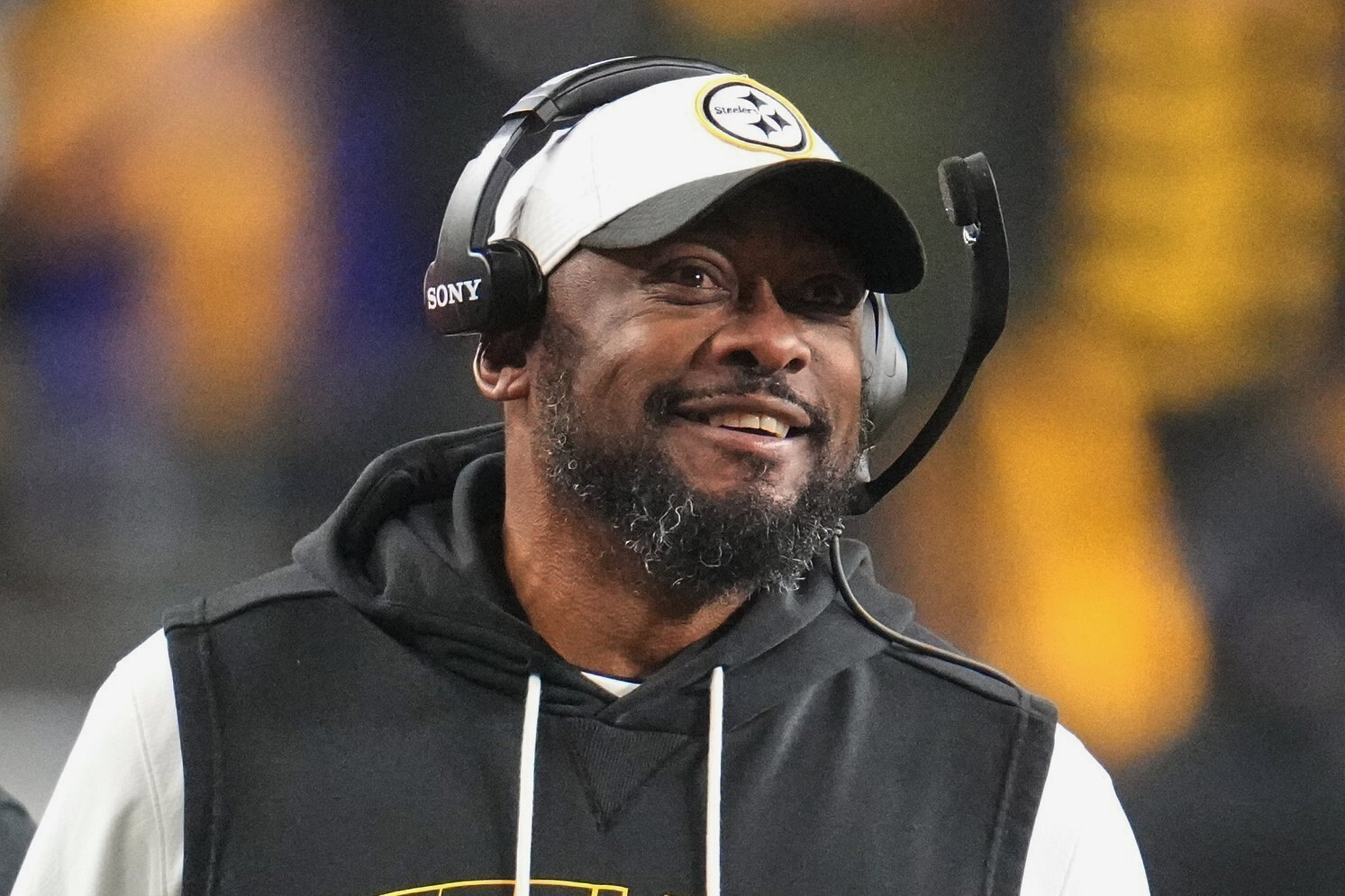
Pittsburgh Steelers head coach Mike Tomlin stands on the sidelines during the second half of an NFL football game against the Baltimore Ravens in Pittsburgh in January.Gene J. Puskar
Tomlintown
When you write frequently about transit and housing, you tend to hear from the small cadre of people who are extraordinarily enthusiastic about these issues. This week, I found out about a surprising member of their ranks: former Pittsburgh Steelers head coach Mike Tomlin.
Famous for his uncanny resemblance to actor Omar Epps and being the second Black NFL coach to win a Super Bowl, Tomlin used the game Minecraft to build his own fantasy city — a project that took place over a dozen years. He’s now giving the public a tour of his work.
Tomlin said he wanted densely populated buildings because of his interest in architecture, and went as far as creating interiors for each of his creations. His work is remarkably cognizant of genuine urban questions like lighting and viewsheds.
Like many gamers, he said his habit helped him “detach from the realities and the pressures of life.” We all need a way to unplug sometimes, but Tomlin’s impressive urban planning side project may have turned him into an unlikely urbanist hero.
Kensington Voice — the independent, nonprofit newsroom and community hub covering the lower Northeast and North Philadelphia — has ceased publication.
“Kensington Voice has run out of money needed to pay our staff,” said Jillian Bauer-Reese, cofounder of Kensington Voice in a letter to readers published Monday.
The outlet’s website, which provided news, guides, community-authored opinions, and neighborhood resources created with community reporting, has been largely dormant for months.
“We should have shared this update sooner,” Bauer-Reese explained. “We stayed quiet while we worked through what would happen next, and that process has taken much longer than we expected.”
The hub is working with partners to preserve Kensington Voice’s work and resources, Bauer-Reese said, and to continue any ongoing projects where possible. The small news organization’s archives will stay online. Staff members — the hub employed six to eight journalists at its peak — had been laid off during the weeks and months leading to the announcement.
Funding for Kensington Voice — which operates with nonprofit status through a fiscal sponsor, Movement Alliance Project — had been a challenge for the last two years, Bauer-Reese wrote on the site.
“Thank you to everyone who read our work, shared it, trusted us with their time and their stories, corrected us, and helped make Kensington Voice what it has been,” she said.
News by and for residents
Serving the neighborhoods of Kensington, Fairhill, Harrowgate, Norris Square, and Port Richmond, Kensington Voice aimed to be something new when it was founded by Bauer-Reese and more than a half-dozen of her journalism students. Its communal reporting on the opioid overdose epidemic, housing, homelessness, poverty, and quality of life considered solutions to issues of inequality that have plagued North Philadelphia communities for decades.
As the neighborhood seemed to suffer worse than ever from the grip of drugs and violence, Kensington Voice became an advocate for a community often overlooked — and stigmatized. Like when a 2018 New York Times Magazine story famously referred to the languishing community as the “Walmart of Heroin.”
“The idea for Kensington Voice came from a hunch I had that in a neighborhood often at the center of our national news media’s drug and addiction journalism, the news and information needs of the community itself weren’t being met,” she had said in 2019.
A Kensington Voice meet-and-greet in October 2018 at Impact Services. The event brought together community partners to talk about ideas for news coverage of the area.Handout
Within months, Bauer-Reese and her students operated a rotating pop-up community newsroom, run out of libraries, rec centers, and on street corners, and putting community voices foremost. At these pop-up stations, residents submitted story ideas and built storytelling bridges, where the realities and solutions of the community-led reporting. Reporters would meet residents at tables. Some residents published their own stories.
“The more I work in the community, the more I realize how the work of journalists impacts those who live and work there,” Bauer-Reese said in 2019.
During the peak of the opioid overdose crisis in Philadelphia in 2022, when more than 1,400 people died in Philadelphia from drugs, the Kensington Voice relied on shoe-leather reporting from the front lines to draw attention to the city’s struggling response.
The newsroom shared empowering first-person narratives from people in addiction building new lives, young mothers navigating complex support services systems, and the writings and art of gifted local high school students.
“I look up at that blue sky and wonder how much longer will it be blue until it is filled with smog,” wrote 16-year-old Kensington student Jazielys Serrano in a 2024 poem published through the hub’s Youth Voices Program.
Amid the challenges of reporting on the largest open-air drug market on the East Coast, Kensington Voice’s coverage received criticism as being too sympathetic to people who use drugs.
That was the point, Bauer-Reese explained. Flipping the lens so the most vulnerable had a chance to be heard.
“By being a part of the Kensington community and helping neighbors share their own voices, we hope to shed a new light on this community,” Bauer-Reese said in 2019.
Fading funding
Staffed by reporters, photojournalists, and editors at its peak, Kensington Voice began to leak funding as attention slowly began to fade from the neighborhood.
Before going dormant in the spring, the outlet published reports about medical mobile service bans in Kensington, police brutality, Mayor Cherelle L. Parker’s affordable housing plan, and plans to renovate Kensington’s embattled McPherson Square. The newsroom detailed community members’ heightened anxiety over U.S. Immigration and Customs Enforcement in North Philadelphia. It also published guides helping citizens connect with vital public resources, like information on how to report illegal dumping and abandoned cars, and where to find jobs, housing, and health support.
The work — and the relationships — will live on, Bauer-Reese wrote.
“What this community built with Kensington Voice doesn’t end here,” he said.
The Philadelphia School District is thousands of students under its enrollment projections this school year — and with an important funding deadline looming, Superintendent Tony B. Watlington Sr. is sending officials knocking on doors to drum up business.
Central office staff and school workers have been asked to fast-track “Enrollment Acceleration,” a new, district-specific programdirectly engaging families that have left the Philadelphia school system, The Inquirer has learned.
District staff — up to and including chiefs and assistant superintendents — are fanning out across the city, pounding the pavement to try to connect with reluctant families face-to-face. The door knocking began in the last two weeks.
The effort is driven by a shrinking student body in district schools and an Oct. 1 deadline to report enrollment — which drives district funding — to the Pennsylvania Department of Education.
District schools were 4,236 students under their projected enrollment as of Sept. 17, according to internal documents obtained by The Inquirer. District-run alternative programs had 1,051 fewer students than planned.
The school system had projected 116,898 in district schools by Sept. 17, and 2,757 in alternative schools. Instead, its enrollment was 112,662 in district schools and 1,706 in alternative schools.
Asked to comment on the enrollment decline, a district spokesperson said it was too early to estimate annual enrollment because the state’s verification process does not conclude until Oct. 30. But, Monique Braxton said, it’s part of a nationwide trend of dwindling public school enrollment.
“The district’s goal is to get district operated schools as close as possible to that of last year’s number of approximately 116,898 students, such that we can grow our enrollment next school year,” Braxton said in a statement.
Enrollment is down virtually everywhere in the city.
Just two of 15 networks did not lose students, according to the Sept. 17 figures — Learning Network 9, a geographic network of elementary and middle schools in Kensington, Bridesburg, Port Richmond, and Frankford, and Learning Network 15, a network of magnet schools across the city.
Voting with their feet
Once the 2026-27 school year began Aug. 24, it became quickly clear that there were fewer district students in seats than expected.
Many factors likely play into the enrollment decline.
Though academics have generally been improving in the school system — Philadelphia was tops in the nation in its learning rate post-pandemic, according to research out of Harvard and Stanford — the district still struggles, with most students unable to read (33%) or do math (25%) at grade level.
(Philadelphia charter schools’ performance is slightly worse in reading, 31%, and slightly worse in math, 20%.)
Also a likely factor is the effect of the school board voting recently to close 17 schools in the next several years. Officials have said they are doing so to improve academic outcomes for all students, amid 70,000 empty seats citywide, a stock of aging buildings and decades of underfunding, and emphasized that in addition to the closings, they plan to spend billions on renovating 169 of the buildings they’re keeping open — though most of that plan is unfunded.
There are other reasons, too: Some staff say the current political climate has fears of ICE keeping some students out of school. And cyber charter enrollment is growing, with some Philadelphia families choosing the virtual option because of safety fears for their children as the city grapples with a gun violence epidemic.
“The district is a hard sell for some families,” said one central-office employee who was not authorized to speak about the enrollment decline. “You have a lot of families who have just unfortunately lost faith in a lot of the offerings that we have, and they’re voting with their feet.”
A full-court press
Since the surprise decline became apparent when school started, “we’ve been working hard to close the gap,” the employee said.
At first, schools were directed to reach out themselves via calls and emails to students they expected to enroll but who never showed up. Soon, almost-daily briefings on closing the enrollment gap began, and have continued.
Next, the administration moved to canvassing events, asking central office employees and school staff to volunteer to go out in pairs into neighborhoods to reach families. Canvassing also includes trips to neighborhood barbershops, laundromats, and corner stores “trying to convince students to return back to the district, rather than remain in whatever other option they decided on.”
About 75 employees volunteered for the effort, the employee said. It is still ongoing.
Some schools and departments pushed back against the call to directly appeal to students, with officials they didn’t feel comfortable sending staff into neighborhoods. Others are going out, the employee said.
The campaign is an extraordinary step, said the employee.
“I’ve never known an assistant superintendent or anyone going so far as this, being part of canvassing,” said the employee source.
Much is at stake.
“Our funding is based on numbers,” the employee said. (Both state and federal funding are tied to enrollment.)
And the district has generally been shrinking for decades.
In 1999, just after the first charter schools opened in Pennsylvania, the district enrolled 205,199 students in its schools. By 2025, that number was 113,735. (An additional 64,469 students were enrolled in charters.)
The district’s enrollment rose once in the last decade: in 2024-25, jumping by 1,841 students to 117,956. Watlington said he believed the next year’s drop happened because of large-scale SEPTA bus route changes at the start of the school year.
‘Warm conversations’
A second employee involved in the recent recruitment efforts said the call to canvass came with surprising urgency.
“They said, ‘It needs to be done in the next two weeks, because our numbers have to go to the state Oct. 1,’” said the employee, who also asked to not be identified because they were not authorized to speak about the enrollment push.
The second employee was paired with another volunteer. They received a several-page handout with instructions about how to conduct the visits, and a suggested script.
“We’re reaching out because we want to make sure your child has a clear plan for school and see how we can support you,”the second employee said.
Canvassers were told to ask if the family planned to return their children to the district, to begin a “warm conversation” and to help families with information about how to register for district schools. They were told to help address any barriers to registration.
Teams were told their safety is paramount, asked to not enter homes, and reminded to end a visit if either team member feels unsafe.
“Remember,” one handout said, “you are there to understand, inform, support and connect — not to convince.”
The second employee wasn’t especially enthusiastic about canvassing, but felt pressure to do so.
“What can I say on somebody’s doorstep to get them registered in the school district? Nothing,” the employee said.
The first employee said they were not having success with families.
“The houses I’ve been to haven’t been very responsive,” the employee said. “But I’ve been having very cool conversations with neighbors.”
Many families aren’t home or don’t answer the door, and the employee doesn’t blame them. They could be mistrustful of authorities or people they don’t know or worry about their safety.
Four people involved in the “come-back-to-the-district” effort said they were skeptical it would help the school system reach its projections.
“It’s going to yield something, but it’s not going to yield enough to cover up the fact that we’re several thousand away from meeting our projection of 116,000,” the employee said.
Mayor Cherelle L. Parker marked her 1,000th day in office by breaking ground on a $21.7 million improvement to the McPherson Square library, a symbol of the Kensington opioid crisis, to send the message that her administration’s “commitment to this community is firm.”
“The Kensington that I’m standing in today — this is not the Kensington that I walked in January of 2024. Quality of life is improving here,” Parker said at a news conference on Monday.
Although she did not focus on Kensington while campaigning for mayor in 2023, Parker has, since taking office, embraced the challenge of addressing gun violence and substance abuse in the neighborhood, which has made international headlines, and eradicating what is often referred to as the largest open-air drug market on the East Coast. She rode the El to an event at a Kensington middle school to mark her first 100 days in office.
The McPherson Square park and library became a highly visible marker of the crisis in the mid-2010s. People in addiction were a constant presence in the six-acre park, near Kensington Avenue and Orleans Street. Library staff learned how to administer Narcan, which reverses overdoses.
Philadelphia Mayor Cherelle L. Parker exits the Allegheny station before walking along Kensington Avenue on April 11, 2024. Parker took the El to attend an event marking her 100th day in office in the Kensington neighborhood in Philadelphia.Heather Khalifa / Staff Photographer
Parker ran on a tough-on-crime platform, and her approach to Kensington has featured a mix of police-focused tactics and novel strategies aimed at getting people off the streets and into recovery.
She cut city funding for syringe exchange services in her first budget, and her election effectively ended the city’s efforts to open a supervised drug consumption site, a priority of former Mayor Jim Kenney. The police department has doubled the number of officers who patrol the area, First Deputy Police Commissioner John Stanford said Monday.
Parker has also launched a Neighborhood Wellness Court program, which is designed to encourage alleged offenders to choose addiction services and avoid criminal proceedings, and she has launched the Riverview Wellness Village, a 20-acre recovery house in Northeast Philadelphia where more than 200 people live.
“People are beginning to see that we are at least trying to make a difference, and we are not acting as if we don’t see what’s happening,” Parker said. “We’re looking it straight in the eye and trying to figure out a way to make sure that we are solving a problem.”
Since Parker took office, the Kensington-based 24th Police District has seen a 48% decrease in violent crime, a 63% decrease in shootings, and a 47% decrease in homicides, Stanford said Monday.
After peaking in the wake of the onset of the COVID-19 pandemic, rates of violent crime and homicide have fallen across the country. This year, homicides in Philadelphia are on pace for a 60-year low.
People using drugs are still a common sight in Kensington, and crime rates in the neighborhood remain higher than the city as a whole, a reality Parker readily acknowledges. And her approach has drawn criticism from some harm reduction advocates and public health experts, who contend that heavy-handed policing can be counterproductive to saving the lives of people in addiction.
But few doubt Parker’s commitment to cleaning up the neighborhood, and the prospect of a revitalization of the dilapidated library, which was built in 1917 with a copper dome and classical columns, could be a potent symbol.
The renovation of the McPherson Square library is being funded through Rebuild, the parks and recreation center renovation program championed by Kenney and supported by Parker when she was on Council. Rebuild is one of three programs Kenney proposed while pitching the city’s tax on sweetened beverages, which was approved in 2016 and is more commonly known as the soda tax.
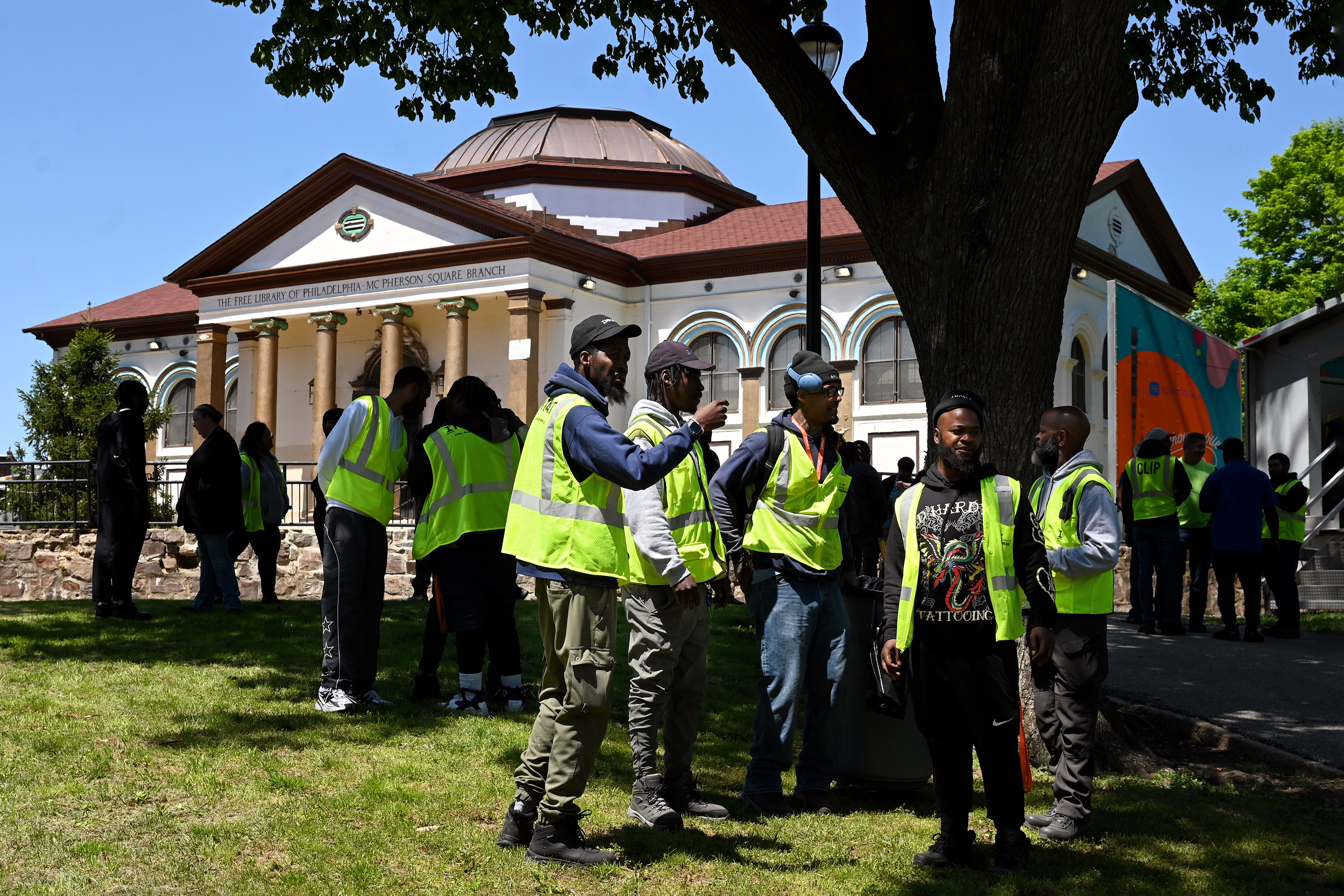
Workers set out to clean after the Office of Clean and Green Initiatives kicked off the summer edition of the One Philly, United City Citywide Cleaning Program in McPherson Park on May 4.Tom Gralish / Staff Photographer
The first phase of the library renovation, which included a new roof and a restored dome, was completed in 2025. Parker on Monday broke ground on the second phase, a “full-gut renovation” with “new HVAC, plumbing, electrical, fire alarm, and security systems” and many other improvements, according to the Philadelphia Capital Program Office.
The project will take two years. In the meantime, the Free Library of Philadelphia will set up a temporary location on Allegheny Avenue, said Kelly Richards, the library’s president and director.
City Councilmember Quetcy Lozada, whose 7th District includes much of Kensington, said she spoke to Parker about addressing the long-neglected neighborhood’s challenges in 2023, and recalled being “skeptical” that Parker would follow through on her promises as mayor.
“She made a commitment on that day that if she were to become the mayor of this city, that she would make Kensington and this community a priority,” Lozada said at the new ground-breaking, “and she has stood by that commitment and that promise.”
Staff writer Anna Orso contributed to this article.
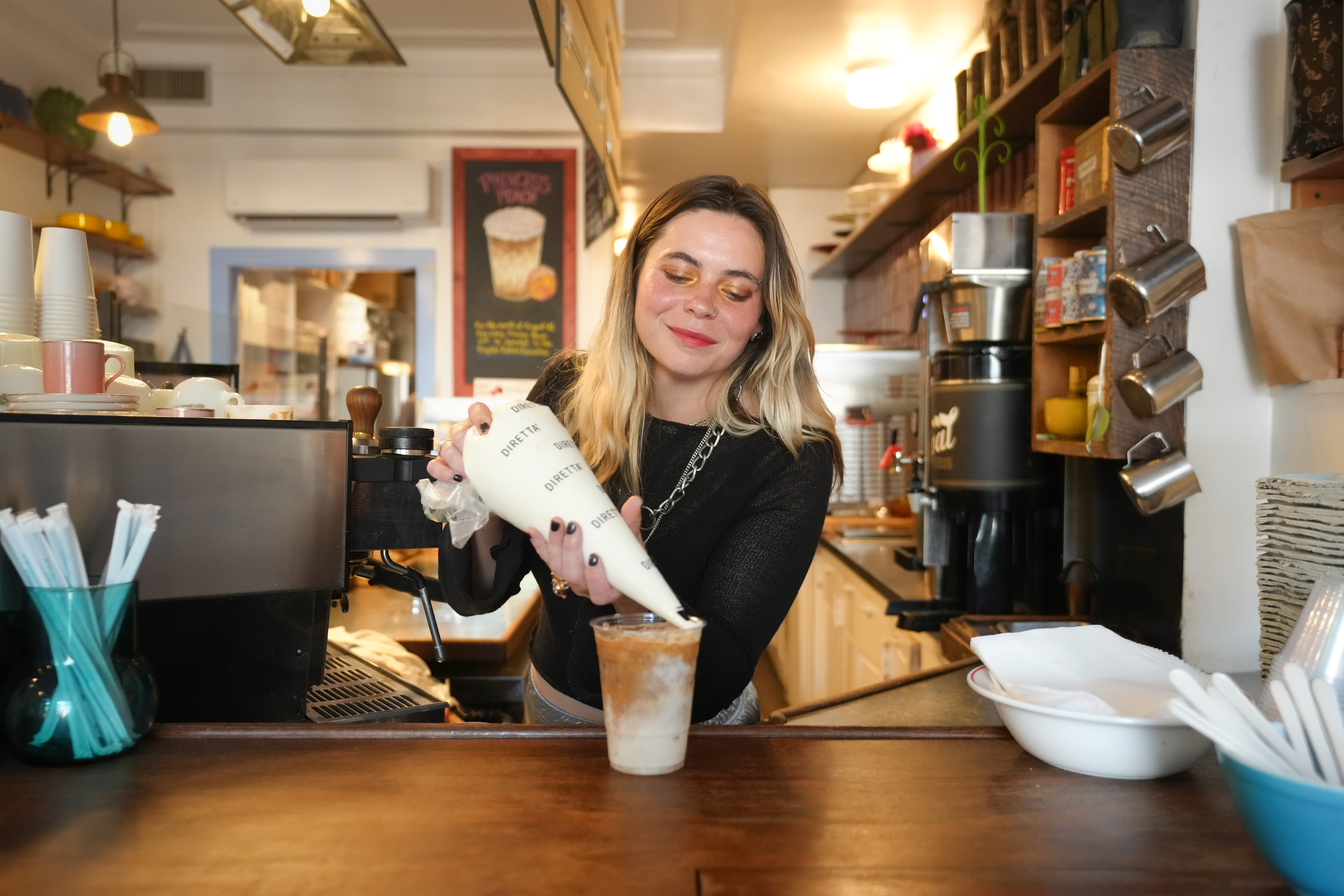
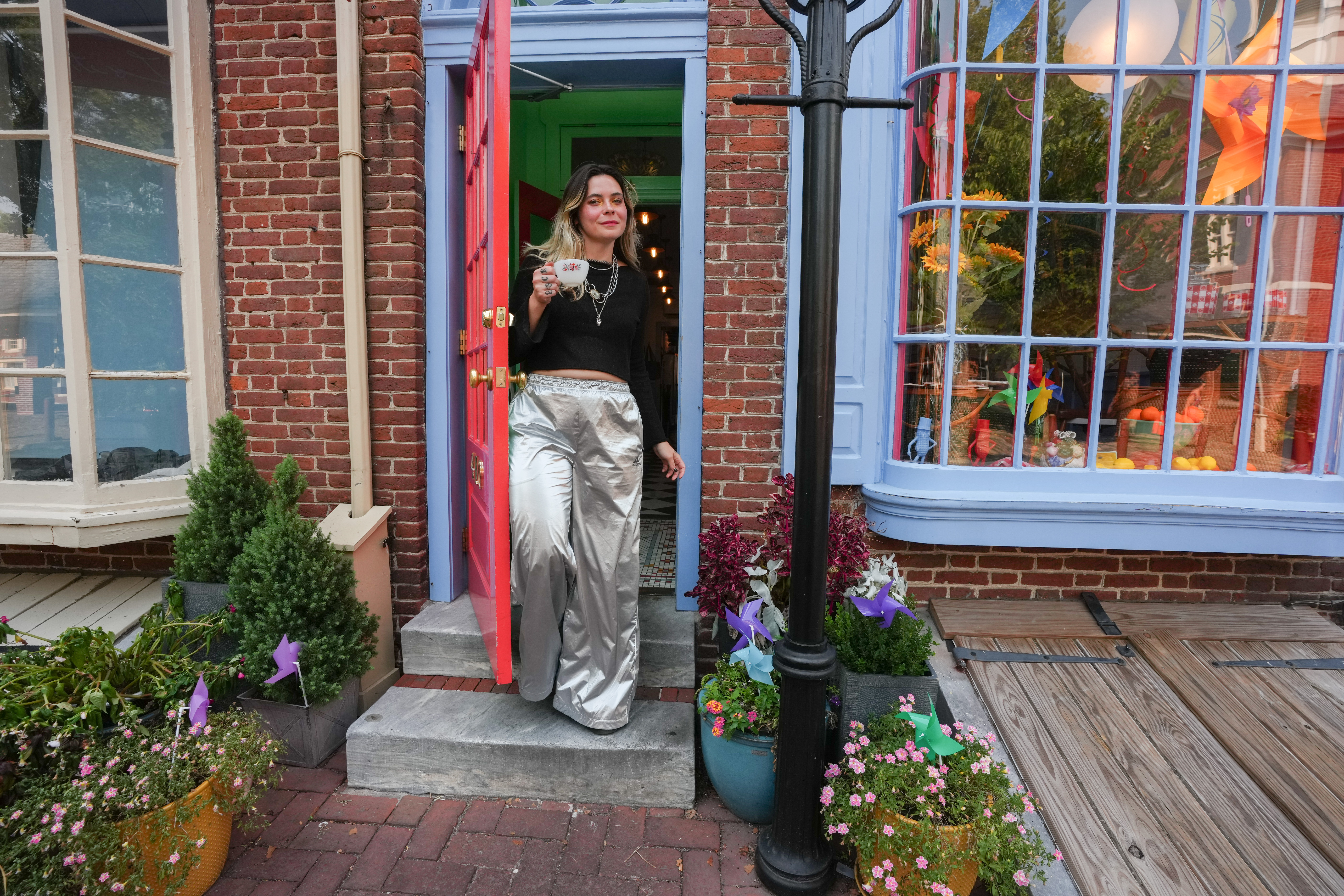
Zoe Tanner’s handiwork is immediately recognizable: Cloudlike cold foam puffs flecked with sprinkles that adorn the lattes at Loretta’s, the Society Hill cafe at the epicenter of Philly’s little treat boom.
Loretta’s sells about 200 specialty lattes on a busy day, Tanner estimates.
This September, Tanner spent hours in Loretta’s basement making bite-size uncrustables to top the coffee shop’s PB&J latte, which comes with Concord grape syrup and a peanut butter cold foam. In May, the drink du jour was a black-raspberry-maple concoction topped with a nutty tahini whip and sprinkles shaped like spring flowers. Next month, Tanner is whipping up a banana latte decorated with pretzel rod ghosts. Proceeds from each creation have gone to local charities such as ACCT Philly and the Eagles Autism Foundation.
“Say what you want about the girls that come in from Instagram, but they’re making a difference by buying a drink,” Tanner said. “That matters to me.”
Tanner, 31, serves as the operations director of all three of Bush and Morris’ businesses, splitting her days between training staff, managing inventory, and developing latte recipes. Barista-ing at Loretta’s, however, is the best part of her job.
“I love connecting with people,” said Tanner. “And coffee is so cool because it goes through so many processes to get into your cup, but everyone who touches it is really important, from the grower to the roaster to the barista.”
Zoe Tanner pipes marshmallow whip onto a speciality latte at Loretta’s, a coffee shop in Society Hill.Jessica Griffin / Staff Photographer
Tanner, who moved to Philly in 2015 from a small town in Maryland, fell into coffee by working at Starbucks while attending the University of Valley Forge. After, she worked her way up from being a barista at La Colombe’s Dilworth Park location to account manager for the local coffee chain, where she was responsible for convincing mom-and-pop shops to use the brand’s products. She started at Loretta’s when they opened.
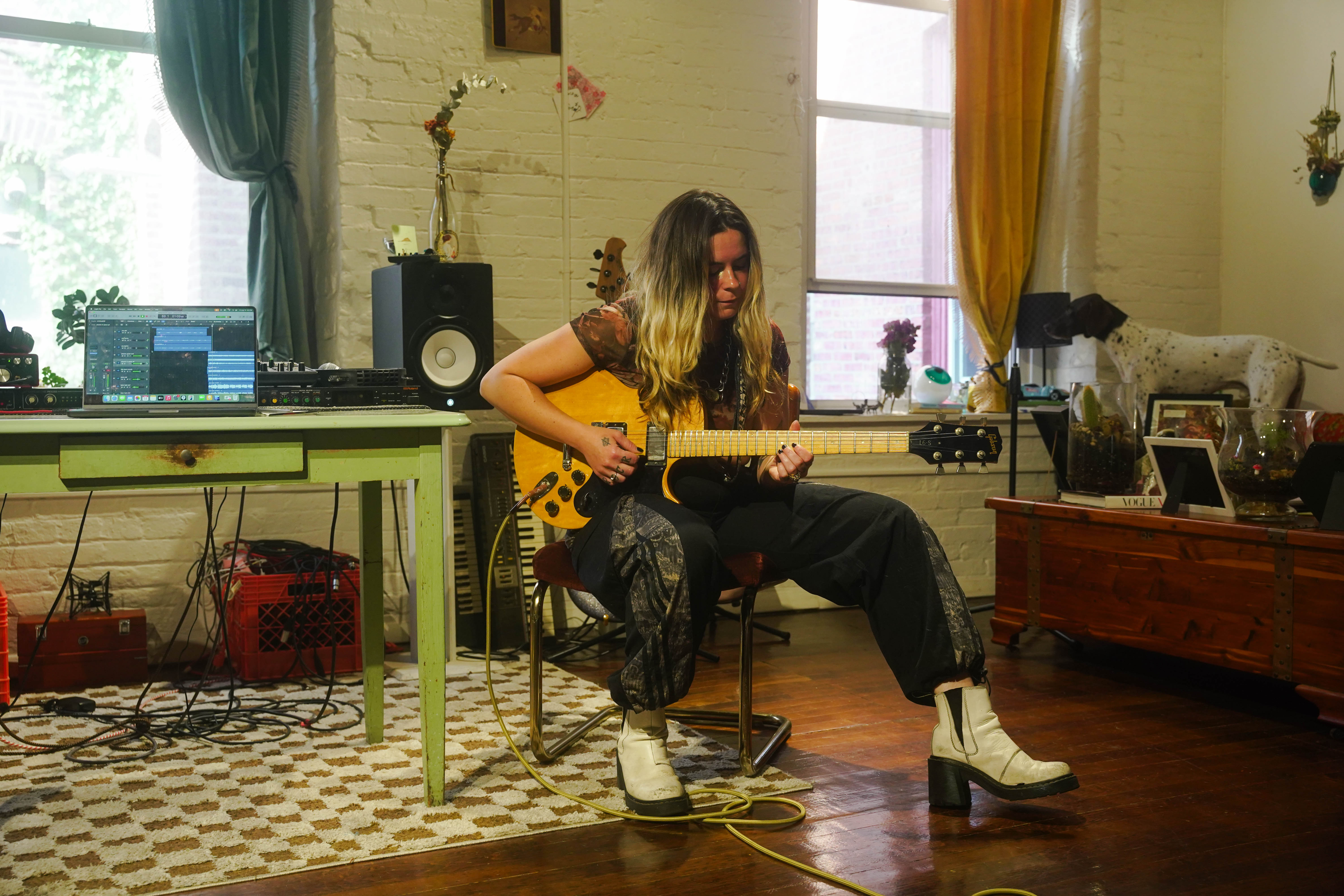
The job fuels Tanner’s second career as a self-made musician who writes, records, and mixes all her music. This fall, Tanner will release her fifth album as Mommy Rockstar Bitch, the grunge persona that has helped Tanner find power in her role as the self-proclaimed “mom friend.”
Tanner said working at Loretta’s keeps her grounded like the novelist Charles Bukowski, who kept his job as a mailman during his early days as a writer. It’s also brought her unexpected fame.
Zoe Tanner plays guitar in the living room of her apartment in Olde Kensington.Rowan Ohara
“I was running in Fishtown the other day when a group stopped me and were like, ‘Can we take a picture with you? You’re the Loretta’s girl,’” Tanner said. “Never did I think coffee would be how I build my brand.”
So, how does Philly’s most famous barista spend a perfect day in the city? It involves sharing human food with her dog, running a half marathon, and mixing music from her home in Olde Kensington.
5 a.m.
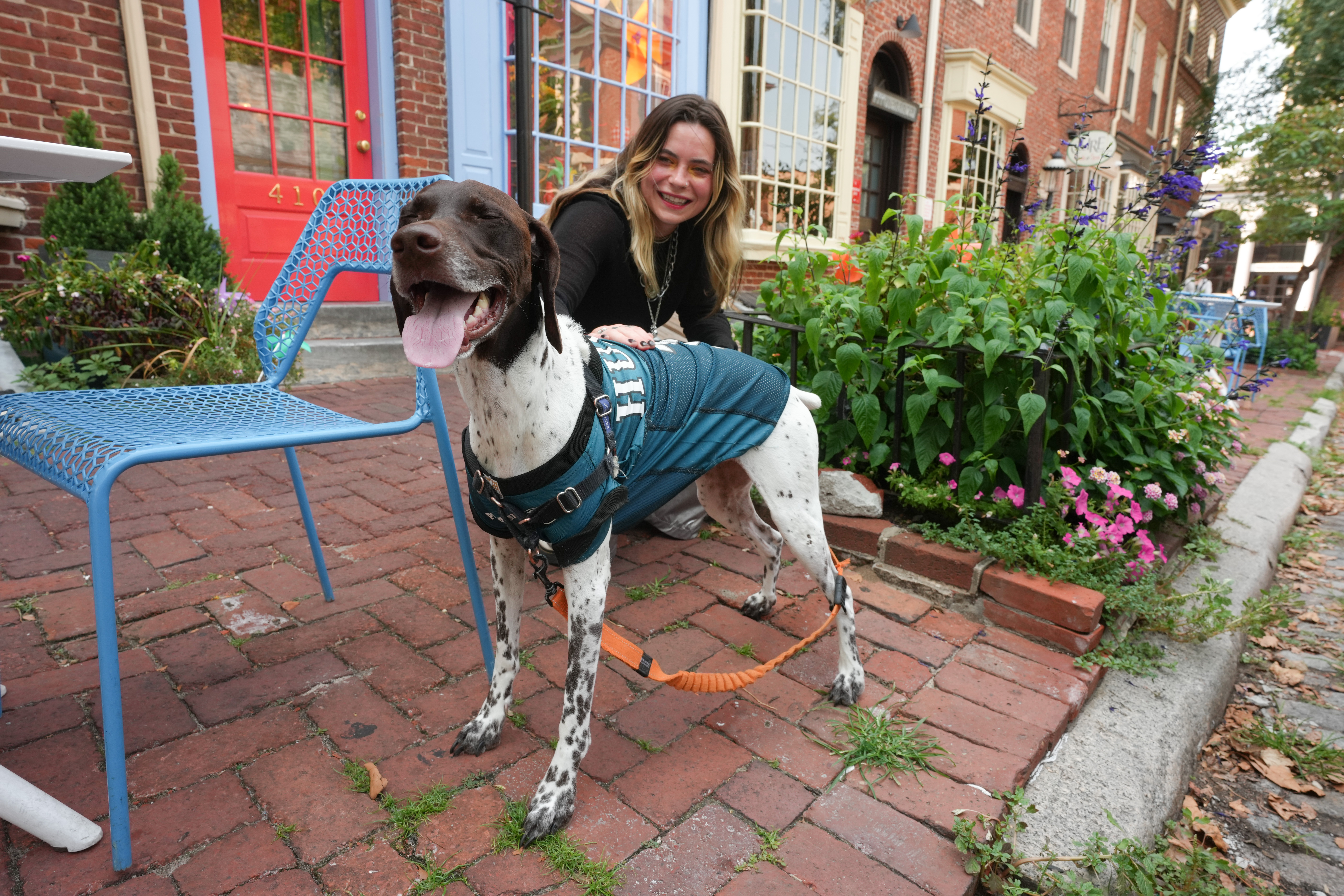
I generally wake up at 5 a.m. with my dog Barrett — a 6-year-old German shorthaired pointer — barking at me to give him pets. I automatically smile; one of my biggest accomplishments in life is that he’s so well-behaved because GSPs are such a tough breed.
After a quick morning walk with Barrett, I’ll head to a 6 a.m. Heated Power Strength yoga class at Monarch Yoga in Kensington. I go without having any coffee, which is so unnatural for me, and then when I get out, I feel so awake and alive. The music is also so upbeat and fun for a strength class, but since it’s a yoga studio, [the instructor] still gives us a spiritual concept to focus on.
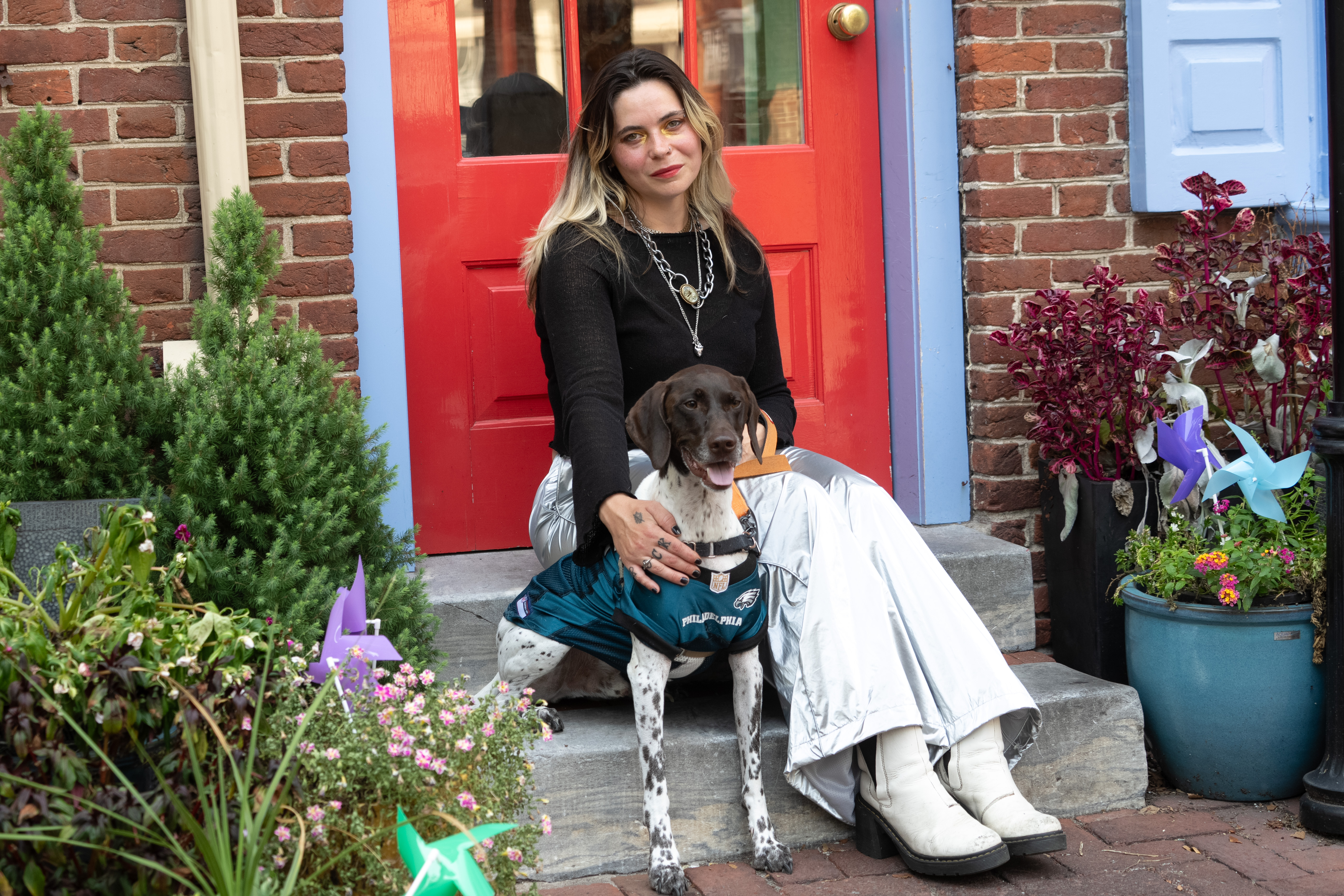
Tanner likes to share food with Barrett, her 6-year -old German shorthaired pointer. His favorites include banh mi from Ba Le and pizza from Pizzeria Beddia.Jessica Griffin / Staff Photographer
7:30 a.m.
Next, I’ll grab Barrett for a long walk that’s mostly about him being the center of attention. People might say that I’m a bad dog mom for this, but I share my food with him.
I’m not even embarrassed by this because Barrett has good taste: When we go on long runs, we always stop at Ba Le Bakery in South Philly for a lemongrass and beef banh mi, and when we walk down Frankford Avenue, he will literally yank me across the street for Huda Burger. I even gave him a Pizzeria Beddia birthday party. I promise he’s a healthy dog.
Anyway, on our long walks we will either stop at Rival Brothers Coffeefor a short Americano and so Barrett can look out the window, or Càphê Roasters to split a fried chicken sandwich. It’s funny because I used to joke about never wanting to be a regular somewhere, but now I walk into these places and it feels like I’m talking to my siblings. It’s a beautiful way to start my morning.
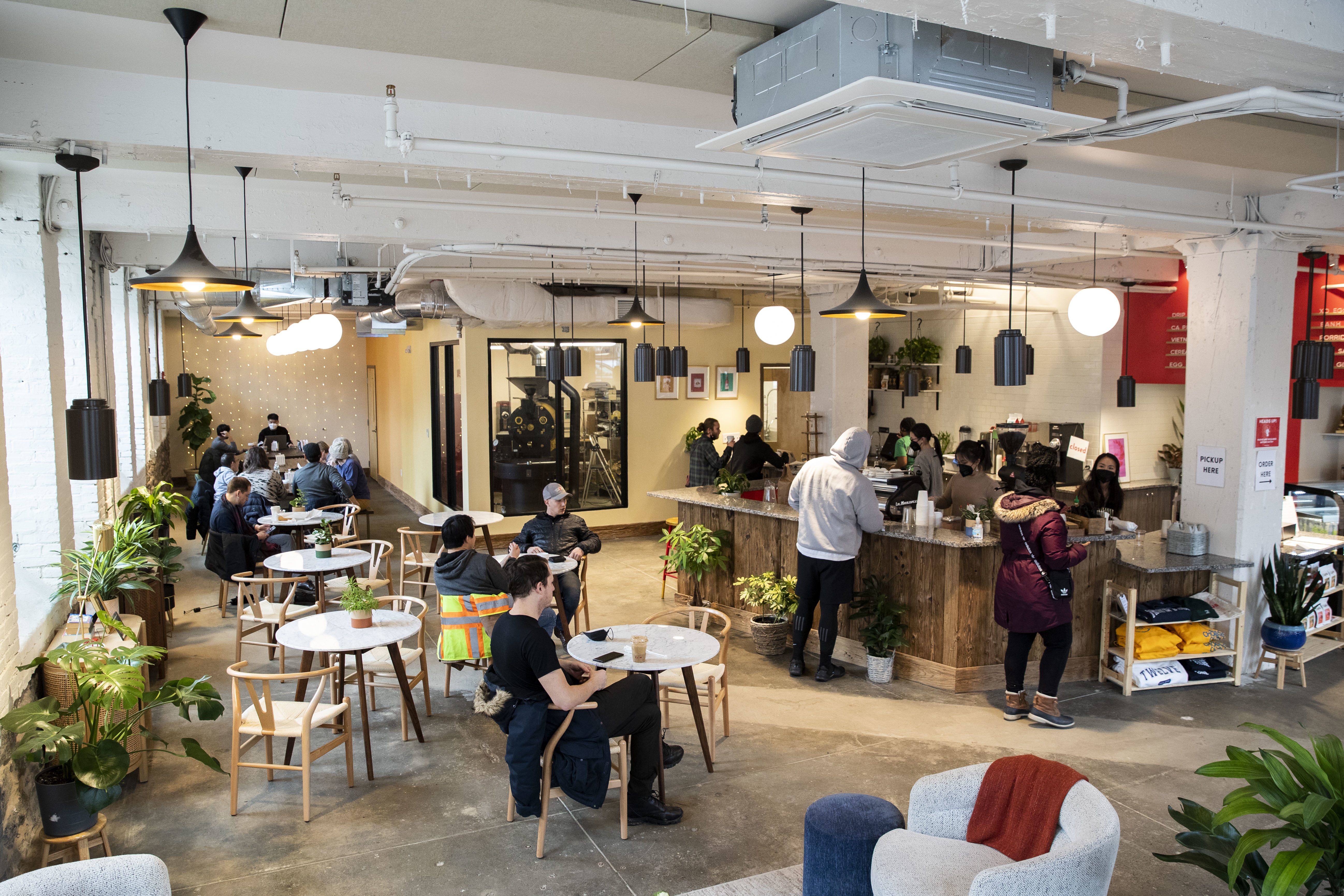
The inside of Càphê Roasters in Kensington, where Tanner and her dog Barrett are regulars.Monica Herndon / Staff Photographer
10 a.m.
After also feeding Barrett real dog food, I head down to Loretta’s to clock in for a shift. On a perfect day, work involves barista-ing a little bit, doing latte research, and filming content for social media.
All of our specialty lattes involve a specialty syrup and cold foam, and they take about three iterations each to get right. I love it because I feel like I’m in a lab, trying to find the right balance of fun and sweetness without just serving people sugar just because it looks pretty … [Kelsey Bush] and I are both very anti-unicorn frappuccinos.
As director of operations at Loretta’s, Zoe Tanner says the best parts of her job include working on latte recipes and barisa-ing.Jessica Griffin / Staff Photographer
At some point, I will stop for lunch. I’m in a protein era right now, so I like to order the Emma, which I equate to Loretta’s version of a chicken Caesar salad wrap. I also love our Rice Krispies Treats. They’re just perfectly done. Packaged Rice Krispies Treats are always so dry.
2 p.m.
It is officially time for me to go on a long run — 13.1 miles at minimum because I’m a distance diva.
My go-to route is river to river: I’ll run from my apartment to Penn Treaty Park, down to the Headhouse Shambles, across South Street to Schuylkill Park, up to the Philadelphia Museum of Art, and back.
While I’m running, I like to listen to a lot of my raw mixes to get a sense of what needs work, but if I’m trying to have a really blissful run, I’ll listen to Dean Blunt or Sade. If you run by the river and put on Sade, you’ll feel like the hottest person in the universe. Trust.
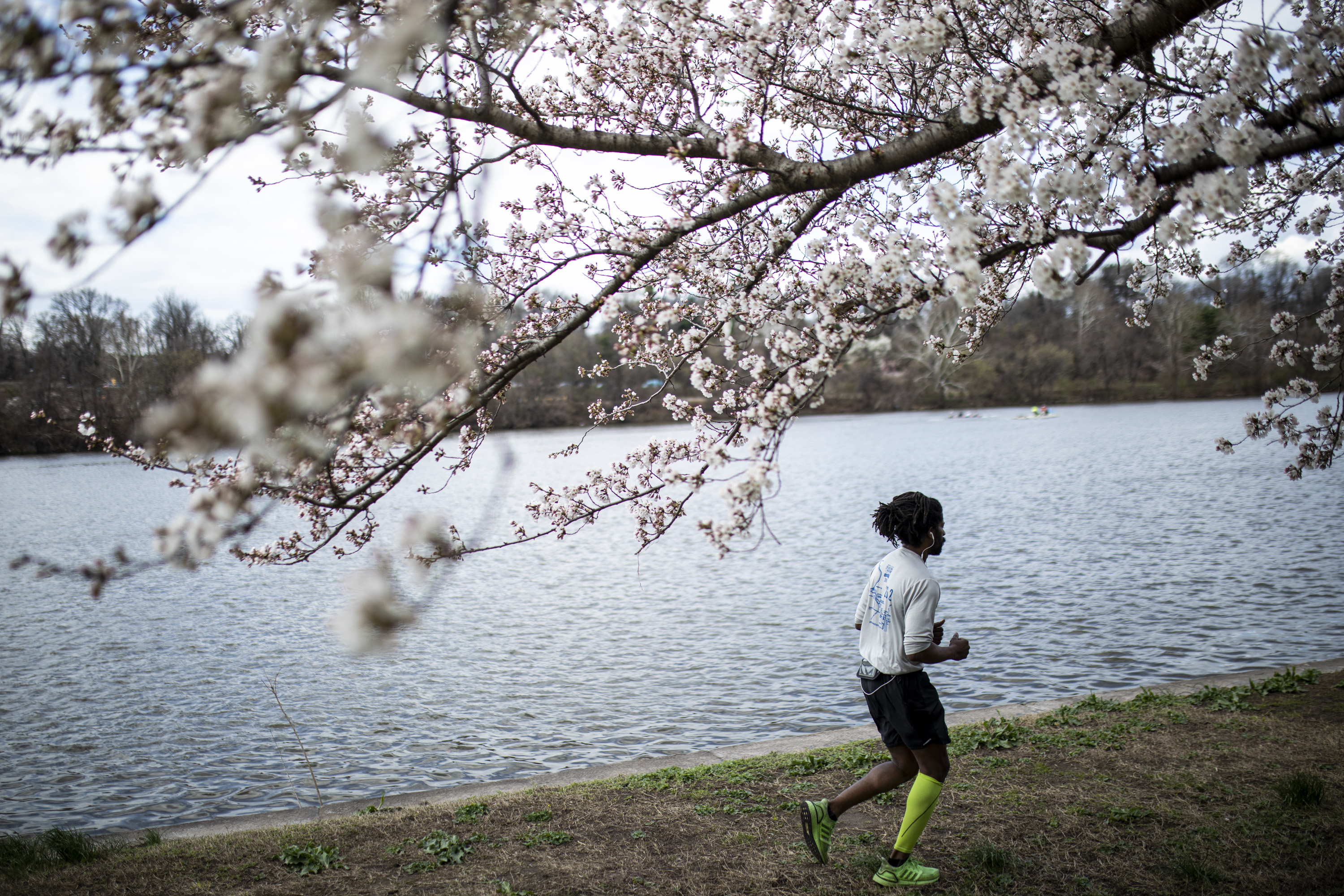
Tanner likes to run along the Schuylkill River, the Delaware River, and through Penn Treaty Park.TYGER WILLIAMS / Staff Photographer
I also like to think of my runs as quests. I will deliberately only bring my phone and headphones so I’m forced to stop for the things I need to keep going, like a snack or electrolytes. It’s fun because it helps me get to know the city better, even after more than a decade. … I think people get tired of Philly because they don’t chew down on it enough.
Running this way has also made me a public bathroom expert because peeing, of course, is always part of the quests. My hot tip: Never count out a Whole Foods.
6 p.m.
After my run, I like to get dinner and drinks with my friends.
Our go-to is Monk’s Cafe, which I recently learned might be haunted? I typically order the Thai curry mussels, a saison, and fries.
I know there’s a lot of discourse about Monk’s having the best fries, but I want to make clear that I do NOT play that game. Fries come in all shapes and sizes, and they’re all good. I would never body shame a fry. It’s like trying to say a basketball player is more athletic than a football player. How could you?
A pot of mussels in Thai curry broth at Monk’s Cafe.Craig LaBan
If we want to have a less chill night, my friends and I will go to Johnny Brenda’s— I had my first ever legal drink there, and they make a great steak. For a more chill night, we like to eat at Phở 75. I want my pho with dark meat chicken and all the fixings — jalapeños, bean sprouts, cilantro, sriracha, hoisin. Barrett, of course, will probably have a piece of the chicken.
9 p.m.
I like to end my day with music, either by practicing with my band or mixing my album, which reminds me a lot of coming up with drinks for Loretta’s since both start with me asking the same question: What can I do to make this thing pop?
Sound mixing is so similar to food and beverage because it’s very easy to sense when you’ve done too much and need to pull back. Things often taste and sound the best when they’re at their most natural.
This interview has been edited for length and clarity.
Leo Stober, an eighth grader at Science Leadership Academy Middle School, is frustrated. He’s thinking about applying to selective Philadelphia School District high schools, but the process is now stymied by what officials said was a delay in the release of state test scores.
So Leo sat in front of the Philadelphia school board Thursday night to air his concerns.
Not having access to scores “is quite frankly disrespectful, not only to the students, but also to the teachers,” Leo said.
Students are anxious to hear how their 2026 PSSA performance will shape the schools open to them, and teachers need the scores “to find which students need extra help on certain assignments,” he said.
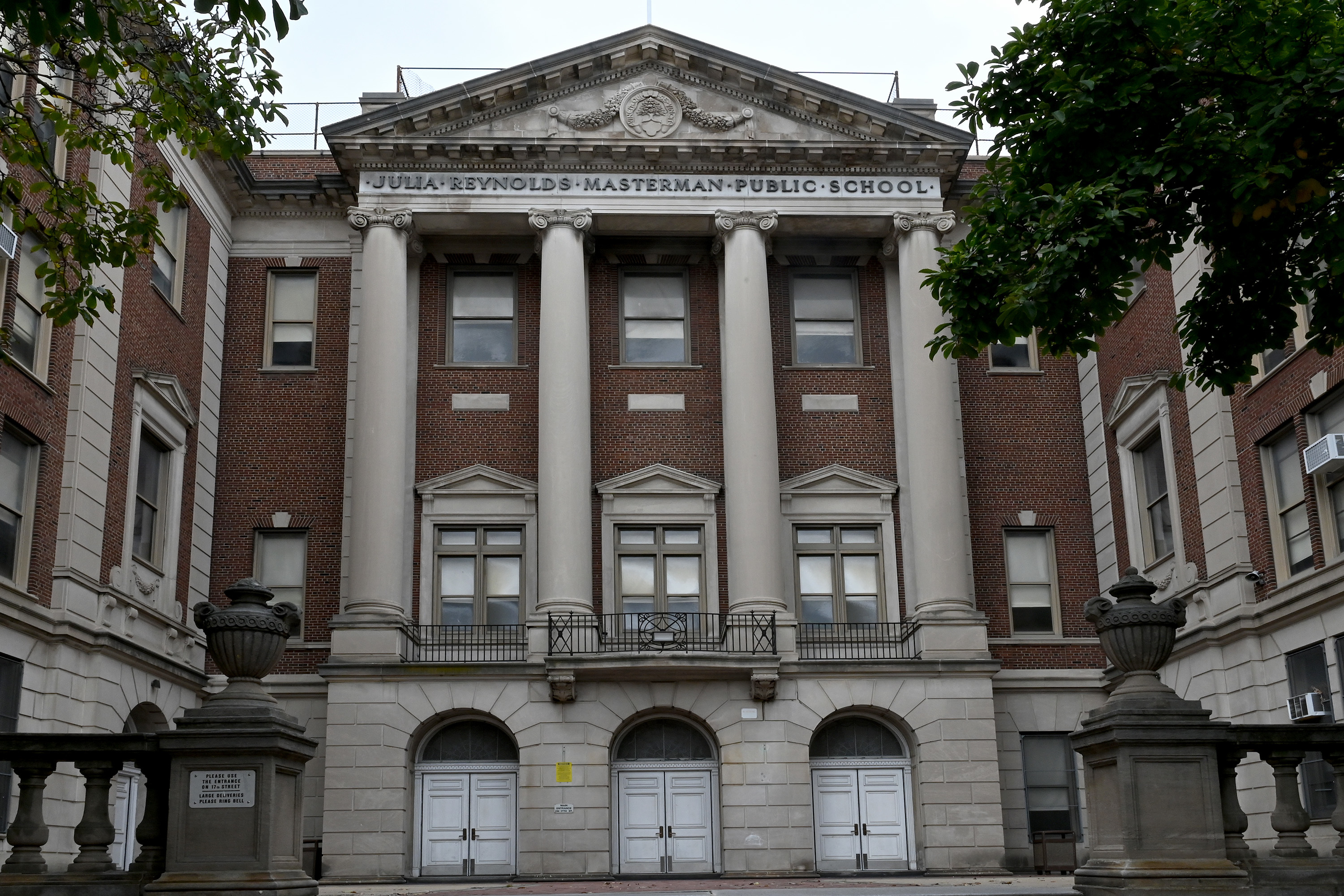
A student’s test scores determine which schools they’re eligible to apply to: Central and Masterman require scores in the 80th percentile to apply, for instance.
The Pennsylvania Department of Education sent preliminary scores to districts and schools in the spring, as it always does — one charter school official told the school board she received her early test results on June 10.
Watlington said Thursday night that scores won’t be available when the application window opens in a week and and a half, but said he realizes “that changing the timeline may require families to adjust their plans, and we absolutely appreciate their patience as we work through this.”
Scores will be available by the time the application window closes, on Nov. 24, Watlington said.
Central and Masterman are only two of the 37 schools that require scores.
Scores in the 65th percentile qualify students for Academy at Palumbo, George Washington Carver High School of Engineering and Science, Parkway Center City Middle College, and Northeast High’s International Baccalaureate and magnet programs. Other schools require scores in the 50th percentile or better.
A student board representative asked Watlington if the shift would cause the district to consider going “test optional” — allowing students to decide whether they want to submit standardized test scores, or withhold them.
“We’re not going to test optional,” Watlington said. “We will likely continue with what we’re doing.”
$600,000 for a Kensington High project fix
In other matters, the board voted unanimously to ratify — formally approve a contract that was already awarded — a $600,000 deal with a firm now charged with monitoring construction work at Kensington High.
Hunter Roberts Construction Group is providing independent oversight and monitoring of the work at Kensington, which has been plagued with problems.
The contractor “is expected to comply with applicable federal, state, and local laws and regulations, including, but not limited to, legal requirements for the proper abatement and disposal of asbestos and/or any other hazardous material,” the board resolution approving the contract said. Hunter Roberts began work on the project on Aug. 27, according to the documents.
Last year, the district was criminally charged over its past handling of asbestos at city schools. After a yearslong secret probe, the school board signed off in June 2025 on a deferred prosecution agreement that comes with strict federal scrutiny of its environmental management.
Philadelphia was the first school district in the U.S. that faced criminal charges for environmental violations.
Hunter Roberts’ contract on the Kensington project runs through 2028.
The pact gives 32BJ’s 2,000 members 9.5% raises over three years. They’ll also get $2,350 in bonuses and 25 paid days off after the birth of a child – the first time parental leave was granted to those workers.
“Come here, in my car, sexy girl,” Horsch told the girl, according to an arrest report.
When police found Horsch circling the neighborhood that March night, officers recovered a pair of high-powered binoculars, a digital camera, a telephoto lens, an eye patch, and a condom from inside his Jeep, the prosecutor on the case said.
Horsch was convicted of two misdemeanor counts of luring a child into a motor vehicle and corrupting the morals of a minor at a trial in Municipal Court in 2010. He was sentenced to 2½ to 5 years in prison, and would have been required to register as a sex offender under Megan’s Law, said Jill Fertel, the prosecutor who handled the case.
But Horsch insisted he did nothing wrong, and requested a new trial in Common Pleas Court. Another prosecutor took over the matter.
The victim and her mother became too afraid to testify in court again, according to two people familiar with the matter. The case fell apart and prosecutors dropped the charges. The original conviction was vacated, and in 2015, Horsch successfully petitioned a Common Pleas Court judge to expunge the case.
Fertel, in an interview Tuesday, said Horsch — and that outcome — had “haunted her for the last 16 years.”
Horsch was known to prowl Kensington to recruit women in addiction to appear in his violent pornographic works in exchange for drugs, cash, and a place to stay at his home. But the details of the expunged conviction, which have not been previously reported, indicate Horsch may have also sought underage girls — and suggest that law enforcement was alerted to his troubling behavior nearly two decades ago.
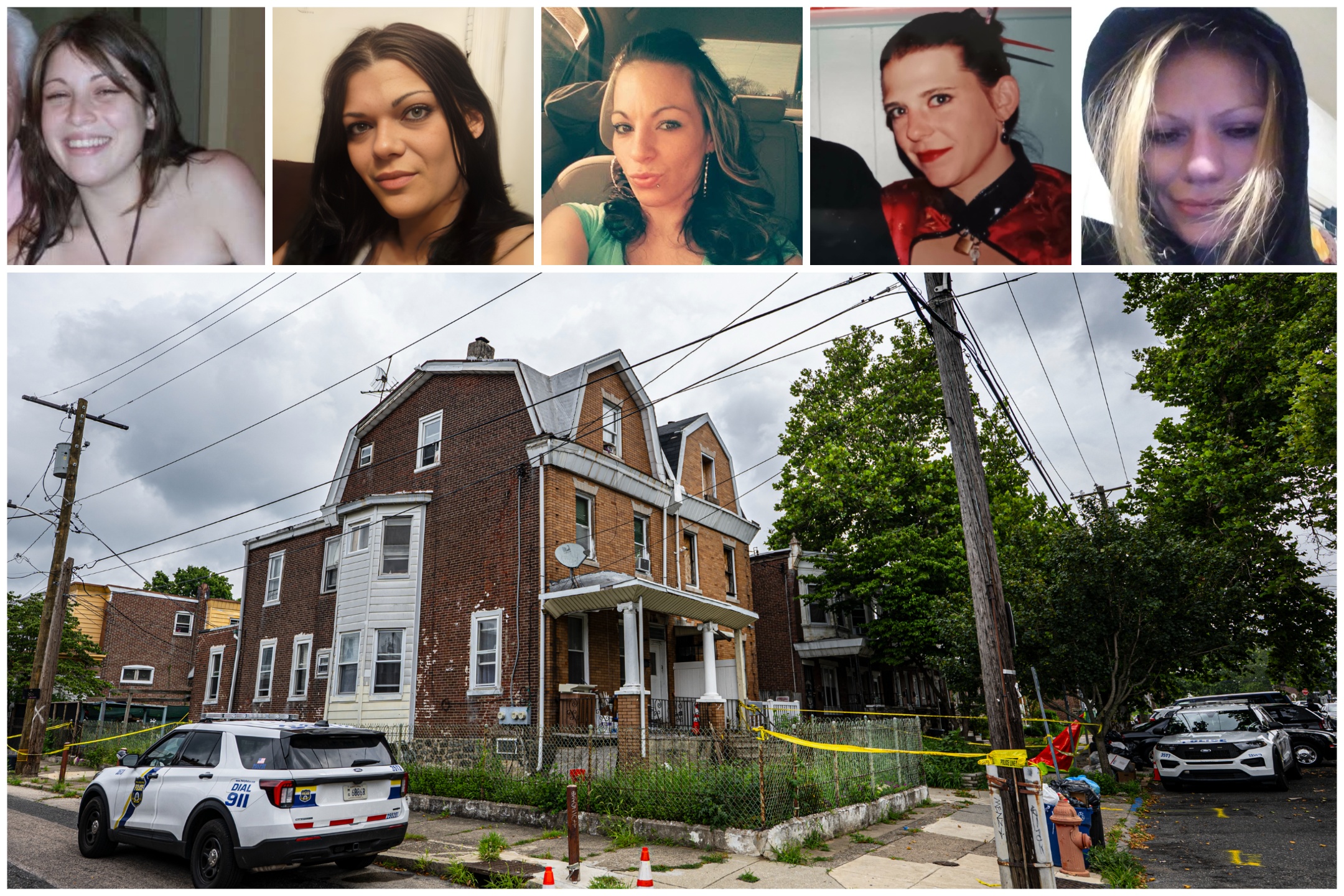
(Top from left) Gabrielle Amarando, Nicole Fusaro, Maribel Fresses, Amy McHale, and Blair Tonzelli. Nicole Fusaro, Gabrielle Amarando, and Maribel Fresses are presumed dead. Blair Tonzelli and Amy McHale are still missing, but last seen at Horsch’s home.Obtained by The Inquirer
Now, the court records in the case — the sole known sex crime Horsch is believed to have been charged with — are at risk of being destroyed.
The records are on file at the Criminal Justice Center, but when The Inquirer sought to review them on Monday, a clerk denied that request.
Because the case had been expunged, the clerk said, the records should have been destroyed years ago. The filings could not be reviewed, he said, and would ultimately be destroyed in accordance with state law.
The Inquirer sent a letter Monday night to administrative judges in Philadelphia’s First Judicial District, asking that the records be preserved in the interest of the public, and that they be unsealed because of the ongoing investigation into Horsch’s connection to missing women.
“Horsch is dead, and this case has extraordinary public interest and news value,” the newspaper wrote. “The filing could hold pieces of information that are irreplaceable and important to the public and the criminal investigation.”
Fertel — who left the district attorney’s office in 2018 — said there are likely essential records of the case that remain in the court file, including notes of testimony, psychology examinations, and letters from Horsch’s defense lawyer submitted as part of his sentencing hearing.
She said the sex offenses triggered a sexually violent predator assessment of Horsch, and recalled that the psychologist was “horrified” by Horsch’s pornography and feared he could be violent.
“This is the only sexual offense he was ever convicted of, that I know of,” Fertel said in an interview Tuesday. “His conduct and his films and video were part of the sentencing. What he was doing [in Kensington] was part of the sentencing. That record is important to have, if we’re to prevent this from happening again.”
Police said they have so far recovered footage on hard drives inside Horsch’s home that appears to show five women dead — including a video of Horsch filming himself while strangling a woman to death with a zip tie. Two other women, including Horsch’s ex-wife, were last seen at the home but remain missing.
Luring a child
Around 7 p.m. on March 20, 2009, the 9-year-old was walking on Ontario Street when Horsch, in a green Jeep, slowed next to her.
“Yo, come here,” Horsch said, before getting out of his car to approach her and calling her “sexy,” according to the arrest report.
The girl ran home and told her mother an old man in a green Jeep had asked her to get into his car. The mother ran outside and chased after the Jeep, which circled the block and drove off, the report said. They called police, who responded and found Horsch in his car near the 3200 block of Kensington Avenue, the report said.
The girl identified Horsch as the man who approached her, the document said.
Fertel said that during the trial, the victim cried on the stand, at times prompting the judge to leave the bench to comfort her as she testified before Horsch, who was standing just feet away.
Horsch was released on bail.
While Horsch was facing those charges in Philadelphia, in July 2009, police responded to his home in Chalfont — where he lived before moving to Olney in 2013 — after a 21-year-old woman called to report a break-in. When officers arrived, they found 455 marijuana plants and two shotguns spread among five partitioned rooms in the basement, according to the Bucks County Courier Times.
Officers also recovered bondage gear, photographs of bleeding women, and a homemade movie labeled with the word “rape,” the newspaper reported.
Court records show that the woman who called police later told investigators she struggled with a heroin addiction and had met Horsch while doing sex work in Kensington. (That woman died of an overdose in January 2016 when she relapsed, her mother said in an interview this week.)
When Horsch returned home that night in July to find police raiding the property, he ran down his tree-lined suburban street, according to the news report.
He was later arrested and pleaded guilty in federal court to manufacturing drugs and illegal gun possession, and was sentenced to 54 months in prison, plus five years’ probation.
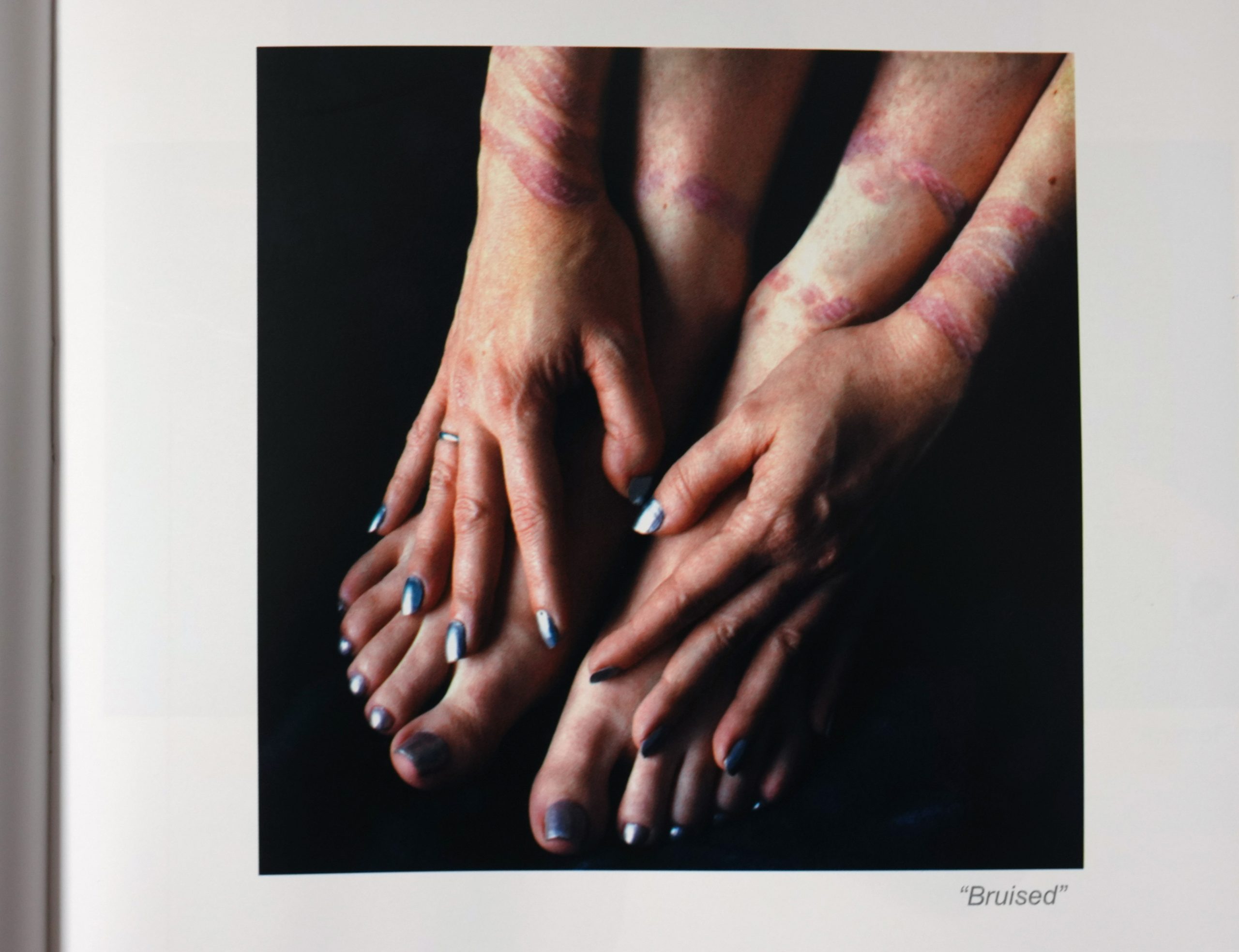
Ligature marks on the arms of an unidentified woman in Raymond Horsch’s 2003 two-volume photobook “Eroto: To The Prurient Interest.”Obtained by The Inquirer
Fertel said that, as she prosecuted Horsch in Philadelphia, she learned details of the Bucks County drug raid — including that officers had found disturbing pornography, guns, and explosive materials at his suburban home. That became part of her case, she said, and led her to ask that Horsch be sentenced to the maximum penalty of five to 10 years in prison.
Common Pleas Court Judge Roger Gordon — who presided over the case — sentenced Horsch to 2½ to 5 years.
But then Horsch appealed, and the case collapsed after the child and her mother became too scared to testify against him again.
Fertel said the materials found in Horsch’s home, and the psychologist’s fears of his potential threats to the community, have been seared in her memory ever since.
“He was able to treat women in this fashion for decades and no one has stepped up to protect them. No one was able to stop him,” Fertel said this week. “Everybody knew about it.”
A ‘fabricated thing’
Horsch, who died in May 2025, boasted about his criminal career as a drug manufacturer and document forger. He also spoke openly about how he recruited drug-addicted women in Kensington to appear in his violent pornographic photos and films that featured drug use, overdoses, and staged hangings, drownings, and killings.
But Horsch vehemently denied ever trying to lure a child into his car. He spoke about it years later, in a 2013 interview with the Rialto Report podcast, and said the 9-year-old girl had lied.
“It’s just a totally weird, fabricated thing,” he said. “All you have to do is go to the state sex offender list and you won’t find my name there.”
In his 2003 movie Slaves, Horsch played a semiautobiographical character who, in one scene, described approaching a young girl in a mall. The girl’s mother, Horsch’s character said, then yelled, “Get away from my daughter!”
“The place froze, literally froze. Time stood still. Every eye was on me, from every direction, hundreds of eyes,” Horsch said in the movie. “And I realized in an instant that, to every single person there, I was a child molester.”
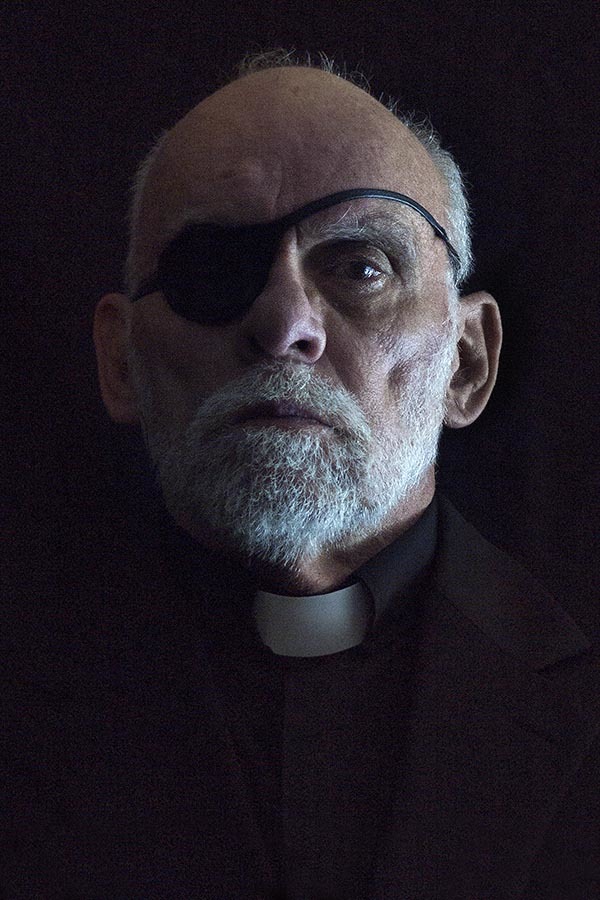
Raymond “R.C.” Horsch in character for film role, 2014.S. E. Stokowski / Wikimedia
As Philadelphia police sort through more than one million photos and videos on the hard drives recovered from Horsch’s home on West Chew Avenue in Olney, they have encountered what they believe was staged violence as part of his art — and also photos and a video of what they now believe were real missing women, dead inside Horsch’s home.
So far, police have identified five women in the footage who they now believe are dead: Maribel Fresses, Gabrielle Amarando, Nicole Fusaro, a 25-year-old woman who has not been identified at the request of her family, and another woman investigators are still working to identify.
Two other women who were last seen at Horsch’s Olney home — Blair Tonzelli and Amy McHale, his ex-wife — remain missing.
Police have so far reviewed only about 30% of the materials on the hard drives.
Fertel said she hopes revelations about the 2009 case will draw more attention to the exploitation of women in Kensington.
“No one was getting arrested for what Raymond Horsch was doing,” she said. “This is an opportunity for people to recognize that this is wrong and that we can’t let it happen again. We can’t let this happen to more people.”
“There never really was a Fishtown, government-wise. It was a localism,” explains Kenneth Milano, a Kensington-born historian and cofounder of the Kensington History Project. Perhaps this is why it’s hard to know exactly where Fishtown’s boundaries are.
“No one [in the old days] would ever call above York Street ‘Fishtown.’ That would have been sacrilege,” Milano said. “With the new folks, they don’t know. The [real estate agent] told them.”
story continues after advertisement
Decades of gentrification in the River Wards have blurred the lines as developers tagged their properties with the coveted Fishtown brand, even as they ventured into what were generally defined as sections of Kensington. (And which Kensington? East Kensington? Olde Kensington? South Kensington? How about Norris Square? And Olde Richmond? And Port Richmond?)
The argument is about more than what to call a few blocks: A neighborhood name can shape a place’s identity, its perceived desirability, and even how it is marketed and valued.
Click anywhere on the map to start drawing your Fishtown boundary
Milano said parish boundaries originally helped reinforce neighborhood identity. Milano, 67, has lived on York Street since age 5 and described the conventional Fishtown as a triangle bounded by Norris, Frankford, and the Delaware River.
The Inquirer’s map of neighborhoods agrees with Milano — although it’s worth mentioning that this map, used internally to help our reporting stay consistent, was created in the 1980s. The Milano-Inquirer definition is definitely conservative when compared to more recent attempts to set boundaries.
By contrast, Zillow’s Fishtown is nearly twice the size. The real estate website includes not only Front Street to the west, but also goes as far north as Lehigh Avenue.
Zillow maintains its own set of neighborhood boundaries “by reviewing sources such as city maps, the Census Bureau, and neighborhood associations,” Zillow spokesperson Briahna Healy said.
There’s some overlap between Zillow’s boundaries and the 19125 zip code. While residents might feel a strong attachment to the last five digits of their address, zip codes exist solely to help route mail. This makes it hard to use 19125’s scraggly borders to define Fishtown — especially when sections that reach that far north are Kensington by any definition.
Somewhere in the middle is the Fishtown Neighbors Association border — sticking with Front Street to the west but extending only as far as York Street to the north. These boundaries “go back about 20 years when FNA was a community organization that needed boundaries to help dictate what projects to work on,” said John Scott, current president of the FNA.
Their boundaries are a single piece in a jigsaw puzzle with surrounding neighboring associations. It explains why some streets are included and others aren’t. For example, the area between Front Street and Frankford Avenue is included because “if we didn’t include them, they would probably be stateless,” Scott said.
This also means that a lot of boundaries are largely codified because the FNA can’t expand without encroaching on neighboring associations — unless, that is, new streets are built, like those in the Northbank development on the Delaware. Now the FNA is about to adjust its boundaries for the first time in a quarter-century to encompass streets south of Schirra Lane.
If we look at all of these definitions at the same time, there is a clear overlap that we can safely call Fishtown.
However, much of the fringe is up for debate. Does Fishtown stop at Front or Frankford, for example? Is York the border, or is it Norris, or even Lehigh?
It’s time for some good, old-fashioned, boots-on-the-ground reporting.
A defining feature of Fishtown are the whimsical fish signs on house facades. Our theory: Surely a painted fish wouldn’t make sense in Kensington. We hit the streets and logged every house that had a fish sign.
Largely, the signs are contained to the FNA-defined borders. But we found a large pocket of signs east of York Street and even a few signs north of Frankford — although they are outnumbered by milk bottle signs to honor Kensington’s old Harbisons Dairy plant.
Fish signs are only one way to delineate Fishtown boundaries. We also looked at restaurants and what neighborhood they describe themselves as belonging to: Fishtown, Kensington, or unsure.
Fishtown has been known for its dining scene since Johnny Brenda’s established the beachhead in 2003. As development marched on, restaurateurs and dining guides followed the cue of developers and real estate agents: We’re in Fishtown.
Today, that’s not entirely the case, as even upscale restaurants are comfortable calling themselves Kensington, though they could claim Fishtown. At Fiore, chefs Ed Crochet and Justine MacNeil use East Kensington for their Italian restaurant north of the York Street roundabout. Directly across is Emilia, chef Greg Vernick’s popular new Italian spot, which doesn’t state its neighborhood in its marketing materials. Resy, its reservation booking platform, calls it Fishtown-East Kensington.
Seemingly everyone says Middle Child Clubhouse is in “Fishtown.” But by dint of its location on the west side of Front Street, it’s arguably in South/Olde Kensington. Yuhiro, a sushi restaurant on Susquehanna Avenue just west of Frankford, markets itself as Fishtown but it could be considered in Kensington.
Then there are the restaurants where it’s even more unclear because they list multiple neighborhoods, or none at all. For example, Picnic, on Martha Street, uses East Kensington in its Instagram bio but has used Fishtown in public relations campaigns. Where is Meetinghouse, a noted bar at Memphis and Cumberland Streets? Chef/co-owner Drew DiTomo thought for a moment: “Its parish is St. Anne’s and I quite like that.”
Finally, we decided to ask people in the gray areas a simple question: “Where are we?”
We found Matt Murphy and Kaitlin Dirkx at Hagert and Tulip Streets — south of Lehigh, north of York, still in 19125. “It’s kind of a curious pocket of the River Wards,” said Murphy, who emphatically called the area “Olde Richmond.” But, as Dirkx added, “they let me into the Fishtown Neighbors Facebook group. My address must have fallen in line.”
Mark Opdyke, who lives on a side street just west of Frankford Avenue near Norris, insisted that his side of Blair Street is in Fishtown. He pointed across the street toward the Blair Garden townhouses, built in 2018 and sold as “Fishtown,” chuckled, and called that side “Kensington.”
At Frankford and Dauphin, Nick Campione’s family has owned AC Auto Repairs for 70 years. Its facade boasts a mural proclaiming, “Welcome to the Neighborhood” with an inscription explicitly describing it as “Fishtown and East Kensington.” Campione won’t take sides: “This is the best of both worlds here.”
Finally, we caught up with Stephanie Goodman and Justin Frye on the west side of Frankford Avenue near Dauphin, in front of the Groove Hound, a doggie day care. Goodman called that stretch Fishtown, adding that it’s two blocks from the house she bought in 2018 across from Philadelphia Brewing Co., which proudly says it belongs to East Kensington. Though Goodman said the real estate agent advertised her block as Fishtown, Frye believes it’s in East Kensington. “Ten different people and 10 different answers,” he said.
So it’s now time for you to decide. Let us know where you think the boundaries of Fishtown are by drawing on the map.
Thanks for drawing your boundaries. Please reach out to interactives@inquirer.com and let us know why you believe these are the boundaries of Fishtown.
This is where the average reader submission currently lays.
Staff Contributors
Design, Development, and Reporting: Sam Morris
Reporting: Michael Klein
Sign Auditors: Sam Morris and Jasen Lo
Illustration: James Olstein
Editing: Charmaine Runes
Copy Editing: Brian Leighton
story continues after advertisement
Subscribe to The Philadelphia Inquirer
Our reporting is directly supported by reader subscriptions. If you want more journalism like this story, please subscribe today
// used for lite color theming and debug buttons only
$colors: (
“purple”: $color-purple,
“pink”: $color-pink,
“red”: $color-red,
“orange”: $color-orange,
“yellow”: $color-yellow,
“green”: $color-green,
“teal”: $color-teal,
“light-gray”: $color-light-gray,
“light-blue”: $color-light-blue,
“blue”: $color-blue,
“black”: $color-black,
“white”: $color-white
);
`;var Wn=tr();var Y=(i=null)=>{let u=Kt.split(`
`),r={};return u.forEach(e=>{let o=e.trim().match(/^$color-([w-]+):s*([^;]+);/);if(o){let s=o[1],n=o[2];r[s]=n}}),i&&r[i]?r[i]:r};var rr=(i,u=null,r=null)=>{r||(r=document.querySelector(“head”));let e=document.createElement(“script”);e.type=”text/javascript”,e.src=i,u&&(e.onload=u),r.appendChild(e)},Ve=()=>(window.PMNdataLayer?.[0]!==void 0&&window.PMNdataLayer[0])?.analytics?.user?.state===”Subscribed”,je=()=>{let u=(window.PMNdataLayer?.[0]!==void 0&&window.PMNdataLayer[0])?.analytics?.user?.state;return window.location.host.includes(“zzz-systest”)||window.location.host.includes(“pmn.arcpublishing.com”)||window.location.host.includes(“stage.fusion.inquirer.com”)||typeof u>”u”},or=()=>{let u=(window.PMNdataLayer?.[0]!==void 0&&window.PMNdataLayer[0])?.analytics?.user?.hasAdsFreeReading;return!!(u&&u==1)},Ae=()=>window.location.host.includes(“localhost”);var To=i=>{(i&&i.querySelector(“.js-loading”))?.setAttribute(“data-state”,”ready”)},Bo=i=>{(i&&i.querySelector(“.js-loading”))?.setAttribute(“data-state”,”loading”)},bo=(i,u)=>{(i&&i.querySelector(“.js-loading”))?.setAttribute(“data-state”,”error”),u&&targetModalErrorEl&&(targetModalErrorEl.textContent=u)},We={stop:i=>To(i),start:i=>Bo(i),error:(i,u)=>bo(i,u)};var ce=document.querySelector(“.js-map-tooltip”),Eo=()=>{ce.classList.remove(“is-hidden”)},Io=()=>{ce.classList.add(“is-hidden”)},ko=(i,u)=>{i&&u&&matchMedia(“(pointer:fine)”).matches?(ce.style.top=i+”px”,ce.style.left=u+”px”):(ce.style.top=””,ce.style.left=””)},Do=(i,u)=>{i==”pre”?ce.textContent=”Click to place the first point”:i==”mid”&&(u{window.addEventListener(“resize”,()=>{ct&&setTimeout(()=>{lr()},300)})},Vo=()=>{rr(“https://interactives.inquirer.com/storage/dependencies/maplibre/5.3.0/maplibre-gl.js”,()=>{let i=new zt;Le=window.maplibregl,Le.addProtocol(“pmtiles”,i.tile);let u=”https://interactives.inquirer.com/melish/1.3″,r=`${u}/north-america.pmtiles`,e=new Oe(r);i.add(e),e.getHeader().then(async()=>{let s=await(await fetch(`${u}/styles/neutral.json`)).json();R=new Le.Map({container:”map”,zoom:13,center:[-75.165222,39.952583],maxBounds:[[-128.362885,24.389629],[-58.886719,52.918839]],attributionControl:!1,interactive:!1,style:{…s,layers:[],sources:{openmaptiles:{type:”vector”,url:`pmtiles://${r}`}}}}),lr(),R.on(“load”,async()=>{for(let f of nr.features)Ko(f.properties.origin,f.geometry);Xo(),st(“people”,sr),st(“signs”,ar),st(“restaurants”,ir),Yo();let y=await(await fetch(“https://interactives.inquirer.com/lyon/2026-fishtown/average.json”)).json();Qo(“readers”,y);let a=R.getCanvas();We.stop(a.closest(“.js-map”)),ct=!0,pt&&ur(pt)}),document.querySelector(“.js-map”).addEventListener(“mousemove”,n=>{jo(n)}),document.querySelector(“.js-map”).addEventListener(“mouseout”,()=>{Wo()}),document.querySelector(“.js-map”).addEventListener(“click”,n=>{Go(n)})})})},lr=()=>{R.fitBounds([-75.14613425987851,39.95952387517457,-75.10908333009395,39.98791745377673],{duration:0})},jo=i=>{if(ve&&ie&&(ue.show(),ue.position(i.clientY,i.clientX),ie==”mid”)){let u=lt(i);xe.features[0].geometry.coordinates[1]=[u.lng,u.lat],R.getSource(“drawing-ghost”).setData(xe),R.setPaintProperty(“drawing-ghost”,”line-opacity”,.5)}},Wo=()=>{ue.hide()},No=()=>{let u=document.querySelector(“.js-map”).getBoundingClientRect().top;u{if(ve){if(ie==”pre”){let u=lt(i);Z.features[0].geometry.coordinates.push([u.lng,u.lat]),xe.features[0].geometry.coordinates[0]=[u.lng,u.lat],document.querySelector(“.js-map-start”).classList.remove(“is-hidden”),pr.setLngLat(u),document.querySelector(“.js-tool-buttons-reset”).disabled=!1,ie=”mid”}else if(ie==”mid”){let u=lt(i);Z.features[0].geometry.coordinates.push([u.lng,u.lat]),xe.features[0].geometry.coordinates[0]=[u.lng,u.lat]}i.target.classList.contains(“js-map-start”)&&Zo(),R.getSource(“drawing-user”).setData(Z),ue.update(ie,Z.features[0].geometry.coordinates.length),ue.show()}},Zo=()=>{ve=!1,ie=”end”;let i=Z.features[0].geometry.coordinates.length,u=Z.features[0].geometry.coordinates[0];Z.features[0].geometry.coordinates[i-1]=u,Z.features[0].geometry.type=”Polygon”,Z.features[0].geometry.coordinates=[Z.features[0].geometry.coordinates],R.getSource(“drawing-user”).setData(Z),R.setPaintProperty(“drawing-user-fill”,”fill-opacity”,.4),R.setPaintProperty(“drawing-ghost”,”line-opacity”,0),document.querySelector(“.js-map-start”).classList.add(“is-hidden”),document.querySelector(“.js-tool-buttons-submit”).disabled=!1},qo=()=>{ve=!0,ie=”pre”,ue.update(ie,0),Z.features[0].geometry.type=”LineString”,Z.features[0].geometry.coordinates=[],R.getSource(“drawing-user”).setData(Z),document.querySelector(“.js-tool-buttons-submit”).disabled=!0,R.setPaintProperty(“drawing-ghost”,”line-opacity”,0),R.setPaintProperty(“drawing-user-fill”,”fill-opacity”,0),document.querySelector(“.js-map-start”).classList.add(“is-hidden”)},lt=i=>{let u=document.querySelector(“.js-map”).getBoundingClientRect(),r=i.clientX-u.left,e=i.clientY-u.top;return R.unproject([r,e])},Jo=()=>{Jt.vote({coordinates:JSON.stringify(Z.features[0].geometry.coordinates[0])})},Ko=(i,u)=>{R.addSource(`boundary-${i}`,{type:”geojson”,data:u}),R.addLayer({id:`boundary-${i}-fill`,source:`boundary-${i}`,type:”fill”,paint:{“fill-color”:Y(“illo-red”),”fill-opacity”:0}}),R.addLayer({id:`boundary-${i}-line`,source:`boundary-${i}`,type:”line”,paint:{“line-color”:Y(“illo-red”),”line-width”:4,”line-opacity”:0}})},Qo=(i,u)=>{R.addSource(`drawing-${i}`,{type:”geojson”,data:u}),R.addLayer({id:`drawing-${i}-fill`,source:`drawing-${i}`,type:”fill”,paint:{“fill-color”:Y(“illo-yellow”),”fill-opacity”:0}}),R.addLayer({id:`drawing-${i}-line`,source:`drawing-${i}`,type:”line”,paint:{“line-color”:Y(“illo-yellow”),”line-width”:4,”line-opacity”:0}})},st=(i,u)=>{let r;window.innerWidth{let i=[{id:”tavern”,coordinates:[-75.13430336980068,39.9690688861316]},{id:”milk”,coordinates:[-75.13290465156766,39.98256059702009]},{id:”pier”,coordinates:[-75.11347715844,39.9714839528569]},{id:”wawa”,coordinates:[-75.11890594948434,39.977239248055895]},{id:”sulimays”,coordinates:[-75.12598489221865,39.971605275979115]},{id:”traffic”,coordinates:[-75.12754751235474,39.98145267435357]}];for(let u of i){let r=document.querySelector(`.js-map-icon[data-id=”${u.id}”]`);new Le.Marker({element:r}).setLngLat(u.coordinates).addTo(R)}},Xo=()=>{R.addSource(“roads”,{type:”geojson”,data:Ne}),R.addLayer({id:”roads”,source:”roads”,type:”symbol”,layout:{“symbol-placement”:”line-center”,”symbol-spacing”:100,”text-field”:”{name}”,”text-font”:[“grot10-regular”],”text-max-angle”:90,”text-pitch-alignment”:”viewport”,”text-rotation-alignment”:”map”,”text-size”:9,”text-transform”:”uppercase”},paint:{“text-color”:”#666″,”text-halo-color”:”#fff”,”text-halo-width”:2}}),cr()},_o=i=>{let u=Object.keys(R.getStyle().sources).filter(r=>r.includes(“boundary-“));for(let r of u){let e=r.includes(i)||i==”all”;R.setPaintProperty(`${r}-line`,”line-opacity”,e?1:0),R.setPaintProperty(`${r}-fill`,”fill-opacity”,e?.2:0)}},en=i=>{let u=Object.keys(R.getStyle().sources).filter(r=>r.includes(“drawing-“)&&!r.includes(“ghost”));for(let r of u){let e=r.includes(i);R.setPaintProperty(`${r}-line`,”line-opacity”,e?1:0),R.setPaintProperty(`${r}-fill`,”fill-opacity”,e?.2:0)}},tn=i=>{let u=Object.keys(R.getStyle().sources).filter(r=>r.includes(“points-“));for(let r of u){let e=r.includes(i);R.setPaintProperty(`${r}`,”circle-opacity”,e?1:0)}},rn=i=>{let u=document.querySelector(“.js-map”);i?u.classList.remove(“is-hiding-icons”):u.classList.add(“is-hiding-icons”)},cr=i=>{let u=JSON.parse(JSON.stringify(Ne.features));u=u.filter(r=>r.properties.defaultVisibility==”visible”),i&&(i=i.split(“,”).map(r=>r.trim()),i=Ne.features.filter(r=>i.includes(r.properties.name)),u=[…u,…i]),R.getSource(“roads”).setData({type:”FeatureCollection”,features:u})},ur=i=>{ct?(i={points:i?.points||null,boundary:i?.boundary||null,drawing:i?.drawing||null,icons:i?.icons||!1,roads:i?.roads||null},_o(i.boundary),en(i.drawing),tn(i.points),rn(i.icons),cr(i.roads)):pt=i},fe={init:()=>{Ho(),Vo()},update:i=>{ur(i)},startDrawing:()=>{ve=!0,ie=”pre”,No()},stopDrawing:()=>{ve=!1},resetDrawing:()=>{qo()},submitDrawing:()=>{Jo()}};var on=()=>{document.querySelector(“.js-tool-buttons-start”).addEventListener(“click”,()=>{pn()}),document.querySelectorAll(“.js-tool-buttons-skip”).forEach(i=>{i.addEventListener(“click”,()=>{fr(),sn(),yr()})}),document.querySelector(“.js-steps-step .js-tool-buttons”).addEventListener(“click”,()=>{nn()}),document.querySelector(“.js-tool-buttons-reset”).addEventListener(“click”,()=>{fe.resetDrawing()}),document.querySelector(“.js-tool-buttons-submit”).addEventListener(“click”,()=>{fe.submitDrawing(),fr(),an(),yr()})},nn=()=>{document.querySelector(“.js-steps-step .js-tool-buttons”).classList.add(“is-hidden”),document.querySelectorAll(“.js-steps-step .js-button”).forEach(i=>{i.disabled=!0})},fr=()=>{document.querySelectorAll(“.js-steps-step.is-hidden”).forEach(i=>{i.classList.remove(“is-hidden”)})},an=()=>{let i=document.querySelector(“.js-tool-buttons-start”).closest(“.js-steps-step”).querySelector(“.inno-p”);i.innerHTML=”This is where you think Fishtown’s borders are.”},sn=()=>{let i=document.querySelector(“.js-steps-step .js-tool-buttons”).closest(“.js-steps-step”),u=parseInt(i.dataset.step),r=document.querySelector(`.js-steps-step[data-step=”${u+1}”]`);r&&r.scrollIntoView({block:”center”})},pn=()=>{document.querySelector(“body”).classList.add(“is-tool-mode”),fe.startDrawing()},yr=()=>{document.querySelector(“body”).classList.remove(“is-tool-mode”),fe.stopDrawing()},mr={init:()=>{on()}};var ln=()=>{or()&&document.querySelectorAll(“.js-adbox”).forEach(u=>{u.classList.add(“is-hidden”)})},dr={init:()=>{ln()}};var me,gr,cn=()=>{me=document.getElementById(“js-inno-toast”)},un=i=>{if(!me)return;me.innerHTML=i,me.classList.add(“is-active”);let u=()=>{me.addEventListener(“transitionend”,fn,{once:!0}),me.classList.remove(“is-active”)};clearTimeout(gr),gr=setTimeout(u,5e3)},fn=()=>{me.innerHTML=””},de={init:()=>{cn()},showToast:un};var Ge,hr=!1,yn=async()=>new Promise(i=>{setTimeout(()=>{console.log(“simulating createShareLink for localhost”),i(“https://inquirer.com/interactives”),mn()},100)}),mn=()=>{let i=document.querySelector(“.js-gift-toast-receiver”);!i||!(i instanceof HTMLElement)||setTimeout(()=>{let u=i?.querySelector(“span”);u&&(u.innerHTML=”Gift link copied to clipboard“)},20)},dn=()=>{let i=window.services?.createShareLink;i&&(Ge=i),Ae()&&(Ge=yn),Ge&&hn()},gn=async i=>{let u=”text/plain”,r=async()=>{try{return await Ge(window.location.pathname)}catch{i.dataset.state=”error”,de.showToast(“Hmm, we couldn’t generate a gift link…”)}},e=new ClipboardItem({[u]:r()});await navigator.clipboard.write([e]).catch(o=>{console.log(o),de.showToast(“Couldn’t copy to clipboard, try again?”),i.dataset.state=”error”}),de.showToast(“Gift link copied to clipboard!”),i.dataset.state=”complete”},hn=()=>{document.querySelectorAll(“.js-gift”).forEach(u=>{(Ve()||Ae()||je())&&u.classList.add(“is-available”)}),document.querySelectorAll(“.js-gift-button”).forEach(u=>{u instanceof HTMLButtonElement&&u.addEventListener(“click”,()=>{u.classList.contains(“disabled”)||(u.dataset.state=”loading”,hr=!0,gn(u),setTimeout(()=>{u.dataset.state=”ready”},2e3))})});let i=document.querySelector(“.js-gift-toast-receiver”);!i||!(i instanceof HTMLElement)||vn(i)},vn=i=>{new MutationObserver(r=>{for(let e of r){let o=[…e.addedNodes].at(0);if(!(o instanceof HTMLElement))return;hr&&de.showToast(o.outerHTML)}}).observe(i,{subtree:!0,childList:!0})},vr={init:()=>{dn()}};var Te,xn=()=>{document.querySelectorAll(“.js-hover”).forEach(i=>{i.addEventListener(“click”,()=>{xr(i)}),i.addEventListener(“mouseenter”,()=>{xr(i)}),i.addEventListener(“mouseout”,()=>{Pr(i)})}),window.addEventListener(“scroll”,()=>{Te!==null&&Pn()})},Pn=()=>{(Te>window.scrollY+100||Te{Pr(i)})},xr=i=>{i.classList.add(“is-visible”),Te=window.scrollY},Pr=i=>{i.classList.remove(“is-visible”),Te=null},wr={init:()=>{xn()}};var Fr=1,ut=class{constructor(u){this.el=u,this.contentPosition=”default”,this.possibleSteps=new Array,this.currentStep=null,this.currentStepEl=null,this.offset=window.innerWidth>960?window.innerHeight*.6:window.innerHeight*.9,this.instanceOfSteps=Fr,Fr++,this.setPossibleSteps(),this.updateContent(),this.bindings()}setPossibleSteps(){this.el.querySelectorAll(“.js-steps-step”).forEach(u=>{u.dataset.step&&this.possibleSteps.push(u.dataset.step)})}bindings(){window.addEventListener(“scroll”,()=>{this.updateContent()}),window.addEventListener(“resize”,()=>{this.updateContent()})}updateContent(){this.updateCurrentStep()}updateCurrentStep(){let u;if(this.el.querySelectorAll(“.js-steps-step”).forEach((e,o)=>{e.getBoundingClientRect().top{let n=”is-“+o,y=”is-“+s;this.possibleSteps.indexOf(o){document.querySelectorAll(“.js-steps”).forEach(i=>{new ut(i)})}};var wn=(i,u,r)=>{document.querySelectorAll(“.js-subscribe”).forEach(e=>{e.classList.toggle(“is-unsubscribed”,!i),e.classList.toggle(“is-preview”,u),e.classList.toggle(“is-dev”,r)})},Cr={init:()=>{wn(Ve(),je(),Ae())}};var Fn=()=>{},Mr={init:()=>{Fn()}};var Ar={init:()=>{Mt.init?.(),mr.init?.(),dr.init?.(),vr.init?.(),wr.init?.(),We.init?.(),fe.init?.(),Sr.init?.(),Cr.init?.(),Mr.init?.(),de.init?.()}};var Sn=()=>{},Lr={init:()=>{Sn()}};var Cn=document.querySelector(“.js-inno”),Tr=()=>{Ar.init(),Lr.init()};Cn?Tr():new MutationObserver((u,r)=>{if(document.querySelector(“.js-inno”)){r.disconnect(),Tr();return}}).observe(document,{attributes:!0,childList:!0,subtree:!0});})();
/*! Bundled license information:
matter-js/build/matter.js:
(*!
* matter-js 0.20.0 by @liabru
* http://brm.io/matter-js/
* License MIT
*
* The MIT License (MIT)
*
* Copyright (c) Liam Brummitt and contributors.
*
* Permission is hereby granted, free of charge, to any person obtaining a copy
* of this software and associated documentation files (the “Software”), to deal
* in the Software without restriction, including without limitation the rights
* to use, copy, modify, merge, publish, distribute, sublicense, and/or sell
* copies of the Software, and to permit persons to whom the Software is
* furnished to do so, subject to the following conditions:
*
* The above copyright notice and this permission notice shall be included in
* all copies or substantial portions of the Software.
*
* THE SOFTWARE IS PROVIDED “AS IS”, WITHOUT WARRANTY OF ANY KIND, EXPRESS OR
* IMPLIED, INCLUDING BUT NOT LIMITED TO THE WARRANTIES OF MERCHANTABILITY,
* FITNESS FOR A PARTICULAR PURPOSE AND NONINFRINGEMENT. IN NO EVENT SHALL THE
* AUTHORS OR COPYRIGHT HOLDERS BE LIABLE FOR ANY CLAIM, DAMAGES OR OTHER
* LIABILITY, WHETHER IN AN ACTION OF CONTRACT, TORT OR OTHERWISE, ARISING FROM,
* OUT OF OR IN CONNECTION WITH THE SOFTWARE OR THE USE OR OTHER DEALINGS IN
* THE SOFTWARE.
*)
*/
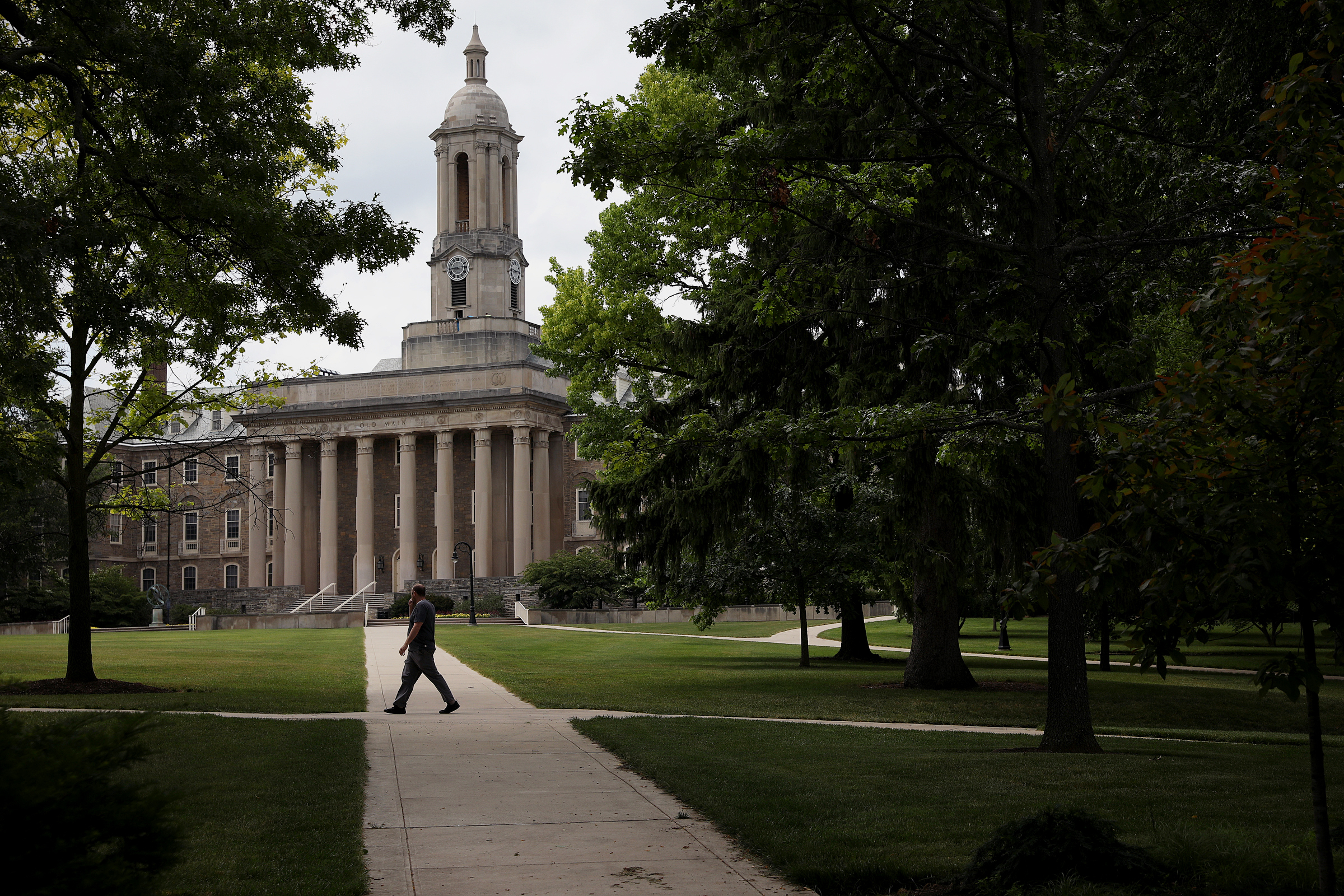
Pennsylvania State University’s board of trustees agreed Friday to sell two of its closing Commonwealth campuses to developers for more than $6 million.
Plans call for the Wilkes-Barre campus in Northeastern Pennsylvania to be developed into event and conference space for a nearby golf course and space for educational programming, while the Shenango campus in Northwestern Pennsylvania will be used for educational, cultural and workforce training purposes. The Shenango campus enrolled 309 students in 2024 and the Wilkes-Barre campus 329 students, according to a Penn State report on the closures.
Sara Thorndike, Penn State’s senior vice president for finance and business and chief financial officer, told trustees at a committee meeting Thursday that discussions continue on the future use of the other five campuses: Dubois, Fayette, Mont Alto, New Kensington and York. The seven closing campuses are spread from Northeastern Pennsylvania to Western Pennsylvania. The campuses in the Philadelphia region — Abington, Brandywine, and the graduate education-focused campus at Great Valley — are not impacted.
“Every campus is on its own path and own time line,” Thorndike said of the closing campuses. “Our goal is to find a positive path forward.”
Penn State in May 2025 voted to close the seven campuses at the end of the 2026-27 academic year due to precipitous enrollment declines, marking the largest remake of the Pennsylvania flagship university’s Commonwealth campus system in its history.
Since then, Penn State has been conducting meetings at each of the campuses with elected officials and others in the community to hear concerns about future uses, Thorndike said.
The board approved the sale of the 13-acre, 12-building Shenango campus in Mercer County to JCL Development LLC for $1 million. It will be used for education, workforce training, economic development and cultural enrichment, Thorndike said.
Penn State Wilkes-Barre’s 57-acre, 17-building campus in Luzerne County will be sold to HGC Development LLC for $5.25 million. HGC is a subsidiary of the Huntsville Golf Club, which is next to the campus. The property will be used for event space “complementary to the golf club,” the university said, and educational purposes, including a planned partnership with the nearby Misericordia University.
Thorndike said the university considered community benefits, appraised values, deferred maintenance and the costs Penn State would have to pay if it held on to the campuses. Though both offers were below the value of the properties, she said the university determined they were the best overall offers.
“Both proposals outline a vision for preserving the community-facing qualities of these properties while building on the educational impact the campuses have had for decades, and that’s an outcome we’re pleased to see reflected in each plan,” Renata Engel, vice president for Commonwealth Campuses and executive chancellor, said in a statement.