Tag: Josh Shapiro

  • Will a pedestrian death move Philadelphia police to step up traffic enforcement? | Shackamaxon

    Will a pedestrian death move Philadelphia police to step up traffic enforcement? | Shackamaxon

    This week’s edition of Shackamaxon looks at a crackdown on “smoke shops,” the Philadelphia police’s handling of traffic citations, how Harrisburg deadlines can be leveraged to fund transit, and what City Council forgot to talk about in its first session after returning from summer break.

    Up in smoke?

    An increasingly common frustration has been expressed across Philadelphia over the rise of what are known as “smoke shops,” which have proliferated in the city’s commercial corridors. Ostensibly operating as grocery stores, they are often locations where illegal drugs and drug paraphernalia are sold. They tend to operate late into the night and attract the ire of both residents and other business owners.

    That’s why it was refreshing to see someone make a substantive move to shut them down. State Rep. Amen Brown, whose district includes parts of West Philadelphia and Logan Square, has put together an initiative he’s called Operation Breezy. Working with both city and state law enforcement, and relying on the support of members of the community, Brown’s efforts have already shuttered 13 of the establishments.

    Brown’s approach uses confidential informants, many of whom come from the community itself. He told me that one of the now-closed shops had roughly 40 pounds of marijuana on the premises, the outlets routinely sell out-of-state cigarettes, and that firearms have been seized as part of the efforts. Residents who would like to help can send an email to OperationBreezy@gmail.com or a message to the effort’s Instagram page, @operationbreezy.

    Brown said he’d like to do more to stop the smoke shops, but that the best option requires action at the local level. Rather than enacting a broad-based curfew for all businesses, he’d prefer to target just the smoke shops. He says that might be possible by imposing restrictions on the operating hours of grocery stores that are smaller than 300 square feet. That’s a size below which, officials say, legitimate uses for a storefront become impractical.

    Official inaction

    Philadelphians were rightly outraged at the actions of a police officer who, in August, left a struggling pedestrian lying in the street, where he was later killed in a hit-and-run. Commissioner Kevin J. Bethel said he was “disgusted” by the patrolman’s behavior. City officials announced their intent to fire the officer. That’s the right call, even if the city’s cop-friendly arbitration process leads to 85% of officers getting their jobs back after alleged misconduct.

    Still, I couldn’t help wondering whether this incident is a natural outgrowth of the department’s policies. The Philadelphia police simply do not seem to take enforcing traffic laws seriously enough. Traffic citations have plunged over the last few decades. In the 1990s, officers regularly issued roughly half a million tickets per year. In 2023, about 45,000 tickets were handed out. These days, we celebrate an increase of a few thousand citations, even as overall stops remain at a fraction of the total pedestrian safety experts say is needed. Commissioner Bethel has said that enforcing traffic violations is a lesser priority.

    While many officers blame the city’s Driving Equality Law for this decline, that measure does not prevent officers from enforcing moving violations, which are the most dangerous offenses. Failing to do so is a choice the department has made on its own. The result of this lack of enforcement, traffic safety experts say, has been an increase in reckless and aggressive driving.

    Given that a city controller report called Philadelphia’s streets the most dangerous of any major U.S. city, this lack of prioritization must change. While speed cameras and other forms of automated enforcement have made a difference along high-traffic corridors like Roosevelt Boulevard and Broad Street, they can only enforce certain offenses in certain locations. Reckless driving is an issue almost everywhere.

    It is impossible to know what went through the mind of the officer who left Eugene Beauford in the street. The department has declined to publish his name, let alone make him available for an interview. But perhaps this horrific incident will prompt police brass to rethink the department’s strategy for enforcing traffic laws.

    Skill game shutdown

    Next month, Pennsylvania’s so-called games of skill will need to be unplugged. Oct. 13 marks the last day of the grace period the state Supreme Court gave the General Assembly to devise a taxation and regulatory scheme for the machines, devices that resemble slot machines and which are currently banned under state law. For years, legislators have debated where the machines can operate, and whether they should pay the same tax rate as existing slot machines.

    By pure coincidence, there’s another big deadline approaching: the authorization period for the state-appointed SEPTA prosecutor. I’d like to propose a potential compromise for both issues. Harrisburg should extend the SEPTA prosecutor’s authority by three years, agree to Gov. Josh Shapiro’s proposed shift in sales tax revenue to support public transit, and pay for it by legalizing skill games and taxing them at the same rate as slot machines. They should also pass regulations limiting the placement of the machines and creating penalties for owners who allow children to use them.

    Given District Attorney Larry Krasner’s recent struggles, extending the SEPTA prosecutor should be less politically contentious now than it was in years past. Lawmakers can also point to the significant decline in fare evasion and violent crime on the transit system over the last few years as justification.

    For Philadelphia lawmakers who may be reluctant to place limits on the authority of Krasner, who has been overwhelmingly elected by their constituents three times, that kind of middle ground can provide fiscal peace of mind for SEPTA, which has been subject to financial uncertainty for three years. While Democrats seem to be pinning their hopes for approving more state funding for SEPTA on winning control of the state Senate during this fall’s elections, that is hardly guaranteed. If a deal can be reached ahead of time, it reduces the risk of a collapse. It also does not preclude additional action next year.

    Finally, the need to act on skill games is clear. As it stands, it will be difficult for the commonwealth to shut down every location that houses the machines. We don’t even know how many exist. I am not a fan of these devices, which have a negative impact on the communities that host them. Regulation will make it easier to mitigate that damage and ensure Pennsylvanians see some benefit from the funds that flow through them.

    Council comeback

    After its three-month summer hiatus, City Council is back in session. All eyes on the second floor of City Hall will be trained on how Mayor Cherelle L. Parker will respond to a series of potentially contentious legislative proposals — from Councilmember Jamie Gauthier’s bill to stop burning trash to Councilmember Isaiah Thomas’ efforts to stop at least part of the school closure plan.

    Then there’s the matter of those city officials who deserve additional scrutiny, in particular Krasner and Sheriff Rochelle Bilal. Krasner has been referred for prosecution by a federal judge, while Bilal misled Council during her budget hearing earlier this year.

    City Council should hold investigatory hearings into both officials. Residents deserve better from their leaders than what both Krasner and Bilal have shown.
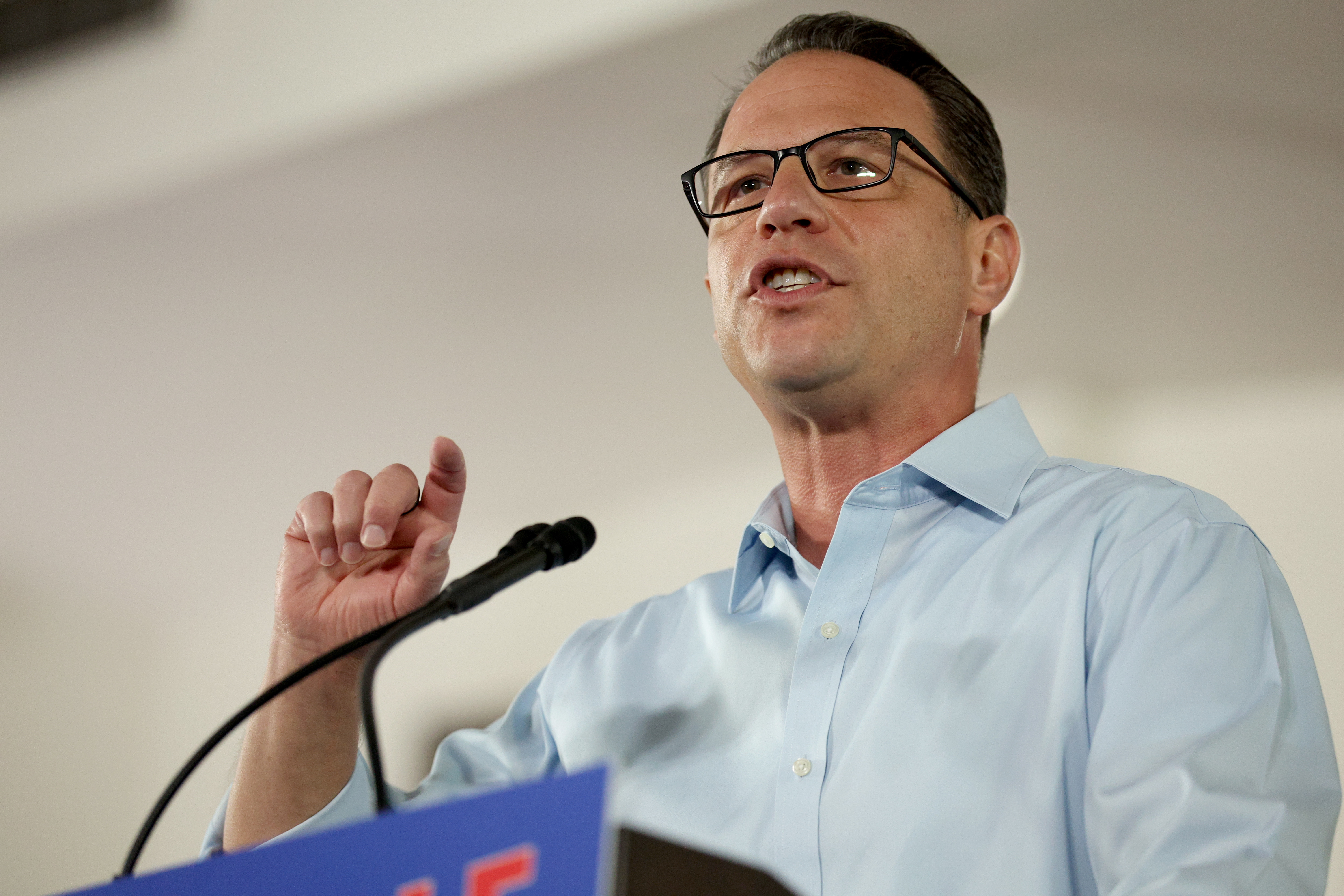

  • Gov. Josh Shapiro spent more than $2.4 million on ads this week. His GOP opponent, Stacy Garrity, spent $672.

    Gov. Josh Shapiro spent more than $2.4 million on ads this week. His GOP opponent, Stacy Garrity, spent $672.

    Gov. Josh Shapiro is dominating Pennsylvania’s media markets in his reelection campaign, spending more than $24 million with less than seven weeks left until the Nov. 3 election — and trouncing his GOP challenger, State Treasurer Stacy Garrity, who has spent a small fraction of that on ads.

    Shapiro, a Democrat seeking reelection and potentially a 2028 White House bid, has spent more than $2.4 million on advertisements per week since Aug. 25 from his campaign war chest of more than $50 million, according to media tracking firm AdImpact. One ad pitches Garrity as “Pennsylvania’s #1 fan of data centers,” and in another, Shapiro boasts about his efforts to cap energy costs. He has also released a number of audience-specific ads to reach Black and Latino voters, including a radio advertisement in Spanish in the Lehigh Valley.

    A clearer picture of Shapiro’s full campaign haul will become public this week, with updated campaign financial filings due Tuesday. The last filing deadline for state candidates was in June. But Shapiro’s multimillion-dollar flurry of ad buys offers early insight into his strategy heading into November in a race where he holds a double-digit polling lead — and where he is hoping to achieve downballot wins in the statehouse and critical congressional districts.

    Garrity has spent just $743,000 on ad buys so far, and paid out only $672 last week, according to AdImpact. No top GOP groups, such as the Republican Governors Association or the Jeffrey Yass-backed Commonwealth Leaders Fund, have purchased TV ads supporting Garrity, and she has struggled to fundraise to compete with Shapiro, a popular incumbent who has raised more money than any governor since at least 2010.

    State Treasurer and Republican candidate for governor Stacy Garrity is seen on a big screen as she speaks to supporters before the arrival of President Donald Trump at Mack Trucks in Macungie Tuesday, June 23, 2026. Tom Gralish / Staff Photographer

    Shapiro’s mass ad buys despite his commanding lead in the polls indicate the governor is a risk-averse politician, said Christopher Borick, a political science professor at Lehigh University.

    “He’s cautious. He wants to make sure nothing goes awry, and to do that, you buy insurance,” Borick said.

    “The governor has also been clear that the midterms run through Pennsylvania — and he is leading the fight to win critical races up and down the ballot in order to flip the House, put a check on Donald Trump’s chaos, cruelty, and corruption, and get even more stuff done,” said Manuel Bonder, a spokesperson for Shapiro’s campaign.

    Garrity, meanwhile, has spent the lion’s share of her ad buys on a digital social media video campaign called “Twilight Justice,” which promises the future release of bombshell details about Shapiro. She has also released an attack ad about Shapiro’s past support for data centers, but it has been seen by far fewer eyes than those Shapiro is reaching in his multimillion-dollar ad campaigns. Both Shapiro and Garrity initially embraced data centers, though both shifted their positions as the projects became increasingly unpopular among Democrats and Republicans.

    Matthew Beynon, a spokesperson for Garrity’s campaign, declined to comment on whether top GOP groups will get involved in the Pennsylvania governor’s race in the coming weeks. But he said any pro-Shapiro mailer or TV ad “is just another reminder to the people of Pennsylvania that Josh Shapiro sold them out.”

    “All the money in the world will not help Josh Shapiro paint over his administration’s failed economic record or erase his ethics scandals that have cost the taxpayers of Pennsylvania and embarrassed the entire commonwealth,” Beynon added.

    Data center power play

    The regulation of data centers and artificial intelligence have become key issues in midterm races nationwide, including in the Pennsylvania governor’s race, where Shapiro’s past support for the projects appeared to be the biggest test of his popularity.

    Shapiro changed his position last month and subsequently began running attack ads against Garrity for her past support of the unpopular centers. Garrity has also changed her position, from initially advocating for the rapid development of data centers around Pennsylvania to now calling for “a pause” on their development. Shapiro, in an executive order signed last month, will now require any prospective data center developers to meet a number of environmental and energy factors in order to build in Pennsylvania.

    “That’s why you’ve seen this enormous ad buy that she can’t even come close to matching, when, in reality, he’s as exposed as her on the issue, but she doesn’t have the resources,” Borick said.

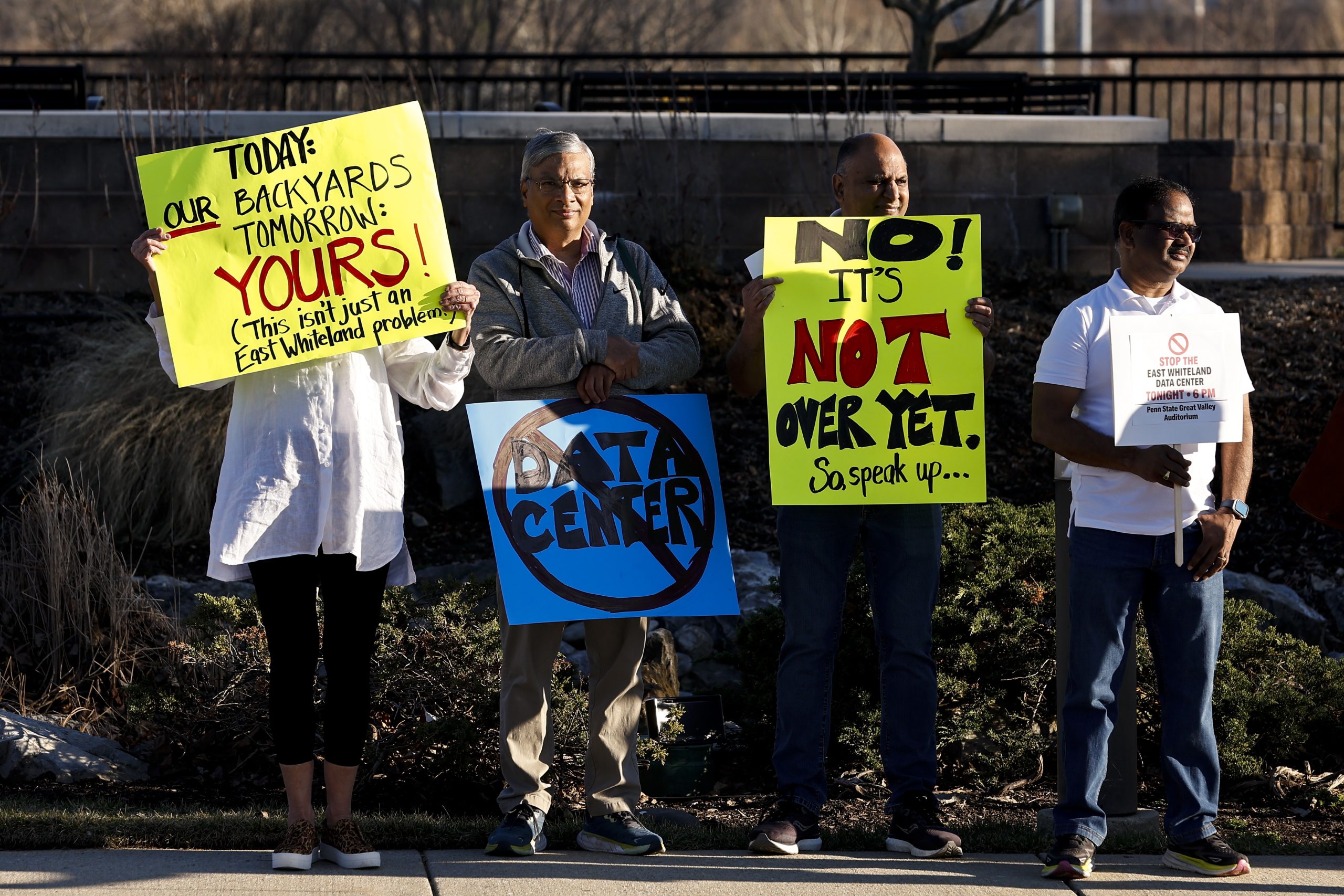
    People protest the expanded data center before the East Whiteland Planning Commission meeting held at Penn State Great Valley on Monday, March 9, 2026 in Malvern, Pa.Monica Herndon / Staff Photographer

    Pennsylvania Republicans endorsed Garrity in September 2025 — an unprecedented early nod that helped clear the field for her as the party’s nominee. President Donald Trump endorsed her in January, calling her an “America First Patriot.” She ran unopposed in the primary election, and top GOP leaders said they wanted to wage a stronger fight against Shapiro this time than in 2022, when far-right State Sen. Doug Mastriano (R., Franklin) won the endorsement in a crowded field and the state GOP largely did not financially support his candidacy.

    Despite all of the additional time to drum up support, Garrity has struggled to raise funds and has yet to be able to cash in on Trump’s backing. As of Thursday, she had spent just $300,000 more than Mastriano had at this point in the race. Shapiro, meanwhile, has spent less this election than he did at the same point in 2022, when he spent $28 million as of mid-September.

    “When you’re making comparisons to the amount of money Doug Mastriano raised, it’s a really troubling sign,” Borick added.

    Garrity and Shapiro will face off in a televised debate on Oct. 7 hosted by ABC27 in Harrisburg.

  • ‘Babies are dying’: How Pennsylvania’s measles outbreak changed the vaccine mindset of this Amish country midwife

    ‘Babies are dying’: How Pennsylvania’s measles outbreak changed the vaccine mindset of this Amish country midwife

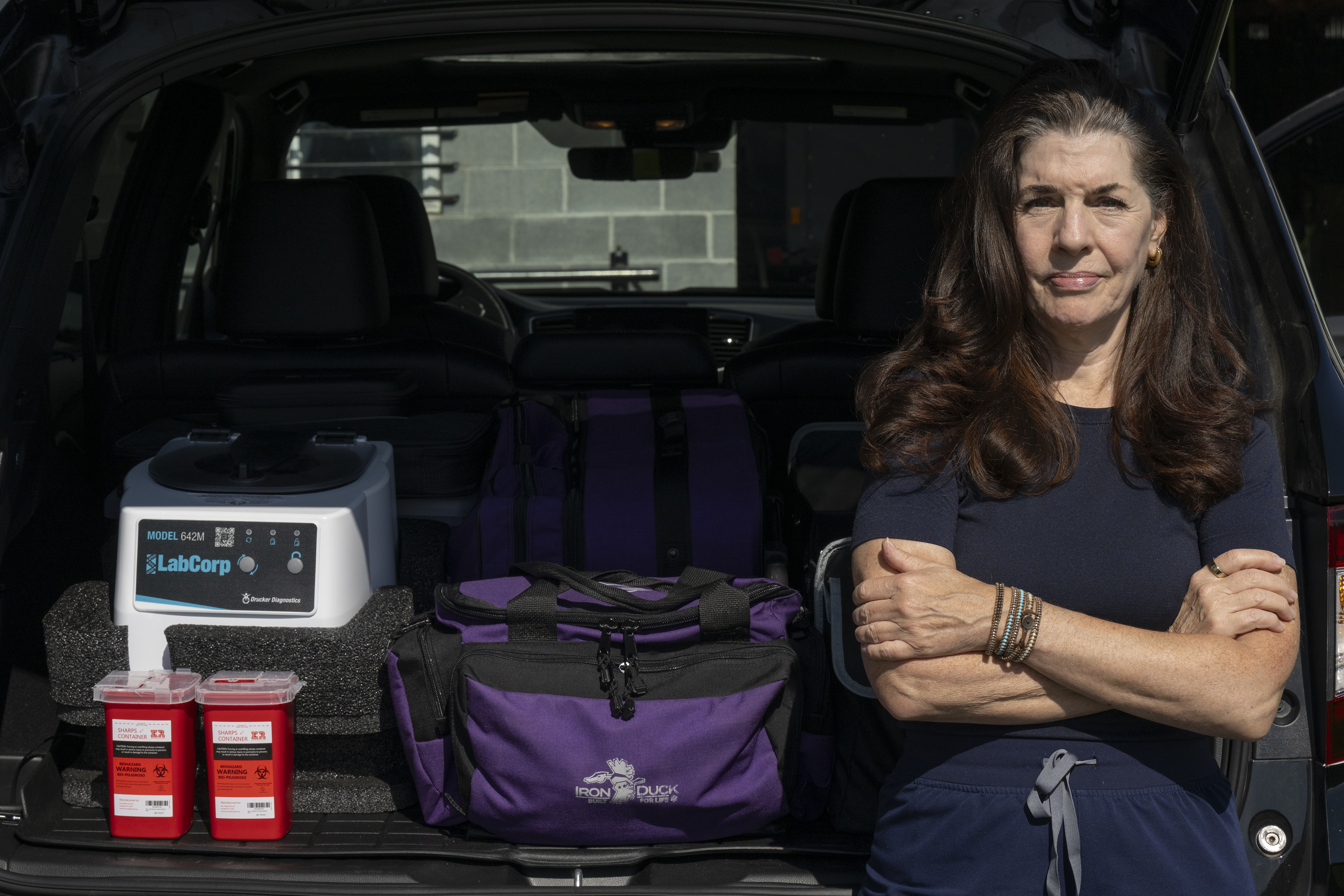
    LANCASTER — Amish families peer into Roberta Devers’ Honda Passport as she drives between prenatal checkups along the rolling hills of Lancaster County. They ask her increasingly frequent questions about the vaccine: Do you have some measles in your car?

    Devers, 63, works as a traditional midwife in communities at the epicenter of Pennsylvania’s largest measles outbreak in more than 30 years. She belongs to a class of midwives who follow age-old practices and are unregulated by the state, unlike the state-licensed midwives one may find in a hospital. She received the full childhood vaccination schedule but, as an adult, chose not to vaccinate her son and is part of the rising number of people in Pennsylvania refusing to get vaccinated against preventable diseases due to unfounded concerns about their safety and necessity.

    But with the growing outbreak now linked to the deaths of two Amish infants and two adults in Pennsylvania — the first measles-related deaths in the state, and the most in the nation in more than three decades — Devers thinks everyone who can should get vaccinated against measles.

    And she thinks she should be able to offer the vaccine to her patients, as a trusted caretaker among Amish residents.

    “Babies are dying,” said Devers, who is not Amish but has been a traditional midwife for 38 years. She says she fears that Pennsylvania’s Amish community, one of the oldest and largest in the country, cannot wait to reach herd immunity. “You’re going to lose too many babies,” she said.

    Devers occupies a unique vantage point from the front lines of the nation’s largest measles outbreak this year. State health officials said the deaths of two local Amish infants were measles-related, sparking a clash between Democratic Gov. Josh Shapiro and President Donald Trump’s Health and Human Services secretary, Robert F. Kennedy Jr., over how to report the outbreak’s death toll. An 18-year-old from Mifflin County and a 40-year-old woman from Jefferson County also died from measles-related illnesses in recent days, according to the counties’ coroners.

    As of Wednesday, the state had reported 731 cases in 38 counties. Lancaster has recorded the highest number of known cases in Pennsylvania, as the highly contagious disease has spread among the area’s significant number of unvaccinated people, including many from communities beyond the county’s Amish population.

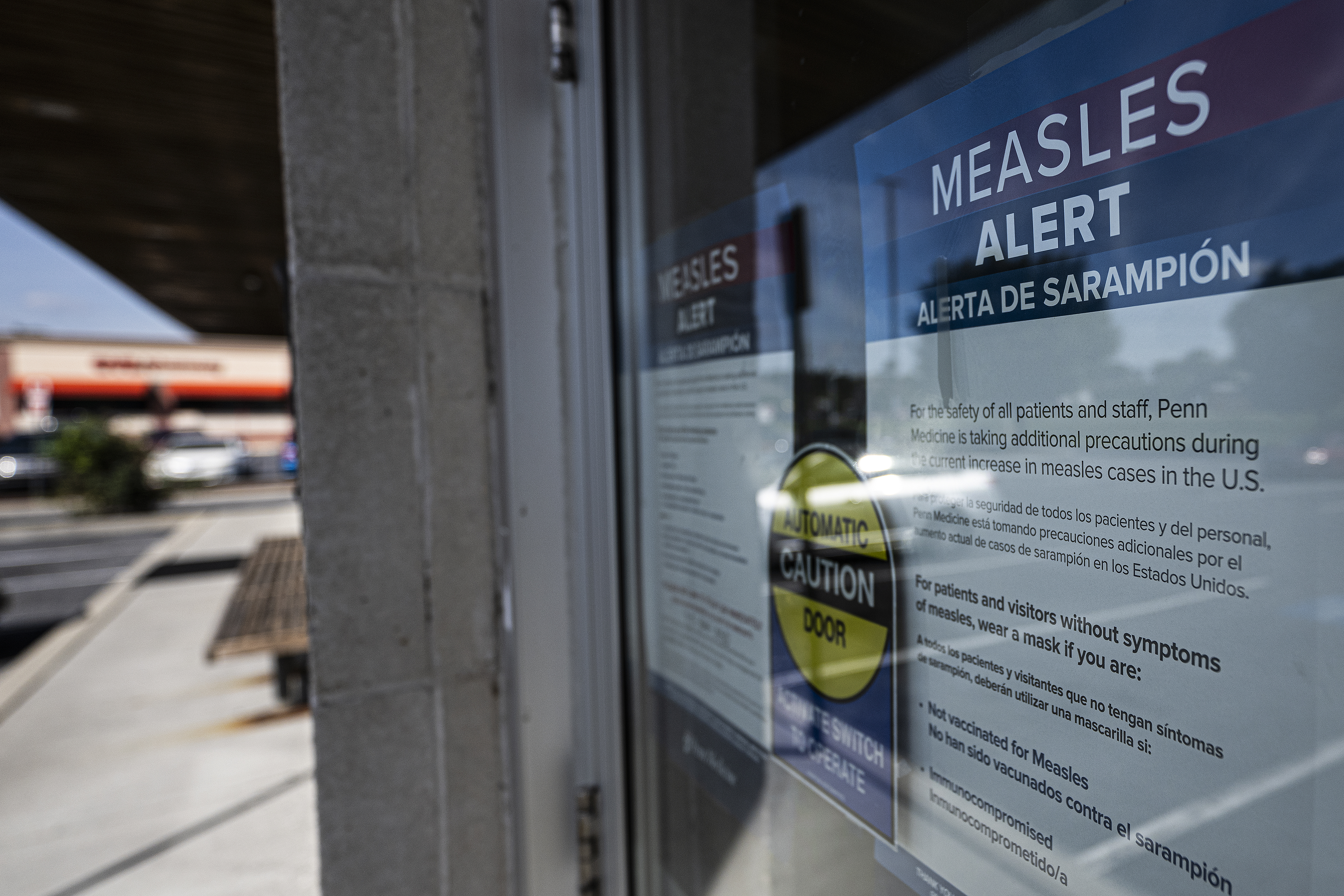
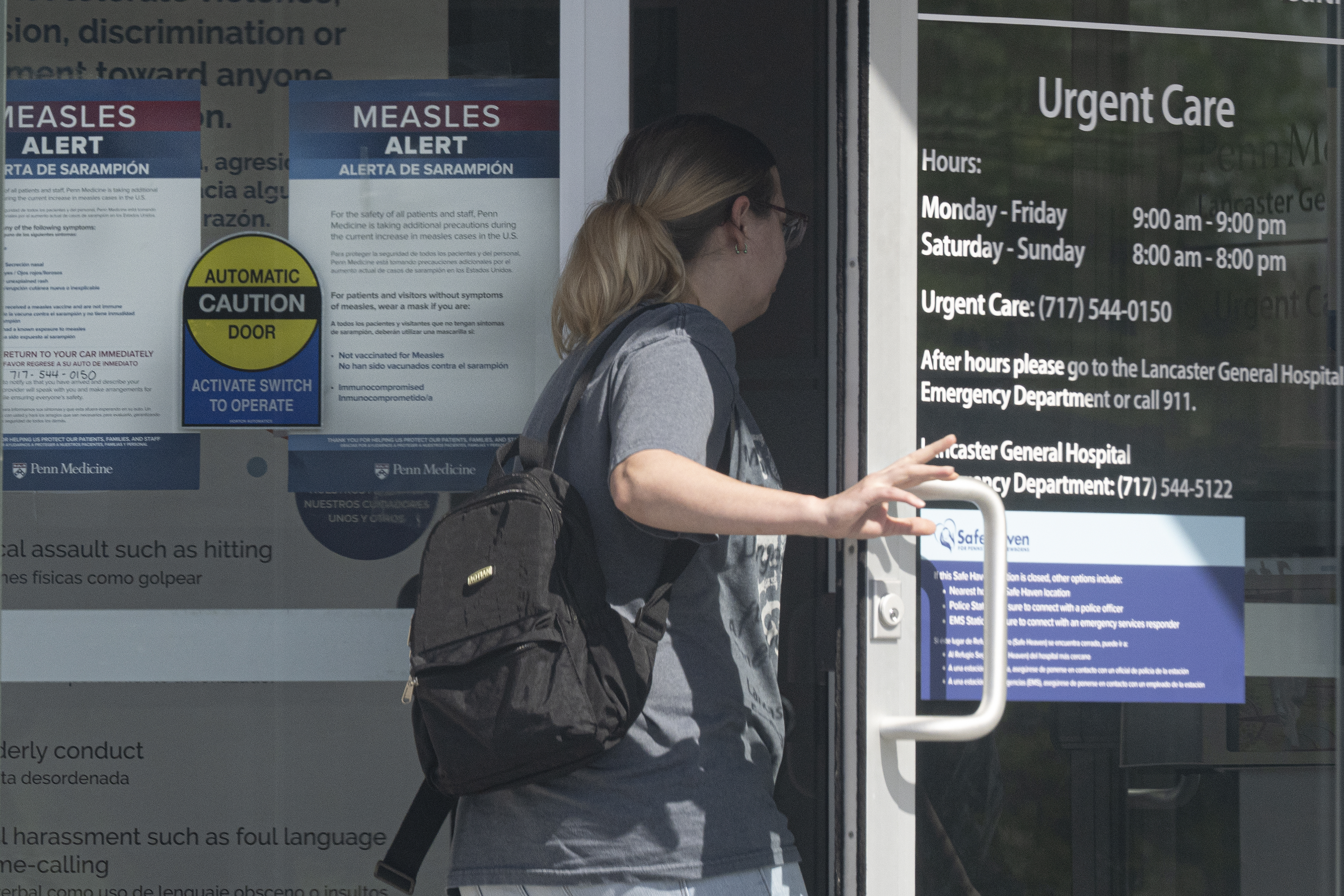
    Measles alert signs in English and Spanish are posted on the front doors of an urgent care facility Tuesday, Sept. 8, 2026, in Lancaster County, Pa., amid a measles outbreak that has affected local Amish and Mennonite communities.Jose F. Moreno / Staff Photographer

    Traditional midwives like Devers — also known as lay midwives or direct-entry midwives — broadly oppose being regulated by the modern medical system and often do not receive the medical and scientific training or college-level education required of certified nurse midwives and midwives. Because of this, top medical associations like the American College of Obstetrics and Gynecology oppose traditional midwives from being able to practice at all. State law also prohibits traditional midwives from practicing medicine, such as administering vaccines or sutures.

    Until this summer when it was quietly repealed in state budget documents, an unenforced 1929 law allowed traditional midwives to practice in Pennsylvania. A group of midwives have sued the state to formally recognize them, but that would still not permit them to practice medicine, including administering vaccines.

    Yet, traditional midwives are the main care providers who oversee home births in certain Amish communities, or for people who want their help with a personal and private birth experience. Their influence is particularly prominent in Pennsylvania, which has one of the nation’s highest rates of home births. Devers’ practice, Mount Laurel Midwifery, delivers about seven babies per month across south-central and Southeastern Pennsylvania, with a number of student midwives studying under her.

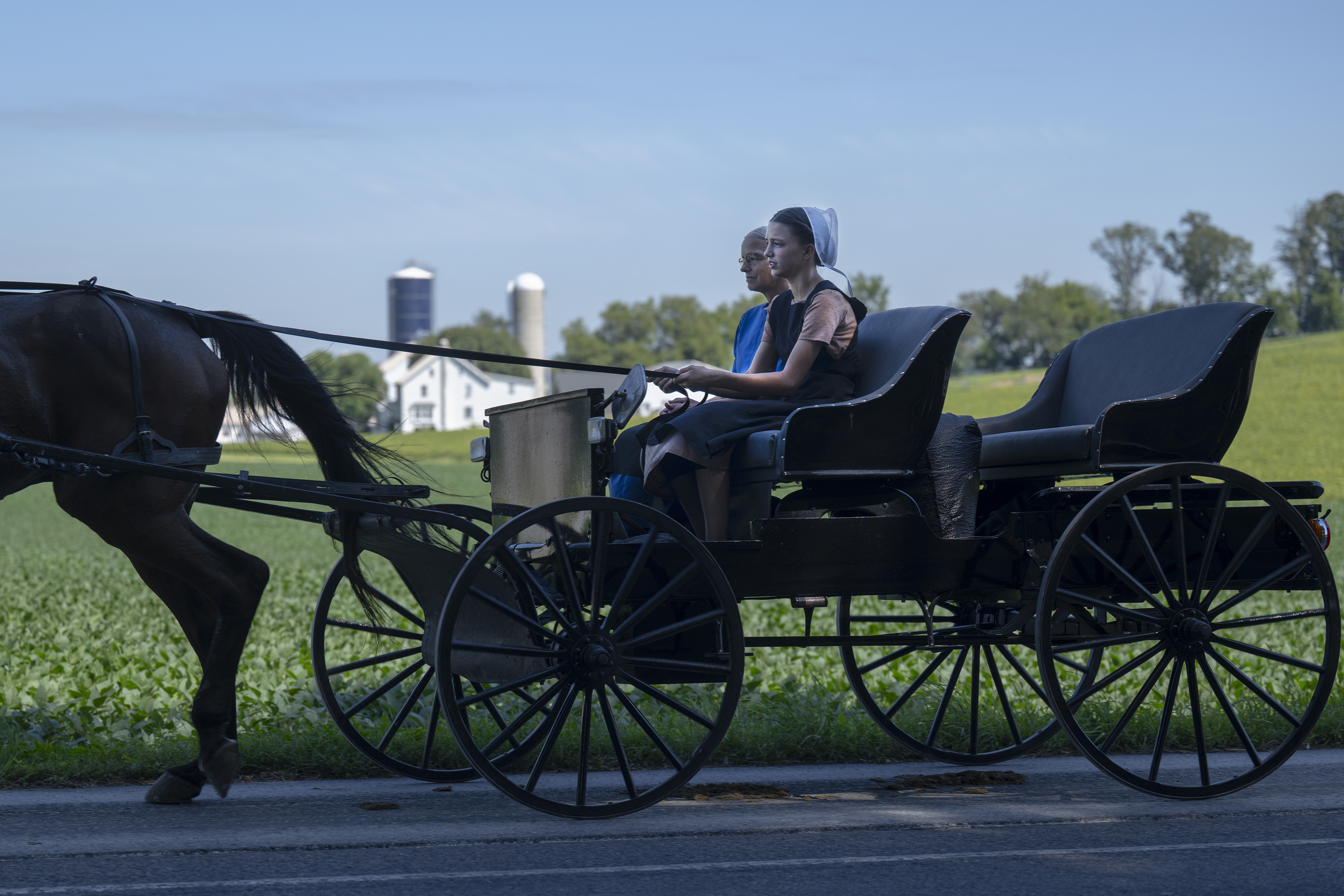
    An Amish woman drives a horse-drawn buggy along a road Monday, Sept. 7, 2026, in Lancaster County, Pa., amid a measles outbreak that has affected the local Amish and Mennonite communities.Jose F. Moreno / Staff Photographer

    In Lancaster, Devers’ clients are not talking about the political debate. Rather, their conversations center on the spread of measles — did she hear about the recent baby deaths, what should they do if they were exposed, does she have a vaccine with her?

    Two doses of the measles, mumps, and rubella vaccine have proven 97% effective at preventing the disease, the Centers for Disease Control and Prevention says. Nine in 10 unvaccinated people exposed to measles will acquire the disease.

    Pregnant people are not eligible to receive the vaccine.

    In her daily prenatal checkups, she is seeing moms who have the infection’s signature bumpy, red rash and fever, and families who have watched the sickness move through one family member to the next.

    About three in 1,000 children who contract measles will die, according to the CDC. Measles can cause severe complications, especially in young children, including pneumonia and brain swelling. And measles during pregnancy can lead to pregnancy loss, premature delivery, and low birth weight, according to the CDC.

    Devers said she recently saw a case in which a mother lost her baby at 17 weeks. The Amish woman was recovering from an active measles infection at the time of the miscarriage, in addition to at least one other underlying medical condition, Devers said.

    Amish families traditionally have funerals for stillborn babies or miscarried fetuses, sharing obituaries in the local newspaper. Devers attended the funeral for one such death, involving the 17-week-old fetus, last month.

    Midwife Roberta Devers is photographed Tuesday, Sept. 8, 2026, near the home of one of her Amish patients in Lancaster, Pa. Devers, who primarily serves Amish mothers, discusses the measles outbreak and why she believes unlicensed midwives should be allowed to administer MMR booster shots.Jose F. Moreno / Staff Photographer

    During previous public health emergencies, state and federal governments have used limited emergency approvals to expand who is allowed to administer vaccines, though the authority was not extended to unregulated groups like traditional midwives.

    Now, Devers wants state or federal health officials to extend approval to allow traditional midwives to administer the measles, mumps, and rubella vaccine.

    But the Pennsylvania Department of Health says it does not have the authority to allow traditional midwives to administer vaccines, because they are not certified healthcare providers. Currently, state law allows licensed healthcare providers like doctors and certified nurse midwives to administer vaccines, and any expansion of the list would require an amendment to state law, spokesperson Stephanie Nojiri said in a statement.

    HHS and the CDC did not respond to requests for comment. Devers said she recently accepted an invitation from the CDC to participate in a paid interview to discuss how midwives serving Plain communities are approaching the measles outbreak. She sees the outreach as a signal of the agency’s interest in working with midwives.

    The Amish and vaccines

    Vaccination rates among Pennsylvania children have been falling for years. The spread of misinformation about vaccine safety reached the highest echelons of the U.S. government after Trump picked Kennedy, a longtime anti-vaccine activist, to lead the nation’s health agencies.

    In 2025, at least 249 Pennsylvania schools had vaccination rates below 95%, the level that scientists say is necessary to prevent the spread of measles.

    Amish communities do not have a religious objection to vaccinations, said Steven Nolt, a top Amish scholar at the Young Center for Anabaptist and Pietist Studies at Elizabethtown College.

    He said low vaccination rates in the groups, who dress in plain clothes and widely object to using technology in favor of a more traditional way of life, are due to their partial abstention from modern medicine, as well as a lack of nearby access given their rural lifestyles.

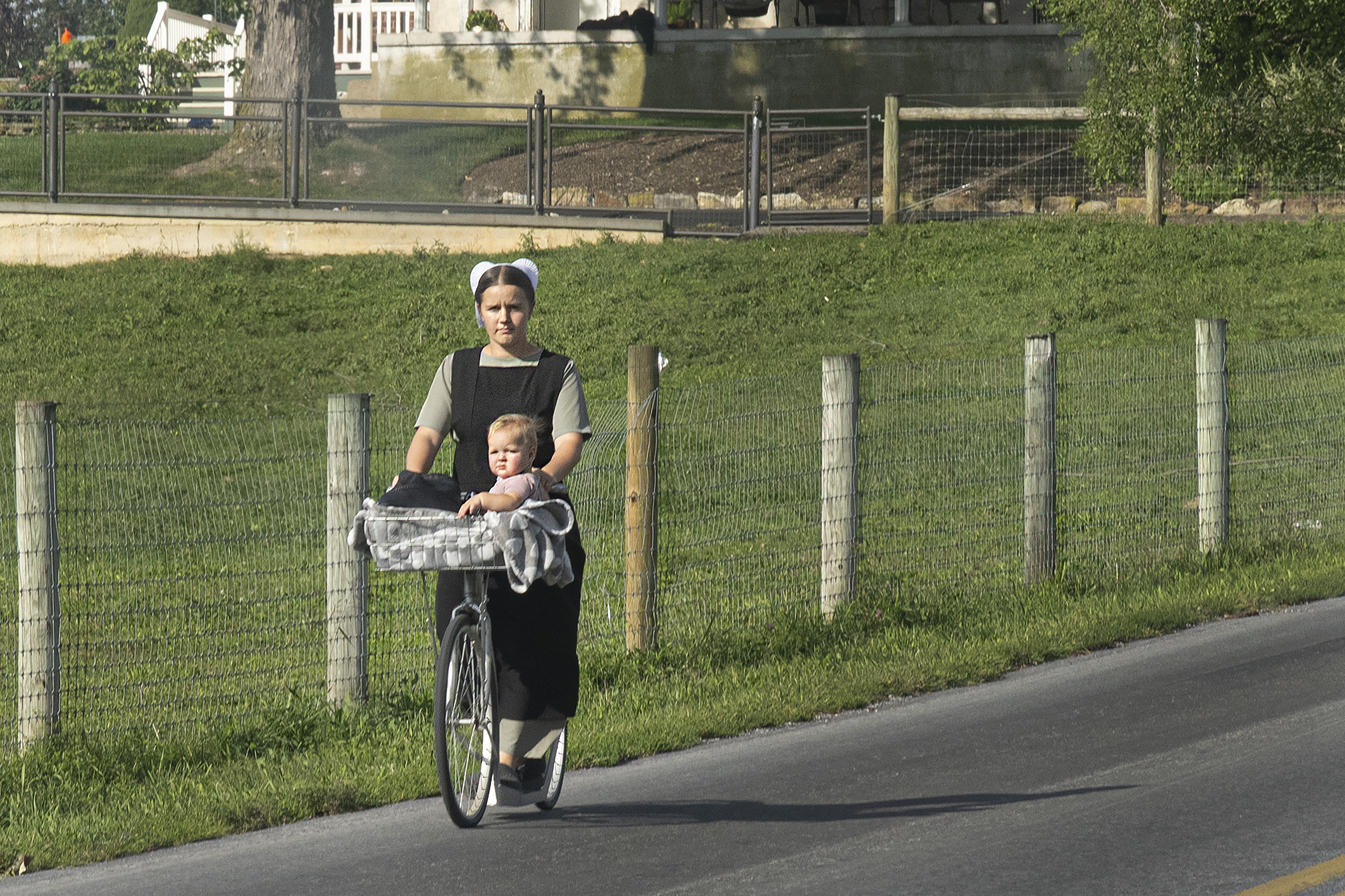
    An Amish woman rides a kick scooter with a baby secured in a front basket attached to the scooter Tuesday, Sept. 8, 2026, along a road in Lancaster County, Pa., amid a measles outbreak that has affected local Amish and Mennonite communities.Jose F. Moreno / Staff Photographer

    In Lancaster County, 30% of Amish families had their children vaccinated and believed vaccinations were safe and effective, according to a 2022 survey of 433 Amish and Old Order Mennonite residents, published by Elizabethtown College and conducted by Franklin and Marshall College.

    The numbers are much higher among Old Order Mennonites — a different religious group that similarly dresses in plain clothes — with 94% vaccinating their children and 72% believing they are safe and effective.

    When a 1991 rubella outbreak spread through Amish communities, families welcomed the booster shots, Nolt said. So did Amish groups during a polio outbreak in the 1970s.

    “When there would be an outbreak, that was a bit of a wake-up call,” he added. “Then people would come out for immunizations.”

    Another “wake-up call” has now arrived for Lancaster’s Amish residents, Devers said.

    Amish vendors work at their stands inside the popular Central Market in Lancaster, Pa., Tuesday, Sept. 8, 2026, amid a measles outbreak that has affected local Amish and Mennonite communities.Jose F. Moreno / Staff Photographer

    Amish groups broadly approach their health through a “medical pluralism” lens — a term coined by Martha King, a medical anthropologist at the University of North Carolina at Chapel Hill. This means Amish communities view medical doctors, chiropractors, midwives, and homeopathic remedies as all being “on the same playing field,” rather than being supplementary to a primary care physician, as is common among most Americans, Nolt said. Sometimes Amish people will choose treatments that contradict each other or lack any scientific backing.

    “They kind of all function in a way that doesn’t necessarily make sense the way many ‘normal’ Americans think about healthcare,” Nolt added.

    Prior to his appointment as HHS secretary, Kennedy helped lead anti-vaccination efforts across the country. During a 2021 speech in Lancaster County, he mocked measles as a serious threat.

    It is unclear what effect the efforts have had on Amish populations, Nolt said. During the COVID-19 pandemic, some anti-vaccine groups ran advertisements in Amish newspapers, discouraging the Amish from getting any immunizations, he added.

    Devers said she largely supports Kennedy, but believes Shapiro was right to raise alarm about the need to vaccinate against measles. She said she has been disappointed in Kennedy for downplaying the dangers of the outbreak.

    “My God, use your head,” Devers said. “He can’t mean this in the midst of an epidemic like this.”

    Pennsylvania’s health department, in partnership with local health systems, says it has been working with Amish communities. And Shapiro has emphasized that the outbreak stretches much further than just among any one community, now that confirmed cases have spread to more than half of Pennsylvania’s 67 counties.

    Since the start of the measles outbreak in Pennsylvania in April, state health officials have hosted 124 pop-up vaccination clinics across the state in locations like churches, fire halls, and private homes to give more than 4,100 doses of the MMR vaccine, Nojiri said. More pop-up clinics are planned in the near future.

    But traditional midwives should be part of the solution, too, Devers argued.

    “Different times call for a change in thinking,” she said.

    This story has been updated to remove identifying information.

  • Josh Shapiro’s not an AI ‘doomer,’ but the Pa. governor wants federal regulations for the industry

    Josh Shapiro’s not an AI ‘doomer,’ but the Pa. governor wants federal regulations for the industry

    Gov. Josh Shapiro on Thursday called on the federal government to enact new guardrails on artificial intelligence, days after a number of tech industry figures raised concerns about the danger posed by AI’s rapid development.

    As he spoke in Pittsburgh, the Democratic governor was critical of both House Speaker Mike Johnson (R., La.) and President Donald Trump for refusing to erect such safety measures “whether out of willful ignorance or personal greed.”

    And, he said, he does not believe that concern about this technology “is a hoax, as our president has called it.”

    But as he urged more regulation of the industry, he also warned against adopting an overly pessimistic view of the technology.

    “I am not a doomer. I don’t think it is inevitable that AI is going to take over the world, or that someone will misuse it to kill us all or to do harm,” Shapiro said.

    Shapiro’s appearance at the AI Horizons PGH Summit, sponsored by Microsoft and the Bank of New York, helps position the governor as a leader on the issue among Democrats.

    Last week, former President Barack Obama urged Democrats running for the White House to define the risks of AI, according to the Washington Post.

    That advice — and Shapiro’s speech — followed warnings from AI executives last week that the technology is developing too quickly, and that it poses threats to human life.

    “I won’t lie to you — there are real dangers,” said Anthropic CEO Dario Amodei, adding that the development of AI has accelerated much faster than he had expected.

    Shapiro — who has consistently led his November opponent, Stacy Garrity, in polls — is widely expected to pursue a presidential run in 2028 after this fall’s reelection contest.

    A growing concern among voters, AI is expected to continue being a significant issue for candidates, and Shapiro has shifted his stance in recent months to reflect questions about the technology.

    In August, he issued an executive order that restricts data center development in the state, a noticeable shift from when he enthusiastically supported a $20 billion commitment from Amazon last year to build at least two data centers in Bucks and Luzerne Counties.

    Shapiro now says future developments require local approval for projects to receive state permits, which in effect may block many developments from moving forward.

    “The real folks I listen to are the people of Pennsylvania,” Shapiro told Politico before Thursday’s speech.

    Six in 10 likely Pennsylvania voters oppose construction of data centers to house artificial intelligence, according to last month’s poll from The Inquirer, the New York Times, and Siena University.

    In contrast to the growing voices calling for AI guardrails, President Donald Trump on Monday wrote on social media that the only guardrail the industry needed it already had: “a STRONG AND SMART (High IQ!) PRESIDENT.”

    Shapiro, in his speech, said he is calling on the federal government to establish “strict rules of the road” regarding AI, and then to enforce those rules.

    “I’ve called on the federal government to step up and regulate the AI industry, just like they do for nearly every other industry,” he said.

    Industry leaders should not exclusively guide the regulatory process, Shapiro said. The government should also work with leading researchers.

    What is vital, Shapiro said, is establishing rules that require independent third-party oversight of “frontier” — most advanced — models, increasing transparency into the development of these models, and prioritizing safety.

    Protections might mean placing some limits on technology sharing and slowing down frontier AI development until we can be sure that these systems are safe, Shapiro said.

    Acknowledging that building a regulatory network from the ground up is hard work, Shapiro took a jab at Congress, and Johnson in particular, when he said “too many in Congress are content to do absolutely nothing.”

    Shapiro noted that the speaker adjourned the House until after the election just days after companies issued “apocalyptic” warnings about the real dangers of AI.

    “He has abdicated his responsibility to lead at a time when we cannot afford weakness and retreat,” Shapiro said of Johnson.

    The United States should work with other nations on an international consensus on how to use AI, but that is hard to do when Trump has “isolated” us from the world, Shapiro said.

    When Trump meets with Chinese President Xi Jinping next week, Shapiro said, he hopes Trump will “leave bluster and the showmanship at the door” and engage productively with him.

    As for the home front, Shapiro said, “I’ll be leading the conversation here in Pennsylvania for safe and responsible use of AI.”

  • Pa. is asking CDC for more emergency aid, but only if measles deaths are reported

    Pa. is asking CDC for more emergency aid, but only if measles deaths are reported

    Pennsylvania is seeking more emergency aid from the Centers for Disease Control and Prevention to respond to the state’s largest measles outbreak in more than 30 years, but only if the federal agency acknowledges the four measles-associated deaths Pennsylvania has reported.

    The CDC has so far declined to publicly report Pennsylvania’s measles-associated deaths, reportedly at the direction of Health and Human Services Secretary Robert F. Kennedy Jr.

    The CDC’s measles dashboard says the agency is still reviewing death data and developing a new standard definition of a measles-associated death.

    Public health experts say it is highly unusual for the CDC to challenge routine disease surveillance by states, and delaying death reporting could affect efforts to control Pennsylvania’s outbreak, which has sickened more than 700 people and is now this year’s largest in the country.

    “The CDC’s choice not to publicly recognize the deaths undermines our response,” Pennsylvania Health Secretary Debra Bogen wrote in a Wednesday letter to CDC Director Erica Schwartz, a nominee of President Donald Trump who was confirmed to the post last month. The state shared the letter with The Inquirer.

    Bogen wrote that the CDC’s Epi-Aid program, which provides short-term technical assistance and subject matter expertise during health crises, will benefit Pennsylvania’s outbreak response only if she can assure her staff that the CDC’s assistance “will not will not undermine their efforts and will partner with them toward a common goal, including publication of timely, accurate information about the outbreak.”

    The CDC said it had not received Pennsylvania’s Epi-Aid request “through its normal channels” and accused state leaders of politicizing outbreak response. Federal outbreak assistance and national mortality reporting are separate issues, the agency said.

    “CDC will not submit to political blackmail that conditions critical public health assistance,” the agency said in a statement Thursday. “The people of Pennsylvania should never be used as leverage in a political dispute over how deaths are classified.”

    The back-and-forth comes after the CDC has said the state is not cooperating with the agency and, for days, highlighted the fact that health officials here had not requested an Epi-Aid team from the agency, as other states with measles outbreaks have done.

    (function(){function e(){window.addEventListener(`message`,function(e){if(e.data[`datawrapper-height`]!==void 0){var t=document.querySelectorAll(`iframe`);for(var n in e.data[`datawrapper-height`])for(var r=0,i;i=t[r];r++)if(i.contentWindow===e.source){var a=e.data[`datawrapper-height`][n]+`px`;i.style.height=a}}})}e()})();

    An ongoing political clash

    Pennsylvania defines a “measles-associated death” as one that occurs within 30 days of symptom onset in a person with clinical evidence of infection and a positive laboratory test, and who did not die of another unrelated cause, like a car crash.

    The state announced its first two measles-associated deaths in late August, but provided no information on them beyond that both were in unvaccinated Lancaster County residents. The county coroner later said he did not believe measles caused one of the deaths, involving an infant with a lacerated spleen who tested positive for measles, though physicians have noted measles can weaken the organ and make it more likely to rupture.

    The coroner, an elected Republican, said a second death, in another infant with a fatal genetic condition, was caused by measles.

    Two other measles-associated deaths were reported this week in Mifflin and Jefferson Counties. Mifflin County’s coroner confirmed the death of an unvaccinated 18-year-old who died from a serious neurological complication of measles; Jefferson County’s coroner said measles led to the death of an unvaccinated 40-year-old woman with severe respiratory conditions.

    Gov. Josh Shapiro, a Democrat, has criticized Kennedy, a longtime anti-vaccine activist, for spreading misinformation and contributing to lower vaccination rates that he says have allowed the virus to spread through 38 counties in Pennsylvania.

    Kennedy had accused the state of “fabricating” two deaths, although he later acknowledged one was caused by measles.

    Both have said the other is politicizing the deaths, the first reported in Pennsylvania and the highest death toll linked to the virus nationally in more than three decades.

    On Wednesday, the state reported that 731 people have been sickened in Pennsylvania so far this year — with 117 cases reported in the last week alone. Just over 140 people had been hospitalized, with 18% of them under 18.

    An Epi-Aid team typically works with a state for one to three weeks to provide technical assistance investigating an “urgent public health problem,” according to the CDC’s website.

    “The focus of an Epi-Aid investigation is to assist partners in making rapid, practical decisions for actions to control and prevent the public health problem,” the website reads.

    In the letter sent to Schwartz on Wednesday, Bogen said that the state is already working closely with the CDC and recently made two requests for “technical assistance” from agency staff.

    She said the state appreciated “the CDC professional staff’s timely and thoughtful responses.”

    Since the state is still seeing measles cases and deaths, Bogen said, officials are now requesting an Epi-Aid team from the CDC.

    But Bogen will rescind the Epi-Aid request “if CDC is unable to transparently and accurately communicate information about those measles-associated deaths,” the letter said.

    “While our professional teams have collaborated well on the measles outbreak response, including the identification and reporting of four measles-associated deaths, CDC’s public communication about the deaths has not been reflective of our close collaboration,” she wrote.

    (function(){function e(){window.addEventListener(`message`,function(e){if(e.data[`datawrapper-height`]!==void 0){var t=document.querySelectorAll(`iframe`);for(var n in e.data[`datawrapper-height`])for(var r=0,i;i=t[r];r++)if(i.contentWindow===e.source){var a=e.data[`datawrapper-height`][n]+`px`;i.style.height=a}}})}e()})();

    Protocol on counting measles deaths

    The CDC’s measles web page, updated weekly with new case information, has featured an asterisk in the column for 2026 deaths.

    The CDC initially posted an explanation saying it had omitted Pennsylvania’s deaths because “available information does not establish whether measles caused or contributed to the deaths or whether the individuals died from other causes while infected with measles.”

    The agency later updated its asterisk language to note that the National Center for Health Statistics (NCHS) “does not currently have any death records from 2026 that indicate measles is the underlying cause.”

    The web page also says that the agency is working with the Council of State and Territorial Epidemiologists to develop a standardized case definition for measles deaths, in an effort to promote “consistent classification and reporting of measles deaths across jurisdictions.”

    Pennsylvania health officials said their definition of a measles-associated death is modeled after existing CSTE definitions for deaths from other respiratory illnesses, like flu.

    In the interim, the CDC will wait to report measles-related deaths until the NCHS “identifies measles as the underlying cause based on death record information submitted by the states,” the agency said in a statement to The Inquirer.

    Relying on the NCHS for measles deaths is a departure from the CDC’s standard protocol for tracking infectious diseases, said Demetre Daskalakis, a former director of the National Center for Immunization and Respiratory Diseases, which oversees state immunization efforts and disease surveillance within the CDC.

    In the past, the CDC has relied on the National Notifiable Diseases Surveillance System, its system for monitoring dozens of diseases, such as meningitis, pertussis, botulism, and measles. States submit new case reports as they obtain them.

    States will typically alert the CDC in advance of entering data into the database when it is urgent — for instance, signs of an infectious-disease outbreak or a death associated with an outbreak.

    This is the approach Pennsylvania’s health department said it took to report its first measles-associated deaths earlier this month.

    By contrast, the NCHS database tracks all deaths in the United States, and is the source of the routine Vital Statistics reports. States upload death certificates, and the CDC’s system skims data about primary and secondary cause of death, and any additional details noted. The process can take weeks because states enter each death individually.

    With both databases, information entered by states is reviewed for completeness (for instance, to ensure no required fields have been left blank) and then recorded.

    “Generally, they are cleaning data to make sure it’s coming in as quality data. They’re not litigating the decisions on a death certificate,” Daskalakis said. “This relitigation is highly atypical.”

    Deaths in which measles is listed on the death certificate will eventually be logged by the NCHS, but relying on this database will mean a longer delay between when a death occurs and when it is reported nationally.

    The CDC did not answer multiple requests for comment explaining its updated protocol.

    Slowing down measles death reporting could minimize the outbreak, and give Kennedy time to design new definitions that will manipulate how measles deaths are counted, Daskalakis said.

    Daskalakis was among the top CDC officials who resigned last summer after its director at the time, Susan Monarez, clashed with RFK over vaccine recommendations and was fired.

    He said he worries that “the goal of the secretary is to say that measles doesn’t kill anyone. And that’s not true, but when you own the keys to the kingdom …”

  • Mayor Parker has ordered a task force to study data centers in Philly and report back by June

    Mayor Parker has ordered a task force to study data centers in Philly and report back by June

    Philadelphia Mayor Cherelle L. Parker on Wednesday ordered a task force largely composed of members of her administration to explore whether the city should place new regulations on the construction of data centers — and to present her with its findings in about nine months.

    The mayor, a Democrat who has not staked a position on whether Philadelphia should host the controversial “hyperscale” data centers that power artificial intelligence, signed an executive order establishing the task force on Wednesday.

    In a video message posted to social media, the mayor said the issue is of “grave importance.” She said she has heard from residents who are concerned that a large data center in the city could hike utility bills and drive pollution.

    “This does not mean that a hyperscale data center is being built now; however, if a firm was to apply to the City of Philadelphia to build one of these hyperscale data centers, we want to make sure that we are fully prepared to know what the impact on Philadelphians would be,” Parker said. “We want the appropriate guardrails in place so that we do everything possible to protect our city.”

    The task force will be made up of members of Parker’s administration, as well as a representative from City Council President Kenyatta Johnson’s office. The group is charged with gathering information from neighborhood groups, unions that represent construction workers, environmental advocates, public health experts, and others.

    According to the executive order, the task force must present a final report to the mayor by June 30.

    The mayor’s move came just two days after dozens of activists held a rally outside City Hall calling on Parker and members of Council to pass a multiyear moratorium on the construction of data centers in Philadelphia. They vowed to make data centers an electoral issue ahead of the May primary election, when the mayor and every Council member will be on the ballot.

    The group, called No Data Centers in Philly, said in a statement Wednesday that Parker giving the task force until June to make its recommendations is too little, too late, and that “a task force does nothing to protect us now and takes time that we don’t have.”

    “Across the country, data centers have relied on dirty deals to get built, with NDAs, backroom negotiations, and massive tax handouts,” the statement read. “We can’t let that happen here. The communities who will see their health, homes, and wallets hurt by a data center need to be at the table.”

    President Kenyatta Johnson (right) is greeted by data center protesters in the hall while he heads toward City Council chambers Thursday, Sept. 17, 2026, as the body returns for start of its fall session.Tom Gralish / Staff Photographer

    Parker’s order also comes as talks of regulating artificial intelligence have gripped Washington after a handful of tech executives called for a global slowdown on the advancing technology. There has been bipartisan backlash across the country to the data centers that power AI; however, President Donald Trump has said the industry does not need new regulations.

    Last month, Gov. Josh Shapiro signed an executive order that effectively placed limits on data center construction in the state and required that the projects receive local backing before obtaining a state permit. It would also ban state agencies from using nondisclosure agreements.

    In Philadelphia, no member of City Council has said publicly that they would introduce legislation to place a moratorium on data center construction. Lawmakers are not currently considering any specific proposal to construct a data center.

    This summer, the city’s planning commission issued a report indicating that there are just two plots of land in Philadelphia that could accommodate a hyperscale data center: the former South Philly refinery site known as the Bellwether District and 2600 Grant Ave., a city-owned plot adjacent to Northeast Philadelphia Airport.

    However, building a data center in either of those locations would face hurdles.

    District Council members wield enormous power over land-use decisions in their districts, and the Council members who represent the two potential locations said they oppose a hyperscale data center in their jurisdictions.

    City Councilmember Mike Driscoll, a Democrat who represents the district where the Grant Avenue site is located, said in an interview Thursday that he “is a no, until we really figure this whole thing out.” He said he is concerned that a data center could drive higher utility bills for his constituents.

    “I think we have to participate to be competitive in the global economy,” he said. “But it’s ripe for some problems, and I think we have to sort that out at the federal level.”

    And Council President Kenyatta Johnson, who represents the area where the Bellwether district is located, said Thursday: “We don’t support any type of hyperscale data centers.” He cited concerns about environmental impacts and noise.

    “I haven’t gotten to the point that it should be a moratorium,” Johnson said. “But we are looking at regulations.”

    Bellwether district leaders have said no data center is currently in the works there.

    Mia Fioravanti, senior vice president of corporate affairs for the HRP Group/The Bellwether District, said earlier this week at the Economy League of Greater Philadelphia PAGE Real Estate and Construction Summit that there are no “data center users in our current project pipeline.”

  • I went to the Flight 93 memorial and witnessed a spirit of unity that’s hard to find elsewhere

    I went to the Flight 93 memorial and witnessed a spirit of unity that’s hard to find elsewhere

    STOYSTOWN, Pa. — There was almost no shade for the thousands who gathered Friday at the memorial plaza near the field where United Airlines Flight 93 crashed on Sept. 11, 2001. The sun was merciless as Red Cross and Salvation Army volunteers handed out water, and people sought refuge amid a few trees by the side of the road.

    But along with the heat, attendees felt something that has become quite unfamiliar for many Americans 25 years after 9/11: unity.

    While the spotlight was on larger events in New York City and Arlington, Va., they saw some of the conflicts we’ve all grown accustomed to. President Donald Trump refused to join his predecessors at ground zero, reportedly because he wouldn’t be allowed to speak. He opted for the Pentagon remembrance instead, where he and Defense Secretary Pete Hegseth gave speeches trying to tie the Iran war to the attacks of a generation ago.

    In Lower Manhattan, former New York City Mayor Rudy Giuliani — who had called for current Mayor Zohran Mamdani to stay away from the event, claiming Muslims “want to dominate us” — at least had the courtesy to shake Mamdani’s hand at the ceremony.

    None of that animus seemed to be present in rural Pennsylvania.

    The speeches by senior National Park Service officials, Gov. Josh Shapiro, and Secretary of the Interior Doug Burgum were civil and shared a common theme: The heroism of the passengers who fought back against their hijackers. Flight 93 never made it to its intended target, believed to be the White House or the U.S. Capitol. Instead, it crashed into a desolate field about 90 minutes outside of Pittsburgh.

    There was no ego on display, no inflammatory rhetoric — Democrat Shapiro and Republican Burgum even stood together at the wreath-laying ceremony in a rare show of political unity. The only comment that could be read as political came from Stephen Clark, superintendent of the National Parks of Western Pennsylvania and thus responsible for the Flight 93 memorial, when he reminded people that “history is shaped not only by the powerful, but by everyday individuals who decide to act with courage.”

    Gov. Josh Shapiro (second from left) and Secretary of the Interior Doug Burgum (center right) walk past the Wall of Names during a wreath ceremony at the Flight 93 National Memorial on the Sept. 11 anniversary in Stoystown, Pa., Friday.Hannah Beier

    In keeping with that sentiment, it wasn’t just those on stage who kept a unifying tone, as people from all walks of life, diverse ages, and across political persuasions came together in Stoystown to mourn and remember.

    I spotted a lone MAGA hat, and spoke with a woman who claimed 9/11 had been an “inside job,” arguing it was only logical because “the CIA killed JFK, too.” However, there were no loud political outbursts, and in talking with people, the same sober sentiment as from the official speakers was evident.

    Tom and Ryan, who preferred not to share their last names, were among the millions of Americans who learned of the attacks in school and watched the second plane hit the south tower in their grade-school classrooms. While they said they consider themselves conservatives, they felt strongly about not making the memorial a political battleground.

    Speaking to other visitors, a few made comments about the president or Democrats, but the major sentiment surrounding the remembrance stayed clear. They were not there to argue about politics. People were there to remember those who perished on 9/11, particularly the heroes of Flight 93.

    Stoystown was not just a contrast to what we regularly see across the U.S.; it also reminded me how difficult it is to come together even in times of tragedy. In my native Germany, recent terror incidents include the 2016 attack at a Berlin Christmas market by an Islamic extremist, a similar attack in Magdeburg in 2024 by a Saudi Arabian refugee (who described himself as an “ex-Muslim” and expressed far-right sympathies when questioned by authorities), and, most recently, an attack on the Berlin Pride parade in July, this one again being linked to Islamic terrorism.

    While decried broadly, none of these events managed to create the unity I felt in Stoystown. On the contrary, every incident in Germany seems to spark new debates about former Chancellor Angela Merkel’s policy of welcoming migrants during the refugee crisis of the mid-2010s. Even years later, populist parties and their supporters make it mostly about Islamophobia and dividing rhetoric instead of uniting to mourn as one people.

    These ugly, divisive sentiments are present in the U.S., of course, but at least for one day in a field in Pennsylvania, the memory of 9/11 still strengthens a bond that has not been erased by terror, populism, or party politics.

    Wim Orth is a journalist with WELT in Berlin and an Arthur F. Burns fellow at The Inquirer.

  • Pennsylvania health officials confirm two new measles-associated deaths, bringing total to four as state outbreak grows

    Pennsylvania health officials confirm two new measles-associated deaths, bringing total to four as state outbreak grows

    Pennsylvania health officials on Tuesday confirmed two more deaths associated with measles, involving a resident of Jefferson County and a resident of Mifflin County.

    The state has now reported four measles-related deaths amid a growing outbreak that has sickened nearly 700 people this year. The deaths mark the state’s first in three decades related to the highly contagious disease, and the most reported in the U.S. in a year since 1992.

    Both residents tested positive for measles and were unvaccinated, state officials said.

    An 18-year-old in Mifflin County died due to measles complications, the county coroner said in a news release Tuesday. The cause of death was acute disseminated encephalomyelitis, “a rare and severe neurological complication of measles.”

    The condition occurs after a measles infection triggers a harmful autoimmune response, said Paul Offit, a physician and vaccine expert who heads Children’s Hospital of Philadelphia’s Vaccine Education Center.

    “It’s rare. It occurs in maybe one in 1,000 cases. But it’s real, and it can be fatal,” he said.

    The death of a 40-year-old woman was reported over the weekend by Jefferson County’s coroner. She also had severe respiratory conditions and died of respiratory failure after showing signs of measles.

    She had been exposed to a person with a lab-confirmed case of measles, and the coroner on Monday evening confirmed in a news release that postmortem testing showed the woman had an active measles infection when she died.

    Health Secretary Debra Bogen, offering condolences to the victims’ families, noted the state’s efforts to “stem this outbreak and prevent more deaths” include ensuring people have access to and accurate information about the measles, mumps, and rubella (MMR) vaccine.

    Measles deaths are rare, with typical symptoms including a high fever, a cough, runny nose, red, watery eyes, and a rash.

    Yet the disease can cause severe complications, including pneumonia and brain swelling, especially in young children. About one to three children for every 1,000 infected will die from complications, according to the Centers for Disease Control and Prevention.

    With 693 cases in 38 counties confirmed so far in Pennsylvania this year, experts fear the mounting death toll indicates that significant numbers of cases are going unreported.

    “I think we are severely underestimating this epidemic,” Offit said.

    Mifflin County, where the 18-year-old patient died, had reported 79 measles cases as of Monday — the second-highest total in the state, behind Lancaster County, where 296 people have been sickened and two deaths were previously reported.

    State officials also warned Monday that a person with measles may have exposed others in a Mifflin County Aldi supermarket earlier this month.

    Jefferson County, where the 40-year-old woman died, has seen 28 cases of measles so far this year.

    Pennsylvania defines a “measles-associated death” as one that occurs within 30 days of symptom onset in a person with clinical evidence of infection and a positive laboratory test, and who did not die of another unrelated cause, like a car crash.

    (function(){function e(){window.addEventListener(`message`,function(e){if(e.data[`datawrapper-height`]!==void 0){var t=document.querySelectorAll(`iframe`);for(var n in e.data[`datawrapper-height`])for(var r=0,i;i=t[r];r++)if(i.contentWindow===e.source){var a=e.data[`datawrapper-height`][n]+`px`;i.style.height=a}}})}e()})();

    Shapiro again criticizes RFK Jr.

    Since last month, state and federal officials have sparred over whether two other deaths reported in Pennsylvania were tied to the state’s measles outbreak.

    U.S. Department of Health and Human Services press secretary Emily G. Hilliard said that state officials had notified the CDC of the two additional deaths reported Tuesday.

    “CDC remains in contact with state health officials as they continue to assess these deaths,” she said in a statement.

    With the news of the additional deaths, Democratic Gov. Josh Shapiro on Tuesday continued his criticism of President Donald Trump’s HHS secretary, Robert F. Kennedy Jr., accusing him of spreading misinformation about vaccine safety through his longtime anti-vaccine activism.

    “This serious situation continues to be made worse by RFK Jr. playing games with public health and safety,” Shapiro said in a X post Tuesday.

    In its latest update Friday, the CDC still had not listed the first two deaths on its website highlighting data on ongoing measles outbreaks around the country.

    Shapiro also noted a news report that Kennedy directed the CDC’s decision not to include the deaths. “It is also deeply concerning to learn that the Secretary personally intervened in an otherwise administrative process to direct the CDC to not report these Pennsylvania deaths, presumably because it doesn’t fit his phony narrative,” he wrote.

    HHS representatives have called the report “false and misleading.”

    Kennedy has accused the Shapiro administration of “fabricating” the first two deaths, although he later said one had been caused by measles.

    Federal health officials also note that unlike several other states with measles outbreaks, Pennsylvania has not required an “Epi-Aid” team from the agency, “which would deploy epidemiologists to provide on-the-ground measles outbreak support.”

    In a post on X, Kennedy said that Shapiro had “chosen to politicize this outbreak instead of implementing a unified public heath response.”

    “He continues to point the finger at me and the federal government and to malign the Amish while refusing the federal assistance that might help end the outbreak,” he wrote. (The two Lancaster County deaths occurred in Amish children.)

    State health officials have said they meet regularly with the CDC and will continue to evaluate if they need additional support from the agency.

    Kennedy also said he had not directed the CDC to “suppress Pennsylvania deaths.”

    “CDC is applying a consistent national standard rather than allowing politicians to decide which deaths appear in federal mortality statistics. CDC will report measles-caused deaths when the National Center for Health Statistics reports measles as the underlying cause based on death record information submitted by the states,” he wrote.

    He added that MMR vaccination is “the most effective way to prevent measles infection.”

    Pennsylvania officials have declined to publicly release additional information on the deaths, citing state privacy laws.

    Details on the circumstances involved with the deaths have come from local coroner’s offices, which at times has heightened the scrutiny on the state’s reporting.

    Lancaster County’s coroner said he had investigated one death caused by measles, in an infant with a deadly genetic disorder that made her vulnerable to respiratory infections.

    He investigated another death in an infant who contracted measles before birth and died shortly after. The coroner, a physician and an elected Republican, has said that infant’s death was caused by a lacerated spleen, not measles. Yet prominent physicians have noted measles can weaken a person’s spleen, putting it at risk of rupture. State officials have maintained that the death was associated with measles.

    Both children were too young to be vaccinated against the virus that is transmitted through the air, when an infected person coughs or sneezes, and can linger in the air for up to two hours.

    Jefferson County’s coroner, also an elected Republican, said from his first news release Sunday that complications associated with measles were behind the death of the 40-year-old woman in his county. He said her death was due to “suspected measles” and other underlying conditions, because she had symptoms of the disease, including a rash and fever, and had been exposed before her death.

    He shared on Monday that he was updating the woman’s death certificate to read “probable measles” after receiving paperwork confirming the woman had been in contact with an infected person with a positive lab test for measles. Later that night, he confirmed in a news release that the woman’s postmortem measles test was positive.

    He told the Guardian that she would not have died were it not for the measles. He did not immediately return a call for comment Tuesday.

    Vaccine protection against outbreaks

    Two doses of the MMR vaccine are 97% effective at preventing the disease, the CDC says.

    The more people who are vaccinated, the less likely it is for measles to spread. Scientists say that about 95% of a community should be vaccinated to prevent spread.

    But vaccination rates in Pennsylvania have dropped in recent years, including in areas now seeing measles-related deaths.

    In Mifflin County, for example, MMR vaccination rates for kindergartners dropped from 92.3% during the 2024 school year to 89% in the 2025 school year.

    Lancaster County’s kindergarten MMR rates were already low and dropped by about 1 percentage point to 87.5% in 2025.

    About 93% of Jefferson County kindergartners were vaccinated in 2025, a slight decrease from the year before.

    Staff writer Stephen Sterling contributed to this article.

  • Next-door states banned ICE-cop deals. Why not Pa.? | Will Bunch Newsletter

    Next-door states banned ICE-cop deals. Why not Pa.? | Will Bunch Newsletter

    One of the many things we won’t forget about the Trump era is how much the family of POTUS 47 has enriched itself — not only the president but his children, including Donald Trump Jr., who is said to be now worth at least $500 million and growing. So it was no surprise when his second marriage to Palm Beach, Fla.’s Bettina Anderson in May was a lavish affair on two private islands in the Bahamas. What is a surprise — as we now know from some stunning work by a team of reporters from ProPublica — is who paid: a very close associate of Russian dictator Vladimir Putin. So maybe the “Russia, Russia, Russia” folks were onto something?

    If someone forwarded you this email, sign up for free here.

    Pa. Democrats are alarmed at the rapid growth of ICE-police deals. But can they stop them?

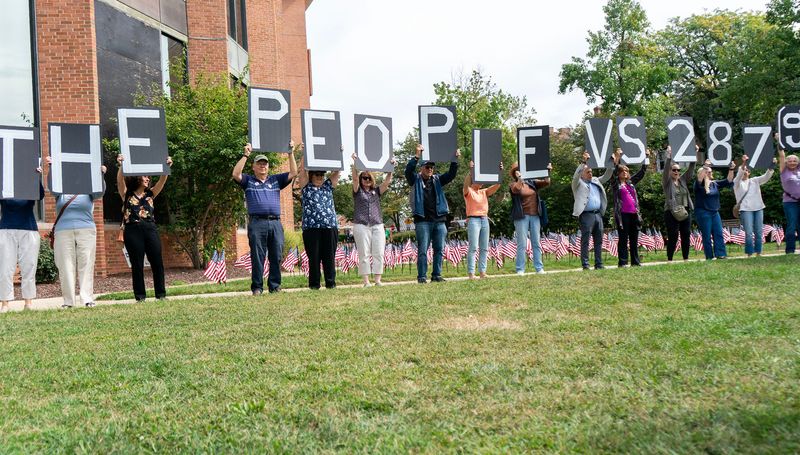
    Immigrants’ rights advocacy group members and their supporters hold up letters that read “The people vs 287(g)” during a rally last September in Doylestown against the Bucks County sheriff’s efforts to implement a 287(g) program.Daniella Heminghaus | Bucks Coun

    The big, mostly under-the-radar story around the Donald Trump regime’s relentless push to arrest and remove immigrants from the United States has been this year’s explosion of so-called 287(g) agreements. These allow local cops to act as immigration agents, working collaboratively with U.S. Immigration and Customs Enforcement, or ICE.

    But if you look at a national map to understand how these 287(g) agreements have spiked from just 135 when Trump retook office in January 2025 to more than 2,500 such pacts today, you’ll notice that one state sticks out like a sore thumb.

    In Pennsylvania, amped-up promises of federal cash incentives have meant a soaring number of localities where local beat cops are now working with ICE to make arrests — up from just a handful at the start of the year to some 130 now. Most 287(g) collaborators are in Trump-voting pockets of the Keystone State — northeast and south-central Pennsylvania, or out west near the Ohio border.

    But when you look at the rest of the Northeastern United States, the 287(g) map is very sparse. That’s partly because most local pols across the region agree with their constituents about opposing Trump’s mass deportation policies, and in several states it’s also the result of legislation that aims to ban the program altogether.

    In late August, New York enacted the Local Cops, Local Crimes Act — backed and signed by its Democratic Gov. Kathy Hochul — which calls on police departments and county sheriffs to terminate their 287(g) agreements, although several counties are still challenging the measure in court. Maryland has a similar law on the books, while New Jersey, which had long prevented such pacts under an attorney general’s directive, also passed a law this spring to codify the ban.

    There’s a growing number of Pennsylvania lawmakers who want to pass a similar law here, but there’s one big problem: Republicans. They control the state Senate in Harrisburg — currently by a 27-23 margin — and GOP lawmakers have no interest in rebuking the president on immigration policy.

    “The reason we exist alone is because of our split legislature,” State Rep. Heather Boyd, a Democrat who represents heavily immigrant Upper Darby and adjacent parts of Delaware County, told me. Last year, Boyd circulated proposed legislation to ban 287(g) deals in Pennsylvania, and while dozens of Democrats in Harrisburg are supportive, any move is on hold until a November election that could shift the balance of power. Boyd said lawmakers are wary of “starting any culture wars” ahead of the vote.

    I pressed the office of Gov. Josh Shapiro, who’s running for a second term and who is seen as a possible top contender for the 2028 Democratic presidential nomination, for his position on reining in the 287(g) program here.

    “Governor Shapiro has been clear that law enforcement should be focused on keeping Pennsylvanians safe — not sowing fear in communities or targeting people who are working hard, raising families, and contributing to our Commonwealth,” his press secretary, Rosie Lapowsky, said. She noted that the governor has barred Pennsylvania State Police from any formal ICE collaboration, and he would urge local police to take a similar stance.

    She added: “Ultimately, however, these decisions rest with local law enforcement agencies. The governor does not have the unilateral authority to dictate whether individual sheriffs or police departments enter into these agreements.”

    Many of those local law enforcement agencies have instead rushed to join 287(g), with ICE promising small-town departments an initial $100,000 cash windfall and additional incentives for training officers to make arrests and to cover the cost of working overtime on the program.

    Last week, I reported from Schuylkill County in east-central Pennsylvania, where some 14 law enforcement agencies have raced to adopt 287(g), more than any other county in the state. Since the spring, local cops there have arrested about 100 immigrants at highway stops or by assisting ICE in job site raids. The blitz has prompted rising complaints about alleged racial profiling, the handcuffing of U.S. citizens, and a sense of fear that permeates a growing Latino community in Pennsylvania coal country.

    Statistics obtained from the U.S. Department of Homeland Security by advocates show that local police in Pennsylvania have arrested and turned over to ICE more than 1,200 immigrants this year — ranking the state fourth in the nation on a list in which the other leading states are all south of the Mason-Dixon Line.

    In Washington, some of the state’s Democratic House members say they’re fed up with a lack of transparency over who is being detained and how the 287(g) program is working here. Last week, four of them — Reps. Mary Gay Scanlon and Madeleine Dean from the Philadelphia suburbs and Reps. Chris Deluzio and Summer Lee from Western Pennsylvania — sent a letter to ICE’s acting director David Venturella demanding information on why the agency’s data lack any specific details about which departments are making arrests, which is required by law.

    “It is unacceptable to me that ICE is hiding information from Pennsylvanians about who ICE is working with in their mass deportation regime,” Deluzio — viewed as a potential 2028 primary challenger to embattled Sen. John Fetterman — told me in an emailed statement.

    Deluzio also summed up the growing unease by many over the speedy growth of 287(g) in the state. “Let’s keep local law enforcement focused on local public safety, rather than enlisting them in extreme federal immigration enforcement that has ripped away American liberties and targeted so many law-abiding families,” he said. Indeed, 287(g) data guru Andrew Thrasher has reported that a whopping 70% of the immigrants arrested in Pennsylvania under the program have no criminal record or pending charges.

    “People in my community are getting smashed off the streets,” said Boyd, the Upper Darby lawmaker. That Delco township is about to vote on a local ordinance to restrict its cops from collaborating or sharing data with ICE.

    Statewide, Boyd says she’s one of about 50 House Democrats in a Welcoming Pennsylvania Caucus with an extensive list of proposed bills that would not only bar 287(g), but look to expand opportunities for noncitizens to do things like obtaining driver’s licenses or gain professional certification. But any serious action hinges on November, when Democrats are hoping a blue wave at the ballot box will flip at least three more Senate seats and create a trifecta for their party in Harrisburg.

    “Even if we can’t stop ICE from picking them up on the streets, we have to protect their rights,” Boyd said. “And right now, there are barriers to that in the state of Pennsylvania.”

    Yo, do this!

    • The issue of wrongful convictions is back in the news here in Philadelphia — but for all the wrong reasons. Some reckless and seemingly wrongheaded moves by Philadelphia District Attorney Larry Krasner and his underlings have the vultures who’ve always opposed criminal justice reform circling. The shame is that the real crisis around wrongful conviction is the thousands of mostly Black and brown folks who remain behind bars for crimes they did not commit. I cannot say enough about a book that came out earlier this year from Brown University (yay!) sociologist Nicole Gonzalez Van Cleve called Crime Fictions: How Racist Lies Built a System of Mass Wrongful Conviction. She mines the most outrageous prosecutions — often of young Black teens and boys — to make a compelling argument that wrongful convictions aren’t a flaw in the criminal justice system. They are the system.
    • If timing is everything, then you’ve got to hand it to my freshman dorm pal at Brown who became Washington bureau chief for Mother Jones, David Corn. On the heels of ProPublica’s bombshell reporting on ties between the Trump family and Vladimir Putin, Corn is out Tuesday with his newest book: How Russia Won — Donald Trump, Vladimir Putin, and the Fight for America. It promises a raft of new information about Russia’s efforts to meddle in U.S. elections in 2020 and 2024, the ongoing close links between Team Trump and Team Putin, and how the current president’s pro-Russian slant has changed the world.

    Ask me anything

    Question: What happens when [House Speaker Mike] Johnson refuses to seat newly elected Dems in January? — David Minckler (@audivita.bsky.social) via Bluesky

    Answer: Suddenly, Jan. 3 — the date the 120th U.S. Congress begins, and new members who won their November elections are to be sworn in — has become the new Jan. 6. Summer vacations are over, and the body politic is focused on the looming midterms, and — more importantly — with polls showing the Democrats on track to retake one and possibly both chambers. So there’s been a surge of speculation that the Trump-allied Johnson will do what former Vice President Mike Pence would not do on Jan. 6, 2021, and somehow fail to certify Democratic winners. That’s based on an assumption that Trump’s election-meddling tactics like stopping mail voting — blocked on Monday by the U.S. Supreme Court — won’t work, yet Team MAGA will attempt to undo the election after the fact, as was tried unsuccessfully in 2020-2021. Lawfare has published the most detailed analysis of a so-called rogue clerk theory in which Johnson appoints a MAGA loyalist to serve as House clerk with the understanding that some Democratic wins won’t be certified. Its article notes that such a gimmick is unlikely to pass muster in the courts, but that won’t necessarily stop Trump and the GOP from trying. My only guidance is: Fasten your seat belts.

    What you’re saying about …

    It turns out readers of the newsletter aren’t eager to join the punditocracy. Only a few of you responded to last week’s question about the chances of a Democratic-led Senate in 2027, and one of them was to give me a verbal tongue-lashing for even asking this. (Frequent writer Daniel Fleisher called it “a pointless exercise in predicting the unpredictable.”) That said, Cathy King has her eye on Abdul El-Sayed in Michigan, her home state, writing that “he seems to be following [Zohran] Mamdani’s playbook.” Meanwhile, in Iowa, Mary Chilton thinks the Dems’ Josh Turek has a real shot in a state won three times by Donald Trump, noting that farmers are up in arms “over the data center issue, imported beef, water pollution and the soaring cancer rates …”

    📮 This week’s question: Suddenly, everyone is talking about one thing: the Silicon Valley whistleblowers saying there’s not a trivial chance that a swarm of angry artificial intelligence agents could wipe out humankind by the end of the decade. Are you worried by this, or do you think Big AI is deflecting here to draw attention away from other issues like data center opposition or the stock market bubble? Please email me your answer and put the exact phrase “the AI threat” in the subject line.

    Backstory on that other thing that could kill humanity

    A barge on the Ohio River moves past the Mountaineer Power Plant, a coal-fired power plant near New Haven, W.Va., in March.Carolyn Kaster

    This weekend, a Bluesky post went super viral almost the second its author, a scientist named David Ho, hit the button to post it. “I resigned from ExxonMobil today,” he wrote. “I spent the last three years doing fossil fuel extraction research at both BP and ExxonMobil. Neither company is acting responsibly. They are racing to maximize extraction while the window to act closes, and gambling with our lives.”

    It’s a safe bet that many of the 13,000 people who liked Ho’s post truly believed they were sharing the words of a brave whistleblower — but instead the post was satire from a leading climate scientist based at the University of Hawaiʻi at Mānoa. Ho would never work for a Big Oil giant. He was trying instead to mimic — and thus make a point about — the recent posts from Silicon Valley whistleblowers that triggered the new freakout over whether AI robots are a threat to human existence.

    Climate change is a threat to society, and it’s even closer to reality. Maybe we should freak out about that?

    Ho absolutely has a point. Just before his post, it was announced that August had been tied for the hottest month ever recorded in the history of the planet. That doesn’t come without consequences. In the Himalayas between Nepal and Tibet, a glacier and the adjacent bedrock of mountains at 17,000 feet abruptly collapsed in a region plagued by higher-than-normal temperatures, sending a 150-foot-high cocktail of floodwater and debris down a populated valley at 100 mph. At least 1,386 were killed, and thousands more remain missing. Here in the U.S., a summer of record heat triggered wildfires across the Pacific Northwest.

    Robots didn’t do this. Humans did. Maybe that’s why humans — at least the ones that are running Donald Trump’s America — are reacting so differently to the danger of AI than the way they’re dealing, or not dealing, with the lethal pollution from burning fossil fuels. In the case of artificial intelligence, even tech leaders like Anthropic’s Dario Amodei, whose firm makes the Claude program, have urged a slowdown until we better understand the risk from rogue AI agents.

    But in the case of climate change, willful ignorance rules the day. The latest outrage from a Trump regime that’s expensively killing off wind farms while racing to extract as much fossil fuel as possible? The now ironically named Environmental Protection Agency is repealing the rule that limits greenhouse-gas emissions from power plants that burn coal or natural gas. A president who spent his summer sweltering on the golf course continues to insist climate science is “the greatest con job ever perpetrated on the world.”

    There’s one last irony here. Increasingly, the biggest new sources of climate-altering pollution are the massive data centers that power AI. An Amazon data center proposed for Pecos County, Texas, would likely become the world’s largest source of carbon dioxide if it opens, spewing out 33 tons from natural gas generators every year. Slowing down the AI arms race would also help the planet. Artificial or not, that would be intelligence.

    What I wrote on this date in 2019

    Joe Biden performing badly in a presidential debate? Say it ain’t so, Joe. We all remember what happened on that 2024 stage in Atlanta (“The night the lights went out in Georgia,” I called that one), but I was almost as unimpressed with the future 46th president during a Democratic primary debate on this date seven years ago. That put me at odds with the punditocracy. I wrote, “The cable TV news show that both channels and is most revered by Washington’s elites — MSNBC’s Morning Joe — is at times so over the top in its bias toward Barack Obama’s former wingman that it could be renamed Morning Joe Biden.”

    Read the rest from Sept. 15, 2019: “Elite D.C. pundits love moderation, low taxes on the rich … and Joe Biden. They just don’t get it.”

    Recommended Inquirer reading

    • Summertime is over, and the living is no longer easy. I published my monthlong investigation into local cops collaborating with ICE under the controversial 287(g) program in semirural Schuylkill County, northwest of Philly. I found U.S. citizens handcuffed, families hiding behind blanket-covered windows, and a community wrestling with what it means for neighbors to be treated as suspects. Over the weekend, I delved into the astonishing $850 million or so Trump World has raised in campaign contributions since his reelection — despite the fact that he’s barred from seeking office again. You don’t think he has a scheme to pocket the excess cash, do you?
    • Dante only had Nine Circles of Hell, but the downward spiral of Pennsylvania Sen. John Fetterman seems to be never-ending. It’s one thing to profoundly disagree on a political and moral issue such as the war crimes of Israel’s right-wing government in Gaza, but recent reporting suggests things are far, far worse in Fettermanland. No senator — regardless of how much their ideology has flip-flopped — should be blowing off their home-state constituents, or clocking out of committee hearings after five minutes. The Democratic senator’s surprise video appearance at the midterm miniconvention of Donald Trump’s GOP, introducing his new best buddy, Republican Sen. Dave McCormick, did nothing to dispel the sense of utter betrayal among liberal voters who now see his winning 2022 campaign as a big lie. The next two years will be crazy as Democrats line up to primary Fetterman, amid rumors the hoodie-clad politico might run as an independent or even change parties. The only sure thing is that The Inquirer will be there for every move. Join us. Subscribe!

    By submitting your written, visual, and/or audio contributions, you agree to The Inquirer’s Terms of Use, including the grant of rights in Section 10.

  • Josh Shapiro celebrates as SCOTUS protects mail voting in Pa. and elsewhere from Trump’s restrictions

    Josh Shapiro celebrates as SCOTUS protects mail voting in Pa. and elsewhere from Trump’s restrictions

    Pennsylvania Gov. Josh Shapiro celebrated the U.S. Supreme Court’s decision to block restrictions on mail voting sought by President Donald Trump less than two months before the midterm elections.

    “Donald Trump’s illegal attempt to undermine our Constitution and prevent eligible voters from making their voices heard in this election by voting by mail has failed,” Shapiro said in a statement posted to X on Monday night in the wake of the ruling.

    In March, the president issued an executive order that directed the U.S. Postal Service to help decide which voters should receive mail ballots. Shapiro, a first-term Democrat running for reelection this fall, had used his power as governor to join Pennsylvania as a plaintiff in a multistate lawsuit against the Trump administration, arguing the limits would unfairly prevent thousands of voters from being able to cast a ballot and would unconstitutionally violate states’ rights to administer elections.

    Since 2019, under a state measure known as Act 77, any voter in Pennsylvania may request to vote by mail ballot. The ruling Monday means nothing will change for those who were planning to vote by mail, whether by submitting their ballot through the mail or over the counter at their county’s election office. Eligible residents may also vote in person at their polling place on Election Day.

    “Counties will continue to administer free, fair, safe, and secure elections. And I’ll stand ready to continue protecting your right to vote — no matter what the Trump Administration tries next,” Shapiro, a likely contender in the 2028 presidential race, wrote on X.

    The deadline to register to vote in Pennsylvania’s contests, which include the governor’s race and four competitive congressional seats that could help determine control of the U.S. House, is Oct. 19. The last day to apply to vote by mail is Oct. 27. Ballots must be received by Nov. 3 at 8 p.m. to be counted.

    Trump’s directive stemmed from his long-running grievance against mail voting, despite repeatedly utilizing the method himself. He had instructed states to develop an approved list of voters, to prevent noncitizens from voting, and ordered the Postal Service to withhold mail ballots from individuals not on the approved list.

    On Tuesday, he called America’s mail voting system a “disaster” and said the justices who voted to block his order, some of whom he had appointed, “are merely a shell of their original selves” in a post on Truth Social, his social media platform.

    At the Republican Party’s midterm convention in Dallas last week, Trump asked attendees to pledge that they would vote whether they are “registered or not” and to “try to cheat like hell like they do,” despite no evidence of systematic voter fraud by either party.

    Pennsylvania Democrats and election officials in the state had doubted the viability of Trump’s order throughout the court proceedings — but said the renewed debate could still instill concern among voters that their ballots might not be tabulated.

    Secretary of State Al Schmidt, a Republican appointed by Shapiro, called the effort an “unprecedented federal overreach” into Pennsylvania elections during a news conference Tuesday, and cheered the announcement.

    “This ruling is a major victory for Pennsylvania voters and, importantly, provides much needed finality for voters and counties ahead of this year’s election,” he said.

    In New Jersey, Democratic Gov. Mikie Sherrill also applauded the Supreme Court’s decision.

    “This is another win for New Jersey voters and another loss for Donald Trump’s attempt to rig elections.”