Tag: Inquirer Local

  • Main Line cannabis payments operator charged with $9 million fraud

    Main Line cannabis payments operator charged with $9 million fraud

    A Lower Merion businessman who raised $9 million from more than 50 Main Line, pro sports, and Hollywood investors for Kind Financial, his marijuana payment-processing business, was charged by federal prosecutors Tuesday with five counts of fraud.

    The businessman, David Dinenberg, “fraudulently induced dozens of people into buying shares of Kind” by supplying false sales and business information, and “misleading the investors into believing that their entire investments were being used” for the company, not “diverted” for his personal use, according to charges filed in Philadelphia federal court. Dinenberg did not return calls seeking comment.

    The U.S. Attorney also called on Dinenberg to forfeit $9 million prosecutors contend he had raised from investors by fraud.

    Kind worked his networks of friends and business contacts to raise money from singer John Legend; former tennis star Andy Roddick and his actress-model wife, Brooklyn Decker; former Sixers manager Billy King; former Eagles star Brian Westbrook; investor Lindy Snider, whose family once owned the Flyers; and dozens more, according to investor lists.

    Investors had spoken to federal investigators.

    But Snider and others who invested in Kind, then tried to keep the company going after the board confronted Dinenberg about his spending and he left in 2023, said Wednesday that they had no advance notice of the criminal charges.

    David Dinenberg, who headed Kind Financial, hoped to serve cannabis growers at a time when few banks would do business with the industry. He has been charged with fraud and accused of embezzling.Kind Financial

    Instead of using all the money to build his marijuana business, Dinenberg allegedly “embezzled” more than $750,000 to pay for “unauthorized personal expenditures,” including family members’ school tuition, a luxury California rental home, and country club memberships. Prosecutors say he lied to investors by exaggerating sales and prospects for Kind.

    Dinenberg is also accused of stealing $175,000 from Rhode Island, which had hired Kind to collect cannabis fees from growers.

    Prosecutors say Dinenberg was supposed to forward that money to the state, less a small transaction payment, but began keeping the fees, and reported money that should have gone to the state as company revenue.

    Dinenberg started Kind in 2012 to process cannabis transactions that were legal in some states but prohibited under federal law. The legal complexity discouraged national banks from working with cannabis businesses, but also created what Dinenberg persuaded investors was an opportunity for his company to focus on serving legal-cannabis pioneers.

    The prosecutors depict Dinenberg as a successful fundraiser who founded a series of related companies, hiring two friends and a “family connection” to run the business in 2014, and tapping each of the three employees to help fund Kind.

    Kind in 2015 acquired cannabis-farm payments software from Colorado-based Agrisoft Development Group, which had clients in Colorado and a few other states, and used that relationship to land a software development partnership with Microsoft that won national media coverage.

    After the Microsoft deal, Kind won the Rhode Island contract. But Kind’s cash flow from the Rhode Island work was so meager that Dinenberg stopped paying his lawyers and stopped paying Kind employees — while keeping the tax and Social Security deductions he had withheld for them, prosecutors said.

    Dinenberg issued glossy investor documents that projected sales of under $500,000 in 2016 would zoom to over $10 million in 2017 and $40 million in 2018 — with “no factual basis” for the unaudited financial reports, their “false” revenue data, and baseless projections, prosecutors allege.

    In 2019, Dinenberg closed a business deal with pioneering cannabis investor Hartstreet Holdings and Colorado-based Herring Bank to develop a KindPay app to pay cannabis transactions through the Mastercard payment network, according to the prosecutor’s charges.

    At first, it worked: “In 2020 and 2021, KindPay was working and some dispensaries even had KindPay kiosks” to enable sales, according to prosecutors.

    But in 2021, Mastercard figured out that KindPay was used for marijuana sales, and cut the service off, according to prosecutors.

    By 2023, Dinenberg had taken more than $750,000 from Kind bank accounts to cover personal expenses. Confronted by an employee, Dinenberg admitted he’d stolen money but claimed the total was $80,000, according to prosecutors. He resigned May 4 of that year.

    Snider and other investors looked at ways to keep the company going, but its websites have since gone dark.

    “The company has been defunct for some time, and it’s truly a shame what has happened,” said Snider in an email after learning of the charges. She declined further comment.

  • They moved to Havertown for the community. The house was a bonus.

    They moved to Havertown for the community. The house was a bonus.

    Caroline and Kevin Finnegan needed a larger home for their growing family and had specific goals: a community feel, lots of neighborhood kids, and walkability to a park, shopping, and restaurants.

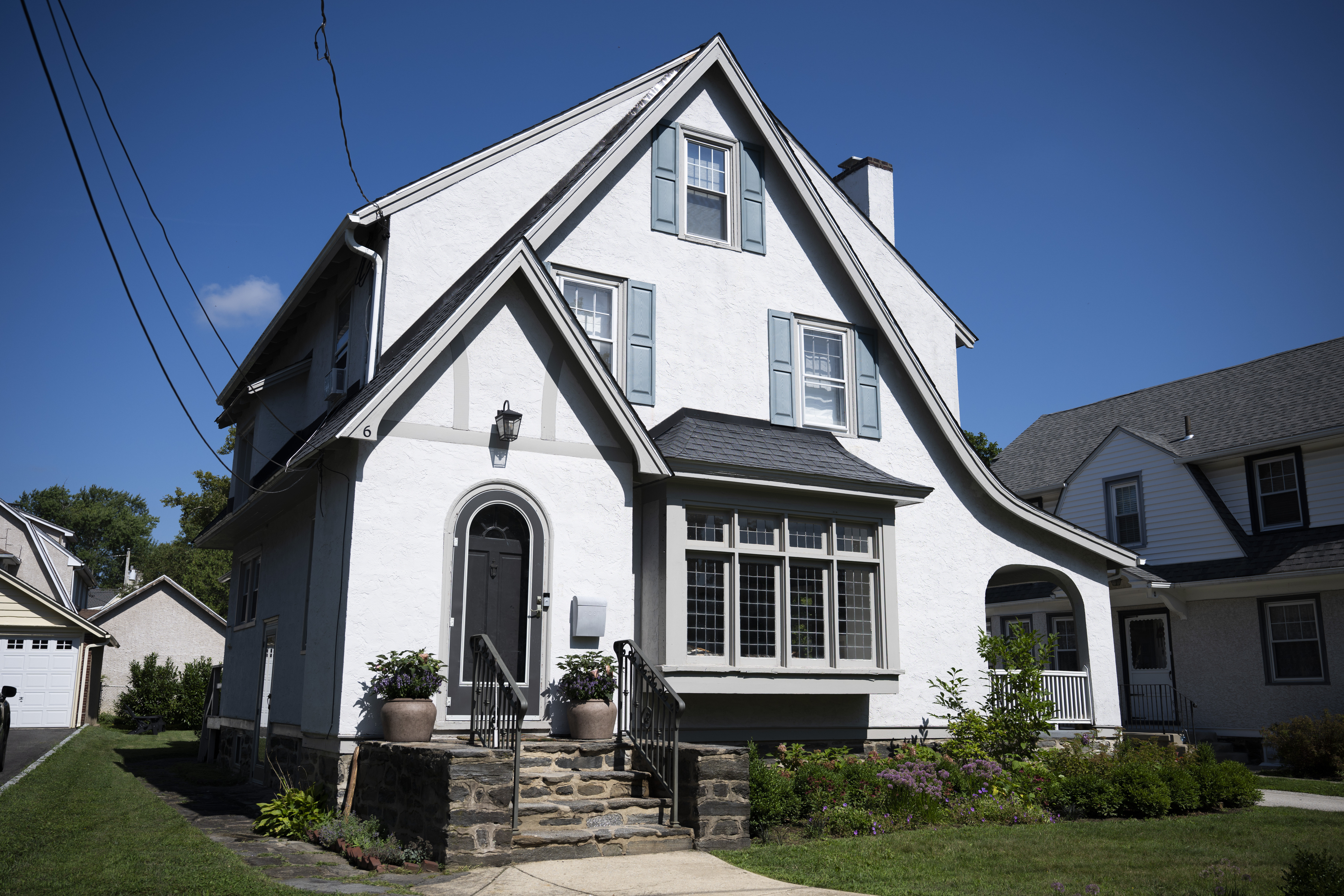
    Though house hunting during the pandemic was difficult, they found the perfect place in Havertown nearly five years ago, a 2,300-square-foot Tudor-style home built in 1920.

    “We had always loved Havertown as a community,” said Caroline, owner and principal designer of Hendren House Interior Design in Havertown. “The house was an extra bonus when we saw its character and history.”

    She also saw signs that this was her forever home. Caroline had been very close with her grandfather, Francis “Frank” Grandizio. She and Kevin bought the house in 2021, 100 years after her grandfather was born and the same year he died.

    The outside of Caroline and Kevin Finnegan’s Tudor-style home in Havertown.Joe Lamberti / For The Inquirer

    “A family who lived here previously had written all their names in the cement in the foundation of the garage,” she recalled. “There are so many stories to this house that I don’t even know and I find that so wonderful.”

    And, she added, “I love that we get to create our own stories here.”

    Prior to moving in, the Finnegans removed the carpet and refinished the floors on the second level of the four-bedroom, two-bathroom house. They also gave the bathroom a facelift. In 2024 they embarked on a larger renovation, swapping the locations of the kitchen and dining room and outfitting those new rooms.

    A designer for more than 10 years, Caroline enjoyed the process of creating a home for her family, including sons James, 7, and Hudson, 5, and daughter Charlotte, 1.

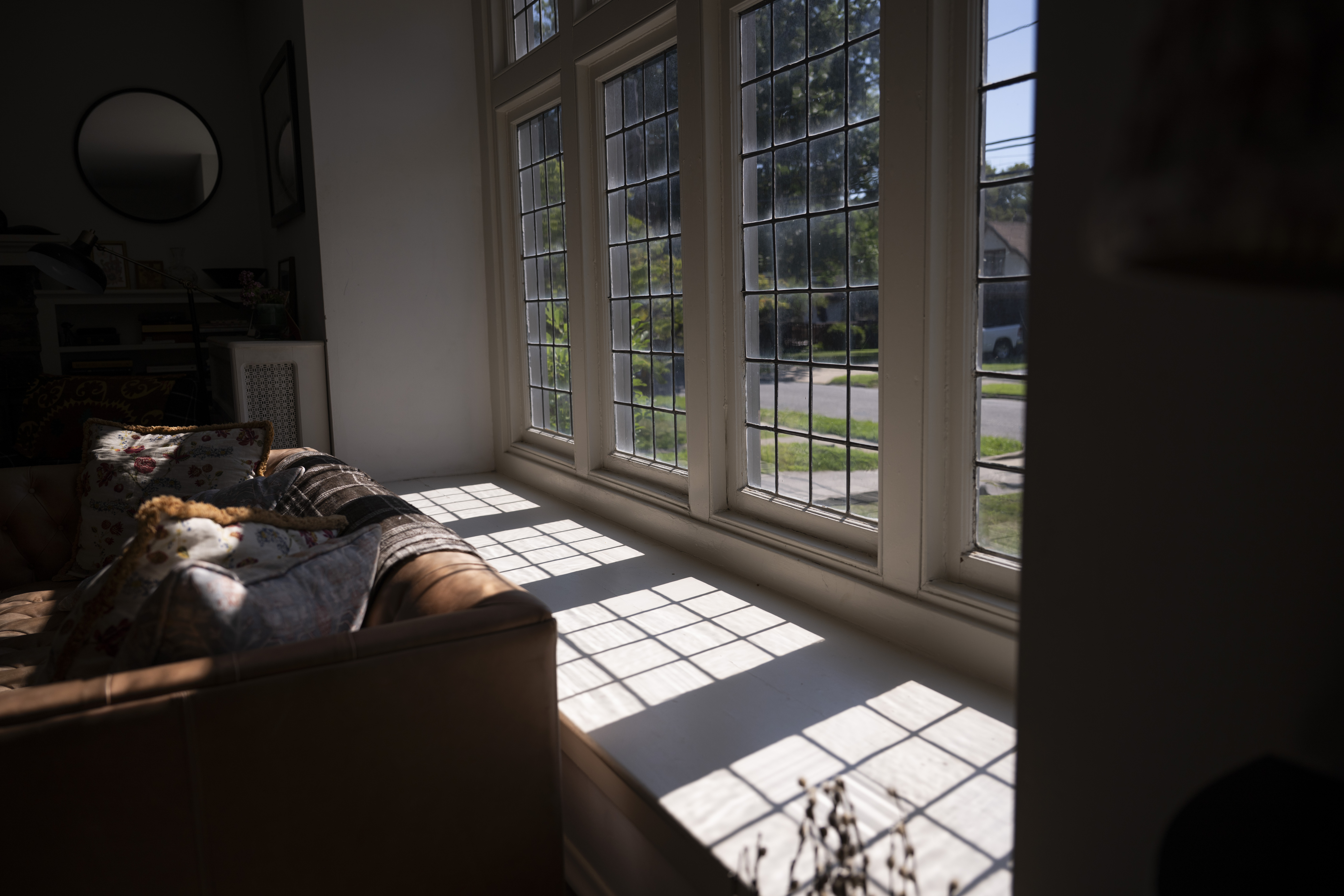
    The living room features a wall of leaded glass windows that cast a grid of light and shadows.Joe Lamberti / For The Inquirer
    Caroline Finnegan’s grandfather’s blue plaid chair is a favorite item of hers.Joe Lamberti / For The Inquirer

    “I’m inspired by classic, timeless, traditional design that has a bit of a modern twist, that entails layering, patterns, texture, and color,” said Caroline. “I like unexpected color combinations.”

    She often chooses wallpaper instead of paint, particularly nature-inspired designs. A blue-and-white botanical print, a contemporary interpretation of toile, greets visitors in the foyer, while a lush mural transforms the dining room.

    The powder room is wrapped in a paper featuring oversized blue blooms and delicate foliage, a hand block print from Michael S. Smith’s Jasper line — Smith is one of her favorite designers. A sweet pink and gray pastel paper sets the tone for Charlotte’s room.

    “I love florals,” said Caroline. “My aunt, Kathleen Gallagher Standeven, was a big inspiration for me. She put floral prints on everything. If I’m allowed to pick a floral wallpaper, I always will.”

    The foyer is wallpapered with a blue and white toile-like print. Joe Lamberti / For The Inquirer
    The bedroom of the Finnegans’ daughter, their youngest child. The wallpaper and shades both feature a colorful pattern.Joe Lamberti / For The Inquirer

    The living room, bathed in light from a wall of leaded glass windows, is home to Caroline’s favorite chair that once belonged to her beloved grandfather. Now reupholstered in blue plaid, it has become a favorite resting spot for Kevin.

    “I like sitting there in the morning with a cup of coffee, looking out through the glass windows in the front,” he said.

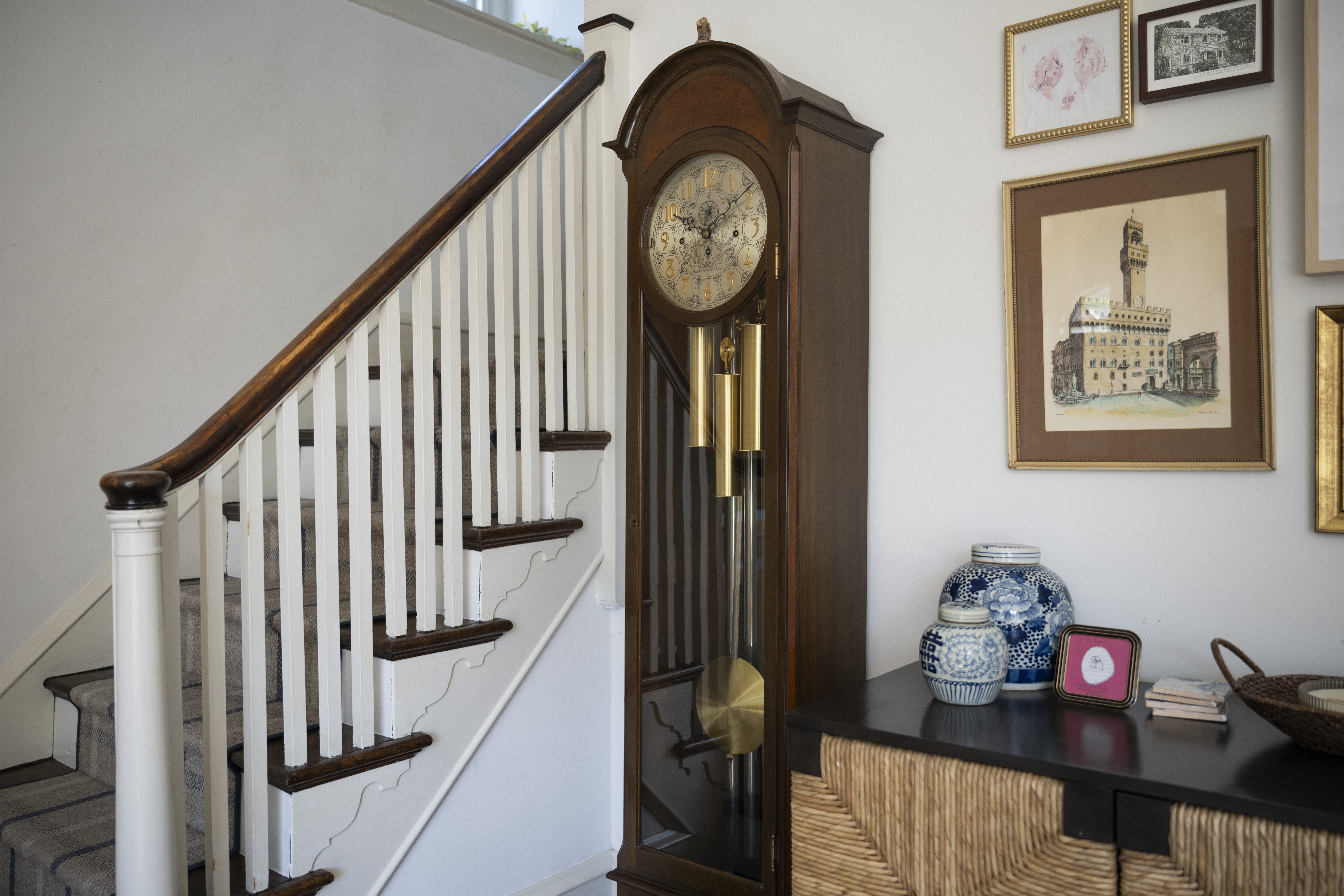
    Nearby sits the grandfather clock that originally belonged to Caroline’s maternal grandfather.

    “My husband and sons crank it every Saturday, which has become a special, fun tradition,” said Caroline.

    A grandfather clock is another heirloom, which the family enjoys cranking each week to keep it running.Joe Lamberti / For The Inquirer

    Though Kevin has little say in the design of the home, he is thrilled with his wife’s choices.

    “I don’t have much taste, and Caroline obviously knows what she is doing,” joked Kevin, a detective in Upper Darby. “I trust her, and just let her do her thing.”

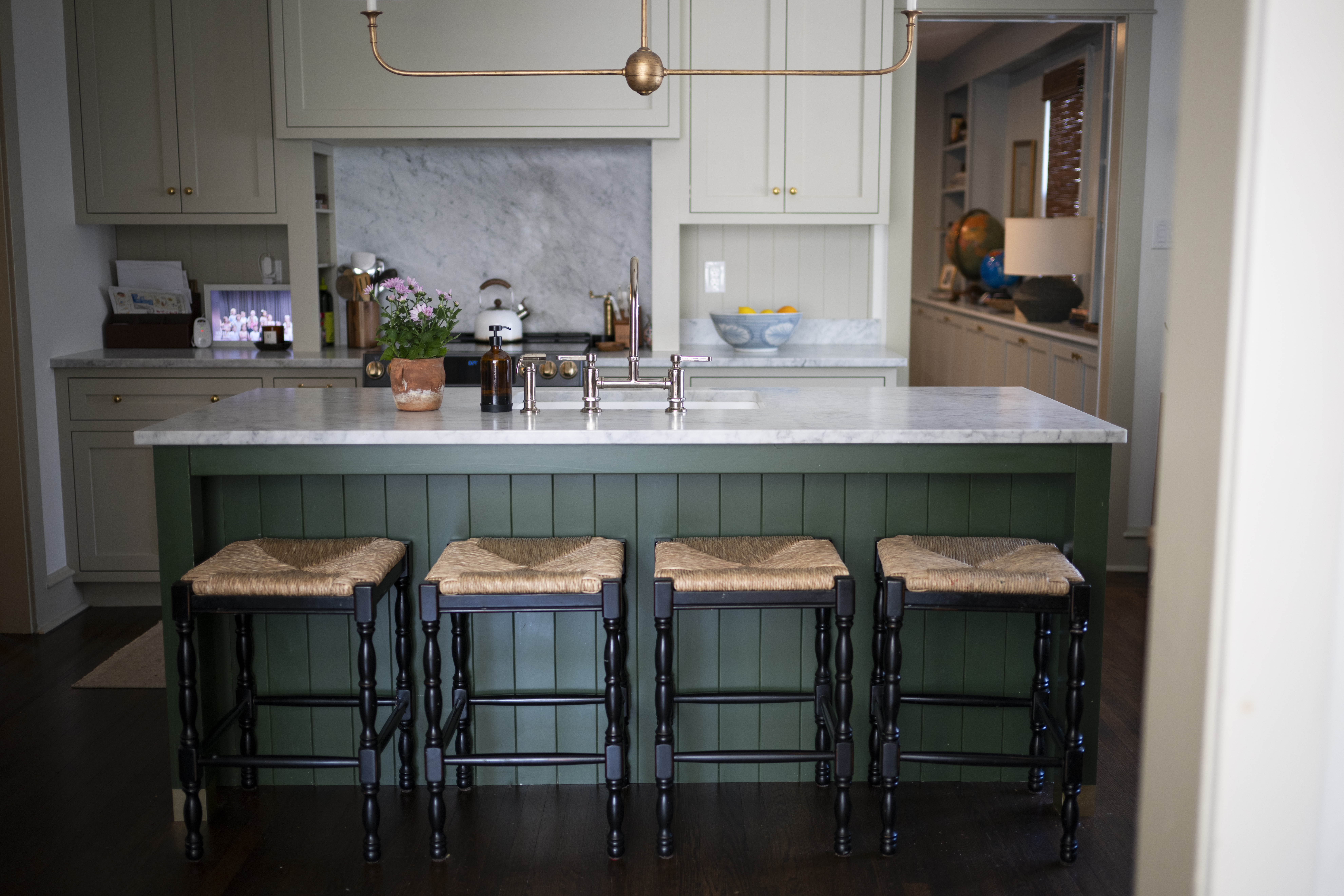
    Though admittedly not an avid cook, Caroline especially appreciates her kitchen, where soft off-white and green hues create a connection to nature. The perimeter cabinets are painted Old White by Farrow & Ball, the island is Benjamin Moore Colonial Verdigris in the Williamsburg Paint Color Collection, and the pantry is a custom stain.

    The Carrara marble island is surrounded by stools where the children sit to enjoy weekend lunches and snacks. Well-organized drawers and shelves store food and kitchen gear. The custom-built cabinet, made by woodworker Nate Wagner, owner of Wagner’s Wood Specialties in Chalfont, does double duty as a coffee bar and storage unit, and is easy to close for an uncluttered look.

    The children enjoy snacks and lunches at the kitchen island.Joe Lamberti / For The Inquirer
    A custom kitchen cabinet serves as a coffee bar and storage solution.Joe Lamberti / For The Inquirer

    The dining room is the venue for the family’s important shared mealtime, when they catch up on the highlights of each member’s day.

    Grassy yards make up the front and back of the house, where the kids play with their neighborhood buddies while their parents watch from the side porch.

    “This neighborhood has been wonderful for our family,” said Caroline. “Havertown has such a deep sense of community.”

    Is your house a Haven? Nominate your home by email (and send some digital photographs) at properties@inquirer.com.

  • Life after ICE custody | Inquirer Chester County

    Life after ICE custody | Inquirer Chester County

    Hi, Chester County!

    A couple of newlyweds are working to help others after one was detained, and later unexpectedly released, by Immigration and Customs Enforcement. Here’s their story. Also this week, a Berwyn native’s TV show has been named one of the best of the century so far, East Whiteland has passed a data center ordinance, plus we take a peek inside a Kennett Square home with an Italianate-style tower.

    — Lisa Dukart (chestercounty@inquirer.com)

    If someone forwarded you this email, sign up for free here.

    Charting a path forward after being detained, and then released, by ICE

    After being detained by Immigration and Customs Enforcement just one week after his wedding this summer, Chester County resident Nelson Contreras-Gelves was unexpectedly released earlier this month.

    The 35-year-old has lived in the U.S. since 2022, when he came from his native Venezuela seeking asylum. He and his wife, Ariel Whaley, feel “incredibly lucky” that he was released from federal custody and will now have a chance to plead his case in court.

    But life hasn’t returned to normal for the couple, who met three years ago through nonprofit Mighty Writers, which has an outpost in Toughkenamon.

    Though Contreras-Gelves is now under constant surveillance, he and Whaley are using what they learned to help others navigating the system.

    The Inquirer’s Brooke Schultz chronicles their story and the hurdles that lay ahead.

    📍 Countywide news

    💡 Community news

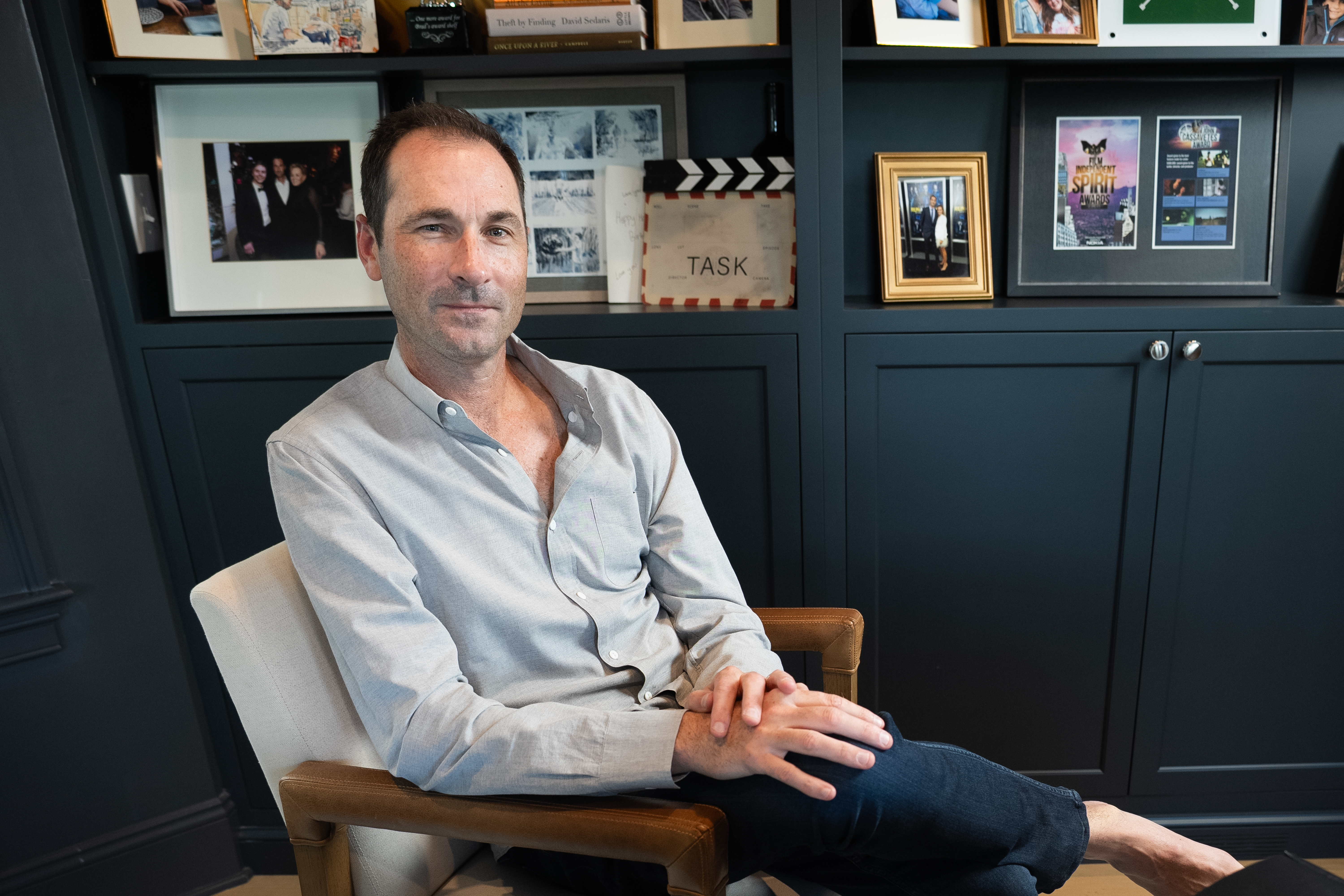
    Brad Ingelsby is the creator of “Mare of Easttown.” Jessica Griffin / Staff Photographer

    🏫 Schools briefing

    🍽️ On our plate

    • Bryn Mawr’s The Bakery House opened its second location over the weekend at 35 W. Lancaster Ave. in Paoli. It sells a selection of treats such as custom cakes, pastries, and pies, plus the viral dot cakes.
    • West Chester Cooperative, which opened this summer, is hosting a grand opening on Friday.

    🎳 Things to do

    🏚️ Pennhurst Asylum: The haunted attraction is open for the season. ⏰ Fridays, Saturdays, and Sundays through Nov. 7, times vary 💵 Prices vary 📍 Pennhurst Asylum, Spring City

    🏡 Chester County Day: The 85th annual event focuses on the northwest section of the county, where visitors can tour homes and barns. ⏰ Saturday, Oct. 3, 10 a.m.-5 p.m. 💵 Prices vary; tickets must be purchased at satellite locations 📍 Chester County

    🪕 Malvern Porchfest: Catch live musical performances from porches throughout the borough. ⏰ Saturday, Oct. 3, noon-6 p.m. 💵 Free 📍 Throughout Malvern

    🎃 Fall Festival at Yeager’s Farm: The two-day event includes a corn maze, pumpkin picking, yard games, and hayrides. ⏰ Saturday, Oct. 3 and Sunday, Oct. 4, 11 a.m.-3 p.m. 💵 Pay as you go 📍 Yeager’s Farm, Phoenixville

    🍻 Oktoberfest: Sip specially priced beers and ciders, nosh on fall-themed appetizers, try your hand at a stein-holding contest, and hear live music at participating restaurants. ⏰ Saturday, Oct. 3, times vary 💵 Pay as you go 📍 Downtown West Chester

    🍂 Festivals: A number of communities are hosting festivals this weekend. The Unionville Community Fair runs Friday through Sunday; New Garden’s and Tredyffrin’s community days, Spring City’s Music and Market, and the rescheduled Warwick Fall Fest are all Saturday; and Downingtown’s, East Pikeland’s, East Brandywine’s, and Westtown’s are slated for Sunday.

    🏡 On the market

    A Kennett Square home with literary roots and a soaring tower

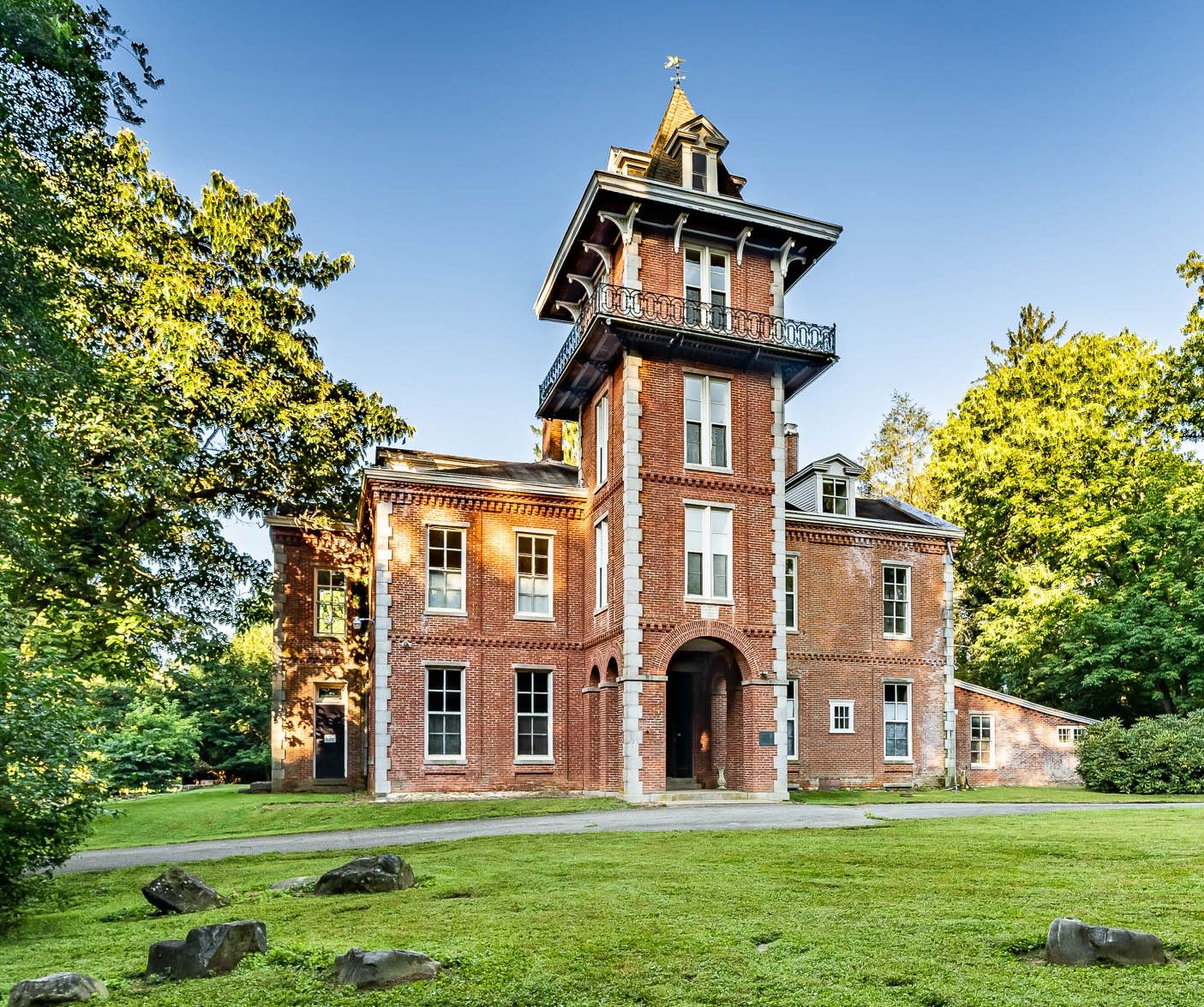
    Built in the mid-1800s for travel writer and diplomat Bayard Taylor, Cedarcroft has undergone a number of updates while staying true to its architectural roots. The Kennett Square home, which is listed on the National Register of Historic Places, has seven bedrooms, living and dining rooms, a billiards room, and, most notably, a five-story tower in the Italianate style.

    Read more about the property here.

    Price: $3.1M | Size: 7,132 SF | Acreage: 2.4

    🗞️ What other Chester County residents are reading this week:

    By submitting your written, visual, and/or audio contributions, you agree to The Inquirer’s Terms of Use, including the grant of rights in Section 10.

    This suburban content is produced with support from the Leslie Miller and Richard Worley Foundation and The Lenfest Institute for Journalism. Editorial content is created independently of the project donors. Gifts to support The Inquirer’s high-impact journalism can be made at inquirer.com/donate. A list of Lenfest Institute donors can be found at lenfestinstitute.org/supporters.

  • Chester County estate with a five-story tower and literary roots is hitting the market for $3.1M

    Chester County estate with a five-story tower and literary roots is hitting the market for $3.1M

    The former Chester County home of a renowned 19th-century author and diplomat is hitting the market this week with an asking price of $3.1 million.

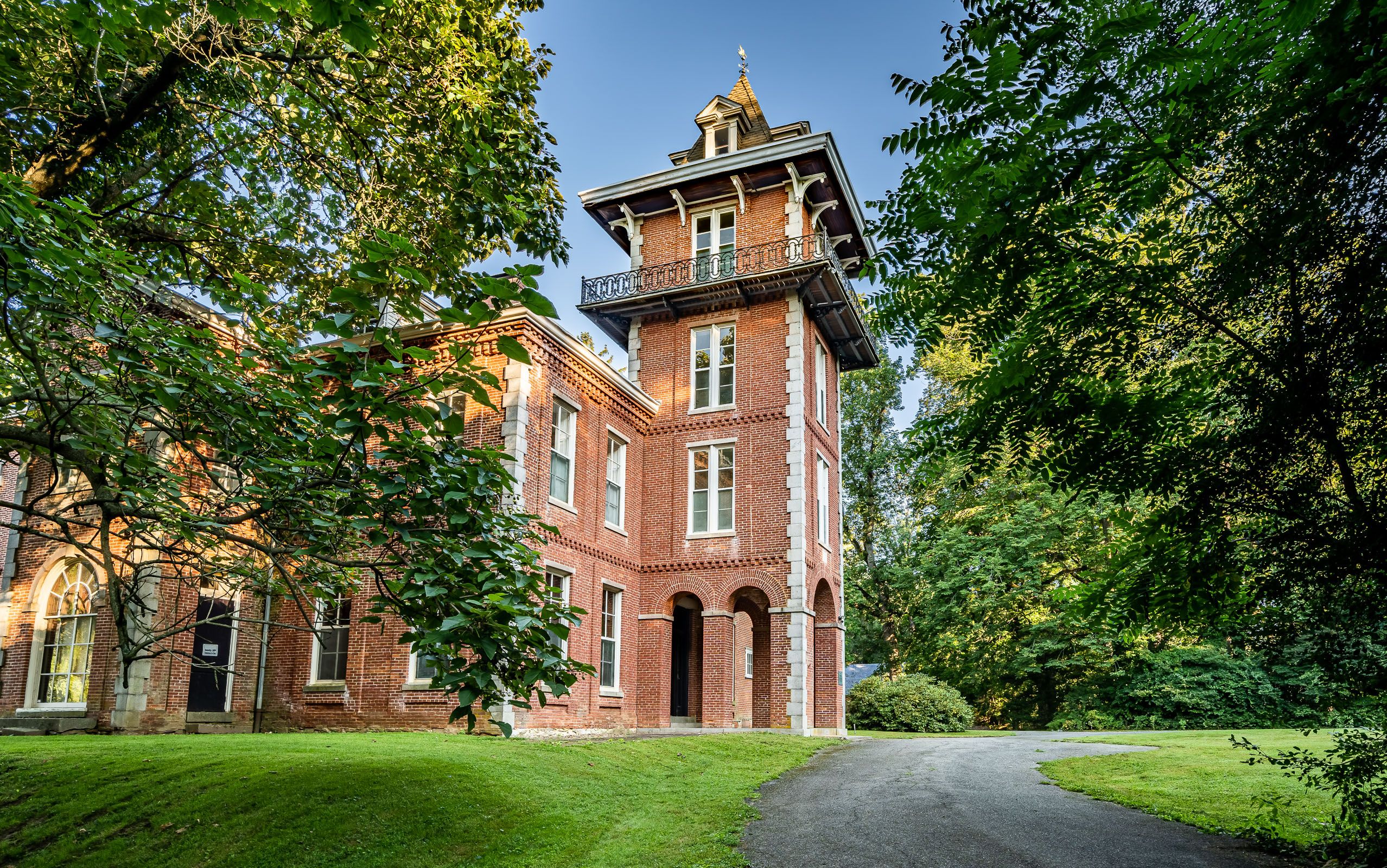
    Known as Cedarcroft, the sprawling Kennett Square brick home spans over 7,100 square feet, sits on 2.4 acres, and has a distinctive five-story, Italianate-style tower overlooking the grounds and surrounding community.

    The tower extends over the home’s covered entryway and is accessible by stairs from the second floor. It has a room with windows on each of the third- and fourth-floor landings. It also has a balcony off the fourth floor and a fifth floor accessible by ladder.

    The home has a five-story, Italianate-style tower.Virtual Vista | Courtesy of Holly Gross Group

    The rooms on the third and fourth floors could serve a number of uses, including as a library, said listing agent Stewart Gross, who is brokering it with Stephen Gross and Holly Gross, all of the Holly Gross Group.

    “It’s breathtaking,” he said of the vantage, where both sunrise and sunset can be seen.

    It’s believed that the home’s original owner, Bayard Taylor, used the tower spaces to write, enjoy cocktails, and survey the surrounding land, Gross added.

    A Kennett Square native, Taylor built the 108 Gatehouse Dr. home between 1859 and 1860. He gained acclaim as a poet and travel writer, publishing a number of works inspired by his global escapades. He also served as the chargé d’affaires of the Russian legation in St. Petersburg.

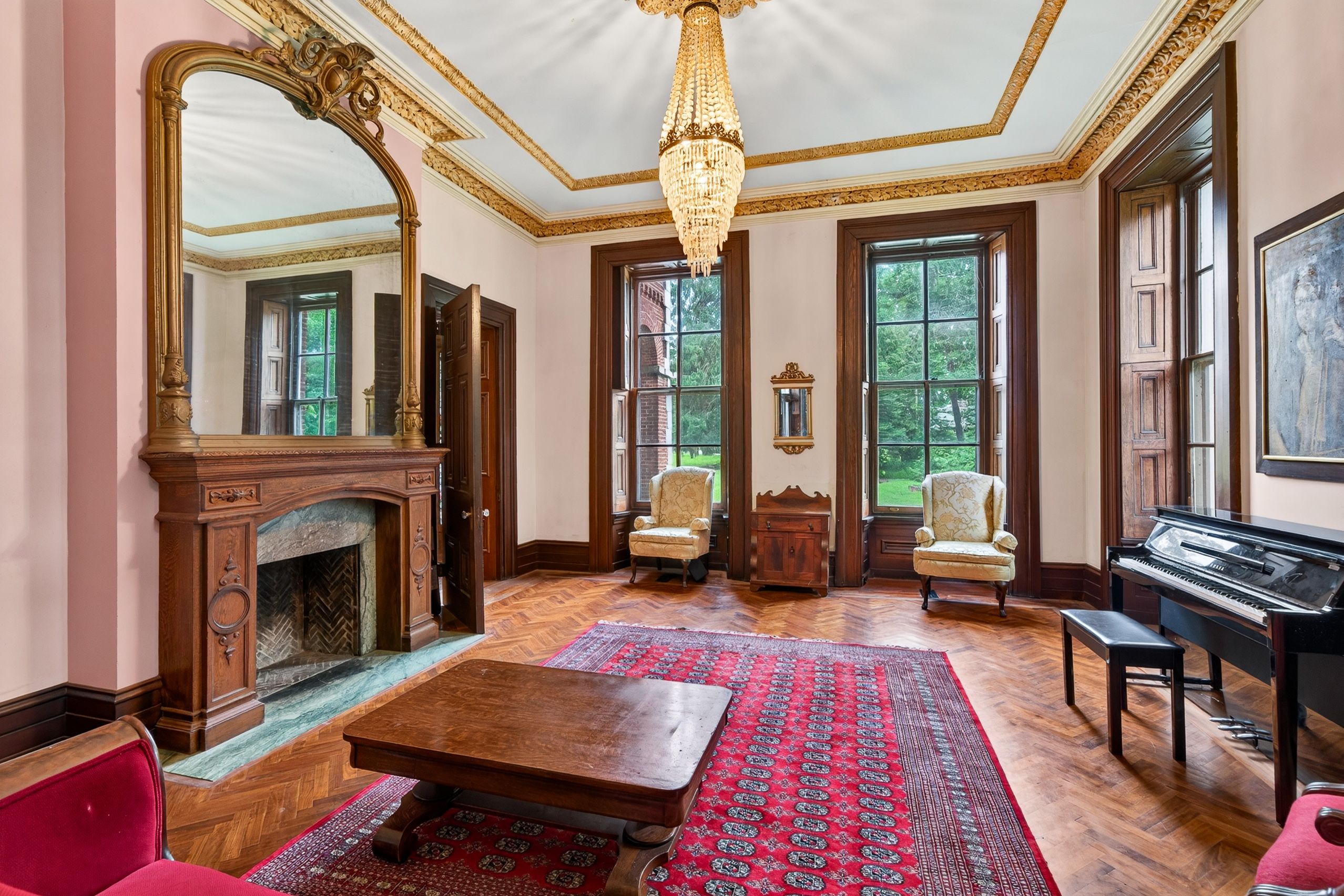
    One of the living spaces on the first floor.Virtual Vista | Courtesy of Holly Gross Group

    During his tenure at Cedarcroft, Taylor reportedly hosted a number of literary figures, including Ralph Waldo Emerson and Horace Greeley, according to a Kennett Library biography.

    Some of the home’s first-floor features include 13-foot ceilings and “grand” spaces including a living room, a dining room, and a library, as well as a billiards room, Gross said.

    The home has seven bedrooms — six on the second floor, with a seventh on the third level — including a primary suite with a fireplace and a walk-in closet.

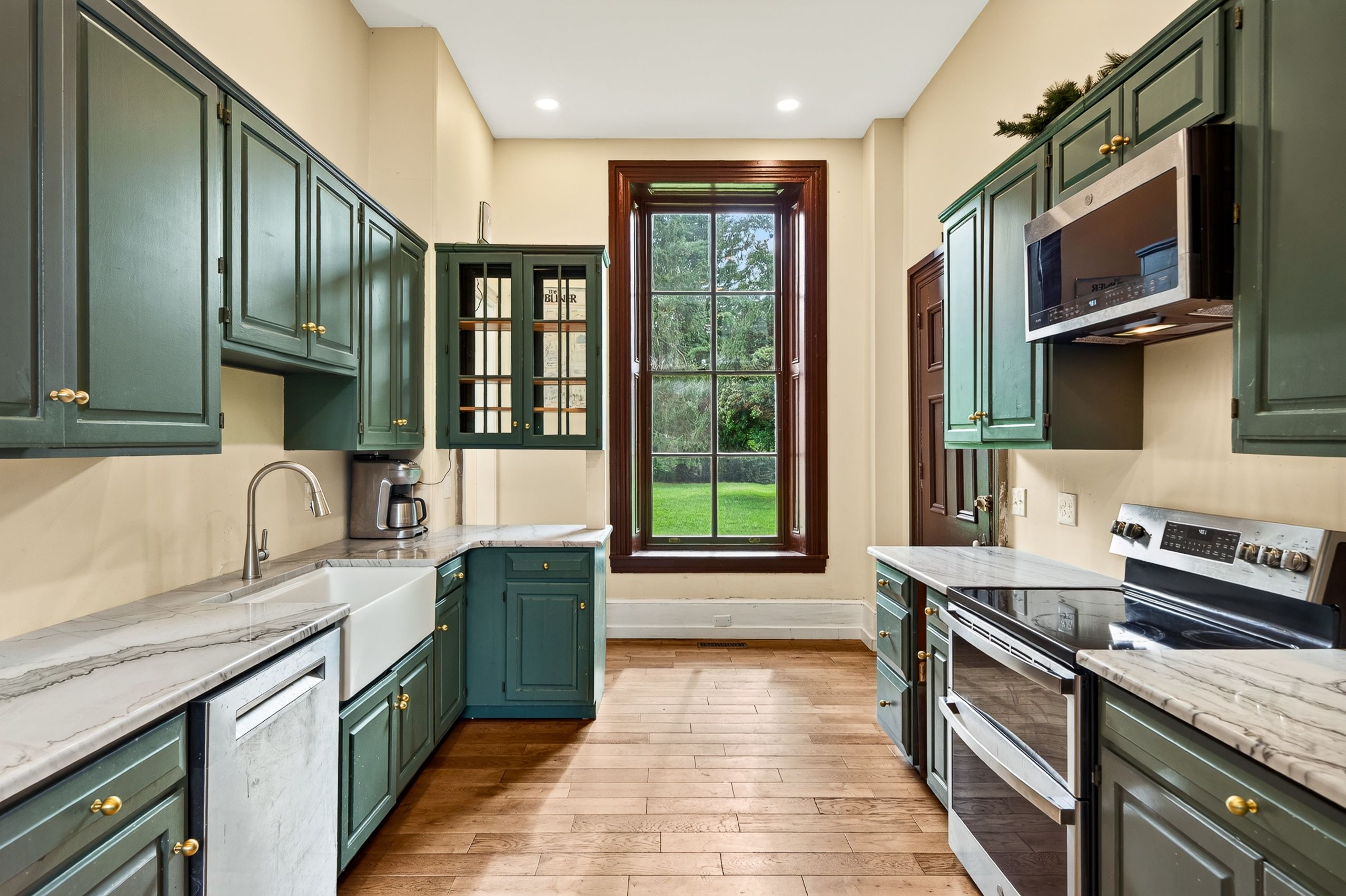
    The home has a new kitchen.Virtual Vista | Courtesy of Holly Gross Group

    The home was added to the National Register of Historic Places in 1971. It retains many elements of its early roots, such as hardwood flooring, milling, and molding details, while having undergone a number of updates by its current owners. Those include overhauling household systems and bathrooms, updating the roof, and adding a new kitchen, which has stainless steel appliances and Italian quartzite countertops.

    This suburban content is produced with support from the Leslie Miller and Richard Worley Foundation and The Lenfest Institute for Journalism. Editorial content is created independently of the project donors. Gifts to support The Inquirer’s high-impact journalism can be made at inquirer.com/donate. A list of Lenfest Institute donors can be found at lenfestinstitute.org/supporters.

  • End of Route 70 roadwork in sight | Inquirer Cherry Hill

    End of Route 70 roadwork in sight | Inquirer Cherry Hill

    Hey there, Cherry Hill!

    After five long years, it’s nearly quitting time on all the roadwork along Route 70. Also in the news, New Jersey’s Supreme Court declined to hear an appeal over control of the Cherry Hill Democratic Committee, the township will use funds from a national opioid settlement for a youth mental health professional, and a group of seniors is on a quest for the best cheesesteak in South Jersey.

    — Laura Smythe (cherryhill@inquirer.com)

    If someone forwarded you this email, sign up for free here.

    Route 70 roadwork to wrap up soon, five years later

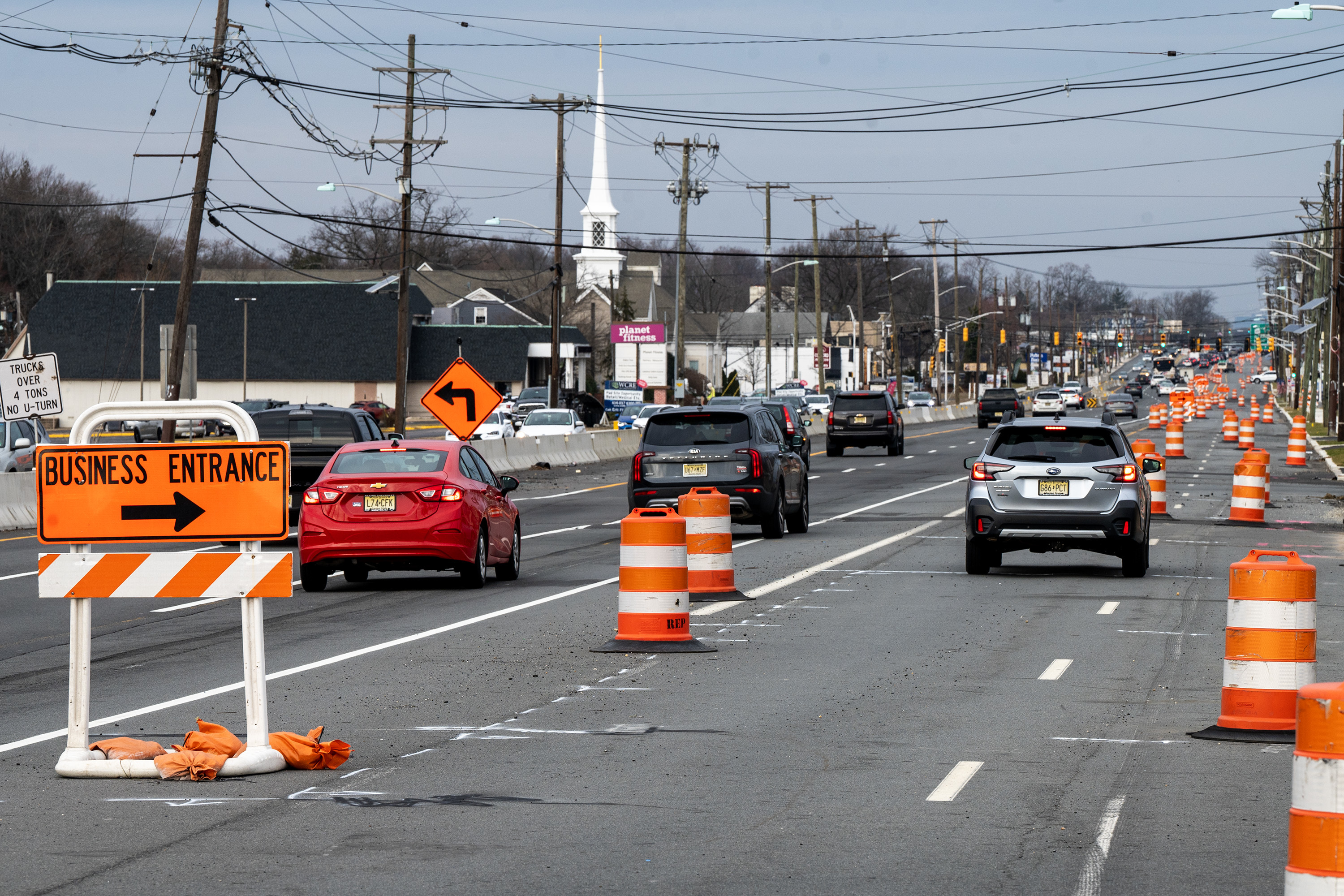
    Drivers, rejoice. The Inquirer’s Lacey Latch has received word that the (seemingly endless) construction along Route 70 will “essentially be complete this year,” per the New Jersey Department of Transportation.

    You may have grown unwillingly inure to the roughly $150 million safety improvement project that has marked up the thoroughfare since 2021. Now, updating some traffic signals and finishing up paving work are the only outstanding to-dos, though NJDOT has some additional landscaping work planned with Camden County in the spring.

    Here’s everything the five years of construction along Marlton Pike has yielded (aside from a headache).

    🚦 In other roadway news: Cherry Hill is at the center of multiple stretches of South Jersey highway that have seen the highest numbers of fatal car crashes in recent years.

    💡 Community news

    • Brandon Parish, who manages the deli at the Kibitz Room’s original Cherry Hill location and previously owned the now-shuttered King of Prussia outpost, has filed for personal bankruptcy. The deli inside The Shoppes at Holly Ravine won’t be affected.
    • The New Jersey Supreme Court declined to hear an appeal aimed at unseating three members of the South Jersey Progressive Democrats — all Cherry Hill residents — who won in the June 2025 primary to control the Cherry Hill Democratic Committee, 70and73 reports. The Camden County Democrats, led by George E. Norcross III, had sued after losing the election.
    • Several roadwork projects are underway this week throughout the township, causing some road and sidewalk closures. Here are the specifics.
    • Police are advising drivers to make sure their car doors are locked and secure as groups target unlocked vehicles in Cherry Hill and other South Jersey locales, NBC10 reports.

    🗺️ Other nearby news

    • Mount Laurel may condemn and demolish nine hotels as part of a long-term push to build more affordable housing. One owner isn’t impressed by the township’s plan.
    • Collingswood is considering privatizing the borough’s ambulance services in an effort to help its understaffed fire department.

    🏫 Schools briefing

    • Cherry Hill will direct $240,000 to support a licensed mental health clinician position working with the township’s high schoolers, drawing the funds from its roughly $764,000 share of the national settlement with drug companies over the opioid epidemic. 70and73 has the details.
    • Cherry Hill Public Schools officials are looking to stem the rate of absenteeism after the latest district statistics indicate more than 1,500 students are chronically absent.

    🍽️ On our plate

    • A group of South Jersey seniors have been on a monthslong hunt to track down the best cheesesteak in the area, trying bites from Chick’s Deli in Cherry Hill, Donkey’s Place in Camden, and beyond.

    🎳 Things to do

    🕺 The Dance Loft Grand Opening: Try out a group class and take in performances by the team behind this new studio. ⏰ Friday, Oct. 2, 7-10 p.m. 💵 Free 📍 The Dance Loft NJ

    🎶 Jim Beer in Concert: Get a jump on commemorating Indigenous People’s Day by checking out a performance by Beer, a member of Lenape Nation of Pennsylvania, who will also share stories and history. ⏰ Sunday, Oct. 4, 1:30-3 p.m. 💵 Free; registration required 📍 Cherry Hill Public Library

    🎸 The Martin Experience: Pick at the iconic company’s instruments and maybe learn a thing or two at this event open to all guitarists. ⏰ Wednesday, Oct. 7, 5 p.m. 💵 Pay as you go 📍 Guitar Center

    🗓️ Looking for more things to do? Check out our guide to ongoing South Jersey events.

    🏡 On the market

    An updated three-bedroom Barclay home

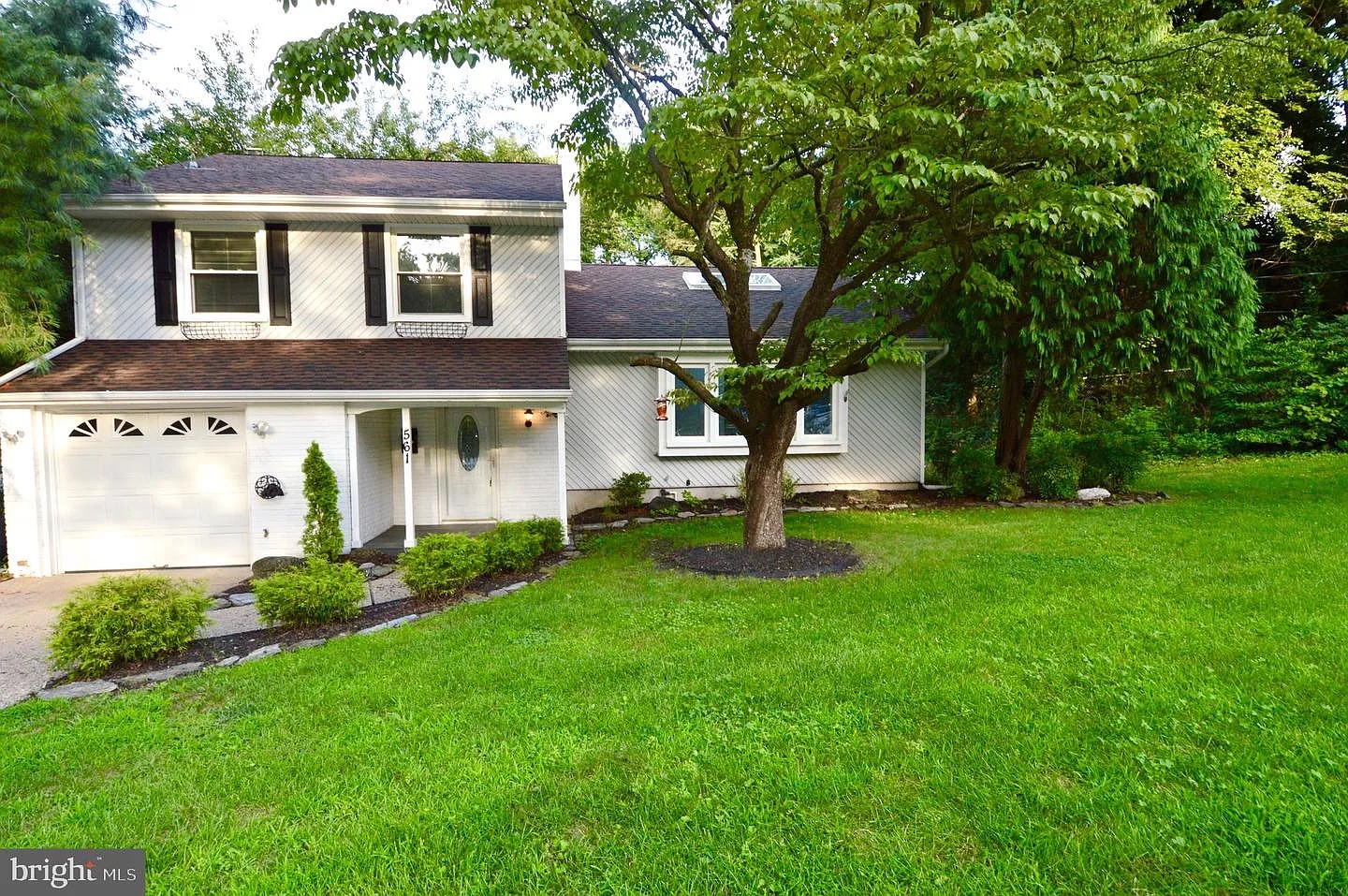
    561 Covered Bridge Rd, Cherry Hill, NJ 08034

    This home from 1960 sits in Cherry Hill’s Barclay neighborhood, offering three bedrooms and two-and-a-half bathrooms. It features an open layout, skylights to bring in natural light, and a brick fireplace. There’s an attached one-car garage, plus a fenced-in yard out back.

    See more photos of the property here.

    Price: $530,000 | Size: 1,679 SF | Acreage: 0.43

    🗞️ What other Cherry Hill residents are reading this week:

    By submitting your written, visual, and/or audio contributions, you agree to The Inquirer’s Terms of Use, including the grant of rights in Section 10.

    This suburban content is produced with support from the Leslie Miller and Richard Worley Foundation and The Lenfest Institute for Journalism. Editorial content is created independently of the project donors. Gifts to support The Inquirer’s high-impact journalism can be made at inquirer.com/donate. A list of Lenfest Institute donors can be found at lenfestinstitute.org/supporters.

  • Alumni, students call on Haverford College to protect speech, academic freedom following antisemitism legal settlement

    Alumni, students call on Haverford College to protect speech, academic freedom following antisemitism legal settlement

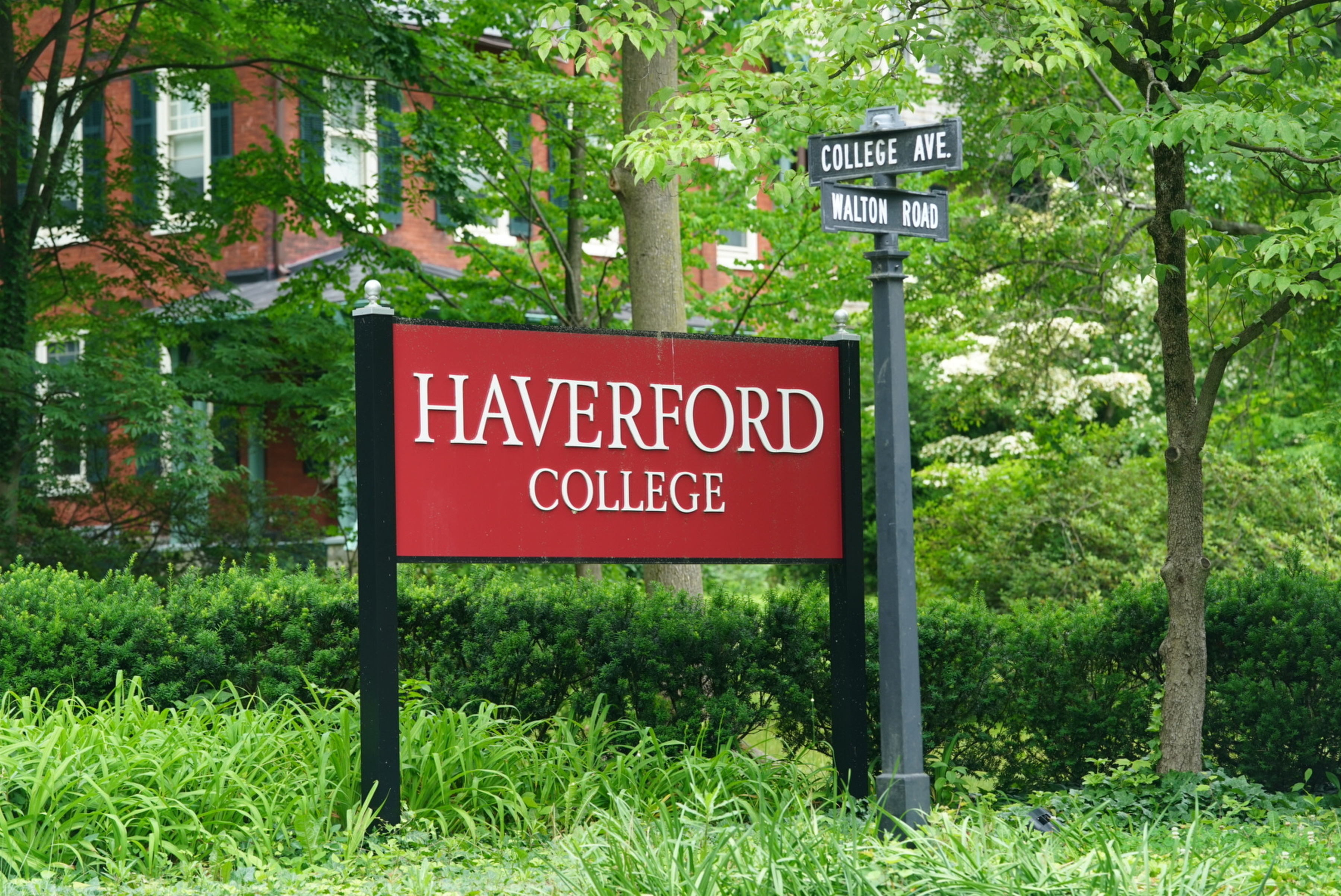
    A group of alumni and students called on Haverford College to “preserve the rights to free speech and academic freedom” after the college settled a lawsuit alleging it allowed antisemitic speech on campus and failed to support Jewish students amid a rising tide of anti-Israel rhetoric.

    In an open letter, nearly 340 alumni and students of Haverford, Swarthmore, and Bryn Mawr Colleges voiced opposition to the settlement, writing it would ”abrogate the rights of all Haverford community members to academic freedom, free speech, and the thoughtful exchange of ideas.”

    Concerned Jewish Faculty and Staff, a Massachusetts-based membership organization of Jewish university employees, published the Sept. 14 letter, which states that its signatories “affirm the necessity of combating antisemitism and all other forms of prejudice” while being “particularly mindful of the safety and rights of Palestinian students.” The letter references an act of violence against a Palestinian student in 2023. Kinnan Abdalhamid, a West Bank-born Haverford College student, was shot in Vermont that year.

    The letter comes as the Trump administration has threatened sanctions and launched investigations into antisemitism on college campuses in the wake of the Israel-Hamas war and ensuing campus protests, actions that some advocacy groups say have suppressed pro-Palestinian speech on campus.

    Haverford was sued in 2024 by a group of Jewish students, faculty, parents, and alumni represented by the Deborah Project, a pro-Israel legal group based in Merion Station that has filed suits against a number of schools and universities since the start of the war in 2023.

    The lawsuit, filed in U.S. District Court for the Eastern District of Pennsylvania, said Haverford students faced discrimination for supporting Israel, including not being allowed to speak during campus-wide gatherings and being disrupted by bullhorns and cowbells during a meeting about antisemitism.

    Ally Landau, a plaintiff and a student at the time of the lawsuit, alleged she was pressured to cancel an event promoting antisemitism awareness as it would prove “too antagonistic to the pro-Palestinian students on campus.”

    After the lawsuit was initially dismissed by a federal judge, the students filed an updated complaint, and the college settled with the Deborah Project in August. Under the settlement terms, Haverford College president Wendy Raymond released a public letter affirming the college’s support of Jewish, Israeli, and Zionist students. The college confirmed that campus events hosted by Jewish or Israeli students would receive the same security as other campus programs and agreed to form an antisemitism committee and require annual antisemitism awareness training for students, faculty, and staff.

    The alumni and students who signed the Sept. 14 letter say the settlement designates supporters of one particular political belief, Zionism, as a protected class, a move they describe as stifling legitimate political debate and misrepresenting the beliefs of many Jewish people. The group wrote that the settlement follows a larger trend “in which organizations like the Deborah Project, together with politically-motivated operatives in the Trump administration, have weaponized accusations of antisemitism in order to silence criticism of Israel on campus.”

    Lori Lowenthal Marcus, the Deborah Project’s legal director, said in an email that accusing the organization of weaponizing antisemitism “evokes the rank racism of the pre-Civil Rights era when racists demanded the law not be used to shield Black Americans from harassment and other harms.”

    The student and alumni group has no legal standing to make demands regarding the settlement, Lowenthal Marcus wrote. She added that they “could be subject to legal action if they insist on continuing on their path of tortious interference.”

    “Thank them for supplying their names and affiliations, so we know how to reach them,” Lowenthal Marcus wrote.

    Dominic Mercier, a spokesperson for Haverford College, wrote in an email that the college understands “that the settlement has evoked strong feelings from many community members, both positive and negative,” and that it is unable to share the settlement in its entirety.

    The settlement did not change the college’s civil rights policy, nor did it change its official list of protected classes, which does not list Zionism, according to Mercier’s email. Community members are not prohibited from criticizing Israel or Zionist beliefs, but the college “prohibits conduct that crosses the line from protected speech into discrimination or harassment on the basis of a protected class,” Mercier wrote.

    Academic freedom and freedom of expression “remain central to our shared experience and community expectations, and are not in tension with our continued commitment to be a campus free from acts of harassment and discrimination against any community members,” Mercier wrote.

    Raymond, in her August letter, wrote that all students, including those who support Zionism, are “welcome and enjoy equal access to the College and all of its educational programs and activities” and that acts of discrimination against Jewish, Israeli, and Zionist students “violate College policy and are antithetical to Haverford’s mission, values, and standards.”

    The alumni and student letter called on Haverford to declare that the college’s nondiscrimination and anti-harassment policies extend to Palestinian students. It also included demands that the college include material related to Islamophobia and anti-Palestinian racism in its annual Title VI training and ensure that antisemitism training does not “equate Jewishness with support for Israel, nor erase the existence of Palestinians.”

    The letter also asked Haverford to affirm that members of a newly established antisemitism committee would not include individuals unaffiliated with the college.

    The committee, whose members were announced the same day the letter was published, includes two Haverford professors; a member of the college’s board of managers; a student; the college’s director of interfaith life and practice; the director of the Rohr Center for Jewish Life; and a Haverford alumnus.

    It will also include two members not directly affiliated with Haverford: Michael Balaban, president and CEO of the Jewish Federation of Greater Philadelphia, and Jeremy Winaker, a rabbi and the executive director of the Greater Philly Hillel Network, which serves Haverford’s Jewish Student Union.

    Clarification: This story has been updated to clarify that Haverford College and The Deborah Project settled an updated complaint after an initial complaint was dismissed.
  • House of the week: A three-bedroom stone Colonial in Wallingford for $545,000

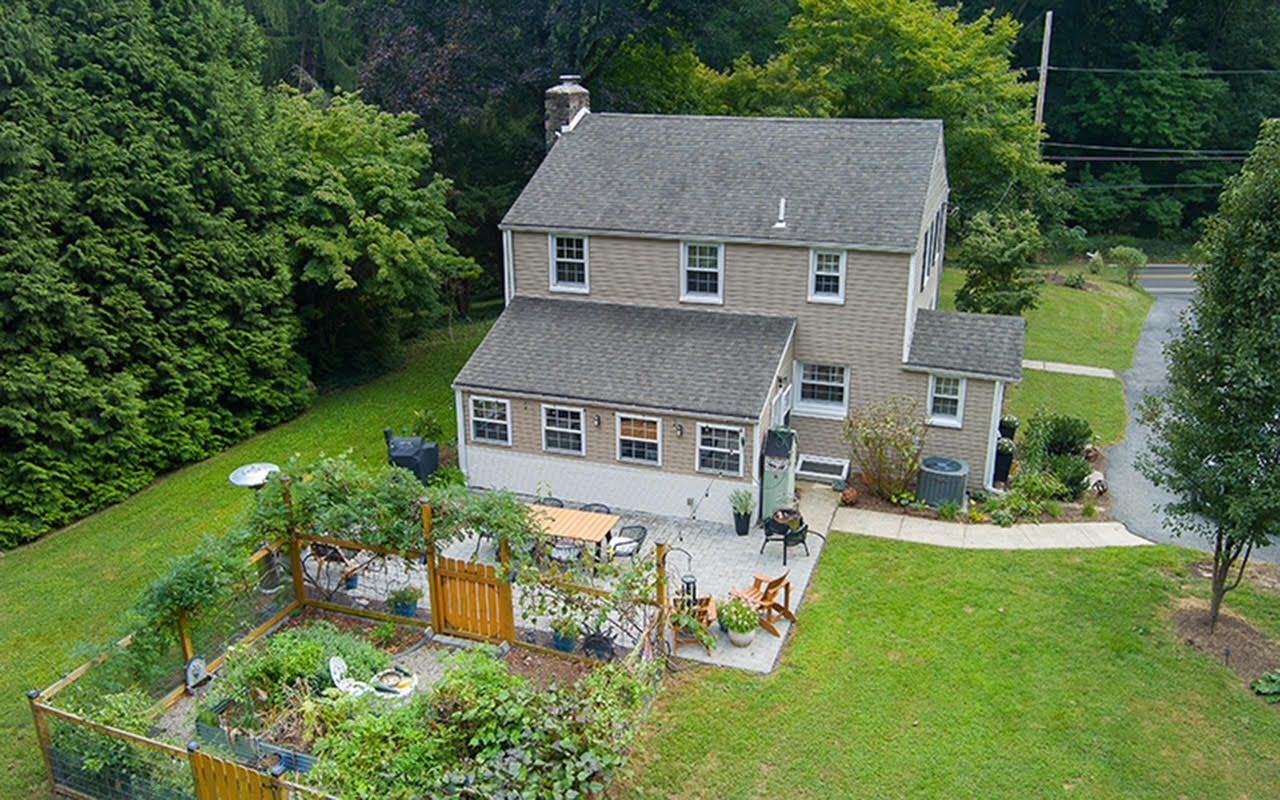
    House of the week: A three-bedroom stone Colonial in Wallingford for $545,000

    Presti’s Bakery was established about 120 years ago in Little Italy, Cleveland, but its influence has reached into the 21st-century Delaware County housing market.

    Mike and Tori Gentile are leaving the Wallingford home they have loved so Mike can take over the family enterprise.

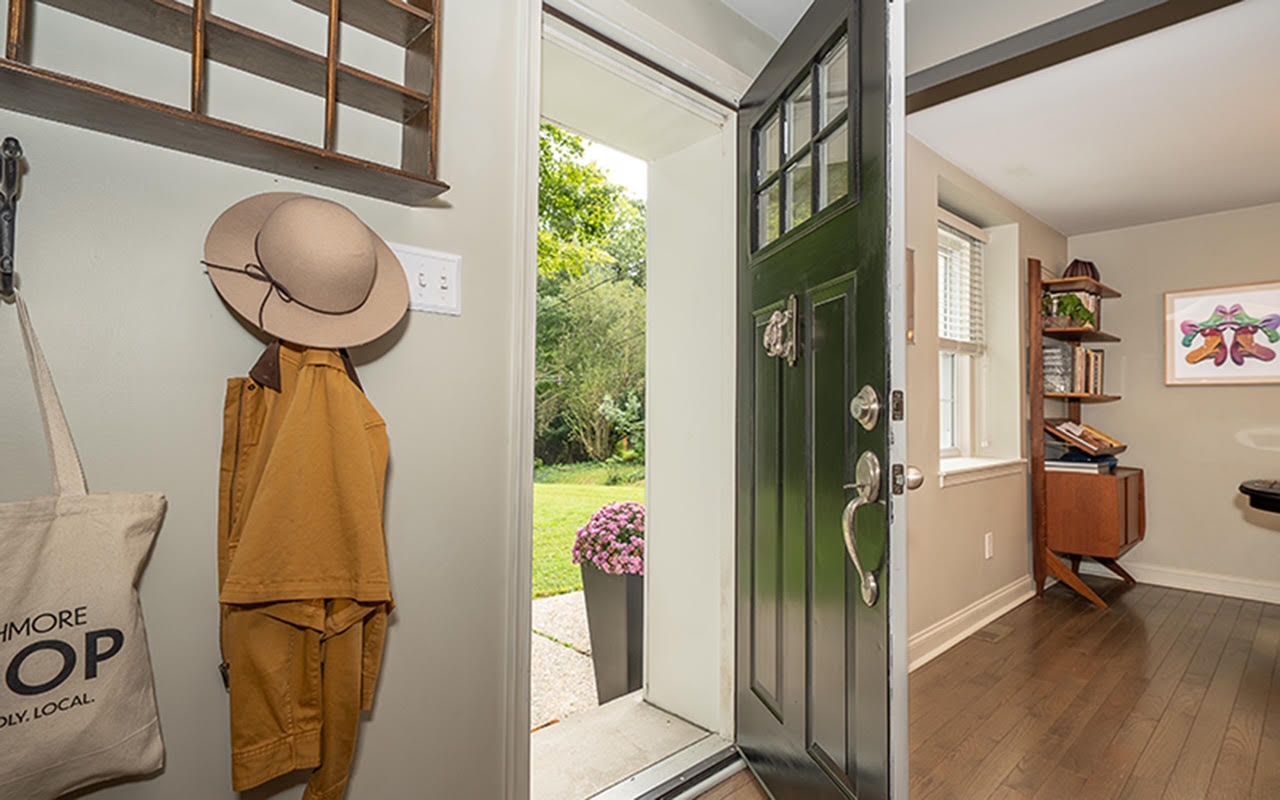
    The green front door leads to the foyer at 5 Waterville Rd. in Wallingford.Dave Ocenas

    The Gentiles bought the three-bedroom, 2½-bathroom, 1,622-square-foot Wallingford home in 2019, right before the COVID-19 shutdown, expecting a long stay.

    “We really liked the Media-Swarthmore area,” said Tori, an interior designer for an architectural firm. Mike sells BMW cars. She thought the area was charming, and loved the nearby farmers market.

    The house has a 0.77-acre lot, which Tori appreciated because it provided room for the family to grow. Plus, she said, “I liked the Pennsylvania stone and the open layout.”

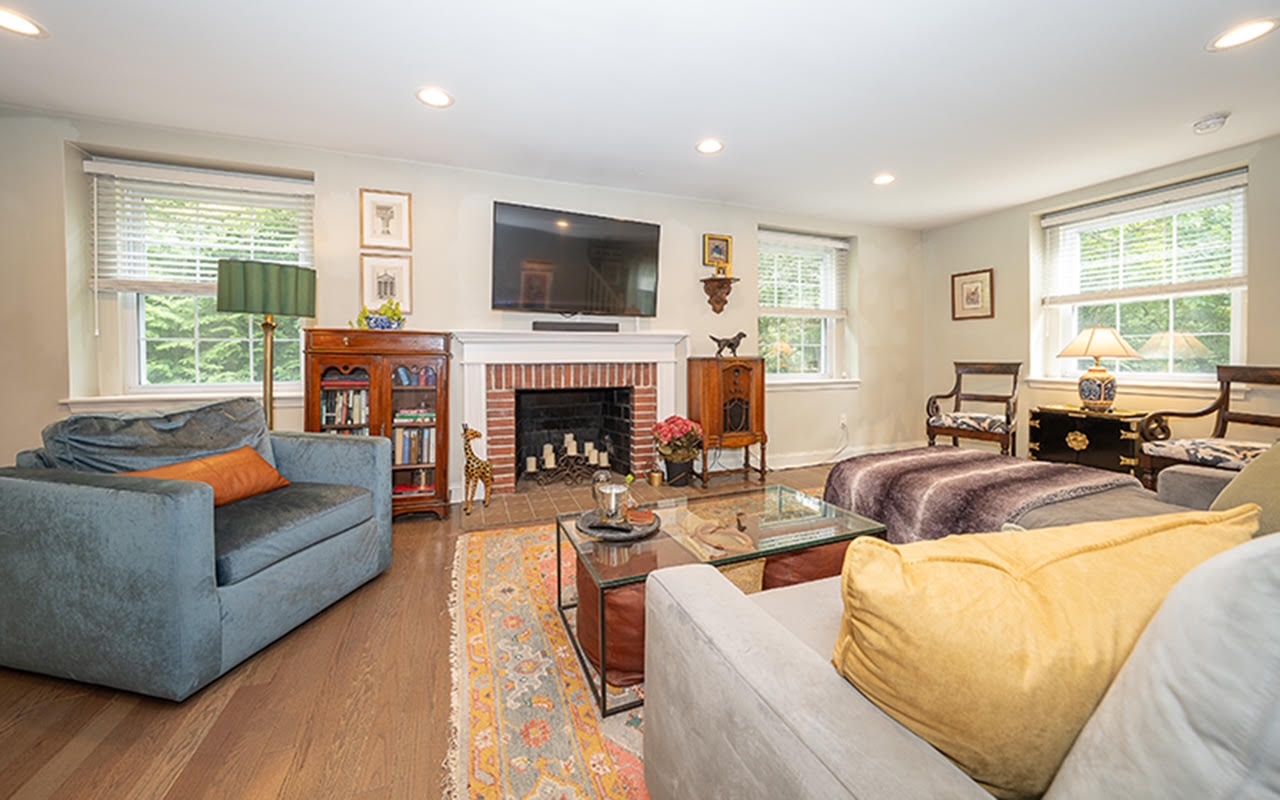
    The living room is anchored by a classic brick fireplace and custom mantel.Dave Ocenas

    The first floor is home to the kitchen, dining room, living room, and family room. The kitchen has granite countertops, stainless steel appliances, and a subway tile backsplash, with a new refrigerator, dishwasher, and microwave. The living room has a brick fireplace.

    There is a mudroom just off the kitchen with a dedicated laundry area and direct driveway access, and a bonus room with exposed brick has direct access to the backyard.

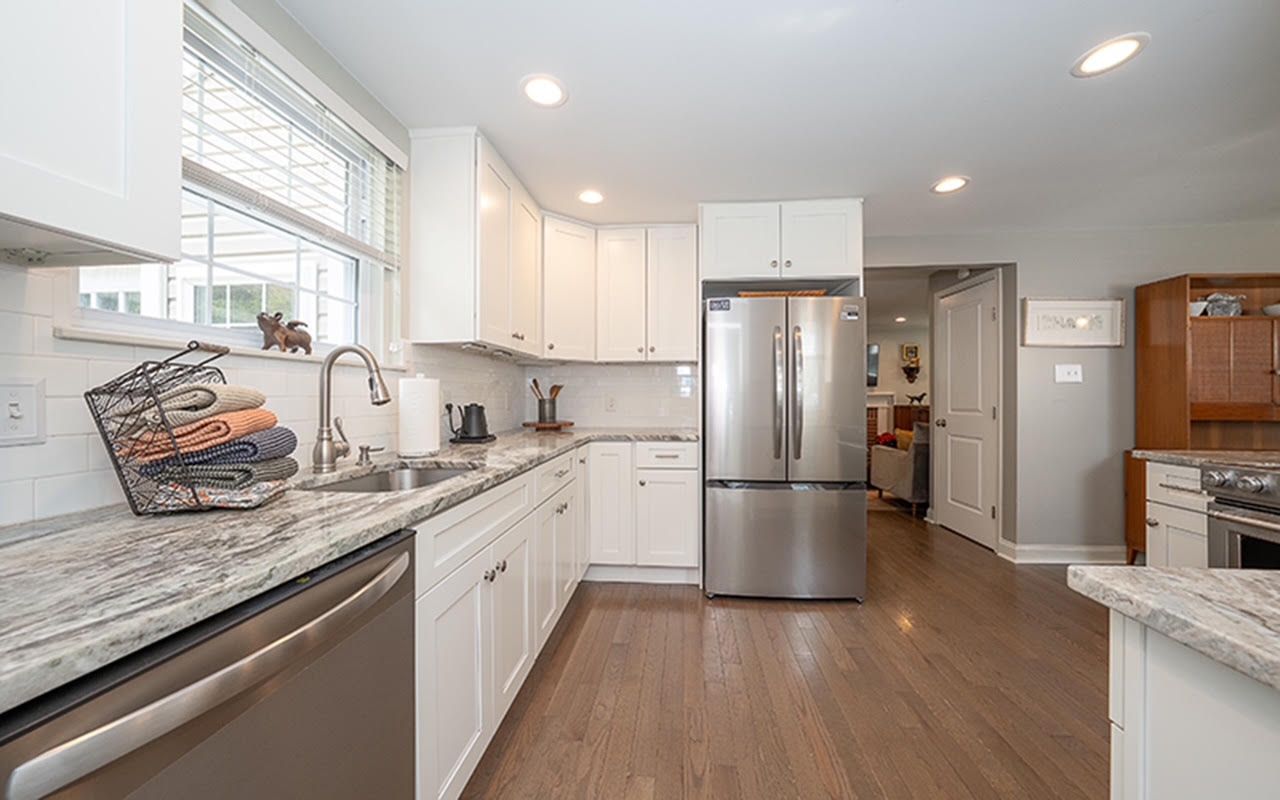
    The spacious kitchen features granite countertops, new stainless-steel appliances, and subway tile.Dave Ocenas

    The second floor has all three bedrooms and two bathrooms. The primary bedroom has dual closets and an en suite bathroom, and the hall bathroom has a barn-door vanity and tiled tub/shower surround.

    A new French drain system was installed in 2019 and HVAC was replaced in 2020.

    The unfinished basement has ample natural light.

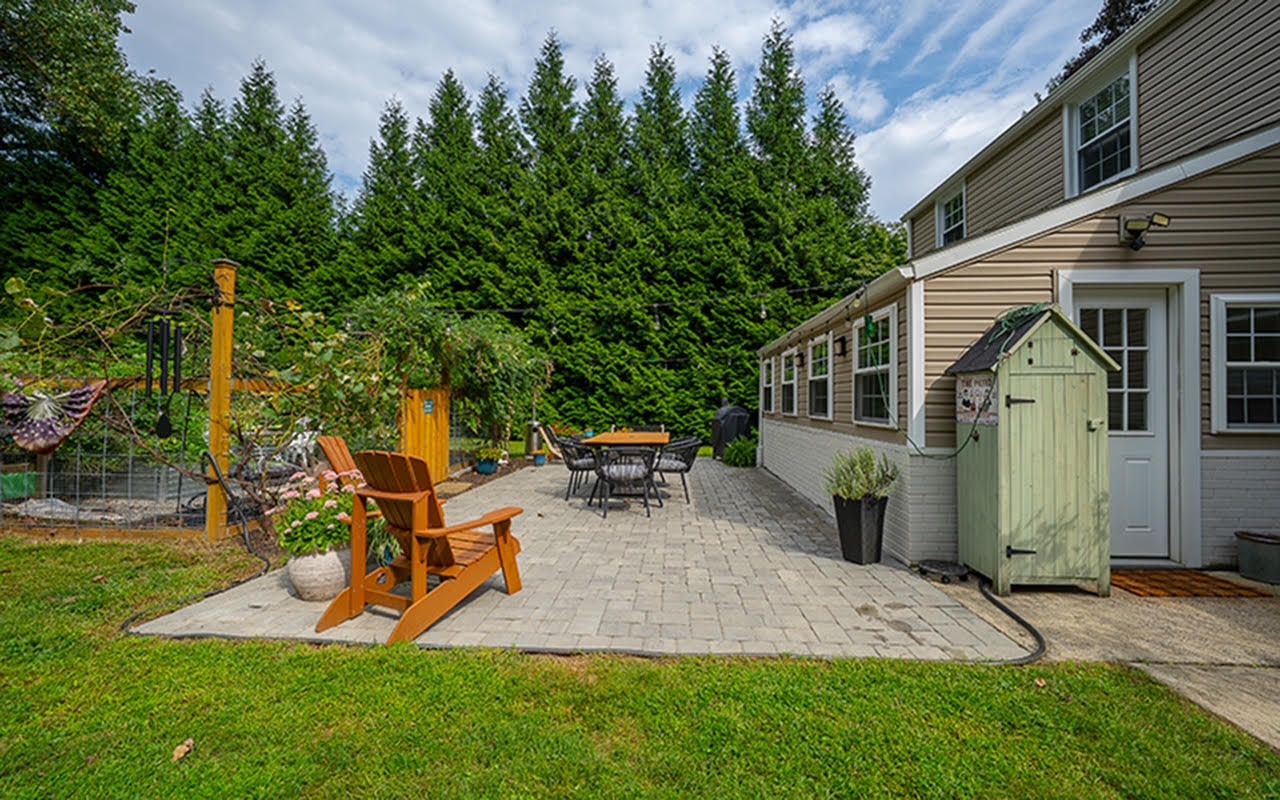
    The Gentiles used the COVID-19 “break” to install a paver stone patio and fenced-in garden.

    The backyard has newer paver stone.Dave Ocenas

    There are several close-by SEPTA Regional Rail stations and convenient access to I-95 and the Blue Route. Philadelphia and Wilmington are less than a half hour away.

    There is a large one-car garage and driveway space for four cars.

    The house is in the Wallingford-Swarthmore School District.

    It is listed by Marisa Bruder of BHHS Fox & Roach Wayne-Devon for $545,000.

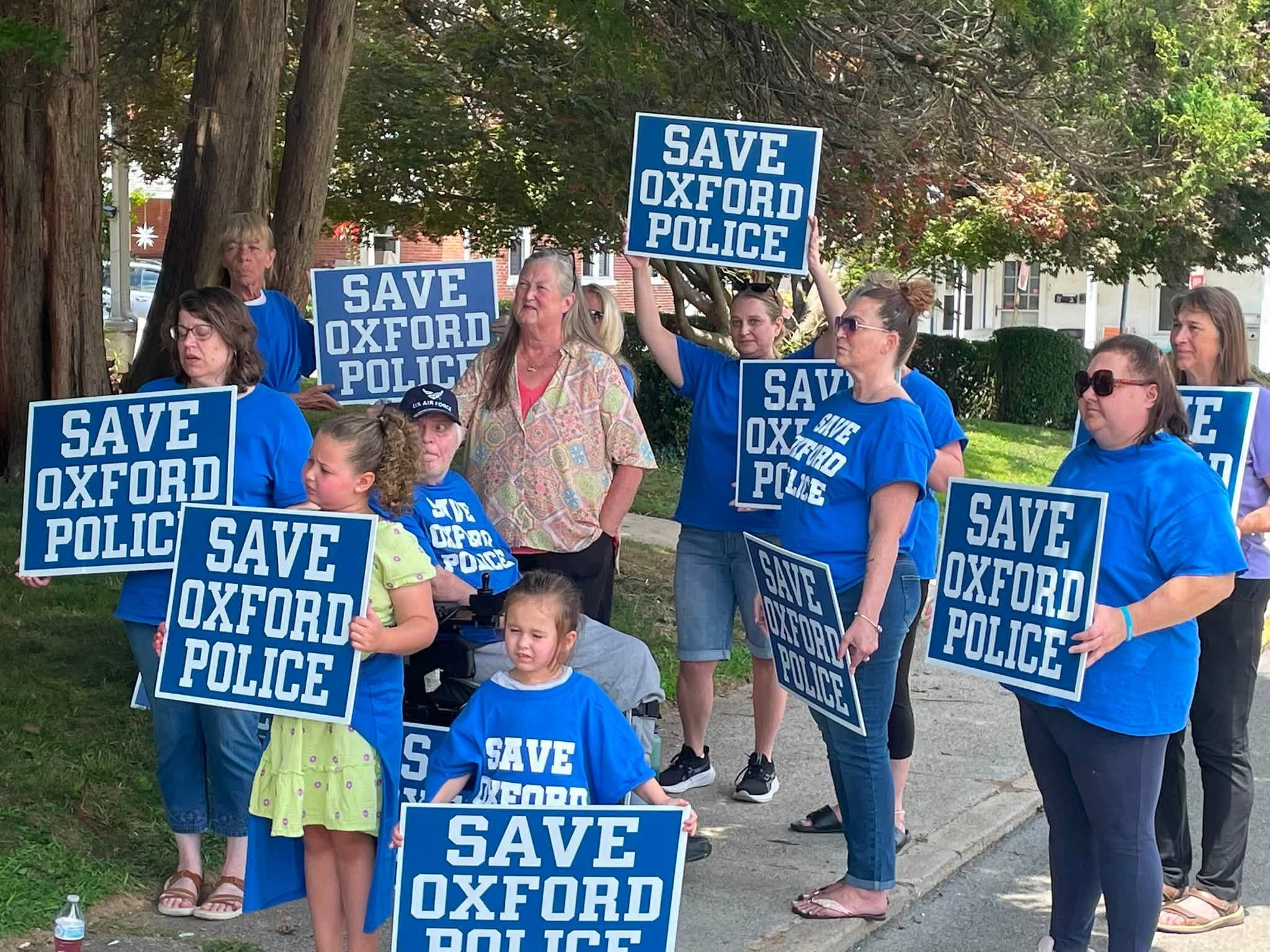
  • Oxford police officers, uncertain of their futures, resign as borough plans to close department and join regional force

    Oxford police officers, uncertain of their futures, resign as borough plans to close department and join regional force

    Three officers will resign from the Oxford Police Department ahead of the borough joining a regional department, with many officers saying the path to employment has felt uncertain and not guaranteed.

    The resignations — which the borough council approved Monday — come after Oxford’s officials approved, in a 5-2 split, to close the doors of their police department, citing ballooning expenses that outpaced the municipality’s revenue.

    Under the vote, the borough will become part of the Southern Chester County Regional Police Department, which serves New Garden, West Grove, and Avondale, on Jan. 1, 2027.

    To accommodate the growing geography, the regional department has pledged to hire 12 additional officers, with Oxford officials saying previously that their goal was for every officer to move over to the new force, if they wanted to. Oxford currently employs 11 full-time officers, including the chief, and several part-time officers.

    Applications for the regional department were sent out to Oxford officers earlier this month, with a deadline to submit by Friday. The applications were also posted publicly.

    But officers said that the road hasn’t been easy or transparent. In a meeting with The Inquirer at their station, the officers said that while it has been publicly stated that they are essentially guaranteed a job at the regional department, everything they have seen is “an opportunity to apply for a job.” Most officers spoke on the condition of anonymity out of fear of retaliation.

    Officers who are leaving said the uncertainty and the borough’s decision to close their department ultimately led them to seek new employment.

    Mayor Philip Harris said the borough was in active contract negotiations and declined to comment broadly on the situation.

    For the officers resigning, he acknowledged the community may “consider that to be in discord with the merger/joinder.” He argued that it “highlights and amplifies what we’ve been saying all along.”

    “It’s an incredibly difficult thing to recruit and retain officers,” he said. “They were recruited by other departments. They were offered better deals. That highlights some of the problems that brought us to this forefront.”

    Officers who have not resigned have begun meeting with the regional department leadership, they said. But with the clock ticking and no formal contract in front of them, the officers are worried about what employment could look like after Jan. 1.

    They are not sure what jobs they will get. With a cumulative experience of more than 280 years, they each have more than one year of service and have acquired rankings from corporal to sergeant. Those positions do not exist at Southern Regional, they say, making it unclear if they will lose rank in the transition.

    Because they have not seen a contract, they don’t know whether they should take a severance package. There are differences in pensions between the two departments that officers think will complicate the transition, too.

    “We have three that have secured jobs at other surrounding departments, and I haven’t seen one damn contract from Southern Regional,” one officer said. “What is my position going over there? How much am I making? What time am I carrying with me? My sick time, my vacation time, my seniority?”

    A yearslong process

    The move to regionalization has, essentially, been three years in the making, with borough officials long saying the police force costs more than it can afford. The borough has had several financial studies done in recent years examining the viability of the police department, and considering alternatives.

    Under the agreement with Southern Chester County Regional, Oxford borough would have two officers on patrol 24-7, like the current structure. Their shifts would begin and end at a local substation, ensuring no gap in coverage, as Oxford is roughly 16 miles away from the other municipalities under the regional department’s coverage. The 12 additional officers, hired as part of this expansion, would join a force of 21 full-time officers.

    There has been a growing trend of municipalities moving toward regionalization for high-price items in their annual budgets, like police, fire, and EMS. Public safety is at least 50% of the pie in most communities, experts have said.

    Regionalization, however, has not been perfect. Across the state, municipalities have joined and then withdrawn from regional services due to increasing costs under the agreement, according to a Keystone Municipal Solutions analysis, which studied police structuring in Oxford.

    Oxford officers said that there had been talks to merge with Southern Chester County Regional several years ago, but those discussions seemingly fell apart. Instead, officers recall, the department tried to make itself a possible regional hub — a force that could serve the municipalities that neighbor Oxford and currently use free coverage from the Pennsylvania State Police. Those talks also struggled to catch on.

    Officers still heard rumblings about joining the Southern Chester County Regional, but formally found out about the renewed effort when the Oxford Police Association received a letter from the borough council saying the start of union contract negotiations would be put on hold as the council explored a merger.

    Meanwhile, officers said, they are frustrated that the borough has not sought to slash costs in other areas, or will not wait for eligible members of the force to retire, where the pendulum on costs could swing back.

    “They have a champagne police department on a beer budget,” an officer said.

    Paul Frie, one of the officers who has accepted a position elsewhere, said that the borough’s decision to close its department caused him to look for other employment.

    “I can’t trust them to have my back,” he said. “I couldn’t work for them when they so haphazardly threw my job to someone else, because it’s not a guarantee.”

    Another officer, who has also resigned, said the uncertainty — and not knowing whether regionalization would stick — ultimately made the decision for him. It was hard: The officer grew up knowing many on the Oxford force, and said it was always a dream to work for the department.

    “I’m glad I got to fill it, partially,” said the officer, who spoke on the condition of anonymity. “It definitely sucks knowing this place isn’t going to be around.”

    This suburban content is produced with support from the Leslie Miller and Richard Worley Foundation and The Lenfest Institute for Journalism. Editorial content is created independently of the project donors. Gifts to support The Inquirer’s high-impact journalism can be made at inquirer.com/donate. A list of Lenfest Institute donors can be found at lenfestinstitute.org/supporters.

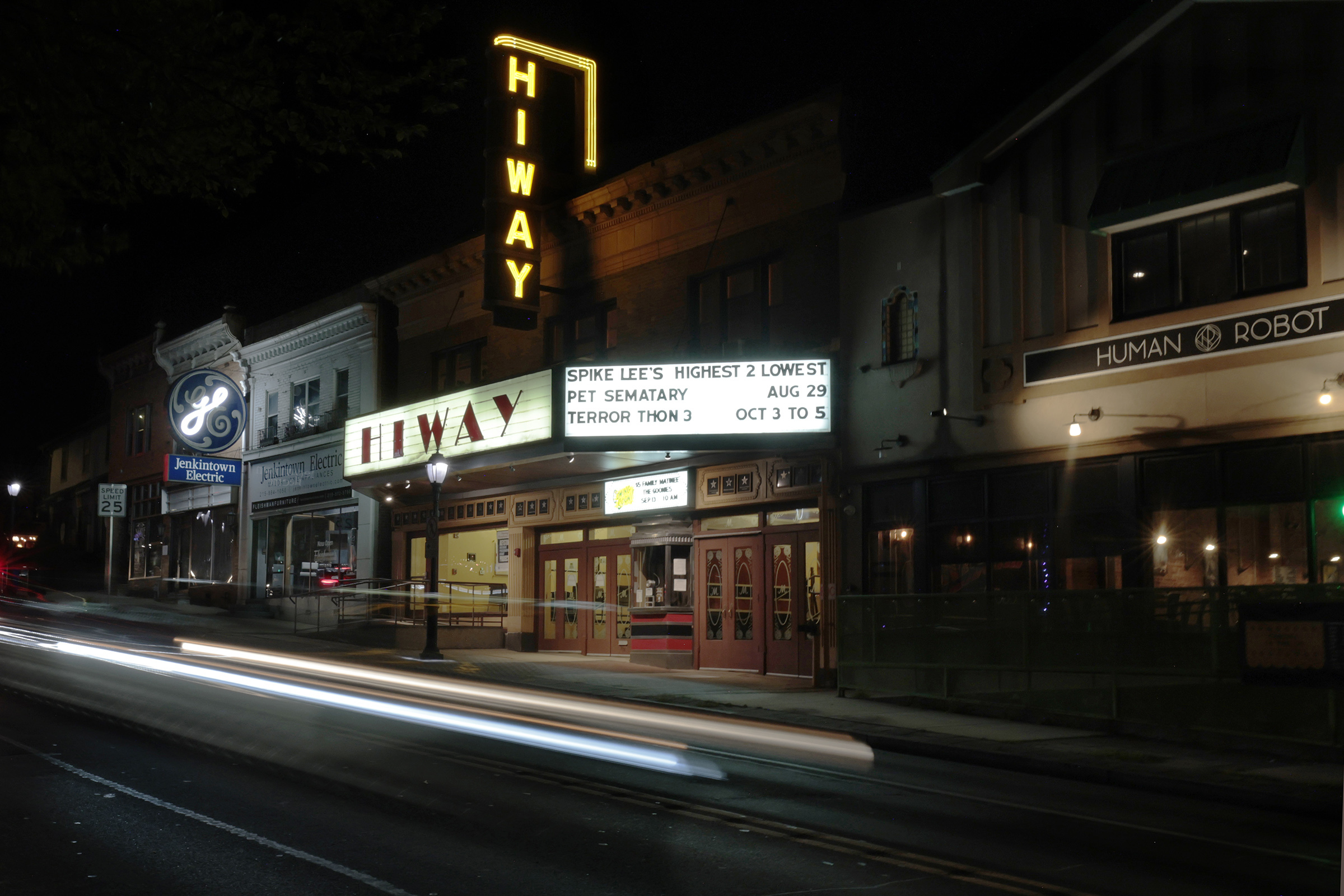
  • Jenkintown’s first short-term rental request was just denied — but it’s not the only Airbnb in town

    Jenkintown’s first short-term rental request was just denied — but it’s not the only Airbnb in town

    Jenkintown’s zoning board denied its first short-term rental request on Thursday after residents complained about noise and visitors.

    Resident Elvira Lindgren and her husband bought and renovated a twin in hopes of renting out rooms, she said in an interview Friday. The couple began hosting almost a year ago, according to their Airbnb.com listing. But the business has led to tension with some neighbors, who urged the board to deny the request for an official rental license.

    The tiny Montgomery County town’s code did not permit short-term rentals until spring 2025, when the borough created an ordinance that allows property owners to open the small businesses with permission from the zoning hearing board, which typically only meets once per year.

    Jenkintown now requires a rental license under the new ordinance, which lays out policies on location, parking, safety, and fines, among other things.

    Lindgren said she didn’t know about the licensing process when she first started, but when a neighbor reported her, the borough said she could continue operating until Thursday’s hearing.

    First Airbnb request draws neighbor dispute

    Lauren Davis, whose family shares a wall with the Lindgrens, said Friday that the twins aren’t suited to Airbnb rentals — partly because they share attic access — and that she and other parents are upset to see older men walking on the property, rather than medical students as Lindgren had told her to expect.

    “The level of activity they have going on there is better suited to a standalone home,” Davis said.

    The borough was mindful of Jenkintown’s already-dense residential development while working on the new short-term rental rules with the county planning office, borough manager George Locke said Wednesday, before the hearing.

    “We wanted to have it, but we wanted it in certain locations,” Locke said, “and to make sure it was safe for everybody and didn’t become a nuisance.”

    Reached by phone Friday, board solicitor Noah Marlier wouldn’t comment on why the board denied the license.

    Lindgren said she was “shocked” by the pushback at Thursday’s meeting from Davis and two other neighbors, adding that seven neighbors had signed a document before the meeting attesting they had no problems with her business.

    Davis argued at the hearing that problems during renovation, including a gas leak that forced her family to evacuate, showed the short-term rental would not follow rules.

    But accidents can happen during any renovation, Lindgren said Friday, so it’s unfair to count the incident against the business itself.

    Lindgren also defended her guests, who she said have included medical students, World Cup visitors, and an out-of-state dad who stays monthly to visit his daughter. While she understands their concern for their children’s safety, complaints are one-off incidents that the neighbors falsely portray as a pattern, she said, and she doesn’t hesitate to remove the rare guest who causes problems.

    “I’ve met so many people from abroad, so many countries,” Lindgren said. “Quite a few people became friends.”

    She’s disappointed that the board’s decision means visitors coming to Jenkintown to see loved ones or work at Jefferson Abington Hospital will lose a housing option in the area, Lindgren said.

    Some Jenkintown Airbnbs may run without approval

    But Jenkintown does have a few other short-term rentals, according to postings on Airbnb — including two that appear to have operated for several years.

    Locke wouldn’t say whether he’s aware of any unlicensed short-term rentals, but he encouraged any property owners operating one to seek approval.

    The borough’s solicitor is expected to write a written opinion on Lindgren’s case within 45 days, and she could appeal after that.

    But Lindgren plans to consider options for longer-term renters instead, like traveling nurses. The short-term ordinance only applies to properties that offer stays of fewer than 30 days and accept guests for fewer than 120 days total in the year. Properties that book more than 120 days a year are considered hotels in Jenkintown.

    “I just feel bad for those who won’t get to stay with me,” she said.

    This suburban content is produced with support from the Leslie Miller and Richard Worley Foundation and The Lenfest Institute for Journalism. Editorial content is created independently of the project donors. Gifts to support The Inquirer’s high-impact journalism can be made at inquirer.com/donate. A list of Lenfest Institute donors can be found at lenfestinstitute.org/supporters.

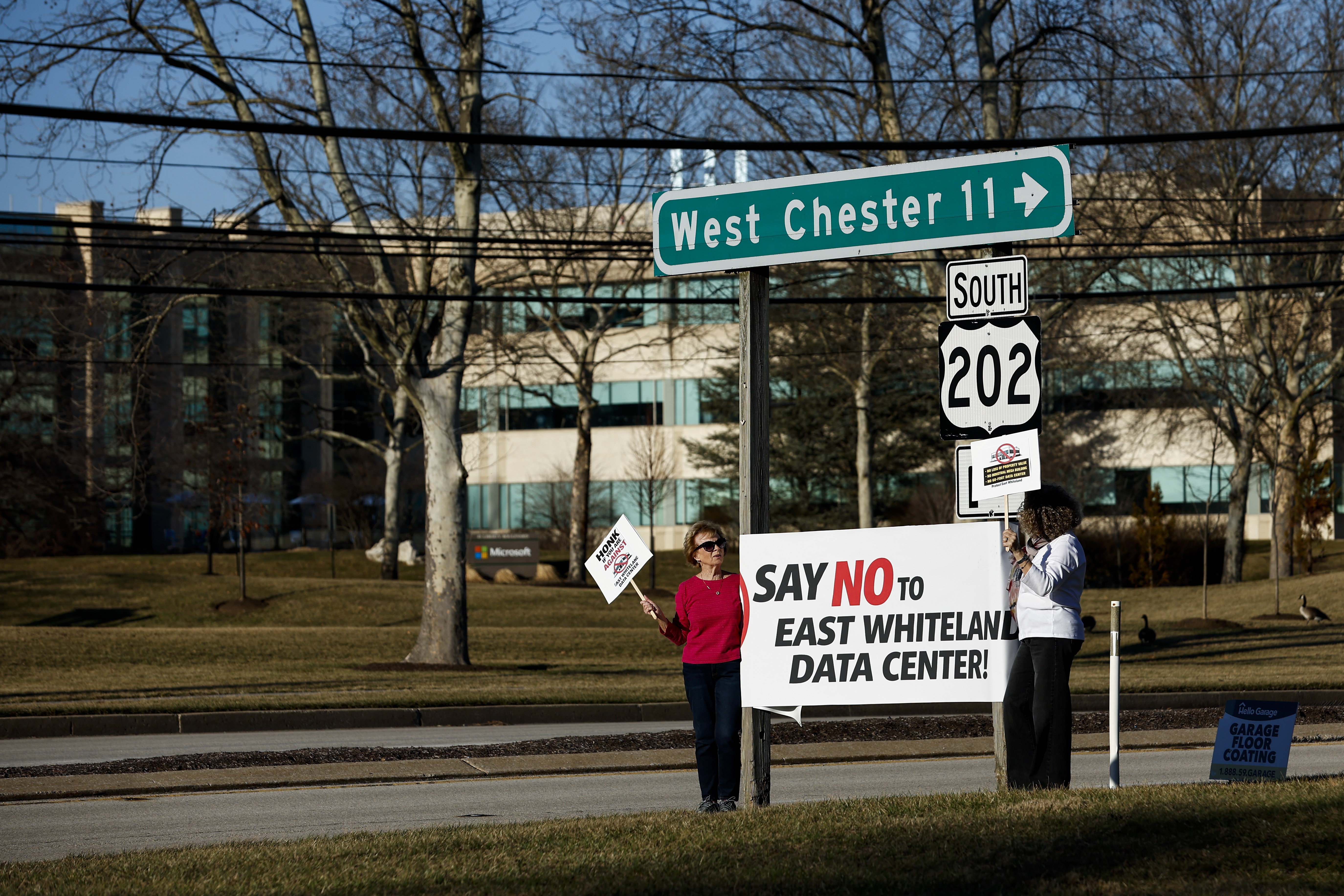
  • East Whiteland officials approve a lengthy data center ordinance, after residents decried the one being built there

    East Whiteland officials approve a lengthy data center ordinance, after residents decried the one being built there

    As East Whiteland grapples with the community’s resounding pushback to a planned 1.5 million-square-foot data center being built, its elected officials have approved an ordinance that would set greater restrictions for any similar proposals in the future.

    The board voted unanimously Thursday to approve the 32-page ordinance, after members had put a data center moratorium in place for months while they re-examined the zoning ordinance that allowed the supersized project to come into the municipality.

    The ordinance doesn’t affect the project, which is slowly taking shape at the former 79-acre Cyprus Foote Mineral Co. property. But the data center’s existence, which has faced staunch community opposition, is certainly what launched the new ordinance, penned in a collaboration between township staff, consultants, and community members.

    “I think this sends the right message,” said resident Tony Gianino, who served on the committee to draft the ordinance. “I know it’s been a little contentious over the last eight or nine months, and I think that we’re not looking at this as a negative, but as a positive, and as a foothold moving forward.”

    East Whiteland is among a number of municipalities in Chester County and the region that have been hurriedly drafting ordinances as more data center projects arrive at their doorsteps. Public backlash against the projects has been loud as data centers, which handle the cloud-storage and computing needs of the companies behind increasingly sophisticated artificial intelligence tools, have come to their communities. Gov. Josh Shapiro, who once sought to make it easier for the projects to call Pennsylvania home, has even evolved his stance.

    In East Whiteland, the ordinance will establish limitations on how close a data center can be to homes, schools, daycares, parks, or churches. It addresses noise, water usage, cooling systems, power supply, and more.

    It’s not a slam dunk, several said Thursday; some speakers were already suggesting amendments. State Sen. Katie Muth, who represents the area and is a frequent flier at data center meetings, suggested changes on portions of the ordinance, quipping, “I would love to have a township to refer to that has a really great ordinance. If you make those changes, you will be that township.”

    Scott Lambert, the board’s chairman, acknowledged it was a living document.

    “Whatever goes on the books tonight, it’s not permanent. It can be amended going forward,” he said. “We’re not locked into this particular ordinance and the specifics at this point in time.”

    Still, there was applause when the officials voted to approve the measure.

    But the effects of data centers don’t stop at the municipal line. East Whiteland residents have been watching nearby Charlestown, which updated its zoning to allow for data centers to be built on the East Whiteland border.

    “I do hope other communities look at this and end up utilizing it, especially Charlestown,” Lambert said. “I hope they do take a look at what we have and implement, to protect both communities.”

    This suburban content is produced with support from the Leslie Miller and Richard Worley Foundation and The Lenfest Institute for Journalism. Editorial content is created independently of the project donors. Gifts to support The Inquirer’s high-impact journalism can be made at inquirer.com/donate. A list of Lenfest Institute donors can be found at lenfestinstitute.org/supporters.