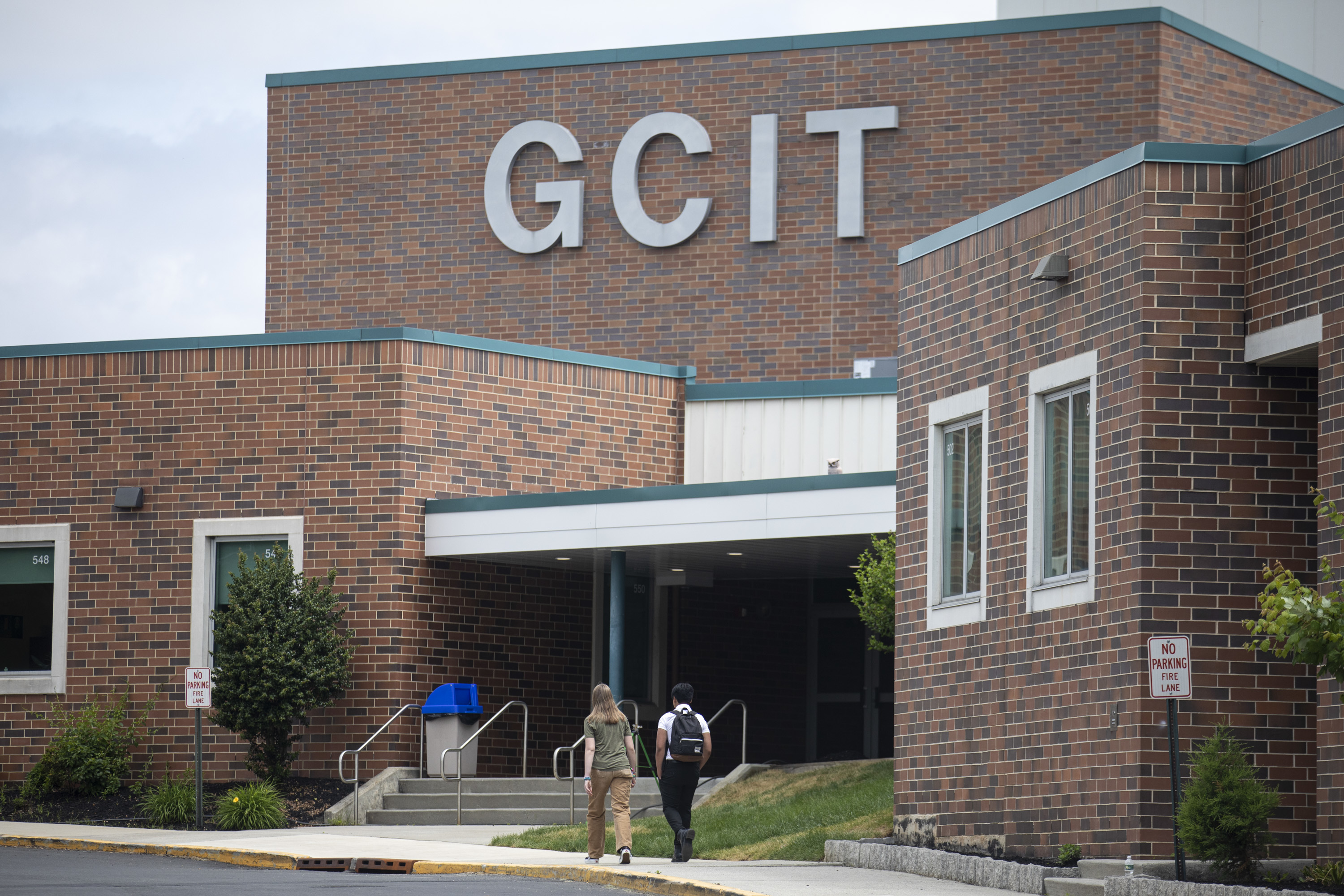
The Gloucester County Institute of Technology and its superintendentare facing multiple lawsuits after the school’s former principal and the administrator who replaced her filed complaints alleging the schooldiscriminated against them and mishandled its recent staff cuts.
Two lawsuits, filed in June weeks after GCIT first voted on the cuts, are the latest in a series of legal actions against GCIT alleging retaliatory and discriminatory behavior.
GCIT, the sole school in the Gloucester County Vocational-Technical School District, did not renew the contract of former principal Sybil Girard and two teachers. The school also cut the positions of former vocational education director Gina Mateka, another teacher, and the aquatics coordinator in a reduction of force.
The cuts, a response to a $500,000 budget shortfall that was only partially supplemented by the county, came down in a unanimous vote first in May and then again in August, according to meeting minutes approved last week. They follow budget struggles across South Jersey school districts.
Girard, who was hired in 2020 and was the district’s only Black administrator as well as the first Black principal in GCIT’s 55-year history, according to the complaint, sued the Deptford tech school and its superintendent, Susan Heiken, about four weeks before the school first voted not to renew her contract. She alleged racial- and gender-based microaggressions, negative performance reviews, and exclusion from staff hiring processes.
In a separate lawsuit filed in June, Girard alleged the school board voted not to renew her contract without providing the 48-hour notice required by New Jersey’s Open Public Meetings Act.
That case closed in state court Thursday, after GCIT’s school board hosted a special meeting, only two minutes long, to redo the personnel vote with proper notice.
Mateka, meanwhile, alleged in another June lawsuit that the district cut her administrative position and demoted her to principal to retaliate against a suit she filed last year alleging age and gender discrimination.
Mateka’s position was the only administrator role cut by August’s reduction in force, and the only tenured administrator position eliminated, according to her lawsuit.
Both Girard and Mateka declined to comment due to ongoing litigation. Heiken did not return repeated requests for comment, nor did Assistant Superintendent Amy Capriotti, who sits on the GCIT school board. Two board members also did not return requests for comment.
Students and others in the district community have spoken out against the staff reductions by defending the impact Girard and their teachers have had on their lives.
“For us GCIT students, our teachers and staff serve as parental figures, inspirations, support systems, and outlets; it would be a grave disservice to them, the students, the school, and morale to let them go,” former student Serena Smithwrote in a Change.org petition to call for the protection of staff. The petitiongarnered more than 1,600 signatures.
At board meetings leading up to the cuts, dozens spoke in defense of Girard and other employees at risk. At one March meeting, 58 people spoke, according to meeting minutes, and those comments took up more than 2½ hours.
A longtime district employee, who declined to be named for fear of retaliation, said recent actions taken by Heiken have hurt staff morale.
“Nobody is feeling secure,” they said.
Mounting complaints
Mateka’s beef with Heiken and the Gloucester County Vocational-Technical School District began in 2022.
The district had long shared its school board and administration with the Gloucester County Special Services School District, which educates children with disabilities, down the street.
But county officials restructured the district in 2022 and split the Deptford education campus back into two separate entities, meaning each school had to find its own staff.
Heiken became the temporary superintendent at the special services district while the school sought a permanent option.
According to an April 2025 complaint, Mateka saw herself as that option. She worked for the vocational technical school district since 1997 and became a shared chief academic officer in 2014.
With her teaching and administrative experience, Mateka applied for the superintendent opening at the special services school district, but the district’s board of education chose to hire James Dundee, a principal at GCIT, instead. Dundee is still superintendent.
Mateka sued GCSSSD, its school board, Dundee, and Heiken. She claimed the district did not handle the hiring process equitably, due in part to her age — she was 66 years old when she applied — and gender.
She alleged that Dundee did not have teaching experience, had never been a superintendent or assistant superintendent, and was not certified by the state to be a school administrator. That lack of experience, the complaint alleges, meant Dundee required a mentor when he was hired.
The same day, Brian Shakespeare, who held several roles at GCSSSD since 1992, also filed a lawsuit alleging age-based discrimination, since Shakespeare — 10 years Dundee’s senior — had applied for the position and lost out, too.
Both lawsuits are ongoing in state court.
Girard’s discrimination lawsuit came in April 2026, about a year after the complaints by Mateka and Shakespeare.
In its 20 pages, Girard alleges Heiken sought “dirt” on her and another Black administrator (who had her own racial discrimination lawsuit seeking $300,000 against GCSSSD, Heiken, and Dundee until the case was settled this summer), demoted Girard but not her white colleagues, refused to call her by her professional title, and constantly left Girard out of the loop.
After she first reported Heiken’s discrimination to the district’s human resources department, the complaint alleges, Heiken began to try to force Girard out of her position, including cutting Girard’s speech from the 2025 GCIT graduation program.
When GCIT did investigate Girard’s discrimination allegations, no one ever asked why she felt discriminated against, the lawsuit reads, and GCIT’s counsel notified Girard that her complaints were “unsubstantiated.”
This is the second consecutive year that GCIT had to pursue a reduction in force due to rising costs and cuts to state education funding, Heiken said during a spring budget hearing.
“[The rising costs are] primarily everything that we need to run a school,” Heiken said in the meeting recorded by the Woodbury Warbler. “Our energy costs, our medical infrastructure costs have risen double digits.”
Carl Heil, GCIT’s teachers union president, said in an interview that the district was ”going through tough waters.”
“My hope is that we navigate it together rather than someone just making decisions and us just dealing with it,” Heil said.
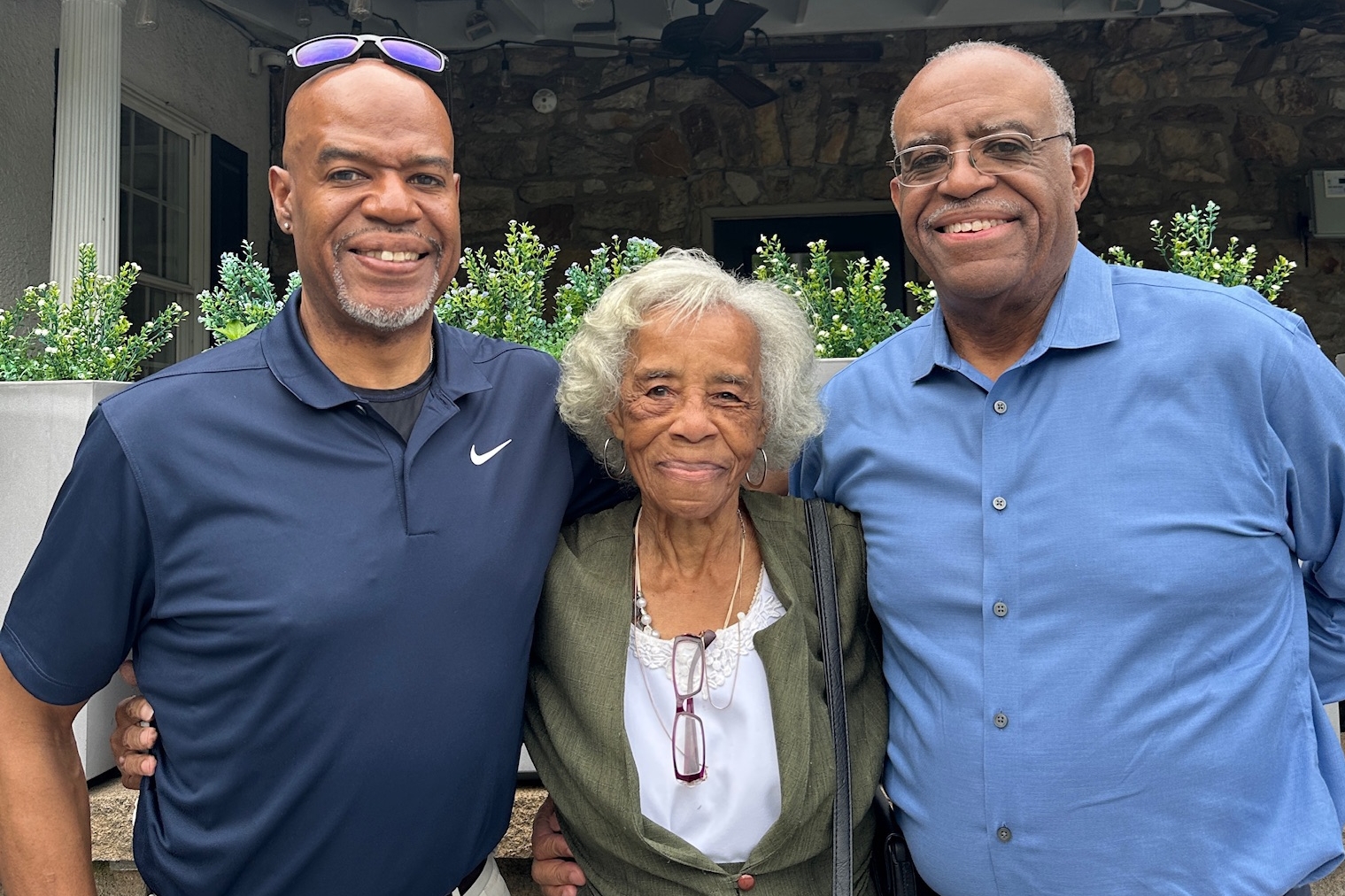
Joan M. Satterthwaite, 92, of Philadelphia, talented tailor and seamstress, longtime office administrator for the Mayor’s Commission on Aging, volunteer, and community caretaker, died Tuesday, Aug. 4, of sepsis at Jefferson Washington Township Hospital in Gloucester County.
Adept at designing, constructing, fitting, and altering garments of all kinds, Ms. Satterthwaite worked at the Botany 500 factory at Broad Street and Lehigh Avenue, and for other clothing manufacturers in Philadelphia, for more than 20 years. She could do every job on the intricate clothing assembly line, her son Kevin said, and she did them fast and well.
She joined the International Ladies’ Garment Workers’ Union in the 1950s and supplemented her weekday work by producing gowns, dresses, suits, and other clothing for family, friends, church choirs, wedding parties, and local businesses.
She made Halloween costumes for her two sons when they were young and tailored suits when they were older. She designed a wedding dress for her daughter-in-law.
She could duplicate many patterns by looking at them just once. Over the years, she collected eight sewing machines. “Her craftsmanship and attention to detail earned her the admiration and loyalty of countless clients,” her family said in a tribute.
Her son Kevin said: “We would call her an entrepreneur today.”
In the mid-1980s, Ms. Satterthwaite left garments and became certified in office administration and computer technology at the old Philadelphia School of Office Technologies. For a decade, she worked for the Joseph Shein Law Firm.
She tried to retire in the mid-1990s. But she impressed officials at the Mayor’s Commission on Aging so much as a client that they recruited her as a receptionist and administrative assistant. Sheleft that job in 2018, at 85.
Ms. Satterthwaite reared her sons in Philadelphia. Courtesy of the family
After that, she volunteered with veterans groups, was active in the community, and opened her home to anyone in need. “If someone asked for help,” her son Kevin said, “she was there.”
Her family said: “Joan’s life was a testament to perseverance, faith, compassion, and determination. Her kindness, generosity, and genuine concern for others became hallmarks of a life well lived.”
A friend said online: “Ms. Joan was the nicest person ever. … Her kind spirit reminded me of my grandmother.”
Joan Marie Watts was born Dec. 28, 1933, in North Philadelphia. Her mother died when she was 2, and she was reared by her grandfather and his wife.
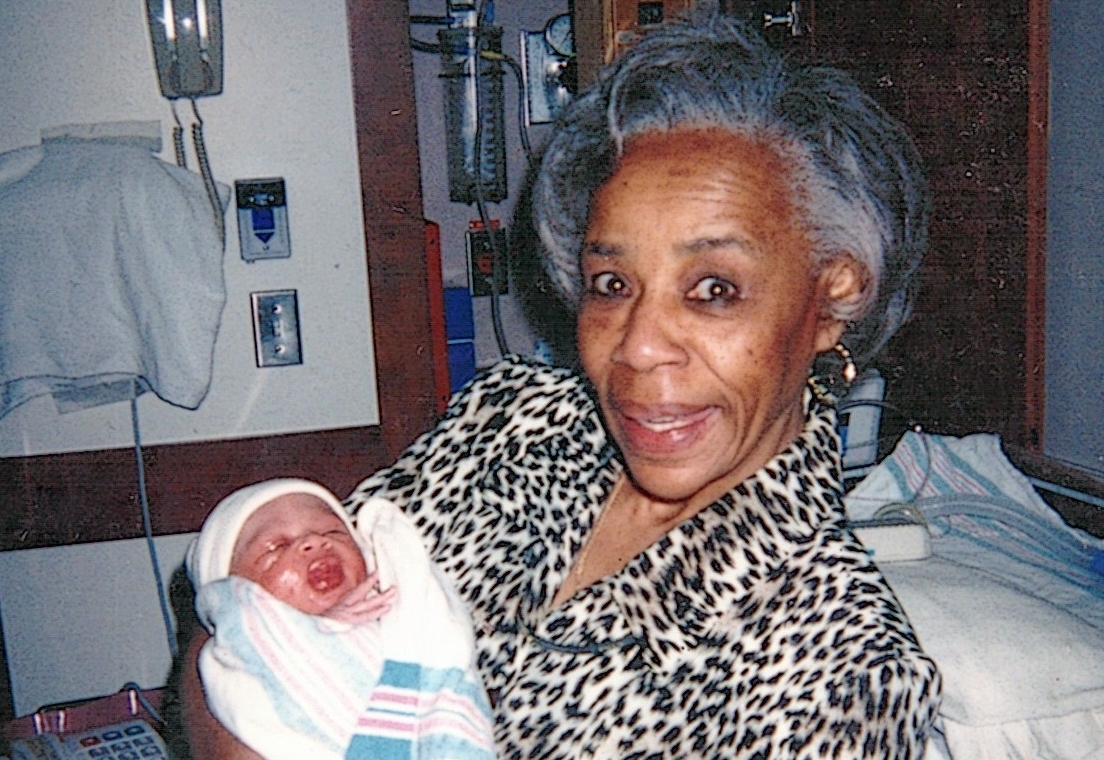
Ms. Satterthwaite doted on her grandchildren.Courtesy of the family
She studied tailoring and sewing at William Penn High School and graduated in 1952. She married Charles Satterthwaite in 1953, and they had sons Kevin and Eric. Her husband died earlier.
Ms. Satterthwaite was a member of Triumph Baptist Church for more than 35 years, and she went to breakfast with others often after Sunday service. She had breakfast with her sons on Saturdays, bowled every week for 30 years, hosted memorable family gatherings on holidays, and pored over puzzle books when she was older to stay sharp.
Her family noted her “warm heart, generous spirit, and love of people” in a tribute and said: “Her kindness, patience, and genuine concern for others left a lasting impression on all who knew her.”
She doted on her family and told them often that education was a key to success. She lived in Nicetown and Logan, and most recently in Washington Township.
Ms. Satterthwaite graduated from William Penn High School. Courtesy of the family
Her son Eric praised her “unwavering belief that nothing in life was more important than family.” Her son Kevin said: “She was welcoming and warm. She liked being around people. Her life force kept her going.”
In addition to her sons, Ms. Satterthwaite is survived by four grandchildren, two sisters, a brother, and other relatives. Two brothers died earlier.
Services were held earlier.
Donations in her name may be made to Triumph Baptist Church, 1648 W. Hunting Park Ave., Philadelphia, Pa. 19140.
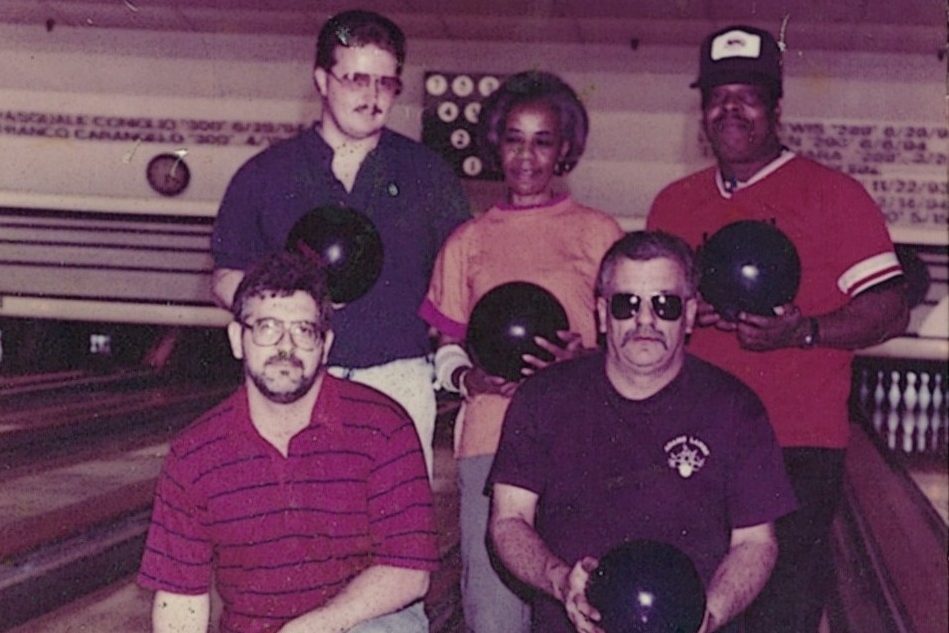
Ms. Satterthwaite bowled every week for decades. Courtesy of the family
Fall is nearly here, and for fruit lovers, that means one thing: It’s apple-picking season.
In the Philly area, there are more than a few orchards where you can pick apples for peak autumnal fun. Whether you’re into the crisp, sweet taste of a Gala or the crunchy, tart Granny Smith, you’re sure to get your fill.
When does apple-picking season start?
The season begins at the end of August for most of Pennsylvania, with Ginger Golds and Honeycrisps available for picking, and typically lasts until mid-November, said Norman Schultz, farm manager at Linvilla Orchards.
Here are great orchards, in New Jersey and Pennsylvania, for your apple-picking adventures, complete with treats like apple cider doughnuts and apple pies to enjoy on site or take home.
Note: Due to freezing temperatures in the spring, this year’s apple availability will be limited, according to many farms on this list. Be sure to to confirm ripening dates and available varieties ahead of time.
Indian Orchards Farm
Stop by the farm stand to sign up for apple picking. This over 100-year-old farm in Media grows about 25 apple varieties, including Honeycrisp, Gala, and Smokehouse. Admission is $3.50 per person, then pay by the pound for what you pick, with buckets and bags offered. On weekends, get hayride and admission combo tickets for $12.
“Farmer Norm” Schultz among the Stayman apple trees at Linvilla Orchards, 137 W. Knowlton Road, Media, in 2020.ALEJANDRO A. ALVAREZ / Staff Photographer
Linvilla Orchards
This Delco orchard is a must visit, thanks to the 25 types of apples grown there throughout the season, like Crimson Crisp, McIntosh, and Jonagold. Fill a two-quart bag for $11 per person. Get tickets online. Linvilla also offers tons of baked goods, including fresh apple cider doughnuts — a seasonal favorite.
📍137 W. Knowlton Rd., Media, Pa. 19063, 🕑 PYO Monday to Sunday, 8 a.m. to 4 p.m., 📞 610-876-7116, 🌐 linvilla.com, 📷 @linvillaorchards
Styer Orchard
This Bucks County orchard will resume its pick-your-own apples this fall. Bring your own bag and purchase the fruit for $1.89 per pound.
This Chester County orchard typically offers pick-your-own apples through early November with over 40 varieties like Mutsu, Gala, and Pink Lady on hand. It’s best to call ahead or check Facebook to see what is available. Pricing for bags varies by size. It’s $3 per person (over 3 years old) to enter the field for picking. Highland Orchards’ farm market is known for its apple cider doughnuts.
📍1000 Marshallton-Thorndale Rd., West Chester, Pa. 19380, 🕑 PYO Tuesday to Friday 9 a.m. to 4 p.m., Saturday and Sunday 9 a.m. to 3 p.m., 📞 610-269-3494, 🌐 highlandorchards.net, 📷 @highlandorchardsinc
Terhune Orchards
Terhune’s pick-your-own apple orchard grows a plethora of varieties. Folks 4 years old and up must purchase bags for $10, $15, or $27 — no entrance fee required. A fall festival, filled with pony rides, live music, and other family fun, runs until the first week of November. Terhune also has an on-site winery and a bakery with apple cider doughnuts. Note: The farm store, winery, and festival events are at 330 Cold Soil Rd. Apple picking takes place at 13 Van Kirk Rd. and 330 Cold Soil Rd. Check the website to confirm location and availability.
📍 13 Van Kirk Rd., Princeton, N.J. 08540, 🕑 PYO Monday to Sunday, 9 a.m. to 5 p.m. (call the farm store during apple season) 📞 609-924-2310, 🌐 terhuneorchards.com, 📷 @terhuneorchards
“Farmer Norm” Schultz cutting into a Stayman apple to look at the color of the seeds as a guide for when these can be picked at Linvilla Orchards, 137 W. Knowlton Road, Media, in 2020.Alejandro A. Alvarez / Staff Photographer
Solebury Orchards
Reservations are required for weekend apple picking at this Bucks County farm, where more than 30 varieties of apples are grown each season, according to its website. These include Pixie Crunch, Fuji, Jonathan, and Cortland, among others. Apples are priced by the pound for whatever you pick. Solebury’s farm market is an apple lover’s paradise thanks to its applesauce, apple butter, apple chips, fresh cider, cider doughnuts, and more, with mail order available for applesauce.
Weaver’s Orchard has some 18,000 apple trees on 35 acres of land and a wide selection of apples that include Honeycrisp, Crimson Crisp, Golden Delicious, and Jonagold. No reservations are required to pick-your-own apples, but you will need to use Weaver’s Orchard containers (starting at $29 — but prices may change) to hold your haul. Once you are done in the orchards, check out the market for everything from apple cider doughnuts to apple dumplings, as well as apple cider pressed on-site.
📍40 Fruit Lane, Morgantown, Pa., 🕑 PYO Monday to Thursday, 9 a.m. to 4:30 p.m., Friday 9 a.m. to 5:30 p.m., Saturday 8 a.m. to 3:30 p.m., 📞 610-856-7300, 🌐 weaversorchard.com, 📷 @weaversorchard
Apples lie on the ground as the pick-your-own season comes to an end and the transition to the winter season begins at Shady Brook Farms in Yardley in November 2023.Tyger Williams / Staff Photographer
Brecknock Orchard
Apple-picking season is expected to run into early November this year at Brecknock Orchard, where over 40 varieties of apples, including Gala, Golden and Red Delicious, Jonamac, and Cortland, are grown. If veggies are more your thing, you can pick your own from over 40 types of pumpkins, squash, and gourds. Brecknock’s farm market has tons of homemade items, like apple cider doughnuts, apple dumplings, and pumpkin rolls, plus apple cider and fruit slushies. The farm also has local delivery and curbside pickup. Check the website for updates on available produce for pick-your-own.
📍 390 Orchard Rd., Mohnton, Pa. 19540, 🕑 PYO Monday, Tuesday, Thursday, and Friday 8 a.m. to 7 p.m., Wednesday and Saturday 8 a.m. to 5 p.m. (through October), 📞 717-445-5704, 🌐 brecknockorchard.com, 📷 @brecknockorchard
Grim’s Orchard & Family Farms
A drive to Lehigh County takes you to this orchard, with its some 30,000 trees growing varieties like Premier Honeycrisp, Sweet Maia, Autumn Crisp, and Pixie Crunch. Each person 3 and up needs to buy at least a quarter-peck bag (about 2.5 pounds of produce) for $11 to enter the orchard. Larger sizes (up to 1/2 bushel for $52) are available, too. The Grim’s Fall Festival starts Labor Day weekend, featuring such activities as a corn maze and hayrides.
📍 9875 Schantz Rd., Breinigsville, Pa. 18031, 🕑 PYO Monday to Friday 10 a.m. to 6 p.m. (last picking bags sold at 5 p.m.), Saturday and Sunday, 10 a.m. to 7 p.m. (last picking bags sold at 5:30 p.m.), 📞 610-841-1417, 🌐 grimsorchard.com, 📷 @grimsorchard
Duffield’s Farm
Fill a bag of pick-your-own apples at this farm in Sewell, N.J. Then, take a hayride and enjoy an apple cider doughnut. A small bag (8 to 10 pounds) and a hayride combo ticket is $21; a large bag (18 to 20 pounds) and hayride is $36. Be sure to call ahead to confirm apple availability.
New Jersey students are going back to school with a new phone-free routine in September.
Starting on the first day of classes, all K-12 students in public schools must power off and put away phones and most internet-enabled devices before the bell rings, with only a few exceptions.
Heartily endorsed by educators who believe it will ease classroom distractions, promote academic performance, and improve student mental health, New Jersey’s new rule marks a big change for students accustomed to having their cellphones and other devices nearby and checking them regularly — even during class.
Some districts, such as Cherry Hill and Woodbury, have voluntarily implemented cell phone bans. Woodbury Superintendent Andrew Bell said most students embraced the restrictions and spend more time interacting with each other during breaks.
“At this point, it’s simply part of our culture and daily routine,” Bell said of the cell-free policy, passed two years ago.
The state left it to local school boards to determine how to implement the law at a district level, while complying with the guidelines. Because policies may vary, parents and students should check with their local district.
The law requires the state’s nearly 600 public school districts to adopt a policy banning the use of cell phones and other personal devices for the entire school day. The law allows some flexibility on enforcement and how the devices are stored.
The state Department of Education issued guidelines this summer to help district set local policies. Some districts including Cherry Hill in Camden County and Washington Township in Gloucester County this month are voting on amending existing policies.
Districts had to decide whether students would be required to store their phones in their lockers or bins, in locked pouches, or in their backpacks with their personal belongings. The devices must be powered off.
The guidelines apply to all internet-enabled devices, typically smartphones, smartwatches, smart glasses, and ear buds, or any device that can access online content.
Some districts have also included other communication devices like flip phones, two-way radios, and walkie-talkies. Some rules may vary, for age appropriateness, depending on grade level, too.
What is bell-to-bell?
Cherry Hill school board member Bridget Palmer explained the restriction this way at a recent board meeting: “The minute you walk in to the meeting, you leave.”
The law restricts students from using their phones during lunch and study hall periods.
Districts get to decide whether phones can be used before and after school on school grounds, on school buses, and during school-sponsored events, such as athletic events and extracurricular activities.
“We’re not going to tell kids they can’t use their phones when they’re at Disney,” Washington Township Superintendent Eric Hibbs said at a board meeting. “We couldn’t enforce it anyway.”
Districts must also provide parameters for how and when parents can contact their children during an emergency. Hibbs said Washington Township will have phones available in every office that a student can use, and is developing a way for parents to contact their child on a district-issued device.
“A true emergency — all of this goes away,” Hibbs said. “No child will ever get in trouble for calling 911 for reporting an emergency.”
Where will the phones be stored?
The law lets the districts decide where the phones will be stored during the school day. The state provided some funding for districts to purchase locked Yondr pouches. Others are designating lockers or bins.
Lianah Carruolo, 12, a seventh-grade student, unlocks her cell phone pouch outside the junior high entrance to Woodbury Junior/Senior High School on Friday, Sept 20, 2024. Alejandro A. Alvarez / Staff Photographer
Cherry Hill’s amended policy would allow students to keep their phone in their personal belongings. It must be turned off, not just on vibrate or silent.
“We prefer that you don’t bring it to school, but if you bring it to school, it has to be off and in your backpack or your locker for the duration of the day,” Palmer said.
In Camden, the district’s new “off and away” policy says phones should be off and out of sight. They are permitted at a teacher’s discretion for instructional purposes. After a first offense, the phone will be confiscated and returned to the student at the end of the day; for subsequent offenses, the phone will be returned to a parent or guardian.
In Washington Township, pre-K to fifth graders must store their phones in their backpacks, sixth to eighth graders must store theirs in their lockers, while high schoolers will be allowed to keep theirs in their backpacks.
Hibbs said few high school students use their lockers so it was decided to allow them to keep their phones in their personal property. With about 2,100 students, the high school is among the largest in South Jersey.
Are there any exceptions to the law?
The law mandates exemptions for students with a disability or an Individual Education Plan (IEP) or 504 plan that stipulates the need for an internet-enabled device.
The exemptions include students with a health plan, such as students with diabetes who need their phone to check glucose levels.
There are also exemptions for students who use the cell phone for translation, or are the primary caregiver responsible for the well-being of a family member.
School policies must also outline procedures for mobile devices that will be implemented in the event of an emergency, such as a lockdown.
In the event of a family emergency, parents should contact the school office, and not the student directly, according to the guidelines.
How will violations be handled?
Districts are posting the new policy on district and school websites, in newsletters, and on social media sites to inform parents and students about the changes. They may also review it at back-to-school-nights, orientations, and training sessions for staff.
The disciplinary action may vary, depending on the district, and typically begins with a warning that could escalate with additional violations. Districts must specify how a phone may be confiscated.
Washington Township’s policy calls for progressive discipline, based on grade level. Administrators, not teachers, will be responsible for confiscating a phone if warranted.
There are 10 possible “consequences” for high school students beginning with an administrative warning for the first two violations, Hibbs said.
For additional violations, students will get a lunch detention and have their phone confiscated for three to four infractions, Hibbs said. Sanctions for additional violations include requiring a student to store the phone in a locker or main office, a two-day internal suspension, and a mandatory parental meeting.
“It’s going to be a very big change, but we’re going to navigate it,” Hibbs told the board.
Armando Roberto Perez goes by many names. Armand. Bob. Opa. Mr. Soupy.
Perez, 70, is the longtime caretaker for Soupy Island, a public pool and park in West Deptford, best known for its century-old carousel, free soup, and the tall, enclosed slide guests glide down, crashing into sand.
Before Perez took the job 28 years ago, his father-in-law was caretaker, and before that, his grandfather-in-law. Managing the former 25-acre haven for sick and hungry kids has long been a family affair.
Soupy Island is open and free to the public three days a week from July to mid-August. For the rest of the year, it’s Perez’s job to keep the tuberculosis treatment center-turned-playground standing come summertime.
Lifeguard Alexandria Bright, 22, watches over swimmers in the main pool at Soupy Island. She is a niece of caretaker Bob Perez.Tom Gralish / Staff Photographer
He puts the picnic tables away, disconnects the piping and toilets, drains the pool, boards up the carousel, collects leaves, cuts the grass, weed-whacks, handles repairs, and takes on whatever else happens.
“If you’re not self-motivating, nothing’s going to get done,” Perez said.
On Wednesday, the second-to-last day of Soupy Island’s summer and what could be one of Perez’s last seasons as caretaker, 329 people had arrived by lunchtime.
At 11:45 a.m., the park’s amenities close like clockwork for lunch, until 1 p.m. Its 18 staff members ushered children and their families toward the middle of the park for Soupy Island’s controversial intermission: free hot soup, crackers, and milk, enjoyed (or not) in the August heat.
Syreeta Minor, 47, brought her daughter and her group of friends to Soupy Island for the first time after hearing about the destination on YouTube. Minor had no idea the park existed despite living in West Deptford, but she said she’ll likely be back.
A soupy history
Driving his golf cart across Soupy’s campus, Perez explained the park’s complicated history, in brief.
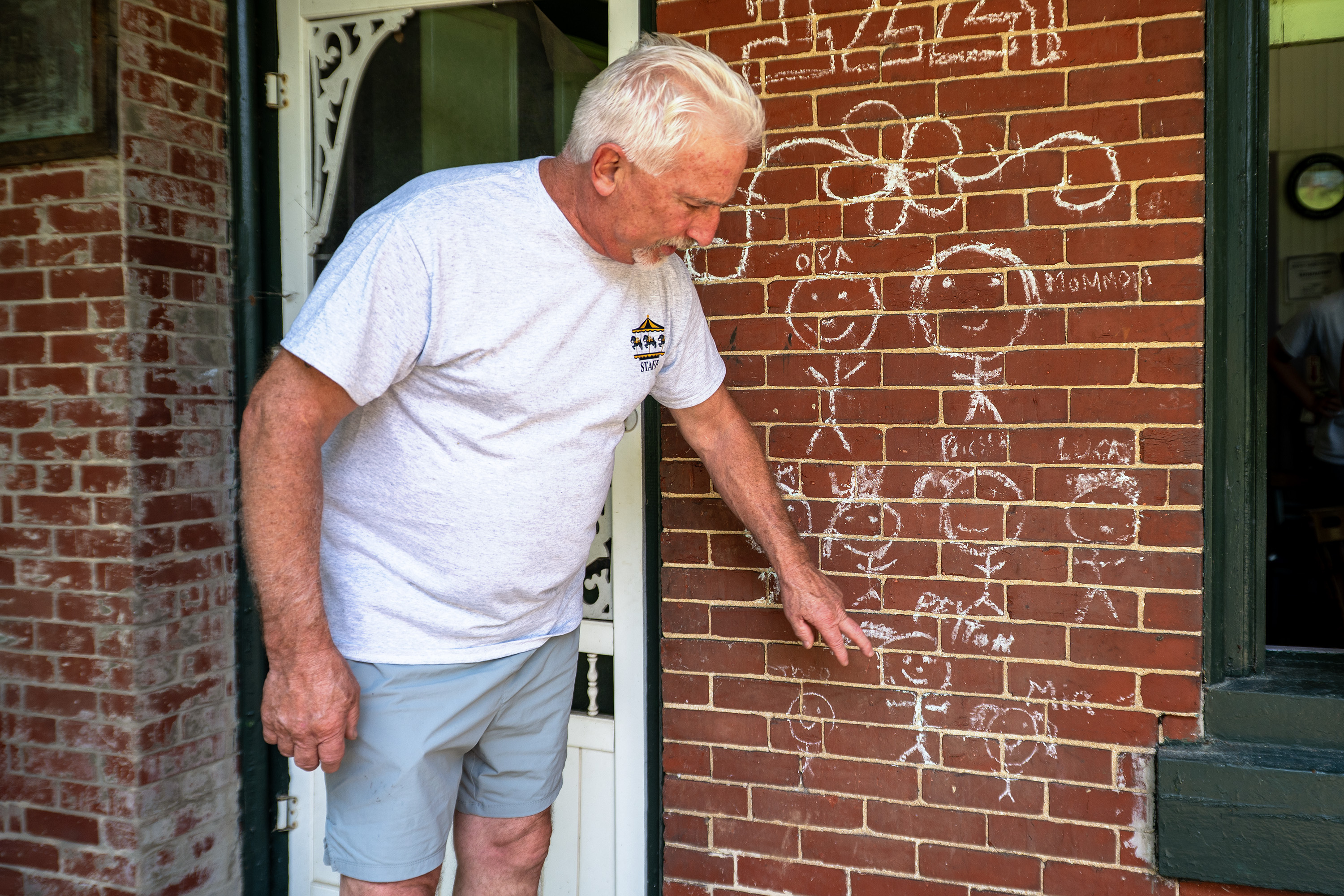
He pointed out the old European carousel, an early 20th-century relic that the National Carousel Association has been working to restore, and all the structures he’s fixed over the years. A chalk drawing made by his granddaughter, Izzy, on the wall of the soup house depicts Perez, “Opa,” at the top of a family tree with his wife, Denise.
Perez with a family tree drawn in chalk by his granddaughter Izzy when she was young.Tom Gralish / Staff Photographer
The park’s roots trace back to 1877, when the Sanitarium Association of Philadelphia purchased land to create a playground and treatment center for kids with tuberculosis.
The hospital no longer exists, but remnants of its history remain. A public pool has replaced the hospital’s former basement. A brick building from the late 19th century still serves hot soup and snacks from its three windows. The medical staff quarters is where Perez now lives with his wife, free-of-charge, different from the life Perez imagined growing up in North Philly. He graduated from Frankford High School, didn’t go to college, and moved to Jersey when he got married in 1976.
“I came from nothing,” Perez said. “We had government food. We had government housing.”
Perez’s home is an old five-bedroom white house at the front of the park, paid for through an endowment set up by Soupy Island doctors more than a century ago. It’s spacious enough for Perez’s grand and great-grandkids when they visit.
The endowment is what keeps the park alive and has kept it going through decades of turmoil.
During the Great Depression, the Sanitarium Playground fed thousands per day. It was often the only place city children could get a hot meal, by taking a river boat from Penn Treaty pier down the Delaware River. For fun, Perez said, children swam on the river in wool bathing suits and overalls.
In the 1940s, during World War II, the U.S. military took over Soupy Island to protect the nearby shipyard, before the playground returned to its park and soup kitchen roots.
‘Working with my hands’
Despite its history, Perez said the island (which isn’t an island at all) has kept under the radar. When staff have to call the police to report vandalism or an incident, they don’t always know where to go.
“A lot of people don’t know about it. They say, ‘I never knew you were here,’” Perez said. “I got people around the corner who don’t even know we’re here.”
In many ways, that has been to Soupy’s benefit. The summer playground doesn’t have the staffing or space to accommodate huge crowds, and Perez does much of his work solo. Over the years, he’s had to keep up certifications as an amusement ride operator, a pool manager, a lifeguard, and a diver, on top of the mechanical skills he developed over his 24 years at Cherry Hill Volvo.
It was his father-in-law who pestered him to apply for Soupy Island, a career he didn’t want.
“I like working with my hands,” Perez said.
His grandson, Lucas Ngo, plans to take over when Perez retires. A mural of Ngo, now 22, is on the wall over by the big kid pool, painted by Perez when Ngo was still a child.
Lucas Ngo, now 22, and an employee at the at Soupy Island in West Deptford, N.J. is depicted on a mural at the swimming pool Wednesday, Aug. 12, 2026. Tom Gralish / Staff Photographer
On Wednesday, Ngo, who originally planned to pursue car mechanic work, prepared the daily soup, chicken noodle, in a giant vat as visitors trickled toward the house. An unfamiliar clanging came from the soup area.
“Now that noise? Open the valve,” Perez instructed, then laughed. “There you go. You get to know the sounds of the things.”
‘A rite of passage’
Lifeguard Ali Bright, 22, placed spoons as Perez scooped soup during Soupy Island’s daily lunchtime ritual. Fellow lifeguard Madi Hogan, 17, carried the trays to a cooling rack, then to the windows to serve a line of people outside.
“It’s like a rite of passage in this family,” said Bright, Perez’ niece. She’s worked at Soupy every summer since she was 14. “This is my little oasis away from my real life.”
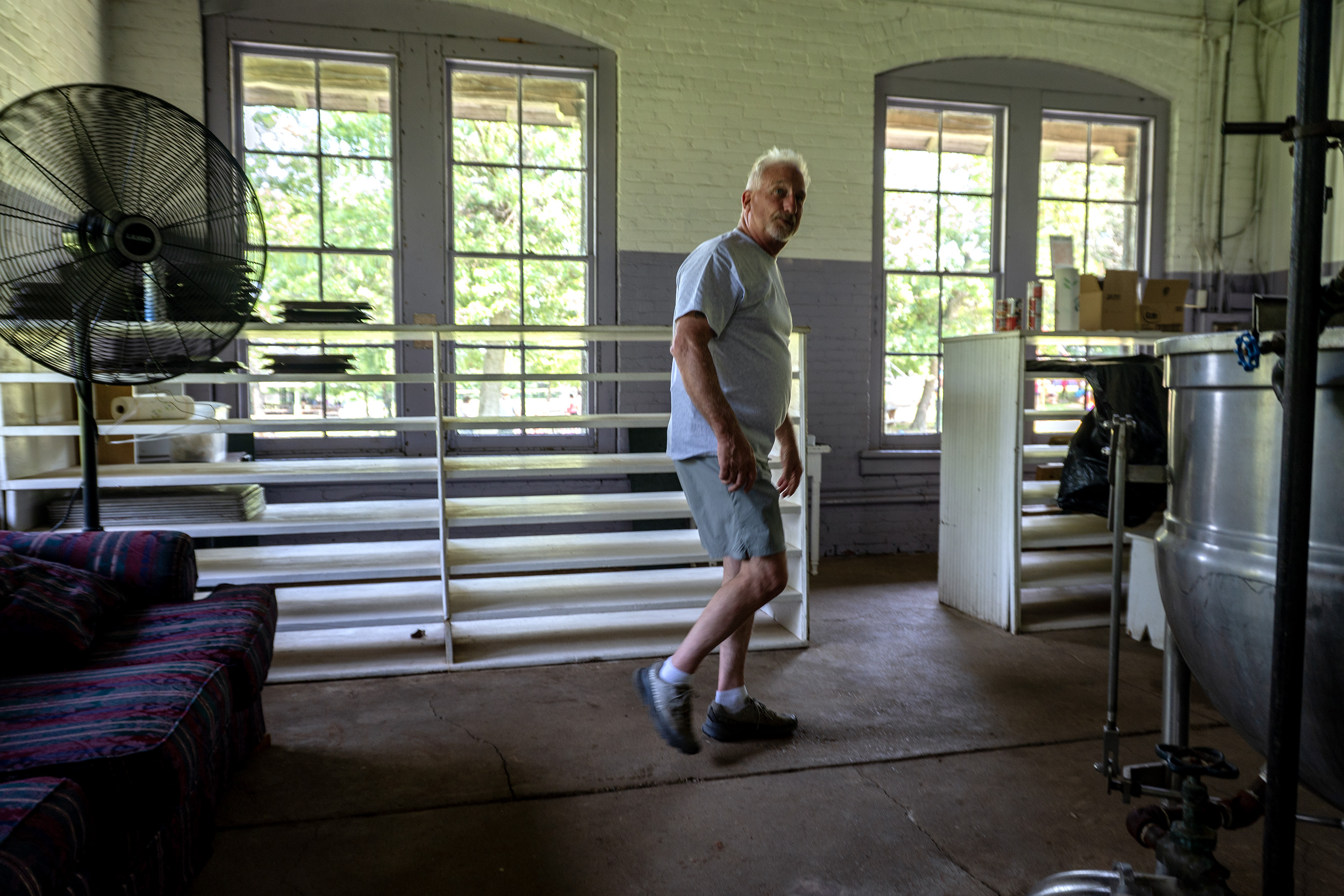
Perez in the kitchen of the original building where the camp still serves free soup lunches every day. The kettles are at right and the same shelves for cooling the soup are at left. Kids still line up for lunch at the windows in rear. Tom Gralish / Staff Photographer
The lifelong connection to the playground is typical for staff. Hogan’s great-grandmother used to come to Soupy Island as a child. Marielle Lewis, 17, used to come to the park for soup when she was little, since her aunt lives nearby. Now, she’s worked as a lifeguard for two years.
“It’s kind of weird now that I get to see everything that I wanted to see when I was a kid,” Lewis said.
For now, the group is using their remaining soup supply donated by The Campbell’s Company last year. In the 2000s, the company paid for a new jungle gym, volleyball court, basketball court, and more at Soupy Island and continued its contributions through food since, even though Campbell’s has no true affiliation with the playground despite its name.
But this season, Campbell Soup didn’t donate goods, Perez said, who added that one season’s worth of soup costs the park more than $8,000.
The Food Pantry of South Jersey in Pennsauken has stepped up, though, by providing Soupy Island with thousands of shelf-stable meals to distribute to visitors.
“Sometimes a lot of these people go through trials, and come in here just to chill a little bit,” Perez said. “You don’t know what the other person’s going through.”
Once Ngo takes over, Perez still plans to help out where he can, just with less physical labor. Plus, he’ll hopefully get to do more home remodeling on the side, and take more consistent naps, his favorite part of the day.
“I try to do it around three,” Perez said, a dream. “But it doesn’t happen.”
A unit of the Hanwha Group, which paid $100 million for Hanwha Philly Shipyard in 2024, has offered to pay more than $1 billion for an Australian company’s shipyard in Mobile, Ala., the company’s nearby nuclear submarine fabrication sites, and a San Diego ship repair facility.
Hanwha has four weeks to review the facilities and meet with the U.S. Navy and other government agencies before closing a deal, according to a statement from shipbuilder Austal USA.
The South Korean-owned Hanwha Group last year promised to pump $5 billion into the facilities it owns at the heart of the former Philadelphia Naval Shipyard to add a second giant Goliath crane, a second 1,000-foot dry dock, larger fabrication structures, and other portside facilities. The company also said it wouldhire thousands more workers, as part of a larger $150 billion investment by several South Korean companies to revive U.S. shipbuilding.
Hanwha Philly Shipyard has not added those major facilities. Company officials have since said their group is looking at other U.S. sites to build enough ships to turn a profit.
Hanwha “is exploring a range of options to expand our footprint in the United States,” said James Hewitt, Hanwha Defense USA spokesperson. The company declined to say more about its search.
South Korean President Lee Jae Myung waves as he arrives at the Hanwha Philly Shipyard for a christening ceremony in 2025. Jose F. Moreno / Staff Photographer
The proposal fits with Hanwha’s ambition to be a leading global defense contractor, competing with General Dynamics and other big shipbuilders, said Gary Kim, a U.S. Naval Reserve engineer and Wharton graduate student who writes extensively on shipbuilding. The Philadelphia yard “would focus on surface auxiliary vessels, where Austal would focus on smaller warships and submarine modules.”
In Philadelphia last month, JPMorgan CEO Jamie Dimon said his bank looks forward to helping fund Hanwha’s expansion.
Hanwha last year had agreed to purchase portside facilities in Paulsboro, Gloucester County, four miles up the Delaware River from its South Philly yard. It pulled out of the agreement after failing to reach a deal with the port operator, Holt Logistics.
Hanwha has not ruled out developing another Philadelphia-area location but has been visiting southern facilities that are ready to run, such as the Austral yards. Austal USA employs around 3,500, compared to around 2,000 employees and outside contractors at Hanwha Philly Shipyard.
The former Philadelphia Navy Base covered a much larger area before it closed in 1994. Philadelphia Industrial Development Corp., a partnership between city government and the Chamber of Commercethat screens tenants for vacant land, has since committed much of the property tocorporate offices,apartments, and other nonindustrial uses, though some waterside industrial property is still available.
Hanwha Philly Shipyard in July. Joseph N. DiStefano
Hanwha’s specialty at its main yard on South Korea’s Geoje Island is mass-producing cargo ships. Hanwha Defense said in a statement last month that building ships for the U.S. government is more profitable for the Philadelphia yard than commercial ships.
Hanwha is finishing work on the final two of five ships it is building for the U.S. Maritime Administration to use as state merchant marine trading academies. Secretary of Transportation Sean Duffy said last month that the Philly yard had built those ships “on time and on budget,” in part by hiring Tote Services of Jacksonville, Fla., to manage construction. Hanwha says it has lost money on the $1.7 billion program, which began in 2021.
The government said last month that Hanwha Philly Shipyard will also build two “tracking ships” replacing missile-defense ships from the 1960s.
Hanwha Philly Shipyard is also building three ships for a total of around $1 billion for the Matson container line to operate between U.S. ports under the Jones Act requiring U.S.-built ships between U.S. ports. The cost of those ships is more than double what Chinese yards are charging for similar ships.
In a securities filing Tuesday, Austal USA’s owner, Austal Ltd., disclosedthat its shipbuilding arm has lost $175 million in its recently concluded fiscal year, after the U.S. Navy last week refused to pay more for ships Austal has been building.
Austal has been building noncombat salvage, dry dock, and equipment-landing ships for the U.S. Navy. The company based its case for larger payments on changes in Navy orders and “deficiencies in design specifications.” Austal said it would “strongly pursue the claims” even after the War Department’s recent refusal.
At an Alabama facility near its shipyard that would be part of the deal with Hanwha, Austal USA constructs submarine modules for General Dynamics, which builds Navy nuclear submarines in Connecticut and Rhode Island. Austal says that business is profitable.
Rhoads Industries, Hanwha’s neighbor at the former Philadelphia Naval Shipyard, also fabricates nuclear submarine modules used by General Dynamics and plans to double employment to 1,400, as it builds new facilities for that business over the next few years.
Hanwha has said it wants to enter the submarine supply business as well. An Austal USA purchase would add that capability.
Hours before Mohamed Coulibaly was found dead in his Gloucester County home, one of his alleged victims said, the 23-year-old entrepreneur had been desperately seeking a $75,000 loan.
A recent Barron’s investigation alleged Coulibaly defrauded three former NFL players out of $1 million in an e-commerce scheme involving fake Shopify stores. Now others who invested in the venture or lent Coulibaly money were blowing up his phone. They wanted to know if Jalen Carter and several former members of the Eagles, including Nakobe Dean and Terrell Edmunds, were even real clients, a claim Coulibaly made on promotional materials.
Above all, these people wanted their money back.
The morning of his death, July 31, Coulibaly solicited money from a New York man, who agreed to speak with The Inquirer on the condition of anonymity to protect his family’s privacy. He is one of at least 10 people, including the three former NFL players, alleging Coulibaly scammed them out of more than $5 million through phony investments over the last year.
Coulibaly, who lived in Mullica Hill, a section of Harrison Township, promised to send a Lamborghini, two gold Rolexes, and a signed Lionel Messi cleat as collateral for what was to be a weeklong loan.
Coulibaly still owed the man $1 million for a bridge loan due in March. Yet he insisted the additional loan somehow would make it possible to return the initial money owed. His alleged victim said he figured he could only gain from the arrangement — if the collateral proved to be real.
But a driver — not in a Lamborghini — arrived at his doorstep with two fake watches, an unauthenticated signed cleat, along with an insurance card and a bill of sale for the promised luxe car, according to the man.
The man called off the loan.
“[Coulibaly] then started to cry hysterical on the phone,” the victim said. “He said, ‘I’ve lost it all, please help me here, please help me here.’”
Coulibaly was found dead later that day.
Mohamed Coulibaly attends Milan Fashion Week on Jan. 19 in Milan, Italy.Dave Benett/Getty Images
The Gloucester County Prosecutor’s Office is leading the investigation into Coulibaly’s death and declined to comment. No charges have been filed in connection to the alleged scams Coulibaly is accused of spearheading.
Coulibaly’s death has only added a layer of uncertainty for his allegedly defrauded clients, who now believe they were unwitting participants in a Ponzi scheme. New so-called investments went toward paying off other clients. But the chain could not be sustained.
“In terms of his death, it sounds rather brash or harsh, but the only reason I’m upset for his passing is that he’s not able to go to jail and suffer,” the bridge loan investor said.
The Inquirer spoke with four victims, all but one of whom asked to remain anonymous citing lingering shame, privacy concerns, and, in one case, safety considerations. They provided alleged contracts Coulibaly gave them, text messages, screenshots of their purported Shopify store sales, and a whistleblower report sent to federal and Pennsylvania financial regulators.
In hindsight, the business always seemed too good to be true. The young entrepreneur convinced them they could rake in millions each month selling vacuums, printers, desktop humidifiers, and silicone trays on Shopify, an e-commerce platform similar to Amazon.
At first, investors said they had no reason to question Vent Motion LLC, also known as Motion Venture. Shopify alerted the victims to a steady stream of sales through their phone apps.
But at least two Shopify stores victims bought into were fake, full of transactions a Barron’s analysis suggests are also a sham. Shopify did not respond to requests for comment.
The alleged victims say Coulibaly lured them in by highlighting purported investor relationships with wealthy and connected people. His pitch deck listed several former members of the Eagles and the NBA as clients. Representatives for the current and former Eagles declined to comment or could not be reached.
“A selling point [Coulibaly] gave me was, ‘Hey, we only have about 90 to 100 people in this,’ insinuating you can make it behind the velvet rope because everybody involved is celebrities or athletes, and this is just a venture they do,” said another of the defrauded investors, requesting anonymity because family and friends do not know about the scam.
Yet as more victims have found one another in the wake of Coulibaly’s death, it has become clearer the scheme was not limited to targeting NFL players.
It involved everyday investors from Arizona, Pennsylvania, and New York who now want to know if any of it was real.
A ‘magnetic’ man with the digital footprint of a business phenom
Coulibaly knew how to sell the image of a successful entrepreneur.
His story always hit the same beats: Coulibaly was a professional soccer player. He made $4 million reselling rare sneakers before he turned 21. His success was largely attributed to “building connections” with athletes and influencers. Grinding was the key to success.
But much of that was embellished.
A database for American high school sports coverage noted Coulibaly played soccer for Roxborough High School.
Coulibaly said he began his professional career with the New York Red Bulls soccer team, but a spokesperson said Coulibaly never had a contract.
A friend from Coulibaly’s days at Temple University said the sneaker venture Heatkickcity was also a scam that swindled students out of thousands. He asked not to be named out of safety concerns, saying Coulibaly often touted relationships with gang-affiliated people.
While Coulibaly told publications he was born in Mali, West Africa, and immigrated to the United States at a young age, while in college, he often intimated that he was a trust fund child and that his parents worked for the French government, the Temple friend said.
He added that may have helped induce so many of their peers to pay a $1,200 membership for monthly access to rare sneakers that ultimately never came.
“He’d be like, ‘It’s stuck in shipping,’ or ‘my assistant forgot to order them,’ or ‘my assistant’s slacking,’ and then he would just keep on extending it, extending it,” said the friend. “If you questioned him in any way, shape, or form about the product that you paid for, then he would switch to angry mode.”
The friend eventually got his money back after pressuring him for weeks but said Coulibaly continued his self-proclaimed pursuit of becoming a billionaire.
“He scammed his best friends,” the friend said. “Nobody was off-limits.”
Coulibaly’s next venture was fashion line Motion Apparelz. It was profiled in Forbes last year, where the author describes Coulibaly’s energy as “magnetic.” In the piece, Coulibaly name-drops artist friends, including rapper YG, who was later listed as an investor in Motion Venture promotional materials.
Rapper YG performs at the Coachella Music & Arts Festival in 2019.Amy Harris
YG’s agent could not be reached for comment.
Outside of the glowing profiles, a now-defunct Instagram account also detailed a lavish lifestyle full of run-ins with celebrities, boat jaunts on luxury yachts with city skylines in the background, and snapshots of Coulibaly in or in front of private planes. Often, Coulibaly could be seen wearing gold watches, what appear to be Van Cleef & Arpels bracelets, and diamond-studded chains.
Coulibaly’s digital footprint set the stage for an even bigger business pitch.
A business promising exorbitant returns
When it came to Vent Motion LLC, Coulibaly told clients he operated “factories in China and India with a combined team of 125 full-time employees,” according to a pitch deck he showed investors that was obtained by The Inquirer.
This allowed stores to operate without keeping any inventory and reducing overhead — a model known as drop-shipping.
The savings from eliminating the middlemen, he said, could then be reinvested into artificial intelligence-driven ads and “influencer amplification” to drum up more customers. Coulibaly’s company would set up and manage the Shopify stores on behalf of investors, pushing out additional advertising or swapping out products if sales slowed.
Clients would be charged a 20% to 25% service fee for that work, and even so, Coulibaly dangled extraordinary returns for those who joined the venture.
One Shopify store that began with a $550,000 investment in January 2024 had allegedly generated $2 million in revenue in April and a whopping $23 million in July of that year. By August, this particular store had generated a total of $84 million in revenue, according to the company’s unsubstantiated pitch deck.
Further sweetening the deal was an initial investment “protection” guarantee if their store did not generate profit within six months.
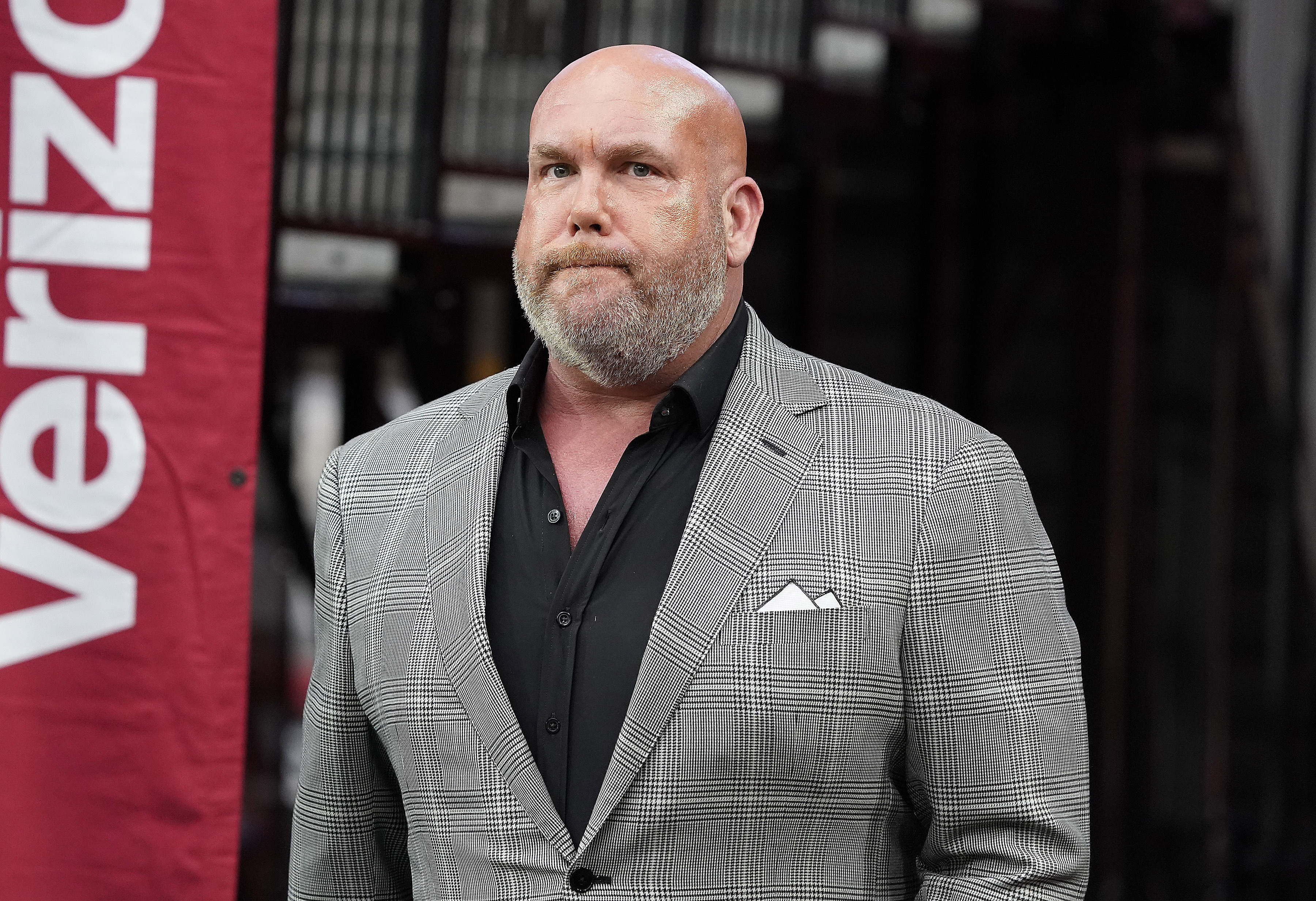
Former Arizona Cardinals General Manager Steve Keim says he was just as much of victim of Mohammed Coulibaly’s alleged scam.Darryl Webb
It’s what got Steve Keim, former general manager of the Arizona Cardinals, into the business.
Keim said he met Coulibaly through mutual Eagles acquaintances and by August 2025 he had bought his first Shopify store, which was recording sales at a pace that had him on track totriple his investment over six months. Keim bought into six more stores the following month, he said. His son and ex-wife would also buy into the business for at least a $1 million investment between all three.
Keim said he was soon offered the role of chief operating officer/chief growth officer, which he now sees as a way for Coulibaly to “legitimize his business.”
“I introduced him to people to sell stores to and that sort of thing,” said Keim, who describes fulfilling a figurehead role with no decision-making power. “He called me the COO but he also made promises to give me health insurance and to have some kind of bonus structure.”
The health insurance, bonuses, and exorbitant returns never materialized. Keim said he never had access to bank records and was never made aware of how many people gave money to Motion Venture. But by the start of the year, Keim claims, a flood of disgruntled investors were asking him for help getting their money back. Around this time, Keim said, he asked Coulibaly to stop using his name in promotional materials and told him he no longer wanted to be COO.
Keim contended he was as much of a victim as anyone else, holding onto hope that he could recover his money until Coulibaly’s death.
“This went downhill fast,” he said. “Not only did I get my name drug through the mud, I lost a lot of money since I was an investor.”
A Dubai deal
As more investors were demanding access to their Shopify funds in the fall, Coulibaly was telling them that the Dubai firm Middle East Venture Partners was interested in buying the operation for $215 million.
All they had to do was reach 175 online stores and meet other benchmarks by Aug. 1.
To back his claim Coulibaly produced a letter of intent dated Aug. 14, 2024.
Troubling for investors: The letter was dated more than a month before the company was registered in Pennsylvania.
The discrepancy was the biggest red flag for Barry Minkow, a convicted fraudster who now investigates scams on behalf of fraud victims. He started poking around the company at the start of the year for an investor who had put up $150,000.
“So here you are looking at a private equity company saying they’re going to buy up this company that doesn’t even exist for $200 million?” Minkow said in disbelief.
Middle East Venture Partners did not respond to an email to asking if a relationship existed with Coulibaly’s Vent Motion LLC.
With the permission of three of the alleged victims, Minkow submitted a 23-page whistleblower report to the U.S. Securities and Exchange Commission, FBI, and Pennsylvania Department of Banking and Securities. The report laid out victim accounts and flagged glaring issues with Motion Venture’s business model.
Minkow warned regulators in February thatintervention was essential to “halt ongoing solicitations, trace misallocated funds,” and stressed the importance of doing so “before the scheme inflicts further, irreparable harm.”
Minkow would prove to be right. Motion Venture was still actively recruiting new investors that month.
Picking up the pieces
Coulibaly’s college friend thinks he might have been one of the first victims of the Shopify sometime about three years ago. It involved less paperwork back then, more of a handshake deal. The friend put in $5,000 in a store with an investment protection promise in place, he said. Unlike that time in college, however, the friend only got half his money back.
The friendship with Coulibaly cooled after that.
“People just keep on saying he scammed NFL players,” said Coulibaly’s college friend. “No, anybody with money could be scammed, no matter how small.”
Coulibaly would insist money issues were the Dubai firm’s fault until his death, according to his alleged victims who shared screenshots and voice memos of conversations.
He ricocheted from distraught, lamenting the financial ruin that awaited him if he did not acquire more investors, to defiant, celebrating the Philadelphia 76ers’ LeBron James trade on X as he dodged investors.
When Keim and another investor flew into Philadelphia to meet with Coulibaly in late July, they spent a day and a half trying to figure out how much money was left, to no avail.
It was around that time that Coulibaly was soliciting the New York man for the $75,000 loan.
Coulibaly’s last post on X was a reshare a day before his death. “Trying to be everyone’s friend is a foolish behavior,” it read.
Whether any investor money remains is unclear. A now-defunct GoFundMe page put together by a man claiming to be Coulibaly’s brother raised more than $12,000 for the body’s “international transportation arrangements.”
Investors are also trying to figure out what legal recourse they might have, if any.
Coulibaly’s death has shattered any last remaining hope some victims had that a Dubai firm was to blame for cash-flow issues, and they are now seeking legal help.
It also left them feeling cheated one last time.
Staff writer Ryan W. Briggs contributed to this article.
Traffic is squeezed into one lane in each direction from 7 p.m. to 5 a.m., and residual morning delays have been reported. Crews sometimes also have to close lanes or temporarily stop all traffic during daytime to move equipment and materials.
It is a major undertaking for the Delaware River Port Authority, the bistate agency that owns and runs the Commodore Barry, as well as the Walt Whitman, Ben Franklin, and Betsy Ross Bridges.
As they move along the 13,912 feet of the bridge, industrial painting crews first sandblast layers of old paint and protective coatings that have built up over the years.
They work from suspended platforms in enclosed spaces of canvas, with containment systems that capture the gritty material used to clean the steel, lead-based paint, and other grime.
Although that up-in-the-air work is most visible to motorists, massive repairs are going on underneath, on the deck, and in the support structures below that, including the piers in the river.
Crews are removing crumbling concrete and replacing it, repairing the drainage system, and installing 14,000 feet of new electrical conduits and wire, DRPA officials say.
The rehab began in spring 2025, with replacement of the movable “zipper” barrier that separates lanes of bridge traffic. It was finished last summer.
The bridge opened in 1974 after five years of construction.
Earlier, people relied on ferries to cross from one state to another.
In 1930, the Chester-Bridgeport Ferry began running, with a capacity of 60 cars per trip. Six years later, the ferry’s boats were added to the federal highway system, as moveable parts of U.S. Route 332.
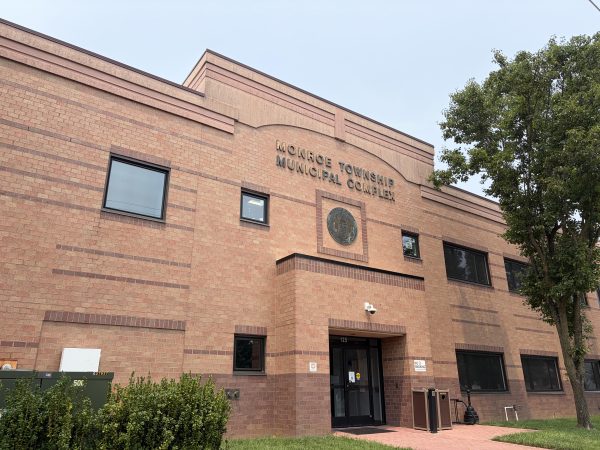
Monroe Township officials requested in late July to dismiss a $300 million lawsuit by Princeton-based real estate developer Hexa Builders challenging the municipality’s data center ban.
The Gloucester County case continues as other South Jersey municipalities consider and pass data center bans, including Cherry Hill, Millville, Medford, and, as of this week, Collingswood.
The request for dismissal came less than a month after Monroe pushed Hexa Builders’ complaint from state to federal court under the claim that some of Hexa’s allegations fell under the U.S. Constitution and should be addressed federally.
Some of the 20 counts alleged by Hexa include violations of the equal protection clause of the 14th Amendment and freedom of speech under the First Amendment.
On July 28, Todd Gelfand, the attorney representing Monroe’s mayor and council, filed a four-page letter listing reasons that he said Hexa’s lawsuit against the data center ban is not valid.
Gelfand rejected Hexa’s constitutional arguments, cited a lack of a physical contract promising data centers to Hexa, and argued Monroe had a right to amend a zoning ordinance based on public objections.
“[The data center ban] does not regulate the content of speech, a speaker, a message, or Plaintiffs’ ability to engage in expressive activity. The fact that data centers support electronic communications does not transform a land-use regulation into a speech restriction,” Gelfand wrote.
In response, Jim Maley, the attorney representing Hexa Builders, requested on Monday to push the majority of Hexa’s complaint — the parts that are not based on the Constitution — back to New Jersey state court. The next day, he asked the federal judge currently overseeing the case to reject Monroe’s request for dismissal.
Maley said state courts have more expertise to consider the local land-use laws that affect Hexa Builders most, and Hexa’s federal claims should be considered second.
“To further the federal claims, the constitutional claims, there has to first be determination of whether there was a violation of the land-use laws,” Maley said. “If land use wasn’t violated, that will hurt [our] federal claims.”
U.S. District Judge Edward Kiel has not yet made official moves in reaction to the letters, which Maley said could take a while.
Sandra Graise, Monroe Township’s solicitor, declined to comment and said the township does not speak about pending litigation.
Hexa filed the original lawsuit on June 5 in New Jersey Superior Court shortly after Monroe officials denied its application to build a 1 million-square-foot data center and a warehouse at 3043 Black Horse Pike, a property the company has sought to develop since 2022.
The denial followed months of public outcry at local government meetings after residents discovered that a change to Hexa’s redevelopment plan in early 2025 allowed the developer to propose a data center.
Collingswood considers ordinance on data centers
As the parties go back and forth, nearby municipalities have taken initiative to ban data centers before a proposal ever arrives.
At a Monday night meeting in Collingswood, the Camden County borough’s three commissioners considered an ordinance amending Collingswood’s code to ban data centers and “computing nodes,” which the borough defines as modular units installed at residential or small commercial properties that supply computing capacity to third parties in exchange for payment or credits to the property owner.
Maley, who represents Hexa in Monroe, is also a member of Collingswood’s board of commissioners.
Two residents who attended the borough meeting brought up Maley’s connection to the Hexa case and asked whether Maley would recuse himself from the vote based on his employment as a private attorney supporting a potential data center nearby.
In response, Collingswood solicitor Caitlin Harney Norcia said she could not find evidence that would disqualify Maley from voting under New Jersey’s Local Government Ethics Law, since Maley’s job as an attorney does not directly affect his work in Collingswood.
While Maley decided to abstain from the vote, he said the borough should have a six-month waiting period to allow the borough planner time to consider standards for data centers, called the move “a ban of reaction,” and said the borough does not have room for a data center anyway.
“We don’t prohibit airports. OK, that’s a permitted use. We don’t do that because there’s no place you can put an airport. There’s no place in this town you can put a data center,” Maley said in a live recording of the meeting on Facebook. “But the nodes are another issue.”
When reached for comment Wednesday, Maley said he did not have to abstain from the vote, but he still chose to for nonlegal reasons.
“Folks in the crowd, they’re working really hard to beat me up on a lot of different things. It’s a group that’s been against me for years. … Whatever my vote would have been, they would have been yelling and screaming about it and impacting my work,” Maley said.
Collingswood’s two other commissioners voted to approve the data center and computing node ban on its second reading. The ordinance took effect immediately.
Lindsay Ward grows more nervous with each passing year, knowing her ultra-rare genetic disease could emerge at any time.
The 37-year-old schoolteacher from West Deptford, New Jersey, inherited the genetic mutation that causes RVCL — retinal vasculopathy with cerebral leukoencephalopathy — which damages small blood vessels throughout the body and typically shows up between the ages of 35 and 50. It causes premature death as brain, retinal, liver, and kidney damage accumulate.
Many patients die within five to 10 years of symptom onset.
“It’s relentless,” said Jonathan Miner, who directs the RVCL Research Center at Penn. “They go from being completely healthy to becoming blind, unable to walk or talk, with kidney failure and other problems.”
The disease currently has no cure. However, Miner recently received a $10 million gift from the Illinois-based nonprofit Clayco Foundation to develop a potential treatment.
The idea behind his small-molecule drug is to eliminate the faulty protein driving the disease before it can cause damage. The drug will still need to be tested in animals to evaluate safety before possibly moving into clinical trials.
Most exploratory scientific efforts do not advance to the point where they are found safe and effective in humans. Even if the results are promising, it could take years before a potential new drug becomes widely available.
Ward has already seen the disease ripple through her family.
Her uncle died from RVCL last year. Her mother, Barbara Small, was diagnosed in 2018 after almost four years of symptoms.
She hopes for a treatment that can help her avoid their fates.
“I do as many active things as humanly possible because I’m so worried about becoming frail,” Ward said. “I see the weakness that my mom has and I don’t want that.”
Lindsay Ward, who inherited the mutation that causes RVCL from her mother, lives an active lifestyle.CHARLES FOX / Staff Photographer
What is RVCL?
Fewer than 50 families worldwide are known to have RVCL.
The rare disease is often misdiagnosed as various autoimmune diseases, including multiple sclerosis and lupus. Only through a genetic test can patients verify an RVCL diagnosis — characterized by a mutation in a gene called TREX1.
The gene encodes a protein of the same name, TREX1, which, when mutated, becomes misplaced in a cell and damages DNA.
Over time, this causes small blood vessels to break down and disappear. The loss of blood flow leads to organ damage, including blindness, glaucoma, chronic kidney disease, strokes, and neurological effects.
When asked how he felt about the donation, Miner reflected on seeing many patients die from the disease and kids lose their parents young.
“I believe that everybody deserves a chance to live,” he said.
A potential drug
Jonathan Miner directs the RVCL Research Center at Penn.Credit to StoryTrack Studio
Miner’s drug candidate belongs to a new class of medicines called a degrader.
The drug eliminates the mutated TREX1 protein by pairing it with another protein called “E3.” E3’s role is to label other proteins for destruction, much like putting a shipping label on a package to direct it to the right address.
By labeling TREX1, “it basically tells the cell’s own machinery to eliminate this faulty protein,” Miner said.
If the drug proves effective, patients would ideally take it before they get sick, to prevent injury to blood vessels and organs.
When tested in mice with the disease, the drug protected cells from DNA damage and prevented premature death.
“We haven’t seen side effects in the mice, but we need to do much more extensive studies to prove that there are no side effects in animals before we can move forward,” Miner said.
The first and only FDA-approved degrader was developed for advanced breast cancer and approved in May. Miner’s TREX1 degrader is one of many variations on the novel technology that have emerged.
The $10 million donation will fund preclinical safety studies. The goal is to complete this testing over the next year, and, if it proves to be safe, move on to humans.
If the drug advances to a clinical trial, it would still take years to test the safety and efficacy. Most treatments evaluated in clinical trials do not become standard practice.
“Nothing has moved the needle yet in terms of delaying death and disability,” Miner said. “This, we think, gives us a real chance.”
Waiting
Barbara Small, her husband Dave, and grandchild Declan.Courtesy of Lindsay Ward
Ward’s 67-year-old mother, Barbara Small, who lives in Cape May Courthouse,started to show symptoms in her 50s.
What began as blurry vision and a damaged optic nerve progressed to a stroke. Roughly four years later, in 2018, she was diagnosed with RVCL.
Today, she is “pretty much blind” in one eye, Ward said, and has had a few strokes. She will frequently have aphasia, a communication disorder that can cause trouble speaking, and memory issues. Small is physically weak overall, and cannot walk very far without having to sit down.
“It is very challenging to see what your future will be,” said Ward, who helps take care of her mother.
Ward gets an MRI and diagnostic eye testing every six months to check for symptoms.
She and her husband, Matt, have three kids, with the youngest being a year and a half old. They don’t know whether their children inherited the mutation (testing is not recommended in children due to the late onset of the disease).
Lindsay Ward, 37, has three children with her husband, Matt.Courtesy of Lindsay Ward
However, if a preventive treatment were to come out, she would test them sooner.
Ward recently attended the International RVCL Symposium at Penn, where Miner presented on his research and potential clinical trial.
For patients like her mother, the treatment would likely just stabilize her condition and not reverse existing damage, she said. However, Ward is hopeful that the drug, if proven to be safe and effective, could help prevent her and her kids (should they test positive for the mutation) from becoming symptomatic.
“I would like to live a long, healthy life,” she said. “That would be my goal.”