In this week’s Shackamaxon, the race for City Council kicks off, SEPTA police officers step in front of the cameras, and a Big Tech reckoning comes for the Ambitious Abingtonian.
Councilmember Jeffery “Jay” Young Jr. during the Barber’s Hall community legacy celebration on Aug. 1.Yong Kim / Staff Photographer
Contrarian challenge
In political circles, the legislative lineage of Philadelphia’s 5th Council District is one of the city’s most esteemed and iconic. The first person to represent the residents of the 5th in City Council was Raymond Pace Alexander, the civil rights leader who was later appointed as the first African American judge on the Court of Common Pleas. The seat has also been held by Cecil B. Moore, Ethel Allen, and John Street. Few other districts can boast such an impressive list of luminaries.
Today, its occupant is someone very different, Council’s quarrelsome contrarian, Jeffery “Jay” Young Jr.
Of course, there’s nothing wrong with “good trouble” or sticking out from the crowd. Moore himself was famously pugnacious, with the former Marine once quoted as saying that “The imported Gandhi philosophy of nonviolence that still exists in the South will not be accepted in Philadelphia, where we believe in self-help and self-defense.” Allen was also a maverick, styling herself as a “B.F.R. — a Black, female Republican, an entity as rare as a Black elephant and just as smart.”
Moore and Allen, however, were quarrelsome on behalf of the people they represented, and contrarians at a time when Black Philadelphians were mostly excluded from the halls of power.
Moore successfully desegregated Girard College, paving the way for Young himself to attend decades later.
Young, however, starts fights that help nobody. Worse, no one seems to understand why he’s fighting in the first place.
From delaying repairs at the Cecil B. Moore Library to blocking popular housing proposals, Young’s actions frequently bring him in conflict, rather than concert, with the community he was elected to represent.
It is unsurprising, then, to see that he’s already attracted a declared challenger for his seat, months before election season kicks off in earnest.
Jalon Alexander has a big advantage over the opponents Young (almost) faced in the past: He’s managed to successfully get onto the ballot before, during the 2023 City Council at-large election.
While he brings his own ideas to the table, Alexander is also clearly running in opposition to Young’s choices. The cybersecurity attorney grew up in Strawberry Mansion, and still lives there, but is running a campaign built to find support across the district’s geographic and political spectrum.
Kellan White, at this point a potential candidate, presents another strong alternative. White managed Rebecca Rhynhart’s 2023 mayoral campaign, which was successful across much of the 5th District. He has a deep knowledge of city politics and policy, and a Rolodex of contacts that any political journalist would be jealous of. Unlike Young, both Alexander and White are willing to answer the phone to talk to reporters, community leaders, and their constituents.
At this point, even if a dozen candidates run against him and split the opposition vote, Young may still face an uphill battle.
When I’ve criticized other Council members, I always get calls or emails from constituents who defend their choices. In nearly three years writing about Young, not a single person has offered a defense.
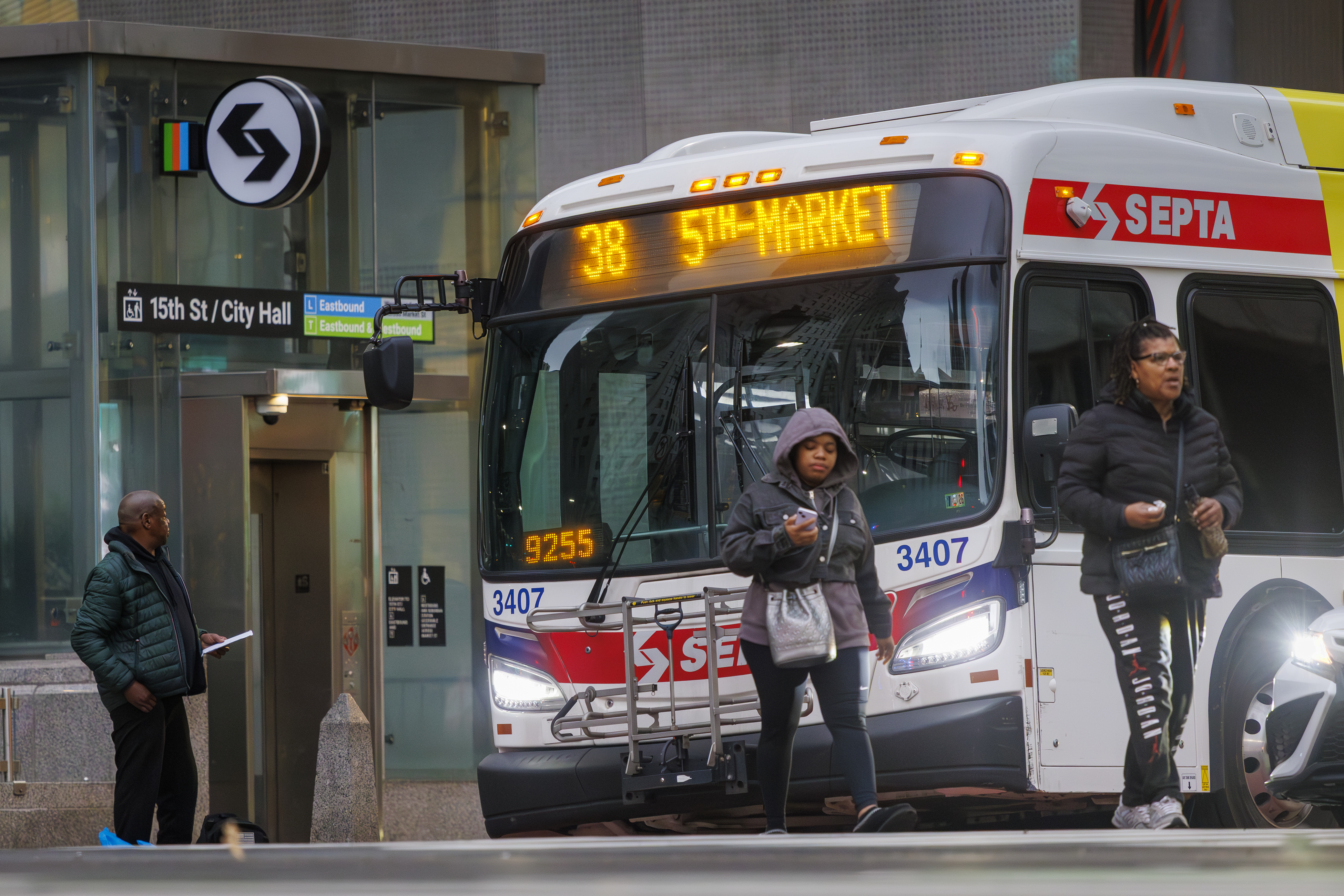
A SEPTA Route 38 bus at 15th and Market Streets in May.Alejandro A. Alvarez / Staff Photographer
Spotlight on SEPTA
A few readers have asked me about film crews they’ve seen following SEPTA police around stations and transit vehicles recently. Media Relations Director Andrew Busch confirmed that the A&E Network is filming a docuseries, which will be broadcast next year.
Personally, I’m looking forward to watching it. SEPTA’s roughly 250-strong police force is charged with patrolling more than 285 train and trolley stations, and nearly 3,000 vehicles. They are also in the midst of substantial declines in serious crime, which occurred alongside a crackdown on fare evasion and a surge in enforcement for quality-of-life issues. That’s a story worth showing.
Less worthwhile would be a series focused on Kensington and the city’s drug epidemic. That’s a real part of SEPTA’s policing duties, but is often exploitative when told by outsiders.
Gov. Josh Shapiro announces a $20 billion investment by Amazon in Pennsylvania data centers in Salem and Falls Townships in 2025.Commonwealth Media Services
Data-driven
Ever since the creation of the first computer, there have been concerns about its role in the future. It doesn’t help matters that many tech CEOs, like OpenAI’s Sam Altman, regularly express a kind of contemptuous attitude toward humanity and human needs. At one point, Altman said that artificial intelligence would “lead to the end of the world.” How inspiring!
This has put public officials in a tough position over their support of data centers.
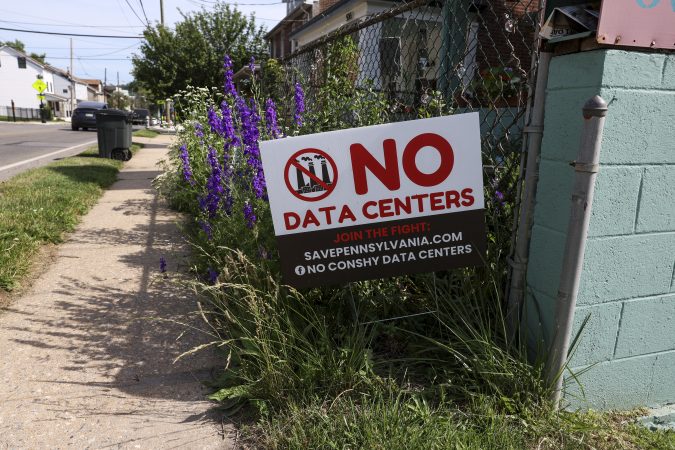
For generations, states and cities have competed to attract investment. But these days, cash is flowing into an industry opposed by 74% of voters. Seeing an opportunity, challengers from across the political spectrum are using data centers in their political attack ads, while incumbents are scrambling to explain themselves.
Gov. Josh Shapiro, the Ambitious Abingtonian, exemplifies this conundrum. He was an early advocate for embracing data centers, but with polls tightening for his reelection efforts, he’s been forced to adapt.
Of course, there’s a certain opportunism to state Treasurer Stacy Garrity’s embrace of the techlash.
Her own party has been quite supportive of data centers. President Donald Trump has called them “tremendous.” Pennsylvania state Senate Majority Leader Joe Pittman has long advocated for the centers, which represent a particular opportunity for his own community, which has, in his words, “a long and storied history when it comes to the production of electricity.” U.S. Sen. Dave McCormick, the highest-ranking Republican in Pennsylvania, is married to Meta executive Dina Powell McCormick. Meta is one of the four companies investing a total of $1.5 trillion in new data centers.
Pennsylvania Senate Republicans declined to pursue Shapiro’s proposed “GRID” initiative, which would have required the centers to produce their own electricity, conform to environmental standards, and make community benefits agreements in exchange for permitting assistance.
Many of the current pitchfork-wielding politicos may themselves be forced to pivot when in office. Voters may hate data centers, but they also hate tax increases and service cuts.
Loudoun County, Va., which is known as data center alley, has averted both. Local authorities have cut property tax rates by nearly 30% over the last decade, and the centers pay roughly half of the county’s property tax revenue. Given the increasing share of Pennsylvania’s budget that is paid through the extractive gambling industry, the need to invest more in schools and transportation, and the continuing structural deficit, it is no surprise politicians initially saw the AI boom as an opportunity.
Now, state leaders will have to pick their poison.
If they pursue data centers, they’ll face voter backlash. If they continue to embrace gambling, they’ll contribute to the impoverishment of their own constituents. If they stop investing in education or allow transit agencies to fail, they’ll weaken the commonwealth’s economy going forward. If they raise taxes, they’ll take the blame for that, too.
While the data center surge may seem sudden to many, it is also a response to demand. Both businesses and individuals are increasingly using AI in daily life.
Ironically, many social media posts about data centers include AI-generated text and images. It is a bit like if the Women’s Christian Temperance Union had fundraised with a booze cruise.
Gov. Josh Shapiro made a declaration in the early days of his administration: Pennsylvania is open for business.
The move would ultimately include promises to slash bureaucratic red tape, cut permit wait times, and offer a new direct line to Shapiro’s office for major corporations hoping to set up shop in Pennsylvania.
Pennsylvania would “move at the speed of business” and “get stuff done,” the new mottos used by his administration, he said. He’s campaigning for reelection in November on the same catchphrases, and boasting major successes like the 12-day repair of I-95 in 2023 that traditionally would have taken months to reopen as an example of how he can think outside the box to solve problems.
What’s more: He sees delivering for residents — showing them government can actually solve problems — as the future of the nationalDemocratic Party, while it searches for an effective message and messenger heading into the 2028 presidential primary, which he is widely expected to enter.
It was with this same spirit last summer that Shapiro announced the largest single private sector investment in Pennsylvania history: Amazon committed $20 billion in Pennsylvania that included two data center campuses in Luzerne and Bucks Counties. Pennsylvania scored the project because of its promise to fast-track permitting and use tax breaks for the massive developments.
“Pennsylvania’s gonna be better off. I think America’s gonna be better off, because we’re going to win the battle of AI supremacy and it’s going to be done right here in the commonwealth of Pennsylvania,” Shapiro said in an interview on CNBC’s Squawk Box on the day he announced the deal.
Gov. Josh Shapiro announces a $20 billion investment by Amazon in Pennsylvania data centers in Salem Township and Falls Township on June 9, 2025.Commonwealth Media Services
But in a year’s time, the politics — and public opinion on both sides of the aisle — have dramatically shifted on data center development. Shapiro’s early welcome of data centers has created an opening for criticism from his gubernatorial opponent and members of his own party.
Yet efforts to cut red tape have proven to be slow and overblown: Only six data centers are actually under construction in Pennsylvania since the announcement, and 10 have received at least one state-level permit approval, according to Shapiro’s office. Still, Shapiro’s popularity is being evaluated by some voters and anti-data center activists on a perception that he moved too quickly and sacrificed the state’s safety in favor of Big Tech.
“I am all about legislators and decision makers getting s— done. This version of it is reckless and it’s irresponsible and it’s not actually serving our people,” said Carrie Santoro, the executive director of progressive advocacy groupPennsylvania Stands Up who has been holding town hall meetings in communities around the state on data centers.
“Governor Shapiro intends to use all the tools available to him to stop the dozens of speculative data center projects that do not meet community needs and Pennsylvania should expect to hear more from him on that in the coming weeks,” said Shapiro’s press secretary, Rosie Lapowsky.
Now Shapiro, who otherwise maintains vast popularity ratings in the state, faces a vulnerability on one of voters’ top priorities as he heads into November, and a particularly sensitive concern among Democrats as he potentially vies for the party’s nomination in two years.
Many states, including Pennsylvania, had already begun welcoming the major projects, and some hyperscale developers plan to spend billions of dollars to build them. Pennsylvania’s General Assembly first approved a sales tax exemption for data center developments in 2021, when Shapiro’s predecessor, Democratic Gov. Tom Wolf, was still in office.
Shapiro, for his part, initially embraced data centers as an economic opportunity for Pennsylvania, bringing union jobs for construction workers to build out the physical infrastructure for the computers running AI software. He also wanted to position Pennsylvania to inherit the most benefit from providing space for AI to operate, leading not only other states but also other countries in the race to advance new technology. He and U.S. Sen. Dave McCormick (R., Pa.) appeared together as early embracers of the technology and the massive buildings needed to power it, speaking together during McCormick’s first AI summit in Pittsburgh last summer.
Sen. Dave McCormick shakes hands with Gov. Josh Shapiro at a panel discussing state investment and infrastructure at the Pennsylvania Energy and Innovation Summit at Carnegie Mellon University in Pittsburgh on July 15, 2025.Kaiden J. Yu / Staff Photographer
But as communities began to push back against the rapid proliferation of data center proposals, in part to protect their water and energy resources, Shapiro adjusted.
Shapiro, like many elected officials, has changed his positions and rhetoric on the unpopular developments. He announced his Governor’s Responsible Infrastructure Standards (GRID) as a way to incentivize developers to follow transparency and environmental requirements in order to receive tax breaks. And when the General Assembly failed to approve his GRID standards or any substantial data center restrictions, Shapiro said he’d act on his own, though it’s still unclear what that will entail.
“You want to build a data center there? You’ve got to bring your own power; you’ve got to pay for your own power. You’ve got to be transparent with the local community — tell them who the hyperscaler is, tell them what’s going to go on there. You’ve got to have a local benefits agreement to help that community. You’ve got to protect the water sources that are used to cool off those facilities,” he said in a June interview with GZERO.
The Democratic governor has been lauded nationally for challenging PJM Interconnection, which is the electric grid operator for Pennsylvania and 12 other states over its efforts to raise prices on ratepayers. He capped the price Pennsylvania consumers could pay through 2029, as residents fear rate hikes due to the data center boom.
But Shapiro’s plan on data centers is too little, too late, Santoro said.
“I saw the GRID proposal as him moving on this issue, and the thing that I am concerned about is he didn’t move enough to keep up with how much voters have moved on this issue,” she said.
Some of those voters would agree. A Quinnipiac University poll of Pennsylvania voters, conducted in early June, found just 24% of those surveyed — and 40% of Democrats — approved of “the way Gov. Josh Shapiro is handling data centers in Pennsylvania.” It’s a stark contrast to Shapiro’s overall approval numbers, in which he’s maintained above 50% approvals — record-high favorability ratings for a first-term Pennsylvania governor.
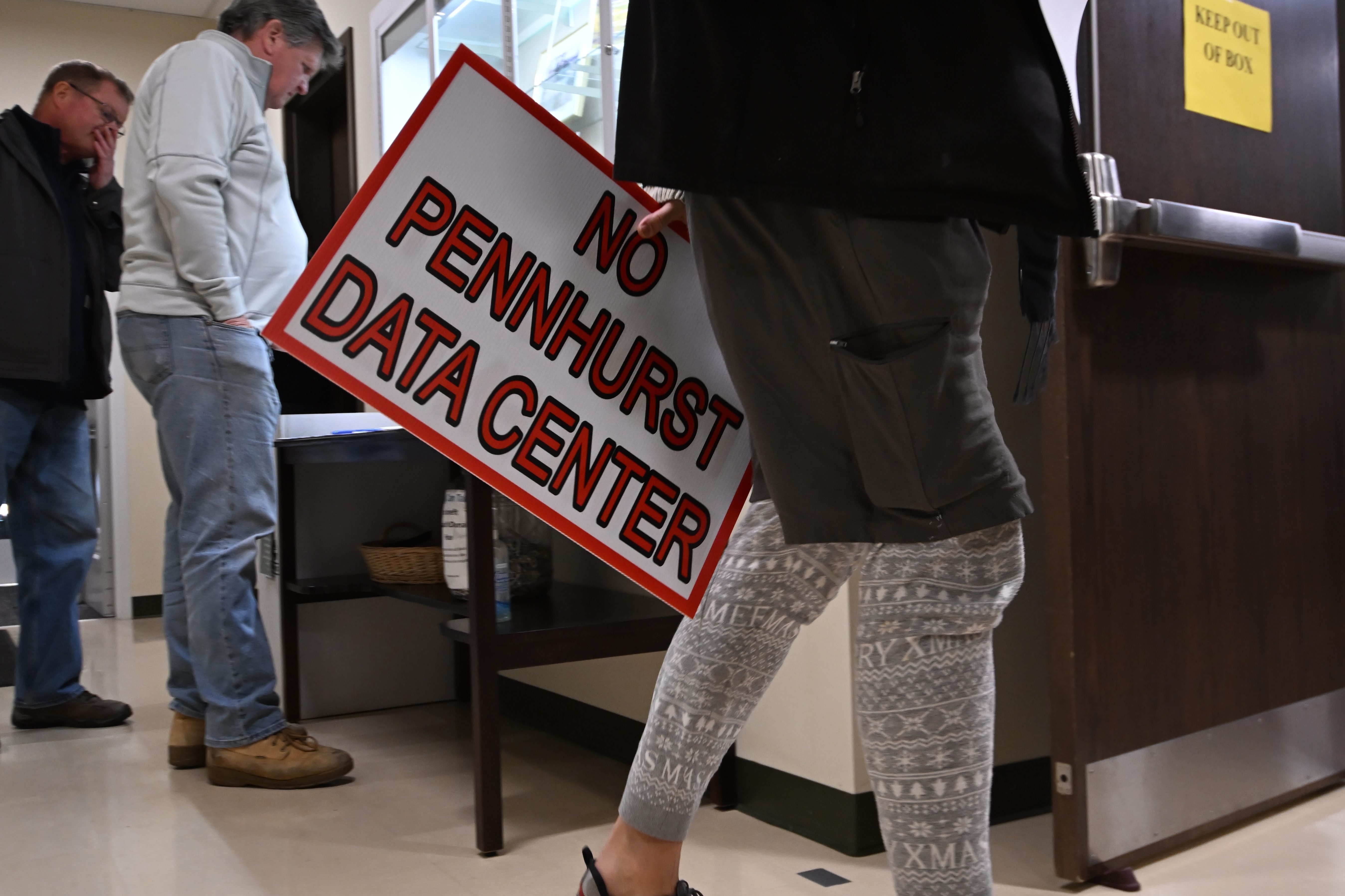
People sign in and head into an East Vincent Township supervisors meeting where an agenda item involved a data center proposal at the former Pennhurst state hospital grounds on Dec. 17, 2025, in Spring City, Pa. Marc Levy
Joanna Tenney, 36, of East Vincent in Chester County, held a sign at a June rally in the state Capitol that read: “Shapiro: Amazon’s bootlicker.” A registered Democrat, she voted for him in 2022, and believes he should be held accountable for supporting data center development in Pennsylvania that led to the fast-tracking of a now-stalled 125-acre data center project near where she lives.
She’s so fed up with Shapiro’s approach to data centers that she said will be writing in the name of her state senator, Sen. Katie Muth (D., Chester), who has been on the front lines of advocating for many state environmental issues, for governor on her November ballot. Tenney said she and a few other anti-data center advocates plan to run a write-in campaign for Muth.
“We’ve elected somebody that we thought was going to make the right choices by us, and we don’t really see that happening,” Tenney said.
Muth, who took office in 2018, said she would not be supporting Shapiro or “any elected official who puts the interests of Big Tech ahead of the health, safety, and future of Pennsylvania communities.”
If Shapiro changes his stance on data centers, she would support him, Muth said. She is the prime sponsor of a bipartisan bill to place a three-year moratorium on hyperscale data center development.
“Get right on the issue, Right your wrongs. If you can’t be on the side of science and people, my support is MIA,” she added.
Emily VanFleet, 26, lives in Archbald in Northeastern Pennsylvania, where six data center projects are underway comprising more than 50 buildings that, when completed, will cover 14% of the town. VanFleet, who is an unaffiliated voter, said she also supported Shapiro in 2022. But because of his public support for speeding up data center development in Pennsylvania, she is “certainly not going to vote for him this upcoming election,” she said. She isn’t sure she’s going to vote at all.
“I want Shapiro to stop being a coward,” VanFleet said in June. “I have emailed him, I have called him, I have reached out to him so many times. I have not heard back, not once. I see his videos all over social media that he has an open-door policy, but I have yet to see it.”
(In May, Shapiro’s administration announced that one of the unpopular Archbald developments, Project Gravity, was removed from a fast-track permitting program for failing to properly engage with the community.)
But negative attitudes toward Shapiro’s position on data centers may be limited statewide and his position is unlikely to dramatically knock down his high popularity or reelection odds: The June Quinnipiac poll found 56% of those surveyed approve of the way he is handling his job as governor overall, and recent polling shows Shapiro ahead 53% to 40% against his Republican challenger, state Treasurer Stacy Garrity.
The data center pitfall
Shapiro’s political opponents — both immediate and prospective — are also seizing on the issue.
Garrity, of Athens in Northeastern Pennsylvania, has also led a statewide listening tour on the topic. In June, she convened one of those sessions in Hatfield with a group of commissioners, zoning planners and emergency responders to talk about how they have been impacted by data centers. She blasted Shapiro for his role in attracting Amazon and said his proposed new requirements amount to a “flip flop.”
“Josh Shapiro has failed on this topic. He was the biggest cheerleader for data center development in Pennsylvania, until he wasn’t,” Garrity said at the June 24 meeting.
Pennsylvania Treasurer Stacy Garrity participates in the podcast “Ruthless” during an event hosted by Americans for Prosperity, Concerned Veterans for America, and the Libre Initiative at the National Constitution Center in Philadelphia on Jan. 29. Elizabeth Robertson / Staff Photographer
Garrity has her own mixed record on data centers.
At the time of the Amazon announcement, Garrity called the investment “great news” that would bring “historic investment” and “create thousands of jobs.” And her current position remains unclear. She has said she opposes a statewide moratorium but wants “a pause” on development instead.
Like Republicans running in districts that supported Trump in 2024 but oppose data centers, she appears to be attempting to find a pro-business and pro-regulation path.
“We want to make sure data centers are an addition to the grid, not a contraction. If there’s infrastructure that needs to be added to the grid, rate payers shouldn’t be paying for it,” she said. “I’m not opposed to data centers, but we have to do them the right way, and we haven’t done it. It’s because of a lack of leadership from the government.”
Garrity’s “long record of supporting completely unregulated data center development makes it clear that she just can’t be trusted,” said Manuel Bonder, a spokesperson for Shapiro’s campaign.
Local government leaders said at Garrity’s campaign roundtable in June that there has been lack of guidance around issues, especially around power demand, water use, infrastructure, environmental impacts, and community compatibility.
Kathie Doyle, a Republican on the Richland Township Board of Supervisors, said confusion around data centers have “set off a firestorm” in her community. Earlier this year, warnings of a supposed proposal for a data center in the Bucks County township circulated on social media, but turned out to be a “business park” with two buildings.
“Our residents don’t understand that we just cannot say no,” she said. Municipalities in Pennsylvania cannot outright ban data center development.
Santoro said Shapiro’s inconsistency is a liability that could sway some voters away from casting their ballot for him.
“Certainly he is giving her an ‘in’ by staying on the wrong side of this,” she said.
And it’s not just Republicans seizing on Shapiro’s position. The early reputation Shapiro earned as a champion of data centers may become a point of attack among other Democratic contenders for the presidency in 2028, too. In a veiled jab at Shapiro in June, Illinois Gov. JB Pritzker, knocked Pennsylvania on a businesspodcast for allowing Constellation Energy to restart Three Mile Island nuclear plant just to power Microsoft’s data centers.
“My guess is that’s going to be a reasonably unpopular thing to have done,” Pritzker said, without noting Shapiro by name on the Prof G Markets podcast.
Vulnerability for down-ballot Democrats
With a $50 million campaign war chest and high approval ratings, Shapiro is widely favored to win reelection this year. But his record on data centers could prove a liability for those he’s hoping to pull along, some advocates, like Santoro, say.
Shapiro has been staking much of his national political clout on his ability to flip four House districts in Pennsylvania for Democratic control of the U.S. House, drawing voters to the polls with his name at the top of the ticket. He’s also aiming to flip Pennsylvania’s Senate into Democratic control for the first time since 1993, giving him a Democratic trifecta in Harrisburg, as the state’s split legislature has blocked many of Democrats’ priorities from becoming law.
Santoro predicted that could be in jeopardy “if he does not change course.”
“Shapiro’s leadership on data centers will be the thing that costs us the first Democratic trifecta in 31 years, and I think that while he will likely win reelection with this wildly unpopular position on data centers, other elected officials and candidates will not,” she said.
Other Democratic candidates aware of data centers’ deep unpopularity are differentiating themselves on the issue, despite remaining otherwise aligned with Shapiro. Scranton Mayor Paige Cognetti, who is running in Pennsylvania’s 8th Congressional District, released a new ad last month putting data center developers on notice.
“Big Tech needs to pay their own way, not hide behind [nondisclosure agreements]. No tax breaks. Don’t raise our electric bills. Don’t poison our water. And hire local union labor,” she said, in the ad spot. “You can’t meet that? Then get out.”
Cognetti’s stance isn’t vastly different from Shapiro’s — both want to end blanket tax breaks — but her rhetoric is much stronger, and she’s putting the issue at the forefront of her campaign.
Democrats insist Republicans, including those running at the state level, don’t have the moral high ground on data centers after failing to pass through several measures that would have enacted stricter controls for their approval.
Sam Silverman, a former congressional aide and founder of Silverman Strategy Group, a strategic communications firm focused on technology and politics, said Shapiro’s approach to data centers — proposing a plan rather than enacting a moratorium — presents a risk that could either pay off and become the model for other states, or fail to fully address all future concerns and is unpopular.
“Shapiro is going out in front by proposing a bargain now. If the standards protect ratepayers, produce visible benefits, and hold bad actors accountable, Pennsylvania could have a model others can follow,” he said. “But because he is putting forward the deal now, he will be judged on whether it delivers.”
Taking a risk involves trust, though. Shapiro can afford to make a big swing at one of the hottest issues in politics because voters put so much faith in him, Silverman said.
“Most politicians do not have the amount of trust and political capital to take a risk, either,” Silverman said.
Whether the governor is triumphant will come down to what standards go into effect and whether bad actors are held accountable, he said, “and whether Pennsylvanians believe those standards are working.”
WASHINGTON — A new federal proposal to enact protections for communities opposed to the proliferation of data centers has drawn inspiration from both the Philadelphia suburbs and Western Pennsylvania fracking country.
The Data Center Bill of Rights is one of several national efforts to address a growing dissatisfaction with data centers, which have so far faced few restrictions at either the federal or state level in Pennsylvania.
U.S. Rep. Ro Khanna, a California Democrat and Bucks County native considering running for president in 2028, said his home state should be doing more.
He introduced thefederal legislation after a recent tour across Pennsylvania that he said was designed to hear from communities that have lost manufacturing jobs and other economic opportunities.
Data center concerns came up more than any other issue, he said — leading him to incorporate new ideas into the bill healready had in the works, and to call for a pause on data center development in Pennsylvania until further protections and local controls are enacted.
A statewide pause would be more than what Gov. Josh Shapiro — another potential 2028 Democratic contender — has proposed as he seeks to enact data center guidelines. It would also be less than other Democrats, both in Pennsylvania and nationally, who have called for more robust moratoriums. Shapiro’s Republican challenger this year, Treasurer Stacy Garrity, has also called for a pause but not for an extended moratorium.
“I was surprised by the anger about it in Pennsylvania,” Khanna said in an interview after his 15-county tour. “In other states, people are sometimes opposed in local communities, local pockets. But not this widespread anger.”
Khanna, a Council Rock High School graduate who has represented Silicon Valley in Congress since 2017, spoke about the Data Center Bill of Rights during his tour but said afterward that it was “partly inspired” by the concerns he heard in the communities similar to the ones where he grew up.
“As a kid, I used to go to Conshohocken and the King of Prussia Mall. I’m familiar with that area,” Khanna said. “You can’t ride roughshod over what Delaware County wants or when Montgomery County wants.”
The legislation would declare that communities have the right to reject data centers through a “transparent community process” or allow them with specific protections. That includes demanding that data centers don’t lead to higher electricity rates, that they use renewable energy sources and disclose their water consumption, and “pay their fair share of state and local taxes.”
State Rep. Chris Rabb (right) joins U.S. Rep. Ro Khanna (left) Tuesday, July 28, 2026, as he stops on his “Made in PA: New Economic Patriotism Tour” at the City Institute Library on Rittenhouse Square.Tom Gralish / Staff Photographer
One specific provision, Khanna said, was informed by his visit in Washington County with individuals who are paid to host natural gas wells on their properties. It was there that he said he learned of community demands for oil and gas well sites to be at least 2,500 feet from residences. That buffer was a recommendation from a 2020 grand jury report released by Shapiro when he was serving as attorney general and that outlined health and safety issues caused by fracking in the Marcellus Shale region.
The recommendation was not followed, and advocates are continuing to push for extending the buffer from the current distance of 500 feet, according to Inside Climate News.
Khanna’s bill of rights would call for data centers to be built no closer than 2,500 feet from residences, schools, childcare facilities, hospitals or nursing homes. He said the environmental and health hazards for data centers aren’t the same as fracking but they should be kept at a distance from communities that don’t want to live directly next to them.
“At least they were offering royalty checks in the cases of fracking,” Khanna said. “[Data center developers are] not even giving the communities checks. It’s just kind of like, ‘OK, we’re going to build.’ What does the community get out of it? I literally don’t understand it.”
Data center advocates have argued their development is critical in winning an artificial intelligence war with China, and that they will bring construction and some skilled jobs to communities that need them.
Even the staunchest advocates, though, have acknowledged the public blowback.
“I do think that data centers in Pennsylvania have raised legitimate concerns,” U.S. Sen. Dave McCormick (R., Pa.) said during a recent telephone town hall as he continued to promote them in the competition with China and their creation of “thousands of jobs.”
When developers are making their pitch, McCormick said they should come with commitments to protect energy costs and overuse of water, use local labor, invest in the community and pay taxes.
“That should be part of the deal up front,” McCormick said during the telephone town hall in late July. “With all those facts, then the local community can decide whether they want the data center or not. And if they choose not to, that’s their choice.”
Khanna said he’s hoping for bipartisan support as he introduces the bill of rights idea. He’ll also be competing with other proposals — like one from fellow progressives U.S. Rep. Alexandria Ocasio-Cortez (D., N.Y.) and U.S. Sen. Bernie Sanders (I., Vt.) called the AI Data Center Moratorium Act. The bill would enact an immediate federal moratorium on data center construction until other safeguards are passed into law, including some of the ideas Khanna and McCormick have proposed, like around utility costs.
Several Pennsylvania state-level laws have been proposed, though the legislature did not address them during its busy budget season earlier this spring and summer. Lawmakers also left Harrisburg without ending tax breaks aimed at incentivizing data center construction even though the idea had garnered widespread support.
“They shouldn’t be getting these tax breaks to build,” Khanna said. “That’s absurd when you’ve got hyperscalers that are making trillions of dollars.”
The fact that many of those ultra-wealthy corporations are based in his district made the issue a politically dicey situation for him, but also one that the possible presidential hopeful said he was willing to take on.
“We’ve got to pause it in states like Pennsylvania,” Khanna said. “Some of my own constituents aren’t going to like that.”
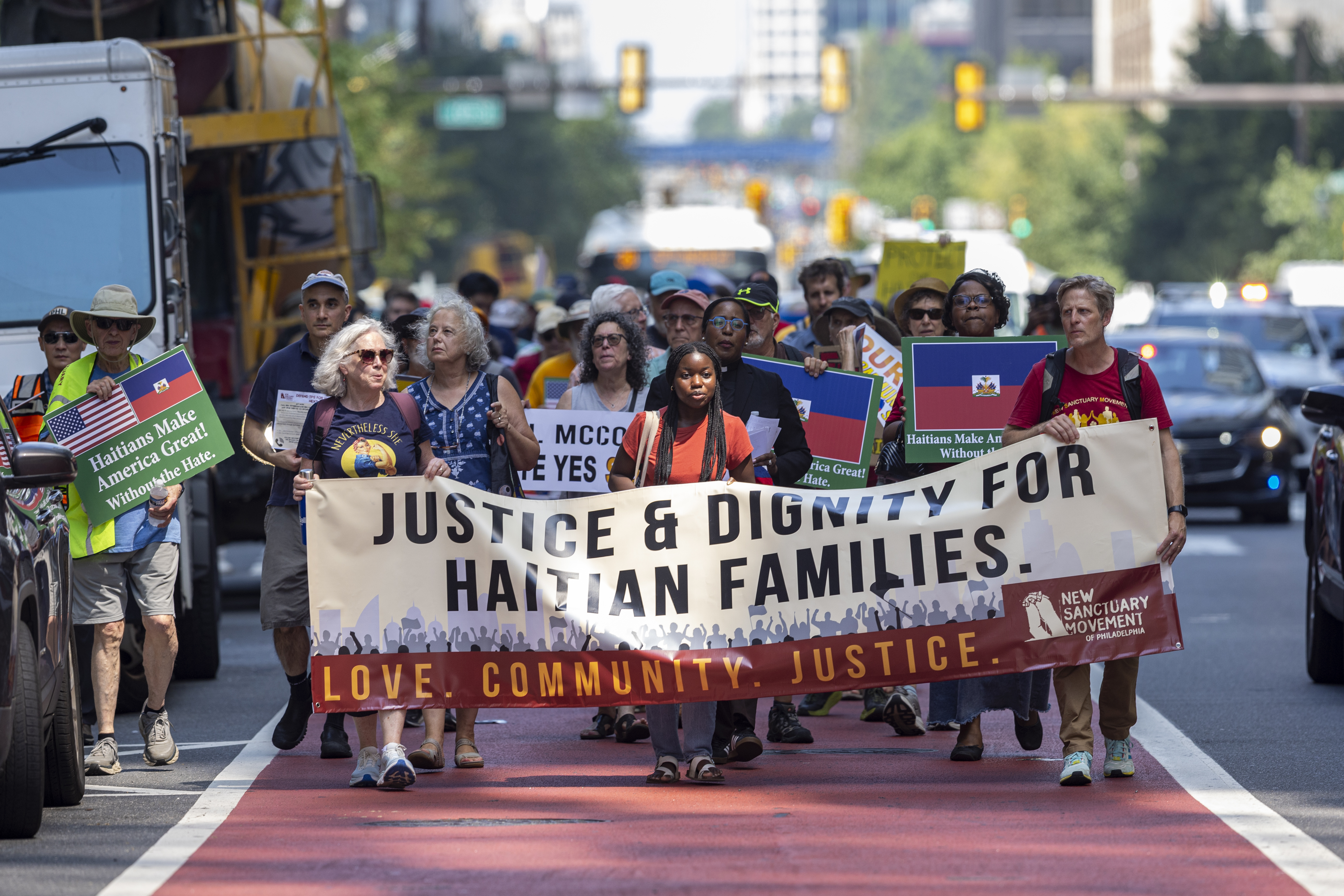
Dozens of Haitians, allies, and supporters rallied in Center City on Thursday, demanding that Pennsylvania’s U.S. senators help restore temporary protected status (TPS) for thousands now in danger of being deported to the shattered Caribbean nation.
They gathered outside the office of Republican U.S. Sen. Dave McCormick near 20th and Market Streets, then marched to the office of U.S. Sen. John Fetterman, a Democrat, near Second and Chestnut Streets.
People held up signs that said, “Our Haitian community is here to stay,” even as protections and work permits have ended for about 350,000 Haitians in the U.S. The Haitian community numbers about 11,000 in Philadelphia, and leaders say it seems everyone knows someone who had TPS or has it themselves.
Speakers said that TPS is more than an immigration status, that it is what allows neighbors, friends, and family members to live here, to work, pay taxes, and help build the country.
They called on the senators to help pass Senate Bill 4814, which would require the secretary of the Department of Homeland Security to designate Haiti for TPS through April 2029.
A spokesperson for McCormick said: “We respect everyone’s right to come together and voice their opinion. We appreciate the input.”
Efforts to reach a spokesperson for Fetterman were not immediately successful.
Pastor Kenel Stevenson said he knows of no local Haitians who have been taken into custody by U.S. Immigration and Customs Enforcement, or fitted with ankle monitors, as the ACLU says is happening elsewhere.
But the mood among his fellow Haitians is grim, he said.
“There is fear, fear of repatriation, of being returned to a place where there is no safety,” Stevenson said.
Nearly 100 people gathered before moving east toward Fetterman’s office shortly before noon, filling the breadth of Chestnut Street as police officers stopped traffic for the group to pass. Oppressive heat and humidity caused some older people to lag.
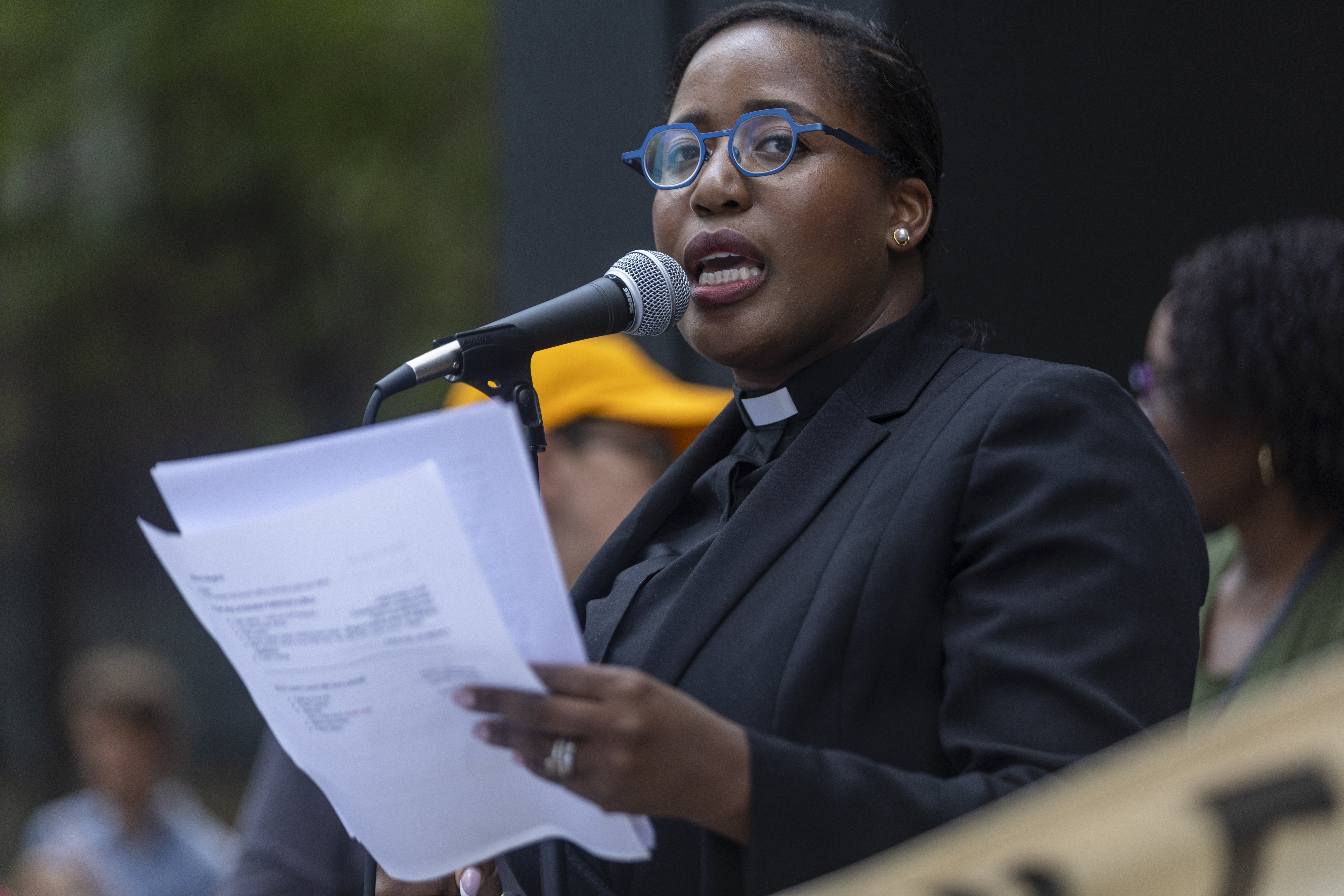
Reverend Jennifer Joseph of Zion Community Church in Delaware County addresses the crowd outside of U.S. Senator Dave McCormick’s office in Philadelphia on Thursday.Aidan T. Gallo / Staff Photographer
TPS has expired for an estimated 350,000 Haitians, ending their ability to legally work in this country and putting them at risk of deportation to a homeland riven by natural disaster and violent crime.
He searches himself to offer hope at a moment when people are desperate for some sense of tranquility.
“I had a mother called me the other day and asked if I could take custody of her child if she’s taken away,” Ulysse said.
Community leaders fear mass family separation, as Haitian nationals have married U.S. citizens and are raising American-born children.
“We are not criminals,” he said. “We have engineers, doctors, professors,” people who are eager to help and contribute.
“If people go back to Haiti, they will die, and if they stay as things are, they are in hiding, scared, and can’t leave their house,” he said, joining others outside Fetterman’s office.
Still, he said, he has not given up hope.
“America is a country of immigrants, and I believe they will stand with us,” Ulysse said. “Help us fight until the end!”
Hundreds of Haitian nationals have been told by immigration officials to appear at ICE offices to be fitted with ankle monitors, according to the ACLU.
Temporary protected status provides permission to live and work in the United States for people whose homelands are riven by war, natural disasters, epidemics, or other extraordinary circumstances.
Haiti suffered a massive earthquake in 2010 that led the Obama administration to announce that undocumented Haitian immigrants in the U.S. would be eligible for TPS. Thousands more would be welcomed over time under humanitarian programs and become eligible as Haiti grew mired in crisis ― a deadly cholera epidemic, hurricanes, the collapse of basic government functions, and the rise of armed gangs.
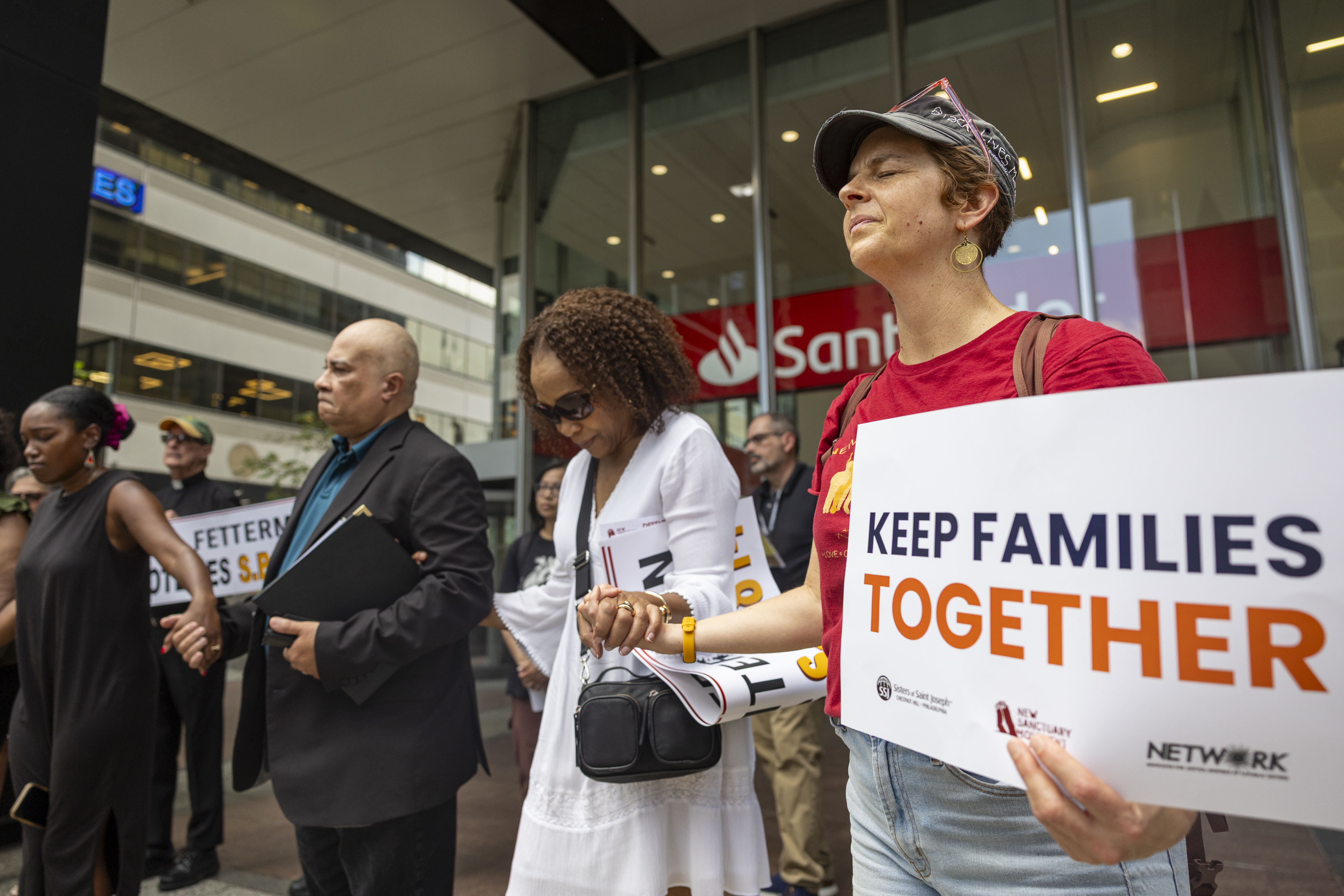
Reverend Katie Aikins, of West Philadelphia, prays for the Haitian people alongside faith leaders and community members before the march begins outside of U.S. Senator Dave McCormick’s office on Thursday.Aidan T. Gallo / Staff Photographer
Haitian American pastor Ketty Pointe-Jour said Thursday that her immigrant parents would not believe what is happening today.
They fled Haiti for their lives, she said, and “the U.S. opened its arms for them. The America they knew in the ’60s and ’80s is completely different from what we are seeing now.”
The Trump administration has sought to end TPS for Haiti and other nations. In June, the Supreme Court ruled that the administration could terminate temporary protected status for countries like Haiti and Syria.
More broadly, the ruling appears to make Department of Homeland Security decisions about TPS unreviewable by lower courts, creating deep uncertainty for the future. The White House has pledged to deport people who lose legal status, including those who had TPS.
Haitians are not the only population affected.
TPS is set to lapse for more than 170,000 people from El Salvador in September, and in October 100,000 from Ukraine face the same termination.
Advocates say the Trump administration’s promise of deportations will hurt families that include spouses and children who are American citizens.
What is more, immigration researchers and organizations say, the country will pay a financial price ― in lost taxes, wages, spending, and services, as large numbers of workers and dollars exit the U.S. economy.
The nation’s 1.3 million TPS holders work at higher proportions than the country as a whole, pay billions of dollars each year in federal and local taxes, and contribute to the solvency of a Social Security system from which they are unlikely to ever draw benefits.
Outside Fetterman’s office, Dottie Baumgarten said she came from her Cheltenham home to support the Haitian community. She hoped the presence of supporters helped immigrants feel less alone.
“The Haitian challenge is not just Haitians,” she said, “it’s immigrants in general, and we have to support them. We are destroying their families.”
Clad in a royal blue, two-piece suit, Pennsylvania Treasurer Stacy Garrity stood next to a seated President Donald Trump in the Oval Office on Tuesday, in a video message posted to his social media platform, Truth Social.
“Pennsylvania is very lucky because you have somebody running for governor who’s going to do a fantastic job,” Trump said to the camera, while shaking Garrity’s hand. “She really is a spectacular person. And I just want to wish you luck. I think you’re going to win.”
The White House appearance signaled a closer public alliance between Trump and Garrity, and the latest chapter in her campaign challenging Gov. Josh Shapiro as she seeks to draw Trump’s loyal fan base to the polls in November.
Trump, who endorsed Garrity in January, followed the video message by posting a photo with Garrity, writing: “Stacy is running to be the next Governor of the GREAT Commonwealth of Pennsylvania. She has my Complete and Total Endorsement. She will do a fantastic job!”
Garrity’s campaign said in a statement that she was visiting the White House alongside the Penn State wrestling team, which was being honored for its 2026 national championship.
The Oval Office meeting represented a repair of sorts between Garrity and Trump after he has displayed little enthusiasm toward her campaign in recent months.
It was my Great Honor to welcome Highly Respected and very popular Pennsylvania State Treasurer, Stacy Garrity, into the Oval Office. Stacy is running to be the next Governor of the GREAT Commonwealth of Pennsylvania. She has my Complete and Total Endorsement. She will do a… pic.twitter.com/1vROsLLTlM
— Commentary Donald J. Trump Truth Social Posts On X (@TrumpTruthOnX) August 4, 2026
Garrity entered the race against Shapiro, the Democratic incumbent, last summer as Republicans — disappointed with their 2022 performance — sought to consolidate support early around one strong candidate. When Trump endorsed Garrity, he called a “true America First Patriot” who “WILL NOT LET YOU DOWN!”
In March, Garrity hosted a fundraising dinner at Trump’s Mar-a-Lago Club in Florida, where, beneath a wrought-iron doorway at his private golf club, the president said “she should win.”
But when Trump visited Pennsylvania in June and Garrity introduced him onstage, he seemed to forget her altogether.
During a speech meant to focus on manufacturing in Macungie, Trump spent over an hour talking about weight-loss drugs, immigration, firearms, the role of transgender athletes in women’s sports, and the UFC fight recently held on the White House lawn. But Garrity never received a mention, and Trump instead celebrated U.S. Rep. Dan Meuser, a Pennsylvania Republican who considered a run for governor before ultimately opting against it. Trump even name-checked Shapiro.
Three months out from Election Day, Garrity has struggled to gain traction among voters. A Quinnipiac University survey of 895 registered Pennsylvania voters in July found 53% would vote for Shapiro, while 40% said they would vote for Garrity.
At right is Pennsylvania Governor Josh Shapiro listening to Stacy Garrity, 78th State Treasurer, Forum Auditorium in Harrisburg, Pa., Tuesday, Jan. 21, 2025.Alejandro A. Alvarez / Staff Photographer
Trump’s latest show of support for Garrity comes as Shapiro — who is rumored to be eyeing a run for the White House in 2028 — has set his sights beyond the governor’s office, lending his time and spending his money to support Democrats up and down the ballot, in an attempt to flip the Pennsylvania state Senate and four swing districts in Congress.
Last month, in another stop in Pennsylvania, Trump attempted to lend more support to Garrity during Republican U.S. Sen. Dave McCormick’s Defense and Innovation Summit.
“I hear things about Stacy, and I’m hearing some poll numbers that are very good,” he said.
Regarding her opponent, however, Trump had stronger words.
“This guy Shapiro is totally overrated. … He doesn’t have what it takes,” Trump said.
President Donald Trump visits Mack Trucks in Macungie in the Lehigh Valley Tuesday, June 23, 2026.Tom Gralish / Staff Photographer
In Pennsylvania, Trump remains deeply underwater in popularity. The Quinnipiac survey found only 39% of Pennsylvania voters would give him a positive job approval. Elsewhere in the country, Trump has remained Republicans’ most effective energizer to the polls — though some are concerned about GOP successwithout his name on the ballot in November.
Pennsylvania Democrats on Tuesday seized on Garrity’s appearance with the president.
“Stacy Garrity always sprints to any chance she gets to pledge her 100% loyalty to Donald Trump and his disastrous agenda,” Ava Pitruzzello, a spokesperson for the Pennsylvania Democratic Party, said in a statement.
Last week, Shapiro’s campaign launched a new ad calling Garrity “100% MAGA.” Garrity’s campaign, in a statement, called the ad “a dishonest, lying attack.”
WASHINGTON — In a Pennsylvania election where a few thousand votes could make all the difference, the last-minute entrance of a Green Party candidate with a background in Republican politics has sparked the second allegation of election meddling in three months and complicated one of the nation’s most competitive U.S. House races this fall.
But the emergence of a third-party candidate has alarmed both Democrats — who have long claimed that Green Party candidates pull votes from their nominees — and the Green Party of Pennsylvania, which said it does not know the person now representing its platform in one of the state’s highest-profile races.
“It sounds a lot like somebody’s just fooling around and trying to use the Green Party name, which is a well-known thing that happens in many states,” said Tim Runkle, cochair of the state party.
Andrew Tupone, 37, of Northampton County, filed his nomination papers with the state last week ahead of a Monday deadline for third-party candidates. He was the only candidate to file to represent the Green Party in a Pennsylvania race for Congress.
Unlike the Green Party’s endorsed candidate for governor — Tony Dastra of Lancaster County — Tupone does not have a long association with the party or its left-leaning policies. In 2021, he was the Republican nominee for a Northampton County magisterial court seat. Voter registration records show he changed his party affiliation from Republican to Democrat in February, and then from Democrat to Green in April.
In an interview, Tupone rejected accusations that he remained affiliated with the Republican Party or that he was asked to run in a way that would draw votes away from the Democratic nominee. He described a leftward shift in his political views after voting for President Donald Trump in 2020, though he said he could not recall whom he voted for in the 2024 presidential race between Trump and Democratic Vice President Kamala Harris.
“A lot of people are disillusioned with both parties,” Tupone said. “They’re sick of all the stuff that’s going on.”
Tupone also said he did not pay anyone to help gather signatures for his nominating papers, which he turned in with upward of 9,000 signatures — more than twice as many as required. Runkle said Green Party members encountered paid canvassers for Tupone who declined to say who was funding the effort.
According to a copy of the nominating papers obtained by The Inquirer, only one of the 22 individuals who gathered signatures is from Pennsylvania. The rest are from all over the country. Multiple have worked for Republican campaigns, according to public records.
Colin McEvers, who gathered signatures for Tupone in Lehigh County, is a Republican candidate for the Maryland General Assembly who is also listed as the contact for the Maryland White Republican Council. Others — including individuals from Illinois and Michigan — have been paid to canvas for GOP campaigns, according to Federal Election Commission records.
Tupone said he had no knowledge of anyone paying his canvassers.
“I went around and I gave a lot of my nominating papers to friends to give to other people, and I sent it to them as well,” Tupone said. “And as I went around, I recruited people and asked them.”
While the signatures appear to be based in the district — which stretches from the cities of Allentown, Bethlehem, and Easton into the more Republican-leaning Poconos — the other candidates have until Aug. 10 to challenge their legitimacy.
Such challenges are common, and the Brooks campaign is reviewing its options to decide whether to bring a challenge, according to a source familiar with the campaign’s thinking.
‘No one’s paying me to run’
Jenna Kauffman, Brooks’ campaign manager, in a statement described the situation as a GOP-initiated and “desperate scheme to meddle in this race.”
She connected it to a last-minute $1.7 million advertising campaign against Brooks in the May primary that appeared to be run by Democrats but was actually funded by a Republican political organization.
The spending, by a political action committee called Lead Left, was aimed at boosting another Democrat who observers considered to have a worse shot at beating Mackenzie in the November election. But the effort was anonymous, and records that became public only after Brooks won show that it was funded by the Conservative Americans PAC.
The effort to prevent Brooks from emerging from the Democratic primary came as he coalesced support from across the ideological spectrum with high-profile endorsements ranging from moderate Democratic Gov. Josh Shapiro to U.S. Sen. Bernie Sanders (Ind., Vt.), a democratic socialist.
“Voters deserve to know who is paying for this effort and whether Ryan Mackenzie and his Republican backers are involved,” Kauffman said, painting Tupone’s candidacy as a continuation of the move in the primary.
Mackenzie’s campaign did not address that comment when asked about it Monday.
Tupone said that the inference was “just false,” and that he instead likes the values of the Green Party, which he said included supporting the environment, social justice, and “stopping the corruption and also the genocide in Gaza.”
“No one’s paying me to run. No one’s asked me to run for this office. I’m running on my own, hopefully with a lot of hope from everyone who wants to volunteer,” Tupone said. “I’m not associated with the Republican Party anymore. I’m not a candidate for them.”
For years, Democrats have voiced concerns about the Green Party and other third-party candidates “spoiling” elections, from Jill Stein in the 2016 presidential race that first put Trump in power to the 2024 U.S. Senate race in Pennsylvania, when Democratic U.S. Sen. Bob Casey lost to Republican Dave McCormick by about 15,000 votes. In that 2024 election, a Green Party candidate won about 66,000 votes, a Libertarian candidate won almost 90,000, and a Constitution Party candidate won more than 23,000.
In the 7th District in 2024, Mackenzie defeated incumbent Democrat Susan Wild by 4,062 votes out of more than 403,000 cast. That was the narrowest margin out of any of the state’s 17 districts, making it a key tossup district this year.
That margin is also significantly different from the one Shapiro potentially faces during his reelection campaign this year as he maintains a sizable lead over Republican Stacy Garrity, and as a Green candidate officially filed to run on Monday. Shapiro defeated Republican Doug Mastriano in 2022 by almost 793,000 votes; the Green Party candidate won just over 24,000 votes.
Runkle said that nobody solicited the Green Party’s endorsement in a Pennsylvania congressional race this year, and that a conversation he had with Tupone left “a lot of questions.”
He said the party is concerned about its reputation and about being targeted in ways that do not lift up its platform, which focuses on environmental protections and liberal positions on healthcare. But he also pushed back on concerns that the party should be considered a spoiler.
“I do solidly believe that the Green Party policies and the values we represent has a solid bloc of voters,” Runkle said. “If people think that’s spoiling the race, then they should try harder to speak to the issues that we speak to.”
WASHINGTON — U.S. Sen. John Fetterman, doubling down on a position that has already added to Democrats’ frustrations with him in recent months, offered a more detailed explanation this week for his change of heart about eliminating the Senate filibuster.
The Pennsylvania Democrat wrote in an op-ed for the Washington Post that he had been “horribly wrong” to support ending the practice that requires bills to win 60 votes rather than a 51-vote majority.
The rule frequently allows members of the minority party to block policies that fail to win bipartisan support, including some of each party’s top priorities — like abortion protections when Democrats have been in control, or the voting restrictions that Republicans are now attempting to pass at President Donald Trump’s urging.
Fetterman was among many Democrats in recent years to campaign on eliminating the filibuster in order to secure those bigger wins. During his 2022 campaign, he specifically referred to passing abortion protections established under Roe v. Wade as a reason for that position after the Supreme Court overturned its landmark 1973 decision that year.
“I became one of the first candidates in the country to call for abolishing the filibuster for a reason: it stands in the way of getting things done for [Pennsylvanians],” his active campaign website still read on Tuesday, nearly four years after he won.
But as he has more frequently sided with Republicans and criticized his fellow Democrats, Fetterman has said repeatedly this year that he had been “wrong.”
“We were very wrong about that to nuke the filibuster, and we should really humble ourselves,” he said on Fox News in February. In that interview and others, he needled Democrats who opposed the filibuster but now, he said, express a “love” for it as they find themselves in the minority and try to reject Republican policies.
In the Washington Post this week, Fetterman wrote that Americans who are “horrified” at the policies coming out of the Republican-led Congress and Trump’s administration would be alarmed if the filibuster had been eliminated and every proposal could become law with a simple majority.
“We’d have the Save America Act by now, which I do not support,” Fetterman wrote. “We could have extreme policies such as nationwide abortion restrictions, backpedaling on LGBT rights, repeal of birthright citizenship and limited voting rights across the country. With a government trifecta firmly in place, many provisions of Project 2025 would have easily been enacted. Republicans could fundamentally change the entire government and country with a simple majority vote.”
Fetterman’s reference to the SAVE America Act comes as Trump has pressured Senate Republican leaders to eliminate the filibuster in order to pass the bill, which would enact sweeping election changes. It would require individuals to provide proof of citizenship when registering to vote and to show photo ID at the polls, and it would scale back mail voting.
Opponents of the bill say it would make registering and voting more difficult for millions of people. And Fetterman has opposed the bill because of the changes to mail voting, though he has changed his position to support requiring a photo ID at the polls.
The bill has failed to receive support from 60 senators, and Trump has demanded that Republicans bypass the filibuster to force it through with only GOP support. U.S. Sen. Dave McCormick (R., Pa.), a Trump ally, has said such a scenario is “very tempting” even though he campaigned against ending the filibuster in 2024.
“It’s a path to get more things done,” McCormick said during a telephone town hall with constituents last week.
Fetterman, in his op-ed, called the filibuster “a critical line of defense that prevents President Donald Trump from having a fill-in-the-blank government with new laws, deregulation or procedures of its choosing.”
He wrote that “history has vindicated” former U.S. Sens. Kyrsten Sinema (D., Arizona) and Joe Manchin (D., W.Va.) for voting with Republicans to block reforming the filibuster when Democrats were in control in 2022.
Fetterman could potentially play a similar role after the midterm elections this fall if Democrats win control of the Senate with a slim, potentially one-vote majority. Some observers have said Fetterman could also leave his party, becoming a Republican or — as Sinema and Manchin did after serving as Democrats — become an independent.
“Some of my colleagues, including myself, have been frustrated when engaging with the minority,” Fetterman wrote. “But that process isn’t a bug — it’s one of the best features of the Senate. We have a great democracy that is imperfect, but it requires working together.”
As Fetterman works more often with Republicans, though, Democrats have become more frustrated with him and vowed to mount a challenge if he seeks a second term in 2028.
Former U.S. Rep. Conor Lamb — one of the Democrats who has not ruled out another campaign after losing to Fetterman in the 2022 primary — has said the senator’s switch on the filibuster “is probably the worst Fetterman story yet” that most people don’t realize.
In a social media video in early June, Lamb said eliminating the filibuster was essential for Democrats to “put Roe v. Wade back into law” and to pass legislation on voting rights, gun control, and raising the minimum wage if they regain control of the Senate.
“When we ran against each other, he promised he would fight for women on this issue and get rid of the filibuster,” Lamb said. “And of course, like so many things, he’s changed his mind.”
In the opening pages of the book he published between losing and then winning a Pennsylvania seat in the U.S. Senate, Dave McCormick painted the picture of an uncomfortable scene at Mar-a-Lago.
It was early 2022. McCormick, a former hedge fund CEO running in a tough Republican primary against celebrity doctor Mehmet Oz, had made the pilgrimage to meet with then-former President Donald Trump and ask him not to endorse Oz. Trump had maintained a firm grip on the party after leaving office and avoiding conviction for “incitement of insurrection” at his second impeachment trial.
According to McCormick’s retelling, Trump pulled up a television interview McCormick gave after the Jan. 6, 2021, attack on the U.S. Capitol in which he said the president was partially responsible for political divisiveness.
“Then the former president looked me in the eyes and warned, ‘You know you can’t win unless you say the election was stolen,’” McCormick wrote. “I made it clear to him that I couldn’t do that. Three days later, Trump endorsed Mehmet Oz.”
McCormick lost the race but ran again and won with Trump’s support two years later — when they shared a ballot. Now, three years after McCormick penned the book, he has become a prominent cheerleader in the Senate for an election reform proposal — the SAVE America Act — that Trump has advocated for while continuing to falsely say the 2020 election was rigged against him.
The Pennsylvania Republican has still not echoed the president’s debunkedclaims of widespread fraud in 2020. He also has not disputed them as he lobbies for the bill, which he and other Trump allies argue will build confidence in elections and which critics say will do the opposite while potentially disenfranchising millions of voters.
Other Pennsylvania Republicans in Congress — some of whom tried to block the state’s electoral votes hours after the Capitol attack— have similarly stayed quiet as Trump has both resurfaced old allegations and introduced new ones.
In a prime-time speech earlier this month, Trump claimed that China had secretly obtained U.S. voter information and that a “large-scale voter registration operation” led to fraud in Michigan six years ago. His administration also released a document alleging Pennsylvania was among four states where the Department of Homeland Security had identified more than 250,000 noncitizens registered to vote.
Pennsylvania Secretary of State Al Schmidt, a Republican appointed by Democratic Gov. Josh Shapiro, has forcefully rejected those claims.
But adding more fuel to the rhetoric about election integrity, New Jersey officials said last week that about 6,600 people who were not citizens were registered to vote before the 2024 election, and fewer than 400 cast a ballot.
Still, many of the claims Trump made in his speech have been refuted by election experts and, in many cases, were not new.Meanwhile, none of the 11 Republicans representing Pennsylvania in Congress have commented directly on them, including some who responded to certain questions for this story but did not answer others specifically about the new claims.
President Donald Trump, left, and Sen. Dave McCormick, R-Pa., attend the finals at the NCAA wrestling championship, Saturday, March 22, 2025, in Philadelphia. (AP Photo/Matt Rourke)Matt Rourke
McCormick’s spokesperson said only that the senator’s position on 2020 “remains unchanged.”
A spokesperson for U.S. Rep. Brian Fitzpatrick, a moderate Bucks County Republican who voted to certify President Joe Biden’s 2020 win, said the lawmaker “completely disagrees with the president’s allegations of interference in the 2020 election.” She did not answer a question about the new and specific claims, such as the 250,000 noncitizens registered, but said Fitzpatrick “has full faith and confidence [in] our election officials.”
Rep. Scott Perry, R-Pa., speaks during the Conservative Political Action Conference, CPAC 2024, in Oxon Hill, Md., Feb. 22, 2024. (AP Photo/Jose Luis Magana, File)Jose Luis Magana
U.S. Rep. Scott Perry, a York County Republican who tried to overturn election results and became a subject of investigations into Jan. 6, reposted comments online that raised alarm about the White House’s claims of noncitizen voters.
Perry’s office did not respond to a request for comment. He is one of four Republicans in the state facing a competitive reelection this fall — putting Pennsylvania in the national spotlight as Democrats push to gain control of the narrowly divided U.S. House, and potentially at the center of concerns about Trump’s attempts to control the election process.
Republicans point to N.J. as they call for new voting law
Every Pennsylvania Republican in Congress, meanwhile, has supported the SAVE America Act. The bill would require voters to provide proof of citizenship when registering to vote and to show photo ID at the polls. It would also scale back mail voting, which has become increasingly popular since the COVID-19 pandemic but has remained a focus of Trump’s false claims of fraud.
Supporters of the legislation say that voter ID is widely popular and that eliminating even a few noncitizens from the voter rolls is worth ensuring elections are legal and secure. Opponents say that the issues the bill is trying to solve are either nonexistent or statistically irrelevant, and that it would effectively make registering more difficult for about 21 million people who do not have easy access to the paperwork that would be required, like a passport or birth certificate.
“It would upend voter registration and our democracy and, on its own terms, is an extraordinarily harmful policy that would hurt millions of American citizens,” said Eliza Sweren-Becker, a voting rights expert at the Brennan Center for Justice. “It is being advanced on the backs of lies about our election system that are themselves harmful to our democracy and trust in election administration.”
Though he has not addressed Trump’s latest claims, McCormick renewed his public push for the SAVE America Act after Trump’s prime-time address — writing, “Let’s act now,” on social media following the speech.
Last week, he and others also grasped on to both a nearly decade-old voter registration issue in Pennsylvania and the fresh problem in New Jersey to underscore the need for the law.
“This isn’t a harmless ‘software error,’” McCormick wrote on social media after Gov. Mikie Sherrill said a technical mistake led to noncitizens registering to vote. “This is why we must confirm citizenship before anyone registers. Only U.S. citizens should vote in our elections.”
McCormick also elevated a statement from the Department of Homeland Security that referred to an issue that Schmidt, then a Philadelphia city commissioner, discovered in 2017. Schmidt found 168 noncitizens were registered in Philadelphia, and likely hundreds more were registered statewide, due to an error by the Pennsylvania Department of Transportation. State Auditor General Tim DeFoor, a Republican, has said fixes to the system were largely successful.
U.S. Rep. Ryan Mackenzie, a Lehigh County Republican who is running in one of the most competitive districts in the country, also pointed to the Pennsylvania example and the New Jersey developments while justifying his support for the SAVE America Act during a telephone town hall with constituents Wednesday.
But while trying to remember the details on the call, Mackenzie potentially overstated the problem.
“I believe it was about 8,000 people here in Pennsylvania made their way onto the voter rolls, who were not supposed to be there and weren’t asked those proper questions. So these things do happen,” Mackenzie said before stressing the need for the SAVE America Act.
Asked about that number, a spokesperson for Mackenzie pointed to the Pennsylvania Department of State’s additional review in 2018 that found 8,698 voters whose eligibility needed to be determined. Those voters, however, were not necessarily noncitizens or otherwise ineligible to vote, and the state never released a more detailed analysis.
The spokesperson did not answer questions about whether Mackenzie agrees with Trump’s old or new claims about election fraud in 2020, or whether Pennsylvanians should have confidence in the state’s current system.
“This case from Pa., and from N.J. more recently, highlight the lack of appropriate checks taking place when people initially register to vote. We should have appropriate checks to verify the citizenship status when someone initially registers, which is what the SAVE Act provides. The absence of these safeguards, as well as the egregious errors that have been seen in states like New Jersey, are key reasons for the bipartisan frustration with our elections.”
Sweren-Becker said overstated claims of noncitizen voters have contributed to spreading distrust. The Pennsylvania situation, she said, was also not an example of a scheme to defraud the system, and “not the basis for a policy that would block millions of Americans from being able to cast their ballots.” Both that case and the one in New Jersey are instead examples of administrative errors that occasionally happen in a complex election system and represent “an extraordinarily small fraction” of voters, she said.
The Cato Institute, a libertarian Washington-based think tank, has also thrown cold water on the idea that the SAVE America Act would have prevented the New Jersey error. Legal fellow and former Arizona Republican official Stephen Richer, in a post that referred to McCormick’s advocacy, wrote that the current structure of the bill “likely wouldn’t have prevented” the software error.
“Be wary of politicians who say, ‘All of these problems will be fixed with my simple legislation,’” Richer wrote. “That’s often not the case.”
‘Deeply unhelpful’
McCormick, in response to questions for this story, did not directly say if the law would have prevented the issue in New Jersey. But he stressed that the paperwork requirement “helps stop noncitizens from getting registered.” It would also require states to set up a program to “continuously check voter rolls to find noncitizens” using different datasets — which he noted some states already have.
In a telephone town hall with constituents on Wednesday, the senator also acknowledged concerns about the bill when asked about it by voters on both sides of the issue.
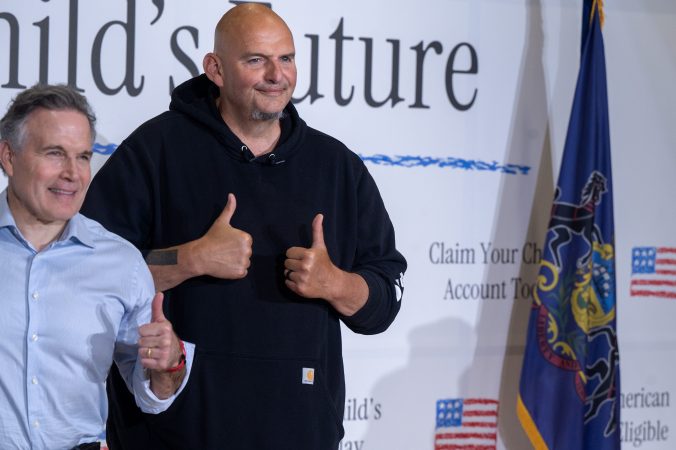
Pennsylvania’s U.S. Senators John Fetterman (left) and Dave McCormick appear together Monday, June 29, 2026 to promote the savings accounts for kids that were a signature piece of President Trump’s Big Beautiful Bill.Tom Gralish / Staff Photographer
He said he believed the law would “make it as easy as possible” for people to obtain valid forms of ID if they do not have them. And as someone who lost his first race against Oz by 950 votes and won his second race against Democratic U.S. Sen. Bob Casey by about 15,000 votes, he said even rare cases of noncitizen voting could make a difference in close elections. Eligibility for mail ballots also needs “to tighten up dramatically,” he said, though he did not fully explain his thoughts on the issue or if he believes there has been fraud associated with them.
As Democrats block the bill in the Senate, he called on them to “defend the indefensible” and said “there should be a political cost in objecting to something that most Americans agree with.”
One of the Democrats opposing the bill is McCormick’s close friend and ally — U.S. Sen. John Fetterman.
Though he has frequently broken with his party — and now supports voter ID after previously calling it “insidious and unnecessary” — Fetterman has said the bill’s changes to mail voting are “a nonstarter” for him.” In a CNN interview last week, he also said that the 2020 election in Pennsylvania was fair, that there is “no evidence” of 250,000 noncitizens registered, and that Trump was unnecessarily fixated on the 2020 election.
“In Pennsylvania, out of 67 counties, the vast, vast, vast majority of them are deep red counties, and they’ve never encountered any kinds of fraud,” Fetterman said. “I don’t know why the president is dragging up all of this stuff. You’re the president. Do something positive. And you are talking about 2020. That’s been settled over six years ago. It’s deeply unhelpful.”
Other Pennsylvania Democrats have lambasted Trump for dredging up the old claims, and they have blamed GOP “enablers” for supporting him and pushing the bill.
“The only thing it would ‘save’ is Trump and his Republican enablers from voters holding them accountable,” U.S. Rep. Dwight Evans (D., Philadelphia) said.
U.S. Rep. Chris Deluzio, an Allegheny County Democrat who worked on election security issues before running for Congress in 2022, said the bill “will do nothing to improve election security” and would instead harm married women — whose birth certificates might not have their current name — and people without passports. He said those who lie about the 2020 election are “cowards” who should not have a place in elected office.
“The fact that some Republican politicians are so scared of Donald Trump that they lie for him just to keep their jobs is spineless and pathetic,” Deluzio said.
McCormick, for his part, said during the telephone town hall that the bill is unlikely to pass as Democrats continue to block it from getting the required 60 votes in the Senate, and as Republicans decline to eliminate the filibuster rule to let it move forward with just 50 votes.
“Where does that leave us? That leaves us in a position where I think we should be constantly talking about this, and I try to do this every single week, multiple times, [saying] why the SAVE America Act is important,” said McCormick, whose staff said he was unavailable for an interview.
A partner at one of the city’s largest law firms who once worked as a federal prosecutor was confirmed Thursday by the U.S. Senate to become the Philadelphia region’s newest federal judge.
Antonio Pozos’ nomination to join the region’s U.S. District Court was approved by a vote of 49-44. There was no discussion as the Senate voted to approve his nomination, which earns him a lifetime seat on the bench.
Pozos, 44, most recently a partner at Faegre Drinker Biddle & Reath, is the first person appointed to the region’s district court since President Donald Trump began his second term last year. During his first term, Trump had five judges confirmed to the region’s federal bench.
Pozos will fill a vacancy created by last year’s retirement of U.S. District Judge Mitchell Goldberg, giving the court 22 district judges and eight senior judges.
District court judges oversee a variety of criminal and civil cases each year, and typically issue the first rulings on legal questions that can sometimes reach the U.S. Supreme Court.
Although some of Trump’s recent nominations to judicial posts across the country have been controversial — including his decision to nominate his former personal lawyer, Emil Bove, to the Philadelphia-based U.S. Court of Appeals for the Third Circuit — Pozos’ candidacy received some bipartisan support.
Shortly after his nomination was announced, Pennsylvania’s Democratic senator, John Fetterman — who, under Senate rules, had the ability to block Pozos’ candidacy from advancing — decided to allow the process to move forward, the first time any Democrat had done so for a district court nominee during Trump’s second term.
Fetterman also voted Thursday to confirm Pozos.
During a confirmation hearing last month, U.S. Sen. Dave McCormick (R., Pa.) called Pozos a “successful attorney, a strong Pennsylvanian, a decorated public servant, and he’s eminently qualified for this role.”
Pozos was criticized by some Democratic senators during the hearing for hesitating to use the word attacked when describing the riot at the U.S. Capitol on Jan. 6, 2021. He instead said it “appeared that there was violence and trespass” that day, and called the events “profoundly troubling.”
Pozos lives in Bryn Mawr and is a graduate of Harvard College and the University of Michigan Law School, according to a questionnaire he submitted to the Senate Judiciary Committee.
Before he became a partner at his firm in 2018, the questionnaire said, he spent three years as a prosecutor in the Justice Department’s criminal fraud section in Washington, where he often worked on cases involving healthcare fraud. He previously worked as an associate in a Washington-based firm and clerked for U.S. District Judge Anthony J. Trenga in Virginia.
In Philadelphia, Pozos has served as a lecturer at the University of Pennsylvania’s Carey Law School and is on the board of Drexel University’s Kline School of Law.
With Pozos’ confirmation to the bench, Trump has now appointed six of the Philadelphia region’s district judges, who handle cases that arise from the city, its suburbs, and counties in and around Reading and Allentown. Former Presidents Joe Biden and Barack Obama each appointed seven judges to the bench, and two were appointed by George W. Bush.
Trump has had a more outsize impact on the region’s appellate court, where he has appointed six of the court’s 14 members across his two terms.
U.S. Sen. John Fetterman has insisted he has no plans to leave the Democratic Party, despite continued attempts to sway him.
“I remain strongly pro-choice, pro-weed, pro-LGBT, pro-SNAP, pro-labor and even pro-rib-eye over bio slop,” the Pennsylvania lawmaker wrote in an opinion piece published in the Washington Post in May.
But if he were to change his mind, a new poll shows he might have a home in Pennsylvania’s GOP.
Just under half of registered voters in the state approve of how Fetterman is handling his job as a U.S. senator, according to a Quinnipiac University poll released Wednesday.
But the vast majority of the first-term Democrat’s support comes from voters in the opposing party: 77% of surveyed Republicans said they approve of Fetterman, while just 19% of Democrats do.
That is a higher share of voter support than even U.S. Sen. Dave McCormick, Fetterman’s Republican colleague from Pennsylvania, received from his own party, with 68% of surveyed Republicans approving of his job performance.
Fetterman also faced more ire from Democrats than his GOP counterpart — with 69% of Pennsylvania Democrats disapproving of their party’s senator, compared with 52% who disapprove of McCormick.
The Quinnipiac survey, conducted June 9-13, polled 895 registered Pennsylvania voters and has a 4.3-percentage-point margin of error.
President Donald Trump appears at a Defense and Innovation Summit hosted by U.S. Sen. Dave McCormick (left) at the US Army War College in Carlisle Wednesday, July 15, 2026.Tom Gralish / Staff Photographer
Since Fetterman began casting key votes in support of President Donald Trump and publicly criticizing progressives in his party, conservatives have been leaving the door open and, at times, rolling out a welcome mat.
(function(){function e(){window.addEventListener(`message`,function(e){if(e.data[`datawrapper-height`]!==void 0){var t=document.querySelectorAll(`iframe`);for(var n in e.data[`datawrapper-height`])for(var r=0,i;i=t[r];r++)if(i.contentWindow===e.source){var a=e.data[`datawrapper-height`][n]+`px`;i.style.height=a}}})}e()})();
State Sen. Greg Rothman, chair of the Pennsylvania GOP, said he could consider supporting Fetterman’s reelection if he switched parties, and Fox News’ Sean Hannity said Trump himself urged Hannity to coax Fetterman into becoming a Republican in exchange for the president’s support.
During an interview Wednesday at the Hill Nation Summit in Washington, Fetterman said the Democratic Party’s stance on Israel could push him out.
“If our party ever becomes — and just makes it official — the anti-Israel party, that’s when I would leave because that’s been a moral clarity for me,” he said.
Democrats, meanwhile, have mostly taken a hands-off approach. The Pennsylvania Democratic Party has previously declined to comment on Fetterman’s positions and actions, including his new joint fundraising committee with McCormick. The venture, announced earlier this month, allows them to split money from donors who want to give to both of their campaigns, a boost for Fetterman, who has reported raising significantly fewer campaign dollars on his own.
Democratic Gov. Josh Shapiro has also avoided directly criticizing Fetterman, but admits their relationship is estranged.
In an interview with Politico in May, Shapiro said it had been “probably years” since he had seen Fetterman at an event in Pennsylvania.
“I’m not saying he hasn’t been at one, but I haven’t seen him and I’m at most things,” he said.
Fetterman was most recently in Philadelphia at an event with McCormick to promote Trump Accounts, the new federally backed savings accounts for kids that became law with Trump’s signature One Big Beautiful Bill Act.
More than half of registered Pennsylvania voters want Fetterman to leave the Democratic Party altogether, according to the Quinnipiac poll.
It is a figure that represents both push and pull: 57% of Democrats surveyed said they want him to leave, and 55% of Republicans do, too. The poll did not ask whether he would be welcomed into the GOP.
“The Democrats would like to show him the door. The Republicans seem to be welcoming him in. Thus is the political irony of Sen. John Fetterman,” Tim Malloy, a polling analyst at Quinnipiac, said.
(function(){function e(){window.addEventListener(`message`,function(e){if(e.data[`datawrapper-height`]!==void 0){var t=document.querySelectorAll(`iframe`);for(var n in e.data[`datawrapper-height`])for(var r=0,i;i=t[r];r++)if(i.contentWindow===e.source){var a=e.data[`datawrapper-height`][n]+`px`;i.style.height=a}}})}e()})();
Fetterman, who is likely to face a primary opponent, has not yet disclosed whether he plans to seek a second six-year term in 2028. U.S. Reps. Brendan Boyle (D., Philadelphia) and Chris Deluzio (D., Allegheny) and former U.S. Rep. Conor Lamb, a Western Pennsylvania Democrat who lost the Senate primary to Fetterman in 2022, are all considered to be potential contenders.
Malloy called Fetterman’s approval among Republicans “stunningly high.”
“He’s a maverick,” he said. “He is certainly one of the most unique politicians in the country.”
“Being an independent voice that works with the other side to deliver for Pennsylvanians might put me at odds with the party that I have stayed committed to and have no plans to leave — but I will continue to put the commonwealth and the country first,” Fetterman wrote in the Post.