After more than two decades of melted cheeses and chocolates, diners in South Jersey hoping to dip into an entirely fondue-based meal will have to look elsewhere after The Melting Pot closes its doors this weekend.
The restaurant’s final day will be Oct. 25, franchisee Charlie LaRosa said through a spokesperson for the company.
“This milestone marks the close of a meaningful chapter filled with memorable experiences, special celebrations, and lasting connections with guests and the community,” LaRosa said in the statement.
Known for providing a one-of-a-kind dining experience, the restaurant chain founded in 1975 offers a wide range of options including a multi-course, interactive meal centered around fondue pots at each table.
Today, the company has more than 90 locations worldwide where diners can enjoy their choice of a variety of melted cheeses with bread, vegetables, and fruit for dipping before they cook their own entrees — a mix of meat, seafood, and vegetables — in flavorful, simmering broth.
The meals then typically conclude with a chocolate fondue desert accompanied by fruit, brownies, pound cake, and more.
Following the restaurant’s closure in Maple Shade, only two Philadelphia-area Melting Pot locations will remain: King of Prussia and Wilmington, Del. The Melting Pot has one other New Jersey location in Red Bank, according to the company’s website.
Melting Pot gift cards do not expire and are redeemable at all restaurant locations.
While the fondue pots might be leaving the building, it appears that the restaurant won’t be empty for long.
Istanbul Bay Premium Mediterranean Restaurant recently signed a lease for the 6,500-square-foot restaurant and plans to move in as soon as permits allow, said Emre Yucel, the restaurant’s leasing agent.
Serving authentic Turkish cuisine, Istanbul Bay operates locations across New York and New Jersey, including a restaurant in Englishtown that opened this summer.
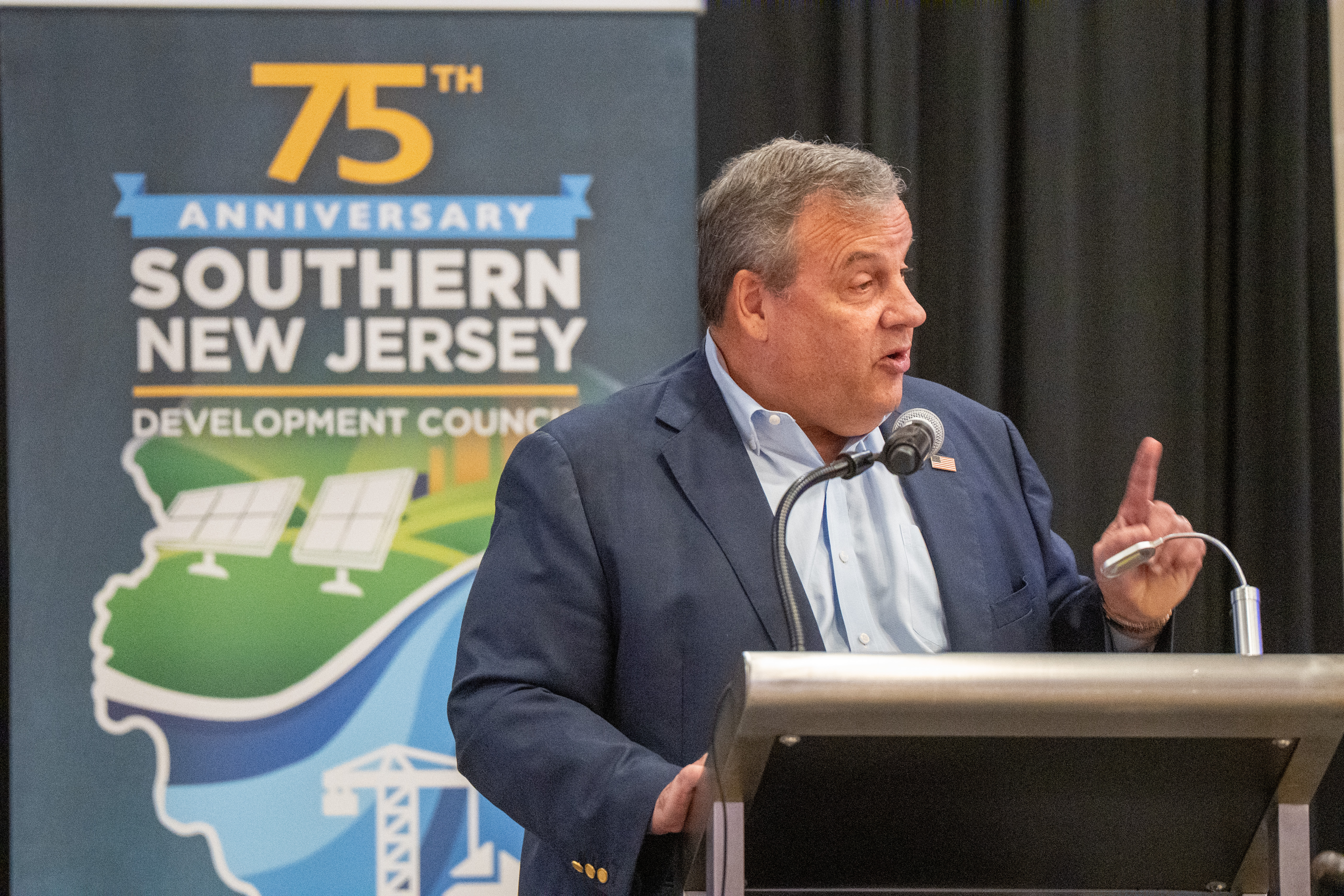
Former New Jersey Gov. Chris Christie predicted the Nov. 3 election will mark “the official end of the Donald Trump era,” when Democrats are expected to win control of the U.S. House, but warned the final two years of his presidency will not result in the stability the public craves.
The country needs leadership to “give people a view beyond the next crisis point” and “feel better about who we are as Americans and what we can do for each other and the world,” the former two-term Republican governor told 200 business leaders gathered Friday at a Southern New Jersey Development Council conference in Mount Laurel.
Trump cannot provide that kind of leadership, Christie said.
“We have a president now who markets every day in anger, in hate, in vengeance and self-dealing,” he said.
Polls universally show Democrats are poised to win control of the House — with pickups in Pennsylvania and New Jersey likely — and the Senate looks in play as the party has gone on offense in traditionally GOP states.
“We are ending an era, everybody. … I suspect it will officially be over Nov. 3. The only person who doesn’t know that is President Trump,” Christie said.
Christie was one of the first elected officials to endorse Trump after ending his own 2016 campaign, but he broke with the president after Trump claimed the 2020 election had been stolen from him. When Christie briefly ran for president again in 2024, he released an ad admitting backing Trump was a mistake.
“What we are in for are the most tumultuous two years,” as Trump will try “with every bit of his strength to hold on to attention and power,” Christie added.
His remarks at times sounded like a stump speech for his ownpotential candidacy in 2028, which he said last month he would consider after the election.
Christie said he would remain a loud voice for leadership and building back the country’s economy and standing in the world.
“I’m not going anywhere,” he said.
He also praised Democratic Gov. Mikie Sherrill and offered advice to corporate leaders on how to weather more economic and political upheaval.
Christie said he expected that Democrats will open numerous investigations into the Trump administration’s conduct when the new Congress convenes in January. He added that he hoped they would not put the country through another impeachment process, which he said would result only in giving Trump more attention.
“Attention to him is like oxygen to everyone else in this room,” he said.
‘Rooting for Sherrill’
Christie described the fruitful partnerships he forged with Democrats, including his collaboration with formerstate Senate President Steve Sweeney (D., Gloucester)in 2011 to force workers to pay more for their pensions and benefits to avert a collapse. The deal was immensely unpopular with public union workers.
He criticized her immediate predecessor, former Democratic Gov. Phil Murphy, for allowing the budget to balloon from $34 billion to $60 billion. (Murphy has criticized Christie for spending down the state’s surplus to about $600 million.)
“If you want to be governor of this state, and this is a cautionary tale to our current governor, who, by the way, I like and I am rooting for, you can’t be governor part-time,” Christie said. “What I hope we now do is encourage the current governor to have some courage.”
Earlier in the day, South Jersey elected leaders of both parties discussed how to strengthen the region’s economy and rebuild after Trump.
U.S. Rep. Herb Conaway, a Burlington County Democrat, said House Democrats are committed to making “a case against the rampant corruption of the Trump administration” and to restoring the cuts to Medicaid slated to take effect next year under Trump’s One Big Beautiful Bill Act, which will threaten the eligibility of hundreds of thousands of low-income New Jerseyans.
“The American people expect it, and we are going to give it to them,” he said.
Philadelphia-area residents heading to fall harvest events may find new things to pick this year as farms diversify their crops.
Farmers are finding creative ways to cope with the spring frosts that decimated many mid-Atlantic fruit tree harvests — including apples, a fall-picking classic.
“Growers across the state are pivoting their fall on-farm and at-market activities to include more pumpkins and sunflowers this year,” Carla Snyder, a Penn State Extension program manager in agriculture, wrote via email.
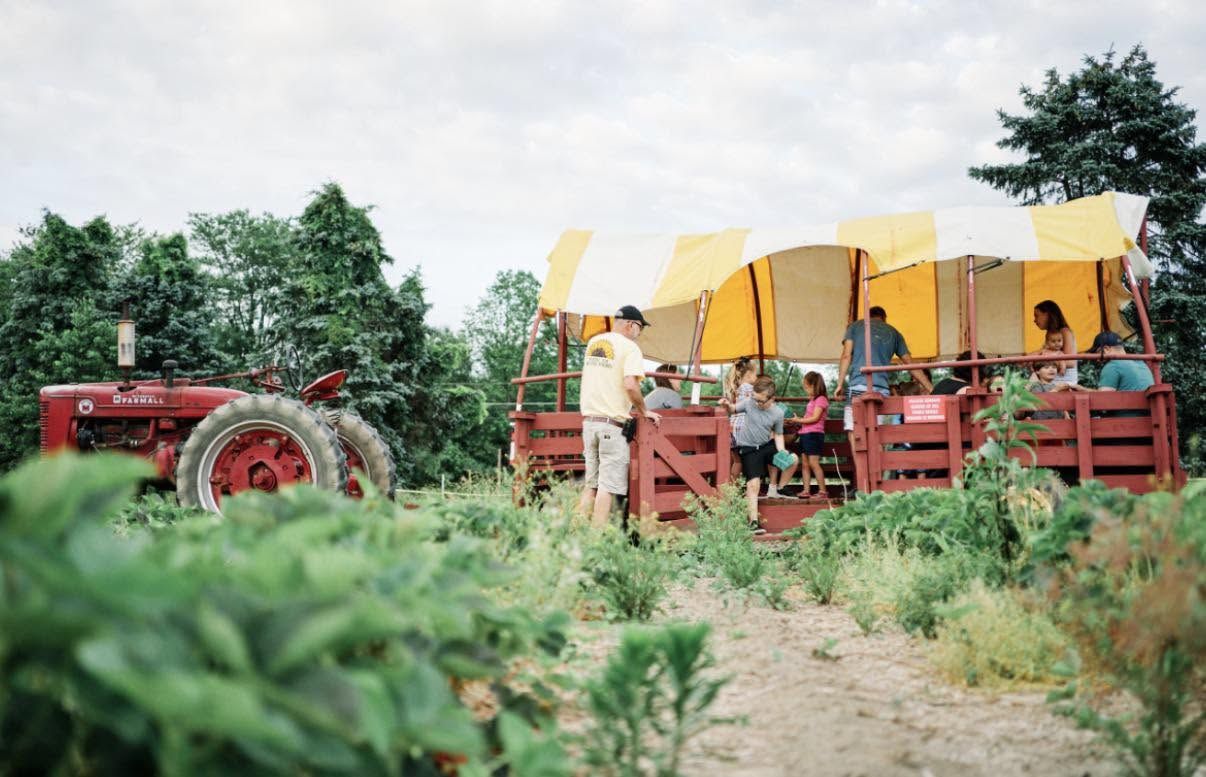
Johnson’s Corner Farm in Medford, Burlington County, didn’t have enough apples for picking this year alongside their other fall activities, including the corn maze, hayride, and pumpkin picking, owner Gil Johnson said. So they planted sunflowers, sweet potatoes, and popcorn for visitors to harvest throughout September and October.
Johnson’s Corner Farm in Medford extended its sunflower season this year to offer more picking options for fall visitors after an April cold snap decimated the apple harvest.Johnson's Corner Farm
The other crops are a hit, Johnson said, especially sweet potatoes: “What kid doesn’t like digging through the dirt?”
The cold snap affected even non-picking activities, said Kelsey Givler, manager at Merrymead Farm in Lansdale. There’s typically plenty of fallen apples, unsuitable for eating, that the dairy farm buys for visitors to shoot out of cannons. Merrymead still managed to find some, Givler said, but they weren’t as abundant as in a typical year.
As its name suggests, Hundred Fruit Farm has built crop variety into its business model. The Buckingham operation doesn’t grow apples, but chestnuts and jujubes native to Asia have both thrived, owner Adam Dusen said. The farm hopes to offer them for fall picking for the first time next year.
The jujubes were unaffected by the April frost because they happen to flower later — a benefit of diversification, Dusen said. With extreme weather expected to become more common in the region, growing just one or two crops is “a much riskier thing to do.”
Johnson in Medford said he’s not sure yet what his farm will do for next fall. “We’re taking a lot of notes,” he said.
But he’s glad this autumn’s festivities worked out, despite the apple losses.
“We knew people still wanted to come out and have a good time in the fall,” Johnson said. “We’re in the business of making people happy.”
This suburban content is produced with support from the Leslie Miller and Richard Worley Foundation and The Lenfest Institute for Journalism. Editorial content is created independently of the project donors. Gifts to support The Inquirer’s high-impact journalism can be made at inquirer.com/donate. A list of Lenfest Institute donors can be found at lenfestinstitute.org/supporters.
Willingboro officials approved plans Tuesday to build 129 townhomes on a roughly 12-acre lot that was once home to the Burlington County Times newsroom.
The now-vacant property served as the newspaper’s headquarters for 50 years before the company moved to a new office in 2018. Two years later, the building was demolished to make way for redevelopment.
Developers want to build 20 buildings on the site at 4284 Route 130 to accommodate the new units: 18 three-story buildings and two two-story buildings designed for accessibility, each 30 feet apart, according to the plans.
The three-bedroom townhomes will each have private driveways, and 115 units will also have attached one-car garages.
Seven townhomes will be deed-restricted for low and moderate-income families, according to Damien Del Duca, an attorney representing Willingboro Townhomes AMS Dev LLC, the project’s developer.
The plans also include four community common areas and 170 newly planted trees throughout the property.
The township granted preliminary approval for the project’s design and site plan in August after previously adopting a redevelopment plan for the unused property in 2025.
The site is currently owned by Langhorne-based Levittown Times Corp., according to state property tax records.
The Burlington County Times was originally named the Levittown Times, a reference to the brief period when the township was named Levittown.
The newspaper changed names after a 1963 referendum reestablished the township as Willingboro.
Calkins Media owned the Burlington County Times and several Bucks County newspapers for decades until the company was acquired by New Media Investment Group Inc. as part of a multi-newspaper deal for $17.5 million in 2017.
Standing in the shadow of the Burlington-Bristol Bridge, the 189-year-old Doane Academy is expanding its footprint in Burlington City with a new athletic facility and auditorium.
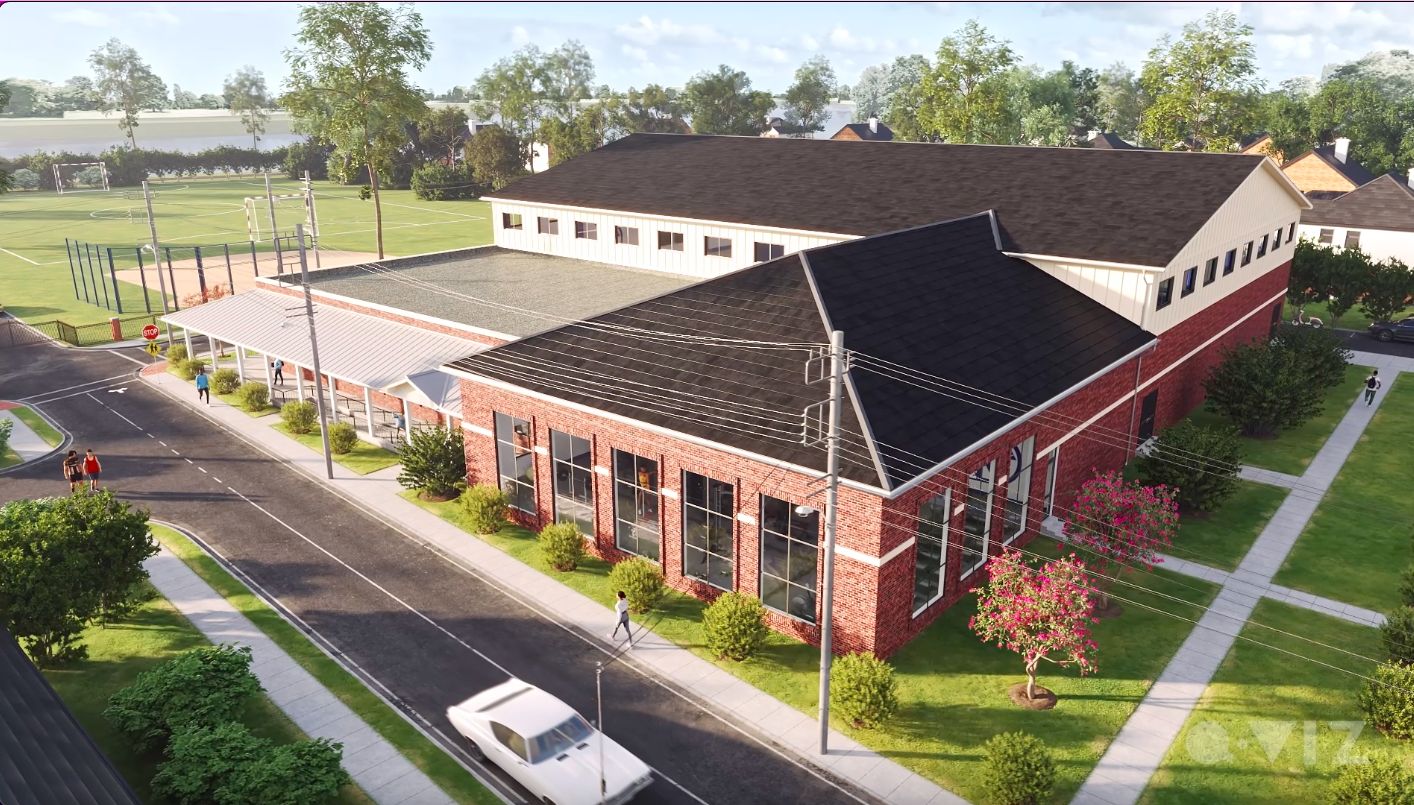
On the corner of Pearl and Ellis Streets, just a short walk from the Delaware River across from the private school’s main campus, a new $10.5 million building will include a field house, fitness center, and gymnasium. The existing gym, built in 1965 as part of the school’s primary cluster of buildings along the riverfront, will be converted into an auditorium.
The independent Episcopal day school serves roughly 200 students from pre-K through 12th grade. Tuition varies based on grade level and program, ranging from $16,600 for pre-K to second grade to $25,700 for grades nine through 12 for the 2026-27 school year.
Pre-construction work on site has already been completed, Doane Academy’s head of school, Erin Mayo, said in an email. Construction will begin when the school gets the final building permit from the city, Mayo said, with the goal of completing the athletic center in August 2027.
Doane will then convert the former gym into an auditorium, a $1.6 million project it hopes to finish by early 2028, she said. A small portion of the auditorium conversion has already been completed: The gym’s locker-room area was reconfigured into a new instrumental music space in 2023, Mayo said.
Doane Academy raised $6.4 million for the projects before the effort was bolstered by an $8 million gift from the Lee Rowan Foundation, the school announced Wednesday.
“This gift is simply monumental,” Mayo said in a statement announcing the donation. “It enables us to make radical, long-desired strides for our students in their athletic and performing arts experiences. We are enduringly grateful to the Lee Rowan Foundation for its generosity and faith.”
While the new facilities will primarily serve the school’s student body, Mayo said, Doane also plans to offer fitness center memberships and court rentals to the community.
Leaves are falling, cardigans are coming out of the closet, and pumpkin spice is on menus everywhere.
In other words: Autumn is in full swing.
With Halloween just around the corner, it’s the perfect time to get into the fall mood at events across South Jersey this month.
Burlington County
The Haunting on High Street
The Burlington County Prison Museum is getting into the spooky spirit with a haunted walkthrough of the historic building and Halloween hangout in the courtyard.
⌚️ Friday and Saturday, Oct. 16-17, 23-24, and 30-31, 7-10 p.m. 📍 128 High St., Mount Holly 🌐 bloodshedfarmsfearfest.com 💵 Tickets for the walkthrough and hangout are $31; tickets for just the hangout are $13
The Witches Bazaar
The Mill Race Village Shops will once again welcome fire twirlers, stilt walkers, and witches for the bazaar. Come dressed in your best costume and try to win over the audience during the crowd-favorite costume contest.
⌚️ Saturday, Oct. 17, 4-10 p.m. 📍 Mill Race Village Shops, 5 Church St., Mount Holly 🌐 millraceshops.com 💵 Free; registration required for costume contest
Chatsworth Cranberry Festival
Celebrate New Jersey’s annual cranberry harvest at this rain-or-shine festival featuring a craft show with up to 150 vendors, more than a dozen food options, and live music. Organizers recommend that attendees bring cash as spotty cell reception makes credit card payments difficult. There will be ATMs available onsite, but expect lines to be long.
⌚️ Saturday, Oct. 17 and Sunday, Oct. 18, 9 a.m.-4 p.m. 📍 White Horse Inn area, Route 563 and Route 532, Chatsworth 🌐 cranfest.info 💵 Free
Maple Shade Halloween Parade
Maple Shade’s annual Halloween parade will start near Fellowship Avenue and travel along Main Street before ending at North Lippincott Avenue. The parade will be followed by a costume contest.
⌚️ Saturday, Oct. 24, 2:15 p.m. 📍 Main Street, Maple Shade 🌐 mapleshade.com 💵 Free
Tricks, Treats & Thrills: Haunted High
Willingboro is getting into the spooky spirit with a family-friendly night at the Kennedy Center. Expect candy stations, Halloween movies, music, and light refreshments in addition to tours of a Halloween-themed classroom.
⌚️ Friday, Oct. 30, 6-10 p.m. 📍 Kennedy Center, 429 John F. Kennedy Way, Willingboro 🌐 Willingboro Township Facebook 💵 Free
Mount Holly Fall Fest
Celebrate all things autumn at this annual event featuring the Howl-o-Ween Pet Pawrade, local vendors, and more in downtown Mount Holly.
⌚️ Saturday, Oct. 31, 11 a.m.-4 p.m. 📍 Downtown Mount Holly 🌐 Fall Fest Facebook 💵 Free
Camden County
Fintastic Pumpkin Glow
Join more than 5,000 aquatic animals as they get into the Halloween spirit.
⌚️ Friday, Sept. 18-Sunday, Nov. 1 📍 Adventure Aquarium, 1 Riverside Dr., Camden 🌐 adventureaquarium.com 💵 General admission tickets start at $32.99 for adults and $27.99 for kids
Howl-O-Ween Bash
The Animal Welfare Association is once again hosting its annual all-ages Howl-O-Ween bash to fundraise for South Jersey animals in need. The event will include vendors, free kids activities, a trunk-or-treat, and spooky-themed cocktails and food.
Enjoy a pumpkin patch, hayrides, children’s activities, a petting zoo, and more at this family-friendly event. Food trucks and vendors will also be on site for the festival.
⌚️ Saturday, Oct. 17, 11 a.m.-3 p.m. 📍 Voorhees Town Center, 2400 Voorhees Town Center, Voorhees 🌐 voorheesnj.com 💵 Free
Pennsauken Fall Festival
The 12th annual Pennsauken Township Fall Festival will be highlighting America’s 250th birthday in addition to carnival rides, games, music, and food.
Over 100 vendors will be at the historic Croft Farm for this family-friendly festival alongside pony rides, a petting zoo, free pumpkins, and a beer garden. Rain or shine.
The third annual Halloween makers market will feature a wide variety of spooky vendors alongside a pop-up beer garden and a live DJ. This two-night, family-friendly event will also include fire pits with s’mores stations and a photo booth.
Enjoy a day full of family-friendly entertainment featuring a wide range of local artists and craft vendors alongside live music, free activities for kids, and more.
Nine Haddon Township restaurants with food and drink specials make up the route for this 21-and-over event. A free jitney will take riders to and from each participating location along Haddon Avenue in addition to the Westmont PATCO station.
⌚️ Saturday, Oct. 24, 2-10 p.m. 📍 Haddon Avenue, Haddon Township 🌐 shophaddon.com 💵 Pay as you go; no cover charges and no tickets required
Gloucester County
The Great Pumpkin Glow at Dalton Farms
This new attraction features thousands of glowing jack-o’-lanterns along a festive pathway through huge pumpkin displays.
⌚️ Friday, Sept. 25-Saturday, Oct. 31, various evening times 📍 Dalton Farms, 666 Oak Grove Rd., Swedesboro 🌐 greatpumpkinglownj.com 💵 $22.95-$27.95
Monroe Township Fall Festival
Drop off your submission for the family pumpkin-carving contest by 10 a.m. before taking a pony ride or strolling through the pumpkin patch in Williamstown.
In addition to enjoying hayrides and a pumpkin patch, kids can get an early jump on this year’s trick-or-treating with Elk Township’s trunk-or-treat event at the Harvest Festival.
Take a trip back in time with living history demonstrations, artillery and cannon drills, and meet-and-greets with Revolutionary War reenactors at Red Bank Battlefield. Vendors and food trucks will also be on site throughout the afternoon.
⌚️ Sunday, Oct. 18, 10 a.m.-4 p.m. 📍 Red Bank Battlefield Park, 100 Hessian Ave., National Park 🌐 gloucestercountynj.gov 💵 Free
Halloween Food Truck or Treat Festival
More than a dozen food trucks will be at Washington Lake Park for this daylong event full of food, music, candy, and costumes. Kids can trick-or-treat while families enjoy local vendors, mini golf, and face painting.
⌚️ Saturday, Oct. 24, 11 a.m.-6 p.m. 📍 Washington Lake Park, 626 Hurffville Crosskeys Rd., Sewell 🌐 Festival Facebook 💵 Admission is $5 at the gate; children under 5 years old get in for free
Children with autism and developmental disabilities will attend the two-story, 55,205-square-foot school when it opens in 2028.
An estimated 188 staff members will work with the children, who will be between 3 and 11 years old, according to Bancroft’s plans. The staff is larger than the expected enrollment because of the needs of the students, according to Bancroft.
The school’s preliminary and final major site plan was approved for former agricultural land that now is a lawn on the southeast part of the Welsh Campus, according to the application.
Bancroft’s overall 80-acre Mount Laurel campus was approved by the planning board in 2016.
A possible additional future expansion on the southwest part of the property is mentioned in the elementary school documents, but details were not provided.
70and73.com is a hyperlocal news site focused on South Jersey, including the communities of Cherry Hill, Evesham, Mount Laurel, Voorhees, Medford, Medford Lakes, and Moorestown.
The CEO of Chobani thought he had identified a site in the Lehigh Valley for the yogurt company’s first dairy plant in Pennsylvania.
But challenges with wastewater and energy were holding up Hamdi Ulukaya’s plans. “And if you don’t have that solution, you kind of don’t want to touch anything,” the billionaire founder said in September.
As Ulukaya announced a $1.2 billion investment at a new facility in Allentown — the biggest private investment in the state’s agriculture industry on record — he credited Gov. Josh Shapiro with making it happen. The state expedited permitting for the project and offered $50 million in grants and loans to support site improvements.
“This really speaks to the leadership of this state,” Ulukaya said. “I’ve never seen anything like this.”
As Shapiro, 53, runs for reelection in November, analysts say, deals with companies like Chobani help reinforce an image the governor has cultivated as a pro-business Democrat who is focused relentlessly on “getting stuff done.”
“I’m competitive as hell. I wanna win every deal,” Shapiro said in September at the Chobani announcement. “For a long time, Pennsylvania wasn’t even on the field. We’re on the field now. We’re competing. We’re winning big deals like this.”
Gov. Josh Shapiro in 2024 at the site of the Bellwether District. The 1,300-acre industrial campus in Southwest Philadelphia was previously a Sunoco oil refinery and is being redeveloped. Alejandro A. Alvarez / Staff Photographer
And increasingly, Shapiro has tapped state subsidies to help drive economic development — landing splashy commitments such as pharma giant Eli Lilly & Co.’s plans for a $3.5 billion plant in the Lehigh Valley and discount retailer Burlington Stores’ $370 million move from South Jersey to University City.
Since Shapiro took office in 2023, his business development team, known as BusinessPA, has spent $121.8 million per year on average to attract, retain, and grow businesses through incentives to employers, according to data the state shared with The Inquirer.
That is more than double the $51.6 million the state invested annually on such deals from 2018 through 2022 under Gov. Tom Wolf, according to the current administration.
Shapiro administration officials say incentives are one piece of a broader strategy to make Pennsylvania more attractive to businesses. Other key ingredients include speeding up projects, investing in industrial site improvements, and continuing to reduce the corporate tax rate.
(function(){function e(){window.addEventListener(`message`,function(e){if(e.data[`datawrapper-height`]!==void 0){var t=document.querySelectorAll(`iframe`);for(var n in e.data[`datawrapper-height`])for(var r=0,i;i=t[r];r++)if(i.contentWindow===e.source){var a=e.data[`datawrapper-height`][n]+`px`;i.style.height=a}}})}e()})();
Shapiro’s strategy carries some political risk, however.
In the gubernatorial race, Shapiro is leading Republican State Treasurer Stacy Garrity by a wide margin in polls. But he is also thought to be mulling a run for president in 2028.
Any perceived coziness with big corporations could haunt Shapiro in a Democratic primary, said Chris Borick, a political science professor at Lehigh University. Shapiro has already seen voters turn against an industry he once courted: data centers.
“He left a trail of breadcrumbs that made that connection to the industry that he has had to walk back on this year,” Borick said.
Garrity’s campaign has sought to highlight Shapiro’s early support for Amazon data center projects in Pennsylvania that he said would result in $20 billion in private investment. Shapiro has since sought to restrict data center development. Garrity, too, initially supported data centers publicly, but has since backtracked.
In a statement, Garrity’s campaign said Shapiro’s economic agenda amounted to “corporate welfare.”
A Garrity administration would “cut the red tape that is holding up progress, reduce the tax burden facing families and businesses, and hang a welcome sign — not a handout — to businesses that want to start or move to the commonwealth,” campaign spokesperson Matt Beynon said.
For Pennsylvanians, the bigger question is whether the governor’s economic development deals will pay off in the long term.
But evaluating the efficacy of his incentive spending could prove challenging. A state board created in 2017 to review the performance of tax credit programs and other government spending has not met since 2023, PennLive reported.
“The right scorecard is not the size of the subsidy package or the value of the announcements,” said Bernie Gallagher, executive director of the left-leaning Keystone Research Center in Harrisburg.
“It’s whether public dollars changed business behavior, and then produced additional family-sustaining jobs and left durable assets behind, and then delivered a measurable public value.”
A new strategy for wooing business
State and local governments spend tens of billions of dollars a year on incentives for businesses, research shows.
When Shapiro took office in 2023, his team found Pennsylvania was being outspent “astronomically” by states like New York, North Carolina, Virginia, and Ohio, said Rick Siger, secretary of the Pennsylvania Department of Community and Economic Development.
Ramping up incentives was one part of the Shapiro administration’s economic development strategy rolled out in 2024 — the state’s first new plan in nearly 20 years, according to the governor. It focused on growing five core industries: agriculture, energy, life sciences, manufacturing, and robotics and technology.
“We didn’t have a plan for economic development in the state for a long time,” said Chellie Cameron, CEO of the Chamber of Commerce for Greater Philadelphia, who describes the road map as “significant.”
With bipartisan support in the legislature, Shapiro launched PA SITES, an incentive program aimed at developing shovel-ready sites for businesses. Lawmakers authorized the administration to borrow $400 million to fund it. That is the program Shapiro tapped to incentivize Chobani.
Hamdi Ulukaya, Chobani founder and CEO, announced in September that his company is investing $1.2 billion to set up a new dairy plant in Allentown. Chobani
From 2023 through late September, Shapiro’s BusinessPA team pledged nearly $457 million in grants, loans, and tax credits to roughly 90 companies that promised to create or retain jobs in the state, according to the administration. That figure does not account for tax breaks available to certain firms located in Keystone Opportunity Zones, a program established in 1998 to promote economic development.
The top 10 largest incentive deals — including deals with Johnson & Johnson, Eli Lilly & Co., and Chobani — accounted for 65% of the total subsidies.
“We’ve been able to compete for some of these really large-scale deals that the state did not have the capability to compete for financially in the past,” Siger said.
Since Shapiro took office, his administration has tallied $43 billion in planned investments and 29,000 jobs created in Pennsylvania by private-sector employers that got help from BusinessPA or other state programs.
One hub of economic activity has been the Bellwether District, a 1,300-acre industrial campus in Southwest Philly that was previously a Sunoco oil refinery.
View of the Bellwether District in 2023. The Bellwether District is in a Keystone Opportunity Zone, so businesses that locate there get big tax breaks.Heather Khalifa / Staff Photographer
Canned beverage manufacturer DrinkPAK is investing $195 million in a new manufacturing facility at the district, which is in a Keystone Opportunity Zone and is being redeveloped by Chicago-based HRP Group. DrinkPAK, which also has locations in California and Texas, says it will create 174 jobs at the factory and produce billions of cans a year.
Company executives said they evaluated sites across five states. In addition to Bellwether’s KOZ — a designation that required city and state approval — the Shapiro administration offered DrinkPAK a $2 million grant.
“I’m going to say it really, really plainly,” said Holly Schroeder, DrinkPAK’s vice president of organizational strategy. “DrinkPAK would not be standing here in Pennsylvania without the support of the incentives the commonwealth brought to the table.”
Jeff Hornstein, executive director of the Economy League of Greater Philadelphia, said Bellwether shows how incentives can help stimulate economic activity that would not have occurred otherwise.
“Bellwether was a disgusting, decrepit brownfield, and through visionary leadership and a lot of money, like a lot of tax incentives, it is going to become a job node, much like the Navy Yard became,” he said. About 16,000 people now work at the Navy Yard, for employers including Urban Outfitters, Tastykake, and Jefferson Health.
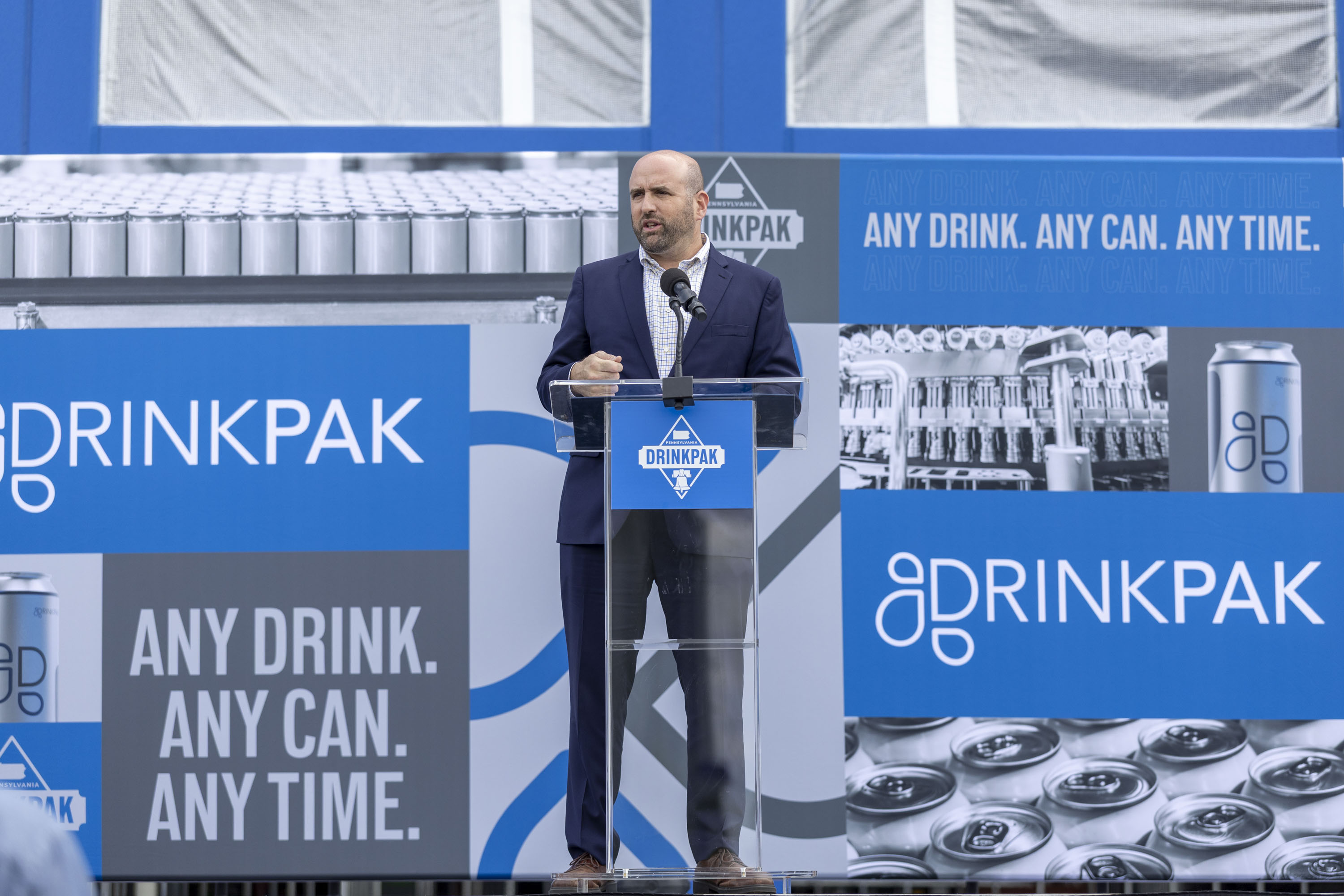
DCED secretary Rick Siger speaks at a DrinkPAK event in late September, marking a construction milestone for the company’s new Philadelphia manufacturing facility.Tyger Williams / Staff Photographer
But Hornstein questioned whether some of Shapiro’s incentives — like one with Burlington, which is relocating its headquarters from South Jersey to Philadelphia — will benefit the region as a whole.
Burlington says it will relocate 1,500 existing jobs to University City and create 500 new ones. Shapiro’s team counts all of those as newly created jobs because they are new to Pennsylvania.
“Is inducing a firm to move from one part of the region to another — is that really growth activity or is it zero sum?” said Hornstein, whose organization seeks to promote inclusive and equitable growth. “We win 2,000 jobs. Burlington County, N.J., which is in our region, loses 2,000 jobs. Is that net growth for the region, or just ‘yay Philadelphia, yay Pennsylvania’?”
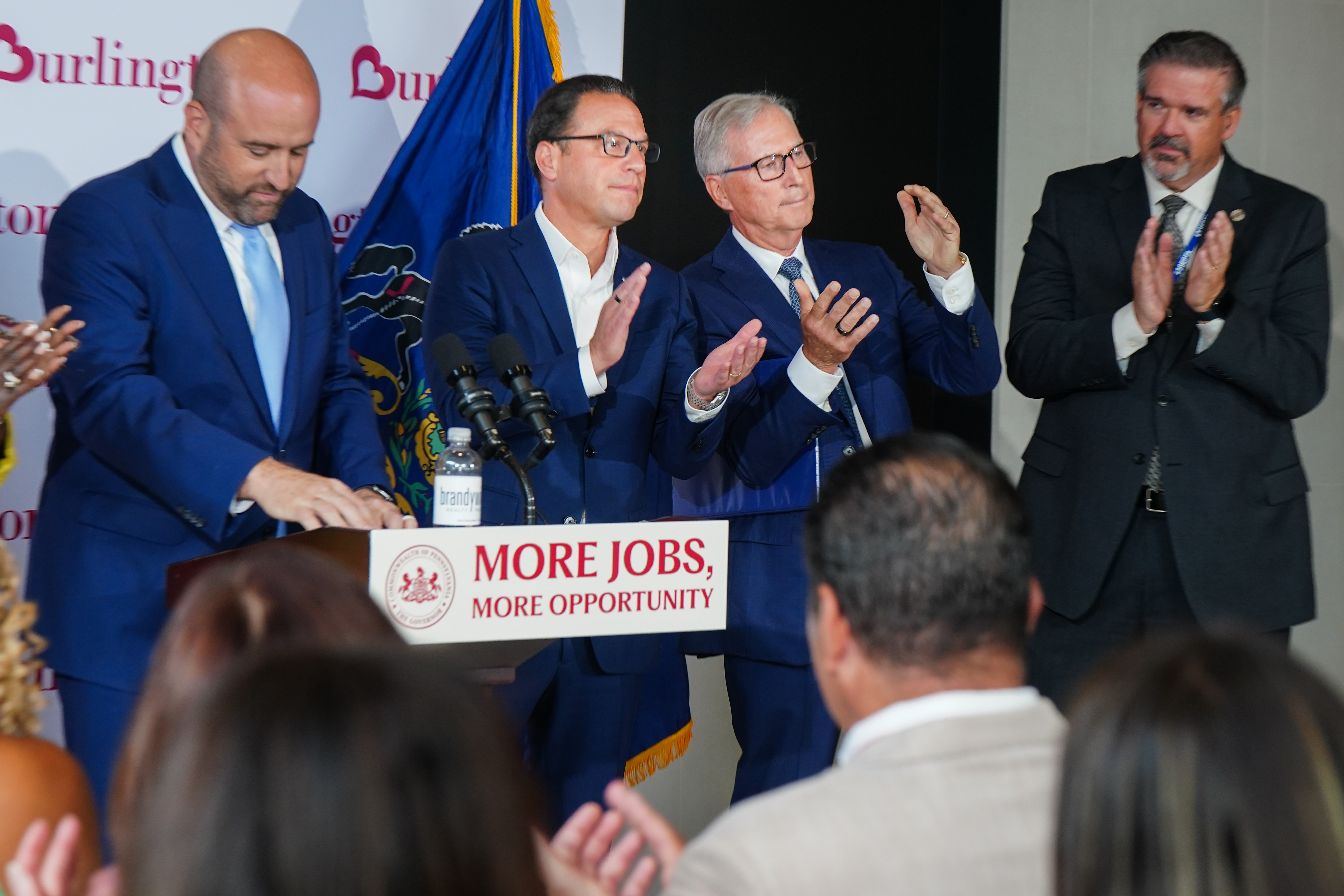
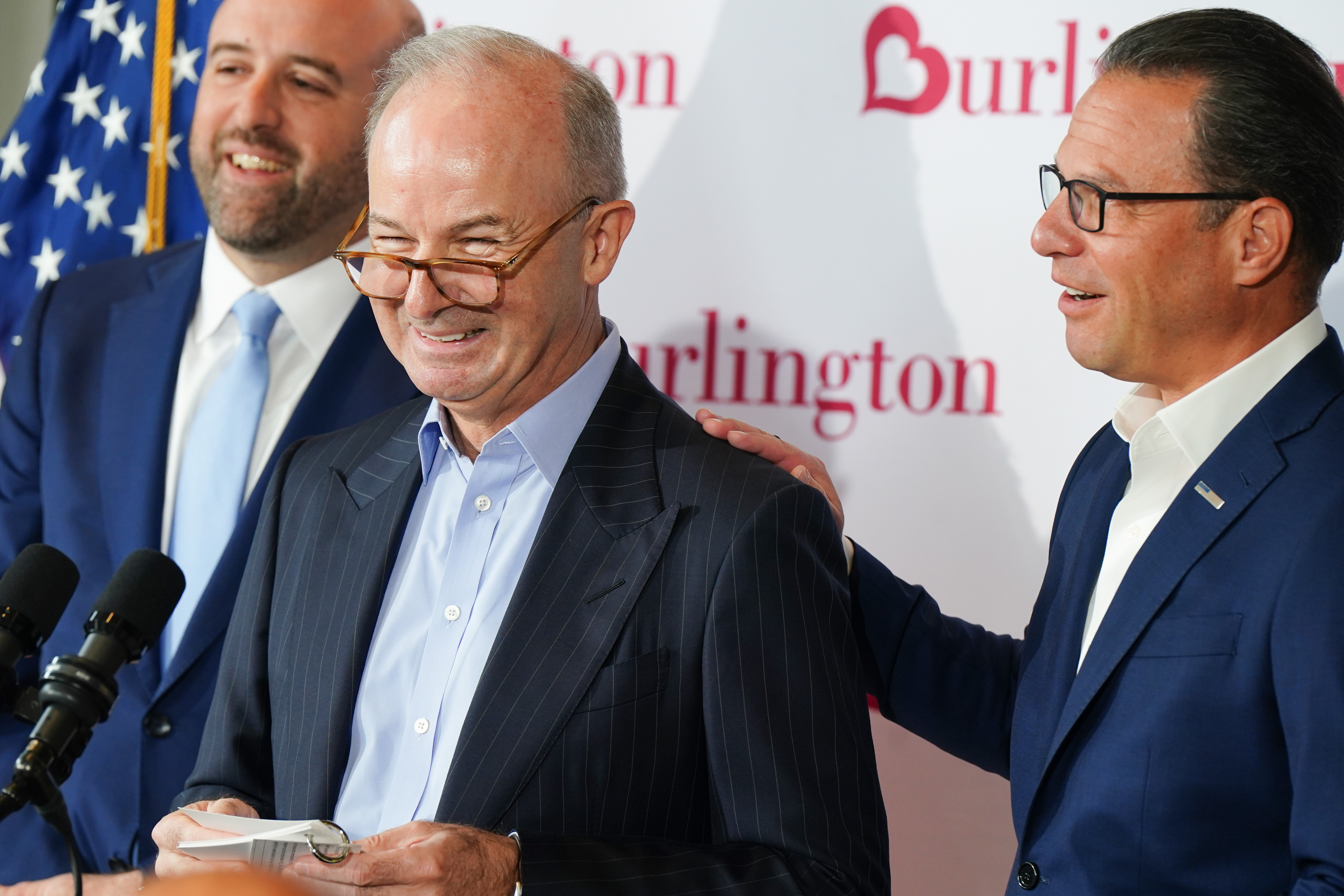
Burlington CEO Michael O’Sullivan and Gov. Josh Shapiro at an event announcing the company’s headquarters move to Philadelphia. Burlington says it will relocate 1,500 existing jobs and create 500 new ones at the new headquarters. Jessica Griffin / Staff Photographer
More broadly, critics say the state’s incentive programs allow politicians to pick winners and losers in the marketplace. They also note that some of the programs are also financed through borrowing, such as Pennsylvania’s Redevelopment Assistance Capital Program — the source of a $20 million grant to Burlington.
“So taxpayers are not only funding those handouts, but they’re also paying interest on those costs, which you know, in our opinion, is kind of the worst of both worlds,” said Elizabeth Stelle, vice president of policy at the Commonwealth Foundation, a right-leaning think tank in Harrisburg.
Who gets the jobs?
Given the amount of money states pump into economic development, there are bound to be some losing bets. And Pennsylvania has had its fair share.
States have been bidding against one another for firms since at least the 1970s, according to academic research, and in that era the big corporate competition featured automaker Volkswagen.
In 1976 the German company chose to build its first U.S. plant in Southwestern Pennsylvania — enticed by $100 million in state subsidies, or about $580 million in 2026 dollars. The plant shut down a decade later.
A 2020 academic paper that reviewed subsidy deals from 2002 to 2012 found that firm-specific incentives were associated with increased average employment in the targeted industry but were not linked to broader economic growth.
“We spend a ton of money on these things, and it’s not obvious they’re always tied to more investment and benefits for the place rather than hollowing out the tax base,” said Owen Zidar, a coauthor of that paper and a professor of economics and public affairs at Princeton University.
Then there’s the question of which workers get the jobs created through subsidy deals.
“We really need to think about talent attraction and talent retention alongside business attraction,” said Jennifer Kebea, president of Campus Philly, which works to keep Philadelphia college students in the area after graduation. “Are the young people graduating from our institutions poised to take these roles?”
Shapiro’s team says it is focused on securing good jobs for local residents.
“We base our incentives — and whether we incentivize a deal at all — on the wages and job quality associated with those roles,” Siger, the department secretary, said.
Jobs created under the Shapiro administration pay more than new jobs announced under the previous administration, the state says.
“That’s the exciting part of what this governor’s been able to do. His team has been able to zero in on really good companies that want to pay good wages,” said H. Patrick Clancy, CEO of Philadelphia Works, the city’s workforce development board.
Down the road, Clancy wonders how many of the jobs created will be retained. In other words: “Long term, did it really all pan out?”
Urban Outfitters cofounder Dick Hayne, and Gov. Josh Shapiro gathered in June at the company headquarters in the Navy Yard, to announce that the business is adding over 1,000 jobs in the region over the next seven years. Alejandro A. Alvarez / Staff Photographer
A 2017 law requires Pennsylvania’s Independent Fiscal Office to review each tax credit program and state agency at least once every five years, and report its findings to the Performance-Based Budget Board. Board members include four lawmakers from both parties, as well as the governor-appointed budget secretary.
But the board has been dormant since 2023 and its members have declined to say why, according to PennLive.
The Shapiro administration is “awaiting consensus” among board members on how to move the review process forward, a spokesperson said, adding that the panel has not provided “clear direction” to agencies.
In the meantime, the administration continues to evaluate government programs, including tax credits, through its Resource Evaluation and Mission Alignment Project (REMAP), the spokesperson said. That project has already informed changes to some tax credits.
Stelle, of the Commonwealth Foundation, said: “Internal reviews are one thing, but the lack of a public review of outcomes is concerning. Pennsylvania taxpayers deserve to see the impact of tax credits and agency programs. Funding should be based on outcomes, not intentions.”
The state says it has measures in place to ensure companies receiving incentives hold up their end of the deal.
“We have a formula that we negotiate with the company to claw back part — or, in draconian cases, all — of an incentive based on nonperformance,” Siger said.
Since the beginning of 2023, the administration says, it has clawed back over $3.8 million from 64 businesses that failed to create or retain the jobs they promised, or otherwise broke their commitment.
“Our goal, of course, is not to do that,” Siger said. “Our goal is to create the jobs.”
Staff writer Joe Yerardi contributed to this article.
Democratic Sen. Cory Booker took to the stage Thursday for a debate with Justin Murphy, the South Jersey Republican mounting a long shot campaign to unseat the well-funded incumbent.
As of June 30, Booker raised more than $33 million while Murphy raised just over $27,000.
There are nearly 865,000 more Democrats than Republicans in New Jersey. The state’s electorate, as of June, includes 38% Democrats, 35% unaffiliated voters, and 25% Republicans.
The debate, which was hosted by the New Jersey Globe and Rider University and broadcast nationally by C-SPAN, lasted about one hour.
The moderators focused much of their questions onTrump’s policies.Booker criticized congressional Republicans, who he said have “enabled” the president. Murphy, on the other hand, praised the current economy — a stark contrast to Democrats’ messaging this campaign season.
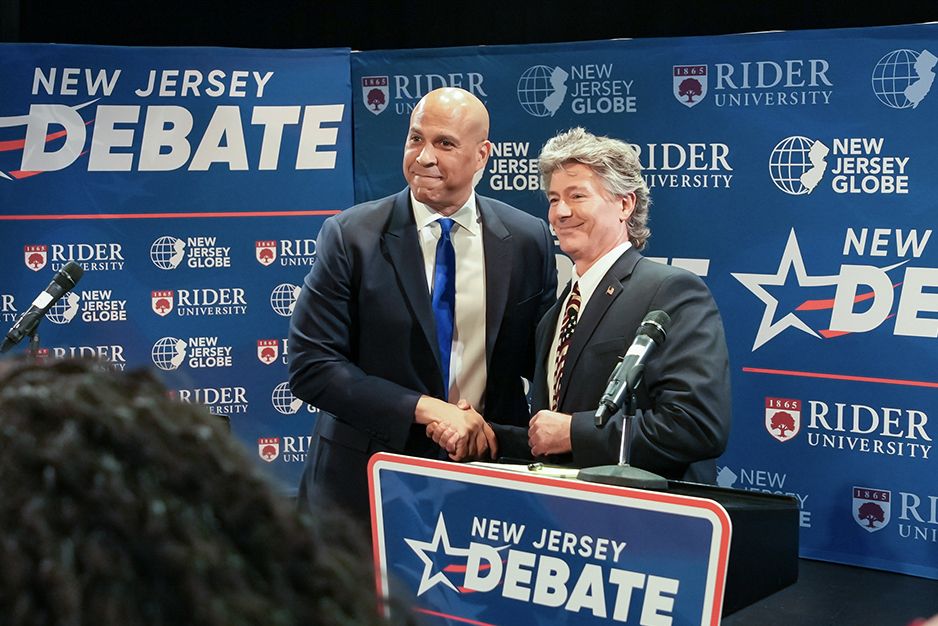
The two candidates were mostly civil, shaking hands and posing for a photo before getting started. Booker, who is bald, made a couple of jokes about Murphy’s voluminous head of hair.
The most raucous part of the debate was when audience members erupted during both Booker and Murphy’s remarks about the state’s sanctuary policy for immigrants.
Here are the highlights.
Sen. Cory Booker, left, and his South Jersey Republican challenger Justin Murphy, shaking hands on the debate stage Thursday night.Pete Borg / Rider University
Focus on Trump: His cabinet, Iran, and the Epstein files
Murphy supports Trump but said he’s not a “blind rubber stamp.” He admitted he is not well-versed on Trump’s cabinet picks or the Epstein files.
When asked about Trump’s cabinet members, the Republican said he trusts the president’s judgement but that he doesn’t know enough about them.
“I don’t know about their backgrounds. I couldn’t name them all for you right now,” he said.
“You’ve gotta be honest,” he added.
The Republican also said his knowledge is limited on the Jeffrey Epstein files, in which Trump is referenced thousands of times. Trump lobbied against releasing them to the public until it was clear he didn’t have enough support from his own party. Murphy said he supports the law that required the files to be released with redactions and exceptions — and supports an overall increase in transparency around them.
Booker had fierce criticism of the president on both subjects.
The incumbent said he voted for some of Trump’s appointees for his first term but the second time around, “something happened where it suddenly seemed like the standard he was creating for a cabinet position was loyalty to him.”
He said the Trump administration’s handling of the Epstein files was an example of Trump’s White House working to protect the president from valid inquiries “and as a sword to go after anybody that criticizes him.”
As for the Iran war, Murphy defended Trump but also said the president should wrap it up.
“Mr. President, put your cowboy hat on and get out there, and kick some … and get this done and done right,” he said to cheers from supporters.
Booker responded that Murphy’s attitude is precisely the problem, calling it a “false bravado.”
“We do not need yahoo policy,” Booker said. “We need sound people that use military force as a last resort, who know the power of diplomacy, who don’t insult your enemies and threaten to invade Canada and Greenland, but pull our allies together.”
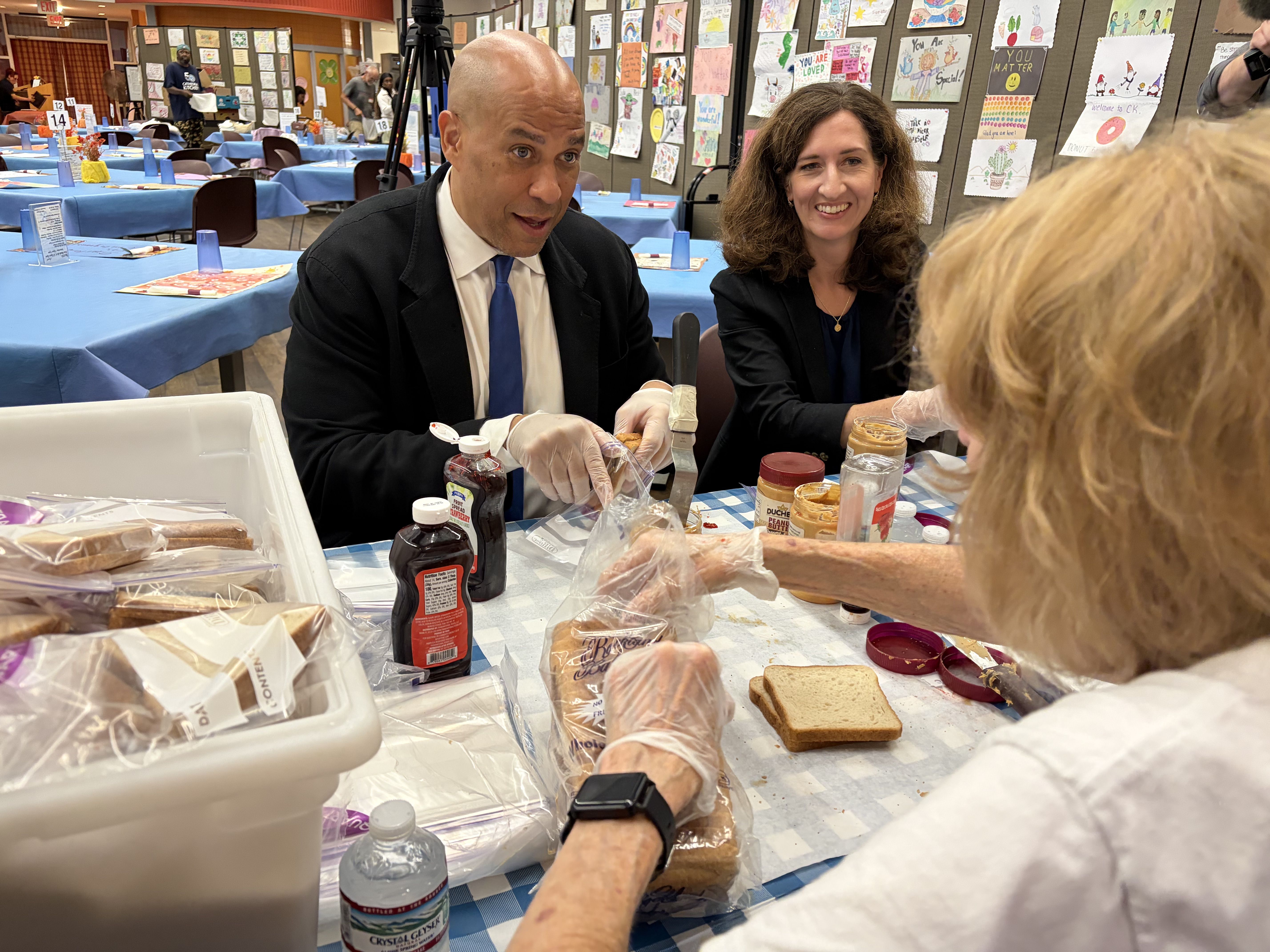
Sen. Cory Booker sits with volunteers at Cathedral Kitchen in Camden on Thursday, Aug. 27.Aliya Schneider / Staff
Housing policies
Sahmya Smith, a Rowan student and Passaic County voter, asked the candidates how they would address the racial wealth gap in New Jersey driven by home ownership disparities.
Booker touted bipartisan housing efforts including a new housing law and opportunity zones, the second of which he said resulted in affordable housing construction in Atlantic City.
“For me, as a guy who was the mayor of Newark, New Jersey, a majority minority city, we were able to double the production of affordable housing during the last housing recession we had in 2008, 2009, it’s something that I feel is really urgent right now,” he said.
He said that Trump’s trade war with Canada is driving up building costs.
Murphy said the best way towards home ownership “is being gainfully employed with low interest rates.” He said the Republican Party is providing the opportunity for the American Dream and that the country, referencing statistics from the Census Bureau that found that the median household income reached a historic high in 2025 since tracking began in 1967 and the poverty rate is the lowest it has been since tracking began in the 1960s.
That being said, the bureau also found that income inequality remained high, and the supplemental poverty measure — which considers non-cash benefits like food aid and household expenses — reached an all time low in 2021 under former President Joe Biden, AP reported.
“We continue to empower people through economic empowerment and betterment,” Murphy said, citing tax relief on tips, overtime, and Social Security benefits. He also noted that there should be more housing supply.
Candidate Justin Murphy, in the suit, at a Pinelands Republican Club event on Jan. 29, 2025.Aliya Schneider / Staff
Sanctuary state
New Jersey’s Immigrant Trust Directive, known as the state’s sanctuary policy, limits state law enforcement’s cooperation with federal immigration officers. Booker said the policy made immigrants feel more comfortable contacting law enforcement to report crimes, but that people feel unsafe again because of ICE immigration sweeps directed by Trump.
“My first priority is keeping New Jersey towns, municipalities, and cities safe, and to do that, I believe the policies of our state are good in keeping bright lines between what is a federal responsibility and what is a county and state and local responsibility,” he said.
Someone off camera shouted that they had to “butt in” and verbal chaos erupted with shouts from the audience.
Murphy said sanctuary policies “are a magnet for criminal illegal aliens,” even though “not every illegal alien is in this country to do us harm.”
“Sanctuary jurisdictions are a problem. They incentivize illegal immigration, and I don’t believe they help our state stay safe,” he added.
As he elaborated on his stance, another interruption erupted from the audience. Murphy responded by saying his position is “not xenophobia.”
Murphy recently received heat from Democrats for comments he made at an August town hall hosted by the Morris County GOP, saying “Islam creates a problem” in response to a question that mentioned a “big Muslim problem.”
Booker at the time called Murphy’s remarks “vile.” Murphy told Politico he intended to reference “radical Islam” and not all Muslims.
As tech CEOs debate the looming threat of artificial intelligence to worldwide safety and economic stability, lawmakers in New Jersey have begun taking steps to protect the workforce from fast-moving changes that have already disrupted how many do their jobs.
The state Senate Labor Committee last week voted unanimously to approve a bill that would regulate how employers use AI to monitor, evaluate, and ultimately replace workers.
The bill, which comes amid a broader backlash to AI and surveillance technology, now moves to the Senate budget committee for consideration before a vote by the full chamber. The “Fair Act” would require private- and public-sector employers to provide 60 days notice before implementing AI that would impose significant changes to job expectations. Employers who eliminated jobs because of AI advances would be required to offer training, extended severance pay, and benefits, according to the bill.
It would also regulate how employers use electronic monitoring tools to collect information about employees’ productivity, and how “automated employment decision-making systems” are used to hire, promote, and fire people.
“It makes sure employers can’t spy on you when you are off the clock. Your boss should not be able to follow you home,” said Charle Wowkanech, president of the New Jersey State AFL-CIO, which represents 1 million public- and private-sector workers and their families, who spoke at a recent rally outside the Statehouse to draw attention to the bill.
Artificial intelligence is already monitoring the productivity of thousands of people who work in grocery stores, factories, and cannabis operations in the state, said Daniel Ross, president of United Food and Commercial Workers Local 152, which represents workers in New Jersey, Pennsylvania, Delaware, and Maryland. “The time-test matrix is so unreasonable that workers skip bathroom breaks, they don’t take water breaks, to avoid falling behind,” Ross said.
“Surveillance is not mainly harmless oversight, as it’s sold by employers,” Ross said. “Workers subjected to these practices experience elevated stress levels, declining mental health, and [increased] injury rates.”
Other states have already taken up the issue.
California, Colorado, Connecticut, Illinois, and New York have enacted various workplace protections from AI, according to Multistate, a clearinghouse for state legislation across the country. Pennsylvania has introduced its own bill to regulate AI in the workplace.
However, New Jersey business and industry leaders urged the committee to rethink some of the most sweeping provisions of the bill.
Most of the 1,300 members of the Chamber of Commerce Southern New Jersey are small businesses, which are not equipped with vast human resource or legal departments to implement the law, said Adam Guzjewski, president of Katz Government Affairs.
The bill requires employers to comply with vague requirements to ensure AI does not undermine “an employee’s autonomy, dignity, or welfare.”
But Jack Kelly, a lobbyist for the New Jersey Business and Industry Association, said it’s unclear how these requirements will be enforced for businesses.
“Large corporations may have dedicated legal compliance and technology teams. Many New Jersey businesses do not. For small businesses, these requirements create significant barriers to entry,” Kelly said.
New Jersey’s legislation is not out of step with how other states have regulated AI use, said Tony L.J. Lin, anassociate professor of accounting at Rowan University who studies artificial intelligence in the workplace.
“If AI materially restructures jobs, we need a mechanism for retraining and redeployment,” Lin said.
States should push back on efforts to evaluate employees through invasive means like monitoring keystrokes, simply because this strategy likely does not fully show a worker’s productivity or value, Lin said.
Lin said there is great potential to improve jobs using AI. A nurse-practitioner, for instance, would benefit from technology that handles automated tasks. But a nurse-practitioner will always be valued for the “human judgment, contextual understanding accountability” aspects of the job, he said.
Debbie White, president of the largest nurses union in New Jersey, isn’t so sure.
“Healthcare employers are increasingly using AI and electronic monitoring systems to track worker productivity, evaluate performance, and influence staffing decisions,” White testified during the Oct. 1 hearing in Trenton.
However, White said these systems fail to measure “the reality of nursing care,” which often involves time comforting ailing patients and educating their families among other overlooked aspects of the job.
“AI can be useful, but it can’t replace the judgment of a nurse at the bedside,” she said.