Blog

  • McConnell not medically cleared to leave rehab yet, Capitol physician says

    McConnell not medically cleared to leave rehab yet, Capitol physician says

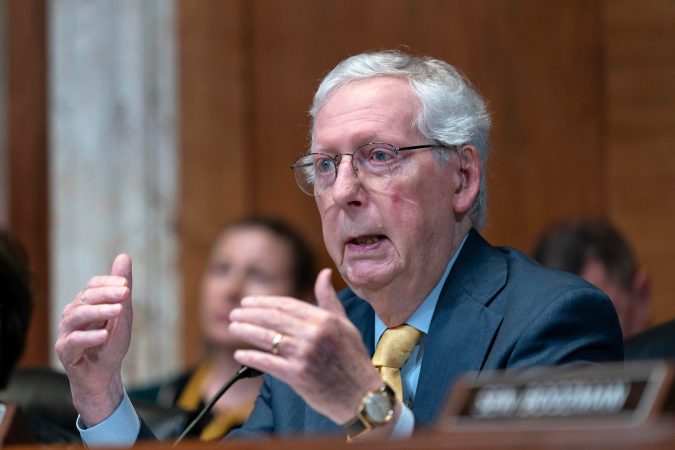
    Sen. Mitch McConnell (R., Ky.) has not been medically cleared to leave a rehabilitation facility, the Capitol physician’s office said Monday, and will miss Kentucky’s Fancy Farm Picnic on Saturday as he continues recovering from a June fall.

    McConnell, 84, was hospitalized June 14 after suffering a fall at home and has not returned to the Senate. He said earlier this month that he had moved to a rehabilitation facility but has not provided a timetable for his return.

    “I’m still working hard to get back to my full schedule of work in the Senate and in Kentucky, keeping up with intense physical therapy per my doctors’ orders,” McConnell said Monday in a statement. “Unfortunately, that means I won’t be able to make it to Fancy Farm, Kentucky this Saturday.”

    In an accompanying statement, Congress’ Office of the Attending Physician said McConnell was “not yet medically cleared to leave the rehab facility and return to the office.” Its physicians visit him daily, the office said, and he is undergoing multiple physical therapy sessions each day to rebuild his strength and reduce the risk of future falls. The office said childhood polio “continues to be a significant factor in his mobility.”

    McConnell has been a regular speaker in the past at Fancy Farm, a picnic in rural western Kentucky that draws politicians from across the state every August.

    McConnell shared a photo of him with his wife, Elaine Chao, which his office said was taken on Sunday.

    McConnell has faced growing questions about his health and when he will return to the office over the past six weeks, which occasional updates from his office have not silenced. Scott Jennings, a former McConnell campaign aide, urged McConnell last week to “routinely update his constituents on how he’s doing.”

    “When you’ve been in a hospital for a month and you’ve missed all the votes … you owe your boss, like anybody else out there who works, an explanation of what’s been going on and when you’ll get back,” Kentucky Gov. Andy Beshear, a Democrat, said earlier this month.

    McConnell’s office has said that he continues to work as he recovers. David Popp, a McConnell spokesperson, said Friday that McConnell “continues to meet with staff regarding Senate and Kentucky business, including discussions on defense appropriations, foreign policy, the farm bill, constituent services, and constituent federal grant requests.”

  • Trump’s Board of Peace lowers ambitions as peace plan lags

    Trump’s Board of Peace lowers ambitions as peace plan lags

    Israel’s right-wing government and the Board of Peace created by President Donald Trump to implement his Gaza peace plan appear on a collision course over the future of the enclave.

    “We are coming home. Gaza is ours,” National Security Minister Itamar Ben Gvir said as he led a demonstration of hundreds of supporters, along with other Israeli government ministers and lawmakers, to the northern Gaza border July 19.

    A number of Israeli officials, without contradiction by Prime Minister Benjamin Netanyahu, have said that Israel is not leaving Gaza and vowed to reestablish settlements that were dismantled when it agreed to “disengage” from the enclave more than a decade ago.

    A White House official confirmed that Trump will meet Tuesday with Netanyahu, who is traveling to Washington to attend a memorial service for Sen. Lindsey Graham. The meeting is likely to center on Iran and Trump’s peace efforts in Lebanon.

    Trump’s Board of Peace has struggled to make progress moving beyond the first phase of his plan, which included the release of all remaining Hamas-held hostages and a ceasefire that left what is now more than 60% of Gaza cleared of Palestinians and occupied by the Israel Defense Forces, and the rest controlled by Hamas.

    Phase Two outlines a sequenced disarmament of Hamas, Israeli withdrawal, and installation of an interim Palestinian government and police force with security provided by an International Stabilization force while internationally financed reconstruction of Gaza takes place.

    Earlier this month, Board of Peace officials briefed Congress on a new element of the plan that would precede those stalemated steps with construction of a pilot “humanitarian and governance zone” for about 50,000 Gazans who agree to live there.

    The briefing was intended to demonstrate progress and transparency to skeptical lawmakers and others who have questioned what the board has achieved thus far.

    While international humanitarian agencies last week noted improvement in food access, the World Food Program said that “the overall humanitarian situation remains brutal” for the up to 2 million Gazans who remain in the truncated, Hamas-controlled part of the enclave, surrounded by the IDF. “Families lack water, sanitation, and medicine,” the WFP said, citing continued problems of international funding and Israeli-restricted humanitarian access.

    The pilot community is to be located in an IDF-controlled area near the now-razed city of Rafah in southern Gaza, according to Board of Peace officials. The officials said it will be separated from the Israelis by a still-to-be formed international force composed of foreign troops and commanded by U.S. Army Maj. Gen. Jasper Jeffers.

    Gazans who have strayed, intentionally or not, across the current dividing line between Israeli and Hamas control — marked by the IDF with widely spaced, yellow concrete blocks that have gradually been moved inward to consume more of Gaza — have been shot at regularly by Israeli troops; some have been killed.

    The current position of the so-called “yellow line,” which Netanyahu said in May he had ordered extended to 70% of Gaza, is far beyond the 53% allotted under the peace deal. IDF Gen. Eyal Zamir has described the line as Israel’s “new border,” where the military exercises “operational control.” The IDF has said it gives warnings before using lethal force against anyone crossing the line.

    On the eve of Netanyahu’s visit to Washington, Israel’s security cabinet on Sunday said that, in principle, it would allow the international force to enter the Israeli-controlled area in support of the planned pilot community.

    According to Israeli news accounts of the cabinet meeting, any Palestinian moving to the pilot community would have to be individually screened for ties to Hamas, and the entry of any foreign troops would have to be directly approved by Netanyahu and his foreign and defense ministers.

    But “it’s unclear whether Palestinian civilians would find that to be a sufficiently secure arrangement and would feel comfortable doing it,” said former U.S. ambassador to Israel Dan Shapiro, now at the Atlantic Council think tank.

    “The model is a little bit bizarre in the idea that it says to Palestinians who are not currently under Israeli control, come live under Israeli control. It’s better for you,” Shapiro said.

    According to a senior Board of Peace official, who spoke in an interview on the condition they not be identified by name, Palestinians who agreed to move into the pilot area would be free to come and go into Hamas-controlled Gaza at any time.

    The official described the pilot project as “serious temporary housing.” They estimated that it will cost $150 million — including humanitarian and medical needs and — and completed before the end of this year.

    The planned humanitarian zone, called “New Rafah,” would be a far cry from the ambitious redevelopment of Gaza into a high-tech industrial center and waterfront resort, with high-rise residential communities, high-speed transportation and parks, outlined by Trump negotiator and son-in-law Jared Kushner.

    When he introduced what he called “New Gaza” in January at the World Economic Forum in Davos, where world leaders first signed up for the Board of Peace, Kushner said demolition and removal of unexploded ordnance, at least in the Israeli-occupied portion of Gaza, had already commenced. Construction of New Gaza, he said, would begin under the second phase of Trump’s peace plan.

    “We’re looking to cultivate a very deep relationship with both chambers and across the aisle” in Congress, the Board of Peace official said, adding that they planned to appoint a permanent congressional liaison. A second official said that in the briefings, the board was “signaling its readiness to receive $200 million” from a State Department peacekeeping account to add to what is now about $300 million that other countries have donated for overall Gaza renewal.

    The State Department did not respond to specific questions about peacekeeping funds but said that it “continues to evaluate how existing authorities, programs, and interagency coordination can best support” the peace and stability objectives laid out in Trump’s plan.

    So far, Bahrain and Morocco have publicly acknowledged contributing funds to the endeavor, plus what the senior official said were “other folks who I don’t think are out there yet.” This month, the European Commission and 15 European countries agreed to provide around $1 billion “to support the implementation of ongoing and planned early recovery projects” for Gaza.

    Asked whether that money would go into private Board of Peace accounts at J.P. Morgan or a World Bank account that is part of Trump’s peace plan, and thus available for the pilot project, a European Commission spokesperson said each donor nation would decide where and through what channels it wanted its specific contribution to go.

    Spokespeople for staff of the House Foreign Affairs Committee and Senate Foreign Relations and Appropriations Committees declined to comment on the briefings by Jeffers, Board of Peace adviser Joshua Gruenbaum and retired Lt. Gen. Mark Schwartz, who is organizing a civilian Palestinian police force.

    While refinements in the Trump plan made by Board of Peace High Representative Nickolay Mladenov spell out in detail partial Hamas disarmament and IDF withdrawals in reciprocal sequence, neither side trusts the other and each has adopted a “you first” stance.

    The pilot project “makes sense in that while disarmament [of Hamas] is not moving forward,” the Board of Peace is “looking for some way to show other elements of the plan can advance,” Shapiro said. “None of this is easy. The Israelis are very resistant to it because they want to prioritize disarmament. … And there may be political factors” in the run-up to Israel’s October elections.

    Last week, Hamas announced selection of a new leader, Khalil al-Hayya, to replace Yahya Sinwar, killed by the IDF in Gaza in 2024. One of his priorities, al-Hayya said in a televised address, was “to accelerate and carry out reconstruction … not a gift or favor from anyone” and not tied to any “trade-offs, concessions, or political positions.”

    He offered no explanation of how that would be accomplished.

    The senior Board of Peace official said that some progress was being made in negotiations with Hamas over turning over their weapons in sequence with Israeli withdrawal, and expressed little concern about any intransigence by Israel.

    “A lot of times what politicians in the Middle East tell you is not exactly what is happening in reality,” the official said. “We have really good relationships with Prime Minister Netanyahu and his team. I think when we are ready to go deploy that first pilot program, they’re going to be committed to making sure it’s a success.”

  • Trump demands Senate cancel August break until it passes voting bill

    Trump demands Senate cancel August break until it passes voting bill

    WASHINGTON — President Donald Trump on Monday demanded that Senate Majority Leader John Thune cancel the chamber’s upcoming August break until senators pass a strict proof-of-citizenship voting bill, even as Republicans lack the votes to advance it.

    Trump has repeatedly urged Thune to scrap the legislative filibuster, which effectively sets a 60-vote threshold for most legislation in the 100-member Senate, or find another workaround to pass the voting bill, known as the SAVE America Act. But Republicans hold only a 53-47 majority, and Thune has consistently said they don’t have the votes to pass the bill or change the rules to get around the filibuster.

    “John Thune should not allow the United States Senate to ‘leave town’ until it passes The Save America Act or, far better still, TERMINATES THE FILIBUSTER,” Trump wrote on social media.

    He later insisted to reporters Monday that he has a good relationship with the Senate majority leader but said Thune has “got to get his job done.”

    It’s the latest escalation in a monthslong pressure campaign by Trump and others in the GOP base to pass the SAVE Act ahead of the midterms. A small but vocal group of Republican senators has also increasingly pressed Thune to find a way forward.

    House Republicans have also attempted to create another path for the legislation through the budget reconciliation process, which would allow grant money associated with voting rules to pass the Senate with a simple majority.

    The House last week approved a budget framework that included $10 billion for voting-related changes aligned with the SAVE America Act. But Thune has said Republicans don’t currently have the votes for that approach, either.

    Trump’s pressure comes during an important period

    The fight threatens to complicate the Senate’s final legislative sprint before the August break, when Thune had hoped to focus on a long list of priorities that includes government funding, cryptocurrency legislation and sanctions on Russia. The August break, scheduled to start on Aug. 7, is a pivotal stretch for senators to return home and campaign ahead of the midterm elections.

    Several Republican senators are facing competitive races, including Maine Sen. Susan Collins, Ohio Sen. Jon Husted and Alaska Sen. Dan Sullivan. Republicans currently hold a 53-47 Senate majority. Republicans are confronting broader political headwinds as well, including an unpopular war in Iran, surging gas prices and costs that remain high for voters.

    Thune has enjoyed broad support from his GOP conference all year as he’s pushed back on Trump’s demands. He previously kept the SAVE Act on the Senate floor for weeks in an effort to build additional support, but was unable to secure the votes needed to advance it.

    Utah Sen. Mike Lee, who has led the push for the bill in the Senate, escalated his pressure late last week, warning that how Republicans handle the SAVE America Act “could impact not only the November midterm elections, but also the Senate GOP leadership elections.”

    “Leaders must lead. And if they don’t, they’re not leaders,” Lee wrote on social media Friday.

    Frustrated by the pressure when he doesn’t have a route to pass the bill, Thune has urged Trump, Lee and others to help him find the votes. Trump on Friday said he’d “certainly be willing” to help call senators.

    Asked last week if Trump is frustrated with Thune, White House press secretary Karoline Leavitt said that “his patience is running out.” But Trump told reporters on Air Force Once Monday while traveling to an event in Michigan, that he hasn’t “even thought” about potential replacements for Thune.

    The late-summer dispute echoes a similar fight before last year’s August recess, when Trump pressed Thune to keep senators in Washington to clear a backlog of his nominees. The Senate ultimately left town without a deal after negotiations with Democrats collapsed.

    The SAVE America Act would create new national rules

    The SAVE America Act, which stands for Safeguard American Voter Eligibility, would require Americans to prove they are citizens when they register to vote, mostly through a valid U.S. passport or birth certificate. It would also require a valid photo identification before voters can cast ballots, which some states already demand.

    Voting experts have said the bill could disenfranchise some 20 million American voters who don’t have birth certificates or other documents readily available.

    Trump has made it his legislative priority in 2026, saying it would “guarantee the midterms” and falsely claimed that election cheating is “rampant.” He previously declined to sign any other legislation until it was passed.

  • This Sixers fan has the tweets to prove he waited almost a decade for LeBron to join the team

    This Sixers fan has the tweets to prove he waited almost a decade for LeBron to join the team

    An X (formerly Twitter) account that’s been around since 2017 has only ever had one question: Is LeBron James a 76er yet?

    After having lost hope and gone dormant years back, the anonymous account has returned for what fans are calling “the greatest re-login” of all time.

    It was a moment of redemption when @IsBronA76erYet came back online Friday. The user didn’t use words, but rather posted a popular GIF from the TV show BMF, where one of the main characters, Lamar, opens his eyes while on oxygen after waking from a coma. Millions of viewers knew exactly what they meant.

    You see, not much is known about X user @IsBronA76erYet besides their fandom. X stats show the account was created in July 2017, is based in the United States, and follows only two accounts — take a wild guess who.

    @IsBronA76erYet followed a format popular across Twitter accounts throughout the aughts. The “is [insert topic] XYZ yet” accounts were devoted to constantly answering a lingering question, usually in the pop culture realm, with a brief status update.

    Know Your Meme has documented dozens of so-called “gimmick accounts” on Twitter over the years, with the earliest examples dating back to 2007, according to managing editor Zach Sweat.

    Examples include “Is Winds of Winter out yet?” an account devoted to George R.R. Martin’s sixth novel in the A Song of Ice and Fire series, @knickswintrack, which follows if the Knicks have won, or “Is GTA 6 out yet?” which has been waiting since 2019 for the latest Grand Theft Auto installment.

    “When these pop up dedicated to a specific event, most of the time they fizzle out or are forgotten when the thing they’re dedicated to never happens,” Sweat said. “However, when they do come true, people love digging them up and reviving them, and it’s always really funny seeing them come back to life and seeing how users react to them like they were an oracle or something.”

    Over the course of @IsBronA76erYet’s lifespan, it would repeatedly just tweet: “No.”

    There was a brief moment of hope for this devoted X user in August of 2017 when media outlets suggested James was done with the Cleveland Cavaliers. “No, but soon,” the account mused.

    But in 2018, when James announced he was headed to the Los Angeles Lakers, the user took it like a dagger to the heart. “He never will be now,” the user tweeted on July 1, 2018. “Time to deactivate.” The account went quiet.

    For years, fans speculated that James’ retirement from the league was imminent. Even James, the NBA’s oldest active player at 41, said there were moments he thought he was done, too.

    “I was pretty sure I played my last game,” James said in a series of social media posts Friday morning. “I still truly love this game, and I have more to give.”

    That’s when the figurative oxygen tank started hissing for this X user — or probably more likely, when they started fervently trying to find their old dormant account’s login information.

    At 9 p.m. Friday, it was the tweet seen around the world.

    Is LeBron A 76er Yet was back.

    Their prophecy had been fulfilled. And the internet was there to see it.

    The wordless post with the GIF has been viewed over 50 million times and has 1 million likes — more than the 400,000 or so likes for ESPN insider Shams Charania’s post breaking the news about James in the first place.

    Users have been enamored with the account’s determination.

    “One million likes from a non verified account who’s finally got Bron in Philly, after not tweeting for 7 years. We’ll never see this organic tweet ever again,” one user wrote. The account “rose from the ashes,” said another. “Remembering the password on an account you haven’t been able to use in eight years is worth the [likes] alone,” another remarked.

    On Monday, @IsBronA76erYet posted again. This time, they wrote something they’ve never gotten to say before. One word, three letters. “Yes.”

  • Shapiro planned to flat fund rape crisis centers. They convinced him to double their line item.

    Spotlight PA is an independent, nonpartisan, and nonprofit newsroom producing investigative and public-service journalism that holds power to account and drives positive change in Pennsylvania. Sign up for our free newsletters.

    HARRISBURG — After years of asking for more funding, Pennsylvania’s rape crisis centers saw their funding nearly doubled in this year’s state budget, a lifeline that the resource-starved organizations say will allow them to restore staff and services.

    The $12 million increase brings total annual funding for the state’s 47 rape crisis centers to just over $24 million, and comes after they were left flat-funded for six of the past 10 budget cycles.

    Administrators at and advocates for these centers say they had to convince Gov. Josh Shapiro and his administration that the situation was dire.

    “I listened,” Shapiro said at a Monday news conference. “These people are true public servants, the work they do every day,” he said. “They deserve more, and they got it.”

    The lack of new state funding, along with federal cuts, the budget impasse of 2025, and ongoing inflation, has troubled crisis centers in recent years, leaving the majority financially strained to the point of cutting staff and services, administrators and advocates told Spotlight PA.

    They said the influx of dollars will help reinstate cut programs and workers, but cautioned there’s still a long way to go to mend years of underfunding.

    “Sexual assault centers have been ringing this bell with our legislators for the past two to three years, trying to explain that we are really coming into the precipice of a real risk for crisis services declining or crumbling in many different parts of our state and of our counties,” said Ali Perrotto, chief executive of the Sexual Assault Resource and Counseling Center serving Lebanon and Schuylkill Counties.

    The commonwealth’s 47 rape crisis centers provide services to around 26,000 survivors of sexual violence annually, according to the state Department of Human Services. These services include 24/7 hotlines and crisis counseling; prevention education; housing; and training on sexual assault-related issues.

    State funding for these centers is distributed through a formula that takes into account population density, number of victims served, and hours of direct service provided. Centers also receive federal dollars, as well as grants and donations. Funding streams vary drastically by center: While some larger ones have relatively diverse finances, others are highly dependent on the state to operate.

    In 2025, lawmakers approved a 2% funding bump amounting to around $250,000 more for all crisis centers. Advocates said this was not enough to meet the needs of organizations already in deep financial straits due to the four-month impasse that preceded the budget deal.

    Rape crisis centers are among the nonprofits and other entities whose state payments get frozen when there is no budget. Perrotto said the situation forced SARCC to cut its prevention services and put off a capital purchase that would have provided housing for survivors in Lebanon County. The decision came after the center had to decide between investing in property or paying its staff, she said.

    Other centers, she added, had to dip into reserve funds or use lines of credit to keep paying wages. When the budget finally passed last year, the number of workers had dwindled to the point where centers were unable to restore everything. And organizations that did take out loans or use lines of credit still have to pay interest, which can only be financed through fundraised dollars, not grants.

    The impasse wasn’t the only difficulty. Rape crisis centers receive funding from the federal Victims of Crime Act fund. Money in the fund comes from fines paid by people who are federally convicted and goes to a range of services for crime victims. However, administrative changes at the federal level have lowered the fund’s balance. A state guide published this spring said money is now “critically low,” a dip that has caused a 45% decrease in victim services funding since 2022.

    At the same time, the number of survivors seeking services at rape crisis centers increased, Perrotto said.

    That uptick stems from lawmakers expanding the responsibility of local law enforcement, who now must directly refer victims to service agencies. This has increased the number of people coming through the doors of crisis centers.

    “We had more influx into the systems, even though we had fewer staff to meet the need and less funding to provide the services locally,” Perrotto said.

    There was often little rape crisis centers could do to tighten their belts further.

    Perrotto said that over the past five years, SARCC has cut 50% of its staff. Those who remained working provided constant access to services, including a 24-hour support line along with counseling, legal, and medical support.

    “The longer an impasse goes, the more of a tax there is on survivors and on the centers who are providing services to them,” Perrotto said.

    The fight for more funding

    When Shapiro first made his budget pitch in February, it didn’t address these issues; he proposed keeping funding flat once again.

    This caused an uproar from rape crisis centers. Advocates and administrators at centers across the commonwealth signed on to a letter asking for a $12.5 million bump.

    “Every year, flat funding has been equal to a budget cut, forcing centers to stretch already-thin resources even further as inflation and demand rise,” the letter said.

    It wasn’t until Shapiro listened to advocates and heard their testimonies that he realized the magnitude of the issue, he said during a Monday news conference at the YWCA in Carlisle.

    Joyce Lukima, director of the Pennsylvania Coalition to Advance Respect, which distributes state funding and advocates for rape crisis centers, said center leaders from across the state also met with lawmakers in May to discuss the need for funding.

    She said this year is the first time she believes advocates’ concerns were actually listened to.

    “After so many years of talking about this, I feel that we were heard and heard in a way that caused someone who was in a position to be able to take action to help move our cause forward,” she said.

    Perrotto was part of that effort. She compiled data about crisis centers’ needs across the commonwealth and presented it to Val Arkoosh, head of the state Department of Human Services.

    Detailed information on centers’ services and various funding streams was necessary to clearly illustrate to legislators the magnitude of the problem, said Arkoosh at the Monday event. Perrotto said the data she gathered showed the “buying power cut” of rape crisis centers — a loss in ability to pay for bills, staff, and services while still helping the same number of people.

    While the money alone is a step in the right direction, Lukima said there’s going to be a lot of necessary rebuilding to right the wrongs of previous years’ funding difficulties.

    She added there’s also a need to ensure that funding keeps pace with inflation to prevent centers from reaching their limits before getting more state resources.

    Perrotto echoed that point. “There’s going to be a build-up period, so we have to build back and restore what was lost or what was kind of crumbling in the current system, and we’re doing that with less staff,” Perrotto said.

    Along with rehiring furloughed workers, she said the new money will also go toward properly paying people who worked through underfunding. In 2022, her most recent analysis, Perrotto said the average wage for prevention educators and advocates working at sexual assault programs was $16 to $18 an hour.

    Increasing wages will ensure survivors are taken care of by workers who aren’t stretched too thin, or who need to work multiple jobs to make ends meet. Centers will also put funding toward restoring programs to ensure the caseload is not as heavy, she said.

    Lukima said she also predicts centers’ money will be allocated toward reinstating sexual abuse prevention programs that were cut in favor of maintaining services seen as more critical.

    At the end of the day, she said, rape crisis centers are essential for survivors of sexual violence, and lawmakers should treat them that way.

    “There isn’t a necessity for people to get to a breaking point before they get that increased allocation,” Lukima said, “recognizing how critical and important services are to the community, to the state, and making sure that that increase comes — just like it does for many other professions, just like it does for our legislatures — without having to have a multiyear struggle.”

    BEFORE YOU GO… If you learned something from this article, pay it forward and contribute to Spotlight PA at spotlightpa.org/donate. Spotlight PA is funded by foundations and readers like you who are committed to accountability journalism that gets results.

  • Saif Manna’s dorm-room cookie company rises into a bakery-cafe in Kensington

    Saif Manna’s dorm-room cookie company rises into a bakery-cafe in Kensington

    Before it became one of Philadelphia’s busiest bakery pop-ups, Manna Bakery operated out of a Temple University dorm room.

    Now, after five years of overnight baking sessions, sold-out farmers markets, and long lines for Levantine and Palestinian pastries, chef-owner Saif Manna is opening his first brick-and-mortar bakery in Kensington — a mile and a half from campus.

    Manna Bakery opens Thursday at 110 W. Berks St., the former Essen Bakery. This caps a whirlwind year for Manna, 27, who married his college girlfriend, Stefaniya Surikova, earlier this year. They’re expecting their first child.

    Manna’s rise has the familiar outline of a pandemic success story, although the traditions reach back generations. He said his grandfather’s family lived in Yafa (also known as Jaffa) but left in 1948 after their house was bombed during the Nakba, the mass displacement of Palestinians in the Arab-Israeli war, when hundreds of thousands fled or were expelled from areas that became part of Israel.

    His grandfather headed first to Cyprus and then to Lebanon, studied medicine in England, and made his way to Kuwait to practice.

    Manna was born in California and raised in Dubai before moving to the United States to attend Texas A&M University on a Division I tennis scholarship. After transferring to Temple, he began baking cookies during the pandemic while living in a dorm. Encouraged by Surikova — also on Temple’s tennis team — in 2021, he started selling them online before expanding into pop-ups and the Rittenhouse, Headhouse and Clark Park farmers markets.

    As demand grew, Manna baked overnight at nearby Char Pizza before outgrowing the space.

    Since Manna never lived in the Levant, he describes his business as a third-culture bakery. He said his shop’s logo, a dandelion flower, is a nod to a belief popular in China that equates Palestinians with dandelion seeds that can thrive anywhere they land.

    Manna has followed a path blazed by the recent crop of independent bakeries such as Kouklet, Second Daughter, Machine Shop, Copihue, and Majdal, growing from home kitchens, pop-ups, and farmers markets into storefronts. Manna said he would keep his farmers market stops.

    Stefaniya Surikova serves customers at Manna Bakery.Monica Herndon / Staff Photographer

    His new bakery’s roomy kitchen includes a window where customers can watch the bakers. Manna is still awaiting his chairs and tables for the 60-seat cafe.

    Weekday fare will feature many of Manna’s signatures, including manakeesh, chicken sumac buns, fatayer, cardamom buns, Basque cheesecake, seasonal cakes, and his pistachio chocolate chunk and extra-brown butter chocolate chunk cookies. Weekends will bring an even broader selection.

    The coffee program, featuring beans from Seekers Coffee in Princeton, includes drinks flavored with rose, cardamom, tahini, dates and saffron, along with Manna’s grandmother’s orange blossom lemonade.

    Jerusalem bagels (ka’ak al-quds) hang on hooks behind the counter at Manna Bakery.Monica Herndon / Staff Photographer

    The shop has been redesigned with warm stone finishes, a small souk stocked with Levantine spices and pantry goods, and a rear room intended for future baking workshops, classes and private events.

    For a soft opening last week, Manna and Surikova recreated their farmers market display, laying pastries across sheets of craft paper.

    Among them were savory offerings such as the open-faced herby cheese fatayer and the banadoura manakish — a tomato-topped Levantine flatbread. Ka’ak al-Quds, the oblong, sesame-seeded Jerusalem bagels, hung from hooks behind the counter.

    A smaller version of those bagels will eventually become Manna’s egg, cheese and za’atar breakfast sandwich. “That’s something I grew up eating,” Manna said. “My mom used to make me that before school.”

    Dillon Assfalg, a line cook at Char who watched Manna’s overnight baking sessions firsthand, said the quality of his pastries stood out from the beginning. He describes himself as a cheesecake fan and ranks Manna’s lemon-and-orange-blossom Basque cheesecake among his favorites.

    Saif Manna working on a pavlova for a customer at Manna Bakery.Monica Herndon / Staff Photographer

    “Whenever he’d leave fillings at Char after his middle-of-the-night baking sessions, I’d eat them all the time,” Assfalg said. “They were always super good.”

    Manna isn’t rushing to turn it into a full-service café. He hopes to add options such as slow-roasted lamb sandwiches for brunch, followed by baking workshops, cooking classes and supper clubs before introducing several nights of dinner featuring the Palestinian dishes he grew up with. But those plans can wait until the bakery is firmly established.

    “Long term, I definitely have aspirations. I love cooking as much as baking, so I think people will see more of that from me,” Manna said. “Would I like to have a restaurant one day? Absolutely. But right now my focus is making this bakery the best it can be and continuing to deliver the quality people expect. We’ll go from there.”

    Manna Bakery, 110 W. Berks St. Hours: 7 a.m. to 3 p.m. Thursday to Sunday.

    Manna Bakery is about a half-block from the Berks Station of the Market-Frankford Line.Monica Herndon / Staff Photographer

    Manna’s tip for home bread bakers

    Saif Manna shared one of his favorite tips for home bread bakers: use an autolyse. The technique calls for mixing only the flour and water for about a minute, then letting the shaggy dough rest for an hour or two before adding the remaining ingredients.

    “When you come back, it’ll almost look like someone kneaded it for you,” he said. “It’s like magic. During that rest, the flour hydrates and the gluten begins to develop naturally.”

    Only then does he add the salt, yeast, sugar and, if needed, oil before kneading. “You’ll end up with a much smoother, more beautiful dough, and you’ll never want to skip that step again,” he said.

    The method also reduces mixing time. “People ask, ‘Why do you do it if you have these beautiful mixers?’” Manna said. “If you mix dough too long in a machine, you can overwork it. Bakers sometimes call it ‘bleaching’ the dough. We let it rest through the autolyse, then add the rest of the ingredients and finish the mixing in the machine. Because the gluten has already started developing, we can reduce the machine mixing time and preserve more of the flavor.”

  • LeBron James could live in NYC while playing for Philly. He wouldn’t be the first Sixer to do it.

    LeBron James could live in NYC while playing for Philly. He wouldn’t be the first Sixer to do it.

    LeBron James is bringing his talents to the City of Brotherly Love after signing with the Sixers on a two-year, $8 million contract, making Philly the King’s new home — kind of.

    On Monday, ESPN’s Brian Windhorst said the 22-time NBA All-Star could potentially live part time in New York.

    “This whole thing is outrageous, and I don’t say that critically, I say that just from a fascinating situation,” Windhorst said on ESPN’s Get Up. “This a one-off moment in the history of the league. We’ve never seen a player ever say the following things, ‘I don’t care about money, I don’t care about my family.’

    “He doesn’t even that much apparently care about the city because he doesn’t seem like he’s going to be living in Philadelphia full time, it seems like he’s going to live at least part time in New York. So, this is a — I don’t even know how to frame it because it’s really truly unbelievable.”

    ESPN’s Shams Charania first mentioned James making the commute to Philadelphia from New York via helicopter on The Pat McAfee show on Friday after James’ decision.

    “The last step for him was just making sure his family was on board,” Shams said. “Savannah, his wife, lives in L.A. with his young daughter, Zhuri. Bronny also plays right now with the Lakers in L.A. Bryce, his youngest son, is in Arizona.

    “So, he’s going all the way to the other side of the coast. And we’ll see, will he live in Philly, will he live in Jersey, will he live in New York, will he take a chopper back and forth? We don’t know those answers yet. But, we do know he’s going to the East Coast now and that’s a big lifestyle change for LeBron James at this age of his career. And he made it very clear that it wasn’t going to be about money. And at the end of the day, it’s not.”

    James wouldn’t be the first Sixers player to make the commute from New York. His former coach J.J. Redick made the commute from his family’s home in Brooklyn to Philly during his time with the Sixers (2017-19).

    And NBA Hall of Famer Wilt Chamberlain primarily lived in New York during the season while regularly traveling back and forth to play with Philly while owning a night club in Harlem — giving James and Chamberlain, both four-time MVPs, even more in common.

    In his book, Wilt: Just like any other 7-foot black millionaire who lives next door, Chamberlain mentioned how the media resented him for living in New York.

    “I had missed one practice that week — just one — because I had the flu, and the press had played it up big,” Chamberlain wrote. “They had always resented my living in New York, first with the Warriors and now with the 76ers; they thought it was an insult to Philadelphia (which, I guess, it was — a richly deserved insult), and when the sportswriters had asked Dolph [Schayes] where I was that day I was sick, he had mishandled the situation, as usual.

    “I had called and told him I was sick, but he just shrugged at the reporters, and said, ‘Who knows?’ The press had a field day with that —another example of the double standard I’d always been subjected to. Bill Russell missed more practices than I ever dreamed of missing, but no one ever criticized him for it; Tom Gola had lived in New York before I even joined the Warriors, but no one ever accused him of insulting Philadelphia.”

    The decision to live in New York has already ruffled some feathers for James.

    “This guy is so disgusted by the city of Philadelphia that he’s commuting in from Manhattan,” said Barstool Sports’ Dave Portnoy. “To quote Dick Vitale ‘Are you serious?’ … This is the biggest spit in the face to any city I’ve ever seen. … This is a dark day for Philadelphia and I’m outraged.”

    But New York’s Governor Kathy Hochul is all for it, posting “LePied-a-Terre” on social media, referencing the term pied-à-terre, which is a part-time second home in the city.

    Although James could potentially be living in the city of the New York Knicks, the team that bounced the Sixers out of the playoffs, Sixers fans should at least be happy he didn’t choose to live in this house.

    The Moorestown house formerly belonged to two Philadelphia sports stars: Ben Simmons and Nick Castellanos. And we all know how that worked out.

  • FIFA president Infantino rants at his World Cup critics for ‘spreading hate and false rumors’

    FIFA president Infantino rants at his World Cup critics for ‘spreading hate and false rumors’

    GENEVA — One week after the World Cup final, FIFA President Gianni Infantino attacked perceived critics for “spreading hate and false rumors” about the tournament.

    Infantino praised FIFA for “delivering the best show in the world” and spoke of the World Cup bringing “joy and togetherness” in a 900-word statement published across a 15-page post on his Instagram account and on FIFA’s website late Sunday.

    “Sorry that you were so consumed by hate and criticism that you missed it all,” Infantino wrote, addressing his comments to “those behind their pens and papers, behind their screens spreading hate and false rumors.”

    FIFA and Infantino faced criticism during the World Cup for Iran team officials, a Somali referee, and fans being denied entry to the United States; alleged political influence by U.S. President Donald Trump in letting Folarin Balogun avoid a ban for a red card; unprecedented high ticket prices and commercialized breaks in play midway through each half of all 104 games.

    “Every city was packed with fans from all around the globe,” Infantino wrote. “While they celebrated, you were busy planting seeds of hate.

    “While you hide, we are exploring the streets of Canada, Mexico, and the United States, talking with fans, engaging with people, and ensuring everyone’s safety.”

    Testy media relations

    Infantino has what is an increasingly testy relationship with the media during the 11th year of his presidency. His eve-of-tournament news conference in Mexico City was his first with a full gathering of international media since March 2023.

    The previous such news conference in Rwanda, after his reelection by acclaim from FIFA member federations, saw Infantino ask his audience: “Why are you so mean?”

    In Mexico City last month, Infantino suggested critics should “chill, relax.”

    FIFA President Gianni Infantino speaks during a news conference at the stadium in Mexico City on June 10.Eduardo Verdugo

    FIFA uniting the U.S. and Iran

    Iran’s ability to play at least three games in the U.S. was a key pretournament issue, and the squad made a late switch to a training camp in Tijuana, Mexico instead of Tucson, Ariz.

    “Iran entered the United States without incident or conflict,” Infantino noted in his statement. “While you spread hatred, we worked tirelessly to unite two countries at war.”

    Fans denied visas to enter the U.S. included Michel Nkuka Mboladinga, the celebrated statue supporter of Congo, which was dealing with an Ebola virus outbreak. He attended one game in Mexico.

    “You mentioned the few people denied visas and overlooked the millions who were approved, from all parts of the world,” Infantino wrote. “Countries facing serious health issues or other challenges were granted visas.”

    Iran’s team had to move its World Cup training camp from Arizona to Mexico at the last minute.Gregory Bull

    Infantino defends Balogun decision

    On fallout from the red card for U.S. forward Balogun, Infantino claimed “subsequent decisions not to ban players in certain situations are routine.”

    FIFA did not overturn Balogun’s red card, which does occur in domestic club competitions, but instead took the more unusual step of deferring the one-game ban for a probationary period. FIFA has yet to publish the written verdict of its disciplinary judge.

    “To those spending their time and energy hating us, please take a moment to reflect, meditate, pray, or watch a football match and truly observe the faces, the eyes, the emotions,” Infantino wrote.

    He signed off his statement: “Much love to all.”

  • LeBron James will wear No. 23 with the Sixers: ‘No words to measure the impact he’ll have’

    LeBron James will wear No. 23 with the Sixers: ‘No words to measure the impact he’ll have’

    The Sixers officially announced LeBron James’ signing on Monday, sharing a statement from president of basketball operation Mike Gansey and blitzing social media with images of James’ likeness.

    James will wear No. 23 with the Sixers after signing a two-year, $8 million deal on Sunday, the Sixers confirmed on their social media account with an image of his jersey in the team’s locker room.

    “There is no doubt LeBron is one of the greatest players to ever play the game of basketball and there are no words to measure the impact he’ll have on this organization,” Gansey said. “I have had the pleasure of knowing LeBron since high school and have seen the high-level impact he’s produced at every stop of his basketball journey. He is a consummate professional, the ultimate competitor, and a tireless worker.

    “But he is also an incredible person with natural leadership traits, a family man, and someone who possesses unwavering commitment to community and those around him. We couldn’t be happier that he is officially here and are excited to welcome him, Savannah, and the James family into our 76ers family.”

    James joins the Sixers as one of the most decorated players in NBA history. He’s the NBA’s all-time leader in points (43,440) and minutes played (61,030), a four-time champion and the record holder for All-Star appearances (22) and All-NBA Team selections (21).

    James most recently led the Lakers to the second round of the NBA playoffs, averaging 20.9 points, 6.1 rebounds, and 7.2 assists in the regular season and increasing those numbers in the postseason to 23.2 points, 6.7 rebounds, and 7.3 assists. James has career averages of 28.2 points, 8.9 rebounds, and 7.2 assists over the course of his 23-year career.

    “I am thrilled to welcome LeBron James to the Philadelphia 76ers,” Sixers managing partner Josh Harris said. “One of the greatest players in NBA history and one of the best athletes ever, his accomplishments are iconic: four-time NBA champion, four-time NBA MVP, four-time Finals MVP, three-time Olympic Gold medalist, the NBA’s all-time leading scorer, a record 22 All-Star selections, and 21 All-NBA selections.

    “I cannot wait to see LeBron alongside Jaylen Brown, VJ Edgecombe, Joel Embiid, Tyrese Maxey, and our talented roster as we work to deliver a championship for Philly. To LeBron and his family: we are grateful you chose the 76ers, and look forward to this next chapter of your legendary career. Welcome to the 76ers!”

    The Sixers’ coronation of James did not end in their official statement as the franchise made several posts on social media. The barrage of messages showed reactions on social media, highlights of James’ offensive prowess and the recreation of a classic meme — the one where James is “Smiling through it all!” — only this time James was wearing a Sixers jersey.

  • 67 boat strikes. 221 dead. The cocaine hasn’t slowed, officials report.

    67 boat strikes. 221 dead. The cocaine hasn’t slowed, officials report.

    The Trump administration’s deadly military strikes on alleged drug trafficking boats have not reduced the amount of cocaine entering the United States, but they’re prompting criminal organizations to develop new strategies and tactics and undermining traditional investigative methods, according to a previously unreported assessment by the Drug Enforcement Administration, a closed-door congressional briefing, and interviews with current and former U.S. and foreign officials.

    In a recent assessment reviewed by the Washington Post, DEA analysts found the strikes had failed to affect the supply or price of cocaine in the United States and had led traffickers to diversify beyond go-fast boats and to avoid international waters, opting instead for larger boats and hemming close to coastlines, where U.S. forces are less likely to open fire. In a closed-door briefing last month, Pentagon officials told lawmakers the strikes in international waters off South and Central America had not reduced the drug’s purity.

    Traffickers are also relying more on aircraft, which take off from clandestine airstrips along the Colombian-Venezuelan border and head east to Guyana and Suriname to avoid U.S. forces, according to the DEA assessment.

    “When you squeeze the balloon on one side, it always expands on the other side,” one DEA official told the Post. “They always find the weak spots and exploit them.” The official spoke on the condition of anonymity because they were not authorized to discuss the matter publicly.

    Chief Pentagon spokesperson Sean Parnell said Operation Southern Spear was accomplishing “exactly what it was designed to do: detect, disrupt, and dismantle designated terrorist organizations and the networks they rely on to traffic narcotics, generate illicit revenue, and threaten the security of the United States and the Western Hemisphere.”

    “Transnational criminal organizations have continually adapted their tactics for decades,” Parnell told the Post. “That does not indicate the pressure is ineffective. It demonstrates that we are imposing systemic friction on their operations.”

    The DEA did not comment. A spokesperson for Senate Armed Services Committee Chairperson Sen. Roger Wicker (R., Miss.) did not respond to a request for comment.

    Preliminary findings two months after the strikes began last September showed that they had disrupted smuggling routes, the DEA analysts reported, causing increases in cocaine prices and drug-related violence. But prices have since reverted to previous levels. “Smugglers have adapted to the intensified pressure,” they wrote. “Price and availability have not been noticeably affected.”

    In one example, they allege, traffickers on Colombia’s La Guajira peninsula pay officials to disclose the locations of U.S. ships, then launch their vessels “once U.S. military assets have departed the area.”

    The Colombia Defense Ministry didn’t return a request for comment.

    Pentagon officials told members of the Senate Armed Services Committee last month that DEA analysis of confiscated cocaine showed high levels of purity, according to a congressional aide familiar with the briefing. High purity suggests supply remains consistent, the DEA official said; dealers do not need to dilute the drug to stretch inventory.

    The reports contradict public claims by President Donald Trump. Trump has said at least 15 times, including as recently as last month, that the strikes have reduced maritime drug trafficking into the country by 97% or 98%. “98.2% of Drugs coming into the U.S. by Ocean or Sea have STOPPED!” he wrote on Truth Social in April.

    Trump has transformed traditional U.S. drug enforcement into a military campaign that fuses the legal and strategic approaches of the war on drugs and the war on terror. In the past year, U.S. forces have attacked at least 67 boats, captured Venezuelan President Nicolás Maduro, killed Tren de Aragua leader Héctor “El Niño” Guerrero, and attacked an alleged camp of FARC dissidents in Ecuador.

    The boat strikes have killed at least 221 people since September. Legal analysts have denounced them as executions without trials. Administration officials say they’re aimed at reducing the flow of “deadly poison” into the country.

    The White House defended the approach.

    “These measures have not only eliminated narcoterrorists themselves, but also discouraged bad actors from trying to smuggle drugs into our country should they meet the same deadly fate,” spokesperson Anna Kelly said in a statement to the Washington Post. “President Trump is using every tool at his disposal to save lives from the scourge of illicit narcotics, and any suggestion that these efforts have not been effective are laughable.”

    The U.S. militarization of the decades-long war on drugs has begun to influence Europe, where a lead enforcement agency is urging nations to adopt more aggressive tactics.

    But a senior Colombian security official said the boat strikes have had a minimal impact.

    “There was a dissuasive effect in one type of transportation,” the official said. “So it has forced them to seek out other methods. Taking the drugs out through ports has increased, stockpiling it on large ships.” The official, like others interviewed for this article, spoke on the condition of anonymity because they were not authorized to discuss the subject publicly.

    Trump and other officials initially described the attacks as part of a broader war against fentanyl, the leading cause of illicit drug deaths in the United States, an issue on which Trump campaigned. But the majority of fentanyl enters the United States by land, not sea. On the shipping routes targeted by Operation Southern Spear, the principal illicit cargo is cocaine.

    When the military began blowing up boats, Monroe County, Florida, Sheriff Rick Ramsay was thrilled. His jurisdiction includes the Florida Keys, for centuries a smuggler’s playground.

    “This is war, and they are bringing death to the U.S. every time they get a boat here,” he said. “Every boat that doesn’t arrive will save U.S. lives.”

    The “kinetic strikes” haven’t stopped the flow of cocaine there, he said. “We see drugs floating up on a weekly basis,” he said. “Floating up on beaches, behind houses. … It’s continuing on strong.”

    Still, he said, they’re a “necessary evil.”

    “You don’t give up just because you’re losing the battle.”

    Marine Gen. Francis L. Donovan, the commander of U.S. Southern Command and senior officer overseeing Operation Southern Spear, told the Senate Armed Forces Committee in March that the strikes are “probably not the most effective tool” and “aren’t the answer.”

    “But putting total systemic friction from point of production to point of delivery,” he said, “I believe that actually kinetic strikes will be one of the many tools.”

    But the strikes have made investigating drug trafficking more challenging, according to the DEA official. Investigators typically rely on low-level informants to provide intelligence on routes and meeting points to build cases against higher-ranking managers and bosses. Now those sources are being pulled back from the field, the current official said, to protect them from being killed in U.S. attacks.

    Based on pricing, there might, in fact, now be more cocaine circulating in the United States. In Florida, cocaine is selling for $13,000 to $15,000 per kilogram, a senior DEA official said, a drop of roughly 50% over the last five years.

    Global cocaine production, centered in Peru, Bolivia, and particularly Colombia, has reached an all-time high, the U.N. Office on Drugs and Crime reported last month. From 2014 to 2024, the office reported in its 2026 World Drug Report, the area under coca cultivation tripled to more than 1,480 square miles and illicit cocaine manufacture quadrupled to 4,100 tons.

    “The business is so extraordinarily profitable that the cartels do not mind paying freight costs that are five or even 10 times higher,” an Ecuadorian naval intelligence official said. “They know that while the United States may destroy one speedboat, they will successfully get 10 semisubmersibles — or other speedboats that evade detection — through.”

    Xinming Du, an economist at the National University of Singapore, reported in March that Colombia’s cocaine boom was linked to 1,000 to 1,500 overdose deaths in the United States annually.

    The boat strikes, she said, are unlikely to diminish cocaine supply in the United States.

    “Coca cultivation at the source in Colombia is the supply factor most directly linked to U.S. [cocaine] overdose deaths,” she said. “With source production at record levels, total flow is driven mainly by what is grown rather than by what is intercepted in transit.”

    Derek Maltz, the DEA’s acting administrator during the first four months of Trump’s second term, has called for greater military involvement to fight trafficking. He said the strikes send a necessary message to the world.

    “America is now actually in a real drug war,” Maltz, who retired from the DEA in May 2025, told the Post. “Over the years we talked about a drug war, but we didn’t fight them as if they were enemies.”

    He acknowledged that the strikes hadn’t succeeded at “disrupting the flow of cocaine.”

    “We are seeing very significant cocaine seizures inside the U.S.,” he said. “We’re back to seeing hundreds of pounds of cocaine being seized.”

    The U.S. Coast Guard continues to stop and board vessels it suspects of carrying drugs.

    As commander of Coast Guard Station Miami Beach, Lt. Matthew Ross is responsible for operations over more than 4,000 square miles of ocean. On one boat in December, station personnel found 3,715 pounds of cocaine, the largest bust by a small-boat Coast Guard station in 30 years, Ross said. They found 1,535 pounds on another, in May, and 900 pounds on a third later that month.

    “Smugglers have been bringing contraband into South Florida for 400 years,” Ross said. “They aren’t going to stop.”