The University of Valley Forge, a small private Christian institution in Chester County, on Wednesday announced that it would suspend operations at the end of its summer 2026 semester.
The Charlestown Township-based college — which enrolls 589 students, according to the National Center for Education Statistics — has been facing the possible loss of its accreditation by the Middle States Commission on Higher Education.
Middle States last month issued its most serious warning — “show cause” — to the small Christian college that prepares students for leadership in the church and the world. It cited concerns about finances, planning, and governance.
Colleges need accreditation to keep their students eligible for financial aid.
The University of Valley Forge recently said on its website that it planned to charge $41,020 in tuition, fees, and room and board for next academic school year, which was scheduled to start Aug. 30.
“After much prayer, careful consideration, and consultation, the Board of Trustees of the University of Valley Forge has made the difficult and painful decision to suspend academic operations at the conclusion of the Summer 2026 semester,” the board said in a statement.
“This decision follows extensive efforts to address the University’s financial challenges, pursue strategic partnerships, and identify sustainable paths forward. These challenges have been well documented over several decades and were reflected in the recent action of the Middle States Commission on Higher Education, which placed the University on Show Cause status,” the board said.
“After careful assessment of the University’s financial realities, the Board concluded that it could not continue academic operations responsibly beyond the Summer 2026 semester,” the board said.
“To our students, we are deeply sorry. We understand that this announcement disrupts your lives, your plans, and your sense of stability, and we are grieving for you and with you,” the board said.
“Please know that until the very last moment, we had significant reason to believe there was a sustainable path forward. However, that path did not materialize in time,” the board said.
Four Cheltenham High School football coaches and six players have been charged in connection with two assaults in the school’s locker room that injured a 15-year-old player and led to the cancellation of two football seasons, Montgomery County prosecutors said Wednesday.
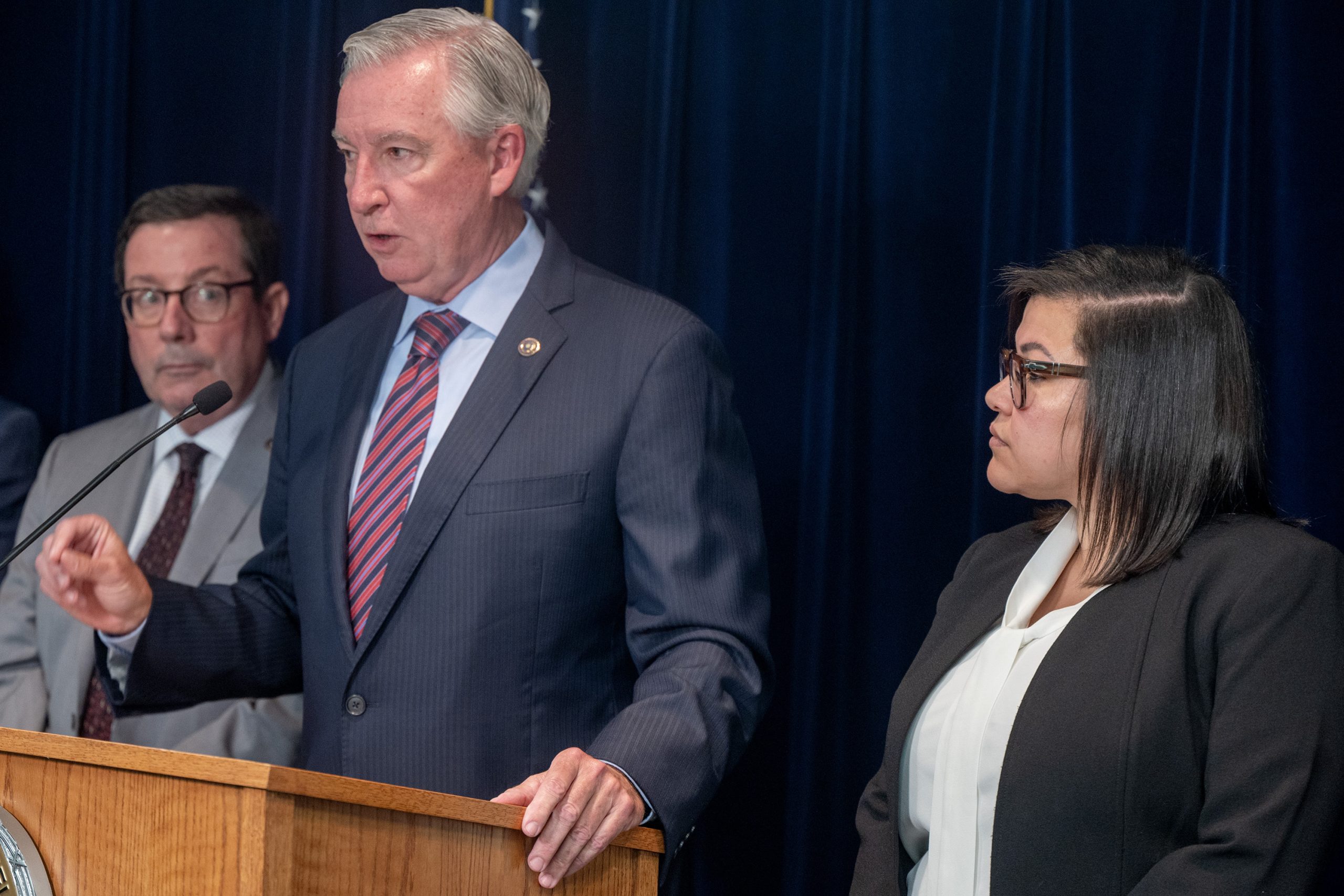
In two violent assaults, District Attorney Kevin Steele said, multiple football players attacked a sophomore on the team, stomped on his chest and groin while wearing cleats, and used a broomstick to poke at his buttocks.
“The assaults on this victim were not typical goofing around by teammates, or horseplay, as some of the coaches in this case called it,” Steele said at a news conference Wednesday. “They were crimes.”
After the attacks, which took place last August and September, Steele said, coaches tried to cover them up.
Head coach Terence Tolbert, 55; associate head coach Darian McFadden, 42; assistant coach Benjamin Johnson III, 45; and volunteer coach Ralph Burnley, 60, have been charged with endangering the welfare of a child and conspiracy. The coaches are no longer with the district.
Two football players, Isaiah Simpson, and Josiah Peeler, both 18, have been charged as adults — Simpson with conspiracy to commit aggravated assault, simple assault, reckless endangerment, and related crimes for his role in the September assault, and Peeler with false swearing for being untruthful to police. The two were 18, Steele said, when the crimes they are charged with took place.
The four other players have been charged as juveniles, and were not identified by prosecutors or named in court records. Two of them face charges of conspiracy to commit aggravated assault and related crimes, because authorities say they took part in the attacks. The other two players are charged with false swearing.
Tolbert, McFadden, Johnson, and Peeler were released on $5,000 unsecured bail. The two other adults had not been arraigned as of Wednesday afternoon. Only two of the defendants, Johnson and Peeler, had attorneys listed in court records.
Johnson’s attorney, Richard J. Fuschino, said his client “has been humiliated by what occurred and absolutely had nothing to do with it.”
“I do believe there is a cover-up, and I absolutely do not believe Benjamin Johnson had anything to do with it,” he said. “In fact, quite the opposite: He went out of the way to cooperate with every investigator.”
Peeler’s attorney, Jessica Mann, did not respond to a request for comment. Attempts to reach the other defendants were not successful Wednesday.
Cheltenham Superintendent Brian Scriven said Wednesday that the district appreciated prosecutors’ work on the case and the filing of criminal charges. “While no legal outcome can erase the harm that was experienced,” he said, “we appreciate that after nearly a year, charges have been announced and those responsible are being held accountable through the criminal justice system.”
Prosecutors say coaches wanted incident ‘kept quiet’
Steele said the charges followed a grand jury investigation in which witnesses described two violent assaults.
The coaches are criminally liable for the assaults, Steele said, because, while they were not present, they learned of the September incident and encouraged the victim not to tell his parents.
Montgomery County District Attorney Kevin Steele at a press conference Wednesday.Tom Gralish / Staff Photographer
Privately, the coaches sent incriminating text messages to one another, Steele said, expressing concern that the incident “has to be handled and kept quiet.”
McFadden, the former assistant coach, wrote “if this gets out we are [expletive]. They will cancel the whole season,” according to the grand jury presentment.
The assaults occurred Aug. 15, after a preseason practice, and Sept. 3, Steele said. He said video footage of the August incident showed several students restraining the victim, while another student poked at his legs and buttocks with a broomstick.
Players are laughing and yelling in the video, and “at least one player is chanting, ‘broomstick him,’” Steele said.
A football player who witnessed the assault, but is not charged in the case, told the grand jury that the use of a broomstick was an apparent reference to a TikTok video featuring a Meek Mill song with the lyrics “broomstick all in his butt, tell him take that,” according to the grand jury presentment.
Steele said there was no evidence that it constituted sexual assault.
Players didn’t take the incidents seriously
Several football players who testified before the grand jury characterized the behavior as “horseplay” and said they did not take it that seriously. Others said the victim had a difficult relationship with his teammates and was viewed by them as “someone who did not follow the rules during practices.”
The Sept. 3 assault, witnesses said, happened after the teen took a pair of shoulder pads from another player’s locker after misplacing his own, an infraction for which the entire team had to do extra conditioning as punishment.
Steele said that investigators did not have a video of the Sept. 3 assault but that multiple players, including Simpson and two of the juvenile defendants, kicked and stomped the victim.
The teen reported told investigators that his teammates were “trying to poke him in the butt with the broomstick,” and that they made contact with his buttocks, Steele said. He said the assault broke up when school buses arrived, and teammates left to board them.
Burnley, one of the coaches, drove the victim home after the attack, and the teen broke down in tears, telling the assistant coach he had been jumped by teammates, the district attorney said.
Burnley then texted coaches in a group chat and called Tolbert, Steele said. McFadden and Tolbert called the teen and “told him not to tell his mother about the incident because they would handle it,” Steele said.
He said the coaches were deliberate and calculating in their decision not to report the assault.
‘Serious concerns about the response’
The incident came to light four days later, when the teen’s mother said he told her he had been jumped by teammates and had pain in his genitals. She said she took her son to an urgent care center and texted the high school’s assistant principal, who called her later that day.
A front view of Cheltenham High School in Wyncote.Tom Gralish / Staff Photographer
The teen did not tell his mom that his teammates used a broomstick in the attack. He was embarrassed and reluctant to share that detail, the mother said in an interview with The Inquirer in which she spoke on the condition of anonymity to protect the identity of her son.
She said her son told her that his teammates had tried “to mess with his manhood.”
She learned about the broomstick later in September, when Cheltenham Township police called to tell her that someone had called Pennsylvania’s Safe2Say hotline to anonymously report that students had used a broomstick during the attack, according to the teen’s lawyers, Alan Yatvin and Gabrielle Turley.
Sometime in October, the district obtained a video that had been circulating in the community and depicted an assault of the student with a broomstick, the lawyers said.
Investigators initially believed that footage was from the Sept. 3 assault. It was discovered during grand jury testimony in January that the assault was from August, prosecutors said. The teen, who said he was not shown the video until this spring, also identified it as being from August, revealing for the first time that he had been assaulted more than once, according to the lawyers.
“Our client and his family are grateful to the Montgomery County District Attorney’s Office, law enforcement investigators, and the grand jury for their careful and thorough work in bringing these deeply troubling events to light and pursuing charges,” Yatvin said in a statement Wednesday. He added that the grand jury investigation “also raises serious concerns about the response by some within the Cheltenham High School community.”
The district faulted inadequate supervision in the locker room, “a failure to prioritize student safety” by coaches and volunteers, and “a toxic and negative culture” within the football program.
District officials have said a Title IX investigation, required by law when sexual assault or harassment is alleged, is ongoing.
Scriven, the superintendent, said in a statement Wednesday that “every report brought to the district’s attention was addressed based on the information available at the time.” He noted that law enforcement and the grand jury had the power to issue search warrants and compel testimony, which “brought information to light.”
In April, the district approved separation agreements with Tolbert and McFadden. Officials say none of the coaches from last season is still affiliated with the district.
The victim, who switched to virtual school after being harassed by peers after the attacks, has continued to struggle, according to his mother. She said he avoids going outside because he fears being taunted about what happened.
During Wednesday’s news conference, Steele criticized the school district and said it had failed the victim.
In its report, the grand jurors noted that they — not the school district’s Title IX investigator — discovered that two separate assaults had taken place.
“I believe the Cheltenham School District has taken the position that they don’t want police in their schools or school resource officers, and so it’s on them to address these issues,” Steele said. “So the grand jury took care of what the school did not.”
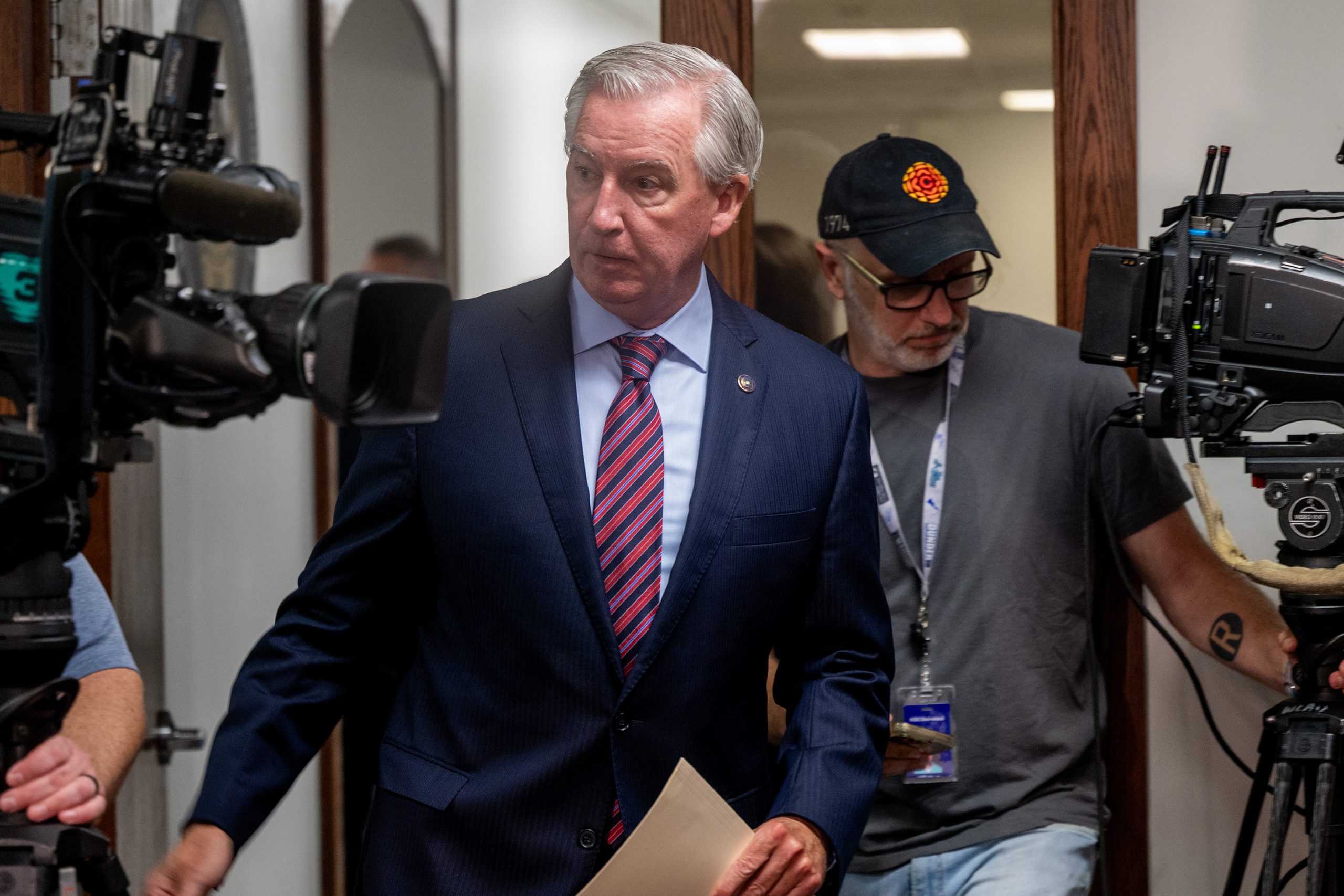
Montgomery County District Attorney Kevin Steele arrives at a press conference Wednesday to announce multiple charges in connection with two assaults in a Cheltenham High School locker room.Tom Gralish / Staff Photographer
In addition to recommending criminal charges against the players and coaches involved in the case, the grand jury filed a separate report calling for a change in state law that would require teachers and coaches to report incidents of hazing as a form of child abuse.
“While the school district claims to ‘protect and prioritize safety and well being,’ their actions in this case say otherwise,” the grand jury report said. “The administration carried out three school-led investigations that were so flawed they failed to even identify that two separate instances of hazing occurred in the locker room.”
News researcher Ryan W. Briggs contributed to this article.
A 36-year-old Camden man was charged with soliciting sexually explicit photos from a 7-year-old girl after a specially trained K-9 dog found the phone the man allegedly used to message the victim, Camden County Prosecutor Grace C. MacAulay said Wednesday.
Elmer Lao was arrested on July 22 after a search was conducted at his residence and the phone was discovered in his bedroom by a K-9 dog named Rookie, who is trained to detect electronic devices, MacAulay said.
Lao was charged with second-degree attempted manufacturing of child sexual abuse material and third-degree endangering the welfare of a child. He was being held at the Camden County Correctional Facility pending a detention hearing, MacAulay said.
On July 20, the special victims and high-tech crimes units of the prosecutor’s office began the investigation after the 7-year-old girl disclosed that a man had begun sending her messages on TikTok and by text message, MacAulay said.
Investigators determined that Lao allegedly engaged in messaging conversations with the girl, whom he knew to be 7 years old, MacAulay said.
Lao allegedly sent nude videos of himself to the girl and requested that the girl send nude photos of herself in return, MacAulay said.
“Predators often use social media and messaging apps to target children, making parental involvement more important than ever,” MacAulay said in a statement.
“I urge every parent to regularly monitor their child’s messages on TikTok and other social media platforms and to have ongoing conversations about online safety and the risks of communicating with strangers,” MacAulay said.
Anyone with information that could be helpful to the investigation can contact Detective Jessica Minniti of the Camden County Prosecutor’s Office Special Victims Unit at 856-225-8537. Tips may also be sent to CAMDEN.TIPS.
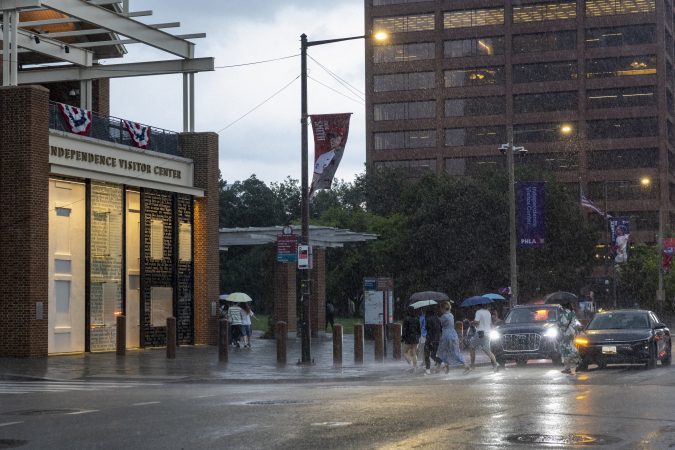
The smartphone alerts and the battery of weather watches and warnings were chilling. But they failed to capture what actually happened in the immediate Philadelphia area.
As it turned out Tuesday, not all that much happened, beyond a beneficial rainfall, some flashbulb lightning, and wind gusts that officially did not get past 34 mph. Heavy rains hammered Upper Bucks County, but around Philly, creeks behaved and flooding reports were isolated, even as damaging storms struck to the north and south of the region.
As so often occurs with summer thunderstorm outbreaks — not to mention winter storms — we learned science is playing catch-up with the atmosphere. That was evident Tuesday night, and if you feel as though you’ve seen this movie before, the forecasts and the outcomes were similar on July 18 and 21.
And expect recurrences — and surprise storms — even if the climate stops changing.
The atmosphere still is jealously guarding some of its most important secrets, said Bill Bunting, deputy director of the federal Storm Prediction Center, the national house of mayhem in Norman, Okla., that is responsible for all the severe-storm and tornado watches.
In his 40-plus years in the storm-forecasting business, Bunting said,“I have seen remarkable progress, but we’re nowhere near perfection. In the end, the science has its limitations.”
About the Tuesday night storms
Life is unfair, and that works both ways. The Philly region has had its share of storm ambushes historically, and as for what did not happen in and around the city Tuesday, “we’ll consider that a much more fortunate outcome than what could have been,” said Mike Lee, meteorologist at the National Weather Service office in Mount Holly.
The outcome was similar to that of July 18 and July 21, when the menu of threats — wind, possible floods and tornadoes, lightning — was about the same. The gusts on the 18th did not get above 35 mph at Philadelphia International Airport, andthey did not get above 30 mph on the 21st.
Bunting said this week’s storms were particularly problematical meteorologically. “The wind fields were quite strong” in the upper atmosphere, he said. “That environment was not one to mess around with.”
It was as though the system had wandered in from a different season, when cooler temperatures create sharp temperature contrasts that drive storm development,Lee’s colleague Patrick O’Hara said.
At 12:50 p.m., the storm center had seen enough to issue a broad-brush severe-thunderstorm watch that covered a huge swath of the Mid-Atlantic region, including much of Pennsylvania and all of New Jersey and Delaware.
A tornado watch followed a few hours later.
The Mount Holly office issued two tornado warnings for the Philly area — including one covering Wilmington and Chester City.
However, the two twisters verified by the Mount Holly office occurred in Talbot County, Md.
The heaviest rains — in some cases over 4 inches in Quakertown — mostly were confined well to the north of Philly. Officially, 0.72 inches of rain was measured at PHL.
Wind-damage and flooding reports around the Philly area were sparse, although Bunting advised it can take days following a storm to get an accurate assessment of impacts.
The future of thunderstorm forecasting
Bunting suggested that complaints about forecast accuracy could be viewed as forms of flattery, since they well from the public’s expectations that, in turn, well from advances in forecasting.
In 1985, Bunting recalled,he was working with one computer-model output that he received via a fax machine, and observation tools primitive by today’s standards.
But forecasting the development and movement of thunderstorms remains one of the great challenges of meteorology, and it is inevitable that storms are not going to materialize in some areas that are under a storm watch.
“You don’t now exactly where those storms will organize into a cluster, or fast-moving line segment,” he said. “So you have to put larger areas on notice.”
A wild card in any cluster or line of storms would be renegade, isolated storms, the kind that are apt to spin up a tornado, Bunting said.
For any given storm, he said, “until it forms in a larger area with similar conditions, it’s hard to pinpoint the risk.”
What would it take to pinpoint the risks? Improved understanding of storm physics, improved remote-sensing capabilities, and more powerful models, Bunting said.
“It is not a trivial challenge,” he said. “The decisions are not going to be perfect.”
That is not necessarily a bad development, he added.
“Sometimes I wonder what it would be like if we knew what the weather would be in great detail, weeks and months advance,” he said. “It seems to me it would get kind of old.”
The summer of unforgettable sports moments in Philadelphia is far from over, and Mayor Cherelle L. Parker was excited Wednesday for the next event coming to town.
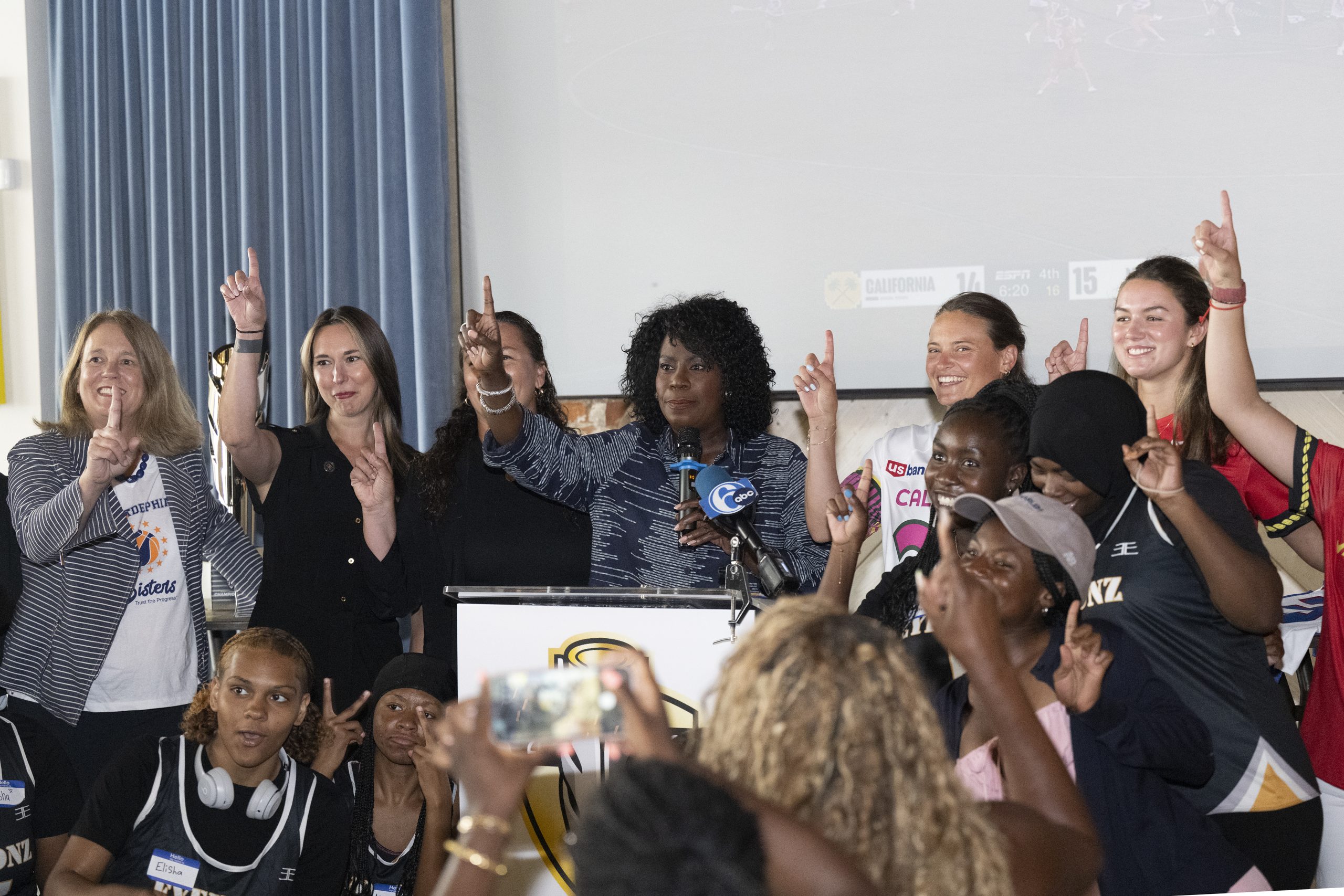
Parker and local youth lacrosse players gathered at Dock Street South to celebrate the inaugural Women’s Lacrosse League championship, which is Aug. 15 (5 p.m., ESPN) at the Union’s Subaru Park in Chester.
“For a long time, women’s sports were treated as an afterthought, a smaller version of the real thing,” said Rachael DeCecco, a USA Lacrosse Hall of Famer and Broomall native who’s the senior vice president of the PLL and WLL.
“Every young girl who’s going to watch this league will understand, without ever having to be told, that this is a real path, a real career, a real sport worth playing at the highest level. And there is no better place to host this historic first-ever WLL championship than right here in Philadelphia.”
Mayor Cherelle L. Parker (center) speaks at an event celebrating the inaugural Women’s Lacrosse League championship coming to the Philly area.Jose F. Moreno / Staff Photographer
The Philly area is a hotbed for women’s lacrosse. Of the WLL’s four teams — the Maryland Charm, California Palms, New York Charging, and Boston Guard — 18 players and two coaches have ties to the region.
Three of those players — California Palms defender Katie Detwiler (Devon, Archbishop Carroll) and the Maryland Charm’s McKenzie Blake (Haddonfield) and Abby Bosco (Penn) attended Wednesday’s event. Also in attendance was Tina Sloan Green, the former Temple women’s lacrosse coach who has been breaking barriers in field hockey and lacrosse since the 1970s.
Now 82, Green said the formation of the WLL, which is in its second season, is her legacy.
“I can’t even believe it,” Green said. “I grew up here and was the only Black female playing the sport. So this means so much to me because I know that my grandchildren, and their children, will get opportunities.”
Parker also discussed wanting to create more opportunities in women’s sports. Discussions about hosting the WLL championship, as well as bringing a WNBA team to Philadelphia — which will happen in 2030 — have been on her radar since her days as a City Council member from 2015 to 2022.
“We’re proving every year that our interests are in building and growing professional women’s sports in the city of Philadelphia. We’re doing it in a tangible way. We’re at the table,” Parker told the crowd. “This championship, to me, is about more than competition. It’s about opening doors. And in a city like Philadelphia, I can’t begin to talk about the importance of Black and brown young women being able to know that this sport, too, is for them.”
At the end of her speech, Parker invited the youth lacrosse players in attendance to join her in reciting her signature chant, “one Philly, a united city; one America, a united nation,” before leading an “E-A-G-L-E-S” chant and laughing with the players about spelling it correctly this time.
One of the young players in the crowd was Shiyann Werts, a lacrosse player and rising junior at Germantown Academy. Werts fell in love with the sport in sixth grade after being introduced to it at the Thomas K. Finletter School, where the Harlem Lacrosse program provides year-round academic and athletic support.
Since then, she has seen the sport’s popularity grow.
“It makes me really kind of emotional,” Werts said. “I’ve been seeing all the news on lacrosse, and it’s getting the recognition that I think it deserves. I’m really excited to see what the WLL will bring to that.”
Werts hopes to play college lacrosse, and the opportunity to play professionally after graduation is becoming a realistic pathway for female athletes who previously had few options to continue competing after their NCAA careers ended.
“I think it’s just super crazy growing up in the area,” Detwiler said. “When we were growing up, we didn’t have any of this. We played in college, and then it was on to the real world. So I think it’s really good for them to see what could be possible someday. It’s awesome to see.”
The WLL and the city are working together to ensure the championship reaches all parts of the community. The league is donating 2,500 tickets to nonprofit organizations, youth programs, and community groups.
Youth lacrosse players listen as Mayor Cherelle L. Parker speaks during a news conference on Wednesday.Jose F. Moreno / Staff Photographer
Ashley Walkowiak, executive director of the Governor’s Advisory Commission on Women, echoed the hopes of the room that the championship is only the beginning of the impact women’s professional sports can have on Philadelphia.
“Seeing the first WLL championship hosted right here in Pennsylvania is a powerful reminder of what’s possible when we invest in expanding opportunities,” Walkowiak said. “Philadelphia has long been a place where history is made, and this championship continues that legacy. But it is more than a game. It’s a celebration of talent, leadership, and the growing momentum around women’s athletics.”
A worker at EMR was impaled by a blow torch while taking apart a crane for scrap metal, according to Camden Fire Department incident reports.
Camden County had confirmed that a worker at the scrap metal plant had been transported to the hospital after suffering life-threatening injuries less than two weeks ago on July 18. The man remains in the hospital in stable condition and conscious.
Fire department documents obtained by The Inquirer through a public records request reveal that worker was injured while dismantling a crane.
He was on a stretcher with “what appeared to be a large Oxy-Acetylene blowtorch handle impaled into his left bicep and into his torso,” when Camden City Fire Department Battalion Chief Ezequiel Tirado arrived on the scene to respond to a burn victim, according to his report.
Another workerwho could not speak English had cuts on his face, and blood and mud on his hands, according to Tirado’s report. They spoke in Spanish, and the man said he was hurt but declined to be brought to the hospital, stating that he’s an undocumented worker.
“I told him, ‘Don’t worry about that. Let’s get you some help,’” Tirado wrote. “He stared at me then ran away.”
He was later found at the hospital, Tirado said.
William Scott, the night time operations manager for EMR, said he did not know what caused the workers’ injuries, according to Tirado’s report. Scott said they were using a cutting torch to cut an old crane for scrap metal.
Tirado described the site of the incident as “very dark with no lighting equipment” and lots of debris. He said emergency responders set up lighting and discovered a pool of blood near the crane and under a lift.
Camden County spokesperson Dan Keashen said Wednesday that the now-stabilized man who was impaled with the blow torchwas transported to the hospital in critical condition.He saidthe county police department is still investigating the incident.
Joe Balzano, the CEO of EMR, said on the phone Wednesday that the workers were subcontractors hired to demolish an old crane and not employees of EMR.
He said the injured worker is “a very hardworking nice man, unfortunately who was involved in a workplace injury.”
“We’re just glad that he’s doing well,” the CEO said. “It’s unfortunate, heavy industry situations have, you know, unfortunate accidents … we just hope he does continues to progress well.”
PLYMOUTH, Mass. — Lindsay Clancy sobbed in court Wednesday as jurors listened to the anguished 911 call her then-husband made after returning from an errand to find she’d strangled their three children in their Massachusetts home.
On the roughly 7-minute recording, Patrick Clancy can be heard speaking with his wife upon finding her badly injured and bleeding in their yard, after she jumped from the home’s second-story window.
“Look at me,” he says. “Say my name.”
He then tells the dispatcher he’s going to check on the children. Moments later, he howls and cries after finding them in the basement. The confused dispatcher repeatedly asks what happened.
“She killed the kids!” he yells.
Three years after their deaths, the murder trial has centered on Lindsay Clancy’s mental state at the time. Her lawyers will seek to prove she had postpregnancy psychosis, a rare mental illness linked to the stress, sleep deprivation and hormonal changes that follow childbirth.
Prosecutors say Clancy, a former labor and delivery nurse at Massachusetts General Hospital, acted intentionally and is criminally responsible for the deaths of 3-year-old Dawson, 5-year-old Cora, and 8-month-old Callan in January 2023.
___
EDITOR’S NOTE: If you or someone you know needs help, the national suicide and crisis lifeline in the U.S. is available by calling or texting 988. There is also an online chat at 988lifeline.org
___
Her lawyer said in opening arguments Monday that she had bipolar disorder, and that antidepressants prescribed after the birth of her third child worsened her condition. On the day of the killings, Lindsay Clancy said she heard a voice telling her, “This is your last chance. Kill the children so you can kill yourself,” according to her lawyer.
If convicted of murder, she faces life in prison without parole. If found not guilty due to a lack of criminal responsibility, she would be committed to a state mental health facility.
Patrick Clancy has said in interviews that he forgives his ex-wife, whom he viewed as ill rather than evil. The trial marks the first time he has seen Lindsay Casey since the killings.
A husband’s emotional testimony and a chilling 911 call
Patrick Clancy testified Wednesday that his last image of Dawson was of the boy sitting on the couch, eating chicken nuggets and green beans. Lindsay Clancy had asked her husband to make a quick trip for takeout food and medication at a pharmacy for Cora. Prosecutors say this was an excuse to get him out of the house.
Jurors were shown surveillance video from the pharmacy of Patrick Clancy on the phone with his wife, asking a question about the medicine.
“She was pretty quiet. It sounded like she was busy,” he testified Wednesday. “I remember hanging up thinking she was probably in the middle of giving baths or something like that.”
Returning home, it was unusually silent. He called out to his family.
When no one answered, he searched the children’s rooms and the bathroom, again thinking they might be in the tub, before finding blood throughout the main bedroom and a window open.
Injured but conscious, Lindsay Clancy told him she’d tried to kill herself and that the kids were in the basement, without saying they were dead. He didn’t realize he was still on the phone with 911 as he ran downstairs to find each had been strangled with exercise bands.
Lindsay Clancy’s parents, seated in the front of the court, also cried as the call was played. Patrick had already left the room after finishing his testimony.
Jurors were shown the clothes each child had been wearing, with a prosecutor pulling the items from clear plastic evidence bags: pajamas and a pink robe for Cora; a nightshirt and dinosaur underwear for Dawson; a red onesie decorated with snowflakes for Callan.
The trial will hinge on Lindsay Clancy’s mental state
Patrick Clancy testified Monday about his wife’s deteriorating mental health in the months before the killings, including her telling him about intrusive thoughts of harming the children and of suicide.
Lindsay Clancy had sought care from experts in postpartum mood disorders, was put on multiple psychiatric medications, and when nothing worked, checked in to a psychiatric hospital. She killed the children 19 days after she was discharged.
No one ever told Patrick Clancy his wife shouldn’t be alone with the children, he testified Wednesday. “I didn’t know what psychosis was until after this happened.”
Clancy and her ex-husband accuse her medical providers of failing to properly diagnose, treat and monitor her, according to lawsuits filed earlier this year.
On cross-examination, Clancy’s attorney, Kevin Reddington, aimed to demonstrate she took her medications and closely tracked her declining mental health. He introduced daily, handwritten notes she took of her medicines and her mood, including repeatedly writing “horrible thoughts.” She also had a book and fact sheet on postpartum anxiety and a chart where she tracked her mood.
Reddington also got Patrick Clancy to acknowledge that many of her medical appointments starting in the summer of 2022 were with nurse practitioners and on Zoom calls lasting only 20 minutes. They also went through multiple medications she was prescribed, including Seroquel — an antipsychotic medication for which doctors increased her dosage in December.
“The idea was that it would help with sleep, but she didn’t get better. She got worse,” Patrick Clancy said.
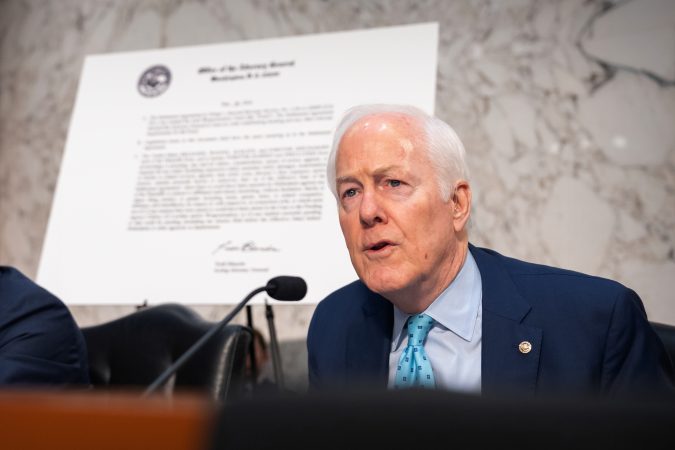
GOP Sen. John Cornyn, a crucial swing vote, called off a scheduled Wednesday meeting with Blanche, who has been serving as acting attorney general since Pam Bondi’s firing in April. Cornyn told reporters that the Justice Department has not adequately addressed in writing his concerns about the settlement that afforded Trump and members of his family protection from tax audits.
The dispute threatened to upend plans for the Senate Judiciary Committee to vote Thursday on whether to advance Blanche’s nomination to the full Senate. Another Republican on the committee, Thom Tillis of North Carolina, has backed Cornyn’s position, and just one Republican holdout could sink Blanche’s prospects.
“They know what they need to do but they simply refuse to do it,” Cornyn, who lost the Texas Republican primary in May, said of the Justice Department.
At the center of the fight is the settlement of Trump’s $10 billion lawsuit against the IRS that included a deal to drop tax claims against the president and a now-scrapped plan to create a $1.776 billion “Anti-Weaponization Fund” to compensate people who believe they were wronged by the Justice Department. The Justice Department said in June that it was no longer moving forward with the “Anti-Weaponization Fund” amid bipartisan outrage but officials have said the audit immunity agreement remains in place.
Trump on Wednesday downplayed any concerns about Blanche’s path to confirmation, calling his attorney general pick and former personal attorney “outstanding.”
“Maybe John Cornyn’s upset with me because I didn’t endorse him,” Trump told reporters in response to questions about the senator’s demands.
Texas Attorney General Ken Paxton won the state’s Republican nomination for the U.S. Senate, easily defeating Cornyn. Trump had endorsed Paxton.
Some lawmakers have raised concerns that the fund could be resurrected absent a commitment in writing from the Trump administration that it is dead, especially since Trump has expressed continued support for the idea. Blanche had previously resisted requests for a formal written retraction, though he told senators at his confirmation hearing earlier this month that the administration would be willing to help craft legislation to bar the creation of the fund.
Cornyn has also demanded clarification from the Justice Department on the scope of the tax immunity deal. He has pressed the administration to modify that piece of the settlement to make clear that it covers only existing audits and does not protect the president from examination of future tax filings.
“We’re been trying to help them get to a conclusion here and they won’t let us. It’s befuddling to me,” Cornyn said.
A person familiar with the matter said the Justice Department provided Cornyn’s office with a written proposal seeking to address his concerns around the audit immunity agreement and the fund. The person spoke on the condition of anonymity to talk about sensitive discussions surrounding Blanche’s confirmation.
The settlement resulting from Trump’s lawsuit over his leaked tax returns has drawn intense scrutiny both in Congress and in court. The judge handling the case said in a scathing ruling earlier this month that Trump had effectively engaged in self-dealing through the lawsuit and that she was troubled Blanche had signed the settlement, given his prior representation of Trump.
Blanche has said he disagrees “with the judge’s insinuations” about him.
Paul Moore’s house is old. It was built around 1900 as a hunting lodge near where Cleveland would develop, and his grandparents bought the home around 50 years later, converting it over the years into a three-bedroom ranch that included what Moore called an “old school” gas stove.
When he moved into the house in 2020 with his wife and six children, Moore already had debilitating asthma. He got winded walking up hills and couldn’t play basketball with his children. He slept poorly and couldn’t hold steady employment, instead doing odd jobs like fixing neighbors’ cars and houses. He was hospitalized multiple times with severe asthma attacks and almost died from being unable to breathe.
“My asthma was a real hindrance at the time. And I couldn’t figure out why, you know?” Moore said. “Just couldn’t pinpoint one thing or another. Was it me? Is it something going on with my body? Is it something else?”
It turned out that researchers at Case Western Reserve University in Cleveland and a local hospital network were studying asthma sufferers like Moore. He signed up to have his gas stove swapped out for an electric one in June 2025. That research would end up providing vital evidence on gas stoves’ health impacts, amid fierce debate between fossil fuel advocates and climate change activists.
Moore said without the study, he has no clue how long it would have taken him to save the money to change it himself. The researchers spent an average of about $10,000 per household, as many old homes needed to be completely rewired to handle the larger electrical load of an induction stove.
What Moore didn’t know is that he would be one of the last people to get a new stove as part of that work.
Ash Sehgal, a Case Western medical professor who led the study, had received an $18 million grant from the Environmental Protection Agency in December 2024 to replace the stoves in 1,200 homes of asthma sufferers in the Cleveland and Akron, Ohio, areas. A month before Moore’s stove was replaced, Sehgal received a letter stating that the grant had been terminated.
It was one of thousands cut short after President Donald Trump took office and launched aggressive efforts to reduce government spending.
But unlike many others forced to halt their research, Sehgal and his co-authors released their study anyway, publishing it in the Journal of Allergy and Clinical Immunology in Practice this month with a fraction of the intended sample size. Still, removing the gas stoves relieved the participants’ asthma so much that the results were clear even with only 85 of them, according to two scientists who reviewed the methodology but were not involved in the study.
“What really surprised me is that the improvement in the asthma symptoms was similar to or even larger than the improvement in asthma symptoms that’s reported in clinical trials of commonly used asthma medications,” Sehgal said.
Participants recorded far fewer asthma attacks, emergency room visits and missed days of work after the stove was removed, and levels of nitrogen dioxide in their kitchens plummeted by 70 percent.
“They were able to see some important results, even with the grant getting canceled, even with the sample size being less than a tenth of what they’d intended,” said Julian Marshall, an environmental engineering professor at the University of Washington.
“It’s also an actionable finding. People who have asthma would want to know, ‘What can I do about this?’” he added. “This is a major problem facing thousands and thousands of people across the U.S.”
Sehgal said that while it can help to replace gas stoves that exacerbate symptoms, it is not a cure for asthma. Asthma sufferers still need to work with a doctor, take their medications and avoid triggers like pollen and cigarette smoke.
Rob Jackson, an environmental scientist at Stanford University who was not involved in the research, said many studies on indoor air pollution from gas stoves rely on models to estimate the impact on people’s health, whereas this study makes real-life observations.
“It’s important because the extent to which indoor air pollution from stoves harms people’s health is still debated in state houses, federally, in courtrooms, and so every piece of the puzzle, even if it’s only 85 individuals, strengthens that story,” he said.
In recent years, conservatives have championed gas stoves and fought Biden-era policies that sought to reduce the use of fossil fuels driving climate change. Trump has championed fossil fuel development, seeking to boost the oil and gas industry by rolling back environmental protections and opening new areas to exploration.
Politicizing science
Scientists have lamented the loss of federal funding following the Trump administration’s dramatic cuts last year to grants across the government, including those awarded by the National Institutes for Health and Centers for Disease Control and Prevention.
The EPA has terminated $28.5 billion in grants, according to Grant Witness, a tracking project, with much of that money intended to focus on helping communities respond to climate change or reduce pollution. That included funding projects that installed rooftop solar or sealed up houses against wildfire smoke, as well as scientific studies that had real-life applications, like evaluating the replacement of gas stoves.
The agency closed the Office of Environmental Justice and External Civil Rights, which awarded Sehgal’s grant, amid its broader purge of programs related to climate change, environmental justice and diversity, equity and inclusion.
Despite court challenges, including a district judge ruling earlier this month that the cancellations were illegal, many researchers were forced to end their studies early.
EPA spokesperson Brigit Hirsch said in an email that the agency’s internal scientists continue to conduct vital research.
“EPA’s core mission is protecting human health and the environment, and at the Trump EPA, gold-standard science supported by our excellent career scientists is happening like never before to ensure clean air, land, and water for all Americans,” she said.
The cancellation of the gas stoves research grant “seems to be a political decision, not necessarily based on science-based or public health priorities,” said Darya Minovi, a public health researcher at the Union of Concerned Scientists, an advocacy group.
The administration is looking to expand its ability to shape scientific funding, she said. The White House’s Office of Management and Budget proposed a new regulation in late May that would demand grants across the federal government align with the president’s policy priorities or face cancellation.
While presidents often set the general direction of agencies by appointing their leadership, Minovi said this new policy would give the president more control over decisions typically made by staffers at institutions such as the NIH.
“This is really making it government-wide policy to politicize grant-making that should not be subject to the whims of a president, but really should be decided on scientific merit,” she said.
What was lost
Based on the results that were published, Sehgal can estimate how much damage halting the study caused. If 1,100 more households had participated as originally planned, it would have resulted in 900 people with better-controlled asthma and 84 fewer people who would go to the emergency room or be hospitalized.
Many of those people probably don’t even realize the connection between their asthma and their gas stove, said Angela Bland, a 38-year-old stay-at-home mom in Akron who also participated in the study. She said the impact of replacing her stove was almost immediate, and she didn’t feel her throat closing up as much while cooking.
“It was kind of heartbreaking because I was like here’s something that can really help people and get information out there to help people, and they cut it so quick,” she said.
Similar to Bland, Moore said he quickly felt the impact of removing his gas stove.
“It was just like, ‘Huh, I feel a little bit better. It’s not like how it used to be.’ It was a slow realization over the first week,” he said.
He remembers waking up to his daughter cooking, smelling the food and feeling good for once, so much so that his family noticed.
“They felt the difference. It was a magical moment,” Moore said.
After his health improved, Moore found a new job locating gas lines so that major construction projects don’t rupture them.
“There’s a whole lot of people out there probably feeling just like how I felt,” he said. “A lot more people deserve to feel good when they cook or when they eat or when they are able to sit down with their families.”
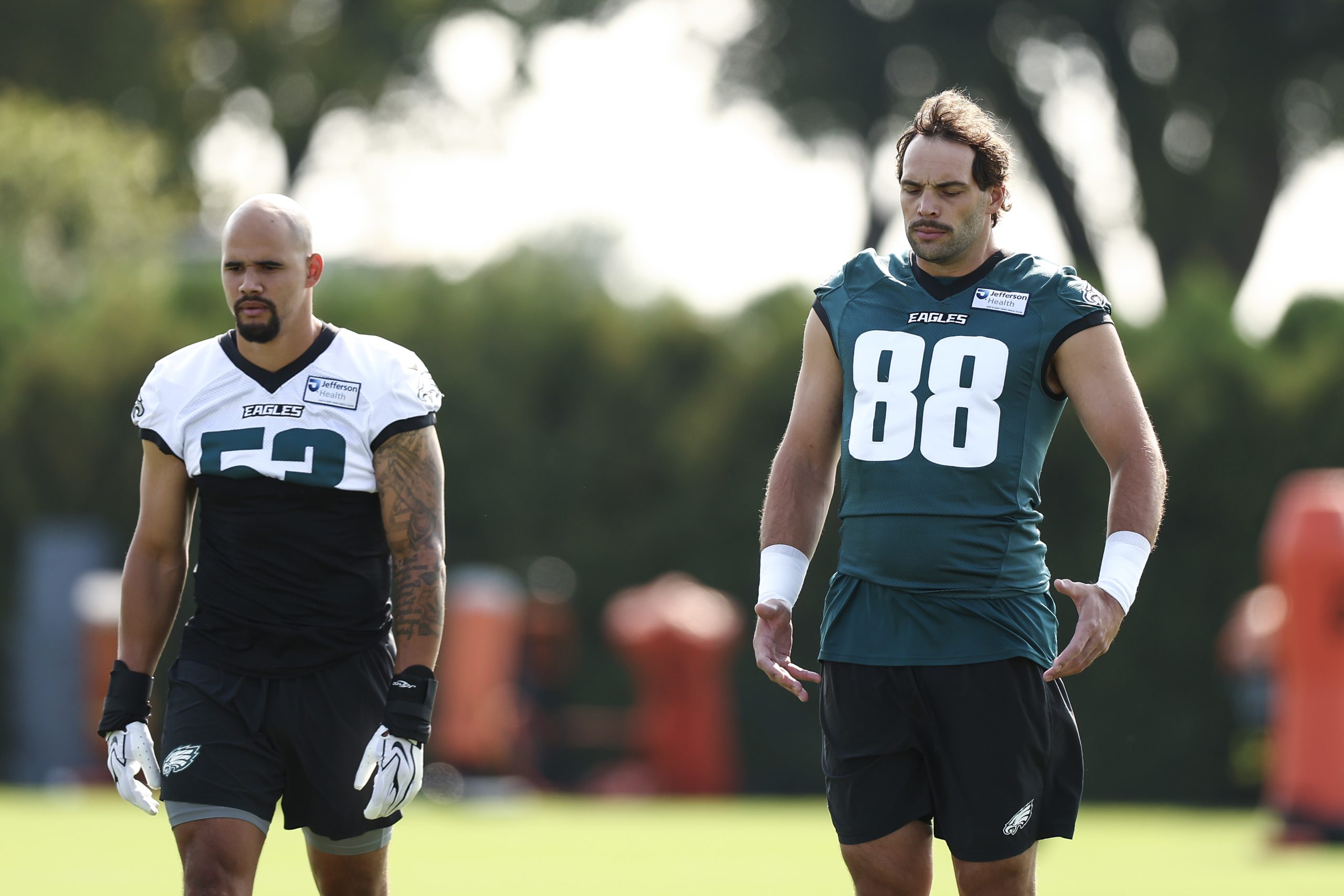
The Eagles held their first practice of training camp on Wednesday at the Jefferson Health Training Complex. Here were my observations from Day 1:
Healthy Birds
The Eagles announced that outside linebacker Jonathan Greenard was placed on the Physically Unable to Perform (PUP) list just before practice. He apparently strained a pectoral muscle while lifting prior to camp. Greenard isn’t expected to be out long-term, but starting him on PUP allows the team to save a roster spot if he’s going to miss more than a month in the regular season.
It’s unclear if the injury had anything to do with his recovery from December shoulder surgery. Greenard didn’t practice much in the spring after he was acquired via trade during the draft. He’s learning a new defense, but he’s been around the block a few times and shouldn’t be held back once healthy.
Jonathan Greenard (right) was present on Wednesday but will remain sidelined indefinitely with a pectoral injury. Monica Herndon / Staff Photographer
The Eagles were otherwise full-go. I don’t recall them being as healthy entering camp in all my years on the beat. Every player passed Tuesday’s conditioning test, as coach Nick Sirianni suggested before practice. Linebacker Jihaad Campbell (shoulder), wide receiver Makai Lemon (hamstring) and several other players who were limited in the spring were back in action.
Campbell, by the way, switched his jersey number from 30 to 11. That should end all talk of the former Eagles wide receiver who previously wore the double ones. Right?
Positional battles
There’s really only one “starting” spot up for grabs and it technically isn’t a full-time job: safety. Cooper DeJean is expected to “start” at safety in base personnel alongside Andrew Mukuba. DeJean was there again on Wednesday. Marcus Epps filled the primary nickel role, however, with a splash of Michael Carter II at times.Those two appear to be the frontrunners. General manager Howie Roseman won’t be shy about trading for an upgrade if needed.
There are some intriguing competitions further down the depth chart. Jonathan Jones was the first cornerback up when starter Quinyon Mitchell took a breather during team drills. Jeremiah Trotter Jr. and Smael Mondon were the backup inside linebackers behind Zack Baun and Campbell.
A handful of receivers will be vying for the snaps that became available when A.J. Brown was finally traded to the Patriots. DeVonta Smith is the bona fide WR1, but new faces like Dontayvion Wicks, Hollywood Brown and Lemon, along with returnees like Darius Cooper and Johnny Wilson will be contending for playing time.
Line ’em up
The first-unit offensive line is set, but swing tackle along with a few other backup spots are up for grabs. New O-line coach Chris Kuper will work some reserve linemen at various positions to create versatility. Here’s how the units looked on Wednesday:
A few notes:
Jordan is new after the Eagles signed the veteran guard at the conclusion of minicamp in June. Bell was back in the lineup after sitting out the last day of minicamp. He and Fred Johnson are presumably battling for the swing tackle role, although Kuper could have both active on game days. Hollin Pierce and Jaeden Roberts were with the third unit at left tackle and left guard, respectively, during the period for developmental players.
Mannion mirror
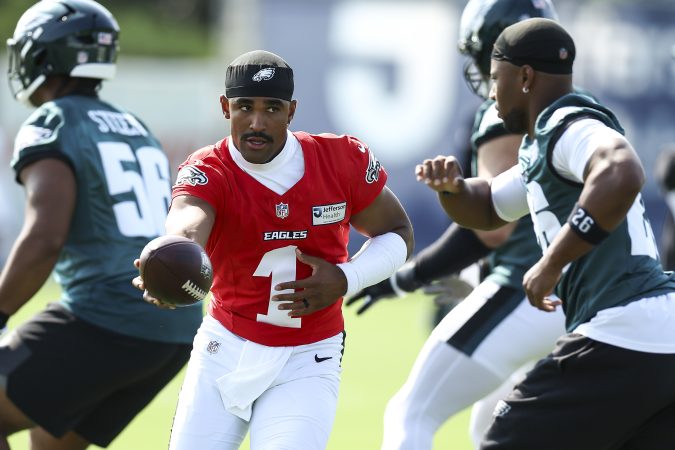
New offensive coordinator Sean Mannion continued to implement many of the concepts we saw from the Kyle Shanahan-Sean McVay scheme he brought to the Eagles in the spring: a lot of under center sets, play-action and motion. I’d estimate that more than half of the plays came with the quarterbacks lined up under center.
Jalen Hurts continued to learn the intricacies of the new offense on Wednesday. Monica Herndon / Staff Photographer
Jalen Hurts has improved from under center since entering the NFL, but he hasn’t done much of it, at least compared to rest of the league. There will be more of him turning his back to the defense on play action and naked bootlegs. An early awkward pass across Hurts’ body to Lemon illustrated that there will be some growing pains.
Hurts to be…
There will be an adjustment period for all involved, but mostly Hurts. He’s endured other previous changes in play-calling and scheme with varying results. The offense wasn’t sharp during the spring practices open to reporters. That came as little surprise, and neither should struggles during the summer.
Hurts’ first pass of camp was a wobbler to Wicks that Mitchell nearly intercepted. But he had some strong moments in the later team portions with good ball placement on a toss to Wicks with cornerback Riq Woolen in coverage and a strike to a crossing Smith just over Mitchell.
The catch of the day came during seven-on-sevens when Hurts hooked up with Cooper. The receiver got behind DeJean out of the slot and made a diving grab over the middle.
Saquon Barkley’s ability to adapt to the wide-zone blocking scheme will be worth watching. Monica Herndon / Staff Photographer
Run it back
The Eagles won’t be in full pads until the fifth practice of camp on Tuesday, but they were able to incorporate more of the run game into team drills. Some of the biggest changes on offense will come with the move to more wide-zone blocking. Lane Johnson said the new system is “O-line friendly” and should theoretically place less stress on the group in pass blocking situations.
Running back Saquon Barkley took the first handoff of camp and ran behind Johnson off tackle. He was met near the line of scrimmage by Baun on his next carry. Backup Tank Bigsby’s first touch came on a rush up the middle after Steen climbed to the second level. Could we see more of Bigsby as the inside complement to Barkley this season?
Hunting season
Greenard’s absence pushed Jalyx Hunt into the starting spot at right outside linebacker opposite Nolan Smith Jr. Hunt will likely play as many snaps as the other two this season. There’s an argument to be made that he should get more playing time than Smith. Nevertheless, he took advantage of his opportunities with Greenard out.
Hunt shot into the backfield unblocked and forced Hurts to check down to Cooper on one play-action pass that came from under center. He blew up tight end Dallas Goedert with an edge rush and Hurts had to hurry a dump to Bigsby that wasn’t caught. And he beat Jordan Mailata on back-to-back rushes — one with an inside move and the other from the outside — that blew up pass plays.
Dallas Goedert (right) rebounded from an early drop in Wednesday’s practice. Monica Herndon / Staff Photographer
Sloppy go droppy
Defensive coordinator Vic Fangio enters his third season at the helm with little turnover on his side of the ball. He’s always evolving and will introduce new ideas, but the core of his unit remains intact. The defense should have the upper hand in competitive periods, especially with the offense still ironing out details.
Mannion’s unit had a couple of false starts from Mailata and Landon Dickerson. Brown lined up illegally at one point. Defensive tackle Jalen Carter, fresh off his contract extension, was flagged for offsides at one point. He slipped by Steen for a would-be tackle of Barkley in the backfield earlier in the session.
Goedert dropped an early pass, but rebounded later on a short crossing route. Hurts and Barkley had a miscommunication on a botched handoff.
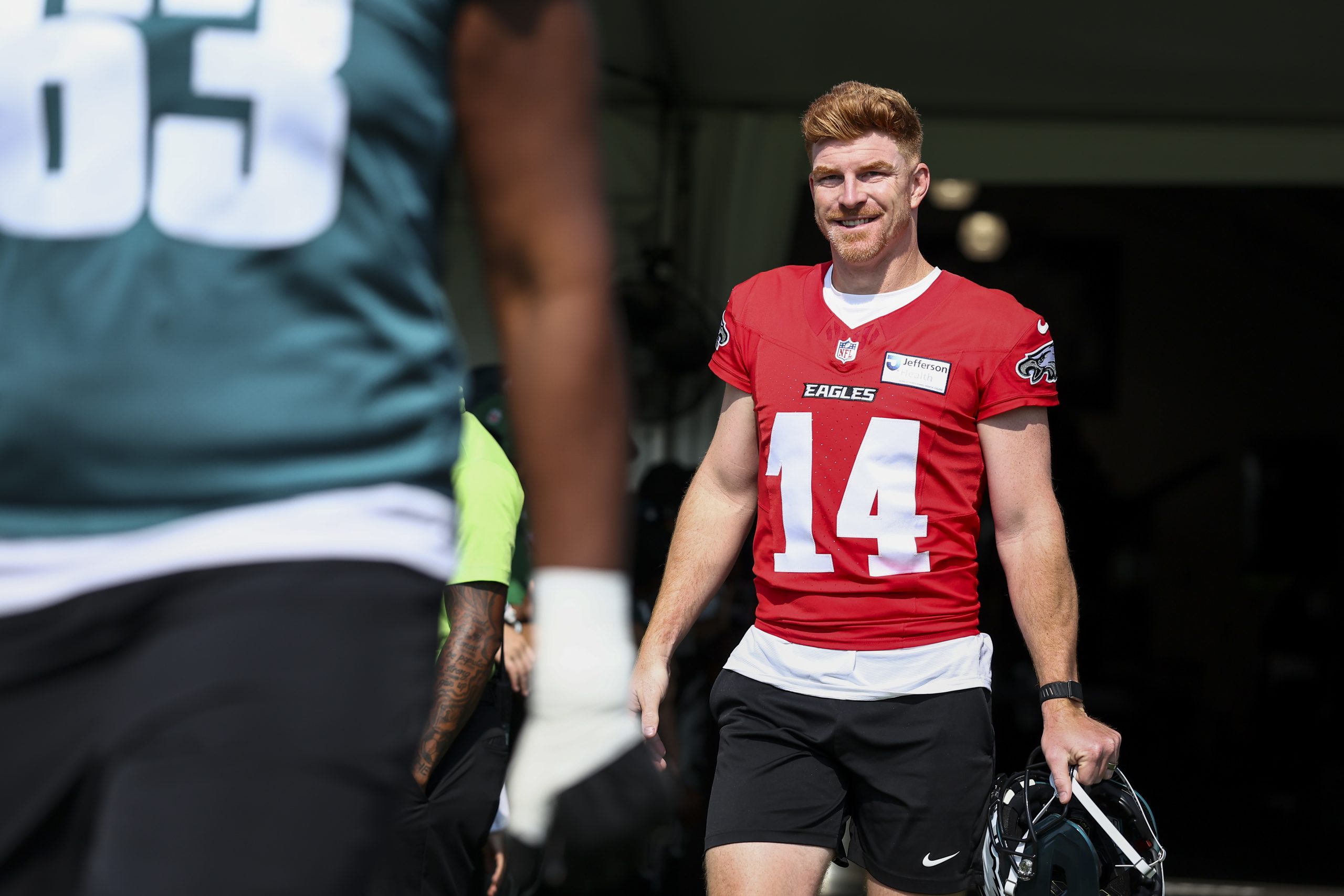
Andy Dalton (14) is vying for the No. 2 quarterback job. Monica Herndon / Staff Photographer
Back it up
Quarterbacks Tanner McKee and Andy Dalton continued to split second unit snaps, much as they did in the spring. McKee’s first completion during seven-on-sevens went to rookie tight end Eli Stowers. Dalton hit Wilson over the middle with a pass only the 6-foot-6 receiver could reach.
Trotter had a couple of run stops, one time seemingly filling a gap out of nowhere to stop Bigsby in his tracks. Former Texans running back Dameon Pierce was relatively quiet in the spring, but he had a nice cutback on an inside rush.
Extra points
Rookie quarterback Cole Payton had his ups and downs in the spring, but he continued to display a willingness to throw downfield a month later. He ripped a pass to receiver Quez Watkins during seven-on-sevens, and found receiver Britain Covey on a deep corner route. … Second-year defensive tackle Ty Robinson was relegated to snaps during the developmental period. Not a good sign. … Lemon fielded punts behind Covey and Elijah Moore. … The Eagles return Thursday for practice and will have a closed-to-reporters walkthrough on Friday.