Blog

  • Trump signs 2 immigration actions to limit birthright citizenship

    Trump signs 2 immigration actions to limit birthright citizenship

    WASHINGTON — President Donald Trump said Thursday that he is once more trying to limit the number of people who are born in the country who can become American citizens, in a sign that even after his first attempt at limiting birthright citizenship was rejected by the Supreme Court, he’s ready to try again.

    The president said he was signing two executive actions on immigration.

    He said one will limit the number of people eligible for U.S. citizenship after being born in the United States.

    A second order seeks to curb what Trump called “birth tourism” by increasing restrictions on visitors to the U.S. who want to obtain visas to give birth while in the country.

    Additional details weren’t provided, but Trump said he thought his latest actions would be constitutional.

    In June, the Supreme Court rejected Trump’s previous efforts to declare that children born to people in the U.S. illegally or temporarily aren’t American citizens, and upheld a broad conception of birthright citizenship.

    On Trump’s first day in office of his second term, he signed an executive order aimed at ending birthright citizenship, which allows anyone born in the United States to automatically become an American citizen.

    Trump’s administration was immediately sued by opponents who said the executive order went against the 14th Amendment, adopted after the Civil War, which makes anyone born in the country a citizen, with very limited exceptions.

    The executive order was blocked by several lower courts and never took effect.

    In June, the Supreme Court struck down Trump’s order by a 6-3 vote. But the vote was too close for many immigration advocates and legal observers who felt the legal question of birthright citizenship was a long-settled issue.

  • Andrew Painter expected to make his next start; Derek Hill avoided injury from collision

    Andrew Painter expected to make his next start; Derek Hill avoided injury from collision

    The Phillies’ 10-4 loss to the Nationals on Wednesday was overshadowed by several injury scares. Andrew Painter left his start after just four innings with hamstring tightness, while Derek Hill exited with a bruised shoulder after crashing into the center field wall in the 11th. After both players were evaluated on Thursday, though, the Phillies were optimistic.

    Imaging on Painter came back clear, and interim manager Don Mattingly said he is expected to make his next start.

    “It’s obviously a sigh of relief that you know you’re not going to be searching for a starter every fifth day. And really everything last night could have been a lot worse,” Mattingly said.

    Hill went through protocols and evaluation after the collision. He was sore but has avoided injury.

    “He feels like he probably should, after running into a wall,” Mattingly said.

    Mattingly added that depending on how Hill progressed through pregame activities, the outfielder might be available off the bench on Thursday.

    Bryce Harper was also checked out by trainers Wednesday night after jamming his hand while attempting to steal second in the 10th, but remained in the game and was fine afterward. Harper was back in the lineup in right field on Thursday.

  • Luis Arraez is the latest Phillie Justin Crawford has pulled aside to ‘pick his brain’

    Luis Arraez is the latest Phillie Justin Crawford has pulled aside to ‘pick his brain’

    After Luis Arraez had traversed the length of the dugout, doling out high fives in celebration of his fifth homer of the season, Justin Crawford had a question for him.

    The Phillies rookie pulled aside the newest member of the team to ask what he’d seen from Nationals pitcher Jake Irvin that had allowed him to take him deep. Arraez sent an 0-2 sinker at the top of the zone 385 feet off the foul pole in right field.

    “I figured he’s probably going to try to pitch me similar to how he pitched him,” Crawford said. “So I was just trying to pick his brain, and see what he saw from him.”

    When it was Crawford’s turn, he attacked a first-pitch fastball from Irvin, and powered it to deep center field for a sacrifice fly that scored a run.

    The exchange between him and Arraez was caught on NBCSP’s broadcast cameras, but it’s something Crawford does often with his teammates. He is always asking fellow lefties Brandon Marsh and Bryson Stott for advice, because he sees their approach as somewhat similar to his own.

    “Just lefties that are kind of similar to me, where I think pitchers might try to pitch us kind of the same,” Crawford said. “Arraez, I went up to him. He had a pretty long at-bat, I think, too. So went up there and [I] asked him what he saw. And yeah, I definitely took that into my next at-bat.”

    Arraez, with his ability to spray the ball all over the field and his penchant for singles, might be more similar to Crawford than anyone else on the team. Both lefties hit for average, don’t swing and miss a lot, and have the ability to manufacture runs. Power is not a main feature of either of their games.

    Luis Arraez celebrates a second-inning home run with Alec Bohm on Wednesday.Monica Herndon / Staff Photographer

    Arraez has three batting titles and is on pace for his fourth. Crawford won the International League batting title in the minors last year after putting up a .334 average in triple A.

    He knows there is a lot he can learn from his new teammate.

    “I think that’s someone I’m going to be relying on throughout the rest of the year, honestly,” Crawford said. “Just with our profiles being pretty similar, knowing that, how pitchers try to pitch him will most likely be how they’re trying to pitch me.”

    What impresses Crawford most about Arraez’s approach is how hard he battles at the plate. Although he has the lowest strikeout rate in MLB — 4.4% — Arraez is not afraid to fall behind in the count and work long at-bats.

    “Just how tough of an out he is,” Crawford said. “I think every at-bat, he goes up there, competes, and his ability to be able to extend that at-bat, put the ball in play, is something that I think is really unique. And also is a lost art.”

    The potential mentorship between Arraez and Crawford is something that interim manager Don Mattingly thinks can really benefit the rookie in the long run.

    “I think Luis is a guy for him. It’s a great guy for him to talk to,” Mattingly said. “He’s left-handed. He’s won a few batting titles. Craw’s won a couple in the minor leagues, so they’re similar guys. Obviously, they look a little different, but they’re similar in what they do.”

    The energy the 29-year-old Arraez has injected into the Phillies lineup in just the two games since they acquired him is clear watching from the outside. But behind the scenes, his leadership is already shining through.

    “Throughout the year, throughout every game, I think I’m going to be kind of leaning on him,” Crawford said. “He’s such a leader too, already, so it’s been really good so far.”

    Phillies outfielder Derek Hill leaves the game against the Nationals after crashing into the center field wall on Wednesday.Monica Herndon / Staff Photographer

    Extra bases

    Zack Wheeler (10-2, 2.49 ERA) is scheduled to start Friday’s series opener opposite Blue Jays right-hander José Soriano (9-6, 3.29). Toronto acquired Soriano at the trade deadline, and he will be making his debut with the club. … Chase Utley is set to be inducted into the Phillies’ Wall of Fame on Friday before the game.

  • Ukraine strikes more oil facilities deep inside Russia, Zelensky says

    Ukraine strikes more oil facilities deep inside Russia, Zelensky says

    KYIV, Ukraine — Ukraine hit more oil facilities deep inside Russia in overnight attacks, President Volodymyr Zelensky said Thursday, as Kyiv kept up its campaign to undermine Moscow’s wartime economy and embarrass the Kremlin.

    The repeated strikes have caused fuel shortages and rattled Russians. Ukrainians, meanwhile, are enduring regular barrages that Kyiv’s depleted air defenses are struggling to counter amid Moscow’s 4-year-old full-scale invasion.

    The Kyiv region observed an official day of mourning Thursday after a Russian missile and drone blitz killed 17 people the previous day, prompting an increasingly urgent scramble by Ukraine and its allies to find new air defense supplies.

    In the first six months of this year, 1,396 civilians were killed and 7,978 injured in Ukraine, the United Nations office in Kyiv said Wednesday. That was a 37% increase from the same period last year and a 114% jump over 2024, it said, attributing the rise to more long-range aerial attacks by Russia.

    Zelensky said he met with senior officials on how to accelerate the development of Ukraine’s own ballistic weaponry, similar to its swift wartime innovation in drone technology.

    “Developing one’s own ballistic capabilities and creating a new anti-ballistic system is a task that only a tiny minority of countries worldwide have managed to accomplish,” he said in a social media post. “Ukraine has this capability.”

    Zelensky said he expects the program to produce results this year and next after it overcomes “key challenges,” including procuring critical components, technological cooperation with partner countries, and choosing where to build the armaments.

    Ukraine says it hit Russian refineries and vessels at sea

    Ukrainian forces hit a refinery in Russia’s Bashkortostan region, more than 800 miles from the front line, as well as a refinery in the Yaroslavl region, almost 400 miles from the border, Zelensky said on social media.

    Yaroslavl Gov. Mikhail Yevrayev confirmed an attack on a refinery, saying in a Telegram post that drone debris hit the facility’s oil reservoirs, sparking a fire. Three private houses also caught fire, and several residential buildings were damaged, he added.

    Ukrainian forces hit two Russian military patrol boats in the Black Sea, Zelensky said, along with vessels belonging to Moscow’s so-called shadow fleet, which Russia uses to evade Western restrictions on its oil exports. He did not give any details.

    The Russian Defense Ministry said its air defenses overnight shot down 605 Ukrainian drones over its territory.

    Ukraine seeks more interceptor missiles to bolster air defenses

    Drone and glide bomb attacks across Ukraine overnight killed at least three civilians and wounded 22 others, authorities said Thursday, as countries helping Kyiv resist the invasion scrambled to find more vital air defenses for its fight.

    Moscow’s forces have in recent weeks pummeled Ukraine with ballistic missiles that Kyiv officials say only the U.S.-made Patriot air defense system can stop. But the Iran war has drained stocks of Patriot interceptor missiles, leaving Ukraine at the mercy of Russian bombardments that seek to exploit the weakened air defenses.

    “We are working as hard as possible with all partners who can assist with the supply of interceptor missiles to protect against such insane Russian strikes targeting life, people, and civilian facilities,” Zelensky said on social media late Wednesday.

    He said he had spoken to NATO chief Mark Rutte and Finnish President Alexander Stubb about urgently procuring interceptors from stockpiles. Zelensky said he and Rutte “coordinated our efforts regarding countries that have the necessary missiles and the capacity to help.”

    Rutte said on X that he was discussing with allies “how we can continue to get Ukraine the air defenses they urgently need.”

    Russian glide bombs wound 12 in Sumy region

    Russia appears determined to exhaust Ukraine through sheer weight of numbers in terms of soldiers, armor and weapons. Russian President Vladimir Putin believes time is on his side, that Western support will fade and that Ukraine’s resistance will eventually collapse under pressure, Western analysts and officials say.

    Ukraine’s air force said Russia fired four missiles and 101 long-range strike drones overnight, with air defenses shooting down or jamming 66 drones.

    Three people were killed in Balakliia in the Kharkiv region of northeastern Ukraine, said Vitalii Karabanov, head of the city’s military administration.

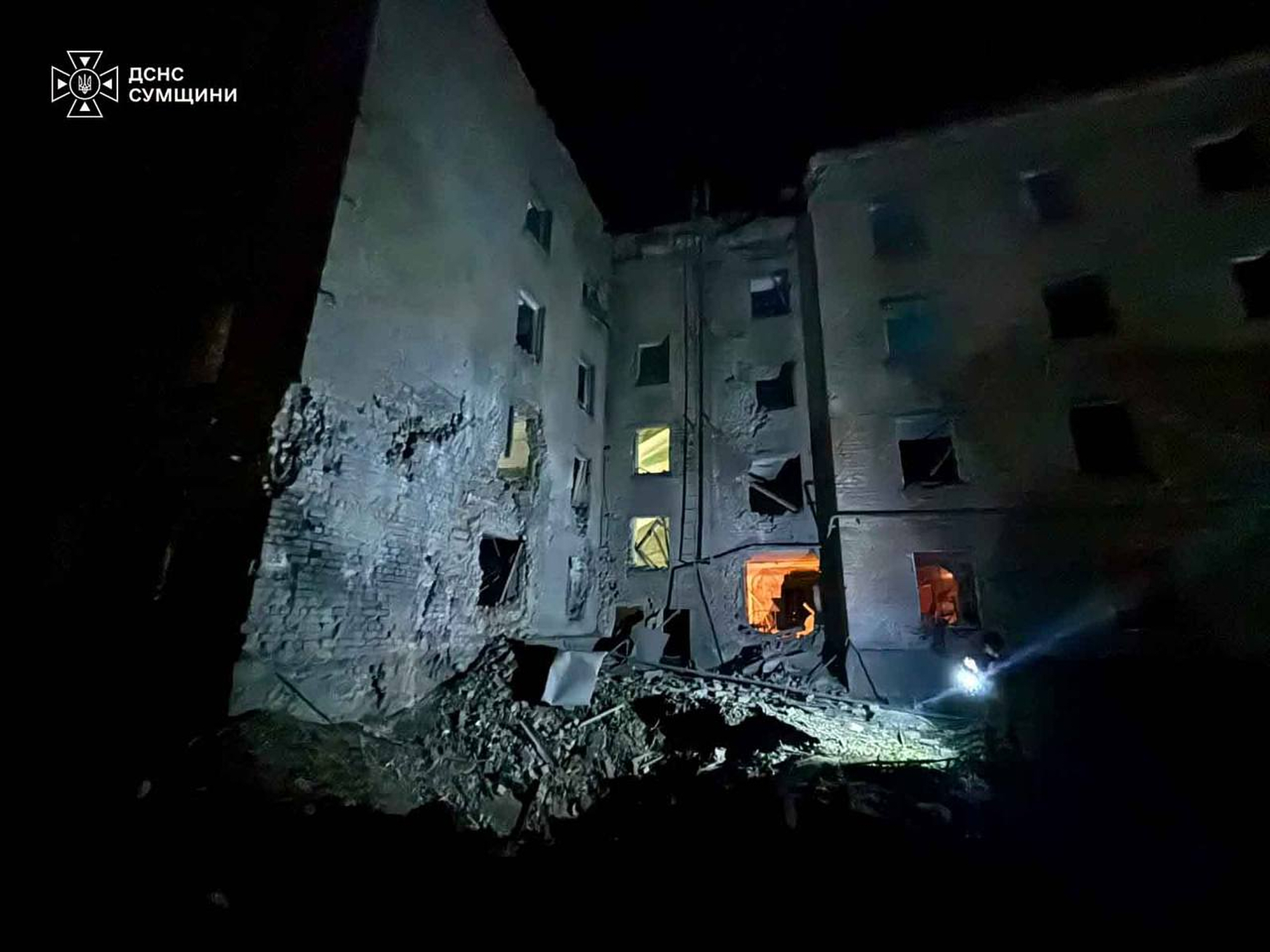
    In the neighboring Sumy region, Russian glide bombs wounded 12 people, the National Police said. Apartment buildings and infrastructure were damaged, with hundreds of windows shattered, said regional military administration chief Oleh Hryhorov.

    In the Kherson region of southern Ukraine, a Russian drone struck a bus carrying farmworkers, injuring six people, regional authorities said.

    A Russian drone also struck a residential area in the southeastern city of Zaporizhzhia, injuring four, said regional administration head Ivan Fedorov.

    UN chief condemns escalating attacks

    U.N. Secretary-General Antonio Guterres condemned both sides for their attacks, his spokesman said.

    “These latest series of attacks follow an alarming pattern of escalating strikes against populated areas, reportedly resulting in a record-level increase in numbers of civilian casualties and widespread destruction of residential and civilian infrastructure in Ukraine, as well as increasingly in the Russian Federation,” said Farhan Haq, Guterres’ deputy spokesman.

    The U.N. chief also called for freedom of navigation in the Black and Azov seas, expressing concern at the risks to shipping, the spokesman said.

  • U.S. suspends avocado inspections in Mexican state of Michoacan due to threat

    U.S. suspends avocado inspections in Mexican state of Michoacan due to threat

    MEXICO CITY — The United States announced Wednesday that it had suspended all government operations in the Mexican state of Michoacan because of a “threat to U.S. interests,” including a halt to the inspections of avocados required for their export.

    While the U.S. Embassy did not specify the nature of the threat in its security alert, Michoacan Gov. Alfredo Ramírez Bedolla said on social media that the temporary halt to inspections was intended to safeguard workers following recent arrests linked to extortion. The inspections are necessary for avocados to be shipped to the United States and their suspension could disrupt exports.

    The western state of Michoacan is the leading exporter of avocados to the U.S. and has a high level of organized crime activity with at least four cartels — designated as terrorist organizations by the Trump administration — operating in the region. Besides trafficking drugs, cartels also make money through extortion, including of the avocado industry.

    Michoacan State Security Secretary Antonio Cruz told The Associated Press that one of the arrests mentioned by the governor was of “El Poncho,” the alias of Alfonso Fernández Magallón, leader of a local cartel operating in the avocado-growing region around Los Reyes.

    U.S. Ambassador to Mexico Ronald Johnson welcomed the arrest, which came over the weekend. The U.S. government had offered a $5 million reward for Fernández Magallón’s arrest.

    Cruz said his department was unaware of any direct incidents involving the avocado inspectors. Nevertheless, 300 security personnel were deployed to the Los Reyes area as a preventive measure.

    The governor said the priority was to “ensure the security conditions necessary for these operations to resume normally,” as has happened in the past.

    Mexico supplies approximately 80% of U.S. avocado imports — a product known in the region as “green gold.” Its cultivation generates around 200,000 jobs in Michoacán alone.

    In 2025, Mexico sold $3.65 billion worth of avocados to the United States, and in the first four months of this year, those exports rose by 35% compared to the same period in the previous year.

    The U.S. Department of Agriculture sends inspectors in Mexico to monitor plantations and packing houses to ensure that exported produce is free of pests. Threats and violence against the inspectors have caused the U.S. to suspend inspections in the past.

  • How extreme heat is changing Americans’ lives, according to a new AP-NORC poll

    How extreme heat is changing Americans’ lives, according to a new AP-NORC poll

    Elisa Bracamonte has lived in Arizona her whole life, so she’s used to adjusting her schedule and outdoor activities around high temperatures, especially during the summer months.

    But the 74-year-old retired nurse from Tucson said she feels the heat has been impacting more of her day-to-day: summer plans with family members across the region, meetups with friends, road trips and her daily morning walk routine.

    “I’ve noticed at least a 10 degree difference in the weather,” Bracamonte said. “Every summer, it seems to be getting hotter and hotter.”

    Like Bracamonte, Americans are increasingly feeling a personal impact from extreme heat, according to a new poll from The Associated Press-NORC Center for Public Affairs Research.

    According to the survey, U.S. adults are more likely to say extreme heat has had either a “major impact” or “minor impact” on their travel or vacation plans, electricity bills, their sleep, their family’s outdoor activities and more parts of their day-to-day life than in July 2024.

    Much of that shift was among people who live in the West or Midwest.

    Democrats are also more likely than Republicans to say that extreme heat has had a “major” impact on each item asked about.

    Warming has endangered the globe especially in recent years; scientists calculated that Earth’s average temperature in 2025 hovered among one of the three hottest on record, along with 2024 and 2023. The U.S. has sweltered under dangerous heat domes over the past few years, and unusually high temperatures even early in the year.

    The recent scorching weather has played a role in thousands of heat-related deaths — killing more people every year than all other weather-related events. It impacts wildfire risk, strains public infrastructure, devastates agriculture and wreaks havoc on gatherings such as sporting events.

    Now, the poll shows how extreme heat is reshaping Americans’ daily lives.

    “I have to get up at 5 in the morning to walk before 6, because by 7 it’s already in the 80s … I lose a couple hours of sleep because I’m having to wake up earlier,” added Bracamonte, who said she identifies as a very liberal Democrat. “You can’t stay outside without being sick unless you’re guzzling water the whole time — it’s just so, so hot.”

    Electricity bills going up

    About 8 in 10 Americans say their electricity bills have seen a “major” or “minor” impact from extreme heat over the last year, compared with 69% in July 2024, according to the survey.

    Just under half of Americans living in the Midwest, 44%, say extreme heat has had a “major” impact on their electricity bills, up from 29% two years ago.

    Rising household electricity prices have turned into an increasingly prominent political issue over the past few years. Extreme weather is just one factor that affects electricity bills, but it means that people are using more energy for air conditioning — or in the colder months, heat.

    “I feel like my utility costs probably doubled in the last three or four years,” said Daemien Williams, a 50-year-old bridge inspector living in Cahokia Heights, Illinois, who identifies as a Democrat. “I do look at my bills pretty in detail and see that the kilowatts and the usage is actually up, not just the price that they’re charging for it.”

    Travel and vacation plans impacted, along with family outdoor activities

    Extreme heat is affecting Americans’ lives in other ways, the survey found.

    Around 4 in 10 Americans say extreme heat has had either a major impact or a minor impact on their travel or vacation plans, up from about one-quarter in 2024.

    “It has affected my entire family because we usually get together a lot during the summer,” Bracamonte said. ”We have family in Texas and we have family in upper Arizona. And we’ve seen that there’s been a lot more fires, a lot of more flooding, all that. So that kind of inhibits our plans to travel.”

    Extreme heat waves increase wildfire risk, and a warmer world supercharges storms that could ultimately send more rainfall.

    Around 7 in 10 Americans say extreme heat has had either a major impact or a minor impact on their family’s outdoor activities, compared with about 6 in 10 in 2024.

    Sean Conway, a 41-year-old direct marketer in North Shore, Massachusetts, said his kids’ soccer practice might either be postponed or canceled due to extreme temperatures, for example.

    But to Conway, who considers himself a moderate independent, leaning Republican, this is minor. “Sometimes, you’ve got to just be out in the bad weather.”

    It’s not surprising many Americans say they are feeling the impacts, said Jennifer Francis, a climate scientist at the Woodwell Climate Research Center who was not involved with the polling.

    “Brutal, life-threatening heat waves have become more frequent, more intense, and more persistent in many parts of the globe, including our Western and Midwestern states,” Francis said. ”Extreme heat compounded with long dry spells have affected our health directly, along with indirect effects on our wallets.”

    Climate change belief remains largely stable

    Even as more Americans say they feel a personal impact from extreme heat, that does not mean an increasing number believe in climate change.

    About two-thirds, 66%, of Americans believe climate change is happening, a slight decline from 73% in September 2025. About 17% say they are not sure if climate change is happening, and about 15% say it is not happening.

    Williams, the Illinois resident, attributes his belief in climate change in part to extreme shifts in weather including very high and very cold temperatures.

    “My biggest indicator of the change in the climate is just the flooding is a lot more often,” Williams said, noting that he believes in both natural and human causes.

    John Hazel, a 33-year-old in Waco, Texas, says he’s noticed changes from when he was younger.

    “When I was a kid, that seemed like a very rare thing when it did hit 100, everybody was like, whoa. And now it’s just every day,” said Hazel, a crime scene investigator. “Seasons felt a little more balanced. Now it feels like summer’s a bit lingering, it starts earlier and lasts longer.”

    Hazel, who identifies as a conservative Republican and believes in climate change, said he plans around the heat.

    “As soon as you walk outside, you’re already sweating even if you’re not doing much of anything. I’ve definitely noticed you’re having to take breaks from being outside, you have to bathe, shower more often,” Hazel said. “It’s definitely a bigger consideration.”

    ___

    The poll of 1,165 adults was conducted July 23-27, 2026, using a sample drawn from NORC’s probability-based AmeriSpeak Panel, which is designed to be representative of the U.S. population. The margin of sampling error for adults overall is plus or minus 3.7 percentage points.

    ___

    Alexa St. John is an Associated Press climate reporter. Follow her on X: @alexa_stjohn. Reach her at ast.john@ap.org.

    ___

    Read more of AP’s climate coverage.

    ___

    The Associated Press’ climate and environmental coverage receives financial support from multiple private foundations. AP is solely responsible for all content. Find AP’s standards for working with philanthropies, a list of supporters and funded coverage areas at AP.org.

  • Federal judge lets Utah enforce its anti-gambling laws on the prediction market Kalshi

    Federal judge lets Utah enforce its anti-gambling laws on the prediction market Kalshi

    SALT LAKE CITY — Utah can enforce its strict anti-gambling laws on prediction markets such as Kalshi and Polymarket, a federal judge ruled in a win for states seeking to rein in the popular betting platforms.

    Utah has been on the front lines of a battle between states and the federal government over who regulates the markets and whether they should be considered finance or gambling. The legal landscape is fragmented, with state and federal courts blocking restrictions in several states and allowing them in others.

    Kalshi sued Utah in February, asking a federal judge to prevent the state from enforcing its gambling restrictions on the platform. The lawsuit came as Utah was on the verge of enacting legislation intended to undercut prediction markets from doing business in the state.

    State law now bans proposition betting in sports — wagers on certain events happening in a game, rather than the game’s outcome — which is a significant source of revenue for the leading prediction markets.

    U.S. District Judge Robert Shelby rejected Kalshi’s request to block the Utah restrictions Tuesday, saying the federal law that Kalshi cited in its argument does not prevent the state from enforcing its laws.

    For now, Utah residents can still place bets on the platforms. The state’s attorney general, Derek Brown, said he will enforce state laws on Kalshi, but he was still exploring options.

    “Gambling is gambling, no matter what any company calls it,” Brown said.

    Kalshi said in a statement that it disagrees with the ruling and plans to appeal.

    The company maintains that prediction markets fall exclusively under federal jurisdiction and are not governed by a patchwork of state gambling laws. The Commodity Futures Trading Commission, the federal agency responsible for regulating financial markets, agrees and has defended prediction markets in court.

    Courts in Maryland, Nevada, Ohio, New York, and Wisconsin have ruled against Kalshi in similar lawsuits, while judges in New Jersey, Tennessee, Arizona and Minnesota have sided with the company. Other states have been allowed to restrict certain aspects of Kalshi’s operations without banning them entirely.

    The Trump Administration has been supportive of prediction markets, which allow anyone with a smartphone to wager on just about anything. The president’s eldest son is an adviser for both Kalshi and Polymarket, and an investor in the latter through his venture capital firm. Trump’s social media platform, Truth Social, is also launching its own cryptocurrency-based prediction market called Truth Predict.

    Utah leaders such as Gov. Spencer Cox have treated their fight to keep out anything they deem gambling as a moral crusade. The culture is rooted in the locally headquartered Church of Jesus Christ of Latter-day Saints, known widely as the Mormon church, which views gambling as a vice that leads to selfishness and addiction.

    Prediction markets are “causing tremendous harm to countless American families,” Cox said in celebrating the ruling.

  • Climate change created conditions for Canada fires, scientists say, as Trump blames mismanagement

    Climate change created conditions for Canada fires, scientists say, as Trump blames mismanagement

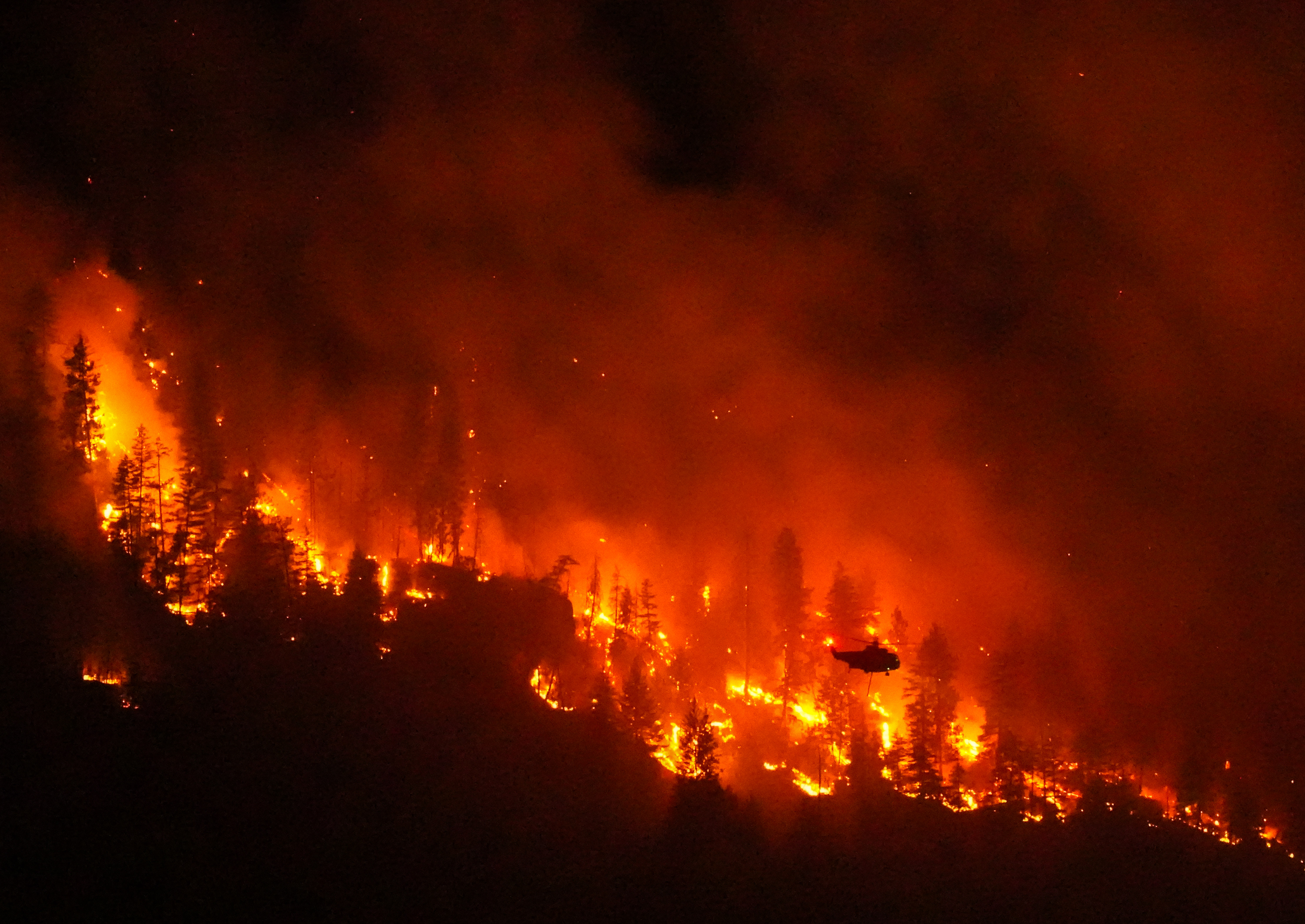
    Human-caused climate change doubled the likelihood of the tinderbox weather conditions that sparked Canada’s massive summer wildfires and in turn angered U.S. President Donald Trump, according to a study released Thursday.

    And fire and climate scientists said Trump, who has talked about punishing Canada for poor fire management and sending days of choking smoke across the border, should look more in the mirror than up north when it comes to blame. They point to the United States’ huge historical emissions of heat-trapping gases from the burning of coal, oil and gas.

    The fire weather conditions in the Northwest Territories and northwestern Ontario, while unusual but not that rare, were still made twice as likely by global warming, said Thursday’s study by World Weather Attribution, a group of international scientists who examine extreme weather conditions to see if there are climate change fingerprints. It’s about the same as the team found for summer fires in France, but not nearly as clear a climate fingerprint as they calculated in Spanish fires, which the scientists said were 20 times more likely because of climate change.

    The study, which was done so quickly it has not been peer reviewed yet, looked at the weather conditions that are connected to large wildfires and the Canadian index for those conditions, which are heat, lack of rain, humidity and wind. The researchers found the doubling of frequency when — using scientifically accepted techniques to search for climate fingerprints — they compared current conditions to a world without the 2.5 degrees of warming that’s occurred since the industrial age and burning of fossil fuels started. The weeklong weather conditions that led to the fires in Ontario are now the type that can happen every six years or so, the report said.

    “In a pre-industrial climate this would have been much less likely to occur, maybe once in a lifespan. So climate change has made those events more likely,” said study co-author Jonathan Boucher, a fire scientist at Canada’s Forest Service.

    Hotter, drier conditions connected to burning

    Outside climate and fire scientists said the flash study made sense and reflects a world where hotter and drier conditions are making fires burn more often and more intensely.

    “Mother Nature’s been burning. Now she’s on amphetamines and she burns more and more,” said Thompson Rivers University fire scientist Mike Flannigan, a Canadian expert who wasn’t part of the study.

    Hazardous smoke spread across both the United States and Canada, choking large cities such as New York.

    By burning more and more fossil fuels, “we’re putting nails in our coffins,” Flannigan said.

    In the larger and remote Northwest Territories fires, where more than 5,000 square miles burned, it’s clear the spark was from lightning but it was the climate conditions that took that initial ignition and made the fire burn intensely and spread too fast to control, said Boucher and report lead author Theodore Keeping, a climate scientist at Imperial College in London.

    While people start about half of Canada’s wildfires — accidentally or on purpose — fires sparked by lightning are responsible for more than 90% of the land area burned in Canada, Flannigan said.

    “What we’re facing here is more of a climate related problem than a forest management problem,” Boucher said.

    That’s not how Trump sees it.

    Trump blames mismanagement, but scientists point to carbon

    “A lot of damage has been done. They’re not managing their forests properly,” Trump said July 21. “And the wind has a tendency to blow right over New York City, right over, you saw Detroit, they had to close the whole place. Michigan was really affected. They had to close businesses for four days. It’s very serious what they’re doing, and they don’t seem to be able to do anything about it. If they managed their forests, they wouldn’t have the fires.”

    When asked Sunday about punishing Canada, Trump on Air Force One told reporters he has decided on a punishment, adding “you’ll find out about it soon.”

    Canadian climate and fire scientists said Trump doesn’t understand the root causes.

    “Smoke does not carry a passport, but carbon pollution does have a history. That history shows that the United States contributed more than any other country,” said University of Victoria climate scientist Andrew Weaver. “President Trump is pointing at the smoke while ignoring America’s fingerprints on the climate conditions behind it.”

    Study co-author Friederike Otto, an Imperial College London climate scientist, said, “if you care about anyone but the super rich, you have to stop burning fossil fuels because the impacts are here and they’re now and have huge consequences.”

    Canada has warmed 65% more than the United States in recent decades. In the past 30 years, the amount of land annually burned by Canadian wildfires has gone up by about 50% while the amount in the United States has more than doubled.

    A big problem that Trump doesn’t appear to understand is that much of Canada’s forests are remote, northerly and full of spruce and pine that burns hard and fast, all making it difficult to get a handle on, Boucher and Flannigan said.

    “In Canada, when things are extreme, you have about a 30-minute window to put that fire out,” Flannigan said. “If you don’t get there in 30 minutes, you’re out of luck. And many of the fires that start in Canada are northern remote areas that are more than 30 minutes away from an airport. So even with perfect detection systems, we would get there too late and these fires are going to burn.’’

    ___

    The Associated Press’ climate and environmental coverage receives financial support from multiple private foundations. AP is solely responsible for all content. Find AP’s standards for working with philanthropies, a list of supporters and funded coverage areas at AP.org.

  • Firefighters get a handle on Spokane wildfires as tens of thousands remain evacuated

    Firefighters get a handle on Spokane wildfires as tens of thousands remain evacuated

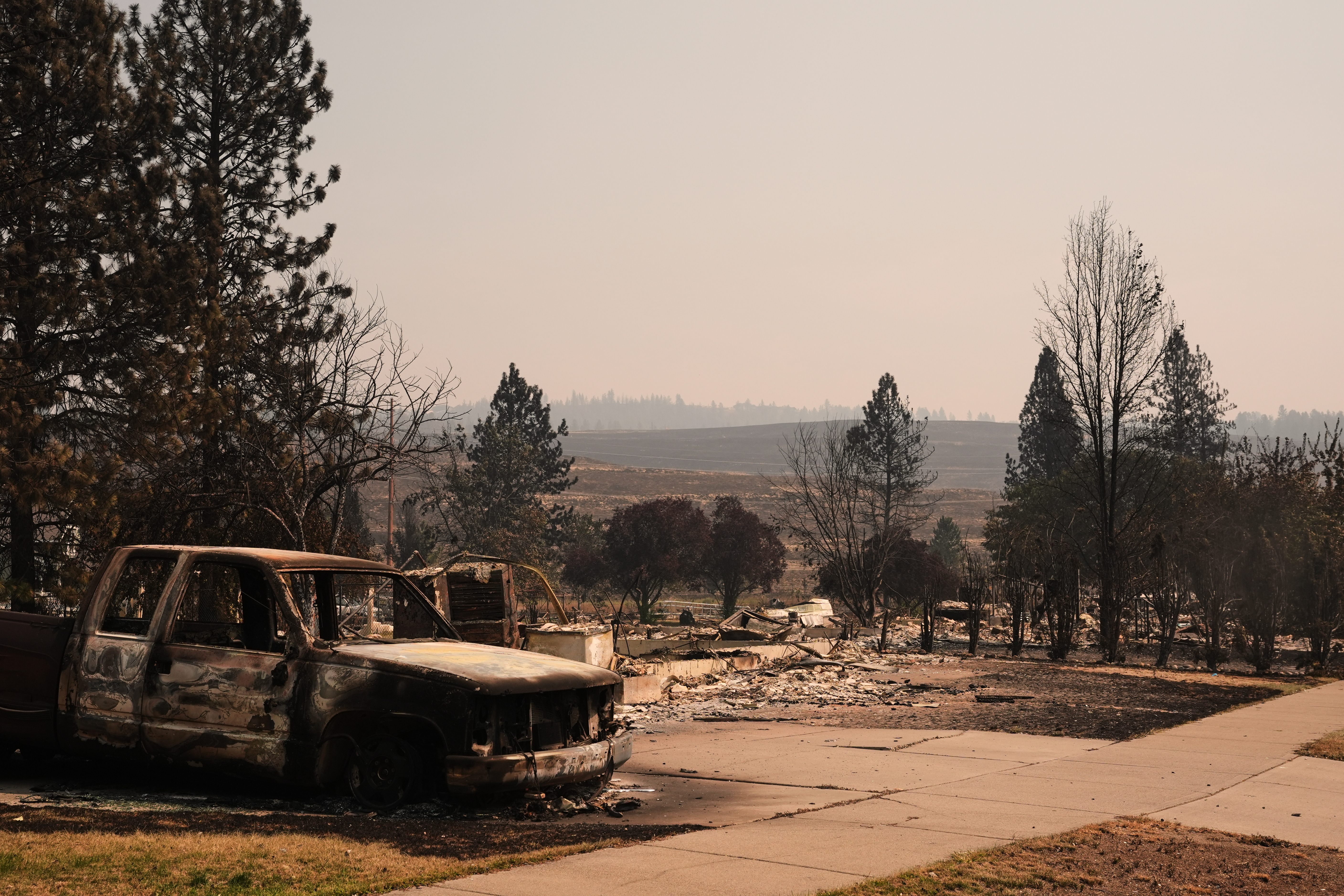
    SPOKANE, Wash. — Firefighters have taken advantage of cooler weather to begin getting a handle on wildfires that have displaced tens of thousands of people around Washington state’s second-largest city, but hotter, drier and breezier days lie ahead.

    Officials reported Wednesday that firefighters had established containment lines around the perimeters of all three fires affecting Spokane and that they were focused on reinforcing those lines. Temperatures were expected to climb from the 80s the past two days into the upper 90s with less humidity, late this week.

    The fires — one of which authorities say was deliberately set by a man who was arrested and charged with arson — have destroyed about 850 buildings and forced the evacuation of around 67,000 people since they erupted last weekend. Damage assessment crews have yet to tally exactly how many houses have been lost or damaged. No deaths have been reported.

    The other two fires were also started by people, though not necessarily deliberately, investigators have said. They remain under investigation. Those fires, the Autumn Lane and Fairview fires, started independently of the arson-caused Old Trails Fire, they said.

    Unclear how long evacuations will last

    Spokane County Sheriff John Nowels said during a Wednesday news conference that the evacuation zones will remain in place due to incoming weather and fire danger.

    “We are not going to be downgrading these zones in any large way for many, many more days to come,” he said. “If we let people back in and we don’t have a high degree of certainty the fire lines will hold, we will put people in danger.”

    Many evacuees remained in a shelter set up in a Spokane convention center, at hotels or rentals, or at the homes of friends or relatives, with no idea of how soon they might go back — if they have a house to return to.

    “We figured it would be a day or two, not four or five. It’s not the best situation,” said Debra Curran, who has been staying at the convention center since Saturday with her husband, who has ALS, also known as Lou Gehrig’s disease. Their house survived, but her husband would need to be transported by ambulance, which officials won’t do until the fire risk in their neighborhood drops.

    Among those under evacuation orders are patients and staff from the Mann-Grandstaff VA Medical Center in Spokane. When the fire approached on Saturday, the staff moved 27 patients to local hospitals and temporary shelters, said Bret Bowers, a spokesperson for the center. The medical center was not burned in the fire but several staff lost their homes.

    Adam Wilson, a communications officer at the Washington State Auditor’s Office, fled Saturday with his wife and three children, ages 9, 14 and 16. They had moved into their Spokane home a little over a month earlier and were still unpacking, he said.

    Since then, they’ve stayed at a hotel 90 minutes to the south and with his father in Idaho. This weekend, they’ll move again, to a rental home in Spokane that their insurance is covering.

    Their house is fine, Wilson said, despite flames that leveled an entire cul-de-sac just two blocks away, leaving only chimneys standing in some cases. The neighborhood remains under an evacuation order. Even if they could return, there’s no power and no internet service, and no information about how soon either will be restored.

    “What you really want to hear, nobody can tell you,” Wilson said. “It is oddly emotional and disorienting. We did not lose any property. From the outside it looks like a family trip — ‘Hey, kids, we’re going to go visit Papa for a week, pack your bags.’ … And yet you feel like something isn’t right.”

    Bad fire season strains resources

    The fires were among dozens across the Western U.S. that have stretched the ability of federal, state and local agencies to fight them. In Washington, there are 16 uncontained wildfires burning more than 672 square miles and being fought by more than 7,000 fire personnel, said Thomas Kyle-Milward, a spokesperson for the Washington Department of Natural Resources.

    “We’re looking down the barrel at one of the worst fire seasons in state history,” he said.

    U.S. Sen. Maria Cantwell of Washington said Wednesday that senators had received a briefing from Interior Secretary Doug Burgum, Agriculture Secretary Brooke Rollins and Wildland Fire Service Director Brian Fennessy, who assured them that keeping firefighting assets, including ground crews and aircraft, in the Northwest is a priority.

    “We are still at the highest risk in the nation and appreciate being the highest resourced,” Cantwell said in a written statement.

    The man charged with starting the Old Trails Fire, Aaron F. Farinacci, 37, of Spokane, was expected to be arraigned Thursday. According to court documents, he was arrested after a resident reported him being in the area where the fire began. He denied having started it when questioned by deputies.

    Authorities said they previously contacted him during two fire investigations last year, including one in a state park that prompted evacuation notices, though he wasn’t charged in either.

    In California, authorities said Wednesday that they arrested a 65-year-old man on suspicion of sparking a major wildfire by recklessly operating equipment without complying with state fire prevention requirements. Prosecutors will determine whether to file criminal charges. The blaze that erupted Monday had scorched nearly 15 square miles of forest in Calaveras County southeast of Sacramento.

  • Lewis Kalb never became a professional announcer. But during Wednesday’s Phillies game, he had his ‘moment.’

    Lewis Kalb never became a professional announcer. But during Wednesday’s Phillies game, he had his ‘moment.’

    Some kids dream of playing in the major leagues, but Lewis Kalb was always different. Growing up in Detroit in the 1950s, he had no interest in becoming the next Al Kaline or Jim Bunning.

    He had his eyes set on a much more exclusive club, one that only hundreds had ever qualified for. Kalb wanted to be a broadcaster. The boy spent his nights listening to the deep drawl of Ernie Harwell, and after the family moved to Medford Lakes in 1965, the laid-back style of By Saam.

    He quickly realized this would be a lofty goal. In the 1970s, Kalb served as a public address announcer for the hockey team at Hillsdale College in Michigan, and worked as a disc jockey for the local radio station.

    Job opportunities weren’t coming. So he decided to pursue a more pragmatic career, in sales, and moved to Los Angeles in 1977 to work for Russell Stover Candies. But even then, he couldn’t shake his dream.

    As Kalb drove thousands of miles up and down the California coast to peddle boxes of chocolate and other confections, it would be Vin Scully’s voice crooning through the car stereo.

    “I would say, ‘Well, you’ve wanted to do this since age 12,’” Kalb recalled. “You can’t wait too much longer. Now I’m 27, 28 years old. So, if you’re going to pursue it, if you’re going to give it a shot, that’s the time to do it.”

    He moved to State College in 1980 to enroll in broadcasting classes at Penn State, working as an overnight disc jockey with some public address appearances on the side. In 1984, Kalb was hired as the afternoon drive host for WZBZ 99.3 in Atlantic City, a role he’d hold for two years.

    Lewis Kalb broadcasting a basketball game at Vaughan Hall in Medford Lakes, N.J., in 2010.Courtesy of Lewis Kalb

    The aspiring play-by-play man transitioned into freelance work after that, as a Philadelphia-based reporter for WFAN and WNAW in New York, but never found a full-time gig. The closest he got was in 1996, when the Sixers held open auditions for a public address announcer.

    Kalb knew he’d be competing against “heavy hitters,” in his telling, so he decided to get plenty of reps in. About a mile away from his house in Medford Lakes was a local recreation center, Vaughan Hall.

    The Detroit native began announcing kids’ basketball games, multiple times a week. He didn’t get the Sixers job, but found his calling in the process.

    “It was my volunteer niche,” Kalb said. “It was the greatest thing in the world. The response I got from the kids, the parents, the grandparents, everybody, they loved it so much.

    “Because here I was, announcing their kids, like it was NBA basketball. Playing the music in the timeouts, pumping them up with the intro music, just like the Chicago Bulls used to introduce their championship teams.

    “And it was so overwhelming that I said, ‘You know what? This is what I’m going to do to volunteer and give back to my community.’ And 30 years later, I’m still doing it and loving every second of it.”

    For those 30 years, Kalb and his dulcet tones were the best-kept secret in Medford Lakes. Not anymore. On Wednesday night, in the third inning of the Phillies-Nationals game, sandwiched between Scott Franzke and Larry Andersen, the 73-year-old took to the air.

    Lewis Kalb (center) with Phillies radio broadcasters Larry Andersen (left) and Scott Franzke (right) after joining them on air on Wednesday.Courtesy of Lewis Kalb

    He’d paid $22,000 for the opportunity in the Phillies’ Phantastic Auction. And to Kalb, a substitute teacher at Neeta Middle School, it was worth every penny.

    The septuagenarian had only minimal live play-by-play experience; about 10 high school baseball games, if that. He’d also done some work on YouTube, holding a camera in one hand, and a mic in the other, while narrating various local sporting events.

    But decades of Scully and Harwell and Saam and, of course, Harry Kalas, had given him an education unlike any other. And when he started to speak, that old-school sound came pouring out.

    Franzke noticed it immediately. The Phillies have held their auction for 14 years, which has brought all sorts of voices into the booth. But the team broadcaster had never heard an auction winner like this.

    Some past auction segments would become de facto interviews, with Franzke and Anderson asking the winner questions about their fandom to fill time. In this case, they barely had to talk at all.

    Kalb had studied so much he didn’t look at his rain-soaked sheet of paper. He had a natural rhythm and feel for what was unfolding in front of him.

    “He was, for the most part, with the play,” Franzke said. “And I think anytime, [with] someone who hasn’t practiced it, that’s the first thing that happens, is they get behind the play. Which is fine. It’s a fun thing; we’re not auditioning, it’s an auction.

    “But for a lot of people, that’s the thing that you notice. The ground ball is on its way to a position and a lot of people are checking their notes. Who is playing that position? What position is it? But he was right on it. Right from the very beginning.”

    Lewis Kalb on the court at the Palestra after announcing a game in 2019.Courtesy of Lewis Kalb

    Kalb had spent the previous week rehearsing for his segment. He had studied each Phillies and Nationals player, making sure he knew their bio, and how to pronounce their name.

    Every night, he practiced play-by-play in front of a small audience on Facebook Live, while watching the Phillies game on TV. That might’ve helped him a bit. But it was also clear, to anyone listening on Wednesday, that the 73-year-old has a gift.

    And while that gift never led to a job in the booth, it did give a lot of joy to a small borough in South Jersey.

    “I didn’t have a career,” Kalb said, “but I had my moment. And I know that’s something that for the rest of my life, I will always cherish.”