Blog

  • The ‘demand is real’ for backyard cottages, in-law suites, and other ADUs, says a Philly-area builder

    The ‘demand is real’ for backyard cottages, in-law suites, and other ADUs, says a Philly-area builder

    Homeowners across the Philadelphia region want to build garage apartments, in-law suites, and backyard cottages on their properties.

    Mario Mascioli, owner of Acorn Built Homes, said he gets hundreds of inquiries per month for these accessory dwelling units (ADUs), which have made up the bulk of Mascioli’s business since his company opened in late 2024.

    “The demand is real,” said Mascioli, who works across southeastern Pennsylvania and in Princeton. And builders like him are ready to create ADUs. But municipalities’ varying and often restrictive land-use rules often make that difficult.

    Pennsylvania lawmakers are currently considering legislation that would allow homeowners to create ADUs in places that are zoned for single-family houses without having to get special permission. The bill passed the state House earlier this month and is now before a state Senate committee.

    Allowing for the construction of ADUs is part of Pennsylvania Gov. Josh Shapiro’s plan to increase the state’s housing supply and provide Pennsylvanians with more affordable housing options.

    Mascioli has testified before state lawmakers to advocate for the loosening of restrictions for ADUs.

    “It would mean that homeowners that want these — which are plenty of them — would be able to get it done quickly, more economically, favorably,“ he said. ”It would be fantastic.”

    The Inquirer talked to Mascioli about the ADU landscape.

    This interview has been edited for length and clarity.
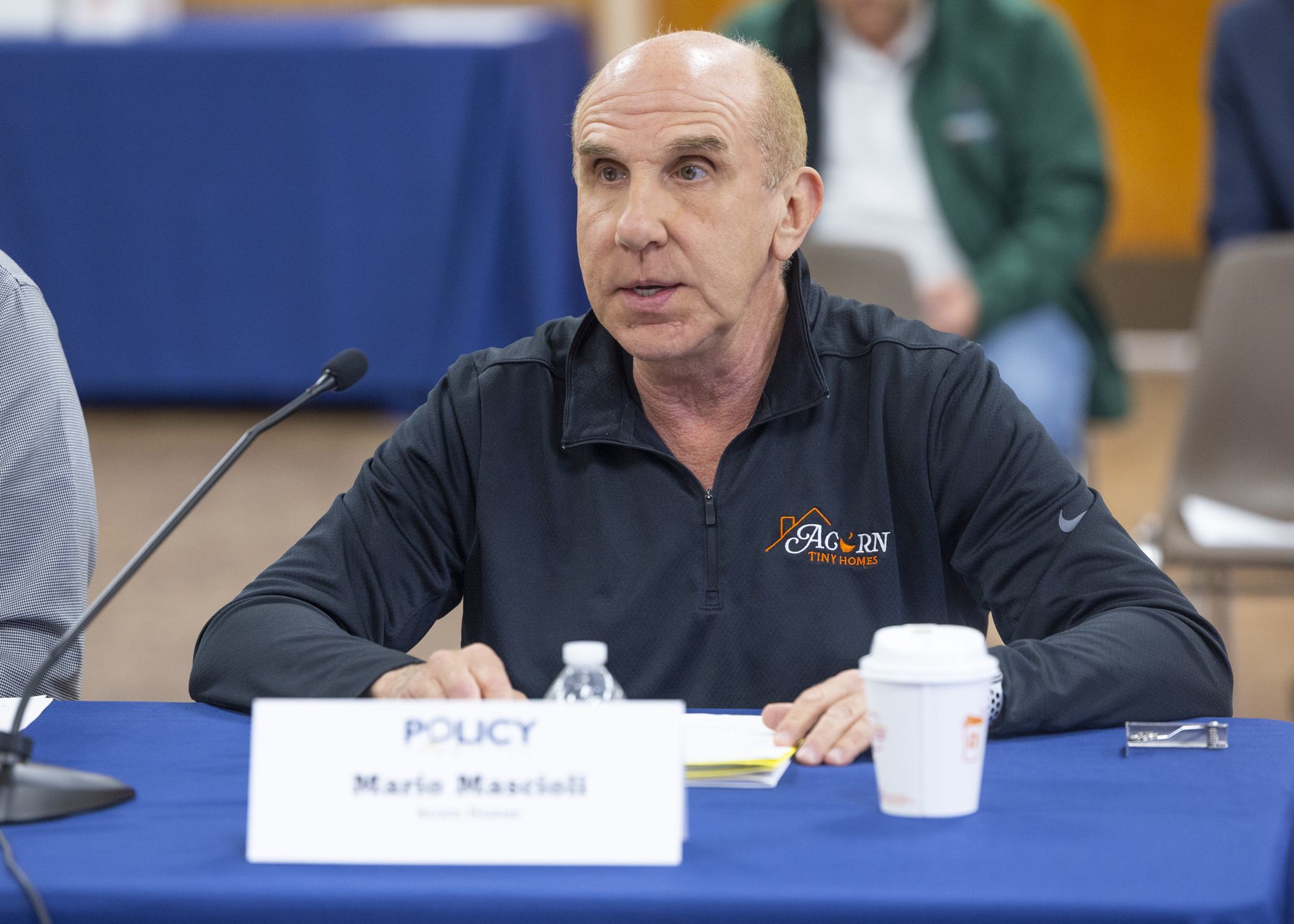
    Mario Mascioli, owner of Acorn Built Homes, testifies about accessory dwelling units at a policy committee hearing of Pennsylvania legislators on May 21, 2026.Acorn Built Homes
    Why do people want ADUs?

    The three drivers for why people want them are: aging-in-place elderly parents; adult children that can’t afford rent or can’t afford to buy a home; and third, people want rental income.

    What types of ADUs do you offer?

    We build studios as small as 240 square feet. [But] most people want a space that has at least 500 square feet. Most opt for one or two bedrooms.

    We [also] do additions. We do garage conversions. We do conversions of basements.

    In many cases, we have to attach an ADU as an addition to a house because of the township requirements. And in many cases, we’re limited as to the features we can put into it, because of those requirements.

    What’s something that clients have asked for that they weren’t able to get because of local land-use rules?

    I’ll give you a real-time example. We start every project with what we call our “feasibility and scoping” phase. That takes about four or so weeks to dial in on what’s buildable from a structural, construction, architectural, and also an approvable perspective.

    We have a customer we’re in the final phase of that study with. They have a beautiful property, plenty of land. They wanted a detached ADU for the couple’s mother, who’s going to be moving up from Florida to take care of their newborn, [who is due] in December. In this case, we can’t do a detached unit without going through a variance.

    We also uncovered through our feasibility process that … if we were to extend the garage and build on top of it, that would require a variance.

    Third thing is there’s a floodplain that runs through the property. And any modification to the footprint of the property would also be a variance.

    Those are three separate variance processes, each of which would require attorneys and fees and zoning hearing boards.

    So what we’re left building [without zoning approvals] is to raise up the loft on the second floor of the garage, put some dormers in it to make it more spacious, and create a one-bedroom living space there — but without a full kitchen with built-in cooking facilities. We can only put a kitchenette in.

    That is very typical. That’s 90% of what we deal with as it relates to ADUs.

    What’s different about building an ADU vs. a typical single-family home?

    Basically, the red tape impedes or kills [ADU] projects before they start. And that is because there’s over 2,500 municipalities in Pennsylvania. Each with different zoning rules as it relates to ADUs.

    In some townships, you can build one with no issues. But if you step, you know, a mile over the line in any direction, it’s either banned entirely or there are so many restrictions and other requirements that it takes [a] very long [time], if at all, to get through zoning hearing boards.

    Permitting and the expense of the red tape can make many projects impractical.

    Why did you decide to go into the ADU business in Pennsylvania with the challenges you’ve described?

    If you look at things from a national perspective, 20 states have passed legislation like Pennsylvania currently has in its legislature.

    People want them. That’s about affordable housing. I thought and still believe that it would be inevitable that ultimately Pennsylvania would pass such legislation. And if we were here in advance of that, establishing ourselves in the market, we would benefit from that legislation being passed.
  • Military members and veterans in Camden County can now get free legal services. Here’s what to know.

    Military members and veterans in Camden County can now get free legal services. Here’s what to know.

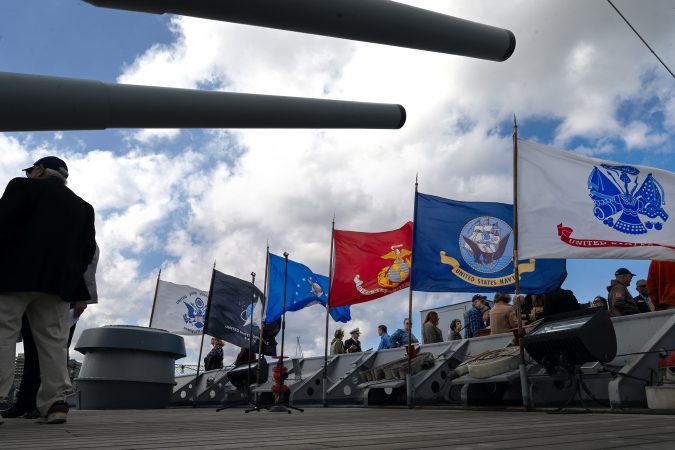
    Current and former military personnel can now receive free estate planning assistance in Camden County to help support their families’ futures.

    The Camden County Board of Commissioners launched the new clinic last month, one of several no-cost legal services available to vulnerable South Jersey residents.

    The clinic, currently scheduled monthly, gives active service members, veterans, and their spouses living in Camden County access to certain legal services at no charge. The county will provide a last will and testament, power of attorney, and an advance directive, which documents a person’s preferences for medical treatment in case they become unable to make their own healthcare decisions.

    Sixteen veterans are signed up for the first Veterans Will Clinic on Wednesday at the Camden County One-Stop Career Center in Cherry Hill Township, said Morgan Callan, the county’s external communications manager. There is no current cap for how many veterans can participate.

    The Camden County Office of Veterans Affairs is now accepting registrations for the second clinic, on July 29. Anyone interested should contact the office by calling 856-374-5801, or by visiting the office at 1 Collier Drive in Blackwood, part of the Camden County Lakeland Complex.

    Help for veterans

    Camden County has nearly 19,000 veterans, according to the most recent estimate available from the U.S. Census Bureau.

    The Camden County Office of Veteran’s Affairs has partnered with Susan Purvin, an attorney from Gloucester County, to help provide the services. Louis Cappelli Jr., one of Camden County’s three commissioners, said in a statement that he hopes everyone eligible takes advantage of the program.

    “Our veterans and servicemembers have sacrificed so much in service to our nation, so have their families,” Cappelli Jr. said. “The least we can do is help them get their affairs in order, giving them the confidence that their last wishes will be protected.”

    The cost to Camden County for the program is $50 per will, $25 per power of attorney, and $100 per hour for every legal information session, with the total cost varying based on how many people show up for the clinics, said Dan Keashen, the county’s public affairs director.

    Other counties in South Jersey provide similar services. All active military personnel and veterans in Gloucester County can receive assistance with a simple will, a legal document for those not looking to involve complicated estates or trusts in their end-of-life plans.

    About 20 attorneys recently volunteered for a free event in Cape May County that helped veterans and their spouses prepare a will, power of attorney, and healthcare directive free of charge.

    More free legal services

    You don’t have to be a veteran to find free legal services in Camden County.

    The Camden County Bar Association hosts Wills for Heroes, a small, volunteer-led clinic that provides free wills and estate planning documents to firefighters, police officers, and paramedics, and their spouses annually. The 2026 clinic, which took place in March, was full at 21 participants.

    Kara Edens Graser, the association’s executive director, said she hopes to run the same clinic next year.

    Camden County also offers free legal workshops, which cover the same services as those now available to veterans, for seniors and residents with disabilities aged 18 and over.

    Plus, about 300 attorneys volunteer on an as-needed basis for the Volunteer UP Legal Clinic, a Camden-based nonprofit that provides legal expertise to those who need it. The nonprofit spent more than $300,000 in 2024 to provide legal services for tenants, criminal record expungement, estate planning, and name changes, according to its 2024 tax filing.

    Volunteer UP also provides same-day eviction defense for tenants in Burlington, Camden, Cumberland, Gloucester, and Salem Counties, CEO Steven Salinger said via email.

  • 🪴 Back to basics | Morning Newsletter

    Happy Tuesday, Philly. We’re surrounding ourselves with some local inspo today. One local business has stripped down what we’re drinking to local herbs that are blended and bottled by hand. And The Inquirer’s list of the most iconic Philly songs captures the sounds of the city.

    Plus, storms created a mess for some World Cup fans on Monday. Let’s hope that’s behind us now.

    — Alyssa Passeggio (morningnewsletter@inquirer.com)

    If someone forwarded you this email, sign up for free here.

    A refreshing scene

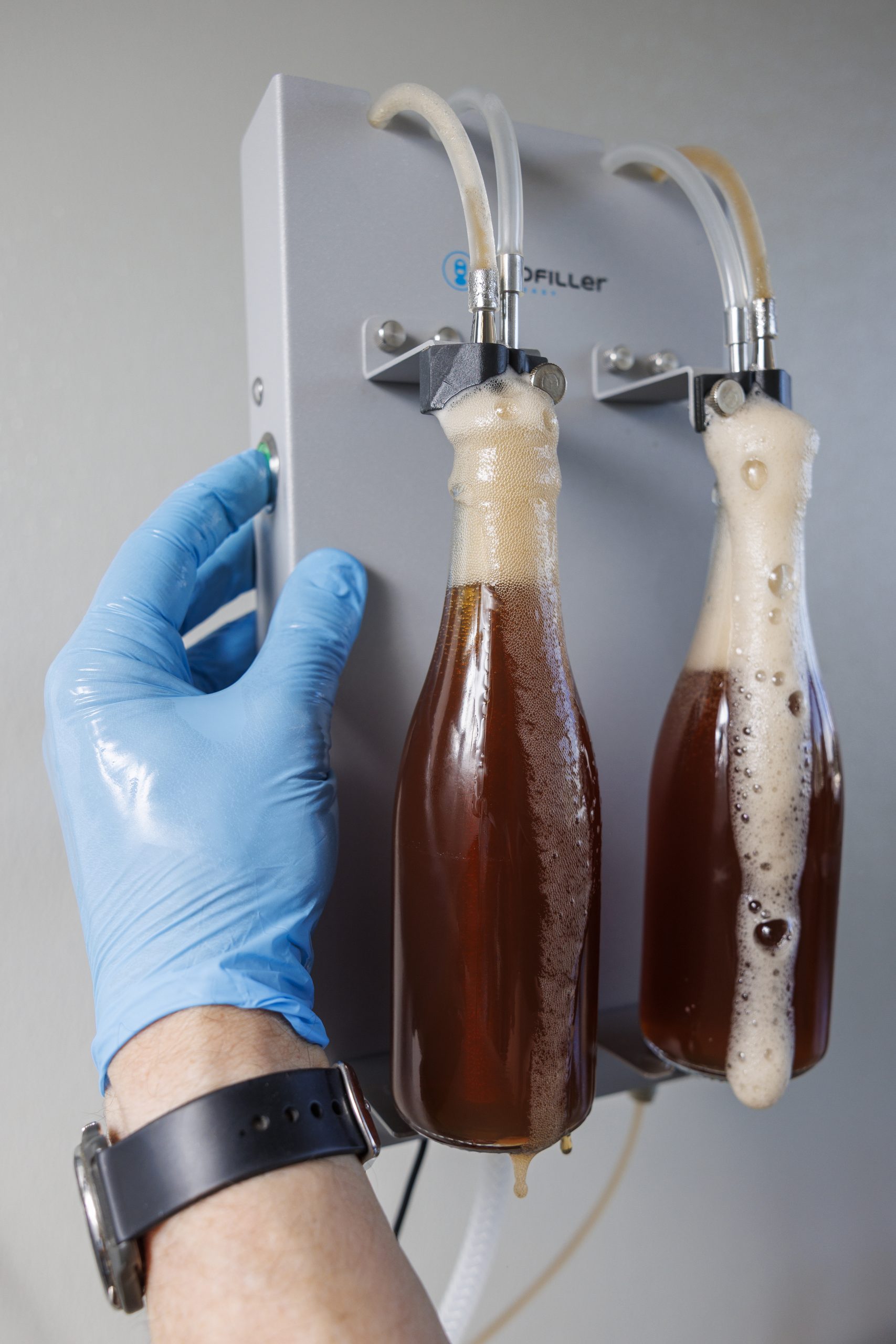
    The trend of analog technology and grandma hobbies have morphed into a new niche: handmade beverages. Meredith Sheehy spends hours each week distilling herb blends from Pennsylvania farms before they are carbonated and bottled — all by hand.

    Each batch takes three days to complete in the sunny Kensington shop. She and a legendary Philadelphia bartender tinkered with test batches inspired by the city and the ingredients.

    The zero-proof fizzy spritzes have found early success at bars and stores across the city as part of the growing sober curious movement.

    Go inside the Cult of Tree’s story.

    The most iconic Philly songs

    As the nation prepares for its 250th anniversary, Inquirer music critic Dan DeLuca asks: What is Philadelphia music?

    “Many of these songs are included mainly because they say something about Philadelphia, and who we are as Philadelphians,” DeLuca explains in the introduction to his countdown of the 76 most essential songs for the city.

    Dig in to the first part of this four-part series.

    🎧 Bonus: Listen along to the playlist as we count down.

    What you should know today

    Quote of the day

    Today’s 50-year-olds were born into a changing landscape for personal freedoms as America celebrated its Bicentennial. Columnist Elizabeth Wellington interviewed a special group of Gen Xers who are reflecting as we near the country’s Semiquincentennial.

    🧠 Trivia time

    A 21-year-old Judy Garland held her first public concert at which storied Philadelphia venue?

    A) Academy of Music

    B) The Met Philadelphia

    C) Mann Center for the Performing Arts

    D) Theatre of Living Arts

    Think you know? Check your answer.

    What we’re…

    💸 Budgeting to see a few of the must-watch concerts on Dan DeLuca’s summer list.

    😲 Tickled by what columnist Stephanie Farr refers to as a revolutionary event: a Nic Cage-themed night around Jenkintown.

    🥙 Craving some falafel after a look at Hira Qureshi’s favorite halal restaurants.

    🧩 Unscramble the anagram

    Hint: 🎩 A Tony-award winning campy comedy is coming to Philadelphia.

    AHOY MR!

    Email us if you know the answer. We’ll select a reader at random to shout out here.

    Cheers to Tammy Murphy, who solved Monday’s anagram: The All-American Rejects, 2000s pop-rock sensations, are taking over the main stage at the FIFA Fan Festival next month.

    Photo of the day

    Iraqi fans cheer in the stands before a FIFA World Cup Group I soccer match between France and Iraq on Monday, June 22, 2026, at Lincoln Financial Field in Philadelphia.Jose F. Moreno / Staff Photographer

    Storms led to the cancellation of the Fan Festival in Lemon Hill, but the weather didn’t stop fans representing France and Iraq before the World Cup game at the Linc.

    👋 Have a great Tuesday.

    By submitting your written, visual, and/or audio contributions, you agree to The Inquirer’s Terms of Use, including the grant of rights in Section 10.

  • Every bottle of this Kensington-made NA spirit is packaged by hand. At local bars, it’s already a hit.

    Every bottle of this Kensington-made NA spirit is packaged by hand. At local bars, it’s already a hit.

    A non-alcoholic Philly spirits brand is finding early success by doing everything — from blending to bottling — by hand.

    Cult of Trees is a new line of alcohol-free aperitifs produced at Maken Studios in Kensington. Inside the sunny production space, founder Meredith Sheehy spends hours each week distilling homemade herb blends into a line of zero-proof cocktails that taste like fizzy spritzes.

    The brand’s three flavors include Hare Brain, which is akin to a cola-spiked negroni; Meadow Core, a citrusy and floral blend of red fruits; and Billy Goat, which tastes like rolling in a field of wildflowers thanks to a mixture of herbs, honey, and elderflower. Since sales began in January, Cult of Trees has been selling well at local grocery stores and bars, such as Solar Myth and Enswell, where the drinks are served straight or floated with sparkling water or cold brew.

    For Sheehy, who moved to Philly in 2022, the city is as much an inspiration for the brand as the ingredients themselves. After closing her Brooklyn-based Mezcal bar La Loba Cantina due to the pandemic, Sheehy began bartending at Philadelphia Distilling. Philly, she said, had a refreshing scene.

    “People will answer questions and pour tastes of curiosities on their back bars, with genuine excitement to share,” said Sheehy. “It’s a beautifully welcoming culture here.”

    From left: Hare Brain, Billy Club, and Meadow Core, Cult of Trees’s three flavors of non-alcoholic aperitifs. Bottles are sold at Riverwards Produce in Old City and Herman’s Coffee in Pennsport.Alejandro A. Alvarez / Staff Photographer

    Fascinated by distilling alcohol, yet increasingly conscious of her own dwindling consumption, Sheehy was inspired by the growing sober curious movement to start her own non-alcoholic cocktail brand.

    Fewer and fewer young people are building their social lives around drinking, and more zero-proof drink brands are available than ever. But, Sheehy noticed, most of them showcased the same styles on repeat — one-to-one spirits replacements like zero-proof whiskeys or gins, and spritzes as far as the eye could see. Many also weren’t transparent about where their ingredients came from.

    Sheehy wanted to create something that wasn’t just about emulating the experience of drinking alcohol. Abstaining “shouldn’t mean that you need to take away flavor or an interesting story,” she said.

    At Cult of Trees, each aperitif is made with ingredients sourced from Pennsylvania farms and requires a multiday routine of distillation, carbonation, and bottling. It’s an analog process that contrasts with that of large scale brands, which Sheehy said often rely on commercial flavor extracts — as opposed to dried botanicals or herbs — to quicken production and lower costs.

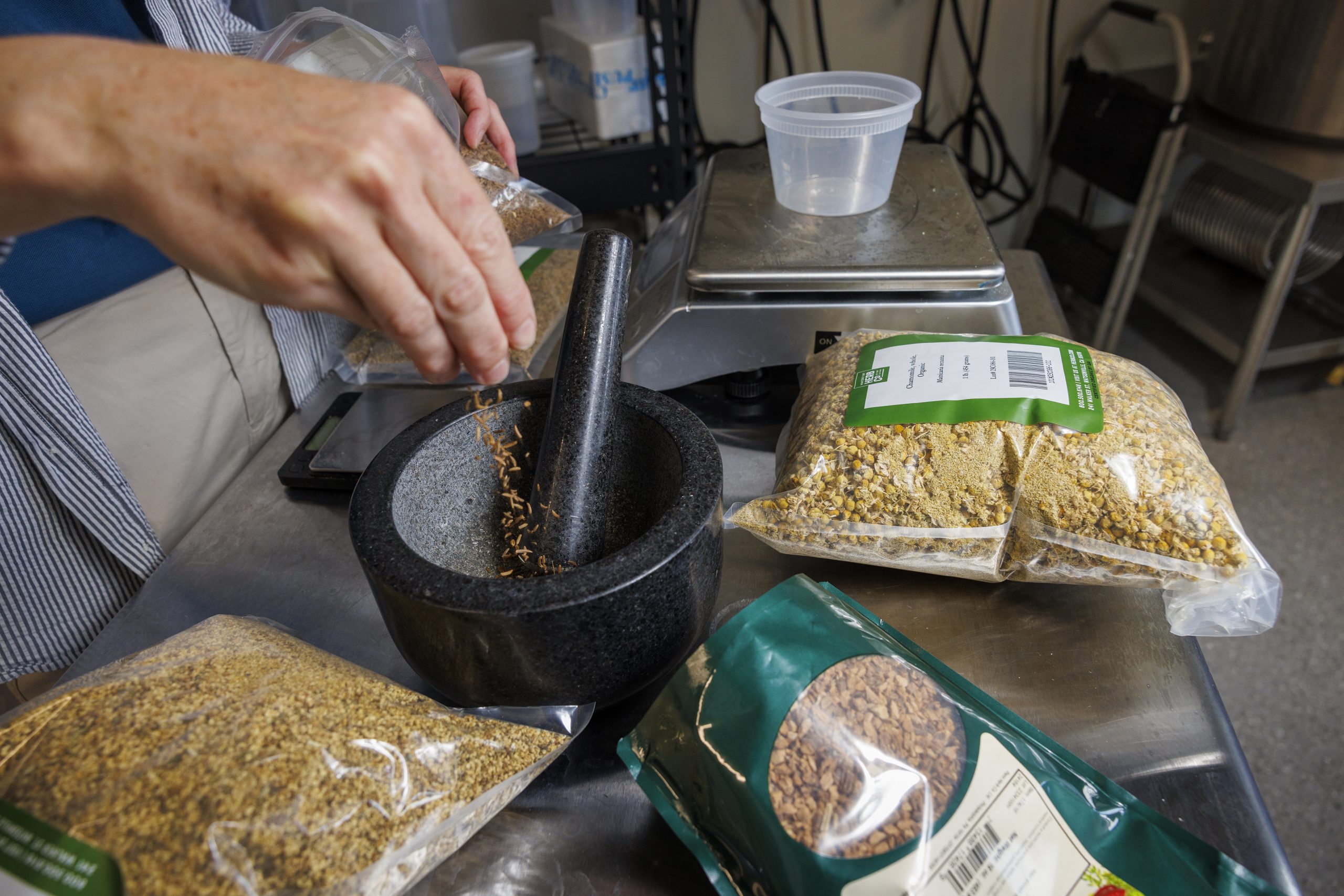
    Meredith Sheehy, owner of Cult of Trees, sprinkles caraway seed into a mortar and pestle to make one of the herb blends for her line of zero-proof spirits. Alejandro A. Alvarez / Staff Photographer

    Getting started, then getting set back

    While at Philadelphia Distilling, Sheehy became close with Jack Falkenbach, the expert distiller and legendary Philly bartender that died last year at 44. Falkenbach, she said, was always “willing to explain specialized process details at the distillery. We both liked deep-diving on things like acid phosphate,” she said. “I deeply trusted his style of drink making and technical know-how.”

    Falkenbach was among Cult of Tree’s earliest supporters, Sheehy said, and one of the first people she involved in building the company. Around this time last year, the pair was making test batches together; Falkenbach was focused on nailing the carbonation as Sheehy refined the packaging.

    Then the first real workday arrived. Falkenbach did not.

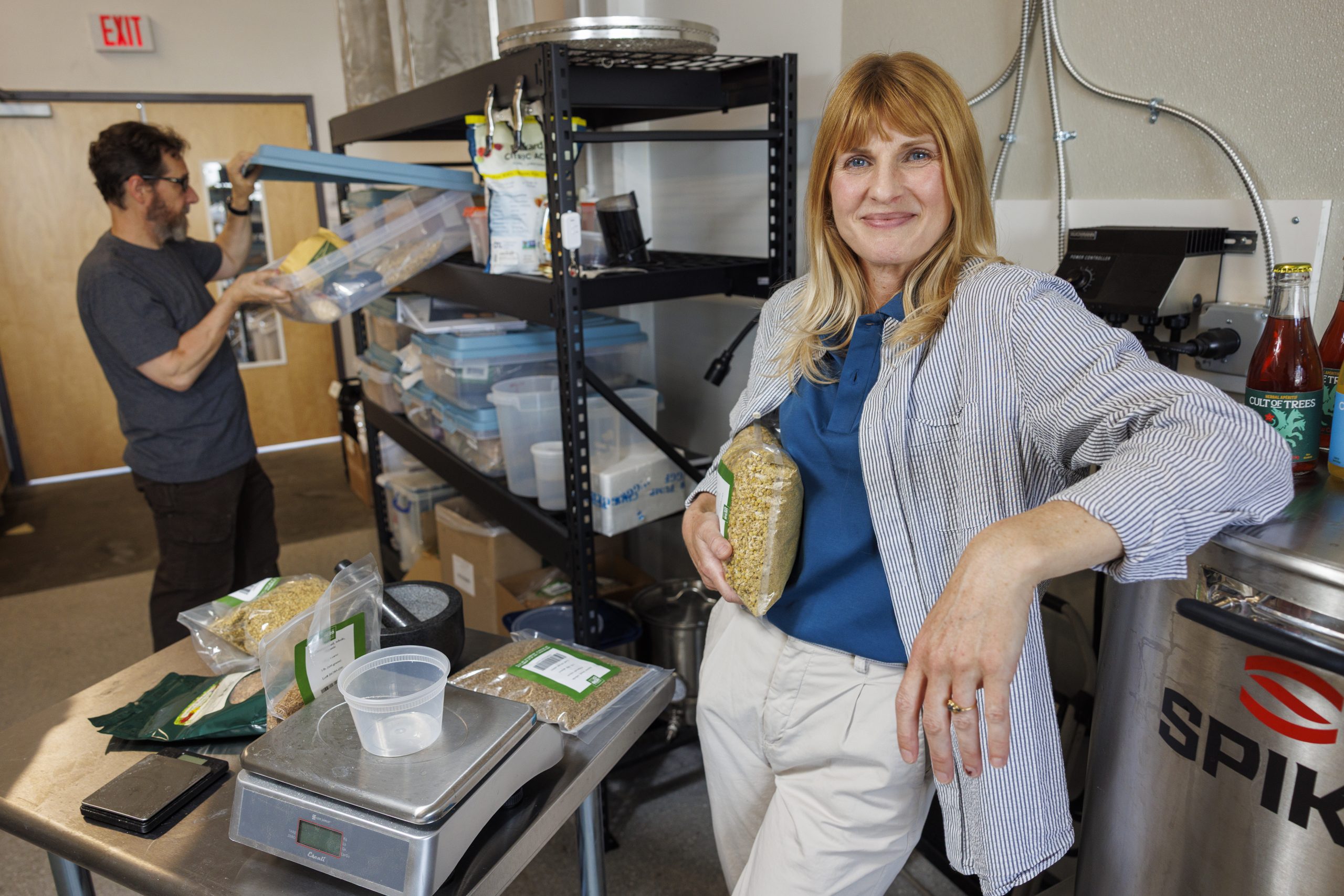
    Meredith Sheehy, owner of Cult of Trees, poses for a photo while preparing one of the herb bases for her line of zero-proof spirts, which is based at Maken Studios in Kensington.Alejandro A. Alvarez / Staff Photographer

    His passing, Sheehy said, was doubly “heartbreaking,” but launching Cult of Trees left little time to grieve. “I did what all business owners have to do,” she said. “You recover and pivot, or you don’t and you lose the idea.”

    Sheehy went on to launch the business with a single employee: Gordon Grubb, a veteran brewer who had been put out of work by Iron Hill’s sudden closures. Together, they make each batch of aperitifs.

    Hand-bottled and hand-carbonated

    Zero-proof spirits still require distillation to get the right flavors and mouthfeel, which is why many come with a higher price tag.

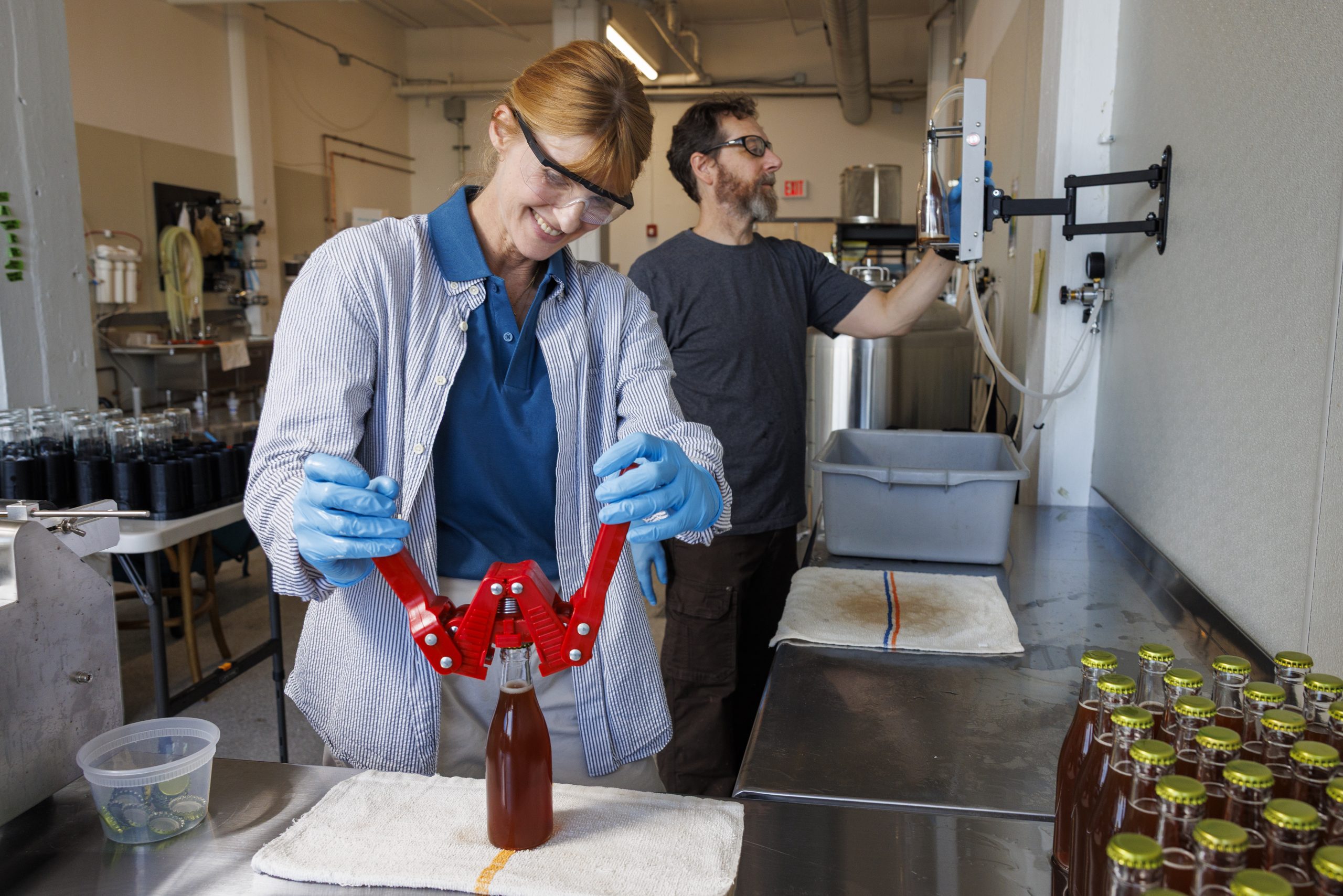
    Each batch of aperitifs takes at least three days to produce, Sheehy said, and begins with her macerating and boiling the original herb blends that serve as the base for each beverage. Distillation is the longest part of the make process and can take upwards of several hours. After, Sheehy and Grubb carbonate and bottle each beverage by hand.

    Hare Brain from Cult of Trees, a zero-proof aperitif that tastes like cola.Alejandro A. Alvarez / Staff Photographer

    A single batch yields only 18 to 20 cases, according to Sheehy. “It’s labor intensive right now,” she said, “but will start to get more turnkey as we grow and are able to incorporate more equipment.”

    Already, Cult of Trees can be found on the beverage menus at Solar Myth, Tulip Pasta & Wine Bar, Enswell, and the International Bar.

    “It’s a popular suggestion from our entire team when guests are looking for a unique and local NA option,” said Enswell manager Chelsea Boyer, who often pairs Hare Brain with Rival Bro’s Whistle & Cuss espresso. “The bitter nature and gentle carbonation of the Hare Brain pairs perfectly with the candied nuttiness of the espresso.”

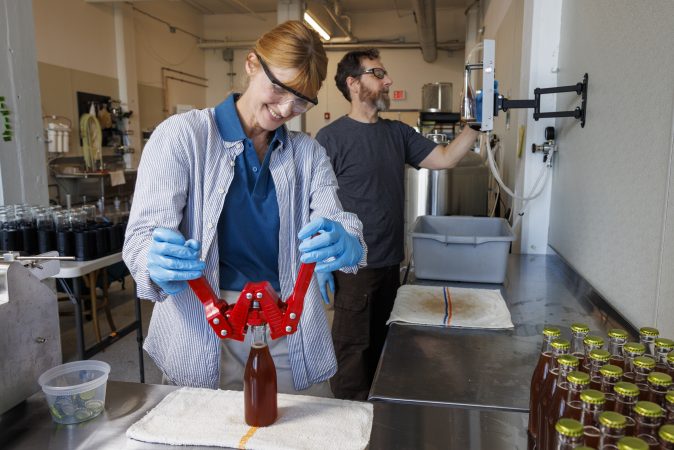
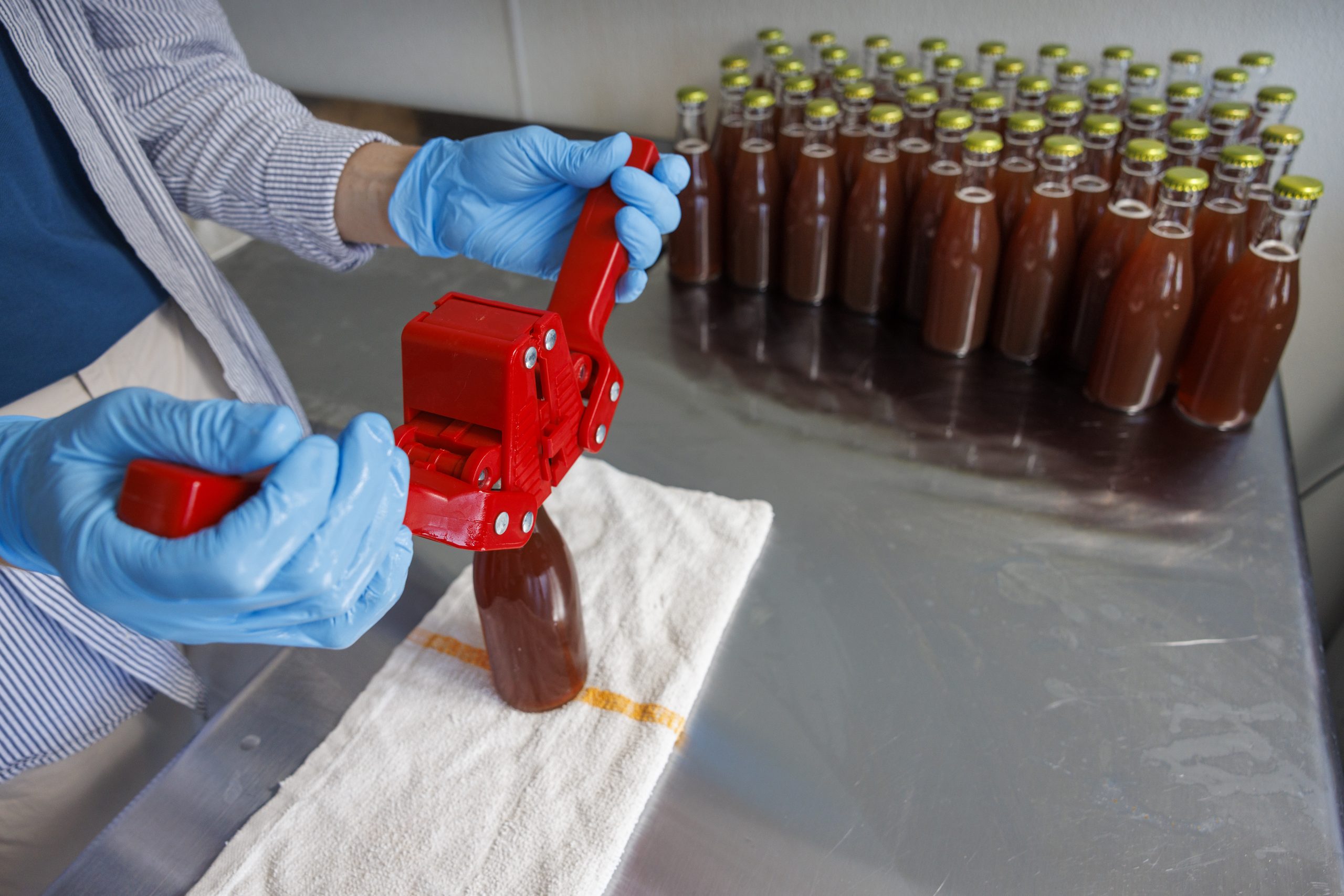
    Meredith Sheehy, owner of Cult of Trees, caps a bottle of Hare Brain at her Kensington production facility. Each bottle of the non-alcoholic spirit is packaged by hand.Alejandro A. Alvarez / Staff Photographer

    Retail placements at Riverwards Produce, Herman’s Coffee, and Queen Village’s Moon & Arrow are also new, but a sign of growth.

    The drinks have been selling well at Riverwards’ Old City location, said CEO Dan Morgan, buoyed by an April pop-up where Sheehy poured samples for guests. “I think their great flavors and beautiful packaging will really help them stand out,” Morgan said.

    Cult of Trees production manager Gordon Grubb fills bottles of Hare Brain during the carbonation process at the brand’s Kensington studio.Alejandro A. Alvarez / Staff Photographer

    Sheehy is betting on the same. “In my opinion, consumers increasingly want transparency, local sourcing, and a story behind what they drink,” she said. “That’s what we’re trying to do.”

  • Would you try this cheesesteak-flavored olive oil? We did.

    Would you try this cheesesteak-flavored olive oil? We did.

    “It tastes like oil from a real cheesesteak wrapper,” proclaims the slogan of Mama-Tee’s Philly cheesesteak-flavored extra virgin olive oil.

    Mama-Tees are community fridges, notable for their bright yellow paint jobs, that are scattered around Philadelphia. The cheesesteak oil ($19) is part of a fundraiser to combat food insecurity locally, along with three other flavored oils: Basil Bliss, Truffle Love, and Pepper Pleaser. Proceeds go to helping fill the fridges with food. So if the oil prompts cheesesteak-flavored burps, it would do so in the name of a noble cause.

    We at The Inquirer had to do a taste test.

    Is this merely a novelty or could it have legitimate culinary applications?

    The ingredients of the Philly cheesesteak-flavored oil intriguingly are only “extra virgin olive oil” and “onion flavor.” How could these two ingredients, neither of which involves cheese nor steak, encompass the nuanced experience of consuming an actual cheesesteak? The Inquirer sought to get to the bottom of these questions.

    The first round of cheesesteak experts was summoned.

    “It smells like a deli case,” said food editor Margaret Eby. “There is a cheesiness to it. It’s like that cheese oil that gets trapped in a charred, upturned pepperoni cup on your pizza.”

    “I think it should be called ‘hoagie oil,’” said food reporter Beatrice Forman.

    “It is like unwrapping a hoagie,” agreed critic Craig LaBan. “When you get the vinaigrette soaking through the wrapper. And it tastes like French’s fried onions, but burnt.”

    “I don’t know what it could be used for,” said food reporter Michael Klein.

    “It tastes like old fryer oil,” grimaced reporter Ryan Briggs. “It’s gravitating toward capturing that cheesesteak shop smell when they’re frying all the onions.”

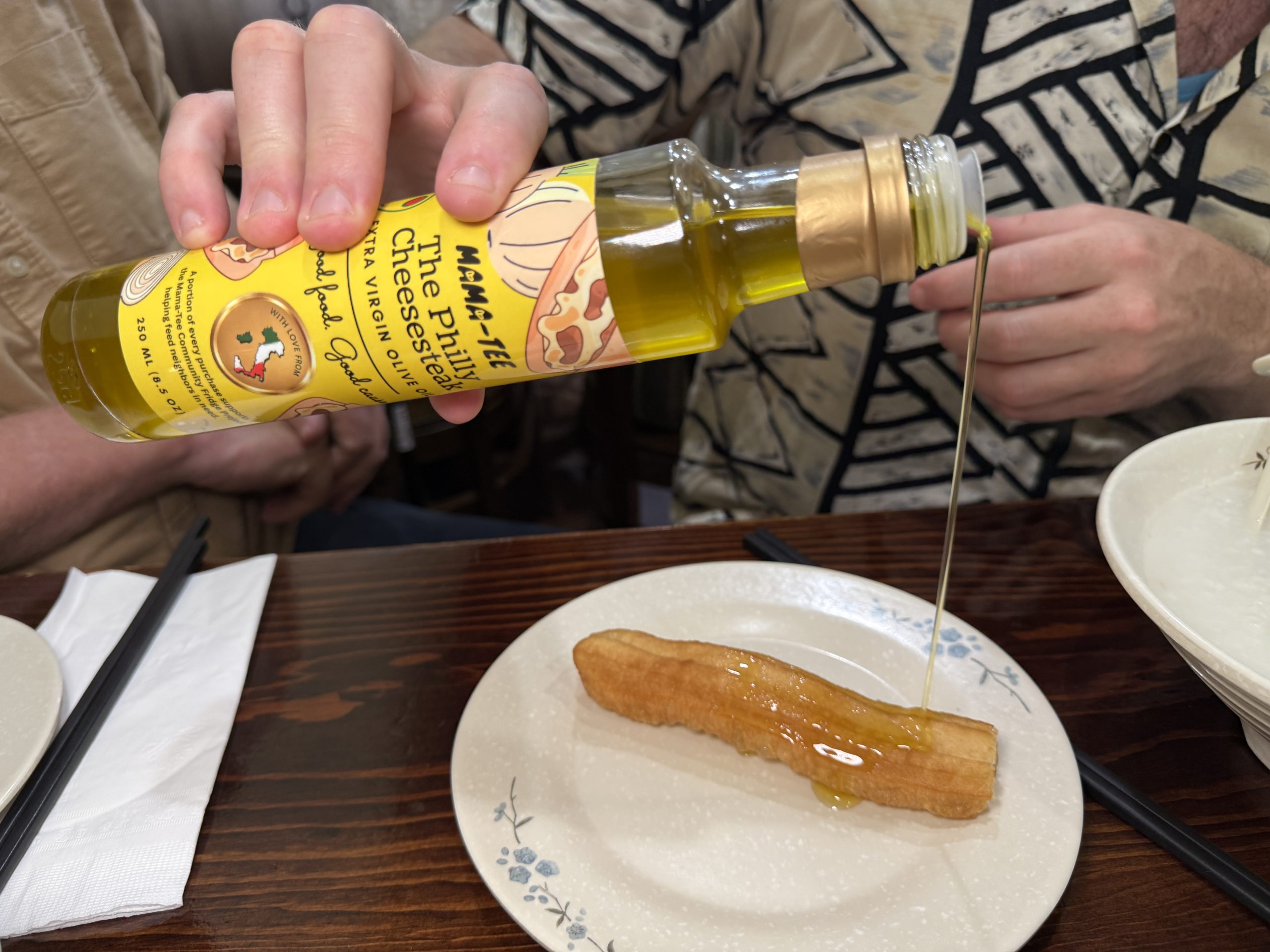
    Reporter Max Marin poured the oil over his youtiao, a savory Chinese cruller, while at lunch at Lau Kee in Chinatown. “It’s got a chemical taste that makes me think there’s a number in one of its ingredients.” But does it make the youtiao taste like a cheesesteak? “It does not.”

    Inquirer reporter Max Marin pours Mama-Tee’s Philly cheesesteak-flavored oil on his youtiao at Lau Kee.Kiki Aranita

    Various Philly chefs were more open-minded in the cheesesteak oil’s applications.

    “I think the flavor is great,” said Juan De Ocampo, sous chef at Fairmount’s Manong, as he poured the oil onto a pile of fried shrimp chips.

    “I kind of like the cheesesteak oil,” said dancerobot’s Justin Bacharach. “It’s pungent and although I don’t cook with olive oil, I would use it to add a little funk and fat to a dish, like to dress an antipasto with South Philly vibes like sharp provolone and soppressata, and in the Japanese canon, I think it would be fun drizzled on top of a gyudon (beef and onions over rice) where you’d normally use mayu (a Japanese scorched black garlic oil).”

    “It feels really heavy,” said Melissa Fernando, the chef behind long-running pop-up Sri’s Company. “In Sri Lankan food, we mostly use coconut oil to cook, but I suppose I’d use this to sauté onions and garlic.”

    That perceived “heaviness” is easily addressed, according to 637 Sushi Club’s Kevin Yanaga, no stranger to unusual pairings. “I just need a lemon or something acidic with it. I could then use it on a fluke crudo. It’s rough and funky on its own, but salt and acid would help.”

    After careful consideration of these diverse opinions, the Mama-Tee cheesesteak oil had only one test remaining to undergo: a side-by-side comparison between it and the oil from an actual cheesesteak wrapper.

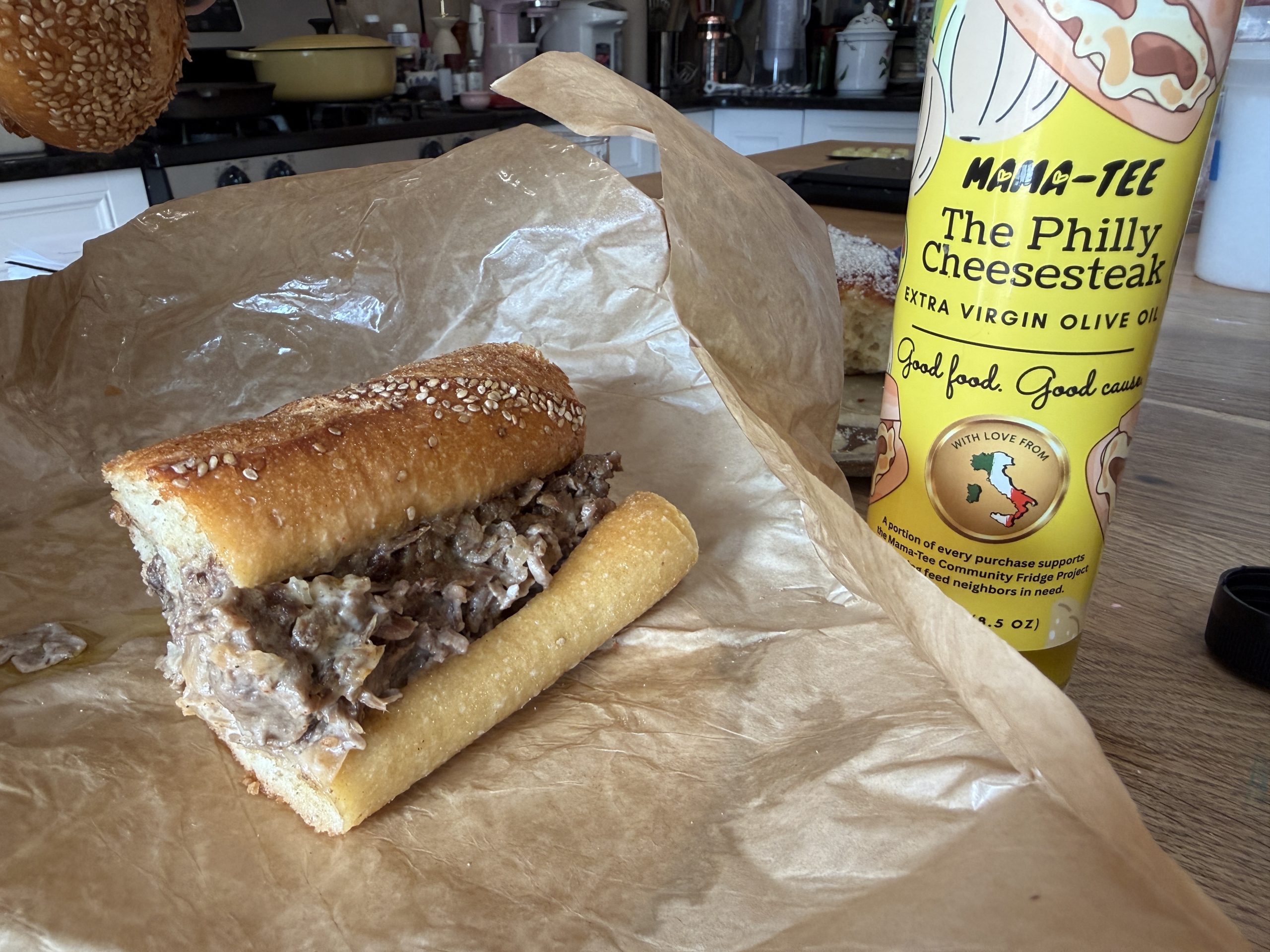
    A Del Rossi’s cheesesteak (wit onions, of course) was summoned. A wrapper was licked. A shot of cheesesteak oil was taken. The wrapper had the distinct advantage of beefiness. When applied directly to the cheesesteak, the oil oddly enhanced the cheesesteak’s flavor. And another thing the oil had in common with a real cheesesteak? Real cheesy, oniony burps after consumption.

    A Del Rossi’s cheesesteak and Mama-Tee’s cheesesteak oil, consumed in unison.Kiki Aranita

    Mama-Tee’s Philly cheesesteak oil ($19) can be purchased at Wegmans in King of Prussia, though more locations may be added soon.

  • The postpartum hospital discharge instructions that failed me — and could fail the next mother

    The postpartum hospital discharge instructions that failed me — and could fail the next mother

    I left the hospital holding my newborn son with a folder of paperwork and almost no real understanding of what had just happened to my body.

    I’d gone through a birth that didn’t go as planned, including a panic attack on the operating table, and in the days and weeks that followed, I developed postpartum preeclampsia, birth trauma, and postpartum depression and anxiety.

    No one had walked me through what warning signs mattered, or what was simply the ordinary exhaustion of new motherhood. I had to figure that out myself, slowly, while sleep-deprived and caring for an infant. I live in Doylestown, and the more I’ve researched this since, the more I’ve come to see my discharge experience as the norm rather than the exception.

    The structural problem is that much of what a new mother is told on her way out of the hospital varies enormously depending on which nurse is on shift, which hospital she delivered at, and how rushed that particular day happened to be.

    Although nurses provide some form of postpartum discharge education to all women who give birth, the information women receive on common potential complications is not always consistent or evidence-based. The consequences of that inconsistency are measurable, not theoretical.

    The Association of Women’s Health, Obstetric and Neonatal Nurses has already tested a fix. Its POST-BIRTH Warning Signs program walks patients through nine specific warning signs of severe maternal morbidity, paired with a take-home checklist of exactly whom to call and when.

    In a pre- and post-evaluation, patients who received this standardized discharge education demonstrated meaningfully better knowledge of warning signs compared with patients who received typical, inconsistent discharge conversations. The program was built due to a troubling pattern: highly educated patients experiencing clear warning signs didn’t seek care because they assumed what they were feeling was normal after having a baby.

    The author writes that after delivering her newborn she struggled to distinguish between signs of potential health complications and the ordinary exhaustion of new motherhood.Courtesy of Casey Keen

    This is where Philadelphia-area hospitals have a real opportunity. I’ve spent recent months in conversation with Doylestown Hospital and other regional providers about exactly this gap, because the system they’re working within doesn’t require a consistent standard.

    Bucks County and the broader Philadelphia suburbs don’t need to wait for a national mandate to adopt something like the POST-BIRTH Warning Signs model regionally. A hospital system here could decide, on its own, that every postpartum patient leaves with the same standardized, risk-specific information regardless of which floor she delivered on or which nurse was on shift that day.

    What would that actually require? First and foremost, it means adopting a standardized discharge script and checklist, already developed and tested, rather than leaving the conversation to individual discretion.

    It also entails making that information risk-specific, telling a patient with a hypertensive disorder of pregnancy exactly what kind of headache warrants an urgent call, rather than a generic instruction to reach out “if something feels wrong,” and treating consistent discharge education as a real quality and safety metric for regional hospital systems to track.

    If you’re expecting or have recently given birth in this region, ask your hospital directly what its discharge education actually covers, and whether it’s standardized across providers.

    If you sit on a regional hospital board or quality committee, this is a low-cost, already tested fix that doesn’t require waiting on federal guidance.

    The five minutes before a patient walks out the hospital door deserve the same seriousness as everything that happens before — and that’s a standard Philadelphia-area hospitals could set on their own.

    Casey Keen is a Doylestown resident and author of “The Alchemy of Motherhood: Unspoken Truths of Birth Trauma and the Postpartum Journey.” Her work appears in Undark magazine and Postpartum Alchemy, her Substack.

  • Kevin Willard accomplished most of his goals in Villanova’s roster rebuild. Then came Luigi Suigo.

    Kevin Willard accomplished most of his goals in Villanova’s roster rebuild. Then came Luigi Suigo.

    Rumors of Villanova’s interest in 7-foot-3 Italian center Luigi Suigo already were swirling when assistant coach Ricky Harris posted a photo last month on his Instagram page from Milan, not far from Suigo’s hometown of Tradate. Villanova was trying to keep its pursuit of Suigo under the radar, but Harris’s post only fueled the speculation.

    Villanova is visiting Suigo in Milan! The staff is all-in on adding the future NBA center! Kevin Willard really wants the cherry on top for this roster rebuild!

    Let’s play a little game of Two Truths and a Lie.

    No, Villanova didn’t send Harris to Milan to visit its next center. The other things are true, though. And the lie is only a partial one. It wasn’t Harris visiting Suigo, it was Willard. Harris was just in Italy enjoying an offseason vacation, with the bulk of the roster overhaul already done. But it wasn’t Milan where Willard went, it was Belgrade, Serbia, where Suigo played this past season with Mega Basket of the Adriatic League.

    “Belgrade was beautiful,” Willard said Monday, nine days after Suigo announced he was leaving the NBA draft and signing with Villanova. “Food was great, people were awesome.”

    It was a short business trip, less than 48 hours. Willard had spent the past month reassembling the Wildcats’ roster. Only two players who dressed in a game from last season’s team, Tyler Perkins and Matt Hodge, returned. The staff surrounded them with plenty of talent, but still needed a true center to round out the roster. Any starting-caliber center would have been fine. The offseason had largely been a success even after losing a few top players like Acaden Lewis and Bryce Lindsay to the transfer portal.

    “We could have gone in a couple directions,” Willard said of the center spot. “For us, it was like, all right, how are we trying to win a championship here?”

    On film, Suigo looked the part of a player who could take the roster to the next level. The size component is obvious. But Suigo is a “really skilled center that can shoot it, that can pass at a high level,” Willard said. “I think one of his best attributes is that he’s extremely unselfish. He’s a great passer.”

    Willard wanted more than film studying, though, so he got on a plane and flew halfway across the world to watch Suigo practice in person, to meet with his coaches, to sit down with him for dinner.

    “Sometimes you can watch clips and you can get fooled,” Willard said. “When I went over there and talked to him in person, met him in person, and saw him play, it was like, yeah, this kid is the real deal.

    “He’s very professional. He knows what he wants. He knows how he wants to play. He knows where he needs to get better at.”

    In 26 games with Mega Basket, Suigo, 19, posted averages of 7.9 points, 5.1 rebounds, and 1 block in 18.8 minutes. He shot 64.9% on his 111 two-point shots, 27.1% on 48 three-point attempts, and 64.7% on 34 free throws.

    Draft evaluators had Suigo projected near the end of the first round or early in the second round. Luring a player out of that range surely was costly for Villanova. Willard declined to discuss financials with The Inquirer. But the region’s rich Italian-American culture and the timing of watching the Knicks on their championship run with Jalen Brunson, Mikal Bridges, and Josh Hart were added bonuses.

    Plus, Suigo was open about wanting to be a top-20 pick throughout the draft process.

    “I think he maybe would have gotten drafted late in the first round, but he doesn’t want that,” Willard said. “He wants to make sure when he gets drafted he’s going to play. The big thing is I think he needs to get Americanized a little bit, to American basketball. I think that’s why college will be really good for him. Get in shape a little bit, just kind of get used to American basketball. I think once he does, the sky is the limit for him.”

    Sky’s the limit for the team, too?

    The offseason had a clear objective.

    “We wanted to make sure that we just didn’t get manhandled the way we got manhandled last year against the top teams,” Willard said.

    He was talking about national champion Michigan and the two top Big East teams, Connecticut and St. John’s. Willard’s first season at Villanova was a success. A streak of three consecutive missed NCAA Tournaments was stopped, though Villanova lost as a No. 8 seed in the first round because it lacked experience and physicality against a veteran Utah State team.

    Tyler Perkins (left) and Matt Hodge (right) will be key contributors again for the Wildcats in 2026-27.Elizabeth Robertson / Staff Photographer

    The first additions of the offseason aimed to address that. Villanova signed Oregon’s Kwame Evans Jr. and Ohio State’s Devin Royal. Both players are incoming seniors who averaged more than 13 points in the Big Ten last season. Evans is 6-10 and Royal is 6-6 but is a physical player who averaged seven rebounds in 2024-25 and nearly six last season.

    With those two and Perkins and Hodge in the fold, the attention turned to the backcourt, specifically to the point guard spot. Willard said he watched more film to fill this spot than any other position during the offseason. Perhaps, then, he could ace a quiz on Illinois-Chicago hoops. Elijah Crawford scored 14 points and dished out five assists in 26 minutes per game last season. More importantly, his decision-making out of pick-and-roll stood out, as did his 75.3% rate from the free-throw line.

    Crawford is the likely starting point guard next to Perkins, with Royal, Evans, and Suigo rounding out the starting five.

    Backcourt depth was a problem at times last season. On paper, it won’t be in 2026-27. The Wildcats added Cornell shooting guard Jake Fiegen, who Willard said “analytically, was probably one of the highest-rated guys.” Fiegen shot 41.4% from three-point range on 5.5 attempts per game. He thrived in catch-and-shoot situations, of which he will have plenty with this Villanova roster.

    Then there’s St. Bonaventure transfer Buddy Simmons. Willard said the staff was actually watching another Atlantic 10 player when they became enamored with Simmons, a 5-11 guard who scored 16.4 points per game and shot 42.5% from deep. While Fiegen is more of a standstill shooter, Simmons produces off the dribble.

    Incoming freshman guard Adam Oumiddoch also is expected to contribute right away. He’ll add to a versatile bench that also includes Hodge, who Willard said is tracking toward being ready for the beginning of the season after undergoing surgery to repair a torn ACL in March.

    Evans could play some minutes at center, as could returning redshirt freshman Nico Onyekwere.

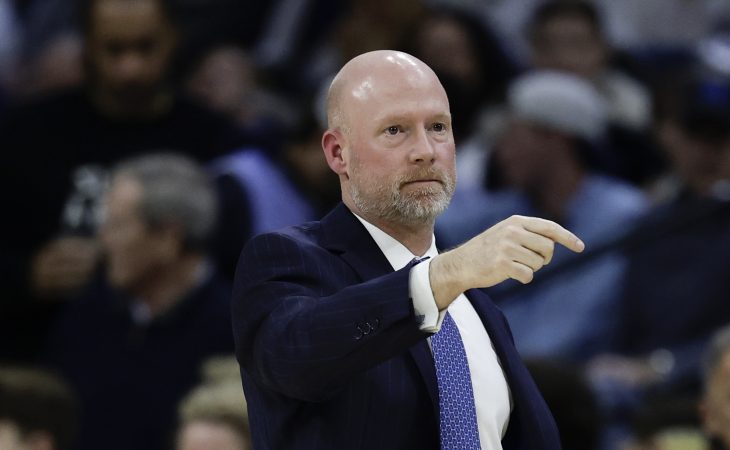
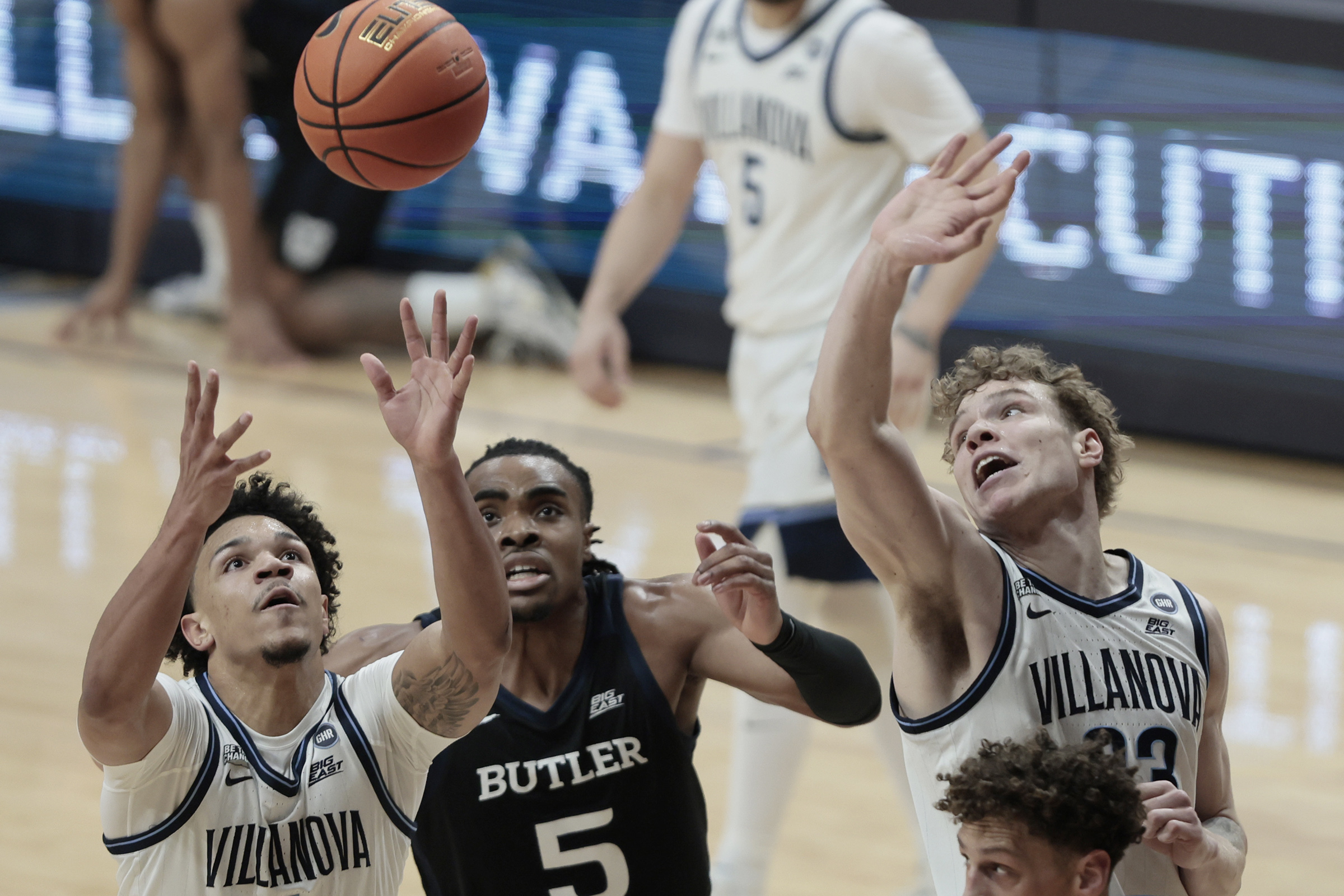
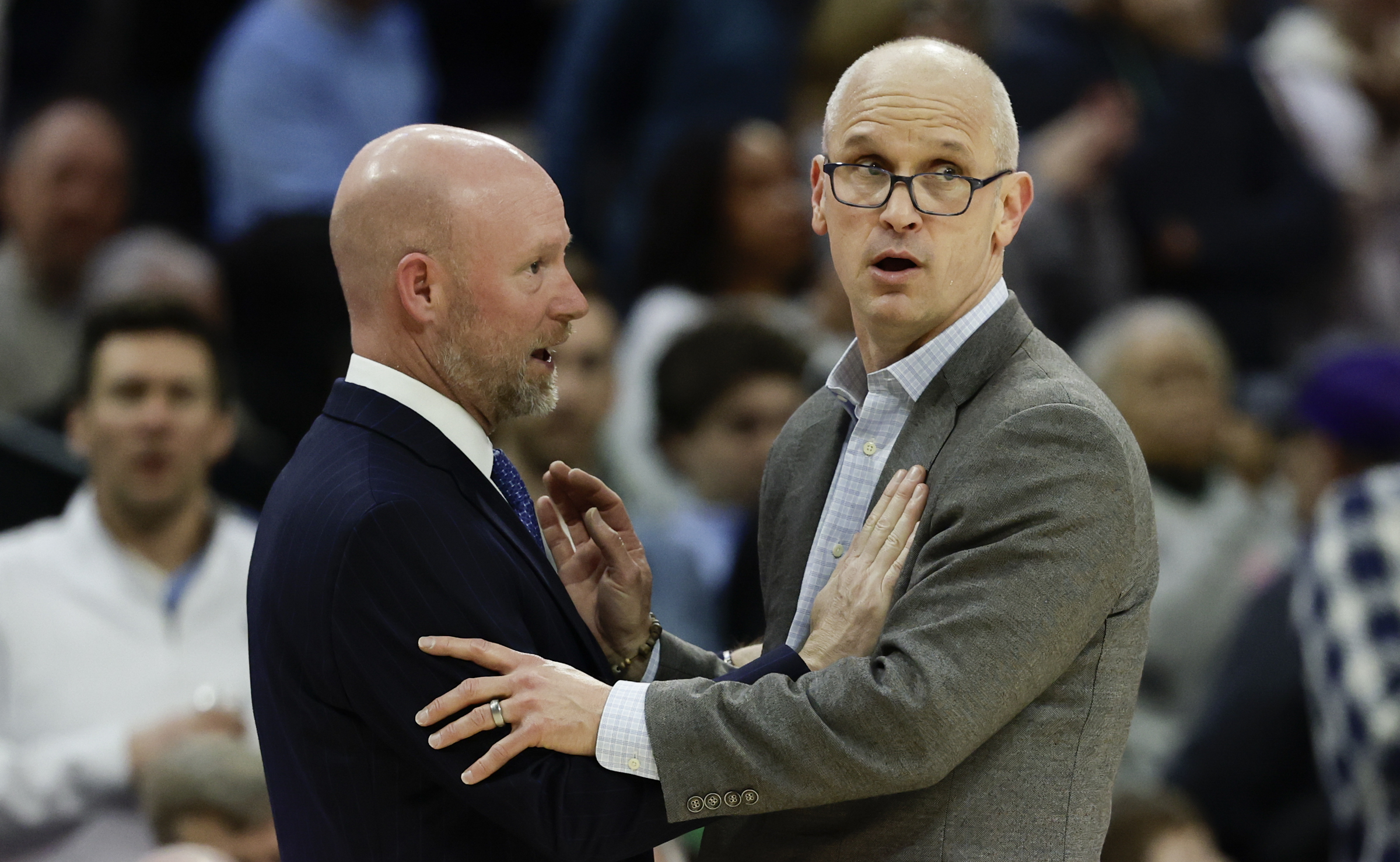
    Villanova hit the offseason trying to build a roster to compete with Dan Hurley’s UConn program.Yong Kim / Staff Photographer

    “We can play small or we can play really big,” Willard said. “That was my goal. Last year we were kind of hampered in how we could play. This year I think we have so much more flexibility.”

    Signing a 7-3 center helps.

    But Suigo’s signing should have done more than raise the expectations for the 2026-27 season. Sure, the Wildcats may get some preseason top 25 love. But they also showed they can compete financially with other programs.

    “From Father Peter to the board to our alumni and our donors, everyone understands how important Villanova basketball is,” Willard said. “We will never be the highest spender. That’s not in our DNA and it’s not what it is. But I will say that the university understands and financially has been extremely supportive of this program and the women’s program.”

    About those expectations …

    “I’m the head coach at Villanova,” Willard said. “The expectations are huge every year. I knew that when I took this job. I knew that when I took the Maryland job. It’s just part of the job. It’s what makes this job so great. You want those expectations.”

    It’s what you fly to Serbia for.

  • ⚽ Weather the storm | Sports Daily Newsletter

    ⚽ Weather the storm | Sports Daily Newsletter

    Despite a lengthy weather delay during Philadelphia’s World Cup match between France and Iraq on Monday, that didn’t stop folks from soaking in the festivities — even if it meant riding out the storm for about two hours.

    And once the game resumed, the performance on the pitch didn’t disappoint. France dominated Iraq, 3-0, with French star Kylian Mbappé tallying two goals.

    French supporters filled the area. Even though the rain washed out the FIFA Fan Festival, fans of Les Bleus spread out to different corners of the city to watch their side. Before the storm, Gov. Josh Shapiro checked out the sights and sounds at Lemon Hill Park.

    The city has certainly become soccer-infused this summer.

    Center City bars were packed Monday afternoon hours before the game, banners hung from City Hall, and the Broad Street Line carried fans to Philadelphia Stadium (aka Lincoln Financial Field). But 50 years ago, soccer was still finding its footing in Philadelphia. Now, the city’s World Cup love affair shows how far we’ve come.

    — Isabella DiAmore, @phillysport, sports.daily@inquirer.com.

    If someone forwarded you this email, sign up for free here.

    ❓With the group stage wrapping up, what are your thoughts on the World Cup — and any early predictions? Email us back for a chance to be featured in the newsletter.

    Preparing for draft night

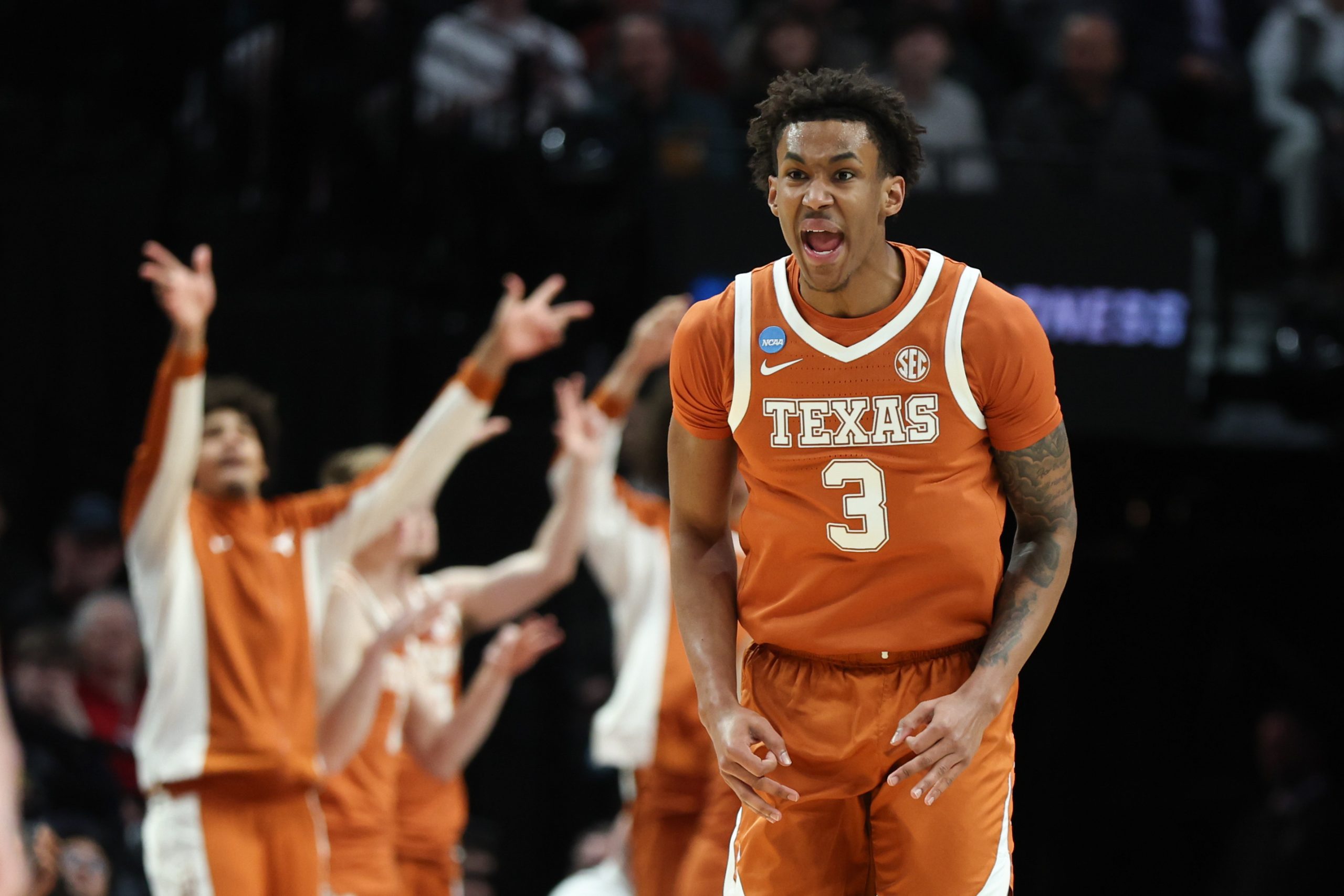
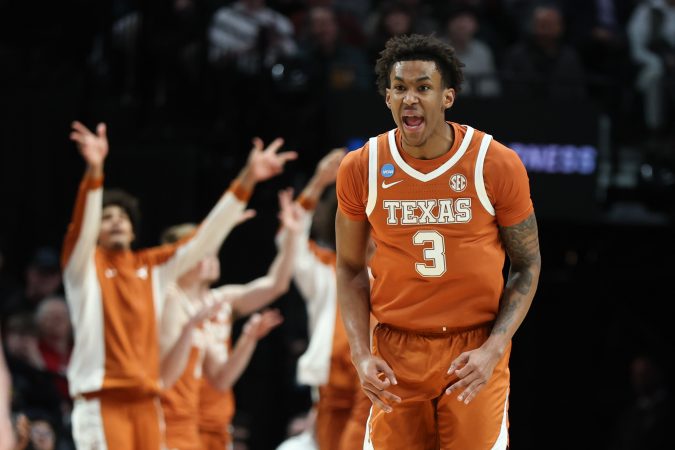
    Texas forward Dailyn Swain is among the long list of players who have worked out for the Sixers, who will select at No. 22 in the 2026 NBA draft.Craig Mitchelldyer

    Tonight is the first round of the NBA draft, and this year’s class is packed with top-level talent — AJ Dybantsa, Darryn Peterson, and Cam Boozer are all worthy of the No. 1 pick — as well as depth throughout the first round.

    The Sixers will start the Mike Gansey era with the 22nd pick, and the new president of basketball operations plans to make their selection based on a combination of best player available and fit.

    Also, Pennsauken’s Yaxel Lendeborg will likely be a first-round selection. The Michigan star had one of the most improbable rises to the draft. If it wasn’t for his mom, Yissel, Lendeborg would have never played Division I basketball, much less become a potential lottery pick.

    What we’re …

    👀 Watching: The 14-year-old Phillies fan who grabbed a Mets home run ball on Sunday and went viral for making a crafty swap.

    🏒 Learning: The Flyers announced their 2026-27 preseason schedule. Let’s look at who they will play in the four-game slate.

    🍻 Cheering: Jason Kelce’s sixth annual celebrity bartending fundraiser is returning to Ocean Drive in Sea Isle City this week.

    📖 Reading: Alexander Command feels a connection with the Flyers. But will he be there at No. 21 on draft day?

    ⚽ Following: The next big question for the USMNT: Managing yellow cards in the World Cup group stage finale.

    Assessing the NFC East

    Jaxson Dart (left) did some good things as a rookie. Is he ready to take the next step and lead the Giants to consistent winning?Monica Herndon / Staff Photographer

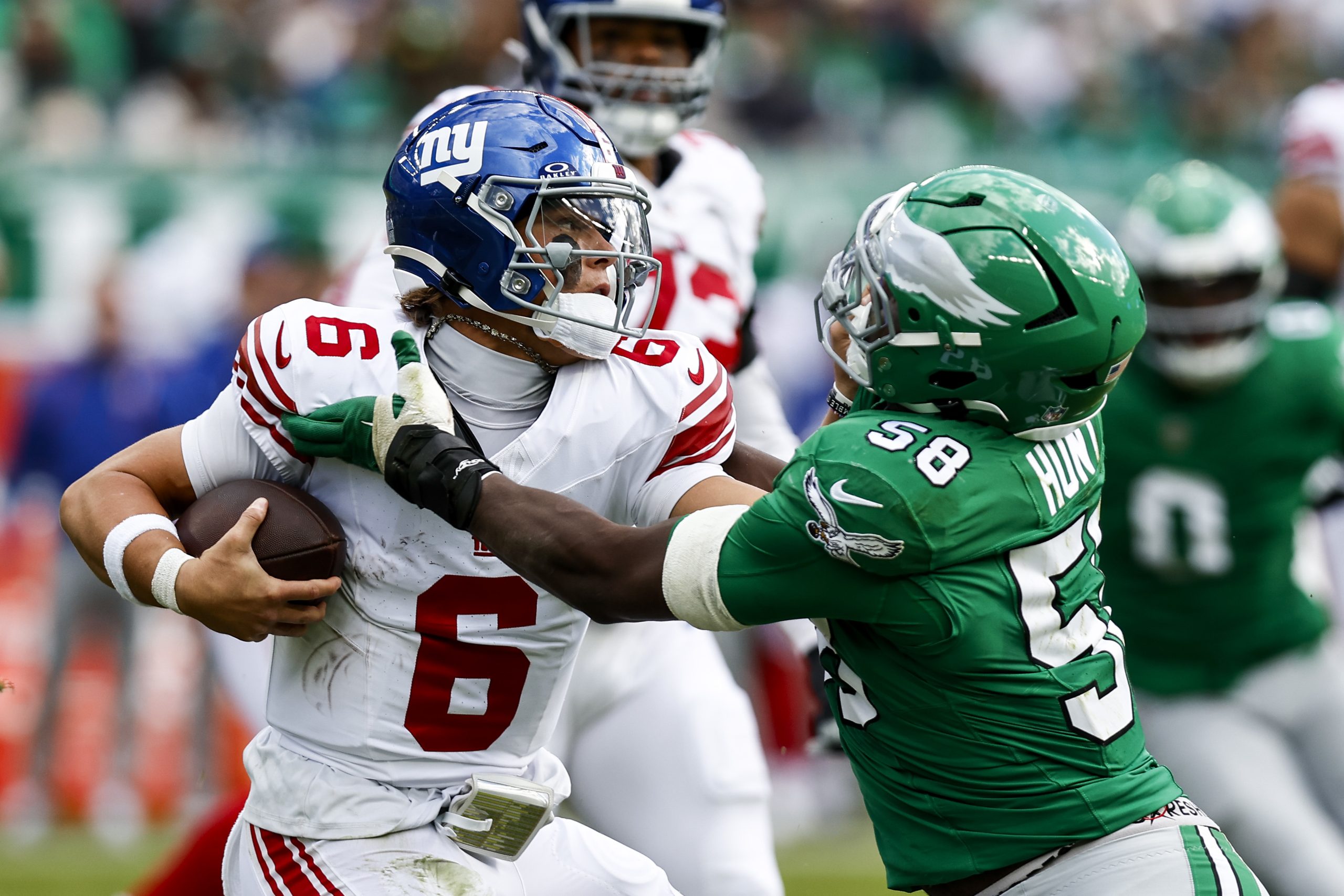
    The Eagles have won two straight NFC East titles and five in the last 10 years. They have dominated the division in recent memory, and there’s no reason to think 2026 will be any different, right?

    But things feel a little different. The Eagles had a transformative offseason, with the biggest change being that they no longer have their No. 1 weapon in wide receiver A.J. Brown.

    All the while, almost all of their NFC East foes took steps forward, at least on paper.

    Working alongside his dad

    Phillies general manager Preston Mattingly signs autographs for fans before a spring training game in March.Yong Kim / Staff Photographer

    For years, Don and Preston Mattingly were “in the same industry, but you’re light years apart.”

    So, they need not be reminded, especially on Father’s Day weekend, of the uniqueness as the first father-son manager-GM combination in baseball history.

    Last week, Preston Mattingly joined Phillies Extra, The Inquirer’s baseball podcast, to discuss what it’s like to work with his dad, Andrew Painter’s demotion, the state of the Phillies’ farm system, and preparing for the trade deadline.

    Ahead of Monday’s game against the Nationals, the Phillies called up Alan Rangel from triple-A Lehigh Valley, as a way to address their fifth spot in the rotation for the time being.

    Save for Brandon Marsh’s solo home run, the Phillies’ offense struggled in a rain-delayed 4-1 loss to the Nationals in Monday’s series opener in Washington.

    Villanova’s roster rebuild

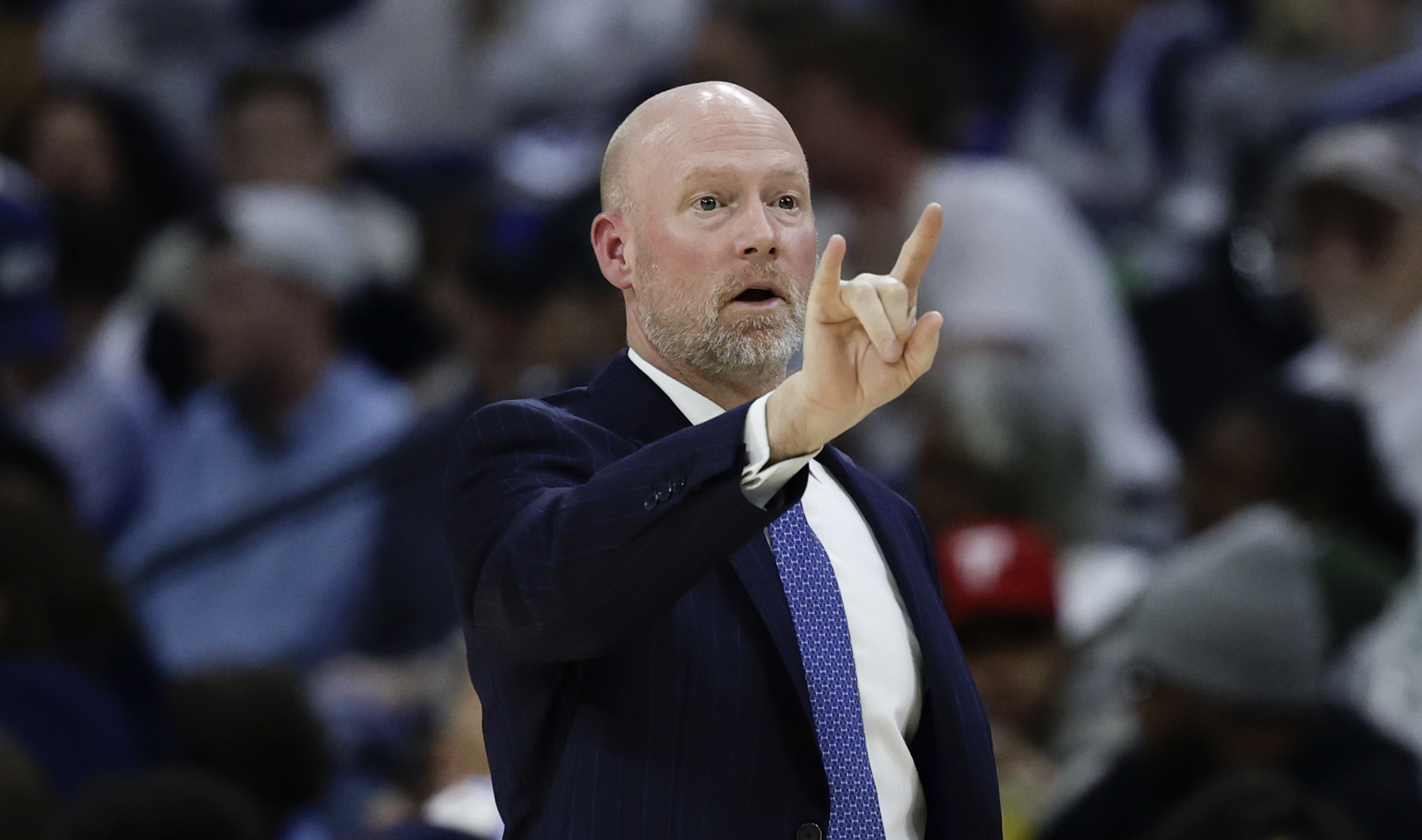
    Villanova coach Kevin Willard says this season’s roster will “have so much more flexibility.”Yong Kim / Staff Photographer

    Villanova’s offseason had a clear objective: “We wanted to make sure that we just didn’t get manhandled the way we got manhandled last year against the top teams,” said Kevin Willard.

    Now with the roster set, the second-year coach believes he’s done just that, and with the signing of 7-foot-3 center Luigi Suigo, it has done more than raise the program’s expectations in the 2026-27 season.

    🧠 Trivia time

    Which of these sporting events recorded the largest attendance at Lincoln Financial Field?

    A) Temple vs. Notre Dame on Oct. 31, 2015

    B) Flyers vs. Penguins on Feb. 23, 2019, in the NHL Stadium Series

    C) Mexico vs. Jamaica on July 26, 2015, in the CONCACAF Gold Cup final

    D) Brazil vs. Haiti on June 19, 2026, in the group stage of the World Cup

    What you’re saying about Bryce Harper

    Bryce Harper raises his fingers after hitting a solo homer against the Mets on Sunday.Yong Kim / Staff Photographer

    We asked: Where does Bryce Harper rank in your eyes among all-time Phillies players? Among your responses:

    Harper is probably still behind Schmidt, Carlton and Robin Roberts for me. Harper needs more consistency when counts, i.e. the playoffs. — Tom G.

    Behind Mike Schmidt, Steve Carlton and Rich Ashburn. — Jim G.

    I think Bryce ranks among the best Phillies of my time. Too bad he had to spend 7 years with Washington before joining the Phillies for the last 8 years. He came as a right fielder but then after suffering the arm injury he almost flawlessly moved to 1st base. He does not match up with Mike Schmidt stat wise nor have the power of Dick Allen or Ryan Howard but definitely one of our best ever. I have of course never been in the clubhouse with our guys, but I have a feeling that he is the Phillies leader who has that unique gift of leadership. Who can ever forget his “Lets give them something to remember” to Kevin Long and then went up and smashed a home run to beat the Padres that sent the Phils to the World Series. — Everett S.

    In my mind, Bryce Harper is close to the top of the all time Phillies players. He has a .279 lifetime batting average, will eventually hit over 500 home runs (most likely), and is a two time MVP, hall of fame credentials. He is currently the face of the franchise and will be for a few years to come. His #3 will no doubt be added to the Phillies wall of fame in the future. — Tom E.

    We compiled today’s newsletter using reporting from Ryan Novozinsky, Kerith Gabriel, Matt Breen, Gina Mizell, Jeff Neiburg, Ariel Simpson, Jackie Spiegel, Gabriela Carroll, Lochlahn March, Scott Lauber, Owen Hewitt, and Jonathan Tannenwald.

    By submitting your written, visual, and/or audio contributions, you agree to The Inquirer’s Terms of Use, including the grant of rights in Section 10.

    Thanks for reading! Have yourself a wonderful Tuesday. Kerith will be back in your inbox tomorrow. — Bella

  • When the Flyers were hopeless, Travis Konecny promised boss Dan Hilferty they’d make the playoffs

    When the Flyers were hopeless, Travis Konecny promised boss Dan Hilferty they’d make the playoffs

    Flyers chief Dan Hilferty and his wife, Joan, traveled to Italy during the Olympics to take in the Winter Games, especially the hockey games, since three Flyers and coach Rick Tocchet were involved. Star winger Travis Konecny did not make Team Canada, but he made the trip anyway. There, he ran into Hilferty.

    After a little small talk, as they ended their conversation, Konecny grabbed Hilferty by the arm. He looked him dead in the eye and, quietly, told his boss’s boss:

    “You better believe.” Pause. “You better believe.”

    At the time, the Flyers hadn’t made the playoffs in five years and, according to one prediction site, had just a 3.8% chance of making the postseason.

    Three months later, they had surged into the playoffs, then they had beaten their archrival, in overtime, at home. Yet neither of these was Hilferty’s favorite moment of the season.

    Hilferty stood on the heights of Citizens Bank Park, a spring wind ruffling the ever-immaculate lapels of his bespoke, dark-blue suit, strong and confident and, then, suddenly, verklempt at the memory of a moment shared with some of his favorite people, including his boss.

    He’d been asked for his most memorable moments of the season his Flyers had just completed. His response was unexpected: The moments just after the team lost its fourth straight game and was swept out of the Stanley Cup playoffs, an overtime defeat to the Carolina Hurricanes in front of the home crowd at Xfinity Mobile Arena.

    Flyers fans cheered their team’s effort even after the season had ended. Yong Kim / Staff Photographer

    This ignominious sweep, the first in 15 years — this was his finest moment?

    “Yes,” he said.

    Why?

    “I go to the locker room after every game, win or lose. So, boom, [the Hurricanes] score, and I get up, go to the elevator, get off the elevator on the event level,“ Hilferty said. ”And I just see a sea of fans. A sea of fans on their feet. And then they start chanting, ‘Let’s go, Flyers!’ And you could see the players, like — their reaction is unreal.”

    That’s where Hilferty’s voice breaks. He’s 69, and he’s been around, a Jersey Shore kid made good: CEO of two health benefits organizations, a midlevel cog in the Pennsylvania government, a candidate for governor in the 1994 Democratic primary, chief of the group that brought the World Cup to Philly, and, for the last three years, he’s held his dream job: governor of the Flyers.

    The new Ed Snider. Connected to the club. Living and dying with every shift. Desperate for his hires to work out. Eager to see validated his oft-questioned decisions, from team president to GM to coach.

    And so, just before 9 p.m. on May 9, Hilferty found validation with the only folks who mattered: Flyers fans. Folks like him.

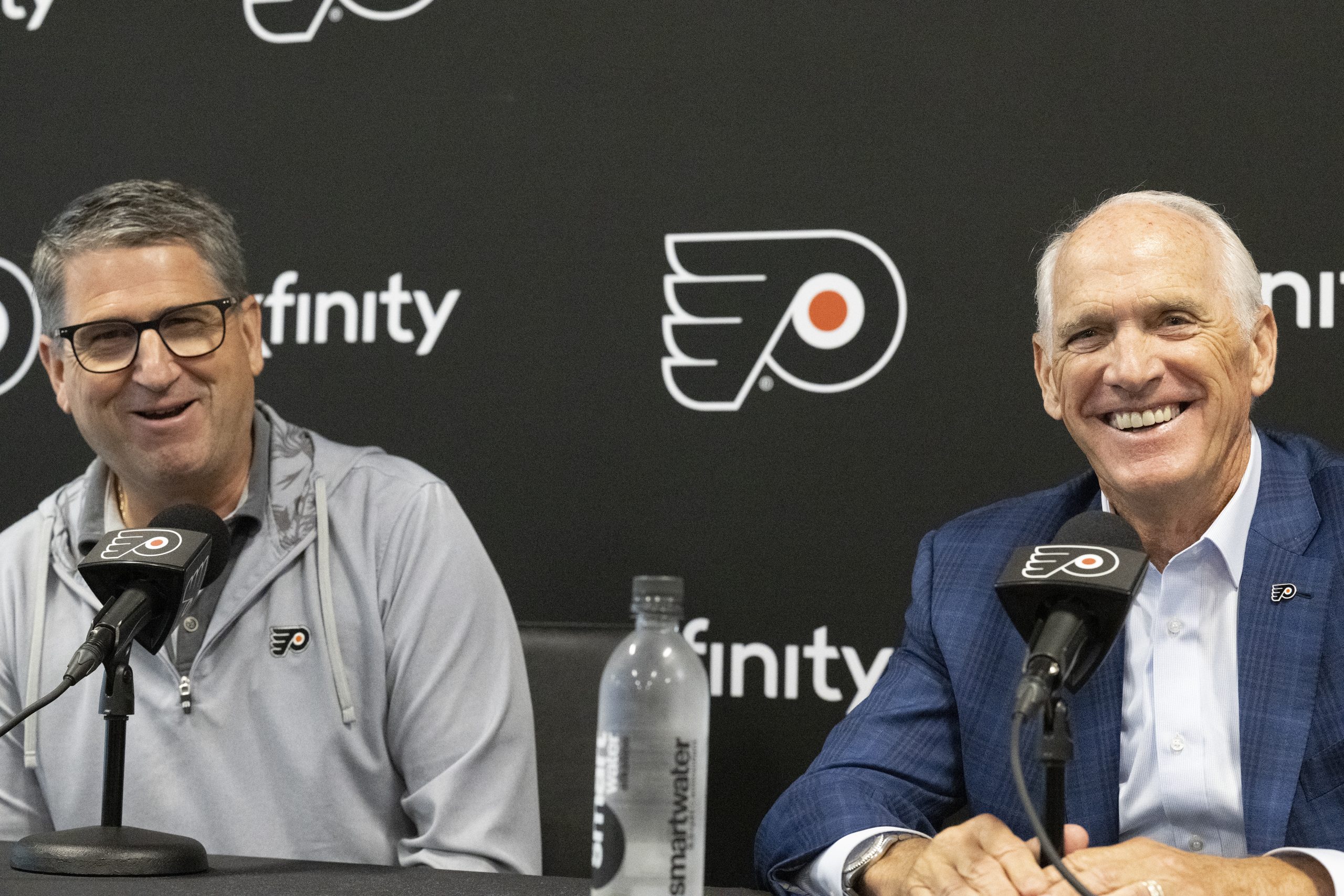
    Dan Hilferty (right), with team president Keith Jones in September, is part of a decision-making group that has pushed the right buttons of late. Jose F. Moreno / Staff Photographer

    The scene was as unreal as it was un-Philadelphian. After the teams exchanged handshakes, Flyers players remained on the ice to skate around and wave their appreciation to whoever remained. Usually, it’s a couple of thousand. That night, it was 10 times that much.

    “I just felt — well, I never needed to feel vindicated,” Hilferty insisted. “But I was just so happy for the organization, so happy for the team, for Comcast Spectacor and Comcast.”

    Spectacor is the sports wing of Comcast, and Hilferty is CEO of Spectacor. Brian Roberts is the CEO of it all, and, that night, he was at Hilferty’s elbow. They live and die with the Flyers.

    “I mean, we talk every day,” Hilferty said. “He runs a huge company. He’s a huge fan.”

    After six years of amorphous corporate management in the wake of Snider’s death in 2016, Hilferty’s hands-on approach during the past three seasons of a painful rebuild has borne fruit.

    When he hired an inexperienced GM, Danny Brière, and his nonexperienced president, Keith Jones, it felt like the Flyers were in line for another generation of the nearsighted nepotism that has so badly hindered it so often in the 50 years since its run to three straight Stanley Cup Finals. That sense only increased with the hiring of coach Rick Tocchet, who, like Brière and Jones, is a revered Flyers alum.

    Those decisions could hardly have looked worse as the Flyers entered the Olympic break in February. Tocchet and unmotivated second-year star Matvei Michkov had been feuding for months, and the team had won just three of its last 15 games.

    But, during the 20-day break, Michkov got into shape, Tocchet changed coaching tack, some veterans got healthy and started playing better, goalie Dan Vladař caught fire, and the club added rookie winger Porter Martone, fresh off helping Michigan State reach the NCAA tournament. Not only did the Flyers make the playoffs, they upset the rival Penguins with a six-game, first-round win, in overtime, the sudden-death score coming from Cam York but set up by Michkov.

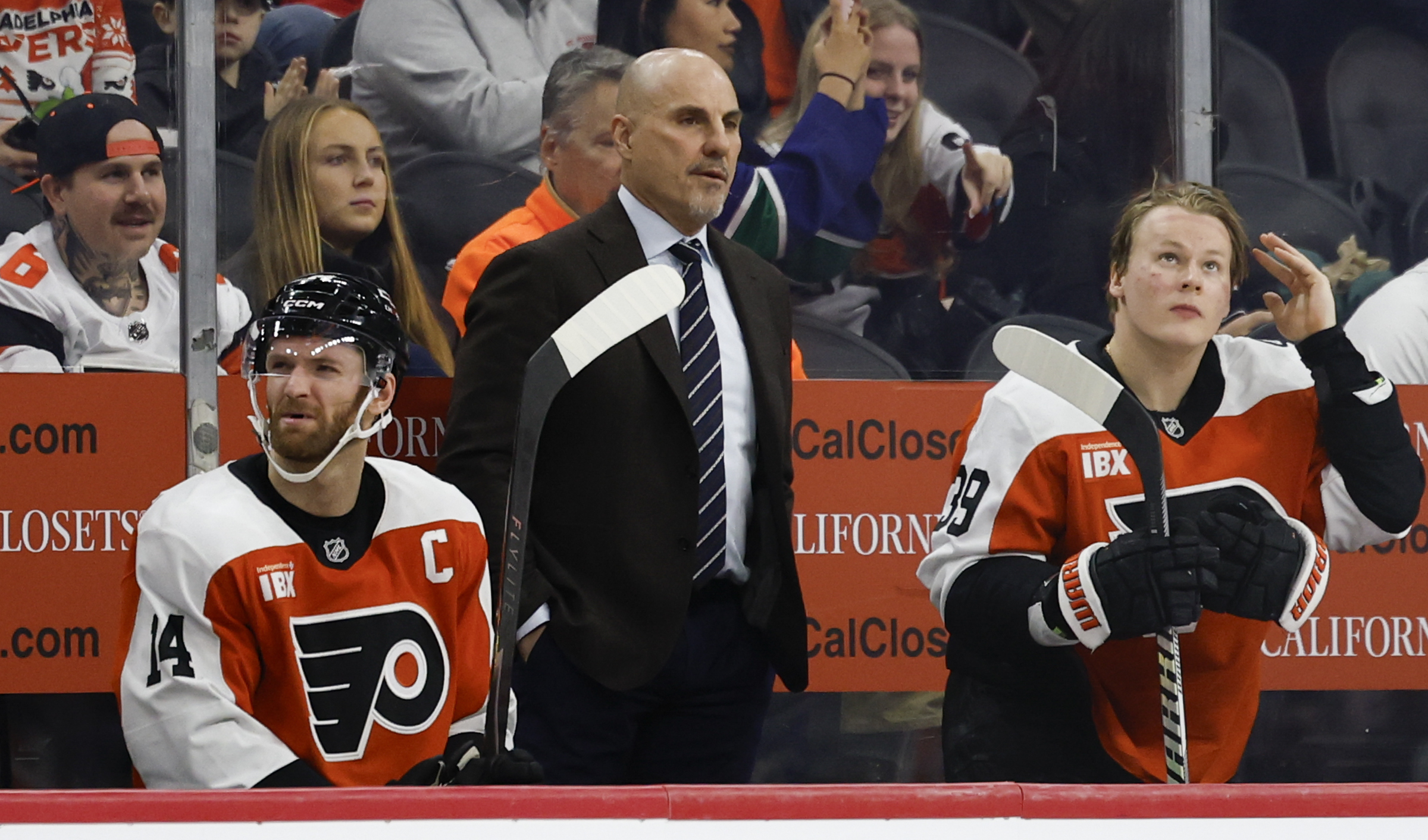
    Flyers head coach Rick Tocchet (center) received up-and-down play from Matvei Michkov (right).Yong Kim / Staff Photographer

    And yet this was not Hilferty’s favorite moment. The love after the loss was.

    “I have to say, it was nice to have kind of a public showing of that positive feeling,” Hilferty said. “What I’ve learned, whether it was running a business or doing this now, is that nothing’s perfect, but when you put four people in the room and have a long-range vision of where you want to go — I feel validated in that we’re through a phase of this effort, and we feel like the pieces are starting to fall into place for a long-term sustainable period of excellence.”

    That begins with Tocchet, a hard-nosed coach obsessed with teaching and largely uninterested in your feelings.

    “I couldn’t be more thrilled about Rick Tocchet, the spirit he brings to it,” Hilferty said.

    Even with Michkov?

    “Matvei needed a message,” Hilferty said. “Look, we’re behind him, but it takes two to tango. Everybody’s got to lean in. And although that was uncomfortable for Rick, and maybe uncomfortable for Matvei, I think it paid off in the end.”

    Is this a sea change for a young player?

    “My hope, and real belief, is that Matvei will come back as a different player next year,” Hilferty said.

    Brière recently traded backup goalie Sam Ersson, smallish defenseman Emil Andrae, and a third-round pick to the Maple Leafs for backup goalie Joseph Woll and biggish defenseman Simon Benoît. The draft comes this weekend.

    Since the Flyers’ decline, the Eagles have reached two Super Bowls, the Phillies have reached a World Series, and the Sixers consistently have made the playoffs with Hall of Fame-caliber players and coaches.

    Now, however, there is a buzz in Philadelphia about the Flyers that has been absent for nearly half a decade. Hilferty feels it.

    “We feel relevant again,” Hilferty said. “We feel really excited to be part of the winning ways of the city, but we’re not finished. I mean, our vision is to get to the top. I’m not going to hide from that.”

  • The Sixers start the Mike Gansey era with the 22nd pick. Here’s where we stand hours before draft night.

    The Sixers start the Mike Gansey era with the 22nd pick. Here’s where we stand hours before draft night.

    NEW YORK — Dailyn Swain posted a photo of the Philly skyline on his Instagram story last week.

    The Texas wing was in town for a predraft workout with the Sixers and “the city was alive,” Swain recalled, because his visit coincided with Friday’s World Cup match between Brazil and Haiti at Lincoln Financial Field.

    Swain has since joined several fellow first-round prospects at a luxury New York City hotel for the final stretch before being selected Tuesday night at Barclays Center. He is still among the possibilities to be chosen by the Sixers, who enter Tuesday with the 22nd overall pick in a loaded draft and new president of basketball operations Mike Gansey at the helm.

    “I’m very emotional,” Swain said. “I know once I hear my name, it’s going to be a surreal feeling … I’m trying to enjoy the moment.”

    This draft class is packed with top-level talent — AJ Dybantsa, Darryn Peterson, and Cam Boozer are all worthy of the No. 1 pick, experts say — as well as depth throughout the first round. That means interesting options should be available, at all position groups, if the Sixers remain at 22.

    It is the first roster-building move for Gansey, whom the Sixers hired earlier this month to oversee daily front-office operations for a team that finished seventh in the Eastern Conference standings, stormed back to upset the Boston Celtics in the playoffs’ first round, then were swept by the eventual NBA champion New York Knicks.

    Though Gansey joined the Sixers’ draft preparation late, he ran that process in his previous job as general manager for a Cleveland Cavaliers franchise that was scouting for this year’s 29th pick. When asked during his introductory news conference about his overall draft philosophy, Gansey said the Sixers will make their selection based on a combination of best player available and fit.

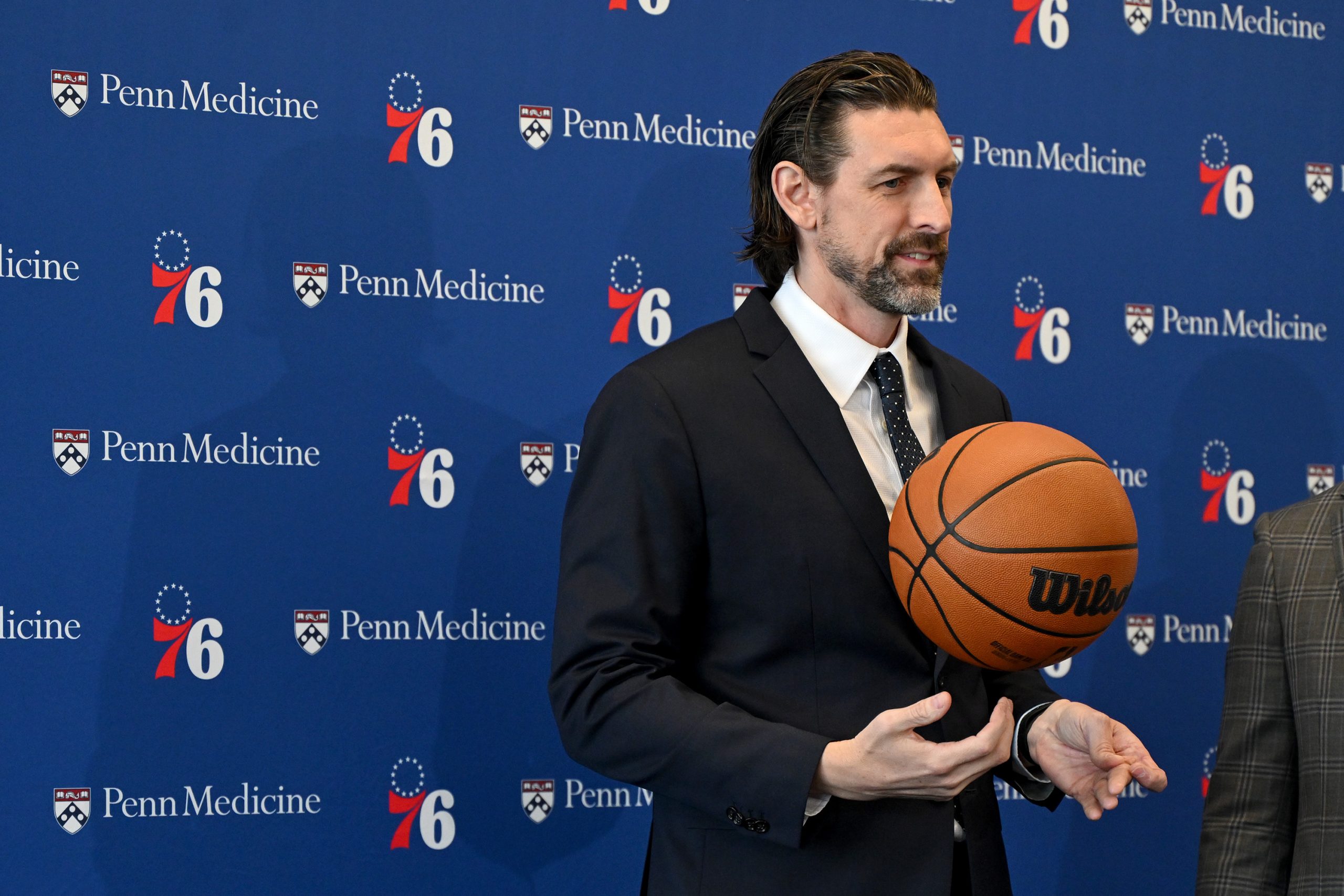
    Mike Gansey will handle his first big decisions as Sixers president of basketball operations during Tuesday’s draft. Tom Gralish / Staff Photographer

    The Sixers held in-person workouts in Philly last Tuesday and Friday. Versatile Santa Clara forward Allen Graves and Duke sharpshooter Isaiah Evans confirmed Monday that they were among the participants, while a source confirmed to The Inquirer that Houston big man Chris Cenac Jr., also was in attendance. Physical forwards Koa Peat of Arizona and Zuby Ejiofor of St. John’s also were reportedly part of those workouts. Iowa guard Bennett Stirtz said Monday that he has had two interviews with the Sixers.

    So Monday became a quest to mine the tiniest tidbits from those prospects in media scrums. Evans said his workout with the Sixers was with Swain, and that current Sixers VJ Edgecombe and Justin Edwards also were in the gym. Graves praised the Sixers’ “amazing” facilities in Camden. Stirtz said that, while watching the playoffs, he recognized how he could “release pressure” off standout guards Tyrese Maxey and Edgecombe with his outside shooting.

    “I create space out there on the floor,” said Stirtz, who is projected to go a bit higher than 22nd. “Every team needs another ballhandler and shooter.”

    Gansey kept some continuity within the Sixers’ front office — including the recently promoted Jameer Nelson — that has executed successful recent drafts. It picked Maxey 21st in 2020, and Jared McCain 16th and Adem Bona in the second round in 2024. Even Paul Reed, Isaiah Joe, and Julian Champagne, who have gone on to succeed with other playoff teams, were either selected in the second round or signed as an undrafted free agent. In 2023, the Sixers traded the 23rd overall pick to the Memphis Grizzlies for guard DeAnthony Melton, a key role player for two seasons when healthy.

    “I’m excited to learn from them,” Gansey said of the remaining front office, “and, obviously, put my vision and put my imprint on the draft. … and try to get the best person and player for the Sixers.”

    As of Monday night, the Sixers do not have a pick in Wednesday’s second round. Yet what they do Tuesday will help dictate how they approach free agency, which begins the evening of June 30. Starting wing Kelly Oubre Jr., sixth man Quentin Grimes, and reserve big man Andre Drummond are all unrestricted free agents. And the Sixers have limited financial flexibility with Maxey, Joel Embiid, and Paul George on max contracts for multiple seasons.

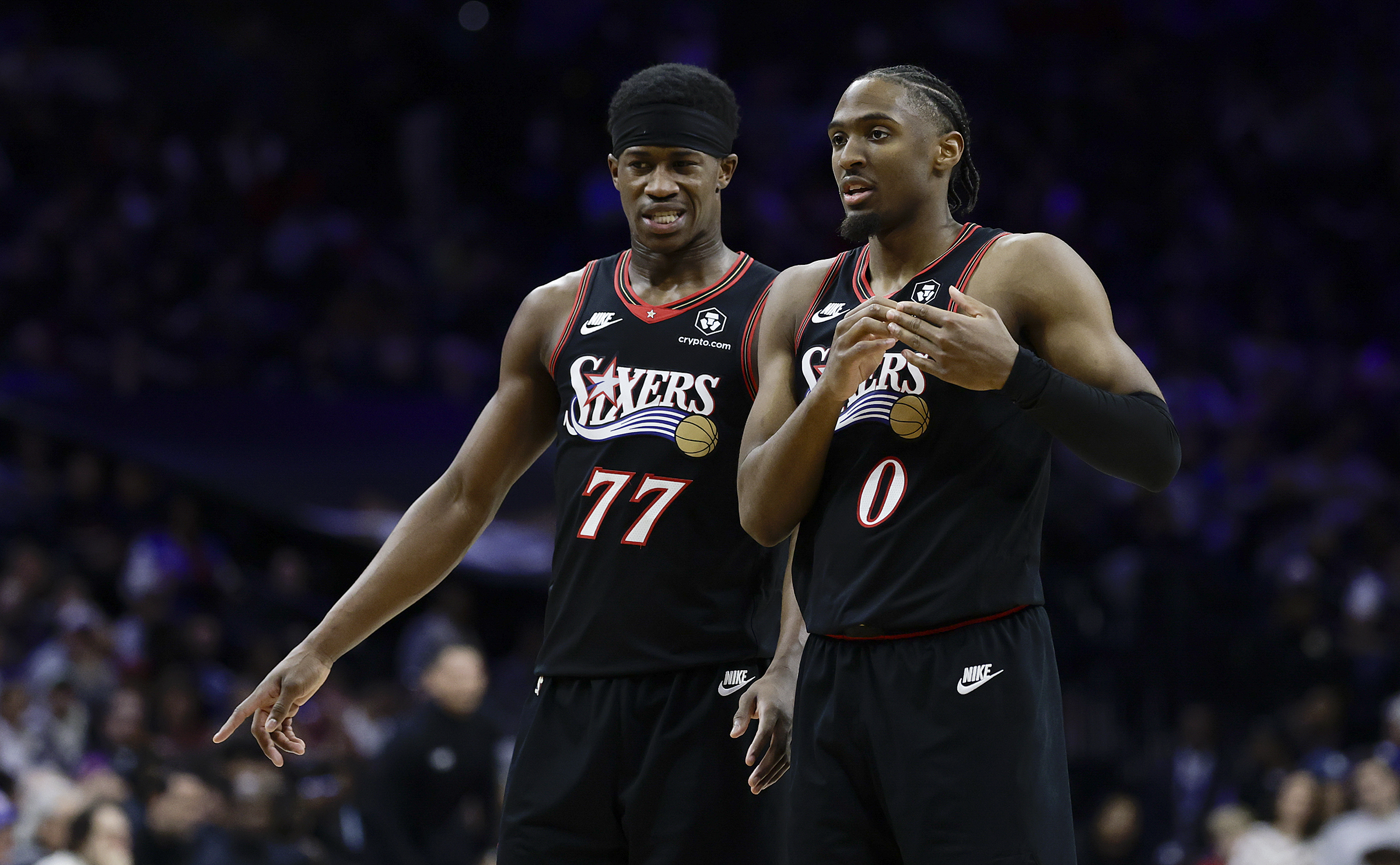
    Sixers guards Tyrese Maxey and VJ Edgecombe are among a long list of recent draft successes for a team that didn’t draft well historically. Yong Kim / Staff Photographer

    For the prospects assembled Monday in New York City, however, the wait for their NBA destination is almost over. Michigan forward Yaxel Lendeborg, who spent his teenage years in Pennsauken and is projected to go somewhere in the middle of the first round, half-jokingly called these final hours “really, really awful.”

    “I’m feeling emotion in the book,” he said Monday. “But I’m getting very impatient, in a way. I want to know where I’m going.”

    The same likely could be said for the Sixers, now beginning the Gansey era with the 22nd overall pick.