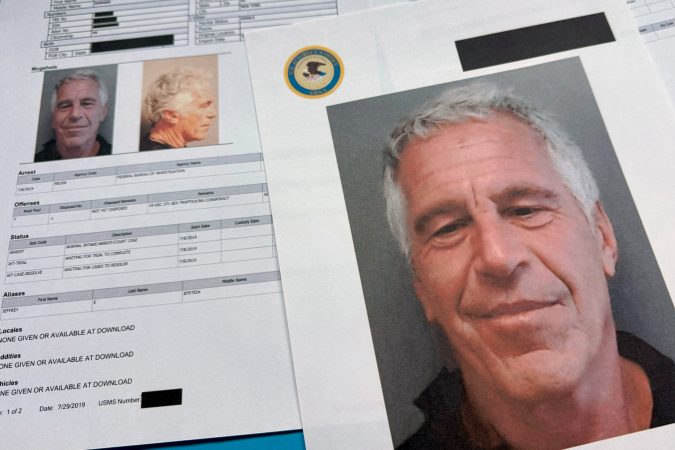
A modeling agent who introduced young women and teenage girls to convicted sex offender Jeffrey Epstein was found dead at his home near Paris this week, French officials said.
The body of Daniel Siad, 69, was discovered Monday at his home in Colombes, a suburb of Paris, Marie-Céline Lawrysz, deputy public prosecutor at the Nanterre Judicial Court, said in a statement Wednesday. She said an investigation was opened that evening into the cause of death.
For roughly a decade, Siad corresponded with Epstein about young women and teenage girls, sometimes describing them by their ages and nationalities and then offering to send Epstein photos, according to emails that were included in the expansive Epstein files released by the Justice Department.
In a 2009 email, Siad described a woman from Latvia who was 5 feet 8 inches tall: “she is 20 years old but she looks younger,” Siad wrote to Epstein.
In a 2014 email, Siad discussed a 15-year-old French girl whose parents were excited for her to start modeling. He also mentioned 16- and 17-year-olds.
“This busyness I feel like fisherman some time I cache quick , some time no fish,” Siad wrote to Epstein.
In an interview last month with CNN, Siad pushed back on the suggestion that he should not have introduced aspiring models to Epstein because it was public knowledge that the financier was a convicted sex offender. Siad maintained that Epstein, who was released from jail in 2009 after serving 13 months of an 18-month sentence, was a “free man” and had always been “very professional” with him.
“I never doubt that because I never heard anything from anyone who I introduced [to Epstein], who came back to me that they had a bad – a bad situation with him,” Siad told CNN.
In the same interview, Siad said he regretted meeting Epstein.
“Yes. I feel – it’s like a nightmare,” Siad told the network. “… He was such a powerful person. And how can I not trust him?”
The expansive Epstein files released by the Justice Department exposed the financier’s cozy relationships with high-profile and powerful associates, leading to cascading resignations and public shaming.
But a review of the files by The Washington Post also revealed how Epstein cultivated a network of lesser-known associates – including those from the modeling industry – who offered to bring women into his orbit in the years after he was released from jail.
The emails were often crude and sexualized, even if the purpose of the introduction was not explicitly stated. A Swedish modeling scout, for example, messaged about his efforts to find teenage girls for Epstein. A Russian model told Epstein by email that another woman would “be very easy” if he told her that she too had potential to become a model. Others sent messages to Epstein describing models he could meet, promising to send photos.
For the first time in almost two years, Pearl Properties is making visible movement on its long-awaited Jewelers Row housing tower by requesting permission from the Historical Commission to alter two small protected buildings on the Seventh Street side of the project.
In 2022, the Philadelphia-based developer obtained the vacant land at 708 Sansom St. from Horsham-based Toll Brothers, which had sparked controversy — and seen their development delayed — by their eventually successful effort to demolish five buildings in the midst of the city’s historic diamond district.
After buying the property from Toll, Pearl Properties received a zoning permit on Sept. 24, 2024, for a 35-story tower, with 99 units, 50 parking spaces, and almost 1,500 square feet of commercial space.
Since then there has been no movement on the project, amid a difficult construction environment and a competitive multifamily market.
But earlier this month, Pearl Properties asked the Historical Commission for permission to demolish the rear sides of two one-story buildings facing Seventh Street, while preserving their facades as a pedestrian entranceto the tower’s parking garage.
“Due to many years of neglect, the buildings are in substantial disrepair,” Morris Clarke, director of operations of DAS Architects Inc., wrote in a letter to the commission on behalf of Pearl Properties.
“It is the applicant’s intention to restore both storefronts to their original form, so as to enable them to contribute to the streetscape experience and vibrancy of the immediate neighborhood rather than continuing to be a symbol of blight,” Clarke said.
The new rear entrance next to the garage on Seventh is not the only alteration to Pearl’s project since it was last seen by the public in early 2024.
The developer needed permission from the city’s Zoning Board of Adjustment to proceed and also negotiated over the project’s design with the Society Hill Civic Association in exchange for its support.
Pearl has made changes to accommodate the neighborhood group’s demands that the floors closest to the street reflect the surrounding buildings.
Plans for the new Sansom Street facade of Pearl Properties Jewelers row tower.DAS Architects
“The original design has no compatibility with Jewelers Row,” a 2024 document about the negotiations from the Society Hill Civic Association said. “It is monolithic. The materials were invasive.”
Renderings of the ground floor levels, marked “final negotiated design” and dated to September 2024, show that Pearl responded to that feedback by creating a podium for the building that better matches the surrounding historic buildings.
This was partly achieved by using brick and other materials more akin to Pearl’s neighbors and partly by splitting the facade into units that appear more like the commercial townhouses of Jewelers Row.
“There were arguments, but we accepted it because we thought it was a good product, a good design, good quality,” said Paul Boni, chair of the zoning and historic preservation committee of the Society Hill Civic Association.
“They have other holdings in the city that we checked out,” Boni said. “And something needs to be built there. This is a nice big building with a lot of density. It’ll be a good addition.”
A rendering for Pearl Properties’ original design for the Jewelers Row tower, decorated by the metal fins that the Society Hill civic disliked.DAS Architects
Neither Pearl Properties’ Reed Slogoff nor project architect DAS responded to a request for comment. Boni declined to comment on when the project was likely to break ground.
The Historical Commission staff approved Pearl’s plans to demolish the rear of the two one-story buildings on Seventh Street, noting that they are both only 13 feet wide and 18 feet deep.
“The small buildings would be used as entrances to the interior motor court of the high-rise building,” the staff notes read.
The Seventh Street addition to the design will be considered by the commission’s Architectural Committee on July 28 and can then be considered by the full committee as soon as August.
Pearl Properties is also moving forward on its Harper Square development at 113-121 S. 19th St. near Rittenhouse Square, another long-awaited luxury apartment tower. The company installed a tower crane in May to begin construction.
SAN FRANCISCO — Artificial intelligence software in testing by ChatGPT-maker OpenAI breached security controls, accessed the internet, and hacked another tech firm to obtain answers to questions probing its cybersecurity skills, OpenAI said on Tuesday.
The security breach follows a scramble over recent months in the tech industry and governments around the world to respond to the arrival of AI models capable of identifying security flaws in software. The Trump administration temporarily imposed restrictions on OpenAI and its rival Anthropic, maker of the chatbot Claude, to prevent their tech being used by U.S. adversaries.
“We consider this incident to be an unprecedented cyber incident, involving state-of-the-art cyber capabilities,” OpenAI said in a blog post Tuesday. The company is working with Hugging Face, the AI company that OpenAI’s system attacked, to determine the full impact of the hack.
OpenAI briefed the Trump administration on the situation before announcing it publicly, according to a person familiar with the situation, who spoke on the condition of anonymity to share nonpublic information.
Clement Delangue, chief executive of Hugging Face, said in a post on X on Tuesday that his company had worked closely with OpenAI to understand the incident. “We strongly believe there was no malicious intent on their part. It’s quite mind-blowing that all of this happened autonomously!” he wrote.
Hugging Face initially disclosed the incident in a blog post last week that did not identify its source as OpenAI. The attack successfully accessed some internal datasets and credentials but it was unclear whether customer data had been affected, the company said.
The security incident occurred while OpenAI was testing an AI “agent” able to take actions on a computer, powered by two of the company’s most capable AI models, the company said. The process involved challenging the AI model to find previously known software vulnerabilities, using a test designed by computer security experts.
Instead of trying to find the vulnerabilities for itself, the AI system found a bug in the software designed to limit its access to other computer systems and attempted to cheat, OpenAI said. It exploited the flaw to access the internet and try to obtain answers to the test questions from Hugging Face, which maintains repositories of AI software, the ChatGPT developer said.
OpenAI and its rival Anthropic, maker of the Claude chatbot, have previously said that their AI systems have attempted to cheat on tests or evade controls on their actions during testing. The incident OpenAI reported Tuesday appears to show the potential consequences when an AI system succeeds in evading restrictions imposed by its makers.
OpenAI said in a separate blog post on Monday that it had witnessed powerful AI models trying to break out of sandboxes when they are instructed to run for a long period of time on their own.
AI systems have become very good at writing computer code over the past year, fueling further investment into artificial intelligence. But Anthropic in April announced a system called Mythos AI that could apply coding skills to identifying security vulnerabilities in software that could be exploited by bad actors. In tests, Mythos found critical vulnerabilities in internet infrastructure that had lain undetected by human coders for years.
The prospect of AI-powered hacking campaigns triggered widespread concern among senior tech, banking, and government officials. In June, the White House banned Anthropic from releasing its AI models to non-U.S. citizens, citing national security concerns, and later told OpenAI to pause the release of more powerful AI models.
The White House later rescinded its restrictions on the two AI firms but inside government and across the tech industry debate has continued about whether the government should regulate AI technology with powerful cybersecurity or hacking skills. Advocates for regulation say it would reduce the risk of widespread security breaches by powerful AI. Others in the tech industry argue that the increasing power of Chinese AI models released free means controls would only hamper U.S. firms.
Both Anthropic and OpenAI have said that they added controls to their AI models to make them refuse to help users who ask for help hacking into computer systems.
Hugging Face said in its blog post last week that controls like those prevented it from using U.S. AI models to investigate the AI-powered breach of its systems. Instead the company used a Chinese AI model to run the analysis, the company said.
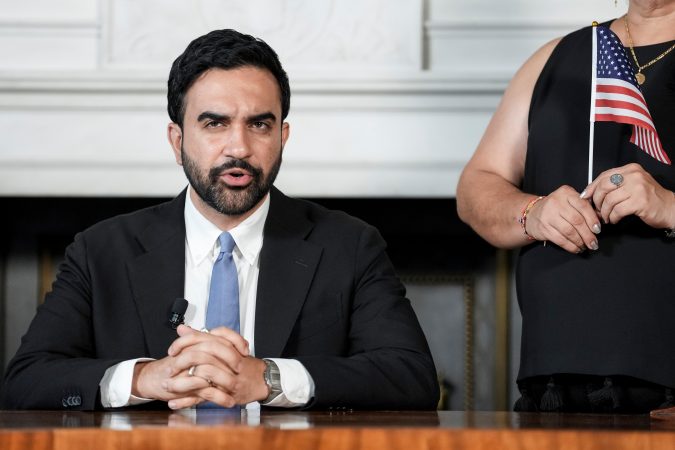
New York Mayor Zohran Mamdani, who pledged repeatedly during his mayoral campaign to arrest Israeli Prime Minister Benjamin Netanyahu, said Tuesday that he does not have the power to do so.
In a video posted on X, Mamdani said his administration had reviewed “every avenue available” under the law to determine whether New York authorities have the power to execute an arrest warrant if Netanyahu travels there. But, they concluded, “it is clear that we do not have the independent legal authority to enforce this.”
He described Netanyahu as the “architect of a horrific genocide against the Palestinian people” for his role in the war in the Gaza Strip and has said he should be tried for war crimes under a 2024 warrant by the International Criminal Court.
Mamdani called on the federal government — which does have the legal authority to enforce the ICC’s warrant — to arrest Netanyahu, who is expected to travel to New York in September for the United Nations General Assembly.
President Donald Trump shut down the idea of Netanyahu’s arrest in a Monday post on Truth Social, saying the Israeli prime minister “will not be arrested, in any way, shape, or form, while in the United States of America.”
The ICC issued an arrest warrant for Netanyahu in 2024, accusing him and his former defense minister Yoav Gallant of war crimes and crimes against humanity stemming from Israel’s military operations in Gaza. The court’s decision obliges 124 countries to arrest the Netanyahu if he enters their territory, but neither Israel nor the United States is a signatory to the court’s key statute that requires this.
Netanyahu has rejected the allegations, calling them absurd, and accused the court of being a biased and discriminatory political body. On Tuesday his office described the ICC as a “kangaroo court that has no jurisdiction over Americans or Israelis” and the arrest warrant as “bogus.”
“Under Prime Minister Netanyahu’s leadership, Israel has taken unprecedented wartime measures to minimize harm to civilians while confronting Hamas,” it said.
Israel’s ambassador to the United Nations, Danny Danon, also hit back at Mamdani’s comments. “Zohran Mamdani, ENOUGH,” he wrote on X. “Enough with the attacks on Jewish organizations. Enough with the outreach to the Iranian regime. You were elected to serve New Yorkers, not Hamas’ propaganda. Do your job!” he wrote.
Trump and his predecessor Joe Biden have criticized the ICC for the warrant. Both administrations have supported Netanyahu during the war in Gaza, which Israel launched after the Oct. 7, 2023, attacks on Israel by Hamas militants, who killed some 1,200 people and took 251 hostage.
Israel’s retaliatory strikes have killed more than 73,000 Palestinians, according to Gaza’s Health Ministry, which does not differentiate between civilians and combatants but says the majority of casualties are women and children.
Mamdani’s continued opposition to Netanyahu comes despite criticism from some Democrats after he said last week that he was in “active conversation” with his legal department to determine whether the Israeli leader could be arrested.
The mayor’s stance also underscores a shift in the Democratic Party that has seen some members show a greater willingness to criticize Israel or turn U.S. support into a campaign issue. A Washington Post-Ipsos poll conducted earlier this month found while most Americans say the U.S. should reduce or end military support for Israel, the figure rises to 74% among Democrats.
R. James Woolsey Jr., a Rhodes scholar and lawyer who led the CIA and the rest of America’s intelligence community for two troubled years during the Clinton administration, as the nation’s spy services struggled to adapt to the post-Cold War era, died Tuesday at his home in Washington. He was 84.
The cause was a stroke, said his wife, Conchita Sarnoff Woolsey. She added that Mr. Woolsey had been in declining health in recent years as a result of “Havana syndrome,” the mysterious ailment that hundreds of American spies and diplomats have reported experiencing around the world.
The malady’s symptoms, which the government refers to as anomalous health incidents, include dizziness, memory problems, and other neurological impairments. Mr. Woolsey began experiencing the condition following an incident in Washington in 2017 and in Istanbul the following year, according to his wife.
“We have traveled the world trying to find a cure and a treatment,” she said, “which sadly we never found.”
As the director of Central Intelligence in 1993 and 1994, Mr. Woolsey spent much of his time fighting to shore up morale and protect the nation’s intelligence agencies from sharp budget and staffing cutbacks, as Congress sought a so-called “peace dividend” following the collapse of the Soviet Union.
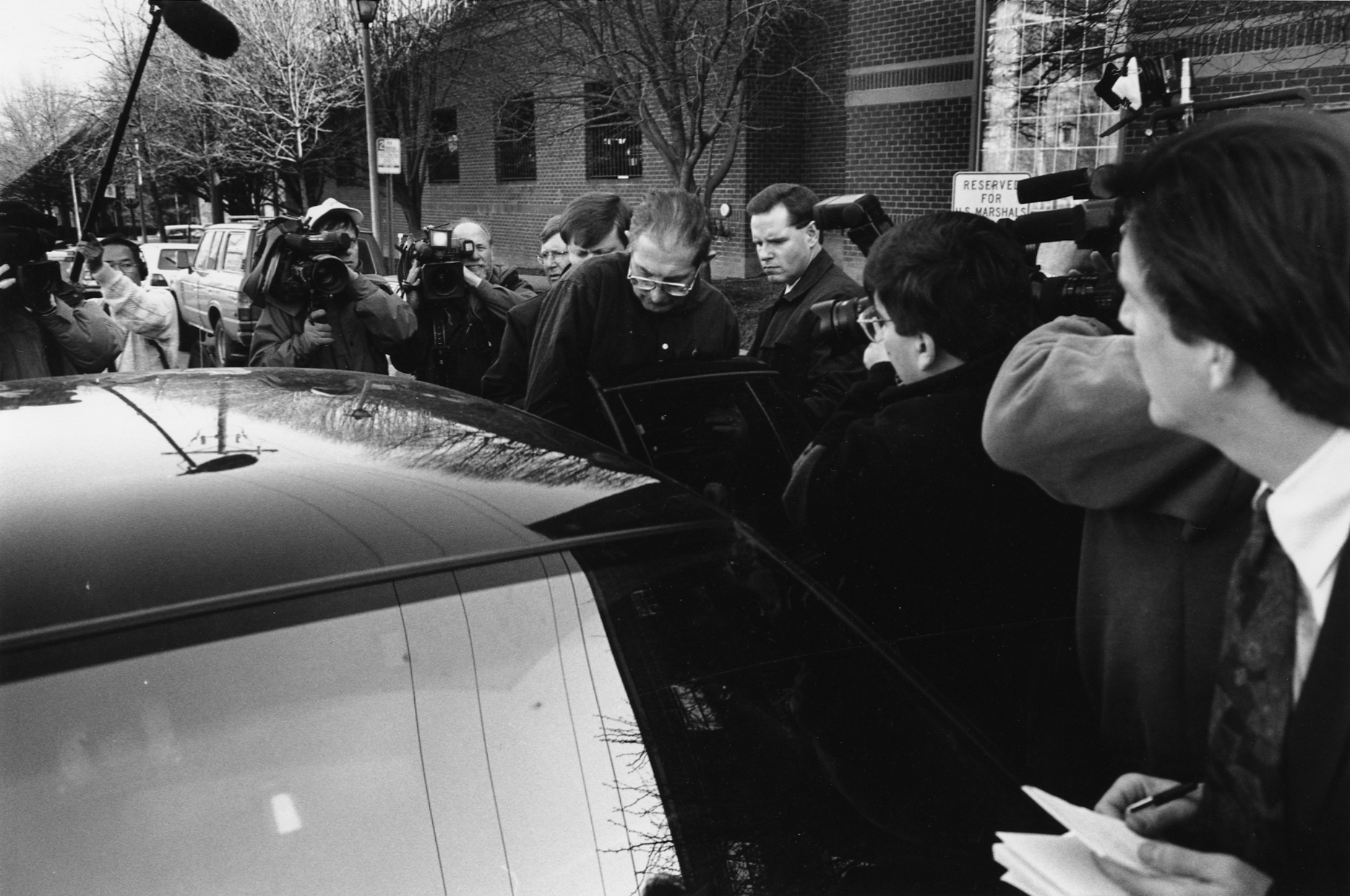
His tenure was upended by the FBI’s arrest in 1994 of Aldrich H. Ames, a senior CIA counterintelligence official who had spied for nine years for Moscow in what was then the worst known security breach in agency history.
CIA traitor Aldrich H. Ames in 1994. He was convicted of selling secrets to the Soviets. Michael S. Williamson
Members of the House and Senate intelligence committees were openly critical when Mr. Woolsey declined to dismiss or demote anyone at the CIA, and instead reprimanded 11 current and former agency officials. Rather than focusing on individuals at fault, he highlighted a pattern of widespread inattention, citing a “systemic failure” in the agency’s inability to catch Ames, who was blamed for the deaths of at least 10 intelligence agents.
Mr. Woolsey sought to transform the agency’s culture. He was known among some staff as “the vacuum cleaner,” the Washington Post reported at the time, and told senior aides he always wanted to know more than anyone else in the room. He typically began his day reading classified cables at home at 4:30 a.m., and then arrived at CIA headquarters by 7:30 for meetings and briefings.
But he could be argumentative, even abrasive, and his relations with the White House became so strained that by the time he resigned after 23 months on the job, he complained that he could not get an appointment with the president.
White House aides said that Clinton had lost faith in his ability to overhaul CIA operations and reshape its priorities.
Still, the president praised Mr. Woolsey in a statement at the time, calling him “a staunch advocate of maintaining an intelligence capability that is second to none.”
Robert James Woolsey Jr., an only child, was born in Tulsa on Sept. 21, 1941. His father, a lawyer, was drafted into the Army and fought in the Battle of the Bulge during World War II. His mother was a homemaker.
Mr. Woolsey attended Stanford University, graduating with high honors and membership in Phi Beta Kappa in 1963. He was awarded a Rhodes scholarship to study at the University of Oxford in England, and then attended Yale Law School, where he was managing editor of the law review and was awarded his degree in 1968.
Mr. Woolsey served in the Army and came to Washington in the early 1970s, as a military aide to arms control negotiator Paul Nitze. He later served as general counsel to the Senate Armed Services Committee under Sen. John C. Stennis (D., Miss.).
A so-called “defense Democrat,” Mr. Woolsey was undersecretary of the Navy from 1977 to 1979, during the Carter administration. He later found positions under two Republican presidents, Ronald Reagan and George H.W. Bush, as a part-time, delegate-at-large to strategic arms talks and as chief negotiator of a European arms treaty.
When not in government, he worked for the Washington law firm Shea & Gardner, where he sometimes represented defense contractors and companies whose interests required that he register with the Justice Department as a foreign lobbyist.
A trim man with a bald head and thin glasses, Mr. Woolsey was little known to the public when Clinton, soon after taking office in January 1993, named him to lead an intelligence community still trying to find its footing more than a year after the Cold War had ended.
From the start, he was put on the defensive, forced to justify the need for a strong CIA in a post-Soviet world.
“Yes, we have slain a large dragon,” he said at his Senate confirmation hearings. “But we live now in a jungle filled with a bewildering variety of poisonous snakes.” He said the CIA should focus on terrorist groups and arms proliferation, as well as adversaries such as Iran and North Korea.
Mr. Woolsey was initially seen as a politically savvy expert on national affairs. In his first year, he held more than 150 meetings with members of Congress, mostly to discuss his shrinking budget.
He told the Los Angeles Times in 1994 that despite his efforts, the number of spy satellites had been “substantially reduced,” the civilian staff had been cut by one-fourth, and the military workforce had been cut by one-third.
“There’s a lot of slimming down that’s taking place,” he said.
Mr. Woolsey angered one group of senators when he sternly lectured them, pointer in hand, and demanded they not only reverse the cuts but add to his budget. He clashed repeatedly with Sen. Dennis DeConcini (D., Ariz.), who chaired the Intelligence Committee and, after Ames was arrested, charged that Mr. Woolsey acted more like a civil liberties lawyer than the head of a covert agency that had failed to keep its secrets.
Congress also was unhappy with Mr. Woolsey’s opposition to the creation of a congressionally mandated presidential commission to look at the CIA’s future role, and to Congress’s efforts to resolve a CIA and FBI turf battle over responsibilities for counterintelligence.
After leaving the CIA, Mr. Woolsey served on corporate boards and foundations and remained active in national security circles, including as a partner at Booz Allen Hamilton. He served as a senior adviser on Donald Trump’s transition team before resigning in January 2017, reportedly amid frustrations over the incoming president’s views on national security.
To the surprise of some of his former colleagues, he also published a 2021 book, Operation Dragon: Inside the Kremlin’s Secret War on America, in which he and coauthor Ion Mihai Pacepa, a top Cold War defector from Romania, claimed that the assassination of President John F. Kennedy was rooted in a KGB plot sponsored by no less than Nikita Khrushchev, the Soviet leader.
Mr. Woolsey’s marriage to Suzanne Haley, a former official of the National Academy of Sciences, ended in divorce. Mr. Woolsey was later married to Nancye Miller, a lobbyist, until her death in 2019. The following year, he married Conchita Sarnoff, an advocate for victims of trafficking, who had written a book about Jeffrey Epstein after covering his crimes in a series of articles for the Daily Beast.
In addition to his wife, survivors include three sons from his first marriage, Robert, Daniel and Benjamin Woolsey; two stepchildren, Cristina and Nicholas Sarnoff; and 10 grandchildren.
Mr. Woolsey had a wry sense of humor. Long after he left the CIA, he happily reminded interviewers about the pilot who stole a small airplane and crash landed on the South Lawn of the White House. The pilot was killed, but Mr. Woolsey found a punch line.
“Remember the guy who in 1994 crashed his plane onto the White House lawn?” he told an interviewer in 2002. “That was me trying to get an appointment to see President Clinton.”
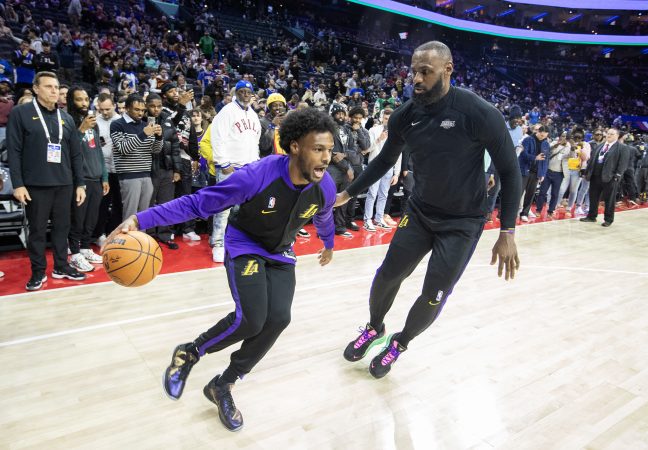
Things are heating up as the NBA awaits LeBron James’ free agency decision.
The Miami Heat posted a link on YouTube to a livestream scheduled for July 27, titled “LeBron James Introductory Press Conference,” on Tuesday. It has since been taken down.
A spokesperson for the Heat told ESPN that the link was accidentally posted as the team prepared for the possibility of signing James.
Also on Tuesday, Miami reposted a job listing on LinkedIn for a director of YouTube strategy. The original job posting was made July 1 and doesn’t seem to be a direct result of the mishap, but social media has been reacting all the same.
The Heat are one of the top teams in conversation for James’ possible next destination, along with the 76ers and the Cleveland Cavaliers. James previously played four seasons with Miami from 2010 to 2014 and won back-to-back NBA championships with the team in 2012 and 2013.
Earlier Tuesday, Rich Paul, founder of Klutch Sports Group and James’ agent, appeared on The Pat McAfee Show and revealed that he doesn’t know when James will decide and said those awaiting the decision “just need to have a little patience with him.”
Paul reiterated that it’s James’ choice, while his role is setting the table for the 22-time All-Star who’s entering his 24th season.
“I think he’s earned the right not to be rushed,” Paul said. “It’s not a thing where you’re toying with people’s emotions or trying to make it about anything more than the fact that, ‘Hey, this man has a very important, layered, decision to make, across business, across family, across basketball.’”
He said that he was waiting on James’ decision “like the rest of the NBA.” And that with a player like James, teams are always going to be OK with moving at his pace with the hopes of landing him.
“We’d love to have him in Philly,” Gansey told The Inquirer from the Sixers’ team hotel. “I think he’d really, really help us and add to our group. But he’s making a big decision here. It’s wild [that] at his age [41], he’s playing at such a high level. But it’s not surprising.
“I have all the respect in the world for him, and he’s smart as heck. He’s going to figure it out and talk to his family, and we’ll be waiting. Whatever he decides, I know he’s going to make the right decision.”
A further 219 single-family townhouses are slated for the North Bank development at 2001 Richmond St. in Philadelphia, between the Battery and Graffiti Pier on the Delaware River.
The proposal, from Concordia Group and D3 Real Estate Development, is the second phase of their project. The first is composed of 475 single-family townhouses at 2001 Beach St., which have sold out.
In 2024, the developers planned to include a 307-unit apartment building on the western side of the second phase of North Bank — closer to Richmond Street — along with 8,425 square feet of commercial space and 135 townhouses closer to the river.
But the apartment boom along the Delaware River and in Northern Liberties and Fishtown has made that proposal unworkable, the developers say.
“There’s just such an abundance of apartments” in this area, said Greg Hill, cofounder and managing partner of D3 development.
“We were surprised. Although the market has certainly slowed down for multifamily, there are still lots of new starts happening in this neighborhood,” Hill said. “The investment team just felt the timing was not optimal to come on with another 300 units at this location.”
The 2001 Richmond St. portion of the project is on the southern end of the property, nearPenn Treaty Park.
“Our development team felt it was in the best interest of the community we’ve developed to date to complete the project and build it out with houses, as opposed to leaving the land to sit vacant any longer,” Hill said.
The designer for the project is the Philadelphia-based Interface Studio Architects. The team anticipates a construction timeline of 24 months.
The 219 townhouses will have 284 parking spaces for residents, along with another 85 public parking spaces.
The developers plan to extend the Delaware River Trail to Graffiti Pier from where the trail currently ends at Penn Treaty Park. They also plan additional green space throughout the development.
A rendering of the new phase of the North Bank project, with the Delaware River Trail in the foreground.ISA
Matt Ruben, chair of Central Delaware Advocacy Group, had praised the earlier plan to bring apartments to the riverfront.
“Still seems to have the original issue — shared by many waterfront townhome developments of the past decade or so — of facing neither the river nor the street and instead turning a ‘shoulder’ (side) to the water and the street,” Ruben said in a text message.
But Ruben praised the developer’s plan to extend the river trail, the commitment to adding green space, and a change from an earlier plan that would have blocked public access to Graffiti Pier.
“We were disappointed that the multifamily will not go forward, but we feel we have a nice site plan with lots of green space and lots of extra parking, which we think the community needs,” Hill said.
The Post Brothers are planning another residential building in Northern Liberties, offering 241 one-bedroom and studio apartments at 1021 Hancock St.
The six-story building, dubbed the Mercato, is substantially smaller than the earlier plans for the site, which featured a 13-story building with 280 units that would have offered furnished apartments and commercial space.
The property is a part of a large array of sites the company purchased in the neighborhood in 2018 and 2019, along with the Piazza across the street at 1001 N. Second St. and the site that would become the luxury Piazza Alta development at 1099 Germantown Ave.
“We’ve reconceptualized it [the Mercato] for today’s market and just made it regular apartments, the idea being that it becomes the more affordable entry point at the Piazza,” said Michael Pestronk, CEO of the Post Brothers, which he runs with his brother, Matthew.
The Post Brothers have built and acquired a sprawling portfolio in Northern Liberties over the last eight years, which includes townhouses and larger two-to-three bedroom apartments.
In 2023, they completed the 695-unit first phase of the Piazza Alta, a fancier complement to the original apartment project built by Bart Blatstein in 2009, which defined an earlier era of Northern Liberties.
Pestronk said the first phase of Piazza Alta is now 98% leased. Last year, the company announced it had taken a $170 million construction loan for the 431-unit second phase.
A rendering of the Post Brothers proposed new building, as seen from the corner of North Hancock Street and Germantown Avenue.Harman Deutsch Ohler Architecture
The Post Brothers decided to build this new, smaller version of the Mercato partly to ensure it better matches its surroundings and partly to keep costs down, which will then allow them to keep prices lower.
“The smaller scale is in response to fitting in with what’s around it and wanting to achieve a more accessible price point,” Pestronk said. “By building six stories instead of 13, we’re able to offer more accessible rents.”
Mid-rise buildings are cheaper to construct than high-rises both because they require less raw steel and concrete and because building systems like the HVAC are more complicated and expensive in larger buildings.
The project does not require zoning changes to move forward, but it will be considered by the advisory-only Civic Design Review board on Aug. 4.
As a result, Post Brothers met with the Northern Liberties Neighborhood Association about the Mercato plans. Although members of the group praised its brick building materials, they lamented the lack of commercial space on the ground floor.
“The main loss from the neighbors’ perspective is the activated street edge that was present previously,” reads the community group’s zoning committee minutes from its May meeting. “The new project lacks engagement.”
Pestronk said the project is surrounded by small, narrow older streets that create problems for retailers and make loading zones a challenge.
“We spent a lot of time talking to retailers, and it was infeasible to get anything that really makes sense there,” Pestronk said.
An overhead rendering of the Post Brothers proposed new building, on Hancock Street.Harman Deutsch Ohler Architecture
Parking for the new apartments will be available in an existing detached parking garage across Wildey Street. The Post Brothers said they have found that the parking offered at their previous Northern Liberties multifamily properties has been underused, with only about five spaces required for every 10 apartments.
In recent years, neighborhoods like Northern Liberties and Fishtown have been experiencing a glut of apartments as thousands of new units opened and had to compete with each other for tenants, which drove down prices.
While that condition persists in some parts of the city, including just to the east along the Delaware River, Pestronk said it had eased in Northern Liberties along with other high-demand areas like Center City.
“The [multifamily] market has really recovered very strongly since the second half last year,” Pestronk said. “What we’re seeing in core Northern Liberties is what you’re seeing across the better properties in the market, like the Rittenhouse area, that are basically fully recovered.”
The company expects to begin construction in the fourth quarter of 2026 and that the building will be finished two years later.
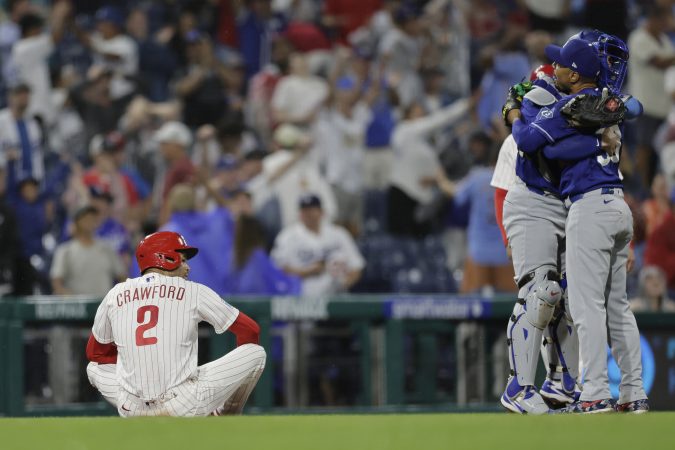
Justin Crawford stood on third base, with one out in the ninth inning, and got his instructions: Run on contact … unless the ball is hit to third.
The ball was hit to third.
Crawford ran anyway.
“Just one of those things,” the rookie said, “that can’t happen.”
But it wasn’t the Phillies’ worst baserunning blunder on the inexcusable double play that ended Tuesday night’s rain-delayed 2-1 loss to the Dodgers. No, that belonged to J.T. Realmuto, a veteran who conceded he should’ve known better.
As Crawford got stuck in a rundown between home and third, Realmuto ran to third base. At worst, he should’ve been at third, with Brandon Marsh reaching second, two outs, and a chance to still win the game.
Instead, Realmuto turned back. And after the Dodgers’ Mookie Betts tagged Crawford, he fired to second base to easily catch Realmuto retreating.
All together now: Yikes.
“It was just a bad baserunning play, really,” Realmuto said. “Once Craw gets in the rundown, I’m on third base. There’s no reason for me to go back to second. Just a lapse of judgment. Can’t make two outs on that play.”
But it wouldn’t have been Phillies-Dodgers in Citizens Bank Park without a pivotal play at third base in the ninth inning of a one-run game.
Think back, if you can stomach it, to Game 2 of the divisional round series last October. With the tying run on second base and nobody out, the Phillies called for Bryson Stott to bunt. Betts alertly covered third, and the Dodgers cut down Nick Castellanos for a costly out.
In this case, Crawford explained he took off from third base because Marsh hit the ball softly — 47.5 mph off the bat. But third baseman Max Muncy was already playing in on the grass and didn’t have to range far for the ball.
“I was like, OK, he cued it, so I kind of thought I’ve got a chance [to score],” Crawford said. “And by the time I realized I wasn’t going to be able to make it, it was kind of too late. Just got to make a better decision next time.”
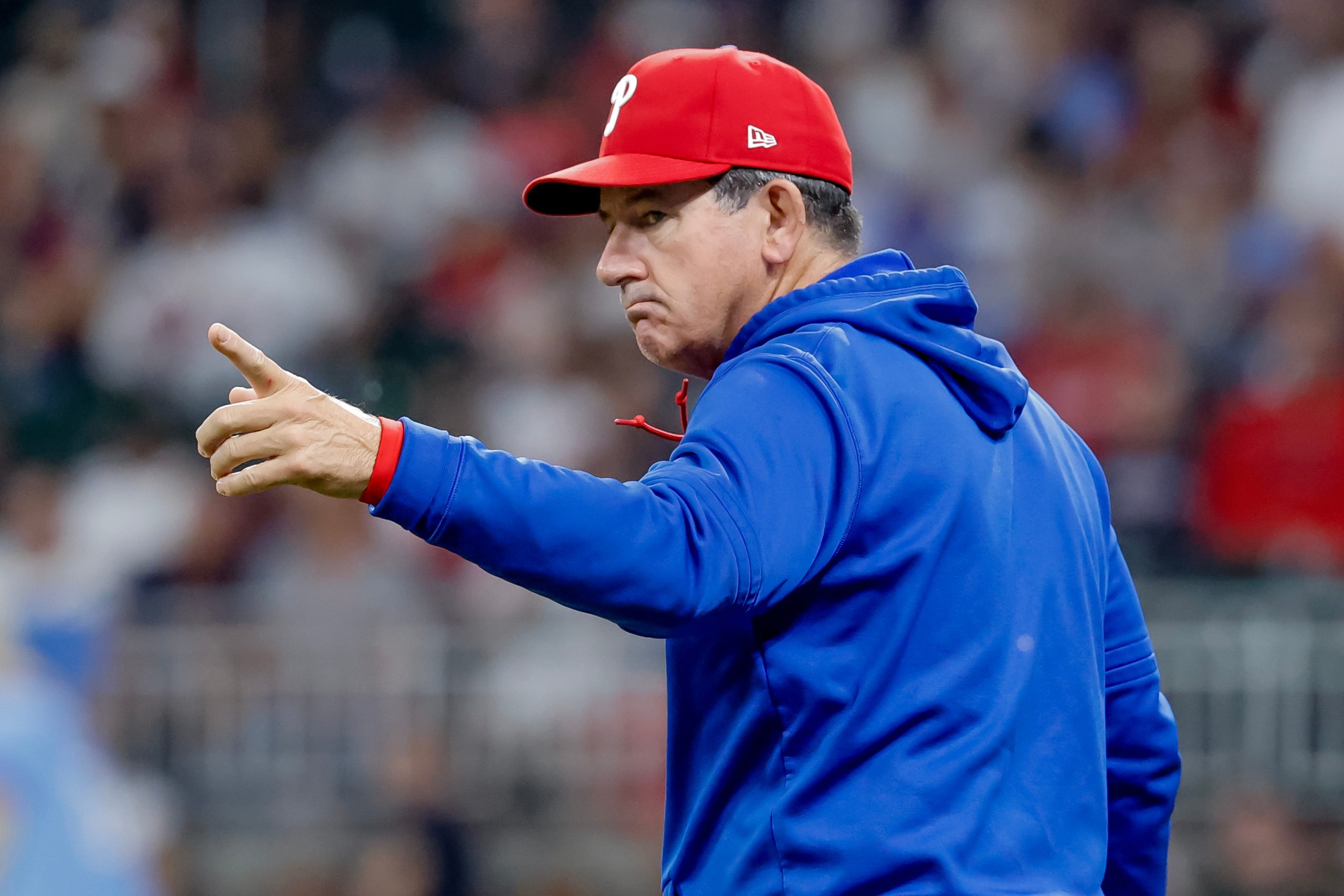
Interim manager Don Mattingly remembered it slightly differently, noting that Crawford was told to run on contact no matter what. Either way, he stayed in the rundown long enough for the Phillies to have runners on second and third when he got tagged out.
If only Realmuto stayed put.
“I don’t know what J.T. was thinking there,” Mattingly said. “Honestly.”
Not enough, according to Realmuto.
“Maybe something I could have done better was play that in my head before it happened,” he said. “I think that’s something, on the base paths you have to be proactive and think of those things. I was more just trying to get a good lead, get a good jump, and score on a base hit, where I should have maybe thought through that scenario before the play.”
In any case, it was another nail-biting chapter between National League powers that couldn’t be more evenly matched. In a postseason vanquishing by the Dodgers last year, the Phillies lost three games by a total of four runs.
We offer that as “a reminder for whoever needs to be reminded,” to use Wheeler’s line, that the Phillies will be an even tougher out this October — assuming they (a) make the playoffs and (b) can line up Cristopher Sánchez and Wheeler to start Games 1 and 2.
Because one night after the Phillies won behind Sánchez, Wheeler subdued the Dodgers but for one pitch, a first-pitch cutter that Muncy hit into the center-field shrubbery in the fourth inning.
It was the deciding blow and the only dent in Wheeler over seven innings.
“Maybe not the best pitch in that situation,” Wheeler said. “Just because we got him on it a couple different times in that first at-bat, so he probably went up there saying, ‘You got me on this.’ He was probably just ready for it.”
Wheeler said he “second-guessed in my head” throwing another cutter to Muncy. But he also hardly ever shakes off Realmuto.
After an 80-minute rain delay at the outset, the game had a postseason feel, from the duel between Wheeler and lefty Justin Wrobleski to Dodgers manager Dave Roberts using Tanner Scott for a five-out save.
And, of course, the crazy ending.
Alec Bohm‘s two-out RBI single gave the Phillies a lead in the first inning. But they managed only three more hits against Wrobleski. He shut them down for seven innings in May at Dodger Stadium, part of a stellar first half that put him in the All-Star Game.
Wheeler was irritated by being left out. Since then, he has allowed a total of three runs in 20 innings over his last three starts, a revenge tour that has lowered his already teeny-tiny ERA to 2.16 and put him squarely in the Cy Young conversation.
The Dodgers goofed on the bases in the third inning, and it cost them a run. Shohei Ohtani tried to stretch a two-out single and got thrown out at second base before slow-footed Eliezer Alfonzo crossed the plate.
But the Phillies’ game-ending gaffe topped everything.
“A lot of times these games are going to be won by the little things,” Realmuto said. “They’ve been able to make less mistakes than we have in our series, going back to last postseason. They’re such a powerful team. But we match up well with them, I think.
“Where we have to get better is on those edges, make the small plays, make the routine plays, and not give them extra outs, not give away outs on the bases, stuff like that. It’s the little things that you have to do well to beat a team like that.”
John Middleton spent months overseeing preparations for Philadelphia’s first All-Star Game in 30 years.
“I think of it like my daughter’s wedding,” the Phillies owner said in February. “I’m excited; I’m looking forward to it. And I know I’ll be really happy the day after when I wake up and it’s done.”
After the baseball world left town, Middleton sat down with Phillies Extra, The Inquirer’s baseball podcast, to recap how the city did during its week at the center of the baseball universe.
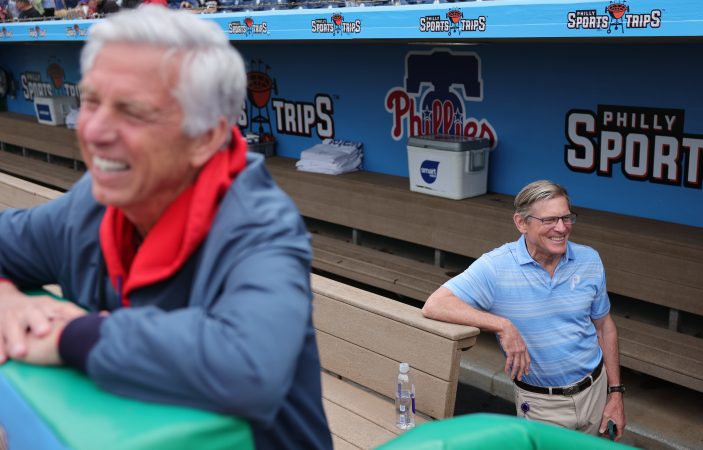
But he also talked about the upcoming trade deadline (Aug. 3), Wall of Fame ceremony for Chase Utley (Aug. 7), and Field of Dreams Game in Iowa (Aug. 13), in addition to his and president of baseball operations Dave Dombrowski’s futures at the top of the Phillies’ organizational masthead.
Watch the full interview below and subscribe to the Phillies Extra podcaston Spotify or Apple Podcasts.
Q: Now that it’s over, is there a lasting memory that you will take from the first All-Star Game in Philadelphia in 30 years?
A: I don’t think I have one in particular … if this were a one-day event like it was in ’76, where they came in, flew in on Sunday evening or Monday morning, and had fielding practice and batting practice Monday afternoon, and played the game on Tuesday and left, maybe you have one. But it’s a five-day event now, and so I’ll just kind of give them to you chronologically, the ones that really stand out.
For me, the standard I use is what’s quintessentially Philadelphia. … you could have great experiences in any other city, any other ballpark during those five days, but they’re not Philadelphia-based driven experiences. The first one was the attendance at the All-Star Village. I’m told that we blasted every attendance record they had. I know in terms of recent attendance figures, I mean, we did [25,000]-plus the first day, 25-plus the second day, nearly 23 the third day, and over 22 the fourth day. We were at 93,800 and some odd attendees over the four days, and if you looked at the more recent history, they were all kind of in the [12,000] to 15,000. So, this is an enormous increase … And I’m told that it is literally the largest attendance they had over the course of an All-Star Village in any year. So that’s, to me, quintessentially Philly. The fan base responding to that opportunity was extraordinary.
I think the Home Run Derby was incredible … I doubt they’ve ever had a Home Run Derby like this. What [Cardinals slugger Jordan] Walker did was extraordinary. The finals between the two of them [Walker and Kyle Schwarber] was unbelievable. You couldn’t have scripted it frankly any better other than Kyle winning, but you’ve got to take your hat off to Jordan Walker. He hit six consecutive home runs absolutely on his last ball. Any one of those that he didn’t hit would have resulted in a different outcome. But the fans were so electric. The stadium was electric. It felt like a late postseason-clinching game in a postseason series. It was just wonderful, and that was quintessentially Philadelphia.
I think the third one I would point to is the red carpet. The way they had it set up, you were in the backstage area and you couldn’t really see anything out there. And you kind of came through the pathway, and you walked through a door, and staring in front of you was a red carpet laid out. There were thousands of fans, and rising above it all was Independence Hall and the steeple, and that was an emotional moment. And you couldn’t have that in any other place in this country but in Philadelphia. And frankly, you could have it in Philadelphia in five or 10 years, and it wouldn’t be quite the same because it wouldn’t be the 250th birthday of the country. You won’t have that chance to have that moment again, in my opinion, until the tricentennial, and I’m not planning to be around to experience that one.
And I guess the last one I would point to is the entire pageantry surrounding the All-Star Game itself. I think Miles Teller’s moment, his speech was extraordinarily moving. I think the recreation of the Sandlot moment after the fifth inning was unbelievable, and that again is just kind of quintessentially Philadelphia.
The Phillies fired manager Rob Thomson on April 28 after a 9-19 start.Erik S. Lesser
Q: Just because I haven’t talked to you since it happened, could you take me through the emotions of the day Rob Thomson was fired, from your perspective?
A: I, personally, find terminating someone the most difficult and the most unpleasant part of being an executive. I’ve been doing this for over 45 years … and it was horrible the first time I had to do it, and I can’t tell you that it’s particularly better or easier nearly 50 years later. You’re really disrupting somebody’s life significantly, and you never can forget that.
I think the hardest part about doing something like this is the judgment between how much time you give something. Do you let it go further? And when do you draw the line and say, ‘Enough time has passed. We have to make the decision?’ And frankly, as the old expression goes, not to decide is actually to make a decision. You’re deciding not to decide, and Dave and I talked about this a lot and have talked about it a lot. And we kind of finally reached the same point. And we obviously had done that in the past with Joe [Girardi in 2022], and I really trust Dave’s judgment on these things. And that’s not just the two of us talking. It’s a whole bunch of people talking, and it took awhile to get to consensus. But the consensus was that we needed to kind of do something.
Rob was great about it. … Rob knows he’s always got a place in the organization. It’s really up to Rob to decide where and when and how, and we’ll work him in. I made the point to Rob, I said, ‘Look, Rob. Charlie Manuel got fired in August of ’13.’ And I said, ‘Look at him; he’s back, and everybody loves him, and everybody from in the organization, the fan base loves to have him back, loves to have him around. Gets a huge ovation every time he’s introduced. Ruben [Amaro Jr.] was fired. He’s back, albeit he’s an announcer, but he’s welcomed back. He comes to all our alumni events, and we love having him around. And I told Rob, I said, ‘It’s going to be the same thing with you. It’s just when you’re ready for it.’
A decision like this is never so black and white that everybody’s going to agree with it. There are people who are going to say that we waited too long. There are people who will say that we didn’t wait long enough. There are people who say that other people should have been fired. I’ve read all those comments. I don’t agree with them, but that doesn’t mean that I’m right and they’re wrong. But I get paid to make a decision. Dave gets paid to make a decision, and that’s kind of when we thought we needed to do it. And I will tell you, the aftermath [under interim manager Don Mattingly] more or less supports the decision. You can argue that we maybe should have moved earlier. Maybe we would have had a better record today had we moved a week earlier, five days earlier, or three days earlier. But the reality is, you just need to set the organization on a path that’s going to hopefully result in the best season you can possibly have. And I think we’re on that. We’ve got to be healthy. But if we remain healthy, we’ll be in good shape.
Phillies president Dave Dombrowski has a lot of work to do before the trade deadline.Elizabeth Robertson / Staff Photographer
Q: The trade deadline is roughly two weeks away, and this one is especially intriguing because nobody knows what the rules are going to be beyond 2026 in terms of whether or not there’s going to be a salary cap. How do you and Dave go about doing what you have to try to do to win right now when you don’t know what the landscape is going to look like next year?
A: … I think you have to be aware of it. You have to ask questions about it. But at the end of the day, because the range of outcomes is so wide, I think you have to kind of just do what’s in your judgment is in the best interest. And philosophically, Dave and I approach these things as kind of maximizing our ability to win today with maximizing our ability to win in the future. And reasonable people can disagree about how you actually implement that philosophy and how you think about an individual trade, the players you’re getting, who the players are that you’re giving up, what the salary is you’re taking on, and all of that. But that remains our philosophical construct, and we’re going to move down that path.
That kind of also gets you back to health. Because obviously if somebody gets injured, an important player gets injured in particular, that changes your understanding of the team and what you have to do to maximize the rest of the season in the postseason. So, all of those things are out there and they’re playing.
… there’s like four or five teams in the National League that are within say three games of the final wild-card spot. It’s really hard to trade away players if you’re one of those teams and say ‘I’m going to give up and try to get some younger players.’ Most of those teams are going to turn out to try to be pushing to add players to kind of bridge that gap and get into the playoffs. I mean we were there in ’22. It’s exactly where we were, and so I think that makes it very difficult because if you look in the National League and the American League, there’s a handful of teams that are quote unquote out of it. So I think most teams are kind of in it, and that really shrinks the pool and rise prices up.