Blog

  • Jason Kelce playing Phil Collins on the saxophone may have been the best part of a bad ‘MNF’ matchup

    Jason Kelce playing Phil Collins on the saxophone may have been the best part of a bad ‘MNF’ matchup

    Jason Kelce’s resumé reads more like a copy of War and Peace at this point.

    The longtime Eagles center and future Hall of Famer turned podcaster, broadcaster, and brother-in-law of Taylor Swift flexed some musical muscle of his own on Monday night.

    Kelce, on the saxophone, played a rendition of “In the Air Tonight” with the Baltimore Ravens’ marching band, the Marching Ravens, as a guest performer. The performance during ESPN’s Monday Night Countdown honored Phil Collins’ induction into the Rock & Roll Hall of Fame over the weekend.

    Collins’ song has been the anthem for Monday Night Football for years; Chris Stapleton, Cindy Blackman Santana, and Ludacris performed this year’s rendition. Snoop Dogg lent his voice to previous versions.

    And now, Kelce can join the ranks of artists who have covered the classic.

    While fans have come to know of Kelce’s musical talents because of his A Philly Special Christmas album, his love of music goes way beyond that. It started with the baritone saxophone at Cleveland Heights High School, about 10 miles from the Rock & Roll Hall of Fame.

    This isn’t the first time Kelce broke out the old sax. After his Super Bowl LII win in 2018, the Central High School music department hosted students from Kelce’s alma mater, where he made an appearance with the high school bands.

  • Adding flag football was ‘a hard transition’ for the Philly Phantomz. Now, they’ve embraced it.

    Adding flag football was ‘a hard transition’ for the Philly Phantomz. Now, they’ve embraced it.

    The Philadelphia Phantomz weren’t supposed to be playing for a flag football championship. In fact, their coach, Qiana “Star” Wright, wasn’t even sure she wanted a flag team in the first place.

    The Phantomz were a tackle football team through and through. But after just one practice and a trip to Canton, Ohio, they found themselves competing against some of the country’s best flag football teams at the Women’s Football Alliance national championship weekend. And now, Wright is expanding her horizons on the possibilities of adult women’s flag football, not only in America but globally.

    “I felt forced to shift into the flag,” Wright said. “It was a hard transition for me because I’m so used to tackle football and just knowing what women’s tackle football has done for me and my team and hundreds of other women around the world. … But I realized that it was good for the younger generation coming up to indulge in something that was less physical and easier to develop because you don’t need equipment and there’s less injuries.”

    Wright founded the Phantomz in 2015. But as flag football grew in the school system, Wright began teaching the game to girls at Cheltenham High School. There, she began to see the talent and opportunities emerging from the sport, she said, leading her to add the flag team to the Phantomz last year with “few expectations.”

    “We were just out there to have fun,” Wright said. “But after the first game, it was just like, ‘Wait a minute. OK, we’re pretty good.’”

    The Philadelphia Phantomz lost to the Tampa Bay Inferno in the Women’s Football Alliance national championship game.Courtesy of Kim Jamison

    The majority of the Phantomz flag team came from the tackle team. The exception was Maya Johnson, a former rival of Wright’s.

    Johnson, then 19, was the youngest player on the team. She began playing flag football when it was introduced during her sophomore year at Abington High School. Wright quickly noticed her, and when Johnson graduated, Wright recruited her for the Phantomz’s flag team.

    “I really have to shout out to my coach, Coach Star,” Johnson said. “She really took me under her wing. I wasn’t even going to play in the tournament. I decided really late, probably a couple of days before we left, that I was going to go.”

    The Phantomz made it all the way to the championship game, which they lost, 33-19, to the Tampa Bay Inferno. Despite the defeat, Johnson, a quarterback, was the tournament MVP. Though flag football wasn’t her first sport, her passion for the game led her to transfer colleges to play Division I flag football at Fairleigh Dickinson as it launches a program in the spring.

    “I love the freedom of it,” Johnson said. “Basketball, I played for years. I’m 20 now, and I’ve been playing basketball since I was like 8. I had the same love for football that I had for basketball at one point, but it kind of just faded as I got older. I feel like flag come easy to me, and it’s really, really fun.”

    As flag football booms — the NCAA added it to its Emerging Sports for Women program earlier this year — Wright has her sights set on an even bigger goal.

    Wright founded the Star Wright Foundation, a nonprofit, in 2019. Through the foundation, Wright and the Phantomz have brought football to 23 African countries, including Ghana, Zambia, and Morocco. Wright would bring cleats, pads, helmets and footballs overseas, but with flag football, the barrier to entry is smaller than ever before.

    “The goal has always been to spread the game of football across the whole continent [of Africa],” Wright said. “Now that flag is such a big thing, there’s opportunities for these countries to be able to showcase their talent on an international level and be proud of their country on an international level.”

  • After her daughter’s remains were found in the New Jersey Pinelands, a mother turns to grief and justice

    After her daughter’s remains were found in the New Jersey Pinelands, a mother turns to grief and justice

    When Sue Quackenbush visited a desolate, sandy road deep in New Jersey’s Pine Barrens earlier this year in search of her missing daughter, she felt overcome with terror.

    On Saturday, when investigators discovered Danielle Lopez’s remains in the Pine Barrens, Quackenbush said, some of that terror subsided.

    Now, after more than two years of dread and uncertainty, there is room for grief.

    “My soul’s purpose was always to bring Danielle home,” Quackenbush told The Inquirer on Tuesday. “Justice comes second.”

    Lopez, 37, was last seen alive around 6 p.m. on April 13, 2024, by witnesses who saw her walking alone on Lost Lane, a sandy road pocked with muddy puddles in the heart of the Pine Barrens.

    On Saturday, units of the New Jersey State Police, along with other personnel, converged for a search in Chatsworth, Burlington County, within Brendan T. Byrne State Forest, to “locate evidence” related to Lopez’s disappearance.

    “During the search operation, human remains were discovered. Following a thorough forensic examination, the remains were positively identified today as those of Danielle Lopez,” police said in a Facebook post Monday.

    A family photo of Danielle Lopez who disappeared in April 2024 while camping with her boyfriend in New Jersey’s Brendan T. Byrne State Forest.Courtesy of Sue Quackenbush

    Quackenbush, who was on site when her daughter’s remains were found, posted about the news on Facebook on Monday, confirming what state police said. She declined to discuss more details about the discovery.

    “Please continue to pray about this situation,” she wrote.

    On Tuesday, Quackenbush also emailed a statement to The Inquirer, praising the state police for their doggedness and asking everyone who cared about her daughter to perform “acts of kindness.”

    “Allowing patience at a traffic light, or buying a stranger’s coffee — and do it thinking that is what Danielle would do … that would be appreciated as well,” Quackenbush wrote. “Danielle loved people and was always thinking of someone else first.”

    Police did not release any additional information Tuesday, including a possible cause of death, but said the investigation “remains active and ongoing.” Spokespeople for both the New Jersey State Police and the Burlington County Medical Examiner’s Office both declined to comment Tuesday.

    At the time of her disappearance in April 2024, Lopez was staying with her boyfriend, James Scott Dunn, at a campground in Brendan T. Byrne State Forest, about 16 miles north of Lost Lane. Dunn, who is serving a five-year sentence on unrelated drug and theft charges, said during an interview with The Inquirer at South Woods State Prison that he did not harm Lopez and cast suspicion on others they met at the campground.

    “I loved her,” Dunn said at the time.

    Just after 9 a.m. on April 13, 2024, surveillance footage captured Lopez buying coffee at a Burlington County Wawa, not far from the campground. She was later seen walking on Lost Lane, alone, and her car was abandoned in a deep mud hole where it had become stuck.

    Quackenbush still believes the witnesses who saw her daughter walking on that road that afternoon failed her, morally, by not helping her or contacting authorities.

    Sue Quackenbush checks a reward poster on a parking lot restroom on Lost Lane Road in Woodland Township in January. In April 2024, her daughter Danielle Lopez disappeared farther up the dirt road while camping with her boyfriend in New Jersey’s Brendan T. Byrne State Forest. Tom Gralish / Staff Photographer

    In January, The Inquirer met Quackenbush on Lost Lane to discuss Lopez and the case. She said her daughter, known as “D-Lo,” suffered deep losses in life, including two brothers, her father, her grandfather, and a beloved dog. Her brother Eric died by suicide in 2015. Her brother Michael, a Marine who served in Afghanistan, died in a Florida car crash in 2016.

    At the time, Quackenbush was holding out hope her daughter was alive.

    “This isn’t grief, yet. This is terror,” she said that January day.

    In her recent Facebook post, Quackenbush said her daughter’s remains were discovered on the 10th anniversary of Michael’s death.

    Now she is planning a funeral service for Lopez.

    “I’m sitting with deep sorrow now, and grief, finally,” she said.

    Anyone with information relevant to this case is encouraged to contact the New Jersey State Police Missing Persons Unit at 609-882-2000, Ext. 2554.

    A family photo of Danielle Lopez with her two brothers. She disappeared in April 2024 while camping with her boyfriend in New Jersey’s Brendan T. Byrne State Forest.Courtesy of Sue Quackenbush
  • Trump starts Asia trip by shrugging off U.S. concerns: ‘It’s fine’

    Trump starts Asia trip by shrugging off U.S. concerns: ‘It’s fine’

    MANILA, Philippines — President Donald Trump arrived in Manila on Tuesday, at the tail end of a diplomatic summit in which world leaders had arranged to hold part of the gathering at his hotel. His agenda was supposed to be about inking trade deals and embracing regional partnerships, but several problems from home had followed him overseas.

    He was pelted with questions. He seemed to meet each with a shrug.

    Did he have any worries about the aviation-system meltdown afflicting travelers across the United States, or a technological outage affecting several large banking systems?

    “It’s life,” Trump said. “When you’re big and powerful and you have all the money, things like that happen. It’s fine.”

    Trump is not shy about prizing photo opportunities. But his appearance showcased just how little he seemed to be interested in netting diplomatic wins or easing concerns about U.S. leadership — his leadership — as he made this quick stop at the Association of Southeast Asian Nations.

    His appearance was on the way to the main event later in the week: a meeting on the edges of the APEC economic summit in Shenzhen, China, on Thursday with Presidents Xi Jinping of China and Vladimir Putin of Russia, two authoritarians whom Trump openly admires.

    Trump will be meeting Xi for the third time this year, and there is another likely next month at Trump’s Doral resort in Miami, where he gets to play the host (and has invited Putin, ending the Russian leader’s isolation for invading Ukraine). The three-way meeting between China, Russia, and the United States would be the first of its kind.

    Trump’s visit to Manila amounted to a layover. When he arrived, he trudged off the plane like all weary long-haul travelers do, and slowly made his way down the stairs of Air Force One. Trump was then whisked to his hotel, where several world leaders had gathered to bring the diplomatic summit to his doorstep.

    Alongside members of the so-called Quad — the informal grouping that includes the United States, India, Japan, and Australia — his comments were brief, cryptic, and nearly mechanical: “Quad is important. We’re working on things that will surprise people.”

    On the way to Manila, Trump floated a meeting with another leader, Kim Jong Un, the North Korean leader and a dictator he has talked warmly about, perhaps in Shenzhen. It isn’t clear why he wants to see Kim: The three meetings he held in his first term ended in failure, and today the North has more nuclear weapons, and more ways to launch them, than ever before.

    If he holds the meeting it would also surprise his staff. Last week, White House officials said there was no chance of a Trump-Kim meeting. On Tuesday, the White House did not explain whether plans for such a meeting were taking shape.

    Trump’s trip was planned before the midterm elections, but few Republicans, including Trump, had predicted them to be a near complete wipeout of the president’s handpicked candidates. His appearance in Asia, two weeks after the election, is in keeping with a long tradition of global trips taken by presidents hoping to divert attention from a damaging domestic story by flexing U.S. power abroad.

    In November 1994, days after Republicans took control of Congress for the first time in decades, President Bill Clinton departed for the Philippines. In 2010, after Democrats lost 63 House seats, President Barack Obama traveled through India, Indonesia, South Korea, Japan, and Portugal. Trump did it in his first term, jetting to France after Republicans lost control of the House in 2018.

    This time, there was little of substance on Trump’s schedule aside from signing a trade deal between the United States and Thailand. In the end, not even the trade deal materialized, with the president saying that it would be finished in the coming weeks.

    “I look forward to finalizing the details of our formal agreement in the coming weeks,” Trump said. “Our staff is working on it very diligently, and it’ll be done. But the concept of what we have will be really very permanent, and we’re just about there.” He signed something anyway, even in the absence of a deal, under the theory that no favorable photo should go unsnapped.

    Several of the factors that made Trump an unpopular president at home have made him an increasingly unpredictable partner abroad. All three Quad partners are smarting from high energy prices triggered by the Iran war, a conflict Trump never discussed with them before launching it in late February. And Trump’s insistence that the United States must win the artificial intelligence race against China has encountered pushback in the Philippines, where some Filipinos are vehemently opposed to Pax Silica, a project led by the U.S. government that would establish a technology hub about the size of 3,000 football fields.

    During an address to Quad leaders Tuesday evening, Trump again focused on personal relationships over policy. He called Prime Minister Narendra Modi of India, a member of the group, “a great leader and a friend of mine, highly respected by everybody all over the world.” The president also praised Modi as a “very tough man.” The countries are at odds over India’s purchases of Russian oil, and trade talks have dragged on, frustrating both parties.

    Later, the Quad leaders issued a joint statement, affirming the group as “a force for good and a partnership of action, committed to peace, stability, and prosperity” and outlining several plans, including maritime flyovers of the Indo-Pacific, cooperation on combating cyberattacks, and accelerating work on AI initiatives.

    Before ending his day, Trump delivered remarks at a dinner of ASEAN leaders, and praised his host, President Ferdinand Marcos Jr. of the Philippines.

    “I don’t want to date myself, but I knew your parents very well. They were great,” Trump said. “I believe in genetics. They did a good job. You have very good genetics, I can tell you that.”

    It was not the first time Trump has praised the family of Marcos, who is the son of the dictator Ferdinand Marcos, who ruled the Philippines for 20 years, imposed martial law, and was ousted in 1986.

    On Wednesday, Trump will stay in Manila long enough to have lunch at Malacañang Palace and a bilateral meeting with the younger Marcos before departing for Shenzhen.

    In China, Trump needs to extend a soon-expiring trade truce that limited tariffs on Chinese goods entering the United States in return for a Chinese commitment not to cut off rare earths and magnets.

    The president is also going to focus on the issue of nuclear proliferation in his meeting with Xi and Putin, though White House officials do not expect any significant breakthroughs.

    Also lingering over Trump’s trip to Asia is the fallout from the resignation of Jensen Huang, the CEO of the chipmaker Nvidia, after revelations he had engaged in extramarital affairs, including with a woman whom U.S. officials have identified as a Chinese intelligence asset.

    Huang has been influential in shaping the president’s views about technological competition with China, and made the argument that keeping China dependent on American-made semiconductor chips and technology could help maintain U.S. dominance over Beijing.

    Huang’s resignation — and the approach the Commerce Department took to slowing rules that would clamp down on the sale of Nvidia chips to overseas data centers — has exposed a long-burning feud within the Trump administration. Howard Lutnick, the commerce secretary, who has argued for less strict limits on chip exports to Asia, joined Trump for the trip, as did Scott Bessent, the Treasury secretary, who in recent days publicly blamed the Commerce Department for failing to clamp down on the sale of advanced Nvidia technology.

    Before leaving for Manila, Trump did not seem concerned about the scandal that has rocked a corporate juggernaut that is critical to the AI industry. His usual retort when asked about spying is that everyone does it, and he did not seem especially perturbed. If he was, he would not show it.

    “You know, we’re heading to China, and I don’t think you want to insult China just before you get there,” Trump said.

    This article originally appeared in the New York Times.

  • Nvidia chair says board does not intend to reinstate Jensen Huang as CEO

    Nvidia chair says board does not intend to reinstate Jensen Huang as CEO

    Nvidia Chair Harvey Jones said Tuesday that the company’s board of directors does not intend to reinstate Jensen Huang as CEO, a statement that came hours after Huang said he would come back to lead the chipmaker if the board invited him.

    It was Huang’s first public statement since he abruptly left the company last week following revelations of an extramarital affair with an alleged Chinese spy.

    Huang said in a social media post that if the board decided that his return was in the best interest of shareholders, employees, the company, and the country, he would be “honored to answer these calls.” He acknowledged making “serious mistakes” in his personal life.

    Some tech industry figures, including SpaceX and Tesla CEO Elon Musk, have called for the reinstatement of Huang, a high-profile booster for the artificial intelligence industry who oversaw Nvidia’s development as the key provider of chips driving advanced AI models. President Donald Trump, a Huang ally who has spoken with him frequently, has also endorsed the comeback bid.

    Huang acknowledged making “serious mistakes” in his personal life but said that he’s received an “outpouring” of support from employees, investors, business partners, and customers for his return.

    Company’s earnings report made no mention of Huang

    In its third-quarter earnings statement released Tuesday, Nvidia did not mention Huang’s ouster or his possible return.

    The turmoil notwithstanding, Nvidia blew past Wall Street expectations for the quarter, pulling in more than $116 billion in revenue, double the level from a year ago. The company also posted net income of $2.70 per share, beating estimates of $2.48 per share.

    Santa Clara, Calif.-based Nvidia did not respond to an earlier AP request for comment on Huang’s statement.

    Nvidia Chief Financial Officer Colette Kress was expected to speak with Wall Street analysts on the earnings call for the first time since being named interim CEO.

    A “Stand with Jensen” petition set up last week has gathered momentum, gaining signatures from current and former Nvidia staff, investors, and other Silicon Valley supporters. The petition calls on the board to bring back Huang while an independent investigation proceeds or until there’s “compelling evidence” that his departure is in the company’s best interests.

    “We are concerned that Jensen was removed without meaningful due process,” the organizers said in an open letter. “We have not been shown evidence substantiating the allegation that the woman at the center of this controversy was a spy.”

    Trump suggested Monday that the ex-CEO could return, saying Huang “learned a big lesson” and that he “would certainly not mind” if he was reinstated.

    Huang resigned last week from Nvidia, apparently ousted by the board after revelations that he had extramarital affairs, both with a Chinese businesswoman suspected of being an intelligence asset for Beijing and with a senior executive who reported to him.

    The woman Huang was seeing who reportedly had links to Chinese intelligence was an executive at Singapore-based cloud computing firm Megaspeed International, a company being investigated by the U.S. for allegedly violating U.S. export controls by illegally diverting advanced Nvidia AI chips to Chinese companies.

    Huang faces questioning by Congress

    Also Tuesday, key House lawmakers said that Huang has voluntarily agreed to appear for transcribed interviews as the company faces intensifying national scrutiny over sales of its advanced computer chips.

    Huang will appear before congressional committees on Dec. 1, followed by the company’s general counsel, Tim Teter, on Dec. 2.

    “We look forward to hearing from Jensen Huang and Tim Teter on their roles in a potential breach of our national security,” said a statement from the chairs of three House committees with oversight of China and intelligence issues.

    “The American people need answers on Mr. Huang and Nvidia’s role in allowing dangerous PRC actors to access our most advanced chips, as well as the role of a potential Chinese intelligence asset in this scandal,” the lawmakers said, referring to the People’s Republic of China.

    Meanwhile, Nvidia said it’s creating a new board committee to oversee national security and global trade compliance following the revelations about Huang.

    In the statement detailing its August-to-October results, Nvidia said revenue in a key business segment — data centers — more than doubled to $107.6 billion. It also projected that revenue for the current quarter running through January would hit $130 billion, more than Wall Street had expected.

    Nvidia’s advanced chips are in high demand because they’re essential for cloud computing and data centers that underpin the AI boom, but they face restrictions on their sale to China. Trump said it was “good” that Nvidia had created the new oversight committee.

    “Yes, that’s a good idea. It’s a great company,” Trump said shortly after arriving Tuesday evening in the Philippine capital of Manila, where he participated in a photo opportunity with the leaders of Australia, India and Japan. “It’s a great idea.”

  • QVC and HSN to become ‘more integrated’ as the shopping networks stabilize post-bankruptcy

    QVC and HSN to become ‘more integrated’ as the shopping networks stabilize post-bankruptcy

    QVC Group made money in its first quarter since emerging from bankruptcy, but top executives say customers should expect more changes ahead.

    The West Chester-based company’s top boss said its two shopping networks, QVC and HSN, will become “more integrated” as the business stabilizes.

    “QVC and HSN will operate as sister networks, sharing brands and guests when it makes sense for the customer experience, leveraging marketing to cross-promote both networks, and over time evolving to a shared technology platform and a common digital experience,” interim CEO Mike George said on Friday’s earnings call.

    The networks have shared QVC’s West Chester studios for more than a year after executives closed HSN’s longtime headquarters in St. Petersburg, Fla.

    The exterior of QVC Studio Park in West Chester, as seen in 2023. QVC and HSN now both use the space after HSN’s Florida studios closed last year.Monica Herndon / Staff Photographer

    The consolidation was one of many moves that the parent company, QVC Group, has made during a turbulent last few years. The period was capped this spring by a long-anticipated Chapter 11 bankruptcy filing. The company emerged from the restructuring in August with $5 billion less in debt and $600 million in new credit.

    In the three months since, the company earned $92 million, marking its first profitable quarter in years and a marked turnaround from the $9 million loss it reported for the same period last year, according to earnings reports.

    Still, its pre-bankruptcy struggles continued.

    QVC Group posted $1.9 billion in revenue from July to September, down 12% compared to the same period last year, according to the report.

    During that time, every major merchandise category from jewelry to electronics saw double-digit declines in revenue, according to the report, and they have lost both new and existing customers over the past year.

    QVC’s diehard customers spend on average about $1,500 a year on 30 items, according to company data. But George said it’s become harder to retain some of those loyalists.

    He pointed to increased competition from other retailers, and fewer people watching live TV, the platform on which the home shopping networks were built. In recent months, he said, customers were distracted by negative publicity around the bankruptcy, which also affected the networks’ ability to get products.

    As QVC Group has emerged from bankruptcy, George said it has been able to reestablish a pipeline of new and unique products, but it will take several months for customers to see them on the networks.

    “The heart of our business will remain compelling, must-have products, products that can’t easily be found elsewhere,” George said.

    The company also plans to expand its streaming service, refine the digital shopping experience, and offer faster shipping, he said. The company is looking at incorporating AI into its customer service department, reserving human agents for “higher-value calls,” George said.

    “The restructuring has given us a much stronger balance sheet and the liquidity to manage the business over the long term,” the interim CEO said. But “our operating results need to improve ahead of bigger transformation initiatives,” which are set to be unveiled next year.

  • Some Montgomery County residents could go to community college for free starting next year

    Some Montgomery County residents could go to community college for free starting next year

    Some students could be attending Montgomery County Community College with no out-of-pocket costs starting next year.

    A last-dollar scholarship program, called Montco Promise, will make college free for eligible students in certain programs by covering the cost of tuition, fees, and books, after all other aid has been applied, the college announced Tuesday morning in collaboration with the Democratic-led Montgomery County Board of Commissioners.

    “Today, we’re not simply launching a last-dollar scholarship program,” MCCC president Vicki Bastecki-Perez told a crowd gathered at the Blue Bell campus for the announcement. “We are making a sustainable promise to students of Montgomery County. A promise that talent, hard work, and determination should never be limited by financial barriers.”

    Montco Promise, aimed at minimizing student debt and increasing access to education and local workforce development, comes amid the skyrocketing cost of living and as student debt has hit a historic high of $1.8 trillion nationwide.

    The program’s focus on 20 degree and certificate programs, particularly in the sciences, is also partly a response to a rise in artificial intelligence and widespread worries that it could reduce opportunities for human workers.

    “We do need humans in these jobs,” Bastecki-Perez said in an interview Monday. “AI is not going to replace the humans necessary for critical thinking, problem solving, and to be able to do the human work that is necessary in these fields. So, certainly, that has been a consideration as part of the development and identification of these programs in Montco Promise.”

    Dr. Vicki Bastecki-Perez, the president of Montgomery Community College, speaks at an event unveiling a new free tuition program. William Thomas Cain / For The Inquirer

    Starting in fall 2027, new or current full-time students who reside in Montgomery County and have filled out the Free Application for Federal Student Aid form must have a student aid index (SAI) of $15,000 or below to be eligible. The SAI is based on the financial resources of an applicant and their parent or spouse used in creating an aid offer.

    “We really wanted to target a household that might be in the middle there, that may perhaps make a little bit too much to qualify for those traditional programs, but still being squeezed in this economic environment,” Mike Bettinger, the college’s chief of staff, said in an interview.

    Students must be enrolled in programs across disciplines in health, sciences, education, STEM, life sciences, computer science, public safety, or tourism and hospitality. The college estimates that these subject areas align with a projected roughly 30,000 jobs opening in Montgomery County through 2032.

    The college estimates that it will assist 1,000 students in the first five years of Montco Promise.

    The program is funded by $3 million from the Montco Student Excellence Fund, established by the college’s board of trustees through the school’s charitable arm, the Montgomery County Community College (PA) Legacy Fund, after the county approved a millage rate increase for 2026. The college has also frozen tuition until 2029.

    “There has been a lot of dreaming sessions, there’s been a lot of visioning, and there’s been a lot of conversations with key constituents to make this happen,” Bastecki-Perez said.

    Students listen as Dr. Vicki Bastecki-Perez speaks in Blue Bell. William Thomas Cain / For The Inquirer

    Bastecki-Perez said the current program builds on a recent partnership with the Aspen Institute College Excellence Program, which helped the college evaluate its career, workforce, and transfer programs.

    With the last-dollar scholarship, college officials said, they are hoping for an increase in demand for these career pathways, and they have studied similar programs at schools across the country — from Oregon to Community College of Philadelphia — to project budgeting needs for enrollment.

    “This is not something that we wanted to create and then have go away after a year or two,” Bettinger said. “Financially, we’ve looked at a number of different models to make sure that this is sustainable into the far future.”

    And there is hope that the program grows, too, with Bastecki-Perez saying she would like to see the scholarship cover all students in the college someday.

    With a Democratic trifecta in Harrisburg, local leaders are also hopeful that bills such as PA Promise, a last-dollar scholarship introduced by State Sen. Vincent Hughes for students attending a public college or university in Pennsylvania, come to fruition.

    State Sen. Vincent Hughes speaks about Montco Promise Tuesday, November 17, 2026 at Montgomery County Community College in Blue Bell.William Thomas Cain / For The Inquirer

    On Tuesday, Hughes, incoming Democratic chair of the Senate Appropriations Committee, said Montco Promise was a key “building block” for legislation in Harrisburg.

    “You made some very wise decisions on Tuesday, Nov. 3, to change the course of the direction of Harrisburg and the commonwealth, and for students, we’re going to get this done,” said Hughes, who represents parts of Montgomery County and Philadelphia.

    Montgomery County Commissioner Neil Makhija, a Democrat who has long advocated for affordable community college, said in an interview that he hopes Montco Promise will encourage Harrisburg “to consider providing the full funding for what it would take to provide free community college.”

    Makhija said the commissioners have been mulling the idea since shortly after they were elected in 2023, but he felt some urgency to make it happen after the massive fire at SPS Technologies in Jenkintown in February 2025.

    The company is rebuilding, but with only half of its workforce due to automation, Makhija said.

    “We want not only to encourage people, students, to enter because our communities really need them, but also ones that we think are going to be important in the economy despite what AI may disrupt,” he said.

    On Tuesday, Montgomery County Commissioners Chair Jamila Winder, a Democrat, noted the important role that education played in her mother’s and grandmother’s lives and said Montco Promise has emphasized her family members’ teachings: “Education was the path forward and the path upward.”

    Jamila H. Winder, Montgomery County Commissioners chair, speaks at the 2026 State of County held at Montgomery County Community College in February. Alejandro A. Alvarez / Staff Photographer

    But she acknowledged that student debt and other affordability issues have been major barriers to accessing higher education, noting that she had carried more than $80,000 in student debt between her undergraduate and graduate degrees.

    “It can be crippling for so many, and can stop their journey before that journey has even started,” said Winder, who called the new program “life-changing.”

    Bipartisan support for the program was on display Tuesday, too.

    Montgomery County Commissioner Tom DiBello, the sole Republican on the board, was at first apprehensive when the program was proposed, saying that he “didn’t think that we needed to go there.”

    But, he said, it ended up being a lesson in never trusting your initial reaction. After learning more about the scholarship and how it aims to serve as the “last piece” for someone who has exhausted other options in trying to obtain an education, he was in agreement.

    “We don’t want that last-dollars-needed to be the barrier for stopping you and your dreams,” DiBello said.

    Staff writer Susan Snyder contributed to this article.

  • Nationwide emergency alert test: Timing, what to know

    Nationwide emergency alert test: Timing, what to know

    The Eagles season might be a disaster, but complaints about the Birds on Philly sports radio will be interrupted by what sounds like a real emergency Tuesday afternoon.

    Don’t worry. As the government explains, “This is only a test.”

    The Federal Emergency Management Agency will test its nationwide Emergency Alert System Tuesday afternoon at 2:20 p.m., interrupting radio and television shows across broadcast, cable, and satellite TV.

    The test will last about a minute.

    Thanks to a 2015 law, FEMA is required to test its public alert and warning systems at least once every three years. It last conducted a test in October 2023, so we were due for another one. This time around, the test won’t include smartphones and other wireless devices.

    In the event of an actual emergency or significant weather (such as last week’s tornado-hail combo in Delaware), the test will be postponed until Dec. 3.

    Nationwide test in the wake of multiple disruptions in the U.S.

    Flights were disrupted in Philadelphia and elsewhere for days due to a system outage. Aidan T. Gallo / Staff Photographer

    While Tuesday’s test has been scheduled for months, the timing couldn’t be worse. The test will take place in the wake of major disruptions in recent days across several different industries, including travel, banking, and office work.

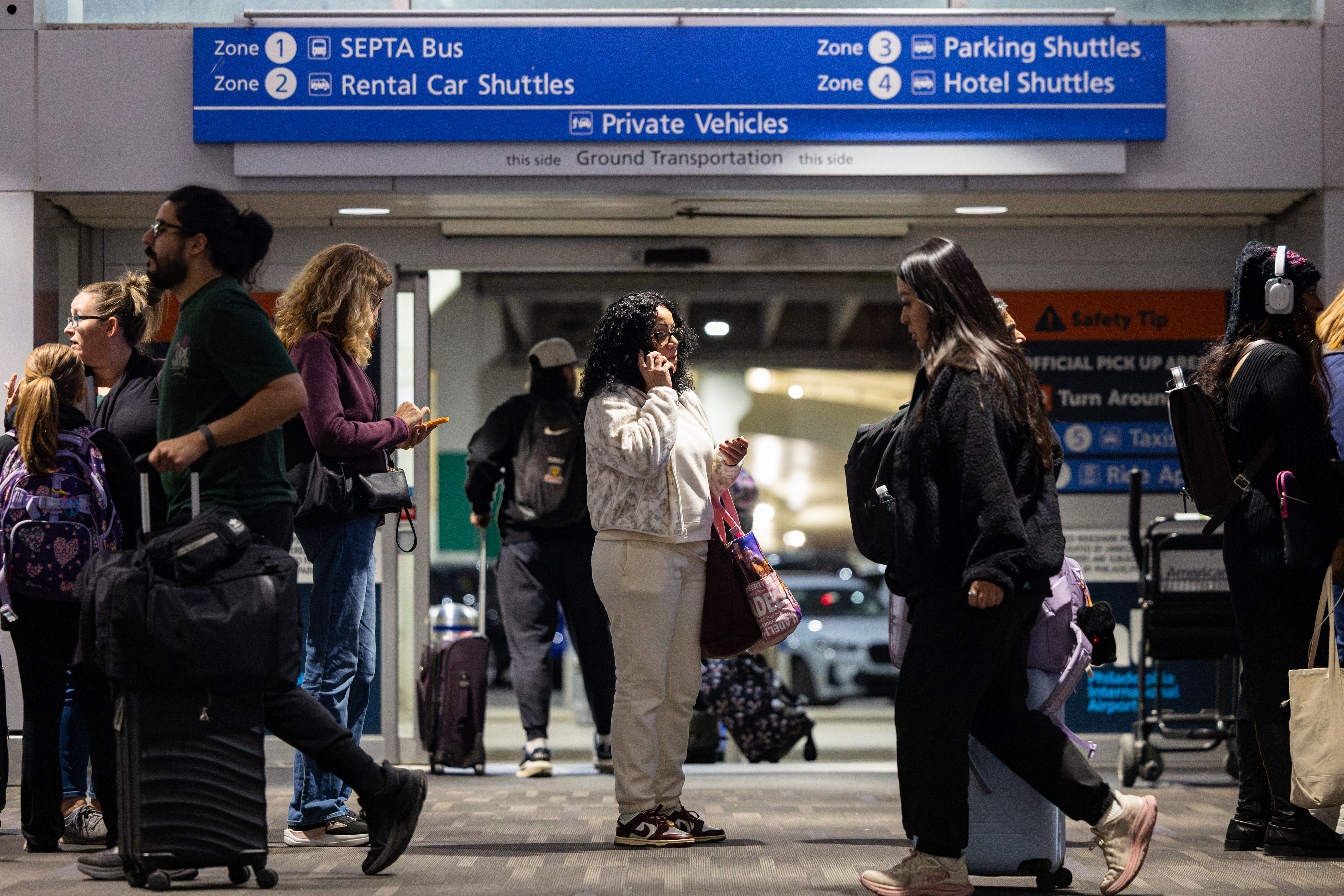
    On Thursday, an outage at Microsoft disrupted global communications. The following day, all flights in the U.S. were grounded for several hours by an equipment failure, according to government officials. United Airlines had its own issues Monday, where a system outage led to widespread delays.

    Also on Monday, a technical issue at JPMorgan Chase led to banking disruptions at several major U.S. banks and the money transfer service Zelle.

    There’s no indication any of these events were connected. But lumped together, they offer a collective sense of dread about a world where complex computer systems are globally connected and cyberattacks fueled by artificial intelligence-powered tools.

    “When we dig into the details, each one has an explanation that makes sense on its own,” University of Notre Dame professor Mike Chapple told the New York Times, “but they all point to a common theme: the complexity and fragility of the systems that we depend on every day.”

    Even FEMA acknowledged the inopportune timing, posted on social media they’ve “heard a lot of rumors” about the test.

    “No blackouts, no secret emergencies. Just our legally mandated, routine test on TV and radio,” the agency added.

  • U.S. loses measles elimination status as outbreaks spread, WHO says

    U.S. loses measles elimination status as outbreaks spread, WHO says

    Measles, a vaccine-preventable disease, is no longer considered eliminated in the United States, where the virus is now circulating continuously in outbreaks of growing size and scope, a regional division of the World Health Organization announced Tuesday.

    The United States is expected to submit a plan of correction to the Pan American Health Organization in the coming weeks. Mexico and Bolivia have also lost their measles elimination status, PAHO said.

    Pennsylvania is contending with the country’s largest outbreak in three decades, with more than 1,500 cases and seven measles-associated deaths confirmed so far this year. The state health department is still investigating an eighth death identified by a county coroner.

    While a clear sign that measles is once again endemic in the U.S., the statewide outbreak did not contribute to the PAHO decision, which was based on epidemiological data for a one-year period ending January 2026. The first cases in Pennsylvania’s outbreak were reported in April.

    The decision “was based on cases for the entire country, not a particular state,” Rhonda Sealey-Thomas, PAHO assistant director, said during a news conference Tuesday.

    During the review period, 48 of 52 U.S. states and territories reported measles cases, according to PAHO.

    Losing the symbolic designation represents a blow to public health, indicating that declining vaccination rates have enabled the highly contagious virus to spread from one community to the next.

    “It is a very solemn and disappointing marker of not being able to follow through with something that was very hopeful not all that long ago,” said Jennifer Hamilton, a professor of family, community, and preventive medicine at Drexel University’s College of Medicine.

    (function() { var l = function() { new pym.Parent( ‘he-elimination__graphic’, ‘https://media.inquirer.com/storage/inquirer/ai2html/he-elimination/index.html’); }; if(typeof(pym) === ‘undefined’) { var h = document.getElementsByTagName(‘head’)[0], s = document.createElement(‘script’); s.type = ‘text/javascript’; s.src = ‘https://pym.nprapps.org/pym.v1.min.js’; s.onload = l; h.appendChild(s); } else { l(); } })();

    The United States first achieved measles elimination status in 2000 after decades of public health efforts to raise vaccination rates. Two doses of the measles vaccine provide 97% protection against the disease.

    “The measles elimination designation is not what protects Americans. Vaccination does,” Erica Schwartz, director of the Centers for Disease Control and Prevention, said in a statement. “Losing a designation doesn’t mean we abandon an evidence-based approach. It means we remain focused on stopping outbreaks.”

    The agency did not immediately respond to a request for comment regarding when it would submit a plan of correction or what steps it would recommend.

    The CDC statement noted it has dedicated $100 million to state and local health departments to expand vaccination efforts. That includes $1.2 million for Pennsylvania.

    Because measles is so contagious — nine out of 10 unvaccinated individuals will get sick if exposed — communities must have exceptionally high vaccination rates to prevent an outbreak. Scientists say 95% of a community must be vaccinated to prevent measles from spreading.

    In Pennsylvania, more than half of the counties have measles vaccination rates below the 95% required for herd immunity.

    Pennsylvania’s Department of Health said that losing measles elimination status would not change the state’s focus on expanding access to vaccines and increasing education about vaccine safety.

    “Measles is entirely preventable, and the path forward is clear: the only way we can successfully stop future outbreaks, protect our most vulnerable residents, and regain our elimination status as a country is for more people to choose to get vaccinated and rebuild our community immunity,” Neil Ruhland, a spokesperson for the department, said in a statement.

    Here’s what to know about the change to the U.S. measles elimination status and Pennsylvania’s ongoing outbreak:

    What is measles elimination status?

    Measles elimination status, as designated by WHO and PAHO, indicates that measles is no longer circulating in the country, because enough of the population is vaccinated. The U.S. held the designation for about 25 years.

    How is elimination status determined?

    PAHO reviewed epidemiological data on case counts, outbreak size, and genomic sequencing data that can indicate whether outbreaks in different locations are connected. Measles is considered endemic when the virus is spread locally from one community to the next, rather than cases being brought in by visitors.

    Experts also review vaccination rates, which indicate how well a community is protected against a major outbreak when the virus is circulating.

    What would the U.S. need to do to regain its measles elimination status?

    The U.S. would need to curtail new measles cases and show that the virus has not spread continuously for at least 12 months. The required plan of correction should include efforts to increase vaccination and dedicate more funding to tracking and early detection of new cases, PAHO officials said.

    Did the U.S. lose its measles elimination status because of Pennsylvania?

    Pennsylvania is experiencing this year the largest outbreak in the country in 30 years. However, the outbreak here did not factor into the PAHO decision, which was based on cases between January 2025 and January 2026. Still, the outbreak in Pennsylvania shows how the virus has become endemic in the U.S., with cases spreading locally, rather than being brought in by visitors.

    Does losing the measles elimination status affect me?

    The loss of measles elimination status is largely symbolic, but indicates that measles is once again circulating significantly in the United States. Anyone who is unvaccinated is at risk, even if they live in an area with higher community vaccination rates.

    Responding to outbreaks is also expensive. The International Vaccine Access Center at Johns Hopkins University Bloomberg School of Public Health estimates that launching a public health campaign when the first measles case is identified costs more than a quarter-million dollars for contact tracing, vaccine doses, and public education outreach. Each additional measles case can cost between $10,000 and $16,000.

    At 1,500 cases, the university’s outbreak estimator tool predicted that Pennsylvania’s outbreak has cost the state, counties, and federal government at least $16 million. That does not include the toll on productivity, since people who are exposed are required to quarantine for 21 days, missing work and school.

    What is my community’s vaccination rate?

    Public health authorities use school vaccination rates as a proxy for community protection, because the MMR vaccine is among those required for school attendance. Pennsylvania reports school-level vaccine data for kindergarten, seventh, and 12th grades. Earlier this year Pennsylvania released an interactive search tool to help people look up local school-level vaccination rates.

    Why are measles vaccination rates declining?

    Measles vaccination rates have been declining for years, amid skepticism over vaccine safety. Shifting guidance about masking protocol and new vaccine development during the COVID-19 pandemic eroded trust in public health authorities. An anti-vaccination movement fueled by misinformation has gained prominence through some of the nation’s top health officials, including Health and Human Services Secretary Robert F. Kennedy Jr.

    Kennedy has recently said that the MMR vaccine is safe and effective, but spent years advocating against vaccination and pushing inaccurate claims that the vaccine contributed to autism.

    Pennsylvania is among just a handful of states that allows families to opt out for religious or philosophical reasons, in addition to medical reasons, often by simply printing and signing a form.

    Other states, such as New York, have tightened vaccine exemption, allowing families to send unvaccinated children to school only if they are medically unable to receive the shots.

    Is there a measles outbreak near me?

    Pennsylvania health officials update a dashboard tracking measles cases three times a week, so you can check to find out if there are measles cases in your county.

    Editor’s note: This story was updated with additional information about the national and state implications.

  • A guest at a Montco wedding flirted with other women’s husbands. She left in cuffs, police say.

    A guest at a Montco wedding flirted with other women’s husbands. She left in cuffs, police say.

    A wedding in Fort Washington turned violent over the weekend, investigators say, when two women were arrested for fighting with and resisting police officers.

    Samantha Dick, 30, was charged with assault of a law enforcement officer, resisting arrest, and related crimes after authorities said she head-butted, shoved, and spat on a Whitemarsh Township police officer who was dispatched to the Highlands Mansion & Gardens on Saturday for reports of a fight.

    Another wedding guest, Janet Nordheim-Remig, 65, faces charges of obstruction of law enforcement and resisting arrest after she allegedly attempted to block officers as they took Dick into custody.

    Both women remained in custody with bail set at $10,000 for Dick and 10% of $5,000 for Nordheim-Remig, according to court records.

    There was no indication either of them had hired an attorney.

    The incident started when Dick, of Bonita Springs, Fla., flirted with the husbands of other guests at the wedding, sparking a fight with another woman, according to the affidavit of probable cause for her arrest.

    A spokesperson for the Highlands did not immediately respond to a request for comment about the fight.

    Staff intervened and broke up the fight between Dick and Danielle Pellegrino, the affidavit said. Pellegrino was later issued a summary citation for harassment and released by police.

    But when officers tried to speak with Dick about the dispute, she refused to listen, and walked away from them toward her mother’s car parked nearby, the affidavit said.

    Nordheim-Remig, of North Wales, walked in front of the officers to prevent them from speaking with Dick, and ignored their commands to leave the area.

    At one point, Nordheim-Remig pushed one of the officers, the affidavit said. She was placed in handcuffs and taken into custody.

    Meanwhile, Dick, who smelled strongly of alcohol, refused commands to leave her mother’s vehicle, according to the affidavit.

    She shoved one of the officers in the chest, and was taken into custody, according to the affidavit. While handcuffed in the back of the officer’s vehicle, Dick head-butted him, and kicked another officer in the groin, the document said.

    Later, while left alone in the car, she slammed her head against its rear divider multiple times, the affidavit said.

    The women are scheduled to appear before a district judge on Nov. 25 for a preliminary hearing.