Blog

  • FAA temporarily stops router installations connected to air travel stoppage

    FAA temporarily stops router installations connected to air travel stoppage

    WASHINGTON — The Federal Aviation Administration has paused installing routers linked to last week’s ground stop that caused chaos for travelers, the agency said Tuesday.

    The move comes amid growing scrutiny over the nation’s air traffic control system and as the Trump administration is making a new request for $50 billion to improve air travel. Democrats in the Senate are demanding that the administration provide clear answers about what went wrong.

    President Donald Trump has blamed old technology and Democrats for the nationwide grounding of all planes and upheaval at the nation’s airports. But the FAA has been struggling to modernize the air traffic control system for decades — going back well before the first Trump administration.

    FAA spokesperson Ian Gregor said the agency paused new installations of Juniper routers and disabled the functionality of all existing ones on Friday after technicians linked the problems to a new router in El Dorado, Ark. The FAA has said that another router installed three weeks earlier in Amarillo, Texas, also went haywire.

    Maker of routers says devices were working properly

    The system became overloaded when the federal contractor that maintains the FAA’s telecommunications network was replacing outdated copper wires with fiber optic lines across the nation.

    The ground stop was needed, Transportation Secretary Sean Duffy said, after the new router that L3Harris installed in Arkansas resulted in a cascade of intermittent communications and radar signals at 17 of the 22 regional air traffic control centers. The centers direct planes cruising at high altitudes.

    The FAA said that “excessive data” was flooding the system “at a rate of 1,000 connection attempts every 4 to 5 seconds.” That deluge created instability with “aircraft communications and radar feeds,” the agency said.

    For now, the FAA is relying on older Cisco routers that have been in place for 25 years to continue operating the network while they investigate the cause of Friday’s trouble.

    The routers at issue last week are being tested in a lab at the headquarters of L3Harris.

    Hewlett Packard Enterprise, which owns Juniper, said in a statement that the company believes the routers were working properly when the ground stop occurred. “Based on what we know today, the device functioned as it was configured to by the installer. It did not fail or act improperly,” the statement said.

    Problems with FAA equipment are decades old

    Democrats on the Senate Commerce Committee said they believe that only 400 out of more than 3,600 new routers have been installed.

    “Identifying the device that failed does not establish why it failed. FAA must investigate further to determine the root cause and report to Congress on how it intends to prevent future issues,” the Democrats said in a letter sent to Duffy.

    Upgrading the nation’s air transportation system is an effort that Congress has dedicated significant sums to in recent years. The problems with aging equipment at the FAA date back decades and past efforts to modernize the system have come up short.

    Duffy has pushed Congress for billions more dollars to upgrade a system he said had been neglected for decades, saying again this week that much more is needed.

    Money would go to control towers, airport infrastructure

    The Trump administration on Tuesday sent a letter to key lawmakers outlining its request for $50.1 billion to modernize the system and make other improvements at airports.

    The request calls for $10.1 billion for updating the nation’s air traffic control system. Similar amounts would go toward boosting airport infrastructure, replacing or refurbishing terminals at high-impact hubs, constructing five new traffic control centers, and improving or replacing up to 140 FAA-owned air traffic control towers.

    “Congressional approval of these funds will equip the FAA to deliver to the American people a brand-new air traffic control system that is safer, smarter, faster, and more efficient,” the letter said.

    Congress approved $12.5 billion last year to modernize much of the key infrastructure that more than 45,000 flights a day rely on to reach their destinations safely. The funds were earmarked for replacing outdated technologies such as copper wires, floppy discs, and radars built in the 1980s, but much of that money will also go toward runway upgrades and other construction projects.

    Ground stop cost big airlines over $300 million

    Equity research and brokerage firm Bernstein estimated the ground stop and the weekend work needed to recover from it cost the four biggest U.S. airlines $345 million combined.

    Since work on the FAA’s communications network led to Friday’s flight halt, American Airlines, Delta Air Lines, United Airlines, and Southwest Airlines only had to offer cash refunds, credits, or a rebooking option to customers who decided to cancel their trips, Bernstein analysts said.

    The lost revenue and additional costs from the ground stop — estimated at $113 million for American, $96 million for Delta, $96 million for United, and $40 million for Southwest — still are enough to have a measurable effect on the four carriers’ quarterly earnings, the analysts wrote in a Monday research note.

    “A booking slowdown before Thanksgiving, or a second outage, would cost more than the weekend’s cancellations did,” the analysts said, adding they did not see any signs of waning ticket demand.


  • Marlton man charged with vehicular homicide after running two red lights before fatal Route 70 crash, police say

    Marlton man charged with vehicular homicide after running two red lights before fatal Route 70 crash, police say

    A Marlton man has been charged with vehicular homicide after he allegedly hit two cars along Route 70, killing a 63-year-old woman inside one, police said.

    Rajiv Fuller, 28, allegedly ran two red lights in his pickup truck on Nov. 6 while traveling westbound on Route 70, striking two occupied vehicles, one on Maple Avenue and the other exiting the ShopRite parking lot near the Route 73 interchange, the Evesham police department said Monday in a statement posted on Facebook.

    The driver of the sedan exiting the parking lot sustained serious injuries and later died, police said.

    Fuller was charged with first-degree aggravated manslaughter and second-degree vehicular homicide.

    He is being held at the Burlington County Jail.

  • LeBron’s admission about his shot, emulating Michael Jordan, and more from his ‘Mind the Game’ podcast

    LeBron’s admission about his shot, emulating Michael Jordan, and more from his ‘Mind the Game’ podcast

    If you ever wondered how LeBron James became, well, LeBron James, Tuesday’s episode of his Mind the Game podcast is the place to start.

    The 76ers star and cohost Steve Nash spent the episode talking about all things shooting, including James’ journey with the fundamentals, and how players deal with the mental side of that skill set.

    They even gave their opinions on the prettiest jump shots in the league’s history. James put Nash on his list, along with Ray Allen, Klay Thompson, Bradley Beal, Mitch Richmond, Devin Booker, and Chris Mullin, to name a few.

    Breaking bad habits

    While kids today are watching James and trying to emulate him, the 41-year-old’s journey began with trying to copy Michael Jordan.

    Without an understanding of the details of Jordan’s mechanics and balance, James said he’d try to imitate what the shot looked like, which created some bad habits with his fadeaway early on.

    “I didn’t know the details as a kid enough about shooting,” James said. “All I knew [was] that he was making shots and he was fading and it looked cool. So I’m going to do that.”

    During the early years of his career in Cleveland, James said he learned from Chris Jent, who worked on Mike Brown’s coaching staff. He’d watch Jent’s shooting and then work with the former Ohio State player to improve his own shot.

    James said he even asked Jent to accompany him during his Nike tours so they could get in extra work during the offseason.

    Jent had James doing basic repetition exercises to focus on details and give him a “platform” to build off. James said it taught him how to be uncomfortable and put in the work until his body couldn’t do things the wrong way.

    “It was super, super detailed, so when I did want to shoot my fadeaways, I had structure,” James said.

    But James still has some quirks in his shot. He and Nash admitted to being ball watchers when taking a shot rather than rim watchers. But James’ main quirk is his preference for not shooting against the grooves of the basketball, which affects him in a game sometimes. James said he’ll turn a shot opportunity into a pump fake to get the ball right before taking his shot.

    For this reason, James said he’s always quick to ask his teammates if they have a way they prefer to shoot the ball so it helps him when passing to them.

    “When I deliver it to you, either if you like the laces, the ball is coming to you like this, so it’s already in the pocket,” James said. “And if you don’t, then I know to put a little spin on it, too.”

    LeBron James on how he’s developing chemistry with Sixers teammates
    Video: LeBron James on how he’s developing chemistry with Sixers teammates

    On the line

    The episode’s fan question asked what a lot of fans often wonder: Why do some good NBA players struggle with free throws?

    As a career 73.7% free throw shooter, James said he didn’t want to answer the question. He said, for him, it’s not anything mental, the distance, or mechanics. James said if he could shoot a fadeaway instead, it’d feel more comfortable.

    While the pair was unsure if that’d be allowed, Nash did offer his explanation for why some players in the league struggle from the line.

    “It’s a million things,” Nash said. “I can’t exactly express it but I think some people just feel uncomfortable at the distance. Some people feel uncomfortable that now a game went from a fluid game to a static game, standstill. Everybody’s watching just you.”

  • Two newly approved developments will bring 309 townhouses to Sicklerville

    Two newly approved developments will bring 309 townhouses to Sicklerville

    A Lakewood developer has won approval to build 309 townhouses in two developments about three miles apart in the Sicklerville section of Gloucester Township.

    Each development, controlled by LLC firms owned by Jonathan Rubin, will have the same design, according to plans submitted to the Gloucester Township planning board. Both projects are in the town’s New Vision Redevelopment Area.

    The Oasis at Sicklerville will include 119 townhouses at 2 and 4 Independence Blvd. on 13.5 acres of land now owned by Lakeside Business Park LLC of Media. Rubin’s firm, Independence Boulevard LLC, will purchase the property, according to the application.

    The planning board approved the preliminary and final major site plan and preliminary and final major subdivision at its September meeting and memorialized the decision with a resolution at the Oct. 27 meeting.

    Located at the intersection of Williamstown-Erial Road and Independence Boulevard, the development is across from a Target and Lowe’s.

    A similar project, called The Palms at Sicklerville, will include 190 townhouses at 1000 and 1092 Williamstown Rd. on 20.3 acres, according to the application approved by the planning board in July with a resolution adopted in August.

    The developer, 1092 Williamstown LLC, also is owned by Rubin, according to the application.

    70and73.com is a hyperlocal news site focused on South Jersey, including the communities of Cherry Hill, Evesham, Mount Laurel, Voorhees, Medford, Medford Lakes, and Moorestown.

  • Claims by Netanyahu’s party of a ‘stolen’ Israeli election unravel

    Claims by Netanyahu’s party of a ‘stolen’ Israeli election unravel

    NAHARIYA, Israel — Since suffering heavy losses in Israel’s Oct. 27 election, Prime Minister Benjamin Netanyahu’s party has repeatedly claimed the vote was “stolen” by Arab-led parties, possibly with foreign assistance.

    Those claims appear to be crumbling as the longest-serving Israeli leader tries to cling to power.

    Israeli authorities say they have found no evidence to support the Likud party’s claims. And in a new setback to Netanyahu, Israel’s attorney general is looking into revelations that unsubstantiated claims of voter bribery originated with Netanyahu’s own staff.

    There are no signs Netanyahu was personally involved in wrongdoing. But his party’s unsuccessful attempts to discredit the election have left him in a weakened position as his chief rival, Gadi Eisenkot, moves ahead with efforts to form a new government and oust Netanyahu.

    Netanyahu’s office raised suspicions ahead of the vote

    Early on the morning of the election, Israeli police announced the arrests of three suspects in a Bedouin Arab town and said they had confiscated envelopes filled with cash. They said the men were suspected of paying people to vote for the Arab-led Ra’am party.

    Netanyahu immediately jumped on the announcement, calling it a “serious incident” and demanding a police investigation.

    Four additional suspects were arrested days later, and the incident would become a cornerstone of the Likud party’s campaign to discredit the vote, in which Arab-led parties posted strong gains in representation, jumping from 15 seats to 19 seats in the 120-seat Knesset.

    But the accusations quickly fell apart. A judge ordered all of the men released within days due to a lack of evidence, and none were charged.

    On Tuesday, after meeting with Israel’s internal security service, the Shin Bet, the country’s Election Committee said, “There is no evidence that bribes were paid to voters on a scale that could have affected the election results.” The committee said its investigation is ongoing but shifting to examine allegations of foreign influence, another Likud claim.

    Netanyahu’s office at center of investigation

    In the past few days, signs have emerged that the unsubstantiated allegations against Arab voters can be traced directly to Netanyahu’s office and allies.

    The information appears to have originated with Danny Greenberg, a former adviser to the prime minister on Arab affairs. Greenberg told Israel’s Yediot Ahronoth newspaper that he received a tip from a member of the Arab-led Joint List party whom he declined to identify. He said he then passed information to Netanyahu’s chief of staff.

    Earlier this week, Netanyahu’s office said the chief of staff, Ido Norden, was “doing his duty as a law-abiding Israeli citizen” by reporting a possible crime to police. He said his office had no further involvement.

    Israel’s police commissioner said Monday he would investigate the police handling of the affair. But late Monday, Israel’s attorney general ordered police to freeze the probe. Instead, she said she will hold discussions about a broader investigation, including a look at the communications between Netanyahu’s office and police close to election day.

    Rival says prime minister is a ‘threat’ to democracy

    Netanyahu’s bloc of religious and nationalist parties lost its parliamentary majority in the election, but Netanyahu remains in office as caretaker prime minister. The latest developments come at a bad time for him.

    In a possible first step toward unseating Netanyahu, Eisenkot’s allies installed their own parliament speaker, Matan Kahana, on Tuesday.

    That clears the way for Eisenkot to reverse some of Netanyahu’s more controversial policies while he continues to try to cobble together a majority coalition in the Knesset. Eisenkot faces his own struggles because he may be forced to rely on Arab-led parties, a potentially risky move.

    Netanyahu has sought to head off any alliance between Eisenkot and the Arab-led parties, pejoratively referring to them as “terror supporters.” Instead, he has called on Eisenkot to join him in a government under Netanyahu’s leadership.

    Eisenkot said this week that the actions of Netanyahu and his inner circle pose a “tangible, direct and immediate threat to Israeli democracy.”

    Yoav Dotan, a law professor at Hebrew University, said the Likud party’s attempts to discredit the vote were part of a larger pattern. Netanyahu has frequently made incendiary statements against Arab voters during elections.

    “It’s not surprising, because it’s not a bug, it’s a feature in his strategy during this election,” Dotan said. “The only point that might surprise someone is that it was pretty clumsy.”

  • Hegseth nominates his former aide to lead the Army

    Hegseth nominates his former aide to lead the Army

    WASHINGTON — After more than six months of delay, Defense Secretary Pete Hegseth has nominated Gen. Christopher LaNeve to lead the Army.

    Hegseth fired the Army’s previous chief of staff, Gen. Randy George, in April without explanation. That dismissal, along with the departure of Army Secretary Daniel P. Driscoll in August, has left the Army essentially rudderless as it struggles to adapt to the threat posed by cheap, deadly drones and missiles that have pounded U.S. bases in the Middle East.

    LaNeve, who previously worked as Hegseth’s senior military aide, is now serving dual roles as the Army’s acting chief of staff and its vice chief. Hegseth nominated Lt. Gen. Marcus Evans to serve as the vice chief of staff.

    Their nominations were sent initially to the White House for President Donald Trump’s approval. Earlier this week, the White House forwarded the nominations to the Senate Armed Services Committee, congressional officials said, speaking on the condition of anonymity to discuss sensitive personnel moves.

    “For 36 years, I’ve served in the U.S. Army, currently as the vice chief of staff,” LaNeve said in a statement. “I’m deeply honored by the president’s trust and confidence for the nomination to serve as the chief of staff of the U.S. Army, and, if confirmed, I look forward to continuing to serve our soldiers, their families, and our nation.”

    In most cases, senior military leaders who are nominated to lead their services are easily confirmed by the Senate. But it is not clear that LaNeve’s nomination can muster the necessary votes to advance, officials said.

    LaNeve was widely thought to be Hegseth’s top choice for the job, but the uncertainty surrounding support for his nomination has delayed the Pentagon from sending it forward. The Republican rout in the midterm elections could make LaNeve’s confirmation even less likely next year.

    Still, he must overcome serious doubts from GOP lawmakers who are frustrated with the way Hegseth has led the Pentagon and who are reluctant to vote for senior officers with close ties to the secretary.

    Sen. Joni Ernst (R., Iowa), who deployed to Iraq and served 22 years in the National Guard, has voiced repeated skepticism about LaNeve. This year, she suggested three alternatives to the White House. Her top choice was Gen. Christopher Donahue, who was serving as the top Army officer in Europe before Hegseth forced him to retire, officials said.

    Some lawmakers have quietly expressed hope that Donahue could return to active duty if Hegseth were impeached or forced to resign. For now, though, Hegseth’s job seems safe.

    Last week, House Republicans banded together to shelve an effort to impeach Hegseth, shielding him from a damaging rebuke and a potential ouster. Democrats have vowed to make another effort to impeach Hegseth in January when they will have a majority in Congress.

    The next few weeks will be critical for Hegseth, who will be pushing lawmakers to approve as much as $350 billion in new defense spending. The Pentagon badly needs that money to continue paying for the war with Iran and Trump’s ambitious modernization program.

    Hegseth’s decision to nominate LaNeve, despite the doubts about his fitness for the Army chief job, suggests that Hegseth is not chastened by the looming threat of impeachment and plans to continue to fight for his and Trump’s priorities.

    This article originally appeared in the New York Times.

  • Beloved Central Bucks English teacher Katherine ‘Kitty’ Semisch has died at 67

    Beloved Central Bucks English teacher Katherine ‘Kitty’ Semisch has died at 67

    Katherine “Kitty” Semisch, 67, of Doylestown, beloved English teacher, community organizer, writer, chef, and educator of thousands, died Monday, Nov. 2, of injuries sustained after she was struck by a bus.

    Mrs. Semisch’s presence reverberates through the countless lives she touched over 26 years of teaching at Central Bucks West High School. She was known to draw a squiggly star on every paper she graded; no star was the same, and she never sought perfection — just as she saw her students.

    Mrs. Semisch was struck and killed in the parking lot of the Bucks County Library in Doylestown. She was crossing the circle in front of the library when she was hit by the bus, police said.

    Mrs. Semisch was an educator who diligently reminded her students of their humanity, refusing to use the word utilize because, she would tell students, it was just use in a robot costume.

    When freshly graduated teachers landed jobs at CB West, she did not just offer advice in the break room. Instead, Mrs. Semisch invited them to her house to bond over home-cooked meals. After students graduated, and long into their careers, who was the person still checking on them decades later? Kitty Semisch.

    Katherine “Kitty” Semisch, left, and her husband, Mark Semisch, pose for a photo during a hike. The two met when Kitty was a freshman at the College of William & Mary, and married at 19 years old. Over their half-century of marriage, Kitty and Mark still held hands wherever they walked.(Courtesy of the Semisch family)

    She proudly defended the rights of LGBTQ+ students and their ability to see themselves in the books they read, including starting CB West’s first Gay-Straight Alliance club in 2002. She strived to ensure as many people as possible experienced kindness in an often-unforgiving world.

    In the op-ed pages of The Inquirer, she wrote about school districts censoring books, and she was prominently featured in the recent PBS docuseries Bucks County, USA as someone bridging the gap between communities torn apart by the COVID-19 pandemic and partisan politics.

    Mrs. Semisch had a saying, “Whole teacher, whole student, whole world,” meaning that when teachers bring their whole self and see their students as whole selves, only then can they change the “whole world.”

    Mrs. Semisch wrote numerous unpublished books with plans to write many more on a range of topics, including a Buddhist-influenced eco-tale for children called Owli and Kit, a book on becoming an adult, and another that reframes teachers as “Sherpas, not disciplinarians,” her daughter Lucy MacNichol said.

    Born Katherine Good in Rochester, N.Y., on Sept. 1, 1959, Mrs. Semisch was the youngest of five to Romer Good, a decorated U.S. Navy veteran of the Pacific theater, and Elaine Good (nee Gentle), a survivor of the London blitz. “She inherited a can-do spirit, a love for gardening and literature, and an exemplary model of how to raise a loving family,” the Semisch family said in a statement.

    As a young girl, Mrs. Semisch followed the events of the Civil Rights Movement, which left an indelible impact on her as she grew into an advocate for the rights of women and people of color. She was vehemently against apartheid and oppression, particularly the act of banning books, which she viewed as a “bellwether of totalitarianism and oppression,” MacNichol said.

    She went on to attend the College of William and Mary, where she met the love of her life, Mark Semisch, as a freshman. They were married at 19 years old two years later, and over their half-century of marriage, they still held hands wherever they walked.

    Mrs. Semisch was endlessly curious, and never one to simply ponder an idea but act on it. She learned to play the guitar, improvised her own recipes, embroidered for her grandchildren, cooked with the vegetables she grew, and sewed her own clothes.

    One of the many ways she shared her love was through food. From simple meals with friends to learning how to perfectly cook octopus with her grandson, she amassed a notebook filled with handwritten recipes.

    Katherine “Kitty” Semisch, center, and her two granddaughters pose for a photo. Semisch was known for her expansive recipe book that she used to delight family and friends, as well as her penchant for embroidering for her granddaughters.(Courtesy of the Semisch family)

    Former students and colleagues told of the moments her kindness broke through, and in many ways changed the course of their lives.

    “Kitty really showed me so many things about being an adult,” said Andrea Vidal, a lifelong friend and work mentee of Mrs. Semisch’s, who was a new teacher when they met. Mrs. Semisch would go on to share her own recipes and guide her younger colleague through not only work, but also life, later helping her choose her wedding dress and being present at her child’s birth. “Big and small, she was my person,” Vidal said.

    Mrs. Semisch often said of guiding others that “the point of being a Sherpa is not to get to the top of the mountain, but to learn everything that the mountain has to teach us, as we climb together,” said one of her former students-turned-educators, Talya Zemach-Bersin. Now the senior capstone coordinator and lecturer for education studies at Yale University, Zemach-Bersin carries much of Mrs. Semisch’s teachings with her, including adorning students’ papers with a distinct star.

    “I know who I am because I knew that she loved me. That was the kind of love she gave to thousands of us. That is the power of one little lady who had a lot of love to give,” she said.

    Kitty Semisch is survived by her husband, Mark; children Christopher Semisch, Maggie Semisch, and Lucy MacNichol; and three grandchildren.

    An open-house memorial service is scheduled for Saturday, Dec. 12, from 3 to 6 p.m. at the Doylestown Country Club, 20 Country Club Lane, Doylestown. A gathering of former students is planned for the same day, before the memorial service, at the Central Bucks West library from 1 to 2:30 p.m.

    The family encourages memorial donations to one of the many causes she championed, such as Planned Parenthood, the Center for Reproductive Rights, Heifer International, Amnesty International, or Rainbow Room.

  • Trump’s pick for Navy secretary acknowledges the Iran war is straining military resources

    Trump’s pick for Navy secretary acknowledges the Iran war is straining military resources

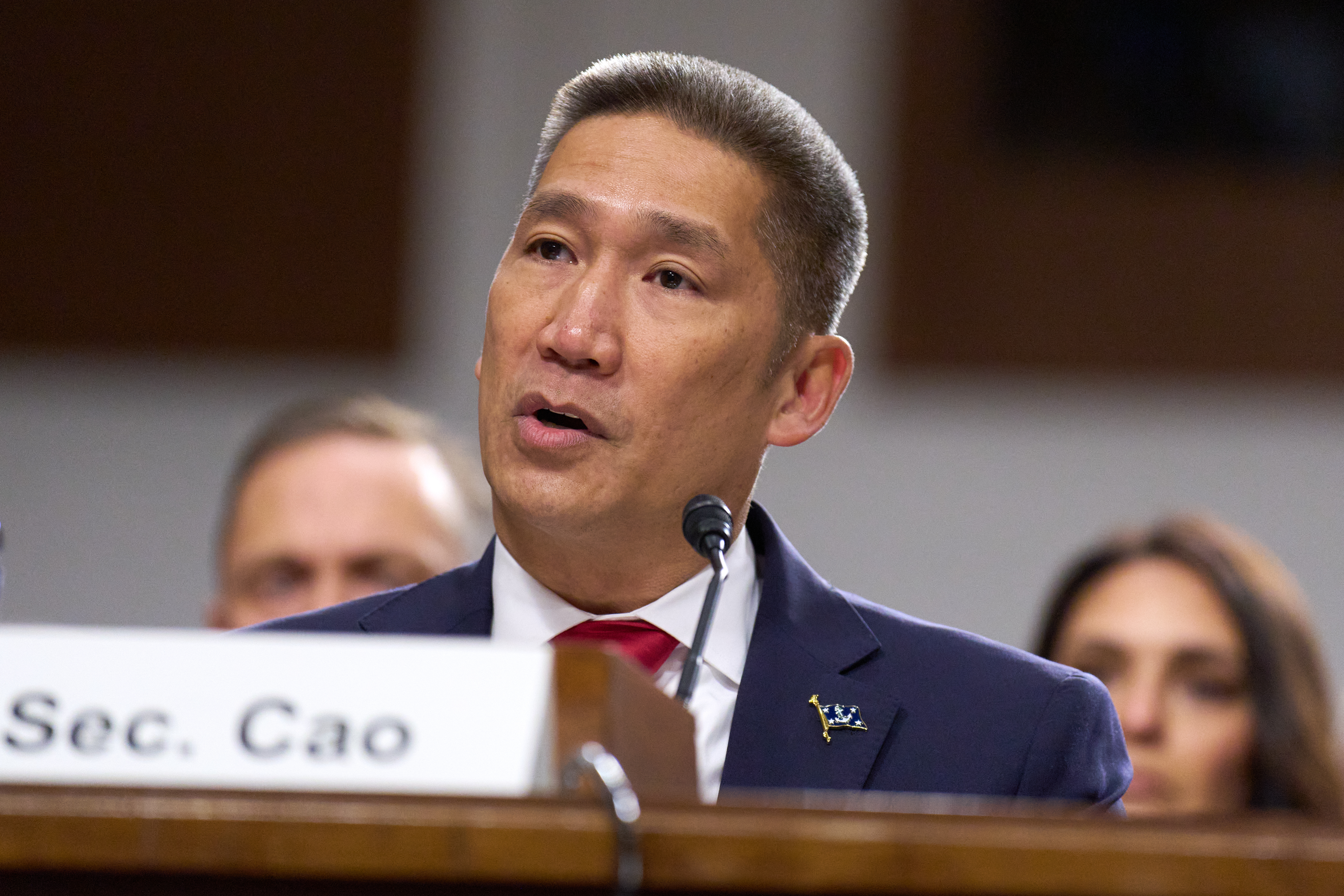
    WASHINGTON — President Donald Trump’s pick to lead the U.S. Navy acknowledged the strain of the Iran war as senators from both political parties pressed him at his confirmation hearing Tuesday about the impact of long ship deployments on sailors, drawdowns to stockpiles of advanced weapons, and resources being shifted away from countering China.

    Acting Navy Secretary Hung Cao, a Trump loyalist and combat veteran, is seeking the permanent top civilian job during a particularly volatile time in Washington. He also faces the extra hurdle of needing a waiver from Congress, because he left active-duty service less than seven years ago.

    “This war, again, I know it’s a strain on our Navy,” Cao told the Senate Armed Services Committee, but he insisted that “it’s really set China back on their heels” to see all the military services work together.

    Sen. Elizabeth Warren, a Democrat from Massachusetts, grilled Cao on the costs of the Iran war, noting that independent estimates or media reports say the naval blockade on Iranian shipping costs about $32.5 million a day and Iranian strikes on the Navy’s regional headquarters in Bahrain did at least $400 million in damage.

    Cao confirmed the figure for the blockade but said he could not offer a full damage assessment in Bahrain because “it’s a nonpermissive area for us to go,” despite telling a reporter months ago that Iran “blew the hell out of Bahrain.”

    The hearing offered a rare opportunity to question a top military leader publicly about the Iran war and other issues. It follows recent firings of Navy officials and a failed impeachment attempt in the House against Defense Secretary Pete Hegseth, partly over his handling of the 8-month-old conflict. Republicans lost the House and Senate in the midterm elections, which were widely seen as a repudiation of the war and will put Democrats in control of Congress in January.

    Cao faces questions over living conditions, mental health during long deployments

    Cao was asked to address concerns that lawmakers have raised over living conditions aboard warships deployed to the Middle East and sailors’ mental health, following reports of crew stress and supply shortages on the USS Abraham Lincoln aircraft carrier and other ships. The Lincoln endured a record-breaking deployment supporting the Iran war before returning to its homeport of San Diego in October.

    Republican Sen. Roger Wicker of Mississippi, who chairs the Senate Armed Services Committee, noted that the “incredibly challenging deployments” take a toll on sailors and their families.

    Sen. Mark Kelly, a Democrat from Arizona, said his office had received “reports of not enough food and inadequate basic necessities” from other warships that are now deployed.

    “One parent told us that there’s their kid, lost more than 45 pounds in six months because of a lack of food,” Kelly said.

    Cao said he was focused on sailors’ welfare but argued that sailors going hungry was “like my kids opening up the refrigerator door and saying there’s nothing to eat in here.”

    When asked about suicide attempts aboard the ships, Cao told Sen. Richard Blumenthal, a Connecticut Democrat, that what he saw “as eight suicide attempts, I see as eight suicide mitigations.”

    Cao says the Navy is making progress on munitions

    The conflict with Iran has strained U.S. stockpiles of air defense interceptors as well as other missiles such as the Navy’s Tomahawk cruise missile, which can be fired offshore by a ship but strike targets hundreds of miles inland.

    GOP Sen. Deb Fischer of Nebraska pointed to concerns about the dwindling munition stockpiles, while fellow Republican Sen. Joni Ernst of Iowa also noted the strain to Navy resources of maintaining the blockade on Iranian shipping.

    Sen. Jack Reed of Rhode Island, the committee’s ranking Democrat, said in his opening remarks that “the munitions expended and damage sustained from Operation Epic Fury alone will take years to recover.”

    When lawmakers raised concerns over munitions stocks, Cao said there’s been a boost in production of Tomahawks and other weapons.

    “When I was in uniform, we only produced 125 Tomahawks a year. Right now we’re well above 60 every month,” Cao said.

    He said efforts are also underway to boost the production of interceptors that are used by Navy ships to shoot down incoming missiles.

    However, Cao also conceded that the Navy has taken to using expired munitions, comparing it to adding water to expired bread and putting it in the microwave. He didn’t identify the specific munitions involved.

    “For some of these munitions, we recoded them. And so we’re able to shoot off the expired munitions,” Cao said.

    Democrats press Cao on recent Navy firings

    Democratic lawmakers say the Navy failed to inform Congress that it fired the entire leadership team of a nuclear-powered attack submarine after an underwater collision. Separately, the sea service fired the commander of a destroyer deployed to the Middle East.

    Cao made the case against the Navy’s traditional policy of publicly announcing the removal of commanders and instead argued that he wants “to make sure that we don’t destroy their careers.”

    “We relieve commanding officers for everything from negligence to even just fraternization or, you know, harassment,” Cao said, “and I want to make sure that we’re protecting their livelihood afterwards as well.”

    Trump nominated Cao for the permanent job in September. Cao has been serving as acting Navy secretary since April after John Phelan’s departure, which came with little public explanation. Before that, Cao was serving as Navy undersecretary and had run an unsuccessful Republican bid in 2024 to unseat Virginia Democratic Sen. Tim Kaine.

    Cao fled Vietnam with his family as a child in the 1970s before attending the U.S. Naval Academy. He was commissioned as a special operations officer and went on to serve with SEAL teams and special forces in Iraq, Afghanistan, and Somalia, according to his Senate campaign biography.

    Cao left active duty in 2021. To take the secretary post, he needs a waiver from a law that prohibits military officers from serving as a service secretary until they have been retired for at least seven years.

    A similar law, which has been on the books since the end of World War II, exists for the secretary of defense and is designed to ensure truly civilian control of the military. Congress has only granted exceptions three times for that post — twice in the past decade, for retired Marine Gen. James Mattis during the first Trump administration and retired Army Gen. Lloyd Austin under President Joe Biden.

    In each case, Republican and Democratic lawmakers expressed an aversion to waiving the requirement and setting precedent for future exceptions. They raised concerns about further erosion of the already precarious concept of civilian control of the military.

  • Apple joins a parade of technology hiccups in recent days

    Apple joins a parade of technology hiccups in recent days

    An update gone awry at Apple followed a rash of major outages in recent days, among them the Federal Aviation Administration, United Airlines, and Microsoft, highlighting the risks that go along with the massive scope of modern technological platforms.

    Apple acknowledged on its system status page that its Apple Music, App Store, and AppleCare services suffered full outages and that its iCloud sign-in interface was designated as also having issues. The technology monitoring site Downdetector.com showed a spike in user complaints about Apple Pay as well.

    “Many of our systems are back up and running after an internal update caused some outages this morning,” the company said in an emailed statement. “We’re working to get the remaining systems online as soon as possible.”

    Marriott International, the largest U.S. hotel operator, was also having technology issues that guests reported had impacted reservations and check-ins, among other problems, according to users posting on Reddit. Downdetector.com also reported that Marriott was experiencing an outage.

    Marriott, which has 10,200 properties and more than 1.8 million rooms under its corporate umbrella, had not responded to an email inquiry from the AP.

    The outages at Marriott and Apple are just the latest in a string of technology breakdowns in recent days.

    The Washington Post reported Tuesday that a key internal communications system used by employees of the National Security Agency to exchange classified messages was out of commission, according to three current and former U.S. officials.

    The reasons for the outage involving NSA Net were not immediately clear. But a former Pentagon official said it was significant enough to force the intelligence agency to delay employees’ arrival times at its headquarters at Fort Meade, Md., and other locations.

    On Monday, a system outage at United Airlines lasted more than 90 minutes, forcing the carrier to delay departing flights. The problem at United came just days after a malfunction in the Federal Aviation Administration’s network prompted a nationwide ground stop that delayed hundreds of flights and stranded hundreds of thousands of travelers across the country.

    Chicago-based United said there was no indication that its outage was cybersecurity related.

    Also Monday, thousands of customers reported difficulty accessing online accounts at several major U.S. banks and the money transfer service Zelle after a technical issue at JPMorgan Chase caused ripple effects throughout the financial system.

    Chase said Monday that the technical problems were not the result of a cyberattack, and as of Tuesday confirmed that the bank’s systems were back up and operating normally.

    Last week, a global Microsoft outage disrupted email and other workplace tools, plunging business chatter and everyday services into disarray worldwide. Microsoft 365 services, including Outlook, Teams, and AI assistant Copilot, were interrupted.

    The tech giant said that there was “no indication” that the disruptions were caused by malicious activity, specifically noting Friday that the outage was not related to a cyberattack or artificial intelligence agents.

  • Ukrainian strikes send large section of Crimea bridge into the sea

    Ukrainian strikes send large section of Crimea bridge into the sea

    A large section of the only bridge linking Russia to the occupied Crimean Peninsula collapsed into the sea Tuesday after a series of Ukrainian strikes, according to photographs and video released by the Ukrainian government, and statements from officials in Kyiv, Ukraine’s capital.

    Russian officials, who temporarily halted traffic on the structure, the Kerch Strait Bridge, acknowledged the damage and vowed to repair it.

    The Ukrainian strikes were the culmination of years of attacks aimed at bringing down the bridge, a hulking symbol of Moscow’s control of Crimea, which Russia illegally annexed in 2014. The bridge is also a lifeline supplying Russian troops.

    President Volodymyr Zelensky of Ukraine said in a statement that the attack came after months of planning. After degrading or destroying nearby air defenses, Zelensky said, Ukraine struck with missiles and drones.

    While destroying the bridge has long been a top Ukrainian objective, Zelensky framed the strikes as a response to recent Russian attacks on Ukraine’s bridges and other infrastructure.

    Hours before his statement, seven Russian ballistic missiles slammed into bridges over the Dnieper River in Kyiv. The bridges were temporarily closed, Ukrainian officials said.

    Zelensky said, “We have repeatedly offered Russia steps toward de-escalation — and every proposal has been met with loud rejection.”

    “We will never leave terror against our cities and people unanswered,” he added.

    The Kremlin spokesperson, Dmitry Peskov, noted that President Vladimir Putin had been briefed on the attack. “There is no doubt that the bridge will be restored and will be even better than the previous one,” he said in a statement.

    The strikes on bridges hundreds of miles from the front lines were part of a long-running battle involving logistics, symbols, and survival. Heavily fortified bridges are some of the hardest structures to bring down using long-range weapons.

    The 12-mile Kerch Strait Bridge was opened in 2018, four years after Russia seized Crimea, and cost $3.7 billion. It has come under repeated attack by Ukraine since Moscow’s full-scale invasion in 2022, both through sabotage operations and bombardments.

    With each attack, Moscow has stepped up defenses, making the bridge one of the world’s most heavily protected pieces of infrastructure.

    The defensive shield includes batteries of long- and short-range air-defense systems, backed by electronic jamming equipment and smoke generators to blind incoming missiles. In the water, Russian forces have anchored rows of sunken and floating barges linked by boom barriers and nets to block drones. The authorities also installed vehicle-screening checkpoints at both entrances.

    The operation to breach those defenses played out over several weeks, according to Ukraine’s domestic intelligence service, the SBU. Ukrainian forces hunted down radar stations and air-defense batteries across Crimea, tearing a hole in the umbrella shielding the strait, according to Ukrainian officials.

    Ukraine attacked the bridge Monday. A wave of drones struck a central arch, bending the steel ribs and leaving the support tilting under the weight of the road suspended below, officials said.

    Before Russian engineers could stabilize the structure, Ukraine launched a second barrage of drones alongside its domestically built Flamingo cruise missiles, which carry warheads large enough to sever steel girders.

    When those missiles slammed into the weakened span, the arch buckled completely, sending the roadway plunging into the water.

    Artem Dekhtiarenko, an SBU spokesperson, said in a statement, “For years, the Russians have convinced the whole world that the Crimean Bridge is one of the most protected objects on the planet.”

    “Today, parts of it lie on the seabed,” he added.

    Footage from a Ukrainian drone shows a warhead flying toward the bridge before seemingly losing its connection. The video was first posted by a former adviser to the Ukrainian government and was later reposted by the drone’s manufacturer.

    A second drone video released by the SBU showed the aftermath of the attacks, with the arches and deck of the eastern side of the bridge destroyed. Social media video circulating Tuesday, verified by the New York Times, also shows a section of the eastern side destroyed, as seen from the shores of Crimea.

    The Kerch bridge consists of two parallel spans — one for road traffic and another for rail — resting on long steel girders supported by reinforced concrete pillars driven into the seabed.

    Near the center of the strait, both decks rise into a pair of huge steel arches that lift the roadway some 115 feet above the water so large cargo ships can pass below.

    Because the span is divided into hundreds of sections, destroying one stretch does not cause a chain reaction across the rest of the bridge, making the structure difficult to knock down completely.

    Ukraine has struck the bridge at least three times in the past.

    In 2022, a truck laden with explosives detonated on the bridge, collapsing roadway spans and igniting a passing fuel train. Ukrainian forces followed up with a strike in July 2023 using naval drones that damaged the road deck. In June 2025, Ukraine conducted an underwater demolition operation involving more than a metric ton of explosives against the bridge’s submerged support pillars.

    This article originally appeared in the New York Times.