REYKJAVIK, Iceland — Iceland’s voters rejected restarting negotiations to join the European Union in a referendum that pitted concerns about geopolitical stability against keeping national control of Iceland’s prized fisheries, officials said Sunday.
Opponents defeated the measure by a margin of 52.8% to 47.2%, the National Electoral Commission said. The result puts the divisive issue to rest for now — more than a decade after a euroskeptic government ended EU talks that had begun after the 2008 financial crisis.
The vote Saturday was held in the shadow of repeated threats by U.S. President Donald Trump to take control of nearby Greenland. Although Iceland is a NATO member, supporters said European solidarity would provide greater protection if Trump ever made similar threats toward the volcanic island.
Iceland’s left-leaning coalition government, elected in 2024, moved up the EU referendum it had planned for next year after Trump mistakenly named Iceland four times while speaking about his designs on Greenland.
Voters faced a simple question
Prime Minister Kristrún Frostadóttir said she did not see the loss as a setback for her coalition government but as a win for democracy as more than 82% of the eligible 270,000 voters cast ballots. She said she would respect the result but would not rule out a future attempt to reopen the issue.
“Things happened in the past couple of years, though, that I could not have predicted,” she said. “But this government will not go forward with it. And something big has to change in the next 24 months for this to be at the top of the agenda.”
Guðrún Hafsteinsdóttir, leader of the opposition Independence Party who opposed the measure, said the result is a blow to the government but not European relations.
“The best way to heal the wounds is for the government to listen to the conclusion and put this path aside,” she told RUV, the national broadcaster. “Because we want to remain in close contact with the European Union, Europe, and as many other countries as possible, the nation is sending a clear message that we intend to steer that course ourselves.”
Voters faced a simple yes-or-no question: Should Iceland resume accession negotiations with the European Union?
The capital of Reykjavik was the only area in the island nation of 400,000 people where a majority supported the referendum.
The influential fishing industry led opposition to the referendum over fears the bloc’s common fisheries policy would open its waters to Spanish, Dutch, and other trawlers.
Iceland is already in the EU single market
Descendants of Vikings, Icelanders, who won their independence from Denmark in 1944, have lived off the sea for centuries, and fishing is central to their national identity. Iceland has a proud history of refusing to be pushed around by bigger and richer European nations, winning the so-called Cod Wars with Britain in the 1970s over the right to control its waters.
Opponents also rallied around the fact that Iceland already reaps benefits from being in the EU’s frictionless single market and the Schengen free-travel zone without the sovereignty compromises that come with full membership. They argued that Iceland’s voice would be muted in the large European Parliament and that it would be better off cutting its own trade deals, such as one with China.
Backers said EU membership would lower inflation and interest rates, and the euro would bring more stability than Iceland’s volatile króna currency. They said it was also in the nation’s interest to get closer to its European neighbors to tackle issues that don’t respect borders, such as climate change.
Other countries face a more difficult path to EU membership
If the proposal had been approved, it would have been a preliminary step to revive the lengthy negotiating process with the EU’s executive branch, the European Commission, to discuss areas from the economy to human rights. Voters would have needed to approve any negotiated deal.
The result is sure to disappoint many in the European Union. As a wealthy, stable, and democratic country with vast fishing grounds, Iceland could have joined the bloc relatively quickly. Croatia was the last country to join, in 2013.
Most of the other candidates waiting — including several countries in the Balkans, plus Moldova and conflict-torn Ukraine — must still undertake time-consuming reforms to bring their laws and standards into line with those of the EU.
Getting Iceland into Europe’s rich club, perhaps along with Montenegro and possibly Moldova, over the next two years could have helped to lay to rest the damage to the EU caused by the departure of Britain in 2020, even though London now appears willing to mend ties.
Voter Daniel Bjarkason, who opposed the measure, said Iceland should wait a decade or two before trying again to join the EU.
“For now we’re too divided and that’s not a good look,” he said. “It should be 70-30 Yes if we’re going to do it.”
Iran’s supreme leader called on Muslim countries to stand together against Israel and the United States, imploring them to “know your real enemy.”
U.S. broadcaster NBC said Israeli settlers attacked a team of its journalists in the occupied West Bank. A British activist faced deportation after Israeli settlers seized him and turned him over to police. And an Israeli airstrike in central Gaza killed at least two Palestinians, including a 3-year-old boy, hospital authorities said.
Here’s a look at the latest developments Sunday in the Iran war and the wider Middle East. Full coverage can be found here.
Iran’s supreme leader urges regional unity
Iran’s new supreme leader, Ayatollah Mojtaba Khamenei, urged Muslim cooperation and unity in a letter to religious leaders from Islamic countries attending a conference in Tehran, Iran’s official IRNA news agency reported.
Khamenei called the U.S. and Israel enemies of all Islamic nations. “My enduring and repeating advice to rulers of Islamic nations is to know your real enemy, understand its plans and confront it,” he wrote.
Six months after the U.S. and Israel attacked Iran, killing Khamenei’s father and other senior leaders, Khamenei has not been seen publicly.
The war has exposed deep divisions in the Muslim world after Iran struck targets in neighboring Gulf Arab countries and restricted movement through the Strait of Hormuz. Tehran has opposed the U.S. military presence in neighboring nations.
NBC says settlers attack journalists in West Bank
Settlers attacked an NBC crew in the central West Bank on Saturday as they were interviewing a Palestinian woman who said she’d been driven out of her house, the network said.
Correspondent Matt Bradley, two other crew members, and the woman were treated for injuries, NBC said, giving no details about them.
NBC shared footage showing masked settlers approaching the crew with sticks and beating their vehicles.
Israel’s military said it was “aware of reports of Palestinian injuries, including a Palestinian woman who sustained non-life-threatening injuries and was evacuated by the Red Crescent for medical treatment.” It did not comment on the attack on the NBC crew.
Prime Minister Benjamin Netanyahu issued a rare condemnation of the violence on Saturday, after a growing wave of violence by settlers in the West Bank. The Israeli leader has come under U.S. criticism for the attacks.
Settlers seized a British activist, lawyer says
Israeli settlers seized a British activist from a Palestinian village in the West Bank on Saturday and locked him in a shed before turning him over to police, his lawyer said Sunday.
Inbar Shaked Vardi said settlers held Finn Joughin for half an hour. Video showed two settlers, one armed, restraining Joughin and marching him away.
It was not clear what led to his capture. Settlers alleged he assaulted a child, which Vardi denied. Settlers pointed to a video where the activist uses his body in an apparent attempt to block a settler boy from passing through a fence. Vardi said the video shows he was trying to protect the village.
“Without any hearing, the police has decided to move him to deportation, which just shows that this entire case has been political in the first place,” Vardi said later, adding that Joughin would likely be deported Sunday night.
A spokesperson with the U.K. government’s Foreign, Commonwealth, and Development Office said embassy officials have raised the case with Israeli authorities and were seeking information.
Israeli strike kills 2 Palestinians in Gaza, including a child
An Israeli strike hit a group of people in the western part of Deir al-Balah, killing a 3-year-old and a man who Israel’s military called a Hamas operative.
The military in a statement identified the man as Hassam Osama Hussein Nasir. It said he had “posed an immediate threat,” without providing evidence.
Another Palestinian was wounded, according to Al-Aqsa Martyrs Hospital, which received the casualties.
The deaths were the latest in Gaza since a fragile October ceasefire deal attempted to halt more than two years of war between Israel and Hamas. Gaza’s Health Ministry says Israeli fire has killed at least 1,318 Palestinians since that truce.
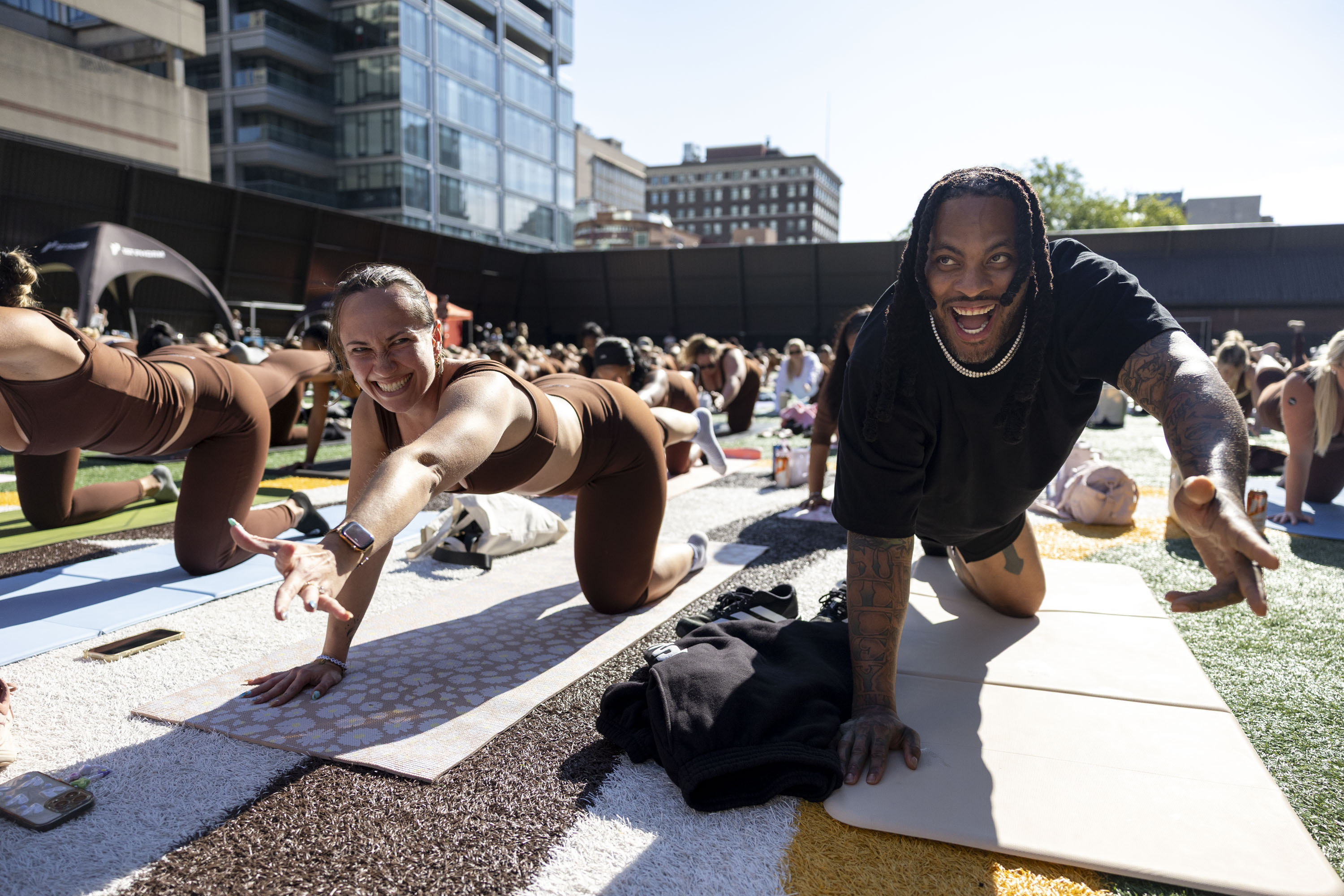
Early Saturday morning, I clambered out of bed and pulled on the required brown Spandex. With my hair slicked back into a ponytail, I hustled down to Friends Select School in Center City, a yoga mat slung over my shoulder. There, on the private school’s rooftop turf, awaited hundreds of my peers all clad in the variations of the same Jacklyn.fit-branded workout set, the allure of complimentary energy drinks and facials, and the promise of rapper Waka Flocka Flame.
This was Sweat & Sculpt, a mat Pilates class slash wellness bazaar slash concert. It’s the brainchild of influencer and Sea Isle City native Jacklyn Romano (aka Jacklyn.fit online), who bills the women’s workout-palooza as a “one-of-a-kind celebration of female empowerment, fitness, and community” and the “largest women’s event” in Philadelphia. That’s a difficult superlative to quantify, but organizers said there were more than 800 women in attendance.
“A lot of people are like, ‘Wait, is this real? Like 800 girls in matching workout sets and Waka Flocka?’” Romano told me. (Nearly everyone I told about this event had a similar reaction, with notably more expletives. One friend texted me, “I can’t even believe that’s a real sentence.”)
That singularity is what interested me — how someone could successfully marry a $120 “viral Pilates event” and the song “No Hands.” A TikTok commenter said it best: “Pilates & Waka is a diabolical combo.”
So I went, I worked out, I Waka’ed. And I didn’t expect to leave feeling so girly and giddy and genuinely moved by the body-positivity of the same man who wrote “Round of Applause.”
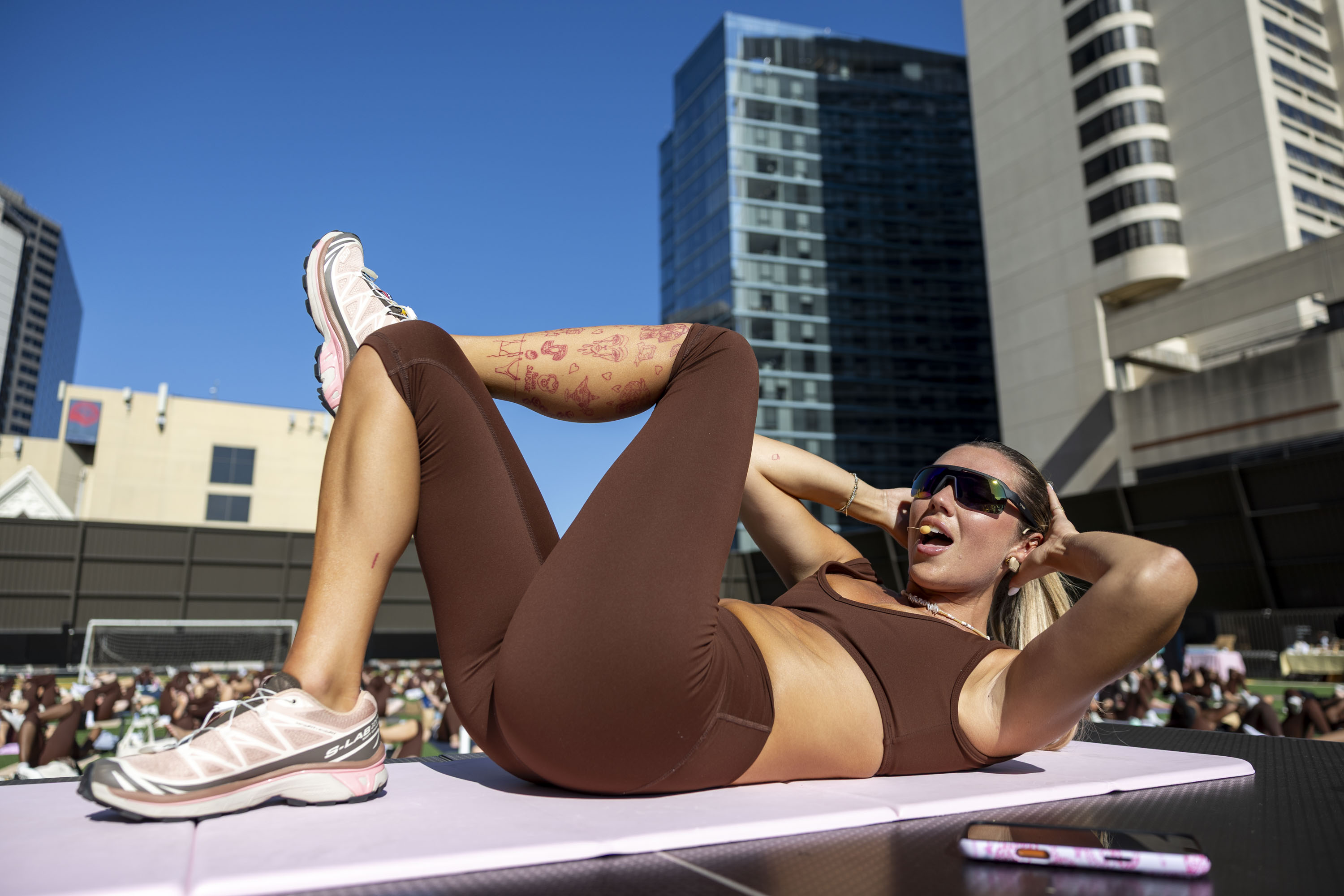
Influencer Jacklyn Romano leads Sweat & Sculpt at the Friends Select School on Saturday, Aug. 29, 2026, in Philadelphia.Tyger Williams / Staff Photographer
Sweat & Sculpt’s mantra
Six years ago, Romano’s brick-and-mortar fitness business was thwarted by COVID-19, so she pivoted to Zoom classes. Then, three years ago, she parlayed her online success (some 111,000 followers on Instagram and 20,600 on TikTok) into in-person activations — a burgeoning trend of social media stars taking their shtick on the road. This spring, for example, I wrote about another influencer, TikTok’s “Dense Bean Salad Girl,” who sold takeout containers of her signature salads at a pop-up near Rittenhouse Square.
A trainer for nearly a decade, Romano said she had always looked for an event like the one she ended up creating with Sweat & Sculpt: An inclusive space for women to get fit, make connections, and feel powerful. Despite the steep admission fee — which included the brown bra and your choice of leggings or capris, with an optional, additional $20 tank top — Saturday’s Sweat & Sculpt was the largest yet, according to Romano. (Full disclosure, I was comped my ticket and athletic garb because I was writing about the event.)
“Once [these women] leave here, they’re also shining from the inside out,” Romano said. At 8:45 a.m., she was already bubbly and energetic, bouncing from fan to fan and selfie to selfie. As we chatted briefly, her tooth gem caught the morning sun and her red-ink patchwork tattoos peeked out from her capris.
“They’re leaving with new friends, they’re leaving with a new form of confidence, they’re trying something new,” she said.
Cousins Dakota Hurwitz, Caitlyn McHugh, and Crystal McHugh have followed Romano for years. They’ve watched as her events grew fortyfold, from 20-person classes in Sea Isle to filling up soccer fields. Here, they said, they found community.
“It’s more than just a workout class,” Hurwitz, 26, of Bucks County, said.
Crystal McHugh, 31, of Northeast Philly, added: “It’s not just [about] confidence, it’s empowerment.”
Admittedly, before this event, I was not familiar with Romano. I recently deleted most social media apps from my phone, expressly because of the constant barrage of body checking, nutrition misinformation, ads for fat-loss miracle drugs, and commentary on what women should or shouldn’t look like. It started to feel like a nightmarish echo chamber of shame.
Romano’s brand, she said, defies that: The workout sets come in an expansive size range, from XS to 4X, and she encourages people to “worry about how you feel” but “not how you look.”
“I try to take a positive spin onto social media,” she said. “On our page, you get to see every different kind of person. No matter what size, what fitness level, what race, what religion — we all come together and we all want to empower each other.”
The workout
Sweat & Sculpt was promoted as low-impact, body-weight mat Pilates.
Don’t be fooled. That doesn’t mean easy.
I’m an ex-ballerina who’s been doing Pilates since age 11. I’m 27 now, so that’s more than 15 years of — albeit on again, off again — Pilates practice. At one point, I was taking as many as five mat classes a week; nowadays, my exercise routine consists of long walks, occasional reformer Pilates, and a weekly gym session with a personal trainer.
Yet by the second set of single-leg glute bridges, my hamstrings were burning. Then came a three-minute ab circuit. According to my Apple Watch, over 42 minutes, I burned 144 calories and my heart rate reached 167 beats per minute, more than double my resting rate.
As my arms and legs started to shake, I certainly felt that sense of camaraderie and support Romano talked about: her steady stream of affirmations — “Hang tight, ladies!” — blasting over the speakers; the smiles from the women around me; finding comfort knowing that I was not alone, that we all signed up to be breaking a sweat at 9 a.m.
Eleven mats down from me, 6-foot-6 Waka Flocka Flame cried, “Call the paramedics!”
“Why not bring in someone who’s iconic to our generation of women and just make it fun?” Romano said. The chorus “Girl, the way you’re moving got me in a trance. …” once filled gymnasiums on prom night; hearing “‘Rain, rain, go away,’ that’s what all my haters say,” teleported me back to a college bar, my heeled booties sticking to a White Claw-laden floor.
Waka Flocka Flame performs some of his hit songs after the Sweat & Sculpt Pilates class at the Friends Select School on Saturday, Aug. 29, 2026, in Philadelphia.Tyger Williams / Staff Photographer
But before he performed his medley, Waka, whose given name is Juaquin Malphurs, took time to answer audience questions, offering reassurance to one new mom in the crowd:
“I need you not to be hard on yourself postpartum,” Malphurs, who is also a new dad, said. “The woman that you’re gonna be is not the woman you see today, and you’ll get there — don’t worry.”
“Give your body some time … then fight the fight.”
Afterward, I spoke to Tamika Ford, who was coincidentally also seven weeks postpartum.
She came Saturday morning worrying — “I’m going to be so out of shape,” she thought — and left feeling fun and light-hearted and buzzing with encouragement.
On a cloudless afternoon in July, Nicole Sweeney was on a charter boat off the southeastern corner of Massachusetts’ Cape Cod, cruising through blue-green water as smooth as sea glass. Conditions were perfect for a dunk in the ocean, but swimming was resoundingly off the table.
That’s because if all went to plan, Sweeney would soon come face to face — or at least face to fin — with a great white shark.
“When I was a kid, sharks were not something we ever thought much about,” said Sweeney, 55, who has visited Cape Cod every summer since she was born. “Now you can’t go anywhere on the Cape without finding a coaster or a keychain or a mug with a shark fin on it.”
The onslaught of great white merch is more than mere leftovers from last summer’s 50th anniversary of Jaws.
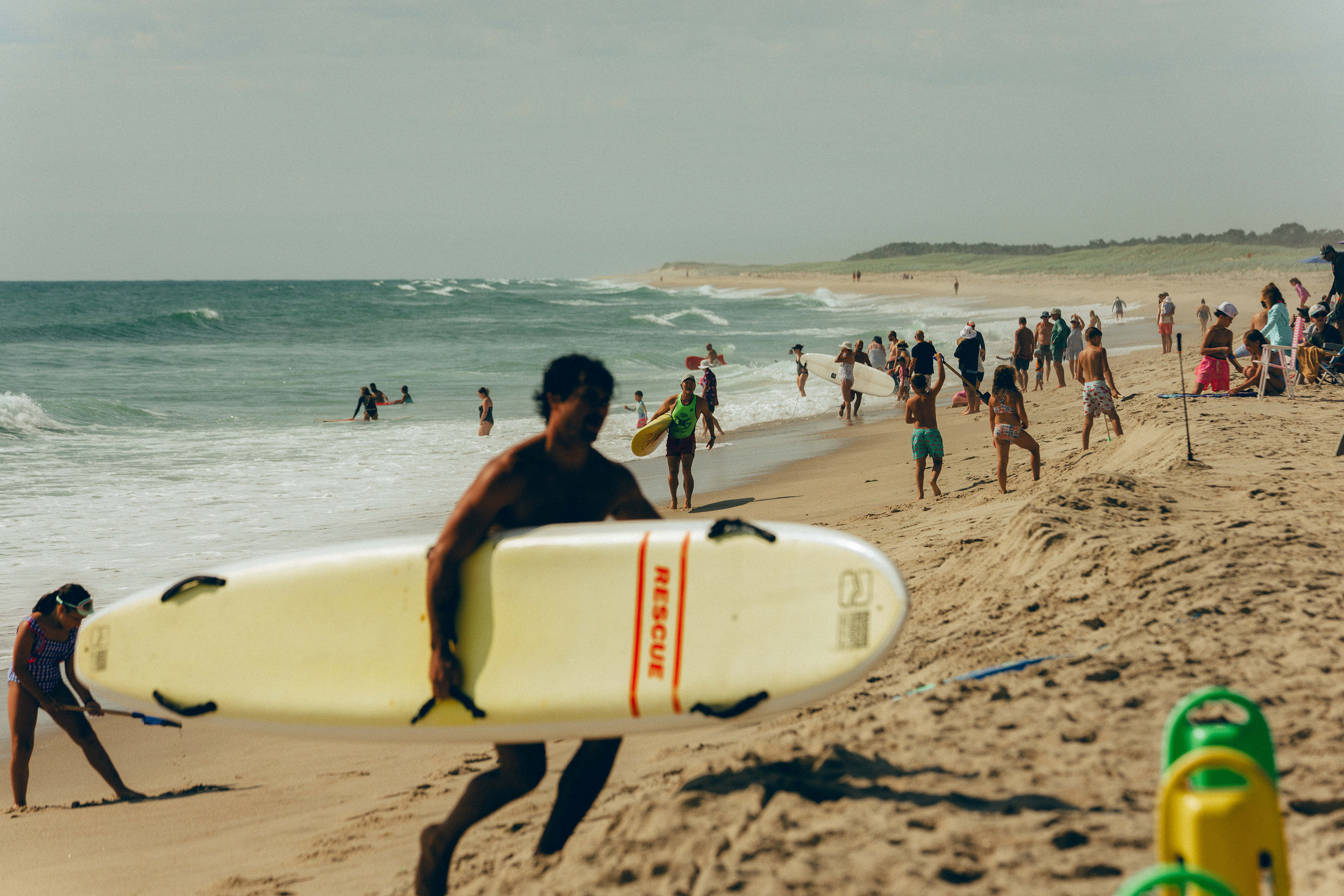
Over the last several years, a resurgent seal population has turned Cape Cod into one of the world’s top seasonal hot spots for great white sharks. In summer and autumn, the stretch of ocean from the northern tip of the Outer Cape down past Chatham, on the Cape’s elbow, is now the best place on Earth to see great whites swimming — and hunting — close to shore.
Back on land, the specter of sharks is inescapable. Beyond the shark-bite ball caps and the “Respect the Locals” shark bumper stickers, ominous shark flags and menacing warning signs, along with “Stop the Bleed” kits, have become summer fixtures on the Outer Cape’s beaches.
Even so, the seasonal shark surges have seemingly done little to dampen overall enthusiasm for Cape Cod, where the median single-home sale price nearly doubled from 2019 to 2025 and hotel prices can top $2,000 a night during high season.
The sharks have, however, changed people’s behavior. Demand for swimming pools has spiked. Beachgoers now keep a close eye on the shark-tracking app Sharktivity. And shark-spotting tours regularly operate within striking distance of some of the Cape’s most popular beaches.
Greg Skomal, a marine biologist with the Massachusetts Division of Marine Fisheries and New England’s leading authority on white sharks (as scientists typically call great whites), has seen the shift in beachgoers’ habits from his shark-tagging trips up and down the coastline.
“We observe it from the research vessel,” Skomal said. “We don’t see the same number of people in the water at great distances from shorelines.”
From a conservation perspective, the sharks’ return to these waters is a success story, the result of the Marine Mammal Protection Act of 1972, which rescued the region’s gray seal population from the brink of extinction. (A 2017 study estimated Cape Cod’s gray seal count to be between 30,000 and 50,000, up from about 2,000 in 1994.)
The sharks soon followed, leading to increasingly frequent beach closures and, inevitably, run-ins with humans. In 2012, a bodysurfer was bitten by a white shark off a Truro beach. He survived, as did a swimmer who was bitten at a neighboring beach in 2018. But a month later, a 26-year-old boogie boarder was killed by a white shark at Newcomb Hollow Beach, in the town of Wellfleet — the first fatal shark attack in Massachusetts waters since 1936. Two years later, a white shark killed a swimmer off the coast of Maine.
Yet in recent years, Cape Cod’s tourist economy has grown to nearly $2.8 billion (up from nearly $2 billion in 2019 per the Cape Cod Chamber of Commerce), even as the U.S. National Park Service has recorded a drop in recreational visits to the Cape Cod National Seashore, a 40-mile stretch of coastline that includes six beaches frequented by white sharks.
Although the sharks may have pushed some beachgoers away, one thing is certain: They’re also luring people in.
Ten years ago, the world capital of white shark tourism was that other Cape at the bottom end of the Atlantic: Cape Town, South Africa, whose resident great white population had long supported an enormous cage-diving industry. But those sharks have since disappeared, possibly driven away by commercial overfishing or perhaps shark-liver-hungry orcas, the subject of an unsettled scientific debate. Guadalupe Island in Mexico, another white shark hot spot, had its shark tourism and cage-diving operations shut down in 2023 by the Mexican government, which cited practices in the industry that were putting sharks and humans at risk.
At the same time, Cape Cod’s star began to rise as a white shark ecotourism destination, specifically the town of Chatham, where shark seekers can choose from a growing number of private shark charters — generally costing north of $2,000 — that employ spotter planes to locate the animals, which passengers can then observe from the boat. (Cage diving, which typically involves chumming the water to attract sharks, is illegal in Massachusetts, though at least one Cape Cod outfitter runs shark cage-diving tours offshore in federal waters.)
And while you can still cage-dive with great whites off the remote Neptune Islands in South Australia and off the southern edge of New Zealand, those experiences require all-day or even multiday tours. Only on Cape Cod can you spend a morning observing white sharks in the wild and be back on the beach by lunchtime.
“The fact that we can go out and see them in a 2½-hour charter is incredibly unique,” said Hannah Leary, ecotourism coordinator for the Atlantic White Shark Conservancy, a research and education nonprofit in Chatham that operates the Sharktivity app. “We can just come out of the inlet and they’re all right there.”
Its “open boat” shark charters, which offer “a shared adventure with Cape Cod’s apex predator,” run several times a week and regularly sell out (at a slightly more accessible $530 per person, with up to six people sharing a boat). Lately, Leary said, she has noticed an uptick in international guests and travelers who’ve come to Cape Cod specifically to see great whites.
At Cape Cod’s surf shops, though, the sharks are old news.
On a recent Sunday morning, Pump House Surf Shop in Eastham, which sells $20 miniature lifeguard-spec shark flags and last month shared a winking social media post about sharks, was packed with shoppers. Across the street at the equally crowded Nauset Surf Shop, the oldest surf shop on the Cape, longtime owner Phil Clark said shark-deterrent products started flying off his shelves after 2018, but they’re not selling much anymore.
“Everybody is kind of used to it,” Clark said of the sharks’ presence. “They’re buying surfboards. The kids are taking surf lessons.” Indeed, Sugar Surf, an all-female surf school, is still holding classes at Marconi Beach in Wellfleet, where a white shark took a bite out of a stand-up paddleboard in 2017.
“It’s not the same business it was 30 years ago, but there’s still tons of business,” said Clark, who noted that boogie boards and skimboards have become his bestsellers. “People are still here, and they’re having fun and enjoying themselves.”
For Suzy Blake, co-head lifeguard of Wellfleet’s beaches, the shark risk is “part of our lives now as lifeguards and residents of the Outer Cape.” She and her team are now armed with an arsenal of shark-specific equipment and protocols, including tourniquets and “Stop the Bleed” training, as well as a direct linkup to real-time shark detector buoys, which send push alerts to the lifeguards when tagged sharks are in the area.
Later that afternoon, at Newcomb Hollow Beach, Lisa DonDiego sat on a beach blanket with a friend a few yards away from the lifeguard stand, looking out at the ocean.
“I understand the fear,” said DonDiego, 37, up from Philadelphia for her family’s annual summer pilgrimage to the Outer Cape. “And at the end of the day, I recognize that the ocean belongs to them. But I still want to come to Cape Cod.”
She said she consulted the town of Wellfleet’s shark updates and the Sharktivity app, which logs crowdsourced shark sighting data and any buoy pings by tagged sharks, to help make an informed decision about getting into the water. Quitting the Cape’s beaches altogether, though, is out of the question. “Basically nothing could keep us off the beach,” she said.
The next morning, the sun was shining, and Paul Bordé, a local real estate agent, was out for a joyride out of Chatham Harbor on his Boston Whaler, keeping his eyes peeled for “one of the big boys.”
“Sharks have changed behaviors and conversations more than they’ve changed demand,” Bordé said. A noticeable trend has been an increasing appetite for swimming pools; one Cape Cod pool builder even advertises “shark free swimming” on its trucks.
That said, nothing has shaped the Cape’s real estate market in recent years as much as the pandemic. And while the COVID-19-era buying frenzy has cooled a bit, Cape Cod is still a seller’s market. Even the swimming pool surge is part of a broader pandemic-era trend toward creating “backyard oases,” Bordé said, adding that heated pools in particular were allowing families to extend the outdoor season by several months.
As for the sharks, Bordé called them “magnificent,” though he said the closest he came to a sighting that morning was a tagged white shark named Tarly pinging a nearby detector buoy.
On the charter boat, Sweeney had better luck. Less than half an hour into her shark tour, she found herself tearing up. Five decades after watching her first Jacques Cousteau film with her father, kick-starting her enduring fascination with great whites, Sweeney was gazing down through clear, shallow water at a 10-to-12-foot male white shark.
This time, there was no need for a bigger boat.
“Just to be in that small boat, looking over the sides at this massive, powerful, beautiful animal,” she said. “It was awe-inspiring.”
When he started as an intern 27 years ago,Mike Grigalonis never expected to become CEO at the Chester County Economic Development Council. But now he’s taken the top job, leading an organization that propels business growth in the county.
Since then, he’s seen the council grow from a six-person operation to one that boasts more than 40 employees, with teams dedicated to building out the workforce, supporting agriculture, and directing hundreds of millions of dollars to projects in the county. Grigalonis succeeds his longtime boss, Gary Smith, who stepped down July 1.
As the council has grown, so too has Chester County, which remains the richest of Pennsylvania’s 67 counties.
“I’m excited and grateful and humbled for this opportunity,” said Grigalonis, 53, who lives in Upper Uwchlan Township. “I don’t take it for granted, and I’m really excited about what’s to come.”
The Inquirer talked with Grigalonis about the current economic landscape of the county.
This conversation has been edited for clarity and brevity.
What’s changed most since you started in 1998?
In some ways there has been a lot of change, but in some ways there haven’t. I think about open space preservation, for example. … I think what this county, over generations of leaders, has done an amazing job of is balancing, making sure that we continue to have that open space, which is a big part of our culture, a big part of I think what makes us attractive and successful, but still having development and job creation and innovation and all those things happening at the same time.
How do you balance preserving the culture of Chester County while fulfilling the council’s mission?
Very carefully. … I always start by saying up front that I totally support open space preservation. I completely acknowledge the value that it’s brought to the county.
Do I feel that sometimes we sometimes lean maybe a little too heavily with the open space? Maybe. The planning commission does what they call a non-residential construction report. They look at institutional, they look at industrial, and they look at commercial. And in 2025, which is the most recent data, that was down pretty dramatically, the lowest it’s been in like 10 or 11 years. Is that a trend? Is it an aberration? It’s too early to tell.
And why is that? There’s lots of reasons — construction costs are high, borrowing rates are high. There are tariffs that maybe were at play. There’s lots of reasons, but do people sometimes shy away from doing projects in Chester County? I don’t know that.
I want to make sure that we strike the balance again.
What do you see as the future for farming in Chester County?
I think the future remains bright. I think we, as an organization, are highly committed to supporting ag[riculture]. … It’s a really strong ag team that’s grown over the last couple years. We have something called AgConnect, which is an awesome partnership with the county, and I’m seeing a lot of a lot more awareness and visibility.
We’ll see how that, longer term, translates to some of the economic metrics, but I think that awareness, engagement, visibility with the ag community is stronger because of the efforts of AgConnect and others.
What do you see as the future of suburban office development in the county?
I don’t know the answer. I wish I did. What I do see is obviously everybody’s aware of it. Developers are thinking smart about it. … Obviously, King of Prussia has the main street, adjacent to the mall. … In Philadelphia, this is a huge thing where they’re converting office buildings to residential. There hasn’t been a ton of that out here, but there’s been a few of those that have happened. … You’re probably going to see some more destination mixed-use creative amenities, maybe some conversion to residential, and then a refresh of office space.
What’s the future of Coatesville?
I think, obviously, there’s been some starts and stops, and there’s been some successes and some things that haven’t worked. But I think there’s some great people in that community. There’s a lot of people that are dedicated to making sure that redevelopment happens there. I think there are signs. The train station obviously has made tremendous progress. There’s a new energy around The Flats. There’s some things that are going to happen on Lancaster Ave[nue] that are on the verge. Ash Park was just completed, so there’s a lot of things happening there. I just don’t want it to be forgotten.
We’re seeing some proposed redevelopment of Superfund or brownfield sites. Do you see this as a viable way of reusing this land?
We’ve always been super supportive of that. … I think that will absolutely continue, and it should always be a top priority, because that enables us to strike that balance to take already developed sites and buildings and kind of repurpose them. That should be a huge part of our strategy moving forward.
Do you think the proposed data centers will actually be built here?
There are concerns that need to be addressed. I do think that data centers aren’t all evil. I think there are some positives that can come out of it. There’s construction jobs and there’s tax ratables. … We’ve always competed as a county, as a region, really as a nation, on innovation. So I think data centers, we’re going to have to figure out: How do we construct them the right way? It should not be the Wild West. It needs to be very thoughtful and very careful.
What’s the future of QVC and its campus in West Chester?
QVC is an incredible success story. So, no matter what happens, we’ll always be super proud and grateful that QVC was born in Chester County. … I don’t know how to forecast the future[as the company emerges from bankruptcy]. … We certainly want to be supportive. We certainly hope they succeed.
Many aspects of retirement planning are the subject of hot debate, even among experts. Here are three tricky decisions that confront people planning retirement today.
How much to withdraw each year in retirement
It’s impossible to say at the outset of retirement what the “right” withdrawal rate is. You don’t know what the major asset classes will return or how high (or low) inflation will run during your retirement. Nor do you know how long you’ll live.
But you have to use something, and this is where the disagreements come in. A 4% starting withdrawal rate, with annual inflation adjustments to that initial dollar amount thereafter, is often cited as a “safe” withdrawal system for new retirees. Research we conducted at the end of 2021 suggested that a 3.3% withdrawal rate was a safe starting point for new retirees with balanced portfolios over a 30-year horizon. When we revisited the research in late 2022, our safe starting withdrawal percentage was 3.8%. By late 2023, that number had popped up to the classic 4%, thanks to rising fixed-income yields and moderating inflation. At the end of 2024, it was 3.7%, and 3.9% at the end of 2025. Further complicating matters is that retirees don’t spend the same amount, adjusted for inflation, year after year.
There’s a comforting consensus in a few key areas.
Whether to buy long-term-care insurance
According to a 2019 study, about half of people turning 65 will need some type of paid long-term care. But paying for it can be financially devastating. What’s up for debate is whether and how to protect yourself.
That’s why purchasing pure long-term-care insurance is by no means a no-brainer. Hybrid products offer a long-term-care rider bolted onto a life insurance policy or annuity, but they’re complicated and often purchased with a lump sum.
Take a hard look at your retirement portfolio to decide whether your assets are sufficient to self-fund, you’re likely to qualify for Medicaid, or you fall somewhere in between. From there, you can create a long-term-care action plan.
Whether to buy an annuity
Academic researchers have long championed simple income annuities for retirement, arguing they provide longevity risk protection and a higher payout than would be available from fixed-rate investment products like bond funds. Annuities have been getting even more attention as payouts tend to get better during a period of rising interest rates.
But annuity types vary widely, from single-premium immediate annuities to more complicated products that provide equity exposure, guaranteed minimum living benefits, and death benefits.
Research has demonstrated that the peace of mind that accompanies the purchase of a basic annuity is greater than would be associated with holding the same amount in investment assets. Yet the annuity products that retirement researchers generally like best — the plain-vanilla immediate and deferred-income annuities — have struggled in the sales department. Investors may be reluctant to part with the capital to purchase them, and advisers may not have a strong motive to recommend them.
While there’s no consensus on whether annuities are a must-have or which types to buy, there’s little doubt that the lifetime income they offer is in short supply. That’s especially true given that only about a fourth of baby boomers retiring today have pensions, and that number trends down for the generations behind them.
The starting point when thinking about lifetime income isn’t an annuity. It’s Social Security, which is basically an annuity backed by the U.S. government. Only after maximizing lifetime income through Social Security should an annuity come into play.
This article was provided to the Associated Press by Morningstar. For more retirement content, go to morningstar.com/retirement.
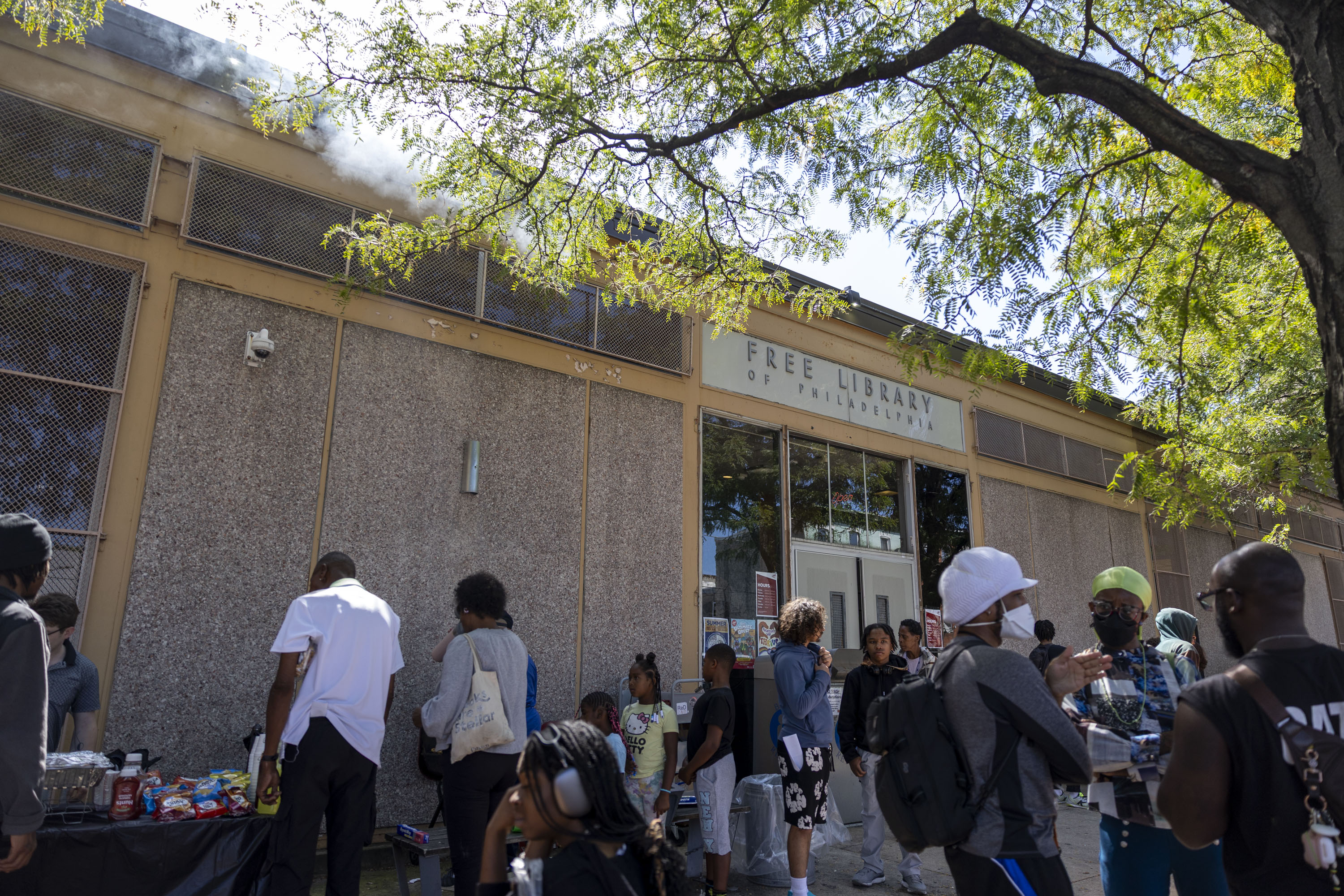
Philadelphia City Councilmember Jeffery Young Jr. intends to move forward with a limited, approximately $2 million renovation plan for the Cecil B. Moore Library in North Philadelphia, according to the city and library staff.
Young’s renovation plan for the building at 2320 Cecil B. Moore Ave. includes a new accessible elevator and restrooms, and improvements to the building’s HVAC, plumbing, fire-alarm system, lighting, and signage, according to city spokesperson Sharon Gallagher. Construction is expected to last roughly six months, she said.
The library building, first opened in 1962, will be closed during construction, and it is unclear whether the city and the Free Library of Philadelphia will operate a satellite branch for Cecil B. Moore during that time frame. The city is working with the Department of Parks and Recreation to temporarily relocate some of the library’s resources and programming to the nearby MLK Recreation Center at 2101 Cecil B. Moore Ave., Gallagher said.
“These are important. They’re also very basic,” said Kate Goodman, a Cecil B. Moore Library worker, at a community meeting and cookout at the library on Saturday afternoon to discuss the renovations. Goodman is a union member of the American Federation of State, County and Municipal Employees District Council 47.
Tess Galen of Strawberry Mansion writes on a sign to bring awareness to the funding and renovations for the Cecil B. Moore Library on Saturday, Aug. 29, 2026, in Philadelphia.Tyger Williams / Staff Photographer
It is unclear when exactly construction will begin. Library staff were informed earlier this month by the city’s capital programs office that construction would begin in September, but Young’s spokesperson, Yumeno Young, said the project would be pushed back to allow for additional preparation and community engagement. He declined to give a precise timeline for construction to begin.
Halted renovation history
Young’s plan leaves about $8 million on the table, since roughly $10 million has been raised and allocated toward the renovation project over the last several years. A modest $1 million in renovations were originally scheduled to begin in October 2024 through the city’s Rebuild initiative, but community members and lawmakers fought to secure a total of roughly $5.3 million for the project.
Rebuild developed a comprehensive renovation plan for the library, which community members and staff still support. It includes much of Young’s limited plan, as well as a new teen space, a private study room, new flooring, exterior upgrades, additional computers, and more upgrades.
After Young came into office in 2024, replacing outgoing Council President Darrell L. Clarke, he secured an additional $5 million from the city’s 2025 capital budget and delayed the project. Young used the city’s longstanding custom of councilmanic prerogative, where Council members have near-unilateral control over which projects in their district go forward, to put his stamp on the plans.
Over the last few years, Young has pushed for several development proposals at the site and has resisted investing in the current space. Those alternative proposals have included demolishing the current building and constructing a new building with both a library and affordable housing on top, or moving the library to a new building at 19th Street and Cecil B. Moore Avenue and converting the existing building into another public space.
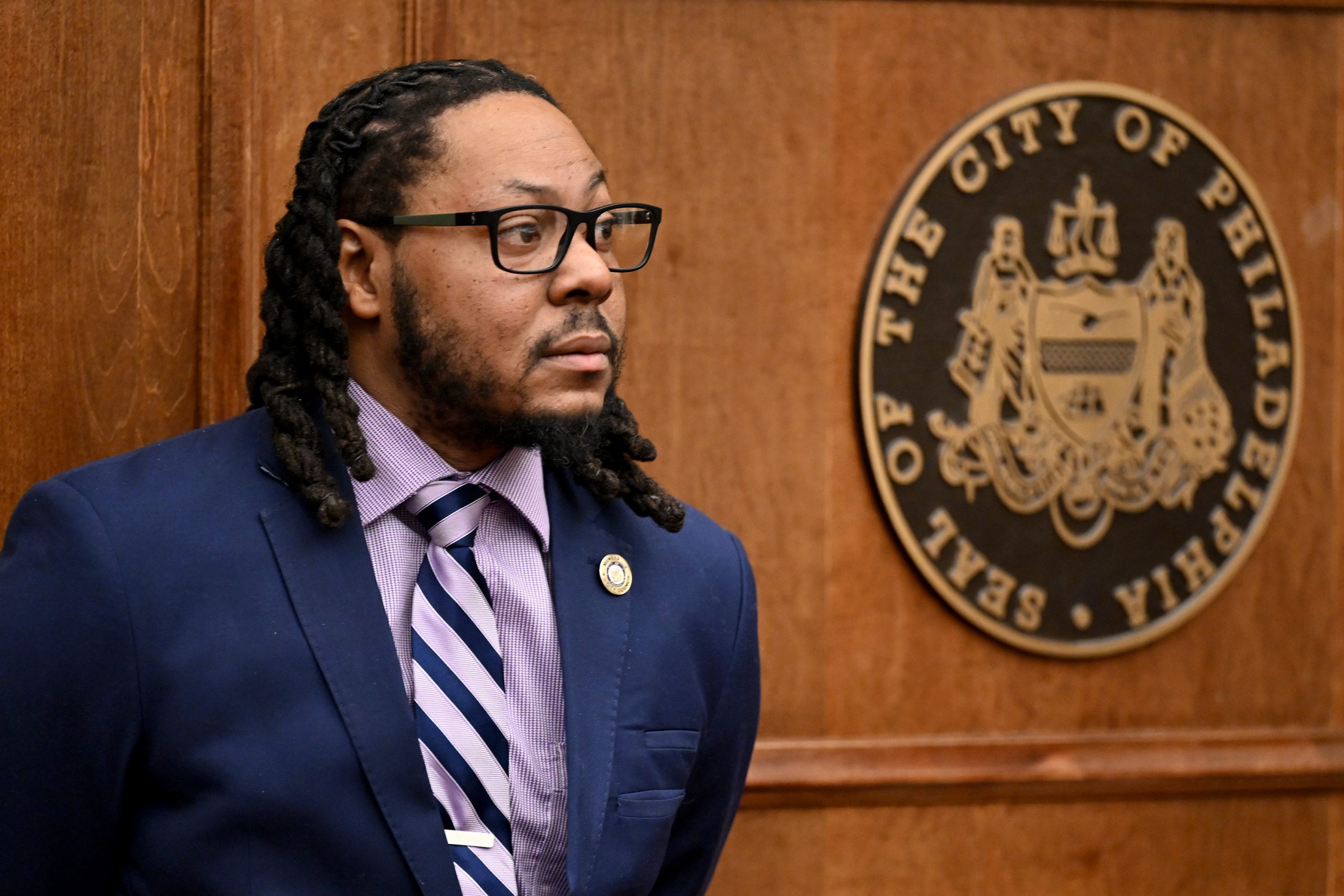
Councilmember Jeffery Young, Jr. in chambers as City Council meets Dec. 11, 2025.Tom Gralish / Staff Photographer
Young and the city declined to comment on what will happen with the other roughly $8 million that has previously been raised for the library renovation project, or why the Council member has opted for this plan despite significant community pushback. Young will host a community meeting sometime in September to provide more details on his plans, his spokesperson said.
Should construction begin soon, that timeline would set the library to reopen before May, when Young faces a likely contentious reelection. The Democratic primary is expected to feature several challengers for Young’s 5th District seat. He is considered the most vulnerable Council member. When Young first ran for office in 2023, he was unopposed in the primary election.
“Neither the Council member’s work on this project, nor our office’s efforts to advance it, are being driven by his reelection,” said Yumeno Young.
The library’s fate will play a significant role in the upcoming election for all candidates, not just Young. Joel Northam, a local resident and organizer with the Philadelphia Party for Socialism and Liberation, said he and other organizers will push the candidates to meet the community’s demands for a fully funded library renovation, or risk losing support.
“If you want that seat in District 5, you have to pledge to release the full $10 million to renovate,” he said.
The ‘soul’ of the community
At Saturday’s community meeting, library patrons spoke about how meaningful the library was to them, and how frustrated they were with how Young has presided over the renovation project. Goodman said the library has had a 70% increase in patrons since June 2025, despite the renovation delays.
Jayden Jackson, 18, loves to flip through comic books and manga at the library, especially ones about Sonic the Hedgehog. He started volunteering at the library a few months ago, because he also loves the community and atmosphere at the branch.
Volunteer Jayden Jackson, 18, of Sharswood, speaks at a community meeting about the importance of the Cecil B. Moore Library on Saturday.Tyger Williams / Staff Photographer
Jackson said the recent developments had provided a good opportunity to keep pushing for the library to receive all of the help it deserves, not just a limited renovation.
“It’s like a light in the middle of the neighborhood,” he said.
Karris Cantrell, 45, said Young’s handling of the library has been so frustrating it has made her want to cry sometimes. She wishes he understood “that he’s not God, that he just can’t do whatever the hell he wants” with the building, she said.
She and her three children have all been regular visitors over the years, and she said the place is as instrumental as a person’s daily coffee and as comforting as a child’s blanket. Cantrell believes the library deserves a full renovation immediately, so it can continue serving patrons in the neighborhood like her family.
“This library is not just a building and it’s not just books. It’s a soul,” she said.
If you’ve shopped for a home in the Philadelphia region lately, you’ve met the villain of this story.
Before the Iran war began in late February, the 30-year fixed mortgage rate was dipping below 6%. Now, it is nearly 7%. On a $320,000 mortgage, approximately what it takes to buy the typical area home, that adds about $210 to the monthly payment, or more than $2,500 a year. That’s not for a bigger house, but the same house.
Behind the mortgage rate stands the bond market. The 10-year Treasury yield, which sets the tone for mortgage rates, is near 4.75%, up more than three-quarters of a percentage point since before the war. The bond market is being asked to swallow a tsunami of new government debt, a Federal Reserve gone mum, and a war with no clear end. And it is choking.
The Iran war has severely disrupted global oil supplies, pushing inflation to near 4% — double the Federal Reserve’s target — and flipping expectations for the Fed from cutting interest rates to raising them. That accounts for a bit more than half the run-up in rates. The good news is that bond investors’ expectations for future inflation have settled back near the Fed’s target. Investors still believe the Fed will do its job.
However, new Fed Chair Kevin Warsh has long believed central bankers talk too much. Forward guidance on rates is gone, and communication is sparse, so investors are left guessing at what the Fed will do next — and they charge for guessing. That extra charge is called the term premium. Think of it as a nervousness fee for lending money over a long period. For a decade, it was pinned near zero. No longer.
But what worries the bond market the most is the nation’s runaway debt. This year’s budget deficit will be more than $2 trillion, equal to more than 6% of GDP. It’s a stunning figure. And the government has been spilling red ink like this since the pandemic hit in 2020.
Meanwhile, there are fewer buyers of the government’s debt. Foreign investors, who held about half our debt a decade ago, now hold closer to a third. The nation’s banks have become more circumspect bondholders after suffering big losses on their holdings when the Fed jacked up interest rates coming out of the pandemic. Highly leveraged hedge funds — fast money, but also the quickest out the door when trouble hits — filled the void.
The Trump administration is trying hard to hold rates down. The Treasury doubled its bond buybacks, but this amounts to billions of dollars, a rounding error compared with the $32 trillion of debt outstanding. It facilitated Japan’s recent effort to rescue the weak yen, so our largest foreign creditor wouldn’t dump Treasurys and push rates higher. And it requires Fannie Mae and Freddie Mac to buy mortgage-backed securities to help pull down mortgage rates.
Each move worked for a day or two, then quickly faded. More telling is the jump in gold and bitcoin prices and the lower value of the U.S. dollar. These are telltale signs that global investors are unsure about the safe-haven status of Treasury bonds. That is, during difficult times, money flows here because investors know they will get their money back on time. A Treasury bond is still the safest place on the planet to put your money, but it’s just a little less safe.
The Treasury’s moves also risk what economists call fiscal dominance, a situation in which a government is so deep in debt that its borrowing needs pressure the central bank to keep interest rates artificially low to make the government’s debt easier to finance. We aren’t there, but we appear headed that way. The Treasury is increasingly doing what looks like the Fed’s job, and history is clear on how that ends: higher inflation and, eventually, higher — not lower — interest rates. The same problem this is meant to solve.
It does not have to end that way. The most likely future is that the 10-year yield falls back this fall, and mortgage rates ease back toward 6%. Of course, this happens only if oil flows reliably through the Strait of Hormuz again, so inflation recedes, and Warsh gives investors some sense of how the Fed will set interest rates.
But that’s a lot of ifs, and lawmakers are unlikely to address the nation’s disconcerting fiscal situation until the bond market forces them to. That could be in next year’s fight over increasing the Treasury debt limit, or early next decade, when the Social Security and Medicare trust funds run dry. The risk of a serious sell-off in the bond market that pushes the 10-year yield toward 6% and mortgage rates toward 8% is real: I would put the odds at about 1-in-5 over the coming year.
A war, a Fed gone mum, yawning deficits — none of these is an act of nature. They are choices. Here’s hoping we start making better choices before the bond market chooses for us.
(From left) Andy Dalton, Cole Payton and Tanner McKee all made the Eagles’ roster.Yong Kim / Staff Photographer
The Eagles, for now, have punted on their backup quarterback decision.
Howie Roseman didn’t move either Andy Dalton or Tanner McKee before the 6 p.m. roster deadline Sunday night, and the Eagles went the unconventional route of keeping four quarterbacks on the initial 53-man roster.
They aren’t the only team. The Pittsburgh Steelers, Minnesota Vikings, and Atlanta Falcons also kept four quarterbacks on their rosters.
Neither Dalton nor McKee grabbed the backup job by the horns during training camp. McKee struggled in Friday’s preseason finale while Dalton looked better than his two previous performances.
Still, Roseman was unable to find a trade partner – assuming he tried – before the roster deadline Sunday night.
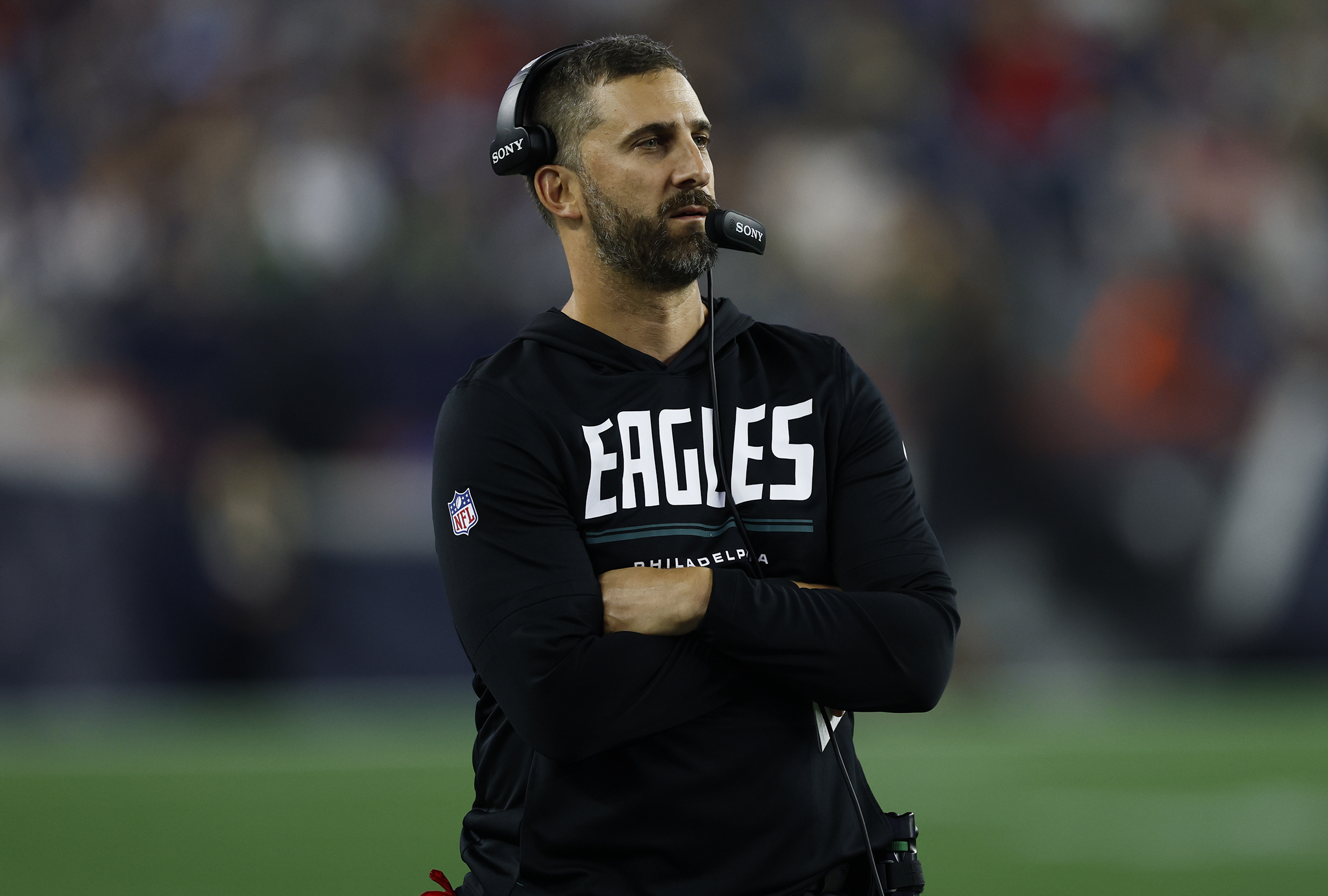
The Eagles don’t open the season for two more weeks, so Roseman has time to sort out the roster situation at quarterback. Roseman and Nick Sirianni will meet with reporters Monday (at a time to be determined).
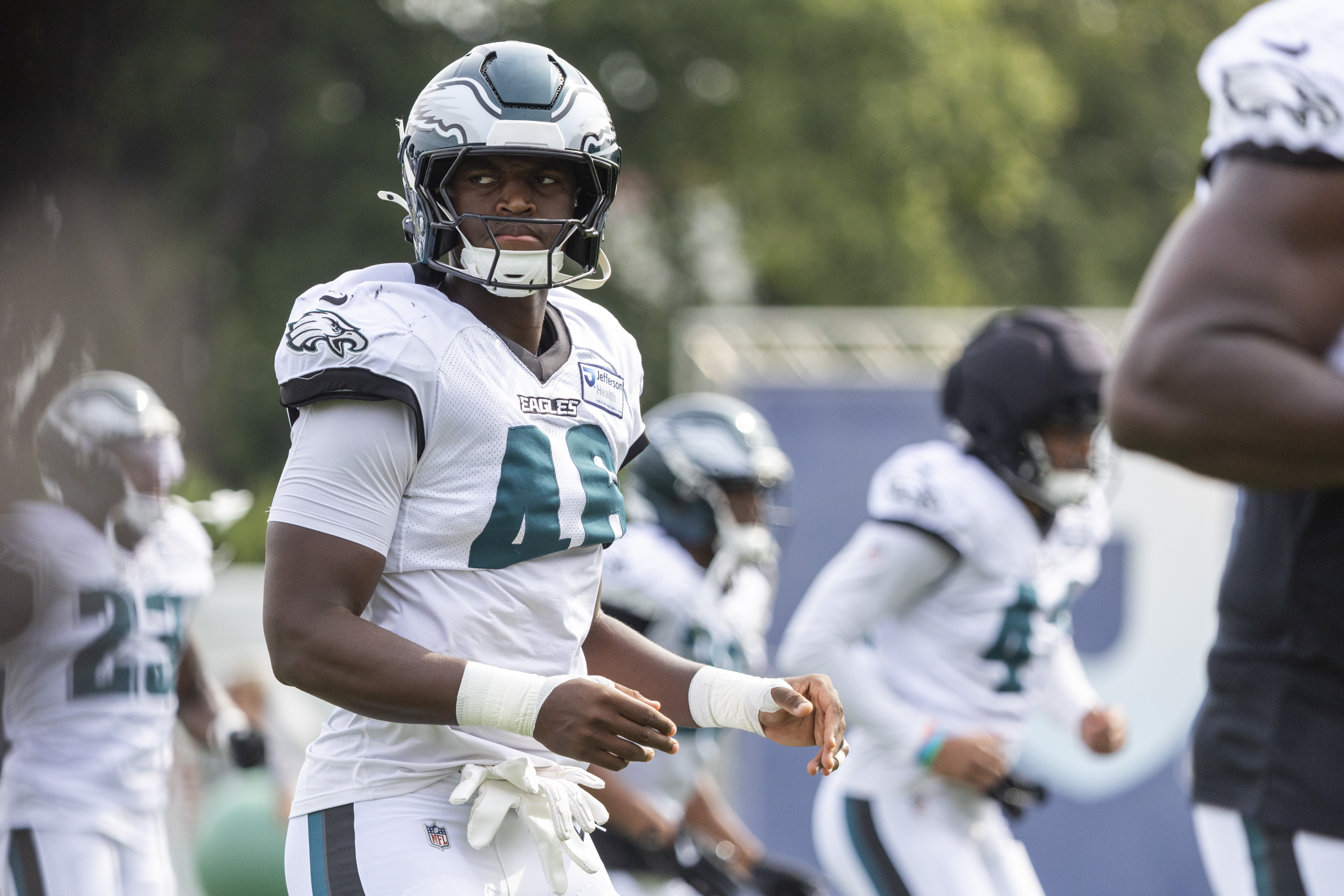
Keeping four quarterbacks also means the Eagles were unwilling to waive rookie fifth-round pick Cole Payton, who led only four drives during preseason games as the Eagles mostly gave reps to the quarterbacks competing to back up Jalen Hurts. Payton would have had to clear waivers. He was turnover-prone throughout camp, but the Eagles decided to commit to developing him, at least for now.
They waived sixth-round pick Kyle McCord last year after a shaky training camp. McCord was on the practice squad last season before signing with Green Bay. The Mount Laurel native had a solid preseason with the Packers and was traded Sunday to Miami for a 2028 sixth-round pick.
Eagles waive both ‘foreign exchange students.’ They can only protect one.
Joshua Weru and Uar Bernard (not pictured) were long shots to make the team.Tyger Williams / Staff Photographer
Vic Fangio wasn’t wrong when he warned time after time that Uar Bernard and Joshua Weru – the two first-time football players that joined the Eagles this offseason – have “a long way to go.”
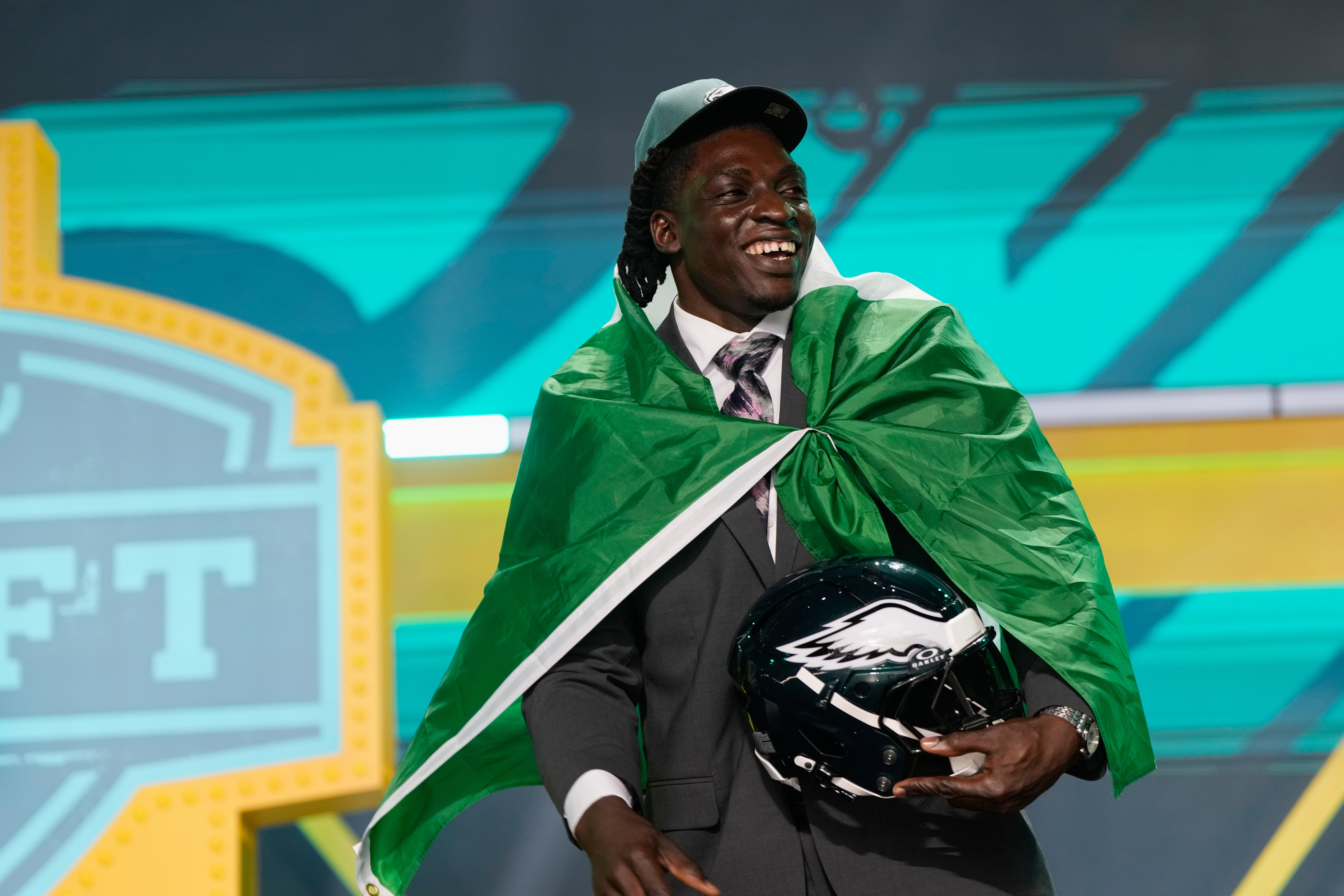
The Eagles used a seventh-round pick on Bernard, a defensive tackle from Nigeria with off-the-charts athleticism. They signed Weru, a Kenyan rugby convert, as an undrafted free agent. Neither had played a padded football game before the Eagles and Ravens met in the first preseason game earlier this month, and getting on the field in a real NFL game is a whole different beast.
But the Eagles’ decision to waive both players ahead of the 6 p.m. roster deadline Sunday means they’ll only be able to protect one of them, and they may not even get to develop either of them if another NFL team decides to claim them off waivers and put them on their 53-man roster.
That result is unlikely. Again, as Fangio says, his “exchange students” are a long way away from being ready to play in NFL games. But assuming both of them clear waivers, the Eagles will only be able to designate one of them as an IPP player, and the other would be free to sign to another team’s active roster at any point during the season.
That’s obviously a risk Howie Roseman was willing to take.
While Bernard was the more talked about prospect after the Eagles used a draft pick on him, it was Weru, an edge rusher, who flashed more during camp and in the preseason contests. If one of the two was going to get cut, Bernard seemed like the more likely candidate given the possibility the Eagles could use Weru on special teams.
Instead, the Eagles kept five edge rushers on the roster: Jonathan Greenard; Jalyx Hunt; Nolan Smith; Arnold Ebiketie; and A.J. Epenesa.
In leaving Bernard off the roster, the Eagles also kept just five interior linemen: Jalen Carter; Jordan Davis; Moro Ojomo; Byron Young; and Ty Robinson.
Aaron Donald and the Los Angeles Rams will face the Eagles in Week 4.DAVID MAIALETTI / Staff Photographer
Aaron Donald is unretiring to return to the Los Angeles Rams, where he’ll play alongside reigning Defensive Player of the Year Myles Garrett.
Donald, a three-time NFL Defensive Player of the Year, signed a one-year deal that could end up being worth $30 million, according to ESPN’s Adam Schefter and NFL Network’s Ian Rapoport.
The Eagles host the Rams at the Link in Week 4, but Mike Florio of Pro Football Talk thinks its possible Donald might delay his return to the field until Week 5:
The specific timing of Aaron Donald's return opens the door to the possibility of the Rams placing him on reserve/PUP (or reserve/NFI) and giving him 4 more weeks to keep getting ready — and reducing his total workload to no more than 13 regular-season games.
The #Titans are waiving QB Will Levis, source says. Tennessee had been open to trading Levis for some time, and in the end, both sides move on. pic.twitter.com/PTZo1l8zi5
Dolphins reportedly trade for ex-Eagles quarterback
Former Eagles quarterback Kyle McCord appears to be headed to Miami.Yong Kim / Staff Photographer
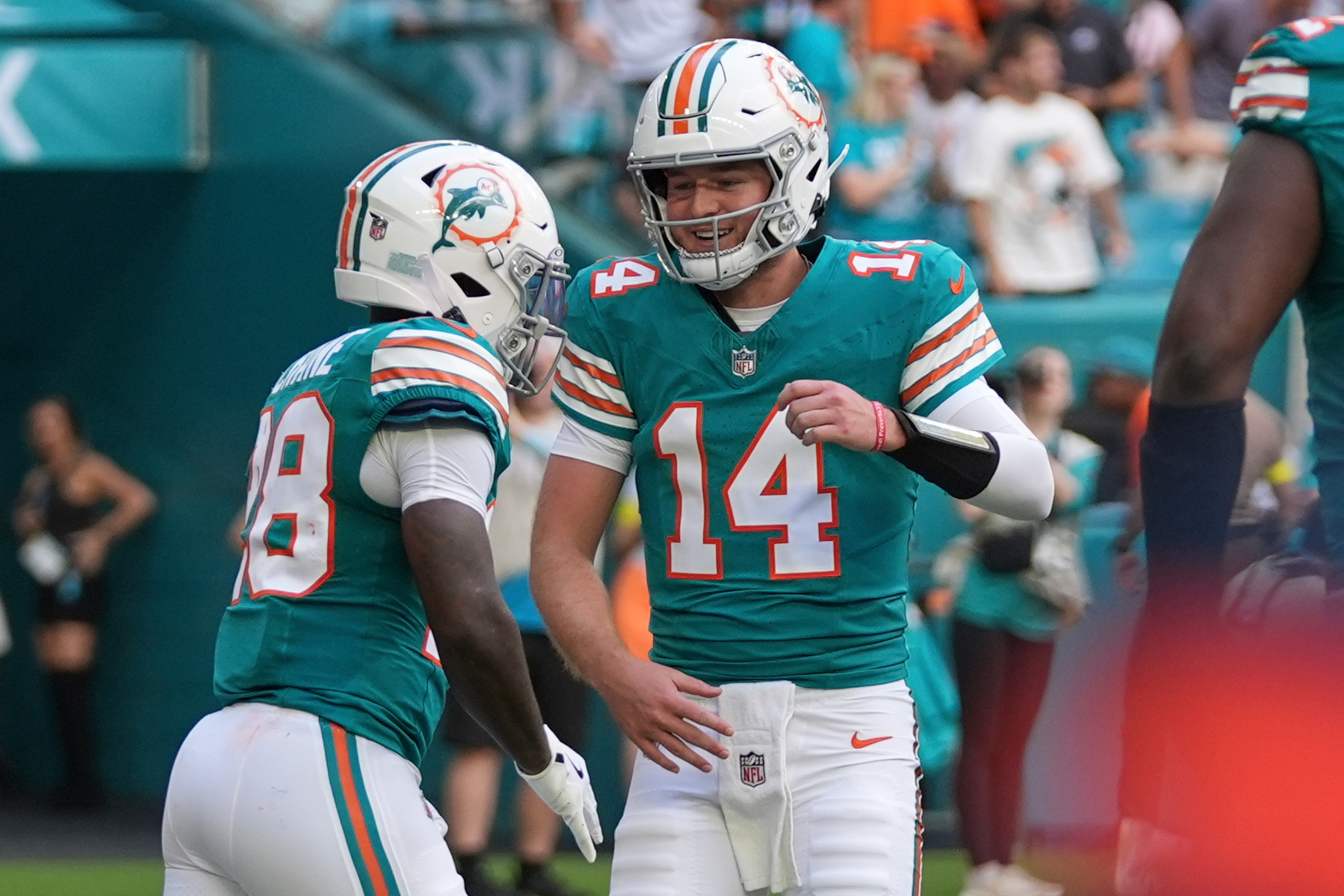
The Miami Dolphins, according to ESPN, are acquiring Green Bay Packers quarterback Kyle McCord for a 2028 sixth-round pick.
That probably eliminates Miami from the list of teams the Eagles could get a draft asset for in exchange for Andy Dalton or Tanner McKee.
McCord, a Mount Laurel native, was a sixth-round pick by the Eagles last year but did not make the team out of camp. He spent the season on the practice squad before signing with the Packers.
McCord performed well in the preseason. He completed 22 of 35 pass attempts Friday night for 226 yards and four touchdowns. McCord will be the only other quarterback on Miami’s roster besides Malik Willis, meaning the soon-to-be-24-year-old could be in line to be the primary backup.
The Dolphins may still need another quarterback, though. They traded Quinn Ewers on Saturday and reportedly waived both Cam Miller and Mark Gronkowski on Sunday. It’s hard to imagine they’d part with more draft capital for another quarterback, though.
In Miami, McCord reunites with former Eagles offensive coordinator Kevin Patullo, who is Miami’s pass game coordinator.
Carson Steele and the mirage of preseason football games
Carson Steele runs for a touchdown during the Eagles final preseason game. Monica Herndon / Staff Photographer
No Eagles skill position player touched the ball more during the team’s three preseason games than Carson Steele. After getting only one carry in the first game, Steele had 18 touches in the second contest and 16 Friday night.
The 23-year-old running back, signed in free agency after spending some time with Kansas City over the last two seasons, Steele was the best offensive player on the Eagles in losses to New England and Cincinnati. He had just 33 yards on 12 carries vs. the Patriots, but he turned six catches into 84 yards and made two highlight-reel hurdles, including one that helped him reach the end zone.
Then he rushed eight times for 24 yards Friday and caught eight passes for 52 yards and another touchdown as Tanner McKee and Andy Dalton spent most of their shifts checking the ball down when they dropped back to pass.
Steele, who was waived Saturday, was one of the few bright spots on an offense that mostly struggled throughout the exhibitions, and it was fair to wonder if 6-foot, 228-pound back could push for a roster spot — especially given his potential to play fullback.
But that’s the problem with the preseason: Eagles fans only get to see such a small part of what’s going on, and what Howie Roseman, Nick Sirianni, and the rest of the team’s decision makers are watching when they’re whittling down the roster to 53 players.
The Eagles practiced 17 times in training camp and played just three games. The exhibition games, then, make up 15% of what the Eagles are evaluating.
So, while standing out in two of the three games — 10% of the evaluation period — isn’t unimportant, it’s too small of a sample.
That’s not to say Steele was bad in practice. He was fine. But the Eagles didn’t really have room for him with Saquon Barkley, Tank Bigsby, and Will Shipley in front of him on the depth chart. There are other roster needs, and they don’t seem to have the luxury of keeping a fourth running back on the roster.
But he can play fullback!
So can Cameron Latu, who could be on his way to a roster spot at tight end and is a solid special teamer.
The Eagles probably won’t mind Steele clearing waivers and finding his way onto their practice squad, though.
The Dolphins need a backup quarterback after trading Quinn Ewers and waiving Cam Miller (not pictured)Lynne Sladky
The Miami Dolphins are in the market for a quarterback after they traded Quinn Ewers to Jacksonville on Saturday and waived Cam Miller Sunday morning.
Howie Roseman has probably scrolled his way to Jon-Eric Sullivan in his contacts list.
The Eagles likely are trying to trade either Andy Dalton or Tanner McKee, and the Dolphins are one of a few teams in need of some quarterback help.
But here’s another angle to consider: Are the Eagles one of the teams in need of quarterback help?
Neither one of their backup quarterback options shined in camp, and McKee on Friday night looked sort of lost while Dalton performed better than he had in previous preseason contests.
Still, it’s possible the Eagles could fetch a late-round pick for either player. Dalton’s body of work and his ability to mentor a younger quarterback – in Miami’s case, Malik Willis – could be more valuable.
The Eagles could find themselves in an awkward position later on Sunday if they’re unable to move a quarterback or don’t trade for one themselves. Would they keep both Dalton and McKee on the initial roster? Would that mean keeping four quarterbacks? Would that mean waiving fifth-round pick Cole Payton and exposing him to waivers?
Jalen Hurts (right) walks to the field with Tanner McKee (left) and Andy Dalton (center) behind him.David Maialetti / Staff Photographer
The winner of the No. 2 job is still unclear. Can both lose?
Tanner McKee and Andy Dalton have been that uninspiring. The preseason finale offered more questionable quarterback play. There have been only glimmers.
McKee got his first start of this preseason after Dalton started the first two games. He played the entire first half. It was a brutal watch. McKee completed 12 of 22 passes, but for only 55 yards. He underthrew and overthrew receivers, looked timid in the pocket, and ultimately became a check-down artist.
McKee didn’t exactly have the best players around him. There were several drops, one that resulted in his lone interception. But receivers were also schemed open. Britain Covey got separation off a nifty double move for a would-be touchdown, but McKee completely overshot him.
Dalton took over in the second half. Like McKee last week vs. the New England Patriots, he outplayed his competition in relief. He completed 12 of 19 passes for 104 yards and a touchdown — and with a few lesser players at certain spots.
Dalton had some shaky moments, too. And when given the opportunity to engineer a go-ahead, fourth-quarter drive, he and the offense couldn’t get the job done.
RookieCole Payton came in late in the fourth quarter. He continued to hold the ball too long when he dropped. His passing wasn’t much better. In Payton’s defense, he hasn’t practiced much the last few weeks. The Eagles will take a long view with the fifth-round draft pick.
Payton must really want to play, though. He was in on the cover unit for the Eagles’ first punt.
Dalton’s play this summer hasn’t earned him the No. 2 job. McKee has been only marginally better, but has shown improvement. The best man doesn’t always win. But the educated guess here is that Roseman will trade Dalton to a backup-needy team — of which there are many. He may need to keep all four quarterbacks past Sunday’s deadline to get what he wants in return, however.
Payton has displayed more than last year’s rookie project — Kyle McCord — and probably wouldn’t pass through waivers if the Eagles consider stowing him on the practice squad.
Roads along the race route will remain shut down after the race and some SEPTA buses will be diverted. Here’s a rundown.
Inquirer sports reporter Ariel Simpson attempted to climb the imposing Manayunk Wall. Here’s how she did.
// Timestamp 08/30/26 4:52pm
After 10 years, a glorious return to Philly
// Pinned
// Timestamp 08/30/26 4:40pm
Tim Torn Teutenberg wins men’s race at Philly Cycling Classic
Tim Torn Teutenberg raises his arms as he crosses the finish line to win the men’s race Sunday. Jose F. Moreno / Staff Photographer
German cyclist Tim Torn Teutenberg cross the finish line first to win the men’s race at the first Philadelphia Cycling Classic in 10 years.
“It was a super good atmosphere today,” Teutenberg told 6abc following his victory, comparing it to the prestigious Tour of Flanders in Belgium.
Teutenberg finished the 120-mile race in just under four hours and 21 minutes. American cyclist Riley Sheehan finished fourth, coming in about 22 seconds behind the leaders.
Rain falls in Manayunk during the Philadelphia Cycling Classic Sunday, Aug. 30, 2026.Michelle Myers
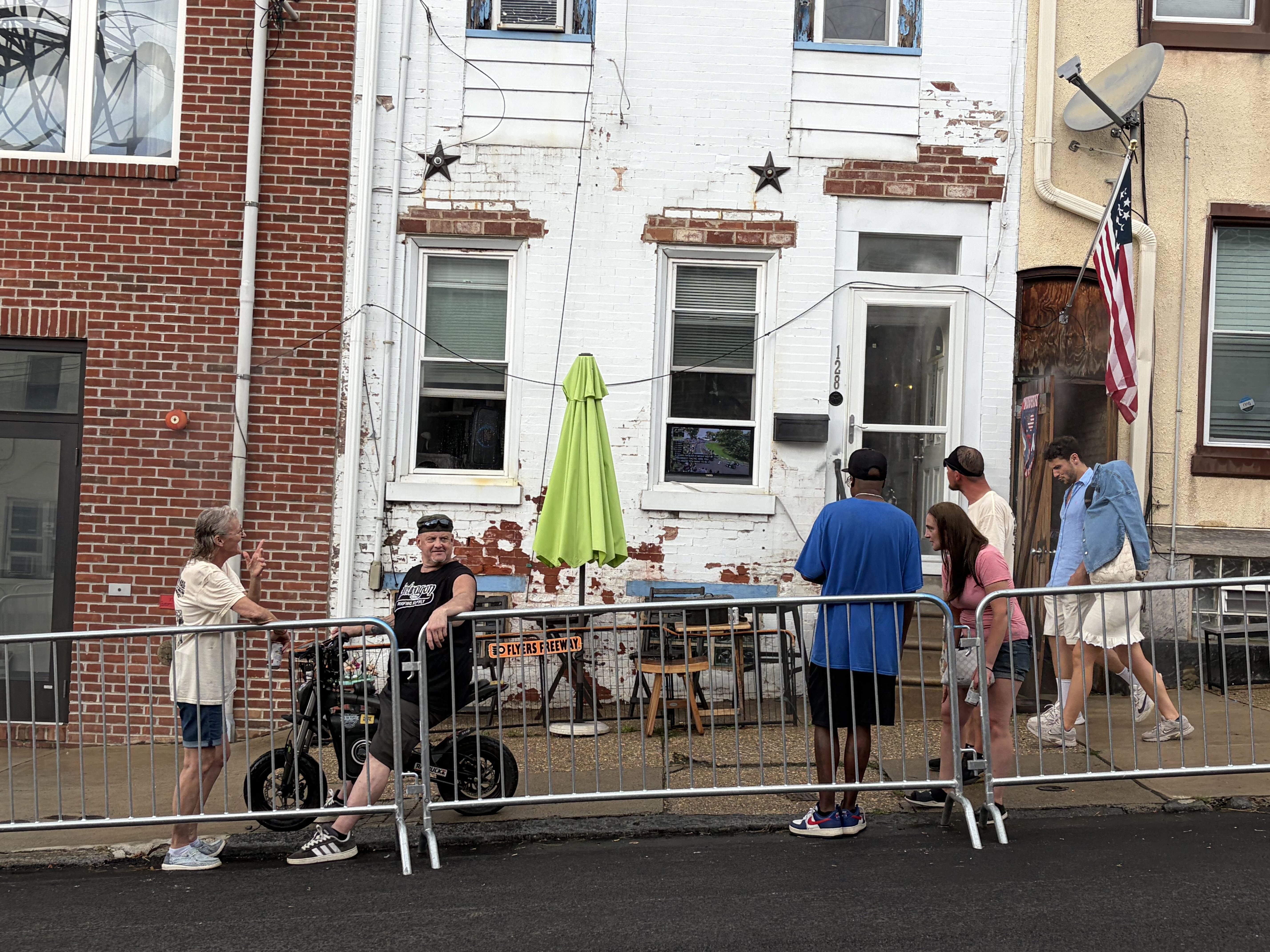
Rain began to empty Levering Street Monday afternoon, but many fans remained to watch the Cycling Classic, some following the race closely on their screens.
He grew tired of race crowds. Now he’s thrilled the Cycling Classic is back.
Thomas Gartside watches the Cycling Classic in Manayunk.Michelle My
Thomas Gartside, 77, remembers feeling a bit tired of the crowds coming to his Manayunk block on race day. The decade-long hiatus changed his perspective.
“I remember the first race, it was amazing: No one was here and they had a helicopter,” said Gartside, who moved by the Manayunk Wall a year before the inaugural 1985 race.
Over the years, he said, the race expanded and his block got more crowded. By 2016, he didn’t come outside to witness the spectacle, unaware the cyclists’ return would be an uphill battle.
On Sunday, seeing the street packed with hundreds of cheerful people brought joy back to Gartside, who decided to hold his own small gathering with bagels and coffee.
“I got a little tired of it, but this is reinvigorating,” Gartside said staring at the crowd standing shoulder to shoulder outside his door. “Look at all the energy and all the neighbors.”
Kim Stoveld, a Philly native, on her unusual path to Cycling Classic
Kim Stoveld didn’t start cycling until her late 30s.Courtesy / Automatic Racing Team
Kim Stoveld, a Philadelphia native, took an unconventional route to appear in the Cycling Classic.
The former University at Buffalo swimmer did not pick up competitive cycling until the onset of the COVID-19 pandemic. Six years later, she placed 71st in her hometown race with a time of 2:37:59.
“I watched this race in 2013, 2014, ’15, and ’16 when it was still going on, and I was just getting into cycling,” Stoveld said. “And then to be on the other side of it, 10 years later, is just like a dream come true. Just absolutely amazing.”
Stoveld looked to break away from the main pack of cyclists in the final stretch, but failed to will herself to the front.
“I am a breakaway rider,” Stoveld said. “My best bet is to win in a small break, and unfortunately, being caught by world tour teams was probably inevitable. But that was my shot, and I was happy to shoot it.”
One section of the race Stoveld had a leg-up in over some of her competition was Manayunk’s “The Wall” — which sees riders climb 210 feet at a steep incline. Stoveld hosts a “group ride” every Tuesday, noting that “those poor suckers” who sign up for her ride take on the Wall with her every week.
One reporter asked Stoveld what her advice would be to young women looking to take up cycling.
“If I can do this good in my late 30s, picking it up at 30, you as an 8-year-old getting into sports will dominate,” Stoveld said. “Please keep riding your bike”
There’s no shortage of cheers and warm welcomes at the Manayunk Wall. It’s not just the first to arrive who feel the crowd’s support – those coming behind get even more:
At the Manayunk Wall, the first riders aren’t the only ones to feel the support: pic.twitter.com/i2b4fGS4EQ
‘It’s inspiring me to put more effort into cycling’
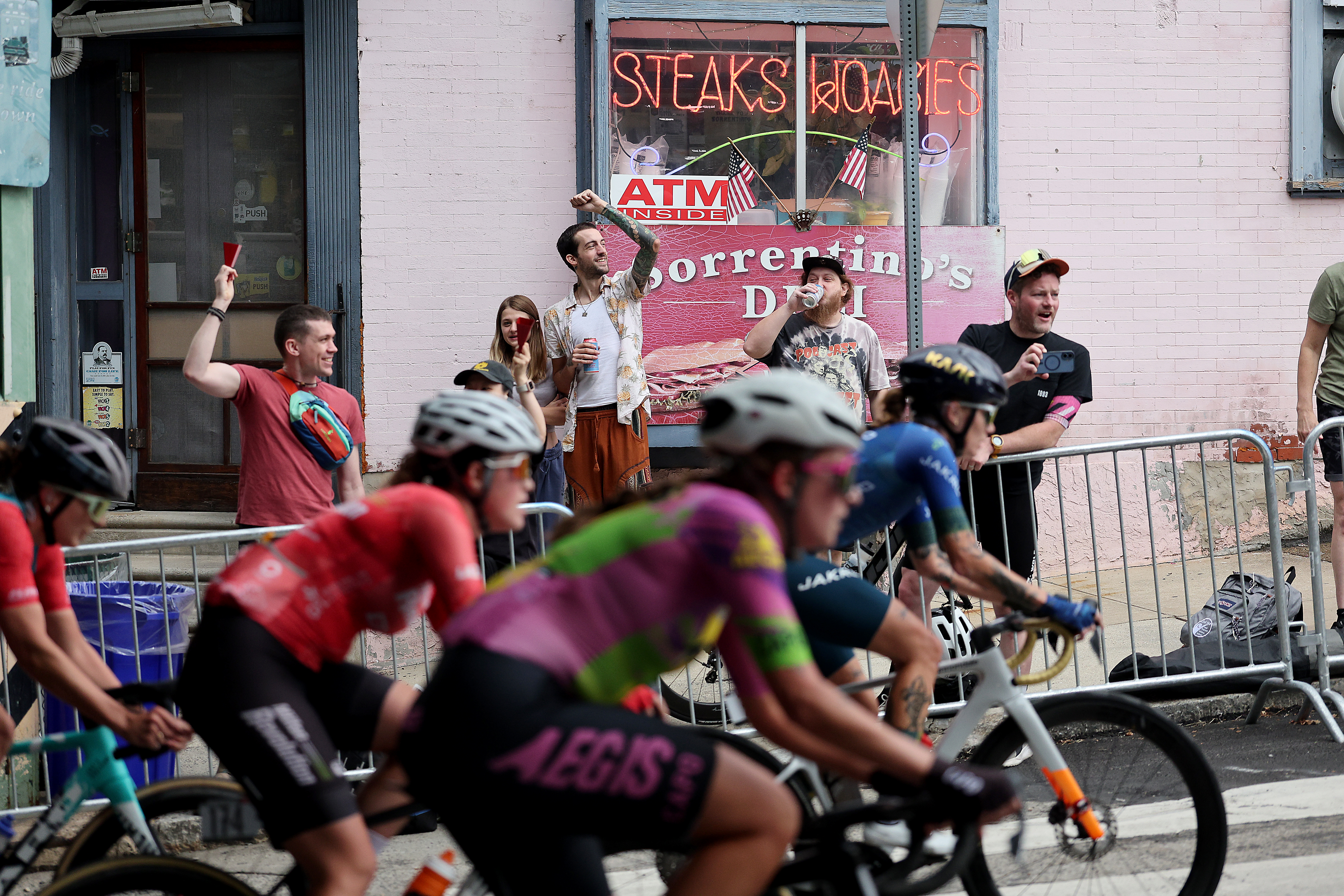
Spectators cheer a group of women riders along Main Street in Manayunk.David Maialetti / Staff Photographer
Rita’s water ice in one hand and a cowbell in the other, Jim Lamond let the clank of the bell ring out as racers rode past on Ben Franklin Parkway on their third lap.
Lamond, 57, came to the race with his daughter, Katie Coulter, 28, who is just starting to get into cycling and triathlon and wanted to witness the sport on this scale in person.
“During the triathlon, cycling is the one discipline that I struggle with the most,” Coulter said. “So seeing the ladies and the professionals do this, it’s inspiring me to put more effort into cycling, and seeing how effortless they do it, it’s really inspiring for me.”
For the few seconds the cyclists are riding past, Lamond and Coulter are fixed on the course, but in the downtime between laps, the Fan Fest on the parkway has plenty to pass the time.
Food trucks line the streets, including the Rita’s Water Ice truck where Lamont got his. There are also tents with fan activations and giveaways, merchandise and cycling apparel for sale, a DJ, and a screen displaying all the action.
“Here at the Fan Fest, you have all different vendors between the equipment for the riding and things like that, the helmets, the bikes, keeps them interactive with the kids,” Lamond said. “They have a Fan Fest for the kids as well, and you get to experience the atmosphere of being outside.”
— Mia Messina
// Timestamp 08/30/26 10:46am
‘It’s like a mini Tour de France’
Alice Antonelli, an avid cyclist and financial consultant, is among those watching Sunday’s race.Michelle Myers
Alice Antonelli, 65, woke up at 4:30 a.m. on Sunday unable to contain her excitement for the return of the Philadelphia Cycling Classic.
“I wasn’t able to come before. I had kids and a lot going on,” Antonelli said. “I’m so thrilled it’s back. It’s like a mini Tour de France.”
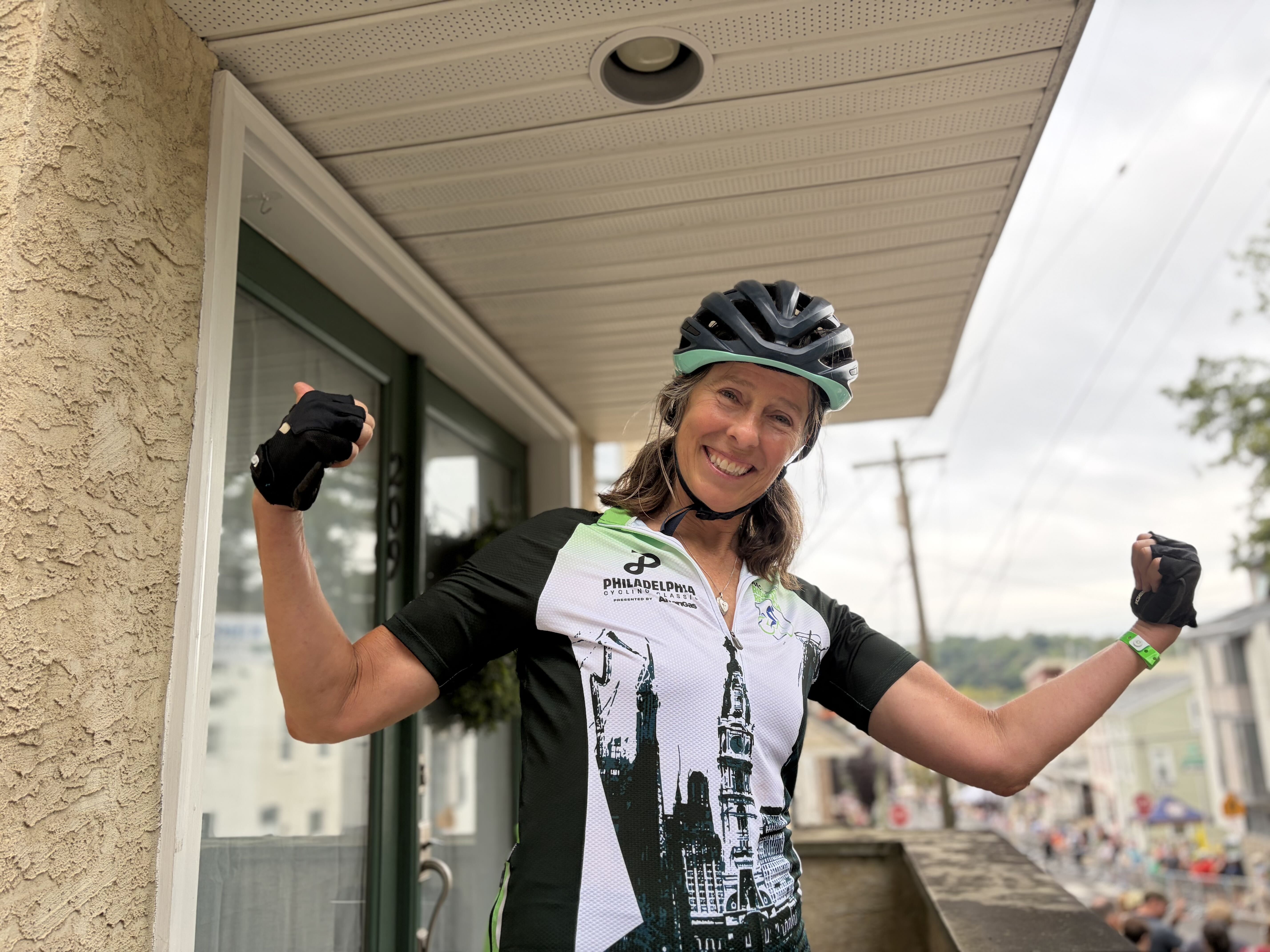
In a new era of her life, the avid cyclist and financial consultant was among the 400 registered for the Charity Ride for AACR, the American Association for Cancer Research. She completed her race in under an hour, she said, and came back to the Manayunk Wall to cheer for the women’s race participants.
“Having done the course, it’s actually not bad, but the Wall separates the women from the girls. I am a girl,” Antonelli said.
Standing on the porch of a neighboring house, Antonelli couldn’t contain her enthusiasm at seeing cyclists more skilled than her go up the same hill she conquered.
“Not to say that my heart is pounding, but I’m anticipating for them; I am living vicariously through them,” Antonelli said, bringing her hand to her chest.
As the motorcycles announced the arrival of the cyclists, Antonelli couldn’t help but jump up and down in celebration, bringing her fingers to her mouth and whistling for the riders.
“I’m planning to come back next year, please keep bringing it back,” Antonelli said.
‘I’m just happy right now’: Father and son take in Cycling Classic
John Dempsey and his 11-year-old son, Orion, woke up at 5 a.m. to make the trip to Philadelphia from their home along the Jersey Shore.
John Dempsey wanted to show his son “something different other than the usual running or car events.”
“Even though we’re from New Jersey, we love the city of Philadelphia,” John Dempsey said. “My wife’s run the marathon here. I’ve run the half marathon here, and we’ve come here for Made in America Festival. Always nice to come back to Philly.”
Added Orion: “It’s very cool. It’s fun to be here, and I’m just happy right now.”
The two are rooting for women’s cyclists Kristen Faulkner and Laini Bones. Faulkner is two-time Olympic gold medalist while Bones won over the Dempseys through her social media content. Bones has found an online audience by attempting to beat male cyclists’ records.
“She’s viral on Instagram for taking men’s segments with Strava and talking a lot of trash to them lightheartedly and going out and beating their time,” John Dempsey said.
Teen spectators inspired by cyclists climbing Manayunk Wall
Spectators line Levering Street as the women’s race makes their way up The Wall in Manayunk.David Maialetti / Staff Photographer
Eyes glued to a cell phone, siblings Tess and Fitz Dolan counted down the seconds it took women cyclists to arrive at the Manayunk Wall, closely following their trip on the livestream.
The mountain biker teens’ ages were in the single digits when the race went away, and they never had a chance to see it in person. Now, they don’t plan on losing sight of the cyclists as they wait for their arrival at Tower and Levering Srreets.
“It’s so cool to see them do this because we are used to these roads and we bike there,” said 16-year-old Tess Dolan. “The women are putting in a lot of work and they are just rocking it.”
Her older brother, Fitz, was equally in awe of the bikers’ performances. The 18-year-old has biked up the Manayunk Wall just once and considers it to be a challenge for any cyclist.
“It was fun, but very hard because it’s so long and really stiff,” Fitz said. “They made it look so effortless and I can vouch it’s not as easy as it looked.”
Seeing the women’s strength and the cheering spectators inspired Tess to put the Manayunk Wall on her bucket list.
“It’s important for us to see them. It gives us inspiration to go outside and get on the bike,” Tess said, praising the work of the organizers and cyclists. “Thank you for bringing it back and putting in the work, because I’m sure it wasn’t easy.”
Mayor Parker says the Cycling Classic is bringing ‘the stadium to the streets’
Spectators cheer as the women’s race makes their first pass at The Wall in Manayunk.David Maialetti / Staff Photographer
Mayor Cherelle L. Parker is looking to “keep pushing” for the city to host “even more grander events.” In the meantime, she is enjoying the spotlight sports have shined on Philadelphia this summer.
“Philadelphia is a tough city,” Parker said. “When you hear people describe our grit, our resilience, our stick-to-itiveness, our fight… battling the underdog notion – it’s a real thing. But sometimes we forget how amazing we are, and when we look at 2026 and all that we have accomplished through FIFA, the MLB [All-Star Game], the Cycling Classic, all of the amazing events that were here, We are a world-class global city and prepared to receive guests from around the world.”
Parker also noted the event is a “very equitable opportunity” for all Philadelphians because it is free to watch. Unlike some of the other events Philadelphia held this summer, the Cycling Classic “brought the stadium to the streets.”
“We got a chance to drive through in Roxborough and Andorra and Manayunk, and even if you didn’t get a chance to see it, right now, you will see families have set up barbecues. They’re doing cookouts and parties at their houses. You also can tell that people have made sure their their lawns are well manicured, it’s a big thing.”
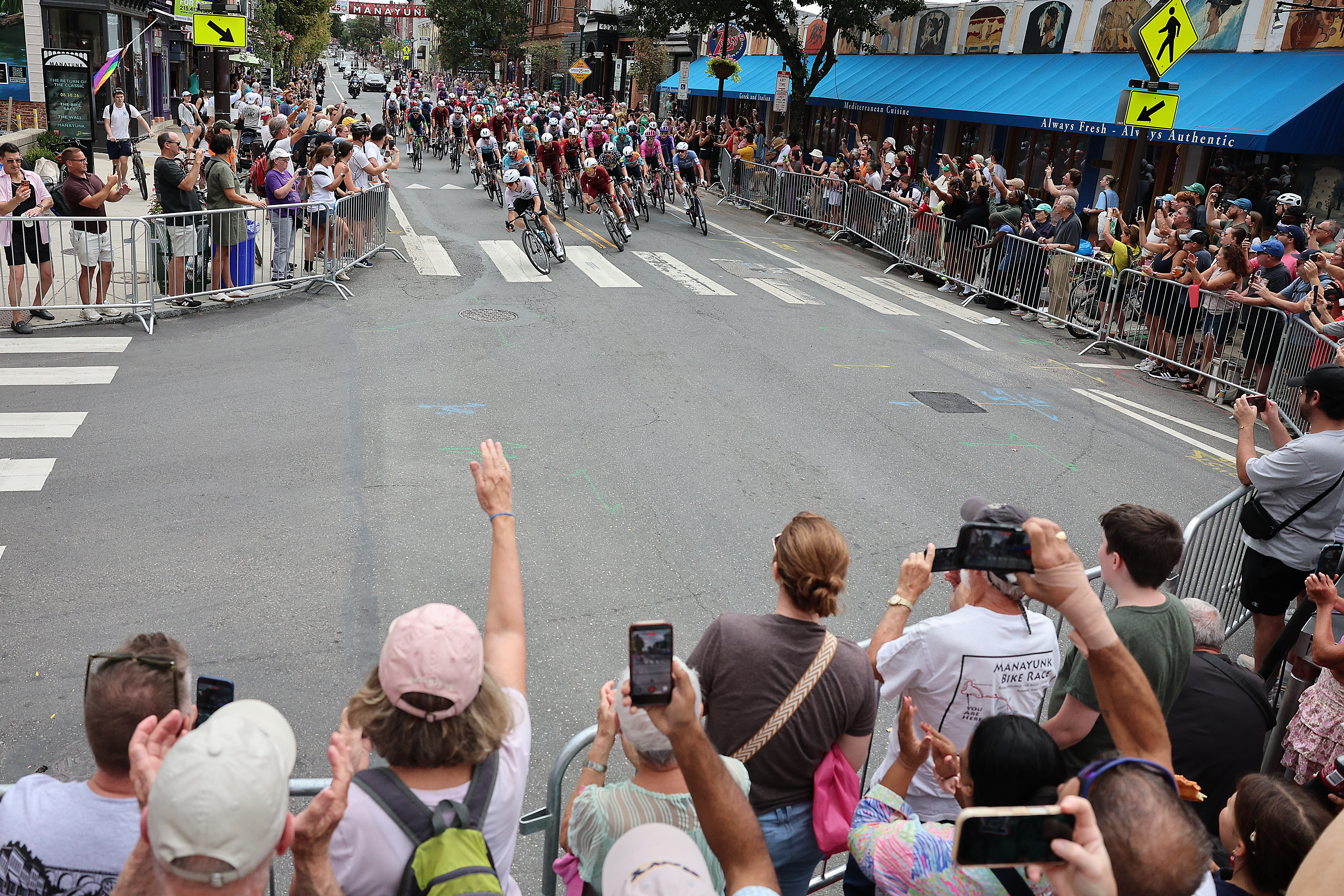
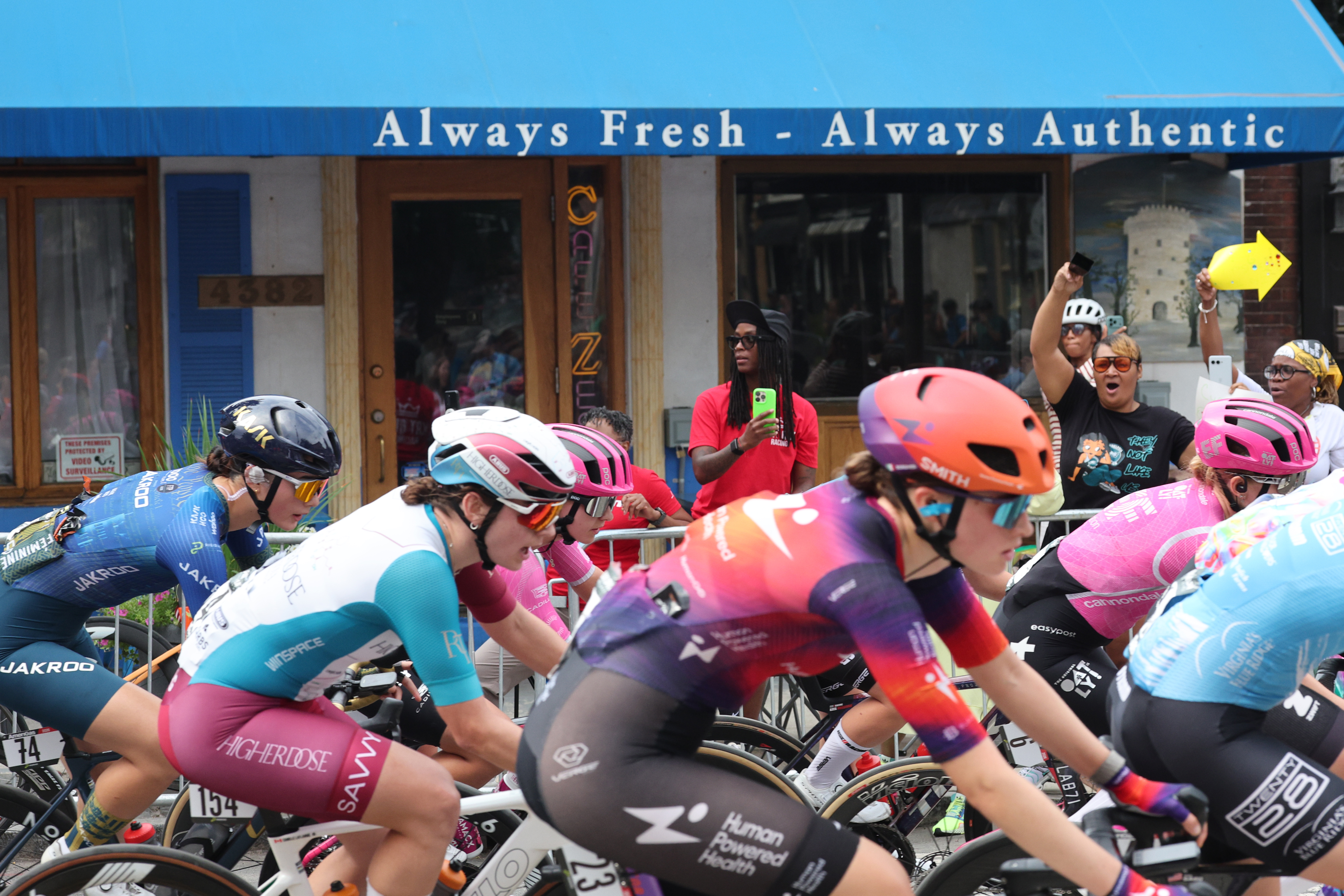
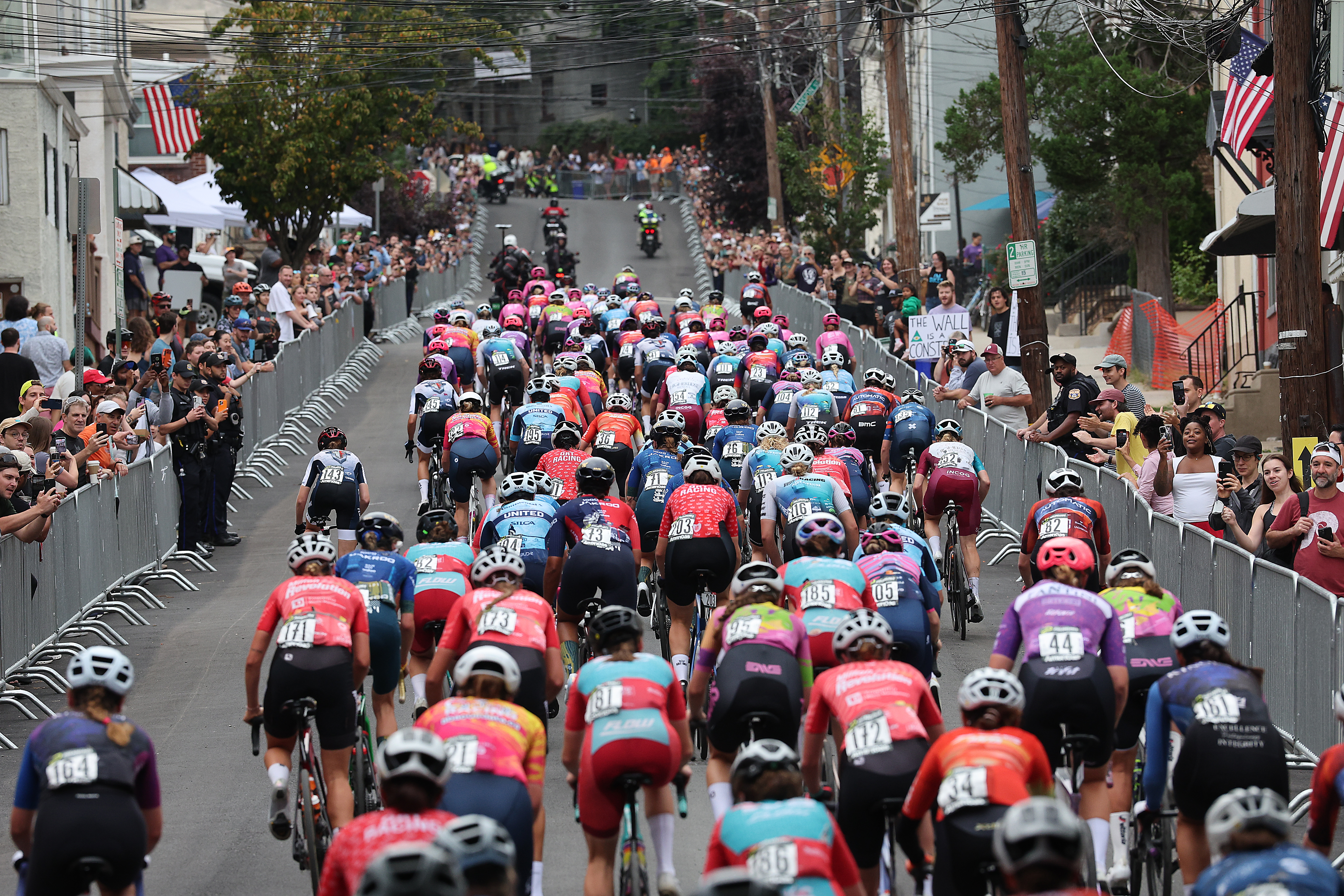
The Philadelphia Cycling Classic is underway. As a group of women speedily cycled by Main Street, dozens of people came out of their Manayunk homes to await them with cheers and praise.
Whistles began to blow, alerting spectators to their impending arrival. “They are coming,” some started yelling as a small fleet of police in motorcycles drove by.
Ringing bells, the eager crowd leaned harder on the barricade, cheering and clapping, before the cyclist speedily rode hill up, with such force the 8% to 9% incline looked effortless.
In less than 40 seconds the women were up the hill and gone from the view of their supporters, but the cheering spirit did not stop.
Shouts of: ”That’s crazy,” and “they are amazing” could be heard among the crowd as they disappeared into the next section.
Celebrating her birthday watching the return of the Philly Cycling Classic
Taking deep breaths, Ashley and Dylan O’Neill walked up Lyceum Street looking for the best spot to see cyclists ride the Manayunk Wall.
The walk was stiff and the air felt slightly humid, but after waiting a decade to experience their first Philadelphia Cycling Classic, Ashley felt like this was the best way to spend her 41st birthday.
“My stepdad wouldn’t stop talking about it: The people gathered together, and the happiness, but for years there was no race,” she said.
“We were bummed out because it’s such a unique thing for a city to do, that to have the city lose something like this is a huge loss for the entire community,” Dylan added.
As soon as the Trenton couple learned the race was coming back, they booked an Airbnb and bought train tickets to Philly.
“We are excited to see the women race and then the men race, especially Quinn Simmons, but we are definitely leaving the cycling to them, because even walking up is hard enough,” Ashley said.
As folks began to gather along the street, the O’Neills plan to return every year to see the race and watch it from different spots.
“We hope they keep doing it, because it’s such a unique thing and Philly is the perfect place to do it,” Dylan said.
For the first time in 10 years, the Philadelphia Cycling Classic is officially underway.
The 62-mile women’s race began shortly after 8:30 a.m. on the Ben Franklin Parkway. The cyclists will complete four laps before the men’s race begins at noon.
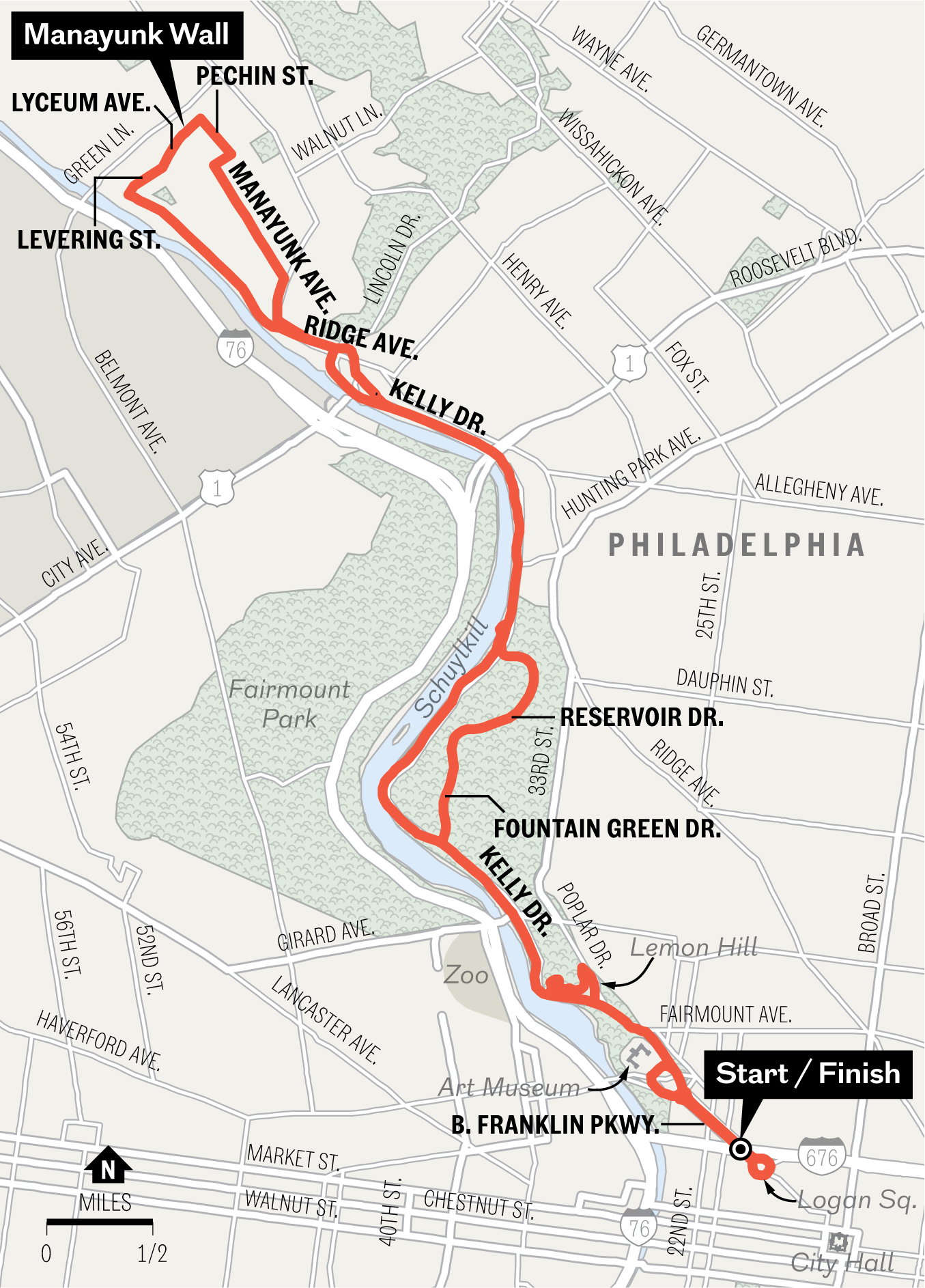
The course is a 14.4-mile circuit that will start and finish on the Benjamin Franklin Parkway. The women’s race will total 65 miles, while the men’s race will be 122 miles.
The original course ran up the Ben Franklin Parkway to Kelly Drive, passing through East Falls, Roxborough, and Manayunk, which was home to the most famous part of the course, the Manayunk Wall.
This year’s race will return to that original course, and will take participants past Strawberry Mansion, Lemon Hill, Boathouse Row — and, of course, up the Wall.
The Wall is a steep incline hill, reaching up to a 17% grade over a stretch of about a half mile, mostly on Levering Street in Manayunk. It is considered one of the race’s most iconic components, and has been part of the race since 1985, when Jerry Casale and David Chauner first mapped out the course
— Mia Messina
// Timestamp 08/30/26 7:18am
The best places to watch the Philly Cycling Classic
The women’s race will start at 8:35 a.m. with the men’s race to follow at noon.
For fans interested in attending, access to the race will be free, meaning anyone can line up along the course to watch.
Traditionally, large parties take place along the tight streets of Manayunk, turning the race into a festival of sorts. But for those not located in the Manayunk area, the event’s official Fan Fest will be held by the Iroquois Sculpture near the Philadelphia Museum of Art from 10 a.m. to 5 p.m. on Saturday and 8 a.m. to 5 p.m. on Sunday. Entry is free and will include vendors, live entertainment, a stream of the race, activities for kids, and a beer garden.
— Mia Messina
// Timestamp 08/30/26 7:12am
Road closures in Center City Sunday
Matti Breschel raises his arms after winning the Philadelphia International Championship Liberty Classic along the Benjamin Franklin Parkway in 2008.Yong Kim / Staff Photographer
The Philadelphia Cycling Classic is back after a decade-long hiatus, bringing loads of cycling fans, events, and road closures along with it.
Plan ahead if you need to drive near the 14.4-mile path for the main women’s and men’s races, beginning at 8:30 a.m. and noon, respectively, and the morning charity ride, which begins at 6:30 a.m.
The following road closures will take effect from 3 a.m. until 10 p.m. on Sunday.
Near the Benjamin Franklin Parkway:
Benjamin Franklin Parkway from 17th Street to Eakins Oval (all lanes)
Spring Garden Street between Pennsylvania Avenue and 31st Street
All roads from Arch to Spring Garden Streets, 18th to 22nd Streets (access maintained for residents)
All roads from Arch Street to Fairmount Avenue, 22nd to Corinthian Streets (access maintained for residents)
23rd Street between Pennsylvania Avenue and Eakins Oval
22nd Street between Winter Street and Pennsylvania Avenue
21st Street between Winter Street and Pennsylvania Avenue
20th Street between Arch Street and Pennsylvania Avenue
19th Street between Callowhill and Cherry Streets
16th, 17th, and 18th Streets between Arch and Spring Garden Streets, if public safety conditions warrant
1600 and 1700 blocks of the Benjamin Franklin Parkway, if public safety conditions warrant
Fairmount Park:
Kelly Drive (all lanes)
Waterworks Drive
Reservoir Drive
Lemon Hill
Sedgley Drive between Girard Avenue and Kelly Drive
Poplar Drive between Girard Avenue and Kelly Drive
MLK Drive from Falls Bridge to Eakins Oval
Manayunk and Roxborough:
Ridge Avenue between Kelly Drive and Hermit Street
Main Street between Ridge Avenue and Green Lane
Levering Street between Main and Tower Streets
Cresson Street between Levering and Cotton Streets
Lyceum Avenue between Tower and Mitchell Streets
Pechin Street between Green Lane and Roxborough Avenue
Roxborough Avenue between Mitchell and Terrace Streets
Manayunk Avenue between Roxborough Avenue and Osborn Street
Rector Street between Terrace and Pechin Streets
Pensdale Street between Terrace and Lauriston Streets
Kingsley Street between Manayunk Avenue and Lauriston Street
Salaignac Street between Manayunk Avenue and Lauriston Street
Terrace Street between Dawson Street and Ridge Avenue
Vassar Street from Ridge Avenue to Cresson Street
Mitchell Street from Connaroe to Martin Streets
Additional streets: unit blocks of Shurs Lane, Jamestown Street, Pensdale Street, Roxborough Avenue, Grape Street, Levering Street, Gay Street, Carson Street, Rector Street, Cotton Street, and Connaroe Street, and the 300 block of Burnside Street
SEPTA detours
The following SEPTA bus routes will be detoured through Kelly Drive, Manayunk, and Roxborough beginning at 4 a.m. Sunday: 7, 9, 27, 32, 33, 38, 43, 48, 49, 52, 60, 61, 65, 82, 124/125, K.
For information on specific route changes, visit www.septa.org.