Blog

  • Jaylen Brown’s Boston block party puts a bow on his Celtics career and clears the way for his Sixers tenure

    Jaylen Brown’s Boston block party puts a bow on his Celtics career and clears the way for his Sixers tenure

    BOSTON — Closure is a fickle concept, whether in relationships, friendships and even sports fandom.

    When something ends, closure isn’t guaranteed, and people often have to move on from traumatic or life-altering moments without it.

    The deep bond between a city, its people, and its sports heroes is a phenomenon with few parallels in life, especially those who have won championships and been as ingrained in their communities as Jaylen Brown was for 10 years with the Boston Celtics.

    But rarely do those connections end without some sort of breakup, which can lead to hurt feelings and confusion. As Brown said recently, “I just threw my phone across the room” when he heard the Celtics were trading him to Philadelphia for Paul George and draft picks.

    His life and the lives of Celtics fans all over Boston became a lot different, and the trajectory of his new franchise changed, since that move also led LeBron James to pick the Sixers as his next and potentially final basketball home.

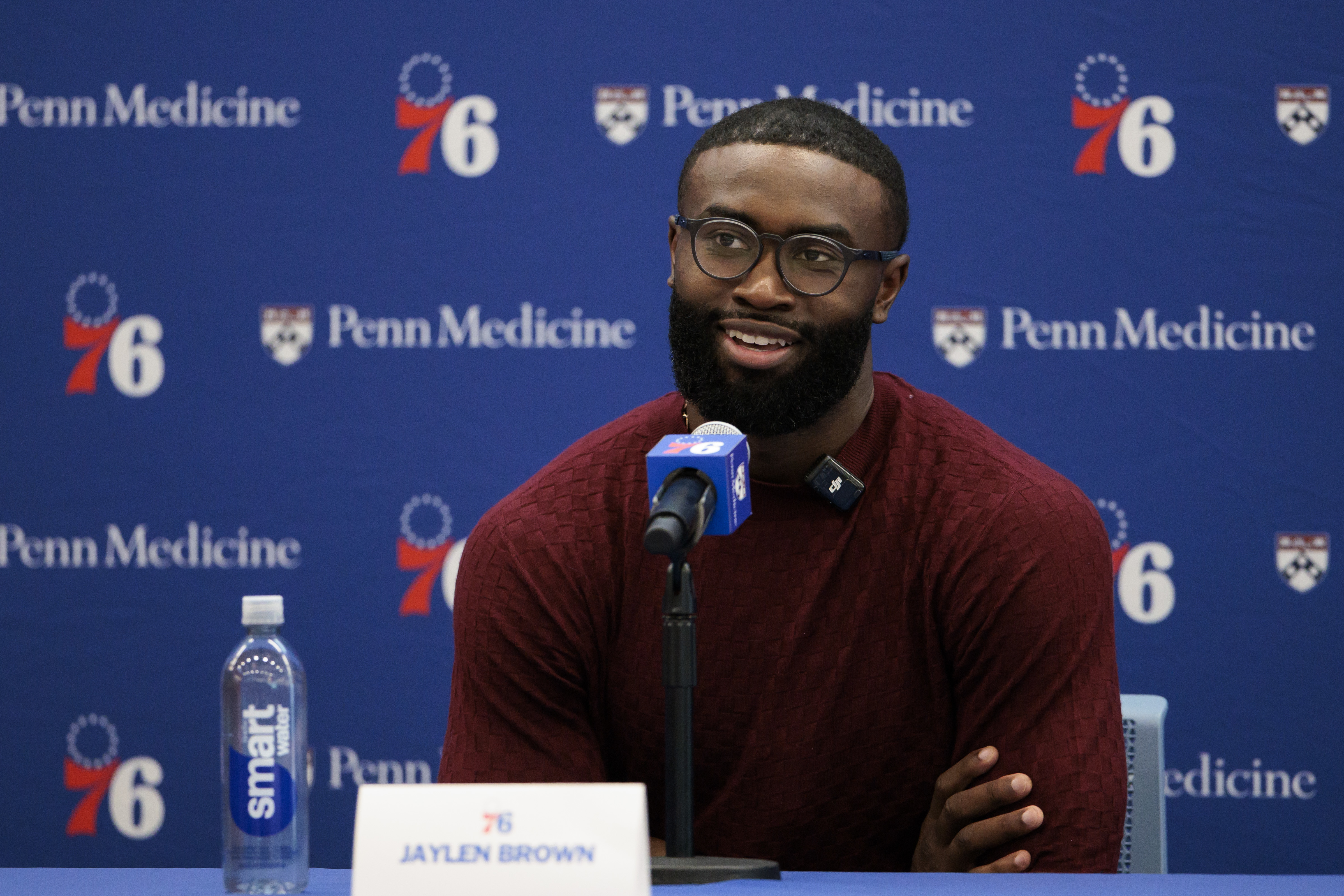
    But before Brown officially gets going in Philadelphia when training camp starts with Media Day on Sept. 28, he had one bit of business to take care of in Boston — saying thank you. Brown did that Sunday with a block party and concert in Boston Common, which he titled the 741 Frequency Fest. He didn’t say much — he only addressed the crowd briefly two times — and he joined rapper A$AP Ferg for a performance of their collaboration “Just Do It.”

    “I ain’t got too much to say because I’m at a loss for words,” Brown said. “I’m seeing all these people out here and I love each and every one of y’all. … I’ve been in this city for close to 10 years. I said I was gonna go to war for this city when I first got here.”

    To Brown, that extended beyond the court, with city and state officials coming to offer Brown the key to the city and a commemorative street sign that said “Jaylen Brown Way.”

    “Every minute that he has, he poured into the city,” Boston mayor Michelle Wu said. “We’re never going to let you forget us.”

    Upon entering the Common, a large poster said “Thank you, Jaylen. Love, the city of Boston.” Fans could take a marker and sign the wall or write a message to Brown.

    One such fan was Roberta Hayes-Bautista, a California transplant who has lived in Boston for over two decades and cited Brown’s commitment to the community, specifically with significant amounts of his money, as why Brown is “one in a million.”

    “Gut punch,” Hayes-Bautista said of the trade. “I don’t think you’ll ever be able to replace him. This right here, who’s ever done this before? Nobody.”

    Hayes-Bautista was referring to the block party in front of her. For most of the afternoon, it was a relaxing day in the park, with a DJ providing music from the stage where Brown and artists like Lil Jon and Lil Baby would eventually perform. The stage also displayed the Larry O’Brien Trophy Brown won with Boston in 2024, along with his Eastern Conference Finals and NBA Finals MVP trophies.

    Fans stood behind barricades about 15-20 feet from the stage from around 1:30 p.m. waiting for Brown to come out. Food trucks lined the pathways, and there were a few different basketball games around the Common. In the meantime, fans flowed in to take advantage of a book bag giveaway, haircuts, and manicures. Cloud cover hid the sun and made for a comfortable afternoon.

    That allowed Mary Vincent, who said she is a Celtics season-ticket holder, to come out with her family and greyhound Sangria, who was dressed up in a Celtics shirt. Vincent wanted to come out and support Brown even as she is recovering from a knee replacement.

    She said she plans on giving up her season tickets and wasn’t buying the Celtics’ reasoning for trading Brown. Celtics President Brad Stevens said multiple times last month that trading Brown would give the team more “optionality” into the future. That wasn’t much of as an excuse to Vincent and the thousands of people who showed up Sunday.

    “There was nothing wrong with the team. I think we had another possibility of winning another championship,” Vincent said. “I thought we would keep Jaylen Brown and Jayson Tatum through their whole careers. It was such a shock to me. I was grief-stricken.”

    Hence why Brown felt a unique day like Sunday was necessary, a part of the processing of the trade for him and for fans.

    Brown showed up to the event around 4 p.m., and mostly stayed quartered off from the crowds either on stage or behind it, except for one stretch of time when he walked down Charles Street as fans followed behind him. As the event wrapped up around 6:15 p.m., local and state officials made presentations to Brown, who was moved by the gestures.

    “When I first got to Boston, none of this I imagined,” Brown said. “My grandma and my mom taught me to just dive into my community, so I was expecting nothing like this.”

    A couple of the people who spoke on stage said they hoped Brown might make this party a regular thing. But those words sounded like people stating that they’ll still hang out after a break up, knowing that likely won’t be the case. There will still be more finality to Brown’s departure the first time he sets foot on the TD Garden floor in a regular-season game wearing a Sixers jersey. That day, slated for Jan. 21, is still about five months away. It won’t be easy for anyone involved.

    “I don’t even know what to say,” Brown said. “I don’t do stuff for recognition, but I’m so grateful it’s so many people here. The feeling is mutual. Just know, Boston, I love you.”
  • The QB2 fallacy, the need for a dynamic RB2, and other (initial) Eagles roster thoughts

    The QB2 fallacy, the need for a dynamic RB2, and other (initial) Eagles roster thoughts

    Thinking our way through the least climactic day on the NFL schedule. . .

    The Eagles backup QB discourse has been a thrill ride over the last couple of years. We’ve gone from nothing-less-than-a-second-round-pick-for-Tanner-McKee to the Eagles trading for Andy Dalton to both-these-guys-stink to the Eagles keeping both quarterbacks plus rookie Cole Payton on their initial 53-man roster.

    The only meaningful takeaway isn’t really a takeaway at all. More so, it’s a reminder of the longest-standing conventional wisdom in the game. In a league where half the teams don’t have a capable starting quarterback, nearly every team is going to have worse than that as its backup quarterback. It’s silly to suggest that the Eagles could have a better backup quarterback if only they looked outside of McKee or Dalton. What you see is what you get.

    The devil is in the definition, as always. Gardner Minshew and Kenny Pickett were at the extreme upper end of capability among backups. Minshew has posted a .500 or better record in both of his seasons where he made at least 12 starts. Pickett (somehow) is 16-11 in his career. Yet, in their combined three seasons as Jalen Hurts’ backup, the Eagles lost three of the four games in which they attempted at least 16 passes.

    Virtually every team in the NFL will be screwed if its starting quarterback goes down for an extended period of time. The only somewhat reliable exceptions are those teams that have invested significant draft capital or significant cap dollars in the No. 2 man on the depth chart. Nick Foles was an outlier. Even then, the Eagles were paying him more than triple what they are paying McKee and Dalton.

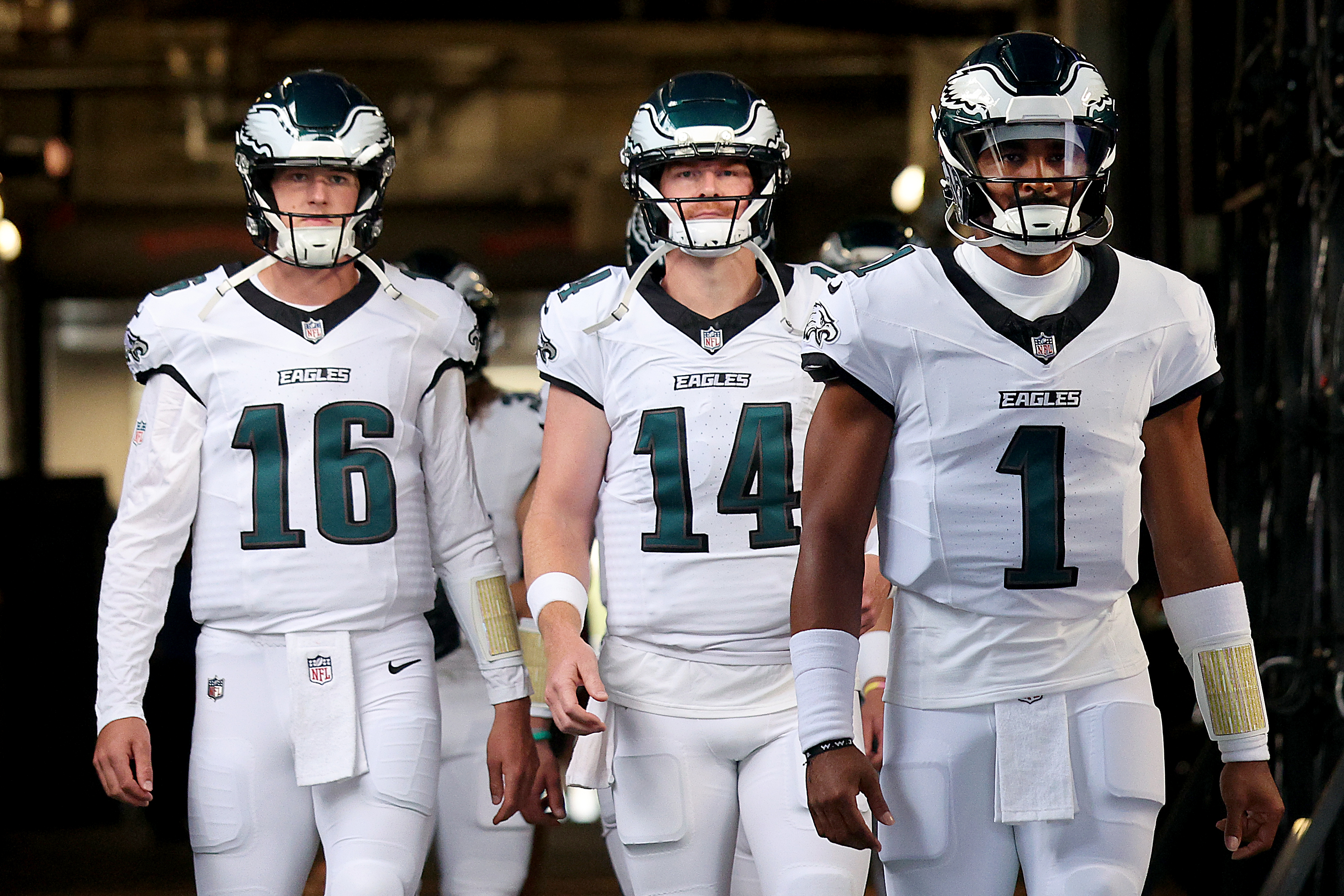
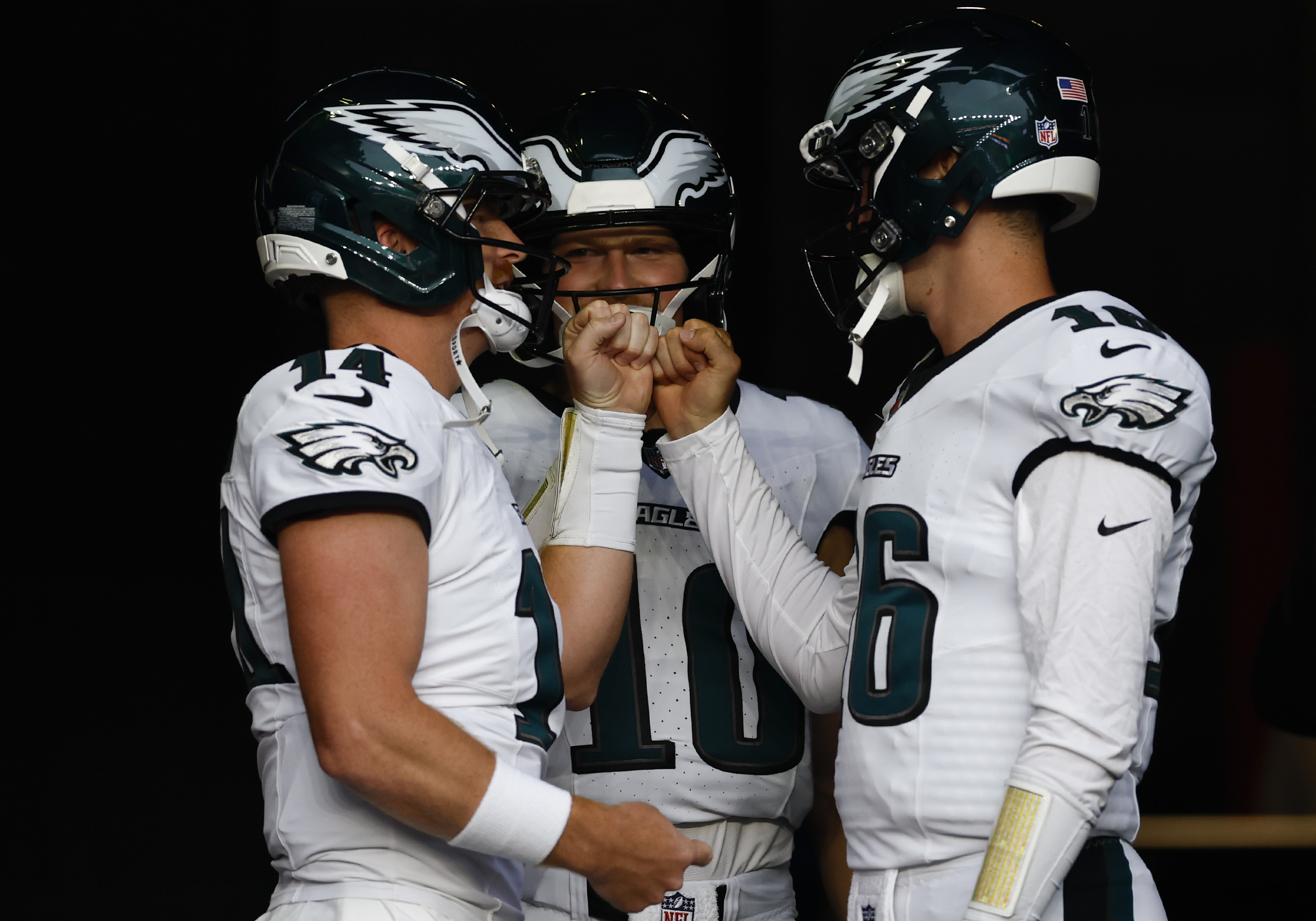
    Eagles quarterbacks (from left to right) Andy Dalton, Cole Payton and Tanner McKee are all on the roster … for now. Yong Kim / Staff Photographer

    The Eagles are at a point in their competitive and financial cycle where they can’t afford to be throwing around that Chase Daniel cheddar. The trade for Dalton was a workaround somewhat similar to the trade for Pickett. He is in the second-year of a two-year, $8 million extension, but the Eagles are responsible for a fraction of it.

    In a best-case scenario, they get a backup QB who has shown the ability to, at the very least, give a team a chance at remaining relevant through a short- or medium-term absence. Dalton is just 2-6 in his starts since going 6-8 as a 35-year-old with the Saints in 2022.

    But all of those starts were in relief of Bryce Young, who is just 14-30 himself over that span. That would be the equivalent of an additional three to four wins over 17 games compared to Dalton. Such a pace could be the difference between sneaking into the playoffs and giving up on the season for a team like the Eagles, who are expected to win 10-12 games with an upside well beyond that.

    The actual calculus of Dalton versus McKee versus keeping both is far too marginal to be conveyed in an expository sentence. At such a minuscule level, the expected value between the lines must be compared to a variety of factors outside of the lines, including the expected value in practice or the film room of Player X versus Player Y.

    That the Eagles have decided, at least for the moment, to keep both Dalton and McKee speaks to their regard for both. Ultimately, that regard, and the factors that compose it, will need to be weighted against the value of the additional roster spot that one of them will occupy. The real question isn’t Dalton versus McKee. It’s the other versus the lineman or defensive back or linebacker who isn’t currently on the roster because of them.

    On that note. . .

    Dollar for dollar, the biggest improvement the Eagles could make to their roster would be adding a running back who can do something different than Saquon Barkley and Tank Bigsby. Unless Will Shipley is that guy.

    Will Shipley has caught only nine passes with the Eagles.Yong Kim / Staff Photographer

    The most glaring anomaly on the Eagles roster is one that hasn’t gotten much attention over the last couple of years. Very few teams in the league have a less diverse running back room than they do. For the sake of the argument, let’s reduce it to a generalization that is overly broad and thus not entirely accurate. The Eagles don’t have a complement to Saquon Barkley, at least not one you’d classify as “pass-catching” or “change-of-pace.”

    Unless Will Shipley is that guy.

    I don’t necessarily think they need such a guy. I’m not even sure that such a guy would be attainable even if they thought they needed him. All I know is that they don’t have him. And, also, that his absence is worth contemplating for a team that should be looking for creative ways to distribute the touches that previously went to A.J. Brown.

    The Ravens’ Justice Hill is the guy I think of when I think of a guy the Eagles could use. Two years ago, he touched the ball 89 times and gained 38 first downs with an average of 6.9 yards per touch. To put that in perspective, Bigsby gained 17 first downs on 61 touches with an average of 6.2 yards per touch in 2025. Meanwhile, Shipley has touched the ball a total of 57 times in the two years since the Eagles drafted him in the fourth round. That, with 13 first downs and 3.9 yards-per-touch.

    Justice Hill caught 21 passes for the Ravens in 2025.Nick Wass

    Is it a big thing? Maybe not. But it’s certainly an area where the Eagles can improve. Last season, they were one of only four teams in the NFL who didn’t have multiple running backs catch at least 10 passes. That’s not necessarily a bad thing. The Rams scored the most points in the league without a traditional pass-catching running back.

    But the Eagles are clearly bucking convention in their backfield. We don’t even need to compare them to the rest of the league. Just look at their recent history. Even in 2024, when Barkley led the league with 345 rush attempts and 2,005 yards, Kenny Gainwell managed to catch 16 passes for 116 yards while carrying the ball 75 times for 290. Gainwell and Boston Scott were both members of the 2022 Super Bowl team. Go back to 2017. Think about Corey Clement’s touchdown catch.

    The modern NFL game is all about mismatches, both between and within personnel groups. Tight ends are in vogue because they thrive on those margins. While Shipley brings top-end speed, he has yet to display the feel, shiftiness or receiving chops that would make him a competitive advantage in a dedicated package. Bigsby is the ideal back-up to Barkley, a power runner who you’d be comfortable handing off to 15-20 times a game. But he has 11 receptions in three NFL seasons. It just feels like the Eagles are missing an element.

  • How to give up your car (sometimes), save money, and save the planet

    How to give up your car (sometimes), save money, and save the planet

    If you have ever considered giving up your car, now is the time.

    There’s the price of gasoline, which has shot up by more than 35% since President Donald Trump launched the war against Iran in February. Even if you never start the ignition, simply owning a car will now set you back an average of $8,000 a year in insurance, maintenance, and loan payments.

    And those are just the immediate costs. As a major source of greenhouse gases, cars contribute significantly to climate change, which is already pushing up the price of food and everyday purchases.

    So, let’s say you’re ready to ditch your money pit on wheels. Then what?

    I’ve been struggling with this question since I moderated a panel this spring with Sarah Goodyear and Doug Gordon, the duo from the popular podcast The War on Cars, who just published a rousing call to arms, Life After Cars: Freeing Ourselves from the Tyranny of the Automobile. The event, held at the capacious Resurrection Philadelphia church in Center City, was sponsored by Philly Bike Action and 5th Square Advocacy, two groups dedicated to promoting alternatives to driving.

    Resurrection’s sanctuary was packed — with the converted. When Goodyear and Gordon asked the audience who had traveled to the event by car, only a few sheepish hands went up.

    While their book does a great job of detailing the ways cars “ruin everything,” there is little in it to help the car-dependent kick the habit. The problem is, most people have no idea where to start.

    Even in the Philadelphia region, which has better-than-average transit and cycling infrastructure, the prospect of living without a car can seem a little like trying to swim without arms and legs. How will you take the kids to sporting events, look after elderly parents, and buy groceries without a vehicle? Our local transit services — SEPTA, NJ Transit, and PATCO — don’t serve every nook and cranny of the region and don’t run as frequently as they should.

    Like everything else in America these days, the debate over the role of cars in our daily lives tends toward extremes. Philadelphia urbanists can sometimes come off as unsympathetic, as if they expect people to go cold turkey and swap their vehicles for bikes and SEPTA. Meanwhile, the pro-car lobby keeps insisting, against the evidence, that the car-free life is not practical outside a few transit-rich neighborhoods, like Center City.

    But who says it has to be all or nothing?

    ‘Habituate walking’

    My advice: Keep your car — for now, at least — but look for opportunities to get around by other means. Walk to the grocery store. Ride a bike to dinner at a nearby restaurant. Think of these excursions as a trial run. Once you feel comfortable, take the train or bus to work. You may never give up your car permanently, but you will save a bundle on gas and maintenance, reduce congestion, and boost your step count.

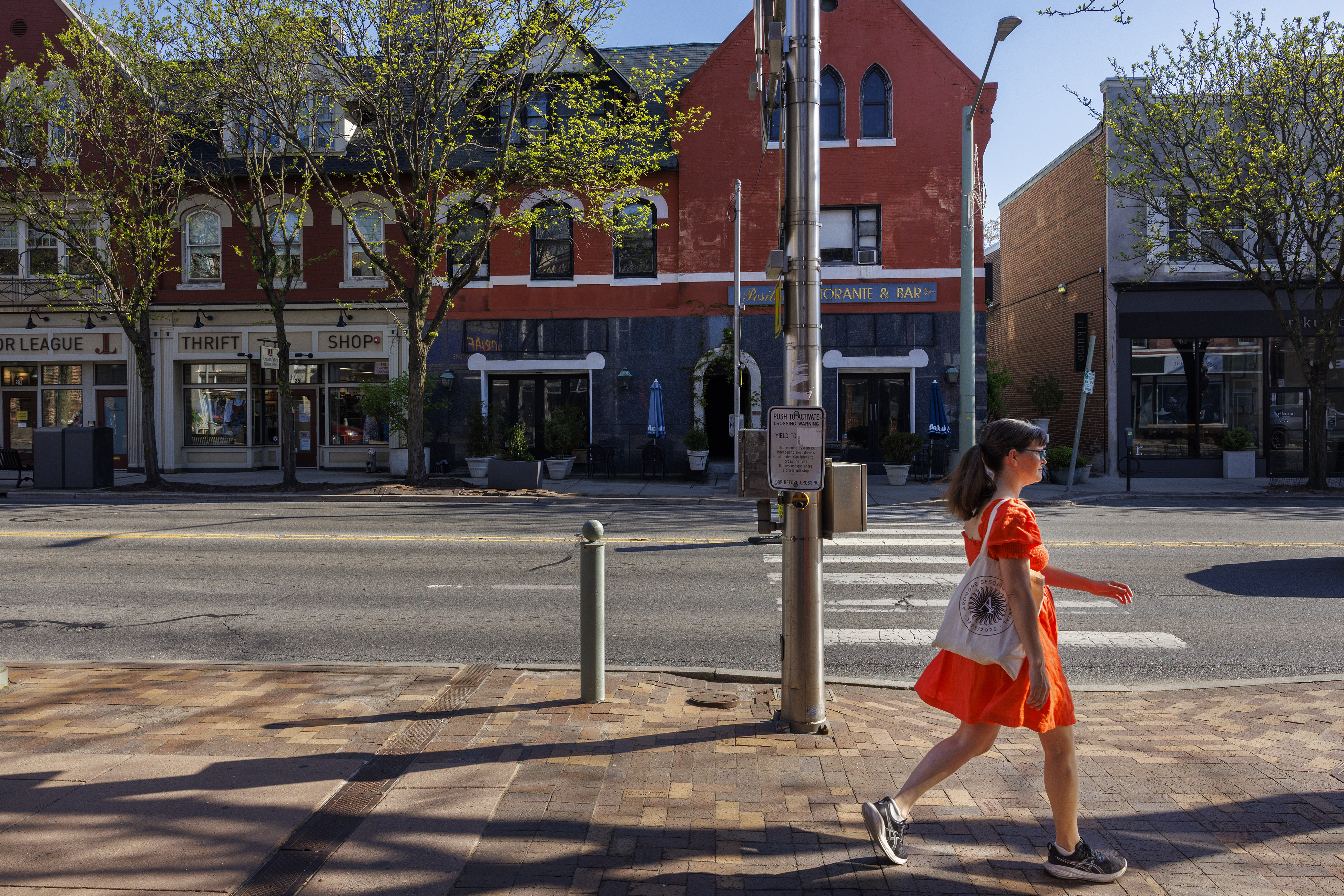
    That’s how Jane Murray started weaning herself from the car. The Ardmore resident, who now runs a popular Instagram account called @Janewalksardmore, first began taking long walks as a way to experience her Main Line town on a deeper level. To give shape to her Instagram project, she decided to visit every block in Ardmore and document her travels.

    Jane Murray walks along Lancaster Avenue in downtown Ardmore, as part of a project to to walk every street in the Main Line town.Alejandro A. Alvarez / Staff Photographer

    The more she walked, the more comfortable she felt leaving her car at home. She now wheels a “granny cart” to Trader Joe’s, a 15-minute walk from her house. Not long ago, she hopped a SEPTA bus to meet friends for quizzo in a pub a few towns away. At the end of the night, she took an Uber home.

    Murray’s kids still have to take a bus the four miles to their middle school and she drives them to distant sporting events, but makes a conscious effort to “habituate walking” into her routine. Before leaving the house, she checks her transit apps to see if she can get to her destination without driving. Sometimes, she mixes it up: When she’s running errands, she’ll drive part of the way, then walk the last few blocks. Her Instagram has inspired her neighbors, who pepper her for tips about safe walking routes.

    A mobility menu

    Living in America without a car is often portrayed as a hardship, something that people on the margins are forced to endure. But, for me, living without a car has been a joy.

    I didn’t know what to expect when I impulsively decided to get rid of my aging clunker 30 years ago after being presented with an expensive repair bill. Before then, I had rarely taken taxis or splurged on Amtrak to visit family in New York. Since I would no longer have to pay for car insurance, I promised to allow myself those indulgences. My husband and I were living in Center City, which certainly made our experiment more doable. (I should mention that I was pregnant at the time. I took a taxi to and from the hospital.)

    Besides saving a lot of money, not having a car has liberated me in ways I never could have imagined. Bike lanes were virtually nonexistent in Philadelphia in the ’90s; today my bicycle is my main form of transportation. Thanks to the city’s mostly flat terrain, I can easily cycle to interviews and events in far-flung neighborhoods. My ride is equipped with side baskets, allowing me to do my grocery shopping by bike. When my destination is beyond biking distance, or when I have to look presentable, I’ll take SEPTA or reserve a Zipcar from the local car-sharing company. In a pinch, I can always summon an Uber, a Lyft, or a taxi. I still walk a lot, and it’s no exaggeration to say I run into people I know on every outing.

    The key here is to think of mobility as a menu of options, rather than a car/no-car binary. While low-speed electric bikes have made it easier to cover long distances, not everyone can, or wants to, bike. Even transit can be daunting for a novice. The fear of crime also deters some people from using SEPTA, even though serious incidents have fallen dramatically in the last decade.

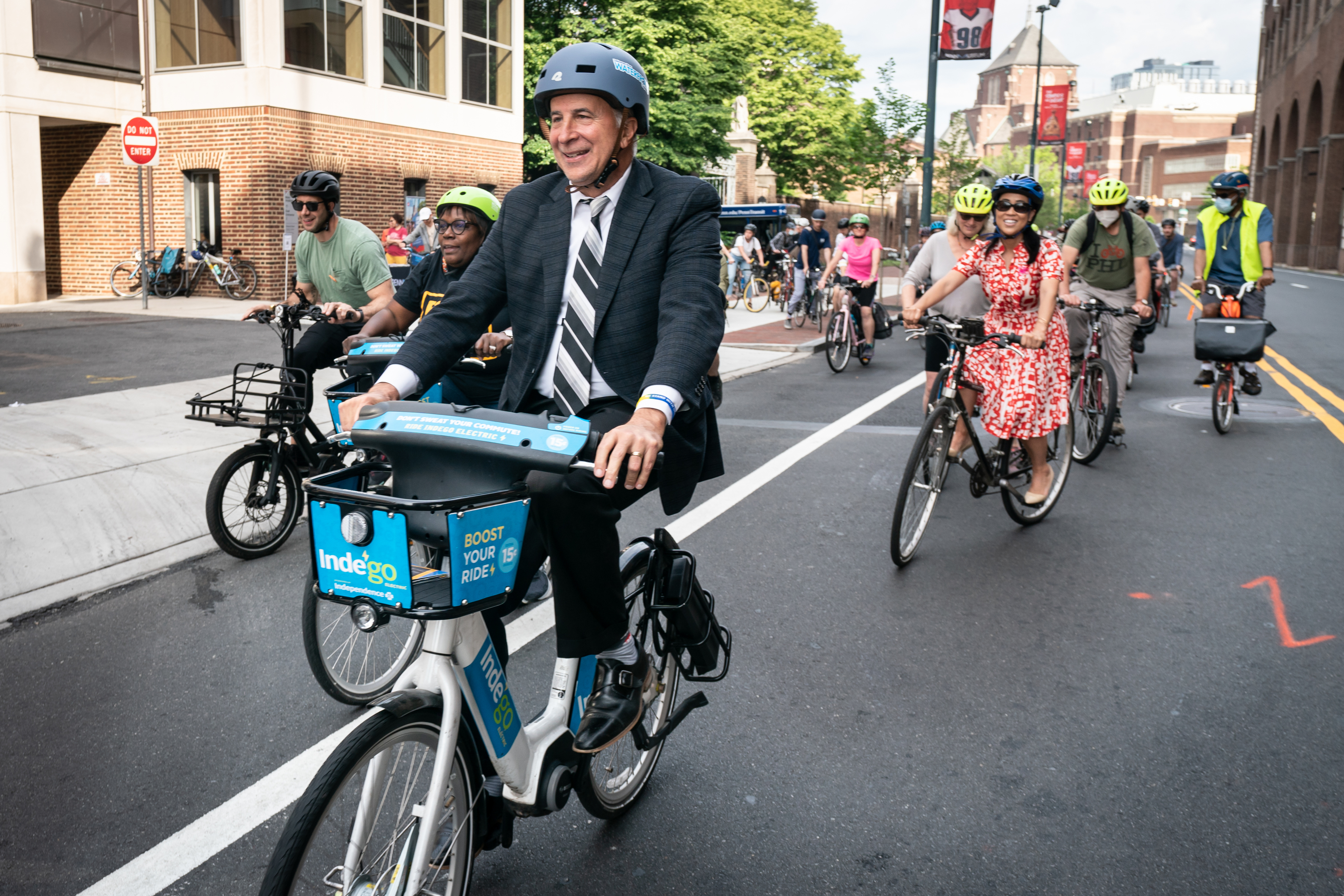
    In 2022, Councilmember Mark Squilla (center), former Eagle Connor Barwin, Councilmember Kendra Brooks, and Councilmember Helen Gym took part in a Bike to Work Day event sponsored by the Bicycle Coalition of Greater Philadelphia to promote cycling as a means of transportation.JESSICA GRIFFIN / Staff Photographer

    Eden MacDougall vividly remembers his trepidation when he started commuting from Langhorne, in Bucks County, to Temple University on SEPTA’s Regional Rail. “I kept thinking, how will I know it’s my stop?”

    By the time MacDougall graduated in 2022, he was a super-commuter. To get to his new job at Mastery Charter School, where he is an AmeriCorps reading instructor, he had to use three forms of transportation: He started his day by biking two miles from his home to the Langhorne station. After taking a SEPTA train to Fern Rock, he changed to the Broad Street subway, getting off at Erie. The trip took an hour and 45 minutes, but MacDougall, who never learned to drive, loved it. “I’d open up my book and read the whole way.”

    Stephen Bronskill, coalition manager for Transit Forward Philadelphia, shows incoming Temple University students how to navigate SEPTA during a tour organized at the start of the new semester. Bastiaan Slabbers / For The Inquirer

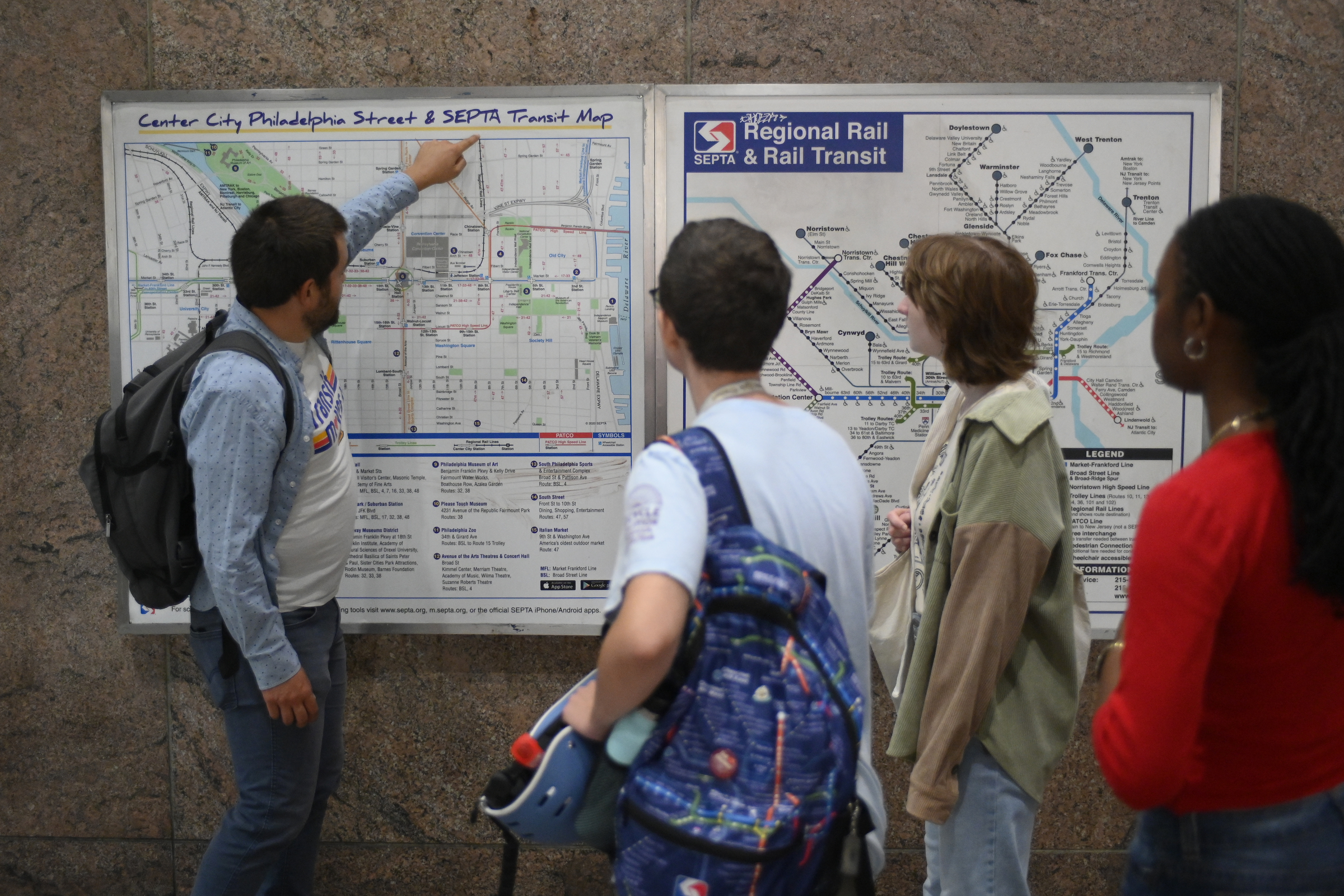
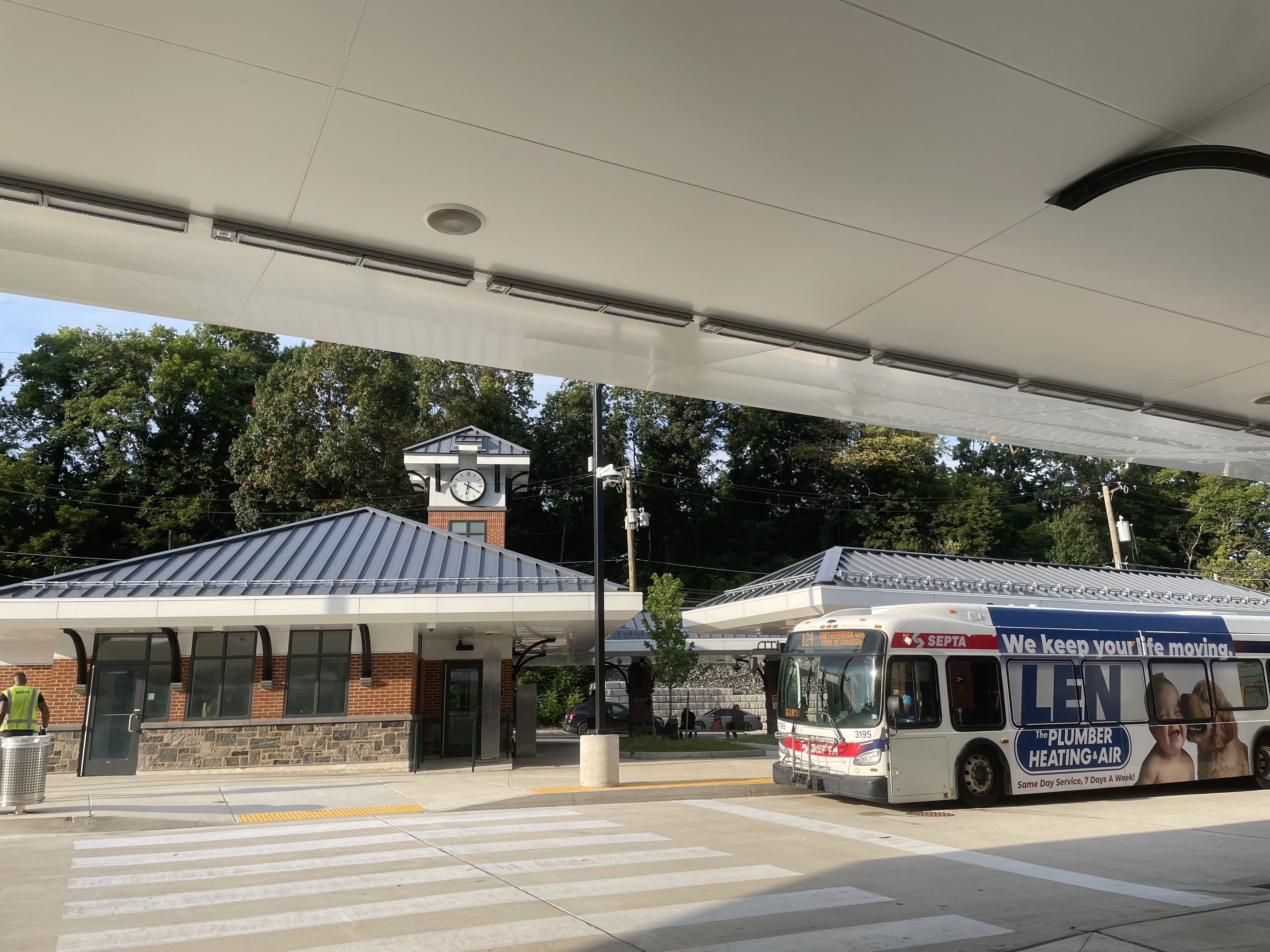
    Now he lives in Philadelphia and volunteers as an instructor for Transit Forward Philadelphia and the Bicycle Coalition of Greater Philadelphia, which run Saturday tours to help people feel more confident riding SEPTA. Although the events provide practical advice, like how to use a transit app, they’re intended to be fun excursions. MacDougall recently shepherded a group from Roxborough to the Clark Park farmers market, showing them how to change from the Route 9 bus to a West Philadelphia trolley. Along the way, the group got to see SEPTA’s efficient new Wissahickon Transit Center on Ridge Avenue, where 11 bus routes converge.

    The two groups, which have been lobbying the state legislature to help SEPTA secure much-needed state funding, started the Saturday tours as an extension of their advocacy work. They believe the exposure to SEPTA’s system can help reset public perceptions.

    SEPTA’s new Wissahickon Transportation Center on Ridge Avenue in Manayunk is a major upgrade for the city’s bus riders. The sprawling, $50 million station opened in January 2026 and allows 5,000 passengers a day to switch between 11 bus lines. (photographeed Aug. 2026)Inga Saffron / For The Inquirer

    “People had a lot of negative experiences during the pandemic,” Julio Rodriguez, the Bicycle Coalition’s policy director, told me. So, when SEPTA announced it was implementing its long-awaited schedule changes this summer, the transit advocates saw a chance to change the conversation.

    Helping SEPTA boost ridership isn’t their only goal, however. Because they believe fewer cars will make Philadelphia a safer, more livable city, they’re organizing similar outings to get people comfortable with bike commuting.

    Changing habits

    Even while these advocates are gaining adherents, many skeptics remain convinced people will never give up their cars.

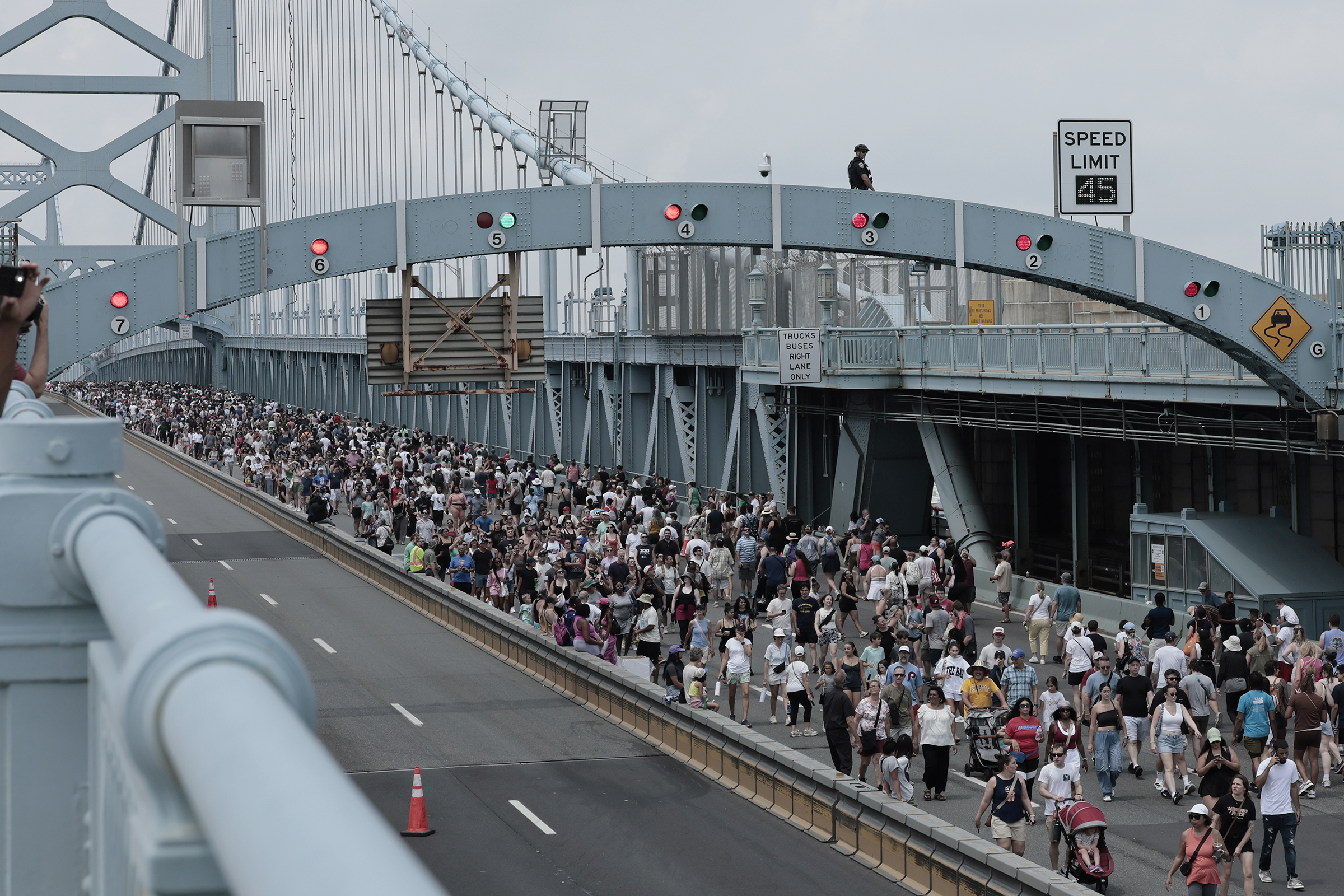
    But the public’s cheerful response to this summer’s car-free celebrations around Philadelphia suggests that habits can change. Almost 600,000 people converged for World Cup watch parties at Lemon Hill in Fairmount Park during the 39-day FIFA Fan Festival — even though parking was banned. After the games ended, I saw hundreds of people streaming along the Schuylkill River Trail to 30th Street Station, a distance of 1.5 miles. Thousands took transit, rode bikes, or walked to the Ben Franklin Bridge to celebrate its centennial in July.

    Thousands of people took transit, biked, or walked on July 11 to parade across the Ben Franklin Bridge to celebrate the 100th anniversary of its opening.Elizabeth Robertson / Staff Photographer

    For people who switch to alternative forms of transportation, the payback is immediate. But Philadelphia and the region also have much to gain from having fewer cars racing through the streets: cleaner air, less noise, more casual social encounters with neighbors, and less wear-and-tear on infrastructure

    The impact on climate change is a different story. Individual actions can only do so much to slow the dramatic shifts in global weather. It’s also a frustrating chicken-and-egg situation. People won’t see car-free living as truly feasible until there is intensive government investment in transit, bike infrastructure, and pedestrian safety.

    Until that happens, carry a fare card, sign up for car-share, install a transit app on your phone — and don’t forget to wear a helmet.

  • 🚴 Pedal to victory | Sports Daily Newsletter

    🚴 Pedal to victory | Sports Daily Newsletter

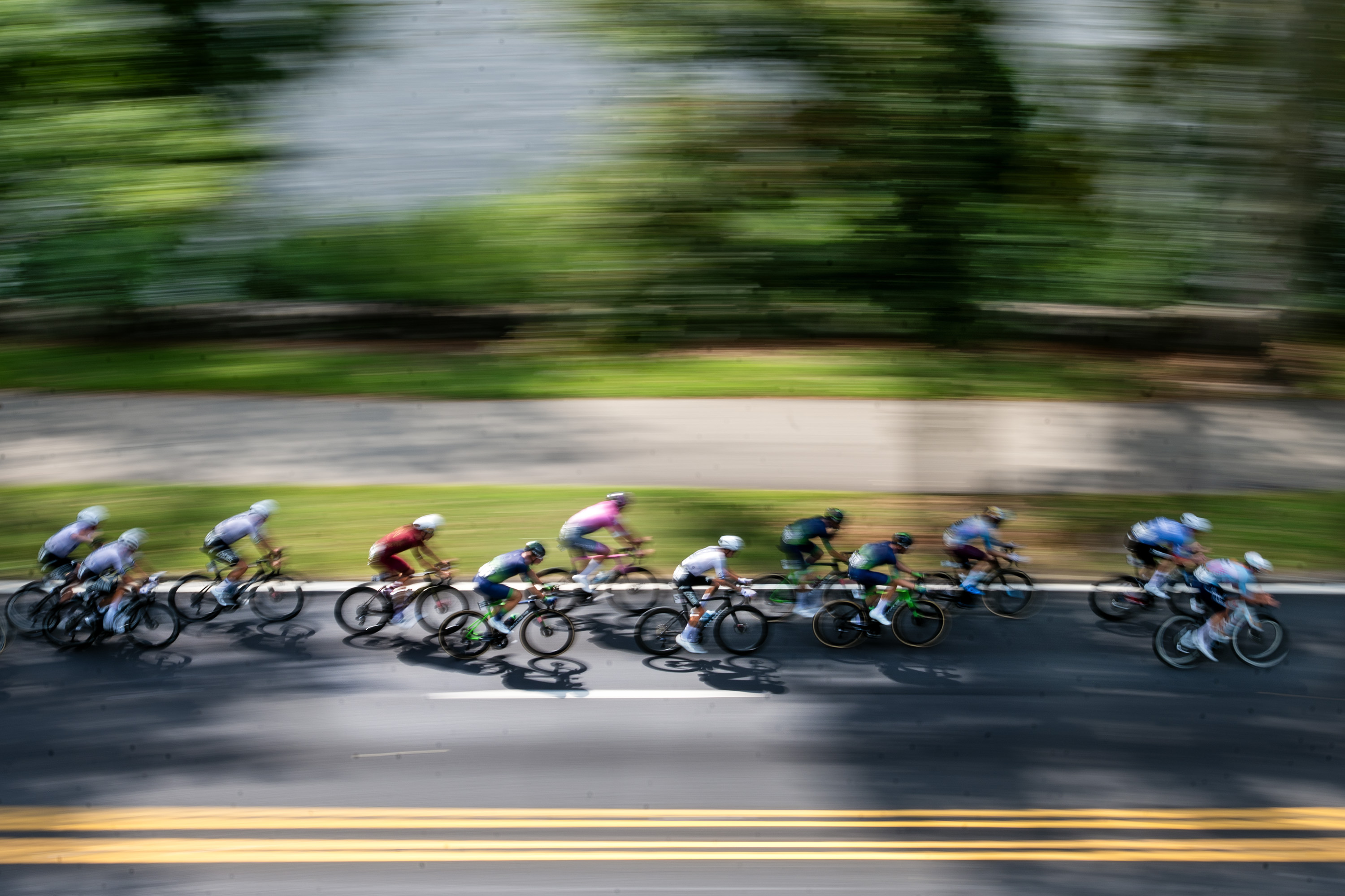
    After decade-long hiatus, the Philadelphia Cycling Classic wheeled its way through the Benjamin Franklin Parkway to Manayunk this weekend.

    The event, considered as one of the nation’s most storied races, has drawn cycling’s Olympians, national champions, and emerging talents to the city. The course is also a giant chessboard of strategy, aerodynamics, and aerobics.

    On Sunday, it saw Italian cyclist Chiara Consonni place first in the women’s classic, and Germany’s Tim Torn Teutenberg won the men’s classic in a thriller.

    For spectators, the event offered a unique opportunity in sports to see world-class competitors up close. Biking fans also came together to reminisce on its run from 1985 to 2016 and inspire folks “to go outside and get on the bike.”

    — Isabella DiAmore, @phillysport, sports.daily@inquirer.com.

    If someone forwarded you this email, sign up for free here.

    ❓What is your favorite outdoor activity and why? Email us back for a chance to be featured in the newsletter.

    Roster moves

    Eagles quarterbacks (from left to right) Andy Dalton, Cole Payton and Tanner McKee all made the 53-man roster announced Sunday.Yong Kim / Staff Photographer

    The Eagles announced the active roster out of camp Sunday at the 6 p.m. deadline, and they plan to carry four quarterbacks to start the year. All three depth quarterbacks behind Jalen Hurts — Tanner McKee, Andy Dalton, and Cole Payton — made the cut.

    However, neither Uar Bernard nor Joshua Weru, products of the International Player Pathway program, made the initial 53. But they could still return to the team.

    Here’s a complete list of the Eagles’ initial 53-man roster.

    And in case you missed the Eagles’ preseason finale loss to the Bengals on Friday, Jeff McLane gave us his grades on their performance.

    What we’re…

    🔍 Analyzing: Villanova QB Pat McQuaide was cleared to play hours before the season opener. Here’s a look at the legal fight over his eligibility.

    🏈 Wondering: How K.C. Keeler is feeling entering Year 2 as Temple’s football coach? He also chatted with the Inquirer about his philosophy and more.

    🏀 Learning: The Sixers hired Randy Mims to the front office. Mims is a longtime friend and confidant of LeBron James.

    📖 Reading: Makai Lemon says he’s “glad” his rough NFL debut happened in a preseason game and not September.

    Complete sweep

    Zack Wheeler throws during the first inning against the Los Angeles Angels on Sunday.Caroline Brehman

    It wasn’t pretty at first, but Zack Wheeler found a way to battle back on Sunday and only allowed one run as he went on to complete six innings for the first time in over a month. The Phillies secured a 5-2 victory and pulled off the sweep in Anaheim.

    However, this series revealed some sloppy baserunning against the Angels. Interim manager Don Mattingly, though, isn’t concerned about it. He says, “That’s going to happen now and then.”

    Taking a step back

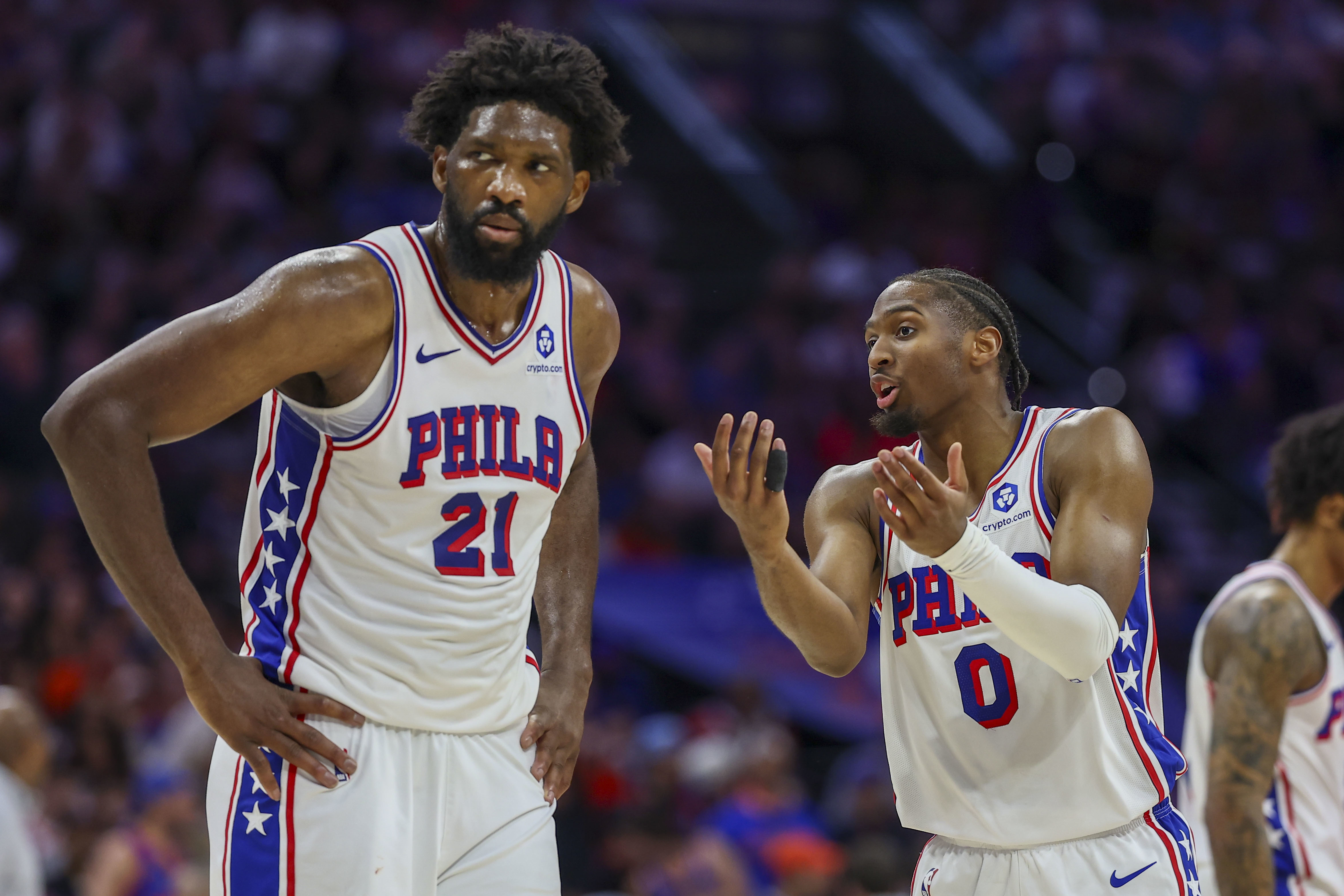
    Sixers center Joel Embiid (left) and guard Tyrese Maxey will need to share the load with LeBron James, Jaylen Brown and VJ Edgecombe this season.Monica Herndon / Staff Photographer

    The Sixers have formed a group that president of basketball Mike Gansey called the “Big Five.” But, with a star-studded lineup in LeBron James, Jaylen Brown, Tyrese Maxey, Joel Embiid, and VJ Edgecombe, someone will need to embrace change in order for the roster to succeed.

    Our Sixers writers explain which member will need to sacrifice the most next season.

    Highlight-reel goal

    This trap of a ball in the air by Cavan Sullivan led to his highlight-reel goal in the Union’s win at Red Bull New York on Saturday.Philadelphia Union

    The Union’s visit to Red Bull New York on Saturday drew the kind of hype that U.S. national team fans have waited to see for a domestic league game.

    And Cavan Sullivan’s sixth goal for the Union’s first team — in a 3-1 rout of New York — was easily his most sensational. Sullivan continues to make his case to earn his first senior U.S. national team call-up for a four-game friendly in September and October.

    There’s just a few weeks to go until Mauricio Pochettino will pick his team, and beside Sullivan, Neil Pierre, Frankie Westfield, and other Union players could be considered.

    David Murphy’s take

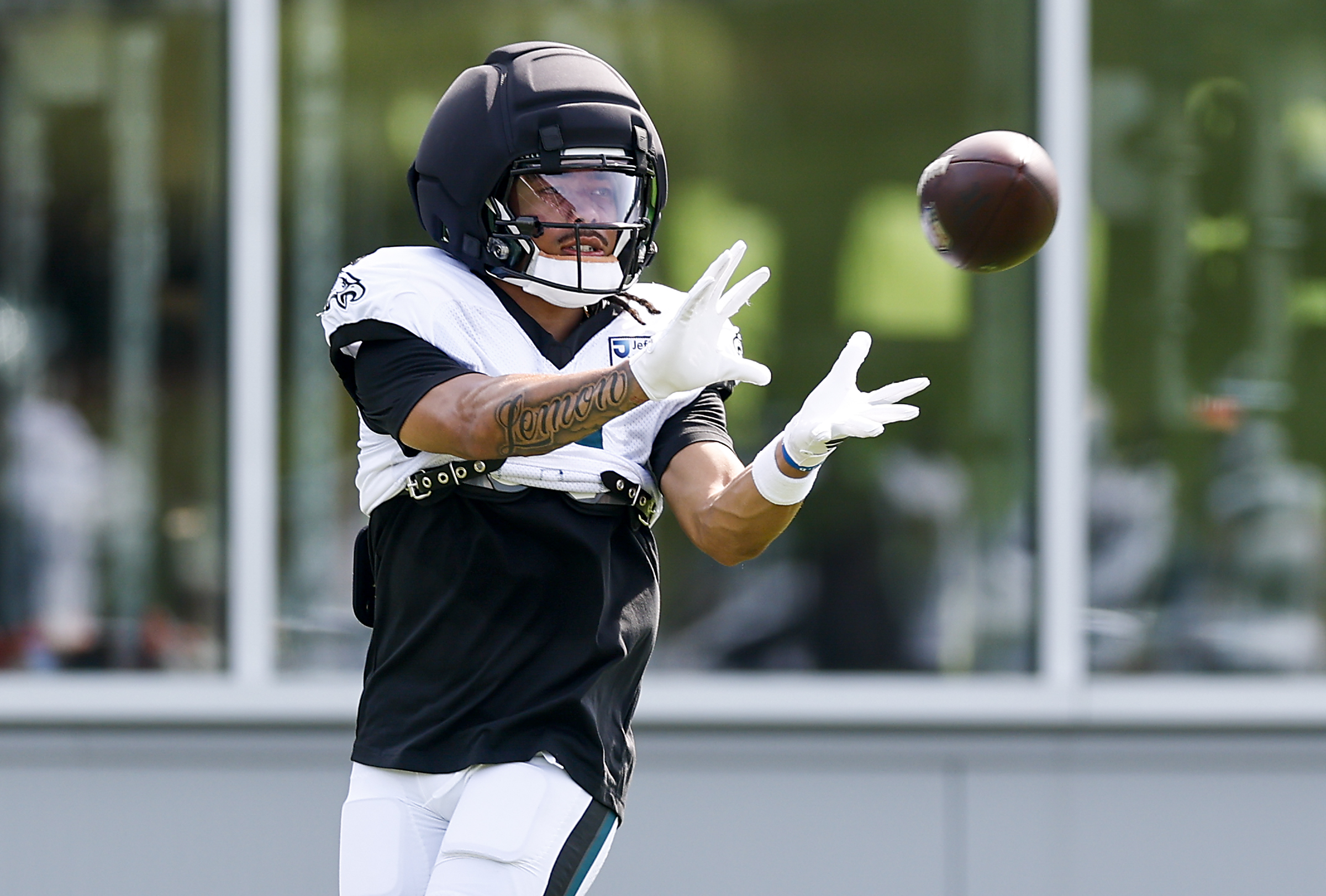
    Eagles wide receiver Makai Lemon during training camp. Lemon has been dealing with soft tissue injuries this summer but remains integral to first-year offensive coordinator Sean Mannion’s scheme.Yong Kim / Staff Photographer

    A.J. Brown’s departure gives Makai Lemon an excellent opportunity to make Sean Mannion’s new offense work. If there’s one thing you can safely say about the Eagles in its first year under Mannion: some wide receiver is going to have a breakout season.

    The expectations for the Eagles’ 2026 first-round pick should be high. Because the bar is high. And he is the only one who has the skill set to clear it, writes columnist David Murphy.

    Join us!

    The Eagles announced their 53-man roster at the 6 p.m. deadline on Sunday.Vaughn Johnson

    Have any questions about the Eagles’ 53-man roster? Jeff Neiburg will answer them in an AMA in the r/Eagles Subreddit starting at noon Monday.

    We compiled today’s newsletter using reporting from Maggie Prosser, Michelle Myers, Mia Messina, Conor Smith, Lochlahn March, Jonathan Tannenwald, DeAntae Prince, Chris Hine, Olivia Reiner, Jeff Neiburg, Isabella DiAmore, and David Murphy.

    By submitting your written, visual, and/or audio contributions, you agree to The Inquirer’s Terms of Use, including the grant of rights in Section 10.

    After being out on vacation, it’s good to be back! Hope you a had a restful weekend. I’ll catch up with you tomorrow. — Bella

  • Farmers say they face a new crisis as Trump’s tariffs, Iran war raise costs

    Farmers say they face a new crisis as Trump’s tariffs, Iran war raise costs

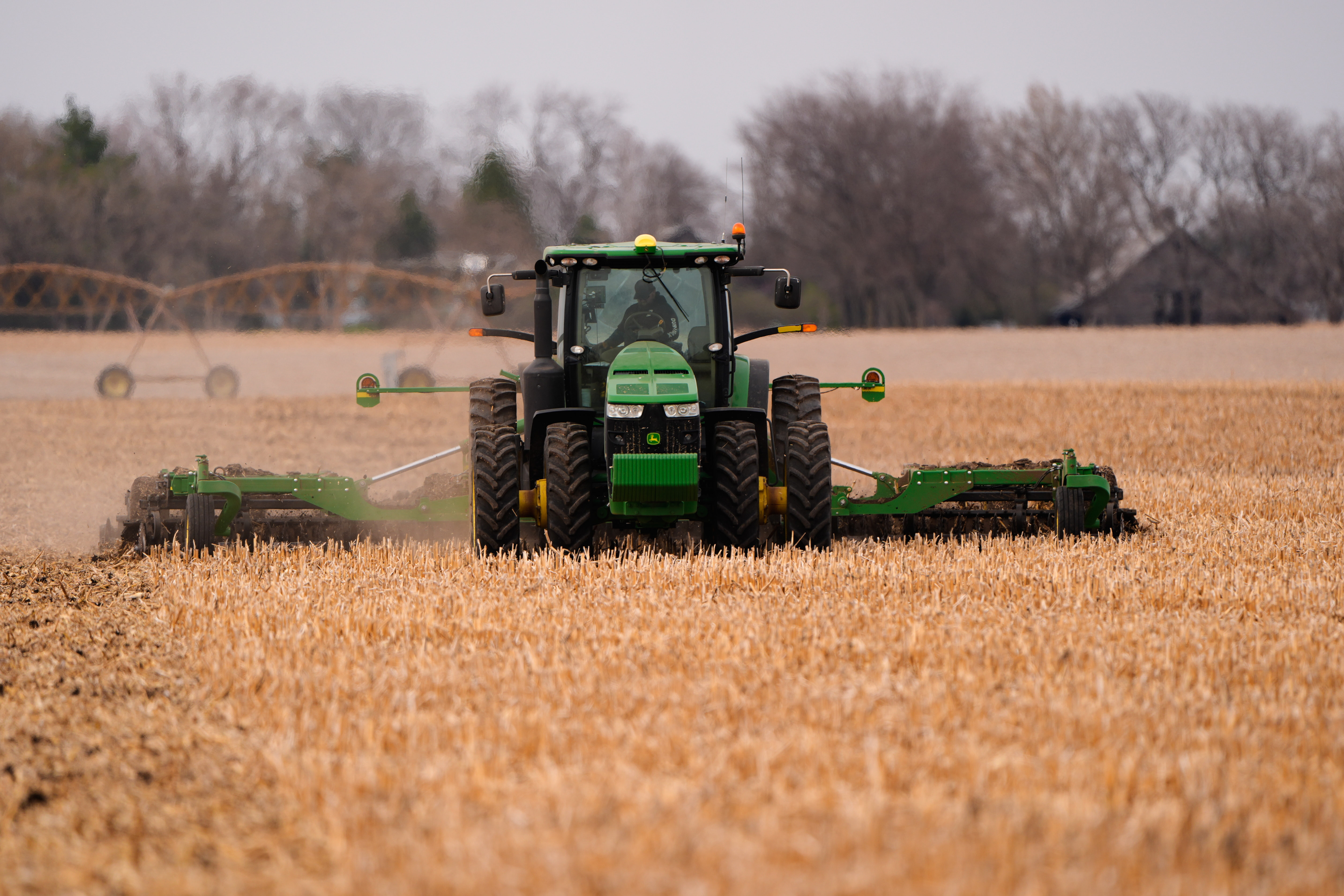
    For nearly 16 years, Wendy Johnson has tried to build an Iowa farm that could survive the kinds of economic shocks that drove farmers out of business when she was growing up in the 1980s.

    She diversified her operations, growing corn, small grains, and soybeans while also raising sheep, cattle, pigs, and chickens. She opted to sell directly to consumers and transitioned a portion of her 1,200 acres to organic production. She avoided debt and even planted trees to protect her soil and livestock.

    But the latest crisis has defied her careful planning: President Donald Trump’s tariffs and his war with Iran have driven up the cost of fertilizer, fuel, and machinery just as weak crop prices have made it harder to cover those rising expenses.

    “I am afraid that we’re looking into the barrel of another farm crisis,” said Johnson, a fourth-generation farmer, who estimates her profits are down by as much as 50%. “And we all know historically what that did to our … rural communities.”

    Johnson is among American farmers who say they are desperate for relief from Washington as Trump administration policies raise costs and slash profits. Recently, Trump slapped 50% tariffs on Canada, a critical source of fertilizer and farm equipment. And he wrote in a Truth Social post that he would pause tariffs on some imported ground beef in an effort to lower grocery prices, infuriating U.S. cattle ranchers who say the move would undermine domestic herders.

    Meanwhile, the federal farm bill — the traditional source of agricultural subsidies, crop insurance, and other support for farmers — is hopelessly out of date, and a divided Congress is far from agreement on how to replace it. To tide over rural America, Republican leaders are trying to pass $12 billion in emergency aid. But their plan would pair that money with billions of dollars for the war with Iran, the very conflict that has helped drive up fuel costs and added to the squeeze on farmers in the first place.

    That combination gets mixed reviews in farm country. While some industry groups, such as the American Farm Bureau Federation, have backed it, others have argued that it is counterproductive to tie the money to funding for the Iran war.

    “While we support providing immediate relief to farmers … we are troubled by funding that perpetuates a costly military conflict that risks further disrupting global markets, increasing input costs, and contributing to the economic pressures already weighing on farm operations,” the National Farmers Union wrote in a July letter to House Speaker Mike Johnson (R., Louisiana) and House Minority Leader Hakeem Jeffries (D., New York).

    Aaron Lehman, president of the Iowa Farmers Union, echoed that sentiment.

    “I’m glad lawmakers are trying to find a way to help farmers,” Lehman said. “But this approach is not the right one.”

    When the House returns to Washington on Monday, passing a farm aid package remains near the top of the legislative to-do list. Iowa is particularly critical heading into the Nov. 3 midterm elections, with three competitive House seats and a competitive Senate race. In a state that has not had a Democratic governor in nearly two decades, even that race in Iowa is competitive, according to the Cook Political Report.

    Nationally, roughly a dozen competitive House seats have a significant concentration of agricultural areas, as well as multiple competitive Senate races. Republican leaders, trying to hang on to narrow majorities in both chambers, are especially eager to demonstrate their ability to deliver for a key constituency.

    “Right now, if you’re growing something in the ground, you’re losing money. And it’s not just a crop, it’s virtually every crop, and it’s virtually every region of the country,” said Senate Agriculture Committee Chair John Boozman (R., Arkansas).

    While farmers say getting the emergency aid is crucial, many called it a “Band-Aid” at best. Agriculture industry groups said the funding must be accompanied by long-term policy that addresses the structural problems threatening their livelihood.

    Russell Boening, a Texas farmer who runs his family’s operation with his brother, is facing a similar squeeze to Wendy Johnson in Iowa. The farm grows corn, grain sorghum, and wheat, as well as raising cattle. But crop revenue has fallen below the cost of their production as fertilizer and other inputs have become more expensive. Boening estimates the farm’s bottom line has taken as much as a 40% hit in some areas.

    The emergency aid is “needed,” he said, adding that farmers in South Texas are already seeking operating loans for 2027 so they can begin planting in January. But Boening urged Congress to get to work on longer-term policies because “farmers don’t want to come there every six months for a bridge payment for farmer assistance.”

    Ben LaCross, president of the Michigan Farm Bureau, also supports the emergency assistance, noting that farmers have been struggling with rising costs and weak commodity prices for more than a decade. He praised the Trump administration’s efforts to expand market opportunities for agricultural commodities, and said farmers need a new farm bill that further expands markets and helps reduce the cost of fertilizer and other inputs.

    The current farm bill — a multiyear law that sets national policy for agriculture and nutrition — is nearly eight years old. With the law originally designed to be renewed every five years, Congress has temporarily extended the legislation three times as lawmakers have failed to reach an agreement on updated policies. The latest extension will expire at the end of September.

    But Congress is nowhere near an agreement on a new policy framework. Republicans want to increase funding for commodity farmers to help offset rising production costs, while reducing federal funding for food stamps. Democrats, who oppose altering the food aid benefits, blocked Republicans from advancing the bill out of the Senate Agriculture Committee in early August. The committee will continue work when senators return from recess in mid-September.

    Boozman and Sen. John Hoeven (R., North Dakota) played key roles in advocating for emergency farm aid. The money was included in a party-line package Republicans are rushing to pass before the midterms. Along with funding for farmers, that package includes two other GOP priorities: Iran war funding and stricter rules for voting.

    GOP lawmakers aim to use the complex reconciliation process to pass the package through both chambers with a simple majority, forgoing the need for Democratic support. But for that plan to work, it would require near-unanimous support from Republicans — which it does not have.

    GOP senators had hoped to vote on a framework for the package before they left town for the August recess, but those plans were scrapped amid lingering concerns from multiple lawmakers within the conference.

    Between those concerns and a tight legislative calendar, the path to passing help for farmers before Nov. 3 is looking increasingly difficult.

  • Q&A: Temple coach K.C. Keeler’s second-year expectations, his Delaware foundation, and more

    Q&A: Temple coach K.C. Keeler’s second-year expectations, his Delaware foundation, and more

    K.C. Keeler is a family man who has built his coaching foundation on the lessons and influence of those he played and coached under.

    He has, what some would say, an old-school approach when it comes to running a football program: Juniors and seniors deserve the opportunity to play, academics and community service are just as important, and building a locker room starts with relationships.

    As the winningest active head coach across all divisions of college football, Keeler’s philosophy has certainly worked. The second-year Temple coach surpassed 275 career wins (currently at 276) last season and is turning around a program that before last season finished 3-9 for four consecutive years.

    In 2025, Temple posted a 5-7 record — one game short of reaching a bowl game, which it hasn’t made since 2019 — and had one-point losses to Navy and Army.

    So, where does the program go from here? Well, for the first time in a long time, this program has a real sense of cohesion.

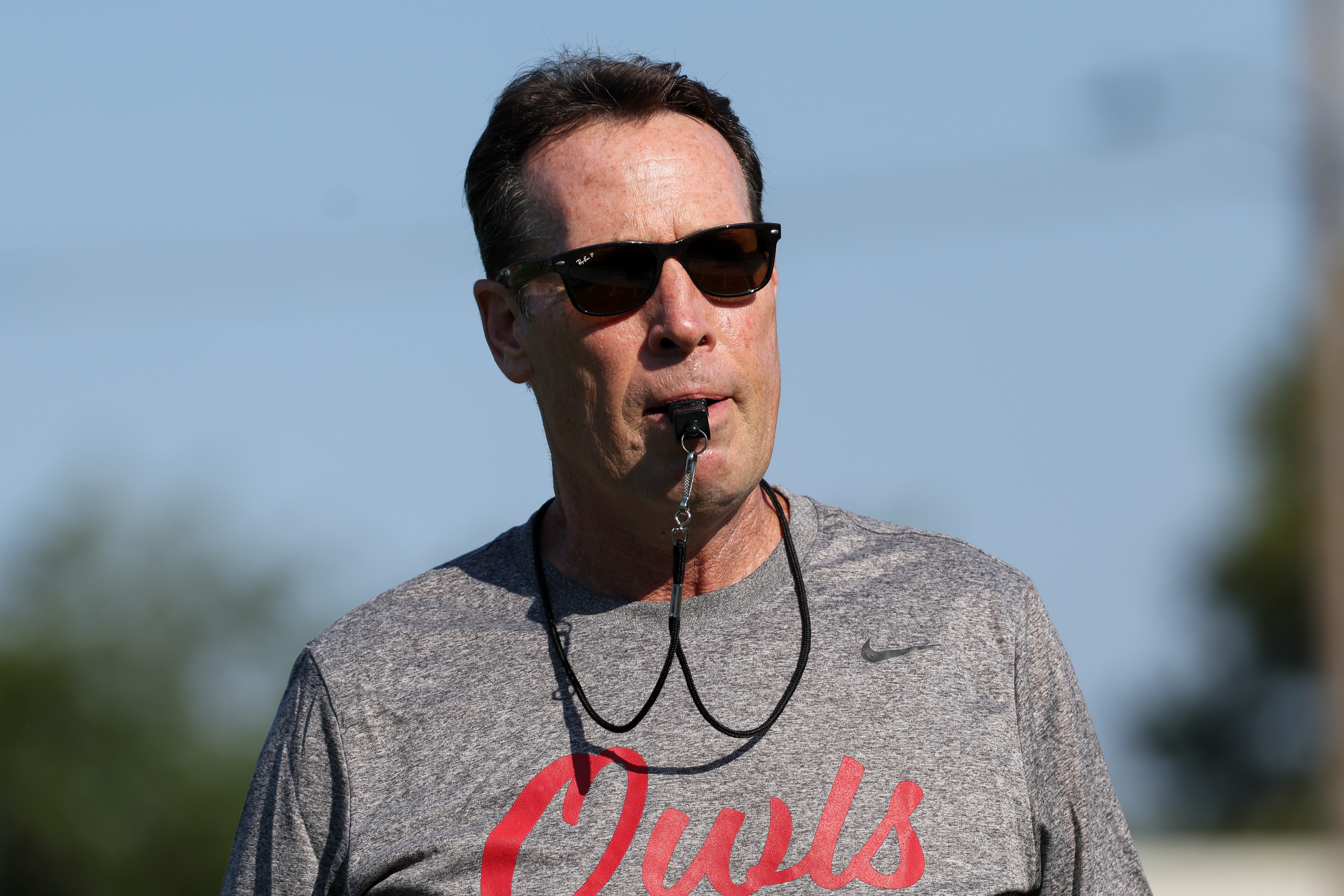
    Before Temple’s season opener on Saturday against Rhode Island (2 p.m., ESPN+), Keeler sat down with The Inquirer, where he expressed his commitment to the Owls. He purchased a home in Wilmington, becoming the first Temple coach since Bruce Arians in the mid-1980s to do so. Keeler, who turned 67 in July (and is the third-oldest active FBS coach), wants to finish his college football coaching career on North Broad. But first, his focus is bringing back greatness to Temple.

    K.C. Keeler enters his second year as Temple’s head coach. In his first season, the longtime college football coach led the Owls to within one win of bowl eligibility.Isaiah Vazquez / For The Inquirer
    Q: [Throughout] your coaching career [at] Rowan, Delaware, and Sam Houston State, you’ve established a track record of building winning programs. How have you shifted or changed as a coach to stay competitive?

    A: One of the things that I’ve always done a really good job of is problem-solving. The other thing I’ve always done a really good job of is recognizing talent, not just on the field, but also coaches I’ve worked with. When I got to Rowan, and I got an opportunity at 34 years of age to be a head coach, I had some really good players I had recruited when I was an assistant there. … I learned from my former coach Tubby Raymond [at Delaware], a lot about building a culture, understanding that when you play for, at the time Rowan University, you play for the people who played before you, you play for the people you’re with in that locker room right now, you’re also playing for the people who are going to come after you. You try to develop this sense of belonging, so everywhere I’ve coached, I’ve always tried to emphasize this is a family. It’s its own unique family, but it’s a family, and this family ranges beyond just the guys in this locker room.

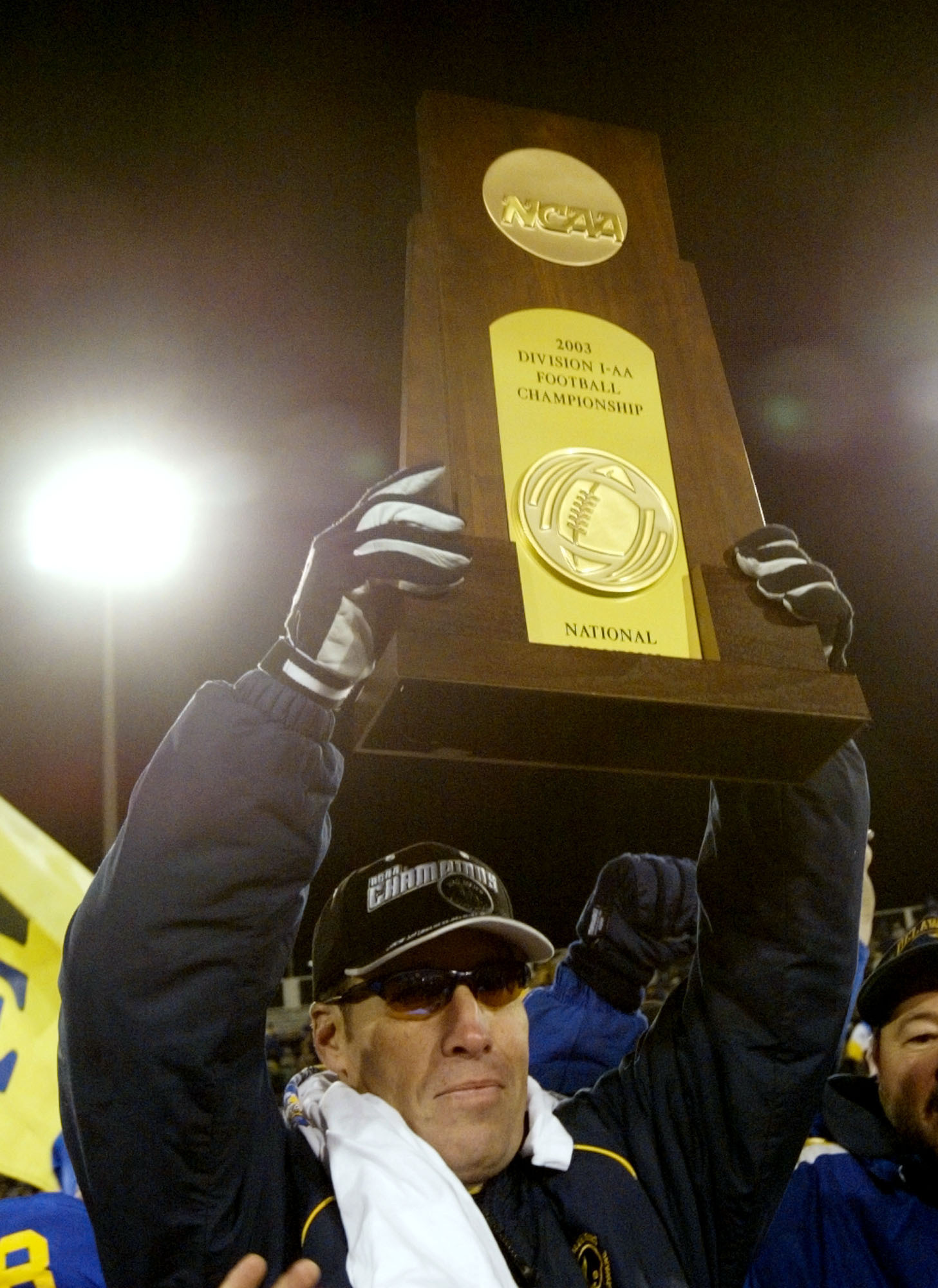
    K.C. Keeler after Delaware defeated Colgate for the NCAA Division 1-AA Championship in 2003.AP Photo/Wade Payne
    Q: You spent more than a decade at Delaware. How special was it to coach at the school you once played for?

    A: Well, nowadays there’s no way that Delaware would hire a Division III coach, just with the headhunters and all the things that people go through now to figure out what coach they’re going to hire. But I was blessed that I had a president and an athletic director. The athletic director — Edgar Johnson, didn’t believe that. … For 11 years, when I pulled up to that stadium, in my office, I pinched myself. I probably had black-and-blue marks for 11 straight years. People always wondered who was going to follow Tubby. I mean, they have his name on the field. He had 300 wins, three national championships, and a guy that I respected in terms of creating that culture. I always say that his 300 wins or him inventing the Wing-T with Ted Kempski, those weren’t his greatest accomplishments. His greatest accomplishment was the culture that he developed.

    Q: You’ve also dealt with adversity and losing seasons during your time at Delaware before you were let go in 2012. What was that departure like?

    A: Me being fired had nothing to do with wins and losses. It was really more I had become a bit like Tubby did in that small state. Everyone knew what car I drove. Walking in a restaurant, my wife and children would go to the back for dinner, and I would have to stop at all the booths. There was a sense that maybe the administration, the people who were running the place at the time — they didn’t stay much longer after they fired me — they didn’t embrace the fact that I had developed a legacy there. It was hard. It was hard being fired, and I remember very vividly my daughter coming home after me being fired, and she said to my wife and I, ‘You guys are in your uniform, huh?’ Still had our pajamas on. … Then when we were out and we ran into an acquaintance on the street, and I went into my woes of being fired, and I said, ‘How are you doing?’ [They replied], ‘I’m battling cancer right now.’ My wife and I were like, let’s put this in perspective. We got fired from a job. We need to move on.

    Q: What was your biggest lesson learned from Year 1 at Temple?

    A: I told the guys when I first took over, I don’t want you to be realistic. [Temple] winning whatever it was, 13 games in five years, no one thinks we’re going to do much because we weren’t changing the roster much. It wasn’t like we came in, gutted the roster, brought new players in. We just felt there were so many upperclassmen that wanted to get their Temple degrees and that wasn’t the right thing to do. I still believe in education, and I believe that even though I wasn’t the coach that signed their scholarship papers when they came to Temple, I still represent Temple, I’m not going to cut you and try to get a player who’s that much better. So 5-7 was very disappointing, because we were so close to being a 7-5 team. But at the same time, I do know that there were some limitations because of how much we could change the roster. Those limitations actually led to us keeping all of our starters [this year].

    Q: Your team was one of the few Group of Five schools to keep their starters from entering the portal. What does that say about what you’re building here?

    A: We believe that our program is built on love and trust. I always explain that you can’t love somebody, you can’t trust somebody, until you know somebody. We work really hard at knowing each other. We’ll do the three H’s: Who’s your hero? What’s your hardship? What’s your history? We’ll do a trivia night where the guys are all mixed up with different positions and different players and coaches, and Clayton [Barnes, Temple’s general manager] leads it. It’s a lot of fun, and it’s a way to be together. … We work really hard in these four walls to develop relationships with our players. The great thing about us going into this year is that the whole strength staff is together, whole coaching staff stayed. … This building has a lot of cohesion.

    Q: With the rising power of Name, Image, and Likeness, how have you managed the new landscape of college sports?

    A: I wouldn’t have taken this job unless [Barnes] came with me. I know my skill set. I am a problem solver, but I’m not going to be the guy who’s going to be dealing with the agents. I’m not the guy who’s going to figure out the charts in terms of how much money we should allocate to each position and what starters are making at different positions. … That’s not my skill set. That’s [Barnes’] skill set.

    I don’t call the offense anymore. I don’t run the defense anymore. I was an offensive coordinator, scored a ton of points — I got too many other things going on. … I’ve turned those things over; same thing with Clayton and the roster. Now we talk about it every day. It’s not like I’m not making final decisions, but I have enough trust.

    Q: Your sunglass look became a trademark at Delaware. What is the backstory about the sunglasses?

    A: I have very sensitive eyes, so the lights really bother me — and I like sunglasses. I have six pairs of Ray-Bans in my backpack right now, so I like to change them up a little bit too. They have a bobblehead of me with my sunglasses on. I’ve been known to support the sunglasses. It’s a little bit of a trademark, but also the sensitive eyes go along with it.

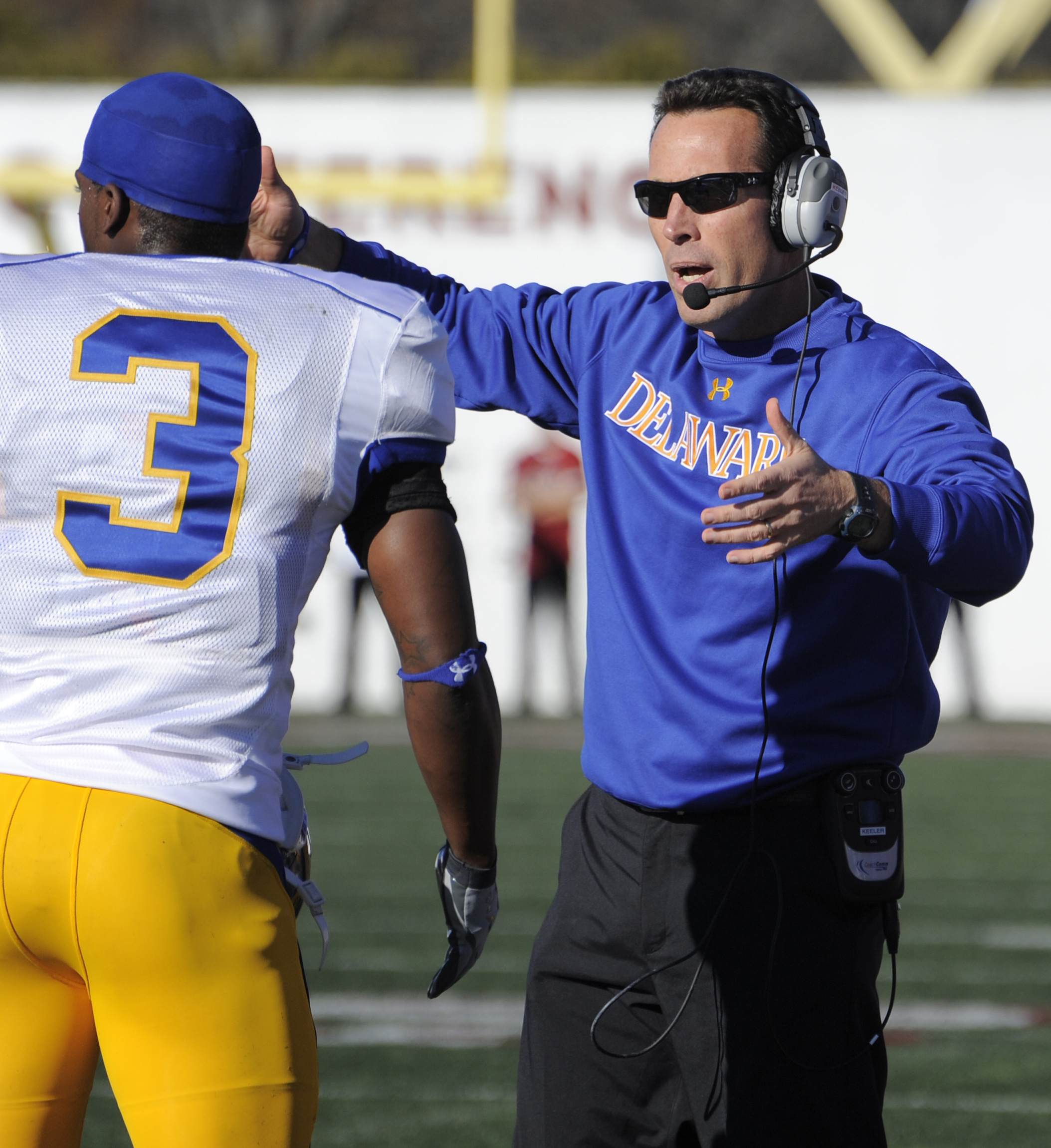
    K.C. Keeler spent 11 seasons as the head coach at Delaware.AP Photo/Nancy Palmieri
    Q: As someone who grew up in Lehigh County and spent the bulk of your coaching career out East, what does it mean to come back after 11 years at Sam Houston State?

    A: My wife’s a Penn grad, we met in the city. I was with the Eagles as a last cut [under] Dick Vermeil, and so we met in the city, fell in love in the city. … We have three grandchildren, and my wife and son-in-law are in Wilmington — this is home. I always tell the story that when the deal was finally done, we had just beaten Liberty Friday night to clinch a 9-3 season and a good bowl game. It was [my wife’s] birthday. I get the call from my agent that the deal’s done. I come back in and tell her, “Hey, listen, we are going back East,’ and she cried for an hour. I’m trying to explain to everybody in the restaurant, these are happy tears.

    Q: There’s a lot of anticipation around this team. What would you say to fans about the direction of where this program is heading?

    A: There’s been greatness here before. It’s not like I’m trying to reinvent anything. … One of my most vivid memories of any situation in my entire career was a locker room after we played Temple. We [Delaware] were the No. 1 team in the country in 1978 — don’t do the math — going to play Temple at the old Veterans Stadium, and they just embarrassed us. It was a different, physical brand of football that we weren’t used to, and they also just had this tremendous talent. Then the next year, that team I played on at Delaware, we won the national championship. We went 13-1. Our loss? To Temple. I have a pretty good perspective of where this place has been — and Temple can do it again. We had the No. 1 recruiting class in the conference. I don’t remember Temple doing that recently.

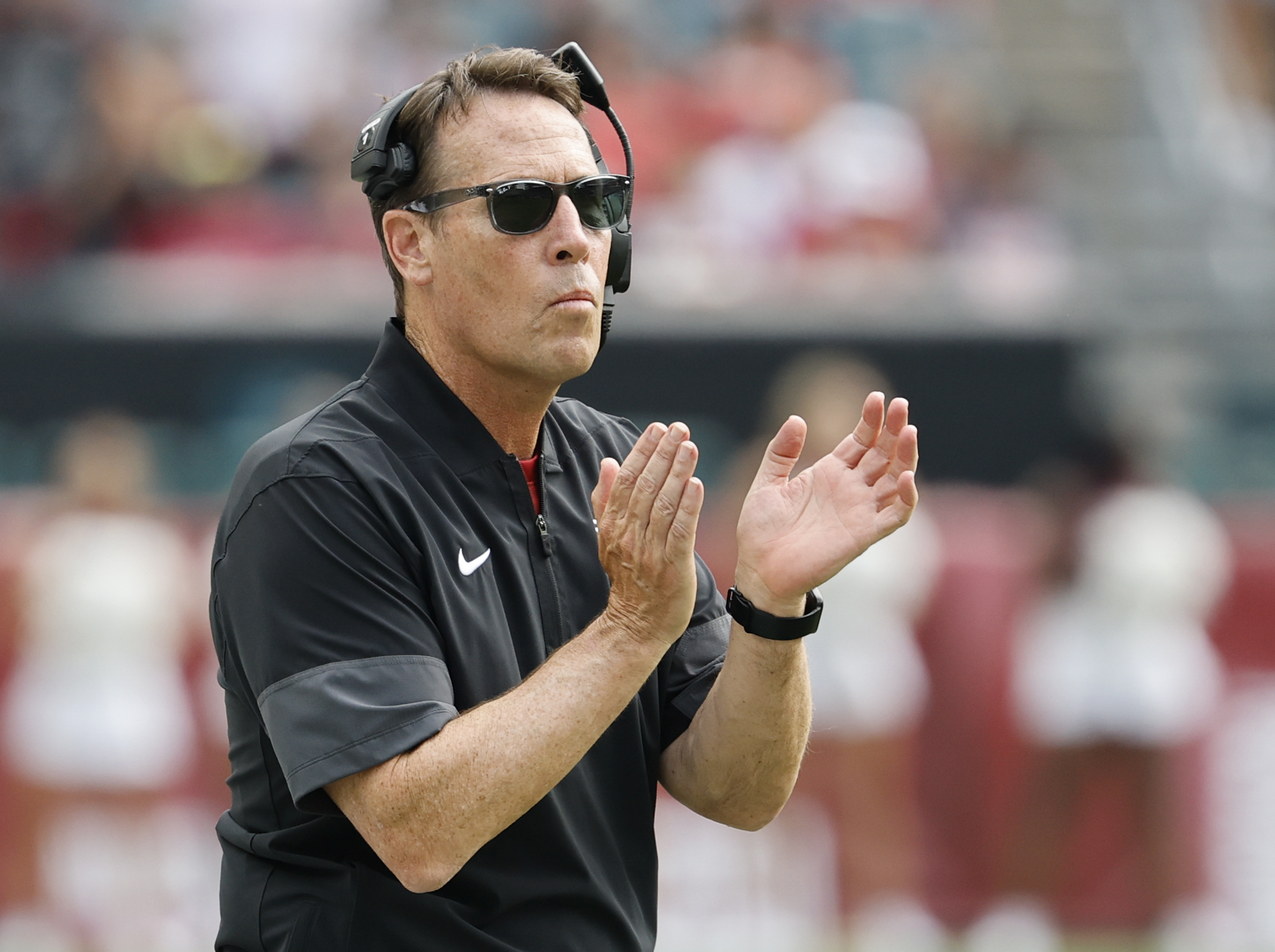
    K.C. Keeler led the Owls to a 5-7 record in 2025.Yong Kim / Staff Photographer
    Q: This year will mark 10 years since Temple last won an American championship. What stands at the forefront when you think about goals this season?

    A: We want them to think about winning enough games to go to a bowl, winning a bowl, and maybe we can win enough [games] to get [to] that conference championship game. That’s kind of where I’m trying to set their sights. … If you’re realistic, don’t play for me. I want you to be unrealistic. I want you to dream dreams that are bigger than you possibly could imagine, because life is short. When I was at the FCS level in my first press conference at Delaware and Sam Houston, I talked about winning a national championship. … Our goal here at Temple is to be the best football program in the country. … I do believe we can become a team that can be playing in that conference championship game, and there’s a good chance that team plays in the big tournament.

    The reality is that everyone knows we play Penn State the second week. I know it because that’s all I got asked when I was at media day. … But we got to worry about playing Rhode Island.

  • Four pushers, one toilet, and a race through a rural Pa. town

    Four pushers, one toilet, and a race through a rural Pa. town

    DUSHORE, Pa. — The competitors were wiped, but they gathered at the starting line in this sleepy Sullivan County town for one last push on their custom-built toilets.

    “All right, this is it, folks,” emcee Gretchen Little announced. “Reputations are made. Legends are created. It’s all here, the drama, the triumph, the heartbreak. There’s nothing like the Dushore Outhouse Races.”

    A half-dozen or so teams began the Dushore Founder’s Day 26th Annual Outhouse Races earlier on this Saturday night in early August. One by one, they dropped, teams like the Blue Water Angels, Perfect Dump, and Royal Flush.

    The Coal Region Turd Herder’s team races down the hill on Main Street in Dushore, Pa.RALPH WILSON/For the Inquirer

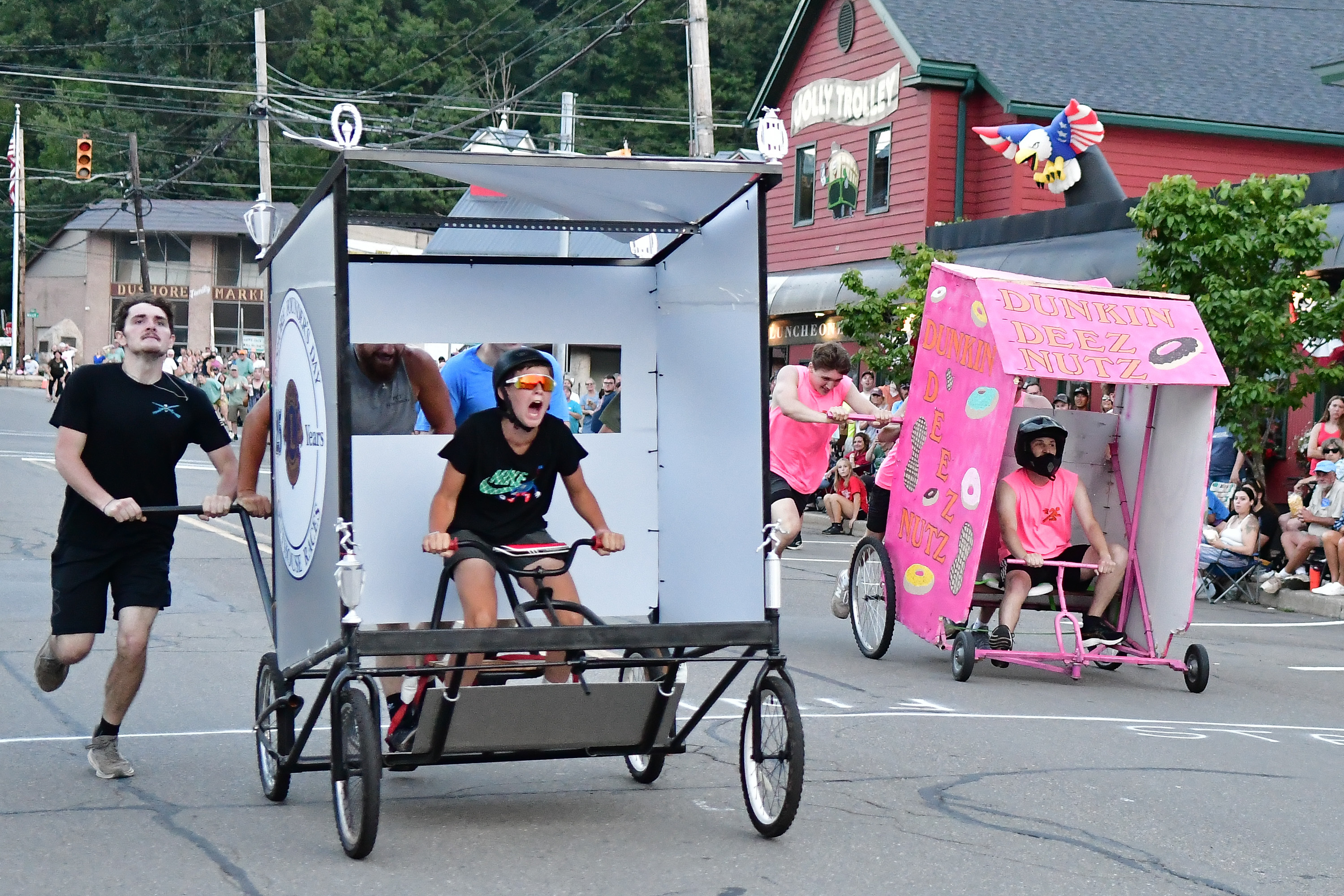
    Little let the crowd decide the best-looking outhouse before the final race. One of them was Steiny’s Heineys. Another team had a Dunkin’ Donuts theme with some unprintable potty humor.

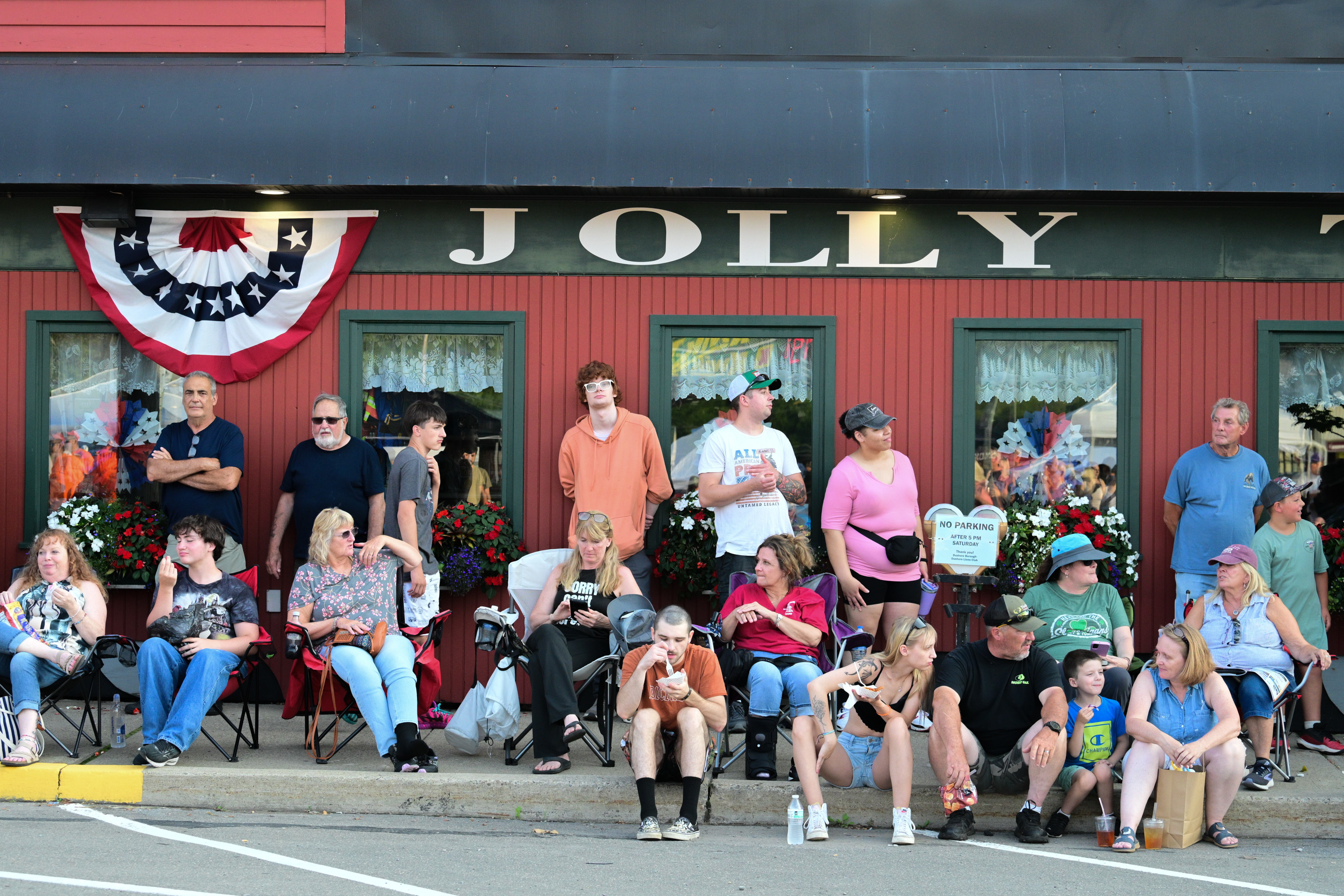
    The crowd itself was an anomaly in Dushore, easily four times bigger than its year-round population of about 450. Sullivan County, about 160 miles northwest of Philadelphia, is one of Pennsylvania’s most rural counties, and its population has been rapidly decreasing and aging for decades.

    “You come to this town tomorrow, you might not see a soul,” said Darryl Kashner, of Coal Township.

    The Lyons Club driver reacts as the team’s outhouse crosses the finish line in Dushore, Pa.RALPH WILSON/For the Inquirer

    Dushore’s Founder’s Day also included a 5k and a keg-rolling competition, but the crowds swelled on Main Street for the outhouses. Vendors included local wineries, coffee shops, and a Sullivan County artisanal broom maker that’s been in business for 100 years. Despite the crowd, many attendees said the turnout was smaller than usual.

    “It used to be much bigger,” said Greg DelBuono.

    The Steiny’s Heinys team races down the hill in Dushore, Pa., as part of the 2026 Founder’s Day festivities.RALPH WILSON/For the Inquirer

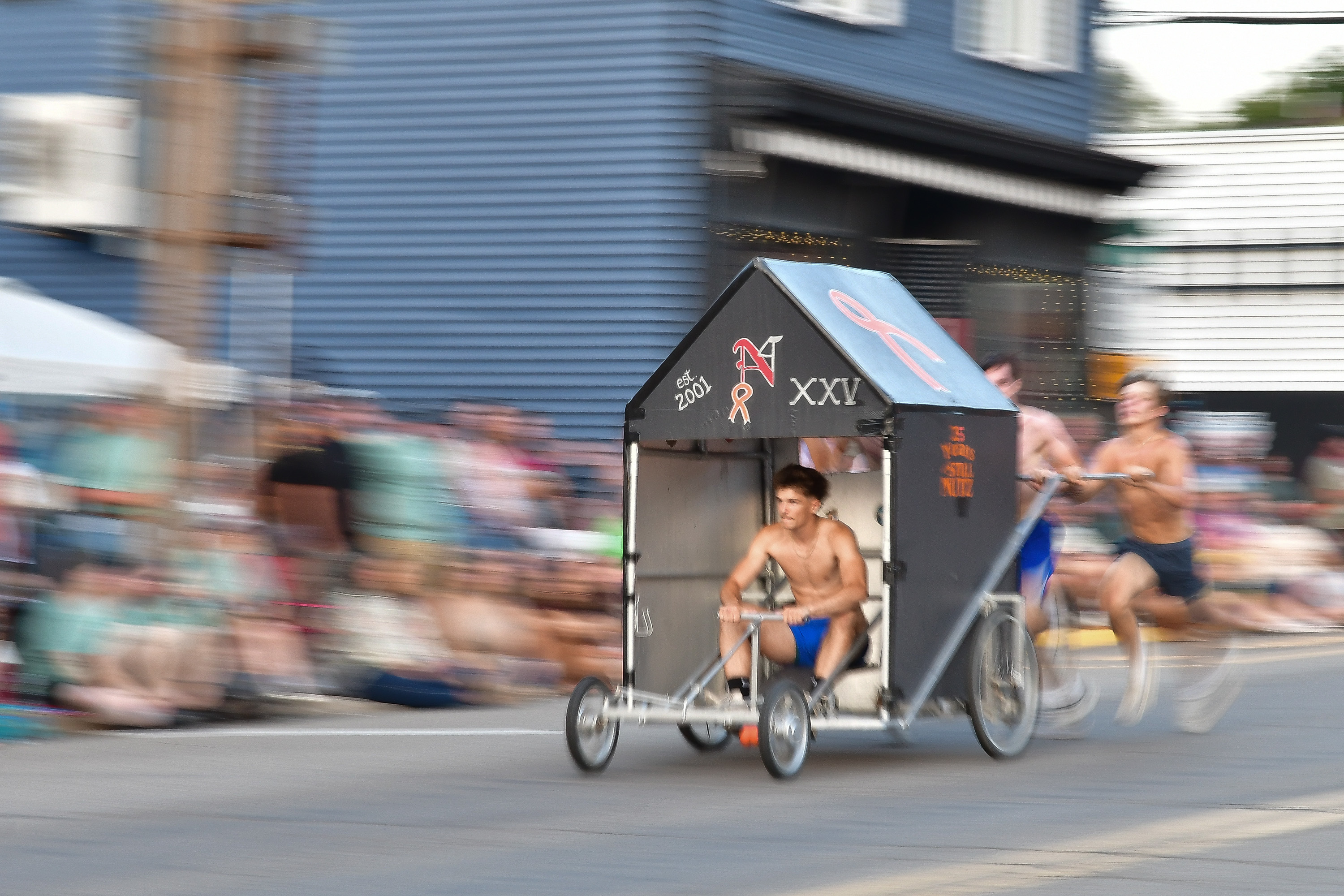
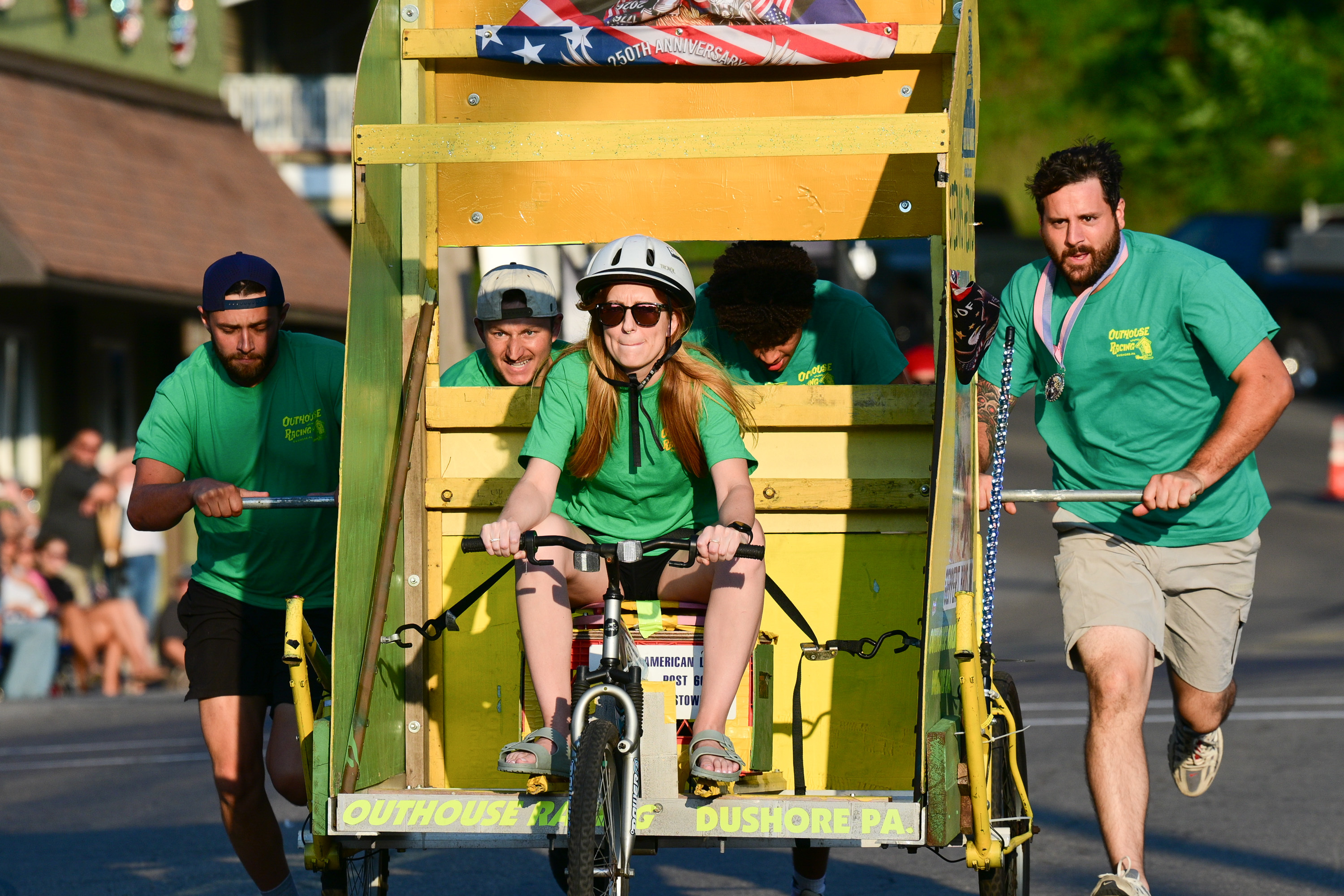
    Dushore’s outhouse races are essentially bobsledding on the street. The outhouse must have a real toilet seat, and most sit on simple aluminum frames with wheels.

    “Remember … this must look like an outhouse … be creative,” the rule book states.

    The Corkscrew Crew team races down the hill during the 2026 Dushore Founder’s Day festivities.RALPH WILSON/For the Inquirer

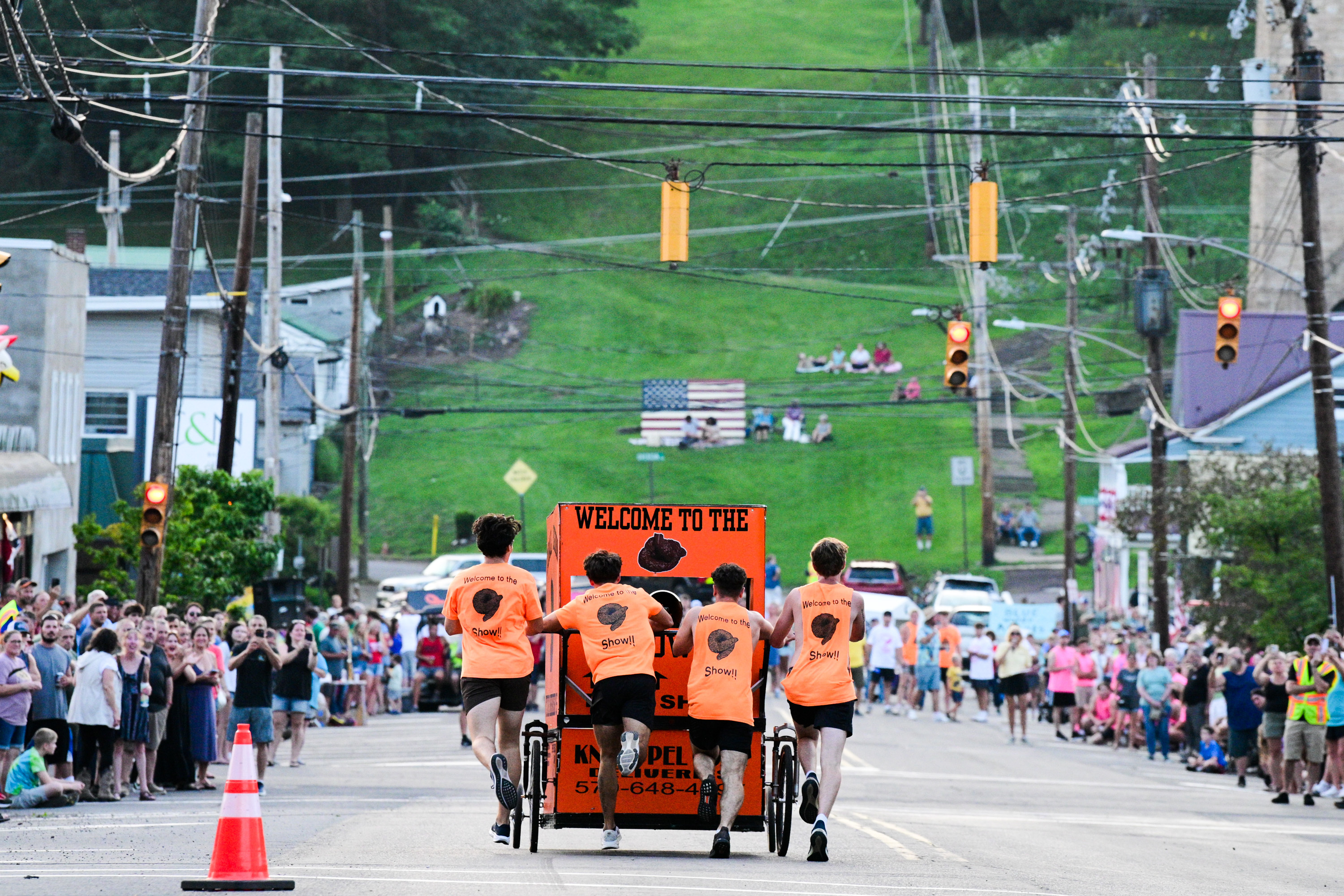
    The pilot sits on the throne, steering, while pushers line up outside. In Dushore, the best pushers were young and brawny, often sleeveless or shirtless. They came off the starting gun fast, racing uphill on Main Street. They passed through Sullivan County’s lone traffic light, swept around a memorial, and pushed back hard in the opposite direction, their legs burning.

    “It’s a young man’s game,” said Kyle Nolte, 39, of Forksville. “I did this about 25 years ago, but I hung it up.”

    The Coal Region Turd Herders were underdogs from the anthracite area south of Dushore, but they’d advanced to the finals by recruiting some real athletes — one of them was named “Speedy” — to do the pushing. Their outhouse was painted safety orange and featured a brown piece of, well you know, wearing sunglasses.

    Locals and visitors line Main Street to watch the 25th Annual Outhouse Races at the Dushore Founder’s Day.RALPH WILSON/For the Inquirer

    Like many people, Kashner discovered the races after he bought a hunting cabin in the area. Now, he pilots the Turd Herders’ outhouse.

    “We bought the camp, came down, and decided to build one,” Kashner said. “I’ve never seen anything like it.”

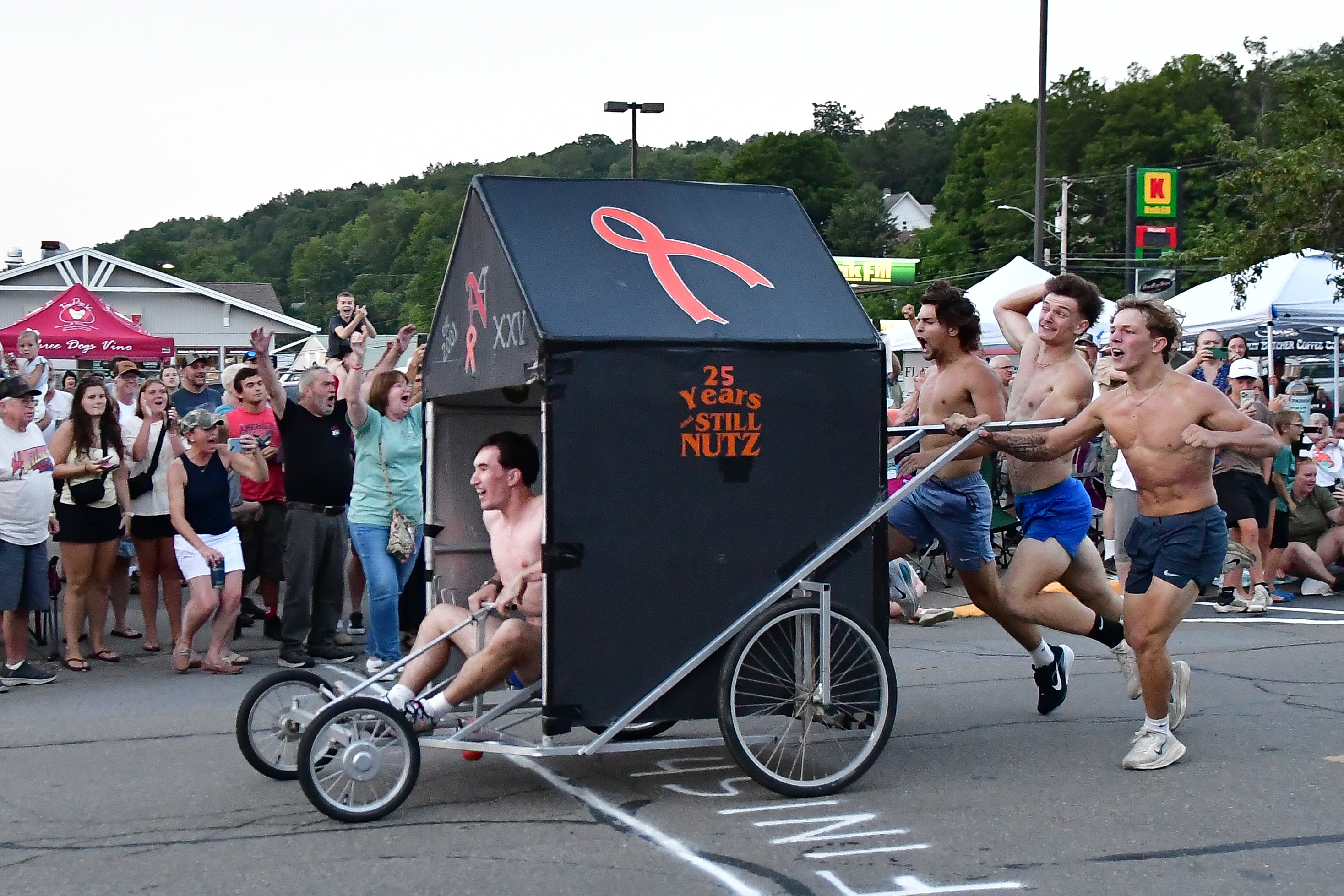
    Team Nutz, the local boys from Sullivan County, were perennial favorites at the races and faced off with the Turd Herders in the finals. The winners would come away with a trophy and a few hundred dollars, but the bragging rights were more important.

    The Dushore Lyons Club team race up the hill on Main Street during outhouse races at the Dushore Founder’s Day.RALPH WILSON/For the Inquirer

    When they rounded the memorial, the teams were neck and neck. The crowd was roaring. Cowbells were clanging.

    “This is close,” Little said. “This is real close.”

    Team Nutz, the locals, crossed first and dedicated their win to team founder Larry Kiess, who died at 36 in 2011.

    “We trained for this. We came down here this week and trained for this, and every dollar we win goes to a scholarship in Larry’s name at Sullivan County High School,” said team organizer Jeff Neary. “This is our 26th year racing outhouses.”

    Team Nutz celebrate their victory.RALPH WILSON/For the Inquirer
  • A man seeking asylum was detained during a routine ICE appointment in Philly. He fears being tortured or killed if deported.

    A man seeking asylum was detained during a routine ICE appointment in Philly. He fears being tortured or killed if deported.

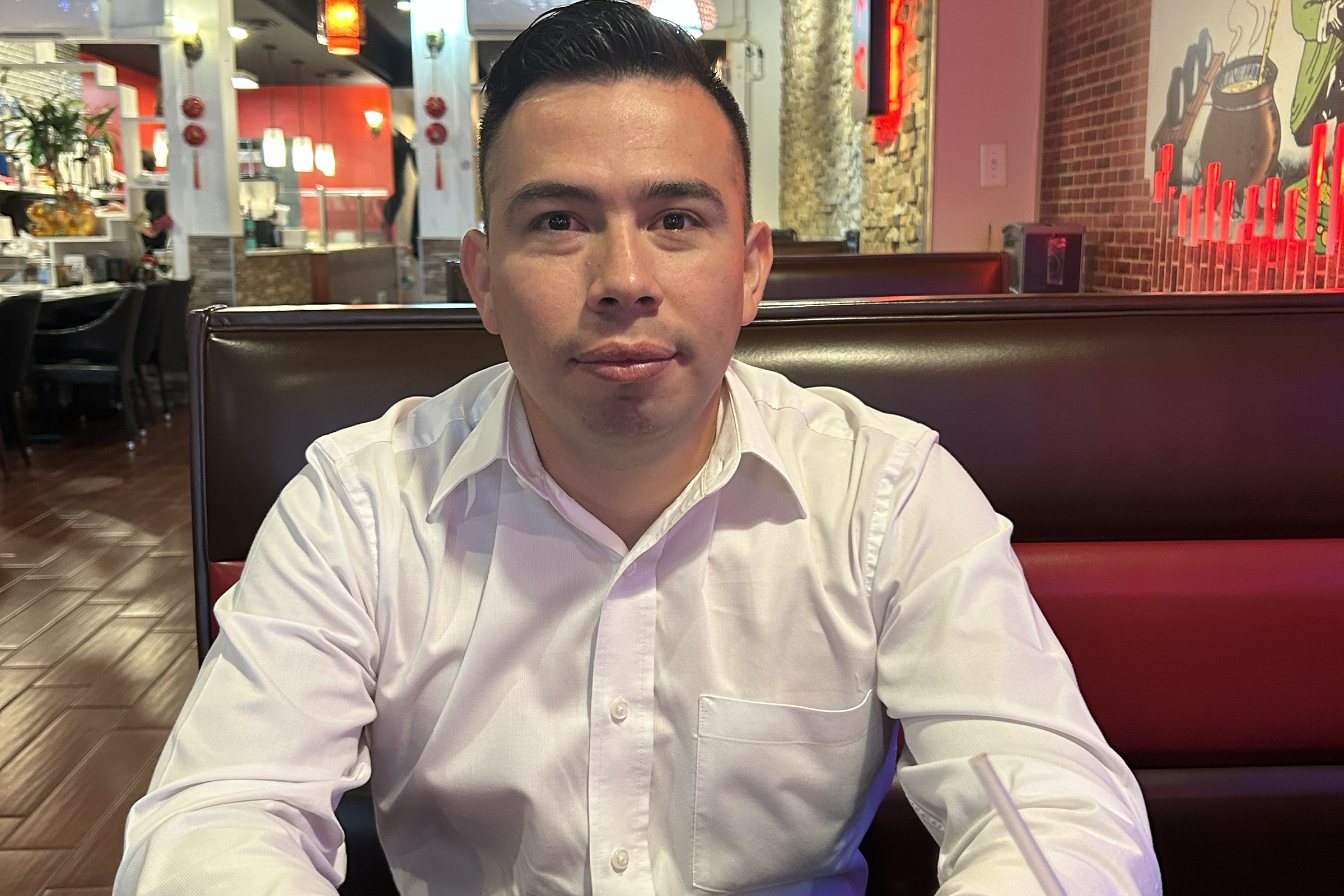
    Jhon Perez Romero carries a driver’s license, Social Security card, and an employment permit, working as a Spark Driver for Walmart in York, Pa.

    He also carries the fear of being tortured or killed if he should be deported to his Venezuelan homeland, where he’s been accused as a “traitor” by the government he once served as an intelligence officer.

    Perez Romero, who was interviewed and released by U.S. immigration officials when he crossed the border in 2023, was arrested by ICE in Philadelphia on June 30, when he appeared for what he thought would be a routine check-in. He joined a growing number of immigrants taken into custody even while they pursue asylum, a long-established legal process that can grant permission to live in the United States to people who could be harmed at home.

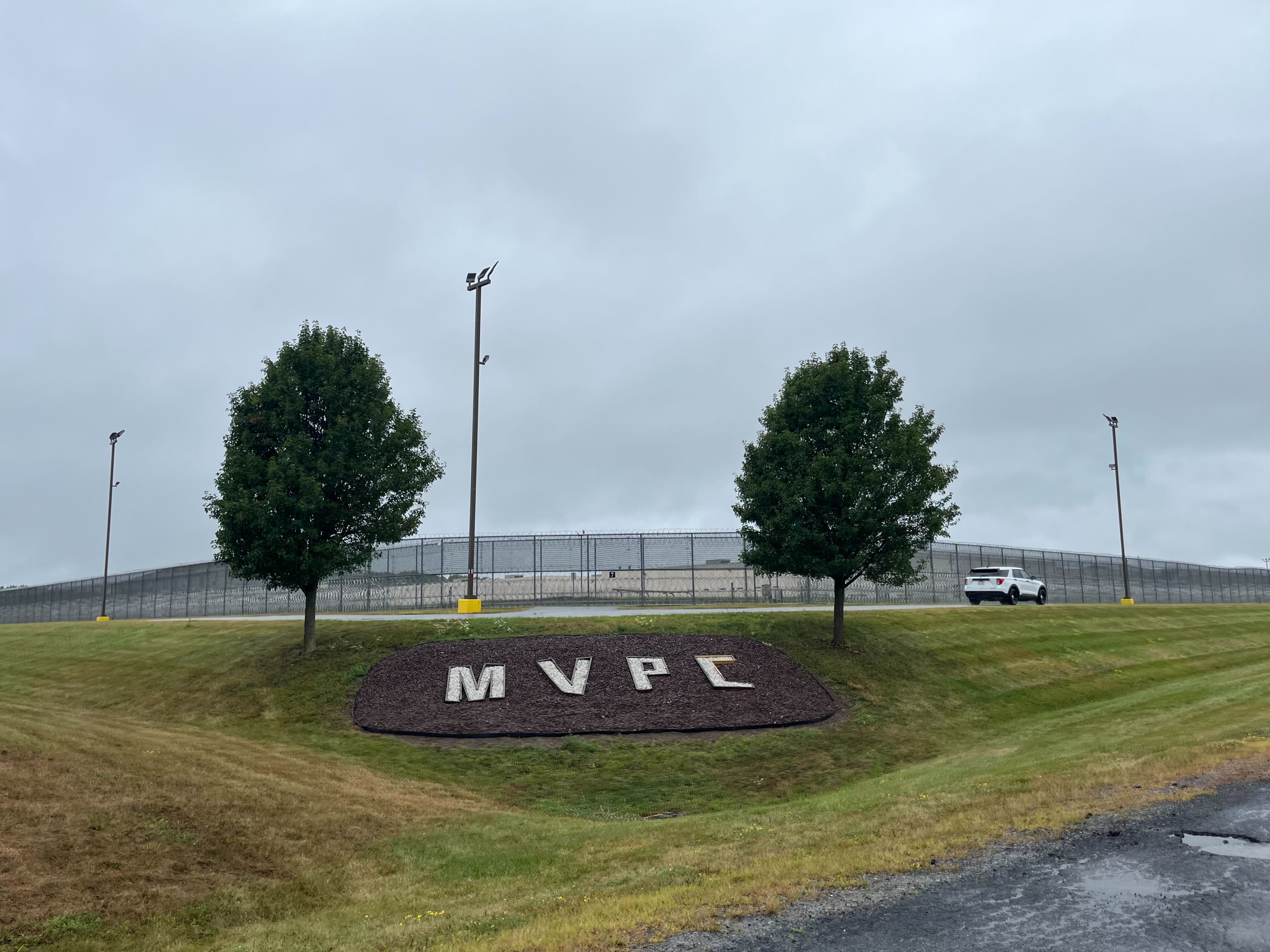
    Perez Romero, 39, is being held at the Moshannon Valley Processing Center, the 1,876-bed ICE facility in Philipsburg, Pa., his future uncertain, his wife and step daughter in anguish.

    “I thought the U.S. represented a place where people who are escaping political or religious persecution can come here and find safety,” said his wife, Sandra Quinones, an American citizen and high school teacher. “Especially if you’re law-abiding and contribute to society. That’s where my heart is broken.”

    The Trump administration’s aggressive approach departs from previous administrations, where asylum seekers with no criminal record were mostly allowed to remain free while they pursued their claims. Now applicants have been detained in communities across the United States, including Pennsylvania and South Jersey.

    Last week news broke that the administration intends to revoke the business and tourism visas of up to 200,000 people who are seeking asylum, putting them at risk of arrest and detention. That comes on top of procedural changes that have made it harder for people to prove they should be allowed to stay.

    A spokesperson for the Department of Homeland Security said Perez Romero was released at the border by the Biden administration, not by officials under President Donald Trump.

    “He will remain in ICE custody pending removal proceedings and will receive due process,” the spokesperson said in a statement. “A pending application does NOT confer legal status in the United States.”

    The agency said that on Jan. 20 Perez Romero was charged with “harassing communication,” an offense that usually involves phone calls or text messages sent to upset someone.

    DHS provided no other information. Dauphin County court records show that Perez Romero pleaded guilty in magisterial district court in March, but do not include details of what occurred. A court worker said Friday she could provide no additional information.

    “Criminal illegal aliens are not welcome in the U.S.,” Homeland Security said. “We will find you, we will arrest you, and we will deport you.”

    Jhon Perez Romero, originally of Venezuela, came to the United States seeking asylum in late 2023, afraid he could be harmed or killed by government agents in his homeland. Now Perez Romero, 39, is being held at the Moshannon Valley Processing Center, the ICE detention facility in Philipsburg, Pa., as the Trump administration detains more people who are seeking safety in the United States.Courtesy of family

    Generally, the government cannot deport someone while their asylum claim is being decided — claimants must be given what’s called a merits hearing, where they can present evidence, before any final removal action.

    The government does have the power to hold asylum seekers in detention for certain reasons, including if it believes the person might flee or is a danger to the public.

    Immigration lawyers argue that there’s no gain for the government in detaining asylum seekers, since their names, addresses, and identifying information are already known to authorities, who require regular, in-person check-ins.

    “The Trump administration is targeting people to subject them to detention, knowing they won’t be able to fight their way out of the system, so they’ll give up and leave,” said lawyer Lilah Thompson, who leads the immigration unit at the Defender Association of Philadelphia. “They’re wearing people down.”

    For immigrants, freedom while pursuing asylum means everything, enabling them to work and earn money to hire an attorney, and to more easily gather evidence and documents for their cases.

    Asylum cases can take years to decide — more than 2.3 million people now await asylum hearings or decisions — and appeals can go on for additional months or longer.

    Prolonged detention leads some to drop their legal cases and accept voluntary departure. Leaving voluntarily avoids the automatic 10-year ban on returning that can accompany a formal deportation.

    “It’s very tough, for people who are facing these choices,” said immigration lawyer Robert Barchiesi II, who represents Perez Romero.

    Thompson is helping defend a Chester County newlywed who has so far spent two months in detention after being arrested at a late-June check-in.

    Nelson Contreras-Gelves, 35, originally from Venezuela, has followed government directions and broken no rules, Thompson said, noting that he recently married a U.S. citizen.

    People seeking asylum must show not only that they could be harmed in their homeland, but also that the danger springs from at least one of five specific causes — their religion, race, nationality, political beliefs, or membership in a particular social group.

    Moshannon Valley Processing Center, in Clearfield County, Pa., is the largest immigrant detention facility in the Northeastern United States.Max Marin / The Philadelphia Inquirer

    People granted asylum can apply for lawful permanent residency and eventually for U.S. citizenship.

    Perez Romero’s life has taken him from a position in Venezuela’s notorious national intelligence agency, to a flight across countries in fear of his life, to love and marriage to a U.S. citizen and a caring role as stepfather to her 17-year-old daughter.

    From roughly 2011 to 2019, according to his asylum application, Perez Romero was an agent at the Servicio Bolivariano de Inteligencia Nacional, known as SEBIN. It was created in 2010 by then-President Hugo Chávez, officially aimed at protecting the nation but accused by human-rights groups of arresting and torturing political opponents, journalists, and activists.

    Perez Romero said he quit the agency after receiving instructions — the specifics were not described in his asylum application — that he refused to obey. His resignation came less than three months after a failed military uprising against authoritarian President Nicolás Maduro triggered a purge of the intelligence services, targeting those suspected of disloyalty.

    Perez Romero was told to report to government officials — and that he was accused of treason.

    “Which is erroneous,” he wrote in his asylum application, “since I have not committed any crime.”

    In March 2020, facing an arrest warrant, Perez Romero fled to Colombia, keenly aware of “what happens to political prisoners in Venezuela, things like imprisonment for life or murder.”

    Two years later, after Gustavo Petro was elected as that nation’s president, he said, he began receiving threats from Venezuelan agents that he would be seized and forced home.

    Perez Romero headed north. On New Year’s Eve 2023, he reached the U.S. border at Eagle Pass, Texas, where he was interviewed and released by immigration agents.

    The next year he met Quinones at La Iglesia de Dios Voz de Alerta Church in York, and they wed in 2025.

    She described him in an interview as an outstanding husband and father, working long hours to provide for their family. He’s deeply invested in their church, she said, and before his detention was developing a resource package to help missionaries serving in remote and dangerous areas.

    Last month, he tried and failed in federal court to win his freedom from Moshannon.

    U.S. District Court Judge Joseph Leeson ordered the government to hold a bond hearing, but Immigration Judge Tamar Wilson ruled that Perez Romero did not show he was not a flight risk or a danger to the community.

    He may say he’s innocent of treason, the judge wrote, but “the court cannot simply take his word for it.”

    Quinones says the family hasn’t lost hope. Their GoFundMe has raised $8,000 of its $9,000 goal, all of it going for legal fees and related expenses. They await the hearing to present evidence to support Perez Romero’s case for asylum.

    Quinones said her husband relies on his Christian faith to stay strong. She’s trying to stay optimistic as well, she said, but so much is uncertain and in flux. Her husband could end up having to accept voluntary departure to a third country, like Colombia.

    She’s prepared to retire early and join him, if necessary, and has begun exploring job possibilities there.

    “I can’t be apart from my husband,” she said. “I can’t picture my life without him.”

    Staff writer Dylan Purcell contributed to this article.

  • Letters to the Editor | Aug. 31, 2026

    Letters to the Editor | Aug. 31, 2026

    We need vaccines

    As a physician, my first response to your essay prominently displayed on the op-ed page with the headline “Why we need vaccines” was to laugh. But then the realization set in — how sad it is that this op-ed had to be written at all.

    Reading that piece makes you realize the size of the nation’s health literacy gap. Vaccines have a 230-year record of effectiveness and safety. They have saved hundreds of millions of lives. The misinformation surrounding them — disseminated largely by MAGA Republicans and their acolytes — has harmed this country immeasurably. How sad it must be to imagine that the parents of an unvaccinated child who dies of measles, a completely preventable disease, think to themselves, “Well, at least he didn’t have a vaccine complication.” You don’t need a college degree to know that vaccines are an invaluable part of modern healthcare. It’s been part of mainstream medicine ever since Edward Jenner developed the smallpox vaccine in 1796. For people to turn their backs on them now begs the question: How did we get here?

    Steven Barrer, Huntingdon Valley

    Woke — and proud

    I totally agree with Jenice Armstrong: In this day and age, with what we know about science, including sexuality, why should anyone be shamed for being woke? Fifty years ago, we either did not fully appreciate the inequities in employment, the oppressive environments in which women worked, the contribution of pollution to the destruction of the environment, the limited opportunities for people with disabilities, the continuum of sexual biology, and the insidious ways racism persisted among our society … or we didn’t know how to change them.

    But I — like a lot of other Americans — am certainly awake now.

    The principles of diversity, equity, and inclusion are about being kind and fair. It’s about helping people who have been denied opportunities during those years we were asleep. How can anyone be against that?

    P.S. No one wants to defund police.

    Beverly Moskowitz, Philadelphia

    Imagination Library

    I was very pleased to see the article explaining Dolly Parton’s program that gets books in the hands of babies, toddlers, and children under the age of 5. However, the article didn’t detail some important aspects of this 31-year-strong, genius idea.

    The 332,411,218 age-appropriate books that have been distributed so far have had a statistically significant and lasting effect on young learners’ scholastic and life outcomes. So much so that in many cases, whole states, including Delaware, have opted to fund the program for every child in their state.

    Philadelphia, and indeed the whole state of Pennsylvania, should use this moment in time to gift our children the love of books and learning.

    Liz Kory, Plymouth Meeting

    Join the conversation: Send letters to letters@inquirer.com. Limit length to 150 words and include home address and day and evening phone number. Letters run in The Inquirer six days a week on the editorial pages and online.

  • Dear Abby | The readers have spoken: The bride should have her way

    Dear Abby | The readers have spoken: The bride should have her way

    DEAR ABBY: I respectfully disagree with your response to “Woman’s wedding has been hijacked.” These mothers have no business trying to co-opt the bridal couple’s wedding. If the daughter gives in, it’s only the beginning of these two mothers trying to strong-arm themselves into trying to make future decisions for this poor couple.

    The couple should put their feet down and tell these mothers to back off. It’s their wedding, the only one (hopefully) they’ll ever have, and, if they cave to these mothers’ incipient narcissism at the expense of their wedding plans, they’ll all regret it (including these mothers) for the rest of their lives. I’m truly surprised you didn’t tell the couple to stand their ground.

    — DON’T BACK DOWN

    DEAR ABBY: Why should the bride put her hopes and dreams on the back burner just so the moms can impress their friends and associates? Not only does this advice fail to help the dad help his daughter, but it also sends the message to the daughter that her wedding is not really her wedding, it is a stage production the moms are orchestrating for their advantage.

    — THINK AGAIN

    DEAR ABBY: The advice for the hijacked wedding plans should have been for the bride to tell these two mothers to let the bride plan the wedding of her dreams, not theirs. I am assuming the bride can afford to pay for her small wedding. She can still include these mothers in something special.

    — ONCE IN A LIFETIME

    DEAR READERS: In the first line of my response to Doting Dad, I agreed that the daughter should have the wedding she wants. In retrospect, it’s clear I should have ended my answer there! If one of the moms had written in to complain about the intimate wedding the bride had planned, I’m sure I would have told her in no uncertain terms to back off and let the bride have her way. My apologies to the couple for wavering and siding with those pushy moms. Thank you all for calling me out on this one!

    ** ** **

    DEAR ABBY: I’ve been ill for almost a year now. Before this, I was in perfect health, able to take care of all my own needs. I have no spouse or significant other. Before I got sick, I used delivery only for the rare pizza I didn’t want to go out for. Now the only reason I have the food and medicine I need is because of delivery drivers. Thank you, delivery drivers! Bless you! I can’t imagine what I’d do without you. I’m sorry if the tip isn’t always the best. Please hang in there. You do more good than you will ever know.

    — GRATEFUL IN WEST VIRGINIA

    DEAR GRATEFUL: Being a delivery driver can seem like a thankless job some of the time. I’m glad you do your best to show gratitude and tip them, and I hope their employers compensate them fairly. Not only do these workers serve the underserved, but they also help keep local businesses afloat.