Blog

  • Eagles not making ‘earth-shattering’ offensive changes after Nick Sirianni endorsed Sean Mannion as play-caller

    Eagles not making ‘earth-shattering’ offensive changes after Nick Sirianni endorsed Sean Mannion as play-caller

    Two days after Nick Sirianni said that Sean Mannion will keep calling plays, the Eagles offensive coordinator said he’s confident the Eagles will turn things around because the issues plaguing one of the NFL’s worst offenses are “fixable.”

    “It’s a double-edged sword,” Mannion said on Wednesday. “You look at that and you can get frustrated by it, but you can also look at that and put a silver lining on it and say, ‘Man, if we just handle our simple, simple stuff, we’re going to yield a better result.’”

    Mannion did not want to delve into schematic things when later asked if he could share the things he deems fixable.

    “Are we communicating with each other properly? Are our fundamentals sound? And then is our level of execution where it needs to be? It can kind of fit into those buckets,” Mannion said. “Those are the three main focal points for us.”

    Eagles coaches often like to say “it’s never just one thing” when talking about problems. But Mannion highlighting all of those areas drives home the point that the offense right now isn’t being held back by one specific thing, it’s nearly everything.

    Personnel has been an issue. The Eagles have been banged up in multiple key spots. But even at its healthiest, the offense was not executing in a way that would lead to long-term success.

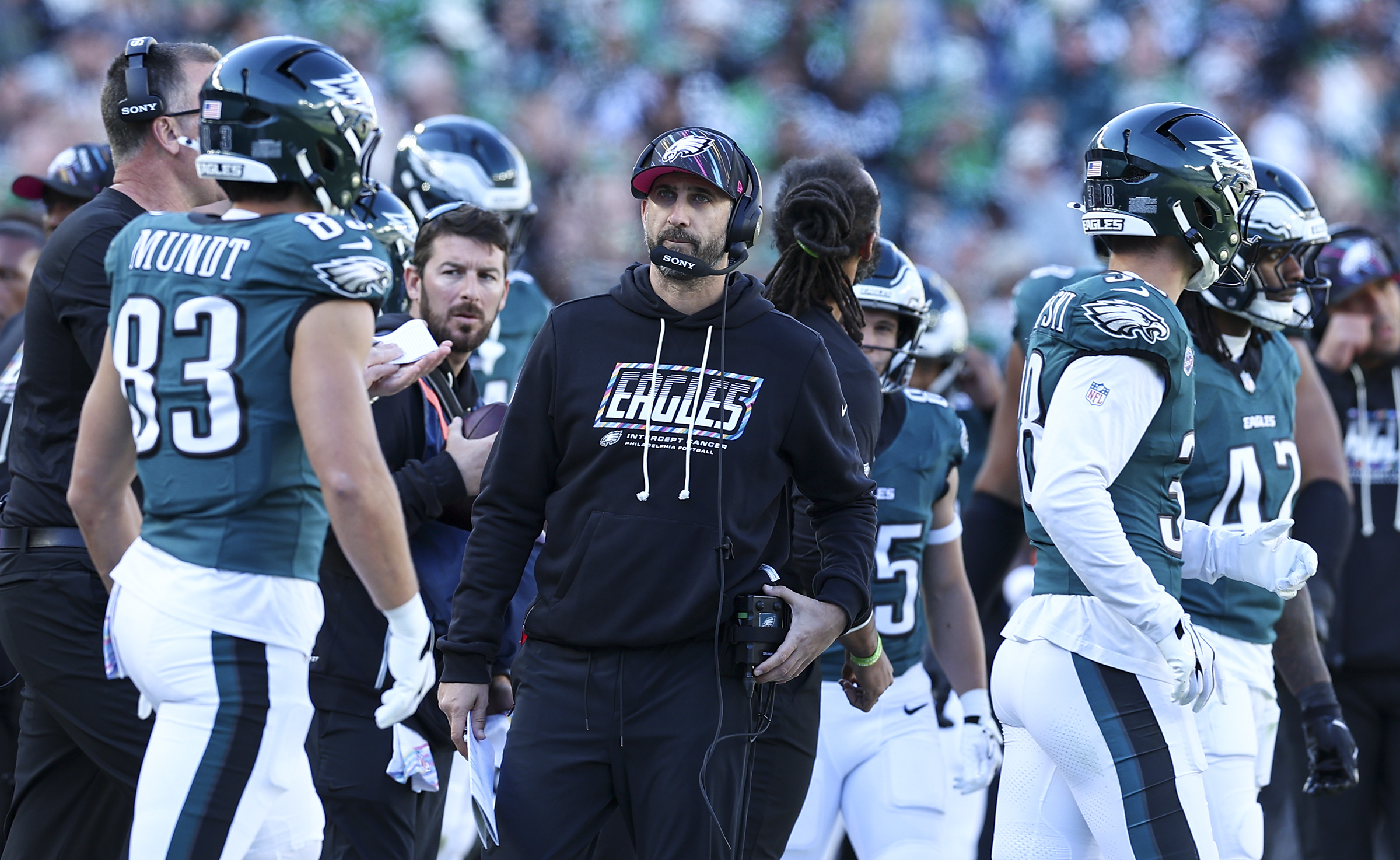
    Sirianni used the phrase “everything is on the table” after Sunday’s 25-14 loss to Carolina when asked how the Eagles could change things up now that Tanner McKee is locked in as the full-time starter. He endorsed Mannion as the play-caller a day later, but didn’t want to go into details about what may be on the table.

    Eagles head coach Nick Sirianni has endorsed the offensive operation but hinted at changes. Monica Herndon / Staff Photographer

    “Obviously, we are looking at everything, right?” Sirianni said on Monday. “Again, I think those are conversations that I’ve had with the staff this whole morning and everything’s on the table. ‘Oh, but we’ve done this.’ ‘Yeah. Well, maybe this isn’t working quite as good.’ ‘All right, so this is on the table.’ Without getting too much into scheme, I’m saying to you, obviously it hasn’t looked the way we wanted it to look and we’re not scoring enough points. So, everything is on the table.”

    Mannion was asked Wednesday if any changes were being made in the process leading up to games, how the Eagles call plays, or the roles on his staff.

    “I feel confident in the approach that we’ve had throughout the week,” he said. “We’re always looking at what we can be doing schematically. I think as a staff we’ve worked really, really well together. I feel totally confident in that. There hasn’t been anything that’s, I think, earth-shattering this week as opposed to the previous six weeks.”

    The 2-4 Eagles rank 30th in yards per game (255.5) and 29th in points (17.7). They lead the NFL in punts and three-and-out percentage. Their revamped offense that was supposed to marry the run and pass games using under-center play-action has not looked as advertised. The Eagles have been the least successful team when under center, and opposing defenses have increasingly sent extra rushers to blow up their under-center play-action attempts and take advantage of a team struggling mightily to handle blitz protections.

    Mannion now will be forced to tailor the game plans around McKee. The first-year coordinator thinks McKee can run the scheme as intended, though McKee does not have a lot of experience under center and struggled enough in camp that he lost the No. 2 job to Andy Dalton, who is no longer with the Eagles.

    Mannion said he still feels good about the under-center looks, but the Eagles may be forced to go even heavier in the shotgun to get things back on track.

    “Obviously things to clean up, but I think what it is schematically I’m still a believer in it,” Mannion said when asked his thoughts on the under-center game and whether it maybe needed to be scrapped. “Every week you may approach things differently, based on your opponent, based on your own personnel, based on your own tendencies that you may be trying to break. I’m still a believer in it, but like every week you’re always being as flexible as possible.”

    There were enough caveats in that answer to infer at least some change could be coming.

    Jalen Hurts is expected to help with preparations for the Eagles’ three upcoming NFC East games, and beyond. Yong Kim / Staff Photographer

    Jalen Hurts has been around the team

    Mannion said Jalen Hurts, who is being treated for blood clots and is expected to miss the remainder of the season, was around the team leading up to the Panthers game and will continue being a valuable asset to McKee and the offense moving forward.

    Hurts, Mannion said, will be especially helpful over the next three weeks as the Eagles face their three divisional foes, against whom Hurts has plenty of experience.

    “Obviously just want him to get healthy and [I] just care for the guy and the work that he puts into our team each and every week,” Mannion said. “Certainly want him to continue to be around and be a positive impact for us while he’s getting himself healthy.”

    Roster moves

    The Eagles on Tuesday shuffled things with their running-back depth. They signed Elijah Mitchell to the practice squad. Mitchell was with the team during training camp before getting injured.

    They also waived Jaydon Blue and waived/injured Carson Steele, who left Sunday’s game after suffering a shoulder injury. Both of those players were on the active roster.

    The Eagles now have two open spots on the 53-man roster, as well as three practice-squad openings after they released center James Brockermeyer and running back Ian Wheeler from the practice team.

    There are a few candidates on injured reserve who could fill those active roster spots imminently, like left guard Landon Dickerson and tight end Eli Stowers.

  • Supreme Court rebuffs Trump administration restrictions on medical care for transgender inmates

    Supreme Court rebuffs Trump administration restrictions on medical care for transgender inmates

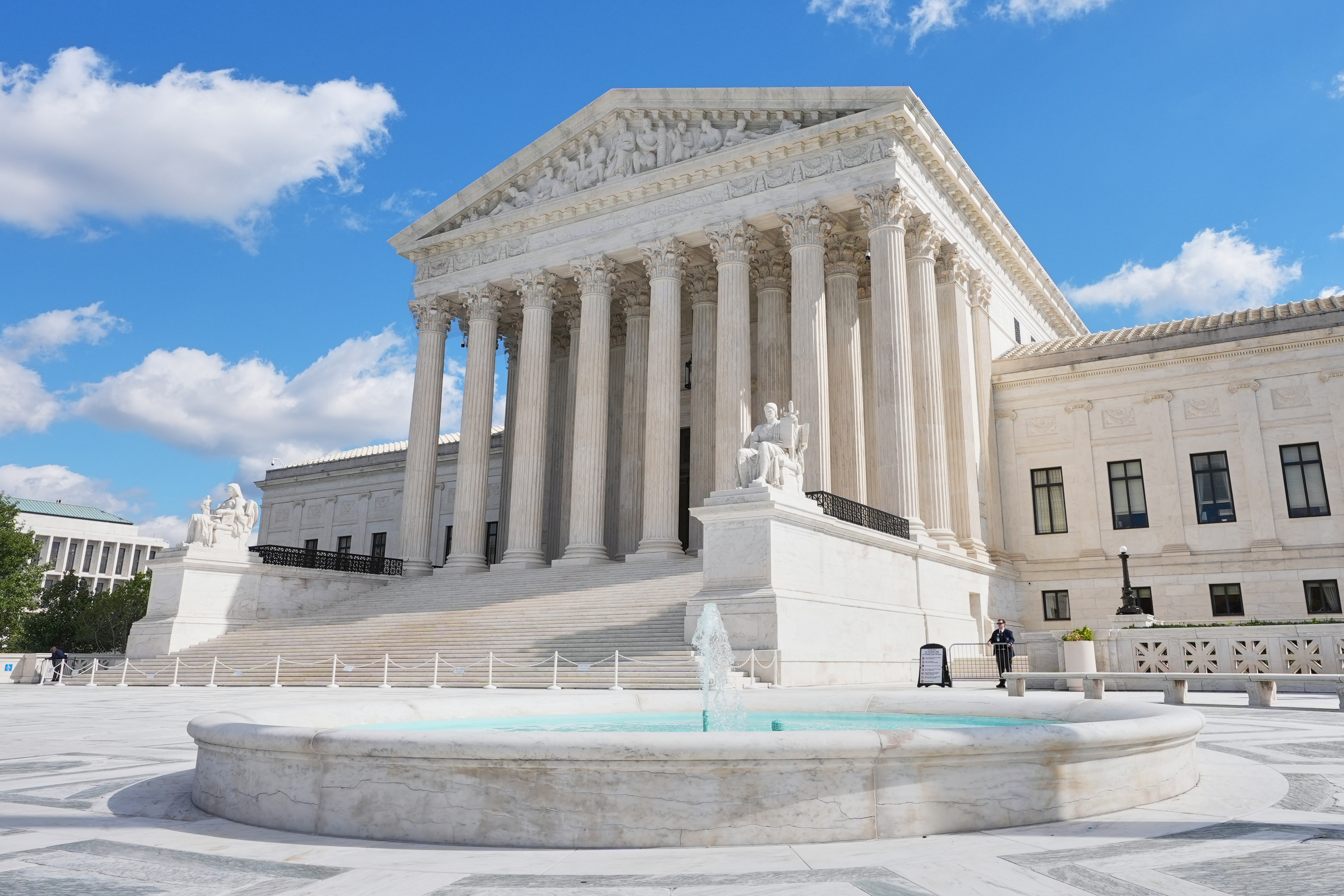
    WASHINGTON — The Supreme Court on Wednesday refused to allow the Trump administration to immediately enforce new medical restrictions for transgender people in prison.

    The decision leaves in place a lower-court block on the policy. It was adopted after an executive order from President Donald Trump, a Republican who has taken several steps to roll back transgender rights during his second term.

    The brief order did not detail its legal reasoning. Justice Samuel Alito and Clarence Thomas would have allowed the policy to be enforced as the lawsuit played out in lower courts.

    The Supreme Court has previously allowed other policies for transgender people to move ahead for now, including restrictions on military service and passport sex markers.

    Trump’s order called on the Bureau of Prisons to revise its medical care policies so that federal funds aren’t spent “for the purpose of conforming an inmate’s appearance to that of the opposite sex.”

    The new policy would halt surgeries, taper off hormones, and end social accommodations like makeup and wigs. Prisons would continue to offer mental health services.

    Attorneys for transgender inmates challenged the policy in court and U.S. District Judge Royce Lamberth ordered treatments to continue. Lamberth, who was nominated to the bench by Republican President Ronald Reagan, pointed out that untreated gender dysphoria can cause severe side effects like depression, anxiety, and suicidal thoughts.

    The Trump administration appealed, arguing that treatments raised security concerns and “could no longer be justified.” A divided appeals court panel left the order in place.

    About 600 inmates were receiving hormone therapy in 2025, the agency said in court records. Withdrawing care would have significant effects on their bodies and mental health, their lawyers said. The government has not detailed evidence of security problems linked to hormone therapy for transgender inmates over the 30 years it has been provided, they wrote.

    The conservative-majority Supreme Court has previously upheld state laws banning certain medical treatments for transgender youth, and restricting sports participation by transgender athletes in women’s sports.

  • Putin agrees to resume three-way talks on Ukraine war with Kyiv and Washington, Kremlin says

    Putin agrees to resume three-way talks on Ukraine war with Kyiv and Washington, Kremlin says

    Russian President Vladimir Putin agreed Wednesday to resume three-way negotiations next month with Washington and Kyiv aimed at ending the war in Ukraine, a Kremlin official said, potentially setting up the first such talks since February.

    The Russian leader agreed “in principle” to resume the talks after Nov. 10, Putin foreign affairs adviser Yuri Ushakov told reporters following a meeting in St. Petersburg between Putin and U.S. envoy Steve Witkoff.

    The talks will focus on “building a security system for Russia and Ukraine after the conflict ends,” Ushakov said.

    Witkoff’s talks with Putin about Moscow’s full-scale invasion of Ukraine took place as U.S. President Donald Trump pushed Kyiv to make a deal that stops the fighting.

    Ukrainian President Volodymyr Zelensky has insisted that only a summit of leaders can break the impasse. The two armies remain locked on the battlefield, and the countries pummel each other with daily long-range strikes.

    Representatives of the three countries held three rounds of negotiations early this year, meeting twice in Abu Dhabi in January and February, followed by further talks in Geneva in February.

    However, little progress was reported beyond exchanges of prisoners of war as Moscow and Kyiv stuck to their longstanding basic demands.

    Latest proposals to end the war have little of value, Kremlin says

    The discussion in St. Petersburg lasted about three hours, the Kremlin said, and came a day after Witkoff met with Zelensky and some European leaders in Norway’s capital, Oslo.

    The proposals from the Oslo meeting “contained little of real value in the context of resolving the Ukrainian crisis,” Ushakov said.

    However, he later told Russian state TV that while Moscow isn’t “fully satisfied” with the Oslo proposals, they are a step in the right direction.

    Witkoff’s meetings suggested leaders are keen to bring new momentum to U.S.-led peace efforts, more than 4½ years after the war began. Efforts by the Trump administration since early last year to end the war have made no significant progress.

    Zelensky said freezing the conflict in Ukraine was the “minimum” required from Russia to bring about an end to the war.

    “Right now, we have to freeze, and I think this is (the) real way to end this war,” Zelensky said in an interview broadcast Wednesday on Fox News.

    Witkoff sees ‘some degree of momentum’ in peace efforts

    Witkoff and Putin met at St. Petersburg’s Constantine Palace, with Ushakov and Russian presidential envoy Kirill Dmitriev also at the table. Trump’s son-in-law, Jared Kushner, joined the discussion via a video link, Ushakov said.

    Before the meeting, Witkoff said that there was “some degree of momentum” in talks.

    During the meeting, Witkoff and Kushner proposed a three-way meeting with the U.S., Russia, and Ukraine at the technical level and shared progress on their talks with Zelensky a day earlier, according to a U.S. official familiar with the talks who spoke on condition of anonymity to discuss the private meeting.

    Witkoff and Kushner also discussed a postwar economic plan, European security, and plans for the upcoming meeting, the official said.

    In televised opening remarks, Witkoff thanked Putin for agreeing to send diesel to the U.S., after Trump lifted a ban despite anger from some U.S. lawmakers, adding that the fuel would help reduce prices for American farmers and truckers.

    Putin said he was ready to consider prospects for the restoration of U.S.-Russia economic ties and that he was prepared to discuss the U.S.-led conflict with Iran. Moscow stands ready to use its relationship with Tehran to help bring peace, he said.

    Ushakov said that “large-scale joint economic projects that offer significant prospects for cooperation” between Russia and the U.S. were discussed in detail with Witkoff.

    “Some of these are, in fact, nearing the implementation stage,” he said.

    In other developments, Russia on Wednesday released a retired American teacher who had been imprisoned on charges of fighting as a mercenary in Ukraine. Witkoff said it appeared to be a goodwill gesture by the Kremlin after Trump asked Putin to free Stephen Hubbard.

    Putin also met Wednesday with Chinese Premier Li Qiang, who was in St. Petersburg for talks with other Russian officials, the Kremlin said.

    Russia has cultivated its ties with China, and the two countries last month vetoed a U.S. proposal for U.N. experts to keep monitoring sanctions on Iran.

    Putin and Witkoff also discussed a possible meeting next month between the Russian, Chinese and U.S. leaders at an economic summit in China, Ushakov said, adding that Beijing is already preparing for it.

    Norway’s prime minister sees a possible ‘new phase’ in talks

    After his trip to Russia, Witkoff returned for more consultations in Oslo, where he met with Norwegian Prime Minister Jonas Gahr Støre at the airport before flying back to the U.S. The meeting lasted just over an hour, Norwegian broadcaster NRK reported.

    “I think we may have entered a phase now where the Russians are also looking for opportunities for diplomacy,” Støre told the broadcaster. He said the new talks were likely to happen in mid-November.

    Asked whether Zelensky could accept a border running along the current front line, Støre said: “I don’t think Ukraine will ever formally accept it and say that this is the new border. But whether they can live with it is another matter.”

    Zelensky was still in Oslo on Wednesday, where he visited Norway’s parliament and met with lawmakers.

    Zelensky said the talks in Oslo and St. Petersburg included discussion of future security guarantees for Ukraine, the fate of occupied territories, postwar reconstruction and the possibility of a ceasefire.

    Trump presses Zelensky to compromise

    At the White House on Tuesday, Trump increased the pressure on Zelensky to come to an agreement with Russia as relations between the two leaders have soured again.

    “We want Zelensky to make a deal,” Trump told reporters in the Oval Office. “We’ve given a lot to Ukraine. We’ve gotten absolutely nothing back except grief, death, tremendous monetary loss.”

    If that doesn’t happen, “I think it’s going to be a very bad thing,” Trump said.

    Amid fears that Washington was turning its back on Ukraine, Zelensky said Kyiv is once again receiving early warnings from its partners about incoming Russian missiles, after recent strikes that he said occurred without enough notice from allies.

    Russian attacks kill 5 people and wound at least 23 others, Ukraine says

    Overnight Russian attacks in Kyiv left three people dead and 12 wounded, while 10 residential buildings were damaged, the city’s military administration said.

    Energy facilities were targeted in Kyiv and three other cities in Russian attacks early Wednesday, Ukrainian Prime Minister Serhii Koretskyi said. Outside the eastern city of Kharkiv, two people died and 11 others were wounded when drones exploded in a residential area, he said.

    The Russian Defense Ministry said that overnight its forces struck a warehouse, an electrical substation and a bulk carrier at sea that was headed to the Ukrainian port of Odesa.

    The Russian Defense Ministry reported Wednesday that its air defenses intercepted 373 Ukrainian drones over multiple Russian regions overnight, as well as the illegally annexed Crimean Peninsula and the Black Sea.

  • Flyers postpone Rick Tocchet’s ‘Chalk Talk’ with season-ticket holders amid the team’s poor start

    Flyers postpone Rick Tocchet’s ‘Chalk Talk’ with season-ticket holders amid the team’s poor start

    The start of the season has been a disappointing one for the Flyers.

    After going winless through their first nine games for the first time in franchise history, the Flyers (2-6-3) have started to perk up with consecutive wins against the Ottawa Senators and Colorado Avalanche.

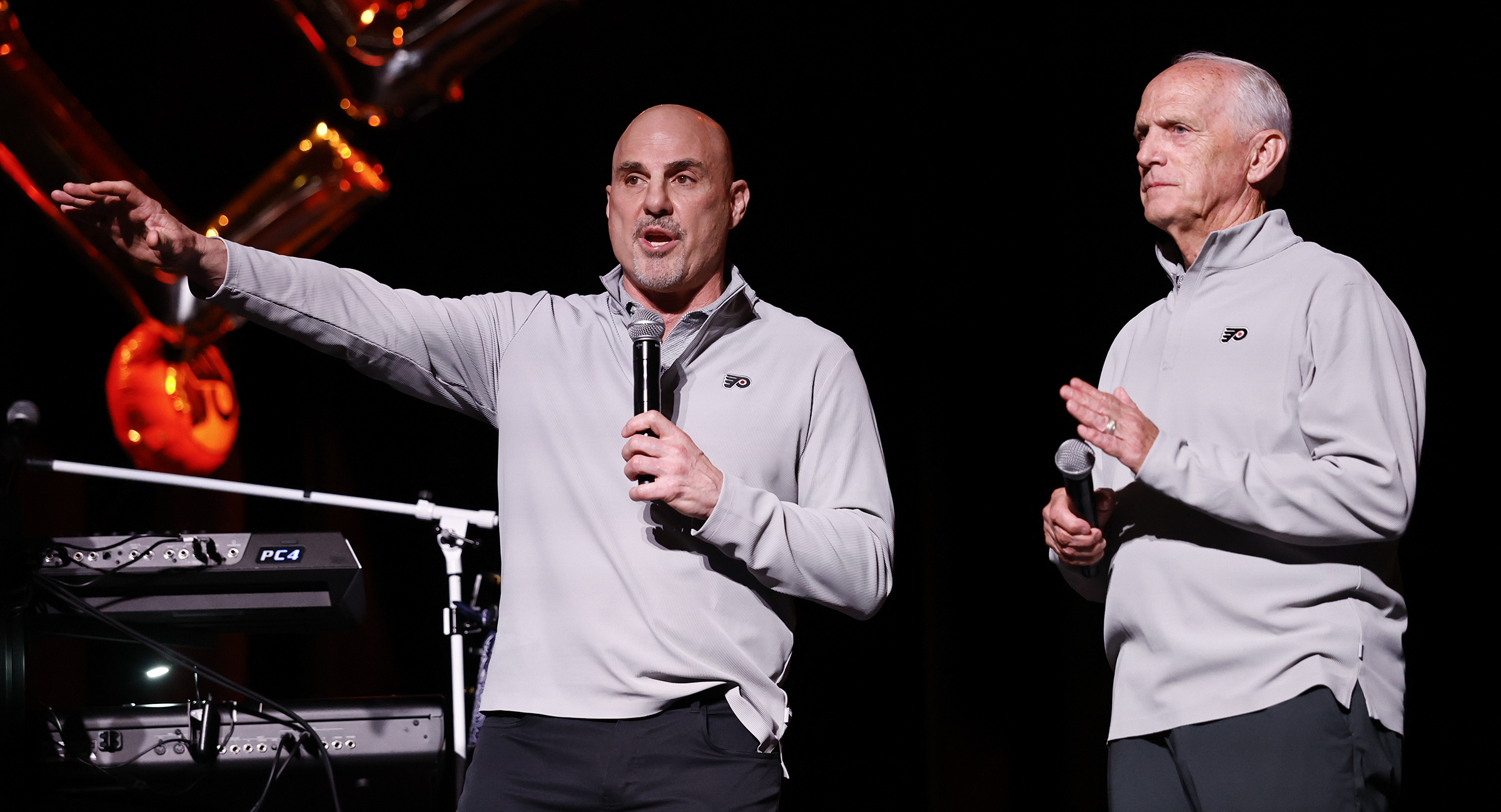
    On Thursday, the Flyers were scheduled to host a “Chalk Talk” with the coaching staff for season-ticket holders. But on Wednesday, a letter from team governor Dan Hilferty went out to season-ticket holders informing them that the event had been postponed. The cancellation comes during a time when Rick Tocchet’s job as head coach has been under some scrutiny from fans, and 10 days after audible “Fire Tocchet” chants rang out around Xfinity Mobile Arena.

    “I apologize for any inconvenience this may cause you. As an organization, our complete focus is on preparing the team for the difficult stretch of games ahead. You deserve our best, and Coach Tocchet and his staff are focused on just that,” the letter read.

    While Hilferty credited fans with fueling the recent wins — saying the fan base is passionate and committed — he was the one who decided to postpone. After Wednesday’s game in Buffalo, the Flyers play four of their next five games at home, including a matchup with the heated rival Anaheim Ducks, on Saturday afternoon. Beginning on Nov. 5, they have a five-game, 10-day road trip that kicks off in New York against the Rangers, heads to western Canada, and ends in Columbus.

    “Through thick and thin, you have cheered us on and let us know when we have fallen short. We do not take that passion or commitment for granted. We have heard your frustration. We understand it, and we share it. You deserve better,” the letter continued.

    The Flyers expect to announce a new date by the end of the week. According to Flyers public relations, the rescheduled event will come before Jan. 1.

  • Their police jobs ended. They kept using Flock’s vast surveillance network.

    Their police jobs ended. They kept using Flock’s vast surveillance network.

    When Andrae Wright left his job as an investigator at the Effingham County Sheriff’s Office in 2021, he handed in his gun and badge. But he kept something powerful: his log-in credentials for Flock, a police tool he used to search a vast network of roadside cameras tracking the locations of passing cars.

    In the five years after leaving the force, Wright searched the system more than 60 times without being stopped by anyone at the Georgia sheriff’s office, according to a statement by the Georgia Bureau of Investigation and Flock audit logs reviewed by The Post. He repeatedly searched the location of a vanity license plate bearing the middle name of his wife, according to the audit logs. The couple divorced this year, court records show, and at the time of some of his Flock searches, Wright was fighting for permanent custody of their teenage daughter.

    In July, after a tipster alerted local authorities, police arrested Wright and charged him with stalking his wife, claiming he misused Flock data “for the purpose of harassing and intimidating her,” according to his warrant. State law restricts the use of license plate readers to legitimate law enforcement investigations.

    Wright did not respond to phone calls, text messages, or voicemails seeking comment. Brian Bailey, a sheriff’s office spokesman, said that the agency had not conducted regular audits of who had access to its Flock system during that time but that it plans to begin doing so.

    The case marked one of at least 11 times in which government officials have discovered unauthorized users have gained access to Flock databases and searched them without permission, sometimes to track the locations of romantic partners, a Washington Post investigation has found.

    The incidents expose what security experts describe as alarming vulnerabilities within Flock’s nationwide network of license-plate-reading cameras and the law enforcement agencies that use them.

    Though Flock has pitched itself as a security-first business that closely controls access to its trove of license-plate data, company leaders have resisted calls from their own staff to implement stricter guardrails, according to three former employees who spoke on the condition of anonymity to avoid professional repercussions.

    Flock managers told staff repeatedly that they didn’t want to create barriers to securing camera contracts with law enforcement agencies that were resistant to more restrictive security controls, two of the employees said.

    To provide the most detailed accounting to date of unauthorized access, including two incidents that have not been previously reported, The Post interviewed police or city officials in eight states and three former Flock employees who worked on technical issues. The Post also analyzed Flock software logs released in response to public records requests, court documents, police records, and officials’ statements.

    The 11 incidents of unauthorized access tallied by The Post reveal how easily users could gain or retain access to Flock’s data. In four of the cases, officers were able to keep using their log-ins to Flock after leaving the force or while serving a suspension, because their accounts were not shut off. In six of the cases, police shared log-ins or passwords with active law enforcement officers from other agencies, in what officials later deemed violations of state laws, department policies or Flock contracts.

    In Indianapolis, a police recruit who was not authorized to access Flock was able to use the tool for more than two years after a more senior officer opened it on the more junior officer’s laptop and didn’t log out. The junior officer, Matthew Binford, used his colleague’s credentials to search his estranged wife’s license plate more than 1,000 times over a 12-month period, according to a court affidavit. Prosecutors criminally charged Binford and four other Indianapolis officers last month, after an August inquiry from The Post prompted an agencywide audit by the city’s police department.

    Binford declined to comment when reached by phone.

    Flock Safety, an Atlanta-based company valued by investors at $7.5 billion last year, has rapidly built a nationwide surveillance network, blanketing roadsides with at least 120,000 cameras that photograph passing cars and enable police to track suspects’ vehicles over time. The network’s growth has also expanded the potential for abuse: The Post has reported that at least 100 employees of law enforcement agencies have been charged with or accused of misusing license-plate readers for unauthorized purposes.

    Flock has been slow to adopt basic safeguards that are standard practice among commercial and government software vendors – measures that could have prevented many of the intrusions, according to security experts interviewed by The Post.

    Many police departments don’t require employees to register Flock accounts to a government-issued email address, which could be deactivated at the end of their employment, interviews and officials’ statements show. Though Flock contractually requires the use of official emails, the company acknowledges it hasn’t widely enforced that policy until recently.

    While movie-streaming companies like Netflix have built tools to crack down on password sharing, Flock does not appear to closely monitor for log-ins occurring from unusual locations and devices, said Jon Gaines, an independent security researcher.

    Security experts also said Flock could have prevented Binford, the Indianapolis officer, from using his co-worker’s credentials if it had taken the simple step of periodically asking users to reenter their password — a common practice for apps that deal with medical, banking, or other sensitive data.

    “There’s zero reason you can’t prompt a cop to put in his password,” Gaines said. “Even if it’s once a month.”

    After The Post presented Flock with its findings, the company said in an emailed statement that it plans to implement additional security measures that it had not previously announced. Paris Lewbel, Flock’s spokesman, said that since earlier this year, the company has been working with customers to identify and remove accounts that violate its terms of service, “including accounts registered to non-agency email addresses and logins shared among multiple people.”

    Starting next year, the company said, it will also begin requiring users to log back in every 12 hours.

    Lewbel declined to comment on the individual cases of unauthorized access or the accounts of former employees but said: “When we identify security gaps or violations of our policies, we take action. In several of the incidents described, we’ve done exactly that.”

    Several of the incidents of unauthorized access could have been prevented if Flock had required its users to provide an additional form of verification, such as a code from an email message or an app, a security practice called multi-factor authentication (MFA) that has been standard for many companies, including at least one of Flock’s competitors.

    Flock “should have had this on day one and enforced it,” said Mert Karakaya, a senior research engineer at IPVM, a surveillance industry research group. “It’s cybersecurity ABCs.”

    Flock made MFA the default option for users in 2024. In August, amid a flurry of reports of officers misusing Flock to stalk romantic partners and exes, the company began requiring MFA.

    One of Flock’s competitors, Rekor, has required MFA for all customers since 2019, the company’s chairman, Robert A. Berman, said in an interview.

    Lewbel said MFA has always been available to Flock customers who wanted it.

    Multiple employees implored the company to require MFA after an unauthorized user obtained the Flock log-in credentials of a police officer in Mishawaka, Ind., in August 2024, said two of the former employees, who were involved in detecting and responding to the incident.

    The person, who used the name “grimoire,” obtained license-plate data and, in an online forum, published files containing the locations of 24,356 Flock cameras across the United States and the details of 167,944 “hot list” alerts triggered by Flock cameras in the vicinity of Mishawaka, according to a copy of the raw data reviewed by The Post and screenshots of the forum post that were published on the blog Dark Web Informer.

    “I thought I would post this if anyone is interested in how US mass surveillance tools like Flock work,” the unauthorized user wrote, according to the Dark Web Informer post.

    Following the incident, Flock employees told senior executives that the breach could have been prevented if the company had required police departments to use multi-factor authentication, the two former employees said. Soon after that, Flock made MFA the default setting but continued to allow agencies to opt out.

    Though the former Flock employees said they discussed the incident on a “war room” videoconference call and Slack messages, Mishawaka officials say Flock never informed them of a data breach. In an Aug. 16, 2024, email to Mishawaka, which the city later shared with The Post, Flock said it had deactivated one of the department’s users who was “running an abnormal number of lookup searches,” but it did not mention a breach.

    In a blog post and in emails to customers, the company maintained that it had never been hacked. “I want there to be zero confusion about what is happening,” Garrett Langley, Flock’s CEO, said in December 2025 emails to several local agencies. “Flock has never been hacked. Ever.”

    In his statement for this article, Lewbel said the August 2024 incident was not a hack, because it “involved unauthorized access or misuse of customer accounts, not a compromise of Flock’s underlying cloud infrastructure.” Flock, he added, has “taken significant steps to strengthen account security and make it harder for unauthorized users to gain or retain access.”

    Matthew Lentsch, a spokesman for Mishawaka, said the city has not found evidence of a data breach. He declined to comment on the details the former Flock employees provided to The Post. Five months after the incident, Flock notified Mishawaka that it was offering MFA, which the city “worked with Flock to expediently implement,” Lentsch said.

    In a letter last year to the Federal Trade Commission, Sen. Ron Wyden (D, Ore.) and Rep. Raja Krishnamoorthi (D, Ill.) said the company’s “cavalier attitude towards cybersecurity needlessly exposes Americans to the threat of hackers and foreign spies.” The lawmakers cited evidence that hackers used malware to steal the Flock passwords of 35 police officers and highlighted that the company did not require MFA.

    Sensitive data, broad sharing

    Police guidelines published this year by the International Association of Chiefs of Police, an Alexandria, Va.-based trade group representing 35,000 police officials around the world, said access to license-plate readers should be granted only to staff members who need it to do their jobs “and promptly removed when an individual’s duties no longer require it.”

    But in practice, some departments don’t keep track of who is using these tools or restrict those who don’t need access.

    During an agencywide review last month, triggered by reports of Flock misuse in Georgia, the Cobb County Sheriff’s Office learned that around 200 of the agency’s roughly 900 staff members had access to Flock, including people who worked at the county jail.

    “We had people on there who had no reason to be accessing it,” Assistant Chief Deputy Gina Hawkins said in an interview, adding that her review did not identify any cases of apparent misuse. Cobb County shrank the pool of authorized users to about 50.

    Flock’s contracts restrict customers from granting access to any people “who are not officers, employees, or agents” of their agencies. But around the country, police have informally shared their passwords with nonemployees and sometimes even set up formal accounts to allow officers from other agencies access to their Flock dashboard, according to interviews and officials’ statements.

    During an internal audit in August, Kevin Collins, the police chief in Covington, La., discovered that a previous chief of his department had granted access to officers from the Louisiana State Police and two neighboring law enforcement agencies. Realizing he had no way of governing their use or investigating their actions, Collins deactivated their accounts.

    “Extending search access to outside agencies limits our ability to fully verify the purpose behind each individual query run against our system,” Collins said in a letter to the agencies, which The Post obtained through a public records request.

    Last year, officials in Richmond learned that giving outsiders access to a Flock database can lead to unforeseen policy violations.

    Shortly after President Donald Trump was inaugurated, the Bureau of Alcohol, Tobacco, Firearms, and Explosives began deploying agents to work on immigration enforcement. An ATF analyst, who had previously been given access to Richmond’s Flock system to assist with local investigations, began using it to search for immigrants, including several who had escaped from a Virginia detention center in March 2025, according to a statement the city issued later that year.

    Richmond officials became aware of the unauthorized access when the ATF agent used the city’s Flock system to search for an immigrant in Illinois. Because Illinois is one of several states that ban the use of license-plate readers for immigration enforcement, Flock says it scans for searches like these and automatically prevents the state’s cameras from being accessed for this purpose.

    Flock sent Richmond police an alert “that two searches from the ATF analyst inadvertently accessed Illinois vehicle data with ‘ICE’ in the query field,” the city said. Richmond immediately terminated the agent’s access, and the city later banned all access to its Flock system by federal agencies.

    The city said this month it would not renew its contract with Flock.

    Since Andrae Wright was arrested and charged in July, authorities have investigated two more former police officers — another in Georgia and one in Michigan — for allegedly running Flock searches after their employment ended.

    The Fulton County Sheriff’s Office, in Atlanta, told The Post last month it had become aware of unusual activity by a former officer who continued to use the agency’s Flock system after leaving the force. The activity had gone unnoticed, in part, because the officer had worked for the Fulton County Police Department, a sister agency that shared a Flock subscription with the sheriff’s office.

    In an interview, Sheriff Patrick Labat suggested that the intrusion would have been uniquely challenging to prevent and compared it to a hack of federal infrastructure by sophisticated foreign actors.

    But Wade Yates, chief of the Fulton County Police Department, said the problem was pretty clear: When the officer resigned, nobody at the police department told the sheriff’s office to remove her access. And because her department didn’t require MFA at the time, she would not have been prompted to authenticate her identity with an active government email.

    The case is now being investigated by the GBI. The officer could not be reached for comment.

    Yates said the department now has its own Flock account, separate from the sheriff’s office, as well as a process for deactivating former employees. It requires everyone to log in while connected to the government’s IT network.

    “They didn’t remove the employee,” Yates said. “I’ll take the heat for that.”

  • All the best music to hear in Philly this week from Jesse Welles, the Damned, John Oates, and more

    All the best music to hear in Philly this week from Jesse Welles, the Damned, John Oates, and more

    Philly music this week is busy with lots of action in theaters and clubs, with Jesse Welles and Arcángel at the Met, Paris Paloma and Movements at Franklin Music Hall, the Jayhawks and Bruce Cockburn at the Keswick, Ashley McBryde in Lansdowne, L7 at Brooklyn Bowl, and more.

    Wednesday Oct. 21

    Young Fresh Fellows

    Scott McCaughey is a Swiss army knife indie rocker. His résumé includes years of touring as an auxiliary member of R.E.M., the Baseball Project, as well as his two main creative outlets, the Minus 5 and Young Fresh Fellows. The Pacific Northwest songwriter and multi-instrumentalist is coming to the Main Line with the latter, in support of the YFF’s psychedelic and Beatles-y 16th album, Loft. Philly’s the No Good Crowd, who released the 10-song collection Unproper (test mixes and rough pressings) earlier this year, is opens. 8 p.m., 118 North, 118 North Wayne Ave., Wayne, 118NorthWayne.com

    Insane Clown Posse

    Juggalos will gather when Violent J and Shaggy 2 Dope of Detroit horrorcore hip-hop duo arrives in Philly for a pre-Halloween date. This tour is in support of their not-so-cheery 2025 album, The Naught, which adds existential dread to the ICP arsenal on songs like “Everybody Dies” and “While It Lasts.” With Wakko the Kid. 7 p.m., Franklin Music Hall, 421 N. 7th St., FrankinMusicHall.com

    Thursday, Oct. 22

    L7

    L7 was a key player in the alt-rock late 1980s and early 1990s, and the grunge-adjacent all-female band was a precursor to the riot-grrrl movement. The “Pretend We’re Dead” and “Wargasm” band fronted by Donita Sparks and Suzi Gardner is carrying on with its “Last Hurrah Tour” despite the loss of bassist Jennifer Finch, who died of brain cancer this year. 8 p.m., Brooklyn Bowl, 1009 Canal St., brooklynbowl.com/philadelphia

    The Jayhawks

    Longtime Americana standouts the Jayhawks are in fine form on Sanctuary Park, the Minnesota-born band’s new album. It reunites the Gary Louris-led quartet with Lou Reed and Alice Cooper producer Bob Ezrin, whom the band previously worked with on 2000’s Smile. Everly Brothers-esque sibling duo Cactus Blossoms opens. 8 p.m., Keswick Theatre, 291 N. Keswick Ave., Glenside, keswicktheatre.com

    Sam and Louise Sullivan, sibling singer-songwriters, sit for a portrait inside the Historic NJ studio in South Philadelphia on July 10, 2026.

    Friday, Oct. 23

    Sam and Louise Sullivan

    The music makers on the Historic New Jersey label have been mainly woodshedding in recent years, obsessively making music in their South Philly basement. Now though, the members of the songwriting collective are increasingly coming out into the light of day to play live. Siblings Sam and Louise Sullivan, who released the superb Love & Devotion this summer, are doing a Free at Noon this week. Noon, Ardmore Music Hall, 23 E. Lancaster Ave., Ardmore, 3025 Walnut St., xpn.org.

    Jesse Welles

    Jesse Welles has deftly positioned himself as a topical folk protest singer, self-styled in the mold of the early 1960s truth-to-power acoustic pickers like Bob Dylan and Phil Ochs. He played the Fillmore earlier this year, did a pop-up show at Race Street Pier in June, and now he’s moved up to headlining the Met. Hudson Freeman opens. 8 p.m., Met Philly, 858 N. Broad St., themetphilly.com

    Paris Paloma plays Franklin Music Hall on Friday.Phoebe Fox / Courtesy 2B Entrtainment

    Paris Paloma

    British pastoral folk-pop singer Paris Paloma, who calls herself “your favorite fairy grungemother” has followed up her 2024 debut, Cacophony, with The Fatal Flaw. The title is a nod to the animating concept of Donna Tartt’s 1992 novel, The Secret History. Susannah Joffe opens. 8 p.m., Franklin Music Hall, 421 N. Seventh St., franklinmusichall.com

    Saturday, Oct. 24

    Arcángel

    New York-born, Puerto Rico-raised rapper and singer Austin Agustin Santos is a reggaeton and Latin trap artist who teamed with Bad Bunny on “La Jumpa” in 2024. He’s nominated for a best rap/hip-hop song award at the Latin Grammys for “Gohan Y Guka” from his new La 8va Maravilla. 8 p.m., the Met Philadelphia, 858 N. Broad St., themetphilly.com

    The Damned

    First-generation British punks the Damned are touring 50 years after their first-ever gig, and opening for the Sex Pistols in London. The lineup for the “Final Damnation” tour includes original members Dave Vanian, Captain Sensible, and Rat Scabies. The band is refreshingly straightforward in their statement about why fans should see them now: “Bearing in mind the advanced years of the participants it’s fairly unlikely we’ll undertake anything quite like this again.” Flaming Groovies and the Courettes open. 8 p.m., Union Transfer, 1026 Spring Garden St., utphilly.com

    Movements

    Post-hardcore rock band Movements hail from Rancho Santa Margarita, California, but their relationship with producer and engineer Will Yip brings them to Philadelphia to make new music. Work on the band’s punchy and propulsive new album, Happier Now — the band’s fourth consecutive with Yip — began last year at Studio 4 in Conshohocken and was completed this year at Yip’s new Memory Music Studios in South Philly. With Balance and Composure, Midrift, and Niis. 7:30 p.m., Franklin Music Hall, 421 N. 7th St., FrankinMusicHall.com

    Ashley McBryde plays the Lansdowne Theater on Saturday.Katie Kauss

    Ashley McBryde

    Ashley McBryde is a sharp-eyed lyricist who makes country music with a rock and roll kick. Wild, her new album produced by Joan Osborne, takes an unflinching look at her Arkansas preacher’s daughter upbringing and past struggles with alcohol. New Zealand “Neon Cowgirl” singer Tami Neilson, who teams with McBryde, Grace Bowers, and Shelly Fairchild on her new single, opens the show. 8 p.m., Lansdowne Theater, 31 N. Lansdowne Ave, lansdownetheater.com

    Bruce Cockburn plays the Keswick Theatre on Sunday night.Daniel Keebler / Courtesy Lappen Enterprises

    Sunday, Oct. 25

    Bruce Cockburn

    Canadian guitarist Bruce Cockburn has been a prolific songwriter over a 50-year career, and his compositions include the all-time great protest song “If I Had a Rocket Launcher.” But on his gorgeous new album, The Blood of Others — which takes its title from a Simone de Beauvoir novel — he turns in empathetic and soulful versions of songs he didn’t write, including Billie Holiday’s “God Bless the Child,” Jelly Roll Morton’s “Buddy Bolden Blues,” and Herman Hupfeld’s “As Time Goes By.” Livingston Taylor opens. 8 p.m., Keswick Theatre, 291 N. Keswick Ave., Glenside, keswicktheatre.com

    Osees play Union Transfer on Sunday.amdophoto / Courtesy of Tell All Yiyur Friends PR

    Osees

    John Dwyer’s super-prolific and ever-name-changing psychedelic garage rock band Osees — formerly known as OCS and Thee Oh Sees among other variants — included singer and keyboard player Brigid Dawson in a classic lineup in its earlier years. Dawson left the band in 2013 but has continued to work with them sporadically and is featured on the new Off Course and this tour. 7 p.m., Union Transfer, 1026 Spring Garden St., utphilly.com

    John Oates & the Good Road Band play City Winery Philadelphia on Tuesday.Jason Lee Denton / Courtesy of Sarah Facciolo

    Tuesday, Oct. 27

    John Oates

    It’s coming up on the third anniversary of the Hall & Oates split that broke up the Philly-born tandem who’s the best-selling duo in the history of pop music. As separate entities, the former musical partners are staying plenty busy. Oates will be back in his hometown with his Good Road Band, performing new songs and past hits. 7:30 p.m., City Winery Philadelphia, 990 Filbert St., citywinery.com/philadelphia.

  • LeBron gets the last laugh in his Sixers debut after boos, chants, and a heated back-and-forth with Knicks fans

    LeBron gets the last laugh in his Sixers debut after boos, chants, and a heated back-and-forth with Knicks fans

    LeBron James may live in New York and play for Philly — but he’s still reminding fans that he’s just a kid from Akron, Ohio.

    In his Sixers debut, the 22-time NBA All-Star was greeted with boos from Knicks fans at Madison Square Garden. The warm welcome didn’t stop there, partially because of James admitting in the offseason that he was planning on signing with the Knicks if they didn’t win the championship last season.

    Then, with James at the free-throw line in the first half, Knicks fans chanted, “We don’t want you,” to try to further get his skin.

    But the most viral moment of the night came later in the first half of the Sixers’ 106-100 win. With the Knicks at the free-throw line, James got into a back-and-forth exchange with fans who were sitting near the court.

    Knicks superfan and filmmaker Spike Lee appearing to play peacemaker in the confrontation, as James continued to engage with the fan. NBC play-by-play announcer Mike Tirico also weighed in on what he was hearing from the crowd, including a fan talking about James’ helicopter commute between New York and Philadelphia.

    “I heard a guy yell behind me say, ‘Hey, LeBron, just because you have a helicopter and you live in New York doesn’t mean we’re going to cheer for you,’” Tirico said.

    Now, thanks to some fan video, we have an idea of what the Sixers star was firing back at the crowd. And it turns out, it’s about where he’s from after a fan apparently called him “soft.”

    “Ain’t nothing soft in the Midwest,” James appears to say. “I don’t know what the f— you talking about. I’m not from the West Coast. I’m from Ohio, baby. … I’m Ohio, baby. F— is you talking about?”

    James, who grew up in Akron and won a championship with the Cleveland Cavaliers in 2016, finished with 14 points, nine rebounds, and seven assists.

  • Macron slams as ‘stupid’ claims by Trump and others blaming Muslim migrants for French riots

    Macron slams as ‘stupid’ claims by Trump and others blaming Muslim migrants for French riots

    PARIS — French President Emmanuel Macron said Wednesday that foreign leaders — including those “on the other side of the Atlantic” — were seeking to exploit France’s tense social climate for political gain following a weekend of street violence and looting.

    Protests over soaring living costs have led to widespread rioting and looting that have drawn worldwide attention and shocked many French citizens. U.S. President Donald Trump has used the violence to rally his political supporters, making unsubstantiated claims that Muslim migrants are responsible for the unrest, and urging Macron to “close your borders and take control before it is too late!”

    Macron responded by saying there “has been foreign manipulation of information in the aftermath” of the looting in Paris and other French cities last weekend. “And that has led to comments that are as unacceptable as they are stupid, from many people, including foreign leaders,” he said.

    Asked by a reporter if he was referring to Trump, Macron replied: “Among others.” He added that there have been “AI-generated images depicting scenes that never actually happened in France. We’ve had people claiming that we were invaded by hordes of migrants and Islamists, which is completely false.”

    Macron did not specify which AI-generated images he was referring to, nor how he knew the content was false.

    French Foreign Minister Jean-Noel Barrot said his office can provide the countries concerned with the necessary clarification, “to help them avoid spreading or amplifying false information and making baseless claims on social media.”

    Macron and Trump once enjoyed a good relationship, but Trump regularly mocks the French president in his public speeches.

    “The fact is, all the people who are speaking ill of our country right now are people who don’t love our country,” Macron said. “So those people really bother me.”

    “When I see leaders who are in the middle of election campaigns, whether in the region or on the other side of the Atlantic — who sometimes naively repeat AI-generated content or spread narratives that certain circles are clearly trying to promote about what happened in France — they’re using our country for their own political campaigns,” said Macron. “And we don’t need that.”

    Macron secures diesel supplies

    Macron was speaking in Qatar at the end of a tour of key energy suppliers in Gulf Arab states, where he secured an additional 100,000 metric tons of diesel per month from the United Arab Emirates, with a further 100,000 tons to be confirmed in Bahrain.

    Macron’s office said he traveled to the Middle East to find solutions to the energy crisis and rising energy prices, and to secure supplies of oil, gas, diesel and jet fuel.

    The Élysée said nearly 295,000 additional tons of diesel per month could be secured, including supplies from Saudi Arabia — equivalent to more than 10% of France’s monthly diesel consumption. Macron later traveled to Saudi Arabia to meet Crown Prince Mohammed bin Salman “to continue efforts to secure and diversify oil and gas supplies,” according to his office.

    Earlier this month, the Group of Seven wealthy democracies agreed to release 100 million barrels of oil and fuel products, beginning with substantial quantities of diesel after the fuel’s price hit a record high in the United States.

    “I would remind you that France initiated the G7 meeting that led to the release of strategic reserves, which, through implementation at the national level, will help bring down prices starting in early November,” Macron said.

    New protests planned in France on Thursday and Saturday

    Petrol, energy and food prices have surged in recent months, and it remains to be seen whether Macron’s announcement will ease protesters’ anger. He said the additional diesel supplies addressed “some of the anxieties.”

    “I also hear the concerns of our high school and university students. Those concerns stem from other factors, but in any case, I think things are moving in the right direction,” he added.

    High school students have raised concerns about underfunded schools, dilapidated facilities, and staff shortages, particularly in lower-income neighborhoods. Some also say school days, which often run from 8 a.m. to 6 p.m., are exhausting and the university admissions system is complex and unfair.

    France has had two consecutive quiet nights since the weekend’s unrest. Curfews have been imposed in parts of several major cities, including small areas of Paris.

    Further protests are planned for Thursday and Saturday following calls from student unions and groups within the “yellow vest” movement, whose demonstrations over fuel prices shook France in 2018 and 2019.

    Paris police said Wednesday they would ban Thursday’s planned protest in the French capital, citing concerns for public safety and the protection of property.

    Prime Minister Sébastien Lecornu, who met union representatives on Wednesday, said a “massive” security operation was planned for Saturday to prevent a repeat of the violence by small groups of rioters that had exposed shortcomings in security measures.

    “We are using the legal means at our disposal to prevent further incidents of this kind,” Macron said. “Those who intend to cause disturbances in city centers next Saturday will be prevented from doing so. Tomorrow, we will also have a very detailed update on the implementation of these measures, including anticipation, intelligence gathering and security, not just for Saturday, but also for the coming weeks.”

  • Roger Goodell says the NFL welcomes a review of how Eagles handled Jalen Hurts’ blood clots

    Roger Goodell says the NFL welcomes a review of how Eagles handled Jalen Hurts’ blood clots

    NEW YORK — NFL commissioner Roger Goodell said Wednesday that the league welcomes an investigation into the Philadelphia Eagles’ handling of Jalen Hurts’ blood clots after the players’ union asked for one.

    Goodell said in his news conference at the end of the NFL’s annual fall meeting that Dr. Allen Sills, the league’s chief medical officer, has gone through the steps that were followed and added that the union had a right to call for a review.

    “Obviously, there was a medical evaluation, and I think our protocols were incredibly good there,” Goodell said. “The protocols were followed. Our process is to make sure that’s the case, and our chief medical officer has gone through that, so we’re comfortable that what we’ve seen in the protocols have happened.”

    Sills on Tuesday offered a passionate defense of the Eagles medical staff. The NFL said officials were in touch with team doctors and trainers, as well as the Cleveland Clinic in London.

    Executive vice president Jeff Miller said officials had a good sense of the course of events. He disputed a report that Hurts was awake for more than 30 hours before playing against Jacksonville on Oct. 11, saying that the QB returned to the hotel and slept for roughly seven or eight hours.

    Hurts is on injured reserve and expected to miss the rest of the season after a blood clot in his left calf traveled to his lungs. The Eagles and agent Nicole Lynn said Monday that Hurts has deep vein thrombosis and bilateral pulmonary embolisms.

    Goodell downplayed the role that international travel may have had in the situation.

    “The most important thing here is Jalen’s health, ultimately, and the future of him,” Goodell said. “He’s a wonderful young man: not just a great player, but he’s someone we all care deeply about. I’m more worried about his health, ultimately, but the protocols were followed.”

  • Jefferson Health-Independence contract dispute worries Jefferson patients with IBX Medicare Advantage plans

    Jefferson Health-Independence contract dispute worries Jefferson patients with IBX Medicare Advantage plans

    Joe MacFarland has relied on Independence Blue Cross insurance for more than 50 years, first through his employer and now in retirement through a Medicare Advantage plan. He likes the coverage and has no interest in changing.

    But to keep seeing his doctors at Jefferson Health, the 74-year-old Philadelphia resident might have to switch to a different company, given the uncertain outcome of contentious contract talks between Jefferson Health, the Philadelphia region’s largest health system, and Independence, its biggest insurer.

    “I’d like to be able to stay with the [doctors] I’ve had for decades,” he said.

    Many Jefferson patients with IBX Medicare plans are now faced with the choice: change insurers during the Medicare open enrollment period that started Thursday and runs through Dec. 7, or risk losing access to their Jefferson doctors next year.

    Independence and Jefferson have declined to say how many Medicare Advantage patients are affected by their negotiations. Under the program, the federal government pays insurers a fixed monthly amount per member to coordinate and cover all of the person’s medical costs. They have become popular for convenience and sometimes added benefits compared to traditional Medicare, where patients navigate their medical care on their own, and the government pays the bills directly to providers.

    Jefferson, which has been losing money for years, says Independence pays 40% below national commercial averages and needs to get closer to what other insurers pay around the country.

    The insurer says it already pays Jefferson competitive rates for the region and has offered a significant increase to the nonprofit health system with 33 hospitals from South Jersey to Scranton.

    Independence has 126,000 Medicare Advantage members in its core Southeastern Pennsylvania market, according to an Inquirer analysis of the latest federal data. It has about 6,200 Medicare Advantage members in South Jersey, where Jefferson has three hospitals.

    Jefferson competes with Independence in the private Medicare market. Its insurance arm has 31,500 Medicare Advantage members, with a concentration in Philadelphia.

    When to make a decision?

    MacFarland and other Jefferson patients with IBX Medicare plans face the question of when to jump to a new insurer. MacFarland said he’s going to take his time.

    Center City resident Ann Lesch, 82, said she plans to plans to leave IBX and select a new plan early next month if she hasn’t heard anything about a contract renewal. Her primary care doctor is at Penn Medicine, but she has several specialists at Jefferson.

    “I don’t want to do anything that’s stressful at the last minute,” she said.

    Lesch has used IBX’s Keystone 65 Medicare Advantage since 2013, when she returned from her position abroad as dean of the American University in Cairo. “It’s been very steady, and I’ve had a couple of procedures during that time, so it’s been good and hasn’t been excessively expensive,” she said.

    Then she received a letter from Jefferson Sept. 23 announcing the possibility that Jefferson might no longer take her insurance next year.

    “It basically said the fault is all on Blue Cross, and what we want you to do is contact them, protest to them, and get them to do a better deal with us,” she said.

    Her reaction was: “How do I know that Blue Cross was offering bad terms? You haven’t told me anything.”

    Insurance showdowns are not unusual and usually end with a deal at the last minute, as happened between Main Line Health and UnitedHealthcare last summer.

    When Jefferson’s Lehigh Valley Health Network stopped accepting UnitedHealthcare’s Medicare plans last January, federal regulators, encouraged by state insurance and aging officials, implemented a special open enrollment period to allow people who had lost access to their Lehigh Valley doctors to switch plans.

    Bracken Babula, a Jefferson internal medicine physician, illustrated the use of his smartphone and software for ambient listening during patient exams last year. Jefferson is in the midst of difficult contract talks with Independence Blue Cross that could force some Jefferson patients to switch Medicare Advantage companies to keep their Jefferson doctors next year.Alejandro A. Alvarez / Staff Photographer

    The added enrollment period was a reprieve for people who weren’t paying attention to the possibility of losing access to their doctors. Patients in the middle of cancer treatment or other serious medical conditions can apply for “continuity of care,” which means they can continue to receive in-network services for a limited amount of time if their doctors go out of network.

    “In the event Jefferson and Independence Blue Cross do not come to terms on a new contract for their Medicare Advantage business, [the insurance department] anticipates engaging in a similar conversation with CMS, however that decision would ultimately be made by CMS,” the Pennsylvania Insurance Department said in an email.

    The context: contentious negotiations

    Medicare Advantage payment rates are among the several insurance products caught up in the Jefferson and Independence contact dispute.

    Independence said that early in negotiations with Jefferson it suggested segregating Medicare from the negotiations over rates paid primarily by employers through commercial insurance plans. That contract expires Dec. 31, and both sides have provided early warnings to patients that Jefferson may no longer be in Independence’s network next year.

    “We wanted to protect our Medicare Advantage members from the impact of these negotiations, particularly because they are our most vulnerable members. Jefferson was not willing to do that,” Independence said in a statement.

    Jefferson said the medical vulnerability of Medicare Advantage patients is not the key issue.

    “When IBX says Medicare Advantage members are the most vulnerable, what they really mean is those members have the option to leave IBX. That’s not a vulnerability for patients, it’s a vulnerability for IBX’s bottom line. Patients have choices and can select other coverage options while continuing to receive care from the doctors they trust,” Jefferson’s chief financial officer Michael Harrington said in an email Thursday.

    Medicare Advantage patients could struggle to swap plans in some parts of the United States, where insurers have reduced the number of plans they are offering during the current open enrollment period. But in Philadelphia the offerings are more or less stable, falling to 63 options for the coming year from 66 currently, according to Medicare.gov. However, costs for enrollees are rising, as in all areas of healthcare.

    Switching to traditional Medicare with Medigap to help with out-of-pocket costs after having Medicare Advantage is not a good option for many, because the supplemental plans can charge people with preexisting conditions more money or deny them coverage. Three-quarters of Medicare Advantage customers have such a condition, according to KFF, a nonprofit focused on health policy issues.

    Jefferson is also negotiating a new Medicaid contract with Independence subsidiary AmeriHealth Caritas — and wants to negotiate on all forms of insurance at the same time. Combining everything could give Jefferson more leverage on the rates that employers pay. Keystone First, AmeriHealth Caritas’s Medicaid plan in Southeastern Pennsylvania, covered 426,000 people in August. Medicaid is insurance for low-income people and many with disabilities funded by federal and state governments. Private companies manage the benefits.

    “Jefferson offered to have a third party evaluate our proposals and made efforts to prioritize the most vulnerable Medicaid patients in our negotiations. IBX flatly refused both,” Jefferson said.

    Medicaid coverage is provided under a separate contract through AmeriHealth Caritas, Independence said. Historically, health systems have negotiated Keystone First contracts separately.

    “Independence Blue Cross does not have Medicaid members or hold a Medicaid contract in the Commonwealth, and we directed Jefferson to the appropriate organization,” the company said.

    Using a third party to look at what providers are paid outside the Philadelphia region doesn’t make sense, Independence said: “Our members and Jefferson’s patients are here, and the Philadelphia region is the relevant market.”

    In addition to negotiating on commercial rates, Medicare Advantage, and Medicaid, Jefferson is also suing Independence over policy changes.

    “IBX is currently failing to uphold important contractual obligations affecting Medicare Advantage patients, including issues related to the CMS mandated two-midnight rule,” the health system’s statement said, summarizing its legal claims.

    A federal judge on Friday rejected Independence’s motion to dismiss the complaint in U.S. District Court for the Eastern District of Pennsylvania, only rejecting Jefferson’s request for attorney’s fees.