Blog

  • Councilmember Nicolas O’Rourke wanted to mandate funding for a new Transit Access Fund. He’s scaling back his plan.

    Councilmember Nicolas O’Rourke wanted to mandate funding for a new Transit Access Fund. He’s scaling back his plan.

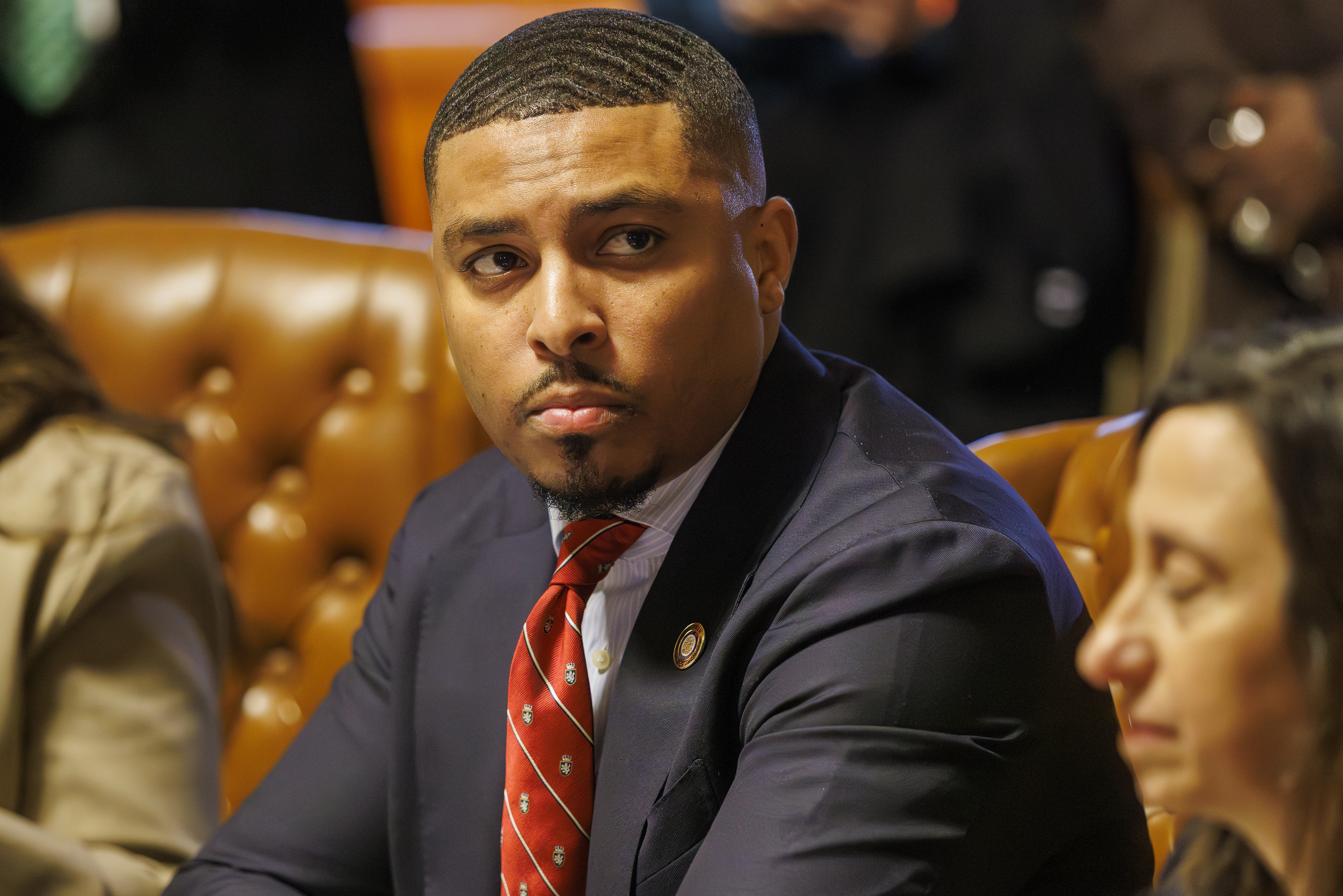
    Philadelphia City Councilmember Nicolas O’Rourke, facing a lack of support amid budgetary concerns, has scaled back his plan to create a Transit Access Fund that would help pay for programs that subsidize SEPTA fares for low-income residents and other groups.

    O’Rourke in April proposed amending the Home Rule Charter to create the fund and mandate that it annually receive 0.5% of the city budget. That would have amounted to more than $33 million in the program’s first year, and $135 million over five years, according to a fiscal analysis prepared by Mayor Cherelle L. Parker’s administration.

    But Council President Kenyatta Johnson never referred the legislation to committee. On Thursday, O’Rourke introduced a less ambitious version of the plan that would instead create a new chapter of the city law code authorizing the administration to create the fund. The bill would require the city to produce an annual Transit Access Plan, but does not include specific funding benchmarks.

    “This is what we got the most support around, as it relates to being able to get it out the blocks,” O’Rourke, a first-term Working Families Party lawmaker who represents the city at large, said in an interview. “It’s important for us to make sure that we continue to show that there is a desire amidst this body to make sure that we are locking in and protecting these programs that provide accessibility to the poorest in our city.”

    Programs established through Home Rule Charter amendments, which must be approved by voters in referendums, are permanent, non-negotiable additions to city government. City law, however, can be overturned by Council, and funding for programs in the law code are renegotiated each year in the city budget.

    The transit fund, if approved, would boost funding for the Zero Fare program, which covers the cost of SEPTA fares for low-income Philadelphia residents, and SEPTA’s Key Advantage and Key Partner programs, which provide discounts for employees or students of participating companies, schools, and nonprofits.

    Passengers wait for a southbound Broad Street Line train at City Hall Station in Philadelphia on Sunday, Aug. 24, 2025. David Maialetti / Staff Photographer

    O’Rourke said he hopes the new bill will be a starting point that will eventually lead to a permanent version of the fund. The proposal is cosponsored by 14 of Council’s 17 members, including Johnson, according to O’Rourke’s office.

    “We’re happy to continue to partner with the city on the Key Advantage program, and we appreciate their support,” SEPTA spokesperson Andrew Busch said.

    Johnson told reporters Thursday that he is giving proposals that carry a significant cost extra scrutiny due to financial concerns. In addition to O’Rourke’s original plan for the transit fund, Johnson has held up a business tax relief bill authored by Councilmember Mike Driscoll that the administration has said would cost at least $29.5 million per year.

    “We are just taking in consideration all the bills that have an impact on revenue, just doing our due diligence before we move forward on any of them, just based upon the total budget that we have,” Johnson told reporters. “We need to look at the totality of all the things that are going to have a budgetary impact. … It has nothing to do if they are good ideas or bad ideas. But they have a cost to them, so we have to be mindful.”

    The city budget, currently about $7 billion, is negotiated each year between March and June, and must be approved by July 1. The city had about $1.1 billion in reserves as of June 30, according to the most recent Quarterly City Manager’s Report.

    Council President Kenyatta Johnson, Mayor Cherelle L. Parker and Superintendent Tony B. Watlington Sr. arrive for an announcement at the School District of Philadelphia Headquarters on Wednesday, June 10, 2026 in Philadelphia.Monica Herndon / Staff Photographer

    Johnson’s concerns about the budget come after Council earlier this year rejected a series of tax-raising proposals by Parker meant to fund the cash-strapped Philadelphia School District, homeless services, and other priorities.

    The tax fight was highlighted by Council’s rejection of Parker’s proposed $1-per-ride tax on rideshare services like Uber and Lyft that the mayor championed in hopes of providing an additional $48 million per year for the schools.

    Council last June instead helped plug the district’s deficit with money from one-time savings in the city budget. Johnson at the time pledged to work with the administration to find a recurring funding source for schools.

    “That’s another commitment we have to find additional revenue,” Johnson said Thursday. “Some of these conversations will take place in the budget process. Some of these conversations will look at: How do we find additional revenue to support the various proposals being put in front of us?”

    SEPTA has faced its own funding crisis over the last few years, and transit advocates are hoping state lawmakers increase funding for the agency.

    Despite O’Rourke’s proposal being watered down, Stephen Bronskill, coalition manager for the group Transit Forward Philly, said the new plan is nonetheless “a major step forward” that shows the city “is doing its part to invest in transit so that the Commonwealth can do the same next year and pass a statewide transit funding solution.”

    Staff writer Thomas Fitzgerald contributed to this article.

  • A look inside Camden County’s $25 million investment to end homelessness by 2030

    A look inside Camden County’s $25 million investment to end homelessness by 2030

    On a quiet, wooded road in Blackwood, a long-awaited respite for homeless people opened its doors Friday, a $25 million investment in the county’s efforts to eradicate homelessness by the end of the decade.

    Built on a former off-road racing track at 15 County House Rd. in Camden County, the new Martin McKernan Supportive Housing Center has 60 transitional housing units and a bright and airy community room with tall ceilings and natural light pouring in.

    The project is a core feature of the county’s plan to reach “functional zero” homelessness by 2030 — achieved when the number of homeless people is not greater than the monthly housing placement rate.

    The Martin McKernan Supportive Housing Center in Blackwood is a $25 million investment in Camden County’s efforts to end homelessness by 2030.Courtesy of Camden County

    The deadline is not a state mandate but a goal the county set for itself, driven by the desire to help amid the pullback of federal funding for social safety net programs, according to Camden County Commissioner Director Louis Cappelli Jr.

    “It’s all about compassion,” Cappelli said. “Our mission has always been to help those most in need, and I think this is a huge leap forward towards meeting that objective.”

    The 45,000-square-foot building includes ADA-accessible units alongside a communal laundry, computer and mail rooms, a gym, and lounges for residents. Each room comes equipped with a small kitchen and bathroom and was constructed with trauma-informed design in mind, county officials said, with large windows and ligature-resistant furniture.

    Staffed 24-7 by the Volunteers of America Delaware Valley, the shelter will also include temporary offices for traveling service providers, county officials said, connecting residents with workforce development, physical and mental healthcare, substance use recovery resources, and more, in partnership with Cooper Norcross University Hospital and Thomas Jefferson University Hospital.

    “There’s not a service, really, that we’re not providing that these folks need,” Cappelli said.

    Rob Jakubowski, director of the Camden County division of community development, and Camden County Commissioner Director Louis Cappelli Jr walk through the new Martin McKernan Supportive Housing Center on Sept. 8.Courtesy of Camden County

    The shelter, its programs, and its services were designed utilizing insights the county gleaned from what has worked well at the Regan Center, a 23-bed emergency shelter also in Gloucester Township, Cappelli said.

    Since it opened in 2021, 80% of the nearly 300 people who have turned to the Regan Center for assistance have gone on to secure permanent housing, he said.

    “That’s a pretty extraordinary success rate, and we’re very confident we could duplicate that here,” Cappelli said.

    Unlike many state-funded shelters, the McKernan Center will not have a hard-and-fast deadline for when residents need to leave their transitional unit, said Rob Jakubowski, director of the Camden County Division of Community Development.

    Instead, the length of stay will be determined by social workers and healthcare professionals on a case-by-case basis, he said, prioritizing the needs of the individual as opposed to an “arbitrary deadline.”

    Jakubowski said residents will need to fulfill some requirements during their stay — mainly just taking an active role in their own wellness.

    “You always have to be working towards your next step. You’re not just coming for a free sandwich, you have to be meeting with your case manager,” he said. “And for everyone it’s different, but the ultimate goal is housing. Today it’s your ID, tomorrow it’s your Social Security card, but you always have to be meeting and participating in your own help.”

    The McKernan Center also does not require a traditional referral.

    Contractors were putting the finishing touches on the new transitional housing shelter on Sept. 8.Courtesy of Camden County

    “If you walked into a shelter right now, they’d say, ‘Who’s your referral?’ — meaning who’s paying for it,” Jakubowski said. “That’s not an obstacle anymore when it comes to the Camden County commissioners.”

    The majority of the $25 million construction was paid for by the county’s remaining federal COVID-19 relief funding that was set to expire at the end of the year, Cappelli said, with county bonds used to cover the rest of the construction budget.

    Cappelli said the county is prepared to shoulder most, if not all, of the financial burden for operation — estimated to cost over $2 million per year.

    The county will apply for grants to help offset costs, Cappelli said, “but we’re not real optimistic.”

    “We’re presuming we’re going to pay for all of these operations and that’s the way it’s going to be,” he said. “But it’s an investment in people who need the investment.”

    In Camden County, like elsewhere in the state and country, homelessness rates have been increasing since the pandemic, Cappelli said.

    During the point-in-time count in January 2025, 759 people in Camden County were experiencing homelessness — 140 of whom were determined to be chronically homeless. In comparison, Burlington County counted 1,550 homeless residents on the same night, while Gloucester County recorded just 162.

    The yearly count is a federally mandated effort used to provide a snapshot of sheltered and unsheltered people experiencing homelessness across the nation on a single night.

    A short walking path winds through the property and into the edge of the nearby woods, encouraging residents to commune with nature, county officials said.Courtesy of Camden County

    “There’s been significant cuts in federal aid, plus the economy is really difficult for a lot of folks right now,” Cappelli said. “And we need to stem the tide here and reverse what has been a trend in homelessness over the past few years.”

    The McKernan Center is just the latest addition to the range of programs and services the county has in place to address homelessness, including the Regan Center and a planned Multi-Agency Center in Camden that will help connect people with the services they need.

    In partnership with the Volunteers of America, the county also operates the Work Now program, which offers homeless people a day of paid work for the county while giving them the opportunity to engage in other services while they are at it, the goal being to ultimately secure permanent housing.

    “The philosophy of this board is that we need to help those most in need,” Cappelli said, whether the issue be homelessness, mental health, substance use, or something else. “We’re going through the communities, finding those who really need help, and we’re trying to help them.”

  • Mighty Writers resumes services in Camden after furlough, but challenges remain in Philly

    Mighty Writers resumes services in Camden after furlough, but challenges remain in Philly

    Educational nonprofit Mighty Writers has restored programming at its Camden locations amid an ongoing organizational furlough, but the future of its operations in Philadelphia still faces challenges.

    The furlough that began in September prompted a pause on services, including food-distribution efforts, summer camp, and after-school and literacy programming at all Mighty Writers locations. Now, the organization has made “meaningful progress toward reopening,“ CEO and executive director Corinne Green said in a statement.

    That progress includes the full resumption of services at both Mighty Writers locations in Camden, which follows a $563,000 grant that is to be paid out over eight months. The award comes through the EMR Camden Community Benefits Fund, and is the largest corporate grant received in Mighty Writers’ history, Green said.

    Grant money, Mighty Writers said in a joint statement with EMR Advanced Recycling, a U.K.-based scrap metal recycler that has courted some controversy locally, will be used only for Camden-based programming. With it, Mighty Writers said, it has restored two after-school literacy academies, summer camp programming, and food-distribution services, and brought back six full-time staffers.

    “We have heard loud and clear the need for stable funding for organizations like Mighty Writers that provide such vital services to our neighbors, and we are proud to support their important grassroots work,” said Joe Balzano, CEO of EMR Metal Recycling USA.

    The fund, administered by the Community Foundation of South Jersey, was created last year following a large fire at the company’s Camden shredding facility, and is intended for community improvement initiatives. Camden last month sued EMR in connection with the fund, claiming it had not made good on more than $1 million in promised donations. Balzano previously told The Inquirer the company had met its obligations, and the case remains ongoing.

    Challenges in Philadelphia

    Across the river, most of Mighty Writers’ five Philadelphia locations will need new homes before they can resume services, following the end of a partnership with the Philadelphia Housing Authority. The PHA owns three buildings where the nonprofit operates in West Philadelphia and North Philadelphia — outposts known as MW West, MW North, and MW Hartranft.

    The authority, Green said, recently told Mighty Writers it wanted to “explore opportunities with other service providers.” The change resulted in layoffs for four Philadelphia staff members. The Mighty Market food-distribution effort, housed in MW West, is slated to operate through the end of 2026 before being relocated.

    “We are grateful for the opportunity to have served children and families within these communities over the past seven years,” Green said. “Although this chapter of our partnership is concluding, our commitment to these communities remains unchanged.”

    Green previously estimated Mighty Writers’ furlough could last about 12 weeks. Now, with the PHA partnership coming to an end, that timeline could be extended, she said.

    The authority said in a statement that it “decided to pause the partnership” while Mighty Writers “rebuilds and strengthens its financial stability.”

    “We congratulate Mighty Writers on securing new funding, wish them continued success, and look forward to the possibility of working together again in the future,” PHA spokesperson Nichole Tillman said. She added that new programming efforts have begun at most locations with other partners.

    Mighty Writers also plans to relocate its El Futuro location in South Philadelphia, and programming will not be restored there before any move, Green said. Conversations with new community partners and searches for new locations continue for all affected facilities.

    Its site in Northeast Philadelphia, however, has restarted enrollment and was slated to begin offering after-school programming this week, becoming the first location in the city to fully restore services since the furlough. Additionally, Mighty Writers’ food-distribution efforts in Kennett Square and Atlantic City are now running twice weekly.

    Alongside announcing the temporary pause on services last month, Mighty Writers also said it had furloughed 26 employees. Since then, 11 employees have been restored, including three full-timers in Philadelphia and two part-time workers in Kennett Square. Six other workers await recall, three resigned voluntarily, and six were laid off.

    Currently, Mighty Writers is accepting individual donations, and plans to hold its annual fundraising event, the Mighty Literacy Bash, next month. Founded in 2009, Mighty Writers said in a 2025 annual report that it served more than 5,800 students and made 110,000 family distribution visits.

    Though the organization faces challenges, Green said she remains optimistic about its future.

    “We have restored programs. We have secured new funding. We have welcomed employees back. We have developed new partnerships,” she said. “And we are actively building the infrastructure necessary to sustain our mission for years to come.”

  • Congress demands information about VIP rewards from DraftKings, Fanatics, prediction markets and others

    Congress demands information about VIP rewards from DraftKings, Fanatics, prediction markets and others

    Three members of Congress on Thursday expanded their scrutiny of VIP gambler benefits by demanding answers about the scope of rewards programs offered by a half dozen companies, including DraftKings and Fanatics, and the prediction markets Kalshi and Polymarket.

    “As repeated stories from exploited gamblers and media reports have vividly documented, VIP programs are driving the gambling industry’s most susceptible customers into debt and addiction through rewards tied to waging ever increasing amounts of money,” the lawmakers — U.S. Sen. Richard Blumenthal (D., Conn.) and U.S. Reps. Paul D. Tonko (D., N.Y.) and Valerie P. Foushee (D., N.C.) — wrote in letters to the companies, which also included BetMGM and Caesars.

    The Democrats asked company officials, including Fanatics chief executive officer Michael Rubin, a former co-owner of the 76ers, to disclose by Nov. 5 how much revenue they derive from VIP customers, the types of perks and services they offer to those gamblers, and whether artificial intelligence is used to shape promotional offers to individual gamblers.

    “Fanatics Betting and Gaming received the request today and will respond in due course,” a spokesperson for the company said. “We appreciate the Members’ interest and welcome the opportunity to share information on the ways in which we work to protect our customers.”

    A DraftKings spokesperson said the company would “respond accordingly once we have had a chance to review” the letter from Blumenthal, Tonko, and Foushee.

    DraftKings said it would respond to the Congress members’ inquiry. Tiffany Hagler-Geard

    In an email, Kalshi sought to differentiate its prediction market from traditional gambling entities.

    “Unlike sportsbooks and casinos, we manage our top traders by volume; we don’t take their wins and losses into account,” a spokesperson wrote. “By definition, a VIP at a sportsbook or casino is a losing customer or someone they expect to lose. That’s because the gaming industry only makes money when people lose. We don’t do targeted promotions, offers, or bonuses when customers lose. We also do proactive outreach to clients when they join about how to use our responsible trading tools.”

    Representatives for BetMGM and Caesars could not be reached for comment.

    Since early August, the members of Congress have pressured another sportsbook, FanDuel, about its VIP program, citing reporting from The Inquirer that showed a FanDuel VIP account manager had sent a personalized video of Phillies star Bryce Harper to a gambler in the Philadelphia suburbs who had an addiction.

    Harper in July said that he had been paid to record the message through the video service Cameo, but that he did not know FanDuel would use it to reward a VIP bettor.

    In July, Bryce Harper wrote on Instagram that he had recorded a short video message for a FanDuel VIP gambler through the pay service Cameo, but didn’t know the man had an addiction.Yong Kim / Staff Photographer

    In response to the elected officials’ inquiries, a FanDuel executive in September said that the company had sent about 30 personalized videos of athletes and entertainers to its customers during the last two years. The company has declined to disclose further details about the videos.

    FanDuel has said that it will not eliminate its rewards program and that its VIP managers are trained to recognize and report signs of problem gambling. The Major League Baseball Players Association said it would support prohibiting players from promoting VIP programs in the future.

    Some of the sportsbooks and prediction markets contacted by Congress have separately figured into controversy surrounding new Sixers star LeBron James, who has previously promoted football bets for DraftKings, and in September signed a $15 million endorsement deal with Polymarket, prompting criticism from fans and fellow NBA players.

    James also sometimes commutes from New York to Philadelphia in a Fanatics-owned helicopter as part of a trading card partnership he has with the company. (NBA Commissioner Adam Silver said the helicopter arrangement is “perfectly appropriate.”)

    LeBron James in September signed a $15 million sponsorship deal with Polymarket, nearly quadruple his $4 million salary with the Sixers.Frank Franklin II

    Sportsbooks like DraftKings and FanDuel have been regulated by individual states since a 2018 U.S. Supreme Court ruling overturned a long-standing ban on sports betting.

    Prediction markets like Kalshi and Polymarket, however, are regulated by the federal Commodity Futures Trading Commission and are available in 50 states. The companies have insisted that their products are not gambling apps but rather a financial product similar to the stock exchange.

    The lawmakers’ letters note that the prediction markets do not refer to their customer rewards as VIP programs: Kalshi’s is known as Kalshi Platinum, while Polymarket’s has “maker” and “taker” rebate programs.

    In early September, New Jersey Attorney General Jennifer Davenport petitioned the Supreme Court to decide whether states should have the authority to regulate prediction markets as they do gambling.

    The federal lawmakers claimed that “prediction markets are actively flouting safeguards established by state gambling authorities and offering their products in states where sports betting is not legal.”

    The Inquirer will continue to report on issues related to the growth of gambling addiction — among teens and adults — across Pennsylvania. If you, or someone you know, would like to speak with a reporter, please contact David Gambacorta or William Bender at dgambacorta@inquirer.com and wbender@inquirer.com

  • European Union awards top rights prize to International Criminal Court days after Trump sanctions

    European Union awards top rights prize to International Criminal Court days after Trump sanctions

    BRUSSELS — The International Criminal Court and its embattled staff have won the European Union’s top human rights honor, the Sakharov Prize, an official said Thursday.

    The award came just days after the Trump administration announced sweeping new sanctions on the court, which is based in The Hague, Netherlands, as part of its campaign to dismantle the tribunal over investigations into the United States and its allies, including Israel.

    “The European Union is built on respect for multilateralism and international institutions, and this prize recognizes the important work of the court in upholding international law and justice,” European Parliament President Roberta Metsola said.

    Her announcement at the parliament in Strasbourg, France, was greeted with a standing ovation.

    The annual EU award, named after Soviet dissident and Nobel Peace Prize laureate Andrei Sakharov, was created in 1988 to honor individuals or groups who defend human rights and basic freedoms.

    A court under fire welcomes the award

    ICC President Tomoko Akane of Japan welcomed the award, saying that it “comes at a time when the court and its officials face unprecedented challenges.”

    “Against this backdrop, the Sakharov Prize carries particular significance, reaffirming the importance of independent judicial institutions and of those who work to uphold international law,” she said in a statement.

    The ICC opened in 2002 as a court of last resort to prosecute senior leaders it deems responsible for crimes that, according to its founding treaty, “deeply shock the conscience of humanity.” It has jurisdiction over war crimes, crimes against humanity, genocide, and the crime of aggression.

    The Trump administration’s sanctions cut the court’s access to U.S.-based financial services, technology companies, and even the use of U.S. dollars. They set a six-month timeline for U.S. companies and individuals that have business with the court to wind that business down.

    The EU considers options to respond

    In a statement after their summit last week, EU leaders said that the 27-nation bloc “deeply regrets” the Trump administration’s sanctions move and “urges the United States to reverse these latest measures.”

    They noted that the U.S. has delayed the full impact of the sanctions by six months, and that “this creates space for diplomacy,” and expressed hope that the measures can ultimately be reversed.

    Should diplomacy fail, however, the leaders insisted on “the EU’s readiness to take all necessary measures.”

    They tasked the European Commission “to take all appropriate initiatives” to help protect the ICC and mitigate the impact of the sanctions, “specifically towards EU companies so that they can continue providing services to the Court.”

    One possible retaliatory measure is the EU “blocking statute,” which could be used to protect European court staff, and possibly the Dutch-based court itself, by preventing European companies from complying with the U.S. measures.

    An award for when rights and justice come under attack

    The ICC and its officials were nominated for the prize by the Socialists and Democrats group in the European Parliament. The group, which unites center-left parties across Europe, said that it was “proud to have put forward their candidacy at a time when international justice is under attack.”

    The Sakharov winner is chosen by the European Parliament’s president and top EU lawmakers from among candidates nominated by the parliament’s various political groups. The assembly says the award is “the highest tribute paid by the European Union to human rights work.”

    Imprisoned Tanzanian opposition leader Tundu Lissu and Taraneh and Romina Rahimi — twins being held in prison for taking part in demonstrations against the Iranian government — were the others to make the EU shortlist.

    Last year’s prize went to journalists Andrzej Poczobut and Mzia Amaghlobeli, who were imprisoned in Belarus and Georgia, respectively. Metsola said at the time that “their courage has made them symbols of the struggle for freedom and democracy.”

    Several Sakharov laureates, including Nelson Mandela, Malala Yousafzai, Denis Mukwege and Nadia Murad, went on to win the Nobel Peace Prize. Venezuelan opposition leader María Corina Machado, who won the Nobel Peace Prize last year, picked up the Sakharov Prize in 2024.

  • Matt Campbell still hasn’t figured out Penn State’s identity. These numbers show why.

    Matt Campbell still hasn’t figured out Penn State’s identity. These numbers show why.

    It was hard to know what to expect in Penn State’s first season under coach Matt Campbell.

    What we do know is that the schedule played in the Nittany Lions’ favor, they had the winningest quarterback returning to college football, and a coach who had always done more with less at Iowa State.

    Penn State is 3-4 entering its bye week, but is winless in conference play and lost its last four games. It hasn’t been pretty, and the fanbase is unsettled. Campbell even said his team doesn’t have an identity. The offense has no run game, while Rocco Becht’s play continues to decline.

    “The reality is, we have to form an identity,” Campbell said Tuesday. “We have to form who we’re going to be. … I think we’ve grown a great deal in the last three weeks.”

    Here are five numbers to explain Penn State’s struggles this season:

    2.5

    Penn State is averaging 2.5 yards per carry against Big Ten competition.

    The Nittany Lions have averaged 2.2 yards across its last three games against Northwestern, Southern California, and Michigan. The Wolverines, though, boast one of the premier defenses in the country.

    But the other two defenses allow over 100 rushing yards per game, and Penn State rushed for a combined 116 yards in those matchups.

    Penn State running back James Peoples has 57 carries this season.Melissa Tamez

    Iowa State transfer Carson Hansen has been the No. 1 running back for the majority of the year with 72 carries. Meanwhile, Ohio State transfer James Peoples earned one start and has 57 attempts.

    Hansen is averaging 3.9 yards per carry, while Peoples is sitting at 4.3. And those numbers are a bit inflated because the Nittany Lions dominated Buffalo on the ground, which was the only contest they consistently ran the ball.

    10.5

    Linebacker Tony Rojas has 10.5 tackles for loss this season, which ranks second in the Big Ten. His five sacks, tied for third in the conference, is four more than any other player on Penn State’s defense.

    Rojas has been the rock of a Nittany Lions defense who has struggled at times during their losing streak, and has emerged as the best pass rusher and tackler.

    The Penn State returnee is a gifted athlete, but he hasn’t had a chance to live up to his potential until now. He played through injury as a sophomore and tore his ACL just four games into last season after getting off to the best start of his career.

    Rojas was named to the AP and Sports Illustrated midseason All-America second-team, while On3.com gave him first team honors. He’s quietly become one of the best linebackers in college football and is trending toward having his name on the All-America wall of Penn State’s Lasch Football Building.

    141.3

    The Nittany Lions’ pass defense is the best in the Big Ten, allowing just 141.3 yards per game.

    That’s in large part due to the cornerback room, which had the least turnover this offseason after longtime cornerbacks coach and last year’s interim head coach Terry Smith decided to stay on Campbell’s staff.

    Redshirt senior Audavion Collins has been one of the best corners in the country with eight pass breakups. Sophomore Daryus Dixson has also stepped up to the occasion, tallying one interception, two pass breakups, and ½ tackle for loss.

    Penn State did struggle against USC’s high-powered passing offense, allowing quarterback Jayden Maiava to throw for 301 yards and three touchdowns. But otherwise, the Nittany Lions have allowed just five passing touchdowns this year.

    28.7

    While they may have looked legit in the three nonconference games, the Nittany Lions’ offense has had a hard time putting points on the board the last four weeks.

    Offensive coordinator Taylor Mouser’s unit is scoring 28.7 points per game, a number that inflated from Penn State’s 45- and 55-point performances in Weeks 1 and 3.

    Penn State’s offense scored just 13 points in each of its first two Big Ten games, although it took a step forward against the Trojans, scoring 23. But that was the only game the Nittany Lions scored more than 20 points on offense during their losing skid.

    53.6%

    The Nittany Lions are scoring a touchdown in the red zone just half the time they make it there.

    Finding the end zone has been difficult for Penn State once it reaches the 20-yard line, and those struggles were highlighted against Michigan. On their first drive, the Nittany Lions drove down the field before they stalled out at the 6-yard line and settled for a field goal.

    Penn State quarterback Rocco Becht has struggled in the red zone this season.Melissa Tamez

    The lack of touchdowns in the red zone can be attributed to Becht’s struggles during Big Ten play and the lack of a run game, but it’s still crucial for Penn State to increase its conversion rate to win games moving forward.

  • Student protests spread across Europe, exposing bleak views of the future

    Student protests spread across Europe, exposing bleak views of the future

    MADRID — Young Spaniards and Portuguese have pitched tents in their countries’ capitals to protest high rents. French and Italian students have marched en masse for better school conditions in demonstrations marred by looters.

    Greeks protested for more university funding and young Albanians clashed with the police after joining broad anti-corruption demonstrations against a government they accused of impeding their prospects.

    These are among the young Europeans who have taken to the streets in recent days in at least eight countries across the continent. Their demands vary according to the context and the government, but a common thread unites them all: They fear for their future.

    “The no-future generation is back,” Sacha Cossi, 27, a concert stagehand, said Tuesday as he sat with a group of other young Spaniards under a low tarp in the tent encampment in central Madrid.

    Cossi said the tent city, there for weeks, reflected a continent-wide exasperation over low salaries and high rents, an impotence in the face of global warming and a general anxiety about job prospects and the potential disappearance of the generous welfare benefits enjoyed by previous generations.

    “We are tired of everything,” he said, adding: “Things keep changing in a way that doesn’t benefit us.”

    The protesters’ gloom reflects a continent that is struggling to find a way forward. Europe’s populations are aging, its debt is rising as governments struggle with growing expenses for pensions and other programs, and governments are reluctant to raise taxes. Immigration is polarizing electorates.

    There is widespread fear that Europe is failing to keep pace with the technological upheavals that are expected to define the near future, and it is caught in the middle of a contest between the world’s two great powers, the United States and China. Things seem less secure in the face of spreading Russian aggression, as President Donald Trump, who threatened to attack the territory of a European ally, Denmark, withdraws support for Ukraine.

    The malaise affects Europeans of all ages, but it is the continent’s young who face the bleakest long-term landscape. The public services and benefits that defined European society for decades are becoming increasingly unsustainable, with governments struggling to pay for pensions for the old, schools for the young, and housing, transportation, and healthcare needed by everyone. Military spending, which has increased as the U.S. reduces its defense commitment, has added extra stress on budgets.

    Governments of all ideological stripes — a right-wing leader in Italy, a left-wing one in Spain, a moderate in France — are all struggling to provide a plausible answer. Europe’s young increasingly feel left out of the picture.

    “There’s this sense of rejection, fatigue,” said Stella Salis, 22, a protester and university student in Padua, Italy.

    In terms of protester numbers and longevity, the movements are still not near the scale of the anti-austerity protests that spread across the world in the years that followed the 2008 financial crisis.

    But they are beginning to catch the world’s attention and spur talk among protesters of a transnational movement. French high school students helped energize teenage counterparts in Belgium, while protesters in Italy and Germany have begun using a slogan that originated in France.

    Salis said that she hoped that the protest movement was “starting to be in a phase that transcends national borders.”

    Yet in some countries, the unrest has emboldened the far right as much as it has galvanized the left, often overshadowing the protesters’ messages.

    Rioting in northern Italy last weekend led to dozens of arrests and gave Matteo Salvini, a government minister and hard-right leader, the pretext to announce that the government would dispatch 500 soldiers to “defend Milan,” from “criminals.” With his party slipping in the polls, Salvini seized on the unrest to promote his anti-immigration agenda, saying he hoped the rioting ended, “once and for all,” leftist calls to extend citizenship to children of immigrants before they reach the age of 18.

    In France, the far-right National Rally has had a field day presenting itself as the party best able to prevent a repeat of the lawlessness perpetrated in French cities last weekend.

    “In six months, the French people will be able to choose a different path: that of restored authority and security,” Marine Le Pen, the party’s candidate in the presidential election next spring, said in a speech Sunday.

    It was a message echoed that same day by her party president, Jordan Bardella. “We stand ready to restore order in the country,” Bardella said after emerging from a police station located near the epicenter of recent unrest.

    Yet whoever takes power across Europe in the coming months will have few easy offerings for young people. They will face excruciating decisions about what public services to fund with declining resources in an environment marked by economic headwinds, including inflation, rising bond yields, and soaring fuel prices.

    “My dream would be to have a job that I love,” said Salomé Regnaud, a 15-year-old student who has been protesting for better school conditions in France. “Not to have to look at my expenses every month and ask myself, ‘Will I be able to do this?’ or ‘Can I afford to buy that?’”

    It was a lament that had echoes from Portugal in the west to Albania in the east.

    “People say we don’t want to work? We do want to work, but with dignified conditions,” said Mourana Monteiro, 29, a psychologist in Lisbon who on Tuesday night joined a few thousand Portuguese to protest real estate speculation that has contributed to rising housing costs.

    She had been staying in a tent encampment since Saturday and looked forward to a teacher’s strike the following week. “What’s the point of working and then not being able to afford a house, pay our bills at the end of the month, have a family?” Monteiro asked.

    In Albania, students have joined a broader anti-government “Flamingo” movement. It is named for the bird habitat in an area where Jared Kushner, Trump’s son-in-law, won government approval for a major luxury tourism development that is opposed by environmental groups.

    Albanians in the anti-corruption movement are calling for the ouster of Prime Minister Edi Rama, who has in turn called them radical leftists, but the students have focused on protections for education.

    “We are a generation that has chosen not to remain silent, unlike our parents, who did not enjoy the same freedoms or the full right to freedom of expression,” said Redjan Shkëmbi, a 22-year-old actor, referring to the dictatorship that ruled the country until 1991.

    Shkëmbi joined the first protests in Zvernec nearly 150 days ago to call for more funding for the education system and public hospitals, and said his main motivation was to fight for a more transparent and democratic Albania.

    “We want a better country,” he said, “and we want to contribute to its future.”

  • Philly police commissioner blasts DA Krasner, calls comments over alleged cop killer’s past acquittal ‘unacceptable’

    Philly police commissioner blasts DA Krasner, calls comments over alleged cop killer’s past acquittal ‘unacceptable’

    Police Commissioner Kevin J. Bethel on Thursday said it was “absolutely unacceptable” for District Attorney Larry Krasner to have effectively blamed two police officers for sinking a prior murder case against the man now accused of fatally shooting Officer Shane Seiber.

    At a news conference Thursday alongside U.S. Attorney David Metcalf and other federal law enforcement partners, Bethel addressed Eric Lewis’ prior acquittal for the first time, condemning what he described as finger-pointing while the city’s law enforcement community was reeling from Seiber’s death.

    Bethel did not directly name Krasner, but his remarks appeared aimed squarely at the city’s top prosecutor, who last week released a YouTube video criticizing the conduct of a police officer and a homicide detective involved in Lewis’ earlier murder case and calling their behavior “arguably criminal.”

    Krasner said his prosecutors “did everything humanly possible” to convict Lewis, and insinuated not only that it was the officers’ fault Lewis was later acquitted, but also that their misconduct left Lewis free to kill Seiber, 40, and seriously wound Officer Hector Rodriguez III years later.

    Bethel said the statements were an unacceptable escalation at a moment of profound grief.

    “I’ve never seen that in my entire career, where when my family was suffering, when the city was suffering — and it wasn’t just about me and the Philadelphia Police Department — the community was suffering, my officers were suffering, and you stand up and you talk about something that is unnecessary?” Bethel said.

    The commissioner said he did not “want to turn this into a back-and-forth.”

    But “anyone who believes it was right” to levy that criticism in that moment should walk with him into the homes of grieving family members and answer their questions, he said.

    Commissioner Kevin Bethel (center) looks at David Metcalf, U.S. Attorney for the Eastern District of Pennsylvania..Monica Herndon / Staff Photographer

    The exchange — which came as Metcalf announced a series of federal gun and robbery crimes against Lewis, 35, that could send him to prison for life — marked Bethel’s most forceful public response yet in the aftermath of the crime that has shaken the city’s law enforcement community. Seiber was laid to rest on Tuesday. Rodriguez, 33, remains hospitalized.

    Krasner, who was not at the news conference, said in a statement Thursday evening that his remarks last week had been “intended to correct false information communicated to multiple media outlets by a senior-level law enforcement official who works directly for Police Commissioner Kevin Bethel.”

    He did not name the official.

    He said he welcomed the federal charges and would “continue to make outreach” to Bethel and Mayor Cherelle L. Parker “with hopes to work together in supporting our city and law enforcement colleagues through this difficult time, consistent with their One Philly agenda.”

    “Real leadership brings everyone to the table, a promise made to Philadelphia. For now, I will await their returned communication,” he said.

    Bethel’s comments Thursday were a notable departure from his usual posture toward Krasner. While the commissioner has privately expressed disagreements with the district attorney’s policies and statements, he has avoided public criticism and, instead, has sought to project a united front as the city works to reduce violent crime.

    Bethel acknowledged that shift Thursday.

    “I’ve been at this work almost for 40 years. Never once have I stood up in front of an audience and talked about my conflicts with the district attorney’s office. Never once have I presented the issues that I deal with on a daily basis and that my men and women have to endure,” he said.

    But the commissioner was outraged by Krasner’s video last week, according to a person familiar with his thinking who was not authorized to speak publicly, and decided Thursday he could no longer go without addressing it.

    Philadelphia District Attorney Larry Krasner during a community event last week.Bastiaan Slabbers / For The Inquirer

    Bethel said there was much to the earlier murder case against Lewis — a 2019 road-rage shooting in West Philadelphia that left Christopher Williams, 32, dead — that still needed to be reviewed.

    Lewis was identified as a suspect in Williams’ killing after then-Police Officer Naeem Crawley gave homicide detectives a tip that Lewis was the gunman.

    But Krasner said Crawley, who was later engaged to Lewis’ sister, then made up an alternative suspect, lied to prosecutors, and sought to “torpedo” his testimony before trial. The homicide detective in the case, Laura Harris, also failed to secure investigative records, including Lewis’ cell phone location data.

    Krasner said Harris “misled people” about the steps she took in the case and “filled out law enforcement paper falsely.” Harris declined to comment last week. Crawley did not respond to requests for comment.

    Bethel fired Crawley, he said. And while there is a time for police and prosecutors to review the shortcomings of that case, he said, it was not in the immediate aftermath of Seiber’s killing.

    Still, Bethel insinuated that it is also the job of Krasner’s prosecutors to ensure detectives acquire evidence for a successful trial.

    “Your duty is to work behind the scenes to make sure we do it effectively,” he said.

    DA Larry Krasner previously called Roosevelt Poplar, the president of the Fraternal Order of Police Lodge 5, a “heroic figure.”Elizabeth Robertson / Staff Photographer

    The Fraternal Order of Police Lodge 5 also issued a statement Thursday condemning Krasner’s statements — a similarly marked shift for union president Roosevelt Poplar, who has largely displayed a friendly relationship with Krasner, in stark contrast to his predecessor, John McNesby.

    “It is disgraceful that District Attorney Krasner would use the murder of a Philadelphia police officer as an opportunity to deflect responsibility and scapegoat the very officers who put their lives on the line every day to protect this city,” the union wrote.

    Krasner, the union said, “misrepresented the facts” of the prior case and “chose to spread misinformation, assign blame, and attack the Philadelphia Police Department” in the immediate aftermath of an officer’s slaying.

    Krasner said Thursday he has offered to meet with Poplar and his team to provide information on the case.

    At the end of the news conference Thursday, Bethel apologized to Metcalf for his comments, saying he did not want them to be a distraction. He said he trusts his federal partners to hold Lewis accountable.

    “This has been a very emotional week,” he said. “Yes, I am frustrated and I can get fired up, but I want to make sure that everyone knows in this room, that this is a relationship built on trust, on support … and the men and women of this police department appreciate everything they’re doing today.”

    Staff writer Chris Palmer contributed to this article.

  • The Union can clinch a spot in MLS’ Eastern Conference playoffs this weekend. Here’s how.

    The Union can clinch a spot in MLS’ Eastern Conference playoffs this weekend. Here’s how.

    The Union’s 15-game unbeaten streak in regular-season play is one of the most impressive feats by any team in MLS this season. But it’s no secret that a lot of the games have been against teams that were equally bad when the run started, and worse lately.

    That started to change when the Union went to Chicago, but that 3-1 win was helped significantly by Jack Elliott’s ejection at the end of the first half. Then came Saturday’s 2-2 tie with Charlotte, which was a fair measure of good teams one point apart in the standings.

    Milan Iloski (right) on the ball for the Union in last Saturday’s tie with Charlotte.Elizabeth Robertson / Staff Photographer

    Now comes another big test. New England comes to Subaru Park on Saturday third in the East, on the heels of a win over fourth-place Chicago that put a four-point gap between those clubs. The Revolution (16-10-4, 52 points), Miami, and first-place Nashville — which almost has the Supporters’ Shield clinched — are the class of the conference.

    If the Union beat the Revolution, they will clinch a playoff spot. They can also do so with a draw against New England but would need one of the following scenarios to occur:

    • Red Bull New York DRAW vs. Inter Miami CF
    • Columbus Crew DRAW vs. Toronto FC, or
    • Red Bull New York LOSS vs. Inter Miami

    The gap from third to the Union in sixth (13-10-7, 46 points) is just six points with four games to go. That isn’t so big, though the Union will follow Saturday’s game with a visit to Nashville.

    Nashville head coach and Philly-area native B.J. Callaghan can clinch a Supporters’ Shield title with a win this weekend. George Walker IV

    The men from Music City should seal their trophy Saturday afternoon at last-place CF Montréal. If they do, Wednesday will be the celebration. If they somehow don’t, Wednesday could be the night they clinch it with a result against the Union, last year’s winners.

    Richter knows this is the stretch that lots of outsiders have circled as the one that will prove the Union’s true level.

    “It’s a pretty cool position for us to be in, where we get on our great run over the last couple of months and now we get the tests of, ‘Is this the company that we belong in?’” he said. “For us to be successful, to continue to show that these are the teams that we are competing with, the teams that we can compete with, we have to be at our best going into the game on Saturday.”

  • Is the Sean Mannion offense really fixable? | Best of unCovering the Birds

    Is the Sean Mannion offense really fixable? | Best of unCovering the Birds

    Even with all the injuries and ineffectiveness through six games, Sean Mannion is still a believer in the Eagles offense, saying the problems are “totally fixable.” The Inquirer’s Jeff McLane and Marcus Hayes have some thoughts on the state of Mannion’s group, as well as a defensive unit that’s also been underwhelming this season.

    Watch the full episode below and subscribe to the audio podcast.

    Jeff McLane: When it comes to the game plan, the play- calling, what do you think will [need to] happen for Nick Sirianni to kick-start this offense?

    Marcus Hayes: The reality is that this was never a great offense, no matter who ran it. It was a great offensive line. And I’ve been preaching that for what, 12 years now, 13 years. Jeff Stoutland and Lane Johnson came in together and essentially went out together. And we’re seeing the worst offensive line play in that interval right now.

    Nobody likes to talk about the offensive line. Rather talk about the coach and the quarterback, but the coach and the quarterback only go as far as the offensive line goes. Now, that’s sort of part A. Part B, and the listeners and viewers probably aren’t gonna want to hear this, is there is not a lot you can do in the middle of a season to fix something that is this broken, and was never that good to begin with.

    Gameday Central: Tanner McKee struggled in place of Jalen Hurts vs. Panthers
    Video: Gameday Central: Tanner McKee struggled in place of Jalen Hurts vs. Panthers

    We saw Saquon Barkley running three and four yards without being contacted routinely in 2024. And I want to say in 2022, the offensive line was probably the best it ever has been. It’s probably the best offensive line in the history of the Philadelphia Eagles. So that’s the issue. And benching Sean Mannion, diminishing Sean Mannion, elevating Nick Sirianni, none of that in my opinion will matter much, especially when you’ve got a third-string left guard and a third-string center playing for you, and starting for you.

    The conversation before the season, Jeff, was OK, it’s gonna take four to six games before this offense jells. And that was best-case scenario. That was without Lane Johnson retiring. That was without Landon Dickerson getting hurt, precipitating the move of Cam Jurgens to left guard, precipitating Cam Jurgens’ trade.

    We know the offense isn’t working and they have tons of issues surrounding it that aren’t coincidental. I don’t know that you can judge this offense when you’re saying, well if Drew Kendall was there, it would be way better.

    McLane: Yeah. I think things are more schematic, because these problems existed before all the injuries. It was there from the get-go. I know you’re saying in terms of it being early in the season. …

    Hayes: Landon Dickerson was injured in the first game and he was the worst player on both teams. They won that game [against the Commanders] and he almost cost them the game. The injuries and Lane Johnson didn’t play after [Week 3] … my point being we don’t know. We just don’t know.

    McLane: I’m not saying we know. I’m just telling you what I think, that the problems are schematic and Nick’s inability to fix them are like the number one problems offensively. There’s just little things they can do, that may be more realistic of what happens here in terms of the scheme.

    DeVonta Smith on the offense's struggles vs. Panthers: 'We've got to keep chipping away'
    Video: DeVonta Smith on the offense’s struggles vs. Panthers: ‘We’ve got to keep chipping away’

    Stop doing stuff from under center, because defenses know you’re either gonna run the ball there or you’re gonna run a play-action and they’re just gonna blitz you every time. We saw this in this [Panthers] game. Tanner McKee under center, drops, run fake, they blitz, zero completions, two sacks, guys unblocked. To me, that is like the number one tell that Mannion and offensive line coach Chris Kuper are kind of in over their heads, because this is very simple football.

    Yes, I understand that there’s some new guys up front, but you can’t have four guys blocking two guys. You can’t have three guys blocking one guy. It’s like that. That is some very simple stuff. And then we’re now six weeks into this, and the same thing is happening over and over again.

    So what I think they can do is change it more to go back [to shotgun] more, because if you look at the [expected points added] numbers under center versus shotgun, way better under shotgun. This is what Nick’s offense has been essentially with Jalen Hurts at quarterback. And I think to some extent it plays to Tanner McKee’s strengths, in terms of being stronger pre-snap than post-snap, you want your quarterback in the shotgun so that he can see the defense and execute it and you could run the inside-zone stuff. You can do more RPOs, you can get more up-tempo on the ball.

    It simplifies things for the players and essentially for the play-caller. And I think that may be more what Nick can do to kind of change things here midseason. We’ll see if there’s more to it. We may never even know. You know, as I found out in 2023, for weeks they had the third-down [defensive play-calling] taken away from [then-coordinator] Sean Desai, which basically foretold his inevitable fate.

    There are serious flaws in this offense. And a lot of it has to do with the fact that Sean Mannion is new, a first-time guy, and maybe you understood that going in. You can go back to the very origin of hiring a first-time guy and why they’re in this predicament in the first place, and how that happened.

    I’d be interested to hear what your take is about Nick’s role in all this and why they’re now in year six and can’t figure out the offensive coordinator conundrum. I think at some point to save himself, he may have to take control over play-calling or just take authorship over it.