This week’s edition of Shackamaxon covers a frustrating change at the Christmas Village, a misguided attempt to foster affordability, a proposal to fund transit by keeping so-called games of skill, and an outrageous campaign boast.
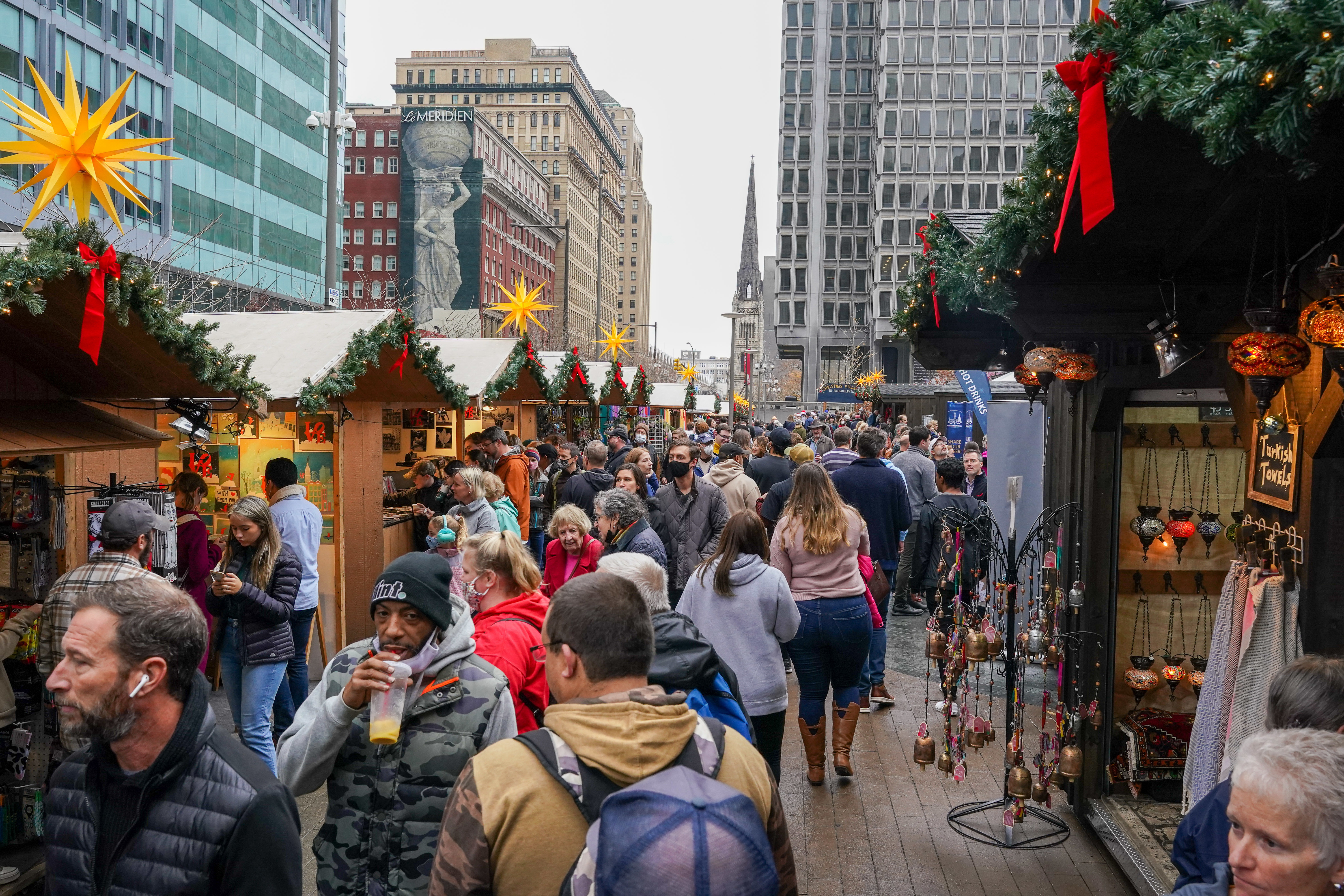
People browse and shop at Christmas Village at LOVE Park.THOMAS HENGGE / Staff Photographer
Counter space
One of the highlights of the holiday season in Philadelphia is the Christmas Village that sets up at LOVE Park and Dilworth Plaza every year. Local artists and artisans sell everything from clothing to ornaments from tiny stalls, a tribute to the markets that have been set up during December in German towns and cities for hundreds of years.
This year, merchants are facing a significant change: The interior of their stalls will now be off-limits to shoppers. Instead, they are expected to build counters, with customers remaining outside, away from most of the merchandise.
On social media and in The Inquirer, sellers complained this undermines the experience.
The new setup will force cashiers to fetch items that potential buyers typically peruse on their own, adding to their workload and slowing sales. It also removes the serendipitous magic of finding the perfect product while browsing.
German American Marketing, which runs the whole operation, has painted the change as a necessary response to accessibility concerns. They’ve cited input from their legal team and ongoing efforts to make the Village more welcoming to customers who cannot navigate the stalls’ tight spaces.
Accessibility is of course essential, but let’s hope that management, the city, disability advocates, and the vendors can find a better solution in time for next year’s holiday season. Especially if the new setup has a measurably negative impact on sales.
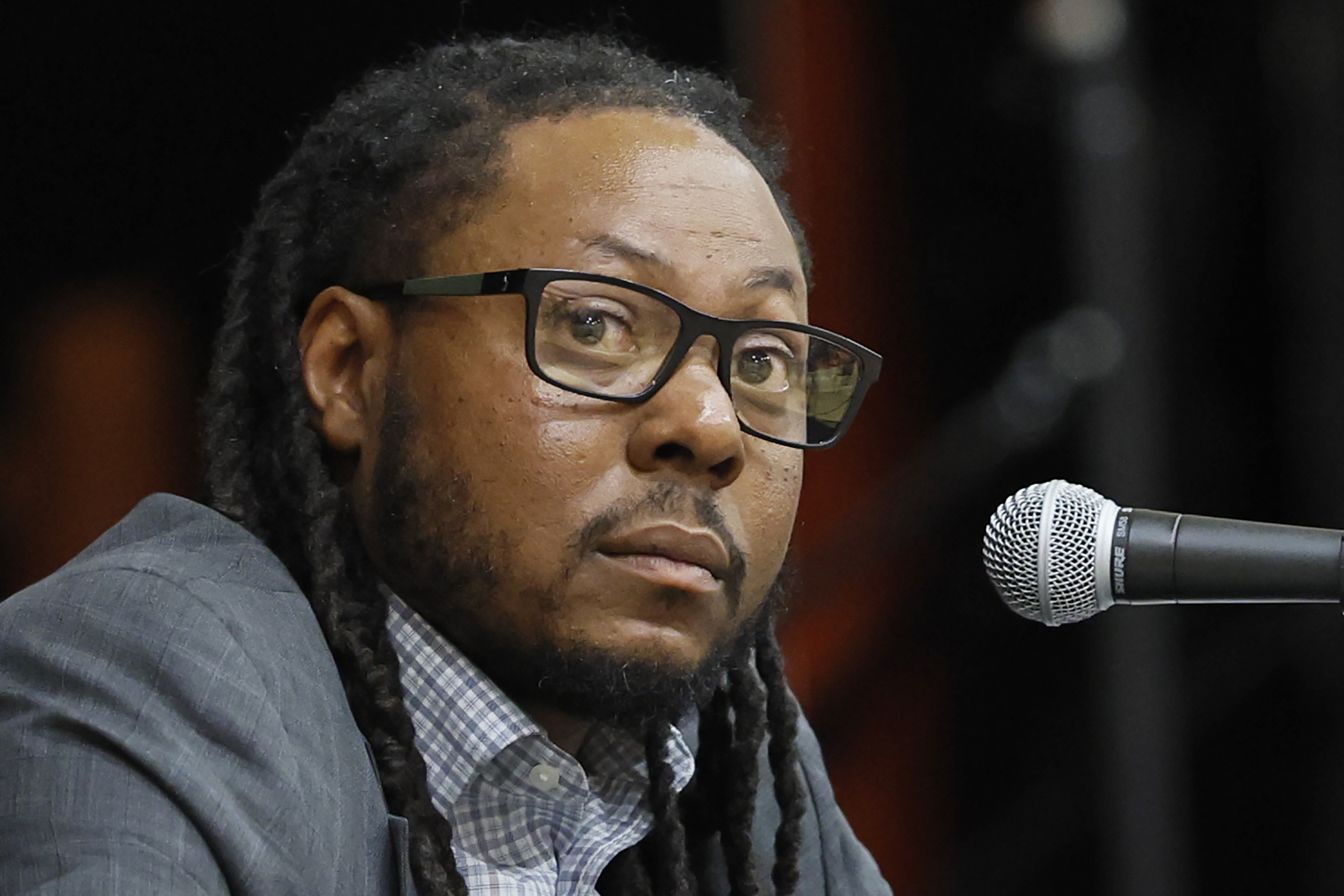
Councilmember Jeffery Young Jr. during a community meeting at the MLK Recreation Center in September.Elizabeth Robertson / Staff Photographer
A break for lawbreakers
For the second year in a row, Philadelphia was named the worst U.S. city for drivers. It’s not only traffic, as my colleague Stephanie Farr chronicled, we all know that the city’s bad motorists can make life frustrating, if not outright dangerous, for everyone else.
Fifth District City Councilmember Jeffery “Jay” Young Jr.’s plan? Reward them.
First, Young proposed lowering fines from the city’s speed and red-light cameras. Now, he’s proposing a general parking ticket amnesty. Young has painted these moves as a response to the national affordability crisis. Except there’s a big difference between paying for food and paying for tickets. We all have to eat; we don’t all have to break the law.
Of course, there are many Philadelphians who have turned resenting the Philadelphia Parking Authority into a major part of their personality. The fact that the city’s ticket-issuing agency seems to have more firepower than its pothole repair squad, school district, Licenses and Inspections Department, and transit agency is legitimately frustrating. The solution, however, isn’t giving scofflaws a break. It is improving these other services.
No matter how many social media posts insist that it is all a cash grab, parking and traffic laws exist for a reason. With limited curb space, ensuring spots regularly turn over is essential to having thriving commercial corridors. Especially in the age of same-day delivery.
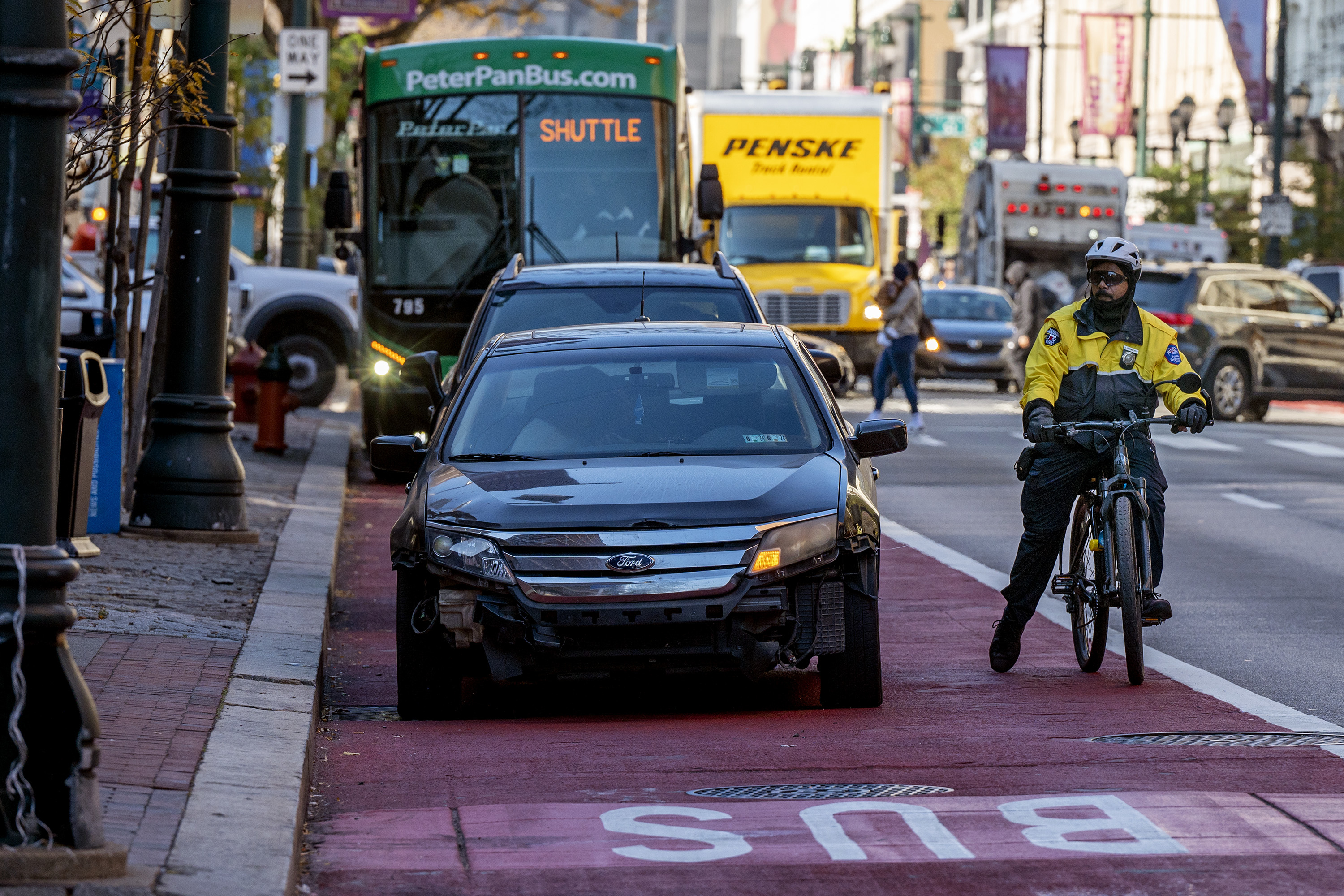
Motorists who park in crosswalks, on sidewalks, and on top of the trolley tracks or bus lanes are putting convenience for themselves over safety and access for their fellow Philadelphians. The ability to extend a reservation by phone has made paying for meters easier than ever before, and traffic cameras have made the city’s most dangerous corridors significantly safer.
Young’s office defended the push as a way to help people who may have made an honest mistake. The city’s parking signs can be confusing to navigate at times, but that only explains the first fine. Residents who have accumulated significant balances are, by definition, repeat offenders.
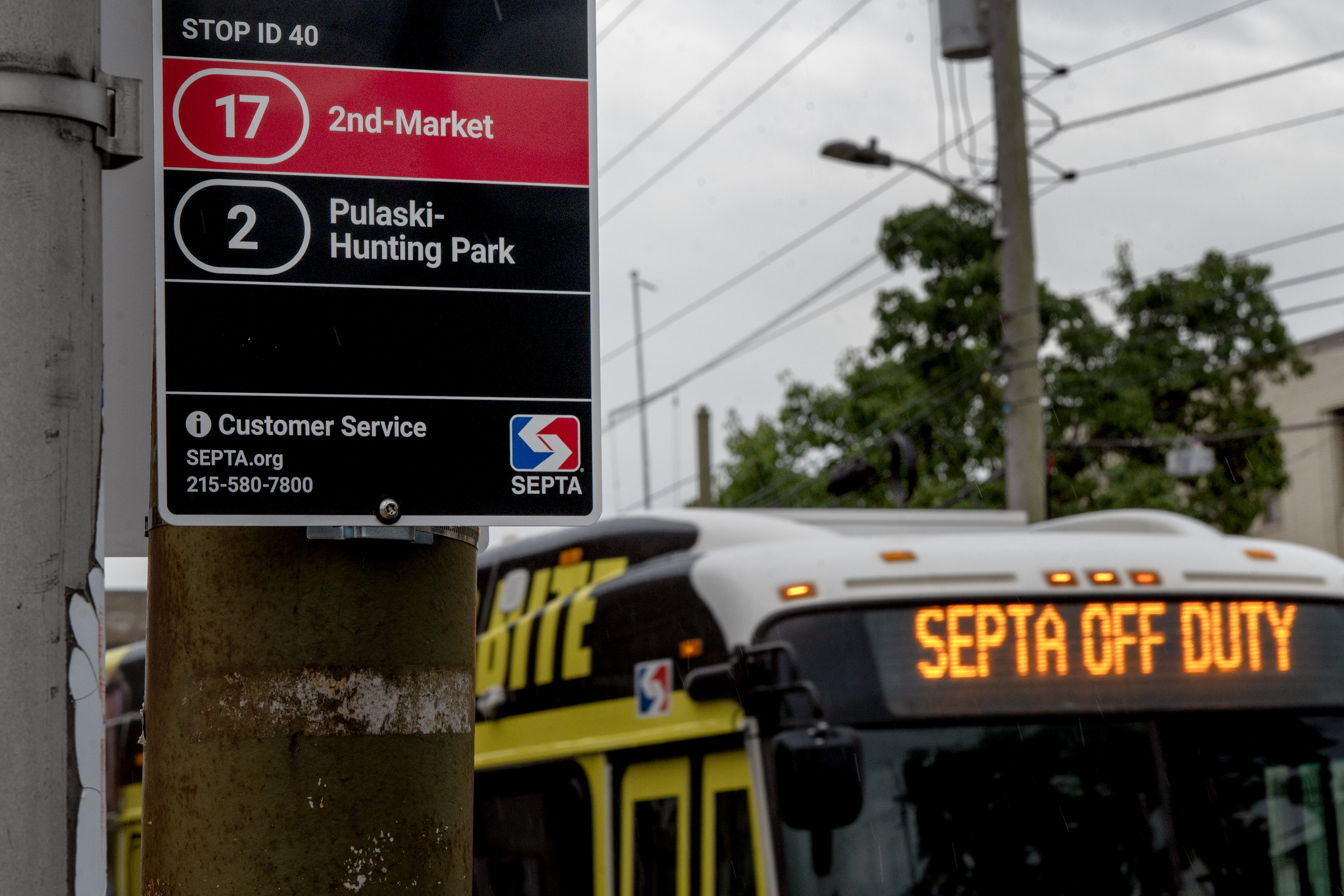
A sign with “Frequent Red” designation is posted at a South Philadelphia bus stop in August.Tom Gralish / Staff Photographer
Missed connection
Northeast Philadelphia State Sen. Joe Picozzi is an outlier in his caucus. He’s the only Republican who represents Philadelphia in a chamber where many of his colleagues are old enough to be his parents, and he supports additional recurring revenue to support public transit (one of his fellow Harrisburg Republicans calls bus drivers “chauffeurs”).
In an op-ed for Broad and Liberty, Picozzi called for state leaders to agree to a plan I’ve proposed myself: taxing skill games and sending the revenue to infrastructure needs across the commonwealth. Beyond transit agencies, Pennsylvania also has more miles of state-owned roads than all six New England states combined.
It’s an idea that has a lot of merit. SEPTA just posted its best month for ridership since February 2020 — with 822,753 riders using the system on an average day. This boost happened despite the closure of 11th Street station on the Market-Frankford Line, and work in the trolley tunnel for three out of four weekends. The New Bus Network contributed significantly to this increase, helping to drive a 14% surge in bus ridership alone. While challenges remain, things are clearly moving in the right direction.
A new recurring funding source would help avoid a repeat performance of last year’s capital budget raid, putting the transit agency in a better position to deliver the faster, more frequent service and upgraded trains and stations promised in the Accelerate plan.
In a recent interview with The Inquirer Editorial Board, Gov. Josh Shapiro indicated support for the idea as well, blaming Senate Republicans for failing to bring a bill forward. State Senate Majority Leader Joe Pittman, despite once making the same proposal himself, more recently suggested that the money should go into the general fund, and that the tax rate for the machines is too high. A last-minute effort to forge a compromise seems to have failed.
For Picozzi and his fellow Southeastern Republicans, this failure only makes life harder. The more people associate the state Senate with inaction, the harder it will be to appreciate the individual qualities of each legislator.
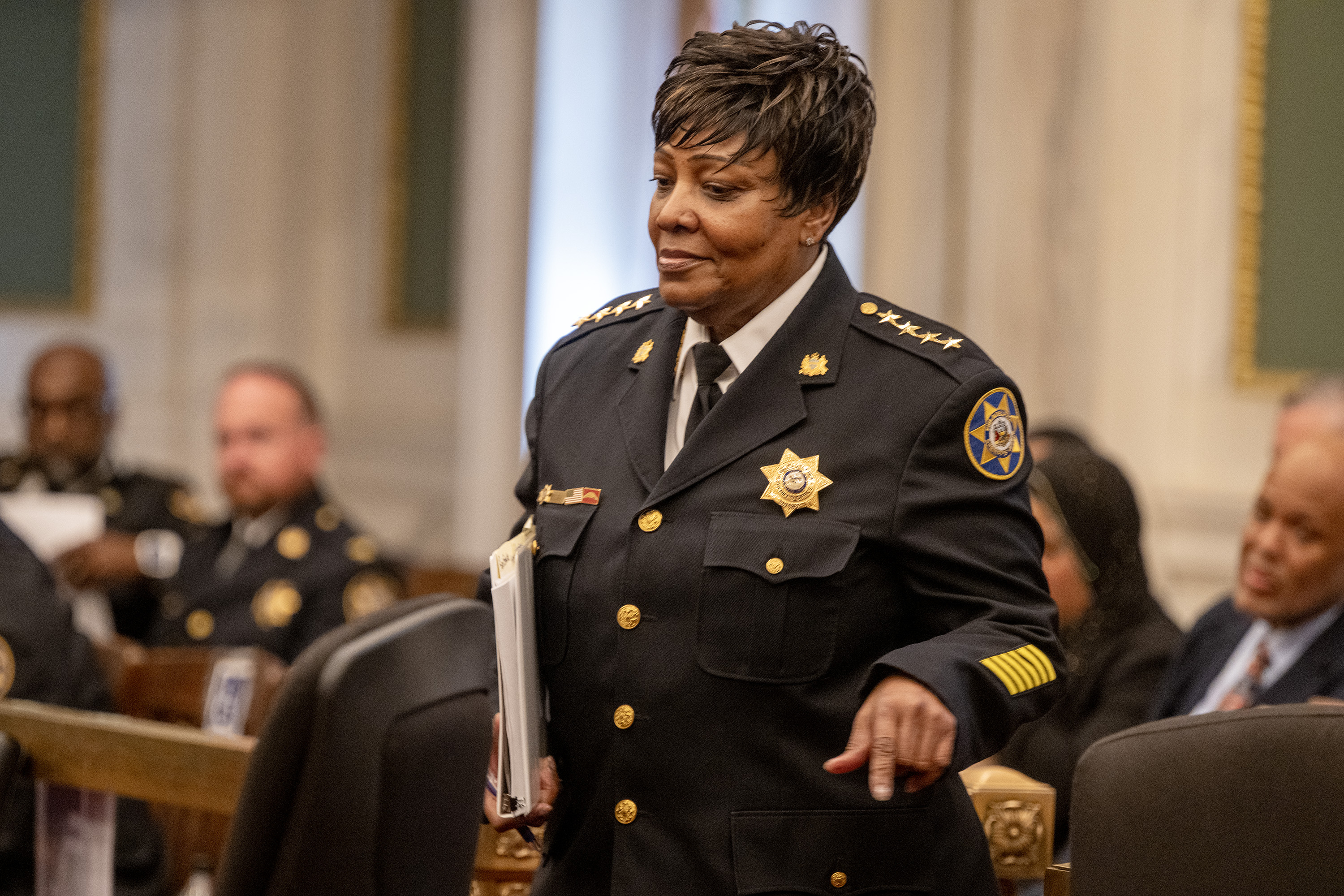
Sheriff Rochelle Bilal steps up to testify before City Council during the annual city budget hearing in April.Tom Gralish / Staff Photographer
Bilal blunders
Several readers forwarded me a copy of a text message they received from the campaign to re-elect Sheriff Rochelle Bilal.
Citing an unnamed fugitive and a mother and child who are now safer thanks to his arrest, Bilal cast herself as a champion of domestic violence victims. The text also included a link to her campaign’s fundraising page.
There’s one big problem with this boast. Under Bilal, the city has struggled to collect guns from people who are under protection from abuse orders. An Inquirer report put the confiscation rate at just 13%, measurably lower than neighboring counties.
While Bilal’s immediate predecessor also failed to confiscate enough guns, she’s had seven years to improve. I asked her office and her campaign for the current figure. No reply yet.
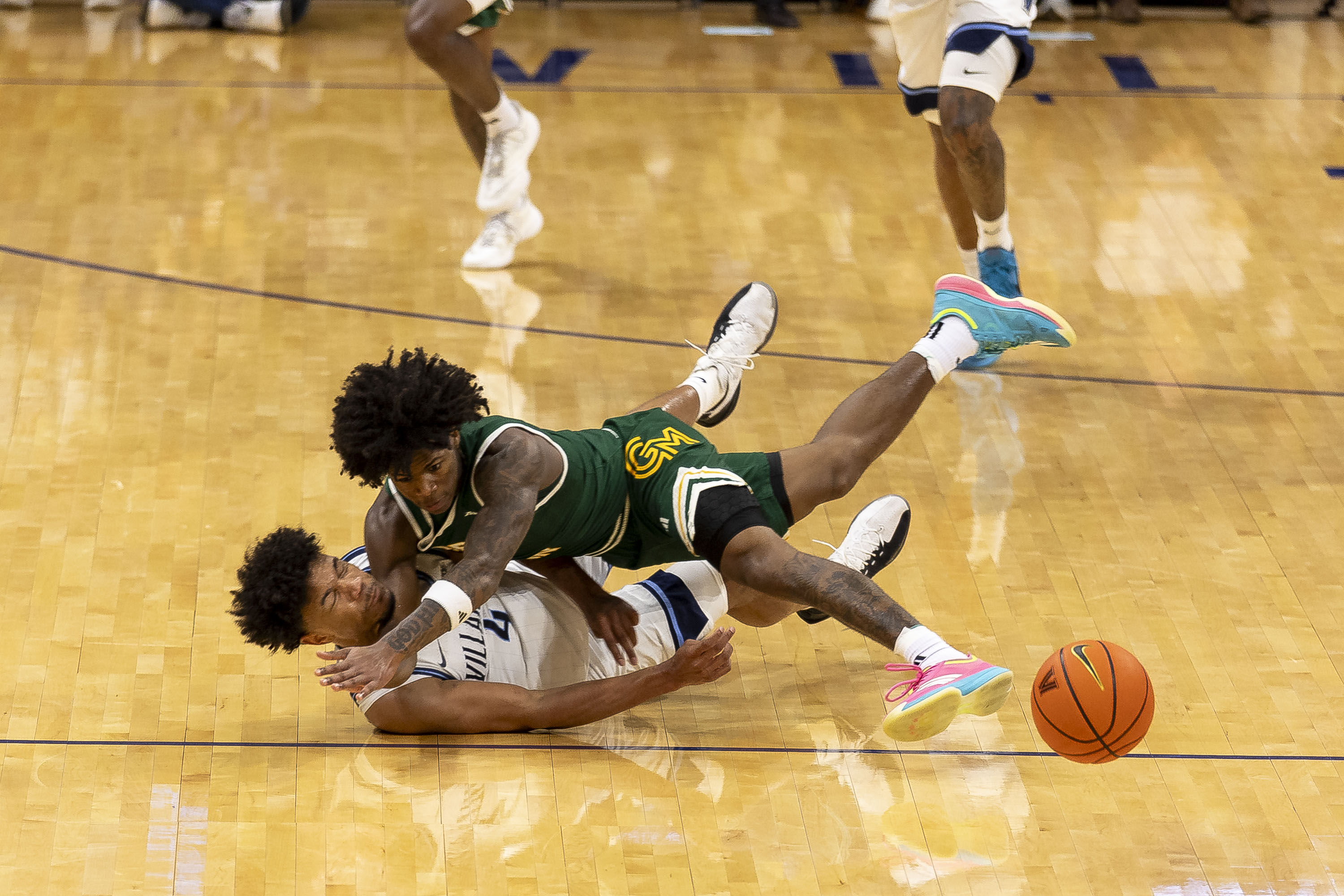
Villanova basketball had one last trial run before departing for Rome next week to begin its 2026-27 season.
The Wildcats hosted Virginia in their third and final preseason exhibition on Thursday night at the Finneran Pavilion. Villanova lost 93-71, after the Cavaliers shot 50% from the field and 44.7% from three-point range.
“I think there’s huge benefits,” Villanova coach Kevin Willard said when asked about playing public exhibitions. “Playing a road game to see how guys are on the road and react on the road and also seeing how guys react at home. That was the first time we had a crowd. So it was kind of interesting to see how some guys reacted. I think you get to learn a lot more about your team. In those situations, you get to play against a really good team.”
The three public preseason scrimmages were the most in program history after the NCAA approved a rule earlier this year that allowed for teams to have more than two.
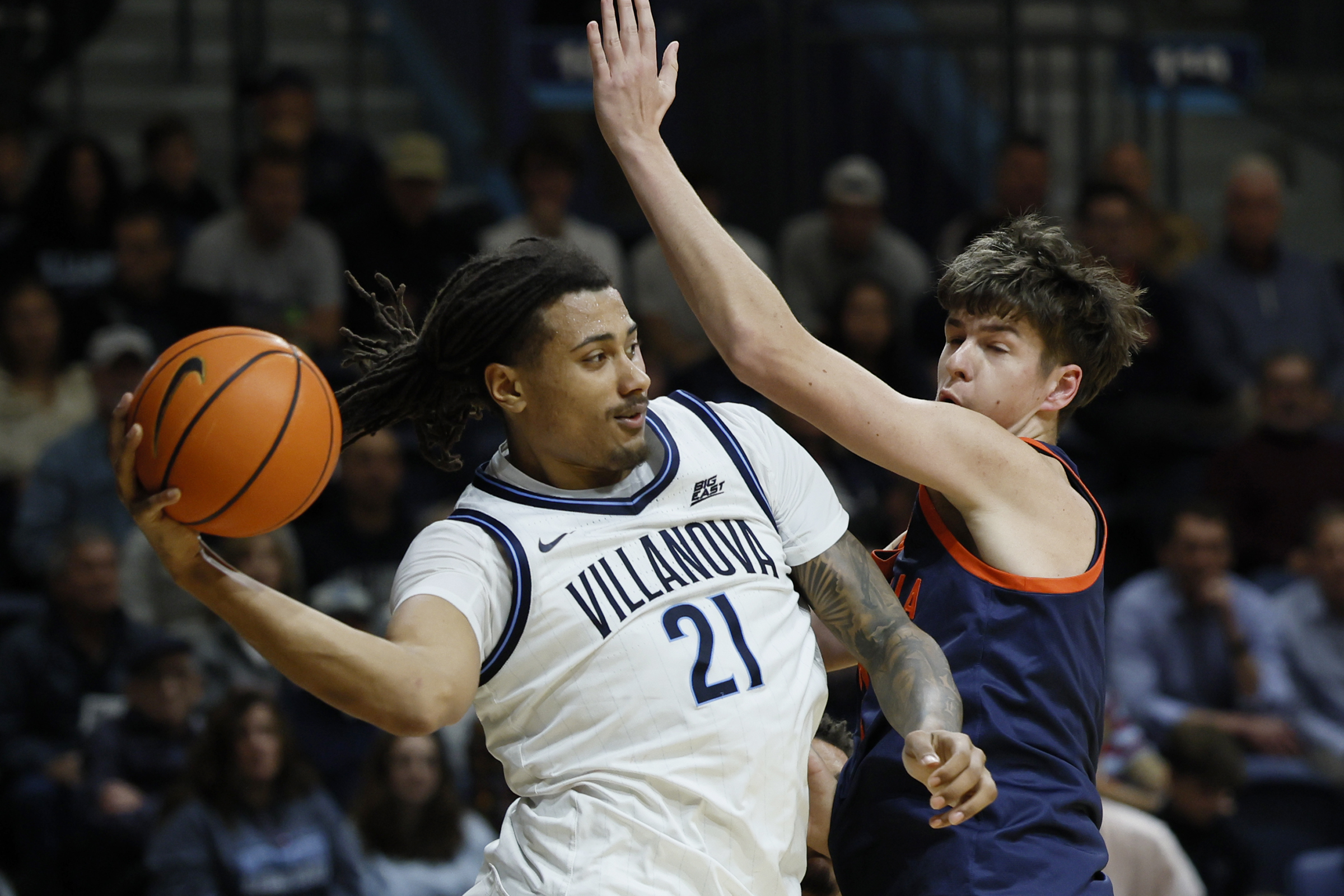
Villanova was led by Devin Royal, who had 21 points and seven rebounds. Royal shot 8-for-8 from the field and 5-for-5 at the free throw line. However, he committed eight of the Wildcats’ 16 turnovers, something Willard noted that he was not worried about. The Ohio State transfer led Villanova in scoring in all three games.
Tyler Perkins had 20 points and nine rebounds.
Villanova’s Devin Royal (left) led the team with 21 points in Thursday’s exhibition loss to Virginia.Elizabeth Robertson / Staff Photographer
Villanova shot 24-for-53 (45.3%) from the field and 7-for-22 (31.8%) from beyond the arc.
It was the Wildcats’ biggest test of the preseason, with Virginia ranked No. 9 in The Associated Press preseason Top 25 poll. Four of the Cavaliers’ projected starters are returning from last season.
“Virginia’s ranked for a reason,” Willard said. “They’re really good. And we’ll get there. I’m not worried about us. We’ll get there, but we’re not ready. We’re not there yet. It just shows you how good retention is.”
Oregon transfer is ramping up
Kwame Evans Jr., who transferred from Oregon this offseason, is progressing to a possible return early in Villanova’s nonconference schedule. The 6-foot-10 forward was in a walking boot this summer, and returned to practice early in October.
“I think once we … get KJ back, you can kind of run more stuff a little bit,” Willard said. “I think Nico [Onyekwere] has progressed great. … When KJ’s back on the floor — with KJ, Dev, Perk, it kind of frees up Jake [Fiegen] a little bit. We don’t have to do so much to get Jake shots because Kwame can really handle the ball.
“ … [With] KJ’s practices the last five days … we’re a different basketball team when he’s out there. He’s so skilled and he can shoot it. So that’s kind of a work in progress.”
Willard was noncommittal about Evans’ availability for Villanova’s season opener.
Suigo shows flashes
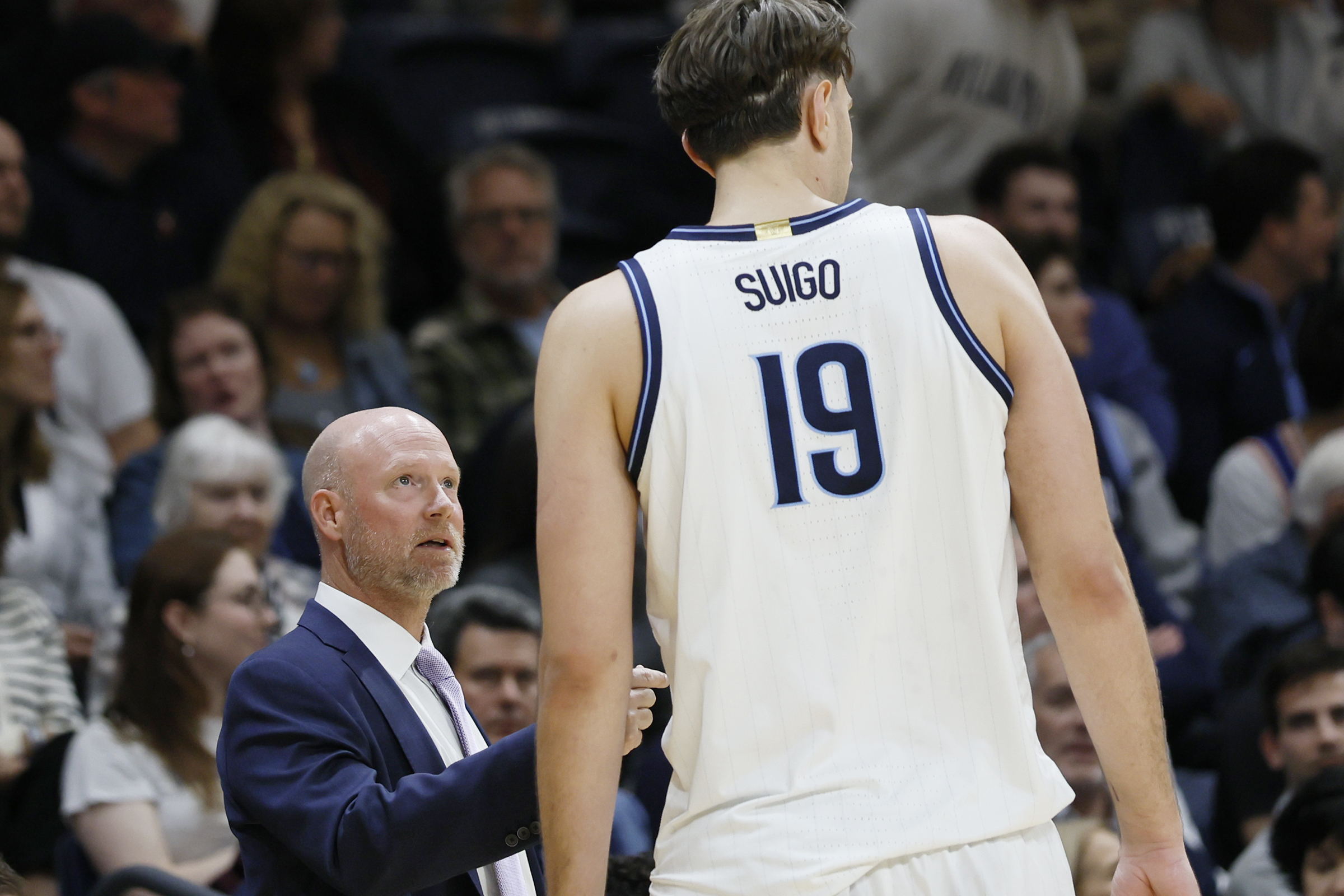
Luigi Suigo, who was once a potential first-round NBA draft pick, had his best performance of the preseason slate against Virginia. The 7-3 center knocked down his only three-point attempt of the game and shot 4-for-7 from the field. He totaled 12 points and four rebounds in 28 minutes. He played 30 minutes in Villanova’s first exhibition game against Rutgers on Oct. 11.
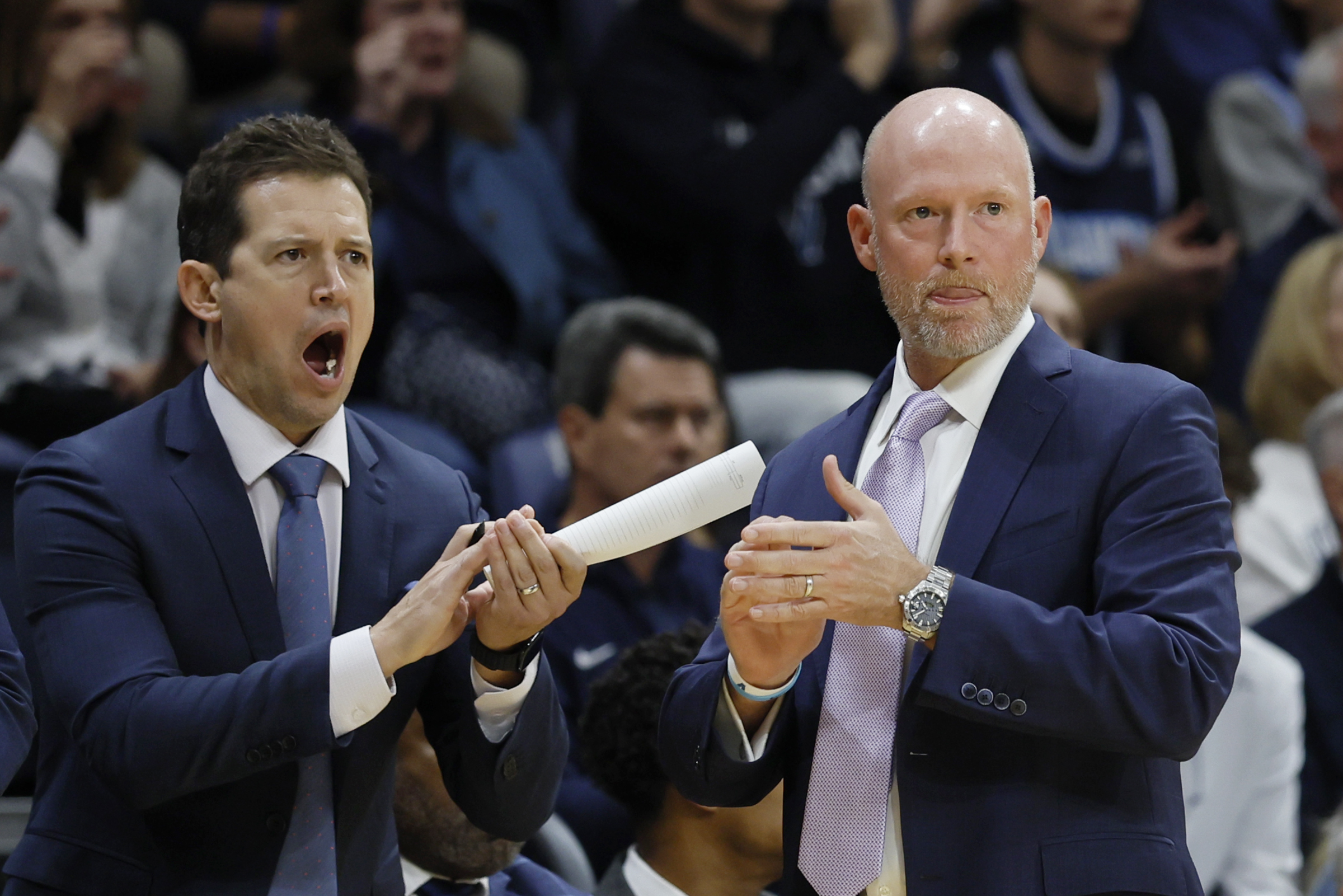
Villanova assistant Greg Manning Jr. (left) and head coach Kevin Willard (right) watch the action during the Villanova’s exhibition against Virginia.Elizabeth Robertson / Staff Photographer
Suigo, a native of Italy, struggled with fouls in Villanova’s second exhibition against George Mason, picking up two in the first 90 seconds and eventually fouling out. However, against Virginia he committed just one foul.
Up next
Villanova will travel to Rome to open its season against Notre Dame on Sunday, Nov. 1 (9:30 a.m. ET, FOX) for the “Eternal City Tip-Off.” The women’s programs of each school will also play in a doubleheader.
Ayushi Chaudhary started her Temple degree not in North Philadelphia, but in Europe, at the university’s Rome campus. By her junior year, the international business major was itching to go abroad again, this time to Temple’s campuses in Kyoto and Tokyo, Japan.
“There aren’t many universities that have multiple international campuses, so I thought to myself, ‘When else am I going to be able to study internationally with such ease?’” she said.
When Chaudhary graduates at next spring’s Commencement ceremony in the Liacouras Center, her college journey will have spanned four Temple campuses on three continents.
“Students today understand that the world is more connected than ever before, and they want an education that is equally connected,” said Temple University President John Fry. “Our campuses in Rome and Japan allow students the opportunity to immerse themselves in other cultures while working toward their four-year degrees, and that’s an experience very few universities can offer.”
Chaudhary’s college journey is indeed unique. Temple is one of just a handful of American universities to have two or more international campuses. Even fewer offer four-year degrees at their international campuses, as Temple Rome and Temple Japan do.
“Our rapidly growing international presence is one of our greatest strengths,” Fry said. “Our campuses in Rome and Japan are thriving, dynamic learning environments that prepare our students to succeed in an increasingly interconnected world. Their momentum reflects the growing demand for a global education.”
Building on 60 years
Temple Rome recently celebrated its 60th anniversary, a milestone that offered an opportunity to reflect on its history while also looking forward to its next chapter.
This fall, the campus began offering four-year bachelor’s degree programs in disciplines like business, communications, computer science, and biology. It already has plans to add five more programs in fall 2027.
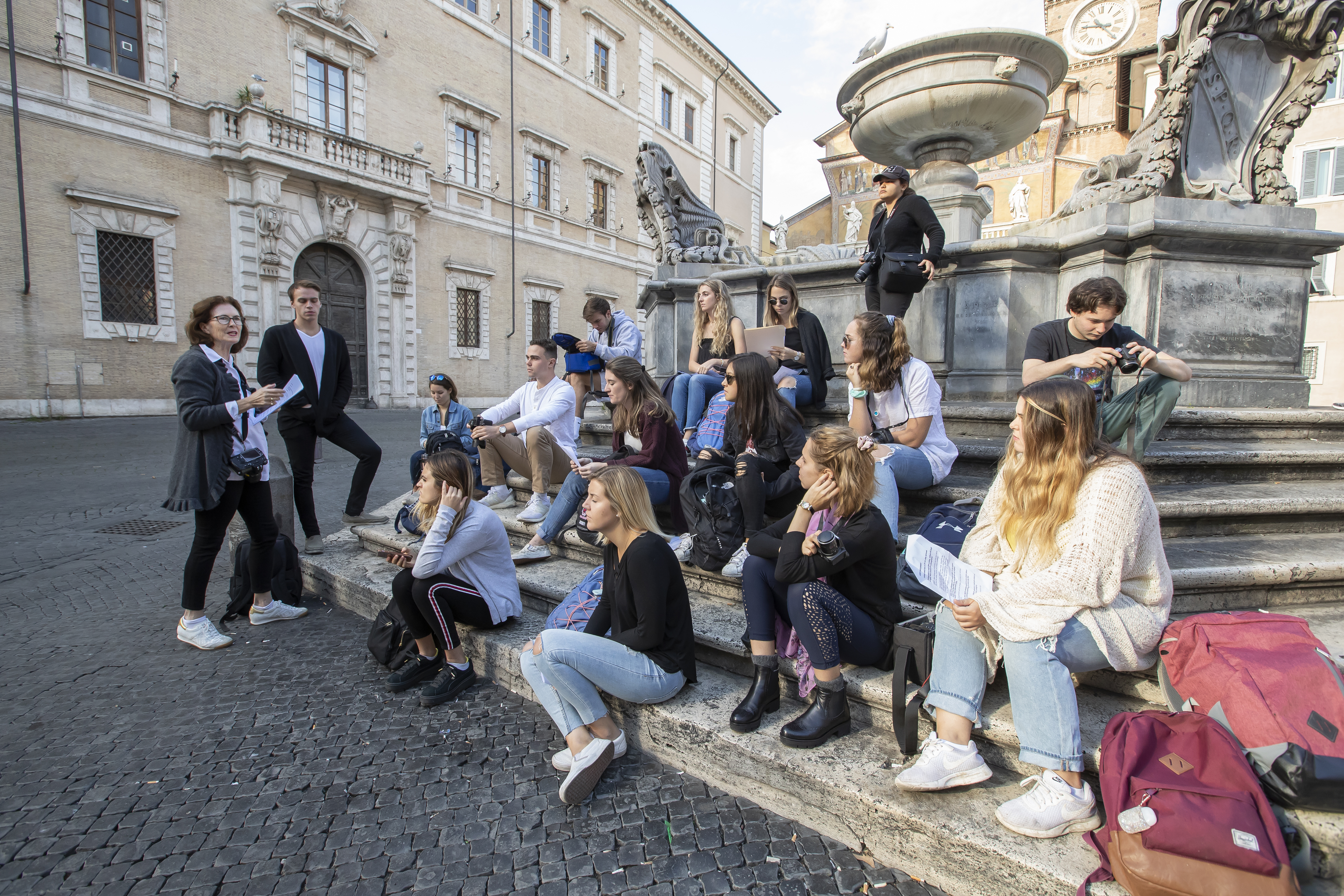
Temple’s campus in the heart of Rome lets students experience the city’s art, history, and culture as an extension of the classroom.Courtesy Temple University
“Expanding our international campuses is imperative, but we must expand thoughtfully,” Fry said. “Adding four-year degrees was the natural next step for Temple Rome. Students have been asking for the opportunity to complete their degrees there. We know that more students will come to Temple Rome because of these degrees, and we are prepared to accommodate that growth.”
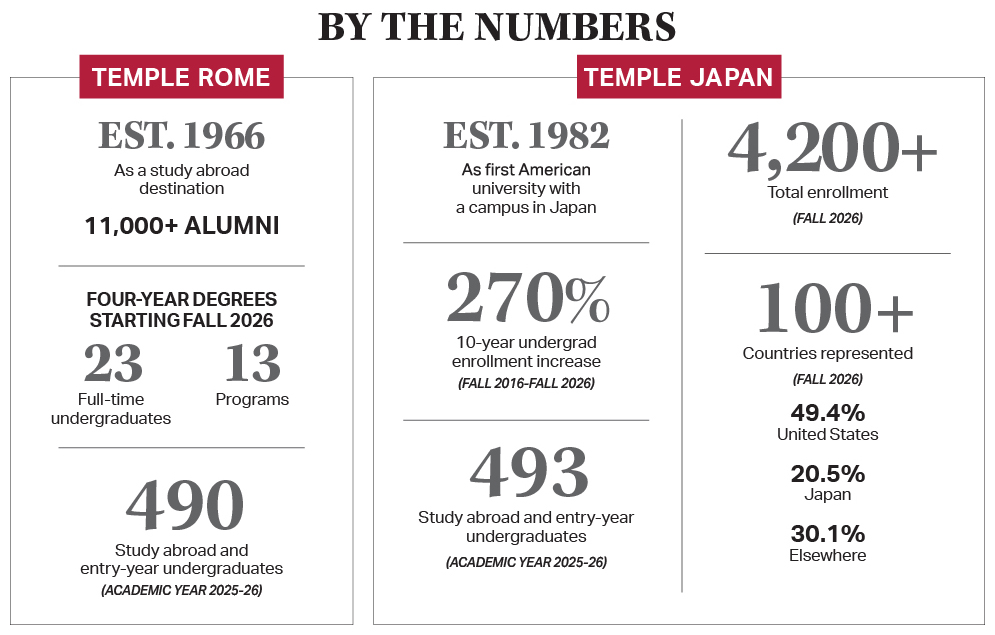
Temple Rome enrolled 318 study abroad students in spring 2026, and 23 full-time students pursuing four-year degrees there this fall. Fry believes total enrollment at the Rome campus could double in the coming years.
The addition of four-year degrees builds on Temple Rome’s longstanding reputation as a study abroad destination for Temple students and students from 78 colleges and universities across the United States. It also comes after the campus relocated to its new home near Piazza di Spagna in 2024.
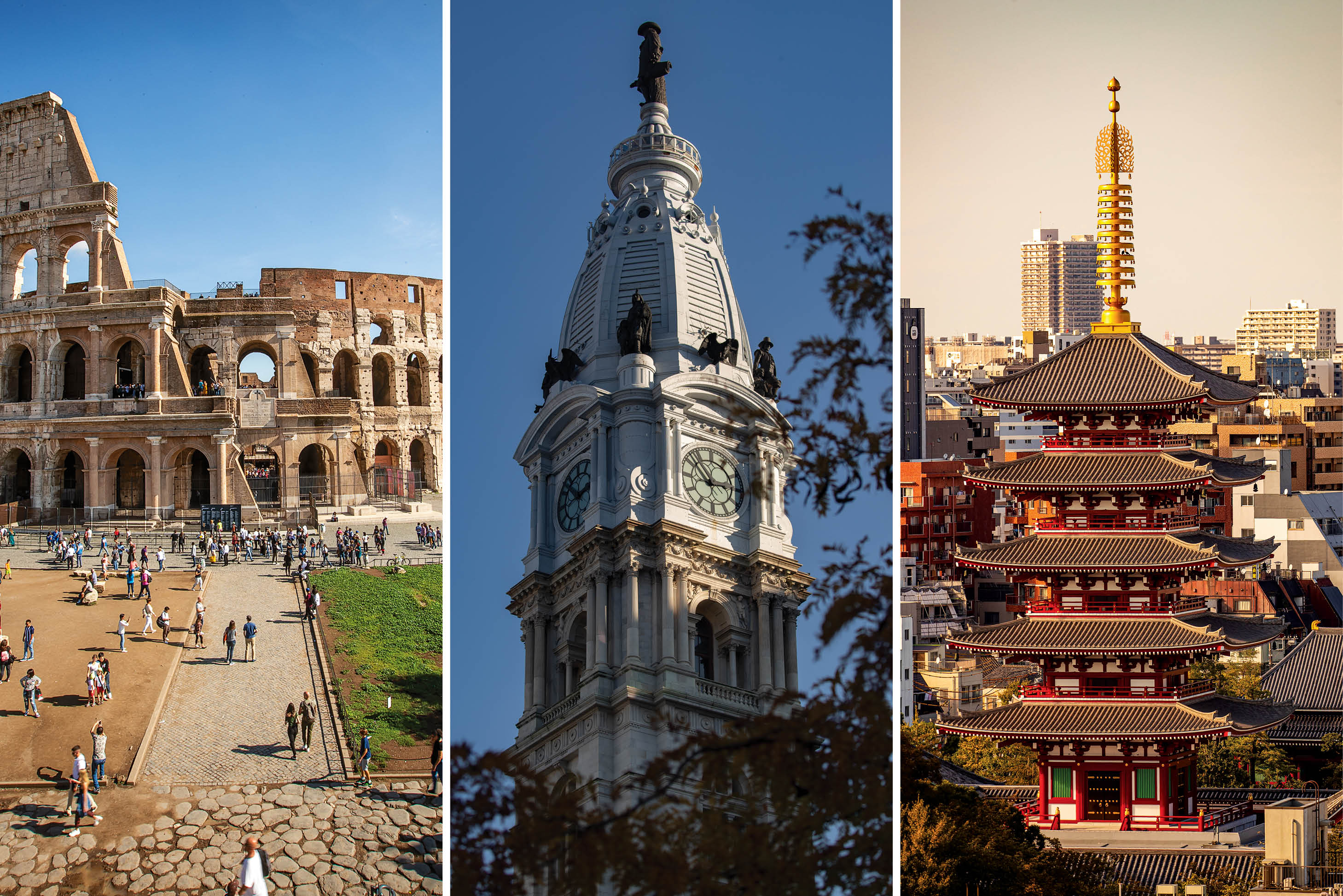
The new campus sits in the heart of Rome, a short distance from UNESCO World Heritage sites such as the Spanish Steps, the Pantheon, and the Colosseum. This historic setting gives Temple students unique access to the people, places, and artifacts they study in class.
One of those students was Kareena Kumar, a 2026 graduate of the Fox School of Business, who analyzed the ancient Italian sculpture Apollo and Daphne for her art history final project. She gave her presentation in the shadow of the sculpture itself, inside Rome’s Galleria Borghese.
“Students learn better when they experience the subjects they are studying firsthand — something they get to do at our international campuses,” said Fry.
A model for the future
As Temple Rome looks forward to its next chapter, Temple Japan offers a glimpse of what the future could hold. Temple Japan has offered four-year undergraduate degrees since it opened in 1982. It is the oldest and largest English-speaking university in Japan, and its enrollment continues to soar.
Temple Japan has experienced 270% undergraduate enrollment growth over the past 10 years. This fall, it welcomed more than 1,000 new students, bringing total enrollment above 4,000 for the first time.
At Temple Japan, students take their studies beyond the classroom, gaining firsthand experience with Tokyo’s global business community.Courtesy Temple University
In response to the growing demand, Temple Japan opened a second campus in Kyoto in January 2025.
Unlike its bustling location in Tokyo, the world’s most populated city, the Kyoto campus is in a smaller, more rural setting known for its blend of ancient traditions and modern innovation. Kyoto is home to 17 UNESCO World Heritage Sites, as well as the headquarters of companies like Nintendo and Kyocera.
It has also quickly become a popular destination for Temple Japan students. Kyoto enrollment has grown rapidly since it opened, surpassing 300 students in the spring 2026 semester and exceeding 450 students this fall.
And Temple Japan expanded once again this fall with the opening of its Hillside Center in Tokyo. The eight-story, 75,000-square-foot facility is just a short distance from the university’s city campus, and between 800 and 1,000 students are expected to take courses there each semester.
Much like Temple Rome, students are coming to Temple Japan for an educational experience they can’t get anywhere else.
During a trip with Temple Japan’s International Business Society, Chaudhary learned about manufacturing and logistics from Tokyo’s Chronogate facility, a hub for international commerce operations.
Later, she went to the Kyoto campus for a yearlong research project that examined the effects of tourism on the city.
With stops in Rome, Japan, and Philadelphia, Chaudhary got the global education she came to Temple to find.
“Students like Ayushi show what’s possible when a university truly commits to its global vision,” Fry said. “Stories like hers shouldn’t be reserved for a few fortunate students. We want that experience to be an integral part of a Temple education, and we’ve built a global presence to reflect that.”
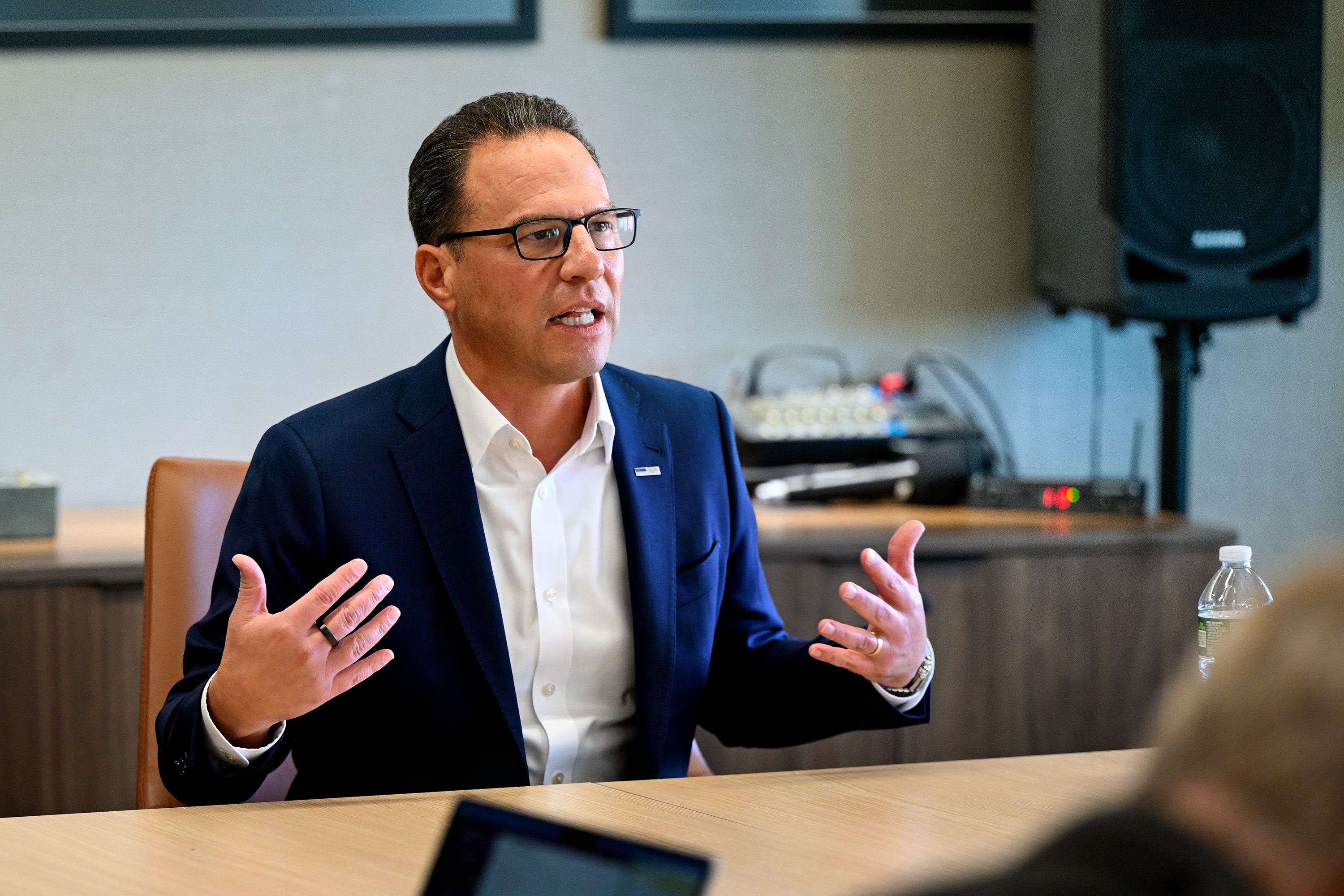
He won’t flinch when you do. No jutted lip, no flicker of emotion. No fiddling with his wedding band or smart ring, one on each hand.
He’s been preparing for this kind of thing for decades.
Shapiro, 53, of Abington Township, has been rumored to have his sights set on the White House dating back to his time as a state representative, as a Montgomery County commissioner, as the state attorney general, and now as Pennsylvania’s governor. And while other 2028 Democratic presidential hopefuls are more outward with their ambitions, hosting fundraisers and making themselves known in early primary states, Shapiro — a disciplined and careful communicator — has led a calculated balancing act as he runs for reelection to the state’s top post, hoping to carry the rest of the Pennsylvania ballot with him.
Are you running for president in 2028?
“I’m going to give you the same answer that I’ve given everyone,” Shapiro told the moderators at a debate earlier this month against his Republican opponent, Stacy Garrity. “The only thing I am focused on is running for reelection as governor, and I’m focused on these midterms in trying to generate the kind of turnout and support the kind of candidates who will push back on the chaos, the cruelty, and the corruption of Donald Trump.”
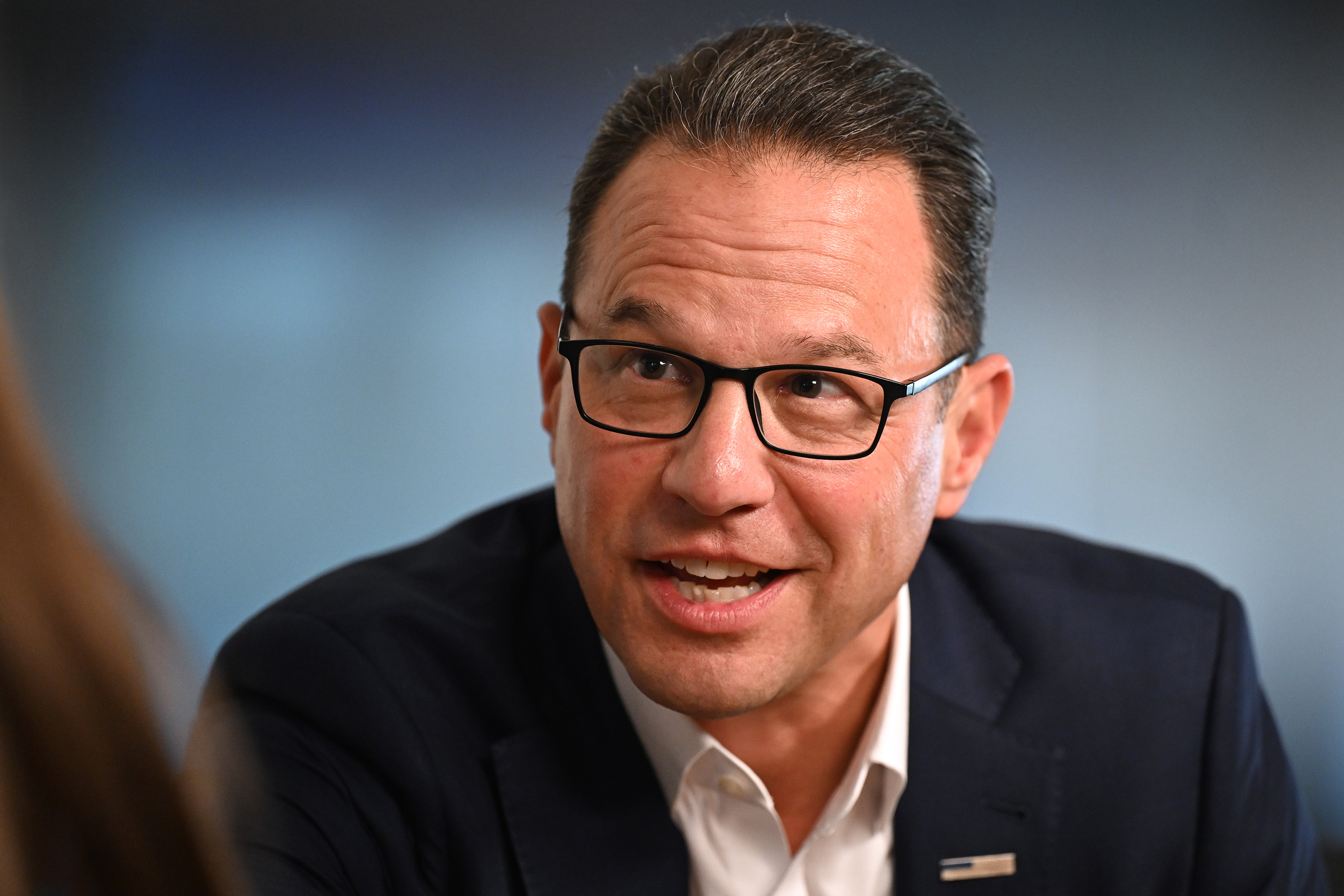
The first-term governor — wearing his daily uniform of a navy blue suit, bright white dress shirt with no tie, white tennis shoes, andblack-framed glasses — does the same again earlier this month in a set of interviews in The Inquirer’s newsroom across from Independence Hall; he smoothly sidesteps the question of whether he’ll promise to fulfill another four-year term if reelected.
Instead, he boasts his administration’s “get stuff done” motto, citing some of his proudest accomplishments as the leader of Pennsylvania, such as reopening I-95 in 12 days, speeding up the state’s process to get licenses or permits to do work, utility rate caps, and new pathways to careers in the trades. In the run-up to the Nov. 3 election, those triumphs have blanketed the state’s TVs, social media and mailboxes, as his campaign tops $42.3 million in ad buys, according to media tracker AdImpact.
Nearby, his campaign staffer sports a pin featuring the number 48. Shapiro is Pennsylvania’s 48th governor. If he runs in 2028, he’d be vying to become the nation’s 48th president.
Nowadays, there’s a noticeable shift in the Democrat who has long prided himself in his willingness to work across the aisle, but who has struggled as a dealmaker in the state’s split legislature as he goes all-in on flipping the Senate in hopes of more easily achieving his goals.
At the same time,he’s become more willing to directly challenge Trump in the state that helped boost the president to a second term just two years ago, as Trump’s approval ratings continue to decline — and national Democrats are looking for a strong leader to carry them into 2028.
“When he’s going to do something to hurt Pennsylvanians, I’m going to stand up to him, and when I stand up to him, I win every single time,” Shapiro said earlier this month.
The shift — and the sharper edge — may be strategic as Shapiro readies himself for a White House run, said Christopher Borick, a political-science professor and pollster at Lehigh University.
“He is more willing to express his animosity toward Republicans, toward Republican policies, and of course, the president,” Borick added. “He’s been more vocal than you may have thought he would be, given his brand.”
‘Straight down the middle’
When Shapiro sat down for an interview at The Inquirer’s offices earlier this month, he studied where he should sit before answering the question himself.
“How’s this, straight down the middle?” the moderate Democrat suggested with a grin, setting himself up at the center of the table.
Gov. Josh Shapiro at The Inquirer’s office on Monday, Oct. 12, 2026.Tom Gralish / Staff Photographer
Shapiro’s brand as a centrist has been tested over the last few years, as he governs one of the only states in the country with a politically split legislature. An early misstep in Shapiro’s first budget negotiations in 2023 over school vouchers tarnished his relationship with the state’s Senate Republicans, a wound that has never fully healed. Republicans accused Shapiro of reneging on their handshake deal to create a new school voucher program. At the time, Shapiro said the move was necessary to avoid a protracted budget impasse.
Still, for the past four years, Shapiro and top state negotiators have struggled to agree on a state budget before the constitutionallyrequired deadline, as Pennsylvania faces worsening fiscal conditions and spends more money than it collects in revenue.
He’s had some major wins, too. State lawmakers have approved $3 billion in funding increases and created a new funding system for public education, after a state appellate court ruled that Pennsylvania’s previous system was unconstitutional. He has celebrated increases to the state’s property tax and rent rebate programs for seniors, a new state tax credit for working families, and a pension bump for retired teachers, police officers, and firefighters. He boasts significant reductions in wait times for business licenses and environmental permits and continued cuts to the state’s corporate net income tax, as part of his cut-red-tape approach.
Shapiro has faced criticism throughout his tenure as governor from top Republican leaders, who say he lacks conviction on the issues he says he cares about and instead changes his stances to reflect what’s popular.
“He was for helping kids out of failing schools, then he was against it,” Senate President Pro Tempore Kim Ward (R., Westmoreland), the top Republican in the state Senate, said last month. “He was for data centers, then he was against them.”
On school choice, he said this month he still supports the creation of a new school voucher program if House Democrats and Senate Republicans can agree on it. And he has defended himself on his recent reversal on increasingly unpopular data center development, which became a political flashpoint that threatened Shapiro’s popularity. He has said his change in position was a direct response to constituent concerns.
Garrity’s campaign has capitalized on the perceived flip-flops, calling Shapiro in a statement a “career politician whose policy failures have left Pennsylvania families struggling.”
His first term as governor also saw the resignation of a longtime top aide, former Rep. Mike Vereb (R. Montgomery), who was accused of sexual harassment by another staffer in the governor’s office that resulted in the state paying the accuser a $295,000 settlement.
Shapiro, previously largely untested on the national stage, also came under scrutiny when he was being considered by Vice President Kamala Harris to be her running mate in 2024. She ultimately passed him over, and he later said he didn’t want the job. But the consideration significantly boosted Shapiro’s rising national profile, and he later retold the story in his memoir, Where We Keep the Light, released earlier this year.
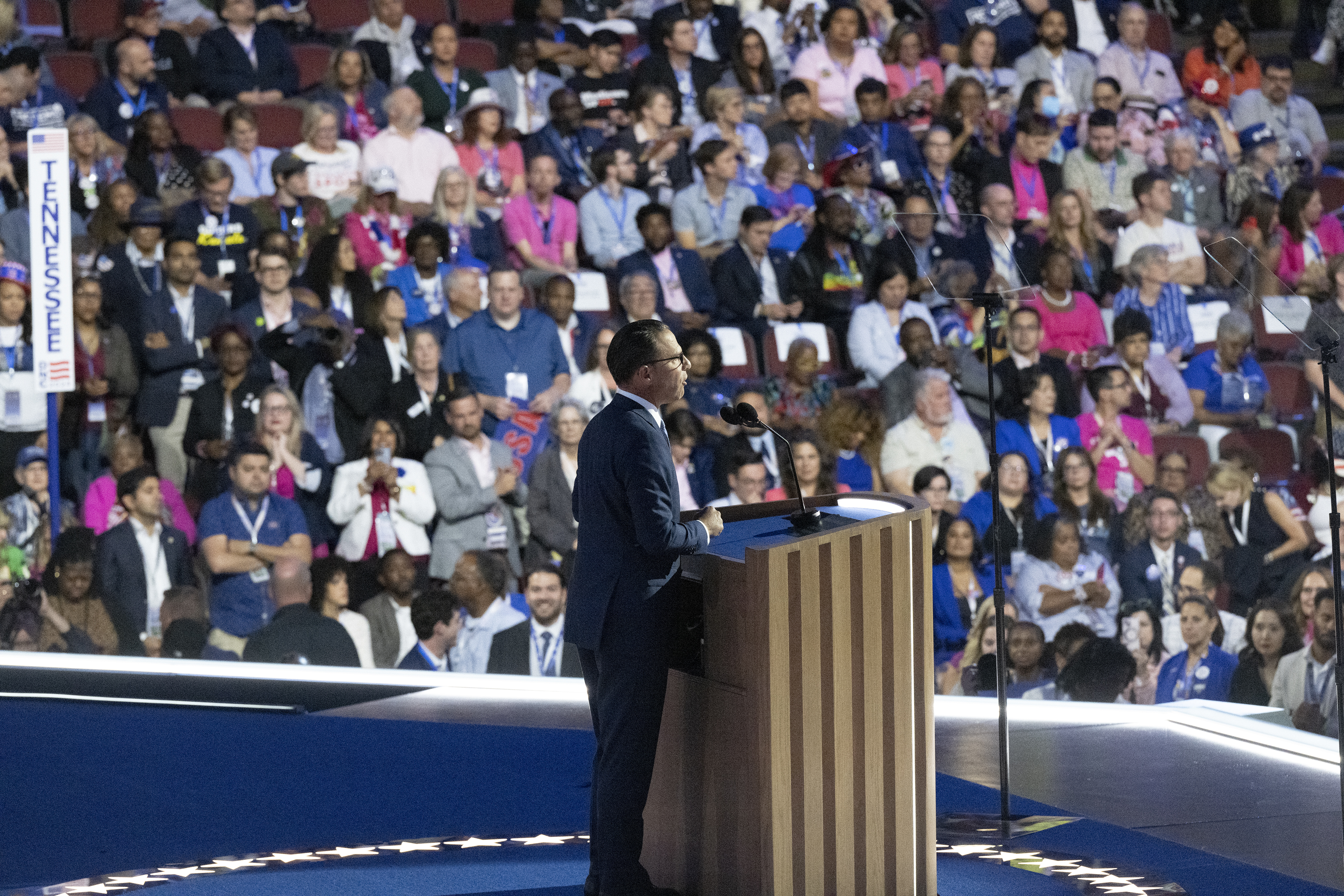
Pennsylvania Gov. Josh Shapiro speaks during the Democratic National Convention on Aug. 21, 2024, in Chicago.Jose F. Moreno / Staff Photographer
And most recently, he’s faced the state’s worst measles outbreak in more than three decades, which the state says has led to the deaths of six Pennsylvania residents. The surge in measles cases, which now tops 1,317 cases in Pennsylvania, led to a public clash with Health and Human Services Secretary Robert F. Kennedy Jr. As of Thursday, the Centers for Disease Control stillrefused to recognize three of the measles-related deaths as caused by the preventable disease.
“There’s a whole bunch we’ve been able to get done by bringing people together, and then there’s some things that I view as quite common-sense that I haven’t been able to convince the Senate to move on — raising the minimum wage to 15 bucks an hour, funding mass transit — even though it helps their communities,” Shapiro told The Inquirer’s Editorial Board this month. “I’m frustrated I haven’t been able to get that done, but again, that’s why I’m still working at this. That’s why I’m still going forward.”
(The Editorial Board, which runs The Inquirer’s opinion pages and decides endorsements, operates independently from the newsroom. Newsroom editors and reporters — including two reporters who attended the Editorial Board meeting as observers — have no role in endorsements, and opinion staffers have no role in news coverage.)
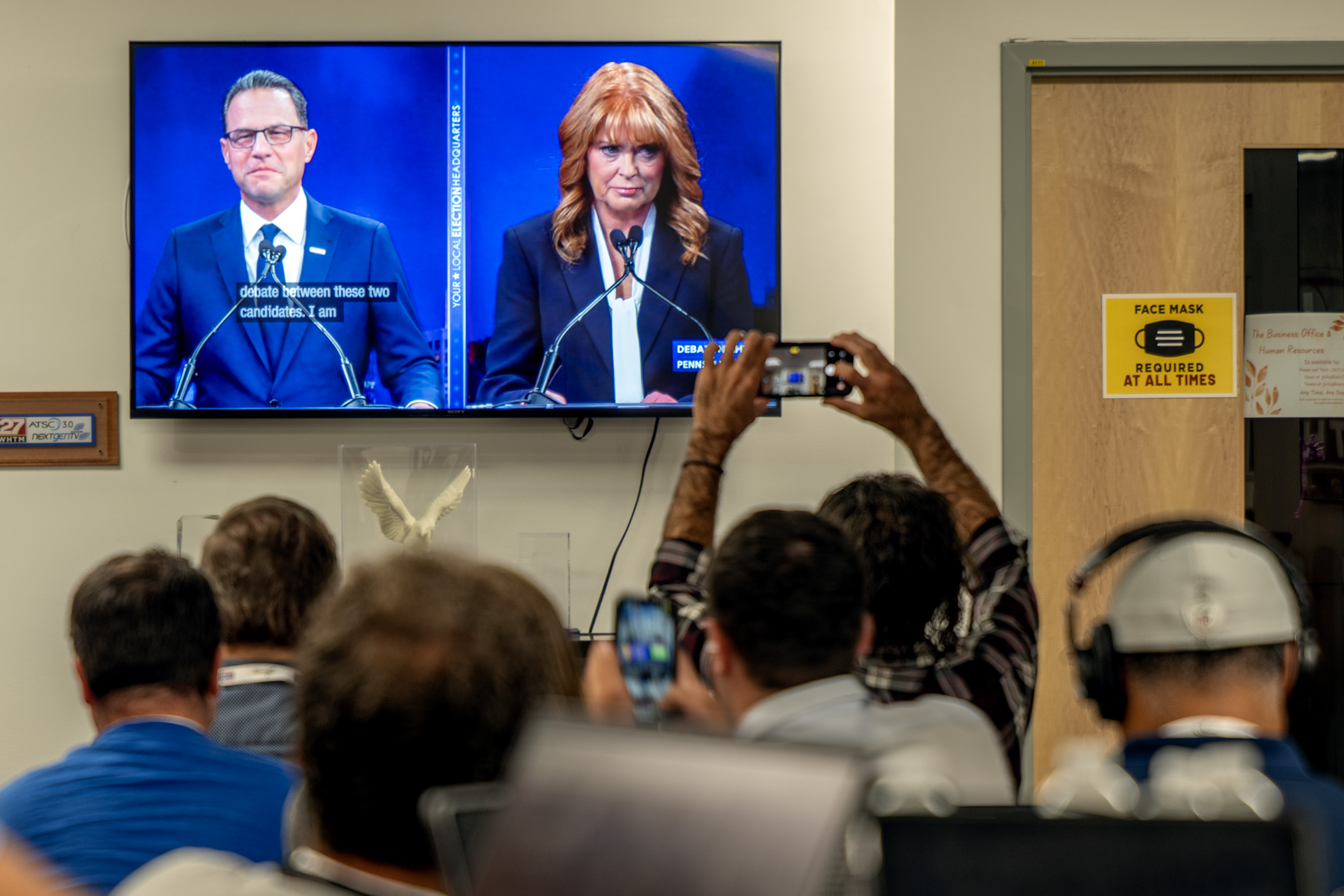
Monitor at the WHTM-TV studios in Harrisburg on Oct. 7, 2026, during the lone debate between Gov. Josh Shapiro and Republican challenger Stacy Garrity.Tom Gralish / Staff Photographer
Shapiro has maintained widespread popularity throughout his first term, including among some Trump supporters, recent polls of likely Pennsylvania voters show. Shapiro’s job approval topped 63% in a Quinnipiac University poll released Oct. 7, and he led Garrity in the poll by 25 points. A poll released Thursday by Franklin and Marshall College had similar findings, including a 22-point lead for Shapiro over Garrity.
“If you can be as popular as he is with divided government and the dysfunction in our Senate… that’s a pretty damn good comment on what he’s been able to accomplish,” said House Majority Leader Matt Bradford (D., Montgomery).
’A responsibility and pride’
These days, Shapiro can’t go to the store or take a walk with his wife, Lori, and their dogs, Bo and Bentley, without a state police detail present and careful coordination.
As Shapiro, one of the nation’s most prominent Jewish politicians, seeks reelection and eyes a presidential run, the impacts of his high-profile, public-facing office have weighed on him, he said. At least six people have been charged in the last nine months with making terroristic threats or ethnic intimidation in regard to the governor, he said.
“If I ever got to the point where I was afraid to go out, or afraid to do my job, or unwilling to do something because I was fearful, that would be the day I would hang it up,” he said. “I don’t feel that way. I feel a lot of purpose in my work, and I feel unafraid when I’m doing it.”
Shapiro said he believes many of the threats he’s received have stemmed from the open practice of his Jewish faith, and he wrote in his memoir that since Hamas’ Oct. 7, 2023, attack on Israel, he and his family “feel both a responsibility and pride demonstrating our faith and living it out loud.”
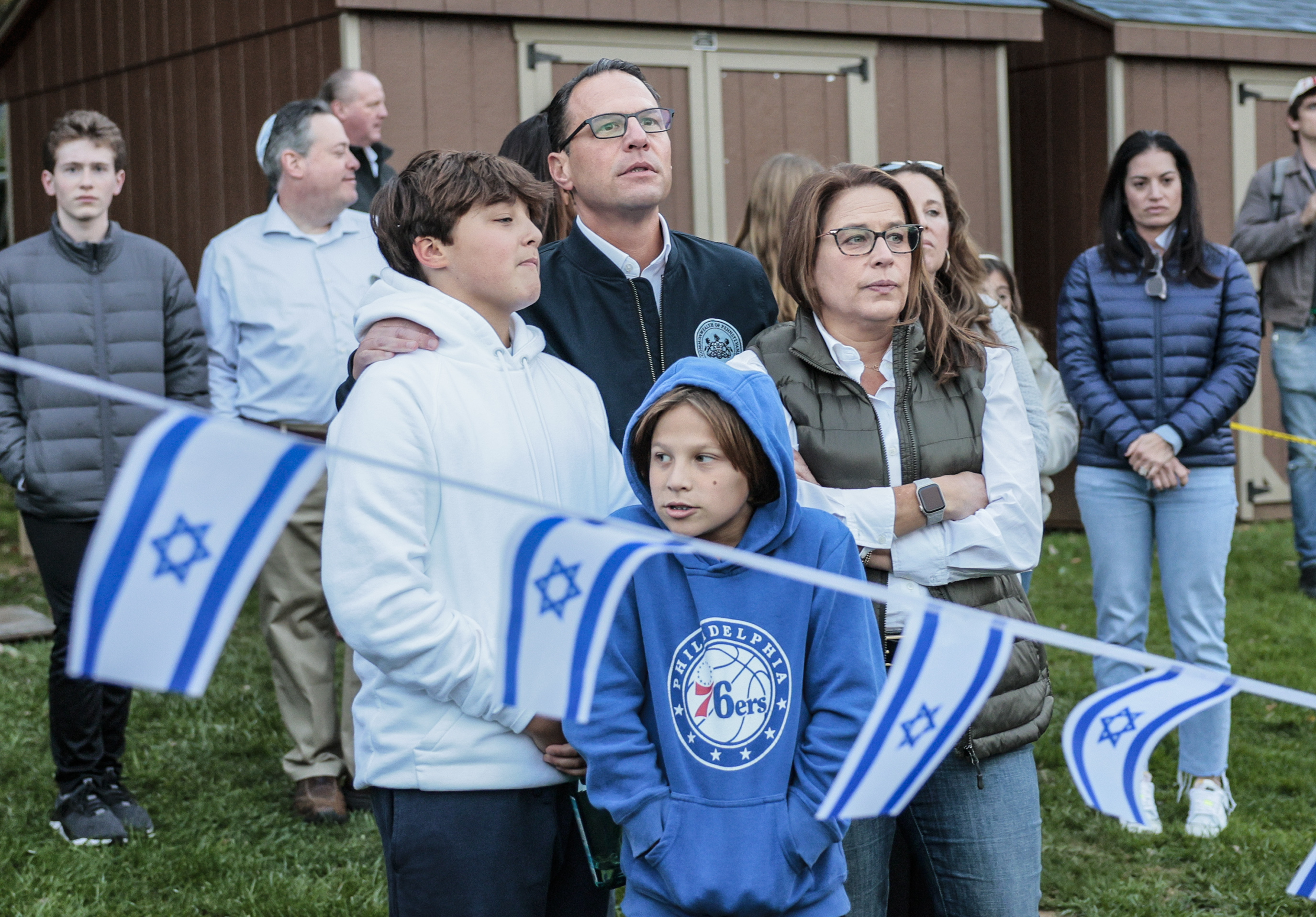
Pennsylvania Gov. Josh Shapiro stands with his family as he listens to remarks at the Philly Stands With Israel Rally outside a Jewish community center in Wynnewood on Oct. 9, 2023.Steven M. Falk / Staff Photographer
For Shapiro, Israel is“a place that’s meant a lot to me and my family,” he said. It’s where he proposed to his wife, and is a country he said he loves — which has been complicated by Prime Minister Benjamin Netanyahu’s actions during the war in Gaza that he sees as weakening Israel’s position globally. He supports a two-state solution, with Palestinians having a state and living side-by-side with Israel, and said he hopes Israeli voters will select a new leader in its Oct. 27 election.
“Unfortunately, we’re in a time where there are people who are calling into question whether the very country has the right to exist,” he said.
None of these positions, Shapiro points out, have much to do with his role as governor.
But they could be key in the 2028 Democratic primary as debate over the United States’ relationship with Israel continues to fracture the party. According to a September Inquirer/Times/Siena poll of likely Pennsylvania voters, 63% of Democrats said they would support a candidate who opposed aid to Israel.
“Josh is very religious and proud of it, and he has learned about the religion, and it made him a better person,” said former Gov. Ed Rendell, Pennsylvania’s second Jewish governor. But, Rendell raised: “Does it make it harder for him to go further in politics?”
“It’s a tough time for Josh if he’s thinking about launching a national campaign,” Rendell, a Democrat who also served as Philadelphia mayor, said, but “one thing Josh has convinced me of is that anything he wants to do, he’s going to have a good chance of succeeding at.”
Growing impatient
When Trump returned to office in 2025, Shapiro vowed to work alongside the president — as long as it didn’t compromise Pennsylvanians. He joined lawsuits on Pennsylvania’s behalf as Trump threatened to slash federal funding.
His tone has since changed. As Trump’s approval numbers continue to decline, Shapiro has begun to moredirectly instigate Trump, often repeating that Trump has caused “chaos, cruelty, and corruption” in Washington.
He has also put his reputation on the line to flip the U.S. House, endorsing, campaigning and fundraising for four Democratic challengers in competitive congressional districts across Pennsylvania in hopestheywin and take control of the chamber.
In Harrisburg, he has poured more than $10 million in total into the state Democratic Party and the House and Senate Democrats’ campaign arms, his campaign said Thursday.
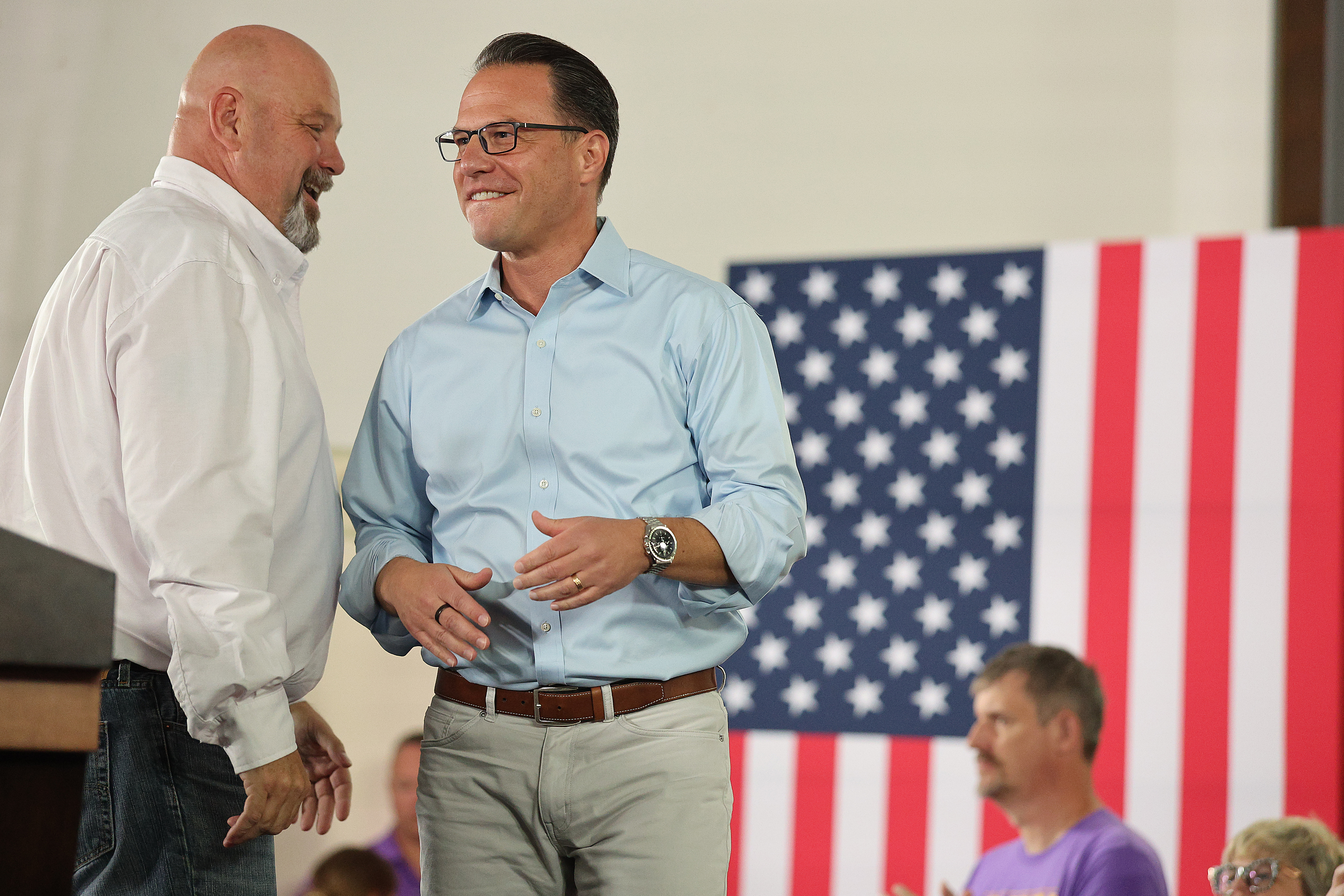
Bob Brooks (left), who is running for Pennsylvania’s 7th Congressional District, and Pa. Gov. Josh Shapiro (right) exchange greetings on the stage during a July 26 rally at the United Steelworkers Union Hall in Bethlehem, Pa.David Maialetti / Staff Photographer
And after he struggled to break through gridlock with Senate Republicans, he went all in on winning full Democratic control in Harrisburg for the first time since 1993.
That move is an example of Shapiro as a pragmatic leader, said Bradford, who has known Shapiro for decades. He wanted to find common ground with Republicans, Bradford said, but when he couldn’t, he found a new solution: winning a trifecta.
“His ideology is competence,” Bradford said. “He’s not an ideologue, and I say that as a proud progressive. … It’s also a recognition that at times he is stymied by a Senate that is incapable of governing.”
Shapiro has been strengthening his grip on the state’s Democratic Party, too, since the fallout of the 2024 election, when Democrats failed to deliver Pennsylvania for Harris. He installed a former top aide as the party’s executive director. The state party has since turned around its declining voter registration numbers.
Still, Shapiro said finding common ground is the most necessary strategy to being a good elected official.
“The people make their choice, and if you’re privileged like I am to be elected, then you’ve got a responsibility when you’re in the room to govern,” he added.
‘Campaign 101′
A lot is on the line this November for Shapiro. If he successfully helps flip control of the U.S. House and gains a trifecta in Harrisburg for the first time in decades, he will have “a great resumé in America’s premier swing state,” Borick said, giving him a leg up among other 2028 contenders.
“That’s a great result that you can bring out on the campaign trail if you so choose to run in 2028,” Borick added.
But if he doesn’t meet expectations, “there may be some questions” about his viability for a presidential run, Borick said.
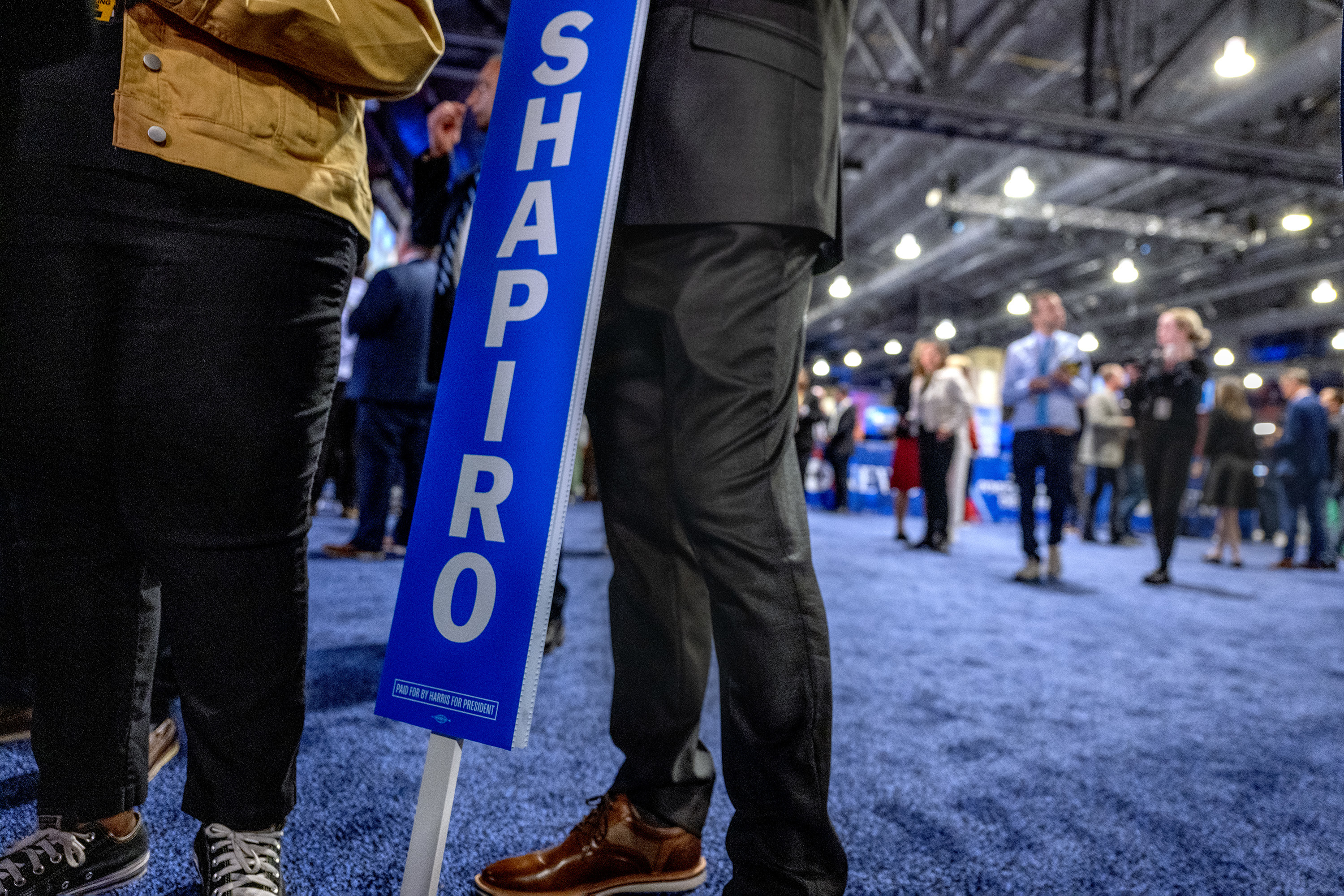
A staffer holds name sign for Gov. Josh Shapiro, a surrogate for Vice President Kamala Harris in the spin room at the Convention Center on Sept. 10, 2024, after her debate with former President Donald Trump at the National Constitution Center.Tom Gralish / Staff Photographer
That may help explain why Shapiro has never publicly said he’s considering a run, as he needs to win reelection first, Borick said.
“You don’t want to get hit at all for looking like you’re thinking ahead and not focused on the race before you,” Borick said. “That’s Campaign 101.”
Still, he’s left a breadcrumb trail for a 2028 run: writing a book, a national media tour, and, earlier this month, creating a federal political action committee, which he could use in the future to finance a White House run.
(His campaign has stressed he is using the PAC to contribute financially to the four Pennsylvania Democrats vying to flip the U.S. House.)
State Sen. Greg Rothman (R., Cumberland), who chairs the state Republican Party, said he believes Shapiro is running for president in 2028. “And I read his book,” he added.
He had some advice for the potential presidential hopeful: Improve your debate performance.
“I’ve been alive for 20-plus presidential debates. He’s gonna need work if he’s gonna compete on a national stage,” he said.
Manuel Bonder, a spokesperson for Shapiro’s campaign, said in response that he appreciates Rothman “taking a break from overseeing this disastrous, flailing Republican campaign for governor to offer unsolicited advice,” adding that Shapiro is only focused on electing Democrats down ballot.
Rothman said he’s still hopeful for a “huge upset” against Shapiro, citing past examples where the expected winner ultimately lost the election, including most recently former U.S. Sen. Bob Casey’s loss to U.S. Sen. Dave McCormick in 2024, without mentioning Garrity. The state party has given no financial support to the state treasurer’s gubernatorial campaign, according to her September campaign finance filings.
“We are a state known for huge upsets,” Rothman added.
Shapiro has also cultivated allies from across the country and ideological spectrum. After conservative influencer Charlie Kirk was murdered while on a Utah campus, Shapiro forged a strong relationship with Republican Utah Gov. Spencer Cox to speak out against political violence. And earlier this month, U.S. Sen. Elizabeth Warren (D., Mass.), who ran for president in 2020 as a progressive,headlined a fundraiser with him in Delaware County, introducing Shapiro as “a man who has the right values.”
“Winning Pennsylvania makes a great argument” for Shapiro’s chances as a prospective 2028 candidate, U.S. Sen. Chris Coons (D., Del.) said. “If you win Pennsylvania, you win the whole presidency.”
But no Pennsylvania governor has ever won the presidency.
(James Buchanan represented the state in the U.S. Senate a decade prior to his election to the presidency in 1856, and Scranton-born Joe Biden’s political career was forged in Delaware.)
Former Govs. Milton Shapp, a Democrat and Pennsylvania’s first Jewish governor, and William Scranton, a Republican, sought their parties’ nominations in 1976 and 1964, respectively. Other popular governors, like Rendell, Bob Casey Sr., and Tom Ridge also considered runs for the nation’s highest office, Borick said, but didn’t pursue them.
Shapiro, he said, is the most poised Pennsylvania governor to be considered seriously for a presidential run in modern history.
Bradford, a top state Democrat who has negotiated the last several state budgets alongside Shapiro, said Shapiro should “absolutely” run for president in 2028. He cited the governor’s popularity and his “record of accomplishment that is rewarded in not just the polls, but by the people.
“And I think that’ll show on Election Day on Nov. 3,” he added.
Correction: A previous version of this story stated the incorrect amount spent on upgrades to Shapiro’s personal home. The state spent $1 million on those upgrades.
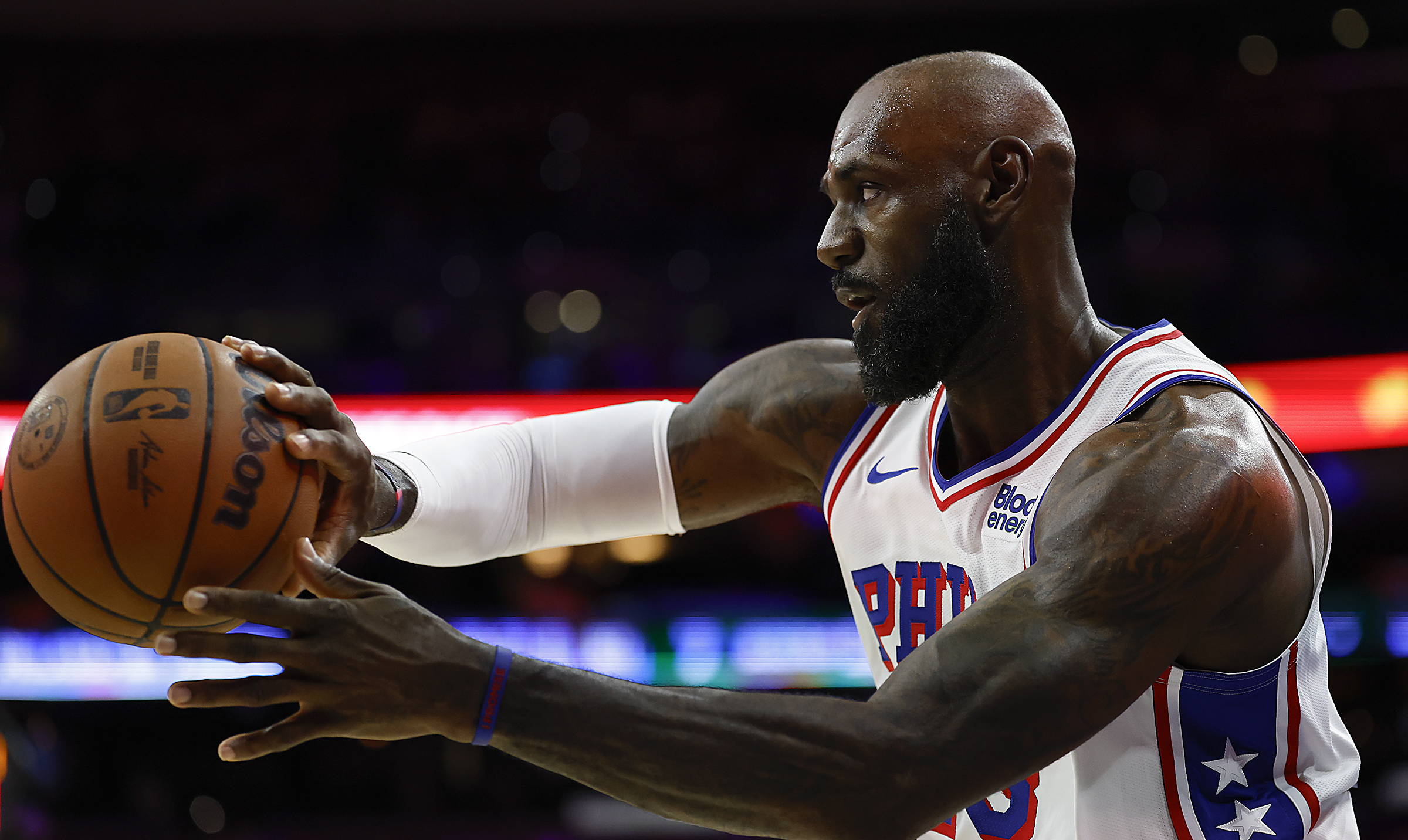
The LeBron James era officially tipped off in Philly this week, but that was only part of the story. The Flyers ended their early-season skid by ripping off three straight wins; the Union ran their unbeaten streak to 15 games; and the Eagles lost again — and likely lost Jalen Hurts for the season. And our team of Inquirer photographers were there to capture it all. Here’s this week’s Big Picture …
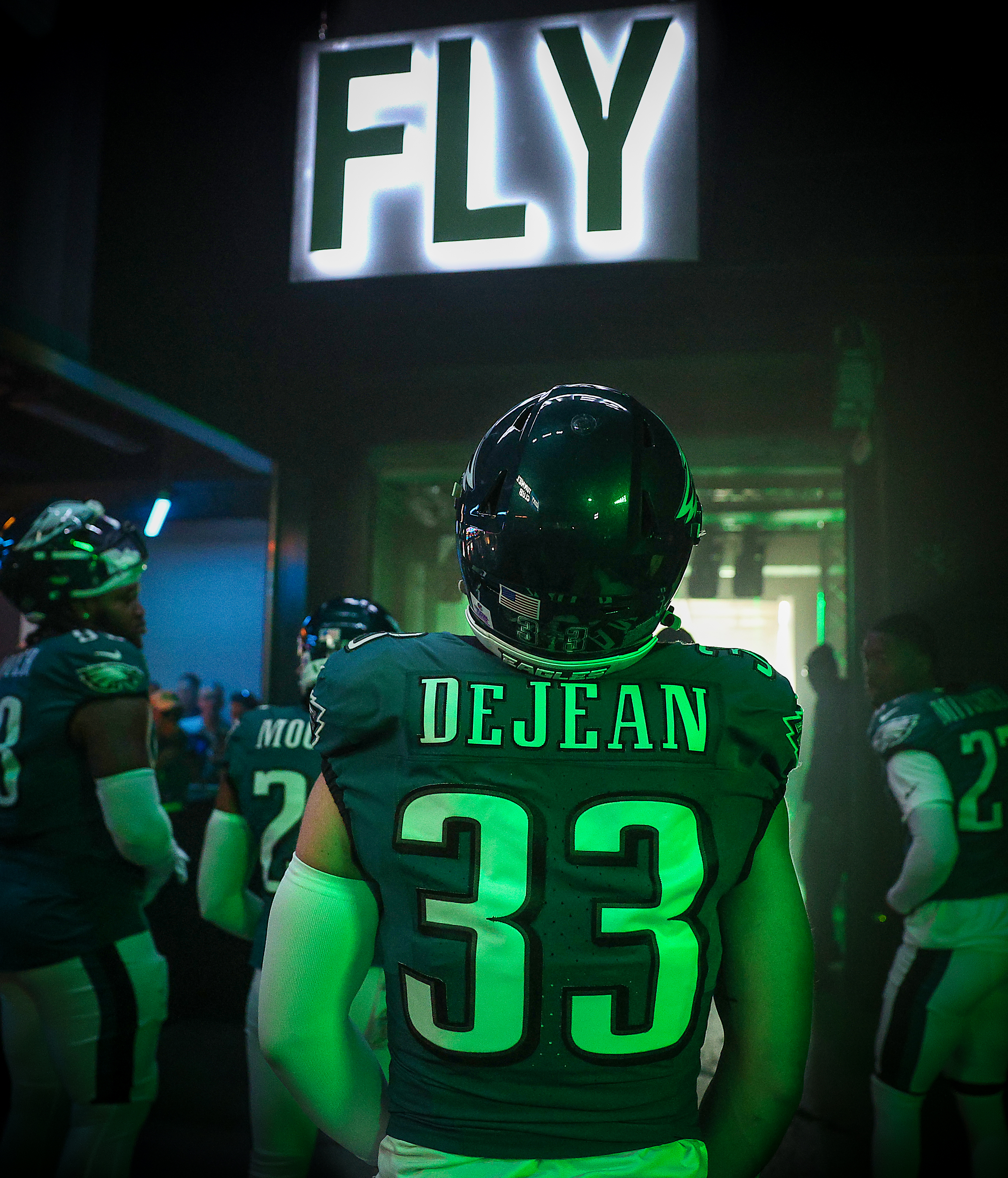
Eagles cornerback Cooper DeJean waits in the tunnel for player introductions before their game against the Carolina Panthers at Lincoln Financial Field.David Maialetti / Staff Photographer
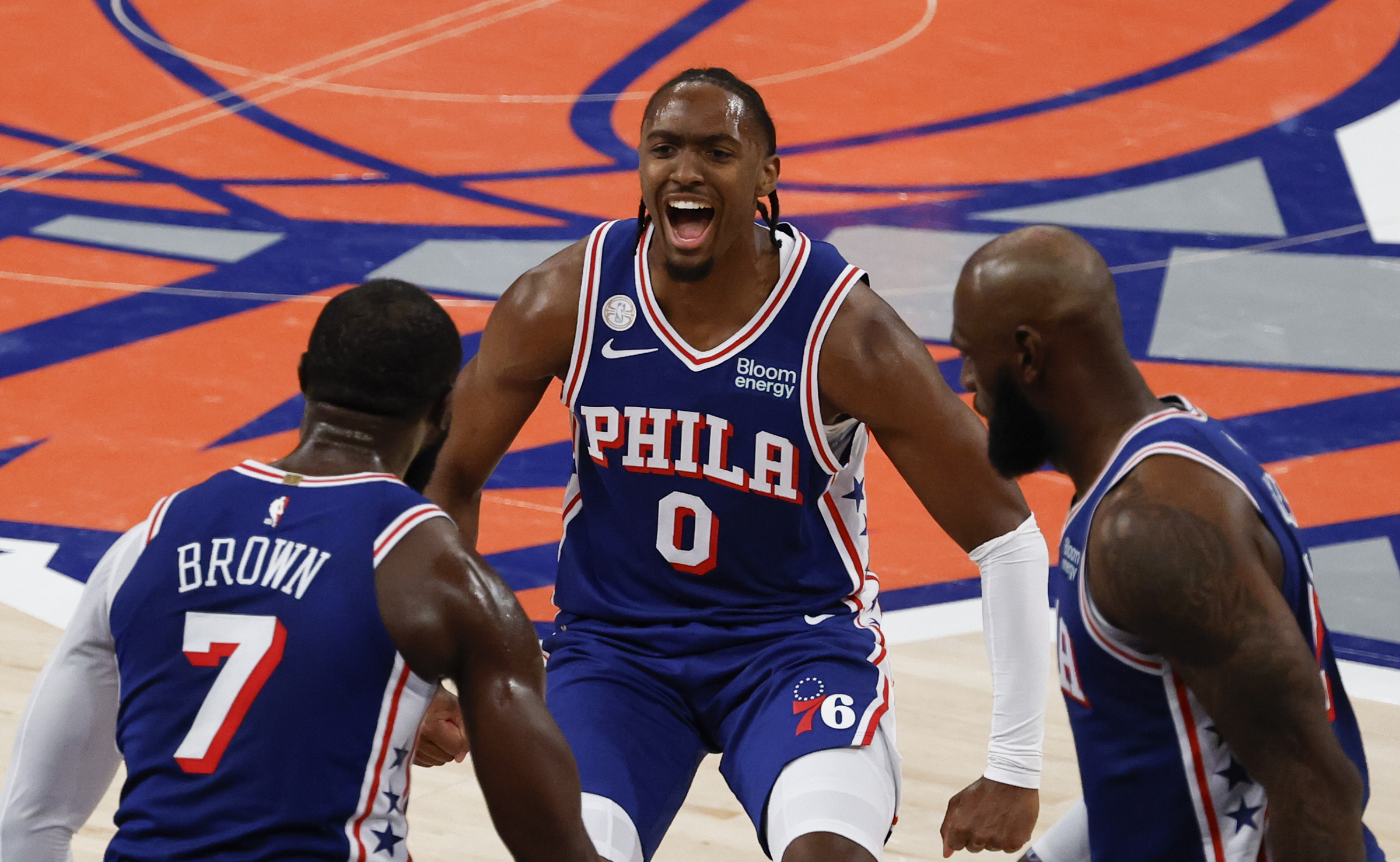
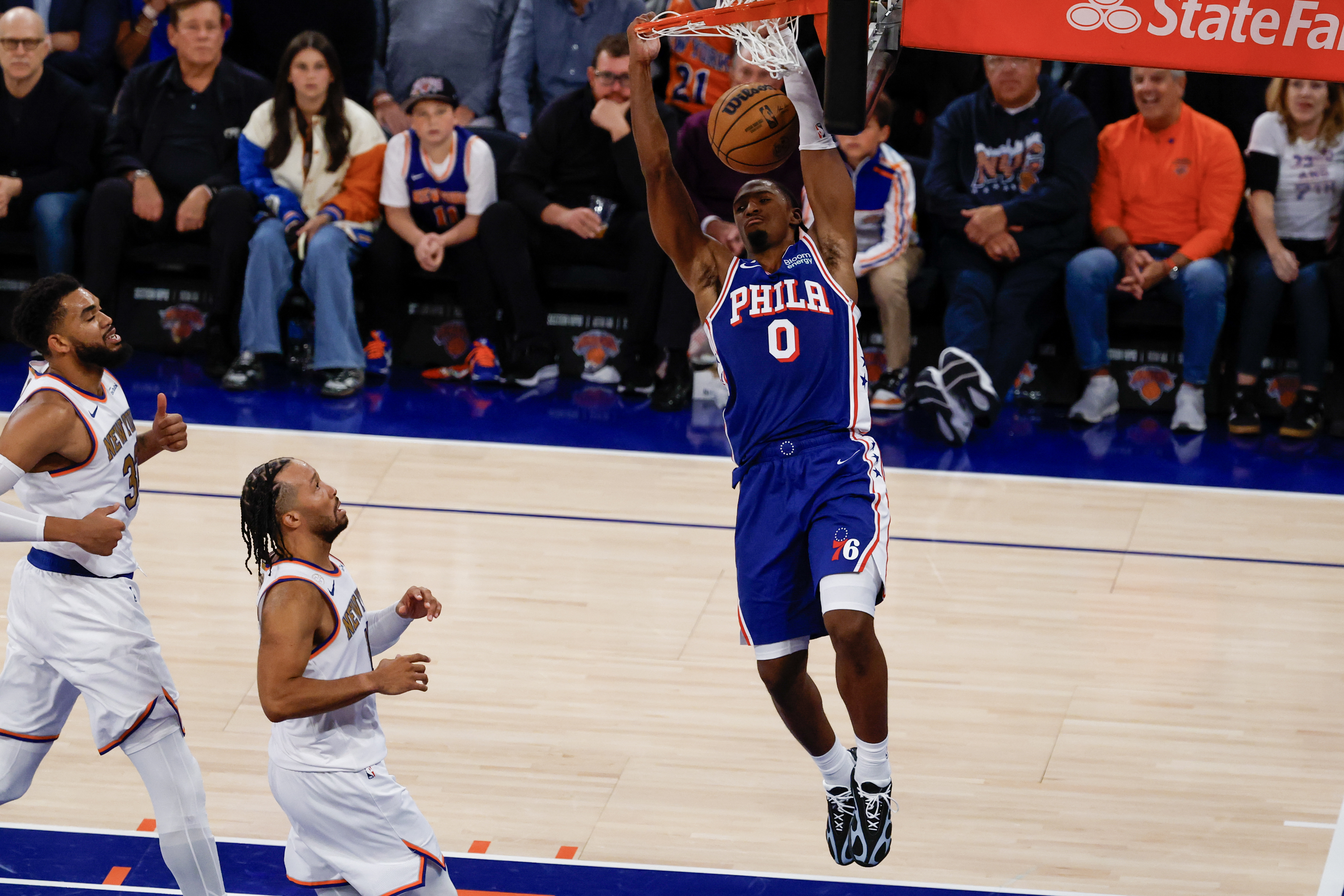
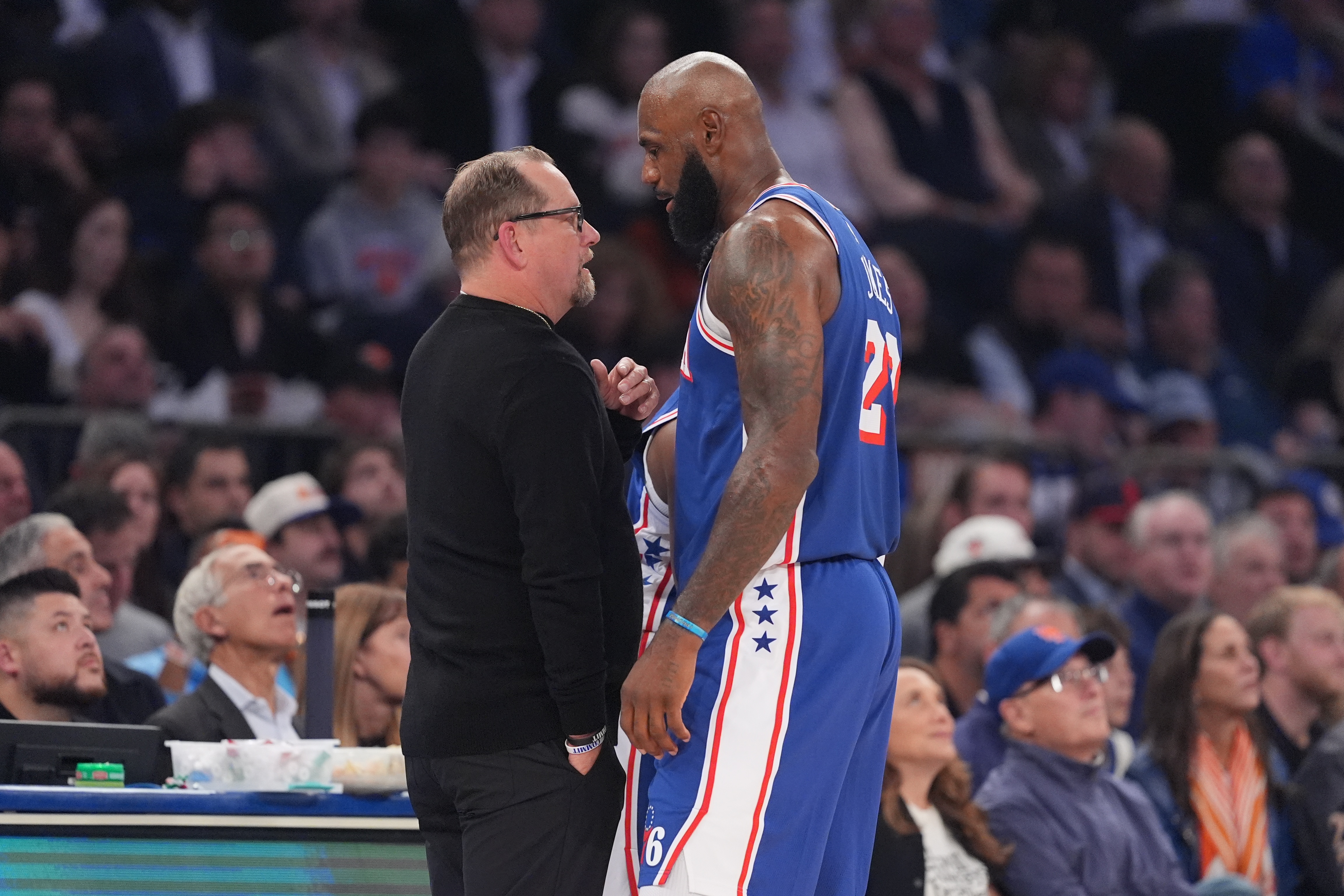
Sixers guard Tyrese Maxey celebrates with new teammates Jaylen Brown and LeBron James after beating the Knicks in their season opener Tuesday at Madison Square Garden.Yong Kim / Staff Photographer
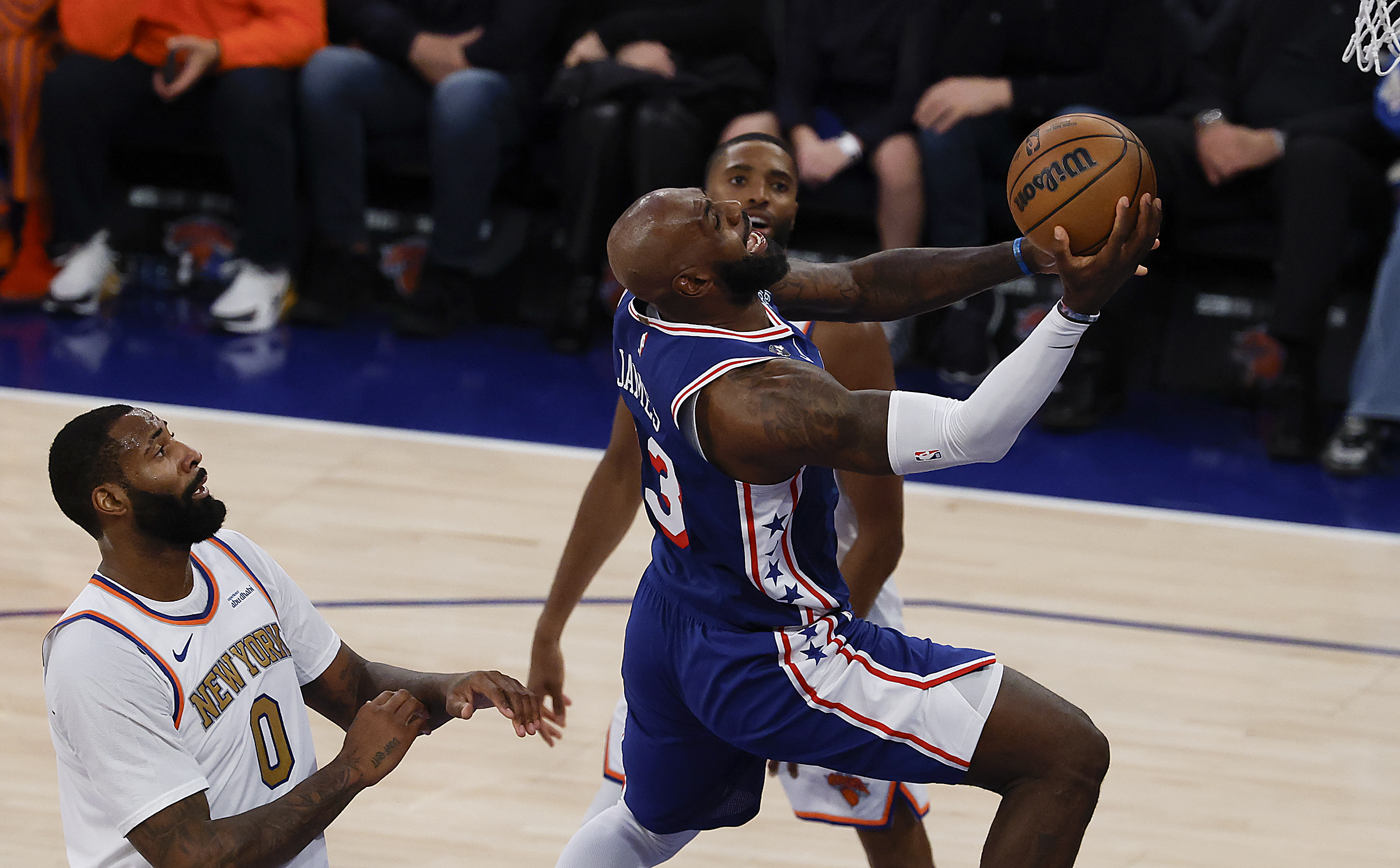
LeBron drives past New York Knicks (and former Sixers) center Andre Drummond during Tuesday’s 106-100 win.Yong Kim / Staff PhotographerMaxey led all scores with 28 points in the Sixers’ win over the Knicks.Yong Kim / Staff Photographer
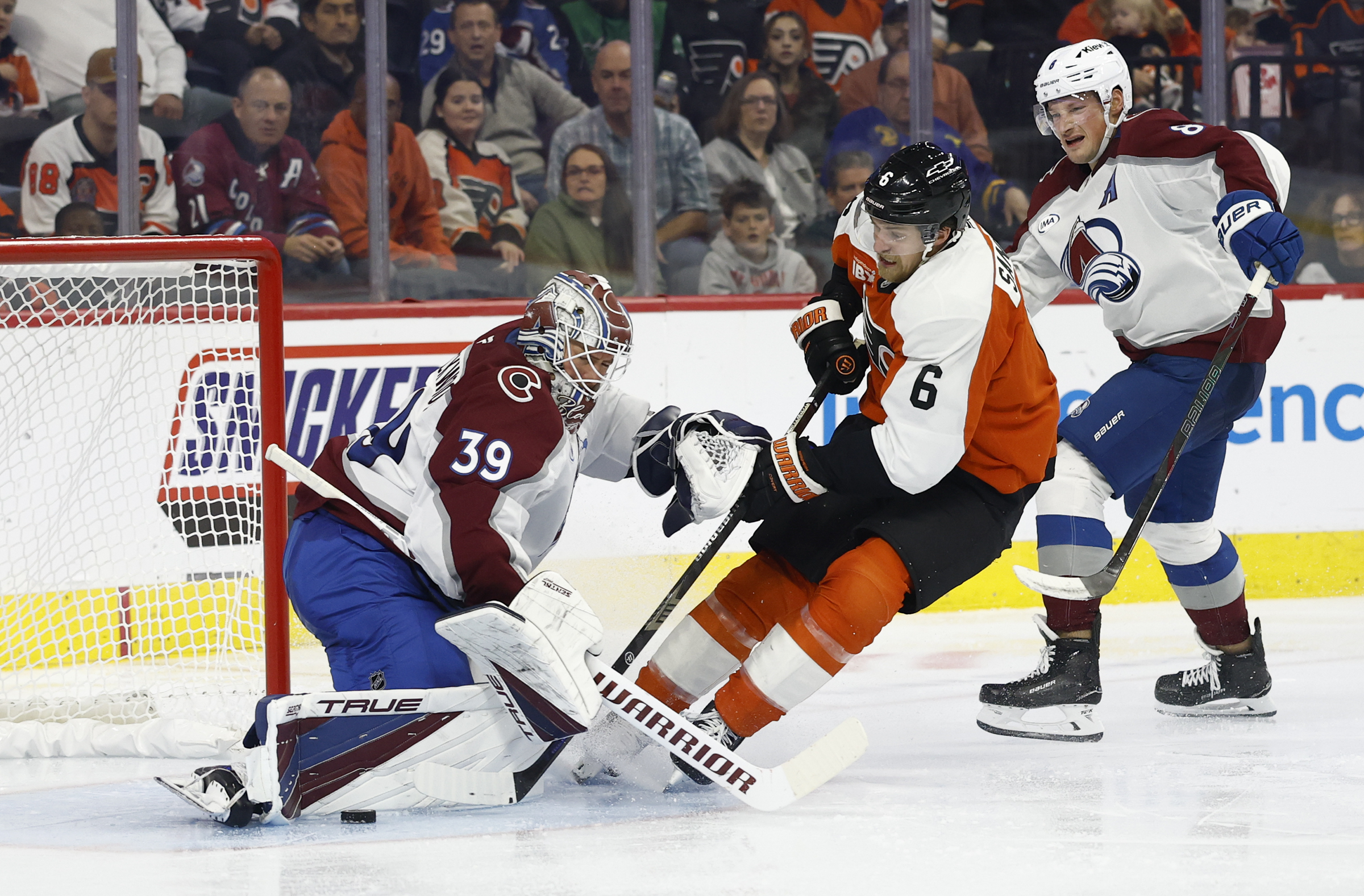
Flyers defenseman Travis Sanheim tries to score past Colorado Avalanche goaltender Mackenzie Blackwood. After nine straight losses to start the season, the Flyers have won three straight, including Monday’s 3-2 win over the Avalanche at home.Yong Kim / Staff Photographer
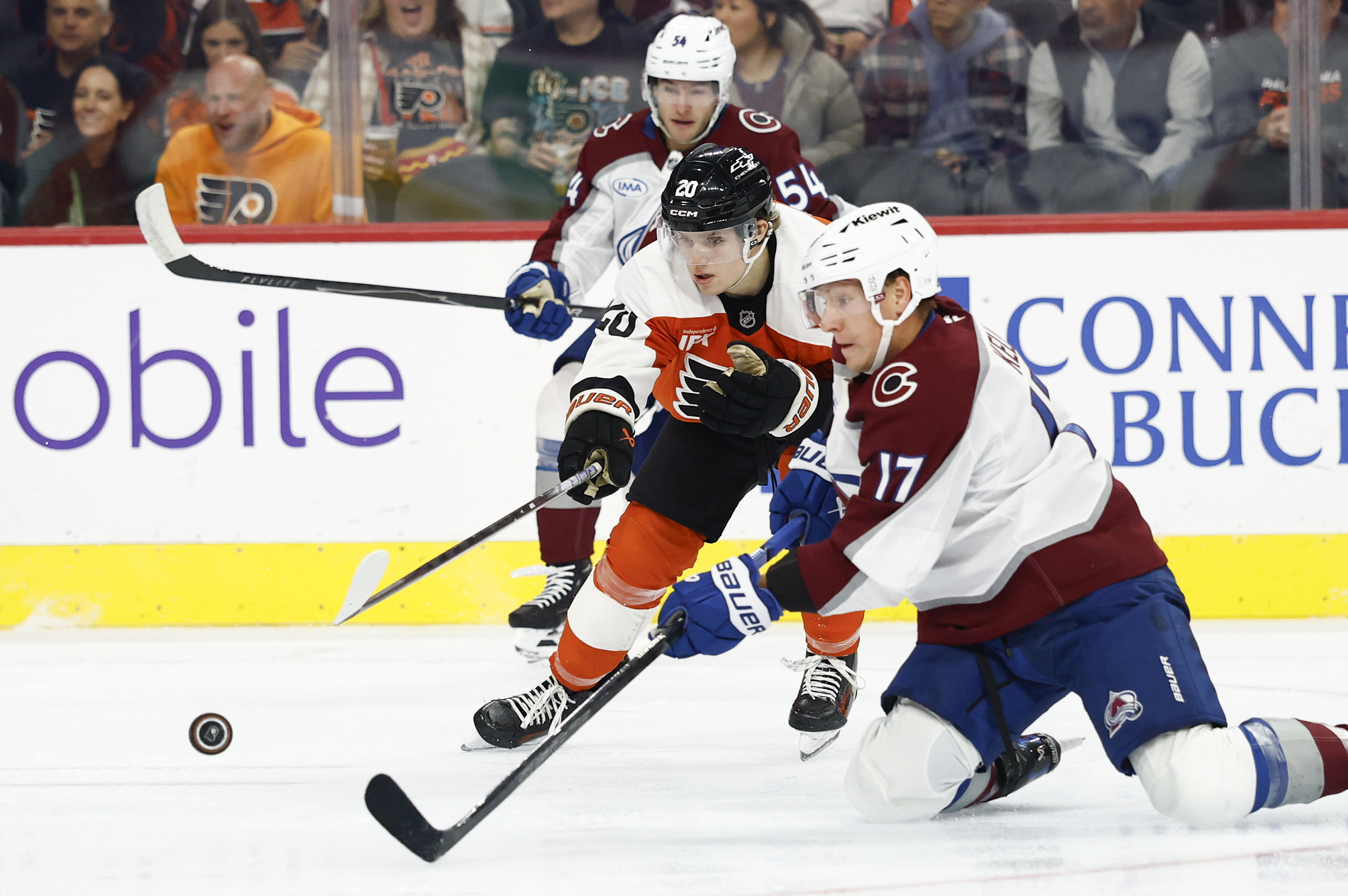
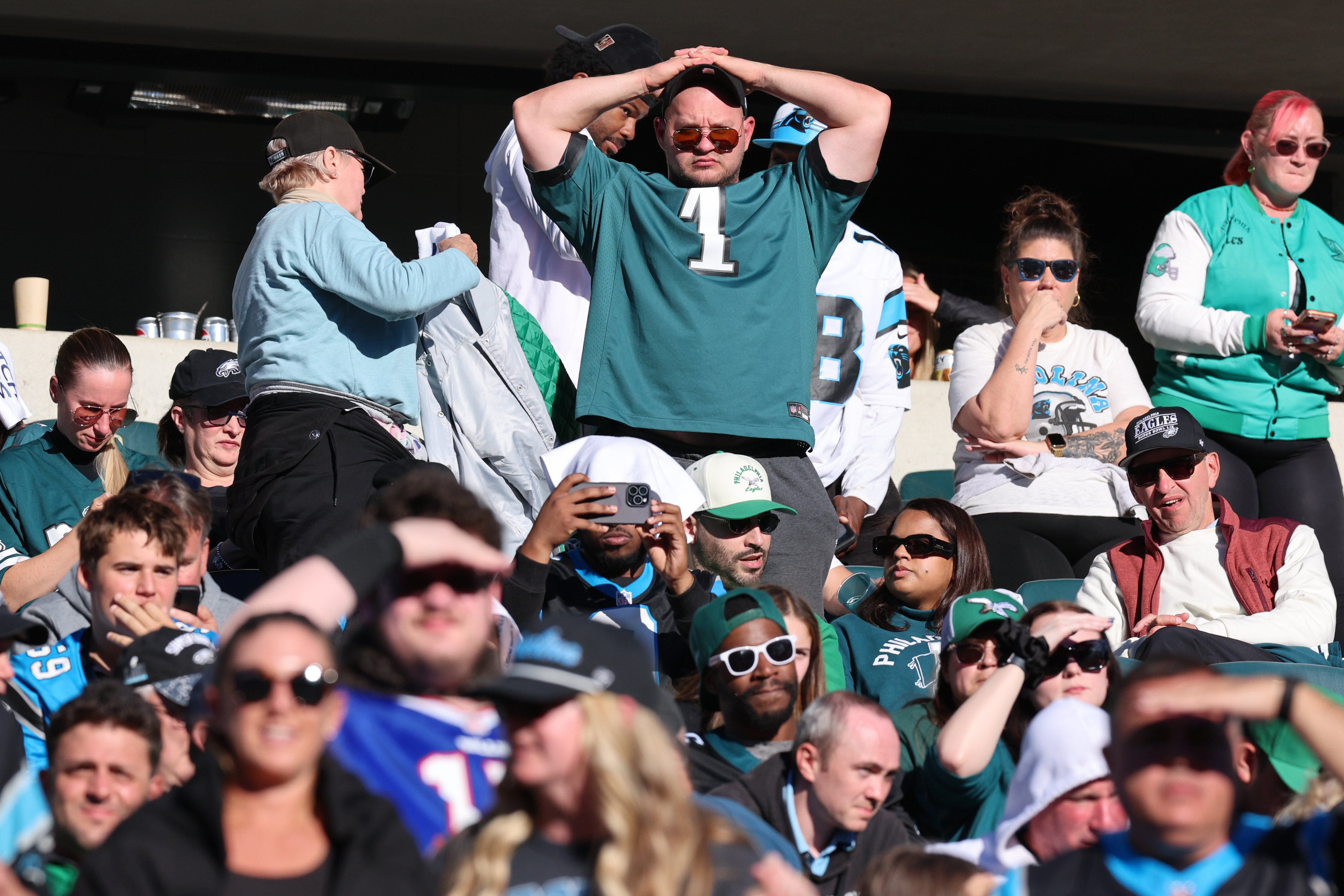
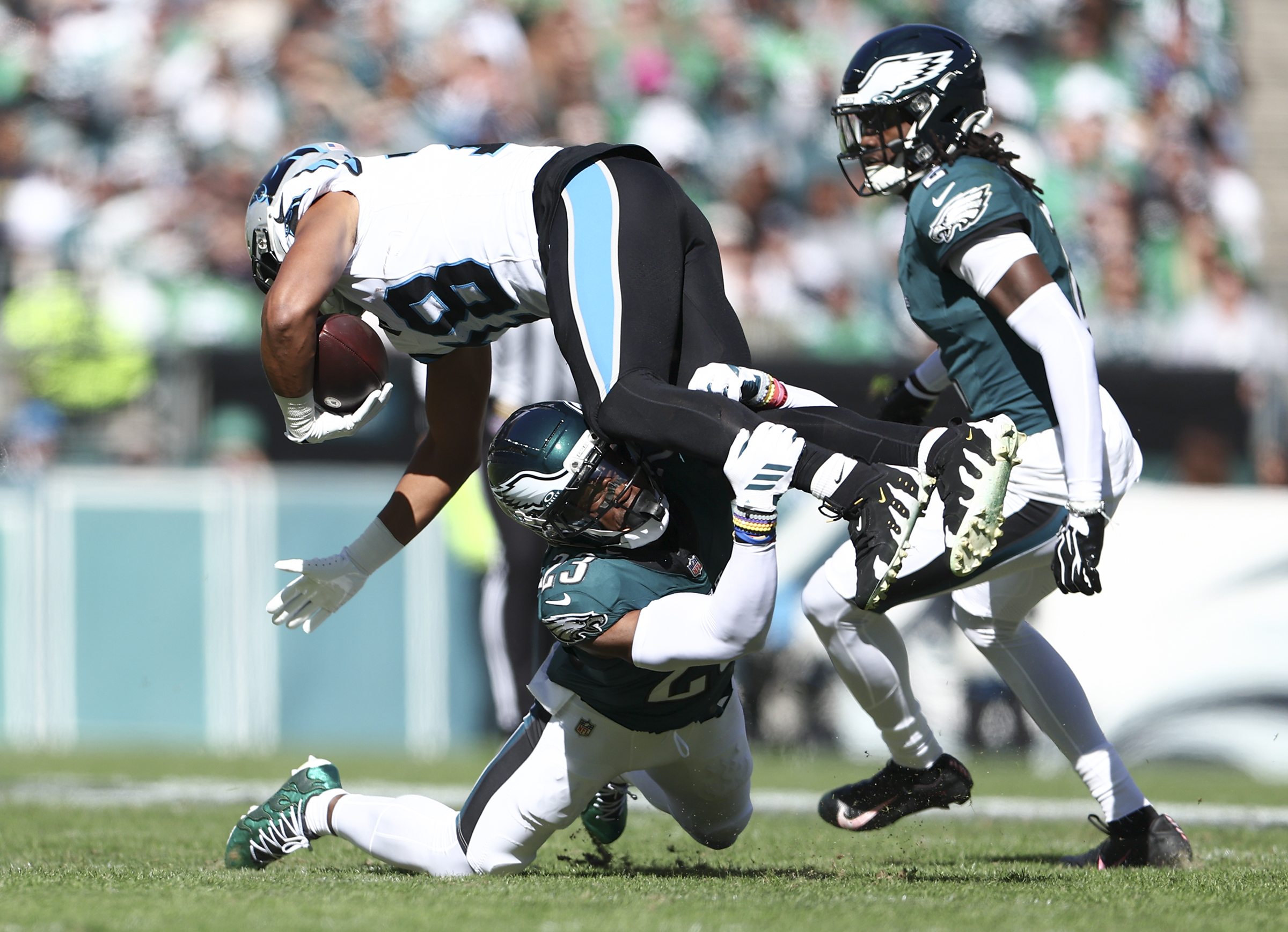
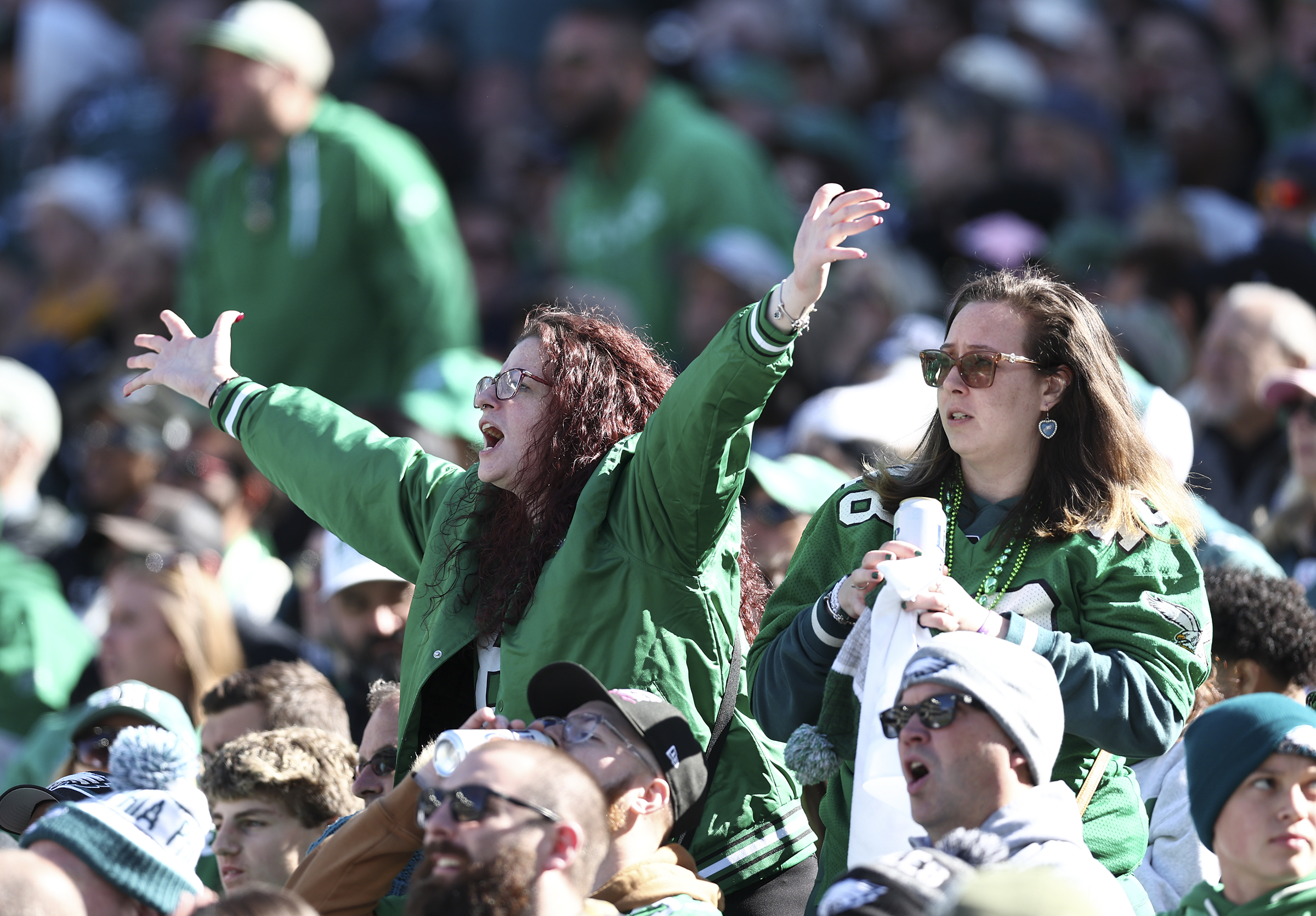
The Flyers recalled left wing Alex Bump ahead of Monday’s win over Colorado.Yong Kim / Staff PhotographerAn Eagles fan in a Jalen Hurts jersey watches the fourth quarter of Sunday’s 25-14 loss to the Carolina Panthers at Lincoln Financial Field. It was the Eagles’ fourth straight loss.David Maialetti / Staff Photographer
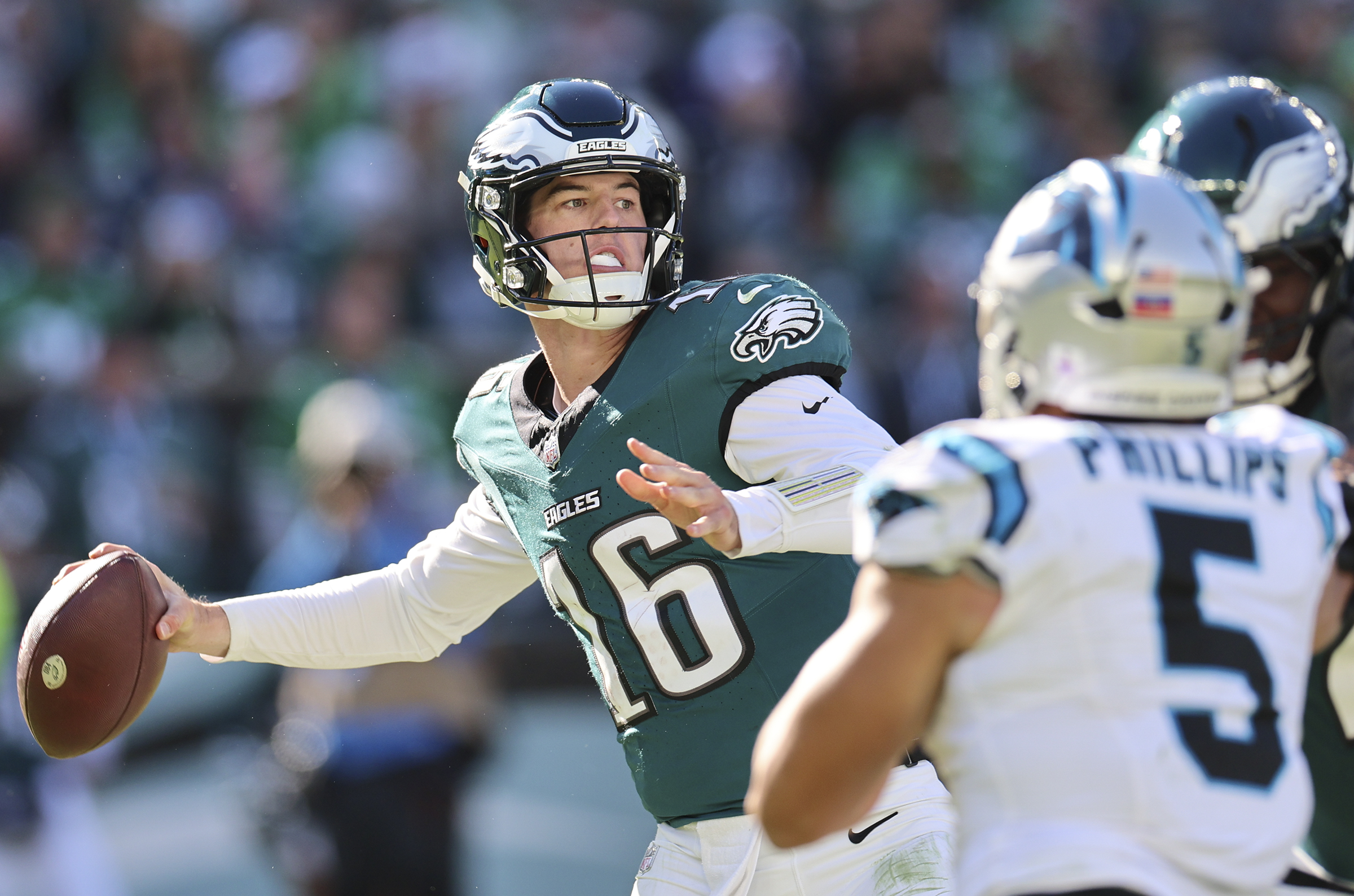
Eagles quarterback Tanner McKee will make his second straight start as Jalen Hurts remains out after blood clots were found in his lungs.David Maialetti / Staff Photographer
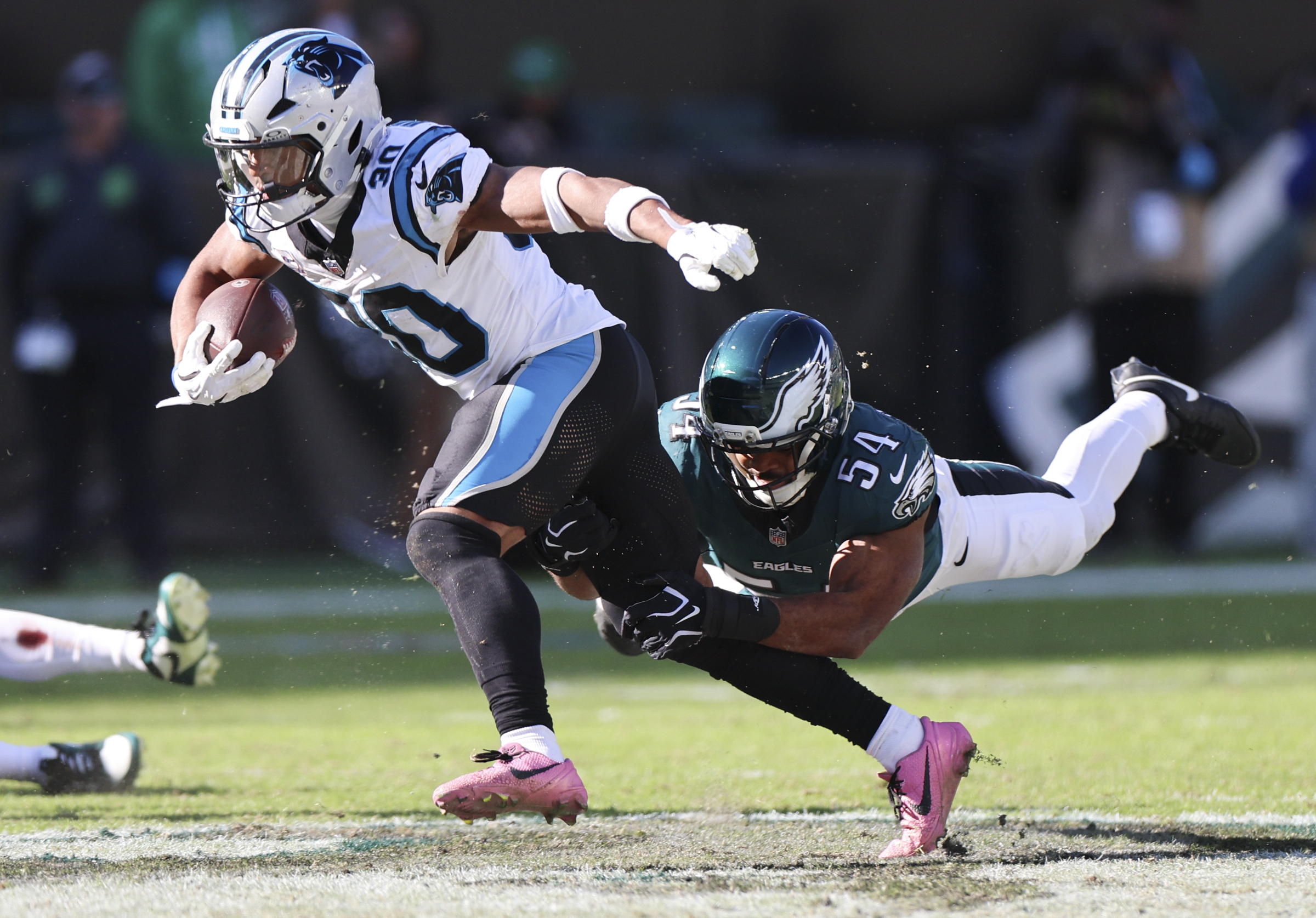
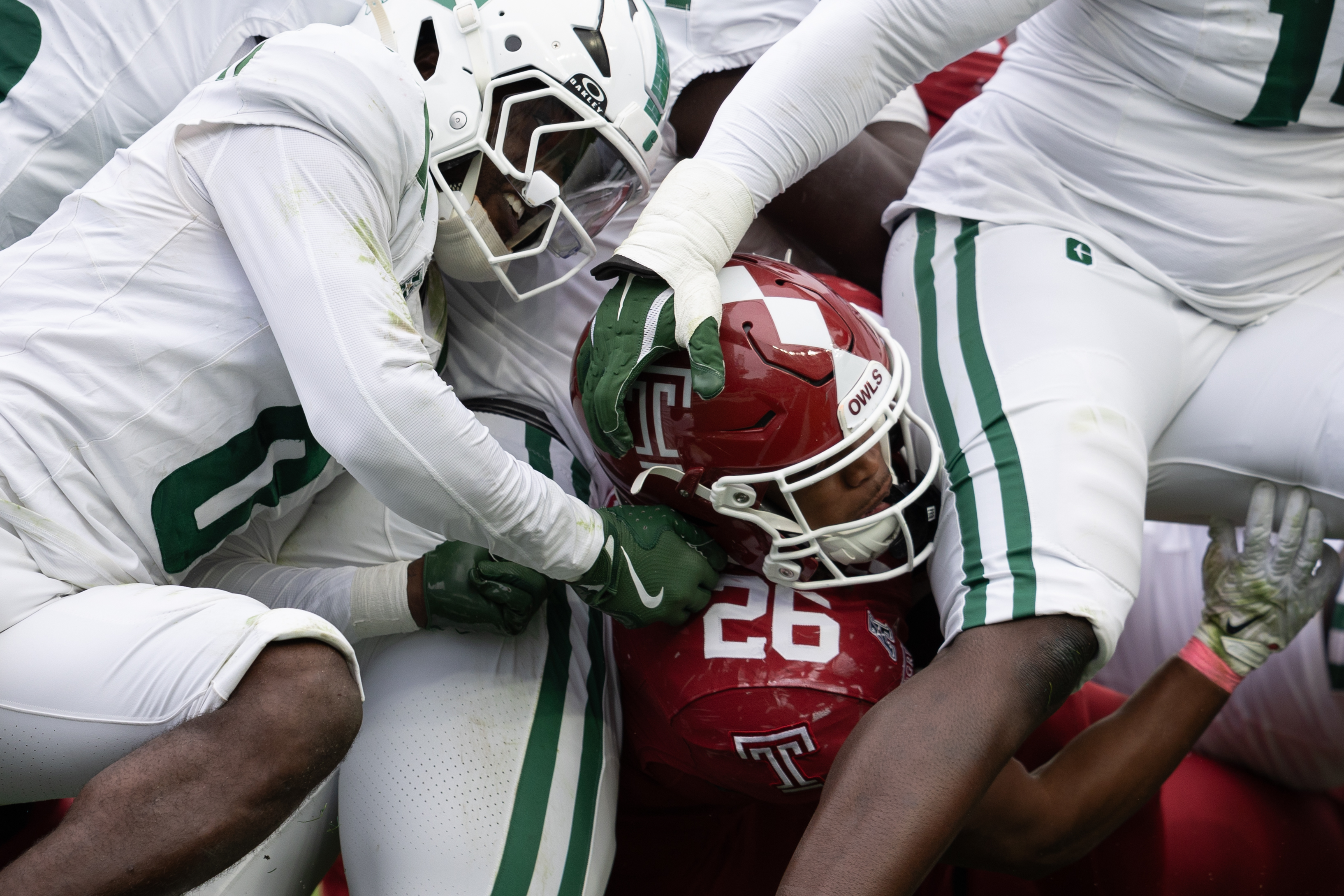
Eagles linebacker Jeremiah Trotter Jr., dives after Carolina Panthers running back Chuba Hubbard in the third quarter on Sunday.David Maialetti / Staff Photographer
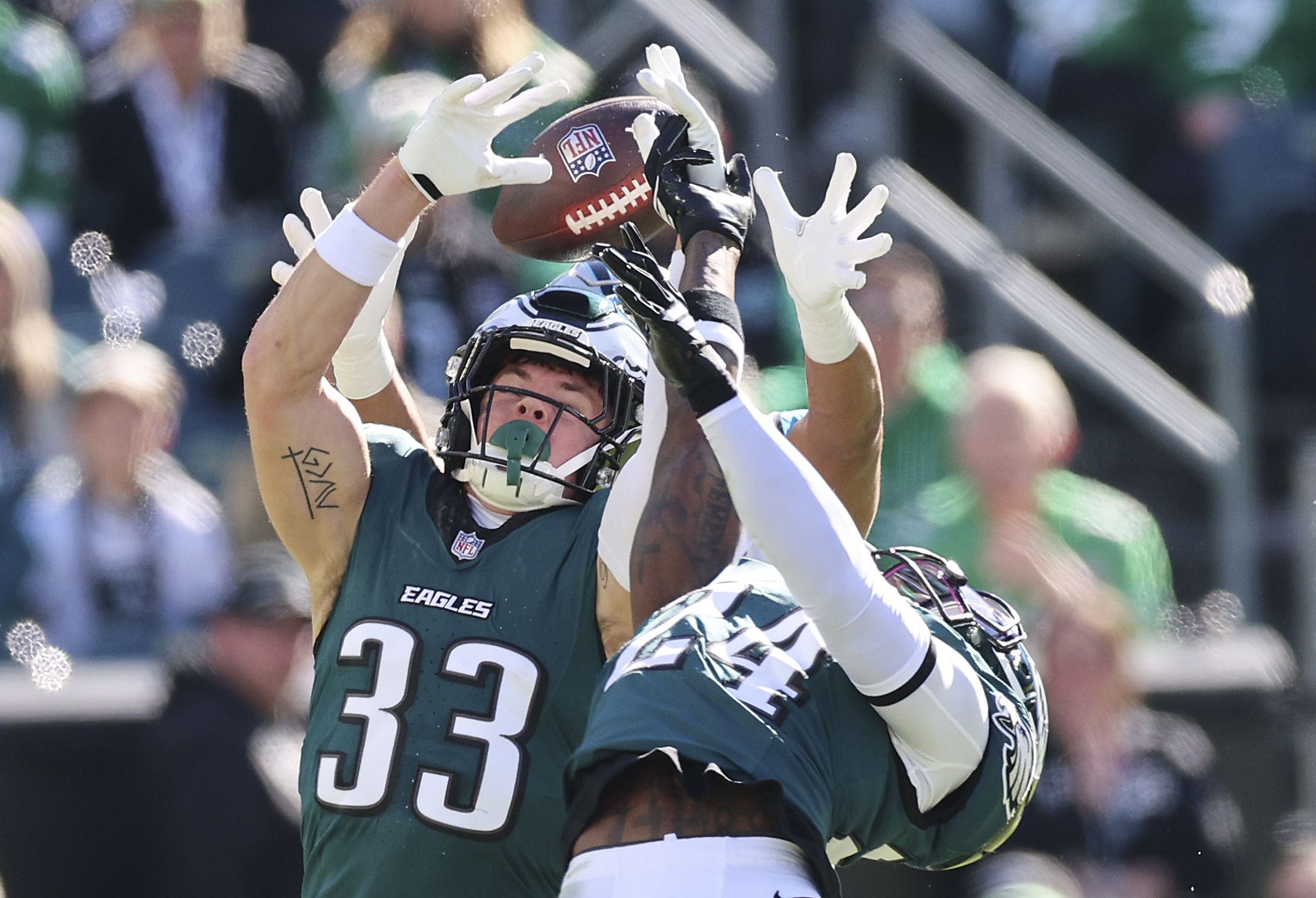
Eagles safety Andrew Mukuba (right) and cornerback Cooper DeJean can’t come down with the interception in front of Carolina Panthers wide receiver Jalen Coker.David Maialetti / Staff PhotographerEagles defensive back Kenny Moore stops Jalen Coker in the first quarter.Monica Herndon / Staff Photographer
Indiana Vassilev (right) and the Union played Charlotte FC to a 3-3 draw Saturday. It was the Union’s 15th straight game without a loss.Elizabeth Robertson / Staff Photographer
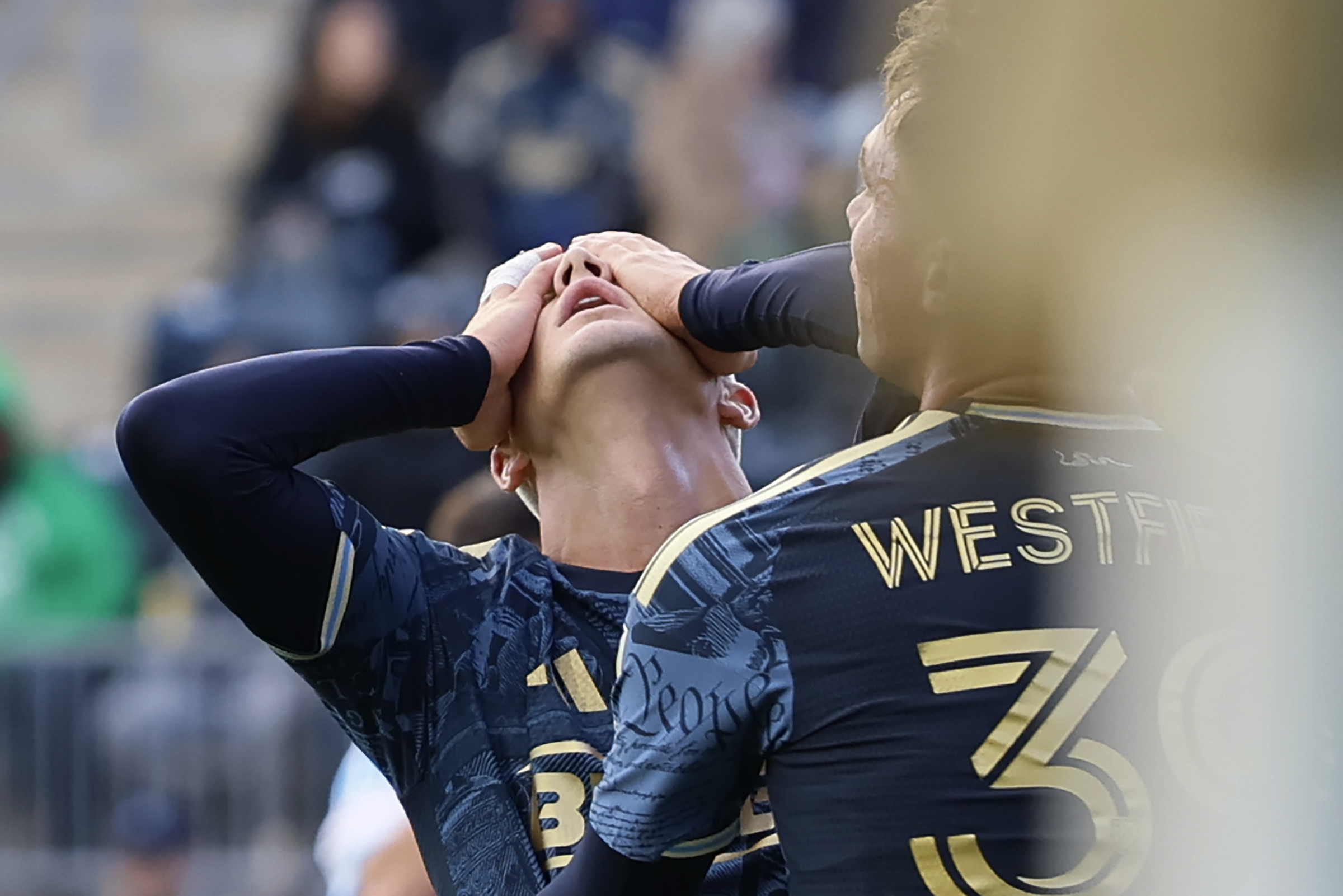
Union forward Cavan Sullivan reacts to a missed scoring opportunity in the second half against Charlotte FC.Elizabeth Robertson / Staff PhotographerBruno Damiani (center) celebrates his goal that tied the game at 2-2 in the second half against Charlotte FC.Elizabeth Robertson / Staff Photographer
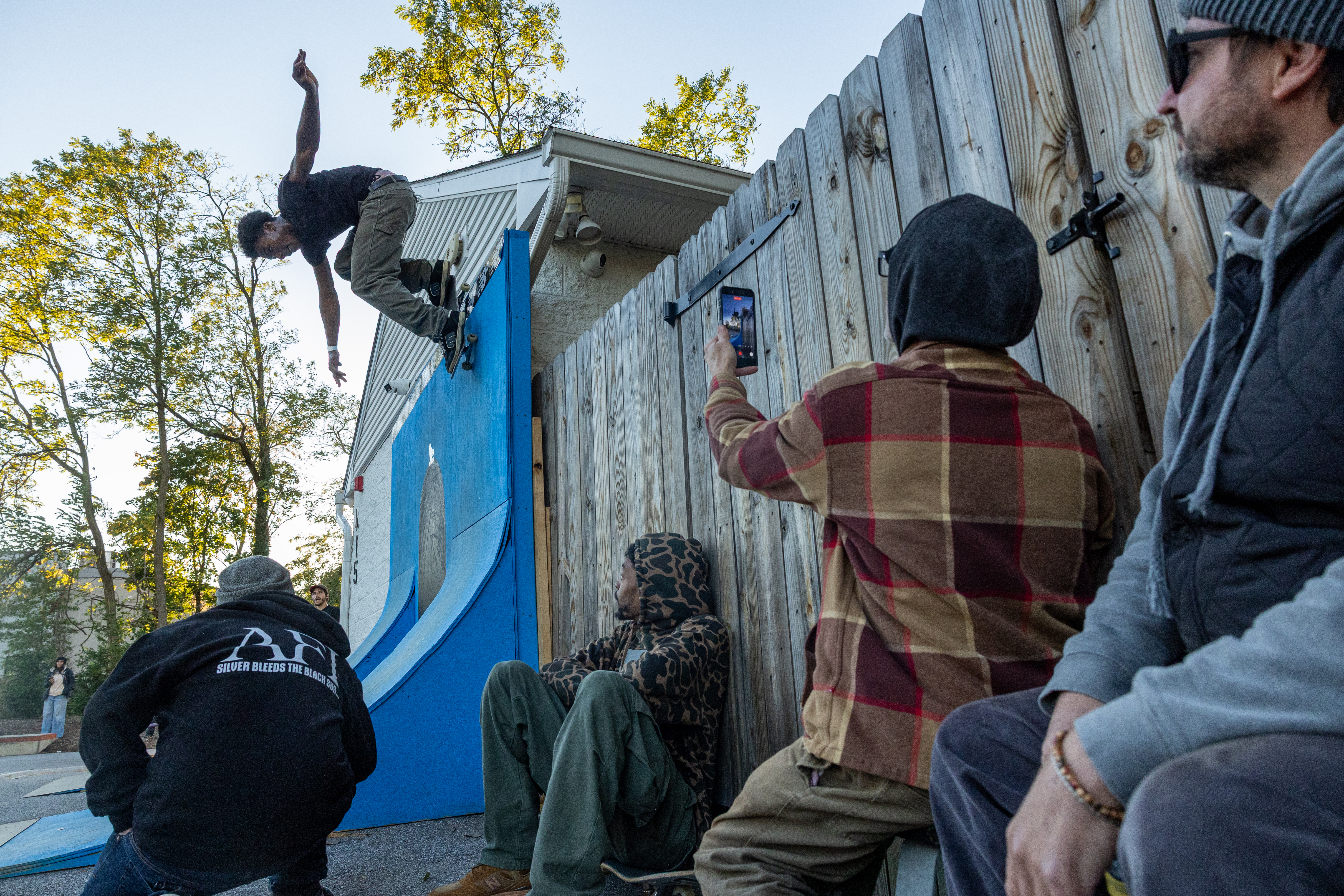
Zymir Rhodes, 20, of York, attempts a wall ride during the “Sponsored” category at the Philly AM skate competition in West Chester on Saturday, while skaters Isiah Booker, 33, Nate Demuro, 54, and Steve Morris, 49, watch in support.Aidan T. Gallo / Staff Photographer
Villanova’s Tyler Perkins fights for a loose ball against George Mason during the first half of the game at the Finneran Pavilion.Tyger Williams / Staff Photographer
In 1978, Anne Cutler drove from her home in Bethlehem to Boathouse Row and knocked on the doors of the many boathouses, asking if she could row with them for the summer.
At the time, Cutler finished her freshman year at George Washington. During the school year, she was approached by the crew team about joining the program. She wanted to use her time back home to see if the sport was for her.
She knocked on the door of the Philadelphia Girls’ Rowing Club, where Sophie Socha, now the club’s president and a U.S. Rowing Hall of Famer, opened the door and welcomed her with open arms.
“Come on down and row with us this summer,” Cutler recalls Socha telling her.
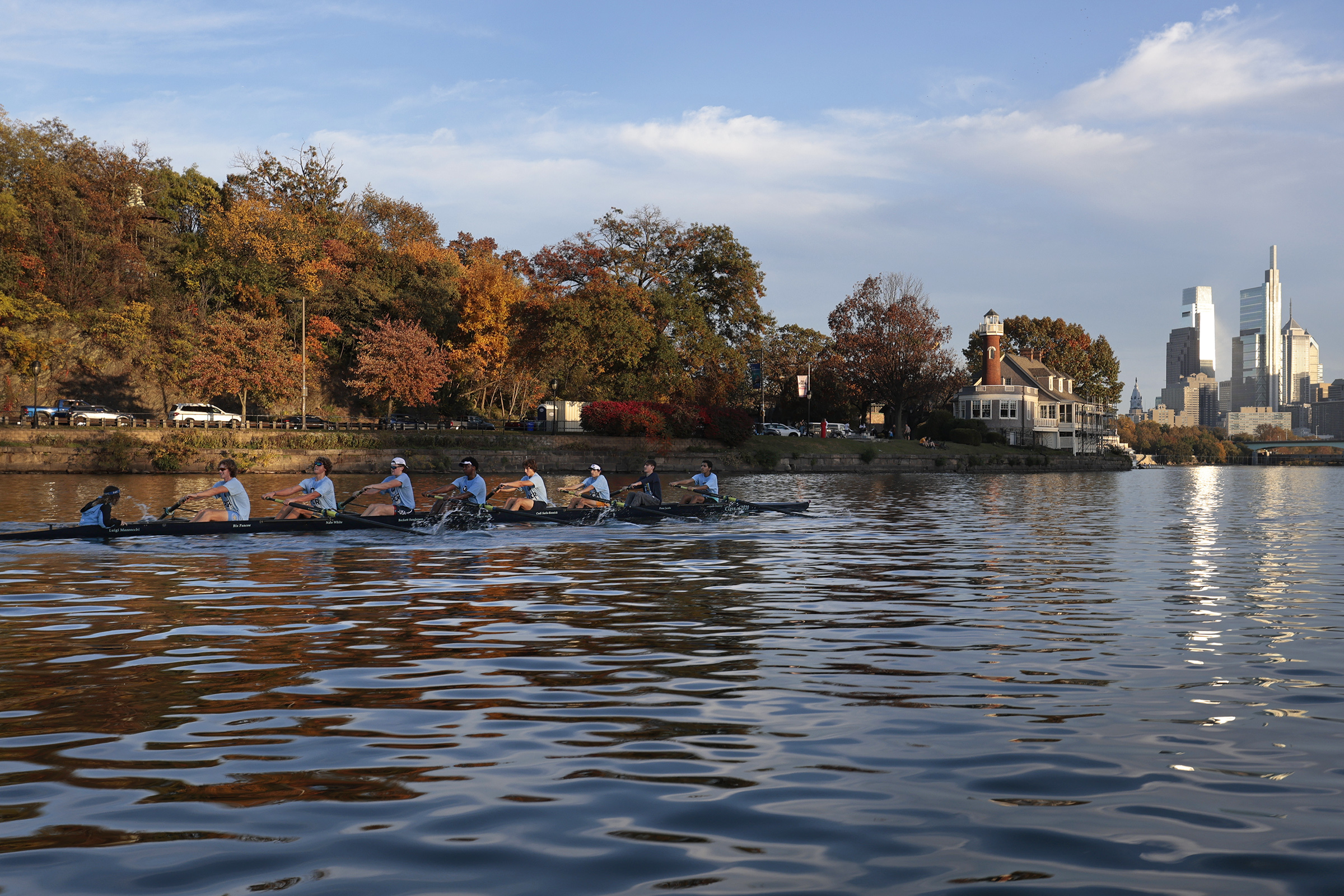
Forty-eight years later, Cutler is back rowing on the river where she started. On Saturday and Sunday, Cutler will compete in the single scull at the 56th Head of the Schuylkill Regatta, the city’s largest and most inclusive regatta.
“I’m at the time of my life where this is my time and this is my celebration of being able to still get in a boat at my age of 67,” Cutler said. “I never stopped rowing because part of my life is always being an athlete and living that lifestyle and having that community of people and staying fit. I moved away from racing but then I moved into coaching and then helping the Schuylkill River. What can women of my age do, right? At this age, as we’re aging, we don’t have to stop. We can keep going.”
The regatta started in 1970 and welcomed rowers of all ages and experience, from elite rowers to those new to the sport. Twelve women competed in the first regatta at a time when rowing was a male-dominated sport.
Women were excluded from the Philadelphia rowing scene until the 1960s. Many rowing clubs on the Schuylkill did not allow women to join or compete, so in 1938 four women started the Philadelphia Girls’ Rowing Club. It was founded as a competitive rowing organization, but for almost 30 years the members had to compete against each other.
The Head of the Schuylkill Regatta is the city’s largest and most inclusive regatta.Elizabeth Robertson / Staff Photographer
Women’s clubs were not allowed to become members of the Schuylkill Navy, the association of amateur rowing clubs in Philadelphia, but as interest in women’s crew began to grow, they were allowed to join in 1968.
“When I started rowing, the guys, they didn’t want us there and they were very clear about that,” said Socha, who started rowing in 1961. “What changed was the attitude of men towards women, and women towards women. The women, then and now, see that it is an open sport that they can do and can try.”
Cutler remembered a time during her rowing career when someone told her she was “too pretty to row.”
“Do you want to see all the medals I have?” she said. “We couldn’t let any of that get in our way. We wanted the opportunity.”
At George Washington, Cutler said her team used to struggle to fill an eight-person boat and get money for uniforms. But she noticed an increase in opportunities for women in rowing once colleges started enforcing Title IX. Cutler said she was one of the first recipients of a Title IX scholarship.
With more women allowed to compete in collegiate sports, that opened more seats for women in boats. Now, girls’ scholastic rowing has started to explode with the increased opportunities at the college level.
“They come now with their masseuses, sports psychologists, three practice uniforms and you’re like, ‘Yeah this is progress.’ It really is the opportunity for women to take part in a sport that, number one, has deep traditions,” Cutler said. “And to be able to take part in the tradition but also in a lifetime sport where you stay fit and to have the opportunity for friendships and personal growth.”
This weekend at the regatta, there are as many women entries as men, showcasing the continued interest in women’s crew.
“This is a celebration,” Cutler said. “This is a celebration of women, all ages that are out there.”
However, the win came after criticism thrown at James from President Donald Trump. During the national anthem on Tuesday, James could be seen extending his arms and rotating his shoulders in a swinging motion that some online thought was a golf swing.
“While listening to our national anthem, LeBron James disrespects our Country!” Trump wrote. “ … LeBron James should apologize to all of those Great American Warriors and Heroes who died for the American Flag, and all that our Country stands for!”
It was not the first time James was captured allegedly practicing his golf swing during the anthem, including last Christmas in a post that was shared by ESPN. However, it appears James is just stretching, as in the video posted by Trump, James’ swinging stretch aligns with a left-handed golf swing. James is right-handed and would be positioned the opposite way if practicing a golf swing.
Philly R&B legends Boyz II Men performed the national anthem Thursday night.
James, who would go on that night to score 17 points, 10 rebounds, and five assists, said, “It must be a slow news day at the office,” in response to Trump’s post.
Sixers head coach Nick Nurse said comments like Trump’s go “right in with all the other outside noise we’ve already had,” he said.
“All I really care about is getting them to the practice floor, getting in the film room, getting them to the game floor. And the focus that they’ve had and the intent and all the stuff they’ve had has been excellent.”
James drew Trump’s attention earlier this year. On the day James signed with the Sixers, Trump said of him, “maybe he’s a racist,” when asked whether he preferred James or Michael Jordan. Trump has also been critical of other athletes’ behavior during the national anthem, most notably former NFL quarterback Colin Kaepernick in 2016.
Staff writer Gina Mizell contributed to this article.
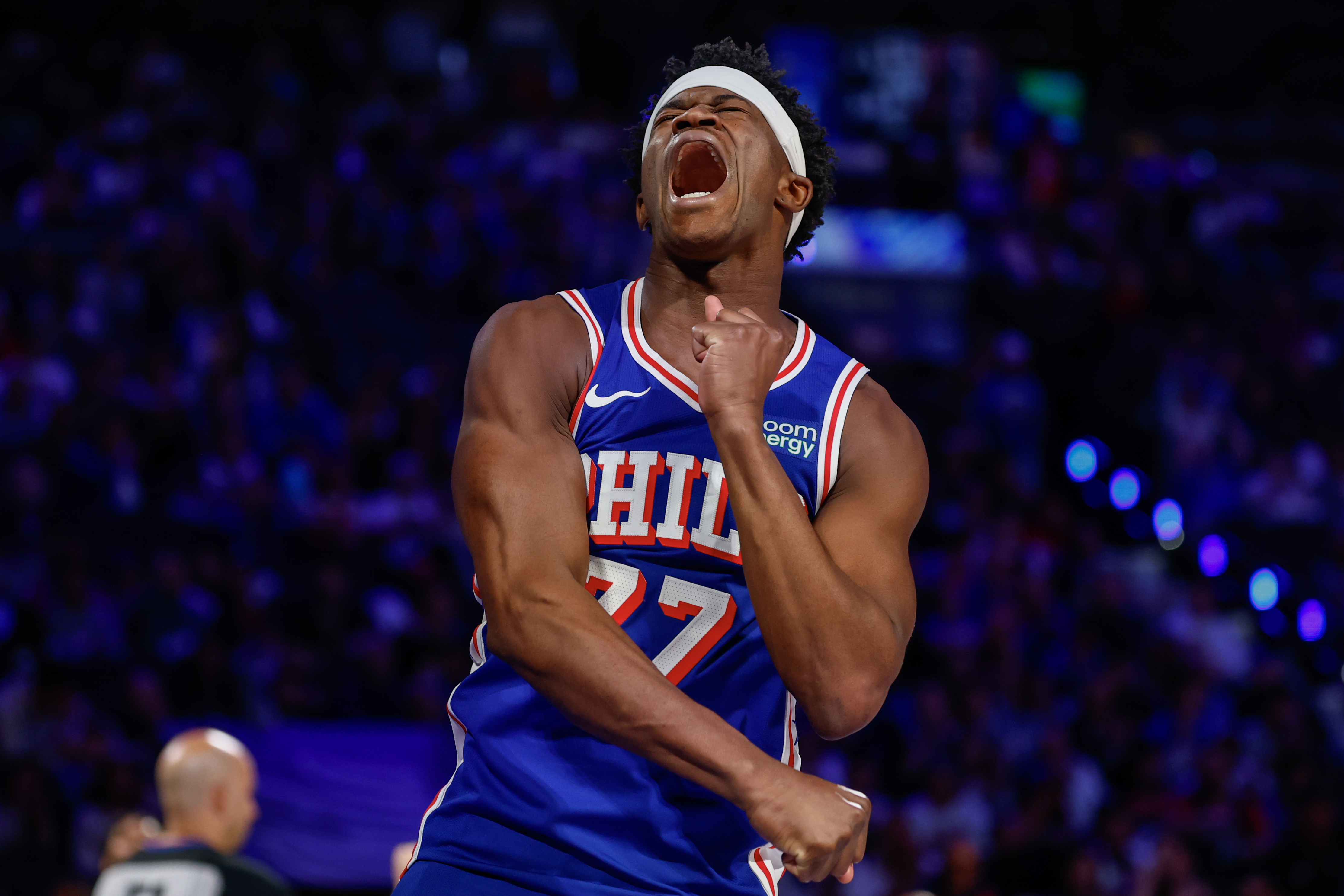
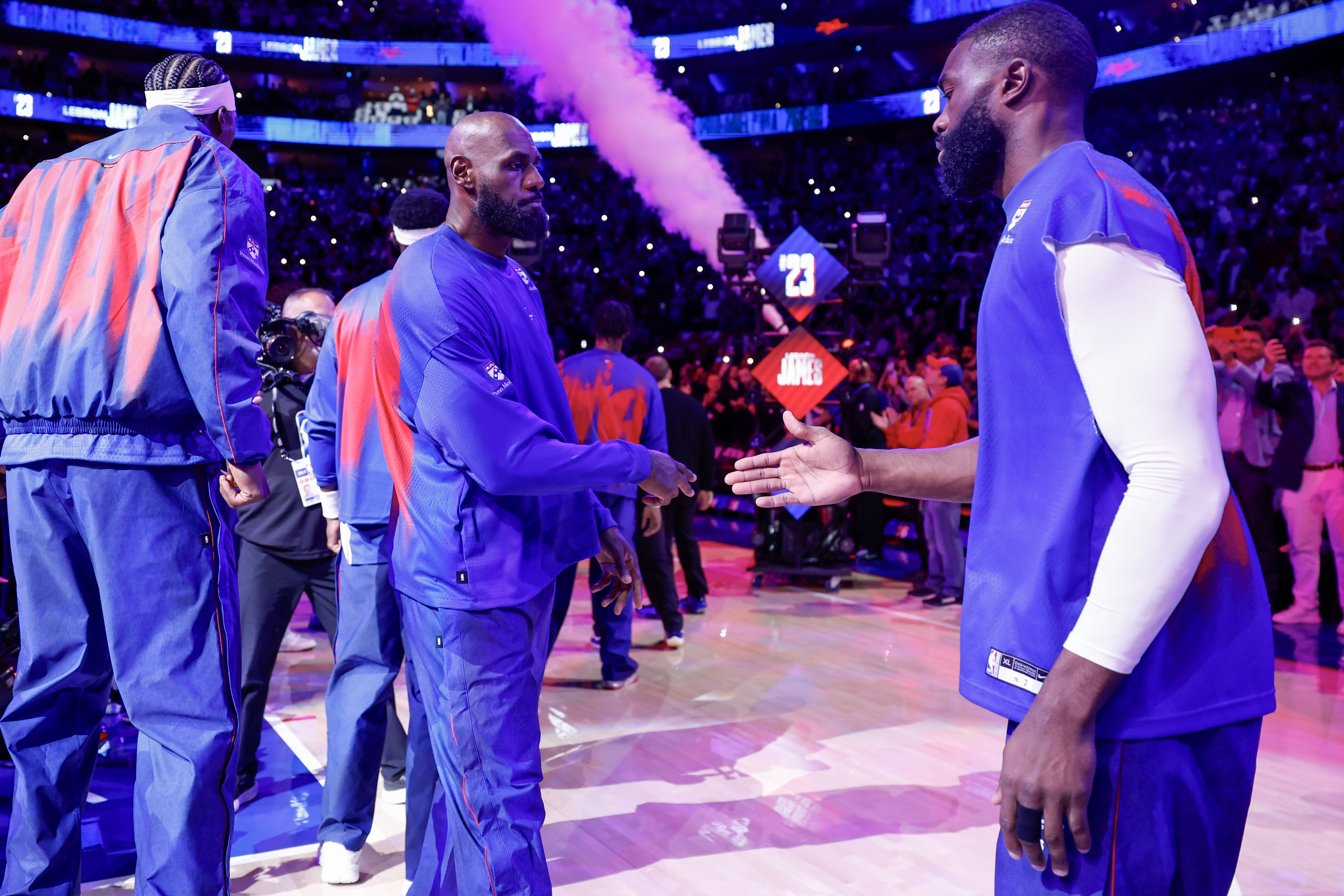
Just before tipoff, LeBron James poured powder onto his hands, cameras gathered around and the crowd erupted as he did his trademark powder toss. Even after beating the Knicks two nights ago, that moment felt like an unofficial start of this season for the 76ers.
And, well, the Sixers came out and played — at first — as if that game Tuesday didn’t happen and they never played with each other. Then they played like the contenders they picture themselves to be in erasing all of a 29-point deficit on what turned out to be a wild night at Xfinity Mobile Arena.
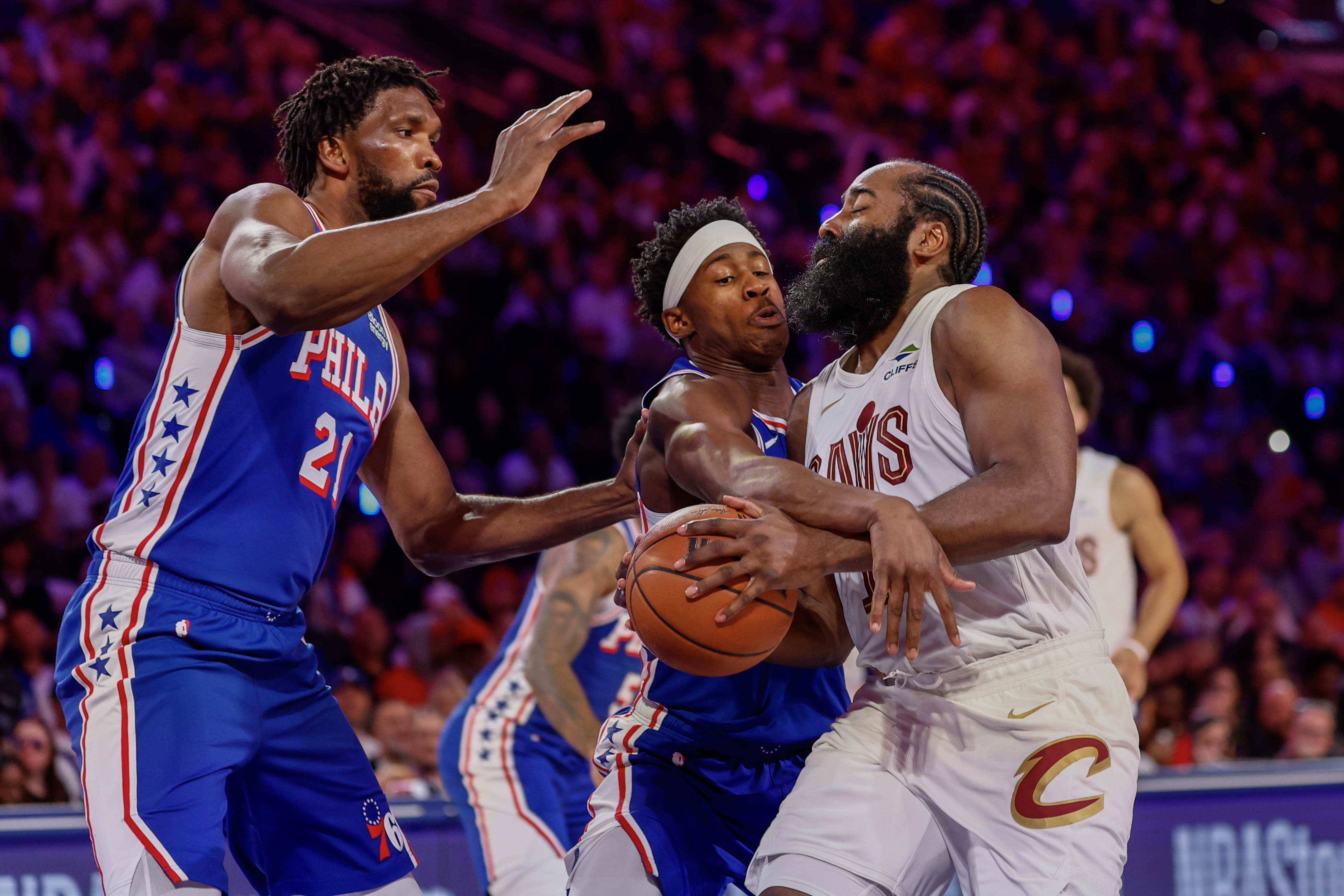
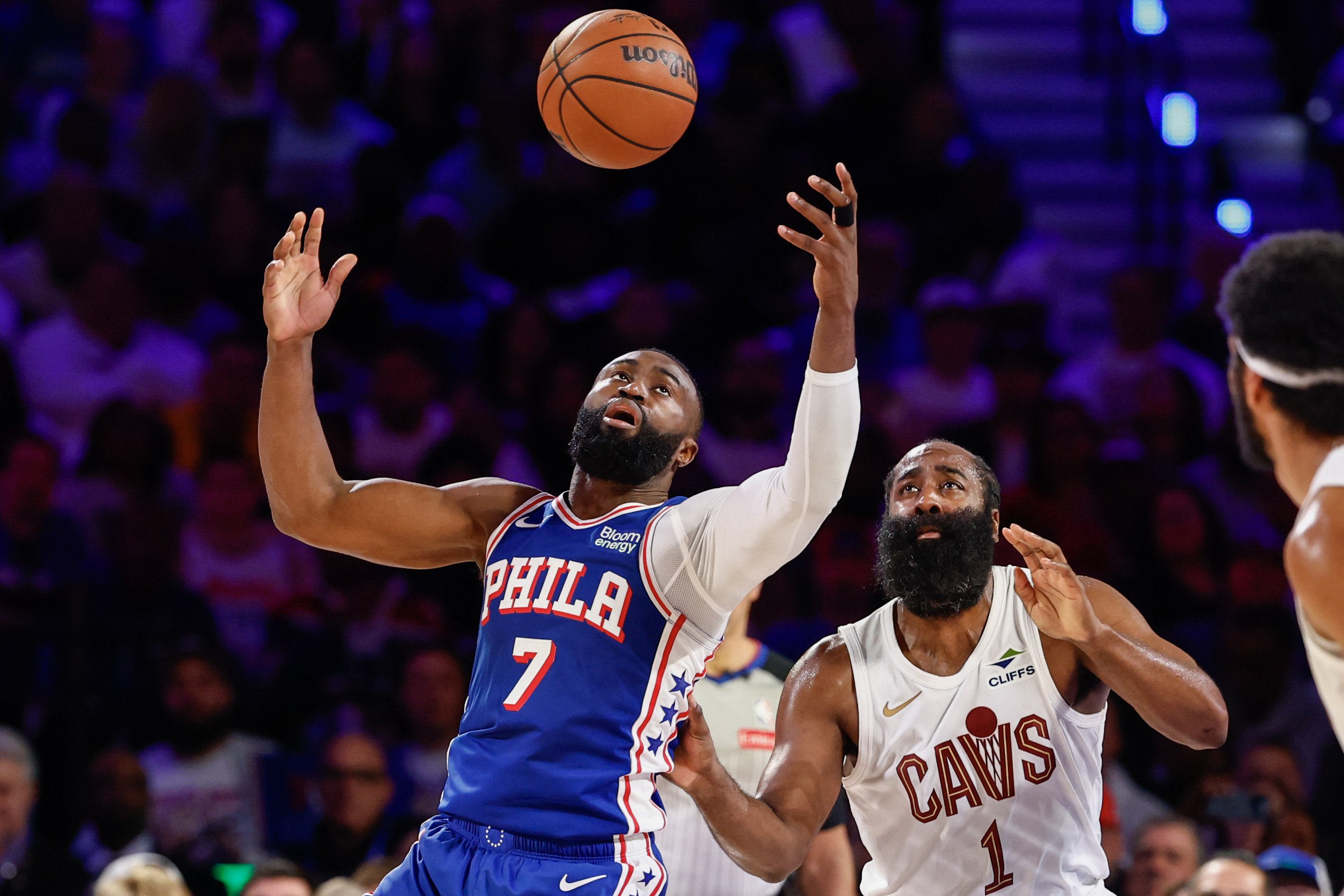
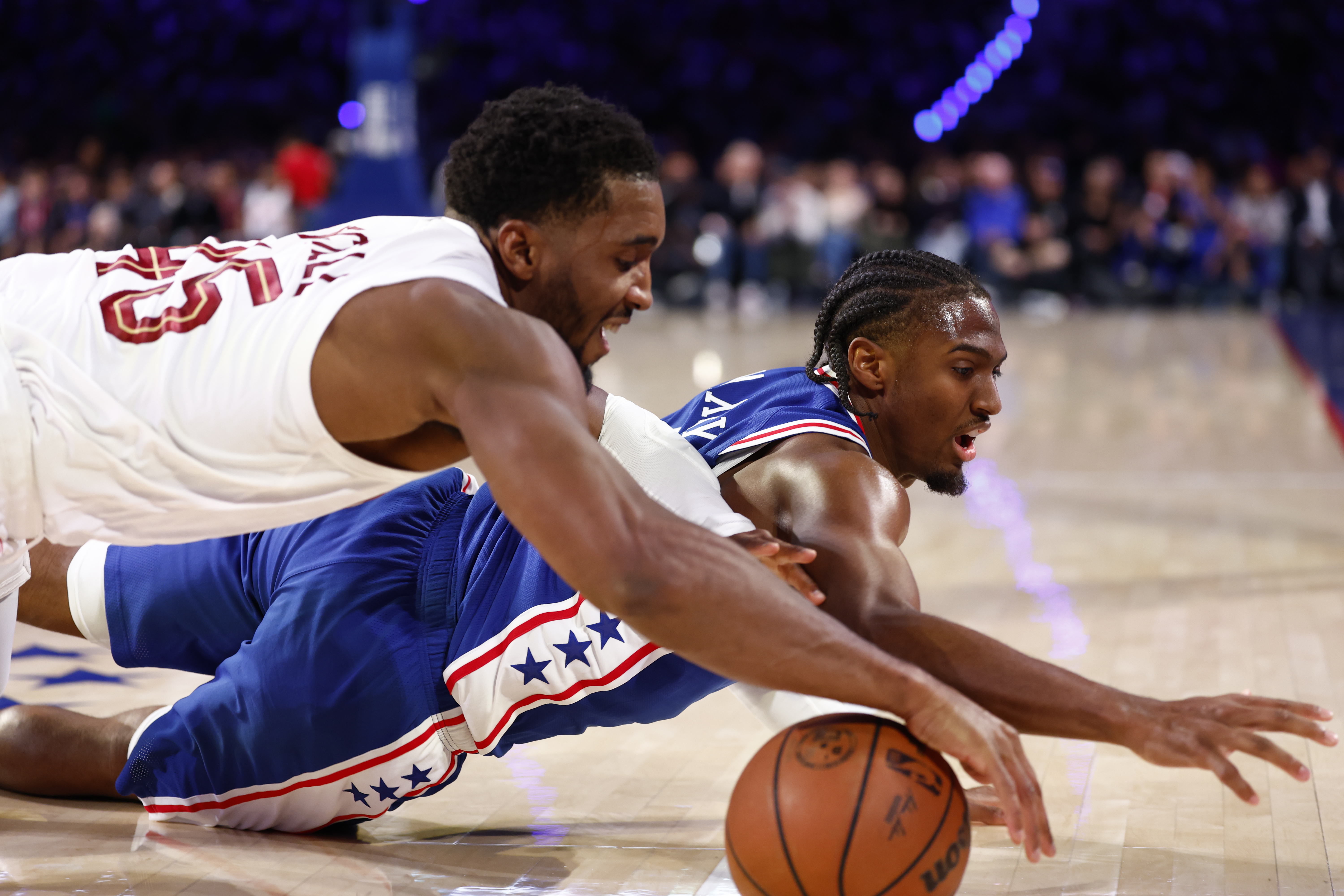
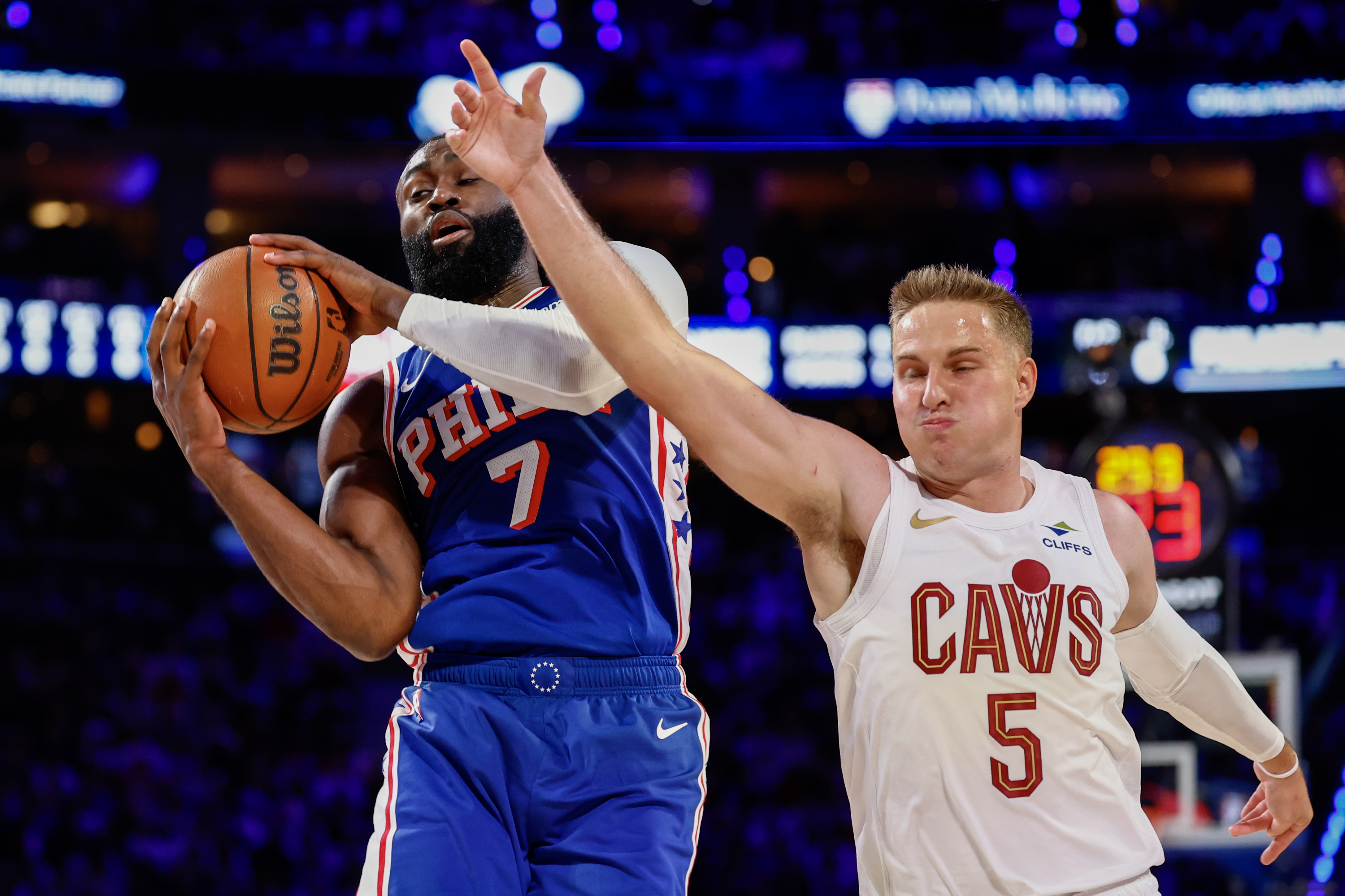
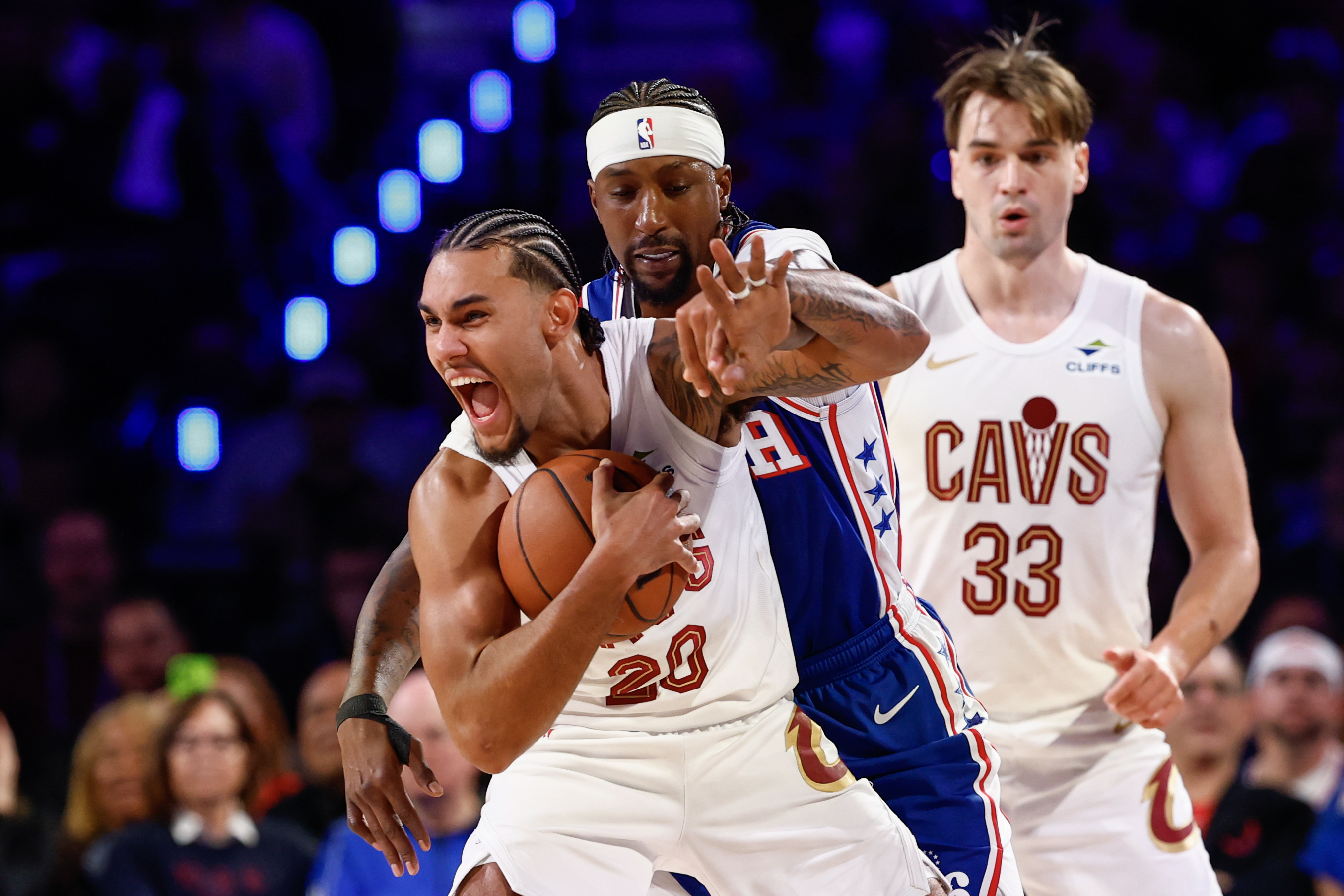
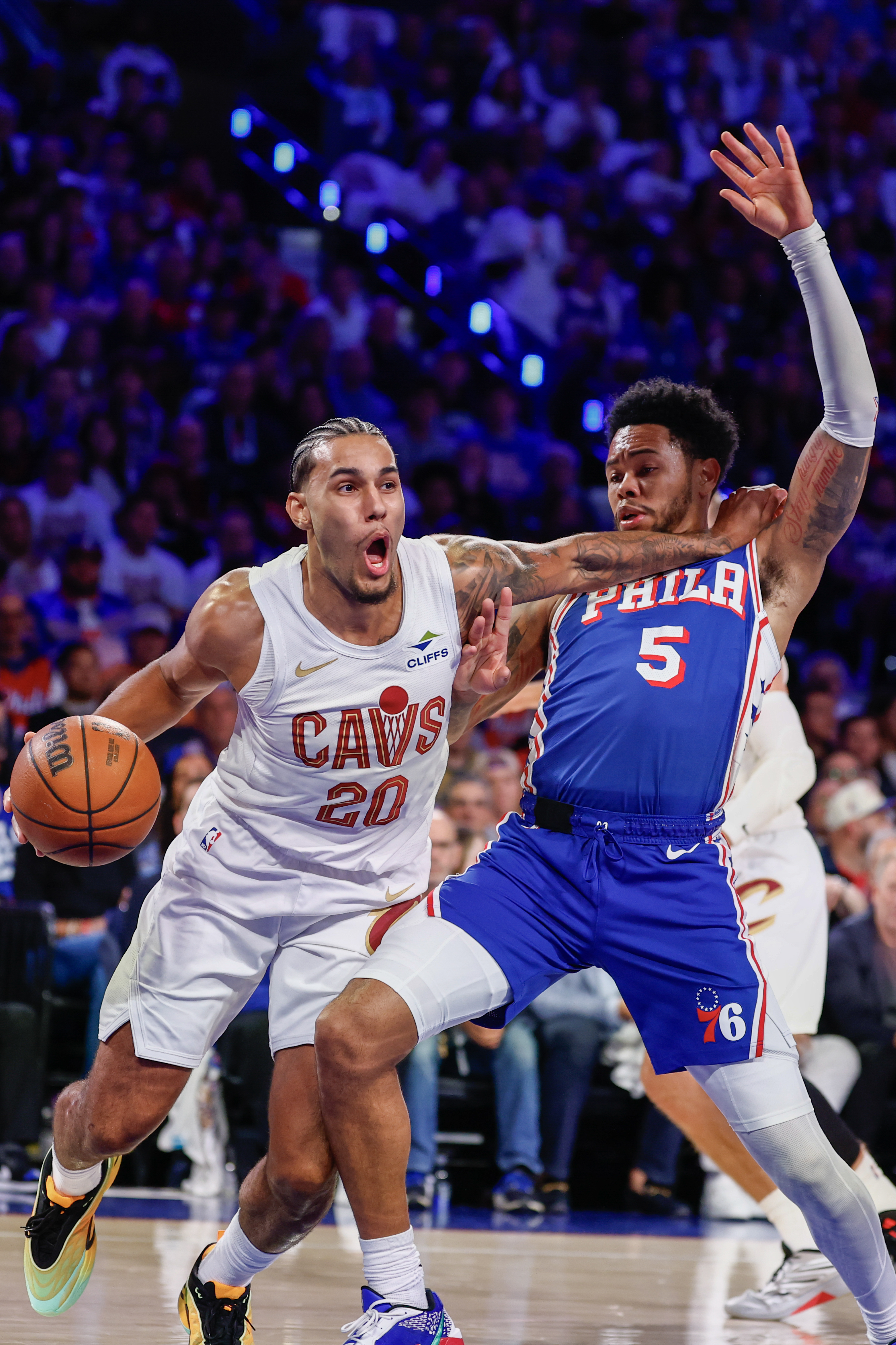
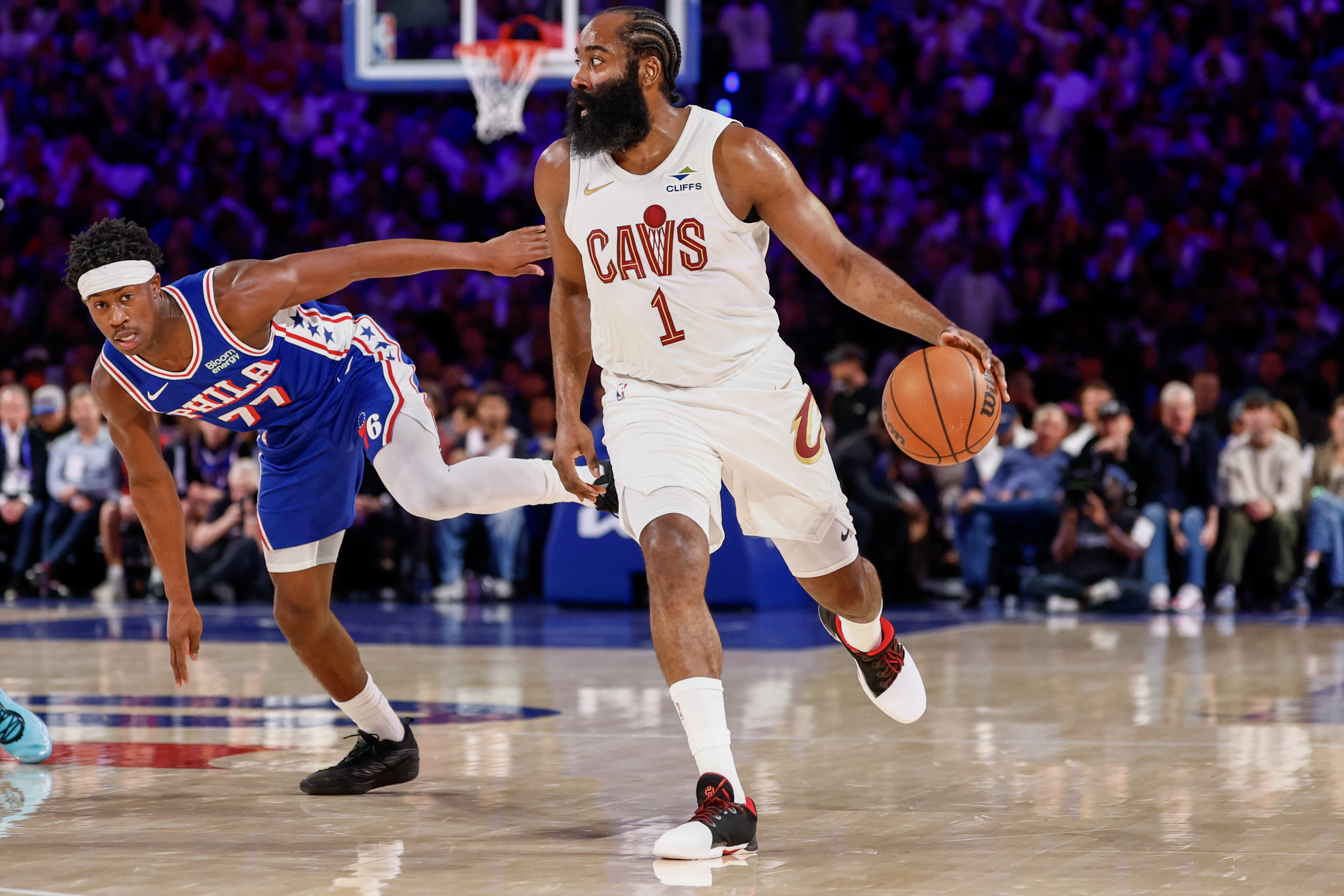
A delirious, standing crowd at the start went to booing by the second to delirious and on its feet again in the second half of a 114-106 Sixers win over the Cleveland Cavaliers. It was a playoff-like atmosphere that included VJ Edgecombe getting a bloody nose, and a momentary tussle between former teammates Tyrese Maxey and James Harden in the fourth quarter, which caused the crowd to shower Harden with a not-for-print chant.
Maxey led the Sixers with 32 points as every starter scored in double figures. Joel Embiid had 24, James produced 17, and Jaylen Brown came through with 10 of his 21 in the fourth. Edgecombe also chipped in 11.
Everyone plays a part
All the stars had a starring role at one point or another.
James and Maxey sparked the comeback with transition offense off Cleveland turnovers in the third quarter. That got the Sixers back in it. Then in the fourth quarter, when it seemed the Sixers just could never get all the way back, Embiid had seven straight points to give the Sixers their first lead, 96-95.
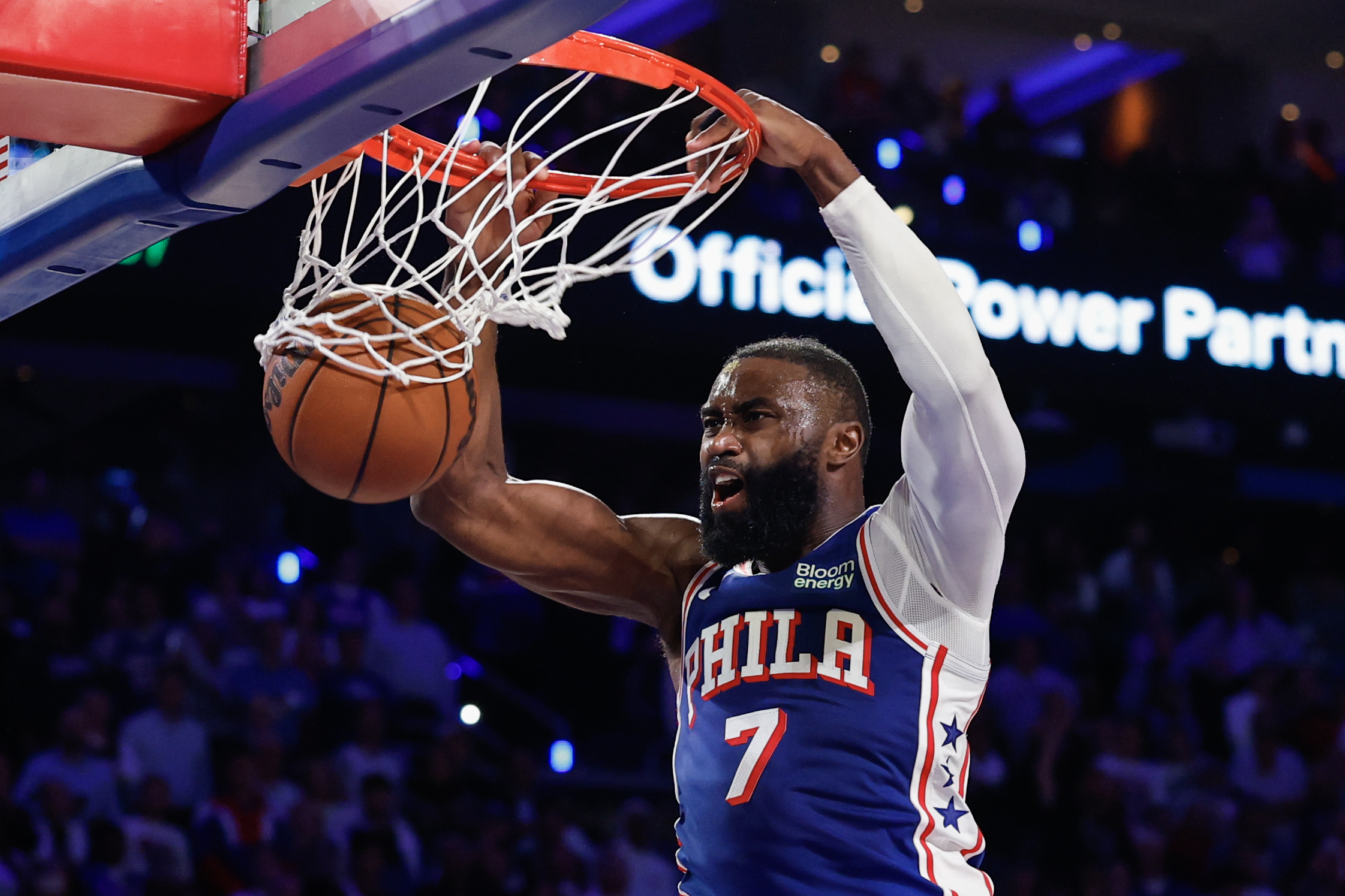
Sixers guard Jaylen Brown dunks late in the fourth quarter against the Cavaliers Thursday.Yong Kim / Staff Photographer
Brown had the biggest flourish, as he found his way into the paint for six consecutive points of his own to build the Sixers lead to 102-95.
After Brown’s third straight bucket, the crowd reached its highest decibel level of the night, and he walked back down the court yelling as his teammates swarmed him.
Maxey and Brown then iced the win with 44 seconds to play with a pair of layups.
Defense, James, Maxey spark comeback
All comebacks start with good defense, and the Sixers didn’t waste any time out of halftime digging in on that end of the floor. They forced two quick turnovers on an 11-0 burst that brought them back into the game. The Sixers forced Cleveland into eight third-quarter miscues and returned the favor after their miserable first half.
The Sixers then got out and ran, and then they ran some more. James had 10 points in the quarter while Maxey had nine and Jaylen Brown had another seven. The Sixers got within two, 84-82, before Cleveland scored the final six points of the quarter for a 90-82 lead entering the fourth.
The defense and transition offense seemed to feed off the crowd, while the Cavaliers couldn’t stop fouling; officials called them for 11 fouls in the quarter. James and Maxey took charge of the offense during that stretch, with the two of them pushing the ball up the floor every chance they got, make, miss or turnover.
Brutal start
Even with all the energy in the building, the Sixers came out flat, or perhaps all the emotion made them play a little tight.
The Cavs dominated the first quarter as the Sixers stumbled out of the blocks. They committed nine turnovers in the first quarter while hitting just eight field goals. The Cavaliers converted those nine turnovers into 13 points with Mitchell scoring 12.
The Cavaliers pressured the Sixers stars and made it hard for them to get the ball even on simple passes. That forced isolation offense for the likes of Brown, who was just 1-for-7 from the field to open the night.
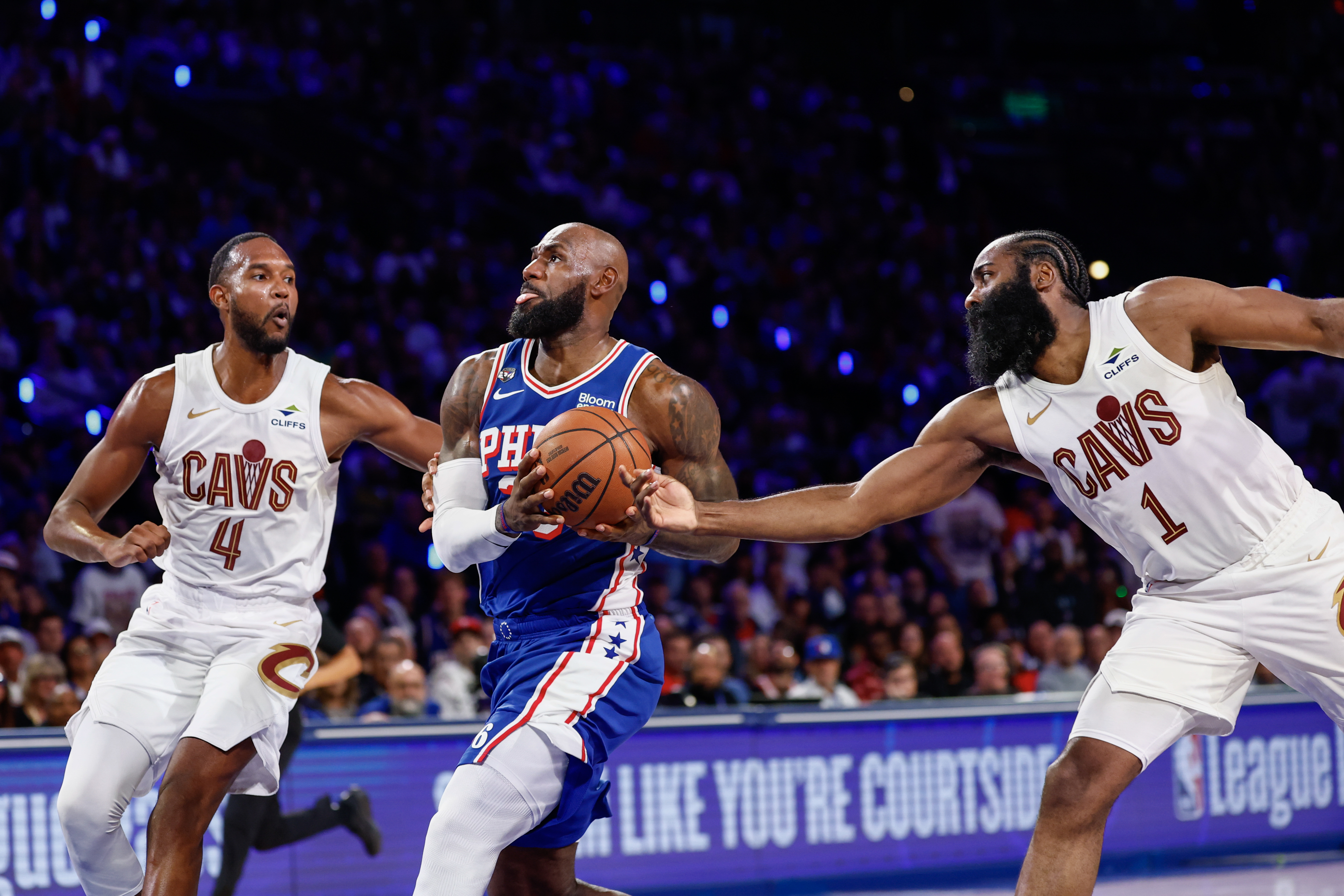
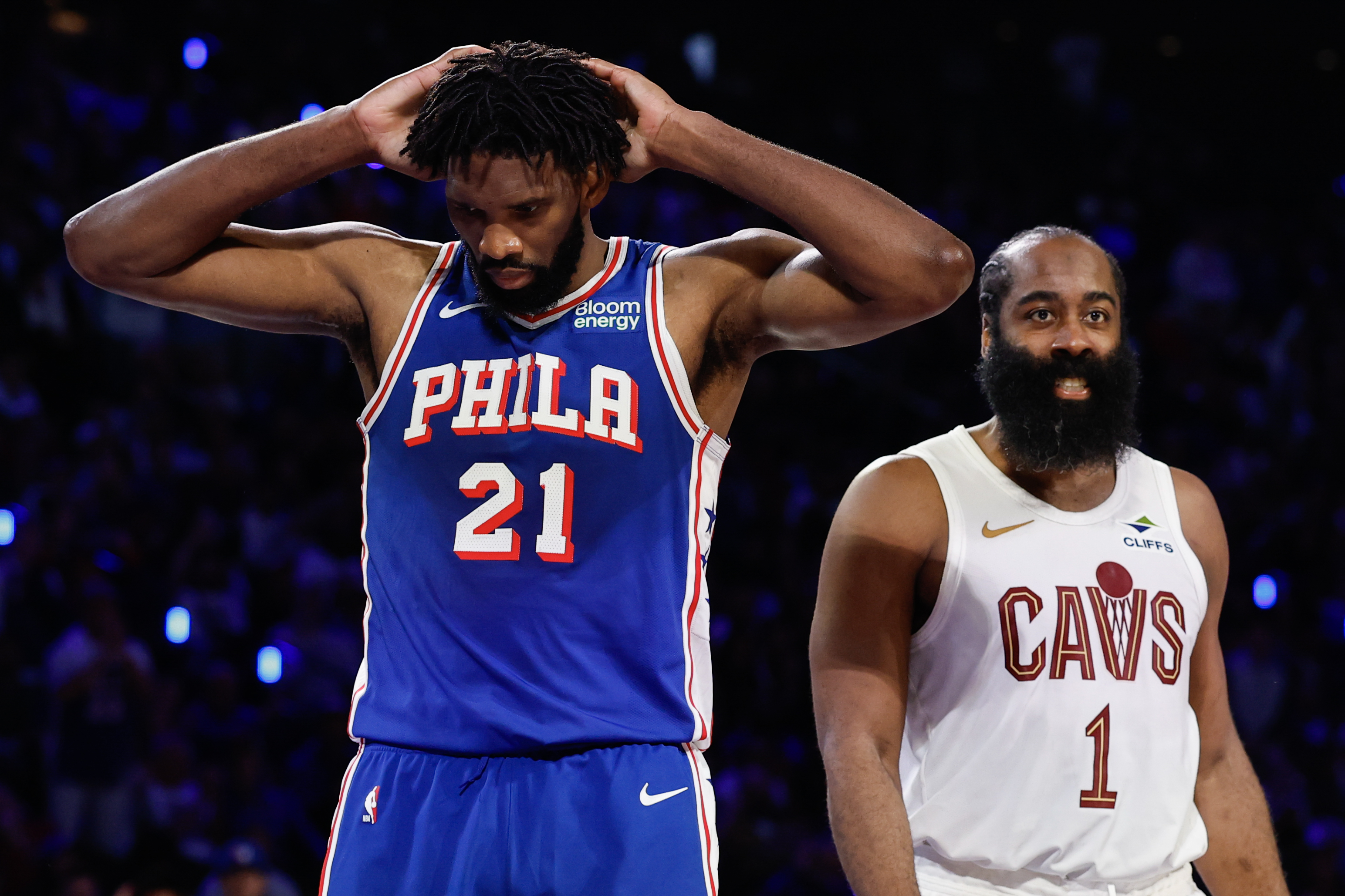
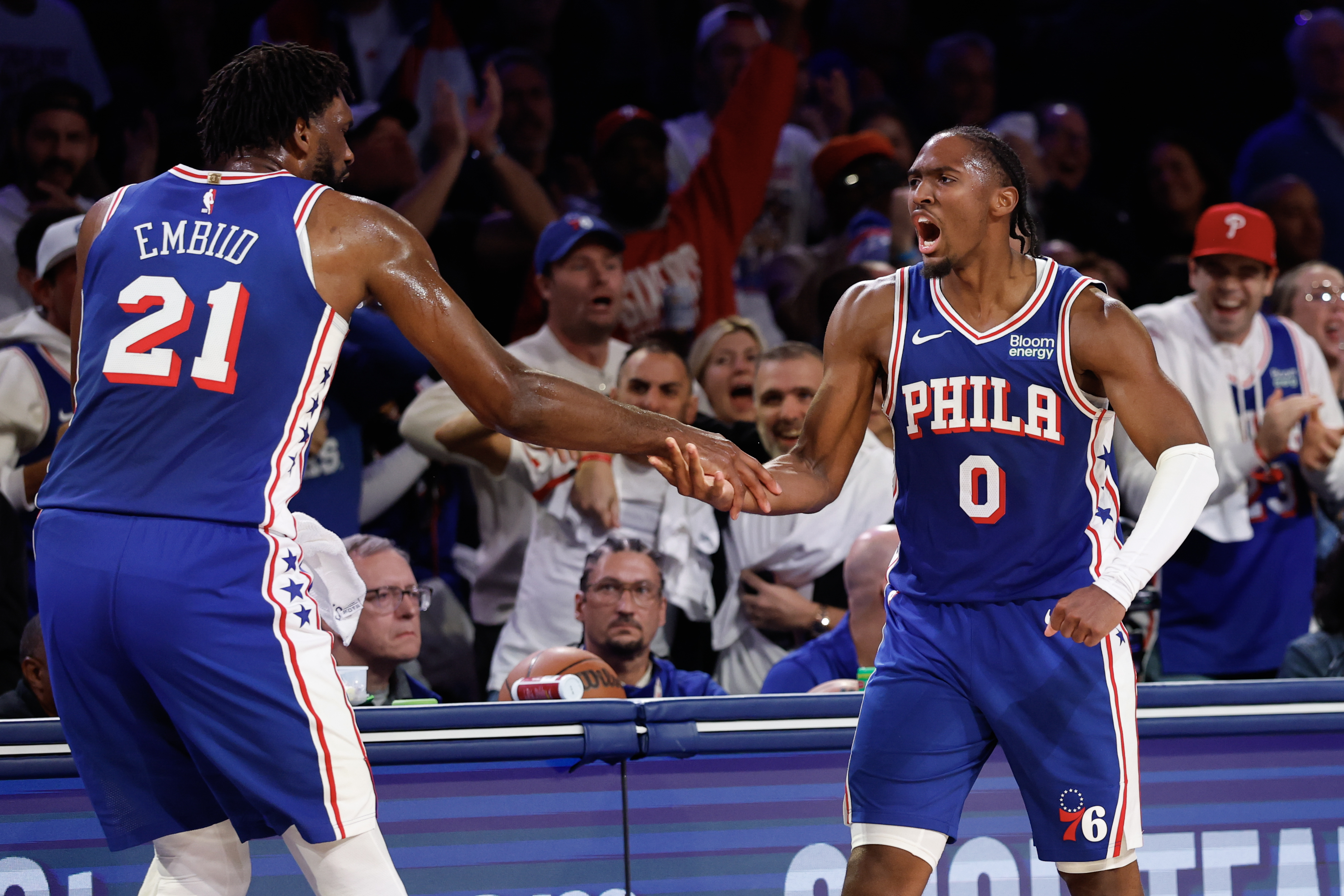
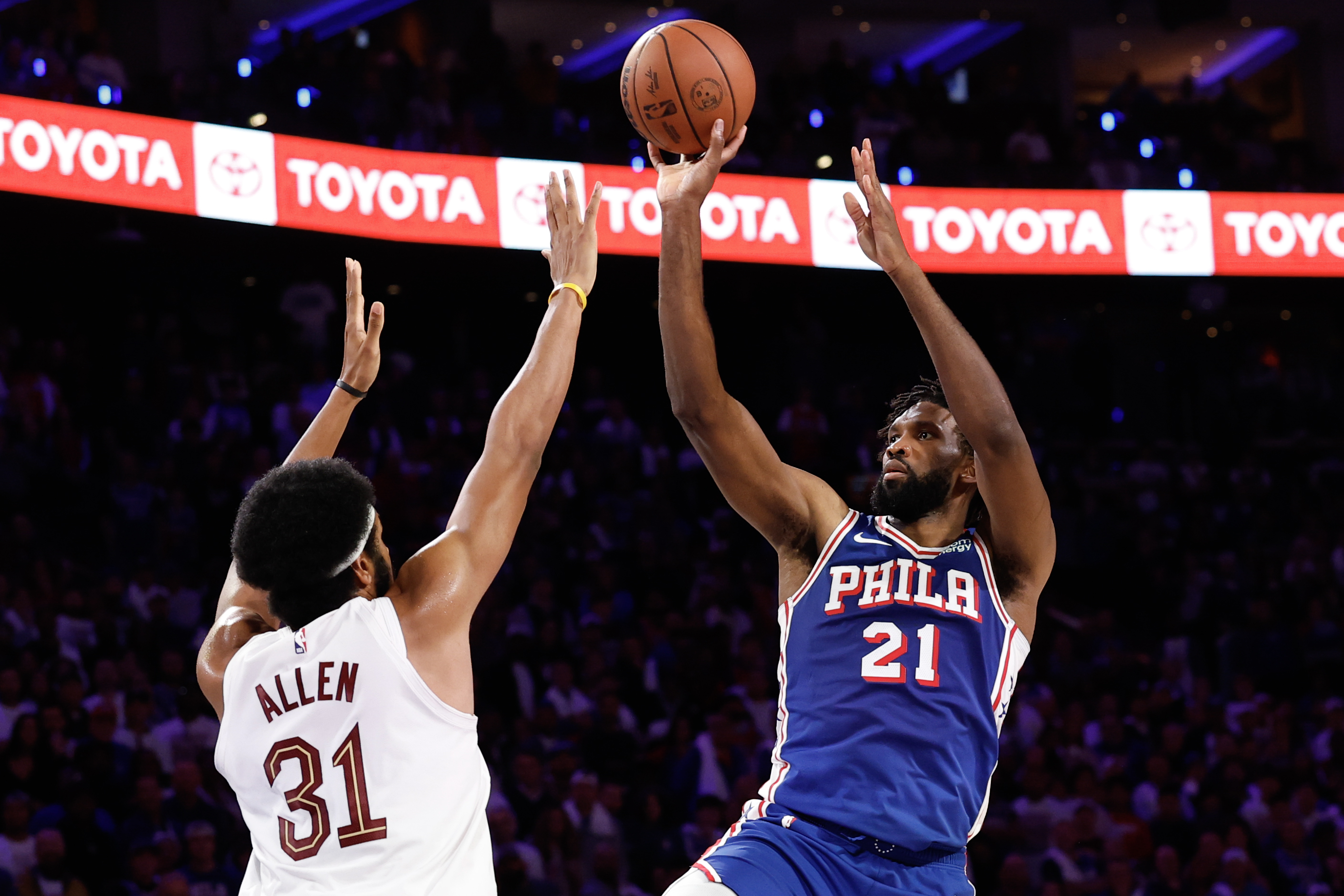
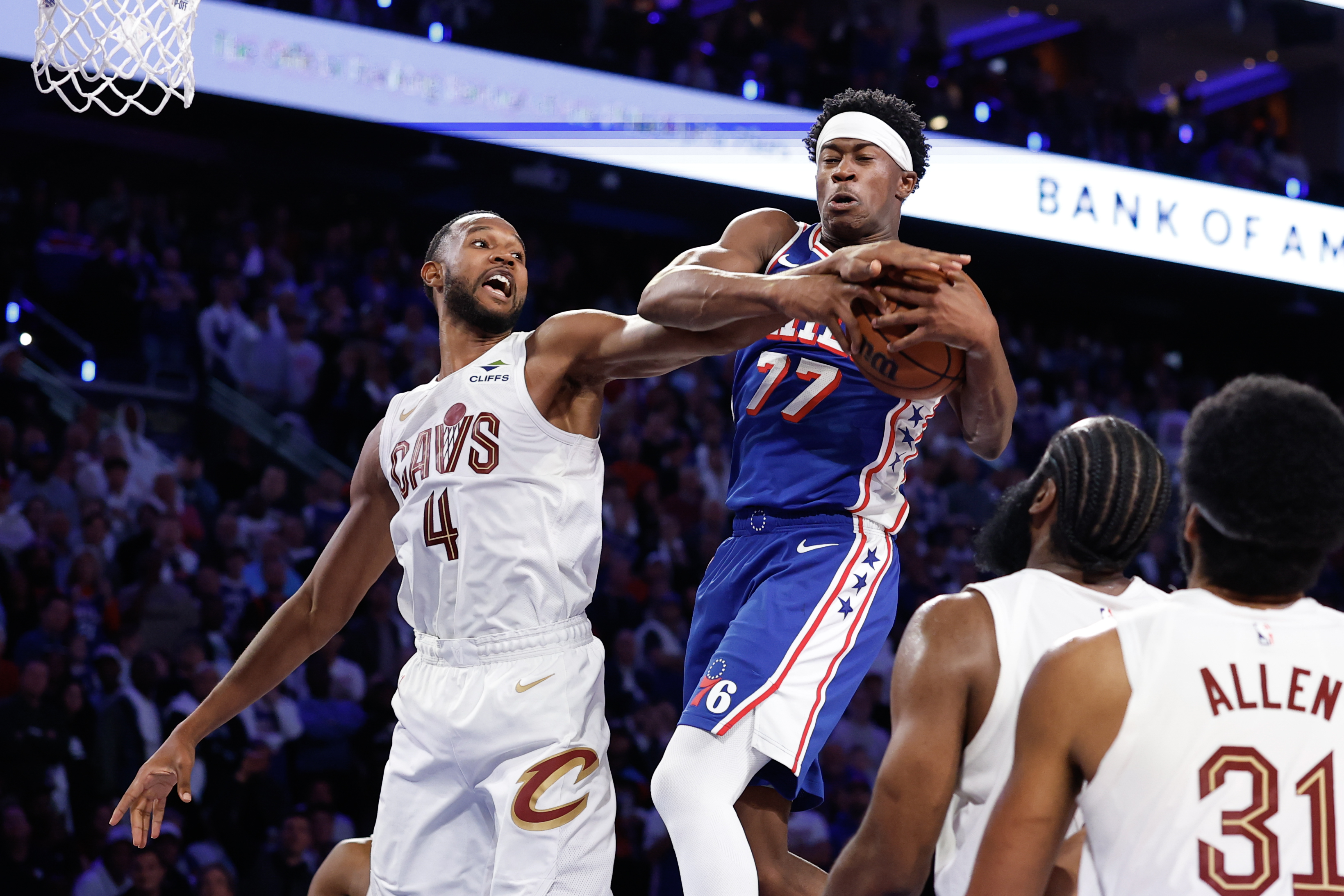
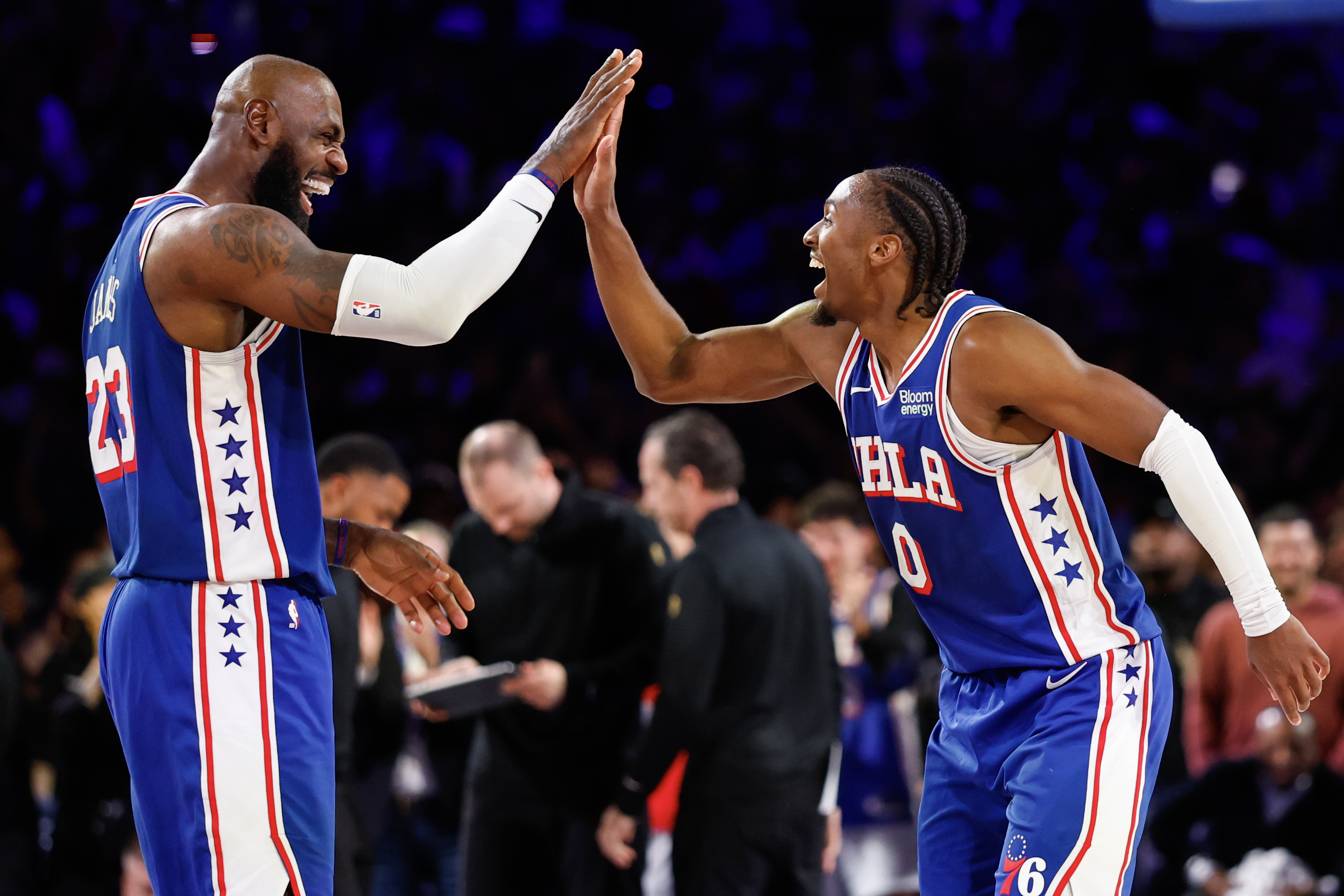
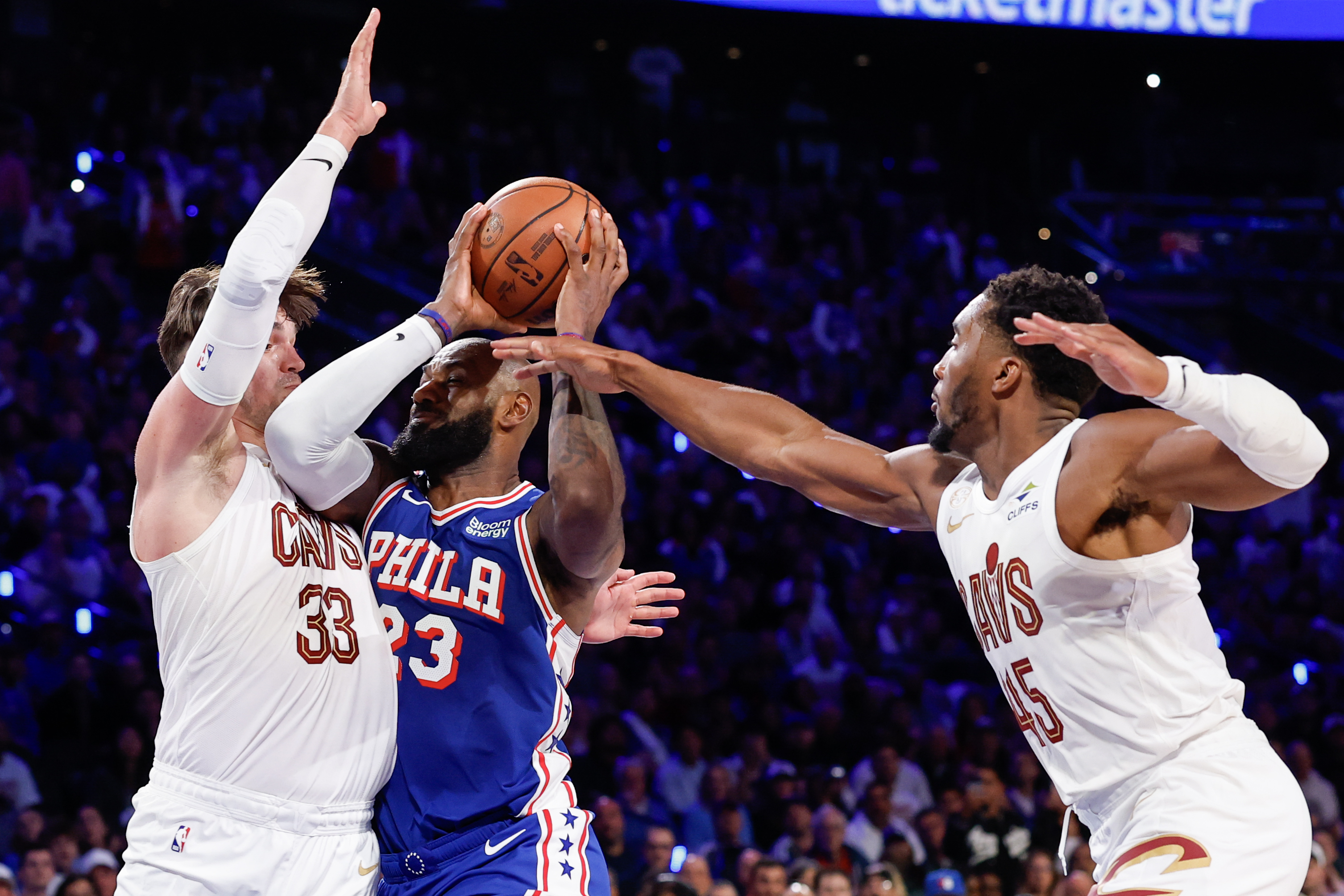
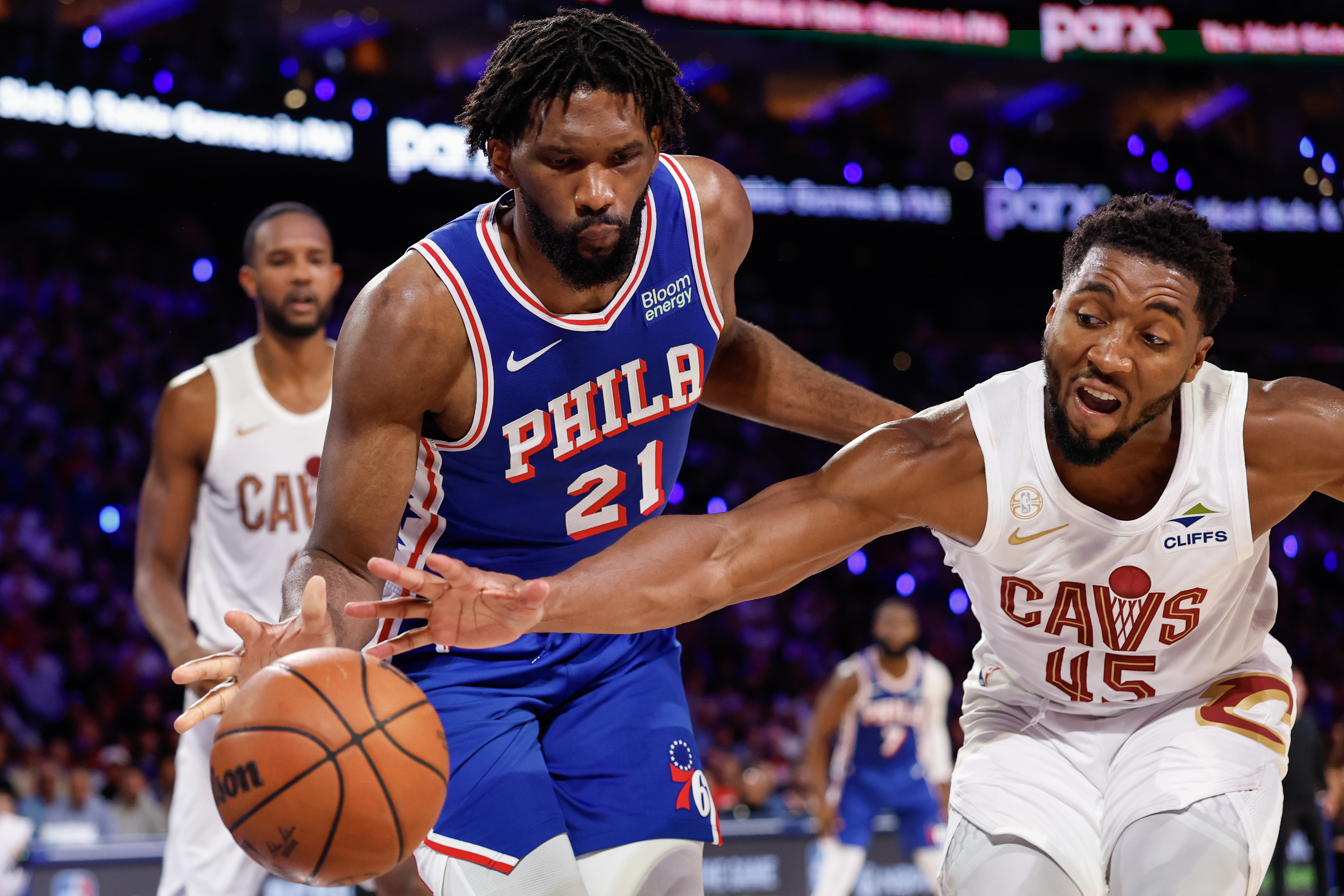
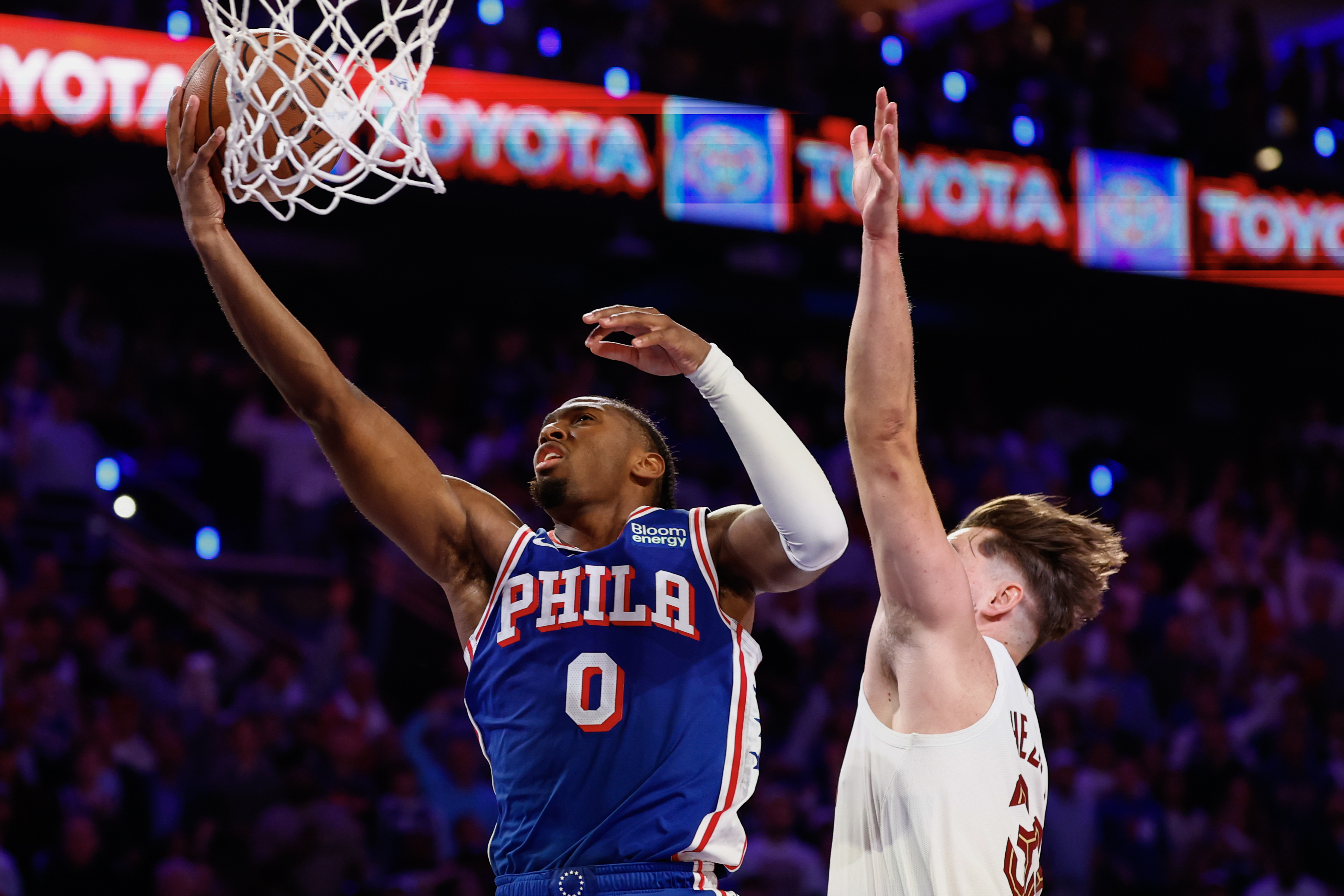
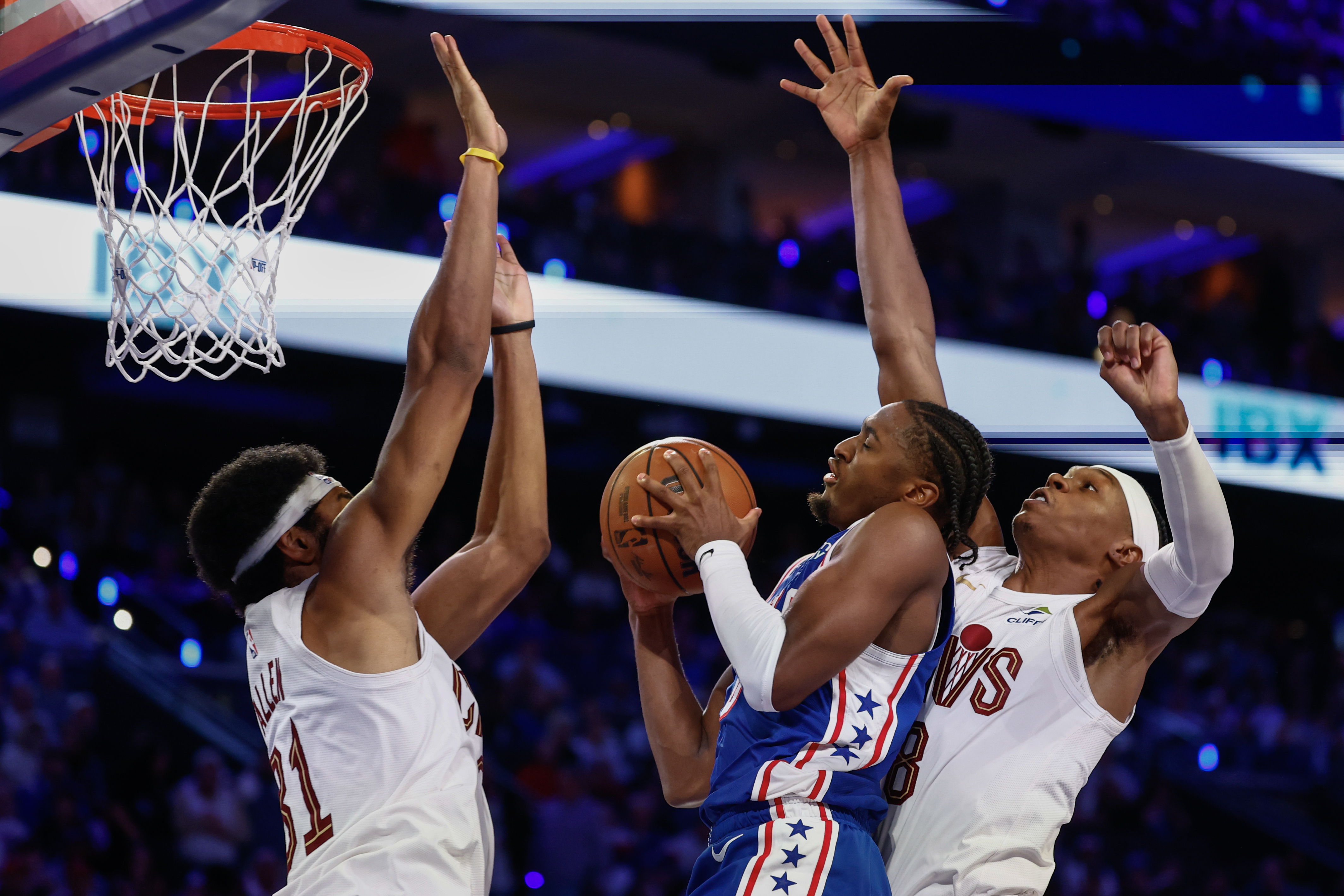
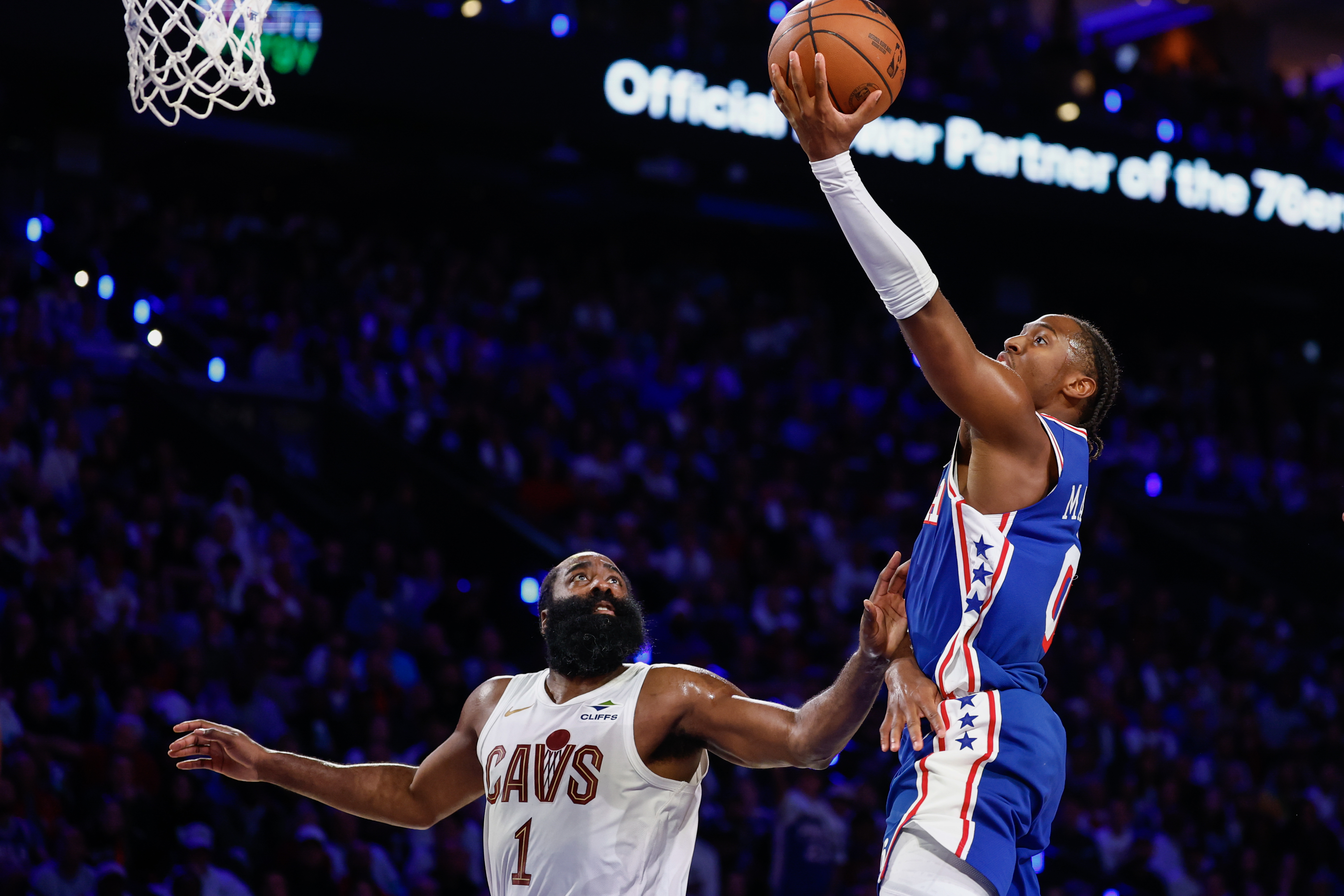
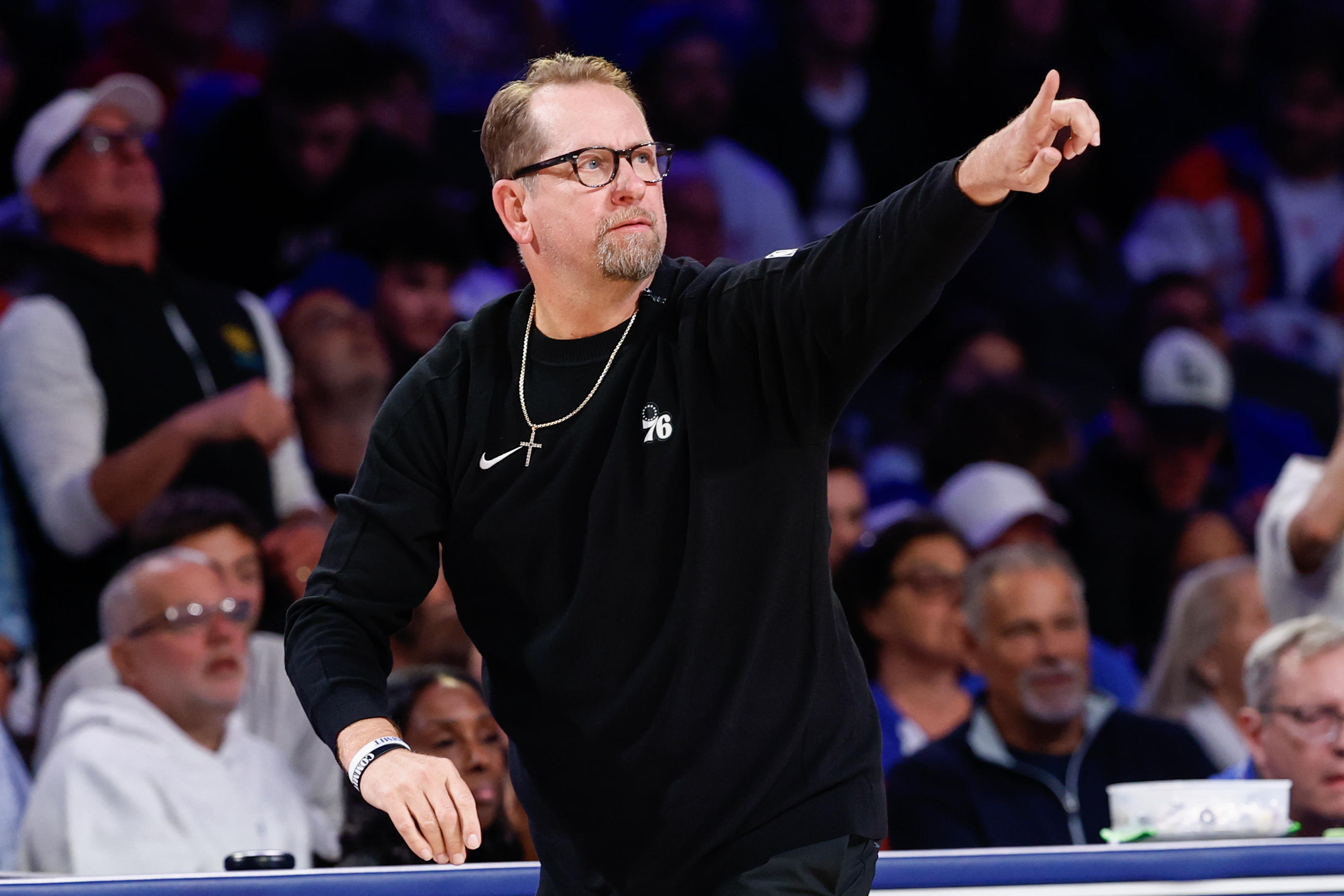
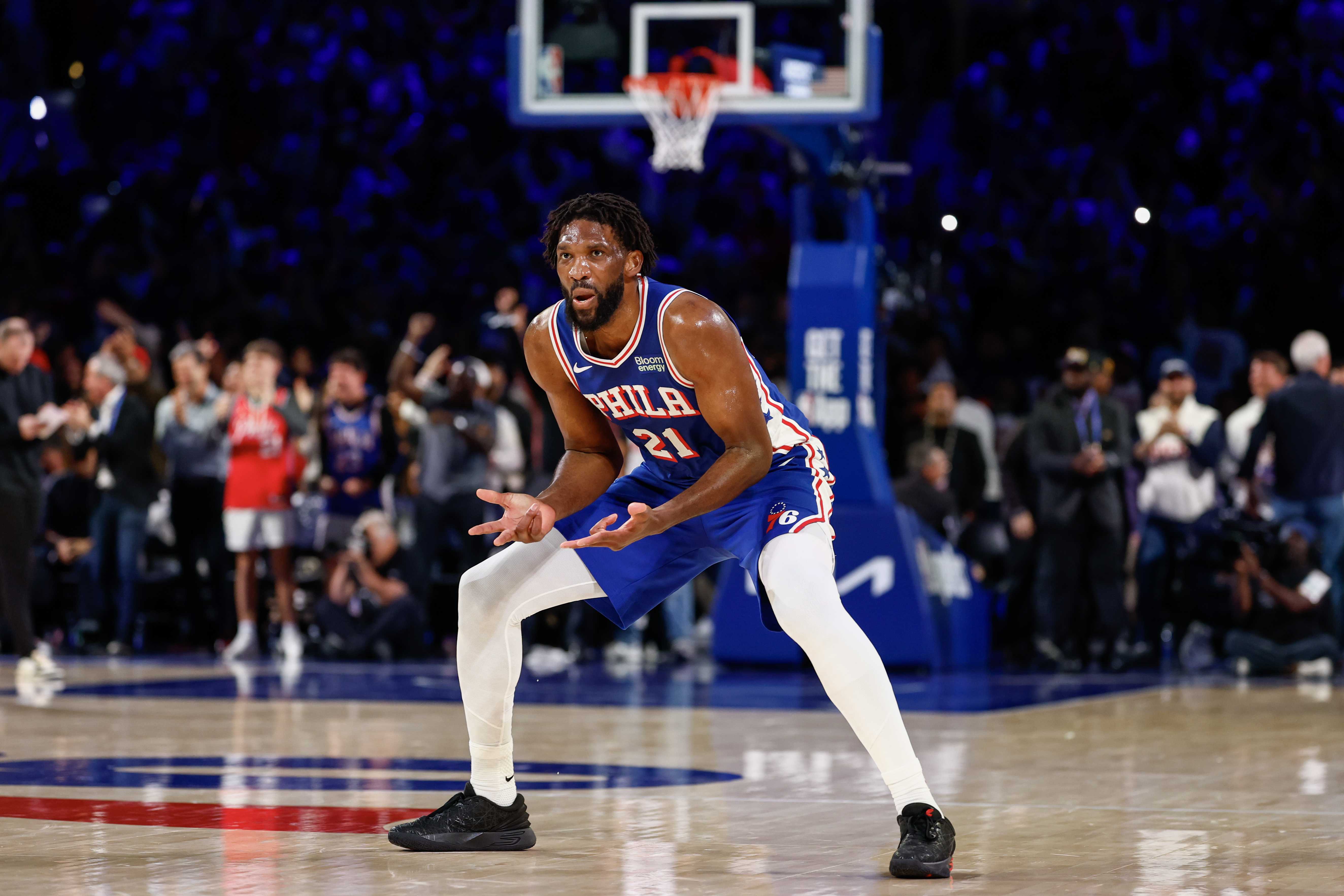
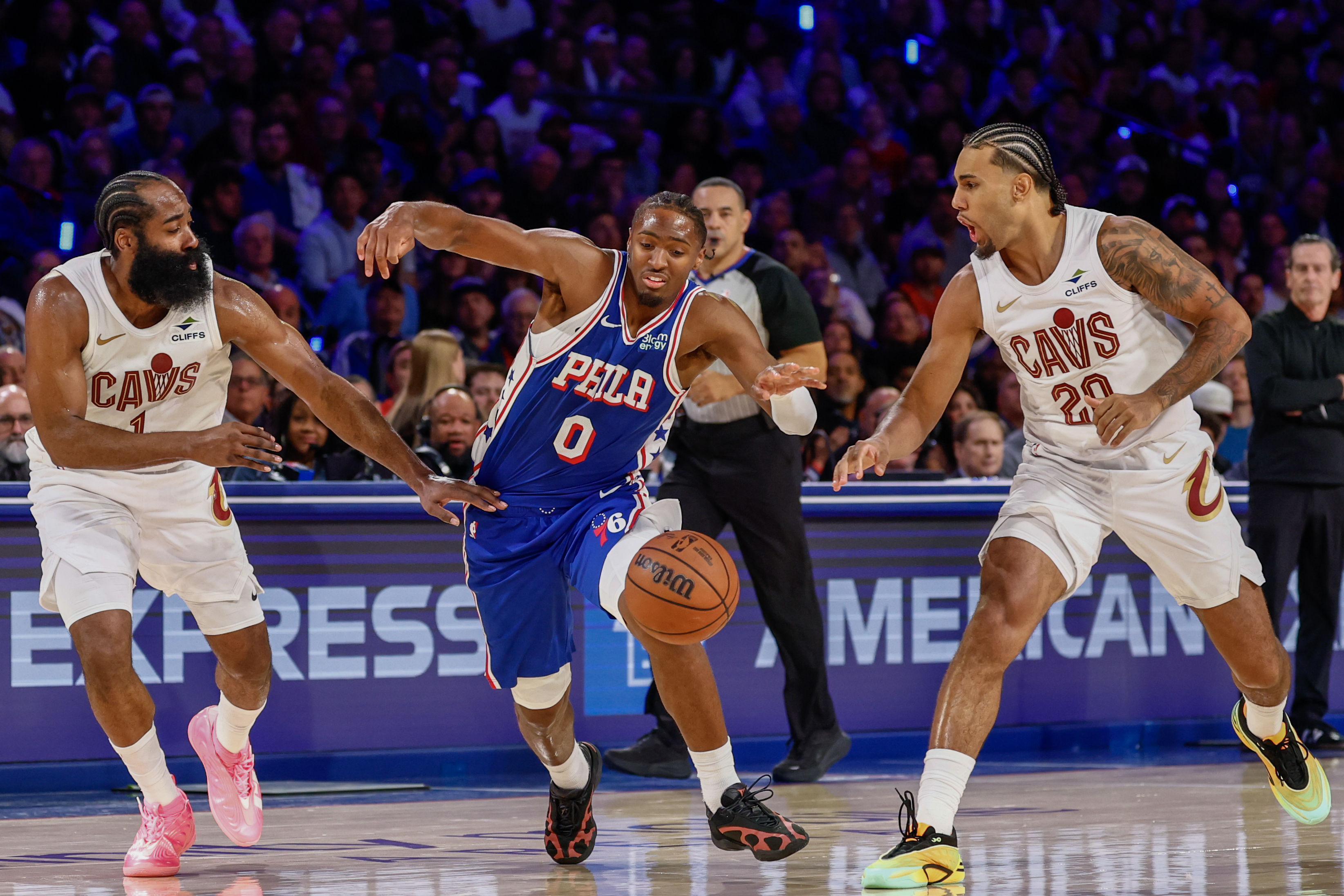
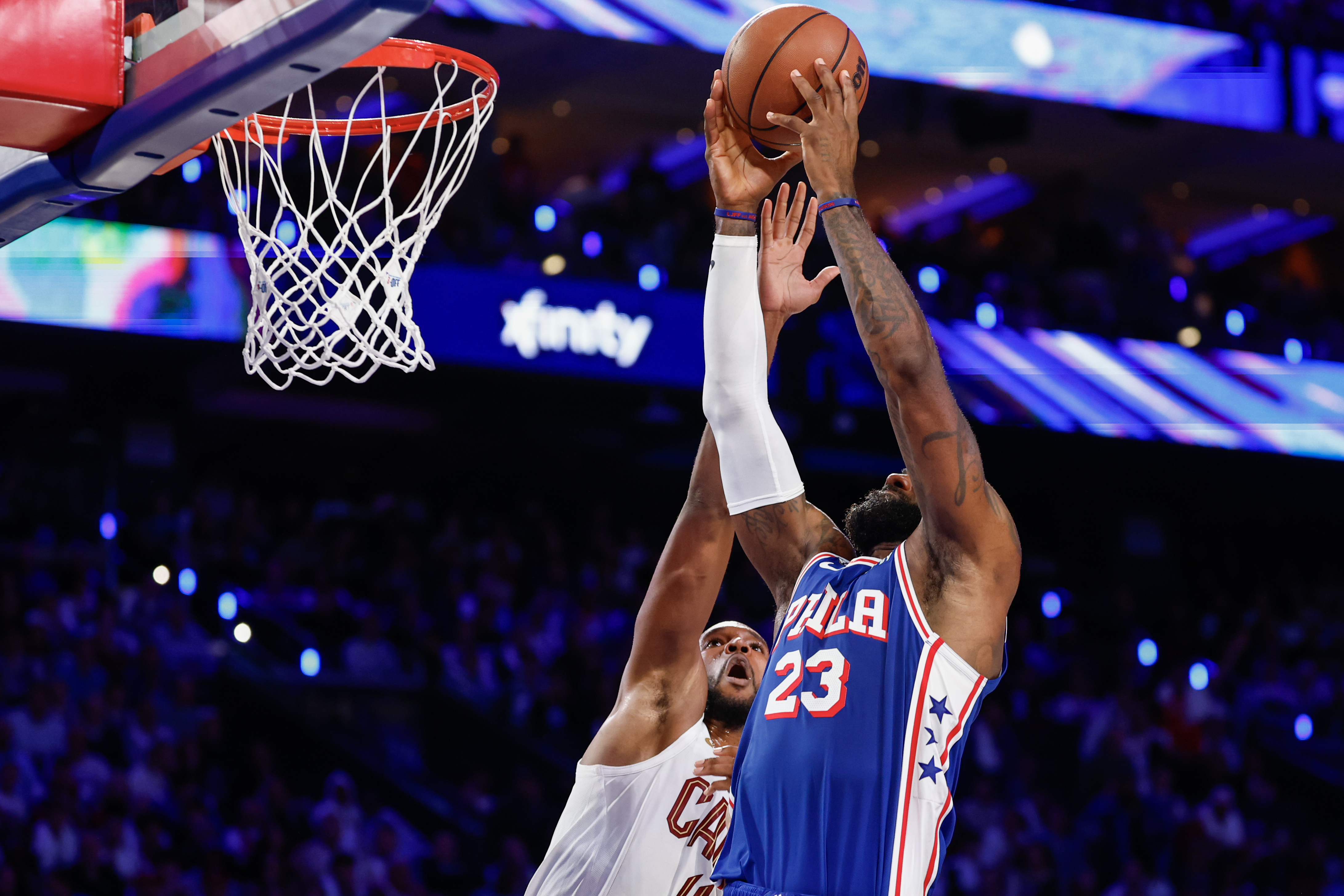
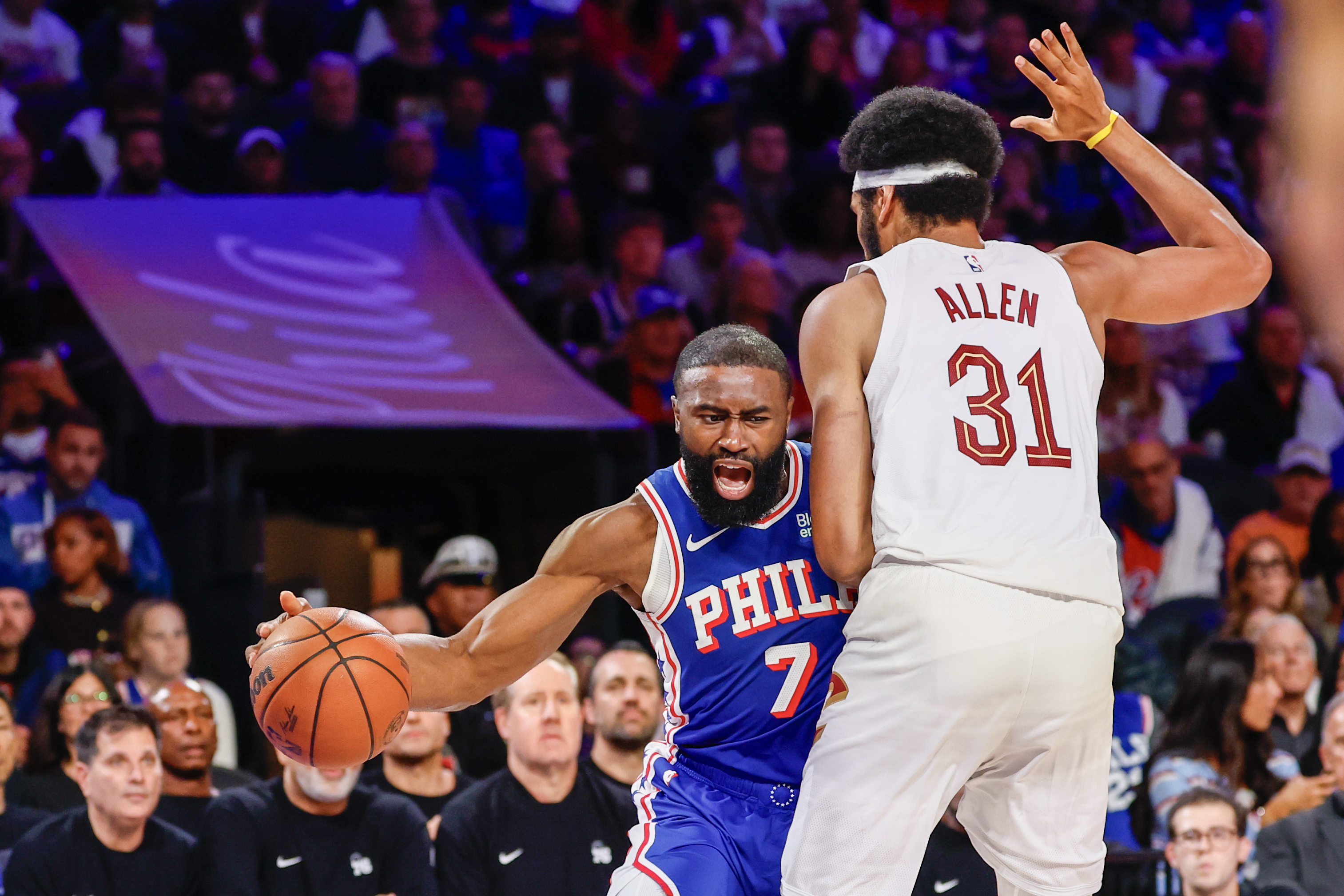
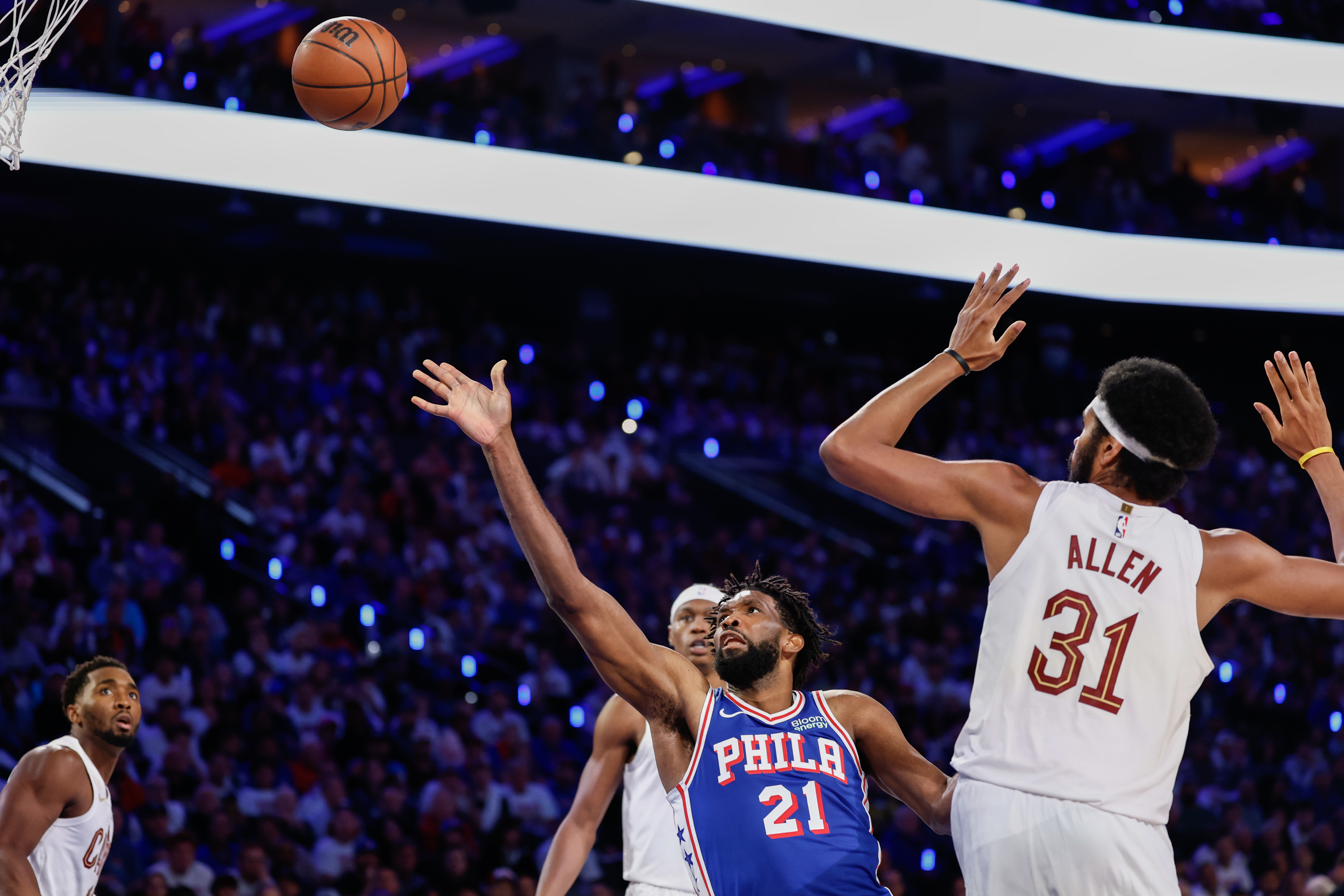
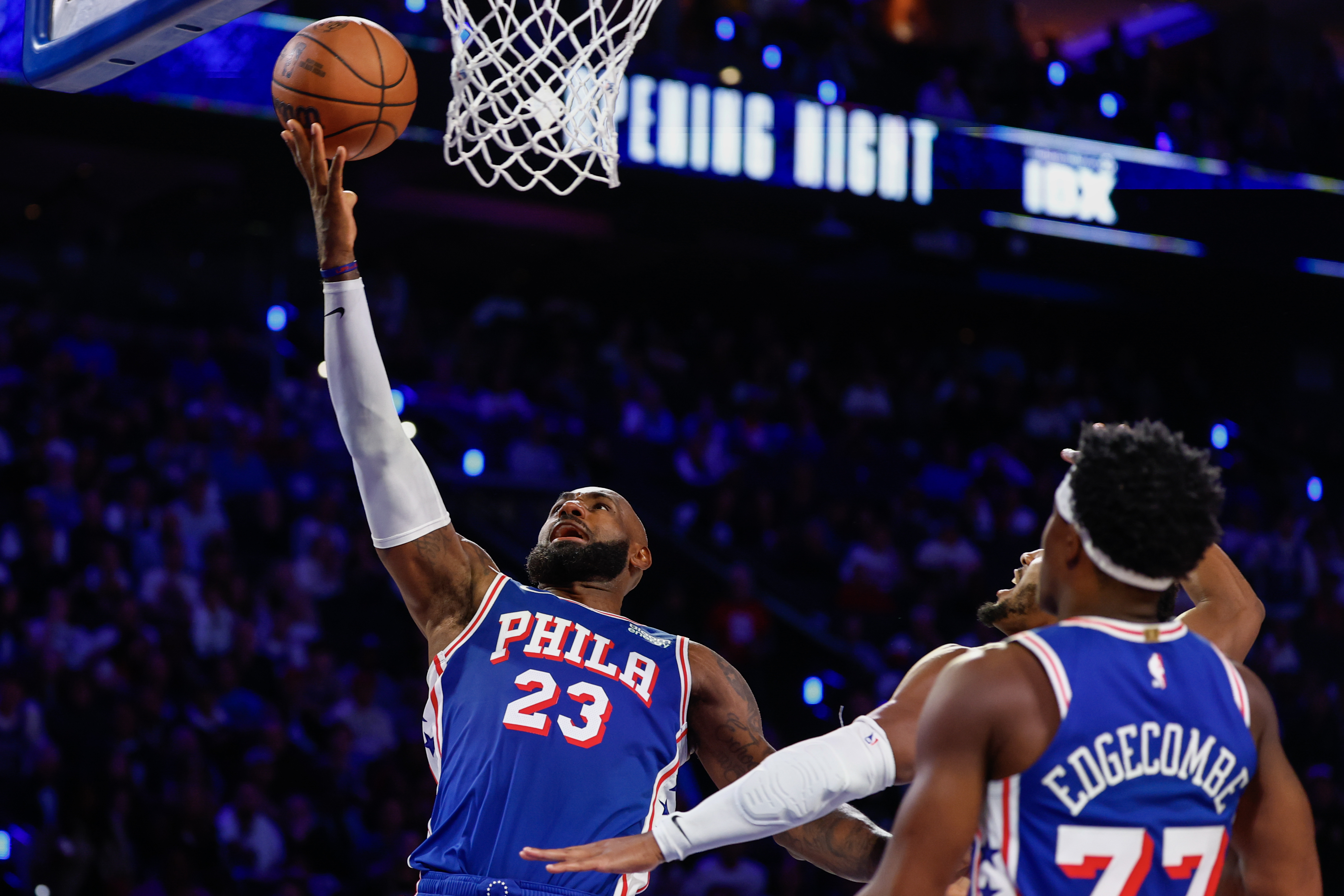
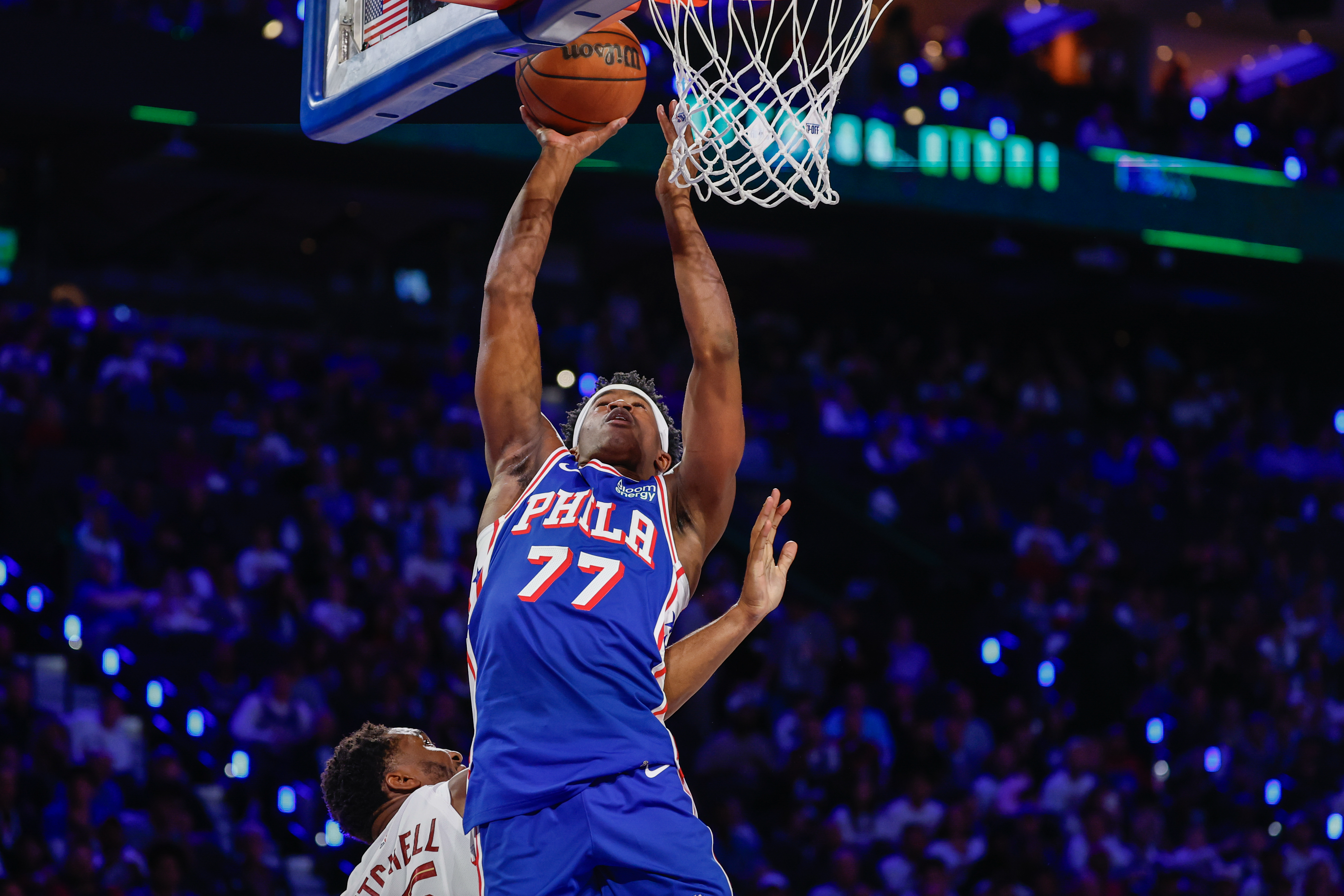
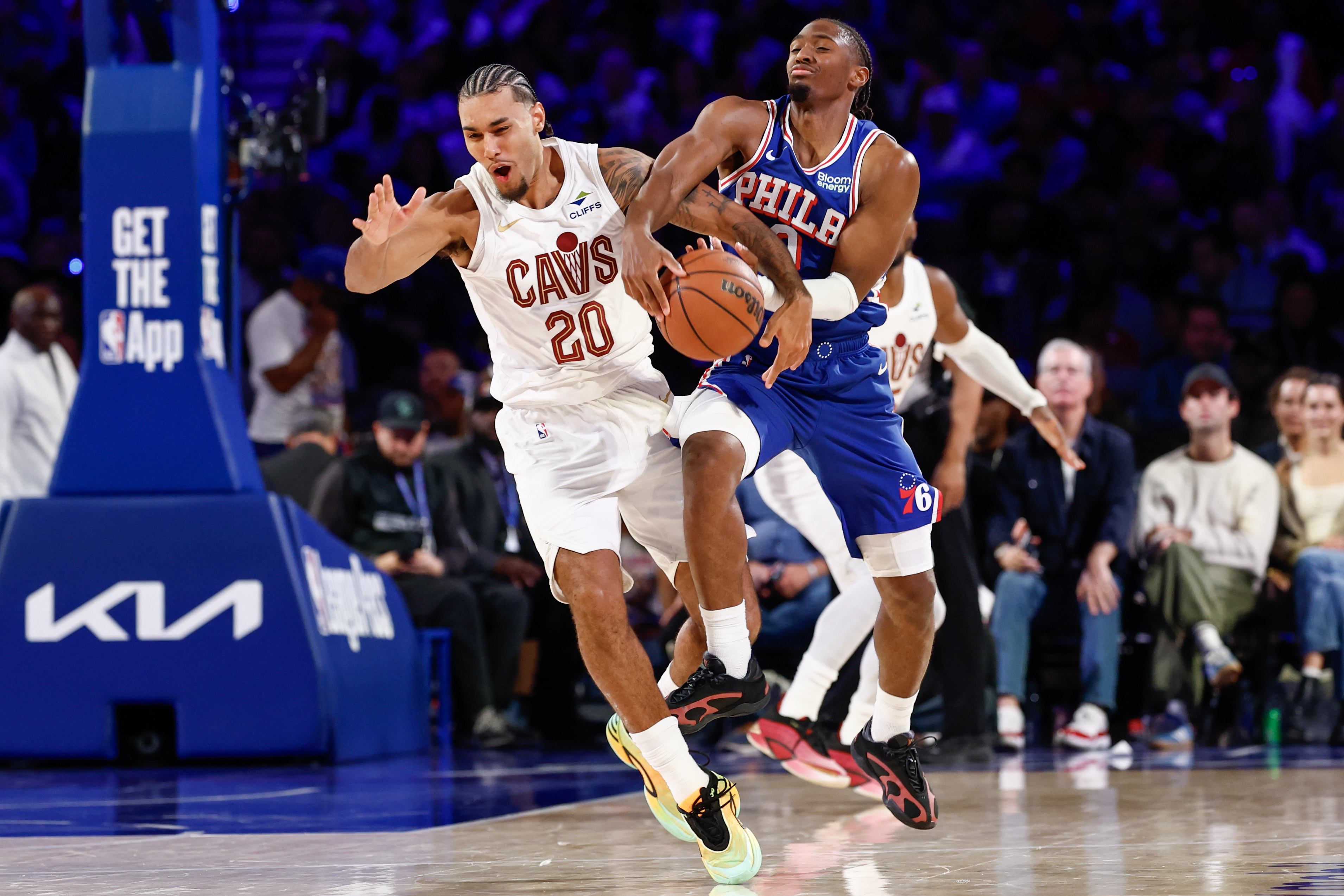
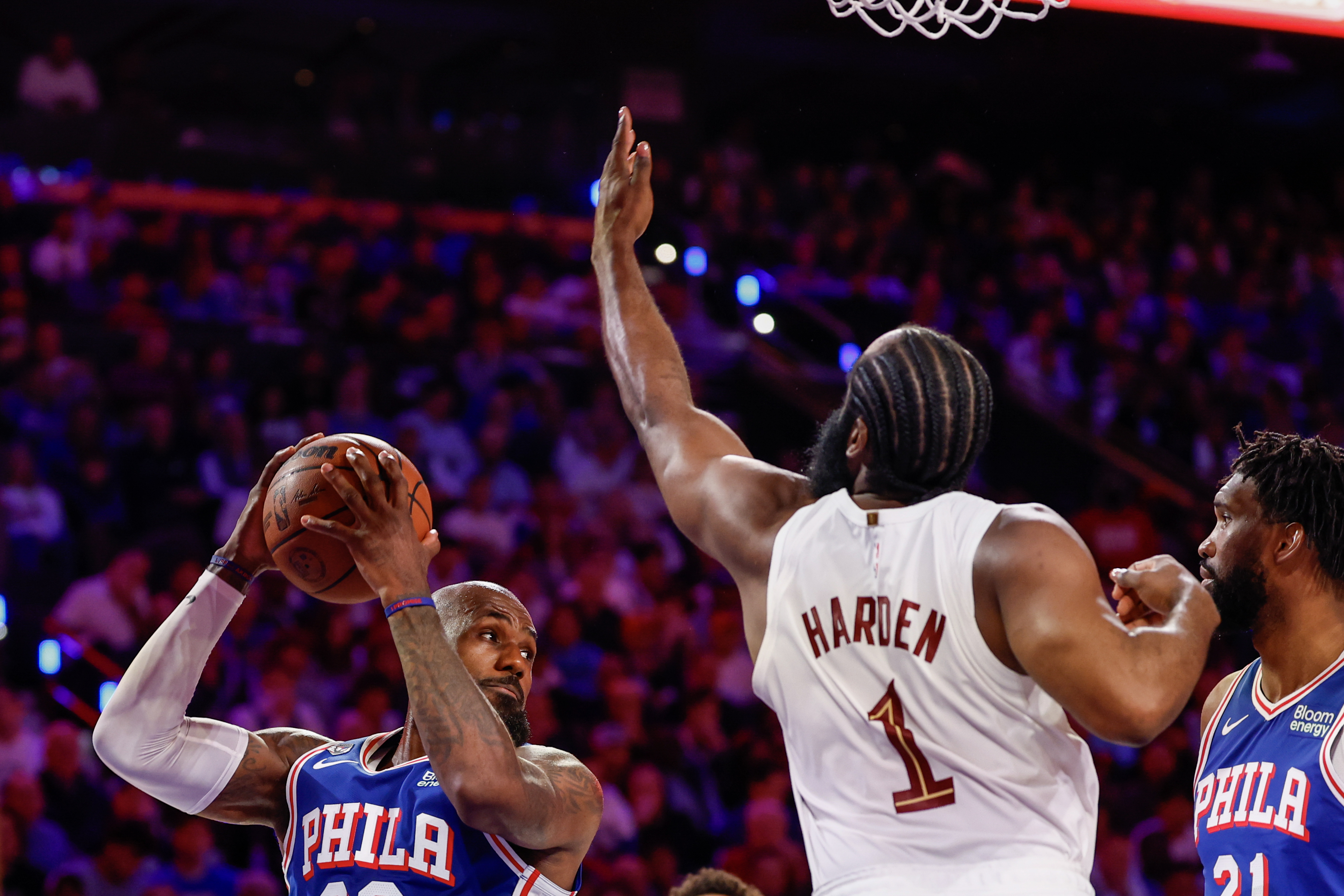
Sixers guard Jaylen Brown dunks the basketball late during the fourth quarter against the Cavaliers Thursday, Oct. 22, 2026, in Philadelphia.Yong Kim / Staff PhotographerSixers center Joel Embiid reacts after getting fouled after scoring during the fourth quarter as Cavaliers guard James Harden passes by (right) Thursday, Oct. 22, 2026, in Philadelphia.Yong Kim / Staff PhotographerSixers guard Tyrese Maxey celebrates with Sixers center Joel Embiid after the Cavaliers made an offensive foul during the fourth quarter Thursday, Oct. 22, 2026, in Philadelphia.Yong Kim / Staff PhotographerSixers center Joel Embiid scores 2-points over Cavaliers center Jarrett Allen during the fourth quarter Thursday, Oct. 22, 2026, in Philadelphia.Yong Kim / Staff PhotographerSixers guard Vj Edgecombe grabs a rebound past Cavaliers center Evan Mobley late during the fourth quarter Thursday, Oct. 22, 2026, in Philadelphia.Yong Kim / Staff PhotographerSixers forward LeBron James (left) and Sixers guard Tyrese Maxey celebrate after a late score during the fourth quarter against the Cavaliers Thursday, Oct. 22, 2026, in Philadelphia.Yong Kim / Staff PhotographerSixers forward LeBron James gets fouled by Cavaliers forward Mario Hezonja (left) and Cavaliers guard Donovan Mitchell during the fourth quarter Thursday, Oct. 22, 2026, in Philadelphia.Yong Kim / Staff PhotographerSixers center Joel Embiid goes after the ball against Cavaliers guard Donovan Mitchell during the fourth quarter Thursday, Oct. 22, 2026, in Philadelphia.Yong Kim / Staff PhotographerSixers guard Tyrese Maxey lays up the basketball against Cavaliers forward Mario Hezonja during the third quarter Thursday, Oct. 22, 2026, in Philadelphia.Yong Kim / Staff PhotographerSixers guard Tyrese Maxey fails to get to the basket against Cavaliers center Jarrett Allen (left) and Cavaliers guard Peyton Watson during the third quarter Thursday, Oct. 22, 2026, in Philadelphia.Yong Kim / Staff PhotographerSixers guard Tyrese Maxey lays up the ball past Cavaliers guard James Harden during the third quarter Thursday, Oct. 22, 2026, in Philadelphia.Yong Kim / Staff PhotographerSixers head coach Nick Nurse during the third quarter of the home opener against the Cavaliers Thursday, Oct. 22, 2026, in Philadelphia.Yong Kim / Staff PhotographerSixers center Joel Embiid reacts after Sixers guard Tyrese Maxey makes a basket during the third quarter Thursday, Oct. 22, 2026, in Philadelphia.Yong Kim / Staff PhotographerSixers forward LeBron James drives to the basket against Cavaliers center Evan Mobley (left) and Cavaliers guard James Harden during the third quarter Thursday, Oct. 22, 2026, in Philadelphia.Yong Kim / Staff PhotographerSixers guard Tyrese Maxey goes after the ball against Cavaliers guard James Harden (left) and Cavaliers guard Jaylon Tyson during the third quarter Thursday, Oct. 22, 2026, in Philadelphia.Yong Kim / Staff PhotographerSixers forward LeBron James lays up the basketball against Cavaliers center Evan Mobley during the third quarter Thursday, Oct. 22, 2026, in Philadelphia.Yong Kim / Staff PhotographerSixers guard Jaylen Brown loses the ball against Cavaliers center Jarrett Allen during the third quarter Thursday, Oct. 22, 2026, in Philadelphia.Yong Kim / Staff PhotographerSixers center Joel Embiid is fouled laying up the basket against Cavaliers center Jarrett Allen during the third quarter Thursday, Oct. 22, 2026, in Philadelphia.Yong Kim / Staff PhotographerSixers forward LeBron James is fouled while making a layup during the third quarter Thursday, Oct. 22, 2026, in Philadelphia.Yong Kim / Staff PhotographerSixers guard Vj Edgecombe reacts after making a basket and getting fouled early during the third quarter Thursday, Oct. 22, 2026, in Philadelphia.Yong Kim / Staff PhotographerSixers guard Vj Edgecombe makes the layup past during the third quarter Thursday, Oct. 22, 2026, in Philadelphia.Yong Kim / Staff PhotographerCavaliers guard Jaylon Tyson fouls Sixers guard Tyrese Maxey during the second quarter Thursday, Oct. 22, 2026, in Philadelphia.Yong Kim / Staff PhotographerSixers forward LeBron James looks for an opening against Cavaliers guard James Harden during the second quarter Thursday, Oct. 22, 2026, in Philadelphia.Yong Kim / Staff PhotographerSixers guard Vj Edgecombe goes after the ball against Cavaliers guard James Harden with Sixers center Joel Embiid (left) during the second quarter Thursday, Oct. 22, 2026, in Philadelphia.Yong Kim / Staff PhotographerSixers guard Jaylen Brown grabs the ball against Cavaliers guard James Harden during the second quarter Thursday, Oct. 22, 2026, in Philadelphia.Yong Kim / Staff PhotographerSixers guard Tyrese Maxey gives the ball to Cavaliers guard Donovan Mitchell during the second quarter Thursday, Oct. 22, 2026, in Philadelphia.Yong Kim / Staff PhotographerSixers guard Jaylen Brown grabs a rebound past Cavaliers guard Sam Merrill during the first quarter Thursday, Oct. 22, 2026, in Philadelphia.Yong Kim / Staff PhotographerCavaliers guard Jaylon Tyson steals the ball from Sixers guard Kentavious Caldwell-Pope during the first quarter Thursday, Oct. 22, 2026, in Philadelphia.Yong Kim / Staff PhotographerCavaliers guard Jaylon Tyson shoves Sixers guard Anfernee Simons for an offensive foul during the first quarter Thursday, Oct. 22, 2026, in Philadelphia.Yong Kim / Staff PhotographerCavaliers guard James Harden against Sixers guard Vj Edgecombe during the first quarter Thursday, Oct. 22, 2026, in Philadelphia.Yong Kim / Staff PhotographerSixers guard Jaylen Brown (right) and Sixers forward LeBron James before the start of the home opener against the Cavaliers Thursday, Oct. 22, 2026, in Philadelphia.Yong Kim / Staff Photographer
The Sixers couldn’t shrug off the unfamiliarity in the second quarter, which was also turnover-filled. They had another six turnovers, 15 for the half, and shot just 4-for-15 from three-point range in the first half.
The Sixers struggled with Cleveland’s size, something that has bothered them in the past, like last season when Cleveland went 4-0 against the Sixers.
Evan Mobley had 15 points and six rebounds in the first half while Jarrett Allen had 14 points and five boards. With Joel Embiid’s injury history, and the loss of Ariel Hukporti to an Achilles injury in the preseason, one of the shallow spots on the roster is center.
Cleveland is one of the teams with the front-line size to exploit that. Cleveland had eight offensive rebounds in the first half as the Cavaliers built their lead.
Before Philly artist Nazeer Sabree made a name for himself in the art world by crafting rich oil paintings and archival prints, music was his guiding light.
His memories — of dancing to James Brown’s “I Got The Feelin’” with his grandparents, his ears gluedto speakers playing Marvin Gaye’s “What’s Going On,” and dissecting the lyrics from Erykah Badu’s “Green Eyes” and “Soldier” with his mom — shaped his childhood and early artistic interests.
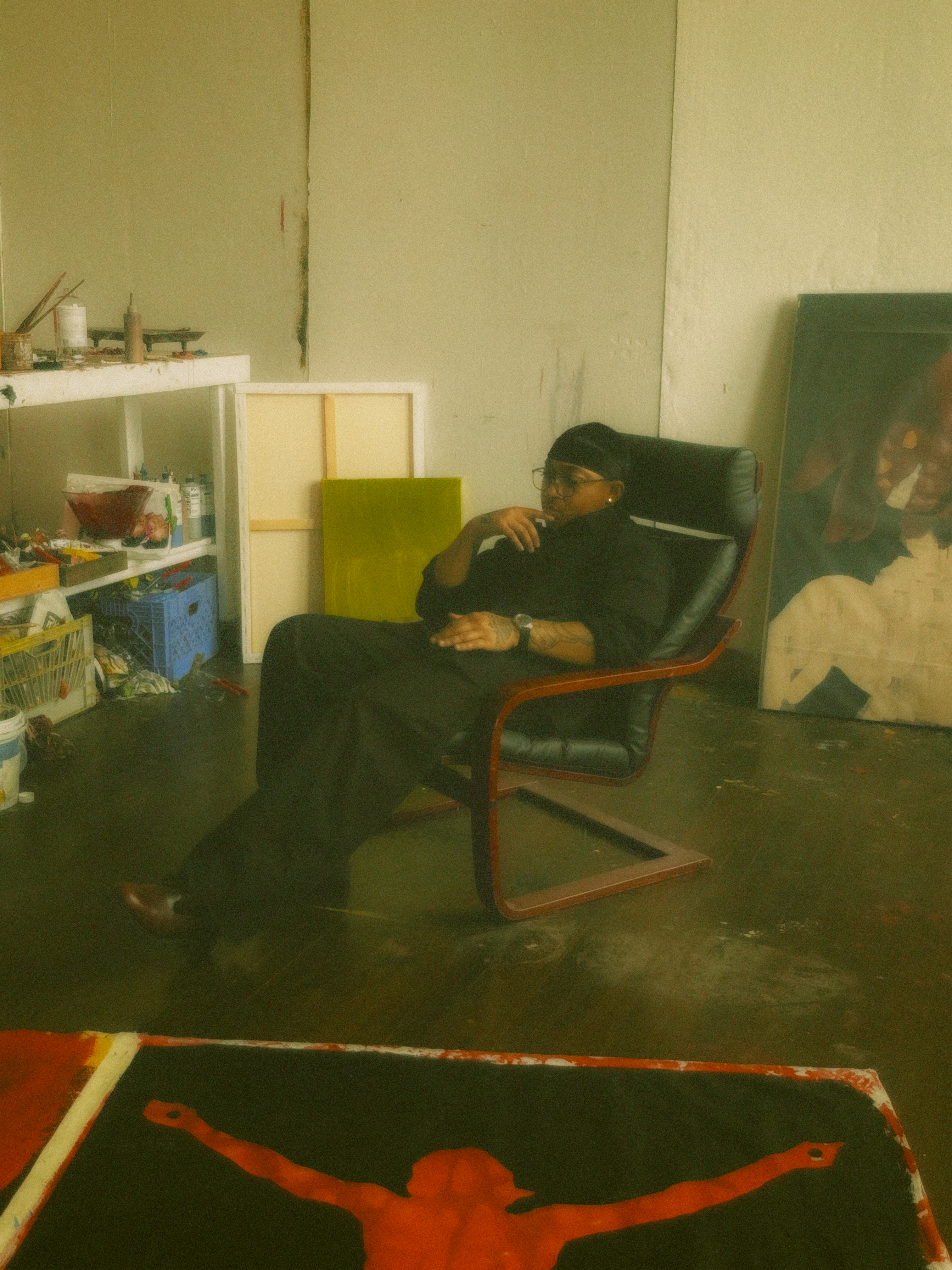
“The music came before I was able to articulate my love for visual arts,” Sabree said, sitting in his Bok Building arts studio. “Often, when I talk about the work, I hear it before anything. And I hear it once it’s done.”
An image of artist Nazeer Sabree in his Bok Building art studio. The 28-year-old artist has forged partnerships with world-renowned art museums and cultural institutions.Courtesy of Kasai Granby
Today, his work is among the permanent collection in institutions like the Philadelphia Museum of Art. He has held residencies at Monument Lab and Fitler Club, and collaborated with Mural Arts and rap star Tierra Whack.
But Sabree, 28, started off by painting custom designs on students’ Timberland boots and screen-printing T-shirts at Charter High School for Architecture + Design (CHAD).
“I was hustling through the art. But before that it was music,” he said.
The melding of visual and musical art for him, he said, is heightened by his synesthesia, a neurological condition that allows him to experience sound both audibly and in color. It’s evident in much of Sabree’s work.
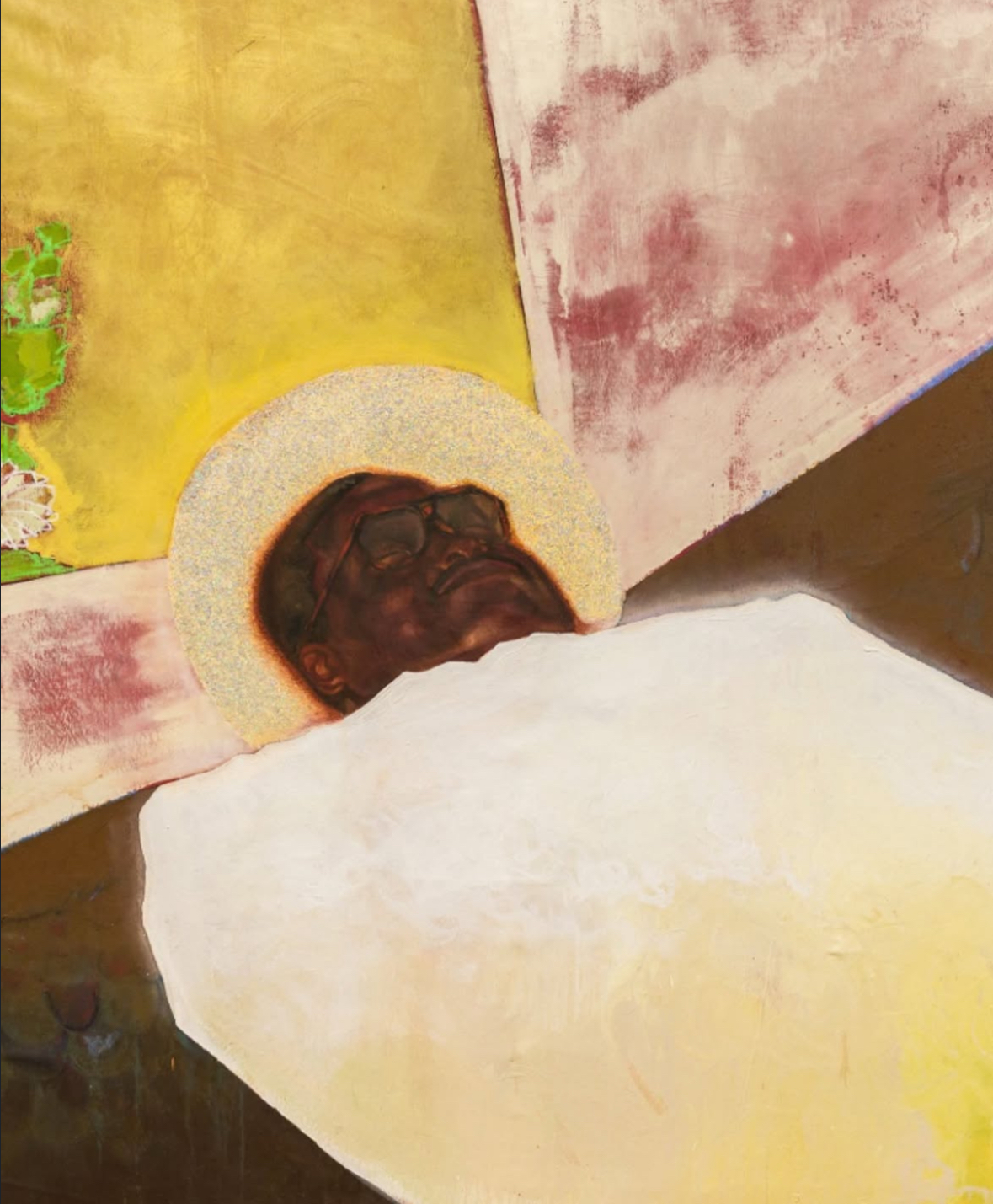
Artist Nazeer Sabree’s painting, “Wings of a Crow,” melds his love of music and visual art. The painting evokes the sounds of orchestral strings and jazz horns.Courtesy of Nazeer
In the making of the 2025 painting Wings of a Crow, the sound of orchestral strings and jazz horns guided his hands over the cotton canvas as he painted with acrylic paint and oil pastels.
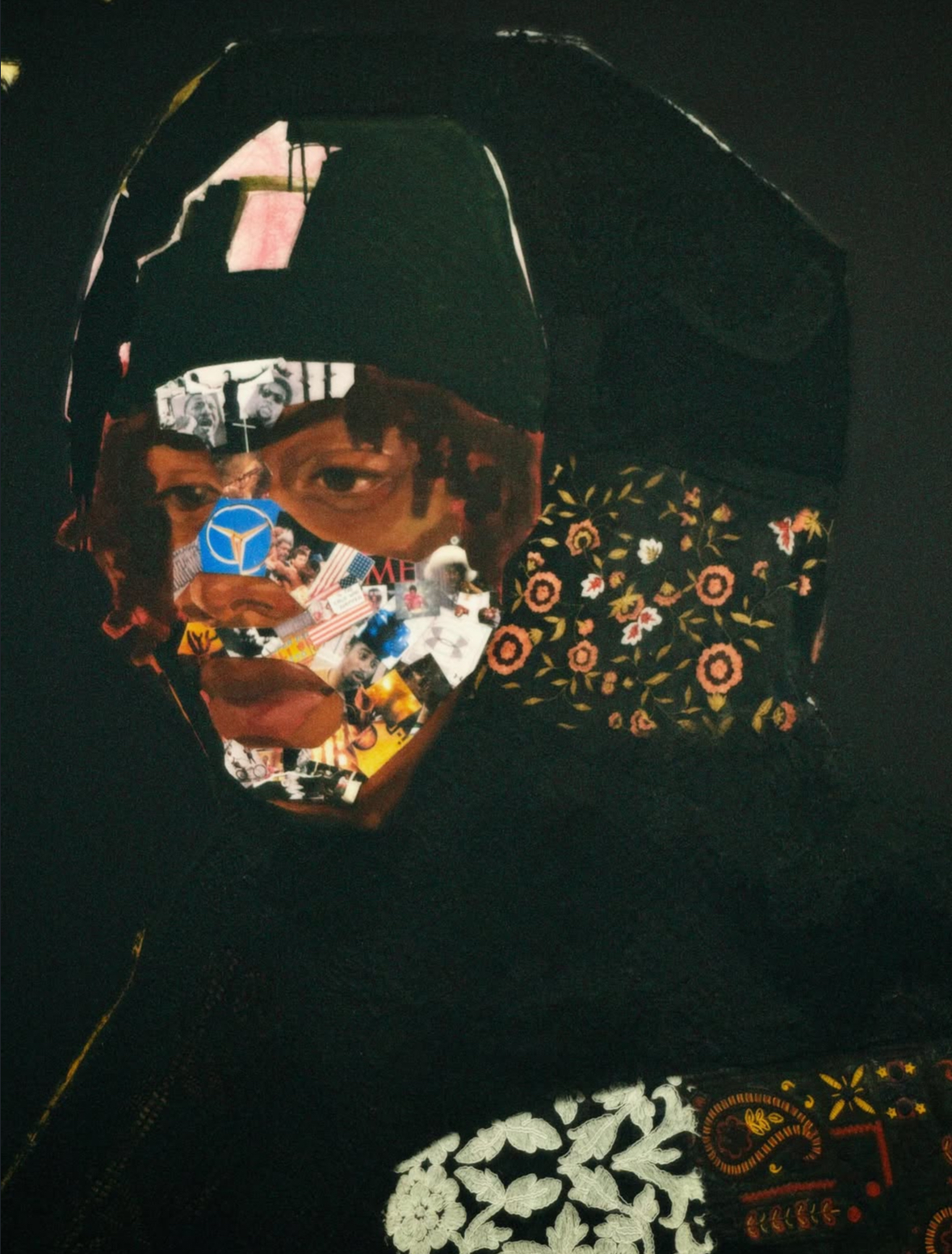
In Untitled, Sabree said the echoes of piano keys and drum kicks brought a visual rhythm to the collage.
“It’s a marriage between the two loves of mine and my practice,” Sabree said. “I don’t think I’m painting in a traditional sense. I’m making an album.”
Artist Nazeer Sabree said his painting “Untitled” evokes sounds of piano keys and drum kicks. It’s one of several artworks that reflect his connection to the musical and visual arts.Courtesy of Nazeer Sabree
As we chat, Erykah Badu, Mick Jenkins, and Kendrick Lamar play in the background.
Sabree’s broader catalog consists of archival prints and color-soaked silhouettes of Black figures, whose faces are covered in collages filled with news clippings, intimate photos, and American flags. His portraits and collage-lined frames aim to capture the kaleidoscope of human emotion, Sabree said. And like the timeless songs he listened to as a child, he wants viewers to unlock the same sense of liberation from his art, as he discovered from music in his most formative years.
The artist grew up in Cobbs Creek and Francisville, facing challenges that Sabree said kept him frozen in a perpetual state of “hypervigilance.”
“My mind was stressed because I was watching kids get drunk, people get shot, and watching my peers laugh at very jovial kid stuff while carrying guns,” he said. “And I knew what jail looked like because all my uncles were locked up. I was like, ‘Damn, I don’t want to go through that.’”
An image of artist Nazeer Sabree in his Bok Building art studio. The 28-year-old artist has forged partnerships with world-renowned art museums and cultural institutions.Courtesy of Kasai Granby
Sabree credits his mother’s decision to move him from Dobbins Technical High School to CHAD for widening his perspective and expanding his creativity. He no longer had to pass through metal detectors to reach his classes, and instead traveled to Center City, Old City, and Washington Square — sites previously unfamiliar to the aspiring artist. Sabree said the days he ventured beyond the school’s walls gave him a glimpse into the broader world he was determined to explore. “That gave me the flexibility to see different participants of the story that I’m now narrating,” he said.
His curiosity and early flashes of artistic brilliance led to a scholarship to theCalifornia College of the Arts (CCA). He moved to the Bay Area in 2016.
“If I don’t go to California, I don’t become Nazeer Sabree,” he said. “I don’t become the person that people see or feel through the work. I don’t become someone who can articulate their experience.”
There, he not only became a more technically sound artist, but he also mastered his “emotional language.” Through yoga, therapy, and literature, Sabree learned to wrestle with anxiety, depression, and the whirlwind of emotions caused by the deaths of loved ones,including his uncle Woody McKenzie, who died in 2018.
The encouragement he received from his mentors, paired with the emotional freedom he felt being 3,000 miles from his hometown, helped him better translate his emotions and past experiences into his visual works. “They were able to pour into me at a level that this city wasn’t able to, and it started that healing process for me,” Sabree said.
After two years in California, he came back to Philly with a renewed sense of self. He was also a more capable artist with a firmer command on his creative mission.
“It gave me a quiet authority,” Sabree said.
While his work is often drawn from his own experiences, Sabree said he isn’t making “trauma porn” and has no interest in “Black escapism.” He wants his viewers to explore the complexity of their emotions and recognize the impact of their own thoughts and actions. He also wants to free people from emotional bondage and encourage self-expression.
“Everything is not black and white. You have a gamut of complex emotions, but that’s what makes you human,” Sabree said. “That’s what being a man is. Having these emotions and learning how to manage them … Allowing yourself the space to get your thoughts out will liberate you.”
An image of artist Nazeer Sabree in his Bok Building art studio. The 28-year-old artist has forged partnerships with world-renowned art museums and cultural institutions.Courtesy of Kasai Granby
In June, Sabree received an Instagram message from artist Tierra Whack, who requested to meet with him for a day of painting in promotion of her June mixtape, Whack’s Museum. Sabree said he’s “grateful” to attract opportunities like these, and he credits his growing success to a higher power.
“I think it’s way bigger than myself,” he said. “A lot of what’s happening is by the grace of God. He gave me something. This isn’t mine. This isn’t my thing. It’s being channeled through me.”
The heat waves that baked Europe this summer were likely the continent’s deadliest on record, and climate change was primarily responsible, researchers at Imperial College London and the London School of Hygiene & Tropical Medicine found in two recent peer-reviewed studies.
About 50,000 more people died in European cities between June and August than would have if temperatures had not been abnormally hot, researchers estimate. The figures are 71 percent higher than in 2022, the second-deadliest year, which researchers said is likely due to just how widespread and extreme the heat domes were across Europe this summer.
Of those estimated additional deaths, about two-thirds would not have occurred if the climate were not warming, the researchers calculated. The papers were accepted for publication in the journal Nature Health, and one published earlier this month.
The findings “clearly highlight the danger from human-caused warming and the need for rapid emissions reductions,” said Clair Barnes, a statistician and climate change researcher at Imperial College London, who is a lead author of the studies.
The researchers analyzed weather data from 854 urban areas in Europe, covering a total population of about 173 million. Using 26 years of data, climate models, population data and a previously peer-reviewed method to link mortality to heat, researchers calculated how many more deaths likely occurred due to the heat than would’ve without the high temperatures.
The research comes on the heels of a United Nations climate report out this week, which found that the planet is on track to warm 2.6 degrees Celsius above preindustrial levels during this century – assuming countries stick to their climate action plans – and that the previous global target to not overshoot 1.5 degrees of warming “has been lost.”
Determining how many people’s deaths are at least partially caused by heat is notoriously difficult for public health authorities to untangle, earning it the nickname of a “silent killer.” Heat can cause heat stroke, but it can also contribute to death by heart attack, stroke, cardiovascular disease and other conditions.
“Whenever the human body is exposed to extremes of temperature, but particularly heat, it puts the body under stress,” said Andrew Hartle, an intensive care consultant at the Imperial College Healthcare NHS Trust, who did not contribute to the new research. The body has coping strategies, he said, but “eventually, your ability to control your temperature fails.”
But even when it’s very likely that heat played a role in a death, other causes often take the blame on death certificates. For example, if the medical examiner evaluates the body long after the internal core temperature has fallen, heat may not be listed as a factor.
Recognizing the gap in data, some European health authorities also calculated heat-related death estimates this summer with their own models. In France, for example, the nation’s public health agency Santé publique estimated about 5,800 excess deaths during the late June heat wave. (The Nature Health study estimates about 7,300 heat-related deaths in France’s urban areas across the whole summer.)