Blog

  • A mistrial is declared in the murder case against Lindsay Clancy. Here’s what could happen next

    A mistrial is declared in the murder case against Lindsay Clancy. Here’s what could happen next

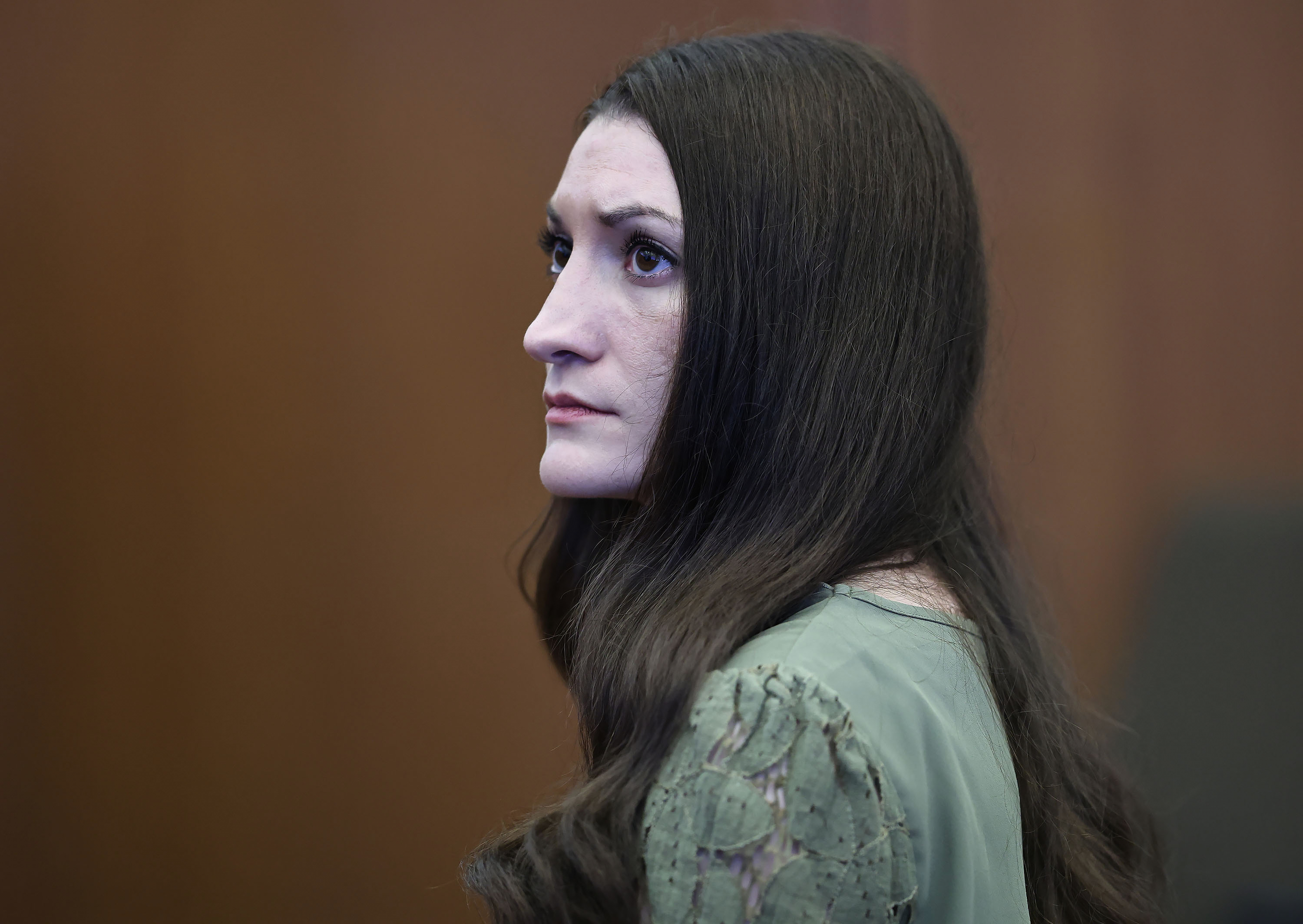
    The trial to decide if Lindsay Clancy was criminally responsible when she strangled her three children in 2023 ended in a mistrial Friday after jurors were unable to reach a consensus after weeks of conflicting testimony about her postpregnancy mental health and seven days of deliberations.

    What happens now?

    Clancy, a 36-year-old former labor and delivery nurse, remains charged with murder and will continue to be held in a psychiatric hospital until the case is resolved. Attorneys on both sides have a few options when it comes to the next steps.

    A hearing later this month could determine the path forward

    Judge William Sullivan set a hearing for Sept. 29. During that proceeding, defense attorney Kevin Reddington will likely ask the judge to declare Clancy not guilty. It’s a long shot move and very unlikely to succeed.

    That hearing could also reveal whether prosecutors will move to put Clancy on trial for a second time. They could also choose to seek a plea deal or even drop the case entirely, though that option is unlikely.

    Sullivan suggested that everyone involved in the case, from attorneys to witnesses to court administrators, would need to look at their calendars to find a suitable time for a new trial, if one is held.

    Clancy doesn’t deny strangling her children at their home south of Boston, but says postpartum psychosis led to her actions. After the killings, her husband found her badly injured in the yard, where she landed after jumping from a second-story window. She was left paralyzed from the waist down.

    Prosecutors argue she knew what she was doing.

    Prosecutors will weigh many factors as they decide on a new trial

    Plymouth County District Attorney Timothy Cruz said there would not be an immediate decision about a second trial, but he emphasized that his goal was always “getting justice for those three little babies.”

    “This case was about Lindsay Clancy and what she did … the cruel and calculated killing of three innocents,” Cruz said shortly after court ended on Friday. He later continued, “Children were murdered and it’s our job to seek justice.”

    Still, prosecutors typically consider a lot of things when determining whether to retry a case, said New York Law School professor Heather Ellis Cucolo, including the potential expense and the likely outcome.

    “I know the prosecutor stated openly that he would not allow public opinion to sway his decision, which is accurate, but the prosecution serves the public,” Cucolo said. “If it is believed that justice must be served by another trial, that is something the prosecutor’s office will take into account and weigh very heavily.”

    A conviction could mean life in prison for Clancy, while an acquittal might lead to confinement in a mental health facility.

    Clancy’s defense will likely push to drop the charges

    Cucolo said the defense attorney will likely push for the charges to be dropped entirely, and might also be open to a plea deal.

    “But if the prosecution chooses to move forward with a trial, there’s no way to prevent that from happening,” Cucolo said.

    Reddington said in court that he believed Clancy’s constitutional rights were violated when the judge declined to remove one juror after the other jurors suggested that he was not following the judge’s instructions on reasonable doubt. But a mistrial isn’t subject to an appeal, Cucolo said, because it’s not a final judgment.

    The impact on family members is another consideration, said Randy Gioia, a Boston-based defense lawyer who formerly supervised public defenders across the state.

    Gioia said prosecutors should not put Clancy through another trial. He said he accepts Reddington’s disclosure that Clancy was extremely close to an acquittal, based on a note presented to the judge by the jury foreperson.

    “Why put everyone through the trauma again: 16 to 18 jurors, all the witnesses, Patrick Clancy,” Gioia said, referring to Lindsay Clancy’s former husband. “What’s to be served here when we’ve had a long trial and long deliberations? You don’t have a strong case. You almost lost the case.”

    Attorneys on both sides could tweak their approach in a retrial

    It’s not clear exactly how the jury reached an impasse, but Reddington suggested that just one juror stood in the way of an acquittal, and said the other jurors were “robbed.”

    “They know they were robbed by one man, for whatever his agenda was, who stole seven weeks of the life of these other jurors that were so attentive, so beautiful, so wonderful,” he said outside the courthouse. “You could see how defeated they were sitting there. I got a funny feeling they would have gone on for another week if they had to. So I hope that guy can sleep well at night.”

    Jurors are under no obligation to speak to attorneys on either side of the case, but it’s common for the attorneys to see if any are open to talking about their experience, Cucolo said. Prosecutors can then use any information they get to reassess and fine-tune their approach, she said, perhaps focusing more on specific evidence or witnesses.

    A retrial would have rippling impacts

    David Meier, a lawyer who represents Patrick Clancy in a lawsuit over his former wife’s mental health treatment, released a statement about the emotional burden of the case, saying “there will never be closure” from the loss of the children.

    “The prospect of reliving this tragedy through another trial is extraordinarily painful — for Patrick, for his family, and for all of us,” Meier said.

    The statement didn’t indicate whether Patrick Clancy would support a second trial.

    Lindsay Clancy has also filed a lawsuit over her mental health treatment. A retrial would likely force those civil cases to be put on hold, Cucolo said.

    “They would not be able to move forward for now because of concerns of possible Fifth Amendment violations,” Cucolo said, because anything Clancy says in a civil case could potentially be used against her in the criminal case. That means the lawsuits could remain in legal limbo for a year or more, she said.

  • Trump moves to allow ranchers and hunters to kill gray wolves

    Trump moves to allow ranchers and hunters to kill gray wolves

    President Donald Trump on Friday ordered the Interior Department to begin the process of removing endangered-species protections for gray wolves, again intervening in a long-running fight between conservationists and ranchers who say the predators threaten their operations.

    Trump also ordered the Interior and Agriculture departments to make it easier for ranchers to kill the wolves if necessary. The measures, long sought by GOP lawmakers from Western states, elicited a swift rebuke from animal rights groups and could draw legal challenges.

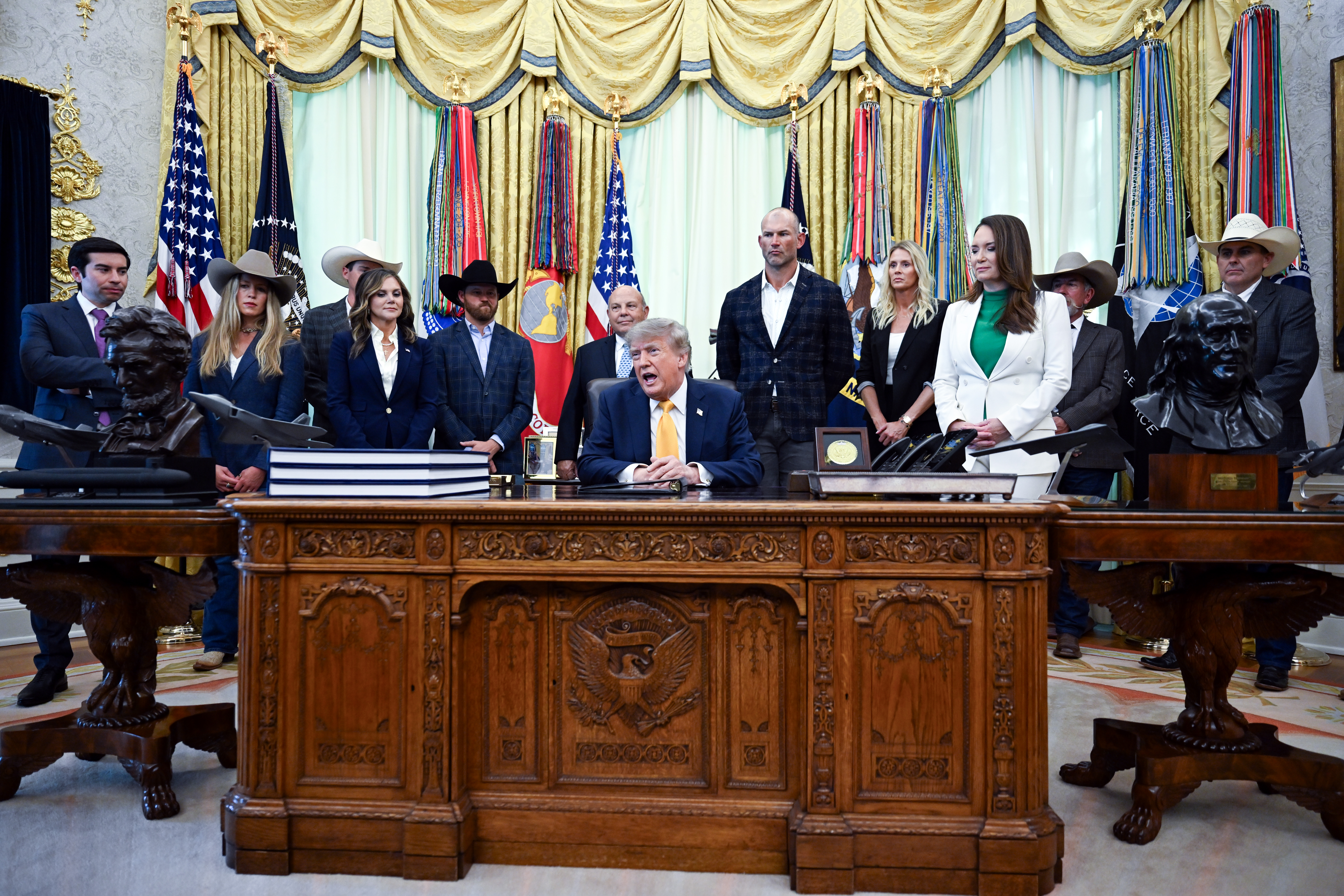
    “You’re not allowed to protect yourself, right? Or your company, your cattle,” Trump said at an Oval Office event, flanked by ranchers who shared stories of watching wolves tear through their herds. “So how do you like the idea that I’m letting you do that?”

    Under Trump’s order, Interior Secretary Doug Burgum will prepare a recommendation to fully delist or downlist the gray wolf and the Mexican wolf under the Endangered Species Act. The order also includes other measures intended to give states, ranchers, and hunters greater latitude to kill the animals.

    “Rolling back federal protections now — or setting that process in motion — would jeopardize decades of recovery and open the door for brutal killing,” Kitty Block, president and CEO of Humane World for Animals, said in a statement.

    The gray wolf and several subspecies were first listed as endangered under federal rules in the 1960s and 1970s, after centuries of westward settlement and government-backed eradication campaigns reduced their historical range in the Lower 48 states by an estimated 95%.

    Federal protections and reintroduction efforts helped lift that population from about 1,000 during the early listings to more than 6,000 by 2020, according to the U.S. Fish and Wildlife Service.

    But that recovery has fueled a long-running dispute over whether the wolves still deserve strict protections. Presidents of both parties have moved to lift at least some protections, only to have those efforts stymied, and sometimes overturned, in court.

    The Trump administration in 2020 stripped gray wolves of their endangered-species designation in the Lower 48 states, declaring the species recovered. A federal judge vacated that rule in 2022, and the wolves remain officially endangered in much of the country.

    Congress has also entered the fray. The GOP-led House in December passed a bill to end gray wolf protections. The Senate is still considering the legislation.

    “The science has been clear for years: Gray wolves are fully recovered, and their resurgence deserves to be celebrated as a true conservation success story,” Rep. Lauren Boebert (R., Colorado.), who authored the legislation, said in a statement after her bill passed the House. “It’s long past time to delist them and empower states to set their own management policies.”

    Ranchers on Friday discussed their frustrations with the status quo.

    “The problem is, because they’re on the Endangered Species List, they can’t shoot them. They have to sit and watch them destroy their herd,” Agriculture Secretary Brooke Rollins said in the Oval Office.

    “But you can shoot them as of today,” Trump mused, to laughter.

    “Well, Secretary Burgum has to do a project, but, yes,” Rollins responded.

  • U.N. approves African proposal for a new world map

    U.N. approves African proposal for a new world map

    The United Nations General Assembly on Friday endorsed a world map that depicts the size of Africa more accurately than the map most commonly used now.

    The assembly approved a resolution favoring the Equal Earth projection, a map that supporters say shows the true size of countries, over the familiar Mercator projection, which shrinks regions near the equator. It passed with 164 votes in favor and 6 abstentions, according to the United Nations.

    The only nation that voted against the resolution was the United States, which said the map promoted an “ideological agenda” and was a distraction from the “genuine problems of international peace, prosperity, or good relations.”

    The new map has supporters in Africa, who say the Mercator projection has contributed to a historical bias that has minimized tropical and equatorial regions and exaggerated the size of countries near the poles.

    The U.N. resolution does not outlaw the Mercator projection or require the use of the Equal Earth map. But it is part of a campaign to raise awareness of the effects of visual representations of the Earth on how people view the world.

    Here’s what to know about the debate.

    What is the Mercator projection?

    The projection, one of many ways to represent the spherical Earth on a flat plane, was designed by Flemish cartographer Gerardus Mercator in 1569 to help sailors navigate.

    It was created by projecting the Earth’s features onto a cylinder, then flattening that into a rectangle.

    The map was invaluable for seafaring: Any straight line drawn on the map represents a compass direction that sailors can use to determine which way to go. The projection has since become widely used in books, classrooms, and online services like Google Maps.

    Why do critics want to move away from it?

    Every map projection makes sacrifices, like shape, size, or distance: You can’t flatten a round object without somehow stretching, shrinking, or tearing it. The Mercator projection reflects true directions but distorts the size of landmasses.

    If you had a Mercator projection on your classroom wall, you might have grown up believing that Greenland, for example, is as big as Africa, even though it is 1/14th its size. You might also think that Alaska is bigger than Mexico, when it is 25% smaller.

    Critics have argued that the Mercator map creates a subtle bias whereby northern nations, including some of the world’s wealthiest, appear large and equatorial regions, home mostly to developing countries, are depicted as small. Some cartographers say it reinforces a Eurocentric and colonial worldview.

    The Equal Earth projection — created in 2018 by cartographers Bojan Savric, Bernhard Jenny, and Tom Patterson — sacrifices straight-line directions in order to render landmasses in their correct proportions. It has rounded edges to account for the Earth’s spherical shape instead of a rectangle.

    Advocacy groups in Africa have campaigned to replace the Mercator map since April 2025. The African Union endorsed the campaign in August that year, urging its 55 member states to adopt the Equal Earth map in schools and public communications. The West African nation of Togo sponsored the U.N. resolution, backed by other countries in the African Union.

    “A map is never neutral,” Robert Dussey, the foreign minister of Togo, said Thursday, promoting the U.N. resolution. “It shapes perceptions, influences how the place of peoples and continents in the world is understood, and may, sometimes from the earliest years of schooling, perpetuate representations that do not correspond to geographic reality.”

    What does the U.N. resolution do?

    The resolution calls on the more than 190 U.N. member states to update their educational materials and educate students about the accurate sizes of countries and the limitations of different map projections.

    It also urges major digital map providers to discuss the issue with governments and adopt more accurate cartographic representations.

    The resolution is not binding. But the push to replace the Mercator map has made progress in other ways.

    Google, which used a Mercator-based map for more than a decade, shifted in 2018 to showing the Earth as a globe when zoomed out on the desktop platform. “Greenland’s projection is no longer the size of Africa,” the company said on social media.

    Some schools have begun replacing Mercator maps. Boston Public Schools in 2017 began purchasing maps with the Peters projection, which shows countries in their correct proportional sizes to one another at the cost of stretching and squashing their outlines.

    The shift was part of the district’s effort to “decolonize the curriculum,” Colin Rose, then a district administrator, told the Boston Globe.

    This article originally appeared in the New York Times.

  • Kacey Musgraves’ ‘Middle of Nowhere’ tour stop in South Philly was a sparkling, consistently pleasing affair

    Kacey Musgraves’ ‘Middle of Nowhere’ tour stop in South Philly was a sparkling, consistently pleasing affair

    Music triggers memory. So, the long gone Philly venue that inevitably came to my mind during Kacey Musgraves’ “Middle of Nowhere” tour stop at Xfinity Mobile Arena in South Philly on Friday was the Valley Forge Music Fair.

    My head is spinning just thinking about it.

    Why? Because just as was the case at the Devon venue where I saw legends like George Jones, Merle Haggard, and Ray Charles, Musgraves staged her show in support of a superb new return-to-country album giving her tour its name in the round.

    And not only in the round, but also — just as at the Music Fair, which closed in 1996 and was located on a site where home improvement retailer Floor & Decor now stands — with a spinning stage.

    Listening to Musgraves’ music can be mildly trippy . Going back to “Follow Your Arrow,” from her 2013 debut Same Trailer, Different Park, the East Texas native who uses @SpaceyKacey as a social media handle has espoused a you-do-you philosophy.

    That song is the foundation of Musgraves’ arena-sized following, and her significant role in making country cool for younger audiences who might be turned off by too much twang or homilies about small towns, pickup trucks, and beer.

    Instead, Musgraves opened the door wide to the LGBTQ community on “Follow Your Arrow,” which was the penultimate song in a sparkling, consistently pleasing set. The song suggests fans “kiss lots of boys, or kiss lots of girls, if that’s something you’re into” and advises taking a toke or two “when the straight and narrow gets a little too straight.”

    No weed smoke was sniffable from where I sat. But the sense of strange things happening was nonetheless in the air; with the stage and video screen above encircling it moving clockwise, then abruptly moving in the opposite direction.

    Kacey Musgraves performing in Chicago in August. The country crossover star brought her “Middle of Nowhere” tour to the Xfinity Mobile Arena in South Philadelphia on Friday.Charles Reagan

    Also notably odd was the faux roadhouse building constructed behind the stage from which Musgraves made her initial entrance, walking through the crowd over a floor strewn with hay. It remained otherwise unused.

    More memorable was how Musgraves chose to present “Rhinestoned,” a terrific tune about stepping out behind the roadhouse for a smoke in hopes of taking the sting out of a breakup.

    “Is every one having a good time?” she asked, adding coyly: “Would you go so far to say you are having a ball?” With that, a double disco ball appeared over in the anatomically correct shape of a pair of testicles.

    Conveniently, the mirrored object was built with space for Musgraves to take a seat within it as she was lifted above the stage. “The is my grandma’s favorite part of the show,” she quipped, then rather remarkably managed to maintain the emotional thrust of the song, singing “Ooh, let’s put a little sparkle on / Ooh, until the heartache and sadness is gone.”

    The moving stage and aerial scrotum made for clever — dare I say ballsy? — strategy by an artist who is more mellowed out than dynamic in performance.

    “Thunderstruck” by AC/DC — the Australian hard rock vets who will be across the street at the Linc on Sept. 29 — played during the entrance countdown.

    Nothing nearly so raucous followed in the 22-song set to come, as Musgraves was backed by a subtle and understated band that included steel guitar and accordion, spicing up a Tex-Mex vibe in songs like “Uncertain, Texas” and the Texas Tornados cover “(Hey Baby) ¿Que Pasó?”

    But if Musgraves is somewhat of a static performer — she moved with such deliberation that her hair never seemed to move beneath her black cowboy hat — that’s OK, because her fans aren’t coming to see the sort of aerobic display expected at most outsized pop concerts.

    Instead — and refreshingly — it’s all about the songs. Musgraves’ strength is in her writing, which is sharply focused in Middle of Nowhere tunes like “Horses and Divorces” and “Loneliest Girl” that settle contentedly into mid-30s singledom and convey the satisfaction of making peace with oneself as middle age approaches.

    Musgraves’ crossover from country to pop was highly successful — 2018’s Golden Hour was named Grammy album of the year. But Middle of Nowhere is as satisfying as it is in part because after wandering away from the music she grew up on, it feels like a homecoming.

    “The bones of country music are really in my heart,” she said, while thanking her fans for a decade plus of loyalty. “Whenever you strip it down to its beautiful basic form, it’s a genre that is built on stories about real people, and just real hearts, real life stuff. And that’s what inspires me the most.”

    Two unexpected things happened — or didn’t — over the course of the evening.

    First, after singing a spooky “I Believe In Ghosts” — about cowardly guys and Irish goodbyes — Musgraves broke out in a snippet of “Here Comes the Sixers,” the snappy theme song of the team for whom LeBron James will soon be dribbling on the very spot she was standing.

    “I don’t know why I know this song,” she said, before leading the crowd in a “10, 9, 8 … 76ers,” singalong, confessing that “I don’t know [much] about sports.” (Turns out, she has a history with the song — though why is a mystery — as my colleague Emily Bloch explained in 2024.)

    Second, the show included no tribute to Dolly Parton, or even mention of the beloved country great who died last month. In her first two shows after Parton’s death, in Boston and in New York, Musgraves sang her own “Rainbow” plus a Parton cover — “Here You Come Again” one night, “9 to 5” the other.

    “It’s already hard to navigate these times right now and when we lose a matriarch like that,” Musgraves said of Parton during the first of her two shows at Madison Square Garden. “It’s the closest thing we’ve ever had to royalty … I definitely would not be able to stand up here and do what I do if it hadn’t been for Dolly Parton.”

    During her second show in New York last week, however, Musgraves cut the Parton tribute, as she did again in Philly on Friday night.

    Kacey Musgraves new album is “Middle of Nowhere.”Kelly Christine Sutton

    It was a disappointing missed opportunity for a collective expression of grief, but perhaps Musgraves feels the pain too keenly to revisit it night after night. Instead, she stuck to the set list closing the show with a lively cover of George Strait’s “All My Ex’s Live In Texas,” complete with a Lone Star State flag hung from the rafters.

    Flatland Cavalry, the Lubbock, Texas, country sextet, opened the show with an agreeable mix of fiddle and steel guitar tunes punched up with a rock and roll backbeat. Singing songs from its new album Work of Heart, the band displayed the influence of fellow Texans Strait and Robert Earl Keen.

    Leader Cleto Cordero got the crowd’s attention by claiming he’s always been an Eagles fan despite growing up in Cowboys country, and the band delivered a tasteful cover of Hank Williams’ “I Saw the Light.”

    But as well as they went over, there was one clear reminder that the band were second fiddle on the bill: The stage didn’t spin for them.

  • Judge orders Trump officials to divulge names of those who set up $1.8 billion fund

    Judge orders Trump officials to divulge names of those who set up $1.8 billion fund

    A federal magistrate judge ordered the Trump administration on Friday to reveal the identities of the people who devised a contentious plan to create a $1.8 billion fund to compensate those who believed they were wronged by political prosecutions.

    The order by the magistrate judge, Ivan D. Davis, could shed further light on how the fund was put together. The plan to create the fund, which could have funneled taxpayer money to the president’s allies, drew repeated scrutiny. It prompted a rare rebuke from Senate Republicans, and imperiled the confirmation of Todd Blanche as attorney general.

    Blanche has repeatedly said the fund is dead, but President Donald Trump has been more circumspect, indicating his support for compensating people including the rioters who were prosecuted for attacking the Capitol on Jan. 6, 2021.

    Davis’ order, issued in U.S. District Court in Alexandria, Va., came as part of a lawsuit challenging the legality of the fund and another measure by the Justice Department that benefited Trump. That provision granted the president, his family, and his businesses expansive protections against all past tax investigations.

    Both the fund and the tax immunity deal emerged from backroom negotiations between Trump’s personal lawyers and senior Justice Department officials. The measures were made public after Trump agreed to dismiss a lawsuit he had filed against the IRS, seeking damages for claims that the agency had failed to stop the release of some of his tax returns to news organizations.

    A federal judge in Florida later excoriated both the suit and the way in which it was dismissed. She said the suit was an improper exercise in self-dealing because the president had brought claims against a federal agency that he himself controlled. She also asserted that the dismissal had been worked out with the intent to evade judicial oversight.

    The suit seeking to kill the fund and the tax immunity deal was brought in Virginia by a group of plaintiffs that includes a former federal prosecutor who was fired by the Trump administration after working on Jan. 6-related cases. The group has claimed that the program was unfairly designed to help only supporters of the president.

    The union representing IRS workers later joined the suit, claiming that the tax provisions were illegal and could put its employees in the untenable position of carrying out unlawful orders.

    Lawyers for the plaintiffs hailed the decision.

    “Today’s order granting discovery is a significant step in getting to the bottom of the slush fund,” said Aman George, a lawyer for Democracy Forward, which filed the suit.

    The Justice Department did not immediately comment on the ruling.

    This article originally appeared in the New York Times.

  • New Jersey can block ICE from entering state property, a federal judge ruled

    New Jersey can block ICE from entering state property, a federal judge ruled

    An executive order signed by New Jersey Gov. Mikie Sherrill blocking federal immigration agents from using nonpublic state property does not violate the constitution, a federal judge ruled Friday.

    U.S. District Judge Georgette Castner dismissed the lawsuit by President Donald Trump’s administration against Sherrill over her executive order banning Immigration and Customs Enforcement agents from “entering accessing, or using nonpublic areas” of state-owned property without a court order.

    The February order also prohibits New Jersey agencies from allowing ICE to use state property as a “staging area, processing location, or operation base” for immigration operations.

    The Department of Justice sued New Jersey and Sherrill days after she signed the order, accusing the governor of “blatant disregard for federal laws” and taking a “deliberate action that jeopardizes the public safety of All Americans.”

    “Gov. Mikie Sherrill aims to intentionally obstruct federal law enforcement and celebrates thwarting the constitutional obligation of the President of the United States to take care that federal immigration law be faithfully executed,” the suit says.

    But the Garden State is not required to assist the federal government in immigration enforcement, Castner wrote while dismissing the case.

    “Congress contemplated state assistance in federal immigration enforcement, but it contemplated that assistance on a voluntary basis. The fact that New Jersey has decided not to volunteer — in the limited context of [the executive order] — is in accordance, not in conflict, with Congress’s design,” the Joe Biden-appointed judge wrote.

    And the Justice Department did not prove its claim that ICE would need to “entirely transform” its operations as a result of the order, Castner said.

    The Justice Department did not respond to a request for comment.

    ICE’s “untrained agents” are not making New Jersey safer, Sherrill said in a statement.

    “Once again, Trump tried to stop us, and once again we won,” the governor said.

    Civil rights and immigration advocacy organizations also celebrated Castner’s decision.

    The ruling assures that immigrants in New Jersey can use state resources, according to a statement by Jeanne LoCicero, legal director for the ACLU of New Jersey.

    “All New Jerseyans deserve to feel safe when they enter state-owned property, and New Jersey has the authority to ensure that safety,” LoCicero said.

    The Trump administration has sued cities and states that enacted restrictions on ICE, and so far it has achieved mixed results.

    Judges dismissed suits challenging provisions that prohibit local cooperation with ICE agents under the constitutional principal rooted in the Tenth Amendment that the federal government can’t force states to enforce federal laws.

    But judges also blocked state and local laws that more directly dictate what ICE agents can or can’t do, such as Philadelphia’s ordinance prohibiting law enforcement officers from concealing their identity.

    A Philly-based district judge ruled in July that the city did not have the authority to unmask ICE and other law enforcement agents.

    A DOJ lawsuit against New Jersey’s mask ban for law enforcement, which Sherrill signed into law in March, is pending.

  • Kennedy Center board renews call for Trump-backed shutdown after part of a ceiling collapses

    Kennedy Center board renews call for Trump-backed shutdown after part of a ceiling collapses

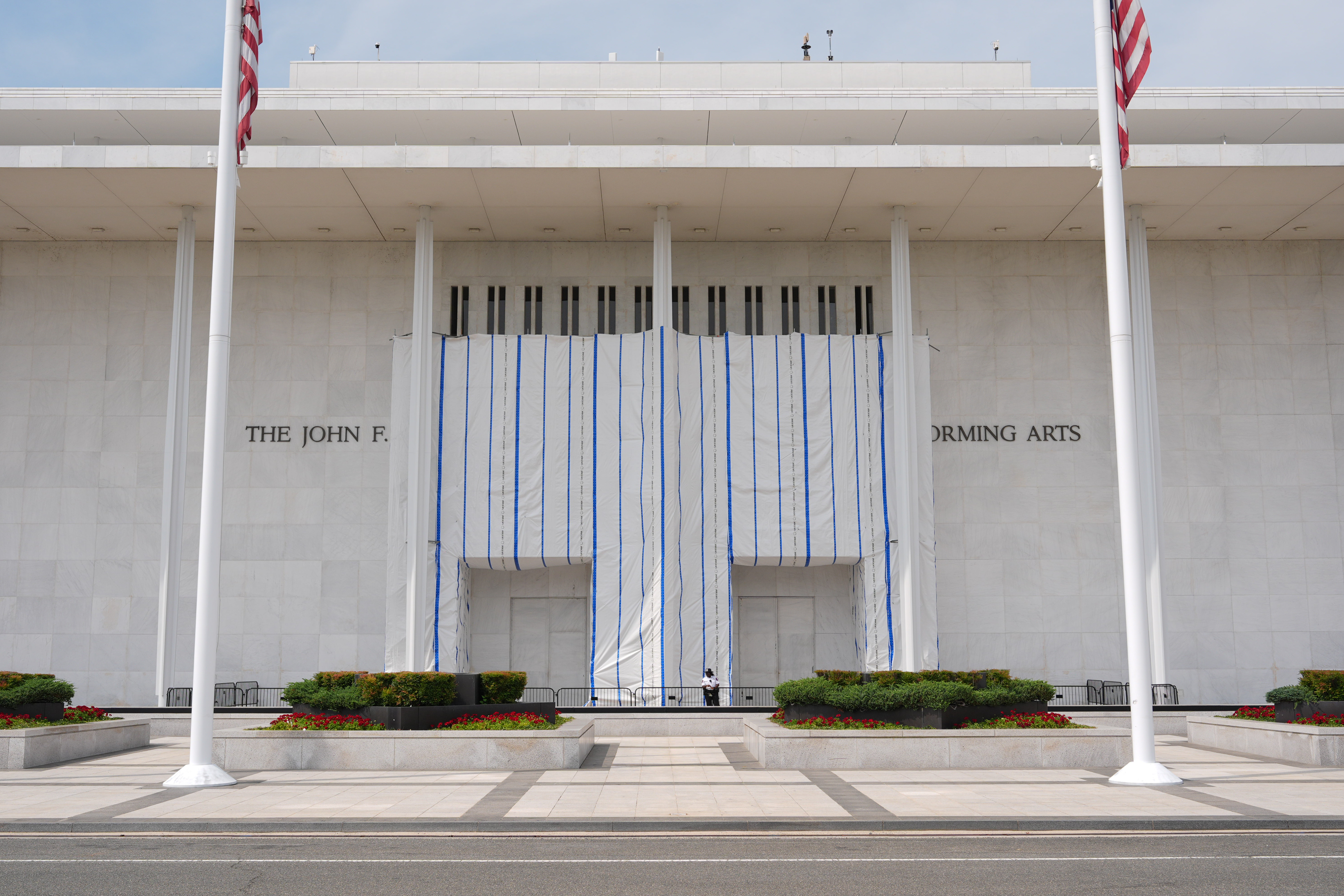
    WASHINGTON — A chunk of ceiling fell inside a main hallway of the Kennedy Center, according to a spokesperson who said the damage underscores the need to shut down the historic arts venue for renovations sought by President Donald Trump.

    No one was injured when a piece of the ceiling inside the Kennedy Center’s grand foyer collapsed Friday evening, said Roma Daravi, the center’s vice president for public relations.

    Photos provided by the center showed a large hole in the high ceiling and debris littering the red carpet in part of the hallway that connects the Kennedy Center’s three main performance auditoriums. The damage occurred during stormy weather in Washington.

    The Kennedy Center’s Trump-aligned board is fighting in court to move forward with plans to add Trump’s name to the building’s facade and to close the center for two years as it undergoes $250 million in renovations.

    Daravi called the partial ceiling collapse Friday “another example of the urgent need to close for renovation and revitalization, as our Chairman President Trump has championed.”

    “This structural failure stems from decades of neglect and deferred maintenance by the previous leadership, and there’s no justification for further delays in restoring America’s cultural center,” Daravi said in a statement.

    Trump’s efforts to add his name and make other big changes to the center established to honor President John F. Kennedy following his assassination are just part of Trump’s broader second-term agenda to reshape Washington.

    Trump already has demolished the East Wing of the White House to make way for a ballroom. He also plans a triumphal arch near Arlington National Cemetery and a renovated golf course along the Potomac River.

    U.S. District Judge Christopher Cooper ruled in May that Trump’s name had been added to the Kennedy Center illegally and ordered that it be taken down. He also blocked the administration from closing the venue for renovations.

    Now before the judge is an August vote by the Kennedy Center’s board to return Trump’s name to the facade so it reads: “The John F. Kennedy Center for the Performing Arts Restored and Renovated By President Donald J. Trump.” Justice Department lawyers have argued donations for renovations will dry up without Trump’s name on the building.

    Other changes have moved forward. Last week, the Kennedy Center took down a large stick figure sculpture known as Blue that had stood outside the center since 2019. The Kennedy Center gave no reason for its removal, but said in a statement “we are honored to have been stewards” of the late sculptor Joel Shapiro’s work.

    Grace Terpstra of Keep the KC, a community group fighting the Kennedy Center’s closure, said she suspects the board will seize on what appears to be limited ceiling damage “to make the point that the whole thing needs to be shut down, that it’s going to fall on everybody.”

    “I think they’ll try to make it into a bigger thing and show that they’ve found a lot of other things,” said Terpstra, the group’s founder.

  • U.S. military hits 3 Iranian oil tankers after saying Navy ships were targeted with missiles

    U.S. military hits 3 Iranian oil tankers after saying Navy ships were targeted with missiles

    CAIRO — U.S. forces struck three Iranian oil tankers after Navy warships were targeted with missiles, the American military said Saturday, warning that it would “if necessary, destroy Iran’s limited and exposed oil fleet.”

    The strikes — a day after U.S. President Donald Trump sought to minimize the conflict as “small potatoes” — keep up a new tilt back toward fighting after six months of on-again, off-again war that began with U.S. and Israeli attacks on the country on Feb. 28. Both sides have sought to inflict both military and economic pain, and negotiations have collapsed.

    The military’s statement said that an American aircraft carrier and a destroyer evaded “multiple unprovoked Iranian attacks” while patrolling in the region and no U.S. personnel were hurt. It said that two Iranian oil carriers were “permanently disabled” and the third, unladen one, was destroyed.

    The U.S. statement said that the tankers were part of a shadow network helping to fund Iran’s powerful Revolutionary Guard and its armed proxies in the region.

    There was no immediate Iranian response.

    Iran had reported a strike near Kharg Island

    Earlier, Iranian state television had said that four U.S. missiles struck a tanker about 6 miles from Kharg Island, home to a terminal through which the country exports most of its oil. Kharg Island has been repeatedly targeted during the war, including U.S. strikes on military sites there in March.

    The U.S. said that one tanker was struck off Kharg Island and another was struck near Jask, east of the Strait of Hormuz. The unladen tanker was hit in the Gulf of Oman, and the U.S. said its crew had been “directed to abandon ship.” The statement shared what it called video footage of the strikes.

    After the U.S. statement, Iran’s state broadcaster reported the two other tankers attacked, saying their crews had evacuated.

    “We will not hesitate to defend American forces, and if necessary, destroy Iran’s limited and exposed oil fleet,” said Adm. Brad Cooper, the head of U.S. Central Command.

    The strikes came nearly a week after the U.S. and Iran resumed attacks following a month of relative calm, with the Strait of Hormuz and Iranian communities along it again being targeted. At least five people were killed earlier in the week during a U.S. bombardment of southern Iran. One strike hit a wedding.

    Masoumeh Zarei, 13, was wounded in the attack. She spoke to the Associated Press at a hospital while being treated for injuries to her abdomen.

    She said that the wedding celebration had already begun when she set out to join it. She never made it there. She was knocked unconscious when a telecommunications tower was struck. Her next memory was of waking up in a hospital.

    “The party had just started, and we wanted to go there,” Zarei said, her voice hoarse. “I had made my nails really pretty for the party, but everything changed.”

    Her friend, 14-year-old Kiana Karimi, also was wounded and in intensive care. She told the AP that she heard five explosions.

    “The first three explosions at the telecommunications tower threw us to the ground,” Karimi said. “I quickly got up to pick my brothers up off the ground. Then there were two more explosions, and after that I don’t remember anything.”

    U.S. had tried to turn to economic pressure

    The resumption of fighting in the past week came after new U.S. efforts to apply economic pressures on Tehran, whose hard-line new senior leaders have signaled the willingness to dig in after weathering decades of sanctions. The elected government of Iranian President Masoud Pezeshkian, however, has said that it favors a negotiated end to the war.

    Iran has found ways over the years to circumvent sanctions — and now a U.S. blockade of its ports — and get its oil to buyers to help ease growing economic pressures. That relies in part on a shadow fleet transporting its oil.

    Meanwhile, the issue that helped lead to the war — Iran’s nuclear program — was meant to be addressed in negotiations that fell apart soon after the U.S. and Iran signed a memorandum of understanding in mid-June. Now diplomats say the U.S., Britain, France, and Germany seek to refer Iran to the U.N. Security Council for failure to comply with its nuclear nonproliferation obligations.

    Instead, Tehran’s new leverage focuses on the strait that is crucial to global oil and natural gas shipments and was seen as an international waterway before the war began.

    The U.S. military has been helping to guide ships through the strait as Tehran asserts control and targets some vessels, but overall traffic remains low.

  • New York renters want to come to Philly and vice versa, Zillow says

    New York renters want to come to Philly and vice versa, Zillow says

    Renters in New York are looking to come to Philly and vice versa, according to an analysis of rental search trends in 50 metropolitan areas by Zillow.

    The Philadelphia metro area’s top out-of-town market for rental searches was the New York area, as of July. And the New York area’s top out-of-town market for rental searches was the Philadelphia region.

    Slightly more than 7% of views on rental listings in the Philadelphia area came from people in the New York metro. In the New York area, which was the market most driven by local searches, 1.6% of views came from residents of the Philadelphia region.

    The Philadelphia area has long been a destination for New Yorkers looking for relatively more affordable homes.

    Overall, two in five views for a rental in the Philadelphia area came from outside the region. Most searches — the other roughly 61% — came from locals.

    (function(){function e(){window.addEventListener(`message`,function(e){if(e.data[`datawrapper-height`]!==void 0){var t=document.querySelectorAll(`iframe`);for(var n in e.data[`datawrapper-height`])for(var r=0,i;i=t[r];r++)if(i.contentWindow===e.source){var a=e.data[`datawrapper-height`][n]+`px`;i.style.height=a}}})}e()})();

    In the Philadelphia area, the percentage of rental listing views from out of town grew slightly — by 0.6 percentage points — from last year.

    Shares of out-of-town rental searches grew the most — a few percentage points — in the Buffalo, Chicago, and Houston metro areas.

    “Renting is often how people try out a new community before committing,” Mischa Fisher, chief economist at Zillow, said in a statement. “When we see a market with a growing share of rental searches coming from outside the metro, that tips us off to a developing pipeline.”

    In hot spots such as Raleigh, N.C.; Hartford, Conn.; and New Orleans; out-of-town rental hunters outnumber locals searching on Zillow. These places have been destinations for people living in coastal metros with higher costs.

    In the New York metro, more than three in four views on rental listings came from locals. Rental markets in the Los Angeles and Chicago areas also are mostly driven by locals. These three markets are the biggest in the country, so their population sizes fuel higher local search traffic.

  • 🔔 To Bell or not to Bell | Morning Newsletter

    🔔 To Bell or not to Bell | Morning Newsletter

    Welcome to Labor Day Weekend. Cloudy skies should clear up this afternoon, with highs near 83.

    For this week’s advice column, we have an only-in-Philadelphia dilemma. When hosting guests from out of town, is it OK to skip a trip to the Liberty Bell?

    Plus, we have the latest on Johnny Doc’s release from federal prison, details about a second measles-involved fatality in Pennsylvania, and our report card for this week in Philly news.

    — Laura Benshoff (morningnewsletter@inquirer.com)

    If someone forwarded you this email, sign up for free here.

    What you should know today

    🔔 Over the Liberty Bell

    For this week’s advice column, a reader asked: My parents keep insisting we take visitors to the Liberty Bell. I’ve been five times this year. I can’t do it anymore but they want me to tag along because they think if I don’t I’ll just play my Switch at home. How can I convince them to go… anywhere else?

    To help solve this quandary, The Inquirer tapped Life & Culture reporters Mike Newall and Zoe Greenberg.

    To start, Newall and Greenberg suggested getting a more personalized feel for what out-of-town visitors might enjoy. Are they gourmands? Then take them to a meal at one of Philadelphia’s award-winning restaurants. History buffs? There’s Washington’s tent at the Revolution Museum, or Lewis and Clark’s journals at the American Philosophical Society.

    For more on how they advised our dear reader to get their parents to think beyond the Bell, read Newall and Greenberg’s full conversation here.

    Need advice, or want to share your thoughts? We want to hear it. Email us here.

    One viewpoint

    Potholes and sinkholes are a basic fact of life in Philadelphia, but fixing them shouldn’t take moving heaven and Earth, argues Inquirer opinion writer Daniel Pearson in his Shackamaxon column.

    This week, Pearson chronicles the 13-year-long saga one block has endured to get their street fixed. He argues that the city shouldn’t institute a proposed delivery tax to pay for filling potholes until it cleans up the communication and coordination issues like those at play on the 1600 block of South Lawrence Street.

    Read on for Pearson’s perspective, as well as his takes on banning Flock cameras and closing of the Academy of Natural Sciences.

    ❓Pop quiz

    The U.S. Constitution, which was signed at Philadelphia’s Independence Hall, turns how old this month?

    A) 250

    B) 247

    C) 227

    D) 239

    Think you know? Check your answer.

    🧩 Unscramble the anagram

    Hint: A proposed 118-unit apartment building at 23rd and Walnut Streets would be replace a building that used to house a location of what now-bankrupt chain.

    ARID TIE

    Email us if you know the answer. We’ll select a reader at random to shout out here.

    Cheers to Nancy Bush, who correctly guessed Friday’s anagram: Gloria Steinem. In 1982, Steinem traveled to Philadelphia to receive an award. During her trip, she met with the Inquirer’s Kathy Hacker, who wrote this profile.

    We were there

    Inquirer video producer Lauren Schneiderman witnessed throngs of visitors packing the Academy of Natural Sciences on Friday.

    Attendees told her they wanted their kids to experience the nearly 200-year-old museum before it shuts down at the end of the month.

    Somewhere on the internet in Philly

    🥸 Retired 6abc anchor Jim Gardner shaved his signature mustache, and people had feelings about it. Crossing Broad even compiled an homage to his famous whiskers over the years.

    🚍 A SEPTA bus got stuck in freshly poured concrete outside of Termini Bros. Of course, there’s video.

    👋 Thanks for hanging with me this Saturday. Paola Pérez is off so Sam Stewart will be your captain tomorrow.

    By submitting your written, visual, and/or audio contributions, you agree to The Inquirer’s Terms of Use, including the grant of rights in Section 10.