DALLAS — Camp Mystic filed for Chapter 11 bankruptcy reorganization on Wednesday, nearly a year after catastrophic floods killed 25 campers and two teenage counselors at the Christian camp for girls along the Guadalupe River in Texas.
Camp Mystic has been under increasing pressure since the July 4 disaster. Owners had planned to reopen the Texas Hill Country camp this summer for its 100th anniversary but reversed course in April amid outrage from victims’ families and lawmakers. Victims’ families filed lawsuits accusing the camp of failing to protect the girls as the powerful floodwaters approached.
Camp Mystic’s owner, Richard Eastland, also died in the flood.
The camp listed its debt at more than $10 million, according to the filing made in federal bankruptcy court in Houston. An attorney for Camp Mystic has not responded to an email and a phone message seeking comment.
“Bankruptcy will not stop all responsible parties from being held accountable,” Paul Yetter, a lawyer who represents multiple families of campers and counselors who died at Camp Mystic, said in a statement. “These innocent girls deserve justice.”
For decades, Camp Mystic was a summer staple and an institution for generations of families, who dropped off their girls at the sleepaway camp to ride horses, canoe, fish and attend Bible studies. Other summer camps in Kerr County, west of Austin, did not take on such devastating flooding and in some cases have reopened.
All told, the destructive flooding killed at least 136 people along a several-mile stretch of the river, raising questions about how things went so terribly wrong.
In the aftermath of the tragedy, the Eastland family spent months determined to reopen the camp this summer, pointing to enhanced safety measures that included flood warning river monitors and putting two-way radios enabled with national weather alerts in every cabin.
By the spring, Camp Mystic’s attorney said it was ready to reopen for business for nearly 900 campers.
But assurances of safety did not convince victims’ families and some Texas lawmakers. State regulators found nearly two dozen deficiencies in the emergency operations plan submitted by the owners, including in proposals for flood warning evacuations and safety training.
The decision not to reopen followed weeks of testimony in court hearings and legislative investigations that laid bare the camp’s lack of detailed planning for a flood emergency and its reliance on poorly trained staff.
Families of the victims packed the hearings, some wearing “Heaven’s 27” pins with photographs of their daughters. They listened to the details of missed flood warning signs, the descriptions of the flood and the decision to leave the girls in their cabins until it was too late. Testimony included video of the raging floodwaters as a girl repeatedly screamed “help!” somewhere in the distance.
Before halting the reopening plans, Camp Mystic invited journalists and lawmakers to review safety improvements at the camp and promised that no camp activities would take place in the low-lying area that was devastated by the flood. The Eastland family also stressed that hundreds of families wanted to return.
WASHINGTON — The Trump administration on Wednesday reached a multistate settlement with chemical giant Chemours Co. over yearslong, illegal discharges of synthetic “forever chemicals” used to make products resistant to water, grease, and stains. The settlement is the first by the federal government to resolve enforcement claims against a manufacturer of harmful chemicals known as PFAS.
Under the agreement, filed in federal court in West Virginia, Chemours will pay a civil penalty of $22.5 million for alleged violations and spend $90 million over 15 years to mitigate PFAS discharges in three states: West Virginia, North Carolina, and New Jersey.
Wilmington-based Chemours, a spin-off of chemical maker DuPont, also agreed to install PFAS pollution controls for surface water discharges and air emissions at a West Virginia facility at an estimated cost of $60 million, supply clean drinking water to communities near its West Virginia and New Jersey sites at an estimated cost of $280 million, and implement controls to reduce releases of PFAS and other toxic chemicals from its facility in North Carolina.
Combined, the penalties and relief programs are estimated to cost about $450 million, the Justice Department said.
The settlement allows Chemours to continue manufacturing PFAS for commercial and military applications while preventing future contamination and protecting communities from existing pollution, said Adam Gustafson, principal deputy assistant attorney general for the Environment and Natural Resources Division.
Justice Dept. says settlement protects public health
“The Trump administration recognizes the important role of Chemours for its commercial and military obligations,” Gustafson said in an interview. “The settlement protects public health while preserving that important balance.”
The settlement against a major PFAS manufacturer “delivers on the Trump administration’s promise to make polluters pay and stop PFAS contamination at the source,” said Jeffrey Hall, assistant EPA administrator for enforcement and compliance assurance.
The agreement will greatly reduce PFAS contamination of water, land, and air and even begin to mitigate past harm, Hall said. “This settlement brings Chemours into compliance with the law and holds it fully accountable,” he said.
In a statement Wednesday, Chemours said it has already begun planning and implementing operational improvements at its facilities and will take steps to mitigate future emissions and enhance existing programs.
“This settlement provides Chemours with greater clarity on future compliance requirements and actions to support long-term responsible manufacturing,” spokesperson Jess Loizeaux said.
The settlement comes as the Trump administration is expected to propose softening Biden-era limits on “forever chemicals” in drinking water, while delaying but keeping tough standards for two common types of the substance.
The proposal will start the formal process of rolling back parts of the first-ever limits on PFAS in drinking water finalized during former President Joe Biden’s administration. Officials at the time found they increased the risk of cardiovascular disease, certain cancers, and babies being born with low birth weight.
The agency is committed to addressing per- and polyfluoroalkyl substances (PFAS) in drinking water while following the law and ensuring that regulatory compliance is achievable for drinking water systems, EPA Administrator Lee Zeldin said.
Chemours discharged PFAS into rivers in three states
The settlement determined that facilities Chemours operates in the three states have discharged PFAS into the Ohio River, Cape Fear River, and Delaware River in violation of permits required by the Clean Water Act and state laws. Chemours also violated legal requirements under the federal Toxic Substances Control Act at all three facilities.
As a result of the alleged violations, people living near the facilities were exposed to illegal PFAS, officials said. PFAS are widely used and found around the world, with scientific studies showing that exposure to some PFAS in the environment may be linked to harmful health effects in humans and animals.
The violations continued for over a decade, the Justice Department said. The facilities were previously owned for many decades by DuPont. The settlement announced Wednesday does not resolve DuPont’s liability for past PFAS violations, officials said.
A federal judge last year ordered Chemours to stop discharging unlawful levels of cancer-causing chemicals into the Ohio River from the company’s Washington Works plant in West Virginia. The pollutants endanger the environment, aquatic life, and human health, U.S. District Judge Joseph Goodwin wrote in the August 2025 order.
The West Virginia Rivers Coalition had asked Goodwin to require the company to immediately comply with its permit limits after violating them for more than five years.
DuPont, Chemours, and another company, Corteva, agreed to pay New Jersey up to $2 billion last year to settle environmental claims stemming from PFAS. The federal settlement does not affect the state case.
N.C. AG blasts settlement
North Carolina Attorney General Jeff Jackson called the settlement “an insult to the people of eastern North Carolina.”
His state is “ground zero for GenX contamination, but this deal does practically nothing to clean up our water,” said Jackson, a Democrat. GenX is a trade name for a synthetic chemical developed by Chemours as an alternative to PFAS but which has raised significant health and environmental concerns in its own right.
“Chemours made this mess, and Chemours should clean it up,” Jackson said in a statement.
The federal consent decree calls for 14 specific treatment systems to reduce PFAS in wastewater, stormwater, and groundwater from the West Virginia plant. Chemours will test drinking water near the West Virginia and New Jersey sites and provide treated or alternative clean water.
Editor’s note: This article has been updated to include statements from Chemours and the North Carolina attorney general.
JDEIDAT MARJAYOUN, Lebanon — Looking out from a friend’s balcony, Milia el-Cheikh struggled to find her own home in the ruins of her now-deserted village, its entrances strung with barbed wire.
Her village of Dibbine is one of several Shiite-majority communities across southern Lebanon destroyed by Israeli forces battling the Iran-backed Shiite Hezbollah. Israel has occupied vast areas and fighting has raged through declared ceasefires. The latest truce — part of the interim peace deal between the United States and Iran — has largely held.
El-Cheikh, one of the few Christians from Dibbine, found shelter in another village but regularly visits Jdeidat Marjayoun, a mostly Christian village next to her hometown, to have coffee with a friend from church. Before the war, it was a comforting ritual. Now it takes place against a backdrop of loss and fear.
“I don’t know anything about my house,” she said. “Nothing is more agonizing than not being able to get to your home.”
Jdeidat Marjayoun is one of a string of towns and villages visited by the Associated Press on the blurry edge of the Israeli-occupied zone of southern Lebanon. The military has pushed out the mostly Shiite population, believing they harbor Hezbollah, and many towns have been demolished.
Residents of neighboring Christian, Sunni and Druze communities have been allowed to stay, but the conflict has transformed their lives. Their homes have been struck, road closures have isolated them from the rest of Lebanon, and nighttime raids by Israeli troops have terrified residents.
Israeli warnings against hosting Hezbollah fighters have effectively barred them from taking in displaced Shiites, driving a wedge between longtime neighbors and stoking political and sectarian tensions.
Lebanon is a linchpin for the Iran deal
The latest conflict began when Hezbollah fired rockets into Israel days after Israel and the U.S. launched their war on Iran on Feb. 28. Israel invaded Lebanon and has expanded its zone of control up to seven miles deep in places.
As troops advanced, Israel warned people to leave large areas of southern Lebanon, and in April published a list of 53 towns and villages — mostly Shiite — where residents are barred from returning. On Thursday, it added eight more predominantly Shiite villages.
Israel says its troops will remain in southern Lebanon for self-defense. It says Hezbollah was deeply entrenched and has released videos purporting to show tunnels and other military infrastructure in residential areas.
Iran says any wider truce must include Lebanon and that Israel must withdraw, while Hezbollah says it will resist occupation. Lebanon’s government has also called on Israel to withdraw.
They live in the Israeli military’s shadow
Mixed villages and towns on the edge of the security zone, spread over hills and valleys among orchards and olive groves, stand within sight of their devastated neighbors. Residents have vowed to stay.
The Shiite town of Khiam — now an empty white swath of flattened buildings controlled by Israel — can be seen from the Christian village of Qlayaa.
Qlayaa’s residents are effectively barred from reaching their olive groves in the valley between. “Now another season is lost,” said Hanna Daher, Qlayaa’s mayor.
A priest in Qlayaa was killed by shelling as he inspected an earlier strike, and a father and his two children were killed in a drone strike while driving to Qlayaa. Israel says it only targets militants.
In Jdeidat Marjayoun, a house was bombed on suspicion that militants were using it. Rockets — believed to be from Hezbollah — damaged a church’s dome. In other places, solar panels, power transmitters and water stations have been hit.
El-Cheikh fled Dibbine with her neighbors in early March after Israel warned people to leave. In late May, following weeks of fighting, Israeli forces raided Dibbine before withdrawing in early June.
As the fighting raged, el-Cheikh’s friend, Lolitta Costantine, huddled with her husband in their home in Jdeidat Marjayoun, and at one point stayed with neighbors. Cracks caused by explosions run down the walls of her home. Windows were shattered and doors knocked loose. She keeps shrapnel as a reminder of the ordeal.
“We didn’t know where the danger was coming from,” Costantine said.
Tensions rise as the displaced are turned away
Shiites seeking shelter from the fighting have been turned away by those who fear Israeli strikes or eviction, aggravating tensions that have been mostly dormant since Lebanon’s 1975-1990 civil war.
When a Qlayaa resident hosted a friend from a Shiite village in his orchard, his house was bombed, said Daher, the mayor. Other residents have asked Shiites seeking refuge to leave.
“We told them, we don’t want problems for you or for us,” Daher said.
Israel has warned Jdeidat Marjayoun’s municipality not to allow in people displaced from neighboring villages, saying it could put the town at risk or force it to be evacuated, the municipality said on social media.
“We were forced to ask some to leave the town,” said the parish priest, Father Philip Habib Okla. “It caused many disagreements and tension,” he added. “We are counting on faith to remain united.”
The Israeli military said it has warned people in parts of southern Lebanon not to allow Hezbollah to use their villages. It said Hezbollah operates in civilian areas, endangering residents.
During Israel’s 1982-2000 occupation of southern Lebanon, the area was a bastion of the South Lebanon Army, a mostly Christian militia working with the Israeli military. When Israel withdrew, some of them fled to Israel while others faced trial in Lebanon, where they were widely seen as collaborators.
Some residents worry they will be unfairly painted with that brush for staying in their homes. Few are willing to speak of the tensions openly, fearing retaliation by Israel or Hezbollah.
At a church visited by AP, a man shouted in exasperation that everyone had become suspicious of each other, even among Christians. He blamed Hezbollah for dragging Lebanon into the war, saying it had made a serious mistake.
‘It is like the West Bank here’
Late one night in March, Israeli forces surrounded a building in the mostly Sunni village of Halta. They burst in and arrested Chadi Abdel-Al, who screamed “my heart” as he was being beaten and dragged into a van, according to his mother, Ayesha al-Qaderi, who lives in the same building.
In the commotion, a 15-year-old relative, Mohammad Abdel-Al, ran through the dark in his pajamas toward the house, his grandfather, Hatem, said. The Israeli soldiers shot him dead. A neighbor, who was out on his balcony, was wounded.
The Israeli military said it had detained the commander of a local militant group and that its forces had opened fire at two individuals who it said had approached in a suspicious manner.
In a separate incident, Israeli troops detained three farmers from Halta during a raid on a nearby village.
They are among at least eight people detained by Israeli troops since March, according to Lebanese media. The Israeli military says they were suspected of involvement in militant activities and plots against its troops.
“We still don’t know why they kidnapped them. Maybe to instill fear in the village and to send a message that they see everyone,” said Issa Abdel-Al, the community’s leader.
“It has become like the West Bank here,” he added, referring to the occupied Palestinian territory.
Al-Qaderi, who has heard nothing about her son since he was spirited away, said: “I just want to know his fate.”
NEW YORK — Three Democrats who made criticism of Israel central to their political identities swept to victory in House primary races in New York City on Tuesday, signaling a new era of skepticism in their party toward the Jewish state and its actions.
The striking results reflected a fast-moving shift in liberal politics. Democratic voters are now more likely to be critical of Israel and its government than they are to be supportive, according to several recent polls, a monumental change in American sentiment.
And while many Democratic officials remain supportive of Israel, next year’s class of congressional Democrats is on track to be more wary about the United States’ relationship with Israel than at any other moment since the Jewish state was established after World War II.
The primary triumphs in deep-blue districts of Brad Lander, Claire Valdez, and Darializa Avila Chevalier came after each was endorsed by Mayor Zohran Mamdani of New York, whose advocacy for the Palestinian cause has been integral to his rapid political rise. At a rally for the candidates last week, he called the nation’s leading pro-Israel organization part of a group of “monsters” that he said were too powerful in American politics.
At Avila Chevalier’s victory party Tuesday night in Harlem, supporters chanted “free Palestine” while she pushed her campaign’s “babies, not bombs” slogan. She suggested in her victory speech that her win represented a shift in how Democrats in New York would operate.
“Today, we make it clear: The politics of the past ends today,” she said.
Super political action committees allied with the American Israel Public Affairs Committee, the pro-Israel group, have spent huge amounts of money on this year’s midterm elections to try to turn the tide in voter opinion. The organization has had some victories, saying in a statement Tuesday night that 180 Democrats and Republicans it had endorsed had advanced to the November election. The group congratulated a Maryland House candidate its allied super PAC spent millions backing and said this would “ensure this seat remains represented by pro-Israel leadership.”
But despite those successes, AIPAC has largely been on the defensive.
Polls show that support for Israel among Democrats has sharply and steadily eroded since the Hamas-led terrorist attacks on Oct. 7, 2023, and Israel’s subsequent destruction of most of the Gaza Strip. A New York Times/Siena survey this spring found that 60% of Democratic supporters said they were more sympathetic to Palestinians than Israelis, compared with 15% who were more supportive of Israel.
“You’re seeing more and more Democrats making it clear that we should provide no U.S. taxpayer support to the government of Israel,” Sen. Chris Van Hollen (D., Md.) said in an interview Tuesday. Next year, he added, “I hope we will see a Congress that doesn’t provide reflexive unconditional support to the government of Israel.”
Perhaps the most significant of the New York races pitted Rep. Dan Goldman, a two-term Democrat from Brooklyn, against Lander, the former New York City comptroller, who staked his campaign on opposing Goldman for being insufficiently critical of Israel.
The race between the two men, Jews who both describe themselves as liberal Zionists, symbolized how Democratic voters, especially younger ones, have shifted away from support for Israel.
But perhaps the most outspoken anti-Israel Democratic candidate who won in New York City, Avila Chevalier, defeated Rep. Adriano Espaillat, who has been a steadfast supporter of Israel in his decade in Congress. Avila Chevalier spoke often of having lived in the West Bank and attended a rally on Oct. 8, 2023, that was widely criticized for featuring speakers who appeared to justify the attacks a day earlier.
Like Lander and Valdez, Avila Chevalier is now the Democratic nominee in a solidly blue House district and is a heavy favorite to wind up in Congress come January.
New York Mayor Zohran Mamdani (left) congratulates Brad Lander after his victory in the Democratic primary election for the seat held by Rep. Daniel Goldman (D., N.Y.) in Brooklyn on Tuesday night.Todd Heisler
The fights in New York became increasingly nasty in the final days of the campaign. A local coffee shop chain wrote on social media that Goldman, who is critical of Israel’s government but has opposed banning aid to the country, was not welcome because it did not serve “genocide enablers.”
Pitched midterm battles over Israel
The main super PAC tied to AIPAC, the United Democracy Project, has spent more than $25 million so far this year, in addition to at least $5 million it has funneled to create new super PACs.
That sum may be just a fraction of what is to come. The group started the year with more than $96 million, making it one of the best-funded PACs in the country.
Its most prominent spending battles so far have been in New Jersey and Illinois. But Israel also became a driving issue in several House primaries in California.
The results have been mixed. In the Chicago suburbs, Daniel Biss, the mayor of Evanston, Ill., won a House primary after explicitly attacking AIPAC. The group spent $7 million in the race, mostly aimed at defeating Biss, who is Jewish. But in the final days of the primary, when it became clearer that a candidate even more critical of Israel than Biss could win, the super PAC dialed back its attacks on him.
In New Jersey, the AIPAC-tied super PAC targeted Tom Malinowski, a popular former member of Congress who supported more restrictions on aid to Israel. But in an embarrassing turn for AIPAC, Analilia Mejia, a progressive organizer who was loudly critical of Israel, beat him in the special election and then won a later primary.
AIPAC has won victories, too. Two of its preferred candidates in Illinois won crowded primaries, even as another anti-AIPAC Democrat won in a Chicago district.
In Washington, defending Israel has fallen out of favor among many congressional Democrats, with a large majority of senators who caucus with the party voting this year to block some U.S. arms sales to Israel.
“Do I think the Overton window on Israel has shifted more in the last six months than my entire career?” said Amy Rutkin, the longtime chief of staff to Rep. Jerry Nadler of New York, the longest-serving Jewish Democrat in the House, who is retiring. “It surely, absolutely has.”
The shift is part of a generational change after the retirements of longtime Democratic leaders such as former House Speaker Nancy Pelosi of California and Rep. Steny Hoyer of Maryland, the longest-serving Democrat in the House, both of whom are stalwart supporters of Israel. Rep. Hakeem Jeffries of New York, the minority leader, is also a backer of Israel.
But among Democratic voters, support for Israel has crumbled. And even House Democrats who are broadly supportive of Israel are highly critical of Benjamin Netanyahu, the country’s prime minister. Few enthusiastically support the right-wing Israeli government, and many are openly counting down until elections there, which are scheduled for October.
Shifting winds in New York
The Democratic shift on Israel has been particularly notable in New York, home to the country’s largest Jewish population and a mayor who has frequently focused on the plight of Palestinians.
“The monsters that we are up against, they take many different forms,” Mamdani said at a recent rally for his endorsed candidates, before adding that AIPAC believed “the only thing more frightening than democracy being allowed to run its course is an end to genocide and Netanyahu’s wars.”
Many Jewish leaders and groups criticized the remarks, arguing that they echoed antisemitic tropes at a time of increased hate crimes targeting Jews.
One of the candidates the mayor backed, Avila Chevalier, defeated Espaillat, the chair of the Congressional Hispanic Caucus. He was the only candidate in New York who was explicitly backed by AIPAC’s super PAC, which transferred money to a separate group that supported him.
In the 10th Congressional District, which includes lower Manhattan and a large area of Brooklyn and is one of the most Jewish districts in the country, Goldman frequently argued that a focus on foreign policy was misplaced given voters’ domestic priorities. Those arguments fell flat: He lost badly, trailing late Tuesday by more than 30 percentage points.
Several Jewish Democrats who are most likely heading to the House, including Lander and Biss, have taken a more antagonistic tone toward the current Israeli government. But whether they will take radically different approaches to policy remains to be seen.
AIPAC as a litmus test
For decades, AIPAC was the leading voice of a bipartisan congressional consensus on the importance of the U.S.-Israel alliance. Now, many Democrats in contested primaries want nothing to do with it.
The organization has become a symbol of dark money, alongside organizations backing the cryptocurrency and artificial intelligence industries. And all three interest groups are spending money on many of the same races.
None of the advertisements paid for by the AIPAC super PAC even mention Israel, focusing instead on top-polling issues in each area.
In Maryland, the super PAC spent more than $5 million to back Adrian Boafo, a state legislator, in the primary to replace Hoyer. The ads focused on Boafo’s biography and his accomplishments in Annapolis. Cryptocurrency interests spent an additional $3.4 million to back Boafo, according to AdImpact, a media tracking firm. He ended up finishing well ahead of a crowded Democratic field.
The next Democratic primaries to revolve around Israel will come in August, when Minnesota, Michigan and other states are holding competitive intraparty contests.
At a Democratic primary debate for Senate last week in Minnesota, Lt. Gov. Peggy Flanagan declared that “I don’t take AIPAC money because my values don’t align with AIPAC.” Her opponent, Rep. Angie Craig, who has been endorsed by AIPAC in the past, replied that she had taken “not one penny” from the group and called for Netanyahu to lose his reelection bid in October.
The most divisive race, however, will be in Michigan, which has large Jewish and Muslim populations.
The Democratic Senate primary there includes Rep. Haley Stevens, a staunch backer of Israel, and Abdul El-Sayed, a progressive public health official who has called Israel’s actions a genocide and opposes any military aid to the country. A third candidate, State Sen. Mallory McMorrow, has tried to take a middle path on Israel, but is struggling in the polls.
NAIROBI, Kenya — Reported Ebola cases have surged above 1,000 in the Democratic Republic of Congo, and health experts are warning this could be one of the worst outbreaks, rivaling the largest on record, which killed 11,365 people in West Africa from 2014 to 2016.
On Wednesday, French officials announced the country’s first case of Ebola from this outbreak — a doctor who had traveled to Congo on a humanitarian mission. The doctor was being treated at a special medical facility and was reported to be in stable condition, according to a statement from the French Health Ministry.
With more than 250 confirmed deaths in Africa, the World Health Organization said Tuesday that the current outbreak, first reported in May, has the largest number of confirmed cases during the first month of any Ebola outbreak in Africa.
There have been 17 outbreaks since the discovery of the virus in 1976, involving three strains. The current strain, Bundibugyo, has been seen only twice before, in 2007 in Uganda and in 2017 in Congo. There is no specific treatment or vaccine for it.
“None of those previous outbreaks had the magnitude of the volume of cases and geographical spread that we are seeing today,” said Manuel Albela, an epidemiologist with Doctors Without Borders who is working with the Ebola response team.
“And even that comparison — again, one month into the declaration of the outbreak — it falls short, because we have never seen almost 900 confirmed cases just after one month of the declaration of the outbreak,” Albela said. “Going back to the comparison with the outbreak in West Africa, it’s a very similar situation because we don’t have a specific treatment for this specific virus.”
Diagnosing Bundibugyo is complicated, because there is no specific test kit for the rare strain and this is one reason the strain initially spread fast without detection.
The virus is now present in at least three eastern provinces in Congo. Ituri province, the epicenter, has recorded 954 confirmed cases, with 91 more in North Kivu province and three in South Kivu province, according to government data released Sunday, with 267 people reported dead.
In neighboring Uganda, 20 infections and two deaths have been reported.
Misinformation and distrust about the virus have complicated the response, leading many infected people to refuse treatment.
Health workers have been attacked during contact tracing and when relatives are denied access to the infected bodies of their loved ones.
On Friday, in the Mambangu neighborhood of Beni, angry residents attacked workers who went to disinfect the home of someone who died of Ebola, according to said Serge Kambale, 39, a doctor who spoke to the Washington Post by phone from the city.
During the incident, two workers were injured when the locals started throwing stones at them. Fabrice Kavono, a witness, said that the crowd attacked the health workers and accused them of fabricating the disease for material gain.
“It is the second time Ebola is in Beni, but they say it’s in Bunia and Mongbwalu only and that they are making it up here to make money,” Kavono said.
Another witness told the Post that people with relatives in Mongbwalu, the mining town in Ituri province at the center of the outbreak, were fleeing in droves to relatives in parts of North and South Kivu — spreading the virus as they traveled.
Onesphore Bangenza, the leader of the Ebola Response Team in Bunia for Mercy Corps, a nonprofit group, said that burials in which relatives insisted on washing bodies of loved ones and touching them were still happening, and that residents were not adhering to distancing guidelines.
“We have motor taxis transporting more than three people,” Bangenza said. “There are people who do not want to be tested. The scale of the outbreak could be larger.”
In May, 30 people who had exhibited Ebola-like symptoms died at a displacement camp in Kigonze that hosts families fleeing conflict in the region, Reuters reported.
Two aid workers confirmed that 13 deaths had been reported at the camp within 48 hours and that more 30 total deaths were expected.
“The constant movement and overcrowding of refugees in camps is causing fear that this virus could spread even more and the scale of the outbreak may grow” Bangenza said, adding that conditions in the camps were abysmal. “No water, no latrines,” he said. “The hygiene condition is very, very bad.”
New Ebola cases have been reported in cities such as Beni where an ISIS-affiliated rebel group, the Allied Democratic Forces, has waged attacks, prompting families to flee their homes.
At a local hospital in Beni, a patient admitted with malaria asked to be discharged early because he feared that others at the hospital would have Ebola and infect him, he told the Post. While he was in the hospital, the ADF attacked an area near the hospital, killing seven people.
“First, I was afraid that because I exhibited malaria symptoms, which are similar to Ebola, I would be assimilated with people with Ebola,” the patient said, speaking on the condition of anonymity to discuss private health matters. “In the small hospital, there is no clear follow-up, so anything can happen. Then, the attack scared me more.”
Congo has been besieged by years of conflict especially in the mineral-rich eastern regions of the country, which boast the world’s largest deposits of coltan and cobalt, used to manufacture electronics.
Cycles of violence have also weakened health systems in the region.
Just last week, protests broke out in Kinshasa, Congo’s capital, after people learned of a proposal to change the constitution to allow an extension of term limits, which would allow President Félix Tshisekedi to stay beyond his current term, which was supposed to be his last.
The Rwanda-affiliated M23 rebel group was working with health teams after two cases of Ebola were discovered in Goma, a city that M23 controls, the group’s deputy spokesperson, Oscar Balinda, told The Post. M23 controls large swaths of territory in eastern DRC.
The United States has sent $375 million in aid, so far, to contain this latest Ebola outbreak, Trump said during a recent Group of Seven meeting in France.
Experts say more must be done contain the outbreak.
“One of the key factors to try to control an outbreak of Ebola is to decentralize as much as possible the testing capacity, so that the tests can be done in the places where the cases are,” said Abela, the epidemiologist. “And I think that this, little by little, is happening. But, as usual, we want things to happen yesterday.”
Abela also said that contact-tracing is crucial but not enough is being done. “At the moment, I think there are 70 percent of the contacts being followed up when the target is normally 95 percent, according to the DRC authorities.”
In his battle to clean the murky waters of the Lincoln Memorial Reflecting Pool, President Donald Trump has tried draining, painting, hydrogen peroxide, and what the Interior Department describes as “high-tech nanobubble ozone technology.” But he has seemingly overlooked two of the most important factors that experts say are driving unsightly — and sometimes dangerous — profusions of algae: pollution and climate change.
Algae thrive in warm, still waters, causing populations to explode as global temperatures rise, said environmental engineer Steve Chapra, an emeritus professor at Tufts University.
Meanwhile, rampant human development has increased the amount of fertilizer and sewage produced by farms and cities, and severe storms intensified by the warmer atmosphere are causing more of these pollutants to run off into local waterways — providing algae with the nutrients they need to grow.
In a 2017 study, Chapra and his colleagues projected that climate change would cause a more than fivefold increase in the number of days when U.S. water bodies are affected by harmful algal blooms.
Short-term measures like those Trump has pursued may temporarily reduce algae populations in some water bodies, Chapra said. But unless they grapple with warming and nutrient pollution, any efforts to address these blooms in the Reflecting Pool and elsewhere are doomed to fail in the long run.
The consequences could be profound, because the problems presented by blooms go far beyond aesthetics, he added. They can disrupt aquatic food chains, deplete oxygen in water bodies and even produce deadly toxins.
“It’s probably the biggest water quality problem in the world,” Chapra said. “The Reflecting Pool is the canary in the coal mine.”
A spokesperson for the Interior Department did not respond to questions about whether the department had considered nutrient pollution or water temperature in planning the pool’s refurbishment. In an email, the agency reiterated that the National Park Service is using hydrogen peroxide and ozone nanobubbles, which break up algae by damaging their cells.
The Reflecting Pool has been beset by algae blooms, as seen Monday.Al Drago
The root causes of blooms
Algal blooms have long thrived in the Reflecting Pool, thanks to stagnant, shallow water enriched by pollution and warmed by sweltering D.C. summers.
Since 2012, the pool has been filled from the Tidal Basin, which in turn is fed by the Potomac River. Both water bodies contain excessive amounts of nitrogen and phosphorous — the nutrients most loved by algae — and are designated as “impaired” by the Environmental Protection Agency, meaning they don’t meet basic water quality standards for swimming, fishing, and supporting aquatic life.
Trump said his $14 million renovation this spring would clean the pool’s algae-clouded waters by sealing leaks and painting the bottom “American flag blue.”
But the refurbishment didn’t address the pollution that is the root cause of algal growth, said Hans Paerl, an aquatic ecologist at University of North Carolina at Chapel Hill. The pool was refilled on June 4 using the same nutrient-rich Tidal Basin water as before.
The spate of warm, sunny days that followed — June so far has been about 2 degrees Fahrenheit hotter than normal, according to the National Weather Service — provided ideal conditions for the photosynthetic creatures to multiply. Those high temperatures may have been exacerbated by the pool’s new dark blue coating, which absorbs more heat than its previous gray finish, Chapra said.
Within days, satellite data showed that the Reflecting Pool contained more algae than at any recorded point in June for at least five years.
The bloom that turned the pool green shortly after it was refilled was likely caused by a single-celled organism called cyanobacteria, Paerl said. Pictures of the pool showed a characteristic bright green scum coating the surface of the water.
Cyanobacteria blooms are the most dangerous, Paerl said, because they produce toxic compounds that can cause rashes, vomiting, and neurological problems in people who touch or ingest them.
After the Interior Department treated the pool with hydrogen peroxide, which breaks down cyanobacteria’s cell membrane and disrupts photosynthesis, the cyanobacteria bloom seemed to wane.
But the water’s sickly green sheen remains. Aquatic ecologist Rosalina Christova, a George Mason University researcher who acquired a sample from the Reflecting Pool on June 15, found that the water had been colonized by a genus of multicellular green algae called Desmodesmus. In an email, she called the population “very dense.”
The green algae are more resistant to the effects of hydrogen peroxide, and they were likely able to capitalize on the nutrients released from the disintegrating bodies of the slain cyanobacteria, Paerl said.
“This created a niche for another player, so to speak,” he said. “Nutrients keep cycling through there and feed whatever blooms.”
A growing global threat
Though the administration’s concerns about algae in the Reflecting Pool are in part cosmetic, the proliferation of blooms in waterways across the planet pose a significant — and growing — threat, said Joaquim Goes, a biogeochemist at Columbia University.
By studying satellite images of the ocean, he found that microalgae scums — caused by the same tiny organisms as those afflicting the Reflecting Pool — have expanded at a rate of 1% per year since 2003. The phenomenon has disrupted food chains and created oxygenless “dead zones” where fish can’t survive.
“It is spreading like wildfire all over the world,” Goes said. “And there is no question that temperature is playing a role.”
Blooms are also increasing in freshwater bodies that supply people’s drinking water, research shows.
A 2022 EPA assessment found that 49% of U.S. lakes showed excess amounts of chlorophyll a, the photosynthetic compound that indicates presence of cyanobacteria and green algae. Detections of microcystins, a class of toxin produced by cyanobacteria, increased by almost 30 percentage points since the previous assessment was conducted five years earlier.
Massive cyanobacteria blooms have poisoned important fisheries, such as in Lake Erie. They can imperil important ecosystems, like the Everglades below Florida’s Lake Okeechobee. They have been linked to the deaths of dogs, cattle and, in rare cases, humans.
Even green algae, which do not produce toxins, can clog filtration systems and disrupt drinking water supplies. When they die, the decomposition of their bodies depletes oxygen in the surrounding water, killing other aquatic life.
The National Office for Harmful Algal Blooms, funded by the National Oceanic and Atmospheric Administration, estimates that phenomenon causes an average $50 million in damage to the U.S. economy each year. Individual severe events can cause even greater harm: An unprecedented “red tide” cost roughly $2.7 billion in decreased tourism revenue when it forced the closure of beaches across southern Florida in 2018.
Lasting solutions
Theories about the persistence of the Reflecting Pool algae abound.
The Interior Department has blamed residual organisms that remained in supply lines after the renovation. Some have speculated that the recent blooms are a product of liberal “sabotage.”
The Trump administration has said it plans to drain the pool again to address algae growth and paint that is peeling from its bottom.
But those measures are unlikely to prevent algae from reemerging, said environmental engineer Victor Bierman, a retired water quality consultant and former EPA scientist.
As summer heat continues to ramp up, he worries the green algae could be replaced by cyanobacteria, which have no predators and readily outcompete other microbes at high temperatures.
“You can get rid of an existing bloom, but if you don’t change the underlying conditions … you’re going to grow more algae,” Bierman said.
Officials could stymie growth by increasing the flow of water through the pool, but that would disrupt the still surface needed for it to be reflective, he added. A better option would be installing an enhanced filtration system that removes nutrients from the Tidal Basin water before it is pumped into the pool.
Ultimately, said Chapra, algae blooms will continue to plague the Reflecting Pool and countless other water bodies until people address the human-made problems of nutrient runoff and climate change.
“If you don’t follow the science, then you think it’s magic or espionage, and it’s not,” Chapra said. “This is basic biology.”
It was the 10th time the Senate has tried to stop the war, and the outcome, on a vote of 50-48, was a stunning turnaround from past efforts. While the resolution is largely symbolic, and does not carry the full force of law, it reflects the growing concerns from a number of Republican lawmakers in both the House and Senate over both the war and the deal Trump struck with Iran to end it. The House approved the resolution earlier this month.
Trump responded angrily Tuesday night on his Truth Social platform, calling the vote “poorly timed and meaningless” and saying it “provided aid and comfort” to Iran.
Senate Democratic Leader Chuck Schumer of New York said, “Time after time, the vast majority of Senate Republicans sided with Trump and his war instead of the American people.”
Schumer said Americans have paid the price for “Trump’s historic blunder in Iran. It’ll go down in the history books as one of the worst foreign policy forays America has ever made.”
In the past, as many as four GOP senators have voted for the war powers resolutions, and they did so Tuesday — Republicans Lisa Murkowski of Alaska, Susan Collins of Maine, Rand Paul of Kentucky and Bill Cassidy of Louisiana. One Democrat, Sen. John Fetterman of Pennsylvania, voted against.
Trump bashed the four Republicans as losers, saying, “These senators have made my job more difficult.”
On this vote, the absence of two Republicans, including Sen. Mitch McConnell of Kentucky, who was admitted to the hospital recently for an undisclosed matter, left the GOP without a full majority to halt the effort. Sen. Dave McCormick, R-Pa., also missed the vote.
Trump to meet senators as Republicans balk at Iran deal
Trump himself is headed to the Capitol on Wednesday to meet with GOP senators after Vice President JD Vance was overseas working to negotiate with Iran to end its nuclear ambitions — which had been among the stated rationales for the war.
The president is not pleased with the Republicans who have been critical of the deal he struck with Iran, according to one GOP senator granted anonymity to discuss the private dynamics.
The terms of the Iran deal are spelled out in a memorandum of understanding that Trump signed last week, starting a 60-day clock for the sides to reach a broader agreement over ending Iran’s nuclear program.
But Republicans have particularly objected to the $300 billion fund to help Iran rebuild, which is far greater than the $1.7 billion then-President Barack Obama refunded the country under his administration’s 2015 Iran deal.
“I believe President Trump is getting very poor advice on Iran,” Sen. Ted Cruz, R-Texas, said last week on his podcast after the deal was made public.
Democrats have repeatedly forced Iran votes
Over and again, Democrats have been forcing votes on the Iran war, almost since the U.S. and Israel launched missile strikes on Iran on Feb. 28.
Nearly each week they’re in session, the Senate Democrats have put forward war powers resolutions, but they have failed to amass the majority needed for passage in the narrowly split chamber, where Trump’s Republican Party holds the majority. Trump would almost certainly veto any measure that passed.
While the House- and Senate-passed resolution does not go to the president for his signature, passage stands as a powerful, if symbolic, statement from Congress and a rebuke of the administration’s military actions.
Sen. Tim Kaine, the Democrat from Virginia who has led his party’s efforts, said the pause in warfighting, as Trump’s team works to shore up a fragile ceasefire, provides the perfect time for Congress to step back and assess “what should the next chapter be.”
Hegseth seeks $80 billion from Congress for the Iran war
Defense Secretary Pete Hegseth is on Capitol Hill this week, seeking roughly $80 billion in supplemental funding to shore up defense supplies in the aftermath of the Iran war, which is drawing scrutiny when many Americans are reeling from high gas prices and costs of living.
The Pentagon early on had estimated the war cost $11.3 billion during its first week, and senators said experts put the overall price tag of Operation Epic Fury higher, at some $100 billion.
The Defense Department’s funding request is part of a broader beef-up of military money the White House wants as part of its budget request this year.
House Democratic Leader Hakeem Jeffries said Tuesday, “We should not spend another dime of taxpayer dollars on Operation Epic Failure.”
The Trump administration is seeking $1.5 trillion in defense funding this year — a nearly 50% increase — including $350 billion that it wants in a so-called budget reconciliation package. Johnson and GOP leaders are working to pass that package on their own, over the objections of Democrats, much the way they approved Trump’s big tax cuts bill last year.
The 2025 tax cuts package also included a sizable increase for the military.
When news organizations around the world have faced criticism, they have historically turned to specialists: ombudsmen, in-house critics empowered to investigate their employers’ coverage and report their findings to the public.
But when CBS News appointed one last year, under an agreement with the Federal Communications Commission, it took a different tack. It tapped Kenneth Weinstein to flag complaints privately to its executives, pitching him in the hiring announcement as “an independent, internal advocate for journalistic integrity and transparency.”
As CBS News has been shaken by infighting between management and its star correspondents this year, Weinstein’s silence is being criticized by media experts. They say Paramount, the parent company of CBS News, has essentially hired a watchdog who doesn’t bark.
In the nine months since he was hired, Weinstein has issued no public statements about CBS News’ coverage or its controversies. He has not issued any guidance or feedback in staffwide emails or memos, three employees said. He has told some employees that he is scheduled to work only one day per month, two people said, though one said he responded to queries outside his monthly workday.
Most ombudsmen are much more public facing, said Jeffrey Dvorkin, a former NPR ombudsman who wrote the handbook for the Organization of News Ombuds and Standards Editors. That handbook says ombudsmen should report to the public, usually in a weekly column or mutually agreeable time slot.
Part of “stewarding public trust,” as Weinstein promised to do in his hiring announcement, is addressing the public, Dvorkin said.
“What’s the point then?” he said of CBS News’ decision not to require Weinstein to publish anything. “How is an ombudsman going to convey the public’s concerns, both internally and externally?”
Paramount said in a statement that Weinstein had been doing his job.
“He’s there to review concerns about CBS News’ reporting and coverage through a process that has been clear from the beginning,” the statement said. “Since September, he’s independently assessed the issues brought to him and, when appropriate, discussed them with CBS News and Paramount Skydance leadership.”
After Weinstein flags potential problems to Paramount’s executives, they decide whether to raise them with CBS News.
Since Weinstein was hired, Bari Weiss, the new editor-in-chief of the network, has been accused of injecting political bias into stories by three high-profile journalists for CBS’s 60 Minutes. She fired them all as part of a broader shake-up of the show. The remaining three correspondents said they would stay only because they didn’t want the show to die. (CBS News has denied the allegations of editorial meddling.)
Many newsrooms have done away with their ombudsmen. Some, like the New York Times, which dropped the position in 2017, argued that they were anachronisms in an era of instant online criticism. Others have cited dwindling resources. In addition to the Times, the Washington Post, ESPN, and the Boston Globe did away with their in-house critics in the last quarter-century; NPR and PBS are among the last remaining U.S. news organizations that employ a full-time public editor.
The FCC announced the creation of the CBS News ombudsman when it approved Skydance’s acquisition of Paramount in July. The agency’s chair, Brendan Carr, had been investigating a complaint about a 60 Minutes interview with Vice President Kamala Harris from the previous fall, but allowed the deal after the company agreed to employ, for two years, an ombudsman who would evaluate claims of bias. (President Donald Trump sued Paramount over the interview. Press freedom advocates said the controversy was baseless.)
Carr said the move would “promote transparency and increased accountability.”
In September, Paramount announced that it had found its pick: Weinstein, a veteran of the Hudson Institute, a right-leaning Washington think tank. Though he had no experience overseeing news coverage, Weinstein had served on the board of the U.S. Agency for Global Media, an independent federal agency that oversees U.S. government-supported civilian media such as Voice of America. There, he worked alongside Jeff Shell, who would become Paramount’s president.
Though Weinstein does not respond to complaints publicly, he is easy to reach. CBS News set up a website where viewers can submit their concerns, anonymously or by name. One of the people said that many of the notes Weinstein received focused on the network’s coverage of the war in the Gaza Strip.
At least one inquiry to Weinstein has been made public. Rep. Jamie Raskin (D., Md.) sent him a letter in December to ask for a full accounting of the network’s decision-making around a November interview with Trump.
But Weinstein did not reply. Instead, Paramount’s general counsel sent a letter to Raskin explaining that the interview had been edited for length.
In December, after a 60 Minutes correspondent, Sharyn Alfonsi, accused Weiss of meddling in one of her stories, media critics mused publicly about whether Weinstein would weigh in.
“I wonder if the CBS News ombudsman will have anything to say about this,” Brian Stelter, CNN’s chief media analyst, wrote on social media. Eric Deggans, the Knight professor of journalism and media ethics at Washington & Lee University, posted: “Wonder if Weiss will ever say exactly why she pulled the story? Or if CBS News new ombudsman will somehow surface?”
Carr, at least, does not seem concerned by the public silence from Weinstein.
This month, after Weiss fired the three 60 Minutes correspondents, Carr was asked directly whether Weinstein would look into their complaints of editorial interference.
Jake Tapper, an anchor on CNN, sat down with Carr and pointed out that the FCC had pushed for an ombudsman to evaluate claims of bias, and asked whether Weinstein should investigate.
Eager to lessen the chaos of the transfer portal era and court fights with players trying to extend their careers, the NCAA approved a new eligibility model for Division I athletes on Tuesday that will allow five seasons of competition over a five-year period that begins with their full-time enrollment or the academic year following their 19th birthday, whichever occurs first.
The Division I Cabinet unanimously approved the change from the longstanding tenet of college sports that gave athletes five years to complete four seasons of competition with their eligibility clock starting at the time of enrollment, regardless of age.
The move will all but eliminate waivers or redshirt years for extended eligibility except for religious missions, maternity leave or active-duty military service. No longer will extensions be considered for athletes who are injured.
“While previous NCAA rules have served college sports well for a long time, we heard also loud and clear from NCAA members and student-athletes that eligibility rules should be easier to understand,” NCAA President Charlie Baker said.
The NCAA believes the age-based model will make rules easier to administer and help make roster management more predictable for coaches.
“I think this new rule is one of the most sensible things the NCAA has ever done, and it will absolutely eliminate the type of eligibility litigation that’s predominated lately,” said attorney Tom Mars, who represented Ole Miss quarterback Trinidad Chambliss in his successful quest for an additional year of eligibility in a case that went to the Mississippi Supreme Court.
Mars added, “Let me put it in bottom-line language: There’s no way somebody could file an eligibility case based on a medical waiver now with the new rule. Can’t be done. You can file it, I guess, but it will be immediately dismissed.”
The rules, which will become official when the Cabinet adjourns its meetings on Wednesday, are set to take effect this fall. Division I includes more than 350 schools, some 200,000 athletes and, with football and basketball leading the way, is by far the most lucrative of the three in the NCAA.
The five-in-five language also is included in Senate legislation intended to address numerous concerns across college sports and comes after a wave of lawsuits from athletes seeking to extend their college careers and ability to earn money through revenue sharing and name, image and likeness deals. Still to be seen is whether the new rules will withstand legal scrutiny alongside the existing challenges.
Heisman Trophy runner-up and Vanderbilt quarterback Diego Pavia remains the lead plaintiff in a lawsuit challenging an NCAA rule counting seasons spent at junior colleges against players’ Division I eligibility time. That case is slated for trial in February.
“I wouldn’t say that the rule change itself will slow lawsuits down,” said Sam Ehrlich, a Boise State assistant professor of legal studies in business and management who tracks litigation against the NCAA.
Ehrlich said athletes very well could continue to petition courts for extended eligibility based on antitrust arguments, but appellate courts recently have delivered wins for the NCAA by overturning preliminary injunctions in several cases.
The new eligibility model will affect all athletes who enroll in 2027-28. Currently enrolled athletes with eligibility after the 2025-26 academic year, and those who are incoming freshmen this fall, can apply the age-based model or continue under previous eligibility rules. It would be advantageous this year for some incoming freshman hockey players to use the traditional model if they are coming from the junior ranks and are 20, as is common in the sport.
For schools with current athletes who may be eligible for hardship waivers or extensions of eligibility under current rules, the D-I Cabinet indicated the deadline to submit requests to the NCAA is July 31. After that date, waivers would no longer be available.
Ryan Downton, the attorney for Pavia in his case against the NCAA that won him a sixth year of eligibility last season, said he was happy to see athletes allowed five seasons of competition. But he said it was likely that high school class of 2022 athletes who are now cut off from further competition will go to court.
“These athletes are still within their five-year eligibility window and spent their entire college careers competing against fifth- and sixth-year players due to the COVID waiver,” Downton wrote in an email to The Associated Press. “We hope the courts will correct the unfairness of the NCAA’s ruling and allow class of 2022 players to play their fifth season in 2026-27.”
Ramogi Huma, executive director of the National College Players Association, wrote in a text to the AP that he had not seen the final language that was adopted but that the rule’s “general structure that has been discussed is within reason.”
“But it’s important for athletes to have an opportunity to seek hardship waivers,” he wrote.
A COVID vaccine study that the CDC’s chief halted this spring over methodological concerns was published Tuesday in JAMA Network Open, a leading peer-reviewed medical journal.
The analysis used the same methodology that CDC’s interim director had criticized when the paper was not allowed to be published in the weekly scientific report of the Centers for Disease Control and Prevention.
The study, which had been slated for publication in March in the CDC’s Morbidity and Mortality Weekly Report, found that the COVID-19 vaccine reduced the risk of emergency department visits and hospitalizations among healthy adults by about half last winter. The findings were consistent with what researchers have found in past years, that the vaccine can help reduce the risk of severe illness in adults even after accounting for immunity from prior vaccination or infection.
“Science was never the issue,” said Michelle Barron, one of the study’s authors and senior medical director of infection prevention and control for UCHealth, a nonprofit health system in Colorado. “Certainly it was within [the CDC’s] purview to keep it out, for whatever reason, but it was clearly not for scientific reasons that the study was withheld from publication in the MMWR.”
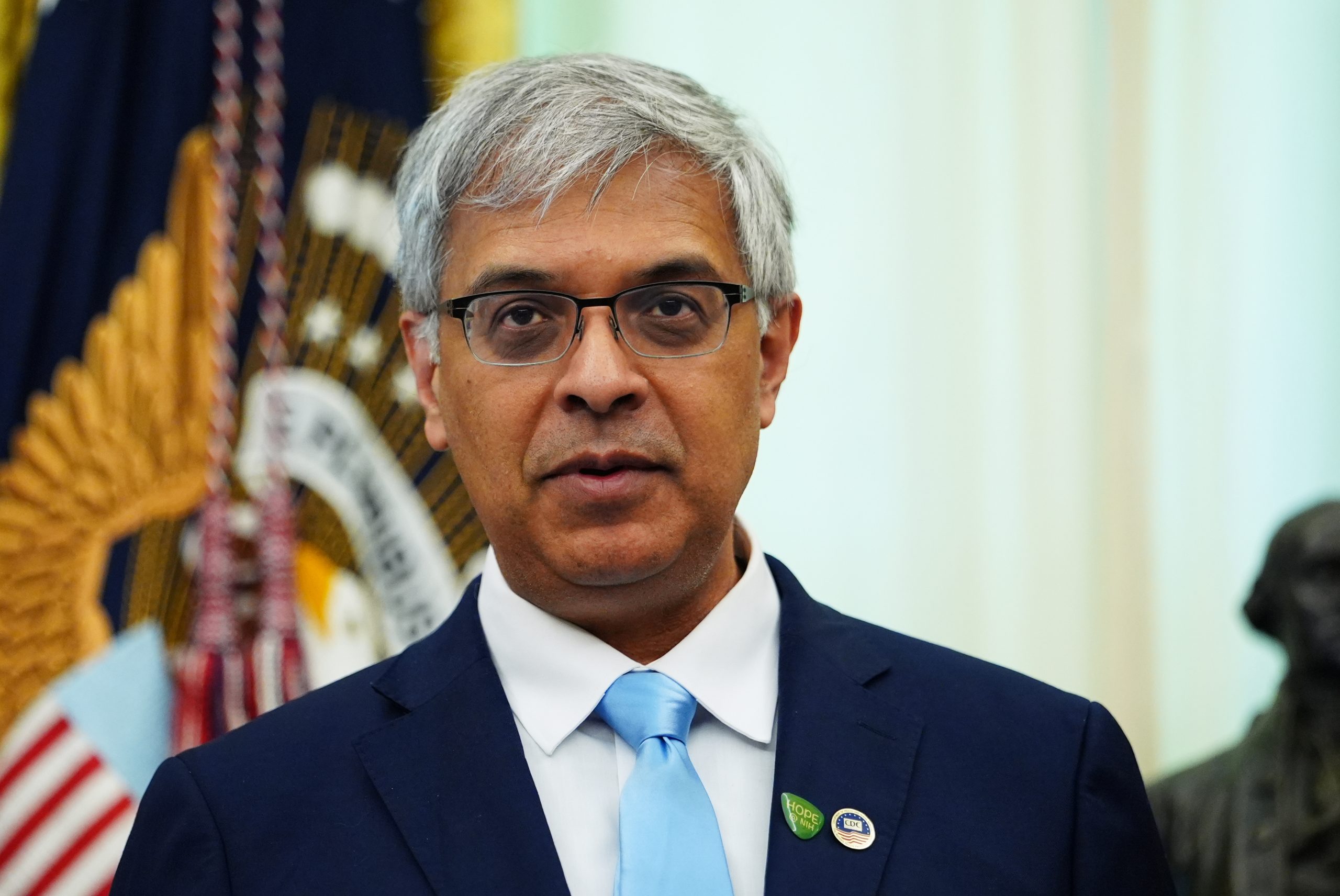
Jay Bhattacharya questioned the study’s methodology. (AP Photo/Julia Demaree Nikhinson)Julia Demaree Nikhinson
Jay Bhattacharya, CDC’s interim director, delayed publication of the study before it was subsequently not published in the MMWR at all, The Washington Post previously reported. Bhattacharya had concerns about the methods used to calculate vaccine effectiveness, a Health and Human Services spokesman said at the time.
Barron said she believed the study was not published because the findings did not support Health Secretary Robert F. Kennedy Jr.’s agenda that wants to limit the use of COVID vaccine specifically.
Kennedy, the founder of a prominent anti-vaccine group, has been an outspoken critic of COVID shots, once referring to them as the “deadliest vaccine ever made.”
A spokeswoman for the Health and Human Services Department did not directly address the author’s allegation Tuesday that the paper was withheld because it conflicted with the administration’s vaccine agenda. Spokeswoman Emily Hilliard said the CDC evaluates studies using rigorous scientific methods and reviews methodological concerns before publication.
“The CDC does not make scientific determinations based on predetermined conclusions,” Hilliard wrote in an email. “We evaluate the weight of evidence using rigorous methods, communicate uncertainty and limitations, and subject our work to scientific scrutiny before publication.”
A commentary accompanying Tuesday’s JAMA Network Open report said the methodology in question, known as test negative design, has limitations, like any study. But those shortcomings are well understood, actively studied, and outweighed by the method’s practicality for routine vaccine-effectiveness monitoring, wrote Natalie Dean, associate professor of biostatistics and epidemiology at Emory University’s Rollins School of Public Health.
“This is not a controversial study design — this is [the] same design that has been churning out vaccine results for a long time,” Dean wrote in an email. “And from a highly experienced group — CDC plus a network of top vaccine researchers across the country. They are a well-oiled machine.”
She added: “There was no scientific reason to reject this paper. It had undergone internal review, and it clearly meets the standards of peer-reviewed science. It makes my colleagues on edge to see political interference in the scientific process.”
Dean said the methodology is being “unfairly maligned” and worried that efforts to discard it could weaken the nation’s vaccine surveillance system. “Then we’ll be flying blind with respect to influenza, COVID, and RSV vaccine monitoring,” she said.
Between September and December last year, healthy adults who received the COVID-19 vaccine reduced their likelihood of emergency department and urgent care visits by 50% and cut the likelihood of COVID-associated hospitalizations by 55%, compared with those not receiving a 2025-26 vaccine dose, the report found.
Researchers analyzed data from a CDC-funded surveillance network to compare data on adults who sought medical care for COVID-like symptoms and compared outcomes between those who received the updated 2025-26 vaccine and those who had not.