WASHINGTON — The U.S. struck Iran on Friday to respond to a drone attack a day earlier on a cargo ship in the Strait of Hormuz, a provocation that U.S. President Donald Trump said violated the ceasefire.
U.S. Central Command said the military struck missile and drone locations and coastal radar sites in Iran.
The strikes came shortly after Trump told reporters, “You’ll find out” whether the U.S. would response to the drone attack.
“I don’t like the fact that they took a shot yesterday, actually four of them,” Trump said at the White House shortly before the U.S. struck back. When asked why there would be strikes when Trump has insisted talks with Tehran are going well, Trump said of Iran: “They’re a little bit different.”
He then abruptly cut off questions and reporters were ushered out of his office.
The British military said on Thursday that a container ship was hit by a projectile off the coast of Oman, coming hours after Iran threatened vessels to stop using the route. The United Kingdom Maritime Trade Operations center said no injuries were reported.
The development came during a fragile time for the U.S. and Iran as they work to negotiate a permanent end to the war. Iran has increasingly challenged the region and the U.S. over its control of the Strait of Hormuz, even with the current interim deal it reached with the U.S. last week.
The attack on the cargo ship happened while a United Nations maritime agency was beginning an operation to move stranded ships out of the strait this week, using an alternative route, hugging the shores of Oman rather than sailing through the central part of the strait.
The International Maritime Organization halted the evacuations after the attack and said on Friday they won’t resume until there are guarantees that the other ships won’t be attacked.
About 115 ships were able to move out of the strait in recent days, leaving about 500 still in the area, said Arsenio Dominguez, the agency’s secretary-general.
The U.S. and Iran are still negotiating terms of the deal, including issues such as getting ships through the key strait and addressing the future of Iran’s stockpile of highly enriched uranium. Under the interim deal, the two sides have 60 days to work out the details.
Shipping analysts said the drone strike cast a shadow over what had been a growing stream of trapped vessels finally leaving the Gulf and an increasing flow of tankers carrying crude oil.
“A week of widening commercial confidence in the Strait of Hormuz has hit its first significant test,” said marine data company Windward on X. It said that while the strait remains operationally open with 43 transits recorded after the incident, “the pace of normalization has slowed.”
On Wednesday before Thursday’s drone strike, 78 vessels transited the strait, the highest number since the war began, although below the prewar averages of 130 or more per day.
At least two tankers reversed course while attempting to transit the strait on the U.N.-backed route near Oman after Iran insisted vessels use only the Teheran-approved routes, according to marine data and analytic firm Lloyd’s List Intelligence.
More than two dozen ships were still transiting the strait’s southern route after the attack, Lloyd’s said Friday.
Immigrants began making plans to sell or rent their homes, secure bank accounts, and figure out thorny issues like child custody arrangements. Business owners started calculating how many days they can continue to employ workers whose legal status is set to expire. And nursing home leaders warned they would have fewer beds to offer if health aides are forced to leave the country.
Panic rippled through communities from Florida to Ohio and beyond in the hours after the Supreme Court cleared the Trump administration Thursday to strip humanitarian protections from Haitians and Syrians — and potentially all 1.3 million immigrants from over a dozen countries who had been previously shielded from deportation.
“The residents will be losing caregivers that they really have become attached to,” said Colin O’Leary, executive director at Laurel Ridge Rehabilitation & Skilled Care Center in Boston. Managers at the facility were racing to figure out how much longer staff members from Haiti with temporary protected status could continue taking care of patients. “That’s a lot for our residents to handle.”
Attorneys said Haitians and Syrians could lose work permits in little more than a month, but the deadline remained unclear because lower court judges must issue orders to implement the decision. Stephen Miller, the White House deputy chief of staff, told reporters Thursday that Haitians and others with temporary protected status should be detained and deported once they lose the benefit.
“If you no longer have status in this country, then you’re supposed to be deported,” Miller said.
Some of those immigrants have lived in the United States for decades and said they feared being sent back to conflict-ridden homelands that they barely know and whose languages some do not speak.
Temporary protected status, a program created in 1990, grants work permits and deportation reprieves to immigrants for up to 18 months if their nations are engulfed in war, natural disasters, or other emergencies. Applicants cannot have serious criminal records and the government can, and has, renewed the protections multiple times.
President Donald Trump and his allies have alleged that the temporary protections have lasted long after the emergencies have passed and have allowed undocumented immigrants and visa overstayers to live and work in the United States.
But the program also has become a political wedge. When he was a senator representing Florida, home to thousands of Haitians, Venezuelans, and others with the protections, Secretary of State Marco Rubio favored the protections.
Approximately 350,000 Haitians and roughly 6,000 Syrians have TPS, but the Supreme Court ruling ultimately could affect immigrants from 17 countries whose citizens were safeguarded under the program when Trump took office. His administration has sought to terminate protections for 13 of those countries.
Harlaine, 38, a registered nurse in Florida, said she hasn’t been to Haiti since she left for the U.S. at age 7 and had never visited because everyone told her it was too dangerous. She spoke on the condition that only her first name be used because she fears being targeted by immigration authorities.
“To tell me to go back to a country that I know nothing of is the sickest and most evil thing I think that somebody could do,” she said.
News of the ruling devastated residents and staff at healthcare and elder care facilities across the country, since a large share of the Haitian immigrant population works in those industries. Nursing homes, labor unions, and governors condemned the decision and called for an emergency resolution. Advocates called the decision one of the largest “de-legalization” efforts in U.S. history.
Ohio Gov. Mike DeWine, a Republican, characterized the decision as “a mistake” and said it is too dangerous to deport people to Haiti, including the more than 10,000 Haitians living and working legally in his state. New York Gov. Kathy Hochul (D) vowed to fight the ruling, even as the path to challenging it is unclear.
“I’m telling you it’s going to cripple our healthcare system,” Hochul told reporters. “Who’s going to show up tomorrow to take care of Grandma? Who’s doing that? Who’s stepping up?”
Miami Jewish Health, a senior living community and healthcare provider in Florida, cut 120 nursing home beds a few months ago, in part due to staffing issues, including those stemming from the pending cancellation of TPS for Haitians. About 40 healthcare employees and contracted food and housekeeping workers were affected by the Supreme Court ruling, said Jason Pincus, a vice president at the center.
Goodwin Living, a senior living nonprofit that serves thousands of older adults in Northern Virginia and Washington, D.C., braced for staff cuts, and at Laurel Ridge Rehabilitation & Skilled Care Center in Boston, managers prepared for having to say goodbye to dietary aides and certified nursing assistants who care for about 115 elderly residents.
Rita Siebenaler, a resident of Goodwin House Bailey’s Crossroads in Virginia, called the decision “sad, dreadful, and very upsetting for the seniors that I know.”
“We are now threatened with the loss of valuable, trained, vetted, very, very reliable caretakers,” she said.
The decision is expected to hit hard in Springfield, Ohio, where about one in four residents is Haitian. Trump falsely claimed on the 2024 campaign trail that Haitian immigrants there were eating cats and dogs. The loss of hardworking employees, homeowners, and renters who became trusted members of the community will be painful, residents said.
Ross McGregor, a fifth-generation Springfield resident and the president of a heavy machinery factory in town, has employed dozens of Haitians with temporary protections in the past, and worried that he will not be able to find workers in the future.
“If anything, right now our business is starting to pick up and grow,” said McGregor, 61. “I might have trouble hiring because the workforce is already challenging in Springfield.”
Harlaine, the nurse from Florida, obtained temporary protected status after Haiti’s catastrophic earthquake in 2010. She said she paid her way through college to earn a bachelor’s degree, taking years longer than most students to finish because she had to pay for it herself. She went on to work in emergency rooms, including during the deadly COVID pandemic that killed her sister.
Now she is facing the loss of her life in the U.S. She lives with her elderly mother, a retired factory worker who also has the temporary status, and her 17-month-old son, who is a U.S. citizen. Her mother paid off the home with her wages, she said.
Starting over in Haiti, she said, is unimaginable.
“You’re basically sending me to stick out like a sore thumb,” she said. “I barely know the language. That’s crazy.”
Fissures have emerged in recent weeks among some Republicans over Trump’s immigration enforcement policies.
Some House Republicans broke ranks in April to help Democrats pass legislation that would have extended Haitians’ TPS protections through April 2029. This month, the U.S. Chamber of Commerce and other business leaders pressured Trump to back off a plan to require green-card applicants to leave the United States for processing, fearing they’d get stuck abroad and it would harm their workforces.
Advocates for immigrants say it is inhumane to deport so many residents to struggling countries. Some are trying to find alternate ways to stay legally, but attorneys say they could be detained pending an asylum hearing if they lose TPS.
“People haven’t been here in this country in some artificial limbo like in a waiting room. People have married, people have had children, people who have started businesses, people have made this country their home,” said Jessica Bansal, an attorney involved in the case. “Are half a million people going to be torn from their communities in 32 days? Or will Congress and the people do something to stop it?”
Mustafa Doe, a Syrian immigrant in his 20s with TPS, was among the plaintiffs named using a pseudonym in the case the Supreme Court decided Thursday. In an interview, he said he fears persecution in his homeland because he is gay and not a practicing Muslim. He works for a Fortune 500 company in New York, helping manage its philanthropic programs. But he said he also recently bought a co-op and sits on the board, and now fears he will have to sell it.
He is among the younger residents in a building of older residents who rely on him to help lug heavy bags of groceries upstairs and even paint the building.
“It is like a family,” he said.
His parents are legal U.S. residents and most of his relatives are scattered across the U.S. Nobody is left in Syria to receive him if he is forced to go back. He said he came to America with a student visa in 2021 to attend college.
“There’s no one in Syria,” he said. “It’s literally just going to be me.”
Vice President JD Vance on Thursday expressed sympathy for former President Richard M. Nixon, suggesting that Nixon was wrongly forced out as president in 1974 and comparing his political travails decades ago to those facing President Donald Trump now.
“As I joked … backstage, if Watergate happened tomorrow, it would be like a 12-hour news story,” Vance said in remarks at the Richard Nixon Presidential Library and Museum in California. “The idea that it would have taken down a presidency is crazy.”
A spokesperson for Vance did not immediately respond to questions about whether the vice president was being facetious and how he was defining Watergate.
The Watergate scandal, which began in 1972 with a botched attempt to bug the Democratic National Committee’s offices at the Watergate Hotel in Washington, mushroomed into a wide-ranging investigation by reporters and lawmakers that revealed Nixon was aware of the break-in and directed secret White House payments in an effort to cover it up. He resigned as president two years after the scandal broke, with Nixon blaming the Washington Post for its central role in exposing his involvement in the break-in and other abuses.
The scandal also prompted a series of reforms intended to rein in presidential authority, including more independence for government watchdogs such as inspectors general, which Trump has steadily rolled back.
Historians said Thursday that the full scope of the Watergate scandal, ranging from the president’s efforts to apply pressure to his “enemies list” to asking for a census of Jewish Americans serving in government because he believed they were unpatriotic, revealed Nixon’s abuses of presidential power.
Vance “should know better as a well-educated lawyer,” said Timothy Naftali, a previous director of the Nixon library, referring to Vance’s law degree from Yale University.
Naftali, a Columbia University presidential historian, referenced tapes that contained thousands of hours of Nixon’s Oval Office conversations.
“You can hear him suborn perjury on the tapes. He’s telling an intermediary, what to tell someone who’s about to be interviewed by the FBI, what to say and what not to say,” said Naftali, who oversaw the Nixon library’s Watergate exhibit. “You can hear Nixon being told that money had been found to hire teamsters to go and break the bones of demonstrators. That’s all illegal.”
“It’s not as if it’s a matter of partisan interpretation. The evidence is overwhelming,” Naftali said, offering additional examples of Nixon’s efforts to subvert legal protections. “If he does know all of this, he’s telegraphing the kind of president he hopes to be.”
Some conservatives in recent years have reframed the scandals that ended Nixon’s presidency, arguing that government bureaucrats and the media unfairly sought to push him out.
In his remarks, Vance also repeatedly compared Nixon to Trump, pointing out the similarities in their political coalitions as well as their experiences with overseas wars.
“One of the other lessons of Richard Nixon is it’s not just that he got out of Vietnam, but that he got out of Vietnam from a position of strength. OK?” Vance said, making a comparison with Trump’s war against Iran. “It’s one thing to tuck tail and run. It’s another thing to clearly define an objective, to accomplish that objective, and then to ensure that you don’t allow mission creep to transform a victory into a defeat.”
Vance also alluded to lawmakers’ efforts to investigate both presidents. Trump was twice impeached in his first term, after first pressuring the Ukrainian government to investigate his rival Joe Biden, and then after lawmakers said he helped incite a riot at the U.S. Capitol on Jan. 6, 2021, as he attempted to have the results of the election overturned.
Nixon resigned as president while an impeachment process into his Watergate-related conduct was underway. Lawmakers ultimately decided to end the process given Nixon’s resignation. His former vice president, Gerald Ford, later issued a controversial pardon.
“If you look at the story of how the ‘deep state’ took down Richard Nixon, it’s not all that different from what the same groups of people, the same institutions tried to do to Donald Trump and the first Trump administration,” Vance said to applause. “There is a parallel.”
The 41-year-old Vance also mused on his own similarities to Nixon, who served as a California senator in his late 30s and became vice president when he was 40.
“Young senator, vice president, writes some best-selling books, is hated by the media,” Vance said. “It kind of sounds like JD Vance. … I’ve always liked Richard Nixon.”
In the late 1970s, comic artist Art Spiegelman and his wife, the editor Françoise Mouly, began dreaming up a new magazine, one they hoped would elevate cartooning into the realm of high art.
A colleague suggested that they talk to Jerry Moriarty, a painter who lived in Manhattan, a little uptown from their SoHo loft.
Arriving at Mr. Moriarty’s studio, Spiegelman was stunned by what he encountered: comics that were painted.
“It was totally mind-blowing,” Spiegelman, whose graphic memoir Maus won a Pulitzer Prize in 1992, said in an interview. “It was exactly what we were groping for, which was a place that wasn’t underground comics anymore, nor was it art underground.”
Raw, their magazine, debuted in 1980 with Jack Survives, the first in a series of painted comics by Mr. Moriarty about a stoic Everyman who muddles through the indignities of life in a hat and tie, refusing to capitulate.
“It’s as if Edward Hopper had taken up songwriting,” comic artist Chris Ware wrote in the Believer magazine in 2009. “For lack of a better word, it’s poetry — I believe the first that comics has ever seen — and poetry as fresh and affecting now as when first drawn.”
Mr. Moriarty died on March 25 at his home in Binghamton, N.Y., where his nephew Kevin Moriarty had been caring for him in his final years. He was 88. His death, which was not widely reported, was confirmed by his brother Fred Moriarty, who survives him.
A self-described loner, Mr. Moriarty refused to sell his paintings, and supported himself by teaching at the School of Visual Arts in Manhattan. In many ways, he had the sort of average life embodied by his Everyman character, Jack, who resembled Mr. Moriarty’s father in appearance (and only in appearance).
“Jack is an average man wanting to be average,” he wrote in The Complete Jack Survives, a 2009 collection of his Jack comics. “I am an average man who doesn’t want to be average, and art allows me to express that frustration.”
Jack’s spare dialogue — often spoken aloud to himself — reminded Mr. Moriarty’s admirers of Samuel Beckett’s minimalist, existentialist plays.
In another panel, Jack is in his office. He opens his lunch and discovers that his wife has packed him a cat-shaped cookie.
“I can’t eat a cat cookie,” he says out loud, seemingly to nobody, before taking a bite. “You have to start with the head or it looks at you to the end.”
To describe his craft, Mr. Moriarty created a portmanteau: paintoonist, a fusion of painter and cartoonist. The word hasn’t yet appeared in the Oxford English Dictionary, but it certainly defined him.
“There’s a kind of stillness in his work,” Hillary Chute, a professor at Northeastern University and a scholar of graphic narratives, said in an interview. “So you enter it as a story, and it has psychological depth, but also the kinds of composition that you would see in paintings.”
Jerome Brien Moriarty was born on Jan. 15, 1938, in Binghamton, the third of four children. His father, John Moriarty, was an expert in Morse code who telegraphed play-by-play accounts of sporting events for the Associated Press. His mother, Esther (Turner) Moriarty, sold magazine subscriptions and worked as a sales clerk at a department store.
Growing up, Jerry loved cowboy movies and radio shows. He also read and collected comics.
“At age 8, I crossed the ‘fantasy barrier’ and became an ‘art kid’ because I could copy Superman or Bugs Bunny better than my classmates,” he wrote in the catalog for “Uninked: Paintings, Sculpture and Graphic Works by Five Cartoonists,” a 2007 exhibition at the Phoenix Art Museum.
His father bought him a drafting table and encouraged him to pursue a career in art, setting up a studio in the cellar.
“It was dank, low and funky, but I loved the cellar because no one came down there unless they had to,” Mr. Moriarty said in the Believer. “Sometimes my dad came down after supper and watched me paint, still in his shirt and tie from work.”
After graduating from high school, he moved to Brooklyn to study at the Pratt Institute, earning a bachelor of fine arts degree in 1960.
He remained in New York City, working as a freelance illustrator and contributing drawings to Esquire, GQ, Seventeen, the New Yorker, and pinup magazines. In 1963, he began teaching at the School of Visual Arts, painting in his studio at night.
Jack came along in the late 1970s after a student gave Moriarty a copy of the war comic Frontline Combat, which he had read as a teenager.
“I took it home and I fell on the floor,” he said in a 2009 interview with the Daily Cross Hatch, an online comics journal. “Not only was it better than I remembered, it was inspiring. I thought, ‘How many other things since that period have I not seen?’ So I started going to comic cons, and that’s where the collector in me started to awaken.”
To Moriarty, Jack wasn’t just a character on canvas; he was a way to reconnect with his father, who had died when he was 14.
“Jack Survives is a whimsical, one-sided conversation with my father where I am 99% of it,” he told the Believer. “Dad is in Jack as a quiet presence who survives Jack’s frustrations far better than I do.”
Mr. Moriarty moved on from Jack in the late 1980s and continued to paint, though in an entirely new way — in panel form, much like a comic book artist. In one painting, Moriarty peers down from the ceiling at his father, who is reading the newspaper. In another, he is an old man painting in his cellar.
“There was no conscious attempt to be poetic or subtle,” he said. “I am not a fan of bigness or theatricality. I prefer string quartets to symphonies, jazz trios to big bands.”
He also savored solitude.
“Loner and loneliness are not the same,” he said. “Everybody has been lonely, but not everybody is a loner. Jack is alone, but he is not a loner. I am a loner, and I fully understand why that makes me strange to society. I am not lonely. Being alone is total freedom for me.”
He usually started painting after midnight, finished by 3 a.m., ate dinner, watched movies, went to bed at 7 a.m., woke up at 2 p.m., had breakfast and watched Jeopardy! He had no use for the hoity-toity art world.
“It was about as pure an experience of being an artist as I’ve ever witnessed,” Spiegelman said. “It was, in some ways, without ambition and without a thought about posterity.”
WASHINGTON — John Bolton, a former top adviser to President Donald Trump who became one of his most outspoken critics, pleaded guilty Friday morning to mishandling classified information in a case that could send him to prison.
Bolton appeared in U.S. District Court in Greenbelt, Md., and admitted to a single charge of illegal retention of classified information over notes he compiled for a book that excoriated Trump.
“I’m sorry for it,” he told Judge Theodore Chuang, who said he would sentence Bolton in October.
Under the plea deal, Bolton could be incarcerated for up to five years, according to the terms of the plea deal described in court. The deal also includes a fine of $2.25 million. If Bolton had gone to trial and lost, he could have faced decades in prison.
When he was first indicted, Bolton sought to frame the case against him as part of a push by the president to misuse the Justice Department to punish his perceived political enemies. The case against Bolton, however, began in the first Trump administration and gained momentum during the Biden administration, as investigators gathered additional evidence.
The original 18-count indictment against Bolton accused him of using personal email and a messaging app to share more than 1,000 pages of notes, which included national defense information, with two family members who did not have security clearances.
The accusations against Bolton center on his notes for The Room Where It Happened, his 2020 memoir about his time as Trump’s national security adviser. Those relatives were Bolton’s wife and daughter, according to people with knowledge of the matter, who spoke on the condition of anonymity to describe details of the case that were not in court filings.
According to the indictment, Bolton’s notes revealed that he understood that he was documenting intelligence secrets. One entry began, “The intel briefer said,” while another read, “While in the Situation Room, I learned.”
The first Trump administration fought unsuccessfully to prevent the publication of Bolton’s book, but the criminal investigation ultimately focused not on what was in the published manuscript, but instead on what Bolton wrote in private notes and correspondence.
Unlike some other investigations involving classified information, including charges filed in 2023 against Trump, Bolton was not accused of retaining the secret documents themselves, but rather of keeping diaries and sending emails that mentioned details of his daily work in national security.
Bolton’s emails, however, were later hacked by someone associated with the government of Iran, the indictment said.
“A representative for Bolton notified the U.S. government of the hack in or about July 2021,” according to the filing, “but did not tell the U.S. government that the account contained national defense information, including classified information, that Bolton had placed in the account from his time as national security adviser.”
One section of the indictment described Bolton apparently being taunted by his hacker. A message on July 25, 2021, warned, “I do not think you would be interested in the FBI being aware of the leaked content of John’s email (some of which have been attached).”
The email went on to declare: “This could be the biggest scandal since Hillary’s emails were leaked, but this time on the GOP side! Contact me before it’s too late.”
A representative for Bolton forwarded the email to the FBI.
Major League Baseball proposed limiting most free agent contracts to five years and 15% of a team’s salary cap and to eliminate deferred compensation, fleshing out details of a plan likely to spark a confrontation with the players’ association.
“There’s no question that we’re very far apart,” union head Bruce Meyer said during an online news conference.
During a bargaining session Thursday at the union’s office, MLB said it would accept the union’s proposal granting free agency a year early for players who have reached age 30 if the union accepted the league’s salary cap system. MLB also proposed boosting the minimum salary from $780,000 to $1 million for those with two years of big league service.
MLB also proposed increasing the pre-arbitration bonus pool from $50 million to $65 million next year and $75 million by 2032, the sixth season of MLB’s proposed seven-year deal.
Meyer said “the debate got a little more vigorous today.”
“The league has done us a favor because their proposals are in fact so obviously and extremely bad for players at all levels that it’s actually been a benefit for our unity,” Meyer said. “Anybody who’s banking on Major League Baseball players cracking, it’s never happened. It’s not going to happen. That’s why we’re the only ones who don’t have a salary cap.”
MLB also said it would agree to eliminate the qualifying offer for free agents that since its inception in 2012 has restricted the market for some players.
Bargaining started May 13 for a contract to replace the five-year deal that expires Dec. 1, and owners proposed a salary cap for the first time since the union fought off the system during a 7½-month strike in 1994-95. MLB is expected to impose a lockout in December, halting free agent signings and trades.
After the prior agreement expired in December 2021, intensive bargaining did not start until late February as the threat approached of losing regular-season games — along with revenue and salary. The sides reached an agreement on March 10, the 99th day of the lockout, preserving the 162-game schedule.
In the league’s cornerstone proposal, made last month, team spending would be capped next year at $245.3 million, using figures for luxury tax payrolls that include $20.1 million for benefits and the pre-arbitration bonus pool. It also would establish a payroll floor of $171.2 million, forcing several teams to spend more. The two-time World Series champion Los Angeles Dodgers, baseball’s biggest spenders, had a $415.2 million payroll on opening day this year — around $170 million over the proposed cap.
“The biggest issue baseball fans want solved to strengthen the game is fixing the payroll disparity that leaves too many fans without hope of their team competing for a World Series title,” MLB spokesman Glen Caplin said in a statement. “Every other major U.S. sport has tackled this problem, and every year more small market teams in those leagues have a chance to win. The salary cap and floor proposal levels the playing field.”
Meyer took issue with that.
“It’s appalling that the stewards of the game, the people whose job it is to grow the game primarily and promote the game have for whatever period of time now in the last couple of years been saying nothing but the game’s broken,” he said.
As part of the plan, MLB would establish a “cornerstone player” similar to the NBA’s Bird rule, which would allow a team to re-sign a player at 16% of the cap. A free agent switching clubs would be limited to a $36.8 million salary next year and a re-signing player to $39.2 million.
Salaries for free agents in additional seasons of a multiyear contract would be limited to 5% increases, as would salaries for younger players in multiyear deals that cover potential free-agent seasons.
Contracts would be capped by service time: at $500 million and 12 years for those yet to make major league debuts, $461 million and 11 seasons for those with 0-1 years of service, $421 million and 10 years for 1-2, $382 million and nine seasons for 2-3, $343 million and eight years for 3-4, $304 million and seven years for 4-5, and $265 million and six years for free-agent eligible players.
Agent Scott Boras claimed the then-record $252 million, 10-year contract he negotiated for Alex Rodriguez in December 2000 would not have been allowed.
“It’s like offering a few pieces of furniture if you agree to live in a house with a 4-foot ceiling,” he said, “an attempt to move player contract values back to the 1990s.”
Banning deferred compensation would eliminate a business practice used most prominently by the Dodgers, who owe just under $1.1 billion to 10 players from 2028-47. In addition, MLB would restrict bonus provisions in player contracts and mandate a standard award bonus package.
MLB said it would accept the union’s proposal to drop free-agent eligibility to five seasons of service from six for those turning 30 by the Nov. 1 of the offseason. MLB said 354 players on big league rosters as of Thursday would reach free agency a year earlier. MLB would start the change in the 2027-28 offseason.
As part of the minimum salary proposal, MLB said players with less than two years of service would have a $900,000 minimum and if earning a full year of service would get an additional $100,000 from the pre-arbitration bonus pool. Minor league minimums for players with major league contracts would increase from $63,600 to $73,400 for initial big league deals and $127,100 to $146,700 for additional contracts.
The union proposed to jointly lobby with MLB for the prohibition on prop bets; to allow player endorsement and sponsorship of legal betting entities, including sportsbooks and prediction markets; to have players under MLB betting investigations to be placed on administrative leave, similar to the domestic violence policy; and to allow players near the end of suspensions for betting to have unpaid 15-day minor league assignments, similar to the drug policy.
In addition, players asked for increases for in-season meal and tip allowances; housing benefits for players with major league contracts who are assigned to the minors; and increased moving expenses, including for assignments from one minor league affiliate to another.
Meyer expects at least one more bargaining session before the All-Star break.
YANKTON, S.D. — Charl Kleinhaus did not like the direction his country was taking.
A white South African, Kleinhaus said the laws meant to empower Black people after the demise of the racist apartheid system had hurt his mining business. Violence in the country — a scourge affecting everyone, regardless of race — had become too much.
So Kleinhaus considered his options.
Some of his fellow Afrikaners, the ethnic minority that ruled during apartheid, had moved to Germany, but the language barrier was not ideal. He thought about Australia, but decided that moving his family thousands of miles from home would be too hard.
Then, in February of last year, Kleinhaus received what he described as “a message from above.” President Donald Trump had suspended refugee admissions to the United States, but he made an exception for people like Kleinhaus: white Afrikaners who claim they are victims of racial persecution in South Africa.
“It’s now a reverse apartheid,” Kleinhaus said, summing up his grievances about his homeland. “That’s what we are fighting about now.”
In a matter of months, Kleinhaus secured refugee status and moved with his family to the United States, completing a process that can take years under normal circumstances. Now, after a year in the country, he has settled in South Dakota, where he has found part-time work at a car dealership, a farm, and a brickyard while planning his next business.
Kleinhaus is among more than 6,000 South Africans — the vast majority of them white — who have benefited from Trump’s decision to upend America’s refugee program, which for decades had made the United States a sanctuary for people fleeing disaster and persecution.
Charl Kleinhaus secured refugee status and moved with his family to the United States in a matter of months. Terry Ratzlaff
Under Trump, the program has effectively become a whites-only path to life in the United States, a culmination of the president’s long-standing antipathy toward immigrants and his embrace of the concept of “reverse racism” as a guiding principle in his administration.
The president has fought to limit immigration for more than a decade, imposing travel bans on mostly African and Muslim-majority nations and making it much more difficult for people from those nations to obtain green cards. He has railed against affirmative action, and in an interview with the New York Times earlier this year said he believed civil rights-era protections had resulted in white people being “very badly treated.”
But few of Trump’s efforts are as striking as his efforts to turn the refugee program on its head, leaving thousands of people across the world sitting in refugee camps with no chance of entry into the United States, even as he created a workaround for Afrikaners.
The Trump administration has argued that the overhaul of its refugee program is necessary to prioritize refugees who can better assimilate into the United States.
“President Trump has provided a lifeline for Afrikaners, who are being raped, maimed, killed, and driven off their property across South Africa,” Anna Kelly, a White House spokesperson, said in a statement. “While the South African government and many in the media have brushed off the horrific lived experiences of this community, the Trump administration continues to process applications for refugee status because the president has a humanitarian heart.”
But critics of the policy who are involved in refugee resettlement say the Trump administration’s priorities have made it impossible to help people who have nowhere else to turn.
“It’s the moral and legal inversion of what this work is about,” said Jason Marks, a senior refugee officer who resigned from the Department of Homeland Security last year when Trump announced the effort to fast-track Afrikaners to the United States. “They are rolling out the red carpet for this group with a clear racial and political agenda at the expense of everyone else.”
‘Too many people’
Kleinhaus acknowledges that moving to the United States from South Africa’s Mpumalanga province was not his “last option.” He left behind resources: a Jaguar sports car, a Range Rover, and what he estimates is property worth at least $300,000. He plans to sell them all to bring in extra money.
But he also says many of his white relatives and friends were no longer safe in South Africa.
White farmers — a population that Trump has spotlighted in public remarks — have indeed been killed in vicious acts of violence in a country that suffers from a high murder rate. But so have Black South Africans and others, and police data does not support the idea that white South Africans are more likely to be targeted than any other group.
Kleinhaus also said his profits were suffering because of racial equity laws.
“You’re not going to get a big contract from a mining company if you’re not Black,” he said. “There’s too many people. How do you divide a small cake between such a big population? Yeah, you cannot.”
He said he felt no guilt about bringing his children and grandson to America to pursue a new life, even as families fleeing conflict in Afghanistan, Sudan, and Ukraine remained walled off.
“You can’t take in those hard-core war people,” said Kleinhaus, whose news feed is full of social media videos and memes promoting the idea that white people are targeted in South Africa. “You can’t put them in a first-world country, you’ll be mad.”
After allowing refugees from around the globe to enter the country for decades, the United States was now trying to “have some type of balance,” he said.
Secretary of State Marco Rubio said this month that U.S. refugee policy must benefit Americans.
“Everything we do has to be geared by the national interest,” Rubio told lawmakers. He said, “It is in our national interest” to allow in people who can “quickly assimilate into society and be successful.”
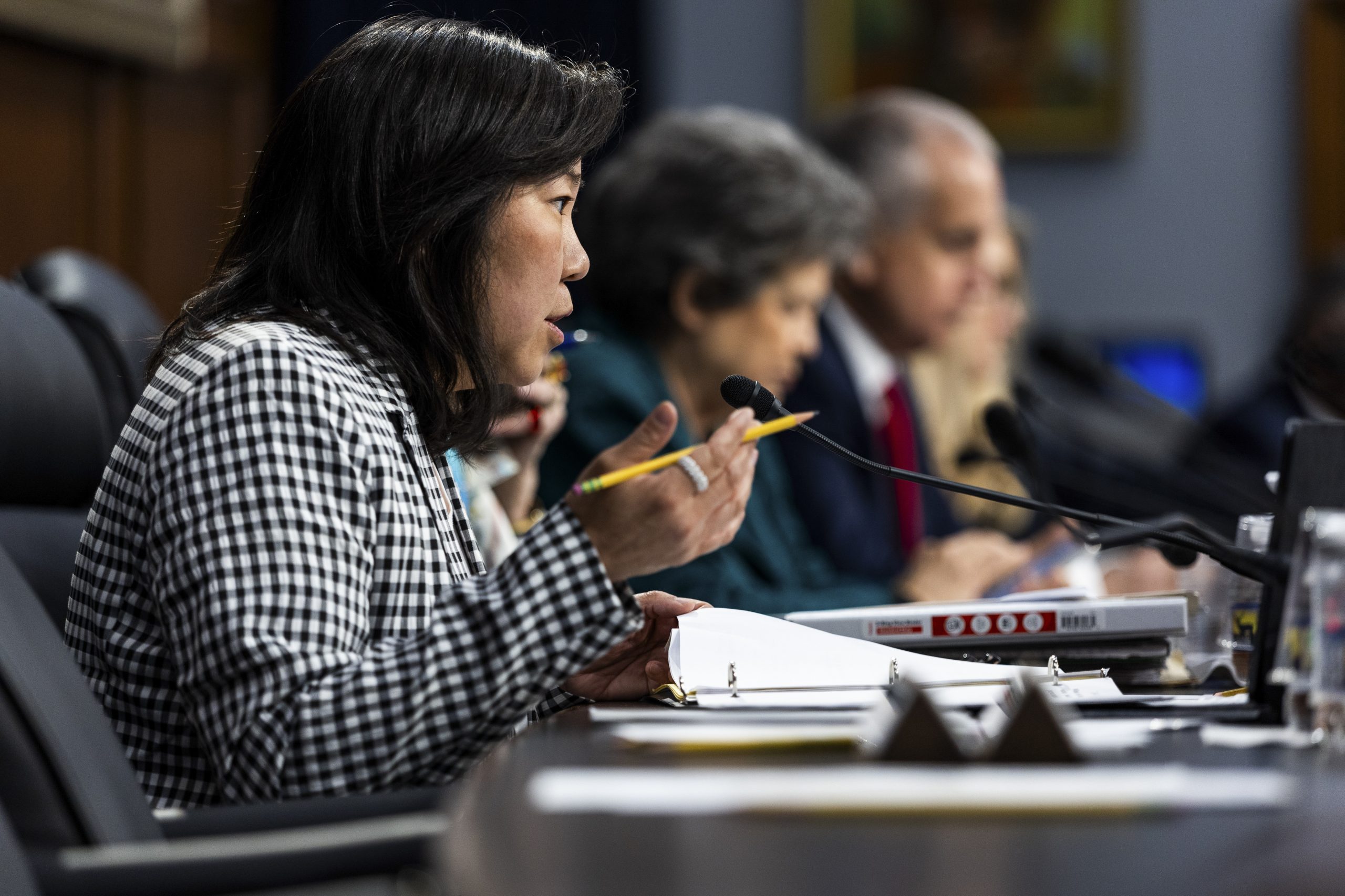
Rep. Grace Meng (D., N.Y.) questions Secretary of State Marco Rubio during a House Appropriations subcommittee hearing this month.Demetrius Freeman
Rep. Grace Meng (D., N.Y.) asked why the administration thought other refugees could not assimilate, including Afghans who had helped U.S. soldiers during the war, cleared vetting, and were now stuck in limbo.
“They have assimilated and contribute and pay taxes,” Meng said of Afghan refugees who had moved to her district in Queens, New York. “I think it’s important for America to keep our promise as well,” she added.
Some of the Afrikaners, who are the descendants of Dutch and other European settlers, have not acclimated as smoothly as the administration expected.
During their initial months in the United States, refugees typically can receive some money for housing and food from resettlement organizations who receive federal funding. Those organizations can also help them find work.
But refugees are expected to eventually be self-sufficient. The process is often a difficult one.
Multiple Afrikaners reported delays in receiving financial support from their local resettlement agency, according to complaints obtained by the New York Times. (The names of many of the refugees were omitted from the documents.) One of the families complained about needing to complete Medicaid and Social Security applications on their own. That same family griped about needing to use public transportation, according to the documents.
Another South African relocated to Texas said he felt staffers from the local resettlement agency, which has a Muslim affiliation, had “discriminated” against him as a Christian. The staff members who picked up his parents from the airport were candid about their views of Trump’s changes to the refugee program.
“They told my mother they cannot wait for next election when Trump can leave office as they had a problem with his decision to give South Africans refugee status and how angry they are that only South African refugees are now allowed,” according to the correspondence.
The newly arrived South African also said his family was placed in an apartment that was “dirty, contained mold, and is located in an unsafe area in Fort Worth.”
The complaints by the Afrikaners about their level of assistance also came after the Trump administration made cuts to funding for resettlement agencies and benefits that in the past were made available to new refugees, including food stamps.
At least three Afrikaners made the return after being settled in states including Minnesota, Idaho, and Illinois, according to government documents. Some had sick relatives back home. One Afrikaner said the process had “occurred quickly” and “she had not thoroughly thought through the process.”
“I think some of them are finding that actually it’s not an easy life to be a refugee,” said Bryony Fox, a lecturer at South Africa’s Stellenbosch University, who researches forced displacement.
Claims of genocide
South African officials strongly dispute claims by Trump that Afrikaners are being targeted in a “genocide.”
During apartheid, which ended in 1994, the government denied Black South Africans the right to own prime agricultural land. That meant that almost all of the country’s large-scale commercial farmers were white, and that remains so to this day.
South Africa’s Commission for Employment Equity found that white people made up 61% of top management posts in 2024, while they are only 7.5% of the population. Black South Africans are also unemployed at far higher rates than their white peers, a disparity that has not improved over time.
To address the disparities, the African National Congress government has instituted racial equity laws that incentivize companies to have Black ownership and leadership. That Black Economic Empowerment initiative has prompted intense scrutiny from the Trump administration, as well as from Afrikaners fleeing to the United States who say it has harmed their businesses.
Kleinhaus said such policies make him as a white man feel targeted by the South African government. He said that he had struggled to keep thieves off his property and that his relatives had been the victims of violence, although he said getting into the specifics made him too emotional.
In his experience, white people are portrayed as “the problems in the economy” and “the privileged ones.”
“There’s no such thing as that,” Kleinhaus said. “Most whites have lost a lot.”
Fox said there was no denying the violence in South Africa.
“That is our biggest problem,” she said. “But it is not targeted. It is not systematic targeting.”
She said criminals had attacked farms because they “have resources that communities are seeking.”
Trump has echoed fringe claims about a white genocide in South Africa for years, going back to his first term. Last year, in a stunning confrontation in the Oval Office, Trump lectured the South African president, Cyril Ramaphosa, about his own country. Ramaphosa implored Trump to listen to “the voices of South Africans.”
The State Department does not break down its refugee data by race, but it has allowed in more than 6,600 refugees this fiscal year. All but three were from South Africa.
Trump’s aides have defended the program by saying that other racial minorities in majority-Black South Africa are welcome to apply for the refugee program.
South Africa also has minority populations of people of Indian descent, white people of British heritage, and mixed-race people — and a few individuals from those communities have been processed through Trump’s refugee program. But refugee resettlement officials say nearly all of those who have been accepted are white, and government documents confirm that the administration has prioritized resettling white Afrikaners.
Why white South Africans?
Long before Trump created the refugee program, many white South Africans traveled to the United States — from the Midwest to the Mississippi Delta — on temporary visas to work as seasonal farmers.
Since 2019, Kobus Van Den Berg has been traveling to and from the United States to plant soybeans and fertilize fields in North Dakota to save money for his family back home in South Africa. He agrees that crime is an issue in South Africa, but he pushed back on the notion that white South Africans are being singled out.
“They’ll attack anybody,” he said. “It doesn’t matter what color or race you are.”
He has watched as Afrikaners have come into the United States in recent months with refugee status and a pathway to citizenship, even as he has spent years navigating a complicated immigration system with the hopes of obtaining a green card.
“Why is it so easy for this other Afrikaner from South Africa to come over here?” Van Den Berg said. “The thing that blows everyone’s mind today is, why is it specifically white South Africans?”
Critics of the Trump administration say the answer lies not just in Trump’s long-standing embrace of the Afrikaners’ cause, or the administration’s desire for “assimilation,” but in his stance toward refugees more broadly.
Sharif Aly, the president of the International Refugee Assistance Project, said the policy shows an “indifference to the plight of nonwhite refugees.”
It is difficult to ascertain how rigorously the administration is vetting the South Africans. In the past, the process has been time-consuming, with agents demanding criminal records, medical records, and even social media posts.
The Trump administration has said it would deny immigration requests for those with antisemitic or “anti-American” posts on their social media accounts, but Kleinhaus was welcomed even though he had made antisemitic comments on social media. In April 2023, the X user @charlkleinhaus wrote in a now-deleted post that Jews were “untrustworthy” and “a dangerous group” and that “they are not Gods chosen.”
Kleinhaus said his grandmother was Jewish, he was not an antisemitic person and he had written the post in error while he was taking medication for a kidney stone. He also shared other posts that had been written by others.
During his processing, he said, he signed off on administration vetting of his social media accounts and no one brought up any problems.
‘Leaving everything behind’
Over breakfast at a local diner, the Fryn’ Pan Family Restaurant, Kleinhaus said he missed some aspects of his life in South Africa, including “the people, my workers, my friends, and family.”
But he also appreciates “these advantages that I’ve got here to do things I can do just as a white person” and not needing to worry about laws requiring him to sell a percentage of equity of his mining company to Black shareholders in South Africa “because they were here first or whatever the story can be.”
He said he was focused on working and contributing to the United States.
He said he did not complain when he, his son, daughter, and grandson were initially placed in one hotel room in Buffalo, N.Y. He soon identified a farmer in Yankton, S.D., who had hired seasonal workers from South Africa for years and was looking for more help.
Now, his daughter works at a flower shop in the small town of Yankton. His son works at another farm and his grandson has learned English quickly after knowing only Afrikaans.
And he has found part-time work at a car dealership and at a brickyard while he plans how to start his next business. He occasionally takes his grandson fishing in this area known for the Lewis and Clark trail on the weekends.
“I just want my kids to be successful,” he said.
Kleinhaus hopes he can convince other relatives to join him soon in America. He said he knows he cannot simply go back and visit, because that would undermine his claims of persecution.
“I’m leaving everything behind,” he said. “When you accept the refugee thing, it’s not a thing like, ‘I’ll be back in two weeks; I’m going on holiday.’ It’s nothing like that. You’re saying, ‘It’s done. I’m not going back.’”
NEW YORK — Carlos Mendoza was fired as manager of the underperforming New York Mets on Friday and replaced by Andy Green.
New York is 34-47 following a six-game losing streak, 15 games behind NL East-leading Atlanta and 9½ games back of the NL’s last wild-card berth.
The Phillies open a three-games series against the Mets at Citi Field on Friday night.
Mets owner Steve Cohen had high expectations for a team without a World Series title since 1986. New York opened the season with baseball’s highest payroll at $358 million and was projected to pay an additional $124 million in luxury tax.
“Our commitment to bringing our fans a championship-caliber team has not changed,” Cohen said in a statement. ”There is no sugarcoating it: This season has been a disappointment and our fans deserve better than what we’ve delivered.”
A former Yankees assistant coach, Mendoza replaced Buck Showalter after the 2023 season and led the Mets to a 206-199 record. While New York advanced to the NL Championship Series in 2024, the Mets failed to reach the playoffs last year and are among the sport’s biggest disappointments this season.
“Carlos has led the organization with passion and grace and is beloved by everyone who works with him on a daily basis,” president of baseball operations David Stearns said in a statement. “Carlos’ impact on our players, staff, and culture over the last three seasons has been transformative. Unfortunately, we know we are falling short and change is necessary to move forward.”
Green, a former major league infielder, joined the Mets in 2023 as senior vice president of baseball development. He managed San Diego to a 274-366 record from 2016-19.
The Florida Everglades immigration detention center known as “Alligator Alcatraz” has served its purpose, Gov. Ron DeSantis said Thursday, closing the makeshift facility heralded by the Trump administration and denounced as inhumane by civil rights groups.
DeSantis said the center, which opened in July 2025, was always meant to be only temporary until more permanent detention centers could be secured and federal officials now have that capacity.
“We stepped up because there was a gap, but my hope is that they’ll be able to handle that,” the Republican governor said at a news conference at the facility.
Officials announced a temporary closure of the facility earlier in June and sent all of the detainees to other facilities, saying hurricane season made it unsafe to keep them in the Everglades.
Immigration advocates said the center’s tents were never safe or humane for holding people. Detainees at the facility have talked about their difficulty accessing lawyers and described poor physical conditions, including worms in the food, toilets that didn’t flush, floors flooded with fecal waste, and mosquitoes and other insects everywhere.
They described large white tents with rows of and rows of bunk beds surrounded by chain-link cages. The air-conditioning could shut off abruptly in the sweltering Florida heat. Detainees could go days without showering or getting prescription medicine.
Advocates for immigrants said the closure of “Alligator Alcatraz” does nothing to stop the harm to people who spend months in custody as their families suffer. The Florida Immigrant Coalition said the only winners were corporations and contractors who profited millions of dollars as Republicans pushed an immigration emergency that does not exist.
The detention center of tents and trailers was built by DeSantis’ administration in a matter of days. The governor and President Donald Trump said the center was critical to Republican efforts to return people in the country illegally back to their home countries.
“There is no question this mission has made the state of Florida safer,” said DeSantis, noting that 21,000 people were deported through the facility.
Even with the closure of the facility, Florida continues to play a key role with other detention centers and an increased role in helping with immigration enforcement, White House border czar Tom Homan said at Thursday’s news conference.
“Gov. DeSantis did a good job, and he’s going to continue doing what he’s doing to help us make this country safe again,” Homan said. “This isn’t the end of relationship. This is a continuation.”
Lawyers for the immigrants at the facility said their clients suddenly started leaving for other facilities in South Florida, California, Arizona, Louisiana, and Texas earlier this month, disappearing for about a week before their attorneys and families were told where they were sent.
DeSantis said the Everglades airstrip the facility was built around will continue to be used.
Environmental groups sued over the detention center, saying Florida officials never got the proper permits or did required reviews on its impact.
The state and federal governments built the site with no oversight and closed it with no input, but they will still be held responsible even with the site is closed, said Paul J. Schwiep, an attorney for Friends of the Everglades and the Center for Biological Diversity.
“The administration believes it can quietly walk away and leave its mess for others to clean up. The law will not allow them to escape accountability. We will ask the courts to ensure that the environmental damage is fully addressed,” Schwiep said in a statement Thursday.
NEW YORK — Harvey Weinstein won’t face a fourth trial on a New York rape charge. Prosecutors dropped the #MeToo-era case on Thursday after his accuser said she could not bear to testify again.
Jessica Mann, a hairstylist and actor, spent days on the witness stand at all three trials, telling jurors that Weinstein raped her in a Manhattan hotel in 2013 and being questioned extensively about the complex relationship she had with him before and afterward. The Oscar-winning producer denied the charge and said everything that happened between him and Mann was consensual.
In a letter that prosecutor Nicole Blumberg quoted in court Thursday, Mann said she could “no longer endure going through this,” adding that the 8-year-old case has “put me through more harm than good.”
Blumberg told the court that prosecutors believe Mann and hail her “bravery, strength, courage and inspiration” to other survivors, but given her feelings about proceeding, “dismissal is appropriate.” With that, Judge Curtis Farber formally dismissed the case.
Weinstein left court with a neutral expression, returning to jail to await a September sentencing on a New York sexual assault conviction involving a different woman. Prosecutors are seeking a 20-year prison term.
Once Weinstein finishes whatever punishment he gets in New York, he’s due to serve 16 years in California, where he was convicted of raping a third woman, who’s an Italian actor. He is appealing both convictions.
Weinstein’s lawyers said he was relieved by the dismissal of the case surrounding Mann’s allegation.
“These charges should never have been brought to begin with,” lawyer Jacob Kaplan said outside court. “He is innocent.”
Mann has testified that she had a consensual, on-and-off relationship with Weinstein, who was married at the time.
But she told jurors she repeatedly tried to leave and said no to any sexual activity as he cornered her in a hotel room on March 18, 2013. They had planned to meet in the lobby for breakfast, but he had spontaneously taken a room.
She said he persevered, demanding that she undress and grabbing her arms, until she was afraid to keep protesting.
The latest trial, this spring, took a visible toll on Mann, 40. During five days of testimony, she was questioned for the first time about a diarylike, soul-baring note she wrote two days after the alleged rape, which the note did not mention. At one point during her testimony, Mann said she was struggling to focus, prompting court to wrap up early for the day.
In her letter to the court Thursday, she said she had suffered a concussion shortly before her testimony, had headaches and other symptoms on the stand and ultimately “disassociated.” It was a humiliating addition to an already crushing experience, she wrote.
“I have been fragmented, silenced, defamed and traumatized. I’ve paid the price of my reputation,” Mann wrote. Slamming the court, the media and Weinstein, she said her experience showed that “pursuing justice is better left a pipe dream.”
Weinstein was one of the movie industry’s most powerful figures, a producer of such tastemakers and hits as Shakespeare in Love, Pulp Fiction, and Chocolat.
The rape charge in this case was a low-level felony punishable by up to four years in prison — less time than Weinstein, 74, already has served.
Weinstein didn’t testify at any of the trials, though he complained during and after the 2025 New York retrial that it was unfair; the judge disagreed.
His lawyers have maintained that all his accusers had completely consensual sexual liaisons with a movie studio boss who could help them go places in show business. Weinstein himself has said he “acted wrongly, but I never assaulted anyone.”
The Associated Press does not identify people who say they have been sexually assaulted, unless they choose to be named, as Mann has done.