Category: Nation World News Wires

  • Hungary braces for a full shutdown of the Paks nuclear plant as the Danube River hits record lows

    Hungary braces for a full shutdown of the Paks nuclear plant as the Danube River hits record lows

    BUDAPEST, Hungary — Hungary’s only nuclear power plant will shut down for the first time in its history due to record-low water levels on the Danube River, Prime Minister Péter Magyar said Friday, adding that the plant may not come back online for several weeks as the river is expected to continue receding.

    The Paks nuclear plant, located around 50 miles south of the capital Budapest, is operating at less than half its normal capacity, producing 965 megawatts of power rather than the usual 2,000.

    The plant uses water from the Danube to cool its reactors, but the exceptionally low water level has tested the ability of pumps to bring sufficient quantities into the plant.

    Speaking at a news conference at the plant on Friday, Magyar said further reductions in output were imminent later Friday and that the entire plant will likely be powered down by Tuesday or Wednesday. He stressed that the shutdown can be performed safely and poses no risk to the public or environment.

    The Soviet-built, four-reactor plant at Paks accounts for nearly half of Hungary’s electricity production. If it is powered down, it will be the first time in its 44 years of service.

    Hungary and much of Central Europe has been in a prolonged period of drought in recent months, disrupting tourism, agriculture, and industry and confronting residents with the realities of climate change. Water levels are not expected to rise on the Danube in the coming days or even weeks as no significant rainfall is forecast.

    Magyar said Friday that the Danube’s water level has only risen on three occasions in the month of August in the last 20 years, and added that the level at Paks could recede to as low as negative 57 inches — far below the previous record of negative 39 inches set in 2018.

    A level of negative 52.7 inches requires the full powering down of the plant, he said. A negative reading means the river has fallen below the gauge’s zero reference level, not that the river is empty.

    Hungary’s government has requested that companies that consume large quantities of energy voluntarily reduce their consumption to help stabilize the energy supply, particularly in peak demand hours between 5 p.m. and 10 p.m.

    Magyar said Hungarian energy conglomerate MOL had committed to reducing its electricity needs by 65 megawatt-hours, a decrease of 40% from its normal consumption.

    Magyar announced Friday that his party had recommended suspending parliamentary sessions planned for Monday and Tuesday in the interest of conserving energy. He also ordered that all state institutions turn off decorative lighting by Monday.

  • Regulators propose overhaul to law governing how banks lend to low-and-middle income communities

    Regulators propose overhaul to law governing how banks lend to low-and-middle income communities

    NEW YORK — The Trump Administration has announced an overhaul to the rules governing a critical piece of Civil Rights-era legislation, most notably a reduction in the number of banks that will need to fully comply with the law.

    The Office of the Comptroller of the Currency and the Federal Deposit Insurance Corporation on Friday jointly announced the proposed changes to the Community Reinvestment Act, a law that requires regulators to document how well banks do in lending to low-to-middle income neighborhoods. It would be the first major revision of the law’s rules and regulations in nearly three decades.

    Under the proposed revisions, bank examiners would put more weight on the lending banks do in certain communities and geographies, and less on how many branches they open or how much in deposits they take in from a local community.

    The number of banks that would need to comply with the law would be reduced as well. The definition of a small bank will increase from banks with under $412 million in assets to banks with $1 billion in assets. Banks between $1 billion and $10 billion in assets will now be classified as an intermediate bank.

    This would reduce the number of banks who need to comply with parts of the CRA by 800 banks. Only 86 banks, or roughly 3% of all institutions, would be subject to the full extent of CRA under the new regulations.

    Another change that is likely to be fought over relates to how banks give money to community development groups. Under the CRA, banks can donate money to local organizations that do poverty or low-income housing work in their communities to show they are providing resources to a local community. The new regulations could narrow the groups and programs that banks could donate to in order to meet those obligations.

    In a summary of the changes, the bank regulators said these changes would ensure community development grants “are not diverted to activist causes or consumed by excessive operating costs.” Banks would also need to collect more detailed information on who gets their community grants, including addresses, which would give more transparency to who is receiving grants from banks.

    That change could negatively impact groups like the National Community Reinvestment Coalition, an umbrella group for community development groups that often receive money from banks under the CRA. The new rules discourage banks making grants to national organizations and instead focus their grants on local groups.

    Jesse Van Tol, the CEO of NCRC, said that it was “unfortunate” that the bank regulators were politicizing grant making under the CRA.

    “CRA was created to work for low-to-middle income people. A lot of these changes are going to discourage banks from making grants, particularly in rural areas, where I expect there will be significant drops in activity,” Van Tol said.

    The proposal announced Friday by the OCC and FDIC did not include the other major bank regulator, the Federal Reserve. Banking groups had been pushing for a joint proposal from all three regulators, to make sure all three were aligned on the same requirements under the CRA.

    The CRA was passed in 1977 to combat redlining, a practice whereby banks would discriminate against the poor and minorities by choosing not to lend or open branches in minority-majority neighborhoods or in poor neighborhoods.

    The law is complex, requiring banks to document how they do business in the cities and areas they operate in. Banks must sit for regular examinations to see whether they are complying with the law. A bad CRA examination could restrict a bank’s ability to open new branches or merge with another bank or have other consequences. The data collected through CRA is also used by the Department of Justice in redlining cases.

    The last major revision of the CRA’s regulations happened in 1995, and there have been repeated attempts by administrations of both parties to update the rules to reflect how banking and financial services have changed in the past 30 years. But those revisions have repeatedly failed, either due to opposition from other regulators, the banks, or community groups, or have been blocked by courts. The Biden administration tried its own revisions of the CRA rules but those changes were blocked by courts in Texas.

    The proposed rules will now go out for a 60-day comment period where they will be finalized after banks, community groups, and other parties have a chance to weigh in on the changes.

  • Social media companies sued over deaths of four teens as pressure, lawsuits over child safety mount

    Social media companies sued over deaths of four teens as pressure, lawsuits over child safety mount

    The families of four teenagers who died by suicide are suing Meta, TikTok, Snapchat, and YouTube over what they describe as “years of escalating harms” from using their platforms that eventually resulted in their deaths.

    The lawsuit, filed Thursday in the Superior Court of Delaware, is the latest in a flurry of suits filed against the social media giants that alleges their platforms are addictive and dangerous.

    The complaint was filed on behalf of four families from Texas, North Carolina, Minnesota, and Tennessee whose children died over a 14-month period starting in July 2024 through September 2025.

    The Social Media Victims Law Center is bringing the suit on behalf of the families, and its founding attorney, Matthew Bergman, said it’s “particularly salient” that the children in this case died “long after” similar suits had been filed.

    “These platforms continue to kill kids, despite the platitudes of their executives,” Bergman said in an interview. “This is a clear and present danger to the health and safety of children, not just in the United States but around the world.”

    The four teens who died by suicide each experienced harms including social media addiction, severe sleep deprivation, depression, anxiety, and suicidal ideation after years of using the social platforms, the complaint states. Livi Castro died at age 13, Riv Kelleher at 14, Nathaniel Chambers at age 17, and Dawson Holden at 18.

    The complaint alleges the social media companies knew they were causing harm to young users.

    A spokesperson for Google, which owns YouTube, said in a statement that “providing young people with a safer, healthier experience has always been core to our work. In collaboration with mental health and parenting experts, we’ve built services and policies to provide young people with age-appropriate experiences, and parents with robust controls. We send our deepest sympathies to the families and are reviewing the claims in this lawsuit.”

    Representatives for Meta, TikTok, and Snap did not immediately respond to requests for comment.

    Sacha Haworth, executive director of The Tech Oversight Project, said in a statement that parents, activists, and whistleblowers have come forward and met with lawmakers for years and “while Congress has dragged its feet, more children have died.”

    Federal legislation of social media has moved at a glacial pace. The Senate passed the Kids Online Safety Act — which had the support of parents’ groups and children’s advocacy organizations — exactly two years before this lawsuit was filed. The House of Representatives never voted on that version of the legislation, and the House and Senate are currently disagreeing on key provisions they think should be included.

    Meta, YouTube, TikTok, and Snap are facing numerous state and federal lawsuits over harms to minors. Meta is on trial in Tennessee this week for a lawsuit brought by the state attorney general claiming that the company deliberately designed its platforms, notably Instagram, to make them addictive to young people, and did not warn them of its dangers. And in August, Meta is heading to trial in federal court in Oakland, Calif., to face four of dozens of states that sued the company in 2023. That lawsuit says the company is contributing to the youth mental health crisis by designing addictive features and violated federal law by collecting data on kids under 13 without parental consent.

    Not all lawsuits are successful, and many are settled out of court. Last week, a Florida teenager dropped his case against Meta that was set to go to trial in state court in Los Angeles, without receiving any payment from the company. Meta had argued that the teen only used his Instagram and Facebook for just minutes a day, on average, and created most accounts only after hiring a lawyer in his case.

    Still, the mounting court cases can get expensive, even for a company like Meta Platforms. Earlier this week Meta said it had $2.4 billion in legal expenses in the second quarter, which contributed to a relatively unusual 14% profit decline.

  • A blanket of seaweed smothers coastlines from the Caribbean to Mexico

    A blanket of seaweed smothers coastlines from the Caribbean to Mexico

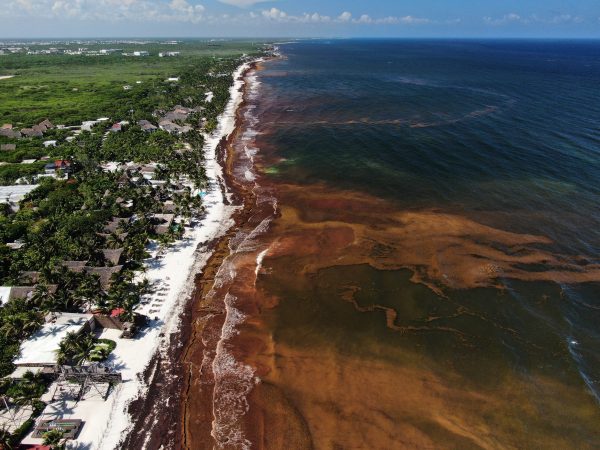
    PUERTO MORELOS, Mexico — Swaths of seaweed are blanketing the beaches and coastlines of the Caribbean and Gulf of Mexico, suffocating shorelines and snuffing out marine life while spooking visitors in areas that depend heavily on tourism.

    Some 27 million metric tons of self-sustaining sargassum have been recorded in the Atlantic, Caribbean, and Gulf of Mexico in July, according to a report released Friday by the University of South Florida’s Optical Oceanography Lab.

    The prickly seaweed covers miles of coastline, releasing a foul smell as it rots onshore.

    This year marks the first time that scientists have observed sargassum growing in large quantities in areas including the Caribbean and Gulf of Mexico, instead of being swept into those areas by ocean currents.

    The algae usually reproduces asexually as it travels from Western Africa, said Brian Barnes, a marine scientist and research assistant professor at the University of South Florida. “None of this is normal,” he said. “Every year is a little bit of a new story.”

    The Great Atlantic Sargassum Belt has been growing since 2011, dumping an increasing amount of seaweed along coastlines in the Caribbean and Gulf of Mexico. Experts have said that agricultural runoff, warming waters, and changes in wind, current, and rain could be factors.

    The sargassum that began reproducing in the region earlier than usual this year stems from a record 40 million metric tons reported last year.

    “The 2025 bloom was so big it never really left,” Barnes said. “It was enough to start a new bloom locally.”

    Seaweed threatens tourism

    Sargassum levels in the Caribbean reached record levels in June, while the amount present in the Gulf hit 5 million metric tons in June, nearly double last year’s record, according to the University of South Florida.

    Scientists expect 2026 to be the second largest amount of sargassum recorded in the Atlantic, Caribbean, and Gulf of Mexico, noting that June alone saw 34 million metric tons, which was only 10% lower than the year-earlier period.

    Mexico said Thursday it plans to invest $115 million to tackle the blooming algae, which poses an environmental and economic threat. The government estimates that up to 9,000 tons reach its Caribbean coastline on the worst days. Given current resources, Mexico says it can only gather 1,200 tons of sargassum a day.

    On a recent evening, Alan Vázquez closed the restaurant where he works as a waiter in the popular tourist town of Playa del Carmen because there were no customers. He had resisted closing for several hours, hoping he would receive a tip and salvage the day, but vast quantities of decomposing sargassum are turning the famed turquoise waters black, driving away tourists.

    “It’s sad that such a beautiful and lively place … has ended up like this,” Vázquez said.

    He fears suffering the same fate as four of his colleagues who were laid off two months ago due to a drop in tourism that has devastated hotels and businesses in the state of Quintana Roo, one of Mexico’s tourism gems, where sales fell 30% in the first half of the year, according to estimates from local businesses.

    In Puerto Rico, sargassum blankets the waters around popular tourist areas, including La Parguera.

    “I don’t recall ever having that much concentration in so many places at once,” said Waldemar Quiles, the U.S. territory’s natural resources secretary.

    Much of the record sargassum reported last year ended up along Puerto Rico’s coastline, prompting the governor to declare a state of emergency.

    It surpassed the previous record set in 2022 with a peak of some 22 million metric tons.

    “It’s not a one-off event anymore,” said Emmanuel Maldonado González, an environmental sociologist at East Carolina University. “It’s becoming a growing hazard.”

    Experts warn proliferation will worsen

    Patches of sargassum in open waters provide a healthy breeding ground for wildlife, including turtles, fish, and seabirds, and can be “a bit of an oasis of life in the middle of the ocean,” Barnes said.

    But once it’s closer to shore, it reduces oxygen in the water, smothers mangrove roots, and blocks sunlight from reaching coral and sea grass.

    Once it washes ashore it can prevent newly hatched sea turtles from reaching the ocean, while the heavy machinery used to remove it from beaches risks destroying fragile turtle nests, scientists say.

    “The coastlines are not built for this,” Barnes said.

    In the U.S. Virgin Islands, people are walking up to 25 feet on mats of seaweed before even reaching the water, according to Amy Dempsey, an environmental consultant.

    “This is by far the worst I’ve seen it in the last five years,” she said. “We are getting slammed in the Virgin Islands.”

    The smell of rotten eggs permeates communities where large piles of decaying sargassum emit ammonia and hydrogen sulfide.

    “The effects of these gases on people can be severe,” warns the U.S. Environmental Protection Agency, noting it can cause nausea, headaches, and lung irritation.

    Used in composting and bioenergy production

    Officials on the French Caribbean island of Martinique recently opened a shelter to temporarily house those affected by the toxic gases after residents protested.

    So far this year, crews in Martinique have collected more than 11,500 tons of sargassum — including 638 tons in four days alone this month — according to government data. Sea barriers catch some of the seaweed, while crews on shore collect the remainder by hand, storing and processing it for composting and bioenergy production.

    Researchers at the University of South Florida and the U.S. National Oceanic and Atmospheric Administration used artificial intelligence and found that from 2003 to 2022, macroalgae blooms increased by more than 13% per year in the tropical Atlantic and Western Pacific.

    Overall, the blooms reached 16.9 million square miles, according to a study published earlier this year.

  • Tax returns show California’s Newsom earning between $1.7 million and $2 million annually

    Tax returns show California’s Newsom earning between $1.7 million and $2 million annually

    SACRAMENTO, Calif. — California Gov. Gavin Newsom and his wife made between $1.7 million and $2 million annually from 2022 through 2024, and they paid about half a million a year in federal and state taxes, according to tax returns released by his office.

    The Democrat’s office released more than 700 pages of tax filings spanning four years for reporters to review, offering a window into Newsom’s finances as he prepares to leave office and considers a 2028 presidential bid. Newsom’s office did not release returns for 2025, because the couple filed for an extension and will complete those returns in October.

    The returns show the Newsoms’ income has remained relatively consistent since when he took office in 2019, when the couple reported $1.7 million in annual income. The exception was in 2021, when the family sold a house for nearly $6 million in Marin County, making roughly $800,000 from the sale. That year, they made $4.2 million and paid more than $1 million in federal and state taxes. They earned roughly $2 million in 2022.

    The release of the couple’s tax filings comes as their finances have been under scrutiny after the U.S. Justice Department launched investigations into the Newsoms, the governor announced last month. Newsom has blasted the probes as politically motivated.

    It was the first time Newsom released returns since 2022.

    Newsom made nearly $200,000 annually from serving as governor, but most of his income comes from winery and restaurant businesses that he put in a blind trust when he took office. The returns don’t name each individual business, making it impossible to know which ones gained and lost money.

    The PlumpJack Group, a company he owns that includes a suite of wineries and restaurants, is now run by his sister and cousin.

    His wife, Jennifer Siebel Newsom, a film director, lost money most years from Girls Club Entertainment, a production company she founded. The business produced Miss Representation, a 2011 documentary about disparaging portrayals of women and girls in media, and two other films.

    The Newsoms paid between roughly $14,000 and $44,000 a year for childcare for three of their four children, according to the tax filings.

    They gave between $40,000 and $65,000 in gifts to charity each year, mostly through monetary donations. They also donated thousands of dollars worth of clothing, toys, and other items to thrift stores and nonprofits, including in 2022, when they gave away Armani business wear they originally bought for $45,000 to a racial justice organization in Oakland.

  • A discarded SpaceX rocket is on a high-speed collision course with the moon

    A discarded SpaceX rocket is on a high-speed collision course with the moon

    CAPE CANAVERAL, Fla. — A drifting SpaceX rocket is on a collision course with the moon after launching a pair of lunar landers more than a year ago.

    The rocket’s upper stage will unintentionally slam into the moon on Wednesday, carving out a crater and sending up a plume of dust and rubble that scientists — and skygazers — are eager to observe.

    Space tracking expert Bill Gray predicts an impact of 5,400 mph — seven times the speed of sound — near Einstein Crater on the moon’s sunlit western limb. With the action unfolding in the wee hours, the eastern portions of the U.S. and Canada, and much of South America, should have the best views.

    While scientists are not too concerned about this particular piece of space junk, it highlights the growing threat as more and more items cram into orbit.

    “Things are getting crowded up there,” said Gray, who plans to view the aftermath from New Brunswick, Canada.

    It was never SpaceX’s intent to hit the moon. But space experts said the crash could have been avoided if the upper stage had been nudged into orbit around the sun.

    It will be the second dead rocket known to crash into the moon accidentally. A Chinese rocket segment dug out a pair of craters on the lunar far side in 2022.

    Lucky for astronomers, the upcoming smashup will occur on the moon’s near side, packing the equivalent energy of three tons of TNT.

    The impact flash, lasting less than a second, will probably be too dim to see, according to experts. But the stream of ejected material could stretch for several miles into space and remain visible to telescopes for tens of minutes.

    “The gravity on the moon is low and there is no wind to blow the dust away,” said Los Alamos National Laboratory’s Benjamin Fernando, who’s encouraging observations by professionals and amateurs alike.

    “Part of the reason for our interest in this event is to figure out how much of a hazard debris impacts pose to future astronauts,” he added in an email.

    Fernando anticipates an impact crater nearly 90 feet across and 16 feet deep, too small to see from Earth but visible to spacecraft.

    NASA’s Lunar Reconnaissance Orbiter and South Korea’s Danuri lunar orbiter will gather before-and-after shots of the crash scene. Danuri will stray within a mile or two of the SpaceX rocket just two minutes before impact, according to Fernando and his team.

    The abandoned rocket segment — measuring some 40 feet and weighing around 10,000 pounds — hoisted two private lunar landers on Jan. 15, 2025.

    One of them — Firefly Aerospace’s Blue Ghost — became the first private spacecraft to pull off a fully successful lunar touchdown. The other, Japan-based ispace’s lander, wrecked.

    With meteoroids and other natural objects offering little if any warning before walloping the moon, scientists said there’s much to learn by observing well-tracked strikes by human-made objects like the one coming up. NASA hurled rocket sections and lunar modules into the moon during the Apollo era for seismic measurements. Decades later, in 2009, NASA intentionally crashed its LCROSS spacecraft and upper stage in search of ice near the lunar south pole.

    With the moon as the new travel hot spot, scientists said it’s crucial to improve debris monitoring and traffic control before packs of robots and astronauts arrive.

    The United States and China are racing to land astronauts on the moon in the next few years. Elon Musk’s SpaceX and Jeff Bezos’ Blue Origin are vying to provide the lander for NASA’s yet-to-be-named moonwalkers of Artemis IV, who will succeed the 12 Apollo astronauts who strolled the lunar surface.

    “This impact will not be a problem,” retired astrophysicist Jonathan McDowell said in an email. “But in a future where there are long-term bases on the moon, similar impacts would be an issue and we need not to leave rocket stages in chaotic orbits of this kind.”

  • Seattle mayor defends ousting police chief after festival shooting

    Seattle mayor defends ousting police chief after festival shooting

    SEATTLE — Seattle Mayor Katie Wilson on Friday defended her decision to oust the city’s police chief as the “right decision at the right time,” but she declined to explain why.

    The leadership change came as police continue searching for people involved in a fatal, gang-related shootout at a food festival near the Space Needle last weekend. A 15-year-old was arrested at the scene and has been charged with assault, but charging documents say the gun he was seen firing wasn’t involved in the deaths of two bystanders.

    Wilson and then-Police Chief Shon Barnes faced criticism for being slow to release key information about the shootout on Sunday, including whether suspects remained at large.

    Barnes, who was the city’s second Black police chief, has been credited with boosting the recruitment of officers and helping reduce crime downtown. A number of Black community organizations, a major business group, and several City Council members issued statements criticizing Wilson’s decision to replace him Thursday.

    At a news conference Friday with Andre Sayles, a Seattle deputy chief the mayor named as interim chief, Wilson credited Barnes for his service and said that as mayor she had a clearer window into the operations at the Seattle Police Department than her critics.

    The lack of communication about a mass shooting at a major public event in Seattle was not the only reason she asked Barnes to resign, she said.

    “There were multiple factors,” Wilson said. “The events of Sunday played into it.”

    Sayles told the news conference the department would boost police staffing at public festivals for the remainder of the summer. He also said he believed investigators are close to finding and arresting additional suspects in the shootout.

    The gunfire erupted in the waning hours of the Bite of Seattle, an annual three-day festival that draws hundreds of food and retail vendors and performers. Three people, including a suspect, were killed, and four people were wounded. One of the people injured was a 2-year-old boy.

  • Dominican Republic’s zoo offers home for confiscated animals as seizures of exotic species soar

    Dominican Republic’s zoo offers home for confiscated animals as seizures of exotic species soar

    SANTO DOMINGO, Dominican Republic — The only zoo in the Dominican Republic is providing a safe haven for confiscated illegal and smuggled animals as a government crackdown aimed at protecting exotic species gathers pace.

    Tucked inside a green oasis in the middle of the capital, Santo Domingo, are crocodiles, flamingos, and even tigers that officials have confiscated from people accused of illegally keeping them. The numbers are growing and threaten to overload the country’s lone zoo.

    “It’s a burden,” said Alfonso Ferreira, deputy director of the city’s National Zoological Park. “People have a predisposition to owning wild animals.”

    Dominican authorities seized 188 animals last year, compared with 30 in 2023, as the government tries to tackle the illegal ownership of certain species. It has also launched educational campaigns to raise awareness about their plight.

    So far this year, officials have confiscated more than 8,900 species, although a majority of those were crickets and young fish to feed animals including seahorses.

    Commonly, flamingos are the most rescued animals, said Nelson García Marcano, head of the Caribbean nation’s Department of Wildlife Regulation and Control.

    Flamingos, which are protected, are often illegally taken from their natural habitat and sold to hotels, which use them as garden ornaments, he said. It’s a trend that individual homeowners have started to follow.

    “People like to copy what they find attractive and beautiful,” said Garcia Marcano, who decried the practice, noting people sometimes amputate a bird’s wings. “It’s a migratory animal,” he said. “It’s an animal that should be free.”

    Nursing animals back to health

    On a recent hot morning, the Associated Press visited a flock of rescued flamingos that sought shade in a private section inside the zoo.

    They had recently been confiscated by authorities, and it showed. Their typically bright coral feathers were white, as if they had been bleached. Ferreira explained that their captors usually feed them white bread instead of the algae and tiny crustaceans their bodies require.

    To reduce the number of flamingos featured at hotels across the Dominican Republic, García Marcano said they have suggested that staff embrace species including the purple gallinule, a cranelike bird with iridescent feathers.

    At the zoo, the rescued flamingos receive carrots and bird feed and are rehabilitated for several months before some are released back into their natural habitat.

    Nearby, several crocodiles sat without blinking in individual cages filled with greenish water. They, too, had been snatched from their natural habitat and kept as pets.

    Encompassing 309 acres, the zoo is big enough that a small train ferries visitors to exhibits, but resources are stretched. Territorial animals such as crocodiles must be isolated, which requires more cages and, in turn, more funding.

    Veterinarians run multiple tests on the rescued animals to determine their health. Many will require a strict diet because their owners would often have fed them the wrong food, weakening an animal’s immune system and causing physical deterioration.

    “Before, we only received parakeets and parrots,” said veterinarian Tatiana Carreño Pinto. “Now we have a much wider range of species arriving at the park.”

    ‘It’s like cat and mouse’

    The zoo also is preparing to take in exotic animals confiscated in neighboring Puerto Rico as part of a deal reached last year, including caimans that have been seized from suspected drug traffickers.

    Puerto Rico, a U.S. territory, is struggling with an overload of exotic species, with nearly 100 animals seized over the July 4 weekend alone. They included 80 boa constrictors, eight native boas, four reticulated pythons, three caimans, and four troupials — Venezuela’s state bird.

    An official with the Rangers Corps of Puerto Rico’s Department of Natural and Environmental Resources did not respond to multiple requests for comment.

    In the Dominican Republic, officials continue to try to save species that once roamed free.

    A project was launched last year to save an endemic parrot, which is under threat and commonly kept as a pet. The government has erected large billboards warning against trade in the parrots. García Marcano said officials are receiving a growing number of calls about this practice as people spot them along roads while traveling.

    The zoo, once again, steps in to help feed and rehabilitate the seized parrots.

    “Operations have been carried out, arrests have been made,” García Marcano said. “It’s like cat and mouse. You have to maintain constant vigilance.”

  • Microsoft’s best day since 2008 leads U.S. stocks, while inflation worries remain in the bond market

    Microsoft’s best day since 2008 leads U.S. stocks, while inflation worries remain in the bond market

    NEW YORK — A monster day for Microsoft’s stock following signals that its big spending on AI is translating into profits led a powerful rebound on Wall Street Thursday, while computer-chip companies regained some of their sharp recent losses. In the bond market, though, worries remained about inflation potentially remaining high for years.

    The S&P 500 rallied 1.7% and more than recovered its drop from the day before, which was its worst in seven weeks. The Dow Jones Industrial Average jumped 613 points, or 1.2%. The Nasdaq composite, which is full of artificial-intelligence stocks, rallied 2.8% a day after it fell 9.8% below its record set last month.

    Microsoft led the way and leaped 15.5% for its best day in nearly 18 years after reporting a stronger profit for the latest quarter than analysts expected. Growth was strong for its Azure cloud business, and CEO Satya Nadella said it reflects how customers are using Microsoft to move into AI.

    Perhaps just as importantly for Wall Street, Microsoft did not announce a big increase in how much it plans to spend on AI investments, something that several other Big Tech rivals have done. Worries are high that such spending is eating into companies’ cash flows and may not ultimately be worth it if AI does not produce as much productivity and profits as promised.

    Meta Platforms helped demonstrate such fears after falling 8%. The parent company of Facebook and Instagram reported a weaker profit for the latest quarter than analysts expected, even though it made slightly more in revenue than expected. It also raised the lower end of its forecasted range for spending on investments this year.

    Companies involved in the making of the computer memory and processors that such “hyperscalers” are buying to power their AI efforts rose Thursday, recovering some of the big losses they’ve taken on worries their stock prices shot too high in the euphoria around AI.

    Micron Technology jumped 18.4%, for example, to trim its loss for the week to 5%. It was the strongest force lifting the S&P 500 after Microsoft.

    Lam Research, a supplier to the semiconductor industry, soared 18% after reporting stronger profit and revenue for the latest quarter than analysts expected. Chip giant Advanced Micro Devices rallied 13%.

    On the losing end of Wall Street was Jersey Mike’s Subs. The sandwich chain’s stock fell 6% in its first day of trading on the New York Stock Exchange.

    All told, the S&P 500 rose 121.48 to 7,437.63. The Dow Jones Industrial Average climbed 613.92 to 52,208.06, and the Nasdaq composite leaped 679.24 to 25,122.18.

    In the bond market, longer-term Treasury yields held steadier following their sharp accelerations Wednesday. They had jumped after the chairman of the Federal Reserve, Kevin Warsh, gave few clues about what the central bank will do with interest rates to combat the painfully high inflation that continues to hurt the country.

    Higher rates could keep a lid on inflation, but they can also slow the economy and undercut prices for stocks and other investments.

    The yield on the 10-year Treasury was 4.67%, the same as late Wednesday. The 30-year Treasury yield ticked up to 5.22% from 5.20%, a day after it shot up from 5.09%. Those yields move with investors’ expectations for inflation and economic growth in upcoming years.

    Warsh reaffirmed on Wednesday the Fed wants to get inflation back to 2%, even though the central bank decided not to raise interest rates despite inflation remaining higher than that. He also implied the bond market may already be doing some of the Fed’s work to restrain inflation, and he pointed to how yields have climbed since the central bank’s last meeting six weeks earlier.

    That leaves investors questioning whether the Fed is prepared to act if inflation worsens, or whether it is relying on financial markets to achieve the same outcome, according to Seema Shah, chief global strategist at Principal Asset Management.

    “If investors conclude that the latter is true, the credibility of the Fed’s inflation-fighting commitment could come under increasing scrutiny. Arguably, it already is.”

    President Donald Trump, who nominated Warsh to lead the Fed, has lobbied for lower interest rates even though they could cause inflation to accelerate.

    Reports released Thursday suggested the U.S. economy’s growth slowed by more during the spring than economists expected. A measure of Inflation, meanwhile, remained worse last month than the Federal Reserve’s target, but it slowed from May’s level.

    In the oil market, prices eased. Brent crude, the international standard, fell 1.4% to settle at $86.88 per barrel.

    It had swung as low as $72 early this month and as high as $102 last week on uncertainty about whether the United States and Iran could reach a deal to allow oil tankers to move freely again from the Middle East to customers worldwide.

    In stock markets worldwide, indexes were mixed in Europe and Asia. South Korea’s Kospi fell 1.2%, and France’s CAC 40 rose 0.9% for two of the world’s bigger moves.

    Seoul’s market has been at the center of AI’s huge swings because it’s dominated by two tech titans, Samsung Electronics and SK Hynix. After more than doubling through this year’s first six months, the Kospi has plunged 34% so far in July.

    Its drop on Thursday came as Samsung Electronics dipped 0.7%. The tech giant reported a record profit for the spring and said demand for its chips continues to outpace supply, but its earnings nevertheless fell shy of analysts’ high expectations.

  • The Trump administration is ending a Medicare drug subsidy program. Here’s how it could affect costs

    The Trump administration is ending a Medicare drug subsidy program. Here’s how it could affect costs

    NEW YORK — Millions of older adults on Medicare prescription drug coverage could face steeper monthly costs in 2027, after the Trump administration concludes a temporary subsidy program that has helped offset premiums for the past two years.

    The Centers for Medicare & Medicaid Services this week announced it would wrap up the program, which was initially implemented by the Biden administration in 2024 to lower patients’ Medicare Part D prescription drug costs in response to effects of the 2022 Inflation Reduction Act.

    While federal officials insist the financial impact on Medicare beneficiaries will be minimal, the decision opens the Republican-led administration to potential political consequences in a high-stakes midterm election year. Voters have identified cost of living as a top concern, and many older adults, who tend to vote in high numbers, are on fixed incomes where every dollar counts. The roughly 25 million Americans with Medicare Part D plans will find out about their 2027 rates in the fall, when they are casting ballots in November’s elections.

    Democrats slammed CMS’s move as part of a pattern of federal attacks on healthcare affordability, alongside federal Medicaid cuts and the expiration of Affordable Care Act subsidies that had reduced premium costs for working-age Americans in that program.

    “The Trump administration is actively raising prescription drug costs for 25 million seniors,” Senate Minority Leader Chuck Schumer wrote on X in response to the news, which was first reported by the Wall Street Journal. “Heartless, cruel, and completely by choice.”

    CMS Administrator Mehmet Oz on Tuesday said ending the subsidy program would prevent billions of taxpayer dollars from being funneled to insurance companies. It cost the agency an estimated $3.6 billion in 2026.

    He said most Medicare beneficiaries would see less than a $10-per-month increase, and some would even see lower premiums than beforehand.

    “Every Medicare beneficiary still has access to low-cost plans, and we will continue to lower prescription drug prices for every American patient, from more MFN deals to our policy giving seniors access to GLP-1s for $50 a month,” he wrote on social media.

    The federal government also negotiates directly with pharmaceutical companies to lower the prices of some of the most expensive drugs in Medicare, through a program created by Congress in 2022.

    This week’s decision has no impact on the out-of-pocket cap that limits the amount that older adults with standalone Medicare drug coverage spend on their prescription drugs over the course of a year. That was set at $2,100 in 2026 and is projected to rise to $2,400 for 2027.

    Part D beneficiaries paid an average of $36 a month this year for their prescription drug premiums with the subsidies in place, according to the healthcare research nonprofit KFF. The subsidies offset the average premium by $16 in 2026, according to the federal Medicare Payment Advisory Commission (MedPAC).

    It’s not yet known how many Americans the change will effect, or how much more they’ll pay. Older Americans have the opportunity to shop for plans each year, and prices vary widely between them. CMS has said it will release information about next year’s premiums in September.

    Juliette Cubanski, vice president and director of the program on Medicare policy at KFF, said the price increases may be marginal for some consumers but impactful for others when combined with higher prices in other areas, like groceries, gas, and housing.

    “What’s going to matter most for consumers is how much more or less they have to pay at the end of a month, and how much they have left after the bills are paid,” she said. “This could just make it more challenging for some people to make that math work.”