Category: Nation World News Wires

  • Nagasaki marks 81st atomic bomb anniversary as mayor says nuclear deterrence only increases risk

    Nagasaki marks 81st atomic bomb anniversary as mayor says nuclear deterrence only increases risk

    TOKYO — Nagasaki marked on Sunday the 81st anniversary of the U.S. atomic bombing of the southwestern city, as the mayor called nuclear weapons “absolute evil,” denounced growing support for nuclear deterrence, and called on the Japanese government to adhere to its three postwar non-nuclear principles.

    The anniversary coincided with Japanese Prime Minister Sanae Takaichi ‘s government revising the country’s defense policy to further bolster the military’s offensive capability. Speculation has risen about whether Takaichi, who supports nuclear dissuasion, may allow nuclear weapons to be brought into the country, going against the third non-nuclear principle.

    Mayor Shiro Suzuki said that while some countries argue the possession of nuclear weapons helps deter potential attackers, the atomic bombings of Hiroshima and Nagasaki had demonstrated that humans can cross the line.

    “The theory of nuclear deterrence is extremely dangerous and fragile. Nuclear weapons are not a ‘necessary evil’ but an ‘absolute evil,’ and can never coexist with humanity,” Suzuki said. “To all leaders of the nuclear states and nations relying on nuclear deterrence, you must face the reality that the more you rely on nuclear deterrence, the more you increase the risk of a nuclear war.”

    The United States launched the Nagasaki attack on Aug. 9, 1945, killing 70,000 by the end of that year, three days after the bombing of Hiroshima that killed 140,000. Japan surrendered on Aug. 15, 1945, ending World War II and the nearly half-century of aggression across Asia.

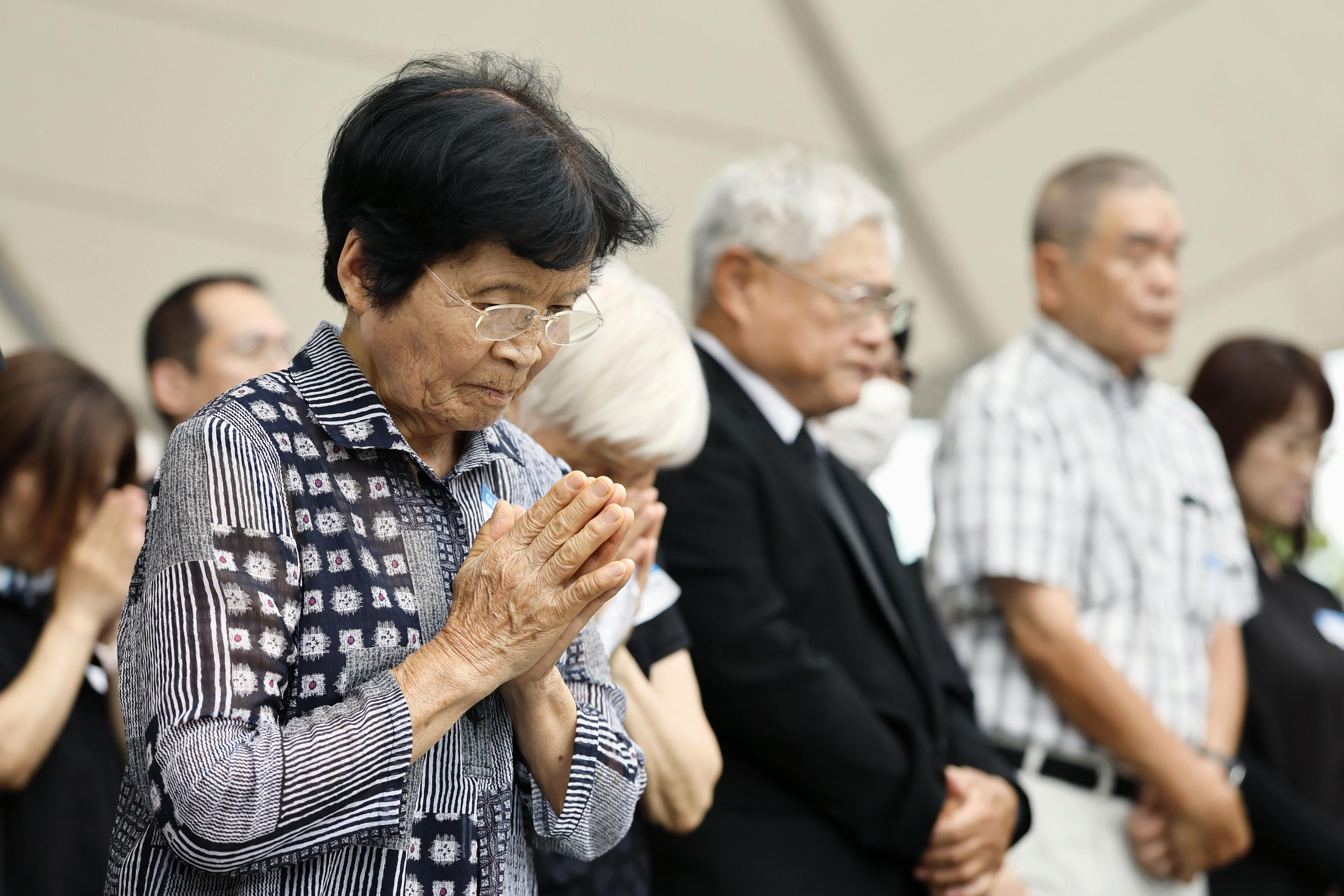
    Representatives from more than 90 countries attended the ceremony at the Peace Park on Sunday and observed a moment of silence at 11:02 a.m., the time when a B-29 dropped a plutonium bomb, known as “Fat Man.”

    Suzuki singled out the Japanese government, demanding it uphold Japan’s war-renouncing Constitution, attend the Treaty on the Prohibition of Nuclear Weapons review conference later this year, and stick to the three non-nuclear principles.

    Takaichi supports the first two principles of not possessing and developing nuclear weapons.

    The prime minister, who attended Sunday’s ceremony, reiterated her policy of taking “a realistic and pragmatic approach” toward achieving a world without nuclear weapons. As she did in Hiroshima, Takaichi remained ambiguous about the three non-nuclear principles and only reiterated that Japan currently maintains the policy.

    Takaichi, in her speech at the ceremony, did not mention the Treaty on the Prohibition of Nuclear Weapons, which Tokyo has refused to sign because Japan is under the protection of the U.S. nuclear umbrella.

    She later told reporters that Japan’s policy is to work within the Nuclear Nonproliferation Treaty, and that her government will decide what to do with the treaty based on what’s most effective to ensure the country’s national security and push forward nuclear disarmament.

    Survivors have expressed frustration and criticized the Japanese government’s support for nuclear deterrence for being insincere. Growing concern about Takaichi’s possible easing of the non-nuclear principles has prompted protests by the survivors, or hibakusha, in Hiroshima and Nagasaki.

    The number of survivors has fallen to 91,105, about a quarter of the original number, with their average age exceeding 86. Survivors worry about fading memories, as the youngest of the survivors were too young to clearly recall the attack.

  • Trump goes unmentioned but not ignored as Clinton, Bush, and Obama step up as essayists on presidents

    Trump goes unmentioned but not ignored as Clinton, Bush, and Obama step up as essayists on presidents

    WASHINGTON — When George W. Bush wrote an essay this year about another president named George, he avoided mentioning the one named Donald.

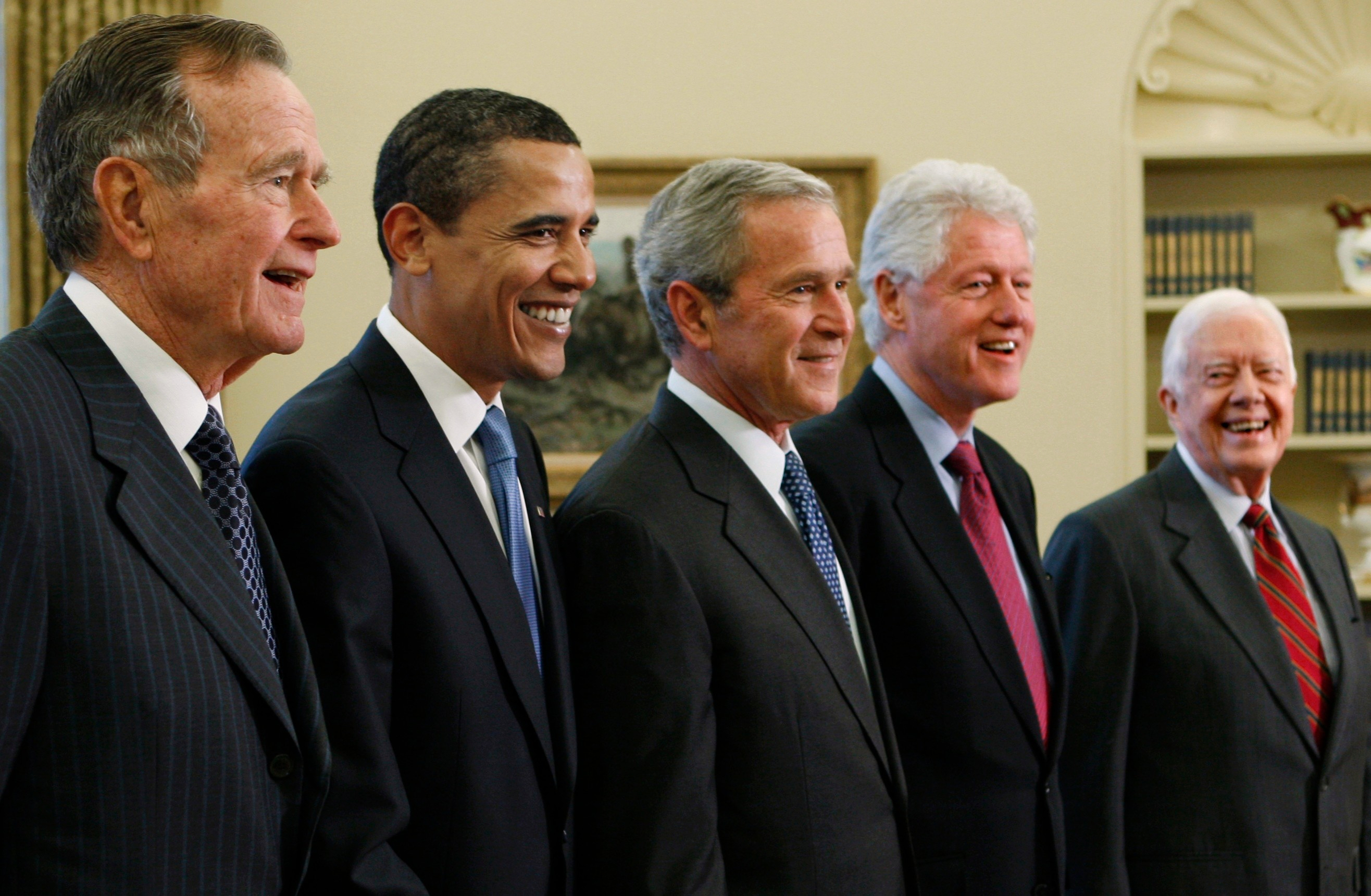
    So did Barack Obama and Bill Clinton. The three ex-presidents joined a roster of historians and authors in contributing to the In Pursuit project, a 250th-anniversary series that had each writer produce an essay about a president or first lady.

    Though the project was explicitly designed to transcend today’s politics, some of its essays nevertheless reflect anxieties that are flaring in the era of President Donald Trump over the use of power, the health of the democracy, and the integrity of the presidency.

    The project is being curated by Colleen Shogan, the U.S. archivist who was fired without explanation by Trump last year. She instructed contributors not to be partisan or ideological. “Everybody took those instructions and that guidance very seriously,” she told the Associated Press. The goal was for all Americans to “feel welcome to be able to read these lessons and essays and learn something from them.”

    The mission, Shogan said, “is to surface the lessons from the past 250 years of American history, so that we can learn from those lessons, from both our successes and our failures, so we can plan for the present and the future. It’s what has been described as debriefing the American story.”

    The essays cover 43 presidents — all but Democrat Joe Biden and Republican Trump — and 30 first ladies. They are being published online at inpursuit.org and on Substack chronologically and weekly into December.

    Trump and Biden were judged too fresh to be appraised by history, a call that may have also set aside passions of the moment.

    Without naming Trump, Bush’s essay is difficult to read without thinking of Trump’s reluctance to cede power after his 2020 election defeat and his musings about a third term in defiance of the Constitution’s two-term limit.

    Bush hails the heroism of humility

    Bush’s essay celebrates George Washington, the original “No Kings” guy. Bush, a Republican, hails a man whose legacy only grew larger because he modeled the limits of the presidency for centuries to come.

    “Our first president could have remained all-powerful,” Bush writes, “but twice he chose not to. In so doing, he set a standard for all presidents to live up to.” First, Washington resigned as commander in chief of the Continental Army, then set the precedent of serving only two presidential terms before that limit was enshrined in the Constitution.

    Bush went on: “George Washington’s humility in giving up power willingly remains among the most consequential decisions and important examples in American politics.” Bush’s essay, released Presidents Day as the first in the series on Substack, drove heavy engagement.

    Retired Gen. Stanley McChrystal, who led U.S. and international forces in the Afghanistan War, sized up a fellow general, Ulysses S. Grant, in another essay that drew much attention for its parallels with today.

    History offers lessons on ‘law over loyalty’

    McChrystal presents the Union general and post-Civil War president as a leader who displayed “an absolute commitment to principles larger than personal ambition” and who, before his presidency, resisted pressure on military leaders to “align with political factions and be loyal to a person rather than the Constitution.”

    The emphasis on personal loyalty resonates in a time when Trump has repeatedly demanded fealty from officials in his administration.

    The “temptation to bend institutions toward personal power is not unique to Grant’s era,” McChrystal writes. “Our future still depends on whether our leaders choose law over loyalty.”

    This month, in the latest In Pursuit installment, Democrat Bill Clinton writes about Theodore Roosevelt, focusing on that president’s drive to expand the universe of “we the people” at the expense of powerful corporate interests, while also emphasizing Roosevelt’s exclusionary views on Black and Indigenous people.

    The essays frequently address presidents’ failures alongside their accomplishments, a contrast with Trump’s calls for federal cultural institutions to stick to patriotic interpretations of American history.

    Presidents, the chief justice, and first ladies contribute

    Among the In Pursuit contributors are Chief Justice John Roberts (writing about William Howard Taft, the only president who also served on the Supreme Court); Hillary Clinton (Eleanor Roosevelt); Michelle Obama (Jacqueline Kennedy); GOP operative Karl Rove (William McKinley); documentarian Ken Burns (Franklin D. Roosevelt); and historian Michael Beschloss (Lyndon Johnson). Democrat Barack Obama presents Abraham Lincoln.

    The project is being staged by More Perfect, a nonpartisan alliance of dozens of presidential centers along with academics and organizations dedicated to advancing democracy. It is where Shogan now practices her archivist craft that Trump shut down by firing her in February 2025.

    She still has not been told why. Nor has Congress apparently been notified of the reason. The law requires Congress to be told but does not specify a deadline. The National Archives is the central repository of federal documents both precious and routine, and its leader has discretion over which records to preserve and display, and how.

    “That is a position that used to be a nonpartisan position, much like the Librarian of Congress, the secretary of the Smithsonian,” she said. “And I took that very seriously and acted the entire time when I was archivist in a nonpartisan way.”

    The White House did not respond when asked why Trump fired the archivist and whether the administration will tell Congress the reason.

    Trump has long begrudged the archives for notifying the Department of Justice of his alleged mishandling of classified documents after he left office following his first term, though Shogan was not working for the agency then.

    Shogan sees hunger for history without a slant

    Shogan said she has been overwhelmed with the public response to the series so far and figures that speaks to a hunger for history shorn of partisanship. The essays have received more than 1 million cumulative views on Substack and her podcast of the same name registered 160,000 audio downloads and nearly 64,000 YouTube views at last count. A documentary about the series is scheduled to air on PBS in October.

    In the essays, readers learn something new not just about the giants, but about presidents such as Millard Fillmore — “a historic punchline — best remembered, ironically, for being so forgotten,” in the words of his essayist, former New York congressman Steve Israel.

    Then there was Franklin Pierce, presented by his essayist as a pro-slavery president and “permanent victim” of Washington’s alcohol-soaked culture.

    Yale history professor David W. Blight recounts how Pierce won the presidency for the Democrats in 1852 despite vicious trolling by the Whigs. Fielding Mexican War veteran Gen. Winfield Scott in that election, they labeled Pierce, who also served in the war, the “hero of many a well-fought bottle.”

  • Lake Mead hits historic low water level as Colorado River struggles

    Lake Mead hits historic low water level as Colorado River struggles

    BOULDER CITY, Nev. — Lake Mead, the largest reservoir in the United States, has plummeted to its lowest water level since it was filled some 90 years ago, another sign of the crisis plaguing the Colorado River system.

    Water levels at Lake Mead hit 1,040.4 feet above sea level on Friday, according to federal data. That’s just below the elevation of 1,040.58 feet recorded on July 28, 2022, at the reservoir that straddles the Arizona-Nevada border outside Las Vegas.

    The record follows a winter that produced the worst snowpack on record in the Colorado River Basin. Melting snow feeds the river, which is relied upon by farmers, industries, wildlife, hydropower producers, and more than 40 million people across seven U.S. states, tribal nations, and Mexico.

    It comes a week after federal officials announced a short-term proposal to stave off a crisis in the beleaguered waterway. Federal officials stepped in after states that rely on the river — California, Colorado, Arizona, Nevada, New Mexico, Wyoming, and Utah — failed to reach an agreement on how to share the dwindling resource long term. Under the proposal, California, Nevada, and Arizona would share water cuts.

    Years of overuse combined with drought and rising temperatures have been depleting Lake Mead and Lake Powell, the country’s second-largest reservoir. Together, the two bodies of Colorado River water are the lowest they’ve been in nearly seven decades.

    To protect the strained system’s ability to produce hydropower, federal officials said Thursday that they will not release cool Lake Powell water from Glen Canyon Dam in northern Arizona to protect a threatened native fish whose habitat is between the reservoirs.

    Severe drought in 2022 on Lake Mead, which is held back by the Hoover Dam, exposed human remains and forced water officials in Las Vegas to pump water from deeper within the reservoir to continue to supply water to millions of people.

  • Ukraine honors its ‘collector of souls’ killed while recovering the war dead

    Ukraine honors its ‘collector of souls’ killed while recovering the war dead

    KYIV, Ukraine — Ukraine paid tribute on Saturday to Oleksiy Yukov, a volunteer who spent more than two decades recovering the bodies of civilians and soldiers — many of them Russian — killed by war. He was 40.

    An Orthodox Christian service was held at the Cathedral of Saint Volodymyr, in central Kyiv, where thousands of people gathered to pay their respects following his death in a landmine explosion during a recovery mission on Aug. 5. Mourners also gathered at Kyiv’s main Maidan Square before the service.

    Yukov founded the Platsdarm (“bridgehead”) organization because he believed all the dead require a proper burial. He became known as a “collector of souls.”

    Yukov, from the war-torn Donbas region, was a martial arts instructor. He began recovering the dead as a teenager after encountering the remains of Soviet and Russian soldiers from World War II.

    Platsdarm’s volunteers go into fields and forests, among ruins and across territory, where the ground is often mined.

    Yukov’s widow, Evhenyia Kaluhyna, promised to continue his work, sobbing as she spoke at the funeral, wearing an embroidered white dress and standing over her husband’s open casket.

    “The work was difficult and terrifying,” she said. “But I promise you we will continue it because the (dead) deserve it, and you deserve it for everything you did.”

    Yukov had suffered leg injuries and lost an eye in a mine blast in 2022. Still recovering from those injuries, he returned to the front line.

    In a social media post last month, Yukov described the landscape in which he worked.

    “Remote mines, shelling, drones — everything is against you. But you go and do everything to ensure that every soul returns home,” he said.

    He also addressed those who believed Russian bodies should simply be left behind: “When they say: ‘Let them rot,’ I do not agree. This is how we fight for every soul.”

    Yukov spoke of his work in religious terms, saying a body was a soul waiting to go home.

    “This is action,” he wrote. “Action every day in the fields, in the forest belts, among the ruins, where your life can end at any moment.”

  • A pillar of environmental enforcement is targeted by Trump and Musk’s AI company

    A pillar of environmental enforcement is targeted by Trump and Musk’s AI company

    WASHINGTON — Right-leaning legal activists along with Elon Musk ‘s artificial intelligence company have brought sweeping challenges against a cornerstone of legal enforcement in the United States: the right of private groups, people, and local governments to sue over violations of many major laws.

    Their argument, supported by the Trump administration, is that the Constitution reserves tremendous power for the president and federal agencies to decide how — or whether at all — to enforce federal law. They contend Congress should never have handed that power to others through so-called citizen suits that are part of environmental, campaign finance, and certain other laws.

    Environmentalists say it would be devastating to lose this essential, decades-old tool that is used to impose fines and halt lawbreaking by bad actors. Citizen suits, for example, have extracted millions from heavily polluting oil and gas operations, and ensured that lead pipes in Flint, Mich., would be removed after its water crisis.

    Legal experts say four pending federal cases — one of them filed last week — are moving forward at a time when the conservative majority on the Supreme Court gives opponents of citizen suits a greater chance than ever of success. The hard part for those opponents now is winning early federal cases and creating disagreement between the country’s appeals courts, which may help convince the Supreme Court the issue is important enough for a nationwide ruling.

    Back in 2000, a Supreme Court opinion opened the door for that possibility.

    “Many of us who worked in this area have been waiting basically 26 years for this shoe to drop,” said Richard Lazarus, a Harvard professor with decades of experience in environmental law.

    A more inviting Supreme Court could take up the issue

    Lazarus was referring to former moderate Justice Anthony Kennedy’s comments in a Clean Water Act case that citizen suits raised “difficult and fundamental” questions about whether they improperly dilute executive power. The late conservative Justice Antonin Scalia wrote in a dissenting opinion in the same case that citizen suits turn “over to private citizens the function of enforcing the law.” He avoided explicitly saying they were constitutional.

    “The court is more like Scalia’s court since he died than it ever was when he was there,” said Lazarus.

    He observed that those who lost cases where Scalia dissented are rushing back to today’s court hoping for a more favorable result.

    The critical issue for citizen suits is who — the government or private citizens — collects fines and has control. A person filing a citizen suit must tell the government ahead of time. The government can stop the suit if it sufficiently pursues the case itself, but its options are limited and the person suing can stay involved. Citizen suits can force compliance with the law and result in fines, which go to the U.S. Treasury.

    Prominent law firms, companies push against citizen suits

    Efforts to increase presidential power and limit who can sue have grown in recent years. They gained vital federal support this summer.

    That’s when the Pacific Legal Foundation, a right-leaning organization with recent Supreme Court success, chose a routine citizen suit in Tennessee federal court for a broader constitutional challenge.

    They signed on as attorneys for Springfield, a town of roughly 19,000 north of Nashville, that was in the early stages of fighting allegations brought by Tennessee Riverkeeper that it had let too much sewage flow from its treatment plant into a nearby creek, violating the Clean Water Act.

    It was the thirty-first citizen suit Tennessee Riverkeeper had filed under the Clean Water Act since 2010. Pacific Legal argued this was part of the problem — a private group of unelected activists had repeatedly forced others to expend resources defending themselves.

    It’s better when “the government is the one wielding the power because the government remains accountable to the people,” said Sean Radomski, a Pacific Legal Foundation attorney on the case.

    Radomski isn’t targeting every lawsuit a person can bring under federal law — he takes exception to those where fines go to the Treasury and where he says people are improperly taking on the government’s powers. Civil rights lawsuits, for example, where damages are paid directly to those wronged, wouldn’t be touched. Nor would many procedural challenges.

    Musk’s AI company also getting into the fight

    Elon Musk-led xAI argued many similar points in its ongoing bid to rid itself of the NAACP’s lawsuit accusing it of operating dozens of gas turbines near Memphis to power a data center without first getting permits. The civil rights group told a Mississippi federal court that the turbines are a pollution threat to those who lived nearby, many of whom are Black. One of their demands was to halt the gas turbines until the company complied with the law.

    The Trump administration intervened in support of Musk’s company, arguing that turning off the power to artificial intelligence that supports the Department of Defense would harm national security. Because the Trump administration wants the suit dismissed, the NAACP shouldn’t be allowed to proceed with it — prudent enforcement requires balancing interests, including national security, the DOJ said.

    Laura Thoms, director of enforcement at Earthjustice, which is representing the NAACP, said the government traditionally gets involved in cases to enforce the law, not to argue that it doesn’t matter if the law is broken.

    “This administration has determined that the company should be allowed to continue to pollute and that therefore, they should have the unilateral and unreviewable authority to veto our citizen suit,” she said.

    Changing the law would have profound consequences

    Citizen suits were written into foundational environmental laws because Congress understood that the federal government had limited resources to go after polluters and that the politics of some cases could be dicey — the government sometimes is the polluter. That’s why outside groups are necessary to fulfill the law’s purpose, according to Lazarus.

    Some argue that dynamic is especially important now. The Trump administration has slashed air and water protections and promoted fossil fuels. They’ve also constrained enforcement that could slow energy projects to only the most extreme cases, such as an “imminent and substantial threat to human health,” according to a federal guidance memo. Environmentalists say citizen suits are vital for filling the enforcement gap this administration created.

    Leaner budgets in many states make the problem worse.

    Thoms said the potential for corruption could increase, too — the president could unilaterally waive laws to benefit friends.

    She said that those who live in states with strong protections may be fine if citizen suits end, but other areas will be “sacrifice zones” where citizens have few options to fight pollution in their backyard. And the unprotected are more often poor and majority-minority communities.

    Many experts are skeptical of the challengers’ claims of a powerful president that gets to unilaterally shape enforcement even outside of criminal law. They argue the country’s history is rife with examples of that task falling to private individuals, too — a contention the challengers reject.

    David Adelman, a law professor at the University of Texas at Austin School of Law, said before the current conservative majority on the Supreme Court, he would have thought there was a close to zero percent chance the challenges would succeed.

    “But this court has been so protective of the executive branch’s complete control of implementation of federal law,” he said, “that it’s not implausible that something like this could prevail.”
  • Senators head for the exits without meeting Trump’s demands for voting bill

    Senators head for the exits without meeting Trump’s demands for voting bill

    WASHINGTON — Senators headed for the exits in the predawn hours Saturday, ending for now a crushing standoff over President Donald Trump’s demands that they stay in session to pass a strict proof-of-citizenship voting bill before the summer recess.

    While they wrapped up many key priorities in the overnight votes, advancing Trump’s SAVE America Act was not among them.

    Instead, Republican senators who had brought the chamber to a standstill spoke to Trump late in the evening about an alternative plan: They would try again to approve elements of the voting bill as part of a broader GOP budget package to fund the Iran war and replenish the Pentagon when they return to work in September.

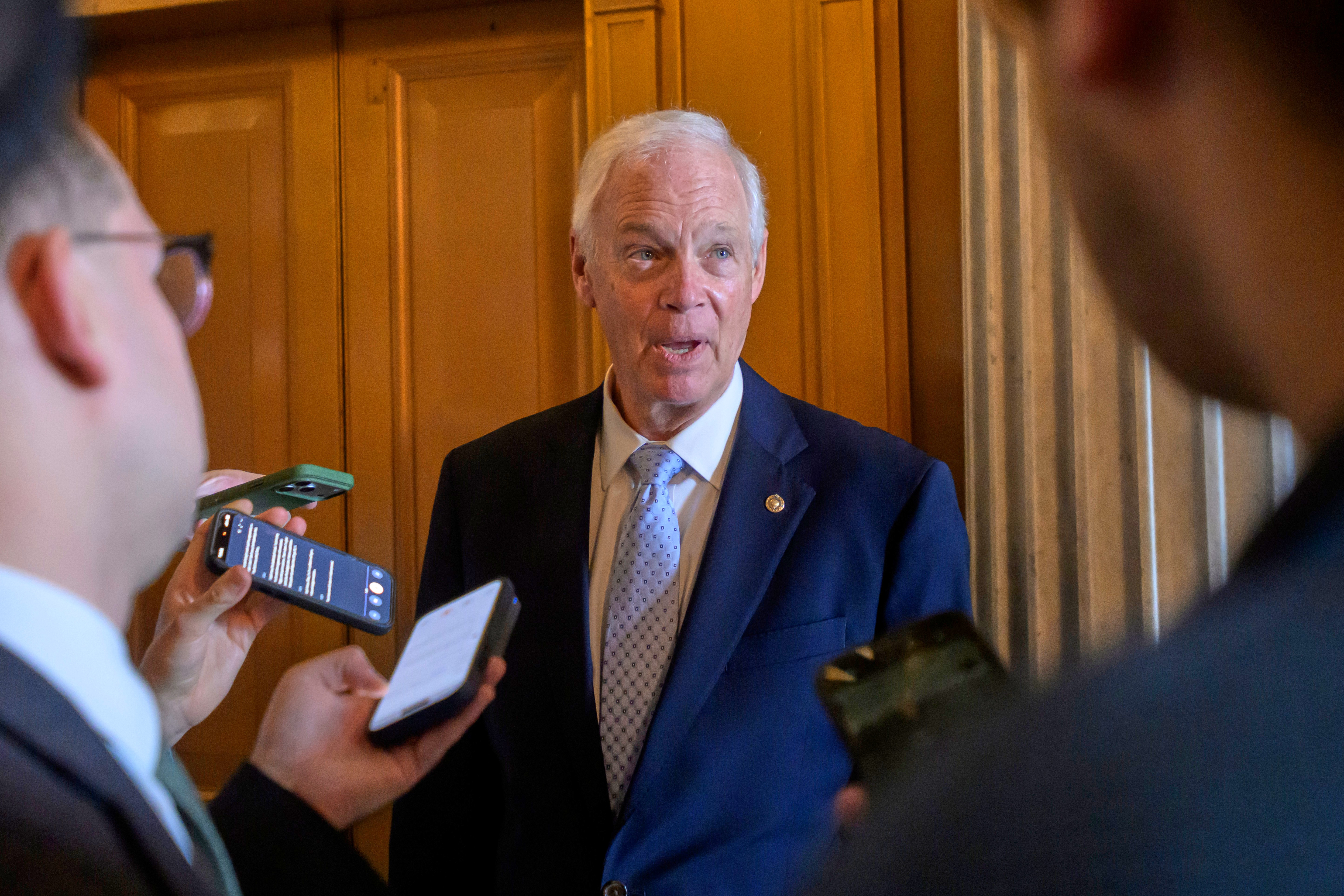
    “Obviously, with the president at his direction, this is what he wants to do,” said Sen. Ron Johnson of Wisconsin, the GOP budget committee chairperson, flanked by Sens. Mike Lee (R., Utah) and Rick Scott (R., Fla.) after their phone call with the president.

    The sudden wind-down after weeks of Trump ramping up his demands shows just how deeply the president is able to reach into the halls of Congress to set the agenda or disrupt it, the executive directing the affairs of the legislative branch. While Trump is often seen as a de facto speaker of the House, he is trying his hand at mastering the Senate.

    Trump had poked and prodded Senate Majority Leader John Thune for weeks to pass the SAVE America Act, a bill that does not have enough support from the Republicans who hold majority power, let alone the Democrats whose votes would be needed to advance it in the Senate.

    The president has gone so far as to insist the Senate abandon its filibuster rules to jam the SAVE America Act past the 60-vote threshold that is typically needed to advance legislation in the chamber — something Thune and most senators have no interest in doing.

    “John’s trying. He’s trying hard. I really believe that. But if he doesn’t get there, it would be unfortunate,” Trump said in an interview with Punchbowl News that posted Friday.

    Trump’s pressure couldn’t overcome Thune’s reality

    Thune himself has worked to carefully balance the often unusual demands of the president with the political reality of his slim GOP majority. Republicans are down one vote with the prolonged absence of Sen. Mitch McConnell of Kentucky, the former leader, who said this week he was released from a rehabilitation center and is recovering at home.

    “I think everybody’s, for the most part, on the same page,” Thune (R., S.D.) said about the trio’s call with Trump, adding that eventually the Senate would have to tackle another budget bill.

    During a daylong session that dragged for nearly 20 hours, Thune successfully powered through a lengthy list of other Trump priorities. Senators confirmed the president’s pick of Todd Blanche as the attorney general, passed a sweeping Russian sanctions package to aid Ukraine, and approved a bipartisan package to fund the government into December in an early step toward avoiding a government shutdown.

    The Republicans also tried to push forward a slimmer voting bill that would require people to show IDs before casting ballots for federal elections. It failed to advance, largely on a party-line vote with Democrats opposed.

    But the failure to make progress on the SAVE America Act had erupted as an online crusade for Trump’s allies in Congress, amplified by activists urging them on.

    Led by Lee, a growing group of senators was refusing to adjourn for the summer break without passing Trump’s priority voting bill.

    At dinnertime, Thune gathered all the Republican senators for a meeting as the standoff deepened at the Capitol. There was no immediate way forward for the SAVE America Act or the broader budget bill. Thune encouraged the trio of senators to talk to the president, which they did, before regrouping back at Thune’s office.

    “We had about a two-hour conference meeting trying to figure out, you know, what we need to do to, to come to an agreement, to accomplish what the president wanted,” Johnson said. “Then we had discussion with the president, he agrees.”

    Lee acknowledged he was disappointed by the outcome, but said he understood the political reality of the situation.

    “We are not in a position right now where we have the wherewithal to pass it,” Lee told reporters at the Capitol, after the three senators emerged from Thune’s office following their call with Trump.

    Near daybreak, when the Senate did call for the vote to adjourn, Lee and others objected with hearty nos.

    On the simple voice vote, the ayes had it, and the motion to adjourn was adopted.

  • Iran makes new strait demands, the UAE says a ship was targeted

    Iran makes new strait demands, the UAE says a ship was targeted

    Iran issued dramatic new demands for the Strait of Hormuz to reopen as the United Arab Emirates said one of its ships was targeted by an Iranian missile. Yemen’s military attacked the country’s Iranian-backed Houthi rebels. And Turkey’s Kurdish peace bill won approval in parliament.

    Here’s a look at developments across the Middle East on Saturday.

    Iran says strait won’t open until the U.S. ‘corrects’ behavior

    Iran’s politburo-like body known as the Supreme National Security Council said the Strait of Hormuz will not open until the United States “corrects its behavior,” issuing new demands that could shake up talks on a deal to manage the waterway and traffic on it.

    Iran’s state broadcaster published the statement by the council’s secretary, Mohammad Bagher Zolghadr, who is also a commander in the powerful Revolutionary Guard.

    The U.S. must never threaten Iran again, the statement said, and must permanently end the war with Iran and its armed allies in the region. The U.S. must lift the naval blockade of Iranian ports and withdraw its military from the area. It also must “completely compensate” Iran for war damage, lift sanctions, and “unconditionally” release frozen assets.

    There was no immediate comment from the U.S., which has wanted an acceptable deal first on the strait before ending the blockade. According to the interim deal signed in June, a schedule to end sanctions and plan on compensation would be part of the final deal, and negotiations would address frozen assets.

    The end of a 60-day period to negotiate a final deal will end in just over a week but could be extended.

    Iran has said it was close to reaching a separate deal with Oman to manage the strait, which runs between the two countries. Iranian Foreign Minister Abbas Araghchi earlier Saturday said they were close to reaching an agreement on navigation, “specifically the determination of a transit route.” But the waterway’s reopening is contingent on other conditions, he said in remarks shared on social media.

    Oman, a mediator Gulf Arab country which has said relatively little on the talks, said in a statement Saturday that the discussions were ongoing “in a positive and constructive atmosphere,” and condemned attacks on ships on the strait.

    The strait, crucial to global supplies of oil and natural gas, had been considered an international waterway before the war.

    Iran attacks vessel in Strait of Hormuz, UAE says

    A vessel owned by Abu Dhabi’s state-owned ADNOC oil and gas company was attacked while transiting the Strait of Hormuz, Emirati authorities said earlier Saturday. The Foreign Ministry said Iran fired the missile as part of attacks on commercial shipping.

    ADNOC in a statement said there were no casualties following the attack early Saturday. The company said over a dozen of its vessels have been attacked by missiles and drones while transiting the strait since the United States and Israel launched the war on Iran in February. One crew member has been killed and 20 others wounded, it said.

    ADNOC didn’t elaborate on the attack’s location or any damage.

    Later, the United Kingdom Maritime Trade Operations Center said a vessel east of the town of Khasab, Oman, had been struck by a projectile that caused a fire that was put out, with the vessel and crew safe. It was not clear whether this was the ADNOC incident.

    Yemen’s military attacks Iran-backed Houthis

    The attacks were in response to the Houthis’ recent strikes in central and eastern Yemen. Col. Majed al-Nazili, spokesperson for Yemen’s military, said the attacks targeted the rebels’ “sites and capabilities” on multiple front lines, without elaborating.

    The escalation between the Houthis and Yemen’s internationally recognized government and its backer, a Saudi-supported coalition, threatens to reignite Yemen’s civil war following a 2022 truce.

    Turkey’s Kurdish peace bill wins approval in parliament

    A Turkish draft law aimed at advancing a peace effort with the country’s Kurdish insurgents passed its first hurdle in parliament on Saturday. A committee approved the measure. It is expected to be approved in the general assembly next week.

    Last year, the Kurdistan Workers’ Party, or PKK, declared its decision to disarm and disband as part of the peace initiative aimed at ending the decades-long conflict with the Turkish state.

    The draft legislation defines the procedures for the group’s disarmament and rehabilitation of some PKK members. The measures would come into effect once Turkey’s National Security Council confirms that the group has disbanded and surrendered all weapons.

    The conflict has killed tens of thousands of people since it began in the 1980s. Turkey and its Western allies consider the group a terrorist organization.

  • A Russian retail giant’s warehouse burns after Ukraine’s latest long-range drone attack

    A Russian retail giant’s warehouse burns after Ukraine’s latest long-range drone attack

    Ukrainian long-range drones hit a warehouse of Russia’s biggest online retailer in the Ural Mountains, more than 1,200 miles from the two countries’ border, local officials and the company said Friday.

    Ukraine has regularly hit targets in the distant Urals this year and has even struck a Russian oil refinery in western Siberia, nearly 1,550 miles from the border. The attacks are examples of how Kyiv has used drone innovation as a key part of its response to the invasion by its much bigger enemy more than four years ago.

    Its successes have drawn international interest and drone cooperation agreements with nine countries, with further deals being negotiated with 15 other countries, according to Kyiv officials.

    Wildberries said its warehouse in Yekaterinburg, Russia’s fourth-largest city, was set ablaze by the attack. Most merchandise wasn’t damaged, the company said, unlike at some of the more than a dozen other Wildberries depots struck by Ukraine in recent weeks that have burned down.

    The regional governor, Denis Pasler, said three drones hit the warehouse’s roof. Artyom Zhoga, the Kremlin’s representative in the region, said that 800 people were evacuated from the warehouse and nobody was hurt.

    Kyiv is trying to rattle the Russian public and the Kremlin with the attacks.

    Russian President Vladimir Putin chaired a meeting Friday of the country’s Security Council. He said in televised opening remarks that the meeting would focus on additional measures to “strengthen … protection of infrastructure facilities” but gave no further details.

    Ukraine presses on with plans for new weapons

    Ukrainian President Volodymyr Zelensky is pushing for his country to keep up the pace of technological development, especially in air defense systems to help stop Russian ballistic missiles that are exploiting Ukraine’s shortage of American-made Patriot interceptor missiles and battering civilian areas.

    A joint European anti-ballistic development program is already underway, Zelensky said late Thursday, with 10 countries engaged in developing an anti-ballistic shield. Europe is concerned about Moscow’s ambitions on the continent beyond Ukraine.

    “Ukraine is capable of producing its (anti-ballistic) missile and launcher, while our partners will provide the necessary components and critical elements — radars, sensors, and everything else required,” Zelensky said on social media. “An anti-ballistic program of our own — one that is truly large-scale — will greatly benefit everyone in Europe.”

    At the same time, Ukraine is working on manufacturing its own ballistic missiles to use against Russia. “The tests have shown strong potential. We need to turn this into a real weapon,” Zelensky said.

    Defenders are under pressure in eastern Ukraine

    Ukrainian front-line defenses in eastern regions, meanwhile, remain under strain as Russia’s bigger army looks for a breakthrough after months of minimal advances that Western analysts and officials say have had a high cost for Moscow in troop casualties.

    Ukraine has been evacuating children from Kramatorsk, one of the four eastern Donetsk region cities that make up the Ukrainian so-called Fortress Belt. The line of four large and heavily defended cities, about 30 miles long, has been key to denying Moscow its goal of seizing Ukraine’s industrial heartland.

    The head of the Donetsk region’s regional military administration, Vadym Filashkin, said Friday that more than 800 people, including 91 children, were evacuated over the previous 24 hours.

    Ukraine has been deploying midrange strike drones to disrupt Russia’s supply lines and slow its advance.

    Zelensky said that the recently appointed commander-in-chief of the Ukrainian armed forces, Maj. Gen. Mykhailo Drapatyi, reported to him Friday about the military situation in Donetsk.

    He said in a social media post that they reached “an understanding of how to strengthen” Ukraine’s defenses there but gave no details.

    Russia and Ukraine sustain nightly drone attacks

    Russia’s air defenses downed 203 Ukrainian drones from late Thursday through early Friday, the Defense Ministry in Moscow said.

    Over the past week, the Russian military struck 31 bulk cargo vessels and three tugboats that operated “in the interests of the Ukrainian armed forces,” it said.

    It added that late Thursday two ships were hit by Geran-4 drones in the Black Sea east and southeast of Odesa and one was struck in the Ukrainian port of Chornomorsk.

    In other attacks, the ministry said that the military hit a facility assembling long-range drones in Okhtyrka in the Sumy region on Thursday. It also released a video of a train purportedly carrying military equipment struck by a Geran drone and then an Iskander ballistic missile near Vyshneve in the Dnipropetrovsk region.

    Meanwhile, Russia attacked Ukraine with 147 long-range strike drones overnight, according to the Ukrainian air force.

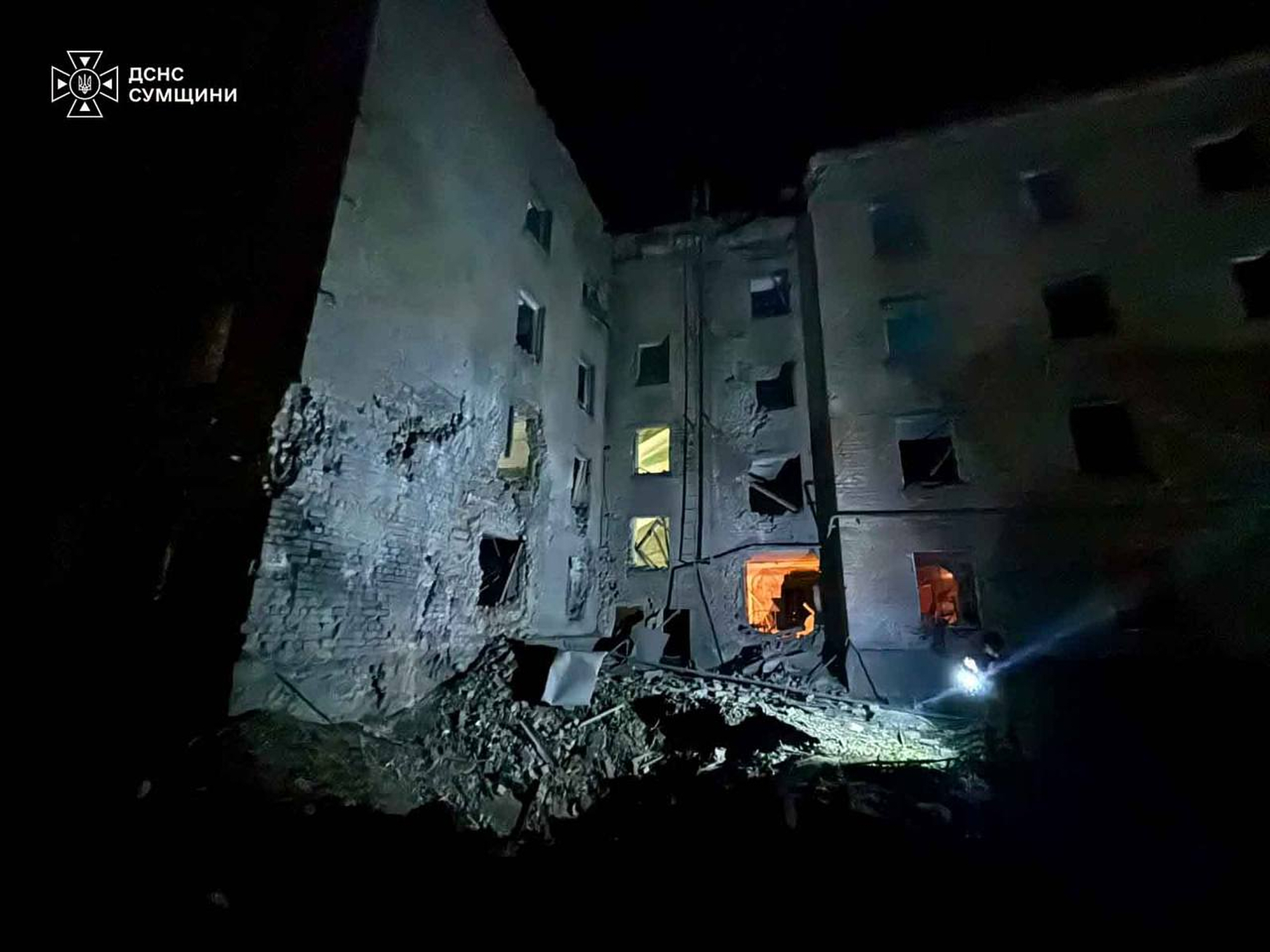
    In Ukraine’s northern Sumy region, a Russian drone struck a busy market Friday morning, wounding 10 people, authorities said.

    Russia also launched glide bombs and drones of various types at the regional capital, according to the head of regional administration, Oleh Hryhorov.

    The attack targeted residential buildings, transport, and infrastructure, wounding two people, he said.

  • Student kills at least 7 people at a high school and a home outside Bangkok, officials say

    Student kills at least 7 people at a high school and a home outside Bangkok, officials say

    NONTHABURI, Thailand — A student opened fire at a high school outside Bangkok on Friday, killing at least five people and wounding more than 20, according to authorities, who said he also appeared to have killed his two grandparents at the family home earlier in the morning.

    The 14-year-old shooter took his own life at the school, officials said.

    Five school staff members, including teachers and administrators, died in the shooting around 10 a.m. at Debsirin Nonthaburi School in Nonthaburi province northwest of Bangkok, Deputy Interior Minister Polapee Suwunchwee said at the scene.

    The boy also killed his grandparents at the home he shared with them prior to the school shooting, Polapee said.

    Bangyai Hospital, about 3 miles from the school, said 23 people were wounded, of whom 10 were in critical condition, with most suffering gunshot wounds. Earlier reports gave conflicting casualty numbers.

    A witness said students hid inside a classroom while they heard gunshots from another building before police officers knocked on the door and cleared a way for them to leave the building.

    Amporn Niamfuang, who owns a restaurant 160 feet from the school, said there was the sound of a single gunshot and then a pause.

    “And then there were multiple continuous shots,” Amporn said, recalling the narrow road outside the restaurant filling with fleeing students. “Students were running scared and pouring onto the street. Young girls were holding each other’s hands and crying. I went inside to hide.”

    Prime Minister Anutin Charnvirakul, speaking after touring the school, confirmed reports that the shooter was 14 and had killed himself. He said the student had shown signs of stress connected to school.

    The gun, described by police as small and compact, was legally registered to the student’s grandfather, he said.

    About an hour after the shooting, people stood outside comforting one another as police and first responders walked around the co-educational state school, which has an enrollment of about 3,000 students ranging from 12 to 18 years old.

    All classes will be suspended from Monday through Friday, and school staff have been instructed to work from home during that time, the school said.

    Police find grandparents dead at family home

    After the shooting, police went to the student’s home and found both grandparents dead of apparent gunshot wounds, regional police Commander Wattana Yeejeen said.

    The student appeared to have shot them before attending school as normal. He waited until classes started and began shooting inside his classroom before walking out and firing more shots, police spokesperson Trairong Piwpan said.

    The boy fired more than 20 shots and police found he still had 30 rounds after shooting himself, he said.

    Several family members, including his uncle and sisters of the grandfather who were at the family home while police investigated, said he usually kept to himself and was a good student.

    The family members said they were unaware of any troubles he faced at home or school.

    Thailand has high rate of gun owners

    Thailand has one of the highest rates of gun ownership in Asia, second only to Pakistan and far surpassing its other Southeast Asian neighbors.

    Data collected in 2017 by the groups Small Arms Survey and GunPolicy.org in their last extensive international study found civilian gun ownership in Thailand was about 15.1 guns per 100 people, compared with less than one per 100 in neighboring Malaysia.

    Thailand had 3.49 deaths by firearms per 100,000 people, according to 2023 statistics published by World Population Review. That puts it well behind parts of Latin America and the Caribbean, but relatively high in Asia. Only the Philippines is higher in Southeast Asia.

    In February, a 17-year-old stole a gun from police and opened fire at a public high school in southern Thailand, briefly taking people hostage in a two-hour attack that killed one person and injured two others.

    A 14-year-old boy was accused of a 2023 shooting at a major Bangkok shopping mall.

  • Beloved author Benjamin Alire Sáenz, first Latino PEN/Faulkner winner, dies at 71

    Beloved author Benjamin Alire Sáenz, first Latino PEN/Faulkner winner, dies at 71

    NEW YORK — Benjamin Alire Sáenz, an award-winning fiction writer and poet who drew upon his sexuality and his life on the Southern border, has died at age 71. He was the first Latino to win the PEN/Faulkner prize.

    Mr. Sáenz, who produced a story collection that won the PEN/Faulkner prize and a young adult novel that received acclaim from readers and reviewers and condemnation from censors, died last week in El Paso, Texas, after a lengthy illness, according to a spokesperson for Simon & Schuster Children’s Publishing. Additional details were not immediately available.

    Mr. Sáenz, born in Old Picacho, N.M., was an ordained Catholic priest who eventually left the order and came out as gay. His Aristotle and Dante Discover the Secrets of the Universe, the story of two Mexican American boys falling in love, was published in 2012 and received a pair of citations for outstanding LGBTQ+ literature: a Stonewall Honors Book Award and the Lambda Literary Award.

    Hamilton playwright Lin-Manuel Miranda, who narrated the audio edition and helped produce a 2023 film adaptation, wrote in an Instagram post that he was “heartbroken” over Mr. Sáenz’s death.

    “Rest easy, maestro,” Miranda wrote. The movie starred Max Pelayo and Reese Gonzales as the title characters and also featured Eva Longoria.

    The novel’s love story led to its being removed temporarily from a school district in Granbury, Texas, and to bans in Russia and in Belarus.

    Mr. Saenz’s other books included the sequel Aristotle and Dante Dive into the Waters of the World, the poetry collection The Book of What Remains, and such adult novels as In Perfect Light and Names on a Map.

    He received the PEN/Faulkner award in 2013 for Everything Begins & Ends at the Kentucky Club, a story collection set in El Paso, and across the border in Juarez, Mexico. Starting in the 1990s, he taught for decades at the University of Texas at El Paso, where he had received a master’s degree in creative writing. He served as chair of the school’s creative writing department before retiring in 2016.

    Next month, Simon & Schuster will publish When the World Was Happy, which draws in part upon the loss of his niece in 1990 in a Las Cruces, N.M., bowling alley shooting. He was reminded of that tragedy by the 2022 school shooting in Uvalde, Texas.

    “That was when I decided that this was not gonna leave me alone until I wrote about it,” he wrote in an author’s note shared by the publisher. “I wanted to write a book about how people survive and live through something as senseless as this.”