Category: Nation World News Wires

  • Enrollment in SNAP grocery aid is dropping faster than expected

    Enrollment in SNAP grocery aid is dropping faster than expected

    PHOENIX — Enrollment in the biggest federally funded food aid program in the U.S. dropped by more than 13% in a 12-month span — a decline far steeper than the government estimated as work requirements and other provisions of President Donald Trump’s “big beautiful bill” take hold.

    Those losing coverage in the Supplemental Nutrition Assistance Program, or SNAP, include people who don’t meet the tightening requirements to participate, and, advocates say, some who qualify for the help but are rejected because they miss deadlines or don’t have the needed documentation handy. It’s too early to tell exactly how many fall into each group.

    It’s also unclear how many have lost coverage because some state agencies that run the programs are overwhelmed trying to keep up with changes. That was the case in Arizona, which saw the nation’s largest enrollment drop.

    Tia Fields, who analyzes social safety net policies at the advocacy group Invest in Louisiana, said the main reason she’s seeing people lose coverage is not failure to meet work requirements. “A lot of it is administrative paperwork,” she said.

    Proponents of welfare reform hope the roll reductions are driven by people earning too much to keep qualifying — a sign that policy changes are behaving as intended for a program they assert is riddled with fraud.

    “If there are people that are leaving the welfare rolls because they’re working and they’re moving forward,” said Rachel Sheffield, a research fellow at the conservative Heritage Foundation, which pushed for stricter requirements for SNAP, “that would be a step forward.”

    Arizona has had the steepest decline so far, with a 12-month drop of more than 50%, according to data compiled by the U.S. Department of Agriculture, which runs SNAP. The decline was more than 20% in Georgia, Louisiana, and Nevada — and in Florida, where the Department of Children and Families said in a statement that the decreasing number “is reflective of the state’s strong focus on advancing opportunities for Floridians and their families to achieve economic self-sufficiency.”

    Eligibility requirements are tightening

    SNAP helps more than 1 in 10 people in the U.S. buy food. Most of the beneficiaries have incomes below the poverty line. The monthly benefit, which is delivered on debit cards that can be used only for groceries, is $344 per household on average.

    Newly released federal data found SNAP enrollment fell from 42.2 million in May 2025 to 36.6 million in May, a drop of more than 13% in a year. The May data are preliminary and could be revised.

    Since 2010, the average number of monthly beneficiaries has been below 40 million for only two years — 2019 and 2020. The rolls started dropping after a recent peak of 43.3 million in October 2024. They’ve fallen much faster since implementation began last year for Trump’s “one big beautiful bill,” which cut taxes and overhauled social safety net programs.

    The expanded SNAP work requirement has now kicked in for most of the country, but it won’t begin in some places until next year.

    Many adults 54 and younger without minor children have long been required to work to get SNAP benefits. The new law requires most people who previously had been exempt from requirements to either work, volunteer, or go to school to get benefits. It now includes those ages 55 to 64, and those with children ages 14 to 17. Those 65 and older or with children younger than 14 remain exempt, as do those with health limitations. Some other groups that had been exempted from the requirement — including homeless people — no longer are.

    In February, the Congressional Budget Office projected that the new requirements and other factors would push SNAP enrollment down over the next decade, falling below 34 million by 2036. But the nonpartisan office did not expect the drop to be as fast as it’s been. By May, the number of people receiving the benefits was about as low as it was forecast to go in 2030.

    Experts expect another impact when states are required to pay part of the cost of benefits if their rate of payment errors — when recipients receive more or less than they should — is above 6%. Advocates for recipients say states may deny benefits to some people entirely rather than risk errors.

    The cost-sharing is scheduled to start in October 2027, though Congress has considered a delay.

    Changes have been hard to implement in Arizona

    In Arizona, enrollment plummeted by 55% from April 2025 to April 2026 — the biggest drop in the country, with more than 400,000 fewer people getting benefits now.

    The state said the drop was driven largely by the state’s own struggles putting new federal requirements in place.

    “Implementing the federally mandated changes triggered unprecedented call volumes and administrative hurdles, including additional verification requirements, creating real barriers for applicants,” said Brett Bezio, a spokesperson for the Arizona Department of Economic Security.

    Bezio said that hiring more staff members and introducing ways for people to submit their documents online have stemmed the enrollment drop in recent months as the state has reduced the chance for people who qualify to lose benefits.

    In Phoenix, LaDiamond Lopez lost her benefits in January, with officials telling her she needed more documentation about her income and household — something that’s needed for officials to determine whether enrollees meet work requirements.

    She’s been skipping meals and some bill payments to ensure her children have enough to eat.

    In her quest to be reinstated, she had previous employers sign forms confirming she no longer worked for them and added her children — ages 3 and 9 — to her apartment lease. She expected payments to resume in August, but she doesn’t know if they’ll last.

    “I was approved at the end of May, but now they’re asking me for more documents,” she said. “It’s a panic.”

    Other factors could be driving down enrollment

    The Heritage Foundation’s Sheffield says that some of the drop in SNAP use is likely a natural decline after peaks in the coronavirus pandemic era.

    Paco Velez, the president and CEO of Feeding South Florida, said the 22% one-year enrollment drop in Florida is driven partly by immigrants who are in the U.S. legally but fear being targeted by Trump’s immigration crackdown if they’re seeking government benefits.

    Invest in Louisiana’s Fields said SNAP enrollment declines have broader consequences. For instance, children in households that receive the benefit can be automatically enrolled in free school lunch programs or in the SNAP for Women, Infants, and Children program for low-income mothers, young children, and expectant parents if they meet the other criteria.

    “What happens when that child can’t pay for lunch?” she asked.

    Some food banks have ramped up donations to try to meet a demand that they say has risen as SNAP rolls have declined. But that isn’t expected to bridge the gap fully.

    “We’re very worried about it because we know that no other organization or program can replicate the scale and success of SNAP,” said Carolyn Vega, a policy analyst at the advocacy group Share Our Strength. “We know that schools can’t fill this gap. We know that food banks can’t fill this gap.”


  • Trump announces plan to lower beef prices, but ranchers and some Republicans are already balking

    Trump announces plan to lower beef prices, but ranchers and some Republicans are already balking

    WASHINGTON — President Donald Trump announced Friday that his administration will allow more beef to be temporarily imported into the U.S. without triggering higher tariffs, as he remains under pressure to cut costs and address affordability issues ahead of November’s midterms.

    Beef prices have climbed to record highs amid a sharp drop in the number of U.S. cattle, consistent consumer demand, and limits on cattle from Mexico, where the animals are facing a flesh-eating pest. The U.S. president has also imposed 50% tariffs on Brazil, a major beef exporter.

    The president’s plan, however, drew immediate skepticism from agricultural experts and backlash from cattle ranchers and conservative rural-state Republicans. Ranchers, normally some of the president’s biggest supporters, are enjoying some rare profitable years and worry cheap beef imports will reduce cattle prices — and with it, the incentive to increase herd sizes.

    “We all want lower grocery prices, but as I’ve said for months, we cannot do it at the expense of American producers,” Sen. Deb Fischer (R., Neb.) said in a statement. “Flooding the market with foreign beef hurts our livestock industry and undermines the long-term solution: growing the U.S. cattle herd to meet demand.”

    Sen. Tim Sheehy (R., Mont.) said in a social media post just hours after Trump’s announcement that the president’s “heart is in the right place,” but importing beef will “harm our ranching families who feed the nation.”

    The deal, Trump said, allows up to 300,000 metric tons of ground beef to be imported into the U.S. for the next 90 days without activating an “out of quota” tariff, which is a tax that goes into effect once a certain quantity of that product enters the country.

    The president said on social media that he had committed to ensuring the imported beef would be sold at 25% below current market rates, making it cheaper for American consumers. A White House official said the deal is with foreign beef exporters who have agreed to the discount on beef.

    “You don’t put America first by putting U.S. cattle producers last,” U.S. Cattlemen’s Association President Justin Tupper said in a statement. “This move will weaken our markets and gamble with food safety in the process.”

    The president’s announcement and other market interventions sacrifice “long-term stability for short term messaging,” Colin Woodall, CEO of the National Cattlemen’s Beef Association, said in a statement.

    Glynn Tonsor, a professor at Kansas State University who focuses on the cattle and beef industry, said he would like to see more details about the latest deal but that his immediate assessment was that it wouldn’t have a big effect on prices.

    That’s because 300,000 metric tons amounts to roughly 3% of what Americans eat yearly, he said. “The relative magnitude we are talking about is pretty small.”

    David Anderson, professor of agricultural economics at Texas A&M University, said he was skeptical other countries could redirect so much beef to the U.S. in such a short time period.

    “Is that even achievable?” he questioned in a phone interview.

    The White House official, who spoke on condition of anonymity to discuss a plan that has yet to be finalized, said the beef in question is lean beef trimmings that are used for ground beef production. Trump plans to sign an executive order formalizing the directive within two weeks, the official said. The administration made a push last year to buy more beef from Argentina to try to bring down prices.

    The president said Friday that his plan would help grow the U.S. cattle supply, which is the smallest it’s been in decades. Some ranchers and experts said the opposite effect was more likely.

    “Imports have been a major contributor to the decline in the U.S. cattle inventory,” said Bill Bullard, the CEO of the R-CALF USA, which represents independent cattle producers. “Using more imports today will exacerbate that decline and will prevent herd expansion.”

  • Supreme Court chief justice allows work on Trump’s $400M White House ballroom to continue for now

    Supreme Court chief justice allows work on Trump’s $400M White House ballroom to continue for now

    WASHINGTON— Chief Justice John Roberts on Friday allowed the White House to continue construction on President Donald Trump’s $400 million ballroom project for now, as the Supreme Court considers the Trump administration’s emergency request to intervene in lawsuits over the project.

    The temporary order came hours before lower-court rulings would have forced a halt to aboveground construction of the project because Trump didn’t get congressional approval.

    It will remain in place until the Supreme Court issues a more durable decision, though the one-page document does not detail Roberts’ reasoning or indicate when another ruling will be handed down. Roberts signed the order because he oversees emergency appeals of cases filed in the capital.

    Ballroom case tests limits of presidential power

    The case is coming before the nation’s highest court as Trump, a Republican, exercises unparalleled assertions of presidential power and increasingly seeks to mold the capital in his own image.

    The administration has argued that the president has total authority to renovate the White House and other federal buildings as he sees fit and that the ballroom project must be completed due to national security concerns.

    When Trump first announced the plans for a new ballroom, he did not emphasize national security. He said the project would be funded by private donations, including from himself.

    The National Trust for Historic Preservation argues that Trump has no unilateral authority to undertake the work, which has included demolishing the East Wing. Lawyers for the preservation group accused the White House of trying to “outrun the courts” by accelerating construction.

    A spokesperson for the trust said Friday that the order from Roberts is not a final decision and the group is awaiting further action. The full Supreme Court will likely weigh in next on whether construction can continue for the potentially long duration of the lawsuit.

    Trump said his administration is grateful for Friday’s decision, writing in a social media post that the project is “under budget and ahead of schedule.”

    While litigation plays out, the ballroom is going up quickly

    The Trump administration says 65% of the work has already been completed on the planned 90,000-square-foot ballroom, where the East Wing stood before the president ordered its demolition.

    Crews are working 20 hours a day, seven days a week, on the project, where about $200 million in private donations has been spent or committed, according to court documents filed by the Justice Department.

    The work has proceeded against the backdrop of the litigation winding through the courts.

    In April, a district court judge ordered a stop to the aboveground construction of the planned ballroom. That ruling was briefly suspended, then upheld by an appeals court panel. U.S. District Judge Richard Leon in Washington allowed work to continue only belowground on bunkers and military installations. Leon was nominated by President George W. Bush, a Republican.

    Leon’s decision was upheld by an appeals court panel, as two judges appointed by Democratic presidents found the project was for Congress to decide and “not a matter for Executive self-help.” A third judge, appointed by Trump, found that the preservationist group challenging the project had no legal standing to sue.

    Solicitor General D. John Sauer picked up on that argument, calling the decision halting the work “extraordinary and unlawful.” He said the completion of the project was “vitally required by national security.”

    The Trump administration has scored a series of victories on the Supreme Court’s emergency docket, though the justices have ruled against some of the president’s signature policies after fuller review.

  • Court cuts $50M judgment against Infowars’ Alex Jones over falsely labeling Newtown killings a hoax

    Court cuts $50M judgment against Infowars’ Alex Jones over falsely labeling Newtown killings a hoax

    AUSTIN, Texas — A Texas court on Friday slashed a $50 million judgment to $1.5 million against Infowars founder Alex Jones after he falsely claimed the 2012 Sandy Hook elementary school mass shooting was a hoax.

    The ruling does not affect a $1.25 billion judgment against Jones in Connecticut, but is a legal victory for him after he and his company, Free Speech Systems, were found liable for damages for claiming the mass shooting didn’t happen.

    Despite the multiple financial judgments against him in Connecticut and Texas, Jones has yet to make any payments as he appeals the amounts and the attempt to liquidate his company.

    The unanimous opinion by the Texas Third Court of Appeals found that Sandy Hook parents Neil Heslin and Scarlett Lewis did not show evidence that harassment inflamed by Jones’ hoax claims rose to a level that would allow them to exceed the state’s $750,000 cap on damages for each plaintiff.

    Heslin and Lewis’s 6-year-old son Jesse Lewis was among 20 children and six educators killed in the attack in Newtown, Conn. The lawsuit and the 2022 verdict against Jones marked the first time he was held financially liable for peddling lies about the massacre, claiming it was faked by the government to tighten gun laws.

    Jones, who portrayed the lawsuit as an attack on his First Amendment rights, conceded during the trial that the attack was “100% real” and that he was wrong to have lied about it.

    However, on his streaming show Friday, he called the Texas ruling “a gigantic victory for the First Amendment,” and said he will continue to appeal the case to the state Supreme Court to get the remaining damages thrown out.

    “I got lawyers who are good constitutional lawyers and they are not backing down,” Jones said.

    Mark Bankston, an attorney for Heslin and Lewis in Texas, shrugged off the appeals court ruling as “irrelevant” given that Jones still faces massive financial judgments.

    “The families care not at all about this irrelevant ruling which affects only two of the 19 claims they all share. Jones still faces over a billion dollars of liability, so this changes absolutely nothing. All it does it highlight the absurdity of Texas law,” Bankston said.

    Heslin and Lewis told jurors in the case that an apology wouldn’t suffice and called on them to make Jones pay for the years of suffering he has put them and other Sandy Hook families through.

    Jones’ trial attorney Andino Reynal had said immediately after the verdict that Jones would appeal the damages amount, and predicted it would be reduced to $1.5 million.

    Jones and his company have filed for bankruptcy, and those legal proceedings continue. The satirical website the Onion also moved to take over Jones’ Infowars platforms and turn his bullhorn of conspiracy theories into parody sites.

    Jones gave up the Infowars brand in April and moved to a new location, switching his shows to new websites and posting them on his personal X account. The Onion, meanwhile, has set up its own Infowars webpage on its website, running videos of shows parodying Jones.

  • Pope hats, bloody shirts, and so many bobbleheads: The creative ways MLB teams lure fans to the park

    Pope hats, bloody shirts, and so many bobbleheads: The creative ways MLB teams lure fans to the park

    CHICAGO — It started as a limited promotion for a specialty theme night. Then the Chicago White Sox heard from their fans.

    Everyone wanted a pope-themed hat.

    “When things go bananas … that’s when it gets really fun,” said Brooks Boyer, the White Sox’s chief revenue and marketing officer.

    Fun is the overarching theme when it comes to stadium giveaways, and business has been good at major league ballparks this year.

    An array of creative promotions — everything from the New York Mets handing out fake glasses and mustaches for a Bobby Valentine Disguise Night to the Texas Rangers giving away a Nolan Ryan bloody lip jersey — has played at least a small role in an MLB-wide average attendance of 29,618 through Aug. 11, the highest such number for a full season since 2017.

    Bobbleheads remain popular — like the Brandon Nimmo Bull Riding bobblehead in Texas, or the butter-churning Nick Kurtz “Big Amish” bobblehead with the Athletics — but it’s not just those iconic figurines that are drawing big crowds. The Brewers handed out 25,000 bar dice sets to fans 21 and over on Saturday, and they had a crowd of 40,625 at American Family Field.

    The pitch clock and other innovative rules introduced by MLB in 2023 are often credited for spurring fan interest. But it’s clear from the long lines — and occasionally astronomical resale prices on eBay — what a clever giveaway can do for ticket sales, too.

    “I definitely think across the league, there’s been an increase in demand and desire, and even necessity, to do things that are outside of the box,” said Meagan Hermosillo, the director of marketing and promotions for the Arizona Diamondbacks. ”For us, we can’t really do a standard bobblehead or a standard anything. It has to have some kind of unique factor if we want it to move the needle.”

    Chicago’s pope hats took creative — and careful — planning

    The White Sox ended up giving the pope hats — shaped like the Pope’s miter, with the team’s sock logo in the middle — to everyone in the crowd of 38,113 for the Aug. 11 5-4 loss to the Cincinnati Reds. The tribute to Pope Leo XIV, a Chicago native and longtime White Sox fan, helped push the club’s season-long attendance to 1,460,383, surpassing its total of 1,445,738 for all of 2025.

    The team leaned into the theme. There were signs posted in the ballpark that read “LEO KNOWS MUNE” and “LEO KNOWS KONERKO,” referring to current White Sox first baseman Munetaka Murakami and former slugger Paul Konerko.

    “I thought it was a great idea, knowing that the Pope is from Chicago and he’s a Sox fan, which is great,” said Edward Lopez, 58, a truck driver from the south side of the city.

    Lopez was supposed to go to the game with his girlfriend, but she wasn’t able to make it. So he went through two different gates to make sure he secured two pope hats.

    “It was worth it,” he said.

    Promotions for the White Sox go through a committee led by senior director of marketing and promotions Mike Downey. They throw out ideas and concepts, and they also look at samples from different vendors.

    The team also is handing out wooden domino sets to 10,000 fans on Aug. 22 and magic wands to 20,000 fans on Sept. 4, a nod to the viral wand-waving dugout displays of injured reliever Mike Vasil.

    “We’ve always looked to have our giveaways be something that we know people would wear or use or value because it adds value to the ticket,” Boyer said. “So it starts with that.”

    While planning the pope hat night, religious sensitivities were part of the conversation for the promotions committee.

    “We haven’t done items that would be Pope Leo’s likeness,” Boyer said. “We wouldn’t do that without the permission of the Vatican. … We’ve been very careful. There is a little bit of nuance and finesse that needs to be done. And items, you know a lot of items may not be for everybody.”

    Teams are eagerly jumping on larger cultural moments for eye-catching promotions

    The Baltimore Orioles handed out a Tupac Shakur bobblehead in May. The New York Yankees gave out a KPop Demon Hunters bobblehead on Aug. 11, and they have a George Costanza calzone bobblehead — paying tribute to a 1996 Seinfeld episode — coming up on Aug. 27. Every MLB team except Toronto had a Star Wars Night this season.

    A Tupac Shakur bobblehead is displayed for the Baltimore Orioles’ giveaway at a baseball game against the Athletics on May 8, 2026, in Baltimore. Noah Trister

    Following in the footsteps of the minor leagues in many cases, it’s not enough anymore to just feature a popular player for a giveaway.

    “You can see that teams are doing a much better job with their understanding [of] who they’re trying to target,” said Jim Strode, an associate dean and professor at Ohio University’s College of Business. “When I think of the Seinfeld one, I’m thinking, you know, they’re targeting Gen X, they are targeting some, you know, younger baby boomers to try to get out to the ballpark.”

    There is also what Lauren Anderson, the director of the Warsaw Sports Business Center at the University of Oregon, described as the “collector chase game.” There were multiple fans looking to buy additional pope hats at Tuesday night’s game, and there were several listings for the giveaway and the KPop Demon Hunters bobblehead on eBay the next day.

    “You want something that’s unique and cool and something that you can, you know, I’m one of 5,000 people to get these, I’m one of 10,000,” Anderson said. “I mean, there is also a bit of the game of people want something that’s limited so they can flip it and sell it, like on an eBay.”

    David Brandt contributed to this article.

  • Congo to receive 70,000 doses of Ervebo Ebola vaccine, which has been effective in past outbreaks

    Congo to receive 70,000 doses of Ervebo Ebola vaccine, which has been effective in past outbreaks

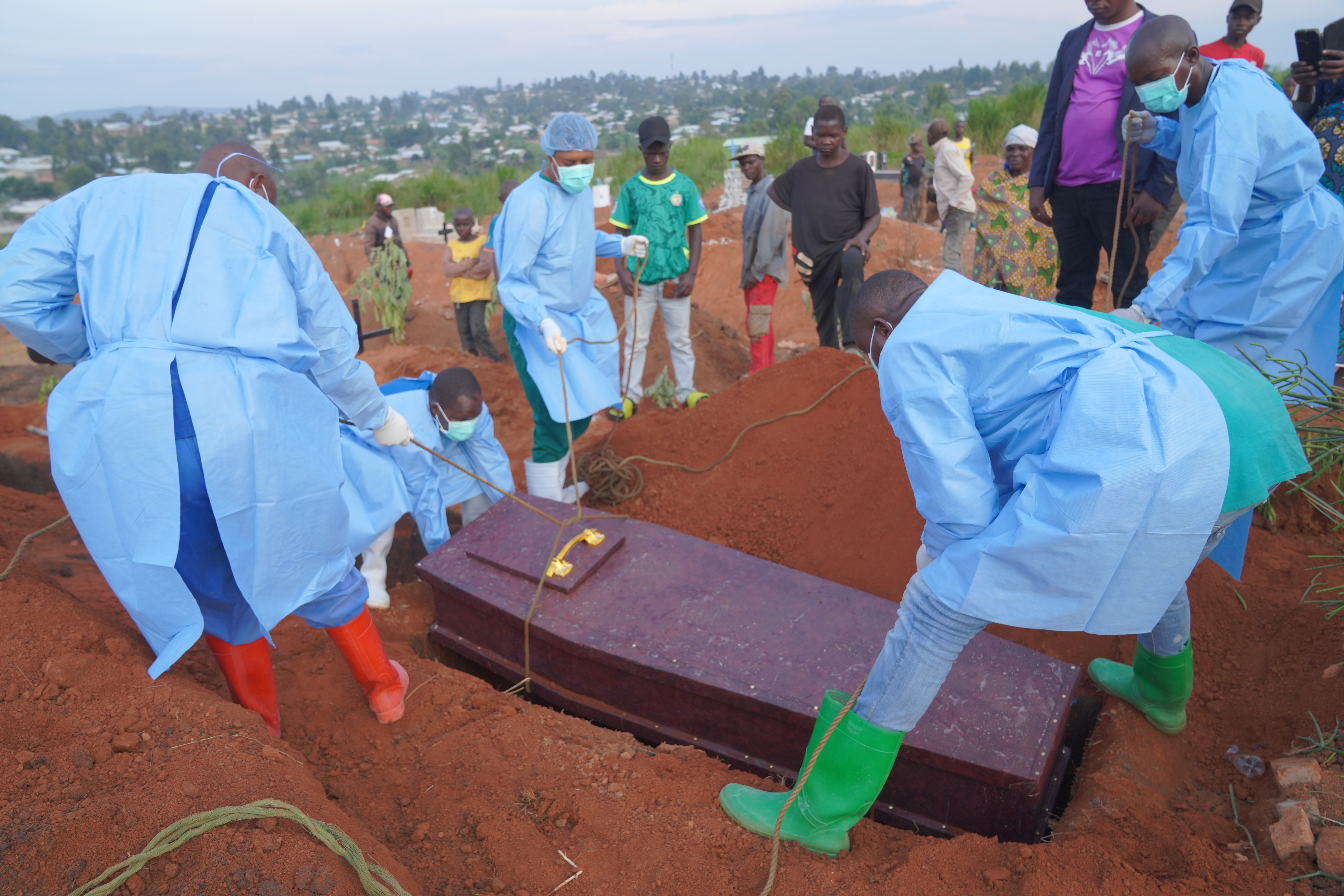
    BUNIA, Congo — Congo will receive 70,000 doses of the Ervebo vaccine, which has been effective in past Ebola outbreaks, the World Health Organization and partners said Thursday, announcing a step seen as a major boost to efforts to contain what officials have described as the fastest Ebola outbreak in history.

    The Ervebo vaccine is licensed for use against Ebola virus, one of the viruses that cause Ebola disease, but not for Bundibugyo virus, which is responsible for the current outbreak which has so far killed 2,476 people out of the 5,208 confirmed cases

    WHO said in a statement that while it’s not known whether Ervebo may protect against the Bundibugyo virus, “early laboratory and animal data suggest it may provide some protection.”

    The allocation includes 20,000 doses for a Phase 3 clinical trial to understand the impact of the vaccine on the Bundibugyo virus, the agency said. The remaining 50,000 doses will be used for front-line and health workers as recommended by WHO experts.

    The outbreak raging in six provinces in eastern Congo has infected and killed more people at a greater speed than any other Ebola outbreak in history, and is spreading about three times faster compared to the 2014-2016 outbreak across West Africa — the deadliest Ebola outbreak on record with more than 11,000 deaths.

    The International Coordinating Group on Vaccine Provision, which includes WHO and other partners, said the doses will be released immediately following a request from Congo’s government.

    WHO Director-General Tedros Adhanom Ghebreyesus called the approval “an important example of global solidarity in action.” He said the agency and its partners remain committed to supporting strengthened surveillance, rapid detection, quality care, community engagement and vaccination efforts to bring the outbreak under control.

    The lack of approved vaccines or treatments for the rare Bundibugyo virus has been a major issue for responders. Most new cases have been reported outside of the people being monitored, showing the virus continues to spread faster than efforts to track it. That has been a key contributor to the recorded deaths.

    The case fatality rate so far is 47.5% although it is far worse in some places where response efforts are more challenging, such as in North Kivu province where the fatality rate is up to 70%.

    Experts believe the virus began spreading from the mining town of Mongbwalu as early as February, months before authorities declared the outbreak on May 15.

  • A Russian missile and drone barrage kills at least 16 in Ukraine’s Kyiv region

    A Russian missile and drone barrage kills at least 16 in Ukraine’s Kyiv region

    KYIV, Ukraine — Russia pounded the Ukrainian capital of Kyiv and the surrounding region with scores of missiles and drones in a nighttime aerial attack that lasted for hours and killed at least 16 people, officials said Thursday.

    Moscow’s forces have in recent months intensified their ballistic missile attacks on Kyiv, exploiting Ukraine’s chronic shortage of U.S.-made Patriot air defense interceptors, the sole weapon in its arsenal able to shoot down the missiles.

    Large-scale Russian missile strikes have become a regular occurrence this summer. Just over two weeks ago, a Russian attack on Kyiv and its surrounding region killed 17 people, and nine were killed in the city two days before that. The United Nations said last week that Kyiv was one of the hardest hit cities in July, with at least 54 civilians killed and 202 injured.

    At the same time, Ukraine has shifted the war onto Russian soil through long-range drone strikes on oil facilities that have caused fuel shortages across the country. It has also unsettled the Russian public by striking warehouses of Wildberries, the country’s biggest online retailer.

    Zelensky repeats his appeals for more air defense

    President Volodymyr Zelensky has pleaded for countries to send more Patriot interceptors for defense, but international stockpiles are low amid the Iran war and Kyiv’s more than four-year fight against Russia’s all-out invasion.

    Russia’s overnight barrage also included cruise missiles and jet-powered drones that further strain air defenses, Ukraine’s air force said.

    Explosions boomed across Kyiv in the dark, but the air force said hits were recorded at 28 locations across the country. Emergency services said 15 people were killed in the capital, with another death in the wider Kyiv region. About 40 people were wounded, Zelensky said, as air raid warnings lasted until after dawn.

    More than 38,000 people, including over 2,000 children, sheltered in Kyiv’s subway stations overnight, the system’s operator said.

    “It was a massive attack,” Zelensky said on social media, adding that Russia “had been preparing [it] for a long time, combining different types of ballistic missiles, cruise missiles and drones, aiming to cause as much damage as possible to civilian infrastructure.”

    The Russian Defense Ministry said it struck a Kyiv industrial site manufacturing components for Flamingo cruise missiles. Sites involved in the production and storage of drones, an ammunition depot and a logistics center were also hit, it said.

    Russia is able to produce more than 200 cruise and ballistic missiles per month, Ukraine’s intelligence agency told news outlet Ukrainska Pravda in comments published Thursday. It has stockpiled more than 1,100 cruise missiles and about 130 Iskander-M ballistic missiles, as well as hundreds of missiles of other types, the agency was quoted as saying.

    It was not possible to independently verify the report, and Russian officials do not routinely answer questions about the country’s arsenal.

    Ukraine says it struck more Russian oil facilities

    Russia and Ukraine have battered each other with drones and missiles as their armies struggle to gain the upper hand on the 780-mile front line.

    Ukraine’s General Staff said its forces struck an oil refinery in Nizhnekamsk, in Russia’s Tatarstan region, starting a fire, and the Tamanneftegaz oil terminal in Volna, in Russia’s Krasnodar region, where there was also a blaze. Ukraine has hit both facilities in recent months as part of its campaign to disrupt Russia’s vital oil industry.

    Tatarstan leader Rustam Minnikhanov confirmed there had been a “massive attack” in the region, state news agency Tass reported, citing his press service. Many of the drones targeted Nizhnekamsk’s Zakamsk economic area, disrupting production at industrial sites and damaging residential buildings, Tass quoted him as saying.

    The Russian Defense Ministry said air defenses shot down 726 drones overnight over a number of Russian regions, annexed Crimea and the Black and Azov seas, in one of Ukraine’s biggest aerial attacks of the war.

    Ukraine’s neighbors are on alert

    Russia’s relentless onslaught has spooked other European countries, especially those bordering Ukraine, which fear spreading attacks from Moscow.

    Amid the attack on Kyiv, the Polish Armed Forces Operational Command activated its military aviation operations, ground-based air defense systems and radar reconnaissance. Polish and other NATO military aircraft were deployed to monitor its airspace, Polish news agency PAP reported.

    Romania’s Defense Ministry said an unidentified drone crashed and burned in an uninhabited area near the Ukrainian border. Two Spanish F-18 jets, deployed on a policing mission in Romania, were scrambled overnight to monitor a group of “air targets” near the border, the ministry said.

    In addition, two Romanian F-16 fighter jets were deployed to destroy a naval drone seen near a major Black Sea gas project, Romania’s acting Defense Minister Radu Miruta said.

    Moldova’s Defense Ministry also said its airspace was breached by at least one drone.

    Russia “is increasingly testing the resolve of NATO and its partners, violating the sovereignty of neighboring states and deliberately expanding the risks posed by its war far beyond Ukraine,” Ukrainian Foreign Minister Andrii Sybiha said on social media.

    European Commission President Ursula von der Leyen saw a broad threat to the European Union. “An escalating campaign of threats is underway, unsettling our citizens and seeking to divide our Union,” she said on X.

    Explosions shatter windows and screams fill the air

    Russia’s overnight strikes hit 12 locations across Kyiv’s Darnytskyi, Sviatoshynskyi and Solomianskyi districts, damaging 30 apartment blocks, a school, a children’s hospital and a kindergarten, Zelensky said.

    Larysa Bondaruk, 60, sat on the ground, holding her cat, Chanel, which had been rescued by firefighters. With tears in her eyes, she said her neighbor’s grandson had been trapped by the rubble and died. Her apartment was badly damaged.

    “A rocket hit the roof. It was incredibly loud. Immediately, debris and doors were blown out. There were columns of smoke, columns of fire, screams, crying and despair,” she said. “Two people were killed in our building, but the rescuers responded quickly and professionally. I am grateful to them for that.”

    In Solomianskyi district, the top two floors of a nine-story residential building were destroyed and fires broke out on other floors. People were also trapped in two residential buildings and a school shelter.

  • AP reporter Christopher Bodeen, a tenacious chronicler of China’s rise, dies at 55

    AP reporter Christopher Bodeen, a tenacious chronicler of China’s rise, dies at 55

    TOKYO — Christopher Bodeen, a tenacious, old-school wire service reporter who brought a keen analytical eye and a wry sense of humor to decades of work in China, Taiwan, and in war zones and natural disasters across the globe for the Associated Press, has died. He was 55.

    Mr. Bodeen died Monday after a struggle with cancer and complications from a stroke, his daughter, Ingrid, said Thursday by telephone from Taiwan.

    Mr. Bodeen, who spoke fluent Mandarin with a proud Taiwan accent, spent much of his career detailing China’s rise to an economic, political, and military superpower — and the accompanying friction from what critics have long called Beijing’s heavy-handed efforts to establish dominance in Asia and beyond.

    “Chris was a reporter who would go anywhere and do anything for the story,” said Charles Hutzler, AP’s former bureau chief in Beijing. After a huge quake flattened a swath of Sichuan Province in 2008, Mr. Bodeen composed his account from one devastated town sentence by sentence over text messages because of damaged telecommunications networks. “It was one of the first eyewitness reports the AP and the world received about one of the worst earthquakes in decades,” Hutzler recalled.

    He was an expert on politics and Chinese military issues

    From AP bureaus in Shanghai, Beijing and Taipei, Mr. Bodeen was for years the news agency’s go-to person on Chinese politics and military issues, able to quickly determine the newsworthiness of the government’s often abstruse statements.

    “A chat with Chris would inevitably turn into a remarkable history lesson,” said Emily Wang Fujiyama, former Greater China news director. “He had astounding knowledge of the region and would be writing about China’s military presence in the South China Sea, pivot to Taiwan’s intricate politics, and just as deftly write about the political sensitivities of Tibet, Mongolia, and China.”

    Mr. Bodeen was born in Missouri on Sept. 9, 1970, but he spent parts of his childhood in the Middle East, Europe, Africa, and Asia. His father was a foreign service officer and his mother a former diplomat, his daughter, Ingrid, said. Friends and colleagues remembered his love of the Boston Red Sox, esoteric punk rock — and his contagious enthusiasm for the job of journalism.

    “He was the blondest, palest person you’ll ever meet” yet also spoke pitch-perfect Chinese, said Ted Anthony, AP’s former China news editor and news director for Asia. “So when the earthquake in Sichuan happened in 2008, he went out there, put on one of his ever-present ball caps to cover his hair, and slouched down. He passed as Chinese, started interviewing people and sailed under the scrutiny of the authorities.”

    He was ‘always ready for adventure’

    Mr. Bodeen joined the AP in 1996, in Taiwan, the self-governing democratic island China claims as its own, before working as an editor on the agency’s international desk in New York and then joining the AP bureau in Beijing as a correspondent, in 2000. He majored in history and Asian studies at Tufts University, graduating in 1993.

    “Chris Bodeen was always ready for adventure. Hiding in the hills of Hainan Island, China, to try to report on the return of an American Air Force plane forced down in 2001, he was the best colleague to be with,” said Raf Wober, a video journalist in the AP’s Hong Kong bureau.

    In a 2017 story on efforts to burnish the image of Chinese leader Xi Jinping, Mr. Bodeen described state broadcaster China Central Television leading its evening national news bulletin “with more than four minutes of uninterrupted clapping for Xi as he met with adoring citizens,” and a Russian translator who “was so engrossed with reading a recent speech by Xi, Xinhua [the official news agency] said, that he skipped lunch and dinner just to finish studying it.”

    While much of this might have seemed amusing to outsiders, Mr. Bodeen was careful to note that “the domination of [Xi’s] image in official propaganda evokes, for some, the painful memories of the upheaval of the 1960s and ’70s, when Mao [Zedong] was accorded the status of a near deity.”

    Julie Pace, AP’s executive editor, remembered Mr. Bodeen as not only an effective China correspondent but as a fellow journalist whose knowledge elevated those around him.

    “Chris cared deeply about his work and the value of on-the-ground reporting in such an important region of the world,” she said. ”His expertise informed AP’s audiences for so many years, but also helped lift up so many colleagues.”

    Passion for family and work was his hallmark

    Mr. Bodeen was deeply proud of his two daughters and loved showing off their artwork and achievements — and creative Halloween costumes — to colleagues. “Every parent thinks their kids are the best, but, hand to God, these girls are both adorable and seriously tough cookies,” he wrote of his children.

    “He truly, passionately loved what he did, as much as he loved being a dad,” Ingrid Bodeen said. She recalled that when her father spent long stints reporting from Afghanistan during her childhood, “he would always have my mom fax over my spelling lists and homework so we could work on them together. He never missed a spelling test week.”

    Mr. Bodeen was also beloved by colleagues for his sharp sense of humor, his knowledge of good local food, and an encyclopedic knowledge of movie and TV comedies from the ’70s and ’80s.

    Kanis Leung, an AP reporter in Hong Kong, said that Mr. Bodeen once told her about an old correspondent’s description of news reporting as “the art of shoving 50 pounds of oatmeal into a 10-pound sack.”

    “Except,” Mr. Bodeen told Leung, “he didn’t say oatmeal.”

    Mr. Bodeen is survived by his wife, Yen Ling, daughters Ingrid, 26, and Naomi, 22, his parents and a sister.

  • North Korea fires barrage of missiles toward the sea after dismissing overture from Trump

    North Korea fires barrage of missiles toward the sea after dismissing overture from Trump

    SEOUL, South Korea — North Korea launched a barrage of ballistic missiles toward the sea on Thursday, South Korea’s military said, a day after the North shrugged off a U.S. decision to scale back military drills with South Korea in an apparent bid to resume diplomacy.

    The Joint Chiefs of Staff said the launches of about 10 short-range ballistic missiles happened from North Korea’s capital region around 5 p.m. local time on Thursday. The military said the missiles flew about 185 miles each toward North Korea’s eastern waters.

    The military said South Korea has bolstered its surveillance posture and was closely coordinating information on the launches with the U.S. and Japan. South Korea’s presidential national security council issued a statement urging North Korea to halt ballistic missile launches.

    The Japanese prime minister’s office had earlier said that it detected a suspected missile launch.

    President Donald Trump earlier ordered the Pentagon to “substantially reduce” the Ulchi Freedom Shield exercises, just before they began Monday. Trump cited what he said was a good relationship with Kim and South Korea’s refusal to support him over the war in Iran.

    On Wednesday, the South Korean and U.S. militaries confirmed they shortened the 11-day drills by shortening their duration by about half and canceling some field training exercises. The reduction of the exercises raised worries about the allies’ joint defense posture.

    Kim Yo Jong, the influential sister of North Korean leader Kim Jong Un, dismissed Trump’s overture later Wednesday, saying “the provocative, aggressive nature of the drills won’t change even though their duration and size were reduced.”

    “If the U.S. calculates that it can propagate its recent measure as the one of so-called good faith, they will not get the desired answer,” she said in a statement.

    She denied Trump’s claim that Kim Jong Un had responded to his request for a conversation.

    Kim Yo Jong still refrained from the typical North Korean reaction of fiery rhetoric and said personal relations between her brother and Trump are “still excellent.” That signals North Korea would want to wait for Trump to make bigger concessions before returning to talks.

    When asked by reporters Wednesday if he would be meeting with Kim Jong Un this year, Trump said that “Yeah, I will be.” He wouldn’t answer a question about whether he is exchanging letters with Kim but said he gets along with him.

    The Ulchi Freedom Shield is one of the main military exercises conducted by the U.S. and South Korea annually to enhance their ability to cope with potential North Korean aggression. Washington and Seoul say their drills are defensive in nature, but North Korea calls them an invasion rehearsal and often reacts with weapons tests.

    Before this month’s drills started, North Korea accused the U.S. and South Korea of plotting more provocative exercises this summer and vowed to respond with “a new level of a deterrent.” Days before the drills’ start, North Korea fired two ballistic missiles into the sea in its first such launches since late June.

    Trump’s earlier diplomacy with Kim Jong Un collapsed in 2019 due to disputes over how much sanctions relief North Korea should be given in return for dismantling its main nuclear complex, a limited denuclearization step. Kim has since shunned any talks with the U.S., pushed to modernize weapons arsenals and expanded cooperation with Russia.

    Kim has said he won’t place his nuclear program back on the negotiating table. Experts say Kim has more leverage than when he first held talks with Trump in 2018 and 2019. They say Kim likely hopes to eventually win international recognition as a nuclear state and extensive sanctions relief in exchange for only limited steps toward denuclearization.

  • Somalia faces another hunger crisis and the U.N. food agency head says it has far less funds to help

    Somalia faces another hunger crisis and the U.N. food agency head says it has far less funds to help

    MOGADISHU, Somalia — Six million people in Somalia are facing acute food insecurity while the World Food Program has only a tenth of the resources it had in 2022 when it helped avert famine in the drought- and conflict-stricken East African nation, the head of the U.N. agency told The Associated Press.

    “We can only do the bare minimum,” WFP executive director Carl Skau said Wednesday during a visit to a nutrition center on the outskirts of the capital, Mogadishu. “We’re only providing these nutrition supplies to the children that are really the worst hit.”

    The reduced funds, because of cuts in international aid by donors and the redirection of resources to other humanitarian crises, meant that the WFP is unable to expand its assistance in Somalia, Skau said.

    Millions of people at risk but far less aid

    The WFP projects that 1.9 million children under age 5 in the country will suffer acute malnutrition this year, including nearly 500,000 who will require urgent treatment for severe acute malnutrition. Overall, around 30% of the population faces critical levels of food insecurity, the U.N. has said.

    “We had 10 times more resources than now,” Skau said of the 2022 hunger emergency that was caused by a prolonged drought. “We were able to step in, and we prevented a famine here in Somalia.”

    “We know what’s going on, we have the capacity, we have the experience of dealing with this. We just need the resources now to do it.”

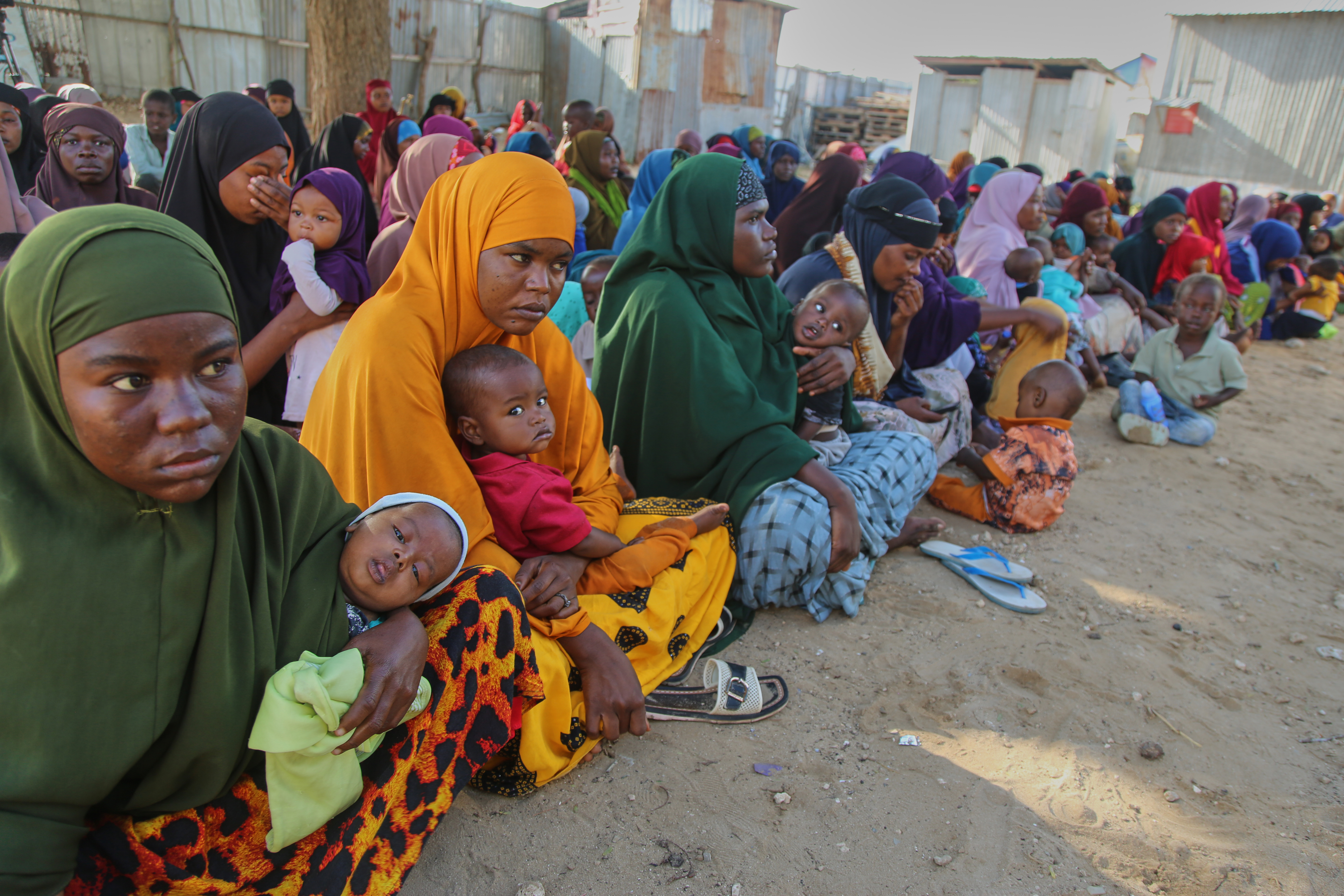
    The consequences of the current food shortage, which is also a result of drought, conflict and the displacement of people, are seen at the Feynuus Health Center in Mogadishu’s Kahda district. Dozens of women carrying babies waited beneath a large tree or crowded along the veranda of the corrugated-metal facility seeking help.

    Inside, health workers placed children in a blue weighing sling, screened them for malnutrition, and distributed therapeutic food.

    One desperate mother tells her story

    Halima Mohamed Hassan, a mother of six, had walked nearly 2 miles carrying her malnourished 4-year-old child. She is pregnant, but said she hadn’t eaten for two days. Her last meal was plain rice.

    Health workers treated the child she brought with a special nutrient-dense food, while Hassan said that her other children were also malnourished, but she wasn’t able to bring them to the center.

    “I could not carry all of them,” she said.

    Hassan fled the Lower Shabelle region four months ago after her husband died of malnutrition, she said. Food and water became scarce, and conflict made it increasingly dangerous for the family to stay.

    She and her children walked for four nights before reaching a camp for internally displaced people on Mogadishu’s outskirts.

    Hassan now shares a makeshift shelter with her widowed mother and her mother’s four other children. The two women look for occasional work washing clothes in nearby neighborhoods to feed their household of 12.

    A health center tries its best to help

    The Feynuus center receives between 250 and 350 patients daily, mainly displaced women and children from regions outside Mogadishu, said Abdirahman Barkhad, program director of Youth Link Somalia, which operates the center.

    Barkhad said that about 10 nearby health and nutrition centers had closed because of a reduction in humanitarian funding, increasing pressure on those that remain.

    “We have witnessed children collapsing, because their families do not have enough food,” he said.

    Mohamud Moallim Abdulle, commissioner of the Somali Disaster Management Agency, described the country’s food situation as “extremely alarming.”

    He said that an estimated 1.85 million children are malnourished, while around 6 million people are affected by drought, and 2 million urgently need assistance.

    They don’t know where their next meal is

    Skau said that mothers he met this week in the town of Burhakaba described drought, insecurity, and also rising food prices as the main drivers of the crisis. Some had lost their crops and fled their homes. Others walked for three or four hours to reach health facilities, because aid workers couldn’t reach them.

    “I spoke to women with eight to 10 children,” Skau said. “They don’t know where the next meal is going to come from.”

    Insecurity, with Somalia battling a 20-year-long insurgency by the al-Shabab militant group, also makes humanitarian operations more expensive. WFP must use aircraft in areas where staff and supplies can’t travel safely by road, and some communities are inaccessible, Skau said.

    He said that conflict in the Middle East was adding to the pressure by driving up fuel and food prices, limiting agricultural supplies, and drawing funding toward other emergencies.

    After her child received some food at the center, Hassan began the walk back to the camp they live in. Her five other children were still waiting and hungry, she said, and she would have to return with them one at a time.