Category: Business Wires

  • Lettuce at Taco Bell in 5 states confirmed as a source of diarrhea-causing parasite

    Lettuce at Taco Bell in 5 states confirmed as a source of diarrhea-causing parasite

    ATLANTA — Federal health officials have identified lettuce from Mexico served at Taco Bell locations across five U.S. states as a source of a widespread outbreak of diarrhea-causing parasite cyclospora.

    The Centers for Disease Control and Prevention late Thursday warned consumers not to eat shredded iceberg lettuce from Taco Bell restaurants in Indiana, Kentucky, Michigan, Ohio, and West Virginia. A record number of cyclospora cases have been reported in more than 30 states, and experts have said not every recent U.S. illness might be caused by a single source.

    A Food and Drug Administration investigation so far has identified a single supplier of the lettuce. The federal warnings to consumers did not identify the company, but Taylor Fresh Foods, of Salinas, Calif., said FDA testing indicated it was “a specific independent farm” affiliated with the company.

    The FDA was working with the supplier “to determine if potentially contaminated shredded iceberg lettuce remains on the market,” including in other states, the CDC said. “Taco Bell has committed to stop using any lettuce from the supplier identified by FDA’s traceback investigation.”

    Taylor Farms has been tied to foodborne outbreaks in the past. The company said in a statement Friday afternoon that it was voluntarily removing all iceberg lettuce sourced from central Mexico from the U.S. market.

    “As a family owned and operated company, we are deeply concerned for those who became ill, their families, and the many Americans whose trust in the safety of their fresh produce has been shaken,” the statement said.

    Taco Bell says it will use a different supplier

    CDC, FDA, and public health officials in several states have been investigating a multistate outbreak of cyclospora infections.

    The illness is not usually life threatening and is typically treated with antibiotics.

    On Thursday, ahead of the federal government’s confirmation, Taco Bell issued a statement saying that it had taken “immediate action to voluntarily remove potentially impacted lettuce from a supplier in select states. The affected ingredient from our supplier is being indefinitely removed from our supply chain nationwide and will be replaced within 24 hours in select states.”

    It’s possible other businesses could be linked to outbreak

    In a statement, federal health officials stressed that other “brands, restaurants, retailers, or distribution channels” could be tied to the outbreak as the investigation continues.

    Michigan investigators are trying to figure out if the lettuce went to other restaurants or stores because many of the ill people said they didn’t eat at Taco Bell, state health officials said Friday.

    There is no evidence the outbreak “is related to poor food handling or preparation at any single restaurant or fast-food chain,” Michigan health officials said in a statement.

    For that reason, they continue to recommend that consumers purchase whole heads of lettuce instead of pre-washed, bagged lettuce or premixed salad kits. Taylor Fresh Foods said in its statement that no Taylor Farms-branded salad kits contain iceberg lettuce.

    Some past outbreaks linked to the company involved products sold under different brand names.

    North Carolina health officials on Friday reported their count has now surpassed 300 cases, but said the recent illnesses there are not considered to be linked to the outbreak in and around Michigan. They said the most commonly reported foods include parsley, cilantro, and lettuce, but it’s not clear if those ingredients were the source of the infections, they said.

    Cyclospora cases have been rising for years

    Cyclospora is a microscopic, spherical parasite that commonly causes watery diarrhea “with frequent and sometimes explosive bowel movements,” according to the CDC. Outbreaks tend to occur most often in the late spring and summer.

    The heat-loving parasite infects the bowels and spreads through feces. In the past, people have been infected by consuming fruits or vegetables that were exposed to feces-contaminated irrigation water.

    The illness, called cyclosporiasis, is less common than foodborne illnesses caused by other germs, including salmonella and E. coli. Many cases are never linked to a specific food or other source and, for years, few U.S. cyclospora outbreaks were reported. But the number started rising about a decade ago, with a particularly notable spike in 2018 and 2019.

    Previously, 2019 saw the most reported U.S. cyclosporiasis cases, with about 4,700. The current surge has far surpassed that. Michigan — the apparent epicenter of the current outbreak — is reporting more than 5,000 cases, and more than 2,000 additional probable and suspected cases have been reported in other states.

    No deaths have been reported. But Michigan officials say more than 100 people in that state have been hospitalized, and health officials say dozens more have been hospitalized in other states.

    Experts attribute the increasing trend in cases to climate change and better detection. They also say it’s likely that cyclospora cases historically were underreported, for several reasons.

    Some common tests used to check for food poisoning have not been geared to detect cyclospora. Technicians aren’t able to grow the parasite in labs, making it hard to draw evidence from contaminated produce. And it can be hard to figure out what food sick people had in common because sometimes it’s a single ingredient that might be common in multiple recipes — like basil or cilantro.

    Taco Bell, Taylor Farms have been tied to past outbreaks

    The FDA’s traceback investigation identified a single supplier of iceberg lettuce from Mexico used by the Taco Bell locations where people who got sick ate, federal officials said.

    The Mexican food chain is among the restaurants linked to foodborne illness outbreaks in the past.

    Taylor Farms also was tied to a 2013 cyclosporiasis outbreak linked to salad mix and a 2024 E. coli outbreak tied to onions served at McDonald’s.


  • Trump’s teleprompter operator on unpaid leave for alleged prediction market bets on Trump speeches

    Trump’s teleprompter operator on unpaid leave for alleged prediction market bets on Trump speeches

    ATLANTA — President Donald Trump’s teleprompter operator is on unpaid leave after reports that he used his inside knowledge to make bets about the president’s speeches on the online prediction market Kalshi, the White House said Thursday.

    The firm’s enforcement chief said Kalshi contacted federal regulators about bets allegedly made about what the president would say in public addresses.

    White House press secretary Karoline Leavitt said the president is aware of the situation, which she described as “unfortunate” and “a disgrace.”

    “The White House has extremely strict ethical guidelines with respect to issues like this,” Leavitt told reporters, saying the aide is on unpaid leave.

    ABC News reported Thursday that Gabriel Perez, who has been operating Trump’s teleprompter since 2016, used his inside knowledge to win more than $100,000 betting on what the president would say in big speeches, including the State of the Union address earlier this year.

    Robert Denault, Kalshi’s lawyer and head of enforcement, said on X that the “Kalshi surveillance team promptly flagged, investigated and referred these trades” to the U.S. Commodity Futures Trading Commission that has regulatory authority over such matters.

    His statement did not name Perez.

    “We have been assisting regulators on this matter and provided all evidence that we collected, as we do with any referral,” Denault added.

    ABC based its report on multiple sources who have knowledge of the matter but spoke on condition of anonymity to discuss the details.

    The ABC report described suspicious activity on Kalshi’s “Mentions” market, in which users can place bets on what phrases and specific words might be used in public speeches. Kalshi recently began requiring users to disclose their place of employment, and the platform’s policy prohibits betting based on information that users gain because of their job.

    Attention on members of the administration profiting from the presidency has reached all the way to Trump himself.

    On Thursday, his media company announced it would charge for special high-speed access to Truth Social posts, including possibly his own affecting national security and financial markets.

    In his most recent financial disclosures, Trump reported making $1.2 billion from his crypto businesses in 2025, raking in profits while his investors suffered losses in marketplaces that Trump has sought to shield from tighter federal regulation.

    Trump got more than $500 million from his World Liberty Financial business selling new crypto products, including “governance tokens,” according to the required annual disclosure report with the Office of Government Ethics. It also showed another crypto business, CIC Digital LLC, took in more than $600 million from sales of souvenir-type “meme” coins stamped with his face. Both the tokens and the coins have plunged in value since the sales.

    The president has also profited from merchandising deals and high-dollar political and official events at his properties, significantly increasing his net worth since returning to power.

    Trump’s aides have stood by his personal and family business practices.

    “The president is abiding by all conflict-of-interest laws that are applicable to the president,” Leavitt said earlier this year. It’s “absurd for anyone to insinuate that this president is profiting off of the presidency.”

  • Need for speed? Driving above the speed limit costs you — and doesn’t actually save much time

    Need for speed? Driving above the speed limit costs you — and doesn’t actually save much time

    Speeding in your car to work, to pick up your children from school, or go from one errand to the next not only wastes money in gas and sends harmful emissions into the air, it barely saves you time, new research says.

    It is something to think about as gas prices stay elevated throughout the summer months and add pain to day-to-day driving and seasonal road tripping.

    Instead, abiding by posted speed limits can save U.S. drivers millions of dollars at the gas pump and eliminate millions of gallons of fuel each day, according to a study published Thursday in the Nature journal Communications Sustainability. That is fuel that, when burned, emits planet-warming gases into the atmosphere. To top it all off, changing driving habits wouldn’t even add a full minute to a driver’s commute.

    University of Minnesota researchers analyzed 120 million vehicle trips across the United States from four Wednesdays in 2021 using driving data on national road networks, speed limits and U.S. Geological Survey elevation data. The analysis included roads with speed limits of 45 mph and higher.

    More than 43% of the studied trips included at least one instance of speeding, and drivers spent nearly 12% of their driving time going faster than the speed limit.

    They found that if drivers of light-duty, conventional internal combustion engine vehicles actually drove at posted speed limits, it could save an average of $22 million, based on fuel costs at the time, 6.7 million gallons of fuel, and 57,000 metric tons of carbon dioxide every day. The researchers said that is comparable to taking about 5.5 million passenger vehicles off the road.

    And while drivers say that speeding saves them precious time, researchers found that is not really the case. With an average daily driving distance of 28.6 miles, driving at or below the posted limit corresponds only to about 54 seconds longer per day.

    “If your goal is to shave one minute off your time, then you’ve got to drive fast. If your objective is to get to your destination safely and to save fuel, then you might drive slower than the speed limit,” said William Northrop, mechanical engineering professor at the University of Minnesota and study co-author.

    The research considered battery-electric vehicle efficiency only in California given the level of EV adoption in the U.S. at that time. Based on the California modeling, “We find that driving slower is beneficial for EVs as well,” he said.

    Interestingly, the study found differences among states. Nevada saw elevated speeding prevalence as well as high speed excess. There was high speeding prevalence in Florida, Georgia, and North Carolina, though those states did not necessarily exhibit high speed excess. Montana, Wyoming, Idaho, and South Dakota showed both low speeding prevalence and speed excess.

    The cost of faster driving today

    Driving faster increases a vehicle’s energy use and the emissions from its engine, as well as reduces efficiency. Vehicle engines have become increasingly more efficient over the past several decades even as vehicles have gotten bigger and more powerful. But speed limits have also climbed since the Emergency Highway Energy Conservation Act was implemented, which mandated 55 mph national speed limits amid the 1970s energy crisis.

    Accounting for the average cost of gas today and more vehicle miles traveled, that increases to roughly $26 million and 7.2 million gallons of fuel that Americans collectively could save each day this year just by not putting the pedal to the metal.

    One limitation of the research is that slower driving could impact traffic patterns, which could play a role in efficiency.

    However, it is especially timely as U.S. drivers remain price-sensitive to volatile gas prices as the war in Iran has sent the cost for a gallon of fuel above $4 this year. Experts have said there are a number of ways to improve one’s gas mileage, including something as simple as slowing down. Less fuel needing to be purchased because of better efficiency could influence oil market demand, which in turn could impact pricing.

    Rob Middleton, associate research scientist of mechanical engineering at the University of Michigan who was not involved in the research, said the study was well-done. But he also noted that the fuel saved from driving more slowly still only represents a fraction of daily gasoline consumption in the U.S., which is about 375 million gallons daily.

    “It’s a big number, but it’s a small fraction,” Middleton said. “This is a ‘freebie’ in that it doesn’t really cost anyone anything to do.”

    “The market penetration of selling EVs is still small, so we still need fuel, we still need ICE [internal combustion engine] vehicles, we’re still going to have them for a very long time,” he added. “Things that we can do to either make the new ones better or to improve our fuel supply, we need to do.”

  • Biden will publish ‘Promise Me, America’ memoir after the November midterm elections

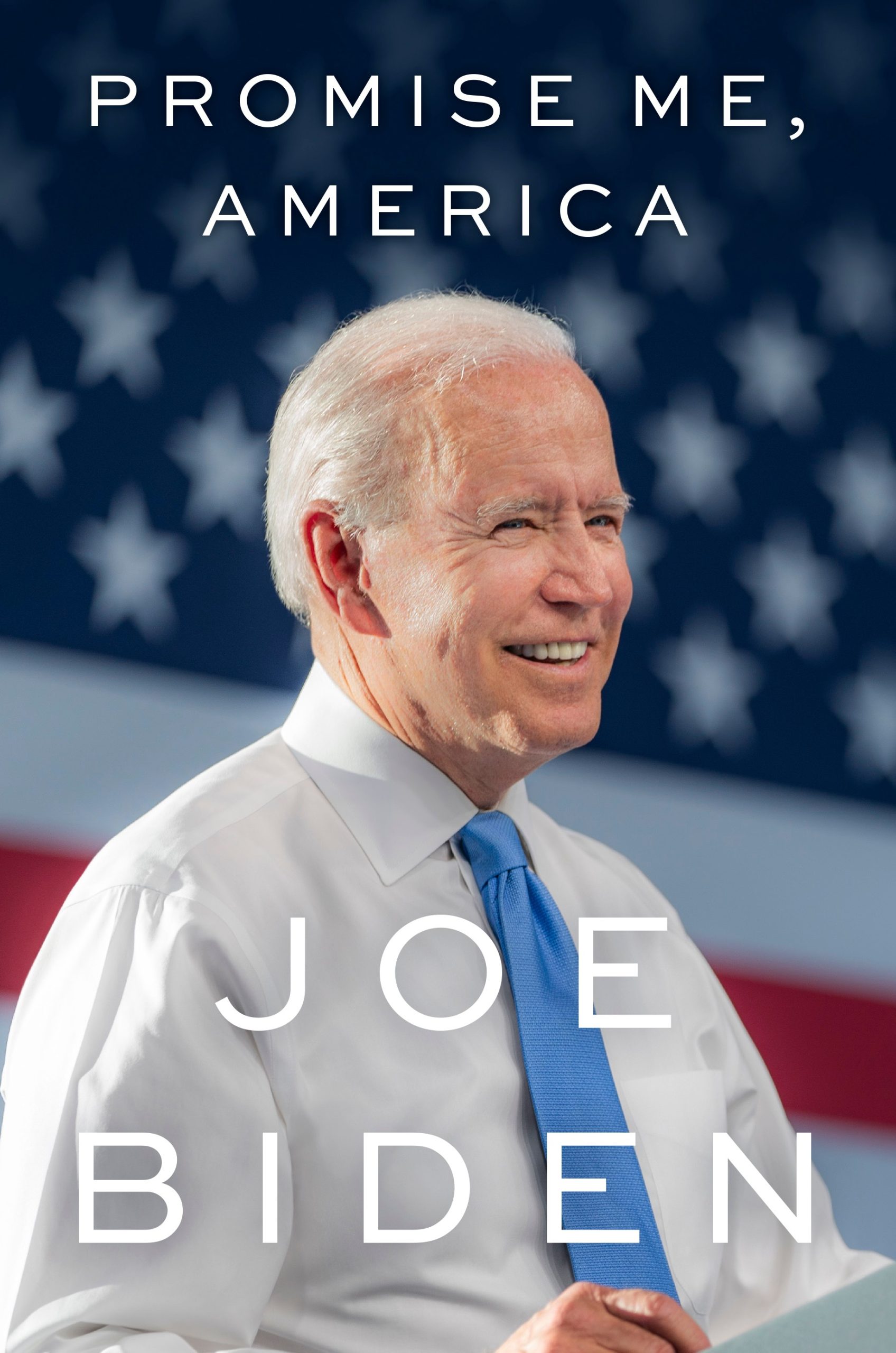
    NEW YORK — Former President Joe Biden will publish a memoir, Promise Me, America, which he says will touch upon everything from the economy to his decision to drop his bid for reelection.

    The memoir is scheduled to come out Nov. 17, publisher Little, Brown and Company told the Associated Press. The timing of the book — two weeks after midterm elections in which Democrats seek to regain control of Congress — could raise concerns within Biden’s party by putting him back into the spotlight.

    Democrats remain divided on Biden’s legacy, with many blaming his ill-fated determination to seek a second term for Republican President Donald Trump’s return to the White House. Leaders hope to keep the fall campaign focused on Trump and his record, and any leaks or promotional efforts before votes are cast could draw frustration.

    “Promise Me, America is about the challenges we faced as a nation. It’s about the decisions I made and why I made them,” Biden said in a video statement accompanying Wednesday’s announcement. “It’s about why I chose to run for reelection and why I chose to step aside.”

    This book cover image released by Little, Brown and Co. shows “Promise Me, America” by Joe Biden.Uncredited

    Reports of Biden’s book have circulated for more than a year, and the former president himself has referred to it during public remarks, appearing to suggest it would be released before November’s election.

    Biden, who will turn 84 three days after the publication of Promise Me, America, has long presented himself as an upholder of standards and traditions; presidential memoirs are one of them. With a handful of exceptions, modern presidents since Harry Truman in the 1950s have published books about their White House years. Like virtually all of his predecessors, Biden did not work on the book alone but was helped by a “small editorial team,” according to the publisher. Little, Brown declined to release financial details for Promise Me, America, although presidents have usually reached deals worth at least seven figures.

    The book’s title echoes a 2017 memoir by Biden, Promise Me, Dad, which centered on the death of his son, Beau Biden.

    Vowing as a candidate to “restore the soul” of his country, Biden was sworn into office in the midst of the COVID-19 pandemic and in the aftermath of the Jan. 6, 2021, attack on the U.S. Capitol by Trump supporters seeking to stop his certification as president. Biden’s term was defined by a wide range of conflicts and achievements, from his handling of wars in Ukraine and the Middle East to the passage of ambitious infrastructure and economic aid bills. But many readers will likely want to know more about his health while president, including the disastrous debate in June 2024 against Trump that led to his giving up his reelection bid. Then-Vice President Kamala Harris, who ran instead, lost decisively to Trump.

    Former first lady Jill Biden wrote in her own book that her husband seemed so weak and disoriented during the debate that she feared he was having a stroke. In View from the East Wing, published in June, she noted that the White House had initially said he was suffering from a cold.

    “The biggest lesson for us, I think, was that if you don’t explain something well enough then the question won’t go away,” she wrote. “There was never a satisfying enough explanation offered for Joe’s debate performance, and a lot of people never got over it.”

    Biden was the oldest man to serve as president and his health was a source of speculation for much of his term; Biden and his White House advisers have faced intense criticism from Democrats and Republicans for allegedly concealing the extent of his problems. A notable book release from 2025, Jake Tapper’s and Alex Thompson’s Original Sin, was subtitled “President Biden’s Decline, Its Cover-Up, and His Disastrous Choice to Run Again.”

    That year, Biden announced he had been diagnosed with prostate cancer.

    Biden’s previous books also include Promises to Keep, a campaign work published to boost his run for president in 2008, when Barack Obama was the eventual nominee and Biden his running mate. Promise Me, America comes out during a year when nonfiction sales have declined and few political books have caught on, although recent bestsellers have included Vice President JD Vance’s Communion and an inside account of Trump’s second term, by New York Times reporters Maggie Haberman and Jonathan Swan, Regime Change.

    A Little, Brown spokesperson said that Biden plans to tour on behalf of the book and give interviews. In his video announcement, Biden said that many people had been asking him how he was doing.

    “I’ve been spending a lot of time with my family. I’m dealing with a cancer diagnosis, been getting treatment, and it’s going really well,” he said. “I want to thank all those who have offered their prayers and support and well-wishes. It’s meant the world to me and to Jill.”

  • Is AI ready to take over your prescriptions? Doctors are wary of Utah’s automated refill program

    WASHINGTON — A prescription refill program that quietly launched in Utah earlier this year has kicked off a big medical debate: Is artificial intelligence ready to take over tasks that, until now, could only be performed by doctors?

    The program allows Utah residents to skip the doctor’s office and get their prescriptions refilled online by an AI chatbot called Doctronic. It’s a seemingly simple step toward making healthcare more convenient for patients and prescribers.

    But it’s also a precedent-shattering milestone that has set off alarm bells for doctors, lawyers, and public health experts. The pilot program has laid bare a host of questions about the role of AI in medicine, including how it should be regulated, whether doctors should be able to veto it, and what kind of safety measures are needed to protect patients.

    At the center of the debate: State and federal laws limit prescribing to licensed medical professionals. Proponents say those laws, which have underwritten American medicine for over 100 years, should be updated to include AI chatbots and other new technologies.

    “We have crossed a threshold in terms of giving something that is not human a medical license, whether or not we want to call it that,” said Eric Bressman, a professor of medicine at the University of Pennsylvania.

    AI cannot practice medicine under current laws

    Bressman and other experts say they aren’t opposed to AI prescribing. But they say it should have to meet rigorous standards akin to human doctors, who undergo years of testing and training before being licensed to practice medicine.

    In Utah, Doctronic was able to launch thanks to a “regulatory sandbox” that allows state officials to waive laws for AI companies offering promising technology.

    The refill program is currently overseen by a five-member board of AI specialists, none of whom are doctors, who say they have implemented numerous safeguards. During the program’s initial phase, for example, human doctors review all Doctronic refill orders. The company expects to soon transition to fully automated refills.

    The head of the state’s medical licensing board says he and his colleagues learned of the program when its January launch was reported in the news. In a March letter to the state, 11 board members called for the program to be halted, citing the risks of automatically renewing medicines that can have side effects or drug interactions.

    “We were essentially told: ‘Yes this is going on. And no, you don’t have a say in it,’” said Alan Smith, a family physician who heads the board but said he was speaking only for himself.

    Complicating the picture is the fact that medical technology is traditionally regulated at the federal level, while medical professionals are overseen by states.

    Doctronic executives consider their AI part of the state-regulated practice of medicine. But the federal Food and Drug Administration is supposed to oversee AI that directly impacts medical care or decision making, a line that some experts believe Doctronic has crossed.

    Some states are clearing the way for AI in healthcare

    In an interview, Doctronic’s executives wouldn’t say whether they have sought permission from the FDA.

    “Our goal here is really just to meet patients where they need healthcare,” said Adam Oskowitz, who cofounded the company with a tech industry entrepreneur. “We try not to get too deep into the weeds on the regulatory side.”

    In Utah, residents can visit a Doctronic website built for the refill program. After confirming their identity, the AI chatbot asks users about their prescriptions and medical history, verifying that they have a valid prescription by tapping into a national pharmacy database. If there are no issues, the AI can renew the prescription and send it to a local pharmacy. If the request requires more attention, the chatbot transfers the patient to a doctor who works for Doctronic’s telehealth service.

    Oskowitz envisions a future where many routine medical tasks, including ordering tests and analyzing results, can be offloaded to Doctronic, allowing doctors to manage thousands more patients than they can today.

    Other states are also waiving rules for AI, including Texas and Wyoming.

    Meanwhile, lawmakers in Iowa, Idaho, and elsewhere have introduced legislation to formally license AI medical services. Many of the bills are based on a template from the nonprofit Cicero Institute, a pro-AI think tank founded by Joe Lonsdale, co-founder of the artificial intelligence software company Palantir.

    Pushback against medical AI mainly stems from the economic fears of doctors and other health workers, says Cicero’s director for health policy.

    “Whoever goes first is going to take the slings and arrows because there’s economic interests, concerns about the workforce and what that’s going to mean for jobs,” said Cicero’s Adam Meier.

    Doctors see potential risks to AI prescription refills

    Smith, the medical board chair, says the risks to patients are real. He points out that Doctronic’s list of 190 refillable medications includes blood thinners, which can become dangerous if patients develop stomach ulcers or other conditions that cause internal bleeding.

    “Many times when I see people after six months I find that their medical history or situation has changed,” Smith said. “Just because something was prescribed before does not mean it’s appropriate now.”

    The American Medical Association has voiced similar concerns, warning that “prescription renewals aren’t routine checkboxes.”

    Zach Boyd, who heads Utah’s AI office, said Doctronic has thus far been overly cautious, often elevating uncontroversial decisions to doctors. In response to safety concerns, several medications have been removed from the list eligible for refills, including a drug for irregular heartbeats.

    Utah has released some initial data on the program and Doctronic plans to publish peer-reviewed studies later this year. Currently the only publication about its technology is a paper written by company scientists that was not independently reviewed.

    The study looked at whether Doctronic could correctly diagnose medical conditions based on records from 500 telehealth consultations. In the study, Doctronic’s diagnoses matched that of human doctors 80% of the time.

    The FDA is taking a hands-off approach

    Bressman says Utah should have demanded data on prescription refills up front, not after Doctronic was up and running.

    “Mostly they’re accepting the company’s word on good faith that they’re up to the task,” he said.

    The current approach to AI mirrors the haphazard medical standards of the early 20th century, Bressman says, before medical schools, medical boards, and other authorities agreed on national benchmarks for training and licensing.

    National guidelines on medical technology would typically come from the FDA, but the agency has indicated it plans to take a hand-off approach, at least under the current administration.

    An FDA spokesperson said the agency has not authorized any AI chatbots but “is committed to encouraging medical innovation and helping bring promising new technologies to patients, while keeping safety at the center of every decision.”

    For now, Doctronic and other companies are likely to expand across states with different regulatory approaches.

    “Companies may benefit in the short term by expanding their business models and kind of having the technology go beyond the evidence,” says Daniel Aaron of University of Utah’s law school. “But in the long-term, I think they risk compromising public trust and fueling backlash.”

  • Judge says Trump IRS lawsuit was filed for ‘improper purpose,’ refers lawyer for possible discipline

    Judge says Trump IRS lawsuit was filed for ‘improper purpose,’ refers lawyer for possible discipline

    WASHINGTON — President Donald Trump’s lawsuit against the Internal Revenue Service over his leaked tax returns was filed for an “improper purpose,” a judge said Monday in a scathing decision that referred one of his lawyers for potential disciplinary action and characterized the $10 billion complaint as an exercise in self-dealing.

    U.S. District Judge Kathleen Williams accused Trump and his lawyers of having manipulated the court system when he sued a federal agency under his control, bypassing a requirement that parties in a lawsuit must have adverse interests and laying the groundwork for a settlement that granted him immunity from tax audits and created a fund to compensate allies of the president who say they were unjustly persecuted.

    The judge stopped short of explicitly voiding the deal shielding Trump from tax scrutiny but said the government cannot claim that the agreement was the result of a legitimate legal process.

    “Whether Executive Branch actors can privately agree to give themselves and their former clients blanket immunities and billions of dollars in tax monies for legally undefined grievances was never an issue advanced to this Court,” said Williams, an appointee of President Barack Obama. “The question is whether the Parties could do so by claiming to be adverse and engaging the legitimacy of a court proceeding. The answer is a resounding ‘no.’”

    Ruling comes just ahead of key confirmation hearing

    Though the practical impacts of the ruling may be limited since the lawsuit was withdrawn months ago and the administration had already abandoned the $1.776 billion Anti-Weaponization Fund that came out of it, the order nonetheless amounts to a scathing rebuke and tees up a politically uncomfortable line of questioning for Acting Attorney General Todd Blanche as faces the Senate Judiciary Committee for his confirmation hearing on Wednesday.

    “The nature of the suit itself and the conduct of the Parties and counsel from its filing make plain that this was an attempt to use the Court to provide some legitimacy to an agreement to confer immunity to people and entities affiliated with the President and to earmark billions of dollars from American taxpayers to redress grievances not defined in the law,” Williams wrote in her ruling.

    She added: “The President may be the functional ‘dominus litus’ of the Executive Branch, but as a party to a civil suit, he, as well as all the parties and lawyers before a court, are bound by the rules. Ensuring that our courts are used only for the express purpose created by the Constitution is the obligation of every judge and an obligation that this Court must discharge in light of the matter before it.”

    The suit against the IRS and Treasury Department in January accused the federal agencies of a failure to prevent a leak of the president’s tax information to news outlets between 2018 and 2020.

    In May, however, the administration announced that it was settling the case and creating a fund to compensate people who believe they’ve been mistreated by the criminal justice system. The fund was quickly shelved amid bipartisan backlash, though the Trump administration has said it intends to proceed with a separate element of the deal affording Trump and family members protection from audits.

    From the start, the judge had appeared skeptical of the complaint and assigned a group of attorneys to determine whether there was a conflict in the case since, as sitting president, Trump was suing “entities whose decisions are subject to his direction.”

    Even after the settlement was revealed, she directed Trump attorneys to lay out their positions on whether the parties in the case were truly adverse to each other, whether the settlement was premised on fraud, and whether the case should be reopened.

    She made clear in her ruling that she was not satisfied by the lawyers’ answers.

    “After a review of the record, and the Parties’ statements, the Court declines to adopt or accept the credulous exercise of divorcing President Trump’s current job title from an understanding of what happened here,” she wrote.

    Ruling also raises the possibility of disciplinary actions

    The judge referred Trump attorney Alejandro Brito, who filed the case, for possible disciplinary action before the state bar in Florida and said another lawyer, Daniel Epstein, will not be granted permission to file within the Southern District of Florida for up to a year.

    A spokesperson for the Trump legal team responded to a request seeking comment from Brito with a statement that blamed the IRS for allowing his tax returns to be leaked.

    The judge also ordered that her ruling be sent to the state bars in New York and the District of Columbia, where ethics complaints have been filed against Blanche and Associate Attorney General Stanley Woodward.

    Williams pointed to Blanche’s congressional testimony in early June in which he revealed that the anti-weaponization fund was no longer moving forward. Though nothing had been filed in court, Blanche appeared confident in his testimony that he “could speak for, and bind, both sides of this matter,” Williams said.

    “Acting Attorney General Blanche’s apparent capacity to speak for both Plaintiffs and Defendants, sign a ‘settlement’ document on behalf of all Parties to this action, and then repudiate part of that agreement, demonstrates that there was only one party whose interests were being represented throughout this case,” the judge wrote.

    The judge also raised ethical concerns about Blanche and Woodward’s involvement in the settlement given Blanche’s past representation of Trump as well as Woodward’s previous defense of Jan. 6 defendants and a co-defendant in Trump’s classified documents case.

    “Instead of either recusing because of their previous representations or vigorously defending this lawsuit as required to do so by DOJ policies and procedures, these lawyers agreed to a ‘settlement’ involving a staggering amount of money potentially benefitting former clients,” she said.

    Blanche denied in a CNN interview last spring that he had come up with the settlement terms, saying, “The president has outside counsel, and their counsel, the Department of Justice, not me.”

  • U.S. airlines are redesigning travel around their highest-paying passengers

    U.S. airlines are redesigning travel around their highest-paying passengers

    They may arrive at the same destination, but two passengers on the same flight can have strikingly different travel experiences.

    One traveler breezes through a priority security lane and heads straight to an invite-only lounge for craft cocktails and a chef-prepared meal before boarding early. A flight attendant offering a glass of champagne and a warm hand towel welcomes the passenger to a spacious seat at the front of the plane.

    The other traveler stands in a line at every step — security screening, a café selling $16 sandwiches, a crowded gate — then boards with one of the final groups, hoping there’s still room for a carry-on in the overhead bin before folding into a cramped middle seat. After the cabin lights dim, sleep comes in fragments, and a travel pillow does little to ease a stiff neck.

    The contrasting journeys are no accident. Since the COVID-19 pandemic, the largest U.S. airlines have pulled out all the stops to court premium passengers who are willing to pay for comfort, convenience and exclusivity. Budget-conscious travelers may notice a widening gap between the back of the plane and up front as the carriers increasingly build their businesses around selling first-class, business-class, and premium-economy seats.

    “We can’t win by trying to provide the cheapest. We have to be able to win by providing the best,” Delta Air Lines CEO Ed Bastian said in a recent Fortune podcast interview.

    The strategy embraced by Delta and rivals American Airlines and United Airlines marks a notable evolution for an industry that spent decades making air travel more accessible. Now, the nation’s largest carriers are reconfiguring aircraft to expand premium seating, designing new fleets with larger premium cabins, and investing billions in amenities that extend the top-tier travel treatment beyond their jetliners.

    But United CEO Scott Kirby has pushed back on the idea that the industry has become solely focused on chasing big spenders. He said United’s premium investments are part of a broader strategy to boost the experience of every traveler, pointing to initiatives such as seatback entertainment and improvements to the airline’s mobile app.

    “We’re investing nose to tail for all customers,” Kirby said last month on financial firm Morgan Stanley’s Exceptional Leaders podcast.

    Premium cabins have become airlines’ most valuable real estate

    The premium playbook didn’t emerge overnight.

    Airlines used to fill empty first-class seats mainly by giving their most loyal frequent flyers free upgrades. Delta rewrote the rules in the early 2010s by using sophisticated pricing tools to offer more of those seats to coach passengers who were willing to pay a little more, said Henry Harteveldt, president of travel advisory firm Atmosphere Research Group.

    The strategy unlocked demand airlines hadn’t fully recognized, encouraging more travelers to trade up and laying the groundwork for today’s broader premium push.

    “Travelers could and would pay for noticeably more comfort, noticeably better service, noticeably more amenities, if the price was right,” Harteveldt said.

    Then came the pandemic. When business travel collapsed and Zoom replaced many corporate trips, airline analysts wondered whether carriers would once again have to lure travelers with cheap fares. Instead, eager leisure travelers proved willing to splurge on premium seats and perks, convincing airlines that demand extended well beyond the traditional business road warrior, Harteveldt said.

    That confidence has only grown. Premium demand is now a fixture of quarterly earnings calls, with airline executives regularly touting premium revenue as they compete for higher-spending travelers.

    “When you think about what’s different and what’s changed over the last 10 or 15 years, the premium products used to be loss leaders, and now they’re the highest-margin products,” former Delta president Glen Hauenstein said last summer. “That’s really the headline.”

    Analysts say premium cabins — a category that expanded with the introduction of premium economy seats featuring more legroom and amenities at a fraction of the cost — now generate a disproportionate share of airline revenue compared with the space they take up on commercial aircraft.

    On heavily trafficked transatlantic routes, business-class tickets can bring in nearly as much revenue as fares and fees paid by passengers in the much larger economy cabin, according to an analysis by consulting firm McKinsey & Co.

    Airlines are competing with chef-designed menus and high-end skin care

    The premiumization of air travel has become impossible to miss, even for travelers who only get a glimpse through an airport lounge door or while walking down an airplane aisle.

    Delta’s new first-class lounges resemble upscale restaurants, with open kitchens plating dishes such as hamachi crudo, cocktail bars serving made-to-order drinks, soundproof relaxation pods, and outdoor decks overlooking the tarmac.

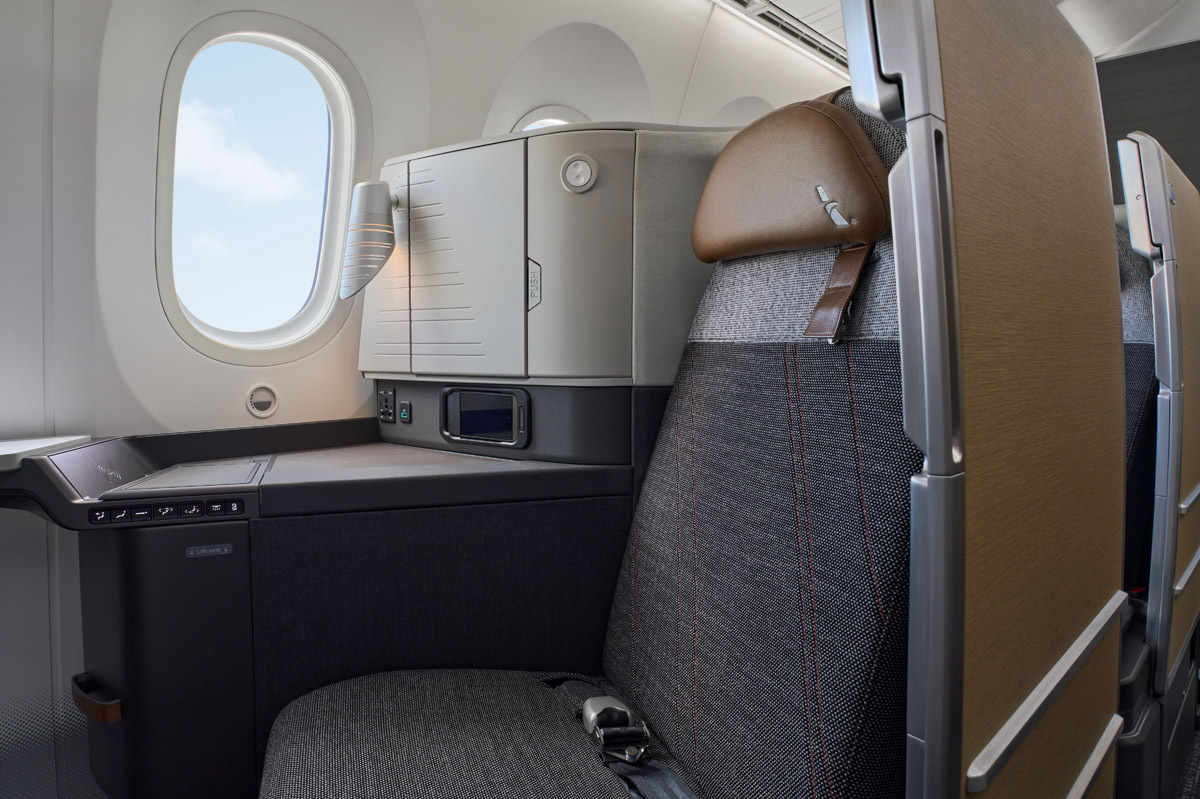
    American has partnered with the James Beard Foundation to refresh its lounge menus with dishes like Thai basil and chili crispy shrimp. The airline also redesigned its newest Boeing 787-9 Dreamliners for long-haul international flights around individual business-class compartments with sliding privacy doors, lie-flat seats longer than a standard twin mattress and amenity kits that might include a celebrity facialist’s brand of sheet masks and under-eye patches.

    American Airlines’ premium in-flight seats on the airline’s Boeing 787-9 planes.Courtesy of American Airlines

    United’s newest business-class cubicles add oversized 27-inch entertainment screens, caviar service, luxury skincare products, and multicourse dining on long-haul international services. The airline said its revamped menus “feature flavors and dishes” inspired by cities across its network.

    “Marie Antoinette would feel very comfortable on any of the big three airlines these days,” said William J. McGee, senior fellow for aviation at the American Economic Liberties Project. “But instead of saying, ‘Let them eat cake’ in the back of the plane, she would say, ‘Let them eat Biscoffs.’”

    Air travel is getting more stratified as fuel costs increase fares

    The airlines’ pursuit of higher-paying passengers shows no loss of momentum. On board Delta’s next-generation Airbus A350-1000 aircraft arriving in 2027, nearly half the cabin will be devoted to premium seating. American has said it plans to expand premium cabins by 50% by the end of the decade.

    Yet the new era of luxury in the skies is unfolding alongside a very different reality for other U.S. travelers as broader inflationary pressures have added to the strain on household budgets.

    New York-based travel adviser Mary Auteri said more of her clients are “experiencing sticker shock” as fares and add-on fees have gotten more expensive since the Iran war broke out and pushed up the price of jet fuel, one of the largest operating costs for airlines.

    A group of friends in their 20s recently asked Auteri to price out flights to the sugar-white sand beaches of Punta Cana, a resort town in the Dominican Republic. After she sent them an itinerary, they said they had found what looked like the same flights on Google Flights for more than $100 less.

    But the cheaper fares were basic economy tickets that excluded seat assignments, checked bags, and flexibility to change plans. Once those costs were added back in, the trip no longer fit their budget.

    Baggage fees, seat-selection charges, and other add-on costs fall heaviest on economy travelers, McGee said. For wealthier travelers, those fees may amount to little more than an inconvenience. For budget-conscious travelers, they can determine whether a trip happens at all.

    “The idea that we’re all created equal? Not in the airlines’ eyes,” McGee said. “Not by any means.”

  • Man partly sucked out of broken window on flight from Greece was pulled back by fellow passengers

    Man partly sucked out of broken window on flight from Greece was pulled back by fellow passengers

    THESSALONIKI, Greece — A man who was partially sucked out of a dislodged window on a flight from Greece to Germany on Friday was pulled back inside the aircraft by fellow passengers.

    The 61-year-old passenger suffered neck and shoulder injuries and friction burns, according to a Greek hospital official who spoke on condition of anonymity because they were not authorized to speak publicly to the media.

    The incident happened on a morning flight from the northern Greek city of Thessaloniki to Memmingen, near Munich, which was operated by Ryanair subsidiary Malta Air. Ryanair, Europe’s largest budget carrier, said in a statement the flight “returned to Thessaloniki shortly after take off when a passenger window dislodged in-flight.”

    Passengers told Greek media that they heard a loud bang, oxygen masks dropped and the plane began to lose altitude.

    One passenger, identified only as Christina, told Thessaloniki radio that some passengers panicked and screamed and that one passenger was partially sucked out of the window.

    “His whole head, neck, shoulders” were pulled out of the window, she said, adding that those seated near him pulled him back in.

    “Most people had fallen asleep, we had closed our eyes. We heard a sound, I’d describe it like a tire bursting … but very loud,” she said. “We knew straight away we lost pressure because we lost altitude. … Screams, shrieks, shouting.”

    The plane landed normally and passengers returned to the terminal, and one passenger requested and received medical assistance on the ground in Thessaloniki, the airline said in a statement. A replacement aircraft was later provided to fly the passengers to Germany.

    The National Transportation Safety Board, the U.S. federal agency that investigates aviation accidents and other major transportation incidents, said it was notified that the flight turned back because of “a right engine issue and cabin decompression.”

    The agency said it is standing by to assist in the investigation, which will be led by the Aircraft Accident and Incident Investigation Committee of the Republic of North Macedonia.

    The aircraft was a Boeing 737-800, which can seat up to 189 passengers. The narrow-body plane was delivered new to Ryanair in 2008, according to flight-tracking site Flightradar24.

    Flight records show that the aircraft climbed past 15,000 feet about six minutes after departure and then immediately descended to about 6,000 feet “to burn fuel for 30 minutes” before returning to Thessaloniki about an hour after taking off, Flightradar24 said.

  • Kia launches new recall for 463,000 Telluride SUVs due to fire risk, urges owners to park outside

    Kia launches new recall for 463,000 Telluride SUVs due to fire risk, urges owners to park outside

    NEW YORK — Kia America has issued a new recall for nearly 463,000 of its Telluride SUVs, urging owners to again park their vehicles outside and away from buildings after several customers reported fires following previous repairs.

    The recall, announced this week by the National Highway Traffic Safety Administration, replaces a prior one Kia initiated in 2024. Certain Tellurides from the 2020-2024 model years are affected, with the NHTSA warning that the front power seat motor of these vehicles may overheat due to a stuck slide knob.

    That could result in a fire while the car is parked or being driven. And even after Kia rolled out a remedy in 2024, recall documents note several customers filed complaints of alleged fires underneath the passenger seat. The automaker investigated other vehicles that had received the prior repair and identified “sporadic dealer workmanship issues” — later deciding to initiate a new recall.

    Between October 2024 and April 2026, Kia North America’s safety office identified 18 incidents involving either localized seat fires or melting of the seat motor, per recall documents. No associated injuries or crashes have been reported.

    In a statement, Kia America noted that “an external impact with excessive force” to the vehicles’ front power seat side cover or slide knob could cause their switch to become dislodged or otherwise damaged — resulting in overheating if the motor continues to be used over time. To prevent this, Kia’s new fix will be for dealers to install an electronic fuse assembly, free of charge.

    That remedy will be available in early August, according to an advanced dealer notice published by the NHTSA. And owner notification letters are set to be mailed starting Aug. 13.

    In the meantime, both the NHTSA and Kia are warning owners to park “outside and away from structures” until the recall repair is complete.”

    Drivers can also confirm if their specific vehicle is included in this recall and find more information using the NHTSA site and/or Kia’s recall lookup platform. Irvine, Calif.-based Kia America is a subsidiary of the larger South Korean automaker.

    The recall covers 462,869 model year 2020-2024 Tellurides that were manufactured between Jan. 9, 2019, and May 29, 2024. Kia America estimates that 1% have the defect.

  • U.S. resumes strikes on Iran after 3 tankers hit in Strait of Hormuz,

    U.S. resumes strikes on Iran after 3 tankers hit in Strait of Hormuz,

    DUBAI, United Arab Emirates — The U.S. military launched a series of strikes against Iran early Wednesday, hours after three merchant ships were struck in the waters off Oman in the Strait of Hormuz.

    The renewed attacks from both sides threaten the interim deal reached last month, with the U.S. and Iran both saying the strikes violate that initial agreement. The fresh assaults will add to the difficulty of the negotiations aimed at fully reopening the strait, rolling back Tehran’s disputed nuclear program, and reaching a permanent end to the war launched Feb. 28.

    In a statement posted to social media, U.S. Central Command said American forces launched the strikes “to impose heavy costs for targeting and attacking commercial shipping crewed by innocent civilians in an international waterway.”

    “Iran’s demonstrated aggression was unwarranted, dangerous, and a clear violation of the ceasefire,” the command said in their statement.

    The latest exchange followed a similar spate of Iranian attacks on shipping and U.S. retaliation that occurred late last month.

    Hours after the three tankers were struck by projectiles, the United States revoked a license that had authorized the sale of Iranian oil as part of the interim deal to end the fighting between the U.S. and Iran.

    The new assaults in the fuel-shipping waterway were the most in a single day since late April, according to the U.N. International Maritime Organization. The fresh attacks threatened to choke off the flow of traffic in the strait just as countries hoped to restore normal shipping practices and ease the global economic strain of the war.

    A U.S. official said the license was revoked because Iran’s actions in the strait were unacceptable and needed to be met with consequences. The official spoke with the Associated Press on the condition of anonymity to share insight into the reasoning behind the move.

    The Iranian mission to the United Nations did not immediately respond to a request for comment.

    One tanker caught fire after getting hit

    One tanker was traveling off the coast of Oman when it was hit and caught fire, the United Kingdom Maritime Trade Operations center said. Iranian state television said the liquefied natural gas tanker came under attack after ignoring warnings but did not directly claim the assault.

    The other two ships sustained some damage, but no one was injured, and both continued on their way, the U.K. maritime agency said.

    Tehran, which has repeatedly declared that only its approved route through the strait is safe, is suspected of attacking other ships that have used another route close to the Omani shore.

    Location details provided by the U.K. agency showed that all three attacks occurred off the coast of Oman or the neighboring United Arab Emirates, making it likely that the ships were using the route near Oman.

    Talks between U.S. and Iran are on hold

    The U.S. is eager to press ahead with negotiations with Iran aimed at fully reopening the strait, rolling back Tehran’s disputed nuclear program and reaching a permanent end to the war launched Feb. 28.

    Previous attacks in the strait have sparked retaliatory strikes by the U.S. Iran then attacked Gulf Arab states.

    In peacetime, a fifth of all traded oil and natural gas passed through the channel.

    The license issued by the U.S. authorized the production, delivery and sale of Iranian oil through Aug. 21. U.S. Vice President JD Vance said at the time that lengthy talks with senior Iranian officials in Switzerland created a “good foundation for a successful final deal” to end the war.

    U.S. sanctions on the purchase of Iranian oil had been in place since the 1979 Iranian Revolution. After the U.S. and Israel launched the war, and after the closure of the strait, the U.S. had authorized the temporary sale of Iranian oil at least twice as an incentive toward a deal.

    Meanwhile, talks between Iran and the U.S. appeared to be on hold until after the burial of Iran’s Supreme Leader Ayatollah Ali Khamenei, who was killed at the beginning of the war.

    Qatar calls attack a violation of international law

    One tanker was carrying liquid natural gas south through the strait near Limah, Oman, when a projectile hit the left-side engine room and sparked a fire, the U.K. Maritime Trade Operations center said.

    Majed Al-Ansari, a spokesperson for the Qatari Foreign Ministry, said the Qatari tanker Al Rekayyat was targeted in an “unacceptable attack” on international navigation and global energy security. He called it a “serious and explicit violation” of international law.

    In a post on X, he said Qatar holds Iran “fully legally responsible.”

    Later Tuesday, the U.K. maritime agency reported that an oil tanker was hit on its left side as it exited the strait near the Omani-Emirati border. A third tanker was struck by a drone off Oman, the agency said.

    The Joint Maritime Information Center, a multinational body overseen by the U.S. Navy, told shippers Monday that the route around Oman “has been expanded and remains available for all traffic.”

    Ships going to the north on the Iranian route must register with Tehran. Those going south work with Oman and the U.S.

    Iran and the United States agreed as part of an interim deal to allow ships to pass without paying charges for 60 days. But Tehran insisted it must control the vessels’ routes and later charge fees for passage, which would upend decades of practice in the waterway.

    The U.S. and many Gulf Arab states say they will not agree to Iran charging for passage through the strait.

    The data firm Kpler reported that at least 108 ships crossed through the strait last weekend using various routes.

    Mourners gather in Qom for Khamenei’s funeral

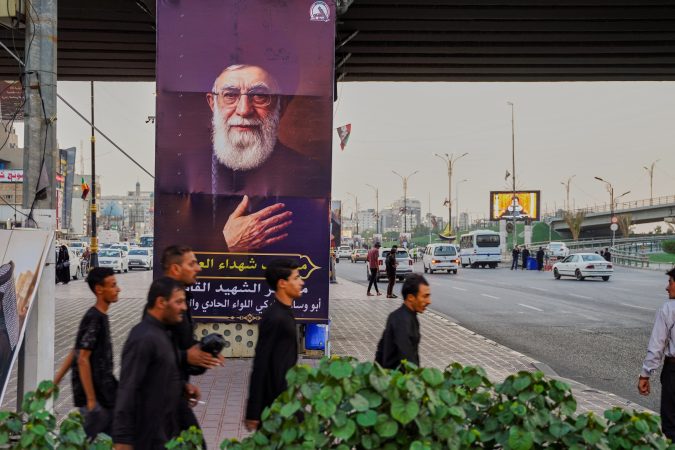
    Authorities flew Khamenei’s body to the Shiite seminary city of Qom, where mourners honored him Tuesday.

    Iranian state television aired live images of hundreds of thousands of people walking toward Jamkaran Mosque, just south of Qom, for the funeral service. Shiites believe the mosque once hosted Muhammad al-Mahdi, the 12th and last Shiite imam, who disappeared in the 9th century and is supposed to one day reappear to bring justice to the world.

    Khamenei’s son, Iran’s new Supreme Leader Ayatollah Mojtaba Khamenei, has yet to make an appearance at the ceremonies, which began Saturday in Tehran. He is believed to be in hiding after reportedly being wounded in the airstrike that killed his father.

    Khamenei’s body arrived late Tuesday in Najaf, Iraq, where it was received by senior officials from both countries. Processions are planned for Wednesday in Najaf and Karbala, the two holy cities of Iraqi Shiism. Iraq has a sizable Shiite population and is home to major Shiite religious sites and centers of learning.

    Khamenei, who was 86, will then be returned to Iran to be buried Thursday at the Imam Reza shrine in Mashhad, his birthplace.