Category: Associated Press

  • U.K. police rearrest the suspect in Ann Widdecombe killing on terrorism suspicion

    U.K. police rearrest the suspect in Ann Widdecombe killing on terrorism suspicion

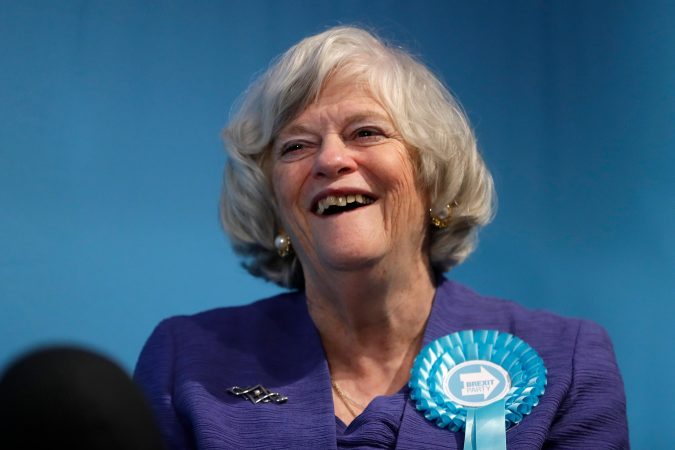
    LONDON — The killing of former British politician Ann Widdecombe is being investigated as a terrorist act, police said Monday.

    A 28-year-old man in custody on suspicion of murder was rearrested on suspicion of commission, preparation, or instigation of acts of terrorism, Counter Terrorism Policing South East said.

    Devon and Cornwall Police originally said the killing was not believed to be a terror-related crime and there was nothing to suggest it was politically motivated.

    “We now have new information and evidence that means Counter Terrorism Policing is now leading the investigation,” the head of National Counter Terrorism Policing, Laurence Taylor, said. “We are pursuing multiple lines of inquiry to establish the motivation for this attack.”

    Widdecombe, 78, a former member of Parliament, was found dead last week in her isolated rural home in a southwest England village. Police did not disclose a cause of death, saying only that she had sustained “serious injuries.”

    The death sent shock waves through British politics, where Widdecombe had been a prominent voice for decades, known for her robust personality and socially conservative views opposing abortion and the expansion of LGBTQ+ rights.

    The suspect, who has not been named because he hasn’t been charged, was arrested Saturday in South Yorkshire county in northern England, more than 200 miles from the village of Haytor on the edge of Dartmoor National Park, where Widdecombe was found dead Thursday.

    Police said they believe Widdecombe was attacked at around 12:30 p.m. on Wednesday. Concerns were raised for her after she failed to appear for a scheduled TV interview on Wednesday afternoon.

    Widdecombe was a lawmaker in the House of Commons from 1987 to 2010, serving in roles including prisons minister in Prime Minister John Major’s 1990s Conservative government.

    Widdecombe found fame after leaving Parliament as a contestant on the reality television shows Strictly Come Dancing and Celebrity Big Brother.

    She later joined the Brexit Party, briefly serving as a member of the European Parliament before Britain left the European Union in 2020. Most recently, she joined the anti-immigration Reform UK party, often appearing in the media as a spokesperson.

    Friends and colleagues contrasted her pugnacious political statements with her personal kindness and good humor.

  • EU rallies $1 billion in pledges for Gaza’s recovery

    EU rallies $1 billion in pledges for Gaza’s recovery

    BRUSSELS — The European Union has coordinated efforts to raise 900 million euros ($1 billion) in pledges of aid for Gaza’s rebuilding following two years of Israeli bombardment that left much of the Palestinian enclave in ruins, a senior EU official said Monday.

    How much of the money will be delivered, and when reconstruction of Gaza can begin, is unclear. The ceasefire between Israel and the Hamas militant group that took effect in October is effectively stalled.

    European Commissioner for the Mediterranean Dubravka Šuica announced the fund after a meeting in Brussels of the Palestine Donors Group, which includes EU and Middle East nations along with international organizations and financial institutions.

    “The ceasefire in Gaza remains fragile, and the situation on the ground for civilians is not getting better,” Šuica said. She said the money will move through “trusted partners” but didn’t give details.

    Few places in the Palestinian territory of over 2 million people have been left unscathed, and the United Nations, World Bank, and EU estimate that reconstruction will cost $70 billion.

    The U.N. has said Gaza has more than 60 million tons of rubble, enough to fill nearly 3,000 container ships. It will take over seven years to clear, with additional time for demining.

    The meeting also brought together Nickolay Mladenov, the head of the Board of Peace set up by U.S. President Donald Trump to lead Gaza’s reconstruction; Trump’s son-in-law, Jared Kushner; Ali Shaath, the head of the new Palestinian committee meant to administer Gaza’s daily affairs but still unable to enter; and Palestinian Authority Prime Minister Mohammad Mustafa.

    Mladenov has made clear that the next steps in implementing the ceasefire are stalled over the difficult issue of disarming Hamas militants in Gaza.

    “We are investing not only in the Palestinian future but also in the regional stability, shared security, and just and lasting peace for everyone together,” Mustafa said, calling for “a resilient, sovereign, contiguous, and viable Palestinian state” — something Israel’s current government has opposed.

    The Palestinian Authority seeks a role in Gaza’s reconstruction, but the U.S. 20-point plan only makes a reference to the possibility of a future Palestinian state.

    Meanwhile, EU ministers discuss the West Bank

    Separately, top diplomats from the 27-nation EU debated how to respond to increased Israeli settler violence in the occupied West Bank.

    The bloc’s executive, the European Commission, has tabled options including cutting off trade with Israeli settlements in the territory.

    Nations like Ireland and Spain are calling for forceful action. The Czech Republic, Germany, and others alongside the commission are more cautious, seeking to apply incremental pressure. Some nations have signaled they would veto sanctions.

    Do sanctions “have a meaningful impact or not? What role could they play as a political message, and would this be escalatory in a wrong direction?” said Bulgarian Foreign Minister Velislava Petrova-Chamova.

    The EU’s foreign policy chief, Kaja Kallas, said the European Council’s legal service had found that severing trade ties with Israeli settlements in the West Bank — not technically sanctions — would require a majority vote and not total unanimity from bloc members.

    Luxembourg’s Foreign Minister Xavier Bettel said a clear majority in the EU agrees on severing commercial ties with the settlements. He dismissed arguments that tough action would boost Israeli Prime Minister Benjamin Netanyahu’s chances in an election in October: “I hope that now it’s time for decisions.”

  • Fire in Fontainebleau forest near Paris triggers evacuations; 10 still missing in Spanish wildfire

    Fire in Fontainebleau forest near Paris triggers evacuations; 10 still missing in Spanish wildfire

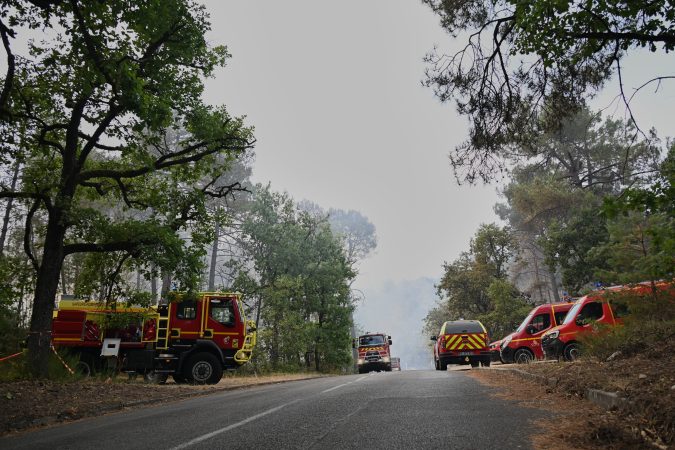
    FONTAINEBLEAU, France — A fire raging in the historic and much-visited Fontainebleau forest south of Paris on Monday prompted evacuations of some residential neighborhoods and disrupted train and highway traffic.

    It was among several wildfires in western Europe as the region bakes under its third red-alert heat wave this year.

    In Spain, 10 people were still unaccounted for Monday from a fire that ripped through a remote southern expatriate community last week, killing 13 people in one of the country’s deadliest blazes.

    The Fontainebleau forest fire is unusual for its proximity to the French capital — about 42 miles away. The region hosts the Fontainebleau Chateau favored by Napoleon and is popular with visitors from Paris and beyond.

    French President Emmanuel Macron said all necessary means were being deployed to fight the fire of ″exceptional scale.”

    Two water-dumping planes were deployed over the area along with hundreds of firefighters, regional fire service spokesperson Paul Laurain told public broadcaster France-Info.

    The head of the regional administration, Pierre Ory, told French media that an investigation is underway and that arson was being considered a possibility.

    A new fire has broken out in another section of the forest, Ory said. The initial fire is still not contained and was continuing to spread at a moderate rate.

    “Winds are turning, which is significantly complicating the work of the firefighters,” he said.

    Trains to and from the bustling Gare de Lyon train station were disrupted late Sunday but were returning to normal Monday morning. A section of the busy A6 highway leading southeast of Paris was shut down because of fire risk.

    Large fires in southern France have already scorched thousands of acres since last week, disrupting the Tour de France cycling race and stretching firefighting resources.

    France is experiencing the peak of its third heat wave of the summer, with temperatures surpassing 104 degrees Fahrenheit across western and central areas and around 98 F in Paris.

    Spain reeling from deadly wildfire

    A 93-year-old British national died Sunday in a hospital from injuries sustained in the Los Gallardos wildfire, elevating the death toll to 13.

    Spanish Prime Minister Pedro Sánchez was expected to visit the site of the fire on Monday. Regional authorities said the blaze was contained Sunday after affecting some 27 square miles of forest and farmland — larger than the size of Manhattan.

    Spain is experiencing extreme heat, which combined with wind and little rainfall is creating the ideal conditions for small wildfires to grow unchecked.

    Europe is the world’s fastest-warming continent, with temperatures increasing twice as fast as the global average since the 1980s, according to the European Union’s Copernicus Climate Change Service.

    Homes evacuated in U.K. due to fires

    In the U.K., people were evacuated from several dozen rural homes in north Wales after a wildfire broke out across a mountainside on Sunday, British media reported.

    Wildfires also burned in several locations across England as another heat wave — the third this year — brought hot, sunny and dry conditions.

    The Met Office said record heat waves since May have led to 2026 becoming the first year to record temperatures of 95 F or higher on six separate days. That broke the previous record set in 1976 and 2020, when five days were recorded with such temperatures.

    Natural England’s fire severity index has put much of England at “very high” risk of wildfires, with some areas in southern England and the Midlands at “exceptional” risk.

  • Minnesota prosecutors obtain long withheld evidence in investigation into protest shooting deaths

    Minnesota prosecutors obtain long withheld evidence in investigation into protest shooting deaths

    Minnesota prosecutors announced Monday that they have obtained key evidence in their ongoing investigations into the fatal shootings of Renee Good and Alex Pretti during pitched protests against a federal immigration enforcement crackdown in the state earlier this year.

    “Through the cooperation of our federal partners we have obtained the hard drives of previously withheld evidence in the killings of Renee Good and Alex Pretti and the shooting of Julio Sosa-Celis,” Hennepin County Attorney Mary Moriarty said. “We have also obtained some of the physical evidence that was previously withheld, including Renee Good’s car.”

    Statements, police body camera video, and other evidence had previously been withheld by federal officials in the killings.

    She said state and local investigators now also have in their possession Good’s damaged car.

    Good, a 37-year-old mother of three, was shot and killed in her car while leaving an anti-immigration enforcement protest in Minneapolis on Jan. 7 as U.S. Immigration and Customs Enforcement agents surged through the region.

    Her death and that of Pretti, a 37-year-old intensive care nurse shot and killed by federal officers just weeks later during a Jan. 24 protest, sparked outrage across the country and calls to rein in immigration enforcement.

    “The wonderful thing now is we have all the evidence,” Moriarty said.

    Investigators are going through all the evidence, including hard drives with statements, hours of video recorded by body-worn cameras, and the car Good was driving, Moriarty said.

    “We need transparency. We need cooperation. Our community needs it,” she said. “Our democracy requires it.”

    At the end of June, Minnesota Attorney General Keith Ellison and Moriarty asked a federal judge to push out the deadlines in their lawsuit against the U.S. Department of Justice because they said they were in the midst of recently reinitiated “ongoing discussions” with the FBI about information sharing.

    Those ongoing discussions with the FBI about information sharing are likely to affect Minnesota’s request for summary judgment in the case, Ellison and Moriarty wrote in their motion to the court.

    The attorneys representing the federal government signed onto the motion.

    Ellison said he remains “deeply troubled that the federal government spent more than half a year attempting to conceal this evidence from state investigators.”

    “It should never have taken this long for Minnesota law enforcement to gain access to the federal government’s evidence,” he said in a statement. “I hope that this is the beginning of a major course correction on the part of the federal government.”

    There have been at least eight deaths since the Trump administration’s immigration enforcement campaign began last year, but nobody has been charged in connection with them.

    A Minneapolis resident, Julio Cesar Sosa-Celis, was also shot and injured in his home while ICE agents were in pursuit of another man.

    In May, Christian Castro, an ICE agent, was arrested and charged with assault as well as falsely reporting a crime in connection with that Jan. 14 nonfatal shooting.

    Prosecutors say Castro, 52, fired through a home’s front door and shot Sosa-Celis in the thigh.

    In April, Gregory Donnell Morgan Jr., another ICE agent, was charged with pointing his gun at a motorist and passenger on a Minneapolis highway.

    Prosecutors said at the time it was the first criminal case against a federal officer involved in the Minnesota immigration crackdown.

    On Monday, ICE was involved in a fatal shooting in Maine, according to state House Speaker Ryan Fecteau, a Democrat.

    Details of what transpired in Biddeford, a coastal city of about 23,000 people roughly 15 miles southwest of Portland, remained unclear.

    Last week, an ICE agent in Houston fatally shot a Mexican national who had lived in the U.S. for decades as the homebuilder drove his construction crew to a job site.

    The federal Department of Homeland Security, which oversees ICE, has acknowledged officers were looking for someone else when they attempted to stop Lorenzo Salgado Araujo’s vehicle. The agency maintains Salgado Araujo rammed an ICE vehicle, prompting an officer to open fire in self-defense.

  • ICE shot and killed motorist in Maine. Advocates say he’s a 26-year-old man from Colombia

    ICE shot and killed motorist in Maine. Advocates say he’s a 26-year-old man from Colombia

    BIDDEFORD, Maine — The motorist killed by ICE officers in a Maine shooting Monday was not the target of the warrant the officers were executing, Sen. Angus King said Homeland Security Secretary Mullin told him.

    It’s the second time in a week that U.S. Immigration and Customs Enforcement agents have used deadly force and at least the ninth since President Donald Trump began his immigration crackdown.

    Immigrant rights groups identified the man who was killed as a 26-year-old native of Colombia.

    King, an independent senator from Maine, said Mullin told him the officer opened fire after the man tried to use his vehicle as a weapon against officers in Biddeford, a coastal city roughly 15 miles southwest of Portland.

    “He was in a vehicle — pulled out in the vehicle, and the term the secretary used was ‘weaponized’ the vehicle and was shot by an ICE agent,” King said.

    King had initially said Mullin told him the man was the target of a deportation effort. Mullin later called King with new information he had received, a spokesperson for the senator said.

    The Maine attorney general’s office, which is investigating along with the FBI and other agencies, said initial statements suggest the motorist was trying to flee in the direction of the agent. The man was the target of an enforcement operation related to a final order of removal, the office said, and the agent who killed him has been placed on leave.

    Messages seeking comment were left for ICE and the Maine Department of Public Safety.

    Man was authorized to work in U.S., advocates say

    The advocacy groups Maine Immigrants’ Rights Coalition and Presente! said the man who was killed was authorized to work in the U.S. and had a Social Security number. After the shooting, his family contacted the Immigrants’ Rights Coalition, executive director Mufalo Chitam said.

    “It’s a young family and he was leaving to go to work,” Chitam told the Associated Press. The family, she said, isn’t ready to speak publicly about the shooting.

    Mary Hayes, who lives close to where the shooting happened, said the man lived nearby with his wife and daughter.

    “I watched a wife fall to her knees looking at her husband’s dead body on the ground,” Hayes told the AP as she held a piece of cardboard with “No ICE Stop ICE” written on it. “I watched a little girl crying with a little pink backpack on because she’s never going to see her father again.”

    The Colombian Embassy told the AP in an emailed statement that it is in contact with U.S. authorities and “working to formally confirm the individual’s identity and nationality.”

    Security video but no body-worn camera footage

    Cory Poulin, whose family runs a laundromat near the scene, told the AP that security cameras at the business captured footage of the man’s car rolling into the intersection after shots were fired. Other images from the scene showed the car going in circles and bullet holes in its windshield.

    “Two ICE members ran to the intersection and another ICE member in a Ford SUV went into the intersection to stop the car from rolling,” he said. “I don’t know for a fact, but I don’t believe he was alive when the car started rolling.”

    He said Maine State Police asked that he not release the footage publicly.

    The agents involved in the shooting didn’t have body-worn cameras, King said.

    “The question is, what did he do with his vehicle,” King said. “Were officers threatened? Were the threats rising to the level that justified deadly force?

    “That’s what this investigation is all about and I certainly intend to stay after it to do everything I can to be sure the investigation is as transparent and thorough as possible.”

    Anti-ICE protesters gather near scene

    Dozens of demonstrators critical of ICE and President Donald Trump’s ongoing immigration crackdown gathered in Biddeford within hours of the shooting.

    Amy Goodman, who is from nearby Wells, arrived with a sign that said “Stop Killing Us” and directed it toward police working at the scene.

    “Sadly, it’s something we’re seeing a whole lot more often lately, and I’m mad about it,” said Goodman, who was wearing a shirt that said “ICE is best when crushed.”

    “It’s heartbreaking and I wanted to show up,” Goodman’s friend, Molly Zucker of Cape Neddick, said as she held a sign reading, “No human being is illegal.”

    Police blocked access to the shooting scene, which is in a neighborhood of mostly multifamily homes, churches, and businesses near downtown. Several protesters stood nearby, with some holding signs condemning ICE’s presence in the community and state.

    “We are grieving, we are furious, and we will not allow his death to be treated as routine or inevitable,” Chitam said. “How much more harm must our communities endure before those with the power to act acknowledge that this has gone too far?”

    A recent uptick in Trump’s immigration crackdown

    The fatal shooting in Maine was at least the ninth death from an encounter with federal immigration officials since the start of the Trump administration’s immigration crackdown and the second in a week, following the killing of a Houston man.

    The reported shooting comes amid a newly intensified push by the Trump administration to carry out its mass deportations agenda. During the five-day period at the end of June, ICE arrested more than 10,000 people. The figures indicate that while the administration is no longer cracking down on individual cities, the arrests continue and are surging.

    “More than anything else, I want to know, ‘Why are you in Maine?’” Rep. Chellie Pingree (D., Maine) said in a video posted on social media.

    Maine Secretary of State Shenna Bellows, a Democrat running for Senate, wrote on X: “It’s time to get ICE off our streets.”

    Hundreds of Maine ICE arrests since Trump’s return

    ICE had a significant presence in Maine earlier this year, which prompted several protests.

    The Homeland Security Department named the operation “Catch of the Day,” an apparent play on Maine’s seafood industry, just as it has done for other enforcement surges, like “Metro Surge” in Minnesota and “Midway Blitz” in Chicago.

    Immigration officials said in late January that they had ceased “enhanced operations” in Maine after hundreds of arrests.

    A Homeland Security spokesperson said at the time that some Maine arrests were of people “convicted of horrific crimes” including aggravated assault and endangering the welfare of a child.

    Court records show that while some had felony convictions, others had unresolved immigration proceedings or had been arrested but never convicted of a crime.

    ICE arrested 546 people in Maine between the start of Trump’s second term and March 11, 2026, the most recent data available, according to ICE arrest data provided to the University of California, Berkeley Deportation Data Project and analyzed by the AP. About 45% of those arrested had criminal backgrounds. During the equivalent 416-day period before Trump took office, roughly 69% of those arrested had criminal backgrounds, the data show.

    The Trump administration’s immigration crackdowns were widely condemned last winter after the killings of Alex Pretti and Renee Good in Minnesota.

    Last week, an ICE officer fatally shot 52-year-old Salgado Araujo, of Houston, after he was pursued by federal agents driving unmarked vehicles while he was taking his construction crew to their latest job site.

  • McConnell says a fall led to his hospitalization, breaking weeks of silence about health condition

    McConnell says a fall led to his hospitalization, breaking weeks of silence about health condition

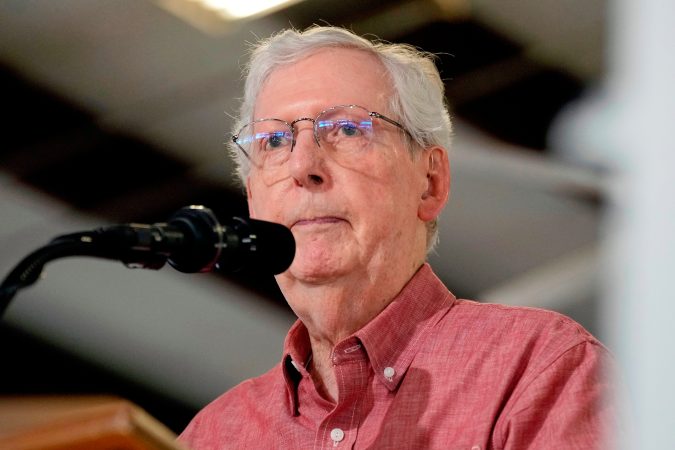
    WASHINGTON — Sen. Mitch McConnell on Sunday revealed for the first time that a fall led to his hospitalization, breaking the silence about his condition after weeks of mounting speculation about the Kentucky Republican’s health.

    McConnell, 84, said in a statement that he has undergone a battery of tests as doctors try to determine what led to his fall. He explained the long silence about his condition by saying that “folks of my generation often hesitate to share the vulnerability that comes with growing older.”

    “Even in the public eye, I feel that same instinct — I can’t help it,” he said.

    McConnell said he is now in a rehabilitation center and will not be returning to the Senate “quite yet.” He said he continues to work with his staff on Senate business in the meantime.

    The statement included a smiling picture of the senator with his wife, Elaine Chao, a tacit response to speculation online that McConnell had died or was incapacitated.

    It comes following his hospitalization on June 14. McConnell’s office for weeks provided little information, insisting only that he was “receiving excellent care” and recovering. As his hospital stay grew longer, speculation mounted about his condition. It grew so intense that Kentucky’s Democratic Gov. Andy Beshear took the extraordinary step of asking that McConnell update the public about his health in a “transparent manner.”

  • Ukraine’s prime minister steps down as Zelensky announces government reshuffle

    Ukraine’s prime minister steps down as Zelensky announces government reshuffle

    KYIV, Ukraine — Ukrainian Prime Minister Yulia Svyrydenko stepped down on Sunday as President Volodymyr Zelensky announced fresh changes to Ukraine’s government, saying he had offered a new and important position to the former premier.

    Zelensky, who has remained in office under martial law because wartime elections are prohibited, has periodically reshuffled his government in an effort to bring fresh momentum to his administration.

    Svyrydenko, who has served as Ukraine’s economy minister, was named prime minister in July 2025 at the age of 39 after playing a lead role in securing a mineral agreement between Ukraine and the United States, seen as an important way of tying U.S. interests to Ukraine’s security.

    In a statement on social media, Svyrydenko said she was “proud to have had the honor of leading the government during one of the most difficult periods in Ukraine’s modern history.” She also said she had discussed “next steps” with Zelensky, but did not provide further details.

    “I remain ready to serve the Ukrainian state and carry out every task aimed at strengthening Ukraine’s position, defending our national interests and bringing a just peace closer,” she said.

    Zelensky announced her resignation in a post saying that Ukraine was “changing its political strategy.” He also said he had offered Svyrydenko the opportunity to lead “a new, important area” in Ukraine’s relations with a key international partner.

    “Each priority area of foreign policy will be assigned to a specific person with substantial experience who is capable of implementing what we agree on at the leaders’ level and what the Ukrainian people expect,” Zelensky said, describing the impending reshuffle.

    The Ukrainian leader also said there would be changes among the top ranks of Ukraine’s law enforcement agencies.

    Zelensky met with a series of senior officials following the announcement, including Energy Minister Denys Shmyhal, Interior Minister Ihor Klymenko, and Defense Minister Mykhailo Fedorov.

    The overhaul, which Zelensky has yet to explain in detail, would be the fourth major reorganization of his government since the start of Russia’s full-scale invasion.

    Ukraine continues strikes against Russian oil sites

    Elsewhere, a Ukrainian attack in southwest Russia killed one person and wounded three more, local officials said Sunday, as Kyiv’s forces continued to bombard Russia’s oil facilities.

    The head of Russia’s Samara region, Gov. Vyacheslav Fedorishchev, said that a child was among the injured. He also said that residential homes and apartment buildings were damaged in the strike, as well as an unspecified “industrial site.”

    Russian media outlets reported that the attack’s target was the region’s Syzran Oil Refinery, with many sharing images that appeared to show plumes of black smoke rising over the site. The refinery, which is owned by oil and gas giant Rosneft and sits some 500 miles east of the border, has been a repeated target for Kyiv’s forces.

    Meanwhile the governor of Russia’s Rostov region, Yuri Slyusar, said that a tanker had been damaged in a drone attack in the Azov-Black Sea maritime canal. The tanker was empty and there is no threat of an oil spill, Slyusar said.

    Ukraine’s drone strikes on oil refineries and other infrastructure across Russia have triggered a widespread fuel crisis with gasoline shortages and rationing in multiple regions and motorists waiting for hours to fill their tanks. Moscow has responded by intensifying its bombardment on Kyiv and other cities, exposing Ukraine’s vulnerability to ballistic missile strikes.

    Zelensky has described the strikes on Russia’s energy infrastructure as part of Kyiv’s campaign of “long-range sanctions” carried out in response to Moscow’s refusal to halt its four-year invasion of its neighbor.

    Meanwhile, Russia’s Ministry of Defense said Sunday that it had attacked the ports of Odesa and Chornomorsk in Ukraine’s Odesa region. Ukrainian officials have not yet commented on the claims.

  • Iran reports new attacks on military targets on its largest island near the Strait of Hormuz

    Iran reports new attacks on military targets on its largest island near the Strait of Hormuz

    DUBAI, United Arab Emirates — The United States attacked Iran on Sunday over an Iranian strike on a container ship in the Strait of Hormuz that set it ablaze and left a crew member missing. Iran responded with attacks on countries including Bahrain, Kuwait, Qatar, Jordan, and Oman — the nation on the other side of the strait that Tehran has pressed to join in managing shipping traffic.

    The U.S. struck again later Sunday. Iran’s state-run IRNA news agency cited the governor of Qeshm island near the strait as saying projectiles had been fired at military targets, with no casualties. IRNA said explosions were also heard in the coastal city of Bandar Abbas and Hajiabad city to the north.

    A U.S. official, speaking on condition of anonymity because they were not authorized to publicly discuss military operations, said a few strikes were conducted on missile and air defense systems, as well as small boats of the paramilitary Revolutionary Guard at a couple of locations around the strait to further degrade Iran’s ability to attack commercial shipping.

    Iran and the U.S. are nearly at the midway point of the 60-day period of their interim deal aimed at reaching a permanent end to the war. The strait, a key route for the global supply of oil and natural gas and long considered an international waterway, has become a sticking point in negotiations that seem in danger of collapse.

    The United Nations secretary-general, António Guterres, was “deeply concerned by the serious escalation,” according to a statement.

    Iran says the strait is closed and the U.S. disagrees

    The U.S. military’s Central Command said earlier Sunday that it hit some 140 targets, including missile and drone launch sites, ammunition dumps, communication equipment, and other sites. It said the attacks, heavier than in recent days, would weaken Iran’s ability to threaten shipping.

    “We bombed the hell out of them last night,” President Donald Trump told NBC’s Meet the Press.

    Semiofficial Iranian news agencies reported that a navy officer was killed. Iran retaliated by attacking nations in the region hosting U.S. military forces, while insisting it alone must control the strait and potentially charge vessels for traveling through it.

    “The era of one-sided deals is OVER,” Mohammad Bagher Qalibaf, the speaker of Iran’s parliament and a main negotiator, wrote. “We told you: keep your word or pay the price. Reality is knocking.”

    The U.S. has launched three rounds of airstrikes targeting Iran in the last week over Iranian attacks on ships heading through the strait using a route off Oman, seeking to avoid the Islamic Republic’s territorial waters.

    The U.S. military and Trump asserted that the strait remained open Sunday. Iran said it was closed until calm is restored, and Tehran would consider targeting “additional enemy bases in the region” if it faced more attacks.

    The U.S. military said over 140 ships had transited the strait over the past week. A multinational body overseen by the U.S. Navy said traffic continued “at reduced levels” off both Oman and Iran. It said nearly 140 vessels transited daily before the war.

    About a fifth of all traded oil and natural gas passed through the strait before the war began. Iran’s grip on it led to a global energy crisis, though oil prices have sharply dropped since wartime highs of $120 a barrel.

    Oman summons Iranian envoy to protest attack

    Missile alerts sounded across several Gulf Arab countries.

    Qatar’s military said it intercepted incoming Iranian fire, with explosions heard in the neighboring United Arab Emirates. Three people, including a child, were wounded as a result of shrapnel from the interception of Iranian attacks, Qatar’s Interior Ministry said, giving no further details on their condition.

    Missile alerts sounded in Bahrain, an island kingdom in the Persian Gulf that is home to the U.S. Navy’s 5th Fleet.

    Kuwait’s Defense Ministry said three “land border posts” in the north and an offshore drilling platform of the Kuwait Oil Company were damaged, with one platform worker wounded.

    A day after Oman and Iran held talks on the strait, the Omani state news agency said drones struck sites in an area on the waterway.

    Oman summoned the Iranian ambassador to protest the strikes, the first such move since the war began, calling Iran’s acts “irresponsible.”

    Three Iranian missiles struck areas across Jordan, causing minor damage but no injuries, Jordan’s state news agency reported.

    Sirens also sounded in the UAE, but the government said missiles did not cross into its territory.

    Iranian strike on ship harms Indian crew

    A Cyprus-flagged container ship was hit by Iran and suffered “significant engine room damage,” the U.S. Central Command said.

    Oman’s maritime authority said it rescued 23 crew members but one was missing. India’s Ministry of External Affairs called him an Indian national and it was working with Oman to locate him.

    The United Kingdom Maritime Trade Operations center, overseen by the British military, said the ship had been moving along Oman’s shoreline.

    Iran’s paramilitary Revolutionary Guard said multiple vessels “disregarded our warnings” and ignored instructions to follow what it called an approved route. One “was struck by a warning shot and brought to a stop.”

    Iranian state media later reported U.S. strikes across the country, including southern Iran in the province closest to the strait and military sites in a province near Tehran.

    Attacks followed more diplomatic talks about the strait

    The strait sits in Iran and Oman’s territorial waters. Oman on Saturday said it and Iran agreed to continue discussing the strait “at the technical and political levels.”

    Trump suggested last week that the interim deal on the war was “over.” But mediators, including Pakistan, Qatar, and Egypt, have continued efforts to reach an agreement. A regional official involved in mediation, speaking on condition of anonymity to discuss talks, said efforts to shore up the ceasefire continued Sunday. Pakistan said its foreign minister spoke by phone with Iran’s top diplomat and urged “de-escalation” on both sides.

    Iran’s new supreme leader, unseen since the war began, on Saturday vowed in his first statement since the funeral of his father, Ayatollah Ali Khamenei, that Iranians would avenge his killing in the war’s opening strikes on Feb. 28.

    Such revenge “is the will of our nation and must certainly be carried out,” Supreme Leader Ayatollah Mojtaba Khamenei said in a statement carried on state television.

  • Sen. Lindsey Graham, Trump critic turned ally and foreign policy hawk, dies after a brief illness

    Sen. Lindsey Graham, Trump critic turned ally and foreign policy hawk, dies after a brief illness

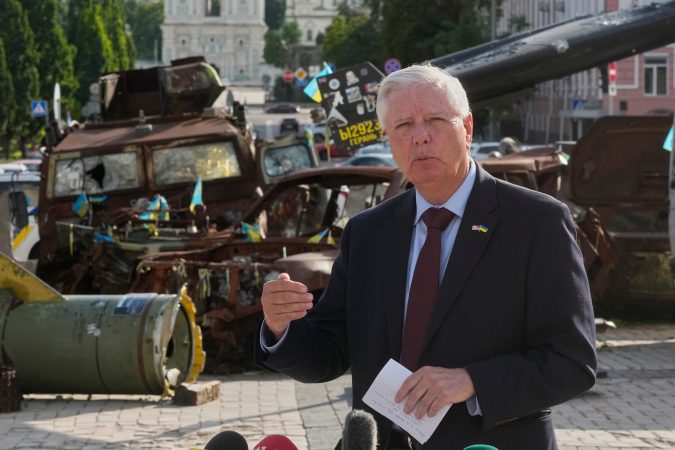
    Sen. Lindsey Graham, a longtime Republican lawmaker from South Carolina who went from being one of Donald Trump’s harshest critics to positioning himself in the front ranks of the president’s most deferential supporters, died Saturday. He was 71.

    The senator had a remarkable political trajectory that included election to the House in the 1994 Republican takeover, a high-profile role as an impeachment manager against President Bill Clinton, a Senate career featuring foreign policy hawkishness and bipartisan collegiality, and a prominent position as a confidant of President Donald Trump who epitomized Trump’s capture of the Republican Party.

    On Sunday, the Associated Press reported that a statement from Sen. Graham’s office said the Medical Examiner of the District of Columbia’s preliminary findings are the senator died of aortic dissection due to arteriosclerotic cardiovascular disease. That is an aorta rupture stemming from hardening of Sen. Graham’s arteries. A final report will be issued later.

    Over his more than three decades in the House and the Senate, Sen. Graham became nationally known because of a near-constant presence in the news media, where his folksy manner and talent for a good quote put a soft edge on his sometimes hard-line views. On Sunday, he was scheduled to have made what would have been his 64th appearance on NBC’s Meet the Press, following his return from a trip to Ukraine.

    The senator also had a talent for winning elections despite regular attacks from the right and the left. Last month, Sen. Graham won the South Carolina Republican nomination over five challengers in his pursuit of a fifth Senate term, avoiding what many had anticipated would be a runoff and placing him on a glide path to reelection in his deeply Republican home state.

    In celebrating his primary win, Sen. Graham paid tribute to Trump, whom he had in 2016 called “a nut job” unfit to be commander in chief. “I want to thank the big guy, God. Trump comes later. Mr. President, you’re not far behind God, but we’re going to start with him,” he said in the June speech.

    Although Sen. Graham was criticized throughout his political career as a shape-shifter and attention-seeking opportunist, there were some areas in which he was steadfast. Among them was his advocacy of a hawkish foreign policy, often as an ally of Sen. John McCain (R., Ariz.), a longtime friend.

    Sen. Graham championed using the U.S. military and government money to support global allies and confront foreign adversaries, supporting the wars in Iraq and Afghanistan and condemning the withdrawal of troops from both countries.

    Sen. Graham had also pushed both the Biden and Trump administration to provide greater support for Ukraine in its fight against Russia’s invasion. A staunch ally of Israel, Sen. Graham had pressed Trump toward war with Iran and warned him against making a premature deal.

    Israeli Prime Minister Benjamin Netanyahu, speaking Sunday morning on Fox News, praised Sen. Graham as “a great friend” to Israel. “He was absolutely clear. He didn’t bend to fashion, the winds of fashion. He knew who the good guys were, and he knew who the bad guys were. He never confused the two,” Netanyahu said.

    In a social media post written in the predawn hours Sunday, Trump also lauded Sen. Graham — among the few who managed to make it into the president’s good graces after having denounced him — as “one of the greatest people and Senators I have ever known” and “a true American Patriot.”

    A childhood growing up behind a bar

    Lindsey Olin Graham was born on July 9, 1955, in Central, S.C., a town in Pickens County that gets its name for being the midway point of a rail line between Charlotte and Atlanta.

    The future senator grew up in the rooms behind the Sanitary Cafe, a pool hall, restaurant, bar, and liquor store owned by his parents, Millie and Florence James “F.J.” Graham. While his father, also known as “Dude,” tended bar for the millworker clientele, the son racked balls and answered phones.

    He would later say jokingly that he learned everything he really needed to know about politics there, often having to tell a wife who called looking for her husband, “He says he’s not here.”

    The first member of his family to attend college, Sen. Graham set his sights on a military career, joining the ROTC at the University of South Carolina, although a bad ear and his dismal math scores got in the way of his ambition to become a pilot.

    He was still a student when his plans for the future suffered a bigger disruption. His parents died within two years of each other, leaving him to provide for his 13-year-old sister, Darline, who went to live with an aunt and uncle with Sen. Graham as her guardian. After graduating from law school, Sen. Graham legally adopted her, so that she would be eligible for his military benefits.

    “You assume everything’s going to be like Ozzie and Harriet — that doesn’t mean it’s going to turn out that way,” he told the Washington Post in 1998. “So here I’ve got a teenager on my hands. She’s turned out great in spite of me. I was probably a nut. I never let her date. I smelled her clothes if she smoked. I listened in on her phone calls. I was probably pressing too hard, just ’cause I felt such responsibility for her.”

    For her part, Darline Graham Nordone would later describe Sen. Graham as “a brother, a father, and a mother rolled into one.” She survives Sen. Graham, who never married.

    As a newly minted lawyer in 1981, Sen. Graham joined the Air Force’s Judge Advocate General staff, spending four years as a prosecutor and defense attorney in Europe. His defense of an Air Force pilot accused of marijuana use brought him national attention when he was featured in a CBS 60 Minutes report on the Air Force’s faulty drug-testing procedures.

    Upon leaving active duty in 1989, Sen. Graham returned to South Carolina and entered politics. After two years in the state legislature, he was elected to the U.S. House in the Republican wave of 1994, when the GOP recaptured the House after decades in the wilderness.

    The junior member of the House Judiciary Committee enjoyed a star turn as a House manager in Clinton’s 1999 impeachment trial in the Senate chamber. “Where I come from,” he drawled as he described a phone call the president had made to White House intern Monica Lewinsky, “You call somebody at 2:30 in the morning, you’re up to no good.”

    Meanwhile, his military career had continued. He was a member of the South Carolina Air National Guard, called to active duty stateside during the 1991 Persian Gulf War. He joined the U.S. Air Force Reserves in 1995, retiring 20 years later as a colonel. During that time, he did numerous stints in Iraq and Afghanistan, and was the first sitting member of the Senate in decades to do military duty in a combat zone.

    Sen. Graham’s growing celebrity helped propel him when a South Carolina Senate seat opened up in 2002 with the retirement of 100-year-old Strom Thurmond. Sen. Graham won it, in what became the most expensive Senate race in state history.

    Once in the Senate, Sen. Graham became known for working across the aisle and developed a friendship with then-Sen. Hillary Clinton (D., N.Y.) — an unlikely one, given his recent history as one of her husband’s impeachment managers. The two traveled together frequently and co-sponsored legislation.

    Sen. Graham’s independent reputation was boosted by his closeness to McCain, whose presidential candidacy he supported during the bitter 2000 South Carolina GOP primary against the eventual winner, George W. Bush. McCain, the ultimate political maverick and one who shared Sen. Graham’s interventionist foreign policy views, referred to his colleague as “my illegitimate son.”

    As a result, Sen. Graham, like McCain, periodically found himself at odds with the Bush administration. When a scandal broke over torture allegations at Abu Ghraib, a prison run by the U.S. military in Iraq, he demanded accountability up the chain of command. “What are we fighting for?” Sen. Graham asked at a hearing. “To be like Saddam Hussein?”

    On Sunday, Bush issued a statement lauding Sen. Graham as “a knowledgeable Senator who understood how the world works and how important America’s international engagement is to resist tyranny.”

    Hillary Clinton, the Democrats’ 2016 presidential nominee, would later express dismay over Sen. Graham’s transformation during the Trump era. In 2019, she told radio host Howard Stern that he had been someone she “admired and liked enormously” before he became a devotee of Trump, whose bullying, name-calling approach to politics was abhorred by Democrats.

    “I saw him as somebody who, you know, had been working to try to figure out what he believed and how he could do things,” Clinton said. “It’s like he had a brain snatch, you know?”

    From Trump antagonist to Trump loyalist

    In 2015, Sen. Graham announced what would become a quixotic campaign for president.

    Outside of his views on foreign policy, he was seen as a moderate Republican. A year before, he had survived an effort by the tea party movement and right-wing commentators to force him out of office. They branded him “Flimsy Lindsey” and “Grahamnesty” over such apostasies as working with Democrats on climate change and immigration, where he supported widening a path to citizenship for undocumented people.

    “I want to be president to protect our nation that we all love so much from all threats foreign and domestic,” Sen. Graham said in announcing his candidacy. “So, get ready. I know I’m ready.”

    He and Trump, who was running his first and ultimately victorious presidential campaign, clashed often on the debate stage, and Trump at one point gave out Sen. Graham’s personal cellphone number on television, after Sen. Graham called him a “jackass.” As it turned out, the senator was the wrong candidate for the moment in a party that was turning toward Trump’s brand of nativist populism. Sen. Graham left the race in December 2015, before the first votes were cast.

    He subsequently endorsed former Florida governor Jeb Bush and, later, Sen. Ted Cruz (R., Texas), only to see their campaigns go down in flames against Trump.

    Once Trump was in office, Sen. Graham’s began cozying up to the new president, looking past Trump’s demeaning of the Vietnam heroism of Sen. Graham’s friend and idol McCain, who had been a prisoner of war for 5½ years and was diagnosed with deadly brain cancer in 2017.

    Sen. Graham insisted his evolution on Trump was based on acceptance, not opportunism. “I said he was a xenophobic, race-baiting religious bigot,” he told CBS News in 2018. “I ran out of adjectives. Well, the American people spoke, and they rejected my analysis.”

    He and Trump bonded over golf outings, and Sen. Graham constantly fed the president’s famous appetite for flattery.

    “I think Lindsey likes the president a lot more than he thought he would,” Steve Largent, a former congressman and confidant of Sen. Graham, told New York Magazine in 2018. “I think Lindsey feels a little bit like the adult in the room, speaking with the president. … There’s something about, I’m not going to say innocence, but the president’s affability as well as his naiveté that Lindsey is drawn to.”

    Sen. Graham wavered after the Jan. 6, 2021, riot at the U.S. Capitol by Trump supporters seeking to overturn the result of the 2020 presidential election, after Trump did little to stop the violence.

    “Trump and I, we’ve had a hell of a journey — I hate it to end this way. Oh my God, I hate it. From my point of view, he’s been a consequential president, but today … all I can say is count me out. Enough is enough,” Sen. Graham said at the time.

    Still, Sen. Graham did not join seven other Republican senators the following month in voting to convict Trump of inciting an insurrection after he was impeached by the House.

    With the resurrection of Trump’s political career during the 2024 election cycle, Sen. Graham quickly made his way back into the fold. Last month, with his primary approaching, the senator made his pitch to South Carolina voters by noting that he had Trump’s endorsement: “If you want somebody who can go to Washington to help him, I’m your best choice.”

  • U.S. airlines are redesigning travel around their highest-paying passengers

    U.S. airlines are redesigning travel around their highest-paying passengers

    They may arrive at the same destination, but two passengers on the same flight can have strikingly different travel experiences.

    One traveler breezes through a priority security lane and heads straight to an invite-only lounge for craft cocktails and a chef-prepared meal before boarding early. A flight attendant offering a glass of champagne and a warm hand towel welcomes the passenger to a spacious seat at the front of the plane.

    The other traveler stands in a line at every step — security screening, a café selling $16 sandwiches, a crowded gate — then boards with one of the final groups, hoping there’s still room for a carry-on in the overhead bin before folding into a cramped middle seat. After the cabin lights dim, sleep comes in fragments, and a travel pillow does little to ease a stiff neck.

    The contrasting journeys are no accident. Since the COVID-19 pandemic, the largest U.S. airlines have pulled out all the stops to court premium passengers who are willing to pay for comfort, convenience and exclusivity. Budget-conscious travelers may notice a widening gap between the back of the plane and up front as the carriers increasingly build their businesses around selling first-class, business-class, and premium-economy seats.

    “We can’t win by trying to provide the cheapest. We have to be able to win by providing the best,” Delta Air Lines CEO Ed Bastian said in a recent Fortune podcast interview.

    The strategy embraced by Delta and rivals American Airlines and United Airlines marks a notable evolution for an industry that spent decades making air travel more accessible. Now, the nation’s largest carriers are reconfiguring aircraft to expand premium seating, designing new fleets with larger premium cabins, and investing billions in amenities that extend the top-tier travel treatment beyond their jetliners.

    But United CEO Scott Kirby has pushed back on the idea that the industry has become solely focused on chasing big spenders. He said United’s premium investments are part of a broader strategy to boost the experience of every traveler, pointing to initiatives such as seatback entertainment and improvements to the airline’s mobile app.

    “We’re investing nose to tail for all customers,” Kirby said last month on financial firm Morgan Stanley’s Exceptional Leaders podcast.

    Premium cabins have become airlines’ most valuable real estate

    The premium playbook didn’t emerge overnight.

    Airlines used to fill empty first-class seats mainly by giving their most loyal frequent flyers free upgrades. Delta rewrote the rules in the early 2010s by using sophisticated pricing tools to offer more of those seats to coach passengers who were willing to pay a little more, said Henry Harteveldt, president of travel advisory firm Atmosphere Research Group.

    The strategy unlocked demand airlines hadn’t fully recognized, encouraging more travelers to trade up and laying the groundwork for today’s broader premium push.

    “Travelers could and would pay for noticeably more comfort, noticeably better service, noticeably more amenities, if the price was right,” Harteveldt said.

    Then came the pandemic. When business travel collapsed and Zoom replaced many corporate trips, airline analysts wondered whether carriers would once again have to lure travelers with cheap fares. Instead, eager leisure travelers proved willing to splurge on premium seats and perks, convincing airlines that demand extended well beyond the traditional business road warrior, Harteveldt said.

    That confidence has only grown. Premium demand is now a fixture of quarterly earnings calls, with airline executives regularly touting premium revenue as they compete for higher-spending travelers.

    “When you think about what’s different and what’s changed over the last 10 or 15 years, the premium products used to be loss leaders, and now they’re the highest-margin products,” former Delta president Glen Hauenstein said last summer. “That’s really the headline.”

    Analysts say premium cabins — a category that expanded with the introduction of premium economy seats featuring more legroom and amenities at a fraction of the cost — now generate a disproportionate share of airline revenue compared with the space they take up on commercial aircraft.

    On heavily trafficked transatlantic routes, business-class tickets can bring in nearly as much revenue as fares and fees paid by passengers in the much larger economy cabin, according to an analysis by consulting firm McKinsey & Co.

    Airlines are competing with chef-designed menus and high-end skin care

    The premiumization of air travel has become impossible to miss, even for travelers who only get a glimpse through an airport lounge door or while walking down an airplane aisle.

    Delta’s new first-class lounges resemble upscale restaurants, with open kitchens plating dishes such as hamachi crudo, cocktail bars serving made-to-order drinks, soundproof relaxation pods, and outdoor decks overlooking the tarmac.

    American has partnered with the James Beard Foundation to refresh its lounge menus with dishes like Thai basil and chili crispy shrimp. The airline also redesigned its newest Boeing 787-9 Dreamliners for long-haul international flights around individual business-class compartments with sliding privacy doors, lie-flat seats longer than a standard twin mattress and amenity kits that might include a celebrity facialist’s brand of sheet masks and under-eye patches.

    American Airlines’ premium in-flight seats on the airline’s Boeing 787-9 planes.Courtesy of American Airlines

    United’s newest business-class cubicles add oversized 27-inch entertainment screens, caviar service, luxury skincare products, and multicourse dining on long-haul international services. The airline said its revamped menus “feature flavors and dishes” inspired by cities across its network.

    “Marie Antoinette would feel very comfortable on any of the big three airlines these days,” said William J. McGee, senior fellow for aviation at the American Economic Liberties Project. “But instead of saying, ‘Let them eat cake’ in the back of the plane, she would say, ‘Let them eat Biscoffs.’”

    Air travel is getting more stratified as fuel costs increase fares

    The airlines’ pursuit of higher-paying passengers shows no loss of momentum. On board Delta’s next-generation Airbus A350-1000 aircraft arriving in 2027, nearly half the cabin will be devoted to premium seating. American has said it plans to expand premium cabins by 50% by the end of the decade.

    Yet the new era of luxury in the skies is unfolding alongside a very different reality for other U.S. travelers as broader inflationary pressures have added to the strain on household budgets.

    New York-based travel adviser Mary Auteri said more of her clients are “experiencing sticker shock” as fares and add-on fees have gotten more expensive since the Iran war broke out and pushed up the price of jet fuel, one of the largest operating costs for airlines.

    A group of friends in their 20s recently asked Auteri to price out flights to the sugar-white sand beaches of Punta Cana, a resort town in the Dominican Republic. After she sent them an itinerary, they said they had found what looked like the same flights on Google Flights for more than $100 less.

    But the cheaper fares were basic economy tickets that excluded seat assignments, checked bags, and flexibility to change plans. Once those costs were added back in, the trip no longer fit their budget.

    Baggage fees, seat-selection charges, and other add-on costs fall heaviest on economy travelers, McGee said. For wealthier travelers, those fees may amount to little more than an inconvenience. For budget-conscious travelers, they can determine whether a trip happens at all.

    “The idea that we’re all created equal? Not in the airlines’ eyes,” McGee said. “Not by any means.”