Category: Associated Press

  • Iran’s Revolutionary Guard warns U.S. over escalation

    Iran’s Revolutionary Guard warns U.S. over escalation

    Iran’s Revolutionary Guard warned Monday that it would “change the geography of the war” if the United States escalates the conflict.

    Meanwhile, the British military said an “unknown projectile” struck a tanker as it entered the Strait of Hormuz on Monday, injuring two crew members.

    The Israeli military remained on alert as much of the country shuts down for Yom Kippur, the holiest day in Judaism.

    Iran’s Revolutionary Guard says ‘war is not over’

    A spokesperson for Iran’s paramilitary Revolutionary Guard, Hossein Mohebbi, said Monday that “the war is not over” and warned that Iran would change its weapons, military tactics, and targets if the conflict with the U.S. escalates.

    “We will certainly change the geography of the war,” Mohebbi said in a statement carried by Iranian state media. “We will certainly bring new weapons with new capabilities into the battle.” He said the Guard had prepared for a long-term war.

    “Our targets will no longer necessarily be the same as before,” he said, according to the Islamic Republic of Iran Broadcasting, adding that Iran has targets that have not yet been struck.

    The more than six-month war began with U.S. and Israeli strikes on Iran on Feb. 28. The conflict has included repeated attacks and efforts to negotiate an end to the fighting, with no agreement reached to reopen the Strait of Hormuz or revive talks over Iran’s nuclear program.

    Projectile strikes tanker in Strait of Hormuz, British military says

    The United Kingdom Maritime Trade Operations Center (UKMTO) said a tanker was struck by an “unknown projectile” as it headed into the Strait of Hormuz. Two crew members sustained minor injuries.

    The UKMTO said Monday the vessel is reportedly continuing to its next port of call under its own power. No reports indicated any environmental impact at this time.

    Tehran has asserted control over much of the Strait of Hormuz since the U.S. and Israel launched the war on Feb. 28. In peacetime, about 20 million barrels — roughly a fifth of the world’s oil supply — passed through Hormuz each day.

    Some tankers are again traversing the strait, but traffic is well below what it once was.

    Houthi leader lashes out at Saudis in televised speech

    In Yemen, the leader of the Iran-backed Houthi rebels used the anniversary of his group’s overthrow of the Yemeni government to lash out at Saudi Arabia.

    In a recorded speech aired Monday, Abdul Malik al-Houthi said his group’s demands include an end to what he called Saudi “aggression” and the blockade the Saudi-led coalition has imposed on the rebels for about a decade.

    “Stop the aggression and end the blockade. Our demands represent the legitimate rights of our people,” he said in the speech aired by the Houthi-run al-Masirah channel.

    The Houthis descended from their stronghold in northern Yemen, taking over the capital of Sanaa in September 2014 and forcing the country’s government into exile in Saudi Arabia.

    The following year, Saudi Arabia led a multi-national coalition that entered the war in an attempt to restore the government. The coalition imposed an air and sea blockade on the Houthi-held areas, as part of its war efforts.

    WHO reports 680 new casualties in a week in Yemen

    The World Health Organization says 680 people were killed or injured across Yemen over the course of a week as fighting between the Houthi rebels and Saudi-backed government forces continues.

    WHO said on Monday in a post on X that 164 people were killed and 516 injured between Sept. 13 and Friday. This brings the total number of casualties since Aug. 6 to 3,672, including 674 deaths and 2,998 injuries.

    Lahj province in southwestern Yemen is currently an active front line where 58 deaths and 226 injuries were reported within six days, according to the U.N. agency.

    Fighting between the Houthis and government forces has so far displaced 129,438 people across seven provinces, the International Organization for Migration says.

    The IOM said in an update Monday that people escaping the conflict inside the country were forced from their homes in only a few weeks, with many already fleeing more than once.

    Israeli military on guard on Jewish faith’s holiest day

    Israel’s military remained on alert even as the country woke up to the silence and empty streets of Yom Kippur, the Day of Atonement, considered the holiest day for the Jewish faith.

    Streetlights blinked yellow Monday as the faithful walked to the Western Wall in Jerusalem’s Old City.

    “For the next 25 hours, Israel is offline,” the foreign ministry said on X after sundown Sunday. But the military said it bolstered its frontline forces following the killing of an Israeli settler Sunday in the occupied West Bank. The Palestinian suspect was detained after a search.


  • States settle lawsuit over Paramount-Warner merger, clearing key hurdle for $81 billion deal

    States settle lawsuit over Paramount-Warner merger, clearing key hurdle for $81 billion deal

    CHICAGO — California Attorney General Rob Bonta announced a settlement with Paramount in a lawsuit his state led challenging the company’s acquisition of Warner Bros. Discovery on Monday, effectively paving the way for the mega merger to move forward, with some new commitments.

    The $81 billion blockbuster deal will bring together two of Hollywood’s oldest studios, key TV networks like CBS and CNN, and streaming platforms HBO Max and Paramount+, as well as decades of libraries with titles ranging from Harry Potter to Top Gun.

    But terms of Monday’s agreement include what Bonta called “court enforceable” requirements for Skydance-owned Paramount to increase domestic production and establish monitoring of editorial independence of the company’s news operations.

    The settlement still needs final court approval. Bonta maintained that Monday’s agreement “is not a vote of support for this merger” — but that he was always willing to come to the table and “find a strong solution that protects competition and consumers.”

    The coalition of states — including entertainment heavyweights like California and New York — sued to block the merger back in July, alleging a Paramount-Warner combo would “extinguish competition” and lead to fewer choices for consumers, particularly movie theatergoers and cable customers across the U.S.

    Accompanied by a complaint also filed by the Writers Guild of America, the challenge was headed toward a full antitrust trial set to kick off in March.

    Paramount said the allegations were meritless, but previously agreed to delay its transaction well into next year so the case could make its way through court. It then quickly called for a settlement — arguing that it had satisfied all regulatory clearances worldwide (including from the Trump administration’s Justice Department ) and the states’ challenge was its “final obstacle.”

    As reports of the states reaching a settlement with Paramount emerged Monday, critics decried the deal — while warning of what further consolidation could mean in an industry already controlled by just a few major players.

    “Today, billionaires have yet again bribed, censored, and bullied their way to the top,” Alvaro Bedoya, senior adviser at the American Economic Liberties Project and former FTC commissioner, said in a statement earlier Monday. “Layoffs will follow. People from L.A. to Atlanta will lose their jobs, small businesses will lose their contracts, your cable bill and movie ticket will be even more expensive.”

  • ICE hides locations of thousands of detainees with final removal orders

    ICE hides locations of thousands of detainees with final removal orders

    U.S. Immigration and Customs Enforcement has stopped publicly revealing where it is holding thousands of detainees who are subject to final deportation orders, an unannounced move that has made it far more difficult for lawyers and relatives to find them, according to current and former officials familiar with the practice.

    ICE removed those detainees from its online detainee locator system on Sept. 15, according to three current and former ICE officials who spoke on condition of anonymity because they were not authorized to discuss the change. Several lawyers contacted by the Associated Press confirmed their clients vanished from the system this week, and the American Immigration Lawyers Association warned its members about the situation Friday.

    The move represents a stark departure from previous practice and highlights the hardline nature of President Donald Trump’s immigration crackdown, leaving thousands of detainees exceedingly hard to trace and potentially unable to exercise all of their legal options.

    The practice, which applies to detainees who have received final orders of removal from an immigration court, could speed deportations by making last-minute legal challenges harder to pursue, immigration lawyers said. Nearly 16,000 people who were arrested and booked into ICE detention in July were subject to final removal orders, more than a third of the overall bookings, according to ICE data obtained by the Deportation Data Project based at U.C. Berkeley and UCLA.

    The practice does not apply to detainees held at a detention facility in Adelanto, Calif., or at temporary holding facilities in Minneapolis, New York City, or suburban Chicago, the sources said. Judges have ordered ICE to list detainees in those facilities in the online locator promptly upon their arrival, as part of litigation over their detention practices.

    Lawyers, relatives distressed by lack of information on detainees

    The effort to hide their locations adds to the ways in which the Trump administration has made life harder for detainees and their families as it has increased pressure on them to waive appeals and agree to deportation.

    ICE did not publicize the move and in a statement issued to the AP, the agency did not confirm or deny it. The statement said detainees with final removal orders were being prioritized for deportation, even as ICE faces a “historic number of injunctions” from courts stopping individual removals.

    As a result of the change, lawyers and relatives lost track of their clients and loved ones without explanation, which is especially concerning because detainees are frequently moved to new facilities before deportation, said Greg Chen, senior director of government relations at the American Immigration Lawyers Association.

    “Families are freaking out because they think the person has been deported and they don’t know where the person might be,” he said. “On the attorney side, this has serious implications for the ability to contact their client. It certainly has implications about how it will interfere with the attorney-client relationship.”

    The Department of Homeland Security, ICE’s parent agency, has argued that people who are subject to final removal orders have received due process. That usually means an immigration judge has ordered their removal after a hearing, including cases when immigrants fail to show up, and the decision was affirmed on appeal or not appealed.

    Detainees with final removal orders still have options to appeal

    Still, those detainees have options to challenge their detention and removal, including seeking to reopen the case or by bringing what’s known as a habeas petition asking a judge to release them on constitutional grounds. Federal judges have granted thousands of rulings ordering that detainees be released or granting bond hearings.

    ICE detention facilities held more than 65,000 people as of early July, the most recent available data. Around 30% of them likely have final removal orders, said Michelle Mendez, legal director at the National Immigration Project.

    More people have been issued final removal orders after failing to show up for hearings in recent months because the administration’s immigration courts have taken steps to make it harder to participate in and to reopen such cases, she said.

    “To me, it’s just another iteration of disappearing people,” she said. “Why would we do that in the United States of America? It’s something we’d hear about in another country and be concerned about individual rights and due process.”

    Some with final removal orders also have legal protections against deportation to their countries of origin based on the likelihood they would be tortured or persecuted. Many of them are facing removal to third-party countries where they have no ties and their disappearance in ICE’s system will make legal challenges harder, lawyers said.

    Lawyers say clients have vanished from ICE locator system

    ICE initiated the online detainee locator system in 2010 to allow relatives, lawyers, and the public to search for people in custody. Previously they had to call ICE regional offices or individual facilities to try to track them down.

    Many advocates and lawmakers have complained that the system updates too slowly and contains too much inaccurate or missing information, allowing ICE to shield the locations of detainees for days or weeks. Minors, people who have been held by U.S. Customs and Border Protection for less than 48 hours, and detainees who are being transported are not in the system, among others.

    But the exclusion of detainees with final removal orders has no apparent parallel, several immigration lawyers said. Atenas Burrola Estrada, a deputy program director with the Amica Center for Immigrant Rights, said that “every single one of our clients who has a final order has disappeared from the locator,” including 17 in all as of Monday.

    Among those disappeared from the locator system are eight Somali men being detained at the U.S. military base in Guantanamo Bay, Cuba, according to one of their attorneys, My Khanh Ngo, of the American Civil Liberties Union. She said the change could make it “nearly impossible” for people to challenge their removals in some cases.

    “If you can’t find your client, don’t know what’s happening to your client, you can’t get that information to the court to stop their removal,” she said.

  • German leader faces tough time ahead after election defeats, but no sign of leadership challenge

    German leader faces tough time ahead after election defeats, but no sign of leadership challenge

    BERLIN — German Chancellor Friedrich Merz stood by his vow to stay in office Monday after his party suffered two more regional election defeats and was voted out of a state legislature in a humiliating first. But he faces a struggle to keep his reform agenda intact.

    Minutes after polls closed on Sunday, the unpopular Merz said he planned to stay on as leader of both Germany and his center-right party, and said that he would push through reforms to Europe’s biggest economy.

    Hours later, final results underlined the extent of what Merz conceded was a “disaster” in Mecklenburg-Western Pomerania, an eastern region on the Baltic Sea coast. His center-right Christian Democratic Union fell just below the 5% of the vote needed to keep seats in the regional parliament, the first time that has happened in 77 years of modern Germany’s federal republic, after losing more than half its support. The far-right Alternative for Germany finished as the strongest party.

    In Sunday’s other election, the CDU dropped to second place in Berlin behind the hard-left Left Party, which is in pole position to lead the next city government — though Merz’s party could, depending on how coalition talks go, still retain city hall.

    But after days of speculation about Merz’s future, there were no prominent public calls Monday for his departure and no sign of a challenge. The chancellor said no one raised any “personnel questions” in party leadership meetings Sunday or Monday.

    “It is the historic task of the (governing) coalition here in Berlin and the political center as a whole to make our country fit for the coming years,” Merz said. “Extremists suggest that there are easy solutions. But everyone who has ever governed knows there are no easy solutions.”

    At the same time, he acknowledged that the CDU needs to work on its profile. He said that it “no longer has satisfactory answers to too many questions, and we will and must change that.”

    A far-right party gains again

    Neither of the states that voted Sunday is a political heavyweight. The CDU’s 2023 win in Berlin was its only one in the past 25 years in the capital, which has tended to lean left. The party was already weak in Mecklenburg-Western Pomerania.

    But the results added to the headwinds Merz faces after a stinging defeat by the far-right, anti-immigration Alternative for Germany, or AfD, two weeks ago in Saxony-Anhalt, another region in the formerly communist east, damaged his authority and set off speculation that he might be replaced.

    While AfD was the strongest party in Mecklenburg-Western Pomerania, the center-left Social Democrats — the junior party in Merz’s national governing coalition — were fairly close behind after a campaign focused squarely on the state governor, Manuela Schwesig, as a bulwark against the far right. That polarization helped squeeze other mainstream parties, including the CDU.

    A left-leaning three-party coalition under Schwesig would have a majority in the new regional legislature.

    Questions over how Germany should be reformed

    Schwesig and others in the governing parties have cast doubt on aspects of the federal government’s reform agenda, which is meant to bolster a chronically sluggish economy. The reform plans include a potentially painful overhaul of the creaking pension system and of the healthcare system. A proposal to scrap a rule allowing people who have paid pension contributions for 45 years to retire early without taking a financial hit has drawn particular criticism.

    The Social Democrats’ national leaders said Monday that they stand by the coalition. But they made clear that they will seek at least some changes to the plans.

    Vice Chancellor Lars Klingbeil, who is also the finance minister, said that “saying we will ignore what voters told us in three state elections won’t work.”

    “We need reforms, but these reforms must be fair and they need support in the population,” he said. The party’s other co-leader, Labor Minister Bärbel Bas, said the plans need a “reality check” and a “fairness check,” but that she was optimistic of finding solutions on the pension system reform, the most controversial plan.

    “There would be nothing more lethal than letting this coalition break apart over some technical question,” Bas said.

    Merz said he wouldn’t speculate about “where we must make corrections.”

    There are at least no more electoral tests this year. However, five state elections are scheduled next year, three of them in April.

    They include one in North Rhine-Westphalia, Germany’s most populous state, currently led by a prominent CDU figure often cited as a possible successor to Merz, Hendrik Wüst. None of the five elections is in the east, where AfD is strongest.

    Looking forward, much will depend on the CDU’s influential regional leaders. But there was no sign of a challenge to Merz Monday from them or others.

    “You get the feeling that the stronger figures are trying to stay away from Berlin at the moment,” Thomas Poguntke, a longtime political science professor at the Heinrich Heine University in Duesseldorf, told Phoenix television.

    “Swapping out a leadership figure wouldn’t achieve so terribly much now,” he added, but the chancellor has made avoidable mistakes in the past, “and the government’s handicraft simply must improve.”

  • Man shot by ICE officer is detained in Texas with a bullet still in his back, attorney’s office says

    Man shot by ICE officer is detained in Texas with a bullet still in his back, attorney’s office says

    AUSTIN, Texas — A Venezuelan man shot by a U.S. Immigration and Customs Enforcement officer was in custody Monday at an ICE detention center in Texas after he was released from a hospital with a bullet still lodged in his back, the man’s attorney said.

    Speaking by phone during a news conference, Wilber Rafael Garces Perez said doctors didn’t remove the bullet because it’s near his spine. He said ICE pressed for him to be released quickly from the hospital so it could move him to a detention center. He said he had received no pain medication or treatment there, and had slept on the floor, before eventually being given a “pill” by a nurse on Monday.

    Perez, 28, was making a DoorDash delivery in Austin on Sunday when his car was “sideswiped” twice by ICE officers in an unmarked truck, immigration attorney Kate Lincoln-Goldfinch told reporters Monday.

    An ICE officer shot Perez in the back of the neck before officers pulled him from his car, she said. He was taken to a hospital, Lincoln-Goldfinch said, but was released later Sunday into ICE custody with the bullet still inside him.

    “I am not doing well due to the gunshot wound, and I have not received the medical attention that I require,” Perez said, speaking in Spanish over the phone as his wife translated during the news conference.

    Perez was being detained at the South Texas ICE Processing Center in Pearsall, about 130 miles southwest of Austin, Lincoln-Goldfinch said. She said Perez told her in a prior phone call that he was being interrogated.

    The Department of Homeland Security, which oversees ICE, has released little information and has not said what prompted the shooting. In a statement early Monday, the department said it was investigating the shooting of a Venezuelan man in the U.S. illegally who “had a final order of removal.”

    Homeland Security did not immediately respond to email messages seeking further comment on the shooting.

    Perez entered the U.S. legally in 2024 as an asylum seeker and had a valid work permit, Lincoln-Goldfinch said. She said a judge issued a deportation order for Perez after he missed a hearing in immigration court because the hearing notice was sent to a former address.

    “Not that being out of status would justify any of this at all,” Lincoln-Goldfinch said of the shooting in a social media post.

    The shooting occurred amid a surge in ICE enforcement across the U.S. during President Donald Trump’s second term. During the summer, it reported more than 50,000 monthly arrests in July and August — a first for the agency.

    Immigration officers have come under intense scrutiny amid a series of shootings during the crackdown. At least four people have been fatally shot by federal officers during immigration enforcement operations this year.

    Local advocates, leaders of the civil rights group the League of United Latin American Citizens, and two Democratic congressmen who represent parts of Austin called during the news conference for the creation of an independent body to review use-of-force incidents by ICE and refer suspected crimes to prosecutors.

    They also urged Congress to ban ICE officers from making traffic stops, saying the officers are undertrained and too quick to resort to violence.

    Austin Mayor Kirk Watson, a Democrat, has said he wants local police to have a role in investigating the shooting. Watson said it wouldn’t be appropriate for ICE to investigate on its own.

    The area beneath an overpass where a large crowd of protesters had gathered Sunday near the shooting scene was quiet Monday. Trash-filled plastic bags were left below concrete pylons marked with anti-ICE graffiti.

    Amid discarded police tape, people left candles, flowers, and a sign that read “Justice for Wilber.”

  • Iran-backed Houthi rebels warn against joining Saudi Arabia in Yemen’s growing civil war

    Iran-backed Houthi rebels warn against joining Saudi Arabia in Yemen’s growing civil war

    CAIRO — A senior official with the Iran-backed Houthi rebels is warning countries against joining Saudi Arabia in Yemen’s revived civil war, telling the Associated Press on Sunday that his group has assured the Trump administration that it won’t attack U.S. vessels in the Red Sea.

    Mohamed al-Bukhaiti, a member of the Houthis’ political bureau, said Washington reached out to the rebels after their rapid advance down Yemen’s western coast to the Bab el-Mandeb Strait earlier this month.

    “We confirmed that we are not targeting the United States, or any other nation, in the strait, with the sole exception of the Saudi enemy,” he told the AP in a Zoom interview from the rebel-held Yemeni capital, Sanaa. “That remains the case.”

    U.S. President Donald Trump last weekend said his administration has “had discussions” with the Houthis, but did not say when. “The Houthis called us, and they don’t want to fight with us,” he said. “They would much prefer not having us involved, and they’re letting most ships go through.”

    The AP later reported that Oman hosted a meeting between U.S. and Houthi representatives last weekend, citing a Houthi official and another individual familiar with the talks. They spoke on condition of anonymity because they were not authorized to brief the media.

    However, al-Bukhaiti only confirmed indirect contacts with U.S. officials through longtime mediator Oman, which brokered a 2025 ceasefire between the Houthis and the Trump administration. That ended a weekslong U.S. bombing campaign against the rebels in return for them ceasing attacks on U.S. vessels in the Red Sea.

    “The goal of our military operations is not to close the Bab el-Mandeb Strait, but rather to ensure freedom of navigation through it for everyone, including Yemen,” he said.

    Houthis claim they can fight a war on multiple fronts

    Al-Bukhaiti said the rebels have the capacity to fight a war on multiple fronts “should any nation become implicated in the aggression against Yemen alongside Saudi Arabia.”

    “Today, Yemen is capable of waging battle — not merely an internal conflict, but an international one as well,” he said.

    He said the Houthi attacks against neighboring Saudi Arabia will persist until Riyadh ends its decade-long blockade on rebel-held areas in Yemen and allows vessels to reach Houthi-controlled ports on the Red Sea. Then they will be ready to negotiate, he said.

    Al-Bukhaiti blamed Saudi Arabia for the latest escalation of violence in Yemen, which he said erupted after an airstrike blamed on the Saudi-led coalition fighting the rebels hit the Sanaa international airport. The strike prevented an Iranian flight carrying a Houthi delegation to land. The flight was a Houthi attempt to challenge the coalition’s air and naval blockade.

    The Houthis responded with missile and drone strikes on Saudi Arabia, including one that targeted Riyadh on Saturday before being intercepted. Saudi officials said debris from a Houthi drone also killed one civilian and injured others.

    The Houthis also declared a blockade on Saudi shipping in the Bab el-Mandeb Strait and the Red Sea, attacking Saudi-linked vessels and oil facilities inside the kingdom, the world’s top oil exporter.

    The Saudis and their allies have long struggled to contain the Houthis, and may be tempted to seek a diplomatic solution to halt attacks. That might ultimately require U.S. concessions to Iran, the only country with leverage over the Houthis. But Washington’s negotiations with Tehran over their own war fell apart weeks ago.

    “We have not closed the door to peace,” Mahdi al-Mashat, president of the Houthis’ Supreme Political Council, the top executive body, said in a speech Sunday marking the anniversary of their 2014 takeover of Sanaa.

    The U.S., which bombed the Houthis under the Biden and Trump administrations, has shown no interest in getting involved militarily this time around.

    The rebels believe power has shifted in their favor

    The rebels’ advance inside Yemen seized the crucial port city of Mokha and key Red Sea islands that allow them to better monitor shipping traffic through the Bab el-Mandeb, through which some 12% of world trade normally passes.

    The Saudi-backed Yemeni government forces, long divided into factions, withdrew but have vowed to regroup.

    The escalation ended a 2022 ceasefire that largely ended fighting in Yemen’s civil war, which started when the Houthis swept in from their mountainous heartland and seized much of northern and central Yemen, including Sanaa, 12 years ago.

    The Saudi-led coalition entered the war the following year on behalf of the internationally recognized government. The civil war killed at least 150,000 people, according to U.N. estimates, and pushed the country to the brink of famine.

    Now, with Houthis in control of Yemen’s western coast overlooking the Red Sea shipping corridor, “the balance of power has shifted in favor of the Sanaa government,” al-Bukhaiti said, referring to the rebels’ de facto authorities there.

    “Ultimately, (Saudi Arabia) lost its most critical card: the west coast,” he said.

  • North Korea launches 2 ballistic missiles toward the sea and dials up pressure on the U.S.

    North Korea launches 2 ballistic missiles toward the sea and dials up pressure on the U.S.

    SEOUL, South Korea — North Korea launched two short-range ballistic missiles toward the sea on Sunday, South Korea’s military said, days after the North threatened to bolster its nuclear deterrent capabilities and respond to what it called U.S. hostilities.

    The launches were the latest in a series of weapons demonstrations by North Korea even after U.S. President Donald Trump scaled back a joint military exercise with South Korea last month in an apparent effort to revive diplomacy with the North’s leader, Kim Jong Un.

    The two missile launches — about three hours apart — were conducted from North Korea’s eastern coastal Wonsan area. The first missile flew about 280 miles while the second one flew more than 370 miles, both toward the North’s eastern waters, South Korea’s military said.

    The missiles eventually ended up in the sea. South Korea’s presidential office urged North Korea to immediately halt ballistic missile launches that are banned by U.N. Security Council resolutions. The South’s military said it maintains readiness to repel any provocations by the North under a solid alliance with the United States.

    Japan’s Defense Ministry said it detected a suspected North Korean missile earlier Sunday but that the weapon did not land in its territorial waters.

    North Korea escalates pressure on U.S.

    Kim’s sister and senior official, Kim Yo Jong, earlier shrugged off Trump’s overture, saying that shortening the drill wouldn’t change its “provocative, aggressive nature.” North Korea’s military later launched about 10 short-range ballistic missiles toward the sea, apparently following through with a previous threat to respond to the U.S.-South Korean drill.

    On Friday, Kim’s sister slammed another recent U.S.-led multilateral maritime exercise in the region as a “frantic military move” by the Americans meant to prolong their hegemony in the Asia-Pacific area. The “Pacific Vanguard” exercise brought together the U.S., South Korea, Japan, Australia, New Zealand, and Canada.

    She claimed that “regular U.S.-led war rehearsals” are the main source of worsening tensions in the Korean Peninsula and the region.

    “Our will to defend our sovereignty will be expressed in clearer action and there will be never ever change in the course of intensifying the nuclear war deterrence,” she said.

    Earlier this month, North Korea conducted what it called a joint live-fire drill involving missiles, artillery, and drones, a day after the United States, South Korea, and Japan wrapped their five-day trilateral military drill that North Korea described as a provocation. North Korea said its drill included firing different types of weapons simultaneously, likely aiming at developing the ability to overwhelm South Korean and U.S. air defenses.

    Chances of a swift resumption of U.S.-North Korea talks are unclear

    Kim Jong Un has been focusing on expanding his nuclear arsenal after his earlier high-stakes diplomacy with Trump collapsed in 2019.

    When Trump ordered the Pentagon to “substantially reduce” the annual Ulchi Freedom Shield exercise with South Korea, he cited what he called a good relationship with Kim, who has called such drills invasion rehearsals.

    Emboldened by his advancing nuclear arsenal and deepening ties with Russia and China, experts say, Kim likely thinks he now has greater leverage in possible fresh diplomacy with Trump. Earlier this year, Kim said he could return to talks if the U.S. drops its “hostile policy” against his country and respects what he calls the North’s status as a nuclear state.

    South Korean President Lee Jae Myung, a liberal who advocates improved ties with the North, said on Friday that a resumption of U.S.-North Korea talks would be “an important starting point” toward boosting chances for peace on the Korean Peninsula.

    “What is clear is that President Trump wants dialogue and I’ve also been encouraging President Trump to seek dialogue” with Kim, Lee told reporters.

  • Rising gas prices frustrate voters. Trump says it’s an ‘inexpensive price to pay’ for the Iran war

    Rising gas prices frustrate voters. Trump says it’s an ‘inexpensive price to pay’ for the Iran war

    EDINBURG, Texas — Quinten Martinez, pumping gas under a hot South Texas sun, remembers a time when fueling up didn’t require difficult decisions.

    “Is it going to be groceries this week?” asked the 28-year-old Amazon delivery driver as he watched the numbers tick higher. ”Is it going to be getting gas in our tank to go to work?”

    He shook his head when asked about President Donald Trump’s assertion last week that higher gas prices are a small price to pay for the war with Iran.

    “I don’t feel like it’s a good trade-off,” Martinez said. “I don’t feel like this is good for anyone.”

    Voters across the country, and across the political spectrum, tend to agree.

    Interviews with voters in several states, along with a fresh round of national polling, reveal an overwhelming sense of frustration that skyrocketing gas prices — a direct result of Trump’s war — are creating serious and sustained financial hardships for America’s working class.

    The acute concerns are adding to a bad political environment that may be worsening for Trump and his Republican Party as early voting gets underway in the November midterm elections.

    Historically, the party holding the White House has suffered major losses in midterms. Today, seven weeks before Election Day, Republican candidates at all levels are struggling with the additional burden of Trump’s weak approval ratings, an unpopular foreign conflict and an affordability crisis that Trump and his congressional allies had promised to fix.

    But when Trump campaigned in North Carolina on Wednesday, he played down the impact of surging gas prices.

    “You have a little higher. It’s a very inexpensive price to pay for what we’ve done,” Trump said of the war, which he describes as critical to prevent Iran from obtaining a nuclear weapon. ”Remember that. It’s a little more. Frankly, even if it was a lot more.”

    ‘Gas prices matter,’ Republican strategist says

    Despite what Trump says, there are few things that may matter more this election year than the price of a gallon of gasoline, according to political operatives in both parties.

    Gas prices are moving sharply in the wrong direction at a time of year when drivers typically get some relief. The national average for a gallon of gas reached $4.48 on Friday, according to AAA, up roughly 17 cents over the last week, 40 cents in a month and $1.27 from a year ago.

    “Gas prices matter because they’re one of the few economic indicators voters experience and see in real time,” said veteran Republican strategist Chris Wilson. “The price is literally staring them in the face several times a week. So I wouldn’t minimize the frustration we’re seeing, particularly among working- and middle-class voters.”

    Interviews with voters this week found bipartisan frustration and disappointment.

    Democrats and independents were especially motivated to punish Republicans at the ballot box for their economic hardship, while some of Trump’s working-class supporters pledged to support Republicans this fall, even if they weren’t happy with the president’s leadership on the economy.

    Some Republicans say they’re disappointed

    Dan Lloyd, who voted for Trump, lamented the president’s leadership as the 63-year-old carpenter paid $4.39 a gallon to fill up his pickup truck in Mesa, Ariz.

    “He hurt himself stepping into this,” Lloyd said of Trump. “Where’s all this oil from Venezuela? I thought we were flush with gas and everything, but no. The American people eat it every time, whether it’s interest rates, food, gasoline.”

    Still, he expects to vote Republican in the midterms.

    “I think the Democratic Party has lost its way,” Lloyd said. “I just feel like the whole system’s on the verge of collapse.”

    In sweltering Edinburg, Texas, 52-year-old Kristin Jimenez shrugged off the rising price of gas after filling up her Mercedes.

    “We’ve paid the same price under Republican presidents, we’ve paid this price under Democrat presidents,” said Jimenez, a mother who runs a small business. She plans to vote for a Republican in November because they’re the “lesser of two evils.”

    She said gas prices aren’t part of her calculation.

    “We don’t mind paying $8 for a cup of coffee at Starbucks, but we have a problem paying four bucks at the pump?” she said. “Make it make sense.”

    More than 1,500 miles to the north in central Michigan, 35-year-old Garth Johnson is trying to make ends meet running a deep-cleaning business with several gas-powered vehicles and one machine fueled by diesel, which was $6.79 a gallon as he filled up his SUV.

    Johnson voted for Trump, but doesn’t know what he’s going to do in November. Johnson doesn’t feel qualified to second-guess the president’s evaluation of the war, but he’s feeling financial pressure in his own life.

    “I like a lot of the things he’s done,” Johnson said, but added, “I’m a little guy and I’ve got to live my life.”

    Other voters are not so forgiving

    Midterm voting was already underway on Friday in Virginia, where 60-year-old engineer Alan Johnson said Trump seems to have “no empathy” for Americans who are struggling financially.

    “With the gas prices being what they are and continuing to grow, we’ve got to do something. Hopefully the Democrats can get into office and turn the ship around,” said Johnson, who cast ballots in the morning for Democrats for the U.S. Senate and U.S. House.

    In Raleigh, N.C., teacher Brittney Bivins sees surging gas prices as evidence that Trump and his Republican Party aren’t dealing with the issues that matter most to people like her.

    “He really doesn’t care about everyday people,” the 45-year-old said. “He can afford the gas, but most of us can’t. So it feels like he’s not even connected to his own people.”

    Bivins, who described herself as an independent, said she’s eager to support Democrats this fall — especially the party’s emerging democratic socialist wing.

    At a gas station in Lansing, Michigan., Rina Risper spent $50 on 8 gallons of premium gas.

    “When I rolled up I was in shock, actually, and said, well, maybe I should drink water instead of having that $4.99 bottle of whatever it was I was going to get,” Risper said. She thinks Trump’s tariffs will make affordability even worse.

    “We’re not in Miami. We’re in Lansing, Mich.,” she said. “It’s really going to impact our people.”

    Most voters think administration has made economy worse, poll shows

    Nationwide, more than three times as many voters say they are falling behind financially as getting ahead, according to a Fox News survey released Wednesday. By a 15 percentage point margin, Democrats are considered the party that would better handle inflation and prices at a time when the cost of living and the economy are voters’ top concerns.

    The Fox poll found that 61% of voters say gas prices are a major problem for their household, compared with 48% two years ago, while 52% say the same for healthcare costs, compared with 44% in 2024. Majorities also view housing costs and grocery prices as major problems, although neither has increased.

    Overall, nearly two-thirds of voters (63%) say the administration has made the economy worse, compared with 52% in September 2025, including one-quarter of Republicans. Only 46% of Republicans say the administration has improved the economy, while about one-quarter don’t see an impact.

    Back in rural South Texas, an area where Trump’s GOP made gains in recent elections, Martinez, the Amazon delivery driver, could not contain his frustration.

    Trump “likes to tout that we are the best economy in the world,” said Martinez, but in more rural towns, “you don’t see any of the winning, you don’t see any of the ups that he’s talking about.”

    “You just see struggles for day to day life,” he said.

  • Ukraine fires over 1,000 drones at Russia, including ‘largest ever’ attack on Moscow

    Ukraine fires over 1,000 drones at Russia, including ‘largest ever’ attack on Moscow

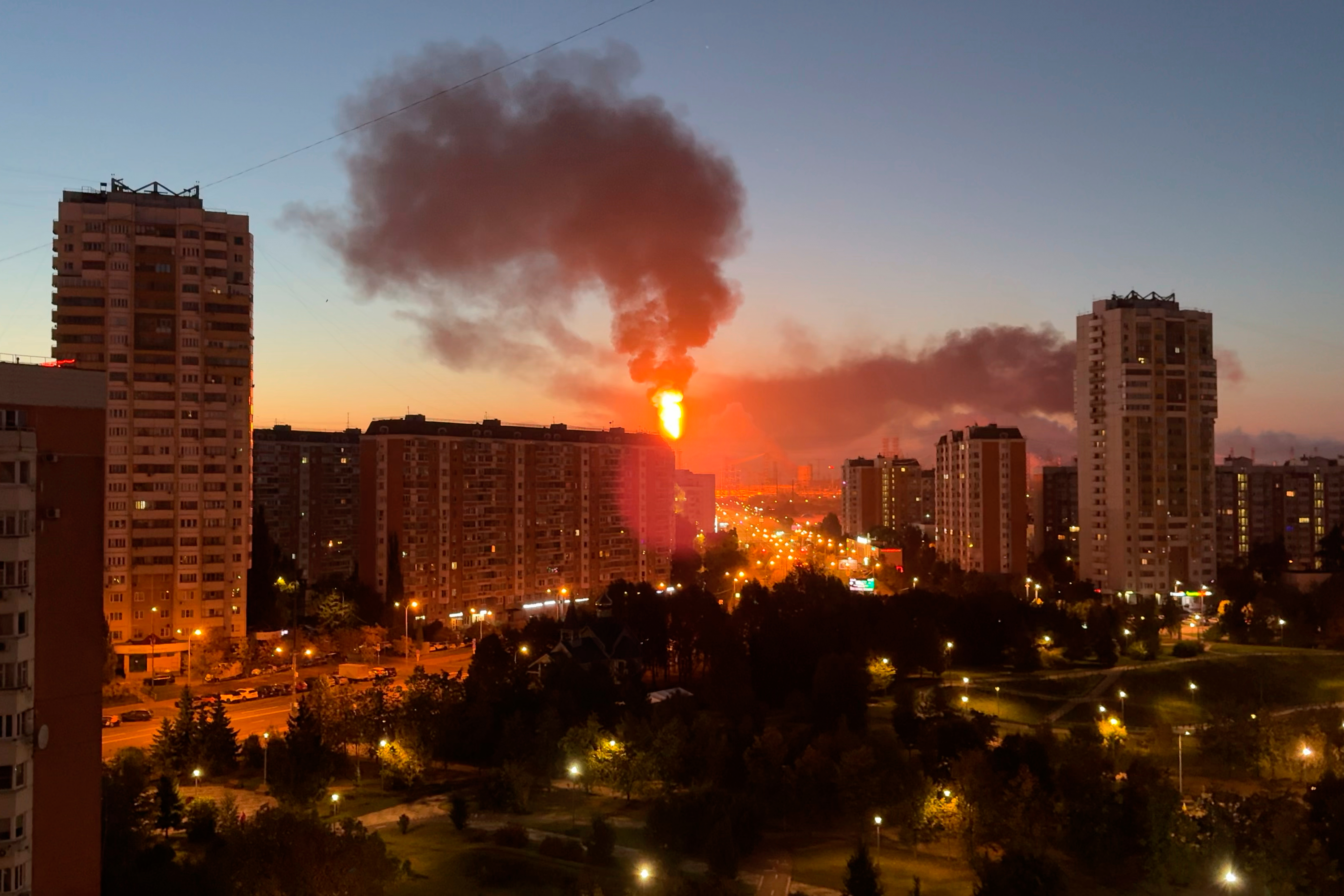
    Ukrainian forces fired more than 1,000 drones at Russia overnight, including hundreds that were launched toward Moscow, officials said Sunday, as the Kremlin was wrapping up the third and last day of its parliamentary elections.

    Moscow’s mayor described the wave of drones as the “largest ever” drone attack on the Russian capital and said there had been damage to the Moscow Oil Refinery, which is among several sites that supply the Russian capital, and a residential building.

    Across the wider Moscow region, the attack killed two people and wounded 20, local Gov. Andrei Vorobyov said. The dead were a 74-year-old man and a 44-year-old woman, he said.

    Writing on social media, Ukrainian President Volodymyr Zelensky said that Kyiv had used a range of missiles and drones in the attack — including Ukraine’s domestically made Flamingo and Pelican missiles — to hit oil and logistics facilities.

    “These are billions of dollars that sustain the war machine,” Zelensky said, referring to the financial pressure that Kyiv hopes to put on Russia’s economy.

    Ukraine also continued to fend off Russian attacks, Zelensky said. A Russian drone strike hit a monastery in Ukraine’s Kherson region Saturday, killing a member of the clergy and wounding four people, he said.

    A Russian attack on the Ukrainian capital also killed two children and their mother on Saturday evening, said Tymur Tkachenko, head of the Kyiv regional state administration. He later said that another child wounded in the same attack had died in hospital on Sunday.

    Russia votes in an election devoid of opposition

    The attack took place on the final day of Russia’s first wartime parliamentary election — balloting that has been virtually devoid of opposition to President Vladimir Putin’s policies and is all but certain to cement the Kremlin’s dominance.

    Russia was also holding the vote in the four Ukrainian regions that Moscow illegally annexed after the war began but still doesn’t fully control, and in Crimea, the Black Sea peninsula that was illegally annexed by Russia in 2014. Kyiv has denounced the action as illegal.

    In a Russian-occupied area of Ukraine’s Kherson region, a Ukrainian attack killed a member of the local electoral committee, Russia’s Central Election Commission said in a statement.

    Russia’s Ministry of Defense said Sunday that its forces shot down a total of 1,110 Ukrainian drones across Russia, as well as over the annexed Ukrainian peninsula of Crimea and the waters of the Black Sea.

    Moscow Mayor Sergei Sobyanin said that 450 drones had been destroyed en route to the Russian capital, and that the attack had damaged the Moscow Oil Refinery and a residential building.

    He said the “unprecedented attack” on Moscow was an attempt to disrupt the elections. “The enemy failed in this regard,” he said.

    Since Russia’s invasion more than four years ago, Ukraine has become a global leader in military drone technology, deploying domestically produced long-range drones alongside missiles for strikes deep inside Russia. Its drone technology has impressed governments and defense manufacturers around the world.

    Kyiv is aiming to make the Russian public feel the war’s consequences and pressure Russian President Vladimir Putin into negotiating a peace settlement. Putin has so far shown no signs he intends to stop the invasion.

    Instead, Moscow and Kyiv have been drawn into an escalating duel of long-range aerial strikes as fighting along the roughly 780-mile front line in eastern and southern Ukraine has slowed, restricted by large numbers of drones and ground robots threatening troop movements.

  • The poorest in the U.S. can’t find housing even as low-income units sit empty

    The poorest in the U.S. can’t find housing even as low-income units sit empty

    PORTLAND, Ore. — Mathew Davis, who lives in a homeless shelter in Austin, Texas, would love an apartment of his own. But with the little money he makes donating blood plasma, even a $450-a-month tiny home with no running water and a communal bathroom would be a stretch.

    Meanwhile, over 4,500 units the city classifies as affordable — nearly 16% — sit empty.

    “I don’t make enough money really to afford anything,” Davis, 49, said of the few hundred dollars he earns a month. “I just keep trying to swim uphill.”

    The poorest people in the U.S. face the most acute shortages of affordable homes. But the majority of low-income housing financed in recent years is for those earning 50% of an area’s median income or above, according to a survey of state housing agencies.

    Some cities are now seeing an uptick in vacancies as rents for these units approach market rates. The result: Apartments designated as affordable sit empty because the poorest of the poor cannot afford them.

    Meanwhile, some people are forced into homelessness and others into desperate circumstances to pay for housing they can’t afford.

    The poorest have few housing options

    There are only about 4 million affordable rental units available for the country’s 11 million extremely low-income renter households, according to the National Low Income Housing Coalition’s most recent annual report.

    These are people with annual incomes either below the federal poverty guidelines — just under $16,000 for a single-person household — or 30% of the median income in their area, whichever is higher. They comprise about a quarter of U.S. renter households, and include many people working low-wage jobs, seniors, and those with disabilities living on fixed incomes.

    About three-quarters of extremely low-income renter households pay over half their income on rent and utilities, the report said, leaving little leftover for other necessities.

    Yet homes set aside for these renters were only about 12% of the affordable housing units financed in 2024 by the Low-Income Housing Tax Credit — a federal program providing tax credits to developers in exchange for keeping rents low for at least 30 years, according to figures from the National Council of State Housing Agencies.

    The majority are for those earning at least 50% of an area’s median income, or AMI. In Austin, that’s a single person earning roughly $47,000 a year, as compared with an extremely low-income person earning under $28,000.

    The program has financed nearly 4 million affordable units nationwide since its creation 40 years ago. But some experts say it’s inefficient — and more costly than housing vouchers.

    “It’s enormously complex and bureaucratic, and it raises the cost of construction enormously because the rules are so complicated,” said Chris Edwards, an economist at the Cato Institute, a libertarian think tank, who told Congress the program’s complexity “spawned” an industry of law and accounting firms just to administer it.

    “If you’re going to subsidize affordable housing, you should give the money directly to tenants,” he said, referring to housing vouchers.

    Other experts say the two programs work together well because properties built with the tax credit are required to accept vouchers — while landlords of market-rate apartments in many states are not.

    Still, there’s a major federal funding shortfall: Experts estimate only one in four eligible families ever receive vouchers. Vouchers can help the poorest pay for housing that’s targeted to higher income groups, but the waitlist can be yearslong.

    Some affordable housing developers say that without vouchers, it’s not economically feasible to provide units for extremely low-income people.

    True Ground Housing Partners, an affordable housing developer in the Washington, D.C., area, gives an example: A unit for those earning 60% of the area’s median income — nearly $70,000 a year — brings in $1,715 per month in rent. But after $1,575 in mortgage and operating expenses, only $140 is left.

    “The math does not lie,” said president and CEO Carmen Romero, noting that an extremely low-income person would pay only half that rent.

    “Our expenses don’t make it really possible to create a 30% AMI unit, unless there was this extraordinary amount of subsidy that just doesn’t exist.”

    Affordable housing competes with market-rate rents

    Meanwhile, affordable housing rents for 60% AMI units are approaching those of market-rate apartments in U.S. cities like Austin, Denver, and Portland, Ore.

    As a result, some people are opting to pay a bit more for market-rate apartments with less income-verification and faster approval — leaving growing numbers of affordable units vacant.

    In Austin, the vacancy rate for all affordable housing is nearly 16% with over 4,500 vacant units, according to real estate data and analytics firm CoStar. A healthy vacancy rate is around 5%.

    LDG Development, an affordable housing developer, cited a 12% vacancy rate for its 60% AMI units in Austin. Chief portfolio officer Rebekah Fischer said LDG is “in direct competition” with the thousands of new market-rate apartments recently built in Austin.

    “I have to have every bank statement, every pay check, every bill, every Venmo transaction that you had with your friends,” Fischer said of affordable housing applicants.

    “When we’re almost going after the same renter, you can be approved within two minutes at a market-rate deal, where unfortunately in affordable housing … it takes time.”

    In Denver, there’s a 13% vacancy rate among 60% AMI units financed by the federal tax credit program — and a 21% vacancy rate for 80% AMI units, according to the Colorado Housing and Finance Authority. Meanwhile, there is far too little housing for the city’s poorest.

    In Portland, where there is also a housing shortage for the lowest income groups, there are over 1,700 vacant affordable units for an overall vacancy rate of 7.5%, according to the Portland Housing Bureau. Most are for those earning 60% AMI, or about $54,000 for a single-person household, with rent capped at $1,444 per month.

    That’s close to the average rent of $1,581 for a one-bedroom market-rate apartment, according to CoStar figures shared by the bureau.

    Portland resident Jaiden Barbee earns around 55% of the area median income and is on waitlists for affordable housing. But, he says, he’d pay more for a market-rate apartment to avoid the lengthy application process.

    “I’d rather spend the $200 extra just to get into a place easier that’s wherever I want” and doesn’t have “all these hoops,” he said.

    ‘I want to shut the door at night and sleep’

    Austin officials set a goal of building 20,000 units between 2018 and 2027 for extremely low-income people — 17% of the city’s households.

    Just 543 were built as of 2024, city documents show.

    Meanwhile, all 15,000 units planned for those earning between 60% and 80% of area median income were built.

    In response to questions from the Associated Press, the Austin housing department said it recognized the need to do more to produce housing for the poorest people and was taking steps to do that, including giving preference to funding proposals that include 30% AMI units.

    For Davis, who lived in his car for a year before getting a bed in the Austin shelter, the housing shortage for people like him is frustrating.

    “I want to shut the door at night and be able to sleep,” he said. “I really just want to find the right place.”

    Charlotte Kramon contributed to this article.