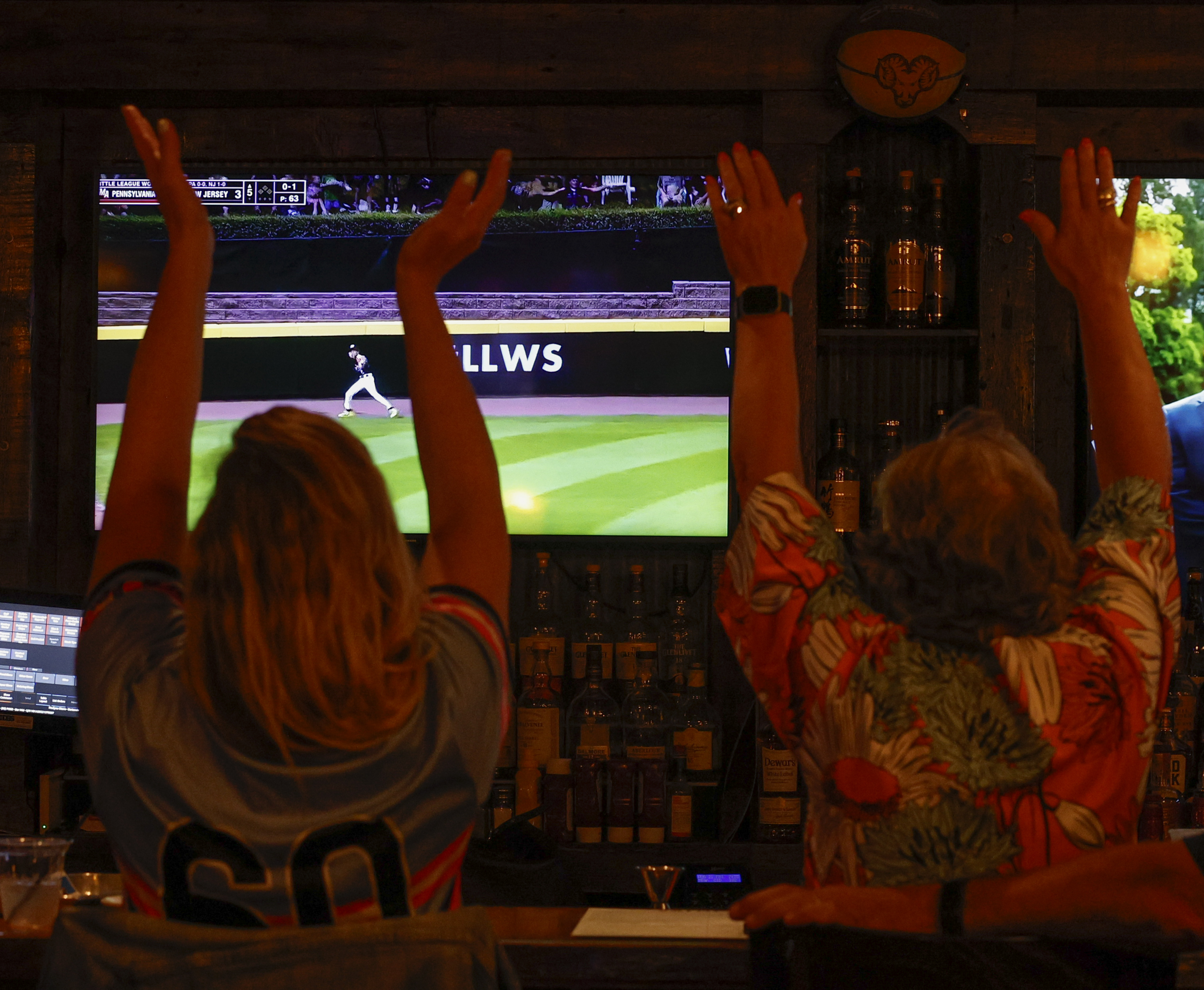
With a recognizable white bow at the back of her baseball cap, Kinley Rasmus continues to make history at the Little League World Series.
Kinley, 12, broke Philly native Mo’Ne Davis’ record for most hits by a girl after hitting five on Tuesday that lifted her team, hailing from Phenix City, Ala., to their second consecutive victory in an elimination game against the Northwest team from Tacoma, Wash.
Kinley hit numbers four and five during their game and was met with cheers and high-fives from the crowd in Williamsport, Pa., and prompted Little League’s social media team to post: “Bow Secured. Take a Bow”
Phenix rallied from a five-run deficit with help from Kinley, who also threw four scoreless innings as pitcher.
The young pitcher and shortstop has baseball in her blood. Her father is former MLB pitcher Cory Rasmus, and she’s the niece of former MLB outfielder Colby Rasmus. Her father is helping coach Phenix City this summer, a legacy team that the Rasmus brothers both played for in the Little League World Series in 1999.
Kinley is one of only two girls playing in the LLWS this year and has been nothing short of unstoppable. She joins the small number of 25 total girls who have ever played in the LLWS, including Philadelphia’s own Davis, who is currently a star player for the Los Angeles Queens of the Women’s Pro Baseball League, which is in its inaugural season.
Davis established her name when she played in the LLWS in 2014 and broke the record for most strikeouts recorded by a girl — 14 — a number that Kinley tied on Monday night after a defeat of the Mid-Atlantic team, represented by West Chester’s East Side team.
Kinley will have the chance to not only break Davis’ strikeout record but her own hitting record in another elimination game, against the Great Lakes on Wednesday night (7 p.m. ESPN).
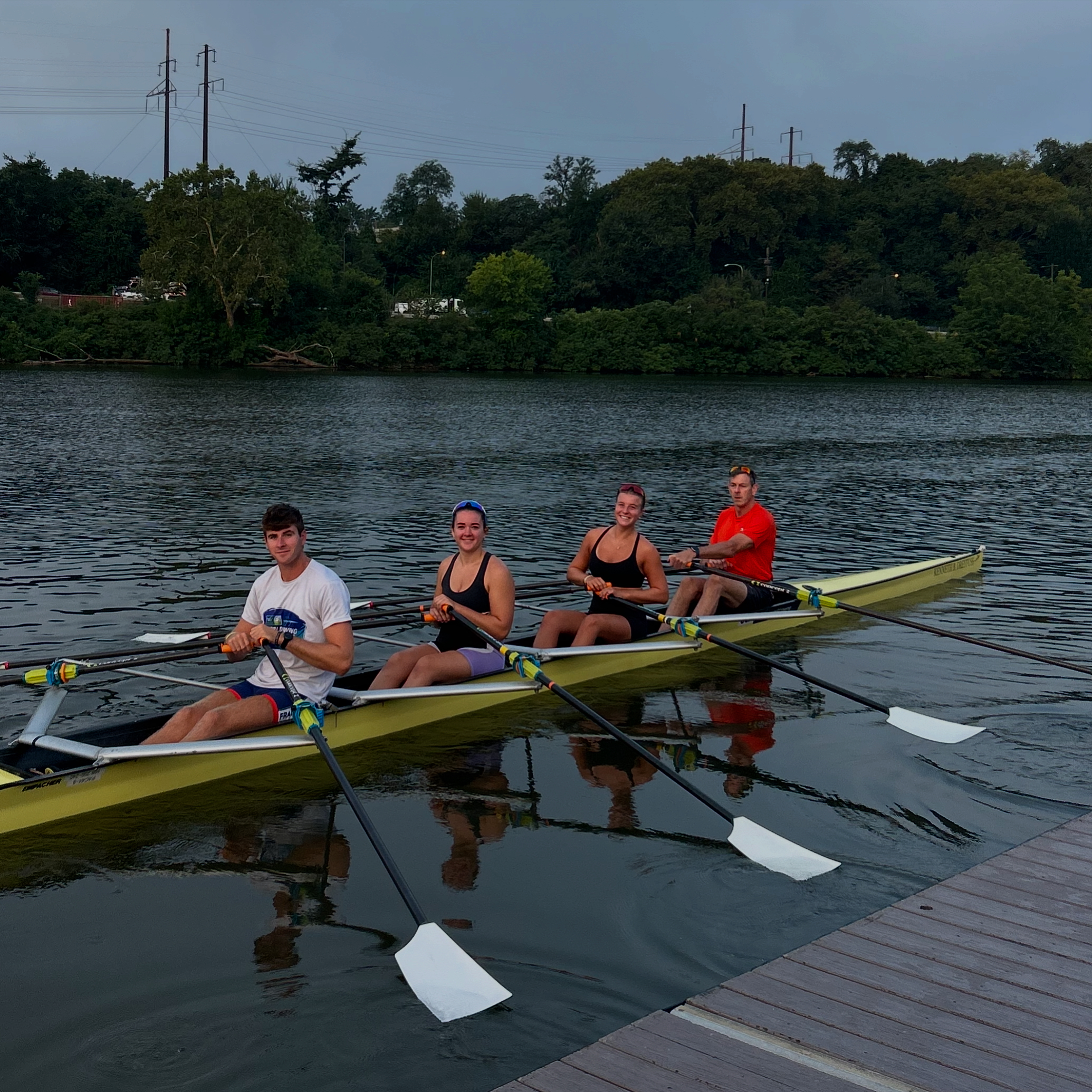
On the other side of the Atlantic Ocean, Ava Smith crossed the finish line in Bulgaria as a proud member of an elite eight-person boat representing the U.S. Under-19 national women’s rowing team.
“Crossing the finish line, it was a feeling of accomplishment,” said Smith, who took up the sport only four years earlier at Mount St. Joseph Academy in Flourtown, Montgomery County. “A sort of relief, in a way, just knowing it’s done. We put it all out there.”
Smith picked up an oar for the first time as a freshman at Mount St. Joseph, but rowing runs in her blood. Her father, Don Smith, competed for the U.S. at the 1996 and 2000 Olympics; her older brother, Luke Smith, rows at Stanford and made the Under-19 national men’s team; and her sister, Addy Smith, now rows at Texas. Even the youngest Smith, Arden, plans to row as she starts her freshman year at Mount St. Joseph.
This summer, that legacy came full circle. After years of sibling-fueled rivalry, Ava earned a spot in the women’s eight as the seven seat and traveled to Plovdiv, Bulgaria, to compete at the World Rowing Under-19 Championships, a spot secured after a whirlwind six weeks that took her from a selection camp in California to the start line across the world. And all of it just days before she leaves for her own next chapter: Rowing at the University of California, Berkeley.
“It was surreal, and I was like, ‘Oh my God, is this even happening?’” Smith said of being selected. “Honestly, before this year, I didn’t think I was ever going to get invited to even try out.”
Humility aside, Smith had an impressive high school career, which included helping Mount St. Joseph women’s varsity eight reach the “A” final twice at the U.S. Rowing Youth National Championships in Sarasota, Fla. She said that solidified her confidence heading into tryouts and college. But for Smith, the journey has always been about the team that helped her, especially in the beginning.
“All the other girls that join the team, they don’t know anything about it either, and you’re all learning together,” she said. “I really enjoyed that, and I feel like me being good at rowing also gave me motivation to see how far I can go, and how much I can improve.”
Though Don Smith never pushed any of his children into rowing, the sport has become a shared family love.
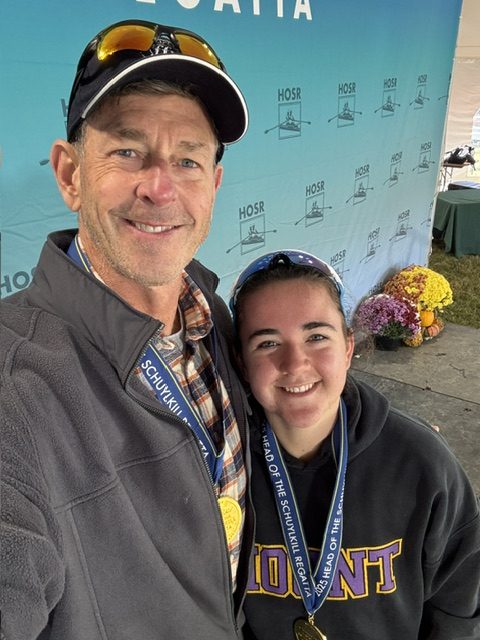
Don Smith with his daughter Ava.Courtesy of Don Smith
“It’s really nice to all do the same thing, get to talk about it,” Ava Smith said. “And with my dad, too, he can give me a lot of advice, especially because he really got to such a high level.”
Don Smith cheered on his daughter in Bulgaria with a few other parents, joking that he still remembers the nerves of a big race. He said he feels them again watching his kids compete.
“At the big ones, I’ll tend to go and I’ll start feeling like I’m out there, and I have to go watch by myself,” Don Smith said with a laugh, before sharing the advice he gives his kids in those moments. “Everybody else is feeling the same thing. … You’ve done all the work. Take this as an opportunity, not something that’s scary, or that you’re afraid of.”
Ava said she’s proud of the work she and her team, a collection of women from around the country, put in.
“Everyone was very nervous, including myself, but we were excited to see what we could do.” she said. “We really trusted one another in the boat, and I think we left with no regrets.”
Now, Smith is headed to Berkeley, shopping for dorm essentials and preparing to meet her roommate in person for the first time as she gets ready to move across the country just days after returning from Bulgaria.
“It’s going to be a little different for me to be toward the bottom,” Ava said. “But getting to compete and try on my way toward the top will be really fun, and I think definitely challenging. But I’m excited for that.”
Last year, Loïs Boisson captured the hearts of her native France and tennis world with a stunning run to the French Open semifinals at Roland Garros.
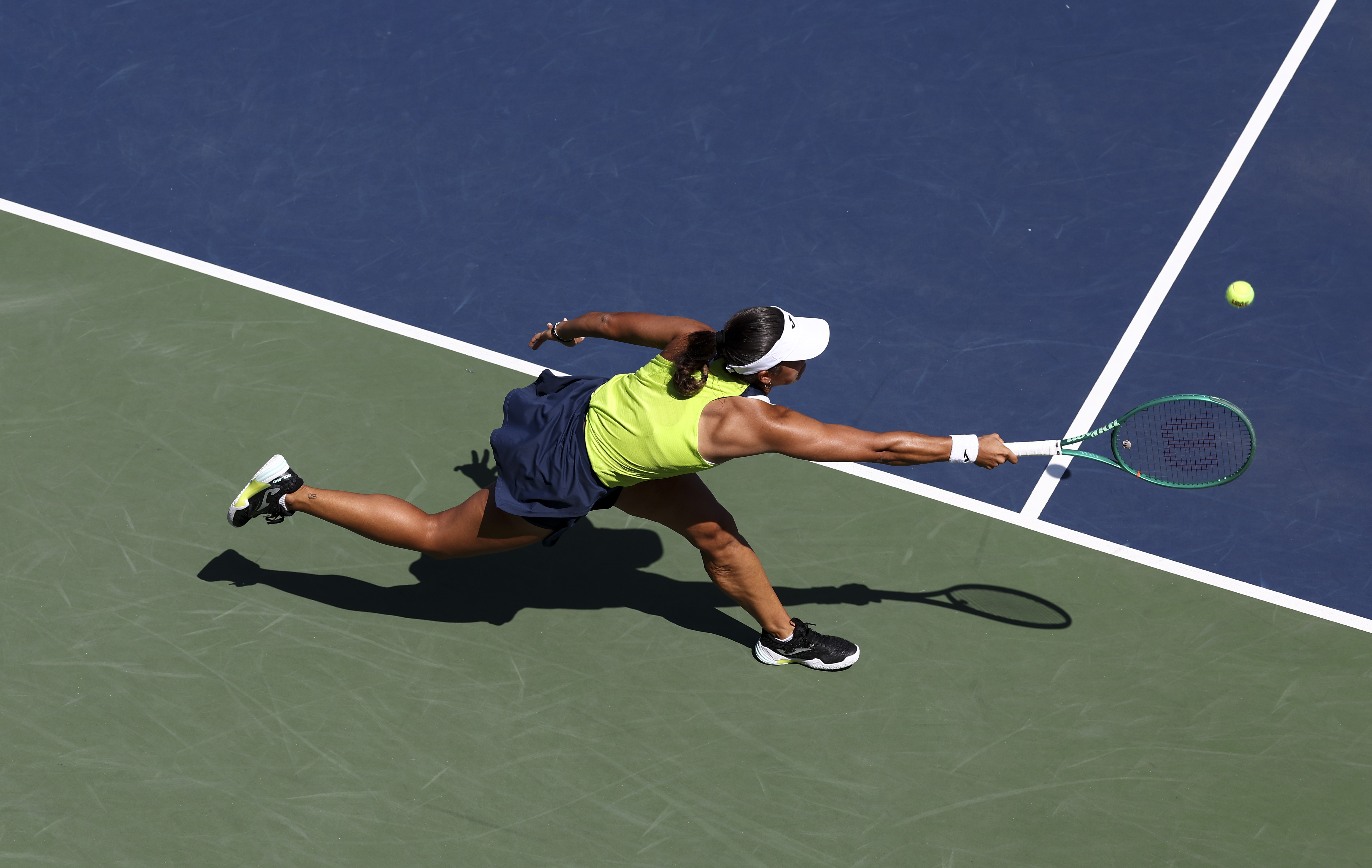
Though she hasn’t reached those heights since, she’s still well-known around the sport. So when her name showed up as a late entry into the Ennoble Care Philly Open tennis tournament this week at Penn, it created some buzz.
It isn’t just another week for tennis players. The U.S. Open starts Monday, so it’s an important time to get ready for the big stage. There are a few events out there to play in, from a women’s tournament in Monterrey, Mexico to the U.S. Open’s flashy mixed doubles showcase. The latter has some of the sport’s biggest stars: Serena Williams and Carlos Alcaraz are playing together, as are Aryna Sabalenka and Novak Djokovic.
The Philly Open is a lower-level event than any of those, at the WTA’s 125 tier compared to the Monterrey event’s 500. Traditionally the players in a 125 tournament aren’t so well-known.
But this one has had an unusually strong field. Spain’s Jessica Bouzas Maneiro made the round of 16 at Wimbledon last year, and has reached the third rounds of the French and U.S. opens in the last two years. Ashlyn Krueger made the Wimbledon round of 16 this year, the 22-year-old’s best finish yet at a major.
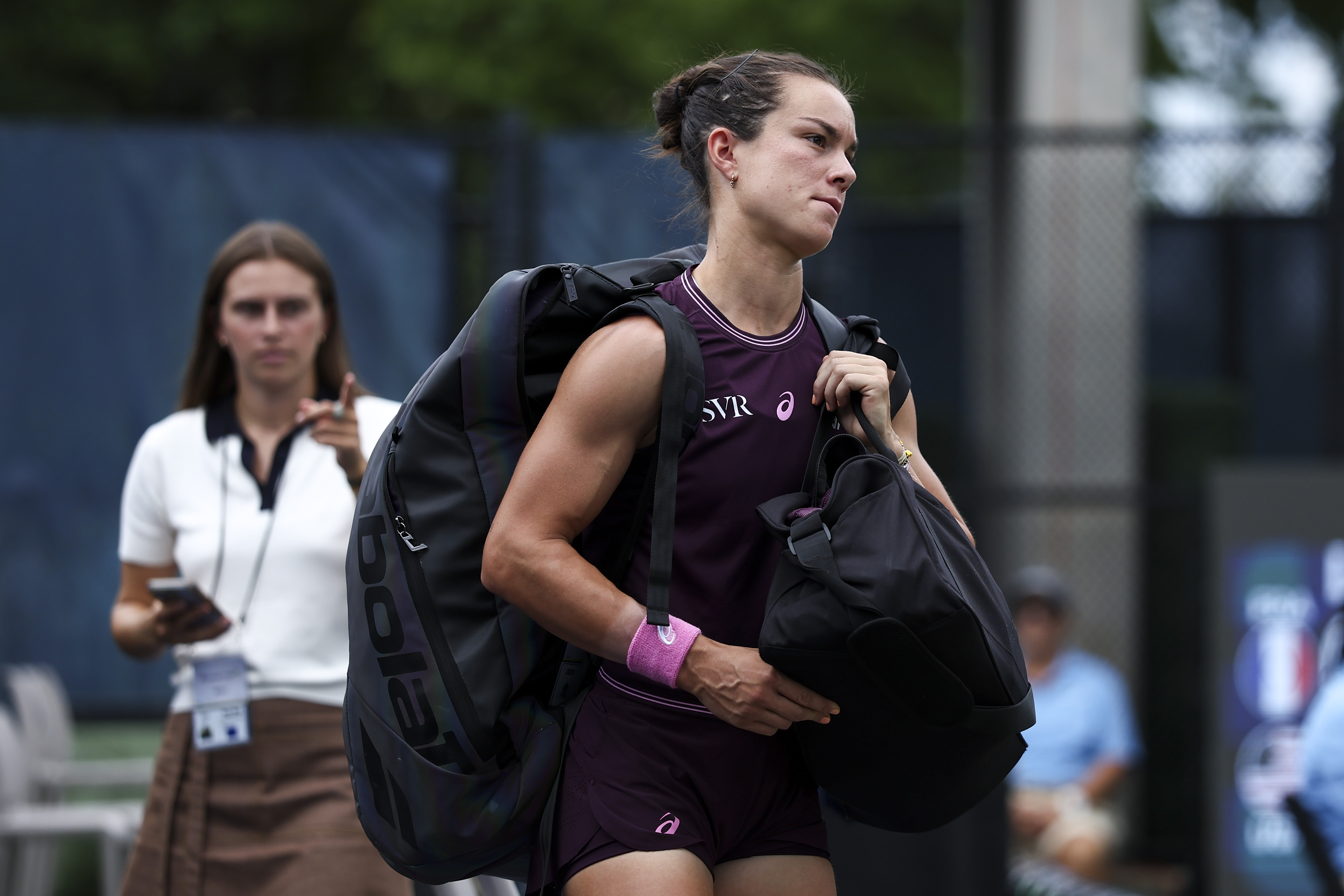
Loïs Boisson was one of the recognizable names in the Philly Open field.Monica Herndon / Staff Photographer
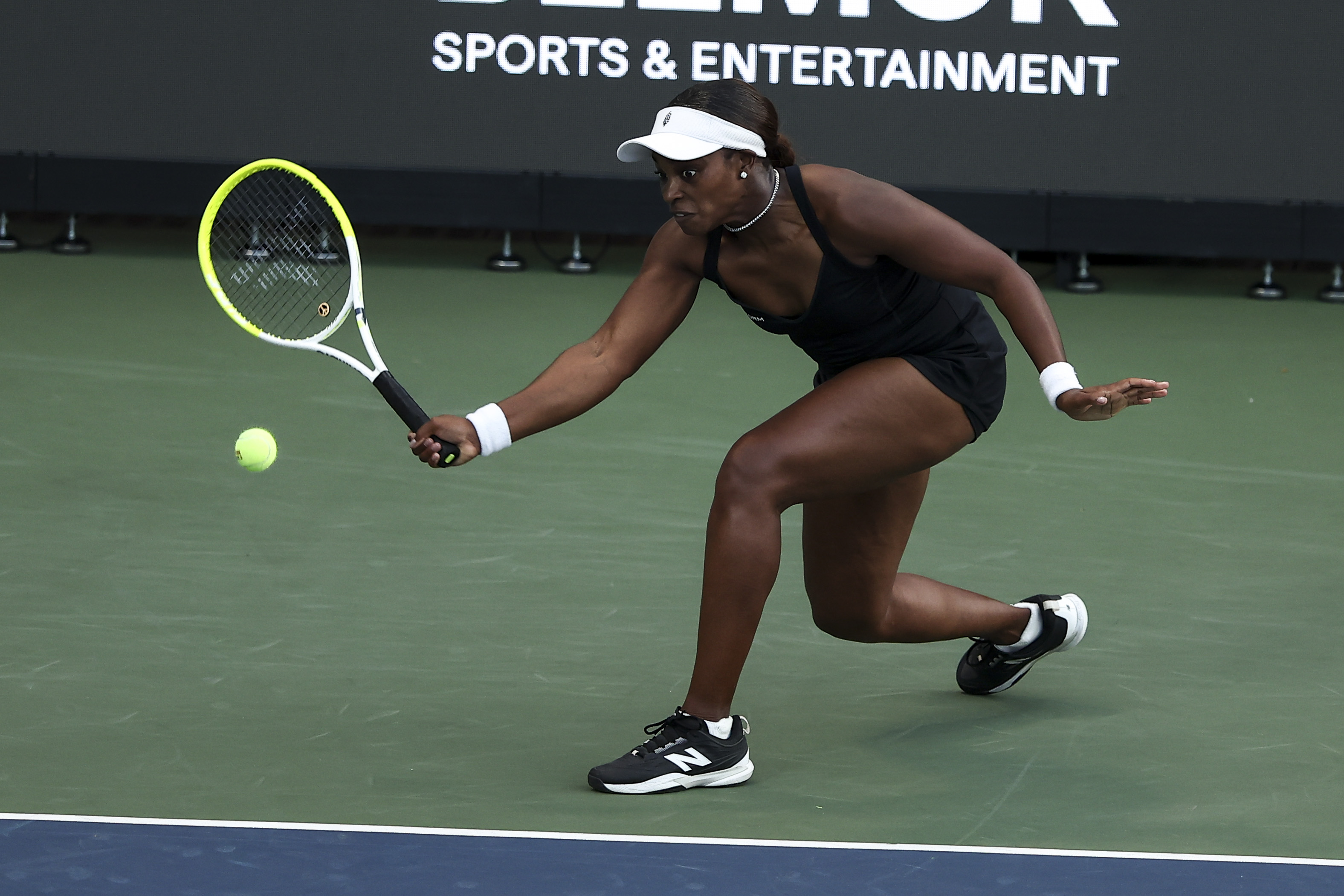
Then there was the headline attraction, 2017 U.S. Open champion Sloane Stephens. She has fallen to No. 240 in the world rankings since suffering a long-term foot injury last year, and arrived in town after making the third round at the high-profile Cincinnati Open.
Unfortunately for local fans, Stephens lost her first-round match, Boisson took a medical retirement after losing the first set of her opener, and Bouzas Maneiro and Krueger lost in the second round.
They still chose to come to town, though, which means they chose to drop down — because that’s what it is for players like these — to a 125. Why do it?
Making the rounds of the tournament over the first few days, one thing came up repeatedly: Philadelphia’s proximity to New York. Spare the “sixth borough” jokes this time, because it’s an asset. Players can spend the week here, then get in a car or train and make a short trip to Manhattan.
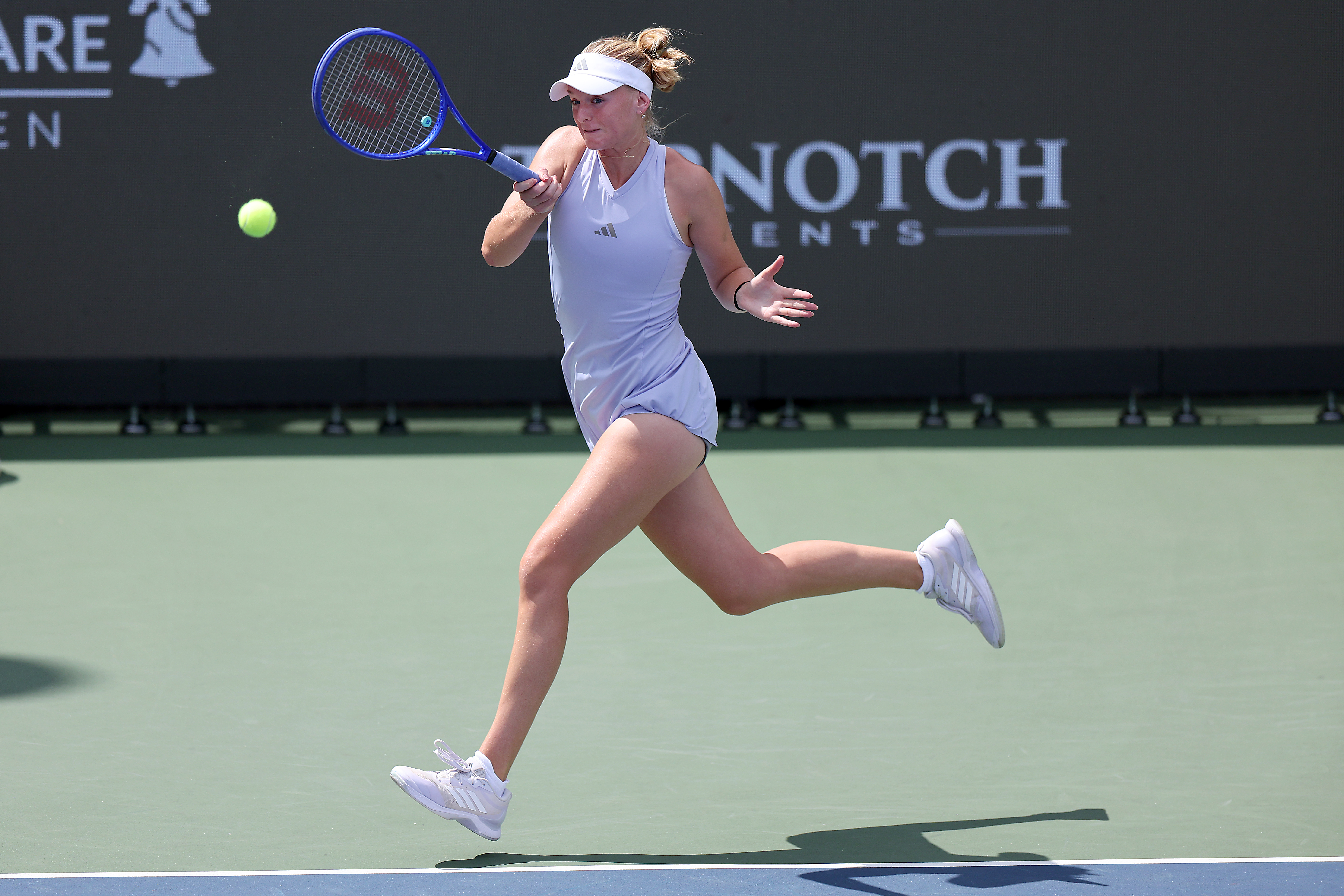
Ashlyn Krueger won her first-round match on the Philly Open’s first day, but lost in the second round.David Maialetti / Staff Photographer
Those in Monterrey, meanwhile, are looking at a four-hour, nonstop flight if they can get it, or a connection through Mexico City or somewhere else.
“Honestly, leading up to the U.S. Open, it was important for me to play in a tournament closer to New York than some others,” Bouzas Maneiro said, “so I decided to play here in Philadelphia to get into a bit of a rhythm.”
The geography angle was an intentional play by the tournament’s organizers, including the Philly Sisters group that helped bring the Unrivaled basketball showcase to town in January.
When the WTA 250 event in Cleveland that had this week for the last five years stopped, the Philly Sisters jumped at the chance to bring something here at the same time. But they already had the attention of Cleveland’s tournament director, Alex Guthrie, who is now the director of the Philly Open.
Some of the crowd that came out to watch Sloane Stephens in the Philly Open’s featured match Monday night.Monica Herndon / Staff Photographer
“We had a lot of discussions going on behind the scenes last year, and we were looking to get into a new market,” he said. “And Philadelphia, obviously being such a big market, but also so close in proximity to New York for the U.S. Open, and then pair that with the amazing facilities here at Penn, it made a lot of sense to explore this even further.”
The sense that Philadelphia could work was also helped by some history on the circuit. There was a WTA stop in New Haven, Conn., from 1998-2018, and a men’s ATP event with it from 2005-10. When the Connecticut operation folded, there was a one-year stop in the Bronx in 2019, then Cleveland took over in 2021 after the world came out of the pandemic.
The Philly Open now has a three-year contract. That gives some runway to potentially scale it up to a 250-level event, which the local organizers would like. But there is a lot of work to do.
“We definitely have to raise a lot more money: The cash prize, the infrastructure requirements,” Guthrie said. “We would have to build an even bigger stadium court, and then add a lot more things like a bigger television production, more stands on the secondary court, etc. So there’s even more requirements at an elevated standard.”
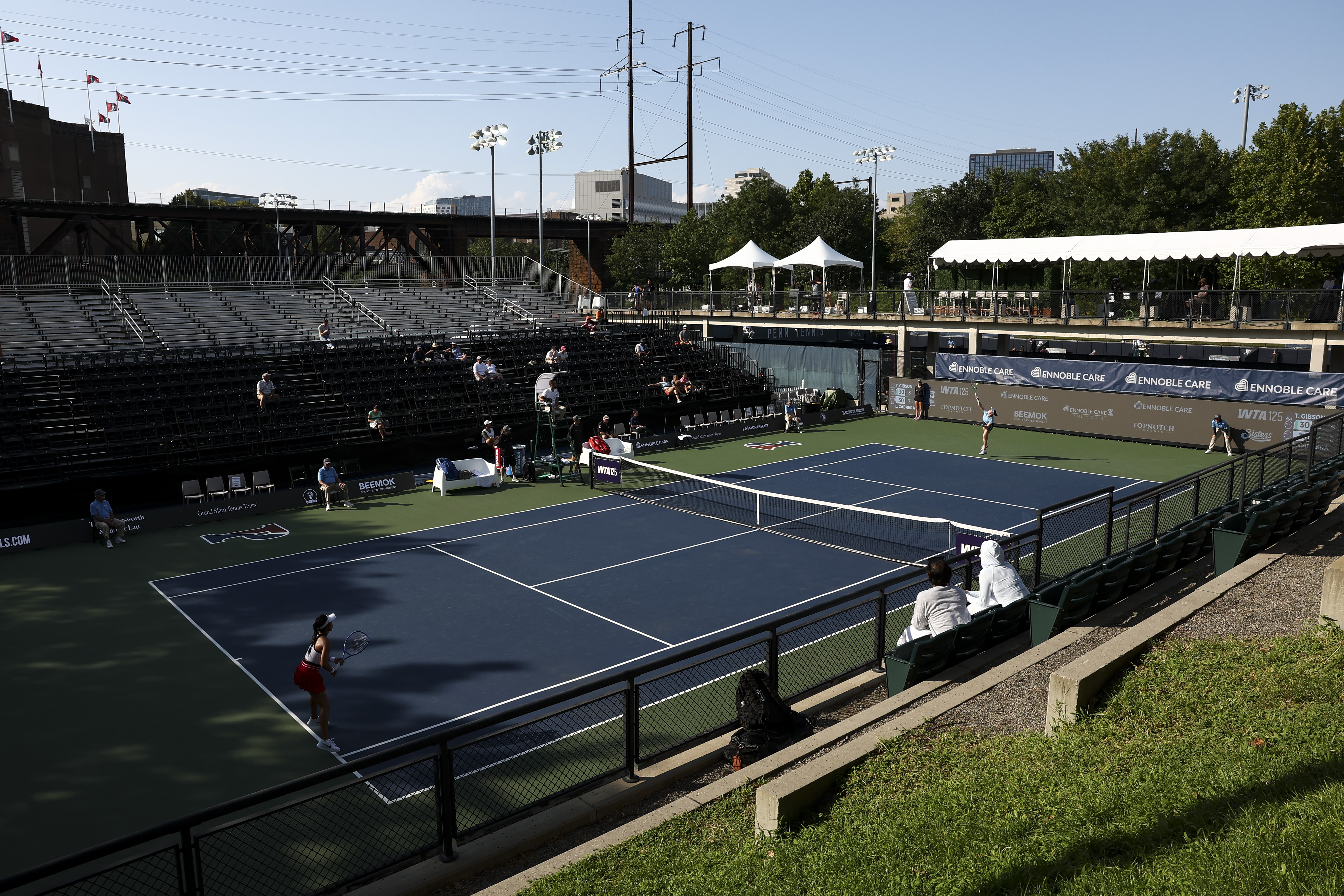
The temporary stands built at Penn’s outdoor facility for the Philly Open’s main court.Monica Herndon / Staff Photographer
The stadium court this week seats around 1,200 spectators, with one big side of temporary stands across from fixed seats at Penn’s Hamlin Outdoor Tennis Center. The second “show court” has another 100 or so fixed seats on one side, but just a few portable bleachers and chairs on the other.
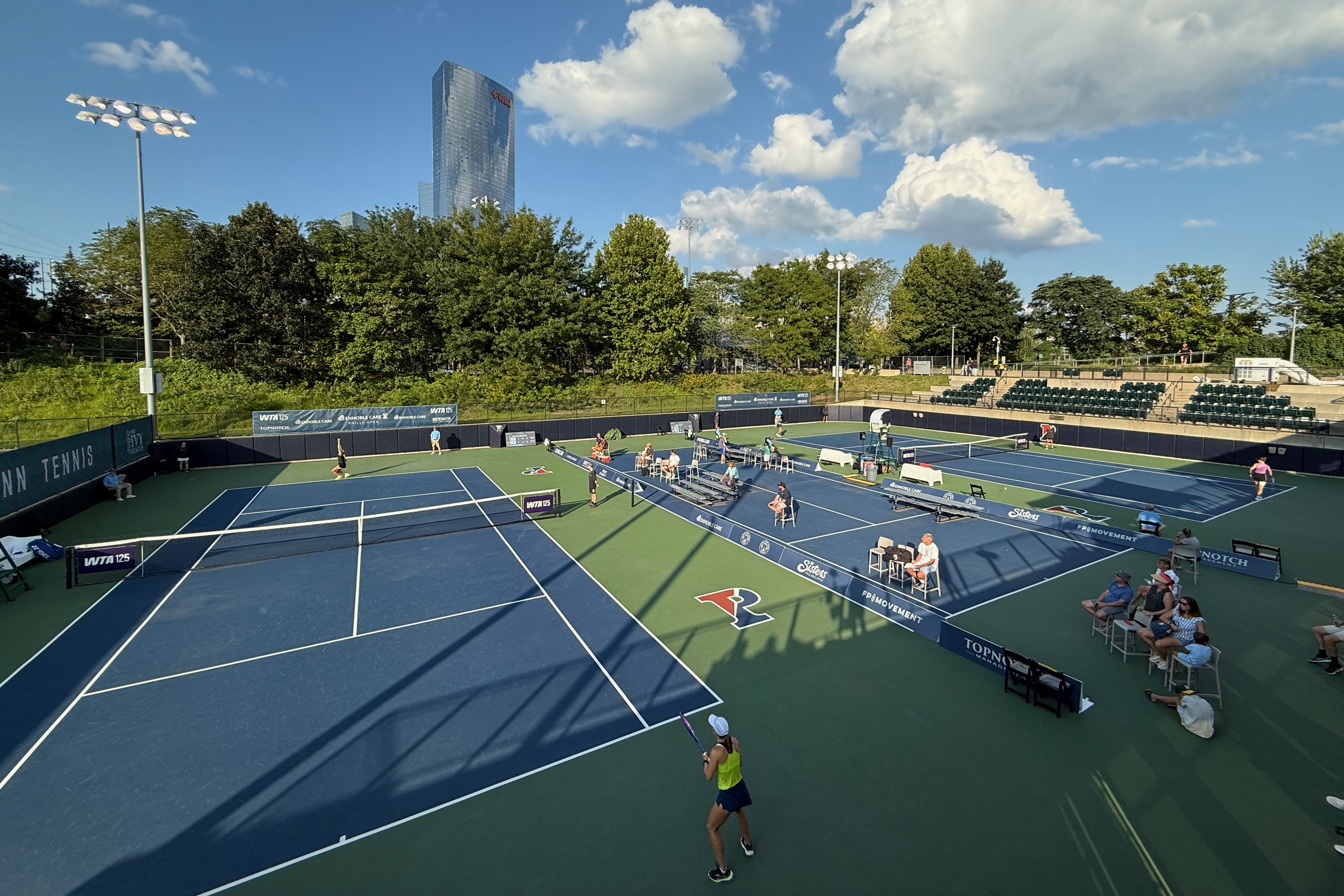
There’s definitely room to expand, since the Hamlin Center has 12 outdoor courts. Just three have been used for competition this week, with seating over three others and the rest serving as practice courts. The nearby indoor facility could be used for practice if more stands are built.
How to raise the prize pot? A boost in corporate sponsorship would help, of course, and the big-city backdrop means officials shouldn’t have to look far.
“It’ll cost more, but I think that’s the goal,” Philly Sisters vice president Ashley Lunkenheimer said. “Then we’ll have more people coming, and we’ll have a more mature opportunity, so people will know about it and say, ‘That’s the tournament I don’t want to miss — this is my chance to see these women up close,’ and in a way [that is] more affordable, and yet still some of them will be at the U.S. Open the following week.”
A view across the outer courts of the Philly Open, with the small amount of seating in the middle and along one side.Jonathan Tannenwald
Guthrie added “The infrastructure here would allow us to one day run a 250 here, if the opportunity became available.”
The decision will be up to the WTA, and it only grants so many sanctions for 250 tournaments each year. Topnotch already owns one for a 250 event in Memphis in late July, so at least it’s familiar to the tour. WTA officials have been in town this week to see the setup in person.
The tour’s top official isn’t one of them, but she needs no introduction to Philadelphia. Valerie Camillo spent five years as one of the highest-ranking figures at Comcast Spectacor, including as president and CEO of Spectacor Sports and Entertainment, and head of business operations for the Flyers and Xfinity Mobile Arena. She became chair of the WTA last November.
The players’ experience matters a lot too, and that seems to have been going well. Bouzas Maneiro said “the facilities here are very good,” praising the gym and practice court facilities in particular. She also has taken some time to enjoy the vibrancy of summer in Center City.
Jessica Bouzas Maneiro in action during her first-round match on Monday.Monica Herndon / Staff Photographer
“I like having lots of coffee shops nearby and places where I can spend some time,” she said. “The hotel’s location is excellent, and it’s close to the venue, too … I think the tournament is very well organized, and I’m getting a really good vibe so far.”
Guthrie called this first edition “an exploratory year for us and for the WTA in many ways,” and said he believes it might be a few years before a 250-level sanction opens up. But he didn’t rule it out either.
“I would venture to bet this will be a 125 next year, but you just never know in tennis,” he said.
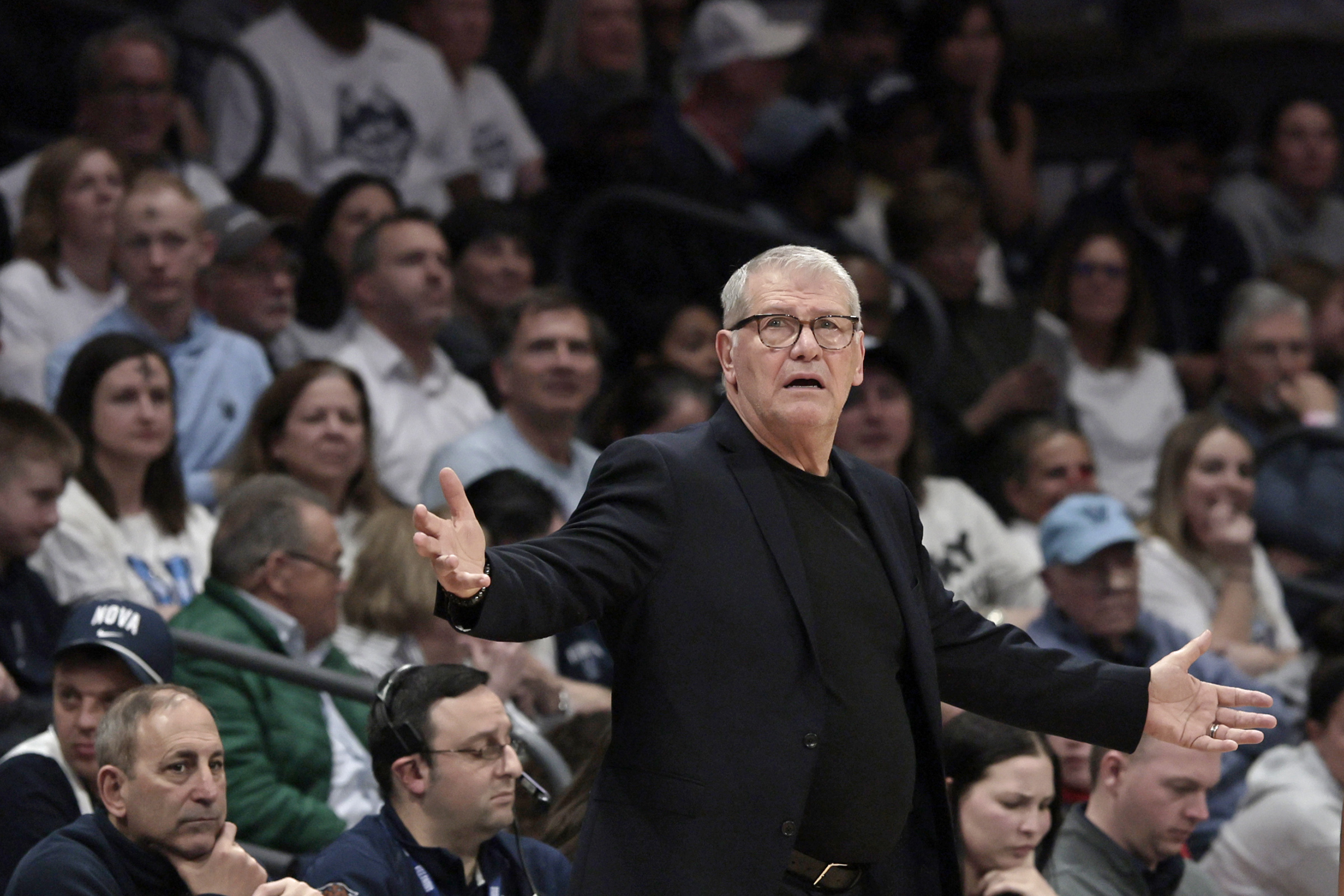
Connecticut women’s basketball in the 21st century has been synonymous with dominance, and the central figure to it all has been Norristown native Geno Auriemma.
The 72-year-old coach, who took his current job ahead of the 1985 season, has spent more than four decades on the sideline and built the Huskies into one of the most dominant and storied programs in college basketball history.
On Aug. 21, a three-episode documentary called The Dynasty: UConn Huskies aired on Apple TV, giving insight into Auriemma’s brash coaching style that has often received criticism but was a driving force to his 12 national titles.
And while it featured many players past and present, from Swin Cash and Sue Bird to Diana Taurasi, Breanna Stewart, and even Paige Bueckers, Auriemma’s Philly roots were another theme of the coach’s historic run in women’s college basketball.
Here were some ways Philly was involved in Auriemma’s journey:
Auriemma’s motivation to coach girls’ basketball
The documentary tells the story of Auriemma and UConn chronologically, but stopped in both the first and second episodes to detail some of his backstory. Auriemma described how he first got involved with women’s basketball.
“When I was in school and playing basketball, coaching women would have been last on my list,” Auriemma says. “But my buddy, he comes up to me one day and he says, ‘Hey, I started coaching girls’ high school basketball. I need an assistant coach.’ I said, ‘Who the hell would coach girls?’”
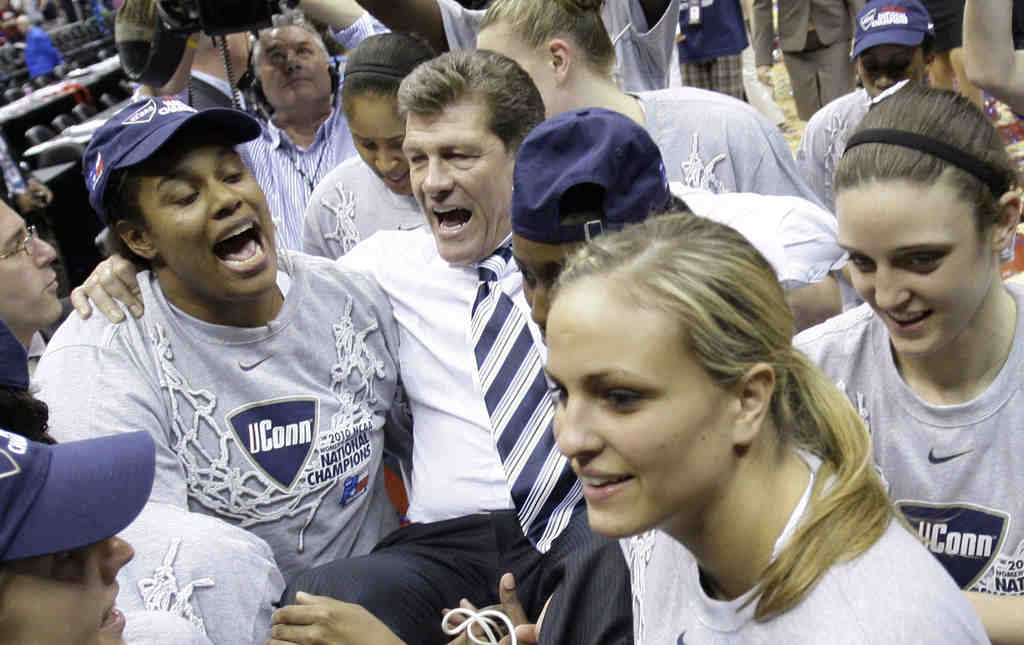
Geno Auriemma is carried off the floor by his players after UConn won the 2010 NCAA championship, defeating Stanford.ERIC GAY, Filoe / Associated Press
Auriemma later obliged, and while he didn’t say it on camera, that start came at Bishop McDevitt High School as the girls’ basketball junior varsity coach and assistant varsity coach. When he went to practice, he noted his own reluctance to provide hard coaching.
“It kind of dawned on me. They’re not going to crack. They’re not fragile,” said Auriemma. “That you can demand a lot from them. … But everything [in my career] just took off from there.”
He later took assistant coaching jobs at St. Joseph’s and Virginia, with Norristown’s Kennedy Kenrick Catholic High School (which closed in 1993) sandwiched in between. Auriemma took the UConn job in 1985 and has been there since.
Auriemma discussed his family moving from Montella, a small village in southern Italy, to Norristown when he was 7 years old. He recalled that his “mother can’t read or write, my father barely went to school,” and cited the challenges of not being able to “speak any English.”
The differences in the clothes he wore and food he ate, compared to other kids, Auriemma said, made him “desperately wanting to be like an American kid.” It ultimately informed his approach as a coach.
“As I got older, I always felt like, ‘I’m not that guy.’ … You get reminded, but there was this part of me where if I can be really, really, really good and be better than you, then I can, I can prove that I belong in your group,” said Auriemma. “It’s just a little kid’s mentality, and unfortunately, it stayed with me 40 years into coaching that I have to prove that I’m better than anybody else at doing what I do, but I need to be better than you.”
UConn-Tennessee rivalry
Auriemma’s breakthrough as a coach was beating Pat Summitt and her Tennessee squad in the national championship game in 1995. But afterward, Summitt won three national titles in a row and reclaimed the Lady Vols’ status as women’s basketball’s elite program.
That all changed in the 2000 NCAA Tournament championship game, though. After a disappointing Sweet 16 loss with their hyped freshman recruiting class that included Bird, Cash, Asjha Jones, and Tamika Williams, UConn came roaring back and was set to face Tennessee in Philadelphia at the First Union Center (now called Xfinity Mobile Arena).
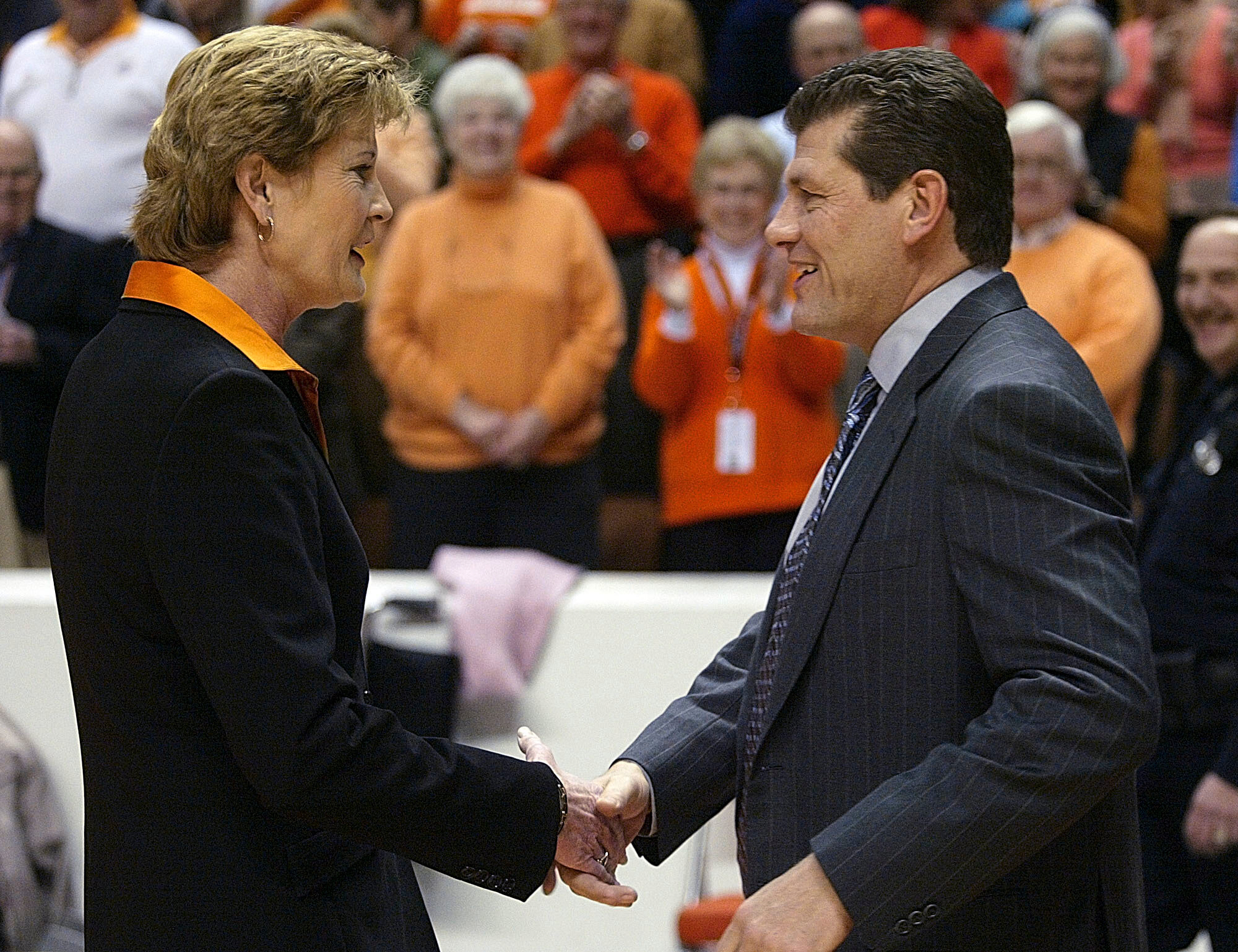
Tennessee coach Pat Summitt (left) shakes hands with Connecticut coach Geno Auriemma before a 2006 game.Wade Payne
Auriemma also further ignited his rivalry with Summitt with some of his pregame comments about cheesesteaks.
“Geno was doing an interview about cheesesteak, obviously Geno’s, and one is Pat’s across the street in Philly, and he made a comparison. Geno’s was new and forthcoming. Pat’s was old and dilapidated,” recalled Mickie DeMoss, a longtime assistant under Summit at Tennessee. “I mean, at that point we had won six, and he’d won one. So I’m not sure where he got Pat was old and dilapidated.”
The interaction underscored the heated and competitive relationship between Summit and Auriemma, and the rivalry that had been brewing for five years. Auriemma wanted to ensure his team came out on top in his hometown that season.
“Lots of people are great. But that night in Philly, I wanted to make sure that everybody knew we’re the best in the country. I mean, everyone,” said Auriemma. “They’re all people I grew up with. They’re all kids I grew up with. So being surrounded by all that and family, yeah, the desire to win, I want that so bad. I’ll do anything to get it.”
And he did, emphatically. UConn rolled Tennessee, 71-52, for Auriemma’s second title and what set off a dominant 17-year stretch in which the Huskies won 10 national titles before Philly’s Dawn Staley and South Carolina took center stage in the current era of women’s college basketball.
Auriemma’s latest title in 2025 was featured to close the documentary, with Bueckers’ difficult journey and rocky relationship with the longtime coach culminating in a win over Staley’s South Carolina.
This season, which will be the 41st for Auriemma, UConn will face Staley’s Gamecocks on Nov. 24 at Mohegan Sun Arena, home of the Connecticut Sun, for the first time since Auriemma’s outburst in the final seconds of their Final Four matchup last season. The game is part of a doubleheader for the Hall of Fame Women’s Showcase. St. John’s will face UCLA in the other game.
SEATTLE — Two years ago, when the Phillies last played here, Trea Turner heard that Ichiro Suzuki was at the games but never got to meet him.
Turner wasn’t going to miss another chance.
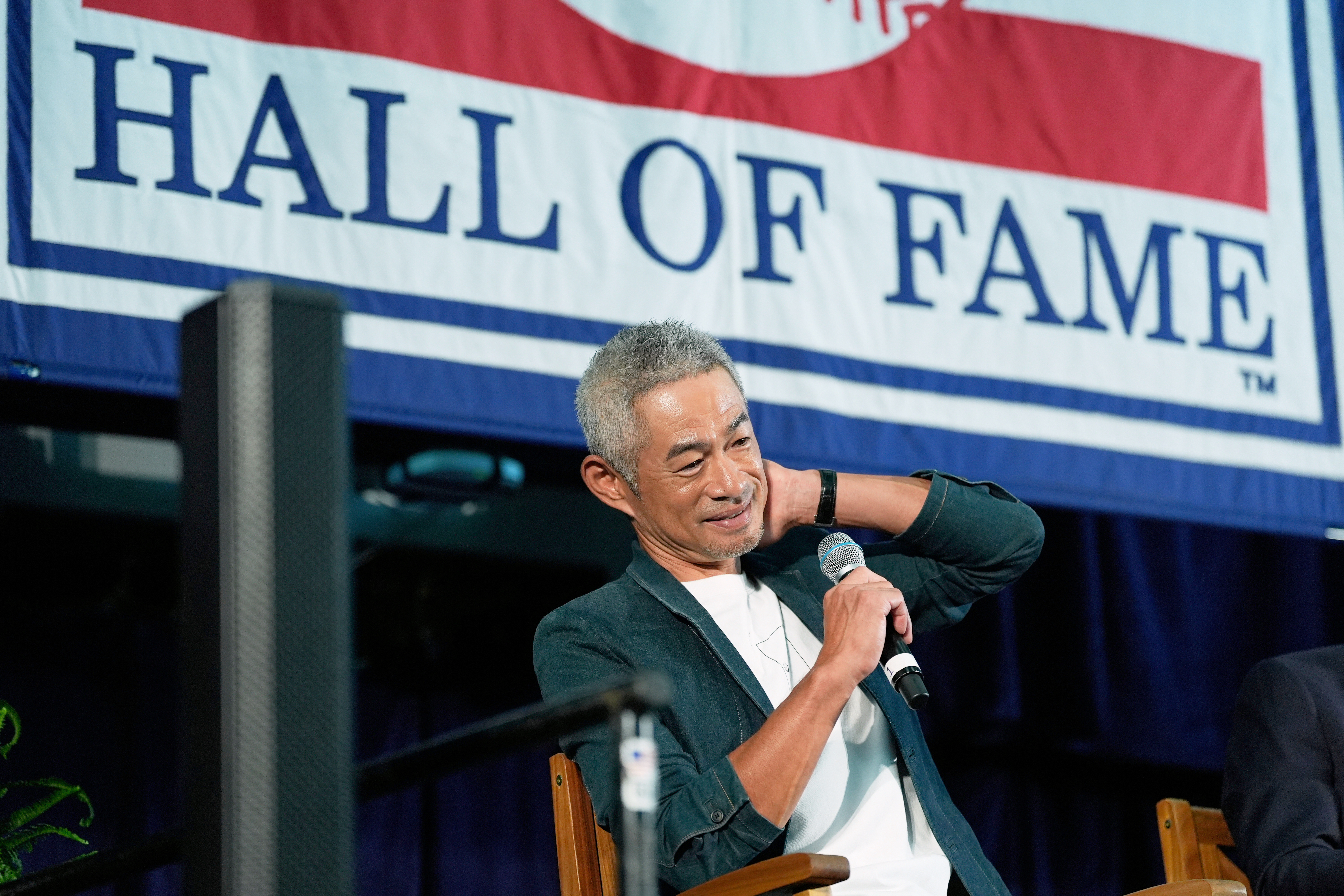
Before Tuesday night’s game, a 4-1 Phillies loss, Turner chatted with Suzuki, the Mariners legend and Hall of Fame hitting machine with 3,089 major-league knocks after coming over from Japan and a statue outside the home-plate entrance to T-Mobile Park.
“What are your thoughts, your approaches in certain situations?”
“If you’re doing this wrong, what would you do?”
“Just all sorts of stuff,” Turner said. “It was just great being able to pick his brain. I really enjoyed it.”
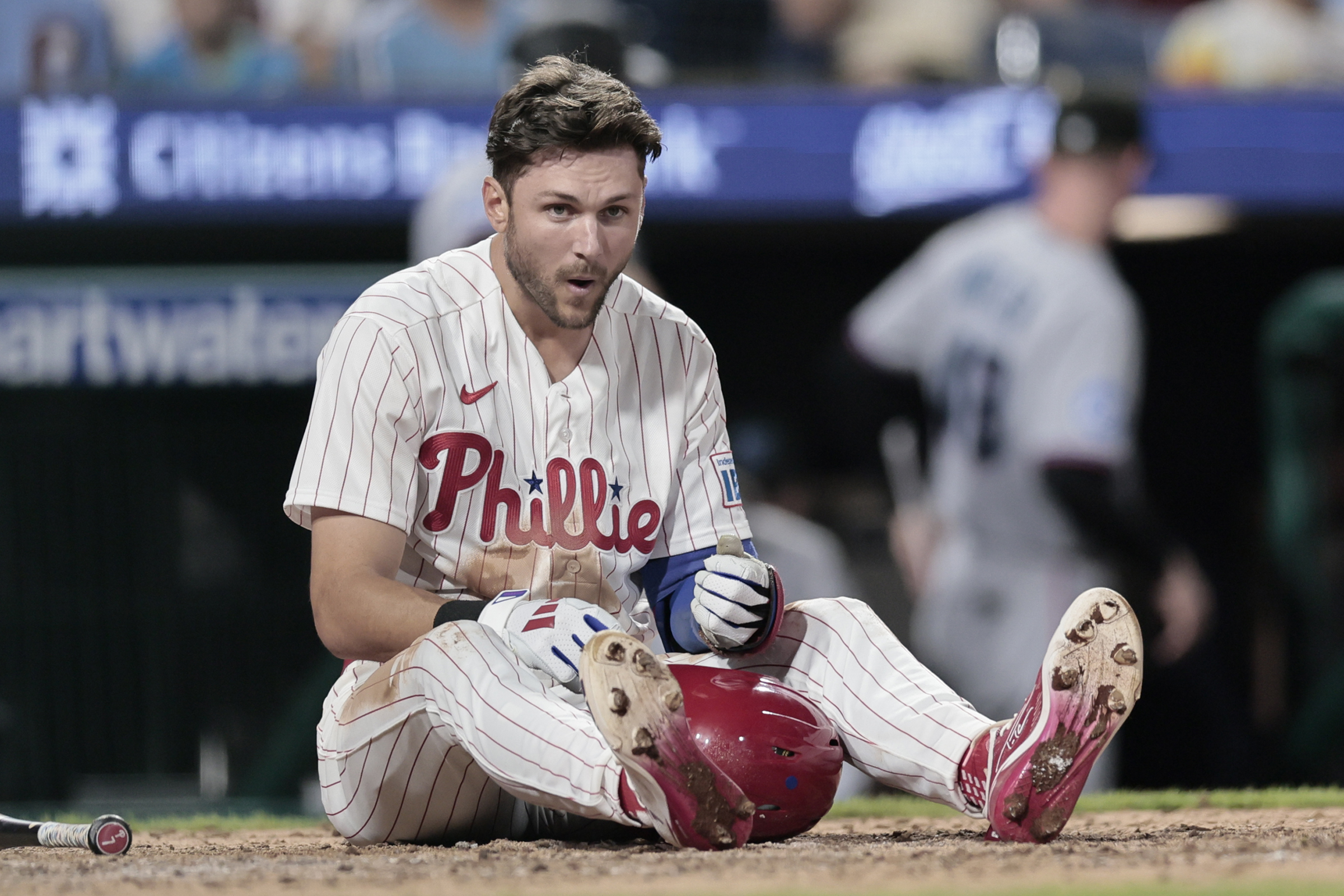
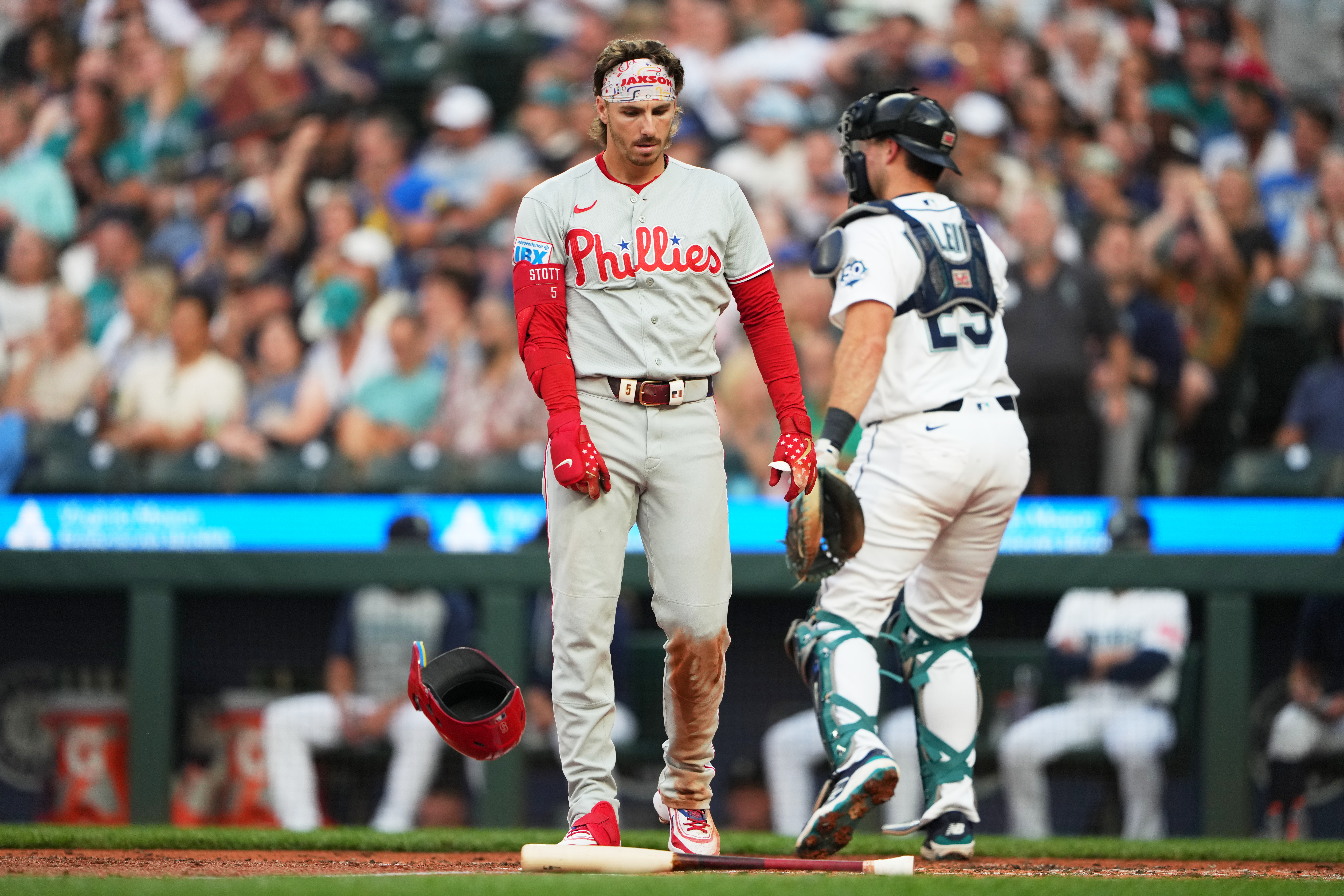
Coincidentally, Turner’s chat with one of the most gifted hitters on two continents came at a time when he’s hitless in 13 at-bats, part of a 4-for-25 tailspin entering Wednesday’s series finale.
Mariners legend Ichiro Suzuki was inducted into the National Baseball Hall of Fame last year.Seth Wenig
The root of the problem: “I’ve been trying to hit the ball the other way [to right field] and stopflying open.” After working with hitting coach Kevin Long, Turner said he made an adjustment Tuesday night that, despite going 0-for-4 again, represented “progress.”
And no, Don Mattingly isn’t considering moving Turner down in the order. Doing so would project “panic,” the interim manager said.
“You’ve just got to hang in with guys over the course of a season,” Mattingly said. “And if there’s a point where it’s like, OK, this has got to go, then you get there. … I think we all know that Trea’s going to come out of this. And when he does, it’ll be hot.”
Turner went 0-for-4 Tuesday night but lined out in his final at-bat.
“I didn’t get the results I wanted,” Turner said. “But I feel like today was good.”
Turner grew up in South Florida as a fan of Derek Jeter and Ken Griffey Jr. He didn’t watch Ichiro as often — “Maybe it’s more of like a West Coast-East Coast type deal,” he said — but noted that he’s been told there are similarities in their hitting styles.
“In the sense that he didn’t walk a lot, he wanted to hit, he hit the ball all over the field, could hit it out of the park sometimes,” Turner said. “So, talking with him about his mindset and what he physically does, a lot of it kind of applied to me in my game. It was kind of nice just hearing him, trying to ask him as many questions as possible.
“Growing up watching him, I maybe probably didn’t appreciate him as much as I should have as a kid. I loved Griffey and Jeter. But his career is incredible. I knew he was a really good player, but I wish I got a chance to watch him a little bit more.”
Turner isn’t the only Phillies player to meet Ichiro this week. Rookie center fielder Justin Crawford was introduced to him Monday by his cousin, Mariners infielder J.P. Crawford.
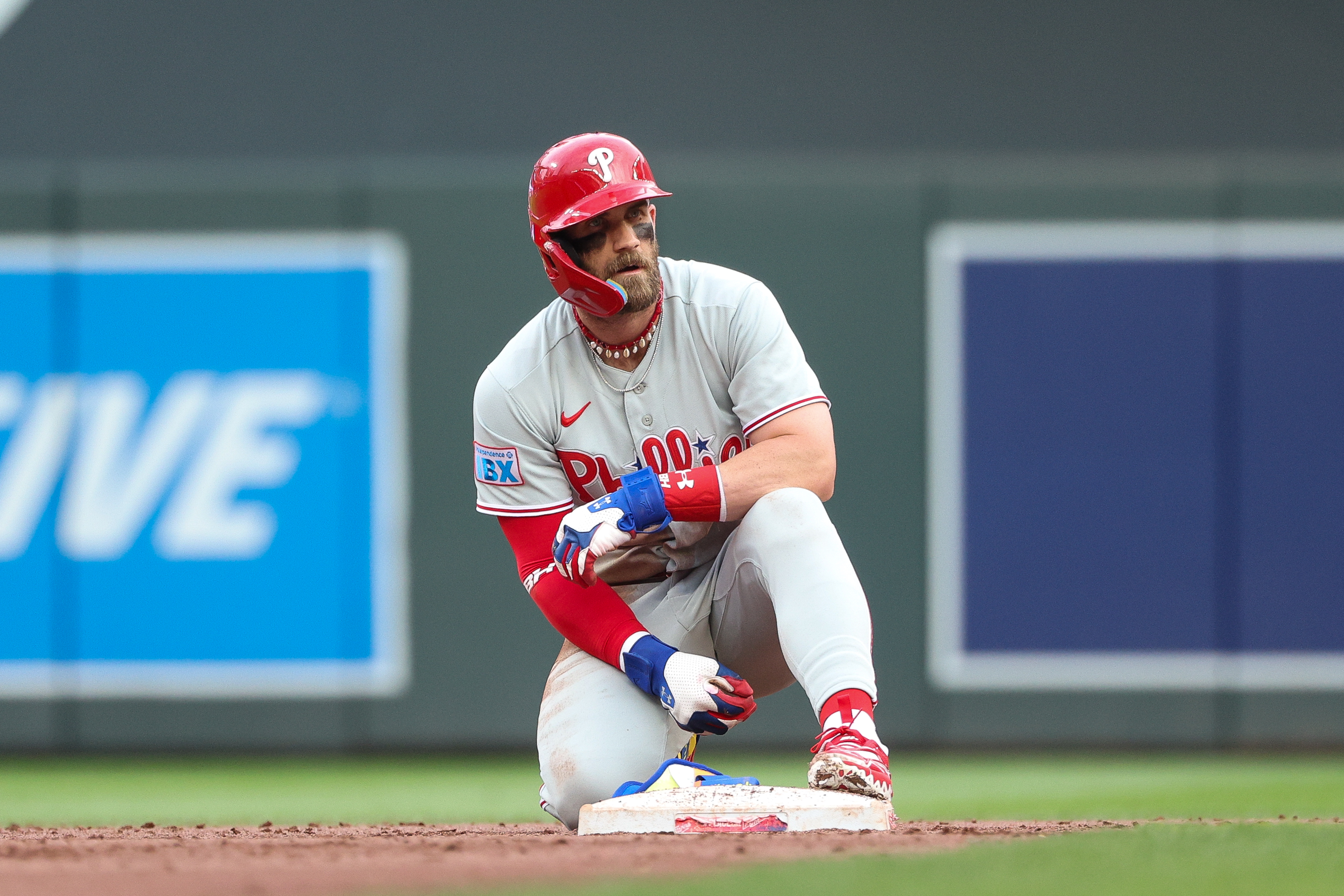
Bryce Harper has reached base in 28 consecutive games, a career-best streak.Matt Krohn
Extra bases
Bryce Harper went 2-for-4 Tuesday and extended his career-long on-base streak to 28 games, tying the Cubs’ Pete Crow-Armstrong for the fourth-longest in the majors this season. … J.P. Crawford returned to the Mariners’ lineup after missing 18 games with an inflamed left wrist. The Phillies’ first-round pick in 2013 was traded to Seattle after the 2018 season for infielder Jean Segura. … Jesús Luzardo (11-5, 3.35 ERA) is scheduled to start the matinee series finale Wednesday against Mariners righty Bryan Woo (9-8, 4.10).
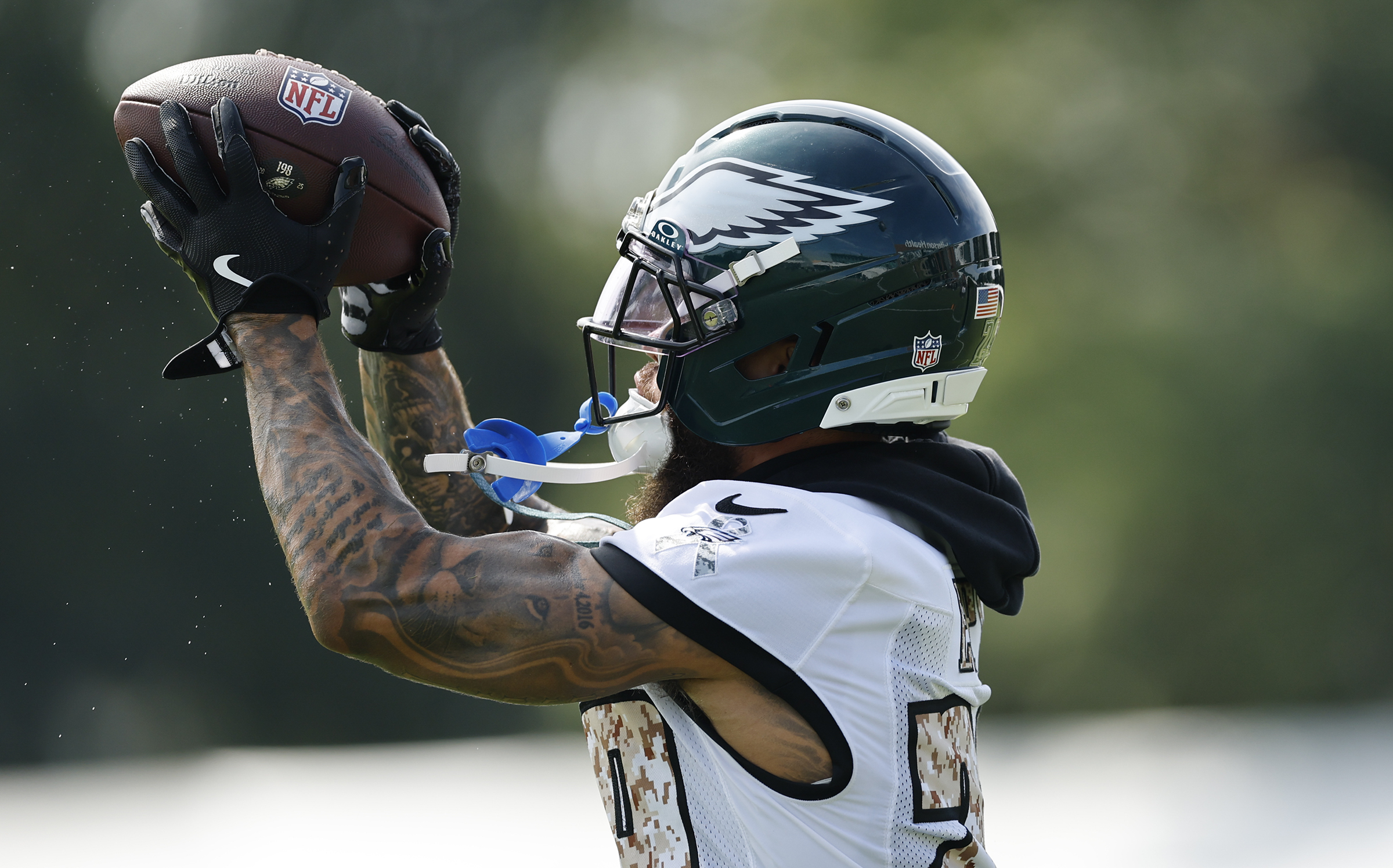
Last year at this time — one year ago Wednesday, to be exact — Marcus Epps was staring a sort of career mortality in the face.
That’s life in the NFL for a 29-year-old safety who works his way back from ACL surgery and signs a one-year contract only to be cut at the end of training camp. The New England Patriots didn’t have a spot for him. They had a Super Bowl-contending roster, to be sure, but Epps was only two years removed from parlaying his starting safety job on an Eagles team that went to the Super Bowl into a two-year, $12 million deal with the Las Vegas Raiders.
Working his way back from the ACL tear that ended his 2024 season — his second year with the Raiders — in Week 3 presented Epps with “dark days” that challenged him physically and mentally. He relied on his loved ones and trained at the gym he owns in Costa Mesa, Calif., unsure what his future held.
The Eagles, who initially claimed Epps in November of 2019 after Minnesota waived Epps just months after selecting him in the sixth round, offered Epps a second chance for the second time. They signed him to their practice squad two days after the Patriots cut him, needing to add some reinforcements at a position that lacked quality depth. He later was called on to start down the stretch after rookie Andrew Mukuba suffered a season-ending injury.
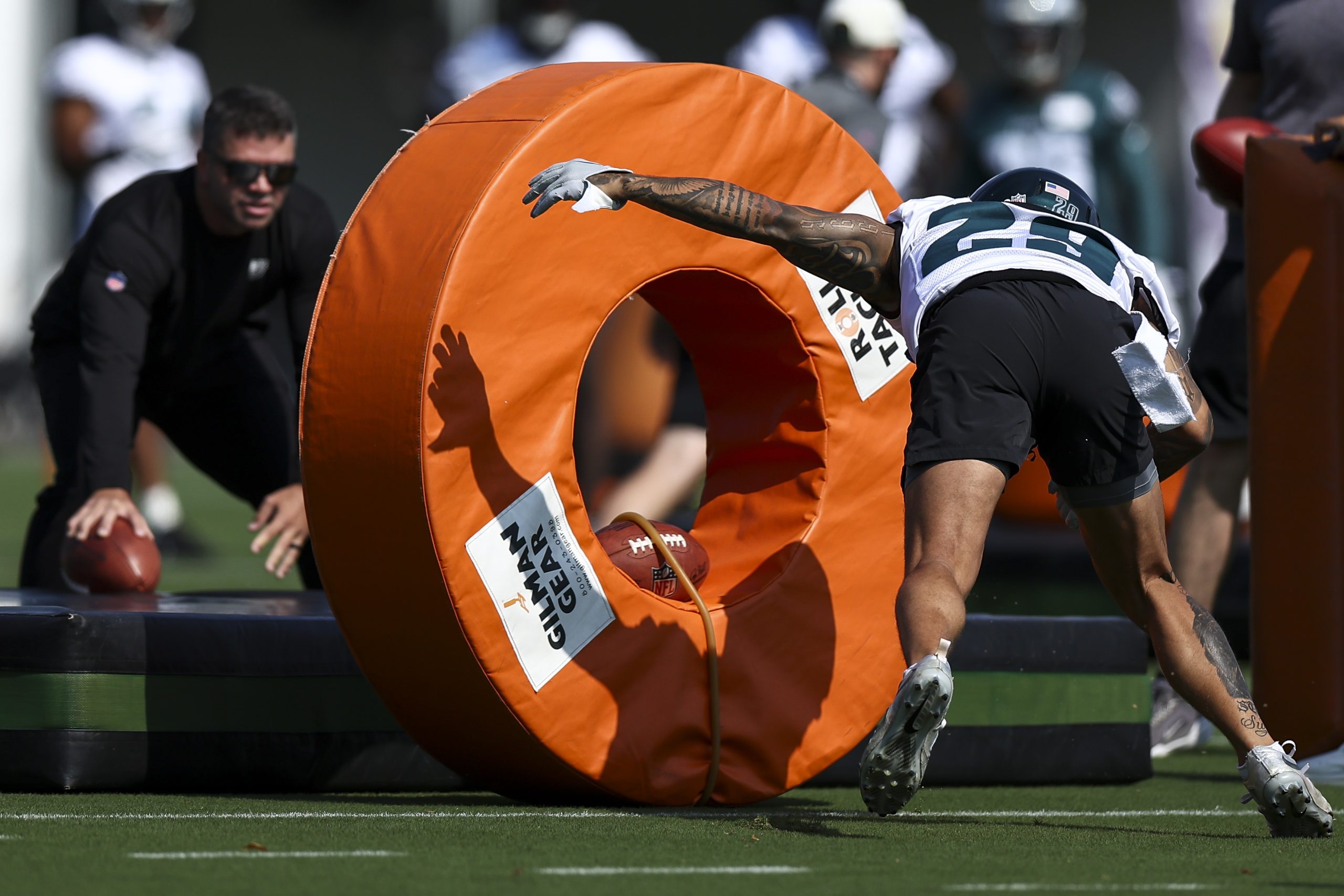
The Eagles brought Epps back on a one-year deal and put him in a competition with a converted nickel corner, Michael Carter II, for the safety spot next to Mukuba whenever the Eagles are in nickel or dime packages (All-Pro nickel Cooper DeJean will play safety in the base package). Epps hasn’t yet been named the winner of that competition, but all signs point to him getting the nod come Sept. 13 when the Eagles open their season at home vs. the Washington Commanders.
“It feels good to just be back healthy, have a clear mind, kind of be out of that dark place that I was in,” Epps said Monday. “I’m just grateful. I don’t take any day for granted, and I’m truly blessed to be here, right where I want to be. I’m just trying to keep my head down and grinding every day.”
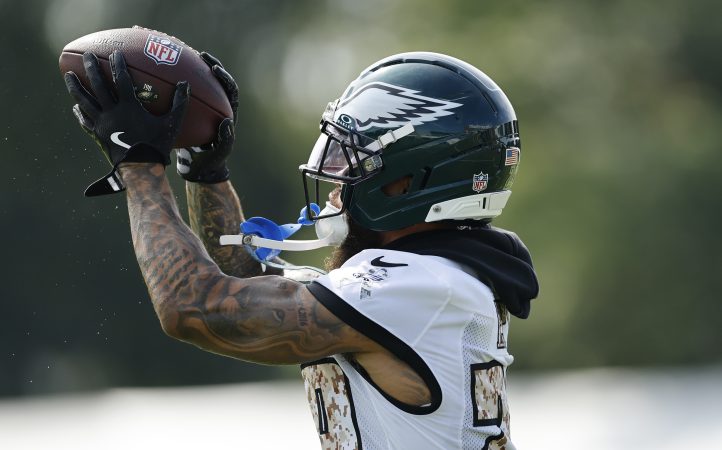
Safety Marcus Epps works out during training camp last month.Monica Herndon / Staff Photographer
Being a starter again would “mean everything” to Epps.
“I worked real hard to get back to where I’m at, man, and there were a lot of dark days,” he said. “But I still got work to do. I haven’t arrived by any means. It’s a long season, and we’re still here just in camp. That’s where my focus is, on camp, finishing out camp the right way and just continuing to get better.”
Safety remains the thinnest position on the roster as far as NFL talent and experience goes. Besides Mukuba, who has 11 games under his belt, Epps, and Carter, who hasn’t played the position, the rest of the team’s safeties have combined for three defensive snaps in the NFL, all from Andre Sam, who has been a mainstay on the practice squad the past few seasons.
It’s possible Howie Roseman makes a move to acquire a starting-caliber safety that bumps Epps down the depth chart between now and the start of the season. It’s possible, too, that the Eagles decide to only keep three safeties — Carter, Epps, and Mukuba — on the initial 53-man roster due Sunday night. With DeJean logging at least a chunk of snaps, they may decide they don’t need to roster more than three.
That stuff is out of Epps’ control. He has taken the vast majority of the first-team reps, though Carter has been sprinkled in at times throughout camp.
“I feel good both physically and mentally, just trying to stay grounded and keep my head down and keep on working,” Epps said. “I still got a lot of things I got to work on and clean up, so that’s where my focus is, to continue to get better.”
With Reed Blankenship gone, pre-snap communication from the back line to the rest of the defense will be a shared responsibility between Mukuba and DeJean in base, and Mukuba and Epps, assuming he’s the starter, in the sub packages. That comes naturally, Epps said, and he’s watched the 23-year-old Mukuba make strides, too, both in his communicating and overall play at safety this summer.
At 30, Epps is among the oldest defensive players in the locker room. Only cornerback Jonathan Jones, 32, is older. It’s a different gig than when Epps was first with the Eagles seven years ago.
“It’s cool being the older guy, being able to be somebody that the younger guys can lean on, continue to pass down knowledge and pass down game to these guys,” Epps said. “It’s an important role in every locker room and I don’t take it for granted.”
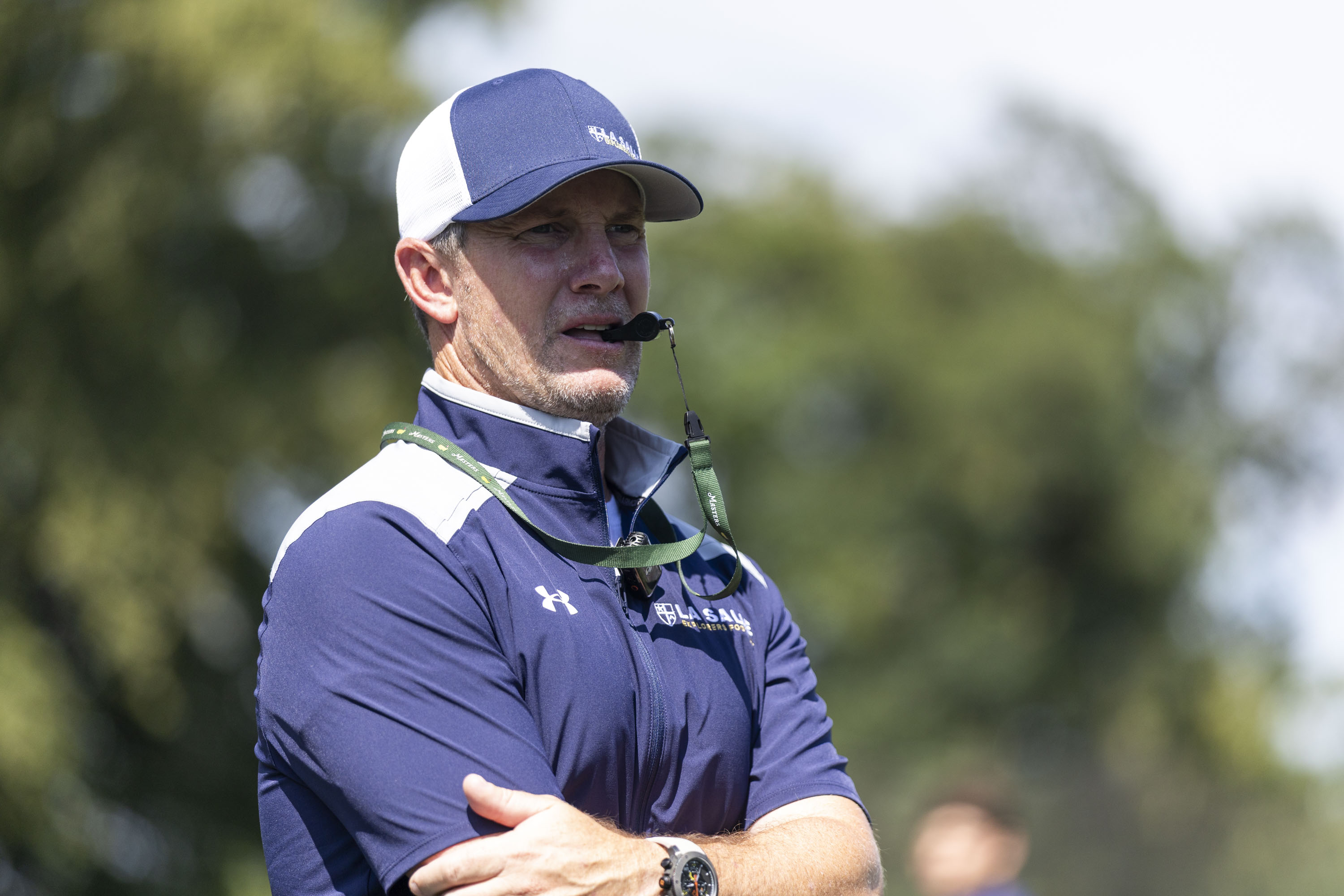
Running a Catholic League football powerhouse is day and night, says La Salle College High School coach Brett Gordon, and nowadays, it’s become even more challenging.
Gordon, who is entering his third season, values preparation and the philosophical approach that no individual is bigger than the team. Those were the lessons he learned from watching his father, Drew, a famed football coach who died on Sept. 4, 2023.
“I often find myself thinking back when I have decisions to make, saying, ‘What would either my dad have done here or what would he tell me to do in this situation?’” Gordon said.
It’s a different world than it was 20 years ago, when Brett came back to La Salle, his alma mater, as an offensive coordinator on his father’s staff.
There’s another layer to being a coach at a school that’s considered to have one of the best football programs in Pennsylvania, and coming off Catholic League and PIAA Class 6A titles in 2025. College coaches are calling to recruit, several players want to be the next stars, and the outside attention can weigh on the players.
But then Gordon is reminded of the things that haven’t changed since he starred here as quarterback in the mid-’90s. It’s those players who show up to every game, and it’s why they wear “protect the brand” on the back of their practice shirts.
“I tell our players how lucky they are to be part of not just La Salle’s football program, but the La Salle community,” Gordon said. “The La Salle environment, both on gamedays, the following and support we feel here from our alumni base, the student body, so many people that pay so much attention to the success of our school. That was on full display the last couple years since I’ve been back involved as a coach.”
Gordon is aware that this year’s Explorers aren’t going to look like last year’s 13-1 state championship squad, which featured a star-studded senior class including Joey O’Brien (Notre Dame), Gavin Sidwar (Missouri), Grayson McKeogh (Notre Dame), John-Patrick Oates (Virginia Tech), and Desmond Ortiz (Brown), among others.
With at least seven seniors starting, there’s going to be a mix of sophomores and juniors getting more opportunities on the field this season, which officially kicks off against Paramus (N.J.) Catholic on Friday at Ocean City High School.
One of the new faces in a starting role will be quarterback Luke Gordon, Brett’s son, who is entering his junior year.
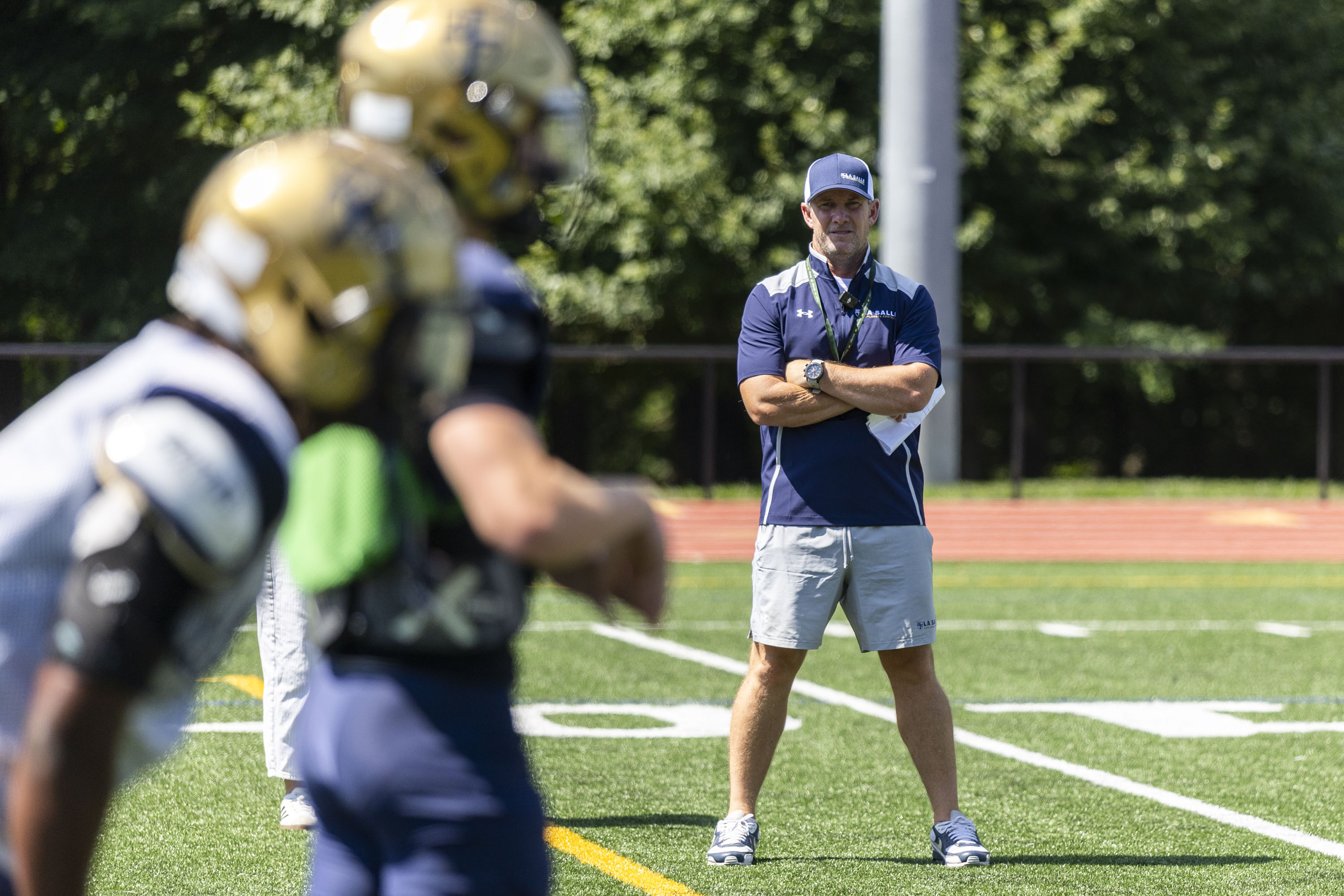
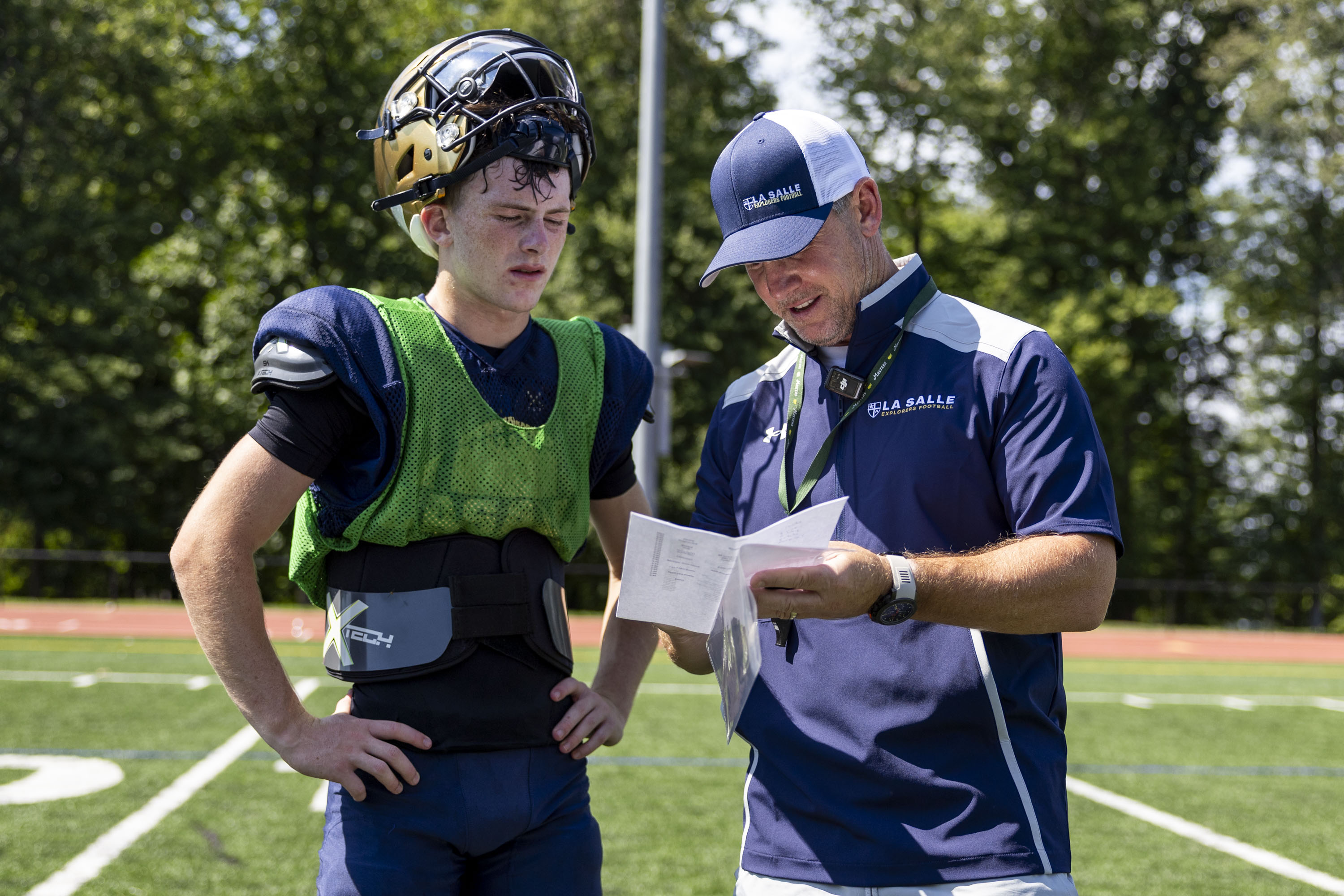
La Salle coach Brett Gordon chats with his son, Luke Gordon, the team’s quarterback, during practice on Wednesday, Aug. 19.Tyger Williams / Staff Photographer
“He’s put in the work,” Gordon said. “The way the timing and transition has taken place for him, having an opportunity to come to La Salle, get his feet under him. He works hard in the classroom. He’s waited his turn, had some opportunities to get in a little bit last year. He’s chomping at the bit to get out and prove what he can do.”
Playing with the last name Gordon carries some weight at La Salle. But if there’s anyone who understands what it’s like to have a father as a coach, it’s Brett. Drew was an offensive coordinator while his son played.
“The coach and player dynamic, it’s certainly not easy,” he said. “I’m going to make my share of mistakes. I try to be as open as I can with him and communicate and do the best I can to separate, ‘Hey, I’m talking to you right now as coach,’ and then also making sure that I’m talking to him as dad. It’s certainly easier said than done. Something that I think about often, and I’m going to do the best I can to support him.”
Football has bonded the Gordon family. It may not always be about La Salle, but there isn’t a day they don’t talk about football.
Luke appreciates his family’s legacy. Growing up around Villanova football, where both Brett and Drew had successful playing careers at quarterback, or watching college and NFL games together has connected them.
His hope is “to be maybe as good as [his dad] one day. I would love to have an opportunity to go play at some of the schools I could play at,” Luke said. “His legacy to me is something that I really cherish, and I want to keep carrying the name.”
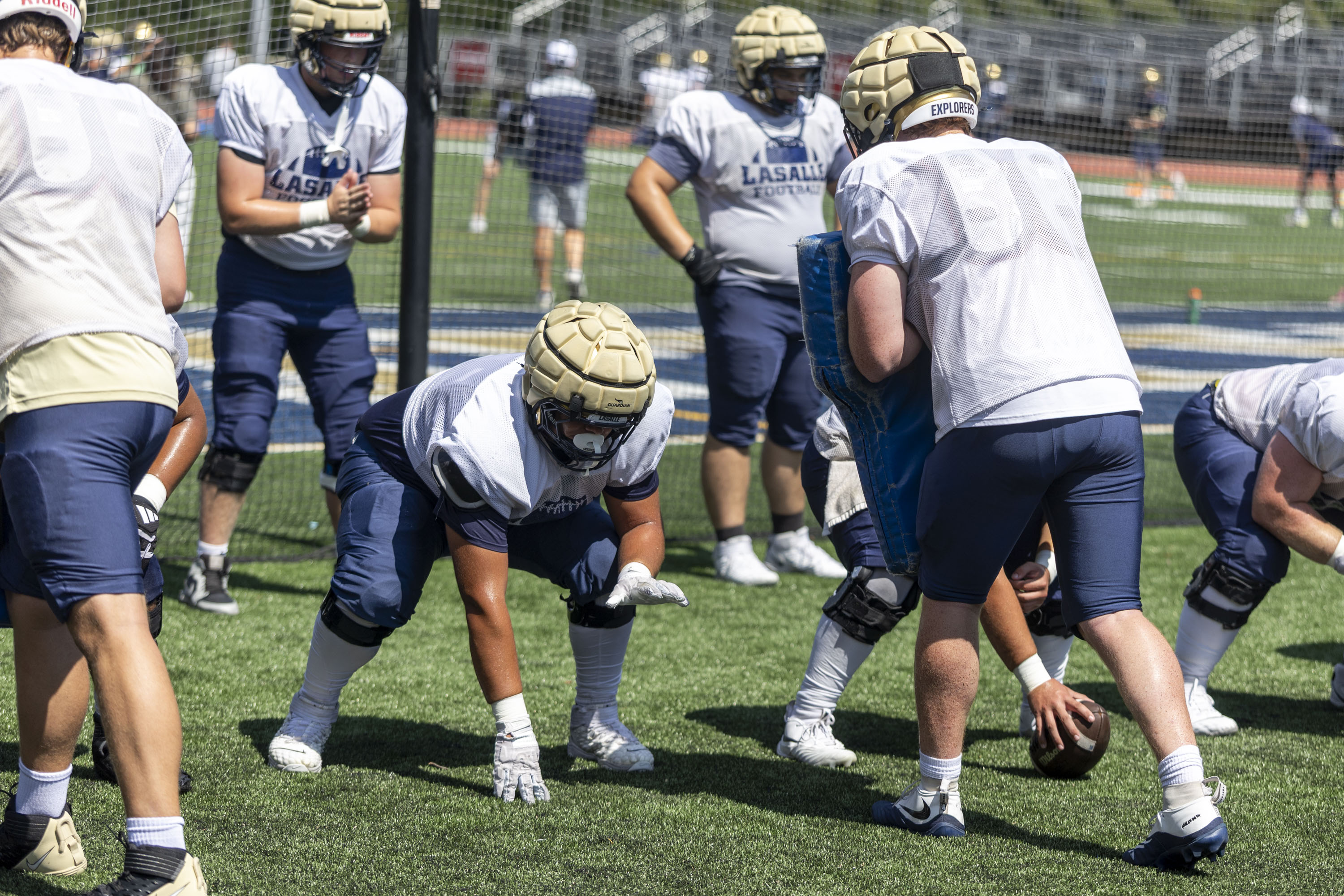
La Salle offensive guard Andrew Sorge lines up during practice as the team prepares for its season opener against Paramus Catholic on Friday, Aug. 28.Tyger Williams / Staff Photographer
First, his focus is on showcasing what he and this team can do. There are a lot of doubters out there, he said, after the Explorers graduated the bulk of their starters.
But that doesn’t mean they aren’t just as talented. Guard Andrew Sorge, one of the team’s senior leaders, says the other schools “don’t know what’s coming.”
“We have a lot of young guys that are very talented and have gotten a lot better over the offseason, including guys that have played for us last year,” said Sorge, who is committed to Lafayette. “People have taken big steps, and I’m excited to see what we can do.”
There’s a wave of newcomers looking to carry this team back to Cumberland Valley High School in Mechanicsburg to defend its 6A crown, but it’s a long road where La Salle will have to get through St. Joseph’s Prep and defending 5A champion Roman Catholic.
So what will be “this team’s rallying cry?” Gordon asks himself. He doesn’t know the answer, but for now, he tells his locker room to keep this in mind: “What is going to be the legacy of the 2026 team?
“In 30 years from now, when people think back, fans and yourselves, [who] were watching us play, and when the season ends, what are you going to be remembered for?” Gordon said. “Ultimately, the players are going to decide that, not me.”
“I tell our players how lucky they are to be part of not just La Salle’s football program, but the La Salle community,” said Brett Gordon, the La Salle coach.Tyger Williams / Staff Photographer
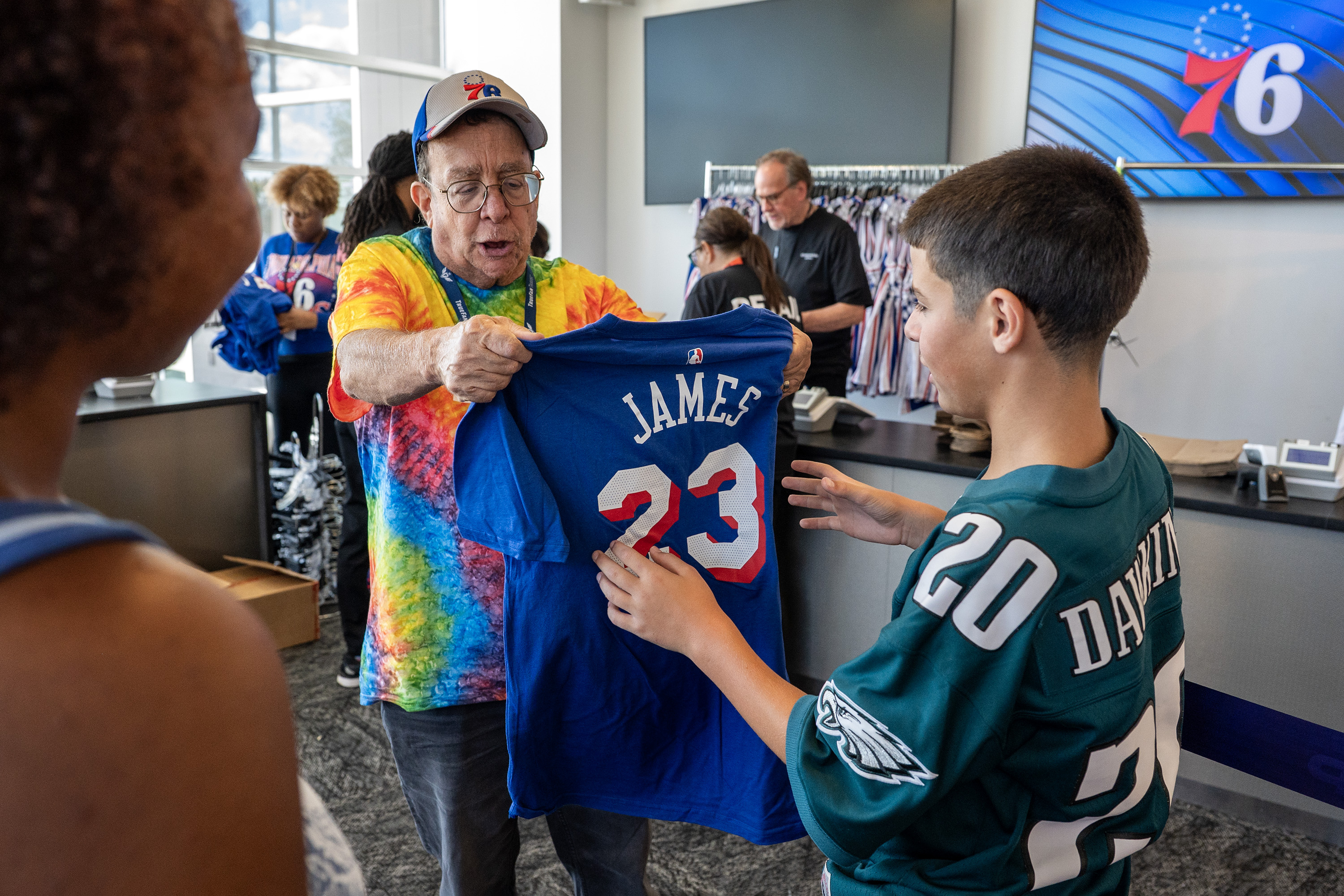
For all we know, LeBron James hasn’t even put on a Sixers jersey yet. It’s been just over a month since he announced his plans to spend the final chapter of his career in Philly, but the city’s biggest superstar has yet to be introduced to his new fan base. At least officially.
The lack of a formal introduction hasn’t slowed the hype train surrounding the Sixers and especially James, whose decision to bring his talents to the City of Brotherly Love shocked the basketball world and fired up the fan base. The four-time MVP quickly surpassed Shohei Ohtani for the most jerseys sold by an athlete who had just changed teams, according to Fanatics. And as they began flying of the shelves, both virtually and in real life, there were even unfounded rumors of ravenous fans stealing them.
But, like trying to find a Cabbage Patch doll — or a Tickle Me Elmo or, god forbid, a Turbo Man action figure — on Christmas Eve, fans were running out of options both online and in-person. So on Tuesday, the Sixers opened their team store at Xfinity Mobile Arena, which is typically open only on game days, and offered up a fresh batch of merchandise ahead of the upcoming season … including blue-and-red LeBron jerseys. The store will be open again today.
Unsurprisingly, fans were lined up before the doors open to get their hands on the season’s hottest gear. And when they got inside, they were greeted by a party atmosphere — one they hope continues all the way to down Broad Street next spring.
Safety Marcus Epps is in his second stint with the Eagles.Yong Kim / Staff Photographer
Marcus Epps knows you’re not guaranteed tomorrow in the NFL. The 29-year-old Eagles safety was forced to ponder the finish line just a year ago, when the Patriots cut him months after ACL surgery prematurely ended his 2024 season with the Raiders.
But the Eagles, for whom Epps had played from 2019-22, threw him a lifeline to rejoin the team via the practice squad. Injuries eventually landed him a starting job, and Epps enters 2026 as the probable starter at safety. It’s an improbable journey he’s thankful for.
“I’m just grateful,” Epps said earlier this week. ”I don’t take any day for granted, and I’m truly blessed to be here, right where I want to be. I’m just trying to keep my head down and grinding every day.”
🚴 Anticipating: The Philadelphia Cycling Classic makes its return this weekend after a decade absence. We’ve got you covered with everything you need to know, including how a former mayor, a salon owner, and more helped bring the race back to life.
🧾 Following: The MLBPA said this week that it supports prohibiting players from appearing in marketing material for VIP sportsbook programs, like the one Bryce Harper appeared in for FanDuel that was sent to a customer with a gambling addiction.
Left-hander Brooks Raley is emerging among the Phillies’ most trusted relievers since being acquired at the trade deadline.Elizabeth Robertson / Staff Photographer
As the Phillies, who lost their second straight against the Mariners, attempt to cement a wild-card spot and close in on the division-leading Braves, the bullpen is coming into focus again, with relievers jockeying for position behind closer Jhoan Duran in interim manager Don Mattingly’s circle of trust.
Here’s what we know: Raley is earning more late-inning chances after being acquired in a deadline trade with the rival Mets. But hard-throwing rookie Alex McFarlane isn’t quite there yet.
Next: The Phillies wrap up their series in Seattle at 4:10 p.m. today (NBCSP). Jesús Luzardo (11-5, 3.35 ERA) will start against Mariners right-hander Bryan Woo (9-8, 4.10).
Penn senior Esha Velaga lost to Ekaterina Ovcharenko in her qualifying match at the Ennoble Care Philly Open on Sunday.David Maialetti / Staff Photographer
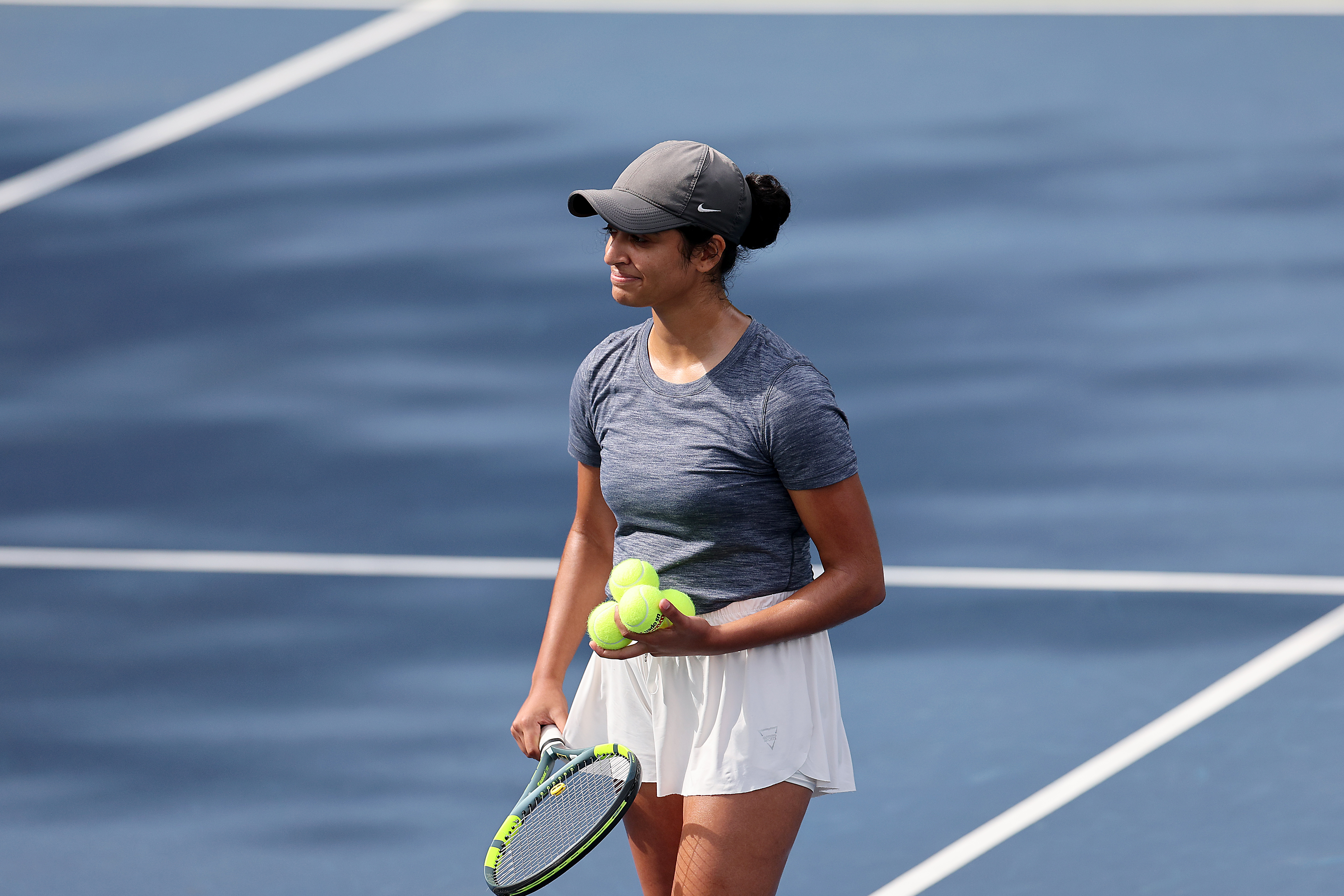
Penn senior Esha Velaga is going to be a doctor. Last week, she took her MCATs and has plans to pursue a career in the medical field. But this week? She was a professional tennis player.
Two days after sitting the MCAT, Velaga took the court at Penn’s Hamlin Tennis Center, which this week is hosting the Ennoble Care Philly Open, a WTA 125 event and the circuit’s first event in the city in two decades. And while she lost her qualifying match — in front of a packed crowd of Quaker teammates, coaches, and friends cheering her on — she got a second chance the next day with doubles partner Lara Stojanovski.
That match also ended in defeat, but both players believe the experience will pay dividends for the entire team, as Penn players served as hitting partners for the numerous professionals in town for the tournament.
“We can compete here, even though we haven’t been doing professional-level training,” Velaga said. “I think we’ll definitely use the momentum and the good energy as well, and bring it into our very high-energy college season, and just know that no matter what team we compete against, we always have a chance, and we’re in it.”
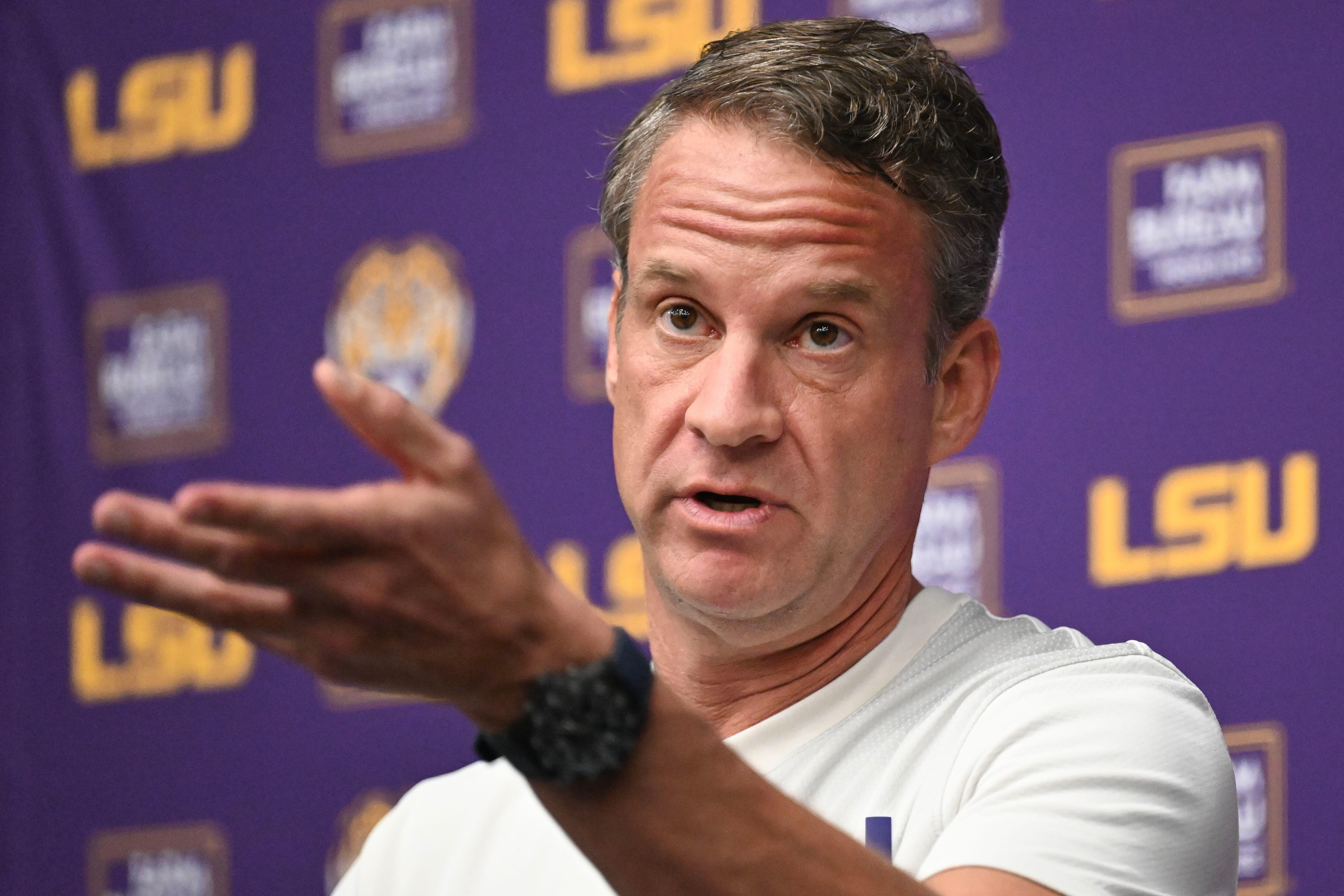
LSU coach Lane Kiffin is at the center of college football’s battle in pro players seeking another season in college.Hilary Scheinuk
Maybe the best thing that can happen to college sports’ integrity is everything that is happening to its integrity right now. It would be ironic, in a way. The NCAA is more than a decade into a series of logical premises and conclusions that was always going to lead power conferences like the SEC and Big Ten to where they are right now, columnist David Murphy writes.
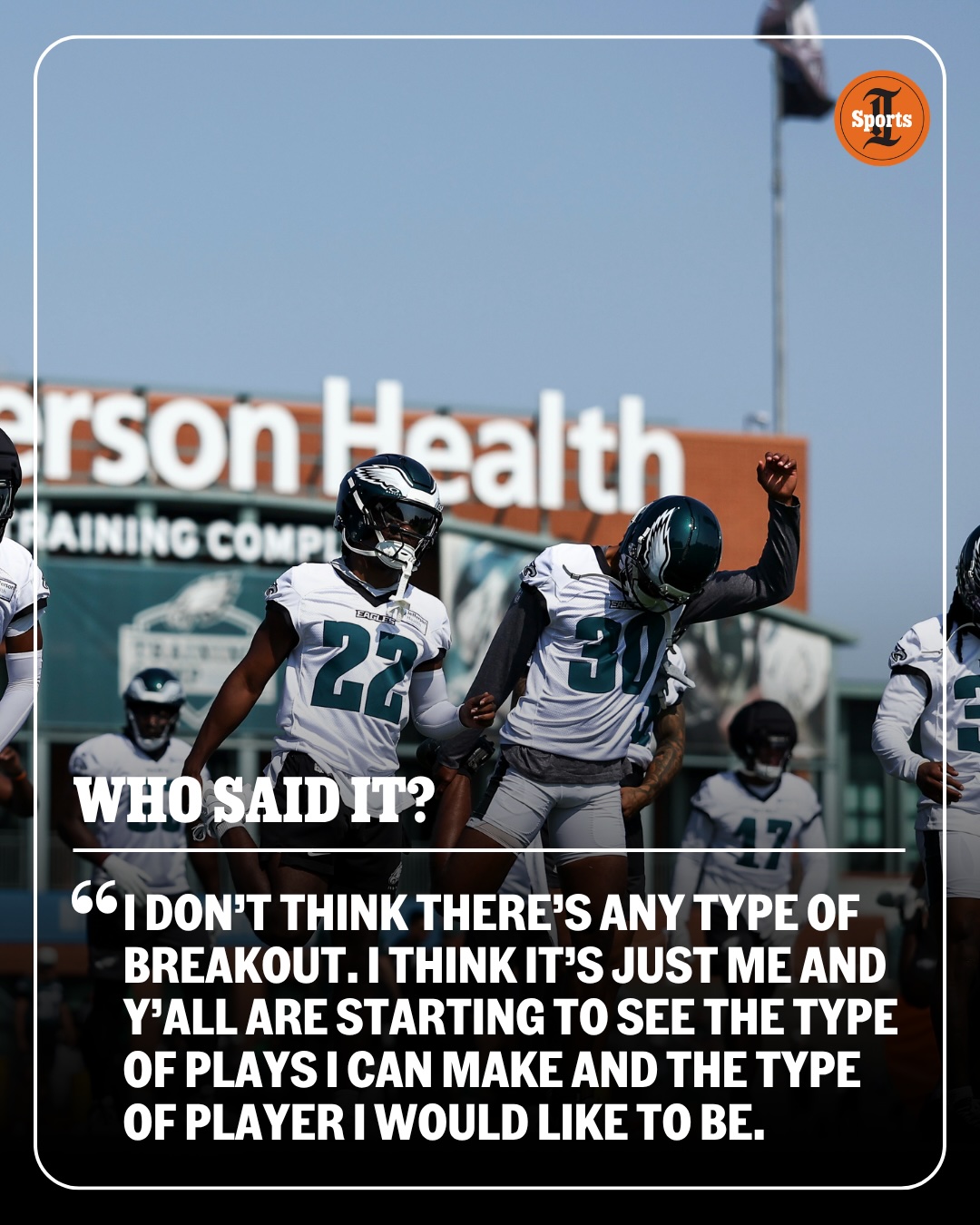
Who said it?
Eagles linebacker Jalyx Hunt doesn’t want you to call him a breakout player.Monica Herndon / Staff Photographer
This third-year Eagles player is having a standout camp, but he recently rejected the idea that he was in store for a “breakout” year — not because of his play, but because he doesn’t like that term for any player. (Hint: It’s not one of the players in the picture.) Check your answer here.
🧠 Trivia time answer
We asked: Which Flyers team went on a 35-game unbeaten streak?
Answer: D: 1979-80. Comprised of a collective of veteran minor-leaguers, top prospects, and a few faces from the franchise’s 1974-75 Stanley Cup champion team, the 1979-80 Flyers had a 35-game unbeaten streak and headed into the NHL Playoffs that year on a high, before losing it all in Game 6 of the Stanley Cup finals.
We compiled today’s newsletter using reporting from Mia Messina, Jeff Neiburg, David Gambacorta, Gabriela Carroll, Ariel Simpson, Conor Smith, Devin Jackson, Scott Lauber, Jeff McLane, David Murphy, and Olivia Reiner.
By submitting your written, visual, and/or audio contributions, you agree to The Inquirer’s Terms of Use, including the grant of rights in Section 10.
Thanks for staying up to date with Philly sports. We’ll return for Thursday’s newsletter. — Matt
Maybe the best thing that can happen to college sports’ integrity is everything that is happening to its integrity right now. It would be ironic, in a way. The NCAA and its member institutions are where they are because they spent decades adhering to a policy of inertia. Only now does it look like a viable strategy, after their world is already burning around them. Sometimes, in order to gain back what was lost, one must lose what little remains.
Very little remains. Let’s be clear about that. That was true even before last weekend’s news that former Eagles undrafted rookie free agent Dae’Quan Wright was planning on returning to the college ranks after being waived by the Browns. In fact, the hand-wringing that has accompanied the tight end’s reported agreement with LSU is mostly an admission of naiveté or ignorance on the part of the hand-wringers.
The NCAA is more than a decade into a series of logical premises and conclusions that was always going to lead power conferences like the SEC and Big Ten to where they are right now. The university presidents who operate behind the NCAA’s bureaucratic anonymity chose this path when they allowed the almighty dollar of television contracts and the vanity of a news cycle monopoly to become the primary goal of collegiate sports rather than sports played by, for, and among collegiates.They are living in a reductio ad absurdum of their own creation.
The best thing any of us can do for our sanity is to lean back and enjoy watching them lose theirs. It no longer makes sense to react to each development as if university athletic departments are tethered to some sort of ethical baseline that sets them apart from any other major professional sports organization. They pulled up that anchor long ago. The ship has sailed.
Frankly, the idea of an undrafted athlete moving from the bottom of an NFL training camp roster to a college football starting lineup pales in comparison to the legion of current college football starters who are making bigger bank than they would as NFL players on rookie contracts. The average Power 4 quarterback is currently signed to a name, image, and likeness deal worth $3.1 million, according to Sportico. It always made sense that there would come a day when a player would ask out of a contract from the Browns for a more competitive offer funded by Big Willy’s Jeep-Chevy of Baton Rouge. That’s the way NIL was always going to work.
Average NIL spend has nearly tripled in the past three seasons, reflecting an accelerating market. Power 4 programs spend roughly $24.8M on football alone.
Top position groups can expect annual NIL earnings of $3.1M (QB), $1.0M (WR) and $932K (RB). QB has the best ratio of… pic.twitter.com/U4HYYXcAJT
The ridiculousness is the real sport, now. We should treat it as such. For years, the NCAA chose to address the logical implications of its profit drive with a weird and counterintuitive combination of hope, avoidance, and authoritarian dictates. They fully recognized that the genie would one day escape the bottle. Now, they’re left to hope that Ja’Marr Chase and Joe Burrow already have plans for their bye week, when LSU plays Mississippi State.
Lane Kiffin’s central role in the latest lunacy is fitting. College football’s Kendall Roy has spent the early part of this week channeling the exact sort of ends-based nihilism so sublimely satirized by HBO’s Succession. He did the same last year when he left his Ole Miss team on the eve of the college playoffs in order to sign a mega contract with LSU. Nick Saban, his former boss at Alabama, leveraged the full power of the media-sports industrial complex to absolve him of responsibility.
“We need to take a better approach to the business aspect of what we do in college athletics,” Saban said on ESPN’s pregame studio show after Kiffin left Ole Miss. “In the NFL, you can’t leave your team until you are finished playing. You can’t talk to another coach in the regular season. There’s a defined time when you can talk to them if they are in the playoffs. We should match the academic calendar with the football calendar.”
Well, yeah. You should. But there are a whole lot of competing self-interests standing between ought and is. Like any system, it is first and foremost a reflection of those who agree to its framework. Major college football has become nothing more than Boar on the Floor in pads. Any television news segment on NCAA should conclude with a clip of Logan Roy smirking at all the piggies at the trough.
Dae’Quan Wright is among the NFL players trying to play another season of college football.Carolyn Kaster
“In general, should NFL players come back to college? I believe — it doesn’t matter necessarily what I believe — that answer would be no,” Kiffin said in a Monday news conference while defending his recruiting of at least two former Ole Miss players who’d spent the summer in NFL training camps.
Focus on Kiffin’s interjection.
It doesn’t matter necessarily what I believe.
You’ll struggle to find seven words that more accurately summarize both the current state of college sports and its contributing factors. In a more principled world, they would be written off as the words of a coward. In our current world, they might as well be written in Latin beneath the flag or family crest or company logo of a disconcerting number of tech titans, politicians, and Fortune 500 firms, not to mention the hundreds of university presidents who have long embraced the plausible deniability of the concept of shareholder value. The best thing you can say about the system of higher education in the United States is that it remains steadfastly by and of the system at large.
The only hope is that it burns itself as quickly and completely as possible. The inevitable end game for the major football-playing schools won’t look much closer to the mandates of their university charters. The big schools will break away, impose a salary cap, hiring and transfer restrictions — all of the things major sports leagues long ago did as a result of similar competitive inevitabilities. They will sign their own television contract, sell their own licensing agreements, consolidate the revenues. The nonpower schools will exist mostly as a counterweight to any antitrust claims. Meanwhile, the rest of us will continue to contemplate the question: Do we really care about college sports if they are no longer about the college?
SEATTLE — The second-best option in the bullpen hadn’t pitched in six days. Nothing to see there, the Phillies insisted. The game situations simply didn’t call for Jonathan Bowlan.
“But tonight,” interim manager Don Mattingly said before Tuesday’s game, “is probably almost a must-pitch.”
So, here were the Phillies, trailing by one run against the Mariners as the seventh inning began. And there was Bowlan, still sitting in the bullpen as Orion Kerkering came on in relief of starter Aaron Nola.
Bowlan pitched, true to Mattingly’s word. But by the time he entered in the eighth, the deficit had swelled to three runs in a 4-1 loss, the Phillies’ second setback in a row here in Seattle after nine consecutive victories.
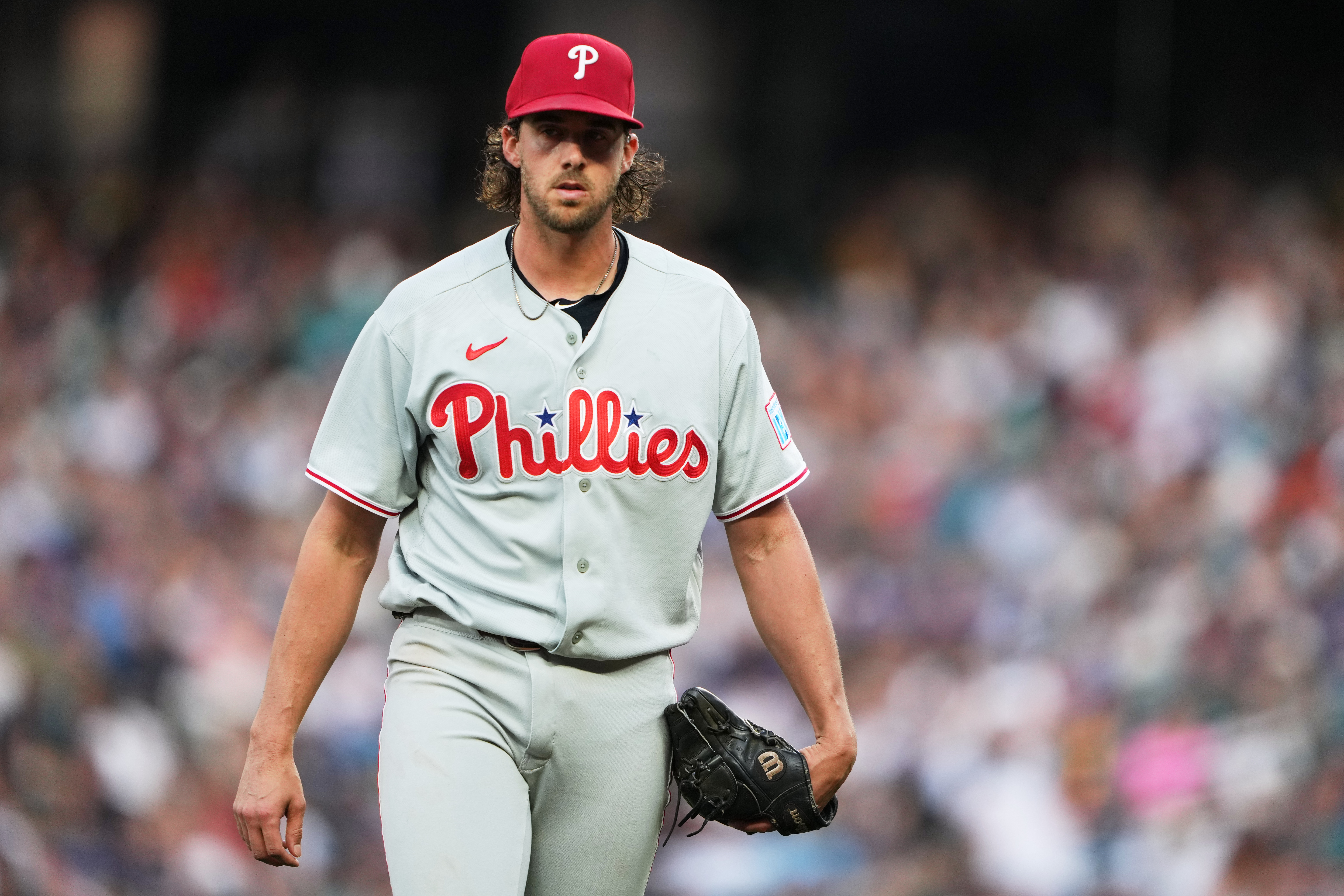
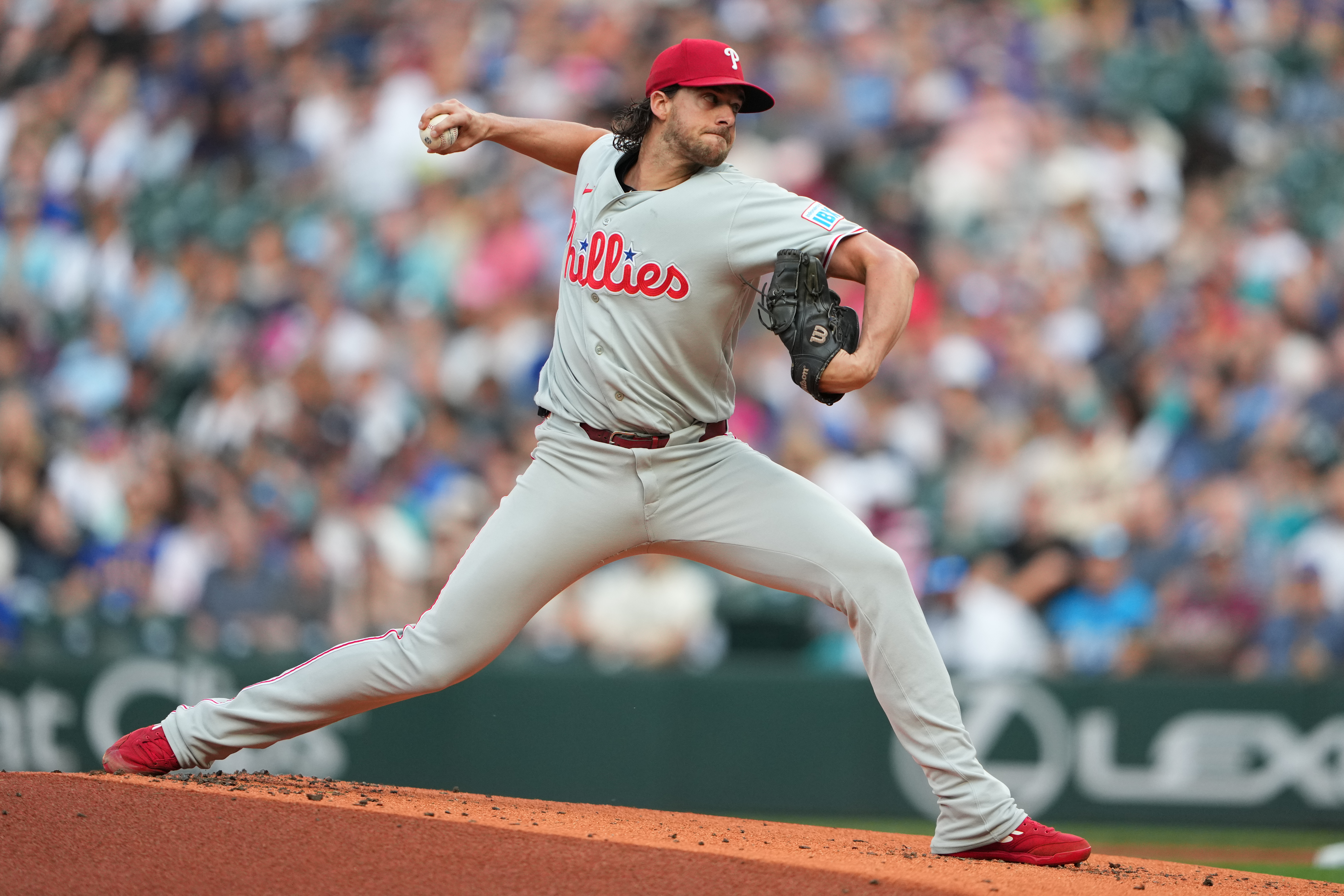
The record will reflect that Nola yielded the go-ahead run in the sixth inning on back-to-back singles to Julio Rodríguez and Josh Naylor. But Nola allowed only three hits overall to continue a resurgence in the midst of ace Zack Wheeler’s worst six-start stretch in nearly 10 years.
So, let’s not pin this one on Nola. Not after the Phillies went 15 consecutive at-bats without a hit between the third and eighth innings against Mariners starter George Kirby.
And certainly not after Mattingly put a 2-1 seventh-inning deficit in the hands of someone other than his well-rested setup man.
Why Kerkering over Bowlan in the seventh?
“He’s kind of been our seventh-inning guy, eighth depending on where it goes,” Mattingly said of Kerkering. “It felt like he was the right guy.”
Aaron Nola has a 3.57 ERA in his last 10 starts.Lindsey Wasson
To be fair, Kerkering seemed to have gotten a second wind lately after struggling to throw strikes in late July. But he hit Taylor Ward with one out in the seventh, then allowed a single to J.P. Crawford and walked Brock Rodden to load the bases before Randy Arozarena fouled out.
With two out, Mattingly played the matchups, turning to lefty Brooks Raley to face lefty-hitting Dominic Canzone. Raley’s 1-1 pitch was a low-and-away sweeper. But Canzone covered the outer edge of the plate and lined it to center field for a two-run single.
Bowlan, meanwhile, pitched around a one-out walk in a scoreless eighth with an assist to Bryce Harper, who made a diving catch in right field to end the inning.
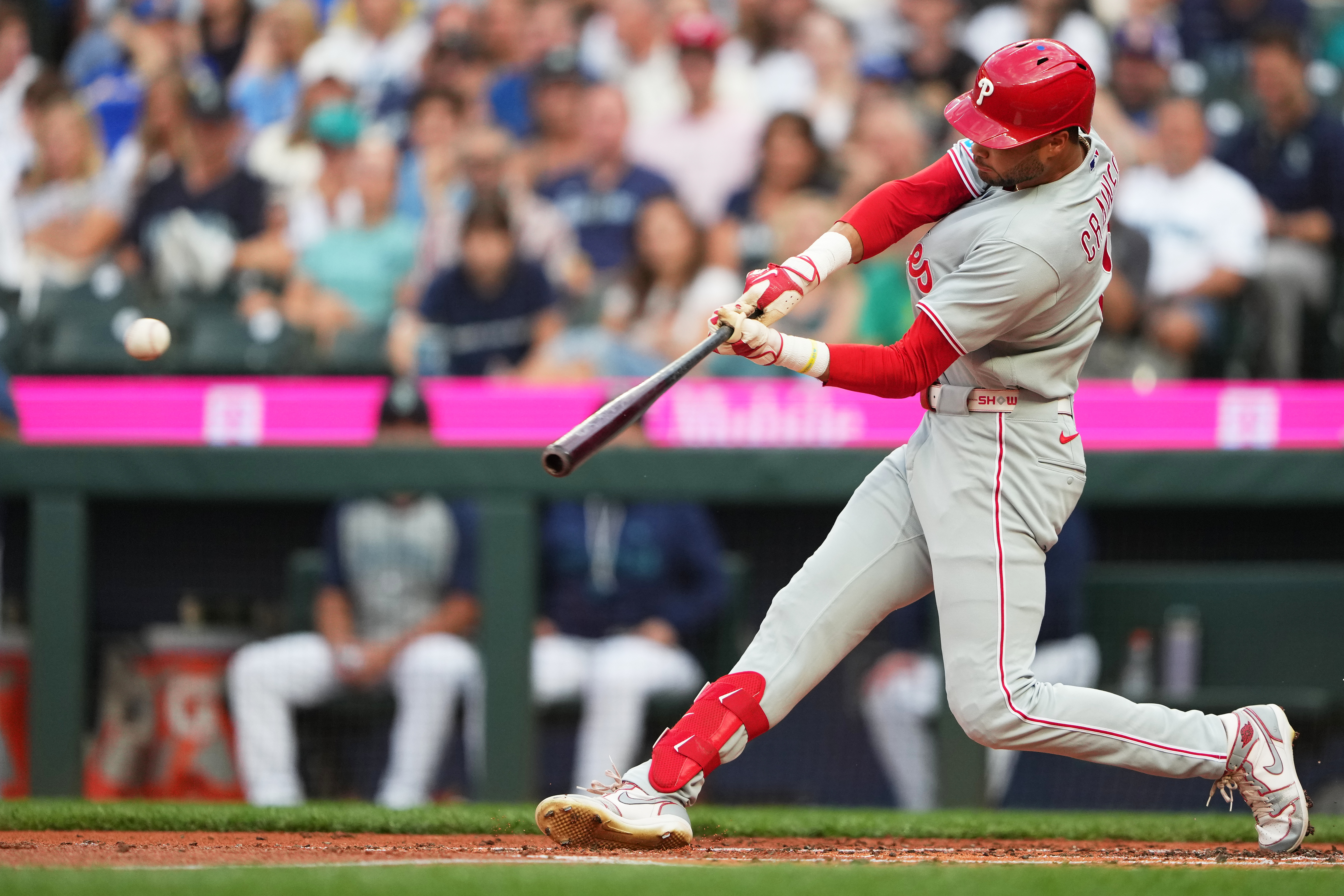
Kirby muted an offense that had been fully operational throughout the nine-game winning streak. With a blazing fastball and a four-pitch offspeed mixture, he gave up a run on Justin Crawford’s RBI single in the second inning, then slammed the door.
“He’s good, man,” Trea Turner said. “He’s got four or five really good pitches and then just the command is really good. He doesn’t give you much to hit in the middle of the zone. The fastball was hard today. I think I saw a bunch of 99s up there, so he’s tough.
“I felt like we did a good job early battling to get some runners on there, but it’s hard to put a big inning against him as a team.”
Justin Crawford’s RBI single in the second inning was the Phillies’ lone run.Lindsey Wasson
Before the game, most of the attention of the Phillies’ pitching brain trust was focused on trying to solve the riddle of Wheeler’s 8.51 ERA in his last six starts. It’s his worst six-start stretch since he posted a 9.89 ERA midway through the 2017 season when he was still with the Mets.
Absent a solution, not much else matters.
But imagine the state of the Phillies’ rotation in these waning days of summer if not for Nola.
And imagine saying that even a month ago.
“He’s been on a good roll,” Mattingly said. “He was really good tonight.”
Nola gave up a game-tying solo homer to suddenly scorching Cal Raleigh in the second inning. He retired 13 of the next 15 batters, allowing only two walks before the back-to-back hits by Rodríguez and Naylor in the sixth.
It marked another quality start for Nola, who has a 3.57 ERA in his last 10 starts. Since July 5, he has lowered his season ERA from 6.04 to 5.03.
“I just kept trying to work, keep working, having good weeks, and keep competing out there,” Nola said. “I feel a little more on the attack, and my misses are a little bit smaller.”
Since July 5, Aaron Nola has dropped his ERA from 5.87 to 5.03.Lindsey Wasson
But after flying across the country on the wings of an improbable ninth-inning comeback at home Sunday, back-to-back losses in the Pacific Northwest have felt like a bucket of ice water.
It has also stretched the deficit in the NL East back to 4½ games and narrowed the Phillies’ wild-card lead to three games over the Diamondbacks.
“It’s tough,” Turner said. “But I think we ran into two really good starting pitchers the last couple of days and just didn’t get the job done. I don’t feel like we’re beating ourselves or doing some stupid stuff. I just feel like we just got beaten. You move on.”