Tom Schafer was a hulking man when he played one preseason game with the Eagles in the summer of 1984. The undrafted free agent center stood at 6-foot-2 and 270 pounds, with a booming voice and an unabashed confidence to match.
By the fall of 2009, his broad frame had hollowed out. His voice had been reduced to a rasp. Schafer could walk, but only gingerly, and for short distances.
Yet here he was, sitting in a West Chester University parking lot, handing out fundraising pamphlets and preaching to tailgaters about his long-lost teammate.
It was not the way most people battling cancer would have chosen to spend their time. But Schafer was not most people.
When Schafer was told the disease he’d battled two decades prior had returned in 2008, he had already made a commitment and was determined to see it through, no matter how many rounds of treatment he would have to endure.
“He still had that fire about the statue,” said former West Chester center Joe Walsh. “He was talking then about everything we see now.”
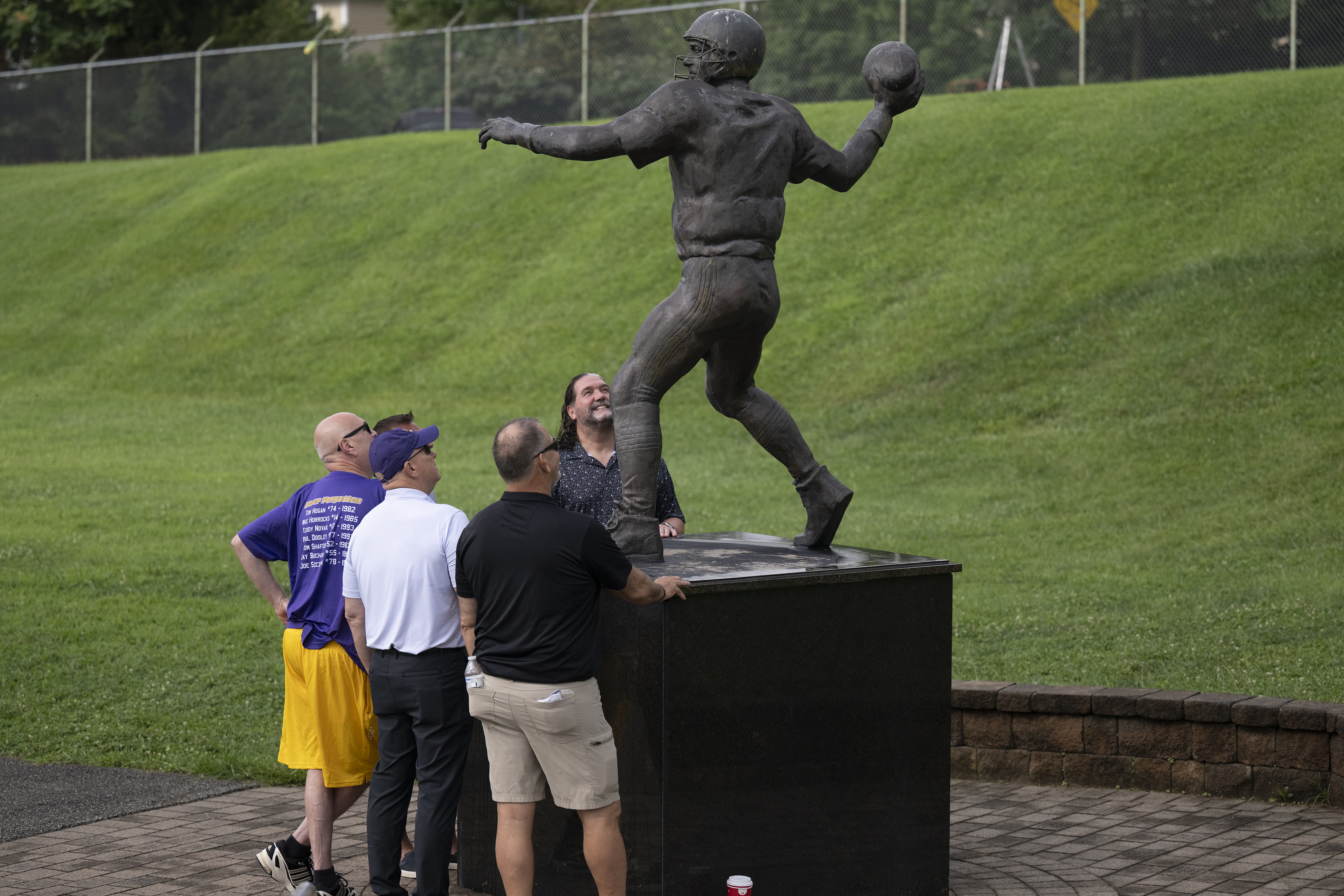
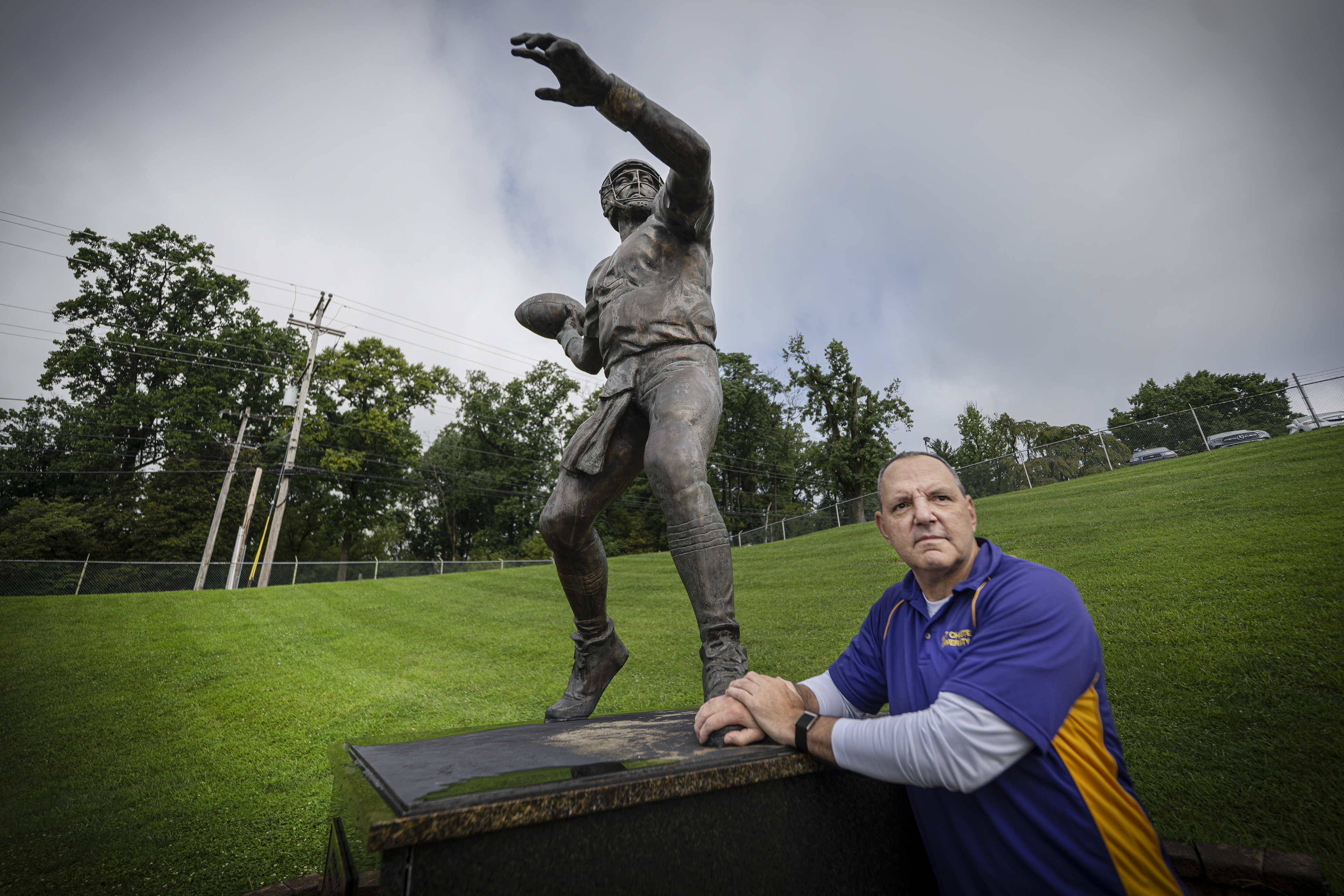
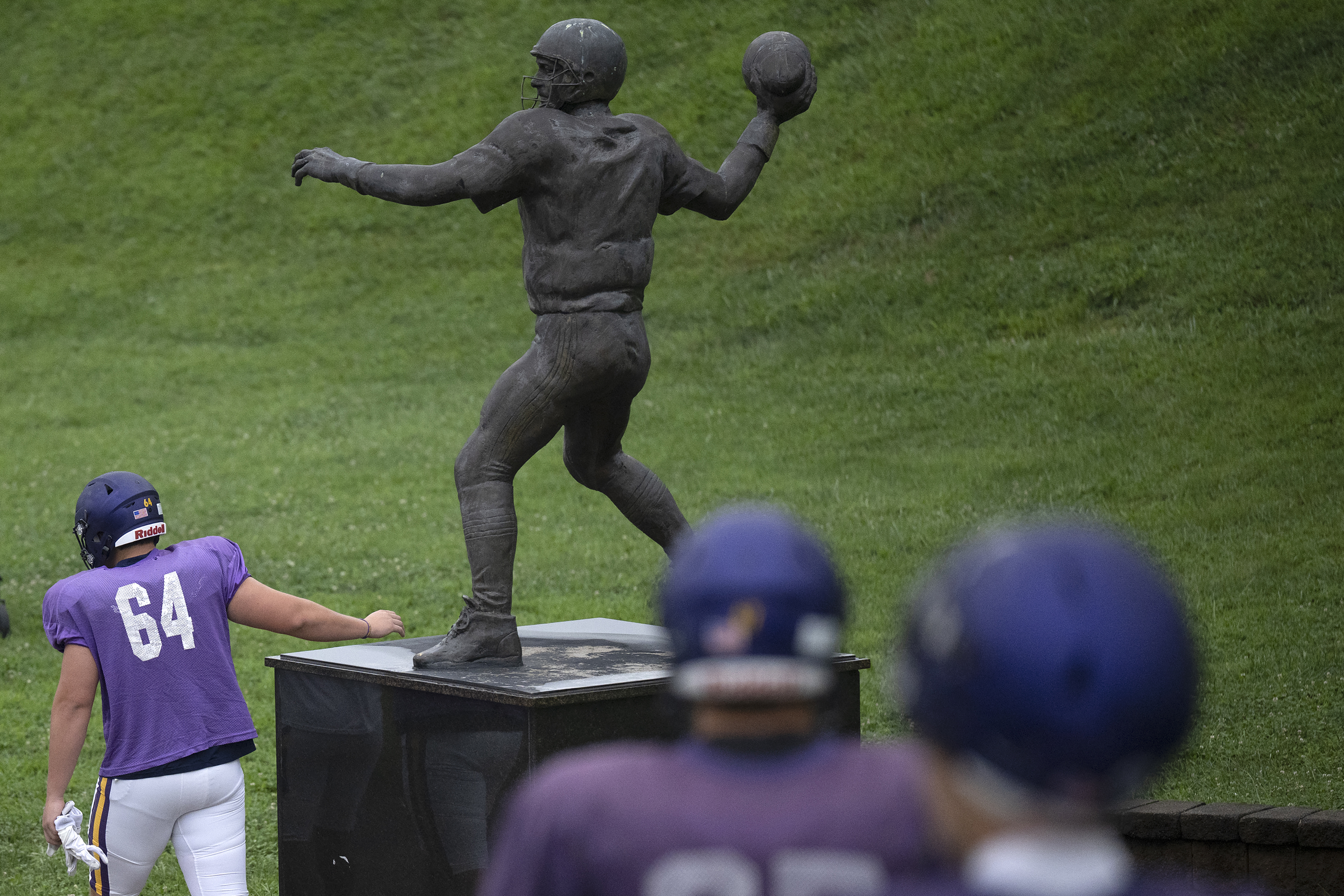
Walsh motioned to the northwest corner of Farrell Stadium. There, at the base of a hill, stood a bronze likeness of a quarterback, his left foot firmly planted, his right arm cocked, ready to uncork a spiral.
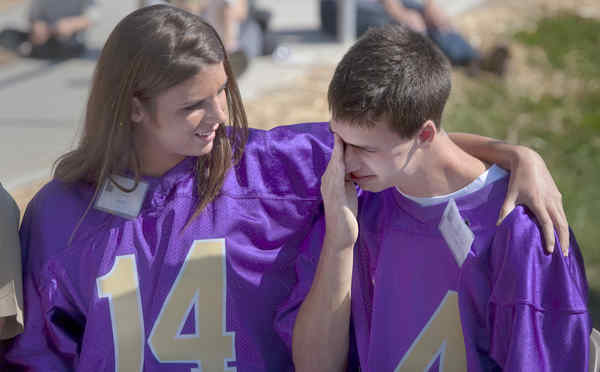
Former teammates John Mininno (left) and Tom Schafer (right) visit the statue of Michael Horrocks which was unveiled Sept. 11, 2010. Michael S. Wirtz / Staff Photographer
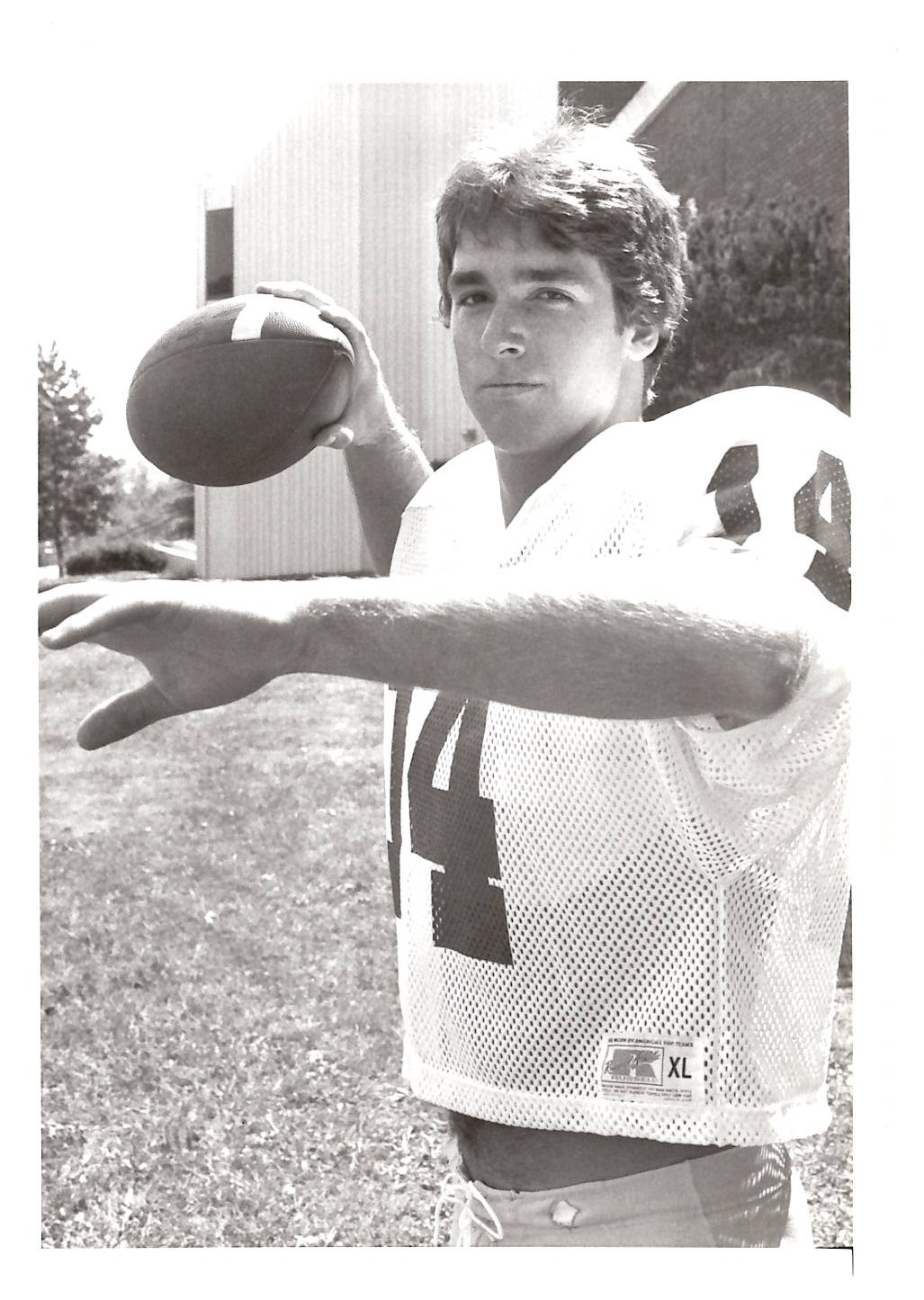
The man was Michael Horrocks, Class of 1985. He and Schafer overlapped on the football team for twoseasons, but Schafer took a liking to the sophomore’s goofy personality.
And when he found out that that same sophomore had been a copilot of Flight 175, the plane that hit the South Tower on Sept. 11, 2001, he was distraught.
Years passed, and Schafer began to coach high school football throughout the region. Some of his players joined West Chester’s program. None knew of Michael Horrocks. Not of his tragic place in history, or of his greatest moment on the field, when he led the Golden Rams to a 35-27 upset win over Delaware in 1983.
They didn’t know of his service in the Marines, or his devotion to his kids, and his wife, and his friends. They didn’t know his name at all. And Schafer desperately wanted them to.
So he and his teammates came up with a plan to ensure Horrocks’ presence would be felt for years to come. From 2008 to 2010, the West Chester alums raised $150,000 for a scholarship endowment and a statue to commemorate the late quarterback.
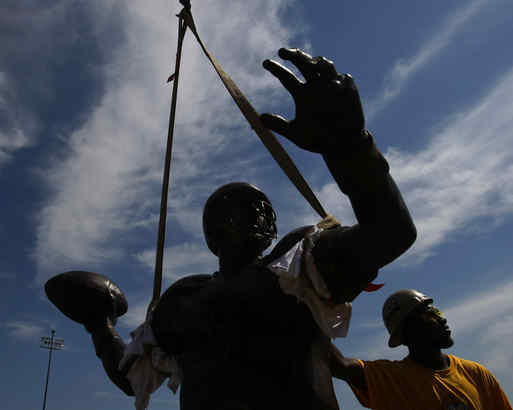
They faced all sorts of challenges, some of them logistical. West Chester had never built a statue on campus before, and had no clear guidelines on the process to have one erected.
Former West Chester University football player John Mininno is photographed near a statue honoring his former teammate, quarterback Michael Horrocks.Jose F. Moreno / Staff Photographer
In an initial conference call with Horrocks’ teammates, school officials tried to persuade them to build something smaller, like a plaque or a bench. They warned the former players of the money they would need, and the bureaucratic hurdles they would face.
But Schafer was undeterred.
“Tom went in there and said, ‘F— you, we’re not doing a plaque. We’re doing a statue,’” said Class of 1988 linebacker John Mininno. “And he was not to be denied.”
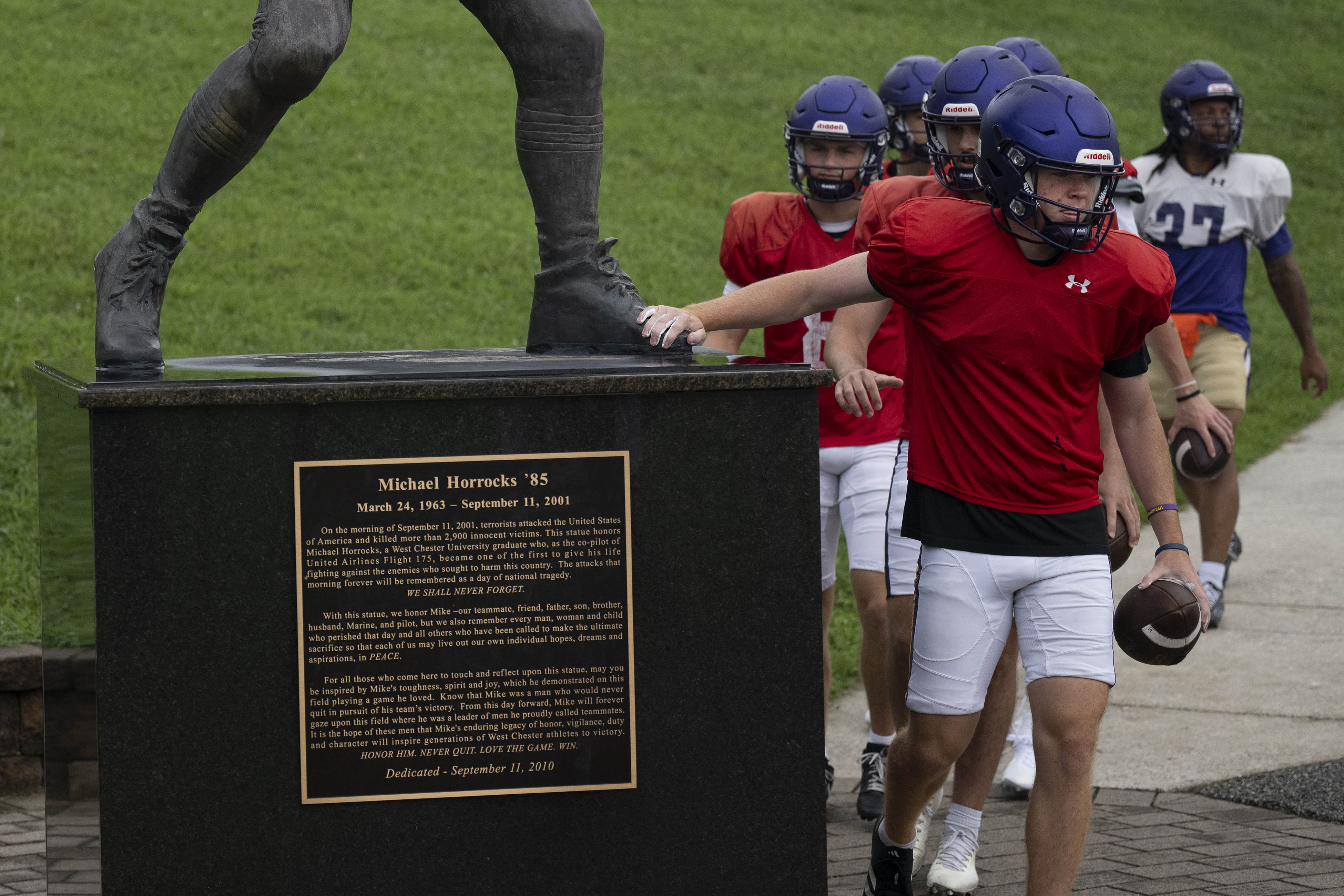
The result was not just a statue, but a tradition. Since it was unveiled in 2010, West Chester’s players have tapped Horrocks’ left foot before every practice and game.
They have done this so often that you can see scuffs of gold peeking out from beneath the bronze. Horrocks is not here in the physical sense, but this version of him — fearlessly driving down the field, leading his men — is now preserved.
And his teammates intend for it to stay that way.
“We want this to be a legacy,” Mininno said. “We want this to be here for much longer than we’re going to be around.”
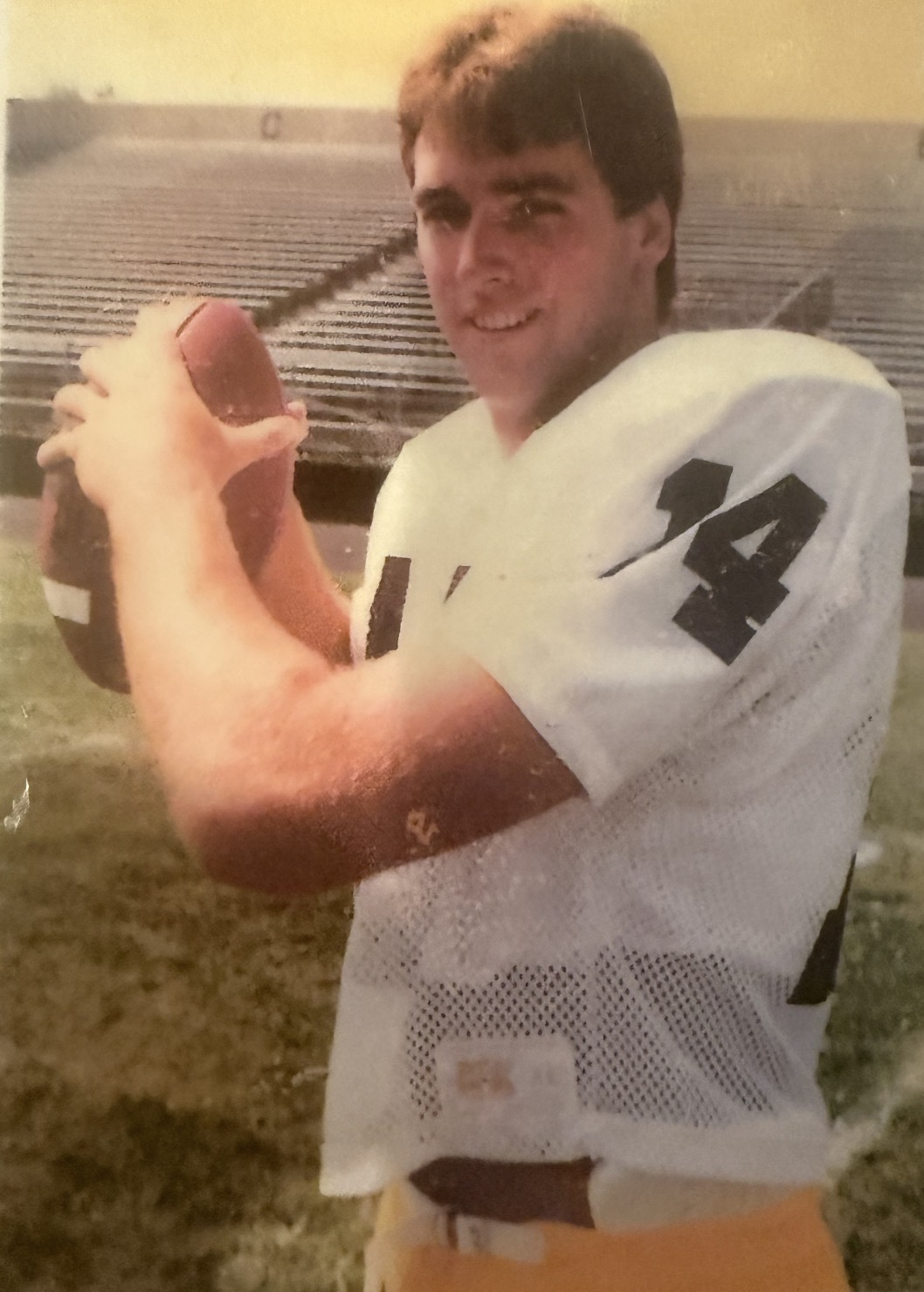
Michael Horrocks emerged as a starting quarterback and a trusted leader at West Chester.provided by Mark Gosik
‘A pilot the entire time’
Horrocks was born and raised about 70 miles west of West Chester, in Hershey, Pa. He attended Hershey High School, where he played varsity football under head coach Robert “Gump” May.
May was tougher than most coaches. His team did three-a-days throughout the summer: an unusually heavy workload, which had the intended effect of whittling unreceptive players from the roster.
The coach would start camp with 75 kids. Two weeks later, he would be left with 30.
One kid, in particular, was always in that lattergroup.
“Mike stayed,” May said.
Horrocks was fighting for playing time with Scott Campbell, a quarterback who would go on to have a six-year career in the NFL. Locals were skeptical that the backup would perform in the opportunities he did get, but he quickly proved them wrong.
Over his one season as a starter at Hershey, and in limited appearances before that, Horrocks led his team to a litany of come-from-behind wins, including one against rival Palmyra High School, which took a 21-point lead in the first quarter.
“After Scott Campbell graduated, everybody thought, ‘Well, they lost their big gun,’” May recalled. “Well, Mike jumped in and he was just as big a gun.”
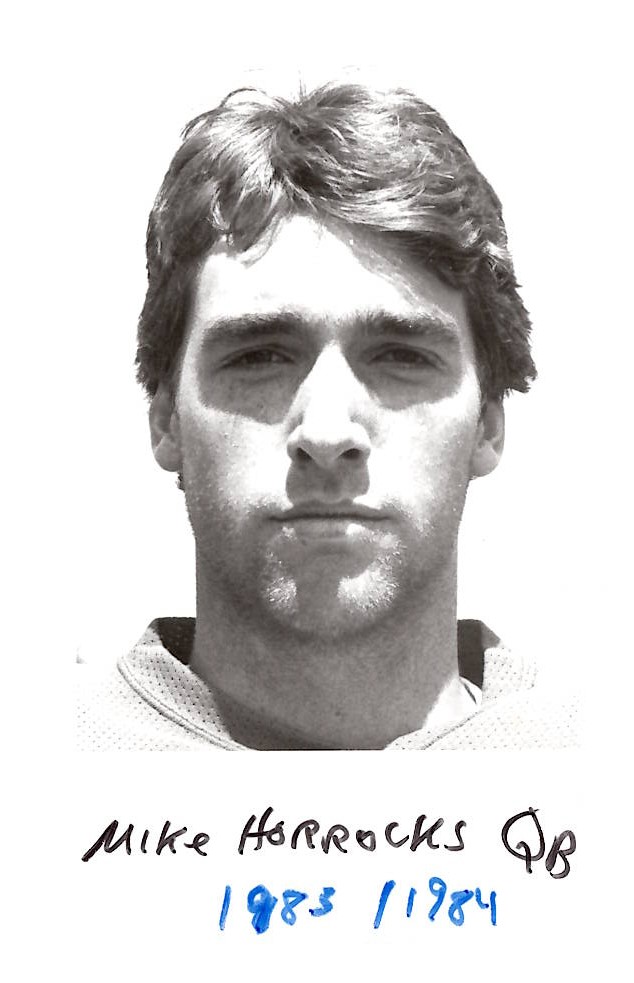
Michael HorrocksSpecial Collections, West Chester University
Gump reached out to a friend, Rick Daniels, a part-time assistant who later became West Chester’s head coach, and sent him some film of Horrocks. In the spring of 1981, the quarterback drove to campus for a visit.
Daniels was already impressed by what he saw on film. Horrocks didn’t just have a strong arm; he was also quick on his feet, and he had an air of unflappability about him. He joined West Chester’s team that fall as a backup quarterback.
Once again, Horrocks found himself in the unenviable position of filling in for an NFL-caliber player in Ron Gaynor, who later bounced around training camps with the Seahawks, Eagles, and Bills.
Nevertheless, the aspiring starter worked with the intensity of a seasoned veteran. Horrocks and tight end Al DePippo would regularly put in extra hours, throwing after practice and then heading to the weight room. If it was locked, they would use the neck machine beneath the stands.
Horrocks coupled his drive with a lighthearted composure that allowed him to thrive in intense situations. The first time he interacted with Schafer was in 1982,when Horrocks was a sophomore.
Gaynor had gotten hurt; Horrocks was asked to fill in.
“He crouched down in the middle of the huddle, looked up at us, and said, ‘Ah, the big boys,’” Schafer recalled to The Inquirer in 2010. “I said, ‘Shut up and call the play.’”
It was a precursor of huddles to come. Some players got stiff when they first entered regular season games. Horrocks was the opposite. He would walk onto the field with a toothy grin and a laugh, confident in the hours of prep behind him.
Michael Horrocks led West Chester to a rare win over rival Delaware in 1983. Special Collections, West Chester University
This continued even after he was named the starting quarterback in 1983. Horrocks was known to play pranks, like tying teammates’ shoelaces together, or putting slices of cheese in a friend’s textbook.
West Chester had some of its greatest moments under Horrocks and his playful persona. In his first game as a starter, Sept. 10, 1983, the Golden Rams faced the University of Delaware on the road.
It was a harrowing matchup. West Chester played in Division II, while Delaware played at what was then known as the Division I-AA level. The Blue Hens had won their last 15 games against the Golden Rams, a streak that dated back to 1957.
But West Chester was unafraid. After a scoreless first quarter, the Golden Rams jumped to a 21-3 lead in the second. They upped it to 35-3 in the third and held on for the win.
Horrocks finished the day 10-of-18 for 129 passing yards and two touchdowns.
West Chester’s campus erupted into a giant party, as if the team had won the national championship. But the quarterback at the center of it all was already focused on his next game.
When he returned home that night, he recapped different plays and passes to his housemates on Magnolia Street.
“He would talk about even some of the plays that he missed,” said his friend Chris Conner. “He never got too big. Even though he had just beaten Delaware, he was still the same guy.”
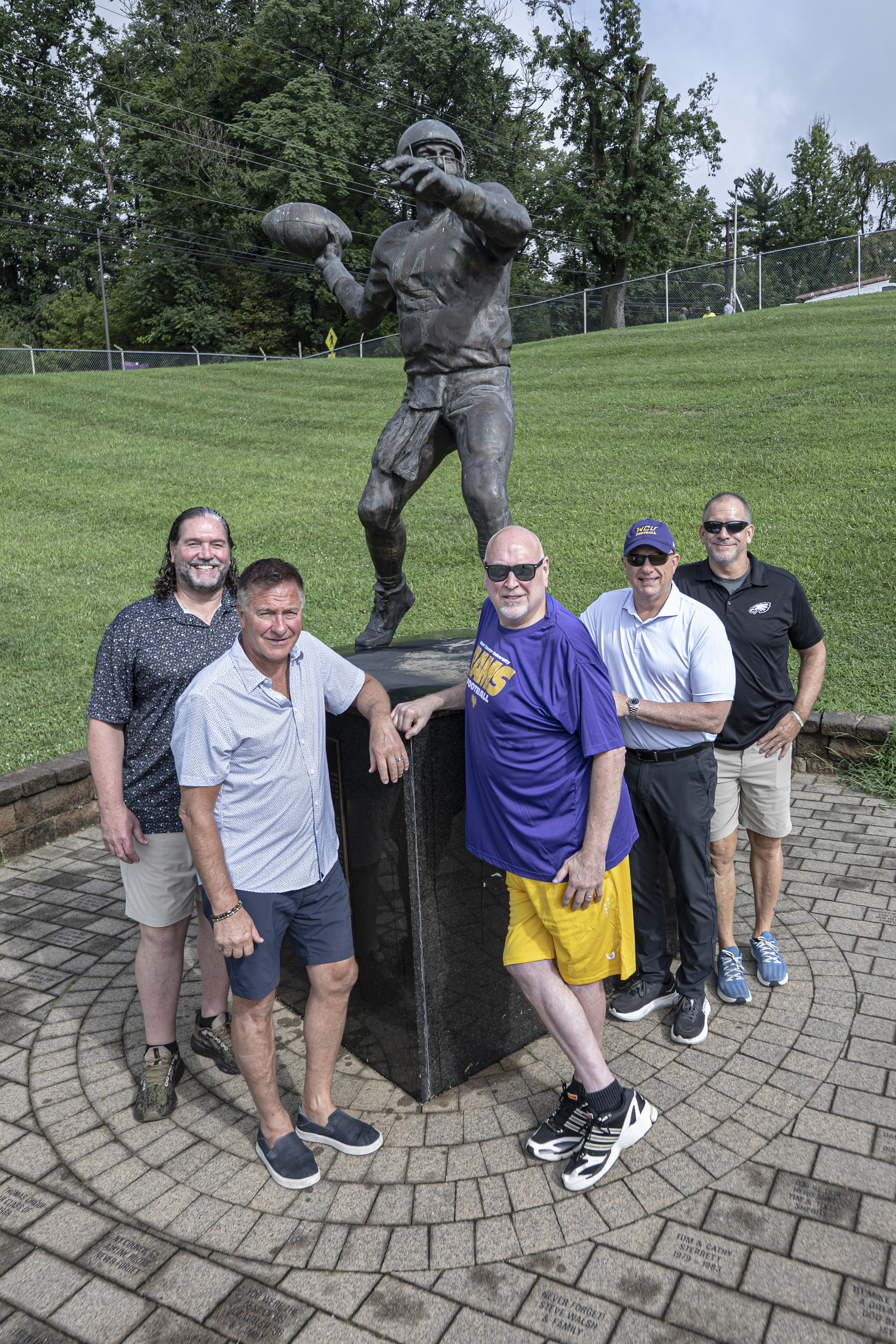
From left, West Chester University football alumni Tom Weaver, Mike Esposito, Bob Campbell, Mike Hudson and Dean DiPasquale pose for a photo with a statue honoring their former teammate Michael Horrocks last month. Jose F. Moreno / Staff Photographer
In 1984, West Chester hired a new head coach, Danny Hale, who brought in a new I-formation attack that incorporated elements of the West Coast offense. This system was different from what the team was accustomed to running (a split-back veer offense), and Hale, who was hired late, had limited time to teach it.
He and quarterbacks coach Bill Hart met with Horrocks every day in the football office on campus. They would draw up plays on the chalkboard and quiz their pupil about different coverages and fronts he would face.
Hale’s system allowed Horrocks the ability to audible if the situation called for it, and the head coach wanted him to be well-prepared. But Hale and Hart soon learned that that wouldn’t be a concern.
The Golden Rams went 7-3 in 1984, and 5-1 in their conference, falling just shy of winning the Pennsylvania State Athletic Conference’s Eastern Division title.
When DePippo looks back, he realizes that the same qualities that served Horrocks in the air were those that made him a good quarterback: a natural leader, a hard worker, a man who could balance an easygoing nature with intense focus.
“It comes back to what kind of pilot do you want?” DePippo said. “Do you want somebody that’s going to panic when the s— hits the fan, or do you want a guy that’s going to be confident?
“And Mike was that confident guy; a pilot the entire time. We just didn’t know it.”
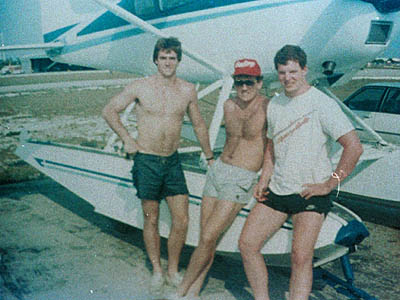
Pilot Michael Horrocks (left) was introduced to flying in the 1980s. (Photo provided by Mark Gosik)INQ WILLIAMS
From football to flight
The first time Horrocks flew a plane was in 1983. He was in Fort Lauderdale, Fla., for spring break with two friends, Mark Gosik, a former guard for West Chester, and Rob Jeffries, a tight end at Lehigh.
They were visiting a family friend of Horrocks’, Bill Blauer, who worked for a commercial airline. One afternoon, Blauer invited them aboard his four-seat aircraft.
Gosik and Jeffries sat in the back, with headgear on, as Horrocks rode up front. About halfway through the two-hour ride, Blauer turned to Horrocks and told him to grab the controls.
Horrocks obliged and cruised the plane down, close enough to see the beachgoers below. As he flew over the ocean, with waves rippling beneath him, he realized he had found his calling.
The former quarterback felt that his best route to commercial flight would be through the Marines. Horrocks knew he would get the best training there, and he liked the idea of a new challenge. So, after graduating West Chester in 1985, he enrolledin Officer Candidates School.
He got his wings at a naval air station in Corpus Christi, Texas, and was stationed in the early 1990s at Marine Corps Air Station Cherry Point in North Carolina, where he joined a marine aerial refueler transport squadron.
Horrocks flew KC-130 turboprop aircraft, which were used to refuel helicopters and jets, but also to transfer cargo, passengers, ammunition — anything that needed to be moved. It was a daunting transition, one that many young pilots struggled with.
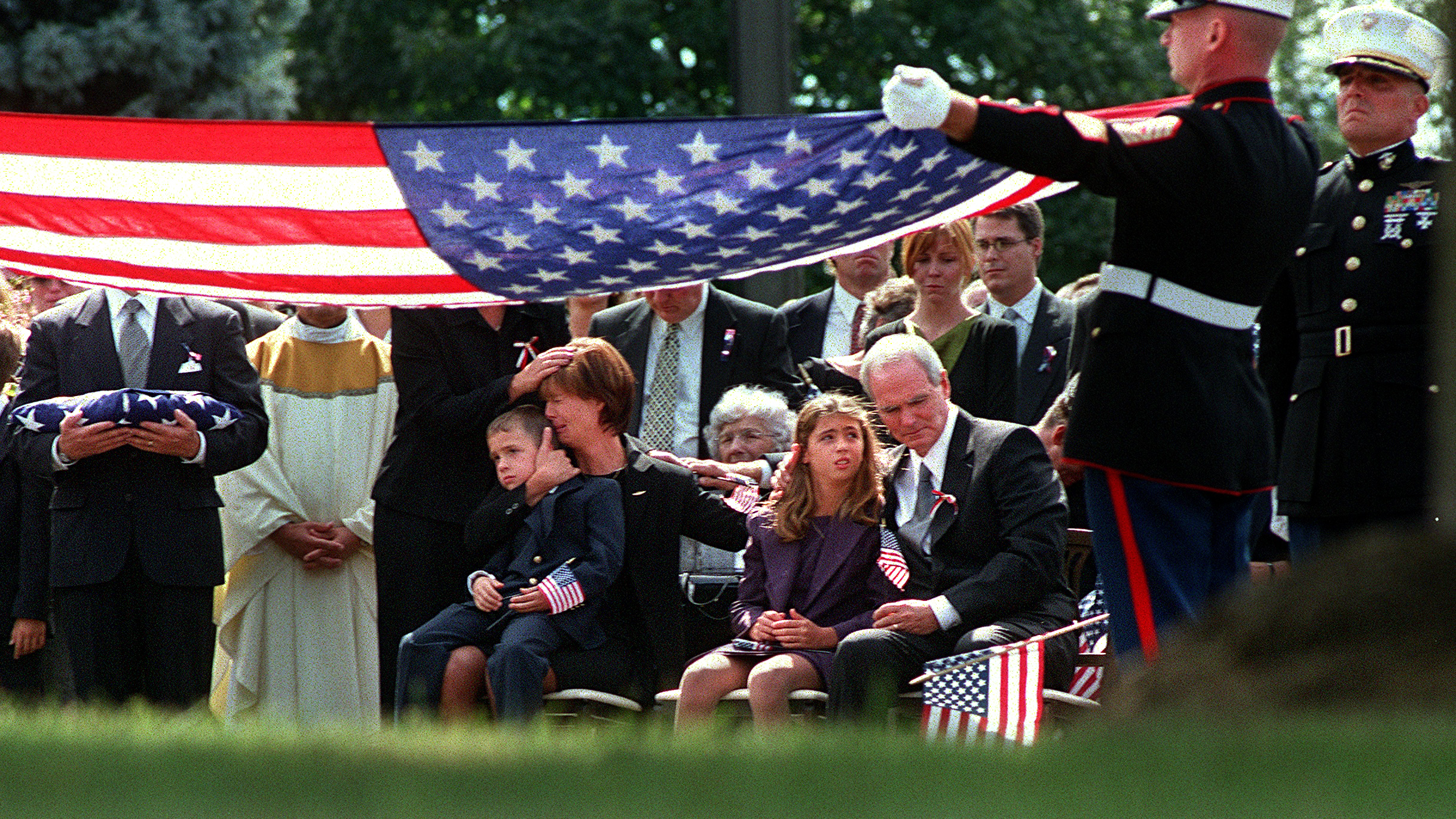
Miriam Horrocks (center, left) cradles her son Mick, 6, as her father-in-law William Horrocks (center, right) sits with her daughter Christa Horrocks, 9, as a US Marine Corps Honor Guard folds up the American flag following a memorial mass and service for her husband Michael Horrocks on Sept. 17, 2001.Tom Gralish / Staff Photographer
In training, they would be flying a single-engine plane, which stretched maybe 18 to 20 feet long. Now, as lieutenants, they were manning a plane five times as big, with three more engines, moving whatever needed to be moved at 30,000 feet in the air.
It was anything but a routine job. Horrocks’ operations officer, now-retired Lt. Col. Bill Franchi, said that when his squadron deployed to Bahrain during the Gulf War, they did so knowing that there was a good chance they would be targeted heavily.
But Horrocks was a natural, and quickly proved he could be relied upon. He went on a number of deployments, to the Middle East throughout the Gulf War, to Europe, to Central America, and became Franchi’s “go-to guy.”
Once, during a three-week detachment to Norway, a panel in the squadron’s KC-130 caught fire. As Franchi tried to put the fire out, he asked Horrocks to redirect the plane back to the local airport.
This was not a scenario that the young pilot had practiced in a simulator. Horrocks would be landing downwind, without flaps on his wings, which helped the plane maintain lift while slowing it down.
With a full-face oxygen mask on, and vapor from a fire extinguisher filling the cockpit, Horrocks guided the aircraft onto the runway, preventing what surely would have been a disaster.
“I told him, ‘I credit you with having saved about six people,’” Franchi said. “Because I didn’t have to do a thing. He had it. And that was sort of typical of Mike. You know?”
Horrocks spent his last few years in the military instructing Marine, Navy, and Coast Guard pilots in Florida. In 1997, his active duty came to an end. He enrolled in new-hire pilot training at United Airlines that summer.
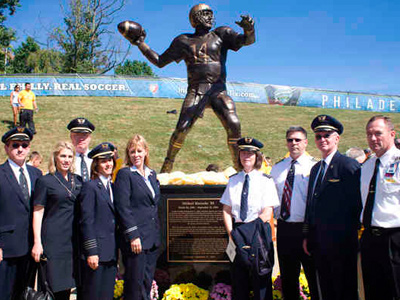
United and Continental Airlines pilots and crew, all friends of Michael Horrocks, stand by his statue at Farrell Stadium in 2010. (Ed Hille / Staff Photographer)
He soon was flying commercial airplanes full-time and living in Glen Mills with his wife, Miriam, and their two young children, Christa and Mick.
Now that Horrocks was local again, he was able to reconnect with old teammates like Bob Rafferty, a former West Chester halfback and quarterback.
They would often see each other in Media, running errands at the Granite Run Mall. In December 2000, while shopping for Christmas gifts, they crossed paths one last time.
Horrocks was walking out of the mall, and Rafferty was walking in. They chatted about family. Horrocks mentioned that he had recently started working transatlantic flights for United.
The two men said goodbye and went their respective ways. Nine months later, Horrocks boarded a Boeing 767 at Logan International Airport in Boston.
Rafferty watched as it hit the South Tower of the World Trade Center. Few, if any, of his teammates knew that Horrocks was piloting commercial aircraft. The idea of him being on that plane didn’t even occur to them.
But Rafferty had a feeling.
“He was the first person I thought of,” he said.
West Chester University quarterback Colin O’Sullivan taps a statue honoring former quarterback Michael Horrocks before practice last month. Jose F. Moreno / Staff Photographer
‘Think of Mike’
Without social media, news of Horrocks’ death at age 38 spread slowly.Some West Chester football alumni found out when they saw Miriam Horrocks on the front page of The Inquirer, at her husband’s funeral in Upper Providence Township.
Others heard through teammates. DePippo was working on Wall Street and lost about 40 or 50 colleagues in the attack. He couldn’t process that Horrocks was gone, too.
In late September, Gosik and two friends, Tim and Patrick Dever, took a train to New York. They spent the day at ground zero, walking through rubble, picking up pieces of people’s lives off the ground: photos, notebooks, newspapers.
Gosik still remembers how dust and soot filled the air. So did the sound of car alarms, blaring for their owners. A few days earlier, a neighbor had made Gosik a lapel pin to commemorate Horrocks, with his No. 14 written on a felt football.
Gosik wore it on his jacket as he traversed the site where his teammate perished.
“We just felt like we needed to be there,” Gosik said. “We just wanted to go.”
Years went by, and the West Chester alums began to wonder why no tribute to their quarterback existed on campus. They were worried that Horrocks would be forgotten, and realized that their fears were well-founded.
West Chester University football players tap a statue honoring former quarterback Michael Horrocks before practice last month. Jose F. Moreno / Staff Photographer
“I don’t recall any of us even being aware of it beforehand,” said Tim Keyser, a wide receiver who graduated in 2013. “That wasn’t something I knew when I was a true freshman on campus or anything.”
The former players began to meet with the school about the prospect of a statue in 2008. Bill Zwaan Sr., who was head coach of the football program at the time, sat and listened as an official from the foundation tried to convey how complicated, and costly, it would be to build such a structure.
Horrocks’ teammates ended the meeting emphatically: by standing up and reiterating, for the umpteenth time, that they were going to move forward with the statue. After they left, the foundation official turned to Zwaan.
“And he said, ‘Do you think they really understood what we were talking about?’” Zwaan recalled. “And I said, ‘They do. And they’re going to do a statue. And you guys have got to be prepared for that.’”
It was a slow, arduous process. The former players not only would have to raise $50,000 for the statue itself, but also would donate $100,000toward a scholarship endowment, which DePippo and another teammate, Bruce Blake, started in 2004.
At this point, most of them had full-time jobs and families of their own, and carving out time was not easy. But they made it happen.
DePippo oversaw the money. Mininno began a letter-writing campaign to raise funds. Walsh served as a liaison between the alumni and the current coaching staff.
Schafer worked as a partner of a local concrete cutting company. He and another West Chester alumnus, Paul Vanscovich, donated their construction crews and equipment for free.
Other teammates chipped in through a team banquet and a Super Bowl pool. A few local businesses, and the pilots union, contributed as well.
The statue of Mike Horrocks at West Chester.MICHAEL S. WIRTZ / Staff Photographer
“I’d kick in $1,000, John would kick in $1,000, Jim O’Donnell would kick in $1,000,” DePippo said. “And then we would get on a text chain, and berate each other in team fashion. Like, ‘You’ve got to do this.’
“We raised money basically only through grassroots. I was specific about that. I didn’t want any corporate sponsorship.You know, ‘CBS Sports presents the Mike Horrocks statue.’ I didn’t want that.”
In the months before construction of the statue was finished, former players would visit West Chester to share stories of their late teammate with the current roster.
Walsh, DePippo, and Blake visited them the day before the dedication. Wearing purple and yellow practice jerseys, the team took a knee as Walsh began to speak.
He explained that one day, Horrocks’ teammates wouldn’t be able to share his story, and that it would be up to the next generation of players to do so.
Then he asked them to close their eyes, and think of a loved one: a sibling, a friend, a parent.
“And when you go down that hill tomorrow, and you touch [the statue of] Mike, think of Mike,” Walsh said. “Say his name. And think of someone else who is special in your life. And thank God that you have them with you today.”
Nine years after their father’s death, Christa Horrocks comforts her brother, Mick, at the unveiling of the statue of Michael Horrocks at West Chester University in 2010.
The statue was unveiled at 10:30 a.m. on Sept. 11, 2010, a perfect autumn day in Chester County. The school arranged a ceremony beforehand, with bagpipes, a marching band, and a flyover.
Miriam Horrocks and the children, now teenagers, were in attendance; Christa gave a speech about her father.
Sitting next to the podium, with crutches by his side, was Schafer. He was unable to speak to a large crowd, but sat throughout the entire ceremony with a smile on his face, shaking hands with football men young and old.
He died of cancer just over a month later, at his home in Phoenixville.
Last August, during a team reunion in West Chester, a thought occurred to Walsh. He pointed to the bricks surrounding Horrocks’ memorial, which contained inscriptions honoring the late quarterback.
He suggested adding a small stone, maybe toward the back, with the number 52 on it; a nod to a teammate who put another above himself, even when his body was failing.
“Tom just believed in his heart that it needed to be a statue,” Walsh said. “And he was right. He was right.”
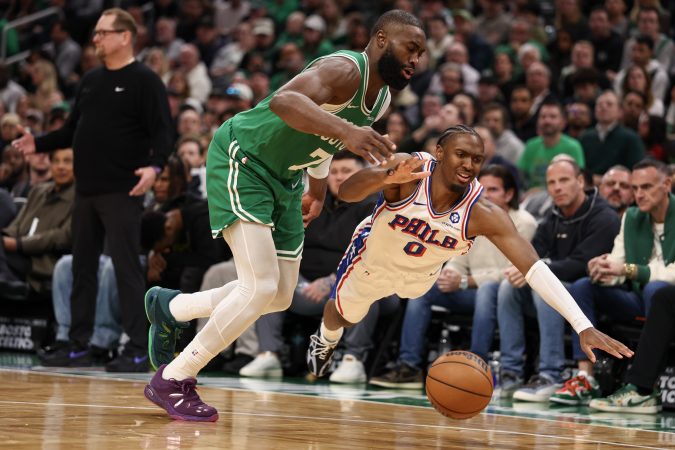
In the wake of the 76ers’ monumental offseason, one concern that players have already started addressing in various statements is, “How much are players going to sacrifice?”
Having as much talent as the Sixers have on their roster naturally leads to questions about roles and shot distribution, since there’s only one ball to go around.
Landing Jaylen Brown and LeBron James in the same offseason will of course invite skeptics who doubt the fit and wonder whether everyone’s games can mesh. But this is a champagne problem in the NBA. Most teams would be lucky to have this as one of its main issues heading into training camp.
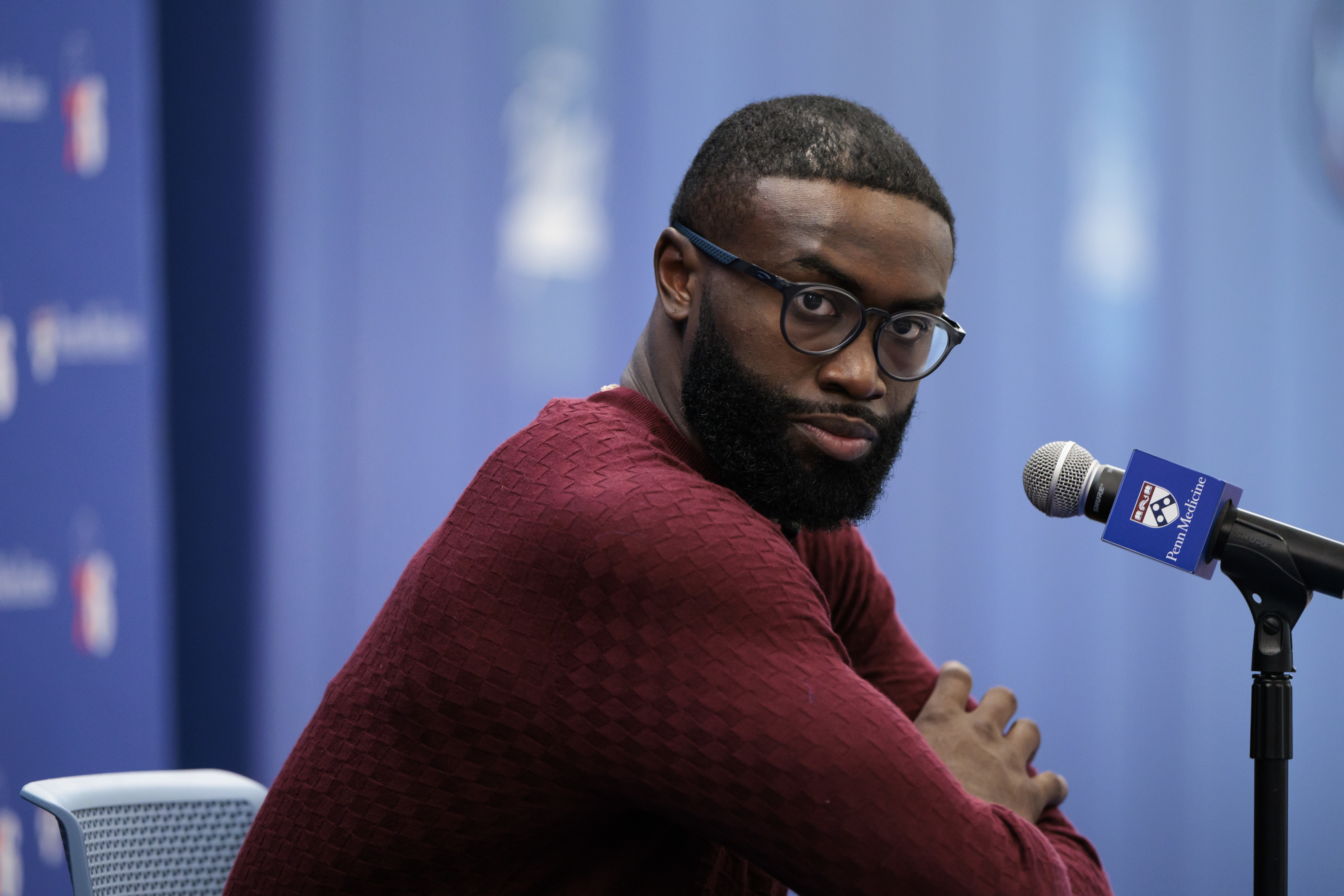
New Sixer Jaylen Brown acknowledged that his team will need to sacrifice. Monica Herndon / Staff Photographer
“Obviously it’s a lot of guys with talent,” Brown said last month. “It’s egos, but to win, you got to be able to sacrifice, be able to have trust and communication.”
Along those lines, here’s a look at how the Sixers might address that through the lens of a statistic that measures how often a player consumes his team’s possessions, usage rate, which measures how often a team’s possessions ends with either a shot, free throws or a turnover from a particular player when he is on the floor.
A glance at the starting five
First, here were the individual usage rates last season (according to NBA.com) for each player in the projected starting five, and where they ranked in the league.
Tyrese Maxey: 28.6% (27th)
VJ Edgecombe: 19.6% (181st)
Jaylen Brown: 35.1% (third)
LeBron James: 26.2% (47th)
Joel Embiid: 33.6% (sixth)
Potential paths forward
Quick addition will show all those percentages equal 143.1 when they need to equal closer to 100 (since not everyone will always be playing together at the same time). In some lineup combinations, and in games in which Embiid and/or James don’t play, that’ll be the time for Maxey, Edgecombe and Brown to have higher usage stretches than they would have when everyone is healthy. But when all five are healthy and on the floor, likely everyone is going to have to sacrifice to make the usage pie work.
James has already indicated with his play that this is where he is headed in his career, and perhaps why general manager Mike Gansey has been hyping up James’ ability to be a connector.
James’ usage actually hit a career low last season, as he ceded more scoring opportunities in the Los Angeles Lakers offense to Austin Reaves and Luka Doncic. This worked for the Lakers, who were playing well before Reaves and Doncic got hurt later in the season. James averaged 7.2 assists, so having him lean more into a connector and creator role in the Sixers’ offense is a prime way for the offense to generate shots naturally when the starting five is on the floor.
This could allow Maxey to play more frequently off the ball, where he can be efficient from three-point range.
Looking at Brown’s numbers
Another obvious place to look for decreased usage is Brown, who saw a spike in that statistic with Jayson Tatum out for the majority of last season for the Boston Celtics. Brown went from 28.2% the prior season to his 35.1% mark last year (he attempted four more shots, averaged 2.4 free throws and one more turnover per game).
Brown returning to a usage level similar to what he had playing alongside Tatum makes sense, considering he won’t have to shoulder the burden of heavy shot creation playing alongside Maxey, Embiid and James. How he adjusts his game to the roster around him is one of the more interesting questions of the early part of the Sixers season and could go a long way to determining just what this team looks like.
A load off Embiid’s shoulders, and legs
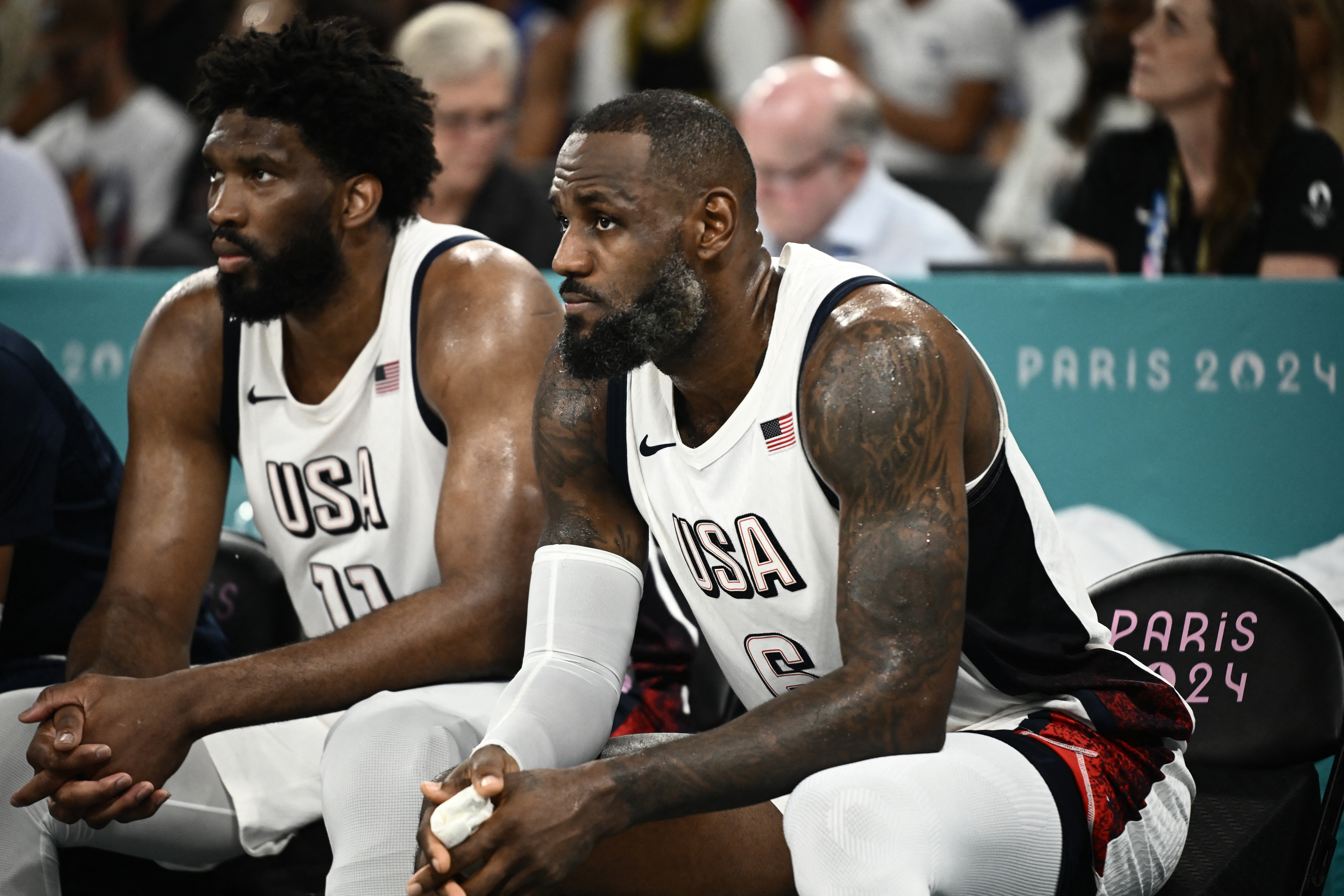
The potential path to Embiid’s role on the team may lie in his 2024 Olympics experience playing with James. There, Embiid took on a reduced role on Team USA’s path to the gold medal.
Joel Embiid served as a role player on the Team USA win in the 2024 Olympics. AFP via Getty Images
The offense doesn’t have to run through him when he’s on the floor, especially if the Sixers are going to utilize one of the strengths of this roster — getting out in transition. This could serve a dual purpose in freeing up shots for the rest of the lineup while allowing Embiid to avoid accumulating as much wear and tear game to game.
Getting out in transition
The Sixers have four of the top 15 scorers in transition from a season ago. One way to get everyone his fill of shots is to play fast and have more possessions. If the Sixers commit to playing that way some of the usage issues will take care of themselves. Inevitably, there will still be things to figure out in the halfcourt, especially when it comes to who is taking what shots late in close games.
That will take time to sort through. But the Sixers, in their comments so far this summer, have indicated they know the challenge ahead, and so far, they seem willing to tackle it head on instead of avoiding it.
Just under a month into training camp, Lane Johnson outlined the best-case scenario for the Eagles offense in 2026.
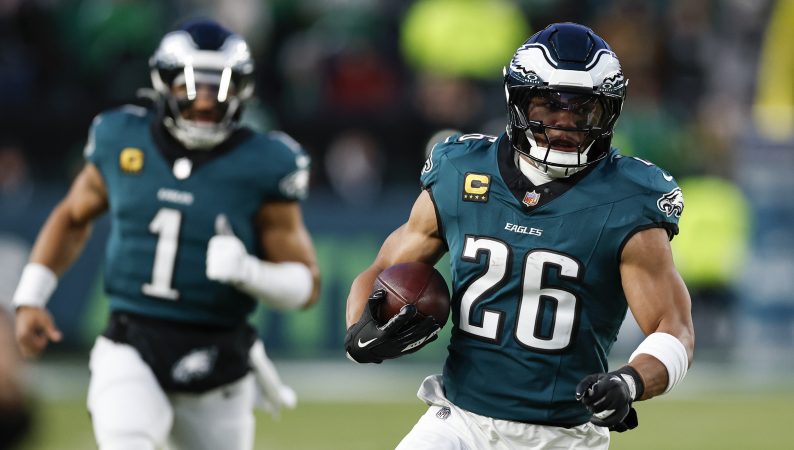
It was a lofty aspiration — but not unrealistic, given the success of the offense just two years ago. It centered on its star running back, Saquon Barkley, who accumulated over 2,000 rushing yards in the 2024 regular season and broke Terrell Davis’ single-season rushing record (combined regular season and postseason) by Super Bowl LIX.
“I think all in all, the more productive we are in the run game and stuff feeds all of that, that we’ll see the Saquon of two years ago,” Johnson said on Aug. 19.
That ideal won’t fall on Barkley alone. To recapture his productivity of two years ago, the Eagles are going back about 30, tapping an offshoot of an offensive scheme that rose to popularity around the time the running back was born.
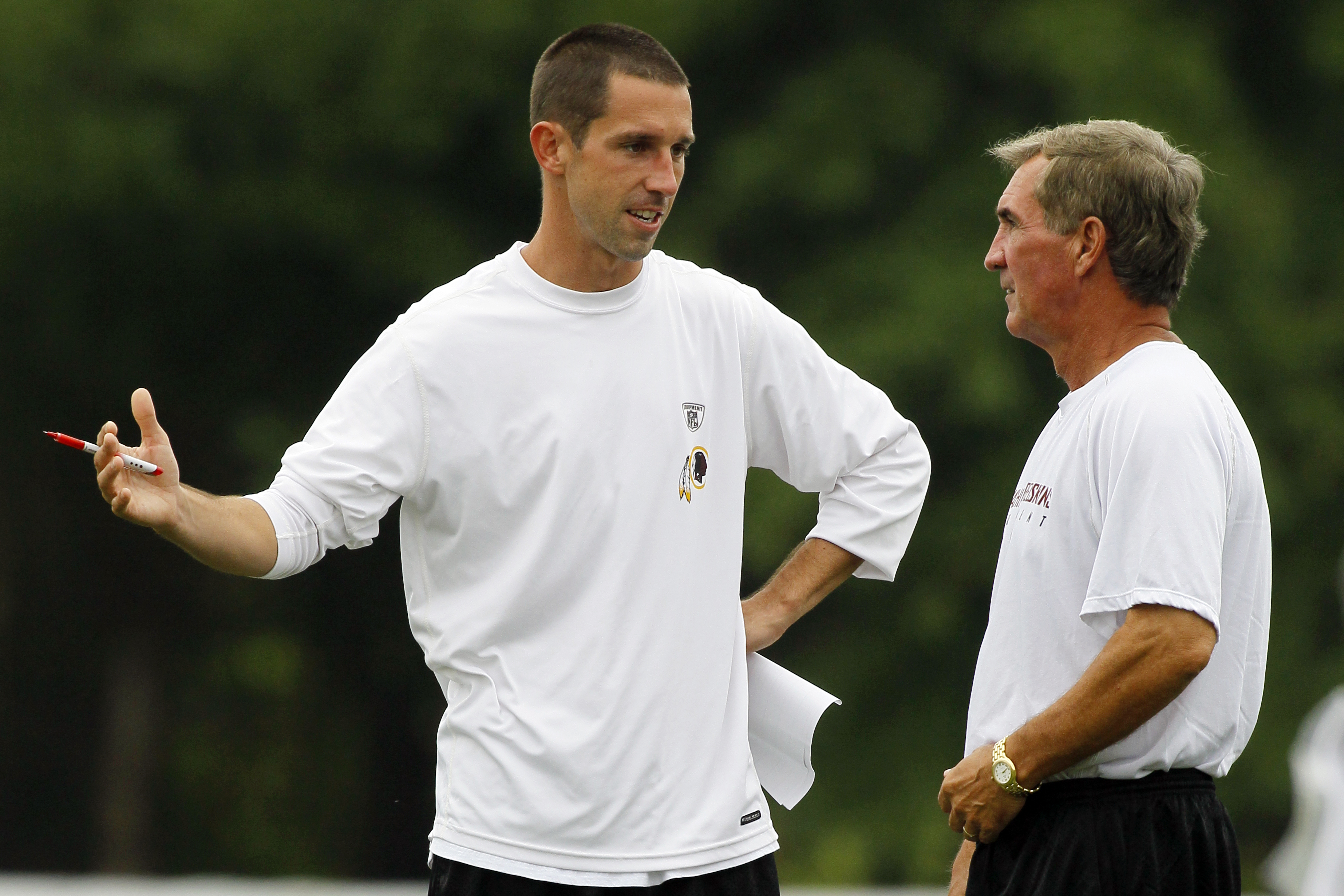
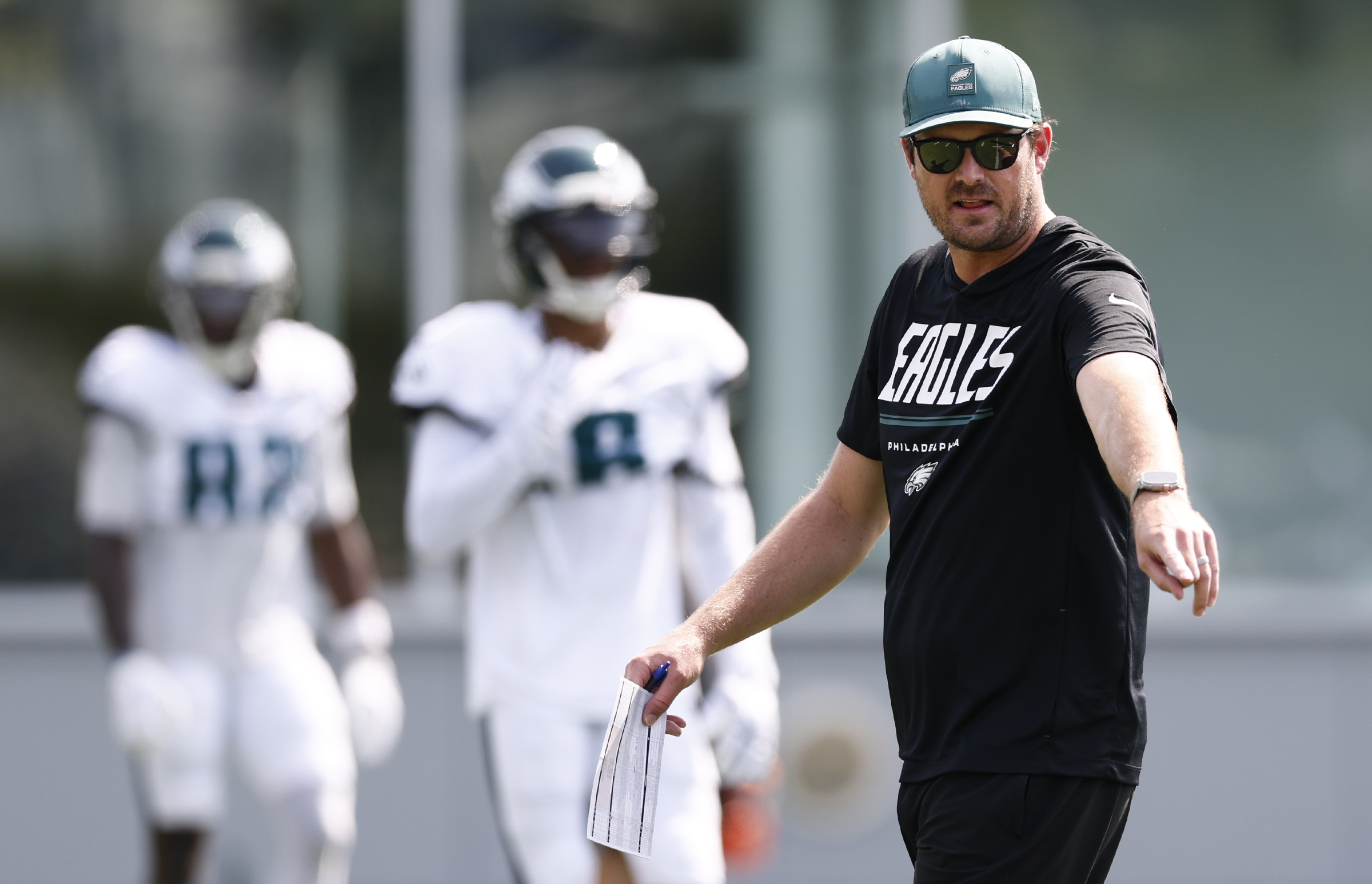
Sean Mannion, the Eagles’ first-time, 34-year-old offensive coordinator, spent most of his playing and coaching careers learning from pupils of the Shanahan/McVay tree. These days in the NFL, “Shanahan” refers to Kyle, the head coach of the San Francisco 49ers, but he is preceded by his father Mike, the two-time Super Bowl-winning head coach with the Denver Broncos who helped Davis reach that record in 1998.
Kyle Shanahan (left) and father Mike (pictured in 2010 while with Washington) pointed the way to the current run-game concepts in vogue around the NFL. Alex Brandon
When Mike became Broncos head coach in 1995, he named Alex Gibbs offensive line coach. Gibbs, who died in 2021, was a proponent of the wide-zone blocking scheme in the run game that would go on to serve as the foundation for the modern West Coast offense.
His influence lives on in offshoots of the scheme around the league. Mannion called his first exposure to the system in 2017 under Los Angeles Rams head coach Sean McVay “a very exciting point in my football life.” Now, Mannion has the opportunity to make it his own, all while helping breathe new life into an Eagles rushing attack that stagnated in 2025.
“I’ve seen it from afar, but now, actually studying it and working it and trying to put myself in the system, I feel like it’s going to open up some things that I may not have been able to show as much in my career,” Barkley said.
The man seeking to help Barkley elevate his game is a quarterback by trade. But Mannion’s expertise isn’t limited to the passing game. According to offensive line coach Chris Kuper, who played for Shanahan in Denver, the Eagles offensive coordinator “loves the run game,” too.
“The run game is a big part of what we’re going to do,” Kuper said, “And [Mannion’s] got passion for it. And that makes me feel good as an O-line coach, because I think we’re going to be really good at running the ball.”
Todd Gurley thrived with wide-zone concepts while with the Rams. Tony Avelar
In the (wide) zone
When Barkley learned that the Eagles offensive scheme in 2026 would have Shanahan/McVay roots, he fired up Todd Gurley’s film.
Gurley spent five of his six seasons in the NFL with the Rams, including two standout seasons in 2017 and 2018. He led the NFL in rushing touchdowns in both seasons, earning a pair of All-Pro honors and an NFL Offensive Player of the Year nod in 2017.
Dean Davidson, the author of the Wide Zone Warriors Substack, watched those years in real time. A native of St. Louis whose memories of the Rams commence with the collapse of the “Greatest Show on Turf” era, Davidson was enthralled with the quick work McVay did to turn the team around. At the time, Davidson had just joined the staff of a struggling high school football team and was looking for inspiration.
“I was trying to figure out how [McVay] took that team from the dumps that they were in my entire life that I could remember to that point to Super Bowl favorites in what seemed like overnight,” said Davidson, who is now the offensive line coach at Obion County Central High School in Troy, Tenn.
At the core of the scheme that fascinated Davidson was the wide-zone run. Its intent is in its name. The blocking unit aims to stretch the defense on the front side of the run, while simultaneously cutting off defenders on the back side.
As Gibbs explained at his 2015 offensive line clinic in Cincinnati, the running back’s aiming point is the backside of the tight end — and if there is no tight end to the weak side of the formation, it would be to the imaginary backside of the tight end. After three steps, the running back would know whether he should hit the edge on the front side or make a single cut up the middle of the field. By the fifth step, he would make his cut.
One of the challenges of defending the wide zone run is the distance that defenders have to cover in order to maintain their gap integrity, Davidson explained.
“Everybody’s moving so far in one direction that the gap that you’re responsible for as a defensive lineman or a linebacker, maybe even a safety, it might still be between the same two offensive linemen, but those two offensive linemen on a given snap could be like 10 yards laterally somewhere else,” Davidson said. “So forcing them to maintain their gap integrity while moving so far laterally, it’s a very difficult challenge.”
It’s a challenge the Eagles offensive line enjoyed creating throughout training camp. Cam Jurgens said the scheme “lets you be a little bit more of an athlete” given how quickly the front side blocking unit must fire off the ball laterally toward the sideline.
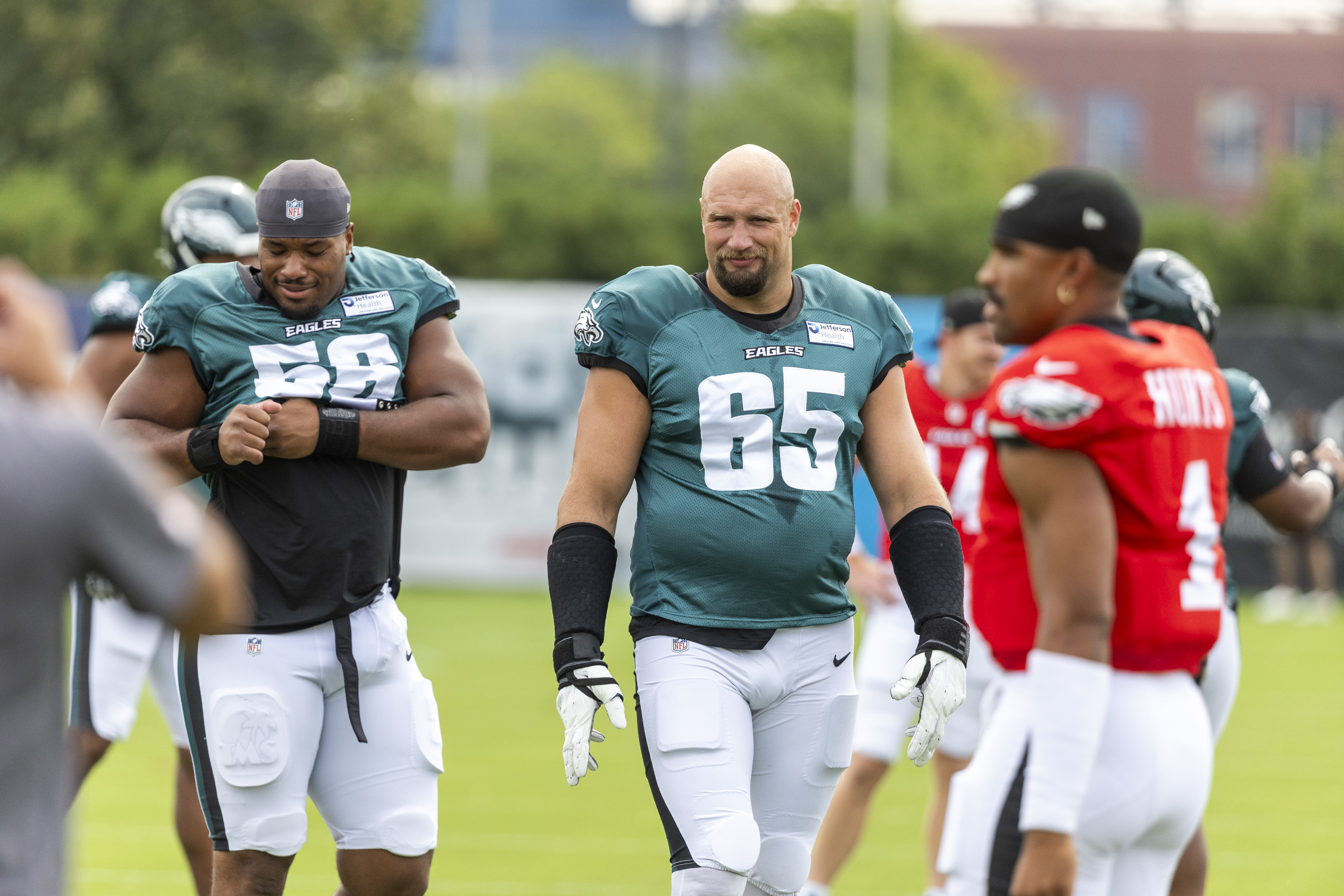
The goal, according to Kuper, is for the defense to defend every blade of grass on the field. That task, ideally, would tire out the defense as the game wears on, Lane Johnson said. After Johnson, Jurgens, and Landon Dickerson had a full offseason to recover from the ailments that plagued them last year, they are up to the assignment.
“We’re getting to really run, stretch the field, cover some yardage,” Johnson said. “So in that way, it tires out defenses. Makes them cover each gap.”
Lane Johnson (65) and his fellow offensive line cohorts are getting behind the wide-zone scheme Sean Mannion has introduced in Philly.Tyger Williams / Staff Photographer
The wide zone could be at the foundation of the Eagles’ rushing attack, but in all likelihood, it won’t be the only style of run in their playbook. When Gibbs was designing the Broncos’ run game 30 years ago, he only believed in coaching zone runs — primarily wide zone and some tight zone, in which the running back’s landmark is typically behind the center.
David Gibbs, his son and the secondary coach at Arizona State, explained that his father didn’t believe teams could excel at executing both zone schemes (blocking a certain area of the field) and gap schemes (blocking a specific defender or gap). But the game has evolved, the younger Gibbs said.
“You have to be able to do both, because the defensive linemen are so good,” he said. “They’re so big, athletic, strong, and the reality of it is defensive linemen are just more athletic than offensive linemen, in my opinion. And so you can’t give them the same schemes all the time.”
Brett Kollmann, an NFL Media analyst, called the Rams’ 15-6 loss to Vic Fangio’s Chicago Bears in 2018 “one of the defining games of the last decade” that prompted an evolution of McVay’s scheme. At the time, the Rams’ rushing attack was wide-zone heavy. Fangio’s solution was to stack bodies on the line of scrimmage in a 6-1 “tilt front,” putting a body in every gap and forcing the running back to cut back into a defender.
Bill Belichick and the New England Patriots would follow the same blueprint to stop the Rams in the Super Bowl that season. To counteract the defense’s penetration at the line of scrimmage, McVay would eventually introduce more “counter” runs, a gap scheme that calls for two pulling blockers to create a pair of gaps on the play side.
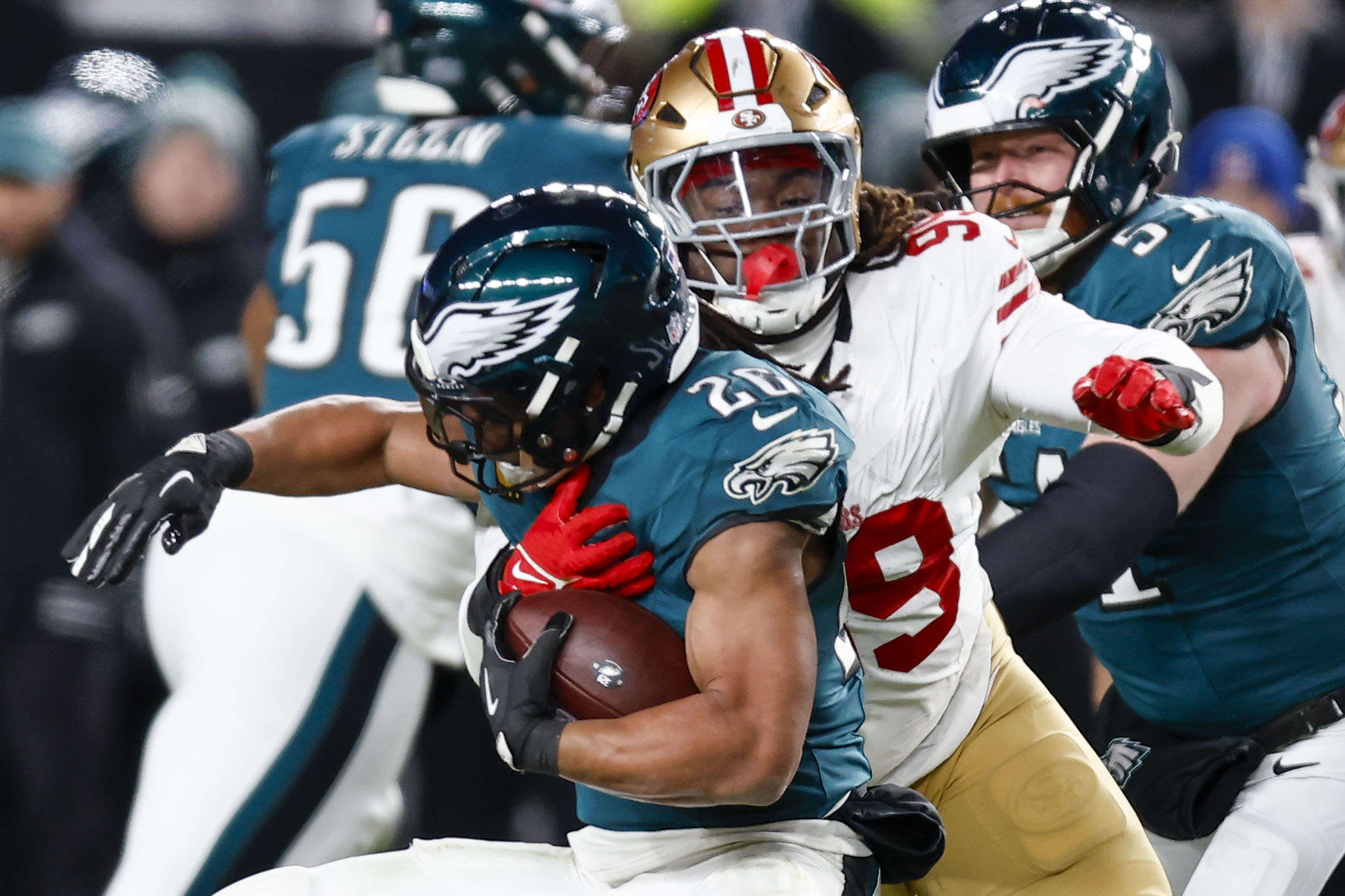
The incorporation of different types of runs gives defenses more to process, according to right guard Tyler Steen, which in turn forces them to slow down.
“One minute you’re going wide zone and D-tackles and D-ends are running,” Steen said. “The next minute, you’re going ‘duo’ and you’re going downhill. So I think that gives defenders a lot to think about. And so it kind of makes it easier on the O-linemen, because [the defense doesn’t] know what to play.”
Saquon Barkley often found running room hard to come by for an Eagles offense that grew predictable in 2025. Monica Herndon / Staff Photographer
Keeping defenses ‘on their toes’
After the Eagles’ 34-17 loss to the New York Giants in Week 6, Johnson tried to surmise the state of the Eagles offense.
As he spoke at his stall, he used some form of the word “predictable” three times.
“I don’t know if we’re predictable, but it seems a lot harder than what it needs to be,” Johnson said. “Maybe moving forward have a little bit more variety, hitting the perimeter some and doing a little bit more of that.”
Johnson emphasized that he wasn’t trying to point fingers, and at the end of the day, the Eagles needed to execute better. Still, his analysis was a harbinger of things to come for the shotgun-heavy offense that seldom disguised its intentions.
The Eagles are set to take a different direction under Mannion. Like other offshoots of the Shanahan/McVay tree, Mannion emphasizes the importance of the marriage between the run and the pass — more specifically, the play-action pass.
When runs look like passes, and vice versa, offenses are less predictable, Johnson said.
“I think setting up with the play action is just going to be a whole lot tougher to distinguish what we’re doing,” Johnson said during mandatory minicamp. “Whole lot harder to catch on [to] tells with stuff that we’re doing. So I think this stuff, we can disguise it more.”
The key to pulling that off is keeping the presentation the same. If the Eagles are running wide zone, for example, and building the play-action pass off of it, the blocking unit is executing the same assignment. Johnson stressed the importance of keeping a “low hat” to sell the run, and if the linebackers bite down, the quarterback can target the vacant middle of the field.
Eagles offensive coordinator Sean Mannion (right) is introducing variety to an offense seeking to keep defenses off-guard. Yong Kim / Staff Photographer
Marry that with motions, and the defense is confronted with another layer of complexity to decipher. Even the quarterback’s alignment under center can further disguise the intent of the offense on any given play, Jurgens explained.
“I feel like that’s just another way to keep defenses on their toes,” Jurgens said during mandatory minicamp. “You get a little less predictable. And so I feel like it kind of gives us a little better angles as well. Defenses can’t cheat things, ‘cause they don’t know where we’re going to go. You can set up a lot of your plays a lot better.”
Kollmann is aware of Jalen Hurts’ historical lack of targeting the middle of the field. Dating back to his rookie season before he became the full-time starter, Hurts has targeted the short middle of the field (a maximum of nine yards from the line of scrimmage) on 8.3% of his pass attempts, according to an Inquirer analysis. The league average is 14.5%. From 10 to 19 yards beyond the line of scrimmage over the middle, Hurts’ attempt rate drops to 4.6% (closer to the 7.4% league average).
But Kollmann said that conflating “hasn’t” with “can’t” isn’t necessarily fair. He said he believes that the Eagles lack of a wide-zone, play-action game in the past is to blame for not helping free up that area.
“When they are so shotgun heavy, and therefore when their play action game is really just kind of faking inside zone, that’s the kind of run fake that doesn’t really draw linebackers in, because they can see the ball the entire time,” Kollmann said.
The fake from under center requires a quarterback to turn his back to the defense, shielding the ball from the view of the linebackers. They can’t see it, so they step up, theoretically giving the offense more room to operate over the middle.
It’s easier said than done for any quarterback, as they must temporarily take their eyes off of the pass rushers seeking to take them down. But according to Josh Grizzard, the Eagles passing game coordinator, Hurts has been a “natural” with turning his back to the defense and selling the fake.
“When you have the runs and they look like the keepers and they look like the play passes, then the goal would be for those guys to see the same thing,” Grizzard said. “And then if you can get that second level of the defense to step up, then you have an ability to now push the ball down the field and be able to marry the run and the pass as well as create explosive passes.”
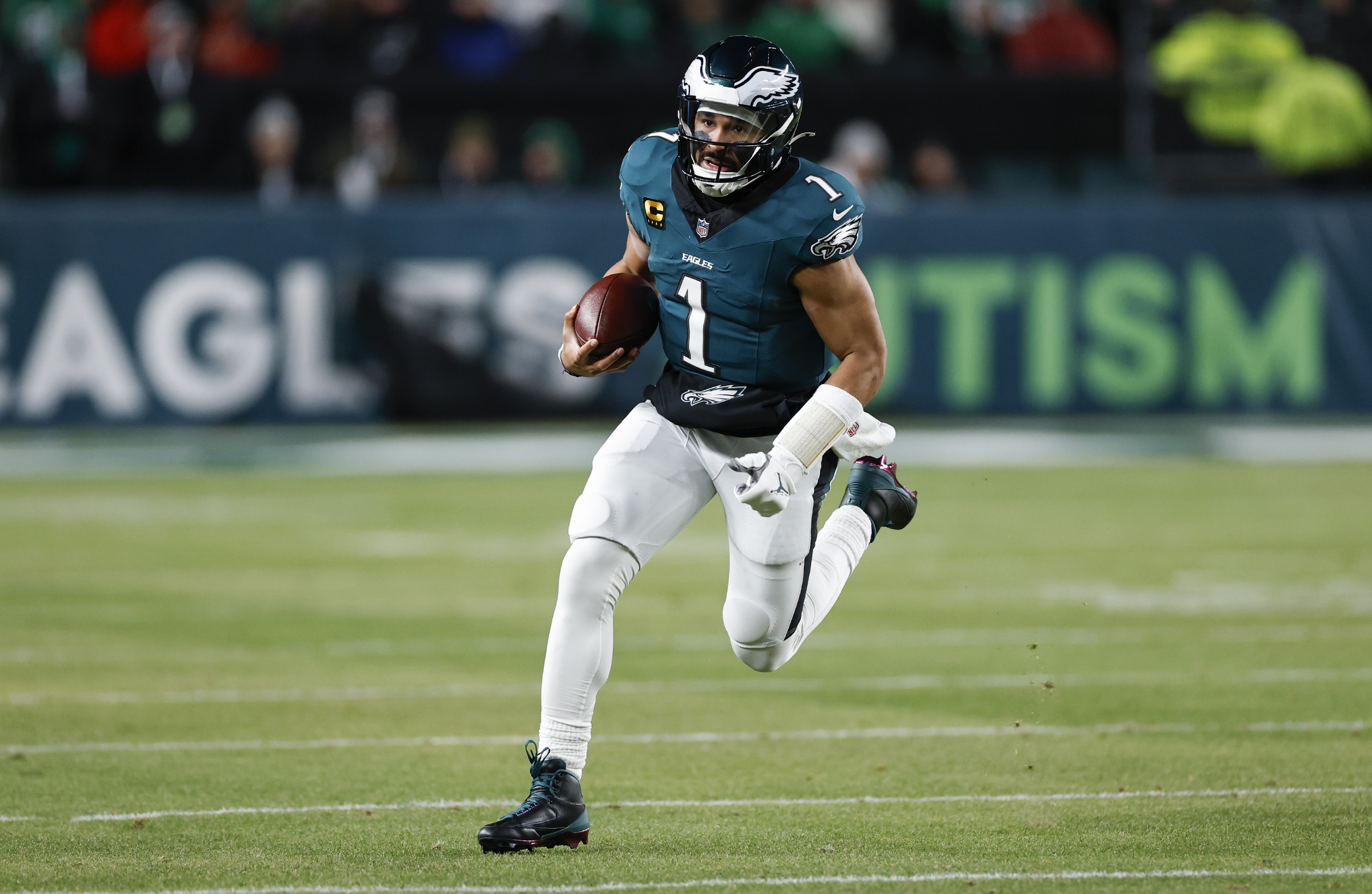
How many runs are designed for Jalen Hurts in the new offense remains an open question. Yong Kim / Staff Photographer
The backside threat
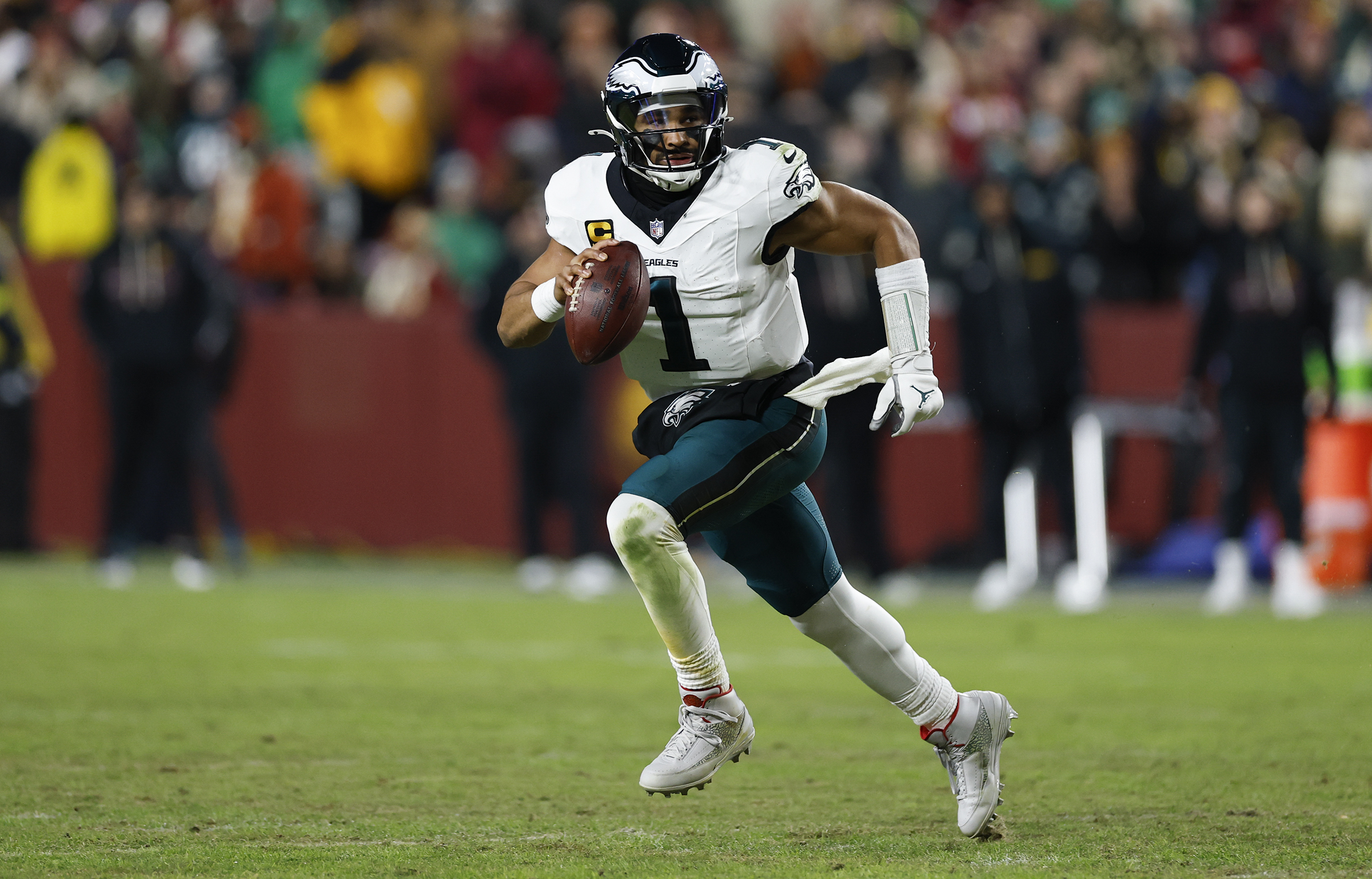
Speaking of keepers, will the quarterback designed run game return to the Eagles offense in 2026?
By December of last year, Hurts was averaging 1.1 designed runs per game in 2025, according to Pro Football Focus. He averaged 3.6 designed runs per game in his first four seasons as the starter.
The modern West Coast offense hasn’t necessarily needed a mobile quarterback to thrive, as evidenced by the success of Jared Goff and Matthew Stafford with the Rams. But the 2026 Eagles offense isn’t going to be a carbon copy of other schemes around the league from the same tree, and Mannion is well-aware of Hurts’ rushing ability.
“Jalen has a unique skill set in that way,” Mannion said. “So that’ll certainly be a part of what we do, but we’re looking again at all areas as an offense to really attack defenses on a weekly basis. He is uniquely skilled in that way. That will be a part of it, but it won’t be the only part of it.”
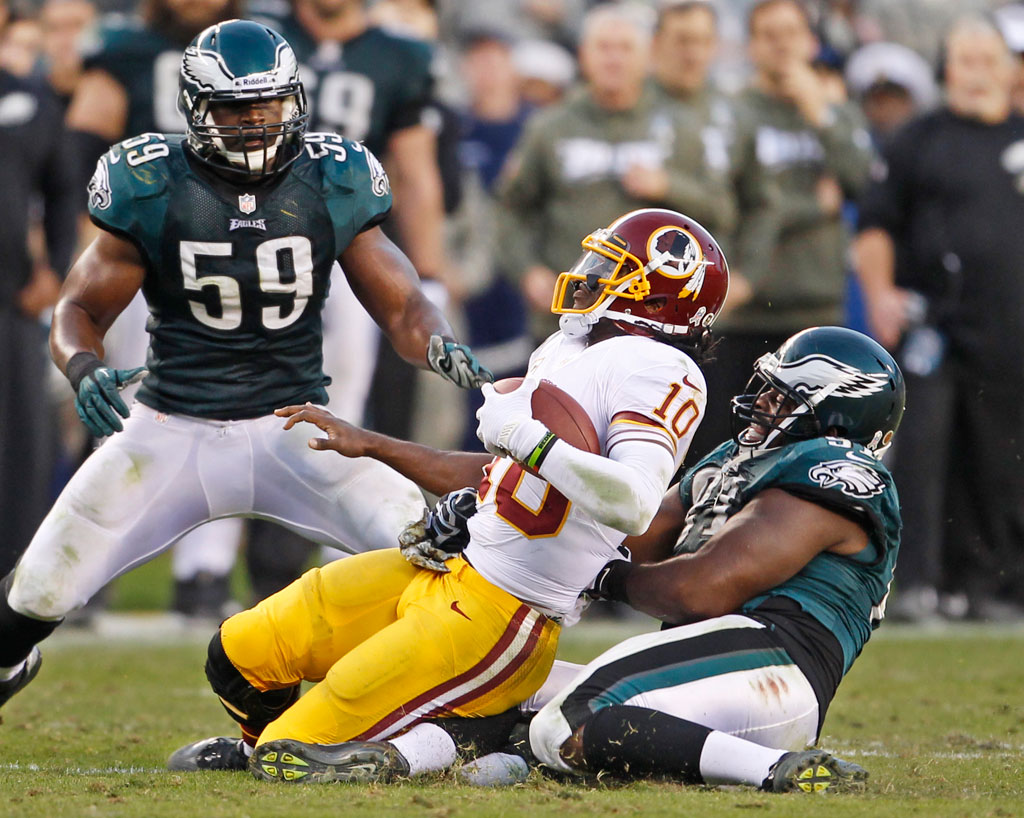
Zone reads aren’t totally foreign to this coaching tree. In 2012, while Mike Shanahan was Washington’s head coach and Kyle was his offensive coordinator, the team drafted Robert Griffin III with the second overall pick.
The rookie quarterback would go on to rush for 815 yards and seven touchdowns, all while throwing for 3,200 yards. His production on the ground wouldn’t persist far beyond 2012, though. Washington took a more conservative approach with Griffin III as a rusher, especially as he dealt with injuries that began during a rookie season that was ended by a serious knee injury.
Robert Griffin III (10) was a rushing threat in the Washington offense before injuries curtailed his effectiveness.
Still, Davidson said a backside threat is important in the run game, whether it’s a quarterback run or a bootleg. In the case of the bootleg, which the Eagles incorporated throughout training camp and the preseason, the quarterback exploits the unblocked defensive end who flows with the running back, rolling out unabated in the opposite direction and completing a pass on the move.
“If you’re just under center or even the pistol, and you don’t have anything that keeps the defense on the backside, then it’s a lot easier for them to chase [the ball] down [in wide zone],” Davidson said. “But if they know that they have to defend boot on the other side of the field or defend a quarterback run on the other side of the field, it can really slow the defense down.”
Time will reveal the contents of Mannion’s playbook. While it may contain odes to his influences, it could also include all of the plays he would’ve liked to run throughout his nine-year career as an NFL backup quarterback and two seasons as an assistant with the Green Bay Packers.
Whatever the offense becomes will be unique to the Eagles, Kuper said.
“Those webs of guys kind of break out, and they kind of make it their own, and that’s what our goal is,” Kuper said. “This is going to evolve into Sean Mannion’s offense. This is going to be a derivative, maybe.
“There’s going to be flavors of what you’ve seen throughout the league, and some of his mentors, but this will be our offense.”
Find the football that Tanner McKee is throwing in this preseason game against the Patriots.
Click Tap on the photo to guess the location of the hidden ball
Click Tap again to change your guess or hit submit when you're happy
You will be scored at the end. The closer to the location, the better your score.
Garland Fordice / Staff Illustration / Photography by The Inquirer
Pretty good/Not bad/Way off! Your guess was the ball.Spot on! Your guess was exactly where the ball was. Here's also where a random selection of Inquirer readers guessed.
story continues after advertisement
Question 2
Find the removed football thrown by Patriots quarterback Drake Maye.
Garland Fordice / Staff Illustration / Photography by The Inquirer
Pretty good/Not bad/Way off! Your guess was the ball.Spot on! Your guess was exactly where the ball was. Here's also where a random selection of Inquirer readers guessed.
Question 3
Find the football that Michael Carter is trying to intercept against the Bengals.
Sam Morris / Staff Illustration / Photography by AP
Pretty good/Not bad/Way off! Your guess was the ball.Spot on! Your guess was exactly where the ball was. Here's also where a random selection of Inquirer readers guessed.
story continues after advertisement
Question 4
Find the removed football in this image of kicker Jake Elliot.
Garland Fordice / Staff Illustration / Photography by AP
Pretty good/Not bad/Way off! Your guess was the ball.Spot on! Your guess was exactly where the ball was. Here's also where a random selection of Inquirer readers guessed.
Question 5
Find the ball in this scramble against the Ravens.
Sam Morris / Staff Illustration / Photography by AP
Pretty good/Not bad/Way off! Your guess was the ball.Spot on! Your guess was exactly where the ball was. Here's also where a random selection of Inquirer readers guessed.
Question 6
Find the removed football in this image of Jalen Hurts.
Garland Fordice / Staff Illustration / Photography by The Inquirer
Pretty good/Not bad/Way off! Your guess was the ball.Spot on! Your guess was exactly where the ball was. Here's also where a random selection of Inquirer readers guessed.
Diving deep into the data to look at three trends that will help determine the Eagles’ fate in 2026 (with an assist from pro-football-reference.com and nflfastR).
23rd
That’s the average ranking from last season of the 14 pass defenses the Eagles will face in 2026. It is the softest schedule in the league by a wide, wide margin. The Eagles couldn’t have handpicked a better setup for Jalen Hurts and first-year offensive coordinator Sean Mannion. Right out of the gate, they’ll face a Commanders defense that finished tied for 30th in yards per pass attempt allowed, then a Titans defense that finished dead last. In fact, nine of their 14 opponents finished lower than 20th in yards per attempt.
A big factor in the Eagles’ good fortune is a division that includes two of the three worst pass defenses from a year ago in Dallas and Washington, plus a Giants team that finished in the bottom half of the league. The Cowboys also finished in the bottom 10 in sack rate while ranking 27th in their rate of passing plays of 20 or more yards, two categories in which the Eagles schedule also ranks among the most favorable.
The nondivision slate will likely play a little tougher than it looks on paper. The Rams (tied for 11th in YPA) rebuilt their secondary while adding Myles Garrett and Aaron Donald to the pass rush. The Colts could be better in their first full season of cornerbacks Charvarius Ward and midseason trade acquisition Sauce Gardner. That said, no team in the NFL has a more favorable schedule top to bottom. The Eagles’ opponents had an average rank of 22.9 in passing yards per game and 20.2 in yards per attempt allowed last season. Both are the highest in the NFL.
The sequencing is as beneficial as the actual opponents. The two toughest defenses on their schedule don’t come until Weeks 15 and 16, with just five days separating the Seahawks on Dec. 19 and the Texans on Christmas Eve. Both games are at home.
The early-season schedule is soft enough to counteract whatever learning curve that will exist for Hurts and the rest of the offense in Mannion’s scheme. The expectations should be high.
3.98
That was the average yards per carry of Eagles running backs when they had multiple tight ends on the field last season in neutral game script situations. That ranked in the bottom half of the league and well behind the teams that made it to their conference championships.
A sampling …
Running-back yards per carry in multi-tight-end sets (first and second down outside the 10-yard line)
Bills: 5.25 (4th in NFL)
Rams: 5.23 (5th)
Seahawks: 4.56 (9th)
Bears: 4.52 (10th)
Broncos: 4.44 (11th)
Patriots: 4.30 (17th)
Eagles: 3.98 (20th)
Johnny Mundt (center) was brought in to help the Eagles’ blocking in multiple tight end sets.Tyger Williams / Staff Photographer
Johnny Mundt didn’t get a ton of coverage in training camp. Blocking tight ends rarely do. But the Eagles signed the 31-year-old veteran for a reason. With Cameron Latu lost to waivers and Grant Calcaterra on injured reserve, the Eagles will enter the season without two of their top three tight ends from last year. Add to that the steep learning curve awaiting rookie second-round draft pick Eli Stowers and tight end is one of the bigger question marks on this 2026 roster.
The question is especially relevant given the leaguewide paradigm shift. Teams like the Rams and Seahawks have spent considerable resources accumulating talent at the tight end position in recent seasons. Seattle drafted AJ Barner and Elijah Arroyo in the fourth and second rounds in back-to-back seasons, while the Rams just added second-round pick Max Klare to a stable of tight ends that already included 2025 second-rounder Terrance Ferguson, high-priced free agent Colby Parkinson, 2023 fifth-rounder Davis Allen and veteran Tyler Higbee.
It remains to be seen how central a role multi-tight-end sets will have in Mannion’s offense. Last year, his Packers team finished in the top half of the league in both RB yards per carry and pass yards per attempt.
That’s how many quarterbacks rushed for 600-plus yards last season. The last time the NFL had a regular season where no quarterbacks reached 600 yards was 2017. At least two had done it in each of the previous five seasons.
Hurts’ rushing production has garnered plenty of attention, and deservedly so. The Eagles were a dramatically different offense in 2022 when he averaged 50.7 rushing yards per game compared to the one they’ve been over the last three seasons, when Hurts has averaged just 34.5 yards. It’s certainly reasonable to think that he can and should be well north of the 26.5 yards he averaged last season. But it isn’t all on him.
The natural trajectory of a dual-threat quarterback is to see a year-to-year decline in rushing production. It has happened to virtually every quarterback who has done the things Hurts did early in his career. The league adjusts quickly. It’s no coincidence that virtually every scrambling quarterback saw a significant decline in his rushing production last season.
New Eagles OC Sean Mannion could utilize Jalen Hurts’ running ability more in 2026.Yong Kim / Staff Photographer
Jayden Daniels missed 10 games, but in the seven games he played, he averaged just 39.7 yards, down from 52.4 the year before. Lamar Jackson’s 26.8 yards per game was barely half of the 52.6 he averaged over the two years prior. Bo Nix’s per-game rushing yardage fell by more than 20% (25.3 yards to 20.9). Drake Maye’s was down 18.5%. Josh Allen has averaged 32 yards per game over the last three seasons after averaging 46.2 yards per game in 2021 and 2022.
“I think [Hurts has] really operated through all facets of the offense comfortably,” Mannion said earlier this summer. “But the piece of him as an athlete in the running game is something unique. Those are elements we can lean into a little bit as well.”
Mannion should be thinking that way. But quarterbacks who have running ability will almost always see that running ability limited by defensive coordinators’ awareness of said running ability. The league has seen enough of it in recent years that it is getting better at stopping it.
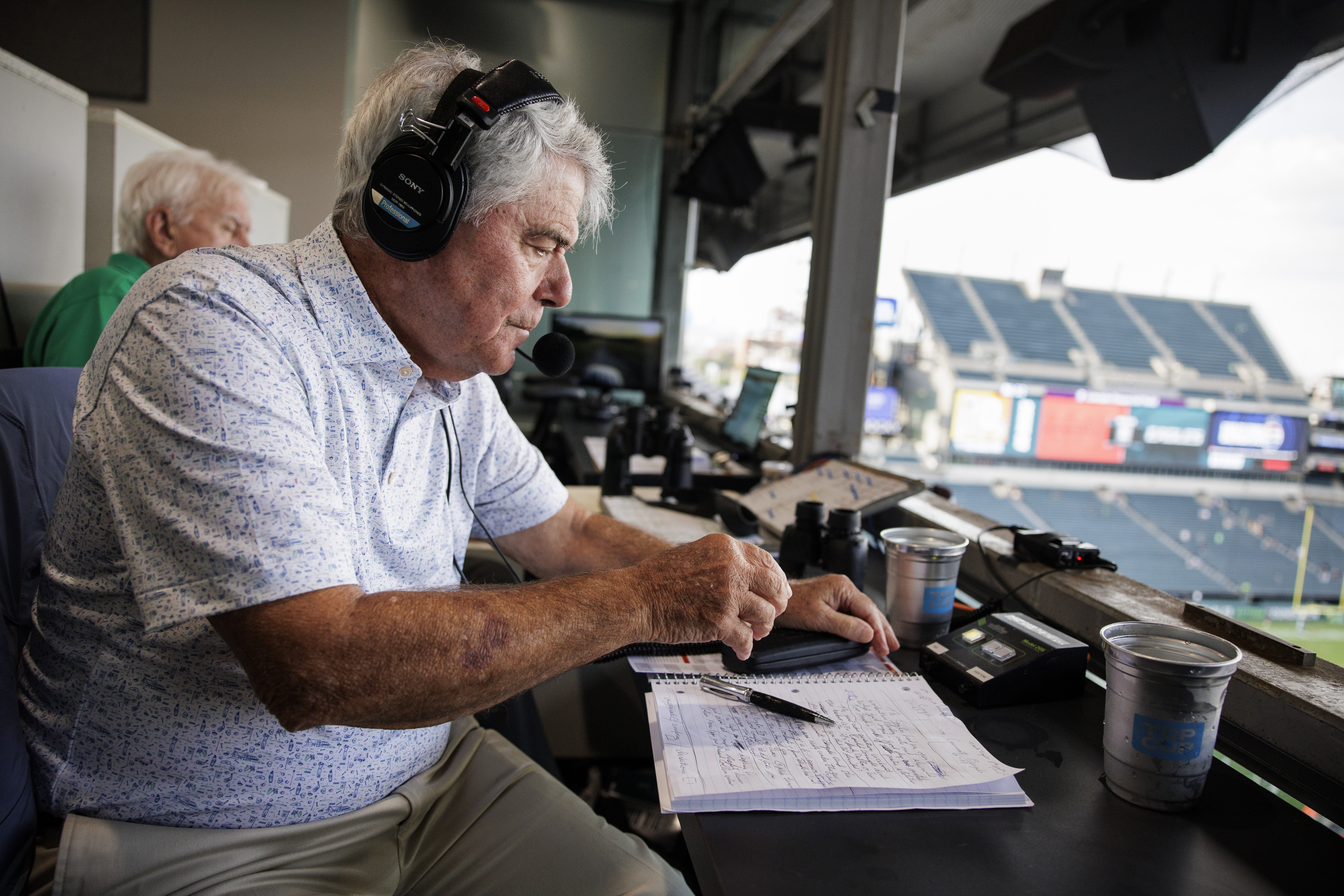
Merrill Reese will begin his 50th season on Sunday as the voice of the Eagles.
The longtime broadcaster has voiced two Super Bowl wins, told you the Eagles stopped ‘em again, and made the word “good” sound great.
After turning 84 earlier this month, Reese has no plans of retiring. So don’t call 2026 a farewell tour because he says he isn’t going anywhere.
Through it all, his wife of 47 years, Cindy, has been by his side, making sure her husband stays sharp for game days, and she may be the secret to Reese’s longevity.
One legend, however, is hanging up the cleats — for a second time. Brandon Graham announced on Tuesday he was “officially done”playing football.
From his strip sack against Tom Brady in the Eagles’ first-ever Super Bowl victory to becoming the franchise’s all-time leader in games played, Graham’s had quite the NFL career. He — and his trash talk — will be missed.
Aidan Miller was batting third and playing shortstop for double-A Reading on Tuesday night.David Maialetti / Staff Photographer
Aidan Miller took another step forward. His rehab assignment was transferred from single-A Clearwater to double-A Reading, where he was scheduled to play seven innings on Tuesday night. Reading has a week remaining before its postseason begins on Sept. 15, allowing for more regular game action after Miller’s return from injury.
Andrew Painter’s struggles through five innings and baserunning miscues contributed to the Phillies’ series opening loss to the Astros. The setback prevented the Phillies from gaining ground in both the division and wild-card races.
And stay up to date with the National League East and wild-card standings through our MLB playoff tracker.
What we’re …
🏈 Reminiscing: Brandon Graham says he’s done with football. Let’s relive some of his most memorable moments.
🤔 Wondering: With Week 1 of the NFL season kicking off today, we found an Eagles or Philly connection on the 31 other teams.
🏀 Learning: Brynn McCurry will miss Villanova’s 2026-27 season after having surgery to repair a torn ACL and meniscus.
🙌 Praising: This Penn State defensive tackle is using his name, image, and likeness earnings to help his family.
Eagles coaches have praised DeVonta Smith’s offseason and training camp presence, as he prepares for an even more prominent role in 2026.David Maialetti / Staff Photographer
For the first time since his rookie season, DeVonta Smith is a No. 1 wide receiver. He excelled in that role in college and had a record-breaking first season, but he’s lived in the shadow of A.J. Brown for the last four years.
And the man seeking to help Saquon Barkley elevate his game is a quarterback by trade. But Sean Mannion’s expertise isn’t limited to the passing game. Olivia Reiner gives us an inside look on how Mannion intends to revive the run game.
Want to play a game? We took six preseason photos and made one change: the ball is missing. Guess where you think it is.
The Sixers’ Tyrese Maxey (left) and Jaylen Brown will play a big part in making their star-studded roster work. Monica Herndon / Staff Photographer
The 76ers have a lot of talent on their roster, but it raises a question about roles since there’s only one ball to go around. However, most teams would be lucky to have this as one of its main issues heading into training camp.
And “to win, you got to be able to sacrifice,” says Jaylen Brown. So let’s look at this from the lens of statistics. Chris Hine evaluates how often a player consumes his team’s possessions, usage rate, and more.
Luke Vlooswyk (right) was watching the draft in Voorhees when his Everett teammate and defensive partner Brek Liske was drafted by the Flyers.Courtesy of Luke Vlooswyk
When the Flyers get together this week for the commencement of rookie camp, there will be a lot of introductions and first-day-of-school vibes.
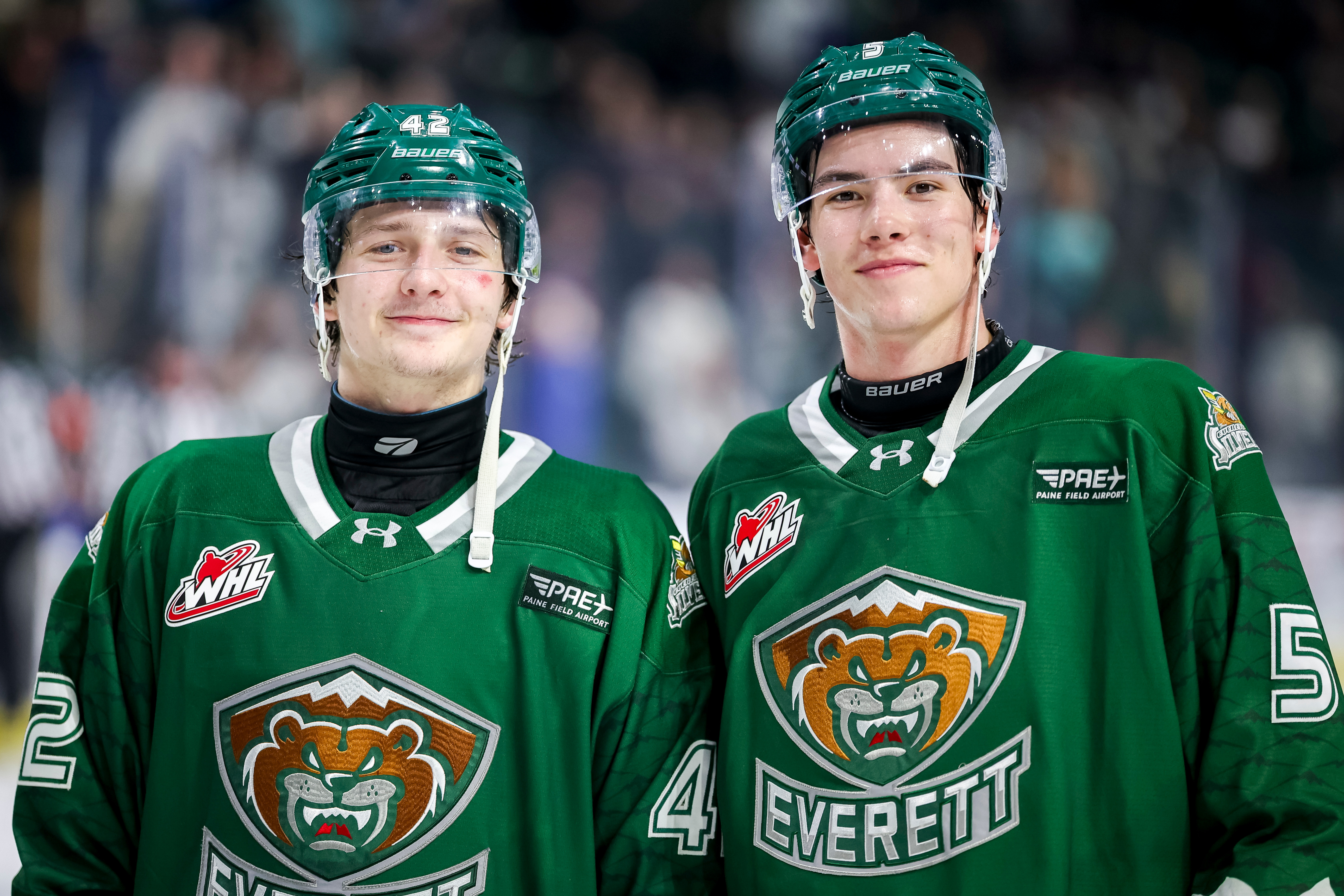
But that won’t be the case for defensemen Brek Liske and Luke Vlooswyk. Why? Liske and Vlooswyk are teammates with the Everett Silvertips of the Western Hockey League, and will be partnered up this season once they return to juniors.
After a stretch together last season, the tandem will take on a larger role in 2026-27 and let’s just say they have high expectations.
🧠 Trivia time
Which Phillies player hit the longest recorded home run in franchise history at Citizens Bank Park?
A) Kyle Schwarber
B) Ryan Howard
C) Bryce Harper
D) Jim Thome
We compiled today’s newsletter using reporting from Matt Breen, Jeff Neiburg, Olivia Reiner, Chris Hine, Ryan Novozinsky, Jackie Spiegel, Lochlahn March, Scott Lauber, Charmaine Runes, Garland Fordice, Mia Messina, Conor Smith, Finn Courtney, and Lexie Linderman.
By submitting your written, visual, and/or audio contributions, you agree to The Inquirer’s Terms of Use, including the grant of rights in Section 10.
Hope you had a restful holiday weekend. Thanks for reading, and Maria will be back in your inbox tomorrow. — Bella
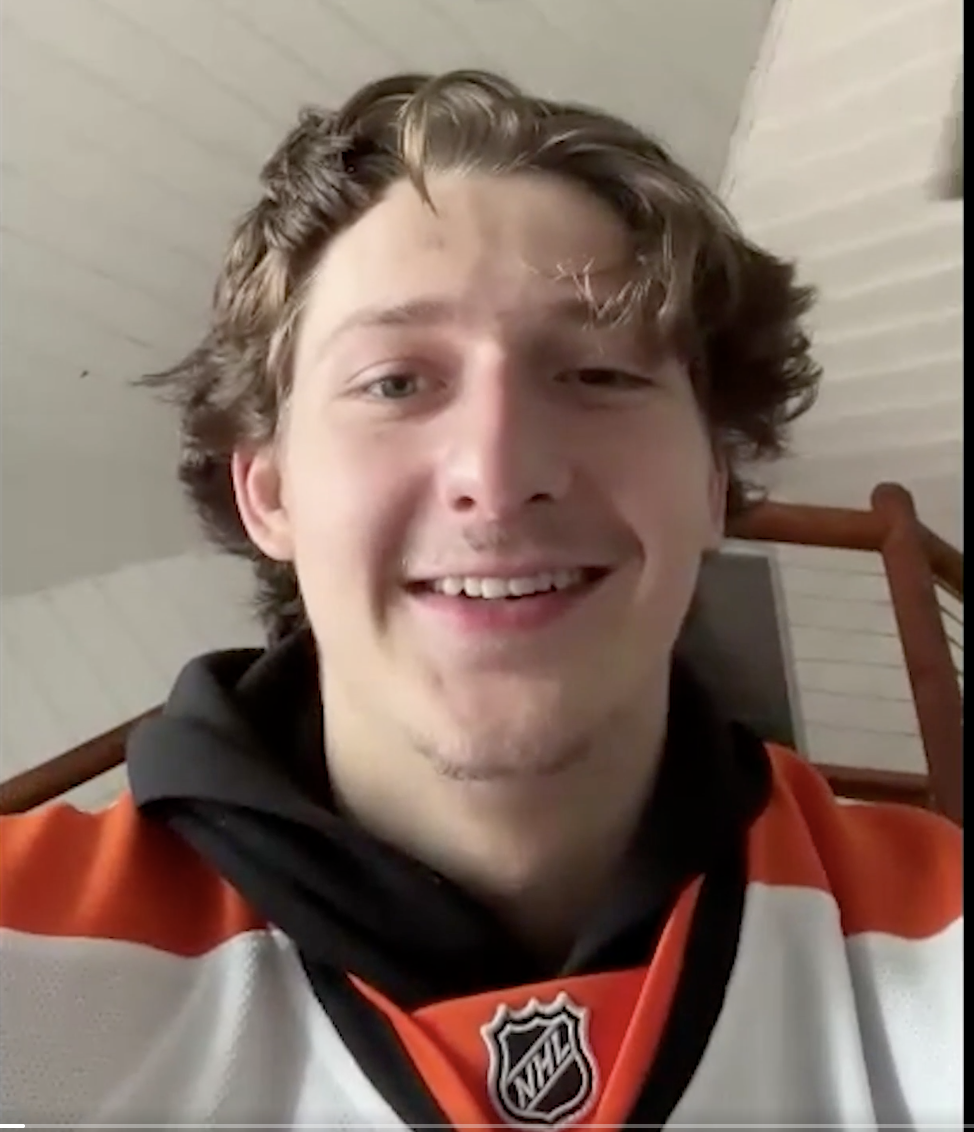
According to assistant general manager Brent Flahr, Brek Liske, the Flyers’ first of two second-round picks in the 2026 NHL draft, has some “swagger.”
Maybe that swagger rubbed off on Luke Vlooswyk because, as the defenseman spoke to The Inquirer in late June at development camp, he made a bit of a guarantee.
“I think we’ll be the best D pair in the league next year,” the Flyers’ 2025 fifth-rounder confidently told The Inquirer at development camp.
Acquired by Everett of the Western Hockey League from Red Deer last January, Vlooswyk, 19, linked up with Liske until the first round of the WHL playoffs when Liske was bumped up to the top pair. Liske, 18, impressed there while slotted alongside projected 2027 No. 1 pick Landon Dupont as the Silvertips made a run to the Memorial Cup final.
With Dupont now teammates with Flyers center prospect Jack Nesbitt at the University of Michigan, Vlooswyk and Liske, who both will participate in Flyers rookie camp this week, are expected to be Everett’s top defensive duo.
“Really well,” Everett coach Steve Hamilton said when asked how they played together after Vlooswyk was traded to the Washington State-based team.
“We’re very fast [in] the way we play, in the way we pressure, the way we transition, defend,” he added. “We expect our guys to close quickly, and just try to apply the pressure to get the puck back right away, and both of those guys just have an aggressive mindset, and they move pucks well. … We want to transition right away, and anytime we get a change of possession, we want our defensemen to be involved, and both of those guys appreciate that style of play.”
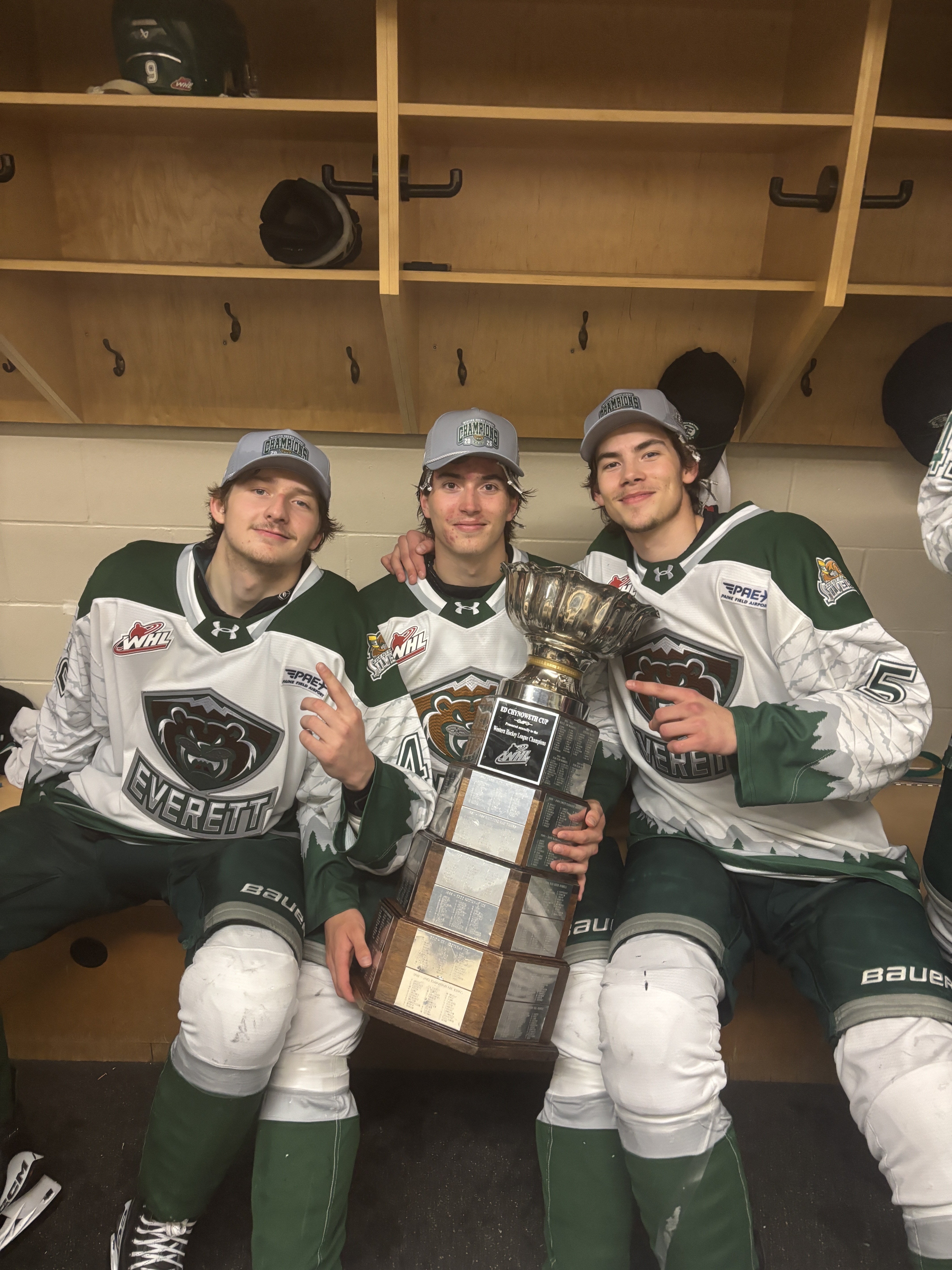
Brek Liske (left) and Luke Vlooswyk (right) celebrate after winning the Western Hockey League championship last season.Courtesy Luke Vlooswyk
The pairing is prototypical. At 6-foot-5, Vlooswyk is the big, stay-at-home, shutdown defenseman with a long reach. The smaller Liske, at 6-1, likes to have the puck on his stick and has a little more offensive pop in his game — he had seven goals and 24 points in 52 games last season.
But the pairing is also unorthodox. It is not a righty-lefty combination, which is what Flyers coach Rick Tocchet typically likes.
Liske and Vlooswyk are akin to Travis Sanheim and Cam York, two lefties who played together under ex-coach John Tortorella, except Liske and Vlooswyk are both righties. Liske is the one playing the off-side, increasing his versatility à la Sanheim.
“Yeah, it is a big difference, right?” he said at development camp. “A lot of stuff on the backhand. The biggest thing was I just had to learn how to place the puck better, if that makes sense, have it at my hip more. You’re ready to open up instead of being able to just snap it. It’s a little harder, but probably took a couple of games of adjustment and [I] figured it out.”
“I think his defensive identity is helpful,” noted Hamilton about Liske during a phone interview in late June. “He’s very subtle. He’s physical in his own way, but very effective, great stick. And I think ultimately, going forward as an NHL player, that’s probably more going to be his strength. … But, I think he’s got a really good understanding that he can bring things in all areas.
“So, honestly, self-assessment is a skill in itself these days, and he’s got a very good handle on who he is. In terms of growth, as a young player … he’s going to need to continue to work on his skating, and the NHL is the best of the best. I feel like he really moves well at our level, and I know with time and training, and continuing to get stronger, that his skating will be NHL caliber.”
Hamilton sees Liske as a middle-pair blueliner in the NHL, and the kid from Manitoba has a lot of motivation to reach that level — especially with the Flyers. His father, Lonnie, is a massive fan of the Orange and Black, and when the 18-year-old spoke to the media via Zoom after hearing his name called, he was already donning a Flyers jersey.
Flyers second-round pick Brek Liske grew up a Flyers fan due to his dad’s love for the Broad Street Bullies.Jackie Spiegel
“First time I ever met his dad, Lonnie, he said to me, ‘Oh my gosh, I can’t believe my son is D partners with a future Philadelphia Flyer. Like, this is unbelievable,’” Vlooswyk recalled. “And for him to be drafted here now, I can’t even imagine what emotions are running through that family. It’s pretty cool.”
It all happened within a five-pitch span of the seventh inning Tuesday night in a 6-5 loss to the Astros, and it prevented the Phillies from gaining ground in both the division and wild-card races.
But it also exposed an insidious weakness. Because while the bullpen’s tendency to melt like soft serve and shortcomings on defense tend to be more glaring, baserunning is often an issue for the Phillies, too.
“There’s games that the small things cost you runs, chances,” interim manager Don Mattingly said after the Phillies remained four games behind the NL East-leading Braves and a half-game ahead of the Cubs for the top wild card. “It can cost you a game.”
Never more than in that seventh inning.
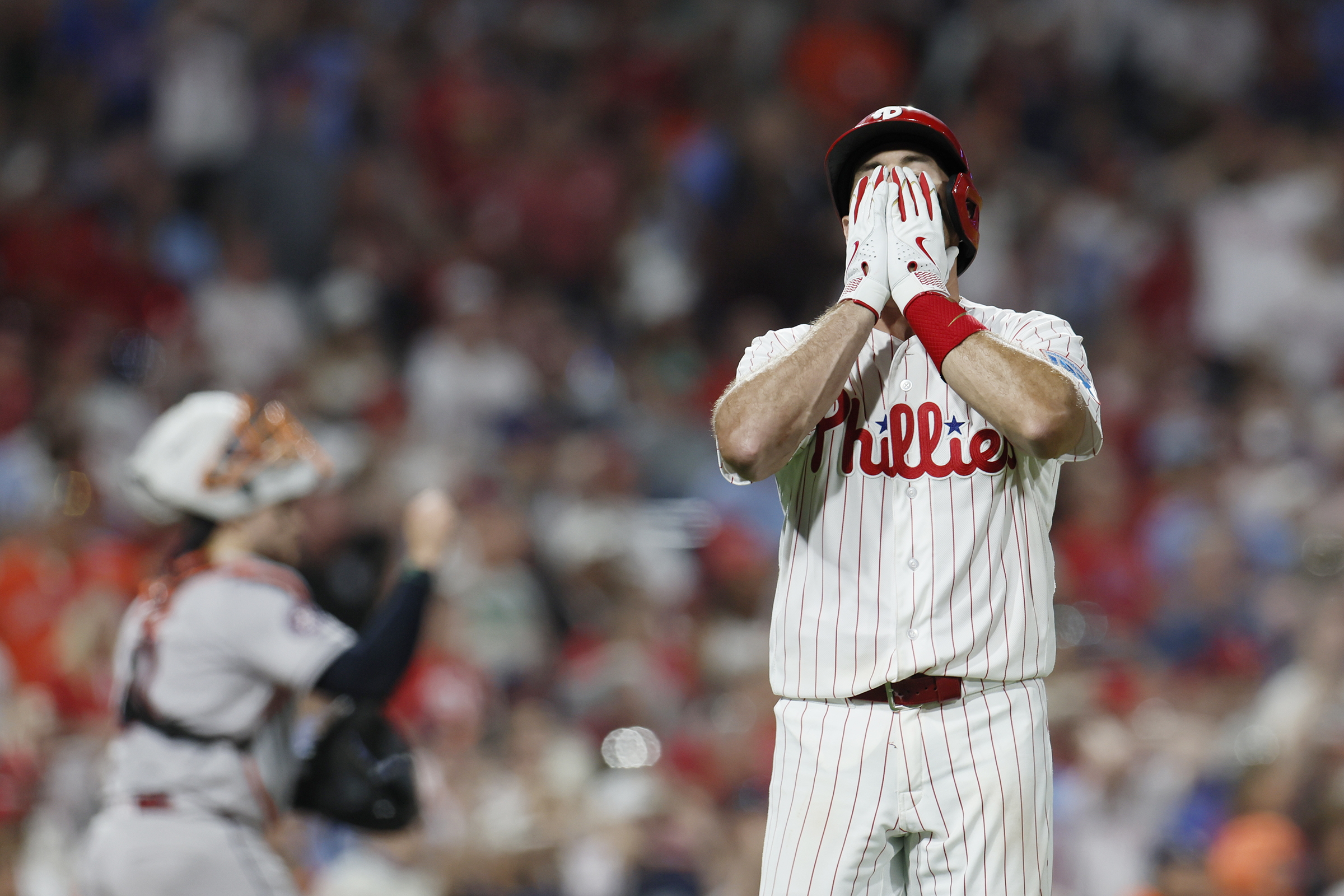
Trailing 6-3 after Andrew Painter dropped them into an early 5-0 hole, the Phillies led off with a double from Bohm. Bryson Stott got hit by a pitch before Marsh crushed a fastball 403 feet toward Monty’s Angle, the part of the fence in left-center that juts back from 387 feet to 409.
Daulton Varsho, the Astros’ Gold Glove-winner who ran around the Citizens Bank Park outfield when his dad was the Phillies’ bench coach in the early 2000s, tried to run it down but was unable to make what would’ve been a sensational catch.
Bohm retreated to second base as Stott approached the bag and didn’t start running until the ball hit the wall and ricocheted into center field. Instead of two runs scoring and Marsh winding up on third base, only Bohm scored, with the speedier Stott on his heels and held up at third.
Mattingly, who coached Varsho over the last few years with the Blue Jays, didn’t take issue with Bohm’s read. Still, instead of cutting the margin to 6-5 with nobody out and the tying run on third for J.T. Realmuto, it was 6-4 with the tying run on second.
“That one doesn’t bother me at all because, I mean, I’ve seen [Varsho] catch that ball,” Mattingly said.“He’s close enough that that one’s fine.”
OK, but it also left Marsh at second base when Realmuto scorched a 102.9-mph liner to shortstop Jeremy Peña, who dove to his right and snared it. Marsh, already almost halfway to third base, was easily doubled off at second.
“The double-play ball is, for me, a little bit more where you get away from your principles,” Mattingly said. “Score of the game, we’re down two there, nobody out. If the ball gets through, Stott scores, Marshy’s at third. First and third, nobody out, you like your chances that you’re going to get it tied up.
“So, your principles say ‘freeze.’ I was taught freeze, and a lot of organizations teach [go] back on that play. Just too aggressive.”
Marsh agreed, regrettably.
“It’s unacceptable for me to take a step toward third,” he said. “It’s a huge mistake by me. Really no excuse. Just a really bad play on my part.”
Edmundo Sosa celebrates after hitting an RBI double in the ninth inning.Elizabeth Robertson / Staff Photographer
Even though the expected batting average on Realmuto’s line drive was .710, according to Statcast?
“No, I’ve got to get back,” Marsh said. “First step’s got to be to my left there. No explanation other than I was just wrong and I have to clean that up and be better in the future if we want to be where we want to be at the end of the year.”
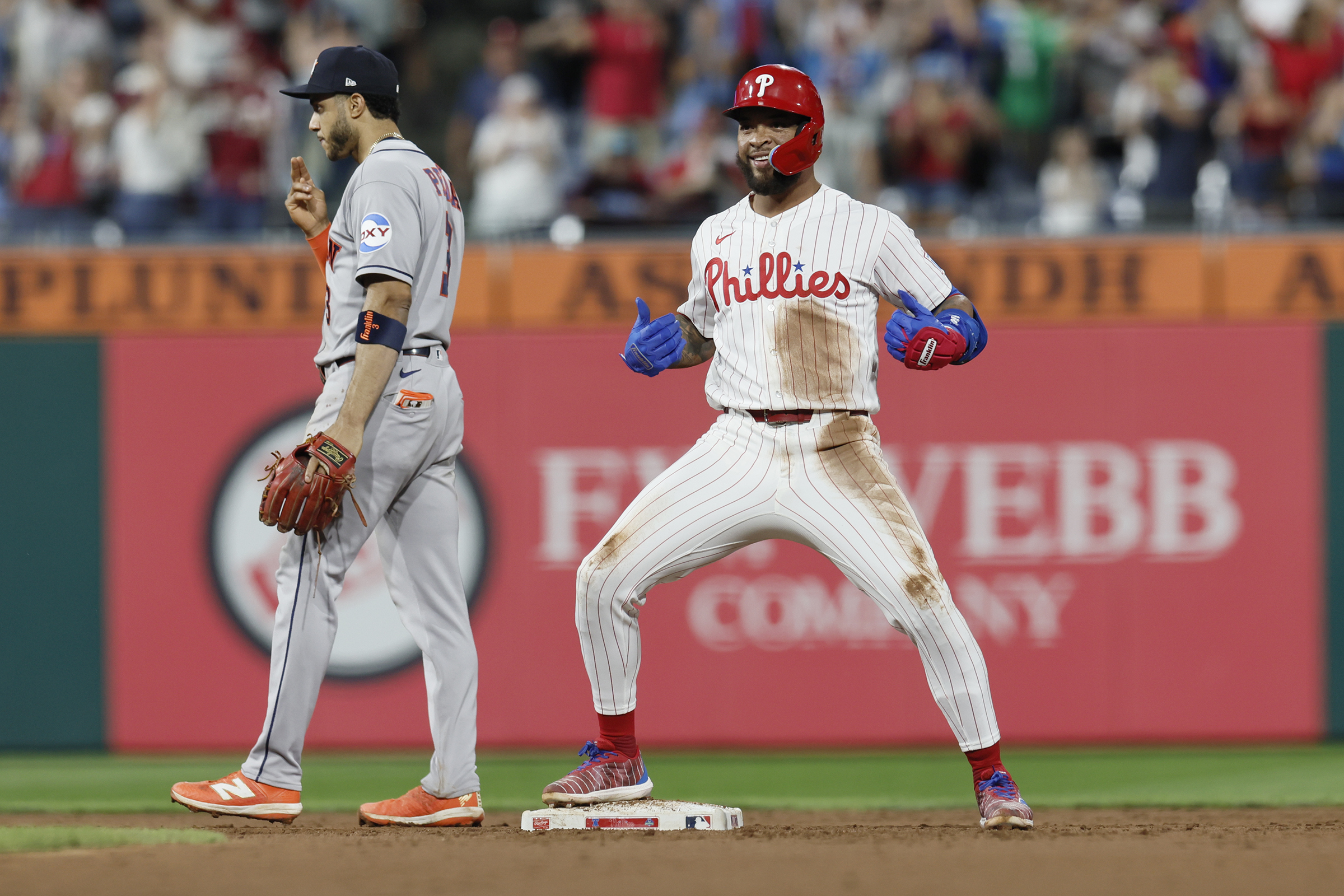
The Phillies rallied again in the ninth inning against Astros closer Josh Hader, but once again, baserunning contributed to their downfall. Edmundo Sosa didn’t run hard out of the box on a long drive to center field and wound up with an RBI double rather than a potential triple. The next three batters flew out to end the game.
NL wild-card standings
window.addEventListener(“message”,function(a){if(void 0!==a.data[“datawrapper-height”]){var e=document.querySelectorAll(“iframe”);for(var t in a.data[“datawrapper-height”])for(var r,i=0;r=e[i];i++)if(r.contentWindow===a.source){var d=a.data[“datawrapper-height”][t]+”px”;r.style.height=d}}});
“I was watching the ball, so I didn’t see if he was going full speed all the way,” Mattingly said. “I was a little surprised, when I looked up, where he was at. … I was wondering why he really wasn’t as far as he should have been.”
If Sosa was on third, could he have scored on Derek Hill’s one-out fly ball to medium-depth right field?
“I’m not sure about that,” Mattingly said. “But I mean, that’s kind of [neither] here nor there at that point. I think, just in general, when you talk about the way you should play and things you should do on the field, that’s really more important than could he or should he have scored on the next play.”
Mattingly suggested that baserunning is lacking across the sport, not only among his team.
“It’s one of the things that I’ve noticed in the game all over the place,” he said. “Players are better probably now than they’ve ever been. Obviously pitchers are throwing harder and tougher to hit than they’ve ever been. Baserunning, for me, has kind of went a little backward in a lot of scenarios, not just here but all over the place.
“I think you should always learn from it. And you should always stay on it.”
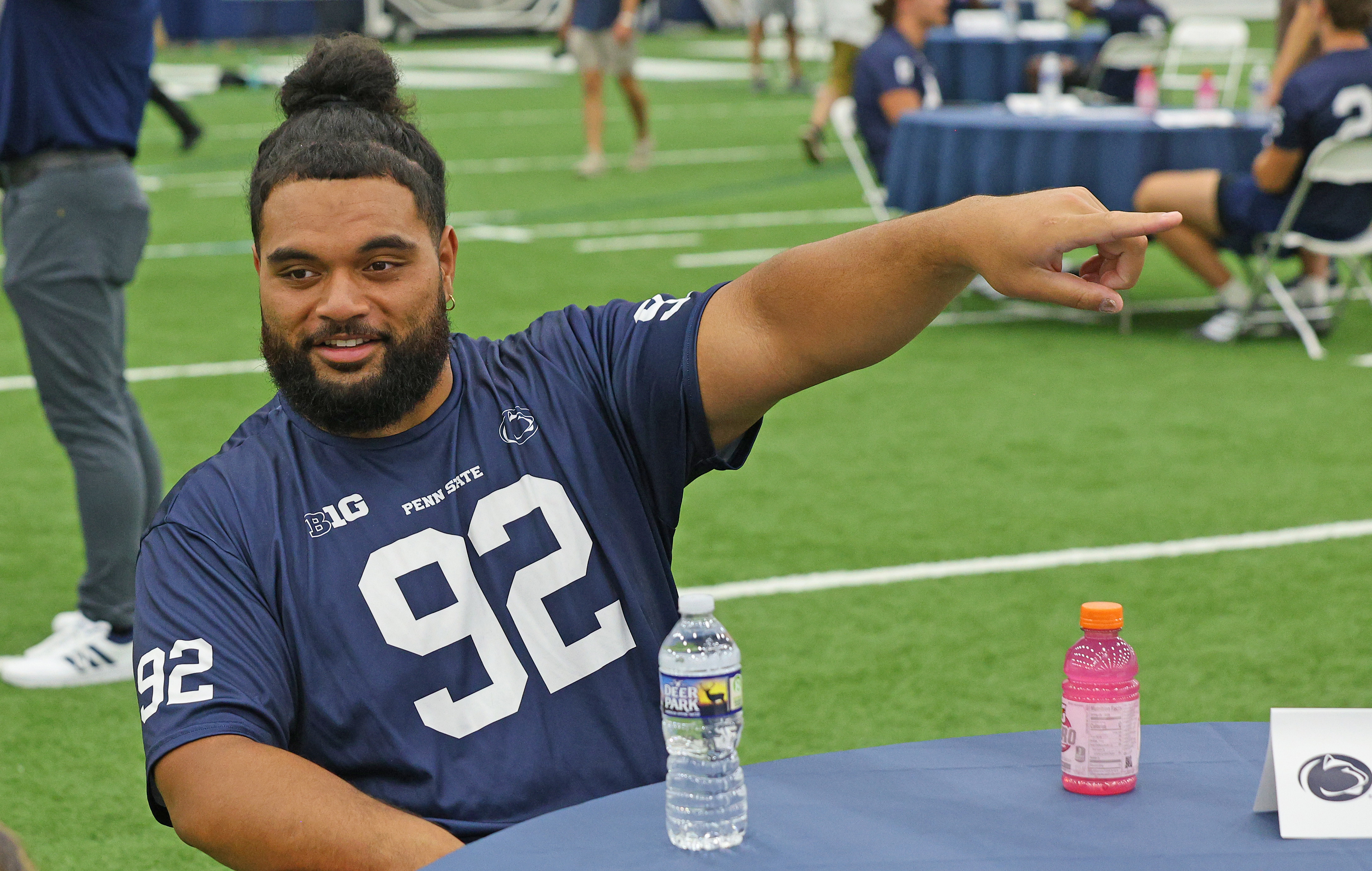
As eighth-year defensive tackle Siale Taupaki took the field for the first time at Penn State on Saturday, his parents, Kolo and Seilose, sat in their California home, ready to watch their son start in Beaver Stadium.
But they wouldn’t be able to watch him if it weren’t for the internet service that Taupaki pays for.
“We don’t watch a lot of TV back at home,” Taupaki said Tuesday. “We just work and rest, and that’s about it. But aside from that, I was glad that they [were] able to see it for themselves.”
Taupaki left his home state this offseason, opting to transfer to Penn State after seven seasons at UCLA. He also moved across the country from his family.
Siale Taupaki bought his parents internet so they could watch Saturday's game vs. Marshall.
The DT is playing his 8th season of college football, but says he now has something to play for at Penn State under Matt Campbell.
That leap of faith came after Taupaki spoke with Matt Campbell on the phone while he was in the transfer portal. The first thing Campbell asked about was Taupaki’s family, which instantly sold the defensive tackle on playing for the Nittany Lions.
“Not a lot of people asked for my family or everyone else that came with me,” said Taupaki, who has compiled 39 tackles and two sacks in his career. “He asked specifically, how was my mom, how was my dad. With that, I knew he was a family man, then he was a football coach. So from there, I knew I could come to him about anything because he’s a father before he was a coach.”
However, playing for Campbell at Penn State means Taupaki’s parents couldn’t watch him in person. Taupaki said they’re too old to fly, leaving limited options to see their son play this season.
So Taupaki is trying to keep them involved as much as he can.
He called his family after Penn State’s win over Marshall and told them about the game-day atmosphere in Happy Valley, which included seeing cows and horses. “You don’t see that a lot in the West Coast,” Taupaki said.
“I told them [Beaver Stadium] is bigger and better,” he said. “That’s it. My pops told me that he had the chills just hearing about it, because he can visualize in the game.”
With his name, image, and likeness income, Taupaki is helping his family.
“My parents are still struggling,” he said. “I’m broke. I’m really just trying to fill in all the holes that I have back at home, understanding the platform that I’m having, and just seeing all of that stuff and understanding how far I came.”
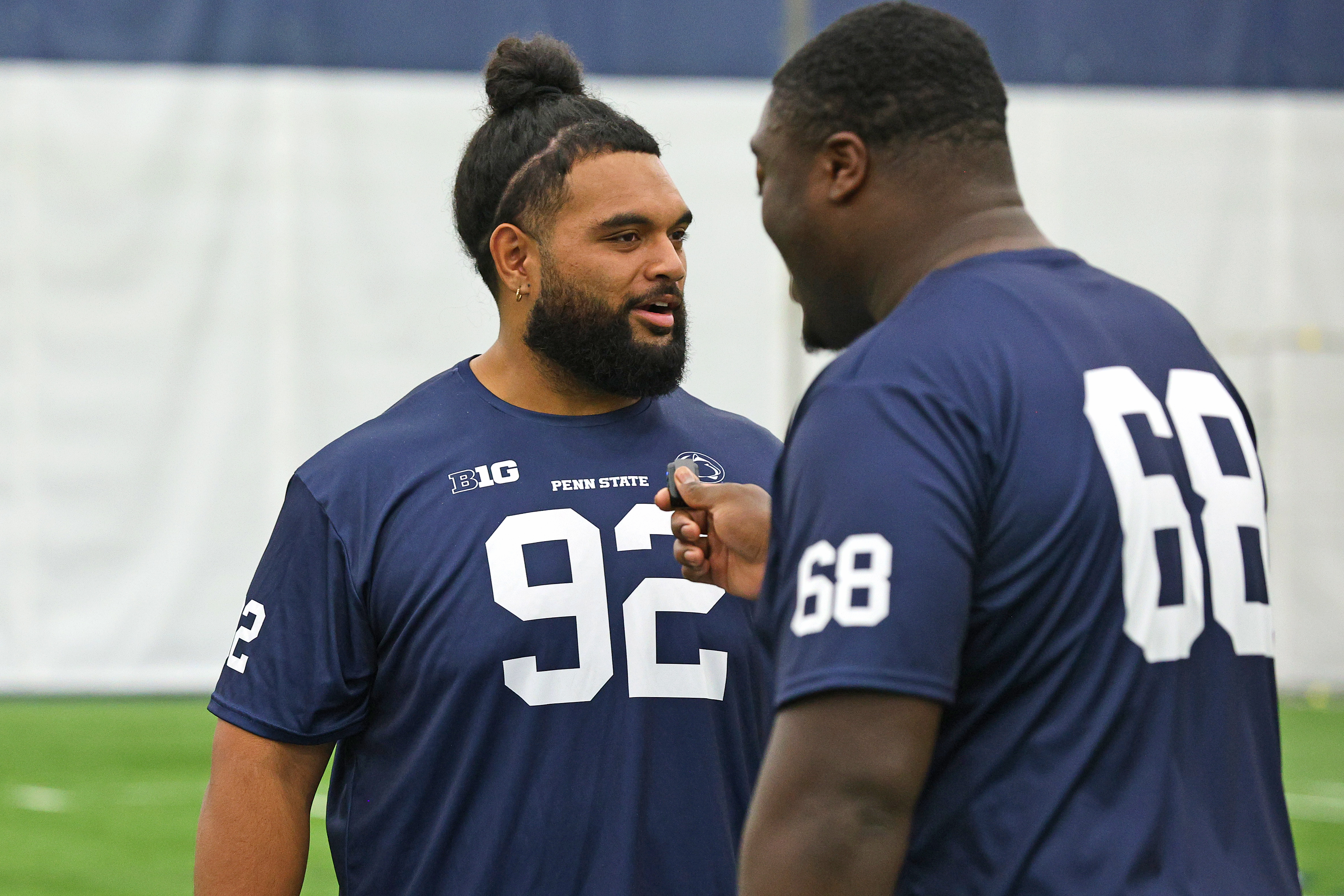
Siale Taupaki (92) with offensive lineman Anthony Donkoh (68) on Aug. 7.Craig Houtz / For The Inquirer
Taupaki said he came from “nothing.” At one point growing up, he and 22 family members lived in a two-bedroom house, so some had to sleep outside.
Those tough times made Taupaki who he is today — someone who wants to learn about everybody on his team, where they come from, and what their story is. He also shakes every media member’s hand before leaving his press conference.
Siale Taupaki is a real one.
After an emotionally open and honest interview– "Im broke, come from nothing" — Taupaki didn't leave until he shook every reports hand.
When he returns home, Taupaki isn’t a Penn State starting defensive tackle. Rather, he’s a son continuing to help give his parents a better life.
“Everything that I got to do beforehand and afterhand, I got to do it based off my parents,” he said. “That football stuff is out the door. So the opportunity I got with the NIL era and the great coaching staff and all that, I’m thankful for that. But at the end of the day, I still got stuff to do as a son. So to play my role as that, I’m forever grateful.”
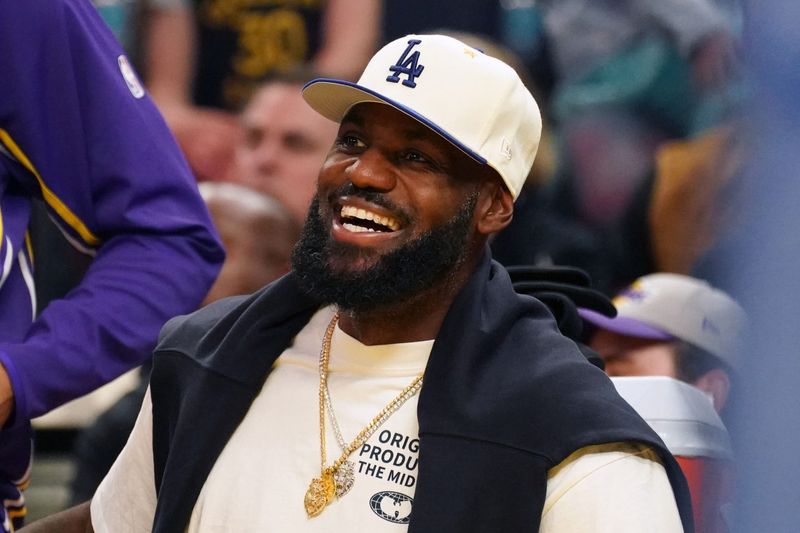
Where LeBron James would choose to play the final years of his storied career was a fixture on prediction markets this summer. Now, James could benefit from the boom of those platforms.
On Saturday, James shared a short video on social media announcing a partnership with the prediction platform Polymarket. The Sixer then posted a longer commercial-ready version of the video Tuesday, in which James visits Polymarket’s fictional headquarters and its “sports” floor.
In his tour around the office, Eli Manning, Derek Jeter, Spike Lee, Sue Bird, Emily Ratajkowski, John Leguizamo, and other athletes and celebrities make cameospromoting the platform ahead of football season.
It is unclear what the nature of James’ partnership with Polymarket is, or if the partnership extends beyond this commercial. Polymarket did not respond to questions about James’ partnership.
Step inside Polymarket HQ.
Somebody get the ice bath ready for @EliManning after that tackle. 🧊🤣🏈
James’ partnership raises ethical questions about whether an active athlete should be promoting and benefiting from gambling platforms, and particularly prediction markets, where inside information and influence could sway bets or determine their outcomes.
Polymarket and other prediction markets typically have rules prohibiting insider trading and are regulated by the Commodity Futures Trading Commission. The NBA has no policy against its athletes partnering with prediction markets, and is likely to join other leagues by announcing its own official prediction market partnerships before the start of the forthcoming season, as reported by Front Office Sports.
Prediction markets vs. traditional gambling
Polymarket and other prediction markets argue they are distinct from traditional sports gambling platforms because there is no “house” that sets odds and stands opposite gamblers. Instead, bets are agreements between individuals and the market sets the odds. But in practice, prediction markets function similarly to sportsbooks, with even more opportunities to wager money.
Prediction markets offer opportunities that go beyond traditional bets on wins and stats, like which teams won’t win the Super Bowl, which team a free agent player might sign with, or whether a quarterback will average a certain number of fantasy football points over the season. The bets are phrased as binary, yes-or-no outcomes.
Prediction market offerings extend beyond sports, bringing even more ethical questions — at any moment someone can bet on whether a public figure will say a particular word during a speech, when traffic in the Strait of Hormuz will return to normal levels, or the number of confirmed measles cases in the United States in 2026. Last month, several Democratic senators wrote a letter to the Commodity Futures Trading Commission demanding it stop allowing bets on California wildfires.
“Prediction markets have been enabled to expand rapidly, increasingly inviting speculation on war, political violence, disasters, and public emergencies that raise ethical and public policy concerns. These markets risk creating perverse incentives, undermining public trust and commodifying human suffering,” they wrote.
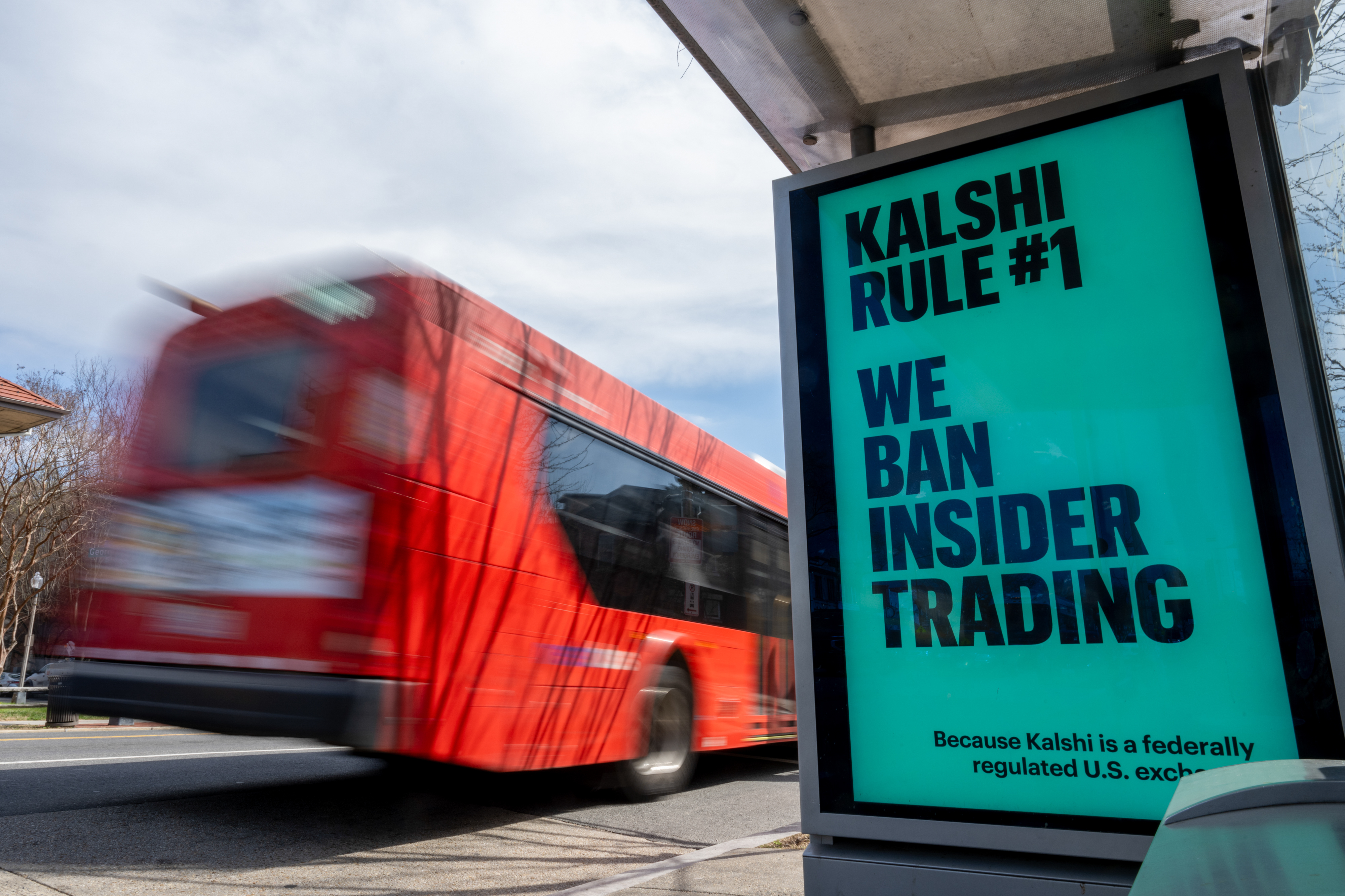
A Kalshi advertisement at a bus stop in Washington, D.C. Daniel Heuer
A U.S. Special Forces soldier was arrested in April after authorities said he made more than $400,000 using insider information to place Polymarket bets on the military’s raid capturing Venezuela’s president, Nicolás Maduro.
Athletes are typically prohibited from placing traditional bets on their own leagues, but the rules on prediction markets are less defined.A few months ago, the NBA, MLB, and their players unions sent a letter to the Commodity Futures Trading Commission asking it to bar athletes and league employees from betting on the NBA and MLB in prediction markets.
The gray areas of legality and ethics around sports gambling are how Phillies All-Star Bryce Harper became the center of controversy this summer, after The Inquirer reported that Harper had sent a personalized video on behalf of the sports betting platform FanDuel to a man who had become addicted to gambling.
Harper later said he did not have a partnership with FanDuel, and was not aware what the video was being used for or that it was going to someone with a gambling addiction.
More partnerships on the way?
Despite the ethical issues, partnerships between athletes and prediction markets appear to be growing. James seems to be the only active athlete partnered with Polymarket, but other major athletes — including soccer star Lionel Messi —have deals with a competitor, Kalshi, or have invested in the platform.
Elsewhere in the NBA, Giannis Antetokounmpo announced he had become a Kalshi shareholder in February, just after the NBA trade deadline, when Antetokounmpo had been the subject of numerous trade rumors attracting bets on prediction platforms. On deadline day, Antetokounmpo tweeted a clip from The Wolf of Wall Street to happily announce he was not leaving the Milwaukee Bucks, but over the summer, he successfully pushed for a trade to the Miami Heat.
Bettors on Kalshi reportedly traded more than $23 million over Antetokounmpo’s future during the deadline betting window.
“One of the things in terms of the ethical issues [of the partnership] is the timing,” Melinda Roth, a professor of business, finance, and sports law at Washington and Lee University, told Fortune magazine of Antetokounmpo’s investment. “The timing really puts a spotlight on how prediction markets work, who is allowed to buy contracts, and who has inside information.”
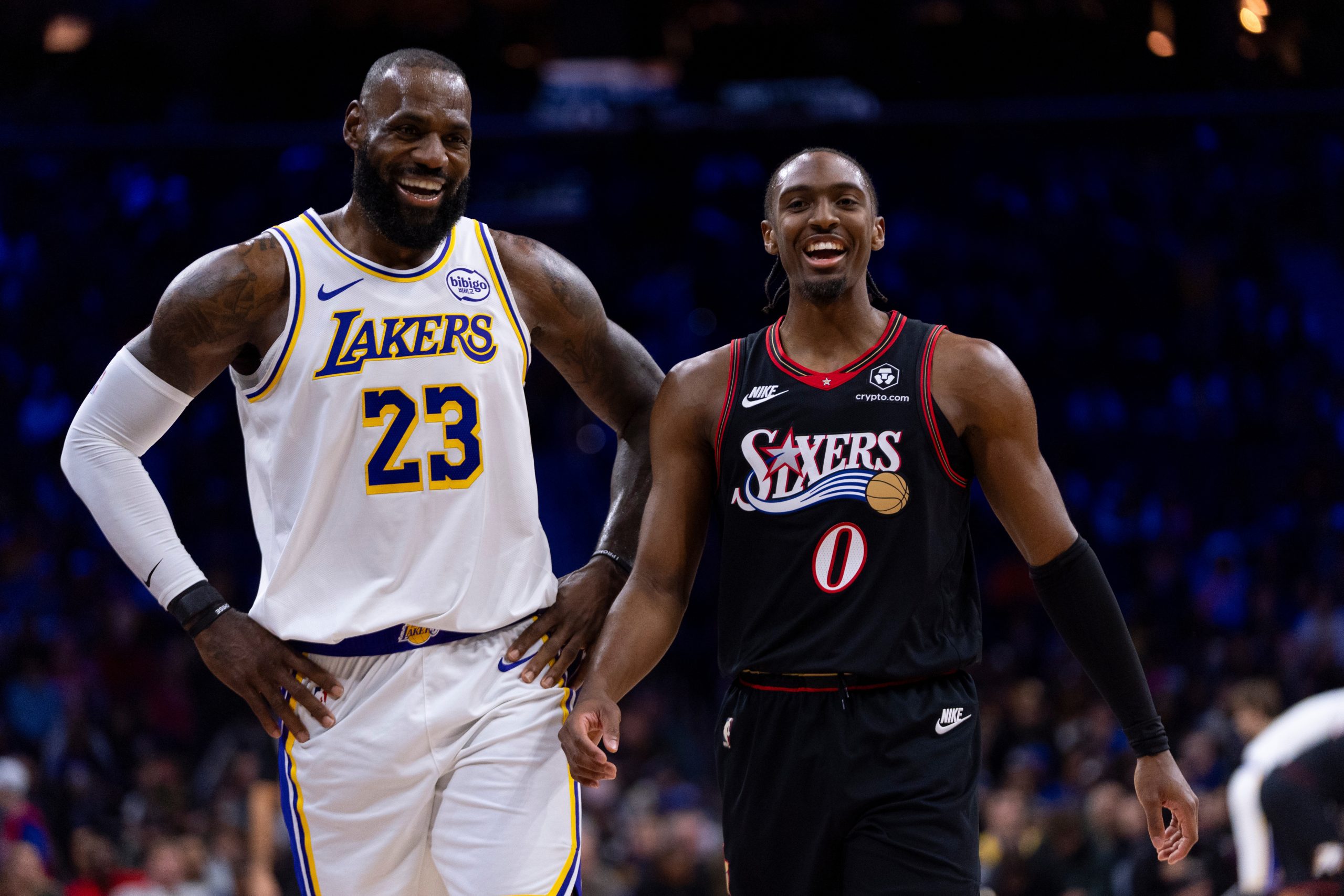
Los Angeles Lakers’ LeBron James, left, shares a laugh with Philadelphia 76ers’ Tyrese Maxey, right, during an NBA basketball game, Sunday, Dec. 7, 2025, in Philadelphia.Chris Szagola / AP
Yet the future of prediction markets is somewhat unclear. They have the backing of President Donald Trump’s administration. Meanwhile, some states are attempting to wrest regulatory control back from the federal government, and the issue may soon come before the U.S. Supreme Court.
But the direct ties between prediction markets with athletes are not necessarily inevitable — the NFL and PGA Tour prohibit their players from partnering with prediction markets.
Only a few years ago, James took a much different stance on sports gambling, sayingthe practice was taking the integrity out of sports.
“It’s weird that some of our regular fans that love the game kind of only care about a parlay now. … It’s kind of taken some of the integrity out of the game because people are kind of really only caring about the betting,” he told the Los Angeles Times in 2023.
A year later, James signed an endorsement deal with the sports betting platform DraftKings, promoting wagers during football season in a series of commercials alongside Kevin Hart.