NBC Sports Philadelphia is losing an Eagles legend.
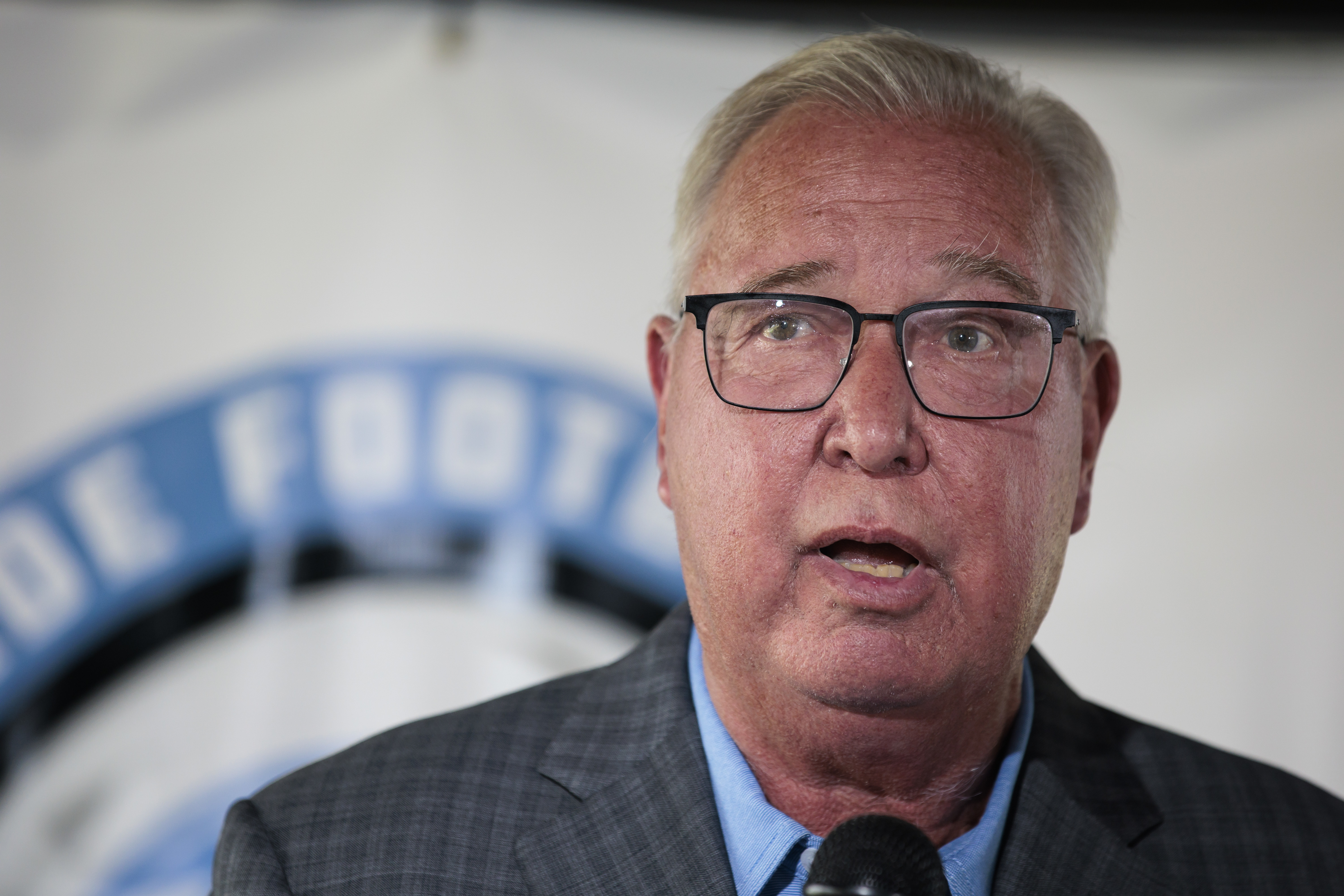
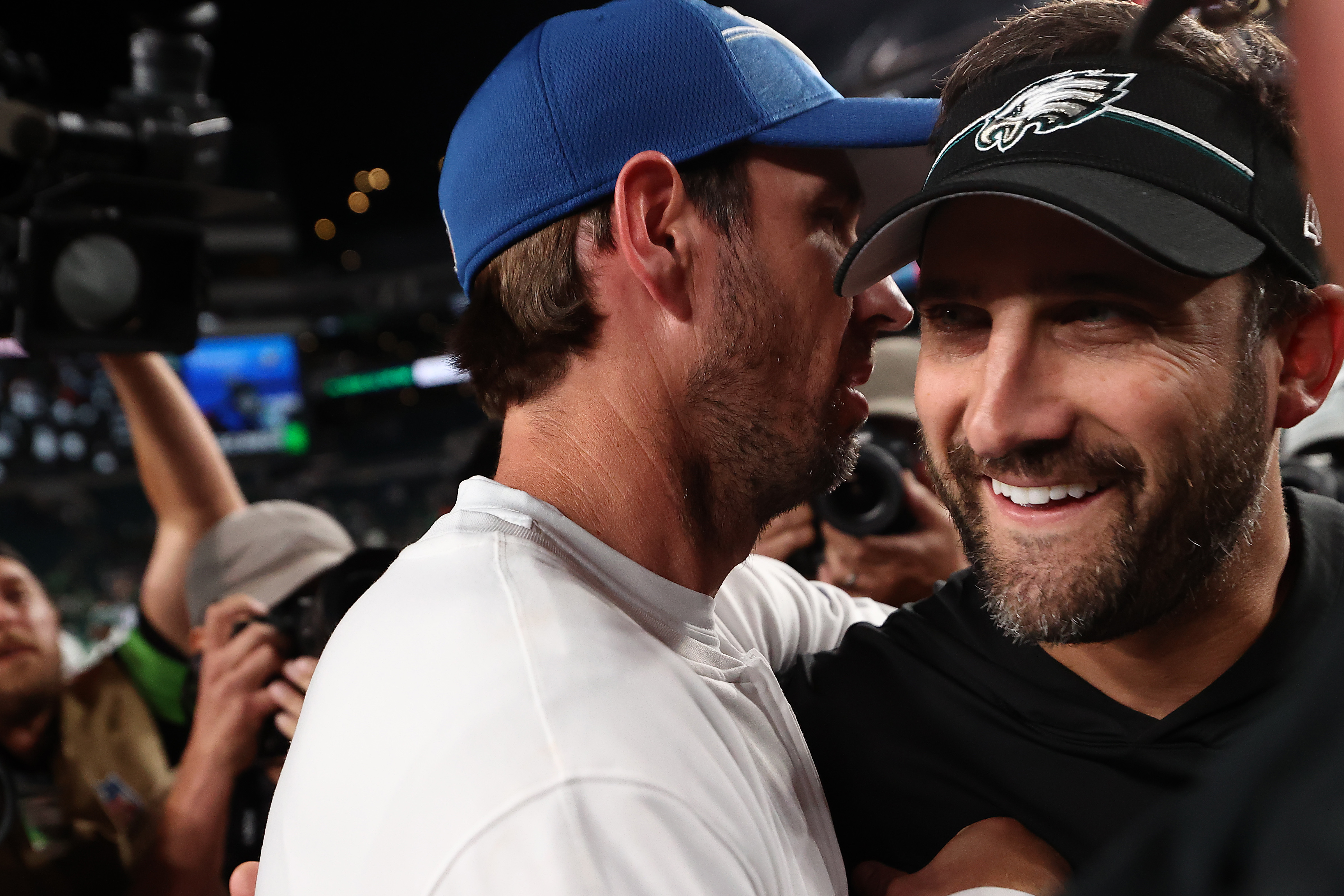
Ron Jaworski, the former Eagles quarterback known to most fans simply as “Jaws,” announced on social media he is cutting back his broadcast work and leaving the network’s Eagles pre- and postgame coverage after four seasons.
“It’s been a great run!” Jaworski wrote. “Thank you all, and Go Birds!”
NBC Sports Philadelphia isn’t planning on filling Jaworski’s empty seat. Michael Barkann will return as host of the network’s pre- and postgame coverage, joined by Barrett Brooks, Reuben Frank, and former Eagles wide receiver Jason Avant.
“There are certain people in this businesses who are irreplaceable, and Jaws is one of those people,” said Alexandra Matcham, the vice president of content for NBC Sports Philadelphia. “You don’t replace a person who was a pioneer in the NFL broadcast world, and we have no intention of doing so.”
Jaworski was hired by NBC Sports Philadelphia in 2022 to help fill the void left by Ray Didinger’s retirement and the departure of former Eagles defender Seth Joyner. Prior to that, Jaworski spent 27 years at ESPN as an announcer and analyst, including a five-year stint on Monday Night Football.
It was also Jaworski who helped lead the Eagles to the franchise’s first Super Bowl appearance in 1980 under Hall of Fame head coach Dick Vermeil. Jaworski spent 15 years as a quarterback in the NFL, 10 with the Birds, and his 99-yard touchdown pass to Mike Quick during the 1985 season remains tied for the longest in NFL history.
Outside of the NFL, Jaworski was the owner of the Philadelphia Soul, the city’s Arena Football League franchise, until the league shuttered in 2019. He also manages golf courses in South Jersey and northeast Pennsylvania.
He chose the latter, a decision he initially regretted before leaning on the media savviness he picked up during his16-year career with the Birds.
“I actually wanted to wait, but man, I was so tired of that question being asked all the time, so that just got me,” Graham said. But he landed on the announcement helping him, because it got fans interested to “tune in” and hear him explain why.
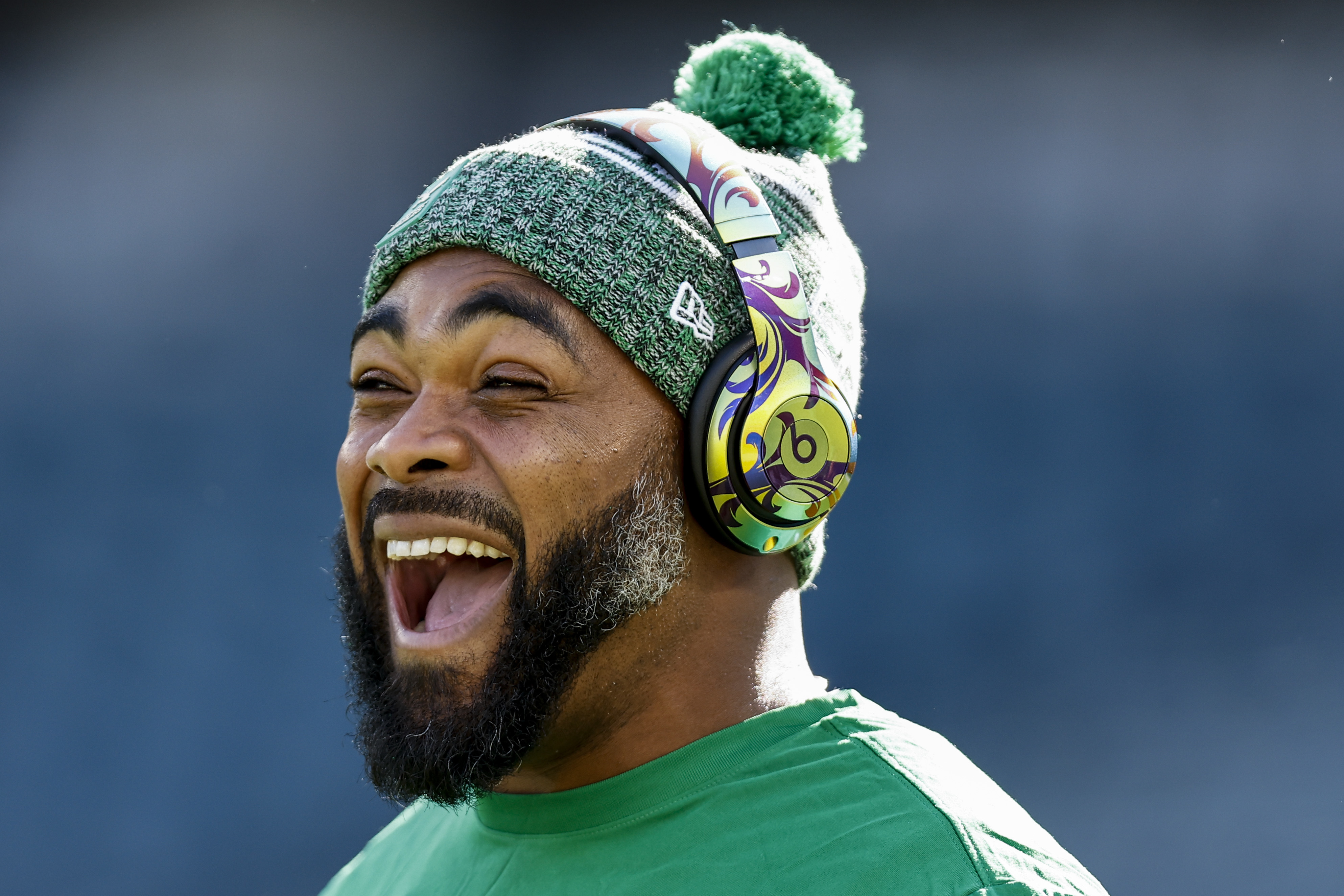
So begins Graham’s transition from Eagles legend and two-time Super Bowl champ to a budding media career talking about football.
After being injured during the 2024 season, Graham, 38, still felt like he had a little gas in the tank. So when the Eagles called him up last season, he was ready to unretire and get back on the field to “finish the season clean.”
Graham went into this offseason hopeful he might jump back into football. He stayed in contact with Eagles general manager Howie Roseman and was even prepared to participate in training camp to be properly prepared if the Birds needed him. But the stars didn’t align.
“It didn’t work out like that because [Roseman] got the team he needed,” Graham said. “So in my mind, I was like, ‘Yeah, I think I’m going to be done.’”
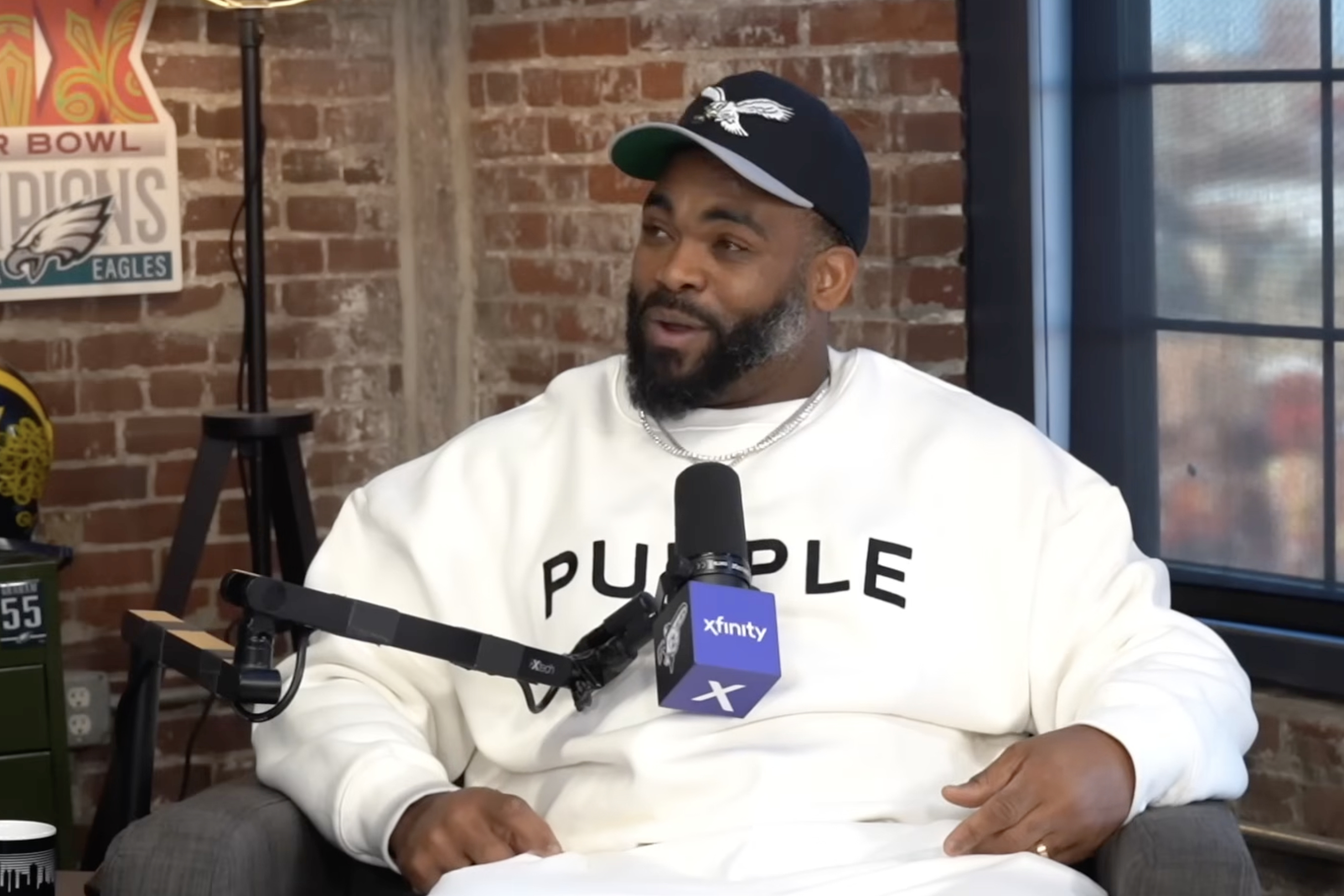
In hindsight, it’s been something of a relief. Now Graham can focus his efforts on a budding media career that will start off with the second season of his Unblocked podcast and joining PHLY for postgame coverage of Eagles games.
“Last year, I was one foot in, one foot out, because I thought there was an opportunity for me to go back and play,” Graham said. “This year I didn’t want that feeling so I can work in the media space how I worked in football. Otherwise I’m doing myself a disservice.”
Learning on WIP and late-night 6abc hits
Brandon Graham hosted a weekly show on 94.1 WIP for nine seasons alongside former host Howard Eskin. Monica Herndon / Staff Photographer
Graham’s interest in the media began during his playing days, where he’d listen back and critique interviews he gave with reporters. It didn’t take long for his engaging personality to win over the press, who began offering him more opportunities to jump on the air.
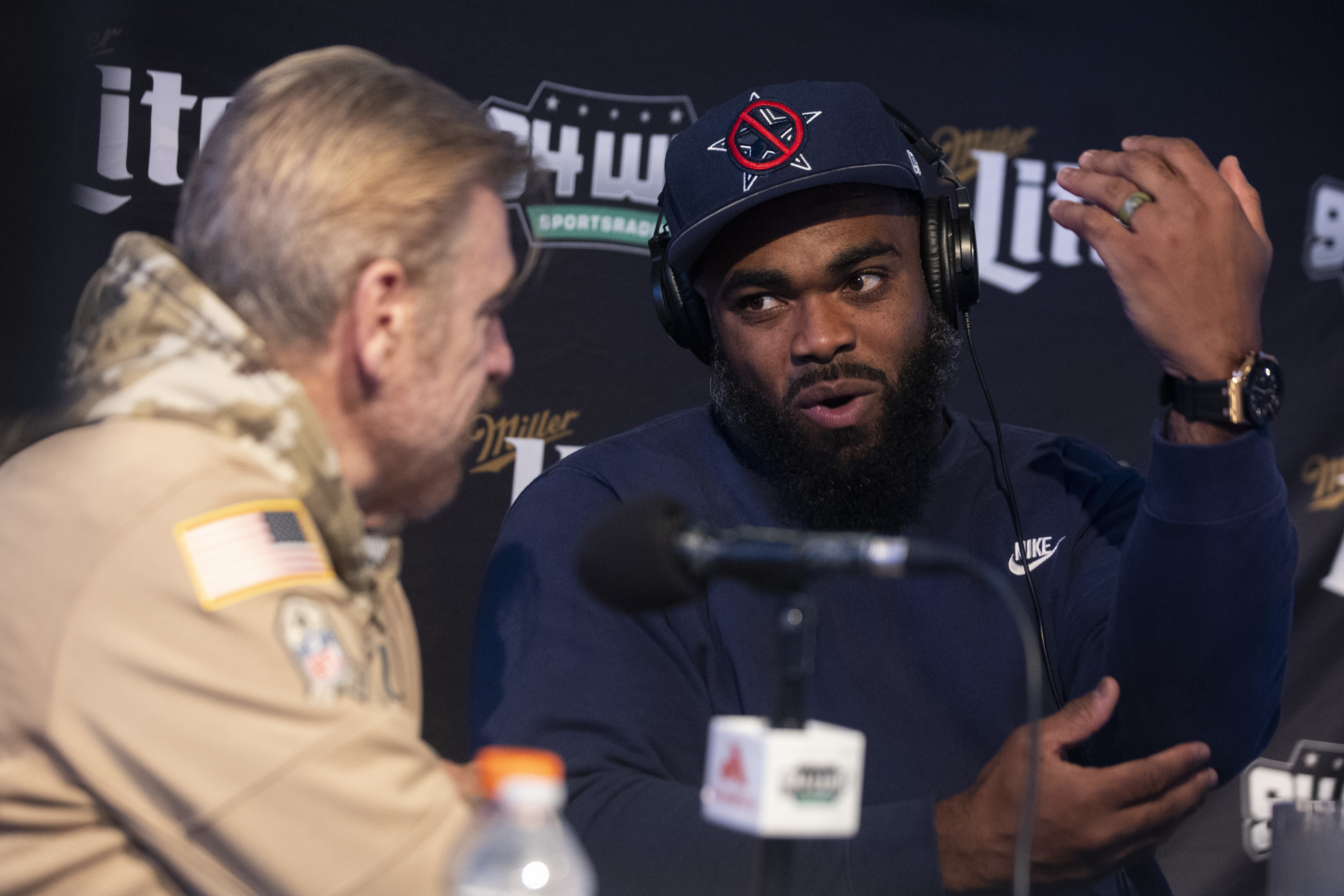
An early break was with 94.1 WIP, a gig that transformed from him calling in on Tuesdays to hosting his own weekly show during the season at Chickie’s & Pete’s alongside former host Howard Eskin.
Learning on the job also meant sometimes wading in controversy. He was forced to walk back comments he made about then-teammates Jalen Hurts and A.J. Brown in 2024. Graham was injured at the time and based his remarks on a video of Brown speaking, something he’s since learned to approach with caution.
“It was an emotional time and I should have been patient,” Graham said. “But I felt like it helped us a little bit, too, because we ended up winning the Super Bowl that year.”
Graham also got some early reps on 6abc during the 2015 season. After Sunday Eagles games, Graham would drive to the station’s studios on City Avenue to join the 11 p.m. edition of Action News and talk Birds with Ducis Rodgers.
“Boy, that was a grind,” Graham said.
In 2024, Graham participated in the NFL’s broadcast boot camp, which allows players to experience what it’s like working on a studio show or calling games. Graham said the experience was enlightening, and helped him land appearances on ESPN and the NFL Network.
“At ESPN, I went through what they call the car wash, when you appear on all the different shows,” Graham said. “They ended up liking me, and I got put on Good Morning Football before I went back to play … I expect I’ll do more of that.”
Joining PHLY and learning to criticize his former teammates
Brandon Graham is entering his second season hosting the “Unblocked” podcast for PHLY.PHLY
Graham is entering his second NFL season with PHLY, the digital start up that began in Denver in 2015 and expanded to Philly in 2023 as part of the ALLCITY Network.
The network took notice of Graham’s abilities during a July 2025 interview on the Exciting Mics podcast, hosted by Eagles cornerback Cooper DeJean and former Birds safety Reed Blankenship (who signed with the Houston Texans in March). Graham said parent companyALLCITY made him a strong proposal, and within a few weeks he launched his Unblocked podcast, co-hosted by Bo Wulf.
“BG brings an incredible depth of knowledge and an understanding of the game, but what truly sets him apart is his authenticity and infectious energy,” said Todd Berman, PHLY’s general manager.
This year Graham is expanding his duties beyond Unblocked to include co-hosting PHLY’s crowded postgame coverage alongside Wulf, Fran Duffy, Brandon Lee Gowton, and former Inquirer reporter EJ Smith.
Graham won’t appear after every Eagles game — he’ll rotate with former Eagles defender and Super Bowl champ Vinny Curry. But his appearances will place Graham in the potentially awkward position of having to criticize his former teammates.
ButGraham isn’t too concerned. As a player, he understood the media had their own job to do, even during his first few seasons with the Eagles when “Philly people were really bashing me.”
“Everybody’s takes are different. Some people do it for clickbait just to get people to click on your show,” Graham said. “I’m going to be honest and tell viewers the truth … It will be challenging, because sometimes there’s certain stuff you can’t just beat around.”
While he’s entering the season hopeful about a future in the sports media machine, he’s open to different paths, including public speaking. For now, Graham’s happy to have a manageable schedule where he works a few days a week, spends time with his family, and has the freedom to explore different interests.
“Who knows what the media stuff will do,” Graham said, “But I’m trying to get this golf game right, too.”
Cathy Engelbert was hired as WNBA commissioner in 2019, and upon her retirement in December, Engelbert will have overseen the most critical years in league history, shepherding the WNBA through a period of uncertainty into a period of exponential growth.
The WNBA is one of the fastest-growing leagues in sports, and under Engelbert’s watch, six expansion franchises have tipped off or been announced — including here in Philadelphia — while a new media rights deal and CBA have been signed.
“Over the years, it has been amazing to watch WNBA players thrive and lead the massive cultural surge around women’s sports,” Engelbert said in a statement. “I retire knowing we have built something bigger, stronger and more enduring than we could have imagined. I am grateful to the WNBA and NBA team owners and staff, players, investors, fans and the powerhouse league office staff, who believed in what this league could become. I retire with immense gratitude and tremendous optimism for the future of the WNBA, with the best yet to come.”
Here’s a look at her most consequential moves, and where the league goes next:
2022: Funding round
Engelbert sold a 16% stake in the WNBA to a group of outside investors for $75 million in cash flow, to be used to fund marketing and infrastructure. Instead of the 50/50 ownership split between NBA and WNBA owners, the split is now 42/42/16.
At the time, the deal was the largest funding round ever for women’s sports, and Engelbert valued the league at approximately $450 million. The average franchise is now worth approximately $460 million just four years later.
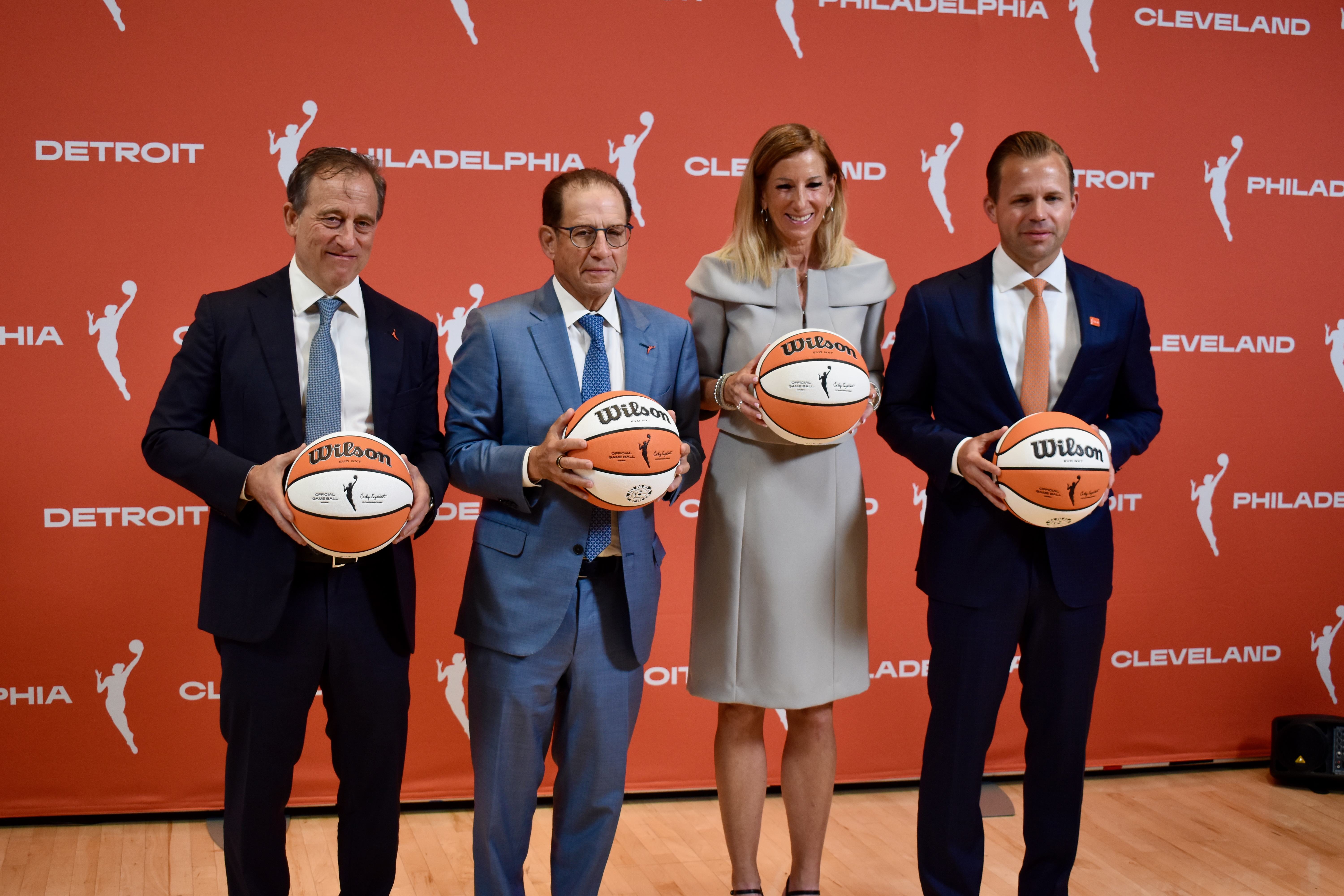
Sixers managing partner Josh Harris (left), Detroit Pistons vice chairman Arn Tellem, WNBA commissioner Cathy Engelbert, and Cleveland Cavaliers CEO Nic Barlage at a news conference announcing expansion teams for Philly, Detroit, and Cleveland.Jonathan Tannenwald
September 2023: Expansion
Starting in 2023 with the Golden State Valkyries, Engelbert began the process of expanding the WNBA for the first time since 2008. It was the first of six successful expansion bids under Engelbert’s tenure, and Golden State now is the league’s most valuable franchise, with an $850 million valuation, according to Sportico. In 2024, two additional expansion teams, in Toronto and Portland, were announced.
In June 2025, the WNBA announced the addition of three more franchises, to bring the total up to 18: Cleveland to begin play in 2028, Detroit in 2029, and Philly in 2030. All teams were purchased by the corresponding city’s NBA team owner. Cleveland and Detroit were both home to previous, now defunct, WNBA franchises, while Philadelphia will be a WNBA city for the first time.
“The demand for women’s basketball has never been higher,” Engelbert said in a statement.
Coming to Philly was personal for Engelbert. She hails from Collingswood, and her parents were Northeast Philly natives. Her dad, Kurt, was a men’s basketball star at St. Joseph’s and is in the school’s hall of fame.
The WNBA last year also announced the sale and relocation of the Connecticut Sun to Houston. The franchise was purchased by Rockets owner Tilman Fertitta, despite competing bids from Hartford, Conn., and Boston to buy and keep the franchise in New England.
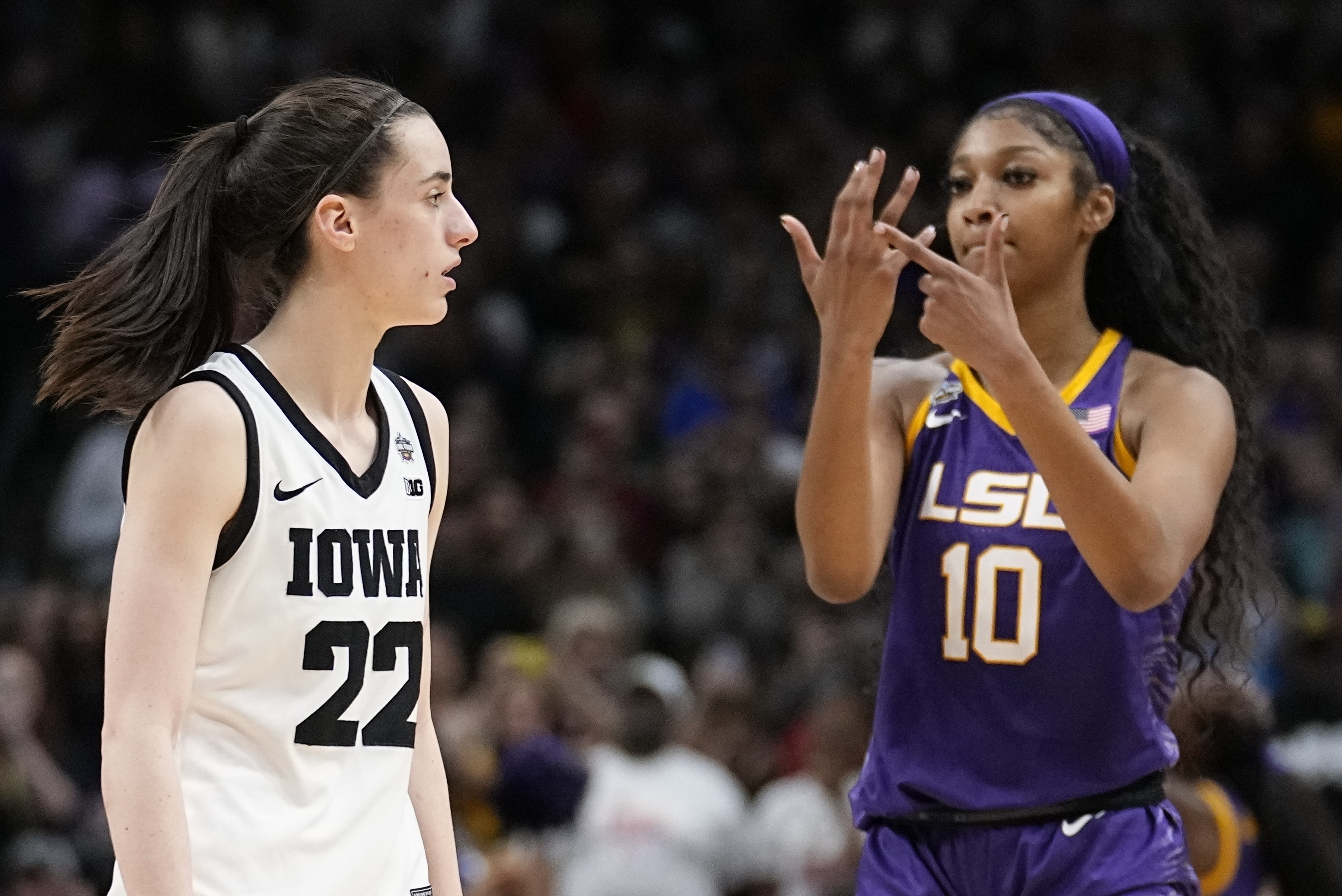
Caitlin Clark (left) and Angel Reese ushered in a new wave of WNBA fans.Tony Gutierrez
2024: The Caitlin Clark Effect
The exponential growth of the WNBA began in earnest with the 2024 WNBA draft, which brought college stars like Caitlin Clark and Angel Reese into the league. Other young stars like Paige Bueckers soon followed.
Clark, now a standout for the Indiana Fever, raised the bar for college basketball ratings, setting viewership records in 2023 with 9.9 million viewers for the national championship game, in which her Iowa squad lost to Reese and LSU, and the 2024 national title game, with 18.9 million viewers, was the first women’s national title game to outperform the men’s.
(function(){function e(){window.addEventListener(`message`,function(e){if(e.data[`datawrapper-height`]!==void 0){var t=document.querySelectorAll(`iframe`);for(var n in e.data[`datawrapper-height`])for(var r=0,i;i=t[r];r++)if(i.contentWindow===e.source){var a=e.data[`datawrapper-height`][n]+`px`;i.style.height=a}}})}e()})();
July 24, 2024: Media rights deal
Engelbert took advantage of spiking ratings with the expiration of the WNBA’s media rights deal in 2024, signing a new contract worth $3.1 billion, expanding partnerships with ESPN, Prime Video, and NBC.
“Partnering with Disney, Amazon and NBCU marks a monumental chapter in WNBA history and clearly demonstrates the significant rise in value and the historic level of interest in women’s basketball,” Engelbert said at the time. “These agreements allow the league to continue to build a long-term and sustainable growth model for the future of women’s basketball and sports which will benefit WNBA players, teams and fans.”
The WNBA set viewership records in 2024, with a record 22 regular-season games attracting at least 1 million viewers. Fever games were the most-watched on ABC, ESPN2, CBS, and NBATV.
March 24, 2026: CBA
After a tense negotiation, the new collective bargaining agreement was ratified by players and by the league, increasing player salaries, providing player housing, and adding an expanded benefits package.
Amid the negotiations, Napheesa Collier described Engelbert as “negligent” and said the WNBA has “the worst leadership in the world” in her exit interviews last season after officiating controversies.
“This past February, I sat across from [Engelbert] and asked how she planned to address the officiating issues in our league,” Collier said. “Her response was, ‘Well, only the losers complain about the refs.’ I also asked how she planned to fix the fact that players like [Clark, Reese, and Bueckers], who are clearly driving massive revenue for the league and are making so little for their first four years.
“Her response was, ‘[Clark] should be grateful. She makes $16 million off the court because without the platform that the WNBA gives her, she wouldn’t make anything.’ And in that same conversation, she told me, ‘Players should be on their knees, thanking their lucky stars for the media rights deal that I got them.’”
Engelbert has also faced player backlash for a perceived lack of attention to threats from toxic fans and sports bettors.
“I think as one of the main faces of our league, too, it creates a dialogue that needs to be had. It puts pressure on Cathy, who we’ve been begging to step up for us in these spaces,” said Natasha Cloud, a Broomall native and former St. Joe’s star.
The league recently has run into conflict with former NBA players like Enes Kanter Freedom and figures like Riley Gaines for lacking a policy restricting trans athletes from competing in the league. There are no active trans women in the WNBA, nor are there any serious prospects to be drafted in the near future.
But that hasn’t stopped figures like Freedom from coming to games and getting into altercations with players on the court, including Cloud. Engelbert said the league is being used as a “political football” by media members who do not watch or cover the league normally, in order to “sow divisiveness.”
Now that the NFL preseason has been consigned to memory — that is, if anyone actually remembers it — it’s time for the big moment. It’s time to reveal the outcome of every Eagles game during the 2026 regular season.
Week 1: After an offseason of speculation about his scheme and system, new Eagles offensive coordinator Sean Mannion shocks everyone on the first play from scrimmage against Washington by having Jalen Hurts line up under center, take the snap, and do The Macarena. “I am not trying to seduce you,” Hurts says after the game. “I am trying to win football games.” Saquon Barkley rushes for 221 yards and two touchdowns, compelling President Trump to issue an executive order changing the franchise’s name from the Washington Commanders to the Washington Ontario. Eagles 24, Commanders 7.
Week 2: Before arriving in Nashville to face the Titans, the Eagles’ players and coaches spend Friday in East Tennessee — at Dollywood for a team-bonding retreat. Following a team dinner at Granny Ogle’s Ham ‘n’ Beans, Jordan Davis persuades Vic Fangio to ride the Wild Eagle roller coaster with him. Both of them throw up. Two days later, Jalyx Hunt sacks Titans quarterback Cam Ward three times. “I set out to get him with a fine tooth comb,” Hunt says. Eagles 20, Titans 6.
Week 3: On Fox NFL Sunday, Bears head coach Ben Johnson tells Jay Glazer, “Yeah, we want to win the game, but we want more than that. We want to hang 50 on ’em. We’re the best around, and nothing’s gonna ever keep us down.” Quinyon Mitchell intercepts Caleb Williams’s first pass and returns it 37 yards for the game’s only touchdown. Eagles 7, Bears 3.
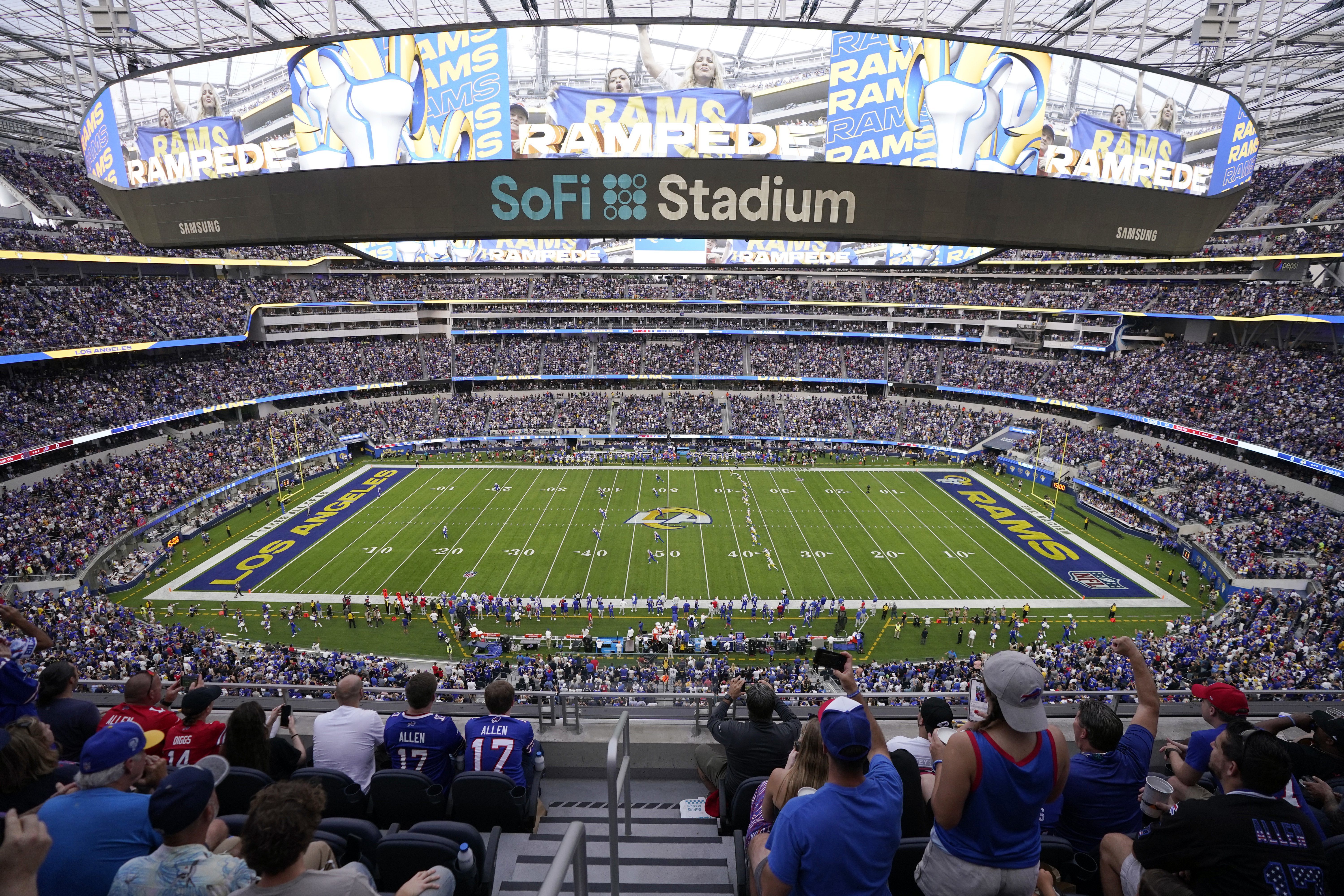
Week 4: Less than 24 hours before their matchup against the Eagles, the Rams announce that they have acquired Joey Bosa, Bobby Wagner, Haason Reddick, Brad Pitt, George Clooney, Matt Damon, Don Cheadle, Elliott Gould, and Julia Roberts. DeVonta Smith catches six passes for 66 yards. The Eagles’ other wide receivers combine for six catches for minus-six yards. Rams 27, Eagles 13.
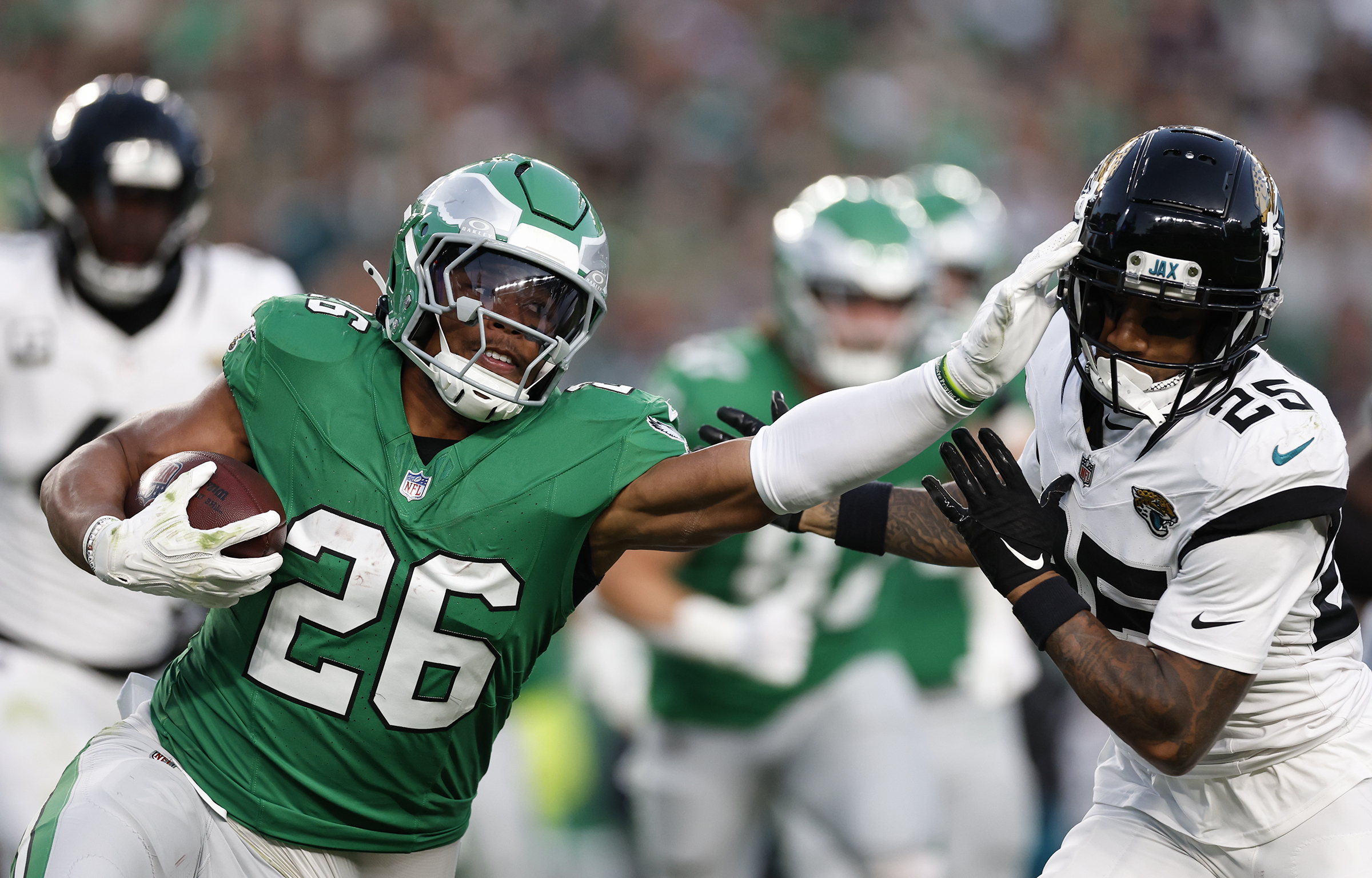
Week 5: In London, Hurts throws two interceptions and loses a fumble against the Jaguars. Asked after the game if he has any plans to go back to an offensive system with which his quarterback is more comfortable, head coach Nick Sirianni says, “Relax. I need some information first. Just the basic facts. Can you show me where it’s Hurts?” Jaguars 21, Eagles 7.
Week 6: The Eagles bounce back against the Panthers, but their manner of victory causes controversy. Barkley carries the ball 45 times for 233 yards and three touchdowns, but Hurts does not attempt a pass. At his locker after the game, Smith is asked how he feels about the offense. “You gotta go shipping up to Boston — or Foxborough — for that answer,” he says. Eagles 30, Panthers 17.
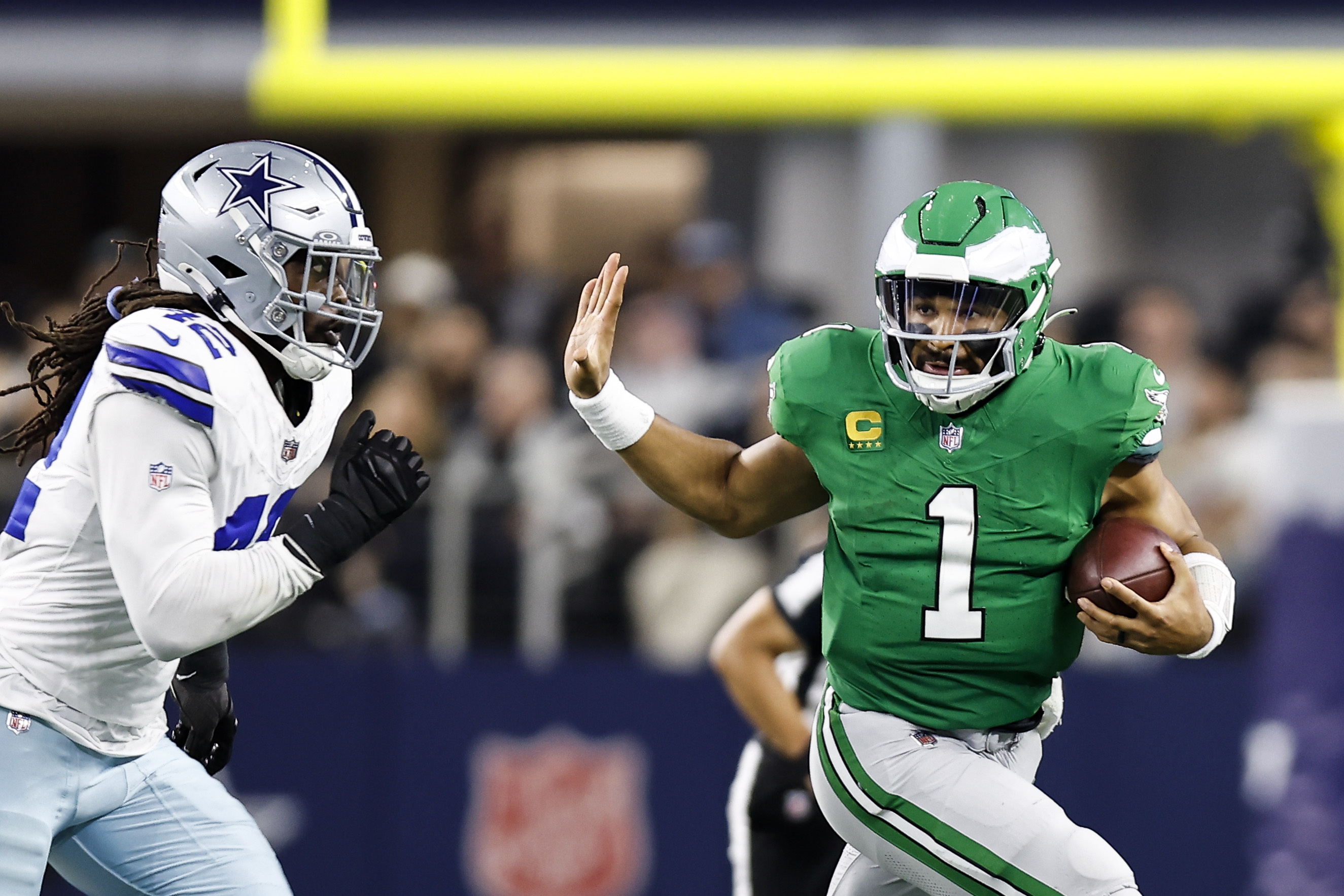
Week 7: On Monday Night Football against the Cowboys, Hurts delivers his finest performance of the season: 349 passing yards, two passing touchdowns, and a career-high seven aphorisms during his postgame press conference. His team off to a 3-4 start, Cowboys owner Jerry Jones says after the game that he has benched quarterback Dak Prescott and asks Troy Aikman if he’d be willing to play again. “Old man,” Aikman responds, “look at my life. Hell. No.” Eagles 34, Cowboys 28.
Jalen Hurts and the Eagles will face the Cowboys in Week 7.Monica Herndon / Staff Photographer
Week 8: It’s the second Eagles-Washington matchup of the season, this time on Sunday Night Football. Josh Harris hosts LeBron James and Jaylen Brown in his Northwest Stadium suite, where the amenities include a catering tray of undercooked hot dogs and guest appearances by former Washington greats Rock Cartwright, Gus Frerotte, and Donovan McNabb. Eagles 31, Whatever Their Name Is 10.
Week 9: Despite the Giants’ 4-6 record entering this game at Lincoln Financial Field, New York Mayor Zohran Mamdani releases 12 social-media videos declaring that Dec. 25 will “be known from this day forth as ‘John Harbaugh Day in the Big Apple.’” The New York Post runs a poll revealing that 57% of the media who cover the Giants believe Harbaugh is a better coach than Bill Parcells, Tom Coughlin, or Vince Lombardi. Jaxson Dart doesn’t complete a pass until late in the fourth quarter. Eagles 23, Giants 0.
Week 10: Through nine games, the Eagles have committed 15 turnovers. So during the bye week, Sirianni announces he will become the full-time play-caller. “The nearer we are to our destination, the more the ball is slip-slidin’ away,” he says. “I wear my passion for protecting the football like a thorny crown.” Asked if he will bench Hurts for any of the other 17 quarterbacks on the Eagles’ roster, Sirianni declines to comment.
Week 11: The Eagles pound the Steelers at the Linc. The next morning, Aaron Rodgers appears on The Pat McAfee Show, claiming that the real reason he and his teammates lost was that Anthony Fauci, The Illuminati, and the game’s replay officials conspired against them. Eagles 28, Steelers 3.
Week 12: On Thanksgiving, the Cowboys rally from a 14-point halftime deficit to beat the Eagles. Asked after the crushing loss why Hurts did not throw a pass over the game’s final three quarters, Sirianni responds, “Jalen was on a vacation far away. So many things I want to say. You know I like my leads a little bit bigger, but I don’t want to lose that ball tonight.” Cowboys 21, Eagles 17.
Week 13: A 10-day layoff leads to sloppiness and frustration on offense against the Cardinals; only a dominant performance from the Eagles’ defense saves them. Standing at his locker, Smith holds out his smartphone to show that he has received a text message from A.J. Brown: “yo bro i told u also don’t 4get book club tues nite.” Eagles 16, Cardinals 3.
Former Eagles OC Shane Steichen (left) and his Colts squad will come to the Linc on Dec. 13.David Maialetti / Staff Photographer
Week 14: The Colts’ Daniel Jones tosses three touchdown passes as former Eagles OC Shane Steichen spends all day scheming receivers open against Fangio’s defense. On WIP, PHLY Sports, and Jeff McLane’s podcast, Brandon Graham announces that he is considering coming out of retirement. Colts 27, Eagles 21.
Week 15: A matchup of the last two Super Bowl champions shows the Eagles where they really stand in the NFC. Hurts throws three interceptions, including two in the red zone, against the Seahawks. “You win. You learn,” Hurts says. “You laugh. You learn. You cry. You learn. You miss Dallas Goedert wide-open in the end zone. You learn.” Still, ESPN’s Dan Orlovsky says that Hurts is in the discussion for the top five quarterbacks in the NFL if you consider that every quarterback in the NFL is really under discussion to be one of the top five quarterbacks in the NFL because every quarterback in the NFL is amazing. Seahawks 24, Eagles 6.
Week 16: On Christmas Eve, the Eagles and Texans combine for seven turnovers and remain scoreless into overtime before C.J. Stroud throws his fourth interception, all to Riq Woolen, and Jake Elliott kicks a 30-yard field goal. Smith shows reporters another text from Brown: ‘haha u missed xmas story marathon on tbs 4 this.’ Eagles 3, Texans 0.
Week 17: When 49ers coach Kyle Shanahan doesn’t appear at one of his midweek press conferences, ESPN’s Adam Schefter reports that the 49ers have allowed him to report that Shanahan has actually been in cryogenic stasis since early October. Eagles 35, 49ers 20.
Week 18: At MetLife Stadium, with Mannion calling plays again, Hurts goes 7-of-21 for 79 yards in an ugly victory over the Giants. New York media members give Harbaugh a standing ovation for going 6-11, talking to them nicely and even using their first names. The Eagles finish 12-5 and clinch their third straight NFC East title. Sirianni announces that, in the following week’s wild-card game, backup quarterback Troy Aikman will start. Eagles 11, Giants 7.
The 2026 NFL season kicks off this week, with the Eagles’ Week 1 meeting against the Commanders highlighting a slate that also includes Seahawks/Patriots on Wednesday and a 49ers/Rams showdown in Australia on Thursday.
With that in mind, The Inquirer’s NFL reporting team of Jeff McLane, Olivia Reiner, Jeff Neiburg, and Ryan Novozinsky offered their predictions not only for the Eagles season but also how they see the entire league shaking out, including playoff brackets and major awards.
Eagles game-by-game predictions
Week
Opponent
McLane
Reiner
Neiburg
Novozinsky
1
Commanders
W
W
W
W
2
@ Titans
W
W
W
W
3
@ Bears (MNF)
L
L
W
W
4
Rams
L
L
L
L
5
Jaguars (London)
L
W
W
W
6
Panthers
W
W
W
W
7
Cowboys (MNF)
W
W
W
L
8
@ Commanders (SNF)
W
W
L
W
9
Giants
W
W
W
W
11
Steelers
W
W
W
W
12
@ Cowboys (T-giving)
L
L
L
W
13
@ Cardinals
W
W
W
W
14
Colts
W
W
W
W
15
Seahawks (Sat.)
L
L
L
W
16
Texans (Thur.)
L
L
W
L
17
@ 49ers (SNF)
L
W
L
L
18
@ Giants
W
L
W
W
10-7
11-6
12-5
13-4
Inside our picks
Which pick were you most on the fence about?
McLane: London game vs. the Jaguars (loss). I was at the Eagles’ last trip over the Atlantic when they beat a then-good Jacksonville team in 2018. Only a couple of players remain from the squad — tackle Lane Johnson and kicker Jake Elliott — but traveling to other countries has become the norm for every team in the NFL. So it’s not like the Jaguars, who play in London the most, have a distinct advantage.
The Jaguars will be a much tougher opponent than the Jacksonville team the Eagles faced in 2024. Yong Kim / Staff Photographer
But coach Liam Cohen returns a squad that won the AFC South with a 13-4 record as he enters his second season in charge. There will likely be regression with a first-place schedule. I see a lot of prognosticators picking them to fall to the middle of the pack. But I like their roster. And I think the Eagles are going to hit a rough patch from Weeks 3-5 after opposing defenses get film on Sean Mannion’s new offense. Still, it’s difficult to see Vic Fangio’s defense allowing a three-game losing steak. So I was divided about this pick. Ultimately, I just felt the Jags matched up well against the Birds.
Reiner: The 49ers road game (win). There should be plenty of juice going into that game, as the Eagles fell to the 49ers in the wild-card round. Looking back, it seemed like a lot of the Eagles’ shortcomings in that game were self-inflicted. The following week, the 49ers were exposed by the Super Bowl champion Seahawks in their 41-6 divisional-round drubbing. That late-season three-game stretch against the Seahawks, Texans, and 49ers should be tricky, but it seems unlikely that the Eagles will lose three straight games. I think the 49ers could be the lesser team of that trio, especially if their poor injury luck persists into 2026. Given they have one of the oldest rosters in the league, perhaps that isn’t too far-fetched.
Neiburg: The Texans game on Christmas Eve (win). I think 12-5 is the right record, and because it’s impossible to know what’s going to go on later in the season, guessing the spots for the losses is tough. On my first spin through I had them losing three straight to Seattle, Houston, and San Francisco. I can’t see this team losing three consecutive games. I also don’t see them losing to Washington, but 13-4 seems a bit off, and I needed a fifth loss, so I went with the NFC East opponent on the road rather than a random loss at home to a team like Pittsburgh. You see? This is an exact science. Houston is really good. That three-game stretch could be a turning point.
Novozinsky: The Seahawks game (win). Yes, they’re the defending champs. Yes, their defense is great. Yes, Sam Darnold just completed a masterful career 180. But after watching the Eagles defense all summer, I just think the Birds have the deeper unit — which will be the clear difference maker in this game. This’ll be a true rock fight, but I say the Eagles come out on top thanks to their secondary clamping down Jaxon Smith-Njigba.
Rookie Carson Beck could be the Cardinals QB by the time the Eagles face them in December. David Richard
Which game do you most consider a lock?
McLane: The opener vs. the Commanders. If there was one non-quarterback Washington couldn’t afford to lose to injury, it was Laremy Tunsil. The left tackle’s season ended when he tore his triceps early in training camp. Not only was Tunsil arguably the most established player on the team, but he was the No. 1 piece standing between Jayden Daniels and more injuries.
But there are a host of other reasons to think Dan Quinn’s unit will be just as bad as it was last season. The offensive skill position group is lacking in top-end talent. The defensive front seven will look significantly different than it did during last season’s wretched campaign. But it’s young and will have to carry the load if the secondary continues to be porous. The Eagles may have some early hiccups with a first-time play caller in Mannion, but the offense should benefit from the early element of surprise. The defense, meanwhile, could dominate.
Reiner: The game against the Cardinals. Congratulations – you have the chance to start for the Cardinals at quarterback this season! The Jacoby Brissett-Gardner Minshew-Carson Beck quarterback depth chart isn’t exactly fear-inducing for defensive coordinators. Rookie running back Jeremiyah Love, who is already injured, could be challenged to reach his potential behind an average offensive line. If things aren’t going well for the Cardinals by Week 13, Josh Sweat might sneak back to Philadelphia on the team plane after the game.
Neiburg: Dec. 6 in Arizona. The Cardinals are dreadful. There’s a real chance they go winless. They could be touchdown underdogs in every one of their divisional contests and they’re also matched up with an AFC West division that could produce three playoff teams. Eagles fans always travel well, but an early December trip to the southwest is enticing, and this one might feel like a home game.
Novozinsky: Week 2 at the Titans. The Titans will probably be marginally better in 2026, but let’s face it: If your team is picking up the scraps from the Giants/Jets of the past five years, you’re probably not going to be a very good team. They’re a true dumpster fire franchise — and I’m still not sold on quarterback Cam Ward. The Eagles will win this game and Broadway will be flooded with chants of “Go Birds!”
Another Eagles-Rams classic could be in store when Nick Sirianni and the Birds host Sean McVay and L.A. David Maialetti / Staff Photographer
Which contest screams “statement game” to you
McLane: Dec. 19 vs. the Seahawks. After a shaky start to the season, I can see the Eagles settling into a groove, especially with some expected easier opponents in the middle portion of the season. I have them 9-4 by the time they host the defending-champion Seahawks on Dec. 19. It’s difficult to repeat, of course, and while Mike Macdonald returns one of the best defenses in the league, and has elite players like Smith-Njigba on offense, I could see Seattle falling back to earth in a tough NFC West. Does anyone really think that Darnold will be as good as he was during a sun-kissed 2025? But a win here for the Eagles would be impressive and maybe catapult them into a stretch run and another NFC East crown.
Reiner: The Seahawks game in Week 15, especially if both teams are competing for playoff spots at that point in the season. Seattle is defending its Super Bowl title and the Eagles are looking to contend once again. If they can come up with a win against the league’s leading defense in 2025 and the Offensive Player of the Year in Smith-Njigba, they should feel good about themselves heading into the final stretch of the season. If not, a loss could be a sign of bad things to come for the Eagles in the postseason.
Neiburg: Well, the Rams game could be a preview of the NFC title game, so, for better or worse, that is kind of a measuring stick game. The Eagles will match up with a few shaky defenses early in the season before welcoming Myles Garrett, Aaron Donald, and perhaps the best defensive front ever assembled to Lincoln Financial Field. It’s just a shame it’s a 1 p.m. game, because it’s one of the best games on the NFL calendar this season.
Novozinsky: Christmas Eve in Houston. What the Texans lack on offense, they make up for — in a huge way — with an unrelenting defensive front. They’re my Super Bowl pick this year and they’re a perfect measuring stick for the Birds in front of a primetime holiday audience. The schedule makers sure didn’t do the Eagles any favors, sandwiching this game between the Seahawks and 49ers.
Rookie Caleb Downs (center) is one reason why Jerry Jones (left), Brian Schottenheimer and the Cowboys are optimistic about getting off the mat in 2026. Tony Gutierrez
Who’s the biggest threat to an Eagles’ NFC East three-peat?
McLane: It’s got to be the Cowboys. The Commanders, as noted above, could be a hot mess, while the New York Giants are likely a year away from contending. But Dallas has the offensive firepower to match the Eagles’ potent defense. Dak Prescott has an aerial attack that can expose a weakness at safety and even some of the best cornerbacks in the NFL. We saw it last season. The Cowboys couldn’t compete in 2025 because, ultimately, they were dreadful on defense. They made significant changes. They snatched Christian Parker from Philly to helm the unit. And they added six new starters, including edge Rashan Gary and first-round safety Caleb Downs.
I’m not saying it’ll transform them into a top unit. Parker is as much of an unknown as Mannion. But it’s hard to see Dallas not finishing with a winning record. I think the Eagles will be right there with them. Heck, they’re still the odds-on favorite to win the division. But I think defenses will still be able to corral Saquon Barkley and the run game because the passing offense will not improve enough with too many question marks at receiver and tight end.
Reiner: The Cowboys. They made upgrades to their defense, which ranked last in the league in points allowed in 2026, and hired Parker. Combine an improved defense with an offense that ranked in the top 10 in 2025 and one of the best kickers in the NFL in Brandon Aubrey and the Cowboys could threaten the Eagles for the NFC East crown.
Neiburg: Dallas. The Cowboys should have an improved defense, and there’s plenty of talent on offense to get to double-digit wins. The Giants could be a sneaky wild-card team with an exciting offense, but I don’t think they’re ready to take that step yet. Washington, meanwhile, didn’t do a whole lot of improving in the offseason and its defense just isn’t good enough. The Eagles-Cowboys game on Thanksgiving could end up being a turning point of sorts in the NFC East standings.
Novozinsky: It’s the Cowboys and it’s not even close. The Commanders are going to stink. I’d be stunned if the Eagles didn’t sweep them this year. The Giants should be better under Harbaugh, but I’m just not sold on Jaxson Dart. Dallas, for all its faults, has a good offense and a capable defense led by a sharp defensive mind in Parker.
The presence of Myles Garrett (95) is helping to make the Rams a trendy Super Bowl pick. Mark J. Terrill
Tom Schafer was a hulking man when he played one preseason game with the Eagles in the summer of 1984. The undrafted free agent center stood at 6-foot-2 and 270 pounds, with a booming voice and an unabashed confidence to match.
By the fall of 2009, his broad frame had hollowed out. His voice had been reduced to a rasp. Schafer could walk, but only gingerly, and for short distances.
Yet here he was, sitting in a West Chester University parking lot, handing out fundraising pamphlets and preaching to tailgaters about his long-lost teammate.
It was not the way most people battling cancer would have chosen to spend their time. But Schafer was not most people.
When Schafer was told the disease he’d battled two decades prior had returned in 2008, he had already made a commitment and was determined to see it through, no matter how many rounds of treatment he would have to endure.
“He still had that fire about the statue,” said former West Chester center Joe Walsh. “He was talking then about everything we see now.”
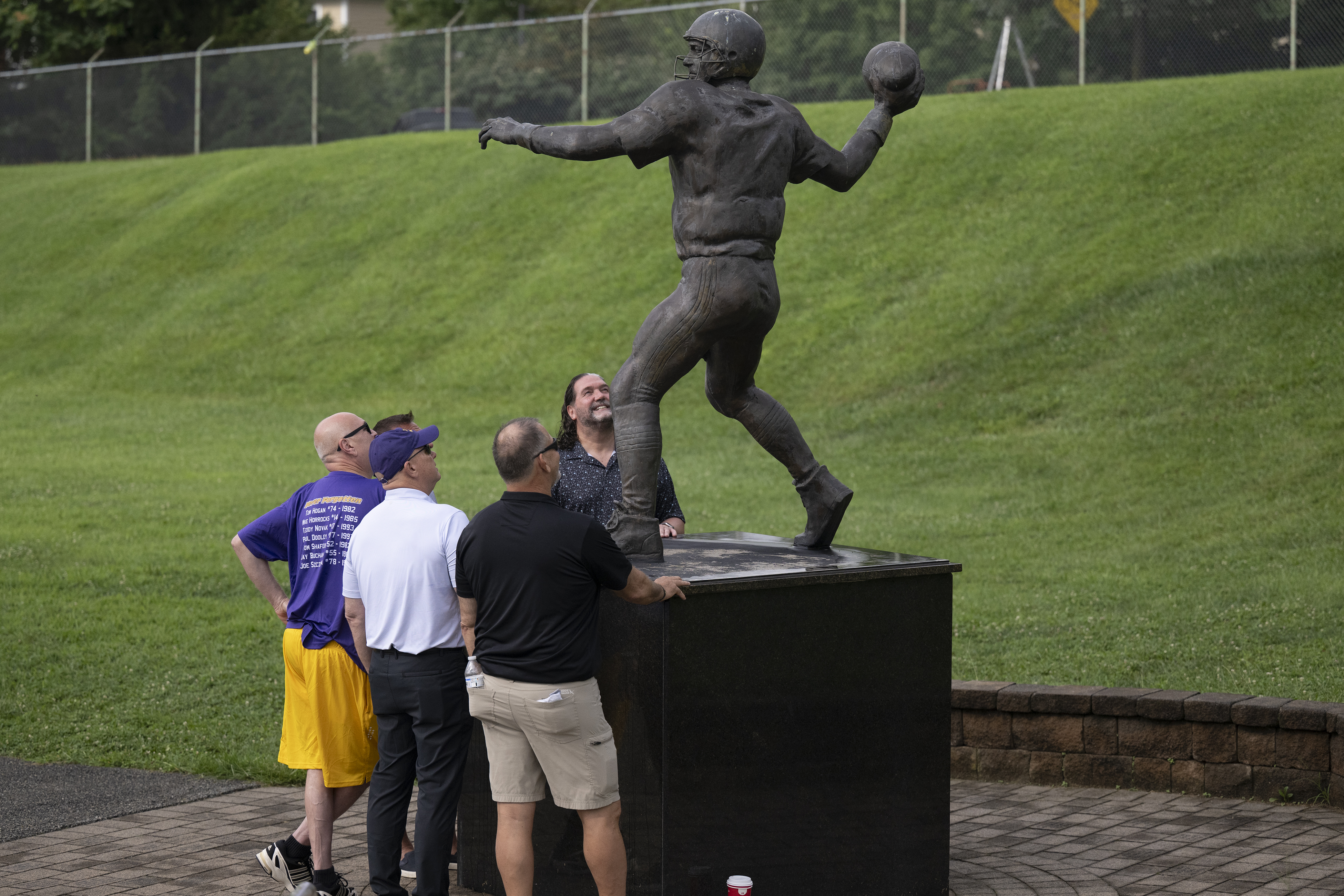
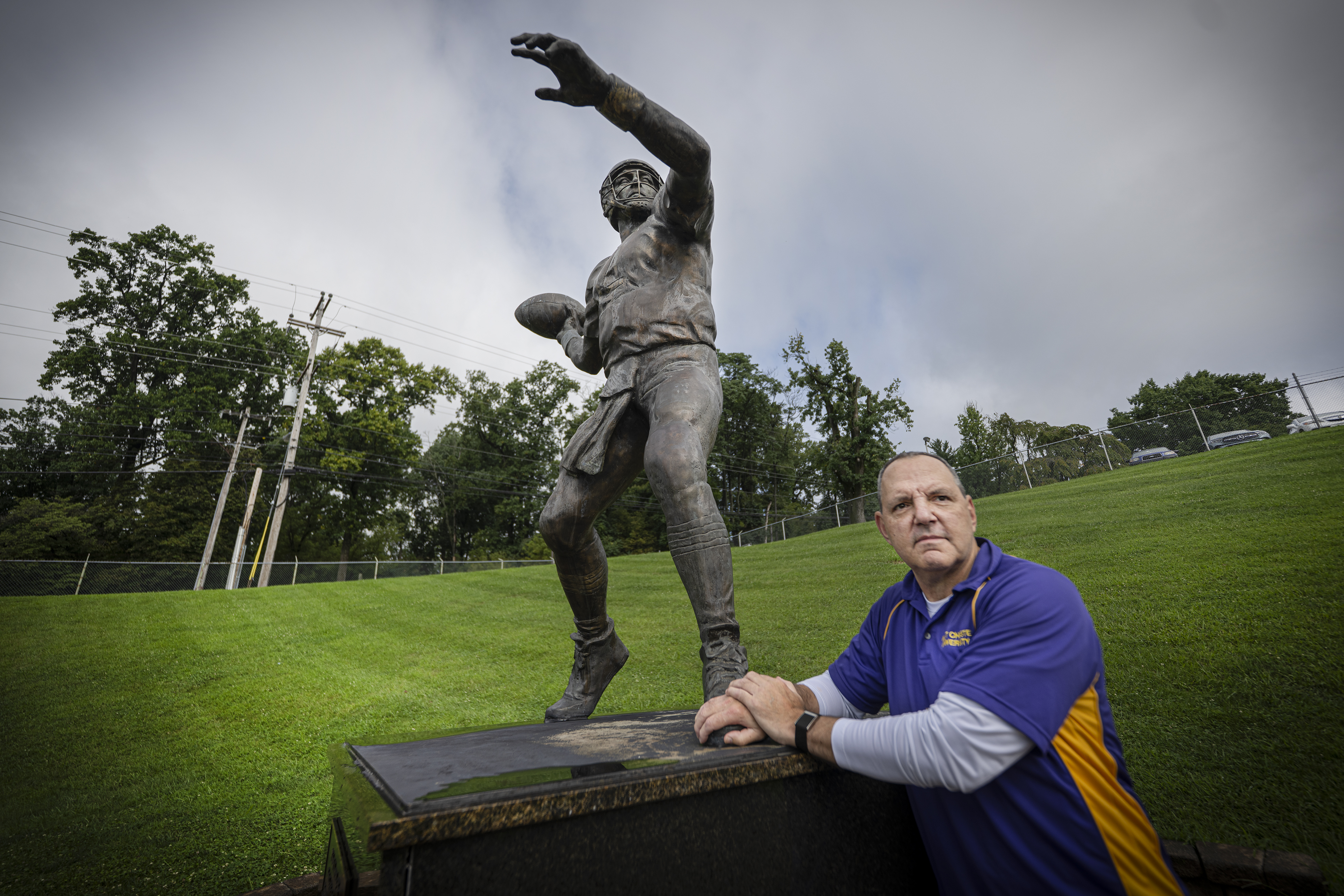
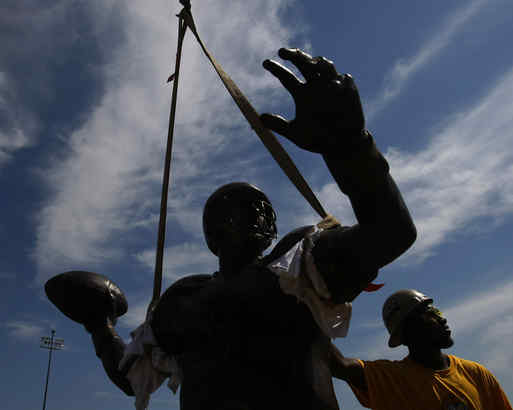
Walsh motioned to the northwest corner of Farrell Stadium. There, at the base of a hill, stood a bronze likeness of a quarterback, his left foot firmly planted, his right arm cocked, ready to uncork a spiral.
Former teammates John Mininno (left) and Tom Schafer (right) visit the statue of Michael Horrocks which was unveiled Sept. 11, 2010. Michael S. Wirtz / Staff Photographer
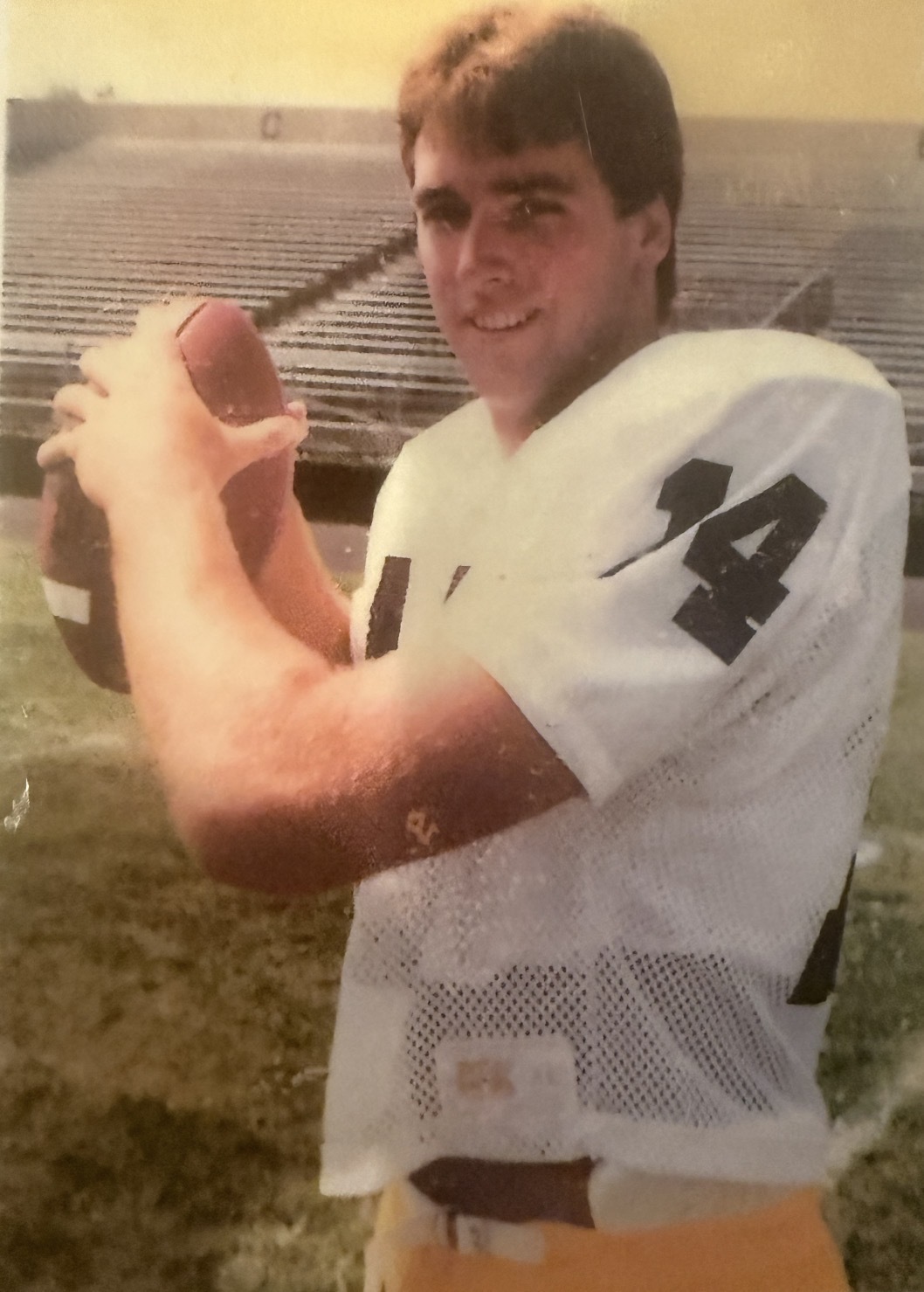
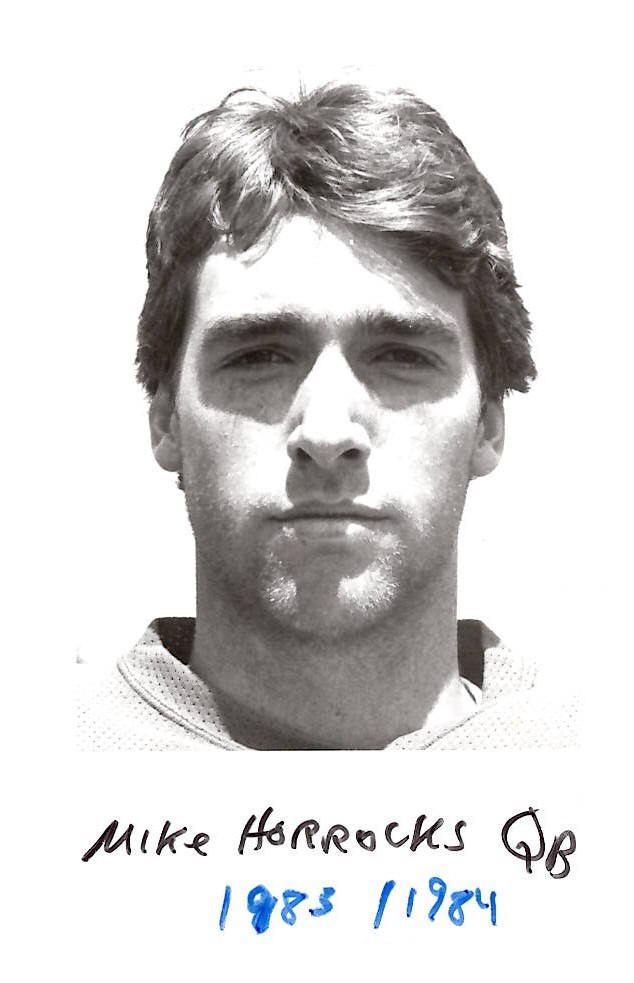
The man was Michael Horrocks, Class of 1985. He and Schafer overlapped on the football team for twoseasons, but Schafer took a liking to the sophomore’s goofy personality.
And when he found out that that same sophomore had been a copilot of Flight 175, the plane that hit the South Tower on Sept. 11, 2001, he was distraught.
Years passed, and Schafer began to coach high school football throughout the region. Some of his players joined West Chester’s program. None knew of Michael Horrocks. Not of his tragic place in history, or of his greatest moment on the field, when he led the Golden Rams to a 35-27 upset win over Delaware in 1983.
They didn’t know of his service in the Marines, or his devotion to his kids, and his wife, and his friends. They didn’t know his name at all. And Schafer desperately wanted them to.
So he and his teammates came up with a plan to ensure Horrocks’ presence would be felt for years to come. From 2008 to 2010, the West Chester alums raised $150,000 for a scholarship endowment and a statue to commemorate the late quarterback.
They faced all sorts of challenges, some of them logistical. West Chester had never built a statue on campus before, and had no clear guidelines on the process to have one erected.
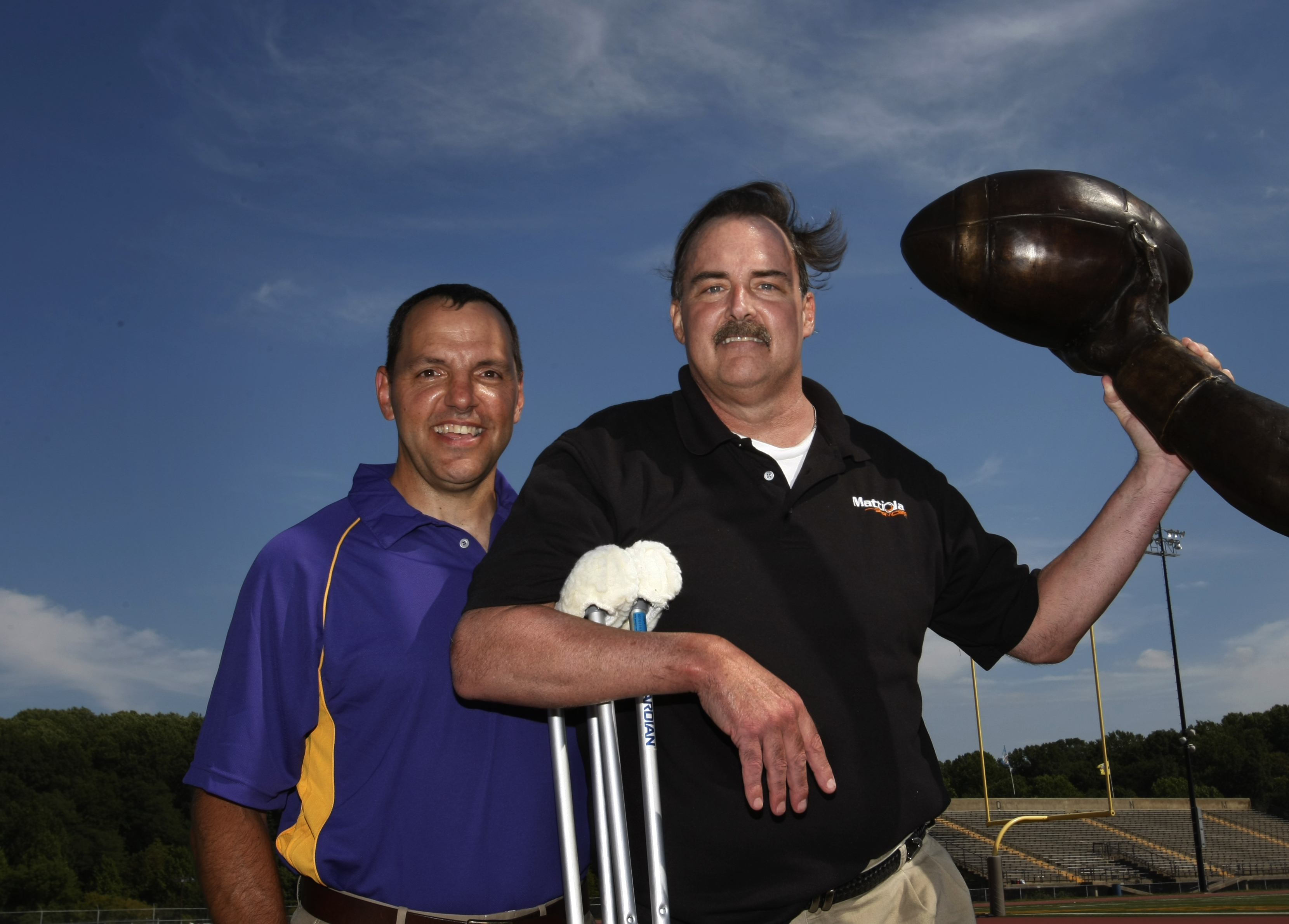
Former West Chester University football player John Mininno is photographed near a statue honoring his former teammate, quarterback Michael Horrocks.Jose F. Moreno / Staff Photographer
In an initial conference call with Horrocks’ teammates, school officials tried to persuade them to build something smaller, like a plaque or a bench. They warned the former players of the money they would need, and the bureaucratic hurdles they would face.
But Schafer was undeterred.
“Tom went in there and said, ‘F— you, we’re not doing a plaque. We’re doing a statue,’” said Class of 1988 linebacker John Mininno. “And he was not to be denied.”
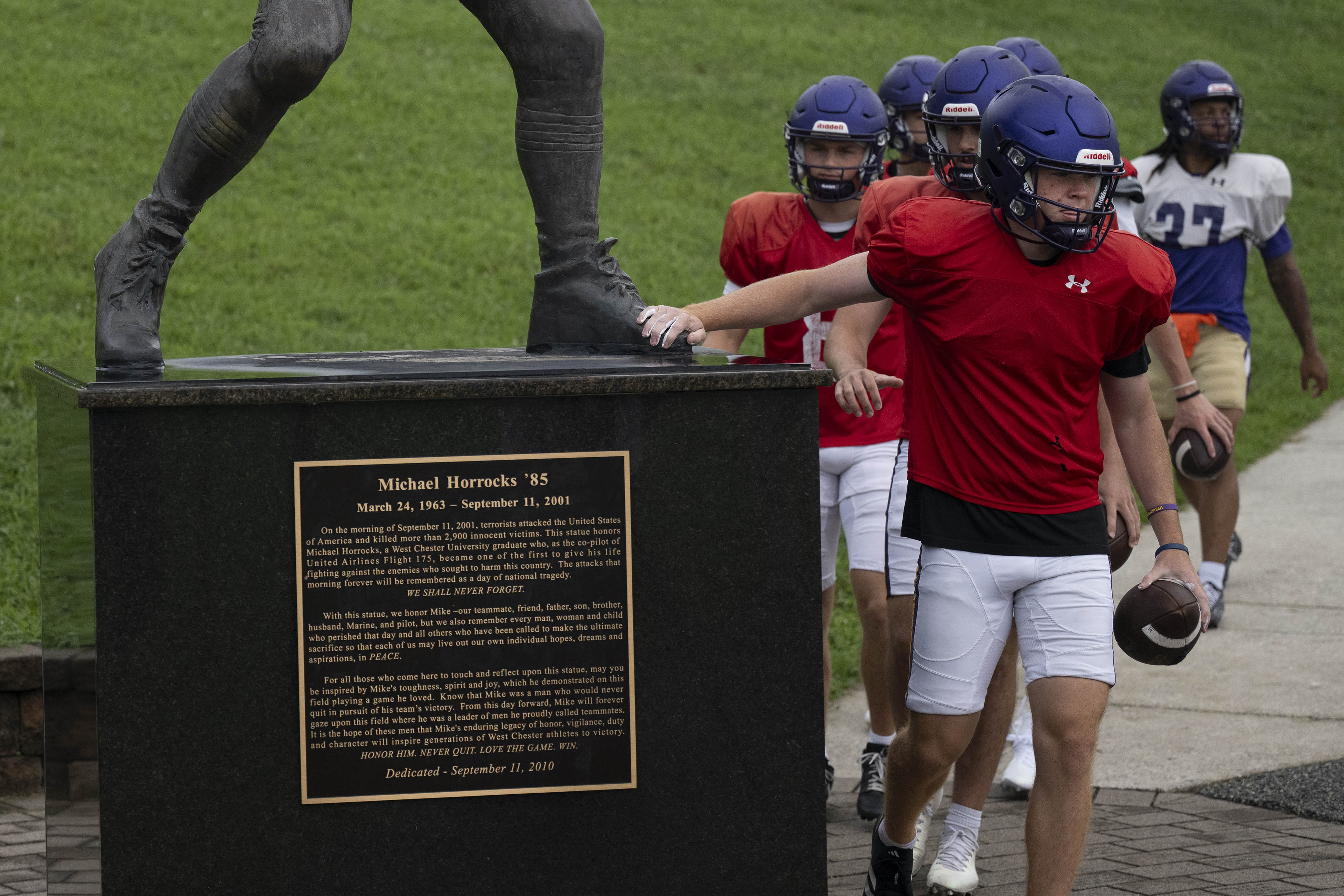
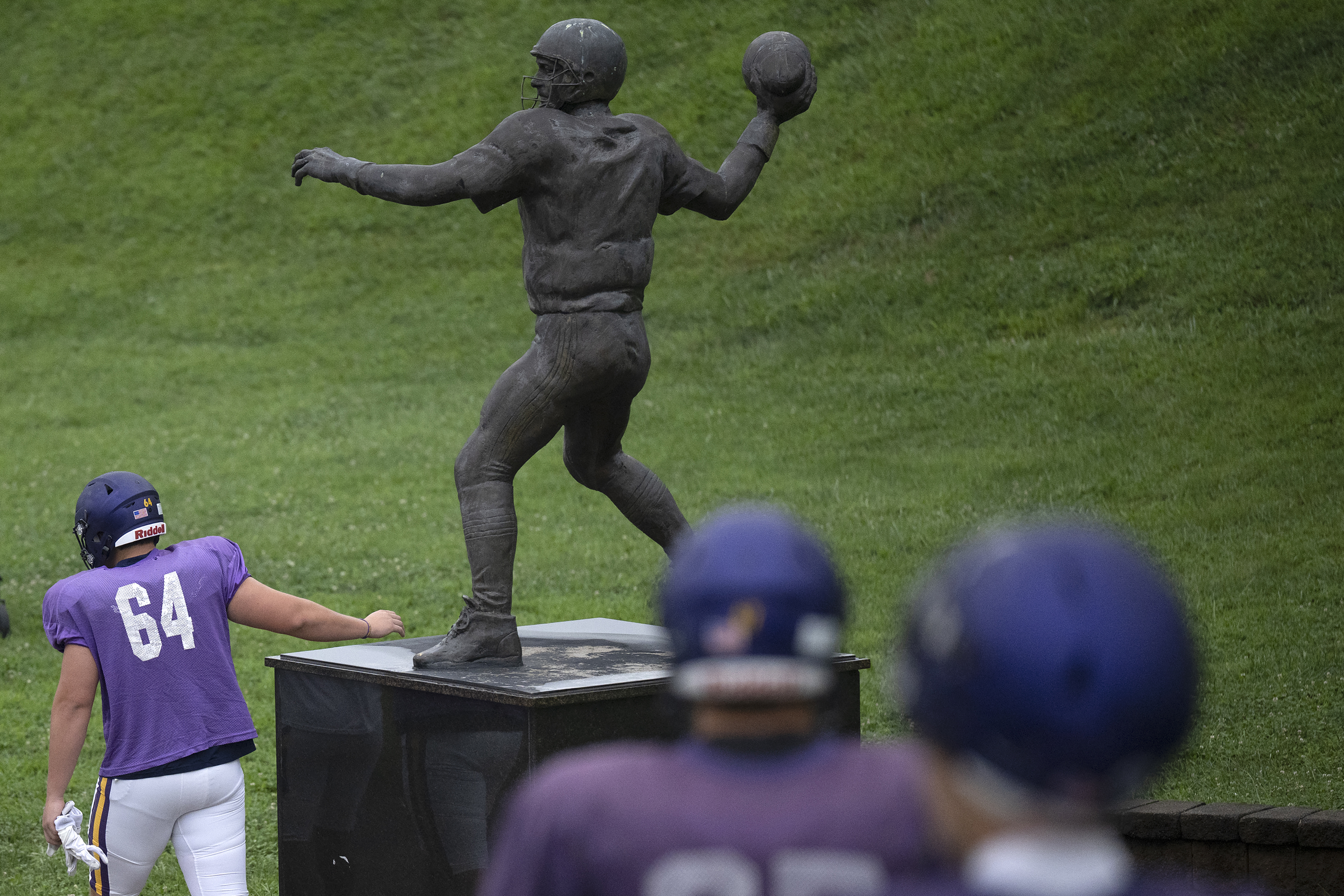
The result was not just a statue, but a tradition. Since it was unveiled in 2010, West Chester’s players have tapped Horrocks’ left foot before every practice and game.
They have done this so often that you can see scuffs of gold peeking out from beneath the bronze. Horrocks is not here in the physical sense, but this version of him — fearlessly driving down the field, leading his men — is now preserved.
And his teammates intend for it to stay that way.
“We want this to be a legacy,” Mininno said. “We want this to be here for much longer than we’re going to be around.”
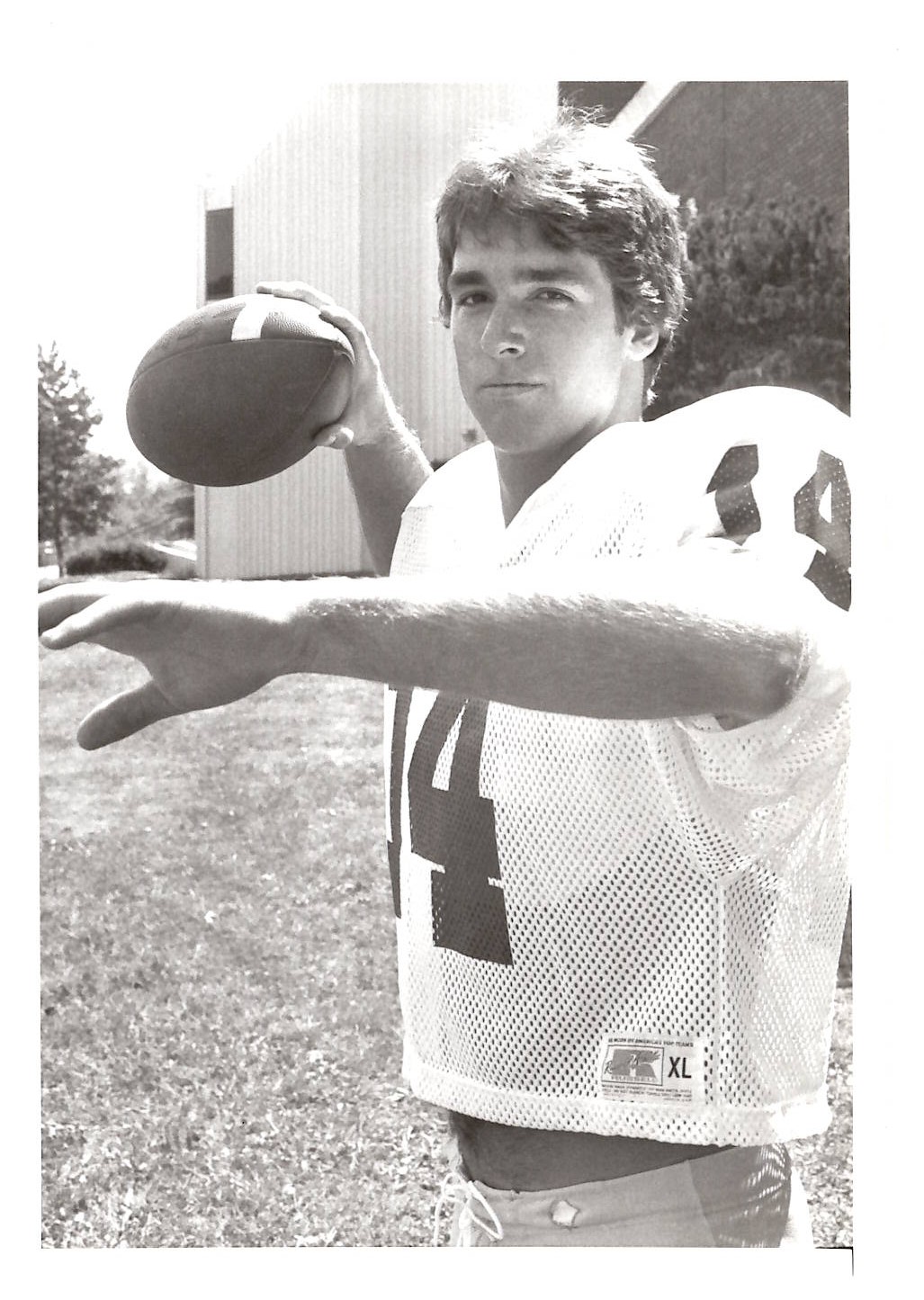
Michael Horrocks emerged as a starting quarterback and a trusted leader at West Chester.provided by Mark Gosik
‘A pilot the entire time’
Horrocks was born and raised about 70 miles west of West Chester, in Hershey, Pa. He attended Hershey High School, where he played varsity football under head coach Robert “Gump” May.
May was tougher than most coaches. His team did three-a-days throughout the summer: an unusually heavy workload, which had the intended effect of whittling unreceptive players from the roster.
The coach would start camp with 75 kids. Two weeks later, he would be left with 30.
One kid, in particular, was always in that lattergroup.
“Mike stayed,” May said.
Horrocks was fighting for playing time with Scott Campbell, a quarterback who would go on to have a six-year career in the NFL. Locals were skeptical that the backup would perform in the opportunities he did get, but he quickly proved them wrong.
Over his one season as a starter at Hershey, and in limited appearances before that, Horrocks led his team to a litany of come-from-behind wins, including one against rival Palmyra High School, which took a 21-point lead in the first quarter.
“After Scott Campbell graduated, everybody thought, ‘Well, they lost their big gun,’” May recalled. “Well, Mike jumped in and he was just as big a gun.”
Michael HorrocksSpecial Collections, West Chester University
Gump reached out to a friend, Rick Daniels, a part-time assistant who later became West Chester’s head coach, and sent him some film of Horrocks. In the spring of 1981, the quarterback drove to campus for a visit.
Daniels was already impressed by what he saw on film. Horrocks didn’t just have a strong arm; he was also quick on his feet, and he had an air of unflappability about him. He joined West Chester’s team that fall as a backup quarterback.
Once again, Horrocks found himself in the unenviable position of filling in for an NFL-caliber player in Ron Gaynor, who later bounced around training camps with the Seahawks, Eagles, and Bills.
Nevertheless, the aspiring starter worked with the intensity of a seasoned veteran. Horrocks and tight end Al DePippo would regularly put in extra hours, throwing after practice and then heading to the weight room. If it was locked, they would use the neck machine beneath the stands.
Horrocks coupled his drive with a lighthearted composure that allowed him to thrive in intense situations. The first time he interacted with Schafer was in 1982,when Horrocks was a sophomore.
Gaynor had gotten hurt; Horrocks was asked to fill in.
“He crouched down in the middle of the huddle, looked up at us, and said, ‘Ah, the big boys,’” Schafer recalled to The Inquirer in 2010. “I said, ‘Shut up and call the play.’”
It was a precursor of huddles to come. Some players got stiff when they first entered regular season games. Horrocks was the opposite. He would walk onto the field with a toothy grin and a laugh, confident in the hours of prep behind him.
Michael Horrocks led West Chester to a rare win over rival Delaware in 1983. Special Collections, West Chester University
This continued even after he was named the starting quarterback in 1983. Horrocks was known to play pranks, like tying teammates’ shoelaces together, or putting slices of cheese in a friend’s textbook.
West Chester had some of its greatest moments under Horrocks and his playful persona. In his first game as a starter, Sept. 10, 1983, the Golden Rams faced the University of Delaware on the road.
It was a harrowing matchup. West Chester played in Division II, while Delaware played at what was then known as the Division I-AA level. The Blue Hens had won their last 15 games against the Golden Rams, a streak that dated back to 1957.
But West Chester was unafraid. After a scoreless first quarter, the Golden Rams jumped to a 21-3 lead in the second. They upped it to 35-3 in the third and held on for the win.
Horrocks finished the day 10-of-18 for 129 passing yards and two touchdowns.
West Chester’s campus erupted into a giant party, as if the team had won the national championship. But the quarterback at the center of it all was already focused on his next game.
When he returned home that night, he recapped different plays and passes to his housemates on Magnolia Street.
“He would talk about even some of the plays that he missed,” said his friend Chris Conner. “He never got too big. Even though he had just beaten Delaware, he was still the same guy.”
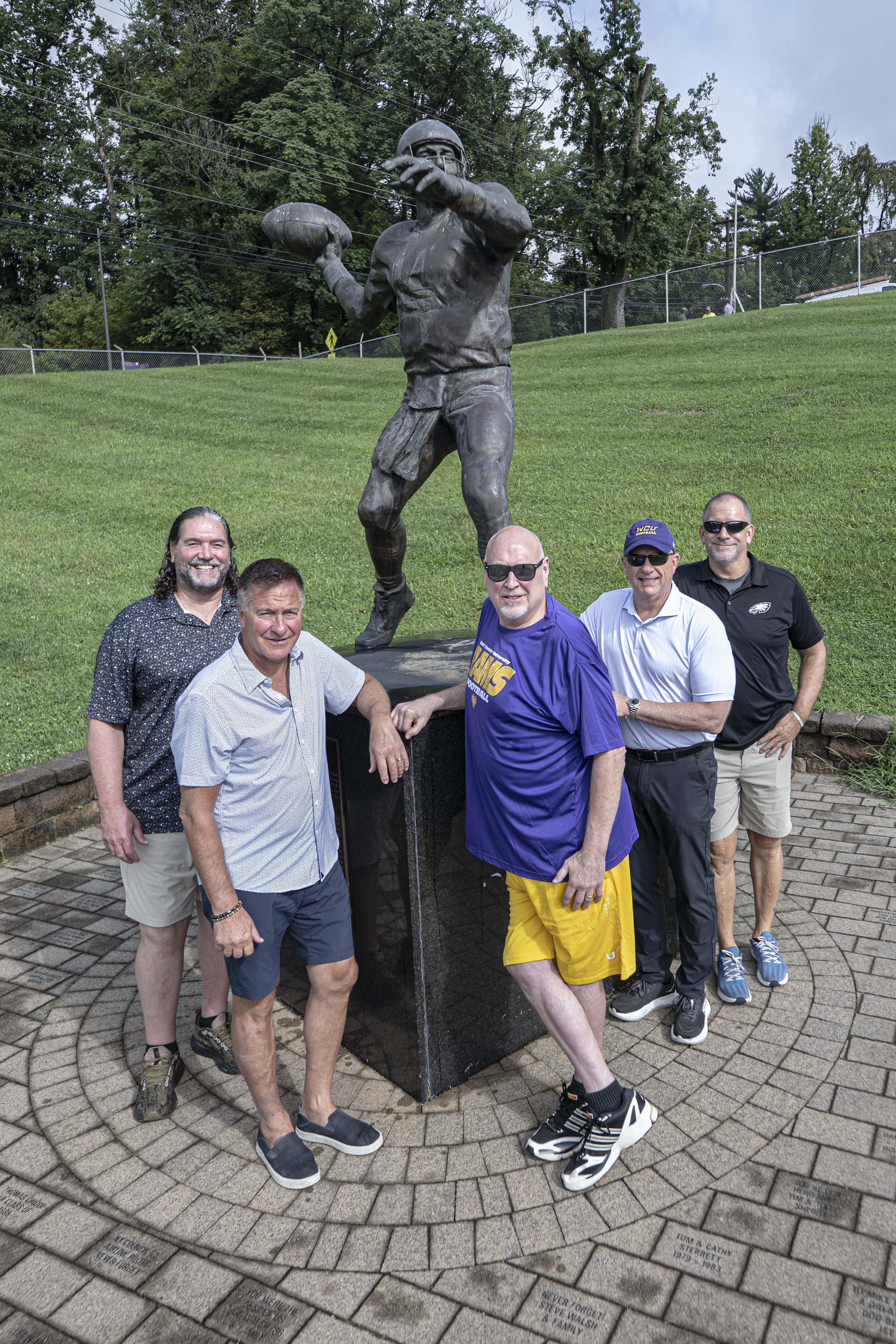
From left, West Chester University football alumni Tom Weaver, Mike Esposito, Bob Campbell, Mike Hudson and Dean DiPasquale pose for a photo with a statue honoring their former teammate Michael Horrocks last month. Jose F. Moreno / Staff Photographer
In 1984, West Chester hired a new head coach, Danny Hale, who brought in a new I-formation attack that incorporated elements of the West Coast offense. This system was different from what the team was accustomed to running (a split-back veer offense), and Hale, who was hired late, had limited time to teach it.
He and quarterbacks coach Bill Hart met with Horrocks every day in the football office on campus. They would draw up plays on the chalkboard and quiz their pupil about different coverages and fronts he would face.
Hale’s system allowed Horrocks the ability to audible if the situation called for it, and the head coach wanted him to be well-prepared. But Hale and Hart soon learned that that wouldn’t be a concern.
The Golden Rams went 7-3 in 1984, and 5-1 in their conference, falling just shy of winning the Pennsylvania State Athletic Conference’s Eastern Division title.
When DePippo looks back, he realizes that the same qualities that served Horrocks in the air were those that made him a good quarterback: a natural leader, a hard worker, a man who could balance an easygoing nature with intense focus.
“It comes back to what kind of pilot do you want?” DePippo said. “Do you want somebody that’s going to panic when the s— hits the fan, or do you want a guy that’s going to be confident?
“And Mike was that confident guy; a pilot the entire time. We just didn’t know it.”
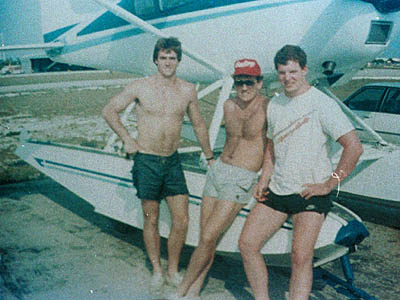
Pilot Michael Horrocks (left) was introduced to flying in the 1980s. (Photo provided by Mark Gosik)INQ WILLIAMS
From football to flight
The first time Horrocks flew a plane was in 1983. He was in Fort Lauderdale, Fla., for spring break with two friends, Mark Gosik, a former guard for West Chester, and Rob Jeffries, a tight end at Lehigh.
They were visiting a family friend of Horrocks’, Bill Blauer, who worked for a commercial airline. One afternoon, Blauer invited them aboard his four-seat aircraft.
Gosik and Jeffries sat in the back, with headgear on, as Horrocks rode up front. About halfway through the two-hour ride, Blauer turned to Horrocks and told him to grab the controls.
Horrocks obliged and cruised the plane down, close enough to see the beachgoers below. As he flew over the ocean, with waves rippling beneath him, he realized he had found his calling.
The former quarterback felt that his best route to commercial flight would be through the Marines. Horrocks knew he would get the best training there, and he liked the idea of a new challenge. So, after graduating West Chester in 1985, he enrolledin Officer Candidates School.
He got his wings at a naval air station in Corpus Christi, Texas, and was stationed in the early 1990s at Marine Corps Air Station Cherry Point in North Carolina, where he joined a marine aerial refueler transport squadron.
Horrocks flew KC-130 turboprop aircraft, which were used to refuel helicopters and jets, but also to transfer cargo, passengers, ammunition — anything that needed to be moved. It was a daunting transition, one that many young pilots struggled with.
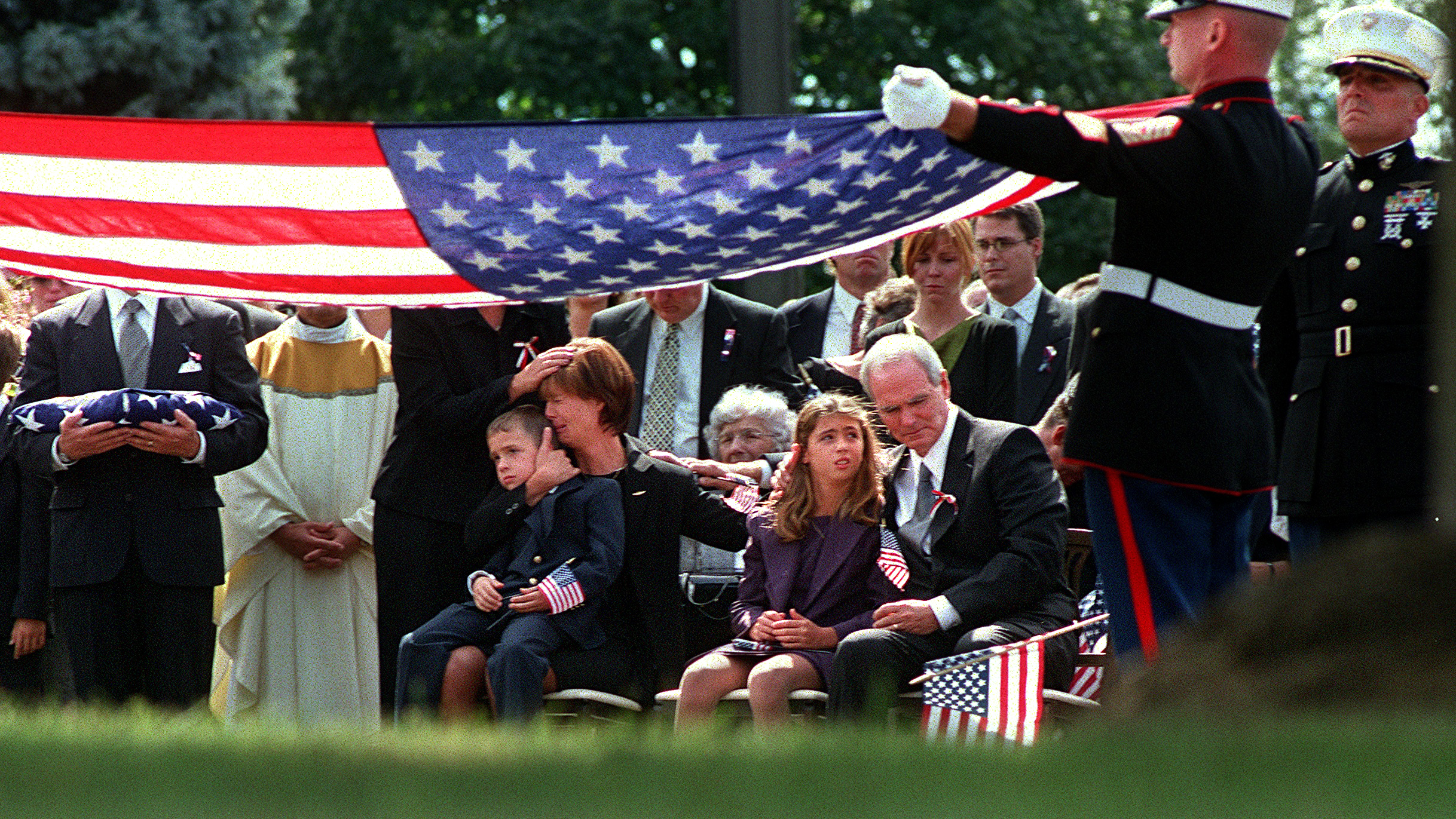
Miriam Horrocks (center, left) cradles her son Mick, 6, as her father-in-law William Horrocks (center, right) sits with her daughter Christa Horrocks, 9, as a US Marine Corps Honor Guard folds up the American flag following a memorial mass and service for her husband Michael Horrocks on Sept. 17, 2001.Tom Gralish / Staff Photographer
In training, they would be flying a single-engine plane, which stretched maybe 18 to 20 feet long. Now, as lieutenants, they were manning a plane five times as big, with three more engines, moving whatever needed to be moved at 30,000 feet in the air.
It was anything but a routine job. Horrocks’ operations officer, now-retired Lt. Col. Bill Franchi, said that when his squadron deployed to Bahrain during the Gulf War, they did so knowing that there was a good chance they would be targeted heavily.
But Horrocks was a natural, and quickly proved he could be relied upon. He went on a number of deployments, to the Middle East throughout the Gulf War, to Europe, to Central America, and became Franchi’s “go-to guy.”
Once, during a three-week detachment to Norway, a panel in the squadron’s KC-130 caught fire. As Franchi tried to put the fire out, he asked Horrocks to redirect the plane back to the local airport.
This was not a scenario that the young pilot had practiced in a simulator. Horrocks would be landing downwind, without flaps on his wings, which helped the plane maintain lift while slowing it down.
With a full-face oxygen mask on, and vapor from a fire extinguisher filling the cockpit, Horrocks guided the aircraft onto the runway, preventing what surely would have been a disaster.
“I told him, ‘I credit you with having saved about six people,’” Franchi said. “Because I didn’t have to do a thing. He had it. And that was sort of typical of Mike. You know?”
Horrocks spent his last few years in the military instructing Marine, Navy, and Coast Guard pilots in Florida. In 1997, his active duty came to an end. He enrolled in new-hire pilot training at United Airlines that summer.
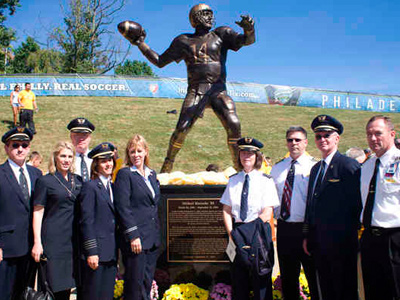
United and Continental Airlines pilots and crew, all friends of Michael Horrocks, stand by his statue at Farrell Stadium in 2010. (Ed Hille / Staff Photographer)
He soon was flying commercial airplanes full-time and living in Glen Mills with his wife, Miriam, and their two young children, Christa and Mick.
Now that Horrocks was local again, he was able to reconnect with old teammates like Bob Rafferty, a former West Chester halfback and quarterback.
They would often see each other in Media, running errands at the Granite Run Mall. In December 2000, while shopping for Christmas gifts, they crossed paths one last time.
Horrocks was walking out of the mall, and Rafferty was walking in. They chatted about family. Horrocks mentioned that he had recently started working transatlantic flights for United.
The two men said goodbye and went their respective ways. Nine months later, Horrocks boarded a Boeing 767 at Logan International Airport in Boston.
Rafferty watched as it hit the South Tower of the World Trade Center. Few, if any, of his teammates knew that Horrocks was piloting commercial aircraft. The idea of him being on that plane didn’t even occur to them.
But Rafferty had a feeling.
“He was the first person I thought of,” he said.
West Chester University quarterback Colin O’Sullivan taps a statue honoring former quarterback Michael Horrocks before practice last month. Jose F. Moreno / Staff Photographer
‘Think of Mike’
Without social media, news of Horrocks’ death at age 38 spread slowly.Some West Chester football alumni found out when they saw Miriam Horrocks on the front page of The Inquirer, at her husband’s funeral in Upper Providence Township.
Others heard through teammates. DePippo was working on Wall Street and lost about 40 or 50 colleagues in the attack. He couldn’t process that Horrocks was gone, too.
In late September, Gosik and two friends, Tim and Patrick Dever, took a train to New York. They spent the day at ground zero, walking through rubble, picking up pieces of people’s lives off the ground: photos, notebooks, newspapers.
Gosik still remembers how dust and soot filled the air. So did the sound of car alarms, blaring for their owners. A few days earlier, a neighbor had made Gosik a lapel pin to commemorate Horrocks, with his No. 14 written on a felt football.
Gosik wore it on his jacket as he traversed the site where his teammate perished.
“We just felt like we needed to be there,” Gosik said. “We just wanted to go.”
Years went by, and the West Chester alums began to wonder why no tribute to their quarterback existed on campus. They were worried that Horrocks would be forgotten, and realized that their fears were well-founded.
West Chester University football players tap a statue honoring former quarterback Michael Horrocks before practice last month. Jose F. Moreno / Staff Photographer
“I don’t recall any of us even being aware of it beforehand,” said Tim Keyser, a wide receiver who graduated in 2013. “That wasn’t something I knew when I was a true freshman on campus or anything.”
The former players began to meet with the school about the prospect of a statue in 2008. Bill Zwaan Sr., who was head coach of the football program at the time, sat and listened as an official from the foundation tried to convey how complicated, and costly, it would be to build such a structure.
Horrocks’ teammates ended the meeting emphatically: by standing up and reiterating, for the umpteenth time, that they were going to move forward with the statue. After they left, the foundation official turned to Zwaan.
“And he said, ‘Do you think they really understood what we were talking about?’” Zwaan recalled. “And I said, ‘They do. And they’re going to do a statue. And you guys have got to be prepared for that.’”
It was a slow, arduous process. The former players not only would have to raise $50,000 for the statue itself, but also would donate $100,000toward a scholarship endowment, which DePippo and another teammate, Bruce Blake, started in 2004.
At this point, most of them had full-time jobs and families of their own, and carving out time was not easy. But they made it happen.
DePippo oversaw the money. Mininno began a letter-writing campaign to raise funds. Walsh served as a liaison between the alumni and the current coaching staff.
Schafer worked as a partner of a local concrete cutting company. He and another West Chester alumnus, Paul Vanscovich, donated their construction crews and equipment for free.
Other teammates chipped in through a team banquet and a Super Bowl pool. A few local businesses, and the pilots union, contributed as well.
The statue of Mike Horrocks at West Chester.MICHAEL S. WIRTZ / Staff Photographer
“I’d kick in $1,000, John would kick in $1,000, Jim O’Donnell would kick in $1,000,” DePippo said. “And then we would get on a text chain, and berate each other in team fashion. Like, ‘You’ve got to do this.’
“We raised money basically only through grassroots. I was specific about that. I didn’t want any corporate sponsorship.You know, ‘CBS Sports presents the Mike Horrocks statue.’ I didn’t want that.”
In the months before construction of the statue was finished, former players would visit West Chester to share stories of their late teammate with the current roster.
Walsh, DePippo, and Blake visited them the day before the dedication. Wearing purple and yellow practice jerseys, the team took a knee as Walsh began to speak.
He explained that one day, Horrocks’ teammates wouldn’t be able to share his story, and that it would be up to the next generation of players to do so.
Then he asked them to close their eyes, and think of a loved one: a sibling, a friend, a parent.
“And when you go down that hill tomorrow, and you touch [the statue of] Mike, think of Mike,” Walsh said. “Say his name. And think of someone else who is special in your life. And thank God that you have them with you today.”
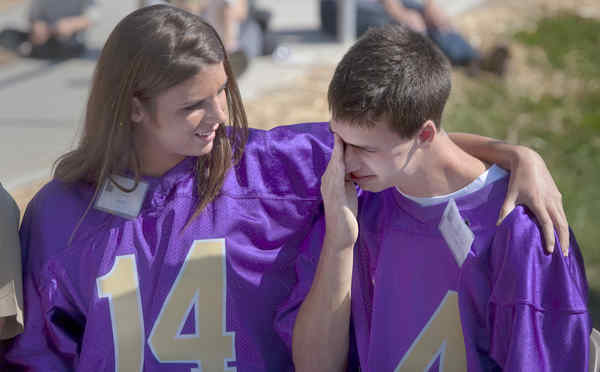
Nine years after their father’s death, Christa Horrocks comforts her brother, Mick, at the unveiling of the statue of Michael Horrocks at West Chester University in 2010.
The statue was unveiled at 10:30 a.m. on Sept. 11, 2010, a perfect autumn day in Chester County. The school arranged a ceremony beforehand, with bagpipes, a marching band, and a flyover.
Miriam Horrocks and the children, now teenagers, were in attendance; Christa gave a speech about her father.
Sitting next to the podium, with crutches by his side, was Schafer. He was unable to speak to a large crowd, but sat throughout the entire ceremony with a smile on his face, shaking hands with football men young and old.
He died of cancer just over a month later, at his home in Phoenixville.
Last August, during a team reunion in West Chester, a thought occurred to Walsh. He pointed to the bricks surrounding Horrocks’ memorial, which contained inscriptions honoring the late quarterback.
He suggested adding a small stone, maybe toward the back, with the number 52 on it; a nod to a teammate who put another above himself, even when his body was failing.
“Tom just believed in his heart that it needed to be a statue,” Walsh said. “And he was right. He was right.”
In the wake of the 76ers’ monumental offseason, one concern that players have already started addressing in various statements is, “How much are players going to sacrifice?”
Having as much talent as the Sixers have on their roster naturally leads to questions about roles and shot distribution, since there’s only one ball to go around.
Landing Jaylen Brown and LeBron James in the same offseason will of course invite skeptics who doubt the fit and wonder whether everyone’s games can mesh. But this is a champagne problem in the NBA. Most teams would be lucky to have this as one of its main issues heading into training camp.
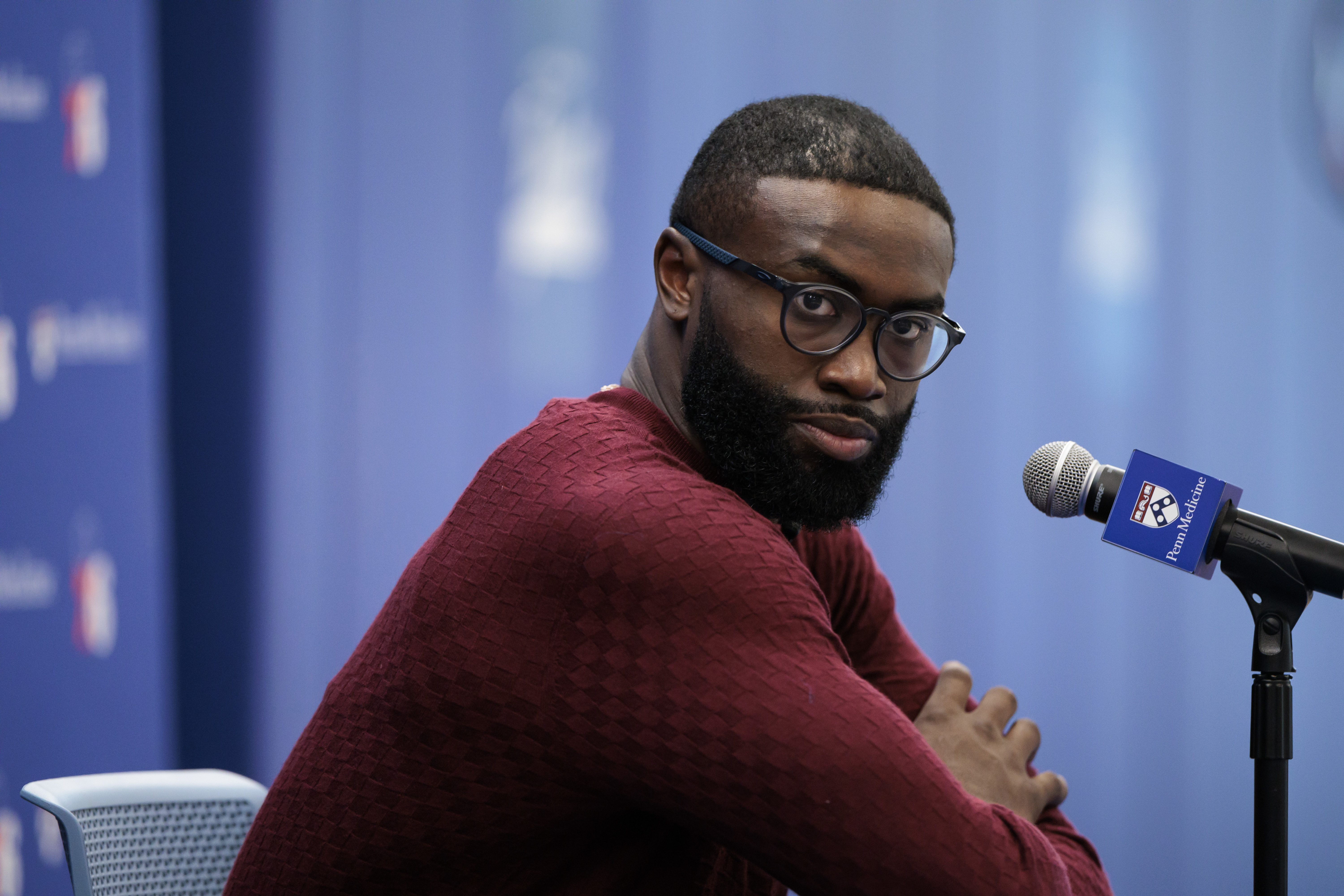
New Sixer Jaylen Brown acknowledged that his team will need to sacrifice. Monica Herndon / Staff Photographer
“Obviously it’s a lot of guys with talent,” Brown said last month. “It’s egos, but to win, you got to be able to sacrifice, be able to have trust and communication.”
Along those lines, here’s a look at how the Sixers might address that through the lens of a statistic that measures how often a player consumes his team’s possessions, usage rate, which measures how often a team’s possessions ends with either a shot, free throws or a turnover from a particular player when he is on the floor.
A glance at the starting five
First, here were the individual usage rates last season (according to NBA.com) for each player in the projected starting five, and where they ranked in the league.
Tyrese Maxey: 28.6% (27th)
VJ Edgecombe: 19.6% (181st)
Jaylen Brown: 35.1% (third)
LeBron James: 26.2% (47th)
Joel Embiid: 33.6% (sixth)
Potential paths forward
Quick addition will show all those percentages equal 143.1 when they need to equal closer to 100 (since not everyone will always be playing together at the same time). In some lineup combinations, and in games in which Embiid and/or James don’t play, that’ll be the time for Maxey, Edgecombe and Brown to have higher usage stretches than they would have when everyone is healthy. But when all five are healthy and on the floor, likely everyone is going to have to sacrifice to make the usage pie work.
James has already indicated with his play that this is where he is headed in his career, and perhaps why general manager Mike Gansey has been hyping up James’ ability to be a connector.
James’ usage actually hit a career low last season, as he ceded more scoring opportunities in the Los Angeles Lakers offense to Austin Reaves and Luka Doncic. This worked for the Lakers, who were playing well before Reaves and Doncic got hurt later in the season. James averaged 7.2 assists, so having him lean more into a connector and creator role in the Sixers’ offense is a prime way for the offense to generate shots naturally when the starting five is on the floor.
This could allow Maxey to play more frequently off the ball, where he can be efficient from three-point range.
Looking at Brown’s numbers
Another obvious place to look for decreased usage is Brown, who saw a spike in that statistic with Jayson Tatum out for the majority of last season for the Boston Celtics. Brown went from 28.2% the prior season to his 35.1% mark last year (he attempted four more shots, averaged 2.4 free throws and one more turnover per game).
Brown returning to a usage level similar to what he had playing alongside Tatum makes sense, considering he won’t have to shoulder the burden of heavy shot creation playing alongside Maxey, Embiid and James. How he adjusts his game to the roster around him is one of the more interesting questions of the early part of the Sixers season and could go a long way to determining just what this team looks like.
A load off Embiid’s shoulders, and legs
The potential path to Embiid’s role on the team may lie in his 2024 Olympics experience playing with James. There, Embiid took on a reduced role on Team USA’s path to the gold medal.
Joel Embiid served as a role player on the Team USA win in the 2024 Olympics. AFP via Getty Images
The offense doesn’t have to run through him when he’s on the floor, especially if the Sixers are going to utilize one of the strengths of this roster — getting out in transition. This could serve a dual purpose in freeing up shots for the rest of the lineup while allowing Embiid to avoid accumulating as much wear and tear game to game.
Getting out in transition
The Sixers have four of the top 15 scorers in transition from a season ago. One way to get everyone his fill of shots is to play fast and have more possessions. If the Sixers commit to playing that way some of the usage issues will take care of themselves. Inevitably, there will still be things to figure out in the halfcourt, especially when it comes to who is taking what shots late in close games.
That will take time to sort through. But the Sixers, in their comments so far this summer, have indicated they know the challenge ahead, and so far, they seem willing to tackle it head on instead of avoiding it.
Just under a month into training camp, Lane Johnson outlined the best-case scenario for the Eagles offense in 2026.
It was a lofty aspiration — but not unrealistic, given the success of the offense just two years ago. It centered on its star running back, Saquon Barkley, who accumulated over 2,000 rushing yards in the 2024 regular season and broke Terrell Davis’ single-season rushing record (combined regular season and postseason) by Super Bowl LIX.
“I think all in all, the more productive we are in the run game and stuff feeds all of that, that we’ll see the Saquon of two years ago,” Johnson said on Aug. 19.
That ideal won’t fall on Barkley alone. To recapture his productivity of two years ago, the Eagles are going back about 30, tapping an offshoot of an offensive scheme that rose to popularity around the time the running back was born.
Sean Mannion, the Eagles’ first-time, 34-year-old offensive coordinator, spent most of his playing and coaching careers learning from pupils of the Shanahan/McVay tree. These days in the NFL, “Shanahan” refers to Kyle, the head coach of the San Francisco 49ers, but he is preceded by his father Mike, the two-time Super Bowl-winning head coach with the Denver Broncos who helped Davis reach that record in 1998.
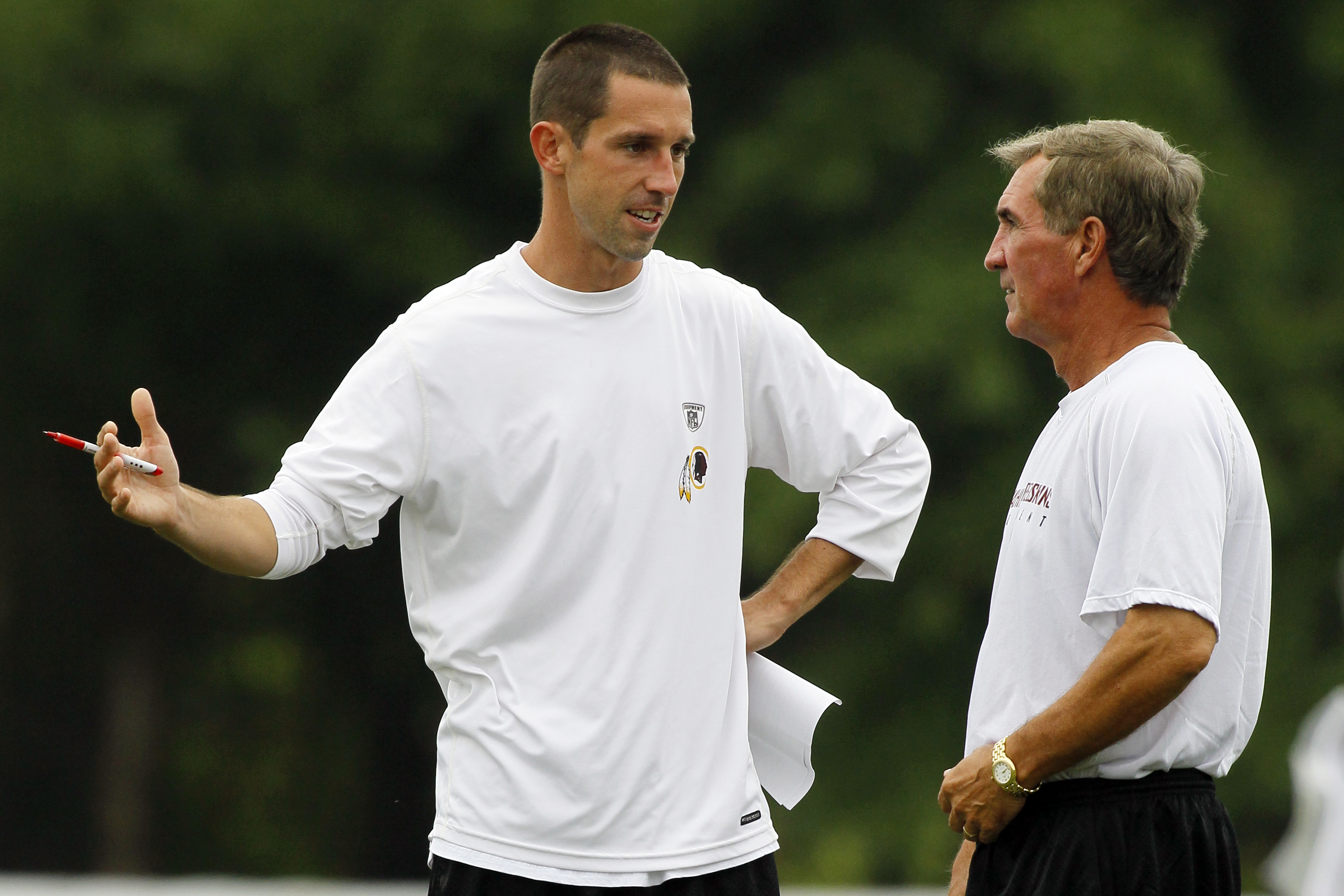
Kyle Shanahan (left) and father Mike (pictured in 2010 while with Washington) pointed the way to the current run-game concepts in vogue around the NFL. Alex Brandon
When Mike became Broncos head coach in 1995, he named Alex Gibbs offensive line coach. Gibbs, who died in 2021, was a proponent of the wide-zone blocking scheme in the run game that would go on to serve as the foundation for the modern West Coast offense.
His influence lives on in offshoots of the scheme around the league. Mannion called his first exposure to the system in 2017 under Los Angeles Rams head coach Sean McVay “a very exciting point in my football life.” Now, Mannion has the opportunity to make it his own, all while helping breathe new life into an Eagles rushing attack that stagnated in 2025.
“I’ve seen it from afar, but now, actually studying it and working it and trying to put myself in the system, I feel like it’s going to open up some things that I may not have been able to show as much in my career,” Barkley said.
The man seeking to help Barkley elevate his game is a quarterback by trade. But Mannion’s expertise isn’t limited to the passing game. According to offensive line coach Chris Kuper, who played for Shanahan in Denver, the Eagles offensive coordinator “loves the run game,” too.
“The run game is a big part of what we’re going to do,” Kuper said, “And [Mannion’s] got passion for it. And that makes me feel good as an O-line coach, because I think we’re going to be really good at running the ball.”
Todd Gurley thrived with wide-zone concepts while with the Rams. Tony Avelar
In the (wide) zone
When Barkley learned that the Eagles offensive scheme in 2026 would have Shanahan/McVay roots, he fired up Todd Gurley’s film.
Gurley spent five of his six seasons in the NFL with the Rams, including two standout seasons in 2017 and 2018. He led the NFL in rushing touchdowns in both seasons, earning a pair of All-Pro honors and an NFL Offensive Player of the Year nod in 2017.
Dean Davidson, the author of the Wide Zone Warriors Substack, watched those years in real time. A native of St. Louis whose memories of the Rams commence with the collapse of the “Greatest Show on Turf” era, Davidson was enthralled with the quick work McVay did to turn the team around. At the time, Davidson had just joined the staff of a struggling high school football team and was looking for inspiration.
“I was trying to figure out how [McVay] took that team from the dumps that they were in my entire life that I could remember to that point to Super Bowl favorites in what seemed like overnight,” said Davidson, who is now the offensive line coach at Obion County Central High School in Troy, Tenn.
At the core of the scheme that fascinated Davidson was the wide-zone run. Its intent is in its name. The blocking unit aims to stretch the defense on the front side of the run, while simultaneously cutting off defenders on the back side.
As Gibbs explained at his 2015 offensive line clinic in Cincinnati, the running back’s aiming point is the backside of the tight end — and if there is no tight end to the weak side of the formation, it would be to the imaginary backside of the tight end. After three steps, the running back would know whether he should hit the edge on the front side or make a single cut up the middle of the field. By the fifth step, he would make his cut.
One of the challenges of defending the wide zone run is the distance that defenders have to cover in order to maintain their gap integrity, Davidson explained.
“Everybody’s moving so far in one direction that the gap that you’re responsible for as a defensive lineman or a linebacker, maybe even a safety, it might still be between the same two offensive linemen, but those two offensive linemen on a given snap could be like 10 yards laterally somewhere else,” Davidson said. “So forcing them to maintain their gap integrity while moving so far laterally, it’s a very difficult challenge.”
It’s a challenge the Eagles offensive line enjoyed creating throughout training camp. Cam Jurgens said the scheme “lets you be a little bit more of an athlete” given how quickly the front side blocking unit must fire off the ball laterally toward the sideline.
The goal, according to Kuper, is for the defense to defend every blade of grass on the field. That task, ideally, would tire out the defense as the game wears on, Lane Johnson said. After Johnson, Jurgens, and Landon Dickerson had a full offseason to recover from the ailments that plagued them last year, they are up to the assignment.
“We’re getting to really run, stretch the field, cover some yardage,” Johnson said. “So in that way, it tires out defenses. Makes them cover each gap.”
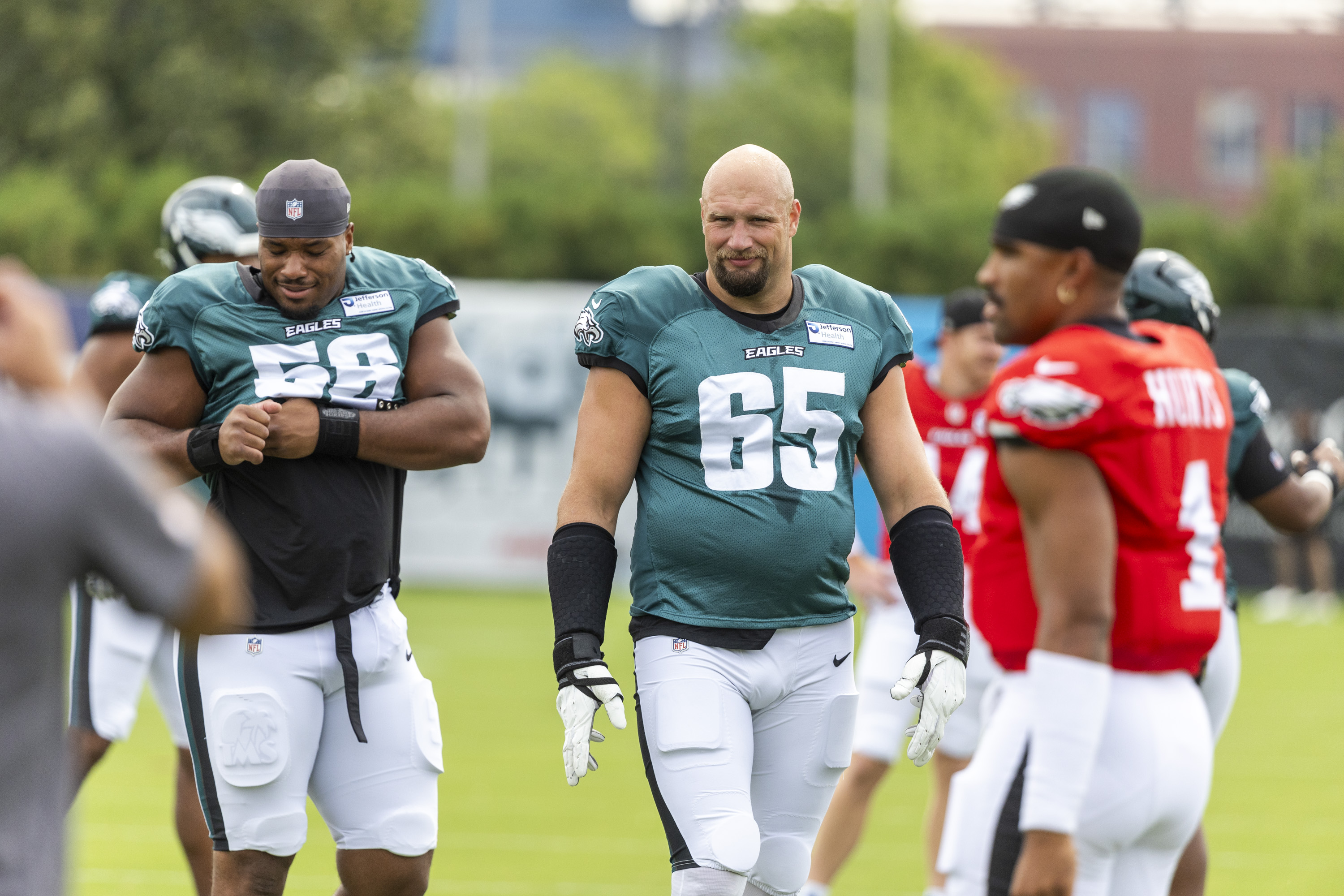
Lane Johnson (65) and his fellow offensive line cohorts are getting behind the wide-zone scheme Sean Mannion has introduced in Philly.Tyger Williams / Staff Photographer
The wide zone could be at the foundation of the Eagles’ rushing attack, but in all likelihood, it won’t be the only style of run in their playbook. When Gibbs was designing the Broncos’ run game 30 years ago, he only believed in coaching zone runs — primarily wide zone and some tight zone, in which the running back’s landmark is typically behind the center.
David Gibbs, his son and the secondary coach at Arizona State, explained that his father didn’t believe teams could excel at executing both zone schemes (blocking a certain area of the field) and gap schemes (blocking a specific defender or gap). But the game has evolved, the younger Gibbs said.
“You have to be able to do both, because the defensive linemen are so good,” he said. “They’re so big, athletic, strong, and the reality of it is defensive linemen are just more athletic than offensive linemen, in my opinion. And so you can’t give them the same schemes all the time.”
Brett Kollmann, an NFL Media analyst, called the Rams’ 15-6 loss to Vic Fangio’s Chicago Bears in 2018 “one of the defining games of the last decade” that prompted an evolution of McVay’s scheme. At the time, the Rams’ rushing attack was wide-zone heavy. Fangio’s solution was to stack bodies on the line of scrimmage in a 6-1 “tilt front,” putting a body in every gap and forcing the running back to cut back into a defender.
Bill Belichick and the New England Patriots would follow the same blueprint to stop the Rams in the Super Bowl that season. To counteract the defense’s penetration at the line of scrimmage, McVay would eventually introduce more “counter” runs, a gap scheme that calls for two pulling blockers to create a pair of gaps on the play side.
The incorporation of different types of runs gives defenses more to process, according to right guard Tyler Steen, which in turn forces them to slow down.
“One minute you’re going wide zone and D-tackles and D-ends are running,” Steen said. “The next minute, you’re going ‘duo’ and you’re going downhill. So I think that gives defenders a lot to think about. And so it kind of makes it easier on the O-linemen, because [the defense doesn’t] know what to play.”
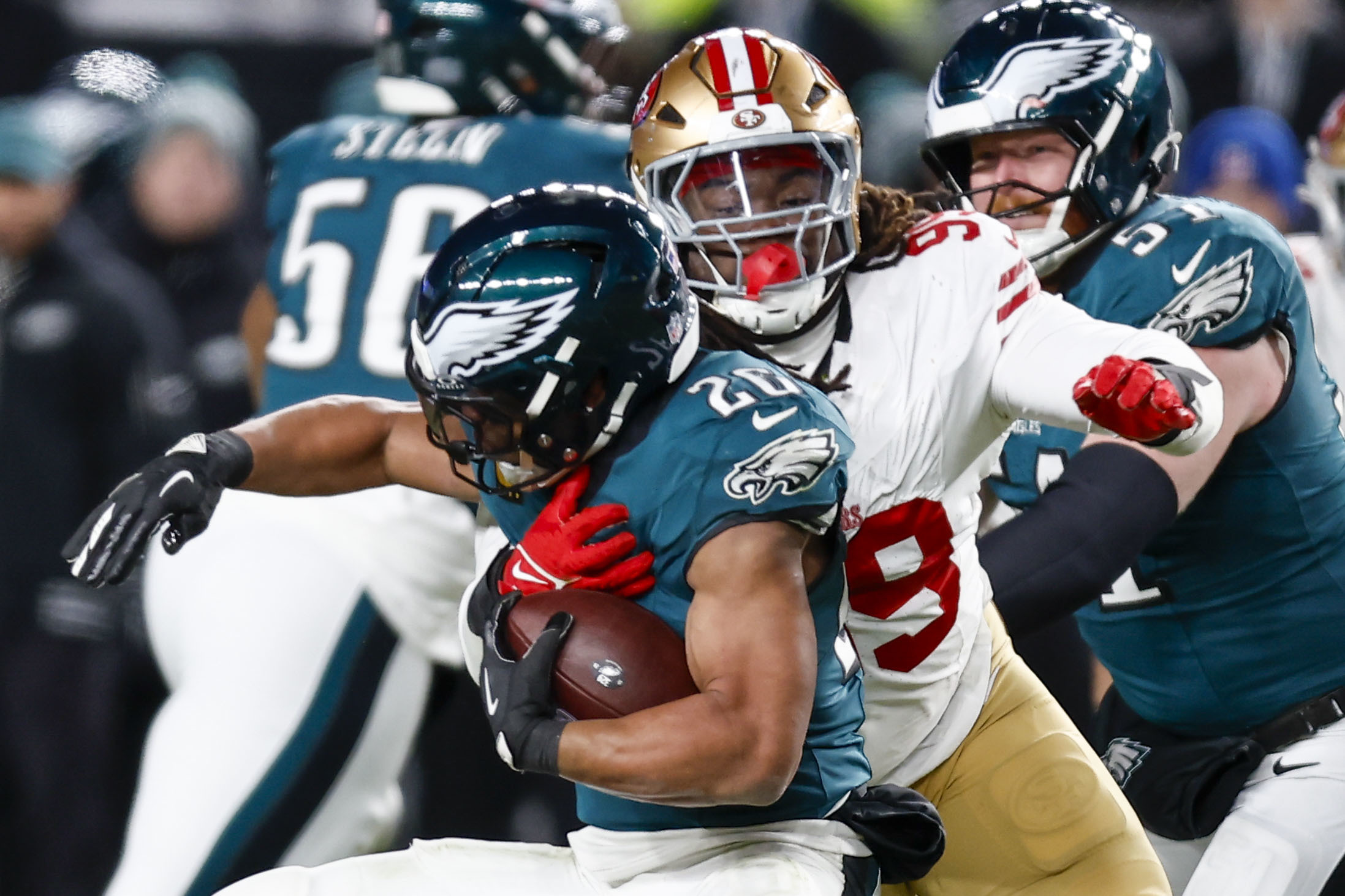
Saquon Barkley often found running room hard to come by for an Eagles offense that grew predictable in 2025. Monica Herndon / Staff Photographer
Keeping defenses ‘on their toes’
After the Eagles’ 34-17 loss to the New York Giants in Week 6, Johnson tried to surmise the state of the Eagles offense.
As he spoke at his stall, he used some form of the word “predictable” three times.
“I don’t know if we’re predictable, but it seems a lot harder than what it needs to be,” Johnson said. “Maybe moving forward have a little bit more variety, hitting the perimeter some and doing a little bit more of that.”
Johnson emphasized that he wasn’t trying to point fingers, and at the end of the day, the Eagles needed to execute better. Still, his analysis was a harbinger of things to come for the shotgun-heavy offense that seldom disguised its intentions.
The Eagles are set to take a different direction under Mannion. Like other offshoots of the Shanahan/McVay tree, Mannion emphasizes the importance of the marriage between the run and the pass — more specifically, the play-action pass.
When runs look like passes, and vice versa, offenses are less predictable, Johnson said.
“I think setting up with the play action is just going to be a whole lot tougher to distinguish what we’re doing,” Johnson said during mandatory minicamp. “Whole lot harder to catch on [to] tells with stuff that we’re doing. So I think this stuff, we can disguise it more.”
The key to pulling that off is keeping the presentation the same. If the Eagles are running wide zone, for example, and building the play-action pass off of it, the blocking unit is executing the same assignment. Johnson stressed the importance of keeping a “low hat” to sell the run, and if the linebackers bite down, the quarterback can target the vacant middle of the field.
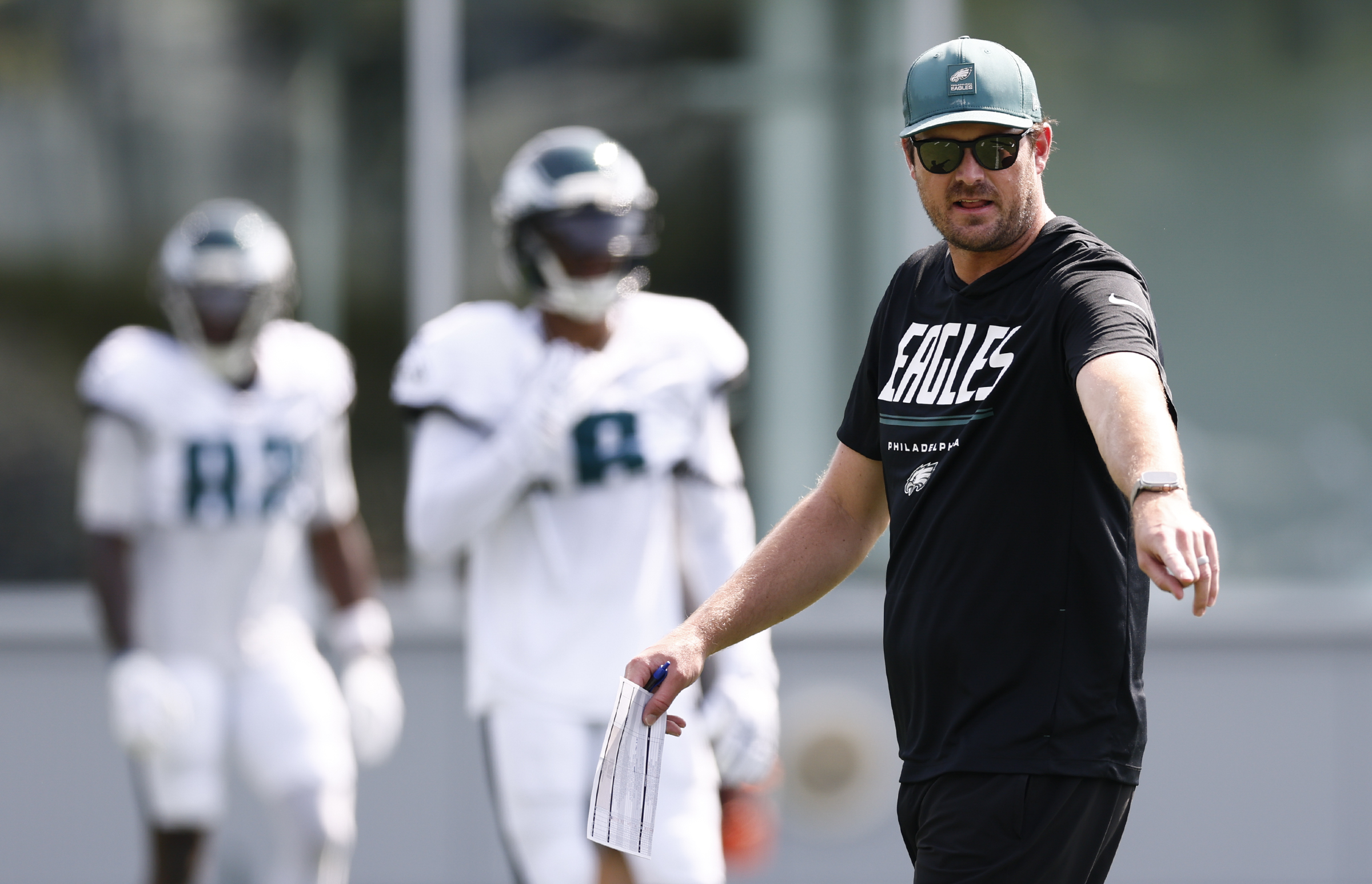
Eagles offensive coordinator Sean Mannion (right) is introducing variety to an offense seeking to keep defenses off-guard. Yong Kim / Staff Photographer
Marry that with motions, and the defense is confronted with another layer of complexity to decipher. Even the quarterback’s alignment under center can further disguise the intent of the offense on any given play, Jurgens explained.
“I feel like that’s just another way to keep defenses on their toes,” Jurgens said during mandatory minicamp. “You get a little less predictable. And so I feel like it kind of gives us a little better angles as well. Defenses can’t cheat things, ‘cause they don’t know where we’re going to go. You can set up a lot of your plays a lot better.”
Kollmann is aware of Jalen Hurts’ historical lack of targeting the middle of the field. Dating back to his rookie season before he became the full-time starter, Hurts has targeted the short middle of the field (a maximum of nine yards from the line of scrimmage) on 8.3% of his pass attempts, according to an Inquirer analysis. The league average is 14.5%. From 10 to 19 yards beyond the line of scrimmage over the middle, Hurts’ attempt rate drops to 4.6% (closer to the 7.4% league average).
But Kollmann said that conflating “hasn’t” with “can’t” isn’t necessarily fair. He said he believes that the Eagles lack of a wide-zone, play-action game in the past is to blame for not helping free up that area.
“When they are so shotgun heavy, and therefore when their play action game is really just kind of faking inside zone, that’s the kind of run fake that doesn’t really draw linebackers in, because they can see the ball the entire time,” Kollmann said.
The fake from under center requires a quarterback to turn his back to the defense, shielding the ball from the view of the linebackers. They can’t see it, so they step up, theoretically giving the offense more room to operate over the middle.
It’s easier said than done for any quarterback, as they must temporarily take their eyes off of the pass rushers seeking to take them down. But according to Josh Grizzard, the Eagles passing game coordinator, Hurts has been a “natural” with turning his back to the defense and selling the fake.
“When you have the runs and they look like the keepers and they look like the play passes, then the goal would be for those guys to see the same thing,” Grizzard said. “And then if you can get that second level of the defense to step up, then you have an ability to now push the ball down the field and be able to marry the run and the pass as well as create explosive passes.”
How many runs are designed for Jalen Hurts in the new offense remains an open question. Yong Kim / Staff Photographer
The backside threat
Speaking of keepers, will the quarterback designed run game return to the Eagles offense in 2026?
By December of last year, Hurts was averaging 1.1 designed runs per game in 2025, according to Pro Football Focus. He averaged 3.6 designed runs per game in his first four seasons as the starter.
The modern West Coast offense hasn’t necessarily needed a mobile quarterback to thrive, as evidenced by the success of Jared Goff and Matthew Stafford with the Rams. But the 2026 Eagles offense isn’t going to be a carbon copy of other schemes around the league from the same tree, and Mannion is well-aware of Hurts’ rushing ability.
“Jalen has a unique skill set in that way,” Mannion said. “So that’ll certainly be a part of what we do, but we’re looking again at all areas as an offense to really attack defenses on a weekly basis. He is uniquely skilled in that way. That will be a part of it, but it won’t be the only part of it.”
Zone reads aren’t totally foreign to this coaching tree. In 2012, while Mike Shanahan was Washington’s head coach and Kyle was his offensive coordinator, the team drafted Robert Griffin III with the second overall pick.
The rookie quarterback would go on to rush for 815 yards and seven touchdowns, all while throwing for 3,200 yards. His production on the ground wouldn’t persist far beyond 2012, though. Washington took a more conservative approach with Griffin III as a rusher, especially as he dealt with injuries that began during a rookie season that was ended by a serious knee injury.
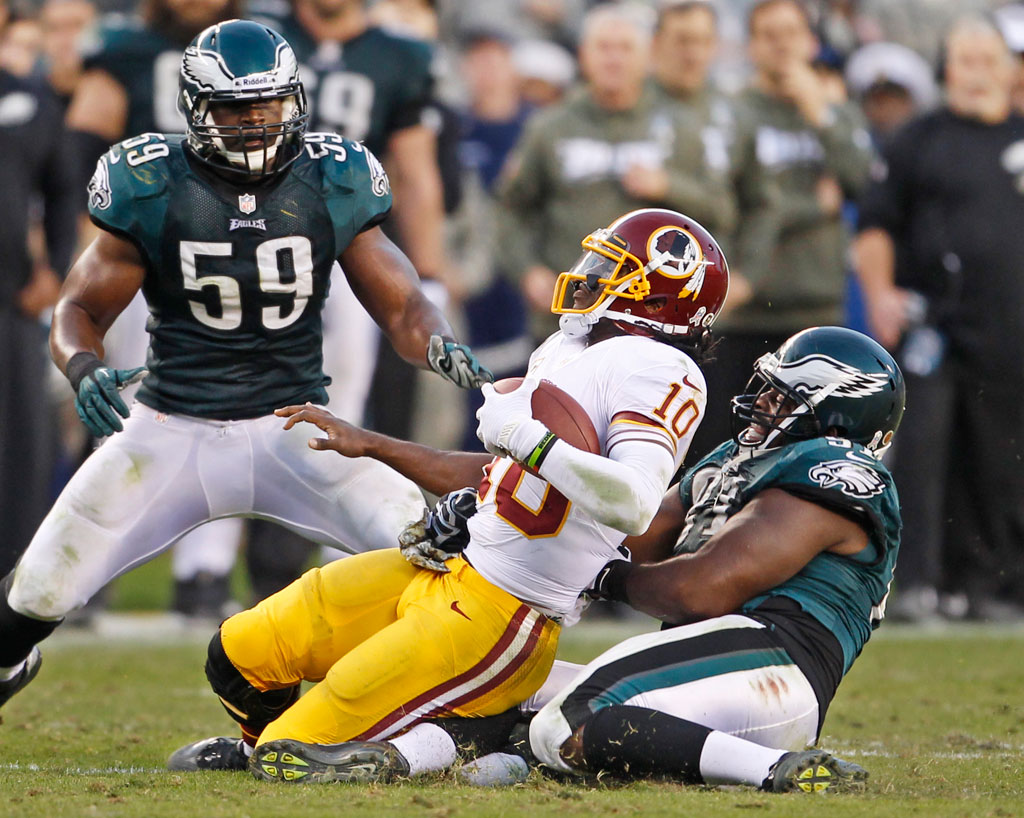
Robert Griffin III (10) was a rushing threat in the Washington offense before injuries curtailed his effectiveness.
Still, Davidson said a backside threat is important in the run game, whether it’s a quarterback run or a bootleg. In the case of the bootleg, which the Eagles incorporated throughout training camp and the preseason, the quarterback exploits the unblocked defensive end who flows with the running back, rolling out unabated in the opposite direction and completing a pass on the move.
“If you’re just under center or even the pistol, and you don’t have anything that keeps the defense on the backside, then it’s a lot easier for them to chase [the ball] down [in wide zone],” Davidson said. “But if they know that they have to defend boot on the other side of the field or defend a quarterback run on the other side of the field, it can really slow the defense down.”
Time will reveal the contents of Mannion’s playbook. While it may contain odes to his influences, it could also include all of the plays he would’ve liked to run throughout his nine-year career as an NFL backup quarterback and two seasons as an assistant with the Green Bay Packers.
Whatever the offense becomes will be unique to the Eagles, Kuper said.
“Those webs of guys kind of break out, and they kind of make it their own, and that’s what our goal is,” Kuper said. “This is going to evolve into Sean Mannion’s offense. This is going to be a derivative, maybe.
“There’s going to be flavors of what you’ve seen throughout the league, and some of his mentors, but this will be our offense.”
Find the football that Tanner McKee is throwing in this preseason game against the Patriots.
Click Tap on the photo to guess the location of the hidden ball
Click Tap again to change your guess or hit submit when you're happy
You will be scored at the end. The closer to the location, the better your score.
Garland Fordice / Staff Illustration / Photography by The Inquirer
Pretty good/Not bad/Way off! Your guess was the ball.Spot on! Your guess was exactly where the ball was. Here's also where a random selection of Inquirer readers guessed.
story continues after advertisement
Question 2
Find the removed football thrown by Patriots quarterback Drake Maye.
Garland Fordice / Staff Illustration / Photography by The Inquirer
Pretty good/Not bad/Way off! Your guess was the ball.Spot on! Your guess was exactly where the ball was. Here's also where a random selection of Inquirer readers guessed.
Question 3
Find the football that Michael Carter is trying to intercept against the Bengals.
Sam Morris / Staff Illustration / Photography by AP
Pretty good/Not bad/Way off! Your guess was the ball.Spot on! Your guess was exactly where the ball was. Here's also where a random selection of Inquirer readers guessed.
story continues after advertisement
Question 4
Find the removed football in this image of kicker Jake Elliot.
Garland Fordice / Staff Illustration / Photography by AP
Pretty good/Not bad/Way off! Your guess was the ball.Spot on! Your guess was exactly where the ball was. Here's also where a random selection of Inquirer readers guessed.
Question 5
Find the ball in this scramble against the Ravens.
Sam Morris / Staff Illustration / Photography by AP
Pretty good/Not bad/Way off! Your guess was the ball.Spot on! Your guess was exactly where the ball was. Here's also where a random selection of Inquirer readers guessed.
Question 6
Find the removed football in this image of Jalen Hurts.
Garland Fordice / Staff Illustration / Photography by The Inquirer
Pretty good/Not bad/Way off! Your guess was the ball.Spot on! Your guess was exactly where the ball was. Here's also where a random selection of Inquirer readers guessed.
Diving deep into the data to look at three trends that will help determine the Eagles’ fate in 2026 (with an assist from pro-football-reference.com and nflfastR).
23rd
That’s the average ranking from last season of the 14 pass defenses the Eagles will face in 2026. It is the softest schedule in the league by a wide, wide margin. The Eagles couldn’t have handpicked a better setup for Jalen Hurts and first-year offensive coordinator Sean Mannion. Right out of the gate, they’ll face a Commanders defense that finished tied for 30th in yards per pass attempt allowed, then a Titans defense that finished dead last. In fact, nine of their 14 opponents finished lower than 20th in yards per attempt.
A big factor in the Eagles’ good fortune is a division that includes two of the three worst pass defenses from a year ago in Dallas and Washington, plus a Giants team that finished in the bottom half of the league. The Cowboys also finished in the bottom 10 in sack rate while ranking 27th in their rate of passing plays of 20 or more yards, two categories in which the Eagles schedule also ranks among the most favorable.
The nondivision slate will likely play a little tougher than it looks on paper. The Rams (tied for 11th in YPA) rebuilt their secondary while adding Myles Garrett and Aaron Donald to the pass rush. The Colts could be better in their first full season of cornerbacks Charvarius Ward and midseason trade acquisition Sauce Gardner. That said, no team in the NFL has a more favorable schedule top to bottom. The Eagles’ opponents had an average rank of 22.9 in passing yards per game and 20.2 in yards per attempt allowed last season. Both are the highest in the NFL.
The sequencing is as beneficial as the actual opponents. The two toughest defenses on their schedule don’t come until Weeks 15 and 16, with just five days separating the Seahawks on Dec. 19 and the Texans on Christmas Eve. Both games are at home.
The early-season schedule is soft enough to counteract whatever learning curve that will exist for Hurts and the rest of the offense in Mannion’s scheme. The expectations should be high.
3.98
That was the average yards per carry of Eagles running backs when they had multiple tight ends on the field last season in neutral game script situations. That ranked in the bottom half of the league and well behind the teams that made it to their conference championships.
A sampling …
Running-back yards per carry in multi-tight-end sets (first and second down outside the 10-yard line)
Bills: 5.25 (4th in NFL)
Rams: 5.23 (5th)
Seahawks: 4.56 (9th)
Bears: 4.52 (10th)
Broncos: 4.44 (11th)
Patriots: 4.30 (17th)
Eagles: 3.98 (20th)
Johnny Mundt (center) was brought in to help the Eagles’ blocking in multiple tight end sets.Tyger Williams / Staff Photographer
Johnny Mundt didn’t get a ton of coverage in training camp. Blocking tight ends rarely do. But the Eagles signed the 31-year-old veteran for a reason. With Cameron Latu lost to waivers and Grant Calcaterra on injured reserve, the Eagles will enter the season without two of their top three tight ends from last year. Add to that the steep learning curve awaiting rookie second-round draft pick Eli Stowers and tight end is one of the bigger question marks on this 2026 roster.
The question is especially relevant given the leaguewide paradigm shift. Teams like the Rams and Seahawks have spent considerable resources accumulating talent at the tight end position in recent seasons. Seattle drafted AJ Barner and Elijah Arroyo in the fourth and second rounds in back-to-back seasons, while the Rams just added second-round pick Max Klare to a stable of tight ends that already included 2025 second-rounder Terrance Ferguson, high-priced free agent Colby Parkinson, 2023 fifth-rounder Davis Allen and veteran Tyler Higbee.
It remains to be seen how central a role multi-tight-end sets will have in Mannion’s offense. Last year, his Packers team finished in the top half of the league in both RB yards per carry and pass yards per attempt.
That’s how many quarterbacks rushed for 600-plus yards last season. The last time the NFL had a regular season where no quarterbacks reached 600 yards was 2017. At least two had done it in each of the previous five seasons.
Hurts’ rushing production has garnered plenty of attention, and deservedly so. The Eagles were a dramatically different offense in 2022 when he averaged 50.7 rushing yards per game compared to the one they’ve been over the last three seasons, when Hurts has averaged just 34.5 yards. It’s certainly reasonable to think that he can and should be well north of the 26.5 yards he averaged last season. But it isn’t all on him.
The natural trajectory of a dual-threat quarterback is to see a year-to-year decline in rushing production. It has happened to virtually every quarterback who has done the things Hurts did early in his career. The league adjusts quickly. It’s no coincidence that virtually every scrambling quarterback saw a significant decline in his rushing production last season.
New Eagles OC Sean Mannion could utilize Jalen Hurts’ running ability more in 2026.Yong Kim / Staff Photographer
Jayden Daniels missed 10 games, but in the seven games he played, he averaged just 39.7 yards, down from 52.4 the year before. Lamar Jackson’s 26.8 yards per game was barely half of the 52.6 he averaged over the two years prior. Bo Nix’s per-game rushing yardage fell by more than 20% (25.3 yards to 20.9). Drake Maye’s was down 18.5%. Josh Allen has averaged 32 yards per game over the last three seasons after averaging 46.2 yards per game in 2021 and 2022.
“I think [Hurts has] really operated through all facets of the offense comfortably,” Mannion said earlier this summer. “But the piece of him as an athlete in the running game is something unique. Those are elements we can lean into a little bit as well.”
Mannion should be thinking that way. But quarterbacks who have running ability will almost always see that running ability limited by defensive coordinators’ awareness of said running ability. The league has seen enough of it in recent years that it is getting better at stopping it.