Consensa Francisca Silva Silva moved to Camden from Costa Rica more than two years ago knowing nobody. She lived on the street for two months, she said, and thenwas bouncing from house to house when a young man in the neighborhood told her to check out the Hispanic Women’s Resource Center in Camden, one of several such centers in the state.
She went. With help from the program, Silva received food, obtained a work permit, made a down payment for a studio apartment, and started a job at McDonald’s.
That statewide initiative is now facing detrimental cutsunder DemocraticGov. Mikie Sherrill’s budget proposal. The governor has proposed cutting nearly 80% ofits funding, and Silva worries that other immigrant women looking to improve their circumstances will not get the help she received.
“It was very hard to come here without knowing anyone, and it was really hard because at first I couldn’t find any work,” Silva, who is Nicaraguan, said in Spanish, translated by Jesselly De La Cruz, the executive director of the Latino Action Network Foundation, which funds the centers.
Sherrill and legislative leaders announced Tuesday they had come to an “agreement” on a budget totaling$60.7 billion, the same price tag Sherrill proposed in March. But it has not been made public and it is unclear how far into the details they have gotten. They have until Tuesday to figure it out.
And the process is still underway. State Sen. Nilsa Cruz-Perez, a Camden Democrat who sits on the Senate Budget and Appropriations Committee, has been a supporter of the centers.She was unable to speak Wednesday afternoon because she was in a committee budget hearing.
Client Consensa Francisca Silva Silva (right) participates in a workshop at the Hispanic Women’s Resource Center in Camden Thursday, June 11, 2026.Tom Gralish / Staff Photographer
On a recent Thursday, Silva participated in a healthy life skills workshop in Spanish at the Camden center, where she learned about taking care of herself as summer temperatures get hotter in the city. About 20 adults clapped for one another with big smiles on their faces, and they received goody bags with sunscreen, lip balm, a towel to keep cool, and a little fan. A young girl played with magnetic tiles and a baby was kept calm, passed between women.
The governor proposed cutting funding for the center’s programs to$535,000, down from more than $2.5 million this year and more than $3 million in 2025. Murphy had proposed a similar cut last year, but the funding was restored during budget negotiations.
Hispanic Women’s Resource Centers were established through 1991 legislation to address the wage gap for Latinas. New Jersey is one of the states with the biggest wage gap for Latina workers, according to the National Women’s Law Center.
Staff members observe from back of the room during a workshop at the Hispanic Women’s Resource Center in Camden Thursday, June 11, 2026. Tom Gralish / Staff Photographer
The Latino Action Network Foundation funds these resource centers in partnership with six nonprofits across 14 sites, including five in South Jersey. The Camden center is located at the nonprofit Healthy Families and Communities, and there are centers in Vineland in Cumberland County, Hammonton in Atlantic County, Pennsville in Salem County, and Rio Grande in Cape May County.
Sherrill’s proposal would “drastically cut” the number of resource centers, and sites in Hammonton and in Lakewood, in Ocean County, would likely be on the chopping block, De La Cruz said, adding that services would need to be cut in eight of 11 counties.
Martha Infante, 38, who lives in Pennsauken, said she was disoriented when she moved to South Jersey from the Dominican Republic. But through the Camden center, she found out how to apply for work online and learned basic English. She obtained coats for her daughters’ first U.S. winter, and a staffer accompanied her to a New Jersey Department of Motor Vehicles center to get her driver’s license.
“I came here and my mind was all over the place, I didn’t know where things were,” she said in Spanish.
She now works as a home health aide, thanks to training she got through the center, and even participated in a program where she learned about advocating for her community in Trenton.
“Don’t cut these funds, Gov. Sherrill,” she pleaded. “Don’t cut the funds! This is like a family. It’s like a home for the community.”
Client Martha Infante (left) talks with staff member Chailienisse Vega (right) after participating in a workshop at the Hispanic Women’s Resource Center in Camden Thursday, June 11, 2026. Tom Gralish / Staff Photographer
Some of the women in the program are fleeing domestic violence and seeking financial independence. Others are struggling to get a work permit, or may have lost a family member who helped pay the bills to deportation. A lot of former “Dreamers” — undocumented immigrants who came to the U.S. as children — utilize the center as well, De La Cruz said.
The need for the centers has only escalated under President Donald Trump’s second administration, she said.
The social worker-turned-executive said she was surprised by the severity of Sherrill’s proposed cut, especially because of the governor’s efforts to push back against Trump’s immigration policies.
A 2023 Rutgers study funded by the Latino Action Network Foundation found that the most popular services at these resource centers were English-language classes and employment services, such as job referrals, assistance filling out applications, resume writing, and interview preparation.
Staff member Andreina Pardo pauses to stretch with participants as she leads a workshop at the Hispanic Women’s Resource Center in Camden Thursday, June 11, 2026. Tom Gralish / Staff Photographer
“Aside from helping them with the technical aspects of job hunting, the assistance from the Centers seemed to provide a boost of confidence for many of the women, giving them an additional push to apply for positions even if they felt hesitant to do so at first,” the study said.
Gladys, 48, who declined to give her last name due to concerns over her safety, said in Spanish that the free English courses made her feel like she could “come up for air and breathe” after not being able to communicate.
The Camden resident had been an ecologist in Nicaragua and has gotten involved in the center’s community garden. She said she would love to pursue a career teaching children about the environment, but her plans are on hold because her work visa was canceled.
In the meantime, Gladys said, activities at the center like art classes have made her feel less alone. She has been able to connect with women in the same situation as her, and those who migrated to the U.S. earlier who can give her advice from their experiences.
“Maybe my circumstances don’t change, but my emotional well-being changes because I’m able to connect with others,” she said in Spanish.
Rep. Thomas Kean Jr., who has been missing from Washington for nearly four months with little explanation, is back home in New Jersey.
He could be seen from the street Wednesday evening, standing in a brightly lit front room of his Westfield home just before 8:45 p.m.
“It’s good to see you,” he said after a reporter for the New York Times rang his doorbell. He was wearing a dark suit and a red tie. “I’ll talk to you next week,” he said. “Thank you.”
Kean’s wife, Rhonda, stood in the background, smiling pleasantly. He declined additional comment and closed the door.
Aides had said that Kean, 57, was being treated for a health condition and was expected to fully recover, but had offered no additional details as their boss missed more than 100 floor votes since the middle of March.
Kean, a Republican, is running for a third term in November in one of the country’s most competitive midterm races. His absence from the campaign trail, though, had left even some of his biggest Republican boosters frustrated.
A spokesperson for Kean, Harrison Neely, said last week that Kean was expected to return to Washington on June 30. He declined to say how long Kean had been home or to offer any additional details about the representative’s long absence.
“He will be fully transparent on the 30th,” Neely wrote in a text message.
Earlier this month, Kean, in absentia, locked in the Republican nomination for his 7th District seat; he was running unopposed. Democrats selected Rebecca Bennett, 39, a former Navy helicopter pilot.
The Democratic Party considers Kean’s seat one of its best pickup opportunities as it seeks to tip the balance of power in Washington and had been aggressively targeting the race long before he began missing votes in Washington.
Kean was last spotted on Capitol Hill on March 5. He spoke that day during a committee hearing and cast a crucial “yea” vote in support of funding President Donald Trump’s immigration crackdown and moving to end a government shutdown.
Then, he seemingly vanished. Neighbors in Westfield said there had been no obvious sign of Kean for months, and the family’s vacation house in Bay Head, N.J., appeared shuttered the weekend before Memorial Day. Year-round residents of Fishers Island, N.Y., where the Kean family owns a large estate, said they had not seen him, either.
Kean’s aides repeatedly insisted that he had no plans to abandon his reelection effort and that he was expected to return to work “soon,” even as they refused to discuss the medical condition that had sidelined him.
In May, after a debate between the four Democrats vying to run against him, Dan Scharfenberger, Kean’s chief of staff, offered a cryptic explanation for why there had been no sightings of the representative in Washington or in his New Jersey district. “There’s no cameras where Tom is,” he said, and did not elaborate.
During his absence, Kean has nonetheless bought and sold stock, introduced remarks into the Congressional Record and urged House colleagues from afar to oppose Ireland’s effort to limit trade with Israel.
A handful of Republican leaders in the 7th District’s six counties reported getting calls from Kean. And his office has released two statements attributed to Kean, including one on primary day, June 2, when he made no public appearances.
“Right now I am focused on my recovery and under the advice of healthcare professionals,” the June 2 statement said.
The statement indicated that he planned to be “completely transparent as to the nature of my medical condition.”
“I understand the need for transparency on this matter,” he wrote, “and I look forward to sharing my experience with the public.”
A federal judge on Wednesday tossed out a lawsuit filed by the Justice Department that accused four New Jersey cities of having “sanctuary” policies that shield immigrants in the U.S. illegally from federal immigration enforcement.
Justice Department lawyers had sued the mayors and City Council members of Newark, Jersey City, Hoboken, and Paterson last month as tensions were rising between local governments in the Garden State and immigration authorities.
The complaint accused local officials of thwarting federal immigration enforcement by impeding access to immigrants in local custody, restricting the ability of local officers to turn over immigrants to agents, and barring “willing local officers from providing mission-critical information to federal immigration authorities.”
But Judge Evelyn Padin, who was appointed by President Joe Biden, ruled that the federal lawsuit had “a fundamental flaw” because it challenged only the cities’ policies and did not take into account an order from the state attorney general’s office, known as the immigrant trust directive, that dictates how local law enforcement officers must engage with immigration authorities.
That 2008 directive, which has been upheld by previous court rulings, was not raised in the lawsuit, Padin wrote. That means, as a legal matter, the federal government lacks the standing to file the suit.
The judge dismissed the lawsuit without prejudice, meaning the Justice Department could refile it. A spokesperson for the department did not immediately return a request for comment.
The ruling came as protesters have swarmed Delaney Hall, an immigration facility in Newark, with nearly daily demonstrations.
Local officials praised Padin’s ruling, saying the immigrant trust directive was one key to maintaining good relationships between local police agencies and immigrants without permanent legal status. Police departments depend on cooperation in immigrant neighborhoods to stop crime.
Amol Sinha, the executive director for the American Civil Liberties Union of New Jersey, wrote in a statement that the sanctuary policies “help people access public services” without fear of being detained, separated from their families and perhaps deported.
“Public safety is strengthened when people can report crimes, and public health is improved when people can seek medical care,” he said.
On May 22, detainees inside Delaney Hall in Newark, the largest immigrant detention center in the Northeast, operated by the private corporation GEO Group, announced a labor and hunger strike in response to months of abuse, unattended complaints over detention conditions, and unmet medical, legal, and personal needs. Detainees detailed these conditions in a series of public letters, as family and community members protested and advocated for freeing their loved ones.
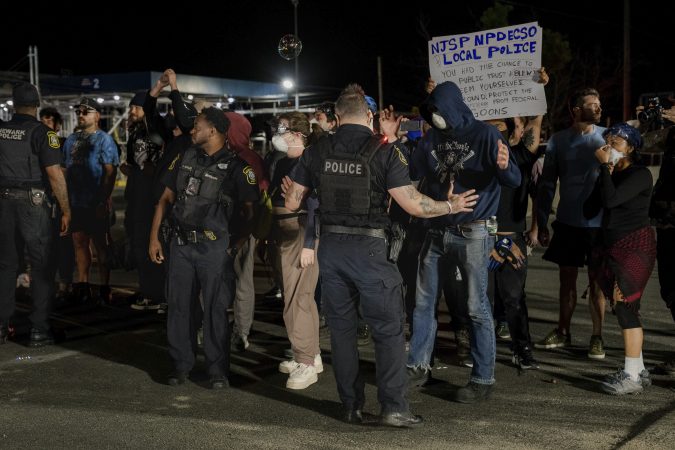
Their protests were met with violence. Some detainees were pepper sprayed, brutalized, and transferred, while masked ICE agents assaulted protesters outside of Delaney. New Jersey state police later arrived on horseback, tear gassing the crowds and sending community members to the hospital.
Complaints had been ongoing since Delaney Hall was reopened as a detention facility in May 2025, but the origin of these abuses actually began four decades earlier ago in 1993, in Elizabeth, a small city less than 10 miles away, with the opening of New Jersey’s first privately run detention facility, the Elizabeth Detention Center (EDC).
The history of EDC helps us understand that the battles over Delaney Hall are the outgrowth of detention privatization, its intersection with mass incarceration, and bipartisan political support for detention that has rarely faltered. It also demonstrates the consistency with which detained people have resisted their detention. Far from the southern border, New Jersey has long been a central node in the detention and deportation machine—and in the fight to end it.
New Jersey was home to the Ellis Island Immigration Station, which opened in 1892. Before the Immigration Act of 1924, Ellis Island served mostly as a gateway and immigrant processing center, but from the 1930s and until its closure in 1954, it operated as a dedicated detention facility, leading a Supreme Court Justice to refer to it as an “island prison.”
Detention became more central to U.S. immigration policy in the 1980s and 1990s. In 1980, for example, the United States detained thousands of Cuban refugees who came during the Mariel boatlift. Private corporations, which governments had begun to turn to for running their prisons, expanded into new markets of immigrant detention. Today, more than 90% of detention centers are run by for-profit corporations.
The presumed “need” for expanding detention bed spaces surfaced after the first bombing of the World Trade Center in February 1993. The Immigration and Naturalization Service (INS), the predecessor to today’s immigration agencies, issued a request for proposals for a detention center, ideally located near the three major airports in the New York City area. Because the WTC plotters were foreign-born, politicians used national security as an excuse for wide-ranging changes to the immigration system.
Esmor Correctional Services, a for-profit company which operated halfway houses and welfare hotels, submitted the winning bid to turn a warehouse in Elizabeth into a NYC-area detention center housing up to 300 detainees. Almost immediately after its opening in 1994, people detained there began complaining of inhumane treatment and conditions.
By 1995, the awful conditions and frequent abuse became public knowledge when detainees organized a hunger strike described in numerous articles in the Bergen Record by journalist Elizabeth Llorente. As Hawa Jama, a Somalian asylum seeker and the lead plaintiff in a lawsuit against Esmor, described in a deposition, “I complained personally to every INS person, every Esmor official… I come to this country to save my life, to ask [for] asylum. And they put me in jail, hell. I can describe hell… Esmor was hell.”
On June 18, 1995, the detainees staged a riot inside the facility. The media attention spurred by the hunger strike and the uprising caused INS to terminate its contract with Esmor. In its place, INS contracted Corrections Corporation of America (rebranded as CoreCivic in 2016), which has run it ever since.
Detention space increased in 1996 when President Bill Clinton signed two laws affecting immigrants in the United States. The Illegal Immigration Reform and Immigrant Responsibility Act (IIRIRA) and Antiterrorism and Effective Death Penalty Act (AEDPA) delegalized lawful permanent residents who had committed certain crimes, widened what counted as an “aggravated felony,” and made more immigrants deportable and detainable, mandatorily, and indefinitely. This merged with the increasingly harsh penalties for drug crimes, which affected immigrants. The 1996 laws also targeted asylum-seekers as subject to potential removal, creating an artificial need for more detention space, and revoked the discretion of immigration authorities to release certain noncitizens from detention.
In the 1990s and early 2000s, EDC was just one piece in the larger infrastructure of detention in New Jersey. Bergen, Essex and Hudson counties had also begun to hold immigration detainees in their jails against payment from the federal government. Delaney Hall, which first opened in 2000 as a halfway house for people with substance abuse issues convicted of low-level offenses, also began to hold immigrants for profit. As Essex County Executive Joseph D. Vincenzo said to the Star Ledger in 2008, “This is a home run for us. We have to find a way to bring in new revenue, and this is the way to do it.”
ICE detention in New Jersey peaked in 2009, then declined until 2015, and increased again after President Donald Trump issued a January 2017 executive order that greatly expanded who would be detainable under the law. In New Jersey alone, ICE arrests more than doubled in 2017 as a direct consequence of the administration’s decision to prioritize the detention of migrants and asylum seekers with no criminal convictions. Because 2017 bail reform had reduced the number of people held in New Jersey’s jails awaiting trial, ICE detention became an even more attractive source of revenue for local county jails.
Activists and advocates working across the New York/New Jersey border had been fighting against immigration detention since the 1990s. Coalition members organized protests, advocated with communities, and pressured public officials to end ICE detention in New Jersey. Fearing that detention would become a death sentence during the early months of Covid-19, detained people in every facility in the state went on a hunger strike, bringing renewed attention to the campaign of ending detention.
Made By History sponsors. FOR USE ON MADE BY HISTORY STORIES ONLY.Inquirer Staff
In 2021, the political tide turned as county and state democrats came out publicly against ICE detention. Within the course of a year, the county jails depopulated their ICE detainees and Governor Phil Murphy signed a law (AB 5207) that banned the creation or renewal of detention contracts with ICE.
ICE detention was nearly eradicated in New Jersey. The EDC was the only facility still in operation. Under the new anti-detention law, when its contract came up for renewal, it, too, would close. Instead, CoreCivic sued New Jersey in a U.S. District Court, claiming the state law was unconstitutional. GEO Group soon filed suit as well. CoreCivic and GEO Group were joined by the Department of Justice under President Joe Biden, who saw New Jersey as essential to immigration enforcement.
The District Court’s 2023 decision striking down New Jersey’s anti-detention law was appealed by the New Jersey Attorney General’s office before the U.S. Court of Appeals for the Third Circuit. The federal appeals court upheld the 2023 ruling and thereby created the possibility for Delaney Hall to reopen on May 1, 2025, and to become the largest immigrant detention facility in the Northeast today.
The lawsuit shows a key tension that continues to play out. While immigration is managed by the federal government, the detention system that EDC and Delaney Hall are a part of, has been forged by bipartisan support at the county and state levels and motivated by economic interests. The overlapping “war on crime” and “war on drugs” caused mass incarceration and immigration detention to become intertwined. Trump has built on this foundation, not created an entirely new system.
Understanding the current situation at Delaney Hall requires this historical context. More than 30 years ago, the EDC proved to federal and state leaders that privatized immigration detention could “work” in New Jersey, as long as the mistreatment and abuse of detained people could be kept out of the spotlight. But history also shows us that when detained community members resist through complaints, lawsuits, hunger strikes and, even, an uprising, their voices and experiences reveal the system’s underbelly and inspire systemic change. We hope that history will teach future generations that such efforts are worthwhile.
Mary Rizzo is a historian at Rutgers University-Newark, and the co-author of a chapter in Elizabeth Detention Center.
Made by History takes readers beyond the headlines with articles written and edited by professional historians. Opinions expressed do not necessarily reflect the views of The Inquirer.
Julie Harrison, a clinical psychologist in South Jersey who works with children who have experienced abuse, received a letter from Rowan University: Notice of Layoff.
Her position as a teacher, researcher, and provider in Camden County would be eliminated “due to the loss of state appropriation funding,” the May 12 letter said. Harrison works for the Rowan-Virtua Child Abuse Research Education and Service Institute (CARES), which provides evaluation, treatment, and other services to children who have experienced abuse in South Jersey, and conducts research on the subject.
The notice came after Gov. Mikie Sherrill proposed slashing the $1.85 million line item in her state budget plan for the program.
CAREShas offices in Stratford in Camden County and Vineland in Cumberland County. The Vineland location, which opened two years ago to provide better access to families in deeper South Jersey, is shutting down due to the anticipated cuts.
“With Mikie Sherrill being in office, we had a lot of hope because she really was pretty loud about wanting to help kids, wanting to help families, wanting to really champion mental health services, and so we were pretty surprised about this budget,” Harrison said in an interview.
The clinician ispregnant with twins and her job prospects are uncertain as the clock ticks until her final day at CARES. But she is mostly concerned about the impacts the funding cuts will have on children facing trauma in South Jersey, and the workers caring for them.
The South Jersey program serves more than 1,500 children across more than 4,000 visits in both locations. Though just about 200 families use the more rural Vineland location, that is where these types of services can be the most critical, Harrison said.
“It’s a pretty resource-dry community,” she said. “There’s not a ton of public transportation to get around. … The amount of services that are available to these families generally is much lower than other parts of New Jersey.”
Harrison is one of about 20 people whose jobs are being impacted by the anticipated funding cuts across both office locations, according to union members. The majority of those are layoffs, and some employees had their hours dramatically reduced to the point they lost their healthcare benefits, according to union members.
Ali A. Houshmand, president of Rowan University, said in a May 11 email that Sherrill’s proposed cuts forced the child abuse care center to pull back its services beginning July 1. He announced the closure of the Vineland office without saying it outright.
“CARES will consolidate its work into our Stratford campus offices and will continue to fulfill its mission there: delivering high‑quality evaluations and treatment, supporting partner agencies across the region and educating the next generation of physicians and health professionals,” he said in the email.
Joe Cardona, a Rowan University spokesperson, said the program also receives $3 million from other state agencies that will not be cut. He said the program’s goal is to offer the same services but reduce the quantity of care.
“The exact outcome, of course, is to be determined,” he added.
What is clear is that the closing of the Vineland center will have a domino effect on Stratford.
“It’s creating an environment where people who are already doing multiple roles, performing multiple jobs, are going to be asked to do more,” Harrison said. “It’s just that horrible ‘do more with less.’”
Harrison said she was just days away from submitting a grant application to start a food pantry out of the Vineland office when she heard the news. Her team did not submit the application after learning about the cuts and Vineland’s planned closure.
CARES is one of four legislatively mandated diagnostic and treatment centers through the New Jersey Department of Children and Family, though it provides more expansive medical and mental healthcare than legally required. The center champions trauma-focused cognitive behavioral therapy, an internationally recognized model that was developed by the South Jersey program’s codirector.
The program has tried to keep waiting lists for trauma care to under three weeks, but it has now grown to 10 to 12 weeks and the wait for care will probably get longer, Harrison said.
“There is a high cost to what untreated trauma can look like for medical, mental health, all those services down the road if trauma isn’t treated early on,” she said.
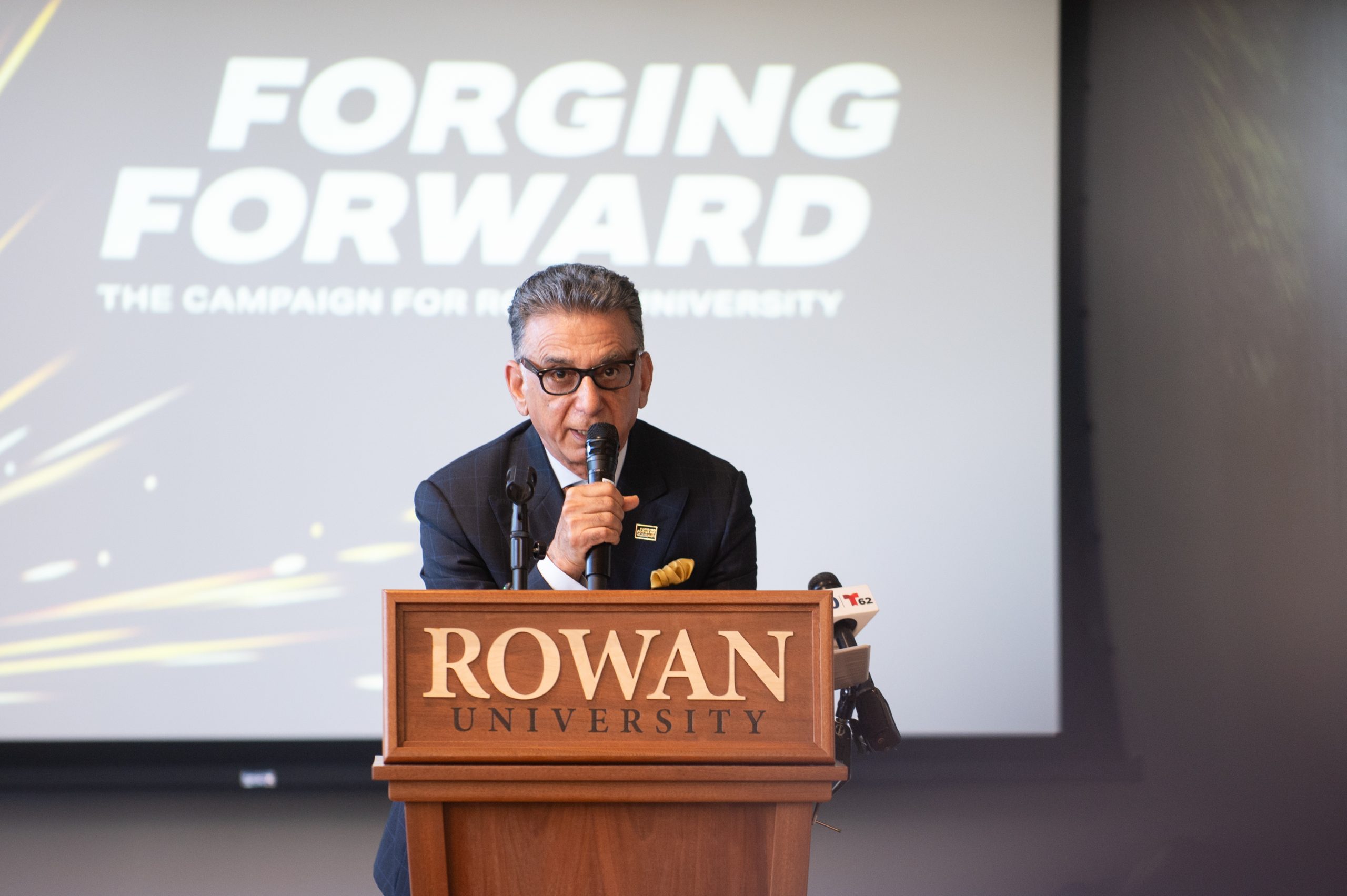
Dr. Ali A. Houshmand, president of Rowan University, speaks to students and staff at a fundraising event in September 2025. Erin Blewett / For The Inquirer
‘Tough choices’
Sherrill championed improving mental health for young people on the campaign trail and in her budget proposal by allocating $33 million to expand mental health services for students with high needs in K-12 schools, $500,000 for a new social media research center focused on young people’s mental health, and $125,000 for the newly created New Jersey Office of Youth Online Mental Health Safety and Awareness.
Her office did not respond to a request for comment on her proposal to decrease funding for CARES.
In response to a request for comment for an earlier Inquirer story about Sherrill’s decision to cut all state funding for Rowan’s brand-new veterinary school, an administration official cited the governor’s “blanket cut to all legislative add-ons.” These items refer to funding allocations legislators secure for their district that are sometimes criticized as “pork” or “Christmas tree items.” They can range from improvements for a local park to community services, like CARES.
Sherrill, in her budget address, spoke about making “tough choices” in order to have “the most fiscally responsible budget that our state has seen in years.”
The state budget is a negotiation between the governor and legislative leaders due June 30, so it is unclear how much funding these programs will get in the end. But Rowan has moved forward as if the money for CARES is not on the table.
This is not the first time the program has been at risk as part of the budget dance.
Former Gov. Phil Murphy proposed cuts to the program last year, citing “belt-tightening,” but legislators were able to get the money back in the budget.
This year, Harrison said, people are not optimistic because CARES is one of so many programs Sherrill struck a pen through.
Dio Tsitouras, the executive director of the American Association of University Professors Biomedical and Health Sciences union, said he hopes Sherrill allocates more money to CARES because more state revenue has been identified since her budget proposal. But state officials have still warned of financial uncertainty on the horizon.
“The CARES program is invaluable to protecting our state’s most vulnerable children,” Tsitouras said.
A scrap metal recycling facility in Camden that has been prone to fires is suing the city for suspending its operations after its 13th fire in six years.
The city of Camden this month suspended the EMR scrap metal recycling facility’s junkyard license after a late May two-alarm fire that officials said created smoke plumes that stretched to Gloucester Township. It was the latest in a string of several fires in recent years that have plagued the facility and local Camden residents.
In the complaint, filed Monday and first published by WHYY, the company argues that the city acted outside of its power and did not provide due process by issuing the suspension. The company’s legal team says the pause in operations has cost EMR $10 million in lost revenue and operational expenses, as well as irreparable harm in the “competitive, relationship-driven” industry.
The most recent fire occurred on May 29 at 3 a.m. and was under control about two hours later. It led to air quality alerts and broke out just days after the company installed a new fire suppression system.
The company says it had shut down its shredder to investigate the cause of the fire before the city sent a suspension notice on June 4 ordering it to cease its primary operations. The notice, signed by the city code enforcement officer, states that the suspension will be reassessed after 30 days.
The company said it asked the city on June 12 to continue operating on June 15 after implementing “preventative measures.”
Camden Mayor Victor Carstarphen said after that fire, “Enough is enough.”
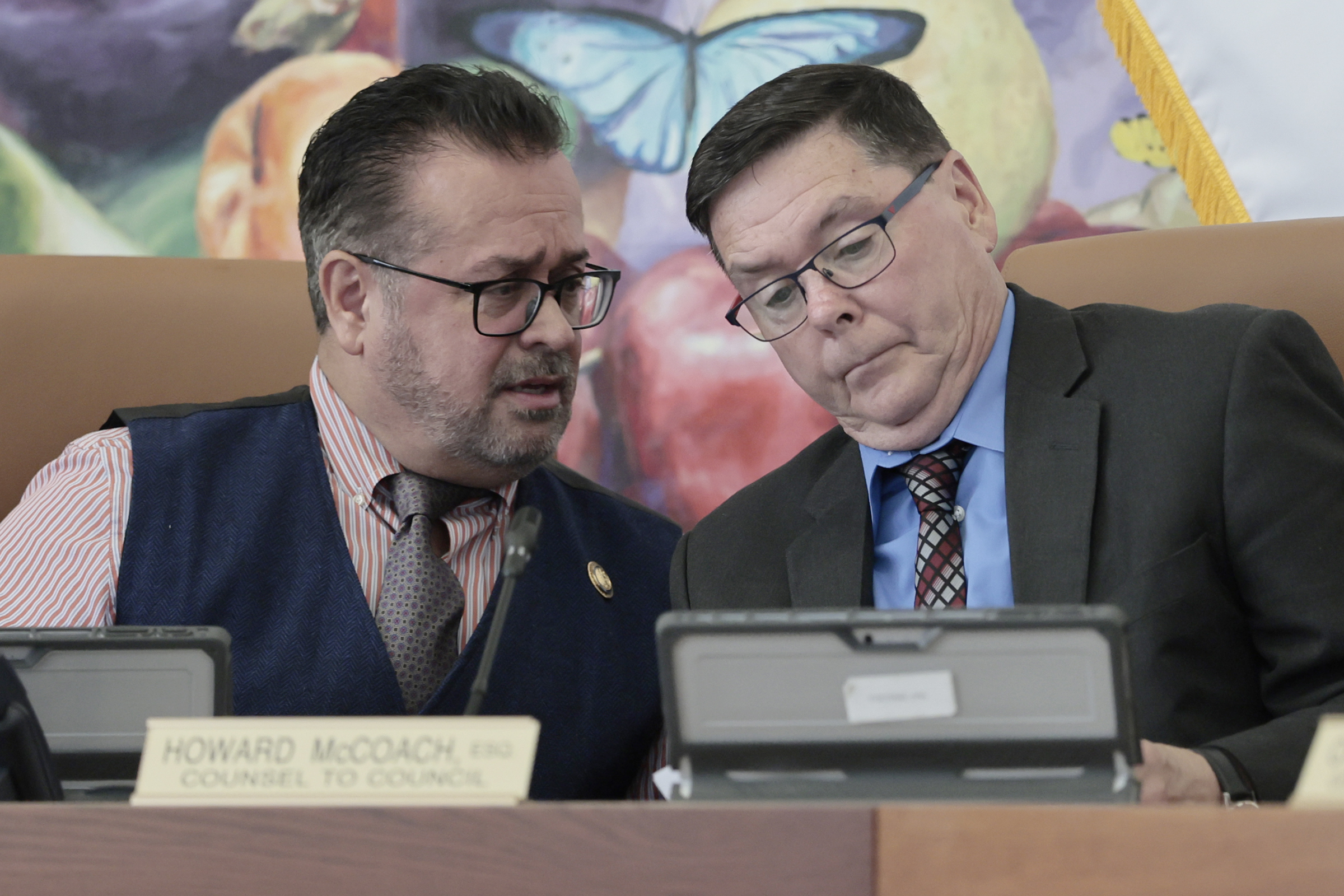
Camden City President Angel Fuentes (left) and counsel to council Howard McCoach discuss business during a Camden City Council meeting at Camden’s City Hall on Thursday, June 11, 2026.Elizabeth Robertson / Staff Photographer
The Camden City Council voted on a resolution Thursday calling on all regulatory agencies with jurisdiction over the facility, including on the county and national levels, to shut the facility down. The company has faced lawsuits over fires at the facility, including from the state attorney general’s office and local residents.
The resolution cites a joint statement signed by Carstarphen, County Commissioner Jeffrey Nash, State Sen. Nilsa-Cruz Perez, City Council President Angel Fuentes, and City Council Vice President Arthur Barclay, all Democrats:
“We will not stand idly by while residents are exposed to fires on a regular basis and have to bear the burdens of an operation that clearly cannot function in a safe manner,” it says in part. “We will no longer allow shelter in place alerts to go out because of another mishap in this scrap metal operation.”
At Thursday’s council meeting, Camden residents called for the facility to be permanently shut down — citing health concerns and other disruptions to their quality of life — and criticized the city for not doing more earlier.
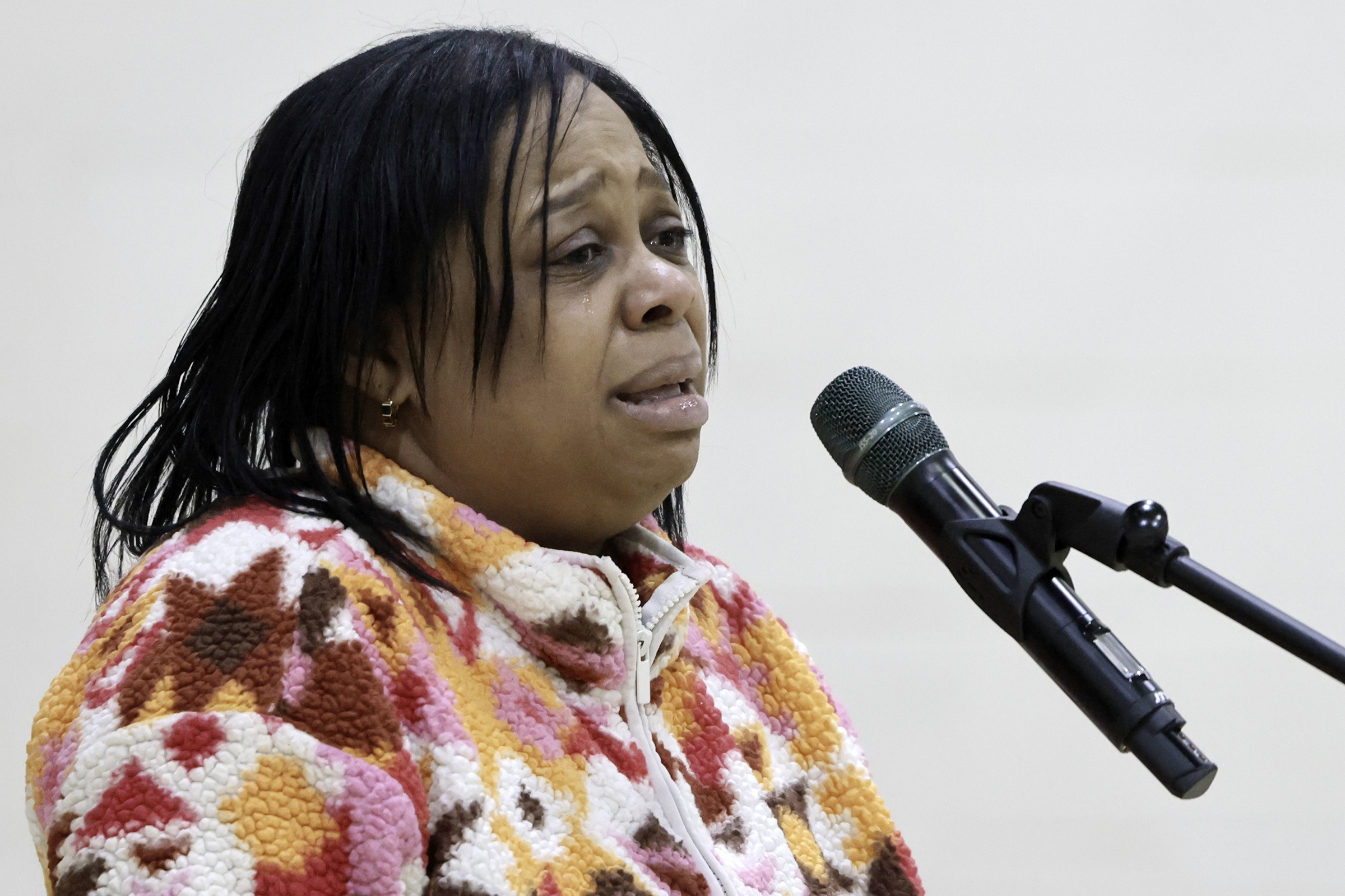
Aliyia Jones becomes emotional during a community meeting for residents, affected by the recent junkyard fire, at MJD Fieldhouse Gym on Broadway in Camden on Sunday, February 23, 2025. Jones was describing her attempt to alert all of her neighbors before fleeing the area with her disabled mother after the fire broke out.Elizabeth Robertson / Staff Photographer
“I just want to say, too little, too late,” said Aliyia Jones, who was among 100 Camden residents who fled their homes after a four-alarm fire at the facility in February 2025.
“No one wants to come here and say ‘finally,’ or ‘thank you,’ or ‘hurrah.’ … We can’t breathe,” she added.
EMR employs 500 people in Camden, including 179 Camden residents, according to the complaint, and if the shutdown continues, employees will face layoffs. EMR workers protested calls to close the facility earlier this month.
Ajeena Riggs, a project manager at the Center for Environmental Transformation, said that she is sympathetic to workers seeking to keep their jobs and that the city and their union should help them find new positions if they lose their employment.
“I don’t blame them for fighting for their jobs,” she said at Thursday’s meeting. “They’re fighting for their livelihood. But the only entity that’s to blame is the EMR.”
The company blames the fires on improperly disposed lithium-ion batteries, but officials said in their joint statement “that story line is old and irrelevant at this point.”
EMR implemented a fire suppression system and agreed to make other changes after entering a memorandum of understanding with the city last summer following the massive February 2025 blaze. Residents at the meeting criticized that agreement as lacking teeth.
Camden city spokesperson Vincent Basara declined to comment on the lawsuit.
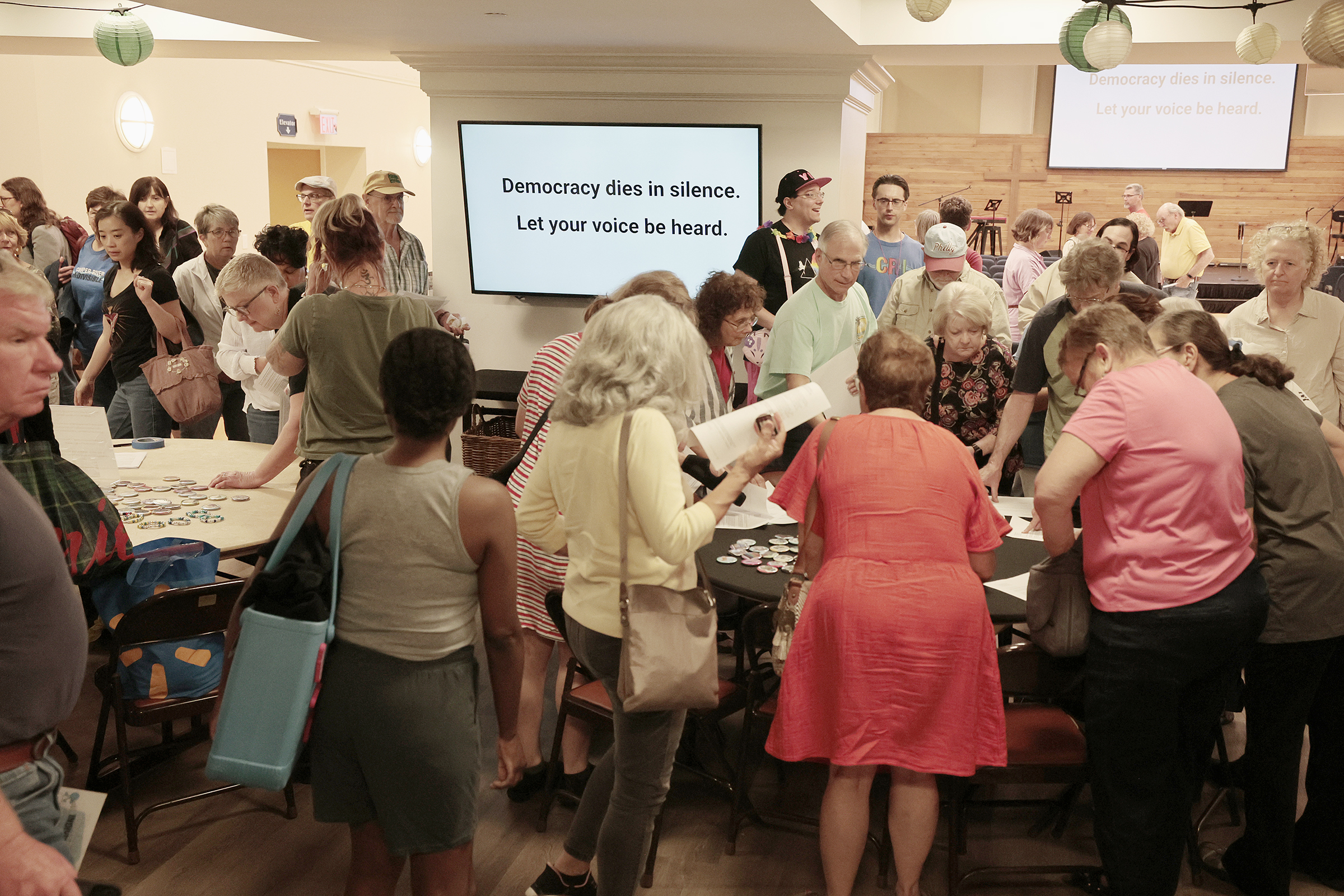
Josue Barreiro stood in front of a crowd of 200 people seated inside a church last week in Haddonfield. He was there to speak about his experience as one of 61 protesters arrested in one night outside Delaney Hall after Gov. Mikie Sherrill had sent over state police.
He told the crowd, gathered for a meeting of the South Jersey progressive group Cooper River Indivisible, that the governor made it seem like she was sending state troopers to protect demonstrators from federal immigration officers. Instead, he said, they brutalized protesters on horseback in riot gear. He showed a video of state police knocking him to the ground.
“All accounts say the state police were considerably more violent than the federal government was,” Barreiro, a Bridgeton resident and activist with Los Tequios, told receptive audience members who made sounds of disgust.
Josue Barreiro speaks about the protests outside Delaney Hall during the Cooper River Indivisible general meeting at the Haddonfield United Methodist Church on June 9.Elizabeth Robertson / Staff Photographer
Sherrill, a former member of Congresswhose double-digit victory last year was seen as a rebuke of President Donald Trump, has been in her most high-profile political bind yet as she juggles her opposition to the ICE detention center while facing widespread criticism for her handling of protests outside it.
The first-term governor campaigned as a fighter against Trump and Immigration and Customs Enforcement. She highlighted her experience as a Navy helicopter pilot and said she was trained “that in a crisis, you run toward the fight.” But to South Jersey progressives who worked hard to campaign for her, Sherrill’s decision to respond to tensions between protesters and ICE with a designated protest zone policed by state officers represented a betrayal. The governor called the decision “absolutely necessary to protect public safety and avoid escalation from ICE.” But the state police’s show of force, video of which replayed across national news and social media channels for days, “kind of resembled what ICE was doing in the first place,” said Newark Mayor Ras Baraka, one of Sherrill’s primary opponents, who was arrested outside the facility last year.
“This was not the kind and quality of leadership we were voting for, or hoping to see,” said Michele Messer, 52, a leader of Cooper River Indivisible, one of the groups that campaigned for Sherrill.
People sign up to volunteer after the Cooper River Indivisible general meeting at the Haddonfield United Methodist Church.Elizabeth Robertson / Staff Photographer
Sherrill said she was trying to “lower the temperature” to prevent Newark from becoming another Minneapolis when she announced her plans to send state troopers to Delaney Hall. She later disagreed with a comparison between state police and federal immigration officers in Minneapolis during a tense interview on WNYC’s Ask Governor Sherrill, noting that state police didn’t kill anyone.
“I don’t think they have the same concern for human life in many cases that I do, and that our police forces in New Jersey share,” she said.
Activists said she should have known that sending in police and corralling people into a free speech zone can escalate already fraught demonstrations.
“I mean, there’s precedent, there’s history. We’ve all read about how these things go, and yet that was the choice she made,” said Messer, a Haddon Township resident who has protested at Delaney Hall.
Patricia Campos-Medina, a former campaign adviser to Sherrill, said the governor’s handling of Delaney Hall — and how she manages “the fallout of her decisions” — has been an early test of her leadership.
“It’s her first real test [of] how she manages the duties of being the highest public safety officer of the state leading New Jersey, and then still protecting the immigrant community who lives here,” said Campos-Medina, an ally of the governor who works with the labor movement.
Sherrill has built her national profile on fighting the Trump administration, and those who have become the most frustrated with her share that mission. How she navigates this moment could determine whether she can keep that base focused on fighting the president, instead of her.
Mounted New Jersey State Police troopers move toward protesters outside the Delaney Hall detention center on May 29 during a protest against the transfer of detainees and federal immigration policies.AP Photo/Andres Kudacki
‘I’m not proud to have voted for her’
Sherrill has called for the closure of Delaney Hall and her administration announced multiple measures to support the fight against the detention center since the late May backlash against her began.
Activists from across the staterallied in Trenton on June 1 and delivered a letter to Sherrill calling on her to “honor our First Amendment rights, cease police brutality and to enable the closure of Delaney Hall.”
“As the grassroots who campaigned for you, we also expect ongoing communication with your administration to navigate this perilous time in New Jersey,” the letter continued, signed by about 40 organizations statewide, including Cooper River Indivisible and several other South Jersey groups.
The next day, New Jersey Attorney General Jennifer Davenport, Sherrill’s appointee, filed a lawsuit against GEO Group — the private company that runs Delaney Hall — to give the state health department full access to the facility over reports of “inhumane and unsanitary conditions.”
Two days later, Sherrill and the state legislature announced an infusion of $20 million to assist with immigration defense and launched a rapid legal defense effort amid concerns about due process.
Marie Henselder-Kimmel, 65, a Cherry Hill resident who leads the South Jersey group NJ Voters Want More Say, said the reports of bad conditions in the facility are not new, so she doesn’t understand why the administration did not take legal action months earlier.
“I foresee that we’re going to have to keep pressuring to get them to keep doing those more bold things,” she said.
Henselder-Kimmel said she feels “torn” about Sherrill’s decision to send state police because she agrees ICE would have escalated otherwise. But she said it seemed like Sherrill may have sent the police in without understanding what they were going to do.
Marie Henselder-Kimmel (left) and Michele Messer (right) talk with Vikki Toomer (back to camera) after the Cooper River Indivisible general meeting at the Haddonfield United Methodist Church.Elizabeth Robertson / Staff Photographer
Cristian Moreno-Rodriguez, who works as the executive director of El Pueblo Unido of Atlantic City, an organization that supports Latino immigrants, said Sherrill’s handling of the protests has fully broken the trust with his community.
Sherrill’s campaign made a particular effort to target Latino voters. She did particularly well in New Jersey’s largest Hispanic-majority cities, which moved an average of 18 points toward the Democrat after rightward shifts in 2024.
“We’re not going to forgive her for what she’s done,” said Moreno-Rodriguez, who worked for One Giant Leap, asuper PAC that supported Sherrill and raised about $9 million by the end of 2025.
Sherrill was not Moreno-Rodriguez’s first choice in the primary, but she was a better choice for his community than Republican Jack Ciattarelli, he said. Still, he said he was expecting better from the Democrat.
“I don’t regret voting for Mikie Sherrill because she was better than Jack Ciattarelli, but I’m not proud to have voted for her,” he said.
Gov. Mikie Sherrill poses for a selfie at a Latinos for Mikie event at the Rancho Mateo restaurant in Elizabeth, N.J., last May.Aristide Economopoulos
Activists have been demanding Sherrill meet with detainees, but she says she has not been allowed in except for one “closely controlled and limited tour” on June 8, in which she was not allowed to speak with those being held there.
Several members of Congress, who are authorized to conduct oversight visits, have visited the detention center, including Sen. Andy Kim, a South Jersey Democrat who made headlines for getting pepper-sprayed while trying to de-escalate tensions between federal immigration officers and protesters. Kim faced criticism from some activists for what they viewed as trying to negotiate with ICE, but others have praised him for being on the ground in a way they have not seen from Sherrill.
Sen. Andy Kim stands between federal agents and demonstrators in an attempt to prevent a clash outside the Delaney Hall migrant detention center in Newark on May 25.DAKOTA SANTIAGO
Sherrill and activists alike have said that the demonstrators have been largely peaceful. But U.S. Rep. Jeff Van Drew, a Cape May County Republican, accused the protests of being “more like anarchy” and called on Sherrill to bring state police back.
State Sen. Michael Testa, a Cumberland County Republican, praised Sherrill’s “decision to cooperate with federal authorities” and “restore order” by bringing state police in, and added fuel to the fire by thanking her for “supporting President Trump and the brave men and women of ICE.”
‘The buck stops with her’
Activists have expressed frustration that the narrative has strayed from the conditions inside Delaney Hall to the fight outside it — a point Sherrill has echoed.
But after state police clashed with protesters, Sherrill focused her criticism on what she described as “aggressive and dangerous” disruptors and defended the officers.
Her remarks further infuriated activists who accused her of echoing the state police’s narrative, which they say does not align with what they experienced on the ground or saw online.
When a radio caller confronted Sherrill on WNYC over state police brutalizing nonviolent protesters, the governor said “if there were incidents like that, the attorney general will be looking into that.”
Vikki Toomer, a Cooper River Indivisible leader who has protested outside Delaney Hall, said that listening to Sherrill’s news conferences have given her “that same visceral reaction” she gets from listening to Trump.
Vikki Toomer speaks during the Cooper River Indivisible general meeting at the Haddonfield United Methodist Church.Elizabeth Robertson / Staff Photographer
“I don’t know if they were feeding her lies, or that’s the narrative she was trying to spin … all I know is what she was saying was not true, and she was not taking the time to listen,” Toomer said.
Toomer said she believes the governor knows her plan did not go well but also “has not come out publicly and said, ‘Oops, I made a mistake.’”
When asked on the radio whether she believes her administration has suffered a loss of trust, Sherrill said sending state police “was really not done focusing on politics, and I certainly hope not.”
“This was focused on making a really hard decision in a situation that nobody wanted,” she said.
Folks leave messages on a collage (left) during and after the Cooper River Indivisible general meeting at the Haddonfield United Methodist Church on June 9. The poster will be part of an exhibit at Perkins Center for the Arts.Elizabeth Robertson / Staff Photographer
Linda Greenwood, 74, a Voorhees resident who belongs to Cooper River Indivisible and campaigned for Sherrill, believes the governor has good intentions but does not think she has been unfairly blamed.
“She’s the governor,” Greenwood said. “The buck stops with her. She brought the state police in. She has to take responsibility for what happened there, and I think she will.”
Lawrence Garrity, 29, was the lead volunteer for long shifts at Sherrill’s Cumberland County campaign office between overnight shifts at Wawa last year. The Rowan student said he feels “salty” he worked so hard to elect her and it feels like she is not on their side.
“It doesn’t feel like she’s not on our side either. It’s like she’s sitting in the middle … people are genuinely in danger, and you’re trying to, like, half-ass fight it,” he said.
Garrity said he had to go to urgent care after state police unleashed tear gas and pepper balls on protesters.
“Somebody said they’re gonna make T-shirts that said ‘I voted for Mikie Sherrill and all I got was tear-gassed,’” he said.
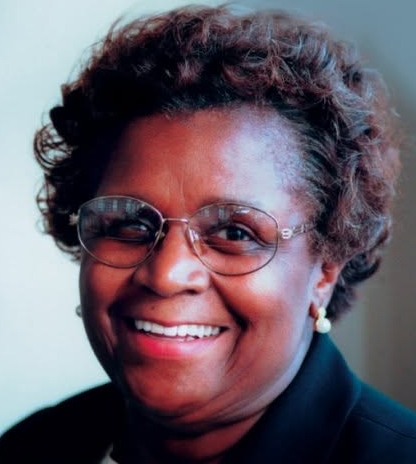
Jackie Love, 83, of Deptford Township, longtime social justice activist, Black political pioneer, former council member and the second Black female deputy mayor of Deptford Township, former director of what is now the New Jersey Division of Disability Services, New Jersey Elected Officials Hall of Famer, mentor, and volunteer, died Friday, May 29, of age-associated decline at Shady Lane Nursing Home in Clarksboro, Gloucester County.
Born in Philadelphia, Mrs. Love moved to Deptford Township when she was 13. She was reared by her grandmother, earned an associate’s degree in business administration at Camden County College in 1972, and served in government leadership roles for Deptford Township, Gloucester County, and New Jersey for four decades until her retirement in 2009.
“Her caring spirit and willingness to help her community is a true example of a servant leader,” a former colleague said on Facebook.
Mrs. Love was hired by Gloucester County officials in the 1970s to coordinate employment training programs and later to prevent and eliminate disability discrimination. She was the first director of the old Gloucester County Office for the Disabled in the 1980s and later was director of the Gloucester County Disabled Persons Advisory Commission.
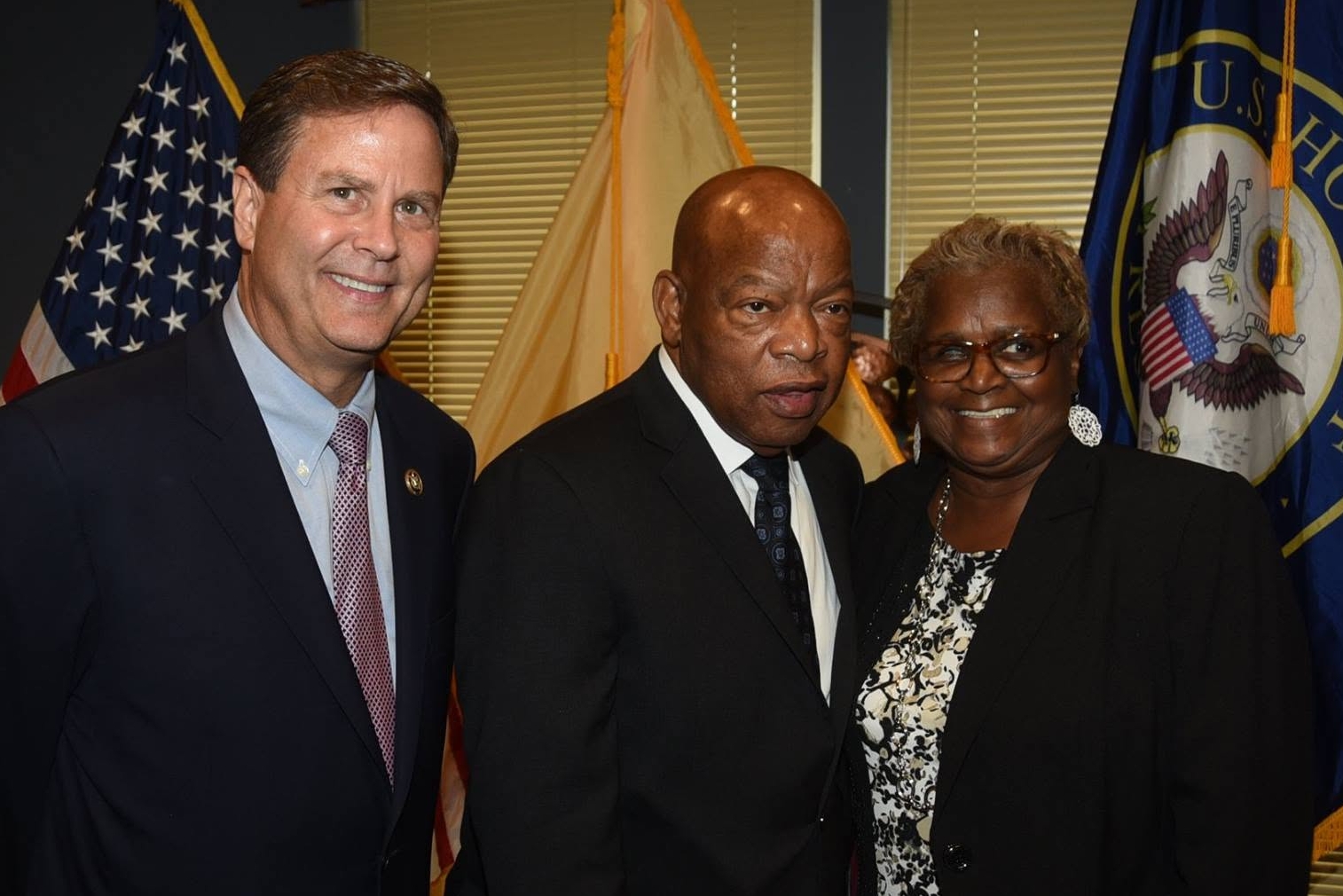
Mrs. Love stands with U.S. Reps. Donald Norcross (left) and John Lewis.Courtesy of the family
She became director at the old New Jersey State Office for Disability, now the New Jersey Division of Disability Services, in the 1990s and championed the installation of sidewalk ramps, curb cuts, and other improvements throughout the state. “We wanted to start making sure that we were accessible,” she told Front Runner New Jersey in 2025. “That’s a highlight of my life.”
Mrs. Love first ran for Deptford Township Council as a Democrat in 1989. She received more votes than any of the other nine candidates, routinely collaborated with members of both parties, colleagues said, and became deputy mayor in 1996.
“When Jackie was on council and she walked into a room, everybody knew who Jackie Love was,” Deptford Township Mayor Paul Medany told The Inquirer in 2015. “She’s known all over the state.”
As Deptford council member and deputy mayor, Mrs. Love focused on reducing juvenile crime and lobbied for sound barriers along the New Jersey Turnpike, lower speed limits on busy township roads, responsible school budgets, improvements to animal waste disposal procedures, and upgraded vendor code guidelines. In 2015, Deptford Township officials renamed Church Street Park as the Jackie Love Community Park.
Mrs. Love stands with state Assemblyman Bill Moen in 2025.New Jersey Irish Society
“To see the future politicians and others out there playing and getting involved is another highlight of my life,” she told Front Runner New Jersey about the park.
In 2005, the editorial board for the Courier-Post called Mrs. Love “loyal, hardworking, and a team player.” In a Facebook tribute, U.S. Rep. Donald Norcross (D., N.J.) said: “Jacquelyn Love was a force for good in Deptford for generations. She paved the way for others as a Black female deputy mayor … and long remained a champion for civil rights, faith, the disabled, and many more throughout her life.”
Mrs. Love also served as a commissioner for the Delaware River Port Authority. She was active with the Gloucester County Minority Coalition, the Gloucester County College advisory committee on diversity and civility, and other groups.
She recruited volunteer poll workers and was a delegate for Bill Clinton at the 1992 Democratic National Convention in New York. In the 1970s, she traveled the country with civil rights leader Leon Sullivan and helped organize his Opportunities Industrialization Centers of America.
Mrs. Love (left) enjoyed time with her family.Courtesy of the family
She was named the 1987 Woman of the Year by the Gloucester County chapter of the NAACP, honored in 2005 by the Gloucester County Human Relations Commission, and inducted into the New Jersey Elected Officials Hall of Fame in 2010. In March, her achievements were recognized by the New Jersey Irish Society.
Mrs. Love mentored dozens of colleagues and friends, conferred frequently with Philadelphia Mayor Cherelle L. Parker, and volunteered at Mount Zion Wesley United Methodist Church and for the United Way. On Facebook, former colleagues called her “a once-in-a-lifetime type of leader” and “one of the most dedicated public officials I have ever had the honor of working with.”
Jacquelyn Williams was born Sept. 10, 1942. She dropped out of Woodbury High School at 17, earned her General Educational Development certificate later, and worked at first as a counselor at Ancora Psychiatric Hospital in Hammonton.
She married Arnold Love in 1972, and together they reared her daughter, Wanda, and their son, Wayne. Her husband died in 1985.
Mrs. Love participated in this 2020 drive-by salute to a friend’s 60th wedding anniversary. Jose F. Moreno / Staff Photographer
Friendly and classy, friends said, Mrs. Love wore memorable hats and enjoyed shopping at local Amish markets. She visited Amish friends in Lancaster when she was young, took classes at what are now Rowan and Rutgers Universities, and lived in Jericho for decades.
Friends called her a “cornerstone of this neighborhood” and a “wonderful down-to-earth lady.” One friend said: “Jackie set the standard for leadership and dedication to her family, faith, friends, and public service.”
Her son said: “She showed love to so many people.”
In addition to her children, Mrs. Love is survived by four grandchildren, four great-grandchildren, a sister, and other relatives.
Visitation with the family is to be from 8 to 10 a.m. Friday, June 12, at Gloucester County Community Church, 359 Chapel Heights Rd., Sewell, N.J. 08080. A service is to follow.
Friends called Mrs. Love a “cornerstone of this neighborhood.”Courtesy of the family
Gov. Mikie Sherrill of New Jersey on Monday was allowed to visit Delaney Hall, a detention center in Newark that has drawn protests for two weeks after immigrants inside complained about inhumane living conditions.
Sherrill described the visit as closely controlled and limited, and she said she was not permitted to meet with or speak directly with detainees.
“That is unacceptable,” Sherrill said in a prepared statement.
Sherrill, a Democrat, said she would continue to ask for a more thorough inspection of the center, including a visit by the state’s Department of Health. New Jersey’s attorney general has sued the center’s operator, Geo Group, which is one of the largest private prison operators in the United States. The attorney general is asking that state health inspectors be given full access to the facility.
Fights between demonstrators and detention center employees have erupted since last month at the front gates of Delaney Hall, with violent clashes common in the early morning hours. Demonstrators had blocked vehicles trying to leave the center, and in late May, heavily armed federal agents with U.S. Immigration and Customs Enforcement had responded with pepper spray and pepper balls.
In a statement, Homeland Security Secretary Markwayne Mullin said his department had granted Sherrill access to the federally run facility despite the fact she is not a federally elected official. Mullin said prisons operated by New Jersey were run more poorly than Delaney Hall.
“Gov. Sherrill won’t tell you: New Jersey state prisons face systemic health code violations,” Mullin said. “I’d encourage Gov. Sherrill to focus on her own backyard, and put the safety of her own constituents above illegal aliens.”
During an appearance on “Fox & Friends” on Monday, Tom Homan, President Donald Trump’s top border adviser, criticized the demonstrators and argued that detainees inside Delaney Hall were treated and fed well, contrary to claims that many have made about rotten food and dirty bathrooms.
Homan also said federal officials would send more federal agents to New York, vowing to push back against new restrictions approved by Gov. Kathy Hochul against federal immigration operations in the state. The recently passed legislation bars agents from wearing masks during immigration operations, allows agents to be sued for constitutional violations, and prohibits agents from searching “sensitive locations” such as hospitals and schools without a warrant signed by a judge.
Homan suggested that local officials were endangering the public by refusing to help facilitate the arrests of migrants.
“I made her a promise — you are going to see more ICE agents than you have ever seen in New York City,” Homan said on “Fox & Friends.” “It’s coming.”
Hochul said Homan’s threat directly contradicted what Trump had said to her in a room full of fellow governors. Trump, Hochul said, had told her that the federal government would not deploy a crackdown where it was not welcome.
“If they come here and go throughout New York state with a surge in ICE, there won’t be a Republican standing in this state,” Hochul said to a group of reporters. “Americans have had enough with the overreach of ICE.”
Asked about Hochul’s account of her interaction with Trump, the White House said, “Any criminal illegal alien living any place in the United States is subject to removal.”
In a social media post on Monday, New York City Mayor Zohran Mamdani criticized Homan’s threat.
“We will not allow ICE or anyone else to sow fear in our communities,” Mamdani said. “We will stand proudly with our immigrant neighbors and reject these attacks for what they are: an attempt to divide us.”