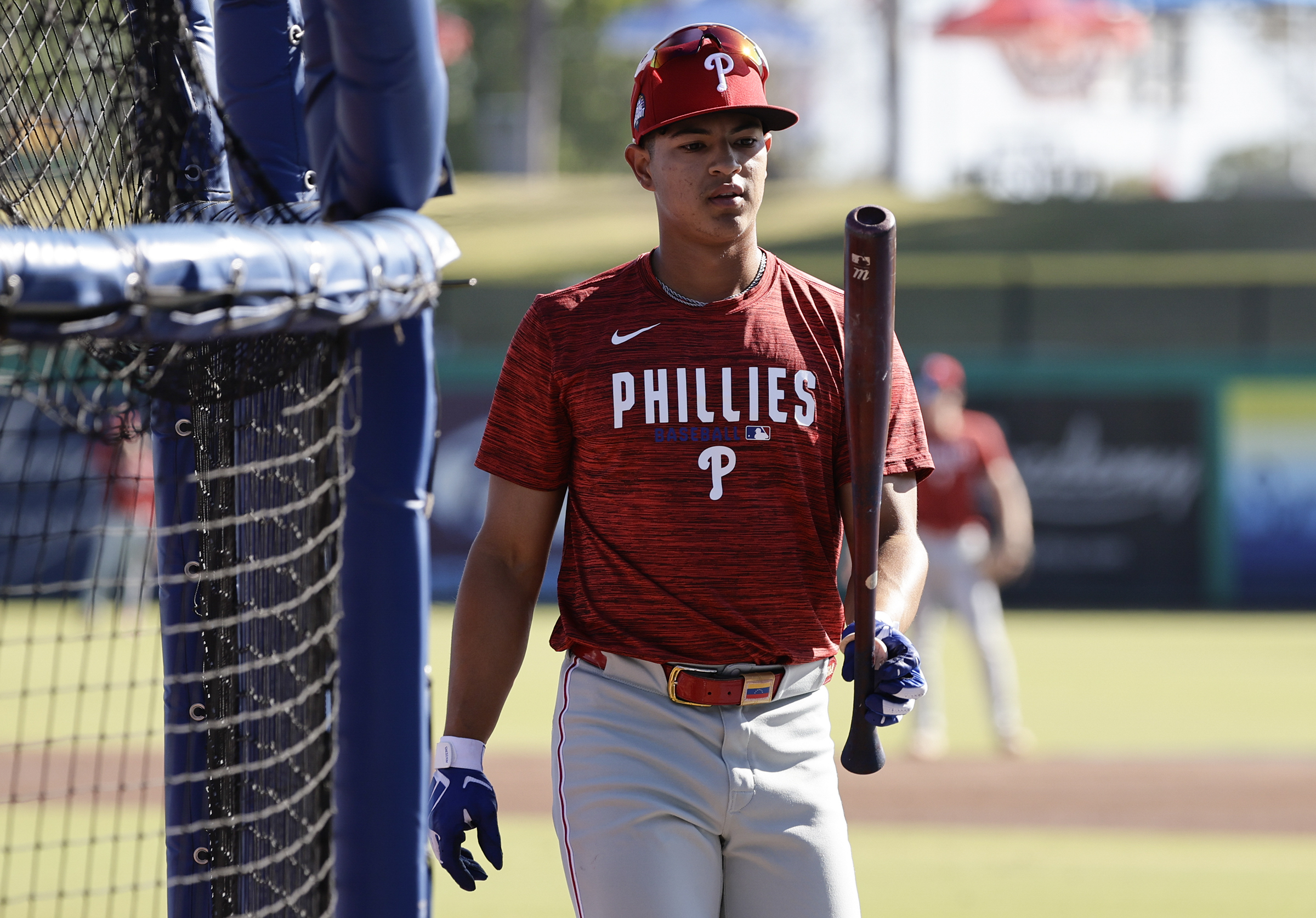
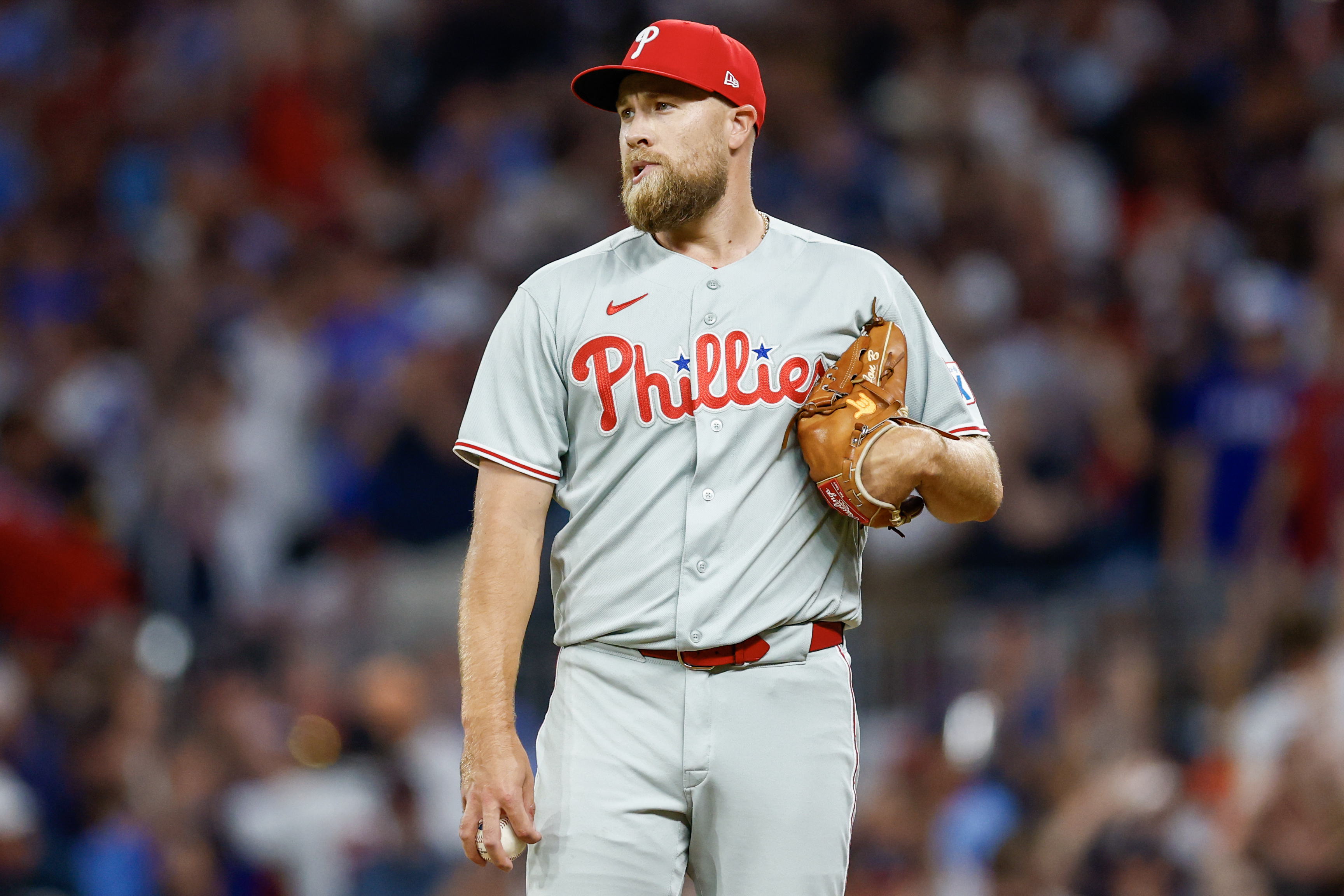
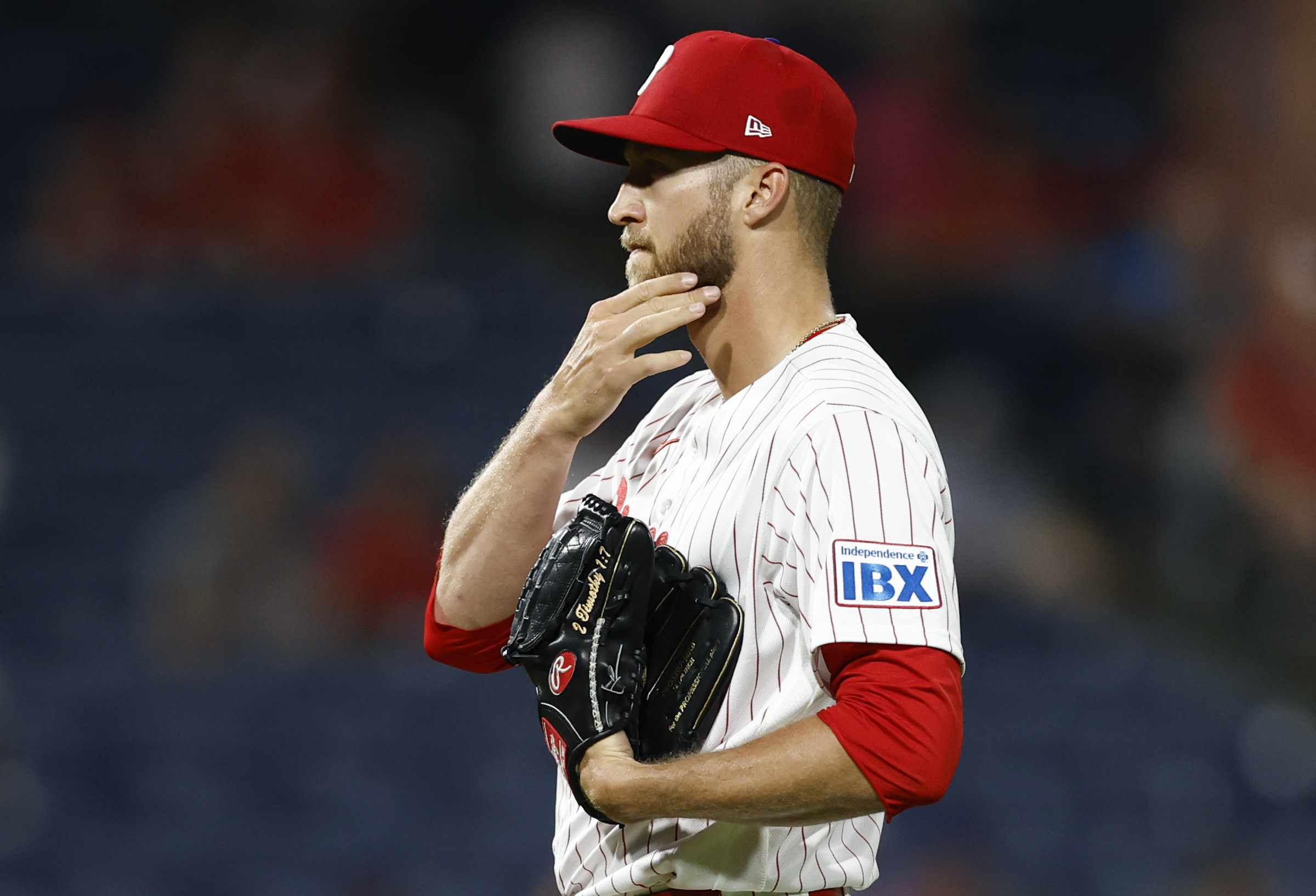
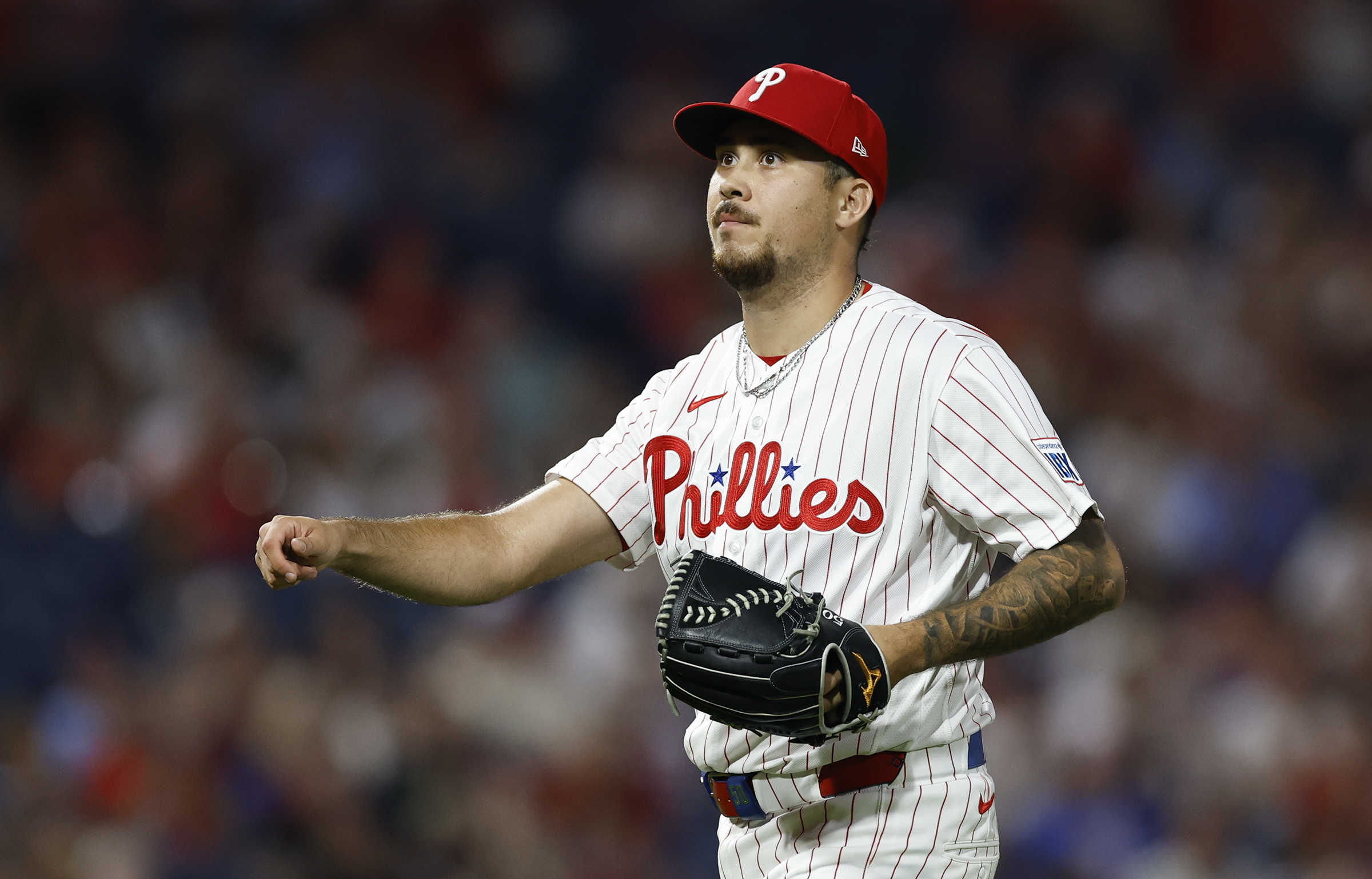
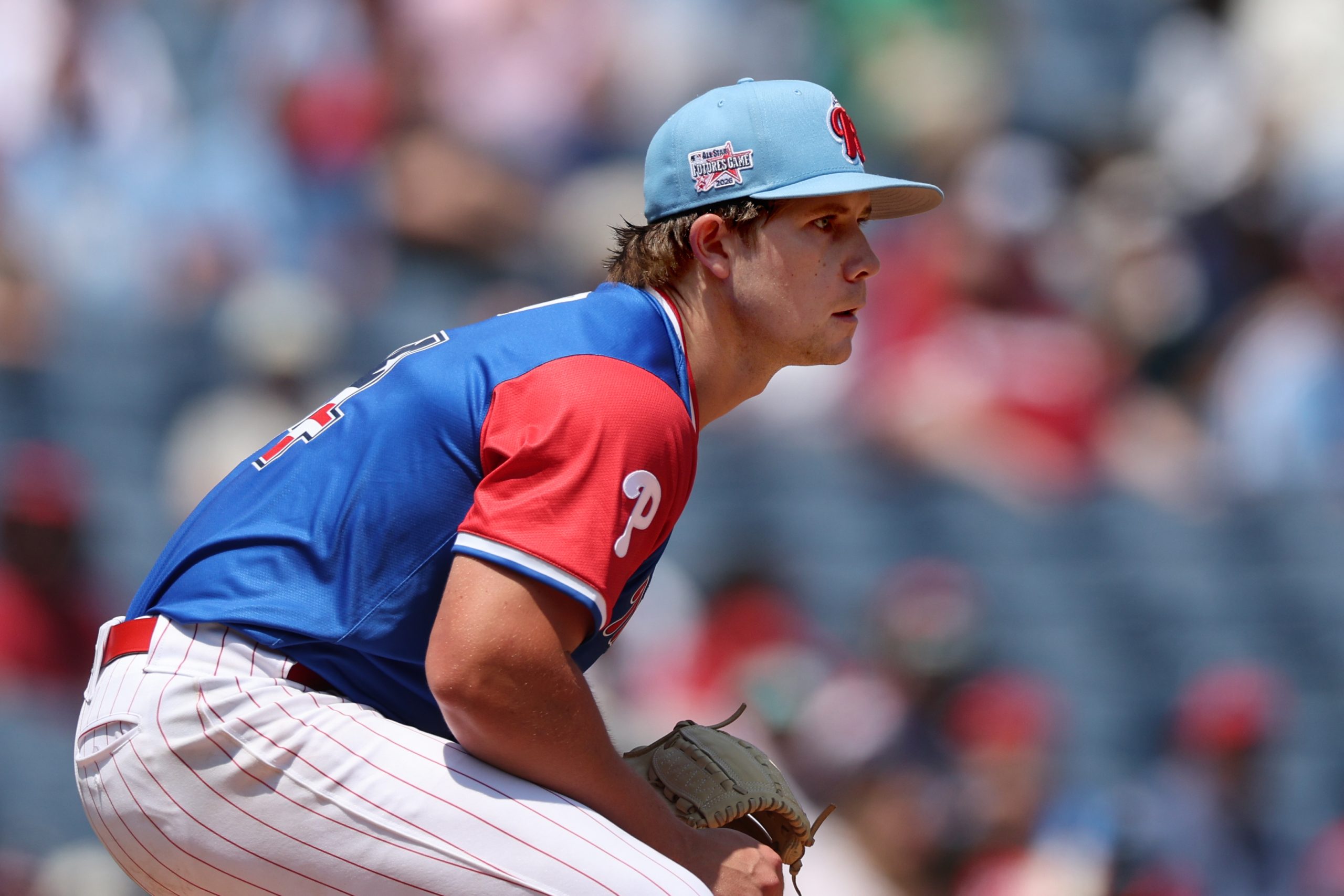
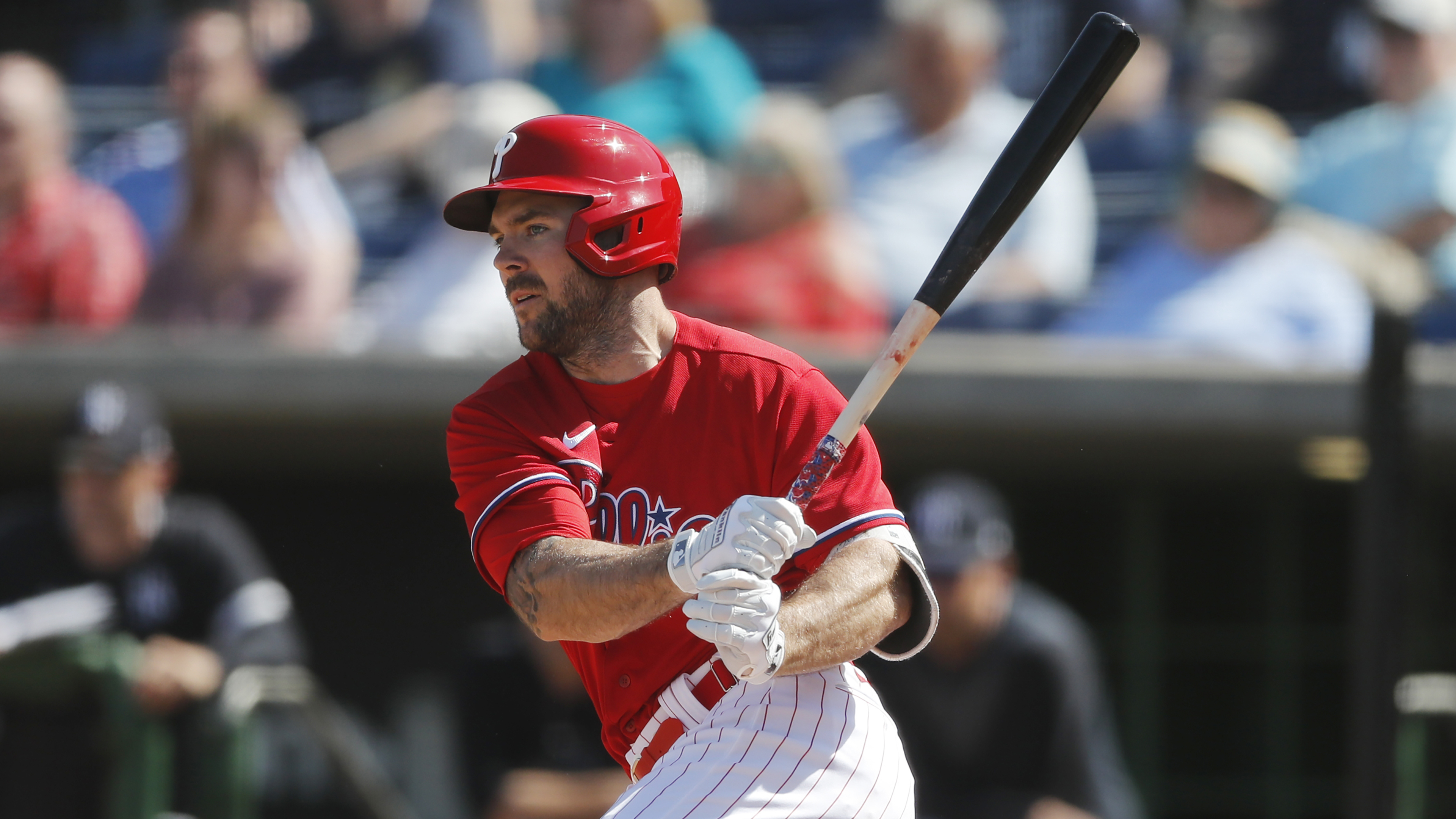
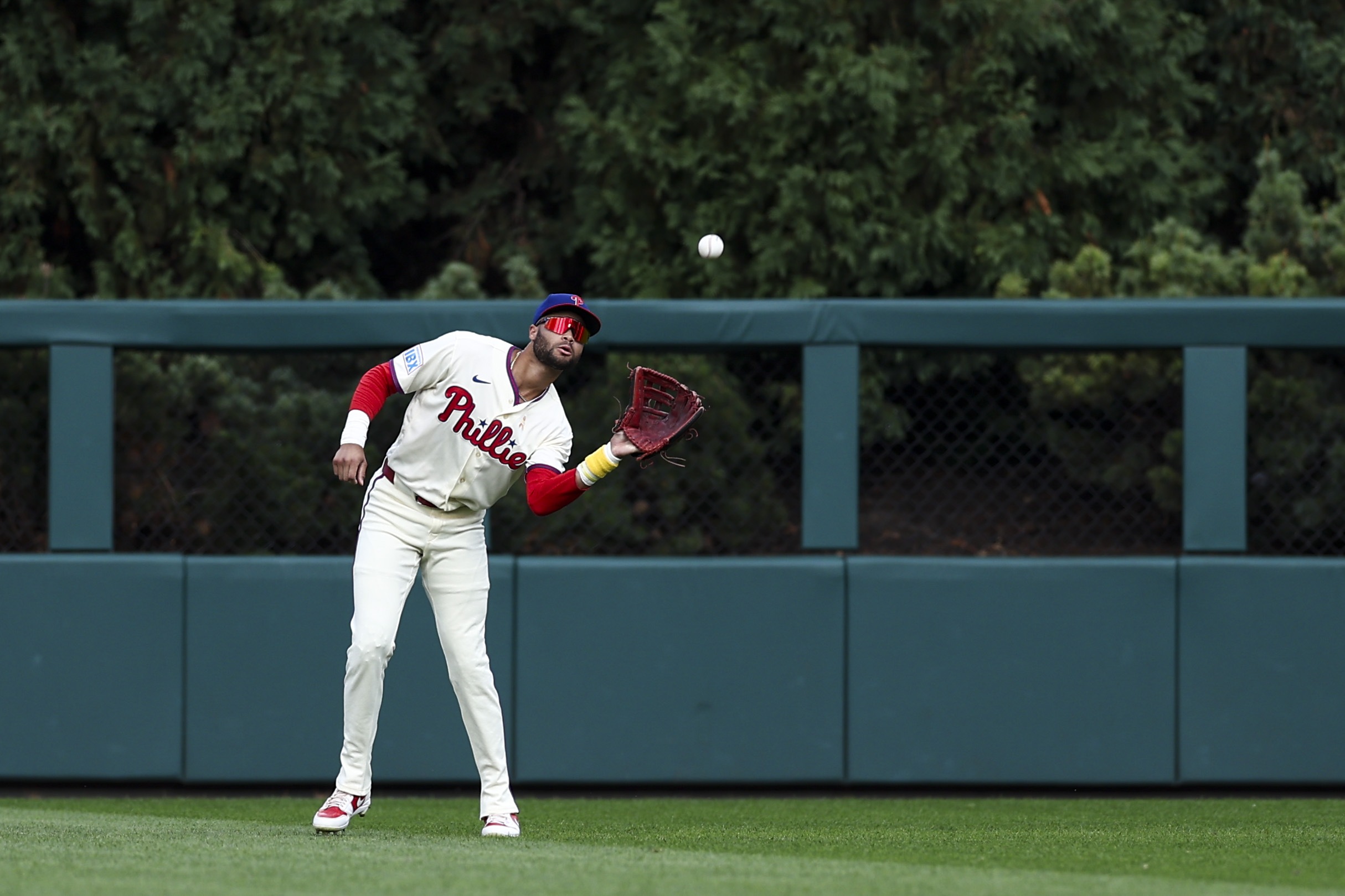
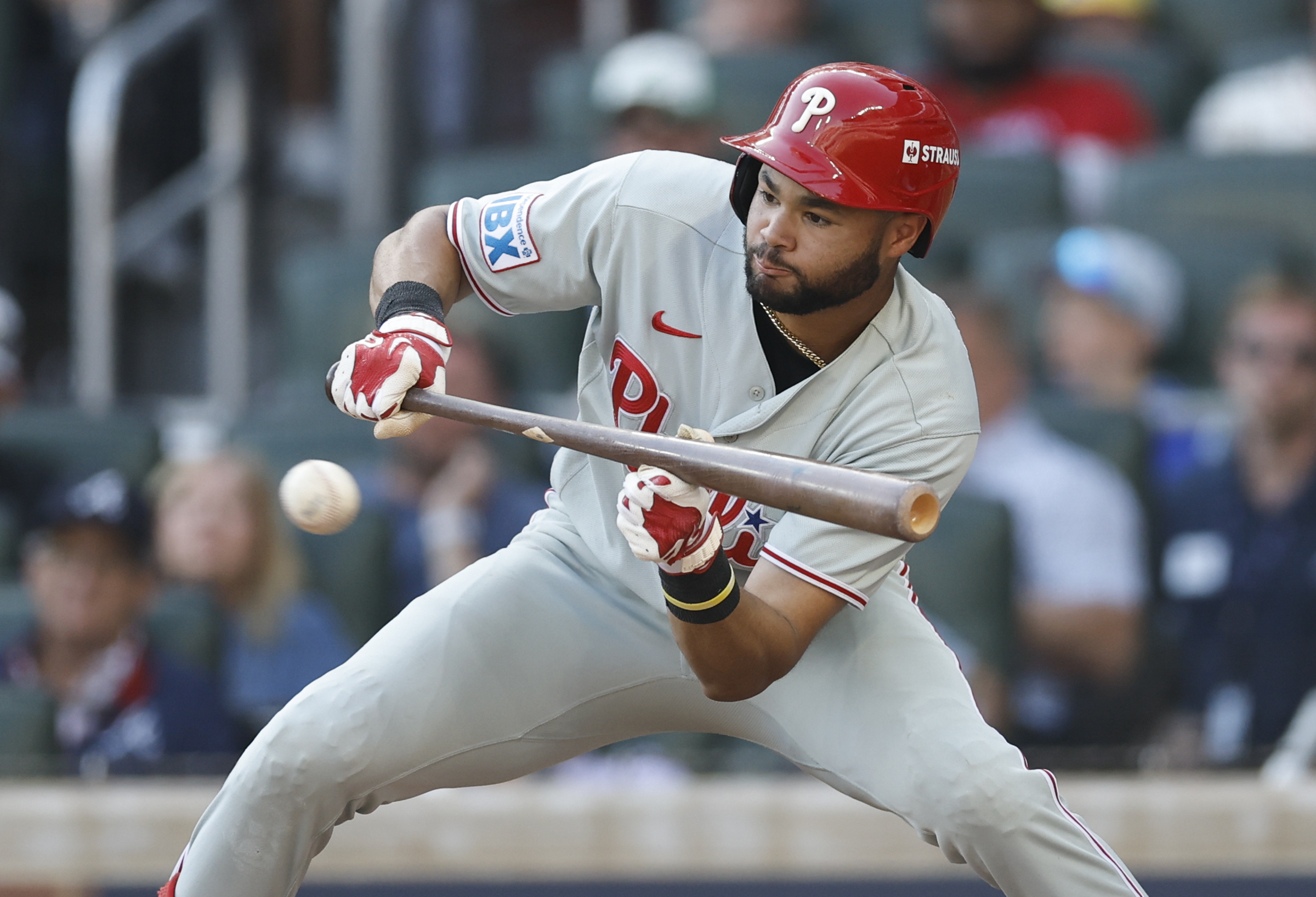
The Phillies added infield prospect Bryan Rincon to their 40-man roster on Tuesday, protecting him from being selected in the Rule 5 draft, the team announced.
Tuesday marked the deadline for clubs to protect eligible prospects from the draft, which is held annually at the winter meetings in December. The Rule 5 draft allows teams to select eligible players from other clubs’ minor league affiliates. Any player taken in the draft must stay on the new team’s 26-man roster for the entire season, or else be offered back to his original club.
It remains unclear whether the Rule 5 draft will be held next month, since it is scheduled for after the collective bargaining agreement expires on Dec. 1. During the 2022 lockout, the draft was canceled, but this year teams are still operating as if it will take place.
The Phillies opted to protect Rincon, a shortstop who had a .267 batting average and .927 OPS in 118 games with double-A Reading this season. The 22-year-old also hit 26 homers, and won the Paul Owens Award as the organization’s top minor league position player. The 40-man roster stands at 39 players.
According to MLB Pipeline, Rincon is ranked the Phillies’ No. 4 overall prospect.
Players signed at age 18 or younger must be protected within five seasons, while players who signed at age 19 or older must be protected within four seasons. Infielders Aroon Escobar (No. 6) and Juan Villavicencio (No. 19) and relievers Wen-Hui Pan (No. 20) and Mavis Graves (No. 26) were among the eligible players left unprotected.
Video: Former MLB GM Jim Duquette is remaining optimistic about 2027 MLB season | Phillies Extra
Phillies president of baseball operations Dave Dombrowski indicated his intention to protect Rincon from the draft during the general managers’ meetings last week in Las Vegas.
“Maybe our other decisions, you’re saying, ‘Well, maybe I’m willing to take this gamble because there may not be [a Rule 5 draft],’ but sometimes you don’t want to gamble others, and that one player I would not want to gamble on,” Dombrowski said.
One drawback of adding a player to the 40-man roster is that they will be included in the lockout that is expected to begin on Dec. 2. As a result, they will not be allowed to participate in the minor league season or communicate with their organization until a new collective bargaining agreement is reached.
For the Phillies, however, potentially losing one of their top infield prospects was seen as a greater risk.
“If something happened and there was a draft and we lost that guy, I’d be saying, ‘Oh my goodness gracious, I can’t believe that,’” Dombrowski said. “Because he might play on our big league club next year.”
In the three-game wild-card series loss to the Atlanta Braves, the Phillies used just four relievers.
Game 2 even required 10 innings to be decided. And still, the majority of the bullpen stayed seated, with manager Don Mattingly preferring to call on rookie starter Andrew Painter to cover the last three innings in that potential elimination game. The Phillies’ only true relievers to make appearances in the series were Jhoan Duran, Alex McFarlane, Jonathan Bowlan, and Tim Mayza. Members of the rotation covered the rest.
It was a reflection of the state of the bullpen, and how few arms remained in Mattingly’s circle of trust by that point.
The unit was beleaguered by injuries all year, and several trusted arms fell down the depth chart after disappointing seasons. There were a few bright spots, namely the continued regular-season dominance of Duran and the emergence of McFarlane. But the bullpen as a whole is a major area of need for the Phillies this winter.
Here’s a breakdown of the relievers’ outlook for 2027 and beyond:
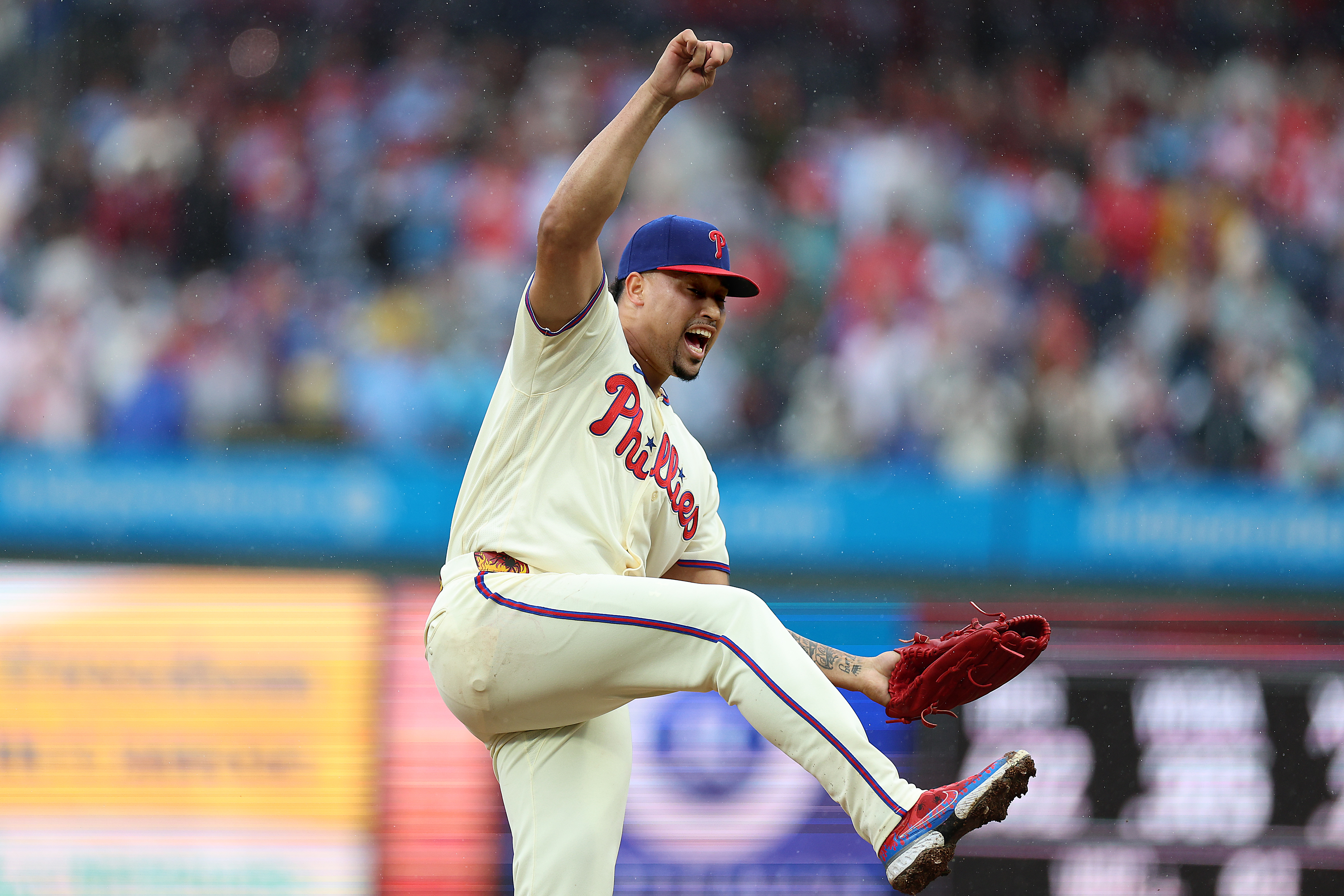
Phillies closer Jhoan Duran had a 1.82 ERA and 33 saves in 2026.David Maialetti / Staff Photographer
The closer
The Phillies’ last three postseason series losses — the 2024 National League Division Series against the New York Mets, the 2025 NLDS against the Los Angeles Dodgers, and the 2026 wild-card series against the Braves — all had a common thread: A late lead in Game 1, blown by the Phillies bullpen, that the team could not come back from.
The go-ahead three-run homer Duran surrendered to Austin Riley in the eighth inning of Game 1 was just the latest example. But this one was perhaps the most stunning, because it was against the Phillies’ most trustworthy reliever.
Before Riley’s homer, Duran had a 1.82 ERA, 0.994 WHIP, and 33 saves in the regular season. He had surrendered two total home runs over 59⅓ innings. It all contributed to Duran’s second-place finish in National League Reliever of the Year voting to the San Diego Padres’ Mason Miller.
Based on what was available to Mattingly, there likely wouldn’t have been a better matchup on paper against the right-handed Riley. Which was why the closer was in the game at all, having entered in the seventh with the goal of a three-inning save.
But therein lies the issue: The Phillies need more options. The bullpen starts with Duran, but cannot rely solely on him. Especially as the flame-throwing righty enters his final season of team control in 2027, the Phillies need to build around him.
Video: The Phillies are counting on youth in 2027 | Gameday Central
The setup arms
The “bridge to Duran” was a question mark that remained unanswered all season. Brad Keller signed a two-year, $22 million contract last offseason to fill that role, but he had an uneven first half that ended abruptly with a UCL tear.
Phillies president of baseball operations Dave Dombrowski said that Keller is on pace to return from Tommy John surgery at some point in the second half of 2027. Even if he remains on track, however, pitchers don’t always return to their pre-injury level immediately after surgery. Keller had a 4.02 ERA in 31⅓ innings in 2026, up from the 2.07 ERA in 69⅔ innings the year before with the Chicago Cubs. If he does return to the Phillies’ bullpen in 2027, it’s fair to wonder what version they’ll get.
For a good part of the season, it appeared that Bowlan was the front-runner for the setup job. But a groin strain in April followed by another in September cost him some time. And even before the second strain, Bowlan had been struggling for the last month of the season.
An ERA of 2.90 across the first four months shot up to 6.75 in seven appearances in September, which included one loss and one blown save. The struggles continued when Bowlan returned from the injury in Game 3, giving up a homer to Matt Olson in his only postseason appearance.
But Bowlan still has one of the best four-seam fastballs on the team. In 2026, the pitch had a plus-10 run value, with a 37% whiff rate. According to StatCast, Bowlan’s four-seam has 18 inches of rise, which is 2.4 inches more than the average right-handed pitcher. Armed with a pitch that limited hitters to a .118 batting average last year, Bowlan enters 2027 as one of the Phillies’ top available arms after Duran.
Jonathan Bowlan emerged as a reliable right-handed reliever for most of the 2026 season.Yong Kim / Staff Photographer
Another is McFarlane, who burst onto the scene in August and continuously earned more trust. McFarlane bounced between the minors and majors earlier in the season, including a daylong stint in April when he didn’t even get into a game. But after he was recalled a third time on Aug. 11, McFarlane ensured he wasn’t going back to triple A.
In 19 major league innings, McFarlane put up a 2.84 ERA and racked up 20 strikeouts. He jumped right into the fire, with his first major league out coming against Shohei Ohtani, and also later striking out the likes of Mike Trout, Nolan Arenado, Brice Turang, and Juan Soto. According to those around him, he has the demeanor suited for high-leverage moments. And at 25 years old, McFarlane is a needed injection of youth into the bullpen.
But McFarlane doesn’t have enough experience to truly seize the setup role just yet. Entering 2027, it’s still a question mark.
“Is there [a setup man] that you would anoint right now? My answer is no,” Dombrowski said. “Do I think there can be one? Yes. As does our pitching people. I mean, you cannot believe the number of inquiries we get about a couple of our right-handed relievers to the point where somebody thinks they might be their closers.”
The Phillies didn’t get to see much of Caleb Kilian after they acquired him from the Giants before the Aug. 3 trade deadline.Yong Kim / Staff Photographer
Other righties
The Phillies didn’t have much to judge Caleb Kilian on, as he suffered an oblique injury just 3⅓ innings into his Philadelphia tenure. Before the trade deadline swap that also brought over Luis Arraez in exchange for a pair of pitching prospects, Kilian had a 4.26 ERA with the San Francisco Giants.
The 29-year-old right-hander saw a large velocity jump in 2026, going from 93.6 mph with his fastball in 2024 (his last season in the majors) to 96.6 mph this season. With his four-pitch arsenal — four-seam, knuckle curve, sinker, slider — the Phillies believe he has the stuff to be a key piece.
“We think he’ll be an important part of our bullpen next year,” Dombrowski said of Kilian.
Chase Shugart, 30, will likely remain a right-handed depth arm. Shugart took the ball whenever asked in 2026, even twice in one day to earn the win in both ends of an April doubleheader. Shugart had a 4.02 ERA in 53⅔ innings, and is primarily suited for low-leverage.
The bigger question will be the future of Orion Kerkering. The Phillies reached an impasse with the righty in September as his second-half struggles continued, and decided to option him to triple A knowing it would prevent him from being included on the wild-card roster. It was the first time Kerkering, 25, had been optioned since making his major league debut in September 2023.
“It got to the point where it’s almost unusable,” Mattingly said at the time.
Phillies reliever Orion Kerkering ended the 2026 season at triple A.Yong Kim / Staff Photographer
He started the season strong, rebounding from the infamous Division Series-ending error that had some wondering if Kerkering would ever throw another pitch in a Phillies uniform. But things fell apart after the All-Star break.
“It’s not like he started out struggling,” Dombrowski said. “People have talked about we should have moved on after the year that he had, after what happened in L.A. the year before. I thought he approached that very well, and did what he needed to do to help himself, and it was apparent he did it, because he pitched well for us. But that’s going to kind of be up to us to try to figure that out with him. And I do think he has a chance to still be an effective big league pitcher.”
In the first half, Kerkering had a 2.43 ERA and 1.16 WHIP. In the second half, those figures ballooned to 9.43 and 1.95. He dealt with turf toe that had him in a walking boot away from the field for a period of time, but the Phillies did not believe there was anything physical causing Kerkering’s struggles.
In his final outing before being demoted, Kerkering’s velocity had lost a few ticks. His fastball, which averaged 97.2 mph, was down to 95.3 mph. Batters were hitting all his pitches hard, but especially his signature sweeper, which they averaged .429 against in the month of September.
It’s fair to wonder at this point whether Kerkering’s time in Philadelphia has run its course, and if a change of scenery might benefit him. But Dombrowski expressed some confidence in Kerkering’s capability.
“He has the ability to turn it around. He’s got a good fastball. He’s got a good sweeper, and they’ve given him a splitter,” Dombrowski said. “He didn’t perform to those capabilities. Am I confident? I’m not going to go into there and say that he’s going to be our setup guy or seventh-inning guy. Do I think he can turn it around? I think he can, but we’ll have to wait and see on that.”
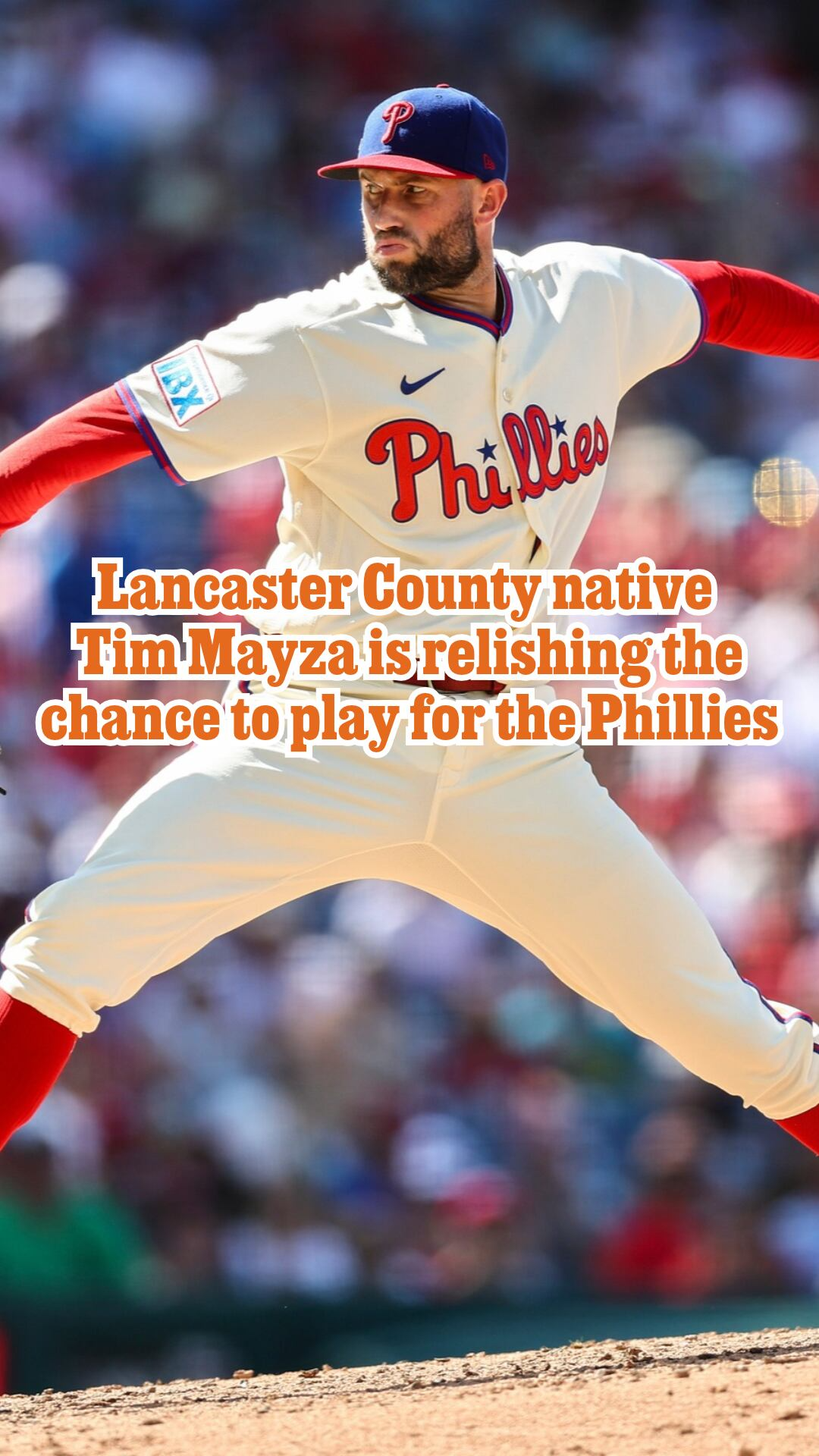
Video: Phillies pitcher Tim Mayza is relishing the chance to play for his hometown team | Phillies Extra
Left-handed struggles
One of the first moves the Phillies made this offseason was re-signing Mayza to a one-year, $2.75 million contract. The 34-year-old was one of the bullpen’s veteran leaders in 2026, filling a variety of roles: opener, bulk, and even occasionally high-leverage. He was also the Phillies’ only left-handed reliever to touch the mound during the wild-card series.
But that signing was just the first step. During the general managers’ meetings last week in Las Vegas, Dombrowski made his priority clear in acquiring a left-handed setup man.
“It’s something we want to really emphasize, with the number of left-handed hitters,” Dombrowski said.
That was what the Phillies hoped Brooks Raley might be at the trade deadline. It cost two prospects to acquire the lefty from the Mets, in what will likely live on as one of the worst trades in recent Phillies history. The 38-year-old had a 1.96 ERA with New York, but a 7.94 ERA with the Phillies. In 16 appearances after the trade, he was charged with three blown saves and two losses.
Raley wasn’t included on the wild-card roster.
He wasn’t the only lefty to struggle for the Phillies last season. As a collective, their left-handed relievers had a 4.58 ERA in 2026, which was third-worst in baseball. The Athletics and Washington Nationals were the only teams whose lefty relievers had higher ERAs, and they finished with records below .500.
José Alvarado is a free agent, with his tumultuous Phillies tenure likely coming to an end after a 5.86 ERA and 1.646 WHIP this season.
Phillies pitcher Tanner Banks struggled to regain his 2025 form.Elizabeth Robertson / Staff Photographer
The Phillies are hoping for a rebound from Tanner Banks, whose struggles led him to be optioned in June. After a 3.07 ERA campaign in 2025, Banks struggled to a 6.19 ERA this season. His walk rate went from 4.5% to 8.5%.
Banks also missed over two months of the season with a forearm strain, returning to fill a bulk role in September. He was somewhat improved in 7⅓ innings that month, with a 2.45 ERA.
Kyle Backhus remains intriguing, if only because he brings something different than any other pitcher on the Phillies roster. With an arm angle of 6 degrees, Backhus had the fourth-lowest arm slot of any lefty in the league in 2026.
For reference, the Phillies’ next-lowest left-hander is Jesús Luzardo with an arm angle of 26 degrees. Backhus had a 4.95 ERA in 20 innings in 2026 and didn’t quite carve out a major league role. But as a sidearmer he gives opposing hitters a completely different visual compared to anyone else on the staff.
However, none of these options seem likely to fulfill the setup role. And as the number of left-handed hitters in baseball continue to rise, the left-handed reliever increases in importance, too. In that regard, the Phillies are back to the drawing board.
Padres setup man Adrian Morejon could be a closer for many teams.Gregory Bull
Free-agent options
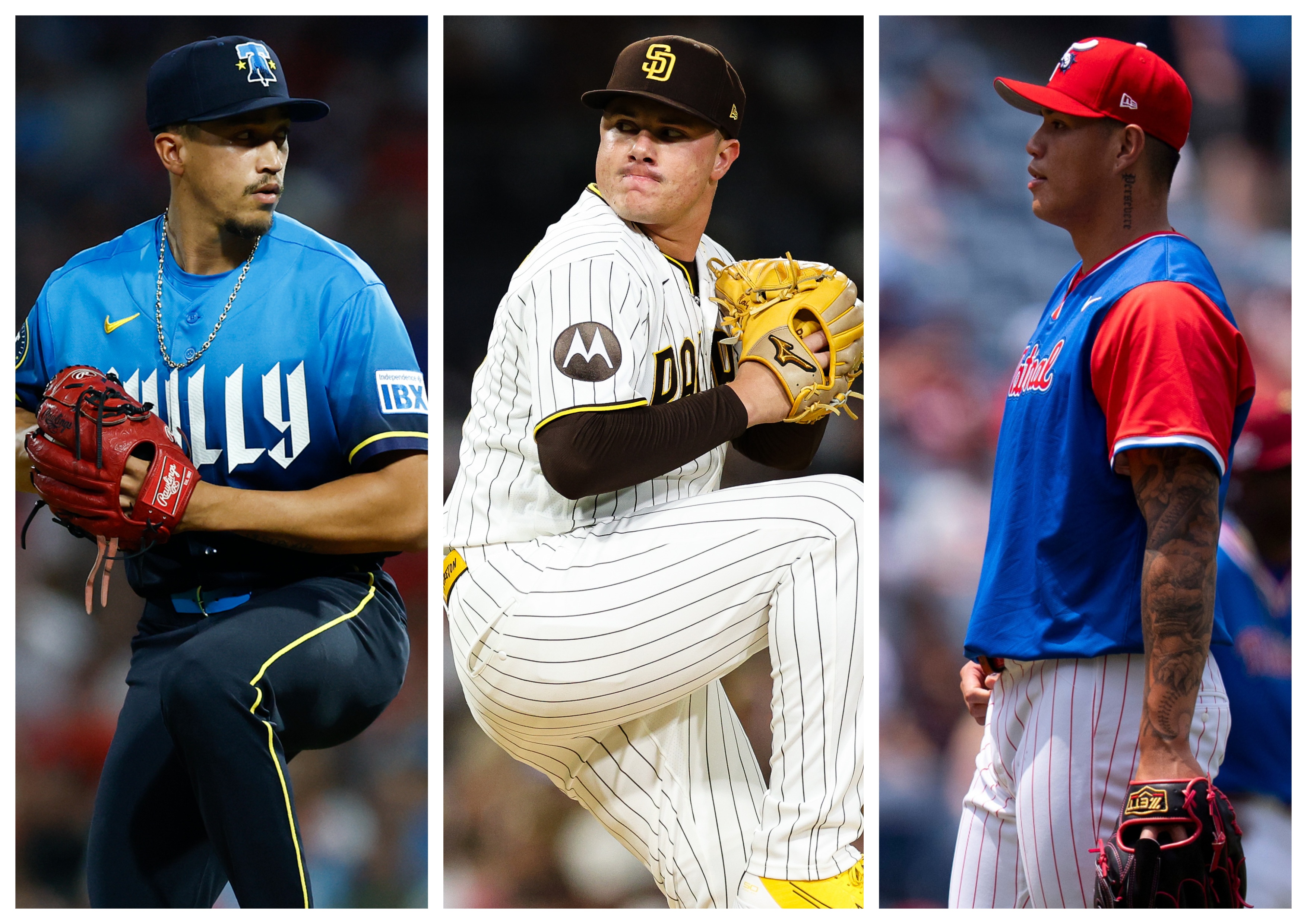
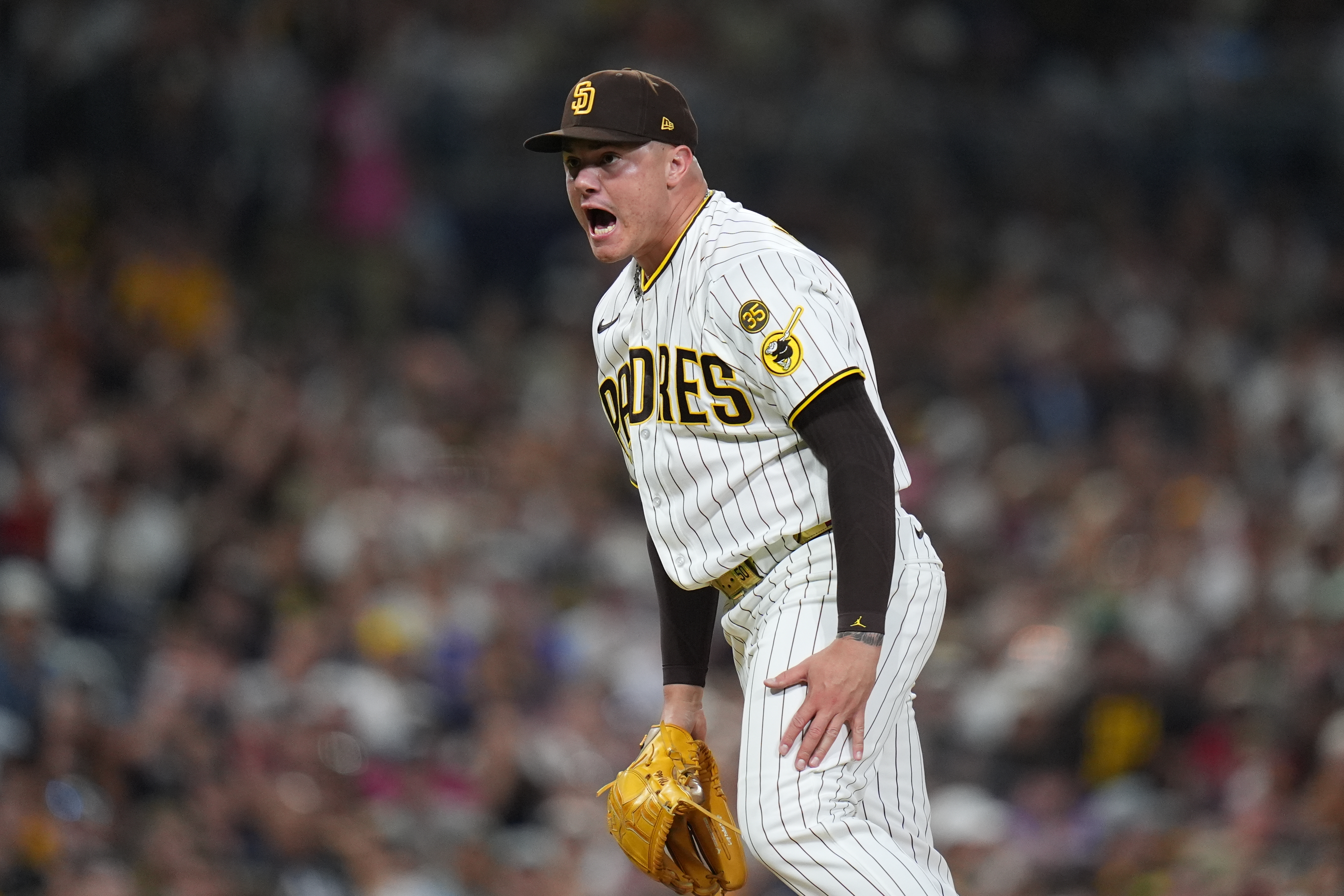
It’s a relatively deep free-agent class for relievers this winter, with Padres lefty Adrián Morejón leading the charge. Morejón would suit the Phillies’ needs exactly, as he pitched to a 2.83 ERA as the Padres’ setup man last season.
Morejón, whose four-pitch arsenal contributed to a 38.6% chase rate, 34.2% whiff rate, and 30.4% strikeout rate, could be a closer on most teams in baseball. He just happened to be blocked from that role on the Padres by Miller, who beat out Duran for National League Reliever of the Year and even garnered some Cy Young votes.
But Morejón is accustomed to high-leverage situations, and has the stuff to back it up. He can touch triple digits with his fastball, and his 58% ground-ball rate in 2026 was in the 98th percentile of pitchers.
Morejón, who will be 28 in February, has recorded an ERA under 3.00 in each of the last three seasons.
To sign a pitcher like Morejón, it’s likely that the Phillies will have to offer a multiyear deal. That’s not something Dombrowski typically likes to do for relievers, excluding last winter’s two-year deal for Keller. But it will be necessary if the Phillies want to compete for a higher-caliber arm.
“Last year, we gave [Keller] two, we hadn’t done in a while, he got hurt. It shows the volatility,” Dombrowski said. “There’s the rare exception of the star relievers, but there’s not very many of them around. I prefer [one-year contracts], but [it] doesn’t mean you’re going to get a deal done if you stick to that all the time. Sometimes you have to. I have felt myself, for relief pitchers, the shorter the better because of the volatility.”
Free agent lefthander Alex Vesia had a 2.64 ERA and 1.07 WHIP in 58 innings.Derik Hamilton
For a sense of the market, one of the first relief pitchers off the board this winter was righty Evan Phillips, who signed with the Braves for three years and $35 million. And that was after Phillips only pitched 26 innings in 2026 upon returning from Tommy John surgery in July.
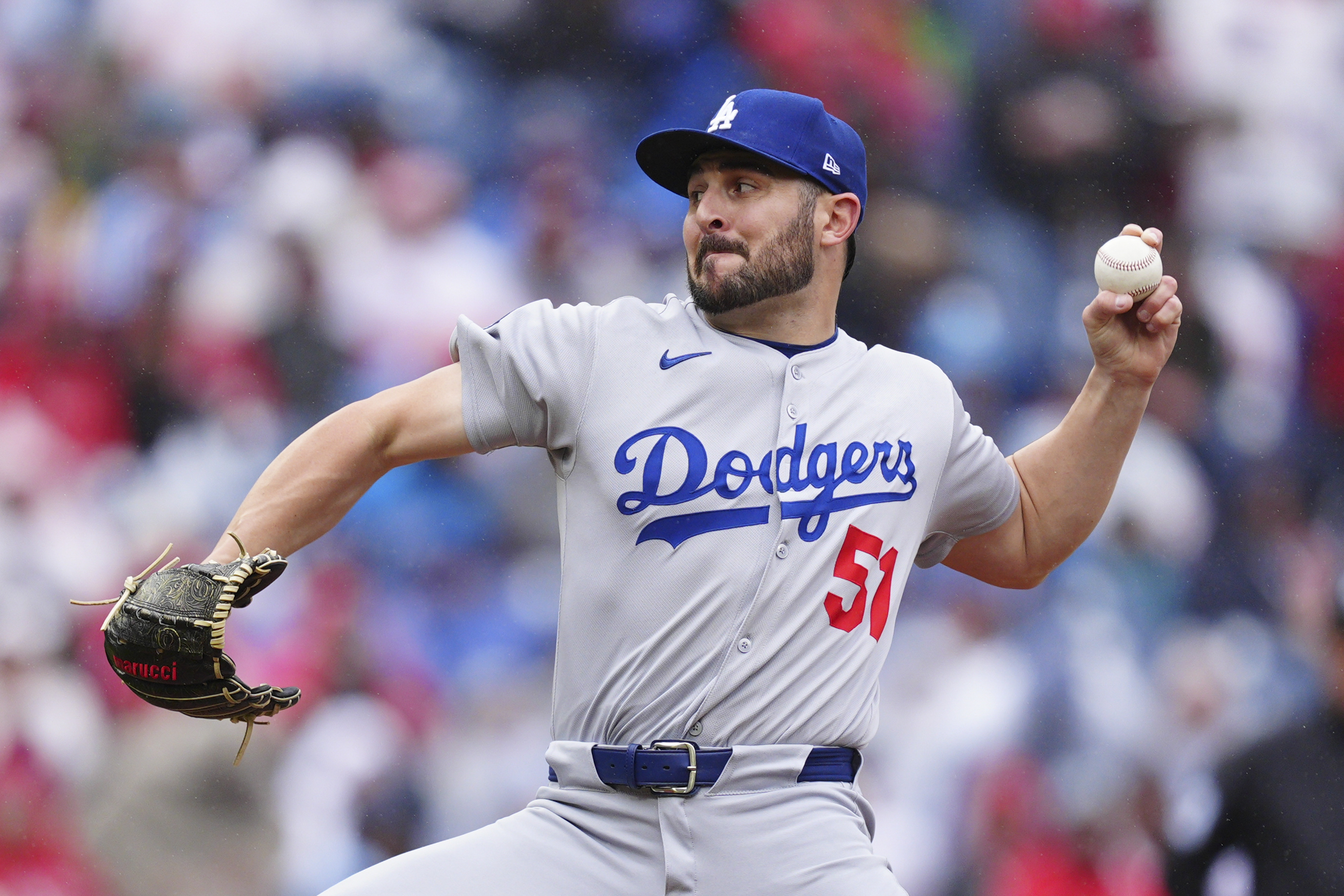
Alex Vesia is another top left-hander available, coming off a strong season with the Dodgers. Vesia, 30, recorded a 2.64 ERA and 1.07 WHIP in 58 innings. He doesn’t have blazing velocity, sitting at 92.1 mph with his fastball, but the pitch is deceptive and helps Vesia generate a lot of whiffs (33.6%). He is effective against lefties (.138 batting average against) and righties (.155).
At 33 years old, A.J. Minter might be a more affordable option. The lefty had a 2.56 ERA and 1.051 WHIP in 45⅔ innings this season, and netted the Mets a pair of infield prospects when they dealt him to the Minnesota Twins at the trade deadline. Minter does have an injury history, though. He missed some time early in the season as he worked his way back from left lat surgery, returning to the mound in May.
Just because lefties are the Phillies’ priority, however, doesn’t mean they won’t look to add to their stable of righties if a deal comes together. A pitcher like Jonathan Loáisiga could also be a fit after his 2.42 ERA season with the Arizona Diamondbacks.
The 67 innings Loáisiga turned in for Arizona this year was his highest workload in five seasons. He saw the bulk of his appearances in the seventh, eighth, and ninth innings, recording two saves. Loáisiga’s fastball sat around 98 mph, and hitters averaged .148 against his four-seam. He generated a lot of chase (35.9%), while keeping his walk rate to just 5%.
The Phillies aren’t closing the door completely on top pitching prospect Gage Wood going to the bullpen at some point.
On the farm
The Phillies continue to view top pitching prospect Gage Wood as a starter, and will continue to build him up with the goal of impacting their major league rotation. But they are not closing the door completely on a future move to the bullpen.
In fact, the Phillies discussed potentially calling up Wood, who spent most of 2026 in double A, as a reliever last season. They ultimately decided against it, but it was an option on the table. If the need arose again, the Phillies would consider it.
“I can never say no to anything, but for me, I think it’s important he continues to develop as a starter,” Dombrowski said of Wood. “We think he can be a starter. We need starting pitching depth, so I think it’s more important for us to use him like that. … You could always do that later. You can’t stretch them out, necessarily, later, but you can do that.”
Right-hander Wen-Hui Pan returned from Tommy John surgery this season after being sidelined for all of 2025. Ranked the Phillies’ No. 20 prospect by MLB Pipeline, Pan had a 3.10 ERA in 38 relief appearances this season. His 40 ⅔ innings spanned three levels, with Pan finishing the season in double A.
Pan, 24, gets a lot of chase, with a 35.87% rate. He picked up six saves and finished the year strong, with five consecutive scoreless appearances to close out September.
Mavis Graves is another intriguing prospect. He began the season in the starting rotation for high-A Jersey Shore, but the lefty shone after a promotion to double A that came with a change in role. Graves, who turns 23 this week, had a 0.96 ERA in 14 relief appearances (18⅔ innings) for Reading. He held opposing hitters to a .152 batting average.
Video: Phillies Extra: Have the Phillies done enough to add talent to their farm system?
Estibenzon Jimenez also had a strong season at double A, converting all seven of his save opportunities after taking over closing duties from the graduated McFarlane. Jimenez, a 24-year-old right-hander, had a 2.38 ERA in 45⅓ innings and threw the final pitch to clinch Reading’s first Eastern League title since 1995.
Jimenez continued to get reps in the Arizona Fall League, where his numbers weren’t as stellar, with a 7.88 ERA in eight innings. However, that is somewhat inflated by one blowup outing on Oct. 26, when Jimenez was charged with five earned runs in one inning.
There’s only one Big Papi. And before his annual celebrity golf event last weekend, the Hall of Fame slugger sat down with Phillies Extra to discuss Kyle Schwarber’s pursuit of 500 homers, watching Bryce Harper take batting practice as a teenager, and how Dave Dombrowski can improve the Phillies’ roster. Watch here.
Thursday will mark the release of one of the most highly-anticipated video games in years, Grand Theft Auto VI. The video game franchise has had a massive cultural impact across different platforms, spreading from the video game world into the sports sphere — partnering with sports teams like the Miami Heat for themed game nights with “Vice City” jerseys, and leaving athletes like Steven Adams worried about players’ performance across the NBA and NFL once the game is released.
Its return ends a 13-year wait since the release of GTA V, which came out in September 2013. A lot has changed since. When it debuted, Barack Obama was president; the second film in The Hunger Games series, Catching Fire, was about to be released in theaters; Breaking Bad was airing its final episodes; and Katy Perry’s “Roar” was on repeat on the radio stations.
As different as it sounds, that’s nothing compared with the changes that have happened in Philly sports — we’re still making Hunger Games movies, after all. In fact, 2013 itself was a big year of change across the city’s sports scene. As fans all over the internet celebrate the game’s long-awaited release by comparing life 13 years apart, let’s take a look at the viral trend through the lens of Philly sports.
The current Sixers roster includes future Hall of Famer LeBron James, five-time All-Star Jaylen Brown, two-time All-Star Tyrese Maxey, former league MVP Joel Embiid, and rising star VJ Edgecombe.
But 13 years ago, during the release of GTA V, these players were all at very different stages of their lives and basketball careers. James was on the verge of winning his second NBA title with the Miami Heat and already had close to a decade of NBA experience. Embiid, meanwhile, was a freshman at the University of Kansas, and had only been playing basketball for a couple of years. Brown was a junior at Wheeler High School in Georgia. Maxey (13 years old) and Edgecombe (8) were still dreaming of playing at the next level.
The Sixers’ organization was also at a different stage of its life.
In 2013, the team was at the start of The Process under former general manager Sam Hinkie. The multiyear rebuilding strategy focused on exchanging current players for assets, and intentionally losing to gain multiple high draft picks. Some of the first dominoes fell when the team traded reigning All-Star and future six-time All-Defensive Team player Jrue Holiday to the New Orleans Pelicans on draft night in 2013 for the rights to Nerlens Noel and a future first-round pick. With the 11th overall pick, they also selected Michael Carter-Williams, who would be traded away less than 18 months later — after winning rookie of the year.
The Sixers won just 47 games over the next three seasons — including going 19-63 in 2013-14 — resulting in several high draft picks. During The Process, the team selected Embiid with the third-overall pick in the 2014 draft and Jahlil Okafor third overall the following year. Then, with back-to-back first-overall picks in 2016 and 2017, the Sixers took Ben Simmons and Markelle Fultz, respectively.
Embiid is the only player from that era who remains on the team, which otherwise looks nothing like the one that is currently off to one of the best starts in the NBA.
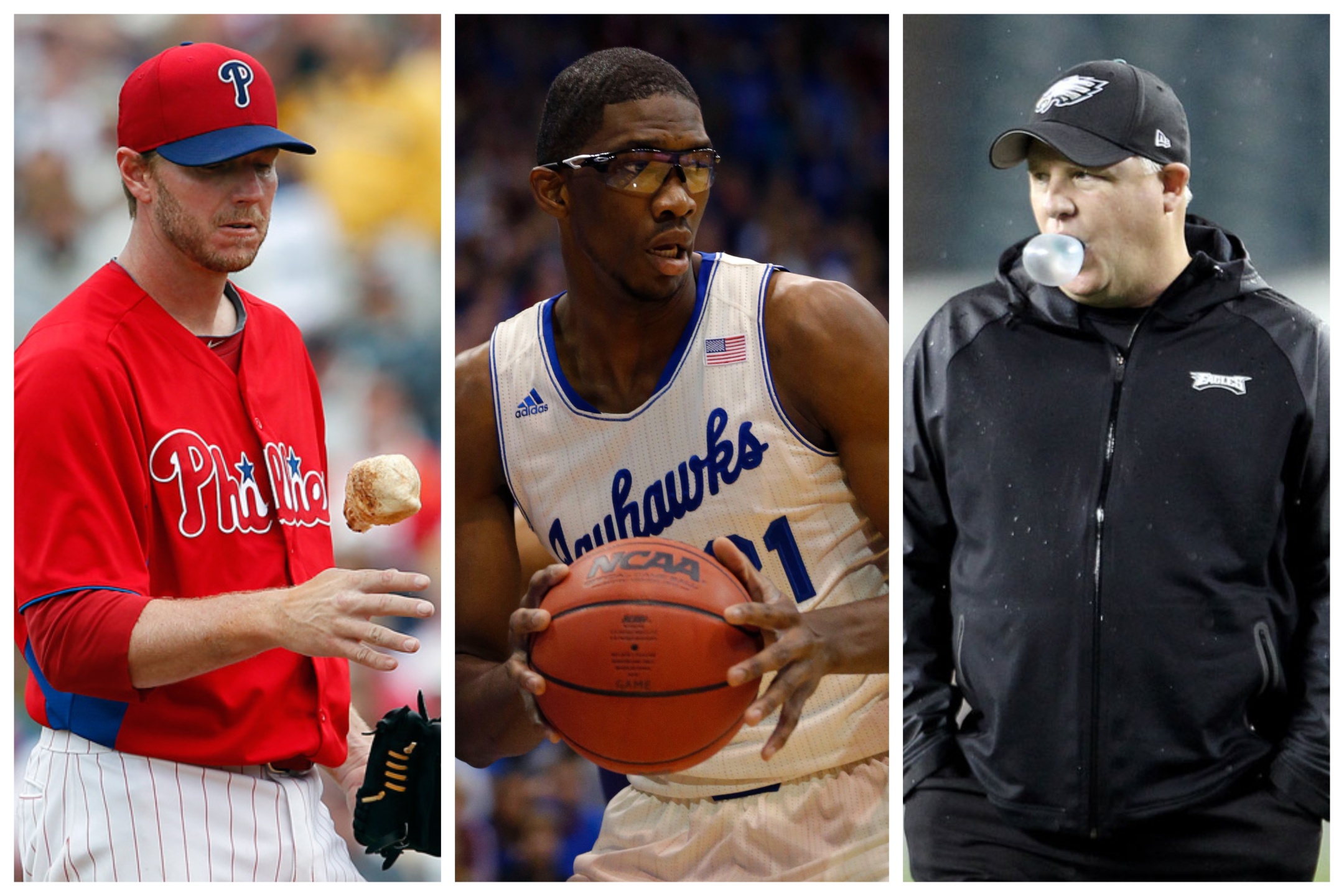
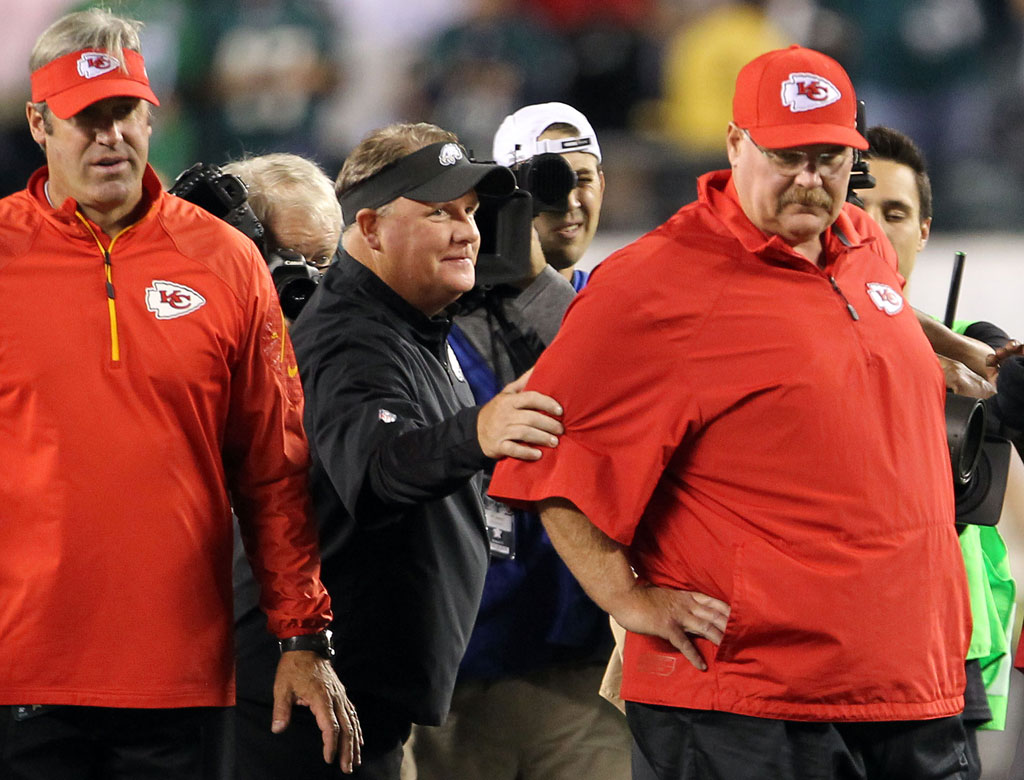
A trio of former Eagles coaches in one shot. Andy Reid (right) was replaced after the 2012 season by Chip Kelly (middle), who was replaced after 2016 by Doug Pederson (left).
The Eagles: The Chip Kelly Era
It was the start of the Chip Kelly era for the Birds. In 2013, following a disappointing 4-12 season that would be head coach Andy Reid’s last with the Eagles, the team hired Kelly, and left fans dreaming of a potentially revolutionary offense under the former Oregon Ducks coach. In Kelly’s first year, he led the Eagles to an NFC East division title with a 10-6 record before losing to the New Orleans Saints in the wild-card round.
The 2013 team featured players like Michael Vick, Nick Foles, LeSean McCoy, DeSean Jackson, Zach Ertz, Brandon Graham, Jason Kelce, Connor Barwin, Brent Celek, Fletcher Cox, and DeMeco Ryans.
But perhaps the biggest difference for Eagles fans in 2013? No Super Bowls. That’s no longer the case, thanks in large part to the contributions of many of the players listed above.
The Kelly Era was short-lived. In 2015, during his third season at the helm, Kelly was fired following a 6-9 start. Kelly was criticized for his lack of “emotional intelligence,” as well as for making questionable roster moves that included releasing Jackson, and trading McCoy and Foles. This came after a power struggle that saw him wrestle roster control away from general manager Howie Roseman.
But even at their lowest under Kelly, the Eagles had never lost seven straight games — and never had a record this poor, this late in the season. Ahead of the release of GTA VI, the Eagles are 2-7, are in last place in the NFC East, and haven’t won a game since mid-September.
Many of the team’s current stars weren’t even in college yet when GTA V first hit the shelves. And some weren’t even old enough to play the violent game, which carries a “Mature” rating and is meant for players 17 and older. Jalen Hurts was a quarterback at Channelview High School in Texas, Saquon Barkley was a running back at Whitehall High School in Pennsylvania, and Cooper DeJean was just a 10-year-old kid in Odebolt, Iowa.
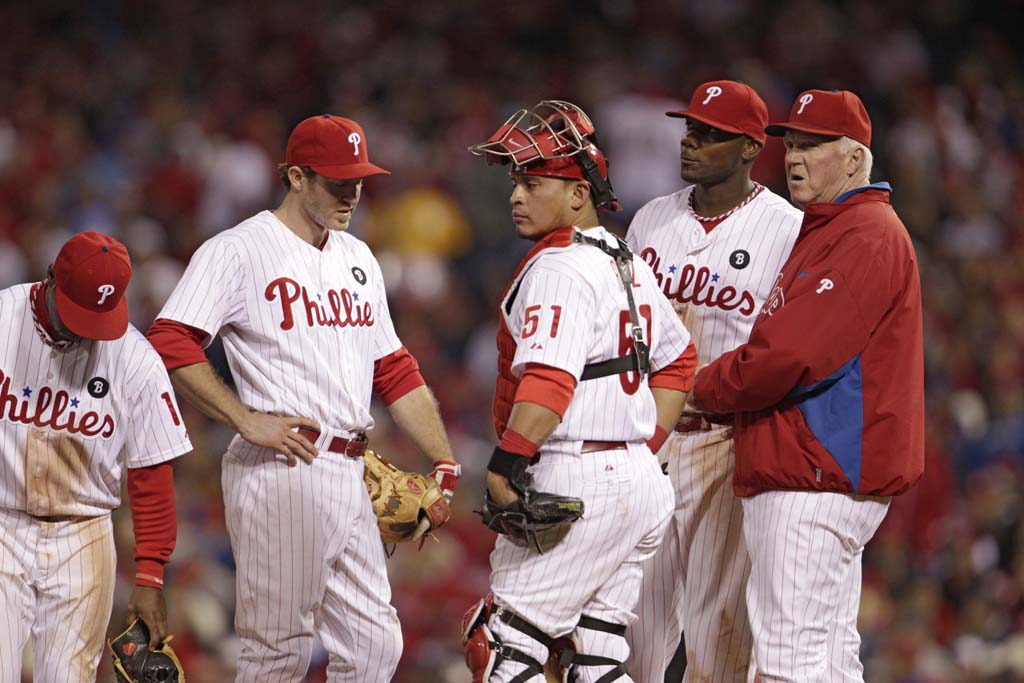
Jimmy Rollins (from left), Chase Utley, Carlos Ruiz, and Ryan Howard, meet with former Phillies manager Charlie Manuel (right) after he pulled Cliff Lee (not pictured) from a game.
The Phillies: End of an era
In the years leading up to the 2013 season, the Phillies found plenty of success, but were backsliding each year. During their run of winning five straight National League East titles (2007-2011), the team peaked with a 2008 World Series title, but was eliminated one round earlier each year, capped off by a National League Division Series loss following a 102-win season in 2011. In 2012, the team’s string of playoff appearances and division titles came to an end as they finished the season .500 (81-81), starting a run of nine straight seasons without a winning record and a decade of being shut out of the playoffs.
The 2013 team featured household names like Chase Utley, Jimmy Rollins, Cole Hamels, Ryan Howard, Roy Halladay, Cliff Lee, and Carlos Ruiz. But over the next three seasons, almost all of those players would be gone. And in August of that season, with the team at 53-67, manager Charlie Manuel, who led the team to its first title in 28 years, was fired and replaced by Ryne Sandberg, who finished the season as interim manager before taking the role full-time.
The Phillies Lineup when GTA V released (September 17, 2013):
1. Cesar Hernandez CF 2. Jimmy Rollins SS 3. Chase Utley 2B 4. Carlos Ruiz C 5. Domonic Brown LF 6. Darin Ruf RF 7. Kevin Frandsen 1B 8. Freddy Galvis 3B 9. Roy Halladay SP
The Flyers had made the playoffs in 16 of the previous 17 seasons, but coming off a shortened 2012-13 season (due to the NHL lockout) in which they failed to reach the postseason, they wasted no time acting. The team opened the 2013-14 season with three straight losses, leading to the firing of head coach Peter Laviolette less than a week into the season. Craig Berube stepped in and lead the team to a 42-30-10 record, getting the Flyers back to the playoffs as the third seed in the Metropolitan Division, before they lost to the New York Rangers in the first round.
The team featured players like Claude Giroux, Wayne Simmonds, Scott Hartnell, Jakub Voracek, Kimmo Timonen, Steve Mason, and Brayden and Luke Schenn.
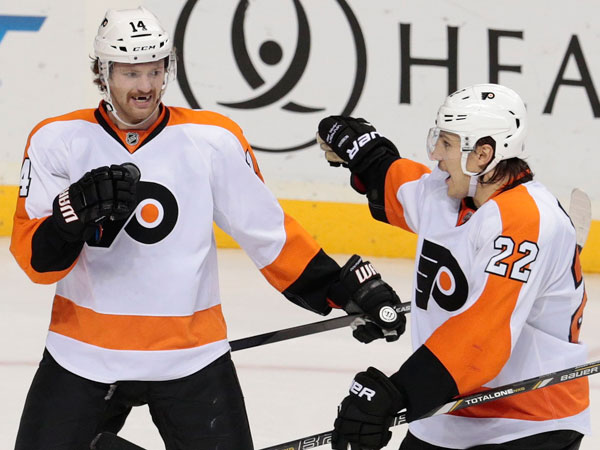
Flyers center Sean Couturier (14) celebrates a November 2013 goal with Luke Schenn (22).
It also featured one player who is still wearing the orange and black: current Flyers captain and the longest tenured athlete in Philly sports Sean Couturier. Then a 21-year-old center, Couturier was the youngest player on the team — he is now the second oldest at 34 — and was eighth in total points with 39 (13 goals, 26 assists) while appearing in all 82 games.
In 2013, the Union was in only its fourth year of existence, and was in search of its second Major League Soccer postseason berth, which wouldn’t come for a few more years (2016). Now, 13 years later, the team is a regular in the postseason, qualifying this season for the ninth time in the last 10 years. After a slow start, the team caught fire following the World Cup break, and went several months without losing a game.
A few days after the release of GTA VI, the No. 6 seed Union will face the third-seeded New England Revolution in Game 1 of their best-of-three first-round series.
The Union’s turnaround has been in part sparked by a trio of young players who was more than just too young to play GTA V; they were likely too young to play most video games: Cavan Sullivan, now 17, was just three when the game was released. Meanwhile, 19-year-old Neil Pierre was six and 20-year-old Frankie Westfield, was seven. Perhaps some of the older players, like Andre Blake, who was drafted by the Union four months after the game’s release, and Alejandro Bedoya, who was already 25 when the game came out, can explain it to them.
When the Phillies announced that Chase Utley would be added to their Wall of Fame this year, it made sense to ask the question.
Can the Hall of Fame be far behind?
“One step at a time,” Utley said in March.
Well, the time has come to talk about it … again.
Utley is the top returning vote-getter on the 27-player ballot released Monday by the Hall of Fame. Six other former Phillies are listed, including Jimmy Rollins, Cole Hamels, and Bobby Abreu. Jake Arrieta, Jay Bruce, and Asdrúbal Cabrera are among 14 first-time candidates, a group headlined by Buster Posey and Jon Lester.
But Utley might want to get started on his speech. The iconic Phillies second baseman’s poll numbers rose to 59.1% last year, up from 39.8% and 28.8% in the previous two cycles since he made his ballot debut in 2024.
History says Utley will eventually vault over the Hall’s 75% bar for election. His trajectory is similar to that of Scott Rolen, who climbed from 35.3% in 2020 to 52.9% in 2021, 63.2% in 2022, and finally 76.3% in 2023.
Will 2027 be the year Utley paints Cooperstown red?
Consider this: Each year, new voters enter the process as they reach 10 consecutive years of membership in the Baseball Writers’ Association, while other voters are weeded out. It explains how a candidate’s year-to-year vote total changes when his statistics don’t.
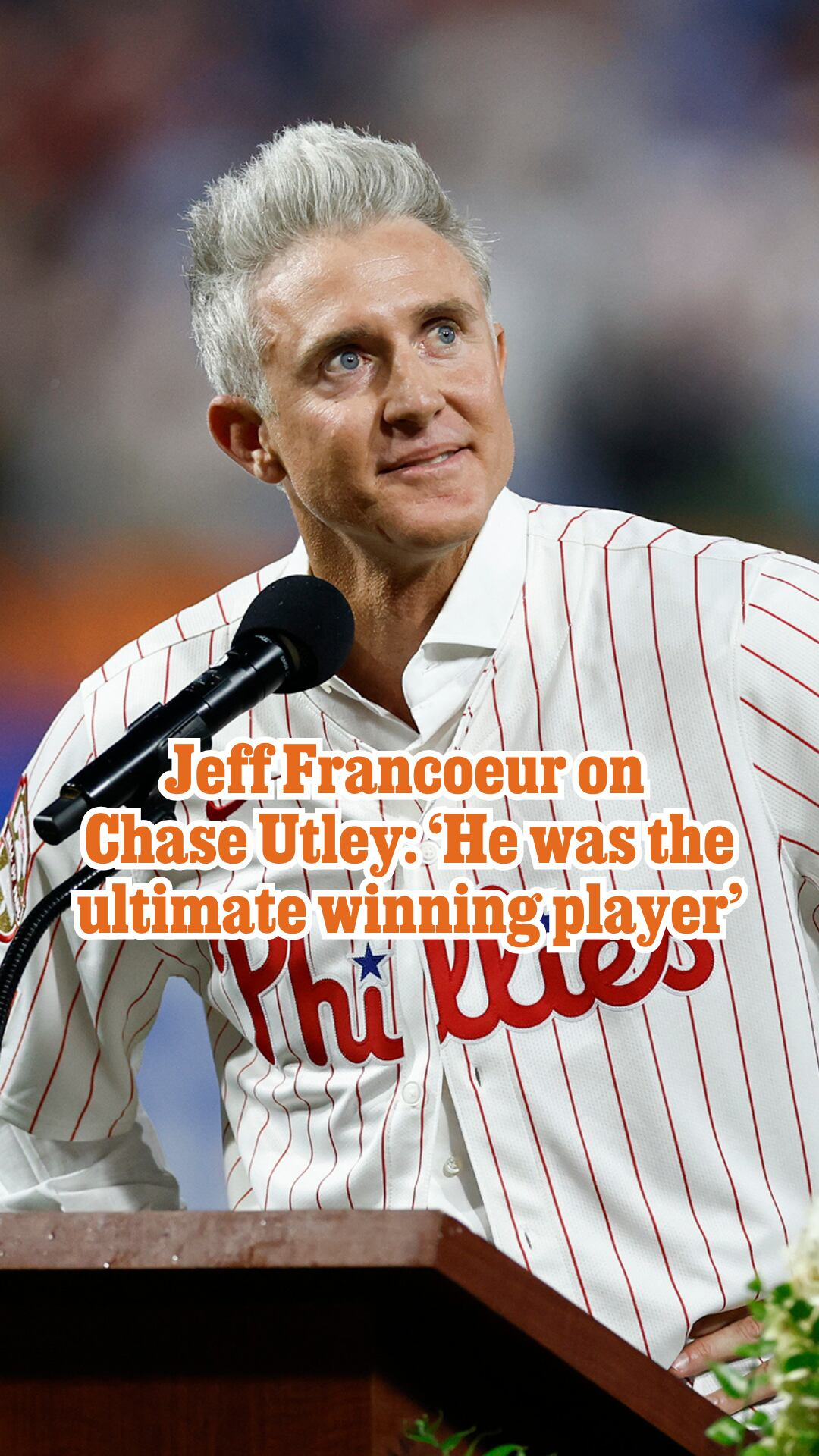
Video: Jeff Francoeur on Chase Utley: ‘He was the ultimate winning player’
Utley tends to do well with newer voters, many of whom are analytically minded and/or value big peaks over longevity. There were more first-time voters than usual last year (46, according to Ryan Thibodaux’s Hall of Fame tracker). Thibodaux is estimating only 15 to 20 first-time voters this year.
Since 1975, only Larry Walker and Ralph Kiner reached 75% without clearing 60% in the previous election cycle. And in both cases, they were in their final year of eligibility on the writers’ ballot.
Then again, Posey is the only first-year candidate with a strong chance to get elected. And his presence on the ballot could help Utley’s case. The three-time World Series-winning Giants catcher finished with 1,500 career hits; Utley had 1,885.
Regardless, Utley knows he’s getting closer.
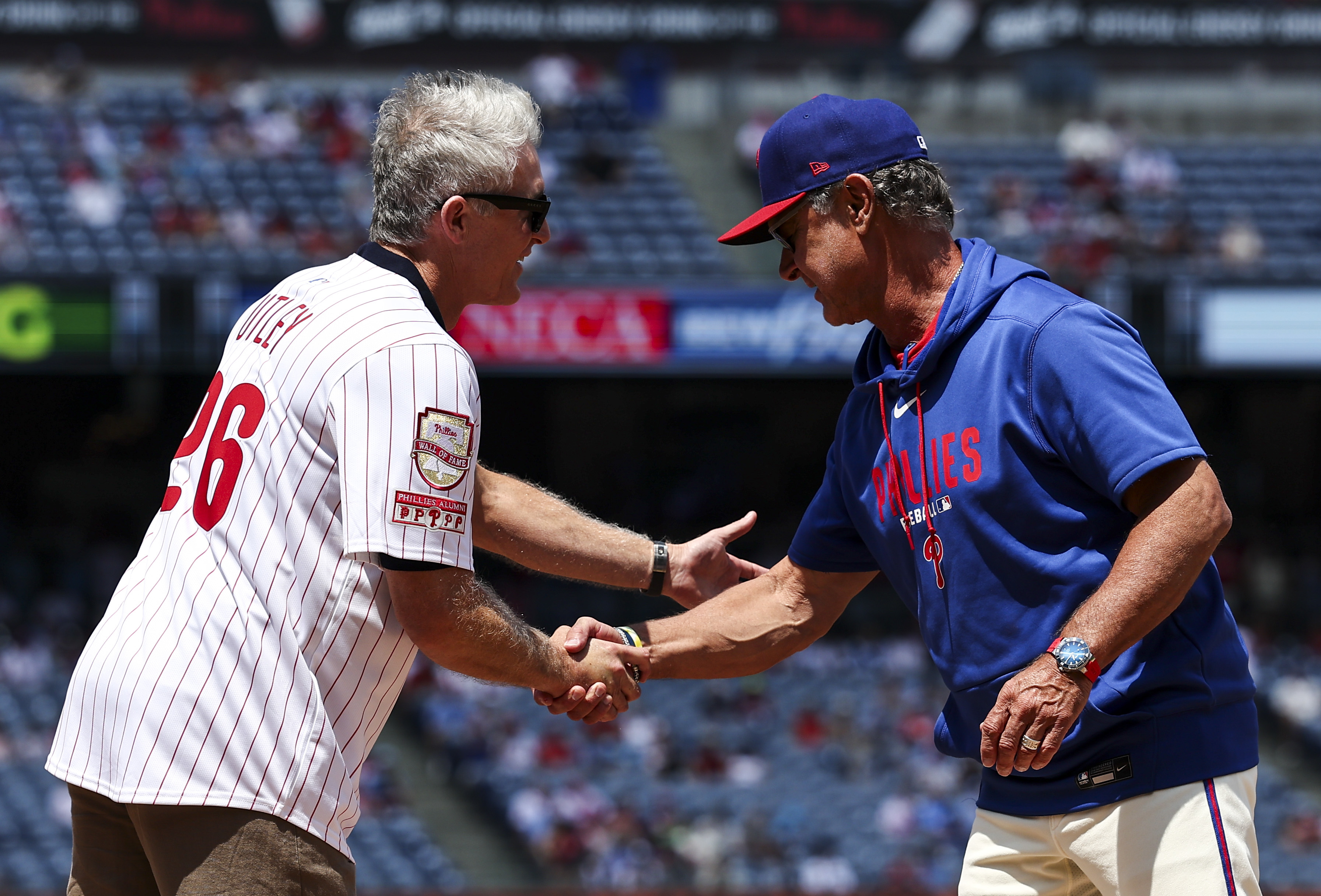
Chase Utley shakes hands with then-interim manager Don Mattingly on Aug. 9 at Citizens Bank Park.Monica Herndon / Staff Photographer
“I’ve tried to educate myself on how the process works,” he said. “And, yeah, it seems like it’s evolving a little bit different than it has in the past. But I think the game is evolving. We as people are evolving as far as how we identify good players and great players and Hall of Famers.
“Obviously you can’t help but pay attention to it.”
Rollins, entering his sixth cycle on the ballot, is seeking to continue his momentum after making his biggest jump yet to 25.4% last year.
Abreu also made a sizable gain last year, reaching 30.8% after treading water the previous three cycles (19.5%, 14.8%, 15.4%). But he’s running out of time in his eighth year on the ballot. (The Hall allows candidates to remain on the writers’ ballot for a maximum of 10 years.)
Hamels debuted last year with 23.8%, slightly ahead of fellow pitcher Félix Hernández’s 2025 debut (20.6%) before he jumped to 46.1% last year.
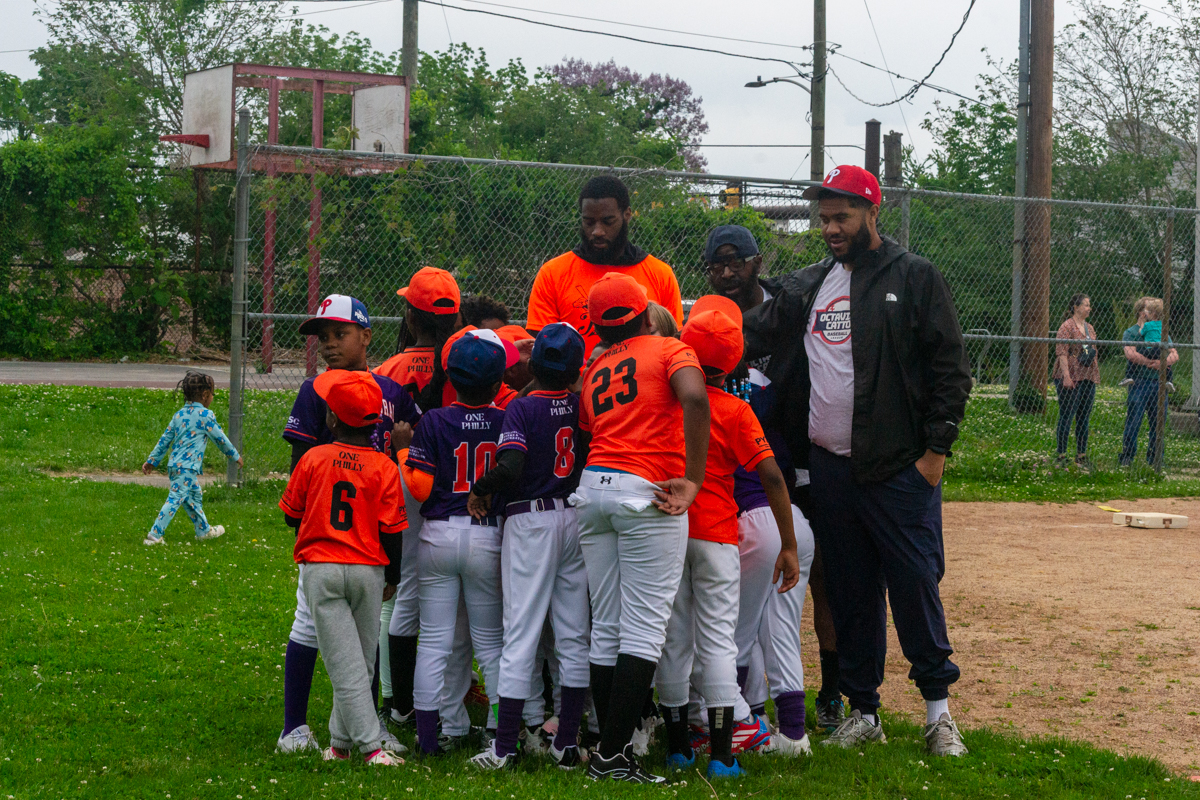
Julian Montgomery corralled his rowdy players into a circle by the dugout at the end of a youth baseball game at Lee Cultural Center in West Philadelphia.
“You guys started off a little bit slow, right, that’s just fine, but you guys turned it around, you guys finished strong,” Montgomery told his players. “Ultimately everybody’s a winner today, but I think you guys might’ve won that game.”
On the field, Montgomery looked like a natural, pitching the ball to his young players, but less than two months earlier, he hadn’t so much as even played baseball, let alone coached.
Montgomery and 19 other coaches took part in an entry-level, city-funded baseball league focused on introducing the sport to areas in North and West Philadelphia.
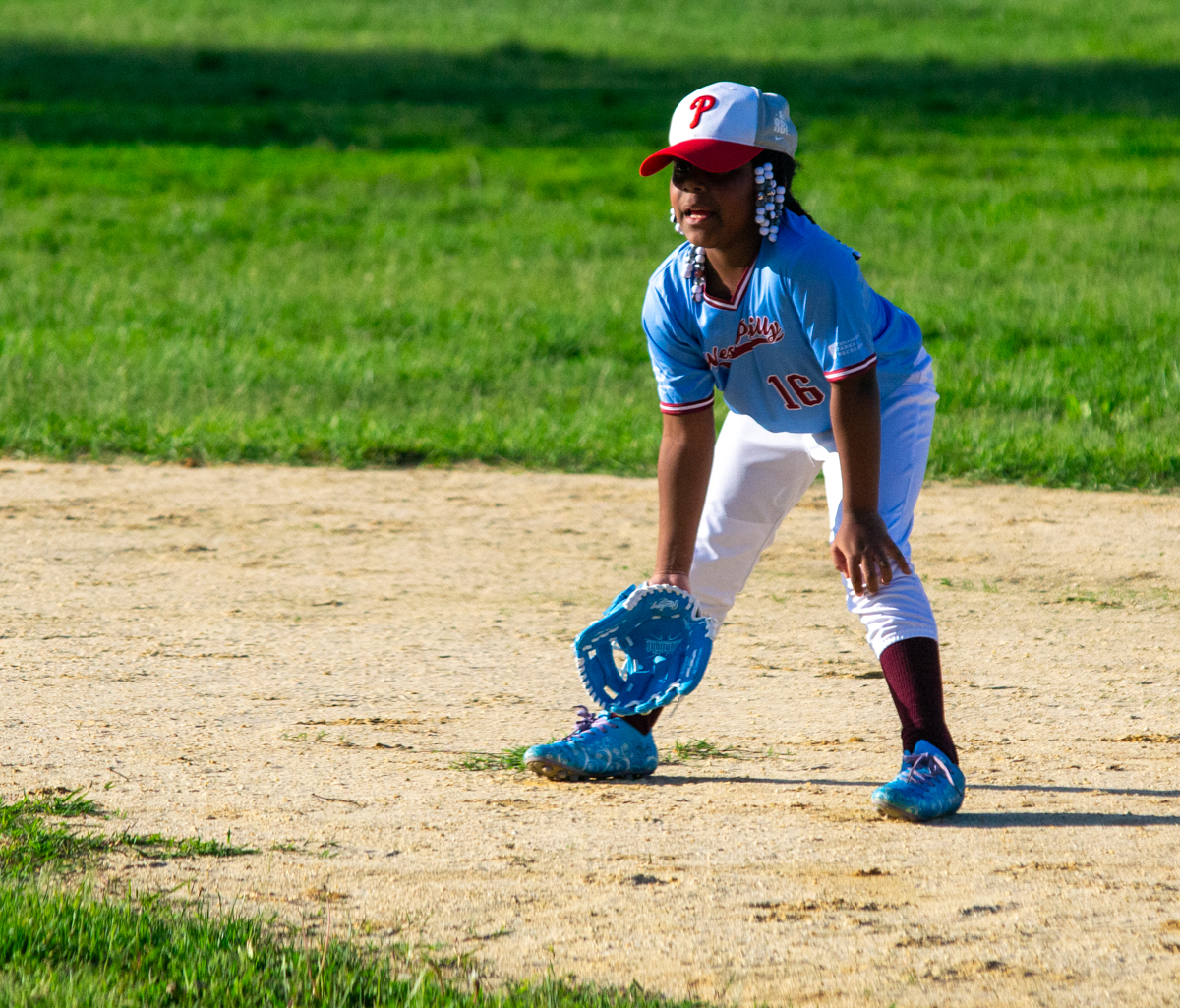
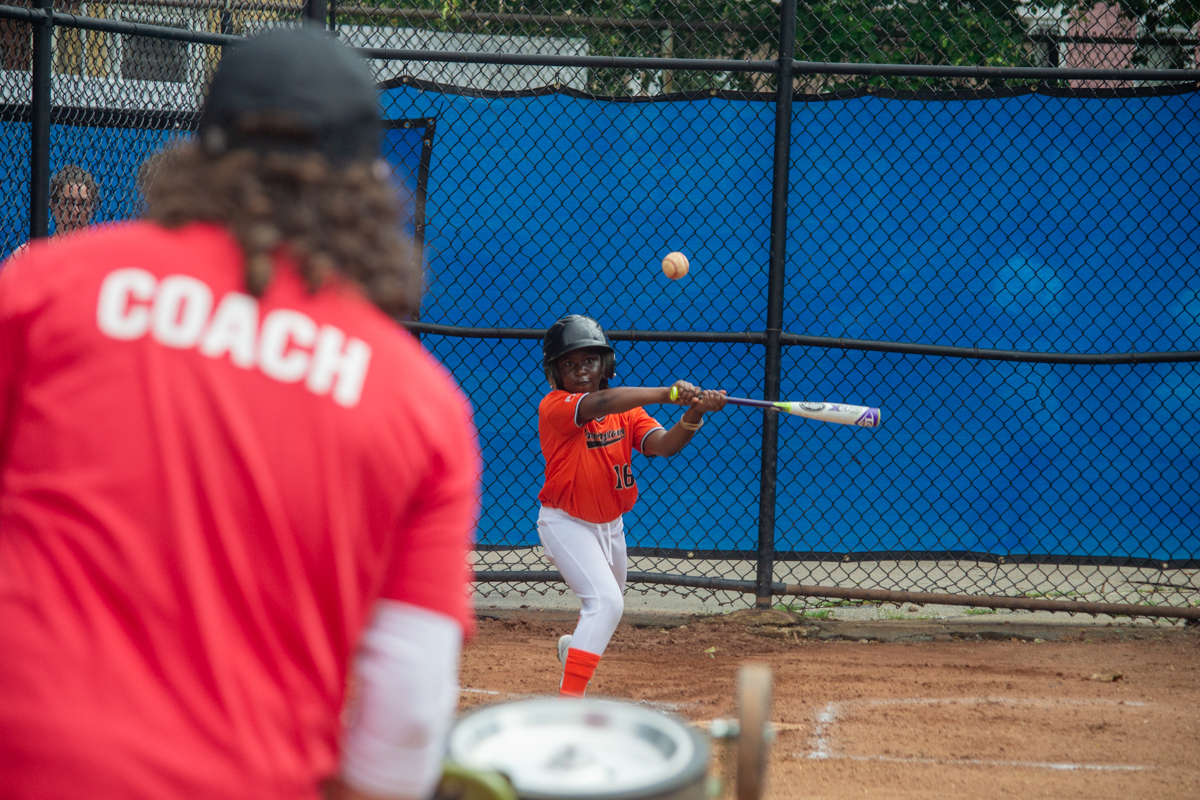
The Octavius Catto League, named for the 19th-century civil rights leader and baseball player, taught more than 150 young kids to play quickball, a variant of baseball, and has since served as the model for how other upstart sports leagues can operate through the Department of Parks and Recreation.
50+ years before the the Negro National League was founded, Octavius V. Catto helped establish the Pythian Base Ball Club. He was a staunch abolitionist and civil rights advocate who was tragically shot and killed while exercising his right to vote in 1871 https://t.co/Zpdz2BHyWvpic.twitter.com/cVT9quxOXn
— National Baseball Hall of Fame and Museum ⚾ (@baseballhall) July 2, 2020
Parks and Recreation has provided the league with not only training, but also equipment and infrastructure provided by nonprofit and private partners.
The city partnered with the Philadelphia Youth Sports Collaborative (PYSC), a nonprofit consortium of youth sports organizations, other nonprofits, and the Philadelphia Phillies to expand the league to ten sites in its second year. The league’s model — which relies on training rec leaders to coach new sports — has already been replicated in tennis in partnership with the U.S. Tennis Association and soccer with the U.S. Soccer Foundation.
“We’re trying to support [Parks and Recreation] in building a sustainable model for safe, entry-level user programming at rec centers across the city,” said Josh Throckmorton, the program development director at PYSC. “We’re targeting these pockets of the city where there just hasn’t been a ton of programming for use at their local rec center.”
Philadelphia’s youth sports landscape reflects the same racial and economic inequalities that define the city’s geography. A 2025 PYSC and Temple University study of public sports facilities found neighborhoods with more white residents had more fields, amenities that were in better shape, and more youth sports programs than other areas.
The disparities are especially pronounced in baseball. The Phillies’ RBI program, among the area’s largest, mostly serves Philadelphia’s predominantly white, middle-class neighborhoods in the Northeast. From 2012 to 2025, Parks and Recreation saw 31 of 51 community baseball teams in its league cease to exist or provide baseball at the same level they once did, said Mike Barsotti, the director of youth sports for Parks and Recreation.
Kids aged 7 to 12 played in the inaugural season of the Catto Youth Baseball League, an offshoot of Phillies RBI aimed at bringing baseball to youth in North and West Philadelphia in 2025.Courtesy of Josh Throckmorton
The Catto League, in contrast, operates in areas that don’t have much robust programming already. Three of the sites are in Fairmount, Francisville and Brewerytown; four in West Philadelphia; and one each in Yorktown, Germantown and Oxford Circle. The league operates on a pay-what-you-can model with an encouraged donation of $40 per family — though two rec centers found local sponsors to cover the entire cost, Throckmorton said — whereas other youth baseball programs can often cost hundreds of dollars.
The league intentionally focused on young kids. Research shows early childhood is an optimal starting age to keep children playing sports into their teens.
“Our goal here is to catch those 6- to 9-year-olds, those kids before they’re ready for Little League, give them those core skills in an accessible way, in their neighborhood, focused on their development, and have them be ready to take that next step,” Barsotti said.
The Octavius Catto Baseball League was founded in 2025 to provide entry-level baseball opportunities for youth ages 6-12.Courtesy/PYSC
Expanding access to youth baseball could have effects reaching beyond the sport. Community coaches who work in poorer areas of the city say their work has the potential to save lives by keeping kids out of trouble. The 2025 study of sports facilities and youth programs found lower crime rates in the blocks surrounding them. The city, for its part, has invested dollars in youth sports programs as violence prevention measures through the mayor and district attorney’s offices.
“I think sports is one of the main things that used to keep our streets safe and we just got away from it for a long time,” said Louis McCrea, a dad watching his son practice in Brewerytown. “Kids go to school for eight hours a day, the teachers tell them to sit down all day, and these kids have nowhere to express their energy.”
But among the challenges facing community teams are lack of quality coaches and the difficulty of reaching kids who have never played an organized sport. Those two issues are what the Catto League, and its spinoffs, are trying to solve.
“We need people who are willing to take the time to ensure that kids have a great experience playing this game,” Barsotti said.
Teaching the teachers
The whirring of loud fans consumed the basketball gym at Gustine Recreation Center on an unusually warm March day as rec leaders gathered to learn baseball for the first time.
Sitting on red bleachers, the adults listened attentively to Throckmorton, who stood by an illustrated flipchart as he gave a brief lecture on the development of children’s brains as they age.
“We’re setting expectations for what the kids will be able to do,” Throckmorton said to the group.
Throckmorton asked the coaches, armed with pens and sticky notes, to write down ways that they might act differently toward the kids they coach based on the information they were learning. He said young children look to adults for cues on how to interpret the world around them. In response, a coach wrote on their sticky note that they would try to be more patient with their players.
The Catto League was purposely placed in sections of North and West Philly where opportunities are scarce. Courtesy / PYSC
The Catto League faced the challenge of training 20 rec leaders, the vast majority of whom never played or coached baseball, to be able to teach it at their rec centers.
Community baseball coaches in North Philadelphia have cited a lack of quality coaches as one of the main challenges in running their programs. The path toward becoming one is not easy: On top of the time commitment, coaches may need to secure background checks, buy insurance, market their programs, and manage registration, among other administrative tasks.
By training existing rec staff in new sports, the Catto League represents one part of the city’s approach in bolstering the pipeline of future coaches. Parks and Recreation is also training youth to become coaches through its summer and after-school career readiness program in the hopes they pursue careers with the department, and PYSC partnered with the city and AmeriCorps’ Coach Across America to teach a cohort of a dozen coaches trauma-informed youth development practices through working at recreation centers last year.
The Catto League’s coach training was modeled to teach the adults in the same way they would teach the kids. Coaches were given kid-friendly analogies — to field a ground ball, extend the hand like Spiderman — played through drills and scrimmages, and received positive reinforcement, including prize stickers when they did something right.
“It was awesome to see because many of them became kids,” said Shannon Gunby, the executive director and founder of the On Deck Circle, which partnered with the Catto League. “One of the coaches said, ‘This was fun.’ And he walked out of here with a big smile on his face.”
In an effort to keep the love of baseball among kids in sections of North and West Philly, the Catto League has plans to return next spring. Courtesy / PYSC
The future of the league
The Catto League will be back next year, though its structure will look different.
Parks and Recreation will run the league as PYSC’s contract with the city has ended, Throckmorton said. The department will try to support the Tustin and Athletic recreational centers — which had comparatively larger participation this year — in developing their own in-house recreational leagues. The cost of this year’s program to the city was just shy of $37,000, Throckmorton said.
As far as the Catto League’s offshoots, the city has received more than 300 signups for One Philly Soccer Club, which has brought entry-level programming to more than 20 rec centers this fall, Throckmorton said.
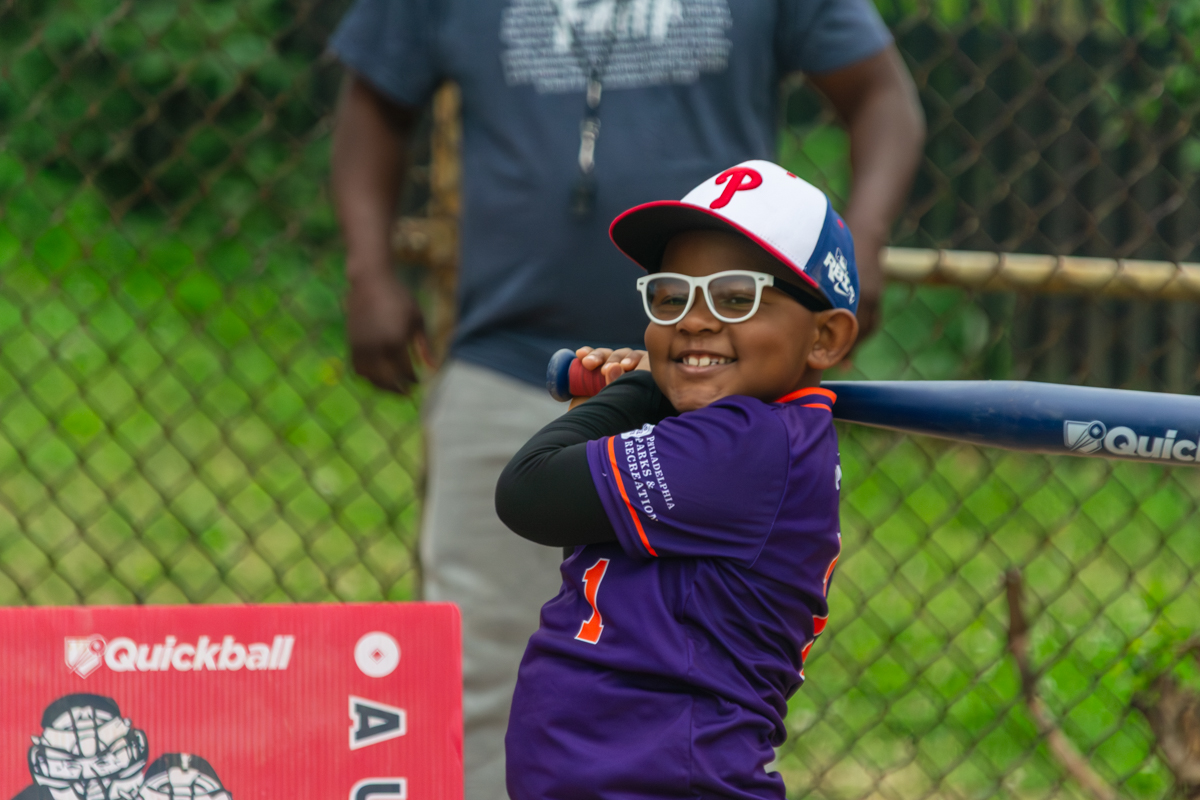
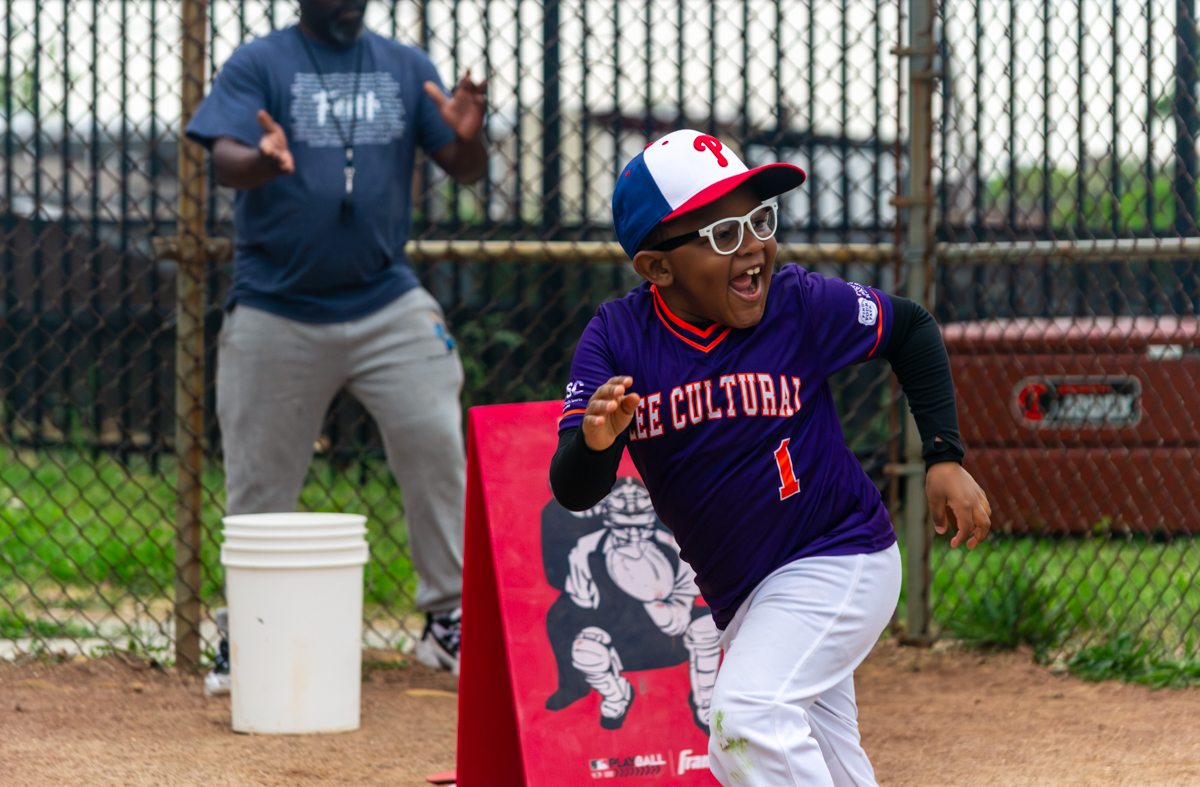
Back at Lee Cultural Center, Dominique Sampson watched her son Dallas step up to the plate. She said playing in the Catto League has been life-changing for the 6-year-old, as he’s made friends and learned to be comfortable and trusting with his teammates.
“He’s psyched up and ready to play baseball,” Sampson said. “So now I have to find something else for him to do after this.”
With his eyes on the ball, in his signature white sports glasses, Dallas sent a grounder to third base and made his way safely to first, earning thunderous applause from parents in both dugouts.
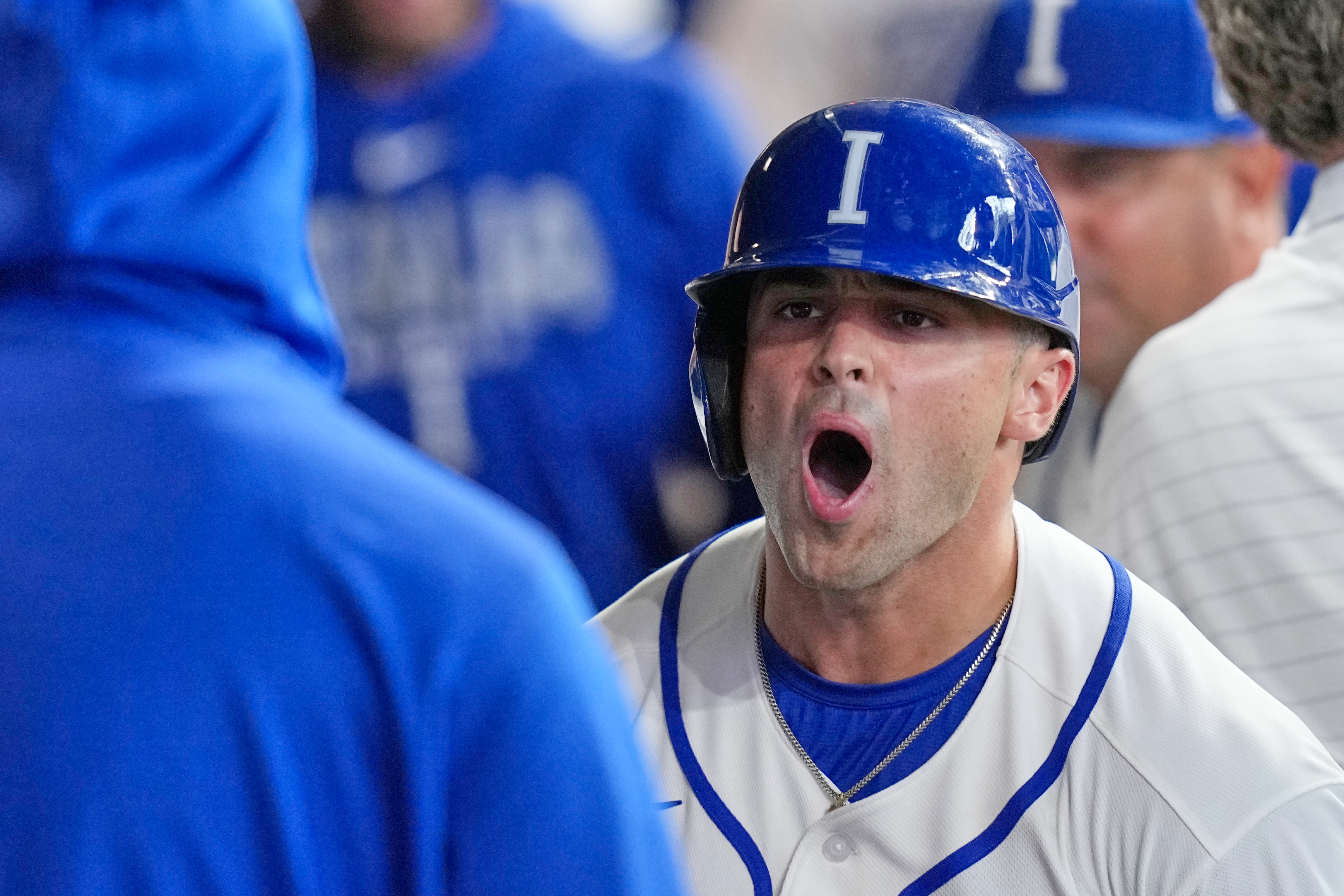
SCOTTSDALE, Ariz. — Phillies outfield prospect Dante Nori took the field at Scottsdale Stadium in what appeared to be just another game in the Arizona Fall League on Nov. 3.
But among the 371 spectators spread across the ballpark was his biggest fan.
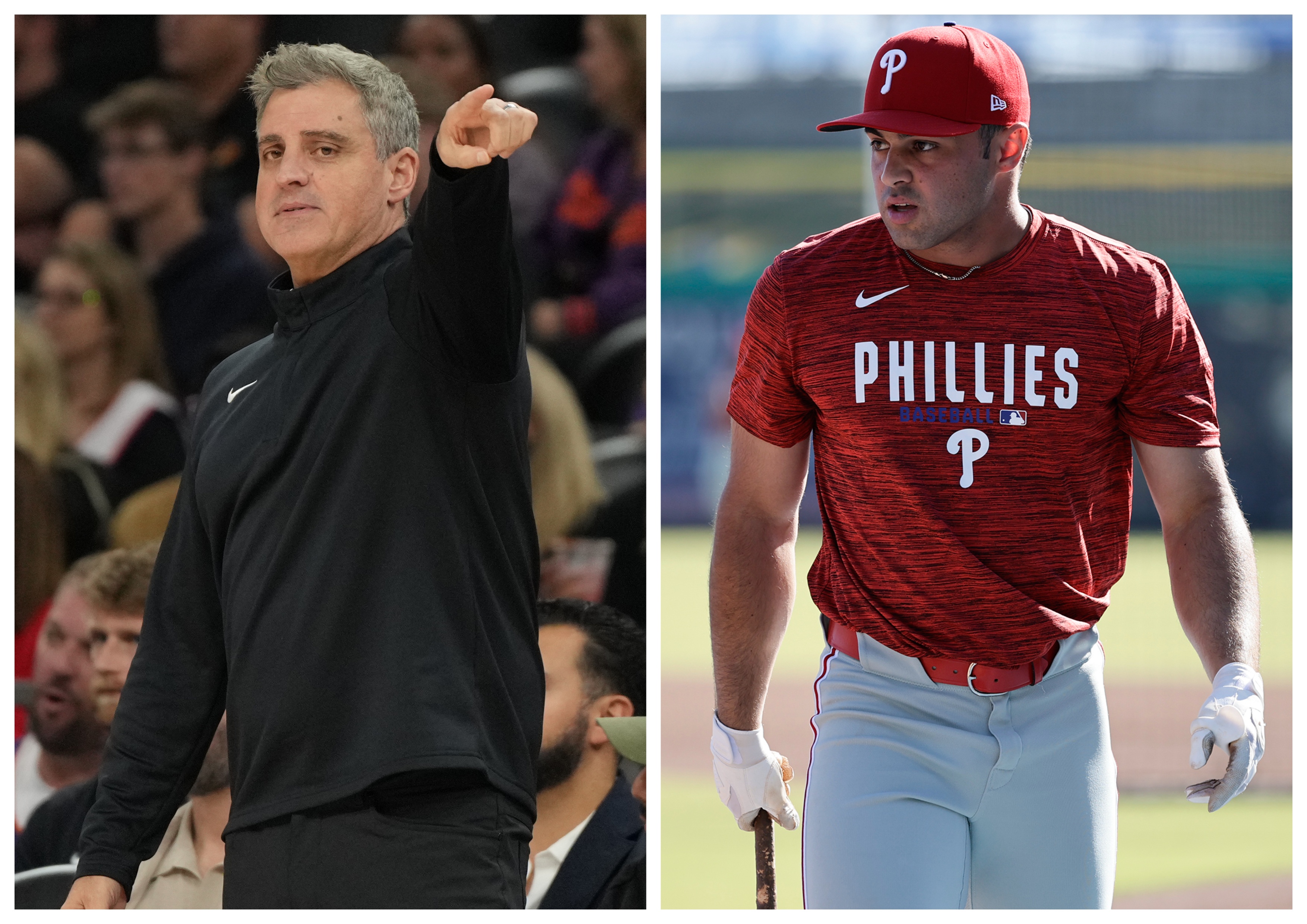
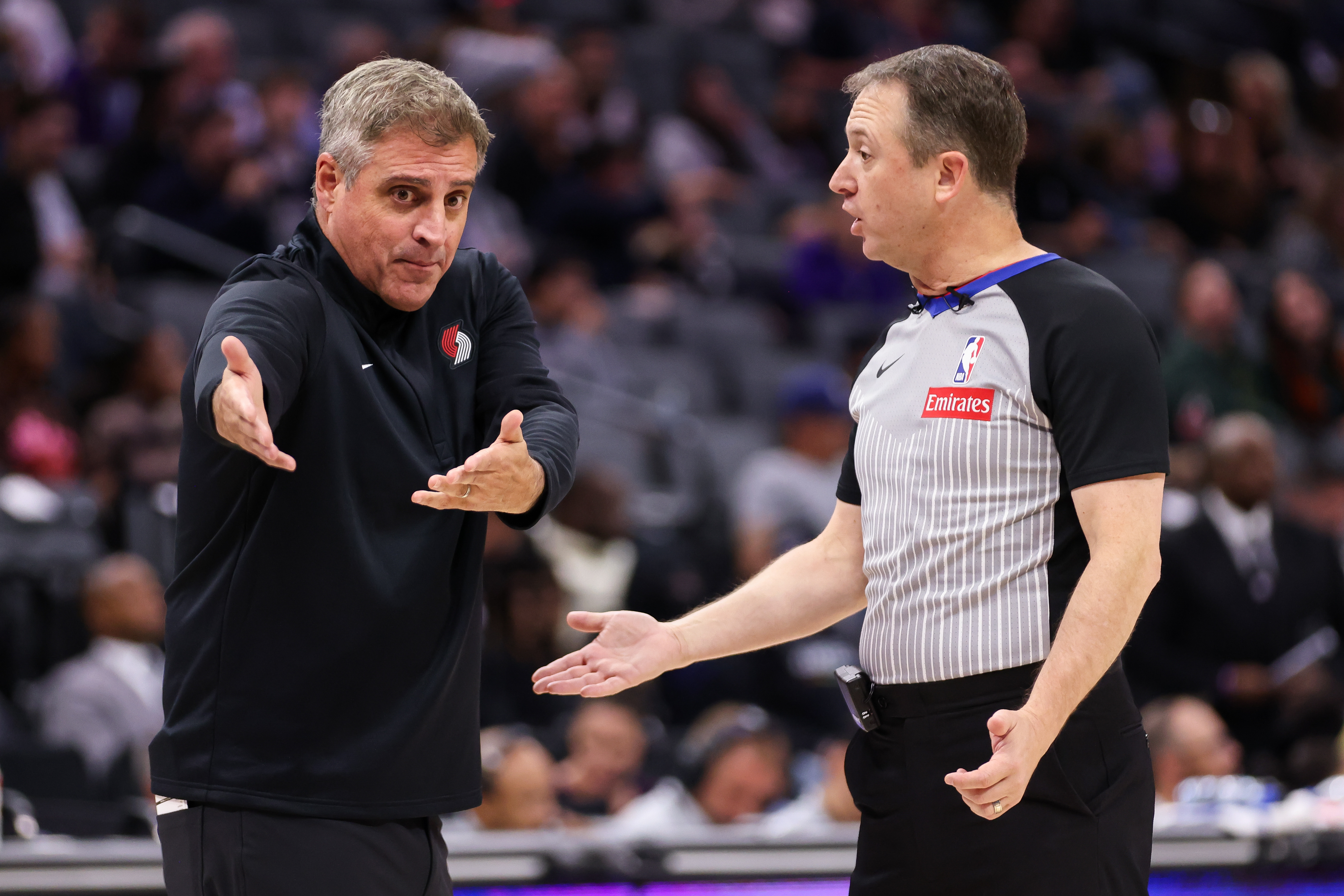
Micah Nori wasn’t passing on the rare opportunity to watch his son play live. Hired as the Portland Trail Blazers coach over the summer — his first head coaching job after nearly three decades in the NBA — Micah, 52, and the Blazers were in town to play the Phoenix Suns.
“I saw he landed and he actually beat me to Scottsdale, so it was pretty cool, walking onto the field and just seeing him waiting for me,” said Dante, a first-round pick of the Phillies in the 2024 draft. “So that was actually really cool. First time it’s ever lined up like that. It was neat.”
They met each other behind home plate and shared a warm embrace before the game. Dante, 22, slashed .308/.386/.436 over 12 games in the AFL last season, but Micah — then an assistant with the Minnesota Timberwolves — was unable to fit a trip to Arizona into his itinerary.
“It was really cool,” Micah said of his first Arizona Fall League experience. “Any time that I can get to watch him in person is special, [especially with] the way that my career has taken me away from him a little bit.”
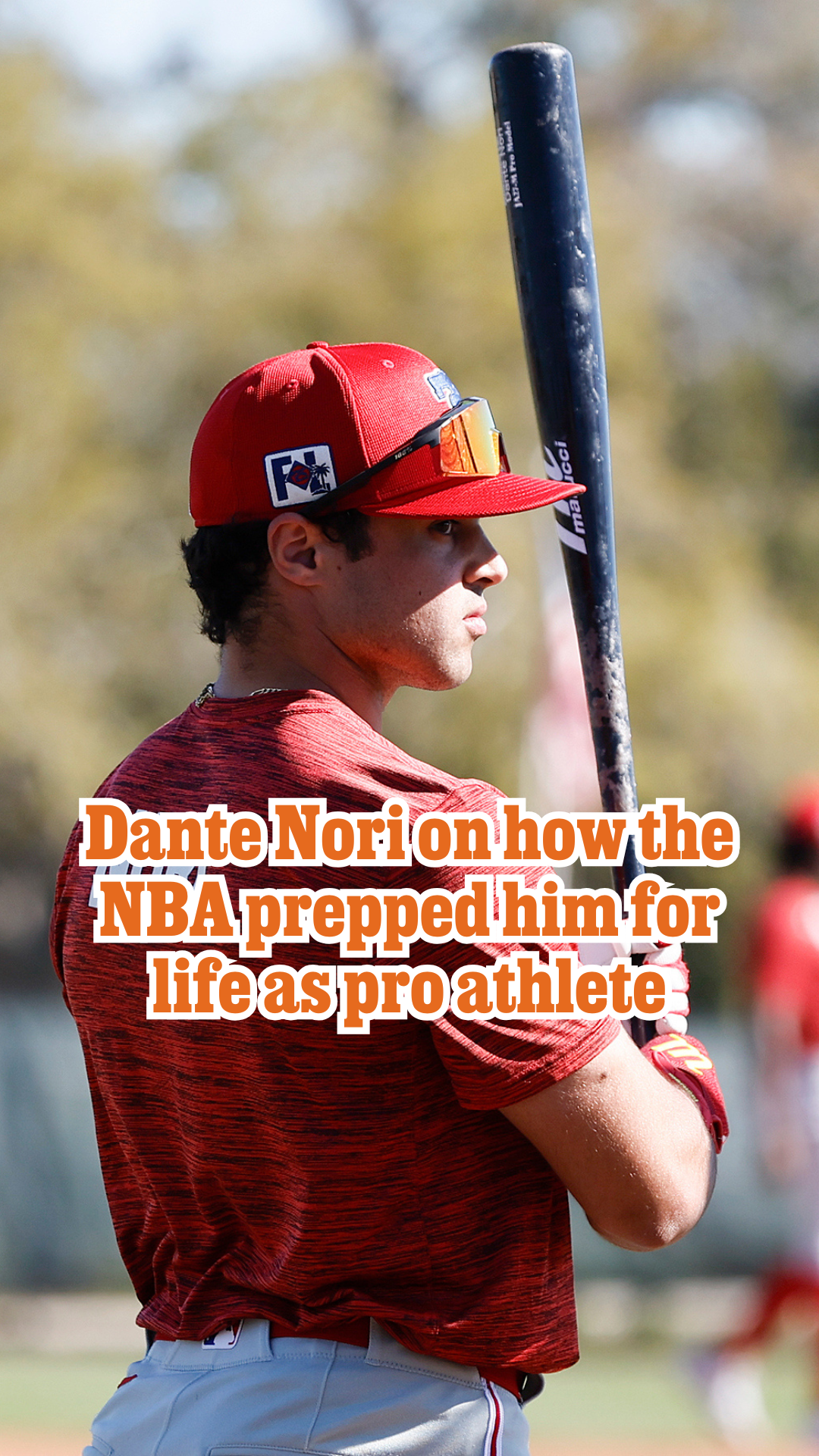
Video: Dante Nori on his NBA coach father, and how he prepared him for life as a pro athlete
Dante went 1-for-4 with a second-inning double in the Surprise Saguaros’ 8-0 drubbing of the Scottsdale Scorpions.
“There’s nothing like watching your son or daughter do something in person, and watching them do what they love,” Micah said. “The nerves are crazy. We played Denver the other night, and it’s a nail-biter, and I had no nerves, but last night in the Arizona Fall League game, every time he comes up to bat, you feel nervous because you have no control, because you want him to do so well.”
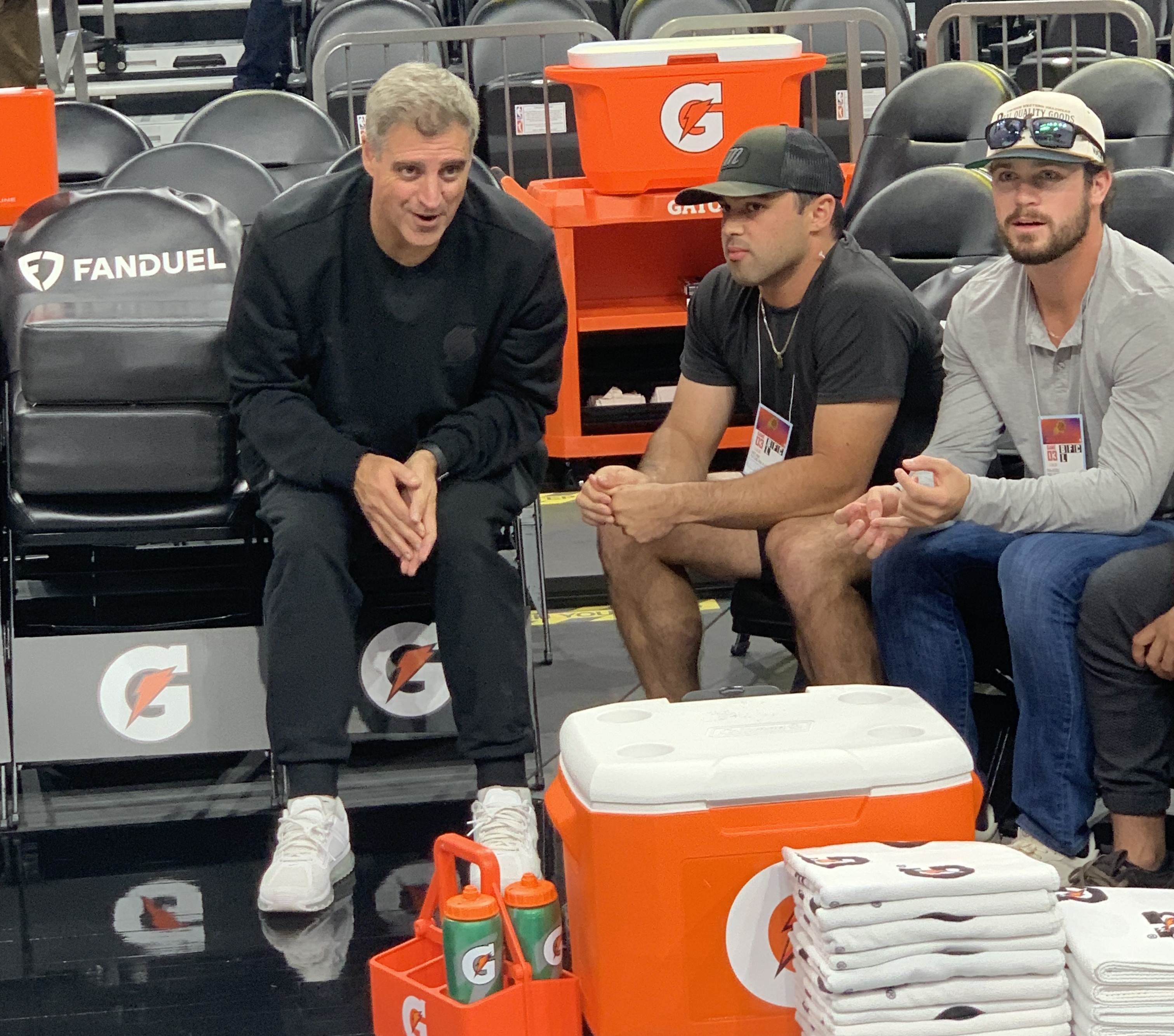
Blazers coach Micah Nori (left) talks with his son, Phillies outfield prospect Dante Nori (middle) before a Nov. 4 game against the Suns in Phoenix.Jack Vita
Cheering on dad
The next day, it was Dante’s turn to cheerlead and support his father, in his first opportunity to watch Micah in his new role leading the Blazers.
Dante spent Nov. 4 with his dad, joining the Blazers for morning shootaround, as well as pregame festivities that evening on the court and in the locker room. Micah’s Blazers handled the Suns with ease, picking up a 132-119 win.
“It was great, just getting to see him for the first time coaching on the baseline being a head coach,” Dante said. “It was cool. He worked his butt off to get to that point, and to see him do it, and watch a big win, it’s great.”
The opportunities to support each other have become scarce with both constantly on the road. Still, they watch each other’s games and chat on the phone often.
“I could show you my call log and it’s almost all, ‘Dad, Dad, Dad, Dad, Dad,’” Dante said. “I almost call him too much. Sometimes, I forget they’re playing and I call him and he’s like, ‘Hey, I’m about to head out. What do you need?’ We stay in touch. After a rough game, I talk to him.”
Micah lettered in baseball, basketball, and football at Middletown High School in Middletown, Ohio — the same school that produced Phillies slugger Kyle Schwarber nearly 20 years later. Micah’s father, Fred, played a critical role in recruiting Schwarber to play in college at Indiana.
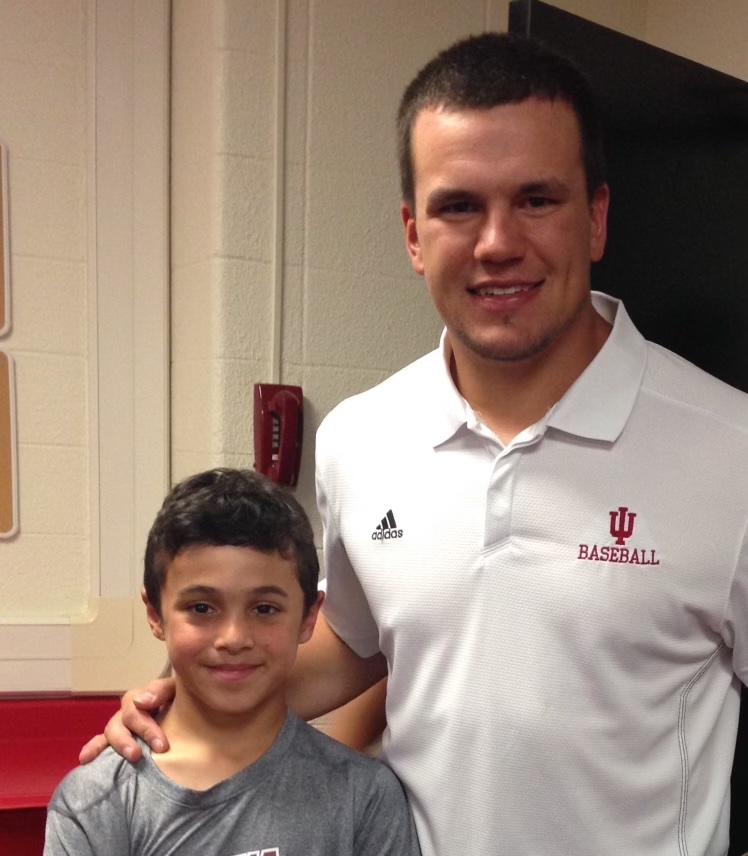
A 9-year-old Dante Nori with Kyle Schwarber when Schwarber was at Indiana in 2014.Courtesy Micah Nori
“My father knew Kyle growing up,” Micah said. “He was in Middletown. And then he was at Indiana with [Hoosiers baseball coach] Tracy Smith, and he talked Tracy Smith into recruiting Kyle. Kyle went there, and my dad was able to coach Kyle for two years while he was at Indiana.
“There [are] pictures of Dante and Kyle playing catch out in the outfield at Indiana. Dante had an oversized jersey that was way too big for him and probably, gosh, he might have only been 9 or 10 years old.”
Fast forward to Dante’s first big league spring training game on March 19, 2025, and who does he pinch-run for? Schwarber, the same slugger he played catch with in the Bloomington outfield a decade earlier.
After 17 seasons as an NBA assistant coach, Micah Nori got his chance to lead a team when the Blazers hired him this summer.Scott Marshall
Learning from the stars
Micah, who played baseball at Indiana from 1994-97, was a graduate assistant and hitting coach at Miami (Ohio) when a phone call from then-Toronto Raptors head coach Butch Carter changed the trajectory of his career.
“I was sitting on my couch in the summer and Butch Carter called and asked me to come up and intern,” Micah said. “That was 29 years ago, and I’ve been fortunate enough to be in the NBA those last 29 years.”
Dante spent his formative years in the NBA locker rooms his father coached in, developing friendships with superstar players like DeMar DeRozan, Kyle Lowry, and Anthony Edwards.
“He’s been very fortunate to be able to grow up in NBA locker rooms, so he’s never in awe of anybody or anything,” Micah said. “And then the access to the people he can talk to, when he was little, I mean, Vince Carter’s in the locker room, and all these guys, he’s not in awe of them. And I think that’s what lets him get into any situation, and the moment’s not too big.”
That included during the World Baseball Classic in March. After slashing .261/.361/.372 with 52 stolen bases across three levels in his first full minor league season in 2025, Nori played for Team Italy during the WBC. He was a breakout star, batting .400 with two home runs in their run to the semifinals.
“[It was] probably the most fun I’ve ever had playing baseball in my life,” Dante said. “You can’t beat that atmosphere. Each game got more packed. I was just overall excited, I didn’t know what to expect, and it beat every expectation that I had.”
Dante Nori had a breakout showing in the World Baseball Classic with Team Italy.David J. Phillip
Lesson for 2027 and beyond
Dante was riding high from the WBC and his first big league camp invite until he sustained a stress fracture in his hip early in the minor league season.
“First week, I felt a little something in my butt, my pelvis area, and I was like, ‘All right, that didn’t feel too good,” Dante said. “And then it was one of those things where I tried to play through it as much as I could until I realized ‘Hey, I’m hurting the team more than helping, so it’s time to get this checked out.’ Good thing we did. MRI came back with a stress fracture, and I’ve never missed time. First time in my life, and that was eleven weeks.”
He rehabbed in Clearwater for nearly three months and was limited to 67 games at double-A Reading. He batted .244 in 306 plate appearances with 17 stolen bases and returned in time to be a part of Reading’s run to the Eastern League championship.
As Dante looks to next season with a looming labor stoppage, he anticipates starting in double A. Regardless of where next season takes him, he will continue to find solace in the words of wisdom his father imparted on him from a very young age.
“The best piece [of advice my dad gave me] is, ‘Have no what-ifs,” Dante said. “He’s hounded on me about that ever since I was 5 years old. Have no what-ifs, meaning, when it’s said and done and your baseball career is over, don’t ever sit there and say, ‘Hey, what if I lifted more? What if I hit the cages more? What if I took ground balls?’ At the end of the day, you gave it all you got, and you can be satisfied with it.”
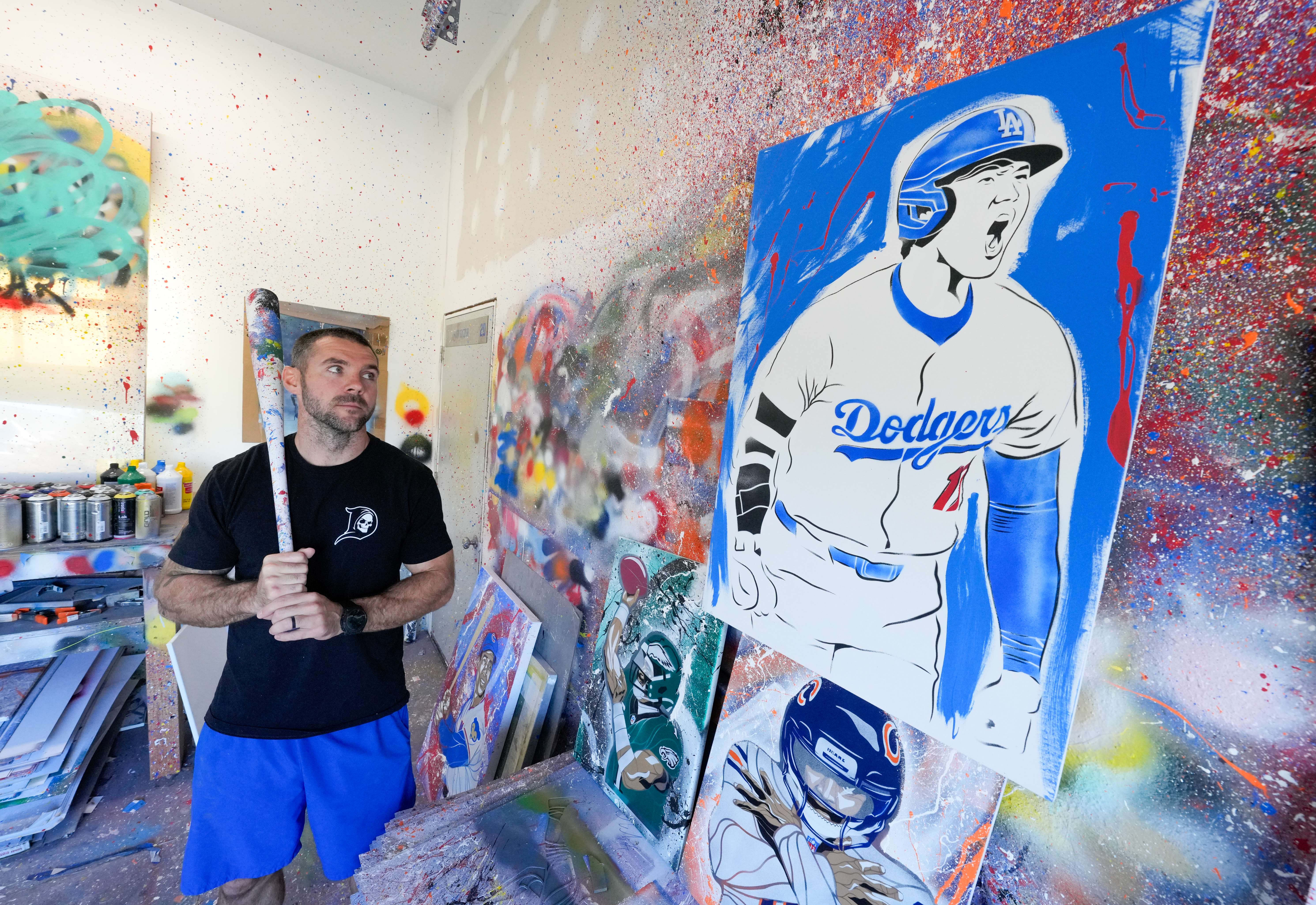
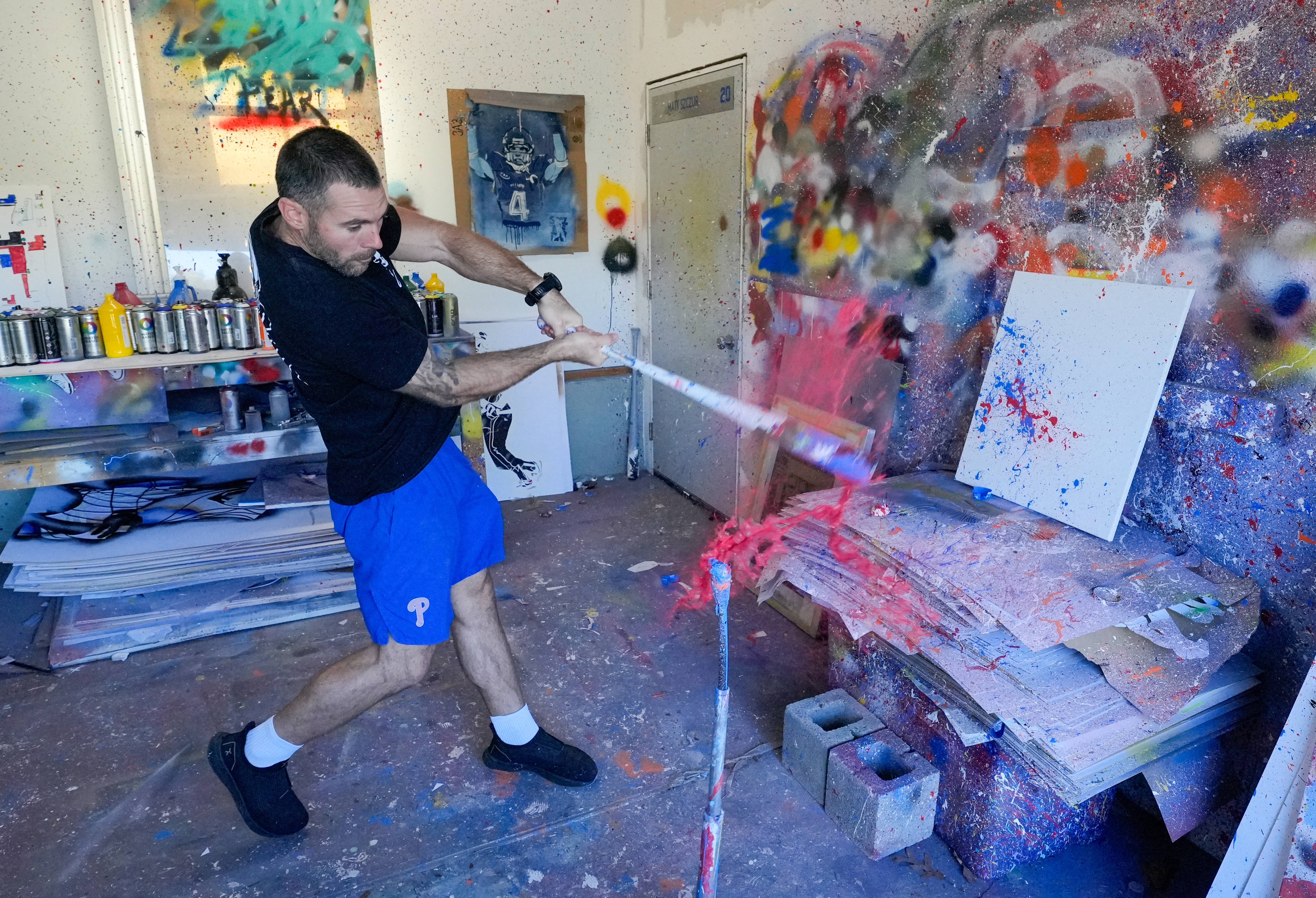
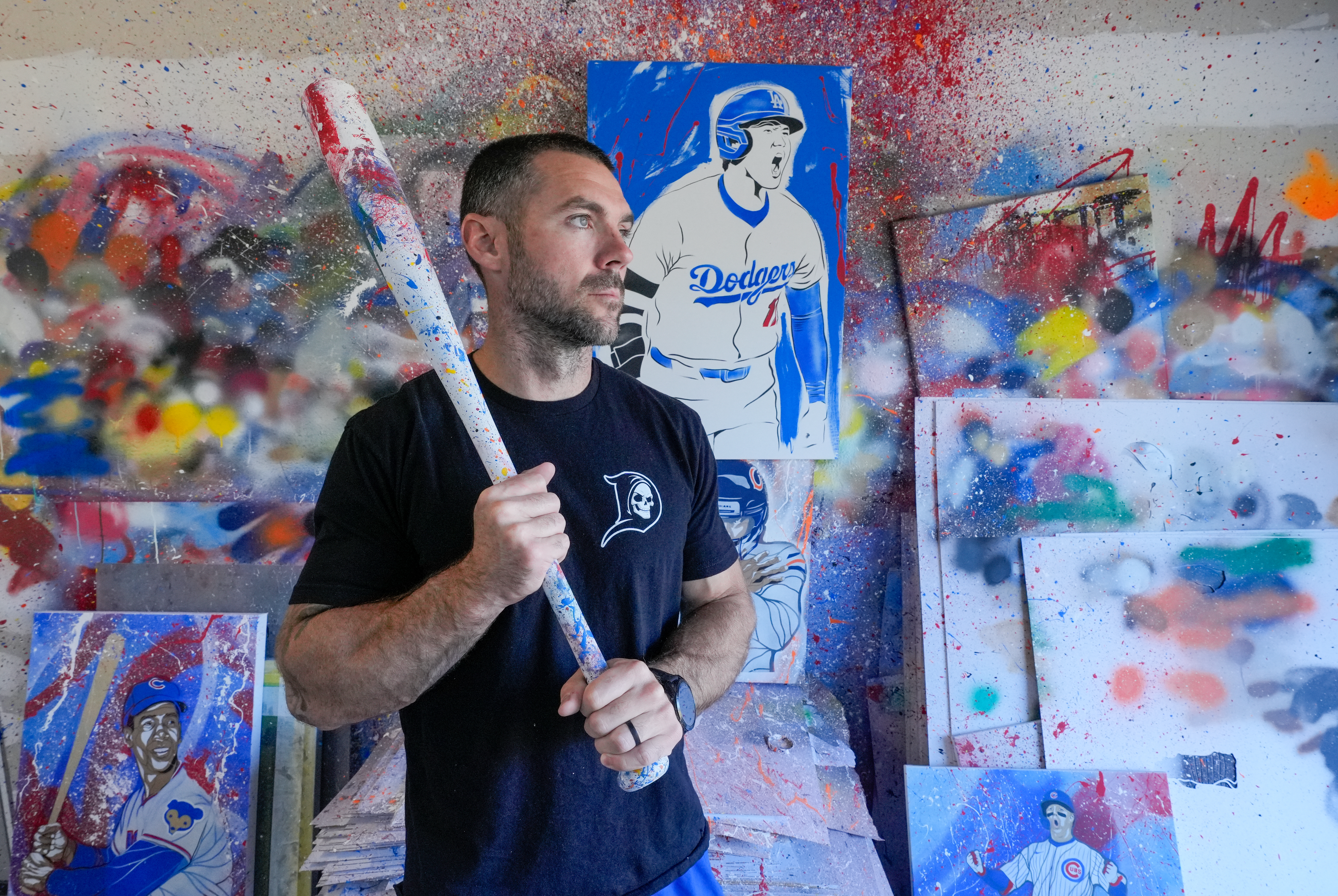
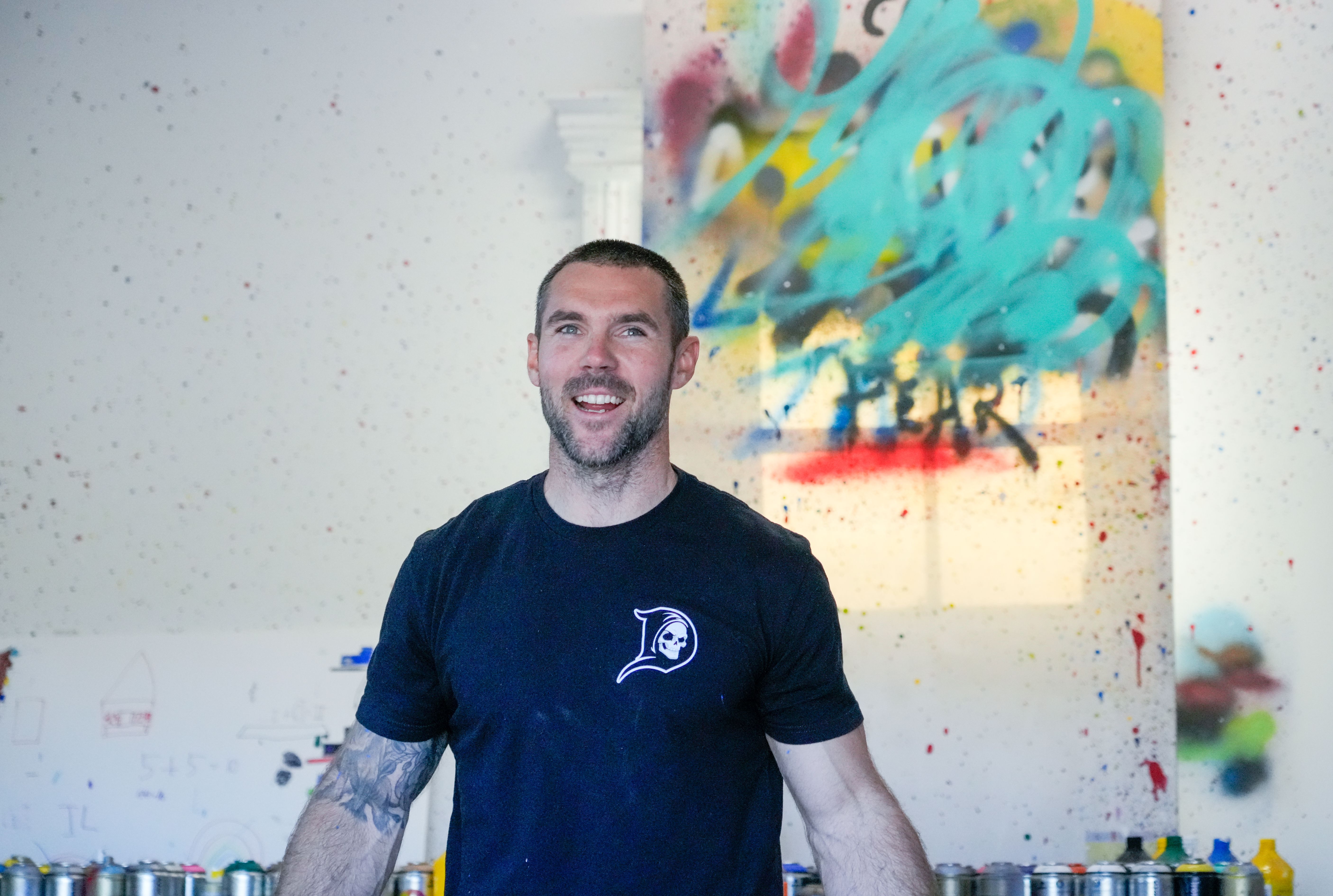
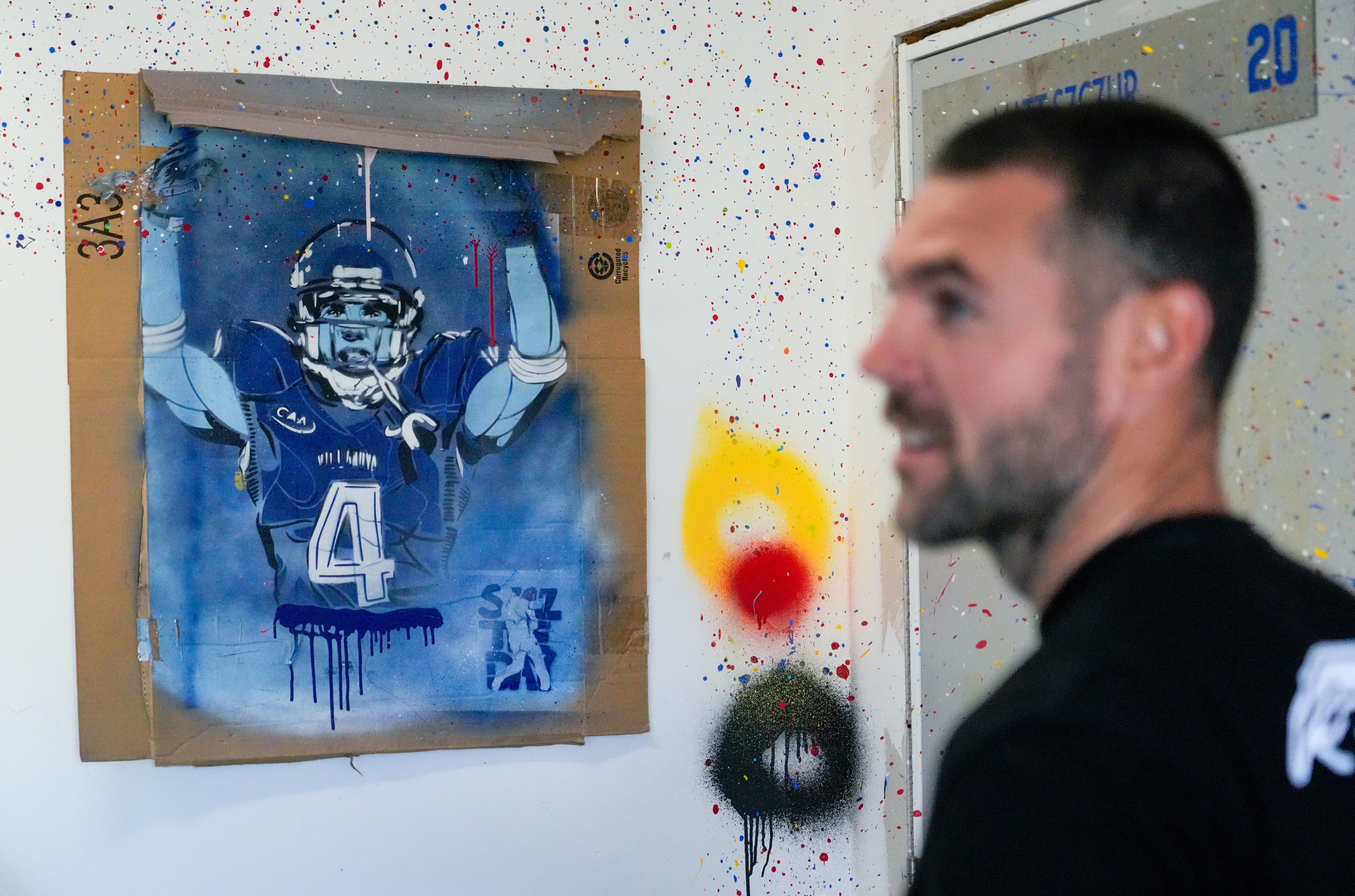
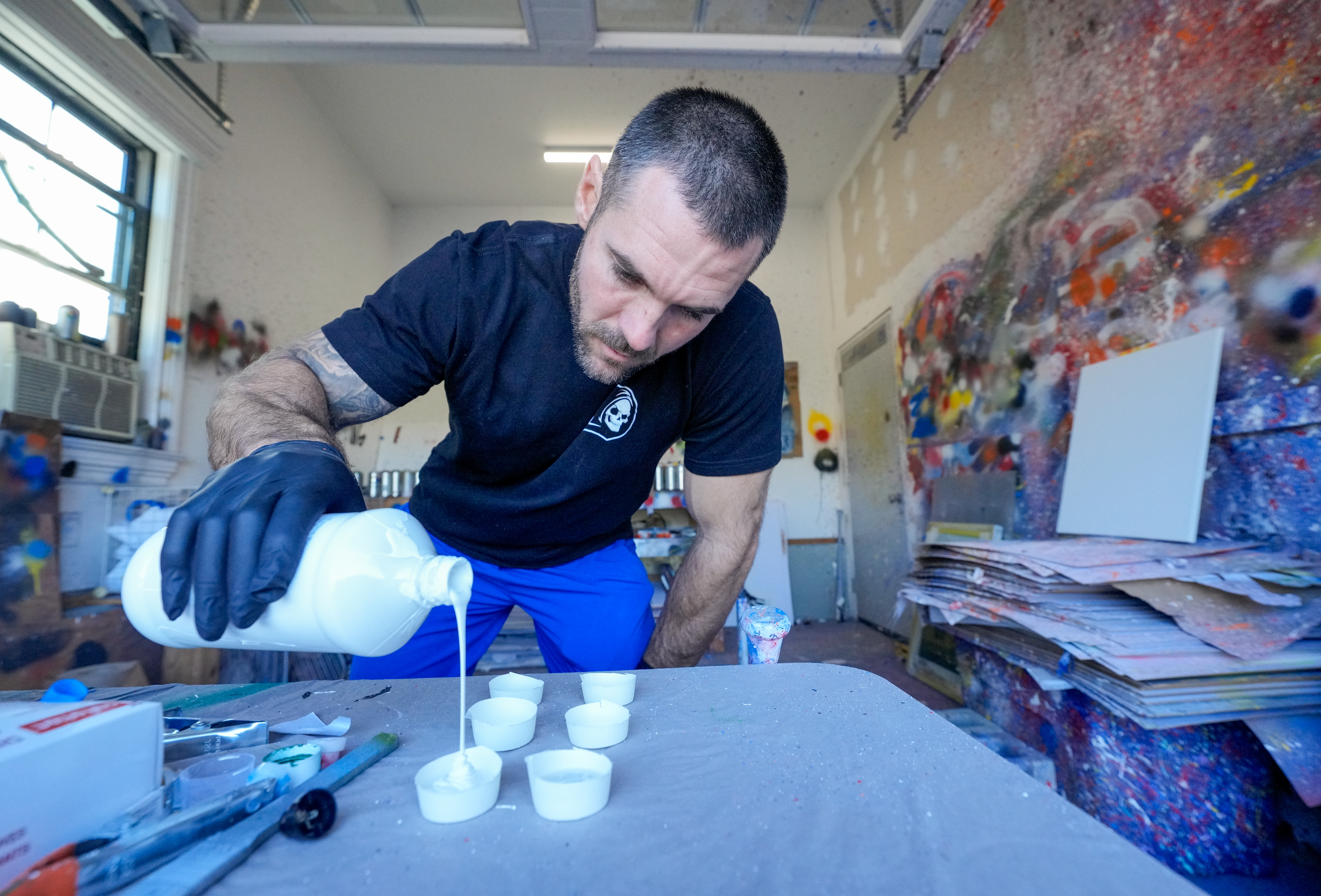
Matt Szczur stood in his garage last month, knees bent with a baseball bat raised in his hands. He played parts of five seasons in the majors and won a World Series in 2016 with the Cubs. But Szczur — a former football and baseball star at Villanova — retired from baseball to do this: hit cups of paint off a batting tee in his Cape May home.
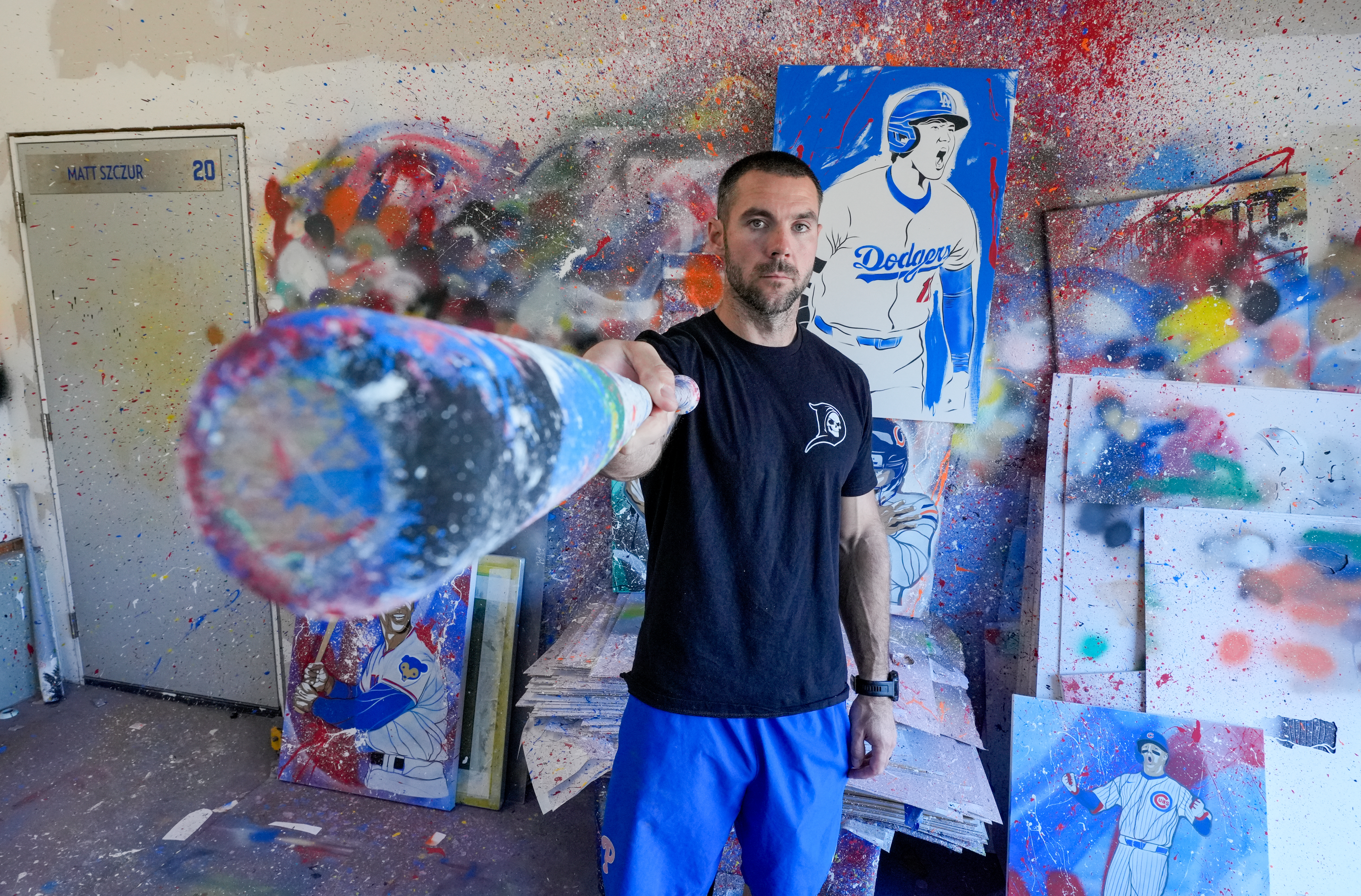
The former big leaguer became an artist. He found a second career, helping to ease a transition that proves difficult for so many professional athletes once they leave the game. He pours paint into cups, places the cups on a tee, and then crushes the cups like they were a grooved fastball. The paint splatters in his garage studio and sprays onto a canvas, which Szczur then uses as the backdrop for his next portrait. He turns batting practice into a masterpiece.
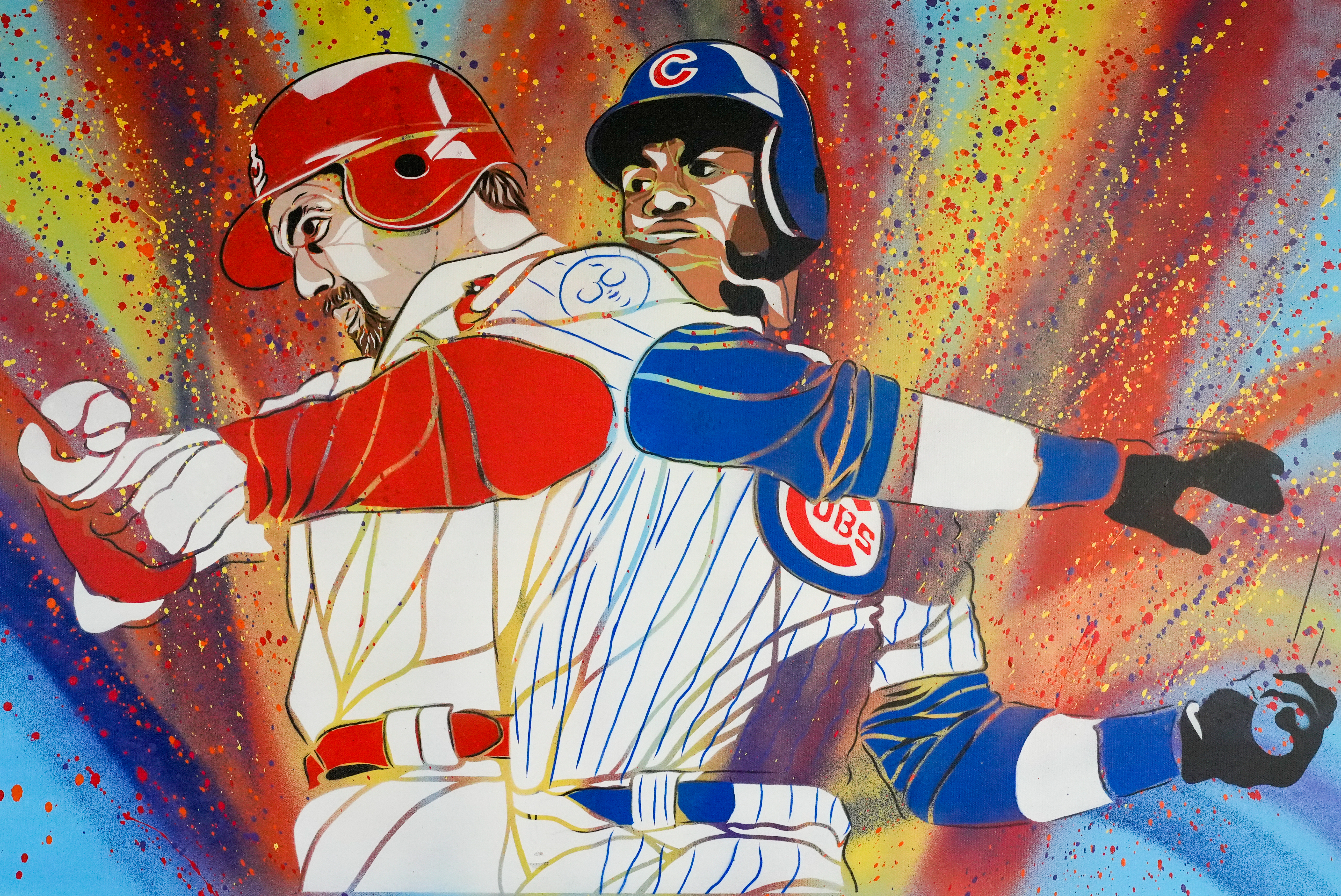
Szczur was briefly a Phillie and was a World Series champion with the Cubs. He still gets in some tee work, but now it involves hitting a paper cup full of paint at canvases to create his art.Tim Hawk / For The InquirerA painting of Mark McGwire and Sammy Sosa, featuring Szczur’s signature paint splatter, hangs in his Cape May studio.Tim Hawk / For The Inquirer
Szczur, 37, knew he had something five years ago when he was making more money selling art than he was playing triple-A baseball. He sells his art on his website, stays busy with commissions, has a partnership with Fanatics, and Topps recently turned his creations — the ones he makes in the garage with a bat — into baseball cards that are prized by collectors and resold for thousands on the internet.
As a kid, Szczur watched his dad come home from his construction job, sit in his recliner with a cup of coffee and sketch. It was how Marc Szczur relieved stress.
Years later, the son found himself doing the same when he reached the majors in 2014 and pressure mounted. Szczur sketched on his iPad, drawing anything that came to mind. Sometimes he just drew his hand in different positions to practice. Art became Szczur’s escape. And now it’s his career.
Pro athletes spend decades obsessively dedicated to their craft, which leaves a void once they walk away. Some say they lose their identity. Szczur found a new one.
“I didn’t want to be the guy who’s 33 years old in triple A trying to fight his way back to the big leagues to come off the bench,” Szczur said. “I’m not interested in that. I didn’t want to be that guy. I’m cool moving on. A lot of those guys have to stay in baseball. They have nothing else afterward. I’m so lucky to be able to do this. Because when guys finish playing, they’re like, ‘What next?’
“If it wasn’t for this, I would’ve kept playing. I would’ve had nothing else. And it could’ve been good. I could’ve made it back to the big leagues and signed a $100 million deal. Maybe? Probably not. But you never know. But I’m happy here. I’m happy working hard every day at my house with my family.”
The wall in Szczur’s studio is covered in paint thanks to the bat that he uses as his paintbrush.Tim Hawk / For The Inquirer
Leaving the game
In 2015, Tommy La Stella, Szczur’s teammate with the Cubs, saw some of the sketches Szczur did and asked him if he could create something for him. It was Szczur’s first commission.
“I had no idea what to charge,” Szczur said. “I just had no idea.”
La Stella wanted a piece featuring Jesus, Buddha, and Lao Tzu. Szczur used spray paint and stencils to create something. He did a first draft of cardboard — “I’m cheap,” Szczur said — and showed La Stella. He liked it. So Szczur went to work, filling a Wildwood Crest apartment with paint fumes.
It was a humble start, but Szczur figured it out. Szczur took art classes in high school and college, as he always loved creating.
“My friends used to make fun of me because they’d be studying and I’d be painting. ‘Well, you could’ve picked my class,’” he said.
Szczur gave the finished painting to La Stella in the Cubs clubhouse, which allowed other teammates to see it. He was soon getting more work, and the Cubs asked Szczur to paint something for their charity event after the 2016 World Series. It sold for $40,000.
“I remember looking at my wife [Natalie] and saying, ‘I have to do more of this in the offseason,’” Szczur said.
Matt Szczur was with the Phillies in Clearwater during 2020 spring training.Carlos Osorio
Szczur signed with the Phillies before the 2020 season, hoping to return to the majors with the team he grew up rooting for after spending the previous year rehabbing an injury in triple A. Then, he tore an oblique muscle in spring training before the pandemic paused the season.
Szczur returned home to Cape May during the shutdown and started painting again. He spent hours in his garage, painting athletes, superheroes, and anything else he thought of. Szczur loved it. He wanted to share his work on social media but felt strange posting about it.
“One of the things I was nervous about was other people’s opinions,” he said. “I asked my wife, ‘Should I post this?’ She said, ‘Yeah, who cares?’”
Szczur smiles in his studio. He made national news in 2009 when he donated bone marrow to save the life of a 15-month old in Ukraine shortly before the MLB draft.Tim Hawk / For The InquirerA self portrait of Szczur during his Villanova football days hangs as he talks about his paintings.Tim Hawk / For The Inquirer
His business took off during the pandemic, and he missed the 2020 season after undergoing surgery to repair his oblique. He signed in 2021 with St. Louis but struggled in triple A after missing the previous year.
The team took a 12-hour bus trip from Memphis, Tenn., to Toledo, Ohio, for a series in June. He was 0-for-4 in the final game of the series when the manager asked him in the eighth inning if he wanted his last at-bat of the game.
“I was like ‘Yeah, I don’t know when it’s going to be my last at-bat so I’m going to take it,’” Szczur said. “I hit a double off the wall.”
The team bused back to Memphis, and the manager told Szczur that the Cardinals were releasing him. Couldn’t that have happened in Toledo? Szczur said. He flew home and told Natalie he was finished. Other teams checked in, but Szczur was content with his career.
He won a national championship in football at Villanova and signed with the Cubs as a fifth-round draft pick in 2010 instead of entering the NFL draft. He played professional baseball for 12 seasons, played with All-Stars, and earned a World Series ring. Szczur was 31 years old and ready to try something new.
“I’ve never been someone who continues to beat a dead horse. I can move on pretty fast,” Szczur said. “There was light at the end of the tunnel.”
Szczur pours paint into paper cups before hitting them off a tee with a baseball bat.Tim Hawk / For The Inquirer
Figuring it out
Szczur was driving to Penn State to watch Villanova play football in September 2021 when Fanatics called. They already commissioned him to do a painting of Tom Brady and wanted to see if he could paint portraits onto jerseys.
“I was like, ‘Yeah, send them to me. I’ll see if I can figure it out,’” Szczur said. “I had no experience.”
He painted onto a Ronald Acuña Jr. jersey, and it looked terrible. Szczur wasn’t sure if he could do it. The representative from Fanatics told Szczur to reach out to some other artists who paint jerseys. Szczur bugged artists he found on Instagram — “usually people don’t respond,” Szczur said — and found someone to help. He told him what paint to use, and Szczur finally had the secret.
“It took like six months to figure things out, which is fine,” Szczur said. “There was a point where I wanted to quit because I couldn’t figure it out, but I was like, ‘These guys have to respond to me.’ I hated trying to figure things out. But I always tell people I leave my ego at the door. I know that I need help. I’m the first guy pulling over at the gas station asking how to get to the next stop. I’m not going to try to figure it out by myself. It just takes so much longer. Find someone who has done it before, who knows where they’re going, and they’re going to tell you. If they don’t, then go to the next person.”
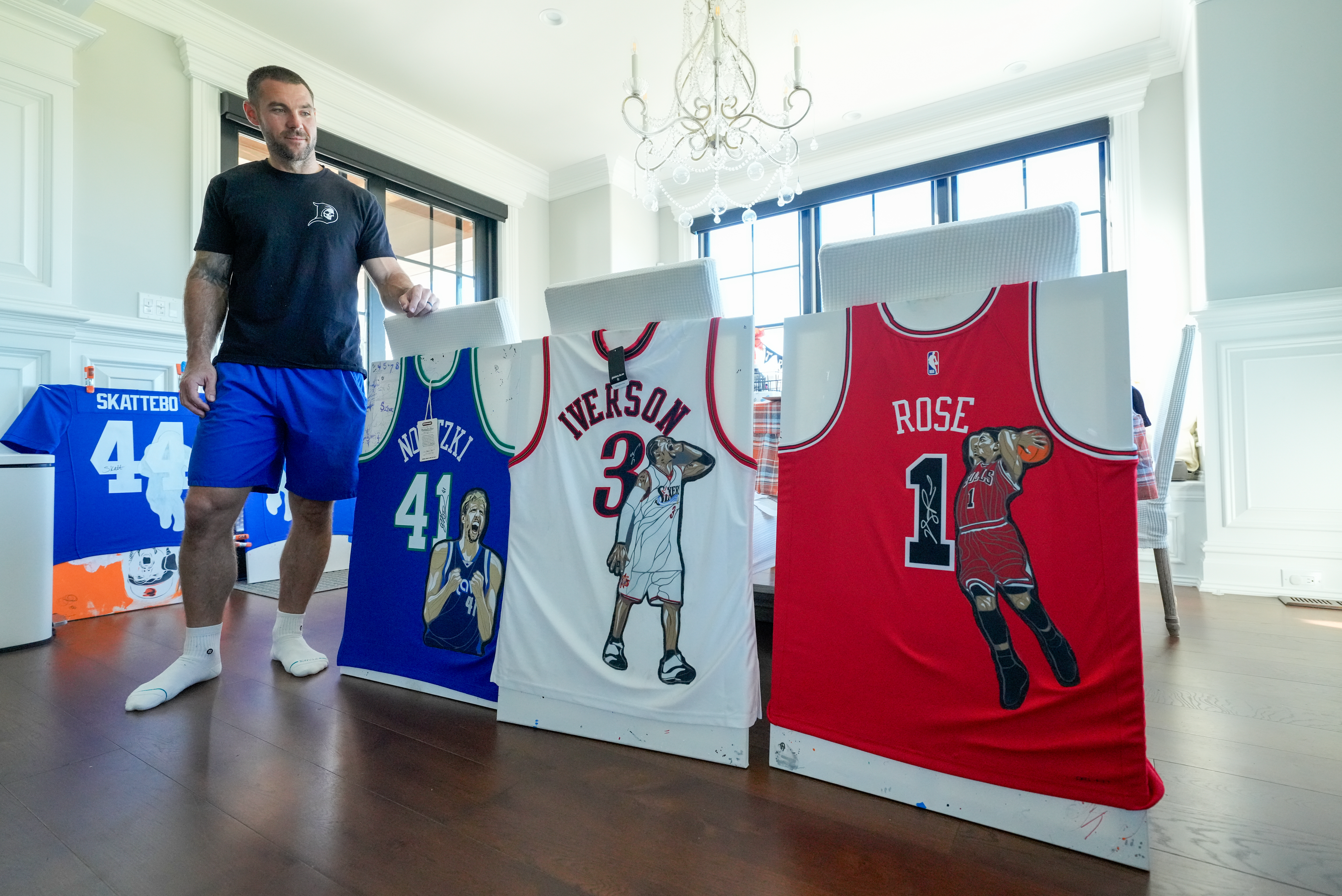
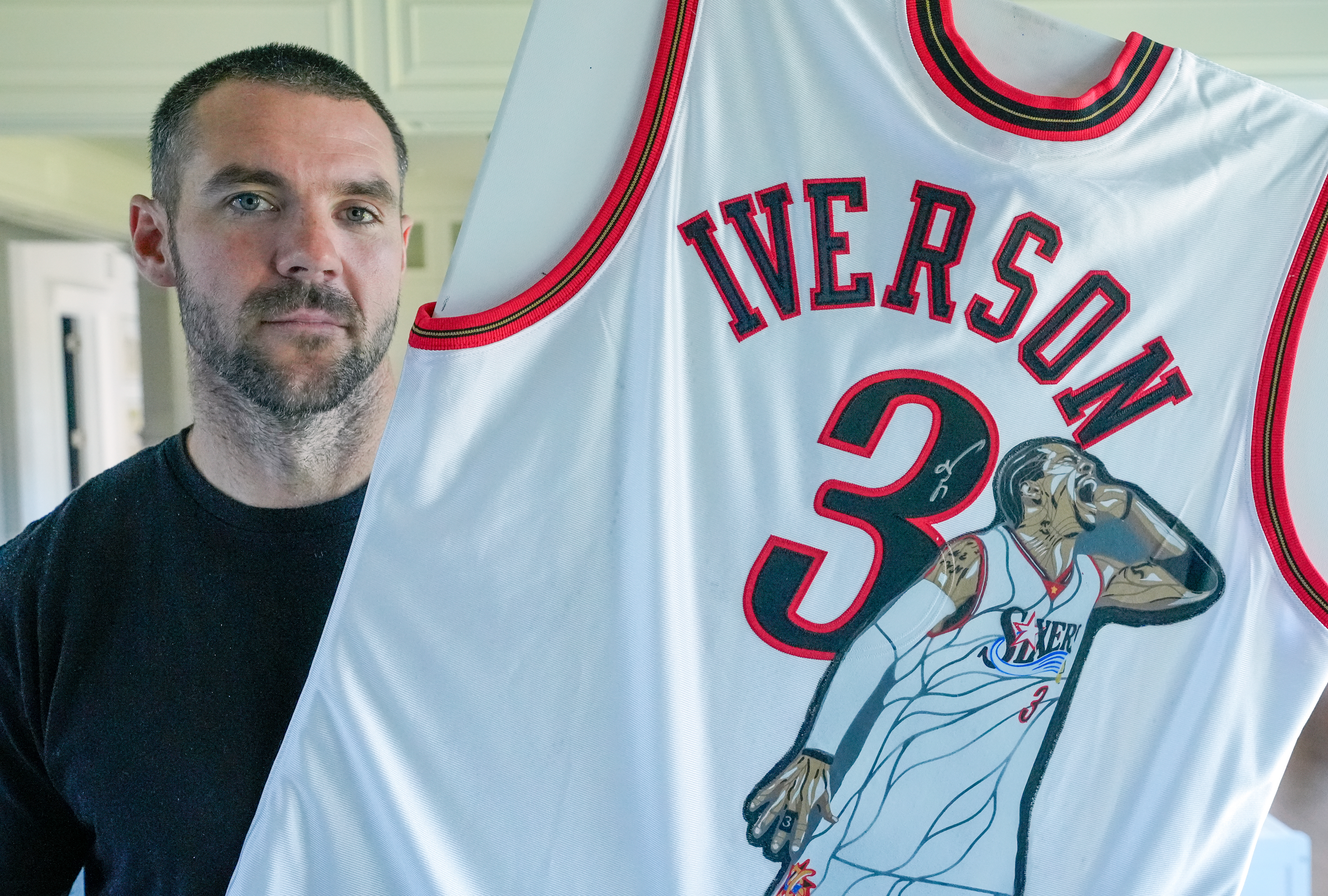
Szczur has created artwork on the jerseys of basketball stars for Fanatics.Tim Hawk / For The InquirerOne of those jerseys belongs to former Sixers star Allen Iverson.Tim Hawk / For The Inquirer
Fanatics sends Szczur signed jerseys of players like Allen Iverson, Emmitt Smith, and Dominique Wilkins. He then paints a portrait of the player onto the jersey and sends it back to Fanatics. Szczur used to spend hours locked in his office or in his basement while he painted the jerseys. But then he realized his second career was taking him away from his two kids. So he paints now in his dining room, turning the table off the kitchen into an art studio. His son, Matthew, builds Legos while Szczur paints another Hall of Famer.
“They get to see dad doing something he enjoys doing,” Szczur said.
Szczur saw someone on social media hitting paint with a golf club, which gave him the idea to use a baseball bat. He figured it out — Szczur shattered plastic cups before trying Dixie cups — and made it his thing.
“Do I need to hit paint with a baseball bat? No. Do I need to throw paint with a glove on? No,” Szczur said. “But it adds to it. And with the stencils and the uniqueness of it, people can tell that’s my art. That’s Andy Warhol, LeRoy Neiman, Banksy, all the top guys. You know that’s a Warhol. That’s a LeRoy Neiman. That’s how my mind thought. When someone sees my art now, they know it’s me. Because no one else does it like me.”
Szczur sold a portrait of Shohei Ohtani at auction for nearly $50,000 and negotiates his own deals and partnerships. He would love to have a manager who could secure him business so he can just paint. For now, Szczur does it all. The former big leaguer moved on. His batter’s box is now in his garage.
“I pinch myself every day,” Szczur said. “I didn’t grow up with a lot of money. And everything I have, I feel like I’ve earned by myself. Yes, I’ve had help along the way. Coaches, parents, family. But it’s weird to say it, but I’m proud of myself. Never in a million years did I think I would have a second profession.”
Szczur’s artwork has sold to former teammates and private collectors, as well as in auctions.Tim Hawk / For The Inquirer
Brandon Marsh played all season with a bony overgrowth on the back of his left wrist and elected surgery last month, according to the Phillies.
Marsh, the outfielder whose season was marked by extremes, underwent a carpal boss excision on Oct. 14 in Scottsdale, Ariz., the team announced Friday. He has full range of motion, plans to begin his offseason hitting program on schedule next month, and is expected to be ready for spring training, a club spokesman said.
But the Phillies have also made it known that they’re open to trading Marsh, who has one year left before becoming eligible for free agency, a rival club official said Friday. It’s unclear whether the condition of his wrist will impact those talks.
The firm bump on Marsh’s wrist — a “carpal boss,” in medical terminology — developed in spring training and was treated non-surgically by the Phillies’ doctors and athletic trainers. It recurred on and off throughout the season.
Marsh, who turns 29 next month, opted for the surgery to prevent future flare-ups, the team spokesman said.
It was a season of drastic highs and lows for Marsh, who started the All-Star Game in Philadelphia but was among the worst hitters in the second half.
Before the All-Star break, Marsh batted .301 with an .829 OPS, tied for 34th among 164 players who qualified for the batting title. After the break, he batted .184 with a .502 OPS, which ranked 163rd.
Brandon Marsh after hitting a two-run home run against the Milwaukee Brewers on Sept. 22.Elizabeth Robertson / Staff Photographer
It’s unclear whether the carpal boss affected Marsh’s swing. According to Statcast, his hard-hit rate dipped from 50.6% in April to 42.6% in May, 45.2% in June, and 40% in both July and August before bottoming out at 31.7% in September.
Marsh is due to make approximately $8 million through salary arbitration in 2027 based on projections from MLB Trade Rumors. Given his struggles against left-handed pitching, the Phillies view him as a platoon outfielder, president of baseball operations Dave Dombrowski reiterated this week at the general managers’ meetings.
“I still think he’s a solid big-league player,” Dombrowski said this week at the general managers’ meetings in Las Vegas. “We do think that. … We have to straighten out the second half of the year. There’s really no rhyme or reason that he should play like that the second half of the year. He’s just too good a player to do it. We need to straighten that out.”
The Phillies didn’t disclose Marsh’s surgery until after a report surfaced in The Athletic this week. Asked on Tuesday if any player on the 40-man roster underwent a medical procedure after the season, Dombrowski said, “None of our big guys have had anything, to my knowledge.”
LAS VEGAS — Hours before a game in late September, Justin Crawford walked across the outfield and slapped hands with Chandler Simpson.
“That’s my guy,” Crawford said this week.
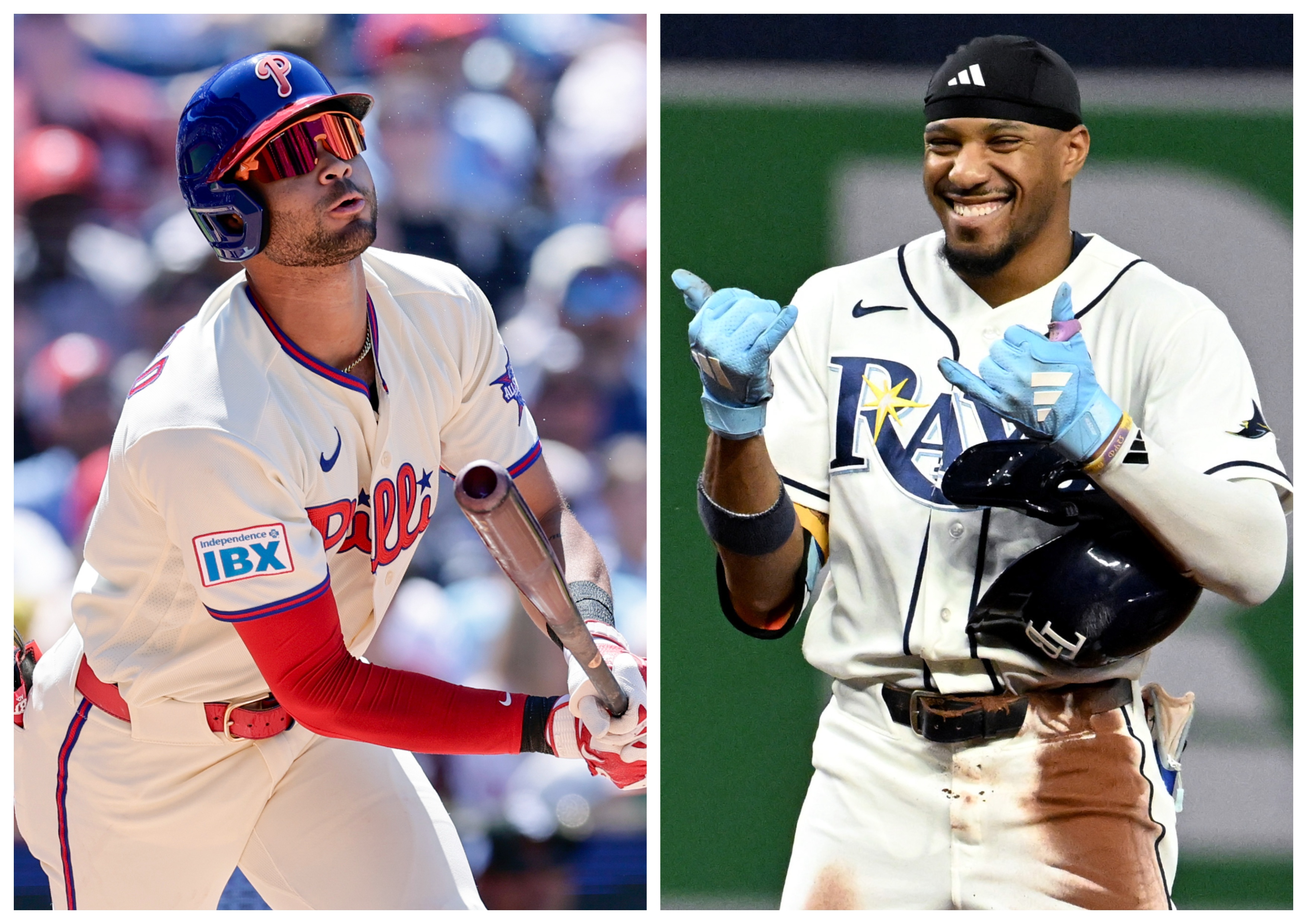
Friends for years, admirers for even longer, they were drafted 53 picks apart in 2022 — Crawford by the Phillies in the first round, Simpson by the Tampa Bay Rays in the second. They played against each other in the minor leagues and comprised two-thirds of Team USA’s outfield at a tournament in Mexico and Japan in November 2024.
And because they have similar skill sets — left-handed hitters with elite speed and an extreme tendency to hit the ball on the ground — they have elicited frequent comparisons from scouts and talent evaluators.
But as they converged in Citizens Bank Park that day, it was impossible not to wonder if Crawford, who will be 23 in January, looked at Simpson, 25, and saw the player that the Phillies need him to become.
“Yeah, definitely,” Crawford said on The Inquirer’s Phillies Extra podcast while the general managers’ meetings were being held in Las Vegas, his hometown. “I love watching Chan play. … I also know, too, the jump he made from his first year into his second year. And that’s definitely something that I’ve thought about, too, to be like, OK, I could definitely improve that way.”
It’s almost an imperative for an expensive, aging Phillies roster.
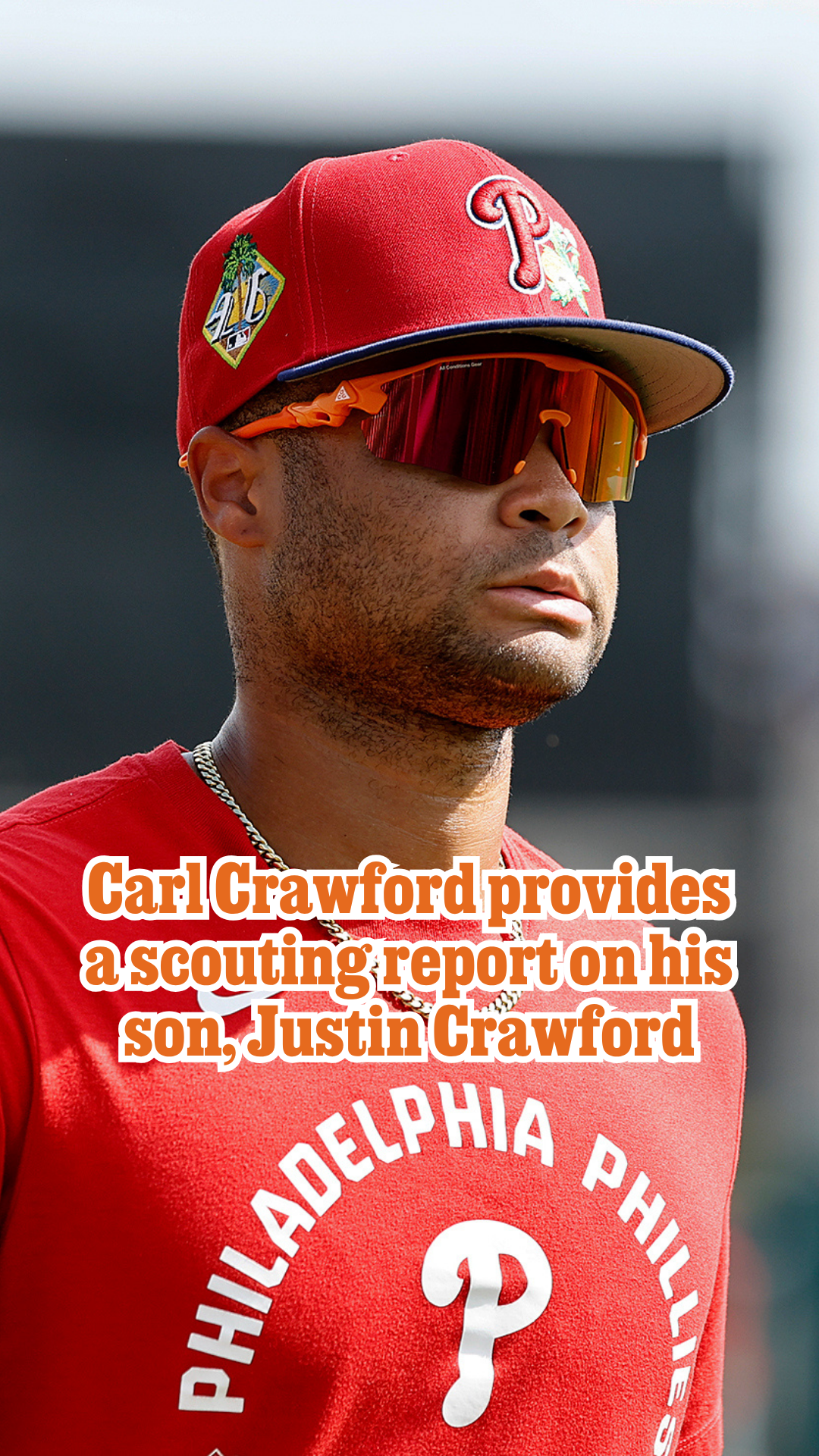
Video: Carl Crawford provides a scouting report on his son, Justin Crawford
As that core ages, the next youth wave must be more like a tsunami. Dave Dombrowski declared this week that he believes top prospect Aidan Miller, when healthy, is “as good as” award-winning rookies (read: Delco’s Kevin McGonigle of the Tigers), and Crawford must progress as Simpson did this year.
Crawford’s rookie year was a mixed bag. The 22-year-old center fielder debuted on opening day and stayed on the roster all season. He batted .279 over the season’s final two months and .264 overall, and was the fourth Phillies rookie since 2006 with 100 hits.
But he had only a .309 on-base percentage, leaving him unable to optimize his speed. After stealing 40 bases in three consecutive minor-league seasons, he swiped 17 in only 21 attempts.
Defensively, Crawford didn’t grade well, based on both the metrics and the eye test. And because he struggled against left-handed pitching, he slipped into a platoon in center field with righty-hitting Derek Hill.
As always, though, context is important. Crawford got 465 plate appearances, more than only four players who have not yet turned 23. Among them: McGonigle and Sal Stewart, who were crowned Rookie of the Year this week, and Jackson Chourio, who just won the World Series.
So, when Dombrowski and Don Mattingly summed up Crawford’s rookie year in separate news conferences by using the same expression — “He kept his head above water” — it’s easy to understand what they meant.
But the Phillies will hold Crawford to a higher standard next season.
Just like the Rays did this year with Simpson.
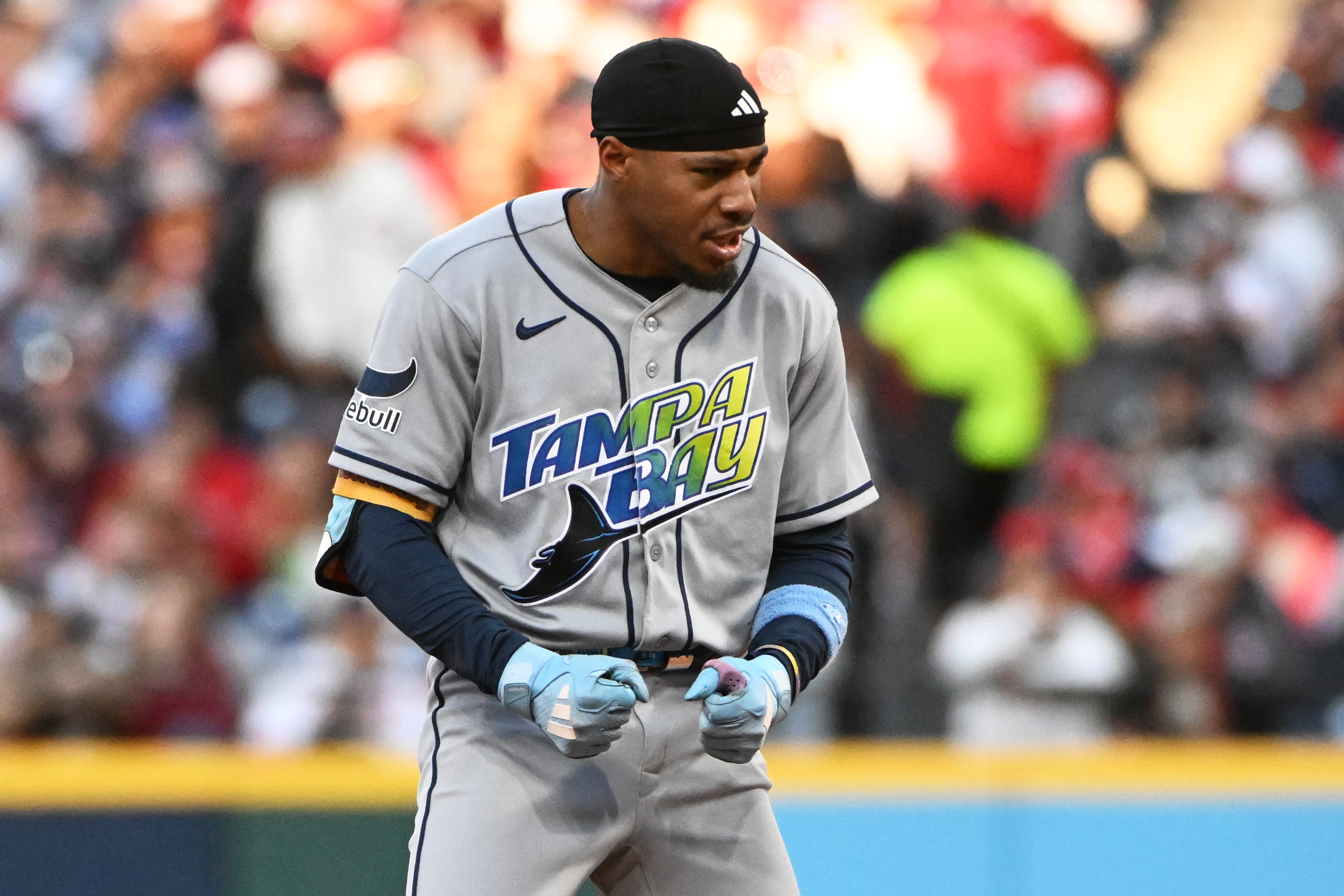
Rays left fielder Chandler Simpson led the majors with 42 infield hits and was second with 14 bunt hits.Phil Long
Getting defensive
Before he batted third in the World Series and led the Rays with eight hits in the five games against the Brewers, Simpson got demoted to triple A.
Like Crawford, Simpson was a polarizing prospect. He received equal praise for putting his bat on the ball at a high rate and rarely striking out, and criticism for making soft contact and often hitting the ball on the ground.
Given his blazing speed, the Rays were mostly content to let Simpson do his thing. But six weeks after making his major league debut in April 2025, he was unable to outrun a .315 on-base percentage and defensive shortcomings, neither of which can be tolerated from a player who doesn’t slug (one homer in 2,050 at-bats between the majors and minors).
“The raw speed is undeniable, but there was uncertainty about kind of its application,” Rays president of baseball operations Erik Neander said this week. “But he’s someone we always believed in because we knew he takes constructive criticism as well as anyone. The desire to be great, the willingness to work is second to none.”
Simpson returned to triple A for three weeks in 2025 before rejoining the Rays. They also moved him to left field. And he went from minus-9 defensive runs saved last season to plus-8, a 17-run upturn from 2025 to 2026 that made him a Gold Glove finalist.
“It was impressive to watch how much he improved all the way into the playoffs, crashing into the walls and putting his body on the line,” said Neander, who credited Simpson’s work with outfield coach Corey Dickerson. “But the jumps, the reads, the technique, the skill, the nuance of playing the position improved by leaps and bounds.
“And if he continues to stay on it the way he has, he’s going to win a Gold Glove, and that’s a tremendous amount of progress compared to where he was.”
Phillies center fielder Justin Crawford struggled at times defensively in his rookie season.Monica Herndon / Staff Photographer
The Phillies believe Crawford is equally coachable. They extol his work habits and his curiosity to learn. He sought help last winter from three-time former Gold Glove outfielder Eric Davis and said Phillies outfield coach Paco Figueroa “stayed on me all year long” about jumps, reads, and pre-pitch preparation. Crawford said he also picked Hill’s brain about ways to get better.
And there’s room for improvement. Crawford tied for second-worst among center fielders with minus-8 defensive runs saved, re-raising a debate within the organization about whether he’s better suited for left field.
The Phillies are planning to keep Crawford in center … for now. As Mattingly put it: “We’ve seen him have periods of time in center field that were really good, other times that weren’t as good.”
“From my first month in the big leagues until the last month — I don’t know what the numbers would say, or anything — I know the way I felt that I definitely felt like I improved out there and got more comfortable and felt really confident,” Crawford said.
The speedy Justin Crawford had just three bunt hits in 12 attempts in 2026.Yong Kim / Staff Photographer
Speed demons
Crawford stole 145 bases in 325 minor-league games in part because he reached at a .385 clip. But the Phillies’ player-development staff also emboldened him.
“In the minor leagues,” Crawford said, “I had the green light all the time.”
It wasn’t the same in the majors.
Never mind that Crawford got on base at a much lower rate. He often batted ninth, and when he did reach ahead of the top of the order, the Phillies tended to apply the brakes. He had 590 chances to steal, according to Statcast, and only a 2.9% attempt rate.
Looking back, Mattingly conceded the Phillies “played a little cautious.” (Stott’s attempted-steal rate was 2.4%; Turner’s was only 1.6%.) Mattingly pledged to utilize the team’s speed more often next season. He views Crawford as a “30- to 40-stolen-base guy.”
“I’m always ready to steal, and I’m always ready to run,” Crawford said. “I steal bases whenever I get the green light, and I don’t steal bases whenever I get the red light. Definitely if you ask me, though, I’m always trying to steal bases and looking to get into scoring position and cause havoc. I mean, that’s my game. That’s what I do best.”
But there are other ways to impact a game with speed. Simpson led the American League with 46 steals, but also paced the majors with 42 infield hits and 14 bunt singles, up from 18 infield hits and five bunt singles in his rookie season.
And amid the launch-angle craze that has permeated batting cages in the last decade, the Rays are content to let Simpson do what makes him special.
Video: The Phillies are counting on youth in 2027 | Gameday Central
“It is a unique skill set, and that doesn’t leave you many places to look for guidance and feedback to help yourself improve,” Neander said. “There aren’t many that can relate to him, right? So, it’s making sure that we continue to demonstrate belief that who he is, his strengths, his profile, have a place in Major League Baseball, not just to have an opportunity but to thrive.
“A lot of it is being there to support him and staying out of his way because he’s got a pretty good road map for what he needs to do.”
Crawford knows he didn’t travel that road often enough.
Mattingly has told him to focus on controlling the strike zone and reducing the swings and misses, especially at non-strikes, a message that Crawford expects new hitting coach Pete Fatse will reinforce when they get together next week in Vegas.
But Crawford also legged out only 25 infield hits and three bunt singles in just 12 attempts. It might have been the difference between his .264 average and Simpson’s .306 mark.
“I could definitely improve in that way,” Crawford said. “Obviously we have similar games, just trying to cause havoc. That’s something I like a lot and really admire is how he’s able to just go out there and be himself and play his game and not [listen to] whatever anyone says. He’s like, ‘No, I’m doing what I do, and this is how I help the team win.’ And it helps [the Rays] win, as we saw.
“Yeah, I’ve always loved watching him play. I definitely try to take some things, pick some things up from him, and try to use that in my game as well.”
Simpson’s second-year jump turned him into a core player for the pennant-winning Rays. The Phillies look at Crawford’s skills and see similar potential.
“I think there’s an upside with Justin, and where he goes is — I shouldn’t say totally dependent upon him — it’s dependent upon us to get it out of him and to help him go there,” Mattingly said. “It’ll be interesting to where it goes with him, and I think the sky is the limit with Justin.”