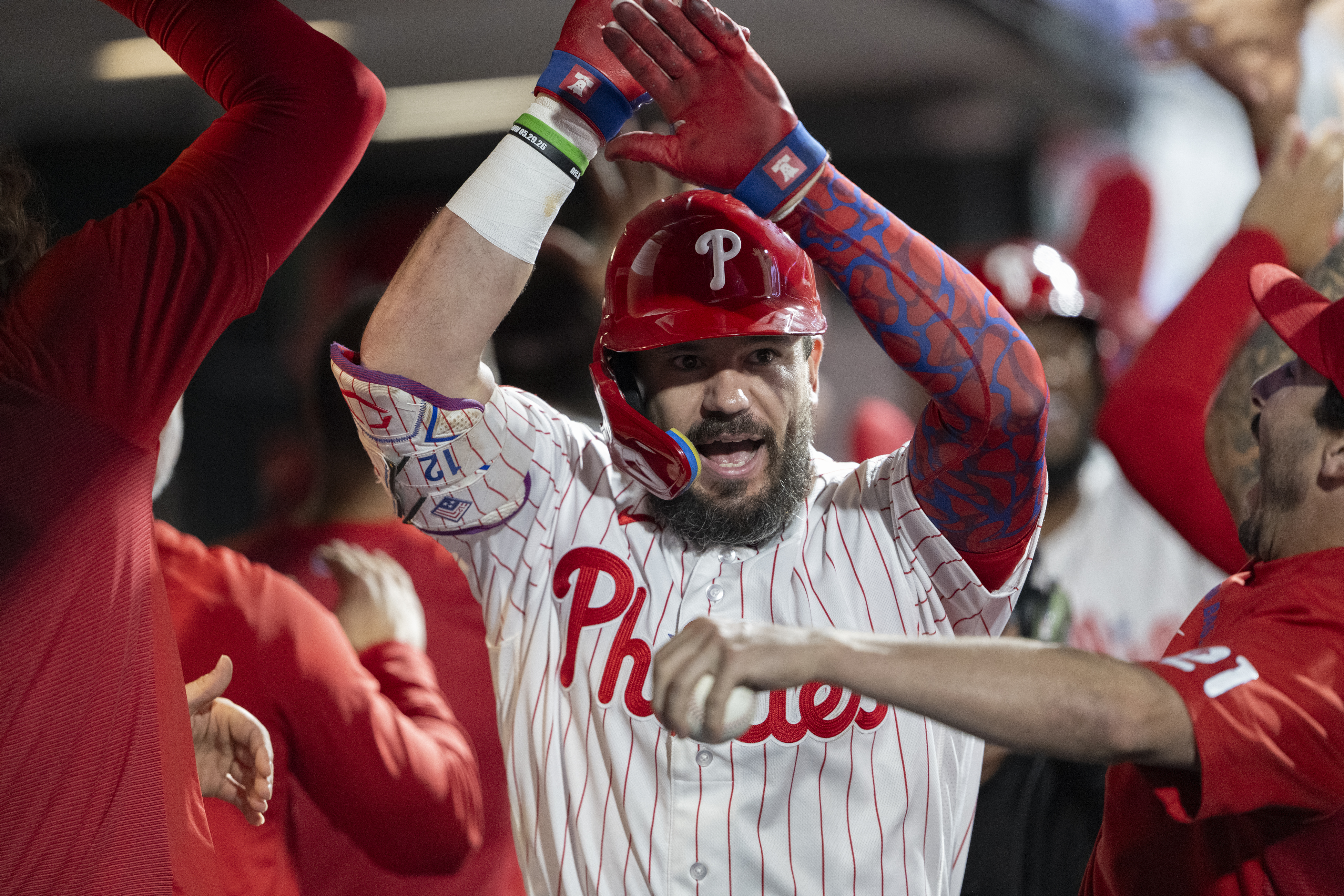
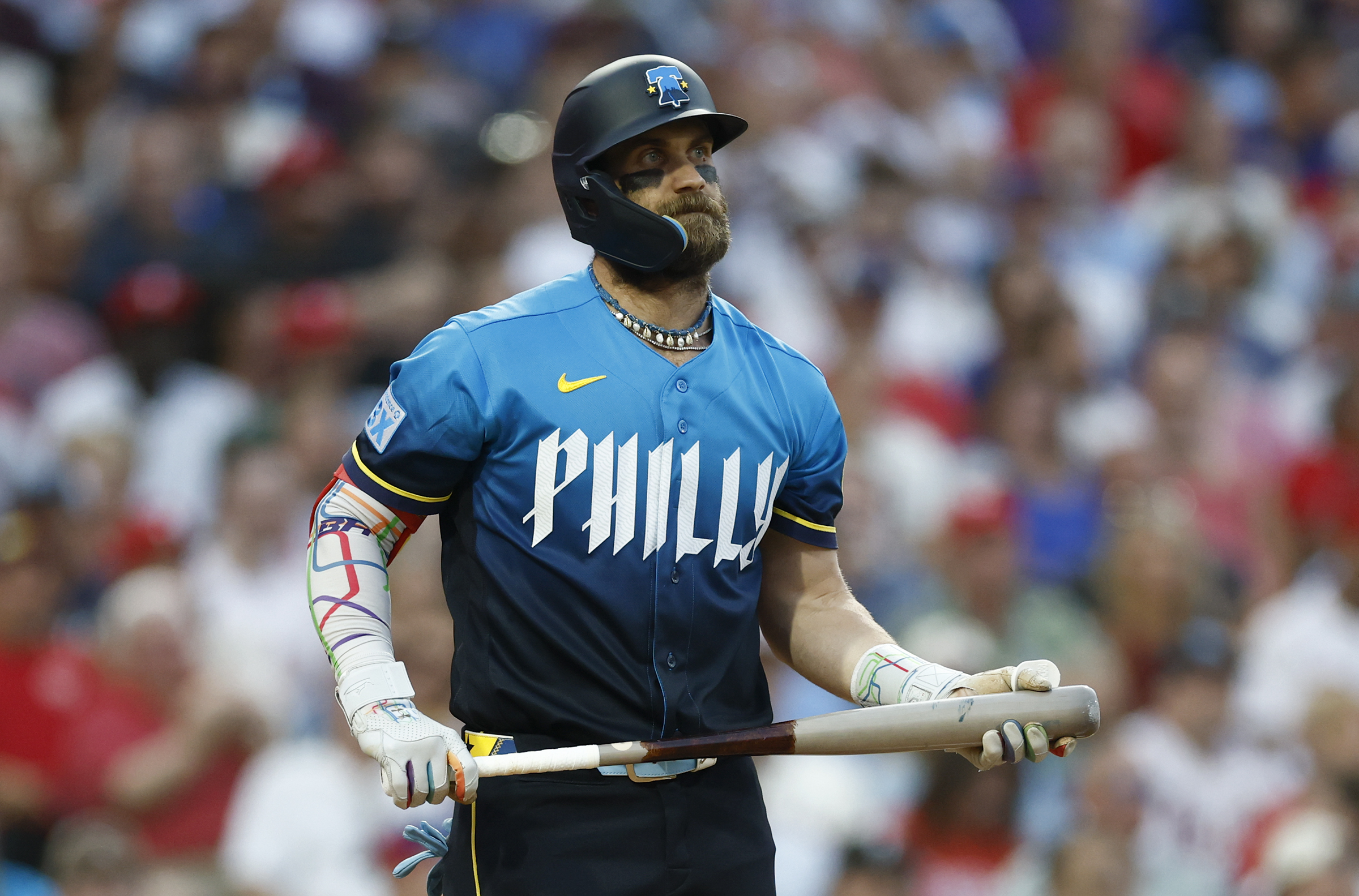
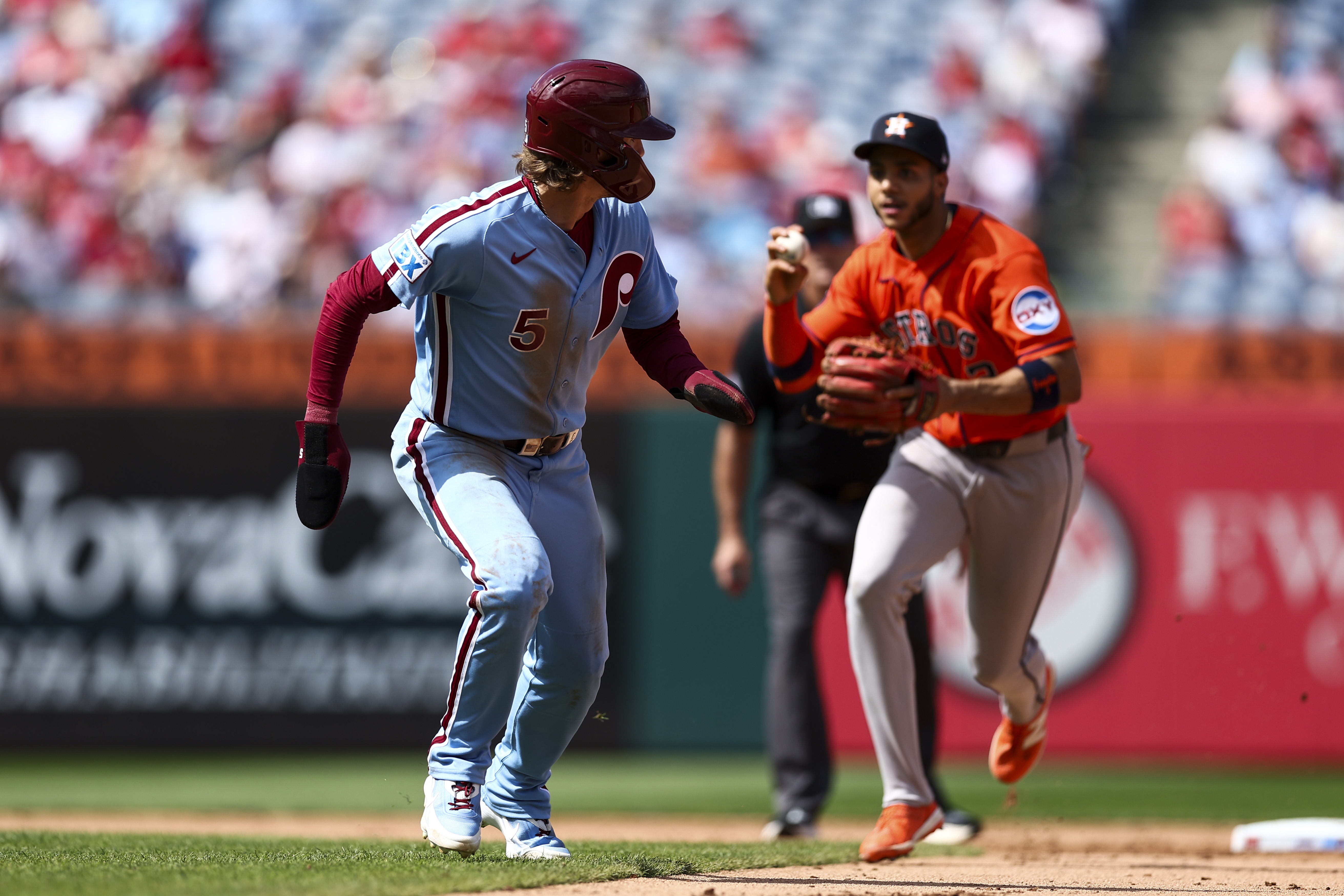
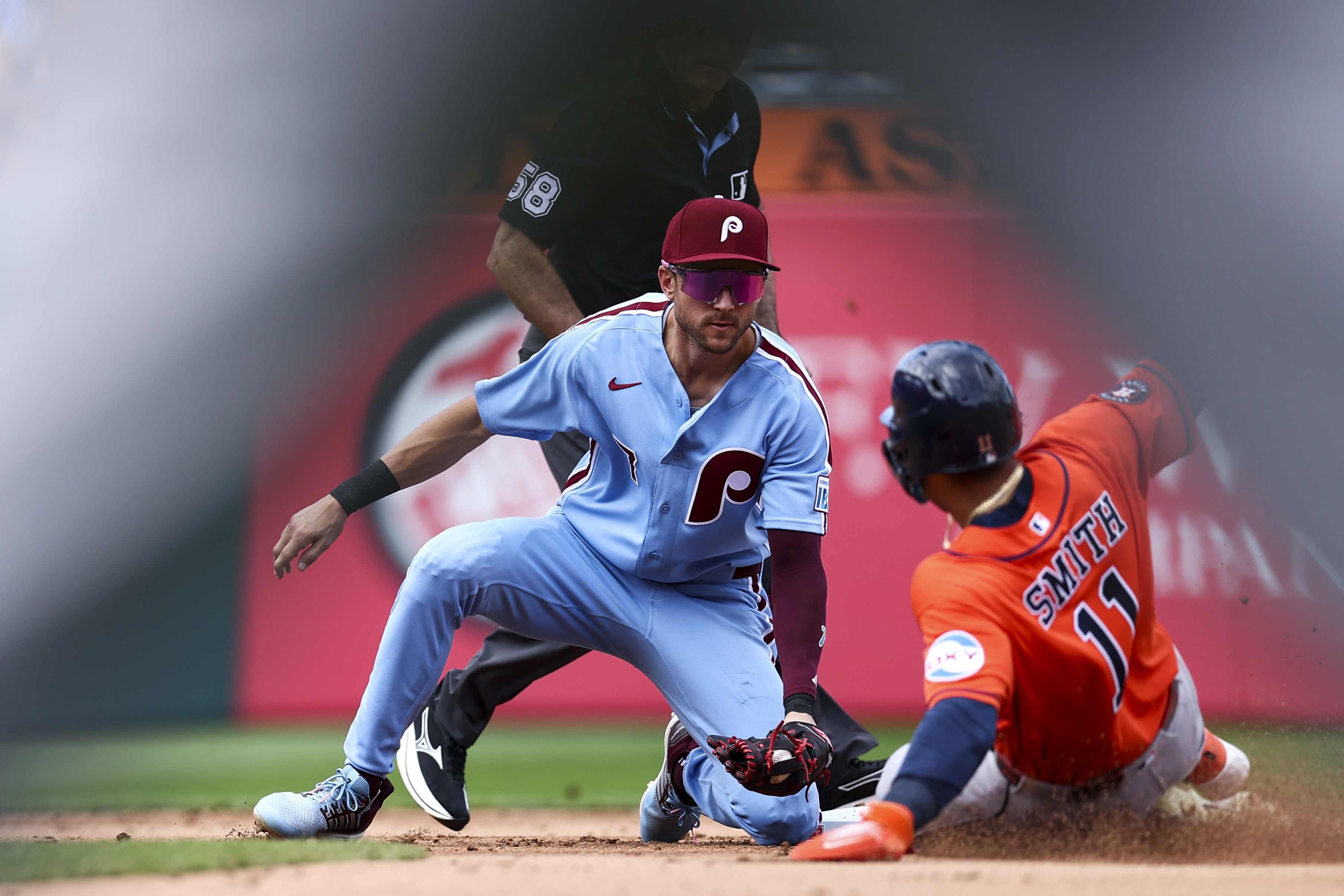
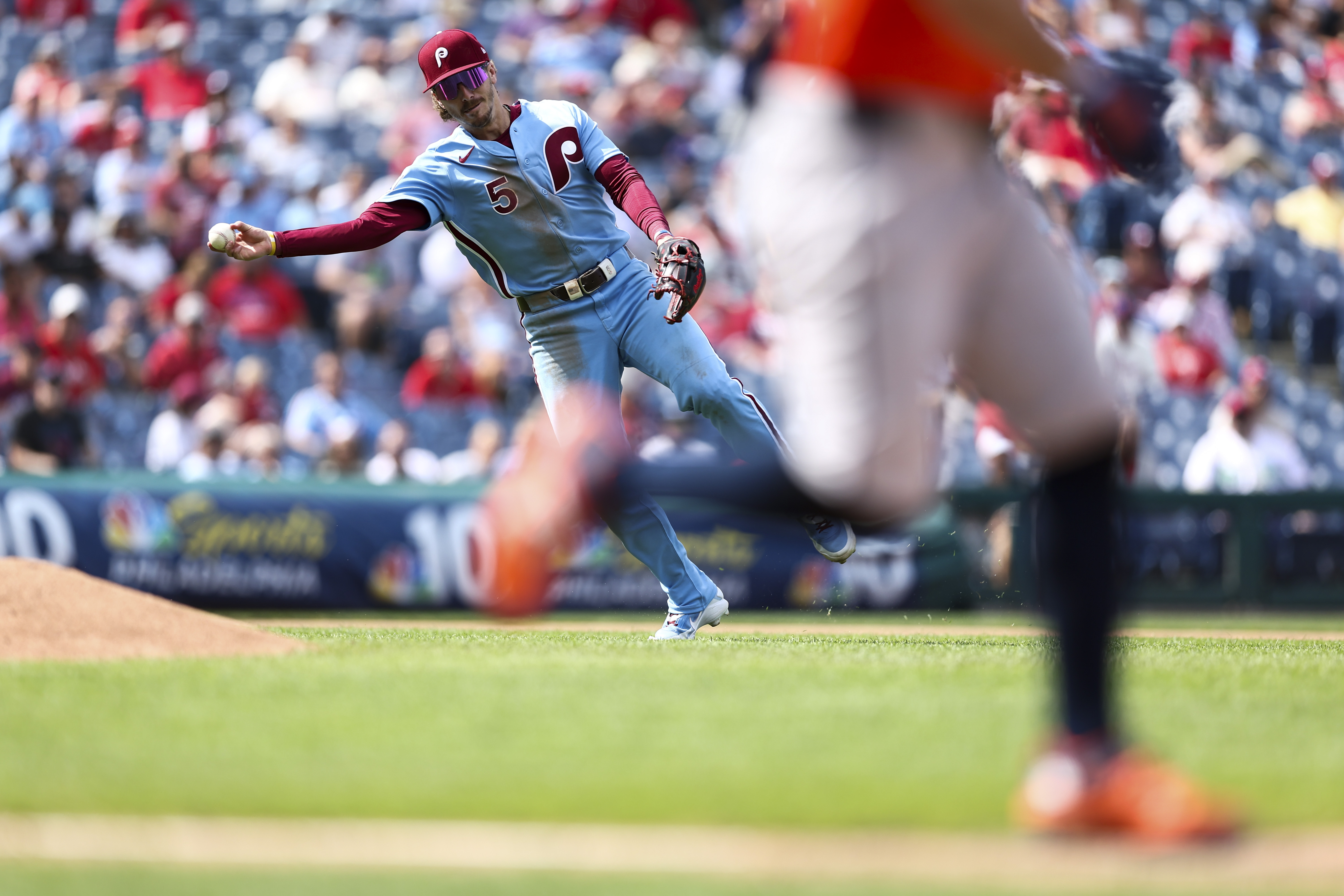
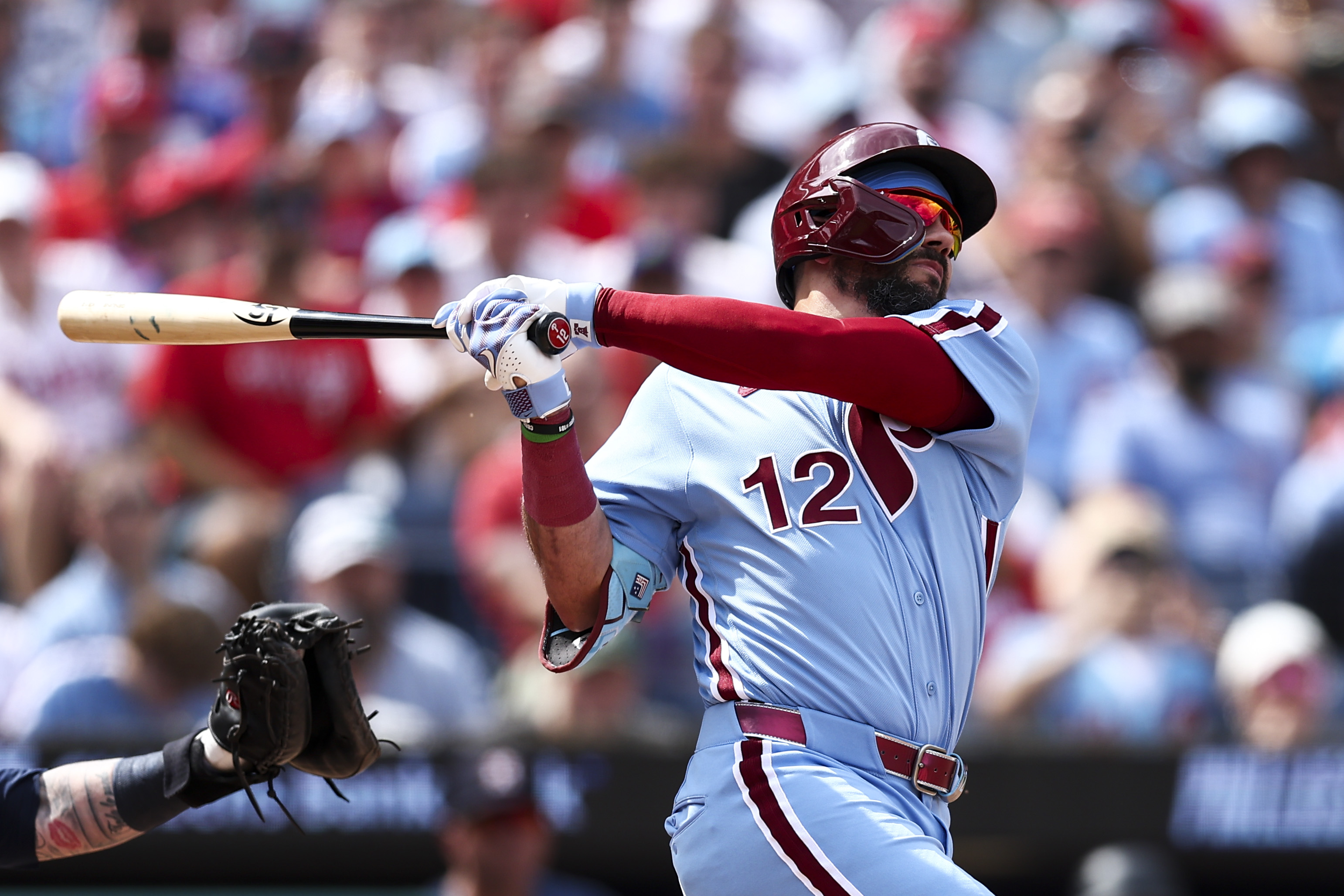
ATLANTA — Bryce Harper was off and running from second.
Alec Bohm had hit a grounder right to Braves shortstop Mauricio Dubón, but by the time Harper realized his mistake, it was too late. He was frozen between second and third, and Dubón had him dead to rights.
Harper was tagged out for the second out in the top of the ninth, and the Phillies’ best chance at an insurance run went up in smoke. When the Braves tied the game in the ninth, and again in the 10th, before finally walking off the Phillies, 6-5, in the 11th, the blunder cast an even longer shadow.
“Not ideal situation,” Harper said. “Yeah, need to be better.”
(function(){function e(){window.addEventListener(`message`,function(e){if(e.data[`datawrapper-height`]!==void 0){var t=document.querySelectorAll(`iframe`);for(var n in e.data[`datawrapper-height`])for(var r=0,i;i=t[r];r++)if(i.contentWindow===e.source){var a=e.data[`datawrapper-height`][n]+`px`;i.style.height=a}}})}e()})();
As Friday’s game marched into extra innings, the Phillies were unable to build a lead of more than one run. And the Braves kept punching back, before finally breaking through with an RBI double from Drake Baldwin to take the series opener in Atlanta.
The bad news for the Phillies didn’t end there. Jesús Luzardo, who almost single-handedly beat the Braves in his first career shutout last week, was scratched from his scheduled Saturday start because of shoulder stiffness.
Now, the Phillies will follow up Friday’s 11-inning game, which required five relief arms, with a bullpen game on Saturday.
Luzardo started feeling the stiffness after his 109-pitch shutout of the Braves on Sept. 4. The Phillies initially hoped he would be able to make his start but now opting fort caution. Interim manager Don Mattingly said Luzardo does not currently require time on the injured list.
“We feel like it’s safer to be careful with him and don’t want this to linger,” Mattingly said. “So it’s one of the things we want to try to take care of and just go from there.”
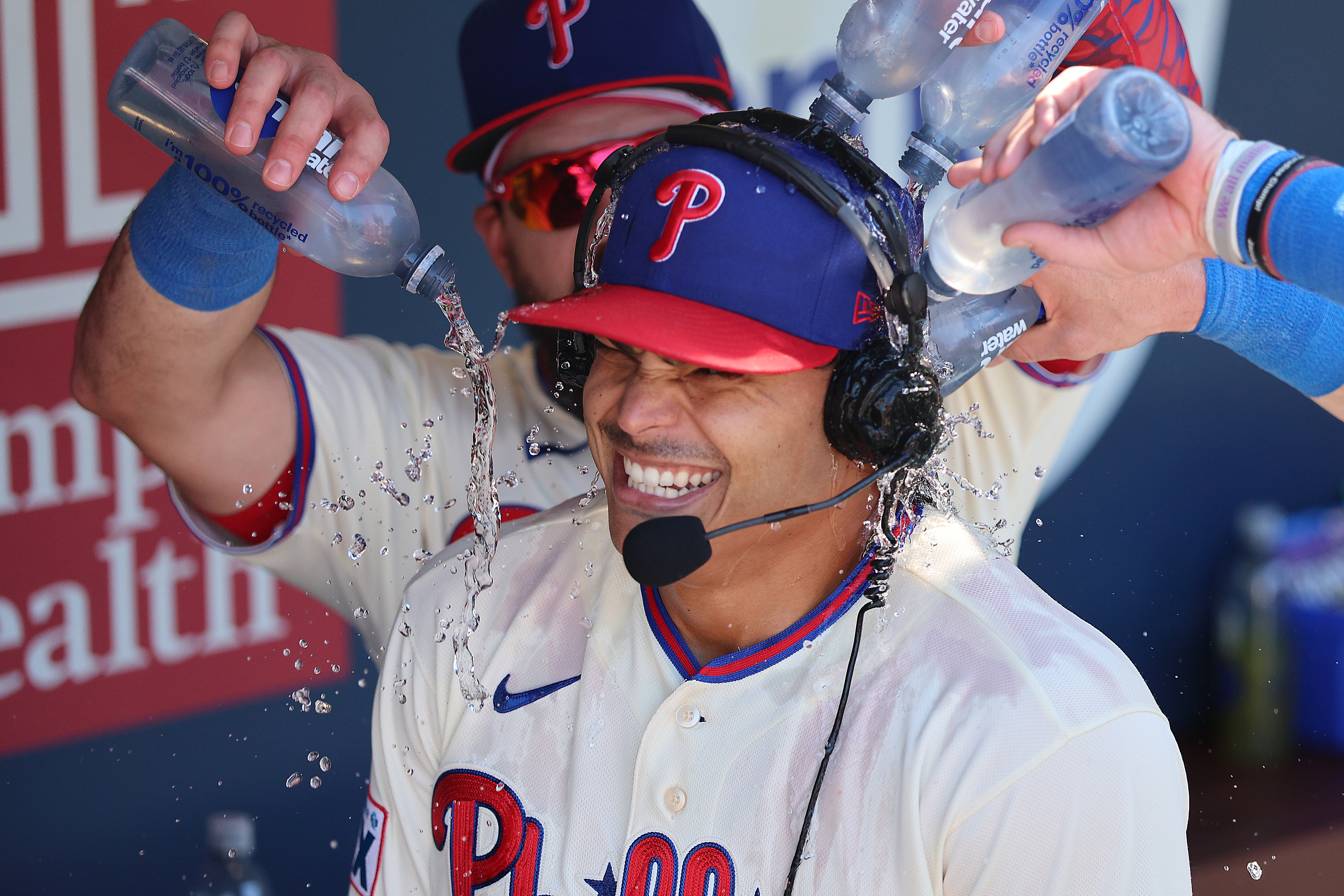
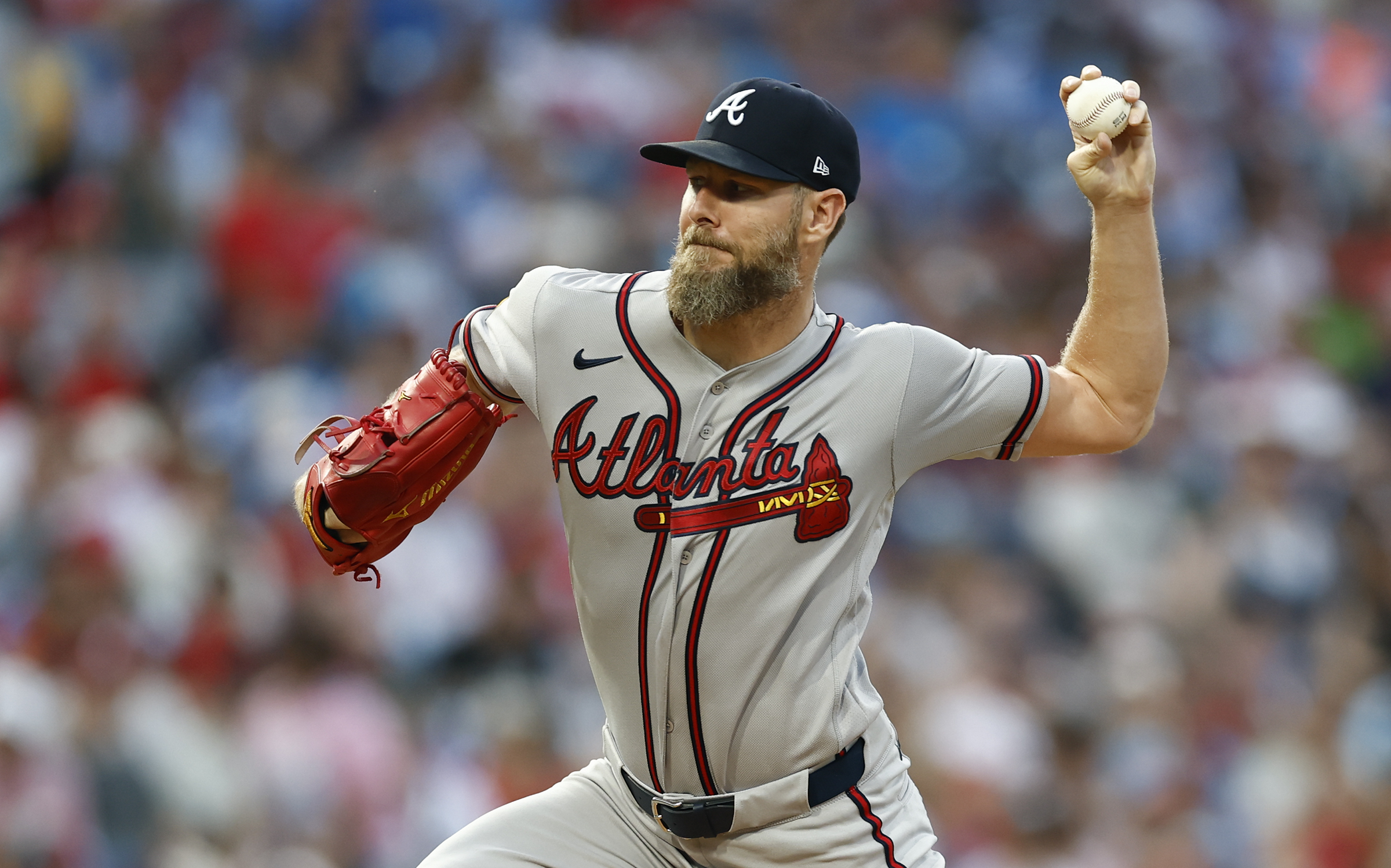
Friday’s loss stung all the more because the Phillies had managed to put up three runs on Braves ace Chris Sale. The second-inning rally, capped by a bases-clearing double by Derek Hill, had been their only sustained offense against him, but it was starting to look like it was all they needed.
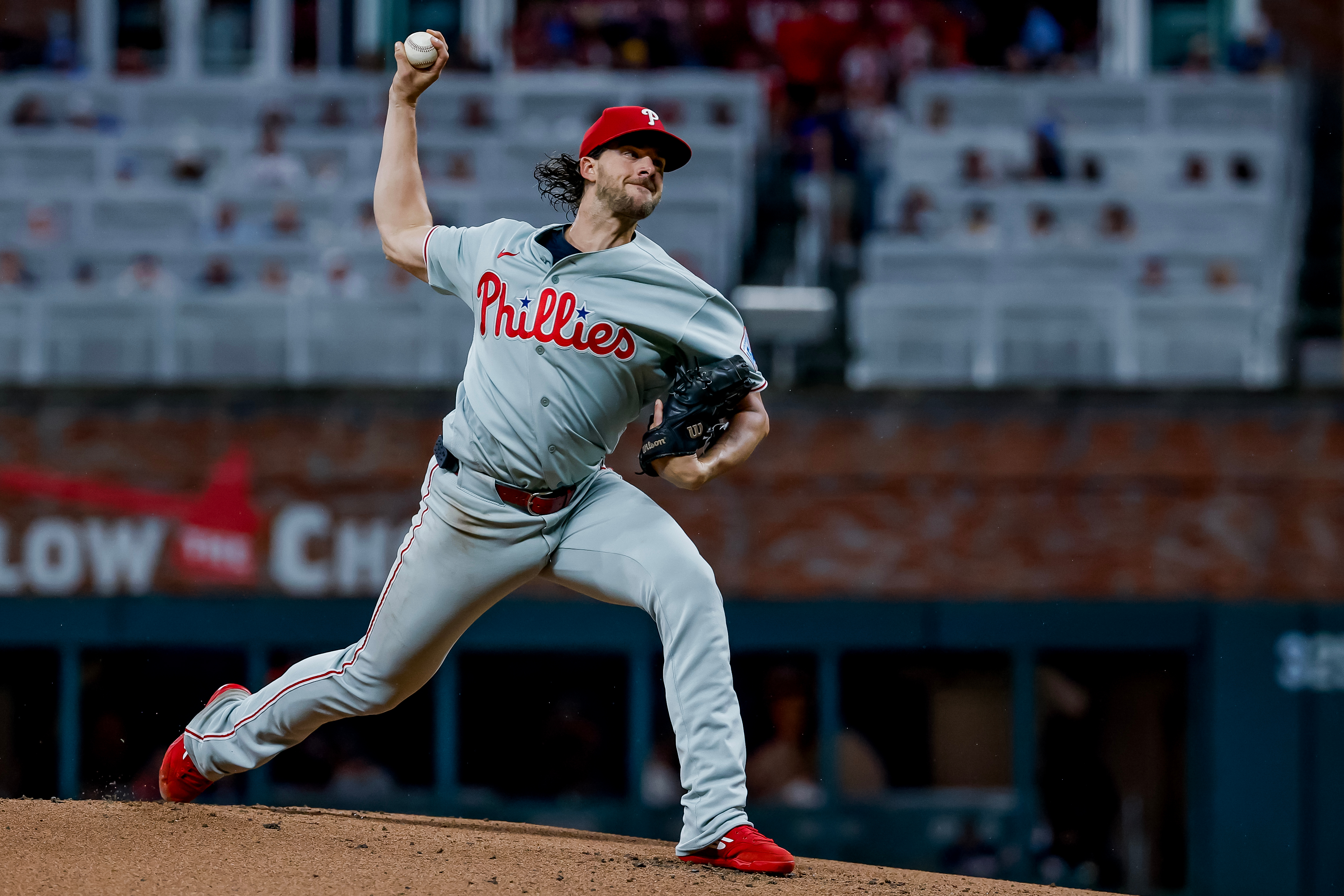
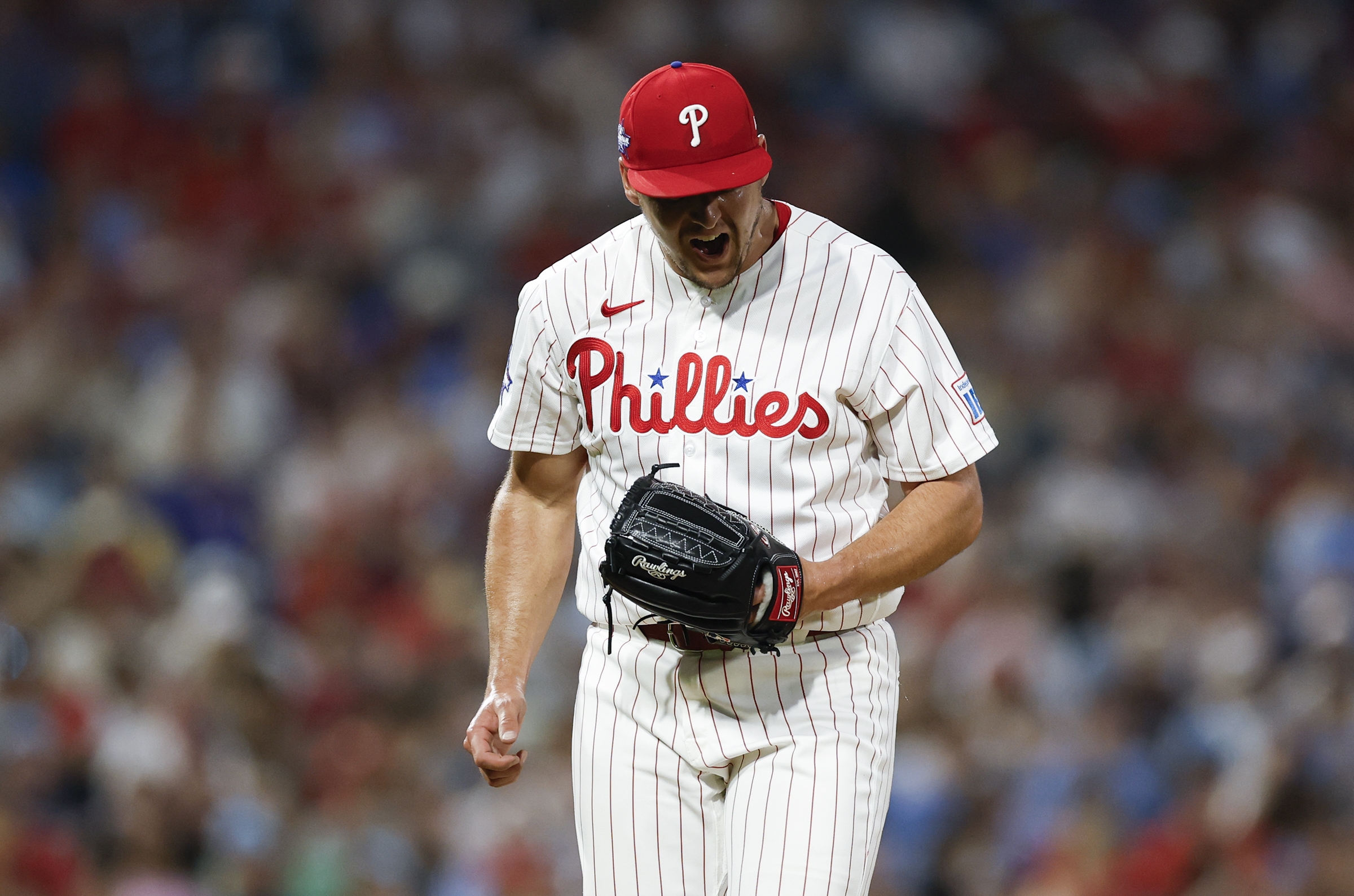
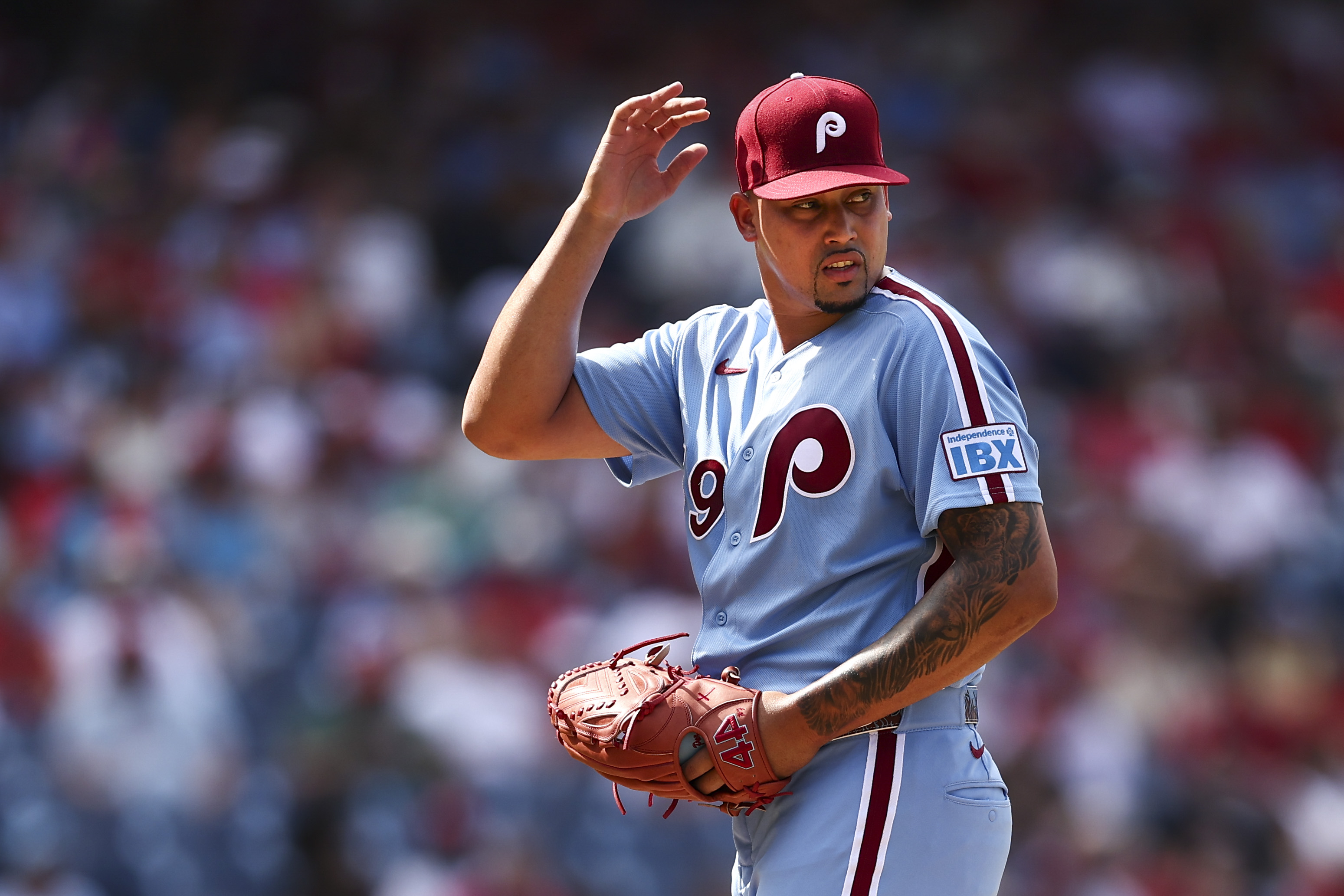
Aaron Nola worked his way around heavy traffic for 6⅓ innings, keeping the damage to a pair of solo home runs. José Alvarado relieved him and delivered two big strikeouts of Baldwin and Ronald Acuña Jr. Rookie Alex McFarlane turned in a scoreless eighth in a big spot.
With the Phillies clinging to a 3-2 lead in the ninth, Harper’s mistake was latest in a long line of baserunning blunders the Phillies have committed in this recent stretch. And this particular play between second and third seems to be the Phillies’ kryptonite.
Alec Bohm made an identical mistake to Harper on Thursday against the Astros. Brandon Marsh did the same two weeks ago in Anaheim, Calif., and earlier this week also was doubled off at second base after misreading a liner to shortstop.
“A little bit contagious,” Mattingly said. “I don’t understand it really. But, again, we’ll just keep talking about it and working through it.”
With Jhoan Duran unavailable after pitching back-to-back days, Jonathan Bowlan had the ninth with a one-run lead. He allowed back-to-back singles on his slider, and it didn’t help that Hill bobbled Sean Murphy’s hit to center field, allowing Mike Yastrzemski to tie the game at 4.
“Two ground balls. I mean, it’s tough, but that’s just the game,” Bowlan said. “The ground balls, they found holes, and it’s just part of it. And all you can do is take it a pitch at a time.”
After emerging earlier this season as one of the Phillies’ go-to setup arms, Bowlan has struggled in September. He has allowed a run in each of his last four appearances.
With 55 innings under his belt now, he’s already surpassed his career-high in the majors, though Bowlan said he feels like he’s holding up physically.
“I thought ball was coming out good,” Mattingly said. “Couple base hits up the middle, both sides of the bag. Yeah, we just got to keep going. He’s going through it, like hitters do or pitchers do. It’s kind of the same for me. So just got to keep working through it, and get where we got to go.”
Justin Crawford, who had been stuck on the bench for nine innings and a 47-minute rain delay before that, kept the Phillies’ hopes alive with an RBI single to lead off the 10th. But it was still not enough, as the Braves tied things back up on a sacrifice fly.
Luis Arraez’s RBI single temporarily put the Phillies back in front, 6-5, in the top of the 11th. But Ha-Seong Kim tied the game against Brooks Raley with a single before Baldwin’s double won it.
“He’s a guy that we trust that he’s not going to give in,” Mattingly said of Raley. “I think [Kim] hit a changeup, just kind of pulled it to him. Yeah, so all of our guys have been struggling a little bit out there. But we’ll get through it.”
As the Phillies left Truist Park in the early hours of Saturday morning, their list of concerns was long, and only growing. At the top is Luzardo’s health and whether some extra rest will be enough to have the lefty back to form atop the rotation as the postseason approaches.
But the Phillies’ baserunning and bullpen are not far behind.
“Definitely thought we had a chance to win that game, all around,” Harper said.
ATLANTA — Four days after they last saw each other, the Phillies and Braves have come face to face yet again.
Because of a scheduling quirk, the regular season matchups between the National League East rivals this year have been condensed within two weeks in April and 10 days in September.
Interim manager Don Mattingly, for one, doesn’t mind it.
“I kind of like the back-to-backs, especially planning-wise. You just saw them for four games. You get a couple days off, and you go again,” he said. “So I kind of like it. It’s always better if you’re playing good. The first time we saw them, we weren’t playing good. They were playing really good. Same with the Cubs. Kind of caught them on fire. We were kind of struggling, right in the same little period of time.”
The Phillies entered Friday’s series opener trailing Atlanta by four games for the division lead — exactly where they were at the start of the previous series, which they split. Taking at least two of three games this weekend at Truist Park is essential for the Phillies to remain in contention for the NL East.
window.addEventListener(“message”,function(a){if(void 0!==a.data[“datawrapper-height”]){var e=document.querySelectorAll(“iframe”);for(var t in a.data[“datawrapper-height”])for(var r,i=0;r=e[i];i++)if(r.contentWindow===a.source){var d=a.data[“datawrapper-height”][t]+”px”;r.style.height=d}}});
Because of the scheduling, the Phillies just saw all three Braves pitchers planned to start this series: Chris Sale, Tyler Mahle, and Grant Holmes. On the other hand, the Braves just faced Friday starter Aaron Nola and Saturday starter Jesús Luzardo, who shut them out in his last outing. They missed Andrew Painter, who will take the ball on Sunday.
There are advantages and drawbacks for both pitchers and hitters seeing each other in quick succession.
“It kind of works both ways,” Mattingly said. “It’s like the cat and mouse game goes on and on. Like, how you pitched them last time, how did you get them out? Did you get them out? Did they hit you? What do you feel like they’re looking for? As a hitter, did he get me out? Is he going to go back there? It’s just back and forth.”
Phillies left fielder Brandon Marsh fouled a ball off his foot in the series finale vs. the Astros and was out of the starting lineup Friday vs. the Braves.Monica Herndon / Staff Photographer
Marsh and Marchán OK
As expected, neither Brandon Marsh nor catcher Rafael Marchán were in the Phillies’ lineup Friday against Sale, but both of them are healthy after sustaining some bruises in Thursday’s day game.
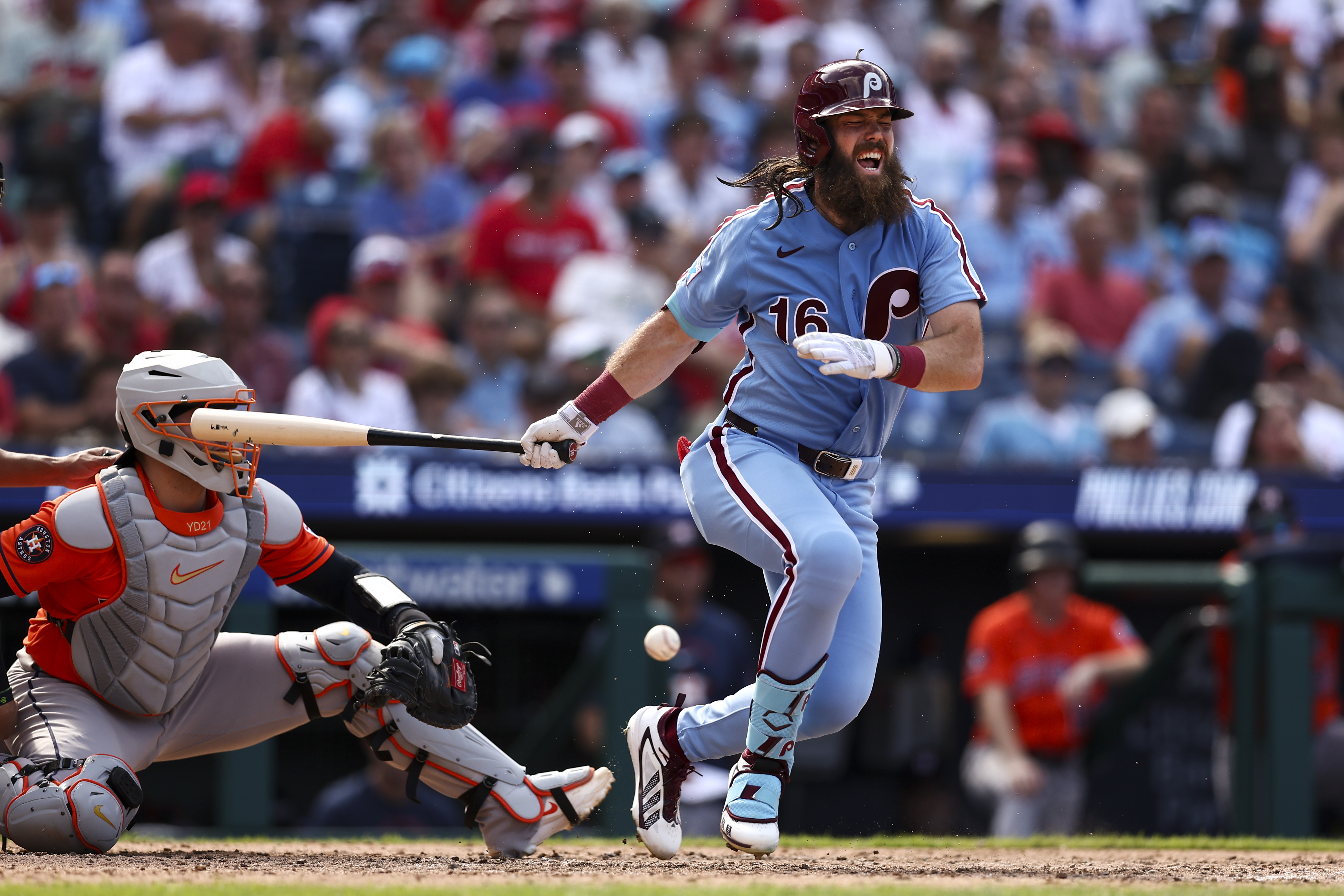
Marsh exited the series finale against the Astros with a bruised foot after fouling a ball off it in the bottom of the eighth inning. Marchán bunted a ball off his helmet in the sixth inning, though he remained in the game.
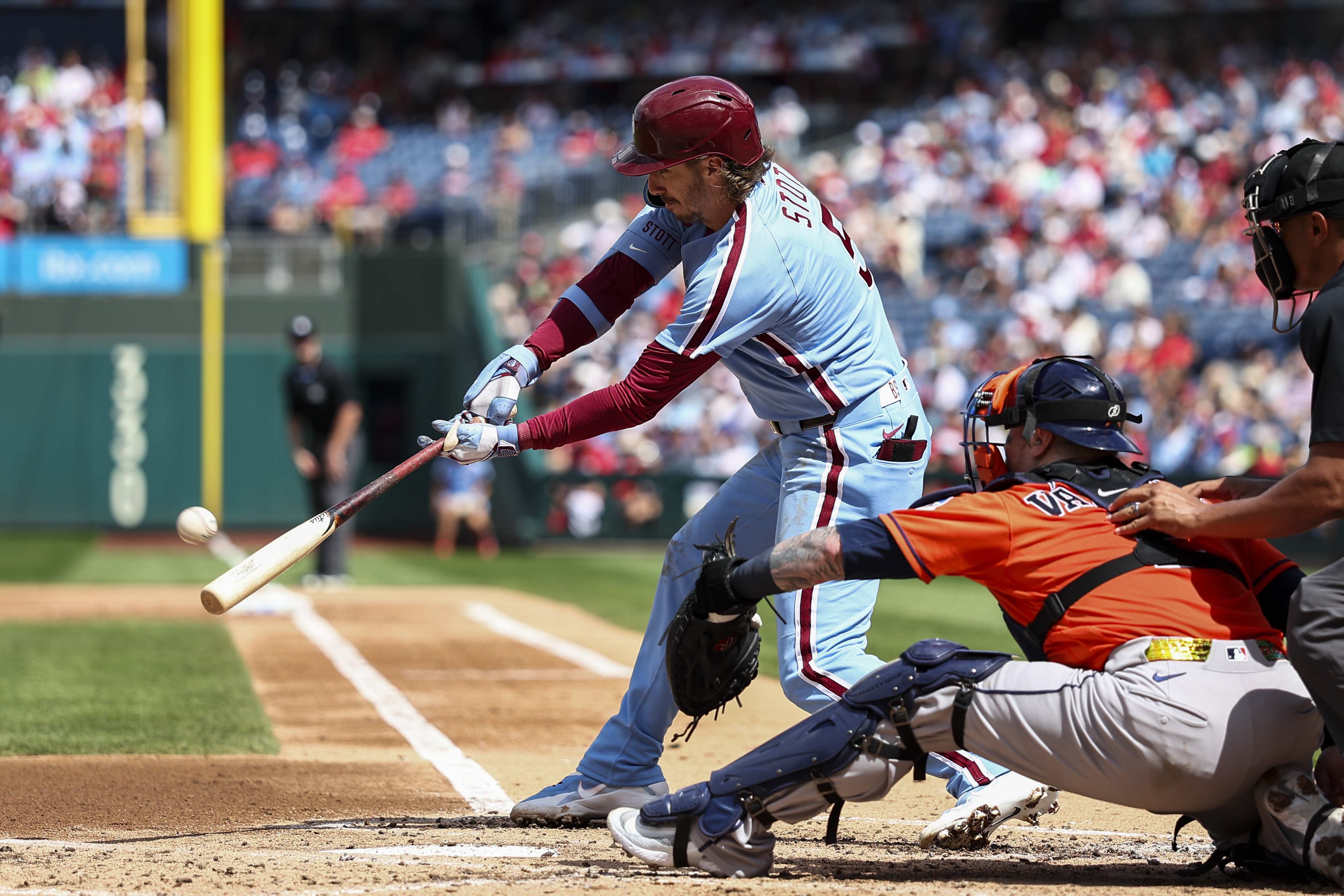
With lefty Sale on the mound for Atlanta, the Phillies stacked right-handers in Friday’s lineup. Bryan De La Cruz started in left field and Derek Hill started in center, while Edmundo Sosa took over for Bryson Stott at third.
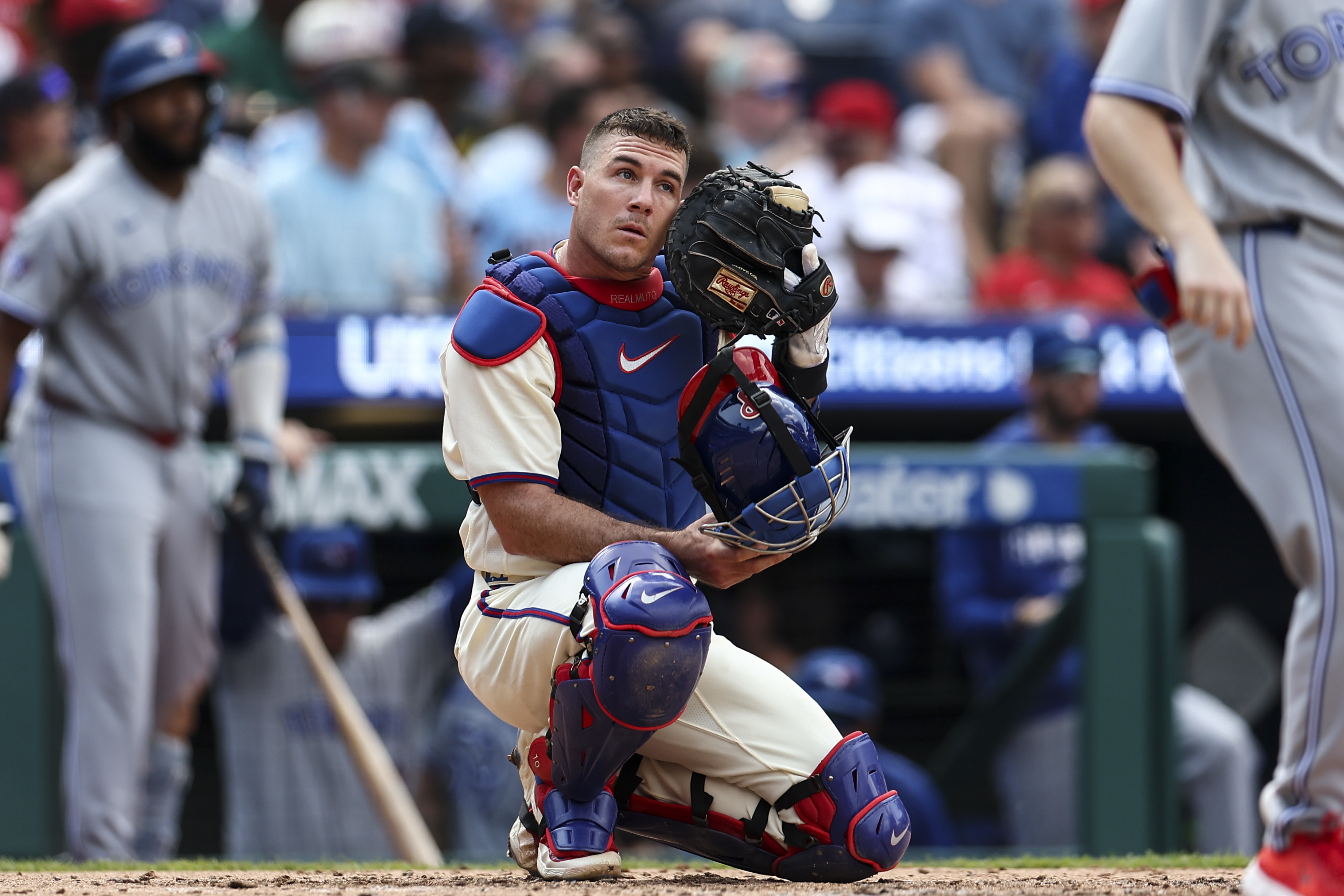
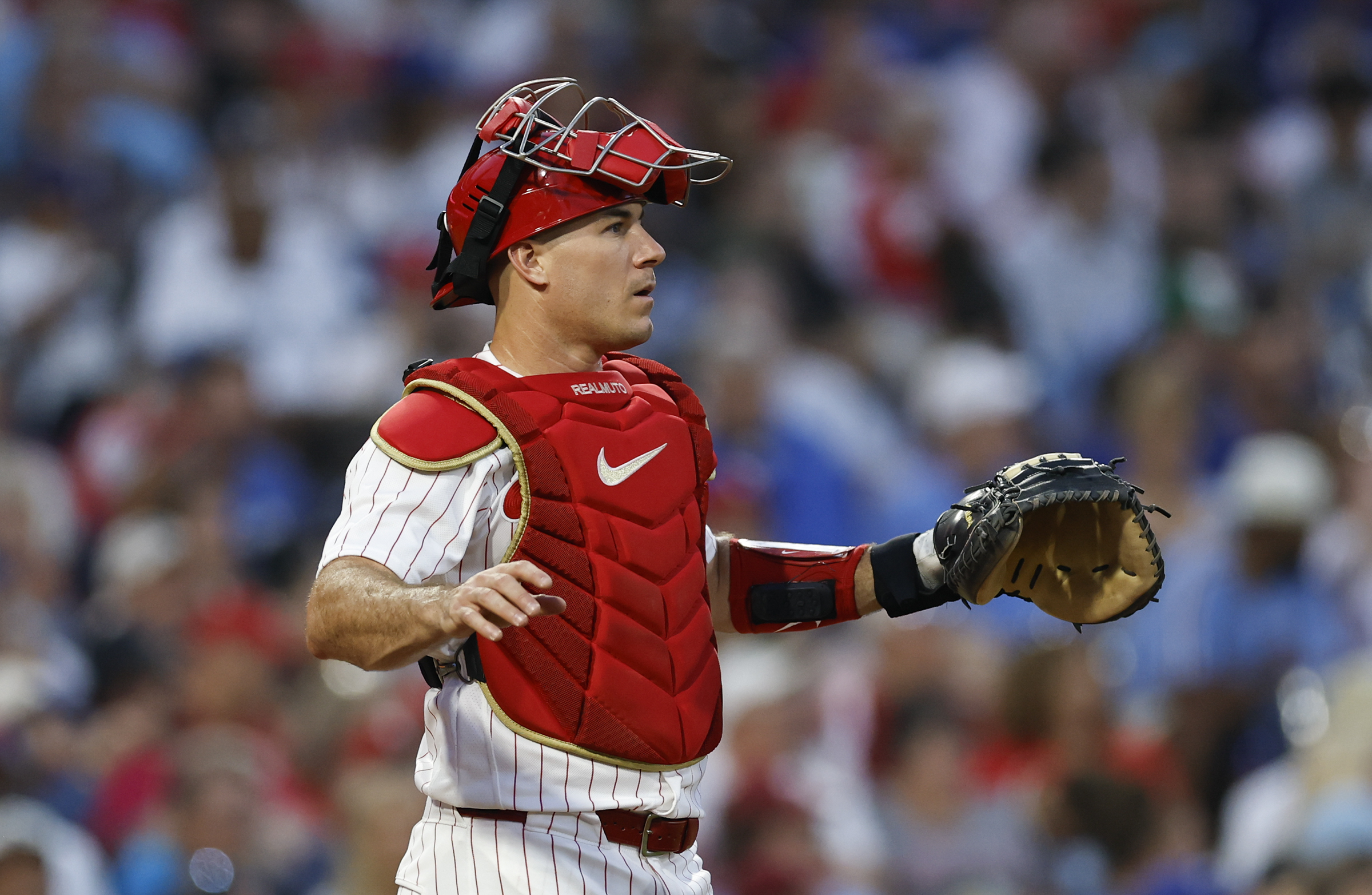
J.T. Realmuto was back behind the plate after a planned day off Thursday.
Brad Keller still has a ways to go in his recovery and rehab from the Tommy John surgery he underwent on July 29 to repair a torn UCL. But he has a locker in the visitor’s clubhouse in Atlanta this week and was there Friday catching up with his teammates.
Keller, who is based in Georgia, is taking the opportunity to be back around the team for the three games this series. Before his injury, he was a key part of the bullpen mix and signed a two-year, $22 million deal to be the Phillies’ setup man this offseason. Since Keller’s season ended, Jonathan Bowlan often has filled that role, but has struggled lately with a 6.23 ERA in four appearances in September.
Before his injury, Brad Keller was a big part of the Phillies’ bullpen.Yong Kim / Staff Photographer
Outfielder Adolis García, who suffered a season-ending lat tear in June, was also back around the team during their last homestand.
“It’s good to see guys that were a big part of what we were doing and had the injury, for him to come around. It’s kind of like [García],” Mattingly said. “It was the same way. To have those guys around, it feels good. Because sometimes I think when you’re on that, where you’re gone for a little bit of time, you feel like you’re not part of it anymore, and it’s just not a great feeling. So it’s good to have those guys come back around.”
Luzardo (14-5, 2.87 ERA) is scheduled to start opposite Braves right-hander Mahle (5-10, 4.05 ERA) on Saturday. In his last start, he limited Atlanta to two hits in his first career shutout.
A familiar Phillies radio voice will return to NBC Sports Philadelphia this weekend to call the team’s pivotal three-game series against the Atlanta Braves.
Scott Franzke, the veteran radio announcer in his 21st season calling Phillies games, will take his talents to TV to fill in for Tom McCarthy while McCarthy makes his annual trek over to the NFL.
Franzke and John Kruk will call all three Phillies-Braves games at Truist Park, beginning with Friday’s matchup. On the radio, pre- and postgame host Gregg Murphy will fill in for Franzke alongside Larry Andersen, who’s making his first road trip of the season.
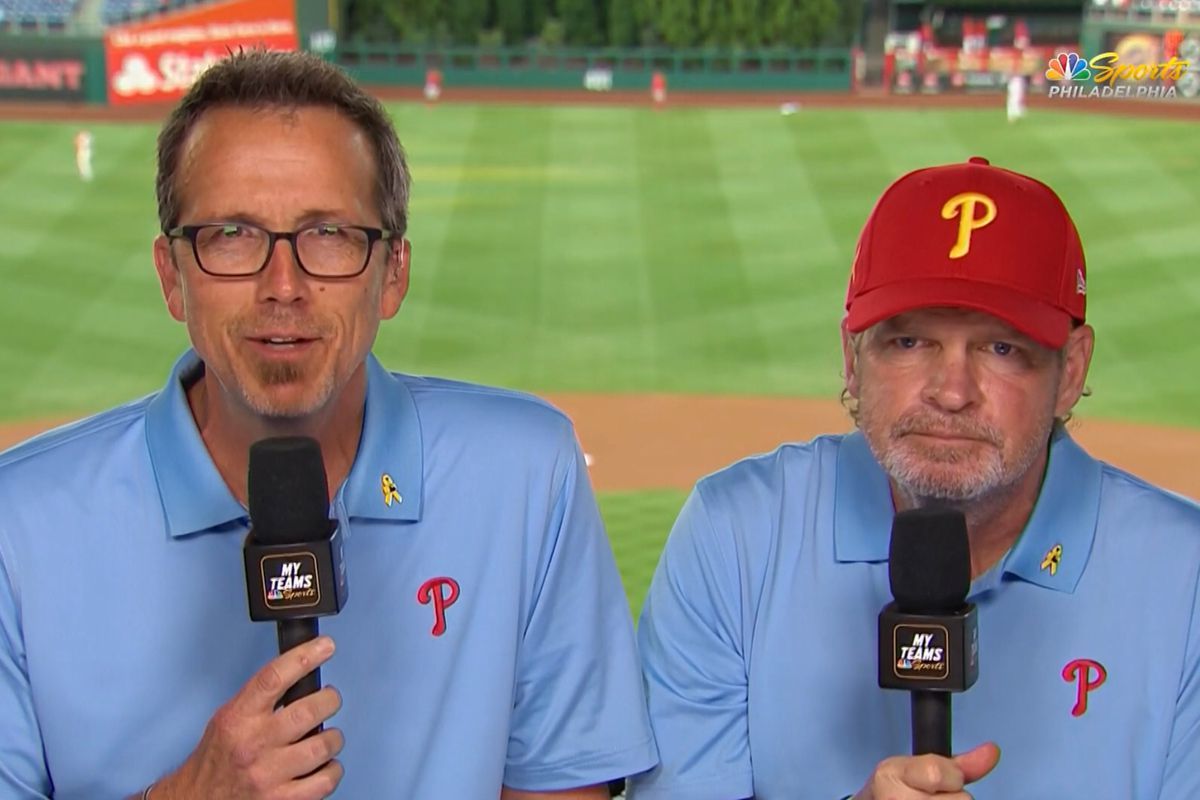
Scott Franzke and John Kruk will call this weekend’s Phillies-Braves series. NBC Sports Philadelphia
While McCarthy’s jump to football isn’t anything new — it’s his 13th season as a play-by-play voice for CBS — the timing is unfortunate. The Phillies have a chance to cut into the Braves’ narrow lead in the NL East, but weren’t helped by Jhoan Duran surrendering a ninth-inning homer Thursday.
Instead, McCarthy will be about five hours south in Jacksonville, Fla., to call the Jaguars’ Week 1 matchup against the Cleveland Browns. This season he’s paired with a new partner: former Indianapolis Colts and Seattle Seahawks running back Robert Turbin, whois in his first season as an NFL color analyst.
“As the former voice of their preseason, I’m kind of used to it,” McCarthy said of the antics that seem to perennially plague the Browns.
The rest of the season, McCarthy benefits from a Phillies weekend schedule filled with national broadcasts.
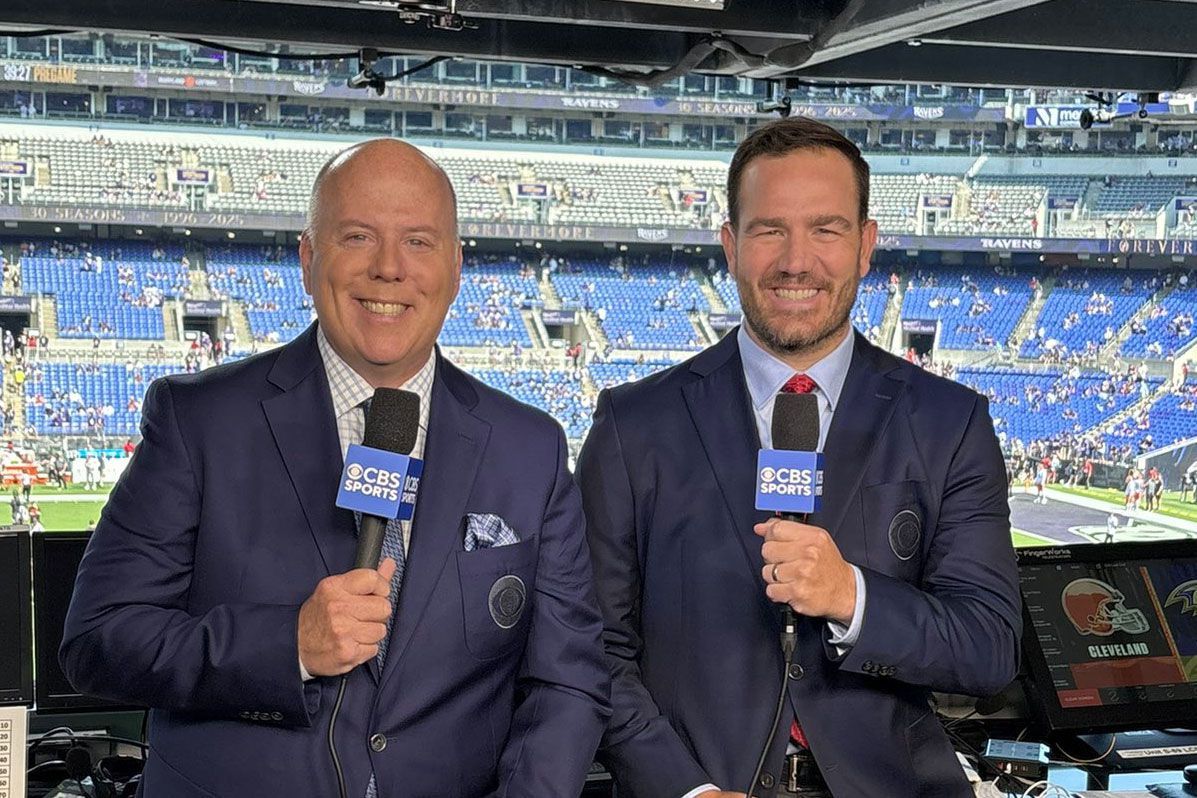
Last season, Tom McCarthy called NFL games alongside Ross Tucker. CBS
Next weekend, McCarthy will miss the final two games of the Phillies’ four-game series against the New York Mets. The first two won’t air on NBC Sports Philadelphia — Thursday’s game is being broadcast by Fox, while the Sept. 18 game will be part of the Friday Night Baseball doubleheader on Apple TV.
He’ll also miss the final game of the season, Sept. 27 against the Tampa Bay Rays, which will feature former Phillies pitcher turned broadcaster Cole Hamels. McCarthy will call the first game of the Rays series Friday, while Saturday’s game will be broadcast on Fox.
McCarthy’s schedule also benefited from this year’s late Labor Day.
“It worked out that I’m missing less games this year than I normally do because the NFL season’s starting a week later,” McCarthy said.
The Eagles are set to appear twice on CBS — Oct. 18 against the Carolina Panthers and Nov. 22 vs. the Pittsburgh Steelers — but McCarthy isn’t in line to call either and has yet to broadcast a Birds game on TV.
“I would love to do an Eagles game. I think it’d be a hoot,” McCarthy said. “But it’s one of those things where I roll with wherever they send me.”
Why McCarthy hasn’t been posting on X
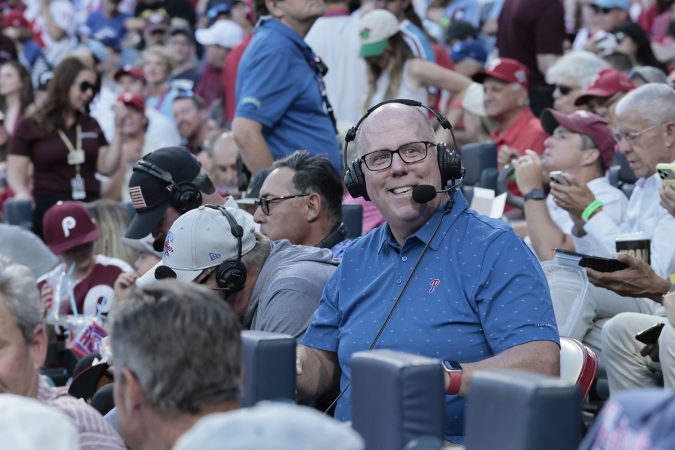
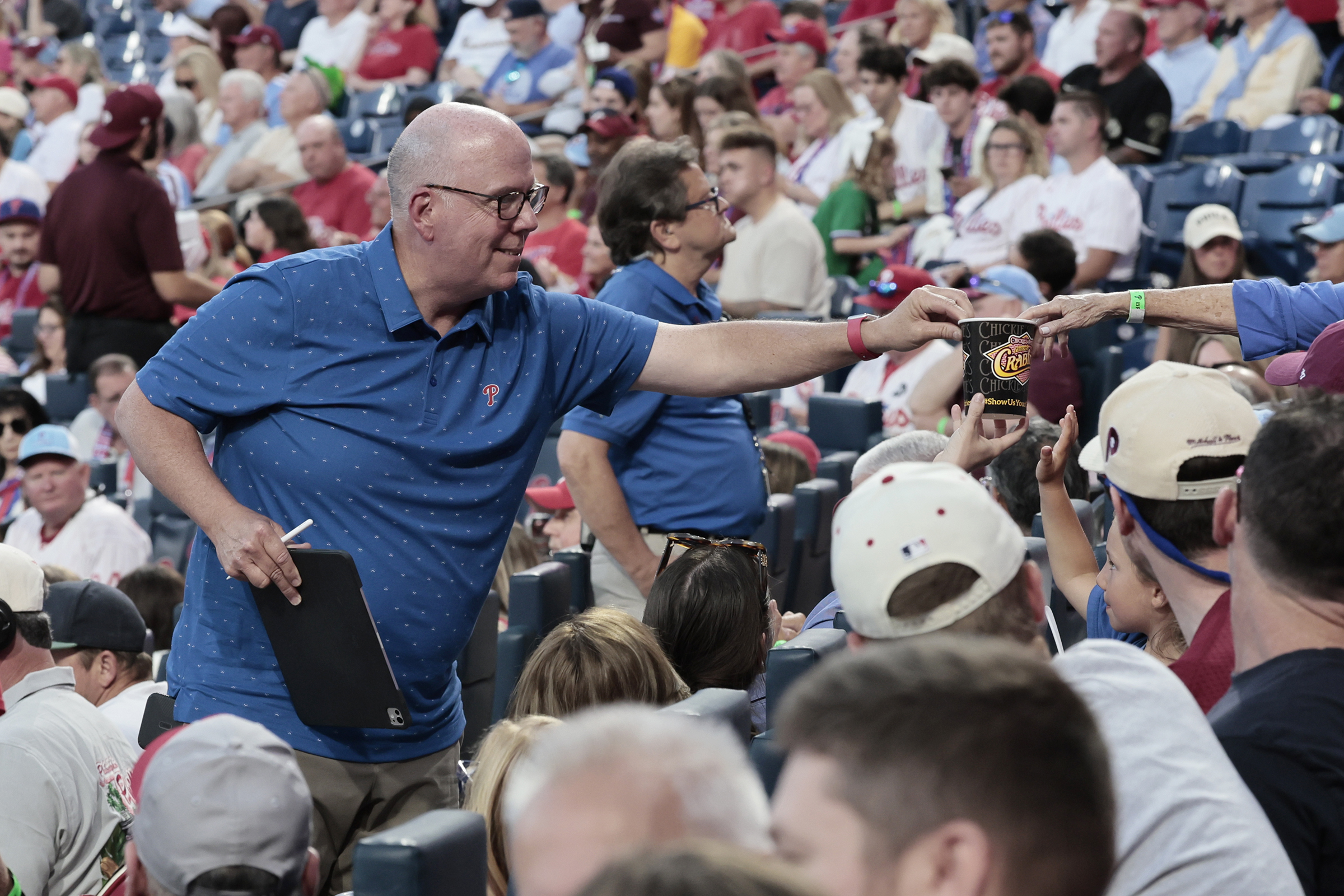
Tom McCarthy gives food to a fan during a broadcast from behind home plate at Citizens Bank Park in June. Elizabeth Robertson / Staff Photographer
While social media tends to be a hateful cesspool of negativity toward announcers, McCarthy has been a prolific poster for years.
Sometimes that meant answering a fan’s question about why the Phillies game wasn’t on NBC Sports Philadelphia. Often it was a funny rebuke of a nasty comment. He’s also used Twitter, now X, to defend his allegiance to the Phillies because he spent a couple seasons calling Mets games and his son, Patrick, handles New York’s pre- and postgame coverage on radio.
But his last post on X was more than two months ago. Why the long silence?
“I just got to the point between the algorithms and all the negativity and all the stories that were untrue,” McCarthy said. “It wasn’t something I really wanted to be associated with it anymore.”
If you miss interacting with McCarthy on social media, you can always follow him on Instagram, where he posts photos from the broadcast booth and connects with fans. He also likes that his feed is focused on baseball and golf.
“I can reset it pretty quickly if I feel like it’s too, let’s say, political,” McCarthy said.
NL East standings
window.addEventListener(“message”,function(a){if(void 0!==a.data[“datawrapper-height”]){var e=document.querySelectorAll(“iframe”);for(var t in a.data[“datawrapper-height”])for(var r,i=0;r=e[i];i++)if(r.contentWindow===a.source){var d=a.data[“datawrapper-height”][t]+”px”;r.style.height=d}}});
NL wildcard standings
window.addEventListener(“message”,function(a){if(void 0!==a.data[“datawrapper-height”]){var e=document.querySelectorAll(“iframe”);for(var t in a.data[“datawrapper-height”])for(var r,i=0;r=e[i];i++)if(r.contentWindow===a.source){var d=a.data[“datawrapper-height”][t]+”px”;r.style.height=d}}});
Phillies magic number
That is the combined total of Phillies’ wins and/or losses by the teams on the outside looking in that are needed to secure at least the third wild-card berth and a spot in the playoffs.
The Phillies are exactly where we probably should have expected them to be, which is exactly where they were a week ago. That is, four games behind the Braves with 15 to play heading into this weekend’s three-game series in Atlanta. That’s not necessarily a bad thing, believe it or not. Treading water is as important as making up ground.
Right now, the Phillies number one goal shouldn’t be winning the National League East. It should be avoiding the Braves in the wild-card round. The NL playoff picture has changed considerably with the Dodgers winning seven straight and the Braves losing four of six.
Now that L.A. has a 3½-game lead over Atlanta for the NL’s second bye, it’s looking increasingly likely that the eventual NL East division champs will end up hosting a best-of-three series against the No. 6 seed. Which means the Phillies should be just as focused on maintaining or growing their current 3½-game lead over the Padres, who entered Friday with a half-game lead over the Diamondbacks for the NL’s final playoff spot.
Some folks will scoff at the idea of the Phillies fearing the Braves in an October series. But best-of-three is barely a series. This isn’t about fearing the Braves. It’s about fearing Chris Sale.
Last weekend, the Phillies took their latest dose of medicine from one of the game’s all-time greats when Sale held them to two runs in six innings of a 5-2 Braves win. Atlanta’s presumptive Game 1 starter is not a problem the Phillies are magically going to solve just because the leaves are falling off trees.
The Braves are 3-0 in Sale’s three starts against the Phillies this season and they’ve won five of his seven since joining the team in 2024. His numbers should make you gulp. In his last five starts against the Phillies dating back to May of last season, Sale has allowed a grand total of four runs in 31 innings. He has struck out 40 of the 118 batters he has faced. That’s 33.9%.
Bryce Harper is one of the Phillies with bad career numbers against Chris Sale. He has just two hits in 18 at-bats against the lefty (.111).Yong Kim / Staff Photographer
In a longer series, the Phillies would have a clear starting pitching advantage over the Braves. Grant Holmes and Tyler Mahle have both had some success against the Phillies, most recently holding them to a combined two runs in 12 innings of last weekend’s series. Holmes has allowed just five runs in 20⅔ innings against the Phillies over the last two seasons, while Mahle held them scoreless in seven innings and 5⅔ innings in two of his three starts prior to last weekend (albeit dating back to 2021). Regardless, the Phillies would have a significant advantage in three of the first four games of a five-game series.
In a three-game series, Sale in Game 1 is a monumental equalizer of the odds. They’d much rather take their chances against the Cubs, who would presumably start Clay Holmes and Shota Imanaga, followed by a spin of the roulette wheel in Game 3.
A sigh of relief
Now, about that bullpen …
Give interim manager Don Mattingly credit for getting Alex McFarlane back on the mound in the eighth inning on Wednesday. The 25-year-old right-hander got ground balls from three of the four Astros batters he faced to deliver an 11-7 lead to Jhoan Duran in the ninth. McFarlane didn’t record a strikeout but threw strikes on 12 of his 15 pitches. This wasn’t exactly a high-leverage situation, at least not compared to the last time he walked off the mound. But it was a situation where a true set-up man gets the ball, and Mattingly gave it to him. Which is exactly what the Phillies manager should be doing.
Despite the homer he surrendered to Ronald Acuna Jr. last weekend, Alex McFarlane remains the Phillies’ greatest hope in the eighth inning.Elizabeth Robertson / Staff Photographer
The underdiscussed aspect of McFarlane’s welcome-to-the-bigs moment against Ronald Acuna Jr. and the Braves on Sunday was the fact that he was on the mound at all. Mattingly easily could have pivoted after McFarlane allowed a one-out single to Mike Yastrzemski and a double to Drake Baldwin to bring Acuna up as the tying run in a 4-1 game with a base open. He had a lefty warming and Braves lefties Matt Olson and Michael Harris due up after Acuna. Conventional baseball wisdom says you don’t put the tying run on base. Still, it said something about the Phillies’ estimation of McFarlane that he both remained on the mound and challenged Acuna Jr. throughout the seven-pitch at-bat.
It also says something that Mattingly didn’t flinch after McFarlane allowed a three-run, game-tying home run to Acuna.
“I don’t think you learn anything yet,” Mattingly said after the Phillies’ eventual 5-4 loss. “I think we see how he responds. I feel about the way he’s going to respond. When everything’s going good it’s pretty smooth sailing. Everybody’s going to struggle, what happened to him today is going to happen to everybody if you play long enough. So we’ll see. I think he’ll be fine. He’s been a kid that’s handled everything. The disposition’s been good.”
The Phillies are doing exactly what they should be doing with McFarlane. The first goal is to get to the postseason with an eighth-inning option that is something better than a flip of the coin. The second goal is to get there with somebody who actually gives them a significant advantage like the one they have in the ninth inning with Duran. On both counts, McFarlane is their best hope. Overwhelmingly so. There is nothing like exposure therapy for a big-league reliever. There will be plenty of big spots in October. The Phillies need McFarlane to become a guy who thrives in them.
As he commuted from South Jersey into Philadelphia on the afternoon of Sept. 11, 2001, Hugh Douglas kept glancing at the skies.
“I remember driving across the Ben Franklin Bridge, I was looking in the air for those planes. You know, the next planes,” Douglas said. “Because that bridge is the biggest way into Philly, and I thought they would attack that next.”
Douglas, then a star defensive end for the Eagles, was driving to the practice facility, summoned for a team meeting to address an emergency. By then, of course, the skies were empty. The FAA had closed U.S. airspace at 9:42 that morning, and by 12:15, only birds flew over America.
Terrorists had hijacked four commercial flights that brilliant Tuesday morning and turned them into missiles.
At 8:46 a.m., American Airlines Flight 11 crashed into the 92nd floor of the World Trade Center’s north tower. At 9:03 a.m., United Airlines Flight 175 crashed into the south tower. At 9:37 a.m., American Airlines Flight 77 crashed into the Pentagon. At 10:02 a.m., after a struggle between heroic passengers and hijackers, United Airlines Flight 93 crashed into an empty field in Shanksville, Pa., 200 miles west of Philadelphia.
Nearly 3,000 people died as a result of the attacks, still the largest death toll of any terrorist attack on U.S. soil. It stunned the world, and it left the nation shocked and terrorized, and it left the sporting world in turmoil.
Douglas had just turned 30. In his lifetime America had seemed invincible. Impenetrable. It was, by far, the most traumatic event he’d known.
“I thought it was the end of days,” Douglas said.
He was not alone.
Phillies center fielder Doug Glanville is a year older than Douglas. He grew up in Teaneck, N.J., less than 20 miles from what became to be known as Ground Zero, where the towers collapsed. He’d visited the towers frequently as a boy.
On 9/11, Glanville was with the Phillies in Atlanta, preparing for an important series against the Braves. When he heard that the terrorists targeted sites beyond New York, he worried about what might come next, and whether ballparks and stadiums were vulnerable.
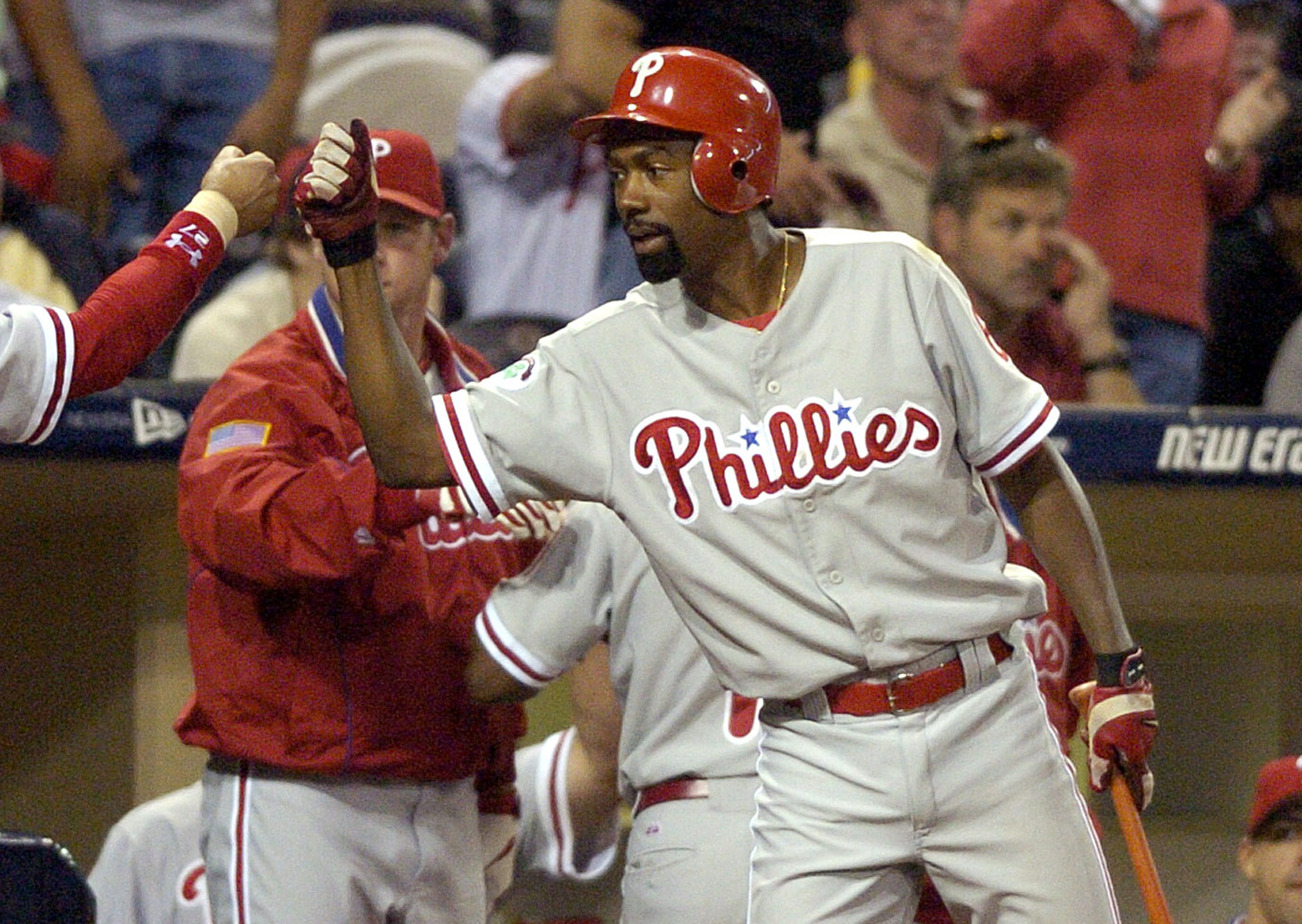
Doug Glanville, here in a 2004 game in San Diego, played six seasons with the Phillies.DENIS POROY
“We didn’t know what imminent threats were still there. We heard that they might attack Atlanta,” Glanville said.
That worry persisted even when games resumed six days later, and beyond.
“You felt like, if you were in a stadium, you were a target.”
‘I thought it was a movie’
Douglas learned of the attacks from the movers helping him settle him and his wife at the time, Simona, into their town house in Marlton, N.J.
“They blew up the tower,” one mover told Douglas. He wasn’t quite sure what the guy meant. The cable company hadn’t arrived yet, so the mover began to jerry-rig an antenna onto a television. Before he finished, another mover, still listening, announced, “They hit the other tower.”
Finally, a fuzzy image appeared on the screen, the towers burning. A few minutes later, at 10:28, the north tower collapsed.
Glanville had much better reception.
Baseball players are a nocturnal breed, but Glanville is one of the few who relishes a hearty breakfast. Also, he’s a reader — he has an engineering degree from the University of Pennsylvania — so he rarely turns on his hotel TV.
“There aren’t a lot of players who get up that early, except Kevin Jordan. So I go out of my room, get in the elevator, and Nina Jordan’s there, Kevin Jordan’s wife,” Glanville said. “I’m, like, ‘Good morning,’ with a smile. She’s like, ‘They hit the towers.’ ”
Glanville flashed back to Feb. 26, 1993, when terrorists attempted to take down the north tower with a car bomb. They failed. Seven people died. Glanville assumed this was similar.
“The first thing I thought is, ‘Oh, again?’ ”
Not exactly.
“We were in CNN country, so I came out of the elevator, I saw banks and banks of TVs,” Glanville said. “And then, of course, we were just, like, locked in.”
Phillies manager Larry Bowa wasn’t watching TV in his room, either, but, with a teenage daughter, he always kept his phone close. When it buzzed that morning and he saw her number he was concerned, of course, but not as concerned as he soon would be.
“She said, ‘Did you see the TV?’ And I said, ‘No.’ She says, ‘Turn it on,’ ” Bowa said. “And when I turned it on, I thought it was a movie.”
‘We took a vote’
What happened in the next couple of days is a blur for most of us who lived through 9/11, and most of us weren’t star entertainers and their bosses walking the thin line of propriety.
Would baseball be played Tuesday night? Would baseball or football, either college or pro, be played on the weekend?
Flights resumed sporadically just two days after the attacks, but it was about a week before air travel resumed full throat. The Eagles and the rest of the NFL hunkered down.
“We knew pretty quick we weren’t going to Tampa that weekend,” Douglas said. “So we just practiced. And it was weird, right? You get planes flying over South Philly all the time, because the airport is so close. There were, like, no planes that week.”
It was as if everyone held their breath, just as they’d done after President John F. Kennedy was assassinated in November 1963, which paused most of college football and briefly paused the NBA and NHL.
“Nobody knew what was the right time,” Bowa said. “Some people were saying they might cancel the whole season.”
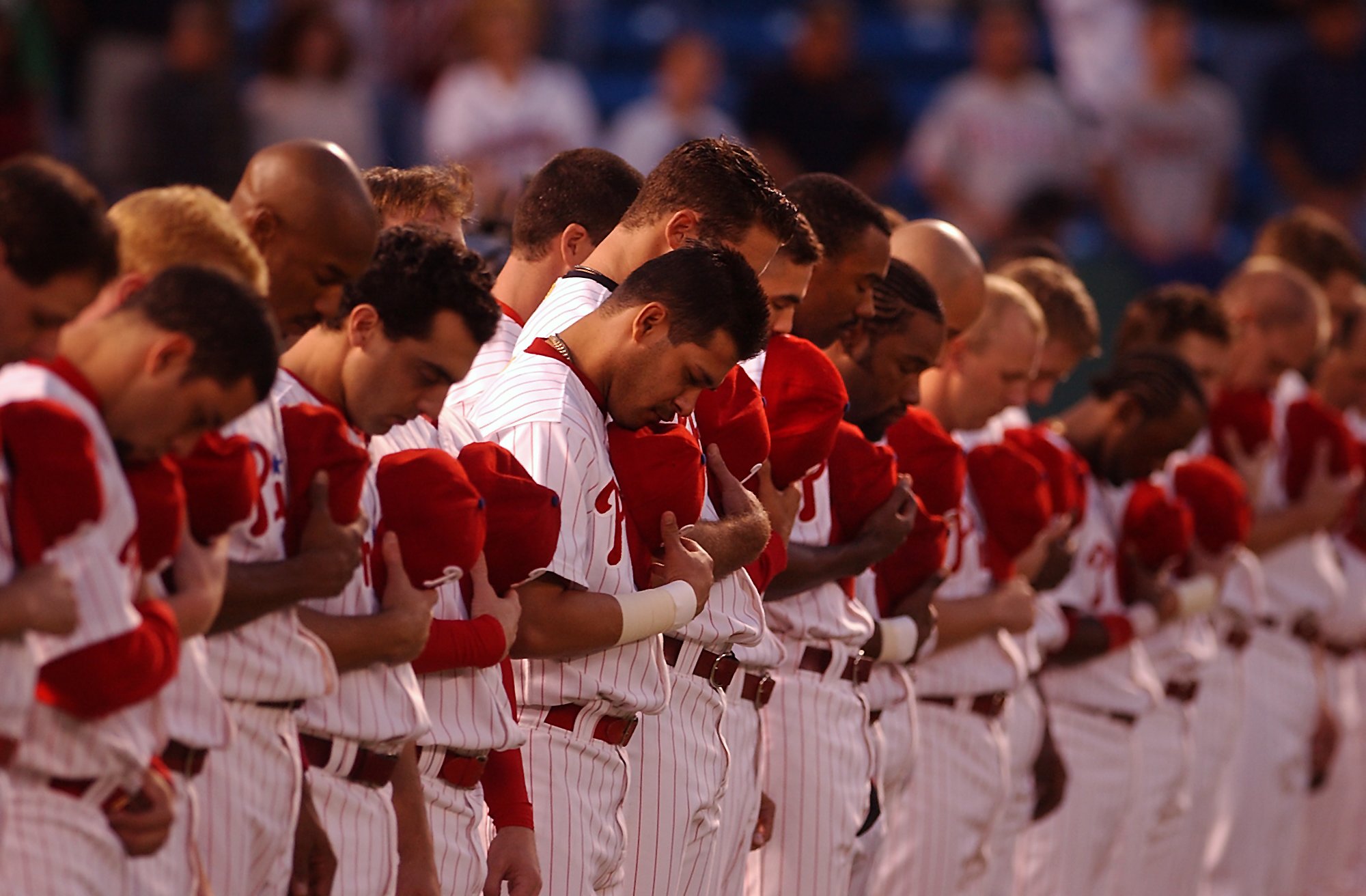
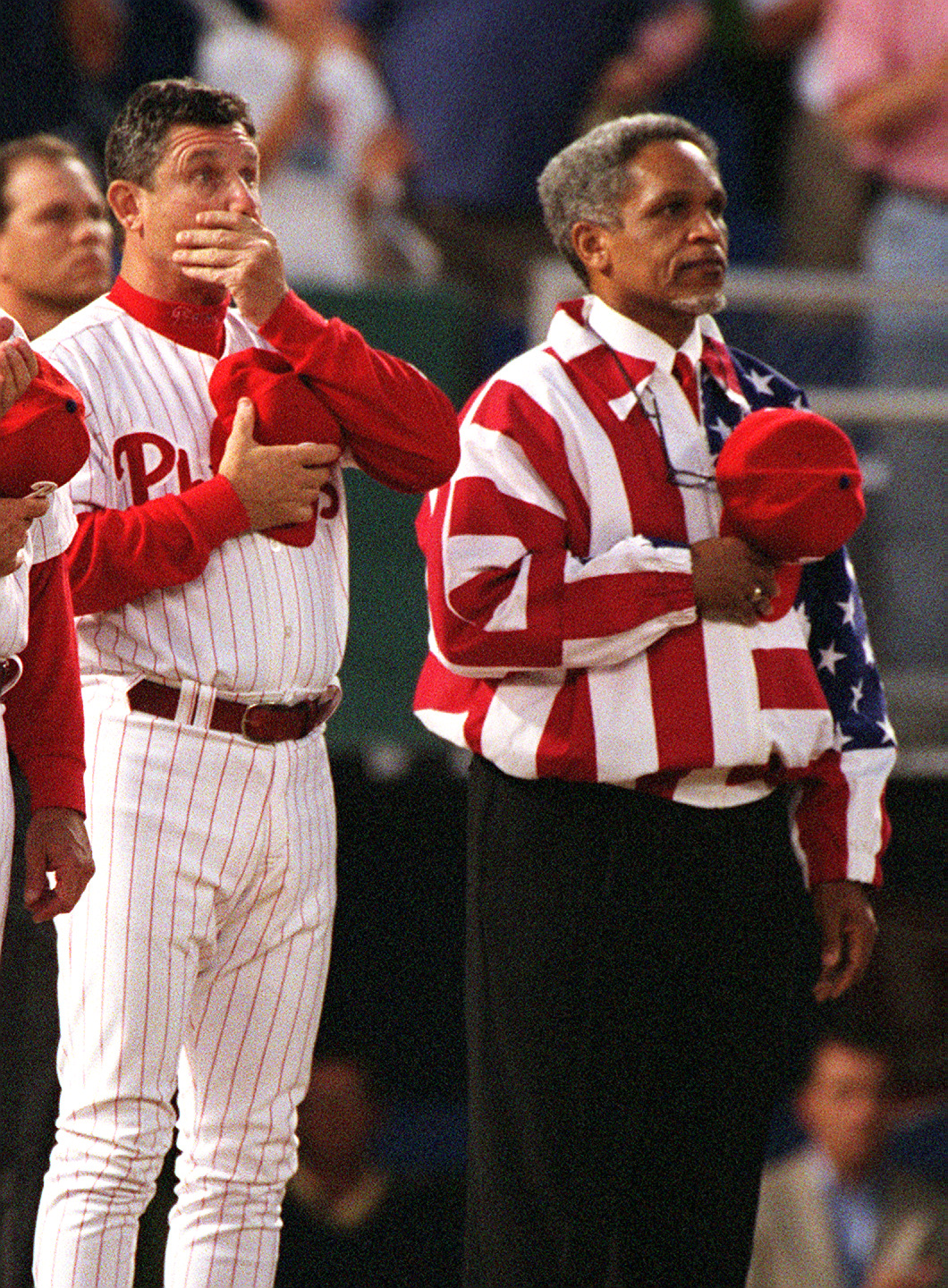
Phillies manager Larry Bowa wipes his face standing next to Philadelphia Mayor John Street during a moment of silence before the Phillies-Braves game on Sept. 17, 2001 at the Vet.D
As it turned out, baseball games resumed Sept. 17. The Expos hosted the Marlins with the first pitch thrown at 7:10 p.m., so baseball officially resumed first in Canada. But the Braves visited the Phillies and the Mets visited the Pirates, and both games went off at 7:19 p.m., so Pennsylvania co-hosted the return of America’s game in America.
‘We took a vote’
Getting from 9/11 to 9/17 was quite a journey for the Phillies.
Games were suspended immediately, but MLB dithered regarding when they would resume. The Phillies spent three days in Atlanta, then decided to bus to Cincinnati, where they were scheduled to play over the weekend. They were outside of Knoxville, Tenn., when they heard that those games might not happen, either.
What now?
They pulled the two buses into a rest stop. Players disembarked to try and get cellphone reception, which was poor on the buses, and check in with their families. At that point, mild chaos ensued.
Should they reroute to Philadelphia? Should they return to Atlanta, where flights would be easier to arrange? Should they just continue to Cincinnati and maybe ride out the weekend?
They couldn’t take the buses to Philadelphia because the bus driver had logged too many hours.
“We took a vote,” Glanville said. “It was everybody, 40 or whatever, to 2. And the two were Bowa and (reliever) Dennis Cook, and Cook lived in Atlanta.”
So, on to Cincinnati, where they discovered those games were, in fact, postponed. Inimitable traveling secretary Frank Coppenbarger, now retired, wheedled a chartered plane for the next day. The Phillies were home for supper on Sept. 15.
MLB delayed the playoffs for a week. The Phillies made up the postponed games in Atlanta and Cincinnati after the regular season ended. Like their NFL counterparts, they played the rest of the season in a daze of heightened security and heightened anxiety.
‘A sense of pride’
NFL players were used to being treated like royalty on their charter flights to games. A week and a half after 9/11, they found out what it was like on tarmacs in countries where terrorism is a constant threat.
“We used to just park our cars at the facility, get on a bus, ride to the airport, get off, and walk right on the plane,” Douglas said. “Now, you went to the airport, man, and everybody was on high alert. There’s guys with machine guns or whatever, there’s tons of security. Even on the plane. And you had to watch your mouth.
“I went to the bathroom and came back and told the fellas I blew it up,” he recalled, and was quickly admonished by security. “Yeah, you couldn’t say you ‘blew up the bathroom’ anymore.”
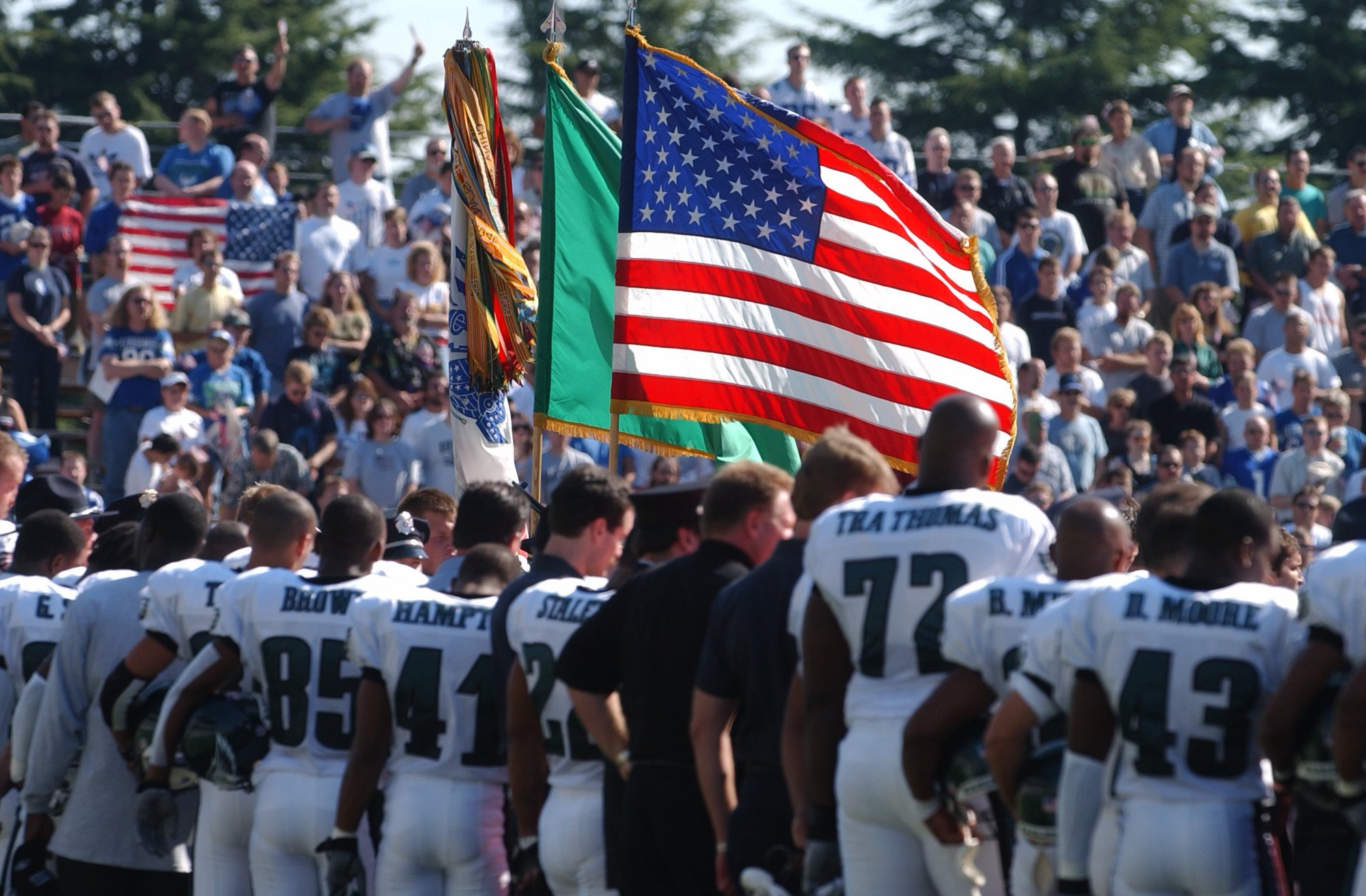
Eagles players line up during pregame ceremonies before the Eagles-Seahawks game on Sept. 23, 2001, the teams’ first game after the attacks.Ron Cortes / Staff Photographer
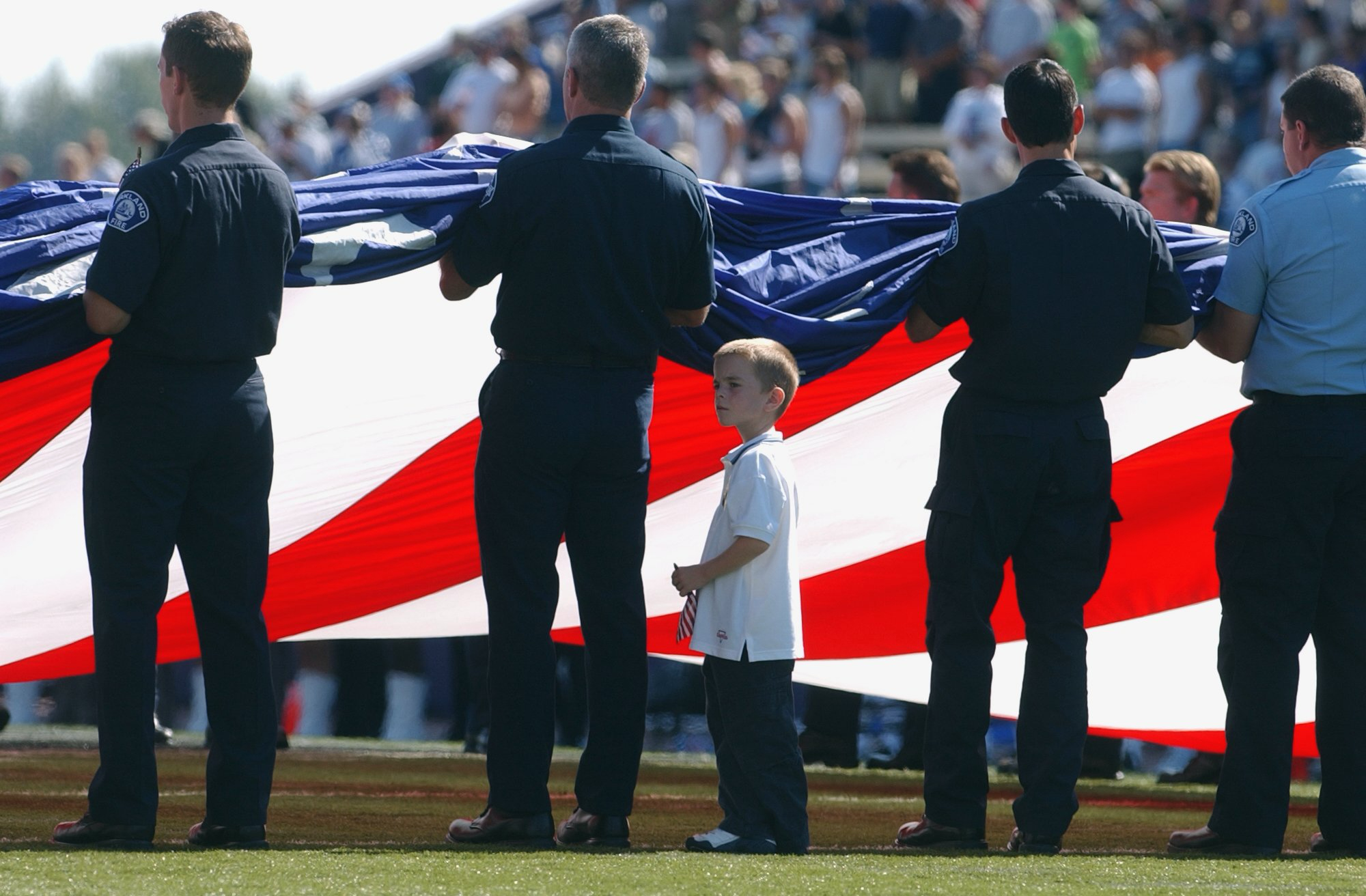
As with MLB, NFL playoffs were delayed by a week, so the Eagles made up their postponed game at Tampa in January after their final scheduled game of the regular season. Their first game after the attacks was in Seattle, where they played the Seahawks at the University of Washington stadium while their new stadium was being built. As in many stadiums that day, the pregame national anthem was performed as a giant flag that covered the entire field.
Who held it? Douglas, his teammates, and his coaches joined their counterparts from the Seahawks and dozens of first responders. Douglas had a hand on that flag, and he remains moved by that ceremony to this day.
“Just, I don’t know,” Douglas said. “Just a sense of pride.”
A giant American flag covers the field before the Eagles-Seahawks game at the University of Washington stadium during pregame ceremonies on Sept. 23, 2001.Ron Cortes / Staff Photographer
‘Tip your cap’
Pride: That’s what Bowa felt on Sept. 17. He’s proud that Philadelphia, the cradle of American democracy, was part of the return to sport. He’s proud that the franchise he played for and managed was, with the Pirates, the first team in the U.S. to resume, and he’s proud that baseball, America’s game, was the first front-line sport to restart.
Bowa is a hard man, but he understood the situation. He held a team meeting before the game and told the players that anyone who didn’t feel like playing didn’t have to; he understood. No takers.
The pregame left Bowa and Glanville shaken. As late Phillies broadcaster Harry Kalas delivered a moving pregame address to viewers, a montage compiled by “Video” Dan Stephenson helped settle the 27,910 fans at Veterans Stadium into their seats.
“People were in tears over that,” Glanville said.
It was the music that got to Bowa. He’d served in the U.S. Army Reserve as a young man, and his patriotism runs deep.
First, he recalled, there was Lee Greenwood’s “God Bless the USA” Then, right before the first pitch, with the teams lined up on the baselines, came “God Bless America” and the national anthem, performed back-to-back by — who else? — the star-spangled Valley Forge Chorus.
Phillies ace Robert Person went eight innings, gave up two runs, Jose Mesa got the save, and the Phillies won, 5-2, and drew to within two games of the Braves in the National League East.
Who’d they beat?
Braves legend Greg Maddux.
Glanville got a hit, Pat Burrell got two, rookie All-Star Jimmy Rollins scored a run, and MVP candidate Bobby Abreu tripled. But all of them — Person, Mesa, Glanville, Rollins, Abreu — they were just co-stars.
Nobody in baseball met the moment like Scott Bruce Rolen.
Chipper Jones’ homer gave the Braves a 1-0 lead in the first inning, but Rolen tied it with a leadoff homer in the second. He drove in Abreu from third base in the fourth for a 2-1 lead.
Then, with two out in the bottom of the sixth inning, Rolen homered again. The Phillies led, 3-2. The Vet rocked and rolled as Rolen returned to the dugout and, as ever, humbly took off his helmet. The crowd was nearly tearing the old stadium down, begging for a curtain call, but that just wasn’t the sort of thing Rolen did. Ever.
Bowa called Rolen over.
“Scotty,” he said, “you got to go out and tip your cap.”
Rolen replied, “Well, you know I don’t do that.”
“Scotty,” Bowa said, “this is something different.”
Nearing the end of the first season with the automated ball-strike system, the Phillies’ analytics department has a challenge for catcher J.T. Realmuto.
Challenge more often.
“That’s one of the things that we see on the reports,” interim manager Don Mattingly said Thursday, a rare day off for Realmuto with Zack Wheeler on the mound. “He’s really good at it. Probably there’s more chances for him to do it. I like to see him do it. When he thinks it’s a strike, it pretty much is, right?”
Indeed, Realmuto has a 79% success rate, best among all catchers with at least 15 challenges. But despite being behind the plate for the second-most innings (940), he was tied for only 32nd with 70 challenges.
By comparison, the Brewers’ William Contreras leads all catchers with 993⅔ innings behind the plate and 167 challenges. Yankees catcher Austin Wells is fourth with 858⅓ innings and tied for fourth with 113 challenges.
There are several factors at play for Realmuto. He has said he likes ABS for “the big misses,” in terms of both the obviousness and timing of an umpire’s call. He won’t hesitate to challenge a close call at a pivotal point in the game.
But Realmuto is more conservative than most catchers about challenging a pitch that doesn’t flip an at-bat or impact a potential rally. Teams begin a game with only two challenges and retain them as long as they keep getting them right.
“It still goes back to leverage,” Mattingly said. “First pitch, unless he’s 100% [sure] — or first pitch of the game, right? — it could be a strike and he knows it’s a strike, but [do you] challenge?”
J.T. Realmuto is among the league leaders in innings caught, but middle of the pack in pitches challenged.Yong Kim / Staff Photographer
After every game, the Phillies coaches receive data on everything, from defense to pitcher and hitter metrics. A review of ABS is part of the report.
Lately, Realmuto has challenged more frequently. In August, he contested 14 pitches and got 10 correct. He has already challenged nine this month … and gone 7-2.
In Wheeler’s previous start, last Saturday night against the Braves, Realmuto challenged a 2-2 pitch with the bases loaded and one out in the first inning. The call was overturned for a strikeout of Mauricio Dubón.
Wheeler called it a “gutsy” challenge given that it was only the first inning. But it also might have prevented the Braves from having a big inning in what turned out to be a 4-2 Phillies victory.
Two days later, Realmuto successfully challenged two pitches in the second inning of a scoreless game for Jesús Luzardo, who went on to pitch a complete-game shutout.
It’s all part of finding an effective ABS strategy.
If anything, Realmuto is so effective at getting close pitches overturned that the Phillies may prefer their hitters to be less aggressive. For instance, four of Bryce Harper’s last five challenges came in the first inning. He lost three of them, leaving only one for the rest of the game.
“Every time [Realmuto] challenges, you feel like he’s going to be right, so I think we should encourage him to challenge when he sees it,” Mattingly said. “And that’s kind of sometimes the frustration when you challenge early in non-leverage situations offensively. It kind of makes him go, ‘I can’t,’ because you don’t like being out of them.
“There’s not been real encouragement [for Realmuto to challenge more] other than he’s really good at it. If he thinks it’s a strike, challenge it.”
Phillies left fielder Brandon Marsh fouled a ball off his right foot and left Thursday’s game with a bruise.Monica Herndon / Staff Photographer
Marsh bruised
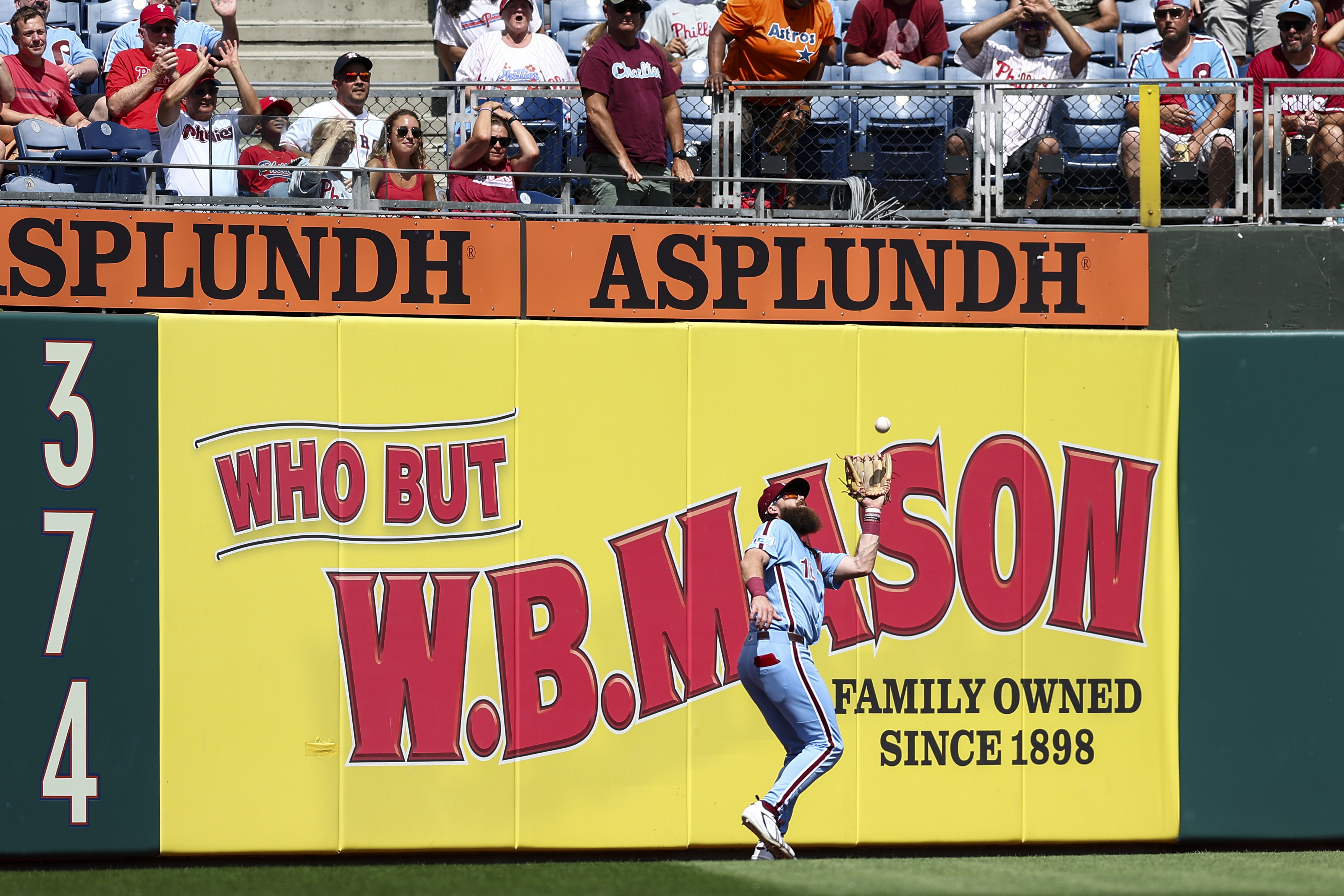
Brandon Marsh fouled a ball off his right foot and left the game in the eighth inning. X-rays were negative, according to Mattingly. The Phillies were calling it a bruise.
“It’ll be sore,” Mattingly said, “but yeah, I think it’s going to be fine.”
Marsh, a left-handed hitter, was unlikely to be in the lineup anyway Friday night against Braves ace lefty Chris Sale. The Phillies were expected to stack the lineup with right-handed hitters, including outfielders Derek Hill and either Bryan De La Cruz and/or Edmundo Sosa.
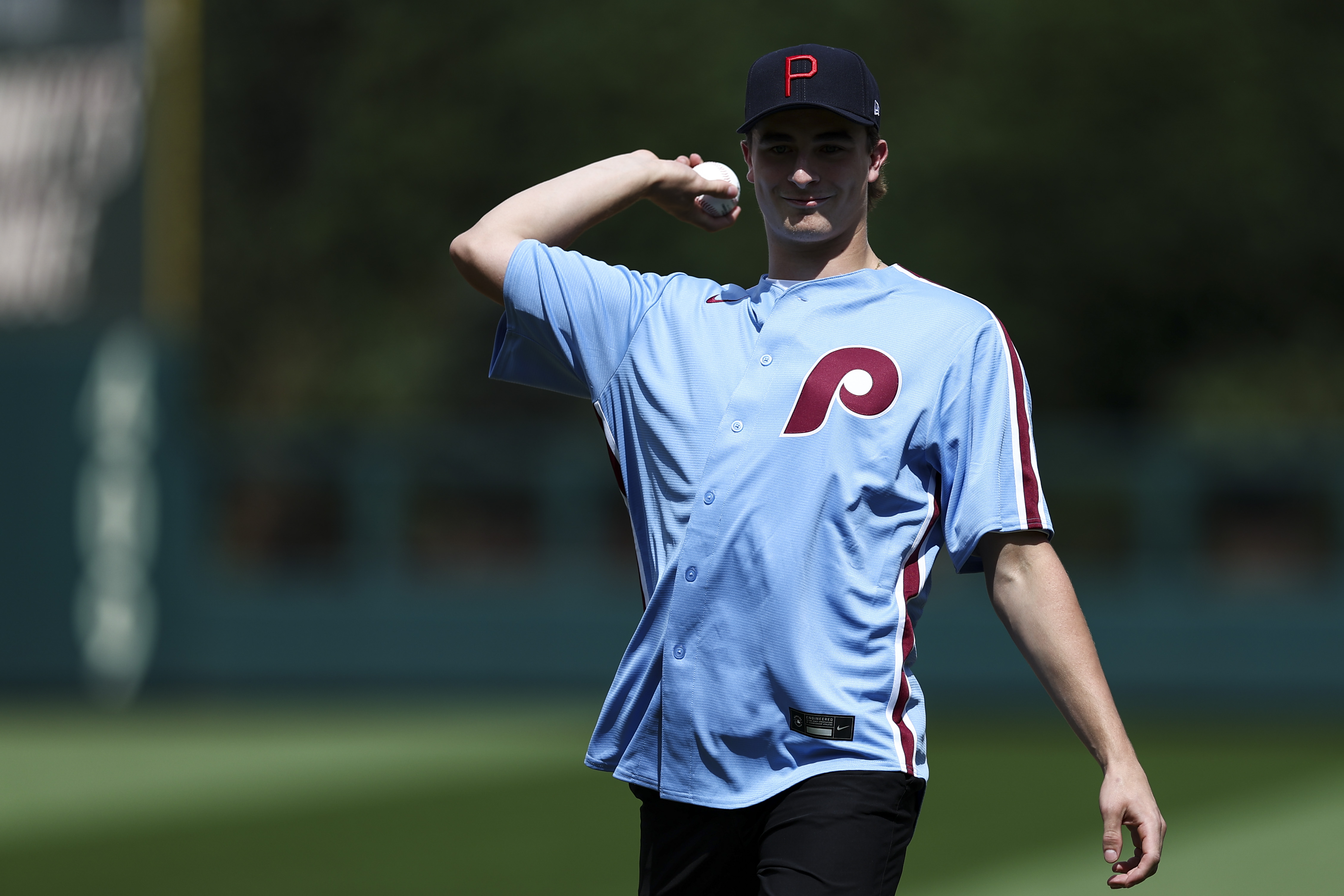
Veteran pitcher Nestor Cortes’ next appearance will be in triple A, according to Mattingly, after he allowed one run in one inning Tuesday night for low-A Clearwater. The Phillies took a flier last month by signing the 31-year-old lefty, who had surgery after last season on a torn biceps tendon. … Reliever Caleb Kilian, sidelined by a strained oblique muscle in his left side, traveled with the team to continue his throwing progression, though he’s still weeks away from returning. … Flyers winger Porter Martone threw the ceremonial first pitch. … Aaron Nola (6-10, 4.76 ERA) is scheduled to start Friday night in Atlanta against Sale (14-9, 2.10). The matchups for the rest of the series: Saturday— Jesús Luzardo (14-5, 2.87) vs. Braves righty Tyler Mahle (5-10, 4.05); Sunday— Andrew Painter (3-9, 5.71) vs. righty Grant Holmes (9-5, 3.46).
Zack Wheeler went to a full count against back-to-back hitters only to walk both and load the bases. His pitch count climbed above 100 on a hot, sticky afternoon.
And rookie reliever Alex McFarlane was ready.
Easy call, right?
Maybe in the playoffs, assuming the Phillies get in, Don Mattingly will act like most managers and be aggressive with the bullpen. Not yet, though. And come to think of it, maybe never. Not with three starting horses who are easier to trust on fumes than any of his fresh relievers.
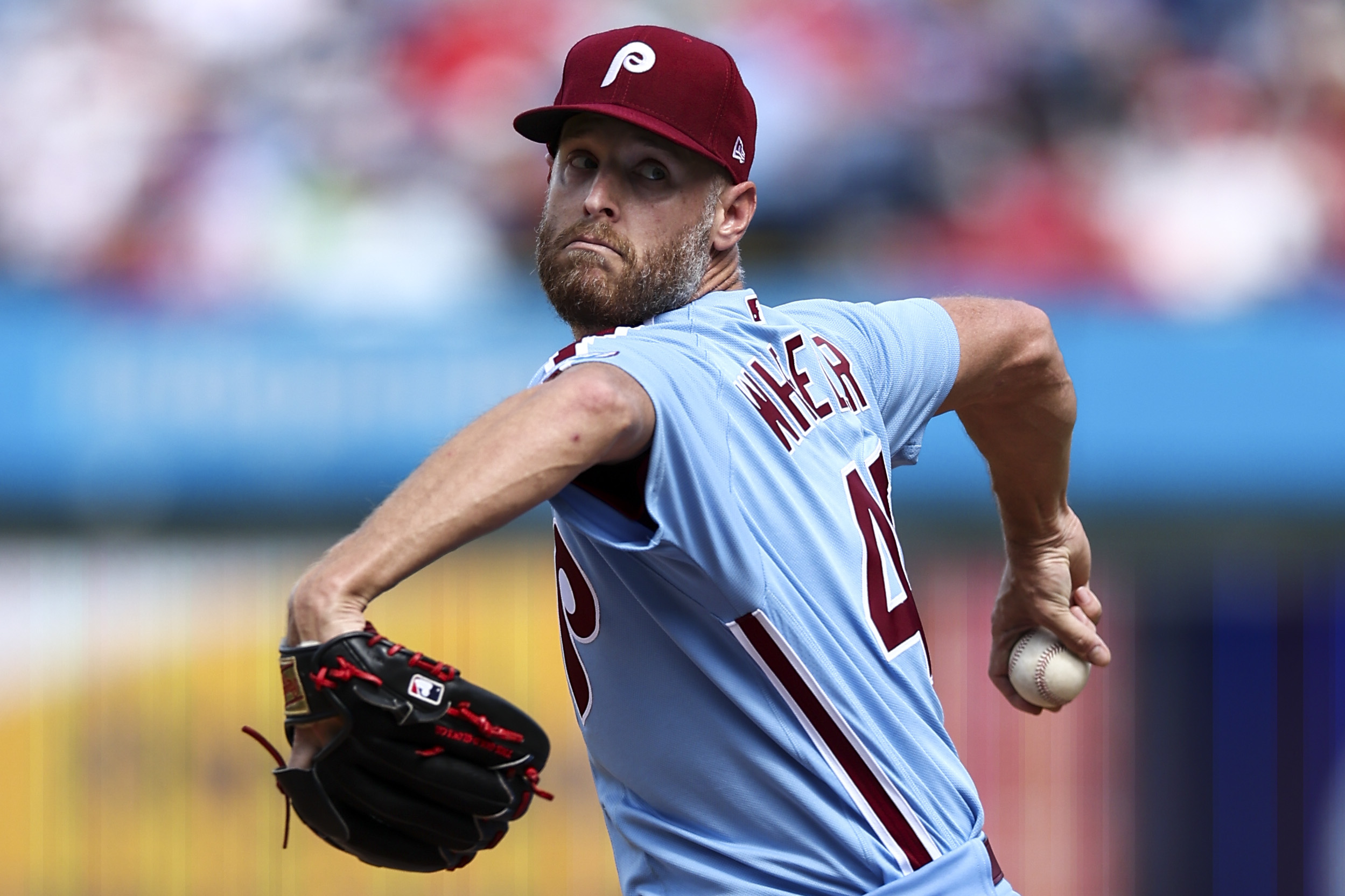
So, Mattingly stuck with Wheeler, who slung a sweeper to escape the seventh inning Thursday, only to watch star closer Jhoan Duran give up a tiebreaking homer to the Astros’ Cam Smith in the ninth in a dud of a 2-1 loss to cap a homestand that felt, well, meh.
“Playoff situation, you’re usually not letting your guys roll like that,” Mattingly said after pushing Wheeler to 110 pitches. “You’ve got to be more careful. But right now, I think he was the best guy for that situation today.”
If Wheeler could’ve thrown 130 pitches, he would’ve been the best choice beyond the seventh inning, too, just as Cristopher Sánchez and Jesús Luzardo would when they start.
Let’s get back to that. First, a check of the standings: The Phillies slid to four games behind the division-leading Braves before hopping on a flight to Atlanta for three games that would’ve felt so much more like a showdown if the deficit was only three games.
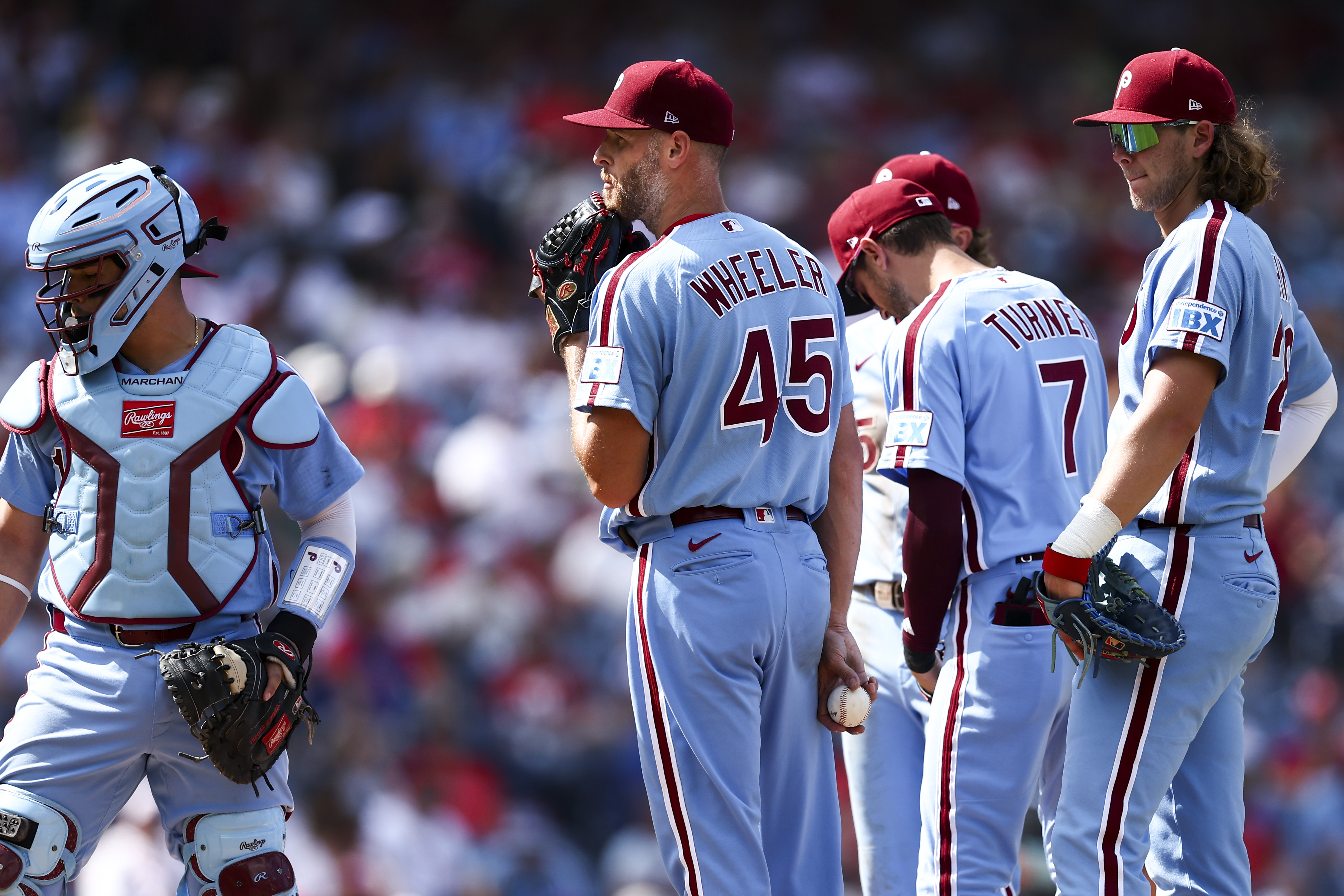
Phillies starter Zack Wheeler (center) talks it over with teammates during the seventh inning Thursday.Monica Herndon / Staff Photographer
Instead, the Braves could finish 7-8 and the Phillies would have to go 12-3 to overtake them.
Not impossible, but also not likely, considering they alternated losses and wins during a 3-4 homestand and haven’t won consecutive games since a six-game roll from Aug. 26 to Sept. 1.
But the Phillies still lead the Cubs by one game for the top National League wild card, which brings the benefit of playing the best-of-three first-round miniseries at home.
“We want to play at home,” Bryce Harper said. “It’s a huge advantage in the postseason, just hearing it from other players coming into here and playing in this environment. We expect our crowds to be loud and crazy and obnoxious and talk the crap that they do to other players. I think it plays a huge part.”
In that case, it would behoove the Phillies to play well over the next nine games in Atlanta, Washington, and New York.
And it sure feels like they wasted an opportunity in the finale against the Astros.
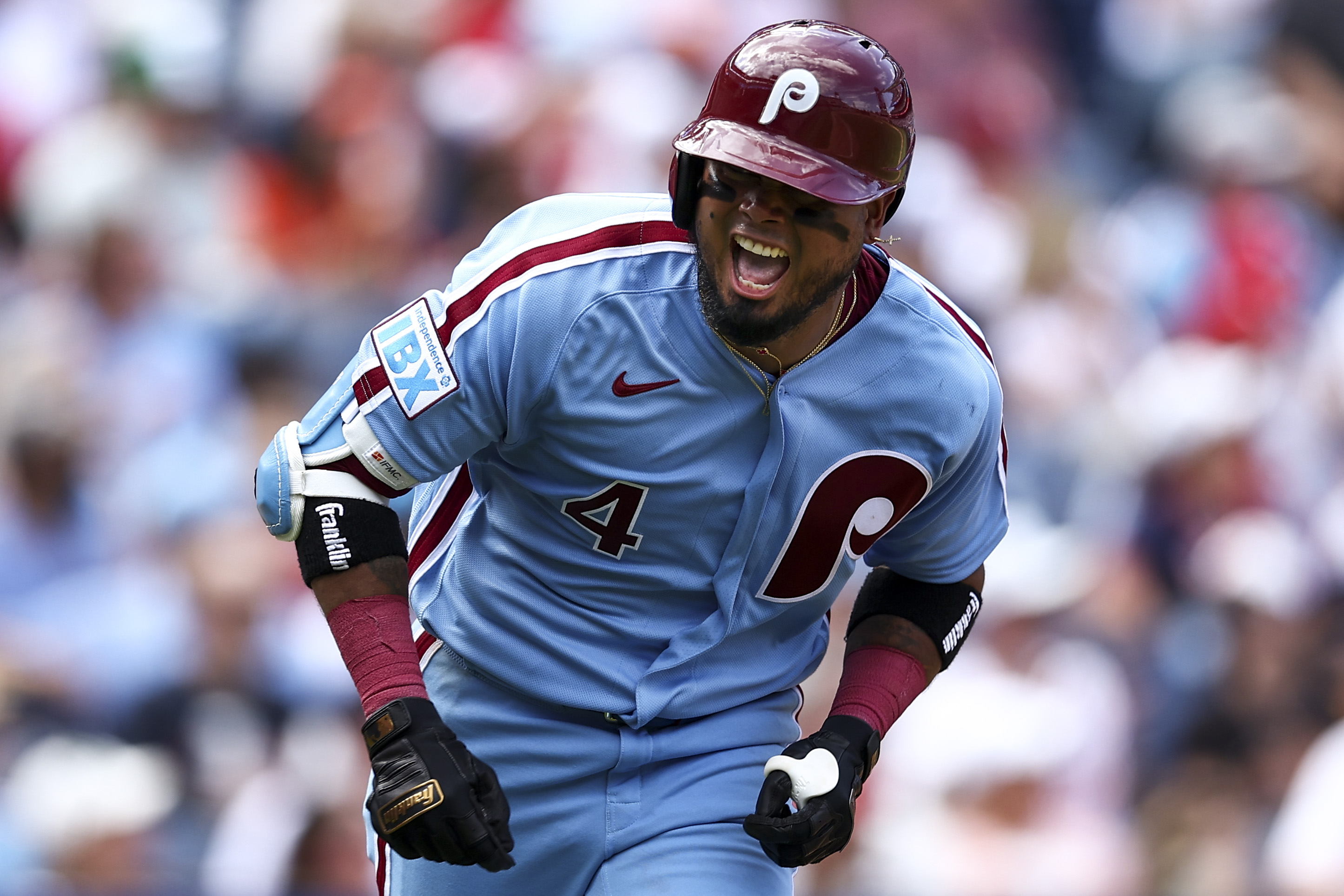
Despite not getting a hit through four innings against Astros righty Cristian Javier (remember him from the combined no-hitter in Game 5 of the 2022 World Series?), the Phillies tied it in the fifth on Luis Arraez’s leadoff single, Alec Bohm’s double, and a fielder’s choice.
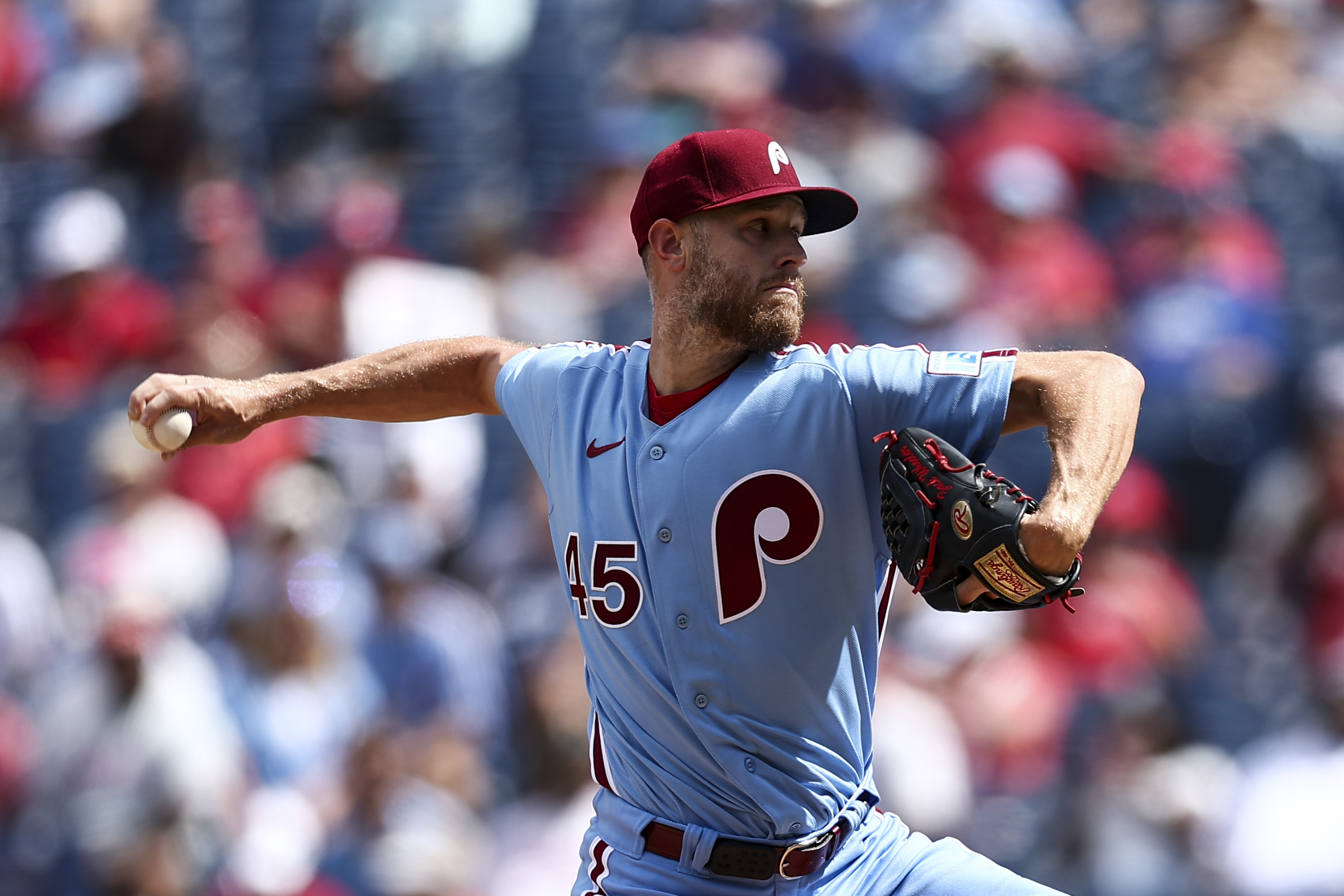
Wheeler recorded his third consecutive solid start after his roughest six-start stretch in seven seasons with the Phillies. But after striking out the side on 16 pitches in the sixth inning, he loaded the bases in the seventh on a leadoff bunt single and back-to-back two-out walks.
Luis Arraez reacts on a single in the fifth inning of the Phillies’ 2-1 loss Thursday.Monica Herndon / Staff Photographer
The Phillies got McFarlane loose. Did Mattingly consider going to him?
“It’s hard to bring in a kid there, bases loaded,” Mattingly said. “[Wheeler] was throwing the ball good. He felt good. I thought it was his.”
Said Wheeler: “He asked me before the inning if I was good, and I said, ‘Yeah.’ But it’s obviously up to him and his call. You’ve got to respect that. I was able to wiggle out of that, and I appreciate him letting me go out there and get that done.”
Across the sport, managers tend to ask less of starting pitchers in the postseason. Maybe Mattingly’s approach with Wheeler foretells that the Phillies will actually ask Wheeler, Sánchez, and Luzardo — all among the top-10 pitchers in baseball — for more.
“I think a few things probably play into it,” Wheeler said. “Maybe who’s coming up, how much the bullpen’s been used, all that stuff.”
Also, who’s in that bullpen. The Phillies’ main bridge to Duran consists of Jonathan Bowlan (career postseason appearances: zero), erratic lefty José Alvarado, and rookie McFarlane, with Orion Kerkering attempting to get back on the upswing of his roller coaster history.
Even Duran is showing cracks. He hung a splinker — his signature splitter/sinker hybrid — to Smith, who hit only the second homer against him all season. It came a few days after he gave up a hard-hit double and triple and gave up a go-ahead run in the ninth inning against the Braves.
“I feel good,” said Duran, who likely will be asked to get more than three outs in his postseason appearances. “I feel much better than when I started the season. I feel really good right now.”
Philadelphia Phillies pitcher Zack Wheeler throws during the first inning.Monica Herndon / Staff PhotographerPhiladelphia Phillies third baseman Bryson Stott flies out during the second inning.Monica Herndon / Staff PhotographerPhiladelphia Phillies pitcher Zack Wheeler throws during the second inning.Monica Herndon / Staff PhotographerPhiladelphia Phillies left fielder Brandon Marsh catches a fly ball during the first inning.Monica Herndon / Staff PhotographerPhiladelphia Flyers forward Porter Martone throws out a ceremonial first pitch.Monica Herndon / Staff PhotographerPhiladelphia Phillies third baseman Bryson Stott gets caught in a rundown with Houston Astros shortstop Jeremy Peña during the fifth inning.Monica Herndon / Staff PhotographerPhiladelphia Phillies shortstop Trea Turner tags Houston Astros right fielder Cam Smith out at second base during the fifth inning.Monica Herndon / Staff PhotographerPhiladelphia Phillies third baseman Bryson Stott throws to first as Houston Astros second baseman Jose Altuve is safe during the seventh inning.Monica Herndon / Staff PhotographerPhiladelphia Phillies pitcher Zack Wheeler talks with teammates during the top of the seventh inning.Monica Herndon / Staff PhotographerPhiladelphia Phillies designated hitter Kyle Schwarber strikes out swinging during the fourth inning.Monica Herndon / Staff PhotographerPhiladelphia Phillies pitcher Zack Wheeler walks through the dugout after closing out the top of the seventh inning.Monica Herndon / Staff PhotographerPhiladelphia Flyers players shoot hot dogs into the stands with the Phanatic.Monica Herndon / Staff PhotographerPhiladelphia Phillies second baseman Luis Arraez reacts after a single during the fifth inning.Monica Herndon / Staff PhotographerPhiladelphia Phillies pitcher Jhoan Duran throws during the ninth inning.Monica Herndon / Staff PhotographerPhiladelphia Phillies left fielder Brandon Marsh gets hurt during the eighth inning.Monica Herndon / Staff PhotographerPhiladelphia Phillies pitcher José Alvarado reacts after the 8th inning.Monica Herndon / Staff PhotographerHouston Astros celebrate defeating the Philadelphia Phillies.Monica Herndon / Staff Photographer
In any case, Mattingly’s best bet may be to push the starters, at least until it’s time for Duran.
Wheeler conceded that 110 pitches in September often feels different than it would in April.
“Today it felt like that, just because it was hot and that last inning I worked a little bit more,” he said. “Some days are different than others.”
There may be more days like this for the Phillies’ big three starters. Their ability to hold up could determine if the Phillies host a wild-card series — and, ultimately, how far beyond that they advance.
“It’s big, you know?” Wheeler said. “There’s nothing like playing here in the playoffs. It’s probably the best atmosphere there is. To be able to host and play here, it’s important.”
It had been six days since Dillon Minacci waited at school for his parents to finally pick him up. National Park rangers told the Minaccis to stay inside their Queen Village home — which sits on the grounds of the Gloria Dei Old Swedes Episcopal Church — as a precaution following the terrorist attacks that morning in New York.
Could the old church where Betsy Ross was once married be next? So Dillon was one of the last kids to leave St. Mary School in the shadow of Independence Hall. No one knew what to think that day, Paula Minacci said of Sept. 11, 2001. And everyone seemed to struggle to find normalcy in the days that followed.
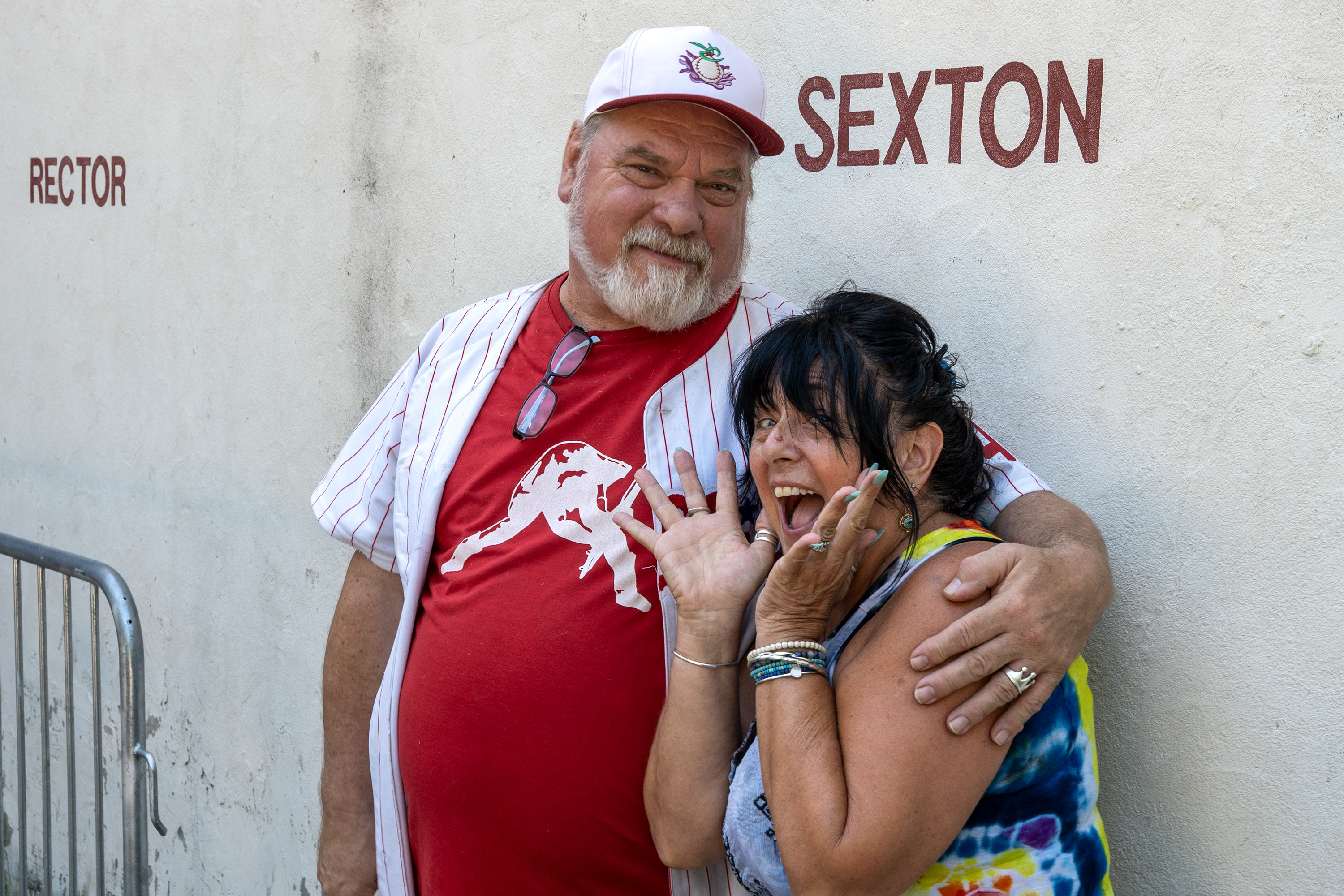
Finally, the Phillies were back at Veterans Stadium. Their game against the Braves on Sept. 17 was the first major league game after the season was paused. Jim Minacci told his son they were going. Then he went to the church basement — where he still works with his wife as the sextons — and grabbed a big American flag on a wooden pole.
“It was embarrassing, right?” said Dillon, who was then in the fourth grade and just old enough to roll his eyes at his parents. “I was like, ‘What are you doing? Why are you bringing a flag to the park? What are we doing?’”
Paula Minacci dropped them off at the stadium and then waited to make sure they’d let them in with the big flag. The Vet was filled that night with American flags. People waved them in the stands and the players had them stitched on their uniforms. Phillies manager Larry Bowa cried during the anthem and Harry Kalas opened the telecast with an emotional monologue about how sports can be a diversion and a unifier.
No one questioned Minacci’s flag.
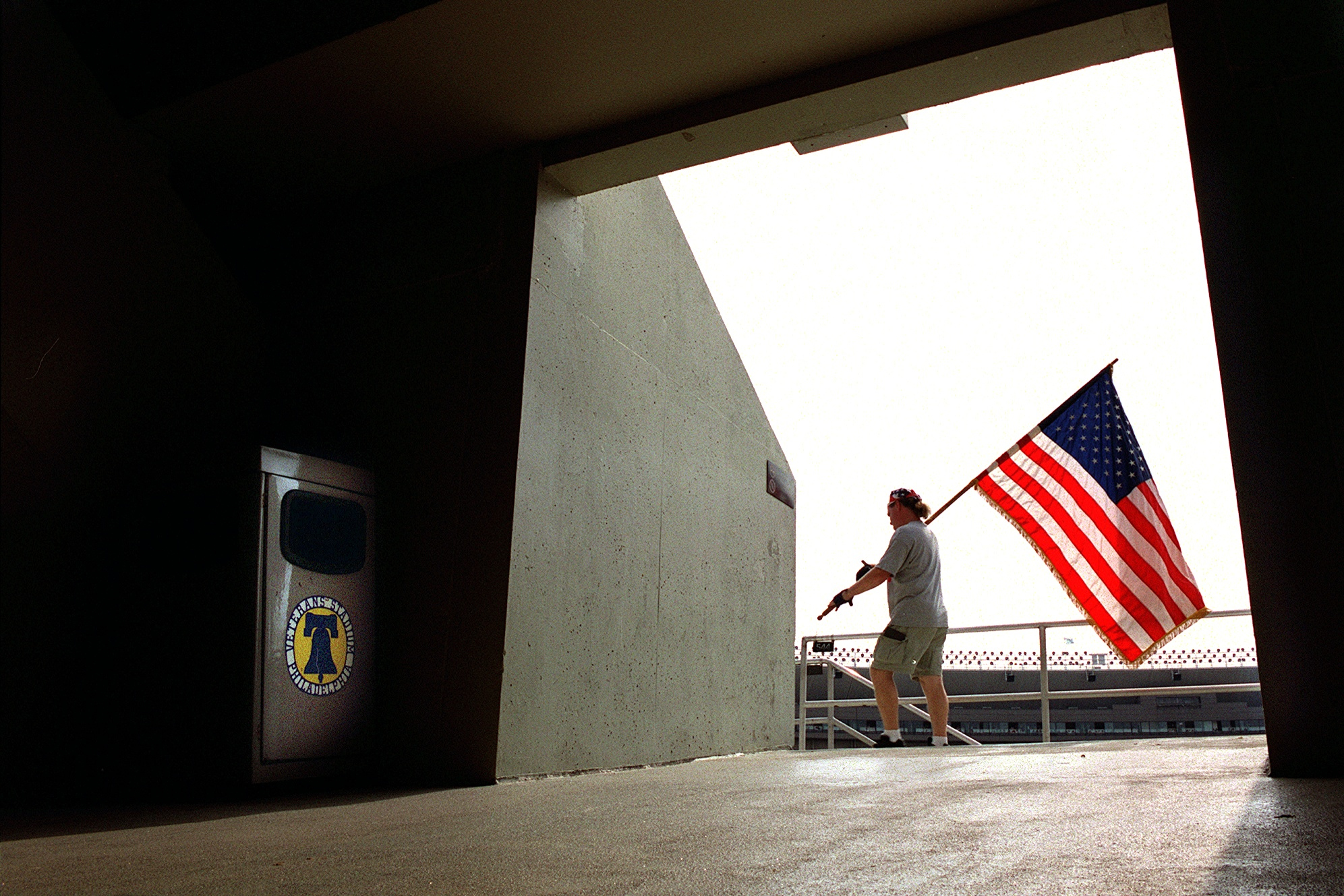
Jim Minacci carries his large American flag as he walks around Veterans Stadium on Sept. 23, 2001.Tom Gralish / Staff Photographer
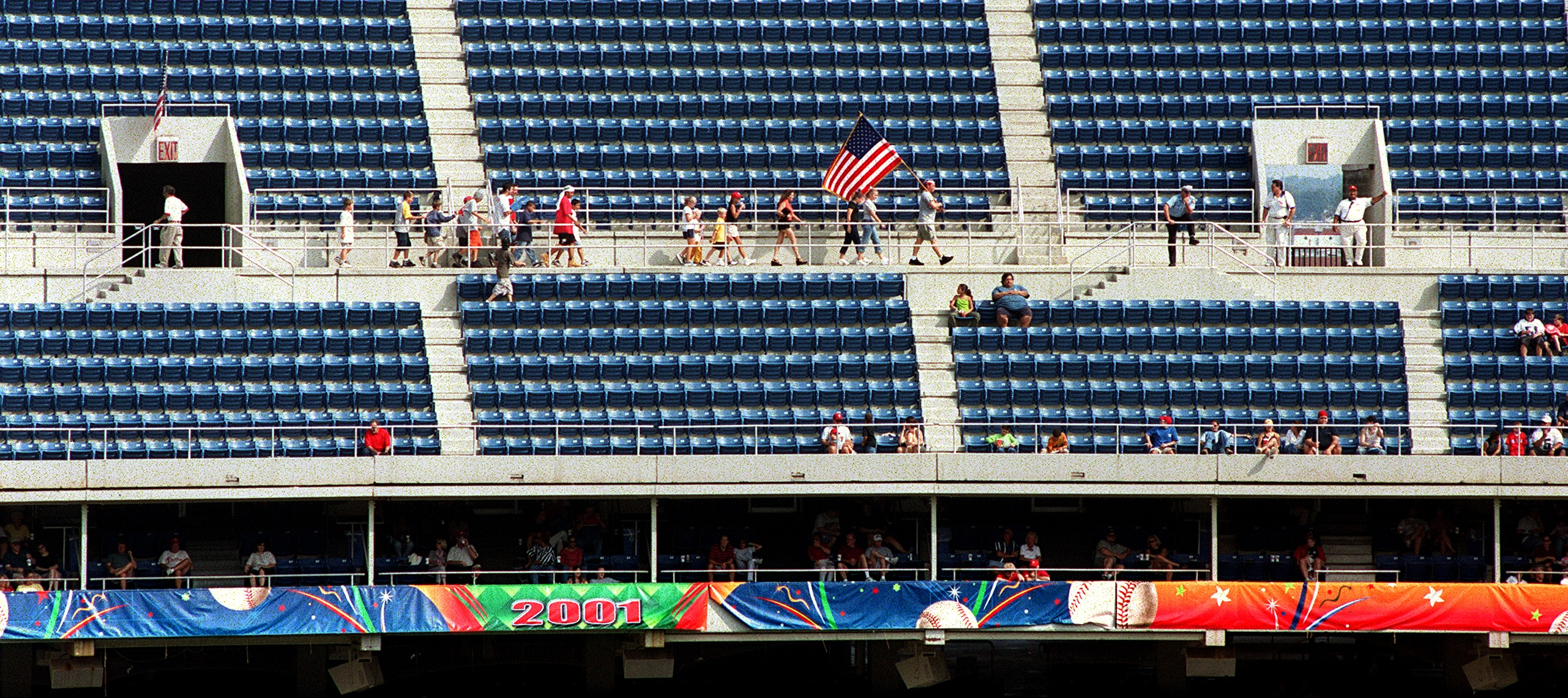
He sat with the pole for a few innings in the upper deck before telling his son he wanted to take a lap around the stadium, which had a rung in front of the seating bowl. His son was embarrassed, but he told his dad he’d come with him. And then the cheers started. The fans chanted U-S-A and shouted for Minacci as he marched around a half-filled stadium with the flag over his shoulder like a patriot. Embarrassed? Not anymore, his son said.
“For us, we were like, ‘Hell yeah. This is awesome,’” Dillon, 35, said. “We got back to our seats and he said, ‘We’re going again.’ OK. I didn’t expect this to be happening. Let’s go.”
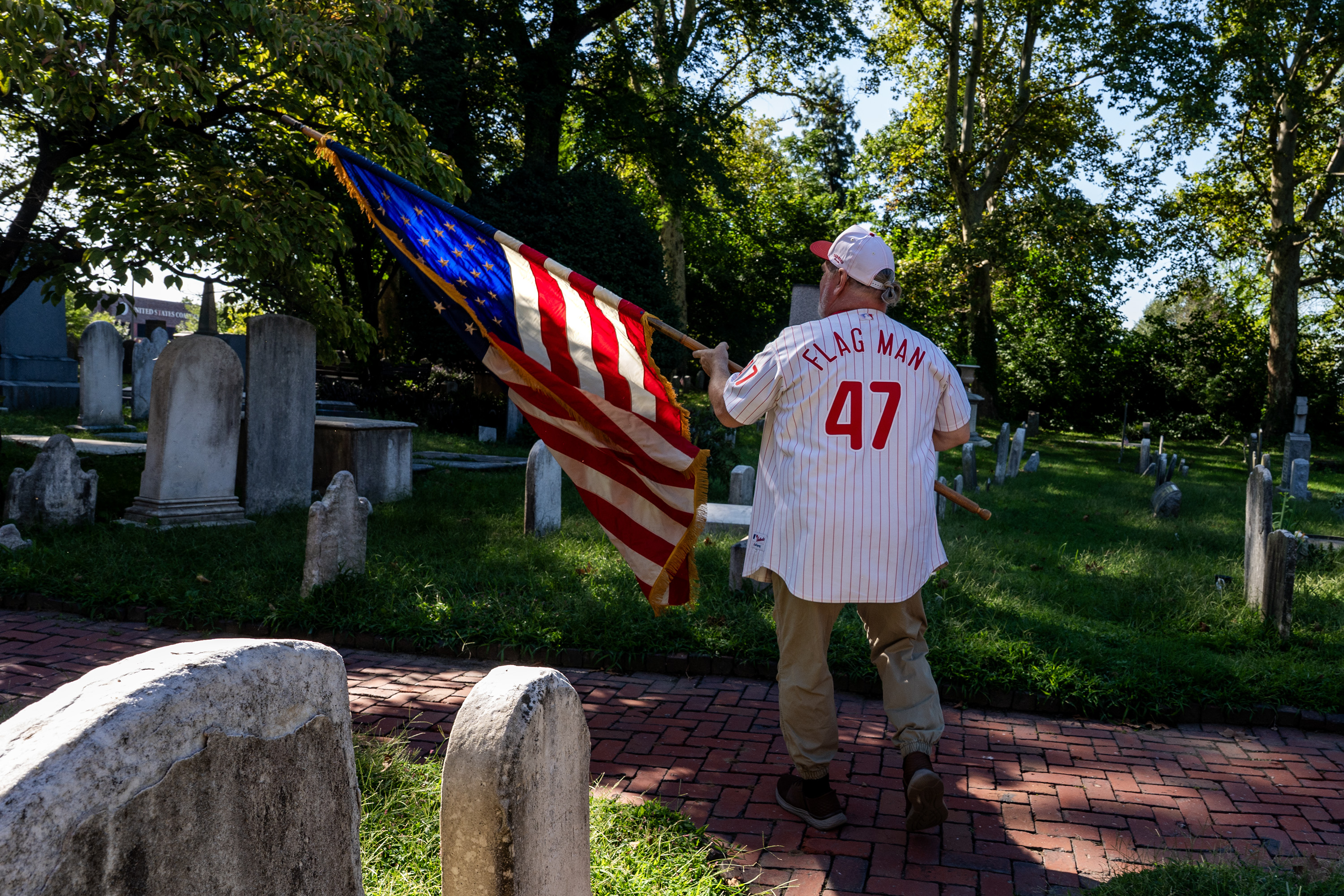
The Minaccis attended every game the rest of the season as the late-30s dad became Flag Man, a symbol of patriotism when everyone seemed to rally around the flag. They started their night marching around the upper deck before heading to the lower bowl where the chants were just as loud.
A cast of kids would leave their seats every night to walk behind Flag Man, whom Pat Burrell called “the pied piper” when Minacci was featured in the team’s highlight video.
Phillies general manager Ed Wade presented Flag Man with a custom jersey and a security guard started letting the Minaccis in without tickets. Flag Man’s hands were so sore from carrying the wooden pole that he started to wear fingerless gloves. He loved it.
Jim Minacci, aka Flag Man, is trailed by a line of kids as he walks around the upper deck over the outfield at Veterans Stadium on Sept. 23, 2001.Tom Gralish / Staff Photographer
The Vet already had the Wolf Pack and other fan groups that injected character to a concrete goliath. Flag Man fit right in. Minacci became part of the scene.
All these years later, the 64-year-old Minacci is still not sure why he brought the flag that first night. He remembers watching the news and seeing people at Ground Zero, volunteering to dig through the rubble of the World Trade Center. Minacci wanted to be in Manhattan but had two jobs in Philly and a son. So he grabbed his flag and went to the game.
“I probably brought the flag so it could represent all those people doing all that good work,” he said. “People were doing extraordinary things against the backdrop of this terrible disaster that in our lifetime was unprecedented. I felt a real sense of wanting to go to the game to enjoy myself and be free of all the struggle and strife but also be part of a community and be with my son in a moment that meant something.”
“It was just being present and showing support for these people who were doing extraordinary things.”
Flag Man grew up near Binghamton, N.Y., in a small town he said had more cows than people. His father Paul was a Yankees fan but he often took his family in the early 1970s to Philly — where he graduated from Penn — to see games at the Vet when tickets were easy to get.
Minacci chased down players for autographs and can still remember how it felt to sit in the stands with his dad. He moved to Philly in the 1980s and soon found himself sitting in the same seats with his son.
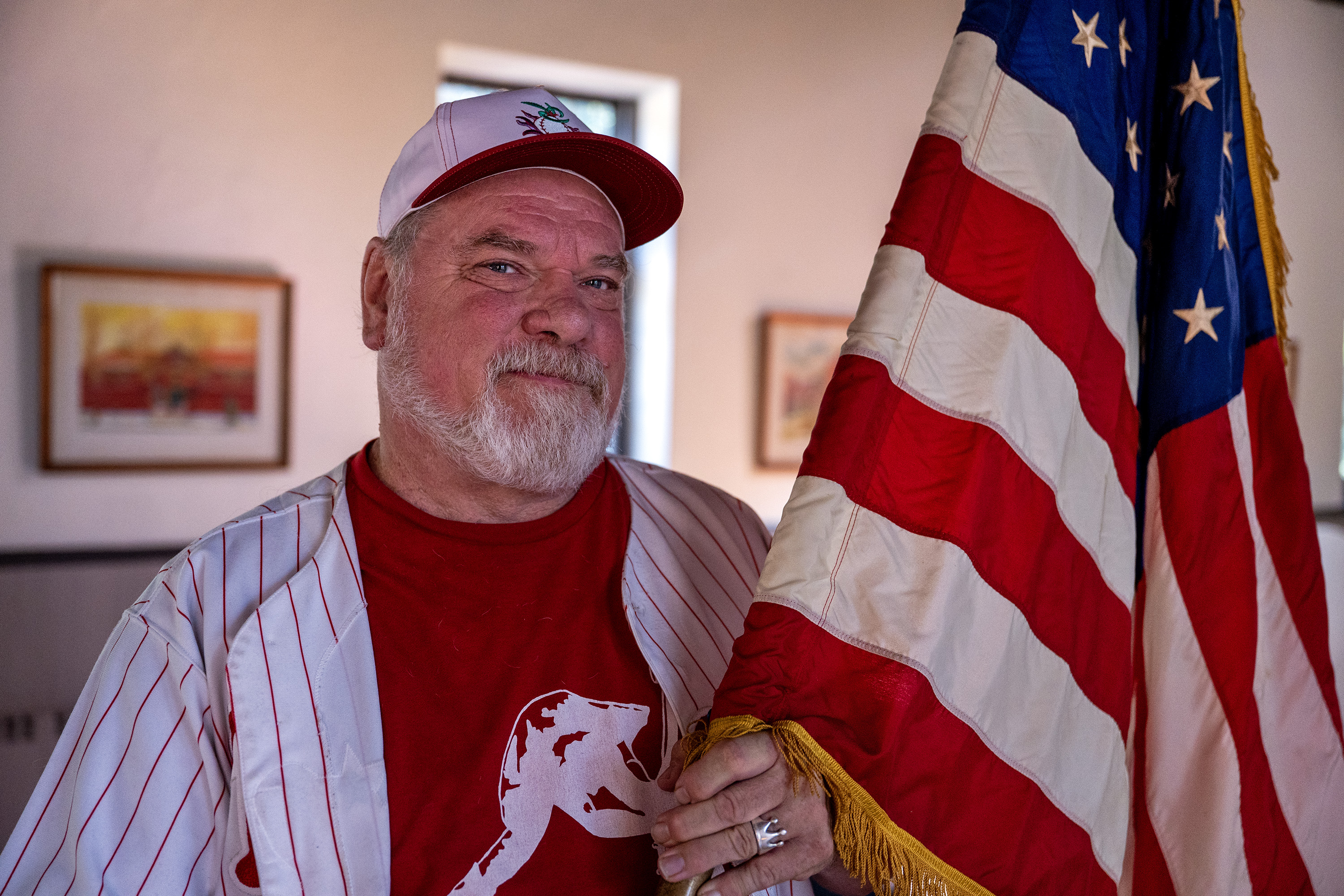
Jim Minacci looks back on his Flag Man days as “a unifying visual. Something everyone could agree to. Back then, it was an agreeable moment.”Tom Gralish / Staff Photographer
“I just always loved baseball and doing it with my dad just like he did it with his dad,” Dillon said. “Baseball is so unique in that you don’t really have to pay attention to it. That’s kind of the beauty of it. It’s an atmosphere that’s open to whatever you make it. Other sports, you’re kind of locked in on the time limit or the net you have to hit it into. Baseball is very much, ‘Are you paying attention or not? Can I take advantage of that?’ For a father and son, you get to spend time whether you’re talking or not.”
The Vet was their place before 9/11 so it was where the Minaccis needed to be after that dark Tuesday. The Minaccis — just like the rest of the 27,910 fans — longed for an escape. They didn’t know their night would be the dawn of Flag Man.
“We got home and he said, ‘We have to go again tomorrow,’” Dillon said. “I was like, ‘I’ll go to baseball every night of the week if that’s what this is.’ I was totally in. If you get a couple drinks in me, then I pull down the old video yearbook. Damn, that was cool. I can’t believe I was a part of that and my dad had the idea to do that.”
He took a trip with his parents last month to a minor-league game in upstate New York and told his dad how impactful those nights at the Vet were. His parents were always “locally minded,” Dillon said, as their work at Old Swedes made them a fabric of the neighborhood. Flag Man was an extension of that. His dad always seemed to bring people together. Everyone just got to see it this time.
“I know my son is a better person today for it. His awareness of being a part of a community,” Minacci said. “As a father, as a human being, that’s the reward.”
Dillon now lives in Austin, Texas, and will often ask another Philly transplant if they remember Flag Man. Of course, they remember that guy who used to carry a flag around the Vet. That’s my dad, the proud son tells them. No way, he hears. Flag Man is a memory.
Jim Minacci and his wife Paula at Gloria Dei Old Swedes Episcopal Church, where they work and live as sextons/caretakers.Tom Gralish / Staff Photographer
“There’s the baseball game, the baseball team, the baseball staff, and then the crowd who fills the stadium,” Minacci said. “We got to be a part of that community.”
Minacci brought his flag back to the Vet in 2002 and 2003 as he continued to march before the Vet closed. Citizens Bank Park opened in April 2004 and Minacci was there with his flag for the first game. The guy at the gate apologized. Minacci couldn’t bring the long wooden pole into the new park. Flag Man was finished.
“I think what bummed him out the most was him not being able to end it in a way that he wanted to,” Dillon said. “He wanted the chance to say ‘Thank you.’ It really meant a lot to him and it meant a lot to me. We met a lot of people at the ballpark and became a part of the Phillies community. So it goes.”
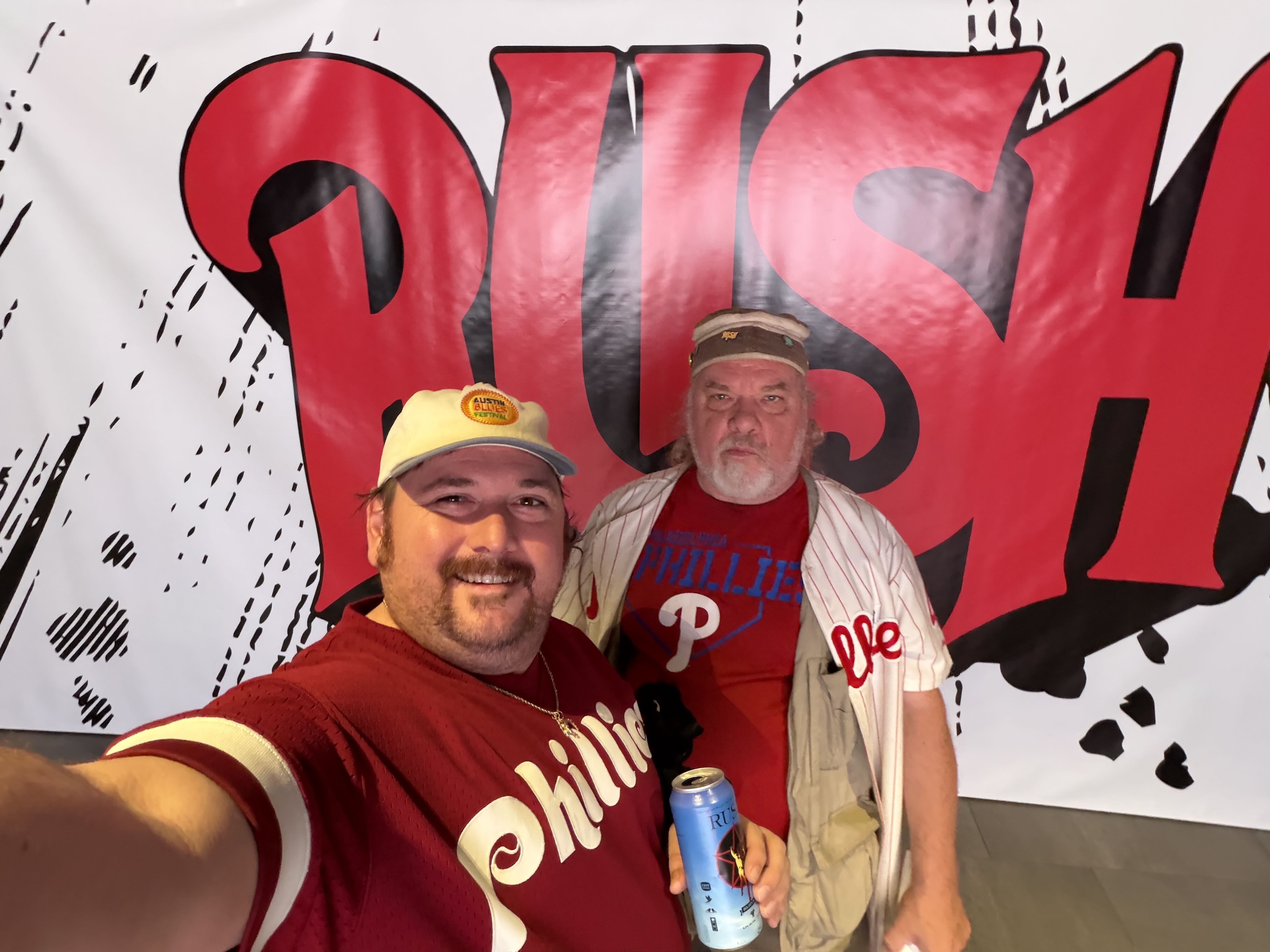
Dillon (front) and Jim Minacci at the Rush concert earlier this month.Dillon Minacci
Minacci stood outside the stadium that day before deciding to go home. It was over. He’s another fan now when he goes to the ballpark except that he still wears his Flag Man jersey — with No. 47 as a nod to Larry Andersen — when he sits in the seats. Kids who used to trail him at the Vet will stop him and tell him about those days. Now those kids have kids of their own. Minacci helped people come together that September. It was a time and place he’ll never forget.
“It was a unifying visual,” Minacci said. “Something everyone could agree to. Back then, it was an agreeable moment. It would be hard to find that agreeable moment today. We’re all so segmented. It’s awful. It’s really hard.”
Alec Bohm leaned over the dugout railing and dropped his hat on the warning track.
The Phillies relievers have a game they often play in the bullpen: If they think the player at the plate is about to hit a homer, they’ll toss their hat on the ground in front of them. Once in a while, the dugout joins in on the fun, too.
Bohm, whose scheduled night off on Wednesday gave him a front-row seat to the Phillies’ roller coaster game against the Astros, decided to call his shot in the sixth inning just as Kyle Schwarber walked up with the bases loaded.
“We’re usually feeling pretty good when he’s up there in a big spot,” Bohm said.
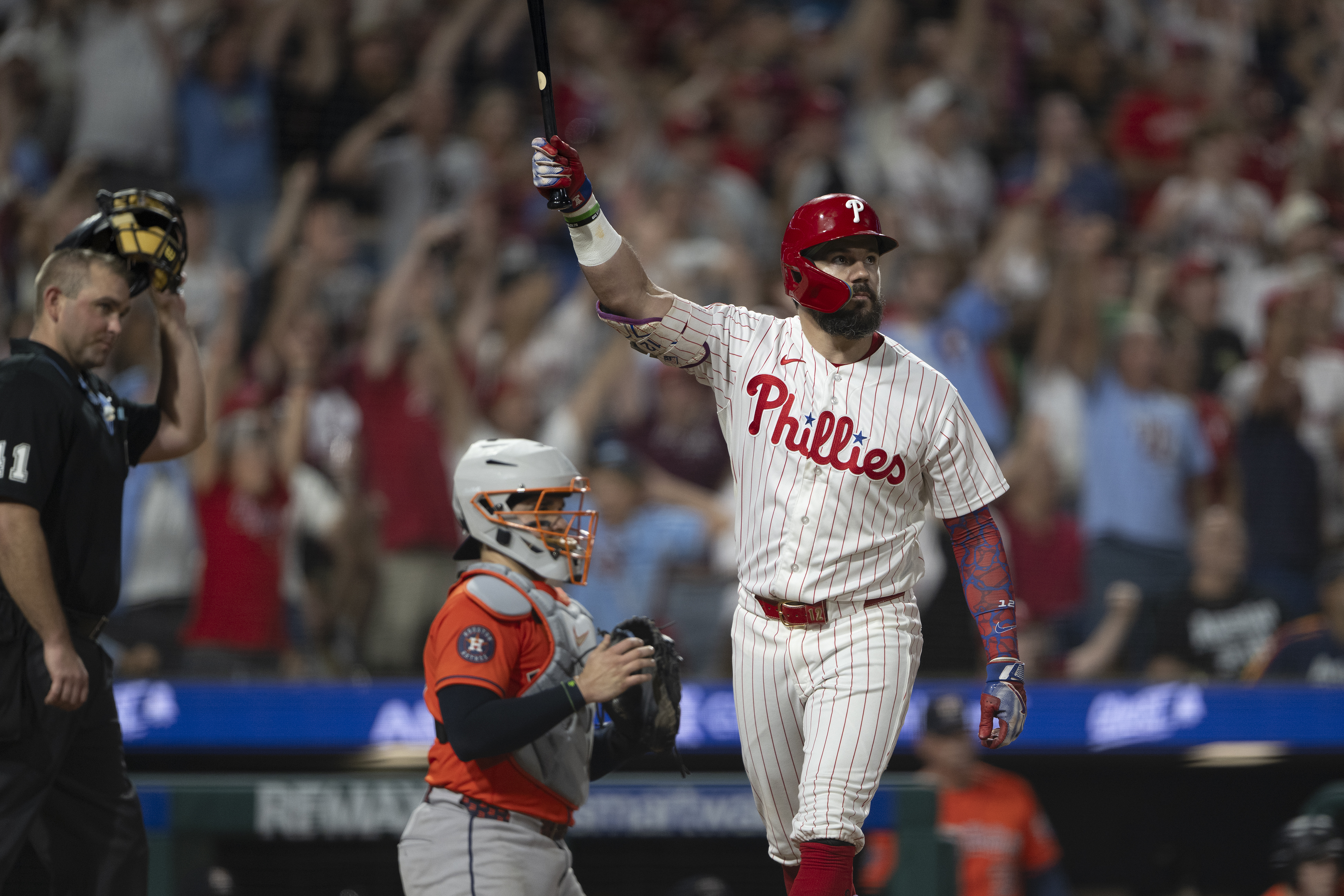
There his hat was as Schwarber took Houston reliever AJ Blubaugh to a 2-0 count, then 2-2, then 3-2. And it was there when Schwarber swung at a sweeper, half with one hand, and drove it 406 feet to right field.
And as Schwarber watched it fly, his bat held straight up in the air, behind him was Bohm’s hat triumphantly lying in the dirt. It’s not the first time that Bohm has won the Phillies’ hat game. But most of his wins, he said, have come with Schwarber at the plate.
After the Phillies’ eventual 11-7 win over the Astros, Schwarber’s teammates were running out of adjectives to describe what he’s been able to accomplish. The grand slam was his 44th homer of the season, adding to his major league lead.
“It’s incredible. It’s amazing. He’s one of the best power hitters in the game,” Cristopher Sánchez said through a team interpreter.
Schwarber’s slam gave the Phillies a commanding lead in a game they had once trailed 4-0. It helped them overcome an atypical start from Sánchez, who allowed a lot of hard contact and only struck out three. The Astros saw his pitches well all night, including his vaunted changeup.
“I was missing a little too much of my pitches today, and I don’t think that’s the kind of pitcher that I am,” Sánchez said.
Of the 10 hits he allowed, half were for extra bases. That included a pair of homers from Isaac Paredes and Cam Smith, both coming on mislocated sinkers.
But the Phillies offense picked him up, responding to a four-run top of the third by Houston with a four-run bottom of the inning. They timed up Astros starter Hunter Brown well, and consistently put runners in motion against him. In turn, that pulled Houston’s infielders out of position, and opened holes for four ground ball singles to sneak through.
“The way we scored tonight, I thought was pretty cool,” said Trea Turner, who accounted for one of those singles and later homered in the fifth. “Working at-bats, working counts, even if a guy got out here or there, felt like the guy behind him picked him right up. So we just need to keep doing that and keep playing good baseball.”
The Astros put up two more runs on Sánchez in the fourth inning on Smith’s homer, but the Phillies completely broke the game open in the sixth.
Edmundo Sosa tied things back up and got some redemption, all at once. A day after he failed to hustle out of the box, costing the Phillies an extra base in the ninth inning on Tuesday, Sosa said the mistake would not happen again.
NL wild-card standings
window.addEventListener(“message”,function(a){if(void 0!==a.data[“datawrapper-height”]){var e=document.querySelectorAll(“iframe”);for(var t in a.data[“datawrapper-height”])for(var r,i=0;r=e[i];i++)if(r.contentWindow===a.source){var d=a.data[“datawrapper-height”][t]+”px”;r.style.height=d}}});
He entered Wednesday’s game as a pinch-hitter against Astros lefty Bryan King with two runners on. As soon as his bat connected on a fastball from King, clocking just a 58.2 mph exit velocity, Sosa dashed to first. It found some grass in right field, allowing Luis Arraez to tie the game at 6-6.
A single from Justin Crawford and bases-loaded walk from Bryan De La Cruz kept the line moving for Schwarber. Every starter reached base at least once in the game.
“It’s nice to have everybody involved, right?” said interim manager Don Mattingly. “When your lineup’s going up and down, it’s always better. Keep the line moving. Momentum builds.”
Kyle Schwarber is congratulated in the dugout after hitting a grand slam in the sixth inning.Jose F. Moreno / Staff Photographer
As he usually does after a big swing, Schwarber said Wednesday he hadn’t been looking to hit a homer in the sixth inning — even though that’s what Bohm and backup catcher Garrett Stubbs both yelled at him to do from the dugout. On the 3-2 pitch from Blubaugh, Schwarber had been focused on finding any way to get on base.
“It’s not like you’re going up there and think that you’re going to be a hero,” he said.
According to Mattingly, who hit six grand slams in one season for the Yankees in 1987, that’s exactly the key.
“I think that the trait is nothing changes,” Mattingly said. “If it’s an early season at-bat, if it’s an at-bat in the fifth, it’s an at-bat in the ninth. Really, if you look at it truly simply. It doesn’t change. You still walk up with a game plan. You’re trying to get what you want to hit. You understand what the guy’s trying to do, and something either good happens, or it doesn’t.
“But I think the guys that don’t change and don’t put pressure on the moment and just stay with what they do, they end up being the guys that seem to be able to slow it down, and not to put too much in the moment.”
After Schwarber’s one-handed swing gave them a sizable cushion, Jonathan Bowlan, Alex McFarlane, and Jhoan Duran split the job in relief. Bowlan allowed a run in the seventh inning on a double and a single.
It was not a save situation for Duran, but the Phillies called on their closer for the ninth anyway, since he had not pitched since Sunday.
The roller coaster game was capped by a roller coaster final play, as Bryson Stott initially overshot a foul pop-up, recovered, and made the catch while falling down.
“There’s going to be times, like we’ve seen throughout the rest of this year, where we’ve come back and we’ve battled through different things,” Schwarber said. “And that’s what it’s going to take, to get through the stretch, and hopefully find our way into October.”
READING — Take it day by day. That was Aidan Miller’s focus for 352 days.
After a back injury started creeping up at the end of last season when the Phillies’ top position player prospect was with double-A Reading, Miller is coming off the longest break from baseball he can remember. His back issues reappeared during spring training, and he was placed on the injured list on March 27.
Answers didn’t come until June, when the Phillies announced he was dealing with discogenic pain and facet inflammation in the lumbar spine.
A minimally invasive procedure on June 5 kept Miller out of a game until three months later on Saturday, when he returned with single-A Clearwater, exactly 352 days after his last game on Sept. 18, 2025.
“It’s all I’ve really known. Growing up playing baseball every day, I never had that long of a break,” Miller said Wednesday. “Early on, I think it was a big mental battle, and then learning how to deal with the day to day, trying to take a positive wave from every single day and take it day by day and go from there.”
Miller, 22, said now “feels 100%” with two games under his belt.
Aidan Miller’s back condition landed him on the injured list on March 27.Jose F. Moreno / Staff Photographer
He went 1-for-2 with a double and a walk for Clearwater on Saturday. With the Threshers now in the postseason, Miller is continuing his rehab with Reading, which has a week left in the regular season. He played seven innings on Tuesday as the starting shortstop and went 0-for-3. He was given a day off Wednesday.
The plan is for Miller to play two more seven-inning games on Thursday and Saturday, with another off day on Friday.
Miller plans to play in the Arizona Fall League, which he missed last year because of his back condition. Beyond that, “we really haven’t gone that far,” he said.
“It’s just stay healthy, stay on the field, and get through that,” Miller said. “You don’t want to get too far out and advance. Just take it day by day and see what happens.”
The 2023 first-round pick spent the majority of the 2025 season at Reading, and played eight games with triple-A Lehigh Valley to close the season. He batted .264 with 14 home runs, 59 stolen bases, and an .825 OPS across both levels.
A “big worker,” Miller said it was tough for him not to overdo his recovery initially, taking some time to find the balance between progression and overuse.
“With the injury now, it’s like I got to be smart and learn when to go extra,” Miller said. “Just dealing with that, finding a good routine, getting in the training room, in the weight room, the diet, everything that goes into it.”
While in Florida, Miller turned to fishing to find a reprieve from baseball. The Dunedin, Fla., native was used to freshwater fishing, but he was new to saltwater fishing. He said his best catch was a 38-inch snook.
Aidan Miller had an .825 OPS across two levels of the minor leagues in 2025.Yong Kim / Staff Photographer
“That was a good little mental reset for me, too,” Miller said. “I’d go out there, throw some lines out, and that’s kind of my hobby down there. Everybody in rehab pretty much fished.”
Around the time of Miller’s surgery, fellow Phillies prospect Dante Nori was sidelined for two months with a stress fracture in his hip. He started his rehab assignment in August at Clearwater.
Nori said having a group of players working on their rehab assignments allowed them not to think so much about the injuries and kept everyone “in the right mental space.”
“Yeah, you’re injured, but at the same time, you just got to think in the future,” Nori said. “Like, ‘Hey, we’re going be back playing soon. It’s not the end of the world.’ So just keeping each other’s heads up high.”
It also helped that Miller was so close to home. On the days he needed to reset, Miller said he had the option of traveling 40 minutes to be with his family, including his brother Jackson, a second-round pick by the Cincinnati Reds in 2020. Jackson’s career was cut short in single A because of a back injury.
Aidan Miller hopes his back injury is behind him, and he’s happy to be an active player again.
“Rehab, I was getting up at 5:30 every morning. It’s nice sleeping in a little bit,” Miller said. “But just being in the clubhouse again with all the guys, it’s awesome.”