Category: New Jersey News

  • Remains of missing woman found in South Jersey

    Remains of missing woman found in South Jersey

    The remains of a 37-year-old woman reported missing two years ago have been recovered in Burlington County, and the investigation into her death is continuing, the New Jersey State Police said Monday.

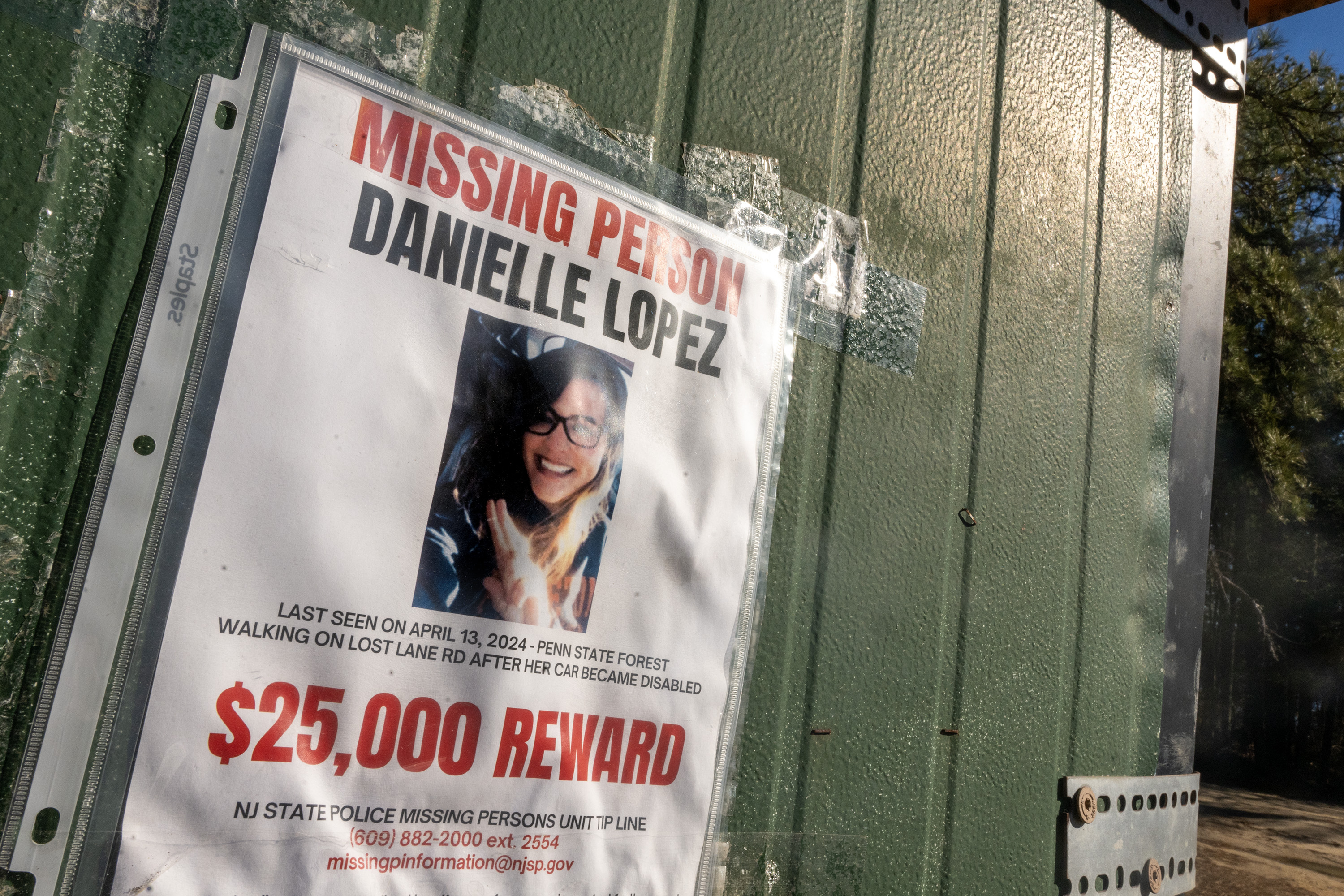
    Danielle Lopez disappeared while she was camping with her boyfriend in New Jersey’s Brendan T. Byrne State Forest. Lopez was recorded on surveillance video on the morning of April 13, 2024, buying coffee at a Wawa not far from the campground.

    NBC’s Dateline show reported on her case.

    Investigators said witnesses reported last seeing Lopez that evening walking alone on Lost Lane deep in the Pine Barrens.

    Lopez’s mother reported her missing 11 days later on April 24.

    On Saturday, the New Jersey State Police Major Crime South Unit and the Missing Persons Unit coordinated a multiagency search operation within the Brendan T. Byrne State Forest in Chatsworth, Burlington County, as part of the investigation of Lopez’s disappearance.

    “During the search operation, human remains were discovered. Following a thorough forensic examination, the remains were positively identified today as those of Danielle Lopez,” the state police said.

    No other details about the investigation were released.

    Anyone with information about Lopez’s disappearance can contact the New Jersey State Police Missing Persons Unit at 609-882-2000 ext. 2554.

    Lopez’s boyfriend, James Scott Dunn, spoke to police shortly after she was reported missing and he was arrested in an unrelated drug case. In late 2025, Dunn was sentenced to five years in prison.

    In a prison interview with The Inquirer last year, Dunn said he and Lopez were “homeless” and living in hotels before moving to the campground. Dunn said he was away from the campground when Lopez disappeared, and when he returned the campground was in “disarray.”

    <iframe src="https://www.facebook.com/plugins/post.php?href=https%3A%2F%2Fwww.facebook.com%2FNewJerseyStatePolice%2Fposts%2Fpfbid0uhMRb9qHaXfY74kZR1LPNoHxVdMGhsFQ4CGz5Fyc1Ey8m1pesfwsm3FjNTmVLZrcl&show_text=true&width=500" width="500" height="539" style="border:none;overflow:hidden" scrolling="no" frameborder="0" allowfullscreen="true" allow="autoplay; clipboard-write; encrypted-media; picture-in-picture; web-share"></iframe>
  • Oaklyn’s hockey rink will get a second life that includes soccer

    Oaklyn’s hockey rink will get a second life that includes soccer

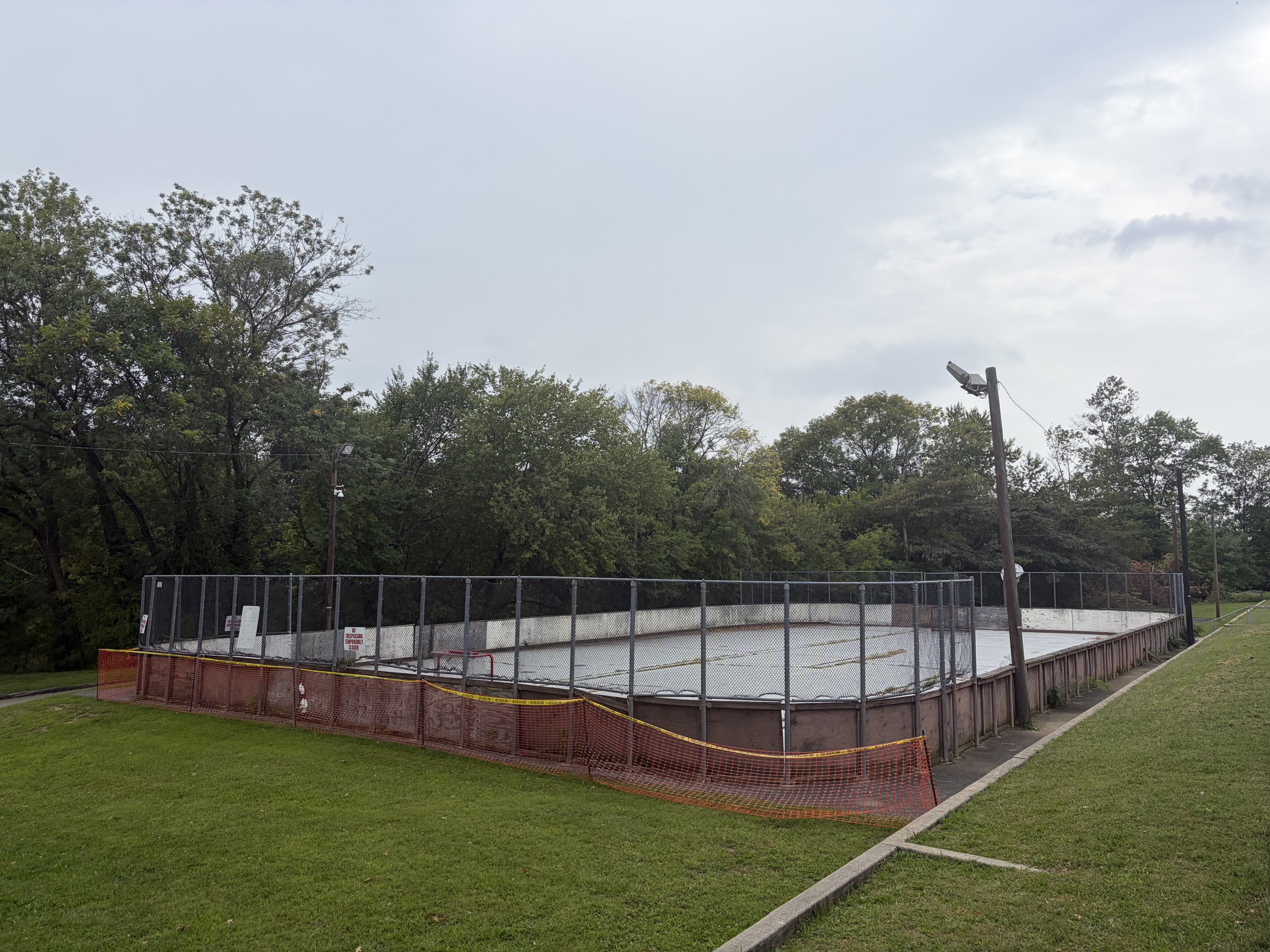
    Two months after closing suddenly because of deteriorating conditions, Oaklyn’s popular outdoor hockey rink has been torn down and will be replaced by a multiuse court for both hockey and soccer, according to Oaklyn Mayor Greg Brandley.

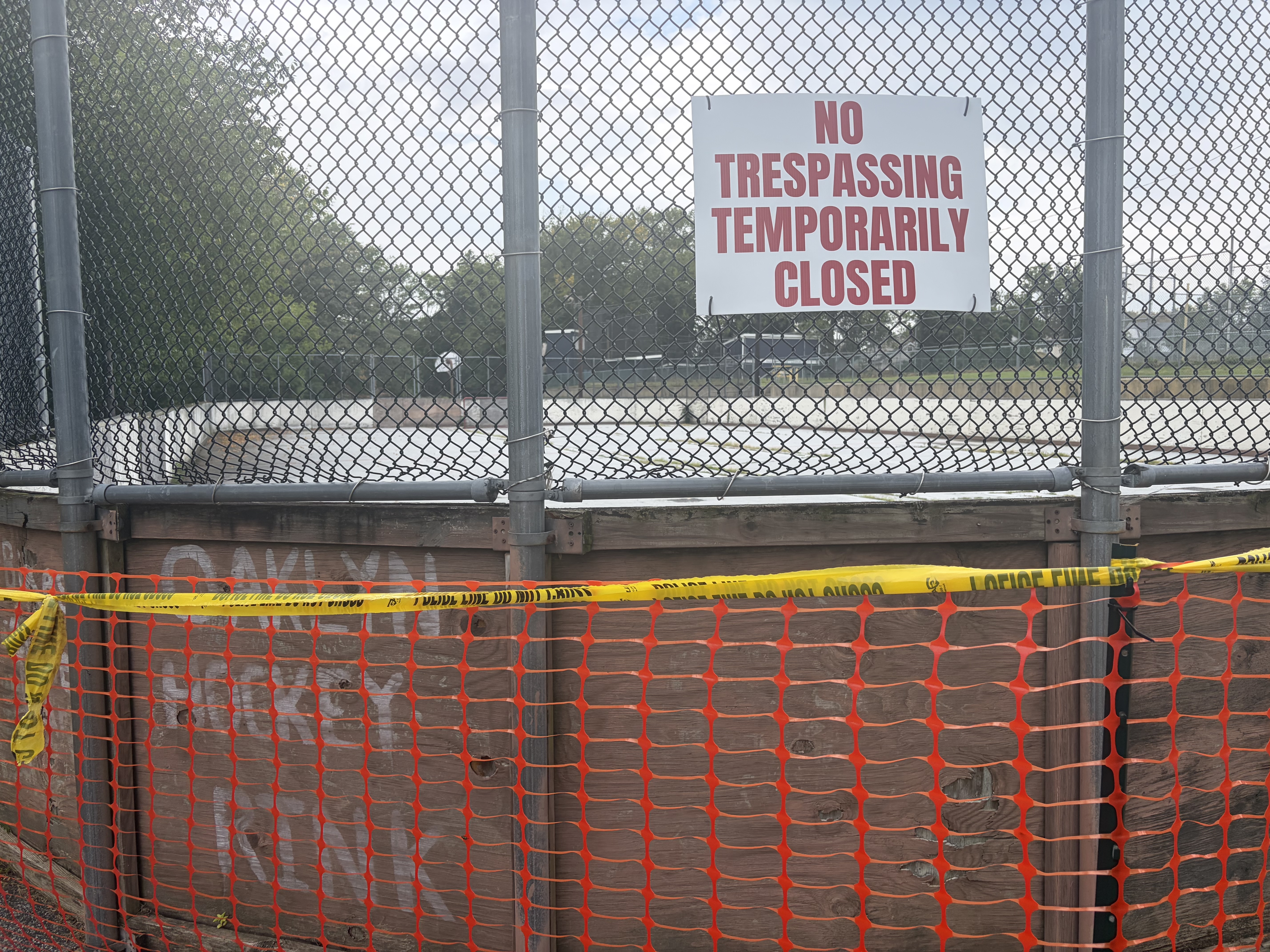
    The rink and the adjacent basketball court at Oaklyn-Lions Park had been cordoned off by temporary fencing and caution tape since closing in early September after an annual safety inspection found issues with the surface, boards, and fencing.

    The new rink should be open by next summer, Brandley said, with most of the construction set to begin once the cold weather breaks in the spring.

    The outdoor hockey rink at Oaklyn-Lions Park, cordoned off on Sept. 17 after being closed due to safety concerns.Lacey Latch

    The borough may even begin to pour the concrete footings this fall if the weather cooperates, Brandley said.

    The project’s total cost is still being calculated, he said.

    The rink’s second wind is coming thanks to help from Camden County and Flyers Charities, said Camden County Commissioner Jeff Nash. A spokesperson for Flyers Charities said Friday the organization is looking into the Oaklyn project but could not provide any further information.

    “Everyone who was involved in this — the mayor’s office, the county parks department, Flyers Charities — everyone is very excited about this project,” Nash said. “This is a really great opportunity for the Flyers to make a difference in the community, and the county was happy to help work with all the partners to make it happen.”

    County parks staff are already working on the project’s engineering and design, Nash said.

    After the rink is rebuilt, Brandley said, the borough will make sure the space is suitable for both hockey and soccer players.

    Alex Lewis, an Oaklyn native and founder of Oaklyn United FC, has long been a proponent of both repairing the area and formalizing the long-standing practice of sharing the court between sports.

    Once the rink is back in working order, Lewis said, he and other local soccer enthusiasts are willing to help fundraise for any remaining soccer aspects needed.

    The repairs are likely as simple as a few extra lines painted on the court, an extra set of removable goals, and possibly a shed for storage, and the roughly $1,000 he has already raised for repairs will go a long way, he said.

    “This is progress,” Lewis said. “This is more progress than we’ve had in 20 years, as far as I know.”

    Lewis said the community needs to ensure that it remains a public asset.

    With so many athletic fields across South Jersey reserved by leagues or organizations, he said, it is critical that Oaklyn kids still have somewhere to play whenever and with whomever they want.

    “It’s really important at this point, and even before it’s built, that Oaklyn starts to prepare itself for keeping it as a public good,” he said, “because that’s what made it so great all those years ago for so long, and that’s what’ll make it good again.”

  • Man charged with double murder in 2022 fatal shooting of pregnant woman in Philly

    Man charged with double murder in 2022 fatal shooting of pregnant woman in Philly

    A 25-year-old man Delaware County has been charged with two counts of murder for the 2022 fatal shooting of a pregnant woman in the Port Richmond section of Philadelphia and the subsequent death of her newborn who survived a month after the woman was killed, police said.

    Christian G. Brown, of Lansdowne, was arrested Friday and was being held without bail at the Curran-Fromhold Correctional Facility, court records show.

    Around 1 a.m. on June 4, 2022, in the area of Richmond Street and Wheatsheaf Lane, Brown allegedly shot 19-year-old Matayah Haynes in the head.

    Haynes, a Camden resident who was about 34 weeks pregnant, was taken by medics to Temple University Hospital, where she was pronounced dead at 1:56 a.m.

    Police reported that a baby boy was delivered and was immediately listed in critical condition.

    Ry’Kier Haynes, as he was named, died July 5, 2022, at 2:56 p.m., police said Monday.

    Police did not release any other details about the investigation.

    No attorney was listed in court records on Monday for Brown.

    An online obituary for Haynes said she “couldn’t wait to take on life with her first child, son Ry’Kier whom she passionately referred to as her critter.”

  • Dead siblings rattle Mount Holly | Inquirer South Jersey

    Dead siblings rattle Mount Holly | Inquirer South Jersey

    Good morning, South Jersey.

    A neighborhood in Mount Holly is unsettled after three elderly siblings were found dead inside their dilapidated home earlier this month.

    And on a much lighter note, a principal is requiring every sixth grader to learn how to play chess.

    Plus, Cooper Health Norcross seeks to build a new stage of its $3 billion expansion, and more news of the day.

    — Taylor Allen (southjersey@inquirer.com)

    If someone forwarded you this email, sign up for free here.

    What shocked a quiet neighborhood

    At 3 Winding Way in Mount Holly, a mail carrier found a note taped to the front door that read “9-1-1 inside” next to two frowning faces with x’s for eyes earlier this month.

    According to a source, police discovered three adults dead inside the single-story story home: William Monk, 64; Randolph Monk, 69; and Rosalind Monk, 71.

    The cause and manner of the death are under investigation, but officials say there is no active threat in the community.

    Still, the discovery has made the quiet neighborhood uneasy.

    The Inquirer’s Jesse Bunch spoke to the neighbors about what they know about the siblings.

    ♟️ Checkmate, class

    The sixth graders at Benjamin Banneker Charter School on its Westampton and Willingboro campuses have a new requirement.

    They must learn how to play chess by the end of the school year. They get an opportunity to practice twice a week while taking a break from classes.

    According to principal Richard L. Wilson Jr., the goal is to encourage critical thinking and to eventually improve test scores. There’s no grades for the class but teachers monitor students’ performance to gauge their skill level and to see how well they’re learning the game.

    Reporter Melanie Burney has the story.

    What to know today

    • Cooper Norcross Health wants to add a 10-story hospital with 110 beds for patients to continue its $3 billion expansion in Camden. Developers are scheduled to go before the city’s planning board today seeking approval.
    • A wave of flight delays and cancellations continued into Sunday at the Philadelphia International Airport, two days after the nationwide ground stop.
    • Christopher Y. Shin, a Harvard University senior from Cherry Hill, was awarded a Rhode scholarship, the institution announced Saturday. When he starts at Oxford next fall, he will pursue two masters: one in modeling for global health and the other in genomic medicine.
    • According to officials, the Tacony-Palmyra Bridge was able to reopen on Thursday evening to pedestrian and vehicle traffic after a passing ship hit it and caused minor damage.
    • The National Weather Service confirmed a rare November tornado in Chesterfield on Thursday that traveled 1.5 miles and damaged three buildings.
    • Former Villanova football player and Phillie Matt Szczur retired from baseball to build his second career as an artist. He paints in his Cape May studio.

    🧠 Trivia time

    Notre Dame basketball player Hannah Hidalgo is from Merchantville.

    But she attended Paul VI High School, which is in which town?

    A) Haddon Township

    B) Berlin

    C) Collingswood

    D) Deptford

    Think you know? Check your answer.

    What we’re …

    🏠 Ogling: A seven-bedroom mega-mansion that sits on both Moorestown and Cinnaminson.

    🥂 Tasting: A bubbly riesling.

    🏈 Debating: If an Eagles family tradition should be kept alive.

    📬 Your South Jersey view

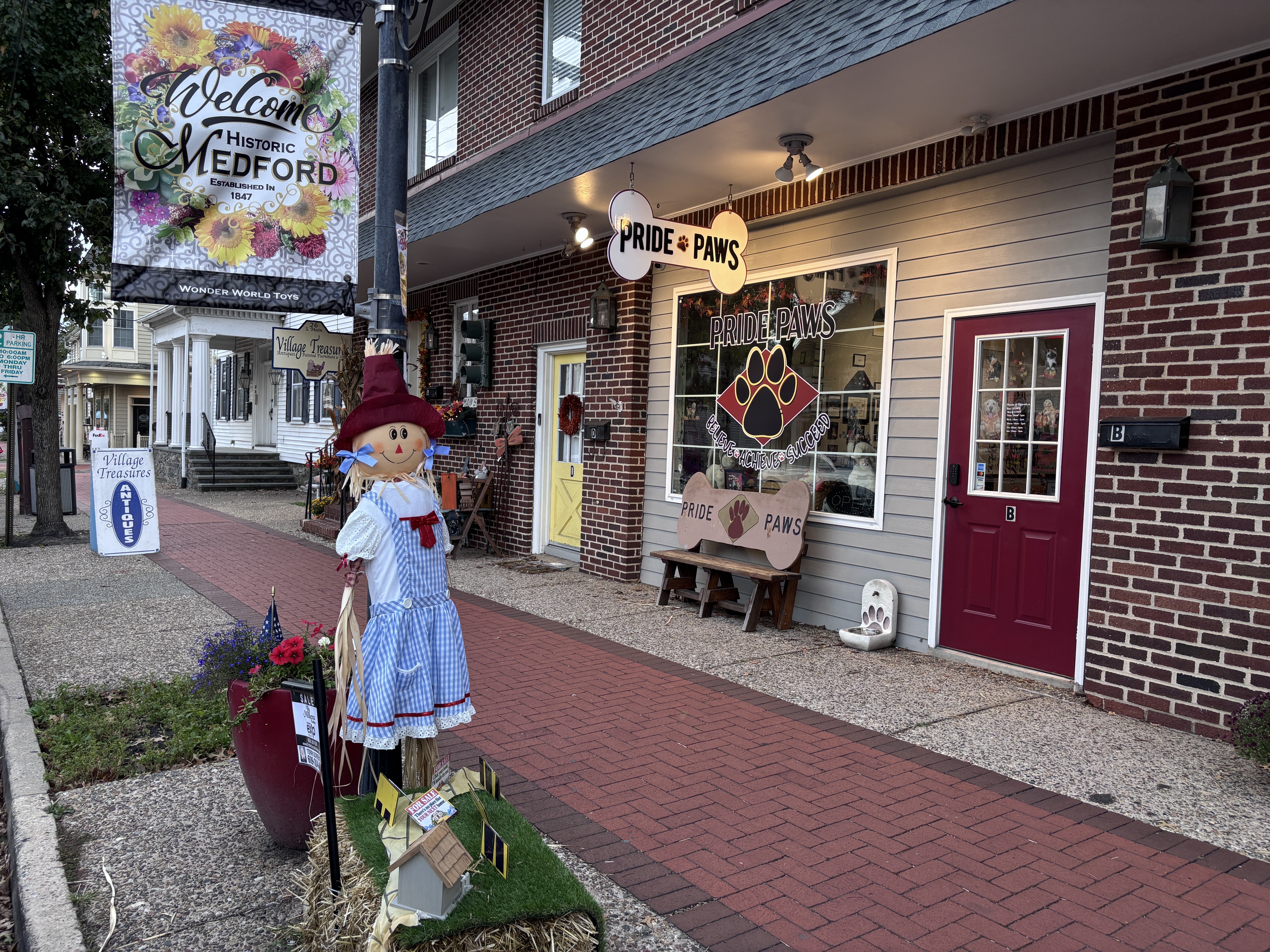
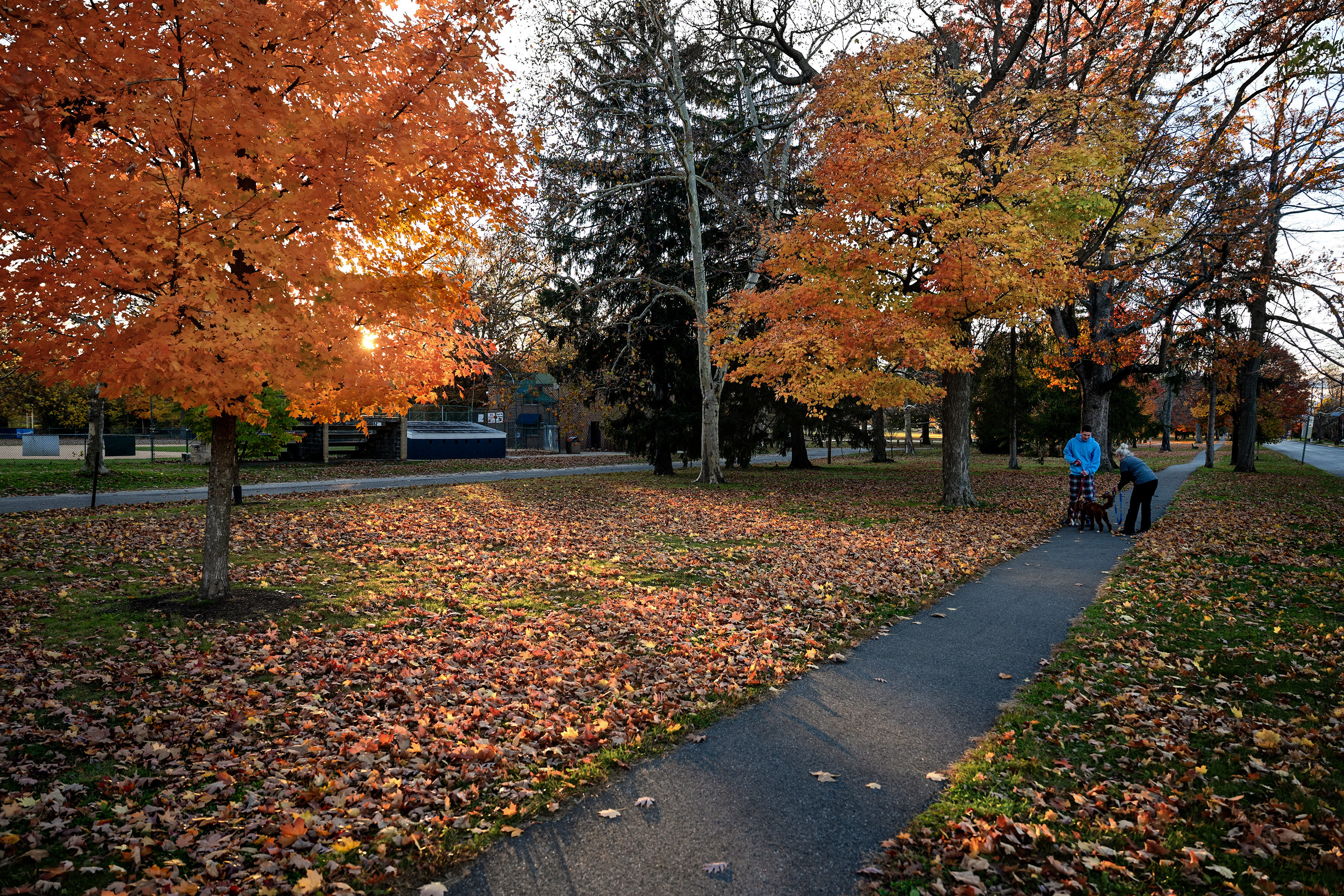
    Fall decorations line Medford’s Main Street.Taylor Allen

    The above image was from a late autumn evening from last month. Downtown Medford is incredibly charming.

    What does your community look like? What South Jersey memory would you like to share? Submit a photo and/or a brief description for a chance to be featured in the Monday edition of this newsletter.

    🗞️ What other South Jersey residents are reading

    Welcome to a new week. More news will be in your inbox tomorrow. 📧

    By submitting your written, visual, and/or audio contributions, you agree to The Inquirer’s Terms of Use, including the grant of rights in Section 10.

  • This South Jersey principal made chess a mandatory class for middle schoolers

    This South Jersey principal made chess a mandatory class for middle schoolers

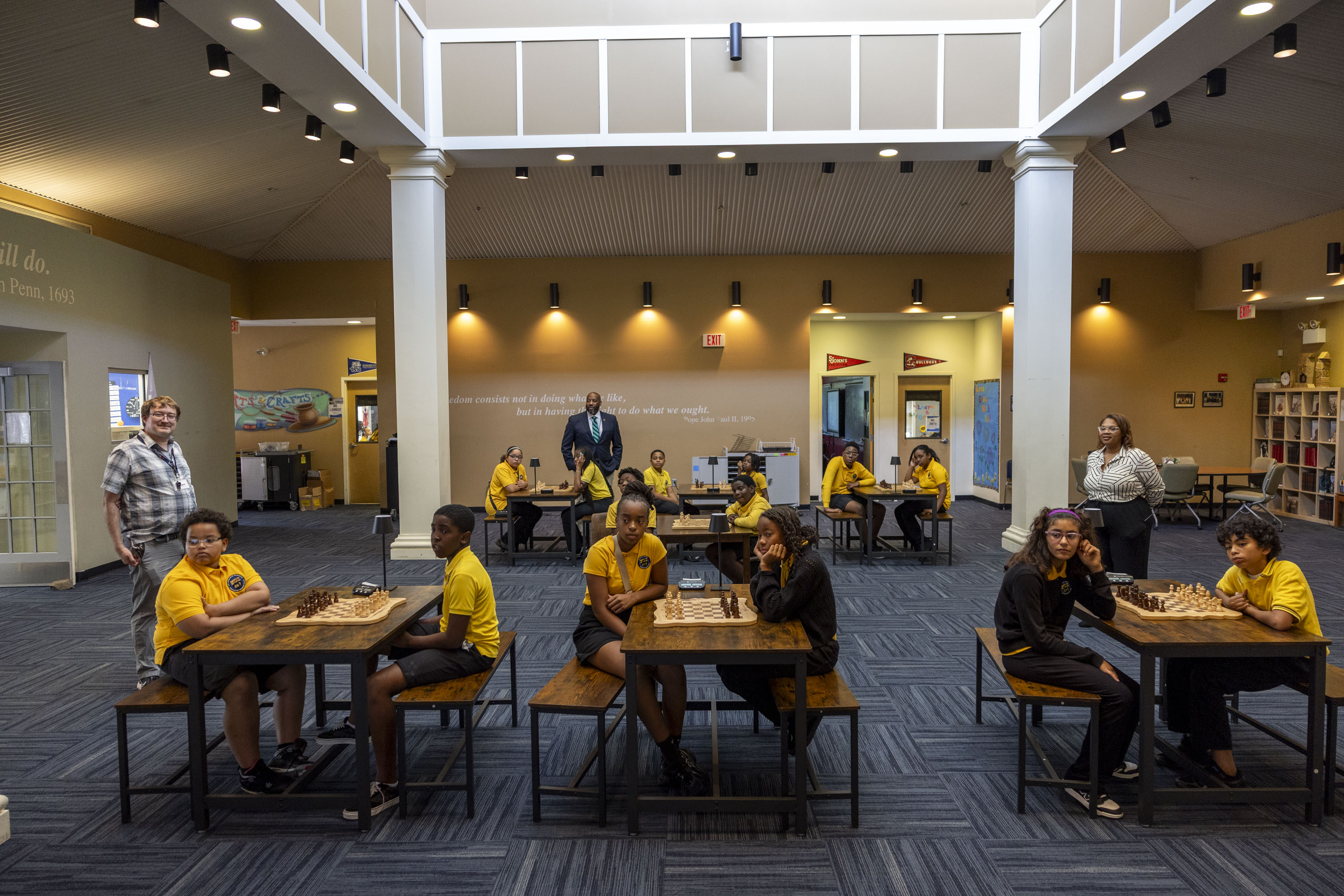
    Twice a week, sixth graders at both campuses of the Benjamin Banneker Preparatory Charter School take a break from their regular classes to play chess.

    Learning chess is a new requirement this fall for middle schoolers at the South Jersey school, which has campuses in Westampton and Willingboro. By the end of the school year, all sixth graders must know how to play.

    Principal Richard L. Wilson Jr. incorporated chess into the school day to foster critical thinking and ultimately, he hopes, to improve test scores, too.

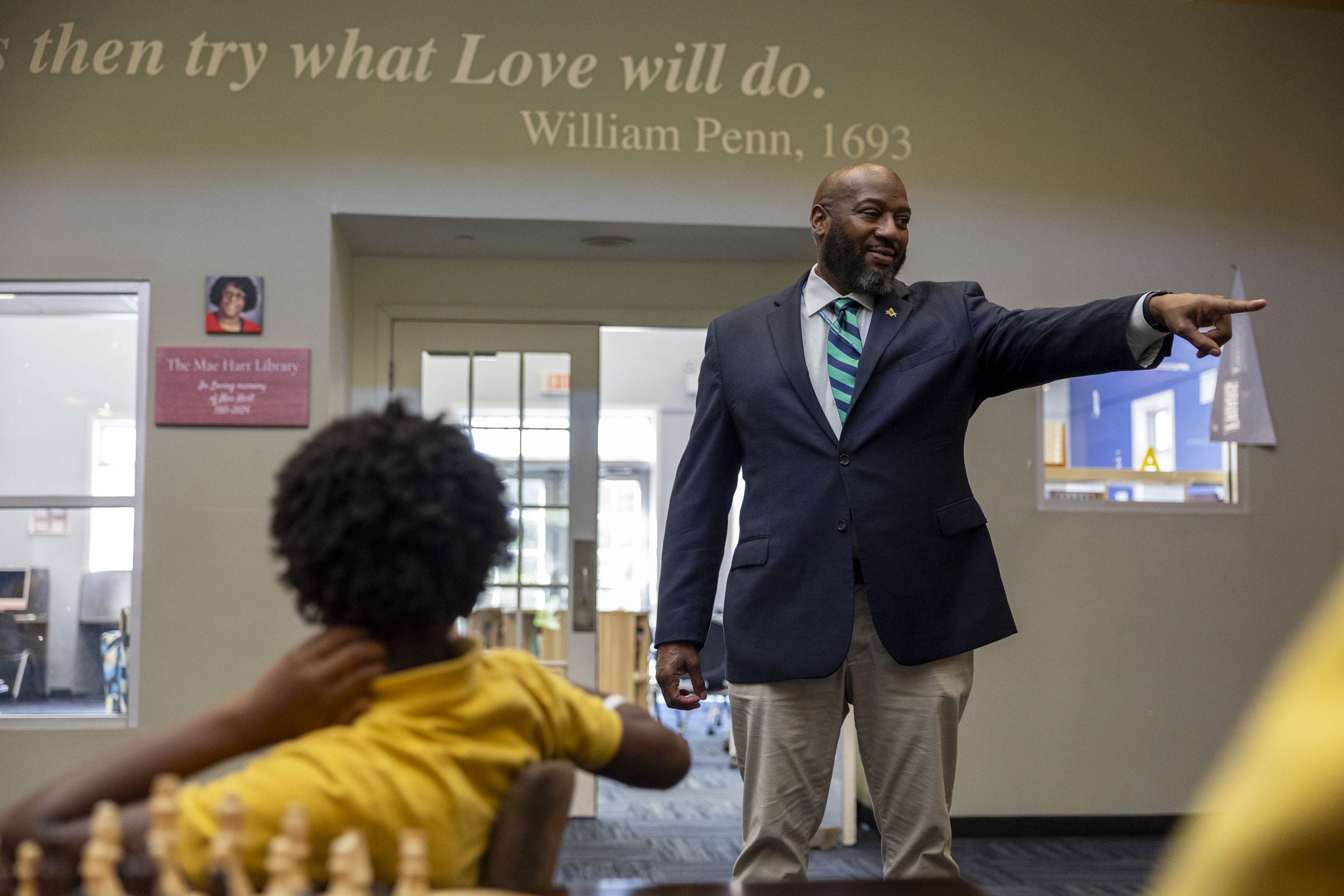
    Richard L. Wilson Jr., founder of the school, asks the sixth grade students what the strongest and most important piece on a chess board is on Sept. 10.Tyger Williams / Staff Photographer

    “I just want them to be excited about playing chess,” said Wilson, who opened the school in 2007 with his wife, Stacey. “Anything to get them enthused.”

    Banneker students have struggled academically, although they have fared slightly better on state standardized tests than some of their counterparts in traditional public schools.

    For the 2024-25 school year, 37.5% of the school’s students were proficient in language arts, and about 16.4% were proficient in math. The state averages for public schools during the same time period were 53% proficiency for language arts and 42% for math.

    In addition to adding the chess program, Wilson said, the school has offered tutoring before and after school, beefed up its curriculum, and hired more specialists to improve student achievement.

    Wilson got the idea for a chess program from a private school in North Jersey. At Banneker, it began as an extracurricular activity for sixth graders during recess.

    It became so popular that students were opting to skip recess to play chess, Wilson said. Other grades wanted to learn, so Wilson opened an afterschool program and invited seventh and eighth graders, too.

    “They love the chess program,” said Kourtney Bridges, director of the school’s Westampton campus. “They really get into it.”

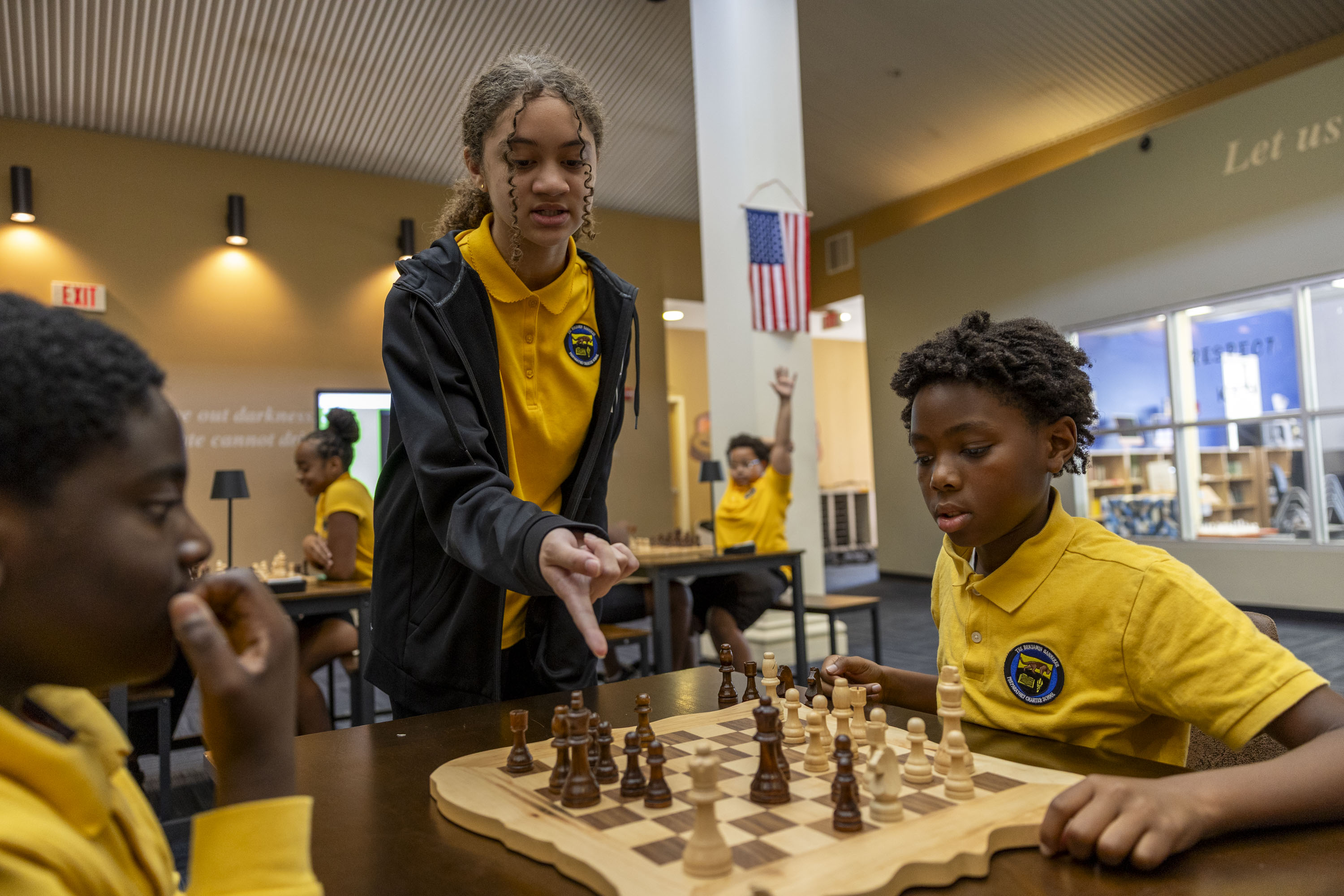
    Sixth grade students at Benjamin Banneker Prep Charter School are learning how to play chess by Isla Hutchinson, an eighth grader in Westampton, on Sept. 10.Tyger Williams / Staff Photographer

    On a Thursday morning in September, a group of sixth graders were brought to an atrium where about a dozen chessboards were set up on wooden tables.

    Each student paired up with a classmate and started a game. They received instructions in class on chess etiquette, the board pieces, terminology, and strategic moves. Some were skilled players, while others were beginners.

    “You can learn a lot from it, like patience. It also helps you become more strategic,” said Arianna Sucki, 11. “It just feels good.”

    Wilson said chess not only helps students with math, but also teaches other skills like problem-solving, good sportsmanship, respect, and discipline, and it boosts confidence. He credits chess for a sharp decline in disciplinary incidents last year.

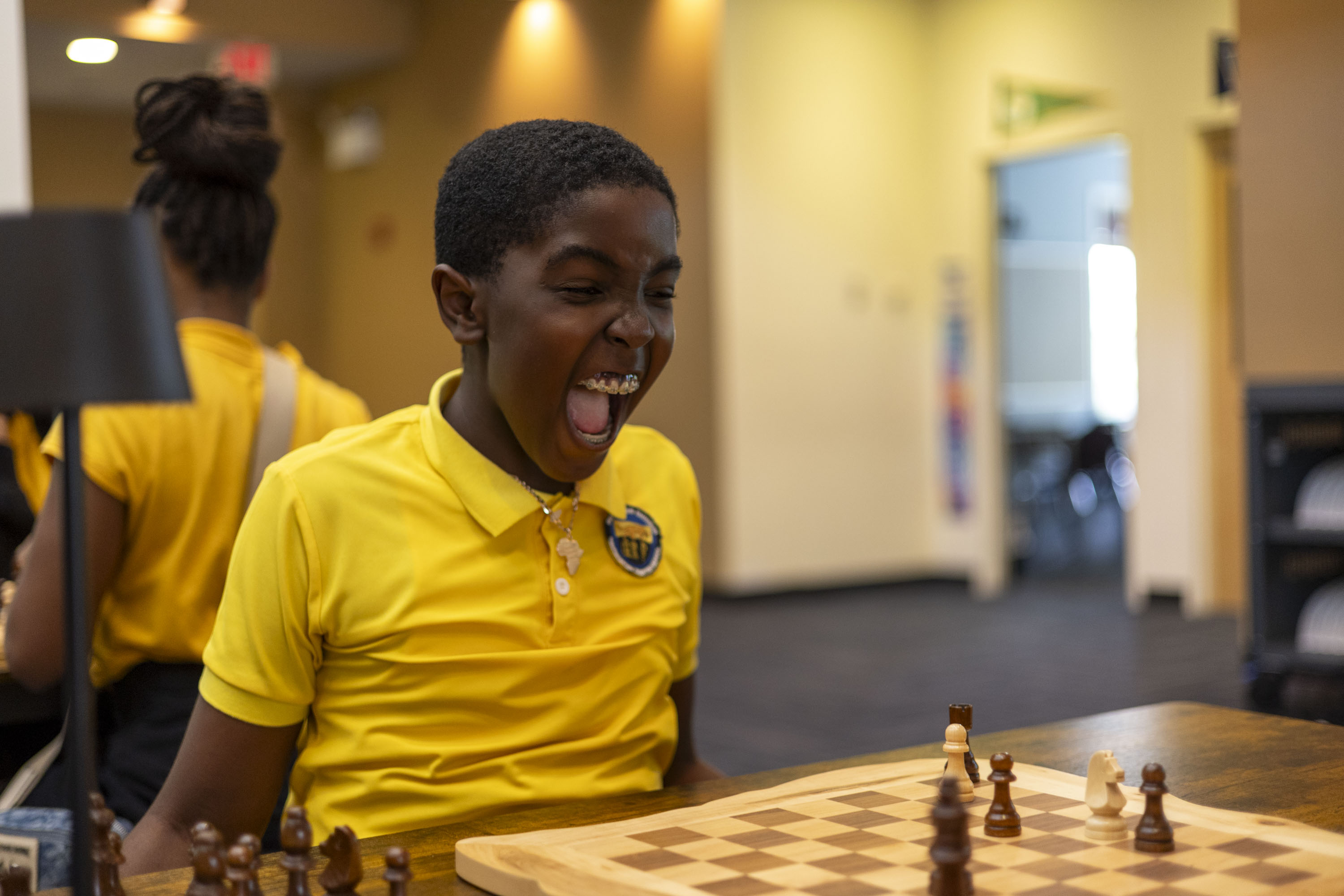
    Sixth grader Anthony Otero, 11, raises up the queen.Tyger Williams / Staff Photographer

    There was little talking as the students concentrated on their moves, heads bent as they looked intensely at their boards. Chess coach Joseph Lurie offered assistance and a lesson when they ran into difficulty.

    “Is it checkmate or a stalemate?” Lurie asked Avery Jackson when he found himself with only one piece remaining, his king.

    Avery and Ayden Charli-Comb, both 11, shook hands and started a new game.

    “That was a good game. It was fun,” Avery said. “I love it.”

    Wilson said the students will spend several months learning chess basics through www.chesskid.com, mainly how the pieces move and how to set up the board. Eventually, a timer will be added for moves.

    There is no grade for the class, Wilson said. Teachers will monitor students’ skill level to see if they are catching on, he said.

    Wilson occasionally sits in on a game. The students jump at a chance to try beating the principal. He has a waiting list of opponents. On the rare times that Wilson loses, the student’s name is announced on the public announcement system.

    “It gives me an opportunity to bond with them,” Wilson said.

    Eighth grader Isla Hutchinson teaches her fellow schoolmates how to play chess on Sept. 10 in Westampton.Tyger Williams / Staff Photographer

    Students also have the option to participate in a chess tournament at the end of the year. Besides bragging rights, the winner gets a trophy and a $300 cash prize.

    The school is among only a handful of charter schools in New Jersey located outside urban districts like Camden, Newark, and Trenton, where parents seeking other options for their children have fled traditional public schools. It enrolls 360 students.

    It is named for Benjamin Banneker, son of a once-enslaved man, who was a self-educated astronomer and mathematician and a civil rights activist. The school focuses on math and science.

    Wilson refers to the students as scholars. Every classroom is named for a college or university — meant to place the students in the mindset to pursue higher education.

  • Finding the art in the shadows of Philly autumn

    Finding the art in the shadows of Philly autumn

    Who would not want to be outside this past week?

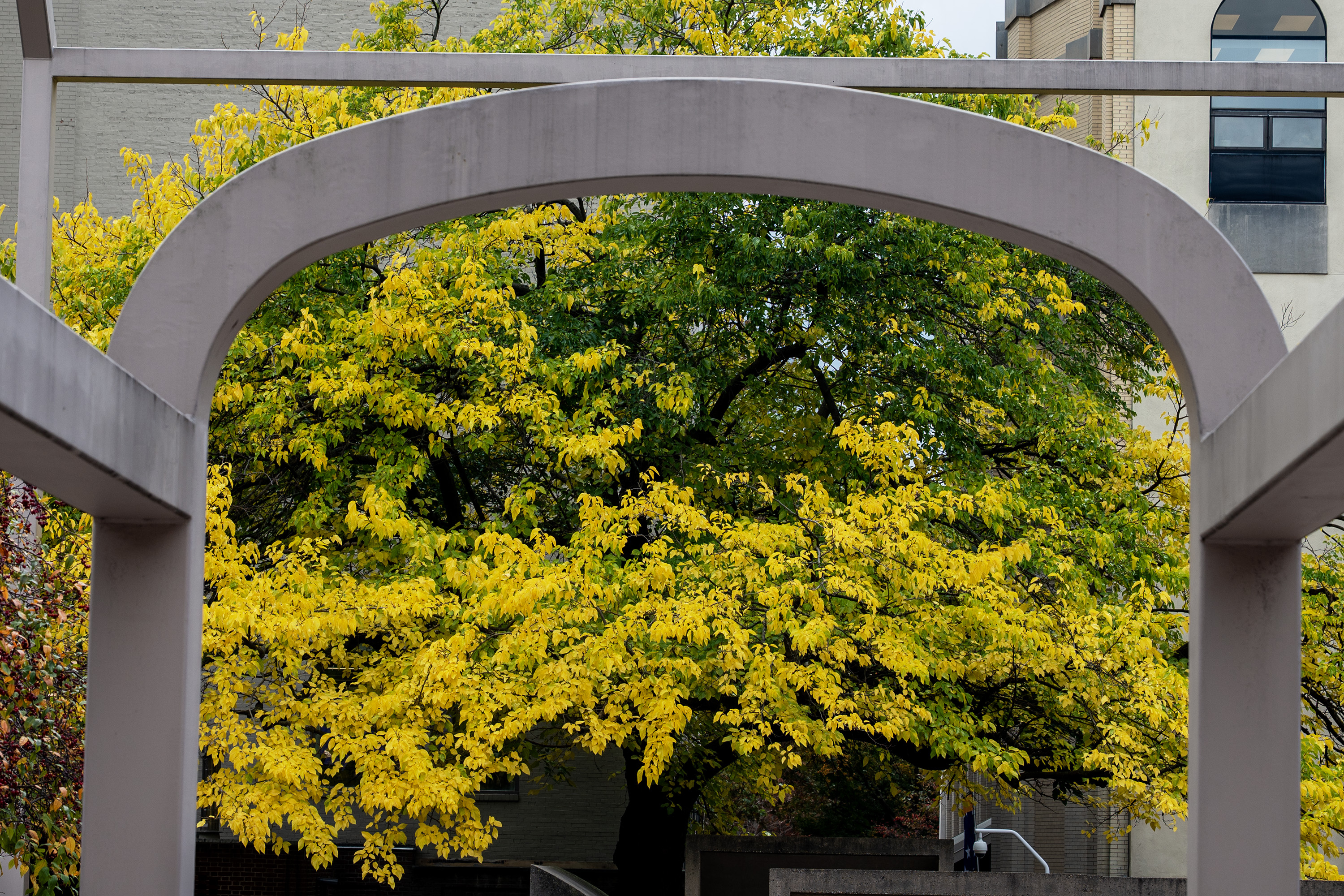
    Autumn foliage in Knight Park in Collingswood on Monday.Tom Gralish / Staff Photographer

    It was awesome, even during Thursday’s downpours and flash flooding. The torrents of hailstones had their charm — despite the day bringing us the chilliest run of weather this season.

    Pea-sized hailstones are on the ground on the University of Pennsylvania campus on Thursday.Tom Gralish / Staff Photographer

    But let’s not get ahead of ourselves. It’s still autumn, and it’s a wonderful time of the year to be a photographer.

    Between assignments in Old City, I took one of my favorite detours, through the historic district. I never tire of walking the exact same streets, as the Founders did, and ended up at a mulberry tree just beginning to show its autumn foliage colors. It’s next to the steel “ghost structure” outlining the spot where Benjamin Franklin’s house once stood. (The tree — despite what tour guides in the city will tell you — is not the same one he wrote about entertaining friends and family under. It, along with his house, were demolished in 1812. The current tree was planted for the Bicentennial.)

    Franklin Court on Monday.Tom Gralish / Staff Photographer
    The 18th Century Garden on Monday.Tom Gralish / Staff Photographer

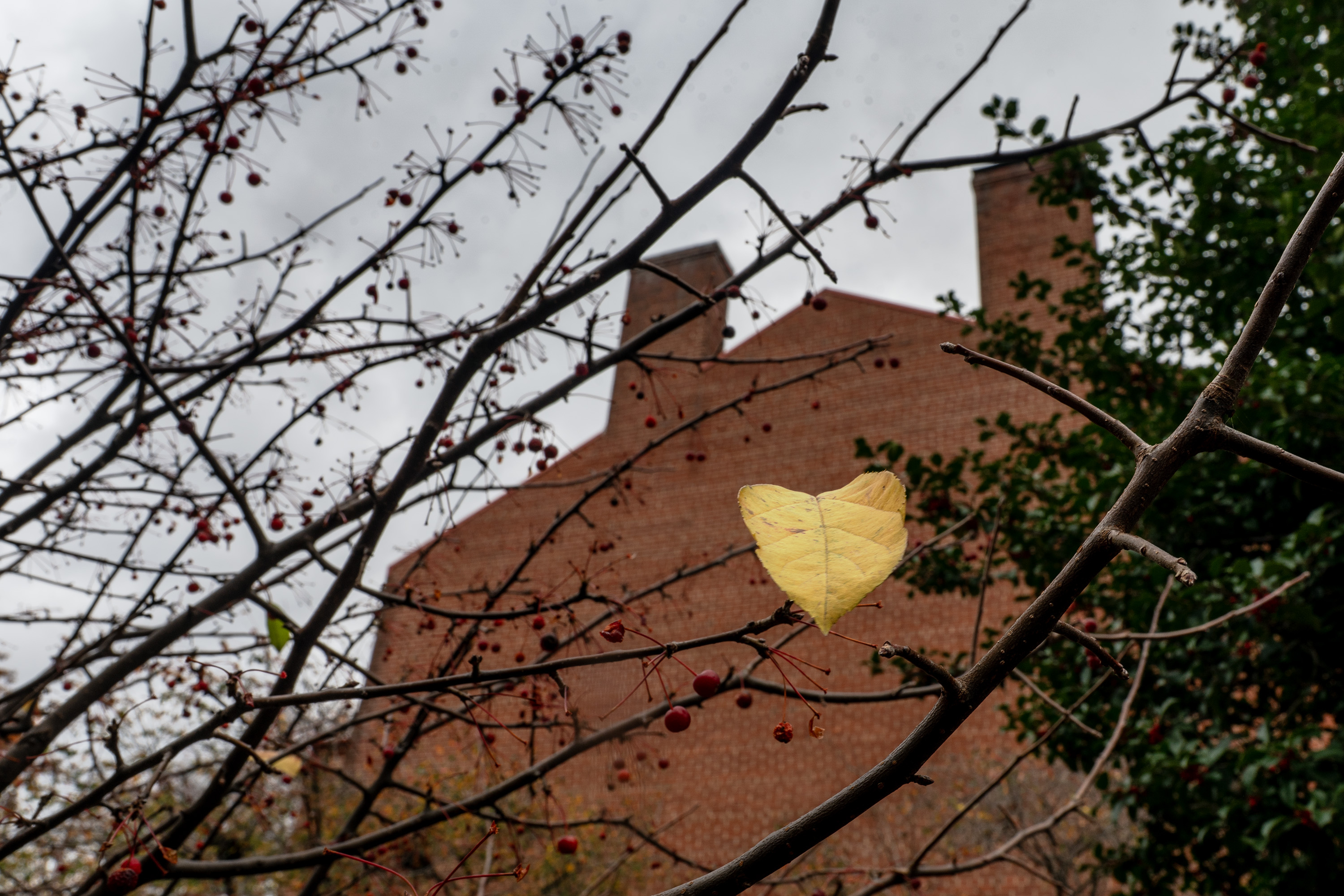
    I also ended up in the 18th Century Garden, where a single red chokeberry leaf (Aronia arbutifolia) hung onto a branch. The garden showcases plants that were frequently grown in Philadelphia during the 1700s. Lady Bird Johnson, wife of President Lyndon B. Johnson, dedicated the garden to the Founders in 1966.

    While wandering between assignments, I also periodically engage in some “street photography.” That’s the genre of capturing real life, people, places, and everyday situations — mostly on public sidewalks.

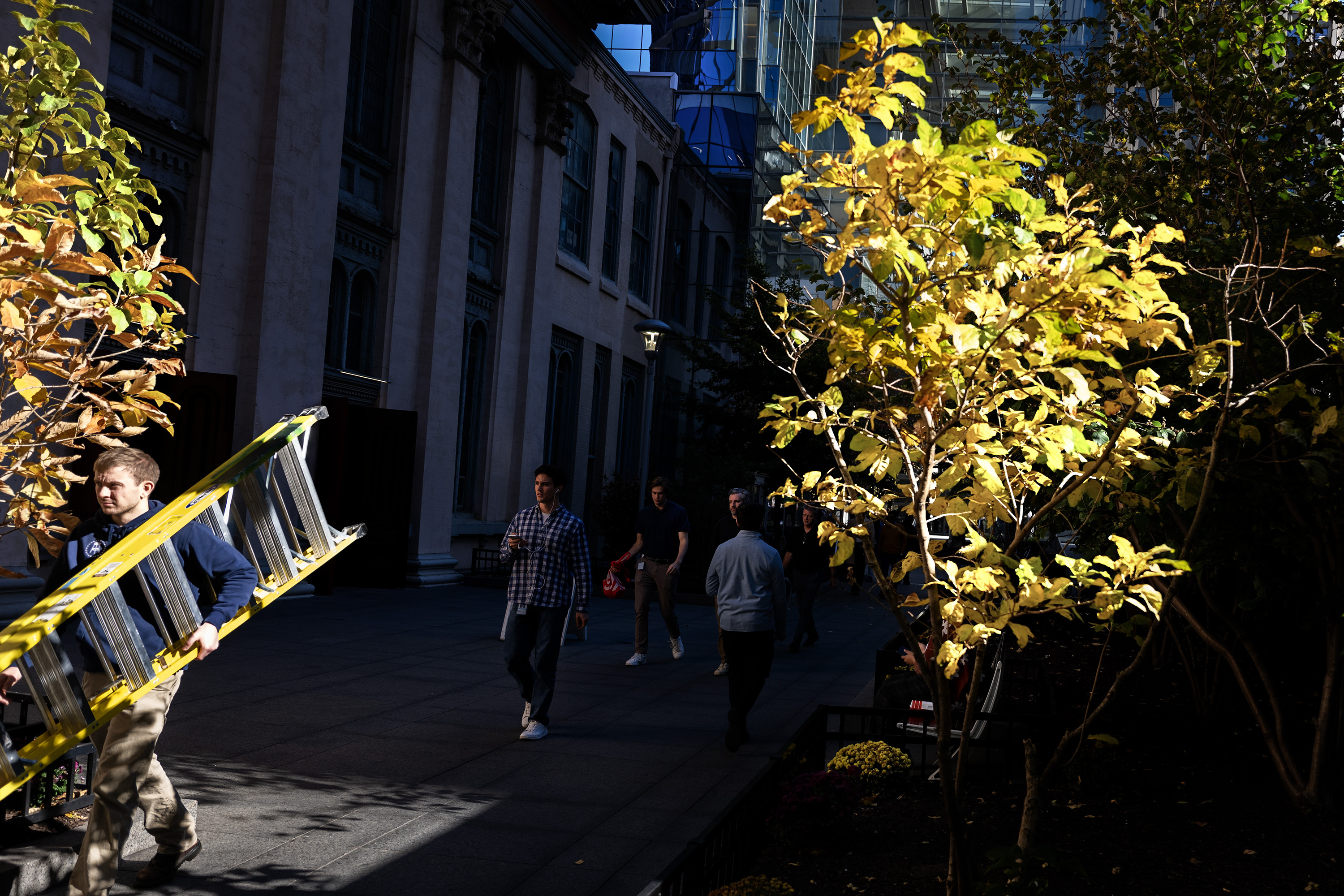
    Autumn leaves in Center City on Wednesday.Tom Gralish / Staff Photographer

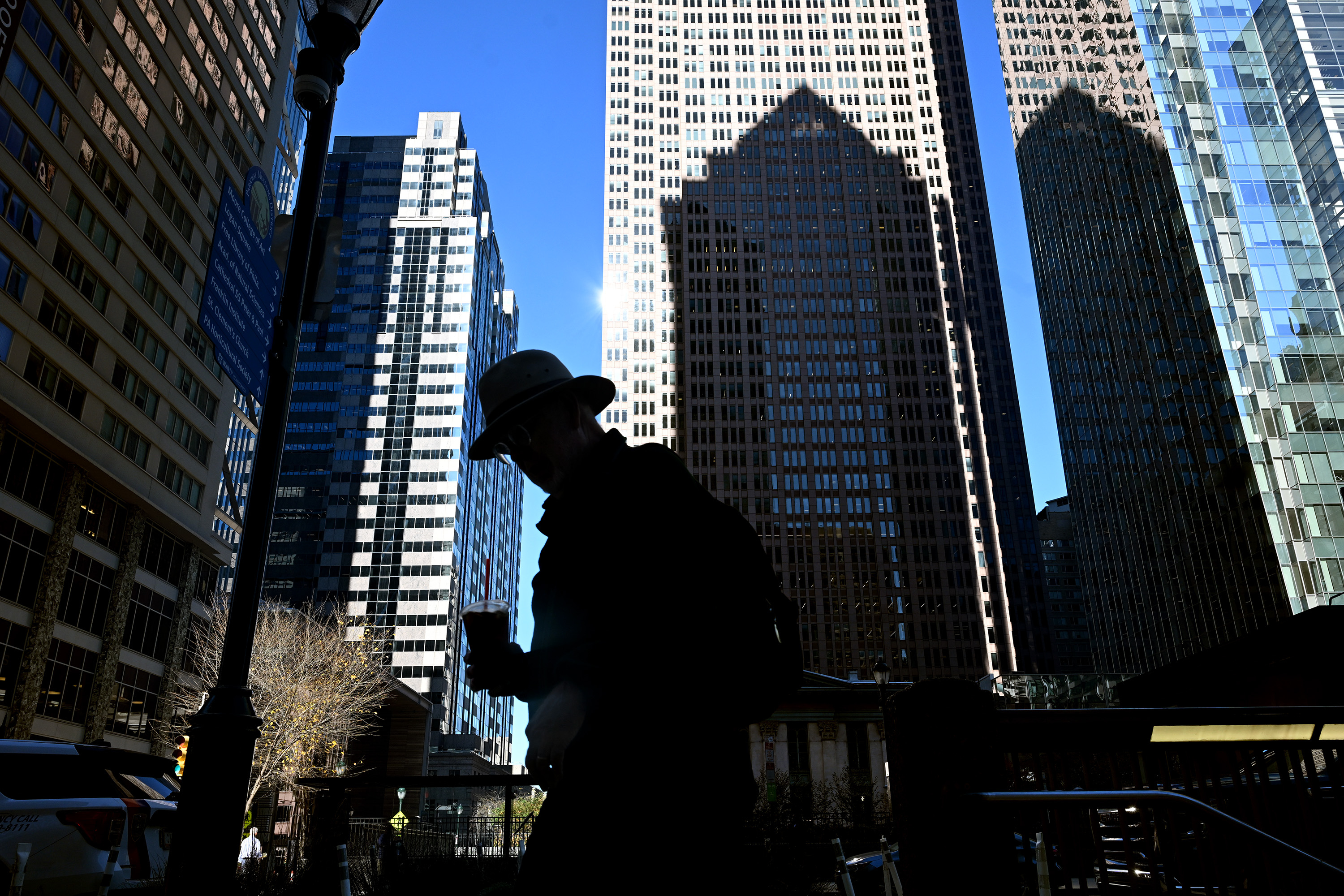
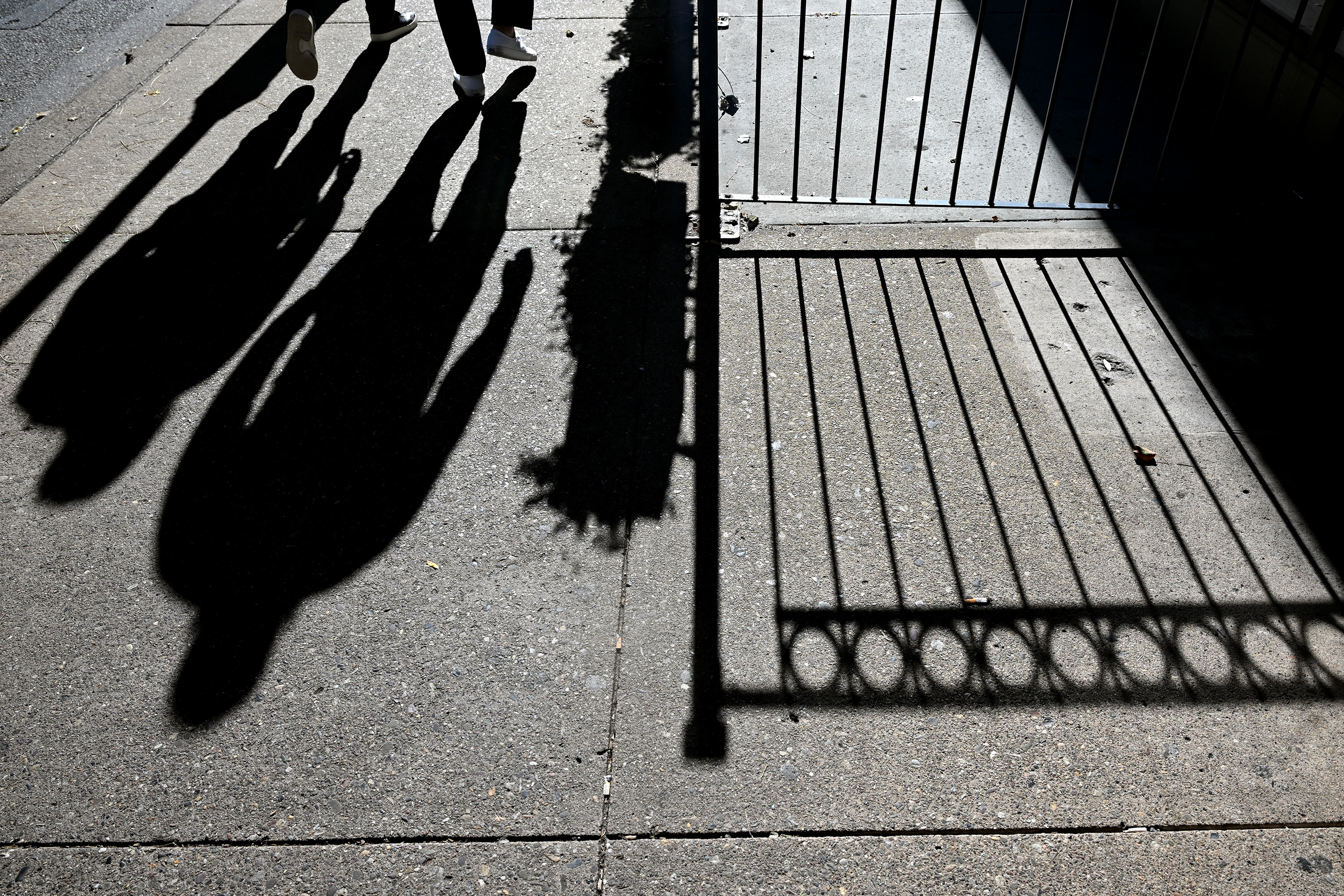
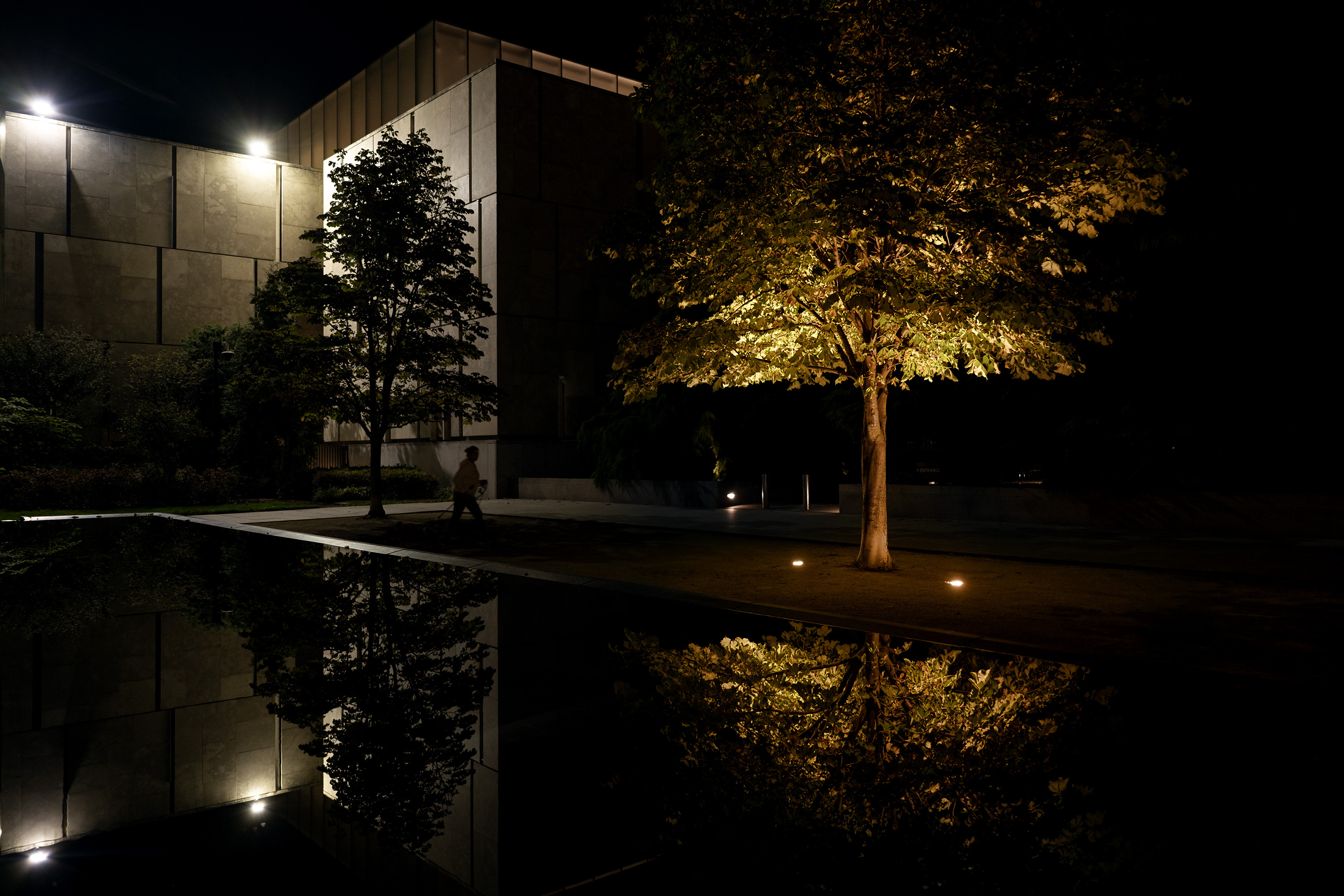
    Besides history — and foliage — in the city in autumn, I also love the low sun and long shadows. Especially among Center City’s skyscrapers, where fellow pedestrians move between light and darkness as if on a stage, the sunlight blasting through curtains of glass and steel like a spot light.

    Those words are meant to evoke the Art (with a capital “A”) of classic practitioners of street photography like Henri Cartier-Bresson or Robert Doisneau.

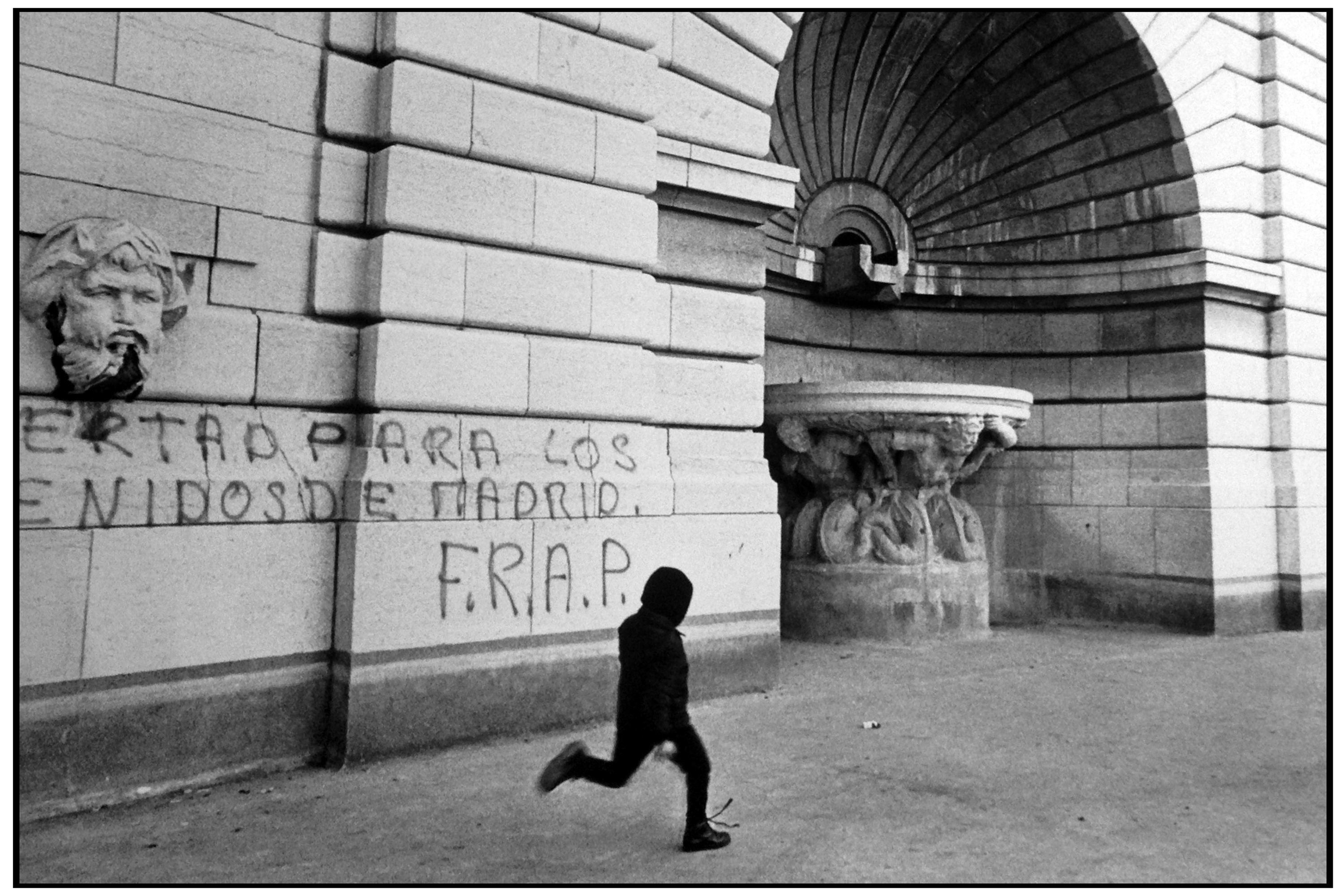
    NOT a French scene by iconic street photographers Cartier-Bresson or Doisneau. Just a young American pretender, at the Sacré-Cœur Basilica in Montmartre, in 1975 while on a gap year visit to Paris. Tom Gralish / Staff Photographer

    Their photos and those of Garry Winogrand, Robert Frank, Lee Friedlander, Harry Callahan, and Fan Ho are about expressing a personal vision and interpretation. The main difference between their photos and mine is that intention.

    While we all combine composition, candid observation, and timing, I am practicing journalism that I hope will better our readers’ understanding of an event, person, or place. I am trying to illustrate ideas, issues, or incidents in the news, so I usually have a reason why I’m documenting something, other than just for myself.

    But every once in a while… those shadows…

    Center City on Wednesday.Tom Gralish / Staff Photographer

    I just couldn’t help myself.

    Not on the list of street photographers above is Ray K. Metzker, who lived in Germantown with his photographer wife Ruth Thorne-Thomsen. I first became familiar with Metzer’s work right after I came to the Inquirer. He had a major retrospective exhibition at the Philadelphia Museum of Art during the fall after I had spent the previous winter doing a completely different kind of street photography. To this day I feel his presence as I walk the same city, hoping to find, as former Inquirer arts writer Stephan Salisbury said of his photos, “the remarkable in the ordinary and the powerful in the most fleeting.”

    I never got to meet him (too young or shy then to reach out, or knock on their door. I was even living just down the road in Mt. Airy at the time), but two decades later we shared gallery wall space (along with 23 other Philadelphia photographers). Unfortunately he didn’t attend the opening, or a later panel discussion where I got to express my admiration.

    I also have to mention Scott Strazzante, a contemporary newspaper photographer who moves easily between Art (with that capital “A”) and journalism. Watching and admiring his work in both genres over the years has given me the same kind of inspiration and insight for my own photography as Metzker’s

    And one more: Alejandro A. Alvarez, a longtime street photographer, dear friend, and former colleague at The Inquirer. I wrote about him when he retired earlier this year. For decades, before the coffee shops unlocked their doors and the metal roll-up shutters were opened on newsstands Alex was already there, chasing the morning light.

    Finally, a few other non-street photos from this week. All seen here online for the first time:

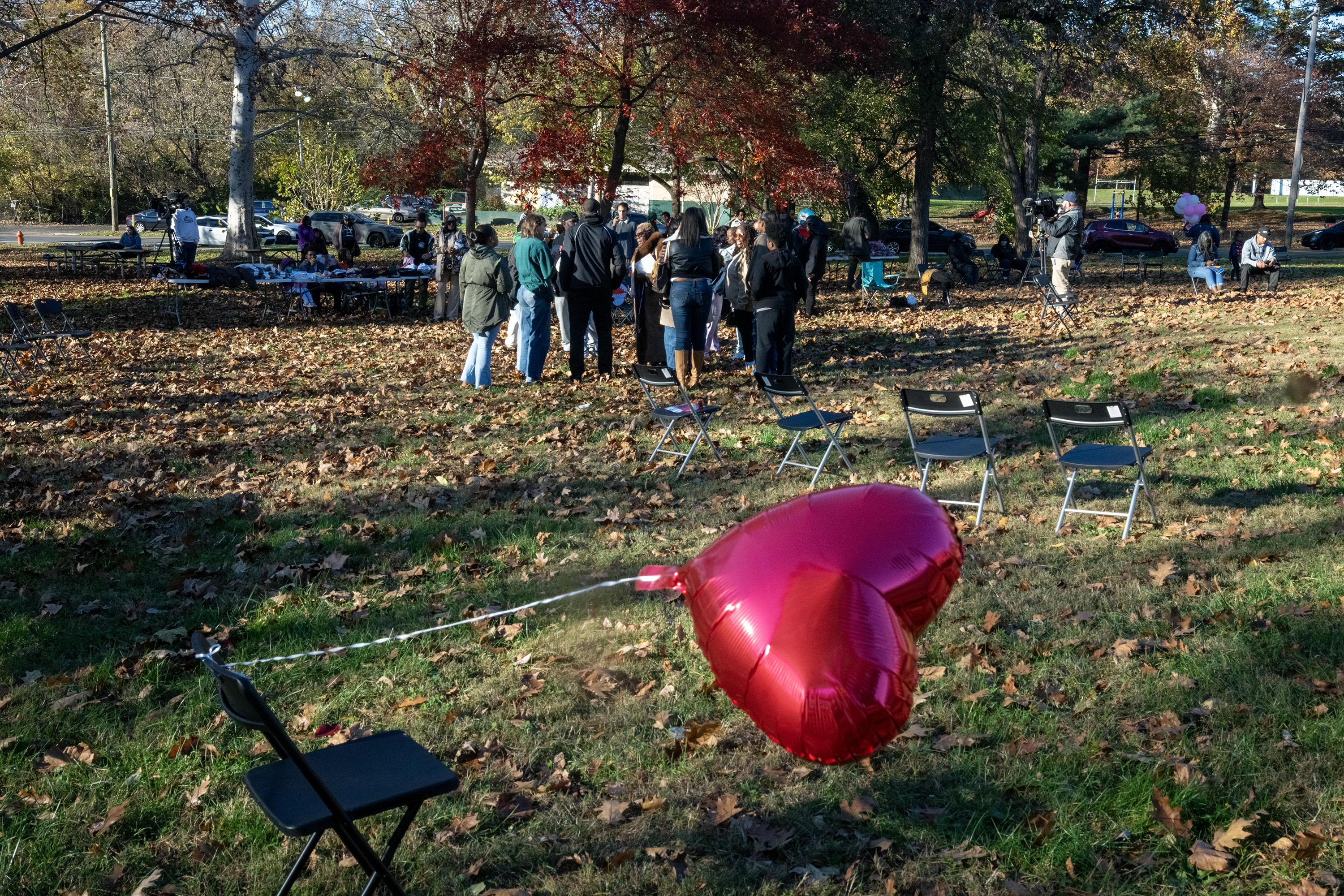
    Family and friends of Malayshia Allford gather Sunday in to remember the 10-year-old girl whose death of has left people across the city shocked and saddened. Tom Gralish / Staff Photographer
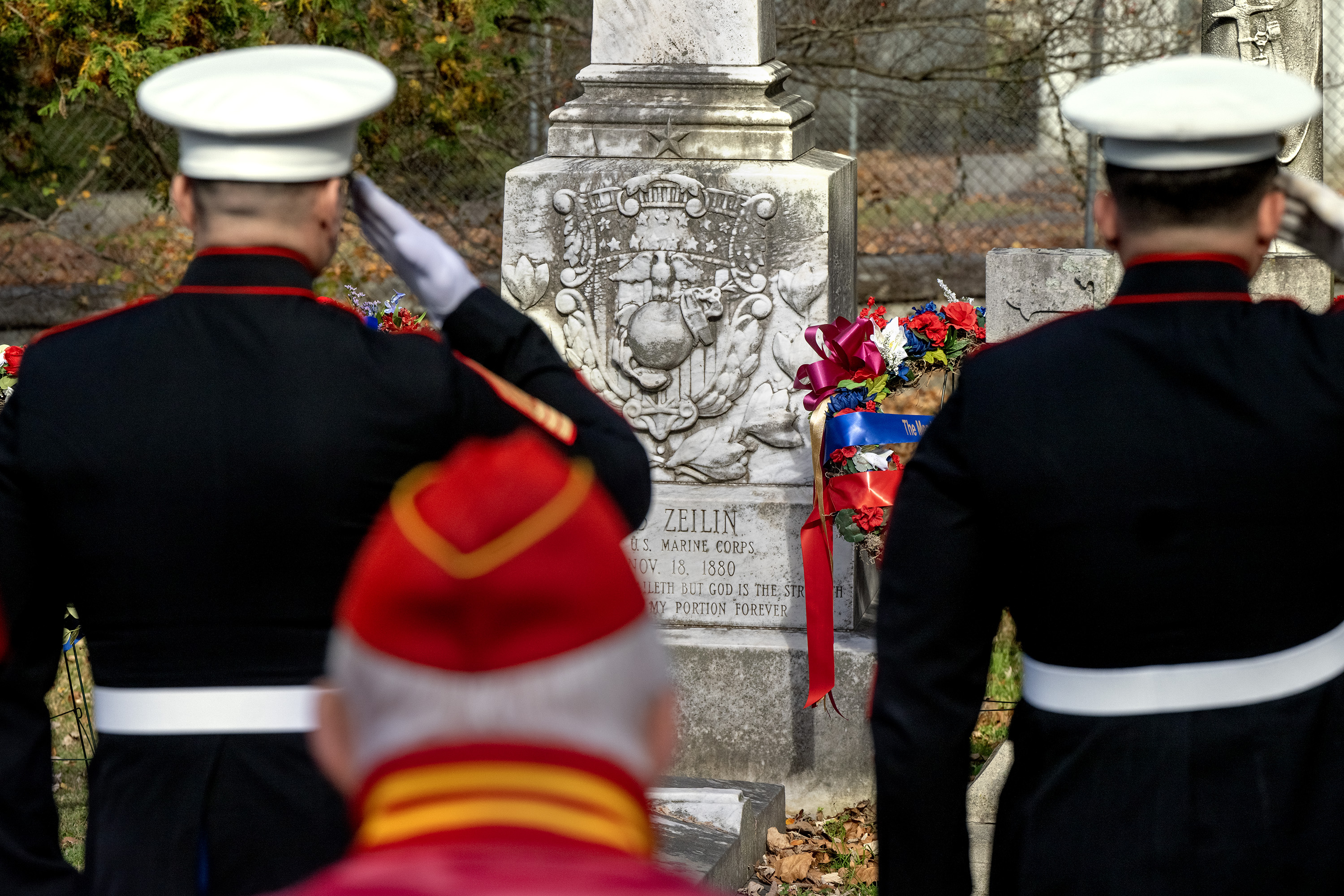
    Marines Master Sgt. Jeremy Vasquez (left) and Gunnery Sgt. Corey Toothman of the 3rd Battalion, 14th Marine Regiment, salute during a wreath-laying ceremony Tuesday at Laurel Hill Cemetery ahead of Veterans Day. The observance, marking the 251st birthday of the Marine Corps, was held at the grave of Brig. Gen. Jacob Zeilin, a Philadelphia native who was the corps’ first general and the designer of the Marines’ “Eagle, Globe, and Anchor” emblem. Zeilin, who died in 1880, is credited with ensuring the Marines remained a separate branch of the military after the Civil War. Tom Gralish / Staff Photographer
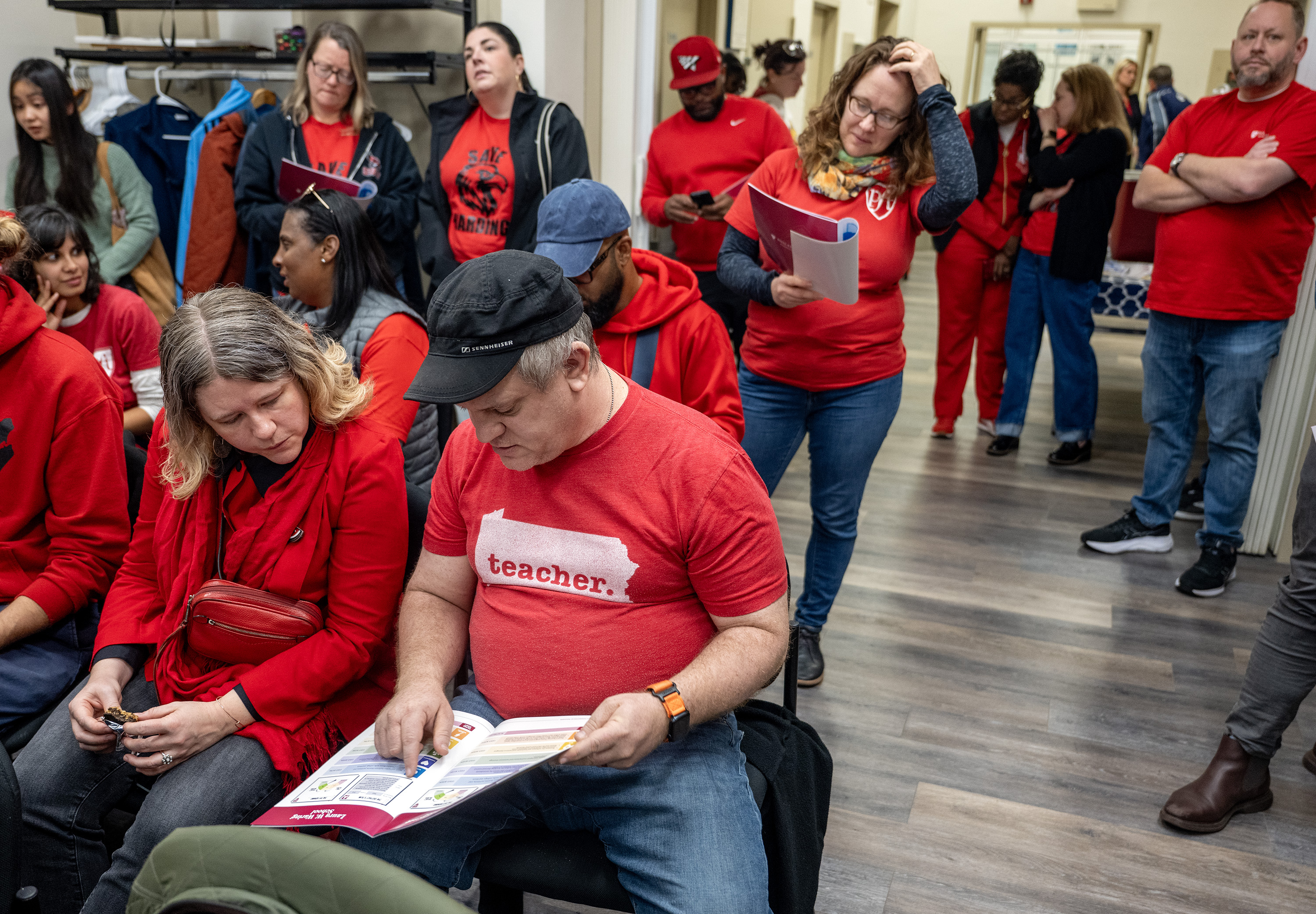
    Teachers Keely Hill and Adam Blyweiss (right) look over their union’s alternative to the District’s facilities plan on Wednesday. One that doesn’t close any schools. Tom Gralish / Staff Photographer
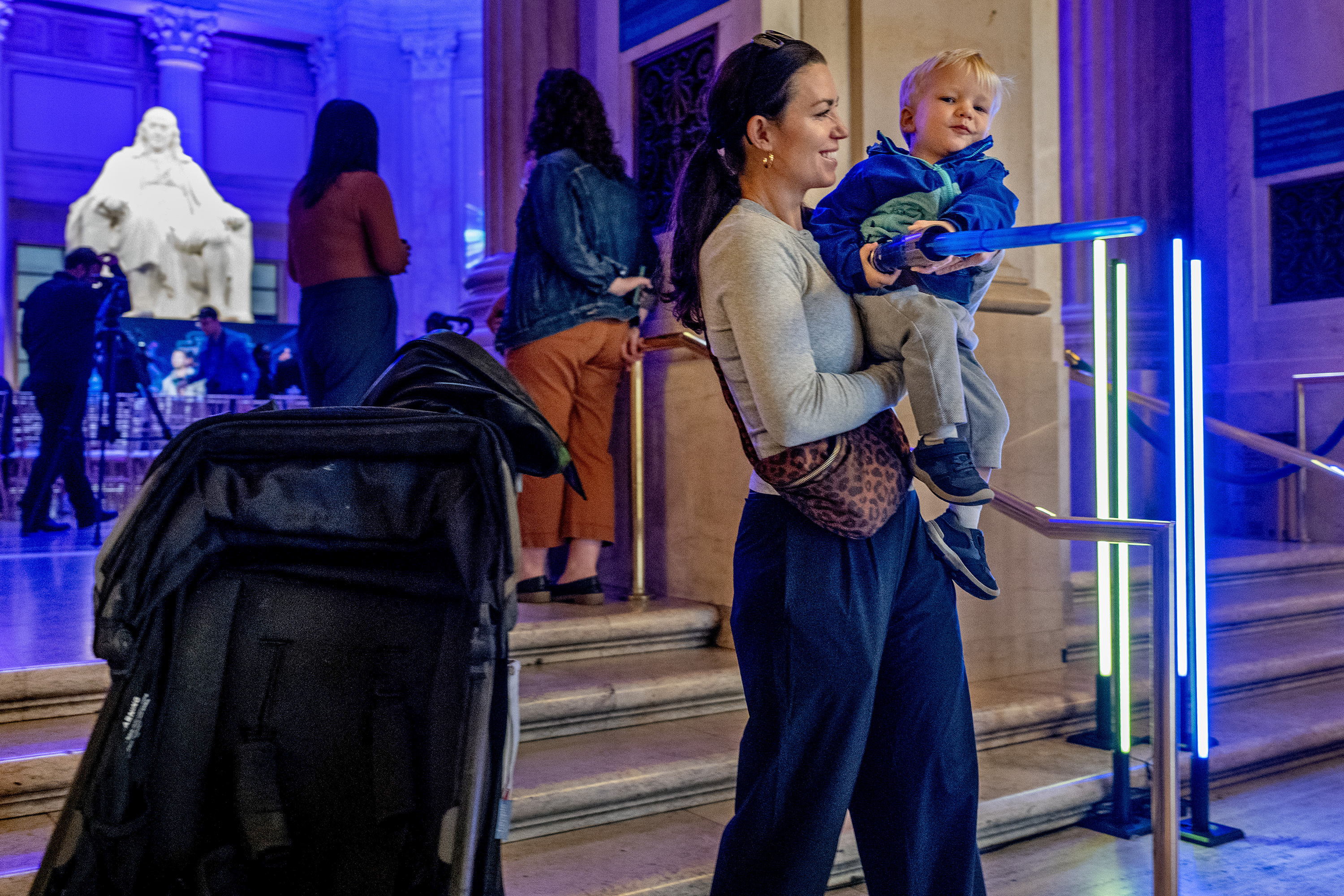
    Grace Mihalich leaves with her two year-old son Howard and his light saber following a Star Wars preview at the Franklin Institute on Thursday.Tom Gralish / Staff Photographer

    And left out of the Week-in-Sports photo gallery, an Eagle winning against a Giant:

    Brothers Shep, 10, and Reed Braunwarth (right, 11) play out their own Eagles-New York Giants game while waiting for Jason Kelce to appear at his New Heights Tailgate podcast on Sunday.Tom Gralish / Staff Photographer

    The stories with those photos: Kelce Tailgate, Malayshia Allford, Veteran’s Day PFT, Star Wars.

    Since 1998 a black-and-white photo has appeared every Monday in staff photographer Tom Gralish’s “Scene Through the Lens” photo column in the print editions of The Inquirer’s local news section. Here are the most recent, in color:

    » SEE MORE: Archived columns and Twenty years of a photo column.

  • Two tornadoes were confirmed from a rare storm that produced golf-ball size hailstones

    Two tornadoes were confirmed from a rare storm that produced golf-ball size hailstones

    While most of the region is likely to experience hard freezes for the next several mornings, after one of the more incredible weather events in the Philly region’s weather history, a few ice puddles aren’t likely to get much attention.

    The National Weather Service confirmed that two rare November tornadoes touched down in the region on Thursday — one near Wilmington, and another in Chesterfield, Burlington County.

    But the twisters arguably were upstaged by rare hailstorms that featured golf-ball-sized icy rocks, mined from frigid regions 35,000 feet in the atmosphere, which literally were plowable in some areas.

    “That was wild,” said Lee Robertson, a lead meteorologist at the weather service office in Mount Holly, who said he had witnessed nothing quite like it in his 21 years with the agency.

    Robertson, who lives in Churchville, Bucks County, was getting live reports from his 7-year-old son, Jack, who said the hailstones sounded “like jackhammers.”

    “That was something we usually see in the West and in the Plains,” said Bill Deger, senior meteorologist at AccuWeather Inc.

    And rarely does the Philly area see tornadoes in November. It’s happened only one other time in Delaware in records dating to 1950, said Kevin Brinson, Delaware state climatologist. In fact, on average, the region experiences thunderstorms in November only once every two years.

    New Jersey hasn’t had a confirmed sighting this late in November since 1989, said Deger.

    Thursday’s tornado damaged three structures, including the Meadow View Junior Academy private school, said Burlington County spokesperson Dave Levinsky. It also caused some tree damage, the weather service noted.

    The Delaware twister, which also had peak winds of 100 mph, uprooted “multiple” trees and damaged several houses along its 1.5-mile path, the survey team said.

    The storm struck the region with ferocity starting around 1 p.m., with the worst over by the evening commute. In addition to the twisters and the hailstones, downpours flooded numerous roads throughout the region.

    No injuries or deaths were reported.

    “It took like the perfect track to impact the most people,” said Deger, the worst of it running along the I-95 spine.

    As for the plowable hailstones that were notable in Delaware and Gloucester Counties, Deger said those hefty accumulations likely occurred near the bottoms of road valleys after all those ice marbles had rolled downhill.

    “That’s not to diminish what happened there,” he said.

    The potential didn’t become evident until Thursday morning when the federal Storm Prediction Center posted a discussion warning that the atmosphere over the Philly region was about to become especially volatile.

    The storm generated powerful updrafts into frigid regions of the upper atmosphere that turned the water to ice, heavy enough to survive trips to the surface where temperatures were around 60 degrees.

    You may have noticed the dynamical storm was a prelude to quite a change in the region’s temperature fortunes.

    Highs are unlikely to get out of the 40s the next two days, and freeze warnings were in effect for the region, save for the Philly heat island and the freeze-proof Philadelphia International Airport. Freezes outside the city are likely the next several mornings.

    Come Saturday morning, it’s all but certain that some of the residual standing water will have turned to ice.

    Given what happened Thursday, would anyone notice?

    Staff writer Lacey Latch contributed to this article.

  • Two tornadoes were confirmed from a rare storm that produced golf-ball size hailstones

    Two tornadoes were confirmed from a rare storm that produced golf-ball size hailstones

    While most of the region is likely to experience hard freezes for the next several mornings, after one of the more incredible weather events in the Philly region’s weather history, a few ice puddles aren’t likely to get much attention.

    The National Weather Service confirmed that two rare November tornadoes touched down in the region on Thursday — one near Wilmington, and another in Chesterfield, Burlington County.

    The latter, an EF1 on the Enhanced Fujita scale with top winds of 100 mph, traveled 1.5 miles and damaged three buildings, a weather service team said. A tornado of similar strength damaged two helicopters on the Christiana Hospital property, the agency said. And a tornadic waterspout also was sighted on the Delaware River near Penns Grove, Salem County.

    But the twisters arguably were upstaged by rare hailstorms that featured golf-ball-sized icy rocks, mined from frigid regions 35,000 feet in the atmosphere, which literally was plowable in some areas.

    “That was wild,” said Lee Robertson, a lead meteorologist at the weather service office in Mount Holly, who said he had witnessed nothing quite like it in his 21 years with the weather service.

    Robertson, who lives in Churchville, Bucks County, was getting live reports from his 7-year-old son, Jack, who said the hailstones sounded “like jackhammers.”

    “That was something we usually see in the West and in the Plains,” said Bill Deger, senior meteorologist at AccuWeather Inc.

    And rarely does the Philly area see tornadoes in November. It’s happened only one other time in Delaware in records dating to 1950, said Kevin Brinson, Delaware state climatologist. In fact, on average, the region experiences thunderstorms in November only once every two years.

    The Delaware tornado touched down in the vicinity of Christiana Hospital. Its peak winds of 100 mph uprooted “multiple” trees, and damaged several houses along its 4.4-mile path, the survey team said,

    New Jersey hadn’t had a confirmed sighting this late in November since 1989, said Deger.

    Thursday’s tornado damaged three structures, including the Meadow View Junior Academy private school, said Burlington County spokesperson Dave Levinsky. It also caused some tree damage, the weather service noted.

    The storm struck the region with ferocity starting around 1 p.m., with the worst over by the evening commute. In addition to the twisters and the hailstones, downpours flooded numerous roads throughout the region.

    No injuries or deaths were reported.

    “It took like the perfect track to impact the most people,” said Deger, some of the worst of it running along the I-95 spine.

    As for the plowable hailstones that were notable in Delaware and Gloucester Counties, Deger said those hefty accumulations likely occurred near the bottoms of road valleys after all those ice marbles had rolled downhill.

    “That’s not to diminish what happened there,” he said.

    The potential didn’t become evident until Thursday morning when the federal Storm Prediction Center posted a discussion warning that the atmosphere over the Philly region was about to become especially volatile.

    The storm generated powerful updrafts into frigid regions of the upper atmosphere that turned the water to ice, heavy enough to survive trips to the surface where temperatures were around 60 degrees.

    While rare, November hail around here is not without precedent. Six inches of hail accumulated in the Princeton area during a storm on Nov. 17, 1977, according to the weather service. That came in advance of an all-time stormy winter in the Northeast.

    Deger said the record-challenging El Niño warming of equatorial waters in the Pacific, which are expected to affect North American weather into spring, may have had something to do with Thursday’s mayhem. “El Niño years make things like this more likely to happen,” he said.

    You may have noticed thst this dynamical storm was a prelude to quite a change in the region’s temperature fortunes.

    Highs are unlikely to get out of the 40s the next two days, and freeze warnings were in effect for the region, save for the Philly heat island and the freeze-proof Philadelphia International Airport. Freezes outside the city are likely the next several mornings.

    Come Saturday morning, it’s all but certain that some of the residual standing water will have turned to ice.

    Given what happened Thursday, would anyone notice?

    Staff writer Lacey Latch contributed to this article.

  • Camden could see another 10-story hospital as part of Cooper Norcross Health’s $3 billion expansion

    Camden could see another 10-story hospital as part of Cooper Norcross Health’s $3 billion expansion

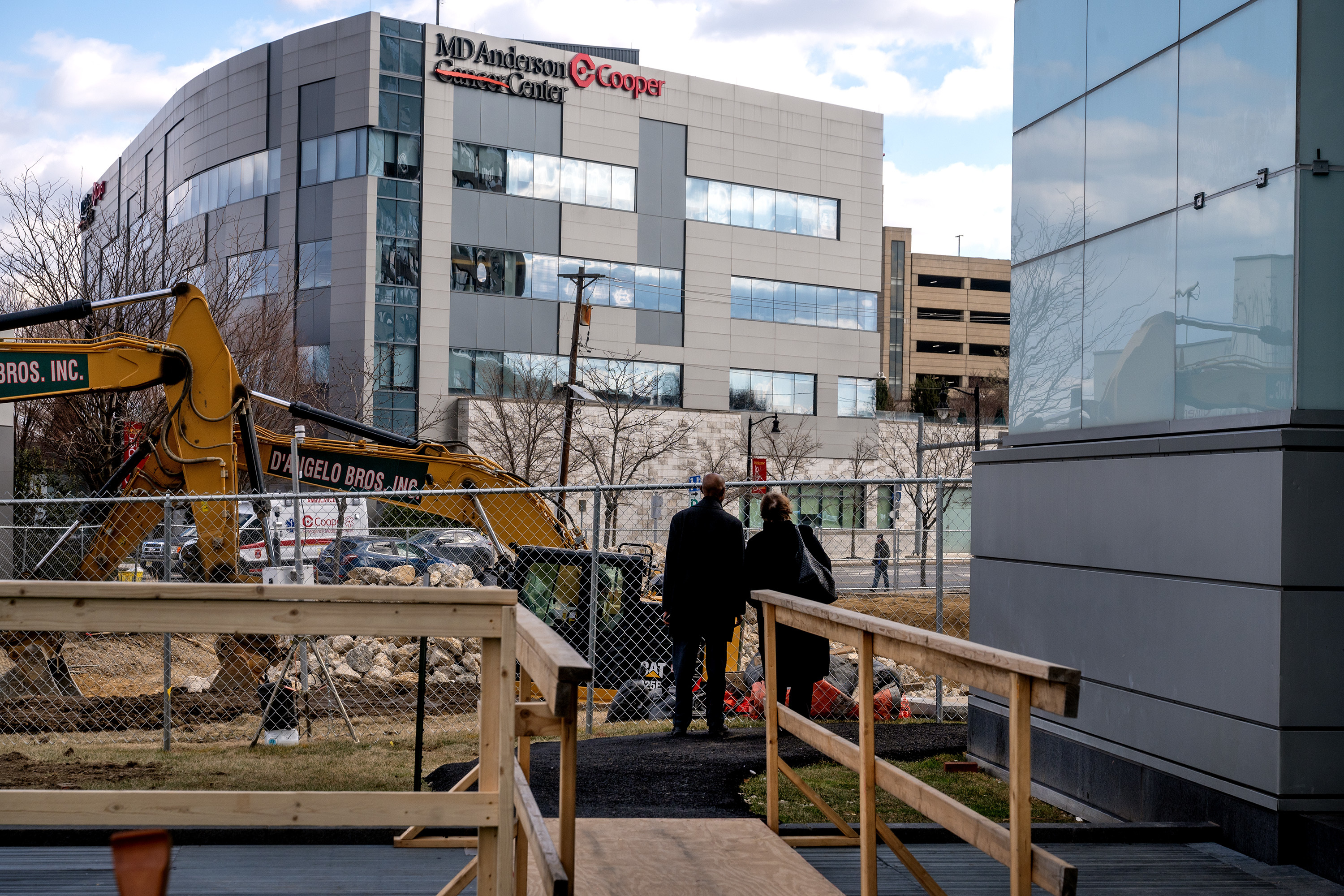
    Cooper Norcross Health wants to move ahead with another phase of its $3 billion expansion in Camden, a new 10-story hospital.

    If approved, it will join another 10-story hospital tower under construction on the same Haddon Avenue campus.

    Developers are scheduled to go before Camden’s planning board on Monday to get approval for the proposed Benson Pavilion, which would have 110 beds for patients, site plans show.

    A Cooper spokesperson was not able to say Friday when they hope to break ground or open the new hospital.

    Cooper University Health Care, which has campuses across South Jersey, changed its name this year after George Norcross, a New Jersey power broker and the chairman of Cooper’s board of trustees, donated $100 million to the health system and its MD Anderson Cancer Center at Cooper.

    The proposed Benson building, which would be at the corner of Haddon Avenue and Benson Street, is one of three patient towers included in Cooper’s “Project Imagine” expansion plan, first announced four years ago.

    Workers broke ground on the first 10-story, 125-bed tower in January 2025. Tower A, which will connect to the cancer center via a pedestrian bridge over Haddon Avenue, isn’t set to be completed until 2028.

    During its busiest shifts, Benson Pavilion will accommodate 428 employees and 40 doctors. The pavilion will be nearly 30,000 square feet, taking up more than 315,000 square feet across its 10 floors.

    The proposed area for the Benson building is currently used as a drop-off loop for the health system’s emergency department, but site plans show the project includes a new drop-off.

    Construction will happen in two phases, according to site plans, first to build the lower six floors and allow the hospital to operate at partial occupancy, and then the remaining four floors will be constructed.

    Cooper will lease nearby parking spaces to account for the increased demand and shuttle employees from an off-site parking area near the Camden Waterfront, the site plans show.

    Vincent Basara, a spokesperson for the city, said Cooper is Camden’s largest employer and “a tremendous community partner.”

    “While their investments are numerous, the $3 billion expansion is the largest investment in Camden. This project is yet another testament to Cooper Norcross Health’s unwavering commitment to Camden and the city’s revitalization,” Basara wrote in an email.

  • The discovery of three dead siblings in a South Jersey home has rattled a quiet neighborhood

    The discovery of three dead siblings in a South Jersey home has rattled a quiet neighborhood

    Last week, a mail carrier in Mount Holly, N.J., arrived at a dilapidated single-story home to find the mailbox sealed shut with clear tape. Then he made an even more unusual discovery.

    “9-1-1 inside″ said a note taped to the front door, paired with a drawing of two frowning faces with x’s instead of eyes.

    What Mount Holly police eventually found inside 3 Winding Way has continued to shock the quiet suburban community.

    William Monk, 64, Randolph Monk, 69, and Rosalind Monk, 71, were dead inside the home, according to a source familiar with the investigation. The cause and manner of their deaths have not been released as the medical examiner’s office continues its examination.

    A spokesperson for the Burlington County Prosecutor’s Office declined to comment, citing the pending result of the autopsies. Mount Holly police referred questions to prosecutors. There is no active threat to the community, the department said in a Facebook post.

    A neighbor said the Monks were siblings who had lived in the declining property for years.

    They kept to themselves and rarely left home or interacted with neighbors, according to Chris Wyatt, who has lived next door since 2013. Wyatt said he had no reason to believe anything was amiss in the home, though he found it impossible to ignore the failing condition of the property in recent years.

    “We’re just in shock,” Wyatt said of his neighbors’ deaths.

    A piece of crime scene tape hung in a tree outside of the Monks’ home Wednesday when The Inquirer spoke to neighbors. Some lawns still had skeletons and gravestone decorations up from Halloween, flags for Philadelphia sports teams, garages brimming with bicycles, and other signals of suburban life were abundant.

    3 Winding Way bore none of those signs.

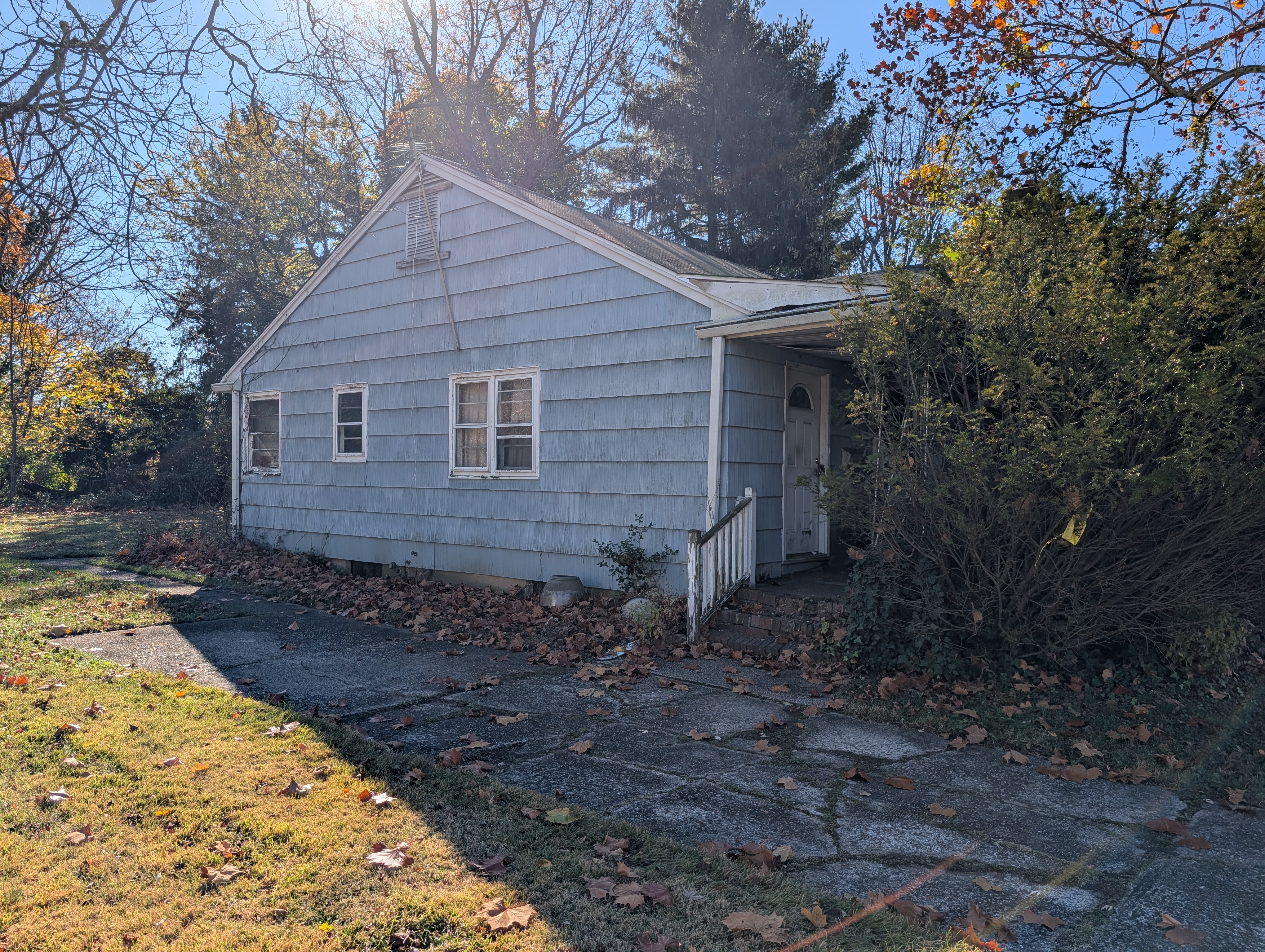
    The light blue home’s front porch was caved in, propped up by temporary metal beams, and windows and siding were damaged. An overgrown bush partially obstructed the front door where the mail carrier discovered the chilling note.

    Wyatt said the Monk siblings did not have a car and sometimes rode the bus to work. One of the brothers had worked at a nearby Boscov’s for a time, he said. Rosalind Monk worked as a crossing guard and had retired.

    Another male sibling, “the most personable” of the group, also lived at the home but died years ago, Wyatt said.

    He remains curious to learn what happened inside the home as prosecutors and law enforcement continue their investigation, as well as what will become of the unsightly property.

    The knowledge that three people had died there under unusual circumstances has not brought comfort to the father of young children.

    “I’ve lived here over 10 years,” Wyatt said. “I never got the inclination that something like this was even possible.”