
Category: Nation & World

  • AI groups are spending millions to influence the midterms

    AI groups are spending millions to influence the midterms

    Artificial intelligence companies racing to shape how the federal government might regulate their industry amid rising safety and economic concerns are spending heavily to influence which candidates make it to Congress.

    A New York Times analysis of federal campaign finance data shows that the political groups aligned with the two leading AI developers, OpenAI and Anthropic, have quietly but decisively intervened in key 2026 races, spending on campaign advertising and outreach to voters to the tune of $55.7 million.

    So far, the spending has been concentrated almost entirely in the primaries. The two groups have spent $52.6 million on safe seats — those that are unlikely to change party hands but that often feature intense intraparty contests.

    The big AI players have also spent more heavily for Democrats than Republicans. They have bolstered candidates who align with their agendas, helped defeat those they see as hostile to them, and ingratiated themselves with front-runners who are likely to be in positions of power in the next Congress to make decisions critical to their bottom lines.

    But with voters quickly souring on their industry — including demanding that lawmakers do more to regulate AI and halt or mitigate the proliferation of data centers — they have taken pains to obscure their involvement. With few exceptions, they have intervened without ever explicitly mentioning AI or data centers in the TV and digital ads they have purchased.

    (The Times has sued OpenAI and Microsoft, claiming copyright infringement of news content related to AI systems. The two companies have denied those claims.)

    The Times reviewed 95 unique ads bought by four AI super political action committees heavily funded by the two biggest players — the OpenAI-aligned Leading the Future and the Anthropic-aligned Public First Action — each of which funnels its money through separate Republican and Democratic groups. None of the ads mentioned data centers. Only seven mentioned AI or an AI company directly.

    An ad for Rep. Barry Moore (R., Ala.) featured the phrase “CHAMPION AMERICAN INNOVATION” as he shook hands with firefighters in a garage — one of several AI-backed advertisements that used that phrase over images of workplaces that appeared to have nothing to do with AI.

    Another was in support of former Rep. Jesse Jackson Jr., a Democrat running for an open House seat in Illinois. It was paid for by Think Big, which is aligned with OpenAI, and praised him as committed to reducing gun violence and supporting law enforcement.

    And in some instances, both the Republican and Democratic groups funded by the same big AI player created advertisements advocating opposing sides of an issue. For example, two spots for House candidates in Texas, a Democrat and a Republican, praise opposite positions on immigration. Both are funded by the Anthropic-aligned super PACs.

    “It’s so cynical,” said Nate Blouin, a state senator in Utah who lost a Democratic primary to an opponent who had been backed by more than $1 million in AI-funded ads. “They’re coming into races in safe seats that they know that they’re going to be decided in the primaries, and they are spending millions of dollars on things that are unrelated to the core issue that they are pushing for.”

    It is a strategy that has also been deployed this cycle by the American Israel Public Affairs Committee, another major interest group whose brand has become a liability in recent years and has spent in the midterms to the tune of tens of millions of dollars while rarely mentioning its top issue.

    The companies behind the spending have somewhat different policy agendas. Anthropic generally supports stricter regulation of AI development, while OpenAI tends to push for fewer guardrails to allow for the acceleration of AI development. But they both share the same goal: promoting AI and electing policymakers who hold a favorable view of it.

    In a statement, Anthony Rivera-Rodriguez, a spokesperson for Public First Action, vehemently denied that the Anthropic-aligned group had a parallel agenda to the political group affiliated with OpenAI.

    “We reject any suggestion that we have anything in common with Leading the Future, a group that exists to gut every serious attempt to regulate artificial intelligence,” he said. His organization, he added, “was founded to be the counterweight to Big Tech’s political machine” and stands “with the people willing to fight for real rules on this technology and protect kids, workers and families from AI harms.”

    Jesse Hunt, a spokesperson for Leading the Future, said the group was “focused on building a bench of champions who understand the need for a national AI framework that keeps America at the forefront of innovation while putting responsible safeguards in place to protect workers, families and communities.”

    A PAC aligned with Anthropic spent $1.6 million to help Rep. Valerie Foushee (D., N.C.) win her primary.ERIC LEE

    Helping the AI-friendly

    Late last year, Rep. Valerie Foushee, a Democrat who represents most of North Carolina’s Research Triangle, was staring down a formidable primary challenge.

    Then, two days before Nida Allam, a younger, more progressive candidate who had challenged her in the past, announced that she was running again against Foushee, Rep. Hakeem Jeffries of New York, the Democratic leader, named Foushee as co-chair of the party’s new Commission on AI and the Innovation Economy.

    Two months later, the Anthropic-aligned Jobs and Democracy PAC spent $1.6 million in support of Foushee. She won narrowly, defeating Allam by less than 1 percentage point.

    “These committees and task forces — they’re basically a flag or indicator to the lobbyist industry that these are people who will have decision-making power over your industry and so you need to go spend money on their campaigns,” Allam said in a recent interview. “No one is spending that amount of money unless they’re getting something in return.”

    In a statement, Foushee denied that the money had bought any favorable treatment for AI, saying that her work on the issue “has centered on establishing guardrails, holding corporations accountable and protecting our children, communities and jobs.”

    In Washington state, American Mission, an OpenAI-aligned PAC, waded into the GOP primary to replace Rep. Dan Newhouse, who is retiring at the end of this Congress, to back Amanda McKinney. McKinney, a Yakima County commissioner, won President Donald Trump’s endorsement this cycle but was running against a former race car driver who had won Trump’s endorsement in 2024 when he challenged Newhouse.

    “She believes the United States must lead in artificial intelligence and advanced technologies, not surrender leadership to China or other adversaries,” her campaign website says. “Amanda opposes heavy-handed regulation that stifles innovation or drives jobs overseas.”

    American Mission spent about $780,000 to support McKinney. She advanced from her primary with 35% of the vote.

    Punishing the skeptics

    With other seats, in Utah, Illinois and New York, the PACs moved to undercut candidates who had established themselves as opponents of AI.

    The most prominent example was in the primary to succeed Rep. Jerrold Nadler (D., N.Y.). The race was inundated by outside spending after Alex Bores, an Assembly member, sponsored legislation seeking to regulate advanced AI models. That set off a multimillion-dollar influx from rival AI interests, with Think Big, aligned with OpenAI, attacking Bores and Jobs and Democracy, aligned with Anthropic, defending him. He narrowly lost the race.

    Along with Foushee’s contest in North Carolina and a primary in the Florida district of Rep. Debbie Wasserman Schultz, the former chair of the Democratic National Committee, the race drew the most money from the AI PACs this cycle.

    In Utah, Think Big intervened to back Ben McAdams, a former Democratic member of Congress.

    It was not expected to be a highly competitive primary, and was made even less so after Punchbowl News unearthed a series of old posts in which his opponent, Blouin, joked about sexual assault and made offensive comments about women and Mormons. McAdams made no mention of AI on his campaign website, though he wrote an opinion essay arguing that schools “should begin treating AI fluency as a basic form of literacy.” He said he opposed the construction of a 40,000-acre AI data center campus proposed in the district.

    But Blouin, the state senator, described himself as a “leading skeptic of the push for unchecked growth of data centers,” and grew increasingly vocal about AI and data center regulation as the race went on.

    Think Big spent about $1.1 million on television and digital ads and text message blasts supporting McAdams. Asked for comment, McAdams reiterated a previous statement he made during a June debate, in which he said that “every member of Congress needs to be proactive in providing oversight of AI in order to protect jobs, our kids, the environment and the fabric of our communities.”

    “That will require federal guardrails to make sure this technology happens carefully and transparently, with appropriate regulation, strong oversight, human accountability, and safeguards for data privacy and civil rights,” he said. “AI could potentially cure cancer, but it could also destroy our kids. I believe thoughtful policy can unleash the good and stop the bad.”

    Backing front-runners

    The AI groups spent in support of clear front-runners in primaries all across the country, including favorites of party leaders, many of them Republican. Rep. Kevin Hern of Oklahoma, who was widely expected to win the nomination to replace Markwayne Mullin in the Senate, was backed by nearly $1.3 million spent by American Mission and Defending Our Values, an Anthropic-aligned PAC, before his victory in June.
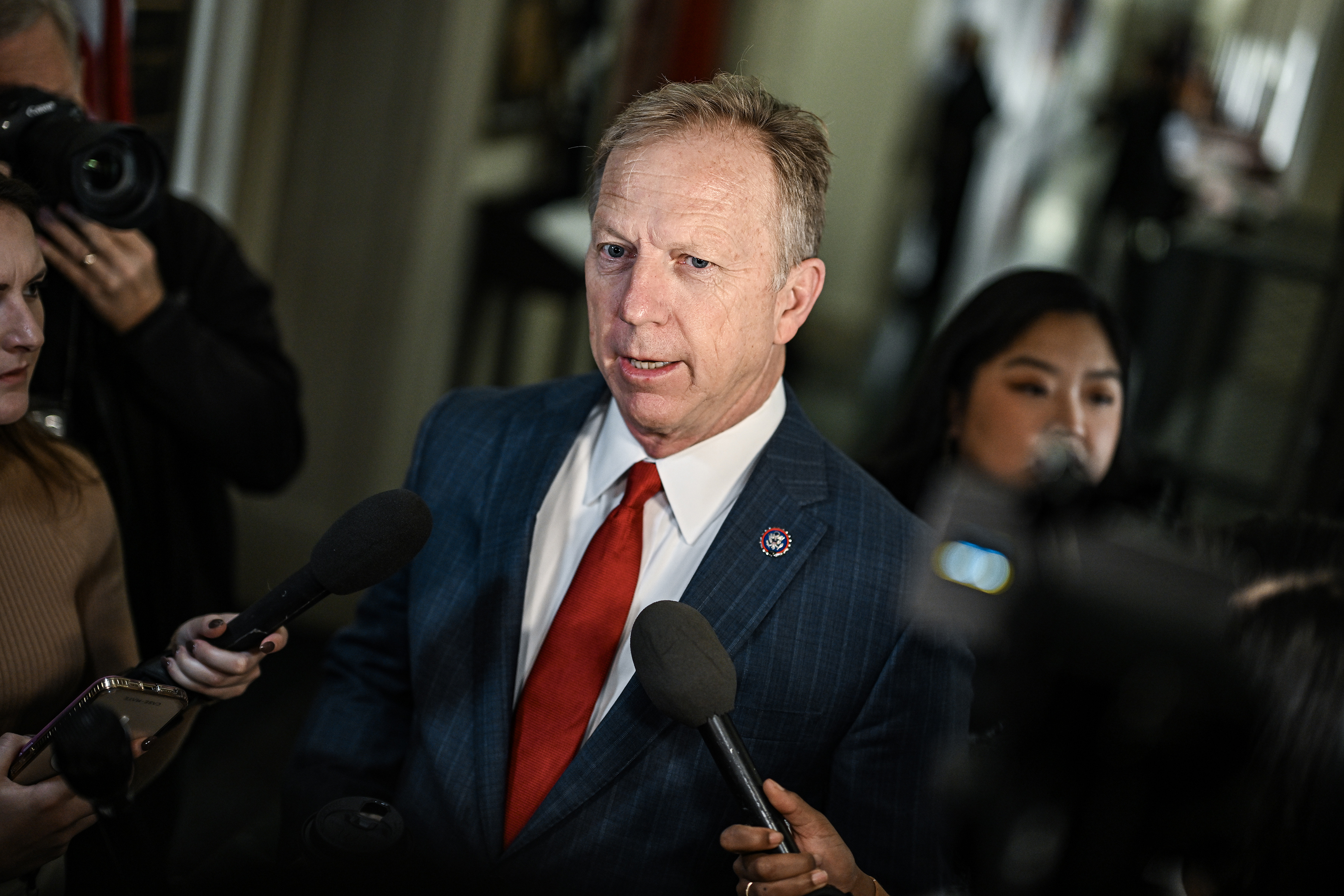
    Rep. Kevin Hern (R., Okla.) prevailed in his primary to replace Markwayne Mullin in the Senate. He received backing from Anthropic and OpenAI.KENNY HOLSTON

    Defending Our Values also supported Carlos De La Cruz, the brother of Rep. Monica De La Cruz of Texas, who both received speaking slots at the midterm convention in Dallas. Carlos De La Cruz is favored to win his election; the nonpartisan Cook Political Report recently rated Monica De La Cruz’s race as a “toss-up.”

    American Mission spent about $375,000 to support Sen. Lindsey Graham for his primary campaign in South Carolina, though it was never expected to be particularly competitive. After he died, the super PAC spent nearly $1.2 million supporting his sister, Darline, in the primary and general contests.

    A vanishing money trail

    With about a month until the midterms, the AI groups have yet to wade into many general election contests.

    American Mission has doled out roughly $500,000 each on behalf of three Republican candidates for Senate who are running in less competitive races: Rep. Julia Letlow in Louisiana, Graham in South Carolina, and Cindy Hyde-Smith in Mississippi. Think Big, the Democratic super PAC, has spent nearly $300,000 to support three House candidates: Reps. Greg Stanton of Arizona, Emilia Sykes of Ohio and Steven Horsford of Nevada — as well as roughly $50,000 to support Rep. Joseph Morelle in New York.

    The amounts could grow. But political operatives closely following their spending believe that the groups will have to shift their strategy amid the furious outpouring of anti-AI sentiment, and will instead move money through other means. That could include donating directly to the major political PACs associated with House Democrats or Republicans, or establishing smaller, more obscure groups to move the money through, as AIPAC has done.

    Usamah Andrabi, the communications director for Justice Democrats, the ultraprogressive organization that backed many candidates whom AI groups spent against, said the industry’s influence was already becoming as difficult to track as that of AIPAC and other pro-Israel groups.

    “There was a time where I could tell you every Israel lobby super PAC, and I cannot tell you that anymore because there’s so many pop-up PACs, there’s so many shell PACs, there’s so many pass-throughs,” Andrabi said. “And I think the same thing is happening with the AI lobby.”

    This article originally appeared in The New York Times.

  • Cornell students call for change at fiery public meeting

    Cornell students call for change at fiery public meeting

    ITHACA, N.Y. — There were fiery testimonies, voices lurching and pleas for action from school leadership. There were fingers pointed angrily at Cornell University’s internal investigators, including by a woman who faced her student government representatives and said, emphatically: “I am also speaking as Jane Doe.”

    Cornell’s student government convened a public hearing on sexual assault Thursday, and some 100 people turned out to share their raw emotions in a student union auditorium, Cornell flags and chandeliers hanging overhead.

    Some broke down in tears, channeling the churning emotions of the broader campus. They walked forward, one by one, to offer testimonies, facing a semicircle of somber-faced student assembly representatives who were surrounded by backpacks and soda bottles.

    “I cannot pretend this is a normal Thursday,” said Sophia Riley, a junior, remembering that as a freshman in 2024 she was shattered to hear that a student said she was assaulted at the Chi Phi fraternity house. “I cried about it then, and I’m still equally devastated now.”

    In the days since a lawsuit and rape allegations put Cornell in the national spotlight, the school’s Ithaca campus has been consumed by the news. The meeting gave students a chance to denounce administrators, saying that they had mishandled the allegations of assault, though few school leaders were in the room and the university president, Michael Kotlikoff, was absent.

    Some students expressed rage about the fraternity culture cited in the lawsuit. The suit had prompted the Tompkins County district attorney to reopen the investigation into the claims by a woman known only as Jane Doe that she was sexually assaulted by seven men at a fraternity house.

    University officials have defended their disciplining of the defendants in the lawsuit and denied that the consequences were not strong enough, saying that “false narrative” could make assault survivors feel less safe and less likely to report crimes.

    None of the men accused in the lawsuit has been charged with a crime, and they all have denied any wrongdoing. Four said that they had consensual sexual contact with the woman at the party, and the others denied any participation. Two were expelled, and others received lesser penalties.

    Along with the students, the forum brought together faculty members and a smattering of Cornell parents. Eeshaan Chaudhuri, the student body president, began the event by addressing the room.

    “We’re absolutely ashamed of the events that happened on campus,” Chaudhuri said, before inviting members of the community to line up and make comments. “I think we’ve made it abundantly clear for the past couple of days that we as a campus community stand with victims of sexual violence.”

    A stream of ideas and proposals followed from students, some of whom feel besieged by national media and eager to shift the focus to solutions. Students urged administrators to improve the required workshops and trainings that teach students about consensual sex. And they asked for their classmates to be supported if they can’t complete homework and exams this week because of distress about the case.

    “Students should not have to choose between grieving and keeping up with their academic responsibilities as if nothing had happened,” said Riley, declaring that the campus is in a “mental health crisis.”

    While the majority of the meeting was declared off the record so students could come forward and candidly share their reflections, a handful shared their stories in front of reporters gathered for the public portion.

    Emotions heightened as a woman came to the front of the room and said she, too, had reported a sexual assault at Cornell and felt let down by the university’s Title IX process, which investigates complaints of sexual assault on campus. She saw her own experience reflected in the accuser’s reports, of having an assault claim mishandled.

    “When I filed my Title IX case in the midst of all of my mental, physical and emotional recovery from the assault,” Jane Wang, a junior, said, “I was also met with an abundance of paperwork, very little instruction on how to navigate it and no follow-up from our Title IX office of an outcome.”

    Wang said that for students like herself to feel comfortable coming forward to report assault, they need to know the institution will act on it. “Through this event, we have witnessed the complete opposite,” she said.

    This article originally appeared in The New York Times.

  • An Ebola treatment center was burned down as the death toll in Congo passes 4,000

    An Ebola treatment center was burned down as the death toll in Congo passes 4,000

    BUNIA, Congo — Congo’s Ebola outbreak has killed more than 4,000 people, authorities said, as they struggle to contain what has become the fastest-growing Ebola outbreak in history.

    The latest figures released by the Health Ministry on Thursday showed that 4,018 people have died among 8,300 cases recorded since the outbreak was declared in eastern Congo on May 15.

    Some health workers, meanwhile, gathered at the epicenter in Ituri Province to demand payment for wages owed them. The protesters, who included surveillance team members, waved placards saying, “No money, no data!” and “No payment for months.”

    Some of the workers haven’t been paid for August and September, said Biongi Beiza, one of the protesters in Bunia, Ituri’s capital. “There is no explanation from the administration,” he said.

    Congolese authorities did not immediately address the issue. Front-line workers have gone on strike several times since the outbreak began, further hampering efforts to contain the disease.

    A senior U.N. official said an Ebola-hit displacement camp housing a transit center for infected patients was burned by soldiers earlier this week as they were looking for weapons in Kigonze, on the outskirts of Bunia, forcing 19,000 people in the camp to flee.

    Creating such transit and treatment centers has been a struggle, requiring money and staff, all of which are in short supply, said Julien Harneis, the U.N. senior Ebola coordinator. “When we lose a center, that means we lose capacity, we lose investment, and we have to start again. And above all, it means that people do not get access to the care that they really need,” Harneis said.

    Infected aid worker evacuated to the Netherlands

    An aid worker with Médecins Sans Frontières, known in English as Doctors Without Borders, was infected with Ebola while working in Congo, the group said in a statement.

    The worker arrived in the Netherlands late Thursday on a special medical flight and was transferred to a high-level isolation unit, the Leiden University Medical Center said in a statement.

    “The human cost of this crisis is unprecedented in the DRC, with communities facing the largest Ebola disease outbreak ever recorded in the country,” MSF said.

    At least 50 health workers have died after contracting the virus.

    Mobile labs are helping detect cases quickly

    One way local authorities have tried to contain the outbreak is through mobile laboratories. In Butembo, an Associated Press journalist watched a medical team operating one such lab near an Ebola treatment center on Thursday.

    Test results that used to take 72 hours can now be obtained in six hours with the mobile labs, said Lota Kalubi, a doctor at the treatment center.

    The labs have also made it easier to get to locations usually difficult to reach, said Michel Ngimba with the National Institute of Biomedical Research in Butembo. “So we can go, if today we have an emergency, for example, in Katwa, we can start up the vehicle, and we can move the lab to Katwa,” said Ngimba.

    Insecurity and community resistance are hampering containment efforts

    The World Health Organization has recently raised the alarm about the virus’ rapid spread into new health zones, stretching limited resources. The current outbreak is on track to exceed the deadliest on record, West Africa’s regional outbreak between 2014 and 2016, which killed 11,000 people, WHO has said.

    The number of newly confirmed cases is falling, but that could be attributed to insecurity and challenges in getting communities to cooperate in some of the hot spots, Africa CDC said on Thursday. While the spread of the disease has slowed in some areas, it has accelerated in others.

    Confirmed cases fell from around 850 cases and 470 deaths a week in mid-July to an average of 490 cases and 230 deaths in September.

    A Congolese politician was beaten to death earlier this week in one of the emerging hot spots after defending government measures to deal with the outbreak, highlighting tensions and mistrust in communities.

    Authorities last month launched a village-centered approach that involved working with local leaders to educate people about the virus, but those efforts face resistance from residents who dismiss Ebola as a hoax. There is also deep distrust in the country’s government for reasons including how it’s managed past Ebola outbreaks and chronic corruption.

  • Central Park was her home and her studio. She was killed there.

    Central Park was her home and her studio. She was killed there.

    NEW YORK — Francis Lee Rogers was a fixture in Central Park’s Ramble, a wooded area that is popular with birders.

    She spent her days painting the Ramble’s birds and kept her homemade network of feeders filled with seed, as legions of bird lovers walked by hoping to catch a glimpse of warblers and sparrows.

    For years, Rogers, who was homeless, brushed off concerns about the perils of a woman in her 60s — or anyone, for that matter — spending nights in and around the Ramble as she largely had for decades.

    Last Sunday morning, Rogers, 63, was found dead, beaten and stabbed in the rustic wooden gazebo where she spent her nights, a short walk from the Central Park Boathouse, an upscale restaurant known for leisurely lunches and weddings.

    She was found barefoot and covered in dirt, her body stabbed repeatedly and her head severely beaten, according to two law enforcement officials with knowledge of the matter.

    Chillingly, her long graying hair, which she wore in signature tight braids, had been shaved off.

    Shortly after the attack, Jonathan Robles, 36, walked into the Central Park police precinct and told officers that a woman in the park had threatened him, one of the officials said. Robles later told investigators that he killed Rogers.

    The police charged him with murder and possession of a weapon. Robles, who was living in transitional housing in a midtown hotel, had been arrested twice in New York City, both times for nonviolent crimes, including leaving an IHOP without paying the bill, the official said.

    Murders are rare in Central Park, a haven for tourists and New Yorkers alike. There were none this year through Sept. 20, and none last year during the same period, according to police data.

    In a city where people largely go about their lives in anonymity, especially the homeless population, Rogers stood out as a familiar figure in the park.

    Known as Lee, she chatted with rich and poor, native New Yorkers and foreigners and tourists. She had hardy mountain-woman looks, with her long braids spilling out from her wide-brimmed birder’s hat, running down over layers of wool sweaters.

    She carried a large rucksack filled with her watercolors, oils and paintings and sketches in progress. And she was never without her crooked walking stick or her sketchbook of pencil drawings of birds and notes about their colors.

    She was devoted to the network of bird feeders she had rigged in the Ramble by hanging them with lines looped over high branches.

    “For years, she was the only person maintaining those bird feeders in the Ramble,” said Lincoln Karim, a wildlife photographer who knew Rogers for about 25 years. “She would spend hundreds of dollars on birdseed and suet.”

    In the perhaps three decades that Rogers had been living largely in and around the park, she sold hundreds of paintings, her friends said.

    Most of the sales came by word of mouth among local birders. But she also gained a following among those who saw her working on her small, nearly pointillist renderings at her regular table in the Boathouse restaurant at the Ramble’s eastern edge.

    In this affordable cafe section, Rogers could nurse a cup of coffee for hours, often using the cup’s plastic lid as a palette. It was her atelier, surrounded by large windows overlooking the Ramble and the lake.

    “She was a fixture — she came by the same time every day, carrying a big backpack, and she was always welcome,” said Dean Poll, who operated the restaurant from 2000 until 2022. “I gave her her space and she never bothered anybody.”

    “She was like family,” he said. “She made us Christmas cards that were beautiful. We still have them.”

    Rogers, who also went by the name Elise Bainbridge Hill, told the New York Times in 2012 that her sleeping spots varied from the steps of local churches to a women’s shelter near Park Avenue in cold weather. She told a documentarian in a film released in 2016 that she ran away from her abusive childhood home in New Jersey and initially became a prostitute in New York.

    Painting was her escape from life on the streets, she said, with Central Park as her oasis from Manhattan’s bustle.

    In conversation, Rogers would often slip seamlessly from detailed discussions about bird species to digressions about conspiracy theories.

    “She knew a lot about a lot of things but then she would just slip into outrageous stuff, like her flying in spaceships,” Karim said. “But she was a damn good painter, I have to say.”

    Karim said he helped Rogers sell several works, with smaller ones fetching $300 and a large oil painting going for $1,200. “She had enough money to get off the street,” he said.

    Joe Lopez, 64, of Manhattan, a caterer who knew Rogers for 15 years, said he bought several of her illustrations for as much as $400, including one of Pale Male, the celebrity red-tailed hawk that captivated the city’s bird-watching community from his nest on a Fifth Avenue luxury building.

    Rogers, who used a public bathroom in the park to wash up, took pride in keeping a neat appearance. But more recently she would go barefoot, Karim said, or sometimes wrap her feet in cardboard.

    The gazebo had become her regular sleeping spot. Just before her death, she weathered the nor’easter that buffeted the region by sleeping on a bench beneath a green tarp, with her belongings and painting supplies around her.

    On Monday, some of her friends trudged through the rain to pay their respects. One of them, Moises Diaz, 71, of the Upper East Side, lit a candle for Rogers, whom he had seen for years on his daily walks.

    Diaz, who is also an artist, played a recording of a conversation he had with Rogers about six months ago. She had asked him about his recent work, a wall hanging he had made out of foam.

    “She had a beautiful voice,” he said as he listened to the recording. “There’s a lot of mean people that come to this place — a lot, but not her.”

    Lopez came by, too. He brought along a satchel of drawings by Rogers, including the one of Pale Male. He called it “a masterpiece.”

    “To me, I was buying something beautiful, but it was also money I knew she needed,” Lopez said. “She wasn’t a homeless person to me, she was a genuine special character. The birders really respected her.”

    This article originally appeared in the New York Times.

  • New ICE guidance bans high-speed car chases and sets tighter rules for traffic stops, a memo shows

    New ICE guidance bans high-speed car chases and sets tighter rules for traffic stops, a memo shows

    U.S. Immigration and Customs Enforcement officers have been ordered not to engage in high-speed car chases and to make vehicle stops only if they have completed specific training, under new internal guidance issued after several drivers were shot in encounters with ICE.

    A memo sent to officers in ICE’s Enforcement and Removal Operations division and obtained by The Associated Press warned they are not authorized to chase vehicles that fail to pull over under any circumstances. Instead, officers should take down the vehicles’ information for further investigation, according to the memo signed by ICE’s executive associate director Marcos D. Charles and dated Wednesday.

    The new guidance comes after ICE-initiated vehicle stops have repeatedly escalated when drivers have refused to cooperate or tried to flee. ICE agents have fired their guns during more than a dozen such encounters since last year, killing at least four people and wounding several others.

    President Donald Trump’s administration has faced internal tension over how to handle traffic stops, which are seen as particularly high-risk encounters.

    After fatal shootings of drivers in Maine and Texas in July, ICE officers were directed to temporarily pause most vehicle stops. But the next day, Trump went on social media to direct the agency to continue traffic stops, calling them “one of ICE’s most important and effective Crime Fighting tools.”

    ICE has faced intense pressure from the White House to deport more people who are in the country illegally, and its arrests have reached record numbers. At the same time, the agency’s rapid hiring spree last year resulted in some poorly vetted and trained officers hitting the streets.

    ICE and the Department of Homeland Security had no immediate comment on the policy guidance.

    The new memo outlines steps intended to improve the safety of vehicle stops for ICE officers, drivers they are targeting, their passengers, and the public.

    The memo told ICE’s field office directors that they must ensure vehicles used for traffic stops have lights and sirens that let the public know they are law enforcement vehicles when activated. All officers on the scenes of vehicle stops must wear and activate their body cameras, under the guidance.

    In addition, only officers who have completed one of five specific agency training courses can conduct vehicle stops. Officers who have not completed the training courses can only participate in vehicle stops “in a support capacity” as passengers and cannot be the drivers of any of the vehicles involved.

    The guidance says ICE officers can continue to use a controversial technique known as pinning, which is defined as “using a vehicle or physical barrier to trap or stop a car,” but only if they have received special training. Similarly, only trained officers can use spike strips that deflate tires to prevent drivers from fleeing.

    The memo came the day that courtroom testimony highlighted ways in which two ICE officers involved in a vehicle stop, pursuit, and shooting that wounded a delivery driver in Austin last month would not have complied with the new guidance.

    During a bond hearing for Wilber Rafael Garces Perez, testimony showed that the officer who shot him wasn’t wearing a body-worn camera. The ICE officer who did have a camera was driving in a separate car and turned it off during the pursuit.

    Prosecutors presented surveillance video that showed an ICE agent chasing Garces Perez at high speeds through residential streets after he fled an initial traffic stop.

    Garces Perez faces federal assault charges after investigators say he struck an ICE officer with his driver’s side mirror. That officer then shot into Perez’s vehicle, lodging a bullet in his back, officials say.

    Attorneys for Garces Perez have called the charges against him “retaliation” and have argued that the camera footage was inconclusive because it didn’t fully capture the moment when he allegedly tried to flee.

  • Trump says Secret Service wants him to ‘take down’ Oval Office

    Trump says Secret Service wants him to ‘take down’ Oval Office

    President Donald Trump said that Secret Service officials have encouraged him to replace the current Oval Office, according to a new interview with Time magazine.

    “‘Sir, we think the Oval Office should be taken down, and we’ll build a new one, sir,’” said Trump, quoting a Secret Service official. “I said, ‘My ass, you can’t build a new one. This is a special place.’”

    The Secret Service has encouraged prior administrations to take steps to fortify the Oval Office, said four former officials, who spoke on the condition of anonymity to detail sensitive security matters. Past presidents have declined to do so because it would require them to relocate.

    A White House spokesman declined to offer further comment. A spokesman for the Secret Service did not immediately respond to questions about Trump’s remarks.

    The current Oval Office was constructed by President Franklin D. Roosevelt and become synonymous with high-profile events and speeches. Trump, who has redecorated it with gold as part of his sweeping changes to the White House, has called it the most intimidating office in the nation.

    Trump has listened to the Secret Service on other projects to fortify the presidential grounds, such as plans to build a permanent fence around Lafayette Square, the public park across the street from the mansion. The president also has invoked national security reasons to defend his most controversial construction projects, including a new White House ballroom and his planned triumphal arch.

    In the Time interview, the president said he was exploring the possibility of a new federal designation for the Oval Office, which he suggested could protect the office from being torn down and preserve his changes to it.

    “I’ve been asking Susie for six months to give me a statement. Will we save this room? Will we make it a federal landmark?” Trump said, invoking his chief of staff, Susie Wiles.

    The White House is already designated a National Historic Landmark, a federally conferred status that is intended to offer protections against sudden changes. But Congress exempted the White House from the National Historic Preservation Act, which has allowed presidents – including Trump – to swiftly remake parts of the building when they assume office.

    “The discussion of making it a landmark is legally meaningless,” said Greg Werkheiser, founding partner of Cultural Heritage Partners, a law firm focused on historical preservation. He also questioned why Trump was invoking historical preservation after disregarding it to tear down the White House’s East Wing, pave over the Rose Garden and make other changes.

    “There’s some irony of the president suggesting that he might use historic designation to protect the property after ignoring it so far,” Werkheiser said.

  • U.S. is moving thousands of troops aboard ships to the Mideast as Trump weighs new strikes on Iran

    U.S. is moving thousands of troops aboard ships to the Mideast as Trump weighs new strikes on Iran

    WASHINGTON — The U.S. military is dispatching roughly 9,000 troops aboard a group of ships to the Middle East, a U.S. official said Thursday. The bolstering of the American military presence comes as President Donald Trump warned anew that new strikes against Iran could be on the horizon.

    He also said early indications suggest that Iran is linked to the co-pilot who stabbed his captain and tried to crash an Israel-bound flight on Wednesday.

    In an exchange with reporters at the White House, Trump raised the connection when asked by a reporter if there were any links between the pilot behind the attack and Tehran.

    “I would say the answer, based on what I’m hearing, is ‘yes,’ but we’re working on it right now,” Trump said, without offering details.

    Trump also warned that if the link is established to Iran, the United States would retaliate.

    “Oh they’ll be hit, very hard, don’t worry,” Trump said. “You just ask them. They know what happened. They’ll be hit very hard.”

    Meanwhile, the group of ships now en route to the Middle East together carry over 7,000 sailors and 2,000 Marines.

    It includes the USS Theodore Roosevelt carrier strike group, which recently deployed with the cruiser USS Chosin, and the USS Makin Island amphibious readiness group, which includes the USS John P. Murtha and USS Anchorage amphibious landing ships.

    It could mean that three carriers are in the region as early as the end of October, according to the U.S. official who spoke to The Associated Press on condition of anonymity to discuss sensitive military operations.

    Given the personnel already in place in the Middle East, the move would bring the U.S. naval presence to an unusually high number of more than 20,000 sailors and Marines and hundreds of aircraft. The Navy previously had three carrier strike groups in the Middle East in April for the first time since 2003.

    The carriers USS George H.W. Bush and the USS George Washington are in the region now, along with the USS Boxer amphibious readiness group. The Washington is typically deployed to Pacific Ocean but it was moved to the Middle East to relieve the USS Abraham Lincoln, whose arduous deployment resulted in the crew being at sea for more than 260 days straight.

    Trump, in a Time magazine interview published Thursday, also raised the prospects of new strikes, saying it is “possible” that he will ramp up bombing in Iran after the Nov. 3 elections in the United States.

    When pressed, Trump said he could not go further in detailing his strategy.

    “I can’t tell you that because look, you know, you’re asking, where are you going to bomb?” Trump said.

    He said in the interview, conducted Monday, that he rejected the latest ceasefire proposal from Iran because “things that I wouldn’t have approved a year ago I wouldn’t have today.”

    Trump cited as an example an offer from Iran to “open up” the Strait of Hormuz, the key energy shipping corridor, but said the overall proposal was “not good enough.”

    Asked if the increasingly unpopular war would threaten Republican Party chances in November, Trump at first responded, “It’s possible.” But then he added, “It should help, because Iran will not have a nuclear weapon.”

    The president said “100% of the people” oppose Iran having nuclear attack capabilities “including worldwide.”

    “So, when you say it that way, It would help,” Trump added. “If you don’t say that, it could hurt.”

  • France gripped by spreading student protests as PM calls crisis meeting

    France gripped by spreading student protests as PM calls crisis meeting

    PARIS — France’s prime minister convened a crisis meeting Thursday and canceled ministers’ trips to focus on the nationwide spread of protests, some violent, by high school students venting about under-resourced schools, long hours, and other complaints.

    The demonstrations erupted in Paris-region schools last week and have snowballed, with police making hundreds of arrests in clashes with the young protesters. Authorities have reported many dozens of injuries, including from hurled objects but also, in some suspected cases, from police riot-control projectiles.

    The protests are quickly blowing up as a hot topic in the election campaign to replace President Emmanuel Macron, who is constitutionally barred from seeking a third consecutive term next May. They are also heightening pressure on the government beset by France’s growing financial problems, and overshadowing the release on Thursday of its proposed cost-cutting budget for 2027.

    At a Paris high school where students barricaded an entrance, 18-year-old Salama Gargouri said protesters want to target “overloaded schedules, the system, the teachers, people who don’t listen to us, the university application process.”

    High school students in France often start classes at 8 a.m. and remain at school until late afternoon.

    “Older people say, ‘Kids, go to school from 8 a.m. to 6 p.m. every day.’ But you don’t know what that does mentally,” said Janna Tahari, another Paris high school student.

    Arson, thrown projectiles, and other violence on the margins of some protests have caused mounting injuries and recriminations. The interior minister has issued orders for police to break up blockades that prevent pupils from attending classes and to put a stop to violence and vandalism.

    Juliette Estiville, a high school Spanish teacher, said that the repression of the protests led her to join the students.

    “So, I’m here just to provide protection, to form a barrier between the police and the students,” she said. “And indeed, today went well, it’s going well, but I really think that the teachers who come to the blockades are really just there to protect our young people.”

    Education Minister Edouard Geffray said Thursday’s violence included a school set on fire and staff doused with gasoline. He said he issued instructions that classes be held remotely when blockades or damage to schools put students at risk.

    “Violence will not deprive our students of their fundamental right to education,” Geffray said in a post on X.

    Far-left presidential hopeful Jean-Luc Mélenchon has denounced the government response as repressive. His critics have accused Mélenchon’s party of inciting violence and using the unrest to score points ahead of the presidential election.

    The office of Prime Minister Sébastien Lecornu said he asked ministers to cancel any planned official trips in the coming days, to enable authorities and police to focus on dealing with the demonstrations.

  • This Head Start center teaches in two languages. A Trump overhaul would require one: English

    This Head Start center teaches in two languages. A Trump overhaul would require one: English

    IMMOKALEE, Fla. — It’s almost noon, and after playing on the playground, working with clay and washing their hands, the 2-year-olds are ready for lunch.

    The eight children and their Head Start teachers pray in English, thanking God for the meal. Then, the adults bring over several bowls.

    “Hoy tenemos arroz. Eduardo, ¿puedes servir tu arroz, por favor?” In Spanish, the teacher announces the children are having rice, asking Eduardo to start serving. The little boy grabs a ladle and scoops rice onto his plate.

    Both English and Spanish are core to daily life in this Head Start preschool in Immokalee, Florida — an agricultural area about 120 miles northwest of Miami. The center serves more than 50 children from mostly Guatemalan families, ages six months to 5 years. Most students arrive speaking little or no English.

    Children who speak a language other than English at home account for at least a third of the enrollment in Head Start, a federally funded early childhood program serving roughly 700,000 low-income children and their parents. For decades, Head Start has supported these kids by hiring multilingual teachers to teach them English, while using their home languages as a foundation.

    But an overhaul of Head Start’s standards proposed by President Donald Trump’s administration would amend that approach.

    If finalized, the proposal would require Head Start programs to conduct all education in English, though programs could seek waivers, and certain Tribal-language instruction would be exempt. The administration argues emphasizing English will expand children’s future economic opportunities and their ability to participate in American communities.

    “A firm foundation in the English language” is critical to preparing kids for school, said the Department of Health and Human Services, which oversees Head Start, in response to questions from The Associated Press.

    The administration says the change would allow programs to reduce multilingual services and redirect resources toward English-language education and “assimilation.” But it also estimates tens of millions of dollars in one-time costs to make the switch to English instruction, including nearly $47 million to replace curricula, books, and other classroom materials containing other languages.

    How Head Start teaches in multiple languages

    Toys line shelves in the Immokalee classrooms, labeled in English and Spanish — helicopters, airplanes, tower builders. Bilingual signs show shapes in different colors and list children’s birthdays.

    Every day, teachers sing and read in both languages, with offerings like “La Vaca Lola” (Lola the Cow), “The Wheels on the Bus,” “El Camioncito Azul” (Little Blue Truck) and “Pete the Cat.”

    One afternoon, a group of children is eating muffins when it suddenly grows dark outside and thunder rolls. Noticing the preschoolers look worried, a teacher explains in English, “When you see it, it’s lightning. When you hear it, it’s thunder. What was it?”

    “Thunder,” a boy responds. Another answers the question in Spanish, noting the danger: “Es muy peligroso.”

    “Si te cae un rayo muy fuerte, te puedes lastimar,” the teacher responds. (If a very strong bolt of lightning hits you, you could get hurt.) Then she adds in English: “So we don’t go outside.”

    The children cover their ears. “¡Lo escuché!” one shouts. (I heard it!)

    Speaking in English, the teacher tries to calm them down. Everything is fine, she explains. They are safe inside the classroom.

    This is part of Head Start’s Planned Language Approach in action. Educators help children learn English while also using the language they speak at home — not simply as an accommodation, but as a teaching strategy. Research shows skills and knowledge developed in a child’s home language can provide a foundation for learning English.

    If a child already knows the word for “yellow” in Spanish, she doesn’t have to completely rediscover the concept behind the color when learning the word in English. Rather, Spanish becomes a bridge to English.

    Asked for research supporting the proposed English-only requirement, the Department of Health and Human Services pointed to a section of the proposal that cites Trump’s executive order designating English as the country’s official language. “The changes set forth in the proposed Head Start rule help achieve these goals by exposing children to English earlier, during a critical time in children’s development,” a department spokeswoman said.

    But education studies don’t back up the administration’s claim, said Michael López, a child psychologist who has spent more than three decades researching early learning and leading Head Start studies for the federal government and non-governmental organizations.

    “There’s really not any credible research basis that suggests that English-only instruction will produce stronger English academic outcomes,” López said. “It’s a mistake. It’s really going back 30 years.”

    Dual-language instruction produces better academic outcomes, he said, including in subjects like mathematics. And, he said, studies suggest instruction in both languages can produce better Spanish skills without sacrificing English-language development.

    Francisco Rodriguez, who attended Head Start in Florida as a child, said he spoke English at home with his mother, but often couldn’t communicate with his father, who speaks only Spanish. Head Start helped him build a foundation in Spanish to deepen his relationship with his dad. Today, he is fluent in both languages.

    “Knowing how to read or write in English, it was easy for me to pick up Spanish words,” said Rodríguez, now 32, who holds a master’s degree in architecture and creates interactive experiences in museums. “And because I’ve heard them at home, I can easily put two and two together.”

    In the 1970s, Head Start began requiring centers with significant numbers of non-native English speakers to hire at least one staff member fluent in their home language — a regulation still in place today.

    The Trump administration wants to drop that requirement, saying it could help centers more easily staff classrooms.

    The language changes are part of a broader effort by the Trump administration to eliminate or rewrite many federal Head Start requirements for classroom conditions, curriculum and safety. Instead, state and local regulations — which are often more lenient — would apply. The administration says the change would give Head Start centers more flexibility over how they operate.

    The proposed changes do not require a vote in Congress, but the administration is required to seek and consider feedback from the public. Comments are due Oct. 6.

    Thus far, most comments related to the English-only proposal oppose that approach.

    Multilingual approach allows parents to participate in learning

    At Immokalee, teachers give daily notes to parents when they pick up their children, writing in both English and Spanish. A recent note to the family of a girl named Deleiza, for example, said she’d eaten almost all her breakfast and lunch. “Hoy estuve sonriente,” it said. (Today I was smiling.)

    Beyond these simple reports are monthly parent meetings on campus to discuss topics like security, plus four in-person parent-teacher conferences every year — two at the children’s homes and two at school. (Those conferences would become optional under the Trump administration proposal.)

    In all of these interactions, parents and staff currently speak in Spanish with each other.

    The executive director overseeing the Immokalee center said she is unsure what the English-only proposal would mean in practice, particularly for parents’ involvement.

    “I don’t know how you’re going to keep people from … speaking Spanish, because it is the home language,” said Isabel Garcia, who, as executive director of the Redlands Christian Migrant Association, supervises 26 Head Start and Early Head Start locations. “It is important that (family members) feel comfortable understanding what is happening with their child.”

    HHS told the AP the English-language requirement would apply only to instruction. Head Start teachers could continue using kids’ home languages in non-instructional contexts — explaining safety rules or providing comfort, for example — and when communicating and engaging with families, the department said. In fact, the law requires Head Start centers to communicate with parents in a language they understand, “to the extent practicable,” which wouldn’t change.

    But communicating thoroughly may be more difficult without a staff member who speaks the language. The department acknowledged that eliminating requirements for bilingual staffers “may negatively affect communication with non-English-speaking families and weaken family engagement.”

    “Technology-based translation tools may help mitigate some of these impacts,” the department said.

    López, the researcher, noted parents help advance their children’s learning by being teachers at home, even when they’re using a language other than English. They help kids by counting, referencing different colors, and repeating stories and songs.

    “We are going to lose that bridge,” López said.

    During naptime at the Immokalee center, a mother opens the door to pick up a sick child. The teacher greets her in Spanish, reporting her daughter didn’t want to sleep or eat.

    “No quiso dormir. No quiso comer,” the teacher says.

    The mother lifts her daughter from the mat, rests her little head on one of her shoulders, and says to her: “It is OK, bebé.”

    “Hasta mañana,” the teacher whispers. “Hope you feel better.”

  • Christa Pike is in critical condition after Tennessee’s failed execution attempt, her lawyers say

    Christa Pike is in critical condition after Tennessee’s failed execution attempt, her lawyers say

    Christa Pike was in critical condition Thursday and receiving “lifesaving care” at a hospital, her lawyers said, a day after a failed attempt to execute her in what Tennessee’s governor called a “deeply disturbing” outcome.

    Pike, who was sentenced to death in a 1995 murder, was taken to a hospital Wednesday night after she received a double dose of the drug Tennessee uses to execute prisoners but survived.

    “We don’t have a sense of her prognosis or much update on her health at the moment,” attorney Randy Spivey said during a news conference. ”But we know she is alive right now.”

    The failed execution, which one death penalty expert described as unprecedented, led Republican Gov. Bill Lee to order a review and to indefinitely postpone Pike’s execution and Tennessee’s lone other one scheduled for this year. It also reignited the debate over the state’s execution procedures, including its single-drug lethal injections.

    Spivey called the process cruel and tortuous, saying he was “haunted” by what he saw after the execution team struggled to find a vein for the lethal drugs. He said he counted at least seven needles in her left arm.

    During the struggle to locate a vein, Pike even suggested where they might find a spot, he said.

    “Please try here, please try here,” Spivey recalled her saying. “She told them over and over, please try higher on my shoulder.”

    An execution fails

    The state tried to execute Pike by lethal injection, but neither the initial nor backup dose of pentobarbital killed her and she was still snoring when the execution chamber’s microphone was cut off more than an hour into the attempt. She was later taken to a hospital for treatment.

    At one point during the execution attempt, she asked prison officials if her arm was supposed to feel that way, though it’s unclear if it was after the first dose entered her body, as officials don’t share that information. Later, more than an hour after the process began and nearly 30 minutes after a backup dose of pentobarbital was administered, she could be heard snoring loudly.

    Another of Pike’s attorneys, Steve Ferrell, said she feared there would be complications with the lethal injection because of a lifelong blood disorder that made it tough to get needles into her veins. “Throughout her life, she’s explained to us that she had trouble having blood drawn,” he said.

    It was quite possible, Ferrell said, that the IV line didn’t enter her vein properly and that the drug was filling her arm instead of entering her bloodstream.

    Her lawyers called for her death sentence to be commuted, saying what she went through Wednesday amounted to torture.

    May Martinez, whose daughter was murdered by Pike and her boyfriend and who traveled to Nashville to watch the execution, told NBC News “it was a mess.”

    Pike, 50, was sentenced to death for a murder she committed at age 18. She would have been the first woman executed in Tennessee in more than 200 years.

    An appeals court stopped the lethal injection an hour before it was scheduled to begin, but the U.S. Supreme Court overturned that stay hours later.

    It was the second time this year that Tennessee was unable to complete an execution. In the other case, officials couldn’t find a suitable vein for an IV line so the drugs weren’t administered.

    Governor halts another 2026 execution

    The governor said it appeared prison staff followed procedure, but he described what transpired as “deeply disturbing.”

    “There are very few answers this morning. It’s very early,” Lee told reporters Thursday. “The people of our state deserve to have those questions answered.”

    Officials gave Pike two doses of pentobarbital, her attorneys said in court filings late Wednesday. The drug has been used in executions in multiple states and by the federal government, but there have been concerns raised about the potential for “unnecessary pain and suffering.”

    The Tennessee Department of Correction said in a statement that it “followed every step of the State’s lawful, established execution protocol approved by the Attorney General’s Office.”

    The state changed its execution method two years ago

    Tennessee announced in 2024 that it was switching from a three-drug series for lethal injections to a single drug, pentobarbital. That came more than two years after the state abruptly halted the execution of Oscar Smith and acknowledged it had failed to ensure its lethal injection drugs had been tested properly.

    Robin M. Maher, executive director of the Death Penalty Information Center, said what Pike experienced is “singular and unparalleled” in that she survived long enough to be moved to a hospital.

    Seven other people have survived medical problems due to an execution team’s failure to access a vein to administer lethal injection drugs, but no one has stayed alive after receiving the drugs used in such executions, she said.

    Executions in the U.S. have fallen sharply since the beginning of this century amid growing public opposition and concerns about the costs and the drugs used. But the number of executions nearly doubled last year behind a record increase in Florida.

    Pike would have been the 30th person executed in the U.S. this year.

    Pike was awake in the chamber

    Strapped to a gurney in the execution chamber, Pike described herself as at peace.

    When asked if she had any last words, Pike said several things, including, “I’m at peace. I’m ready to be free. … This is a happy day.”

    But she remained awake, and at one point complained about the feeling in her arm. The chamber’s curtains were closed briefly, suggesting it had been five minutes since the first dose was administered. But they were reopened three minutes later.

    An hour after officials first raised the curtains, witnesses reported that a second dose of pentobarbital was administered. Pike could still be heard snoring behind a closed curtain until the microphone was cut off almost 30 minutes later.

    Her lawyers filed an emergency motion with the Tennessee Supreme Court seeking to immediately halt and stay the execution, saying she was in “unnecessary agony” and the procedure violated her right to be executed free of cruel and unusual punishment.

    Last May, Tennessee officials called off the lethal injection of Tony Carruthers, who was convicted of kidnapping and killing three people in 1994, after executioners tried for over an hour but failed to find a suitable vein for a secondary IV line.

    Pike didn’t deny her role in the killing

    Pike and her boyfriend were convicted of the fatal stabbing of 19-year-old Colleen Slemmer, a classmate. The killing stoked fears of Satan worship because of a pentagram carved on Slemmer’s body.

    Pike’s boyfriend wasn’t eligible for the death penalty because he was 17 at the time of the killing and received a sentence of life in prison. He was denied parole last year.

    Pike didn’t dispute that she helped kill Slemmer, but supporters argued that Pike’s age at the time of the murder, her mental illness and her allegations of severe sexual abuse should be considered. She was diagnosed with bipolar disorder and post-traumatic stress disorder after the killing.

    “It took me numerous years to even realize the gravity of what I’d done,” she once said.