In the early 1780s, Revolutionary War era Jewish patriot and Philadelphian Lt. Col. David S. Franks had a desperate work situation in hand.
He had served as one of Benedict Arnold’s high-ranking personal assistants, and after Continental militiamen discovered Arnold’s intentions to sell America out to the British in 1780, it became nearly impossible for Franks to find ajobwith the United States government.
Franks was cleared of wrongdoing. But working with Arnold made the Founders wary of employing Franks.
But not Thomas Jefferson, who hired Franks as his secretary. By the time the Treaty of Paris ending the Revolution was ratified in January 1784 in Annapolis, Md., then America’s capital, Franks had been Jefferson’s secretary for almost a year.
It was Franks who carried at least one official copy of the finalized treaty to Benjamin Franklin — who was in Paris at the time — and other officials in Britain and France.
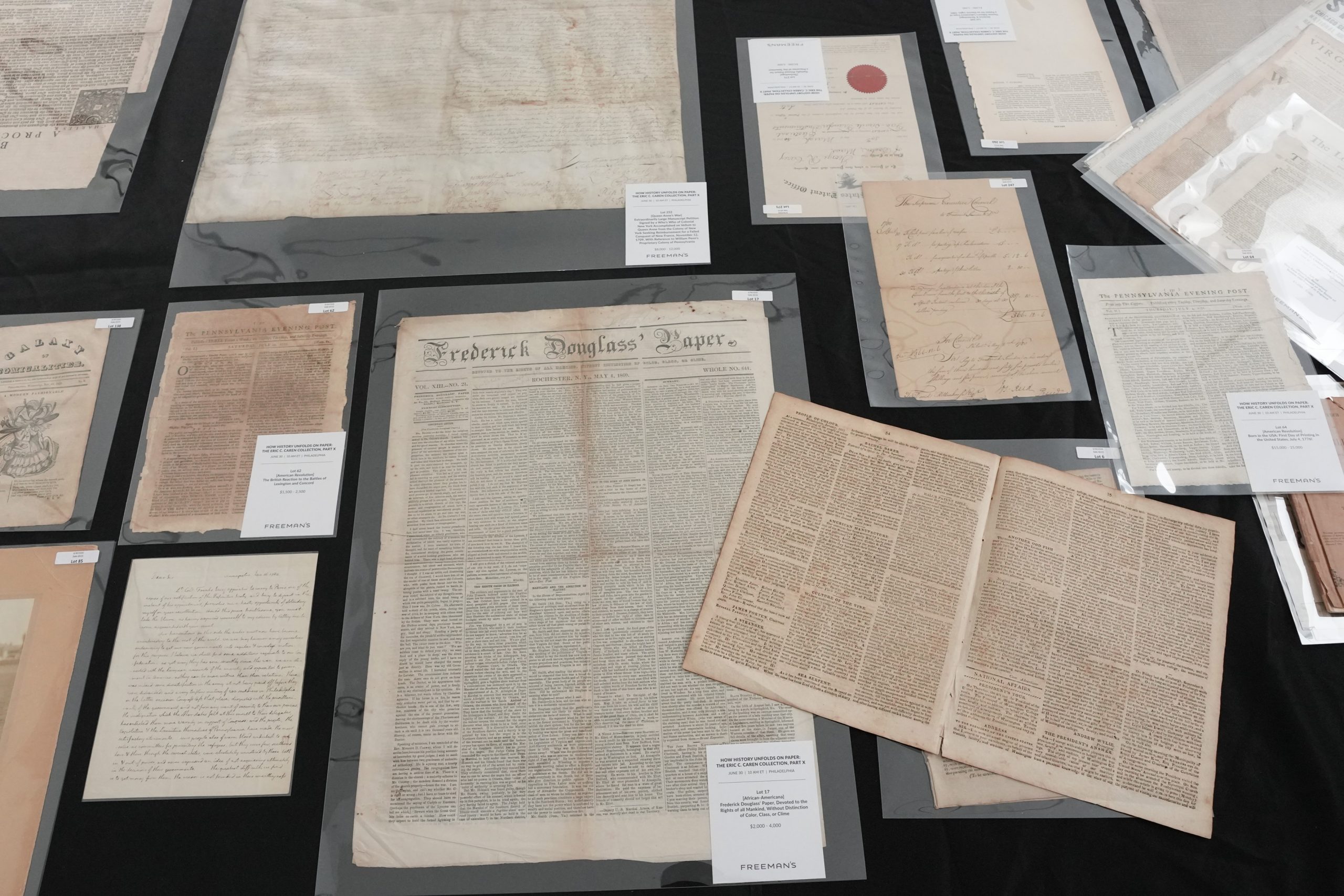
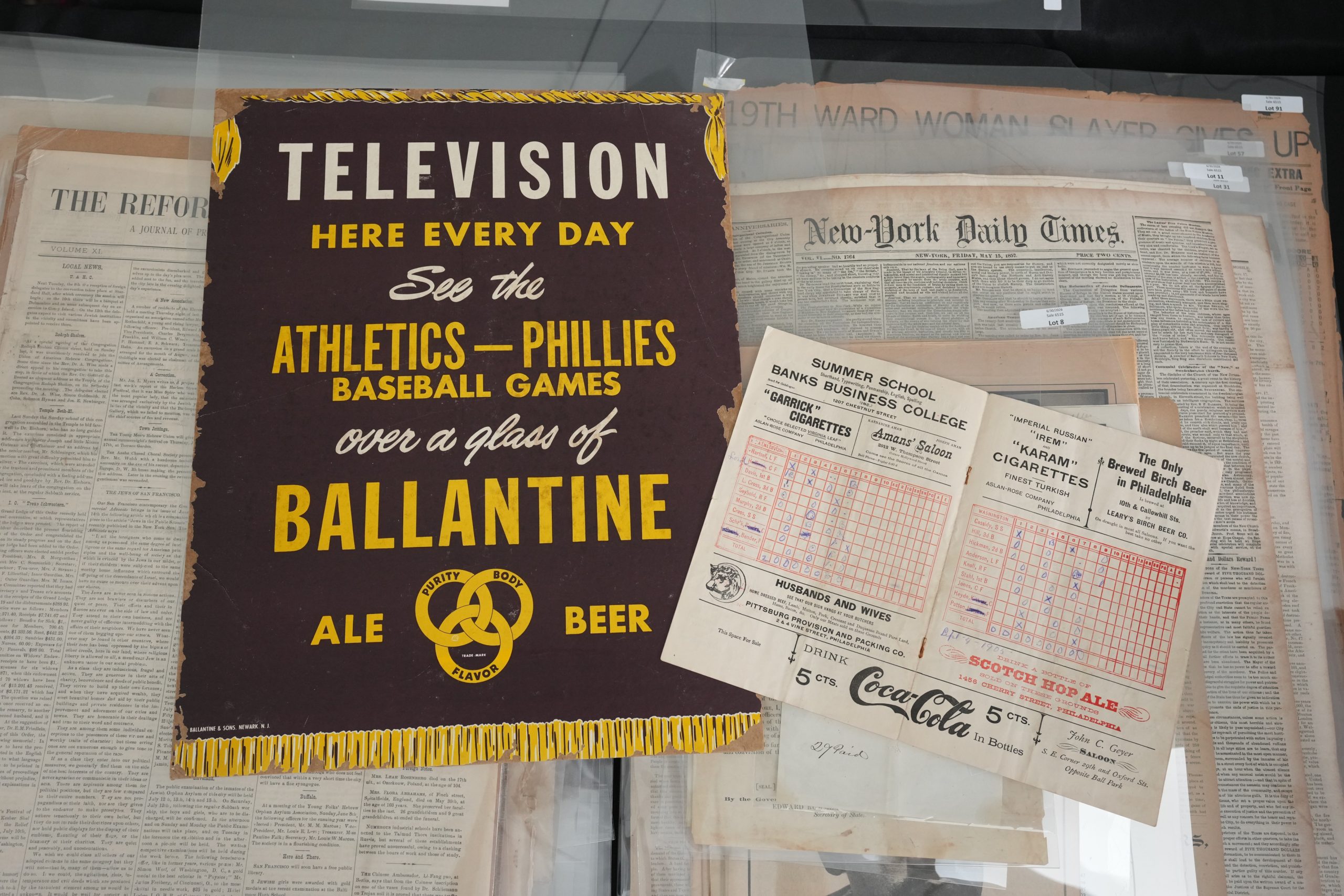
Frederick Douglass’ Paper (front center) and other documents, part of the collection “How History Unfolds on Paper: Important Americana from the Eric C. Caren Collection,” which boasts more than 320 rare newspapers, books, pamphlets, and ephemera tracing the development of printing and publishing in America, an enterprise that started in Philadelphia in1690 with the first paper mill.Jessica Griffin / Staff Photographer
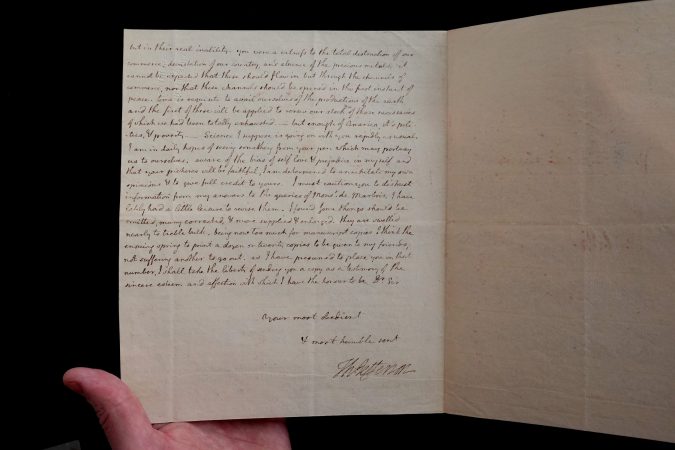
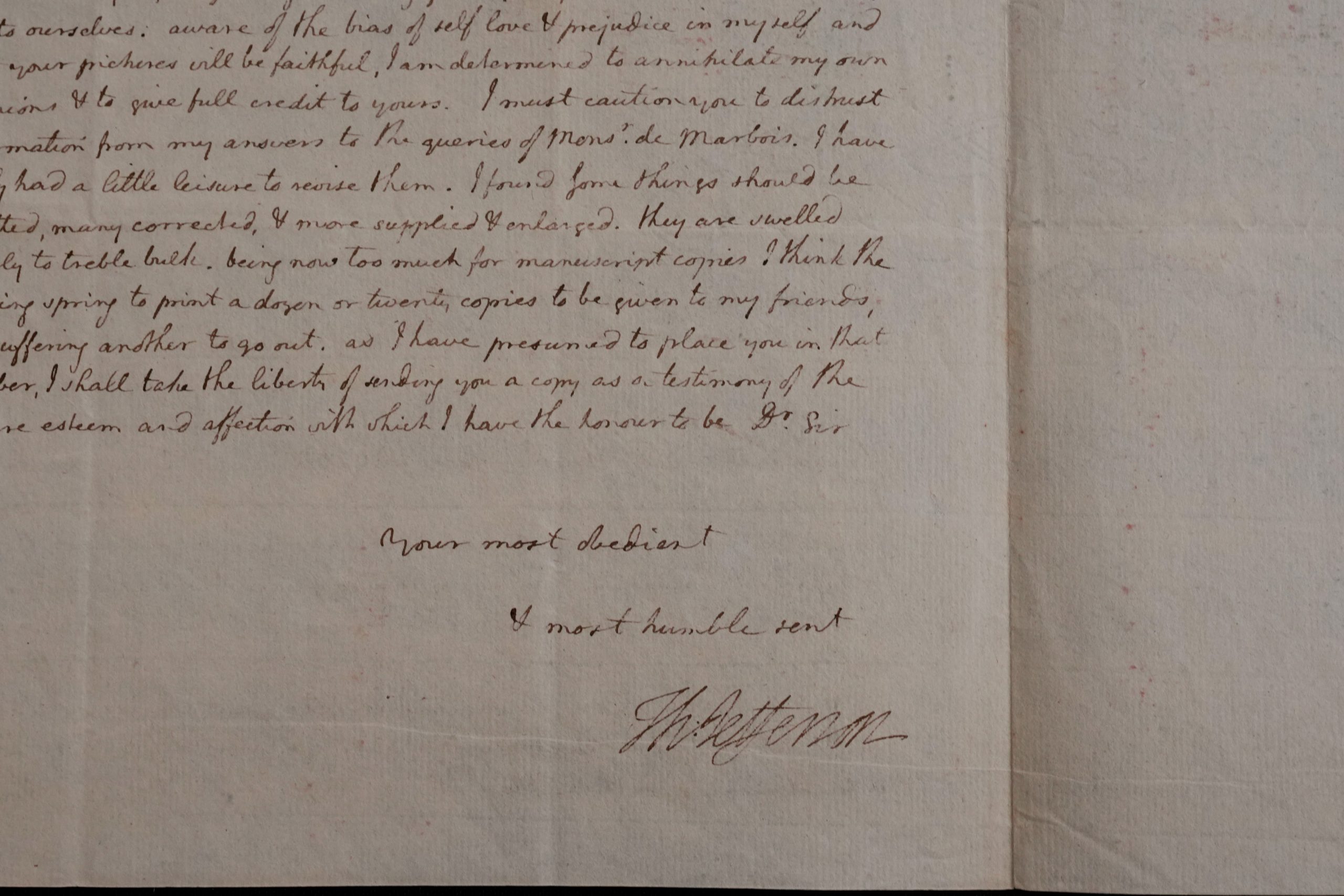
Franks also carried a two-page letter written in Jefferson’s customary neat hand for Francois Jean de Beauvoir, Chevalier de Chastellux. It was a friendly message between the longtime acquaintances, in which Jefferson wrote to the French noble about how America was progressing as a sovereign nation and about his forthcoming book Notes on The State of Virginia.
That letter sold for $108,000 Tuesday as part of an online and in-person auction presented by Philadelphia’s Freeman’s auction house.
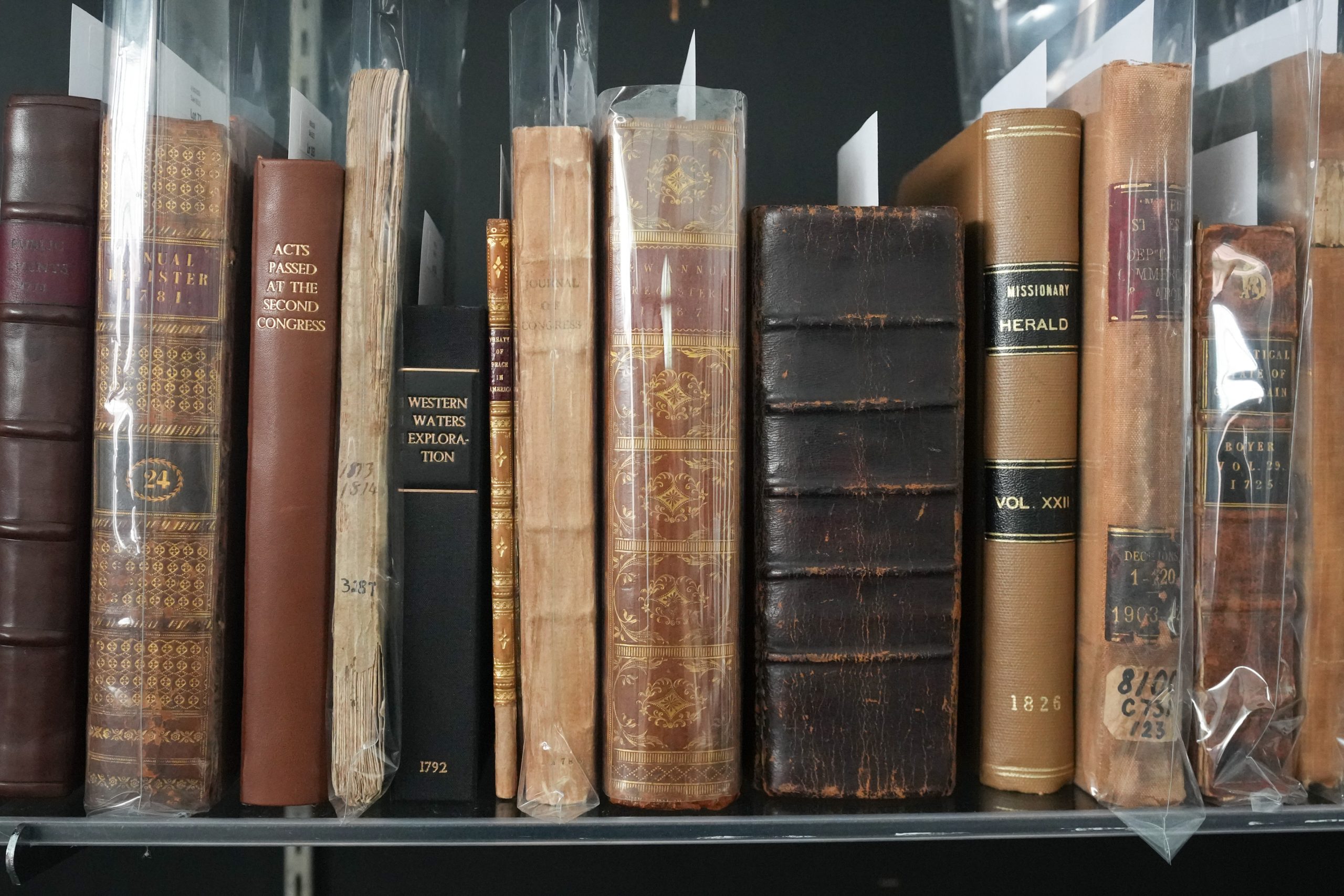
Books from the collection “How History Unfolds on Paper: Important Americana from the Eric C. Caren Collection,” which boasts more than 320 rare newspapers, books, pamphlets, and ephemera tracing the development of printing and publishing in America.Jessica Griffin / Staff Photographer
“Caren goes where the history leads him. His collection reflects that,” said Darren Winston, Freeman’s senior vice president and head of the books and manuscripts department. “When he asked us to host a sale in honor of the 250th, we immediately said yes.”
18th century news treasures
The vast sepia-hued collection of aged newspapers and bound volumes was heaven sent for primary-source junkies who can afford to plop down a few hundred or several thousand dollars for the kinds of historical gems usually found only on microfilm. It’s also a gold mine for those who think hundred-year-old newspapers in near mint condition are frame-worthy.
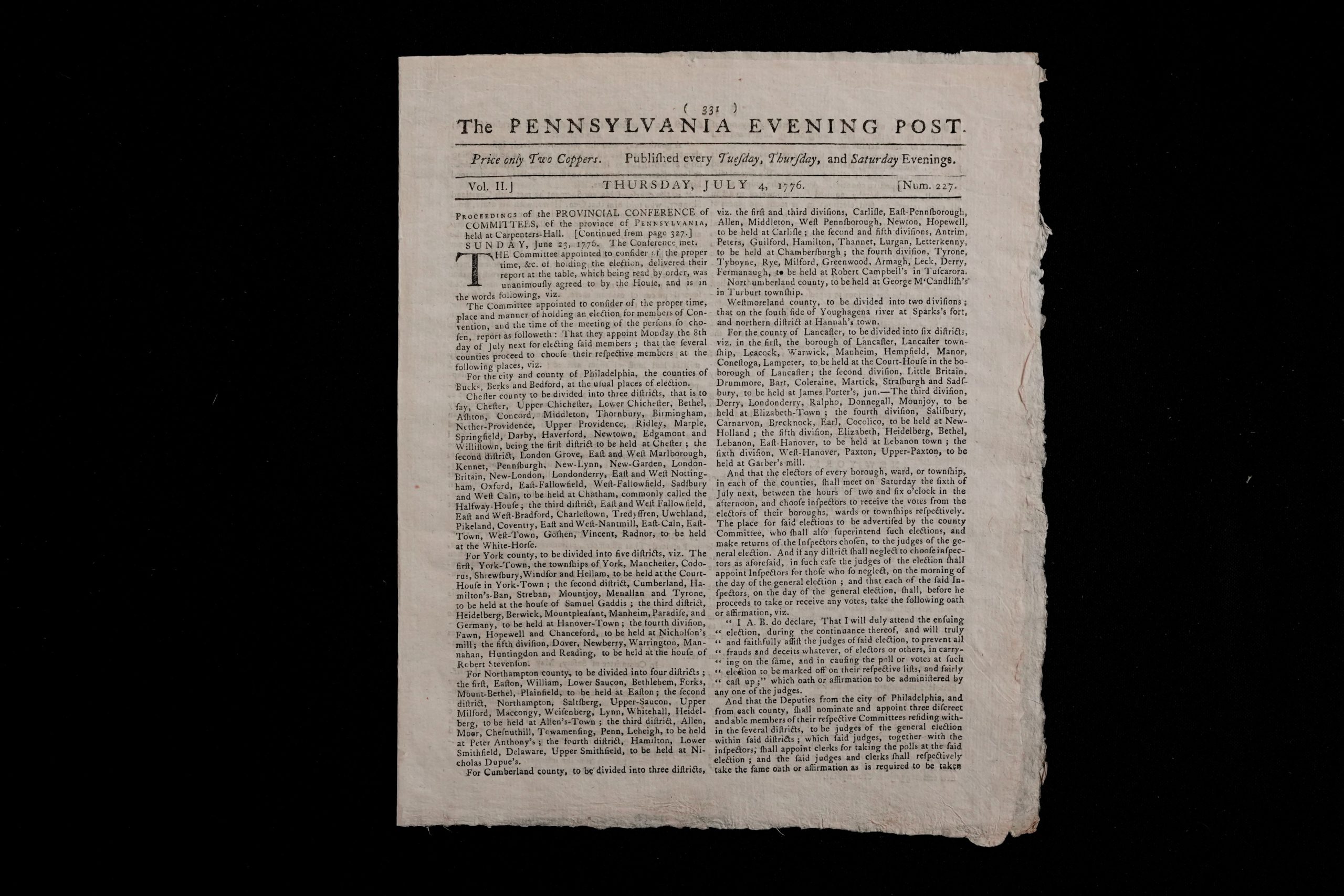
A four-page Pennsylvania Evening Post printed on July 4, 1776, believed to be the first daily newspaper printed on North American soil just declared free of the monarchy.Jessica Griffin / Staff Photographer
The Evening Post, founded by printer Benjamin Towne in 1775, was published just a few blocks from the Pennsylvania State House on Tuesday, Thursday, and Saturday evenings.
The July 4 edition contains a short mention that the Continental Congress declared the United Colonies free and Independent States earlier in the day. And “the day before, we had a King in charge,” Winston said.“How History Unfolds on Paper” included five 18th century newspaper editions, including one printed in Scotland, that published the Declaration of Independence in full.
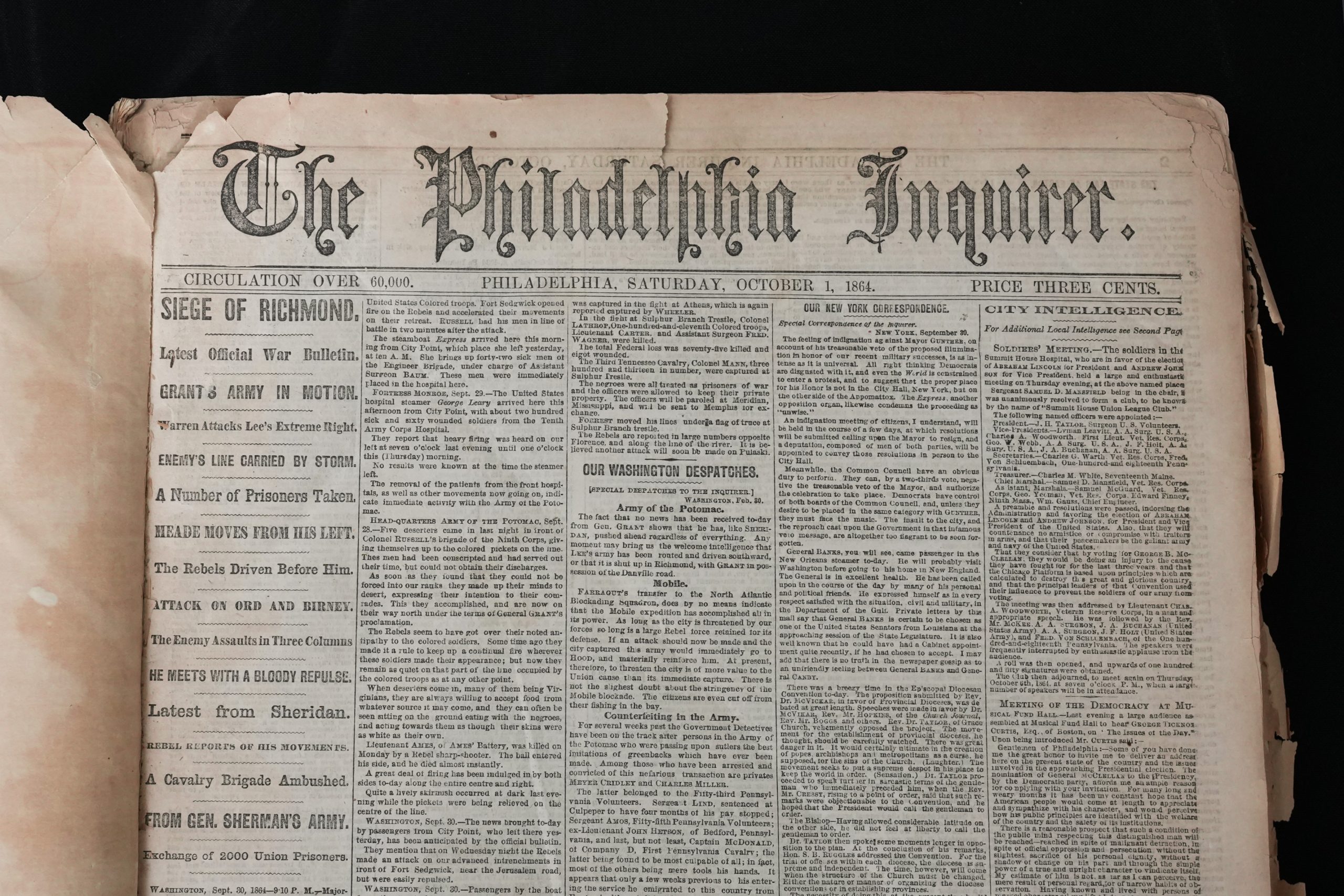
Other archival gems included a copy of the Frederick Douglass Paper from 1860; copies of the Emancipation Proclamation as they appeared in the Daily Globe, the New York Tribune, the Evening Journal Almanac, and The Philadelphia Inquirer; Abraham Lincoln’s second inaugural address as printed in the New York Times in 1865; and more than 70 issues of Civil War-era Philadelphia Inquirers.
A copy of the Philadelphia Inquirer, part of the collection “How History Unfolds on Paper: Important Americana from the Eric C. Caren Collection,” which boasts more than 320 rare newspapers, books, pamphlets, and ephemera tracing the development of printing and publishing in America, an enterprise that started in Philadelphia in 1690 with the first paper mill.Jessica Griffin / Staff Photographer
But Caren’s collection is more than weathered newspapers.
The auctioned collection bubbled with relics, collectibles, and keepsakes that speak to the economy, such as a note signed by first director of the U.S. Mint, David Rittenhouse — for whom Rittenhouse Square is named — ordering payment of 350 pounds to a doorkeeper employed at the Pennsylvania State House. (That’s about $107,000 in today’s money.)
“Freeman’s is America’s oldest auction house, and Philadelphia is the birthplace of the United States,” Caren said. “So for the 250th anniversary [of America], I thought this sale would be quite fitting.”
Some of the sports memorabilia featured in “How History Unfolds on Paper: Important Americana from the Eric C. Caren Collection” Jessica Griffin / Staff Photographer
50 years of collecting
Caren, 66, is a New Yorker and said he came out of his mother’s womb collecting — starting with comic books, stamps, coins, and baseball cards.
In 1970, he learned that a few of his friends were going rummaging through an abandoned house in Rockland County and that they had found newspapers from the turn of the 20th century.
“I asked them to try and find me a sports page with Babe Ruth, and they brought me one from 1913 and I was mesmerized,” Caren said.
After some cajoling, Caren convinced his friends to reveal their secret treasure trove. There, he discovered periodicals going back to the 1890s and was hooked.
Caren spent the next 50-plus years collecting the printed and written word. He has traveled the world to estate sales, garage sales, rare book shops, and antique shows. He’s one of the founders of the Ephemera Society of America and a member of the American Antiquarian Society and the Grolier Club.
He owns hundreds of thousands of paper items, and pieces of his collection have been sold at the auction houses Christie’s and Sotheby’s. “How History Unfolds on Paper” was his 10th auction and first in Philadelphia.
“If ever there was a Philadelphia item, this is it”
In his travels, Caren has come across many of Jefferson’s letters. The one written to Chastellux, he says, is particularly noteworthy because Jefferson wrote it himself, as opposed to dictating it to a secretary, like Franks.
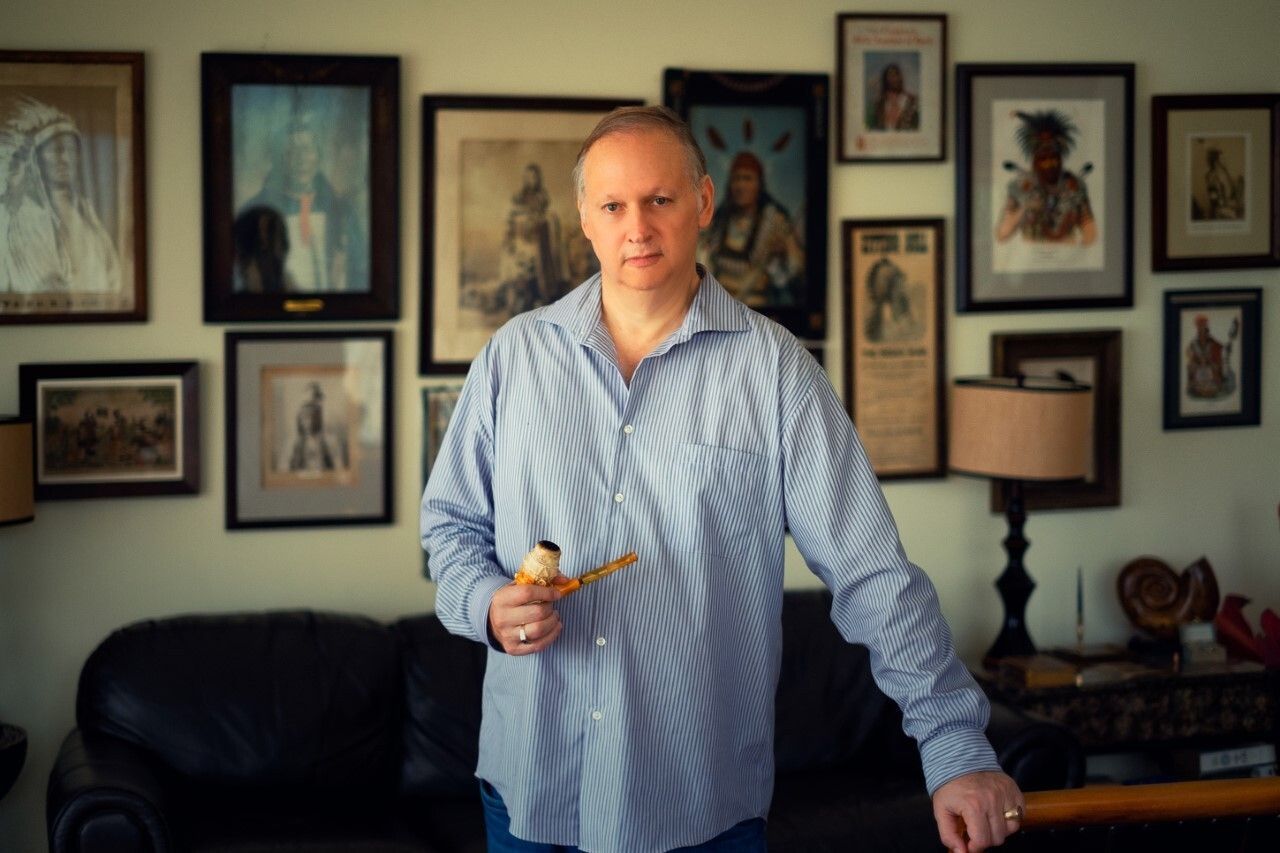
Long-time ephemera collector Eric C. Caren, his collection “How History Unfolds on Paper: Important Americana from the Eric C. Caren Collection, Part X” went to auction at Freeman’s in Philadelphia.courtesy of Freeman Auction House
The letter had been in the Chastellux family for centuries before landing at an auction a few years ago. Caren passed it over a few times before recognizing Frank’s name in the first paragraph.
“It was a great example of how even great things can slip by,” Caren said.
The Treaty of Paris was signed in September 1783. The following January, legislators ratified it in Annapolis.
Dated Jan. 16, 1784, Jefferson’s letter reads like a chatty blog of late 18th century American happenings. In the five months since the war’s end, news traveled to Europe that Americans were behaving badly. One of the reasons Jefferson penned this missive, Caren said, was to “dispel [this] fake news.”
“There was indeed some dissatisfaction in the army at not being paid off before they were disbanded and a very trifling mutiny of 200 souldiers in Philadelphia,” Jefferson wrote, playing down the Pennsylvania Mutiny of 1783, during which a few Continental Army soldiers rioted in Philadelphia streets when they weren’t paid.
Thomas Jefferson’s signature on a letter to Francois Jean de Beauvoir, Chevalier de Chastellux, a part of the auction at Freeman’s.Jessica Griffin / Staff Photographer
He also mentions his yet-to-be published book Notes on The State of Virginia and encouraged Chastellux to write one of his own. He did.
Voyages de M. le Marquis de Chastellux dans l’Amerique septentrionale, published at theturn of the 20th century, is what rare book dealer Wright Howes described as “the first trustworthy record of life in the United States.”
He spent years trying to restore his name. During his first term, President George Washington helped Franks secure a job as an assistant cashier at the Bank of the United States of America, but Franks was no longer accepted in the Founding Father’s circle.
He died in 1793 during Philadelphia’s yellow fever epidemic.
“If ever there was a Philadelphia item, this is it,” Caren said. “This letter is the intersection between the history of Philadelphia and the history of our nation.”
The headline and article have been updated to include the winning bid at the auction on Tuesday morning.
Like many, I’m big fan of Nicolas Cage’s work. How big? On my bachelorette party to New Orleans a few years ago I requested we tour St. Louis Cemetery No. 1 so I could get a pic of me and my girls with Cage’s nine-foot pyramid tomb.
Not only can the man seriously act, he can also seriously overact. As a writer who loves puns ( especially bad ones), I appreciate someone who has fun with their art form to the point it causes eye rolls.
And so, when I learned about Uncaged in Jenkintown: A Nic Cage cocktail crawl that happened on Sunday, I wanted to check it out. In some ways, it turned out to be like a lot of Cage movies — not a blockbuster, but still quirky and fun.
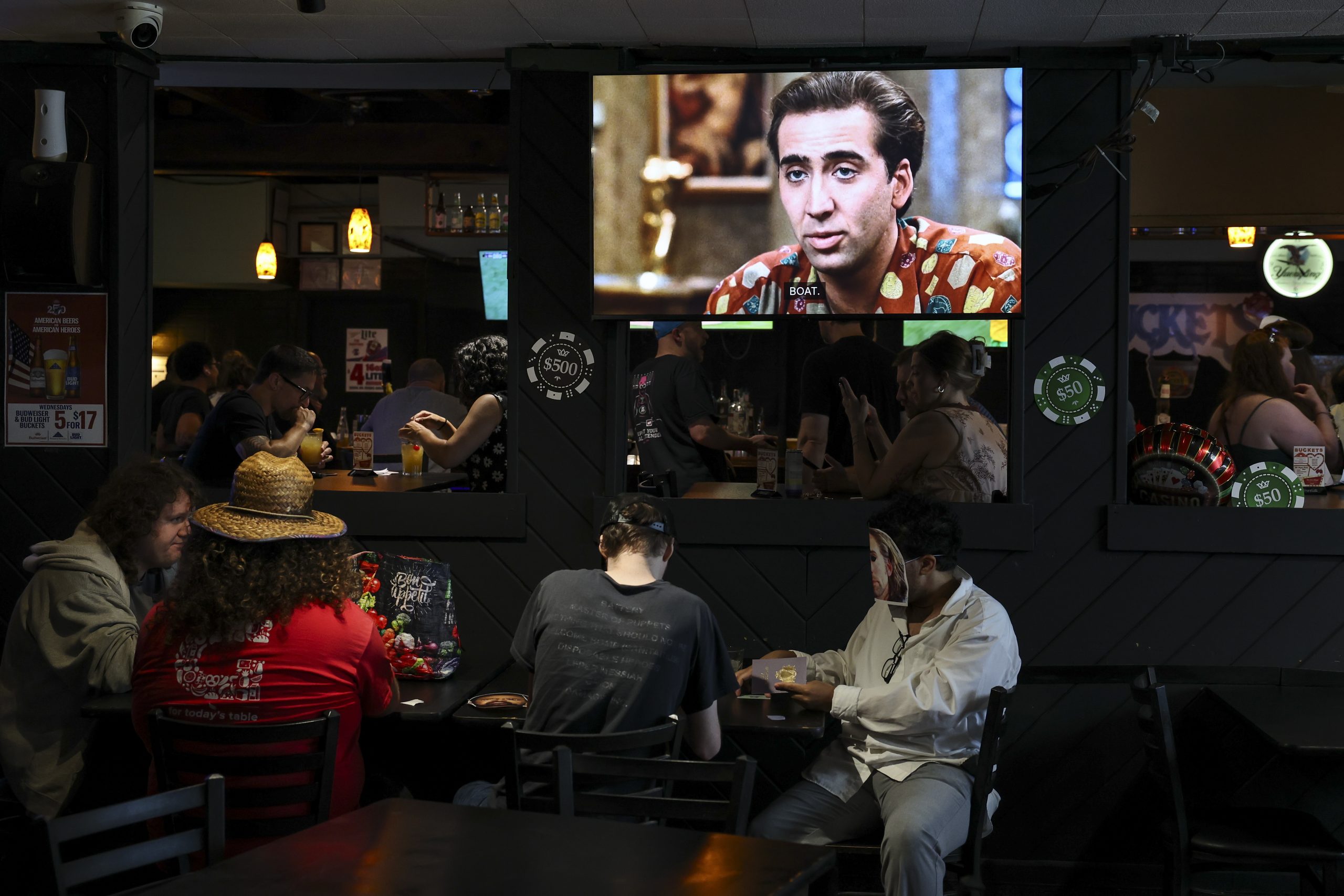
“Honeymoon in Vegas” plays at Buckets Bar during the Nic Cage cocktail crawl on Sunday in Jenkintown. Monica Herndon / Staff Photographer
The crawl was spread across four Jenkintown bars — the Keep Easy, the Drake Tavern, Buckets Bar, and King’s Corner. Each one featured Cage-themed cocktails and hosted a “Cage match,” where participants went head-to-head in challenges based on Cage films.
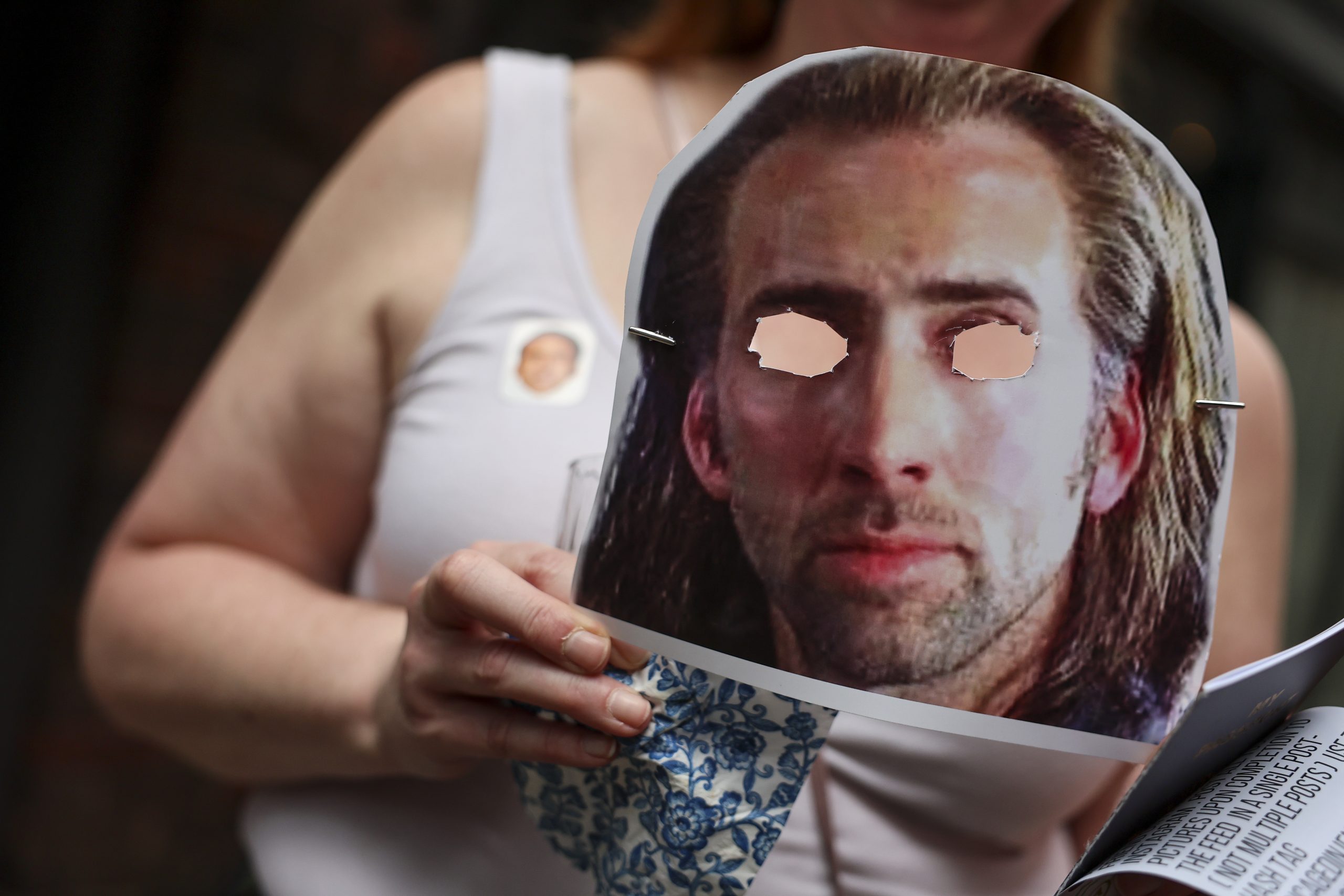
Organizer Mel Hager, an owner of the Keep Easy, said she sold out of the 50 Uncaged kits she’d prepared for $15 a pop. While the crawl was free to attend, those who bought a kit — including yours truly — received a passport book, which got you a free Cage match at each establishment (otherwise they were $2 to play); a piece of Cage cash, which was good for one shot at any of the bars (it’s a tiny dollar bill with Nic Cage’s face on it, I’m never spending that); and one of a variety of Cage masks (I felt like I won the lottery when I got the Con-Air Cage).
While I didn’t drink, I hopped around to the bars, tried my hand at the Cage matches, and talked with fellow Cage fans about what brought them out to the event. Here are five of the wackiest things I saw at the Nic Cage bar crawl.
1. H.I. fashion
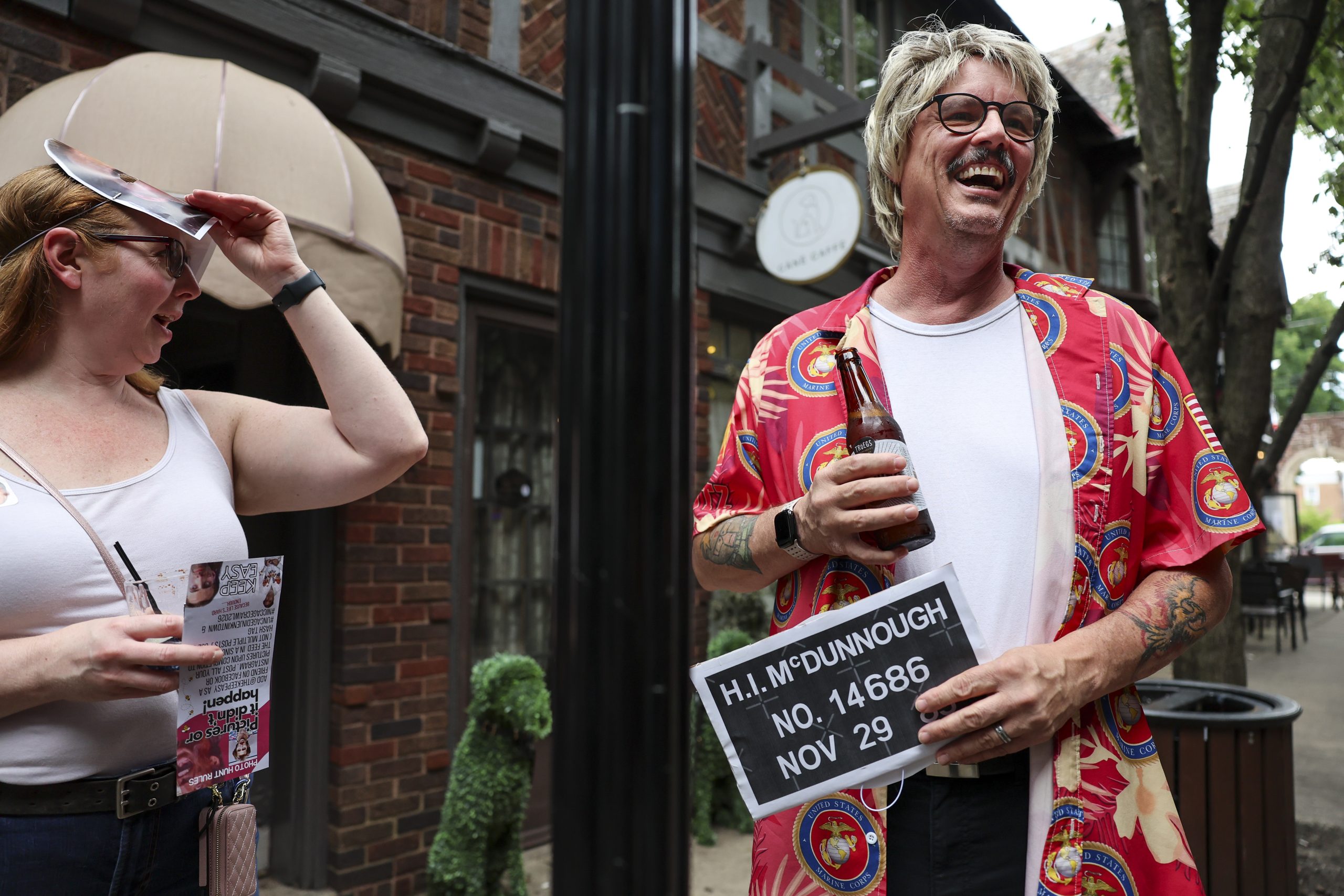
Vicky and Mike Hutz, of Huntington Valley, at the Keep Easy during the Nic Cage cocktail crawl on Sunday in Jenkintown. Mike Hutz is dressed as Cage’s character from “Raising Arizona,” H.I. McDunnough.Monica Herndon / Staff Photographer
When H.I. McDunnough kidnaps one of the Arizona quintuplet babies in the 1987 Cohen Brothers classic, Raising Arizona, he proclaims to his wife: “I think I got the best one.”
Of the few Cage character costumes I saw Sunday — which included Ronny from Moonstruck, Cameron Poe from Con Air, and someone portraying Cage’s first role as an unnamed burger shop worker in Fast Times at Ridgemont High — Mike Hutz’s H.I. McDunnough costume was undoubtedly the best one. Hutz, of Huntingdon Valley, had the open Hawaiian shirt, a wig, and McDunnough’s mugshot board.
“What else are you going to do on a Sunday afternoon when you have a Nicolas Cage crawl option?” he said. “There’s nothing he can’t do and he does it with maximum cheesiness, which is just perfect for people who love cheesy.”
2. The faces
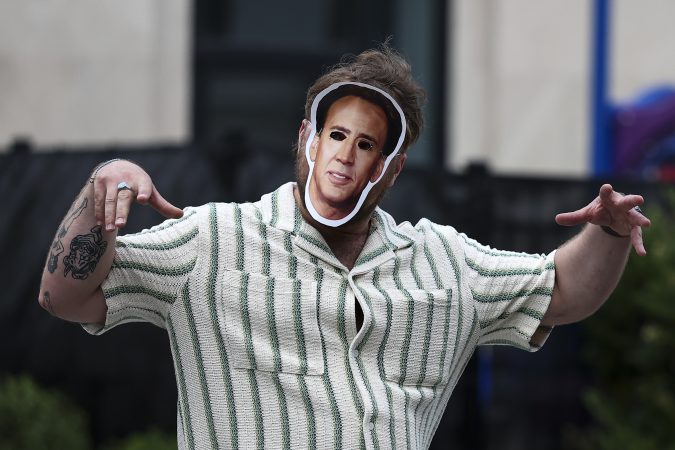
Seeing people at bars and walking the streets of Jenkintown wearing Cage face masks was both highly amusing and mildly unsettling, mainly because the eye holes were cut out wonkily, giving them a ragged, creepy edge.
Masks included Face/Off Cage, Con Air Cage, red carpet Cage, and Dracula Cage (from the movie Renfield).
Vicky Hutz, of Huntington Valley, holds a “Con-Air” Nic Cage mask at the Keep Easy during the Nic Cage cocktail crawl on Sunday.Monica Herndon / Staff Photographer
Julia Sousa and Josh Douglas traveled to the crawl from Roxborough because they love Cage and Jenkintown. Douglas walked from bar to bar with his Cage face mask on, which seemed to startle some passing motorists.
“I’m pretty sure they thought I was Michael Myers,” he said.
3. The Cage matches
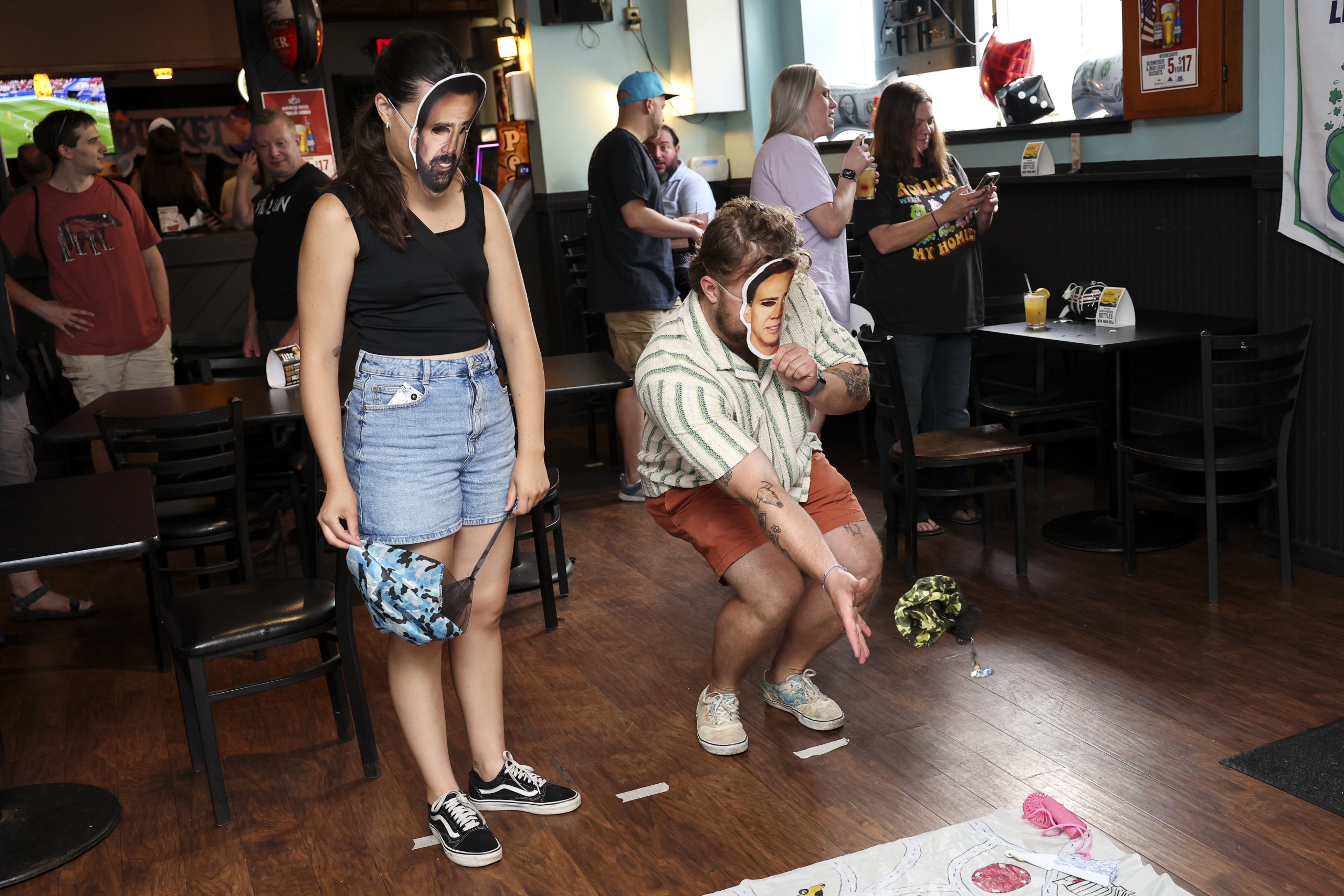
The games based on Cage films, while homespun, were clever and fun. At Buckets, the game was inspired by the scene in Honeymoon in Vegas where Cage skydives with a bunch of Elvis impersonators. Contestants had to throw toy parachute soldiers that were painted to look like Elvis onto particular spots of a mock-up of the Vegas strip for points.
Julia Sousa and Josh Douglas, both of Roxborough, compete in the “Flying Elvis Cage Match,” at Buckets Bar during the Nic Cage cocktail crawl on Sunday in Jenkintown. Monica Herndon / Staff Photographer
At King’s Corner, where the challenge was based on the movie National Treasure, participants had to solve little metal mind-bender puzzles.
For the Spider-Noir Cage match at the Drake, you had to keep a balloon bouncing in the air while putting on a cape, mask, and fedora.
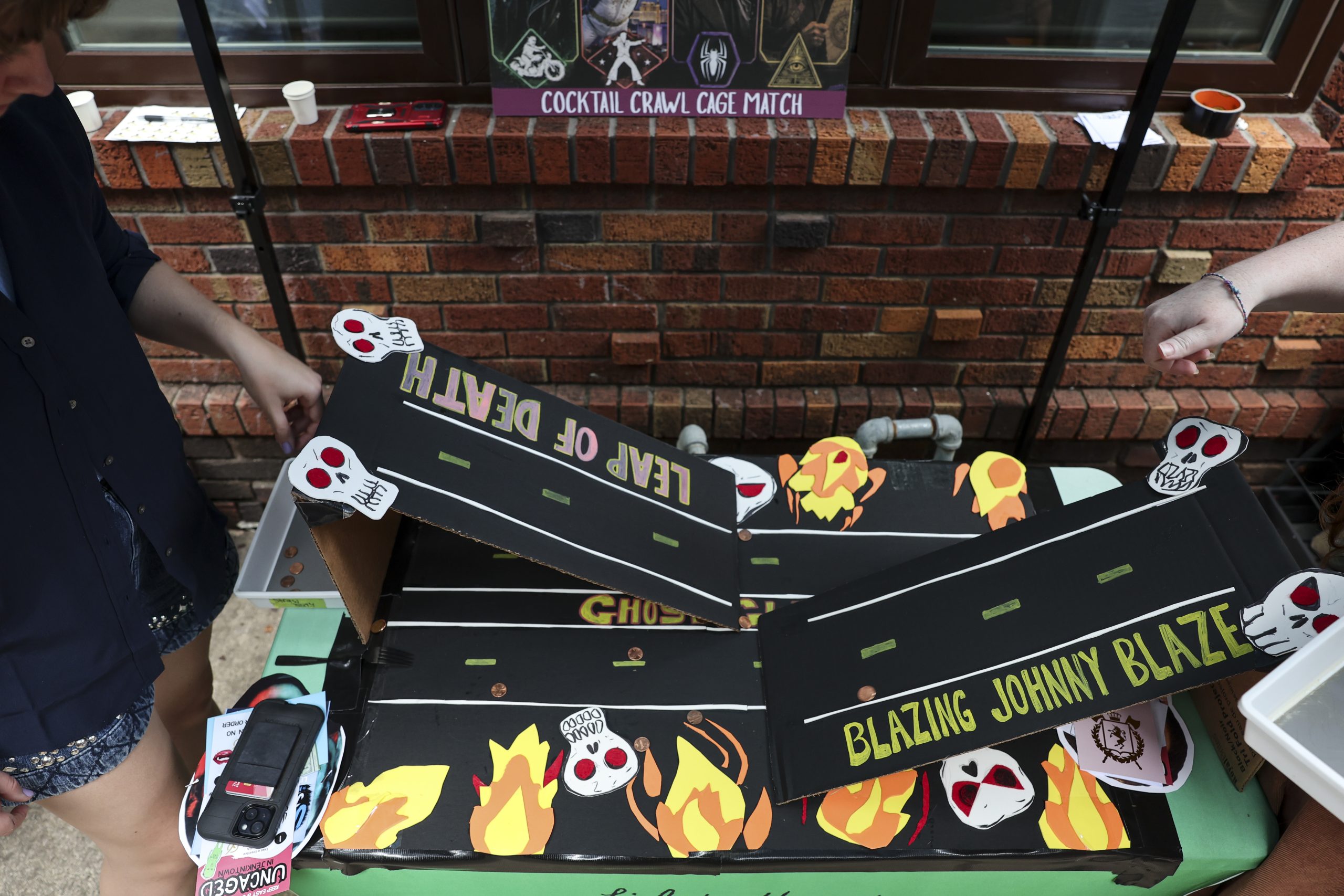
I failed spectacularly at all three of those challenges — and I was completely sober! The only one I did succeed at was called Ghost Glider. Based on the film Ghost Rider, the challenge was to to roll a penny down an inclined surface made to look like a road and into the tongs of a fork at the other end.
The “Ghost Glider” Cage match at the Keep Easy during the Nic Cage cocktail crawl on Sunday in Jenkintown.Monica Herndon / Staff Photographer
4. Stickers and sage
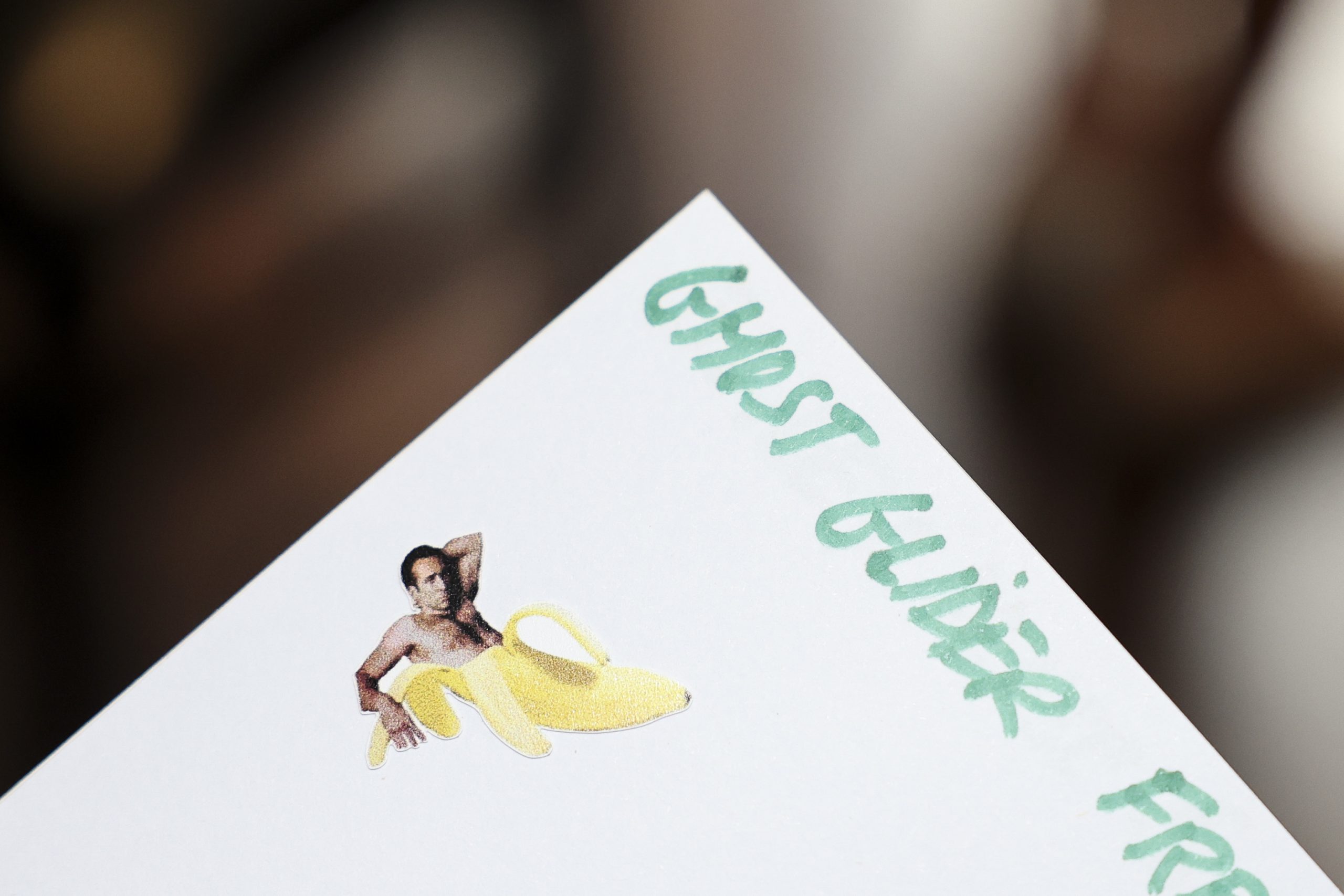
For winning the Ghost Glider challenge, I received a bundle of sage and a sticker for my passport book of a shirtless, reclining Cage coming out of a banana.
Let’s address the sage first: Nobody could tell me why this was my prize for winning the challenge, which somehow makes it even better. I have two theories — it could be because sage rhymes with Cage, or maybe it’s because you light sage and in Ghost Rider, Cage lights on fire.
Whatever the reason, I’m gonna smudge some stuff up this weekend.
An a-peeling sticker columnist Stephanie Farr received for winning a Cage match challenge at the Keep Easy during the Nic Cage bar crawl in Jenkintown Sunday. Monica Herndon / Staff Photographer
Now onto this banana sticker — I don’t know why it exists, but I am so happy it does. Each bar gave a different sticker if you won a challenge, but this banana-Cage split one was, by far, the most a-peeling.
Later at the Drake, I met Erica Adams of Bensalem and “her only friend of whimsy,” Amanda Knop, who’d driven from Baltimore to attend the Cage crawl with her. Adams had her own stickers of Cage’s head she was handing out like friendship bracelets at a Taylor Swift concert.
“I just love his movies and doing silly, fun things,” Adams said. “Nicolas Cage himself is very unserious. He’s lived a million different lives in a short span already.”
5. Picolas Cage
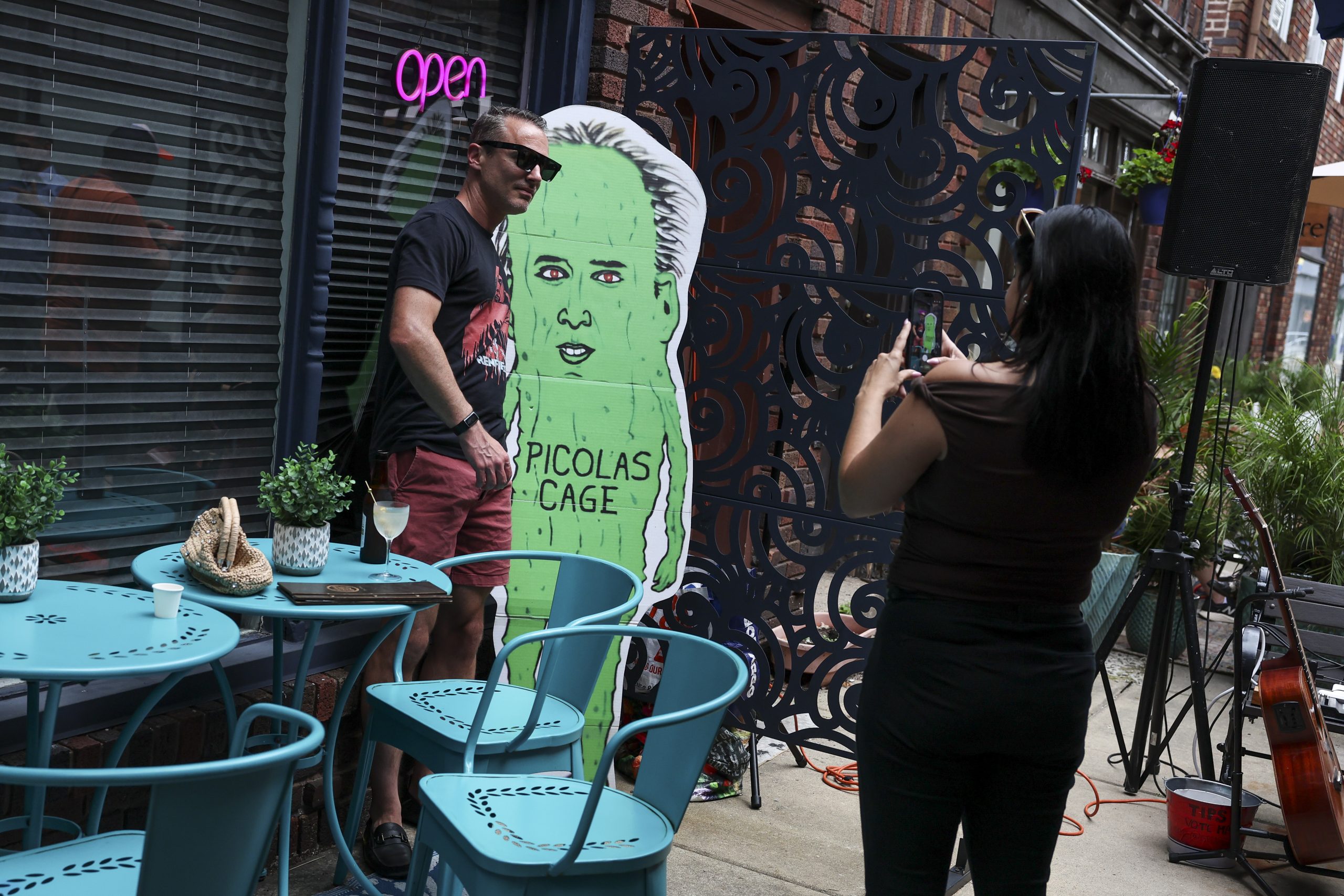
Justin Walsh poses for a photo with “Picolas Cage” as Jessica Lopez takes the photo at the Keep Easy during the Nic Cage cocktail crawl on Sunday in Jenkintown. Monica Herndon / Staff Photographer
A giant cut-out of Cage as a pickle, aka Picolas Cage, was stationed outside of the Keep Easy during the crawl. As someone who likes Cage and cucumbers — but hates pickles — it was a jarring experience. But I saw others relishing the photo op so I didn’t make a big dill out of it.
Daveigh Chase, an actor known for voicing the character of Lilo in the hit animated film “Lilo & Stitch,” died in Los Angeles this month of AIDS, the county’s Department of Medical Examiner said Monday.
The case information for Chase, who was 35 and also known as Daveigh Schwallier, said her death at a hospital June 16 was natural. It listed AIDS, which is caused by HIV, as the cause, and said that “chronic polysubstance use” — repeatedly using more than one drug or substance at the same time or within a short period of time — was a “significant condition.”
The Los Angeles Department of Medical Examiner said a more detailed report about the case was not yet available.
When Chase’s father, John David Schwallier, confirmed his daughter’s death to The New York Times, he said the cause was complications of bacterial meningitis and a blood infection. Schwallier also said his daughter had been homeless and living in Los Angeles with her boyfriend near the hospital where she died.
“Lilo & Stitch,” released in 2002 when Chase was almost 12, told the story of an orphaned Hawaiian girl, Lilo, who brings home an impish blue space alien, Stitch, from the dog pound. Chase brought the plucky Lilo to life.
Her breakout role, however, was in the live-action thriller “The Ring,” released in the United States roughly four months later, alongside Naomi Watts. Chase played Samara, a long-haired child villain. The image of Samara crawling through a blurry television screen would become seared in the cultural consciousness of that period.
Editor’s note: This story has been updated to reflect a later start time for the concert, which organizers changed due to the extreme heat advisory this week.
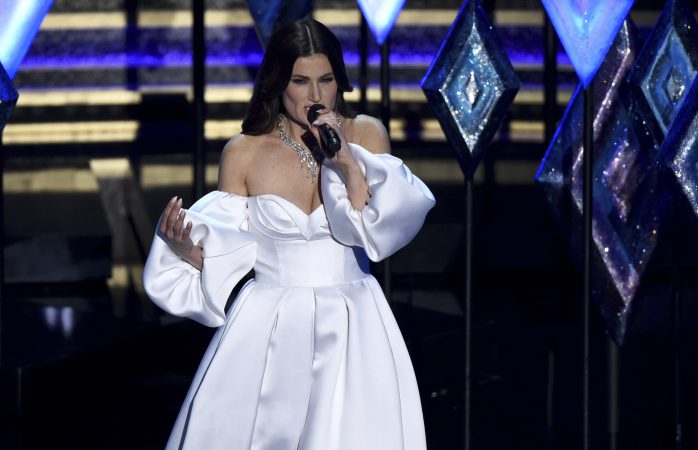
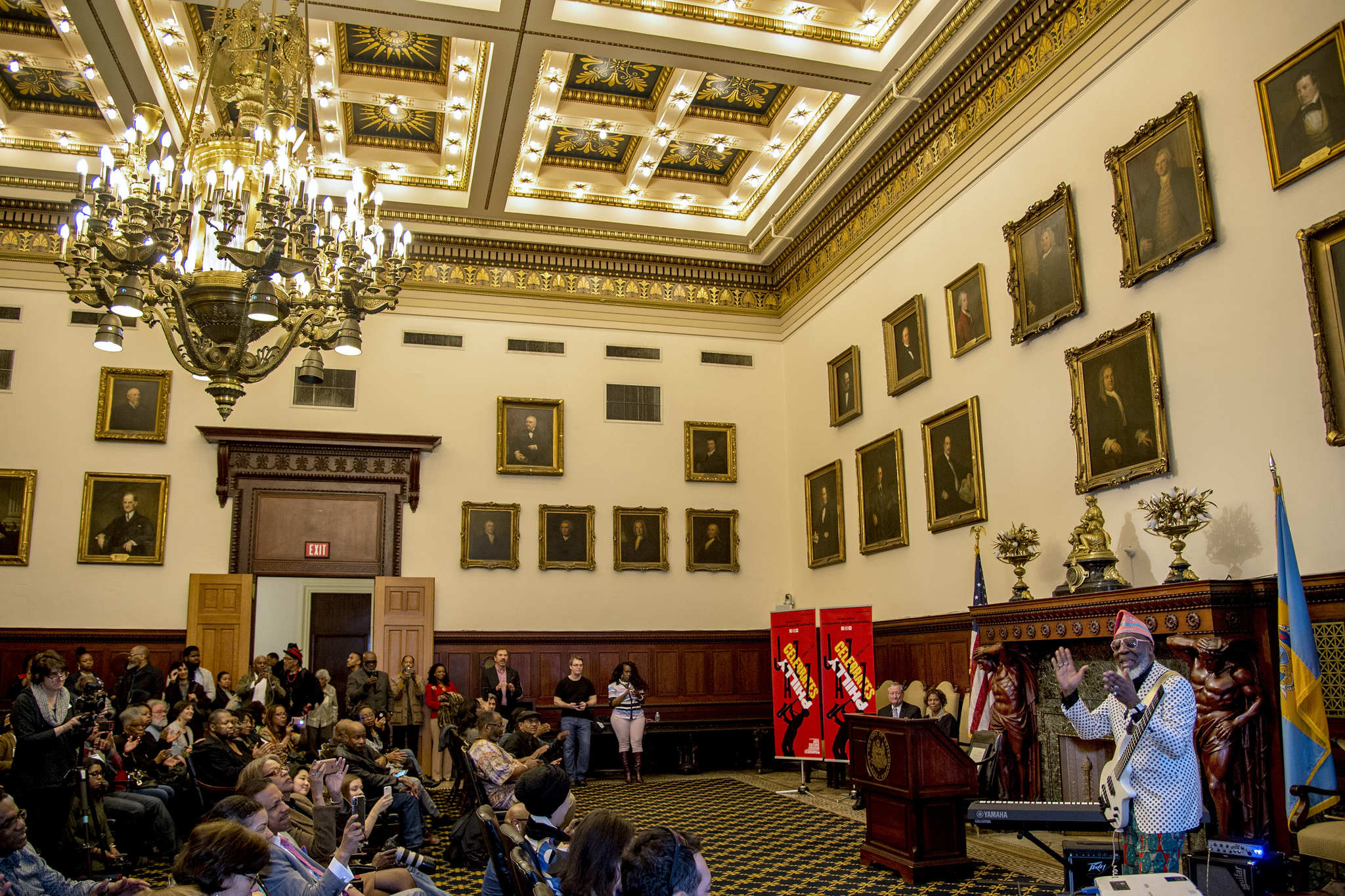
Broadway legend Idina Menzel has lived in Los Angeles for years now, but she still loves an East Coast audience — especially in Philly.
“They’re my vibe. I’ve got a lot of friends and family down there. They understand my humor,” said Menzel, who lives in Encino with her husband, actor Aaron Lohr, her 16-year-old son, Walker Nathaniel Diggs, and their dog, Gino.
“I just really feel like I’m very authentic when I’m on the stage with them, and we have a great time.”
The star singer behind unforgettable characters in Wicked, Rent, and Frozen, Menzel returns to Philadelphia on July 3 to perform her biggest hits from musicals and beyond, joining the Philly Pops for a free concert on Independence Mall.
“It’s been quite some time since I’ve done an orchestra show,” said Menzel, who last year starred in the Broadway musical Redwood, about a mother grieving the sudden loss of her son and finding solace in a redwood forest.
“It’s the most glorious experience, just standing up there in front of 80 some musicians and performing with them … there’s nothing like it.”
At Independence Mall, she’ll likely sing her popular hits, like “Defying Gravity,” “Take Me or Leave Me,” and “Let It Go,” as well as songs from her own discography, with some familiar arrangements and some new ones she created recently.
Outside of touring, the Tony Award-winner is no stranger to the city: As a New Yorker, Menzel has visited often before. In college, she once spent a Christmas in town with two New York University roommates from Philadelphia.
There’s one thing she loves to do whenever she stops in Philly — run up the Art Museum steps.
“I make it a point to, with my son, because he’s such an athlete. We run the steps. I call them the Rocky steps,” she said.
Performing as part of Wawa Welcome America’s Semiquincentennial celebrations leading up to July 4, Menzel joins a long list of celebrities coming to Philadelphia for the national birthday bash. If there’s one song from her history that she thinks Philly audiences — and Americans overall — need to hear right now, that would be “No Day But Today.”
“Rent was my very first professional show, and it’s one of my favorite songs from that show. For me, it’s kind of like a mantra, and whenever I sing it, audiences truly come together,” she said. “It’s more about gratitude and community. People coming together, not taking things for granted, and really embracing the moment.”
It’s a message that will likely resonate with Philadelphians — even if Menzel is a diehard Knicks fan.
Idina Menzel will headline Pops on Independence in Philadelphia at Sixth & Market Streets on the Independence Concert Series Stage at 8 p.m. on Friday, July 3.
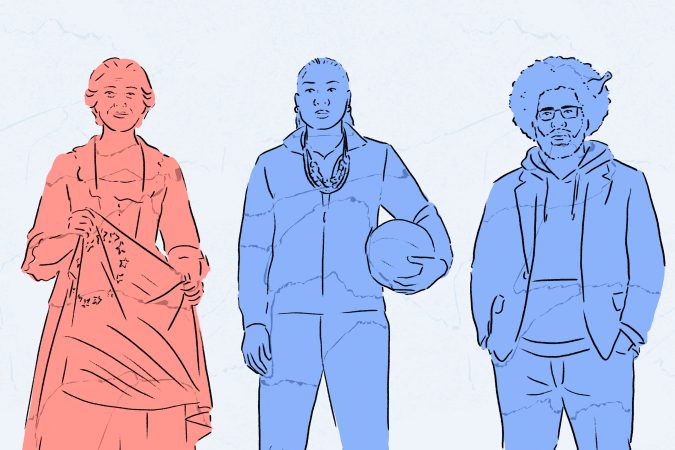
Philadelphia now has three Rocky statues. That is three statues celebrating a fictional Philadelphian. And while many great Philadelphians already have statues, there are so many who don't.
Who do you think should be Philadelphia’s Next Top Statue?
To decide, we’ll present you with two random Philadelphians from our list of just 26. For each matchup, you choose who deserves to be honored more. The winner will move on to the next round to face another Philadelphian.
You’ll keep going until we end up with your definitive Philadelphia’s Next Top Statue.
story continues after advertisement
story continues after advertisement
story continues after advertisement
If you're happy with , you can skip the remaining challengers, and lock them in as your choice.
story continues after advertisement
You think Philadelphia should build a statue of winner and percentageWinner of Inquirer readers agree with you. The most popular winning statues, so far, are popularWinners.
You stuck with longest for the longest, picking them over longestLength other statues.
(()=>{var be=(e,t)=>()=>(t||e((t={exports:{}}).exports,t),t.exports);var U=be(s=>{var Ae={0:”Jan.”,1:”Feb.”,2:”March”,3:”April”,4:”May”,5:”June”,6:”July”,7:”Aug.”,8:”Sept.”,9:”Oct.”,10:”Nov.”,11:”Dec.”};function $(e){return e===void 0&&(e=new Date),Ae[e.getMonth()]}var Ce={0:”Jan”,1:”Feb”,2:”Mar”,3:”Apr”,4:”May”,5:”Jun”,6:”Jul”,7:”Aug”,8:”Sep”,9:”Oct”,10:”Nov”,11:”Dec”};function O(e){return e===void 0&&(e=new Date),Ce[e.getMonth()]}function u(e){return e==null}function G(e){return typeof e==”number”&&isFinite(e)}function A(e){return G(e)&&Math.floor(e)===e}var Le=[“one”,”two”,”three”,”four”,”five”,”six”,”seven”,”eight”,”nine”],Pe=[“million”,”billion”,”trillion”,”quadrillion”,”quintillion”,”sextillion”,”septillion”,”octillion”,”nonillion”,”decillion”],z=[“th”,”st”,”nd”,”rd”,”th”,”th”,”th”,”th”,”th”,”th”],xe=[11,12,13];function _(e){if(u(e))return””;var t=+e;return A(t)?xe.indexOf(t%100)>-1?z[0]:z[t%10]:””}var Be=[“first”,”second”,”third”,”fourth”,”fifth”,”sixth”,”seventh”,”eighth”,”ninth”],je=new RegExp(/s+([^s]*)s*$/);s.apdate=function(e){return e===void 0&&(e=new Date),$(e)+” “+e.getDate()+”, “+e.getFullYear()},s.apdatetab=function(e){return e===void 0&&(e=new Date),O(e)+” “+e.getDate()+”, “+e.getFullYear()},s.apmonth=$,s.apmonthtab=O,s.apnumber=function(e){if(u(e))return””;var t=+e;return A(t)?t=10?e.toString():Le[t-1]:e.toString()},s.aptime=function(e){e===void 0&&(e=new Date);var t,o,n=e.getHours(),i=e.getMinutes(),a=i===0;if(a){if(n===0)return”midnight”;if(n===12)return”noon”}return n0?n:12):(t=”p.m.”,o=n===12?n:n-12),a?o+” “+t:o+”:”+(i<10?"0"+i:i)+" "+t},s.capfirst=function(e){if(u(e))return"";var t=String(e);return""+t.charAt(0).toUpperCase()+t.slice(1)},s.intcomma=function(e){if(u(e))return"";var t,o=+e;return G(o)?((t=o.toString().split("."))[0]=t[0].replace(/B(?=(d{3})+(?!d))/g,","),t.join(".")):e.toString()},s.intword=function(e){if(u(e))return"";var t=+e;if(!A(t))return e.toString();var o=Math.abs(t);if(o<1e6)return e.toString();var n=Math.ceil(Math.log(o+1)/Math.LN10)-1,i=n-n%3,a=t/Math.pow(10,i);return(a=Math.round(10*a)/10)+" "+Pe[Math.floor(i/3)-2]},s.ordinal=function(e,t){if(t===void 0&&(t=!1),u(e))return"";var o=+e;return A(o)?t&&o{let t=document.querySelector(`.js-reveal[data-id=”${e}”]`);t?t.classList.add(“is-hidden”):console.log(“No reveal component found with the id”,e)},Se=e=>{let t=document.querySelector(`.js-reveal[data-id=”${e}”]`);t?t.classList.remove(“is-hidden”):console.log(“No reveal component found with the id”,e)},T={init:()=>{},show:Se,hide:ve};var M,ke=(e,t)=>{M=M||window.PMNdataLayer,M?M.push({event:”misc_event”,eventAction:e,eventLabel:t}):window.location.hostname.includes(“localhost”)?console.log(“Analytics event:”,e,t,”(not actually being sent due to localhost)”):console.log(“Failed to push analytics event”,e,t)},b={event:(e,t)=>{ke(e,t)}};var p,J,Ne=()=>{p=document.getElementById(“js-inno-toast”)},Te=e=>{if(!p)return;p.innerHTML=e,p.classList.add(“is-active”);let t=()=>{p.addEventListener(“transitionend”,Me,{once:!0}),p.classList.remove(“is-active”)};clearTimeout(J),J=setTimeout(t,5e3)},Me=()=>{p.innerHTML=””},c={init:()=>{Ne()},showToast:Te};var gt=U();var y=e=>{if(e)return e.trim().toLowerCase().normalize(“NFD”).replace(/[u0300-u036f]/g,””).replace(/[^A-Z0-9 ]/gi,””).trim().replace(/ /g,”-“).replace(/–/g,”-“)};var C=()=>/Android|webOS|iPhone|iPad|iPod|BlackBerry|IEMobile|Opera Mini/i.test(navigator.userAgent);var x=(e,t=null,o=null)=>{o||(o=document.querySelector(“head”));let n=document.createElement(“script”);n.type=”text/javascript”,n.src=e,t&&(n.onload=t),o.appendChild(n)},K=()=>(window.PMNdataLayer?.[0]!==void 0&&window.PMNdataLayer[0])?.analytics?.user?.state===”Subscribed”,V=()=>{let t=(window.PMNdataLayer?.[0]!==void 0&&window.PMNdataLayer[0])?.analytics?.user?.state;return window.location.host.includes(“zzz-systest”)||window.location.host.includes(“pmn.arcpublishing.com”)||window.location.host.includes(“stage.fusion.inquirer.com”)||typeof t>”u”},Y=()=>{let t=(window.PMNdataLayer?.[0]!==void 0&&window.PMNdataLayer[0])?.analytics?.user?.hasAdsFreeReading;return!!(t&&t==1)},B=()=>window.location.host.includes(“localhost”),Z=(e,t=””)=>{let o=document.querySelector(`template#${e}`);if(!o||!(o instanceof HTMLTemplateElement))return console.log(`Couldn’t find .`),null;let n=o.content.cloneNode(!0).childNodes;if(n.length==0)return console.log(`Template ${o} has no children, returning null.`),null;n.length>1&&console.log(`Template ${o} has multiple children, only returning the first.`);let i=n[0];return i.setAttribute(“data-id”,t),i},j=(e,t)=>{let o=[…e.querySelectorAll(“[data-populate]”)];e.dataset.populate&&o.unshift(e);let n=o.filter(i=>{let a=i.closest(“[data-populate-context]”);return!a||a==e});for(let i of n){let N=i.dataset.populate.trim().split(/s*,s*/).map(w=>w.split(/s*:s*/));for(let[w,m]of N){let f=w.split(“.”).reduce((d,we)=>d?.[we],t),F=f==null||f==null,ge=m?.split(/s+/)||[“innerHTML”];for(let d of ge)d.startsWith(“.”)&&i.classList.toggle(d.substring(1),F?!1:f),!F&&(d==”innerHTML”?i.innerHTML=f:d.startsWith(“@”)?i.setAttribute(d.substring(1),f):d.startsWith(“–“)&&i.style.setProperty(d,f))}}};var Q=e=>{for(let t=e.length-1;t>0;t–){let o=Math.floor(Math.random()*(t+1));[e[t],e[o]]=[e[o],e[t]]}return e};var Ee=()=>{document.querySelectorAll(“.js-share”).forEach(e=>{e.addEventListener(“click”,()=>{qe(e)})})},De=()=>{document.querySelectorAll(“.js-share”).forEach(e=>{let t=e.dataset.url||[location.protocol,”//”,location.host,location.pathname].join(“”);e.dataset.url=t})},He=(e,t)=>{navigator.clipboard.writeText([e,t].join(” “)),b.event(“click”,`copied share text to clipboard | ${[e,t].join(” “)}`)},qe=async e=>{let t=e.dataset.text,o=e.dataset.url;if(!navigator.canShare||!C())He(t,o),c.showToast(“Copied to clipboard!”);else try{await navigator.share({text:t,url:o})}catch(n){console.log(n),c.showToast(“Hmm, something went wrong…”)}},Ie=(e,t,o)=>{let n=document.querySelector(e);n?n.classList.contains(“inno-share__button”)?(n.dataset.text=t,o&&(n.dataset.url=o)):console.warn(`${e} is not a share button`):console.warn(`${e} not found`)},L={init:()=>{Ee(),De()},updateTextToCopy:(e,t,o)=>{Ie(e,t,o)}};var X=async(e,t)=>(await fetch(`https://inq-junto.herokuapp.com/${e}`,{method:”POST”,headers:{“Content-Type”:”application/json”},mode:”cors”,body:JSON.stringify(t)})).json(),E=()=>{let t=document.querySelector(“.js-inno”).dataset.junto;if(t)return t;throw new Error(“no junto id found”)},v={getDefaultId:()=>E(),vote:(e,t=E())=>{X(“vote”,{poll:t,ballot:e})},results:async(e=E())=>await X(“results”,{poll:e})};var ee=[{name:”Betsy Ross”,category:”Civil”,born:”1752″,died:”1836″,placement:”Betsy Ross House”,bio:”She may not have actually made the first U.S. flag (according to the Smithsonian), but she did make U.S. flags for 50 years and is a Philly and national icon.”},{name:”Boyz II Men”,category:”Music”,born:”1985″,died:””,placement:”CAPA (where they formed)”,bio:’These “Motownphilly” icons started in 1985, when the Boyz met at Philadelphia High School for the Creative and Performing Arts (CAPA).’},{name:”Cecil B. Moore”,category:”Civil”,born:”1915″,died:”1979″,placement:”21st Street & Cecil B. Moore Avenue”,bio:”A leader in Philadelphiau2019s Civil Rights Movement in the 1960s who successfully campaigned to desegregate the cityu2019s building trades unions and expanded opportunities for Black workers.”},{name:”Chase Utley”,category:”Sports”,born:”1978″,died:””,placement:”Citizens Bank Park”,bio:`”The Man” helped the Phillies win it all in 2008, played in six All-Star Games, and is an important plot point in an episode of It’s Always Sunny in Philadelphia.`},{name:”Chubby Checker”,category:”Music”,born:”1941″,died:””,placement:”Italian Market”,bio:`Before the “Twist” icon made it big, the South Philly-raised musician worked at a produce stand in the Italian Market. He’s now in the Rock & Roll Hall of Fame.`},{name:”Dawn Staley”,category:”Sports”,born:”1970″,died:””,placement:”Murrell Dobbins Vocational High School”,bio:”Raised in North Philly, she transformed the University of South Carolina into a womenu2019s basketball powerhouse, winning multiple NCAA championships while also earning Olympic gold medals as both a player and coach.”},{name:”Dr. Drew Weissman & Dr. Katalin KarikxF3″,category:”Science”,born:”1959, 1955″,died:””,placement:”James G. Kaskey Memorial Park”,bio:”These Penn researchers won the Nobel Prize for Physiology or Medicine in 2023 for their work that made the mRNA COVID-19 vaccines possible. Those vaccines saved an estimated 2.5 million lives, according to a JAMA study.”},{name:”Gamble & Huff”,category:”Music”,born:”1943, 1942″,died:””,placement:”309 S. Broad St. (where Philadelphia International Records was located)”,bio:”The songwriting and production duo created the Philly sound and built Philadelphia International Records, which produced a string of hit records that helped define 1970s R&B and soul.”},{name:”Guion Bluford”,category:”Science”,born:”1942″,died:””,placement:”Overbrook High School (which he attended)”,bio:”The Overbrook High grad was an Air Force officer and pilot before becoming the first Black astronaut in space, flying aboard the space shuttle Challenger in 1983. He logged more than 688 hours in space.”},{name:”Daryl Hall & John Oates”,category:”Music”,born:”1970″,died:””,placement:’The steps of Mitten Hall at Temple: “If I had a picture of Temple, it is hanging outside of Mitten Hall and singing … hanging on those steps with friends, street corner singing.” — Daryl Hall’,bio:”They may be in the midst of a feud, but these maneating, dream-making Philly icons who have delighted the city, and the world, started at Temple University.”},{name:”Hercules Posey”,category:”Civil”,born:”1748″,died:”1812″,placement:”The President’s House Site (where he was enslaved)”,bio:”The enslaved chef who ran President George Washingtonu2019s household kitchen, both in Mount Vernon and at the President’s House in Philadelphia, later escaped to freedom.”},{name:”Isaiah Zagar”,category:”Art & Culture”,born:”1939″,died:”2026″,placement:”Palumbo Rec Center (a park near Magic Gardens)”,bio:”Philadelphia would suddenly look naked without Zagar’s tile-junk-and-mirror murals. His masterwork, Magic Gardens, is rightfully beloved, but he was also a great champion of South Street, the city, and Philadelphians.”},{name:”Jason Kelce”,category:”Sports”,born:”1987″,died:””,placement:”Philadelphia Museum of Art steps or Lincoln Financial Field”,bio:”It is only a matter of time before this Super Bowl champ is honored with a metal likeness. The question is: Do you put it next to the Linc or atop the Art Museum steps in his Mummer-celebration attire?”},{name:”Jill Scott”,category:”Music”,born:”1972″,died:””,placement:”Reyburn Park (near her childhood home)”,bio:”The Grammy winner helped define the neo-soul movement of the early 2000s with her blend of soul, hip-hop, jazz, R&B, and spoken word.”},{name:”Jim Gardner”,category:”Civil”,born:”1948″,died:””,placement:”Jim Gardner Way”,bio:”He was Philadelphiau2019s leading news anchor for more than four decades and became one of the most trusted and recognizable figures in the city.”,Notes:’for category, maybe something like “Media” or “News”?’},{name:”John Coltrane”,category:”Music”,born:”1926″,died:”1967″,placement:”The Yard on John Coltrane Street”,bio:”He developed his groundbreaking style while living and performing in Philly during the 1940s and 1950s, before becoming one of the most influential musicians in jazz history.”},{name:”K. Barry Sharpless”,category:”Science”,born:”1941″,died:””,placement:”Outside the Science History Institute”,bio:”A pioneer of u201Cclick chemistry,u201D a revolutionary method for quickly and reliably joining molecules together, he has earned not one but two Nobel Prizes in chemistry.”},{name:”Kevin Bacon”,category:”Art & Culture”,born:”1958″,died:””,placement:”Rittenhouse Square (two blocks from his childhood home)”,bio:’The Philly-grown actor is beloved for hits like “Footloose,” “A Few Good Men,” and “Apollo 13.” His father, Edmund Bacon, is referred to as “the father of Modern Philadelphia,” making Kevin true Philly royalty.’},{name:”M. Night Shyamalan”,category:”Art & Culture”,born:”1970″,died:””,placement:”Avenue of the Arts”,bio:’The king of plot twists directed many Philly-based movies, including “The Sixth Sense,” “Unbreakable,” and “Split.” He is not a favorite to win this competition, but what if … he pulled it off at the last second?’},{name:”Oscar Hammerstein II”,category:”Art & Culture”,born:”1895″,died:”1960″,placement:”Avenue of the Arts”,bio:’The Doylestown-raised songwriter composed the lyrics to classic Broadway musicals such as “Oklahoma!,” “Carousel,” and “The Sound of Music,” helping redefine the American musical. His father built the Met.’},{name:”Patti LaBelle “,category:”Music”,born:”1944″,died:””,placement:”John Bartram High School (her high school)”,bio:’The u201CGodmother of Soulu201D is known for her powerhouse vocals, hits like “Lady Marmalade,” and her famous sweet potato pie.’,Notes:’maybe add “and her famed sweet potato pie” to the bio?’},{name:”Questlove”,category:”Music”,born:”1971″,died:””,placement:”CAPA (where the Roots were formed)”,bio:”The drummer and cofounder of the Roots helped redefine hip-hop with live instrumentation while building a celebrated career as a producer, filmmaker, and cultural historian.”},{name:”Sheryl Lee Ralph”,category:”Art & Culture”,born:”1956″,died:””,placement:”Avenue of the Arts”,bio:’The actress, who has adopted Philly as her home when she is not filming, originated the role of Deena Jones in “Dreamgirls” and won an Emmy for her performance on “Abbott Elementary.”‘},{name:”The Delfonics”,category:”Music”,born:”1965″,died:””,placement:”Overbrook High School (where they met)”,bio:”The Delfonics are known for their lush harmonies and romantic hits like u201CLa-La Means I Love Youu201D and u201CDidnu2019t I (Blow Your Mind This Time),u201D which helped define the Philadelphia soul sound.”},{name:”Wanda Sykes”,category:”Music”,born:”1964″,died:””,placement:`2000 block of Sansom Street (“Philly’s Funniest Blocku201D)`,bio:”The comedy legend is known for her sharp standup and her Emmy-winning work as a writer, actor, and comedian. She was also instrumental in bringing the WNBA to Philly.”},{name:”Will Smith”,category:”Art & Culture”,born:”1968″,died:””,placement:”Tustin Recreation Center (where he shot some b-ball outside of his school)”,bio:’The Oscar- and Grammy-winning actor and rapper was, famously, born and raised in West Philadelphia. The Fresh Prince is known as much for “Men in Black” as he is for “Miami.”‘}];var We=[1,5,10],l=new Array,r=new Object,h=new Array,S=null,D=0,q,te,Fe=async()=>{l=Je(),q=await $e(),te=Oe(3),r.red=l.shift(),r.red.side=”red”,r.blue=l.shift(),r.blue.side=”blue”,H()},Je=()=>{for(let e of ee){let t={…e,id:y(e.name),marbleBaseSrc:`https://interactives.inquirer.com/projects/2026/06/statues/1782400824702/assets/_resized/statues/${y(e.name)}–marble–1200px.webp`,marbleColorSrc:{red:`https://interactives.inquirer.com/projects/2026/06/statues/1782400824702/assets/_resized/statues/${y(e.name)}–marble–red–1200px.webp`,blue:`https://interactives.inquirer.com/projects/2026/06/statues/1782400824702/assets/_resized/statues/${y(e.name)}–marble–blue–1200px.webp`},outlineSrc:`https://interactives.inquirer.com/projects/2026/06/statues/1782400824702/assets/_resized/statues/${y(e.name)}–outline–1200px.webp`,chosenCount:0};l.push(t)}return l=Q(l),l},$e=async()=>{let t=(await v.results()).ballotAsPercentages.winner;return Object.entries(t).map(([i,a])=>({id:i,count:a})).sort((i,a)=>a.count-i.count)},Oe=e=>{let t=q.slice(0,e);return t=t.map(n=>{let i=l.find(a=>a.id==n.id);if(i)return i.name}),new Intl.ListFormat(“en”).format(t)},H=()=>{let e=Z(“js-picker-stub”);return j(e,{…r,index:D,readableIndex:D+1}),D++,e.querySelectorAll(“.js-picker-button”).forEach(o=>{o.addEventListener(“click”,()=>{ze(e,o.dataset.side)},{once:!0})}),document.querySelector(“.js-pickers”).appendChild(e),e},ze=(e,t)=>{let o=t==”red”?”blue”:”red”;e.classList.add(“is-complete”),e.querySelector(`.js-picker-side[data-side=”${t}”]`).classList.add(“is-selected”),e.querySelector(`.js-picker-side[data-side=”${o}”]`).classList.add(“is-unselected”),r[t].chosenCount++;let a=r[t],N=r[o],w=[a.id,N.id].sort((m,W)=>m.localeCompare(W)).join(“-“);if(v.vote({[`${w}`]:a.id}),v.vote({side:t,[`${a.id}-streak`]:a.chosenCount},”2026-statues–FULL”),b.event(“click”,`Voted | ${a.name}`),h.push(N),l.length>0){r[o]=l.shift();let m;We.includes(h.length)?(m=_e(),H()):m=H(),document.querySelector(“.js-pickers-left”).textContent=l.length,document.querySelector(“.js-pickers-current”).textContent=a.name.trim(),h.length>12&&document.querySelector(“.js-picker-skip”).classList.add(“is-visible”),ne(m,3e3)}else oe()},oe=()=>{document.querySelector(“.js-picker-skip”).classList.remove(“is-visible”);let e=r.red.chosenCount>r.blue.chosenCount?r.red:r.blue;h.push(e),h=h.sort((i,a)=>a.chosenCount-i.chosenCount);let t=q.find(i=>i.id==e.id),o=t?Math.round(t.count):0,n=document.querySelector(‘.js-reveal[data-id=”post”]’);j(n,{winner:e.name,longest:h[0].name,longestLength:h[0].chosenCount,percentageWinner:o,popularWinners:te}),L.updateTextToCopy(“.js-share”,`I think Philadelphia should build a statue of ${e.name}. Choose your Philadelphia’s Next Top Statue.`),v.vote({winner:e.id}),T.show(“post”),ne(n,50)},_e=()=>{let e=document.querySelector(“.js-pickers”),t=e.querySelector(“.js-adbox:not(.is-visible)”);return t&&(e.appendChild(t),t.classList.add(“is-visible”)),t},ne=(e,t)=>{S&&clearTimeout(S),S=setTimeout(()=>{e.scrollIntoView({behavior:”smooth”,block:”start”})},t),window.addEventListener(“scroll”,()=>{S&&clearTimeout(S)},{once:!0})},Ge=()=>{window.addEventListener(“scroll”,()=>{Ue()}),document.querySelector(“.js-picker-skip-button”).addEventListener(“click”,()=>{b.event(“click”,`Skipped | ${l.length} candidates left`),oe()})},Ue=()=>{let e=document.querySelectorAll(“.js-picker:not(.is-in-view)”);e&&e.forEach(t=>{t.getBoundingClientRect().top{Fe(),Ge()}};var Ke=()=>{Y()&&document.querySelectorAll(“.js-adbox”).forEach(t=>{t.classList.add(“is-hidden”)})},ae={init:()=>{Ke()}};var P,se=!1,Ve=async()=>new Promise(e=>{setTimeout(()=>{console.log(“simulating createShareLink for localhost”),e(“https://inquirer.com/interactives”),Ye()},100)}),Ye=()=>{let e=document.querySelector(“.js-gift-toast-receiver”);!e||!(e instanceof HTMLElement)||setTimeout(()=>{let t=e?.querySelector(“span”);t&&(t.innerHTML=”Gift link copied to clipboard“)},20)},Ze=()=>{let e=window.services?.createShareLink;e&&(P=e),B()&&(P=Ve),P&&Xe()},Qe=async e=>{let t=”text/plain”,o=async()=>{try{return await P(window.location.pathname)}catch{e.dataset.state=”error”,c.showToast(“Hmm, we couldn’t generate a gift link…”)}},n=new ClipboardItem({[t]:o()});await navigator.clipboard.write([n]).catch(i=>{console.log(i),c.showToast(“Couldn’t copy to clipboard, try again?”),e.dataset.state=”error”}),c.showToast(“Gift link copied to clipboard!”),e.dataset.state=”complete”},Xe=()=>{document.querySelectorAll(“.js-gift”).forEach(t=>{(K()||B()||V())&&t.classList.add(“is-available”)}),document.querySelectorAll(“.js-gift-button”).forEach(t=>{t instanceof HTMLButtonElement&&t.addEventListener(“click”,()=>{t.classList.contains(“disabled”)||(t.dataset.state=”loading”,se=!0,Qe(t),setTimeout(()=>{t.dataset.state=”ready”},2e3))})});let e=document.querySelector(“.js-gift-toast-receiver”);!e||!(e instanceof HTMLElement)||et(e)},et=e=>{new MutationObserver(o=>{for(let n of o){let i=[…n.addedNodes].at(0);if(!(i instanceof HTMLElement))return;se&&c.showToast(i.outerHTML)}}).observe(e,{subtree:!0,childList:!0})},re={init:()=>{Ze()}};var tt=()=>{window.addEventListener(“message”,e=>{if(e.data[“datawrapper-height”]){let t=e.data[“datawrapper-height”];for(let o in t)document.querySelector(`#datawrapper-chart-${o}`).setAttribute(“height”,t[o])}})},ot=()=>{document.querySelectorAll(“.js-datawrapper-graphic”).forEach(e=>{x(`https://datawrapper.dwcdn.net/${e.dataset.id}/embed.js`,null,e)})},nt=()=>{window.addEventListener(“message”,e=>{let t=e.data;document.querySelectorAll(`iframe[src*=”${t.id}”]`).forEach(n=>{n.style.height=`${t.height}px`})},!1)},it=()=>{document.querySelectorAll(“.js-pym-graphic”).forEach(e=>{if(typeof window{new window.pym.Parent(e.id,e.dataset.iframe)};typeof window.pym>”u”?x(“https://pym.nprapps.org/pym.v1.min.js”,t):t()}})},le={init:()=>{tt(),ot(),it(),nt()}};var k,at=()=>{document.querySelectorAll(“.js-hover”).forEach(e=>{e.addEventListener(“click”,()=>{ce(e)}),e.addEventListener(“mouseenter”,()=>{ce(e)}),e.addEventListener(“mouseout”,()=>{de(e)})}),window.addEventListener(“scroll”,()=>{k!==null&&st()})},st=()=>{(k>window.scrollY+100||k{de(e)})},ce=e=>{e.classList.add(“is-visible”),k=window.scrollY},de=e=>{e.classList.remove(“is-visible”),k=null},ue={init:()=>{at()}};var g,I,R=!0,rt=()=>{g=document.querySelectorAll(“.js-video-autoplay”)},lt=()=>{window.addEventListener(“resize”,()=>{he()}),window.addEventListener(“scroll”,()=>{he()}),g.forEach(e=>{e.addEventListener(“volumechange”,t=>{e.muted!==R&&!C()&&(R=e.muted,ct())})})},he=()=>{let e;g.forEach((t,o)=>{let n=t.getBoundingClientRect(),i=n.height/2;n.y-i&&(e=t)}),e!==I&&(I=e,g.forEach(t=>{t.pause()}),e?e.play():I=null)},ct=()=>{g.forEach(e=>{e.muted=R})},me={init:()=>{rt(),g&<()}};var pe={init:()=>{ie.init?.(),ae.init?.(),re.init?.(),le.init?.(),ue.init?.(),T.init?.(),L.init?.(),me.init?.(),c.init?.()}};var dt=()=>{},fe={init:()=>{dt()}};var ut=document.querySelector(“.js-inno”),ye=()=>{pe.init(),fe.init()};ut?ye():new MutationObserver((t,o)=>{if(document.querySelector(“.js-inno”)){o.disconnect(),ye();return}}).observe(document,{attributes:!0,childList:!0,subtree:!0});})();
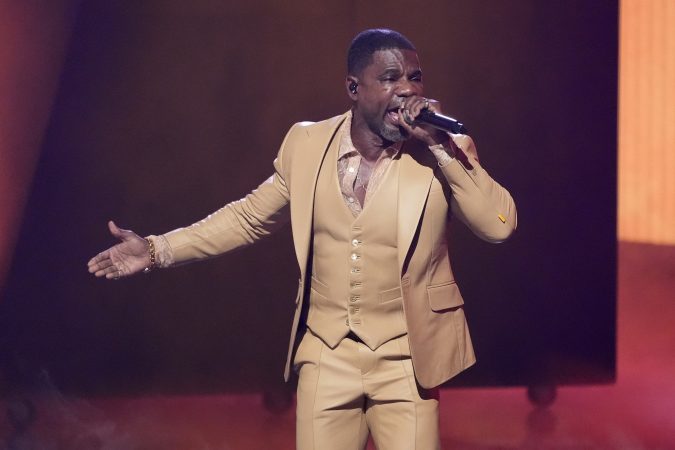
The concert, scheduled for 7 p.m. at Independence Mall, was initially postponed because of lightning and thunder detected in the area.
Wawa Welcome America officials, who organized the concert, said there were plans to restart the show, but it was ultimately canceled due to inclement weather.
There are currently no plans to reschedule Franklin’s show.
Franklin, however, found a way to greet fans as he briefly stood on top of an SUV as the crowd exited Independence Mall.
A downpour started shortly after his departure.
In a video posted on his Instagram page, Franklin explained his intention to put on an “incredible concert.” “I was really excited about it,” he said in a video with the caption, “I need the weather to repent! LOL! 😂❤️🙏🏽.”
“People were really disappointed,” he wrote. “But I need you to know that I’m more disappointed because I was really, really, really ready to go. I love Philadelphia. I’ll get back, man. I can’t let Philly down like that.”
“My feet still hurting from standing out there waiting,” one fan commented under Franklin’s Instagram post.
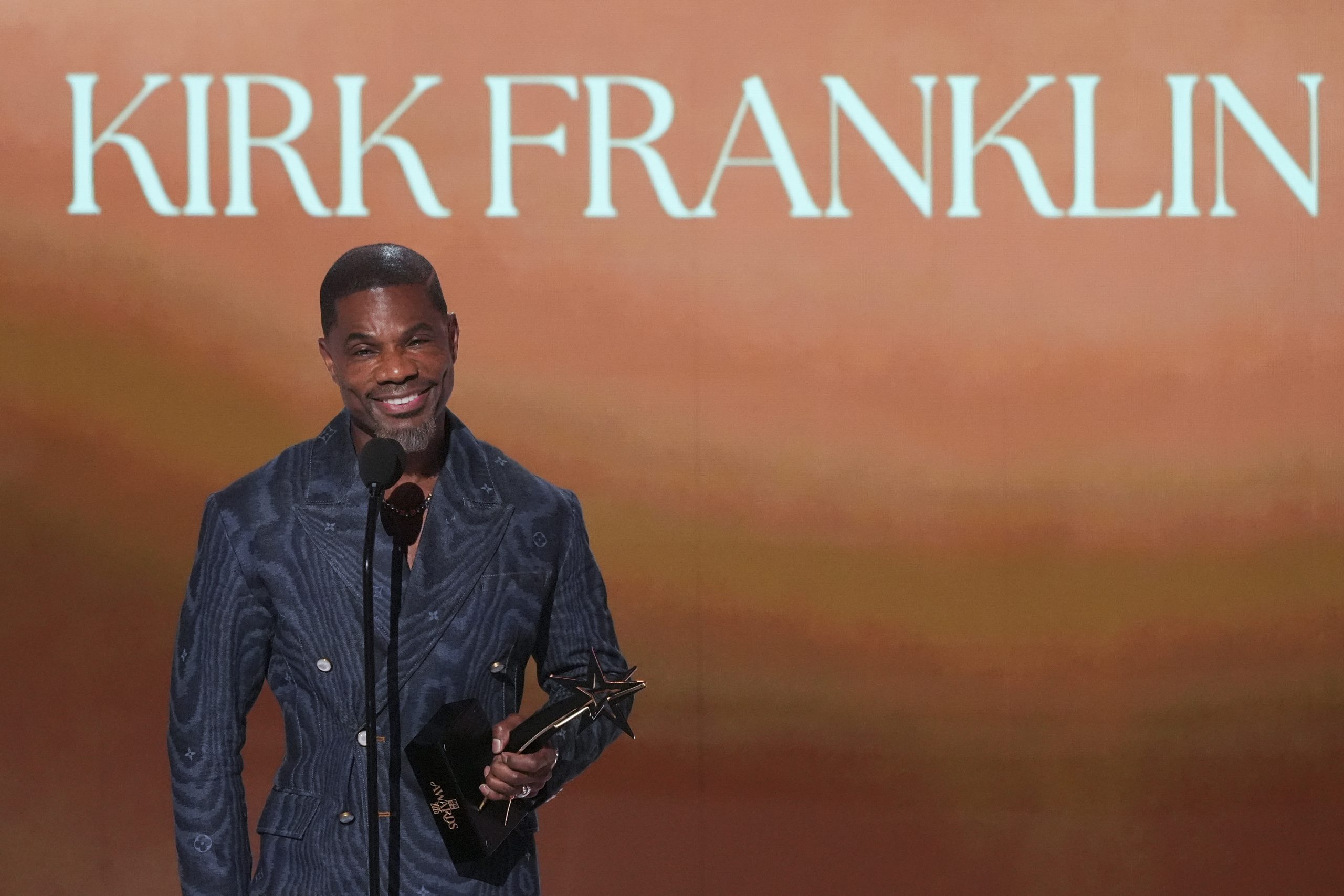
Kirk Franklin accepts the ultimate icon award during the BET Awards in 2025, at the Peacock Theater in Los Angeles. (AP Photo/Chris Pizzello)Chris Pizzello
Not all of Franklin’s interactions with fans on Sunday were as jovial.
In a now-viral social media video, Franklin is seen arguing with an attendee, who urged the singer to “repent” for his sins. Otherwise, he and his wife, Tammy Franklin, are “going to go to hell,” the attendee threatened.
Franklin attempted to confront the unidentified man but was held back by several security guards.
The man was eventually escorted out of the venue by law enforcement officers.
Before the show’s cancelation, fans enjoyed the opening performances and food vendors at Sunday’s event at the Independence Mall, which was part of this week’s lineup of Wawa Welcome America Festival events and concerts.
The celebration of the nation’s 250th birthday will continue with Tuesday’s Philadelphia Orchestra’s Pride concert, Thursday’s “Salute to Service” concert, and Friday’s Pops on Independence concert.
On July 4, the free “One Philly: Unity Concert for America” will take place on the Benjamin Franklin Parkway. Featuring Christina Aguilera, Jill Scott, The Roots, and others, that show is not part of Wawa Welcome America but counts Wawa among its sponsors.
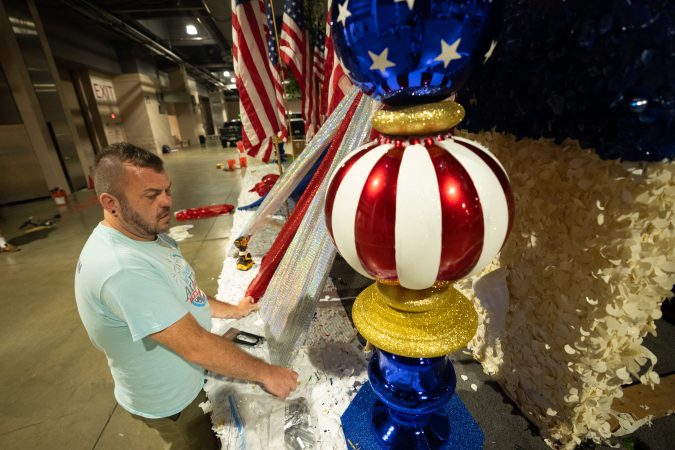
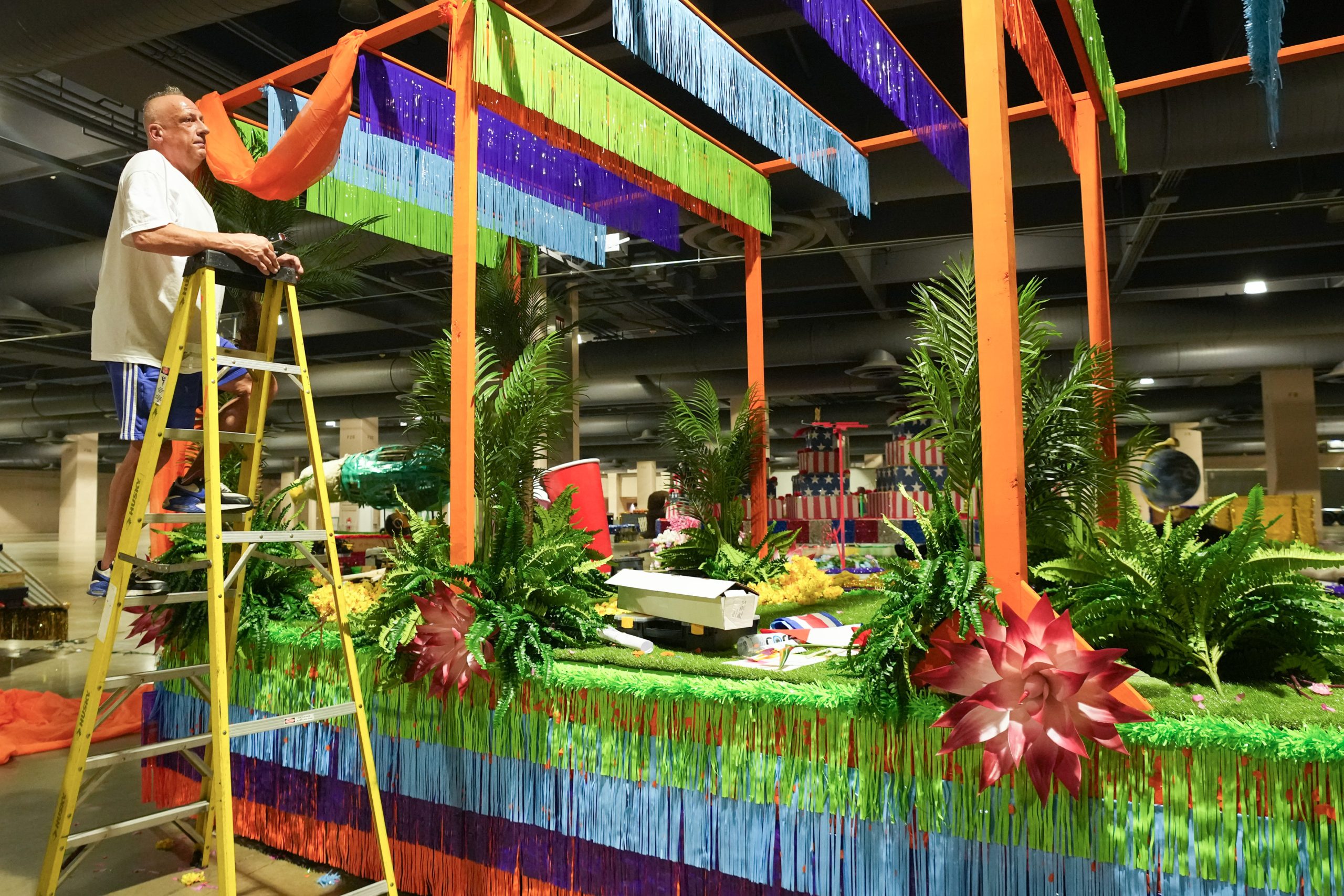
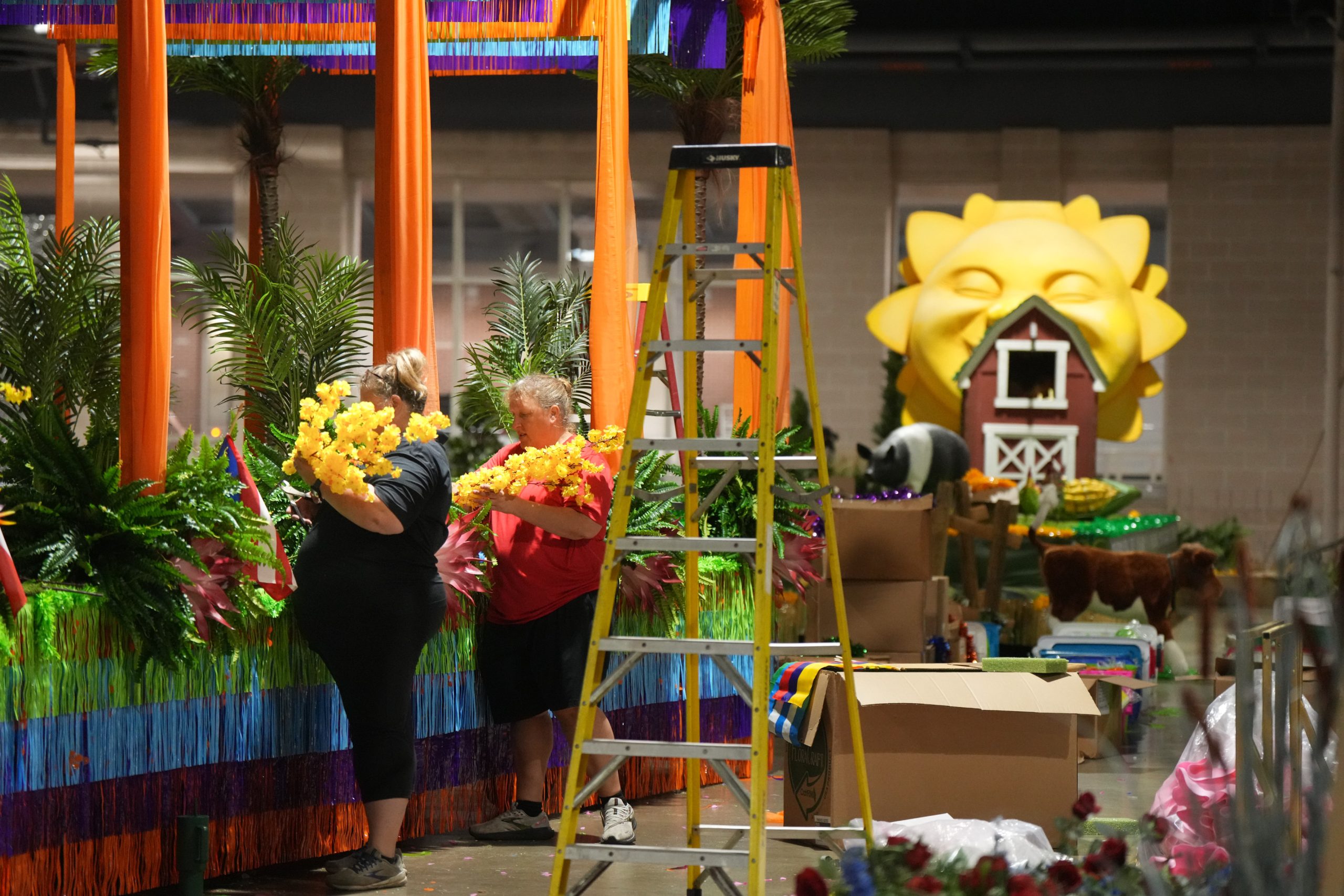
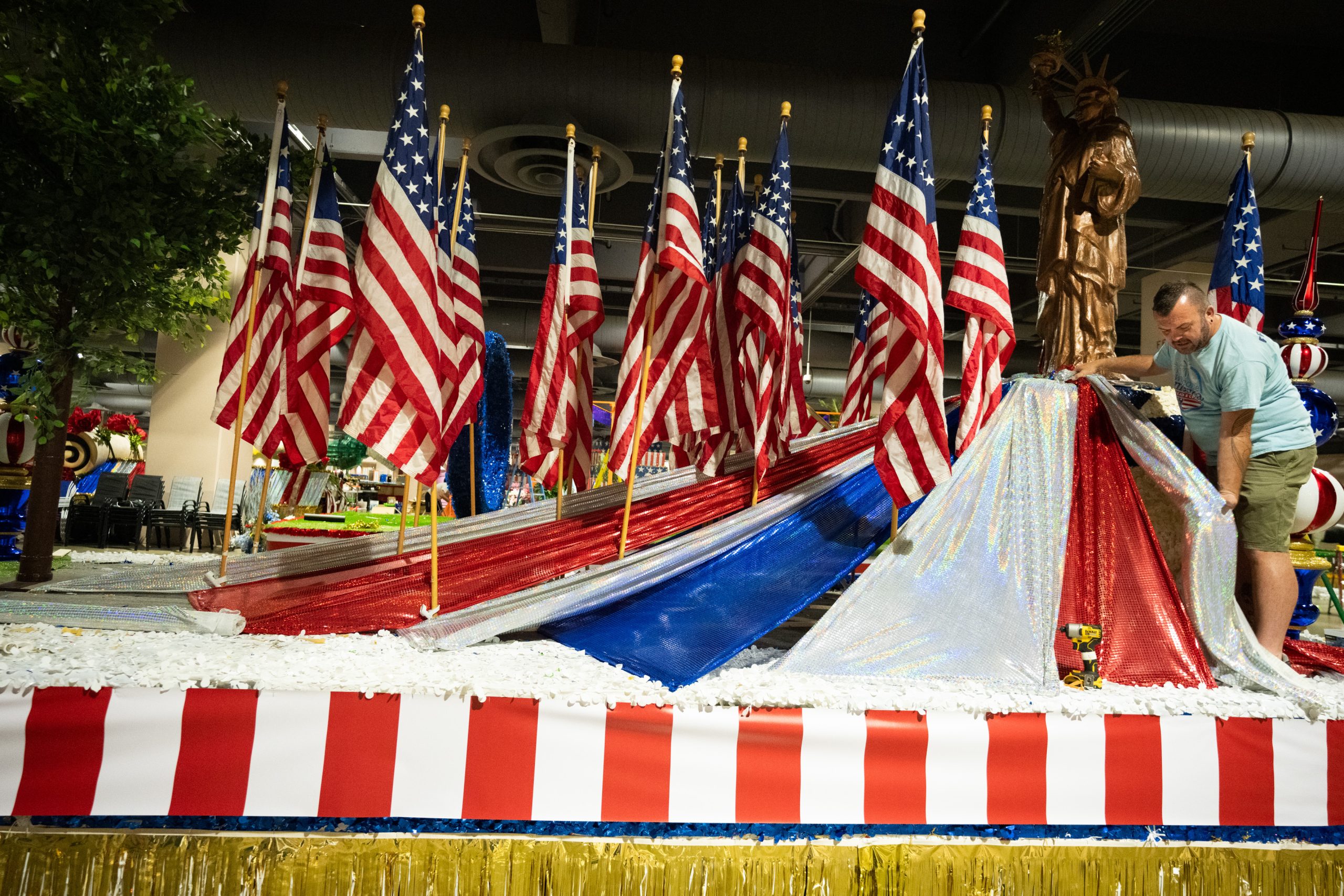
In the dull glow of the overhead Convention Center lights, Todd Marcocci and a band of craftspeople stood next to large wheeled platforms, some housing floral gazebos, others a recreation of a Pennsylvania farm. Sweat dripping from his brow, Marcocci intently drilled palm tree crowns into the base of a platform dedicated to Central and South America.
With just days until Philadelphia’s Semiquincentennial parade, Marcocci, alongside his crew and John Shaw of Shaw Parades, is assembling 19 parade floats to commemorate the United States’ 250th birthday.
Todd Marcocci works on a float back stage with the crews of Friday’s parade and festival.Jessica Griffin / Staff Photographer
The “Salute to Independence” Semiquincentennial Parade is scheduled to begin at noon Friday nearwhere the Declaration of Independence was signed in 1776, which Marcocci reminded himself of while he designed a historical parade.
“I told all the groups who signed on for the parade that we’ll be lining up in the footsteps of the Founding Fathers,” Marcocci said. “We’ll walk through history.”
In the halls of the Pennsylvania Convention Center, where float builders worked on Monday, larger-than-life recreations of Martin Luther King Jr. and Harriet Tubman awaited placement on a platform celebrating the Civil Rights movement.
Mike Oyer works backstage on the floats.Jessica Griffin / Staff Photographer
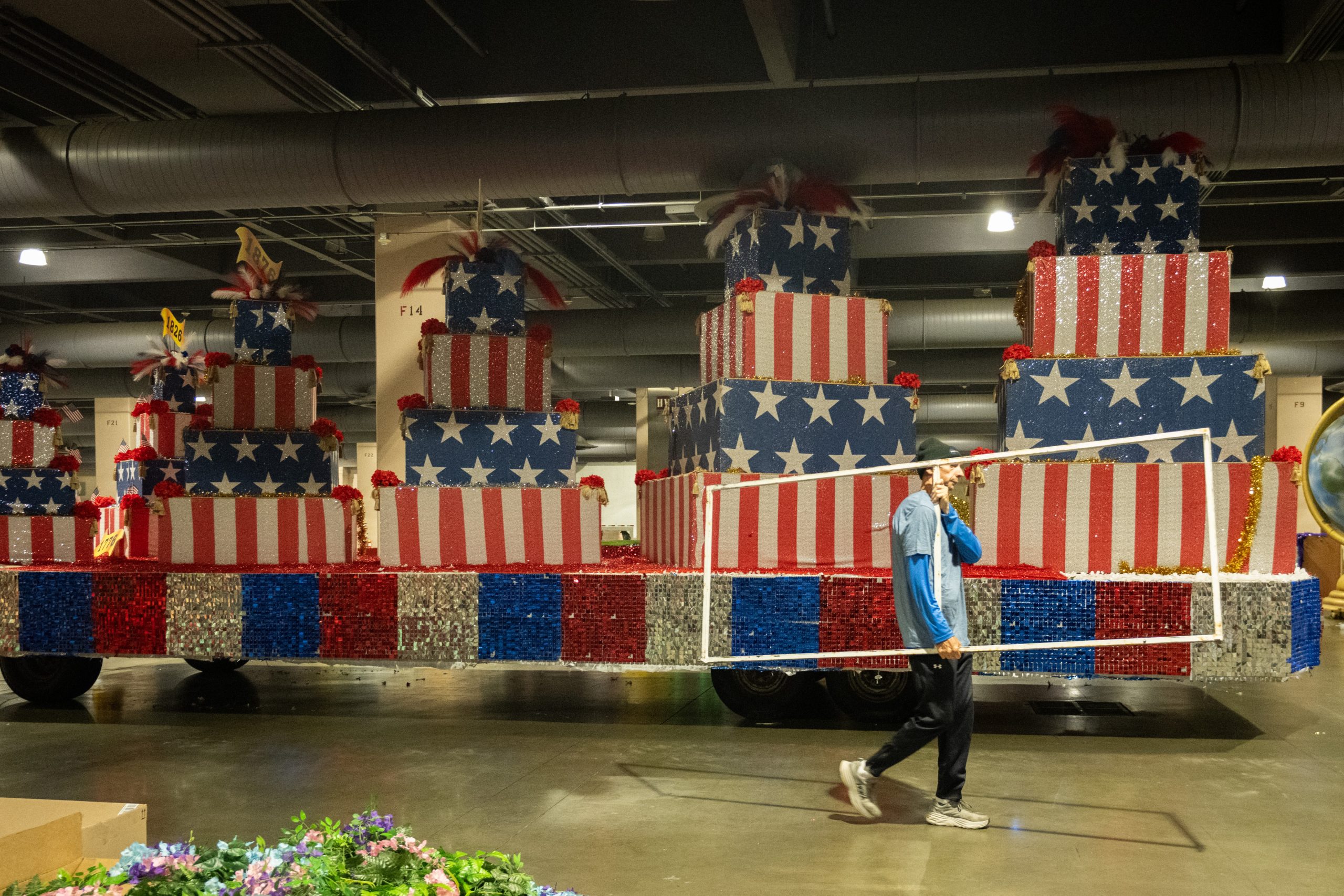
The next float over was bathed in white sequins, where a giant “peace dove” sculpture accompanied by a globe would rest. A few paces over sat a 6-foot-tall Wawa smoothie and coffee cups, and right by that were multiple United States-themed layered birthday cakes marking the various anniversaries of the country.
Shaw worked a blade saw, slicing through two-by-fours to construct the float frames that Marcocci and Co. were painstakingly deciding the minutiae of, such as how many American flags or sequins can be threaded through a float.
Annie Woods (left) and Johanna Gelber working on the floats.Jessica Griffin / Staff Photographer
Shaw, whose parade float company has passed down through four generations, said Philly Fourth of July parades usually average seven floats. “This year it’s almost tripled,” he said. “Todd designs everything in his head, and then we collaborate back and forth to come up with the plan to actually make these ideas work.”
Mayor Cherelle L. Parker will be on board the “One Philly — A United City” float, which features a large sculpture in the shape of the number 1 and a butterfly-and-floral gazebo symbolizing the city’s commitment to a clean and green city, Marcocci said.
Jeremy Williams, works on a float back stage.Jessica Griffin / Staff Photographer
A Liberty Bell float will commemorate some of the Founding Fathers and Betsy Ross with an Independence Hall backdrop. Another celebrates Philadelphia Pride with prominent LGBTQ figures and pride flags atop a vibrant rainbow platform.
“The most important thing for me is that people, whether they’re watching on TV at home across the nation or here in person, is that they see themselves in our parade,” Marcocci said of representing the diversity of America’s history.
Philadelphia’s Semiquincentennial Parade on Friday starts at noon at Fifth and Chestnut Streets, passing such historical landmarks as Independence Hall before heading to Sixth and Market Streets and then west on Market to circle City Hall before ending at Broad and Chestnut Streets after a heat emergency was declared, cutting short the route that was to continue to Logan Circle and loop around before heading back to City Hall.
Fan zones are at Sixth and Market Streets , 11th and Market, and the northeast side of City Hall, where a bar is available for those 21 and over.
“Smokin’” Joe Frazier is finally in his new home, just in time for the 250th birthday of the United States.
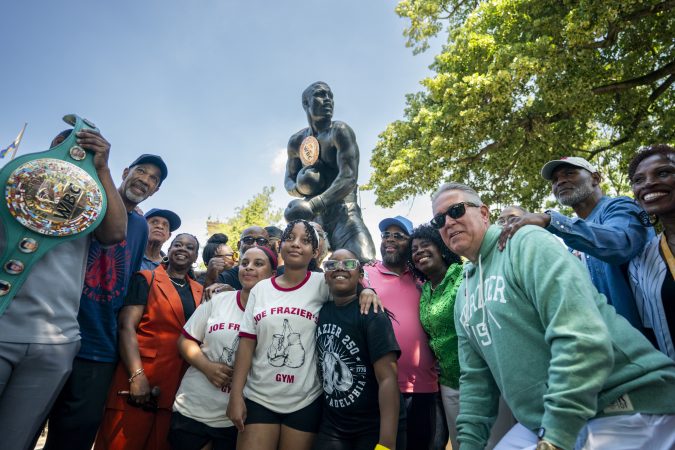
City officials, alongside Frazier’s family, friends, and fans, on Monday unveiled the real-life heavyweight boxing champion’s statue at the base of the Philadelphia Museum of Art. Intended to be the statue’s new location in perpetuity, the spot was occupied by a monument to fictional boxer Rocky Balboa for two decades.
“During this 250th celebration in the birthplace of democracy, we will forever remember that the city got right what it had gotten wrong for a long, long time,” Mayor Cherelle L. Parker said. “Now, Joe Frazier is attached, and connected to, and will permanently be here at our Philadelphia Museum of Art.”
Monday’s unveiling was the culmination of months of planning. The Philadelphia Art commission in February approved a plan to move the statue from by Creative Philadelphia, the city’s office for the creative sector. Chief cultural officer Valerie V. Gay said Monday’s event was something of a “soft launch” for the statue’s new home, as a granite base will be installed in the future, along with more formal interpretive panels.
Mayor Cherelle L. Parker speaks at the unveiling of the statue of former heavyweight boxing champion Joe Frazier at its new home outside the Art Museum. Jessica Kourkounis / For The Inquirer
“Today, we did not want to wait,” Gay said.
Frazier’s statue, after all, lived at the South Philadelphia sports complex for more than 10 years. Created by sculptor Stephen Layne, the statue was unveiled outside what is now Stateside Live! in 2015, four years after Frazier’s death in 2011 following a battle with liver cancer. Frazier, the undisputed heavyweight champion in 1970-1973, is probably best remembered for his three battles against Muhammad Ali in the 1970s.
The city’s statue of Rocky had called the base of the Art Museum’s famed steps home since 2006. The monuments’ moves are part of a larger shuffling of statues at the Art Museum that began in March, when the Rocky statue was moved inside the museum for the first time as part of the ongoing exhibition Rising Up: Rocky and the Making of Monuments.
That Rocky statue will be installed at the top of the Art Museum steps in the fall, when the statue of the Italian Stallion currently there will be returned to actor Sylvester Stallone’s private collection. Stallone, Parker said, was supportive of the Frazier statue’s new location.
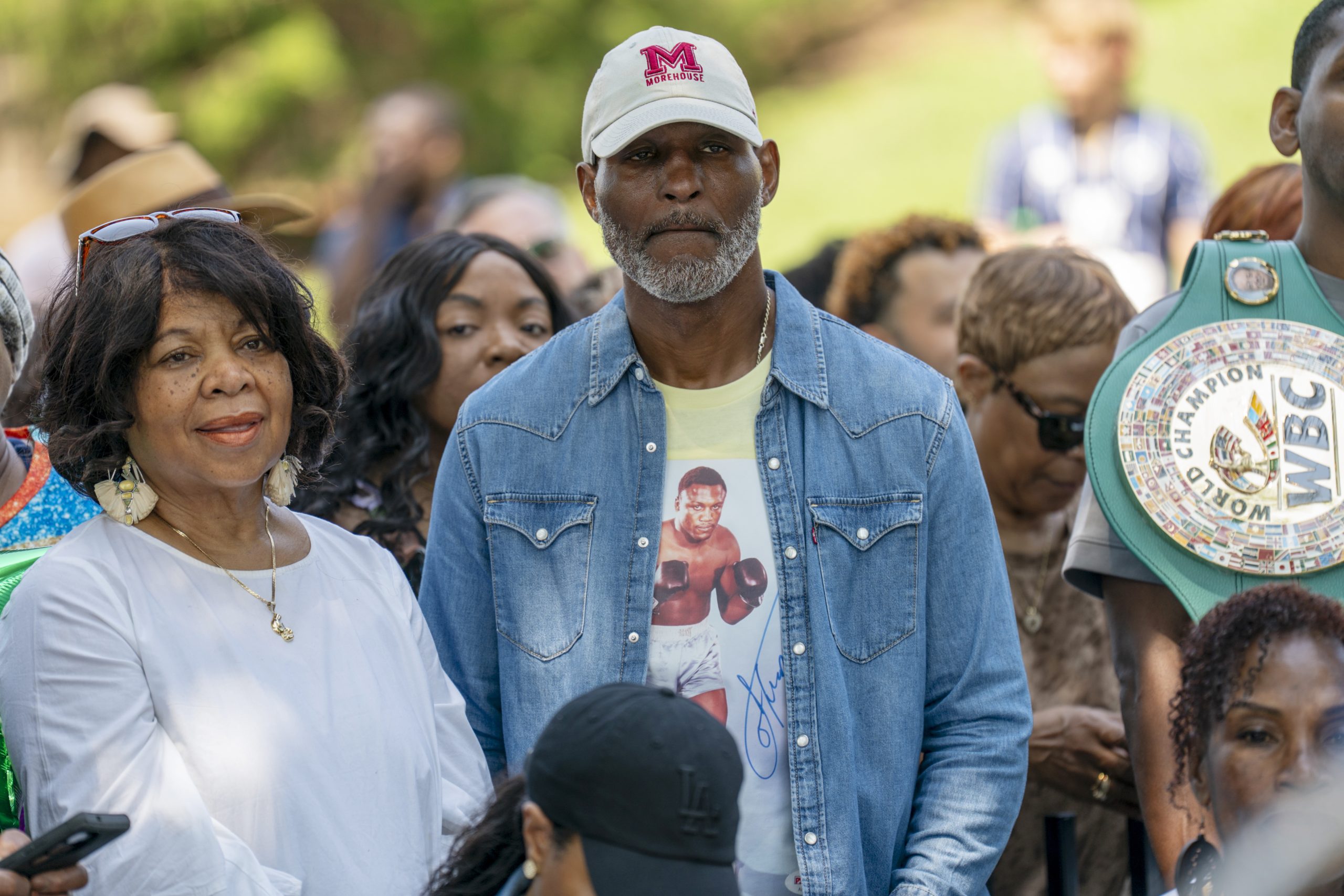
Dozens of the boxer’s supporters attended on Monday, including Philadelphia boxer Bernard Hopkins who held world championships in two weight classes, promoter Joe Hand Jr., and Frazier’s daughter Jacqueline Frazier-Lyde. Frazier-Lyde, a retired boxer and current Municipal Court judge, said the the color of the shroud covering her father’s statue — green —was fitting.
“My mother’s favorite color was green, because we’re from the South and we love green, because it represents life,” she said. “My father, Joe Frazier, liked it because it was the color of money.”
Boxing legend Bernard Hopkins at the unveiling of the new home for the statue of heavyweight boxing champion Joe Frazier.Jessica Kourkounis / For The Inquirer
To the end, the statue’s new location wasn’t the end of efforts in the boxer’s memory. Parker also announced plans for a capital campaign to restore the former Joe Frazier’s Gym on Broad Street above Glenwood Avenue in North Philadelphia. Now a discount furniture store, the building is a legendary location in Philadelphia boxing history, having served as a training location for not just Frazier but other famed fighters and community members.
Parker said plans were underway to establish a way to accept donations for that effort via the Philadelphia City Fund. The amount of funds targeted be raised was not immediately clear.
“It’s important to show the world who we are,” Gay said. “Joe Frazier was a humble underdog whose determination and grit inspires us all. What could be more [a] more Philadelphia story than that?”
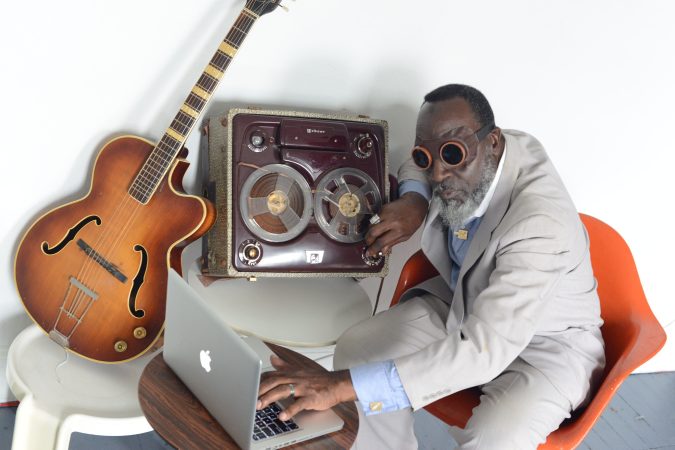
Jamaaladeen Tacuma isn’t particularly interested in dwelling on the fact that he has just turned 70. It may be one of the few things the veteran bassist, with a seemingly limitless capacity for fascination, isn’t interested in.
“I was always the kind of person that looked ahead,” Tacuma said. “I like to say, ‘What am I going to be doing in the future? How will I be thinking in the future?’”
He marked his June 13 birthday not with old friends, but performing at South,leading a never-before-assembled, multigenerational quintet with Pulitzer-winning drummer Tyshawn Sorey, saxophonist and Snacktime cofounder Yesseh Furaha-Ali, guitarist Keyanna Hutchinson, and pianist Yoichi Uzeki.
On July 18, he’ll celebrate the release of a new all-star album with 102-year-old saxophonist Marshall Allen at Grounds for Sculpture in New Jersey. Two months later, he’ll be back at South with Quantum Blues, an unlikely quartet teaming him with longtime Pharoah Sanders guitarist Tisziji Munoz, Living Colour drummer Will Calhoun, and former Late Show with David Letterman keyboardist Paul Shaffer.
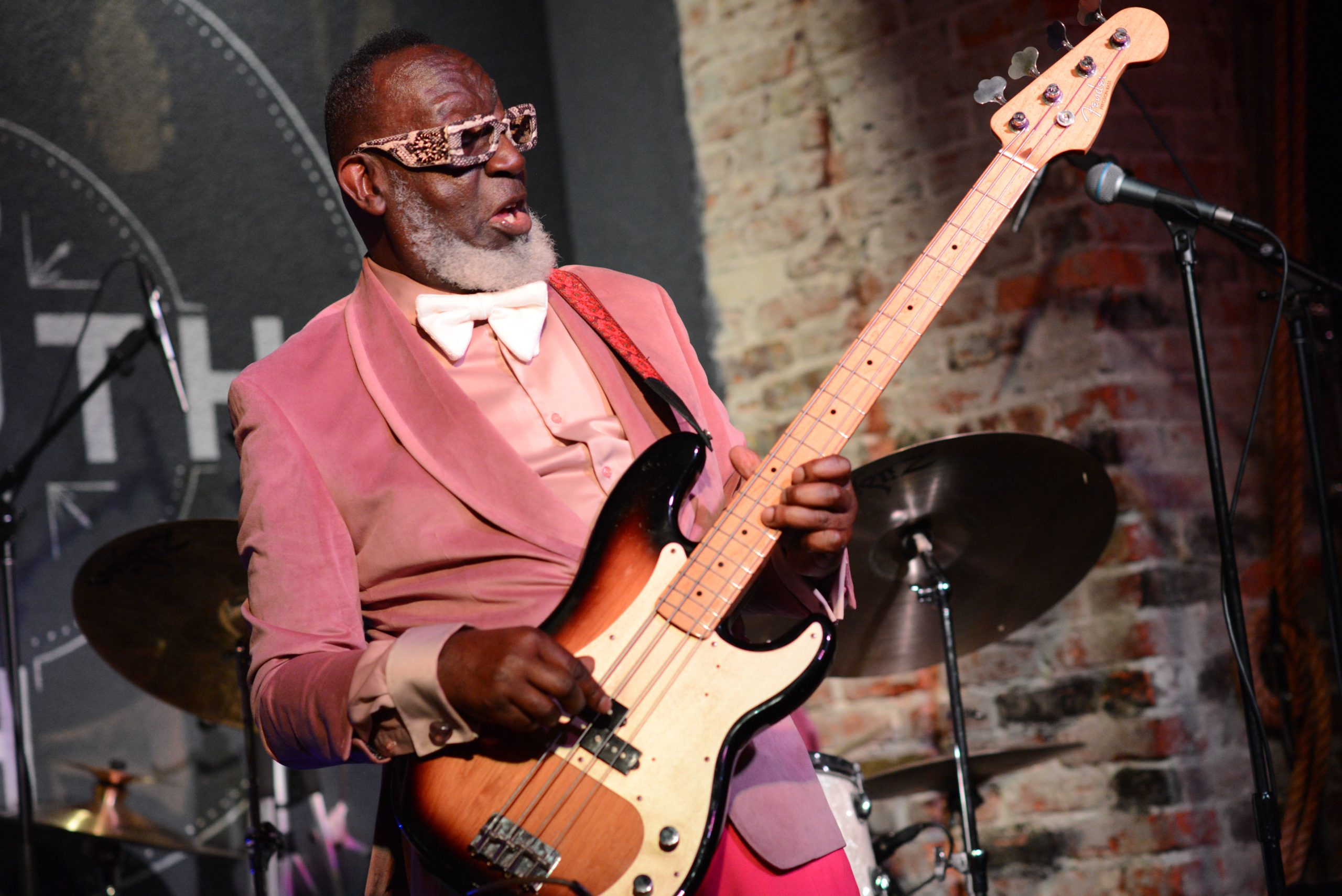
Jamaaladeen Tacuma on stage at South. The bassist celebrated his 70th birthday at the club in a quartet featuring drummer Tyshawn Sorey.Sound Evidence
But it’s not just music that captures his imagination. Before settling in for our interview in May at a Mexican restaurant on Passyunk, Tacuma was gushing about his recent viewings of vintage films from Japan’s Toho studio, giant monster movies like the original Godzilla and The Mysterians.
The lunch, he said, evoked memories of a visit to Mexico City, where he learned of the country’s lucha libre wrestling tradition. This, in turn, prompted the recording of an upcoming album, Bajo Libre.
That sort of thing happens constantly with Tacuma, who has a Zelig-like ability to find himself in unexpected musical situations.
On a recent trip to London, he was being shown around by drummer Sean Noonan, a frequent collaborator. While passing though the Liverpool Street tube station, his ear was caught by the guitar playing of a young busker. He immediately tasked Noonan with finding a studio and enlisted the 18-year-old guitarist, Michael Asukyle, to record an impromptu album he called Mind the Outsiders, which was released last February.
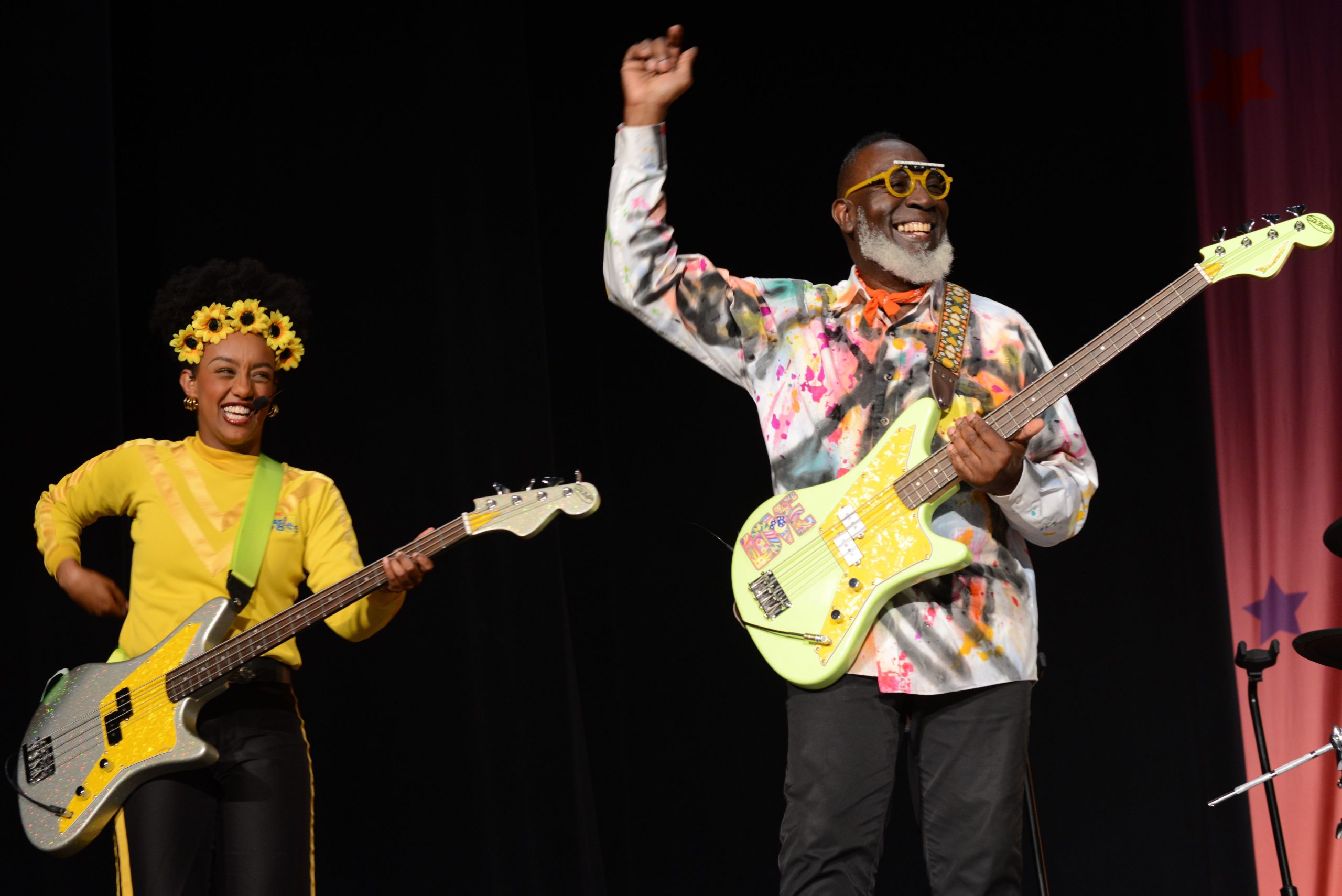
Jamaaladeen Tacuma on stage with the Wiggles in Boston’s Wang Theater in 2023, where he presented band member Tsehay Hawkins with a special DiPinto bass.Sound Evidence
After taking his grandson to see the Australian children’s group the Wiggles a few years ago, he bumped into the band over breakfast at Sabrina’s Cafe the next morning. By the time he got home, they’d invited him into the studio to write and record the song “Play the Bass Guitar.”
He’s since joined them on stage and on television, and plans to reunite with the band this summer at the Miller Theater.
Tacuma’s friendship with Rolling Stones drummer Steve Jordan — they met, he recalls, copresenting an award to the Red Hot Chili Peppers — led to an eight-year gig in the house band for the Michael J. Fox Foundation’s annual gala fundraiser, where he’s played with the likes of Sheryl Crow, Stevie Nicks, Jackson Browne, and Bob Weir.
Almost in spite of his compulsion to move perpetually forward, Tacuma’s 70th birthday year has occasioned a number of opportunities for revisiting the past, as well.
In January, the bassist returned to the Norris Apartments housing project, where he grew up as Rudy McDaniel.
Joined by a group of local singers and musicians, many of whom he’d known since his early days in North Philly, he presented his “The Dream Then & Now” suite, dedicated to the Rev. Dr. Martin Luther King Jr. As Lawrence “Weas” Newton recited the civil rights leader’s words, Tacuma struck up a funk groove in the complex’s community center, a poster board nearby displaying photos of him playing in the same room as a teenager.
Bassist Jamaaladeen Tacuma on stage with vocalist Lawrence “Weas” Newton in January at the Norris Homes Community Center.Adam Shanker
“It was surreal,” Tacuma said with a laugh. “Weas and I grew up in the area. We used to play ball in the basketball courts right next door. A lot of groups came from that area, like Harold Melvin & the Blue Notes, the Stylistics, McFadden and Whitehead, Brenda & the Tabulations. And the Uptown Theater was right around the corner, so I saw everybody there whenever those shows would come to town — the Temptations, James Brown.”
The neighborhood not only nurtured Tacuma’s passion for music but also inculcated his love of fashion.
“If folks had money, they would go downtown and go to Boyds,” he explained. “But for the most part, we would go to the Avenue, Germantown and Lehigh. There you had all the stores, like Leo’s or Al Schaeffer’s Red Carpet Room.”
Tacuma later borrowed the name of one of those shops for his boutique, the Redd Carpet Room. There he sells the finds he brings home from his travels; he can often be found at flea markets and vintage shops in the hours prior to a performance.
“I don’t take bass guitars on tour anymore,” he said. “I just bring a suitcase to fill with clothes. I’m serious about helping guys look a bit better.”
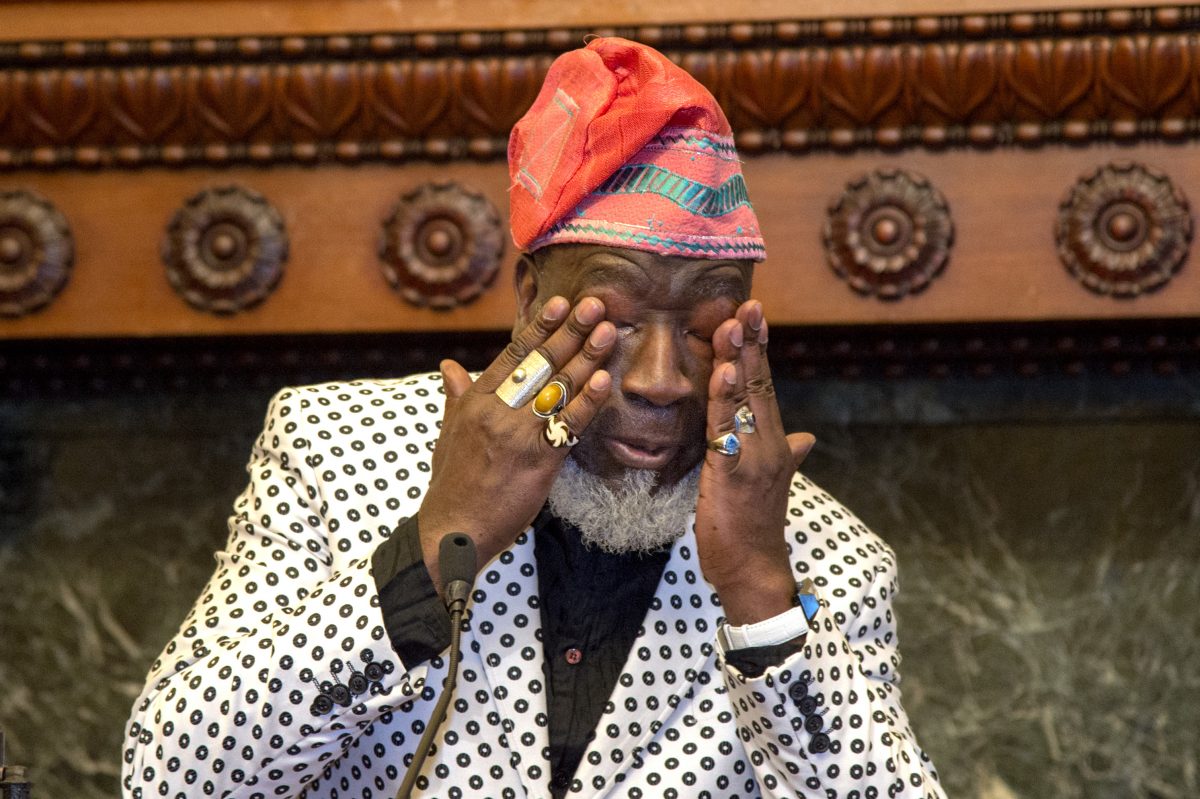
Bassist Jamaaladeen Tacuma wipes away tears after he was presented with the 2018 Benny Golson Award by the mayor at City Hall on March 29, 2018. TOM GRALISH / Staff Photographer
A month after his MLK Day performance, Tacuma played the Sons d’Hiver festival in Paris, where he revisited the hotel that had become the home base for Ornette Coleman’s Prime Time band 50 years earlier, during Tacuma’s first tour of Europe.
“We were supposed to go to Paris for two weeks, and we wound up staying for three months,” he recalled. “I hadn’t been back to that place since that time. The same family owned it. We had lunch right next door, at the same restaurant where Ornette and I used to have lunch, sitting at the same table. It brought back a lot of memories.”
Coleman played a foundational role in Tacuma’s musical life. After high school, he received a scholarship to attend Berklee School of Music but declined.
“Because I wanted to be a musician that played on the road.”
Instead of college, he joined organist Charles Earland’s band but was fired after a year. He moved home, wondering what to do next, until a week later he received a call to audition for Coleman’s band.
Tacuma gives an impromptu solo performance in the Mayor’s Reception Room on March 29, 2018.TOM GRALISH / Staff Photographer
“I learned so many things from Ornette,” he said. “As a bandleader, he wasn’t dictatorial, but he knew what he wanted and he knew how to extract that from the members of the band. Also there was a seriousness about sound, the idea that if you really, truly hear something different, then you should express it. You don’t have to follow a trend.”
Those are lessons that Tacuma has carried with him over a remarkably diverse and unpredictable career spanning more than half a century. He has collaborated not just with a staggering variety of musicians but with visual artists, filmmakers, architects, and scientists.
When asked to take a moment to look back over it all, even he has to marvel.
“I think I’ve looked into the future so much,” he concluded, “that I have a lot of stuff now to look back on. I feel blessed that the creator has given me all this.”
The players amble into the auditorium on acloudy May morning to run through their schemes and formations and make last-minute adjustments to the roster. Some are already in uniform — waistcoats and breeches — fueling up on Wawa coffee and bagels. Others scroll aimlessly on iPhones or finish off their cigarettes outside the Free Quaker Meeting House near Independence Hall. They discuss contingencies, ready their gear, and buckle their latchet shoes tight.
“Get out there and have fun,” their coach, Historic Philadelphia’s director of storytelling Johanna Dunphy, says as she sends her proud-chested team of historical reenactors off for their preseason opener.
This is the start of the team’s Super Bowl run: the lead-up to the nation’s Semiquincentennial. The cast of Ben Franklins, John Adamses, and Betsy Rosses — actors who have spent months and uprooted their lives to learn about and live as colonial America’s key characters — will be at the front lines of the 250th birthday celebrations, which began with the cast’s opening day on May 23 and reach a fever pitch on July 4. They will become de facto historians, guides, entertainers, and ushers to an expected crush of tourists, all while anchoring how the country’s earliest days are memorialized and whose stories get to be told.
“Fly!” Dunphy says with gusto as the performers shuffle out of the modest redbrick building.
This set of actors is part of Historic Philadelphia’s Once Upon a Nation program — a series of performances staged throughout the summer and beyond in Philadelphia’s historic district and at Valley Forge. It’s Once Upon a Nation’s 21st season, but this year is expected to be one of its biggest ever, with the most actors, plays, scripts, and events.
And, with tourism agencies expecting this summer’s events to draw upward of one million visitors, it’s almost certain to be the program’s largest audience.
“Philadelphia is ready for you,” Amy Needle, Historic Philadelphia CEO, told the players on the last day of the preseason. “And I know you’re ready for them.”
Shecky Perlman as Ben Franklin, and other historical reenactors receive their diplomas on May 21, 2026, after weeks of intensive, immersive training at the Benstitute. Tom Gralish / Staff Photographer
Fourmonths to game day
Actors, mostly local, file in and out of Jason Greenplate’s office on a chilly January afternoon. Greenplate, program manager for Once Upon a Nation, and his colleagues are seeking the strongest possible players who have the passion, the look, and the improvisational skills to take on the characters and become “history makers” — what Historic Philadelphia calls its reenactors.It’s essential for these coaches to choose players who are not only capable of taking on these roles but are also willing to challenge their own understanding of history.
Spencer Salusky, a 23-year-old fresh William & Mary graduate, walks through the door.
As a draft prospect, Salusky is an impressive pick. He can execute even the most complex of plays (tricky lines and blocking), and his stats (body measurements and head shape) are optimal.
“He kind of looks like John Adams,” Greenplate thinks.
After conferring with his peers, Greenplate chooses Salusky tobecome Once Upon a Nation’s next John Adams, and, one by one, 19 more actors are cast as history makers and storytellers, those who are stationed at the city’s historic sitesin green polos to offer context to visitors. They join the existing 30 company members returning from prior years.
Courtney Mitchell, who portrays Margaret Woodby (left), and Spencer Salusky (right) as John Adams, join other historical reenactors at graduation on May 21, 2026, after weeks of intensive, immersive training at the Benstitute.Tom Gralish / Staff Photographer
Three months to game day
The actors soon begin their training. For Salusky, that looks like receiving a large packet full of biographical information about John Adams — where he was born, his wife’s name, and his perspective on slavery — from Doug Thomas, director of history makers.
Thomas is a player-coach, a star in his own right who can seamlessly transition to the coaches’ box. Like Deion “Prime Time” Sanders, Thomas is a Swiss Army knife on the field, having played every position in the game of historical reenacting, from William Penn and Patrick Henry to Francis Scott Key, and has been doing the work for nearly 30 years. But what makes him truly elite is his position as Mount Vernon’s George Washington.
Out in the field, the players might be blindsided by a granular question from a tourist, an offensive remark from a passerby, or incessant badgering from a child. On the stage — where the history makers also perform a series of scripted plays — they must be prepared to embrace their characters’ conflicting motivations, shifting attitudes on political issues, and complex interpersonal relationships.
Thomas is equipped to help them tackle it all.
He guides them in studying their characters, trains them on redirecting conversations with visitors toward topics they’re knowledgeable about, and teaches them improvisational techniques. He also prepares them to embody the voice, posture, and behavior of historical figures.
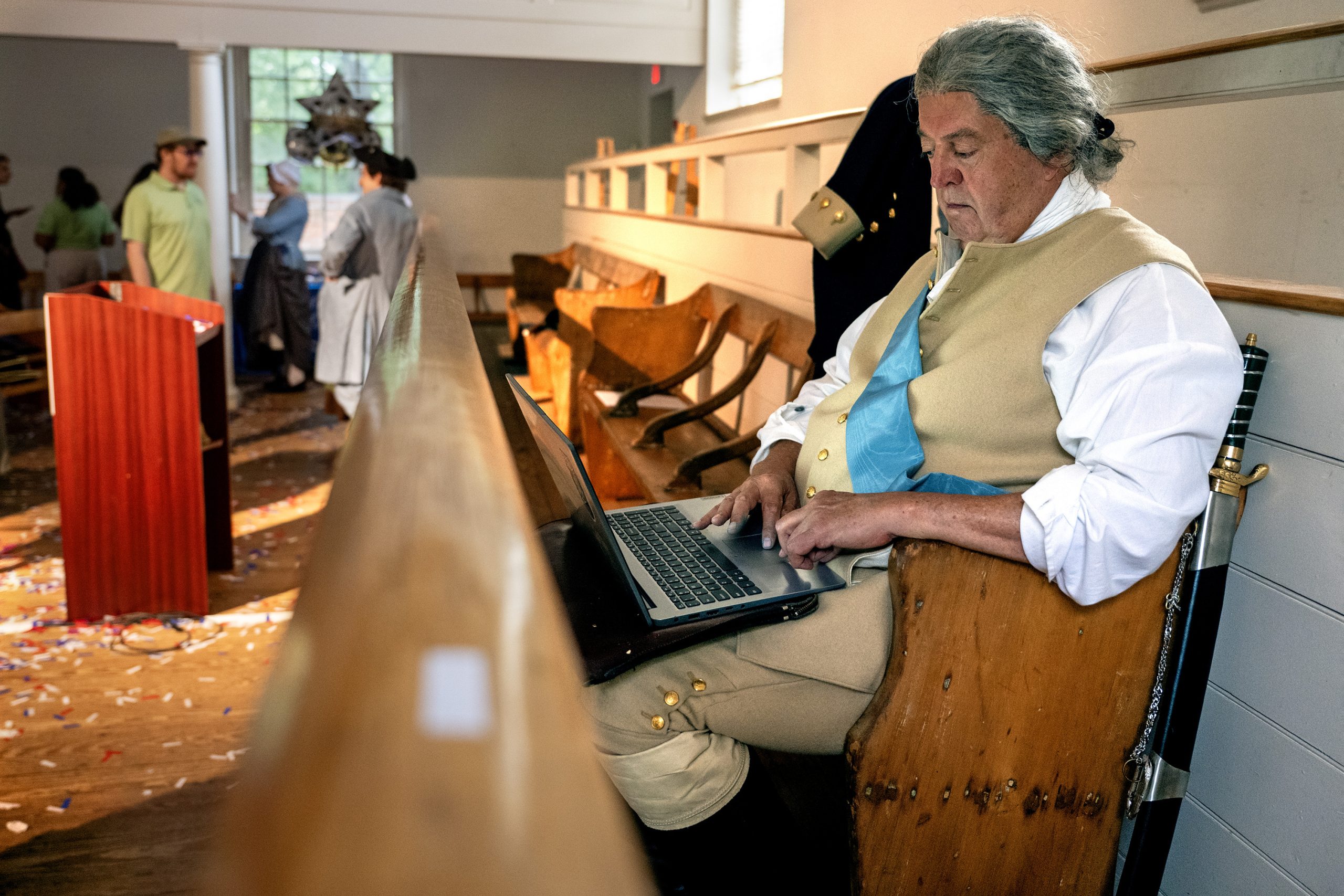
Jim Fryer as George Washington checks in on his laptop on May 21, 2026, after the graduation of dozens of historical reenactors after weeks of intensive, immersive training at the Benstitute.Tom Gralish / Staff Photographer
Three days to game day
“Adams,” Thomas says, summoning Salusky during a rehearsal for Cocktails and Congress, a marquee performance in the Once Upon a Nation repertoire.
On a scorching 95-degree afternoon that foreshadows what the players can expect during the steamy home games to come, Thomas scans the script, glasses poised atop silky black hair that grazes his shoulders. He directs Salusky’s attention to a moment in the dialogue: “Slavery is like a great cancer.”
He cautions the actor to be careful with how he utters that line. Adams is torn about slavery at this point in his life, Thomas explains.
“He doesn’t like it, he doesn’t support it, but also he does realize very practically what eliminating slavery would do to the economy,” Thomas tells Salusky.
Salusky contemplates the note, sitting on a Meeting House pew with a mechanical pencil tucked behind his ear.
“Adams is evolving,” Thomas tells him. But “he’s a practical man.”
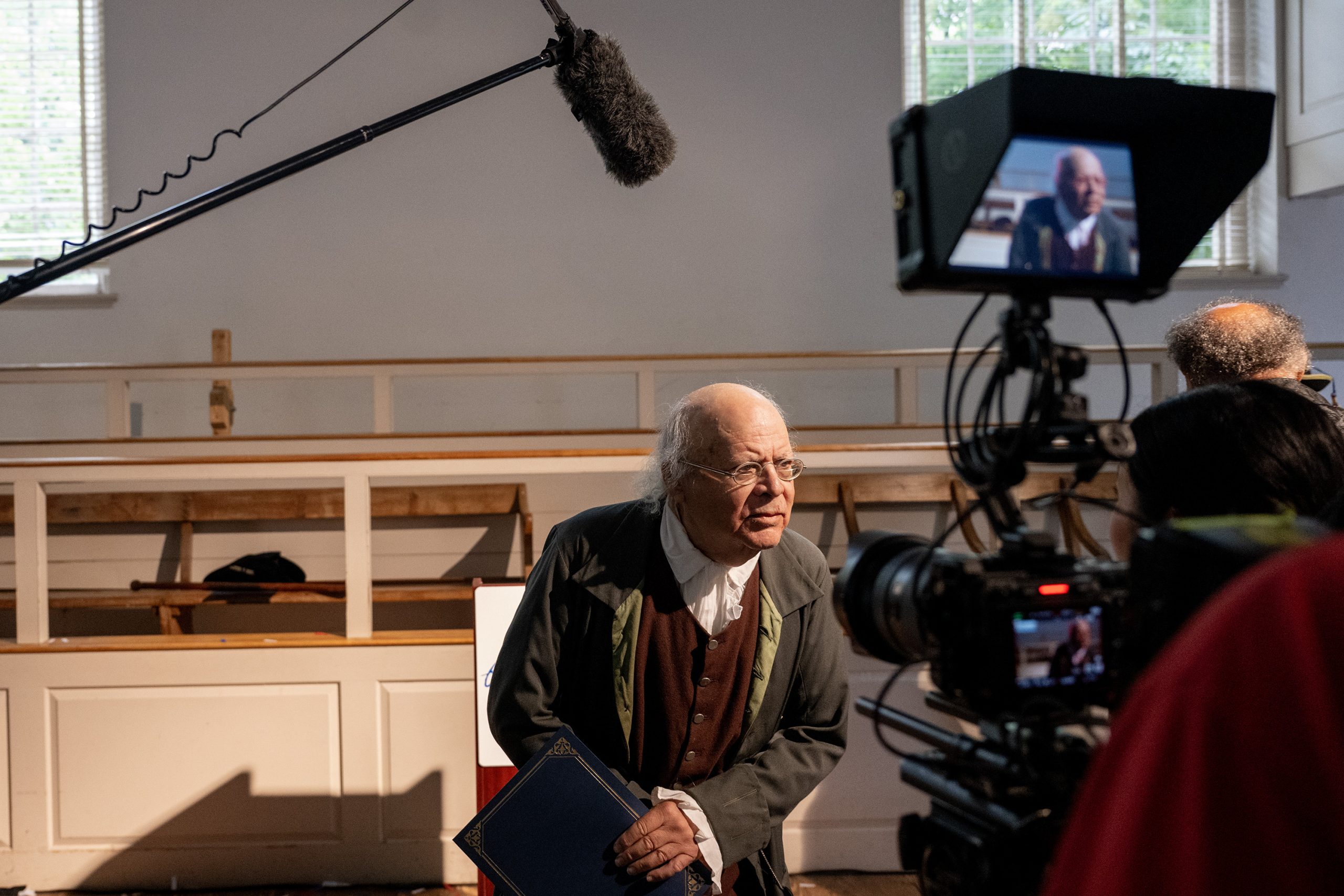
Shecky Perlman as Ben Franklin, ready for his close-up, on May 21, 2026, as he is interviewed by a documentary film crew, as dozens of historical reenactors graduate after weeks of intensive, immersive training at the Benstitute. Tom Gralish / Staff Photographer
Two days to game day
Even with centuries of primary and secondary sources, and extensive research, there are still gaps in what’s known about 18th-century American life that the actors and program coordinators must contend with. There’s a trove of information on John Adams, for example, but the documented lives of women and people of color are far less complete, like that of Hannah Till, an enslaved cook for George Washington at Valley Forge, who purchased her freedom. What’s known about Till is often centered on her enslavers.
West Philadelphia actor Miranda Thompson, who portrays Till as well as Sarah, a fictional composite character in Cocktails and Congress, relies on more general information about how women of color lived during the colonial era to inform her performance. “You just want to get it right,” Thompson, 43, says. “You want to give truth to who that person was. … I feel like if I’m grounded and honest within that interpretation, I think that I’ve done it justice.”
For historian Sandra Mackenzie Lloyd, who authored many of the Once Upon a Nation scripts and founded the Benstitute — the immersive training program the actors undergo — the American story is about “more than the dead white dudes.”
“It’s not a straight line,” Lloyd says. “We are people who have been through many difficult periods and ups, downs. This is a country that was created by people from many places with different beliefs, and that’s historic, and it’s contemporary.”
Organizers were intentional about the stories and figures they chose to platform this summer, centering diverse and layered voices in the narrative of the nation’s founding, including those of Black Americans whose stories have been omitted in the retellings of the story of 1776.
“Our history is being erased, voting rights [are being erased], certain books are banned,” Thompson says. “Representation matters … to know that we were there, and we played an important role.”
Prominently featuring Black history during the 250th, she says, is also an opportunity to dismantle racist, archaic stereotypes about enslaved people through authentic storytelling and connection.
“You can change a person’s mind,” Thompson says. “We’re human, we can always change our minds.”
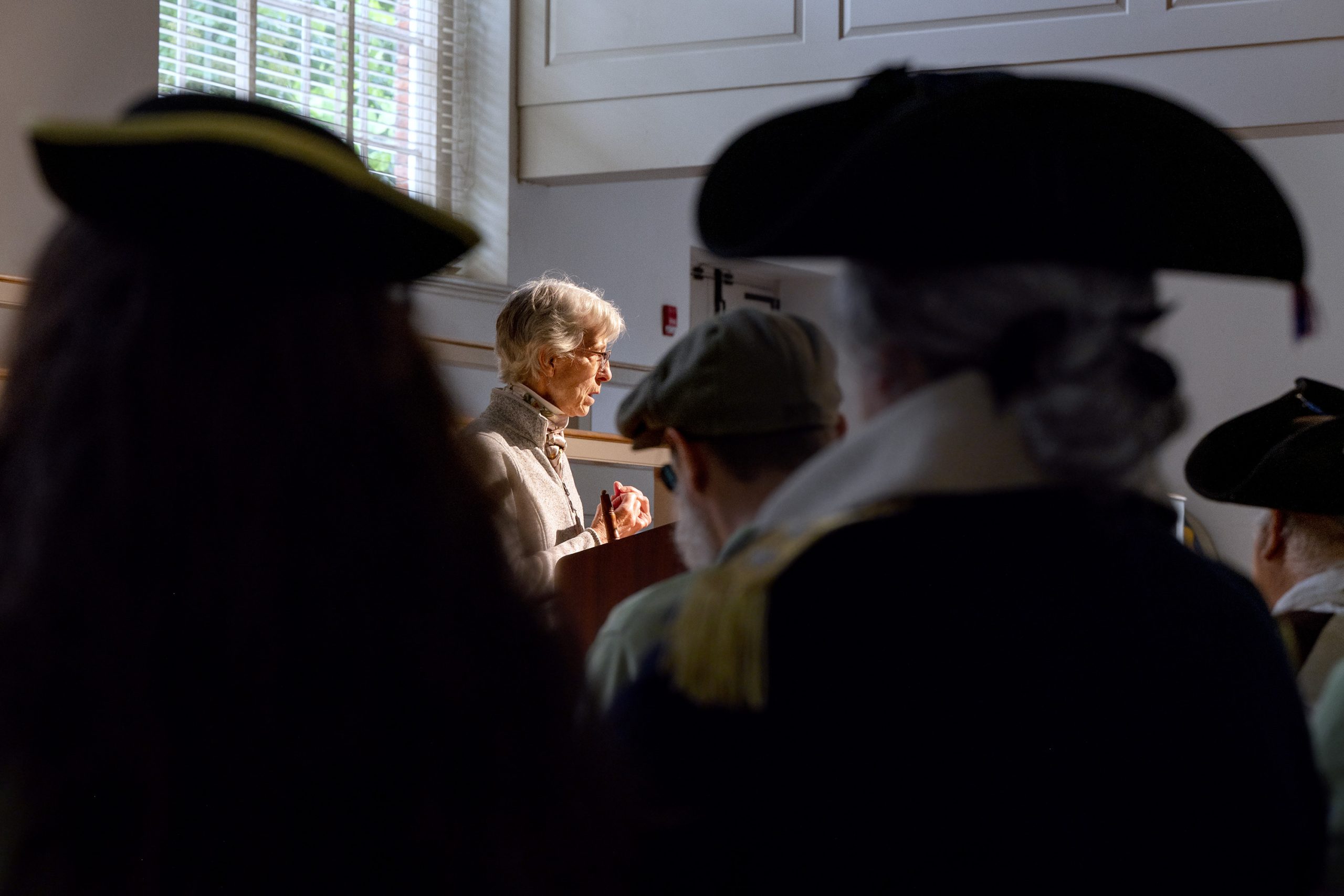
Historian Sandra Mackenzie Lloyd, founder of the Benstitute, delivers the commencement address on May 21, 2026, as dozens of historical reenactors graduate after weeks of intensive, immersive training.Tom Gralish / Staff Photographer
One day to game day
Preparations for the reenactors include not only character work, but also tourism and hospitality training. They learn how to guide someone to the best cheesesteak or nearest toilet while staying in character and using period-appropriate vernacular. The actors also learn how to beat the heat in wool frocks and petticoats and stay safe.
“Make sure to hydrate, hydrate, hydrate,” Dunphy, the storytelling director, tells her team during a morning gathering at the Meeting House before they hit the streets in costume, and a set of volunteer fake tourists heads out to test the reenactors’ skills before they’re faced with real tourists.
She points them to a packet in their supply bags full of powder to pour into their water for extra hydration.
“Drink this,” she instructs them.
Most importantly, Dunphy reminds both the history makers and the storytellers what to do if they’re out in the field and feeling unsafe.
“History makers, please remember this: If a storyteller says, ‘Have you seen John Adams?’ Don’t be cute. That is a plea for help; they need you to stay with them. It is not a joke. They need you to stay,” she says. “Things can turn on a dime.”
And, as this is live performance, things often don’t go according to plan.
During an April news conference at which a Betsy Ross and a Benjamin Franklin from the company stood onstage beside Gov. Josh Shapiro, a giant poster reading “America 250 PA” fell forward, scraping Franklin’s behind.
Carol Spacht, the Betsy Ross at the event, acted quickly.
“This is such an exciting announcement that the world is falling apart over it,” she exclaimed after the poster came down, gesticulating with a scroll clasped in her hand before turning to the Benjamin Franklin reenactor, Bill Robling.
“Quite all right, Dr. Franklin?” she asked as he nodded. “We’re sturdy at our age. 250 years does that.”
At a recent event at Reading Terminal Market, Salusky, as John Adams, had to navigate how to handle tourists approaching him, thinking he was Benjamin Franklin.
“As John Adams, how do I react to people thinking I’m Ben Franklin. Well, he was a mentor of his. He really admired him, found him annoying, but would still be a little flattered,” Salusky says. “It’s kind of just like in-the-moment problem-solving.”
Over the course of their four months of training, the actors finally reach a place of feeling ready for anything … mostly.
“Speaking in 18th-century tongue continuously, I am nervous about that,” Thompson says. “I want to portray it real.”
Cause for celebration
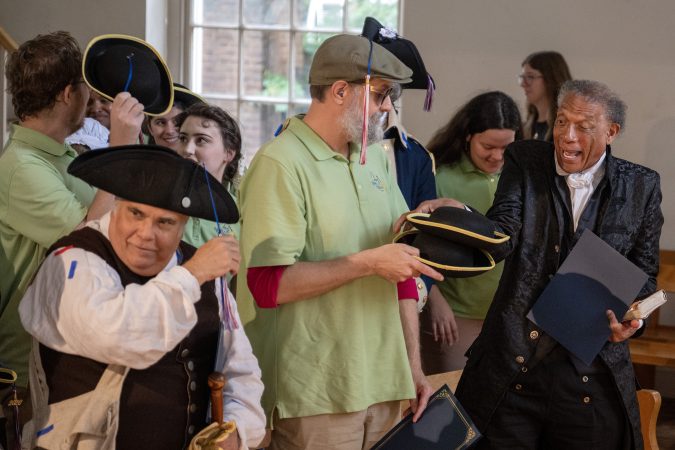
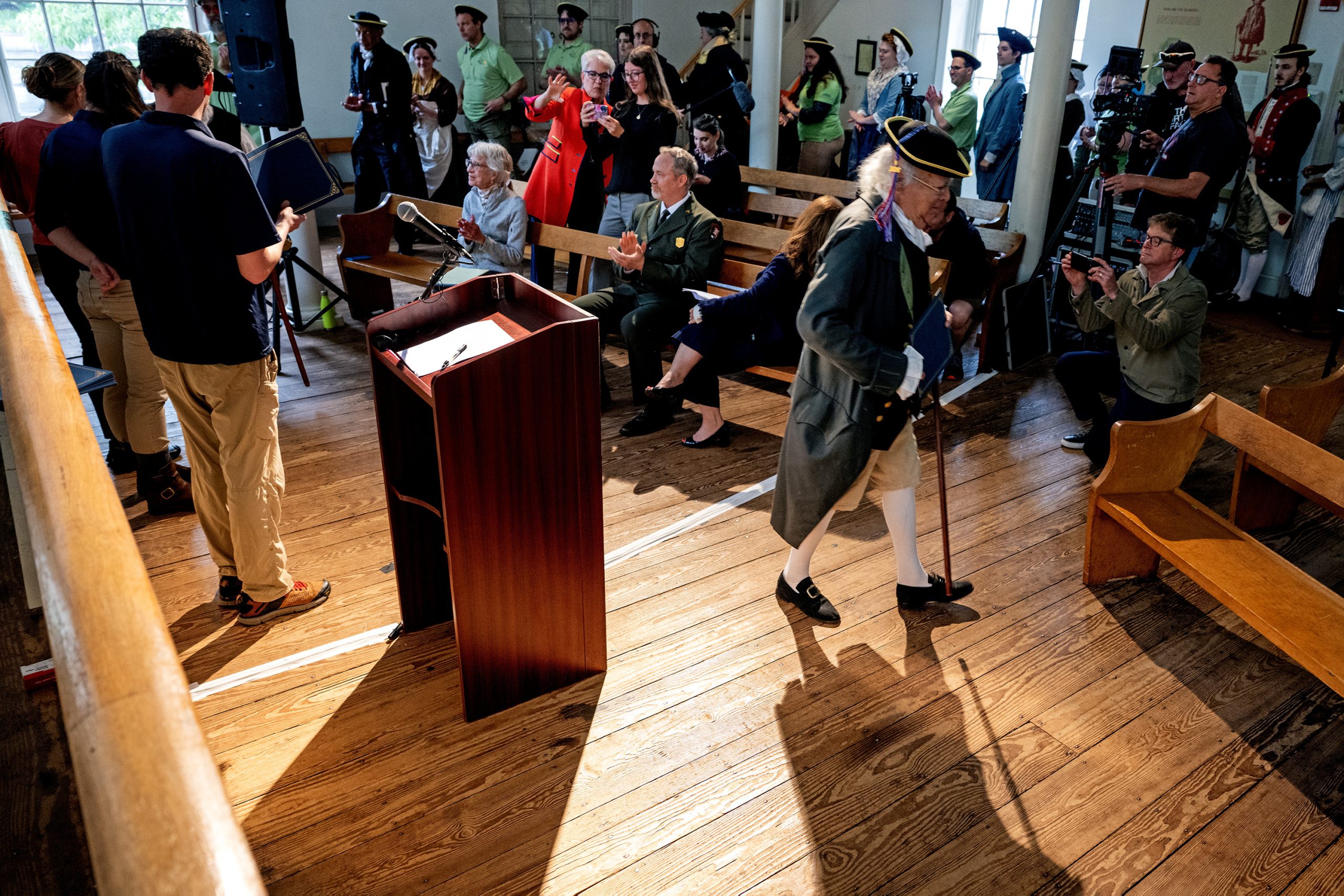
Before the actors are on their own on the Philly streets, they and their mentors celebrate the completion of their Benstitute training with a graduation ceremony at the Free Quaker Meeting House.
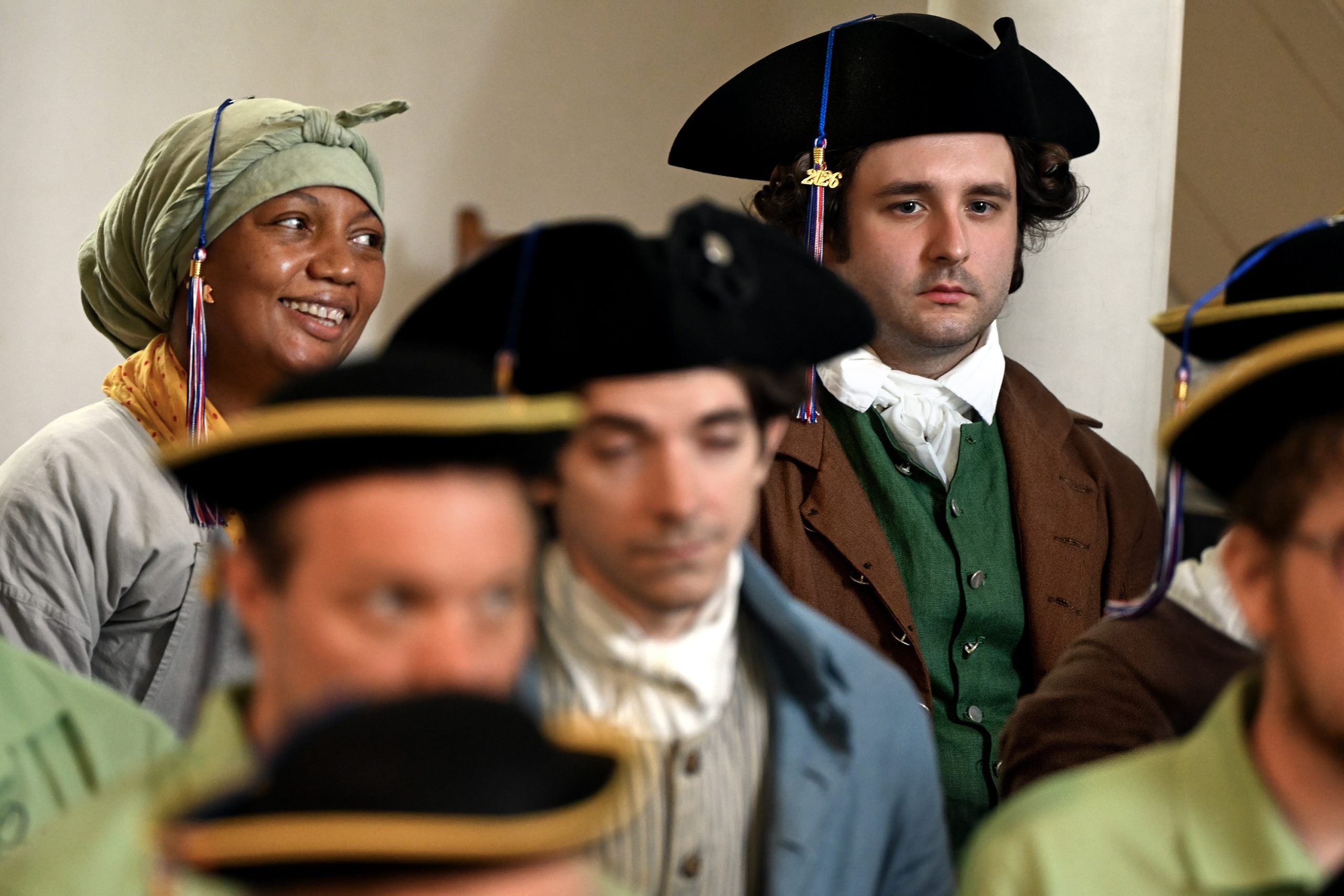
Graduates file in, some in polos and slacks and some in costume, all wearing red, white, and blue tassels dangling from the center of their mob caps and other historical hats. They sit in the pews, players awaiting the game-time whistle, as their coaches offer them final words of encouragement before they put their drills to the test and tackle the real world, beginning with their season’s opening day — their fervor not letting up until they run through the proverbial tunnel onto the championship field for July 4.
“History is not just about buildings, artifacts, and famous moments. It is about people — their choices, their struggles, their disagreements, their courage, their hopes for the future,” says Steven Sims, superintendent of Independence National Historical Park. “Long after visitors leave Philadelphia, they may not remember every date they heard or every building they toured, but many will remember how someone made them feel connected to history. Many will remember you.”
One by one, the reenactors and storytellers cross the stage, graciously accept their diplomas, smile for photos, and return to their seats.
“Class of 2026, please stand up,” says Amy Needle, the Historic Philadelphia CEO.“Change your tassels. Congratulations! George Washington?”
“Class of 2026,” aWashington reenactor calls. “Hip hip.”
“Huzzah,” they respond.
“Hip hip,” he repeats.
“Huzzah!” they conclude as audience members deploy tiny silver confetti cannons and red, white, and blue rain down upon them.
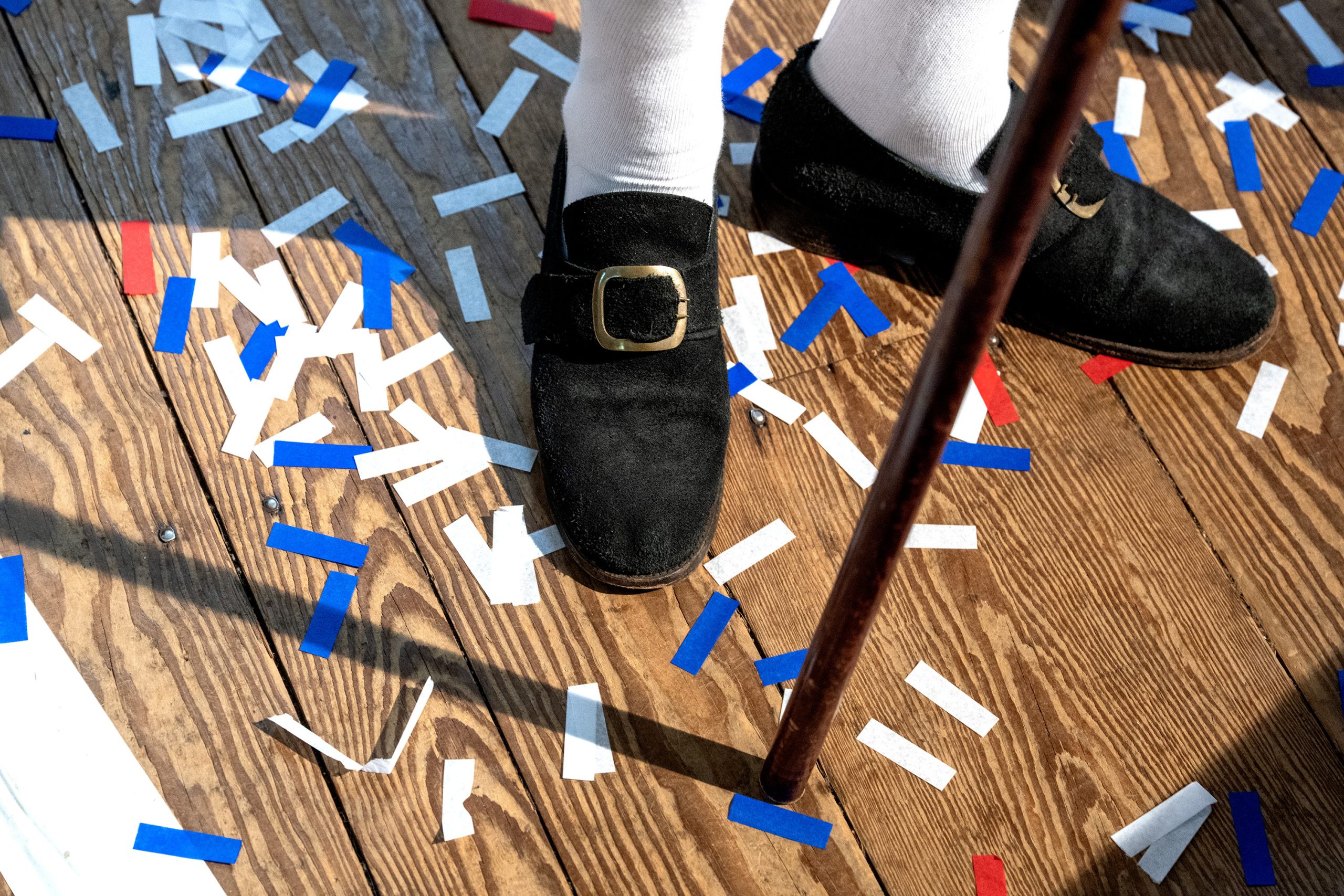
Shecky Perlman as Ben Franklin, his cane and feet, Thursday, May 21, 2026, among the confetti as dozens of historical reenactors graduate after weeks of intensive, immersive training at the Benstitute.Tom Gralish / Staff Photographer