Category: Temple

  • Sam Brown almost walked away from football. Now he looks to lead Temple’s backfield.

    Sam Brown almost walked away from football. Now he looks to lead Temple’s backfield.

    There was a time when Sam Brown thought his college football career was over.

    Before transferring to Temple from Rutgers this past offseason, the running back was limited to 16 carries for 38 yards during an injury-riddled 2025 season with the Scarlet Knights.

    “There was a point where I didn’t really want to play anymore,” said Brown, a fifth-year senior from La Salle College High. “It was a lot on me mentally. Injuries were weighing on me a lot, and I didn’t want to be in a situation where I got hurt again.”

    Brown has been hampered with injuries throughout his college career. He dealt with a season-ending lower-body injury in 2024 which lingered into 2025, when he played in just three games. As a freshman in 2022, , he suffered a broken foot in the middle of the season. His sophomore year was his only complete season; he had 216 yards and two touchdowns in 12 games.

    Before his foot fracture in his freshman season, he had rushed for 374 yards and three touchdowns. Now, in his final year of college, he’s looking to get back to that.

    “I wanted a fresh start,” he said. “I wanted to go somewhere that was definitely home-oriented, with a great coaching staff and great teammates. That is what went into my decision. And I met with everyone when I took my visit. It just felt like the right place and the right fit.”

    ‘Can’t just give up’

    The injuries took a physical and mental battle on Brown. But he spent most of his life playing football, so walking away wasn’t going to be easy.

    “I noticed that [quitting] wasn’t the right way to go about things,” said Brown. “I just thought [about] all the sacrifices that my parents made for me since I was 4 years old playing football, and I was like, I can’t just give up. I have another year left, and I need to take advantage of that.”
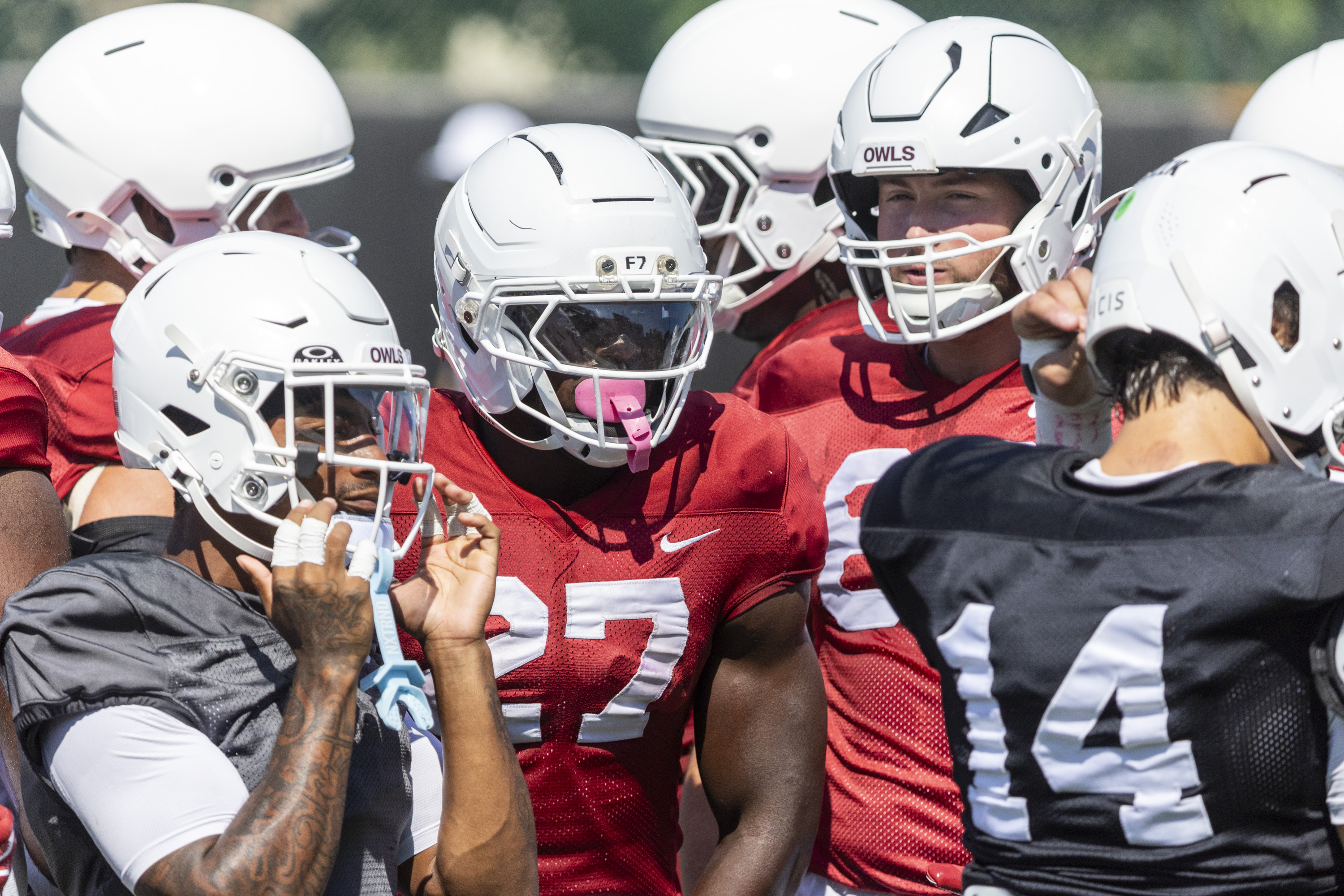
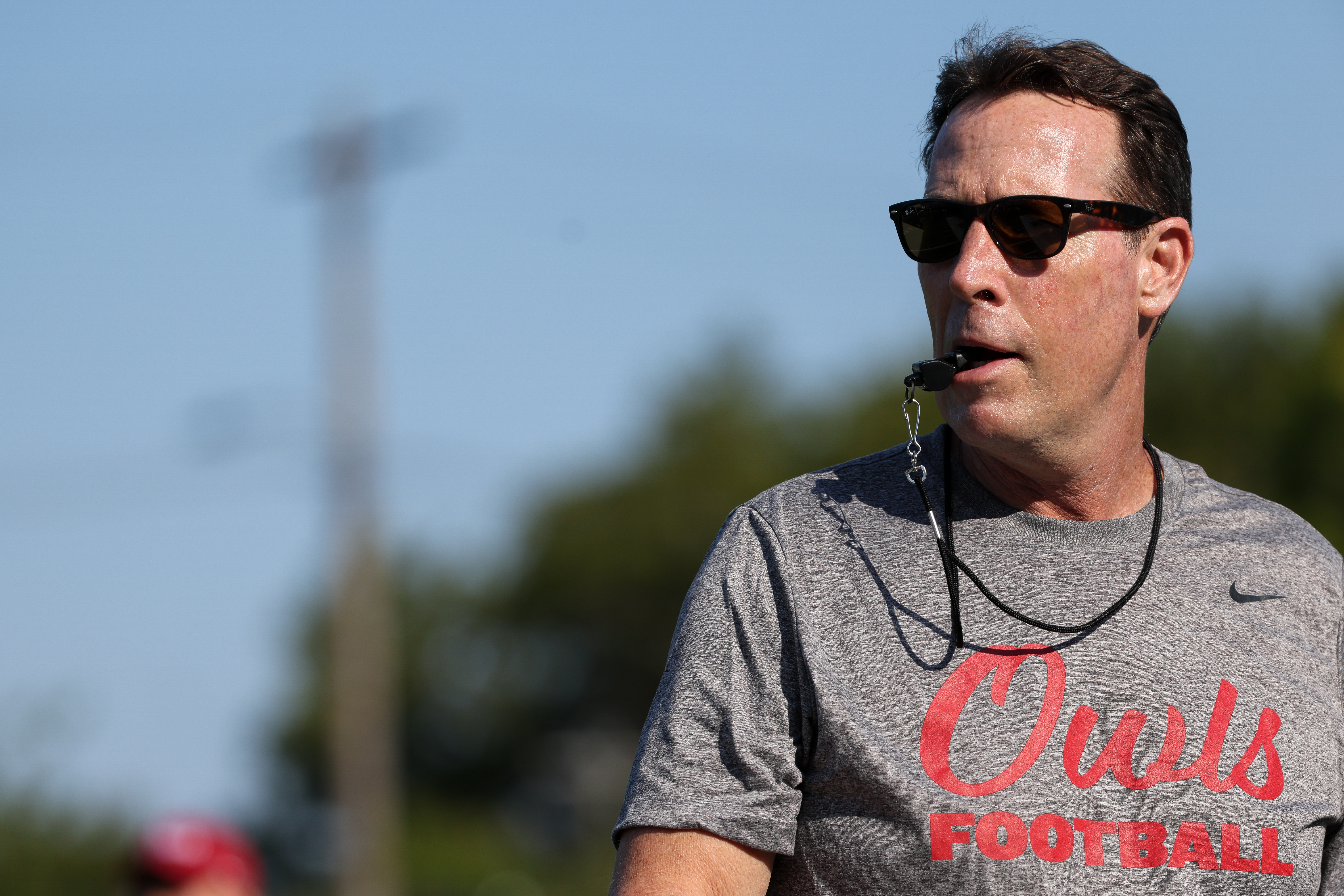
    Sam Brown could be a key piece to Temple’s offense this season.Tyger Williams / Staff Photographer

    But it’s taken Brown some time to feel like himself again.

    “It was definitely tough,” he said. “But my coaching staff at Rutgers and I, we already had kind of talked, and we kind of knew what the plan was for me [last] year. Even through that season, I wasn’t myself.”

    When Brown entered the transfer portal, he had an idea of what he wanted in a new school. As it turned out, that school wasn’t entirely new to him.

    While playing for La Salle College High, Brown, who grew up in Hunting Park, was recruited by Temple out of high school, albeit by a different regime.

    With the Owls losing one of their top producers in Jay Ducker to graduation, the starting spot was open. Brown has been competing in the backfield with Hunter Smith and Keveun Mason.

    “I think it’s a testament to his ability to fight through adversity,” said running backs coach Andrew Pierce. “He could have easily just said, ‘I’m done with football after injuries and all of those things,’ he could have said, ‘Football’s over for me, I’m going to move on.’ It’s just his ability to put his head down and work every single day, and I think that just improved the room overall.”

    Another opportunity

    Brown came into spring practices, getting reps with the second- and first-team offenses but quickly built separation between himself and the rest of the room.

    During the Owls’ Cherry and White spring game, Brown was the first running back to have his name called in the first drive of the game.

    Brown, at 6-foot-1, 215 pounds, is a powerful figure on the field. He can put defenders on their backs and trudge through the line in short-yardage spots.
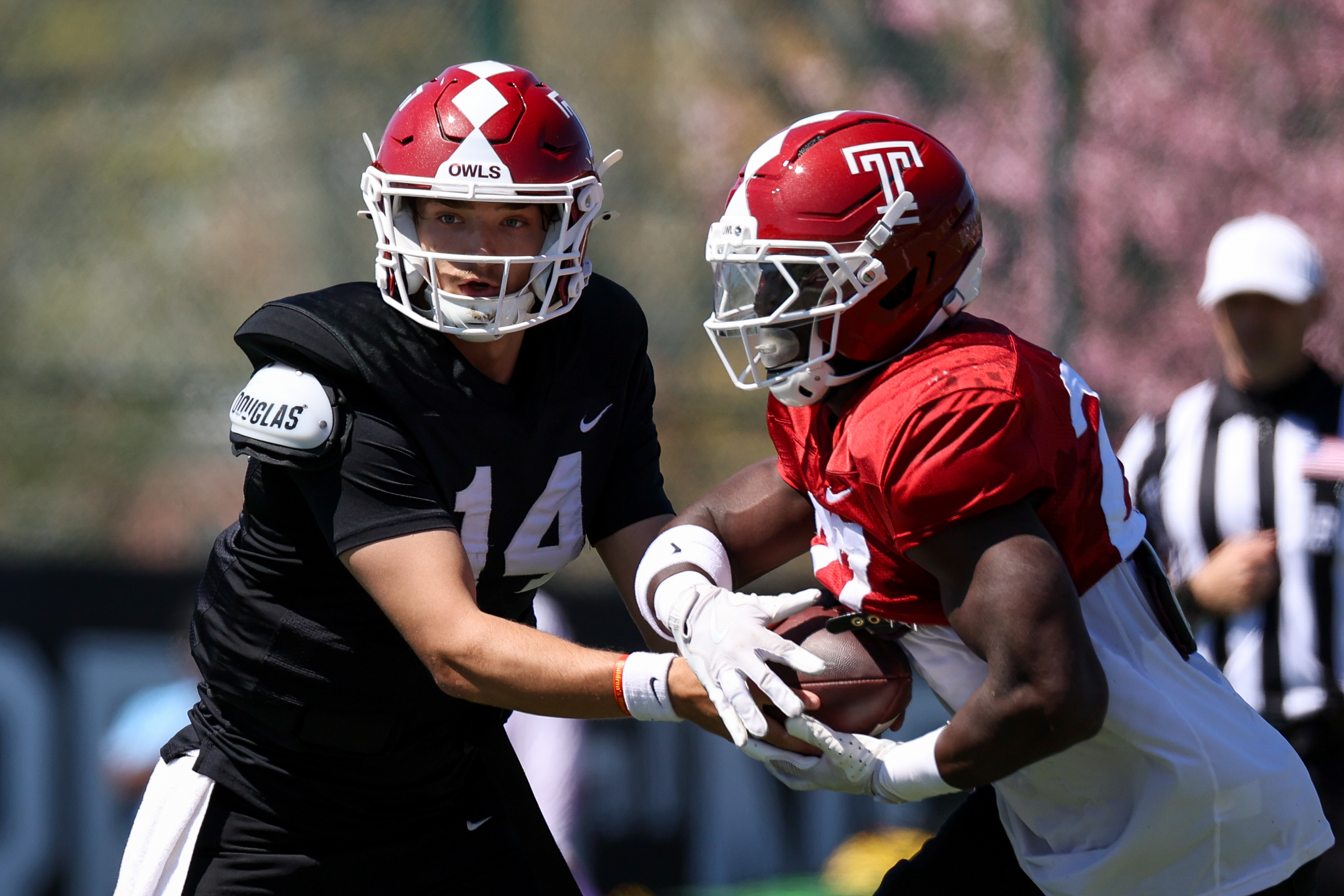
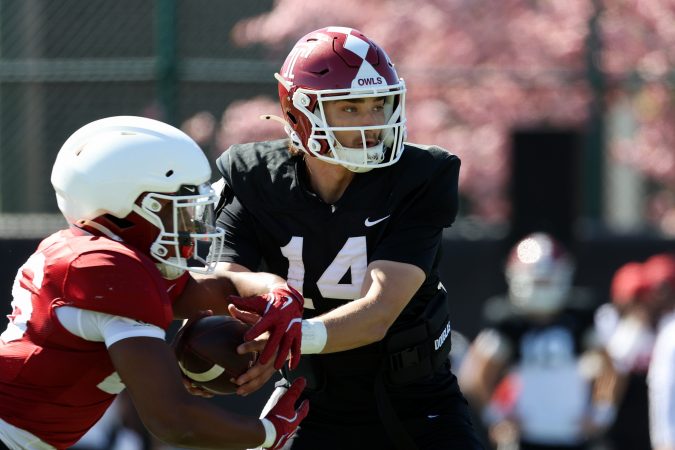
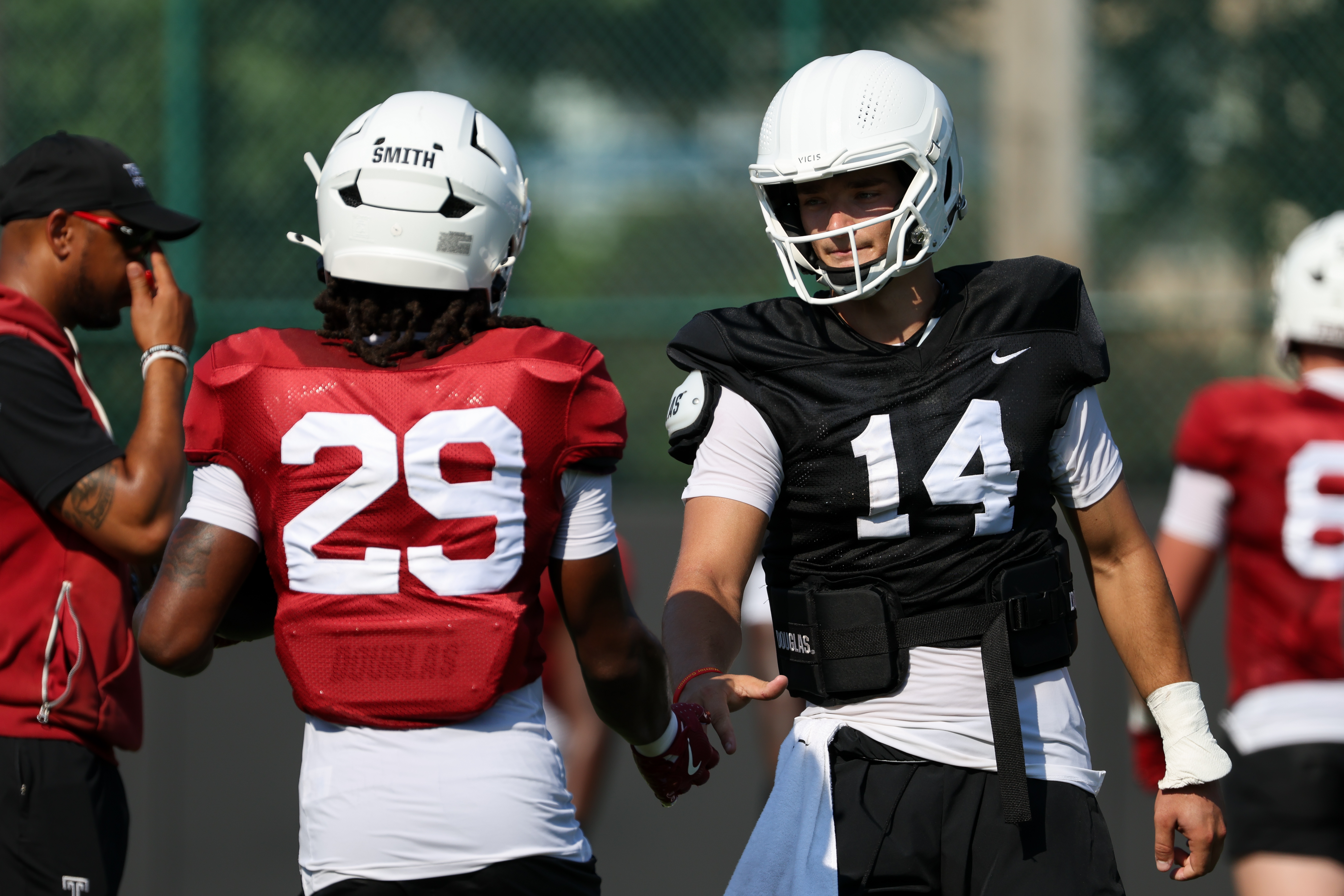
    Temple quarterback Jaxon Smolik (14) hands the ball to running back Sam Brown (27) during the Cherry and White Spring Game on April 11.Isaiah Vazquez / For The Inquirer

    But Brown’s new calling card since he made it to North Broad has been speed.

    Since taking the field, and healthy for the first time in nearly two whole years, Brown’s acceleration out of the backfield has changed the Owls’ offense.

    “A lot of the work that I put in with the strength program played a big part in everything,” he said. “Having the spring, having the summer to train, even in the moments where I wasn’t in here, I was at home with my trainers. That all [played a] part in just staying positive and staying confident in my abilities through it all.”

    Temple kicks off its season against Rhode Island on Sept. 5 at Lincoln Financial Field, and Brown looks poised to headline the backfield.

    “The first thing is his character,” Pierce said. “Just who he is as a person, he’s the right fit for this program and what we are trying to accomplish. I think his character speaks volumes, and obviously, as a player, just his ability to be a big physical back who also can just run as well.

    “He is not a very talkative guy, but he also leads by example. Anybody in that building can tell you he’s in here 24/7 trying to get better every single day. And that, I think, trickles down to our room, which I think only improves everybody in there.”

    Nearly a year after Brown questioned whether he still wanted to play football, he is preparing to enter this season as one of the Owls’ most important offensive pieces.

    This time, there’s little question about whether he wants to be there.

    “I’m just grateful for every opportunity I get,” Brown said. “I just got to keep working and I’ll get what I deserve.”
  • Temple quarterback competition ‘not even close’ to being decided

    Temple quarterback competition ‘not even close’ to being decided

    With just 25 days until Temple football’s season opener against Rhode Island, coach K.C. Keeler and his staff seem to have a pretty good idea of the starting lineup they’ll be rolling out at Lincoln Financial Field on Sept. 5.

    But there is one glaring decision remaining — quarterback.

    Here are observations from Temple’s Monday morning practice.

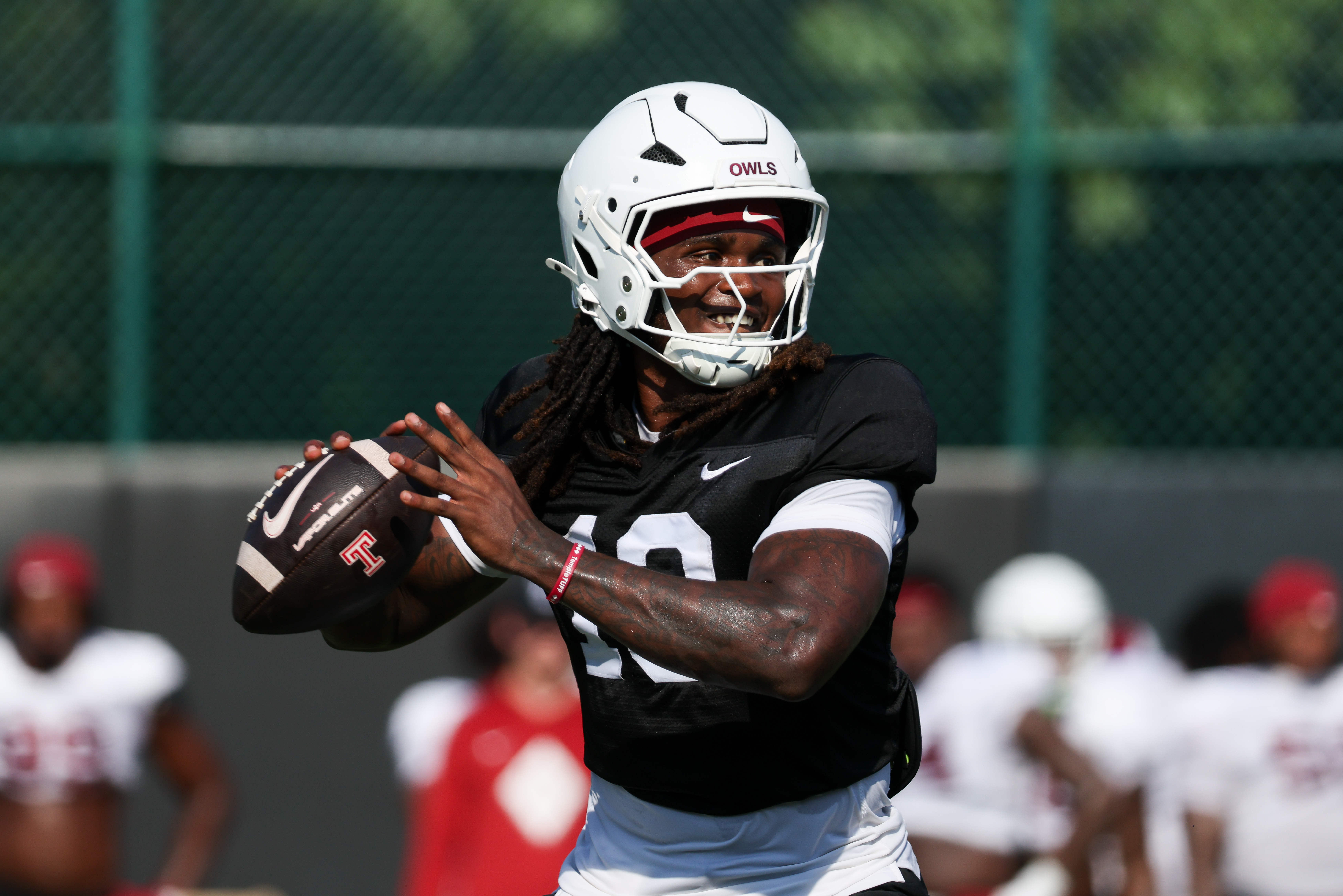
    Temple quarterback Ajani Sheppard takes part in drills during practice at Edberg-Olson Hall on Saturday.Isaiah Vazquez / For The Inquirer

    QB competition update

    The quarterback competition between the transfer duo of Jaxon Smolik (Penn State) and Ajani Sheppard (Washington State) continued Monday morning.

    Smolik, who got snaps in four games as a junior, found seniors Peter Clarke and Colin Chase multiple times, each for big gains.

    Smolik also hit Clarke and Ryder Kusch through the middle on slant routes while finding Chase streaking down the sideline twice on big plays.

    Temple coach K.C. Keeler is content to take his time making a decision on a starting quarterback.Isaiah Vazquez / For The Inquirer

    Keeler declined to give any indication about who might be in the lead for the starting job.

    “We’re not even close,” Keeler said. “I thought they both took a step forward today. I just look at last year and Evan [Simon] didn’t establish himself until later but looked strong. I’d also say Evan was going up against a defense that had some wider windows in practice than what these guys are seeing now, and I think the defense has played really sound, which has affected these guys.”

    Last year, Simon and Gevani McCoy competed into the season opener against UMass, when Simon threw for six touchdowns and claimed the starting job.

    “Yeah, I’m not going to overthink it,” Keeler said when asked if he’d be OK with a similar competition this year. “I’m just going to let it play out. Everyone would obviously prefer to have a guy, but at this time I think we let it play and see how it goes.”

    Depth chart shakedown

    Aside from quarterback, Keeler said “everything is kind of shaking out where you would’ve wanted it to” with the rest of the roster.

    “There are positions like with the defensive line where we have 10 good guys and we’re going to play 10 guys on the defensive line, same thing with linebackers,“ he said.

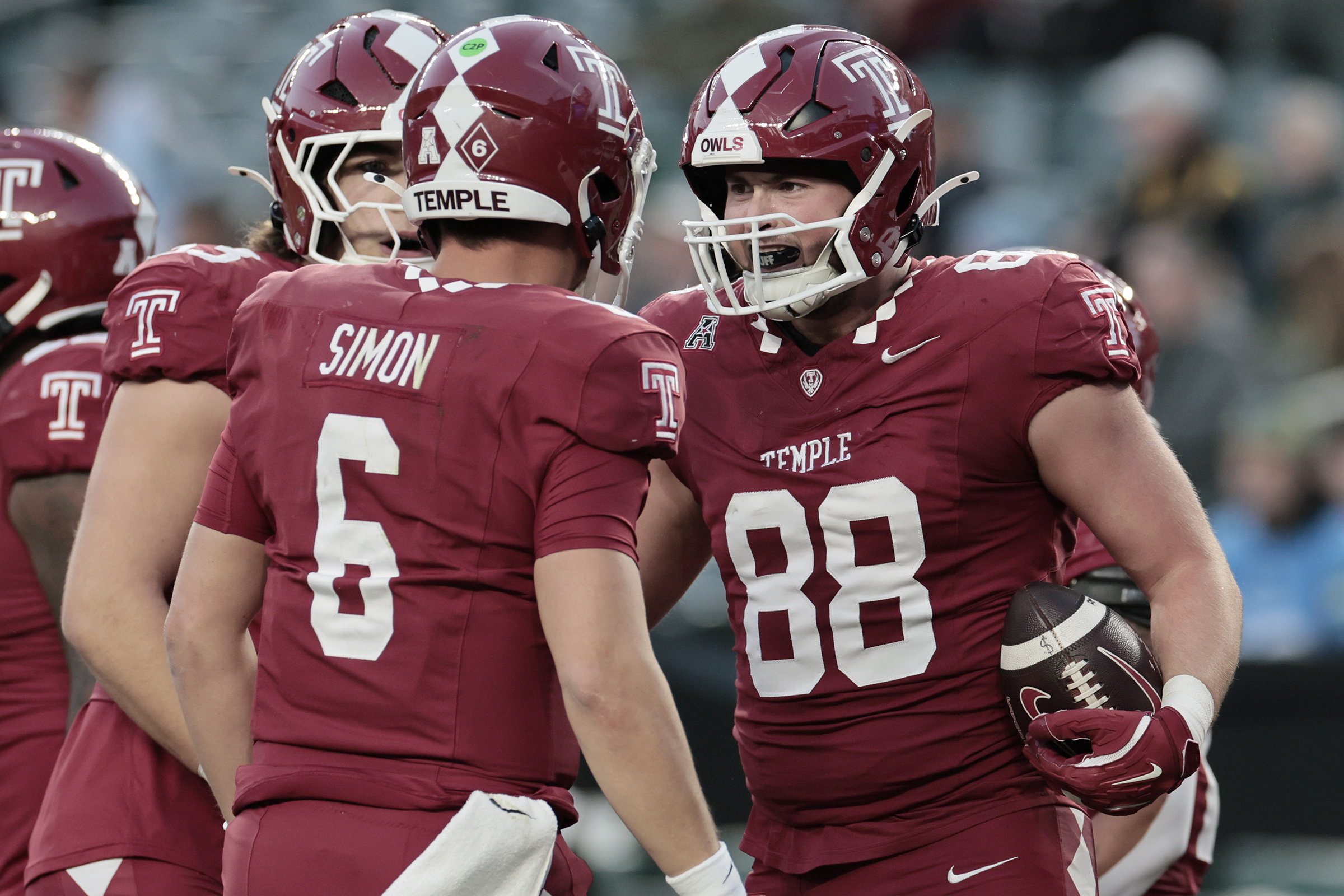
    And if the Owls continue to line up the way they have in practice, a skill-position core of wide receivers Chase, JoJo Bermudez, and Jayce Freeman, tight end Clarke, and running back Sam Brown looks promising.

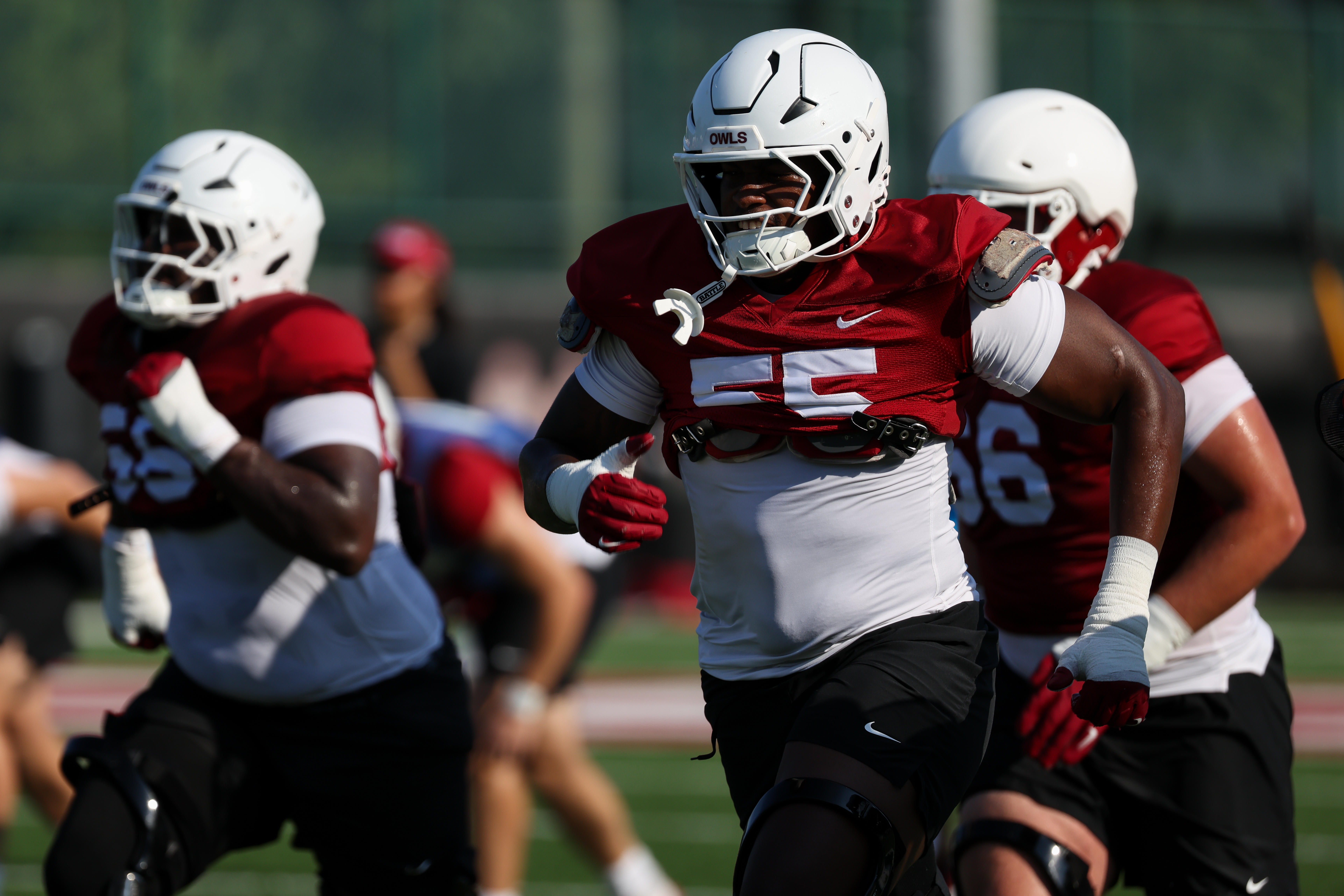
    Temple linebacker Uyi Igiehon (55) takes part in drills during practice at Edberg-Olson Hall on Saturday.Isaiah Vazquez / For The Inquirer

    Giakoby Hills, Eric King, Grayson Mains, Jackson Pruitt and Kevin Terry figure to start on the offensive line. Terry was thrust into the starting right tackle position following an injury to Luke Watson this week.

    Keeler and offensive line coach Al Johnson have been vocal about having multiple players switching off and on throughout the game on the line.

    “I absolutely [think we can have a rotation],” Johnson said following Saturday’s practice. “If you earn the right to play, you’re going to play. If we have seven guys that earn the right to play and help Temple football win football games, we’re going to play seven guys.”

    With Watson, that number could jump to nine, though John Stone and Zach Aamland seem like the players who could rotate in the most at center and right guard/tackle, respectively.

    On the defensive line, Keeler plans on having 10 players rotate in and out, a group that would likely be headlined by Cam Jones, Davier Bishop and Joseph Auzenne. Kevin Hornbeak Jr., Troy Cunningham, Kaleb Artis, Russell Sykes IV, and Lamar Fairfax are expected to see regular playing time on a unit that could be kept fresh in games.

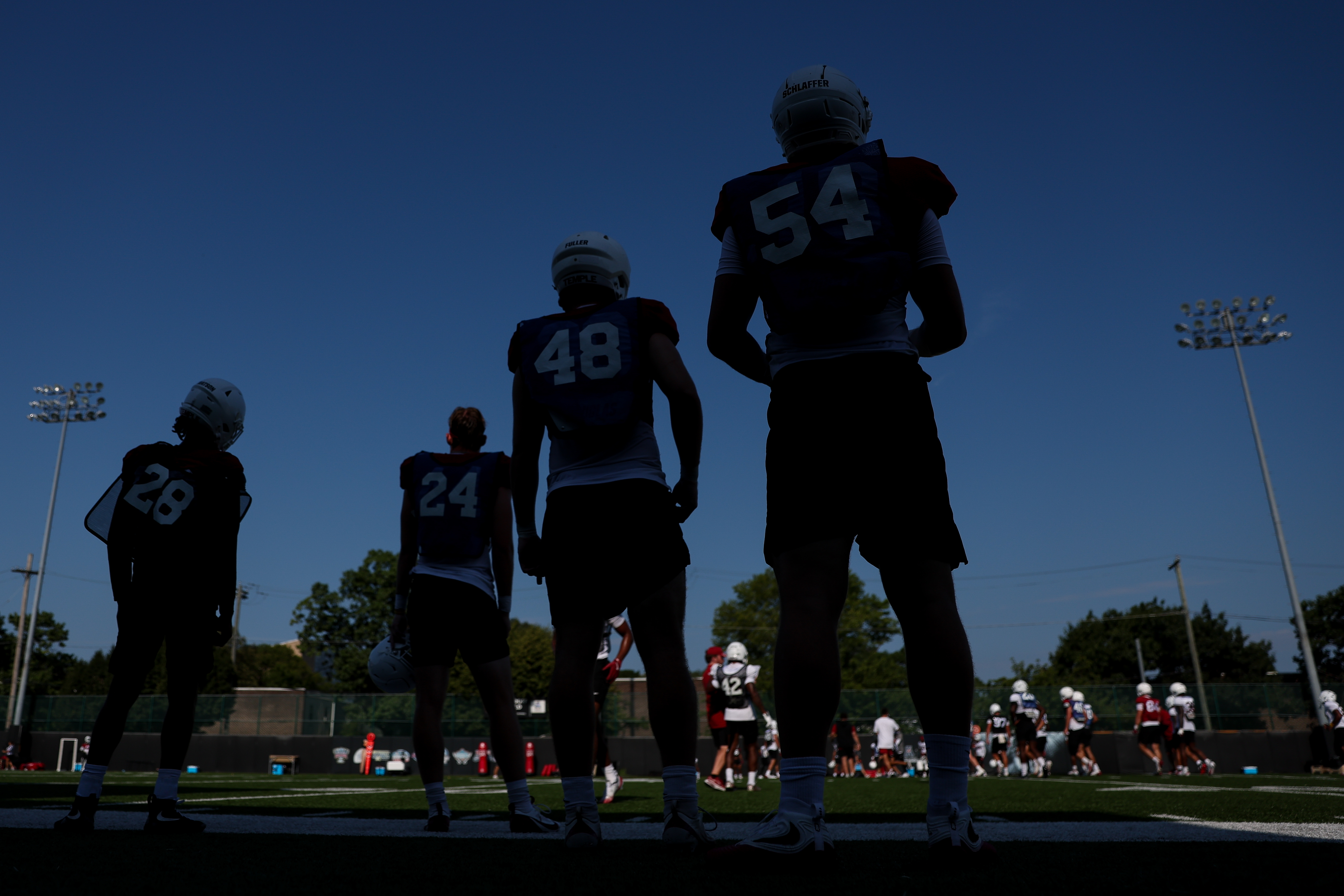
    Temple players look on during practice at Edberg-Olson Hall on Saturday.Isaiah Vazquez / For The Inquirer

    On the edge and in the linebacker core, Jaylon Joseph and JaMair Diaz headline the outside and Curly Ordonez and Eric Stuart hold down the middle and weak-side linebacker spots, with Tyree Alualu, Jayvant Brown, Wesley Brown, Willy Love, and Aiden Britton likely to see meaningful time.

    In the defensive backfield, Denzel Chavis and Adrian Laing will hold down the cornerback spots and Saboor Karriem and Avery Powell will take safety duties, with Jaeden Gould, Kolin Dinkins and Josiah Jackson in the conversation as well.

  • How Philly hoops shaped D.J. Rivera and his son, Derrick Morton-Rivera, to do ‘what you love’

    How Philly hoops shaped D.J. Rivera and his son, Derrick Morton-Rivera, to do ‘what you love’

    It was easy for Derrick Morton-Rivera to “fall in love” with basketball. He was always around it.

    His father, D.J. Rivera, had his son while he was a sophomore at St. Joseph’s. Even after he transferred to Binghamton University in New York then University of Montevallo in Alabama, his son traveled to games and watched.

    “His little eyes would be going up and down the court,” said D.J. Rivera, who grew up in Lawncrest and played nine years professionally overseas. “I gave him a basketball, and he never put it down.”

    The Riveras also have deep roots in the sport. D.J.’s dad played, as did his late uncle, Hank Gathers, who starred at Loyola Marymount and was the NCAA’s scoring champion and rebounding leader in 1989.

    For the Riveras, basketball serves as a reminder that nothing in life is guaranteed. On March 4, 1990, Gathers collapsed on a court in Southern California while playing in the West Coast Conference tournament semifinals. He suffered cardiac arrest and died at 23 years old.

    “With my uncle and his heart condition, you never know when you could play your last game or your last time people seeing you — death is real,” D.J. Rivera said. “It’s the only thing that’s guaranteed in life, so I think while we’re here, you should do what you love.”

    It’s why Rivera brought his son to the Danny Rumph Classic for years.

    The five-day tournament, which begins Thursday at Drexel, honors Rumph, who died in a pickup basketball game at the Mallery Recreation Center on May 8, 2005.

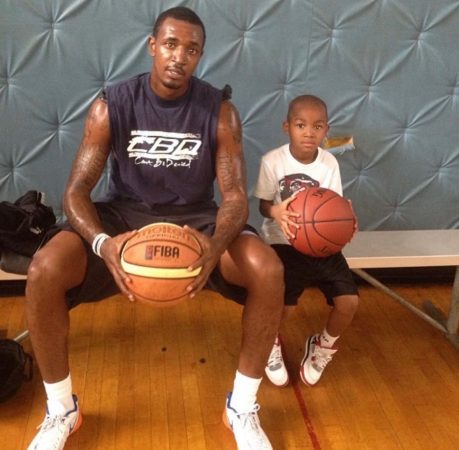
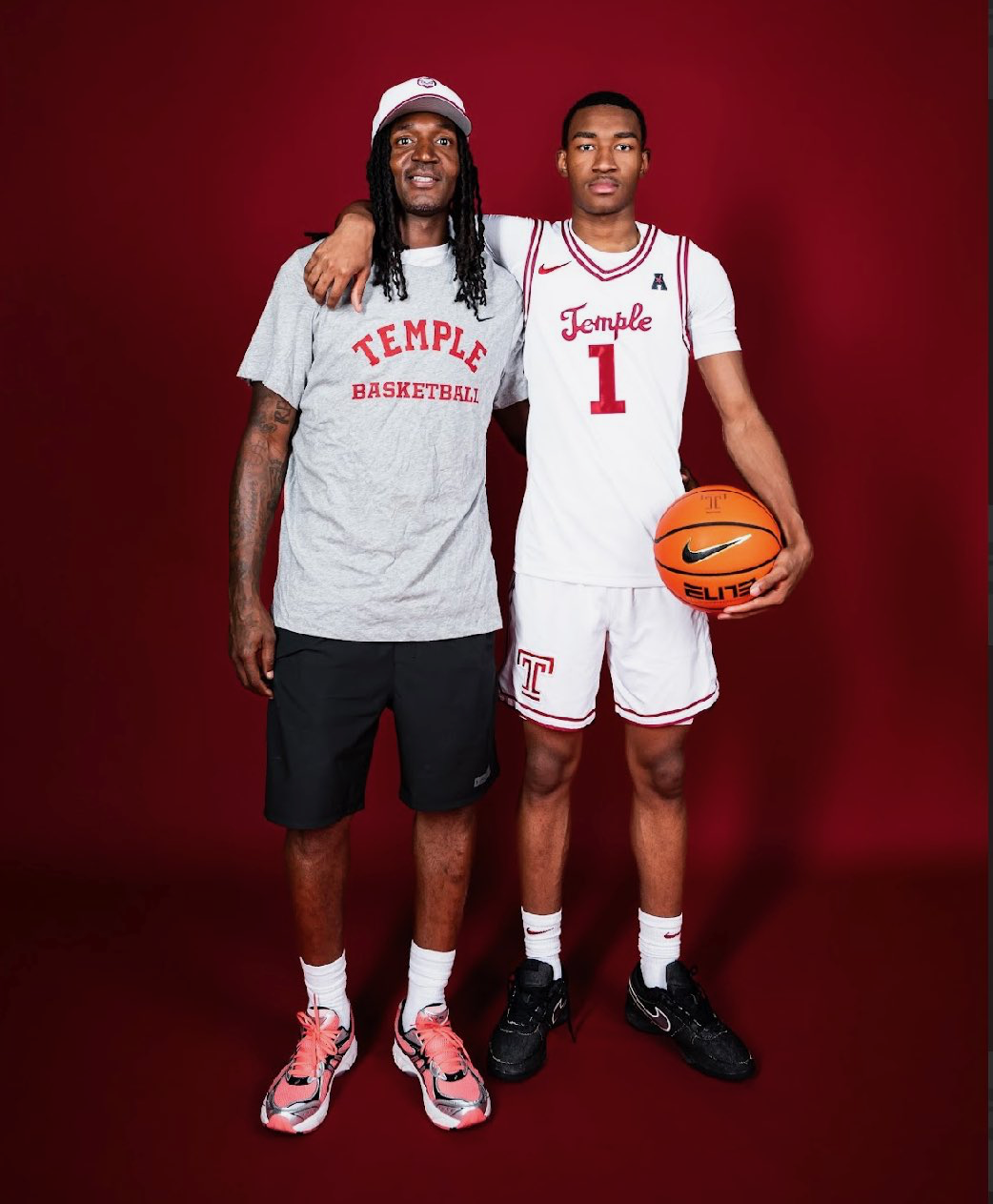
    D.J. Rivera with his son, Derrick Morton-Rivera, who will play college basketball at Temple this fall.D.J. Rivera

    Rumph died from an undiagnosed heart condition, known as hypertrophic cardiomyopathy, which caused him to go into sudden cardiac arrest. He was 21.

    Giving back to a cause that similarly impacted his family was important to Rivera. He played in the tournament in 2012 and did it consecutively for about 10 years. Even Morton-Rivera participated in a youth halftime game during the tournament in 2016, where he recalled winning a $50 Nike gift card and James Harden showing up to play in the final.

    The two have made an effort to check out the event each year and plan to attend a game this week.

    “I love the Danny Rumph tournament,” Rivera said. “You get to play against pros, NBA players, be highly competitive, get to talk trash, and the crowd’s great. It’s just a great weekend in the city that you look forward to end the summer on.”

    Being exposed to an event like the Rumph Classic has also played a factor in Morton-Rivera, a 6-foot-4 guard, continuing his basketball legacy in Philadelphia. The Father Judge graduate will play at Temple this fall.

    “Back in the day, a lot of people used to stay home,” he said. “That’s not normal now. I feel like that should be a normal thing because that brings the community out even more. Like if a lot of hometown kids are staying, a lot of people from Philadelphia are going to the games. It’s just better for the city, it brings everybody together.”

    At a young age, Morton-Rivera didn’t fully grasp what happened to Gathers, but as he got older, he had a better understanding.

    He took a family trip to California before 2020 and visited LMU, where he saw Hank Gathers’ statue outside of the arena. He also met with a program who detects heart problems and had a screening done.

    D.J. Rivera played high school basketball at Neumann Goretti, his son competed at Father Judge.D.J. Rivera

    The trip, Morton-Rivera said, brought his family together.

    “Even though I didn’t know much about it at a young age, just me hearing about it and knowing what they did inspired me to do what I do,” he added.

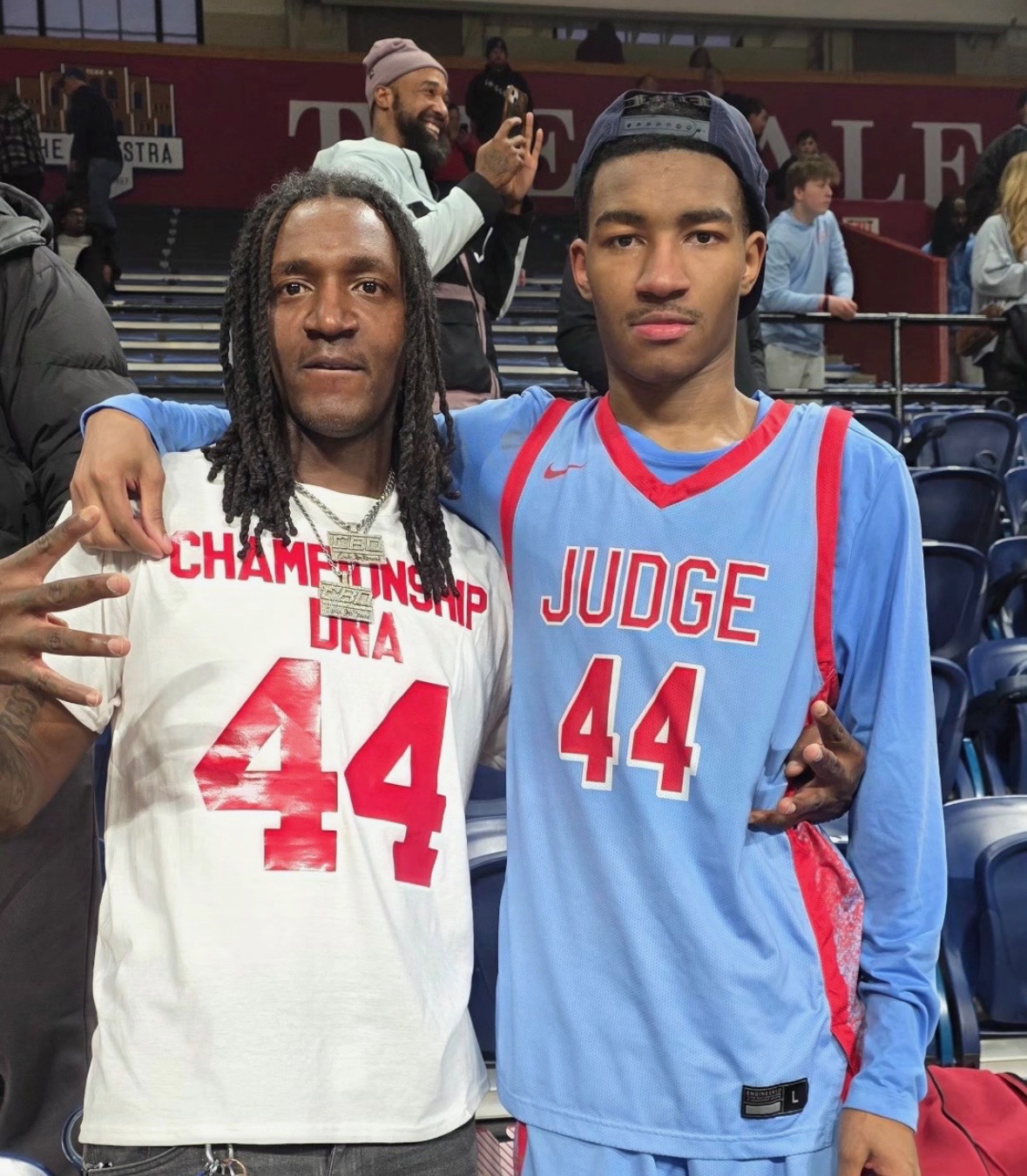
    Basketball has also been the focal point of him and his dad’s relationship. This past year, D.J. Rivera got to watch his son win back-to-back Catholic League championships with Father Judge, a feat he once achieved 20 years ago with Neumann Goretti.

    Both father and son left their respective high schools as the program’s all-time leading scorer.

    After Judge won the crown inside a packed Palestra this past February, Rivera surprised his son with a shirt that read on the back, “20 years apart same heart.”

    “When my career came to an end, I got to watch his, so it’s like the game never left,” said Rivera, who will graduate from the Philadelphia Fire Academy in three weeks. “That’s something that brings me and him together. … It’s something we can enjoy together because I both know we love the sport.

    “Basketball has done a lot for us. It’s just a great feeling to be able to continue that and watch his time be here now. Soon enough, he’ll be playing in the Rumph as a professional.”

  • K.C. Keeler has no timetable for Temple’s QB battle  as fall camp opens

    K.C. Keeler has no timetable for Temple’s QB battle as fall camp opens

    Temple’s football season is just around the corner — even if the pads haven’t come on yet.

    On Wednesday, Temple hosted its first open practice for media, allowing second-year coach K.C. Keeler to give some insight into the team’s offseason. Last year, the Owls finished 5-7, one win short of making a bowl appearance.

    Temple opens its season against Rhode Island on Sept. 5 at Lincoln Financial Field (2 p.m., ESPN+).

    Here are three takeaways from Temple’s first fall camp practice.

    Waiting for a QB to ‘step up’

    There’s a quarterback battle on North Broad — one that does not have a timetable, said Keeler.

    Jaxon Smolik, who transferred from Penn State, and Ajani Sheppard, who made stops at Rutgers and Washington State, are competing for the Owls’ starting role. Neither have started a game in college. Notably, though, Smolik outplayed Sheppard in the Cherry and White spring game.

    “I thought it was a pretty good back and forth all spring,” Keeler said. “And then just the spring game that Jaxon had, obviously that’s what you’re hoping our quarterback can play like this season. … If we get that Jaxon, you know, let’s go. But again, I think we all feel Ajani has a special skill set, too.”

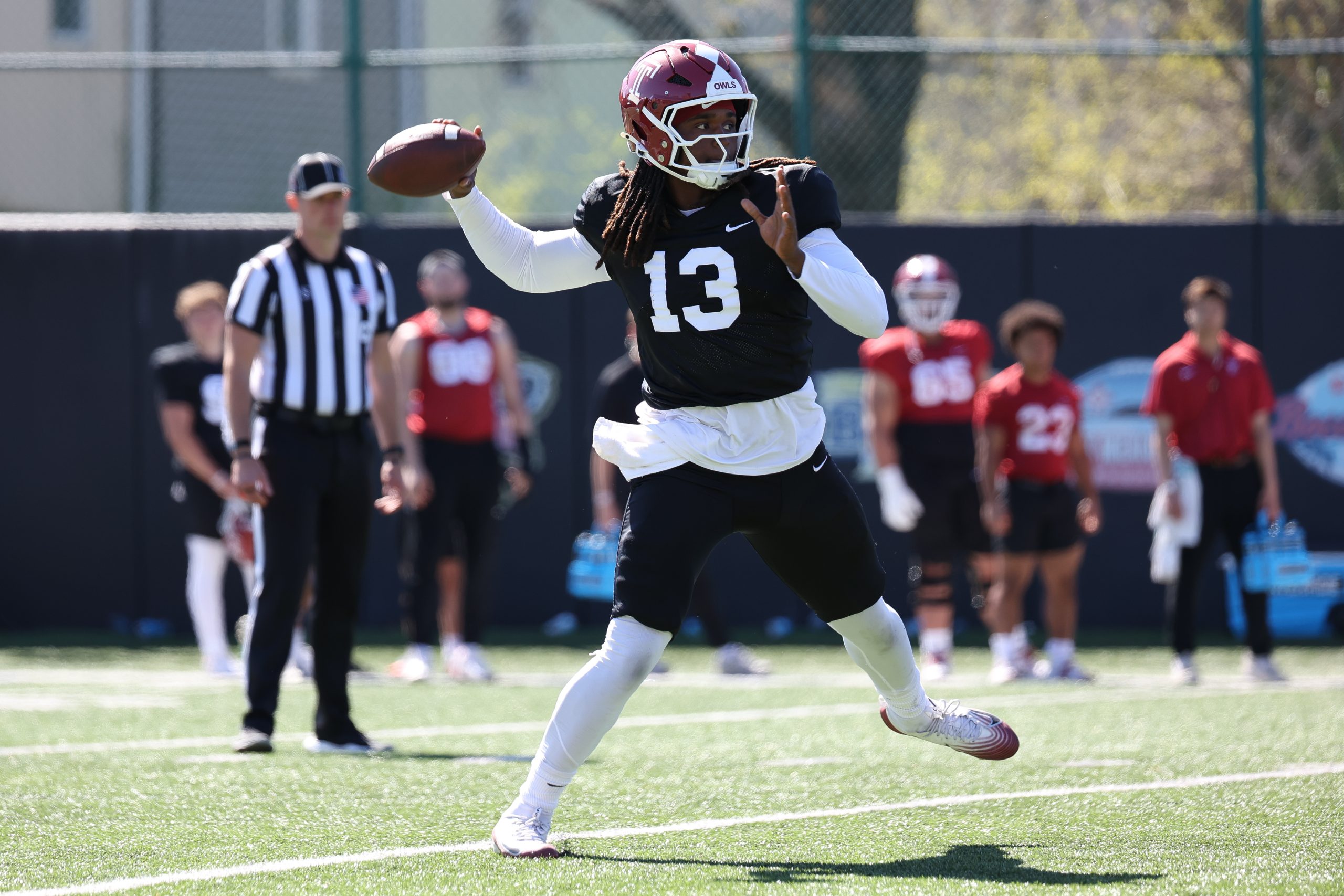
    Temple quarterback Ajani Sheppard (13), shown during the Cherry and White spring game in April, has a “special skill set,” said coach K.C. Keeler.Isaiah Vazquez / For The Inquirer

    Both quarterbacks took repetitions with the first-team offense. Fifth-year wideout Colin Chase, who finished with 40 receptions, 414 yards, and four touchdowns last season, will be among the top pass catching options for either quarterback.

    “Ajani and Jaxon are two great guys,” Chase said. “They’re very mature about their business. … They work very well together. So for myself, it’s whatever they need. If Jaxon needs a couple more throws after practice, if Ajani wants to go watch film after practice, I’m there to assist whoever because as of right now, they’re both the starters in my eyes.”

    In 2006, Keeler, who was then Delaware’s coach, presided over a quarterback battle between Joe Flacco and Ryan Carty. Flacco, a future Super Bowl champion with the Baltimore Ravens, did not win out until the “last scrimmage.” Keeler likened this year’s battle to the one two decades ago. Carty is now Delaware’s head football coach.

    “You didn’t think it was going to be back and forth,” Keeler said. “I mean, I love Ryan. Ryan was a pretty good little football player too. Joe ended up being the 18th overall pick. So obviously, Joe had this unique skill set, but it took us a while because Ryan just kept on fighting and kept on putting himself in a position where you couldn’t legitimately say Joe was the better one.”

    In time, Keeler hopes that one quarterback will “step up” like Flacco did, but he does see a world where their unique skill sets allow both quarterbacks to see action this season. Evan Simon and Gevani McCoy also battled for the starting role during Temple’s fall camp last season before Simon was later named the starter.

    “I never love to say we’re playing two quarterbacks, but I’ve been in package situations before where I’ve had guys who like [come in for] red zone packages, short yardage packages,” Keeler said. “Whatever it may be, one guy fits better than the other guy does.”

    Retaining key players

    Beyond the quarterback position, Temple boasts a slew of returners.

    Two weeks ago, during the American Conference’s media day, Keeler noted that the Owls had multiple players who were contacted by Power Four schools. Some were even offered “hundreds of thousands of dollars” to transfer.” However, every eligible starter returned.

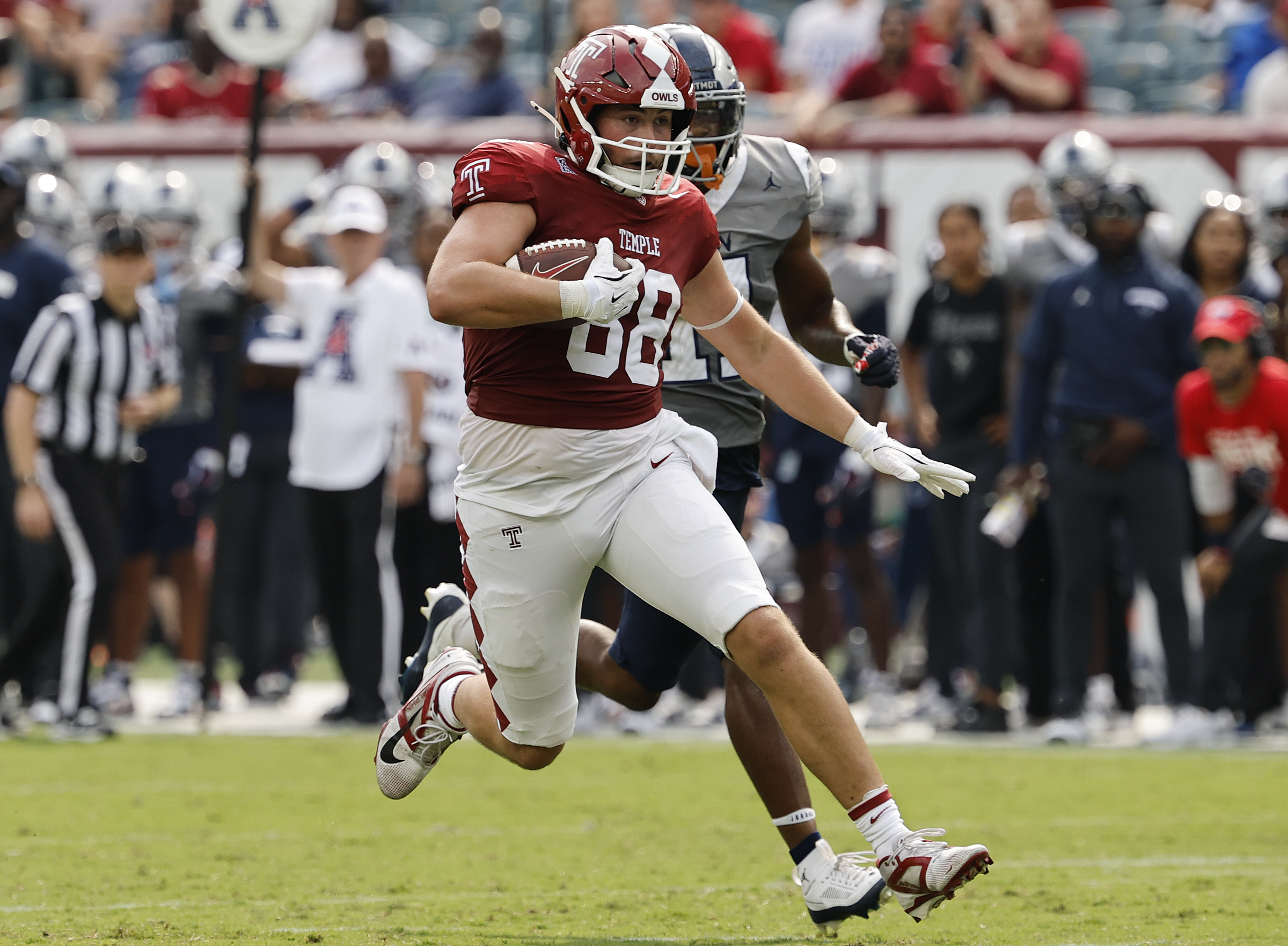
    One key returner, who could have transferred to a bigger program, is senior tight end Peter Clarke. Last season, he logged 483 yards and six touchdowns. Clarke, a product of the NFL Academy in England, was named to preseason watchlist for the John Mackey Award, given annually to the best tight end in college football.

    Temple tight end Peter Clarke (right) will anchor the passing game this season.Elizabeth Robertson / Staff Photographer

    On Wednesday, Keeler recounted his pitch to Clarke.

    “Peter, you had six catches in two years, now you’re one of the top five tight ends in the country coming back,” Keeler said. “How does that happen? Probably in the right system, you probably got a great strength coach, you know you got a great position coach. Your ‘O’ coordinator is brilliant. You obviously have bought into everything we have to offer.”

    “This is home to him, and so he wanted to stay in the worst way,” Keeler added. “And we had to find a way to make it financially reasonable. We can’t match, but we’re going to do our best. And I think he appreciated that.”

    Along with Clarke, Keeler added that punter Dante Atton and offensive linemen Giakoby Hills and Eric King also turned down bigger programs to stay at Temple.

    “Once we got those guys, it made the locker room so much easier to keep [together],” Keller said. “Because it’s like, ‘you guys are turning down what you think is significant money. We turned down a lot more and here are the reasons why we turned down that money, because we believe in where this place is going.’”

    Cornerback room takes a hit

    On Wednesday, Keeler revealed that sophomore cornerback Devontae Ward-Grant suffered a torn ACL in his right knee during the spring game and will miss the entire 2026 season.

    “Every obstacle is an opportunity,” Keeler said. “And even though [Ward-Grant] would have competed to be a starter for us this year, he really needs a year in the weight room. … We’re looking at it like ‘it’s a great year for you to just get your body bigger, stronger, faster,’ and we’ll get him back next year.”

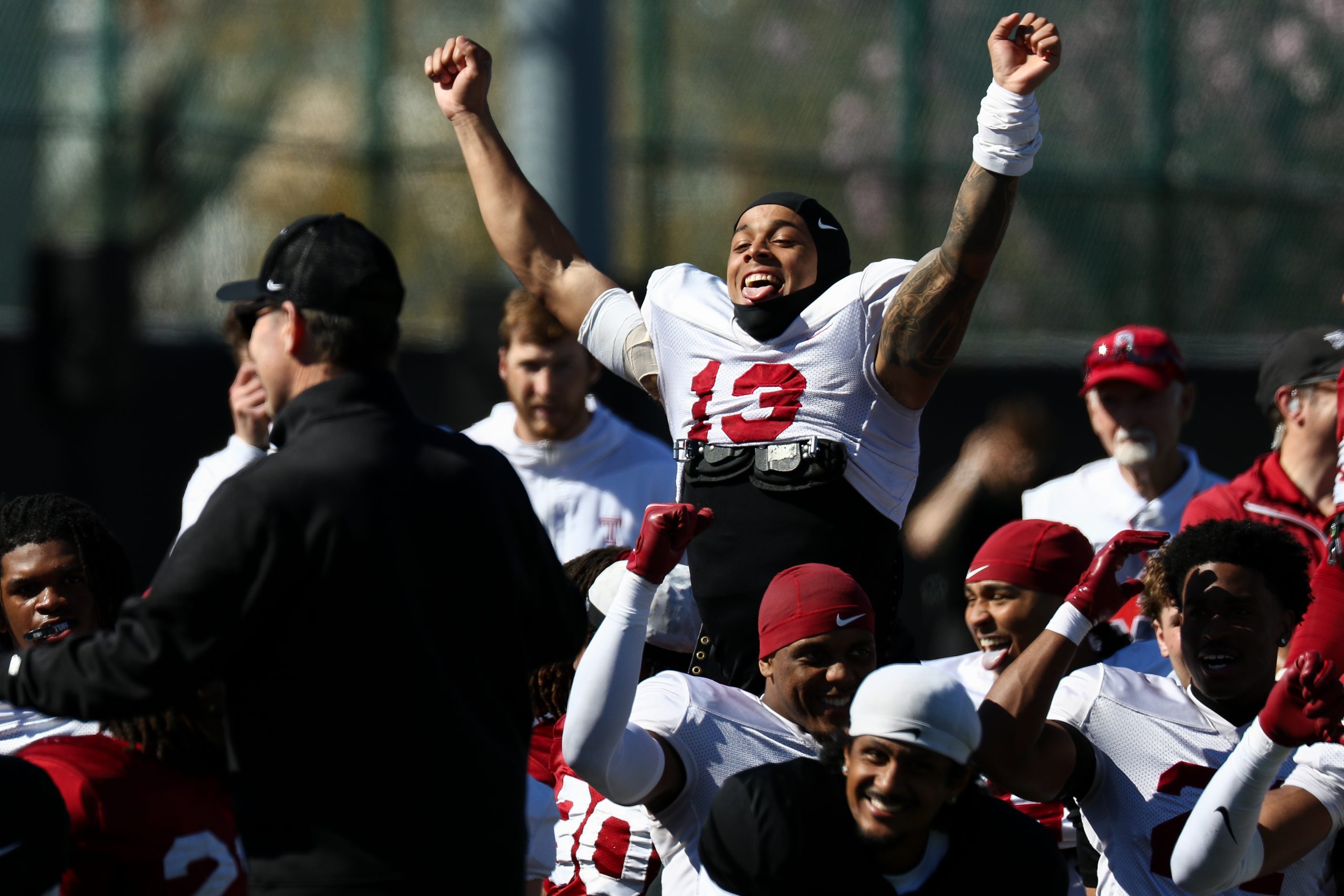
    Denzel Chavis (13) is among the returning cornerbacks vying for a starting role for Temple this season.Isaiah Vazquez / For The Inquirer

    The loss of Ward-Grant hurts an uncertain cornerback room. Notably, the Owls returned juniors Denzel Chavis and Adrian Laing. The duo combined for just 15 solo tackles last season.

    “I think that cornerback spot is the one position you go, ‘I like the guys out there. I just need to see more of them,’” Keeler said. “I like their skill set. I just need to see more of them. So I think that’s where we’re at.”

    “There’s one or two guys in that cornerback group that you feel really good about,” he added. “They’re getting in the right position, you know. But now, when the ball’s in the air, you got to make that play.”

  • American commissioner speaks on need for structure in college athletics; Temple looks poised for success

    American commissioner speaks on need for structure in college athletics; Temple looks poised for success

    The college football season is coming soon.

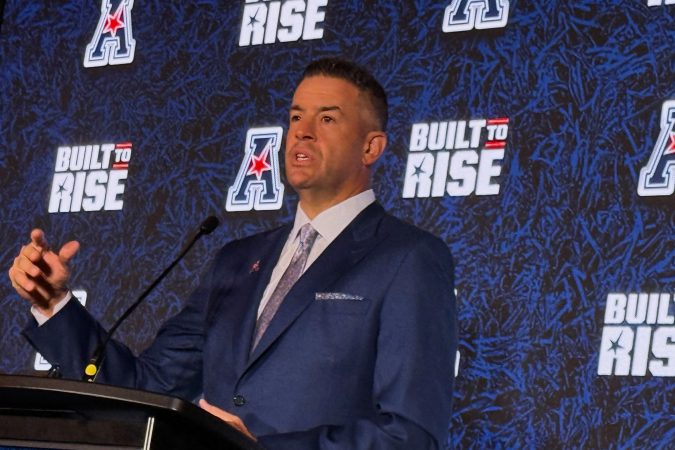
    On Friday, Temple head coach K.C. Keeler took the podium to address members of the media during the American Conference’s media day. Keeler was joined in St. Petersburg, Fla., by the other 13 American head coaches and Tim Pernetti, the conference’s commissioner.

    Here are some notable takeaways:

    ‘Sustainable framework’

    During his opening remarks, Pernetti focused heavily on the evolving nature of college sports and how the current landscape is failing athletes.

    “We have a responsibility to surround [student-athletes] with a sustainable framework, and right now, that’s not a thing,” Pernetti said. “We need to give them a clear path to earn degrees, become leaders, and win championships. Compensation and all these things we hear about — they need to live inside a broader mission.”

    Pernetti expanded on this by endorsing the Protect College Sports Act, a federal bill that would provide an antitrust exemption to the NCAA.

    If voted into law, this exemption would allow the NCAA to establish limits on athletes’ compensation, regulate transfers and eligibility, and prohibit coaches from departing from a program midseason, among other changes. More than 20 college conferences have publicly offered support for the bill, but the two wealthiest conferences — the Big Ten and SEC — have opposed it.

    “‘I’ve walked the halls in D.C. more than Frank Underwood did in House of Cards,” Pernetti said. “The American has a seat at the table. That’s the great news. We have a nationally respected voice, and I’m really humbled to be part of President Trump’s commission to save college sports. And at times, I’ve been the only non-autonomy commissioner in that room.

    “For too long, this industry has lived in this cycle of litigation and temporary fixes and uncertainty, like enough. It’s time for structure in college sports. The Protect College Sports Act is now front and center.”

    On Thursday, ESPN reported that the Senate is not expected to vote on the bill prior to Congress’ August recess, making it unlikely that a vote occurs prior to the midterm elections in November.

    Owls retain crucial starters

    A few hours later, it was Keeler’s turn to field questions from the media. His brief availability was more dedicated to the gridiron than the halls of Congress.

    Keeler is entering his second year at the helm. Last season, the Owls (5-7, 3-5 AAC) finished one game short of bowl eligibility. As Keeler pointed out though, the program is returning key players to nearly every position.

    “We kept every single one of our starters that was able to go in the portal, which is unheard of at our level,” Keeler said. “We had a number of guys that had major opportunities in the Power Four world, and when guys like [tight end] Peter Clarke and [offensive linemen] Giakoby Hills and Eric King turn down literally hundreds of thousands of dollars to stay at an institution because they love Temple, they love Philly, and they see where we’re going, it speaks volumes to the rest of the locker room.”

    One notable position that is not seeing a returning starter may be the most important: quarterback.

    Last season, the Owls were led by Evan Simon, who graduated this past spring. Keeler is now presiding over a quarterback battle between Penn State transfer Jaxon Smolik and Ajani Sheppard, who saw stops at Rutgers and Washington State before landing with the Owls this offseason. In the Cherry and White spring game, Smolik looked like the sharper passer.

    Another new name to watch is fifth-year senior running back Sam Brown V, who transferred from Rutgers. The La Salle College High alumni was sidelined with injuries during his time with the Scarlet Knights. He was formerly 247Sports’ No. 13 high school recruit in Pennsylvania in the class of 2022.

    Despite being approached by other schools, Temple tight end Peter Clarke decided to stay with the Owls.Yong Kim / Staff Photographer

    “You keep Sam healthy, Sam’s a Big Ten starting running back,” Keeler said. “I think we have enough depth that we can keep him healthy.”

    Temple opens its season against Rhode Island on Sept. 5 at Lincoln Financial Field. Then on Sept. 12, the Owls are slated to host Keystone state rival Penn State. Keeler is looking to make sure his team does not look past its initial opponent.

    “And if you worry about what’s beyond you, there’s a good chance that very talented Rhode Island team, that’s ranked No. 4 in the country preseason at FCS, they’re going to beat you,” Keeler said. “I’m going to make sure my players understand nothing else really matters but us playing Rhode Island.”

  • Should Division I men’s soccer become a two-semester season? Here’s where Philly coaches stand.

    Should Division I men’s soccer become a two-semester season? Here’s where Philly coaches stand.

    A change to Division I men’s soccer looks to be on the horizon.

    After years of discussion and debate, the NCAA Men’s Soccer Oversight Committee adopted legislation to shift the sport’s season from the fall to a two-semester schedule. The change was set to go into effect before the 2027 season. But on June 24, the NCAA announced that the Division I Cabinet remanded the proposal for additional review.

    Twenty conferences opposed the measure, according to the NCAA’s release, taking issue with “the duration of the season” and “the lack of clarity about related rules.” Additionally, the Cabinet noted issues relating to how the change could impact the “student-athlete academic experience.”

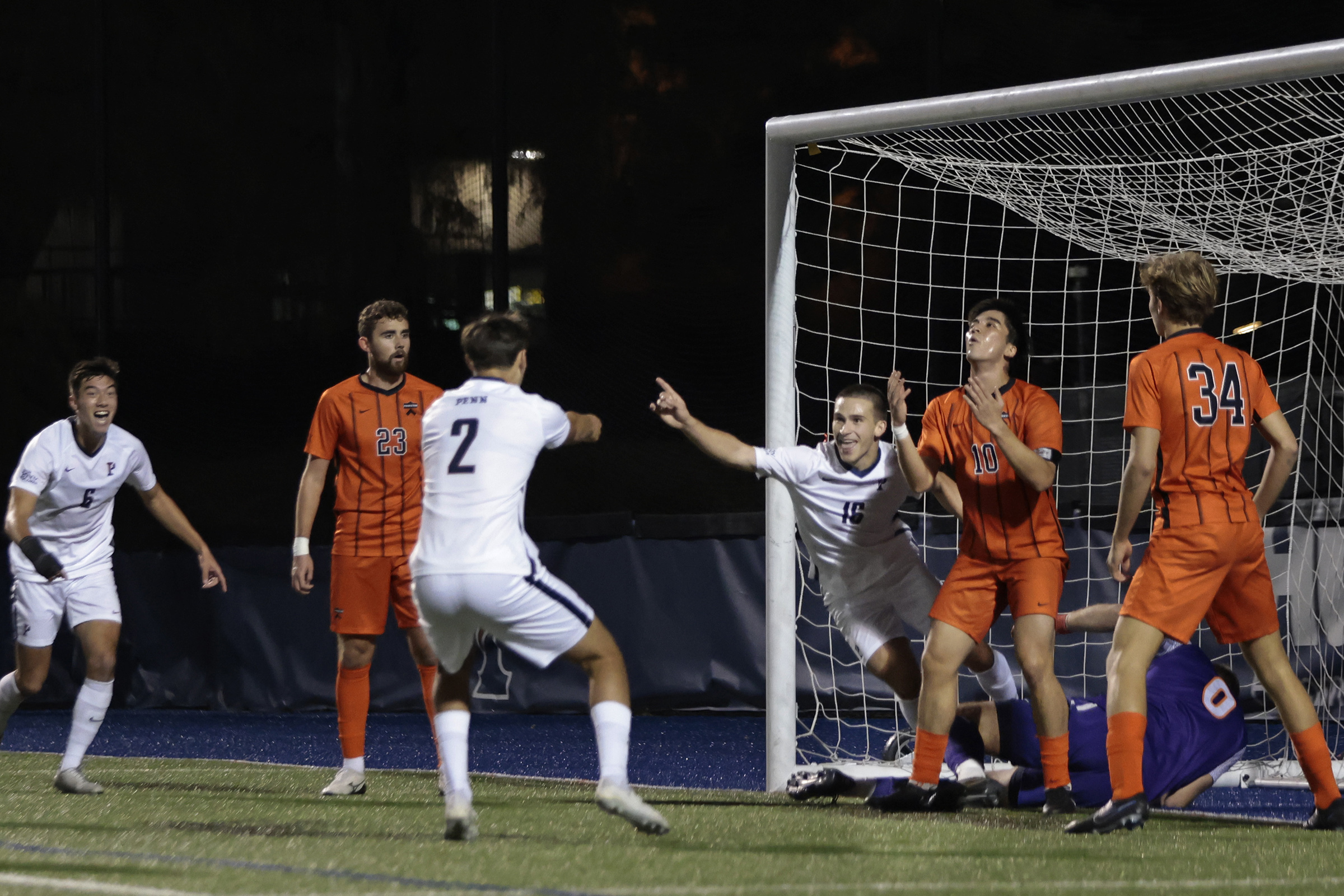
    Philadelphia has six Division I men’s soccer programs: Penn, La Salle, Drexel, Villanova, Temple, and St. Joseph’s. The head coaches of each program reacted to the possible change. Some supported it, while others pointed out a variety of flaws.

    Player development

    Critics of the one-semester season have long lamented that the current setup impacts player development. Villanova head coach Mark Fetrow, who noted his program has been “big supporters” of the new legislation, believes a two-semester format will accelerate development and may be a necessity for college programs.

    “When you space the games out, and now you’re saying we’ve got a year of competition, we can now periodize our training in a way where we’re getting more out of our training sessions from a week-to-week basis,” Fetrow said. “We’re really maximizing performance because guys are just healthier on game days. If we want to stay relevant, if we want to evolve, because the game has evolved a lot in the United States in the past 10 years, then we have got to be willing to make some changes as well.”

    A main competitor for colleges, in terms of acquiring and developing talent on a path to the professional ranks, has been Major League Soccer Next Pro, MLS’s path to pro league. But a longer season could put college soccer on par with the emerging professional league, says Taylor Thames, La Salle’s head coach.

    Oliver Pratt (No. 16) played four years at Penn before signing a pro contract.Elizabeth Robertson / Staff Photographer

    “I think it makes us much more competitive in relation to MLS Next Pro, and some of these USL One contracts that are starting to take some high-level players from the college landscape, and it helps us develop them for longer spells,” Thames said. “There’s a bigger development cycle.”

    Oliver Pratt, a 22-year old defender for MLS Next Pro’s Union II, played four years at Penn. He had to graduate a semester early to sign with an MLS team in time for the season. Having now experienced a full year of training in the pros, Pratt better understands the upside to shifting the college format.

    “I definitely would have been able to maximize [training] more, and I would say be able to significantly improve within one season,” Pratt said. “It’s a different transition for me now. I’m dealing with a 10-month season, and my body’s definitely taking a toll.”

    However, the majority of college players are not going pro, St. Joe’s coach Tim Mulqueen pointed out. He also noted that increased development would benefit the “top 1% or 2%,” but argued “that would happen for the top players anyway.” Mulqueen has seen premier development firsthand. He served in multiple roles with U.S. Soccer, including as an assistant coach for the 2008 U.S. men’s Olympic team.

    Meanwhile, Drexel coach David Castellanos believes the current system is yielding strong results and a “drastic change” would not be necessary. He said that the old model has produced “national team guys in the 1990 World Cup” and “MLS head coaches.”

    Scheduling games, shifting operations

    In a two-semester season, programs would have to adjust how and where games are scheduled.

    Under the new format, the maximum match limit for each team would stay at the current cap of 25, meaning no additional games would be added in the 2027 season. With this, programs are required to schedule at least seven games or at most 10 games in the spring season. A team cannot opt to play all of its games in the fall.

    Having to schedule games and additional practices in the spring could create issues for teams that share their facilities with other programs. For example, St. Joe’s shares Sean Sweeney Field with both of the school’s lacrosse teams and the women’s soccer program.

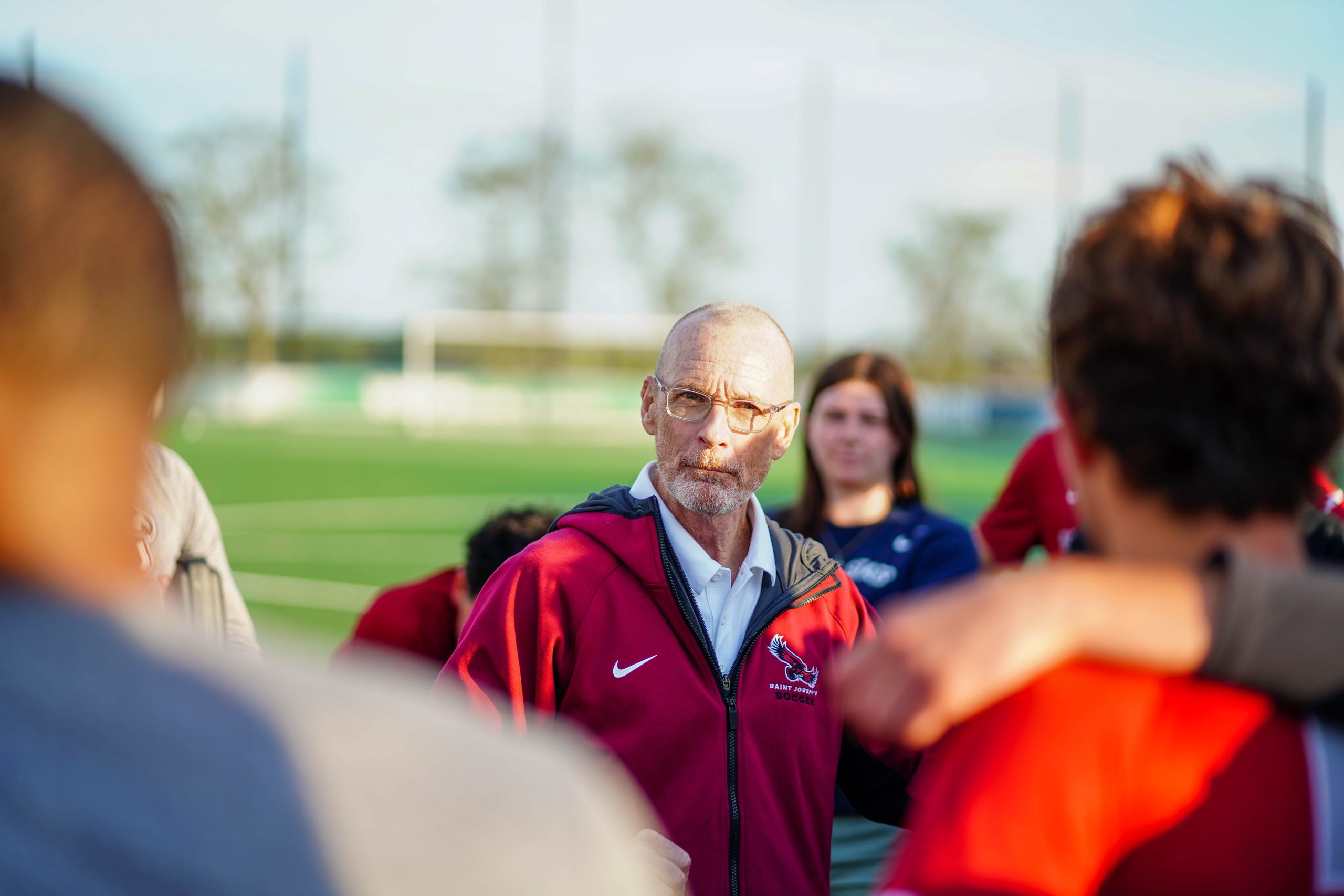
    Tim Mulqueen has served in multiple roles with U.S. Soccer, including as an assistant coach for the 2008 U.S. men’s Olympic team. St. Joseph's Athletics

    “When you’re sharing [facilities] with lacrosse or field hockey, that’s going to stress training times,” Mulqueen said. “It’s going to stress the [operations] people, it’s going to stress our trainers, who in small schools do multiple teams.”

    Penn and Villanova are the only two local Division I programs that boast soccer-specific facilities, meaning that intra-program scheduling conflicts are unlikely to occur. Still, Quakers coach Brian Gill expressed concern with how the change may affect the other resources that his program relies on.

    “Your infrastructure gets shared, so if that’s the actual facility or some of the people: trainers and strength coaches, sports information,” Gill said. “There’s a lot of shared overlap there, so that’s probably one of the biggest challenges. … How do you make this all feasible when it comes down to that stuff?”

    Then, there’s the case of weather. Philadelphia boasts relatively cold Februaries, when spring play is slated to resume. From 1992 to 2021, the city’s average temperature in the month was 36 degrees — a cause of concern for a few of the City 6 coaches.

    “It’s going to be brutal,” said Castellanos. “If you take, for example, the winter that we just had this year and then you’re telling me our playing season is going to be in the spring. You need January, February for preseason to ramp these guys up.”

    Added Thames: “I think any coach should be concerned about competitive advantages — how to protect their program and fight for their program. That’s one concern that I would imagine for teams that don’t have an [indoor] bubble. [La Salle], for example.”

    However, Temple head coach Bryan Green did not feel Philadelphia’s climate was a cause for concern.

    “All the leagues in Europe, like Germany, have a pretty similar climate to us,” he said. “They play in December and January. It’s part of the sport to play outdoors and play in different environments and conditions”

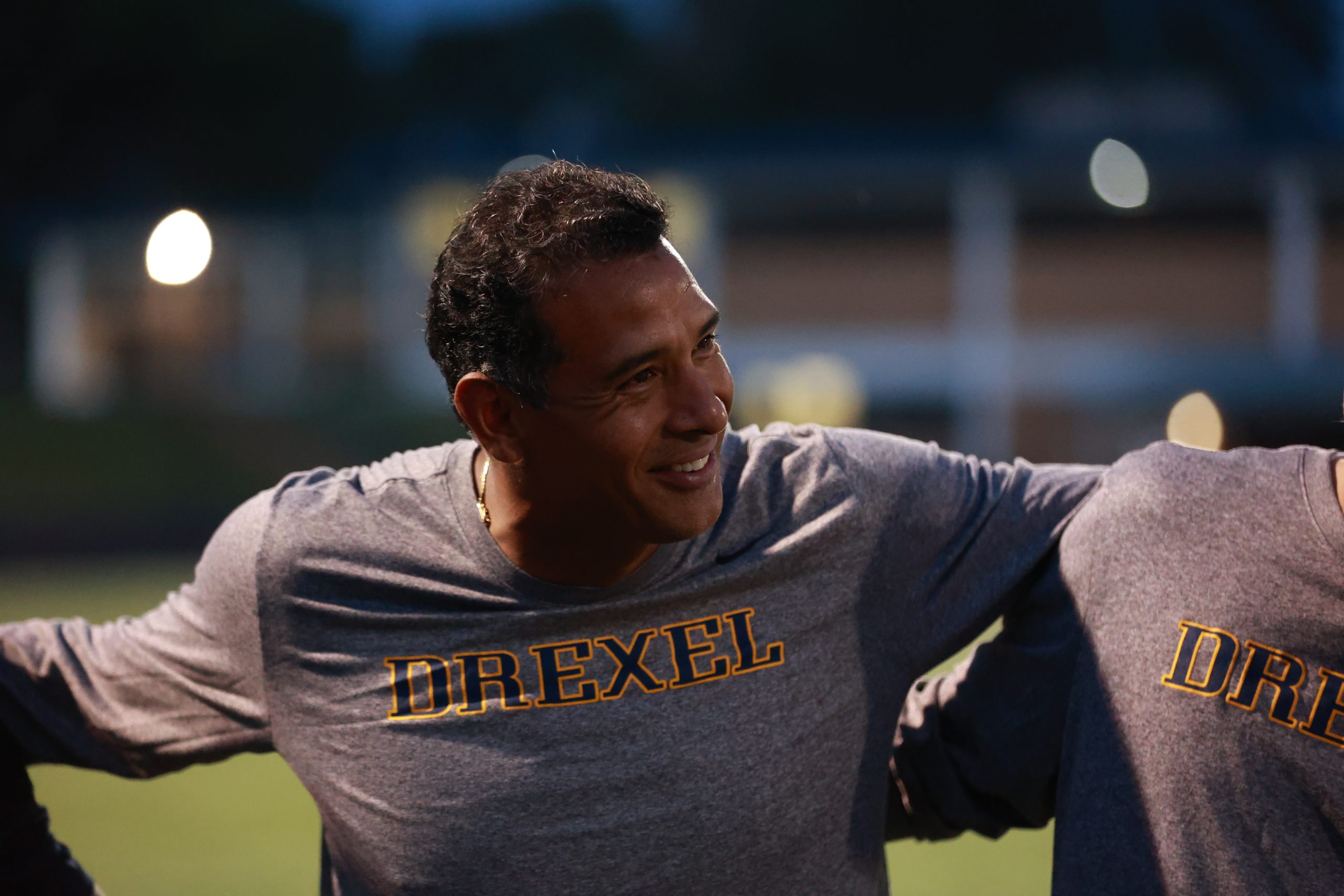
    David Castellanos believes college soccer’s current system is yielding strong results and a “drastic change” would not be necessary.Drexel Athletics

    One way to escape the cold is to schedule early spring matches down South, which is what most of the area’s college baseball teams do. Fetrow noted that he has been in conversation with Villanova to “try to go down to a place like North Carolina” to start the second half of the season. Thames, Mulqueen, and Castellanos all shared similar interest.

    Like anything, though, that will come with additional costs.

    “Those are going to be travel expenses. I don’t see how you can get around it,” Mulqueen said. “We’ve gotten to the stage where the smaller schools, we have to adapt to what’s being done at an NCAA level that we really don’t have much say in.”

    Player health

    A leading factor in the new format’s adaption was the idea that spacing out games would result in fewer total matches missed due to injuries. The NCAA, in its formal announcement, wrote that increased recovery time “could support injury prevention and return-to-play protocol.”

    For the most part, the area’s coaches agreed with the reasoning.

    “Say a kid needs two and a half weeks to get back [from an injury], there’s a good chance that the player missed five or six games through one injury,” Gill said. “Versus [in the new format], the player maybe misses two to three games. You’re sort of giving some space for guys to naturally come back.”

    While Castellanos agrees that total games missed will be cut down due to the new format, he believes that a longer season may bring more “wear and tear” injuries.

    “When we think about these injuries, we think about some of the major ones, but we’re not talking about the soft tissue ones,” Castellanos said. “Now that you go 10 months, you’re on it every single day, right? I think that you know these things can linger. It’s going to put a lot more pressure on the training staff to maintain these guys to be healthy for 10 months.”

    Bryan Green has led the Owls as head coach since 2022.Temple Athletics

    Mulqueen is also concerned about new injuries sprouting due to the format.

    “In my experiences, when you have more time, you do more things,” Mulqueen said. “No one’s going to sit idly by and say, ‘Right, we have 10 months now, or we’re going to give guys time off.’ Well [if] you get bad results, you’re going to do more.”

    Now, Philadelphia’s coaches are in a waiting game to see when the proposal will make its way back to the NCAA’s desk. In the meantime, they will continue to prepare for what feels like the inevitable.

    “There’s all kinds of different challenges every season, no matter what,” Green said. “I think that’s the one thing that college athletics does really well, is they’re nimble and adaptable, and this is just one more thing that we can prove that we can do.”