Temple kicked off its much-anticipated 2026 season on Saturday at Lincoln Financial Field. While many of the program’s burning questions remain unanswered, the Owls still delivered a strong performance in nearly every facet of the game to fuel a 38-14 win over FCS opponent Rhode Island.
Temple paired balanced production from both quarterback contenders with a breakout performance in the backfield, while its defense stymied the defending Coastal Athletic Association champions in the second half.
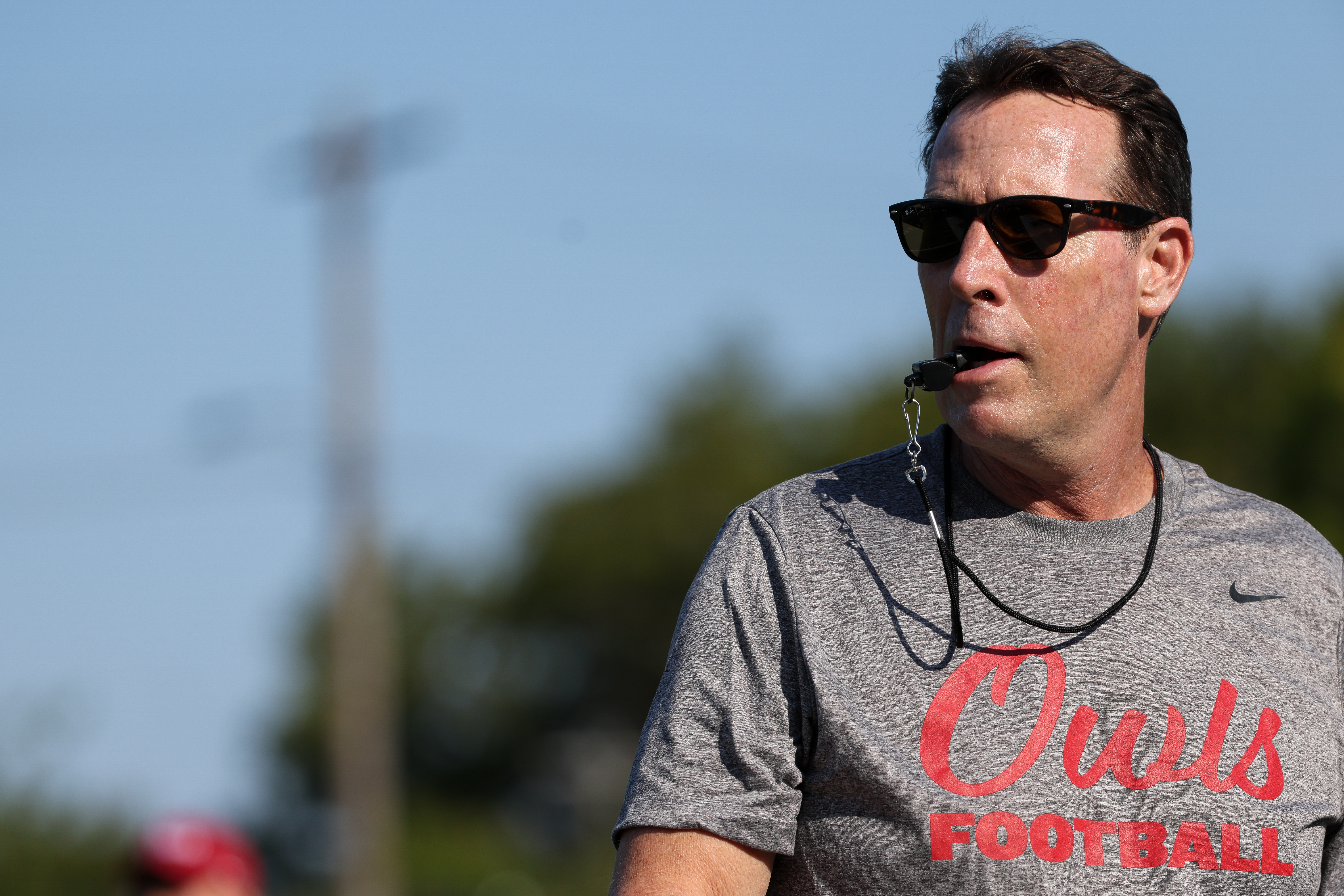
“We did a really good job at keeping them down in the second half,” said Owls coach K.C. Keeler. “We held them to a second-half shutout, and I’m happy with a lot of parts of this performance.”
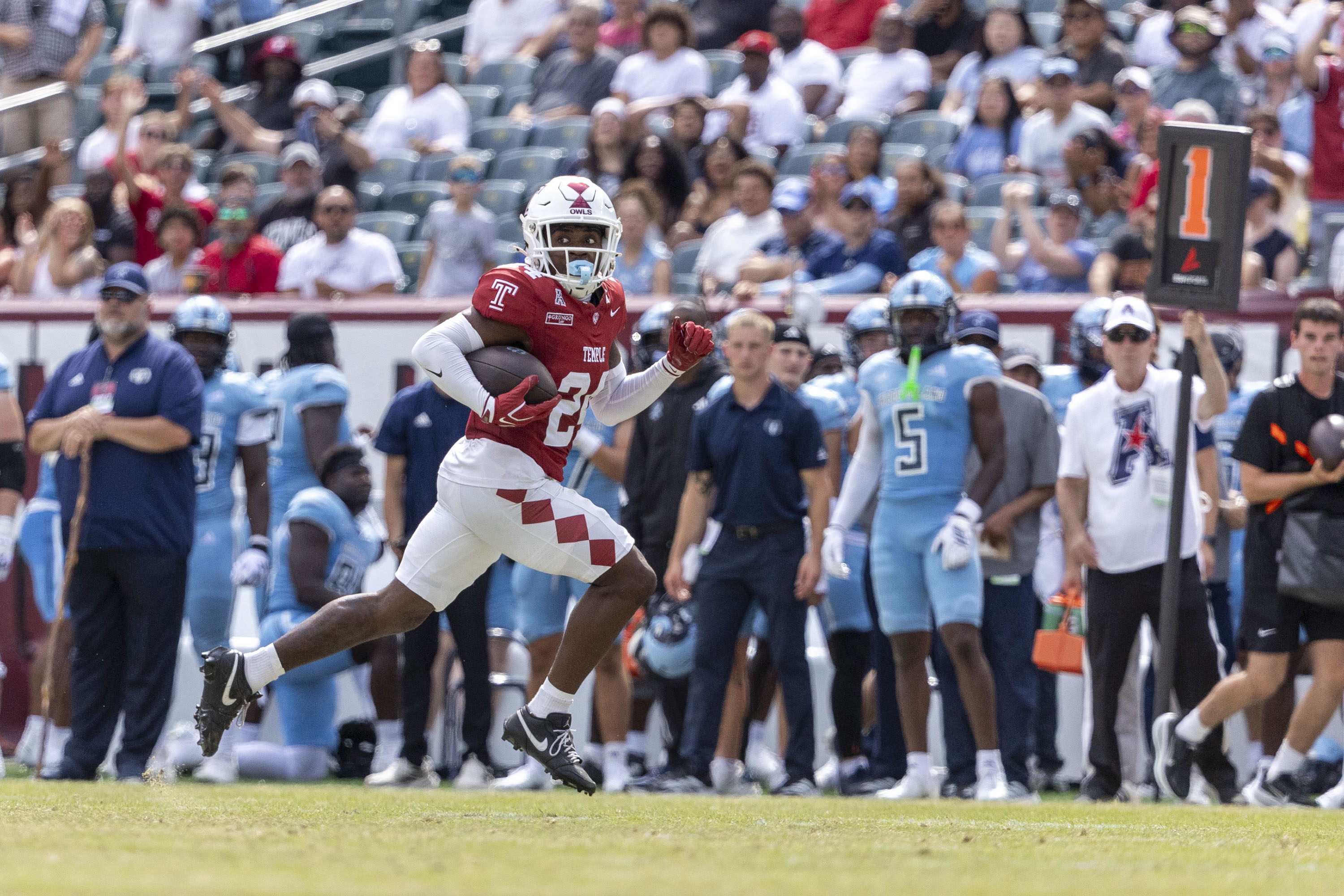
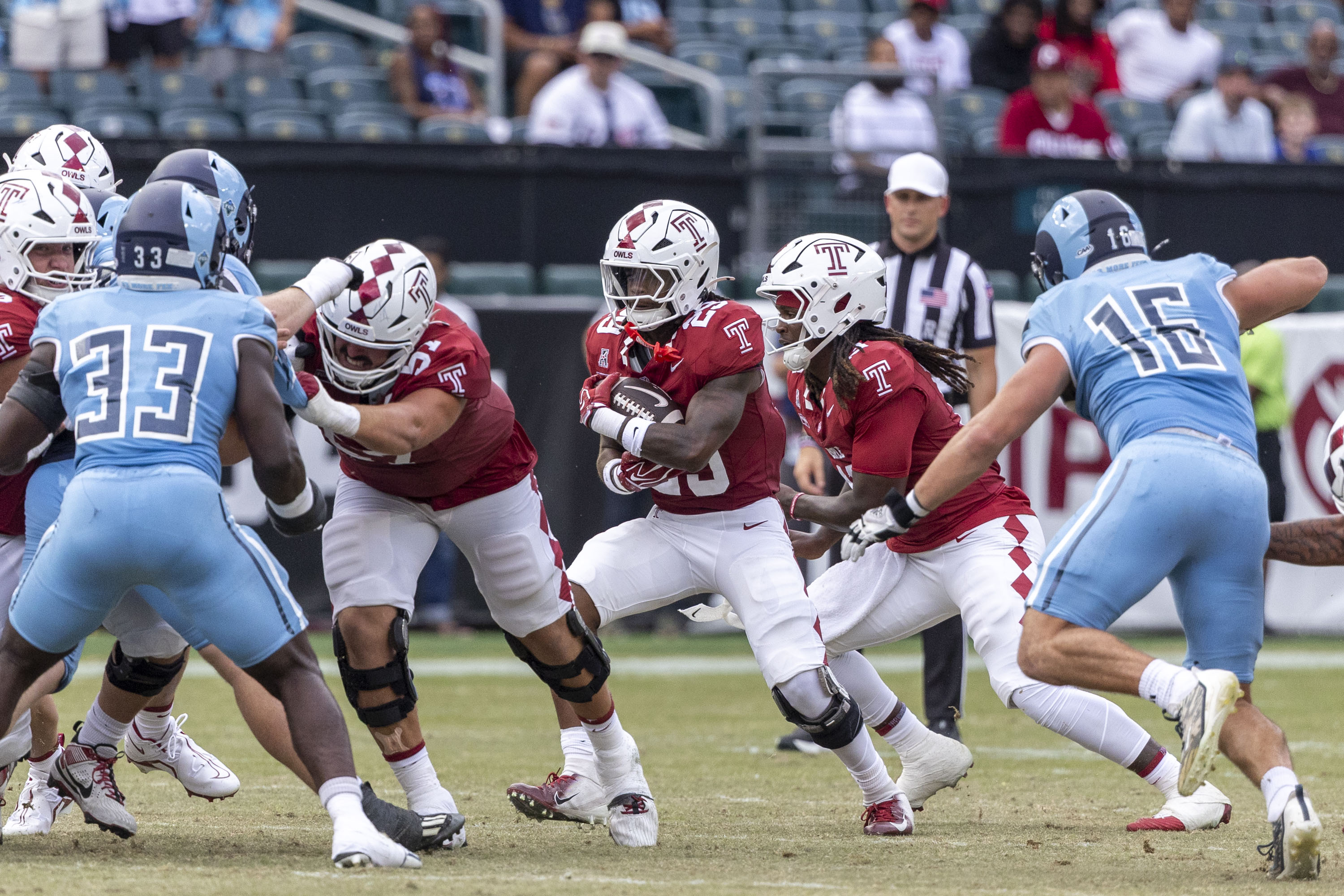
Hunter Smith (29) runs through Rhode Island’s defense during the first half of Saturday’s game.Tyger Williams / Staff Photographer
The quarterback rotation
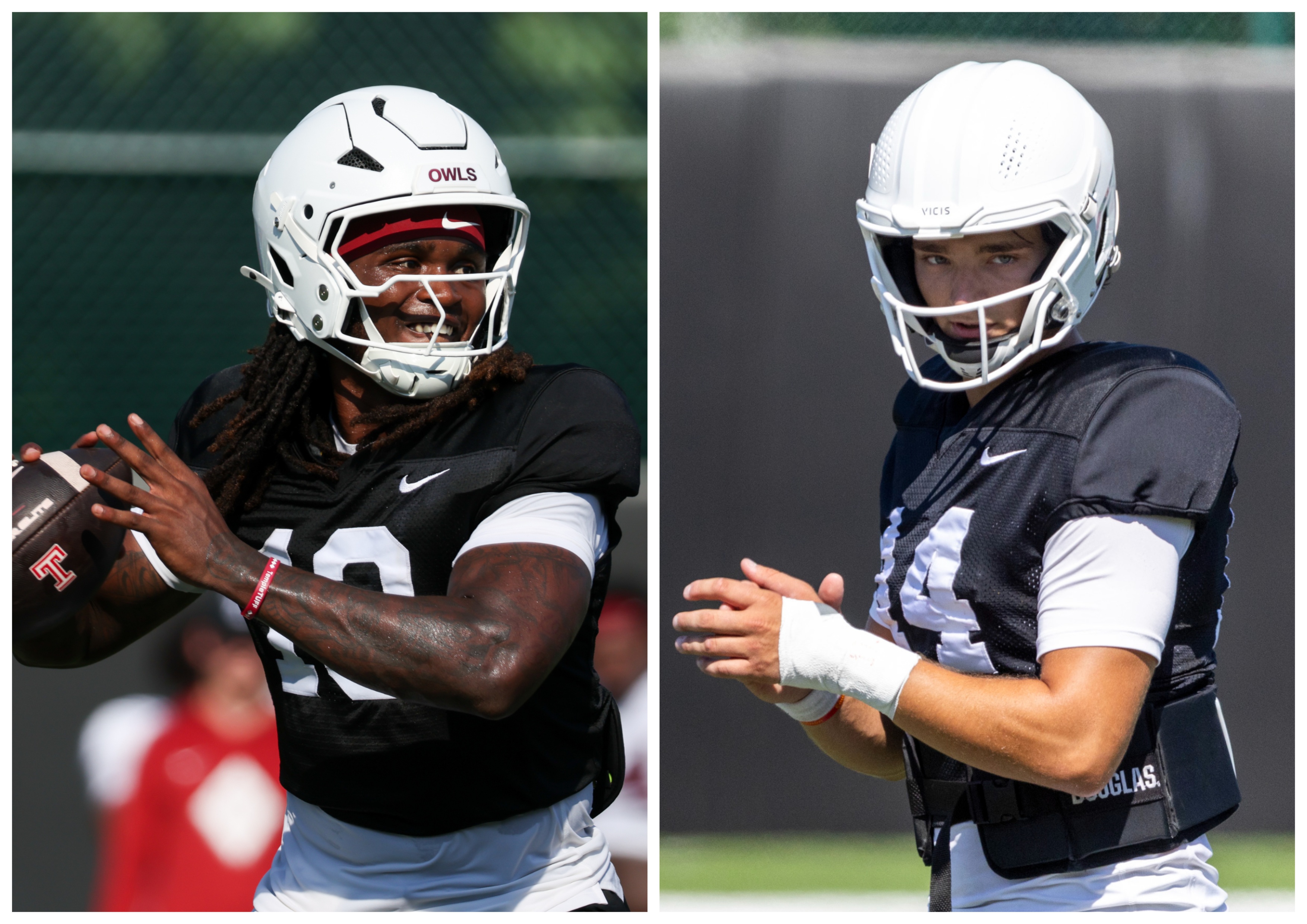
After an offseason of speculation about which quarterback would take the field for Temple, Keeler went with both — Jaxon Smolik at quarterback and Ajani Sheppard at running back.
Smolik shuffled the ball to Sheppard, who made the on-the-run throw to Colin Chase, who took it 21 yards.
That set up a 19-yard run from Keveun Mason, which was followed by an 18-yard strike from Smolik to Jayce Freeman, putting the Owls up, 7-0, with not even three minutes into the first quarter.
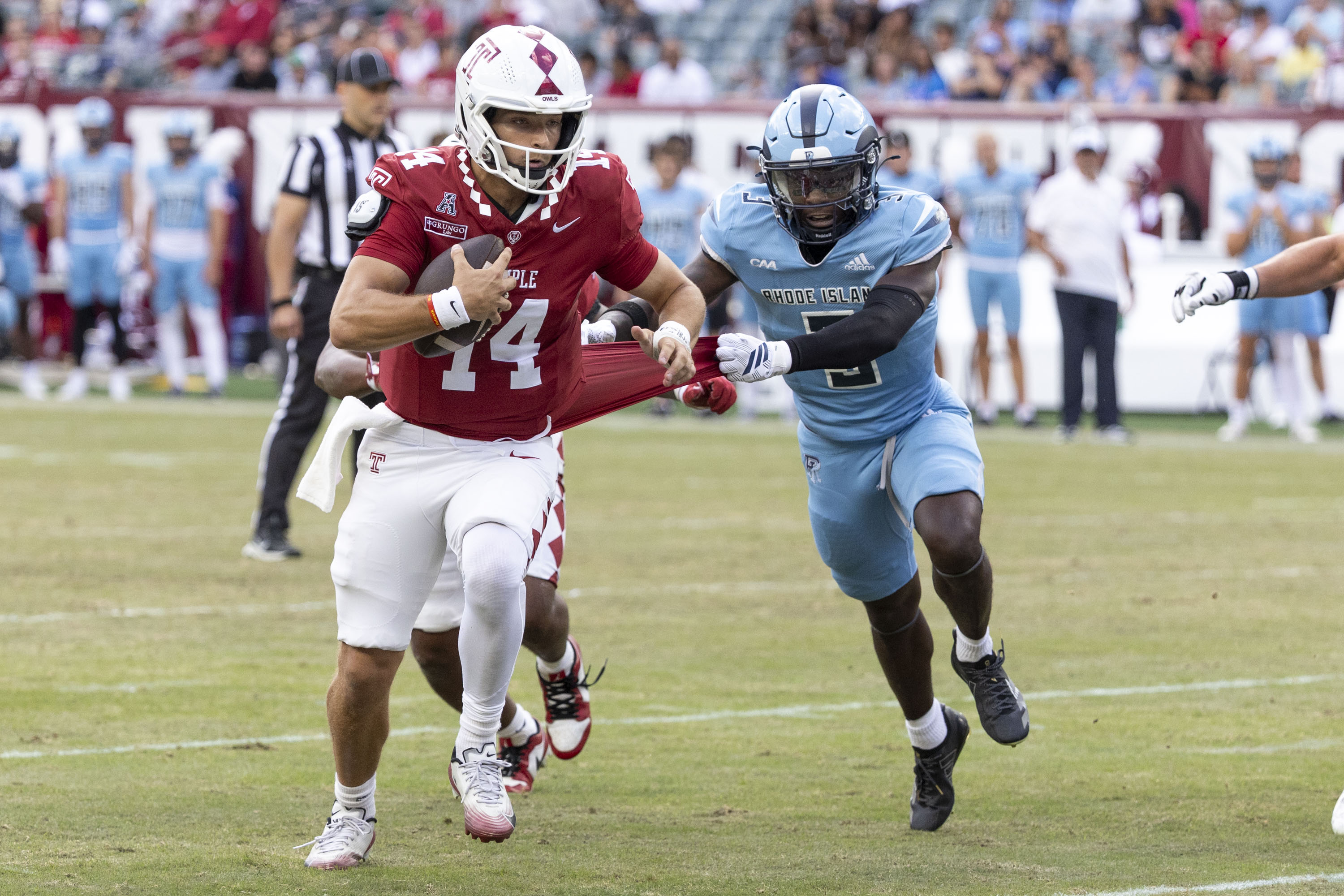
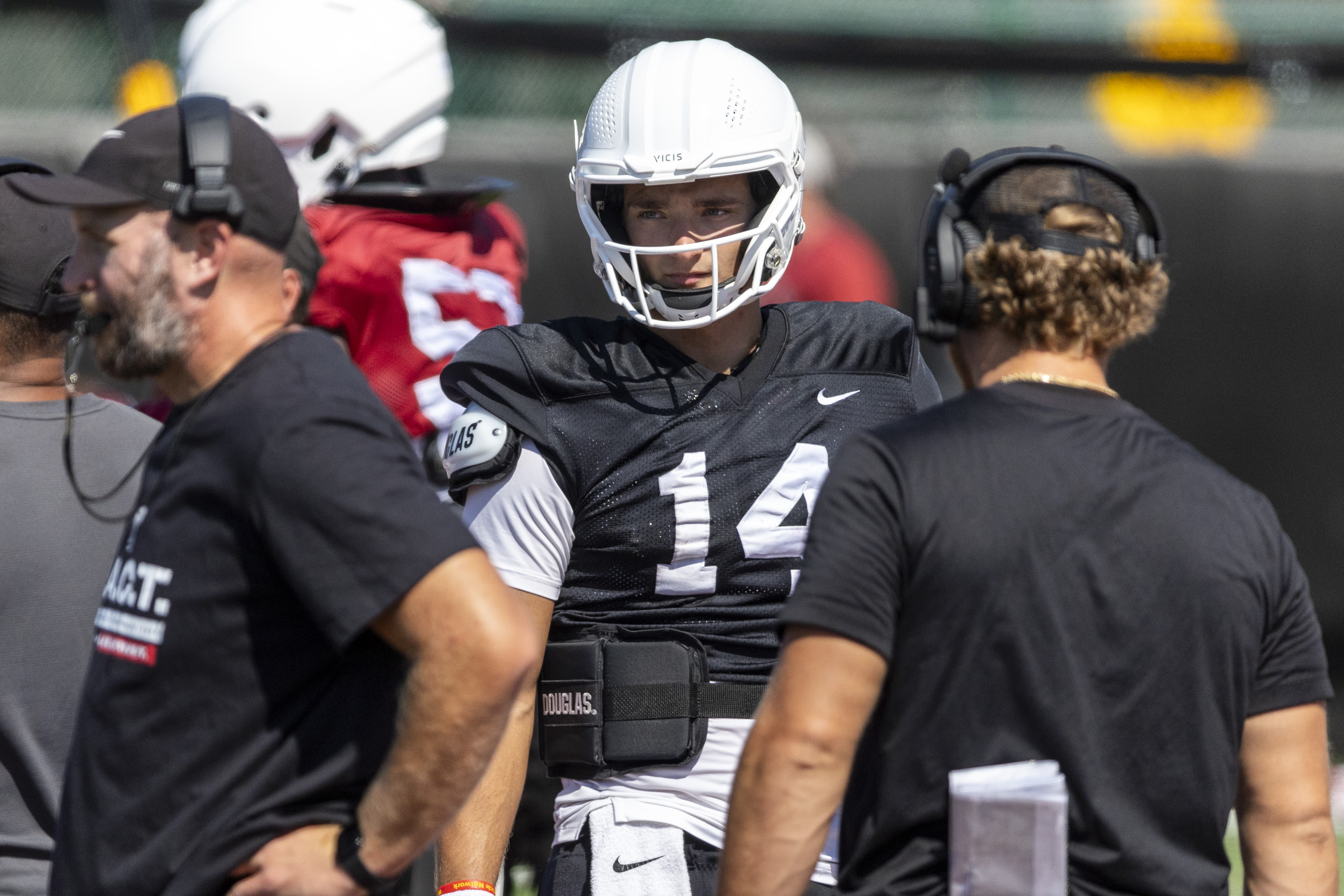
Temple quarterback Jaxon Smolik (14) runs as Rhode Island’s Trey Lubin looks to make a tackle on Saturday. Tyger Williams / Staff Photographer
The Owls scored two more times in the half, with Smolik having control on all three scoring drives.
Both Sheppard-led drives in the first half ended with punts, while Smolik’s inaugural drive of the second was thwarted when the Penn State transfer fumbled trying to escape a sack.
“It’s an ongoing competition,” said Keeler. “It would be a disservice to those guys for me to name anyone right now. That’s [offensive coordinator] Tyler [Walker’s] job, and he’s handling that.”
Sheppard went on to lead the Owls’ only scoring drive of the second half.
Defensive tone
Since the onset of spring camp, offensive and defensive coaches alike have praised Temple’s defense at every chance.
The Owls’ defense backed up that praise in their first opportunity of the season. After letting up a touchdown on Rhode Island’s opening drive, Temple forced two punts and saw sophomore Jamarcus Pierre take a 35-yard interception into the end zone to take a 17-7 lead.
The second half began with Tyree Alualu putting an end to the Rams’ first drive with any promise when he gave Temple its second pick-six of the day, taking the score back 63 yards and claiming a 38-14 lead.
Jordan Montgomery forced a fumble recovered by Bryson Goodwin late in the game, as the defense finished with three turnovers.
Second-team walk-on linebacker Reggie Jones, who has grown a social media following for his series, “Road to One Tackle,” got in on the defensive festivities as well and recorded his first career tackle, taking down Rams wideout Marquise Buchanan on a short crossing route midway through the fourth quarter.
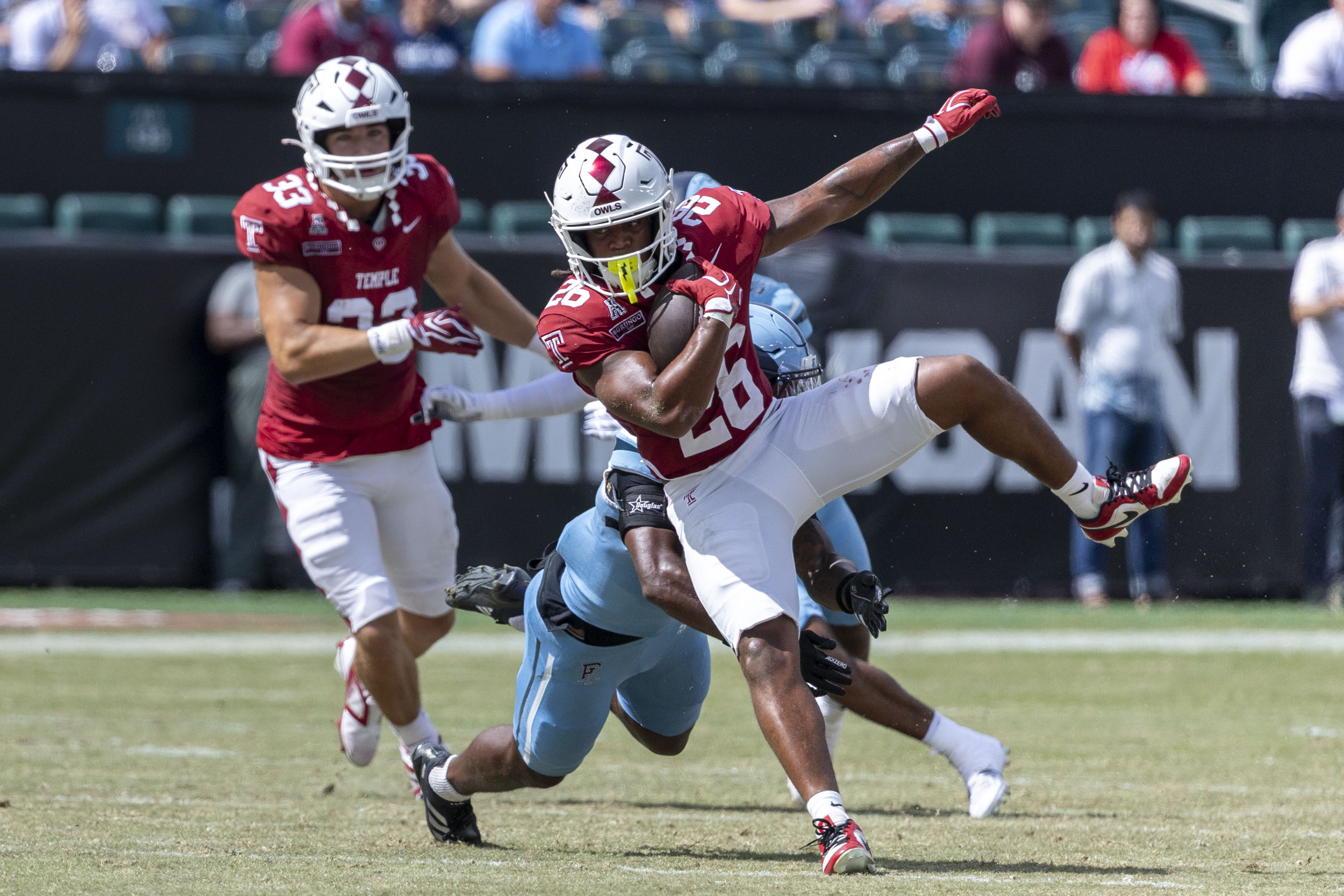
Keveun Mason (center) scored twice against Rhode Island on Saturday at Lincoln Financial Field.Tyger Williams / Staff Photographer
The Keveun Mason game
Projected first-team running back Sam Brown sat out of the Owls’ opening game despite being a full participant in team warm-ups, paving the way for Mason to receive the bulk of the snaps.
Mason carried the ball 20 times and broke off a couple of big runs early before punching in his first score of the year from one yard out to give Temple a 24-14 halftime lead just before time expired.
Mason added another score in the second half, running through a couple of defenders to find the end zone. He’d finish the day with 158 yards and two touchdowns.
Up next
Temple will prep for its much-anticipated home matchup with Penn State when the Nittany Lions visit South Philadelphia on Sept. 12 (noon, ESPN).
Temple almost reached a bowl game during K.C. Keeler’s first season. The Owls began their 2025 campaign 5-3 and needed one more win to be eligible, but four consecutive losses left them short of their first bowl appearance since 2019.
Keeler enters his second season with a revamped roster, higher expectations, and uncertainty at the sport’s most important position. Temple added 22 players through the transfer portal and plans to play quarterbacks Ajani Sheppard and Jaxon Smolik in its season opener on Saturday against Rhode Island at Lincoln Financial Field (2 p.m., ESPN+).
Before kickoff, here are five things to know about Temple’s key players, newcomers, schedule, and preseason expectations.
Both quarterbacks will get an opportunity
Temple’s well-documented quarterback battle will continue in the season opener.
Smolik and Sheppard have battled for the starting job since the spring and it has persisted through preseason camp. Both quarterbacks have seemingly struggled and thrived in unison, making any decision difficult for the Owls coaching staff.
Keeler has shown little urgency in naming a signal caller.
“Early on, I think it was sort of a battle, but they weren’t playing great,” Keeler said. “The quarterback play was just OK. Now, all of a sudden, they’ve both made dramatic improvements. I think we feel like we can live with two quarterbacks. I’m going to ask one of those guys to go out there and start the game, obviously. But I think it’s a little bit like last year — we had no idea. We had to go out there and put some stuff down, see where they were, and let somebody steal that job and give us some peace of mind.”
Jaxon Smolik will split reps in pocket with Ajani Sheppard in the season opener on Saturday.Tyger Williams / Staff Photographer
Neither candidate has extensive college experience. Smolik appeared sparingly during three seasons at Penn State and never attempted a collegiate pass. Sheppard played in five games across two seasons at Rutgers, completing both of his attempts for 23 yards, before missing the entire 2025 season at Washington State because of an injury.
Keeler faced a similar decision last season with Evan Simon and Gevani McCoy. Both were expected to play in the opener against Massachusetts, but Simon seized the job by throwing six touchdown passes in a 42-10 victory. Keeler will again lean on game action to produce separation.
Brown is healthy … kind of
Sam Brown enters Saturday’s matchup as the Owls’ starting running back, a role he carved out for himself in spring and fall camp.
Brown has been primarily healthy through the past six months, which is notable considering the fifth-year senior has yet to compete in a full season of his collegiate career. He suffered injuries in 2022, 2024, and 2025 at Rutgers.
Over the past two weeks — and for the first time since joining the Owls — Brown has been limited in practice. He did not participate in team or contact drills after taking a hard hit on Aug. 20.
Sam Brown will be Temple’s starting running back as long as he’s healthy.Tyger Williams / Staff Photographer
“It’s one of those things where we’re trying to protect Sam from Sam, because Sam is a compulsive worker,” Keeler said. “When you get into those situations, you just try to back him off. That’s what we’re trying to do — back him off a little bit and have a fresh version of him when we get to game day, and if we had a game today, he’d be playing.”
Assuming Brown takes the field on Saturday, it’ll be a huge boost for the offense.
Entering his second season, Keeler added several transfers and recruits in the offseason, but kept nearly all his returning starters, which is considered rare in today’s college football climate.
That effort comes from a culture shift in the wake of Keeler’s hiring. The Owls broke their streak of four consecutive 3-9 seasons last year.
In 2026, Keeler and company will be tasked with taking another step forward.
“I’ve driven this team really hard — maybe as hard as any team I’ve ever driven,” Keeler said. “I strongly believe in them. We have a lot of new players, and we had to get them up to the culture and how we do things. I don’t want to get to game day and, all of a sudden, we’re under some adversity or strife and don’t know how to handle those things. As a collective group — and me in particular — we pushed this team quite hard. I don’t think you push a team hard if you think its ceiling is right there. You push it hard when you think the ceiling is really high.”
Almost every great Temple football team has been spearheaded by a strong, gritty linebacker corps.
In the mid-2010s, Temple boasted names like Tyler Matakevich and Avery Williams. Al Golden’s teams featured Tahir Whitehead, while even Wayne Hardin’s 1970s glory-day teams had former pros, including Mike Curcio.
Now, the 2026 defense will be led by linebackers Eric Stuart and Curly Ordonez. Stuart was also selected as a defensive captain and awarded a single-digit for the season.
Linebacker Eric Stuart returns as Temple’s lead tackler from the 2025 season.Isaiah Vazquez / For The Inquirer
The defense wreaked havoc throughout preseason camp. On the defensive line, Keeler and defensive coordinator Brian Smith are planning to regularly rotate 10 players during games. The safety room is also deep, with Avery Powell and former Illinois defensive back Saboor Karriem leading the room.
“I feel like we have one of the best rooms,” Ordonez said. “We have guys and can go three or four deep. I just feel like there is no slack off. That’s one thing I see in our room, just how ready everyone is, no matter what, whenever we need them.”
A telling September awaits
After six months of facing each other, the Owls will finally get their first game action against Rhode Island. It will be a measuring stick for Temple’s nonconference schedule as the Rams are one of the FCS’ best squads.
Then, Temple will face No. 18 Penn State in Philadelphia in Week 2.
The rest of September includes a Week 3 matchup with one of the Mid-American Conference’s best teams, Toledo, which will also be Temple’s first road game. The Rockets won eight games last season and punched a ticket to the Boca Raton Bowl. Toledo was selected third in the MAC preseason coaches’ poll.
The month will conclude with Temple’s American Conference opener against Army at Lincoln Financial Field. The Owls lost, 14-13, in West Point, N.Y., last season after a potential game-winning field goal was blocked in the final seconds.
By the end of September, the Owls could show if they’re capable of reaching a bowl game.
During the spring, as Temple’s football team started to mesh together returning players and newcomers, via the transfer portal and high school recruits, Peter Clarke, the team’s standout tight end, gathered the entire offense together.
The gesture was one example of Clarke, one of the seven players to earn the single-digit demarcation this season, emerging as a vocal leader for a program looking to build on last season’s 5-7 finish.
“When it comes to Peter Clarke, I feel like he’s a natural born leader,” said Temple running back Sam Brown, who transferred to the program this spring. “When I got here, I saw that off the jump. He’s always taking account for things, making sure people are doing the right things, and he’s definitely a leader by example, by what he does on and off the field.”
Clarke is a key returner for Temple, which didn’t lose an eligible starter to the transfer portal earlier this year. The rising senior finished with a career-best 30 catches for 483 yards and six touchdowns last season and is one of the best returning tight ends this season, evidenced by his preseason accolades: the John Mackey Award watchlist, preseason first-team All-American Conference honors from Phil Steele and Athlon Sports, and All-America third team honors at Pro Football Network.
As the Owls prepare for their season opener on Saturday against Rhode Island (2 p.m., ESPN+), there will be a sense of continuity for the offense, even with a new quarterback under center with transfers Ajani Sheppard and Jaxon Smolik competing for the starting spot. Four of the five starting offensive linemen from last season return, along with wide receivers Jojo Bermudez and Colin Chase, in addition to Clarke.
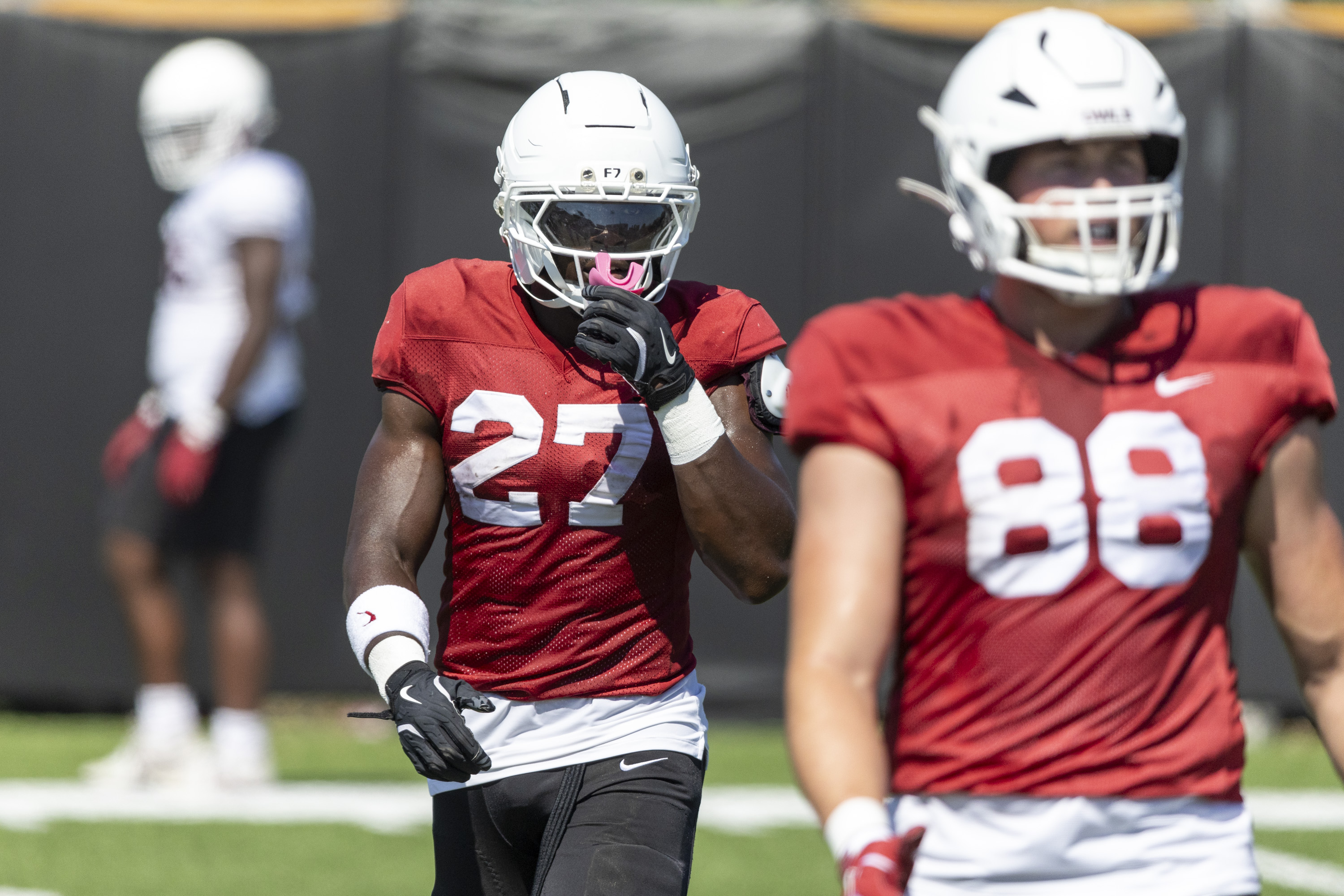
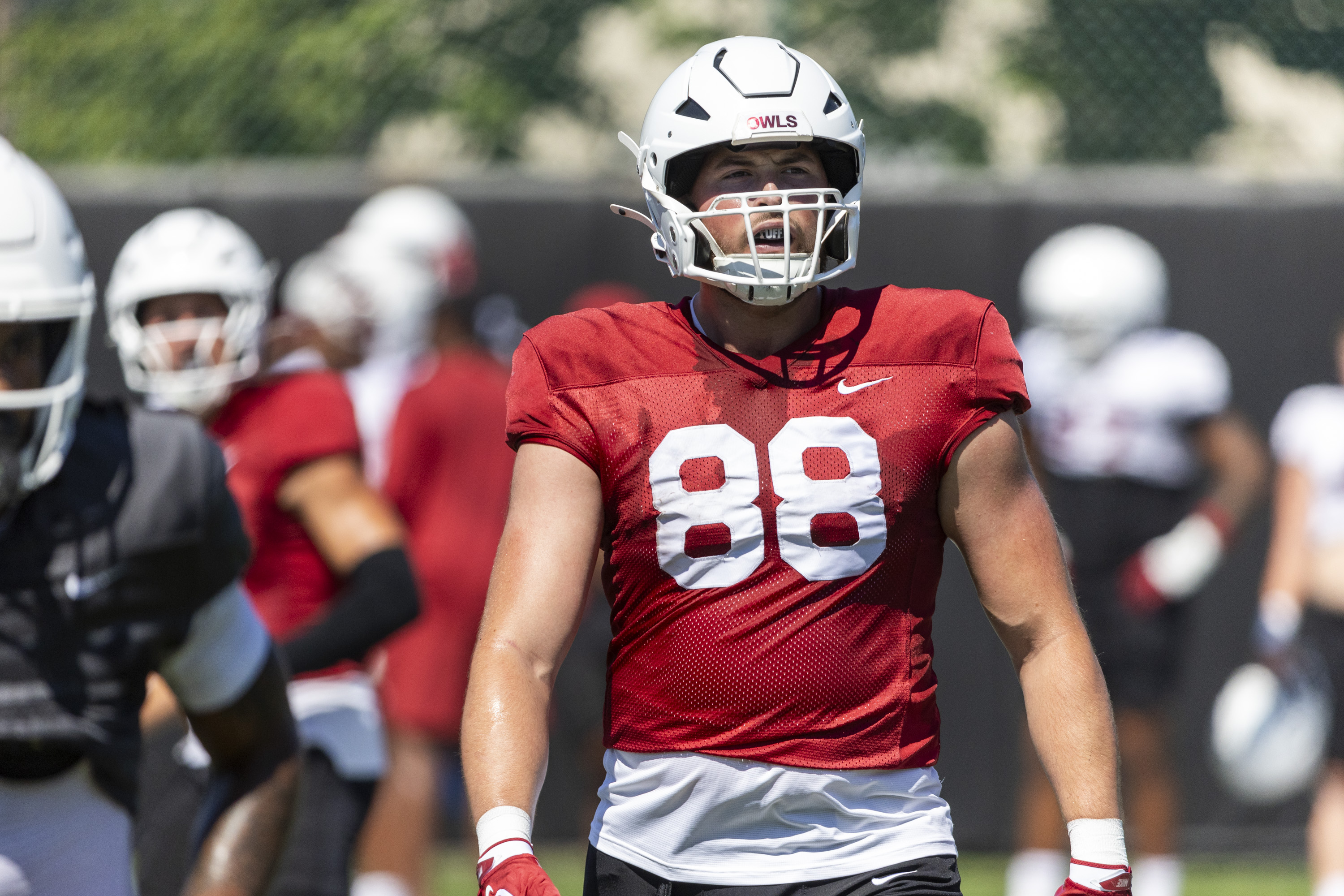
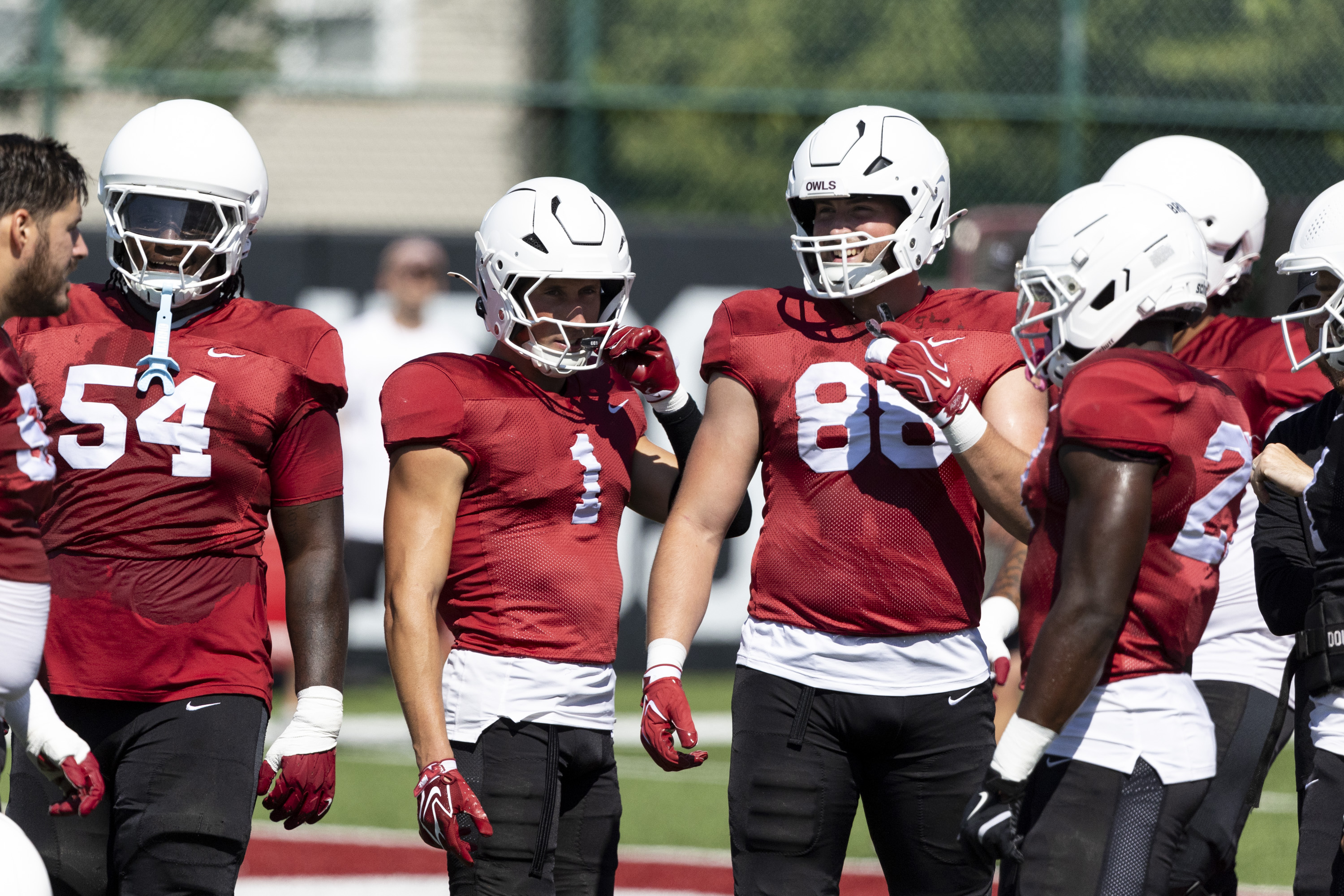
Colin Chase (1) and Peter Clarke (88) are among the returning skill players from last season’s roster.Tyger Williams / Staff Photographer
“When you bring in 50-60 new guys every year, you’re having to reinstall not just the plays, but also the culture, the identity,” Clarke said. “Whereas when you keep everybody, you have position leaders in every group. You have guys who know what it takes and have been in those positions and can guide guys and bring them along a lot quicker. So it means we can [be] more quicker. … We have a big advantage in keeping the position leaders, keeping guys we played [with], and just reinstalling coaches and new guys that not necessarily starting from ground zero.”
Building foundational blocks
When K.C. Keeler took over the program 21 months ago after a 11-year run at Sam Houston State, he emphasized that Temple would not be “living in the transfer portal 100%,” and added that he doesn’t want a locker room full of mercenaries, where “guys [are] just here for a year or two, and there’s no fabric, there’s just no continuity.”
A key part of his plan to help turn the program around was building leadership and advisory board councils among the returning players, as a way to rebuild the team’s culture.
The message appears to be resonating. Clarke, who says leadership “comes natural to me,” is one of 11 seniors or fifth-year players who have remained on the roster since their freshman seasons and endured the coaching change from Stan Drayton to Keeler.
“Being a captain on my high school team and leading guys there and coming here and having an impact like I have, and then when success happens, staying at Temple and continuing to grow, helps me step into that [leadership] role,” Clarke said. “I love this program. I love my teammates, and I want this school and this community to bring the energy for us. … When I see guys doing the wrong things, not being accountable, not doing things the way like ‘Temple tough’ football is. It’s my job to hold them accountable and hold myself to that same high standard.”
Grayson Mains, the team’s starting center for the last two seasons, transferred to Temple from South Carolina before the 2024 season and was also selected by his teammates to be a single-digit player this season.
He too, understands the importance of continuity and team culture, not only for the success of the program, but for the health of the locker room. He says leaders, like Clarke, himself, and other returning upperclassmen who have been around the program, “know what a bad culture on a team is like” and added that this year “we know what we do and don’t want to see, and just how to push guys the right way.”
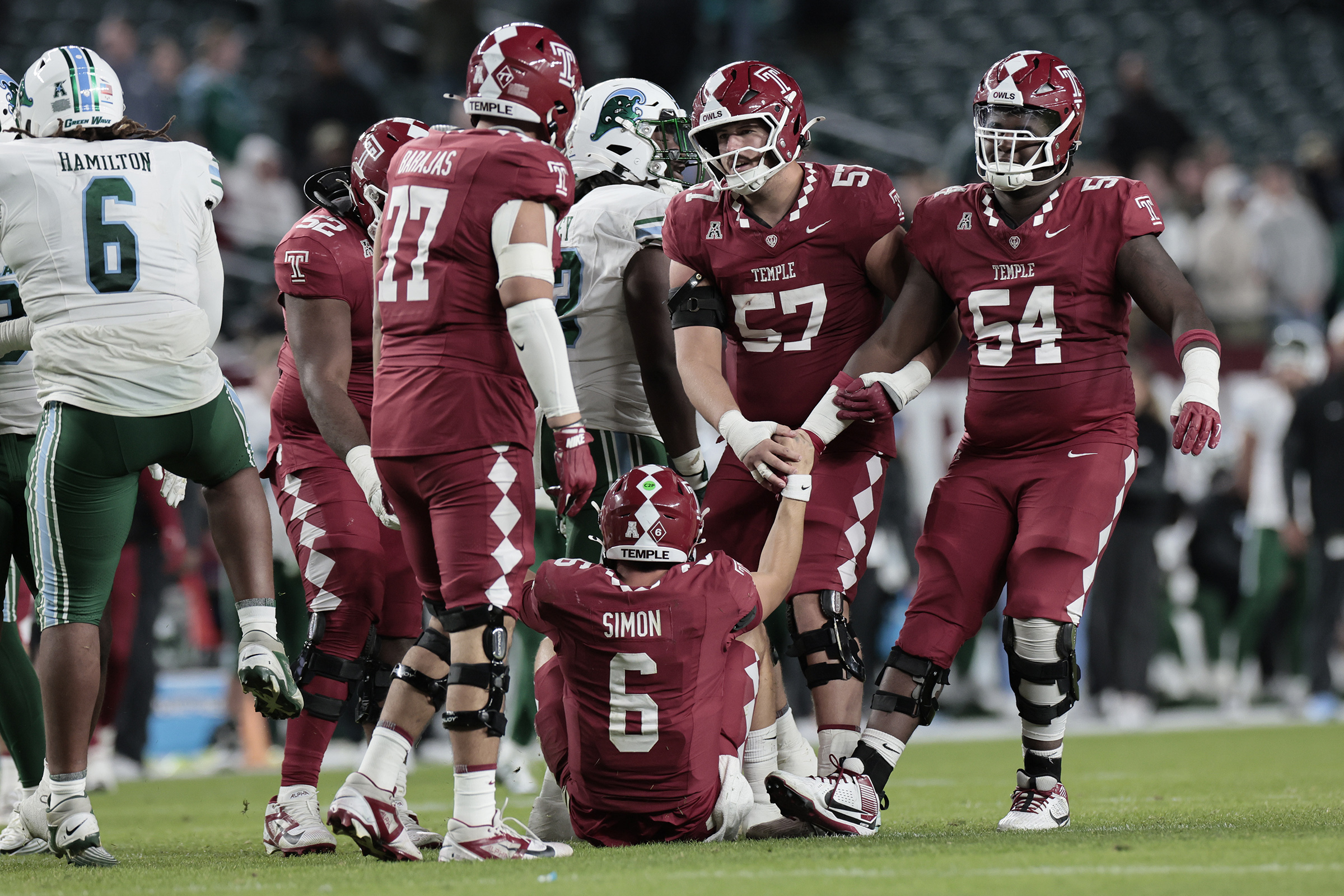
Grayson Mains (center) helps up his quarterback during Temple’s game against Tulane last season.Elizabeth Robertson / Staff Photographer
“Coach Keeler’s big thing has really been about accountability, and I think I’ve seen it a lot from the players,” said Mains. “Players holding players accountable, and being a lot more respectful to each other. … [We’re] not taking everything personal, because we all know that we’re one team and we’re all fighting for the same goal.”
Clarke’s leadership hasn’t been just noticed by his teammates. Offensive coordinator Tyler Walker, part of a coaching staff that was also fully retained from last season, called his tight end “the epitome of a single digit.”
“He’s been in the shoes that a lot of these young guys have been in,” said Walker. “He’s been [at Temple] through the ups and downs, and he’s been through coaching transitions. He’s been a backup. He’s been a freshman, and now he’s also been the guy. … He’s super humble. He wants to be great. He wants to be coached. He wants to be coached hard.
“He sets expectations for himself, and he brings other guys around him, with him. And that’s the sign of a good leader.”
‘Captain’s practices’
During the summer, coaches are not allowed to administer nor watch practices, according to NCAA rules. But that didn’t stop players from getting work in, led by Clarke and others.
Clarke and Mains each credit the player-run practices for bonding the team together, and it ultimately set the tone for their expectations this season on North Broad.
“The biggest emphasis to the transfers that weren’t here [last year] was, ‘Hey, this team’s been through a lot and experienced a lot, and we’re so close to turning this thing around.’ We’re all pushing the same direction and [we told them], ‘It’s time to get in and help us,’” said Clarke. “So [we were] getting those extra captain’s practices in with Army and Navy looks and [their] triple option offense, so that our defense understands what the read keys look like and can develop those habits early, so when we get to the game weeks, it’s not a complete surprise.
K.C. Keeler has had winning records in the second season of previous stops at Rowan, Delaware, and Sam Houston State.Elizabeth Robertson / Staff Photographer
“It’s just about, ‘Hey, what’s going to get us over the edge?’ It’s going to be efficient football from the offense. It’s going to be able to stop the run from the defense and just play one complete football game between special teams, offense, and defense.”
Added Mains: “Over the summer we pushed each other [so much harder]. … We were just able to do so much more, and then especially those summer days, like our OTA days, when coaches weren’t in the building, everybody respects [the leaders] enough to lead those player-run practices on the field and truly get really good work done.”
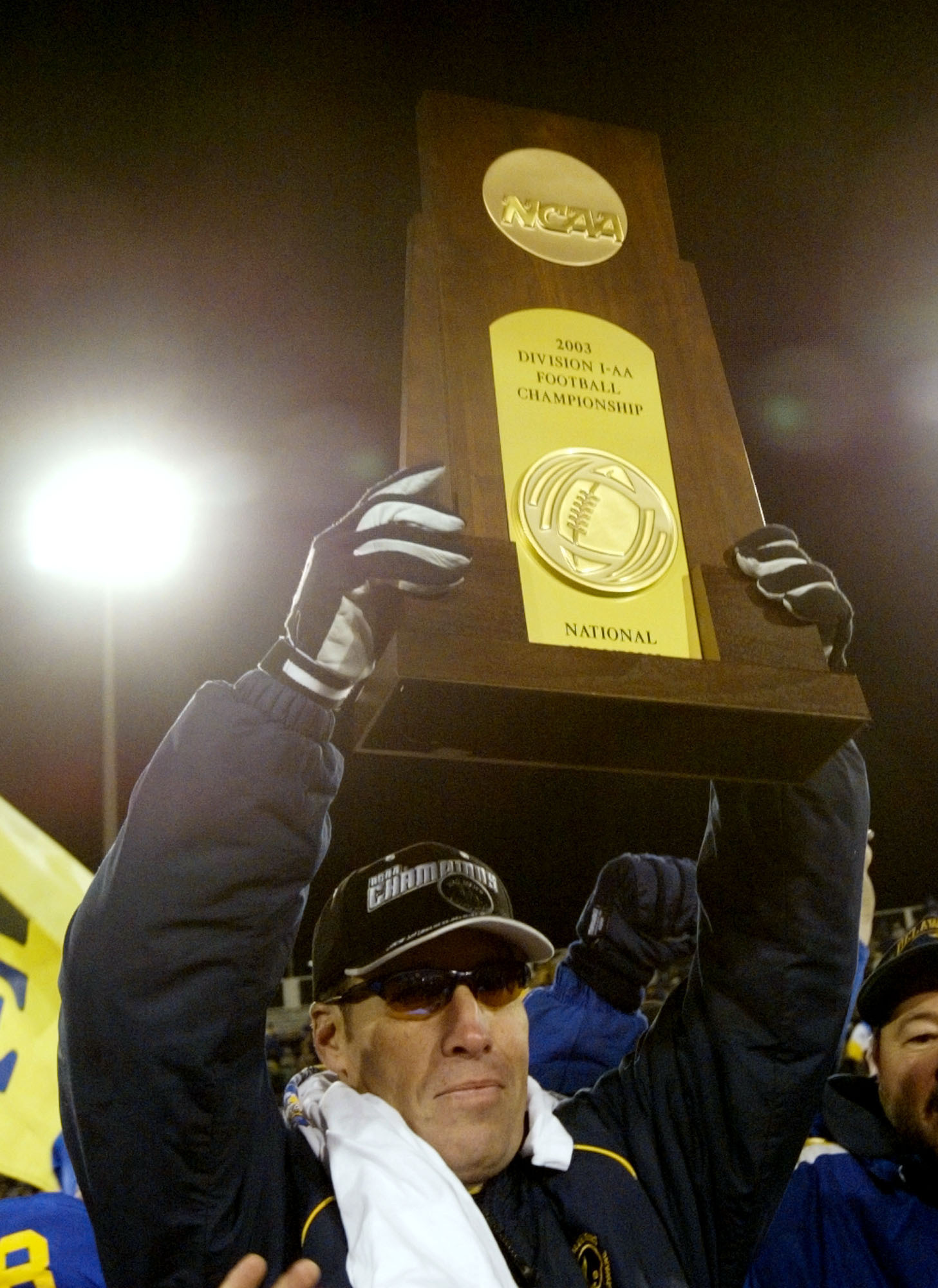
At his previous three stops, second seasons for Keeler have been notably fruitful. At Division III Rowan in 1994, the team finished 6-3; in 2003, Delaware won the Football Championship Subdivision championship; and at Sam Houston State in 2015, Keeler led his team to the FCS semifinal.
After two one-point losses last fall that prevented the Owls from making a bowl game, their players are ready to turn the page.
“We talk every day about winning championships,” said Mains. “This team hasn’t been to a bowl game in a while and hasn’t seen that American Conference trophy in a while. We’re all striving every single day to be as great as we can to make those goals [happen].”
Added Chase: “I think we got something special here. It speaks about our program. It speaks about coach K.C. Keeler and the vision that everyone truly believes that Temple football is going to be successful.”
The college basketball season is officially over, which means it’s time for the transactional period to begin. Welcome to the 2026 transfer portal.
More than 1,500 men’s basketball players were in the portal in the first 24 hours after it officially opened on April 7. The portal is open for two weeks, but players do not need to make their commitment to a new school during that window. The next few weeks will be filled with salary negotiations during the yearly NCAA free agency process.
We’ll be tracking it all here, from players moving in and out of — or around — the Big 5 to keeping tabs on Philly-area players at other schools. We’ll also take a look at where some of the top local high school recruits from the Class of 2026 will be playing in the fall.
Big 5 portal entries
Here are the players who were at Big 5 schools during the 2025-26 season but have entered the transfer portal.
Villanova
Acaden Lewis (point guard) started for the Wildcats during his freshman year and averaged 12.2 points, 5.3 assists, and 3 rebounds. (Transferring to Miami.)
Bryce Lindsay (guard) was a redshirt sophomore and Villanova’s best scorer during its nonconference schedule. (Transferring to Indiana.)
Malachi Palmer (forward) was a solid contributor off the bench who started down the stretch after Matt Hodge went down. But Villanova recruited multiple forwards out of the portal. (Transferring to Minnesota.)
Chris Jeffrey (guard), a freshman backup point guard who missed time after knee surgery but had promising moments.
Braden Pierce (center), a redshirt freshman reserve who followed coach Kevin Willard from Maryland, played 6.5 minutes per game and averaged 1.2 points. (Transferring to College of Charleston.)
Zion Stanford (forward/West Catholic graduate) transferred to Villanova from Temple, left the team in March after playing in 10 games. (Transferring to Towson.)
Tafara Gapare (forward), a senior, left the program at midseason after playing in just nine games.
Aiden Tobiason (guard) averaged 15.3 points, second on the team, and led the Owls with 39 steals. He’ll have two years of eligibility left. (Transferring to Syracuse.)
Babatunde Durodola (forward), a sophomore, started as a freshman and was a key rotational player this season. (Transferring to Ball State.)
Jamai Felt (forward) started in 23 games and averaged 4.1 rebounds. (Transferring to Arkansas-Little Rock.)
AJ Smith (guard) averaged 7.8 points in eight games and had his season cut short by a shoulder injury.
Spencer Mahoney (forward) made 13 appearances as a redshirt sophomore. (Transferring to Denver.)
Ayuba Bryant Jr. (forward) appeared in 27 games, averaging 8.1 minutes.
Connor Gal (guard/Great Valley High graduate) played 12 minutes across five games and will have one year of eligibility left.
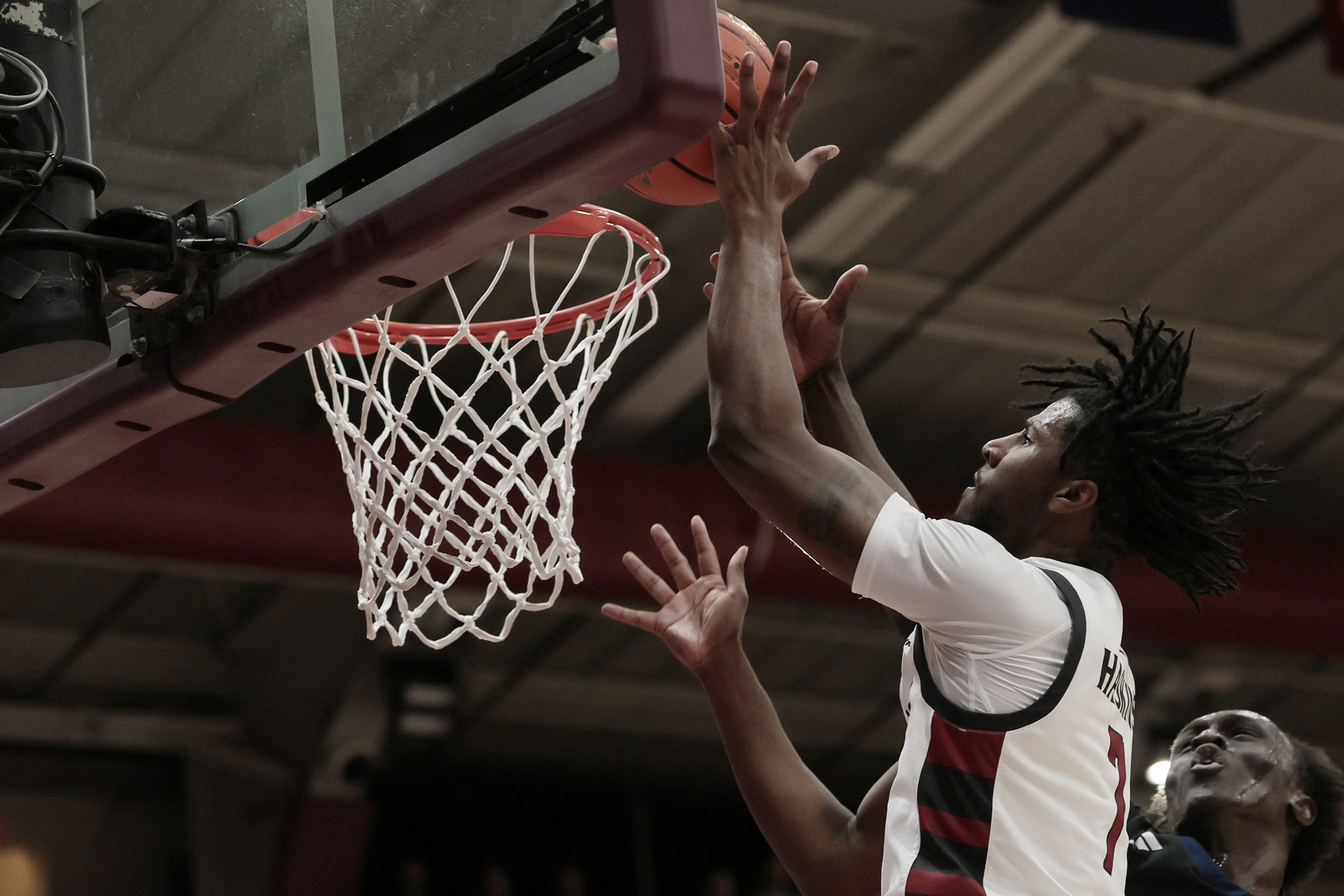
Dasear Haskins was a key starter for the Hawks this season.Elizabeth Robertson / Staff Photographer
St. Joseph’s
Deuce Jones (guard/La Salle), who led the Hawks in scoring during the first two months of the season, was dismissed from the team in December. (Transferring to Alabama-Birmingham.)
Dasear Haskins (guard/Camden High graduate) averaged 11.1 points and started for the Hawks as a redshirt sophomore. (Transferring to Ole Miss.)
Anthony Finkley (forward/Roman Catholic graduate), a junior, averaged 19 minutes in 35 games. (Transferring to La Salle.)
Kevin Kearney (forward) appeared in 14 games as a redshirt freshman. (Transferring to Manhattan.)
Jaden Smith (center) averaged 2.8 points and 1.8 rebounds in 9.1 minutes after transferring from Fordham. (Transferring to Ball State.)
Steven Solano (center), a redshirt freshman, played in eight games. (Transferring to Delaware.)
Al Amadou (center/Springside Chestnut Hill Academy graduate) transferred from Marquette and appeared in 11 games. (Transferring to Wisconsin-Milwaukee.)
Penn
Ethan Roberts (forward) has one year of eligibility remaining — the Ivy League prohibits graduate students from playing intercollegiate athletics — and was the Quakers’ leading scorer (16.9 points per game). (Transferring to Notre Dame.)
Cam Thrower (guard), a senior who spent four years at Penn, averaged 17 minutes in 27 games. (Transferring to Elon.)
Dylan Williams (guard) played in seven of Penn’s first 10 games before the senior missed the rest of the season with an injury. (Transferring to Northwestern)
Michelangelo Oberti (center) appeared in 12 games. (Transferring to Boston University)
Alex Massung (guard), who averaged 5.6 minutes in 10 games played. (Transferring to Saint Anselm.)
Bradyn Foster (forward) saw action in Penn’s season opener.
Drexel
Shane Blakeney (guard) was Drexel’s leading scorer, averaging 14.2 points in 33 games as a junior. (Transferring to South Carolina.)
Kevon Vanderhorst (guard) averaged 9.3 points and 2.9 assists while starting all 33 games for the Dragons. (Transferring to Iona.)
Villiam Garcia Adsten (guard), a junior, averaged 17.5 minutes in 32 games. (Transferring to Maine.)
Horace Simmons Jr. (forward/La Salle College High School graduate) appeared in 13 games.
La Salle
Ashton Walker (guard) started 21 games and averaged 8.2 points as a freshman. (Transferring to Monmouth.)
Eric Acker (guard), a junior, appeared in 26 games, starting 10, and averaged 18.9 minutes. (Transferring to Northern Kentucky.)
Nas Hart (forward) played in 20 games as a freshman. (Transferring to Quinnipiac.)
Edwin Daniel (forward) played 31 games (14.5 minutes) and averaged nearly four points and 3.5 rebounds. (Transferring to Stephen F. Austin.)
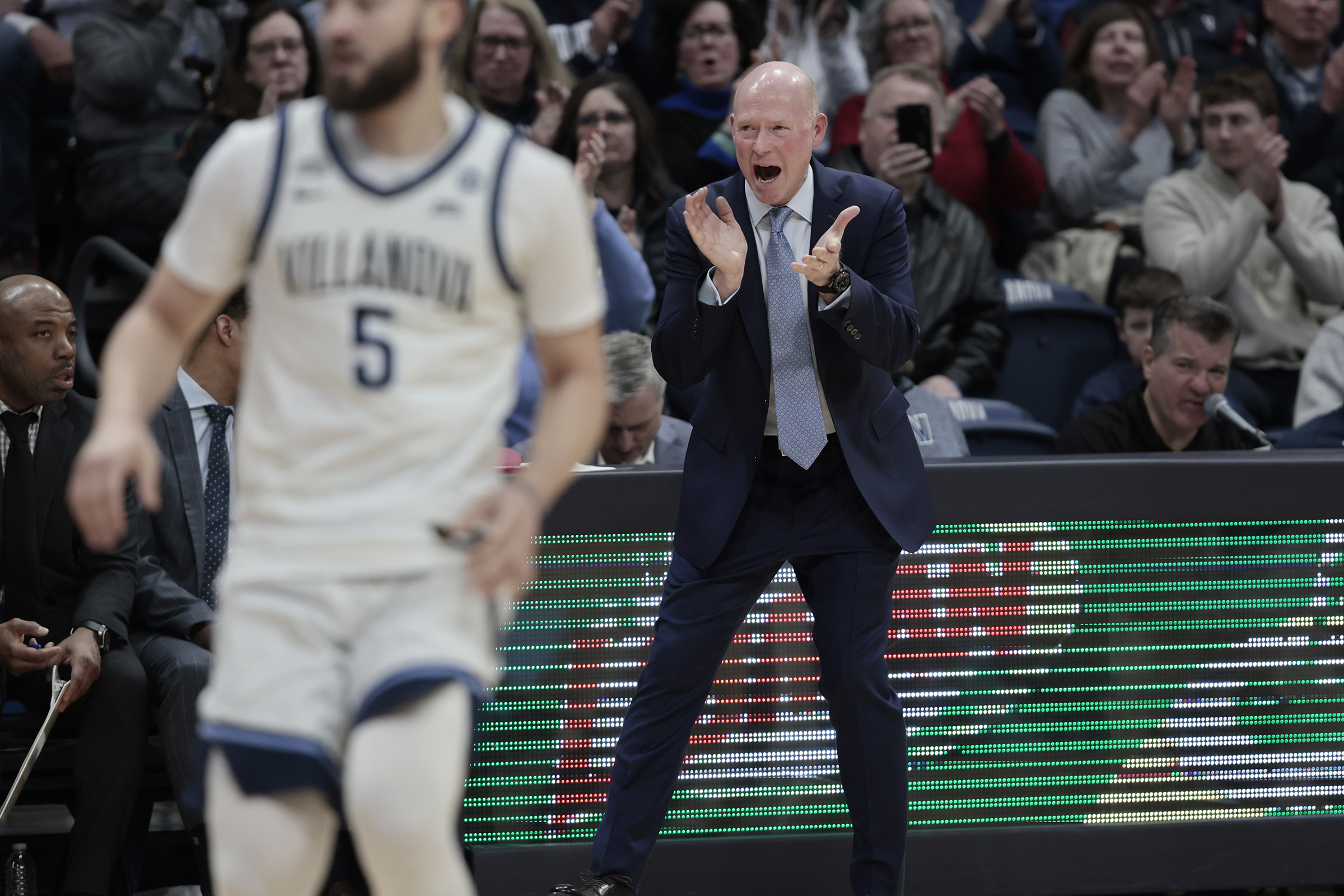
Villanova coach Kevin Willard directs his team against Butler on Feb. 25. Elizabeth Robertson / Staff Photographer
Big 5 portal additions
These are the players who are transferring to Big 5 schools.
Imagine this: A college football player lauded as one of the best in the country gets roped into a collective of other top college players just as good for an All-Star team.
Except these players won’t prove their mettle against other college athletes; they’ll prepare to face the reigning Super Bowl champions.
The annual All-Star game, also formerly known as the Chicago Tribune All-Star Charity Game, featured not just the full preseason roster of an NFL team that won the league championship but also played many of its starters. The Eagles played in the event in 1949, 1950, and 1961, and actually lost the 1950 game.
It was an event that offered an honest proving ground for college players to see if they could handle the rigors of playing in the NFL against the league’s top team.
Imagine being a college player and trying to stop Hall of Fame receiver Tommy McDonald, who scored three touchdowns for the Eagles in the 1961 game.
What about the Steel Curtain of the Pittsburgh Steelers, against the likes of guys like Ernie Holmes and “Mean” Joe Greene? It happened in 1975 and again in 1976, the last year of the event.
But as NFL players got bigger, faster, and stronger, the annual preseason spectacle lost its allure. Once considered an even playing field with college’s best lining up against the cream of the NFL crop, the game began turning into a contest of men against boys.
Fast-forward to today’s college game and NFL, you’ll see that the parity in size, strength, and speed between top college products and NFL players is debatable.
Thanks to advances in sports science, training methodologies, and more recently, players simply being allowed to play longer college seasons, the idea reviving an annual game between college’s best and Super Bowl champions is at least a conversation starter, right?
One argument for the water cooler talk would be the NCAA’s recent “5 in 5 rule,” which will allow Division I athletes up to five years of eligibility as long as their first academic year begins no later than their 19th birthday.
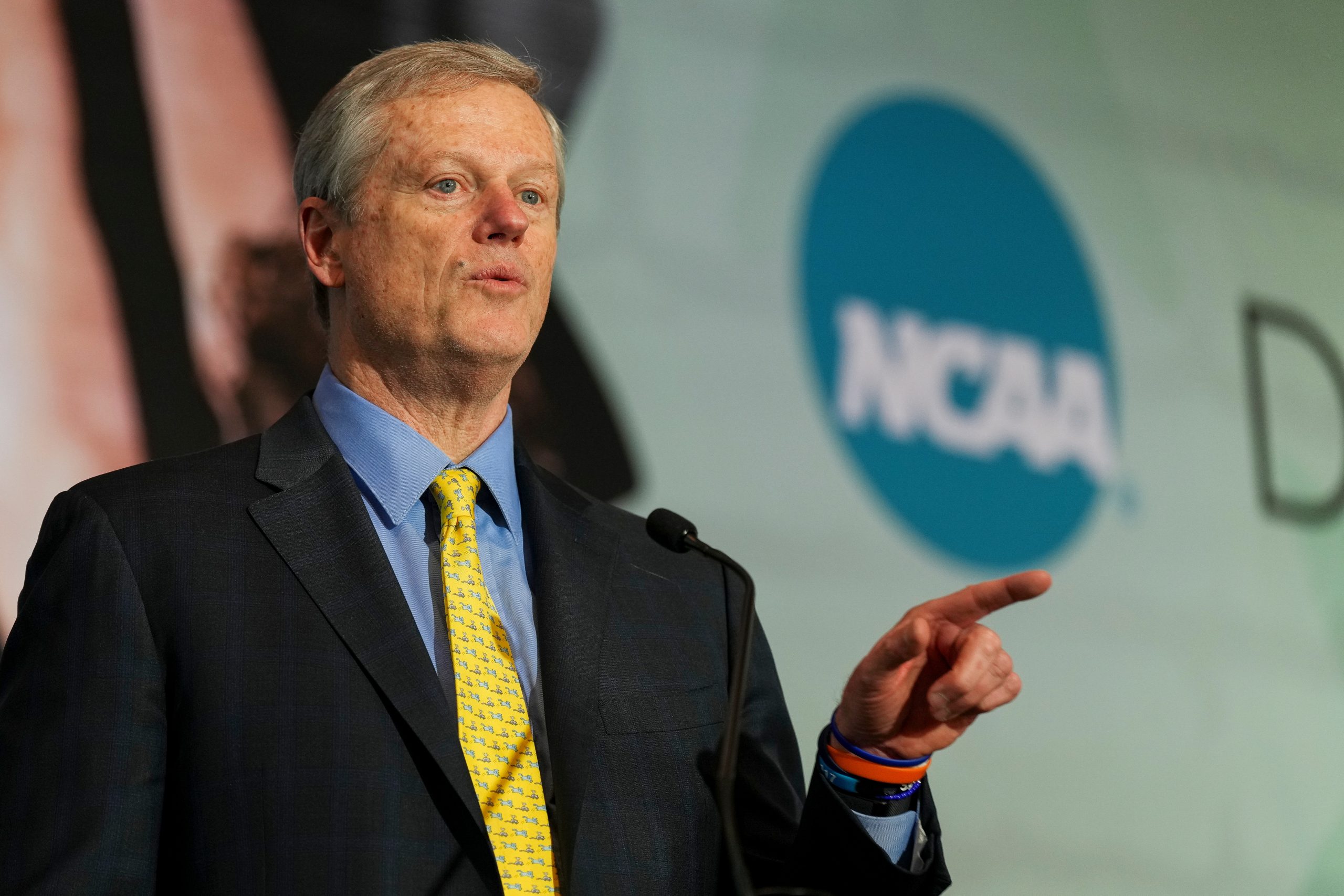
NCAA President Charlie Baker granted athletes five years of eligibility if they enroll in college no later than the academic year after their 19th birthday.George Walker IV
This rule would guarantee that top college athletes could play through their 24th birthday, which already felt like the norm due to the extra COVID-19 year. Earlier this month, a trickle effect began to occur within many college conferences as NFL players who recently signed pro contracts weighed the option to return and play a fifth season of college ball.
Also, the age gap between a college team and today’s NFL franchise isn’t too wide. Take just last season and look at the Indiana team that ran the table en route to a national championship. Average age? It was 23.1, and 18 of those players cracked the 53-man rosters of NFL teams this season, according to 247 Sports.
The average age of the Seattle Seahawks roster that won Super Bowl LX? Just 26.1.
While there’s precedent for a pro-am like the Chicago Charities College Game to make a return or even have a similar offshoot sprout up, a number of college coaches believe it will never happen — and it has nothing to do with a more level playing field when it comes to athletic abilities.
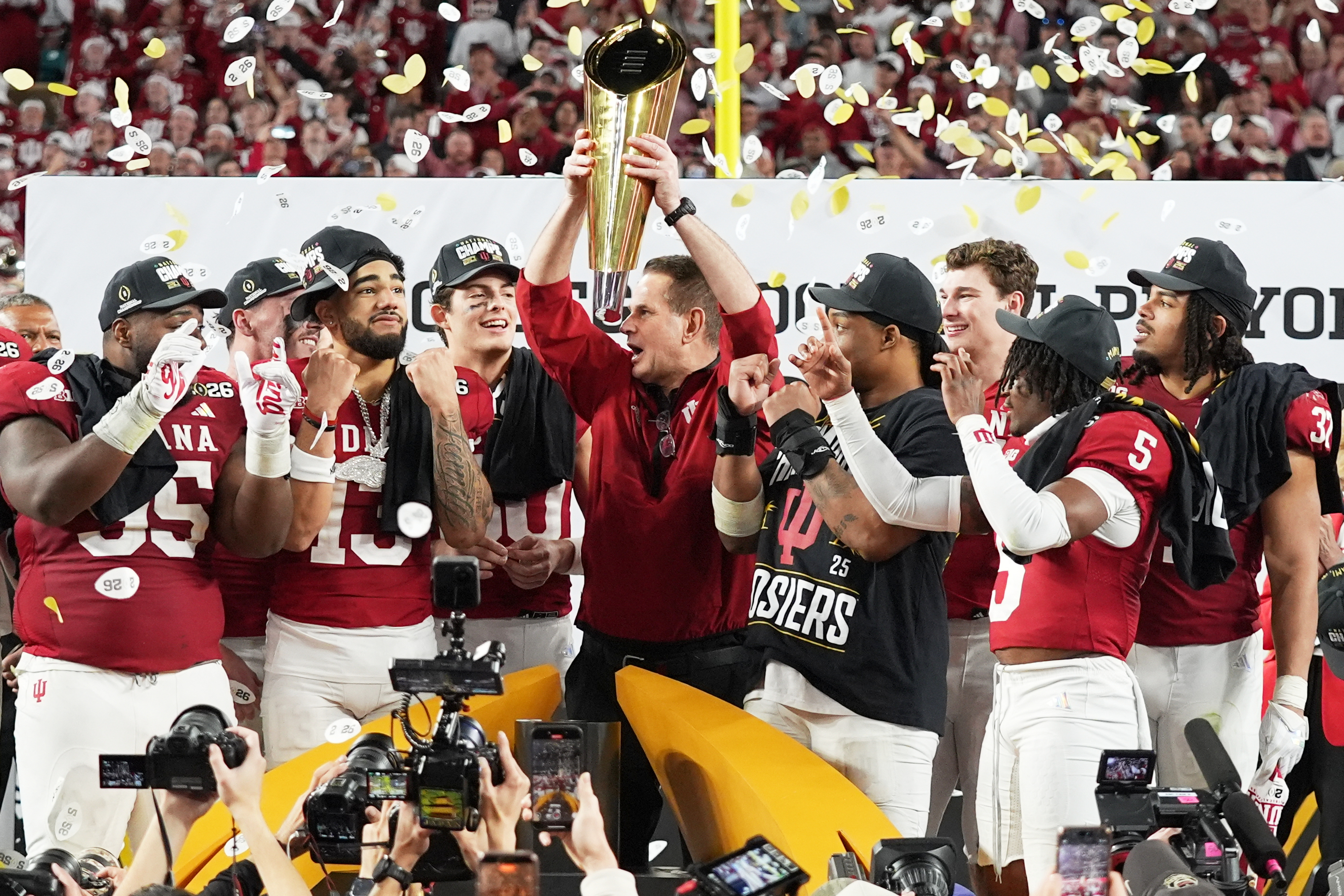
Indiana won the national championship with a team that had an average age of 23 when it defeated Miami in last season’s game. Lynne Sladky
“I think the college kids would be very enthusiastic. I think the NFL guys would be like, ‘Why are we doing this?’” said Temple coach K.C. Keeler, who remembers the old Chicago Charities College All-Star Game well, but contends it has no place in today’s football. “Nowadays, [NFL teams] aren’t even playing their starters in the first preseason game, right? And now you’re talking about a whole game against a bunch of [college] guys who want to prove themselves.
“But this isn’t about athleticism, it’s about money. One injury can change the trajectory of a player’s career in both pro and college ball. I think just looking at the logistics of pro football, you’d be hard-pressed to find anyone that would be willing to match up these days and risk it all against college kids who have that ‘I’ll show you’ mentality.”
Temple head coach K.C. Keeler says there’s too much at risk for players in college and the NFL to consider reintroducing a spectacle like the old Chicago Charities College All-Star Game. Isaiah Vazquez / For The Inquirer
A similar thought process came from Villanova coach Mark Ferrante, who also took a larger look at the state of both college football and the country during the heyday of the annual exhibition.
“My gut tells me that it would be much harder for a college all-star team to beat an NFL Super Bowl champion,” said Ferrante. “And the reason I say that is, even though the college teams are keeping older guys and all the extra years of eligibility that really came through [because of the pandemic], that’s kind of going to get erased [as those eligibility years phase out].
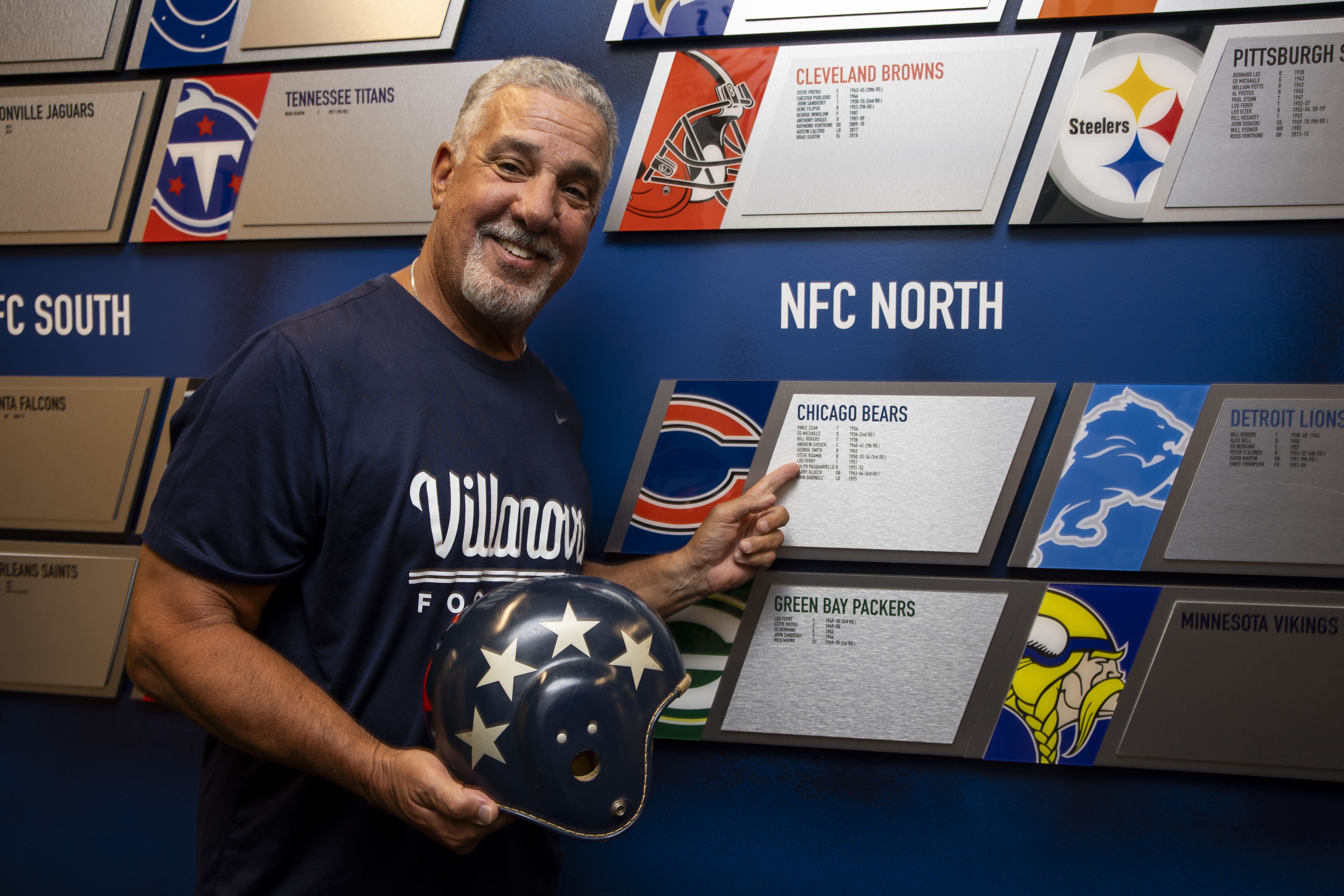
Villanova head football coach Mark Ferrante posed for a portrait with an all-star helmet worn by former fullback Ralph Pasquariello, who played in the 1950 Chicago Charities game, with the team that defeated the Eagles.Monica Herndon / Staff Photographer
“Also, I’d like to see the age rosters of those 1940s and 1950s teams. Because, I bet you a lot of those college guys might’ve actually been the same age or even a bit older than the pro guys they were playing against back then because of [World War II].”
To Ferrante’s point, it’s also harder for a college kid today to crack an NFL roster. There are a little more than 18,500 Division I players competing for 250-plus spots in the NFL draft.
“It’s still under 2% of college guys that make it to that level,” Ferrante said. “And we’re talking about the best of the best, not that it wasn’t the best back then, but it’s just different and dare I say harder to get to the NFL now than it was then.”
But the proving ground for college players in the Chicago Charities All-Star Game was apparent back then, with the Eagles feeling the brunt of it. In 1950, the Eagles lost to a collective of college players, one that featured former Villanova standout Ralph Pasquariello.
A star fullback for the Wildcats, Pasquariello was coming off an MVP performance a year earlier in the 1949 North-South Shrine Game where he scored the game-winning touchdown.
Pasquariello was drafted later that year in the first round (ninth overall) by the Los Angeles Rams. The Eagles’ loss was one of just nine times a college team defeated an NFL champion.
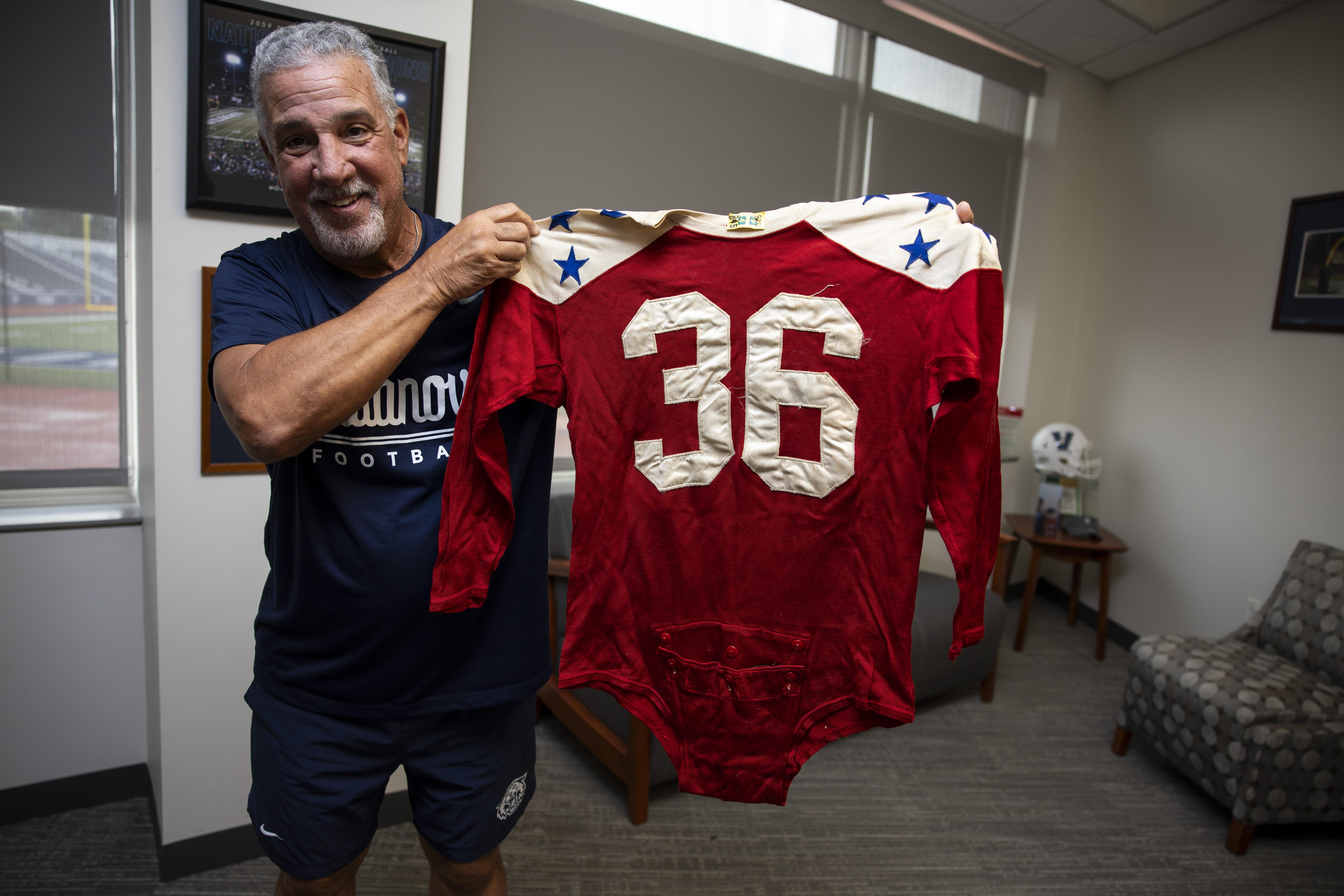
Mark Ferrante holds up an all-star jersey worn by former Villanova fullback Ralph Pasquariello, who played on the 1950 college team that defeated the Eagles in the Chicago Charities College All-Star Game. Monica Herndon / Staff Photographer
But the notion that a college group would beat an NFL champion today — even with a closer-to-equal playing field than we’ve seen between college and professional football in recent years — would be tough to imagine. Between lucrative name, image, and likeness deals in college and blockbuster sponsorship deals in the NFL, both coaches say there’s too much money to be made.
“Listen, it would be something really cool to see all these young players who are going to be 22- or 23-year-old seniors go up against NFL stars, but I just don’t think it’s viable,” Keeler said. “Everyone has a time frame now to make as much money as they can. Also, they’re getting rid of more and more [contests like these].
“I mean, look, they just got rid of the Pro Bowl. Why? The impossibility of suggesting that you can play at three-quarters speed and not get hurt when you’re tackling guys to the ground. That’s just not how this game works anymore.”
K.C. Keeler is a family man who has built his coaching foundation on the lessons and influence of those he played and coached under.
He has, what some would say, an old-school approach when it comes to running a football program: Juniors and seniors deserve the opportunity to play, academics and community service are just as important, and building a locker room starts with relationships.
As the winningest active head coach across all divisions of college football, Keeler’s philosophy has certainly worked. The second-year Temple coach surpassed 275 career wins (currently at 276) last season and is turning around a program that before last season finished 3-9 for four consecutive years.
In 2025, Temple posted a 5-7 record — one game short of reaching a bowl game, which it hasn’t made since 2019 — and had one-point losses to Navy and Army.
So, where does the program go from here? Well, for the first time in a long time, this program has a real sense of cohesion.
Before Temple’s season opener on Saturday against Rhode Island (2 p.m., ESPN+), Keeler sat down with The Inquirer, where he expressed his commitment to the Owls. He purchased a home in Wilmington, becoming the first Temple coach since Bruce Arians in the mid-1980s to do so. Keeler, who turned 67 in July (and is the third-oldest active FBS coach), wants to finish his college football coaching career on North Broad. But first, his focus is bringing back greatness to Temple.
K.C. Keeler enters his second year as Temple’s head coach. In his first season, the longtime college football coach led the Owls to within one win of bowl eligibility.Isaiah Vazquez / For The Inquirer
Q: [Throughout] your coaching career [at] Rowan, Delaware, and Sam Houston State, you’ve established a track record of building winning programs. How have you shifted or changed as a coach to stay competitive?
A: One of the things that I’ve always done a really good job of is problem-solving. The other thing I’ve always done a really good job of is recognizing talent, not just on the field, but also coaches I’ve worked with. When I got to Rowan, and I got an opportunity at 34 years of age to be a head coach, I had some really good players I had recruited when I was an assistant there. … I learned from my former coach Tubby Raymond [at Delaware], a lot about building a culture, understanding that when you play for, at the time Rowan University, you play for the people who played before you, you play for the people you’re with in that locker room right now, you’re also playing for the people who are going to come after you. You try to develop this sense of belonging, so everywhere I’ve coached, I’ve always tried to emphasize this is a family. It’s its own unique family, but it’s a family, and this family ranges beyond just the guys in this locker room.
K.C. Keeler after Delaware defeated Colgate for the NCAA Division 1-AA Championship in 2003.AP Photo/Wade Payne
Q: You spent more than a decade at Delaware. How special was it to coach at the school you once played for?
A: Well, nowadays there’s no way that Delaware would hire a Division III coach, just with the headhunters and all the things that people go through now to figure out what coach they’re going to hire. But I was blessed that I had a president and an athletic director. The athletic director — Edgar Johnson, didn’t believe that. … For 11 years, when I pulled up to that stadium, in my office, I pinched myself. I probably had black-and-blue marks for 11 straight years. People always wondered who was going to follow Tubby. I mean, they have his name on the field. He had 300 wins, three national championships, and a guy that I respected in terms of creating that culture. I always say that his 300 wins or him inventing the Wing-T with Ted Kempski, those weren’t his greatest accomplishments. His greatest accomplishment was the culture that he developed.
Q: You’ve also dealt with adversity and losing seasons during your time at Delaware before you were let go in 2012. What was that departure like?
A: Me being fired had nothing to do with wins and losses. It was really more I had become a bit like Tubby did in that small state. Everyone knew what car I drove. Walking in a restaurant, my wife and children would go to the back for dinner, and I would have to stop at all the booths. There was a sense that maybe the administration, the people who were running the place at the time — they didn’t stay much longer after they fired me — they didn’t embrace the fact that I had developed a legacy there. It was hard. It was hard being fired, and I remember very vividly my daughter coming home after me being fired, and she said to my wife and I, ‘You guys are in your uniform, huh?’ Still had our pajamas on. … Then when we were out and we ran into an acquaintance on the street, and I went into my woes of being fired, and I said, ‘How are you doing?’ [They replied], ‘I’m battling cancer right now.’ My wife and I were like, let’s put this in perspective. We got fired from a job. We need to move on.
Q: What was your biggest lesson learned from Year 1 at Temple?
A: I told the guys when I first took over, I don’t want you to be realistic. [Temple] winning whatever it was, 13 games in five years, no one thinks we’re going to do much because we weren’t changing the roster much. It wasn’t like we came in, gutted the roster, brought new players in. We just felt there were so many upperclassmen that wanted to get their Temple degrees and that wasn’t the right thing to do. I still believe in education, and I believe that even though I wasn’t the coach that signed their scholarship papers when they came to Temple, I still represent Temple, I’m not going to cut you and try to get a player who’s that much better. So 5-7 was very disappointing, because we were so close to being a 7-5 team. But at the same time, I do know that there were some limitations because of how much we could change the roster. Those limitations actually led to us keeping all of our starters [this year].
Q: Your team was one of the few Group of Five schools to keep their starters from entering the portal. What does that say about what you’re building here?
A: We believe that our program is built on love and trust. I always explain that you can’t love somebody, you can’t trust somebody, until you know somebody. We work really hard at knowing each other. We’ll do the three H’s: Who’s your hero? What’s your hardship? What’s your history? We’ll do a trivia night where the guys are all mixed up with different positions and different players and coaches, and Clayton [Barnes, Temple’s general manager] leads it. It’s a lot of fun, and it’s a way to be together. … We work really hard in these four walls to develop relationships with our players. The great thing about us going into this year is that the whole strength staff is together, whole coaching staff stayed. … This building has a lot of cohesion.
Q: With the rising power of Name, Image, and Likeness, how have you managed the new landscape of college sports?
A: I wouldn’t have taken this job unless [Barnes] came with me. I know my skill set. I am a problem solver, but I’m not going to be the guy who’s going to be dealing with the agents. I’m not the guy who’s going to figure out the charts in terms of how much money we should allocate to each position and what starters are making at different positions. … That’s not my skill set. That’s [Barnes’] skill set.
I don’t call the offense anymore. I don’t run the defense anymore. I was an offensive coordinator, scored a ton of points — I got too many other things going on. … I’ve turned those things over; same thing with Clayton and the roster. Now we talk about it every day. It’s not like I’m not making final decisions, but I have enough trust.
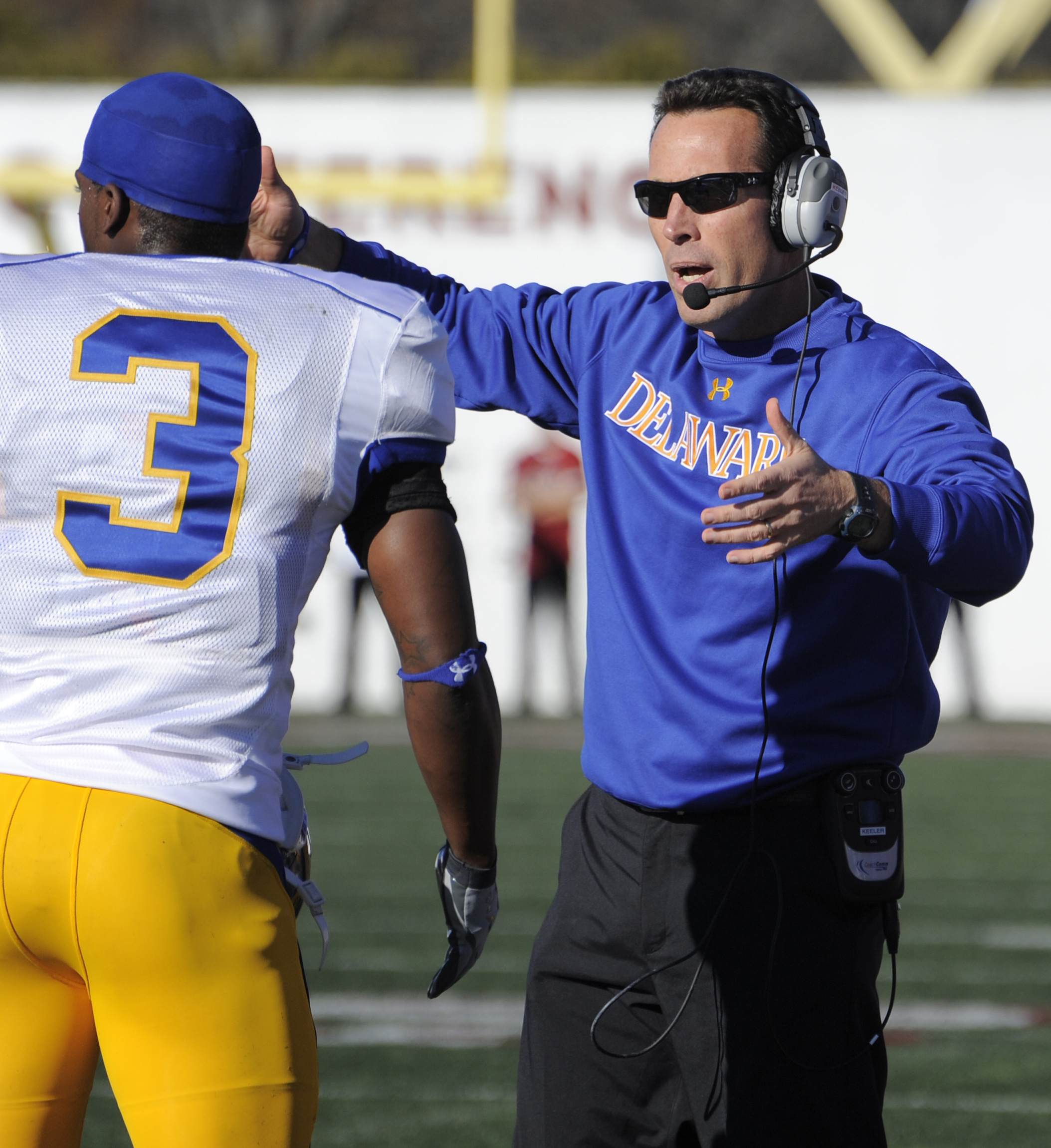
Q: Your sunglass look became a trademark at Delaware. What is the backstory about the sunglasses?
A: I have very sensitive eyes, so the lights really bother me — and I like sunglasses. I have six pairs of Ray-Bans in my backpack right now, so I like to change them up a little bit too. They have a bobblehead of me with my sunglasses on. I’ve been known to support the sunglasses. It’s a little bit of a trademark, but also the sensitive eyes go along with it.
K.C. Keeler spent 11 seasons as the head coach at Delaware.AP Photo/Nancy Palmieri
Q: As someone who grew up in Lehigh County and spent the bulk of your coaching career out East, what does it mean to come back after 11 years at Sam Houston State?
A: My wife’s a Penn grad, we met in the city. I was with the Eagles as a last cut [under] Dick Vermeil, and so we met in the city, fell in love in the city. … We have three grandchildren, and my wife and son-in-law are in Wilmington — this is home. I always tell the story that when the deal was finally done, we had just beaten Liberty Friday night to clinch a 9-3 season and a good bowl game. It was [my wife’s] birthday. I get the call from my agent that the deal’s done. I come back in and tell her, “Hey, listen, we are going back East,’ and she cried for an hour. I’m trying to explain to everybody in the restaurant, these are happy tears.
Q: There’s a lot of anticipation around this team. What would you say to fans about the direction of where this program is heading?
A: There’s been greatness here before. It’s not like I’m trying to reinvent anything. … One of my most vivid memories of any situation in my entire career was a locker room after we played Temple. We [Delaware] were the No. 1 team in the country in 1978 — don’t do the math — going to play Temple at the old Veterans Stadium, and they just embarrassed us. It was a different, physical brand of football that we weren’t used to, and they also just had this tremendous talent. Then the next year, that team I played on at Delaware, we won the national championship. We went 13-1. Our loss? To Temple. I have a pretty good perspective of where this place has been — and Temple can do it again. We had the No. 1 recruiting class in the conference. I don’t remember Temple doing that recently.
K.C. Keeler led the Owls to a 5-7 record in 2025.Yong Kim / Staff Photographer
Q: This year will mark 10 years since Temple last won an American championship. What stands at the forefront when you think about goals this season?
A: We want them to think about winning enough games to go to a bowl, winning a bowl, and maybe we can win enough [games] to get [to] that conference championship game. That’s kind of where I’m trying to set their sights. … If you’re realistic, don’t play for me. I want you to be unrealistic. I want you to dream dreams that are bigger than you possibly could imagine, because life is short. When I was at the FCS level in my first press conference at Delaware and Sam Houston, I talked about winning a national championship. … Our goal here at Temple is to be the best football program in the country. … I do believe we can become a team that can be playing in that conference championship game, and there’s a good chance that team plays in the big tournament.
The reality is that everyone knows we play Penn State the second week. I know it because that’s all I got asked when I was at media day. … But we got to worry about playing Rhode Island.
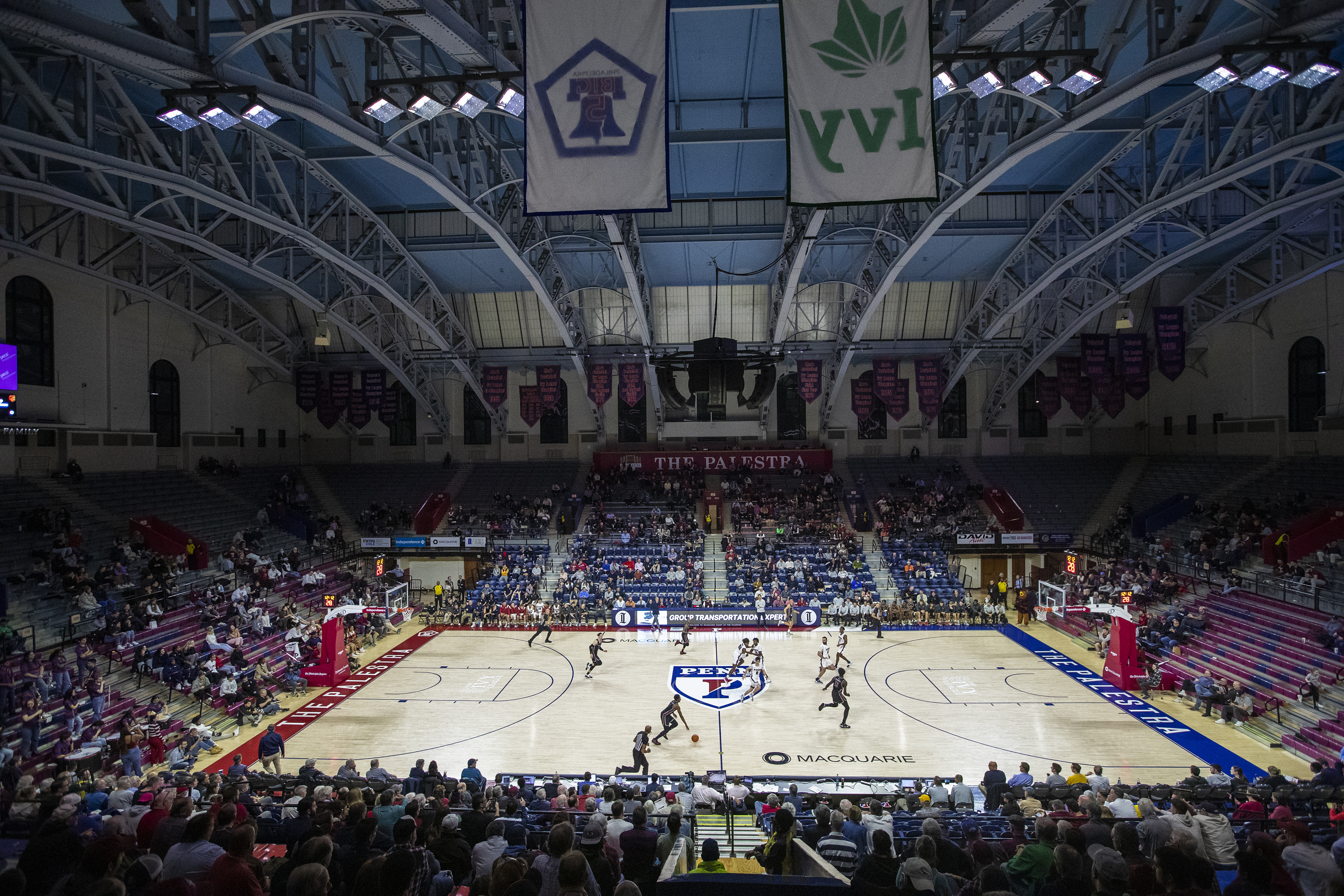
Temple will play in two neutral-site games at the Palestra this season.
The Owls will face Richmond on Nov. 8 and St. Bonaventure on Dec. 12 at the Palestra to celebrate the storied arena’s 100th anniversary. Temple called the Cathedral of College Basketball home from 1955 to 1984.
“The Palestra holds a special place in the history of college basketball and Philadelphia, and we are honored to be part of its 100th anniversary celebration,” Temple coach Adam Fisher said in a release. “Richmond and St. Bonaventure present two challenging matchups against well-coached programs, and we look forward to competing at one of college basketball’s most historic venues.”
The Temple men’s basketball program last played at the Palestra during the 2022-23 season.Yong Kim / Staff Photographer
Temple’s matchup with Richmond will mark the 22nd between the two schools. The Owls hold an 11-10 all-time advantage. The programs last played during the 2022-23 season at another neutral site — the Brooklyn Nets’ Barclays Center, which ended in a 69-41 win for Richmond.
The Bonnies have faced Temple at the Palestra three times, losing each matchup. Temple has a 53-7 record all-time against its former Atlantic 10 rival. Their game on Dec. 12 will be their first since the Owls left the A-10 after the 2012-13 season.
“We are excited for the opportunity to play at the Palestra during its 100th anniversary season,” St. Bonaventure coach Mike MacDonald said. “The Palestra is one of the most iconic venues in college basketball, and the opportunity to take on the Temple Owls, a longtime Bonnie rival, makes this game even more special.”
After months of speculation, Temple coach K.C. Keeler said on Thursday that transfer quarterbacks Ajani Sheppard and Jaxon Smolik could both play against Rhode Island in their season opener on Sept. 5.
“I could see us playing two. … I still don’t think anyone has really separated themselves,” said Keeler. “The nice thing is they both have a little bit different skill set, and [offensive coordinator] Tyler [Walker] did a phenomenal job running two quarterbacks at Montana State. I think we’re trying to let it all unfold and take as much time as possible, but I’m not going to force it.”
The competition between Smolik and Sheppard started when the two pledged their commitments to the Owls this past offseason. Smolik transferred from Penn State, and Sheppard came over from Washington State, where he had transferred to the previous offseason, but never saw the field there due to injury.
They have played in a combined nine college games and attempted a combined two passes in their careers.
Keeler still seems intent on naming a starter at some point in the season.Last season he didn’t name Evan Simon the starter until after the Owls’ Week 2 win over Howard.
“I’m not saying we’re going to play two all year,” said Keeler. “I don’t want to have a mindset where it’s only going to be one quarterback and backup. We’re not there yet, but we’re getting close to figuring it out. And we will probably have an idea of what that first play looks like [against Rhode Island].”
Peter Clarke, Dante Atton, Colin Chase, Eric Stuart, Grayson Mains, Saboor Karriem, and Sam Brown were nominated by their teammates and members of the program to wear single digits during the 2026 season. It’s the program’s highest honor.
“It’s so exciting, and it was so cool calling their names out and seeing how their teammates reacted,” said Keeler. “It’s so great having guys like that [the single digits] that take on all that responsibility, so it’s a really good group. We’re really pleased with the leadership they’ve given us, and I think they feel very honored because of how stringent the process was.”
Mains, Clarke, Brown, Karriem, and Stuart were first-time selectees, while Atton and Chase held their designations from last season.
Coming from the roof of Temple linebacker Jordan Montgomery’s North Philadelphia home, sounds of music and general jeering fill the streets. The Owls linebacker room has gotten together for another function.
It’s become somewhat of a tradition. Every few weeks, the Owls linebackers, headed by captain Eric Stuart, come together to eat, laugh and strengthen the bonds that have extended beyond the football field. And it’s a tradition that reflects the broader culture shift in the program, brought on by coach K.C. Keeler, and one the Owls hope sparks a resurgence on the field.
“I think the first time we did it was last year for the Super Bowl, at my old crib,” said Stuart, a fifth-year senior. “We just cooked some food and had everybody come over and come eat and just hang out together. That’s how it all started.”
Said senior Curly Ordonez: “For us, it is just like showing up for your brother, right? You don’t have to come for the whole time. I was one of those, especially last year. I was laid back, pretty quiet, and kept to myself. And it was about bringing people out of their shells. We have a lot of guys that are far away from home, and we can get them some home-cooked meals, which is something we like to do.”
Continuity is key for the Owls linebackers with 10 returners from last season. Stuart, one of Temple’s most experienced defensive players, anchors a group that also returns 2025’s leading tackler, Ordonez, Tyree Alualu, Jayvant Brown, Wesley Brown, Montgomery, and others. They are joined by newcomers such as Jaylon Joseph and JaMair Diaz.
“I think it’s just really important for us to be able to coach each other up,” Stuart said. “On the football field, stuff happens; emotions are high. … Every message might not come off in a regular tone, especially to the newer guys. But I feel like especially the guys in our room, we all understand that nobody is coming at you as a person.
“We’re trying to be better out here, so knowing each other just helps with communication. You don’t get that bickering and fighting, and that is probably the biggest thing we’ve gotten from being so close.”
Junior Tyree Alualu is one of Temple’s returning linebackers.Isaiah Vazquez / For The Inquirer
And the cohesion among the Owls linebackers has been noticed from across the field.
“I’ve never seen a room so close like the linebackers,” said quarterback Ajani Sheppard. “They are always hanging out with each other, always talking to each other. I think it’s such a great thing.”
The relationships among the linebackers started just over a year ago with the hiring of Keeler and a new staff. Keeler inherited a program coming off four consecutive 3-9 seasons under Stan Drayton and Rod Carey but quickly made a culture shift a priority. Keeler said he met with every player on the roster individually following his hiring. Many players were encouraged to stay, and the coaching staff emphasized that continuity.
“I would say, just having new coaches,” Ordonez said of the difference. “We had a lot of guys who were new to the team, and last year was one of those years that took us where it went, and I feel like this year, we understood the type of team we had and the guys we have coming and who we are. We obviously got better, and we’ve seen that throughout the spring. So understanding that by getting together we could really be something as a defense. But to be one of the best groups you got to get to know each other, got to hang out, you’ve got to do stuff outside of the city, gain that trust and gain that love.”
Stuart said, unlike previous years, he wants to be in the facility every day.
“I would say it’s more of a whole team energy that kick-started it for [the linebackers],” said Stuart. “Me personally, in 2024, [I] just honestly hated being in the facility every day. I didn’t want to be here. I didn’t want to hang out after or spend time with anybody. Then Coach Keeler and the new staff got here, and the energy changed. Like, I feel like everyone wants to be here, everyone comes in, and nobody is getting their stuff just to run out of the locker room and go home. We sit, and we hang out in the locker room. There’s no one in a rush to get out of here. I would say I thought that’s probably the biggest change.”
The real test of their chemistry awaits on Sept. 5 with their season opener against Rhode Island.
The dates and locations for the men’s and women’s Big 5 Classic are set.
The men’s classic will be held at Xfinity Mobile Arena for the fourth consecutive year on Dec 5. Meanwhile, the women’s classic will come to the Palestra on Dec 6.
The choice of Palestra for the women’s classic coincides with the 100-year anniversary of the storied arena. The event was held at Villanova’s Finneran Pavilion for its first two years.
Along with the women’s Big 5 Classic, Penn is hosting an expanded Cathedral Classic during Thanksgiving weekend and the men’s and women’s Ivy League tournaments this season.
Both the men’s and women’s Big 5 Classic will feature the city’s six Division I programs playing in a triple-header. Seeding will be once again be determined by the teams’ performance in pod play. Each pod game will take place at the schools’ on-campus arenas in a round-robin format.
𝐀 𝐜𝐞𝐧𝐭𝐮𝐫𝐲 𝐨𝐧 𝐭𝐡𝐞 𝐡𝐚𝐫𝐝𝐰𝐨𝐨𝐝 🏛️
We’re excited to announce that the Big 5 Classic returns to University City this year to celebrate the 100th anniversary of The Palestra! 🔴🔵
For both the men and women, the teams that make up each pod are the same. Pod 1 will feature Drexel, Penn, and Saint Joseph’s while Pod 2 will consist of La Salle, Temple, and Villanova.
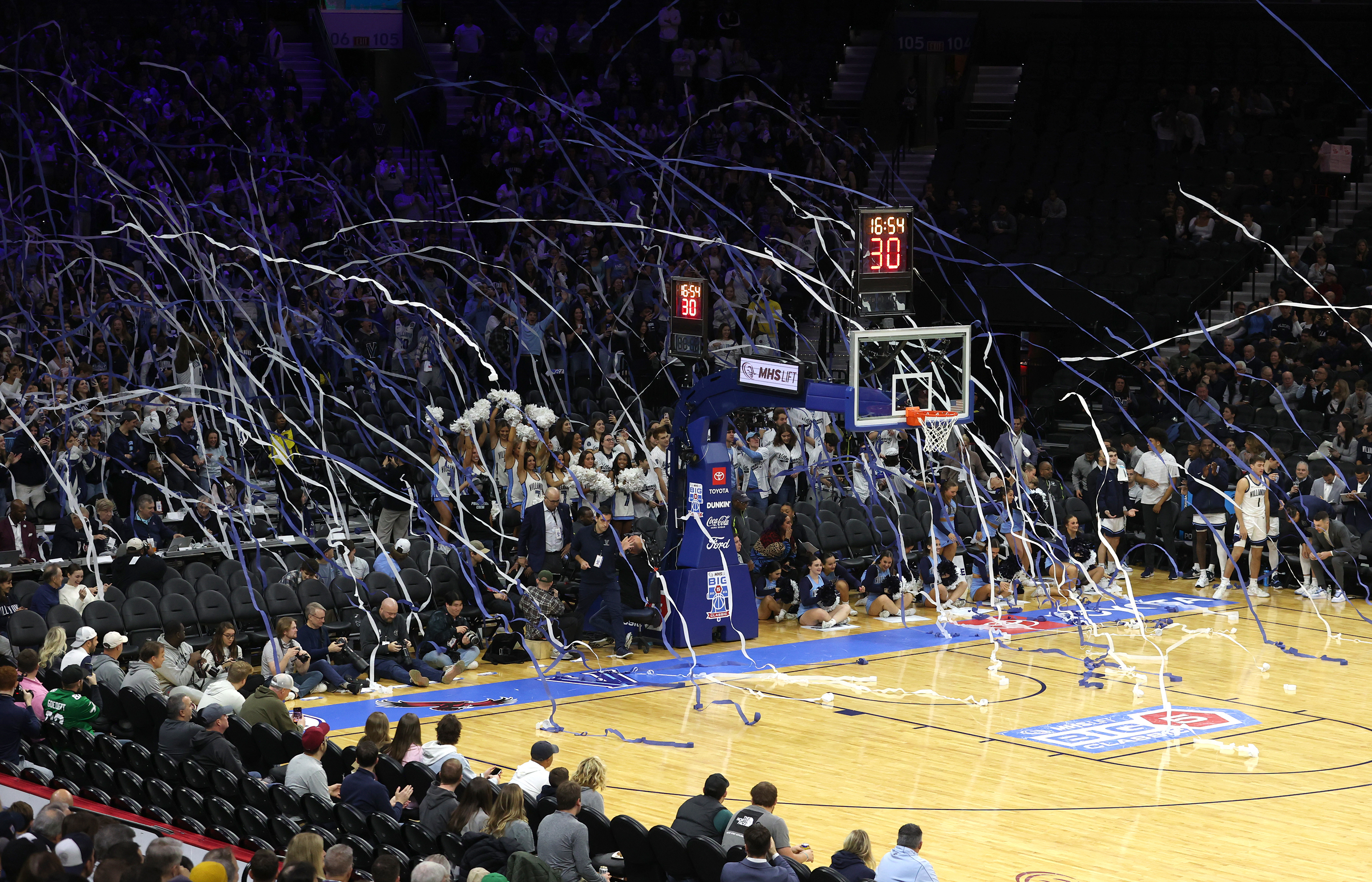
St. Joe’s and Villanova’s men’s teams are separated for a second year in a row. The Hawks won the first two iterations of the Big 5 Classic, while Villanova enters its season as the defending champions after it trounced Penn, 90-63.
In the women’s championship, the Wildcats also came out on top, defeating St. Joe’s 76-70.