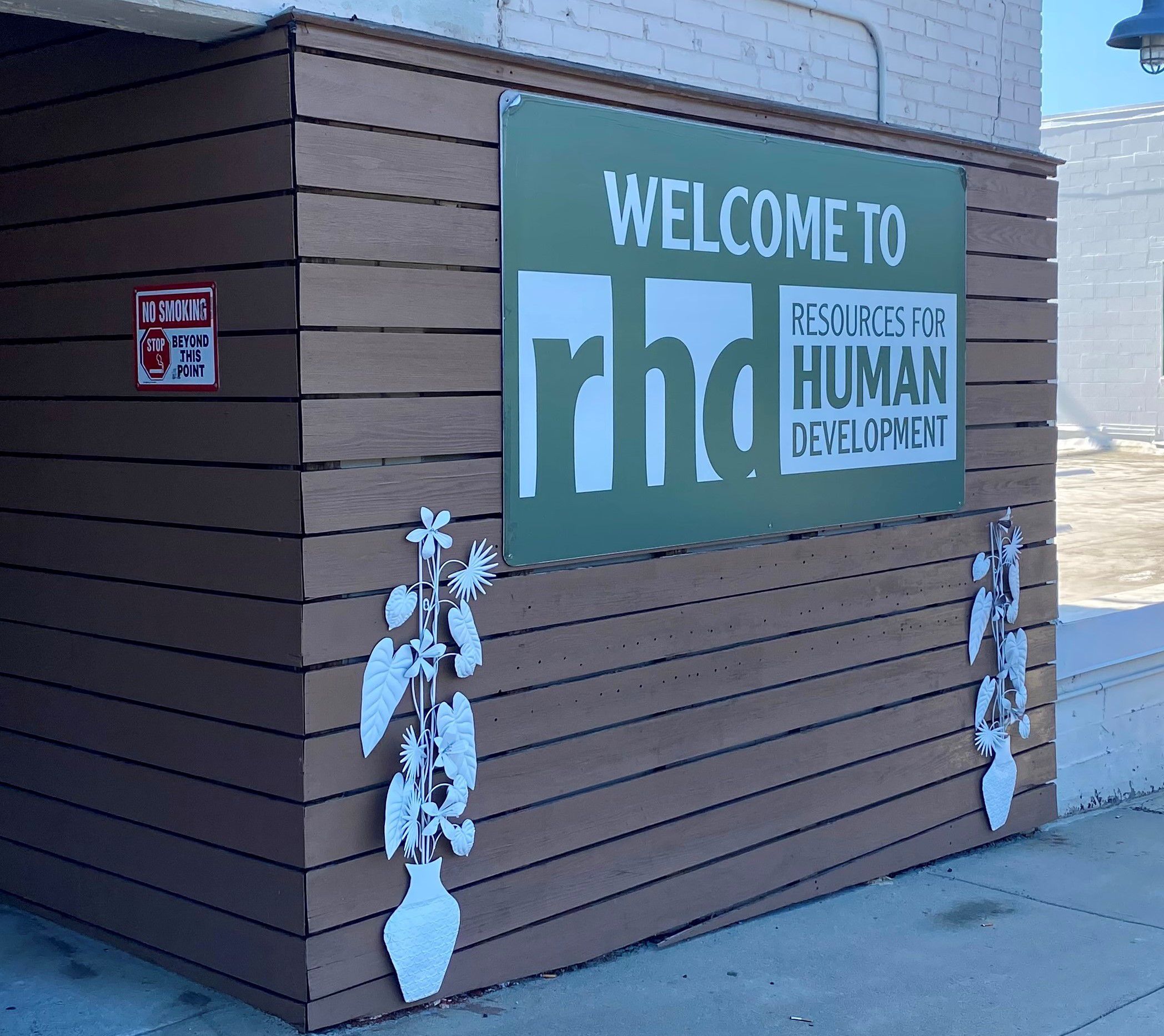
Pennsylvania regulators revoked Resources for Human Development’s license to operate homes for people with intellectual disabilities in Southeastern Pennsylvania after medical neglect led tothe February death of a Philadelphia resident, state officials confirmed Friday.
RHD, a Philadelphia-based human services provider with 91 homes in the region, has the right to appeal the revocation and to continuing operating during that process. The state, which will conduct moreunannounced inspections during the appeal, said RHD serves 136 residents in Southeastern Pennsylvania.
The Sept. 22revocation comes about two years after RHD was taken over by fast-growing Reading nonprofit Inperium Inc.
RHD it was on the verge of bankruptcy at the time. Inperium also owns Supportive Concepts for Families, a Reading nonprofit with services similar to RHD’s that has been operating under a revoked license since April 2025.
Officials at Inperium and RHD did not respond Friday to emails or voicemails requesting comment.
Investigators of the February death at anRHDhouse found “serious neglect and systemic failure by RHD to ensure health safety, timely medical intervention, and adherence to [individual support plan] requirements,” according to documents provided by the state Department of Human Services .
The redacted documents did not reveal details on what had happened to the individual, who was found dead on the morning of Feb. 23.
An assistant regional director had alerted RHD’s CEO and other top leaders in January to the individual’s need for therapeutic and behavioral support, but RHD did not seek a medical evaluation, the documents say.
RHD provides services in 12 states, employs 2,800 people, and had $280 million in revenue in the year that ended June 30, 2025, according to a recent bond offering statement. Fiscal 2026 financial results are not yet public.
Following the Philadelphia death, RHD management failed to submit an acceptable plan to correct regulatory violations, leading regulators to issue their own on Sept. 2. It’s not clear what happened in the period leading up to the revocation on Sept. 22.
Last year, state regulators revoked Supportive Concepts’ license following at least four deaths, 11 abuse incidents, and dozens of cases of neglect at Supportive Concepts’ homes in the year ended February 2025.
That revocation impacted operations in 15 northeastern Pennsylvania counties, including Berks. Under the terms of the revocation, the organization cannot open any new homes or accept new clients in existing properties.
Seventeen Supportive concepts facilities in western Pennsylvania have been operating under provisional license since February. The provisional status requires them to implement a correction plan. As of August 26, the homes were still operating under a provisional license.
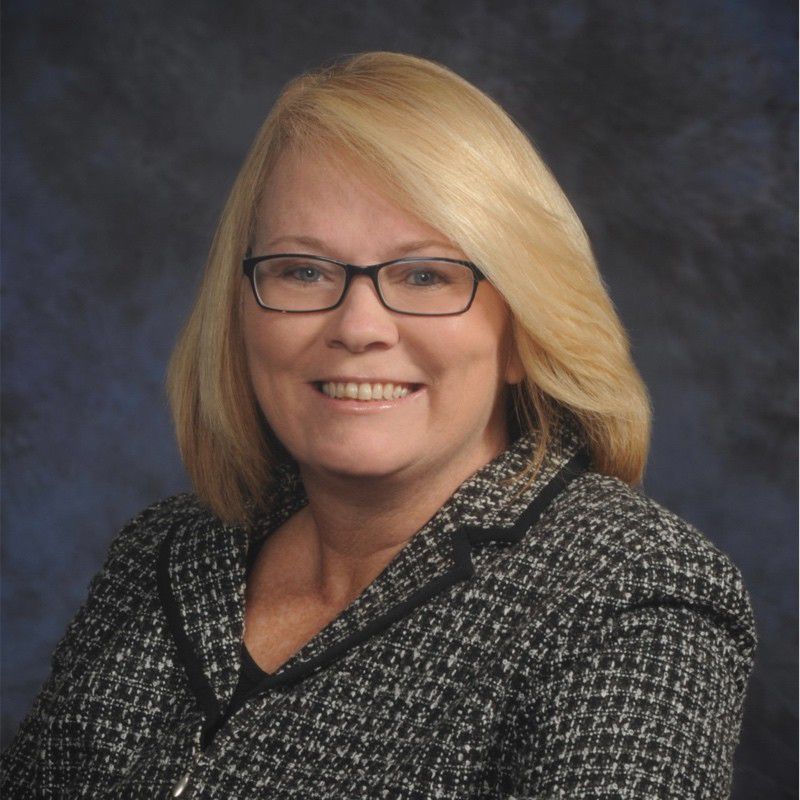
St. Christopher’s Hospital for Children named Claire Alminde permanent president on Thursday, following a period of leadership turmoil at the North Philadelphia safety-net institution.
Alminde, who will continue to serve as chief nursing officer, had taken over in January from another acting president.
“Claire brings a unique combination of frontline clinical experience and hospital leadership, along with firsthand knowledge of what it takes to operate a hospital like St. Chris that plays such a vital role in Philadelphia and beyond,” St. Chris said in an email.
One of Alminde’s tasks will be to work with leaders at Nemours Children’s Health, Jefferson Health, and Temple Health to build an alliance announced in July to secure the future of St. Chris, which struggles financially because most of its patients have low-paying Medicaid insurance.
St. Chris’ chief nursing officer, Claire Alminde, has been named president of the North Philadelphia safety-net provider.St. Christopher's Hospital for Children
Alminde was the third interim or acting executive appointed to the top management position at the nonprofit hospital since February 2024 and its fourth leader since 2020.
Drexel University and Tower Health have owned St. Chris in a 50-50 joint venture since 2019. Tower oversees day-to-day operations.
“After several years of leadership changes, this appointment gives St. Christopher’s strong, permanent leadership from someone who knows our hospital, our people and the community we serve incredibly well,” Tower CEO Michael Stern said in a message to employees. “Claire understands what makes St. Chris such a special place and what it will take to move us forward.”
The safety-net provider received a $76 million revenue boost from its inclusion for the first time in a program that taxes Philadelphia hospitals and uses the money to increase the government’s Medicaid funding for facilities that disproportionately care for low-income patients.
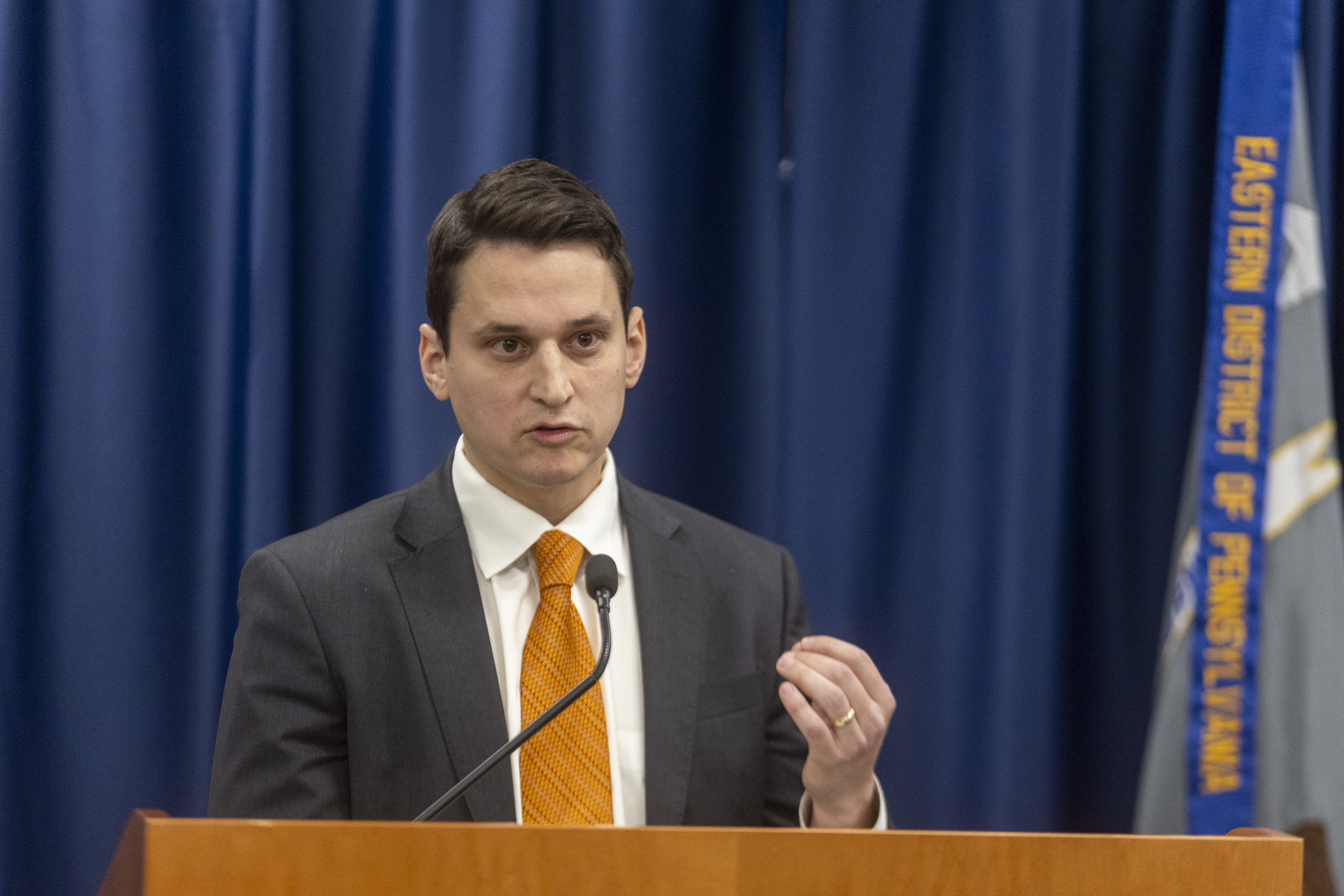
Independence Blue Cross, Philadelphia’s largest Medicare Advantage insurer, agreed to pay $22.5 million to settle a whistleblower lawsuit alleging that the company submitted inaccurate diagnoses for enrollees to increase payments, the U.S. Attorney for the Eastern District of Pennsylvania said Wednesday.
The IBX settlement, like several others this year, centers on how private Medicare insurers evaluate the health of the individuals in their plans, a process known as risk adjustment. The government gives insurers more money for sicker patients.
“This matter was not about the quality of care our members received. It involved differing views regarding certain documentation and reporting requirements under the Medicare Advantage risk adjustment program,” Independence said in an email. The company did not admit wrongdoing.
Federal officials said that for five years ending in 2020, IBX used nurses to review patient records and look for additional medical conditions that could be submitted to regulators. That generated additional payments for the insurer under Medicare Advantage’s risk adjustment models.
According to the government, the chart reviewers also found diagnoses that were not supported by the patients’ records, but IBX failed to withdraw those diagnoses. Had the company done so, it would have had to return money to the Centers for Medicare and Medicaid Services.
“Many major health plans have faced similar government scrutiny regarding Medicare Advantage risk adjustment requirements and practices, reflecting industry-wide challenges in the application of these standards,” Independence said in an email.
IBX’s settlement followed an agreement in May by Aetna, the Philadelphia region’s second-largest Medicare Advantage insurer, to pay $117.7 million for coding violations.
Nationally, two settlements this year topped half a billion dollars. Kaiser Permanente, a California-based insurance company with a large hospital business, agreed to a $556 million settlement in January, and Villages Health System LLC, a Florida provider group, settled for $541.5 million.
The whistleblower, a former IBX employee, will collect $3.8 million of the settlement amount. Government and company officials signed the settlement Sept. 11.
Temple University Health System saw a $22.7 million operating profit in the year that ended June 30, up slightly from $21.9 million in fiscal 2025, the North Philadelphia nonprofit told bondholders this week.
The result showed solid business operations while the system was “navigating intense professional liability and inflationary headwinds in a competitive Philadelphia healthcare market,” Temple said in an email to The Inquirer commenting on the results.
Here are more details:
Revenue: Temple’s total revenue rose nearly 10%, to $3.62 billion in fiscal 2026 from $3.29 billion the year before. Outpatient surgeries and cancer services were among the significant contributors to revenue growth from patient care, Temple said in its notice to bondholders.
Expenses: Insurance expenses climbed $19.3 million because of “higher professional liability costs related to inflationary legal expenses and the accelerated settlement of claims to mitigate rising awards by local courts,” Temple said.
Notable: Temple reported a 12% decline in cardiology procedures in fiscal 2026, to 4,654 from 5,274 the year before, because an unspecified number of physicians left. “As of late summer, 100% of these cardiology positions have been successfully filled,” Temple said.
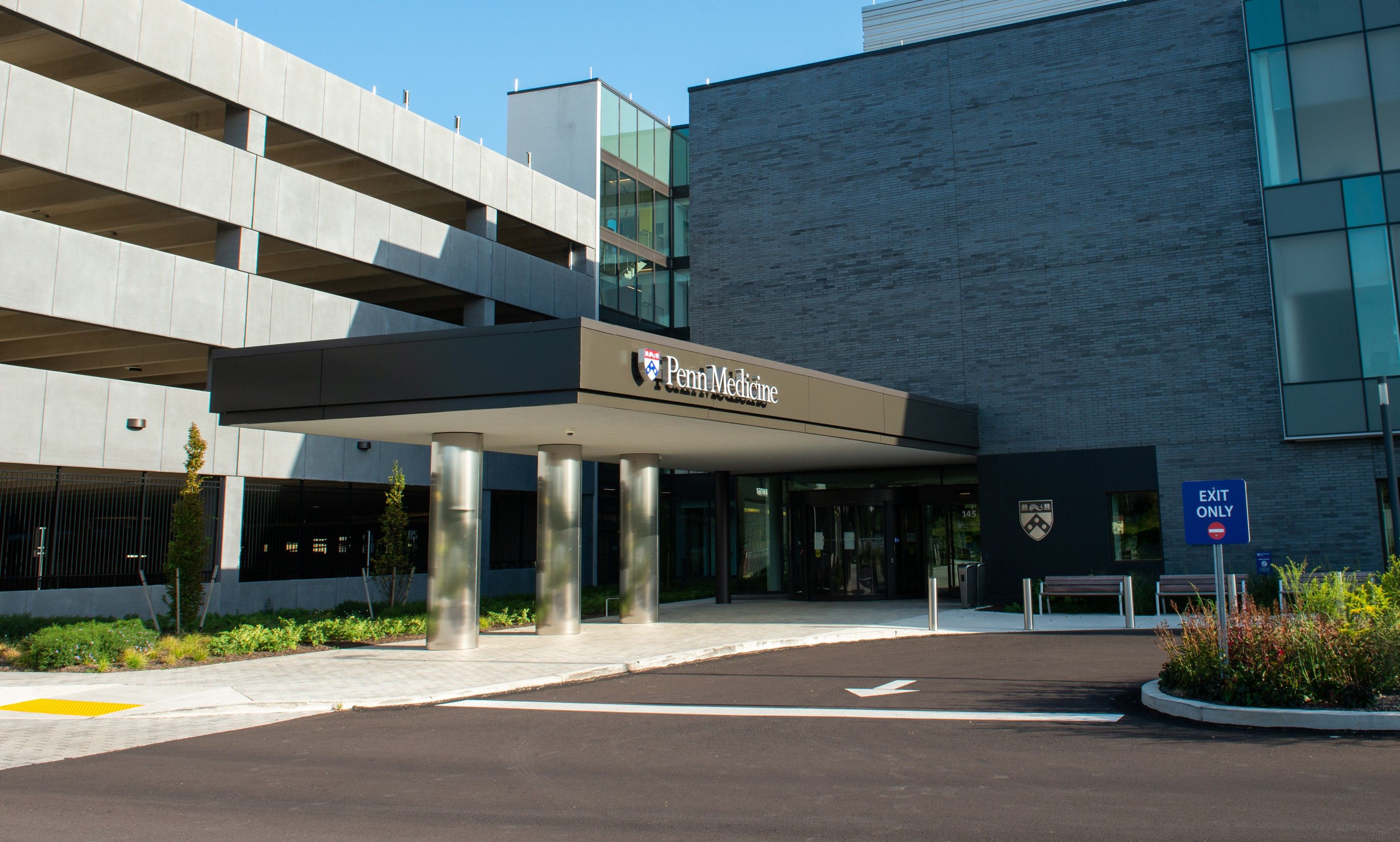
The University of Pennsylvania Health System and Independence Blue Cross, the Philadelphia area’s largest insurer, have formed a new company with plansto open at least 18 regional surgery centers.
The for-profit company announced Thursday is part of an effort by Penn and IBX to bring lower-cost procedures closer to patients, while maintaining quality and safety, officialssaid.
For Penn, the venture represents a financial leap, because it means the nonprofit health systemwill intentionally accept significantly lower payments for part of its business.
“We need to work on affordability in healthcare. It’s too expensive. It’s bankrupting families,” Penn health system CEO Kevin Mahoney said.
Medicare and private insurers like IBX who pay the healthcare bills “want to move to less costly settings,” he said,and Penn needs to be ready to capture that business.
IBX’s CEO Kelly Munson emphasized the importance of partnerships to tackle rising healthcare costs. She noted that shifting care to ambulatory surgery centers from hospital departments can generate as much as a 50% discount.
A third investor in the company is Regent Surgical, a Tennessee firm with private equity investors that will manage the local centers. Its tasks include forcing efficiency. Regent already manages 40 sites in 15 states. Penn clinicians will provide services.
Regent’s CEO, Travis Messina, called the new company the first of its kind nationally. “I’ve yet to see one that has involved both a payer, a provider, as well as a management company,” he said.
Key details — such as the for-profit company’s name, the ownership percentages, and the time frame for opening the anticipated facilities — were not disclosed.
The first local facilityis expected to open next year, but officials did not say where.
The Penn-IBX initiative doesn’t fit into the typical playbook for ASCs, said Dan Grauman, a healthcare consultant based in the Philadelphia area.
Usually, physicians are also involved as owners. “They’re part owners of these surgery centers, and they drive the volume,” said Grauman, a managing director at VMG Health, a national healthcare consulting firm.
Asked if non-Penn doctors could be involved in or be investors in the new centers, Penn and IBX said they are evaluating all options for future growth.
The case for more ASCs in the Philadelphia region
Southeastern Pennsylvania already has more than 100 ambulatory surgery centers, many of them specialized in gastroenterology and mainly focused on colonoscopies, state heath department data show.
Yet the region lags the nation in the shift to lower-cost surgery centers.
Data provided by Regent show that in 2023 and 2024 only 33% of ASC-eligible procedures in the Philadelphia region had migrated to the ASCs, compared to 56% nationally. Regent uses data fromKythera Labs, a company that analyzes health insurance claims.
Messina attributed the slower adoptionof surgery centers to the concentration ofphysicians employed by localhealth systems. “That tends to limit the amount of ASC availability in markets across the country,” he said.
Historically, Philadelphia-area health systems tended to concentrate servicesin their hospitals, which have expensive fixed overhead, and in facilities that charge hospital rates. Executives focused on protecting revenue, so they could maintain broad hospital offerings, rather than on offering lower-cost options.
“We’ve been trying to deconstruct away from hospitals for a long time, and this is a natural step on that continuum,” he said.
Penn previously invested an undisclosed amount of money in the Ambulatory Cardiovascular Center of Pennsylvania near King of Prussia. That facility is a partnership that also includes Cardiology Consultants of Philadelphia, Cardiovascular Logistics, and SCA Health.
To incentivize more surgery centers and reduce costs for employers, IBX introduced a policy this year that it will only pay for certain procedures if they are done in a low-cost ASC. At the same time, IBX does not force patients to change doctors if their provider does not have privileges at an appropriate ASC.
How Penn could go about opening centers
Mahoney called the initial target of 18 locations the start.
“Eighteen is half of what I want to do. These are not mega hospital buildings,” he said. “They’re going to be convenient. They’re going to be spread throughout the five counties, easy for people to get to, close to their homes.”
The new centers won’t always require new construction, as is typically the case for Penn’s large outpatient centers, such as the one going up in Montgomeryville.
The new ASC company could also acquire existing ASCs or change the billing practice at a Pennsurgery center that currently charges higher hospital rates, Messina said.
A surgery center on the campus of Penn’s Doylestown Hospital closed last year. Penn could relaunch it under the new company.
New Jersey could also see new surgery centers from the Penn expansion.
The University of Pennsylvania picked the first three faculty-founded companies for early stage investments from its newly established $10 million StartUP fund, the university said Wednesday.
The three companies are working in maternal health, advanced radio-frequency filtering technology, and AI-powered drug discovery.
Each is receiving the maximum investment of $250,000 from the fund launched in December to make seed investments in companies founded by university researchers.
“Penn researchers are developing technologies with the potential to address some of the most important challenges facing society today, and many of these solutions have the potential to create entirely new markets,” John Swartley, Penn’s chief innovation officer, said in an announcement.
Here are some details on the three companies:
Vasowatch is developing a non-invasive monitoring system to predict the risk of maternal postpartum hemorrhage, a leading cause of maternal death. Its cofounders are Penn Nursing adjunct professor Stefanie Modri and former Penn Engineering faculty James Weimer. The company will use the money to fine-tune the product and to pay for a clinicaltrialanticipated to start next year.
OneFiltr, cofounded by Troy Olsson,aprofessor in the School of Engineering and Applied Science, has a compact device designed to allow a cell phone to isolate and process specific frequencies. The company will use its investment to further development of its device for evaluation by aerospace and defense companies.
Peptaris Inc. has an AI platform for evaluating and developing drugs based on peptides, which are building blocks for proteins. Cofounders are César de la Fuente and Marcelo Der Torossian Torres. The StartUP investment is part of a larger seed round that Peptaris is using refine its model and evaluate its first candidates. Peptaris said in an SEC filing June that it raised $4 million from investors.
Redeemer Health CEO Greg Wozniak has resigned from the financially troubled nonprofit Montgomery County health system after a little more than two years, Redeemer announced Thursday.
Replacing Wozniak on an interim basis is chief transformation officer Jim Logue, who has held the role since early 2025.
Redeemer has posted operating losses every fiscal year from 2017 to 2025. It hasn’t yet posted financial results for the fiscal year that ended in June.
“Jim and his team will work with our financial advisors and counsel to implement a reorganization of the Redeemer system to assure its continued viability and a sustainable business model,” board chair William R. Sasso said in an internal communication obtained by The Inquirer.
“This reorganization is expected to involve some significant organizational changes which will be announced in the coming weeks as they are finalized,” the note said.
More than four years ago, Redeemer announced that it was seeking what it called a “strategic partner” for its 239-bed hospital in Meadowbrook, near Abington, but nothing came of that effort.
Redeemer also operates a home care business, nursing homes, senior apartments.
Redeemer announced additional personnel changes Thursday in its internal communication, including the departure at the end of this month of chief financial officer Kim Cummings. Former CFO Michael Keen is returning to that position.
Another returning executive is Donald Friel, a former executive vice president tapped to assist Logue.
Diane Derr, who has been at Redeemer for 44 years, is being promoted to chief administrative officer from chief nursing officer.
Editors note: This article has been updated to correct Derr’s history with Redeemer.
Geisinger Health expects to lose more than $180 million in revenue next year when deep cuts to Medicaid start impacting the nonprofit health system with 10 hospitals in a largely rural stretch of central and northeastern Pennsylvania.
The Rural Health Transformation Program — meant to soften the blows from the cuts imposed by Congress under Republican’sso-called “One Big, Beautiful Bill Act” or H.R. 1 — offers limited relief.Geisinger expects to collect $6.7 million of the $193 million allotted to Pennsylvania.
“It’s given us some money for some critical infrastructure that we need,” such as a CT scanner or an MRI machine for hospitals that serve rural counties, CEO Terry Gilliland said in an interview last month.
But much of the money being distributed through the Rural Health Transformation Program, or RHTP, isn’t going to help rural hospitals because it wasn’t designed to do that. No more than 15% of the funding can be used to reimburse providers for healthcare services.
That has left Geisinger, which is owned by California-based Kaiser Health, in a tough spot: “H.R. 1 is taking a big old chunk out of our hide, and there’s just no way for RHTP to fill the hole,” he said.
Nationally, $911 billion in Medicaid cuts are anticipated over a decade, with $137 billion is expected to come from rural areas, according to KFF, a nonprofit that researches health policy. KFF’s analysis did not provide state estimates for rural losses.
The Rural Health Transformation Fund totals $50 billion over five years. Pennsylvania would receive $965 million if it were to get the same amount each year as it did this year. Philadelphia-area health systems haven’t received money from the fund yet, but could participate in the future through projects that benefit rural Pennsylvania.
Where the money is going
The rural health fund is an incomplete response to the revenue hole created by H.R. 1, said Katherine Hempstead, a senior policy officer at the Robert Wood Johnson Foundation, a Princeton-based philanthropy focused on healthcare advocacy and research.
“It is mostly targeted to upstream projects designed to make rural healthcare more efficient in the long run. They may or may not be successful,” she said.
All but $2 million went to technology and infrastructure projects, including critical needs like new roofs, HVAC systems, elevator repairs, and the repair of a collapsed sewer line.
On the technology side, new imaging equipment was popular in the first funding round.
With $3.7 million from that round, Geisinger got a new X-ray machine for its Bloomsburg hospital, new CT units for Jersey Shore and Lewisburg hospitals, and an upgraded compounding pharmacy for its flagship hospital in Danville.
Geisinger applied for $3 million from a forthcoming second round and plans to use the money for a special EMS vehicle, transport vans for senior care, telehealth equipment, and other capital equipment, if it is approved.
In addition to technology and infrastructure, Pennsylvania is focusing the rural funding on workforce development, maternal health services, behavioral health services, aging and access, and emergency medical services and transportation.
Geisinger’s approach to filling its financial hole
Geisinger’s estimated $180 million revenue loss next year has three main drivers. They are limits on how much federal money the state can generate through provider taxes, changes to the supplemental payments for hospitals with large numbers of Medicaid patients, and an increase in the uninsured population caused by new Medicaid enrollment rules.
In 2025, Geisinger had about $10 billion in revenue. That’s up from $7.7 billion in 2023, that last full year before it became part of Risant Health, a new nonprofit created by Kaiser in 2023 to acquire community health systems.
Already this year, Geisinger has seen a $10 million a month increase in charity care and bad debt write-offs, Gilliland said, which he attributed to people not being able to afford individual Affordable Care Act plans after the enhanced tax subsidies expired.
“How many more of these hits can I take? The answer is not very many,” Gilliland said.
The health system is focused on becoming more efficient.
“There’s some optimism that says we could find some way to have artificial intelligence do some of the tasks that we typically throw humans at,” Gilliland said.
He hopes to avoid want layoffs, given that Geisinger is often the largest employer in its communities.
“I’d really like to figure out ways to fill the hole without having people lose their jobs because that has a much more devastating impact on the local economy,” he said.
Highmark reached an agreement to keep Rothman Orthopaedics in network for Pennsylvania customers of Highmark Blue Shield plans and federal employee health programs after Oct. 1, the two companies said Wednesday.
The Pittsburgh-based insurer had issued a termination notice over the summer, alleging that about a half-dozen Rothman surgeons were abusing a federal process designed to protect patients from unforeseen out-of-network bills.
The dispute centered on the use of out-of-network physician assistants by Rothman surgeons who do not have residents or fellows working for them and need help treating patients.
Highmark said that the practice violated a contract that took effect at the beginning of last year and that the use of arbitration under the federal No Surprises Act generated extraordinarily large payments for the physician assistants.
The physician assistants worked for separate company that Rothman, a practice, had no control over, a Rothman official said earlier this month.
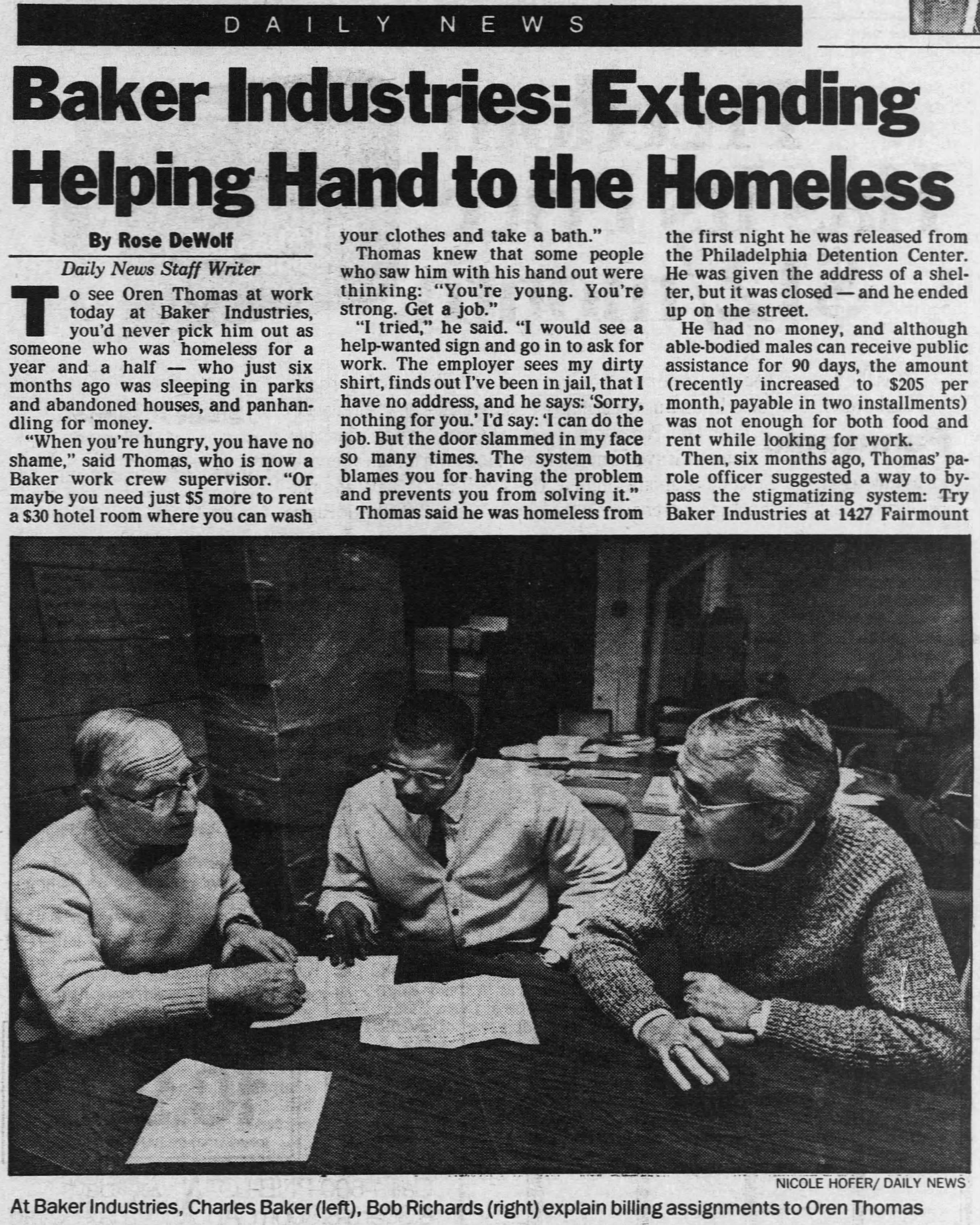
Charles P. Baker III, 101, formerly of Radnor, celebrated cofounder of Baker Industries, longtime workplace for the “least employable,” former owner of the C.P. Baker & Co. chemical firm, Army veteran, national squash champion, mentor, and volunteer, died Wednesday, Sept. 16, of congestive heart failure at HarborChase assisted living community in Wilmington.
Born in Philadelphia, Mr. Baker grew up in the old Colonial Hotel at 11th and Spruce Streets in Washington Square West. He and his wife, Louise, founded Baker Industries in 1980, and the workforce development nonprofit has hired, trained, and mentored more than 12,500 workers with physical and intellectual disabilities, substance use disorders, recent periods of incarceration, and housing insecurity who could not find jobs elsewhere.
Their own son, Justin, lives with epilepsy and, when he could not find suitable employment years ago, Mr. Baker and his wife started their own two-person mail order packaging firm in their Strafford garage. Their son was their first hire.
“We decided, if we’re going to start something like this, let’s go for the people who need it the most,” Mr. Baker told The Inquirer in 1998, “the ones who are least employable.”
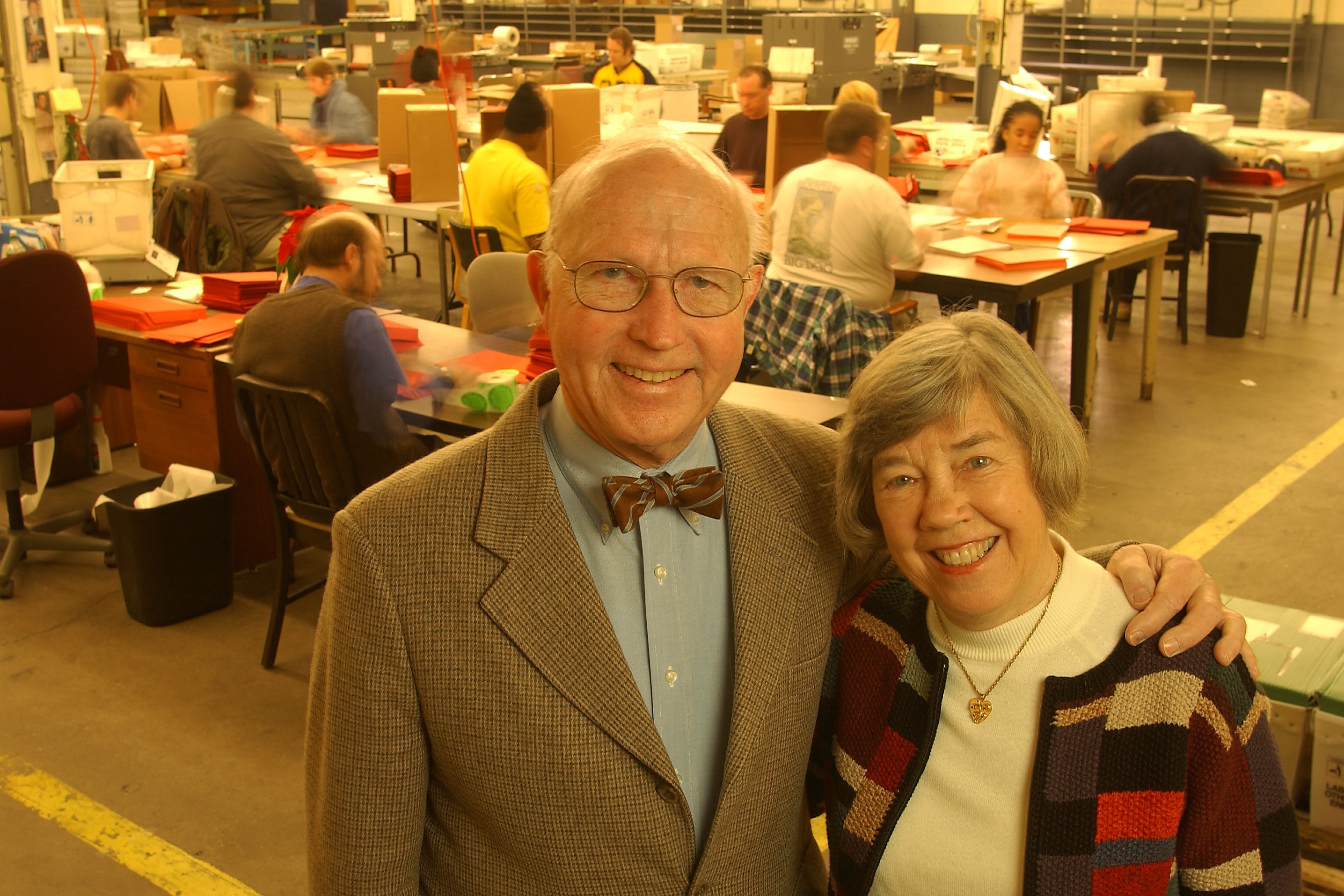
Mr. Baker and his wife, Louise, stand inside their Baker Industries building in Malvern in 2003. Michael Bryant / Staff Photographer
For nearly five decades, Baker Industries has contracted light industrial and office work from hundreds of businesses, and operated facilities in Philadelphia, Malvern, and elsewhere. Employees are paid an hourly wage, offered additional training, and encouraged to attend workshops, social events, and support group meetings.
The company motto is “providing a steppingstone to regular employment,” and many workers have moved on to higher-paying jobs elsewhere. “We have a philosophy of work as rehabilitation,” Mr. Baker told the Daily News in 1988. “The goal is to show these people they can do a whale of a lot more than they think they can do.”
Mr. Baker served as the unpaid president at Baker Industries until 2002 and then on the board of directors. In the 1950s, he assumed control of his family’s small chemical company, C.P. Baker & Co., and he expanded it before selling it in 1980.
“Charlie and Weezie Baker believed there is healing in work,” colleagues at Baker Industries said in a Facebook tribute on his 101st birthday in June. “Not just jobs. Work. Showing up. Being part of something. Contributing alongside others.”
Mr. Baker played many roles at Baker Industries.Baker Industries
Turk Thacher, vice board chair at Baker Industries, said: “Charlie was beloved. He was kind to everybody.”
Mr. Baker, his wife, and their company were featured often on TV shows, and in The Inquirer, the Daily News, and other publications. They won many awards for their community service and innovative business model.
“I was grateful to have their guidance,” Nic Watson, president of Baker Industries, said, “and we will follow their example for years to come.”
In 1991, the company was named an inspirational Point of Light by President George H.W. Bush. In 2004, Mr. Baker and his wife earned the legacy award for “community generosity” from the Chester County Community Foundation.
“They went above and beyond their own self-interest,” a foundation official told The Inquirer then.
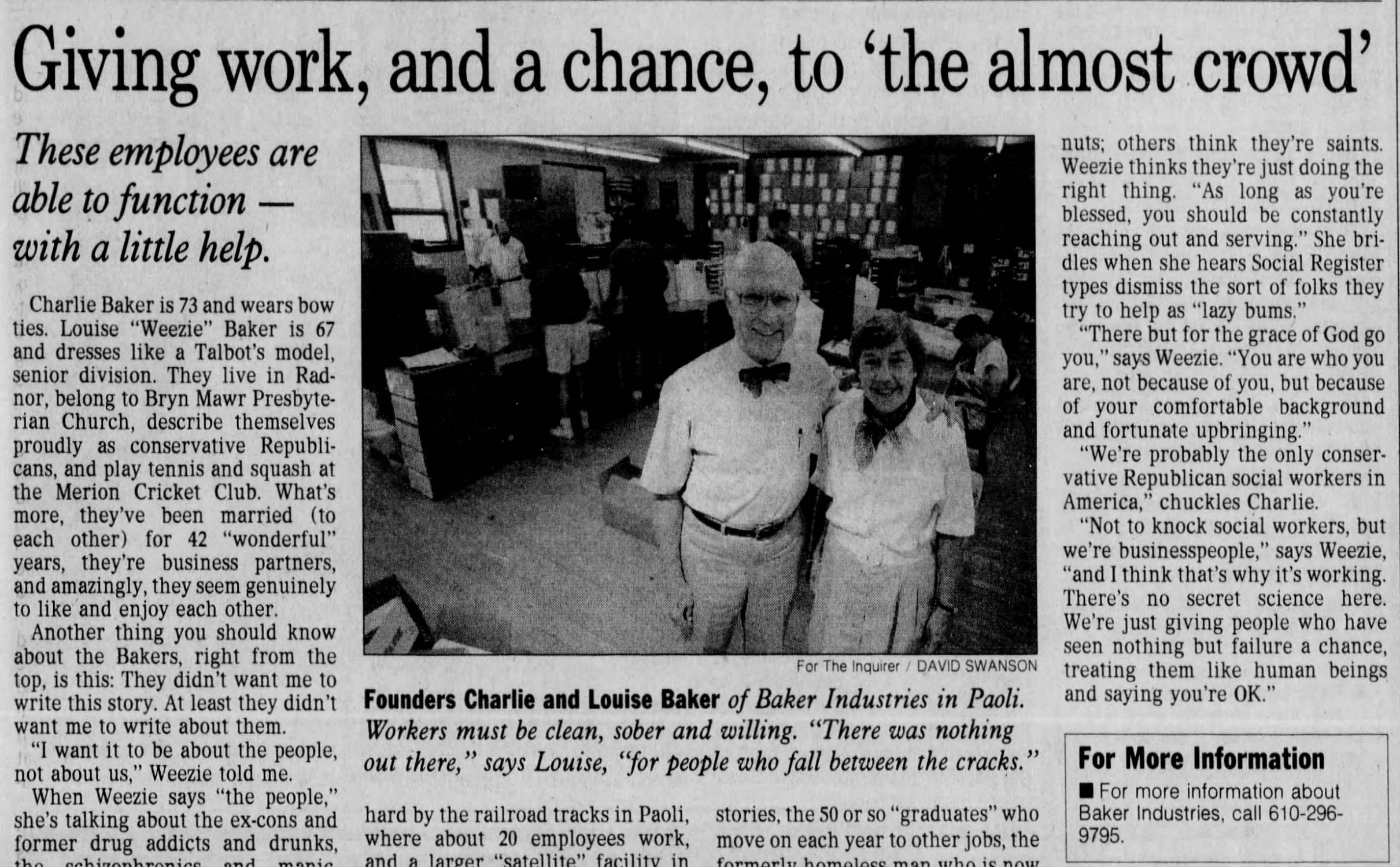
This photo and article about Mr. Baker were published in The Inquirer in 1998.Newspapers.com
Away from work, Mr. Baker was an avid squash player, skier, and sailor. He won the U.S. national hardball singles squash championship six times in the 80-and-older division from 2006 to 2016, skied into his 70s, sailed into his 80s, and played squash and tennis at the Merion Cricket Club until recently.
He graduated from the U.S. Military Academy in 1946 and served more than seven years in the Army. He was stationed in Europe and rose to captain. His family called him a “relentlessly joyful spirit” in a tribute and said: “The world was a better place for his presence.”
Charles Pitman Baker III was born June 24, 1925, in Philadelphia. His father, Charles Jr., was manager at the old Colonial Hotel, and Mr. Baker told stories of dropping water balloons on passing pedestrians from windows when he was very young and spending summers at the beach and on boats with the Ocean City Yacht Club.
He was a star squash player at the Haverford School and known by classmates as “the Arm,” his 1943 senior yearbook said, “because of the vicious way he wields a racket.” His mother died when he was 11.
This photo and article about Mr. Baker (left) appeared in the Daily News in 1990.Newspapers.,com
He met Louise Wilhelm while water-skiing in Ocean City, and they married in 1955, and had sons Charles IV and Justin and a daughter, Sandra. His wife died in 2025.
Mr. Baker and his wife attended Wayne Presbyterian Church, and he was known for his bow ties and wide smiles. He was funny, his daughter said, and liked to sing show tunes anytime anywhere, and write corny poems on birthday cards.
“He was a wonderful dad who loved his family,” his daughter said. His family said in a tribute: “His legacy of service, humor, and kindness will live on for many generations to come.”
His wife told The Inquirer in 2004: “Charlie has a kind heart.”
Mr. Baker (front left) celebrated his 100st birthday in June 2025 with his family.Courtesy of the family
In addition to his children, Mr. Baker is survived by four grandchildren, five great-grandchildren, and other relatives. Two sisters died earlier.
Visitation with the family is to be from 10 to 11 a.m. Saturday, Oct. 17, at Wayne Presbyterian Church, 125 E. Lancaster Ave., Wayne, Pa. 19087. A celebration of his life is to follow. Bow ties are optional but encouraged, the family said.
Donations in his name may be made to Baker Industries, 184 Pennsylvania Ave., Malvern, Pa. 19355.
His wife told The Inquirer in 2004: “Charlie has a kind heart.”Baker Industries