Category: Theater

  • Philly’s Cathedral Basilica is the canvas for a new immersive light show

    Philly’s Cathedral Basilica is the canvas for a new immersive light show

    If you’re in a church and the ceiling starts pulsating and streaks of lightning splinter down the walls, it’s usually a good sign that more than the homily is about to go down.

    But at Luminiscence, it’s all part of a new immersive experience that uses light to alter one of Philadelphia’s most famous altars — at the Cathedral Basilica of SS. Peter and Paul.

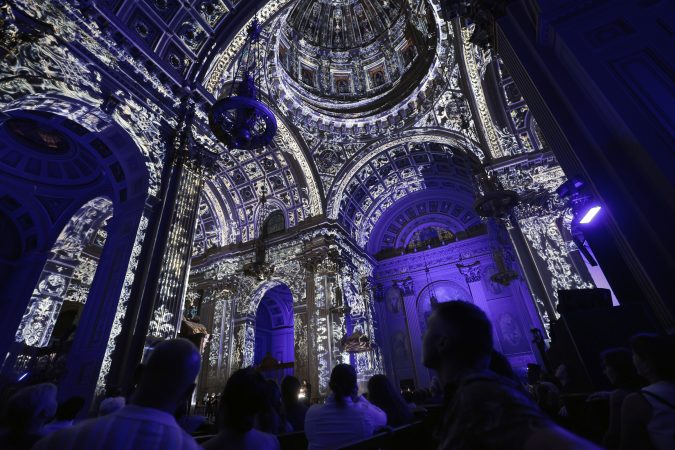
    On select evenings through August, Luminiscence brings the interior walls of the 164-year-old mother church of the Archdiocese of Philadelphia to life with 25 high-definition projectors, 360-degree video mapping, and accompanying performances by a live choir and orchestra on select dates.
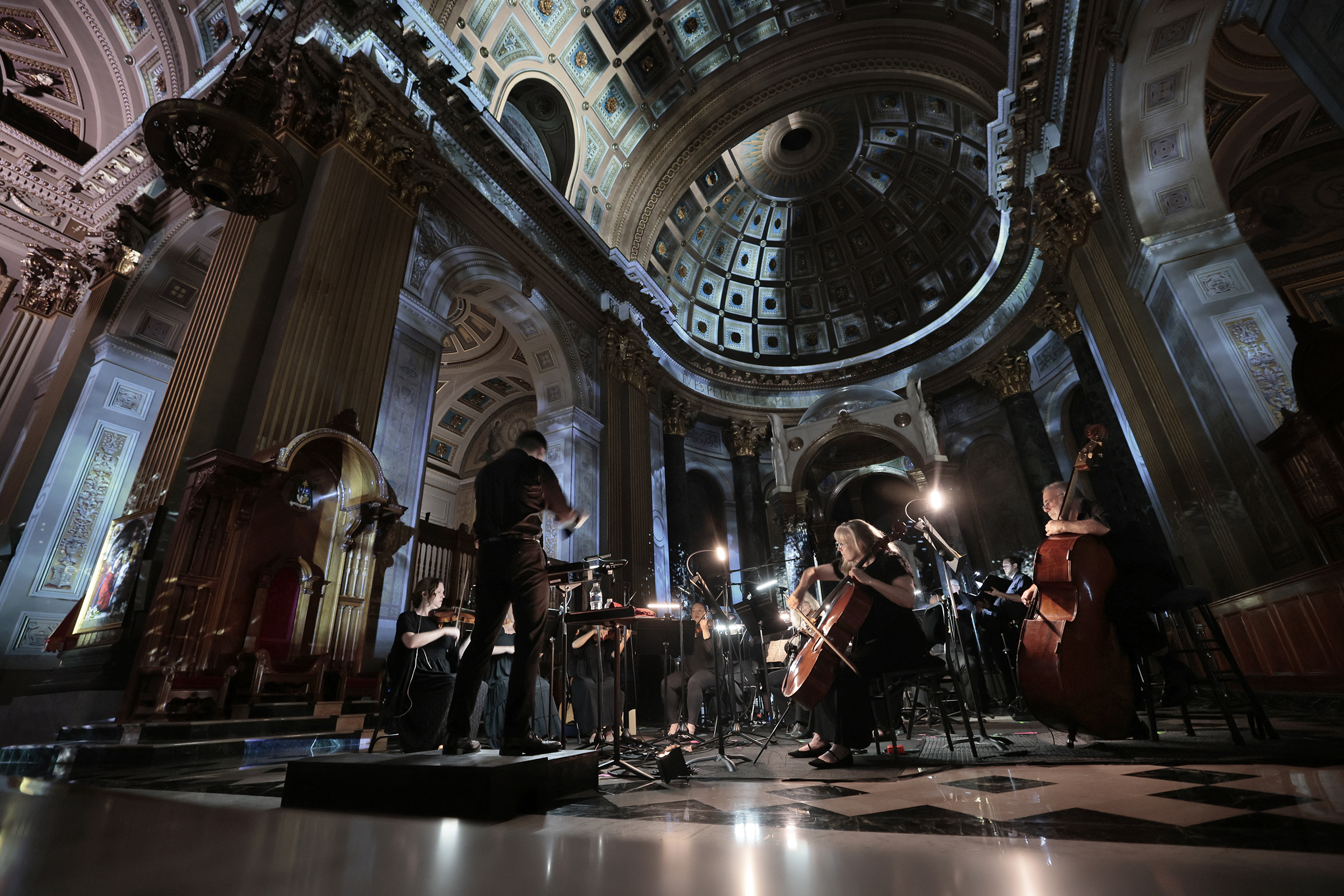
    The orchestra plays during the June 11 premiere of Luminiscence at the Cathedral Basilica of SS. Peter and Paul.Elizabeth Robertson / Staff Photographer

    This sacred space where two popes have celebrated Mass, countless Philadelphians have been laid to rest, and the remains of a saint are enshrined is now host to a visual and auditory odyssey that tells the history of the cathedral as high-definition lights trace every nook and cranny of its walls.

    Think of it as a laser light show for the digital age and mature palette. Instead of spacing out with Pink Floyd in a planetarium, you’re basking in bright lights with Bach in a basilica.

    “We really wanted to see the building come alive and be featured in ways that it hasn’t ever been seen before, together with music that really illuminates the soul,” said Clayton Ferguson, executive producer and general manager for Banijay Americas Live, the media and production company behind show.
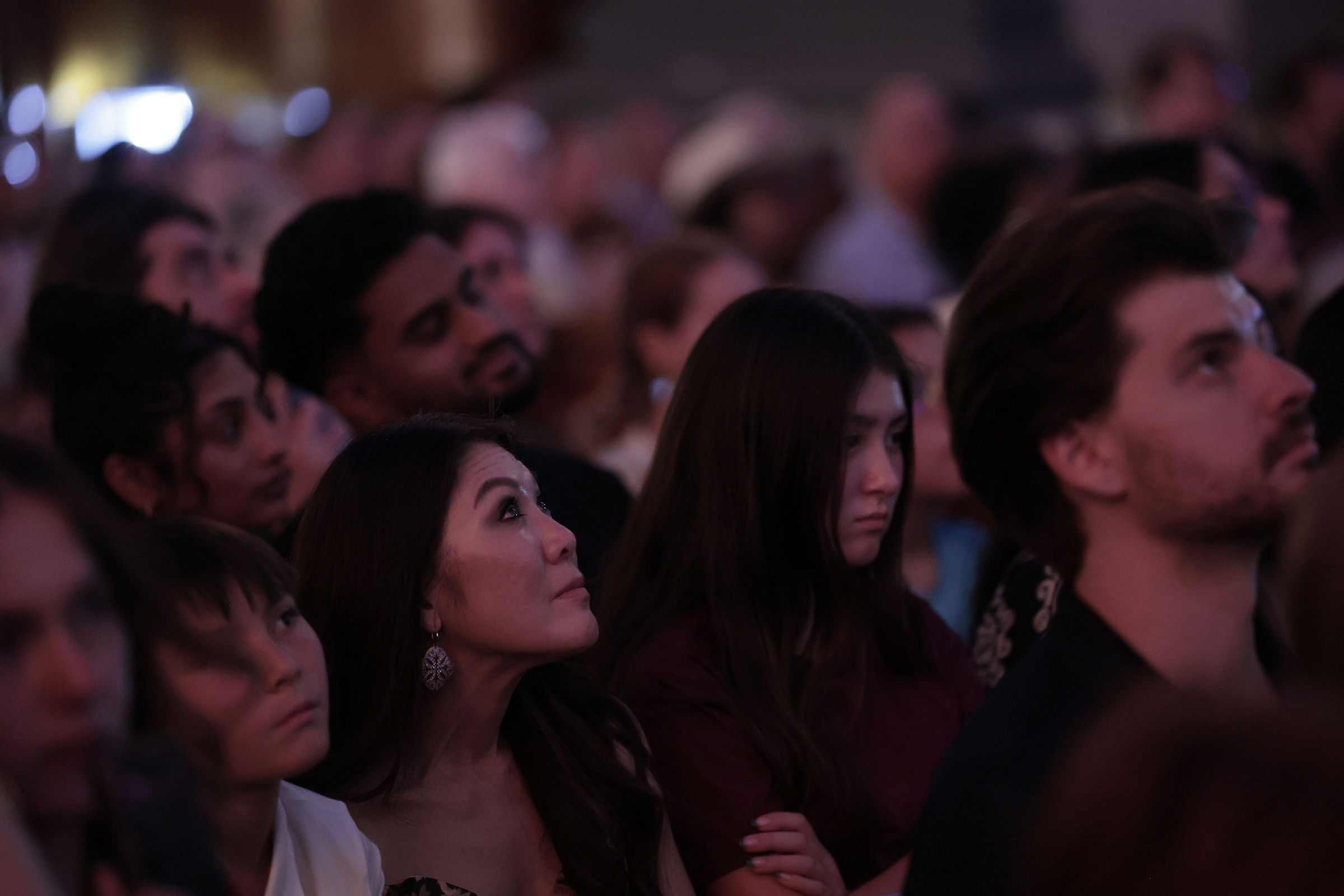
    Guests watch the opening night performance of Luminiscence at the Cathedral Basilica of SS. Peter and Paul on June 11.Elizabeth Robertson / Staff Photographer

    ‘Respecting the cathedral’

    Father Dennis Gill, rector of the Cathedral Basilica, said he was approached about hosting the production a little less than a year ago.

    “They were very impressed by our cathedral building and they thought it would be a wonderful place to highlight with light,” he said. “It took some convincing. My primary concern was respecting the cathedral. The primary ministry of the cathedral is the worship of God and I wanted to make sure Luminescence would protect and promote that.”

    Luminiscence events — which are specifically designed for cathedrals and basilicas — began in France, where Banijay Americas Live parent company, Banijay Entertainment, is headquartered. Philadelphia is only the second U.S. city to host a production. The first was held at the Basilica of Saint Mary in Minneapolis last year.
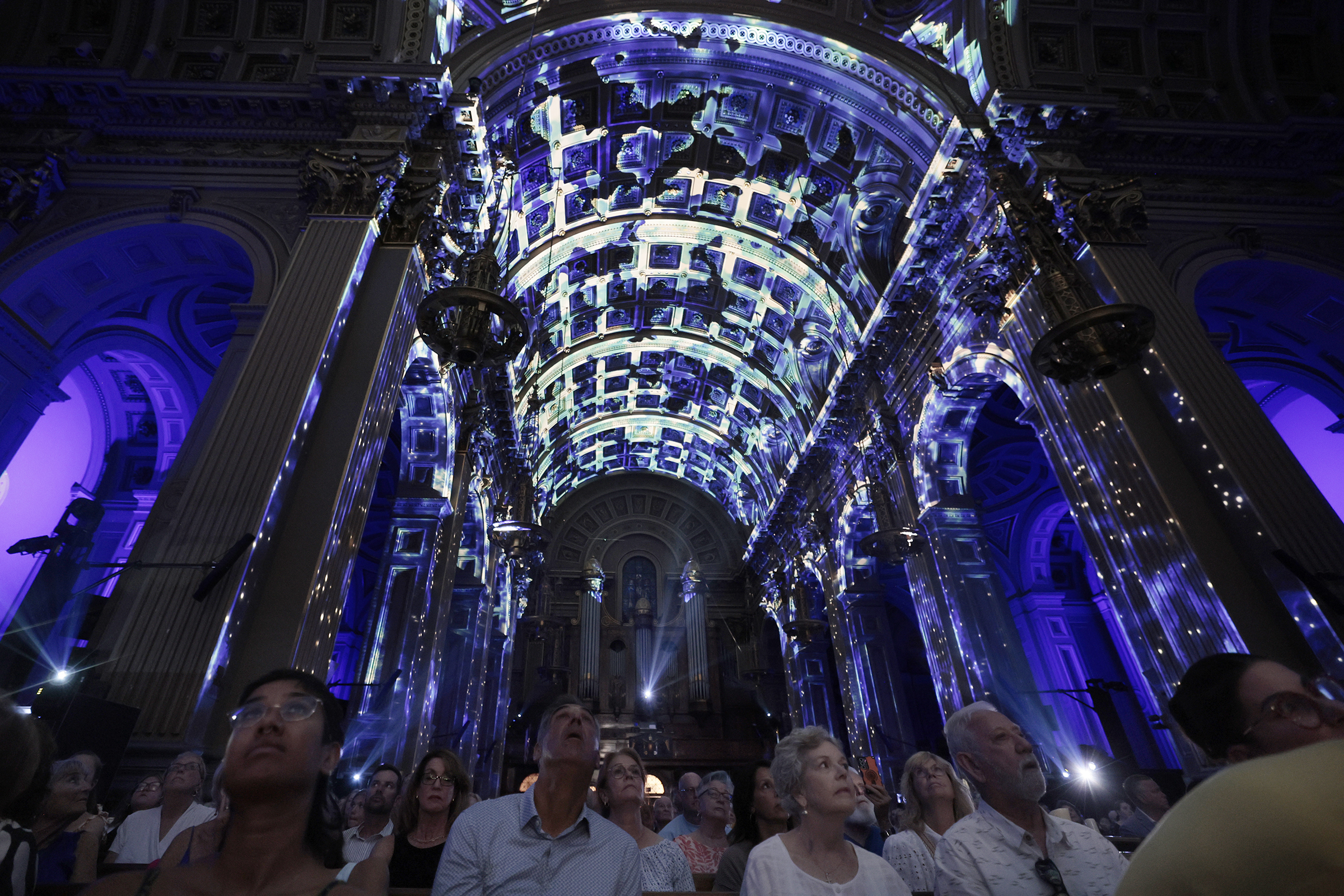
    People watch the opening night performance of Luminiscence on June 11.Elizabeth Robertson / Staff Photographer

    “It’s about sacred spaces, but it is not a faith-driven show, so it is absolutely for all audiences,” Ferguson said. “I wouldn’t say that it’s a secular story or a religious story. I think that it is about beauty and hope and creativity.”

    This isn’t the first time projection mapping has been used to transform an iconic Center City building. For years, Philadelphia’s own Klip Collective brought the exterior of City Hall to life during the holidays with its free Deck the Hall Light Show. But Luminiscence is the first time an immersive experience like this has been done in the Cathedral Basilica, or in any Catholic church in Philly.

    Gill said he had three reasons for agreeing to participate.

    “My first reason was it would highlight the architectural beauty of our cathedral. Second, it would draw people to church, and my third reason was it would bring us some financial assistance,” he said.

    A portion of the ticket sales goes to the Cathedral Basilica, but Ferguson declined to detail how much.

    A purpose

    Last week, entry lines snaked around the building as people packed the pews for the first performance. Prior to the start of the show, the basilica’s domed ceiling was bathed in a dark cerulean light dotted by hundreds of stars. Human silhouettes walked slowly and methodically along the walls high above the crowd.
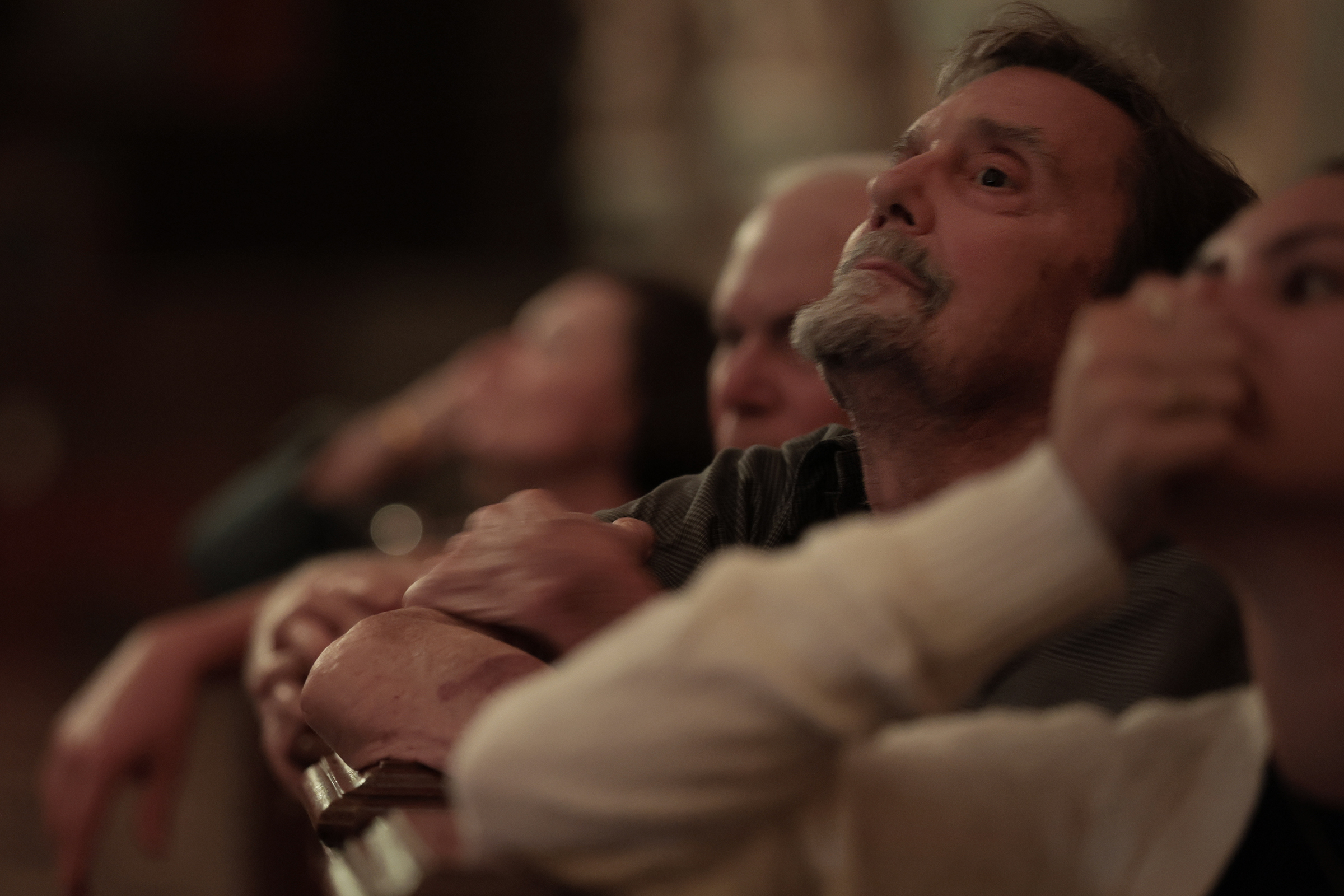
    Joseph Blanch of Havertown watches the opening night performance of Luminiscence on June 11. Elizabeth Robertson / Staff Photographer

    Ferguson and Gill offered brief opening remarks, with the latter also offering a blessing.

    As I sat listening in a pew, I tried to think of the last time I was in the basilica. Was it really 11 years ago when Pope Francis was in town? I often visit churches in Europe just for their beauty and architecture, but not those in my own backyard. Maybe I feel like I need a purpose when it’s so close to home.
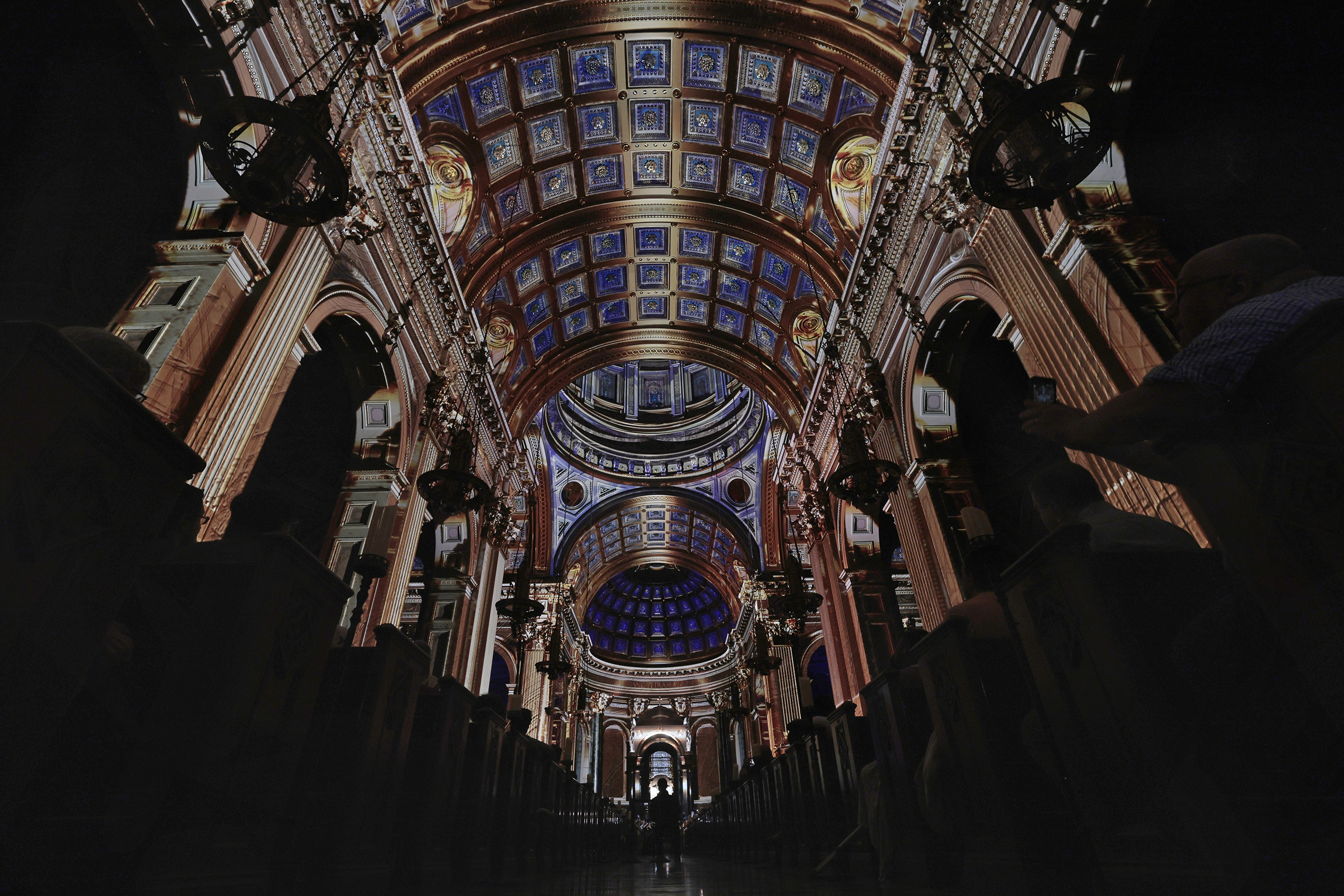
    Luminiscence at the Cathedral Basilica of SS. Peter and Paul on opening night on June 11. Elizabeth Robertson / Staff Photographer

    “Talking it through, everybody kind of understood how it would really, really help get more people through the doors,” Ferguson said. “I mean, this building is stunning. It’s incredible. How many people have maybe walked past it over all of the years and not even had a chance to walk inside?”

    ‘Goosepumps’

    The show began with a narration welcoming us to “prepare to board on a timeless journey.” Over the next 45 minutes, the basilica was transformed into a night sky, a golden palace, an architect’s drawing board, a stormy sea, stained glass, a garden of falling petals (that defied the laws of gravity and rose upward), a kaleidoscope, a cloudy sky filled with angels, and, for a brief moment, a black-and-white scene that looked straight out of a Tim Burton movie.

    “Wow!” and “Oh my God!” I can hear myself saying on my video recordings (probably should have rethought that last exclamation in a Catholic church).

    “Goosepumps” I wrote in my notebook (hey, it was dark).
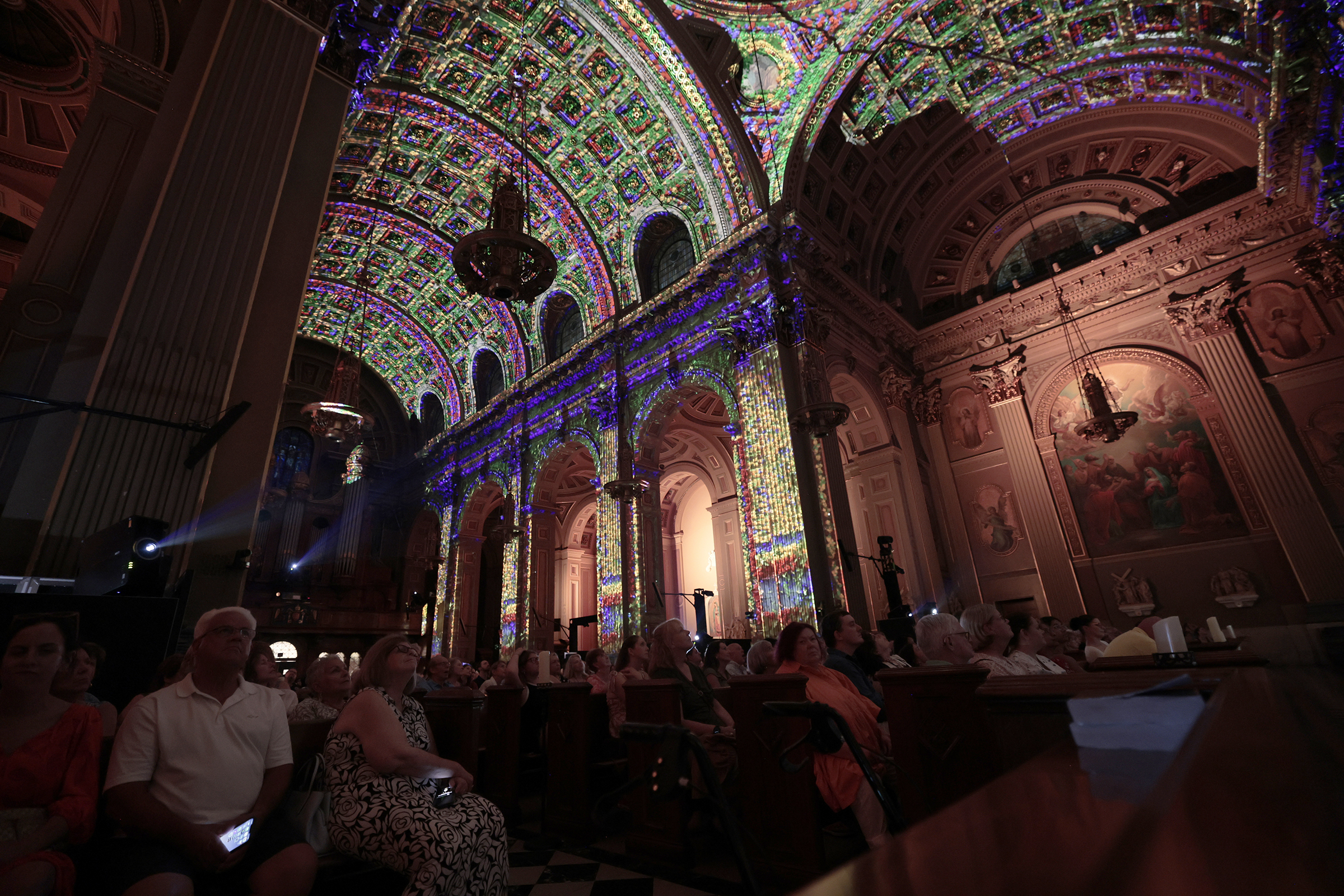
    The opening night performance of Luminiscence on June 11.Elizabeth Robertson / Staff Photographer

    The visuals were stunning and the live orchestra and choir of local musicians sounded lovely, even if I only recognized a few of the pieces of classical music being performed, like “Ode to Joy” from Beethoven’s Symphony No. 9.

    I did struggle to follow along with the narration and tenuous storyline though, which mostly focused on the creation of the Cathedral Basilica but also tried to tie in the founding of the United States and Philadelphia. Ferguson called it a “poetic love letter to Philadelphia and the cathedral.”
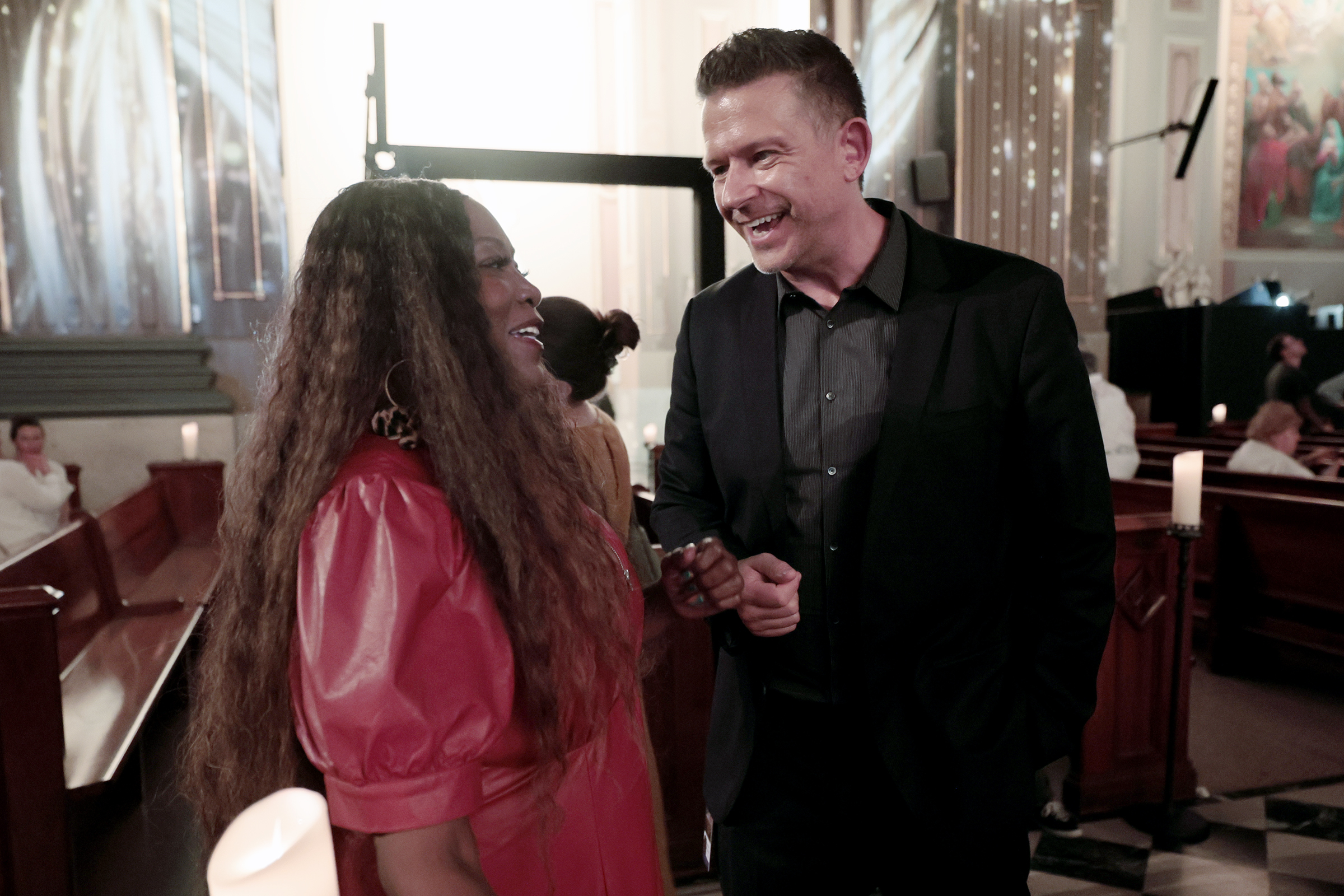
    Crystal Safford of Philadelphia and Luminiscence executive producer Clayton Ferguson talk after the opening night performance.Elizabeth Robertson / Staff Photographer

    “It’s really about less is more,“ he said. ”We try to use as few words as possible to elevate the senses along the way.”

    God and the church feature prominently in the narration, which perhaps is to be expected, given the setting, but it also makes the program feel less than secular. I didn’t find it off-putting, but I can see how some people may.

    Faith and wonder

    The strength of this show lies firmly in its visuals, which helped me to see one of Philadelphia’s most storied edifices in a new way — alive.

    But it’s always alive, every day, with people and services. That was one of the biggest difficulties Ferguson and his crew faced when setting up Luminiscence.
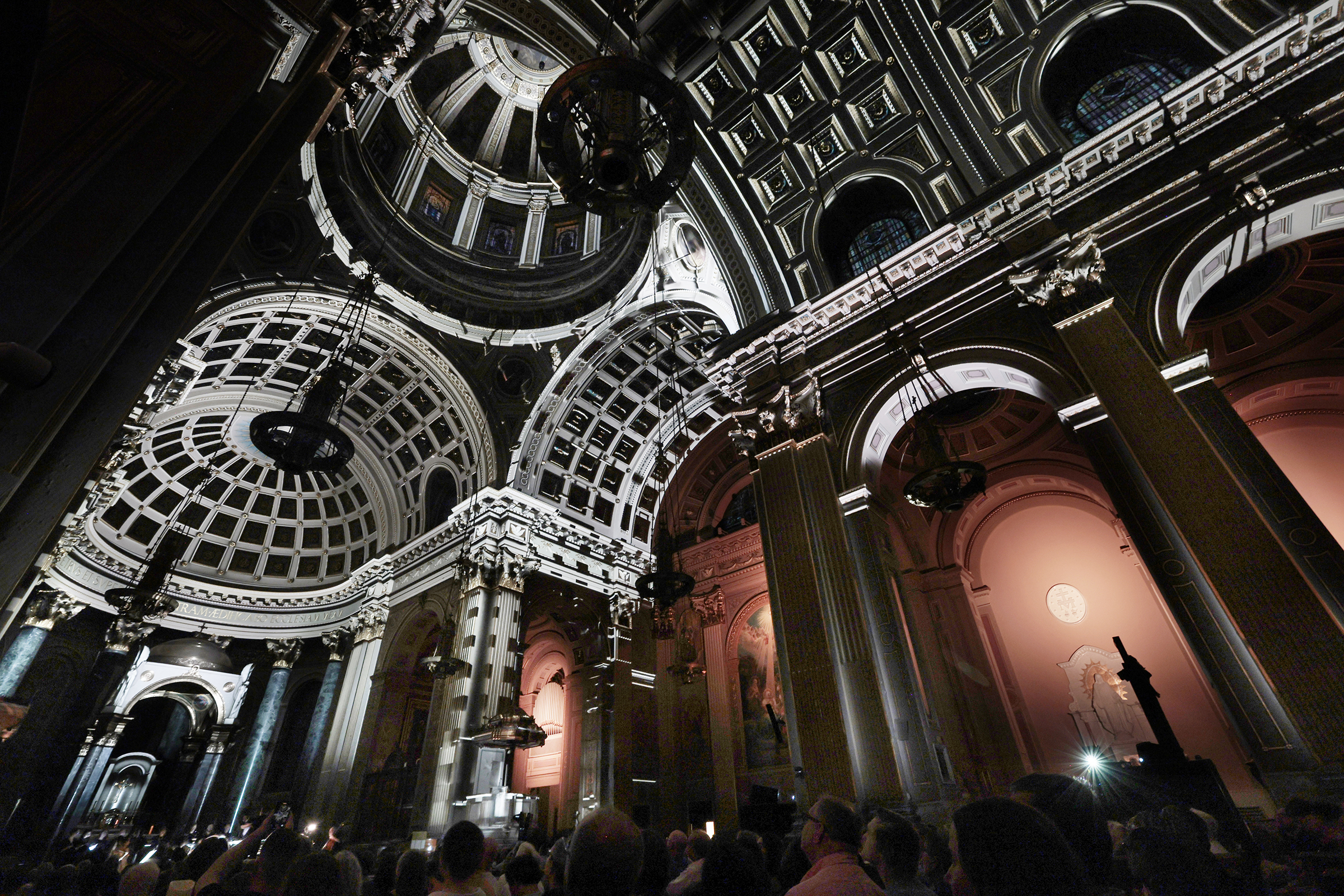
    The opening night performance of Luminiscence lights up the interior of the Cathedral Basilica of SS. Peter and Paul in Philadelphia on June 11. Elizabeth Robertson / Staff Photographer

    “One of the hardest challenges is how do we kind of disappear so people don’t see speakers everywhere,” he said. “So that’s actually our biggest challenge — staying out of the way.”

    If you’ve been staying out of the way of the Cathedral Basilica (or have never visited), Luminiscence is a great excuse to step inside. I’ve felt wonder in grand places of worship over the years — the Sagrada Familia in Spain, the Cao Dai Temple in Vietnam, and the Basilica of San Clemente in Italy — but it’s been a long time since I’ve felt wonder in a church on my own soil. Luminiscence gave me that.

    “It’s a very positive, beautiful, uplifting experience and it’s able to be both about faith and about wonder,” Gill said.
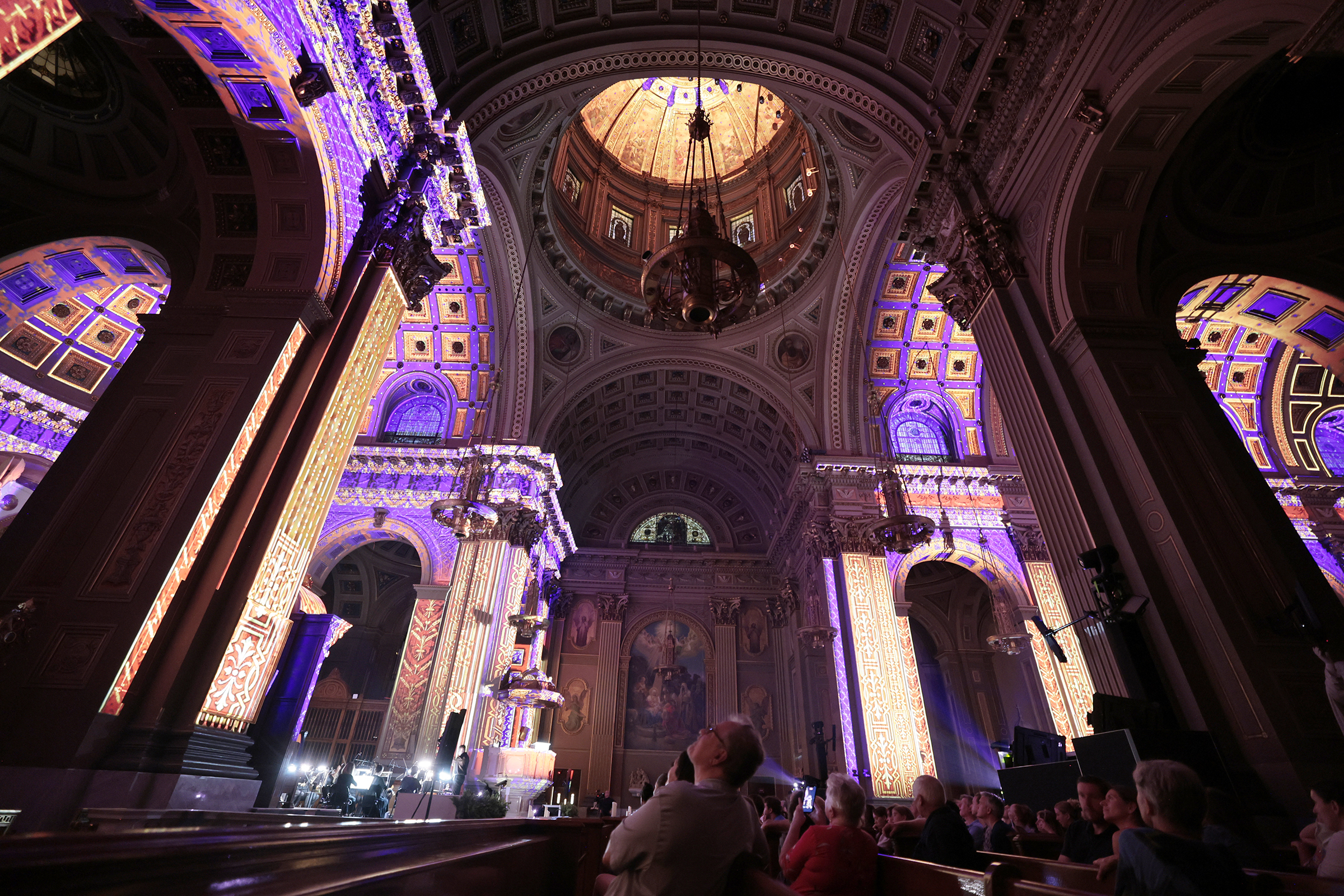
    People watch the opening night performance of Luminiscence on June 11.Elizabeth Robertson / Staff Photographer

    Know before you go

    • Three types of shows are available: with a live choir and orchestra, with just a live choir, and with an audio recording.
    • Adult ticket prices are $29 to $85 depending on the type of show, your chosen seating, and the day of the week. Tickets are available through Feverup.com.
    • Shows start late, with the earliest beginning at 8:15 p.m., to limit external light during performances.
    • For the best views, sit as far back as possible.
    • Do not, like me, bring your leftover dinner from Urban Farmer or you will be forced to throw it away, even if you promise you have no intention of eating mac-and-cheese in a church.
    • You will be looking up a lot, so if you suffer from neck issues maybe bring an airplane pillow?
    • Photos and videos are permitted, but limit yourself for your own enjoyment and for those around you. Nobody wants to watch the show through your phone.

  • Elon Musk becomes the world’s first trillionaire

    Elon Musk becomes the world’s first trillionaire

    Elon Musk became the world’s first trillionaire Friday when shares of his rocket company SpaceX began trading on the stock market, signaling a new era of ultra-affluence and widening wealth inequality.

    Musk reached the milestone when trading of SpaceX shares opened at $150, up 11% from their initial public offering price of $135. His net worth — which comprises his stock in SpaceX and his electric carmaker, Tesla, as well as ownership stakes in other ventures including brain implant company Neuralink and tunneling firm the Boring Co. — stood at around $1.1 trillion.

    Musk, 54, was already the world’s richest person. He claimed that title from Amazon founder Jeff Bezos in January 2021, after Tesla’s shares surged to take his net worth past $185 billion.

    Since then, the South African-born entrepreneur’s fortune has more than quintupled in a 5½-year period, during which he bought social media company Twitter, founded an AI startup, fused them together with SpaceX, and then took the conglomerate public. In that time, Musk also spent more than $250 million to help elect Donald Trump and advised the president.

    And Musk’s wealth-making has only accelerated, cementing his influence over society, culture, and global politics. Since October, his net worth has doubled.

    “The fact is that wealth for some and wealth inequality is growing in dimensions that we’ve never seen before,” said Steven Durlauf, the director of the Stone Center for Research on Wealth Inequality and Mobility at the University of Chicago.

    When oil tycoon John D. Rockefeller’s fortune was at its height in 1937, his $1.4 billion net worth amounted to about 1.5% of U.S. gross domestic product, Durlauf said. Musk’s net worth is now equivalent to more than 3% of U.S. GDP.

    Such wealth is so extraordinary that it can be hard to make meaningful comparisons. The median American household had a net worth of just under $200,000 in 2022, the year with the most recent data available from the Federal Reserve. That means Musk’s net worth is 5 million times as large as that of the typical family.

    His wealth dwarfs even that of the everyday wealthy. The top 10% of households by income had an average net worth of $6.5 million in 2022, less than 0.001% of the SpaceX leader’s total. The world’s second-richest person, Google co-founder Larry Page, is worth around $304 billion, according to the Bloomberg Billionaires Index.

    Inequality is notoriously difficult to measure, but the explosion of wealth at the top is hard to dispute. The net worth of the middle 40% of households, adjusted for inflation, has risen slightly more than 50% over the past decade, according to data from French economists Emmanuel Saez and Gabriel Zucman. The top 1% have seen similar gains. But the richest 0.001% have seen their wealth roughly double over the same period.

    Beyond Musk, the ultrawealthy have experienced significant increases in their fortunes. In 2016, a net worth of $100 billion — a mark that Musk crossed about six years ago — would have easily placed someone at the top of the Forbes Billionaires list. Today, $100 billion would rank them as the 20th richest person in the world.

    “Christ, when I was a kid, we only talked about millionaires,” said Bernie Sanders, 84, the progressive senator from Vermont. “If this isn’t an example of oligarchy, I don’t know what is.”

    Musk’s rapid accumulation of wealth largely comes down to the appreciation of his nearly 50% stake in SpaceX, which is worth more than $900 billion. During its IPO, the company sold more than 555 million shares, which valued it at $1.77 trillion, up from a $400 billion valuation on the private market last summer. Starting in January, SpaceX also granted Musk pay packages totaling 1.3 billion shares, which he cannot sell until he hits certain operational milestones.

    Musk did not respond to a request for comment. But he has previously acknowledged the trillionaire milestone.

    In February, he replied to a post on X about possible trillionaire status by noting that he had created significant wealth for shareholders and held less than 0.1% of his net worth in cash. In May, he responded on X to the financial musings of Peter Diamandis, a friend and SpaceX investor, saying he would reach “$10T or bust.”

    Musk has also recently said that “money won’t matter” in the future because Tesla and SpaceX would develop robotics, AI, and rockets so powerful that no human would ever have to work again. In his utopian world of “amazing abundance,” everyone would have “universal high income,” he has said.

    Musk’s allies said his net worth was justified by his impact, providing an example and incentive for those who want to build successful companies. Diamandis, the head of the XPrize Foundation, an organization that holds contests to encourage scientific breakthroughs, said Tesla and SpaceX were “raising the floor.”

    “The fruits of his labor are making him into a trillionaire, and they’re uplifting humanity,” Diamandis said.

    Adeo Ressi, Musk’s college roommate at the University of Pennsylvania, said the SpaceX chief never cared as much about financial gain as obtaining resources to help him achieve his entrepreneurial goals. For Musk, “money is a means to an end,” Ressi said, comparing his friend’s mindset with a gamer accumulating coins in a video game to beat a level.

    “He’s amassing resources to do things, and the thing he wants to do most is colonize Mars,” Ressi said. “That’s a really big driving force behind his wealth accumulation.”

    He added that Musk was “not a poster child of wealth inequality” and pointed to the tech leader’s lifestyle, in which he is known to work around the clock and avoid the typical trappings of the rich, like islands and megayachts.

    “It’s not like he’s planning to leave this in a massive family trust,” Ressi said. “It’s literally going to be used to make humanity into a multiplanetary species.”

    But critics say the way Musk chooses to lead his life is beside the point. His net worth has already provided him with the means to personally acquire companies and spend hundreds of millions of dollars to help elect a preferred presidential candidate, Durlauf of the University of Chicago said.

    Becoming a trillionaire will only magnify how “economic inequalities are spilling over into the political domain,” he added.

    Sanders called Musk’s trillionaire status “a moral travesty,” noting that 60% of Americans live paycheck to paycheck.

    The senator also agreed with the assessment that Musk was probably not as interested in owning islands or yachts. The trillionaire, in his view, was interested in just one thing.

    “This guy is into power,” Sanders said. “And he is now the most powerful person on Earth.”

    This article originally appeared in the New York Times.

    FILE — Elon Musk in Washington on Nov. 19, 2025. Elon Musk became the world’s first trillionaire on June 11, 2026, as shares of his rocket company SpaceX began trading on the stock market at $150, up 11 percent from their initial public offering price, signaling a new era of ultra-affluence and widening wealth inequality. (Haiyun Jiang/The New York Times)HAIYUN JIANG
    FILE — The SpaceX Starbase rocket launch site near Boca Chica beach, in Cameron County, Texas, on Feb. 24, 2024. Elon Musk became the world’s first trillionaire on June 11, 2026, as shares of his rocket company SpaceX began trading on the stock market at $150, up 11 percent from their initial public offering price, signaling a new era of ultra-affluence and widening wealth inequality. (Meridith Kohut/The New York Times)MERIDITH KOHUT
  • An 80 year old rabbi from Chestnut Hill, a Senegalese immigrant, a former Vietnamese refugee walk onto a stage

    An 80 year old rabbi from Chestnut Hill, a Senegalese immigrant, a former Vietnamese refugee walk onto a stage

    At 80 years old, Rabbi Sheila Pelz Weinberg has made countless speeches and sermons while also publishing books on spirituality, meditation, and her own life experiences. But this weekend, she’s trying something totally new: She’s telling her story onstage.

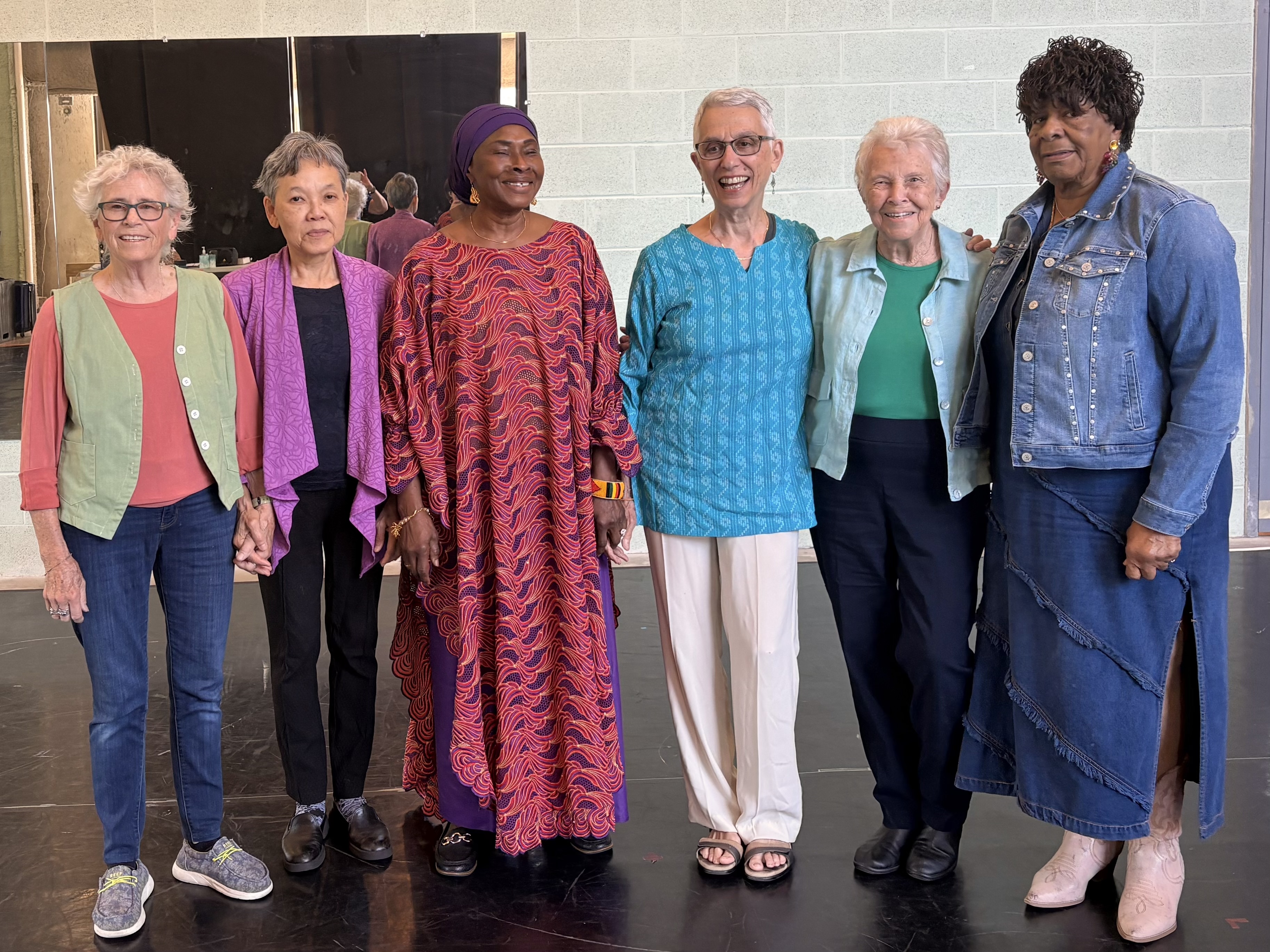
    Weinberg is one of six women between ages 69 and 86 who star in the theatrical performance GrandWomen presented by Theater of Witness, a theater company based in Center City that creates plays from performers’ real-life testimonies.

    Previous productions have spotlighted refugees, formerly incarcerated people, teens, survivors of abuse; GrandWomen focuses on the insights and wisdom of elderly Philadelphians with diverse backgrounds.

    “This show was kind of a surprise event in my life,” said Weinberg, who lives in Chestnut Hill with her husband. “It’s not like I’ve never told my story … although it’s very different writing a book and then getting up there on stage.”

    Onstage, Weinberg will deliver her story as if she’s speaking directly to her eldest granddaughter, who is 19 years old. Weinberg grew up in New York and later moved to Philadelphia in the 1970s and ‘80s, when she studied at Wyncote’s Reconstructionist Rabbinical College. After spending many years in Amherst, Mass., she returned to Philadelphia about 14 years ago to be closer to her children and grandchildren.

    Before saying yes to Theater of Witness artistic director Teya Sepinuck, Weinberg sought her family’s permission — and they all encouraged her.

    Joining Weinberg onstage this weekend are Tiguida Kaba, a Senegalese immigrant who founded the African Family Health Organization; Judith Palmer, a lesbian singer and composer with the Anna Crusis Feminist Choir; Kim Nguyen, a former refugee from Vietnam who served on the N.J. Council on the Arts; Hilda Campbell, a poet, carpenter, and minister who lost her grandson to gun violence; and Regina Coyne, a retired defense attorney.

    For GrandWomen, Sepinuck spent a few hours interviewing each participant and then developing a script based on their personal stories, which incorporates film, music, and choreography.

    For Weinberg, the challenge wasn’t stage fright, though she has occasionally felt nervous before speaking at the pulpit. The hardest part was memorizing the script, after so many years of delivering sermons and talks spontaneously, or with notes nearby.

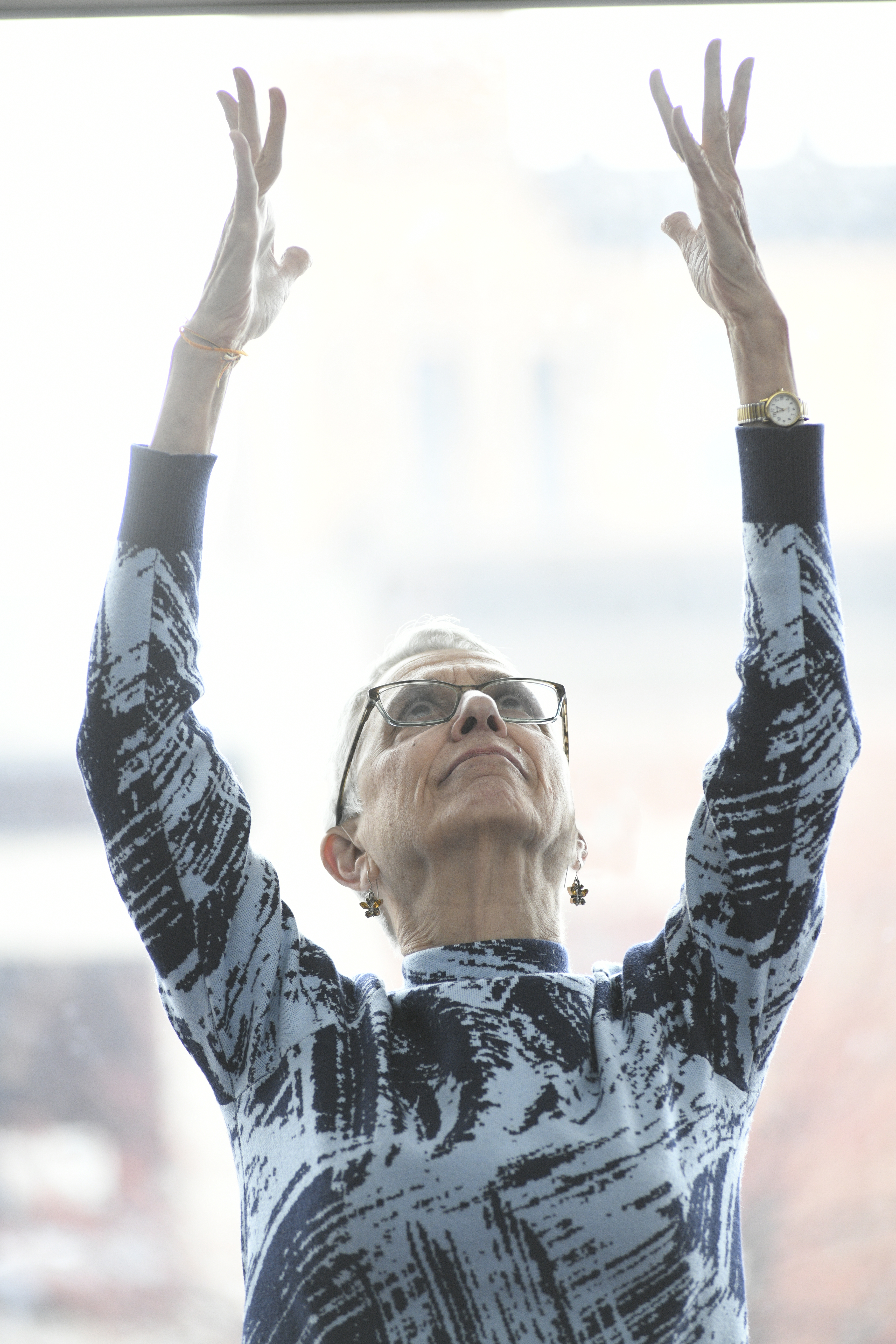
    Rabbi Sheila Peltz Weinberg will perform in “GrandWomen,” running at the Suzanne Roberts Theatre from June 11-13.Courtesy of Theater of Witness

    “Getting up in front of people is not unusual, but in this context it really feels different,” she said. “With the other women … I have developed this connection that’s amazing. I never would have met any of them, likely. We just have a lot of warmth towards each other, and humor, and compassion.”

    Writer/director Sepinuck has said that she wants this production to serve as “an antidote to these times” and “a communal prayer for peace.”

    In recent years, Weinberg said she has leaned into her activism through working with American Friends of Combatants for Peace, supporting Palestinians and Israelis rooted in nonviolence resistance.

    “[They] are former Israeli soldiers and former Palestinian fighters that are working for ending the occupation, and they’re amazing people. They found each other, and they see each other in profound ways,” she says.

    Their example inspires her work. “There are amazing peacemakers, and we’ve met them, and that’s my [goal], whatever I can do to let people know about that possibility.”

    In the show, too, she calls for compassion and deep listening. One of her most memorable lines, she said, is a call for change: “They know that reacting to violence with violence is not the answer.”

    In “times of war and hatred and deception,” she said, GrandWomen seeks to amplify “truth and kindness” today, and in the days to come.

    “GrandWomen” runs June 11-13 at the Suzanne Roberts Theatre, 480 S. Broad St., Philadelphia, 215-985-0420
or theaterofwitness.org.

  • Years before Bill Rauch won a Tony, he was a Jersey teenager playing Malvolio and braving a monologue through an allergic reaction

    Years before Bill Rauch won a Tony, he was a Jersey teenager playing Malvolio and braving a monologue through an allergic reaction

    When Bucks County-raised pop star Pink began the Tony Awards on Sunday evening, she started somewhere she would be comfortable on stage — in the air.

    Suspended from the rafters, she joked about feeling underqualified to host the awards ceremony because she’s never appeared on Broadway. But actor Neil Patrick Harris assured her that she would excel as her entertaining, acrobatic self: “Listen you’re Pink, you’re singular, you’re the best.”

    Then she went on to belt “Lady Marmalade” with some of Broadway’s best performers and fit right in.

    The night of revelry at Radio City Music Hall celebrated the biggest theater shows with major winners including Death of a Salesman, Schmigadoon!, Ragtime, The Lost Boys, and Liberation. The latter won for best play, recognizing playwright Bess Wohl, who became the fourth woman in Tony history to win that award. (Philly audiences will get a chance to see the show this fall when Liberation runs at Philadelphia Theatre Company in October)

    The biggest local highlight was director Bill Rauch, who calls New York home now but spent part of his childhood in Haddonfield, where he participated in productions at Haddonfield Memorial High School. Rauch and his codirector, Zhailon Levingston, won the Tony Award for best direction of a musical for Cats: The Jellicle Ball, a revival of Andrew Lloyd Webber’s 1982 feline musical, set in New York’s queer ballroom scene.

    “Ballroom is about audacity and disruption, in the words of Junior LaBeija, it do take nerve,” said Levingston when the pair accepted the award.

    “Finally, ballroom is about chosen family,” said Rauch, getting emotional. “We chose each other, my husband, Christopher Liam Moore, 42 years ago, and you and our kids, Liam and Xava, are at the heart of anything I do that has any value in this world.”

    Rauch, who leads New York’s Perelman Performing Arts Center, previously directed the Tony Award-winning production All the Way, about Lyndon B. Johnson during the civil rights era. That production received Tony Awards for best play and best lead actor in a play (spotlighting Bryan Cranston), in 2014.

    Rauch credits his high school teacher and mentor Jack Shaw with inspiring him to pursue theater.

    “I did six shows directed by Jack Shaw, and they really changed my life,” Rauch told 6abc. “I learned by example what a great director could be, and it made me want to become a director.”

    On Sunday night, Shaw hosted a Tony Awards watch party at his home in Voorhees, where he and a group of about 15 of Rauch’s old theater classmates jumped and screamed as they saw him accept the award. The revered drama teacher is still close with dozens of his former students, who reunite often to celebrate Shaw’s milestone birthdays and have created a scholarship at Haddonfield Memorial High School to fund drama students in Shaw’s honor.

    One of Shaw’s favorite memories of Rauch was during a production of Shakespeare’s Twelfth Night, when the teenager powered through his Malvolio monologue while in the middle of an allergic reaction.

    “The poor guy literally ended up on the floor of the stage, going through a long speech [as] his neck and back cramped up,” said Shaw. “Unbelievably, he kept going — the ultimate ‘show must go on’ spirit. He delivered the speech from his knees, still in character, and the audience had no idea …[then] we took him offstage and put him in an ambulance.”

    A proud teacher, Shaw was “choked up” seeing Rauch receive the Tony recognition and praised his former student’s “remarkable need to bring theater to lots of people.”

    “Theater and the drama club was a place where anybody could come and be accepted. To my way of thinking, that’s my most happy part, and Bill, as a director, has had the same kind of philosophy,” Shaw said.

    Cats: The Jellicle Ball was nominated for nine awards and took home three, including best choreography and best costume design of a musical, which went to Qween Jean (who also designed costumes for Liberation). Qween Jean made history becoming the first transgender person to win a Tony Award.

  • The first Black woman to win a Barrymore for directing a musical is now going to lead Theatre Horizon

    The first Black woman to win a Barrymore for directing a musical is now going to lead Theatre Horizon

    Popular Philadelphia director, actor, and teacher Amina Robinson will take the helm at Theatre Horizon as artistic director, the Norristown organization announced Monday.

    The 21-year-old nonprofit theater, cofounded by Erin Reilly and Matthew Decker, had been searching for a permanent leader since the 2024 departure of Nell Bang-Jensen, who now heads FringeArts.

    Decker has served as interim artistic director and will continue to do so until Robinson’s tenure begins in November.

    For Robinson, who grew up in South Philly and studied theater at Temple University, Theatre Horizon has been a creative home and launching pad for her work as a director. In 2018, she received wide acclaim for her direction of the musical The Color Purple, based on the classic Alice Walker novel and 1985 film. The Theatre Horizon production earned six Barrymore Awards and Robinson made Philly theater history, becoming the first Black woman to win the Barrymore for outstanding direction of a musical.

    “I like to say [The Color Purple] put me on the map in Philly because it won a whole bunch of awards, and people responded really well to it,” said Robinson, who lives in Cherry Hill with her husband and teenage son. “I got the opportunity to work with people who have become family to me …[that’s] the culture of the theater. It’s built into their mission [to be] a place of gathering. I like to think of them as human-powered, people-centered, and that really coincides with who I’ve always been.”

    Theater fans in the region will recognize Robinson’s name from some of the buzziest local productions in recent years, from directing James Ijames’ Pulitzer Prize-winning Fat Ham in 2023 at the Wilma Theater, to the Arden Theatre’s 2024 run of the musical Once on This Island, which Robinson set in Haiti as a comment on the Caribbean country’s turmoil.

    “Amina is a visionary artist, a thoughtful collaborator, and someone who understands both the power of theater and the importance of community,” Decker said in a statement.

    Robinson is an associate professor of acting and musical theater at Temple University and has appeared on screen in shows like Nurse Jackie, Law & Order, and Smash, and in the 2009 film Precious.

    She is no stranger to Norristown, either, as she was formerly an artistic director at the Centre Theater.

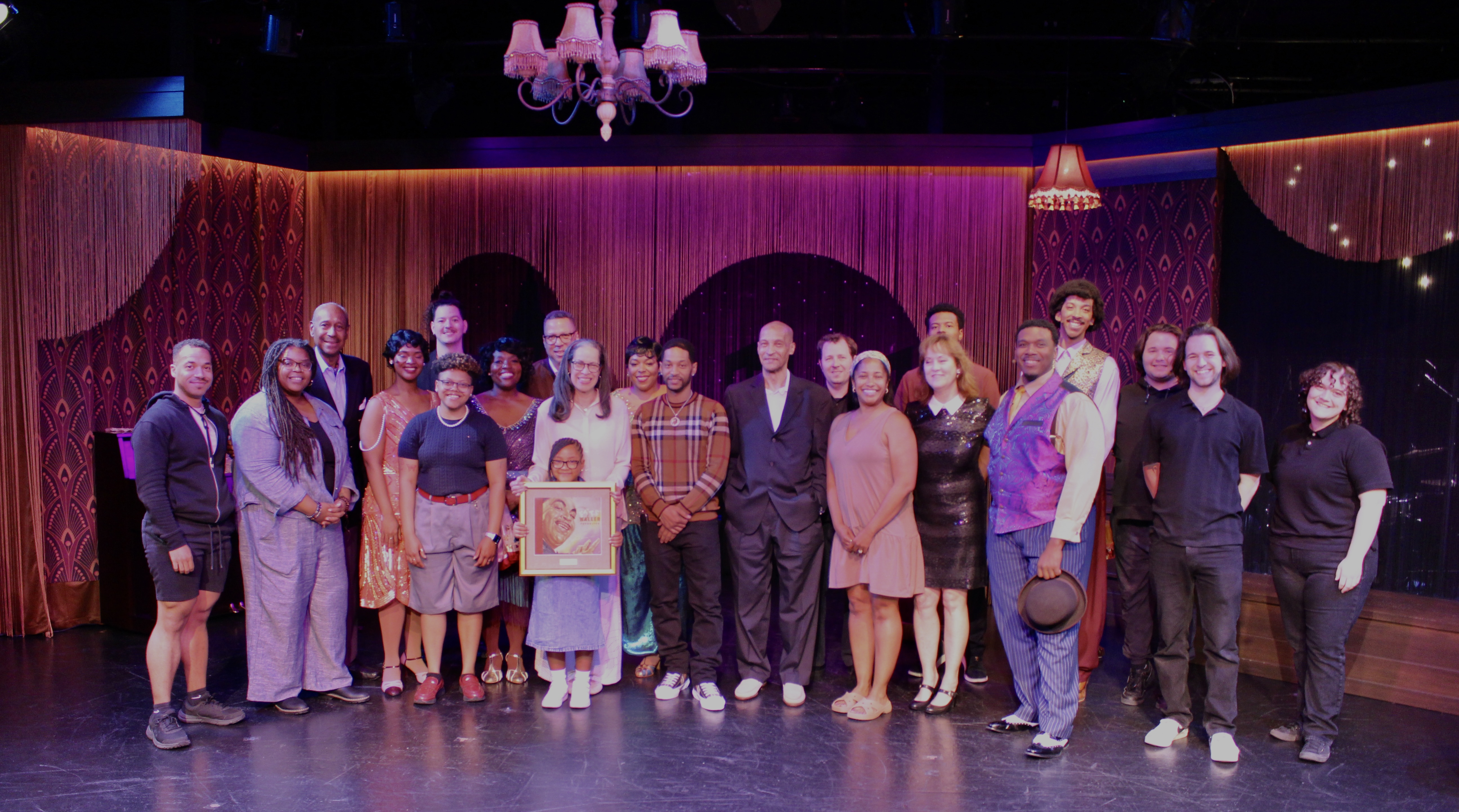
    Director Amina Robinson with the cast and crew of “Ain’t Misbehavin’” at Theatre Horizon in spring 2026.Courtesy of Theatre Horizon

    Robinson just wrapped work on Theatre Horizon’s production of the Fats Waller musical revue Ain’t Misbehavin’ and is now working on the forthcoming Arden Theatre production of Suzan-Lori Parks’ TOPDOG/UNDERDOG, opening this fall.

    “As Theatre Horizon continues expanding how we serve artists and audiences in Norristown and throughout the region, I’m excited to partner with someone who believes deeply in theater as both an artistic home and a gathering place,” said Theatre Horizon executive director Mydera Taliah Robinson in a statement.

    The two will work to expand community programming and reach new audiences; their plans so far include a permanent choir and potential events for Black History Month and Juneteenth in 2027, as well as a “season sampler” series of comedy nights, open mics, and staged readings under the title HorizoNEXT. In October, the theater will host an event celebrating Robinson’s start, showcasing performances from Ain’t Misbehavin’ and The Color Purple.

    “I have a really burning desire to make theatergoing feel essential,” said Robinson. “When I’m talking about the history of theater, it finds its grounding in ancient African storytelling traditions, and that wasn’t only used for entertainment, it was used to share cultural values and strengthen community.”

    She said sees an opportunity to create a community-driven theater, to produce shows that prompt people to think critically about social and political issues, or help process collective trauma together — all working toward the goal of building a sustainable, supportive community for artists and patrons alike.

    “I want an essential theater, and that includes growing the audience and getting more people in the space to experience the power of creation and storytelling through the theater,” she said. “I’m invigorated by the power that theater has to impact people’s lives, and how miraculous the creation is.”