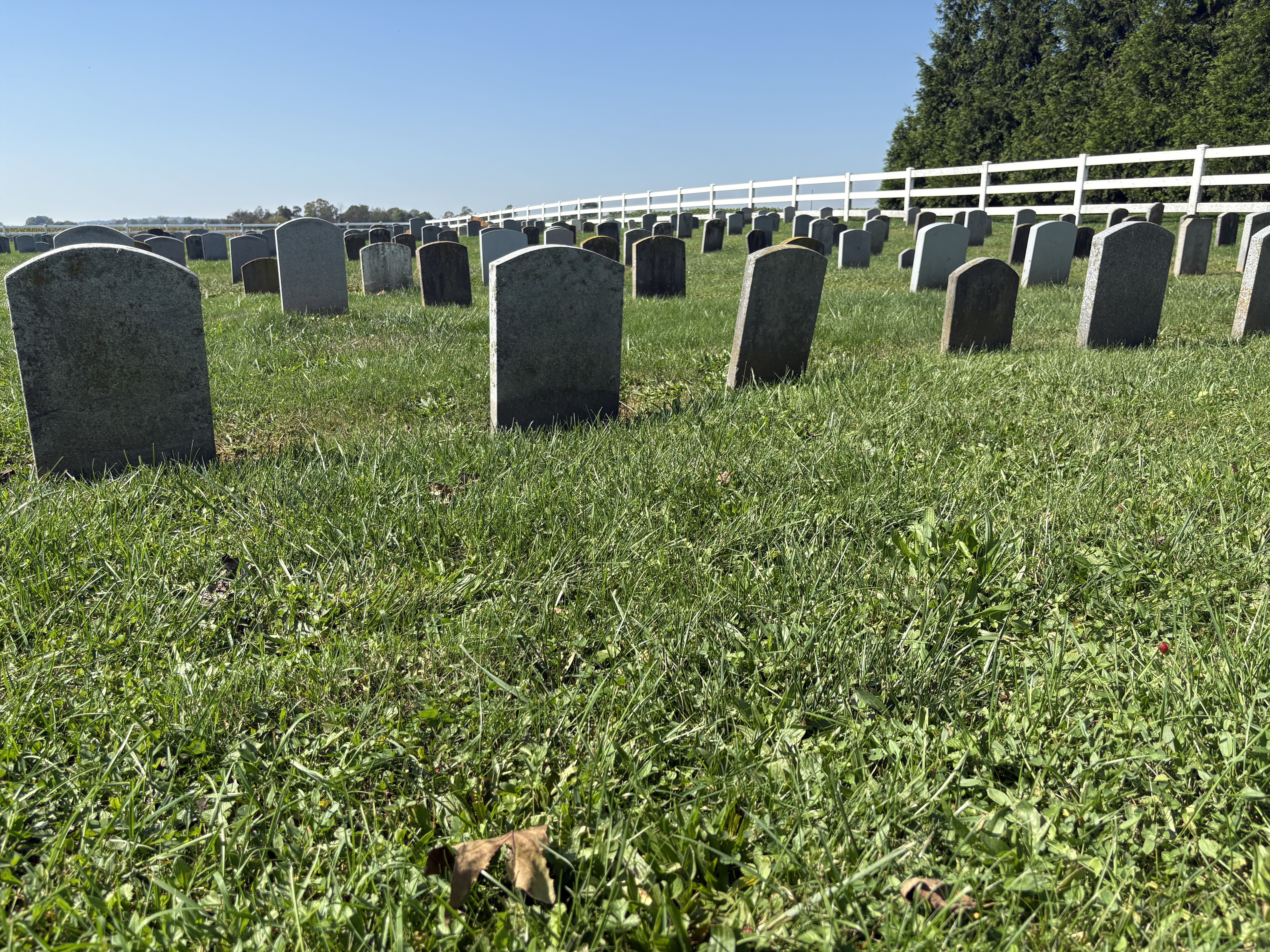
The headstone had not yet been placed Thursday on the freshly dug grave where a 20-year-old Amish woman was buried this weekamid the rolling clover fields and dairy farms at the edge of suburban Philadelphia.
Newly wed, and receiving treatment for blood cancer, she was the last of nine siblings sickened when measles swept through her unvaccinated family’s home on a one-lane road in Lancaster County.
At first, the home remedies that eased their symptoms seemed to help her, too: Soothing the fever with bath soaks. Calming the rash with coconut or olive oil. Cloistering in a dark room to ease light sensitivity.
Then her fever spiked. She struggled to breathe and had to sleep sitting up in a recliner in the living room, her maternal grandmother recalled.
Her family does not operatecars, in keeping with Amish beliefs, so they hired a driver to take her to the emergency department at Hershey Medical Center about an hour away. She died about two weeks later in the intensive care unit there, her grandmother said.
Speaking on the porch of her stone farmhouse, the grandmother described the family’s experience with Pennsylvania’s largest measles outbreak in three decades, now the nation’s largest. At her request, The Inquirer withheld her name and that of her deceased granddaughter to protect the family’s privacy.
She said her granddaughter ultimately developed double pneumonia and died after the family decided to discontinue use of a ventilator.
The cancer made her especially vulnerable to a virus as contagious as measles, which will infect 9 in 10 unvaccinated people who are exposed.
“Her immune system wasn’t built up,” the grandmother said. “She just couldn’t take it with the measles.”
The Lancaster County borough where a 20-year-old Amish young woman died from pneumonia caused by measles is dotted with diary farms and grain silos.Wendy Ruderman
Pennsylvania reported on Wednesday its fifth measles-related death, revealing only that the latest fatality was an unvaccinated Lancaster County resident. Health officials did not provide further details, citing privacy laws.
But it appears from the grandmother’s account, along with other records and news reports, that three of the five deaths occurred in adults with measles. Other reported deaths included an 18-year-old Amish woman from Mifflin County and a 40-year-old from Jefferson County with severe respiratory conditions. Two Amish infants in Lancaster County who had confirmed measles cases also died. All five cases involved people who were unvaccinated, either by choice or because they were too young to receive vaccines.
The number of deaths in adults is striking, said Paul Offit, who heads the Vaccine Education Center at the Children’s Hospital of Philadelphia. Widespread childhood vaccinations had eradicated the disease in the United States, leaving mostly children too young to be vaccinated at high risk in recent decades. Now multiple generations of unvaccinated children are adults, exposing wider vulnerabilities across the state, Offit said.
“We’re aging out a population that was never vaccinated,” he said.
After learning the details of the 20-year-old’s death from The Inquirer, Offit explained that measles commonly leads to pneumonia.
“The measles virus reproduces itself in the lungs and can cause severe and occasionally fatal infection,” he said.
The Amish cemetery where the 20-year-old woman is buried.Wendy Ruderman
Too late to get vaccinated
The young woman, the second oldest in a line of nine siblings, ages 6 to 22, fearedgetting measles in the outbreak in Lancaster County, her grandmother said.
About two years ago, she was diagnosed with leukemia, a blood cancer, and began medical treatment with the help of an “English” neighbor — as Amish call outsiders — to drive her to her medical appointments.
The treatment regimen of chemo and steroids further weakened her immune system. She knew she was at risk of more severe sickness from a viral infection like measles, which started spreading throughout her family in the late summer.
Her eight siblings, her parents, and her new husband all got sick, the grandmother said.
Along with home remedies, family members drank extra fluids to stay hydrated, the grandmother said.
“They weren’t worried,” the grandmother said. “Measles just has to take its course.”
Although no one in the household was vaccinated, they are not opposed to the vaccine based on Amish beliefs. They believe it’s an individual choice, she said, and many Amish people opt not to get vaccinated because they “don’t know what’s in it.”
“We wouldn’t tell people not to get vaccinated,” the grandmother said. “It’s up to each person.”
As illness spread in her household, her granddaughter grewmore worried about getting the virus than about the vaccine that medical authorities have long considered safe and effective.
She asked her doctor if she could get a measles vaccination. Her doctor said no. “She wasn’t allowed to get the shot because she was on chemo,” the grandmother said.
The measles vaccine contains a live but weakened virus, and her granddaughter was already immunocompromised from the leukemia treatment.
After getting measles, her granddaughter began to feel better in early September. She picked vegetables from the family’s garden to make soup using tomato juice as the broth. She canned jars for the coming cold months, her grandmother said.
Then, in mid-September, she spiked a high fever, and her breathing became labored.
“She could hardly breath. Her lungs were just in bad shape,” she said.
The Amish typically only seek emergency hospital treatment until “sometimes we’re dying,” the grandmother said, recalling how her husband got chided by a doctor in 2018 for waiting too long to get the heart surgery he desperately needed.
“We do what we can at home,” she said. “We have so many natural things we can do.”
By Sept. 11, the family knew it was time to take her granddaughter for emergency care at Hershey Medical Center.
At Hershey’s ER, doctors gave her a chest X-Ray, but sent her home before reading it, the grandmother said.
“They wouldn’t do anything for her. They didn’t want her there,” shesaid. (A Hershey spokesperson did not reply to a request for comment on Friday.)
A Hershey provider later called and left a voicemail message asking the family to bring her back. Although the family has a phone in their house, the grandmother said they rarely use it. With the ringer off, all calls go to voicemail, she said.
A driver took them back to the hospital, where she was admitted on Sept. 14. An ultrasound showed fluid between the lining of her lungs and in her lungs. She was diagnosed with double pneumonia, her grandmother said.
Hospital staff hooked her up to supplemental oxygen.
“They had the oxygen up as far as they could and she still had to work to breathe,” the grandmother said.
About a week later, they moved her to the intensive care unit, where they sedated her so they could put her on a ventilator while intubated.
The hospital allowed two family members at a time to sit by her bed. Her granddaughter’s young husband and the girl’s mother sat vigil, the grandmother said.
As she continued to deteriorate, life support was the only remaining option, and it carried the risk of neurological complications, including brain death.
The family didn’t want that, the grandmother said. “They couldn’t do anything more,” she said.
They turned off the oxygen and shut off the ventilator, Family members, including her new husband’s parents, gathered around her bed.
She died with a breathing tube still in her mouth, the grandmother said.
A happy first year of marriage
More than 300 people came to the family’s home on Monday for the funeral service and viewing. She was buried in a cemetery near the family’s home, about a month before what would have been her first wedding anniversary.
Despite being ill with leukemia, her granddaughter’s trademark “rosy pink cheeks” and “beautiful smile” beamed on her wedding day, her grandmother recalled.
The November 2025 wedding, held at the family home, was a festive affair, with plates loaded up with chicken and vegetables, chicken and filling, pickled cabbage, and cooked celery.
She feels sorry for her granddaughter’s husband, who declined to be interviewed. “They had a good year together,” she said.
At the young woman’s home, two black dogs, with hay in their matted curly hair, greeted an Inquirer reporter on Thursday. Some of her family members were outside, unloading cornstalks from a horse-drawn wagon and feeding them into a John Deere harvesting machine.
They stopped working and spoke to one another in Pennsylvania Dutch, a centuries-old German dialect, before fetching the young woman’s father, who declined to be interviewed.
Staff writers Aubrey Whelan and Sarah Gantz contributed to this article.
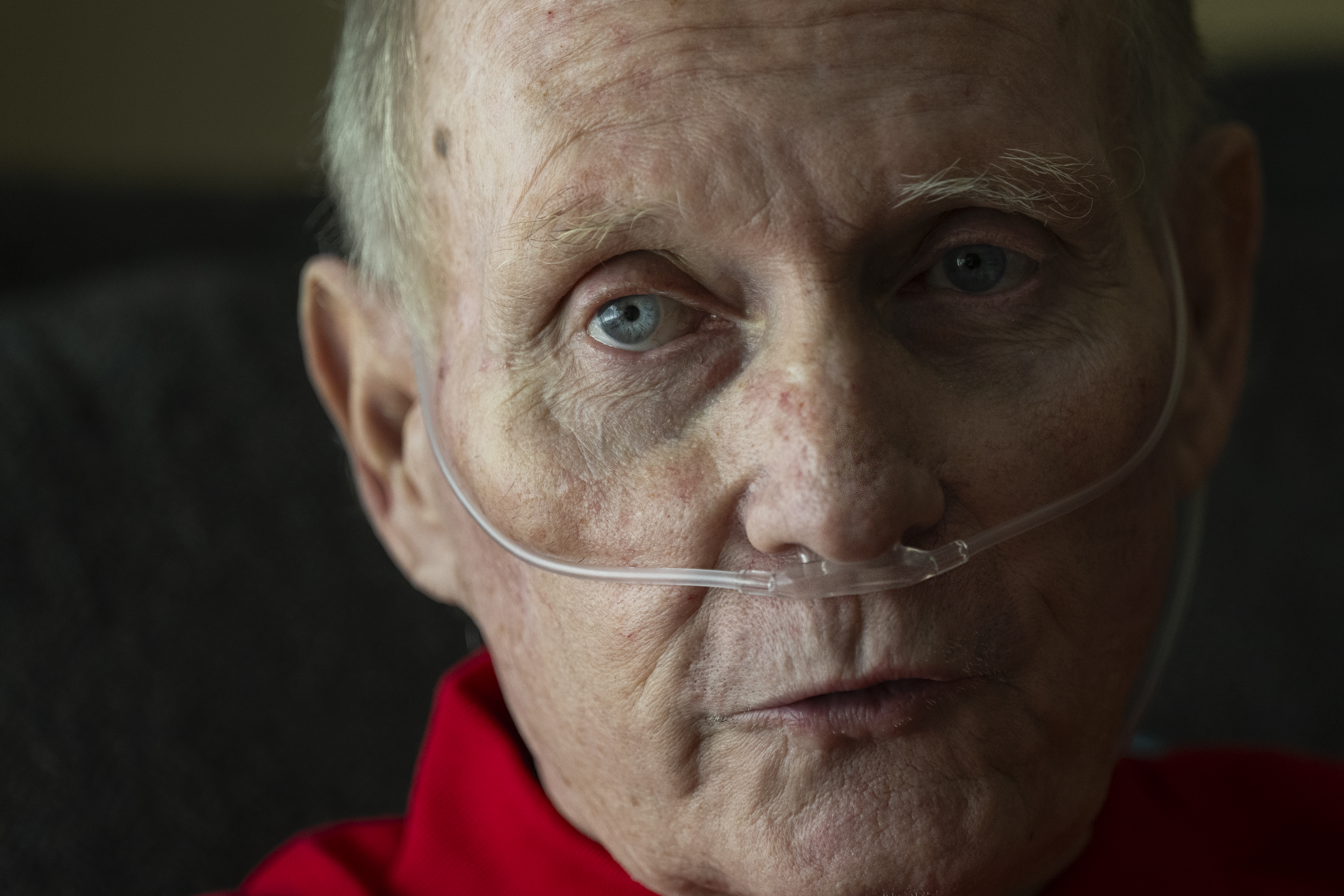
Retired Philadelphia Police Capt. Mark Fisher gets winded and lightheaded while emptying the dishwasher or pushing his gas-powered lawnmower, his lungs forever scarred by the ankle-deep ash that he trudged through at ground zero.
WhenFisherarrived at the nation’s worst crime scene, two days after the Sept. 11, 2001, terrorist attacks, each step he took kicked up a powdery plume, coating his tan work boots. Dense smoke from fires burning beneath the rubble of the World Trade Center site stung his eyes and clogged his lungs.
Then a lieutenant in charge of the Philadelphia department’s crime scene unit, Fisher scoured the wreckage for nearly two weeks. He helped recover the lifeless body of a firefighter crushed under concrete. A torso. The severed arm of a businessman.
The coughing fits started about a year later. Then, about six years after 9/11, a chest X-ray revealed a thick, hardened fluid around his lungs, makingit difficult to breathe. He developedsevere pulmonary disease linked to exposure to toxins.
Fisher, 69, needs a double lung transplant soon, his doctors say, that at best will extend his life by five to seven years. His deteriorating health shows how grossly federal and local health officials underestimated the environmental hazards.
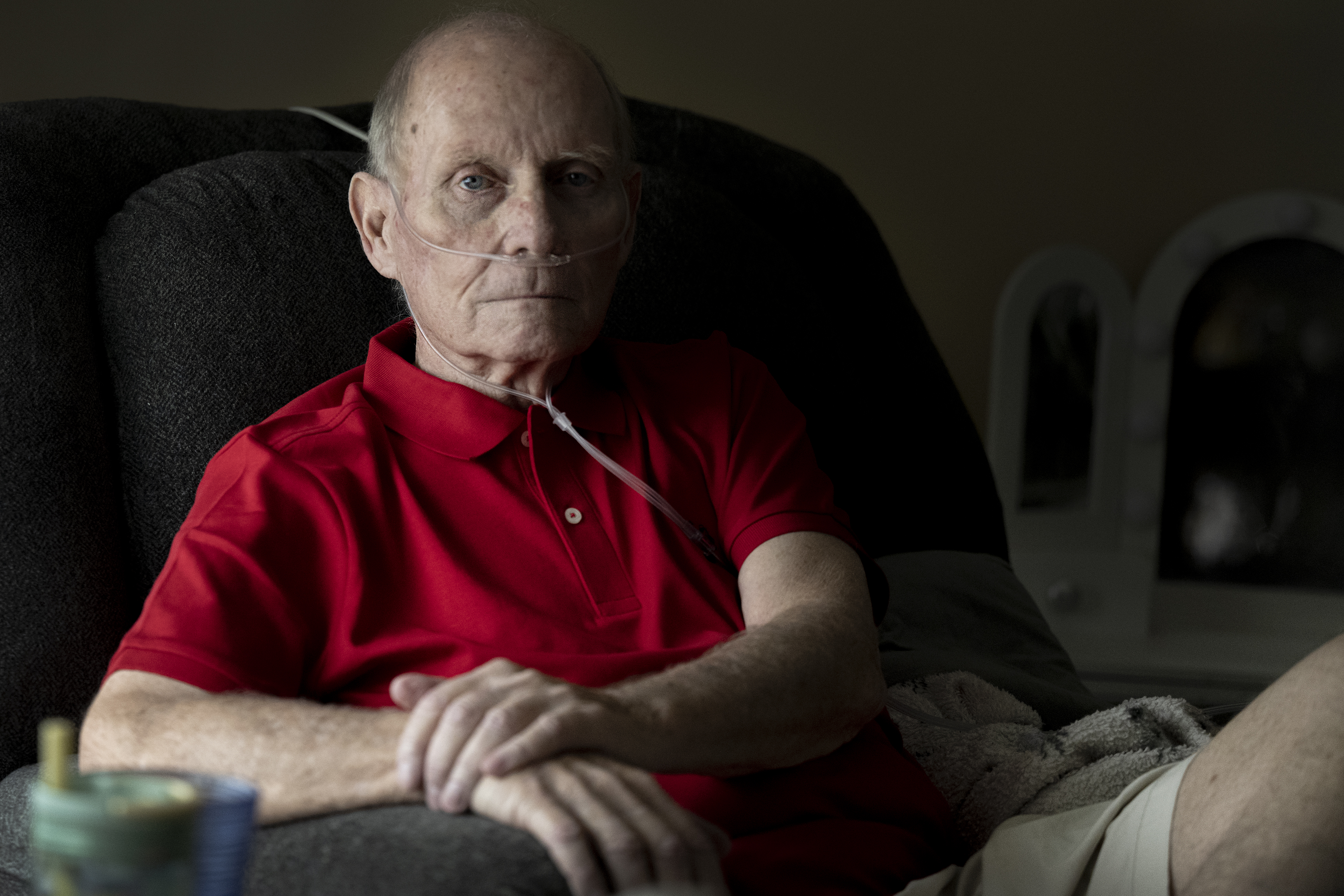
“I can’t breathe worth a darn. My lungs just aren’t going to last,” Fisher said, as he sat in his Northeast Philadelphia home with oxygen prongs in his nostrils and a heating pad against his back.
“Everything aches,” he rasped, coughing relentlessly.
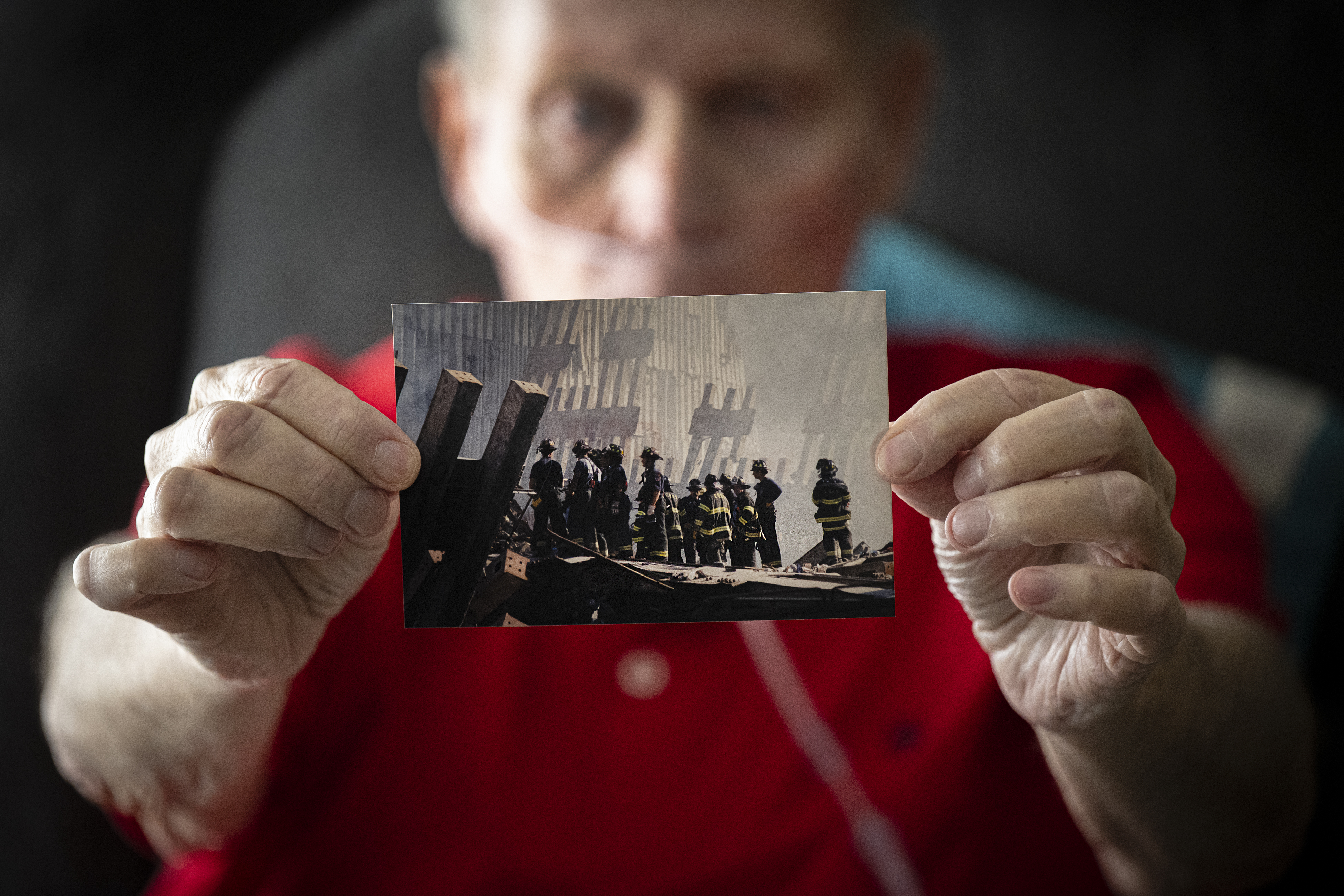
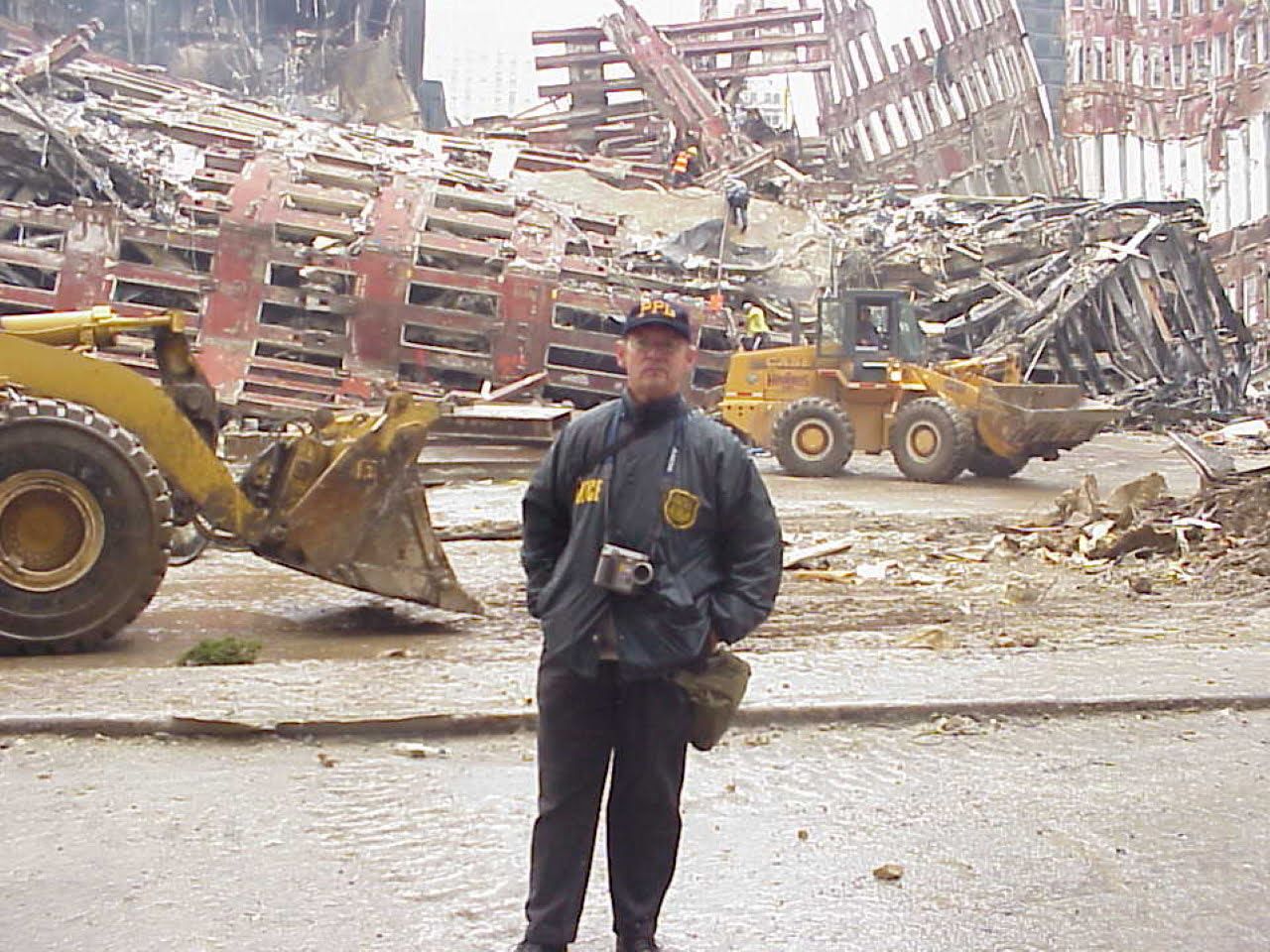
Retired Philadelphia Police Captain Mark Fisher, 69, shows a photograph he took while working as a crime scene investigator at ground zero.Jose F. Moreno / Staff Photographer
Cancer is the fastest-growing diagnosis, now that enough years have passed for tumors and other abnormalities to emerge, soaring from about 3,200 cases to more than 57,000 within the last 11 years.
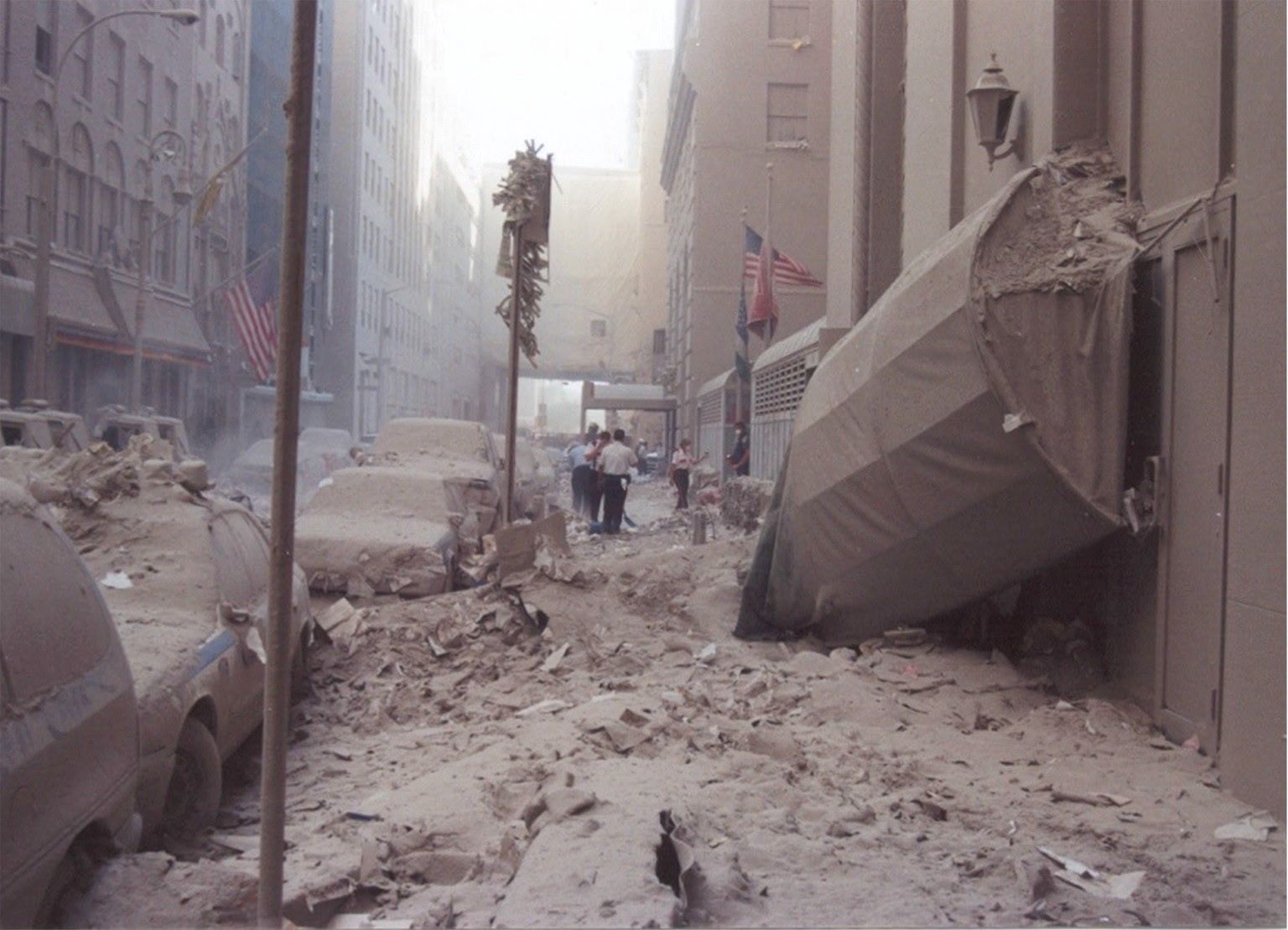
Most of the toxic dust — as deep as snow drifts in spots — formed when the concrete floor slabs of the 110-story towers collapsed on top of one another in quick succession. The wreckage, known as “The Pile,” contained more than 350 chemicals andmineral agents:potassium hydroxide in concrete, calcium sulfate in wallboard, jet fuel, asbestos, glass insulation fibers, heavy metals — all finely groundand aerosolized.
“It was such a mixture of stuff, like a witch’s brew,” said Iris Udasin, a Rutgers Health doctor who treats 9/11 responders and studies the long-term health effects of the attack.
The alkaline alone in “the cement from all these buildings was toxic in and of itself,” she said. “It basically burned holes in people’s noses and made them more likely to absorb other chemicals and gases that were in the air.”
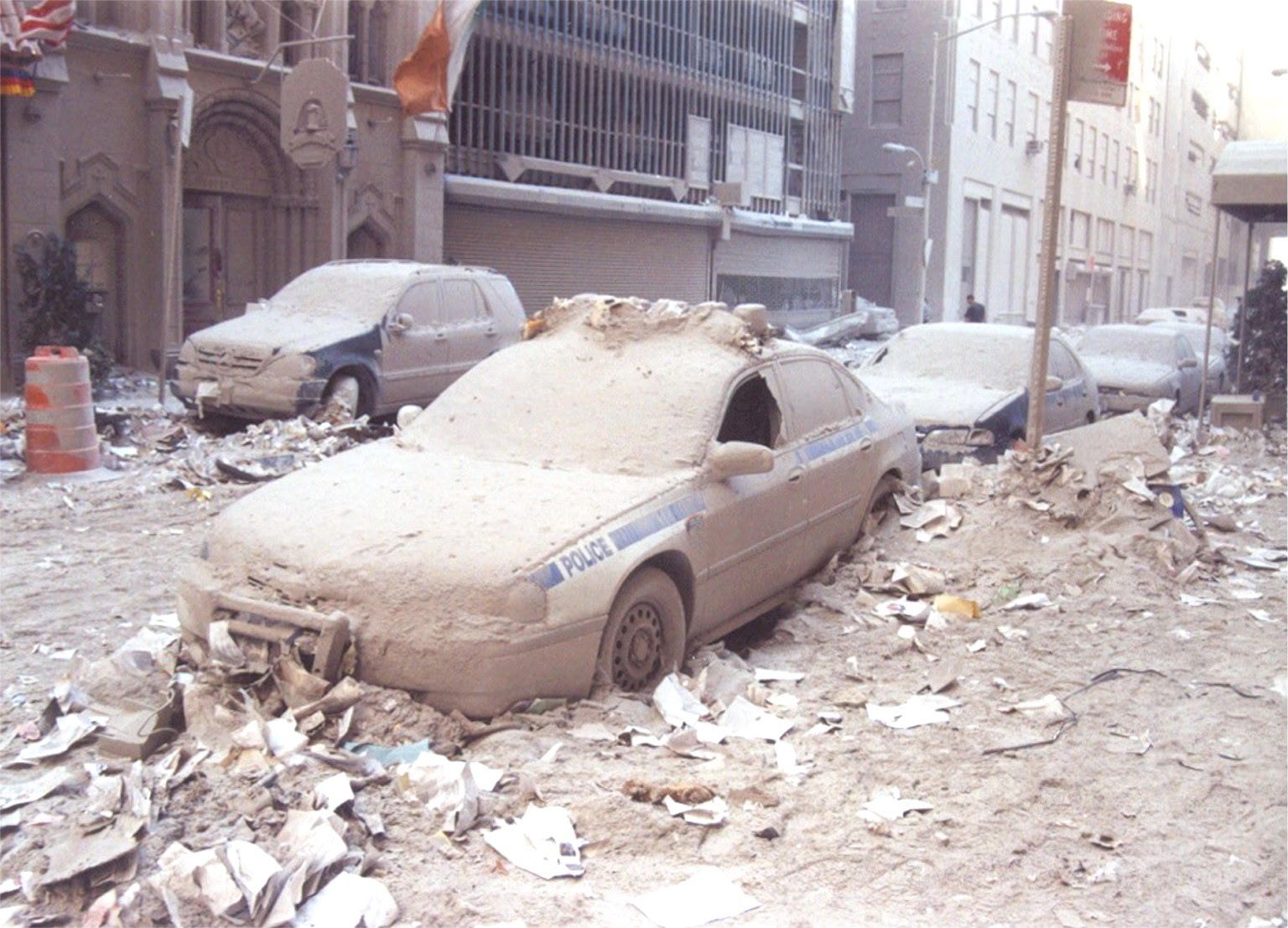
While at ground zero, then-Philadelphia Police Sgt. Greg Masi took photos of the dust and debris. When Masi started wheezing and coughing a few years later, he thought, “I’m just getting old. I didn’t want to believe that the days I was there affected me,” he said. He’s since been diagnosed with asthma, lung nodules, and a type of blood cancer linked to breathing toxic dust. Courtesy of Greg Masi
From WTC cough to lifelong disease
Udasin directs the WTC Health Program at Rutgers University in Piscataway, N.J. — one of six clinics created nationally to treat 9/11 responders.
When it opened in 2003, Udasin mostly treated responders for what she calls “World Trade Center cough,” a dry and persistent hacking that improved with asthma medication.
Now their cases are far more complicated and life-threatening, often requiring referrals to medical specialists, from pulmonologists to oncologists.
Udasin can name many of the roughly 3,000 responders she treats annually by their faces alone. She prefers to relay test results, both good and bad, to patients herself, rather than delegate.
On a recent morning,she escorted an older man from an exam room to the clinic’s lobby and asked: “Do you want me to call you with the results? If you are going to be scared, I can have somebody else call you with the results.”
Her patients, hailed as heroes after 9/11, could not have anticipated how working at ground zero would impact their long-term health.
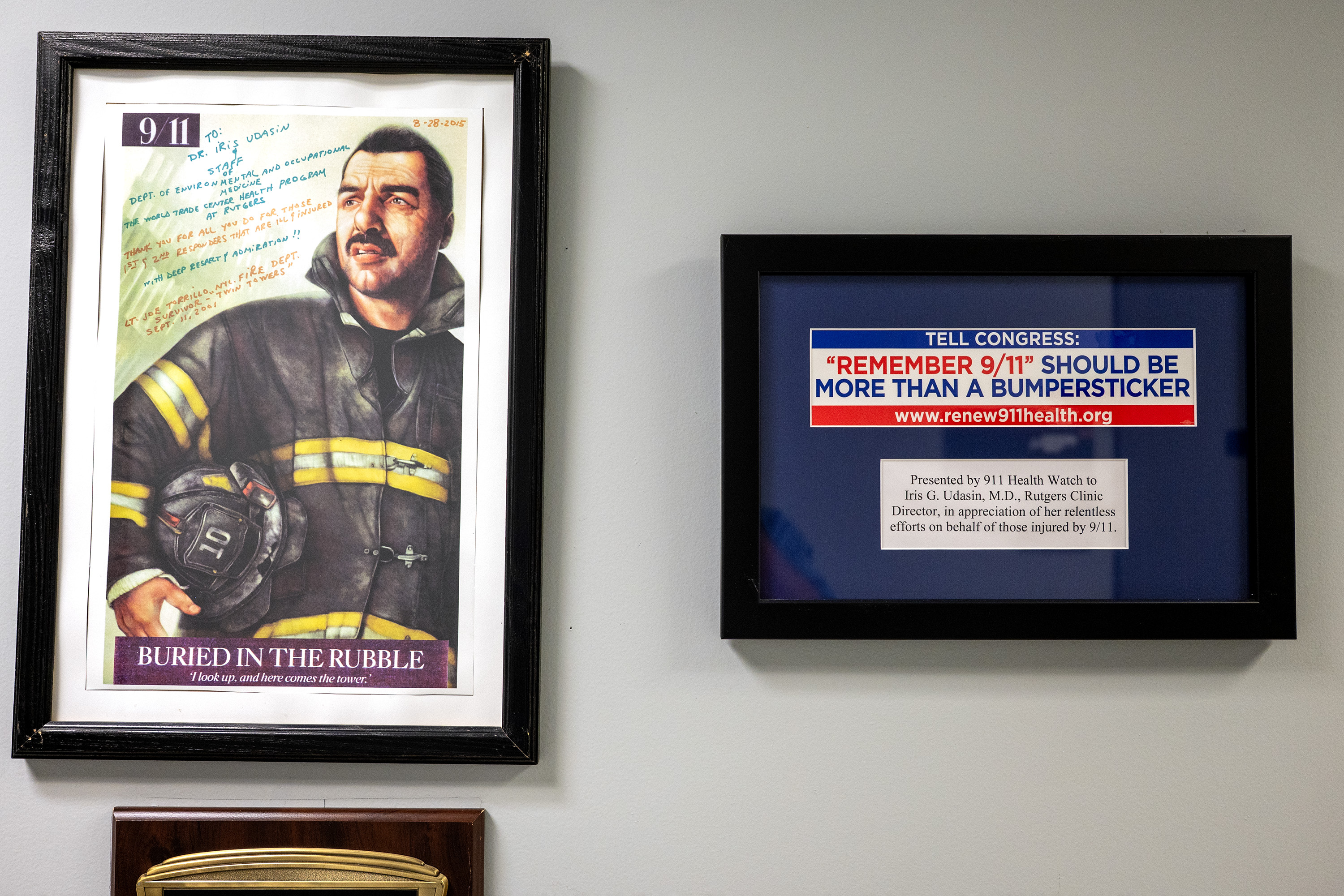
A plaque (right) presented to Iris Udasin, medical director of the World Trade Center Health Program at Rutgers University, hangs on the wall of the patient waiting room. Udasin’s federally funded clinic provides medical monitoring and free treatment to 9/11 responders. Tom Gralish / Staff Photographer
Local and federal officials initially minimized the environmental health hazards. Christine Todd Whitman, who was the head of the Environmental Protection Agency under President George W. Bush, infamously assured the public within days of the attack that the air around the WTC was “safe to breathe.”
“The [EPA] scientists did the best they could with the data that they had and with the knowledge they had at the time,” said Whitman, who had previously served as New Jersey governor.
“It’s a case of you don’t know what you don’t know,” Whitman added in an interview with The Inquirer late last month.
Whitman said her agency did urge responders on “The Pile” to wear protective gear, preferably respirators. The EPA distributed masks, but many refused to wear them, she said.
In hindsight, she said, the masks were not protective enough. Responders are now paying “the price” of breathing toxic air: “It sickens me to say it,” Whitman said.
The Rutgers program grew out of early alarms about air quality hazards, of which details are still emerging. On Tuesday, New York City officials publicly released a trove of documents revealing that toxins lingered in the air for months after the attacks.
Medical monitoring and free healthcare forresponders continue to evolve as the responder population ages.
Researchers evaluated more than 5,000 WTC responders, with an average age of 53 at the start of the eight-year study.
“As this population ages, we are seeing increasing concerns related to memory, attention, and executive functioning, sometimes at ages when the responders themselves are surprised to be experiencing them,” said Jodi Streich, mental health director at Rutgers’ WTC Health Program.
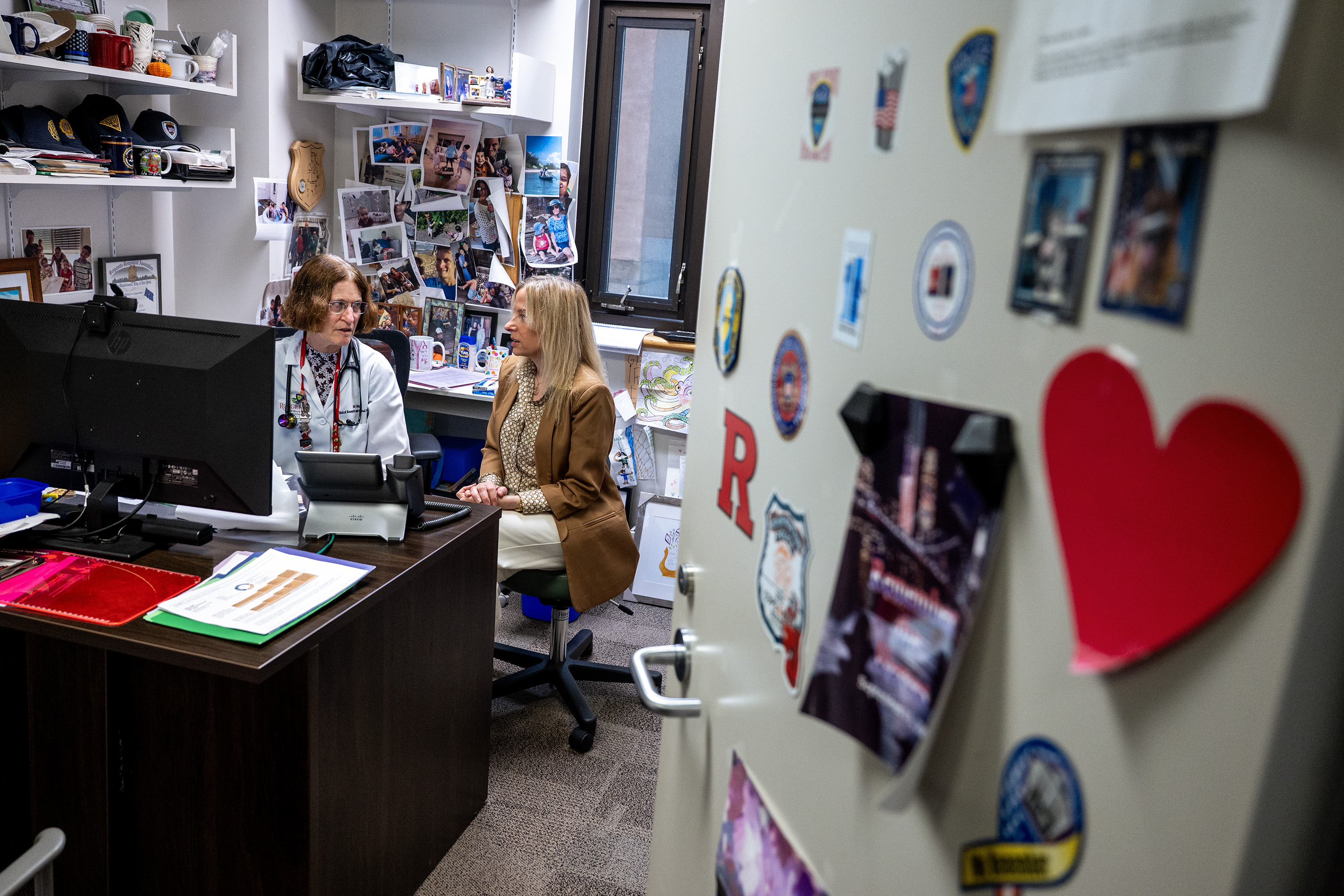
Iris Udasin, medical director, and Jodi Streich (right) mental health director, of the World Trade Center Health Program at Rutgers University sit together in Udasin’s office. They treat responders with WTC-related illnesses at the medical clinic, which is funded by the National Institute for Occupational Safety and Health (NIOSH) within the Centers for Disease Control (CDC). Tom Gralish / Staff Photographer
A stubborn and spreading blood cancer
Udasin’s clinic currently treats 1,177 cancer patients. Research shows that 9/11 responders suffer from thyroid, prostate, lung, and blood cancers at higher rates than the general population.
“The question is: Are certain cancers higher because we looked for them, or are they higher because they’re really higher?” Udasin said. “We really don’t know the answer to that, but my job is to treat everybody.”
In 2023, Udasin successfully lobbiedto have gynecologic cancers, including uterine, included on the list of WTC-related conditions.
Philadelphia Police Department Sgt. Greg Masi at ground zero just days after the twin towers fell. Then-Police Commissioner John Timoney dispatched Masi to New York City because of his expertise in radio communications. He’s developed asthma, lung nodules and T-cell lymphoma from breathing in toxic fumes and dust.Courtesy of Greg Masi
Greg Masi, 71, a retired Philadelphia police sergeant from the Northeast, was diagnosed with a form of blood cancer known as T-cell lymphoma in 2019.
First, red bumps appeared on his left arm. A scaly rash hassince spread over much of his body, killing hair follicles. His oncologists worry the cancer will find “a road map” into his organs.
Light therapy and topical medications did not work. Chemo and radiation would be a last resort. Since there is no cure, the goal is to slow it down.
Masi, an expert in radio communications, can still hear the horns that blared each time responders thought they found someone still alive beneath the rubble at ground zero, or to signal an imminent structural collapse.
The dust that caked cars and blanketed fire escapes struck himas a mere nuisance.
“We figured it was just dust, like dirt,” Masi said. “We had no idea it had harmful toxins in it.”
An avid runner and marathoner, Masi developed bad chest colds with wheezing about five years after Sept. 11. He was later diagnosed with asthma and nodules on his lungs, both common afflictions among responders.
He recently learned that one nodule has doubled in size, and doctors plan to monitor it for signs of cancer.
Then-Philadelphia Police Department Sgt. Greg Masi captured photos of the dust during his time at ground zero. Masi and three other department staffers have been diagnosed with WTC-related illnesses from breathing in deadly dust.Courtesy of Greg Masi
Mental health toll still mounting
Multiple diagnoses are commonly seen in 9/11 responders. Frank Geffre Jr., a retired firefighter from Central Jersey, has asthma, two types of cancer, and post-traumatic stress disorder.
In 2013, surgeons removed a “grapefruit-sized tumor” and parts of his colon and stomach to treat his stage-four colon cancer. Two years later, he learned the cancer had spread to his rectum.
After more than a decade of chemotherapy and radiation, his cancer is in remission. He credits Udasin, his primary care doctor, with saving his life.
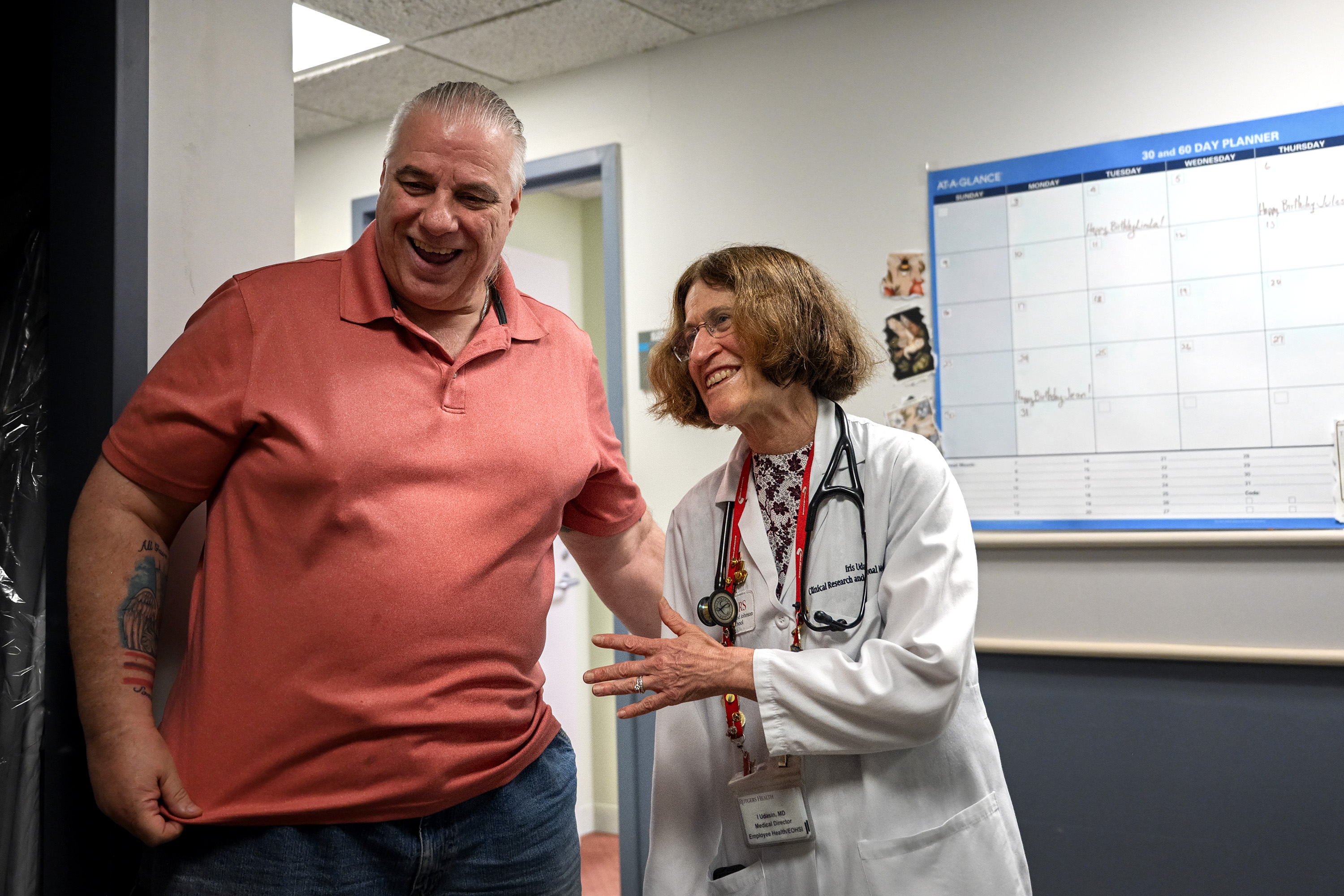
Retired Piscataway firefighter Frank Geffre Jr. shares a laugh with Iris Udasin, medical director at the World Trade Center Health Program at Rutgers University. Geffre credits Udasin and her team at Rutgers with saving his life after he was diagnosed with colon and rectal cancer. “Dr. Udasin is like the quarterback of the team,” he said.Tom Gralish / Staff Photographer
He sees a psychiatrist and a therapist for PTSD, which he finds especially hard to manage as Sept. 11 approaches each year. He lies awake after a recurring nightmare in which he is trapped in Manhattan with his family amid a terrorist attack, and he can’t get them out.
After the first plane struck on 9/11, Geffre and five other firefighters from Fire District No. 3 in Piscataway were immediately dispatched. His team got to ground zero shortly after the second tower violently pancaked.
“It was dark as can be, even though it was daylight. You had smoke clouds so thick you couldn’t even see your hand in front of your face,” Geffre said. “The dust was so thick it was like you had two foot of snow the night before.”
He initially wore respiratory gear, but the oxygen tank ran out as he worked nonstop over the first 30 hours. He saved roughly a dozen people after putting out fires that were blocking their exit from the burning buildings within the World Trade Center complex.
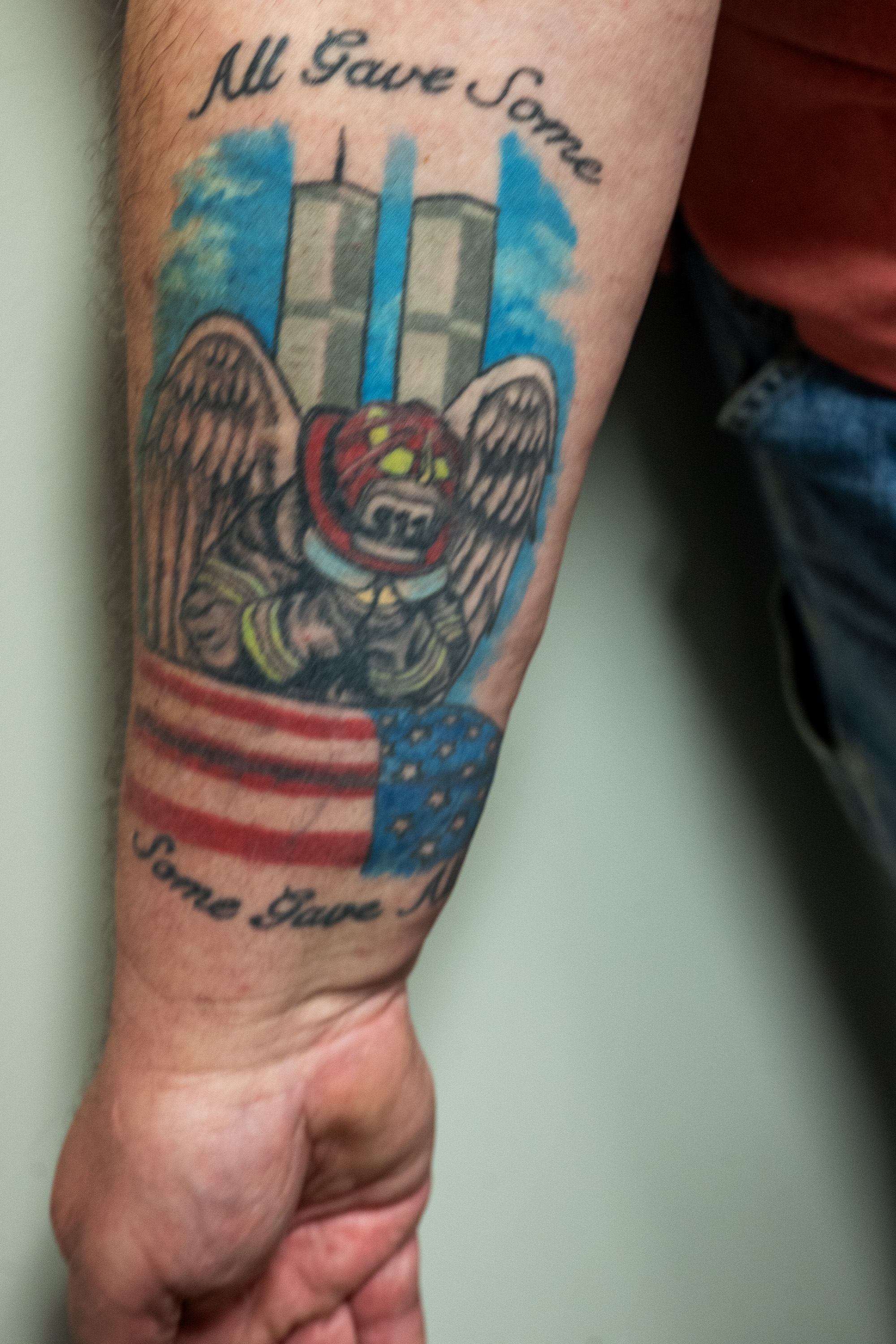
Retired firefighter Frank Geffre Jr. displays his 9-11 tattoo – “All Gave Some – Some Gave All” – during an appointment at the World Trade Center Health Program at Rutgers University. He designed the tattoo from a photo of himself splashing water on his face to rinse off dust and debris from ground zero. His wife said he looked like he was praying in the photo.Tom Gralish / Staff Photographer
He vividly recalls findinga brown dress shoe with a foot still in it. A blue polyester suit jacket with a torso seared to its lining. A wristwatch. A ring.
In all, he worked The Pile for 20 days, smearing Vicks VapoRub under his nose to cope with the“unforgettable, unbearably horrid smell of burning human flesh,” he said.
Now he can’t use the menthol and eucalyptus goo for his bouts of sinusitis, because the scent stirs bad memories.
“It feels like it was yesterday and a lifetime ago,” Geffre said. “The ‘Never Forget’ vow is not for first responders. We won’t ever forget. It’s embedded in us.”
He is ever-vigilant, prone to panic attacks. He avoids movie theaters and other places with crowds. “Too many variables,” he said.
He has a second home in Florida but drives back and forth. He won’t get on a plane. “I get paranoid that somebody on the plane is going to hijack it,” he said.
Two of the five firefighters with him on Sept. 11 have since died of cancer. He keeps in touch with four of the people he helped out of burning buildings. One committed suicide in recent years.
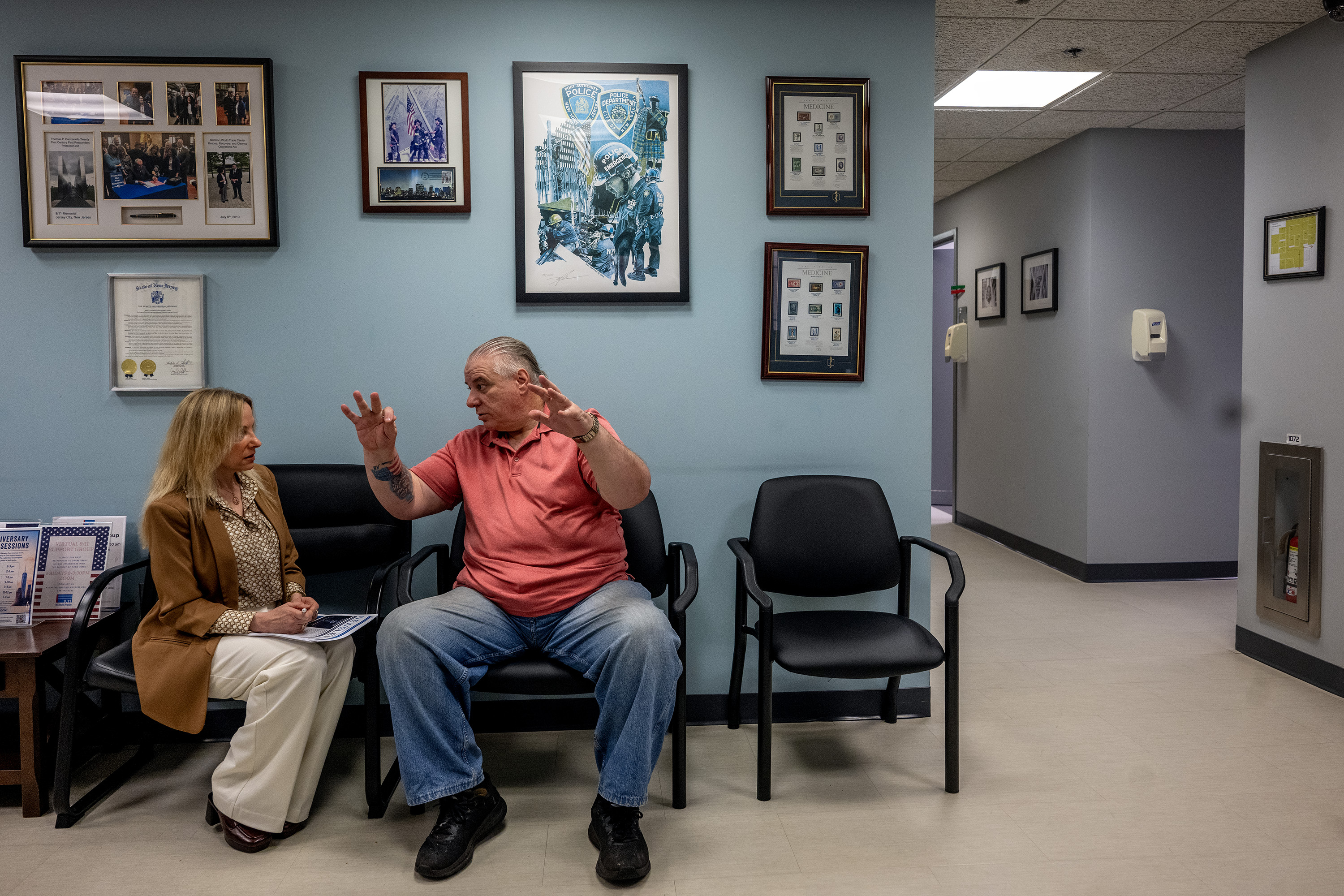
Retired firefighter Frank Geffre Jr. talks with Jodi Streich (left), mental health director of the World Trade Center Health Program at Rutgers University. Rutgers is one of six federally funded health clinics that monitors and treats 9/11 responders, as the health impacts continue 25 years later. The patient waiting room at the Rutgers clinic is adorned with photos of responders. Tom Gralish / Staff Photographer
Geffre, enrolled in the Rutgers program since its start, gets his mental healthcare through the clinic, which has seen a significant increase in demand for these services.
As more responders become ill or die from 9/11-related diseases, some have developed “heightened anxiety and vigilance about their own health,” Streich said.
Having more unstructured time in retirement, along with the loss of job identity and camaraderie, can be detrimental for mental health, she said.
“Things that we once buried — they come fully alive during retirement,” Streich said, adding that the support group she runs for retirees is now the most widely attended after the cancer support group.
Emergency responders who had felt too embarrassed or ashamed to seek help while working — because they feared being seen as weak — are coming in for the first time. Many are unable to eat or sleep, Streich said.
“We see them when they are at rock bottom,” Streich said. “They’ll come in and say, ‘I’m ready to talk about what I’ve been holding in for 25 years.’”
‘Exhaustion, desperation and heartache’
When asked if he regrets being dispatched to ground zero, Mark Fisher is emphatic: “Absolutely not.”
But he is tormented by images of people standing outside makeshift morgues with photos of their missing loved ones.
Fisher recalls becoming so distraught that a Red Cross volunteer pulled apart two tables piled with fresh clothes for responders to reach and embrace him.
“She hugged me for the longest time,” Fisher recalled, blowing air through his lips to steady his breathing and control tears. “I’m an Irish Catholic, so I wear my heart on my sleeve and face. I just had that look of exhaustion, desperation, and heartache.”
These days, he feels exhausted both emotionally and physicallyas his lung disease progresses. Fisher spent most of this summer in the hospital with a kidney infection that required two surgeries.
Five days after he got out of the hospital, his gall bladder became infected. “If I die, I want to die in a Catholic hospital,” he told his wife. Doctors removed his gall bladder in July.
The once-burly cop is rail-thin. He’s lost 35 pounds.
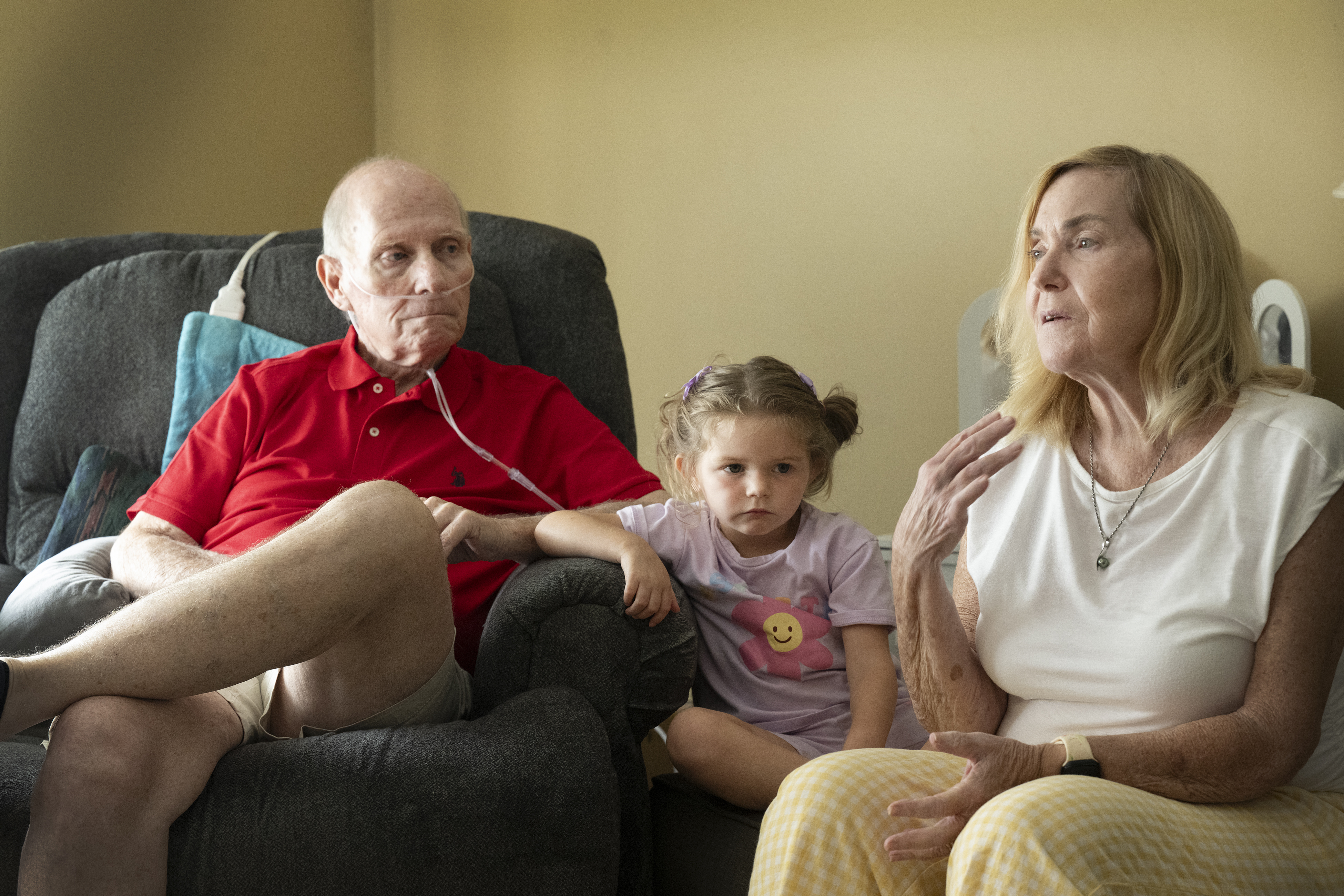
Inside their Northeast Philadelphia home, Sue Fisher (right) talks about the day she learned her husband, Mark Fisher, would need a double lung transplant. The couple’s 3-year-old granddaughter, Morgan Elizabeth Fisher, sits between them. Mark Fisher needs to use a portable oxygen tank to take walks with Morgan. Jose F. Moreno / Staff Photographer
Fisher’s priority right now is spending time with his wife and former sweetheart at Archbishop Ryan High School, and making sure she will be in decent financial shape when he dies.
Fisher, Masi, and two other responders from the Philadelphia Police Department are seeking written assurances from the city that if they die from their World Trade Center-related illnesses, their families will receive line-of-duty death benefits.
The status would enable their spouses to collect their full pensions, rather than half.
City officials said their families can apply to the Philadelphia Board of Pensions and Retirement, which would review each case individually after death.
Sue Fisher tries not to cry in front of her husband of 42 years;she’ll do it behind the shed in their backyard or on a walk with their golden retriever, Bentley.
He wants to delay as long as possible a double lung transplant, for which the survival rate is about five to seven years. “If they say that’s all he’s got, I’ll take it,” SueFisher said. “It’s better than him suffering the way he is.”
At night, she lies awake listening for the sound of Fisher’s breathing. Sometimes, she fears he has stopped. Then she nudges him with her toe until he stirs.
Retired Philadelphia Police Captain Mark Fisher wants the city’s word that if he dies of lung disease from his time at ground zero, his wife will get line-of-duty death benefits. City officials have said that his wife can apply to the pension board after he dies. Jose F. Moreno / Staff Photographer
SPS Technologies and its parent company reached a multimillion-dollar agreement last week to settle a class-action lawsuit stemming from the massive 2025 factory fire in Montgomery County that shuttered schools, halted SEPTA trains, and forced scores of nearby residents to evacuate.
The proposed agreement was announced on Friday by Kroll Settlement Administration, the firm handling the legal deal, which is pending before the county’s Court of Common Pleas.
If approved by the court, SPS Technologies and its owner, Precision Castparts Corp., would create a $5 million fund to provide cash payments to those impacted by the four-alarm blaze that erupted on Feb. 17, 2025, prompting officials to declare a disaster emergency.
“The plaintiffs allege that individuals and businesses were impacted, injured, or damaged by the fire,” Kroll Settlement Administration wrote in a news release. “SPS and PCC deny any wrongdoing.”
Under the proposed settlement, business owners, employees of impacted businesses, and homeowners within a 1-mile radius of the former factory in Abington Township could be eligible for payouts. The amounts would cover unreimbursed business losses of up to $5,000, unreimbursed property damage losses of up to $300, and unreimbursed hourly wage losses of up to $200, according to Kroll. Claim forms must be filed by Dec. 3.
Pending court approval, the proposed $5 million fund would also provide a maximum $1.75 million in “reasonable attorneys’ fees, costs, and expenses” and an extra payment of $2,500, known as a ”service award,” to lead plaintiffs in the class-action suit.
Last year, a judge agreed to consolidate three lawsuits into a single class-action suit. The lawsuits were brought against the aerospace parts manufacturer by a school bus driver for Abington School District, co-ownersof an auto service business that is less than a mile from the SPS facility, and a resident in neighboring Jenkintown whose apartment was engulfed in smoke and has experienced coughing and chest pain.
“The fire and explosion was caused by the defendant’s failures to inspect, properly maintain, and/or operate its facility, including the location of the origin of the fire,” according to the lawsuit. It also states that SPS “failed to uphold industry standards” in facility operations and as a result “hundreds if not thousands of persons have been damaged.”
The bus driver declined to comment on Sunday evening. The other class members did not return phone calls from a reporter, and their lawyers did not immediately respond to an email.
After a series of explosions at the Highland Avenue factory, fire engulfed the complex, drawing emergency responders from nearly 80 fire companies. Local officials ordered residents within a mile of the facility to shelter in place. A voluntary evacuation order for about 250 homes, mostly in neighboring Jenkintown, came soon after.
It took firefighters five days to extinguish the conflagration, while plumes of smoke drifted over the neighborhood, and residents worried about air quality because of the types of chemicals stored at the factory.
When Richard Sperry’s right shoulder began to ache, the pharmaceutical executive thought he was overdoing it at the gym.
“I was doing CrossFit at the time,” Sperry said. “I thought it was from doing things that I shouldn’t be doing in my mid-40s.”
Then, almost overnight, the entire right side of his body was weak. He could not pick up a coffee mug, grasp a pen, or shave his face with his right hand. His wife had to help him button his dress shirts each morning.
An orthopedic doctor sent him to a Philadelphia neurologist in late 2019. After a battery of tests, the neurologist diagnosed Sperry, then 45, with amyotrophic lateral sclerosis (ALS), or Lou Gehrig’s disease, a fatal nervous system disorder. The neurologist said he would die within three to five years. He went for another opinion, and a second neurologist concurred.
In early 2020, Sperry traveled to the Mayo Clinic in Minnesota for a third opinion.
“‘I’m gonna cut to the chase — I don’t think you have ALS,’” Sperry recounted the Mayo doctor saying, as his sister erupted in tears.
Sperry actually had a rare autoimmune disease called multifocal motor neuropathy, or MMN. The doctor prescribed intravenous immunoglobulin therapy, a treatment made from the blood plasma of healthy donors. Immunoglobulin is an antibody found in plasma, the straw-colored liquid in blood.
Once back home in Princeton, Sperry got infusions for five straight days, sitting about four hours each time. A few days after treatment ended, Sperry awoke and discovered he could move his right hand for the first time in more than a year, he said.
“My wife and I were in bed bawling,” Sperry said. “It was like a wonder drug.”
Demand for plasma is growing as the global population ages, more people like Sperry are being diagnosed with chronic diseases, and new medical treatments that require plasma are discovered, research shows.
The value of a liter of plasma rose from about $181 in March to $192 in June, likely because of increased demand, according to Georgetown University professor Peter Jaworski, who studies the global economics and ethics of the plasma industry.
No cure existsfor all three conditions, butsymptoms are alleviated with regular infusions of plasma-based therapies.
“It is life-changing for patients with rare and chronic diseases,” said Anita Brikman, president and chief executive of the Plasma Protein Therapeutics Association, a trade organization that represents donation centers in North America and Europe.
Doctors are not exactly sure how it works on patients like Sperry, said Sami Khella, a Penn Medicine neurologist and clinical neurology professor at the University of Pennsylvania Perelman School of Medicine.
But if Sperry does not get his medicine on time, he will “develop weakness almost right away,” said Khella, who sees Sperry as a patient.
Sperry’s condition causes his immune system to attack his nerves. The immunoglobulin in plasma quells the attack, Khella explained.
Every four weeks, Sperry receives 35 grams of immunoglobulin through infusions over two days. It takes hundreds of donors to make 35 grams, Khella said.
Sperry, who is back doing CrossFit, said it feels “scary” to be dependent on plasma donations. When he sees people going in and out of donation centers, he said, he is enormously grateful.
“It’s not like the drug manufacturer can just build another plant and make more pills,” Sperry said.
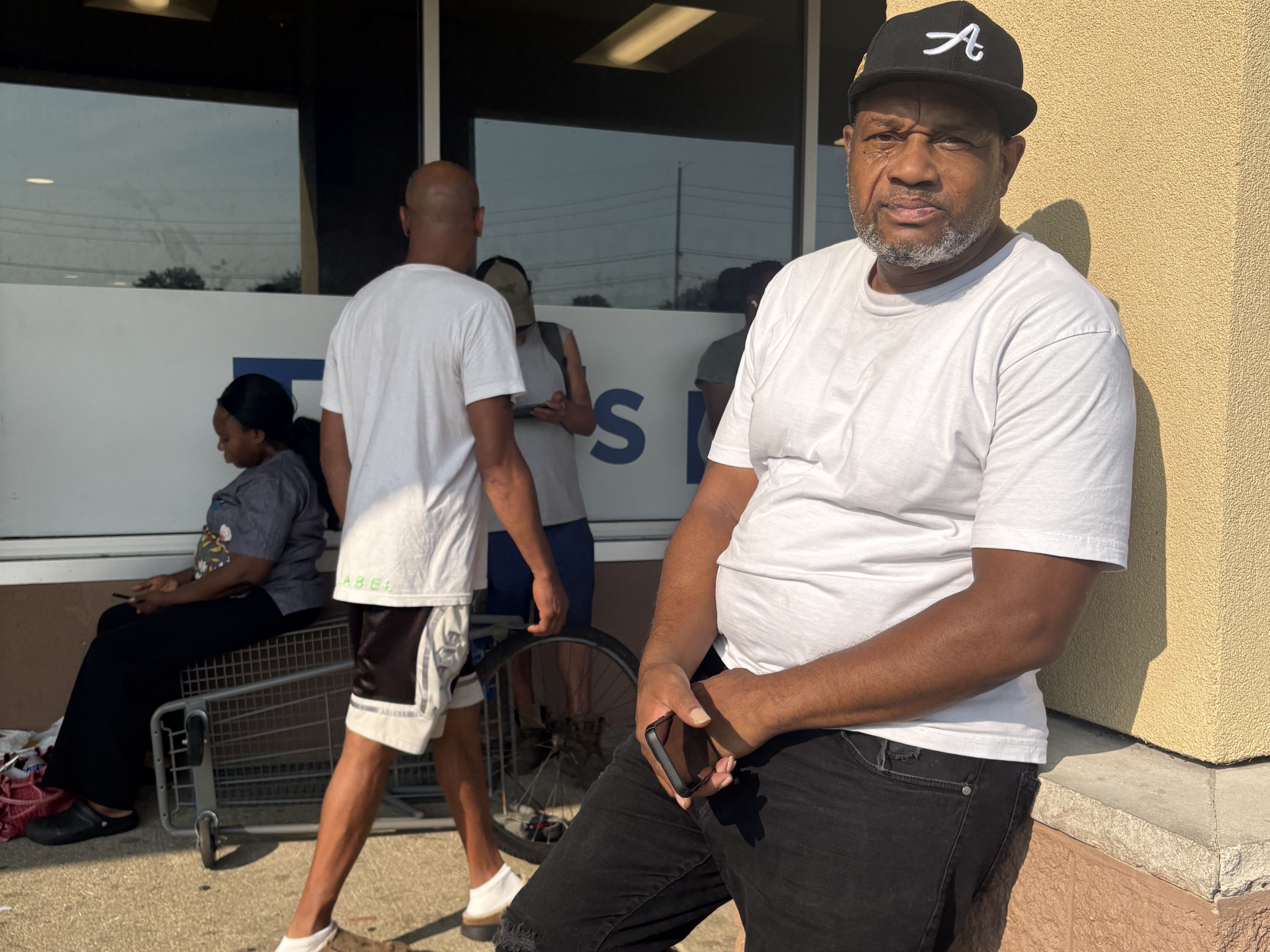
Maleka Evans waited outside Octapharma Plasma in South Jersey at 8:30 on a recent sweltering morning, sweat beading on her face. A dozen other prospective donors had arrived before her, and the line was still growing a half hour before doors opened.
One woman sat on an overturned shopping cart pilfered from the nearby Walmart. Another brought her own folding chair. A man held a bicycle tire, removed to protect his bike from being stolen once he was inside and hooked up to a machine that extracts antibody-rich blood plasma needed for medical treatments.
Every Monday and Friday for the last three years, Evans has trekked to the Audubon strip mall for what she considers her second job. She takes a 45-minute bus ride from her Willingboro home to Camden, then walks another 45 minutes to the donation site with a slogan posted in its window: “When it pays to give hope. That’s plasmagic.”
The 37-year-old single mom has noticed the lines growing in the last year, as others are seeing at donation sites elsewhere in the Philadelphia region and across the nation. The for-profit business is booming as more and more Americans, both poor and middle class, struggle to straddle the gap between stagnant wages and increased living costs.
Evans relies on the $50 that she typically earns for each plasma donation — loaded onto a prepaid debit card — to help with bills that she cannot cover with her $18-per-hour job packing boxes at a warehouse.
“Prices for everything — food, rent, transportation, electricity — are just getting higher and higher,” Evans said. “You have to work two jobs to make ends meet, and you’re still living paycheck to paycheck.”
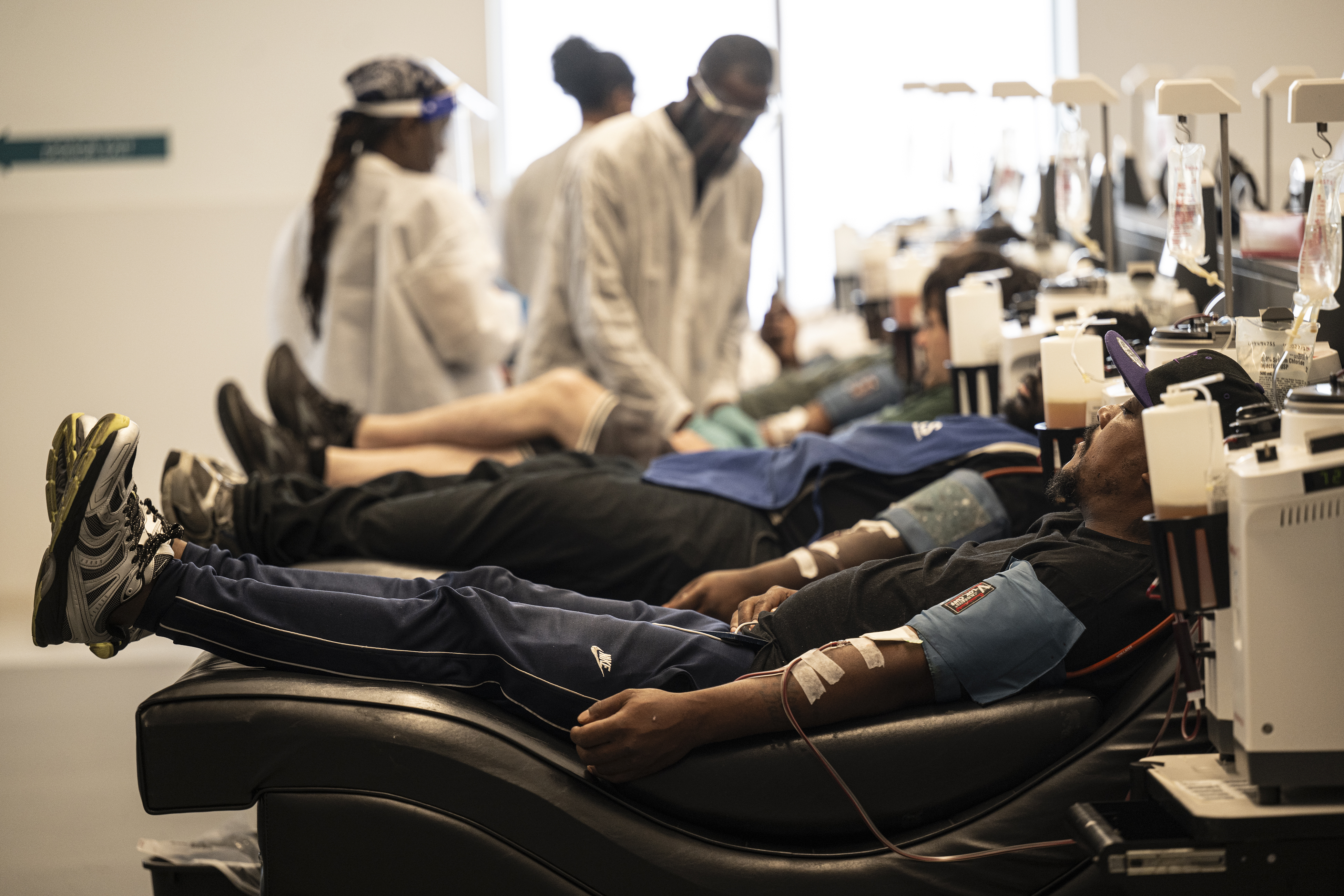
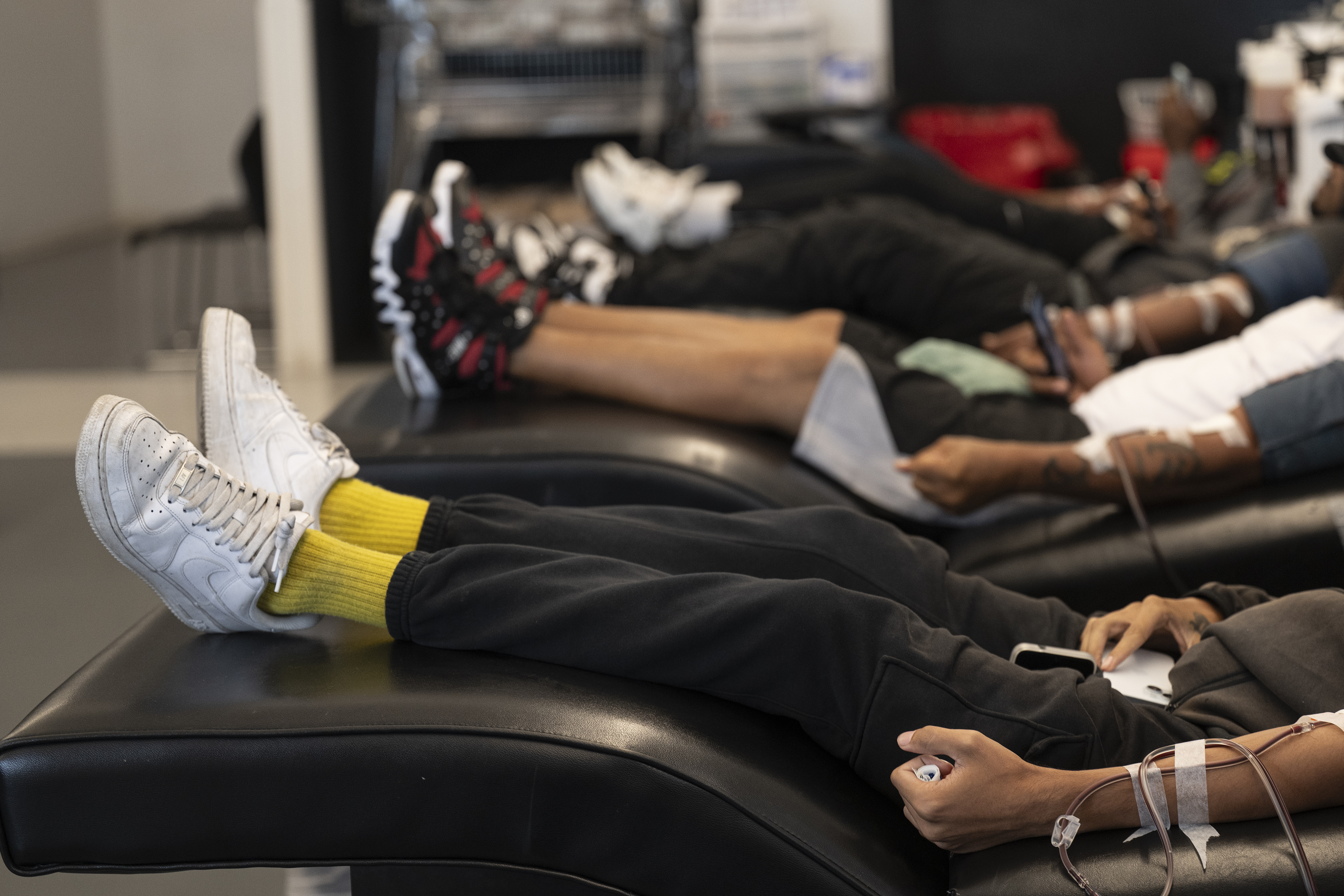
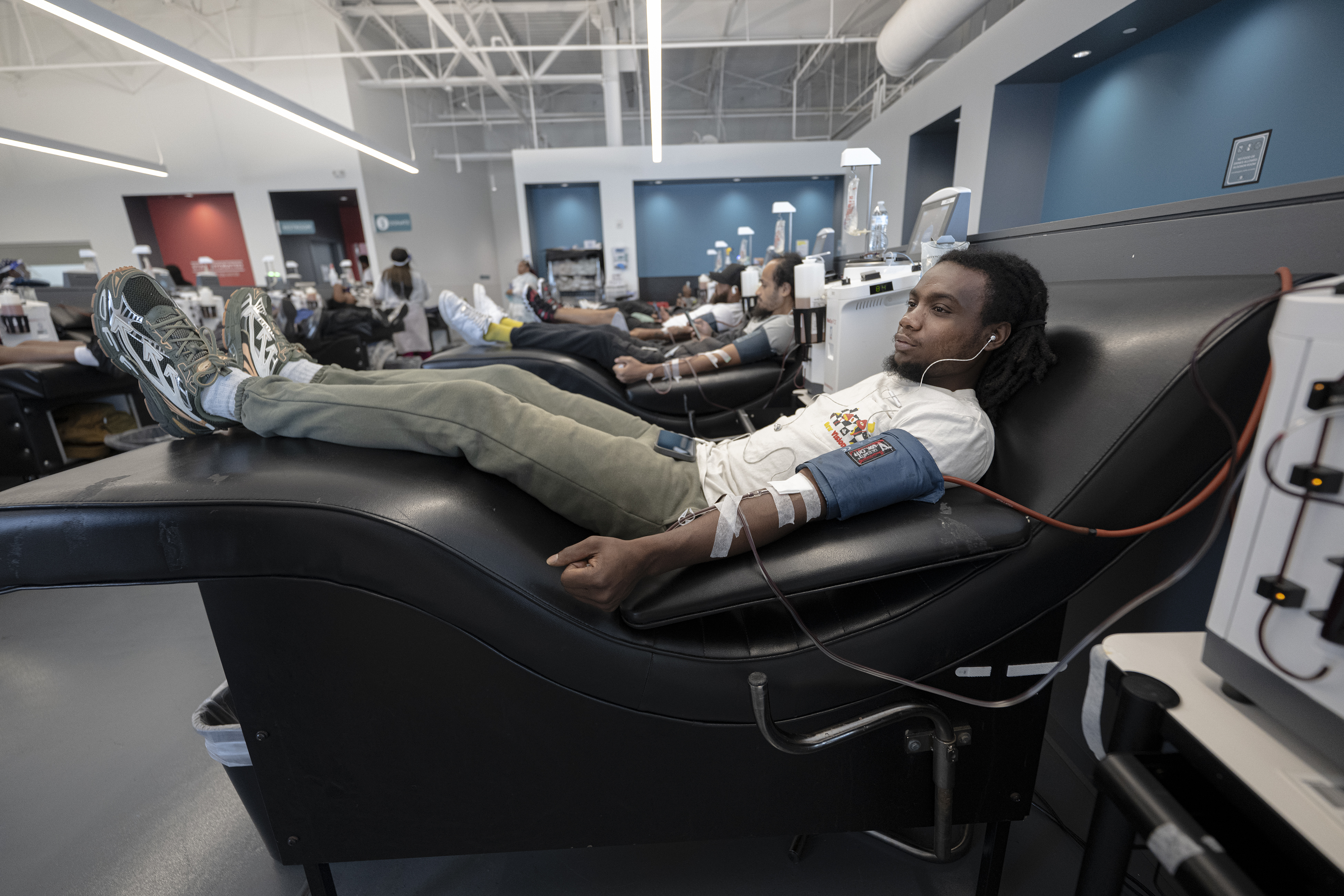
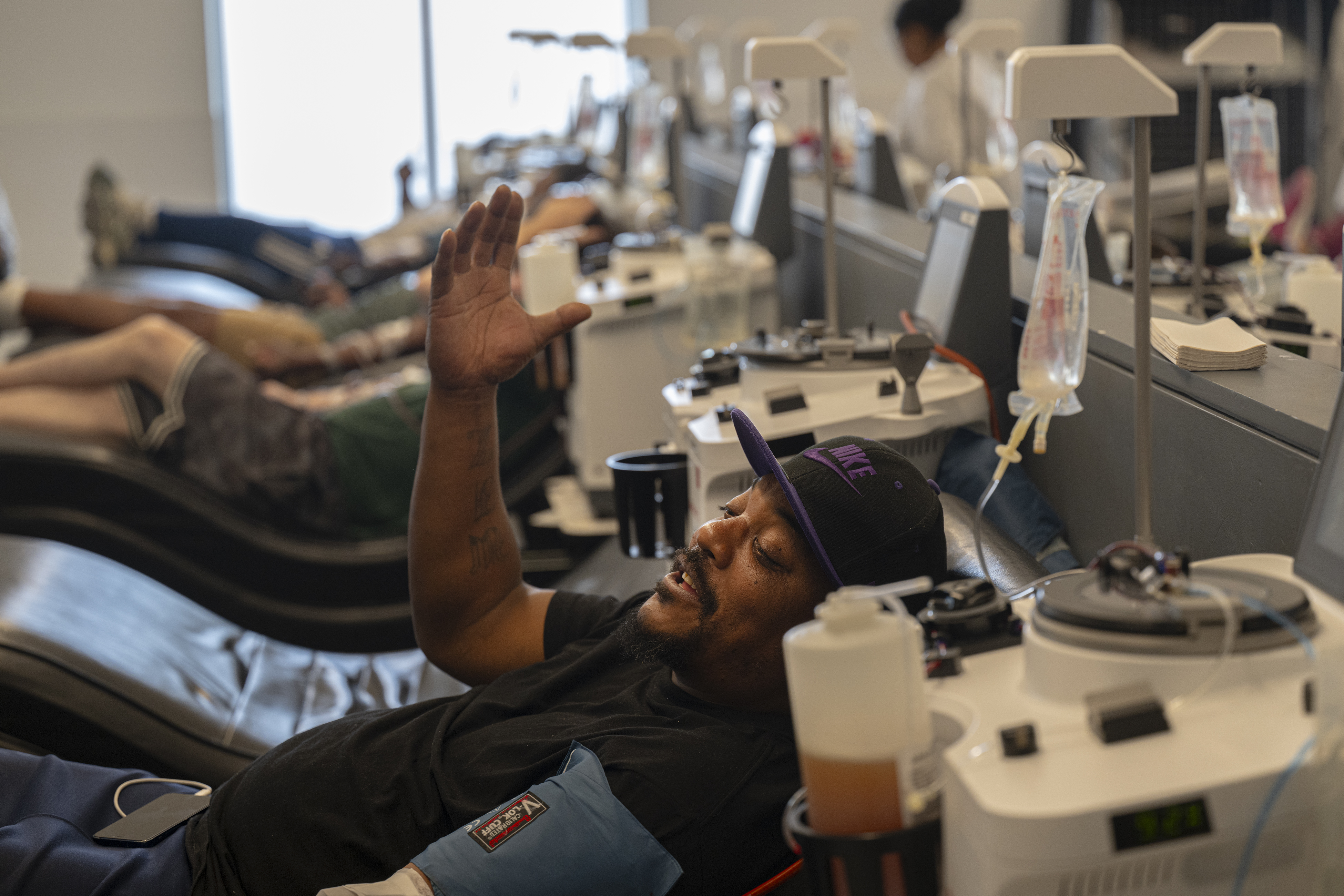
An increasing number of people in the Philadelphia region are selling their blood plasma for money. Here, local donors sit in recliners with needles in their arms at B Positive Plasma in Montgomery County.Jose F. Moreno / Staff Photographer
The U.S is one of about a dozen countries where it is legal to pay donors for plasma. It is among only three countries where people are allowed to donate two times over seven days, though not on back-to-back days, per U.S. Food and Drug Administration regulations.
Nearly 70% of the world’s plasma comes from donors in America, fueling a multibillion-dollar global industry. Plasma, a straw-colored liquid in blood, contains antibodies and other proteins used for treating a wide range of patients with immunodeficiencies, neurological conditions, kidney disease, and bleeding disorders.
Last year, U.S. donors produced 62.5 million liters of plasma — the highest volume ever collected and an 8% increase from the previous year. That trajectory has continued into this year, according to Georgetown University professor Peter Jaworski.
“When the price of most staples goes up, so does the amount of plasma donations,” Jaworski said. “If I fell on hard times, the very first thing I would do is become a regular plasma donor.”
Donating plasma is widely considered low-risk, with millions of people doing it each year without reported health problems. However, the long-term health effects of donating twice weekly for years have not been well-studied. Safety concerns raised by the deaths of two people in Canada who had recently donated at for-profit clinics run by the healthcare company Grifols haveprompted an investigation there.
In the U.S., an FDA investigation into 34 deaths of people who had donated plasma between 2016 and 2020 did not find a link between donations and fatalities.
Some donors experience lightheadedness, fatigue, bruising, bleeding, or dehydration. Drinking water and eating foods high in iron and protein can help alleviate those side effects, according to U.S. health guidance.
Security guard Danny Morales of North Philadelphia said he feels “tired” after donating. But that has not deterred him from heading to CSL Plasma in the city’s Olney neighborhood twice a week, as soon as he finishes his overnight shift at 6 a.m.
Morales can earn $520 a month donating plasma, which helps to offset rising expenses that have the 35-year-old father feeling ever more drained: The cost to fill up his Honda Civic’s gas tank jumped from $30 to $80 in the last year; a package of ground beef increased by $8; and even the brand of mac and cheese that his 8-year-old daughter and 2-year-old son enjoy costs about $1 more, he said.
“It’s just getting worse and worse,” said Morales, whose plasma donations supplement his $18 hourly security job wage. “Stuff is just getting so expensive. Groceries are ridiculous.”
CSL opens at 6 a.m., but a line starts to form around 4:30 a.m. In late July, it snaked past the building, wrapping around the corner. The sight caught the attention of nearby Olney resident Tony Reed.
“There’s always a line there, especially toward the end of the month and definitely on Monday mornings,” Reed said. “People are broke.”
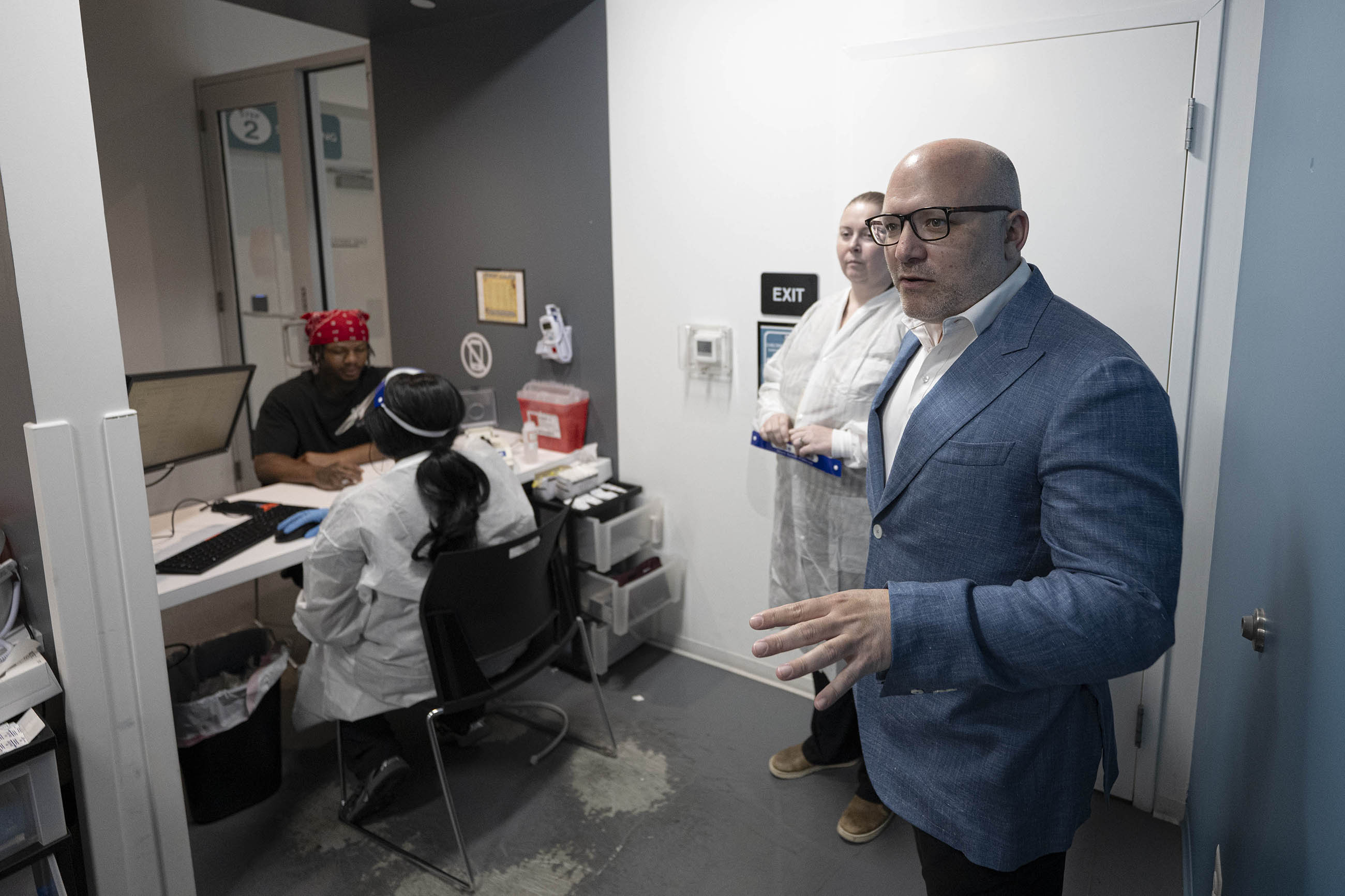
Ben Ruder, CEO and founder of B Positive Plasma, and Pearl Dixon, an assistant manager and phlebotomist, explain the donor intake process. Each donor fills out an extensive health questionnaire, undergoes a medical exam, and gets a finger prick to test their blood for iron and protein levels. Jose F. Moreno / Staff Photographer
Inside the booming industry
On a recent Wednesday afternoon at B Positive Plasma in Montgomery County, a steady stream of donors checked in at kiosks in the lobby.
After filling out an extensive health history questionnaire, each new donor undergoes an on-site medical exam by a licensed practical nurse. Repeat donors must get annual exams. At each visit, a medical tech checks their vitals, including blood pressure, pulse, and temperature, and performs a finger prick to test their blood for protein and iron levels. Donors must weigh at least 110 pounds.
“We make sure they’re healthy and well,” said Ben Ruder, founder and CEO of B Positive Plasma, noting that the plasma itself is tested for HIV and hepatitis B and C before being sold.
Next, plasma donors are hooked up to a machine that draws out blood, spins off the plasma, and then returns the red blood cells back to the donor, a process that typically takes 45 minutes to an hour.
At 2 p.m., 18 of the 24 cushioned recliners at the Wyncote location on Cheltenham Avenue were occupied by donors, each with a needle in one arm. They included a Philadelphia police officer who had donated more than two dozen times since May 2025; a casino cleaner who earns $120 a week donating to support his young daughter; and a home health aide who donates twice a week to help cover his $750 monthly apartment rent.
Jason Johnson, 29, of East Mount Airy, has donated plasma 68 times at B Positive Plasma in the past two years. He makes an extra $120 a week donating twice weekly. The money helps supplement the $17.80 an hour he earns as a cleaner at Live! Casino & Hotel Philadelphia. “In the beginning, I was doing it for the extra money, but once I learned that I’m helping people out in their life, it made me want to come back even more,” Johnson said. Jose F. Moreno / Staff Photographer
Plasma donation differs from whole blood donation, a faster process that relies on unpaid volunteers who can donate only once every 56 days in the U.S.
B Positive Plasma is on track to see a record year, with 180,000 donations, peaking this holiday season, when people need extra money for gifts. Last year, the company saw 150,000 donations at about 1 liter per person.
Ruder, 42, who lives in Center City, opened his first plasma donation center in Cherry Hill in 2012 and rapidly expanded to 12 locations in New Jersey, Pennsylvania, and Delaware. He plans to open two more sites in Maryland next year and another in Allentown later this year.
B Positive Plasma, like other plasma companies, structures payments to incentivize twice-weekly donors. For instance, donors whose weight and physical health yield the maximum amount of plasma — 1,001 to 1,200 milliliters — will receive $45 for the first visit and another $90 if they return that same week. Plus, the company offered a $50 bonus for anyone who donated eight times in August.
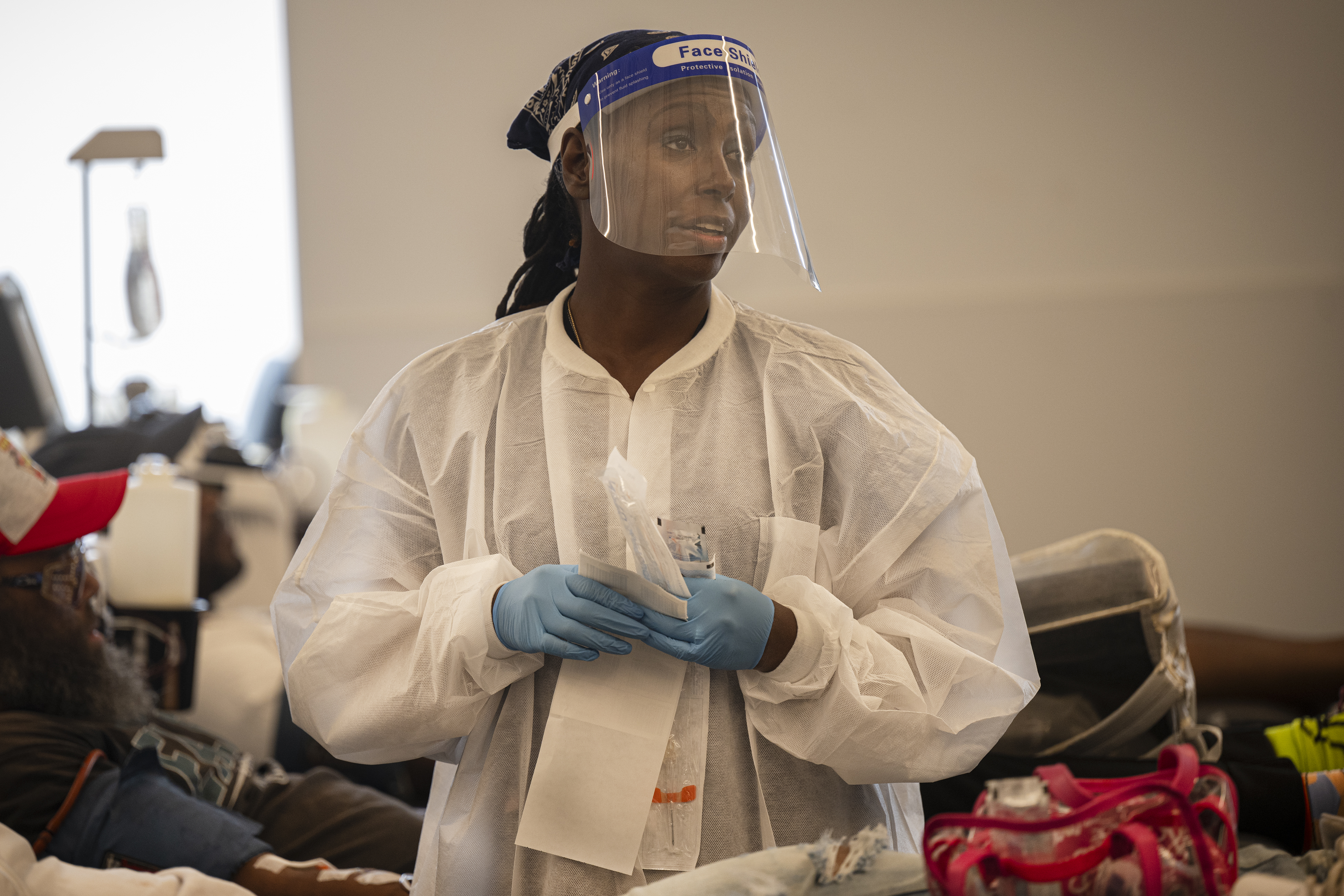
Donyele Wilkins, 48, a phlebotomist and medical assistant, works in the donation room at the B Positive Plasma in Montgomery County. She suffers from lupus, a chronic autoimmune disease for which she receives plasma-derived infusions to control her symptoms.Jose F. Moreno / Staff Photographer
Phlebotomist Donyele Wilkins works 12-hour shifts, four days a week, at B Positive Plasma.
For Wilkins, the paycheck is not the only benefit of working there.
The 48-year-old Northeast Philadelphia resident suffers from lupus, an autoimmune disease in which the body’s immune system attacks its own tissues and organs. Wilkins said she relies on plasma-derived medication, infused through an IV every four to five months, to help control symptoms like inflammation and joint pain.
Knowing how plasma is processed makes her feel “safe,” she said. She also likes getting to know “the regulars” who donate.
“It makes me feel like I know exactly where it’s coming from, and I know the people who are doing it,” Wilkins said. “A lot of them really need the money, so they’re helping me, on top of me helping them.”
‘Blood money’
Paying donors for plasma has sparked ethical debate, with some accusing the industry of exploiting poor people.
In her 2023 book, Blood Money: The Story of Life, Death, and Profit Inside America’s Blood Industry, Kathleen McLaughlin, a Montana-based journalist, found that donors in many U.S. regions are disproportionately Black and brown people.
McLaughlin, who has a rare autoimmune disease treated withmonthly plasma-derived infusions, said today’s rise in donations is “a symptom of our broken economic system.”
While the FDA regulates health safety at plasma centers, the pay rate is set by the companies, McLaughlin found. She thinks donors should be paid more and the amount should be standardized.
“Right now, it’s a capitalist free-market system, where the pricing isn’t transparent,” McLaughlin said. “The profit margins are crazy for these plasma companies, and it’s gamified to make you donate twice a week, every week, in perpetuity.”
Jaworski, the Georgetown University professor, said donors are compensated fairly. A donor whosits for an hour and a half makes “significantly more than” New Jersey’s $15.92 minimum hourly wage and Pennsylvania’s $7.25. Plus, he stressed, donors save “hundreds of thousands of lives.”
Wallace Smith, 45, of Upper Darby, prides himself on making an honest living. He earns $15 an hour as a home health aide. He makes an extra $130 a week selling his blood plasma. The money helps cover cigarettes, rent, and his phone bill. Jose F. Moreno / Staff Photographer
Recently published research suggests that communities can benefit when a new plasma center opens, because fewer young people take out high-interest payday loans and area crime drops, mostly driven by decreases in property and drug-related offenses.
“It helps you from having to do something wrong,” plasma donor Wallace Smith said.
When Smith was in his late 20s, he got arrested for selling drugs. Now 45, he is still struggling to find a job that pays a living wage, he said.
Smith, of Upper Darby, works three days a week, earning $15 an hour, as a home health aide. He earns $130 a week donating plasma, which helps pay for cigarettes, his phone bill, and rent, he said.
Like many donors, Smith said he likes the win-win of earning extra cash and helping patients who depend on plasma.
“They say there’s a job’s out here for everybody, but when you become a person who made mistakes in life, then they look at your background, so there’s only certain jobs you can do,” Smith said as his blood flowed into a spaghetti-thin clear tube at B Positive Plasma.
“With that being said, you don’t go back to your old ways,” he said. “You find better resources like this.”
On a hot August morning, donors line up outside Octapharma Plasma in South Jersey to sell their blood plasma for money. They arrive before the doors open at 9 a.m. to beat the wait. Donor Carl Davis, 56, of Camden, donates every Saturday and Monday, earning $70 each time. The extra money helps supplement his $900 monthly Social Security Income disability check. “I get SSI disability, but it’s not enough at all to pay my bills and buy food,” Davis said.Wendy Ruderman
Beach boardwalk fun
At Octapharma Plasma in South Jersey, the wait time can be as long as three hours, donors said. When a sewer pump broke and bathrooms stopped working earlier this year, the company trucked in a row of porta-potties to accommodate donors and staff.
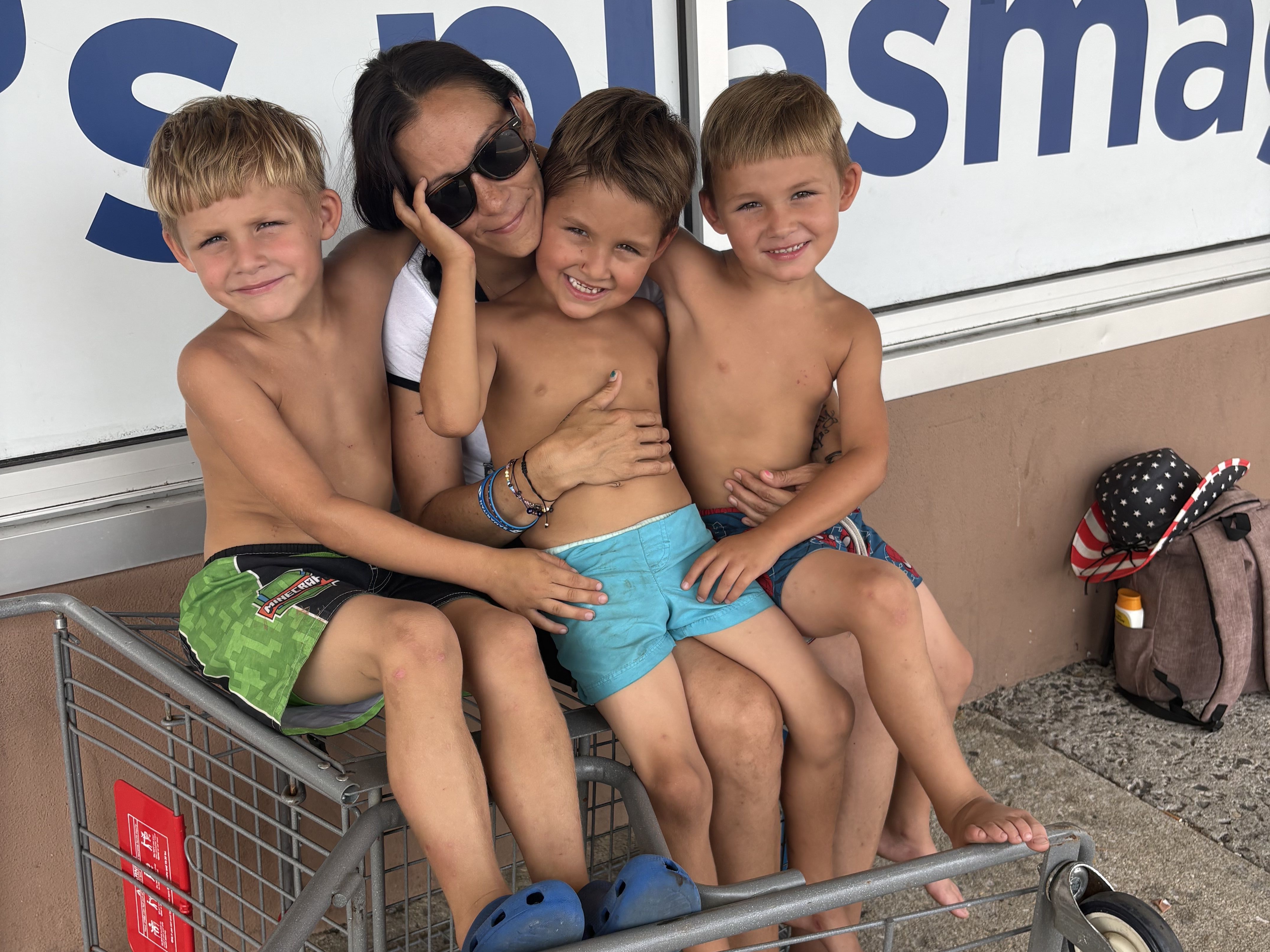
On a recent August morning, Brittany Barr, 36, and her three sons — 5-year-old twins and a 6-year-old — waited outside Octapharma as her husband donated. The family had walked roughly two miles from their Gloucester City home.
When Barr learned her friend had kidney failure and needed plasma infusions, she wanted to help. Barr was unable to donate plasma because she is anemic, so her husband agreed to do it.
In the month since Barr’s husband started donating, the family has earned more than $500. It has helped with groceries and their phone bills to supplement her husband’s income as a shipping manager.
“With only one income, money is tight these days,” Barr said. “Everything is messed up.”
The boys, clad in their bathing suits, climbed up on Barr as she sat on a tipped-over shopping cart. They were headed next to Atlantic City for a beach day.
“This week, the money is going toward fun. They’re going to play arcades and have ice cream or whatever their little hearts desire,” Barr said. “Next week, it’s going to school supplies.”
Brittany Barr, 36, seated with her boys (from left) Cooper, Cannon, and Colton, waits outside for her husband to finish donating plasma at Octapharma Plasma in Audubon, N.J. The family from Gloucester City was next headed down the Shore, where they planned to spend the extra money earned from donating plasma on arcade games and ice cream.Wendy Ruderman / Staff
A Main Line psychiatrist who lost her medical license after a state investigation found she had a yearslong sexual relationship with a young patient while prescribing him highly addictive psychotropic drugs may continue practicing while she appeals the revocation, a state judge ruled.
In ruling in favor of Amy Mazza MacIntyre on Thursday, the judge agreed that she posed no threat to patients, who would likely suffer if their care was disrupted or if they had to find a new provider amid what Commonwealth Court Judge Stella Tsai acknowledged as a “shortage” of specialized child and adolescent psychiatrists in the Philadelphia region.
Tsai also found that MacIntyre would be “irreparably harmed” if forced to close her Bryn Mawr practice because hundreds of current patients likely wouldn’t return, even if she later won her appeal to keep her license.
MacIntyre’s “actions leading to the instant revocation, although spread over several years, were focused on a single individual,” Tsai wrote in her opinion. “In that time, she has treated thousands of patients without reported incident, and there is a purported shortage of psychiatrists with [MacIntyre’s] subspecialty.”
MacIntyre, who specializes in treating young patients with complex psychiatric diagnoses, began seeing a then-17-year-old cancer survivor in 2004 when he was a senior at Lower Merion High School. She first had sex with him in 2011, when he was 24, and prescribed him powerful psychiatric drugs through mid-2017, according to an investigation by the Pennsylvania State Board of Medicine. The board found that the drugs, including Xanax and Adderall, were given to him without proper medical evaluations.
The board revoked her medical license in May, finding she had engaged in sexual misconduct and inappropriate prescribing in violation of state medical licensing laws. She then appealed the decision to Commonwealth Court, where the case is pending. Last month, she asked Judge Tsai to temporarily lift the revocation so she can continue seeing patients while she fights the board’s disciplinary action.
“We are extremely pleased by the judge’s decision and believe it to be appropriate,” MacIntyre’s lawyer, Gary Samms, wrote in a text message to an Inquirer reporter Friday. Samms declined to comment further, citing the appeal. He has advised MacIntyre not to talk to The Inquirer. MacIntyre, 52, did not respond to an email sent Thursday.
Matt Heckel, a spokesperson for the Department of State, which oversees state licensing boards, said the judge merely granted MacIntyre’s request to continue seeing patients but did not address the larger question of whether her license should be revoked. The state is fighting her appeal, arguing that “no sanction short of a revocation would adequately protect the public.”
The patient at the center of the case, Justin Kopicki, who is now 39 and in law school in Oregon, said the judge’s ruling was “extremely problematic,” opening up a “really dangerous can of worms.”
“It says to other psychiatrists and practitioners that it is OK to violate the laws of their license and to take advantage of their patients,” Kopicki said in an interview on Thursday evening. “The court is basically saying that the public interest is not at risk here. Quite frankly, it’s an egregious position to take.”
Kopicki, who gave The Inquirer permission to use his name, said it’s “a very large slap in the face against what I went through.”
“It was not an isolated incident,” he said. “It was something that went on for six, seven years continuously.”
Mixing sex and medications
Kopicki was diagnosed with leukemia at age 4. He received chemotherapy treatments at Children’s Hospital of Philadelphia until age 7, when the cancer went into remission.
In high school, he grew depressed and anxious. He isolated himself from peers. His mother worried his mental health problems stemmed from his childhood battle with cancer. She contacted CHOP, which referred him to MacIntyre, then 31.
During his first appointment in 2004, MacIntyre diagnosed Kopicki with anxiety and agoraphobia. She suspected he also suffered from obsessive-compulsive disorder. She put him on medication.
According to the board’s investigation, MacIntyre “became focused on [Kopicki’s] sexual activity” during treatment sessions in 2010. During a session in early 2011, she told him she “wanted to climb on top of him” and did so, kissing him, the board’s revocation order says.
Soon after, they had sex for the first time at Kopicki’s father’s house. Although MacIntyre stopped charging him for sessions, she formally treated him through June 2013, writing patient notes in his medical record. From 2013 to 2017, she continued having sex with him while prescribing a revolving mix of up to 12 medications to him, without proper evaluations, according to the board’s order.
The board’s investigation — based partly on emails, texts, and voicemail messages that MacIntyre sent Kopicki — revealed that she gave him a $5,000 saxophone and a Cartier watch, hired him to work in her office, proposed marriage to him, told him she miscarried his baby, sent him naked selfies, and took him on trips, including to Turks and Caicos and Walt Disney World.
The board also found that MacIntyre prescribed medications to Kopicki’s mother and father, although they were not her patients.
In an interview with The Inquirer last month, Kopicki said MacIntyre had “groomed” and manipulated him while prescribing “really large quantities” of stimulants and benzodiazepines, including “Xanax and Klonopin mixed together.” She would withhold his medication refills if he refused to go away with her or tried to end the relationship, he said.
Kopicki cut off all contact with her in 2017, shortly after MacIntyre showed up at his father’s house, yelling and demanding to speak with Kopicki. His father called 911, the board found.
Kopicki first complained to the state medical board in 2017. He also filed a medical malpractice lawsuit against her in Montgomery County Court. His lawyers did not want him to cooperate with state investigators while the case was pending, and the state dismissed his complaint.
MacIntyre settled the case with Kopicki in 2020 for an undisclosed amount, and he again complained to the board in 2021. The board launched an investigation, interviewing Kopicki and reviewing “thousands of text messages” between the two.
During the disciplinary proceedings, MacIntyre admitted to sexual misconduct, immoral and unprofessional conduct involving a patient, failure to maintain complete medical records, and fraudulent, reckless, or negligent practice. She had disputed claims that she engaged in improper prescribing, but the board found her culpable.
In her appeal, MacIntyre is seeking a lighter discipline, such as probation. While not excusing her behavior, MacIntyre provided explanations to the board. She testified at a state hearing last year that she had been afraid of Kopicki and that he forced her to have sex. She said she tried to get a protection-from-abuse order against him, but didn’t qualify for one because they weren’t married or living together.
The board rejected her arguments, citing a lack of evidence, finding her testimony not credible, and pointing to her “shifting explanations.”
MacIntyre also cited “personal stressors” in her life at the time of the misconduct, including the birth of a child and her mother’s dementia.
Samms argued that she has learned from her mistakes: She underwent an extensive evaluation with a psychologist who found her fit to practice, and she also went to therapy to address her behavior with Kopicki. Additionally, MacIntyre has limited her interactions with patients to mostly medication management, and has not violated any regulations for the last decade, Samms said.
Samms told Judge Tsai during oral arguments last month that MacIntyre has treated about 15,000 patients without any incident since at least 2017, when contact with Kopicki ended.
“While she acknowledged wrongdoing, it was an isolated patient due to isolated circumstances,” Samms said during the July 30 hearing. “There’s never been any other issues regarding her licensing or her practice.”
Dana Archer, the lawyer representing the State Board of Medicine, argued that the reason so much time had lapsed between her misconduct and the board’s sanction is because “she did everything that she could to hide it.”
“Just because you’re successful in hiding your inappropriate conduct doesn’t mean you should be rewarded and receive a lesser sanction because you were successful in keeping it a secret,” Archer told Tsai.
Archer said MacIntyre took advantage of a vulnerable patient, who was “basically a child” when she began treating him. Her conduct was one of the board’s “worst” cases, she said.
“It was one of the worst things that a psychiatrist can do to a patient,” Archer said.
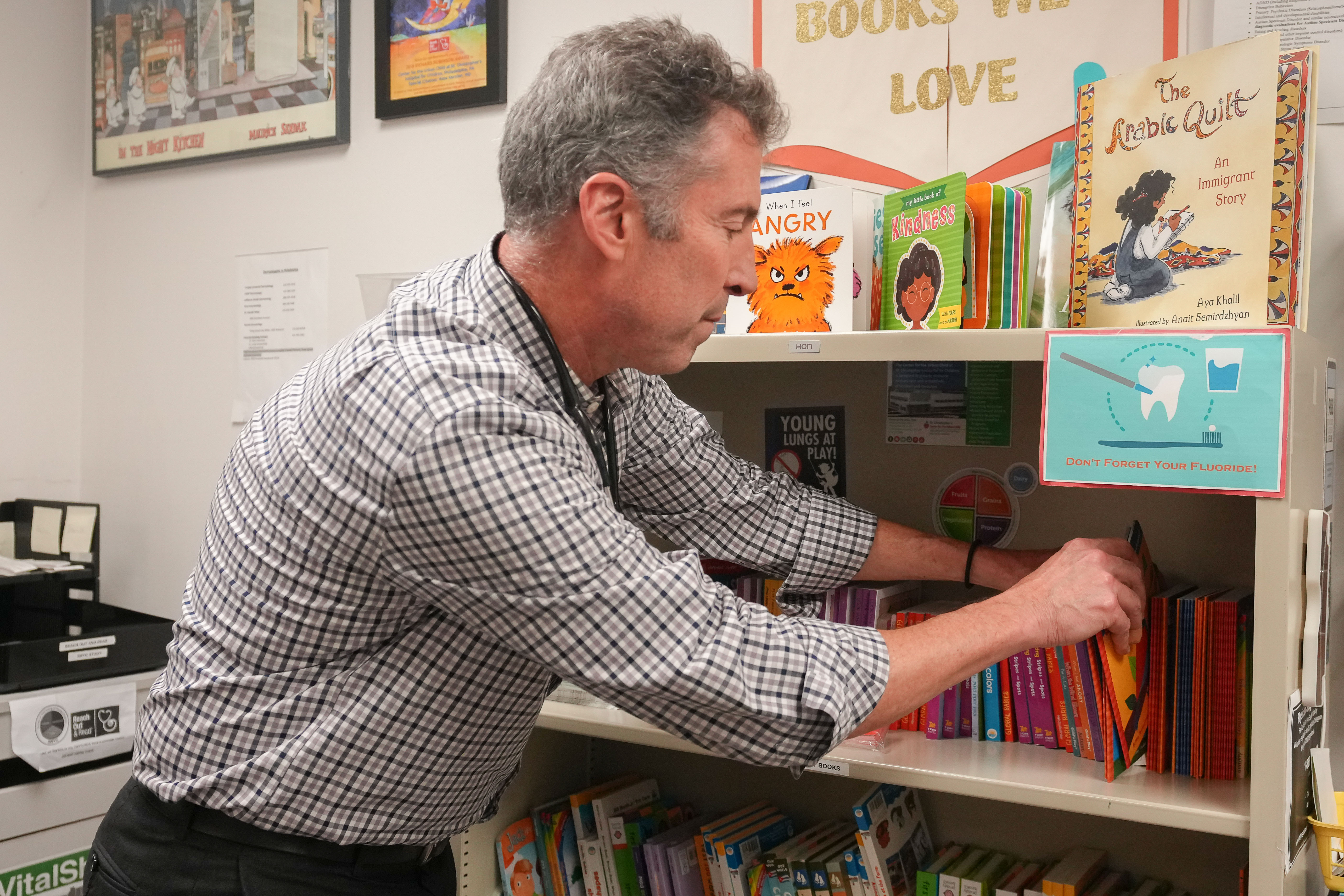
Pediatrician Daniel Taylor opened a crisp hardcover book and began reading to a 5-year-old patient inside an exam room at the clinic at St. Christopher’s Hospital for Children.
“I am laughter that falls like —,” Taylor read, pausing.
“Rain!” the little girl finished, smiling.
“That was amazing,” Taylor said to the girl’s mother, LaShonda Williams, 35, of East Mount Airy. “That’s nice phonetic awareness.”
Williams’ daughter, Xylo, already grasped context and recognized some words. Both crucial skills for school readiness as she prepares for kindergarten this fall.
Xylo and her two siblings — 12-year-old Isaac and 9-month-old Xymia — each got a new book suited for their ages during Wednesday’s checkup. Seated on her mother’s lap, Xymia pointed to a carrot in the First Book of Colors, demonstrating a skill infants ideally master by age 1.
Taylor is one of a growing number of pediatricians who are using books to measure developmental milestones, bolster literacy, and connect with families.
LaShonda Williams and her children, 12-year-old Isaac and 9-month-old Xymia, read together during a checkup at the Center for the Urban Child at St. Christopher’s Hospital for Children.Jessica Griffin / Staff Photographer
The program, “Reach Out and Read,” a national nonprofit literacy group that started in Boston, is celebrating its 25th year at St. Christopher’s in North Philadelphia and its 30th anniversary at the Children’s Hospital of Philadelphia (CHOP) in West Philadelphia.
Participating pediatricians model reading aloud for parents and prescribe reading to children during each well-visit from birth to age 5, although St. Christopher’s program extends into early teens. The children keep the books, building home libraries.
“North Philadelphia is considered `a book desert,’ where there aren’t a lot of bookstores — i.e., none — and families don’t have a lot of children’s books in their homes,” Taylor said. “Just like food insecurity and trying to feed people food. Here we’re trying to feed people with words and books.”
Caregivers often don’t have time or don’t feel safe traveling to their local library in city neighborhoods with high crime, Taylor said.
Taylor helps run “Reach Out and Read” out of the hospital’s Center for the Urban Child, which he described as “an outpatient academic pediatric integrated practice” that sees about 48,000 children a year. There, families can access both medical treatment and social services.
LaShonda Williams, 35, of East Mount Airy, with three of her four children during a checkup with pediatrician Daniel Taylor. Williams, a special education assistant teacher at Wissahickon Charter School, said she’s a big proponent of reading to her children. Jessica Griffin / Staff Photographer
The burgeoning brain
The Pennsylvania chapter of “Reach Out and Read” has grown from three clinics at CHOP in 1996 to 264 pediatric practices today, mostly in the Philadelphia region. Now, local organizers say they plan to expand the program statewide by an additional 100 sites within the next few years.
Pediatrician Trude Haecker, one of the founders of CHOP’s “Reach Out and Read” program, said parents who get a book during a well-visit are two and a half times more likely to read to their child. The research also shows that reading is an important part of the brain development that occurs within the first three years of a child’s life, Haecker said.
“The brain is burgeoning, so in the first three years of life, 80% of your brain is formed,” Haecker said in an interview last week. “There’s a million neurons a second being formed in that first year of life, which is incredible. So having that ability to engage with that child changes that child’s brain.”
Reading to your child also helps offset adverse childhood experiences, like divorce or substance use, Haecker said.
“We’re also really changing that child’s lifetime trajectory,” she added. “It’s really magical.”
A recipe for school success
An estimated 46% of children in the Philadelphia school district are not prepared with the skills they need to start kindergarten. Those children lag in vocabulary, language, reading, and listening skills, according to Taylor.
One of the greatest predictors of whether a teen will graduate from high school is how well they read by third grade, which is directly tied to their speaking skills at age 3, Taylor said.
“So we’re trying to get as many books in the home as possible so that a 3-year-old is saying three-word sentences and a lot of words,” he said.
Taylor said St. Christopher’s raised more than $120,000 last year for new books through its annual basketball tournament fundraiser. The program has given out nearly 1 million books, written in English and about a dozen other languages, since 2001, he said.
“This is one of the most joyous things we do,” Taylor said. “It’s not giving shots; it’s giving immunization against potential future literacy issues.”
Pediatrician Daniel Taylor, co-director of the “Reach Out and Read” program at St. Christopher’s Hospital, organizes the books he selects for his patients before entering an exam room. He has books in 12 different languages, including Urdu, Hmong, and Arabic. He also gives children culturally diverse books in which they can see themselves. More than 90% of his patients are Black or brown.Jessica Griffin / Staff Photographer
A Main Line psychiatrist has lost her medical license after a state investigation found she had sex with a young patient for years, all while prescribing him a revolving mix of up to 12 medications, including highly addictive psychotropic drugs, without proper evaluations.
Amy Mazza MacIntyre, a child, adolescent, and adult psychiatrist in Bryn Mawr, started treating a then-17-year-old cancer survivor in 2004 when he was a senior at Lower Merion High School.
MacIntyre first had sex with him in February 2011, when he was 24 years old. She stopped billing him for treatment around the same time, though she continued to take patient notes for another 2½ years. She continued prescribing him powerful psychiatric drugs while having sex with him through mid-2017, according to an investigation by the Pennsylvania State Board of Medicine.
The board revoked her medical license in May, finding she had engaged in sexual misconduct and inappropriate prescribing in violation of state medical licensing laws. She is appealing the disciplinary board’s decision, which followed lawsuits between MacIntyre and the patient, Justin Kopicki, in civil courts.
The board’s investigation — based partly on emails, texts, and voicemail messages that MacIntyre sent Kopicki — revealed that she gave him a $5,000 saxophone and a Cartier watch, hired him to work in her office, proposed marriage to him, told him she miscarried his baby, sent him naked selfies, and took him on trips, including to Turks and Caicos and Walt Disney World.
Kopicki, who is now 39, said in an interview that MacIntyre had “groomed” and manipulated him while prescribing “really large quantities” of stimulants and benzodiazepines, including “Xanax and Klonopin mixed together.”
“If I refused to go away on a trip with her, or I refused to see her, or I wanted to break up with her, she would refuse to prescribe antianxiety medications until I saw her again,” Kopicki said.
She also prescribed medications to his mother and father, although they were not her patients, the board found.
The board’s revocation order refers to Kopicki by his initials, but he gave The Inquirer permission to use his name.
MacIntyre, 52, did not return calls and emails from a reporter. Her lawyer, Gary Samms, said he advised her to decline comment.
“Dr. MacIntyre is an excellent, caring and compassionate physician,” Samms wrote in an email last week. “The board decision is being appealed to the Commonwealth Court where we believe we will be victorious.”
The board revoked her license on May 28 and ordered her to “immediately cease practicing medicine.”
“By engaging in a sexual relationship with a patient while continuing to prescribe medications without appropriate evaluation or oversight, [MacIntyre] compromised the safeguards that protect patients from harm and undermined confidence in the medical profession,” the board wrote in its revocation order.
A woman who answered the phone at MacIntyre’s Lancaster Avenue office late last week said she was still practicing but unavailable to speak with a reporter. MacIntyre did not reply to a voicemail message asking whether she was still treating patients. Samms did not reply to a follow-up email on the subject.
Earlier this month, the state board rejected her emergency request to staythe revocation of her licensepending her appeal. She plans to argue her case before a judge on Thursday, Commonwealth Court records show.
‘Shifting explanations’
MacIntyre admitted to sexual misconduct and violating medical licensing laws on three other counts: immoral and unprofessional conduct involving a patient; failure to maintain complete medical records; and fraudulent, reckless, or negligent practice.
During the disciplinary proceedings, MacIntyre had only disputed claims that she engaged inimproper prescribing. However, she argued for lighter discipline, such as probation, on all counts.
She testified at a state hearing last year that she had been fearful of Kopicki and felt “trapped.” She said the sex was not consensual, but coerced, and that she had feared for her safety and that of her family.
She said she had repeatedly tried to get a protection-from-abuse court order against the patient but did not qualify for one. (Such proceedings are not public record).
The board rejected her arguments, citing a lack of evidence to support her “claims of coercion,” “shifting explanations,” and inexcusable actions.
MacIntyrealso cited “personal stressors,” including “family losses, the birth of a child, and her mother’s decline due to early dementia,” the report states.
While treating Kopicki, she introduced him to her young daughter and was married, state and court records show.
After contact with Kopicki ended in 2017, she said, she went to therapy to address her “understanding of appropriate boundaries.”
She also limited her interactions with patients to mostly medication management rather than therapy. And she had not violated any regulations for the last decade, she said, arguing for less severe discipline.
Kopicki said he provided the state with “thousands of text messages,” dating back to 2011, showing she aggressively pursued him and used medication to control him.
“She put it in writing so it was extremely difficult for her to be like, `It was him. He’s the aggressor,’” Kopicki said.
Her lawyer,Samms, said he believed MacIntyre’s appeal of the board’s revocation order to the Commonwealth Court will prevail.
“There are numerous issues and contested facts that support the doctor’s position,” Samms wrote in an email, declining to comment further due to the appeal.
First treatment, then sex
Diagnosed with leukemia at age 4, Kopicki receivedchemotherapy treatments at Children’s Hospital of Philadelphia until age 7, when the cancer went into remission. In high school, he became depressed and anxious. His mother thought his mental health problems stemmed from his cancer historyand contacted CHOP, which referred the family to MacIntyre. Then 31, the psychiatrist was considered “relatable to a younger patient,” Kopicki said.
The board’s order described how her initial therapeutic care morphed into inappropriate sexual contact:
MacIntyre diagnosed Kopicki with anxiety and agoraphobia at his initial appointment in 2004. She thought he also might have obsessive-compulsive disorder. She started him on medication.
In 2010, his treatment sessions with MacIntyre “became focused on [Kopicki’s] sexual activity.”
In early 2011, Kopicki, then 24, expressed feelings for her in an email; the relationship seemed to be crossing professional lines. He was unsure if he should continue treatment with her.
MacIntyre, then 37, wrote him back, saying she “was sorry if he felt it was best not to meet” and to “let her know if he wanted to be back in touch.”
During a session a few days later, she told him she “wanted to climb on top on him” and did so, kissing him, the board’s order says.
They had sex for the first time at his father’s house in early February 2011, and she continued to formally treat him through June 2013, writing patient notes in his medical record, according to the board’s investigation.
She kept a log of medications she prescribed him through March 2014 and continued prescribing into 2017, the board found.
When Kopicki tried to cut ties with MacIntyre, he said in the interview, she would change or increase his medications, saying his “mood is out of control.”
“I trusted her,” he said. “When she was like, ‘You need X, Y, and Z medication,’ I put trust in her.”
Kopicki said she became very involved with his family, attending dinners and events, including his mother’s wedding in California. She also prescribed medications to his parents.
In spring 2017, MacIntyre showed up at Kopicki’s father’s house, yelling and demanding to speak with Kopicki. His father called 911, the board found.
Kopicki cut off all communication with MacIntyre in July 2017.
‘Not acceptable’
Kopicki said he first complained about MacIntyre to the state medical board in 2017, shortly before filing a medical malpractice lawsuit against her in Montgomery County Court.
His lawyers advised him not to cooperate with the state while the case was in litigation. The state dropped his complaint, he said.
MacIntyre settled the case with Kopicki in 2020 for an undisclosed amount.
After the settlement, Kopicki said, he again complained to the board in 2021.
Later that year, MacIntyre sued Kopicki in civil court for breaching a nondisclosure clause in their settlement agreement that prevented him from discussing her actions with authorities.
In January, a judge ordered Kopicki to pay MacIntyre $25,000 for violating the agreement, court records show.
Kopicki, who is now in law school in Oregon, said he intentionally violated the agreement “for the good of the public interest.”
“This is not acceptable and she needs to be held accountable,” Kopicki said.
A prosecutor dropped felony rape and sexual assault charges against Philadelphia-area doctor John Smyth Michel on Tuesday after his accuser failed to appear at his criminal trial.
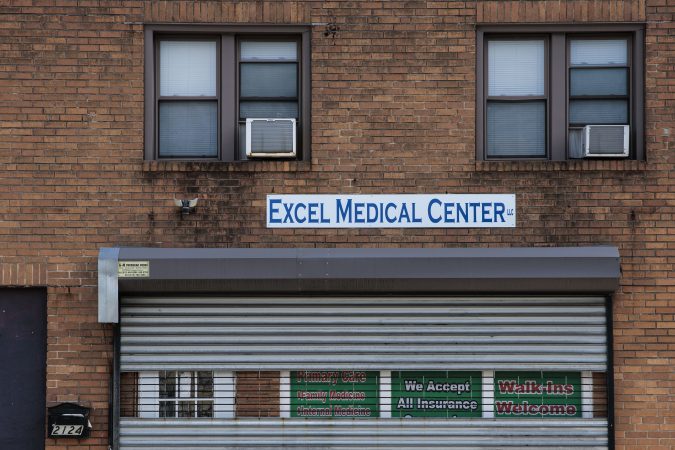
The woman’s testimony against Michel, the former medical director of Excel Medical Center, was key because the case lacked physical evidence. The then-38-year-old patient from Northeast Philadelphia had claimed Michel raped her during a 2024 office visit.
Michel’s criminal defense lawyer, Andrew Gay Jr., told jurors the sex was a “terrible” mistake but consensual.
“As terrible of a decision as it could have been for a physician to make,” Gay said during his opening statement Monday on the trial’s first day, “it was an entirely consensual act between two adults.”
Gay declined to comment on Michel’s behalf after Common Pleas Court Judge Chesley Lightsey dismissed the case at the prosecutor’s request.
“This case is done,” Lightsey declared before excusing the jury empaneled at the city’s Criminal Justice Center.
The stakes were high for the 56-year-old doctor from Jenkintown on two fronts: He faced up to 20 years in prison on the rape charge alone and loss of his medical license, if convicted.
Under state law, doctors convicted of sexual offenses are prohibited from being licensed and practicing medicine.
The Pennsylvania State Board of Osteopathic Medicine, which regulates and oversees licensure of osteopathic doctors like Michel, suspended his license last year after he apologized for having sex with a patient — a violation of state licensure laws. As of Tuesday, his license remained suspended, according to a state spokesperson.
Excel Medical Center, which Michel founded, is currently closed, Gay said. The center was composed of 12 locations in the Philadelphia region, with more than 200 employees and about 20,000 patients.
In a letter to the medical board last year, Michel described the October 2024sex with the patientas a “lapse in judgment” for which he is “profoundly contrite.”
“I fully acknowledge that I crossed a professional boundary,” Michel wrote to board members last year. “I recognize that boundaries are not only a legal and ethical obligation but a critical element of safe, respectful, and therapeutic care. I make no excuses for my actions.”
Claims of rape
The patient, identified in police records by the initials “D.R.,” had accused Michel of kissing her during a May 2024 exam at his East Mount Airy office on Stenton Avenue. She told him “no,” left the office, and did not report the kissing incident.
About five months later, she went to an appointment at Michel’s North Philadelphia office on West Diamond Street. During the Oct. 14, 2024, visit, she said, Michel raped her with such force that her head banged twice against the exam room wall. She pushed him off her and fell to the ground crying, according to criminal court records.
In early November 2024, she told her husband what had happened and subsequently filed a police report, records show.
Late last year, a second woman accused Michel of sexual abuse.The woman had worked for Michel as a medical assistant from 2015 to 2019 at his East Mount Airy office and at a location in Germantown on Chelten Avenue.
The former employee claimed that beginning in 2018, Michel touched her breasts over her clothing on multiple occasions while she was working in the office. He additionally groped her vagina over her clothing before she quit in 2019, according to a document filed in court last year by the Philadelphia District Attorney’s Office.
Prosecutors never charged him in connection with those accusations, but argued the former employee’s claims bolstered their patient rape case, given there were no witnesses. Gay, Michel’s lawyer, had declined to comment after the second woman came forward.
A no-show witness
In the patient’s case, Philadelphia police arrested Michel in February 2025 after prosecutors charged him with three felonies — rape, sexual assault, and involuntary deviate sexual intercourse — and two misdemeanors — indecent exposure and assault. He was released on bail.
Assistant District Attorney Allison Christian dropped all but the rape and sexual assault charges prior to the trial. Michel pleaded not guilty.
The former patient had been scheduled to testify on Tuesday morning. Christian told the judge that she had spoken with her the night before. She sounded “very emotional” and seemed to be having a “nervous breakdown,” but said she would testify, Christian said.
“I’ve been calling her since 8:15 a.m. this morning every 15 minutes,” Christian said. “I haven’t heard from her.
“I’m not going to issue a bench warrant for a rape victim,” she said before dropping the charges.
A path to practicing medicine
Prior to the patient’s accusations, Michel had no criminal complaints and no disciplinary history against his medical license, state records show.
Michel agreed to be disciplined by the board of osteopathic medicine for violating a state law prohibiting sexual misconduct, according to a June 2025 agreement.
The discipline included a $4,000 civil penalty and an indefinite suspension of his medical license for a minimum of 24 months, followed by probation, according to a spokesperson for the Pennsylvania Department of State, which oversees licensing boards.
While Michel is on probation, a chaperone must be physically present when he treats female patients and a separate monitor must oversee his practice. Michel also must complete in-person classes on physician-patient boundaries and 15 hours of continuing education on ethics, the disciplinary agreement says.
The state spokesperson on Tuesday said the board will reinstate Michel’s license to “non-suspended, probationary status” once he has met the agreement’s reinstatement conditions.
After giving birth to her first child, Jennifer O’Mara sought therapy forpostpartum depression.
But when O’Mara left her Delaware County home to visit her in-laws in North Carolina, her counselor had to cancel a virtual session because she wasn’t licensed to practice outside of Pennsylvania.
“My therapist had always asked me if I was in Pennsylvania before a session started, and there was actually a time where I was not, and we couldn’t meet, and I didn’t understand why,” O’Mara said. “I was confused.”
Unbeknownst to the new mother, Pennsylvania counselors need a separate license for each state they practice in.
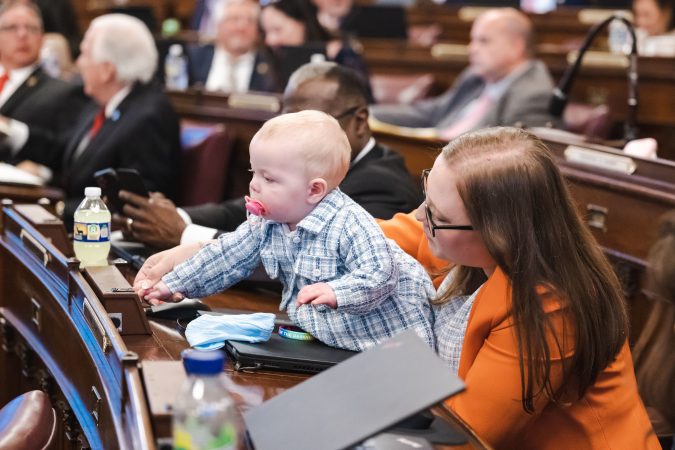
O’Mara, a Democrat elected as a state representative in 2018 and a co-chair of the legislature’s Mental Health Caucus, said she’s been working to change that regulation since that canceled therapy session.
Four years later, O’Mara’s efforts are about to pay off under a bill expected to soon go to Gov. Josh Shapiro for his signature.
The legislation would make Pennsylvania the 40th state to join the Interstate Counseling Compact. It enables counselors who are licensed in Pennsylvania to practice in any state that is part of compact.
Pennsylvania will join already participatingstates, including Delaware, New Jersey, Maryland, Ohio, and yes, North Carolina.
The bill only applies to licensed professional counselors, or LPCs. Pennsylvania separately participates in multistate healthcare compacts for psychologists, doctors, nurses, and physical therapists to provide inpatient care or telemedicine across state lines.
State Rep. Jennifer O’Mara (D., Delaware County) with her daughter, Katherine, now 4, in 2023. O’Mara helped usher the Interstate Counseling Compact bill through the Pennsylvania House in late June. The bill would allow licensed professional counselors (LPCs) to practice across state lines. Courtesy of Jennifer O'Mara
Shapiro plans to sign it
O’Mara helped advance the bill in the House. The Senate had passed it in July 2025 by a 45-5 vote. The House approved it last week by an 188-to-14 vote.
It now goes back to the Senate for a perfunctory, final signature by that chamber’s president before heading to Shapiro’s desk, according to a spokesperson for Sen. Lisa Boscola (D., Lehigh and Northampton), the bill’s prime Senate sponsor.
O’Mara and leaders of the Pennsylvania Counseling Association (PCA), which has about 700 members statewide, said they expect Shapiro to sign the bill into law once it gets to his desk. A spokesperson for Shapiro confirmed on Tuesday that he plans to sign it.
The bill aims to benefit recent high school graduates who want to keep the same therapist but plan to attend college out of state; active duty military members who are deployed outside Pennsylvania; and residents who physically work in New Jersey or Delaware and opt to do sessions during their lunch break, according to O’Mara.
“This feels like a small bill that will make a big difference,” O’Mara said.
Addressing a shortage of counselors
Post-pandemic, the demand for mental health services has increased, and providers have struggled to keep up. The nation is expected to have a shortage of more than 40,000 counselors by 2030, and roughly 62% of Pennsylvania communities lack adequate mental health services, according to the PCA.
The legislation is designed to ease that burden, said Nicole Palman, a counselor at the Main Line Counseling and Wellness Center in Haverford.
“We’ll be able to continue to see clients when they move to New Jersey or when they move to Delaware without having to end care that may have been going on for years,” saidPalman, a PCA member who advocated for the bill.
It’s not always easy to find a new counselor, she noted.
“A lot of people get discouraged,” Palman said. “The process is worse than dating to find a therapist you align with.”
Editor’s note: This story has been updated to clarify that psychologists are included in Pennsylvania’s multistate compacts for health professionals.
Inquirer staff writer Gillian McGoldrick contributed to this article.