Author: Dana Munro

  • This tween could have met Jalen Hurts. Instead, he used his Make-A-Wish to host a carnival for a homeless shelter

    This tween could have met Jalen Hurts. Instead, he used his Make-A-Wish to host a carnival for a homeless shelter

    On a mild April day, 12-year-old Sam Okyere reviewed his wish list with his mom during their drive to the Make-A-Wish Foundation’s Bala Cynwyd office.

    First choice: Legoland and Disney World.

    Second choice: meeting Eagles Jalen Hurts and Saquon Barkley.

    Third choice: hanging out with Philly rapper Lil Uzi Vert.

    But when Sam, his mom, and two members of the Make-A-Wish crew squeezed into the office’s tiny Lego-themed room for the official discussion, something different flashed to mind.

    “I want to help the homeless,” Sam told them.

    Sam has sickle cell disease. He’s endured a lifetime in and out of hematologists’ offices, white-knuckling through blood transfusions and bursting into hospitals when “pain crises,” agonizing sensations caused by disruption in the blood flow, tore through his body. This was his chance to do one completely selfish thing, and he chose to be selfless.

    “Are you sure this is what you want to do?” Maude Gambrah, Sam’s mom, asked as she started the car to drive them home to Drexel Hill. She knew Sam had a soft spot for homeless people. He was always encouraging her to give money to panhandlers around Philly. But this was his only wish.

    “Yeah, Mommy,” he responded. “This is what I want to do.”

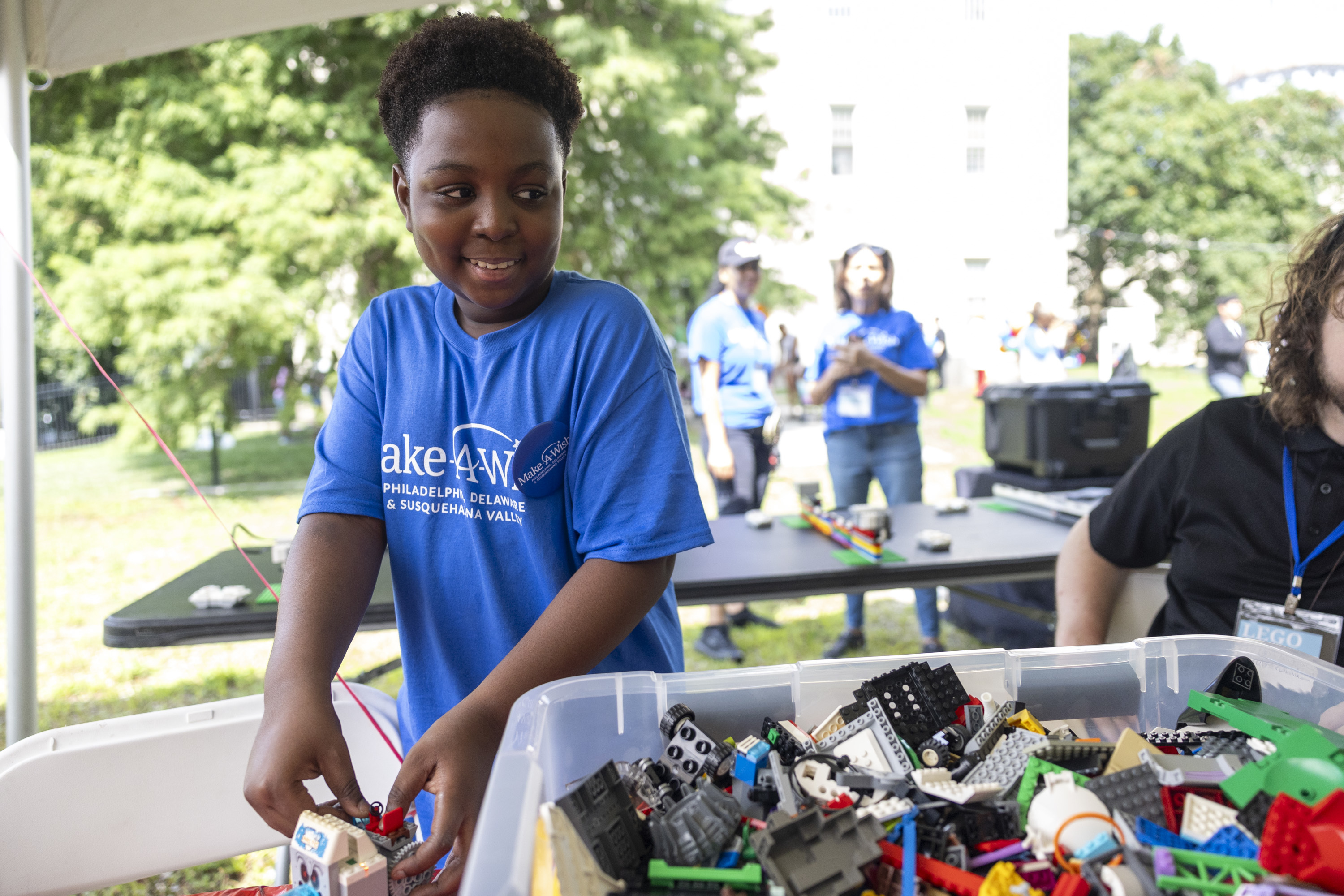
    Make-A-Wish settled on Families Forward Philadelphia, a homeless shelter in West Philly, as the recipient of Sam’s wish and hosted a monthlong donation drive for the facility leading up to “Sam’s Perfect Day” last month. The carnival-style extravaganza on the shelter’s front lawn, attended by dozens of families experiencing homelessness as well as Sam and his family, featured Lego displays, a petting zoo, a Lego-inspired bounce castle, and water ice provided by Sam’s family’s Southwest Philly water ice business, Willkay’s.

    Making a wish a reality

    Word of the wish quickly spread around the office of Make-A-Wish Philadelphia, Delaware, & Susquehanna Valley following the April meeting. Anika Goyal, one of the staffers responsible for carrying out wishes, knew this one had to be hers.

    The chapter, which grants about 335 wishes a year, regularly fulfills shopping sprees, vacations to Disney World, and room makeovers, but it rarely gets one like Sam’s, Goyal said.

    So Goyal got to work. Sam emphasized that helping homeless children, specifically, was important to him, so Goyal selected Families Forward as the beneficiary shelter because it emphasizes keeping families intact during their stays.

    She reached out to small businesses and nonprofits — as many as she could find that also had Make-A-Wish connections. Oshun Family Center, which Goyal asked to host a table on Black maternal health and to distribute childcare kits, was founded by a mom of a Make-A-Wish recipient. Jam-Rock Kitchen, a local Jamaican restaurant owned by another Make-A-Wish family, slathered up their jerk chicken and spiced up their rice and peas for the big day.

    Goyal also looped in staff at the King of Prussia Lego store, a former contestant on the reality TV competition series LEGO Masters, and Swoop, the Philadelphia Eagles mascot, to make the event quintessentially Sam.
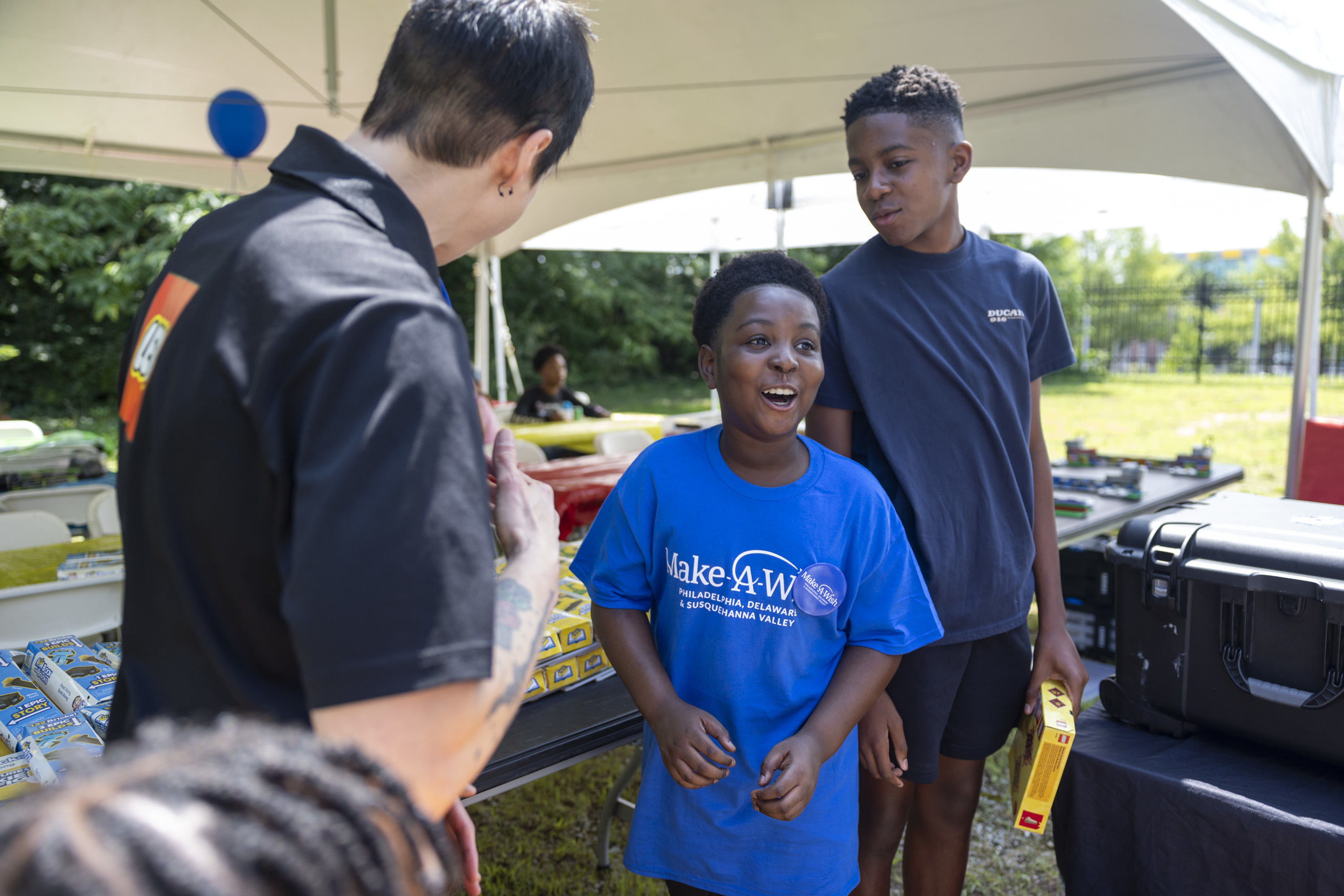
    Alana Deluca, manager at King of Prussia’s Lego store, talks to Sam Okyere, 12, during his Make-A-Wish donation drive and block party.Tyger Williams / Staff Photographer

    “It’s not about him,” Goyal said. “But it is about him.”

    As Goyal and the Make-A-Wish team prepared the logistics, Sam contended with a life-altering decision. Sickle cell can be treated through a bone marrow transplant. The ideal donor is a sibling who is a match. Will Okyere, Sam’s 25-year-old brother, was. So Sam and his family scheduled a transplant for the end of August. The process starts with chemotherapy and ends with in-home isolation for several months, requiring Sam to miss most of his seventh-grade year with his friends.

    “It’s a bummer,” Sam said. “But, it’s like, anything to get me better.”

    “I just want to get sickle cell over and done with,” he added.
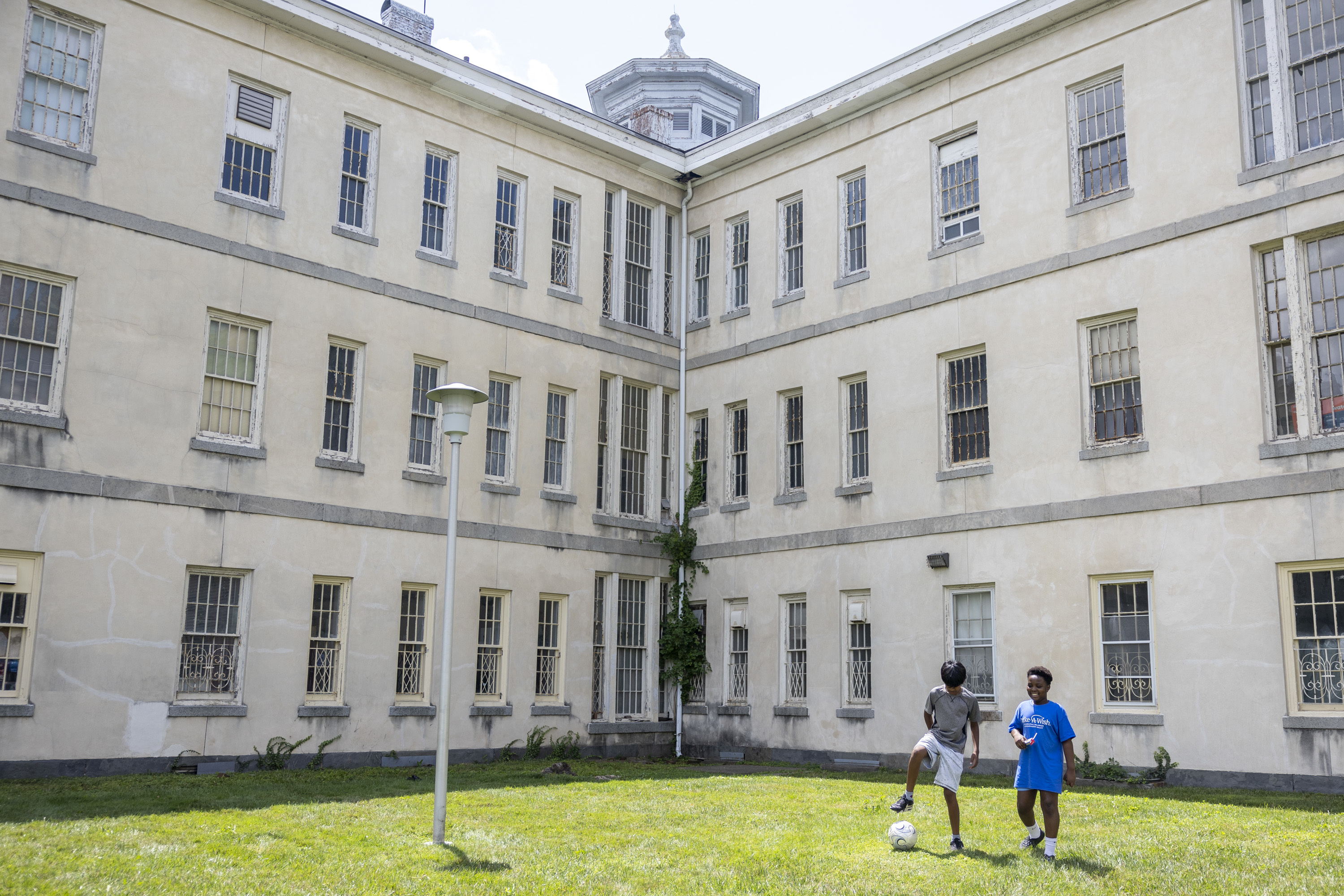
    Sam Okyere, 12, hanging out with his friend Mosiah Saddick, 12, during Sam’s Perfect Day at Families Forward Philadelphia homeless shelter.Tyger Williams / Staff Photographer

    While sickle cell disease is not inherently fatal, it can increase the risk of life-threatening infections, acute chest syndrome, stroke, and chronic organ damage, particularly without medications or interventions such as a bone marrow transplant or gene therapy.

    Cynthia Norris, Sam’s attending hematologist at Children’s Hospital of Philadelphia, who referred Sam for the wish, said he stood out among all her eligible patients because he has the most severe variation of the disease and has had a number of complications. His grace and thoughtfulness, she said, also set him apart.

    “He’s just a very special young man,” Norris said. “He has so much empathy.”
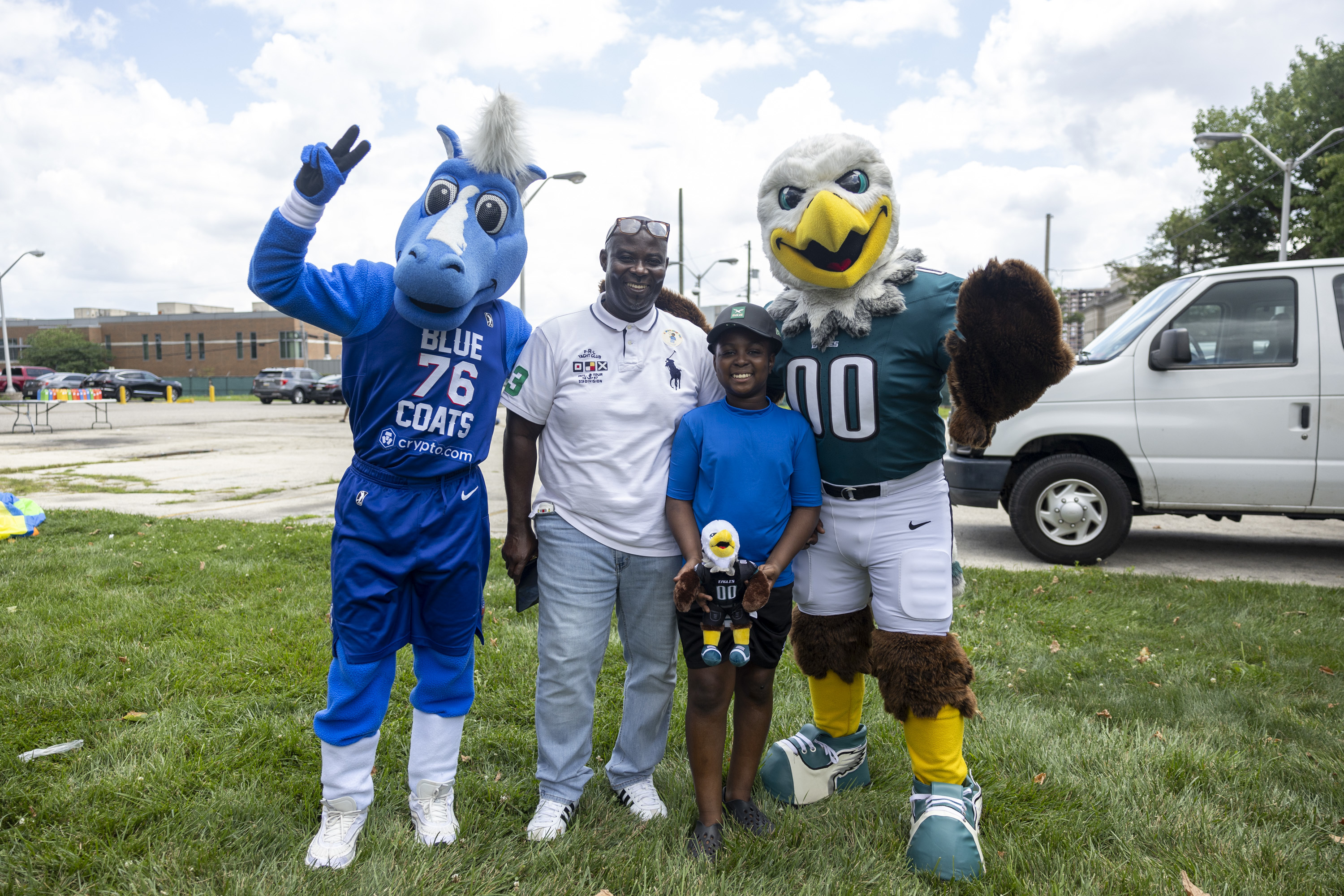
    Sam Okyere, 12, with his dad Akwasi Okyere, Delaware Blue Coats mascot Coaty, and Philadelphia Eagles mascot Swoop during Sam’s Perfect Day Make-A-Wish donation drive and block party at Families Forward Philadelphia homeless shelter.Tyger Williams / Staff Photographer

    Living out a perfect day

    After months of waiting and preparation, Sam’s Perfect Day finally arrived.

    Shiny new yellow, red, and blue soccer balls and Hula-Hoops lined the main hall of the Families Forward office building. Tubs along the mirroring wall brimmed with sunscreen bottles, toothbrushes, and soap. A giant poster sandwiched in the middle bore Sam’s likeness in Lego form — tiny Afro and all.
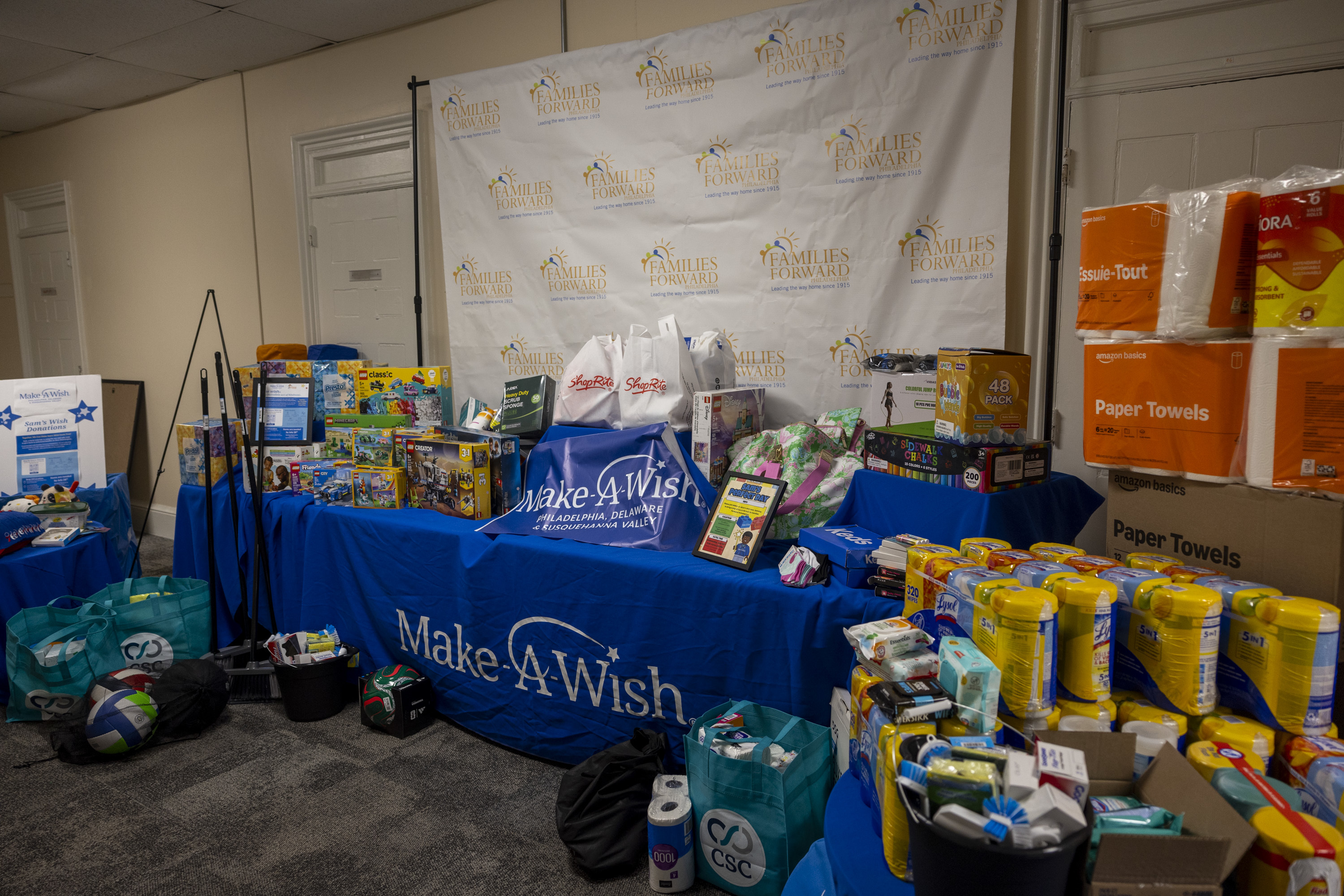
    Some of the donations for Sam Okyere’s Perfect Day Make-A-Wish donation drive and block party.Tyger Williams / Staff Photographer

    Families Forward could never have afforded this bounty on its own, said Jessica Main, the nonprofit’s chief development officer. Grant money the shelter receives is often tied to specific types of services like mental health and education. Its budget for toys and recreational materials is around $3,000 annually, Main estimated. That would probably barely cover the glimmering new basketball hoop and sports equipment Sam’s donation drive brought in.
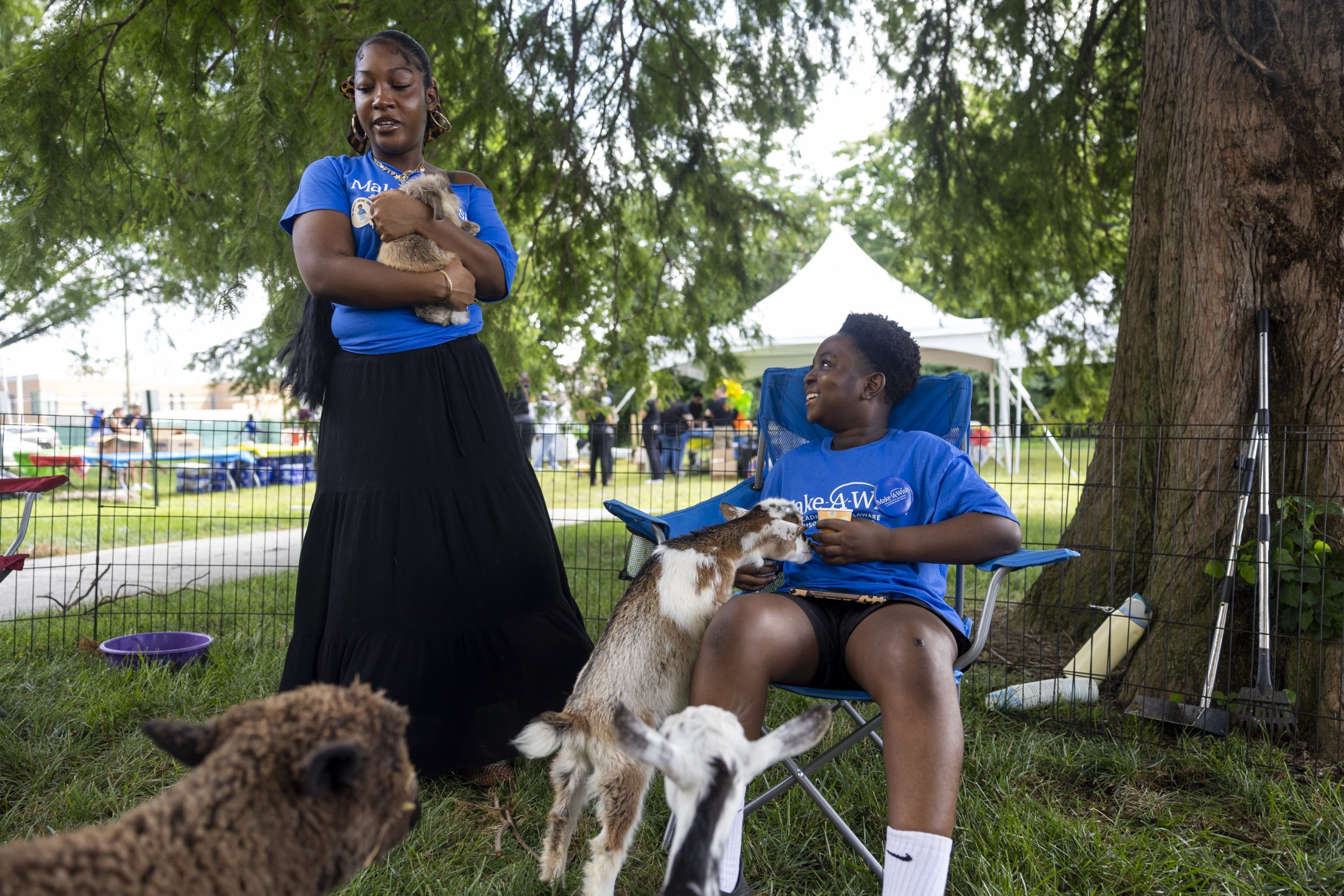
    Sam Okyere, 12, with his sister, Kayla, at the petting zoo during his Make-A-Wish donation drive and block party at Families Forward Philadelphia homeless shelter.Tyger Williams / Staff Photographer

    Sam nestled into a blue canvas chair in the petting zoo as two goats nibbled food out of Dixie cups he held in each hand.

    “I’m naming this one Ashton,” Sam announced to no one in particular, looking at a brown and white goat.

    “Food! Anybody want food,” he shouted to the tiny goats (one wearing a feathered bowler hat), bunnies, and one black pig that dragged its rotund paunch on the ground wherever it went.
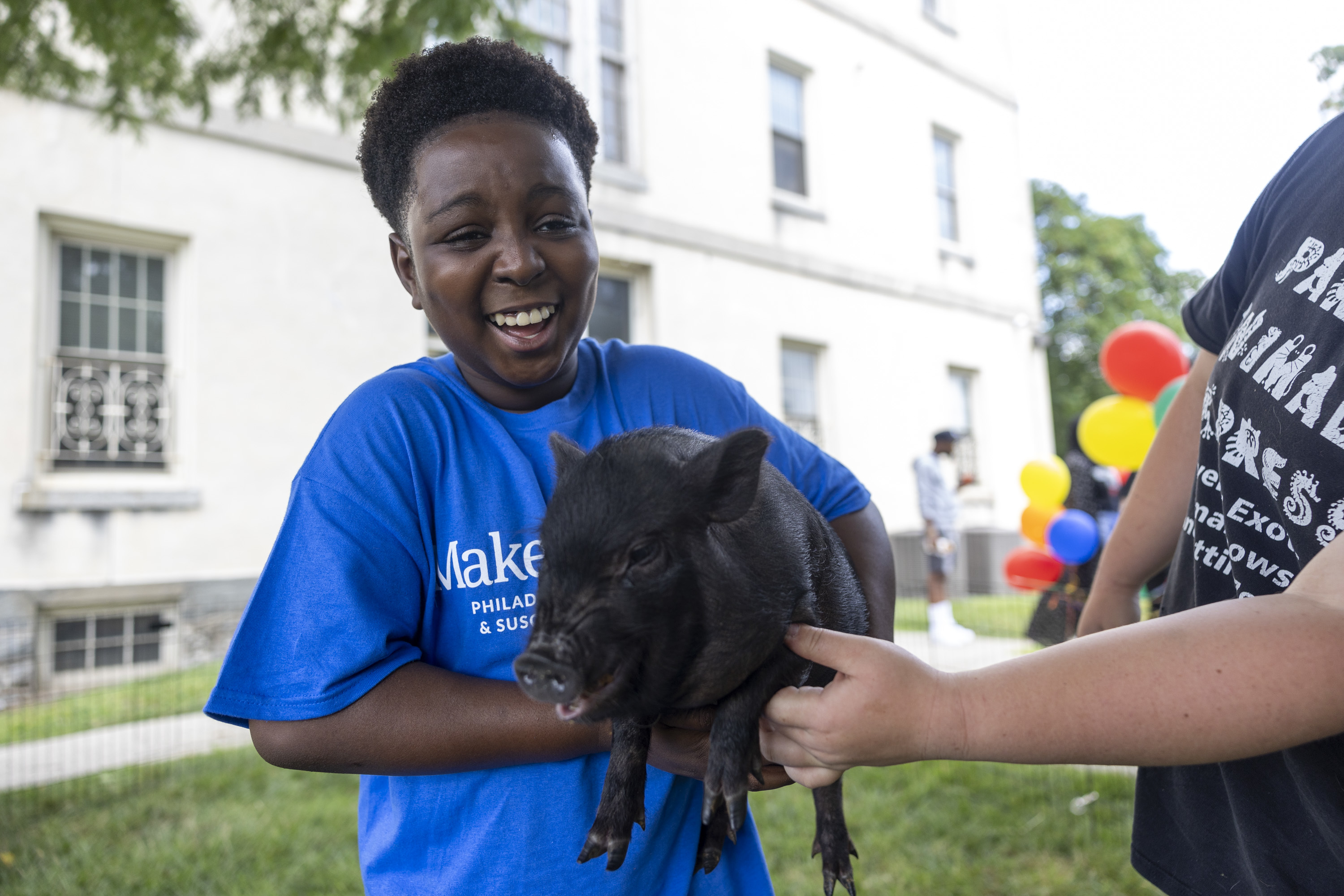
    Sam Okyere, 12, is holding Penelope the pig at the petting zoo during his Make-A-Wish donation drive and block party at Families Forward Philadelphia homeless shelter in Philadelphia, Pa., on Wednesday, July 29, 2026.Tyger Williams / Staff Photographer

    “Zane, Kai, Lloyd,” he said, pointing at two goats and then the pig, naming all after characters on his favorite show Ninjago, which the uninitiated will be unsurprised to learn is a show about Legos.

    Soon a 3-year-old named Saga, wearing a white dress smattered with images of heart-shaped lollipops, entered the petting zoo enclosure, mouth agape as she stood eye-to-eye with the recently named Ashton the goat and gently patted the silver nubs on either side of its bony head. This was her first experience with farm animals.

    Her mother, Quechera Jowers, 32, followed closely. The pair have lived at the shelter for about four months.

    “I’m not going to lie, it’s a little nostalgic,” Jowers said, taking in the carnival sights as they waited in line for cotton candy, which, based on crystallized red formations encrusted around Saga’s mouth, it appeared she’d already indulged in.

    Throughout the afternoon, gleaming toddler cheeks transformed into butterfly wings, kitten whiskers, and dragon scales with face paint. Pink and purple beads were strung into friendship bracelets, and technicolor swimsuits (each child got one through Sam’s donation drive) grew soaked from a sprinkler raining down on the kids as they descended an inflatable slide adjoined to the bounce castle. Navigating the pipe system of the old converted asylum-turned-shelter facility was the challenge of the morning, Main said.

    Beyoncé blared from a portable DJ booth, chubby fingers grasped balloons on strings and absentmindedly released them into the stratosphere, and a topless toddler with wild curls boogied near the mouth of a bubble machine, a diaper band peeking out from his khaki shorts.

    Sam Okyere, 12, is trying out the DJ set with Nashirah Felder, of Fishtown, during his Perfect Day Make-A-Wish donation drive and block party at Families Forward Philadelphia homeless shelter in Philadelphia, Pa., on Wednesday, July 29, 2026.Tyger Williams / Staff Photographer

    Sam, meanwhile, alternated between the Lego games, petting zoo, and basketball station.

    After discreetly lowering his game controller in the middle of a Lego joust, allowing a friend to overtake his spacecraft and win the game, Sam sauntered over to the goats situated in a kennel in the back of a truck to bid them farewell.
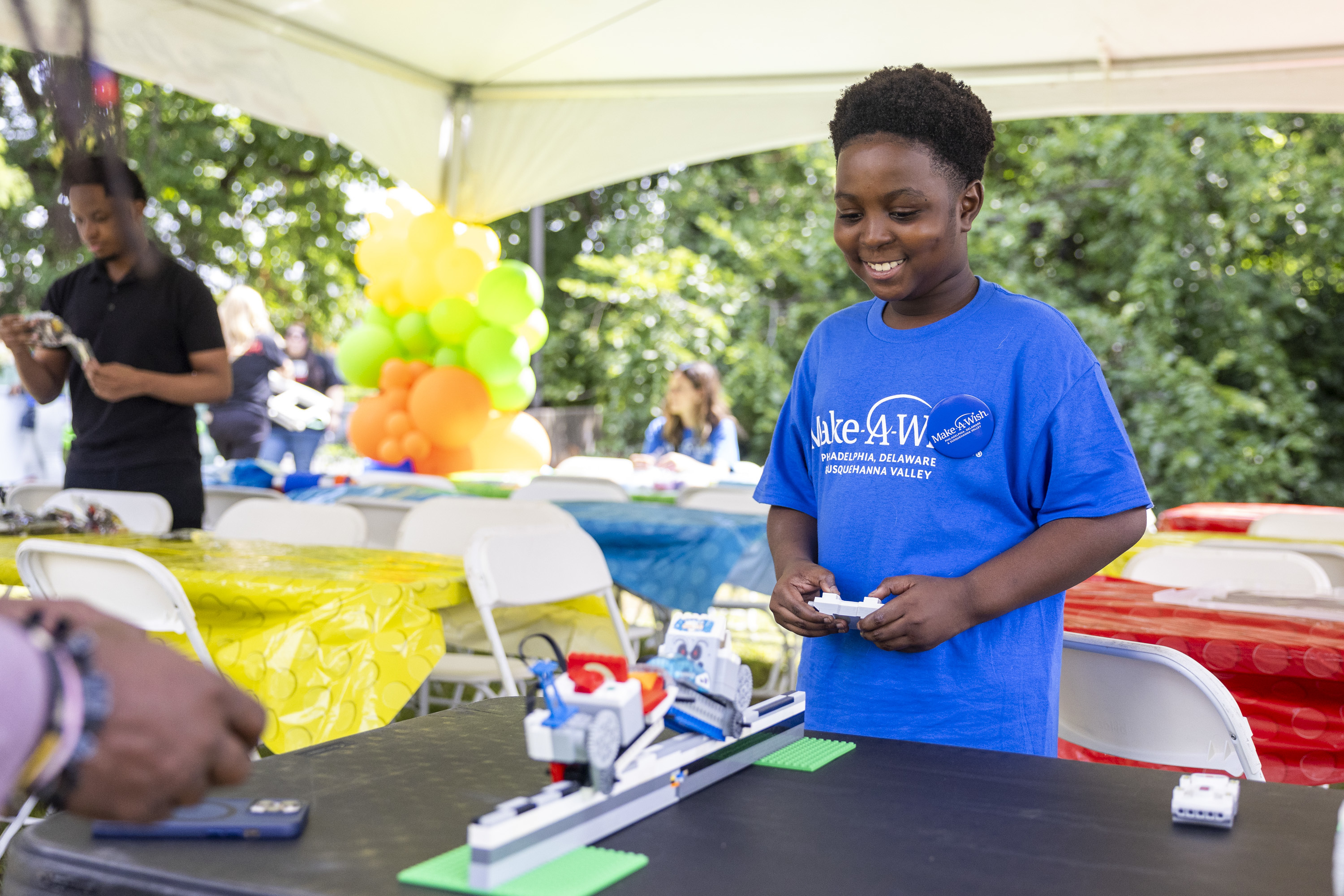
    Sam Okyere, 12, plays against Corey Samuels, 41, of Princeton, N.J., a LEGO Masters winner, during his Make-A-Wish donation drive and block party at Families Forward Philadelphia homeless shelter in Philadelphia, Pa., on Wednesday, July 29, 2026.Tyger Williams / Staff Photographer

    “I don’t want them to leave,” he mused as he delicately scratched a tan one on the chin and, with an understated graciousness rare to find in adults, let alone children, allowed the petting zoo staff to take them away.

    As the afternoon drew to a close, Sam settled into a chair in the hallway full of donations and futzed with a small Lego vehicle. An event organizer informed him that the Lego store employees offered to gift him all the leftover toys. Sam politely declined and requested they instead be given to the kids at the shelter.

    Asked in the final moments what could have made Sam’s Perfect Day more perfect, he contemplated.

    “Nothing,” he resolved.

    Nothing at all.
  • HBO series ‘Task’ to film in Wissahickon Valley Park in August

    HBO series ‘Task’ to film in Wissahickon Valley Park in August

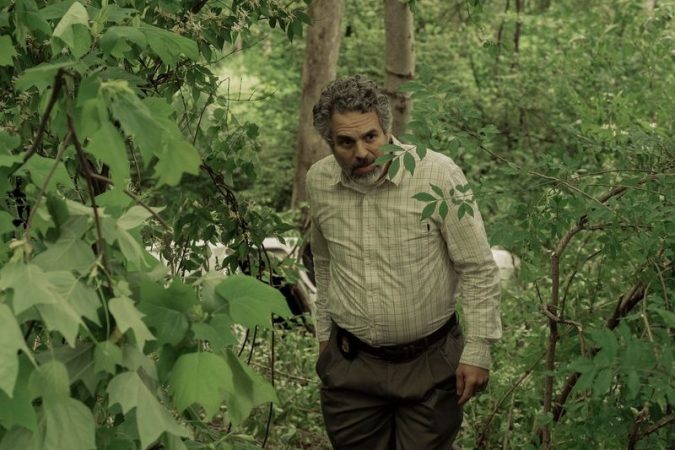
    If you’re taking a run through Wissahickon Valley Park next week and spot those signature Mark Ruffalo curls and determined glint in his eye through the tree leaves, worry not! The HBO series Task is filming its second season in the Northwest Philly park Monday through Friday.

    On Monday, the Bells Mill West Lot will be closed to the public for filming and will reopen the next day. Visitors can park instead in the Bells Mill East Lot.

    On Tuesday and Wednesday, the trail entrance at Manatawna Avenue will not be accessible. Houston Meadow can be accessed through the Houston Playground entrance on the Yellow Trail.

    The film crew is slated to park vehicles and equipment on some parts of Forbidden Drive. The trail will remain open, but hikers and runners may see stop signs warning them of “equipment ahead” or to go “slow ahead.”

    In July, the crew was spotted filming in Manayunk.

    The Delaware County-set series Task by Mare of Easttown creator and Berwyn resident Brad Ingelsby centers on FBI agent Tom Brandis, portrayed by Ruffalo. In the second season, Brandis is leading a new task force and confronting his rival Philadelphia DEA agent Eddie Barnes, played by Mahershala Ali, the Oscar winner who starred in Moonlight, Green Book, and the third season of the HBO crime show True Detective.

    The show’s first season also made its way around the city and suburbs. It featured scenes at the Rita’s Italian Ice & Frozen Custard in Collingdale, the Willowbrook Shopping Center in Boothwyn, and Marsh Creek State Park in Downingtown.

  • Of all the places in the world, pop star Audrey Hobert says she would haunt Drinker’s Pub in Center City

    Of all the places in the world, pop star Audrey Hobert says she would haunt Drinker’s Pub in Center City

    Ever been throwing back a white tea shot (or four) at Drinker’s Pub at 19th and Chestnut Streets and found yourself wondering: “You know what would make this better? A slender strawberry-blonde ghost.”

    Well, apparently, you wouldn’t be the only one. At an onstage Q&A in a respite from performing, singer-songwriter Audrey Hobert was asked: “If you could haunt any place, just some place, for the rest of your life, what would you choose?”

    As she gripped a plastic water bottle sitting in front of a large speaker, Hobert, who grew up in L.A., smiled and contemplated.

    “Such a great question,” responded Hobert, in a lime green zip-up and gym shorts. “I would probably haunt this bar in Philly which is where, during my song ‘Silver Jubilee,’ it’s like based on a real weekend in Philly in my life and that’s where we spent most of the weekend so I’d probably haunt that bar. It’s the best bar I’ve ever been to.”

    The video capturing the moment was posted Sunday on TikTok and labeled as “audrey q+a in columbus.” It has since amassed more than 130,000 views.

    @thewayiloafedyou audrey q+a in columbus!! #audreyhobert #whostheclown #fangirl #staircasetostardomtour #concert @Audrey Hobert ♬ original sound – addi 🪩

    Hobert said she couldn’t recall the name of the bar in the moment, but a blog post on her website detailing the backstory of “Silver Jubilee” explains that the song was inspired by a Halloween weekend in 2024 she spent at Drinker’s Pub in Center City celebrating her cousin’s 25th birthday.

    Hobert didn’t go into detail about what made the experience so memorable other than spending time with friends and family and a mysterious man from Spain. But almost two years later, the neighborhood haunt (pun somewhat intended) still clearly holds a special place in her heart.

    The “Sue Me” singer is in the midst of her “The Staircase to Stardom Tour,” which stopped in Philadelphia on June 10 at the Met.

  • DraftKings sues Philadelphia for investigating whether it’s violating city consumer protection laws

    DraftKings sues Philadelphia for investigating whether it’s violating city consumer protection laws

    DraftKings, one of the nation’s biggest sports betting companies, is suing the city of Philadelphia in an effort to stop an investigation into the company.

    The city is investigating whether DraftKings has violated the Philadelphia Consumer Protection Ordinance, a 2024 law designed to protect Philadelphians from deceptive business practices, according to the lawsuit and accompanying documents.

    In response, DraftKings contends a state law, the Pennsylvania Unfair Trade Practices and Consumer Protection Law, preempts the city‘s ordinance. The Boston-based company argues in the suit filed Thursday in federal court in Philadelphia that the city is trying to usurp the state’s authority through its investigation.

    “DraftKings filed a lawsuit against the City of Philadelphia because we believe the City has acted beyond the scope of its authority on matters governed by state law and regulated by the Pennsylvania Gaming Control Board,” the company said in a statement. “DraftKings remains committed to operating responsibly and in full compliance with Pennsylvania law, and we look forward to addressing this issue through the legal process.”

    The city declined to comment due to litigation being ongoing.

    The legal sparring match comes as sports betting companies have come under fire locally in recent weeks due to tactics they’ve used to entice bettors to keep wagering money on their sites.

    Last week, The Inquirer reported on a personalized video that FanDuel, another sports betting company, sent to a bettor featuring Phillies star Bryce Harper. A lawsuit filed by the nonprofit Public Health Advocacy Institute on behalf of that bettor and another alleges the Harper video is only one of a series of incentives sports betting companies offer to patrons to keep them hooked.

    A subpoena attached to the DraftKings case shows the city requested a host of documentation from the company by May 24. That included requests for details on how much money Philadelphians have wagered in the past three years, how many Philadelphians have placed bets on DraftKings in the past three years, and what kinds of marketing materials have been used with Philadelphians.

    It’s unclear what, if any, of the documentation DraftKings provided the city.

    The city had no right to request such documents due to the state law superseding the city’s version, DraftKings said in its lawsuit. It’s now asking the U.S. District Court for the Eastern District of Pennsylvania to rule that the city overstepped and let DraftKings off the hook for complying with the subpoena.

  • Philly temperatures are forecast to near 100 degrees, again, this week

    Philly temperatures are forecast to near 100 degrees, again, this week

    No rest is in sight for the weary Philadelphians still recovering from the scalding week that led up to the city’s July Fourth festivities. Temperatures this week are expected to near 100 once again.

    The National Weather Service has issued an extreme heat watch for Wednesday, when temperatures are expected to peak at 99 degrees, accompanied by a heat index of up to 108. Before then, a high of 93 is expected on Tuesday. Temperatures should return back down to 93 on Thursday and settle at 92 on Friday, according to the service’s forecast.

    The forecast doesn’t anticipate anything quite as severe as the series of triple-digit days leading to July Fourth, but it will surely be humid, hot, and uncomfortable, said Zack Cooper, a meteorologist with the National Weather Service’s Mount Holly office.

    Similarly to the early July heat stretch, rain is possible to follow the heat over the weekend, Cooper said.

    The city has tallied eight heat-related deaths this year, according to the city health department.

    This blanket of heat in the atmosphere “probably won’t be centered” over the Philadelphia area, Cooper said. “What really set the last event apart from this one was that high pressure center being right over the area for a period of a few days where, in this case, it’ll mostly be suppressed down to our south.”

    Virginia and West Virginia are anticipated to experience the brunt of this heat spell, he added.

    Temperatures this week are unlikely to break records, Cooper said, as the hottest recorded temperature in the Philly area on a July 15 was 103 degrees, set in 1995.

    Still, Cooper advised Philadelphians to treat this heat similarly to the early July heat wave — limit time outdoors, dress in lightweight clothing, and check up on neighbors.

    “It still will be dangerous heat,” he said.

  • They call her the Delco Dog Detective. She’s spent over a decade finding the Philly area’s hardest to catch lost dogs

    They call her the Delco Dog Detective. She’s spent over a decade finding the Philly area’s hardest to catch lost dogs

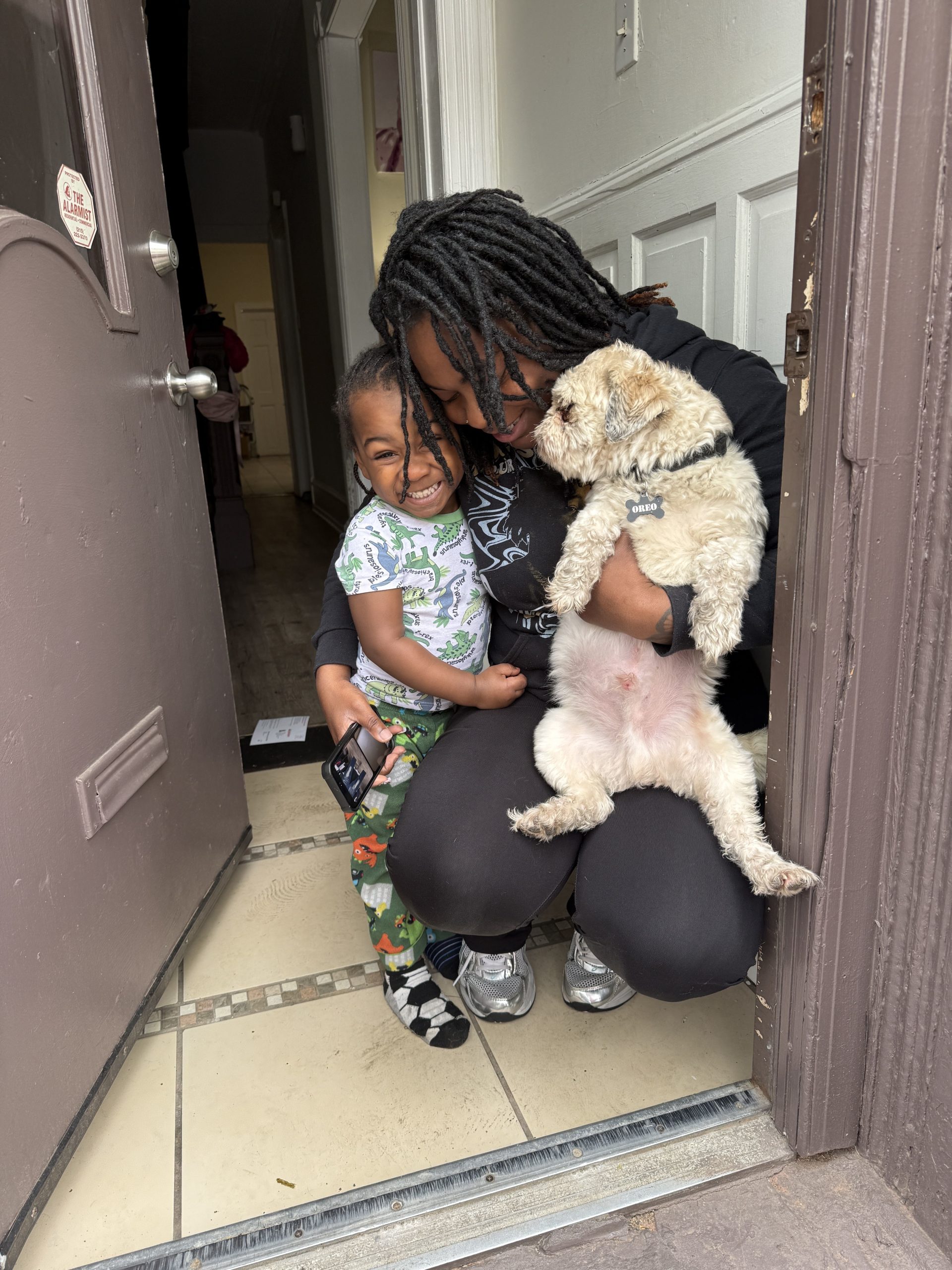
    His eyes were smeared with black goo, his legs were caked in dirt, his back was riddled with ticks, and a chunk of fur was missing from his upper lip. And yet, Oreo, a 4-year-old shih tzu, blissfully bounded up the front porch steps of his Mantua home on a Sunday morning in April.

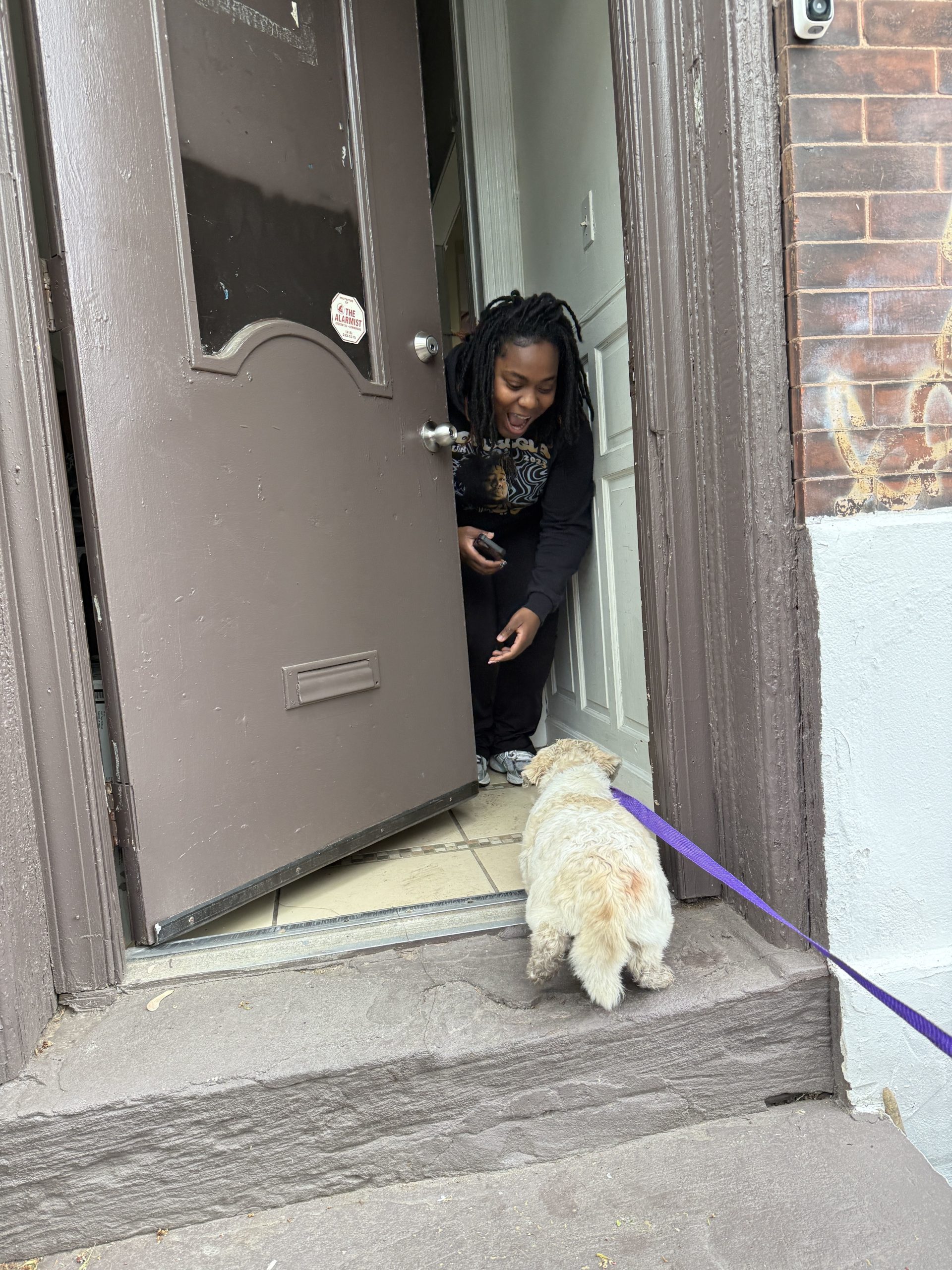
    He wedged his tiny frame between the door and the molding, a crumpled purple leash trailing from his neck, waiting until the knob turned and 22-year-old Jayda Pizarro appeared in a black hoodie and yoga pants. Her braces sparkled as she beamed widely and greeted her pup, who’d been lost in the woods for the last 15 days.

    Jayda Pizarro reunites with her dog Oreo at her Mantua home.Dana Munro

    Tears dripped from Pizarro’s eyes onto the tile foyer floor as she nestled Oreo between her cheek and shoulder.

    “Thank you,” she sniffed out as she cradled his body and rocked him in her arms. “We’ve been crying every day.”

    It was all in a morning’s work for 53-year-old Colleen Bell, who estimates she’s recovered nearly 1,000 dogs, both strays and family pets, over the last roughly 14 years.

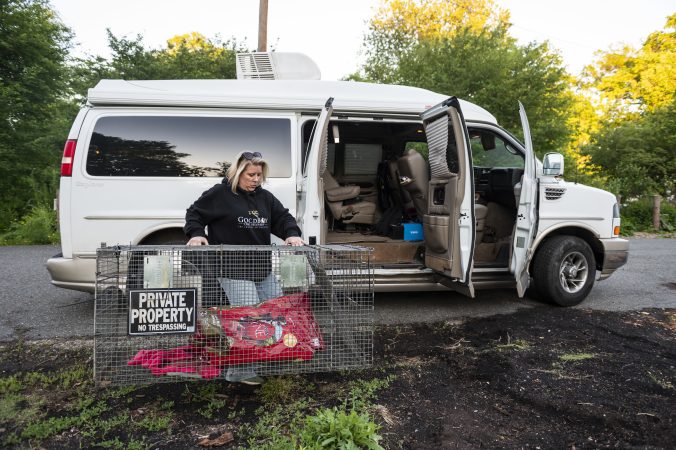
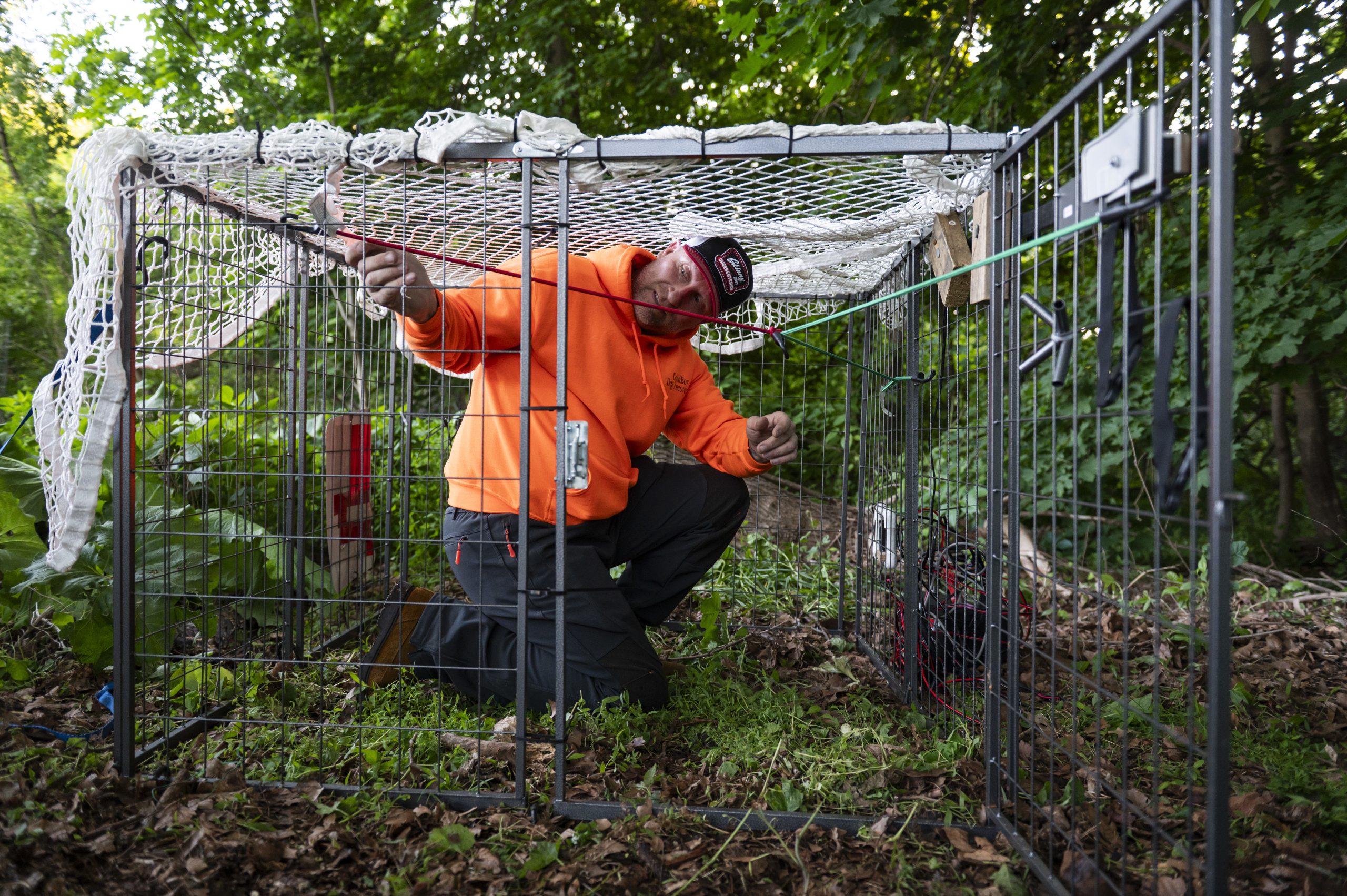
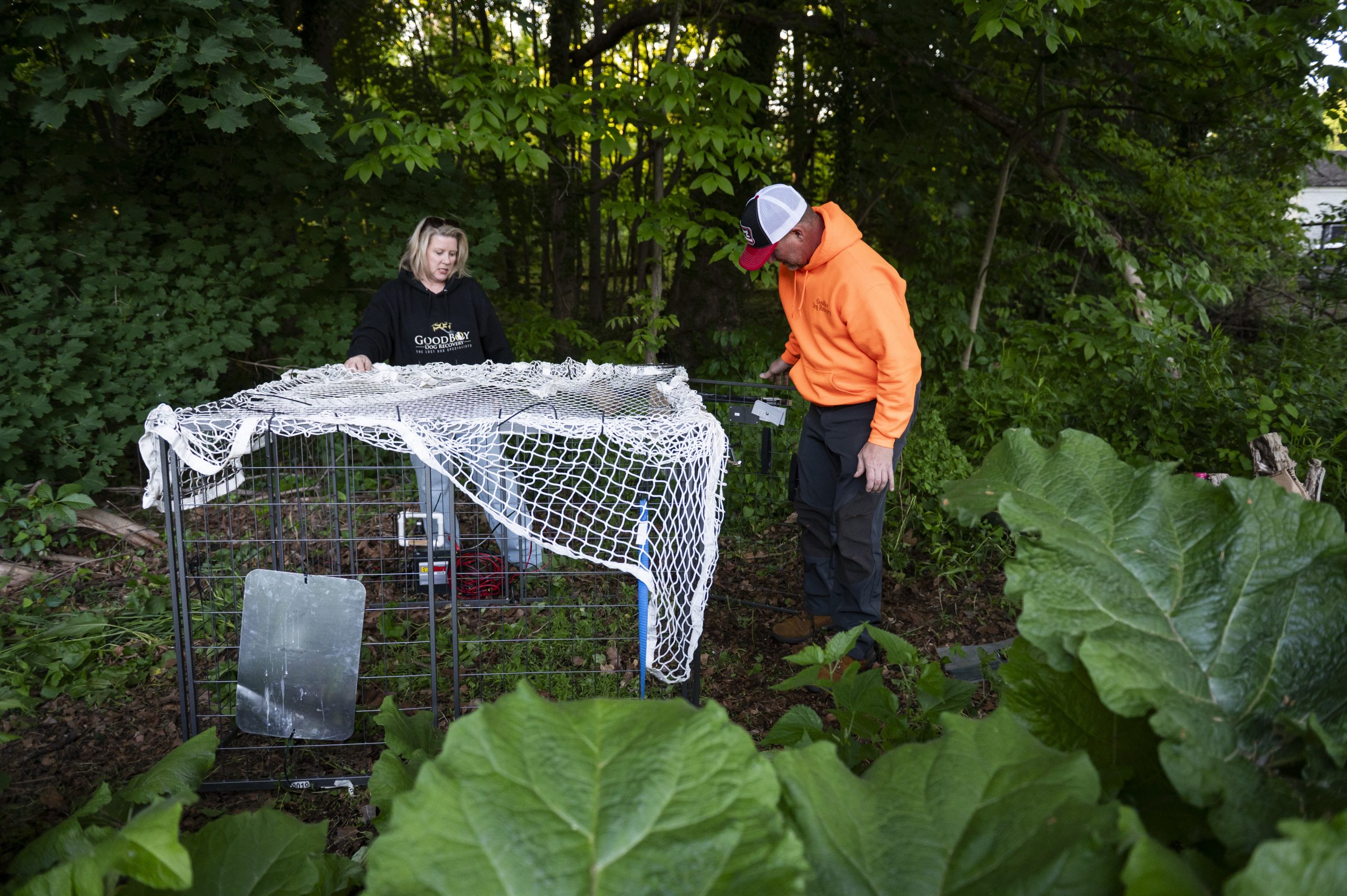
    Colleen Bell finishes setting up a dog trap by the Woodford Mansion in Fairmount Park on Monday, May 11, 2026. Bell runs the non-profit, GoodBoy Dog Recovery, where her and her brother and friend catch mainly stray and lost dogs in the Philadelphia region.Allie Ippolito / For The Inquirer

    Bell doesn’t do this work for money, acclaim, or internet fame. She does it purely for a love of the game, the thrill of the hunt, the satisfaction of capturing a petrified pup, and the fulfillment of reuniting it with a frenzied family.

    Over the last several years, she’s become a trusted and critical resource for the Animal Care & Control Team of Philadelphia and many others in the region and across the globe. She’s also become a fearless dog rescuer, who’s traversed mountains, driven through blizzards, sifted through building rubble, and charged through rainstorms with soccer nets to retrieve retrievers, shepherd shepherds, and master mastiffs.

    Puppy love for a new pursuit in life

    Bell spent much of her Lower Chichester upbringing tearing through Nancy Drew books as a steady procession of stray dogs came and went from her Delaware County home.

    However, this specific fusion of her love of dogs and solving mysteries didn’t set in until decades later. It started about 14 years ago with a black pug named Lilly.

    When her neighbor with dementia accidentally let Lilly out the front door, Bell, a single mother with two adult daughters and some time on her hands, volunteered to help. She and others weren’t able to find the dog, but the experience, Bell said, “kind of sparked something in me.”

    When another opportunity arose to reunite a lost dog with its family, she was determined to do so. So she contacted Justice Rescue, a Pennsylvania-based animal welfare group, which had special traps designed to catch animals. The dog was caught within five minutes.

    From then on, “I was kind of hooked,” she said.

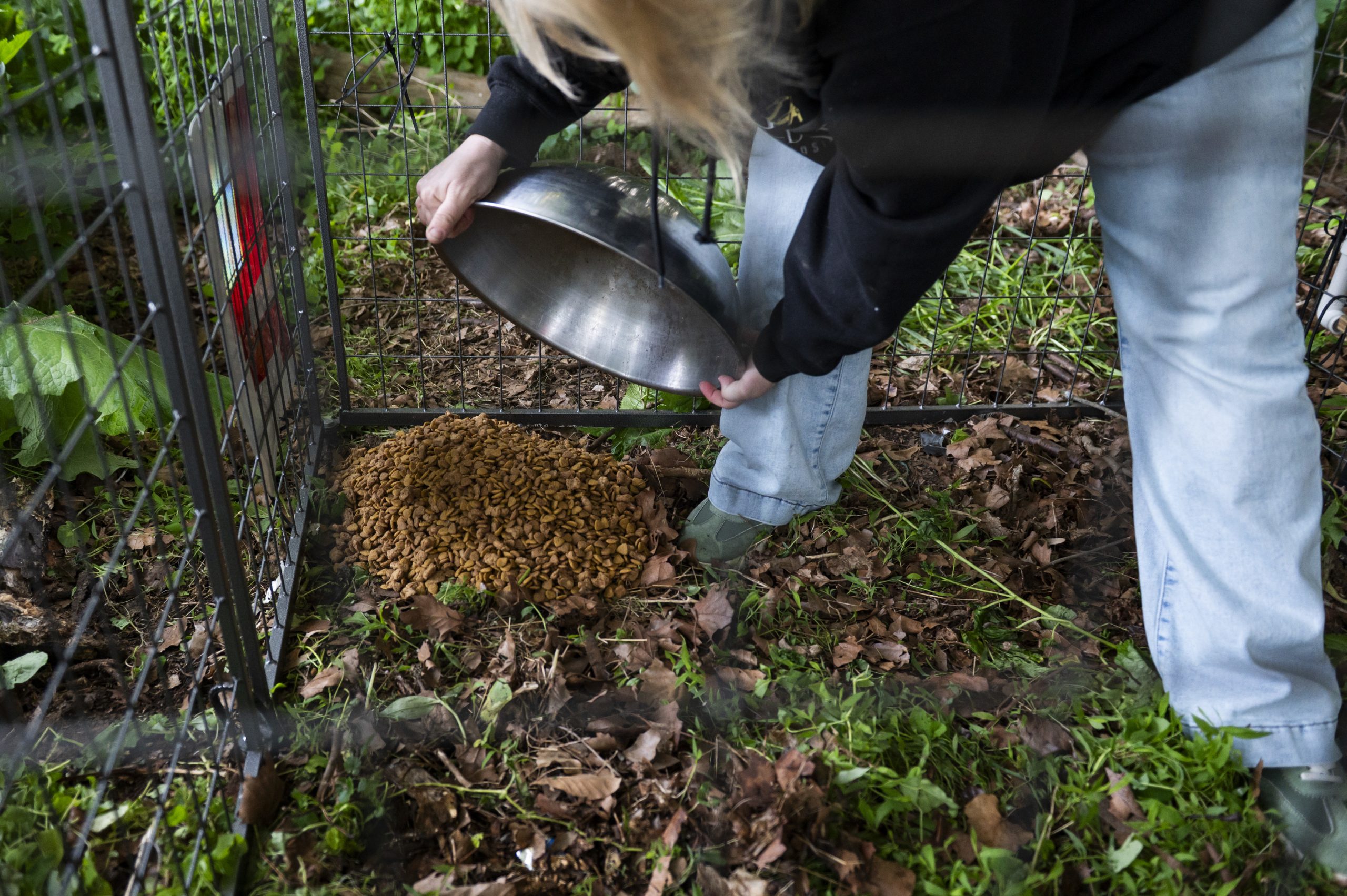
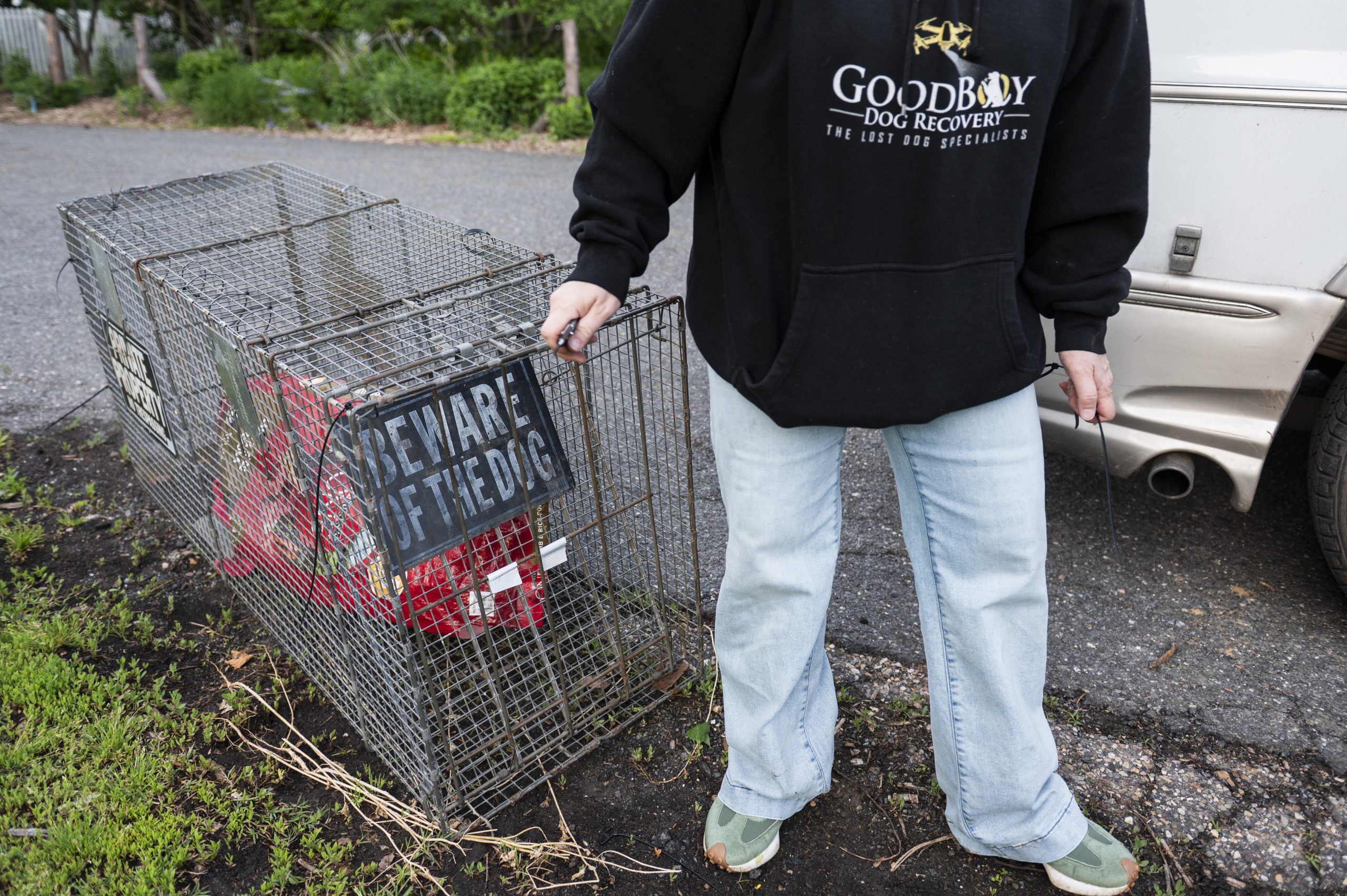
    Colleen Bell dumps food into a dog trap in hopes of luring a local stray dog by the Woodford Mansion in Fairmount Park.Allie Ippolito / For The Inquirer

    Slowly, she started collecting her own equipment — some traps, some cameras, and some dog food.

    With a little outside advice, a whole lot of dogged persistence, and through good old-fashioned trial and error, she refined her approach. She learned what entices fearful dogs and what scares them off. She studied their body language and behaviors and miraculously kept all her fingers and toes in the process.

    She filled her free evenings after her day job as a supervisor at a health insurance company with stakeouts.

    Most people in her life didn’t know she was doing any of this until one fateful midnight about two years ago.

    Tanwyn the golden retriever was missing in Chester County’s White Clay Creek Preserve. Bell tried every tactic in her arsenal. She even purchased a stuffed golden retriever toy that breathed and cried in hopes it would spark Tanwyn’s maternal instincts. She set up traps and slept in her car overnight in case the dog appeared. But nothing worked. Bell needed to get closer.

    She procured a duck blind and positioned it near the trap so she could hide behind it and grab the leash if the dog came close enough.

    Around 12:30 a.m., as she sat alone in the preserve, fear set in.

    “What the hell am I doing?” she thought to herself. “I’m scared to death. Nobody knows I’m here.”

    But she couldn’t leave. It wasn’t in her nature. It could be the night the dog came. So she called her brother, Brian. Of her three older brothers, Brian had always been the “dependable” one, she said.

    “What are you doing?” she asked him.

    “I’m sleeping,“ he replied. ”What’s going on?”

    Within the hour, he was there. And, for the most part, he hasn’t left her side since.

    “I’m an older brother,” said Brian Bell, 55. “It’s my job to look out for her.”

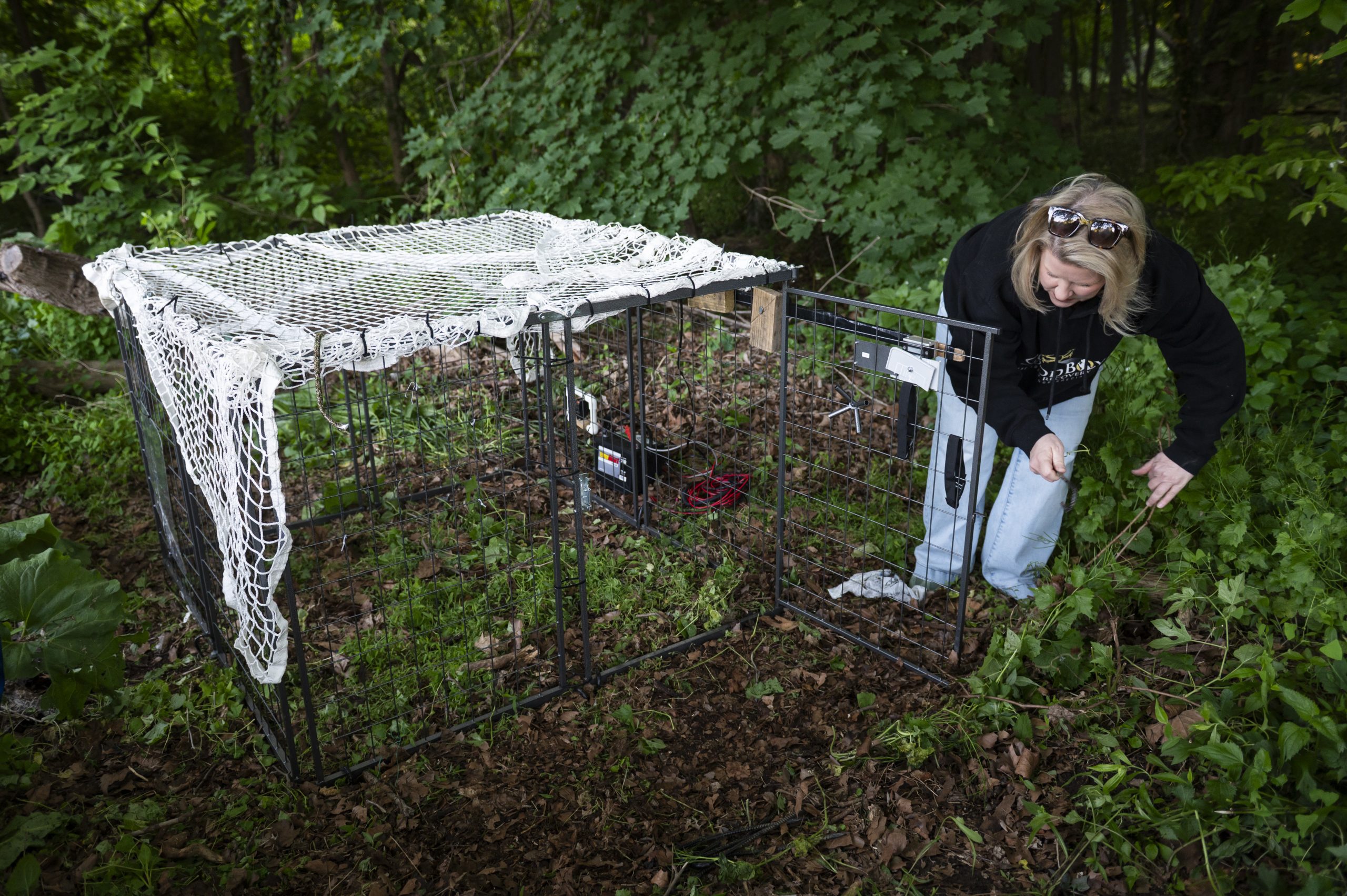
    Brian Bell sets up a dog trap by the Woodford Mansion in Fairmount Park.Allie Ippolito / For The Inquirer

    Previously, the two had gone years without speaking. They were raised in an abusive household, Colleen said, which led her to distance herself from her siblings.

    “I just couldn’t deal with talking to anybody” from that part of my life, she said.

    The dog recovery work reunited all four of them, Colleen said, but especially her and Brian.

    “He’s become one of my best friends,” she said.

    “We’re like inseparable,” Brian added.

    Soon their friend Alan Boates, 45, got involved as well. All three, who live minutes from one another in Chichester, adore dogs and the rush of capturing one on the run fending for its life.

    Quickly, Brian Bell and Alan Boates understood their assignment as the muscle of the operation. Colleen Bell was the brains, and neither hell (an unstable building or unscalable mountain) nor high water (frozen creeks and torrential downpours) were going to stand in her way.

    “There’s nothing that she won’t do to save a dog,” Boates said. “If she got to sacrifice us for a dog, it’s the dog.”

    Boates, who owns a construction company, leveled up their equipment. They built traps operated by remote control and others activated by laser beams.

    They upgraded items as they found more advanced versions online. They swapped DIY drop nets for net launchers that hang between trees and shoot nets at the ground.

    At one point, Colleen Bell came across literature about thermal drones and how they create digital maps that can help locate animals in dense woods so she bought one for $8,000 and roped a retired state trooper into teaching her to fly it. It shattered on the asphalt due to a faulty battery. Luckily, she’d already purchased a more sophisticated one for $18,000.

    While she worked alone, Colleen paid roughly $15,000 to $20,000 a year out of pocket. She even took a second job at a nursing home to cover the costs. But once her brother and Boates came on board, the operation became more advanced, and the equipment too expensive to afford on her own.

    So, about two years ago she created a 501(c)3, GoodBoy Dog Recovery. Donations rolled in for fuel, food, traps, cameras, and more. Last year she raised about $134,000, according to a 990 tax form. Much of the money came from her 75,000 Facebook followers.

    Never letting sleeping dogs lie … alone in the woods

    Now, dog recovery is effectively Colleen’s No. 2 full-time job and No. 1 passion.

    Her days typically start with work at AmeriHealth Caritas at 7:30 a.m. She clocks out at 4 p.m., then texts her brother an eyeballs emoji to see if he’s free and up for an adventure. She’ll often reach out to Boates as well.

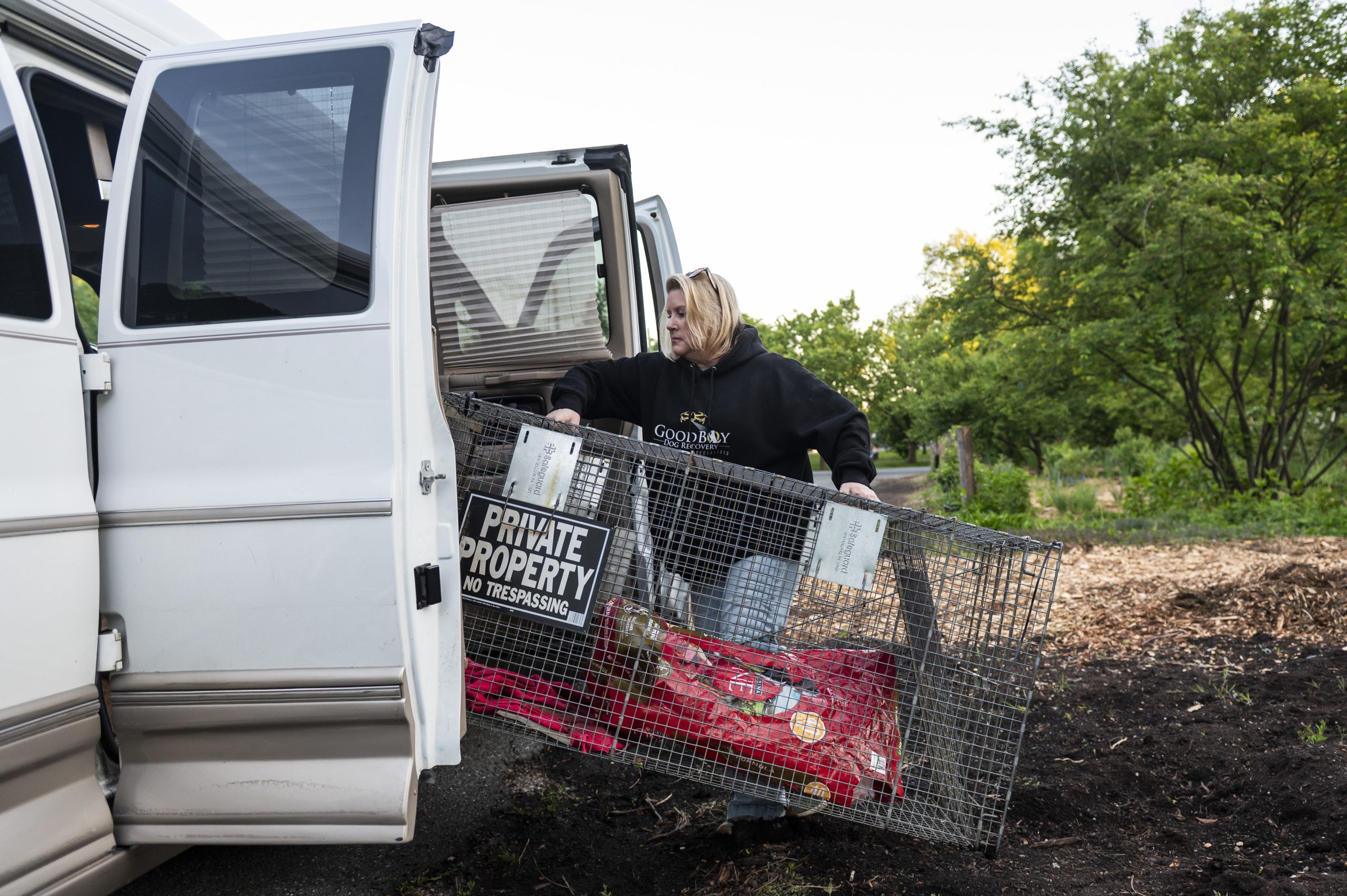
    On a recent Tuesday in June, she picked up Brian in a donated conversion van and drove to the Woodford Mansion near the Strawberry Mansion neighborhood.

    Colleen Bell (left) her brother Brian Bell (right) set up a dog trap by the Woodford Mansion in Fairmount Park on Monday, May 11, 2026. They run the non-profit, GoodBoy Dog Recovery, where they catch mainly stray and lost dogs in the Philadelphia region.Allie Ippolito / For The Inquirer

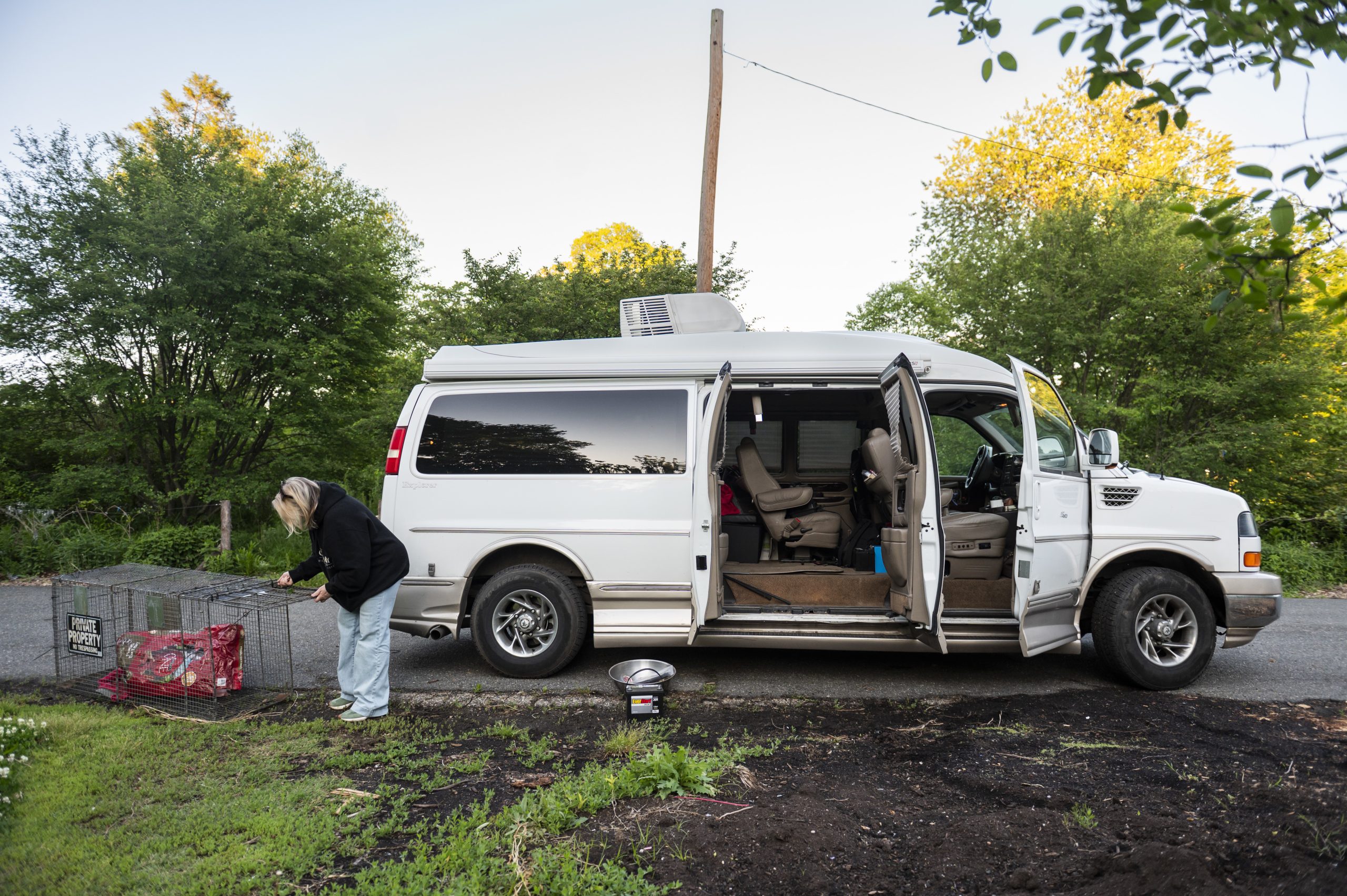
    They often sleep in the van parked near a trap in the woods. That’s because sometimes the dogs enter the traps in the wee morning hours and if the traps were unattended, the dogs might get confused and scared.

    On this night they pulled into a driveway at around 7:15 p.m. and replenished the kibble in the trap they’d set weeks ago for Parker, a stray pit bull they were pursuing. Colleen Bell sprayed the area with a barbecue-scented liquid smoke, which she buys by the gallon. Some of these dogs, especially if they’ve been in the wild a long time, survive primarily on wild game. So the crew keeps deer meat and chicken feet on hand. They even have a moose dealer.

    After they prepared the trap area, the siblings sat in the van and waited.

    They scrolled their phones, sipped juice, and nearly popped out of their seats when a jingle emanated from Colleen’s phone, which told them motion was detected in the trap.

    “Be a dog. Please be a dog,” she muttered to herself. “Oh it’s a raccoon. Oh it’s two raccoons.”

    About half an hour later the phone tinkled again. She rushed to press the alert.

    “Damn,” she said. “It’s a fox.”

    An hour later, another alert sounded. This time, it was Brian Bell who shot out of his seat.

    “I got a feeling,” he said with a cockeyed smile.

    “Fox,” she responded, deflated, before pressing a button on her phone that allowed her to transmit an audio message into the trap. “Get out of there,” she warned the fox before its white frame scurried out of view.

    Many nights, she only sleeps a few hours.

    “We never stop until we catch the dog,” she said.

    Colleen Bell drags a dog trap no longer in use to pack up in her van after setting up a different dog trap by the Woodford Mansion in Fairmount Park on Monday, May 11, 2026. Bell, her brother, and friend run the non-profit, GoodBoy Dog Recovery, where they catch mainly stray and lost dogs in the Philadelphia region.Allie Ippolito / For The Inquirer

    When normal methods cease to work, Colleen Bell will throw in a number of toys of her own invention. Her tactical lamb chop, as she calls it, a stuffed Lamb Chop toy into which she sews a GPS tracker, can be especially effective in locating dogs.

    For Brian Bell, the most satisfying part is watching his sister’s face when they close in on a canine.

    “Once she sees it, she’s locked in,” he said. “To her, it’s like each dog that we catch is like the lottery.”

    When they do finally catch them, sometimes the dogs are in disturbingly poor condition, Boates said. One they caught recently “looked like it has 10 legs because it was so matted,” he said. Another had cigarette burns all over its head. Some dogs are dead when they find them. The trio will retrieve the body for the family to deal with as it sees fit.

    For the dogs who are alive, once they’re securely in the trap or net, Colleen Bell puts them in the back of her van. They’re usually asleep within minutes.

    “They’re just so tired of running,” Boates said. “I don’t know what it is, with Colleen, it’s like they know she’s there to help them.”

    Colleen Bell gets ready to pack up her van after setting up a dog trap by the Woodford Mansion in Fairmount Park on Monday, May 11, 2026. Bell, her brother, and friend run the non-profit, GoodBoy Dog Recovery, where they catch mainly stray and lost dogs in the Philadelphia region.Allie Ippolito / For The Inquirer

    A dog eat dog state

    For the professionals, such as those in charge of the Animal Care & Control Team of Philadelphia, Colleen Bell is a critical resource, said Sarah Barnett, executive director of ACCT Philly.

    Barnett’s team gets thousands of calls a month, many about lost dogs. Locating them all would be impossible for ACCT to do alone.

    Not only does Colleen Bell search for dogs in Philly and the suburbs, relieving some of the load from ACCT, she also lends her equipment to individuals with missing pets.

    Philadelphia is relatively privileged in terms of animal resources when compared with surrounding areas, Barnett said. Many Pennsylvania counties, such as Chester and Delaware, have spottier animal care and control coverage.

    In those counties, sometimes, “the dogs just stay wandering,” Barnett said.

    Call off the dogs

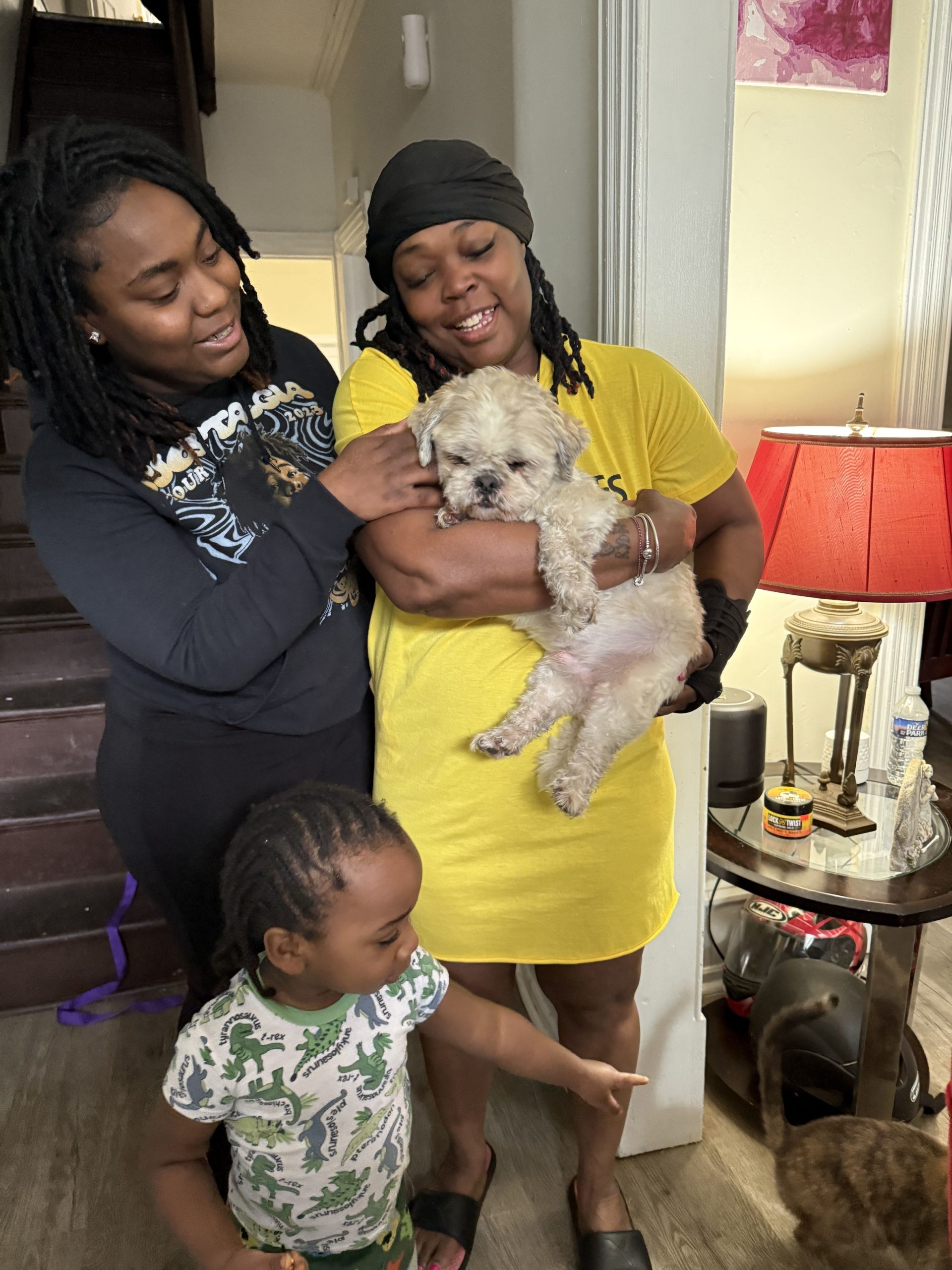
    On the sunny April morning Oreo returned to his Mantua home, he quickly settled back into the loving and chaotic environment he’d wandered off from weeks before.

    “Come see Oreo, Meatball,” Jayda Pizarro shouted up the stairs to her 3-year-old cousin who all in the home refer to by the name of the spaghetti topper.

    Jayda Pizarro reunites with her dog Oreo at her Mantua home.Dana Munro

    A toddler in dinosaur pajamas and one soccer-printed sock and one striped sock came ambling down the staircase.

    As Meatball delightedly watched Oreo wriggle on the floor, a cat emerged from the living room to judgmentally gaze upon the scene. All seemed as it was meant to be.

    Jayda Pizarro and her family reunite with their dog Oreo at their Mantua home.Dana Munro

    “I appreciate you,” Pizarro said with a smile for Colleen Bell before the dog detective climbed back into her van to continue her perennial search for dogs in distress.

    Colleen Bell packs her van with a dog trap no longer in use after setting up a different dog trap by the Woodford Mansion in Fairmount Park on Monday, May 11, 2026. Bell, her brother, and friend run the non-profit, GoodBoy Dog Recovery, where they catch mainly stray and lost dogs in the Philadelphia region.Allie Ippolito / For The Inquirer
  • Mayor Parker defends decision to host July 4th Parkway concert despite dangerous heat and high price tag

    Mayor Parker defends decision to host July 4th Parkway concert despite dangerous heat and high price tag

    Mayor Cherelle L. Parker on Wednesday defended the city’s upcoming July Fourth concert, a seven-hour outdoor spectacle featuring performances from Christina Aguilera, Jill Scott, The Roots, and more, amid concerns over the nearly 100-degree forecast and revelations that the event will cost taxpayers millions more than in years past.

    The city has dealt with high temperatures before and has battle-tested personnel and protocols prepared for the evening, Parker told reporters at a news conference in front of the stage at the foot of the Philadelphia Museum of Art steps.

    She also addressed the detractors head on.

    “I do not apologize to anyone about making sure that the city of Philadelphia, as the sixth-largest city in the nation, the birthplace of democracy, we were going to have a celebration that is fitting to and for our historical significance and prominence,” Parker said. “One that could be seen, respected, and honored, not just in our city and commonwealth and nation but in the world.”

    Parker described the concert as the largest July Fourth concert in the city’s history. For an occasion as momentous as the nation’s 250th anniversary in the city that bills itself the birthplace of America, Parker said Philadelphia must rise to the occasion and prove it can achieve ambitious undertakings.

    Parker said her administration scaled up the experience, including moving the stage back to accommodate an estimated 300,000 concertgoers, and made the stage larger.

    “We won’t get a second chance to do this over again, Philadelphia,” Parker said. “We only turn 250 years old once in a lifetime.”

    Ground crews set up speakers on the stage on Wednesday in preparation for the July 4 concert expected to draw thousands to the Benjamin Franklin Parkway.Jose F. Moreno / Staff Photographer

    Parker recalled feeling the mounting pressure to prove Philadelphia could rise to the occasion of honoring the nation’s 250th anniversary shortly after the start of her tenure as mayor.

    “‘Philadelphia lacks ambition. They’re thinking too small. We need a leader. Where is the legacy project?’” Parker recalled from the discourse of the time. “The critics were right. Philadelphia, as the birthplace, we couldn’t do what every other city was doing. We couldn’t just do something that was average, something that was mediocre. What we did had to be a reflection of this moment and our history.”

    Parker’s news conference came hours after The Inquirer reported online that this year’s July Fourth concert will cost taxpayers millions more than in years past because the mayor’s administration hired ESM Productions, a for-profit company, to put on the annual show. For years, the concert has been produced by Welcome America, a nonprofit established by the city.

    The Inquirer reported that the city is set to pay ESM $15.5 million to put on the show, and that last year’s iteration of the Welcome America concert cost the organization about $3 million.

    Parker defended ESM and its founder, Scott Mirkin, as “the gold standard in planning large-scale global events, not just in America but across the world.” And she vowed that the city would produce a “fiscal impact report” after the event to account for how much money the city spent on this year’s festivities.

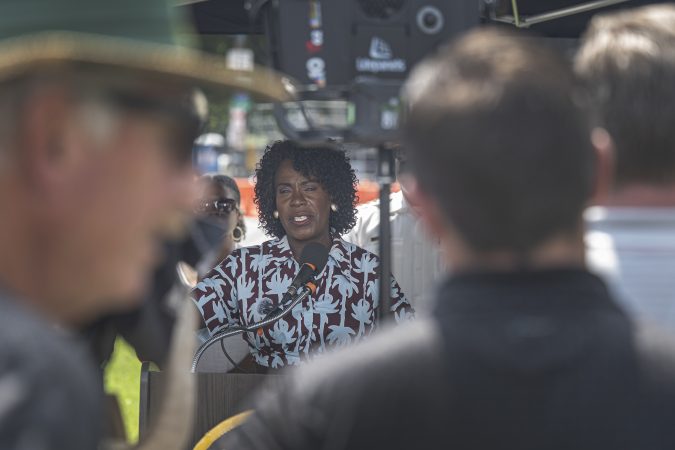
    Mayor of Philadelphia Cherelle L. Parker speaks during a news conference under a tent Wednesday, July 1, 2026, in Philadelphia, outlining public safety and transportation plans ahead of a July 4 concert expected to draw thousands to the Benjamin Franklin Parkway.Jose F. Moreno / Staff Photographer

    She also noted that former Mayor Jim Kenney put his own stamp on the annual July Fourth concert when he took office in 2016 — and took some heat for it. The Roots had headlined the concert since 2009, but Kenney’s administration went a different direction and The Roots were sidelined.

    Roots drummer Ahmir “Questlove” Thompson didn’t mince words at the time, writing on Facebook that the decision was “arrogance in the HIGHEST order courtesy of your new leader.”

    When Parker took office, she knew she wanted the spotlight back on the beloved local hip-hop group.

    “I’m proud to have The Roots back home,” Parker said.

    In terms of weather and safety, the city has proven this summer that it can host large-scale events in the heat seamlessly, said Philadelphia Police Commissioner Kevin J. Bethel.

    The city has already hosted five World Cup games, which have gone off without a hitch, Bethel said. For the July Fourth event, the department will be executing one of its largest deployments since the papal visit in 2015. That will include hundreds of officers across Center City and many more at the stadium and along the Parkway.

    “I want everybody to come and have a good time. Don’t mess up the party,” Bethel said.

    In order to keep people cool, the city will run 40 air-conditioned cooling centers, 150 pools and spray grounds, enhanced homeless service outreach, and extra fire department medics, said Dominick Mireles, Philadelphia’s deputy managing director for community safety. Along the Parkway, there will be misting fans and shade structures, he added.

    Parker said she’s confident every Philadelphian interested in participating will be able to do so safely and will look back on the day fondly.

    “I want people to remember where they were when America turned 250 years old and what we did here in the place when it all happened,” Parker said.

  • How Philly’s historical reenactors are preparing for their Super Bowl: The nation’s 250th

    How Philly’s historical reenactors are preparing for their Super Bowl: The nation’s 250th

    The players amble into the auditorium on a cloudy May morning to run through their schemes and formations and make last-minute adjustments to the roster. Some are already in uniform — waistcoats and breeches — fueling up on Wawa coffee and bagels. Others scroll aimlessly on iPhones or finish off their cigarettes outside the Free Quaker Meeting House near Independence Hall. They discuss contingencies, ready their gear, and buckle their latchet shoes tight.

    “Get out there and have fun,” their coach, Historic Philadelphia’s director of storytelling Johanna Dunphy, says as she sends her proud-chested team of historical reenactors off for their preseason opener.

    This is the start of the team’s Super Bowl run: the lead-up to the nation’s Semiquincentennial. The cast of Ben Franklins, John Adamses, and Betsy Rosses — actors who have spent months and uprooted their lives to learn about and live as colonial America’s key characters — will be at the front lines of the 250th birthday celebrations, which began with the cast’s opening day on May 23 and reach a fever pitch on July 4. They will become de facto historians, guides, entertainers, and ushers to an expected crush of tourists, all while anchoring how the country’s earliest days are memorialized and whose stories get to be told.

    “Fly!” Dunphy says with gusto as the performers shuffle out of the modest redbrick building.

    This set of actors is part of Historic Philadelphia’s Once Upon a Nation program — a series of performances staged throughout the summer and beyond in Philadelphia’s historic district and at Valley Forge. It’s Once Upon a Nation’s 21st season, but this year is expected to be one of its biggest ever, with the most actors, plays, scripts, and events.

    And, with tourism agencies expecting this summer’s events to draw upward of one million visitors, it’s almost certain to be the program’s largest audience.

    “Philadelphia is ready for you,” Amy Needle, Historic Philadelphia CEO, told the players on the last day of the preseason. “And I know you’re ready for them.”

    Shecky Perlman as Ben Franklin, and other historical reenactors receive their diplomas on May 21, 2026, after weeks of intensive, immersive training at the Benstitute. Tom Gralish / Staff Photographer

    Four months to game day

    Actors, mostly local, file in and out of Jason Greenplate’s office on a chilly January afternoon. Greenplate, program manager for Once Upon a Nation, and his colleagues are seeking the strongest possible players who have the passion, the look, and the improvisational skills to take on the characters and become “history makers” — what Historic Philadelphia calls its reenactors. It’s essential for these coaches to choose players who are not only capable of taking on these roles but are also willing to challenge their own understanding of history.

    Spencer Salusky, a 23-year-old fresh William & Mary graduate, walks through the door.

    As a draft prospect, Salusky is an impressive pick. He can execute even the most complex of plays (tricky lines and blocking), and his stats (body measurements and head shape) are optimal.

    “He kind of looks like John Adams,” Greenplate thinks.

    After conferring with his peers, Greenplate chooses Salusky to become Once Upon a Nation’s next John Adams, and, one by one, 19 more actors are cast as history makers and storytellers, those who are stationed at the city’s historic sites in green polos to offer context to visitors. They join the existing 30 company members returning from prior years.

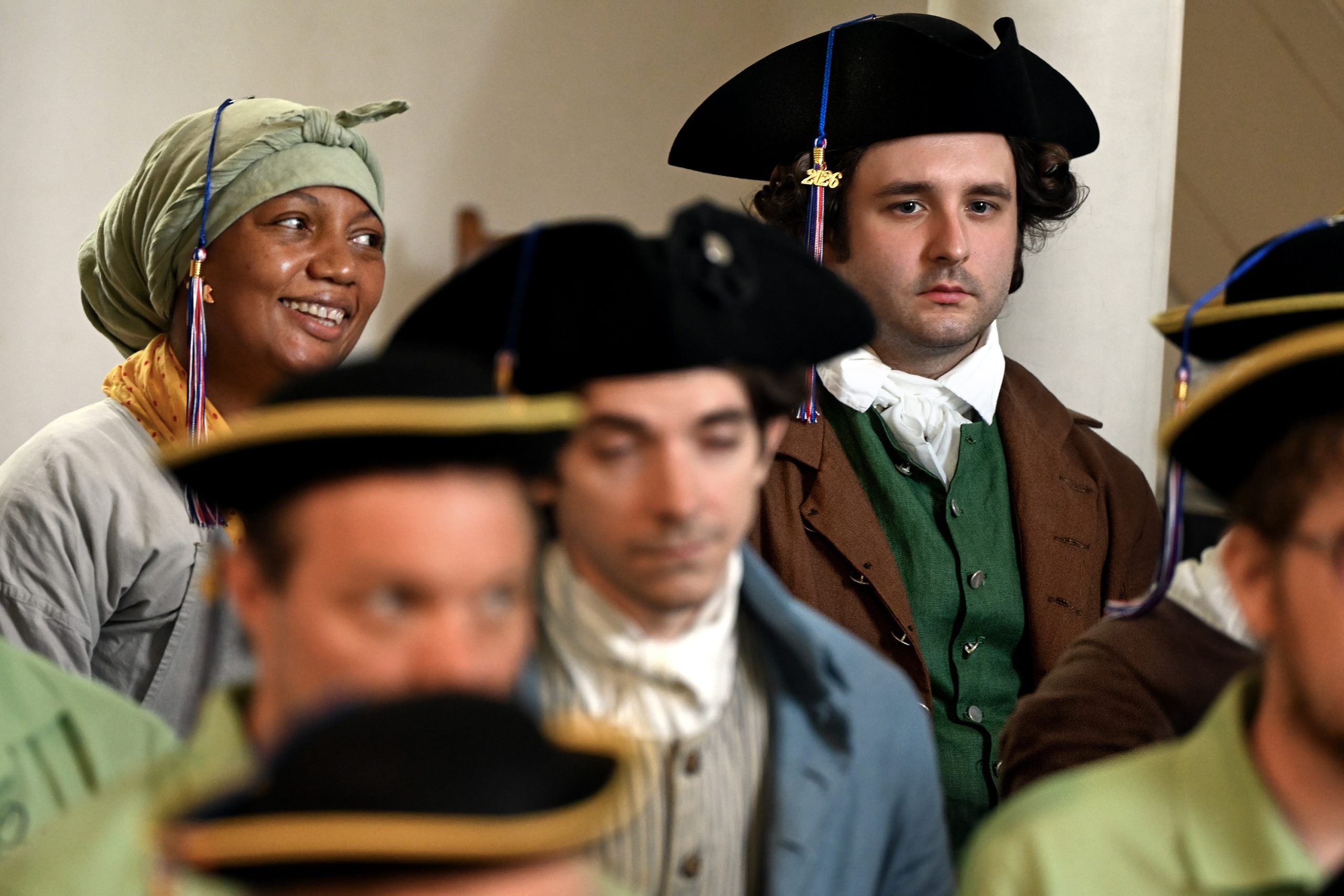
    Courtney Mitchell, who portrays Margaret Woodby (left), and Spencer Salusky (right) as John Adams, join other historical reenactors at graduation on May 21, 2026, after weeks of intensive, immersive training at the Benstitute.Tom Gralish / Staff Photographer

    Three months to game day

    The actors soon begin their training. For Salusky, that looks like receiving a large packet full of biographical information about John Adams — where he was born, his wife’s name, and his perspective on slavery — from Doug Thomas, director of history makers.

    Thomas is a player-coach, a star in his own right who can seamlessly transition to the coaches’ box. Like Deion “Prime Time” Sanders, Thomas is a Swiss Army knife on the field, having played every position in the game of historical reenacting, from William Penn and Patrick Henry to Francis Scott Key, and has been doing the work for nearly 30 years. But what makes him truly elite is his position as Mount Vernon’s George Washington.

    Out in the field, the players might be blindsided by a granular question from a tourist, an offensive remark from a passerby, or incessant badgering from a child. On the stage — where the history makers also perform a series of scripted plays — they must be prepared to embrace their characters’ conflicting motivations, shifting attitudes on political issues, and complex interpersonal relationships.

    Thomas is equipped to help them tackle it all.

    He guides them in studying their characters, trains them on redirecting conversations with visitors toward topics they’re knowledgeable about, and teaches them improvisational techniques. He also prepares them to embody the voice, posture, and behavior of historical figures.

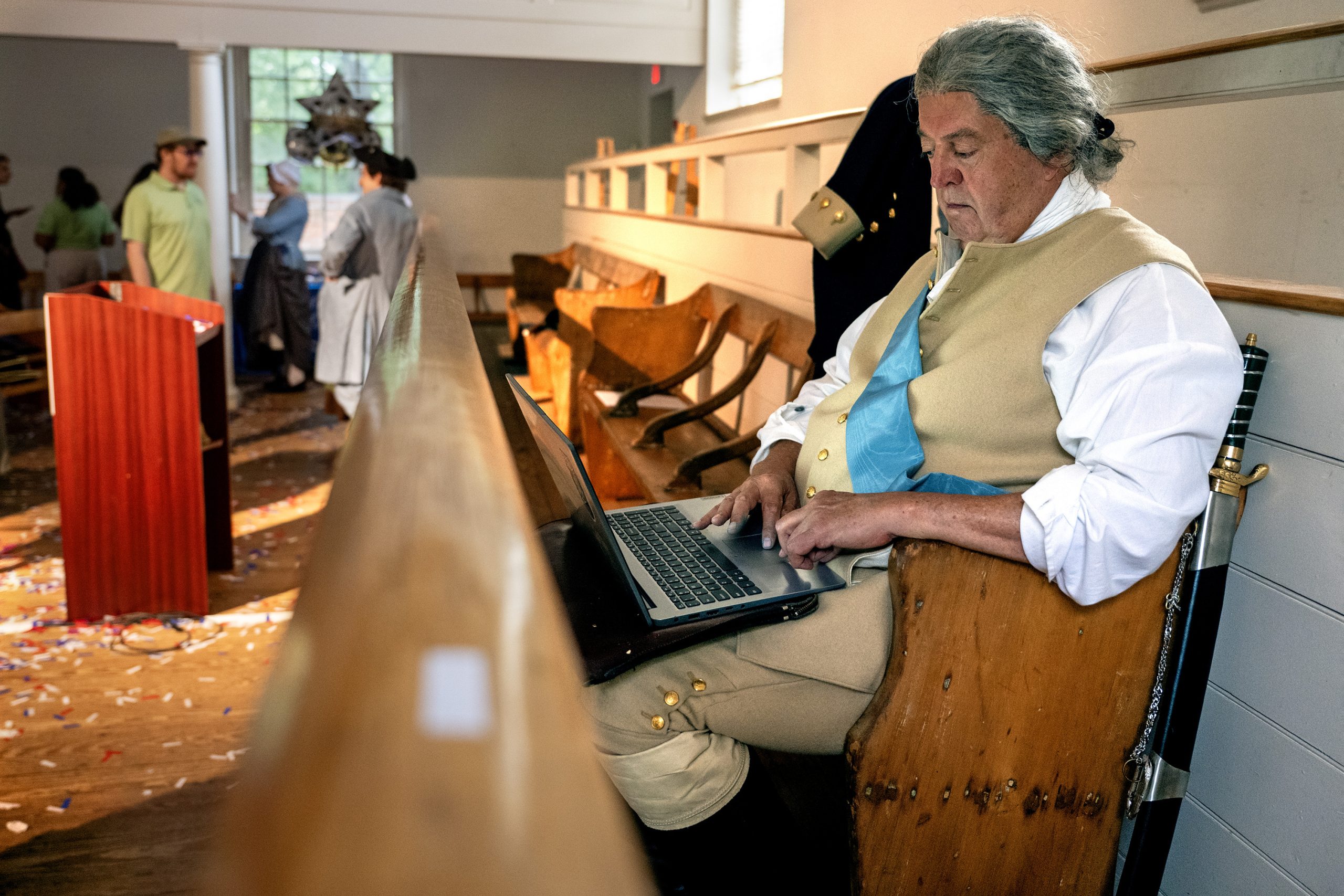
    Jim Fryer as George Washington checks in on his laptop on May 21, 2026, after the graduation of dozens of historical reenactors after weeks of intensive, immersive training at the Benstitute.Tom Gralish / Staff Photographer

    Three days to game day

    “Adams,” Thomas says, summoning Salusky during a rehearsal for Cocktails and Congress, a marquee performance in the Once Upon a Nation repertoire.

    On a scorching 95-degree afternoon that foreshadows what the players can expect during the steamy home games to come, Thomas scans the script, glasses poised atop silky black hair that grazes his shoulders. He directs Salusky’s attention to a moment in the dialogue: “Slavery is like a great cancer.”

    He cautions the actor to be careful with how he utters that line. Adams is torn about slavery at this point in his life, Thomas explains.

    “He doesn’t like it, he doesn’t support it, but also he does realize very practically what eliminating slavery would do to the economy,” Thomas tells Salusky.

    Salusky contemplates the note, sitting on a Meeting House pew with a mechanical pencil tucked behind his ear.

    “Adams is evolving,” Thomas tells him. But “he’s a practical man.”

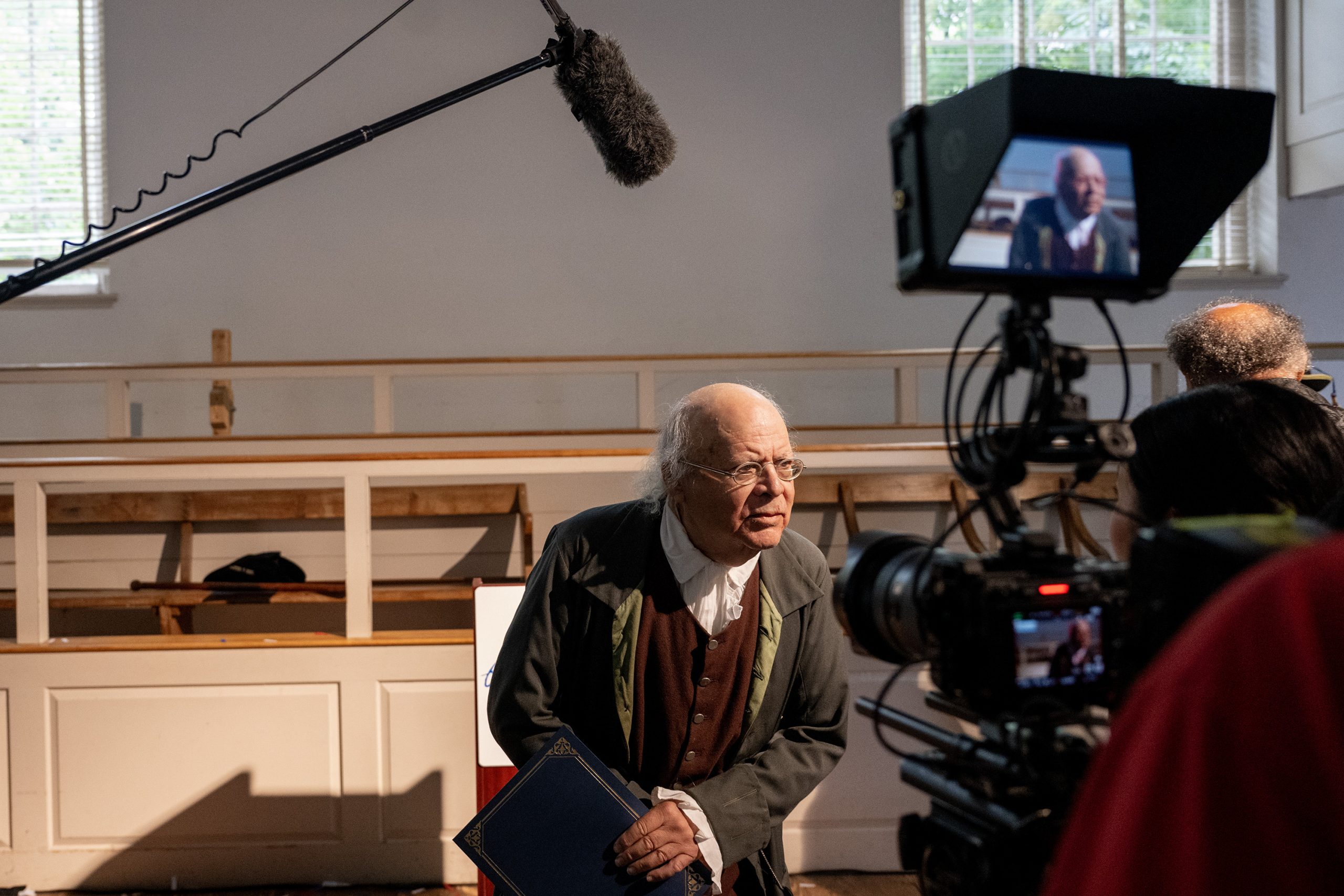
    Shecky Perlman as Ben Franklin, ready for his close-up, on May 21, 2026, as he is interviewed by a documentary film crew, as dozens of historical reenactors graduate after weeks of intensive, immersive training at the Benstitute. Tom Gralish / Staff Photographer

    Two days to game day

    Even with centuries of primary and secondary sources, and extensive research, there are still gaps in what’s known about 18th-century American life that the actors and program coordinators must contend with. There’s a trove of information on John Adams, for example, but the documented lives of women and people of color are far less complete, like that of Hannah Till, an enslaved cook for George Washington at Valley Forge, who purchased her freedom. What’s known about Till is often centered on her enslavers.

    West Philadelphia actor Miranda Thompson, who portrays Till as well as Sarah, a fictional composite character in Cocktails and Congress, relies on more general information about how women of color lived during the colonial era to inform her performance. “You just want to get it right,” Thompson, 43, says. “You want to give truth to who that person was. … I feel like if I’m grounded and honest within that interpretation, I think that I’ve done it justice.”

    For historian Sandra Mackenzie Lloyd, who authored many of the Once Upon a Nation scripts and founded the Benstitute — the immersive training program the actors undergo — the American story is about “more than the dead white dudes.”

    “It’s not a straight line,” Lloyd says. “We are people who have been through many difficult periods and ups, downs. This is a country that was created by people from many places with different beliefs, and that’s historic, and it’s contemporary.”

    Organizers were intentional about the stories and figures they chose to platform this summer, centering diverse and layered voices in the narrative of the nation’s founding, including those of Black Americans whose stories have been omitted in the retellings of the story of 1776.

    “Our history is being erased, voting rights [are being erased], certain books are banned,” Thompson says. “Representation matters … to know that we were there, and we played an important role.”

    Prominently featuring Black history during the 250th, she says, is also an opportunity to dismantle racist, archaic stereotypes about enslaved people through authentic storytelling and connection.

    “You can change a person’s mind,” Thompson says. “We’re human, we can always change our minds.”

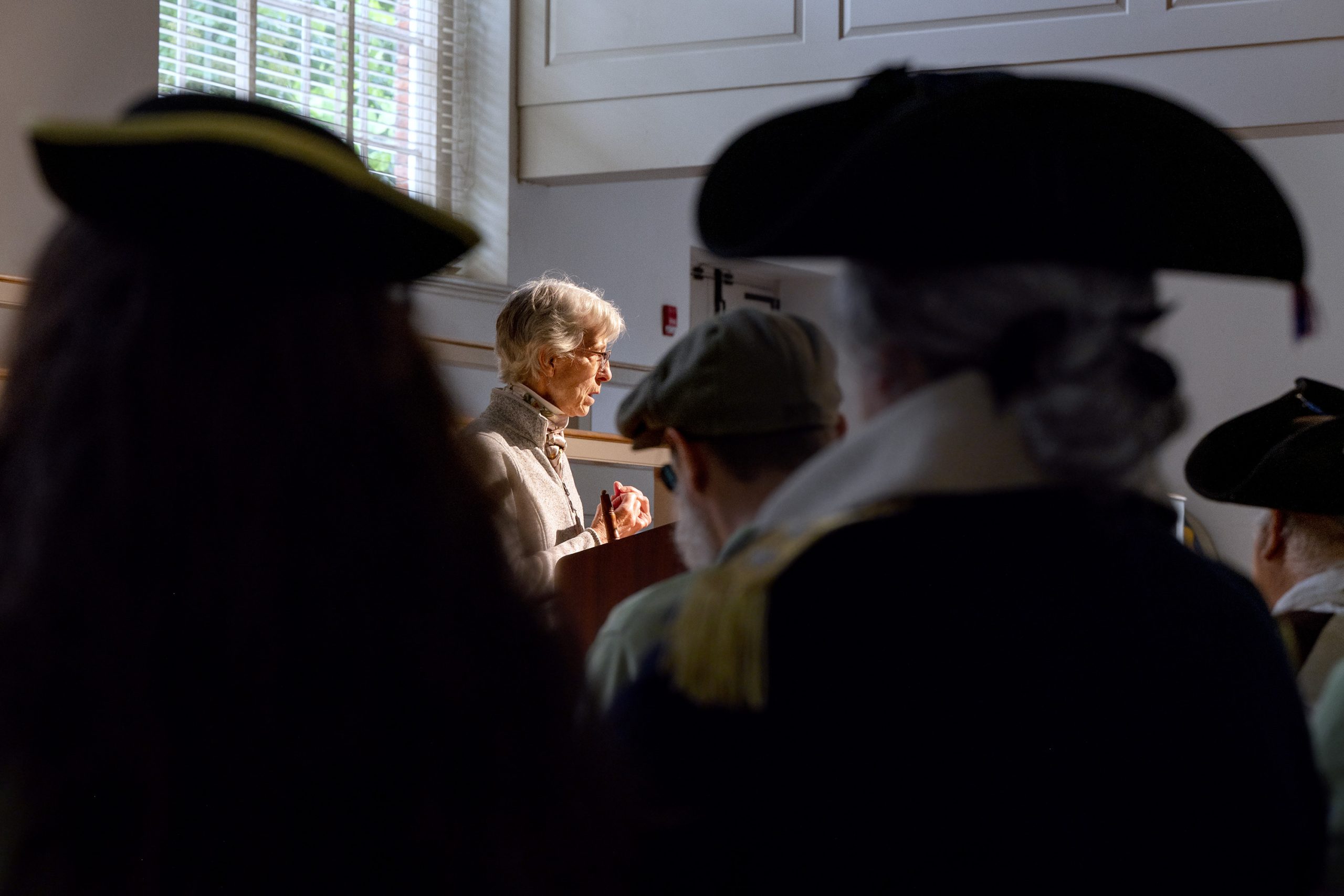
    Historian Sandra Mackenzie Lloyd, founder of the Benstitute, delivers the commencement address on May 21, 2026, as dozens of historical reenactors graduate after weeks of intensive, immersive training.Tom Gralish / Staff Photographer

    One day to game day

    Preparations for the reenactors include not only character work, but also tourism and hospitality training. They learn how to guide someone to the best cheesesteak or nearest toilet while staying in character and using period-appropriate vernacular. The actors also learn how to beat the heat in wool frocks and petticoats and stay safe.

    “Make sure to hydrate, hydrate, hydrate,” Dunphy, the storytelling director, tells her team during a morning gathering at the Meeting House before they hit the streets in costume, and a set of volunteer fake tourists heads out to test the reenactors’ skills before they’re faced with real tourists.

    She points them to a packet in their supply bags full of powder to pour into their water for extra hydration.

    “Drink this,” she instructs them.

    Most importantly, Dunphy reminds both the history makers and the storytellers what to do if they’re out in the field and feeling unsafe.

    “History makers, please remember this: If a storyteller says, ‘Have you seen John Adams?’ Don’t be cute. That is a plea for help; they need you to stay with them. It is not a joke. They need you to stay,” she says. “Things can turn on a dime.”

    And, as this is live performance, things often don’t go according to plan.

    During an April news conference at which a Betsy Ross and a Benjamin Franklin from the company stood onstage beside Gov. Josh Shapiro, a giant poster reading “America 250 PA” fell forward, scraping Franklin’s behind.

    Carol Spacht, the Betsy Ross at the event, acted quickly.

    “This is such an exciting announcement that the world is falling apart over it,” she exclaimed after the poster came down, gesticulating with a scroll clasped in her hand before turning to the Benjamin Franklin reenactor, Bill Robling.

    “Quite all right, Dr. Franklin?” she asked as he nodded. “We’re sturdy at our age. 250 years does that.”

    At a recent event at Reading Terminal Market, Salusky, as John Adams, had to navigate how to handle tourists approaching him, thinking he was Benjamin Franklin.

    “As John Adams, how do I react to people thinking I’m Ben Franklin. Well, he was a mentor of his. He really admired him, found him annoying, but would still be a little flattered,” Salusky says. “It’s kind of just like in-the-moment problem-solving.”

    Over the course of their four months of training, the actors finally reach a place of feeling ready for anything … mostly.

    “Speaking in 18th-century tongue continuously, I am nervous about that,” Thompson says. “I want to portray it real.”

    Cause for celebration

    Before the actors are on their own on the Philly streets, they and their mentors celebrate the completion of their Benstitute training with a graduation ceremony at the Free Quaker Meeting House.

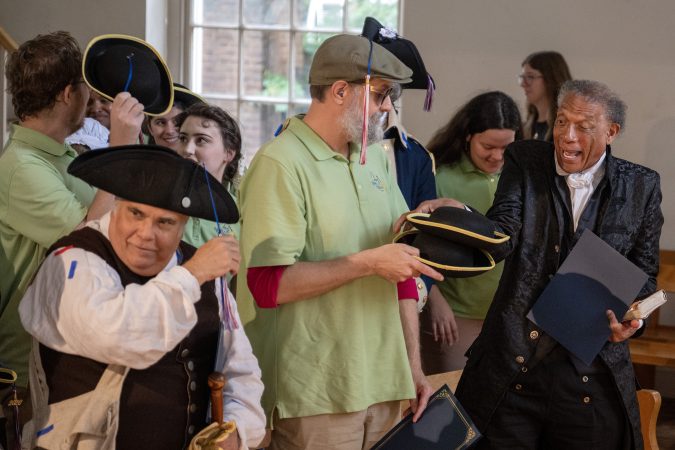
    Graduates file in, some in polos and slacks and some in costume, all wearing red, white, and blue tassels dangling from the center of their mob caps and other historical hats. They sit in the pews, players awaiting the game-time whistle, as their coaches offer them final words of encouragement before they put their drills to the test and tackle the real world, beginning with their season’s opening day — their fervor not letting up until they run through the proverbial tunnel onto the championship field for July 4.

    “History is not just about buildings, artifacts, and famous moments. It is about people — their choices, their struggles, their disagreements, their courage, their hopes for the future,” says Steven Sims, superintendent of Independence National Historical Park. “Long after visitors leave Philadelphia, they may not remember every date they heard or every building they toured, but many will remember how someone made them feel connected to history. Many will remember you.”

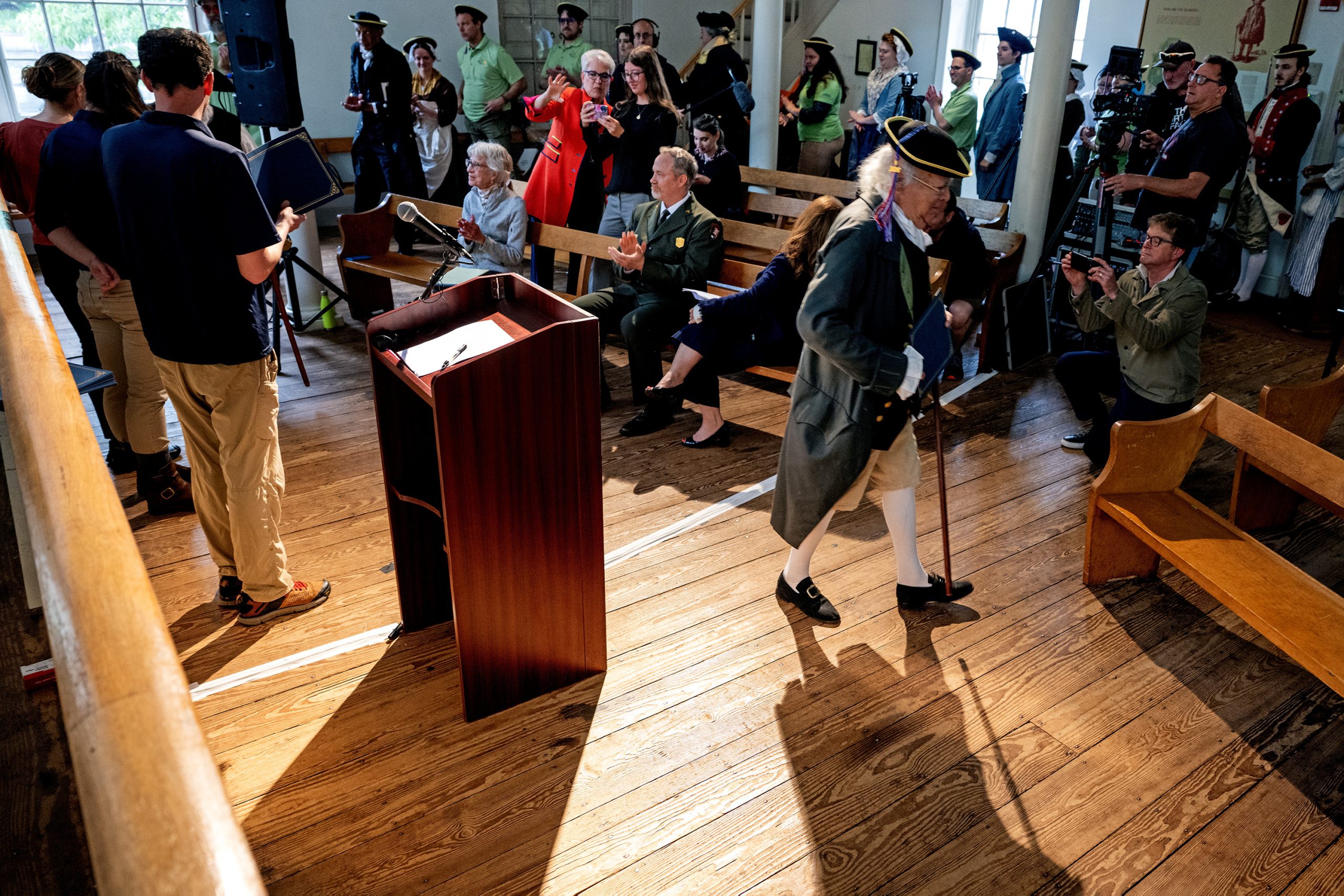
    One by one, the reenactors and storytellers cross the stage, graciously accept their diplomas, smile for photos, and return to their seats.

    “Class of 2026, please stand up,” says Amy Needle, the Historic Philadelphia CEO. “Change your tassels. Congratulations! George Washington?”

    “Class of 2026,” a Washington reenactor calls. “Hip hip.”

    “Huzzah,” they respond.

    “Hip hip,” he repeats.

    “Huzzah!” they conclude as audience members deploy tiny silver confetti cannons and red, white, and blue rain down upon them.

    Shecky Perlman as Ben Franklin, his cane and feet, Thursday, May 21, 2026, among the confetti as dozens of historical reenactors graduate after weeks of intensive, immersive training at the Benstitute.Tom Gralish / Staff Photographer
  • Pennsylvania health officials address measles outbreak: ‘We will not slow down until this … is over.’

    Pennsylvania health officials address measles outbreak: ‘We will not slow down until this … is over.’

    Pennsylvania health officials and doctors on Friday said several people have been hospitalized amid a growing measles outbreak that has spread to six counties in the southeastern and central parts of the state.

    At a news conference in Lancaster on the outbreak, which has sickened 72 people in the area since April, health officials stressed that vaccination was the best defense against the highly contagious disease.

    Secretary of Health Debra Bogen said she could not comment on the exact number of people hospitalized to protect their privacy, as the number was still relatively small.

    About one in 10 people who contract measles will require hospitalization, and three people were treated at hospitals in Lebanon County at the onset of the outbreak in late April.

    Fahmida McGann, an infectious disease doctor at Penn State Health, said the health system’s Lancaster Medical Center has treated patients who needed to be hospitalized for several days with symptoms including serious electrolyte abnormalities and liver and kidney dysfunction.

    Measles can infect up to 90% of unvaccinated people who come into contact with the disease, which can linger in the air for up to two hours.

    Newborns and young children are at higher risk for serious complications, but adults can also experience them, especially if their immune systems are weakened. Doctors at Friday’s news conference said they had treated both adults and children in hospitals.

    The state response

    In the current outbreak, state officials have recorded 41 cases in Lancaster County, 20 in Lebanon County, six in Northumberland County, two each in Berks and Dauphin Counties, and one in York County.

    Overall, the state has seen 84 measles cases this year, more than five times the cases recorded in all of 2025.

    The outbreak is spreading largely among people who are unvaccinated, Bogen said.

    “These are not numbers,” Bogen said. “They are children, parents, neighbors and friends.”

    The health department is conducting contact tracing to detect cases, and working with local healthcare providers and community organizations to ensure residents have access to vaccines and accurate information on their efficacy and side effects.

    (function() {
    var l2 = function() {
    new pym.Parent(‘HE_MEASLES2.html’,
    ‘https://media.inquirer.com/storage/inquirer/projects/innovation/arcgis_iframe/HE_MEASLES2.html’);
    };
    if (typeof(pym) === ‘undefined’) {
    var h = document.getElementsByTagName(‘head’)[0],
    s = document.createElement(‘script’);
    s.type = ‘text/javascript’;
    s.src = ‘https://pym.nprapps.org/pym.v1.min.js’;
    s.onload = l2;
    h.appendChild(s);
    } else {
    l2();
    }
    })();

    Health providers in Lancaster have said they believe there were more cases in the area than officials were aware of. Bogen said the department was working with community members to build trust and ensure that cases get reported.

    “People who are part of the community are really the key to the response, because we want people to know that if they call the department, we are here to help them,” she said.

    The department has vaccinated more than 430 people at pop-up clinics in the region in the last two months, she said, and state-run health centers around Pennsylvania have administered more than 1,300 measles, mumps, and rubella vaccine doses this year.

    “We’re not sitting back and just watching the virus spread,” Bogen said. “We will not slow down until this outbreak is over.”

    It’s crucial that residents get vaccinated, she said, to protect people who cannot safely get the vaccine, like newborns and pregnant women, and people whose immune systems are weakened, like organ transplant recipients and cancer patients.

    On Wednesday, the department recommended that physicians vaccinate infants and young children against measles early, beginning at 6 months, in affected areas. The same precautions should be taken by families with infants traveling to these areas.

    The department has also hosted webinars for hundreds of healthcare providers across the state. Measles was considered eradicated decades ago, and many doctors practicing today have never seen a case, Bogen said.

    Jeffrey Martin, a physician at Penn Medicine’s Lancaster General Hospital, said he last encountered a measles case 30 years ago, as a medical student in Colorado.

    “I still remember that patient, a child with a high fever, red eyes, and the classic rash we learned about in textbooks. At the time it was an illness we were trained to recognize,” he said. “None of us imagined that one day measles would become so rare that most physicians would go their entire careers without ever seeing a case.”

    Now, he said, physicians in Lancaster must keep measles in mind when they’re treating patients with respiratory symptoms. The virus’s early symptoms include a fever, a cough, and a runny nose — similar to other respiratory diseases — before patients develop a telltale rash.

    “It underscores the importance of being especially thoughtful about how we identify and respond to possible cases,” he said.

    It’s also key for families to call ahead to doctors’ offices if they’re experiencing measles symptoms, so physicians can prepare to treat them without exposing other patients, Martin said.

    Lower vaccination rates

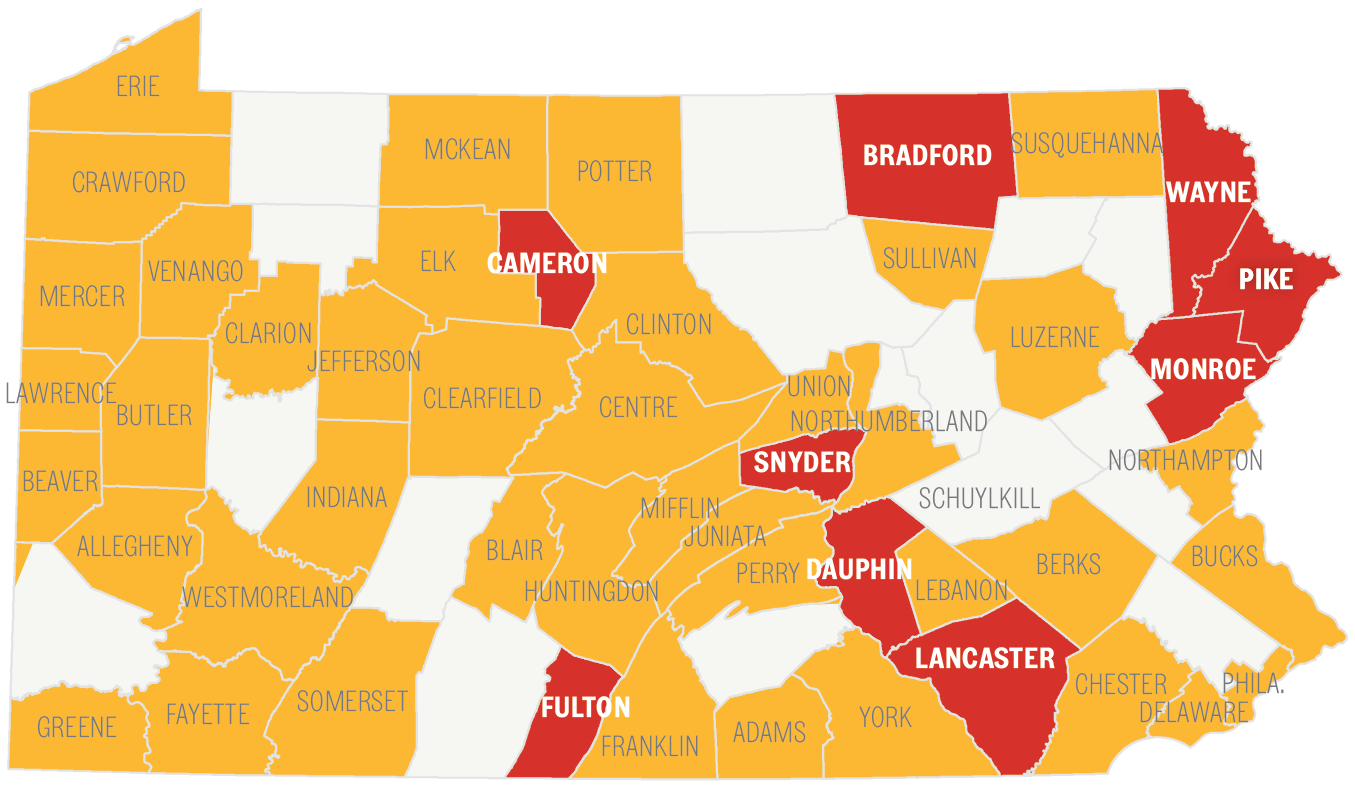
    Vaccination rates among kindergarteners have decreased across Pennsylvania in recent years, and some counties affected in the current outbreak have particularly low rates, including Lancaster, where about 88.5% of kindergarten students are vaccinated.

    Health experts say 95% of a community must be vaccinated to prevent the spread of the disease.

    A map showing vaccination rates in kindergarteners for the 2024-2025 school year. Counties in yellow have vaccination rates between 95% and 90%. Counties in red have vaccination rates below 90%. To halt the spread of measles, at least 95% of a community must be vaccinated against the disease.John Duchneskie

    The state is working with schools to increase vaccination rates, Bogen said Friday.

    After The Inquirer and the Pittsburgh Post-Gazette published analyses on low vaccination rates at individual schools across the state, health officials announced that they would soon publish a public database of school-level vaccination data. (Previously, the state published county-level vaccination data on its website.)

    Bogen said she hoped the new database would encourage schools with lower vaccination rates to reach out to healthcare providers to ensure students have access to vaccines.

    “We want to make sure as a public health department that we’re ensuring that anybody who wants access to a vaccine has that,” she said.

    Encouraging vaccination

    Martin, the Lancaster General physician, said the area was welcoming and helpful to people in need.

    “It is a defining characteristic of our community to help others, especially the most vulnerable, during times of crisis,” he said.

    Residents now have an opportunity to help protect vulnerable people from measles by getting vaccinated, raising awareness about the disease, and helping doctors decrease exposures in care settings, he said.

    “When vaccination rates are high, the virus has very little opportunity to spread. When gaps emerge, even small ones, measles can find a way back in because it is so contagious,” Martin said. “Ultimately what keeps measles rare is not luck. It’s the choices we make together to protect those who cannot protect themselves.”

  • Corner stores say ‘skill games’ are an essential part of their business. A court ruling threatens that.

    Corner stores say ‘skill games’ are an essential part of their business. A court ruling threatens that.

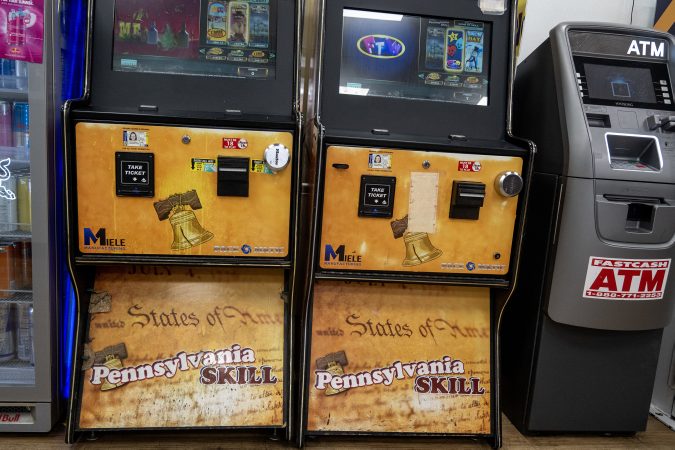
    Amid rising inflation and business costs, many Philadelphia corner stores, bars, laundromats, and smoke shops have turned to skill games, the slot machine look-alikes, to help keep their slim margins afloat.

    The machines, which shop owners say also encourage their customers to linger in stores and make additional purchases, are particularly profitable because they are not taxed or regulated like slot machines — and they have been operating without state oversight in a legal gray area for more than a decade. But a recent state Supreme Court ruling may force that to change.

    Last week, Pennsylvania’s highest court handed down a decision deeming skill games the same as slot machines. That means the skill game terminals proliferating around the state will soon be illegal if not operated and taxed at 52%, and housed in a highly regulated casino or truck stop with a license to carry slot machines. Those terms will take effect in less than four months unless the state legislature intervenes.

    Owners and clerks at several corner stores throughout Philadelphia that offer the games say they do not contribute a lot of revenue to their establishments directly, but they foster more of a lounge atmosphere in the shops that leads patrons to stay longer and purchase more snacks, drinks, lottery tickets, and other goods. Many of the business owners said they are willing to stomach a tax on skill games, but additional regulations would make them rethink keeping the machines.

    José Pérez, who runs a corner store on Opal Street in South Philadelphia, said his store runs on incremental profits. And, he said, when people play the skill game machines and start feeling lucky, they often are inclined to make other purchases there.

    “This business is about getting a little bit of money from every product, and the machines are a tiny source of income that adds up to that,” he said in Spanish between transactions at the store’s register. “While people play, they buy other stuff in the store. And if they win, they buy lottery tickets. Because when someone has one vice, they probably have two.”

    Tax proposals from Harrisburg

    Lawmakers in Harrisburg have for years failed to reach an agreement on how to tax and regulate the so-called skill games

    The issue has proved to be tricky in Pennsylvania’s split legislature, where Democrats narrowly control the House and Republicans control the Senate. The skill games industry leader, Georgia-based Pace-O-Matic, long maintained a friendly relationship with the Senate GOP, and the Republican lawmakers appeared willing to support policies that benefited them. But last year, the goodwill began to sour after the company backed political campaigns against incumbent Republican state lawmakers who did not support its requested low tax rate on the machines.

    State Rep. Danilo Burgos (D., Philadelphia) and State Sen. Anthony H. Williams (D., Philadelphia) have introduced a bipartisan bill in their chambers to impose a $500-per-month fee on each skill game machine operated in Pennsylvania, with a 50,000-machine cap across the state. There are currently an estimated 70,000 skill game machines in Pennsylvania, according to the state attorney general’s office.

    Skill games can be seen through the door of a mini mart on Kensington Avenue in the Kensington section of Philadelphia on Wednesday, July 30, 2025.Elizabeth Robertson / Staff Photographer

    The proposed legislation would split revenues among transit and infrastructure, local governments, and state police for enforcing the cap and fee. The bills also prohibit small businesses whose “primary source of net revenue” is from skill games, in an effort to prevent mini casinos in stop-and-go corner stores around the city. Burgos estimates the regulations would bring in $300 million in new revenue to the state in their first year.

    The bill includes additional protections for Philadelphia, where City Council voted in 2024 to ban the machines. The ban never went into effect, after a lawsuit was filed seeking to block it. In the legislation before the General Assembly, Philadelphia has specific carve-outs that would allow city officials to block stop-and-go businesses or “chronic nuisance” businesses from getting a license to carry the games.

    Surrounded by hundreds of skill games supporters at a news conference Wednesday on the Capitol steps in Harrisburg, Williams said rank-and-file lawmakers would hold up passing the state budget, due June 30, if there is not a deal to protect small businesses from losing their skill games altogether.

    “In this time when everybody talks about affordability, I can’t afford a 52% tax,” Williams said.

    The fee-per-machine option offered in the Democratic-sponsored bills is backed by Pace-O-Matic, which has spent millions of dollars on political campaigns and lobbying in the state, in addition to millions more spent by other parts of Pennsylvania’s booming gambling industry.

    Meanwhile, a separate proposal backed by the Senate GOP and penned last year would set the tax at 35% on gross terminal revenue, in addition to annual license fees. A small portion of those fees would go toward the state’s resources for problem gambling.

    Gov. Josh Shapiro, a first-term Democrat, has proposed taxing the machines at the same rate as slot machines — a hefty 52% levy on each machine’s net revenue — in his last two budget proposals. As the machines have continued to proliferate around the state, Shapiro’s office estimated the newly regulated industry could bring in nearly $800 million in revenue in its first year.

    Uncertain future with uncertain revenue

    Philly store owners were divided on whether it would be worth keeping the machines if they needed to pay a lofty tax on either housing the devices or the profits they made on them.

    Andrew Karki, who operates a laundromat near Pérez‘s store in South Philadelphia, said the machines occupy the customers while they wait for their laundry to finish and, as at Pérez‘s store, lead to purchases of candy and soda from the small bodega he runs inside the laundromat.

    He estimated the machines make up 15% to 20% of his monthly revenue, and he said he would likely be willing to take on a tax on the games, even a rather large one, to keep them around.

    “It’s hard, but we got to pay it. We got to pay it,” Karki said.

    For others, like Diego Reyes, who runs a secondhand shop on Kensington Avenue with about a dozen skill machines inside, taxing the small businesses for the machines does not seem fair. The terminals are often owned by small amusement companies, and are largely operated by Pace-O-Matic. The business owners get a cut from the machine’s revenue for allowing the terminal in their building.

    “They should tax the owner,” Reyes said in Spanish, wearing a Phillies cap and T-shirt with a size-medium sticker still stuck on the back, as three people played the machines.

    Pérez agreed that any tax should be on skill games companies and not on the businesses that carry them.

    It is frustrating to think another tax may be coming down the line, he said, when small-business owners already pay so many of them and see little return on the investment in the community.

    “Look outside, that pothole has been there for six months. We have no safety,” Pérez said. “What do you want me to pay more taxes for if you are not doing anything to better the conditions with it?”

    Staff writer Isabel Maney contributed to this article.