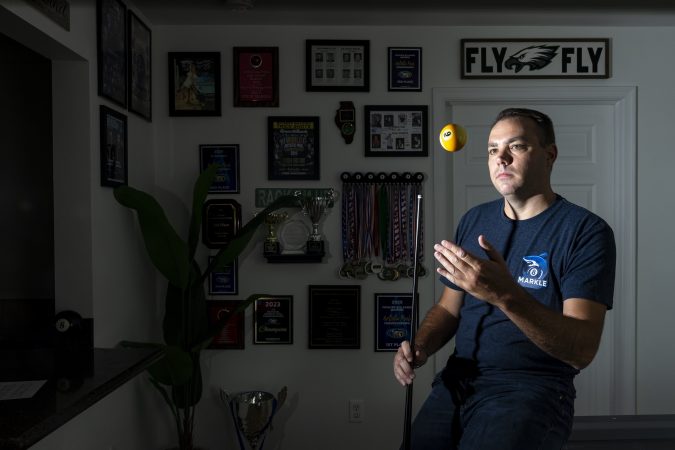
Author: Lauren Jones

  • How Bucks County pool player Steve Markle mastered the art of the trick shot

    How Bucks County pool player Steve Markle mastered the art of the trick shot

    At 13 years old, Steve Markle asked his parents for a not-so-typical gift for his age — a pool table. Bill Markle, his father, asked his son if he was going to use it, and Steve assured him he would.

    “Pool tables are good for storage and being in the way,” Bill recalled saying to his wife when Steve asked.

    The Bucks County native was first interested in pool after spending long summer mornings playing stickball. One of his friends had a pool table in his basement, and they would play in the afternoons to cool off.

    Steve eventually convinced his father to get him a pool table, so Bill took him to Kmart and bought him a seven-foot wooden table. Steve and his friends started making trick shot videos and posting them on YouTube. One night, Steve showed his parents one of the videos.
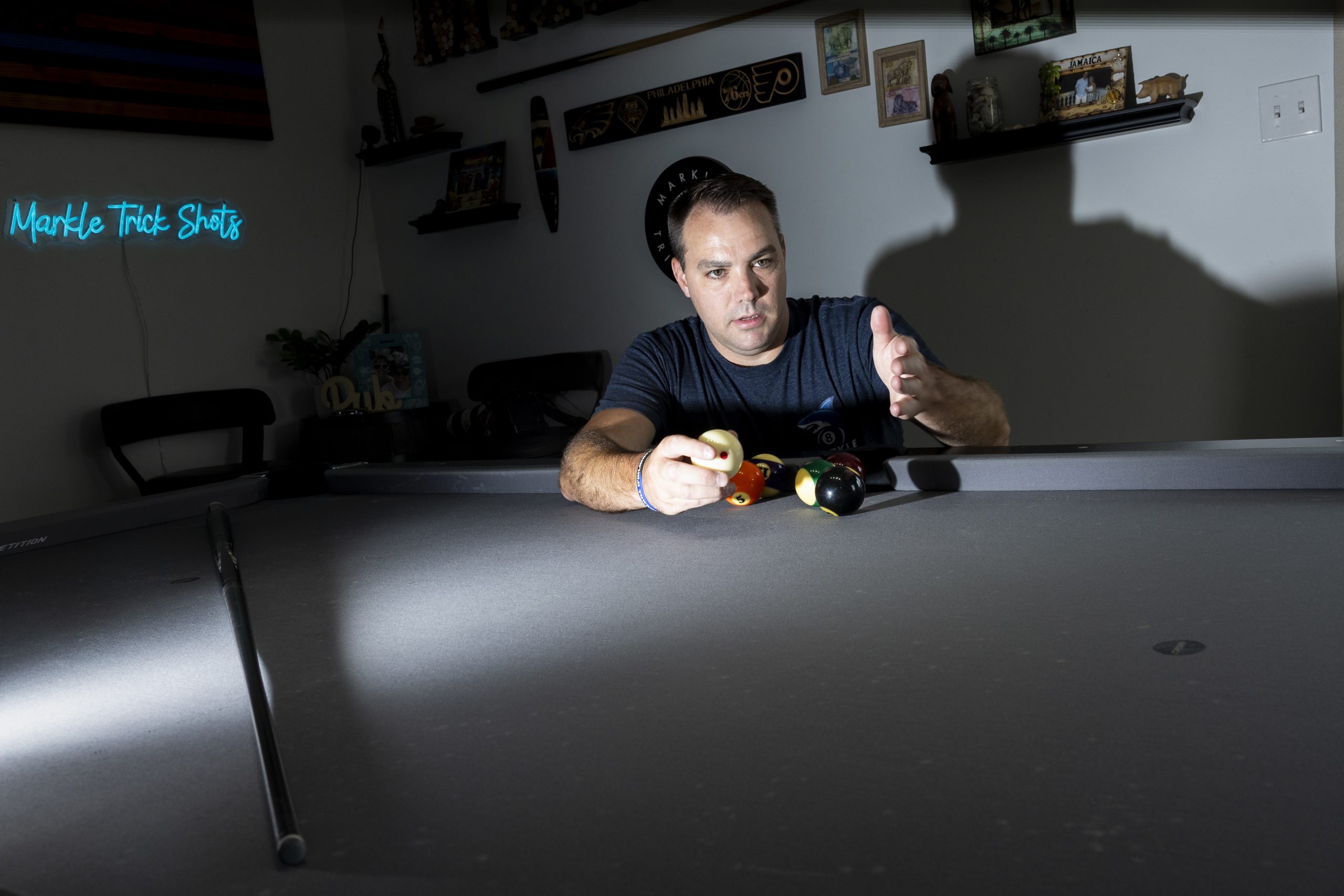
    Steve Markle began practicing trick shots at the age of 13.Aidan T. Gallo / Staff Photographer

    “We were taken aback at what he did,” Bill said. “We were like, ‘Did you really do that?’”

    That shock and surprise continued for the Markles as Steve’s career has taken off in ways they could have never imagined.

    “This game has been able to open up so many doors for me that I never thought would be open,” Steve said.

    Steve Markle, now 34, is Pennsylvania’s only professional artistic pool player and is ranked No. 1 in the United States by the Billiard Congress of America and No. 9 in the world by the World Pool Association. His trick-shot videos on social media have garnered more than 175 million views.

    Starting pool

    The Archbishop Ryan graduate’s introduction to artistic pool was random, he said.

    He was shooting pool with his dad at a restaurant in Penndel when an older gentleman approached him and showed him a trick shot where he made four balls in one shot.

    That same day, he ran over to his friend’s house and showed him the trick.

    “I brought that back to him and was like ‘You’ve got to see this; look what I just learned,’” Markle recalled.

    Before long, he was spending nearly every day practicing on his pool table and filming videos with his friend. By 16, he competed in his first trick-shot tournament in New Jersey.

    Artistic pool is one of the sport’s smallest niches, Markle said. Professional pool players must master 124 designated trick shots, with just three attempts allowed at each shot during competition.
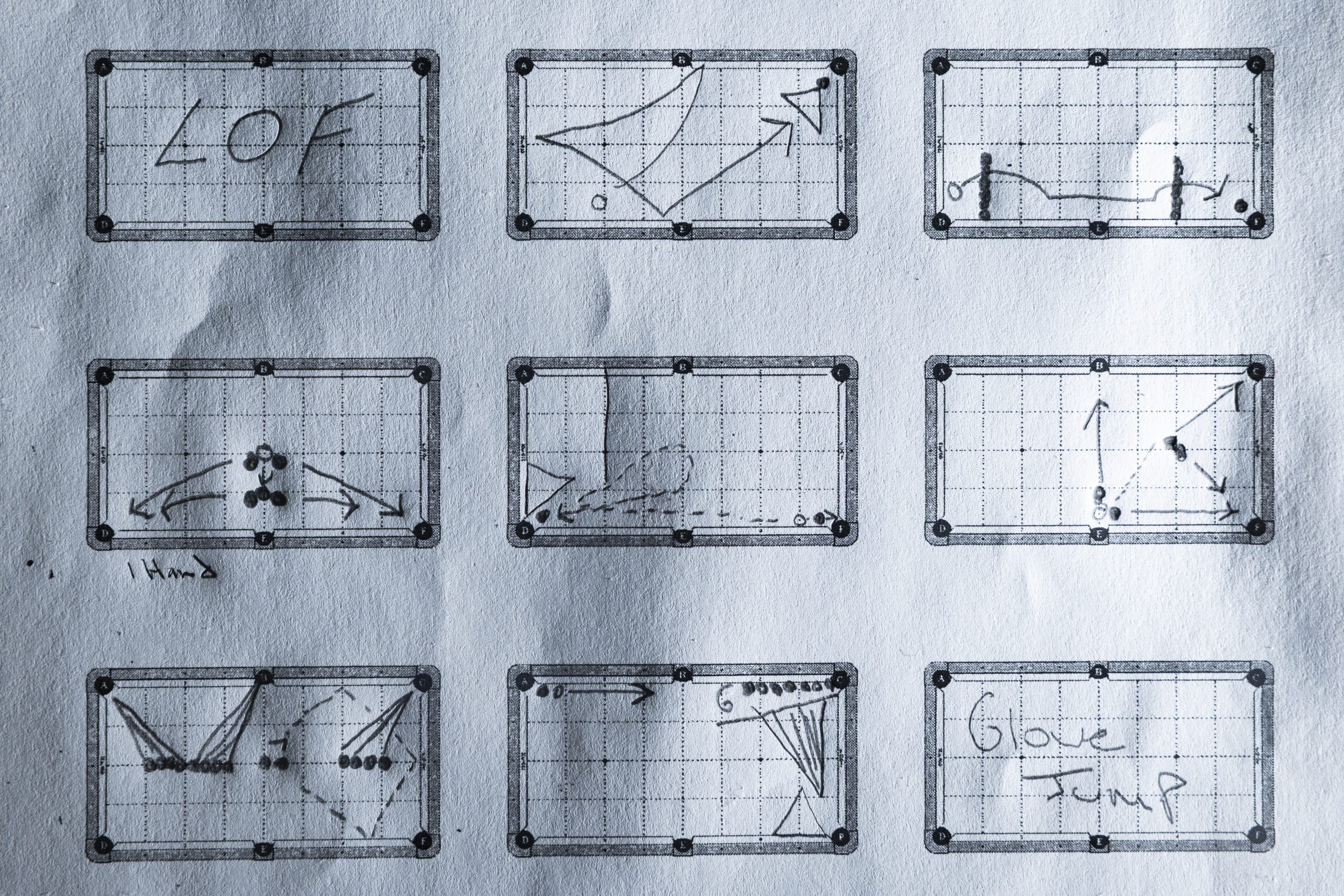
    Markle’s sketches of his new trick shots. He is organizing the 2026 WPA World Artistic Pool this fall.Aidan T. Gallo / Staff Photographer

    “To be good and consistent and give yourself a chance to win these tournaments, you really have to be consistent with all 124 shots because at a tournament you only get three attempts at each,” Markle said.

    The sport features six federations across the world, with the Billiard Congress of America in the U.S. The sport has two smaller events, U.S. Nationals and the Premier Billiards Masters Artistic Pool Championship, which are open tournaments and anyone can compete. Competitors qualify for the World Championship through smaller tournaments before earning a spot in the competition, which Markle compared to the Super Bowl for artistic pool players.

    Taking a break

    Markle competed professionally from 2008 to 2016 before deciding to take a break to join the police academy for Temple’s Ambler location.

    “Police academy teaches you a lot about people and life skills,” Steve said. “The physical training you have to go through, it pushes you a lot.”

    Markle worked part-time police jobs in Solebury Township and Bristol Borough before joining the Lower Makefield Township Police Department, where he still actively serves.
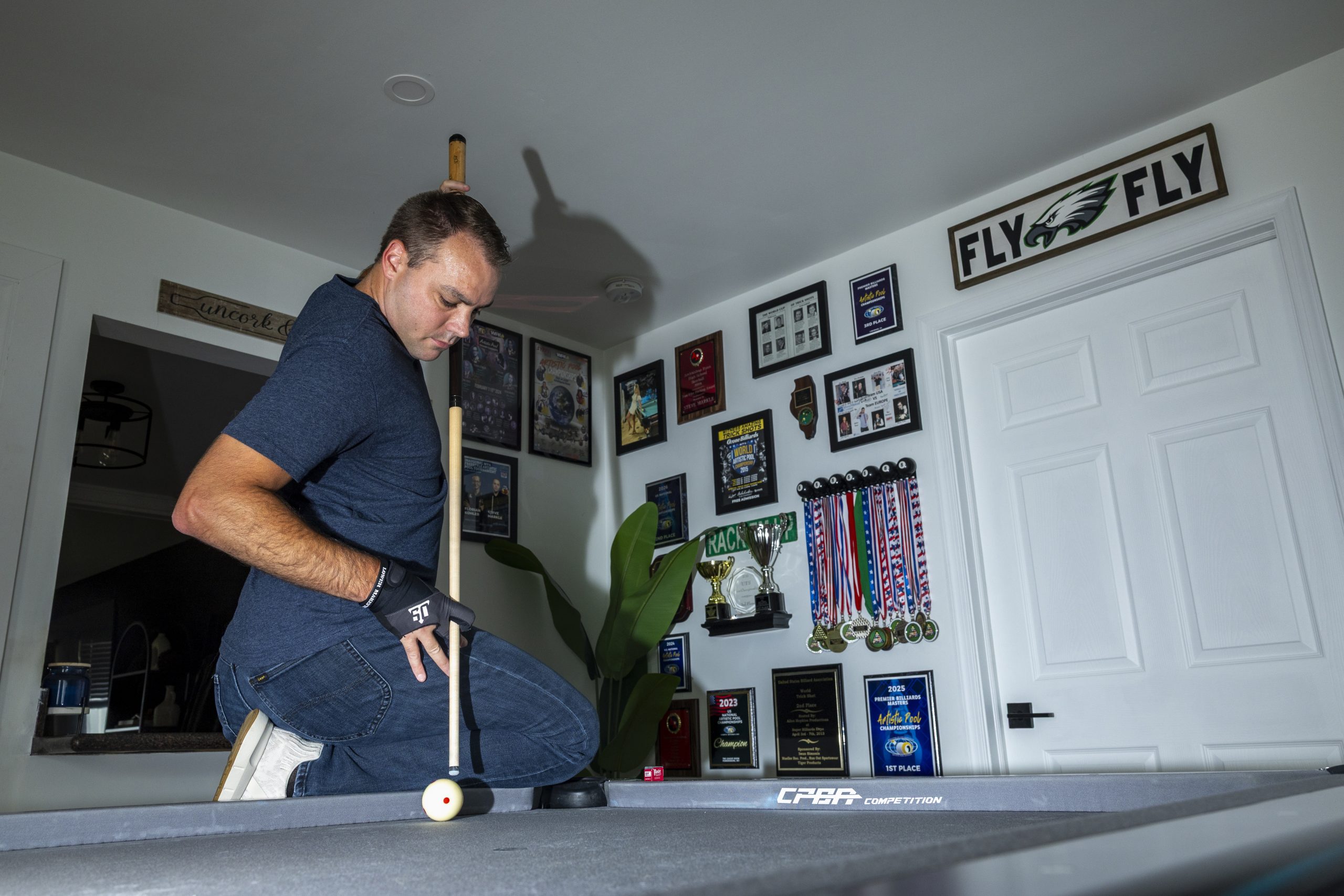
    Steve Markle competed professionally from 2008 to 2016 before deciding to take a break.Aidan T. Gallo / Staff Photographer

    Living in a one-bedroom apartment without room for his pool table and working a demanding job made competing professionally nearly impossible, he said.

    In 2023, he and his wife bought a house with enough room for his pool table, so he picked it back up. That break made all the difference in his professional career.

    Getting back into it

    The seven-year break was pivotal for his development, he said. In his second tournament back — the 2023 U.S. National — he ended up winning.

    “I never expected to come back and the same year end up winning a tournament,” Markle said. “That was something I had been trying to do since 2008, and when I won I was like all right, I’m back and definitely stronger.”

    Much of his growth was in the mental side of the game. He credits his time away from the sport and his experience as a police officer in strengthening his composure under pressure.
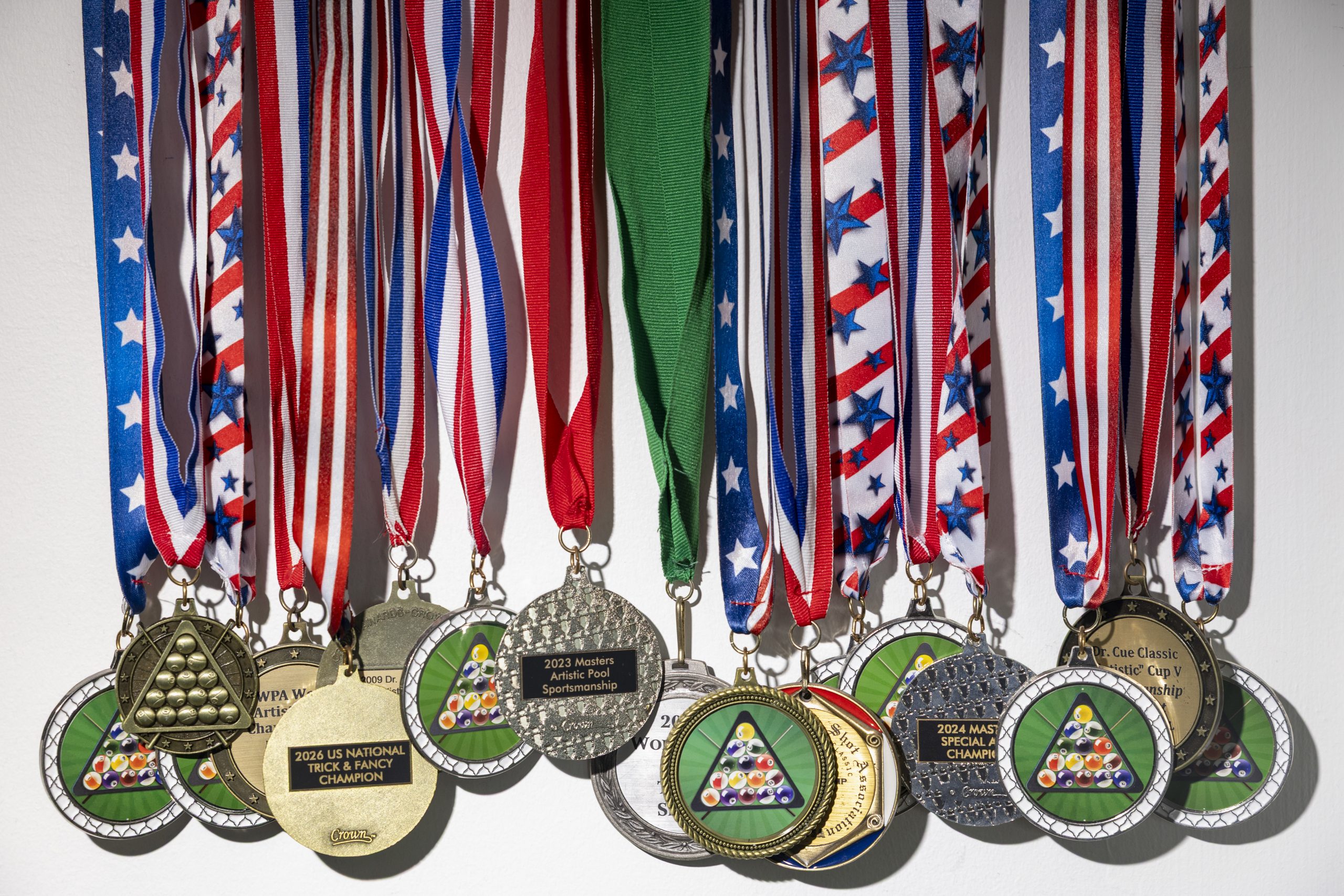
    Steve Markle’s medals from professional trick-shot competitions.Aidan T. Gallo / Staff Photographer

    “Patience and composure are the two things this sport has really taught me,” he said. “That correlates to life as a police officer because we have to stay calm in a lot of situations.”

    During June’s U.S. Nationals in West Virginia, Markle had to make one last shot to force a playoff for a chance to win the tournament. He missed the shot twice, and had one more attempt. He made the third attempt and went on to win the tournament.

    “I’m more calm,” he said. “If I miss a shot, I don’t let it get to me because my mental game is a lot stronger now. I stay more composed. Back in the day if a crucial shot came up, I may have missed it and I would’ve let it get to me, now I just brush it off.”

    Making the game go viral

    For many people, pool is synonymous with smokey dive bars, Markle said, but it has grown into so much more. The sport has continued to expand through amateur organizations, like the American Poolplayers Association, while major networks have begun streaming professional events.

    “If ESPN wants to tag along with pool, that just means that the sport is continuing to grow,” Steve said.

    Part of that growth has come through social media, where Steve has gone viral with over 20,200 followers on Instagram and 34,700 on TikTok.

    He initially posted three-to-four minute trick-shot videos on YouTube, but realized as social media began to evolve, audiences wanted shorter, more engaging content. He adapted by posting individual trick shots and combining multiple shots into fast-paced videos.

    His most popular video, called “Man’s Best Friend Jump,” features his 85-pound golden retriever sitting on the pool table while Markle jumps a ball over the dog. One of his videos, he said, has gained more than 36 million views.

    The popularity on his social media comes from the accessibility and uniqueness of the sport, Markle said.

    “Trick shots are universal,” he said. “You don’t have to know a single thing about pool to understand what I’m doing in these trick shots. It’s entertainment.”

    Coming to Philadelphia

    Markle was supposed to compete in the 2026 world championship in South Africa, but logistical issues involving exporting the tournament’s pool tables forced organizers to find another location.

    “The door was open for me, and I’ve always thought about bringing the world championship to Philadelphia,” Markle said.

    He is organizing the 2026 WPA World Artistic Pool and WPA World Freestyle Artistic Pool championship at Bluegrass Billiards in Northeast Philadelphia from Oct. 1-4. The competition will feature competitors from 10 different countries.

    Hosting the event is significant for Markle because he will have the opportunity to compete for a world championship in his hometown while introducing something new to the Philadelphia sports scene.

    “For people who are pool players that follow me, they’re used to your normal eight or nine ball matches. But this is something different that I’m bringing to the city,” he said. “It’s fun, it’s engaging, and it’s different for them.”
  • Big Ten media day: Matt Campbell explains why Penn State was the right fit, keeping Terry Smith on staff, and more

    Big Ten media day: Matt Campbell explains why Penn State was the right fit, keeping Terry Smith on staff, and more

    Big Ten commissioner Tony Petitti addressed the media Tuesday in Chicago, and emphasized that the conference has never been in a better position.

    Big Ten schools have won the past three national championships in football — Indiana (2025), Ohio State (2024), and Michigan (2023) — and it continues to try to influence the future of college athletics.

    Petitti discussed the proposed Protect College Sports Act and said the Big Ten continues to withhold support until it can review amendments made to the bill’s language.

    “Over the past 10 days, there have been hundreds of phone calls discussing key aspects of the bill,” Petitti said. “It is important to understand that this bill sets forth very specific language on how college sports will operate going forward. After a lot of productive work, it is absolutely imperative that we see the amended language of the bill. We cannot change our position until we see the amended bill and have an opportunity to share it with our leadership. And I will say … we expect to see the amended bill shortly.”

    Petitti said the Big Ten has been in communication with lawmakers about the proposed changes and believes progress has been made.

    “There seems to be alignment in the direction with the senators,” Petitti said. “They understand our issues. I think we’ve been aligned with the SEC in pointing those out, which is really the case on most of the stuff around the bill and even really working together.”

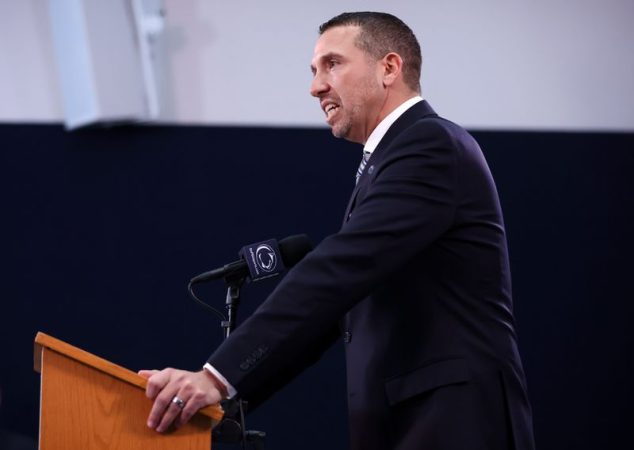
    Later, new Penn State coach Matt Campbell, along with offensive tackle Anthony Donkoh, quarterback Rocco Becht, and linebacker Tony Rojas, took the floor to answer questions. Here were the most notable takeaways:

    Decision to leave Iowa State

    Campbell was hired on Dec. 5, 2025, after James Franklin was fired midway through his 12th season. Campbell was the winningest coach in Iowa State history, recorded more than half of the school’s Big 12 wins, and reached the conference championship in 2024.

    A common question throughout Campbell’s tenure with the Cyclones was whether he would leave for another coaching opportunity. Campbell reportedly was offered an eight-year, $68.5 million contract to be the Detroit Lions’ head coach in 2021 and initially accepted the offer before deciding to remain at Iowa State.

    Campbell was the Cyclones’ head coach from 2016 to 2025 and amassed a 72-55 record while winning Big 12 Coach of the Year three times. So the decision to leave Iowa State was a big one for him.

    “If we were ever going to leave, it had to be for a place that aligned with my beliefs about culture, leadership, and building a football program,” Campbell said. “Over the past six months, we’ve been reminded every day why Penn State was the right fit. The history is special. The tradition is special. But what really resonated with me is how Penn State has always valued integrity, character, and class at its best.”

    Campbell said he is focused on building a program centered on young men who value doing the right thing on and off the field, have a genuine passion for football, and are committed to receiving a meaningful education.

    “While many things surrounding college football continue to change, winning football games has not,” Campbell said. “Neither has my belief in how you build a football program. I still believe it’s my responsibility to help turn young men into great husbands, great fathers, and great leaders. That responsibility hasn’t changed, and it’s one I embrace every day. At Penn State, we’ve chosen a culture that embraces doing what’s hard rather than what’s easy. We want people who are chasing something greater than simply winning football games.”

    Bringing Iowa State with him

    Campbell brought 24 players from Iowa State with him, including Becht, who is the winningest returning quarterback in college football.

    Becht spent much of the spring recovering from surgery on his left, nonthrowing shoulder and was unable to participate in spring practices.

    “I wasn’t able to do a lot in spring football,” Becht said. “So I think that ultimately helped me become a better leader off the field. To lead off the field, I had to make those meetings with the guys, with the running backs, with the receivers, with the tight ends, because all that offense was so new to them that I was probably, when the coaches are gone, the next resource to help them gain that knowledge of the offense. And so that was my mentality of going into the spring ball was how much time can I get with those guys off the field so then ultimately when I got back onto the field, that relationship just clicked.”

    Taylor Mouser, Ryan Clanton, and Deon Broomfield joined Campbell’s coaching staff from Iowa State. Becht said one of the factors that went into following Campbell to Penn State was the type of person he is off the field.

    “[The coaches] are down to earth and people of relationships,” Becht said. “They don’t just care about you as a football player, they care about you as a person as well. And that’s something that I wanted to experience for my last year in college football.”

    Defensive changes

    Campbell also discussed new defensive coordinator D’Anton Lynn. Lynn had spent the past three seasons as a defensive coordinator at Big Ten foes UCLA and Southern Cal.

    “He understands this conference, the style of play, and what it takes to build great defenses,” Campbell said.

    Lynn is a Penn State graduate who was a cornerback from 2008 to 2011. He recorded 162 tackles, including seven tackles for loss, four interceptions, and one fumble recovery in 47 games, while starting 37 of his last 38 games.

    “He understands what it means to play here and what it means to lead here. He and his family have a deep passion for Penn State and the community,” Campbell said. “Beyond that, he’s an outstanding teacher. He’s assembled an excellent staff around him and has already made a tremendous impact on our players. Those qualities made him the right fit.”

    Along with the new defensive coordinator, Campbell is moving away from the 3-3-5 defense he used at Iowa State. During his time at Toledo and throughout his first two seasons at Iowa State, he primarily used a four-down front with multiple variations before evolving into the defense for which they became known.

    “As the Big 12 evolved with more multiple tight-end sets and more pro-style offenses, we found ourselves naturally moving back toward four-down fronts in certain situations, anyway,” Campbell said. “When we got to Penn State, we evaluated who we are, what our personnel looks like, and what gives us the best opportunity to succeed.”

    Variety in their defense is important, Campbell said, but the foundation will begin with a four-down front.

    Keeping Terry Smith

    One of the most important aspects of taking the Penn State job was keeping Terry Smith on the coaching staff, Campbell said.

    “Watching him lead Penn State through a difficult stretch at the end of last season only reinforced my respect for him,” Campbell said. “It wasn’t an easy situation, but Terry steadied the program and gave us a strong foundation moving forward.”

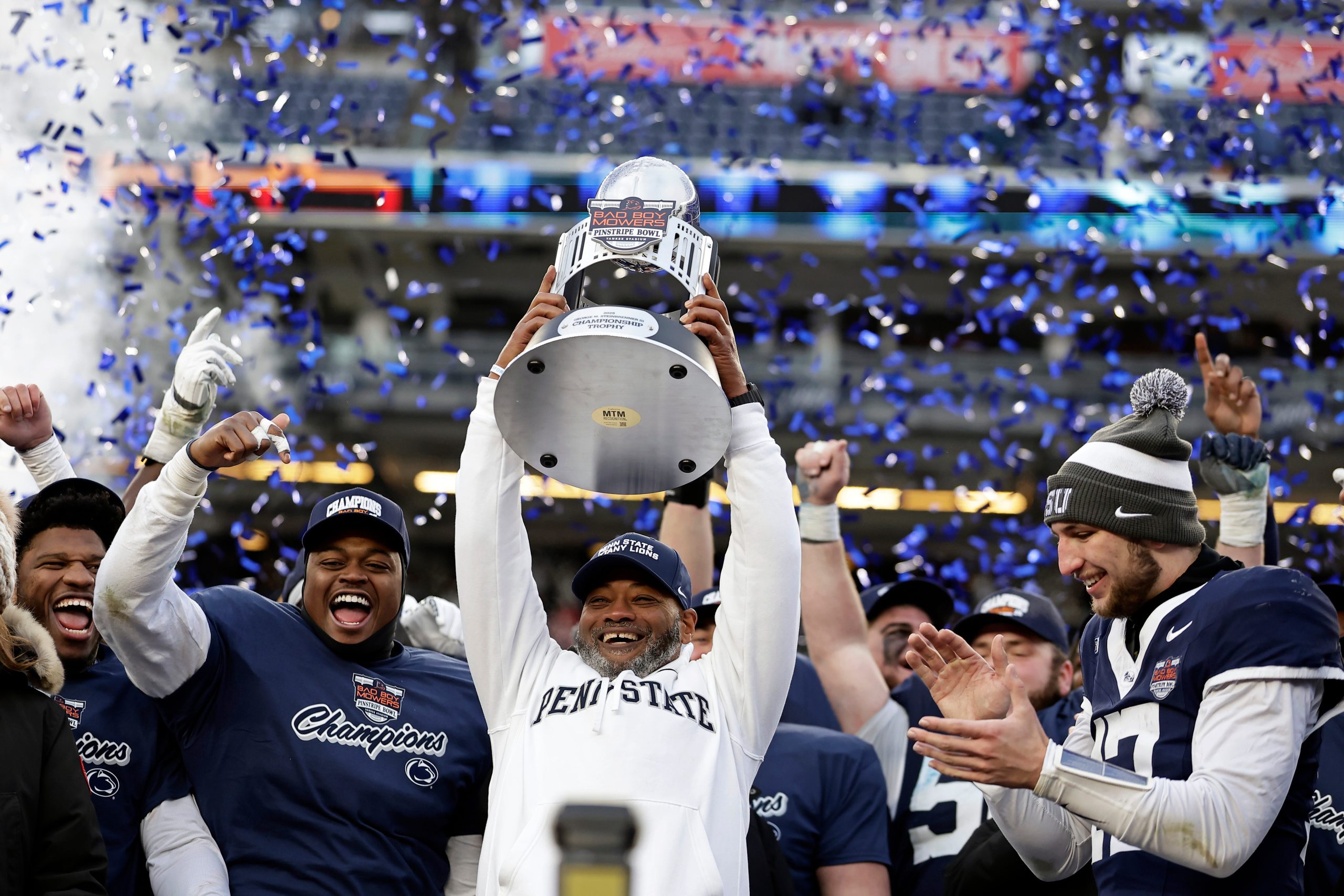
    Last season, Terry Smith led Penn State to a win over Clemson in the Pinstripe Bowl.Adam Hunger

    Smith served as the associate head coach and cornerbacks coach before being named the interim head coach after Franklin was fired. Rojas said Smith taking on the interim role brought life to the locker room.

    “Everyone wanted to play for each other and wanted to play for him,” Rojas said. “Especially the last bowl game, we’re all super excited to get that last one for him. So I think just keeping him on our staff has been a big blessing.”

    Smith was a wide receiver at Penn State from 1987 to 1991.