Author: Zoe Greenberg

  • My kid’s school offers daily chocolate milk. Should I restrict it?

    My kid’s school offers daily chocolate milk. Should I restrict it?

    This week’s question (Have your own? Submit it here.):

    My child is about to start kindergarten and is excited about the school-provided lunch (he knows there is regular pizza). The menu looks mostly fine and I won’t stop him from enjoying it if everyone else is, but I noticed that he can choose to have chocolate milk every single day, which seems like a lot to me. Am I overthinking it or should I tell him he can only choose it once a week? I won’t even be there to see if he’s telling the truth. Do I ask the school to restrict it?

    Jason Nark, Life & Culture reporter

    I also have a child starting kindergarten, but we have to supply all the lunches.

    Zoe Greenberg, Life & Culture reporter

    Will you be packing chocolate milk every day?

    Jason Nark

    No way, but I’m not horrified by the idea. I was recently scolded for packing her marshmallows for summer camp lunch.

    Leaving it up to the kid seems like a bad idea. I have to explain this to my parents, often, when they watch my daughter. They will argue “well, she likes (insert ice cream, gummy bears, YouTube, etc.) so we give it to her.”

    Zoe Greenberg

    So I was just rereading an article about “fat activist” (her words) Virginia Sole-Smith, the author of Fat Talk: Parenting in the Age of Diet Culture. She talked about her own method for “unhealthy” foods — she lets her kids decide, and thinks it’s a way for them to figure out what they actually want/need.

    For example, she serves brownies and Cheez-Its and chicken and broccoli at the same time on the dinner table, and the kids decide what to eat, how much to eat, and in what order. I was intrigued!

    Jason Nark

    I wonder if she’s teaching this kindergarten class.

    Zoe Greenberg

    Jason, would you talk to the school, or would you tell your daughter chocolate milk is a once-a-week delicacy?

    Jason Nark

    I would talk to the school, first, and if this was their policy, I would talk to my daughter and set some limits.

    Zoe Greenberg

    I feel like drawing attention to the chocolate milk as an everyday option, and saying it’s not allowed, makes it seem so much more interesting and desirable.

    Jason Nark

    We don’t treat kids like adults (or shouldn’t) for a reason.

    Zoe Greenberg

    I might just say nothing and assume the kid won’t drink it every day? But I also have a five-month-old and he hasn’t ever gotten to drink chocolate milk.

    In your school could you have chocolate milk at lunch? I feel like maybe I could, but I didn’t much. I’m picturing the little brown carton.

    Jason Nark

    I think we could. I drank Pepsi at lunch every day, so that’s even worse. I grew up before people drank water.

    Zoe Greenberg

    You wish you’d been restricted?

    Jason Nark

    Maybe not restricted, just more informed. I wish my wrestling team had a nutritionist.

    My daughter brings a water bottle to school every day and that’s her drink. If we go out somewhere, she can get chocolate milk or juice.

    Funnily enough, a few weeks ago, we were eating pizza and I asked her if she wanted a sip of soda and she seemed horrified.

    Zoe Greenberg

    Wow. She wants WATER.

    How would you deal with the fact that you won’t know if she does or doesn’t drink the chocolate milk, even if you set limits? To me it’s better to not introduce the “you can’t have this” and then the kid has to lie or find a workaround. (Or I guess follow the rule.)

    Jason Nark

    My daughter is a pretty straight shooter, so I think she’d follow the plan. I wouldn’t ban the chocolate milk, though.

    My bigger fight is with the grandparents.

    Zoe Greenberg

    It’s true, the grandparents will say, “He didn’t want to nap so he didn’t” and I’m like of course he didn’t want to nap, but he really does.

    Jason Nark

    As an aside, I’ve interviewed a lot of dairy farmers who tell me real milk in schools is key to their survival.

    Zoe Greenberg

    Oh wow. And I think it’s a USDA requirement. The daycare center required us to sign a waiver if our child was allergic to cow’s milk, otherwise he has to get it.

    Do you place restrictions on the grandparents?

    Jason Nark

    I try, but…

    Zoe Greenberg

    Sometimes we have to learn to let go.

    Jason Nark

    Particularly if they’re babysitting.

    Zoe Greenberg

    Yes. Unlimited chocolate milk is a small price to pay.

    Godspeed to all as the school year begins.

    Jason Nark

    Enjoy the milk!

  • He lives with his wife — and his husband, and his partner, in a 6-person polycule

    He lives with his wife — and his husband, and his partner, in a 6-person polycule

    Linden Curhart describes his home as a “spider web of connections.”

    There’s his husband, Teddy Ullrey-Curhart, whom Curhart met when he was an isolated teenager growing up in a conservative town in Virginia. The two always dreamed of getting married, and in June they celebrated their 13-year commitment in a big pink ceremony at Pastorius Park in Northwest Philadelphia.

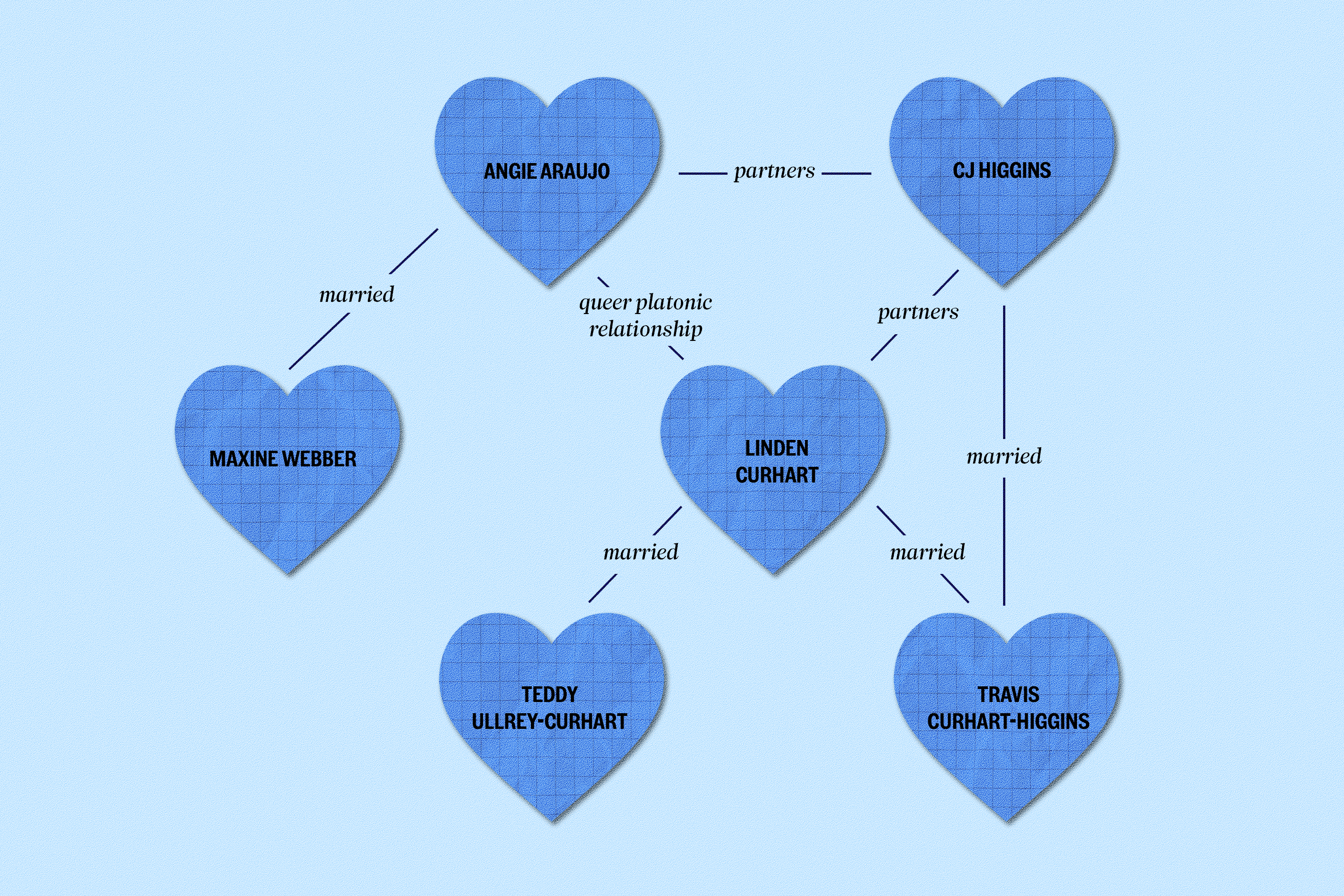
    There’s Curhart’s wife, Travis Rosemarie Curhart-Higgins. They bonded as the two most sober people at a friend’s birthday bar crawl in 2019, and got married in 2023. (Curhart wears two stacked wedding rings on his left hand, one for each spouse.)

    Then there’s Curhart’s partner, CJ Higgins, who asked prospective dates to fill out a short Google Form expressing their interest, which Curhart did. Rounding out the group is Curhart’s best friend and “queer platonic partner,” Angie Araujo, who is married to Maxine Webber, and dating CJ. Travis and CJ are also married.

    “It’s a whole constellation,” Curhart, 28, said. Ullrey-Curhart is also in his late 20s; the rest of the crew are in their early 30s.

    The six live together as one family in a narrow, rented rowhouse near Drexel. They each have their own room.

    The polyculeJulia Duarte / Staff Illustration

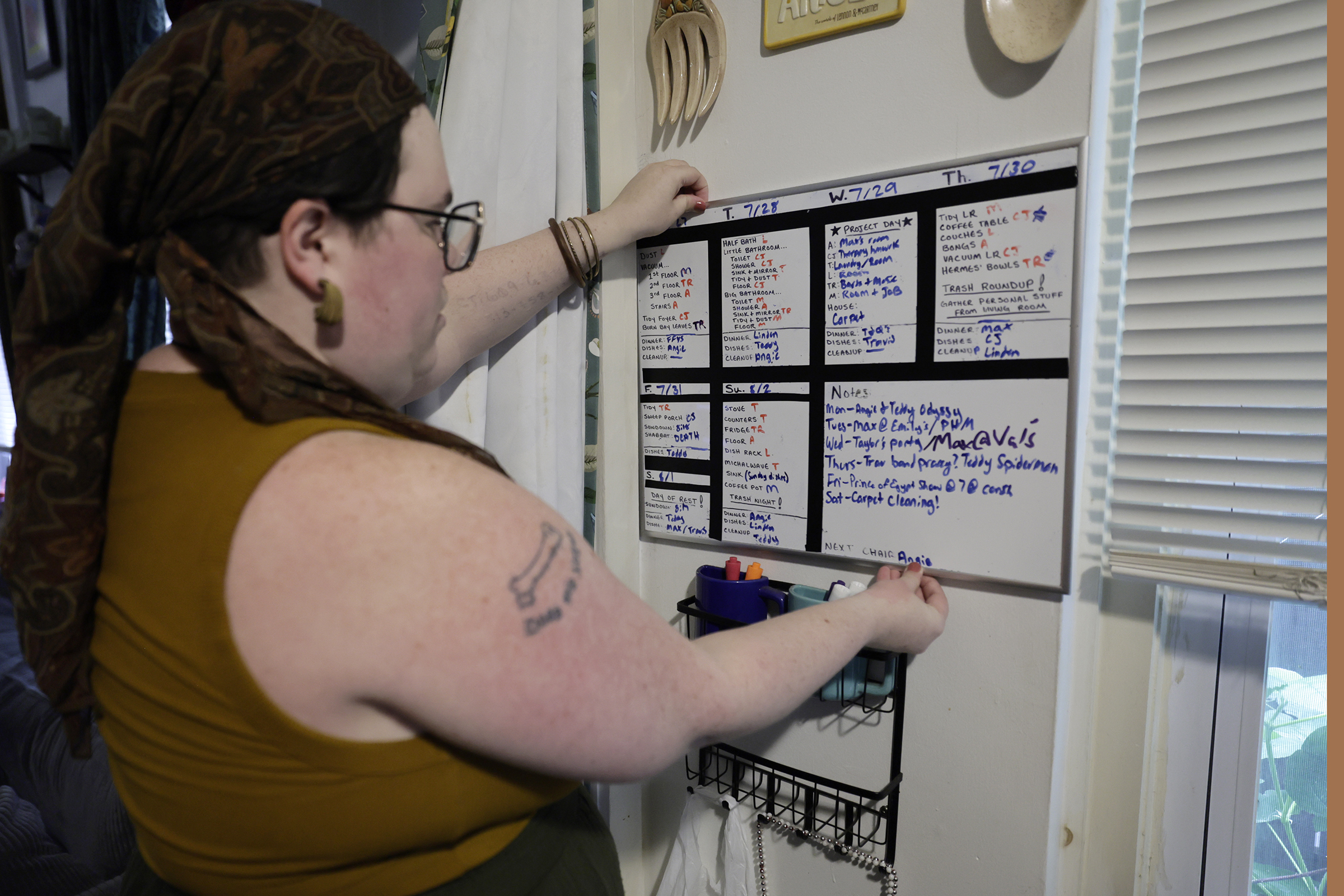
    The polycule — the textbook term for a group involved in polyamory together — shares costs, and meets weekly to discuss chores and meals (usually each person cooks one night a week). They also collectively care for three cats and a hermit crab named Linda.

    “Honestly, the biggest daily challenges that we deal with are just things like, ‘please rinse your mug before you put it in the sink,’” said Curhart.

    The household is Jewish and everyone is an anarchist, Curhart said. They keep the closets stacked with street medic supplies to bring to protests and homeless encampments.

    Some of the members work in theater and some in tech; some don’t work. (Curhart is disabled and relies on the polycule to support him; Ullrey-Curhart is looking for work.) They’ve lived collectively for two years.

    “As a species, humans are pack animals,” said Curhart. “That isn’t to say that everybody should be polyamorous, but I think everybody should live in community.”

    The following, as told to Zoe Greenberg by Linden Curhart, has been edited for length and clarity.

    On proposing marriage

    I had planned a big romantic public proposal for Travis, and then COVID lockdown hit. So instead I got flowers and made dinner at home. I set it up really romantically, with candles, and proposed. We both cried.

    Teddy proposed to me while the whole polycule was apple picking. He got down on one knee and did that dramatic thing where he said my whole name in front of everybody. He talked about how long we’ve been together and how much change we’ve been through.

    Travis and I got married on the winter solstice, so Teddy and I got married on the summer solstice.

    Travis Curhart-Higgins (left) and Linden Curhart show the tattoos they got after their wedding in 2023.Elizabeth Robertson / Staff Photographer

    On what marriage means

    When I’m talking to people who are not in the polyamorous world, I’ll describe it as a “commitment ceremony.” Because I’m not legally married to anybody. But within our own communities, we just say that we’re married.

    There’s this sense of security that comes with making that decision and having it witnessed by all of the people that you love.

    On leaving the state out of the polycule

    The way that I see it is that our personal relationship, who we share our lives with, who we have sex with, who we choose to raise our kids with, that’s not the government’s business.

    But even if you’re not getting the state involved, it’s a big decision to permanently entangle your life with another person. It’s not something that I am actively seeking to do again.

    On moving in together

    All of us were living in various apartments that we hated, scattered around West Philly. We all had landlords that were crappy.

    The pitch was: all of us are broke and we all love each other, and we’re already making dinner together three times a week. We might as well just all do that in the same place. So we came together and pooled our resources and found the rowhouse.

    All of us understood that this is a family commitment. I really want to have kids someday, and these are the people who will help me raise my kids.

    Linden Curhart kisses his husband, Teddy Ullrey-Curhart, while his wife, Travis Curhart-Higgins (right) looks on. Elizabeth Robertson / Staff Photographer

    On sharing money

    We haven’t officially pooled our finances because it’s important for all of us to have financial independence and some financial privacy.

    Somebody will go grocery shopping for the whole house and then calculate an even split. If somebody can’t contribute that amount, they’ll just say, “Hey, I can’t cover mine this week,” and that’s not usually a big deal. Somebody else will step up.

    Generally speaking, we try not to give each other loans. You don’t give somebody money unless that is money that you can afford to lose.

    On distributing labor

    We try to split the work: the financial labor, the actual physical labor, and the emotional labor, so that everybody’s contributing whatever they have the most of.

    Because I contribute less money, I try to make sure that I’m doing things like making big lunches that people can have during the week. I run a garden so we can grow some of our own food.

    The polycule meets on Sundays to discuss tasks for the week. Elizabeth Robertson / Staff Photographer

    On potential breakups

    Because we’ve been together for so long, we don’t really worry about that. We don’t have concrete contingency plans, but our overarching philosophy of how we treat each other doesn’t stop if we break up.

    Fun fact: Travis and Angie are exes. They broke up before we chose to live in a house together. They had dated for a few months and then decided they didn’t have romantic feelings for each other.

    On the most important house rules

    I was worried about us getting on each other’s nerves in close quarters.

    We have a rule that we don’t have serious emotional conversations in the living room. That’s a bedroom conversation. If a conversation starts in the living room and gets tense, one of us will be like, “Oh, I don’t think this is a living room conversation.”

    Don’t gossip. If somebody tells you something emotional, you assume that it’s for your ears only.

    You try not to drag everybody in the polycule into conflicts that are just between two people.

    On a future spare bedroom

    My 10-year vision is a house with a big vegetable garden and kids and maybe a dog. And hopefully a spare bedroom where we can host people who need a place to crash.


    This story is part of a new series about life partners across the Philadelphia area.

    If you want to share your story about who you’re navigating life with, romantically or otherwise, write to lifepartners@inquirer.com. We won’t publish anything without speaking to you first.

  • Should I run a cord across the sidewalk to charge an electric car?

    Should I run a cord across the sidewalk to charge an electric car?

    This week’s question (Have your own? Submit it here.):

    I’m thinking of getting an electric car even though I don’t have a driveway. I’ve seen some of my neighbors run the cords out of their rowhouses across the sidewalk to charge their cars. I’m intrigued! What’s the etiquette?

    Mike Newall, Life & Culture reporter

    Hey, Intrigued-by-Electric! I think it was Emily Post who wrote in her foundational 1922 text on manners and etiquette: “Don’t be a bozo and run electric chargers out of your rowhome!”

    Zoe Greenberg, Life & Culture reporter

    The etiquette is you must secure the wires to the sidewalk, but I have a stroller these days and the sidewalks are like an obstacle course.

    Mike Newall

    Do you want this young mom and her babe to jump rope over your car charger?

    Zoe Greenberg

    But electric cars are better for the babe’s future…

    Mike Newall

    It’s a tripping hazard and probably a city violation (and if there is one thing the city excels at, it’s enforcing violations).

    Zoe Greenberg

    Would you say electric cars are a no-go entirely?

    Mike Newall

    I love electric cars! (Disclaimer: I know nothing about electric cars except they are better for babies’ futures.)

    But when you live in a city, you have to think of your neighbors.

    Find a neighborhood charging station. If they’re filled up, you can always reserve one with a cone or folding chair (kidding… maybe).

    Zoe Greenberg

    I say you can run the cords from the rowhouse, but you have to REALLY secure it to the sidewalk. Make it like a ramp!

    Mike Newall

    Intrigued-by-Electric, you are making me and a wonderful new mom who has to jump over cables put on our public service hats.

    There aren’t enough public stations, but don’t run it from your house.

    If you have a garage, there are companies that will come out to your house and install a charger the right way so you don’t have parents and kids playing double dutch over your new plug-in wheels.

    But a little Googling has led me to another possible solution.

    Zoe Greenberg

    Look at you.

    Mike Newall

    The city seems to be planning a new program called ChargePHL where they will be installing 800 new charging ports across city neighborhoods by 2027.

    Zoe Greenberg

    Wow! So wait until 2027 to get your electric car.

    Mike Newall

    Like so many of these questions, the answer comes down to that famous passage at the end of Grapes of Wrath when Tom and everyone are walking on the road and someone talks about being part of a bigger collective struggle (they were driving a jalopy, not electric).

    When you live in a shining city like Philadelphia, you’re part of that collective struggle. You don’t thrive if your neighbor struggles.

    If you want to go electric (see above about babies’ futures) then be smart and responsible and do it in a way that doesn’t have everyone tripping.

    Zoe Greenberg

    In solidarity.

    Mike Newall

    Your heart is in the right place, Intrigued-by-Electric. Do it smart. Safe. Look up the private installations. Check out current neighborhood options, and possibly go gray waiting for the city. You came to us looking for help, so you obviously got your head on right. I trust you in this endeavor.

    Zoe Greenberg

    We’re in it together. Godspeed.

  • How to have a perfect Philly day, according to novelist Emma Copley Eisenberg

    How to have a perfect Philly day, according to novelist Emma Copley Eisenberg

    The novelist Emma Copley Eisenberg is not supposed to write about her new South Philly neighborhood.

    A longtime resident of West Philly, Eisenberg wove its eccentricities and institutions into two books of fiction: the 2024 queer road trip novel Housemates, and the newly released Fat Swim, an interconnected short story collection featuring, among other local allusions, a pool inspired by the one at West Philly’s Kingsessing Rec Center.

    Then about a year ago, Eisenberg and her partner, Art Phung, moved together across the river. Phung suggested that maybe Eisenberg could avoid writing about their new environs, so they wouldn’t have to move again. (Eisenberg made no promises.)

    On her perfect Philly day, Eisenberg treks between fresh and familiar haunts, floats in the city pool immortalized in Fat Swim, and browses at least three bookstores.

    8 a.m.

    In a perfect world, I wake up at 8, and I go to Café y Chocolate, a wonderful Mexican brunch and breakfast spot in our new neighborhood. I read my book for a little bit until meeting a friend. The mocha they make is pretty life-changing. When my mom was in the hospital, she was like, “All I want is café con chocolate from there.”

    11 a.m.

    The Clark Park Farmers Market still has a chokehold on our Saturdays. I’d get some flowers from the Amish fellows [at Unique Gardens].

    I like to look at all the dogs. I don’t have a dog, my partner says I’m not responsible enough. So I force a friend who has a dog to bring their dog to the park to meet me. I like to run into people and hear the queer gossip of the day — who went out last night, what’s going on.

    A lot of my friends have kids now, so it’s usually a good excuse to see some of their kids and hear about their gossip at school.

    Noon

    At the Kingsessing pool, I like to just kind of flop around and float. I can’t ease my way into the pool, I have to jump all the way in. I’m not a particularly good swimmer per se, but it makes me happy. After doing the pool, I always feel 10% less dead inside.

    1 p.m.

    We make our way up to Saad’s [Halal Restaurant]. I like the chicken falafel sandwich. Fries are often important.

    3 p.m.

    From there I go see a movie at PFS East Theater. I always love seeing the Oscar-nominated shorts or when they play older movies. If it’s August, I go see a BlackStar Film Festival movie.

    5 p.m.

    Walking from Old City back to South, I stop at Head House Books. It’s kind of magical: whatever the book is that I want, they always have it. They have good book clubs, they’re supportive of local authors, they do a lot of events.

    Head House has a really good children’s section. I usually try to buy a couple of board books because they’re good for little kids and they’re cheaper. I also have a soft spot for the classic things that I read when I was a kid, like The Baby-Sitters Club and Nancy Drew. I buy a couple of kids’ books and put them in little free libraries because I find that joyful.

    I also cut over to Giovanni’s Room, because they have all those $1 paperbacks out. I’ll browse around to see if they have anything that’s cheap that I want to buy for my library or for one that I pass on the way home. I might wind through a few little free libraries. I could hit the one at the Singing Fountain on East Passyunk, and say hi to Little Yenta Books.

    6:30 p.m.

    My partner and I go to Cafe Nhan at least once a week. I love their vermicelli bowl with grilled pork, and fried spring rolls. They have an amazing limeade too. If you follow Cafe Nhan on Instagram, they often show what broths and soups they have going that day, so you can get excited.

    Eisenberg poses with a billboard along Interstate 95 promoting the release of “Fat Swim.” Jose F. Moreno / Staff Photographer

    8 p.m.

    I used to be partial to Fred’s on 54th and Chester. I put Fred’s in Fat Swim. However, I will say that at Chuck’s Water Ice [on Snyder], the texture is incredible. It’s very fluffy. The flavors they have are really special — tangerine, blood orange. I like to get a gelati of tangerine and vanilla custard. I eat it as I walk home.

    8:15 p.m.

    If I’m feeling like I want a little nightcap, I go to Brewery ARS. They have good beer and it’s kind of a hole-in-the-wall, but not in a sports way. More in a “we might have a weird musician” way. They probably wouldn’t have the game on, but they would have a Sun Ra music video on.

    10 p.m.

    I watch a comfort episode of television or read a book. Right now I’m doing a rewatch of Girls, like everybody else. I get into bed at 10 and go to sleep by 11, if I’m honest.


    The conversation has been edited for clarity and brevity.