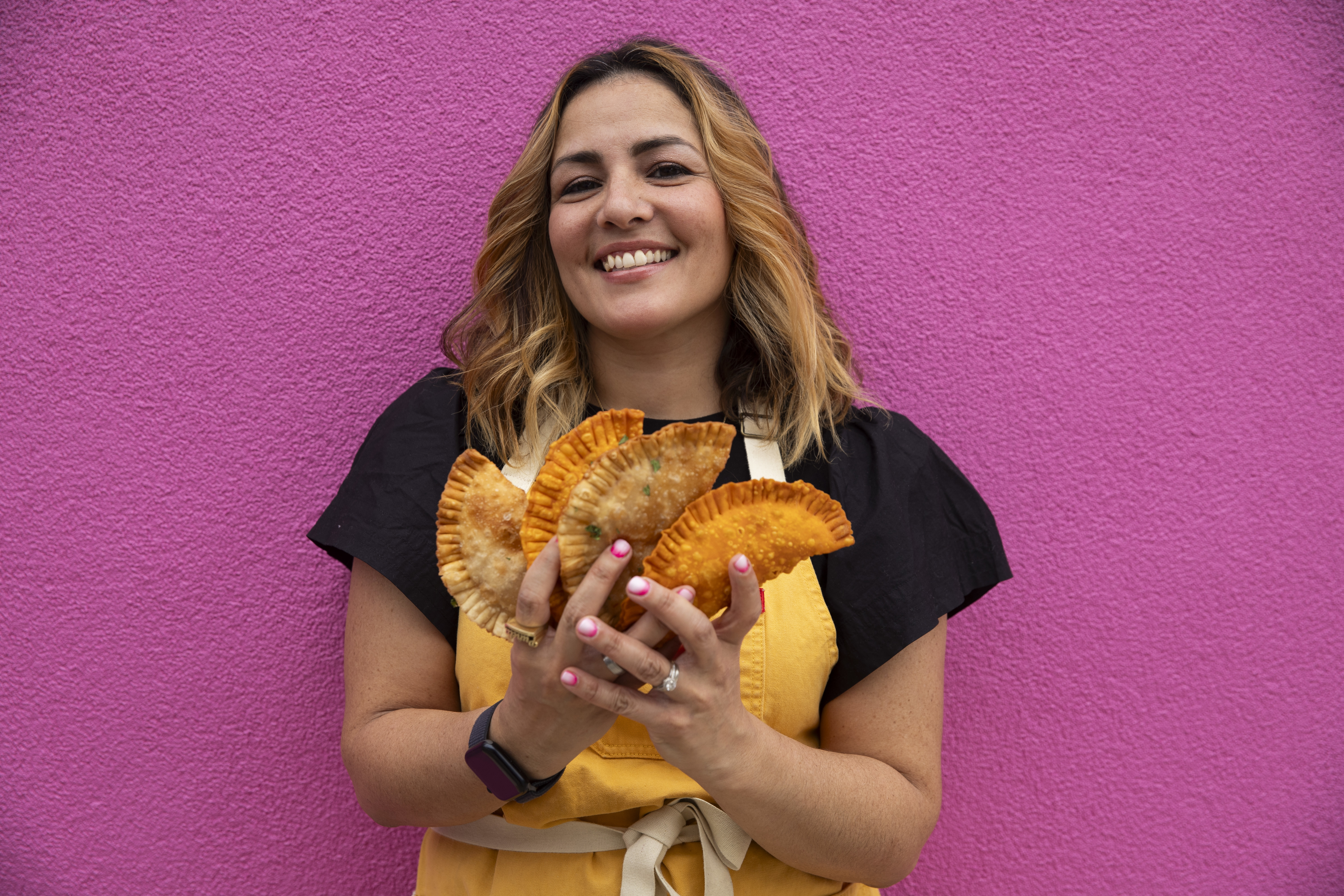
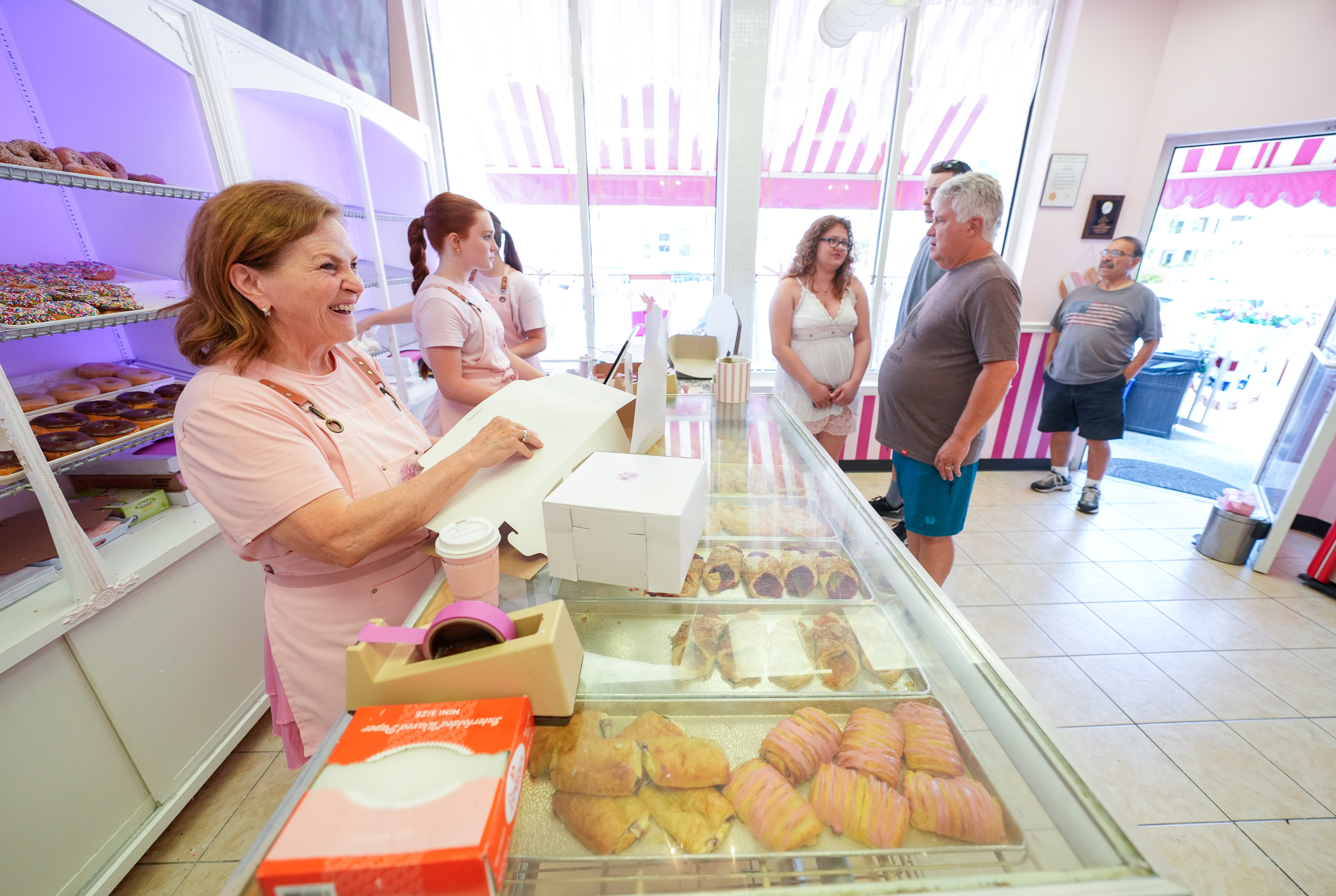
Every week, Amaryllis “Amy” Rivera-Nassar hand-shapes and deep-fries around 2,000 pastelillos at her Fishtown takeout joint, Amy’s Pastelillos.
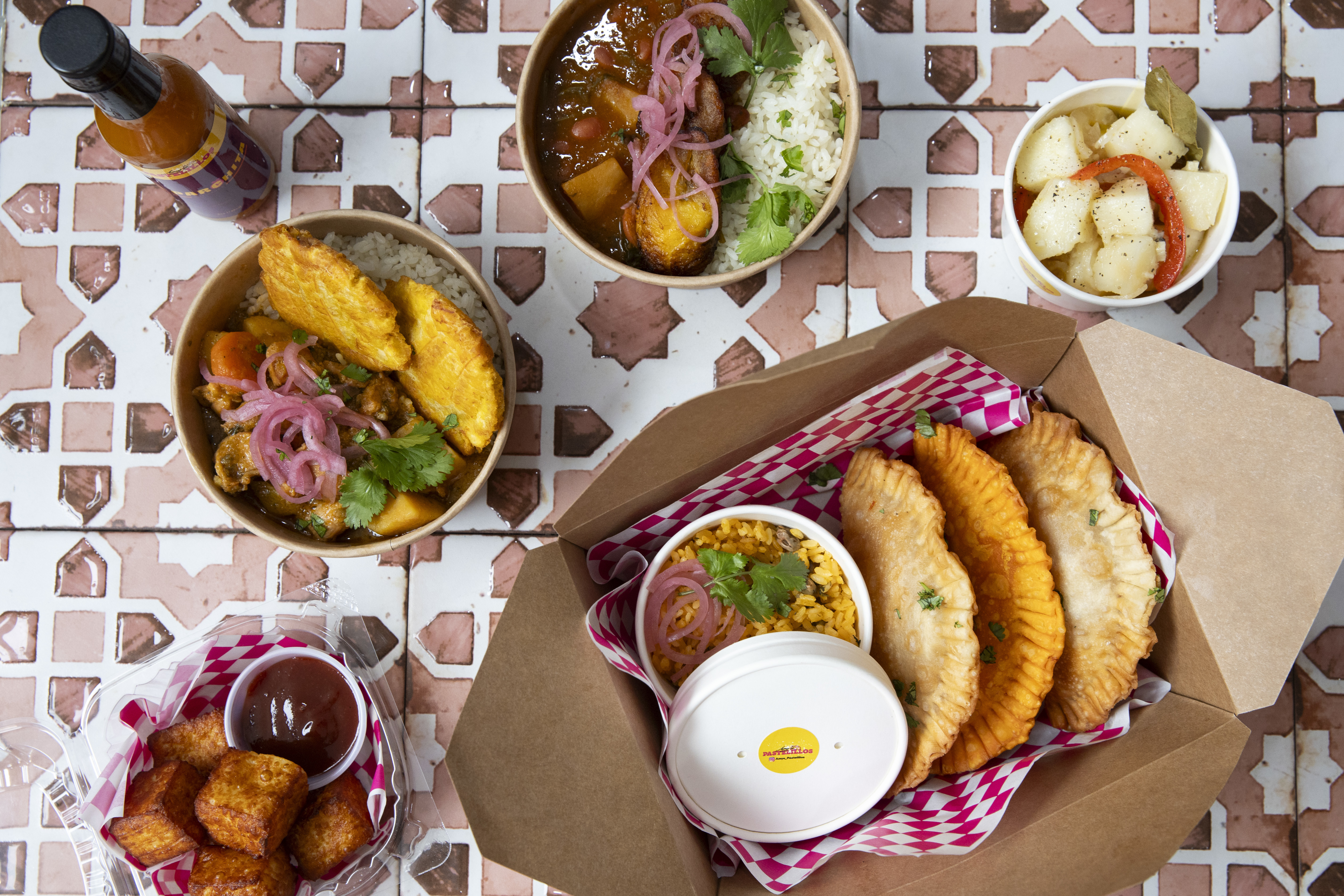
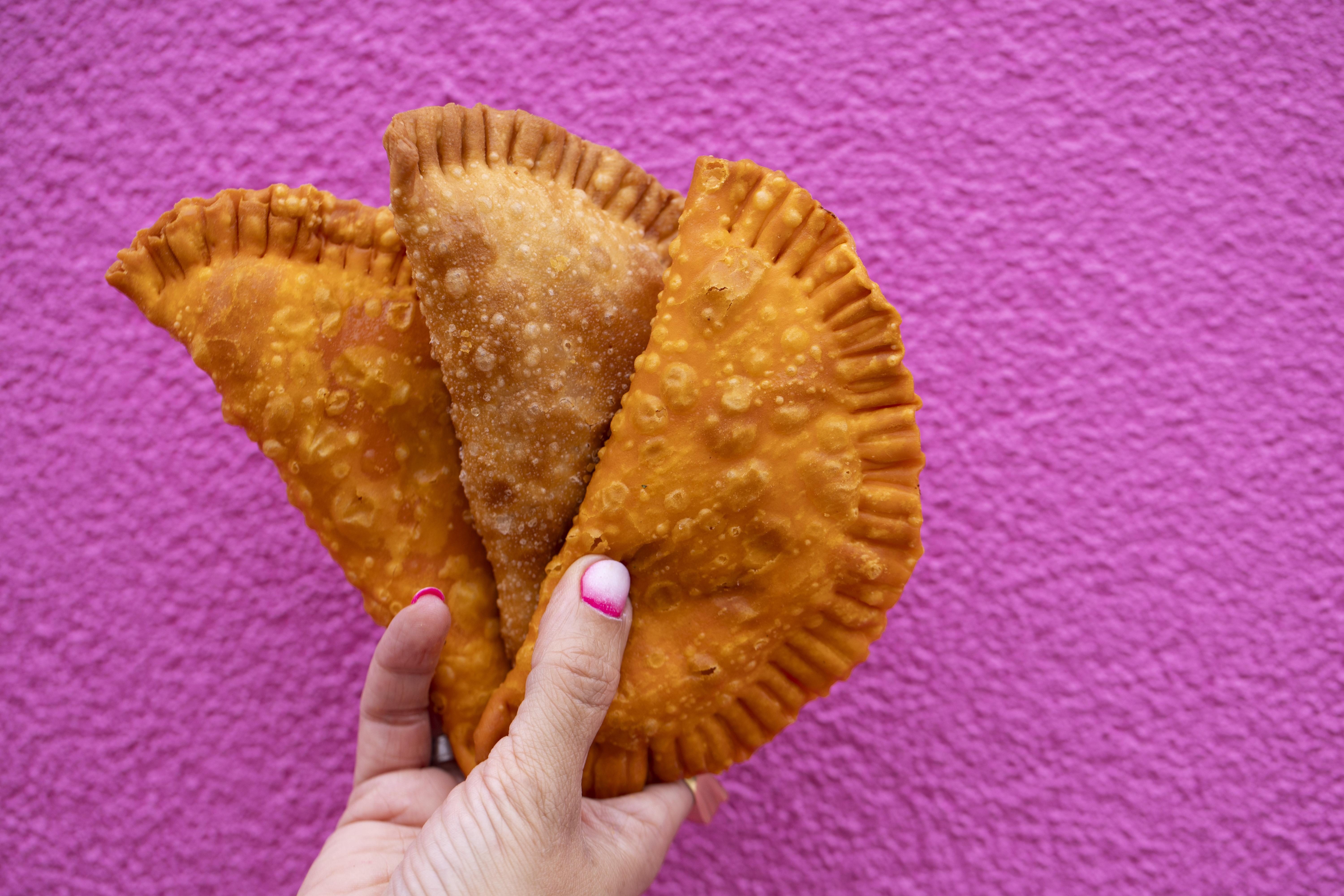
Rivera-Nassar opened the bright pink storefront at 2001 Memphis St. in 2024 after spending years as the neighborhood’s “pastelillo lady,” selling the Puerto Rican turnovers — filled with classic chicken stew, guava BBQ pork, and truffled mushrooms, among others — via pop-ups. But 2026 is the year things really started to click.
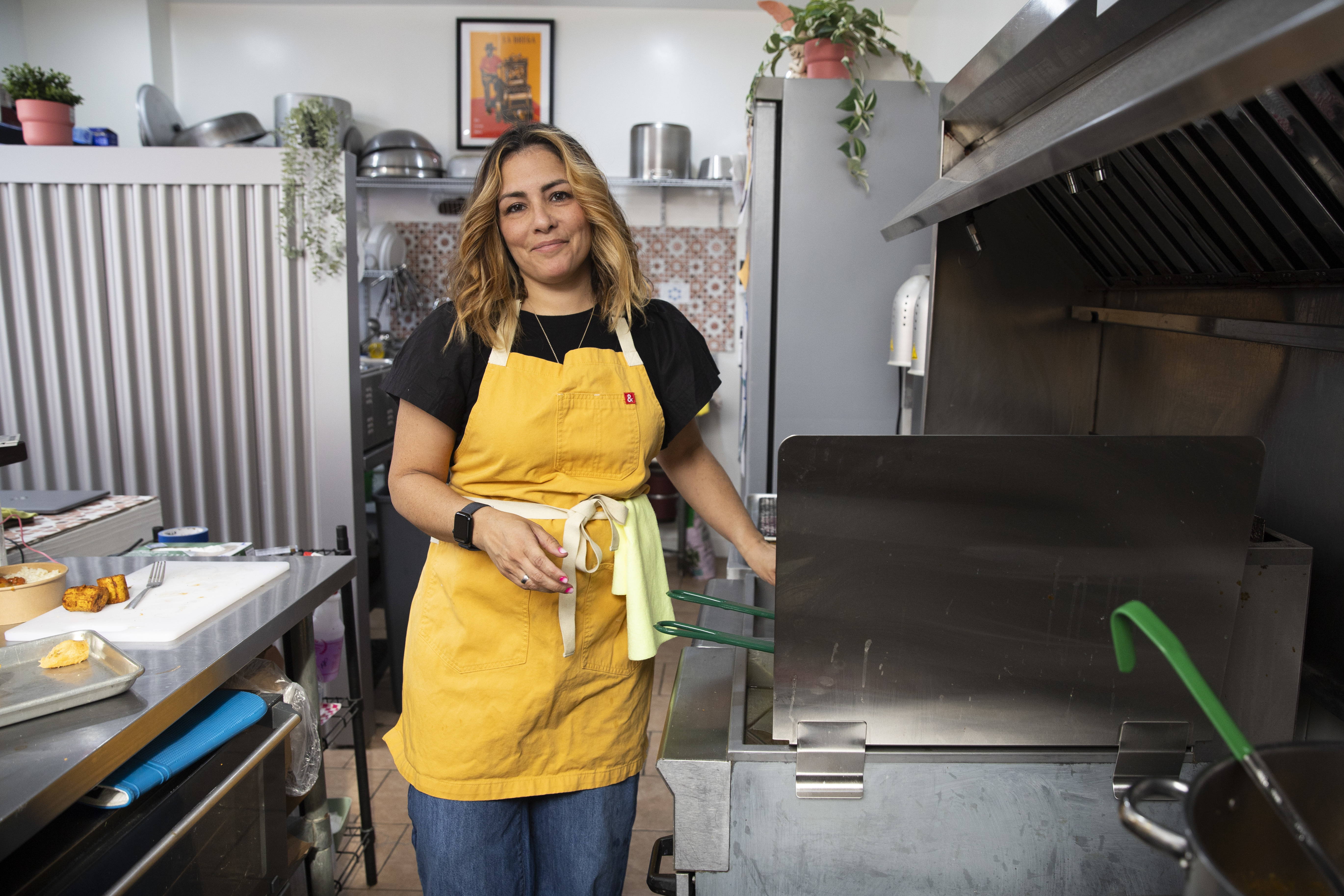
The only hitch: Rivera-Nassar says she’s running out of room to keep up. Her kitchen barely has enough space for two burners, two fries, a pair of fridges, and an oven.
“It’s like a little tiny shoebox. We do so much with so little,” Rivera-Nassar said.
Luckily, Rivera-Nassar now has a big team in her corner: This week, the Philadelphia 76ers and Bank of America announced that Amy’s Pastelillos won the Enrich Program competition, making the takeout shop an official Sixers partner for the upcoming NBA season.
A spread of dishes including pastelillos at Amy’s Pastelillos, now an official partner of the Philadelphia 76ers for the 2026-27 NBA season.Monica Herndon / Staff Photographer
The prize package is valued at approximately $250,000, and includes a year of marketing support, business consulting, and strategic networking from both Bank of America and the Sixers. As an official partner, Amy’s Pastelillos brand will be promoted to 76ers fans through a mix of TV, social media, and radio ads, plus appearances.
The opportunity, Rivera-Nassar said, couldn’t have come at a better time.
“I had been spending all year trying to secure support and funding for my business, and had been getting constant ‘nos,’” she said. “I just can’t believe that we won.”
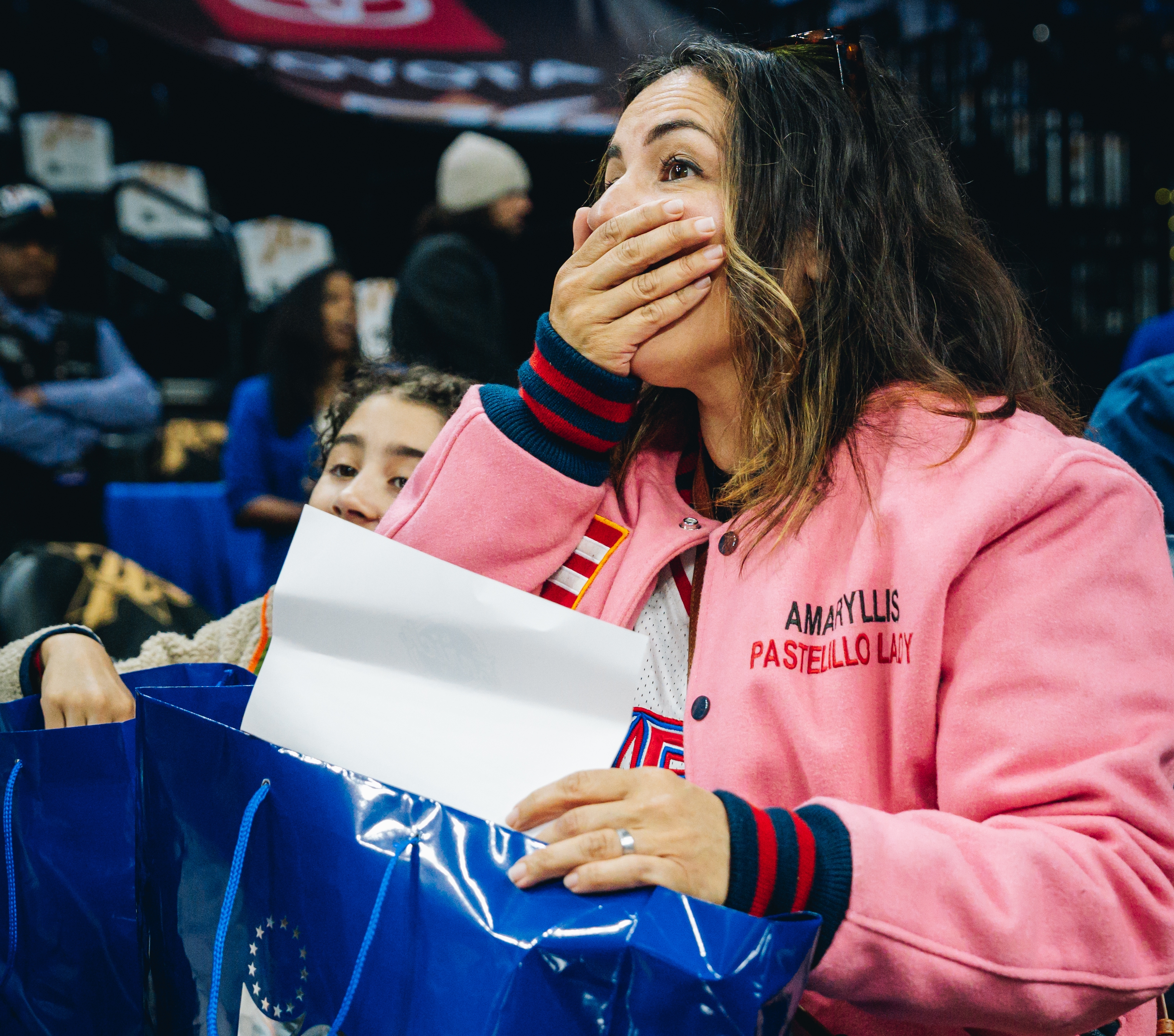
Amaryllis “Amy” Rivera-Nassar, owner of Amy’s Pastelillos, found out her business was an Enrich Program winner during Game 4 of the Sixers playoff series against the Boston Celtics at the Xfinity Mobile Arena.Courtesy Philadelphia 76ers
Bank of America and the Sixers started the Enrich Program during the 2020-21 basketball season as a way to uplift small, local, and underrepresented business owners in and around Philly. Previous winners include East Falls coffee shop Thunder Mug Cafe and the late Charisse McGill’s Lokal Artisan Foods, the brand behind the popular French toast bites stands previously located at Spruce Street Harbor Park and the Christmas Village.
The program is competitive: 175 businesses applied earlier this spring, a Sixers spokesperson said via email. After submitting an application detailing their growth plans, selected business owners must pitch Bank of America and Sixers executives. Enrich’s two other finalists, the Northern Liberties gift shop Laser Philly and the popular Kensington gelato shop Cloud Cups, also received $10,000 cash prizes.
“Amy’s story stood out to us,” the Sixers spokesperson said. “Her vision extends beyond the restaurant itself — she is passionate about creating a space where Philadelphians can experience and connect with Puerto Rican culture and community. That combination of entrepreneurial growth [and] cultural purpose … made Amy’s journey one we were excited to support.”
Amaryllis “Amy” Rivera-Nassar holds three pastelillos from the menu outside her restaurant, Amy’s Pastelillos. She estimates the storefront sells just under 2,000 Puerto Rican turnovers per week.Monica Herndon / Staff Photographer
“We did 700 pastelillos in two hours for just Super Bowl parties alone,” she said. “But the aftermath was super-exciting. A lot of people were like, ‘Oooh, Puerto Rican food’ and really wanted to explore the culture.”
Rivera-Nassar believes the support from Bank of America and the added visibility from the Sixers can help Amy’s expand to a larger off-site prep kitchen —even if she can’t bear to leave her bright pink storefront.
“I’m attached. It’s my baby,” she said,at the same time acknowledging that, space-wise,“we’ve hit our ceiling.”
Amaryllis “Amy” Rivera-Nassar works in the kitchen at Amy’s Pastelillos. Now an Enrich Program winner, Rivera-Nassar is hoping to expand to a larger, off-site prep facility.Monica Herndon / Staff Photographer
Rivera-Nassar is most excited to see her business’ name in lights inside the Xfinity Mobile Arena. She learned about winning the Enrich prize while sitting courtside with her 10-year-old daughter at Game 4 of the Sixers playoff series against the Boston Celtics.
“I was already overwhelmed by the fact that Tyrese Maxey and [V.J.] Edgecomb were right in front of us. And then the Sixers reps came out and congratulated me,” Rivera-Nassar said. “I was floored.”
A line in Philadelphia’s zoning code conflates drag performances with strip clubs, topless bars, and other adult cabaret venues. It’s a definition that City Council hopes to change.
Councilmember Rue Landau introduced legislation on Thursday to remove references to “male or female impersonators” in a section of the zoning code that regulates “Adult Oriented Services.”
As currently written, Philadelphia defines an adult cabaret as a place that “features topless dancers, go-go dancers, exotic dancers, strippers, male or female impersonators or similar entertainers … dancing, performing or acting in a lewd, sexually erotic, exciting or stimulating manner.”
The distinction is similar to one found in a Tennessee law that prohibits so-called “adult cabarets” featuring “male or female impersonators” from being staged anywhere minors might see it. It also mirrors language used in similar drag bans struck down this year byjudges in Texas and Montana, and one currently up for consideration by the Idaho Senate.
If passed, Landau’s proposal would strike the provision regarding male and female impersonators.
The bill will first be considered by City Council’s Rules Committee. The legislation has the support of Mayor Cherelle L. Parker’s administration, Landau said, and has also been shared with her colleagues in City Council, who Landau described as “supportive.”
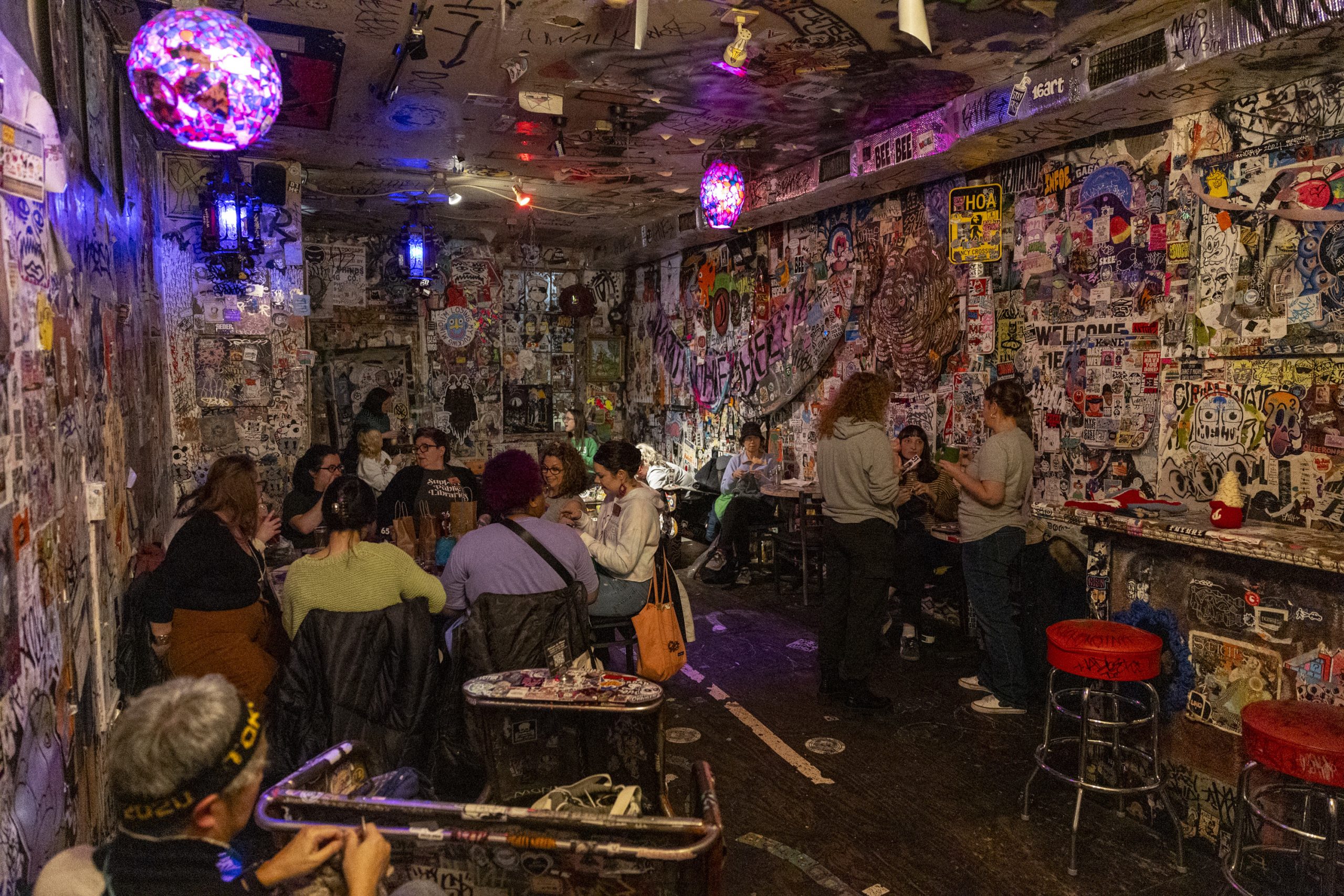
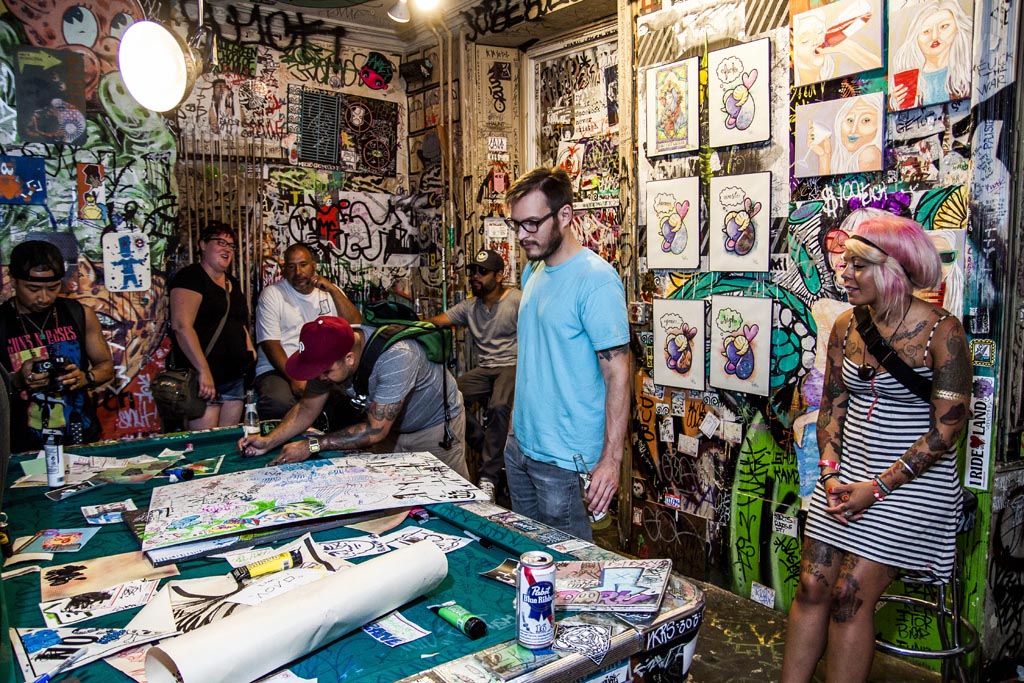
Landau’s bill is inspired by recent events at South Street bar Tattooed Mom, which has long been a go-to venue for Philly’s LGBTQ+ artists, and particularly drag performers, in part because it doesn’t charge acts.
A crowd fills Tattooed Mom. The popular South Street bar is unable to host events with music for the foreseeable future.
Tattooed Mom owner RobertPerry told The Inquirer Friday that he brought what he called the “offensive and troubling language” to the attention of Landau’s staff, but was not involved in drafting the legislation.
The incident “opened my eyes to actually reading the code and having conversations … I think the [language] is so antiquated that people don’t even realize it’s there,” Perry said. “We might have initially spurred the conversation, but Landau did all the heavy lifting.”
Perry was initially instructed to seek an adult cabaret permit in addition to a special assembly license for Tattooed Mom, he told the Philadelphia Gay News in July. That same month, an L&I spokesperson told Philly Voice that the permit — which traditionally governs businesses such as strip clubs and adult theaters — is required to host drag and burlesque events.
Perry now believes that his bar doesn’t need one upon further research, he said Friday.
Regardless,Landau said Tattooed Mom’s predicament was the spark for her proposal.“They were cited in violation of this provision simply because they had a drag performance happening,” she said. “We don’t want that happening in Philly … A lot of folks rely on drag performances for their livelihood, and we just want to keep supporting them.”
Landau is unaware of L&I citing other Philly venues for hosting drag or burlesque shows without a permit. “This is thankfully nothing that L&I is usually citing establishments” over, she said.
A crowd looks at art inside the South Street bar Tattooed Mom.
If passed, Landau’s legislation won’t green-light events with music at Tattooed Mom. All Philly establishments with an occupancy of 50 or more people that host music performances, dancing, or DJs are required to have a special assembly occupancy license, which costs $253 and must be renewed annually. To procure one, Tattooed Mom must first apply for a zoning exception.
The process involves holding a public meeting for community feedback followed by a separate hearing in front of the Zoning Board of Adjustment. As of March 2026, the wait time for a hearing is 180 days — or roughly six months — according to a manual from the City of Philadelphia.
Perry said he has yet to begin Tattooed Mom’s application.
Dolly is an Aries. She likes pink accessories, the feeling of freshly brushed hair, and morning coffee with friends. She also has to be the center of attention.
No, Dolly is not a teenage girl.She’s a three-month-oldHereford calf with a job: To snuggle up with as many guests as possible at Rose Bridge Farm, a Montgomery County animal sanctuary.
Rose Bridge Farm sits on almost 13 acres of land at 1314 Limekiln Pike in Dresher, once part of an estate owned by William Penn in the mid-1700s. When steward Kristin Sutch took over the property in 2013, she transformed it into a sanctuary for farm animals rescued from livestock auctions, dairy farms, and breeders.
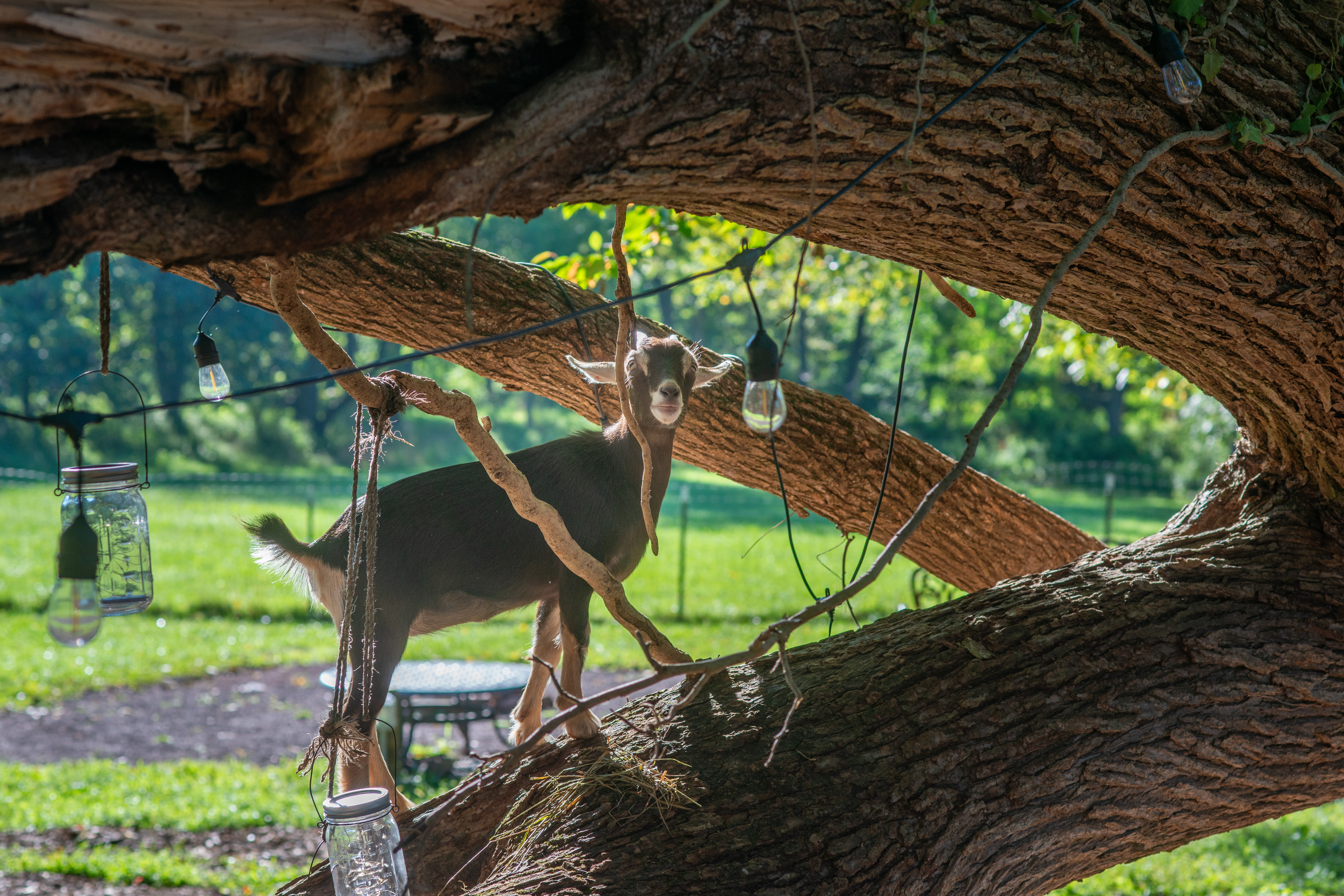
The sanctuary has 50 animals at any given moment, Sutch said, most of them babies that eventually will be adopted out to private farms and other sanctuaries. About a dozen kids — baby goats, that is — clomp around the property, climbing on lopsided trees as if they were a playscape. Freshly rescued lambs doze together in a dimly lit corner of the farmhouse, while kittens play upstairs in a renovated loft.
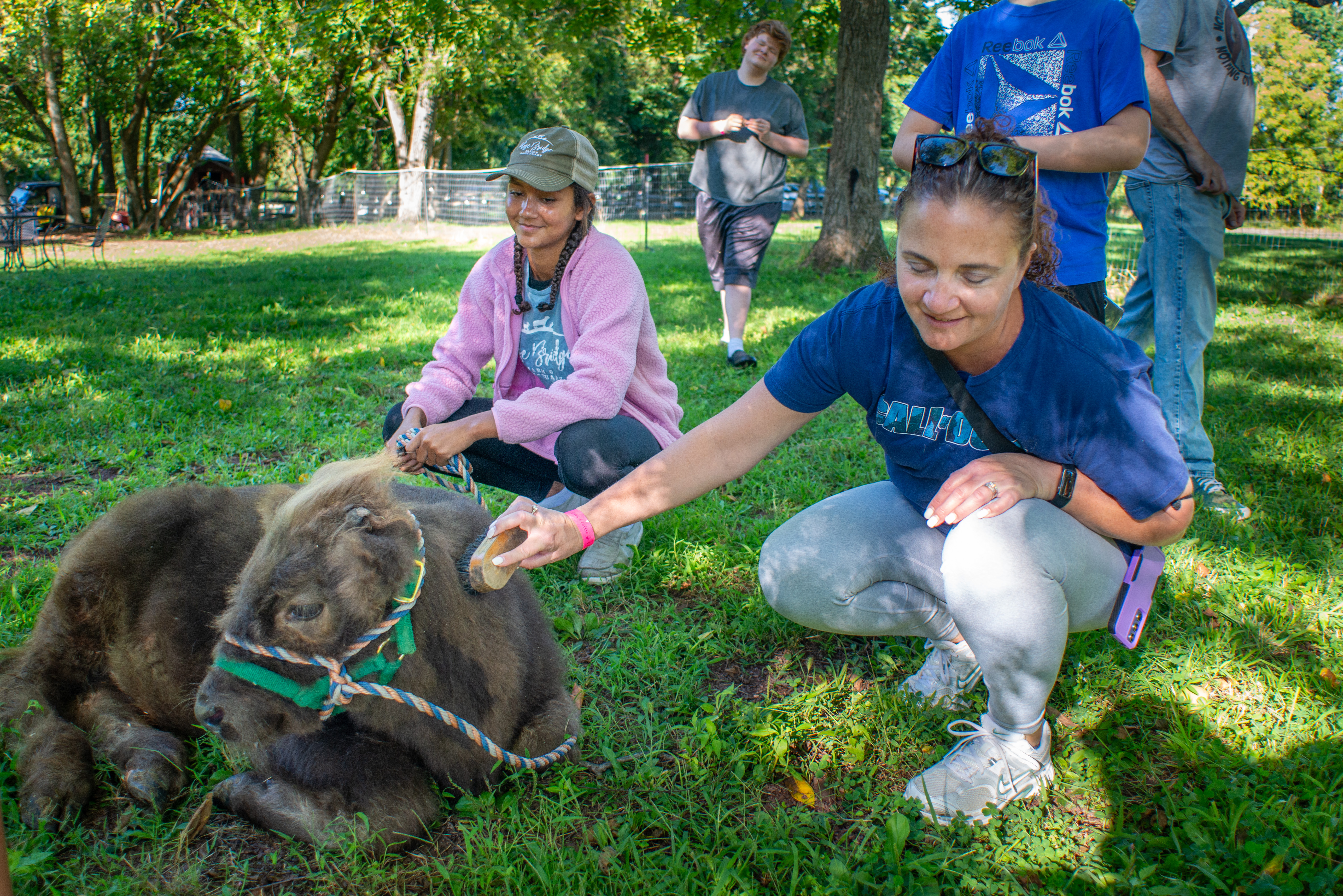
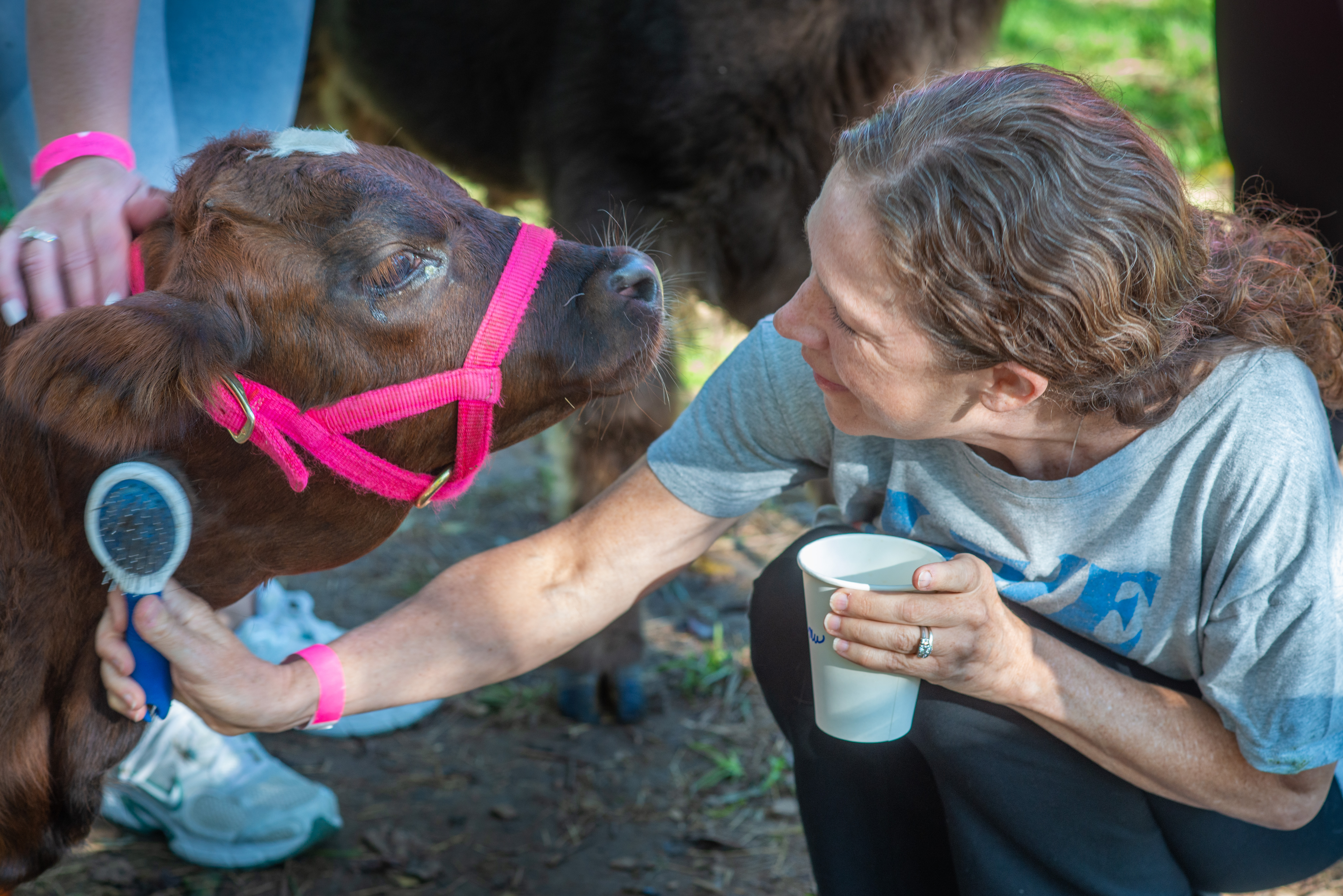
Ava Cranshaw (left), a volunteer, and Diane Haggerty, of Doylestown, brush Teddy — a mini Highland cow — at Rose Bridge Farm sanctuary during a morning Cows & Coffee event.William Thomas Cain / For The Inquirer
Rose Bridge has always been open to the public, offering guided animal husbandry tours, birthday parties, and the once-trendy goat yoga to offset the cost of running the rescue. Sutch, however, struck gold with a novel idea: What if people could start their morning like she does, by drinking coffee in the company of baby cows?
“A lot of these animals are bottle babies, so they really enjoy companionship. They’re like your dog: If you leave, they get sad,” Sutch said. “Having the public come in … [the cows are] getting as much love, snacks, and cuddles they could hope for.”
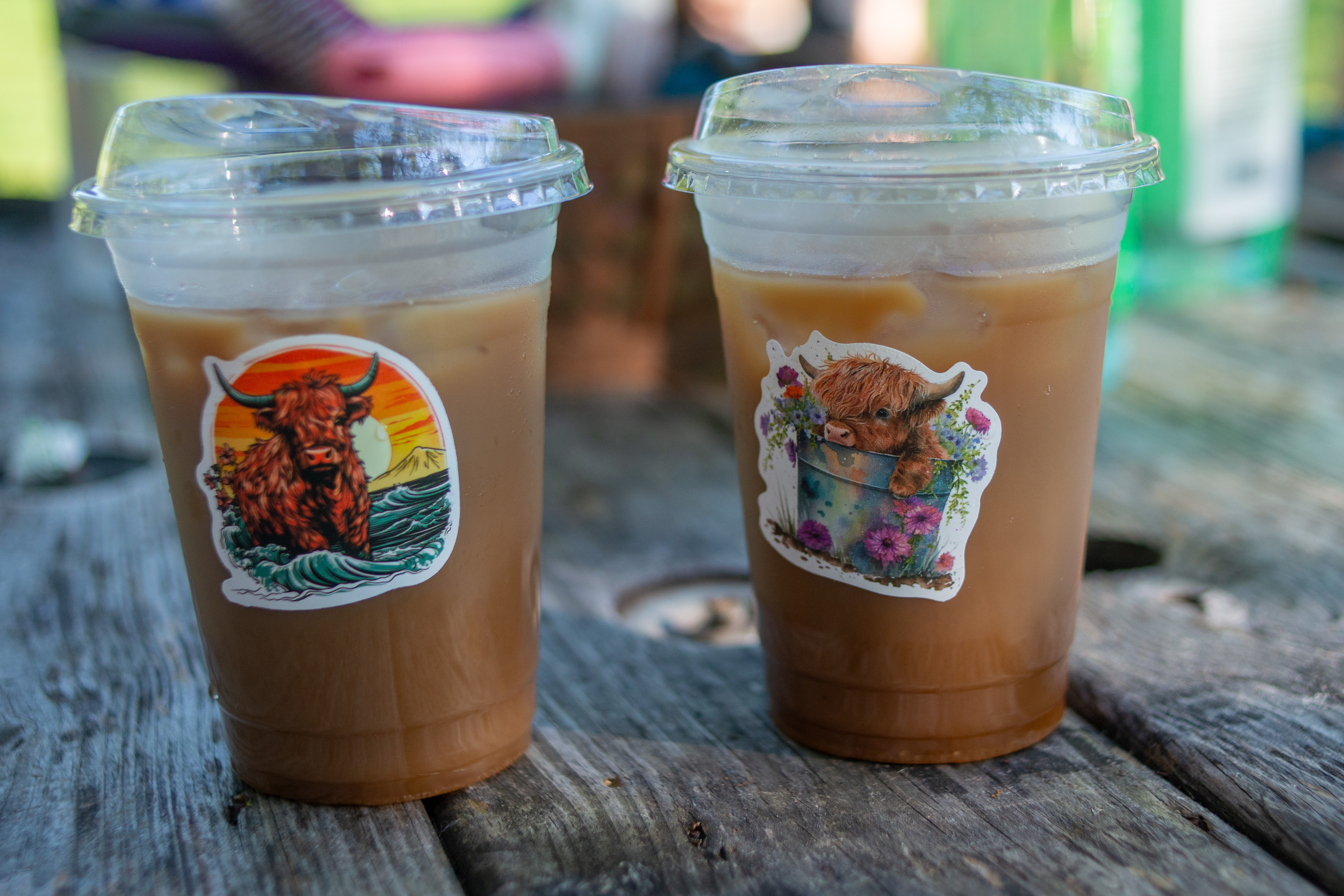
Coffee cups with Highland cow decals from a Cows & Coffee session at Rose Bridge Farm and Sanctuary.William Thomas Cain / For The Inquirer
During the hourlong, $20 sessions (which run daily at 8, 9, and 10 a.m.), guests start in the barn’s loft with an unlimited self-serve drip and iced coffee bar that includes sugar, nondairy milks, creamers, and cold foam alongside seasonal sprinkles.
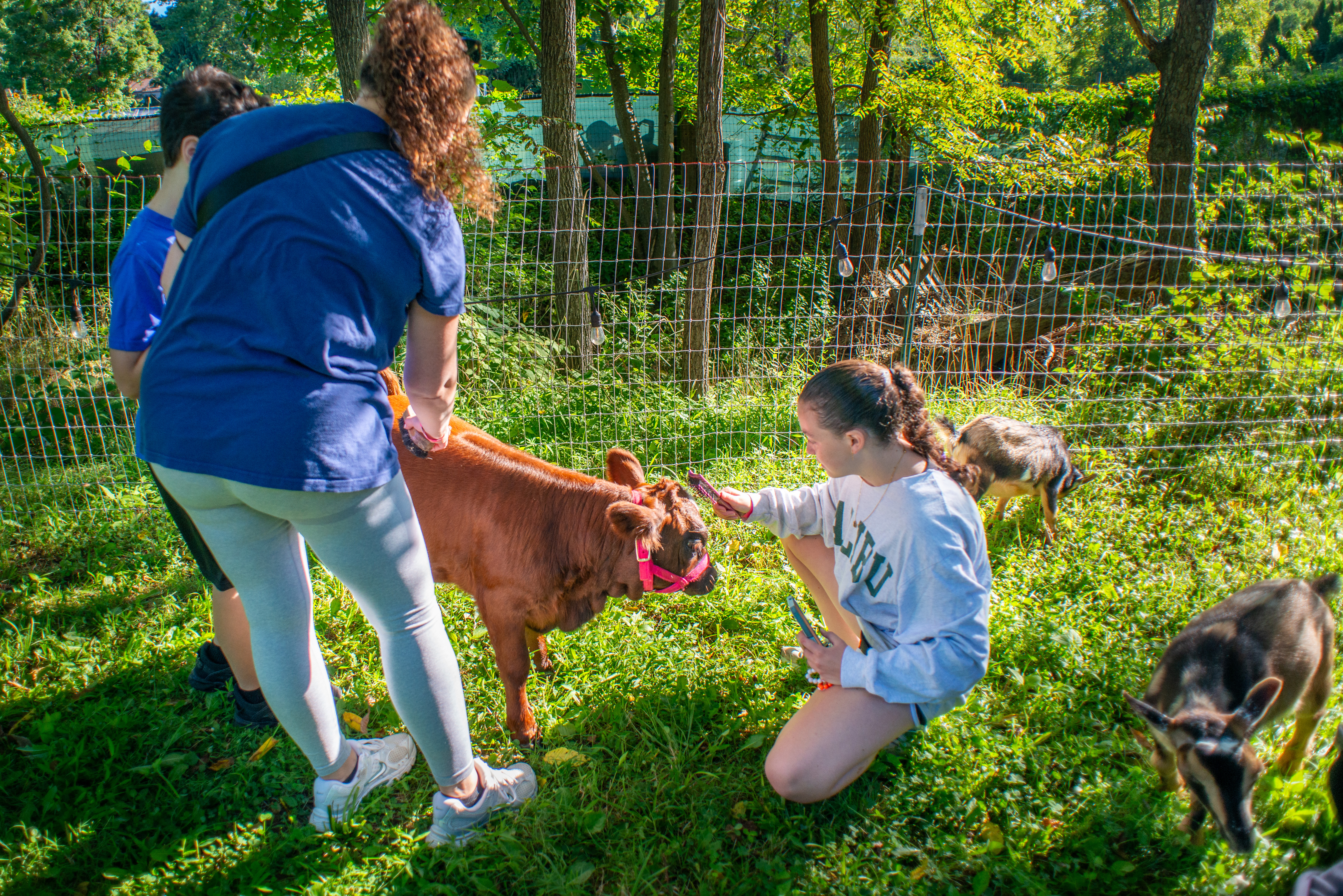
Next, one of Rose Bridge’s volunteers will lead the group to the farm’s pasture, where they can brush, cuddle, and bottle-feed Dolly and her friend Teddy, a five-month-old mini Highland cow with fringe bangs and a summer buzz cut that’s just starting to grow in.
The sanctuary’s sessions are so popular that Sutch started offering an evening version branded Cows & Cocktails, where guests can sip on alcoholiciced tea and lemonade made with farm-grown mint and lavender alongside Teddy and Dolly. They’re content with booze-free bottles of milk.
A goat eats a snack during a Cows & Coffee event.William Thomas Cain / For The Inquirer
The events’ success has helped Sutch begin to check off a laundry list of renovations to the nearly 300-year-old farm, such as an automatic fire system, new barn doors, and eventually, a rehabbed bottle room.
“Everything needs replacing,” Sutch said. “And you should see our vet bills, our feed bills, our hay bills. … It takes a lot to run this farm, so [Cows & Coffee] has really been a blessing.”
Cows and goats and kittens, oh my
It’s easy to feel chosen at Rose Bridge. When I attended Cows & Coffee on a recent crisp morning, it started with a tiny tuxedo kitten trying to climb inside my coconut cream latte. Outside, baby goats nibbled on the hem of my shirt at seemingly every turn. If I stopped petting Dolly under the chin, she’d moo as if she missed me.
Melissa Watters, of Elkins Park, brushes Dolly during a Cows & Coffee event at Rose Bridge Farm.William Thomas Cain / For The Inquirer
“You look at them, especially the fuzzy baby ones, and they just make you feel all warm,” said Sutch.
Rose Bridge caps Cows & Coffee sessions at 15 attendees, with a 10-and-up age minimum. Attendees are encouraged to brush Dolly and Teddy, and to let the calves suck their thumbs, sort of like a baby and their pacifier. For maximum bonding, Sutch recommends squatting down to the cows’ level and “talking to them like a friend.”
Diane and Grace Haggerty, of Doylestown, brush Dolly during a Cows & Coffee event at Rose Bridge Farm.William Thomas Cain / For The Inquirer
Dolly, who was dropped at Rose Bridge in April from the back of an SUV, wasn’t always a diva. Teddy, however, was always a ham.
“He’s a big kisser,” said Sutch, and loves to get his floppy bangs styled.
Rose Bridge also has a new cow in town: Lady A, a 1½-year-old mini Highland cow named after the country band. Since she’s the eldest, Sutch said, Lady A is still adjusting to socializing with the rambunctious Teddy and Dolly. But what she lacks in fans, she makes up for in friends.
A goat walks on a tree at Rose Bridge Farm & Sanctuary, an animal rescue in Dresher, Pa.William Thomas Cain / For The Inquirer
“She’s a little feisty,” said Susan Connolly, who drove nearly 50 miles to Rose Bridge from her home in Kendall Park, N.J. “I like that.”
Diane Haggerty and her daughter, Grace, were partial to Dolly. “She speaks her mind and actually lets you pet her,” said Grace, who went to Cows & Coffee for her 12th birthday. “This exceeded all my expectations.”
Admittedly, not everyone was sold.
“I don’t know how at peace I feel,” said Katrina Miciek of Havertown. “I’m too busy making sure the cows and goats don’t eat my shoes.”
Ella Skiles, a volunteer, kisses a lamb at Rose Bridge Farm & Sanctuary in Dresher, Pa.William Thomas Cain / For The Inquirer
Rose Bridge Farm Sanctuary, 1314 Limekiln Pike, Dresher, rosebridgefarmsanctuary.com; Cows & Coffee runs 8 to 10 a.m. daily.
A coed bathhouse is opening in Philly. Its business model involves choreographed sauna rituals and Bitcoin-heated pools.
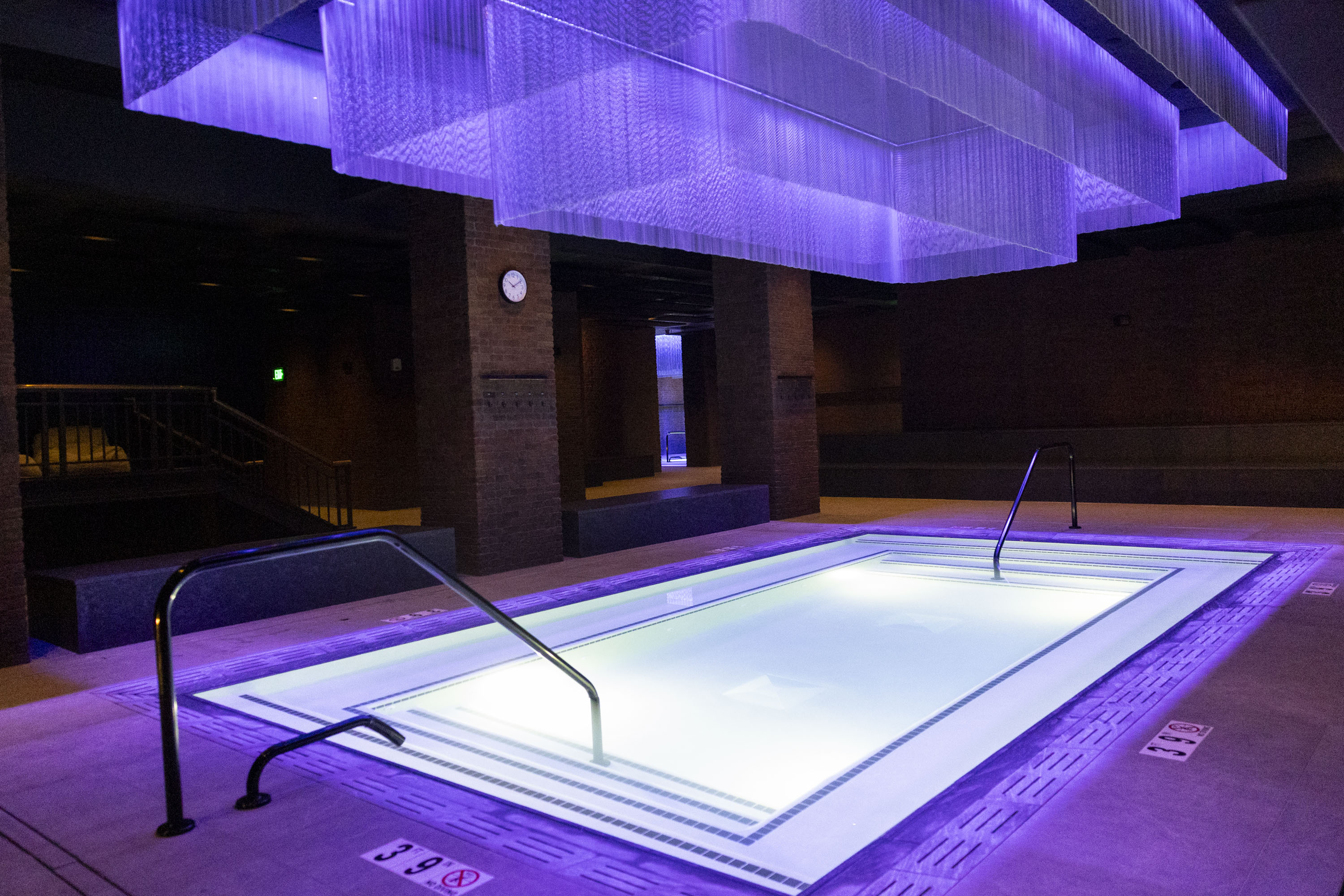
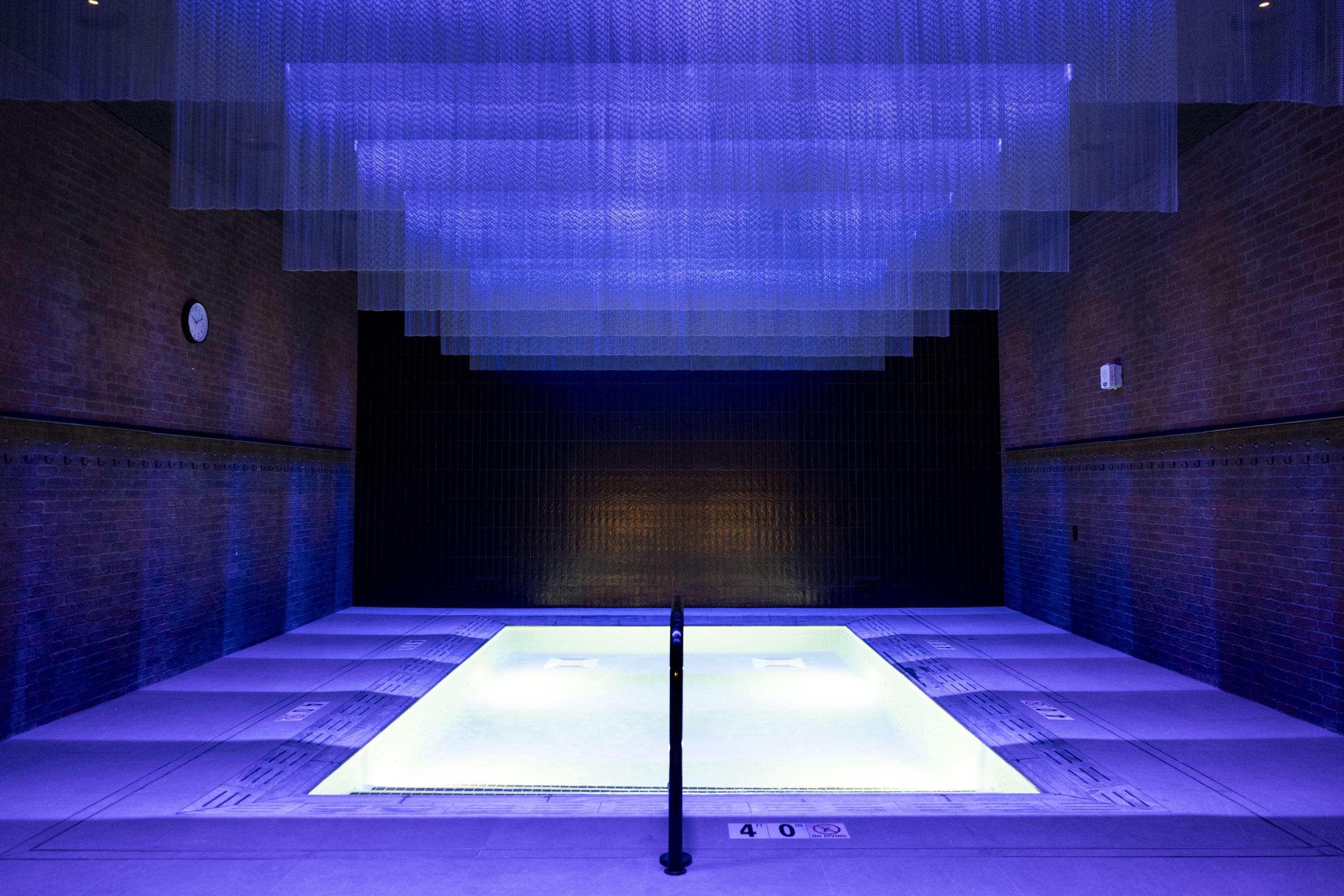
Bathhouse opens on Friday, Sept. 25, at 1418 Walnut St., transforming the Bellevue Hotel’s defunct basement food court into a sprawling facility with three saunas, three pools, a steam room, and appointment-only massages. The 36,000-square-footspace is the largest standalone wellness complex in Philly. It’s also the latest in a gambit to rebrand sweating as an activity that is simultaneously sexy and productive.
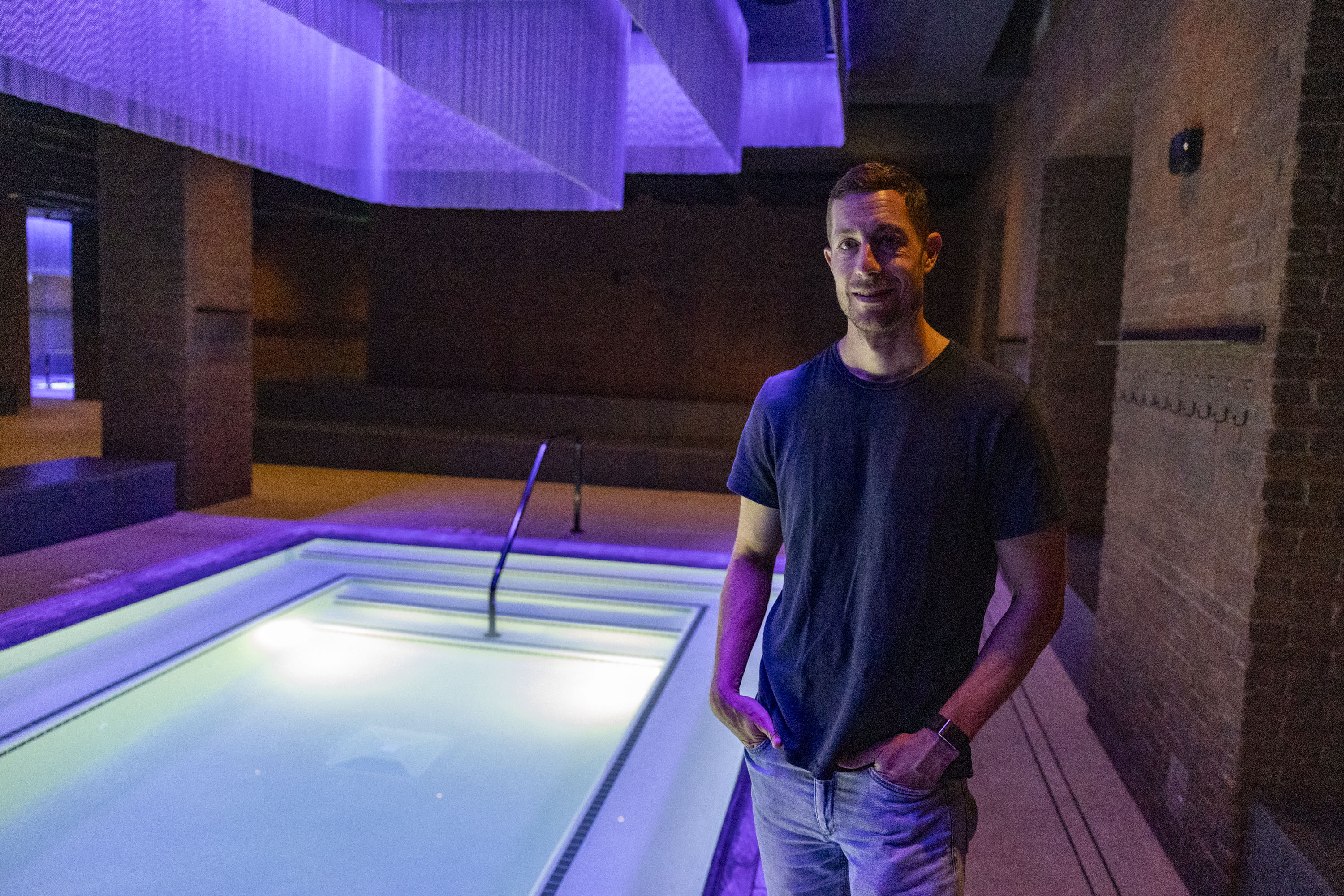
“Our business is technically a 7,000-year-old business,” said Travis Talmadge, a certified sauna master and Bathhouse’s cofounder. “People have been building hot rooms to sweat in forever, and pools aren’t a new concept … All we’re doing is bringing the best-in-class” versions of both.
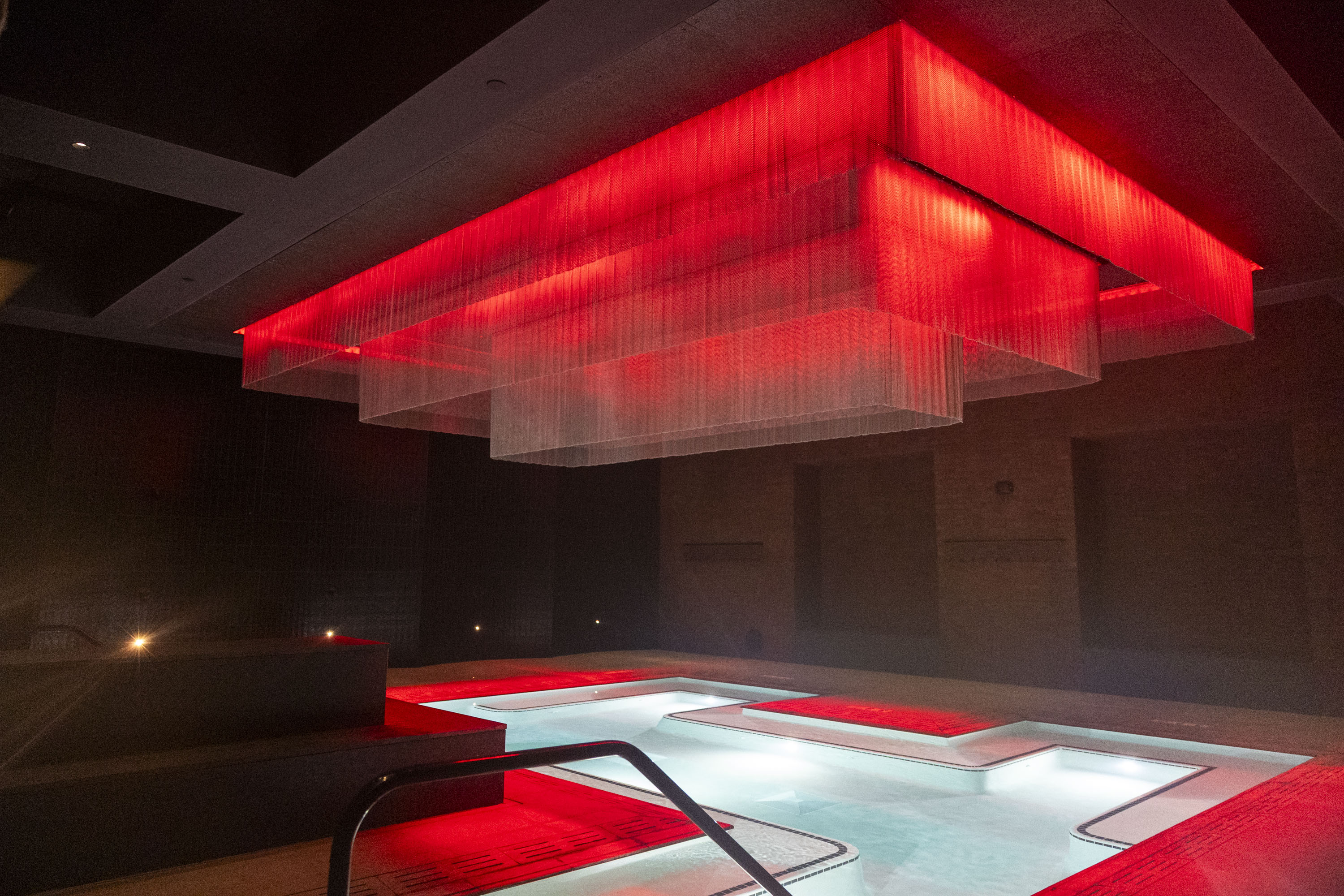
The cold plunge inside Bathhouse’s 36,000-square-foot location in the basement of the Bellevue Hotel.Tyger Williams / Staff Photographer
After opening another New York City location in 2024, Bathhouse received a $35 million investment from Imaginary Ventures, the investment firm that previously backed beauty brands such as Glossier, Kosas, and Alix Earle’s Reale Actives.
Now, Bathhouse is on an expansion tear. Philly’s location will be the first outside of NYC, with other outposts planned for Chicago, Nashville, Los Angeles, Minneapolis, North Jersey, and Connecticut.
Roughly 1,000 people pass through each of the company’s now three NYC locations per day, Talmadge estimated. Most, he said, are focused on decompressing before or after work. Others, he said, use it in place of happy hour with friends. Some are even on dates. None, Talmadge stressed, want a spa.
Bathhouse cofounder Travis Talmadge is a certified sauna master who also hosts aufgusses, a traditional German sauna ritual.Tyger Williams / Staff Photographer
“Spas really focus a lot more on relaxation and pampering,” he said. “There’s really no pampering [here]. There’s nothing relaxing about sitting in a 200-degree room or a 45-degree pool.”
The amenities
Bathhouse draws on Russian, Turkish, and German bathing rituals to create a distinct wellness experience.
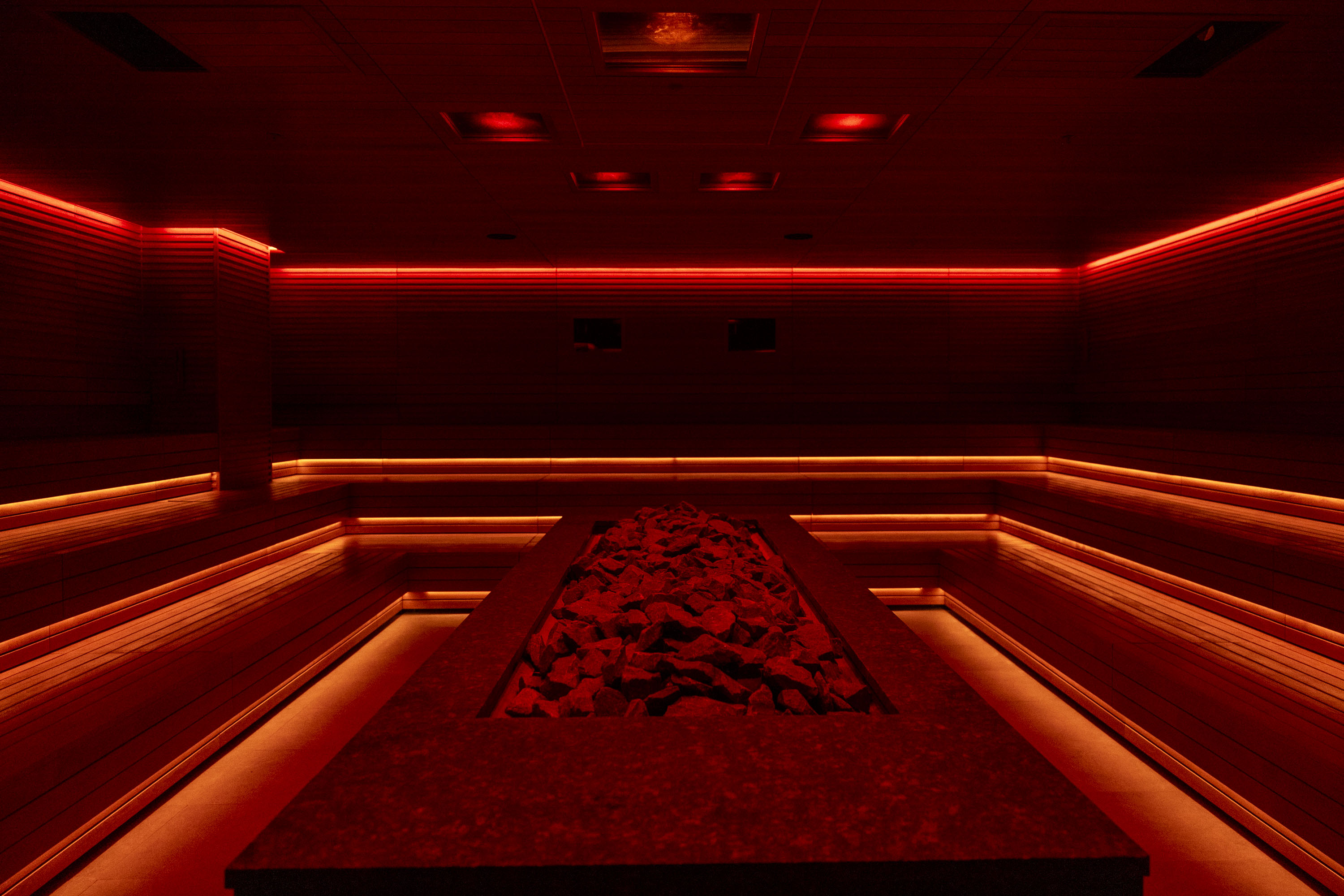
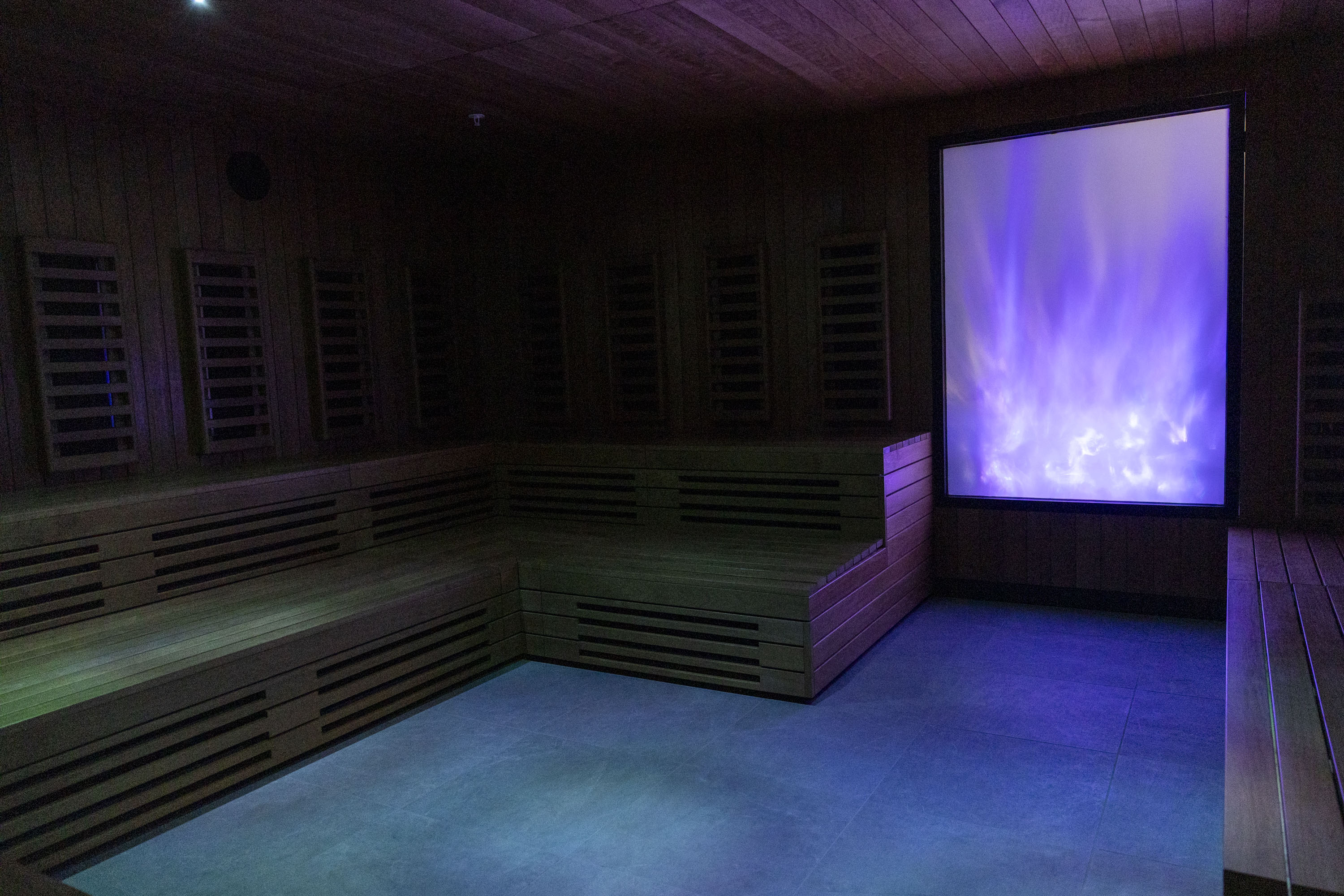
The Philly location is launching with a steam room and three saunas: a 140-degree infrared one; a 190-degree traditional Russian banya heated by a wood stove; and a large dry room warmed to 180 degrees that Talmadge repeatedly referred to as the “event sauna.” Its lights have “the capabilities of a nightclub,” Talmadge said, and can change color to match the beat of the music during Bathhouse’s regularly scheduled sauna rituals.
The space also has hot and neutral pools alongside a traditional cold plunge, plus private rooms for full body massages and an on-site cafe for smoothies, beer, natural wine, and light bites. (A rooftop pool and sauna will open in May, Talmadge said.)
The dry “event” sauna room at Bathhouse heats to 180 degrees Farenheit. It’s also where sauna masters perform aufgusses — German sauna rituals — for guests.Tyger Williams / Staff Photographer
Zach Seidman, head of marketing for the Bellevue, called Bathhouse “a complement” to the Sporting Club’s fitness-first offerings. “There’s nothing like it in Philadelphia,” he said.
The infrared sauna at Bathhouse is the gentlest of the Philadelphia location’s three saunas.Tyger Williams / Staff Photographer
In theory, Bathhouse is the cheapest of them all. Day passes at the Philly location start at $29 but are subject to change based on demand and time of day.
Talmadge said Bathhouse tries to avoid trends. Instead, they are singularly focused on hosting aufgusses, a theatrical German ritual wherein a sauna master melts essential oil-doused snowballs on a bed of hot stones. To circulate the scents, the sauna master then whips towels around the room like helicopter blades.
The hot pool at Bathhouse Philadelphia. Located at 1418 Walnut St., it is the brand’s first location beyond New York City.Tyger Williams / Staff Photographer
In Philly, Bathhouse will likely host aufgusses every 90 minutes in — naturally — the event sauna, lead by certified sauna masters. Talmadge, who earned the title in 2021, said each sauna master has their own playbook of tricks meant to evoke a smile, if not some sort of spiritual experience. (His is a double-towel spin mixed with a bit of catch-and-release.)
“Some people really love the aromatherapy and want to see how the scents hit their nervous system,” Talmadge said. “Other people love watching the show and are in it for the tricks … Everyone has their own experience.”
The Bitcoin
What, exactly, is powering your Bathhouse experience? Bitcoin, in part.
Since its 2019 founding, Bathhouse has used small on-site data centers of Bitcoin miners to warm its pools and heated seats, extracting excess energy from the machines via pipes. The practice, Talmadge said, has helped significantly cut Bathhouses’ electricity bills while allowing them to make back some money, even as returns from the cryptocurrency have slowed.
“It’s like a rebate,” said Talmadge with a shrug.
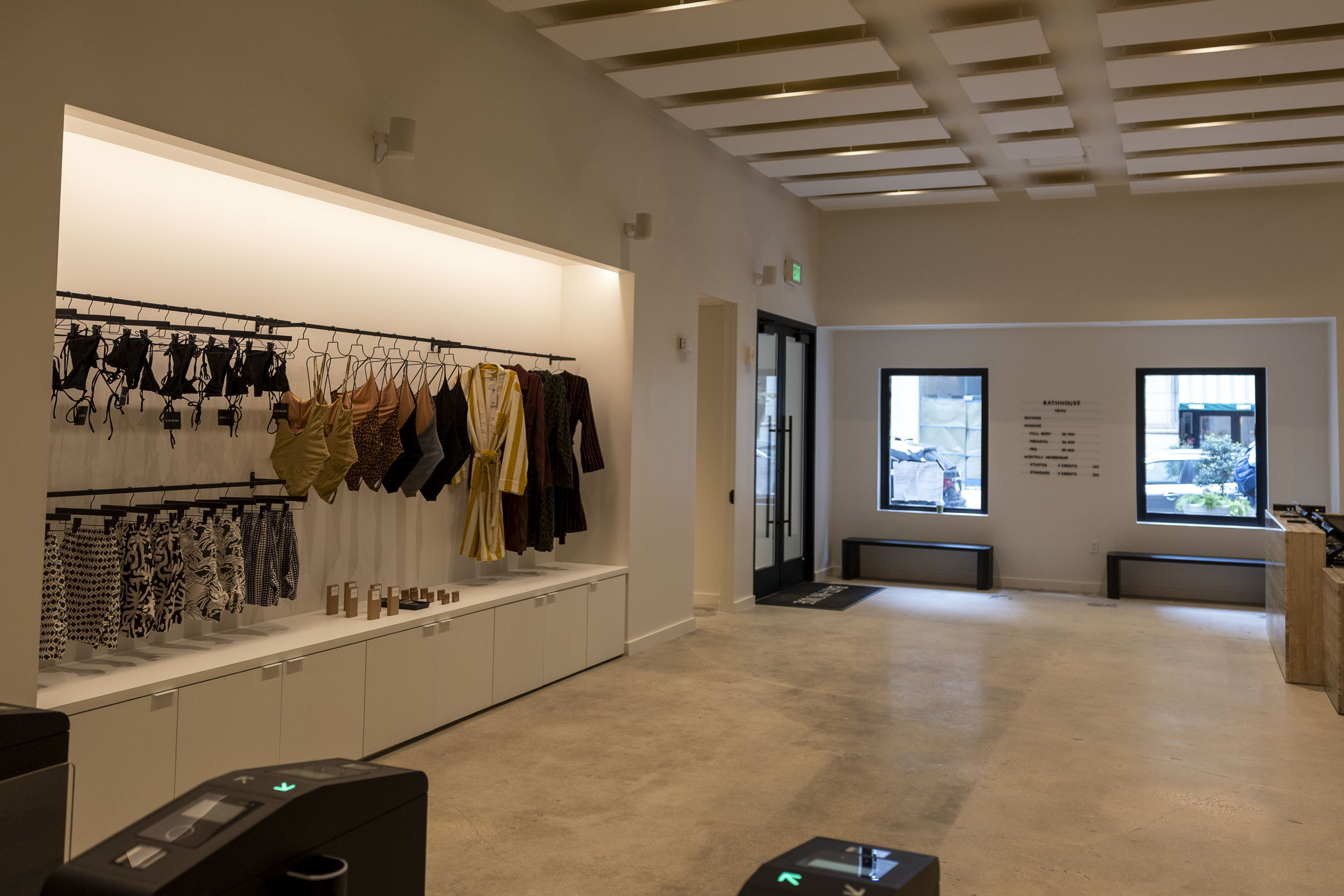
The entrance area at Bathhouse Philadelphia, 1418 Walnut St.Tyger Williams / Staff Photographer
If Philadelphians can get past the Bitcoin miners lurking in the background, Talmadge recommends first-timers start with 15 minutes in the gentler infrared sauna. They should also hydrate constantly.
Those looking to maximize their sweat should lay on the top row of the Russian banya, which becomes the hottest point in the bathhouse as the heat rises.
“That’s your belly of the whale,” Talmadge said. “The goal with the saunas is to eventually try to push yourself.”
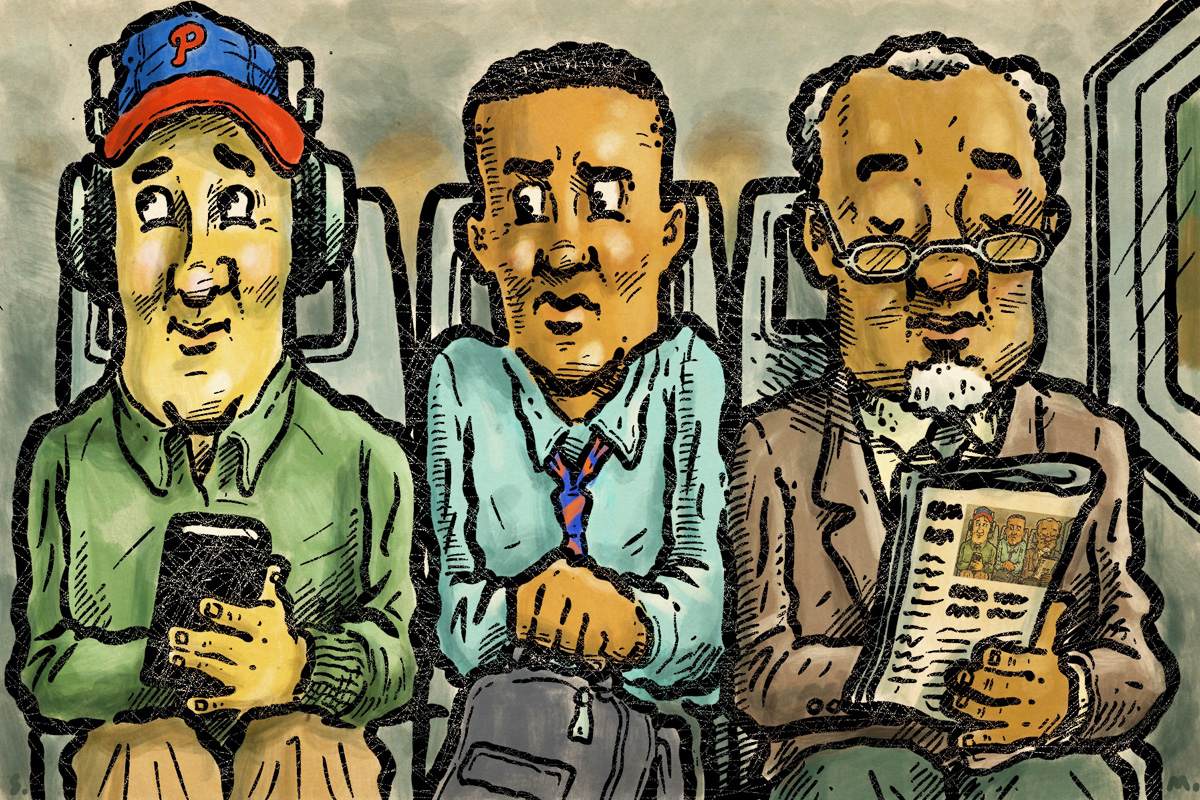
On Regional Rail, I often sit in the aisle of a three-seater, knowing the car will fill up at rush hour. When it does, I stand up so another passenger can take the middle seat, then return to my aisle seat. My friend says that’s awkward on a busy car, and I should just slide over. Who’s right?
Beatrice Forman, Food & Dining reporter
I feel like sliding over is one of those things that’s baked into the social contract of riding public transit, TBH.
If it’s a busy car, it’s your moral duty to slide over and free up the aisle seat. Sitting at the end of the row is a defensive posture that makes it seem like you don’t want someone next to you.
Abigail Covington, Life & Culture reporter
The right thing to do is slide over.
Beatrice Forman
I think it’s weird because it treats the middle seat kind of like a punishment? And most Regional Rail rides aren’t long enough to the point that it matters. One of my favorite facts about Regional Rail is that none of the trains have bathrooms because the trips aren’t that long.
Abigail Covington
I would absolutely do what the writer does. Everybody knows the middle seat is terrible. The window is better because you don’t have people on either side of you. The aisle is better because it makes it easier and faster to get off the train. The only reason to sit in the middle is if there is nowhere else to sit. If the aisle was open when you got to it, you hold onto that seat for dear life. It’s basically like riding first class for free.
Beatrice Forman
I don’t know that taking the middle seat makes it that much slower to get off the train. It’s like when people stand as soon as the airplane lands! It doesn’t help you move any quicker. The real prime real estate is getting a seat close enough to a door. First class does still have middle seats, after all.
I always slide over because of the golden rule. I would hate to be relegated to the middle seat for the rest of my life just because my stop is closer to the end of the line.
Abigail Covington
Yeah, Bea, you’re correct. The right, polite thing to do is slide over. If you’re getting up to let someone else in, you’re causing commotion in the aisle, forcing others to move, or shoving them closer together. Trains work best when everybody on them works together to create a seamless, efficient experience. Like stepping off the train at a stop if you’re standing by the door. By not scooting over, you’re being a bottleneck.
Beatrice Forman
And no one likes a bottleneck.
Abigail Covington
Exactly. And I say that with love, as a fellow aisle seat-addicted bottleneck.
Beatrice Forman
You know, at least they’re not one of those people that take their shoes off on the train. Those people deserve the middle seat for life.
Bagel shops come in all stripes. There are sandwich shops and schmear shops, shops that will gladly toast your bagel, shops that will refuse to scoop it, and shops with service so curmudgeonly it comes across as endearing.
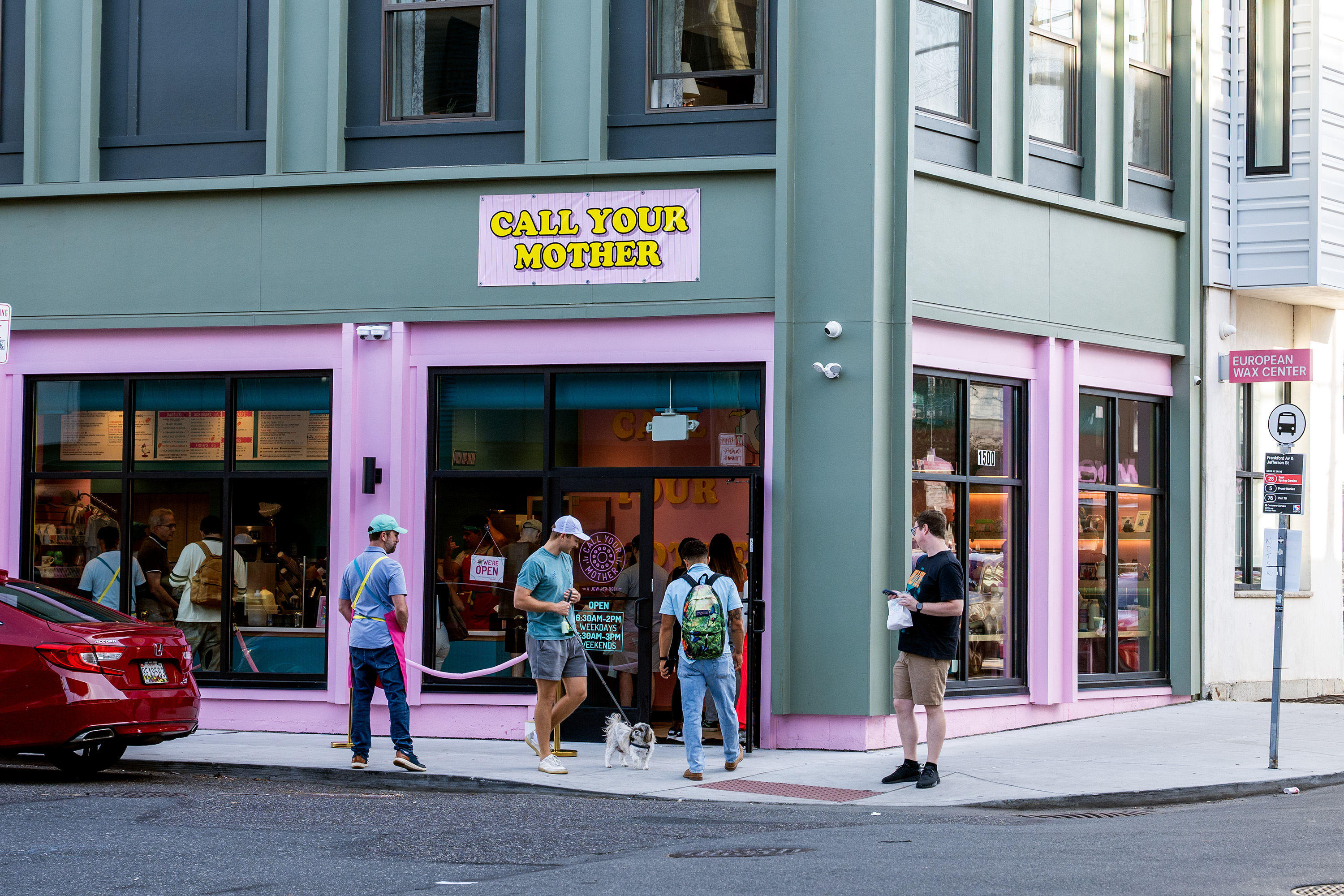
Call Your Mother, the latest bagel chain to hit Philly, isn’t trying to be any of those. Instead, it is America’s preppiest bagel shop, closer to a viral tween clothing store than a neighborhood deli.
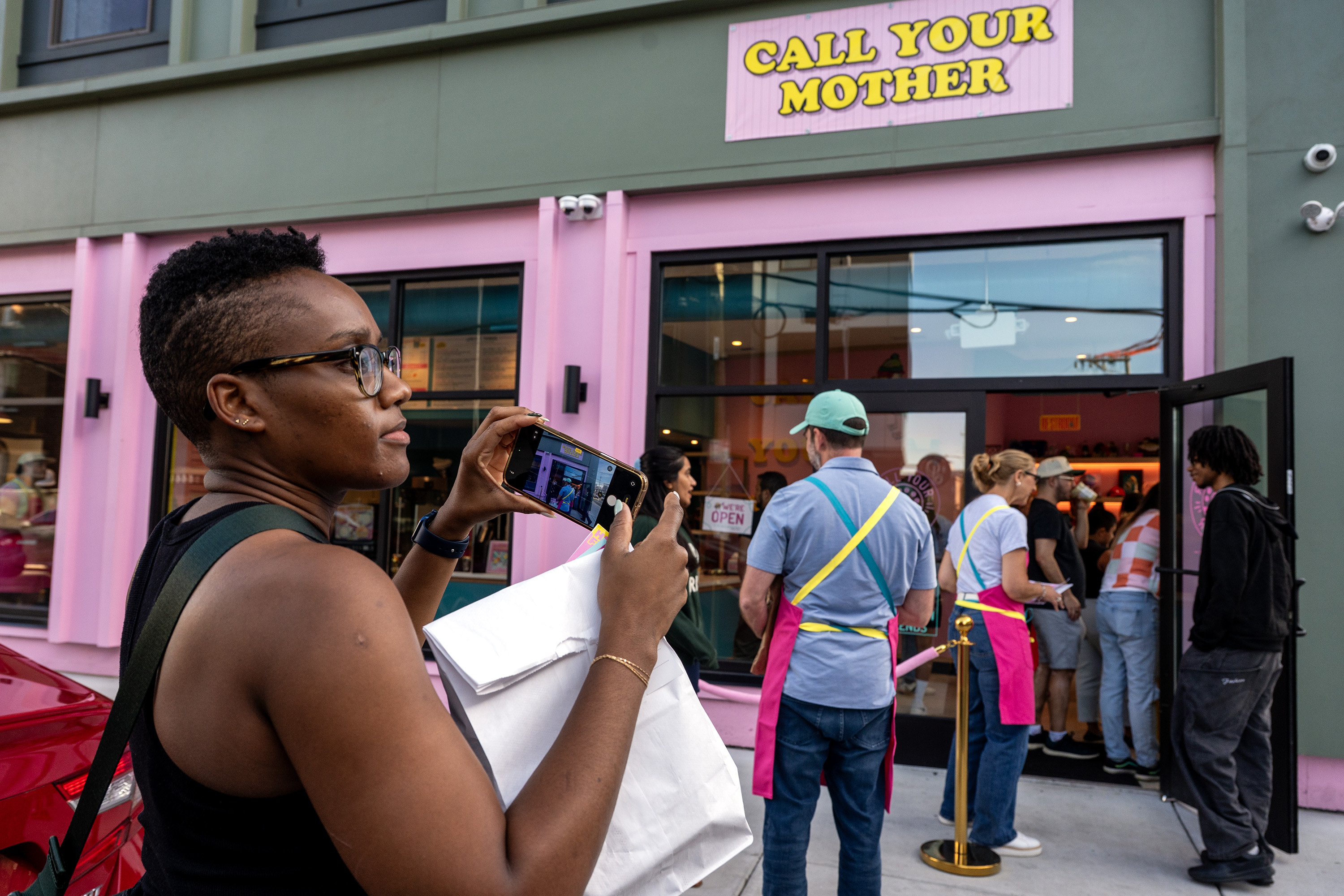
The shop’s newly opened Fishtown location looks like a boutique that just so happens to serve bagels, its bubblegum pink storefront sporting a mural of a cream cheese-and-lox bagel and a latte alongside a school of cartoon fish.
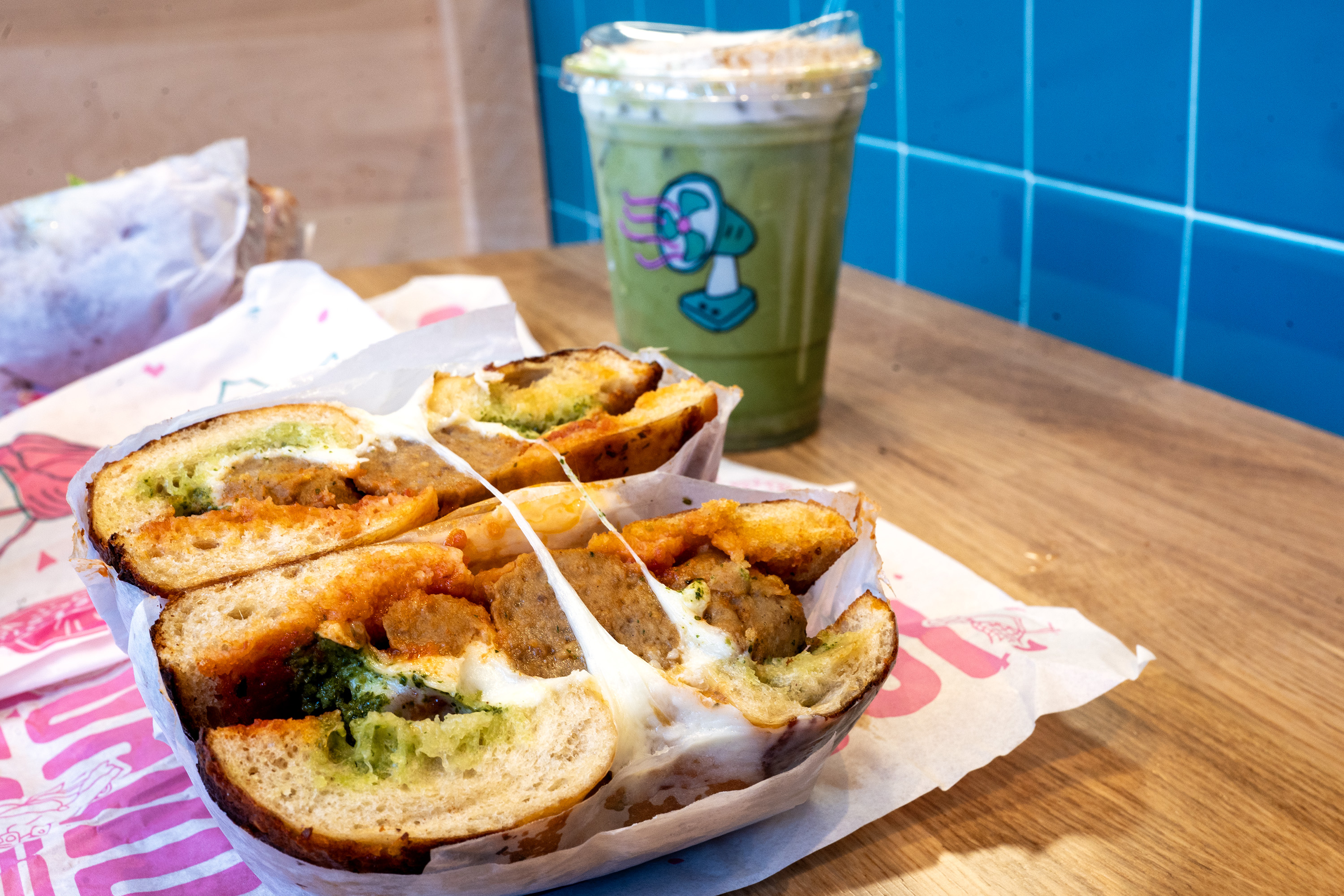
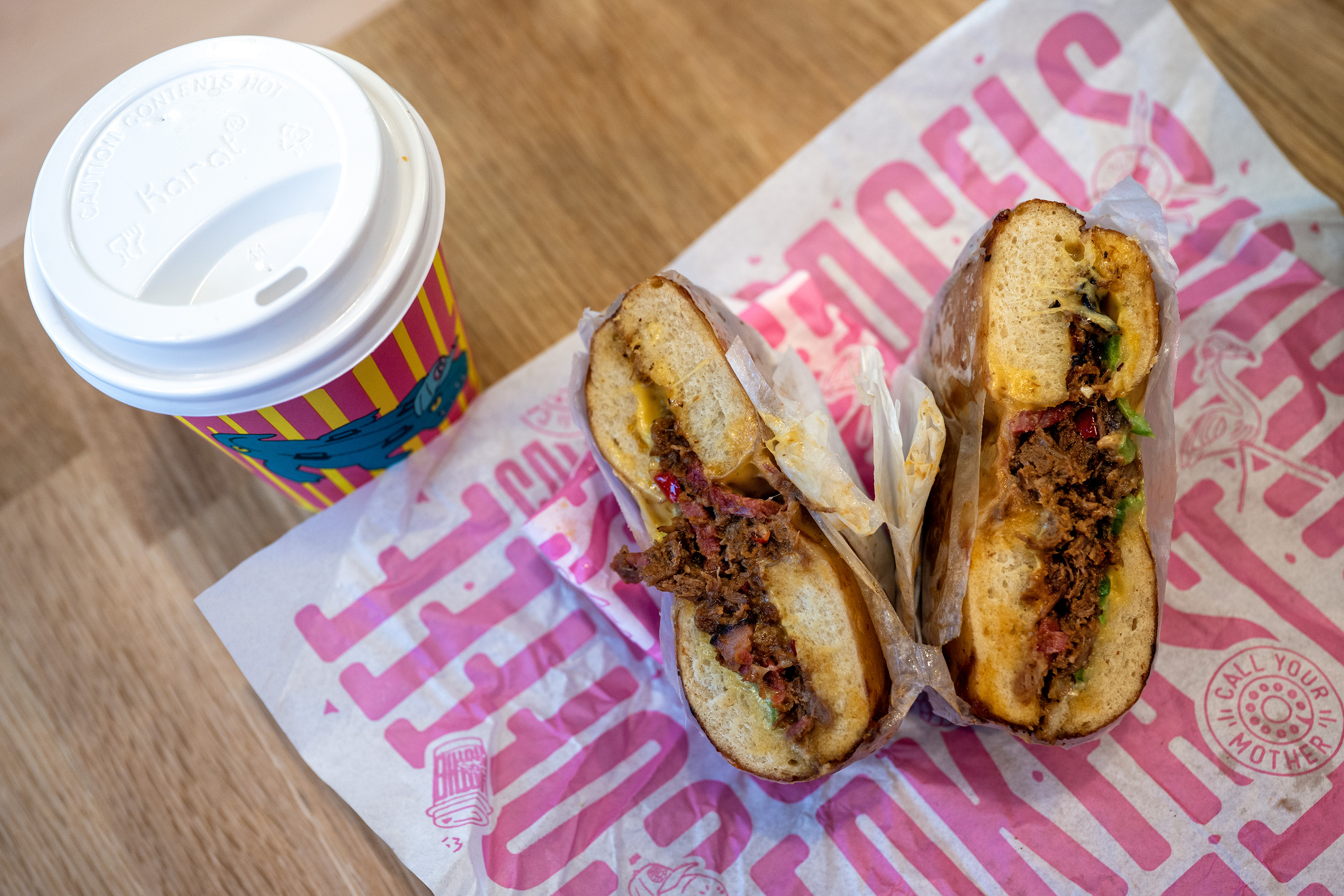
The meatball sub bagel and banana bread-matcha latte at Call Your Mother during its Fishtown soft opening on Tuesday, Sept. 8, 2026.Tom Gralish / Staff Photographer
Shortlisted as a candidate for Bon Appetit’s best new restaurants list in 2019, Call Your Mother is now synonymous with the private-equity bagel boom: The shop went from a handful of locations in D.C. to 28 across Maryland, Virginia, Colorado, Illinois, and Pennsylvania after the investment firm Invus, an early Cava investor, purchased a stake in the company at the start of 2025.
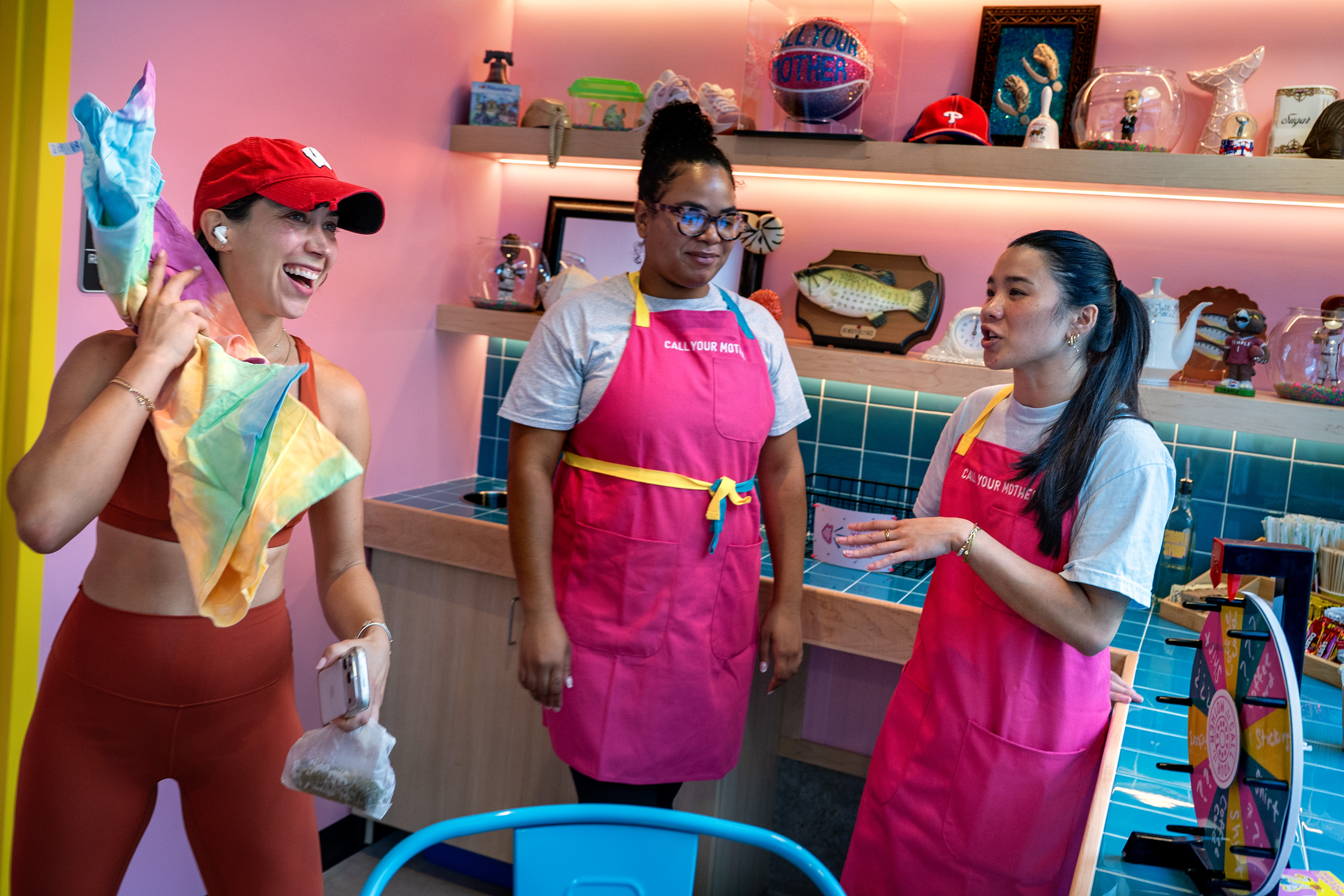
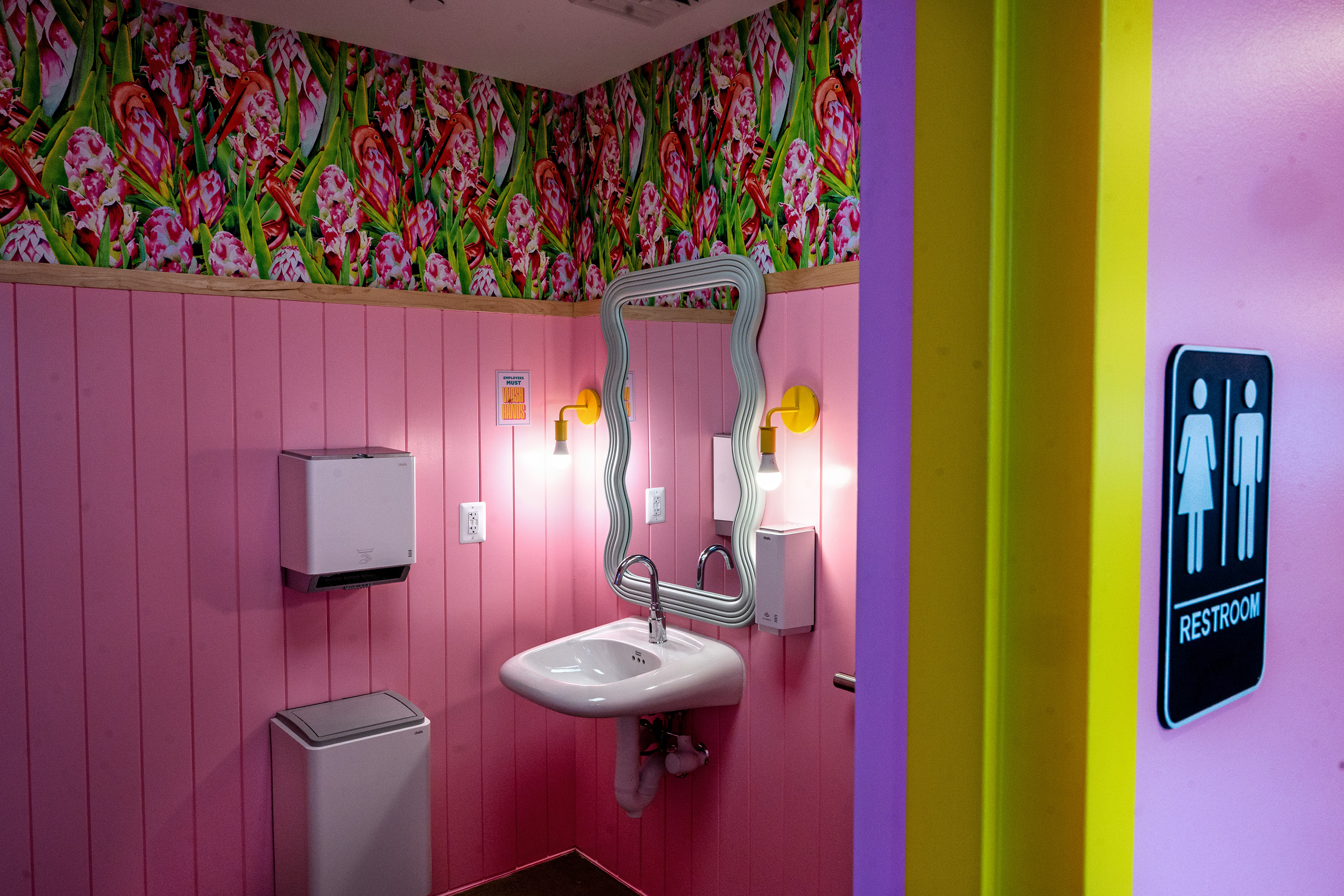
To be fair, Call Your Mother is making an effort to blend into Fishtown. The inside of its 1500 Frankford Ave. space doubles down on the whimsy with kitschy wares — Phillies bobbleheads, a tiny Liberty Bell, and a bedazzled basketball — procured from local thrift stores such as Thunderbird Salvage. A tasteful merch wall abuts the cash register, where customers can purchase pastel-colored dad hats and tees alongside jars of Fishtown Pickle Project and One Trick Pony, the peanut butter brand that Dana and Moreira also co-founded. (The bathroom, however, sticks out: it’s wrapped in a Lilly Pulitzer-style tropical wallpaper.).
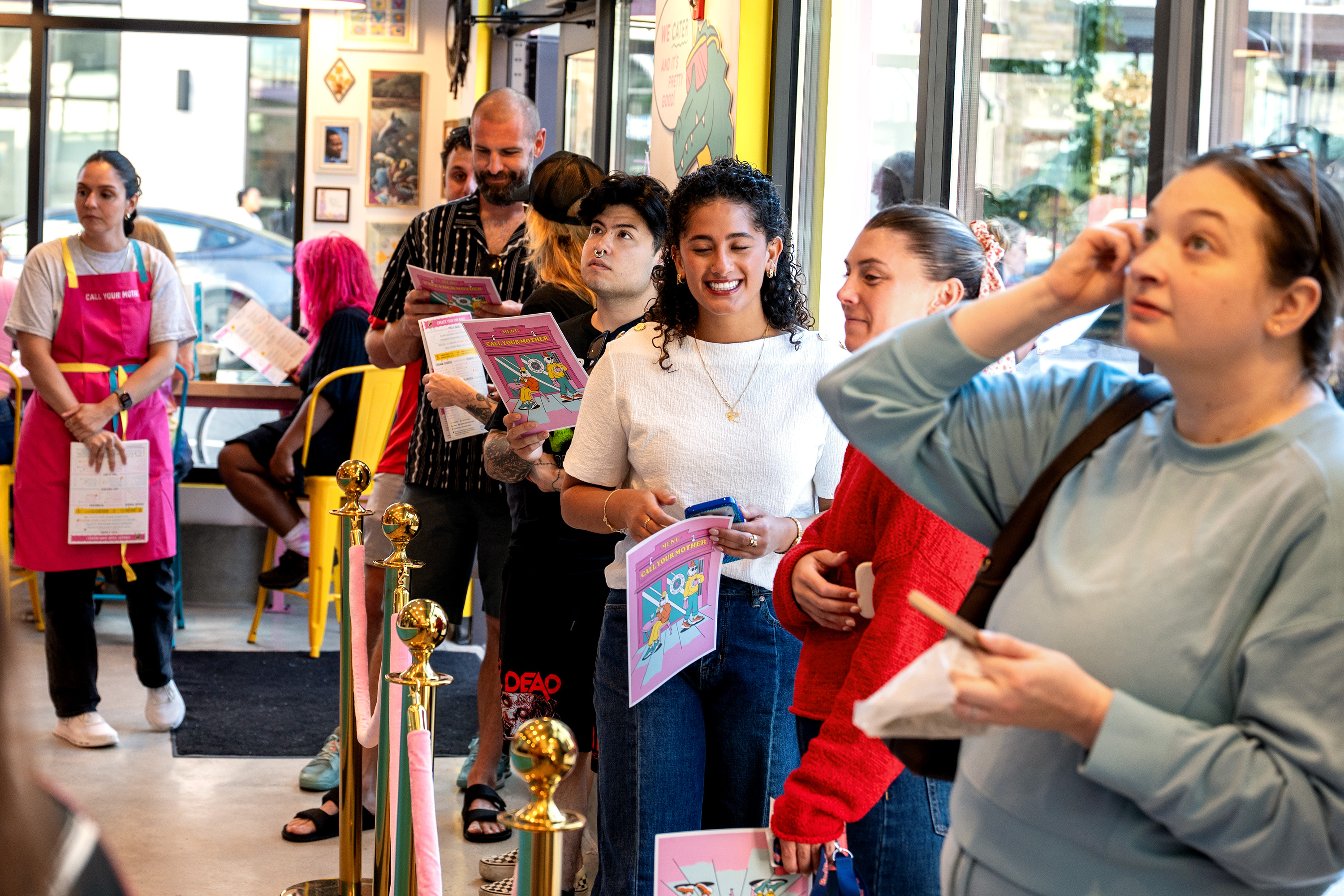
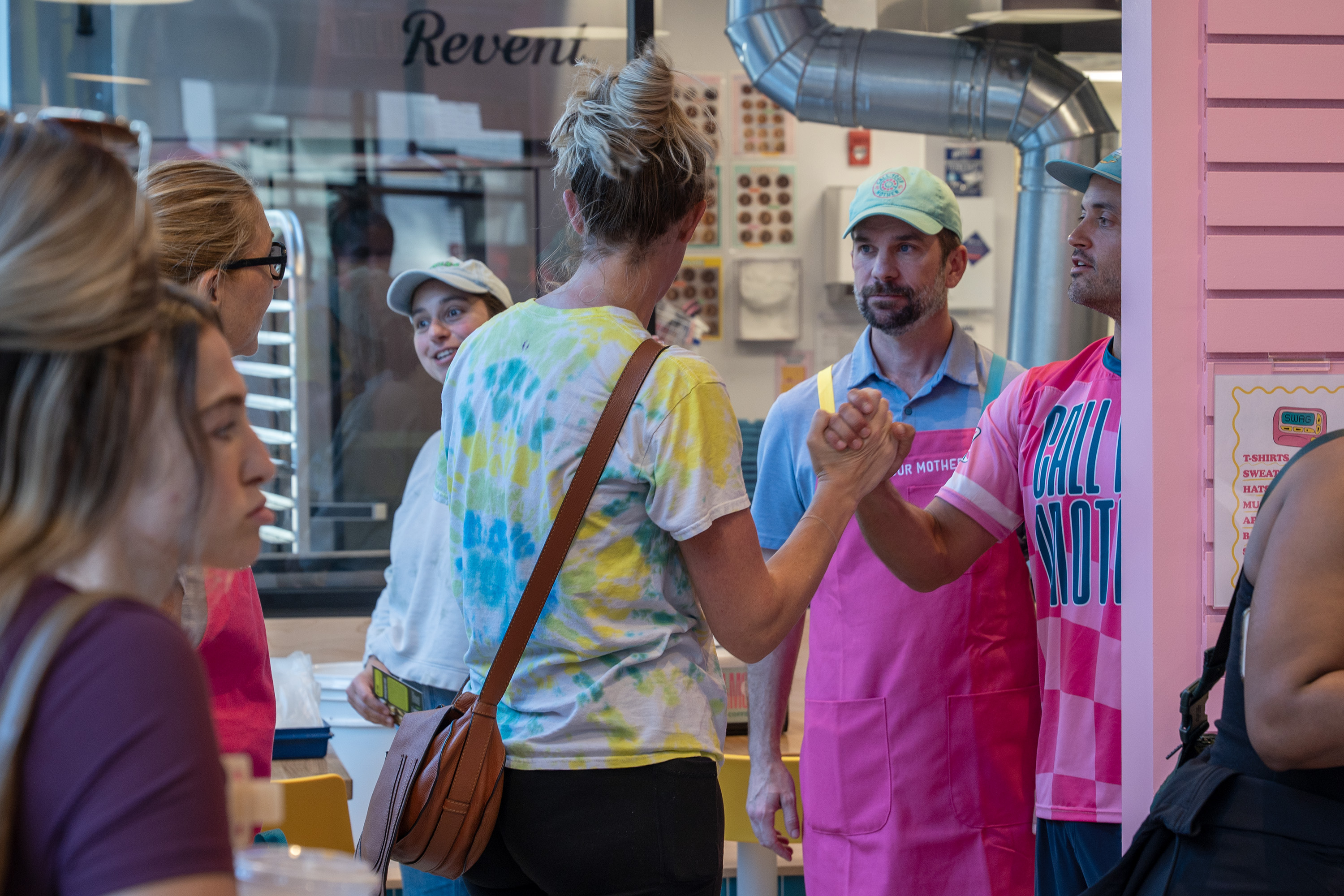
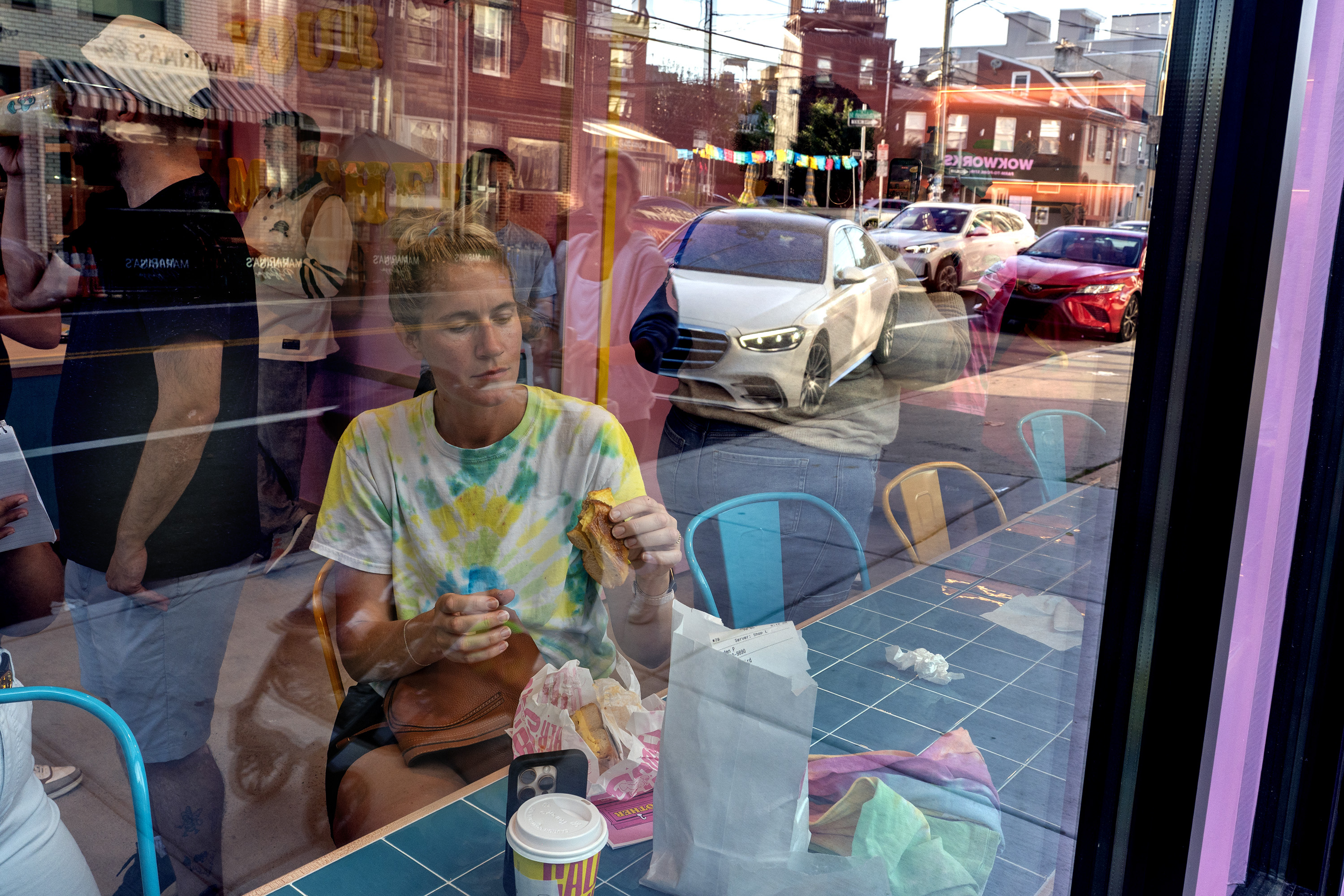
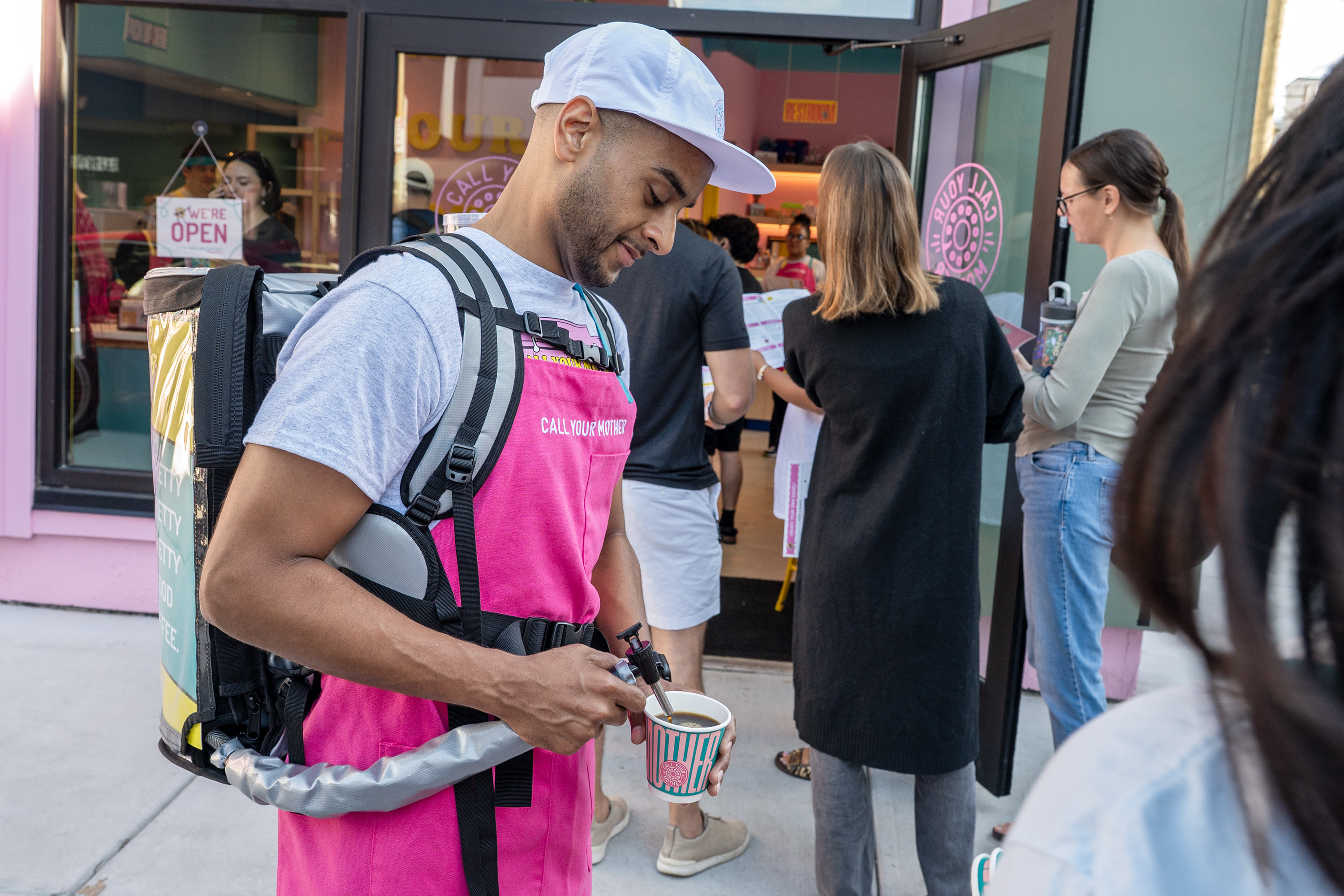
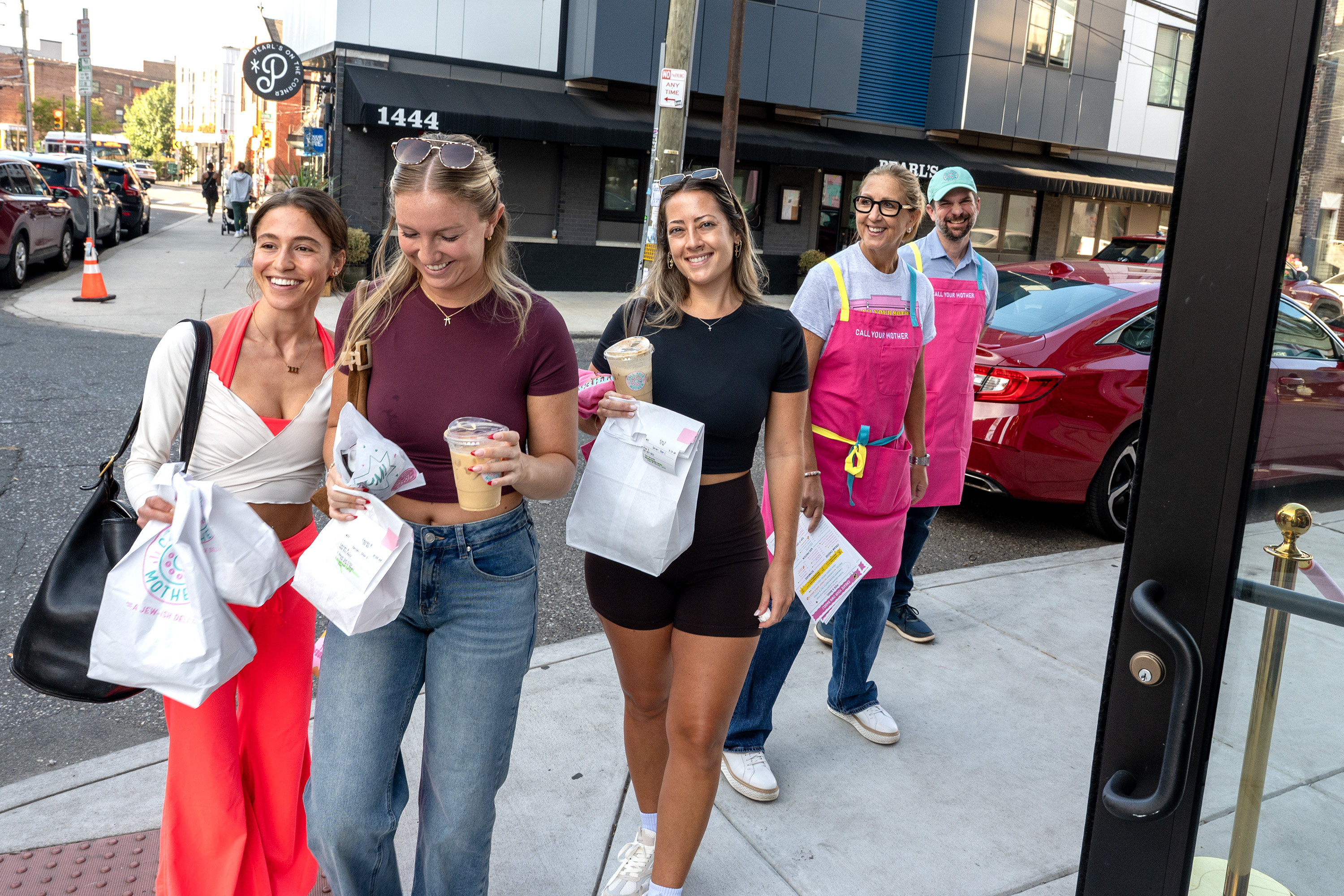
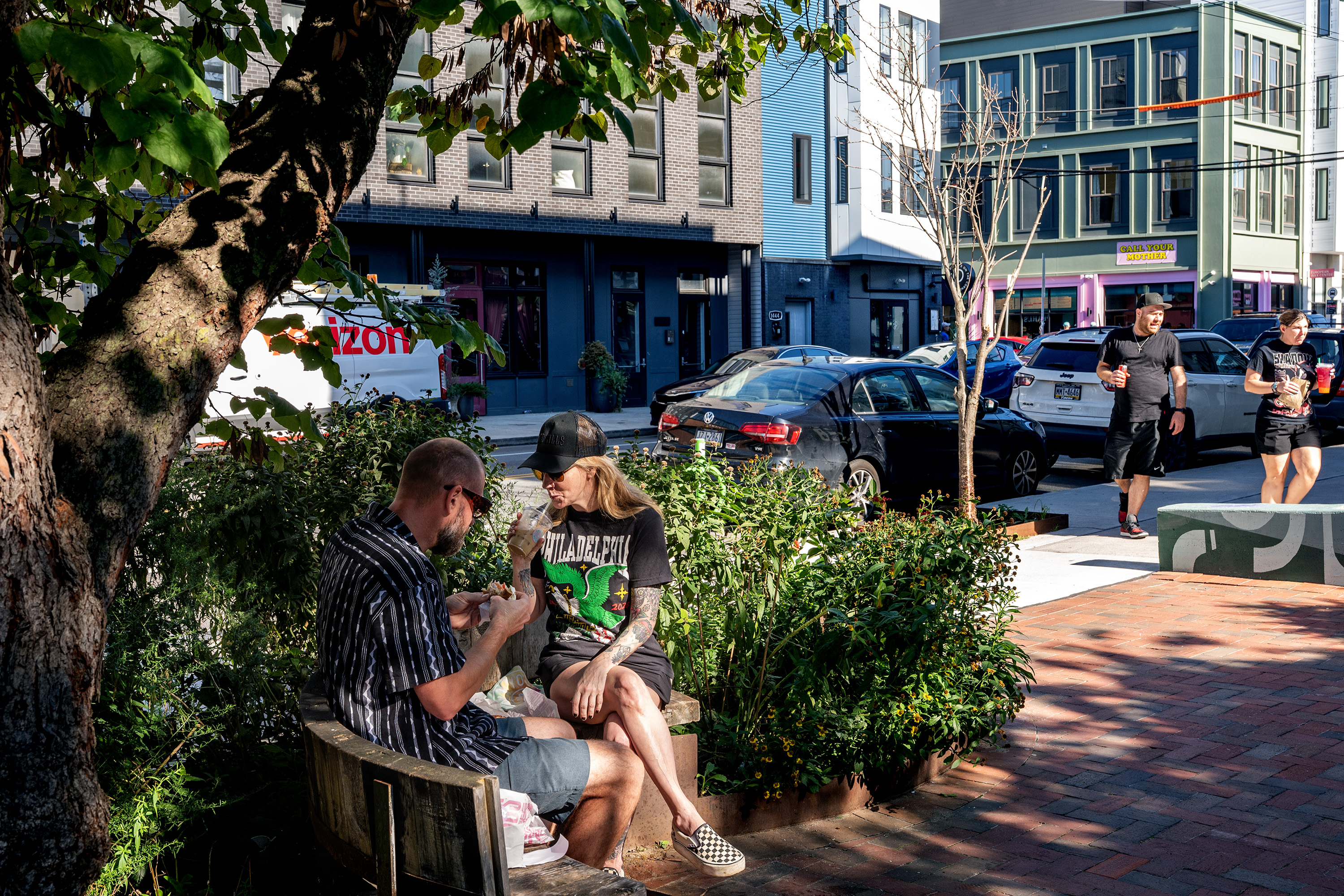
Customer Allison Mattiola wins a free T-shirt after spinning the wheel with Shay Wireman (center) and Annie Leder (right) on the Call Your Mother marketing team. Behind them is a display of kitschy thrift shop finds.Tom Gralish / Staff PhotographerThe line waiting to place their orders during the soft opening on Tuesday.Tom Gralish / Staff PhotographerFounder and co-owner Andrew Dana (right) greets customers with COO John Murray.Tom Gralish / Staff PhotographerFrankford Ave is reflected in the window as customer Jordan Price has her bagel, at the counter seating facing the street.Tom Gralish / Staff PhotographerWith a backpack insulated dispenser, corporate IT manager Osman Mohamed pours free coffee for customers waiting outside.Tom Gralish / Staff PhotographerVice president Kristine Denicourt (left) and COO John Murray (right) greet customers leaving with their bagel orders.Tom Gralish / Staff PhotographerThe all-gender restroom.Tom Gralish / Staff PhotographerCustomers Ethan Haymes and Carrie Bliss Brooke (right) eat their breakfast bagels from Call Your Mother (rear, right) in the park across the street during their Fishtown soft opening Tuesday, Sept. 8, 2026.Tom Gralish / Staff Photographer
Indoor seating is limited, split between a few two-tops and counter seating. That didn’t stop influencers from flooding the space during a soft opening. They were after the money shot: carefully pulling apart a steaming breakfast sandwich to create a dramatic cheese pull.
Neighbors were more skeptical.
“How many bagel and coffee places do we need in Fishtown?” said Gabriela Rivera, a decades-long resident who wandered in Tuesday morning during her morning walk.
It’s a fair question.
Call Your Mother’s first Philly location is smack in the middle of the city’s bagel renaissance. The shop is surrounded by outposts of Philly Style Bagels, Bagels & Co., and Kismet, three local chains. It’s also on a strip of Frankford Avenue that has seen an influx of corporate chains, from the controversial Starbucks across the street to New York City’s venture capital-backed 7th Street Burger, which opened four blocks south last month.
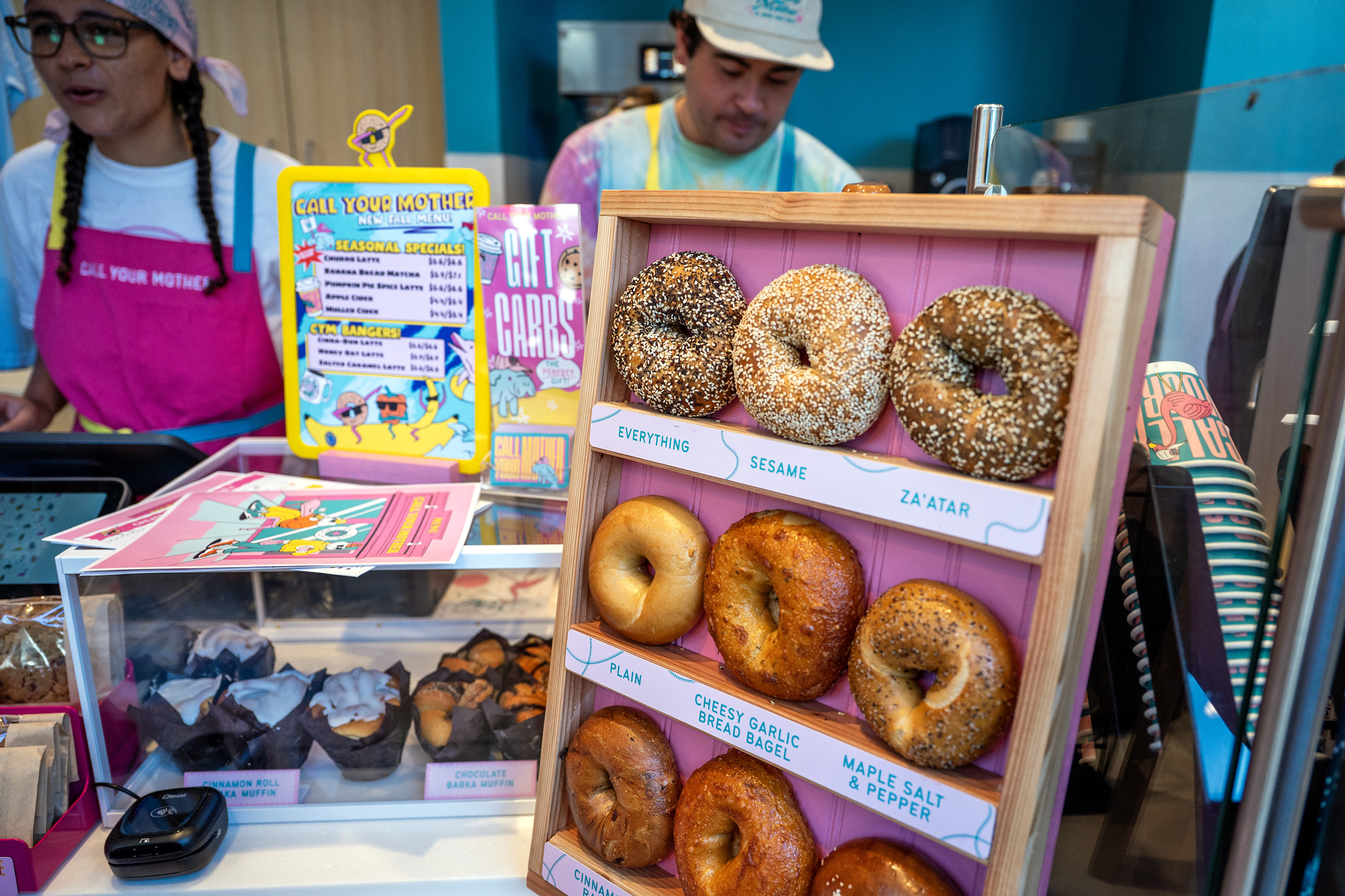
Call Your Mother offers nine bagel varieties, which can be ordered plain, with schmears, or as part of sandwiches.Tom Gralish / Staff Photographer
“For a long time, [Fishtown] was small businesses … the more big stuff that comes in, I worry the neighborhood is going to become less community-centered,” said Justin Berger, Rivera’s fiancé, who also lives in the area.
Both of them still ordered breakfast sandwiches. They were free, after all.
New York-style with a hint of Montreal
Call Your Mother’s bagels split the difference between New York-style — the classic fluffy-yet-crusty kind — and Montreal-style, which are smaller, sweeter, and denser.
Bagels are made on-site using a recipe developed by Moreira, an Argentinian-born chef who never ate a bagel until building Call Your Mother with her husband. The chain’s are still hand-rolled and kettle-boiled with a simple honey-sweetened dough.
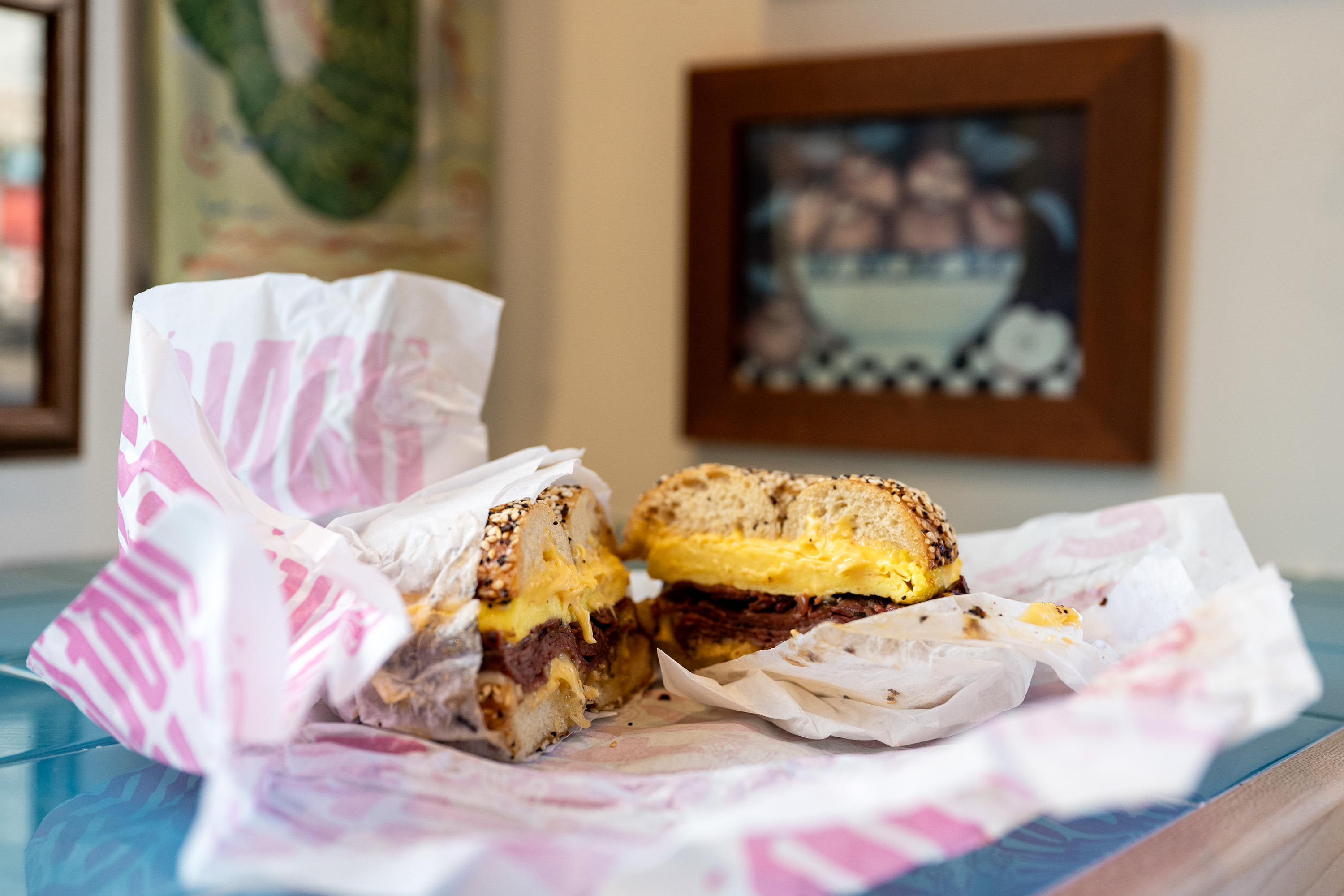
The Sun City bagel at Call Your Mother during its Fishtown soft opening Tuesday, Sept. 8, 2026.Tom Gralish / Staff Photographer
Their bagels come in nine flavors, ranging from classic plain and everything and to cheesy garlic bread, maple sea salt and pepper, and salt-crusted pretzel. You can order them with a schmear, though most customers go for the sandwiches, which range from $9 to $15 in Philly.
The chain’s menu includes 19 sandwiches, categorized indiscriminately as those with “breakfast-y vibes” and “lunch-y vibes.” (You can order both all day.) Some fuse Dana’s half-Jewish upbringing with Moreira’s Argentinean palate, like the Jetski, which features sofrito-seasoned brisket and pastrami. Others, like the Don Cesar — literally a grilled chicken Caesar salad on a bagel — are somewhat light, while some are downright decadent. Case in point, the fall special:meatballs, marinara, and mozzarella on a bagel.
Customer Shannelle Palmer takes a photo outside Call Your Mother as she leaves with her bagel order during its Fishtown soft opening Tuesday, Sept. 8, 2026.Tom Gralish / Staff Photographer
The Thunderbird (chicken sausage, eggs, American cheese, cheddar cheese, and spicy honey, recommended on a maple sea salt bagel) tastes “like a happy accident,” said Jordan Price, a local content creator who lives in Fishtown. “It reminds me of when all the stuff on a breakfast platter mixes together and gets syrupy.”
Berger, on the other hand, was sure he could taste a bit of the private equity.
“It tasted like it was made somewhere else and shipped here,” he said after biting into his lox and cream cheese on yuca bread, Call Your Mother’s gluten-free bagel alternative.
The Chai Latte and Jetski bagel at Call Your Mother during its Fishtown soft opening Tuesday, Sept. 8, 2026.Tom Gralish / Staff Photographer
Price doesn’t mind. The chains are already here, she said. At least this one has bagels she thinks her kids will like.
“There’s literally a Sweetgreen down the street. We are surrounded by so much private equity,” Price said. “If it was the first of that sort of thing in the neighborhood, I’d be more upset.”
Call Your Mother, 1500 Frankford Ave., 215-703-3254, callyourmotherdeli.com. Hours: 6:30 a.m. to 2 p.m. Monday through Friday; 6:30 a.m. to 3 p.m. Saturday to Sunday.
One of Philly’s most prominent fine-dining restaurants received a state grant to createan even higher-end establishment. The project promises to create 100 jobs and help cement Philly’s place as a culinary hot spot. It drew criticism over the use of tax dollars.
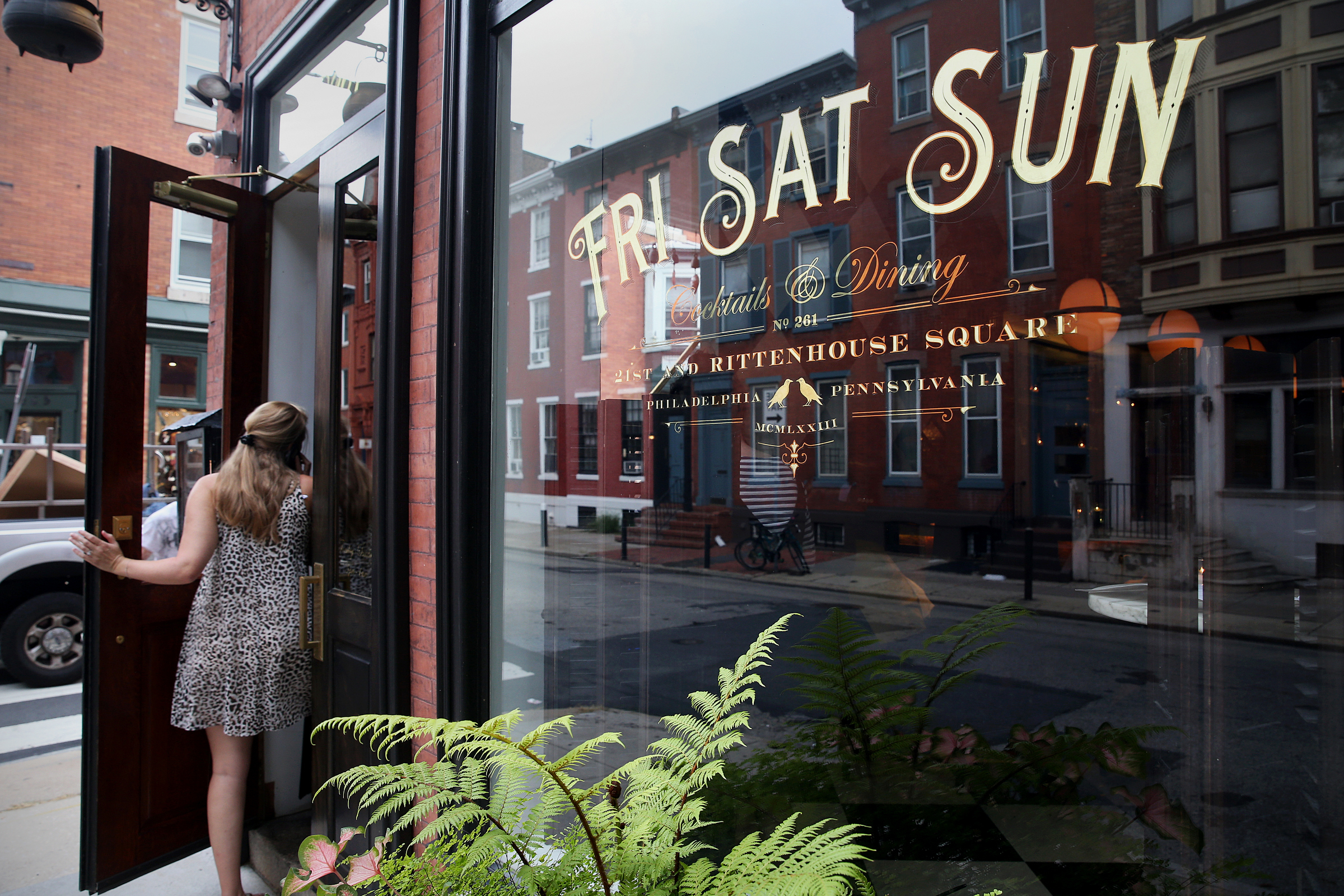
The Weekend Restaurant Group, which owns the acclaimed Rittenhouse Square restaurant Friday Saturday Sunday, was awarded $1.5 million from the state’s Redevelopment Assistance Capital Program in July to help finance the expansion of the Michelin-starred restaurant. The grant will cover only a fraction of the project’s multimillion-dollar budget.
The endeavor will be the “first minority-owned restaurant of its kind” in the United States, wrote Friday Saturday Sunday chef-owner Chad Williams, who is Black, in the restaurant group’s application.
The undertaking involves connecting Friday Saturday Sunday with a neighboring rowhouse that will eventually be transformed into a three-story dining destination withan 18-seat chef’s counter, private dining rooms, and a post-dinner sweets lounge.
Williams runs Friday Saturday Sunday with his wife, Hanna. Together, they announced plans to grow their award-winning restaurant at 261 S. 21st St. last summer, after entering an agreement to buy the adjoiningproperty at 2048 Rittenhouse Square. Neighbors enthusiastically endorsed their ambitious plan, whichcame five months before the restaurant earned a Michelin star.
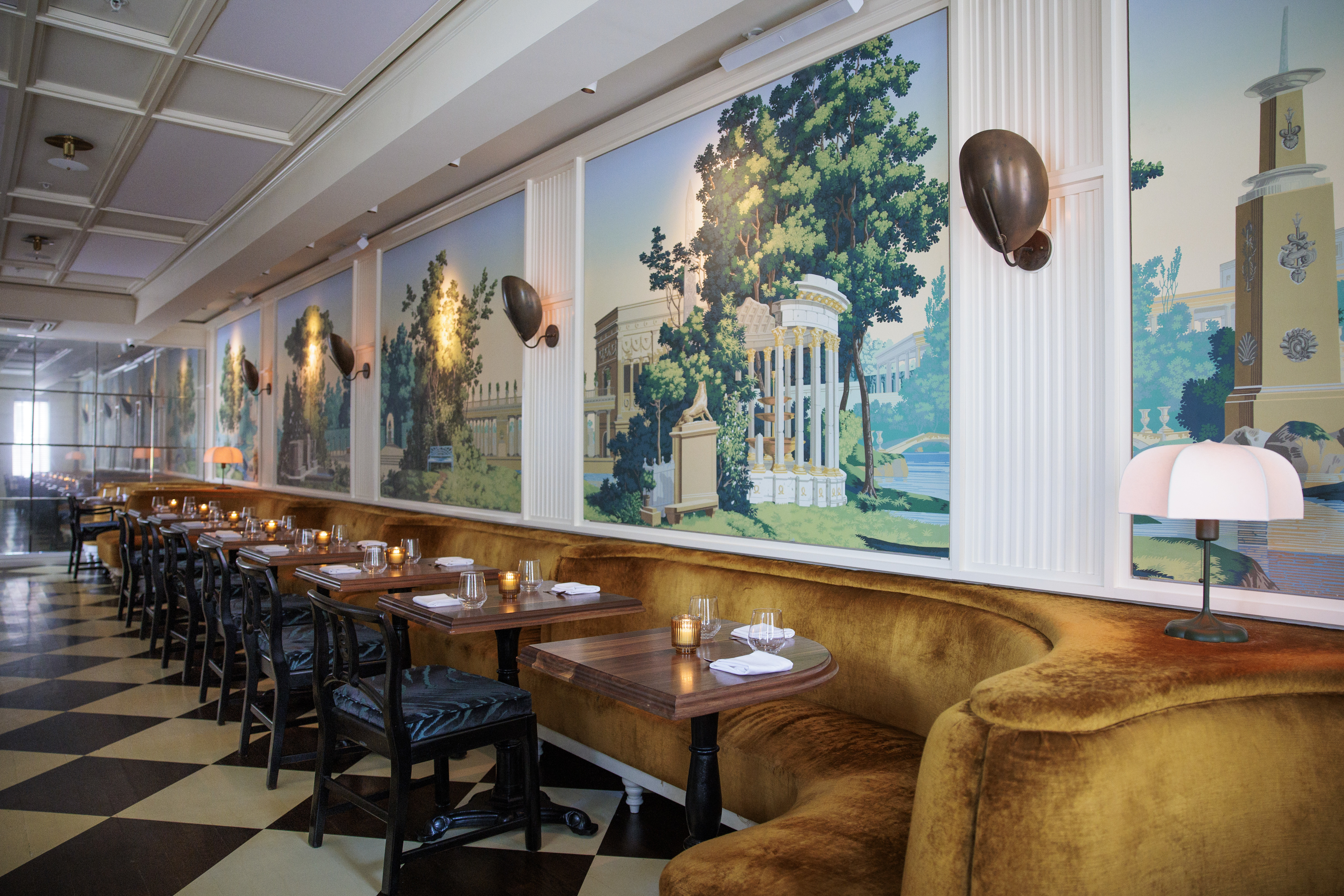
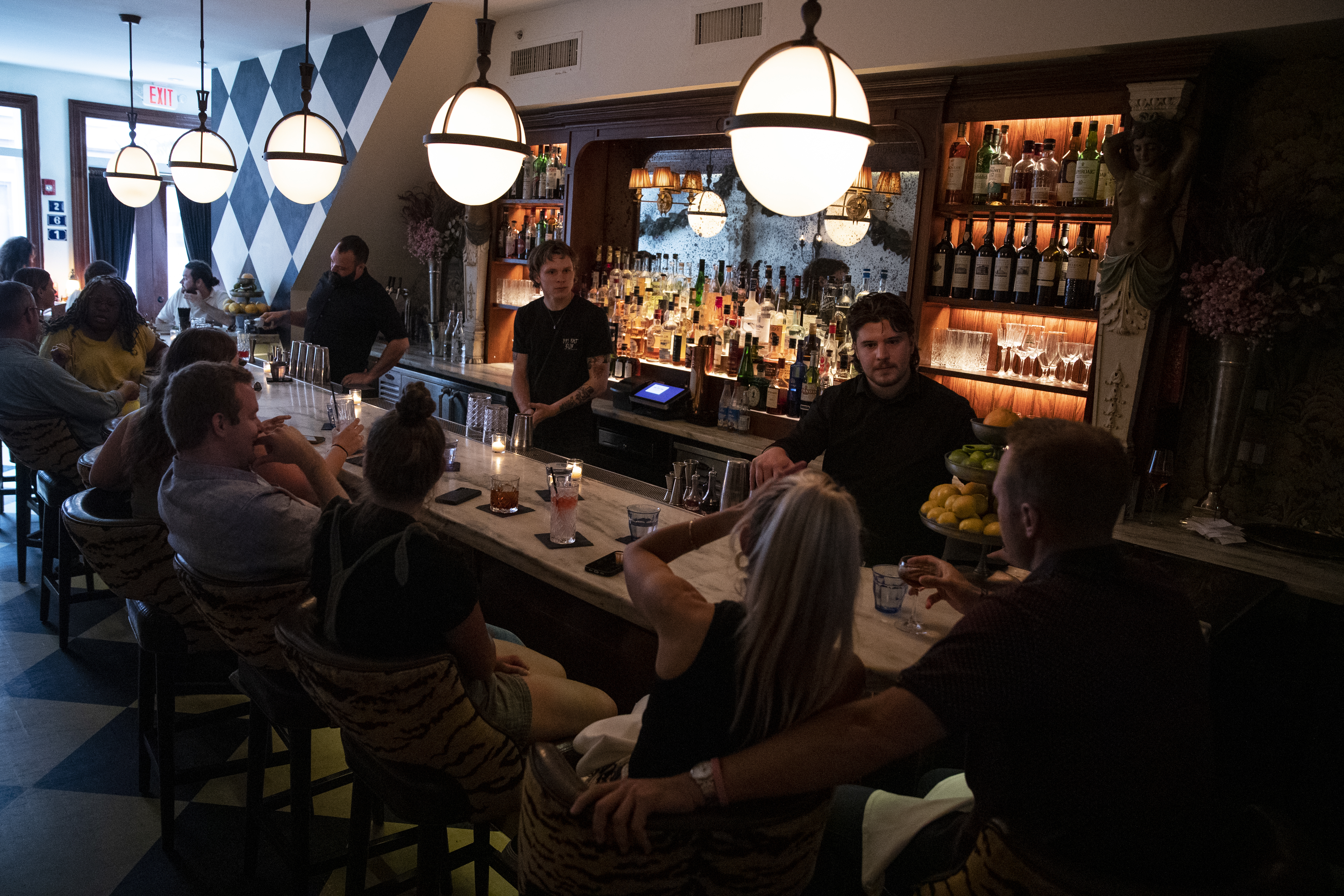
The interior of Friday Saturday Sunday’s upstairs dining room, which offers a $205-per-person tasting menu.Monica Herndon / Staff Photographer
In the state grant application,Williamswrote “the project will generate significant cultural impact [by] retaining and creating high-quality jobs, attracting visitors from the region and beyond, and raising Philadelphia’s profile.” Renovatingthe storied Philadelphia restaurant “demonstrates a long-term to commitment to the city, with the scale and ambition to be a generational anchor in its neighborhood.”
Yet when news of the grant spread on social media last month, it was met with critics who were angry that taxpayer dollars were funding a fine-dining restaurant.
“Luxe restaurant getting a grant to become more luxe? … WTF?” one person wrote under an Instagram post about the grant with over 100 comments, many of which were critical.
“Give it to the schools” instead, wrote another.
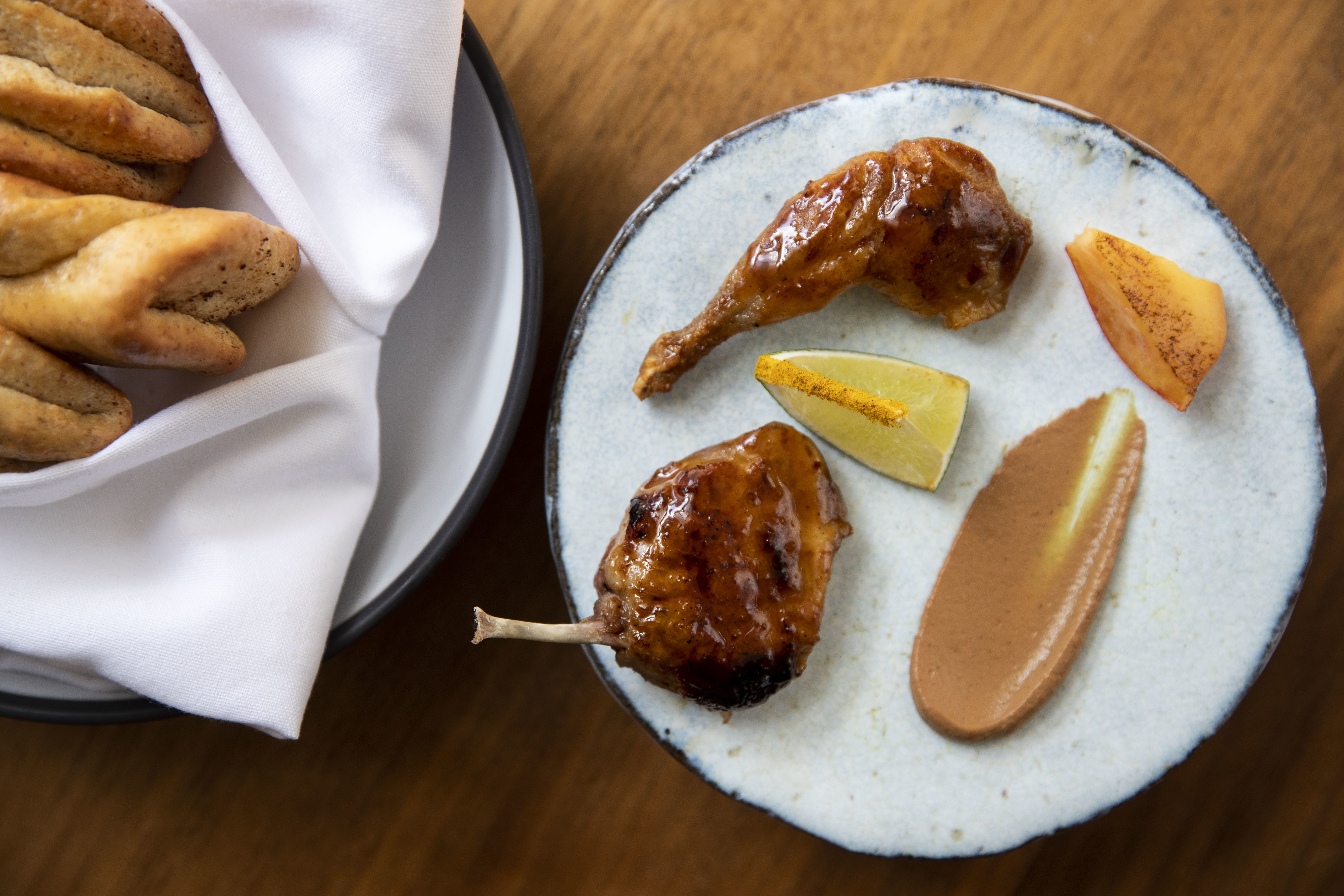
The grilled quail with coco bread at Friday Saturday Sunday, photographed in 2022.MONICA HERNDON / Staff Photographer
Williams says the grant money — which is from a fund for construction projects that would benefit the state culturally and economically — is a win for the city, not just Friday Saturday Sunday.
“I was born here. I left, learned all that I could, and came back. What we want to do is push the culture forward and, with that, hopefully [bring] economic benefits for everyone in the city,” Williams said.
“There’s going to be tax revenue and jobs that come back in a very real way.”
A much-debated grant program
Better known as RACP, theRedevelopment Assistance Capital Program defrays the cost of construction-ready projects across Pennsylvania that stand to generate substantial economic growth. The fund has stirred controversy in the past.
The program was launched in 1986 tosupport construction and real estate projects that intend to create jobs, boost tax revenue, orhave significant cultural and civic impact. Eligible projects must cost at least $1 million and secure at least half of their funding from other sources.
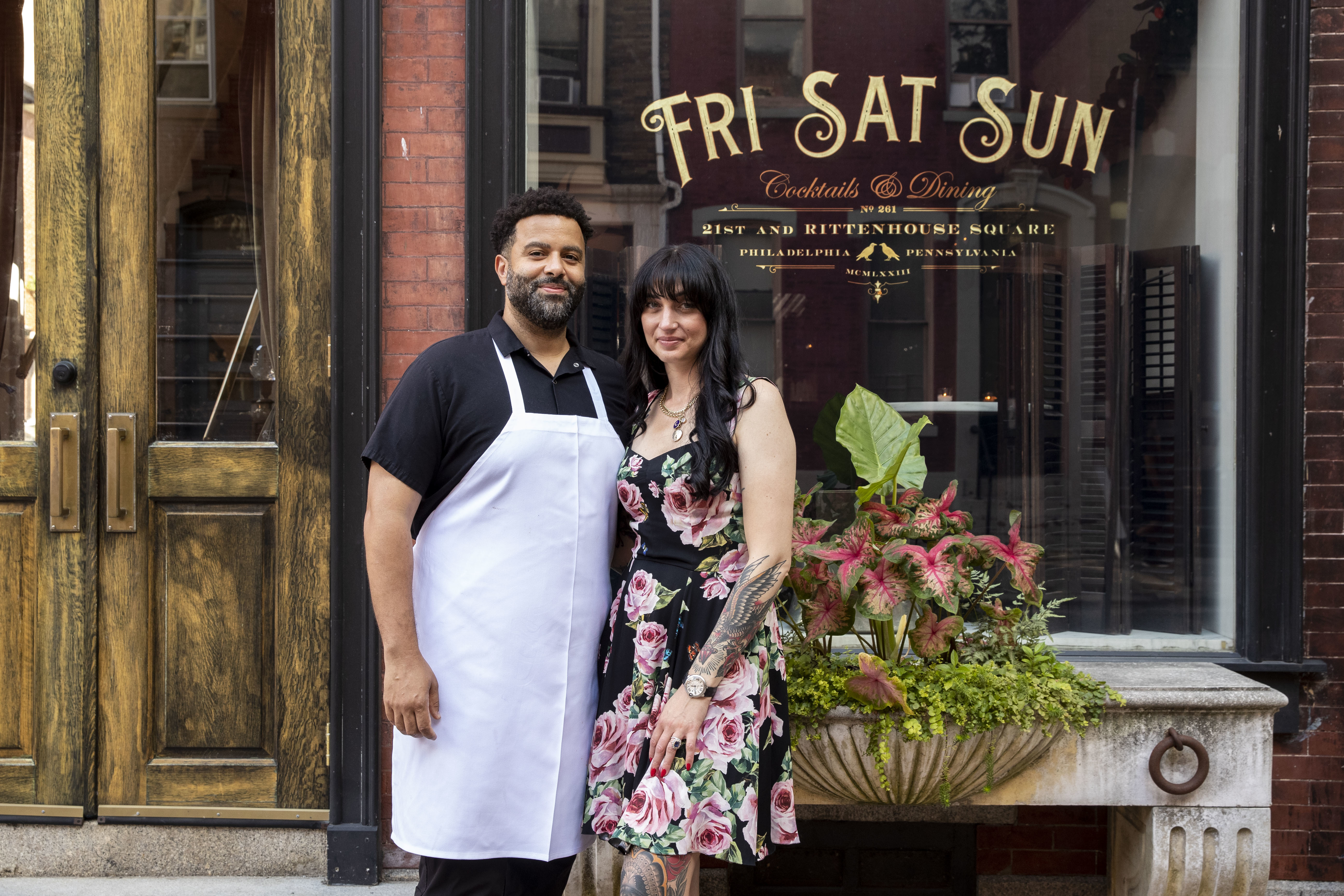
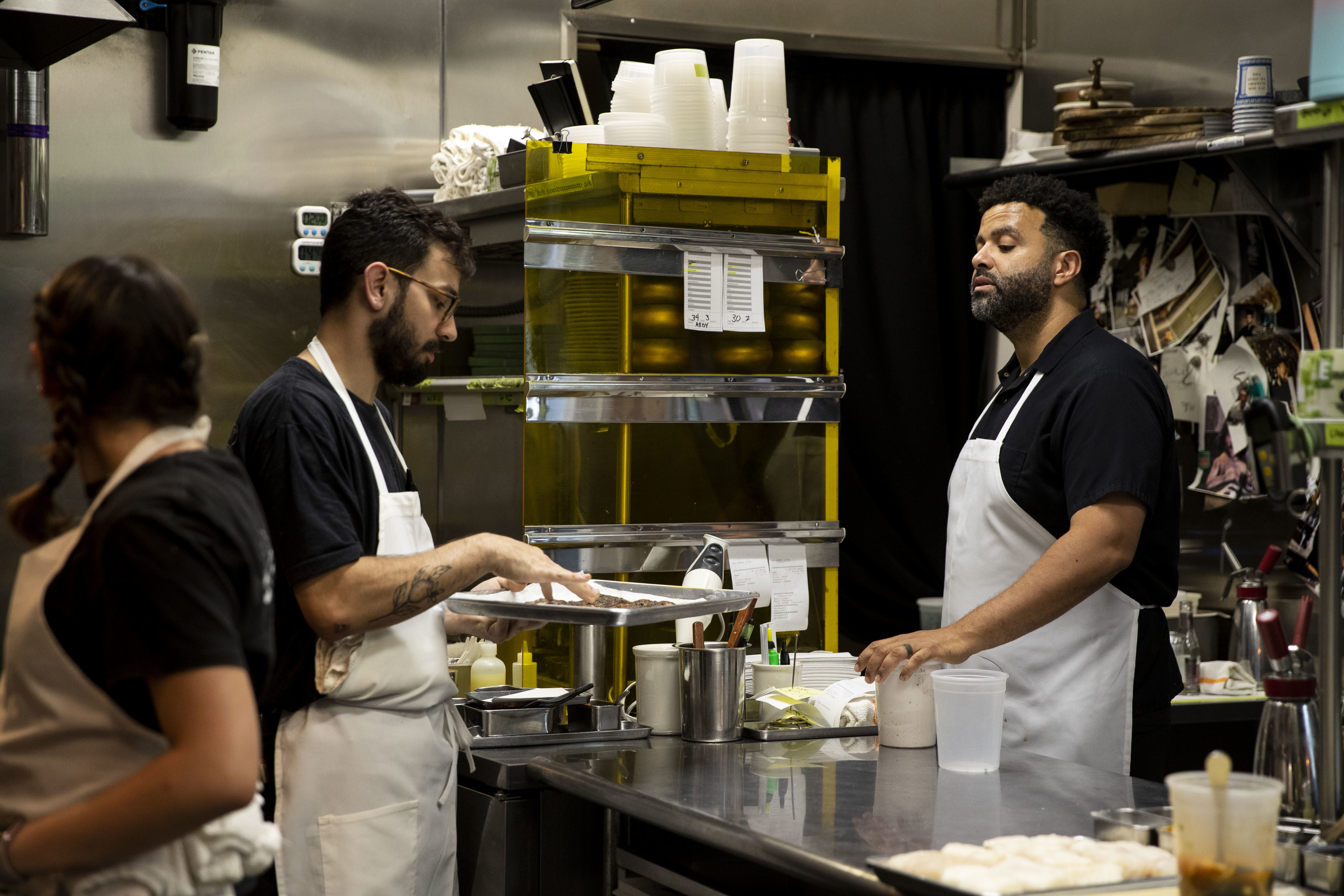
Chef Chad Williams and Hanna Williams at their restaurant Friday Saturday Sunday.Monica Herndon / Staff Photographer
Because grants are decided at the governor’s discretion, the program has previously been criticized for a lack of transparency and glad-handing.
RACP was overhauled in 2012 after an audit found that the Gov. Tom Corbett administration did not adequately disclose or document why projects were awarded grants. Similar accusations cropped up again in 2020, when critics alleged Gov. Tom Wolf and state legislators were misusing the program for political favors.
This July, Gov. Josh Shapiro’s administration allocated $445 million in RACP grants to 356 projects across the state. Recipients range from private real estate developments and public parks to affordable housing and renovations of schools, hospitals, and community centers. The program was particularly competitive in Philadelphia: 170 projects applied. More than half were rejected.
(function(){function e(){window.addEventListener(`message`,function(e){if(e.data[`datawrapper-height`]!==void 0){var t=document.querySelectorAll(`iframe`);for(var n in e.data[`datawrapper-height`])for(var r=0,i;i=t[r];r++)if(i.contentWindow===e.source){var a=e.data[`datawrapper-height`][n]+`px`;i.style.height=a}}})}e()})();
Friday Saturday Sunday’s expansion is projected to cost $7.5 million overall, according to the grant application. Once complete, Williams told The Inquirer, it will add 100 front- and back-of-house jobs to the Weekend Restaurant Group’s payroll. (The group currently has 40 employees, according to the application.)
Not all RACP hopefuls are awarded the full amount of funding they applied for. Friday Saturday Sunday’s expansionwas one of 12 Philly projects awarded the full amount requested.
(function(){function e(){window.addEventListener(`message`,function(e){if(e.data[`datawrapper-height`]!==void 0){var t=document.querySelectorAll(`iframe`);for(var n in e.data[`datawrapper-height`])for(var r=0,i;i=t[r];r++)if(i.contentWindow===e.source){var a=e.data[`datawrapper-height`][n]+`px`;i.style.height=a}}})}e()})();
A spokesperson for the Shapiro administration told The Inquirer over email that the Weekend Restaurant Group’s proposal “is fully consistent with the purpose and authorized uses of the RACP program and represents an appropriate use of RACP funds.”
The downstairs Lovers Bar at Friday Saturday Sunday is a two-time James Beard Award nominee.Monica Herndon / Staff Photographer
Receiving the RACP grant was a relief, said Williams, who said he is funding more than half of the $7.5 million project with loans.
Taking on the financial liability is “not a rosy story necessarily,” Williams said, “but it’s a risk we’re willing to take.”
Williams envisionsthe3,500-square-foot rowhouse at 2048 Rittenhouse Square as a chance to create an old-school fine-dining experience inspired by the likes of Le Bec-Fin and Vetri Cucina. Guests will start with welcome drinks on the ground floor before moving upstairs for an intimate meal at a chef’s counter helmed by Williams. Diners will finish the meal on the third floor in a designated dessert space, Williams said.
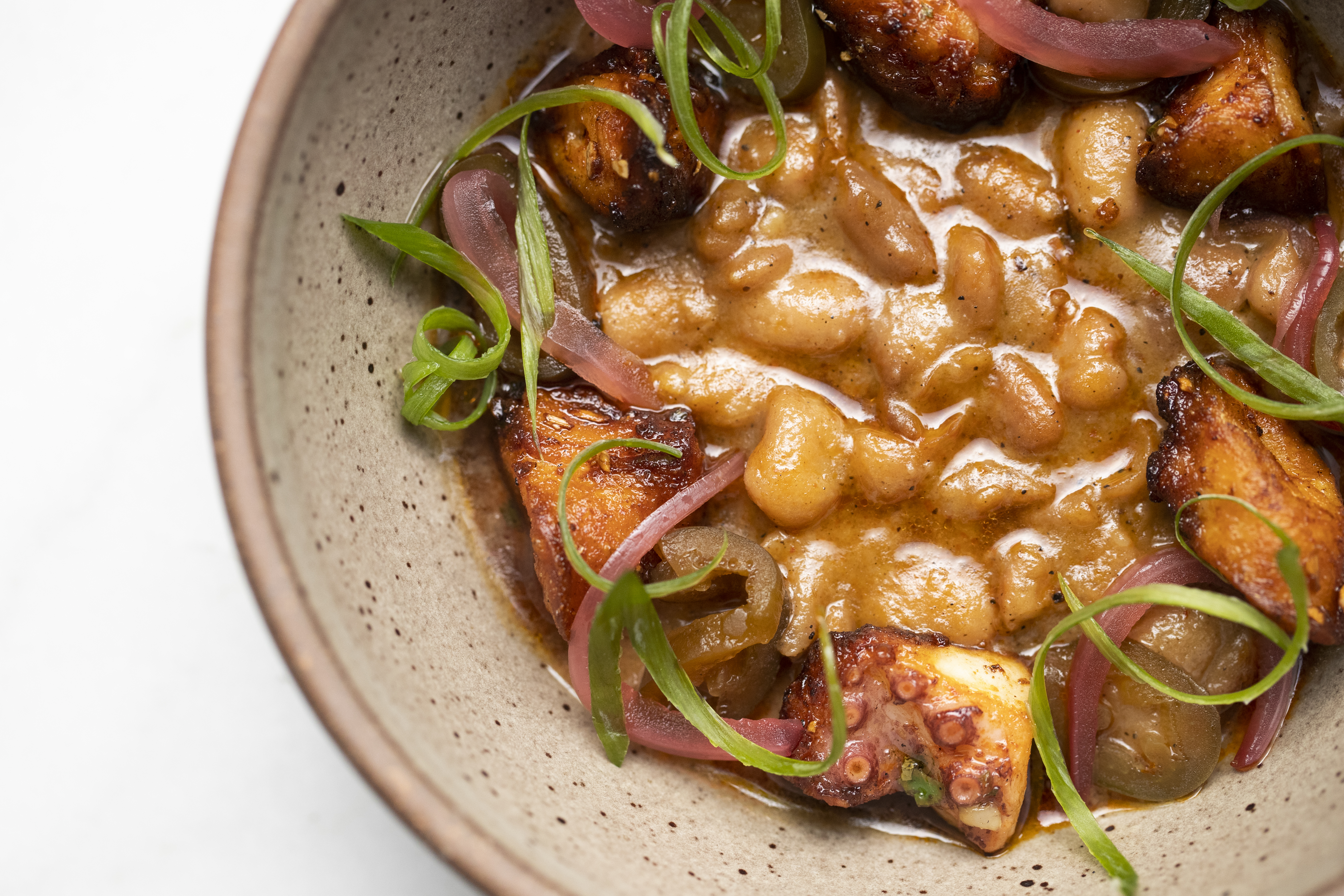
The octopus and beans from the bar menu at Friday Saturday Sunday, photographed in 2023.Monica Herndon / Staff Photographer
The concept will extend the Friday Saturday Sunday brand and render the original tasting menu into a “less formal” affair that is more in line with “what neighbors and regulars want,” Williams said. The connected properties will also enable Friday Saturday Sunday to serve large parties and potentially open seven days a week. The expanded hours will allow for more staff, Williams said
Williams said the project could break ground in October. He’s optimistic about a September 2027 opening.
He framed Friday Saturday Sunday’s expansion as a moonshot. “To be frank, for a Black chef to have this opportunity and do it is a big deal,” Williams said.
“Having a chance to practice our craft at this level is extremely rare.”
‘We need all the help we can get’
Williams decided to apply for RACP funds after exhausting more traditional financing routes.
“Without state support, the project would face a significant financing gap,” he wrote in the application, “as private funds alone cannot absorb both the acquisition and essential structural work.”
Despite his restaurant’s extremely successful track record, the chef found the process similar to the original financing of Friday Saturday Sunday — which required the Williamses to sell their home and submit paperwork to“14 different banks” before finding one that would take a chance on them.
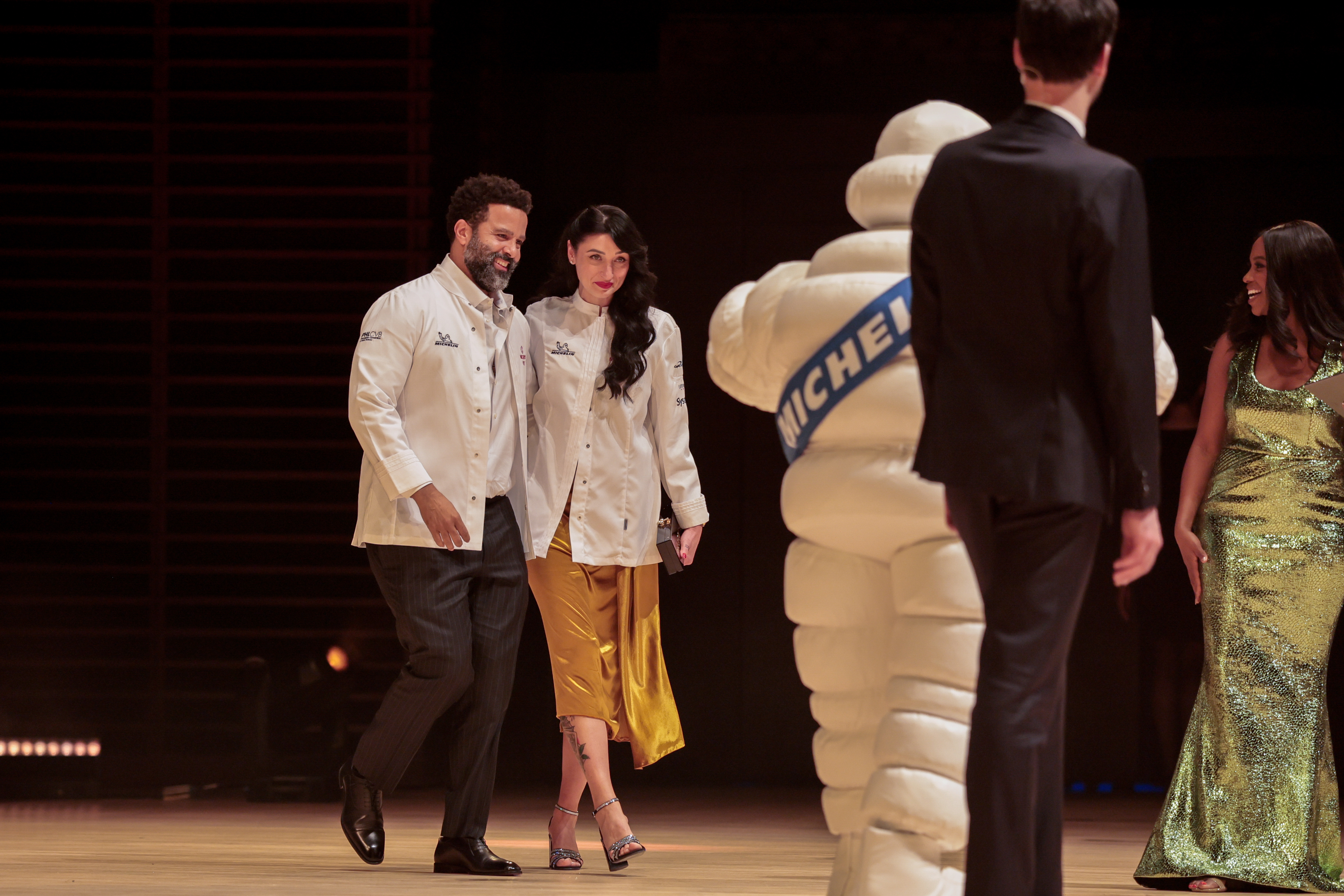
Friday Saturday Sunday, run by chef Chad Williams and his wife, Hanna, earns a Michelin star at the Kimmel Center on Nov. 18, 2025.Elizabeth Robertson / Staff Photographer
It’s a struggle many Black entrepreneurs know well: Several studies have found that Black-owned businesses are discouraged to apply, denied, and offered inferior loans at higher rates than white counterparts, even when appearing more creditworthy.
“We’ve put in our work here, had some success and won some things, but it did not make [financing] any easier,” said Williams. He was attracted to RACP because it was described to him as a “colorblind grant” by other BIPOC entrepreneurs who encouraged him to apply.
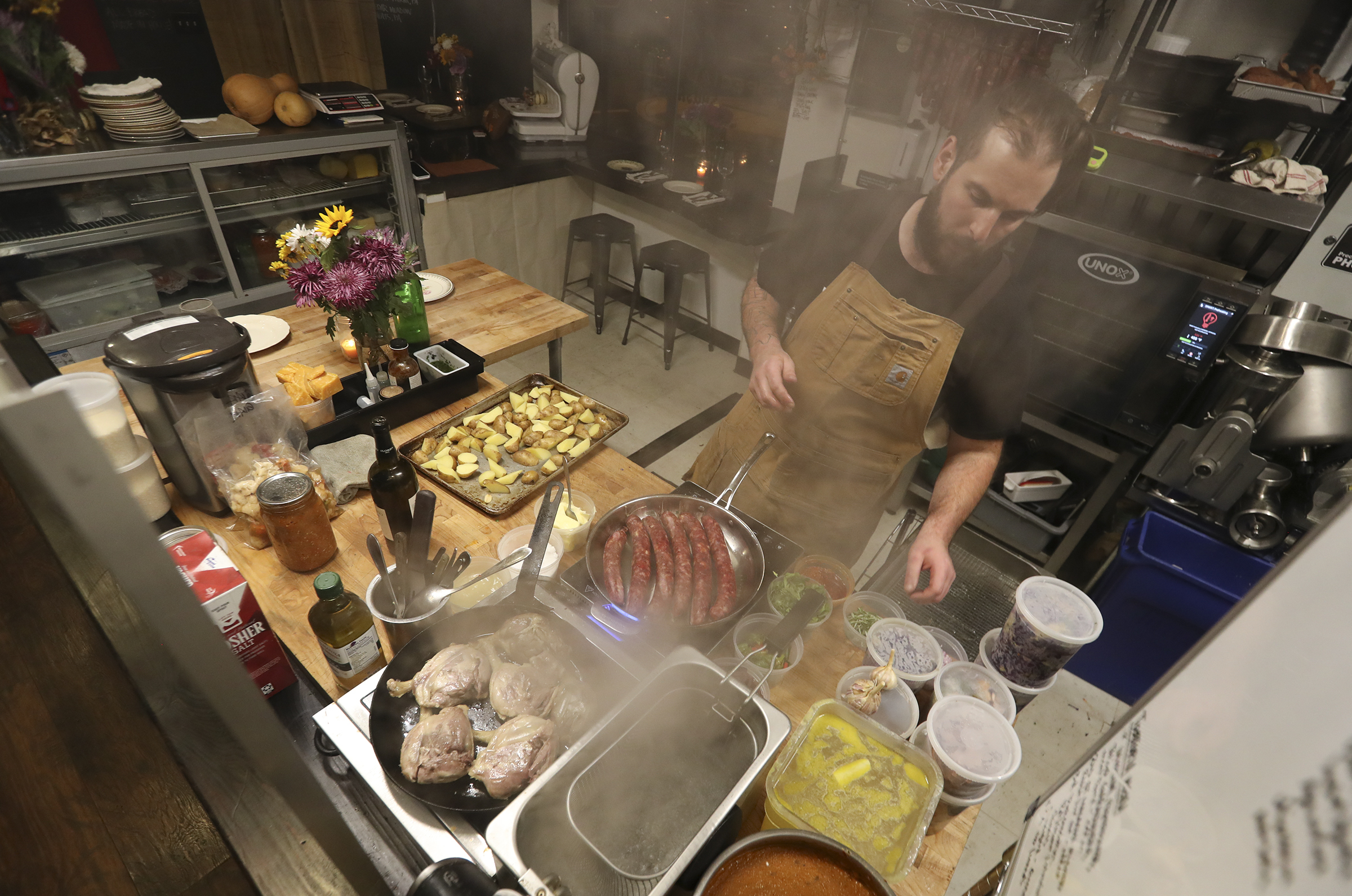
South Philly butcher shop Heavy Metal Sausage Co. indefinitely paused its after-hours Italian dinners last weekfollowing a failed health inspection that ordered the shop to removeall indoor seating. Co-owners Patrick Alfiero andMelissa Pellegrino say the resulting loss of revenuecould close the business.
An inspector with Philadelphia’s Department of Public Health ordered the shop to remove itseightseats and cease all food prep in the basement on Aug. 21. The inspection found Heavy Metal’s setup did not align with the restaurant’s plan review, a document detailing operating procedures that all restaurants must submit to the health department in order to receive a food license.
Among the three-hour inspection’s other findings: flies, mouse dropping, and unauthorized kitchen equipment, plus evidence that Heavy Metal was canning foods and dry-aging meat without an FDA-mandated food safety plan.
The most consequential violation on the report, however, is that “the food facility does not have a handwash sink conveniently located in the customer dining area” because “access to the toilet room is located through the kitchen.”
The location of Heavy Metal’s bathroom renders the space unsuitable for indoor dining, according to the health department. The recent determination — which came four years into Heavy Metal’s run as a hybrid butcher-restaurant — could cost Heavy Metal thousands of dollars in renovations and lost revenue, Pellegrino said.
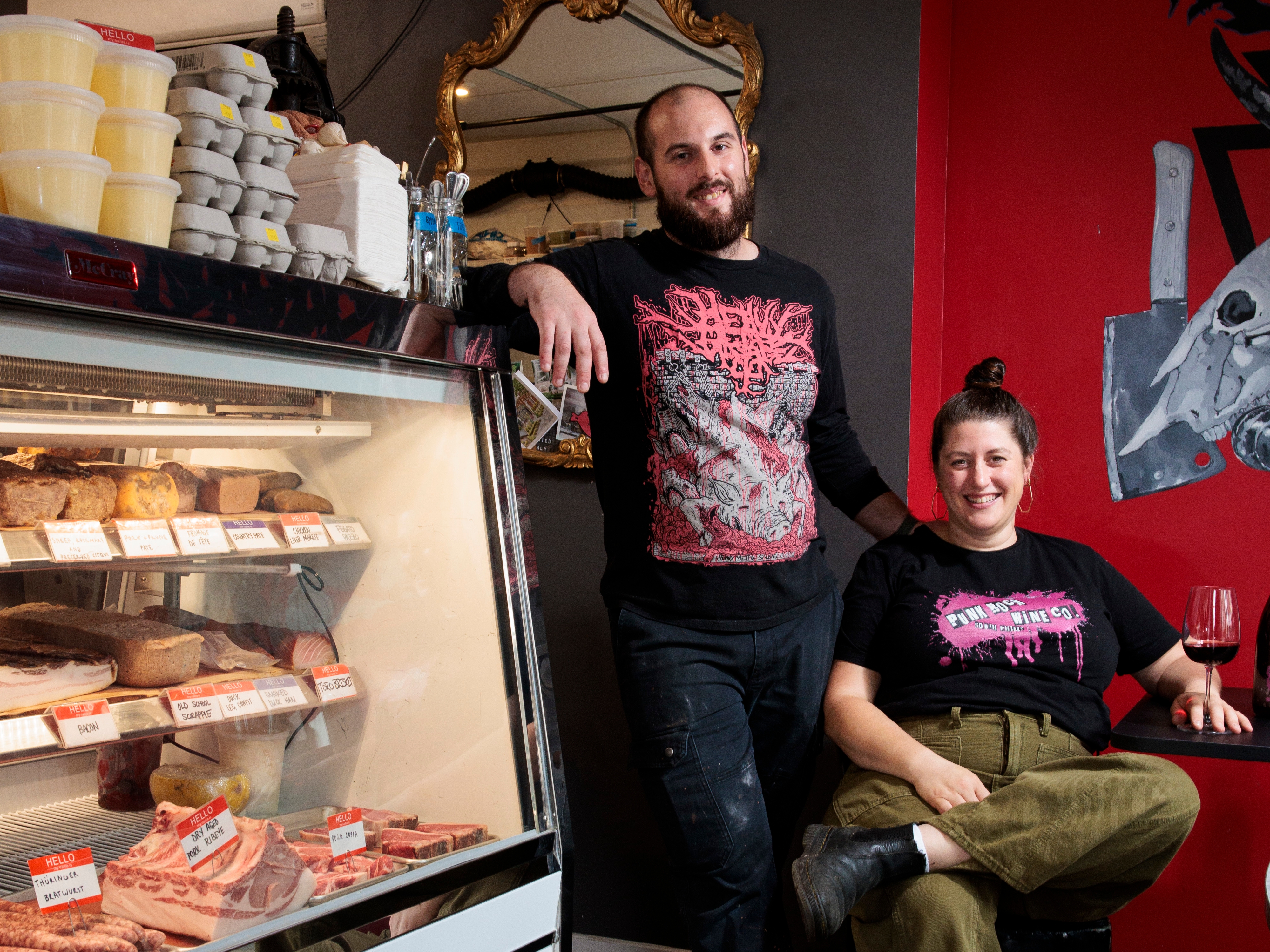
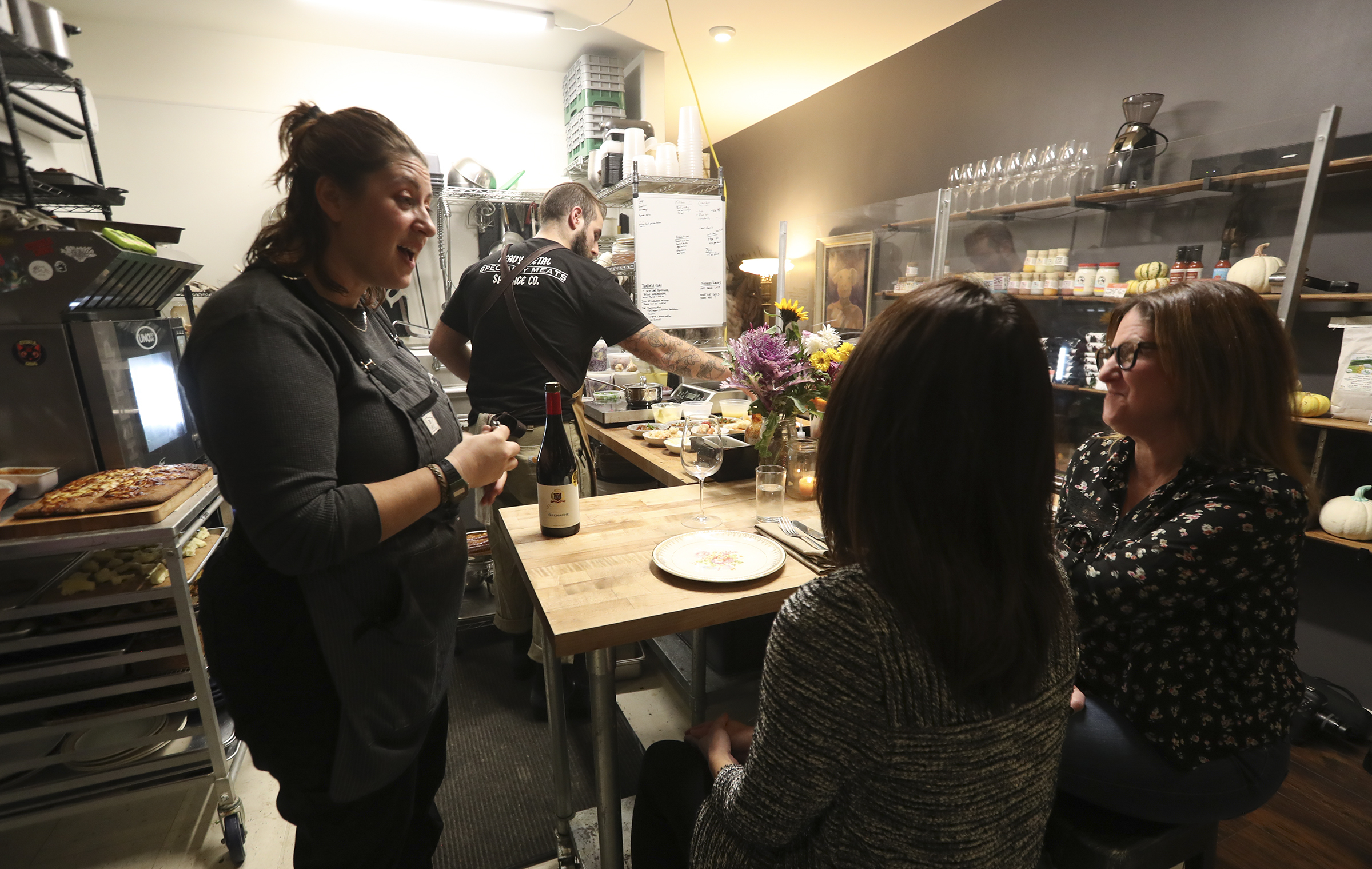
Alfiero and Pellegrino opened Heavy Metal Sausage Co. at 1527 W. Porter St.in 2022. By day, it’s a deli where Alfiero uses local ingredients and artisanal cured meats to create hearty, inventive sandwiches. By night Thursday through Sunday, the 500-square-foot space transforms into an intimate trattoria. Tables are pressed against deli cases and seats are tucked into empty corners, lending a vaguely illicit, punk-rock aura to what’s otherwise a traditional prix fixe meal.
The$98 dinners are also a moneymaker, accounting for well over half of Heavy Metal’s revenue, Pellegrino said. Without them, the duo have already had to lay off a cook and a server.
“When the [health inspector] asked if we could stop dinner, I told him we might not be here in six weeks to be reinspected,” Alfiero said. “I was just like, ‘How are we going to survive this?’”
Heavy Metal Sausage Co. chef/co-owner Patrick Alfiero prepares the antipasto course during the trattoria dinner on Nov. 17, 2022.Yong Kim / Staff Photographer
Same setup, new violation
Pellegrino and Alfiero told The Inquirer that they were blindsided by the findings in August’s health inspection. Heavy Metal has never hidden how it operates.
The couple started offering the after-hours dinners just six months after opening as a way to offset the costs of running a niche butcher shop, which has never been profitable.
A copy of the business’ plan review, reviewed by The Inquirer last week, shows that some form of indoor seating has been always accounted for. It also showsthat the deli’s bathroom is accessible to customers via a hallway that runs parallel to the kitchen.
The issue is brand-new despite Heavy Metal’s layout remaining static for months, according to a review of city records. The business has had an active food preparation and serving license since 2022. Heavy Metal has also passed all previous health inspections, including one in April 2026, whose report makes no mention of unauthorized seating, kitchen equipment, or food prep. It also doesn’t touch on sink or bathroom access.
Heavy Metal Sausage Co. chef/co-owner Patrick Alfiero preps food before a trattoria dinner on Nov. 17, 2022.Yong Kim / Staff Photographer
Health inspections are considered “snapshots in time” that may not necessarily be indicative of day-to-day operations, department spokesperson Jason Brooks said over email. During Heavy Metal Sausage’s prior inspections, inspectors only noted a basement storage space, “indicating that no food prep activities were taking place there — at that time,” Brooks wrote.
“In April, our inspector did not observe any seating for indoor dining. Inspectors are investigating what they can physically observe and document during the inspection,” he wrote. “During this most recent inspection, our inspector observed, in real time, food preparation in an unapproved space and unapproved indoor dining. For this, the food business was cited for violations of its approved plan.”
Pellegrino disputes the idea that Heavy Metal’s seating is a new development. “We were inspected four months ago, and we have done absolutely nothing different in those four months,” Pellegrino said. “Not a single thing has changed.”
The deli’s inspection comes amid other notablehealth department shutdowns.
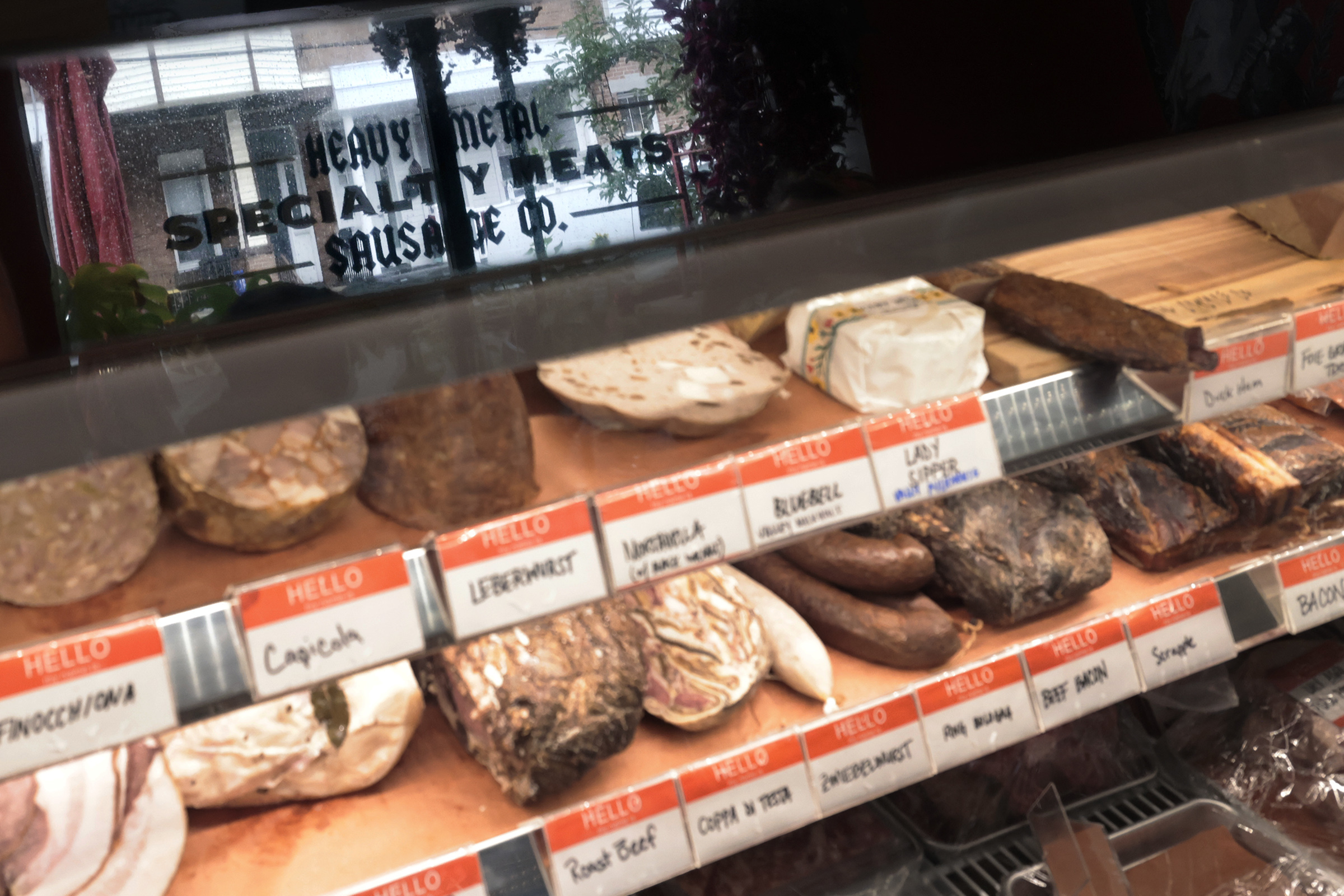
The front window is reflected in the top of the meat case inside of the Heavy Metal Sausage Co., 1527 W. Porter St. in Philadelphia, on Aug. 9, 2024.Elizabeth Robertson / Staff Photographer
Last week, Victory Brewing Co.’s three-level taproom on the Benjamin Franklin Parkway was ordered to temporarily cease operations after an inspector documented 26 health code violations that included live roaches, mice, and flies. And in mid-August, the health department failed Stargazy over “two unapproved countertop deep fryers without adequate mechanical ventilation,” a violation that has forced the East Passyunk Avenue restaurant to stop serving fish and chips.
How can Heavy Metal fix this?
Since Heavy Metal’s violations didn’t pose an imminent health hazard, the restaurant is allowed to remain open without indoor dining, Brooks confirmed.
The butcher and deli counters are still open during normal daytime hours (11 a.m. to 4 p.m. Thursday through Saturday, 11 a.m. to 3 p.m. Sunday) for takeout only. Pellegrino and Afiero said they’ve addressed most of the violations by creating the required food safety plans and limiting the basement to storage only.
The only hitch: What to do about the sink?
Heavy Metal Sausage Co. co-owner Melissa Pellegrino (left) greets diners Jeannette Armstrong (center) and Liz Rissover as chef/owner Patrick Alfiero prepares meals in the kitchen during the trattoria dinner on Nov. 17, 2022.Yong Kim / Staff Photographer
Heavy Metal must submit a new plan of review to the health department for approval. If the plan is approved and the restaurant passes reinspection, Brooks said, they will be allowed to restart indoor dining.
But to do so, Pellegrino said the health department recommended Heavy Metal install a customers-only sink at the front of the restaurant, a change that would require a separate, weeks-long permitting process and a contractor. When Pellegrino asked the health department if she could add curtains or room dividers to more clearly separate the bathroom hallway from the kitchen — which she considers a more cost-effective solution — she said they didn’t respond.
“All of these things take time and money,” Pellegrino said, “and we will have to make a calculus of what’s worth doing.”
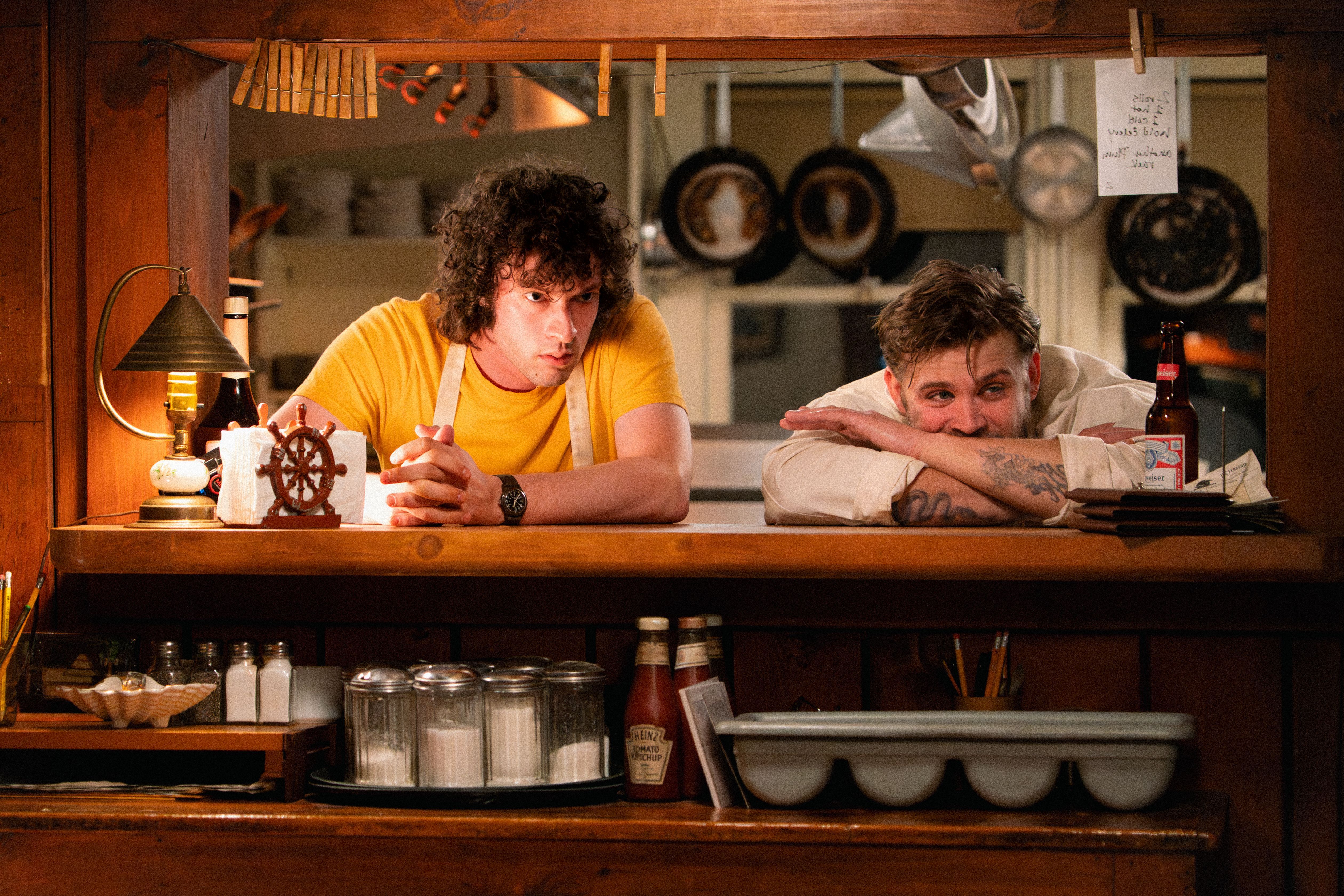
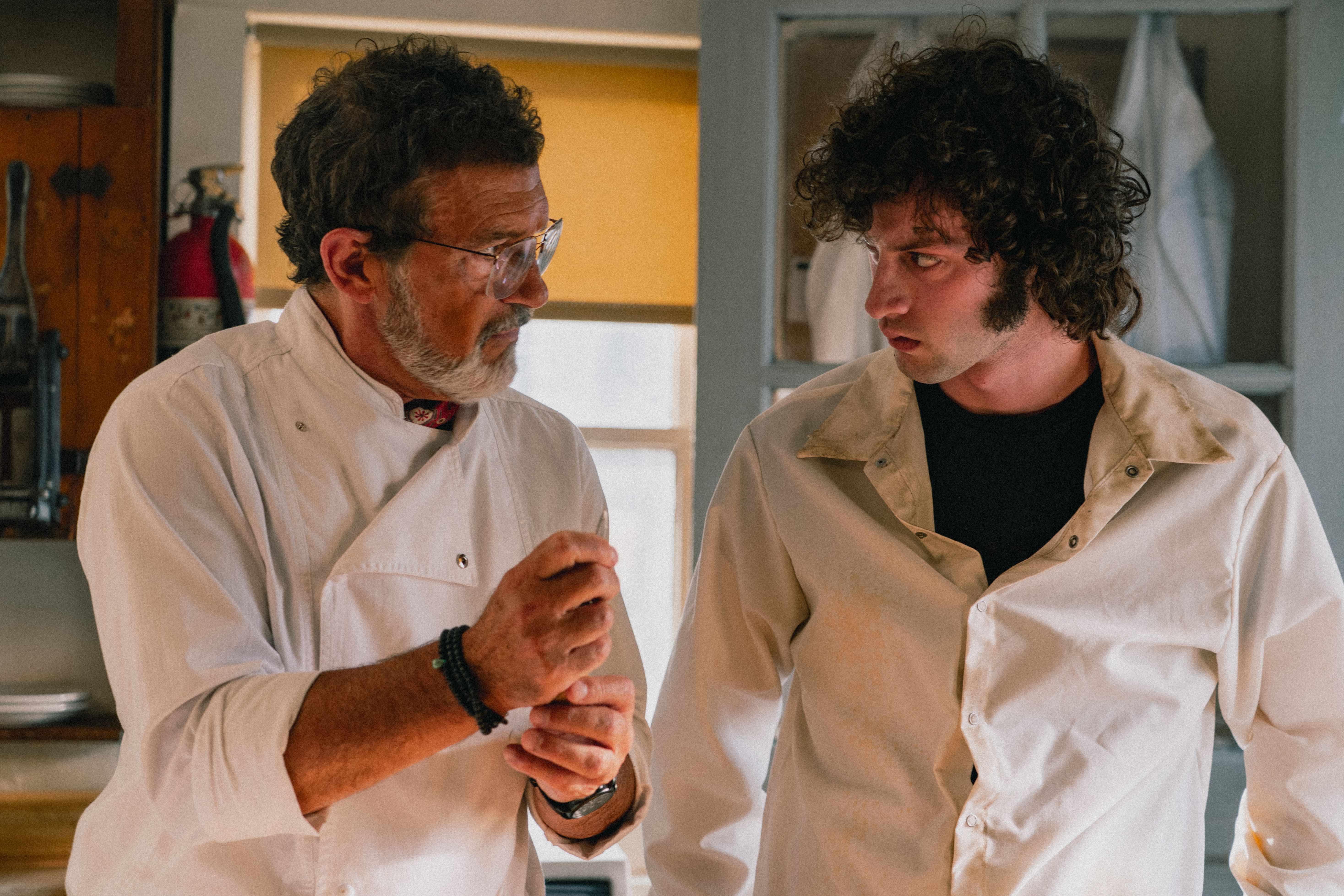
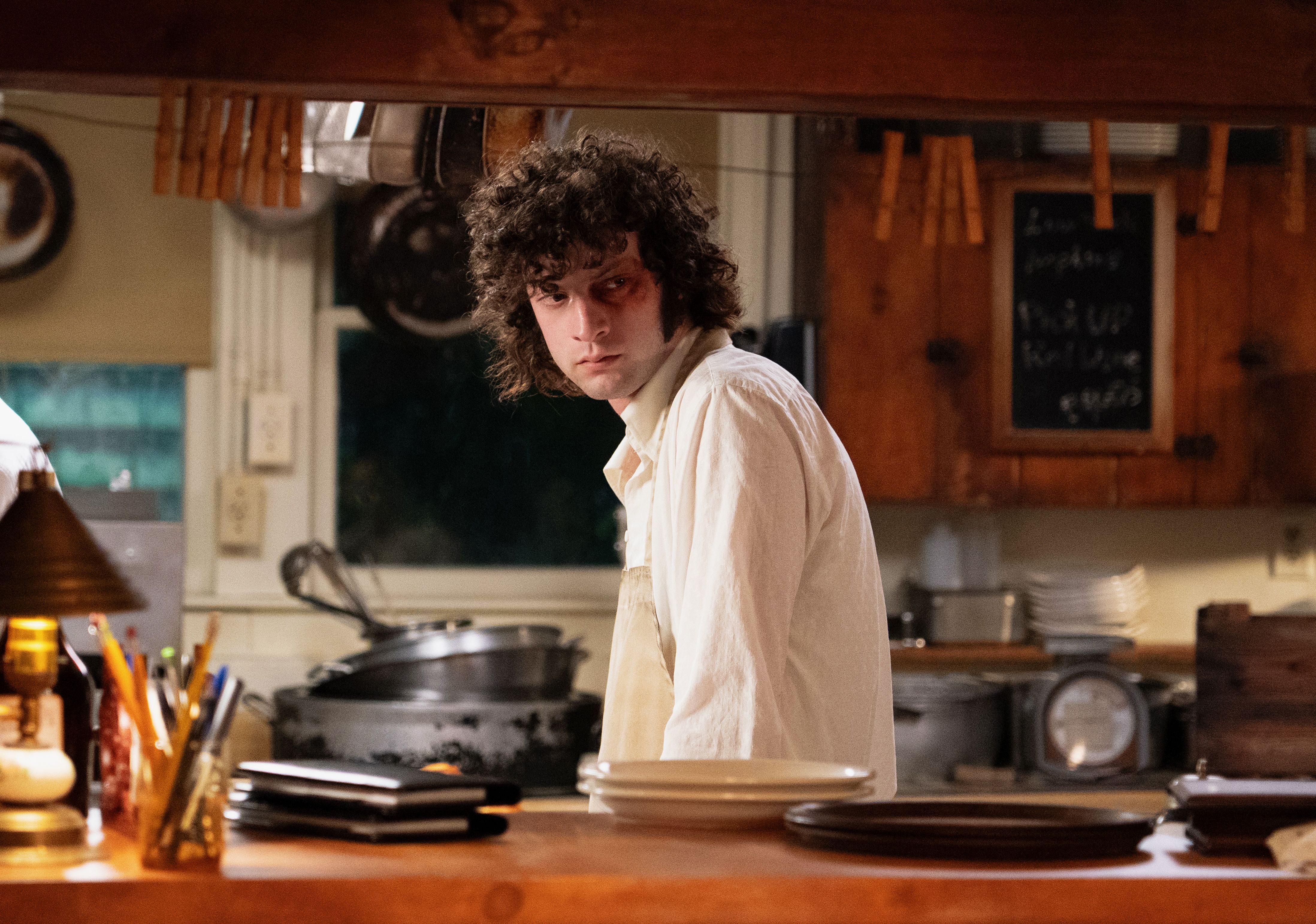
Dominic Sessa (left) as Anthony Bourdain with Leo Woodall as a renegade cook in “Tony.”A24
In the film, Sessa portrays a 19-year-old Bourdain in the summer of 1973, when he found himself in Provincetown, Mass., desperate to get his would-be wife, Nancy Putkoski (Emilia Jones), to fall in love with him after losing out on a writing fellowship. A tough-yet-kind chef (Anthony Banderas) gives Bourdain a job as a dishwasher at the Flagship, a no-nonsense seafood shack where Bourdain grows from bumbling dishwasher into something resembling a cook.
The film draws heavily on chapters of Bourdain’s best-selling memoir Kitchen Confidential, in which Bourdain romanticized a crew of talented, if aimless, line cooks and their exploits.
“They drank everything in sight, stole whatever wasn’t nailed down, and screwed their way through floor staff, bar customers, and casual visitors like nothing I’d ever seen or imagined,” Bourdain wrotewith palpable admiration.
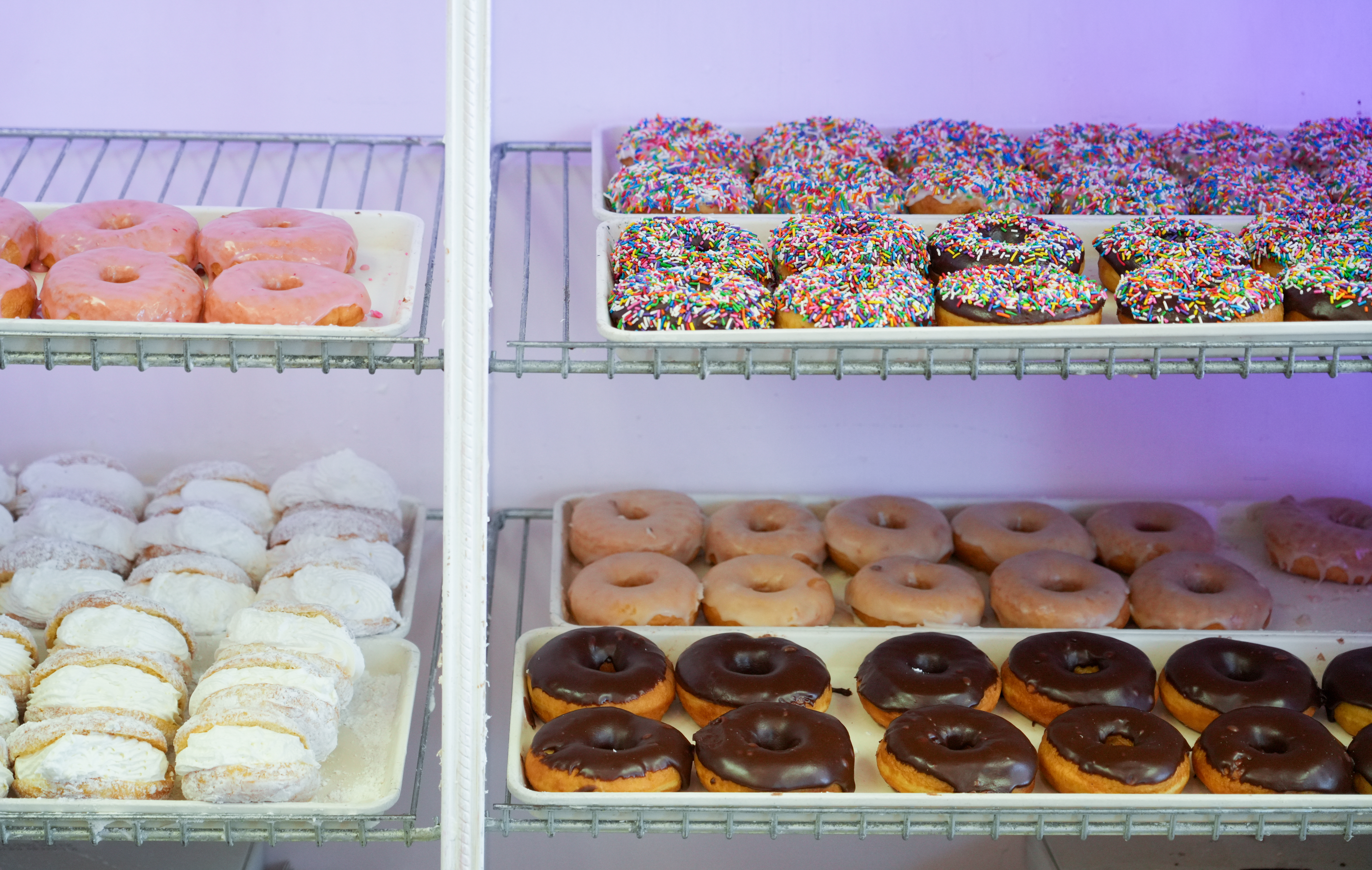
When Sessa startedas a dishwasher there in 2016, he was 13. By the time he worked his last shift in 2019, he had worked his way up to full-fledged baker, responsible for opening the shop and preparing batches of Cathy’s famous powdered and cream-filled doughnuts from scratch.
“I’ve hired a lot of great kids, but there are some who don’t get it,” said Cathy Greene, the bakery’s owner. Sessa “was really a natural.”
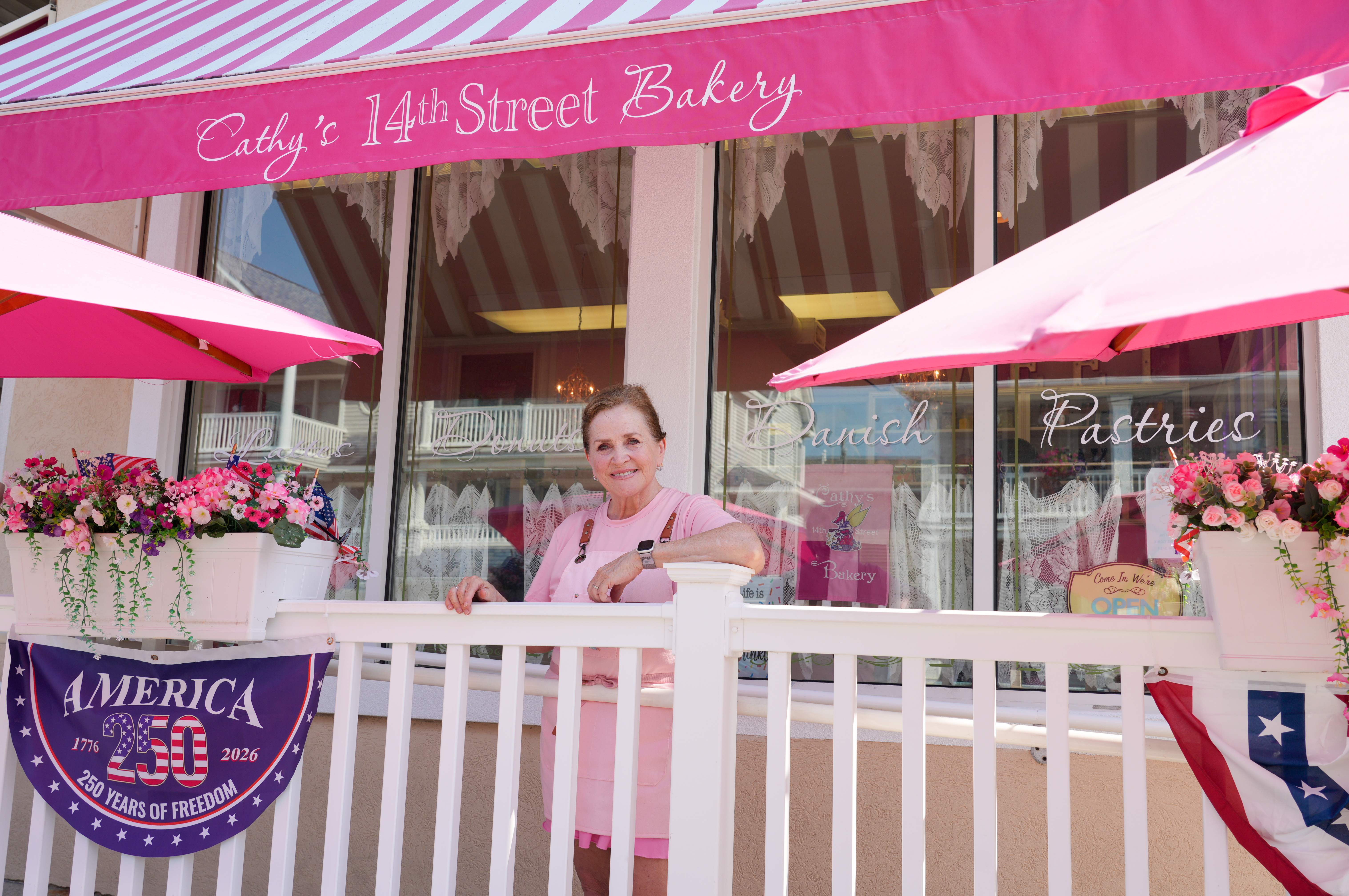
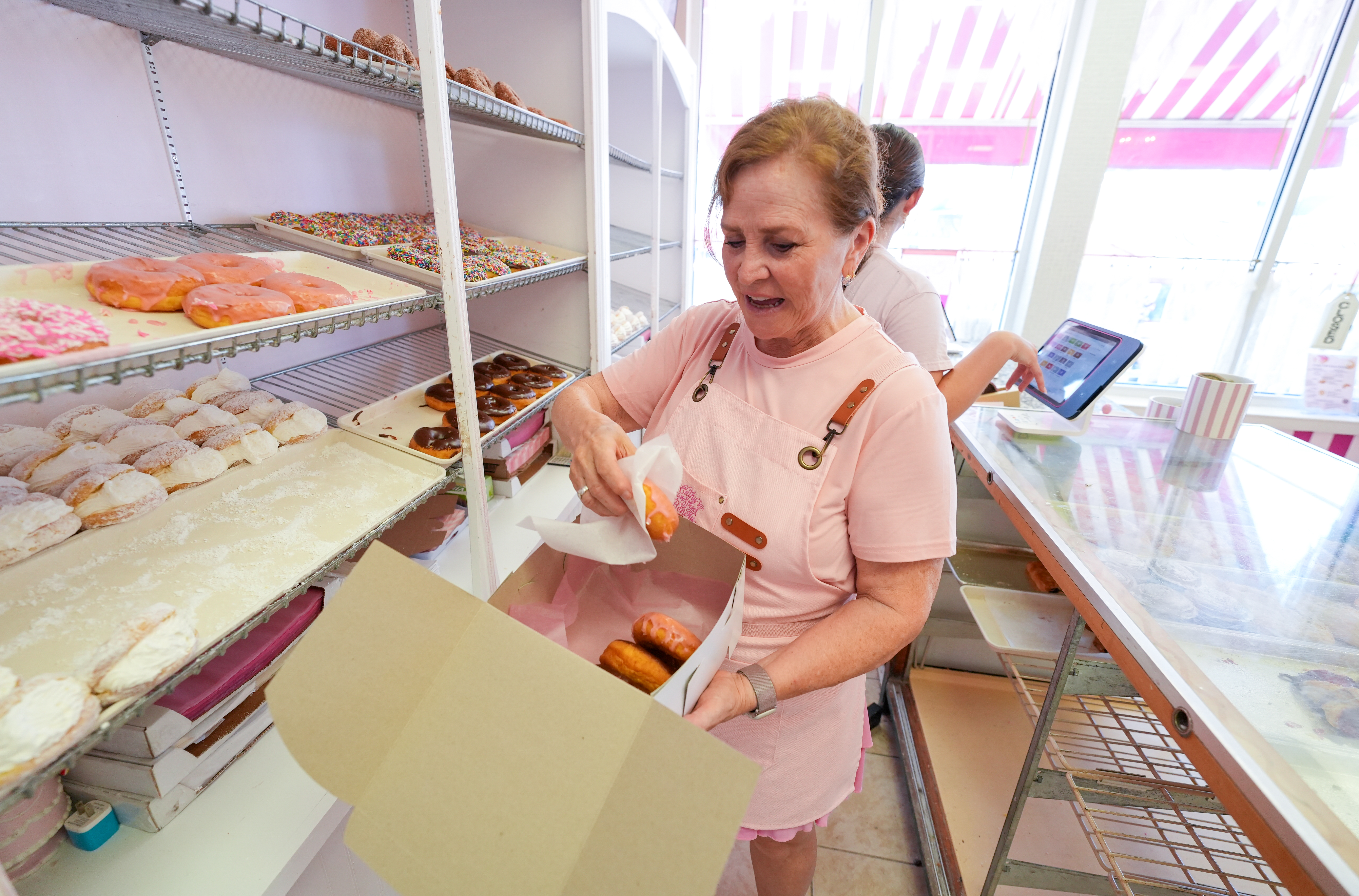
Cathy Greene, owner of Cathy’s 14th Street Bakery in Ocean City, N.J., fills a box with doughnuts for a customer on Aug. 13, 2026. Former Cathy’s dishwasher and junior baker Dominic Sessa plays Anthony Bourdain in the new A24 biopic “Tony.”Tim Hawk / For The Inquirer
Sessa doesn’t remember taking to it so easily. And yet, like Bourdain, he kept coming back.
“When I first started there, it was miserable — especially at that age, waking up super-early and making batches of dough. I was just lazy and didn’t feel like finding another job,” Sessa told The Inquirer. “But every summer I’d come back and Cathy would teach me something new … The experience was one of the things that taught me how to work hard.”
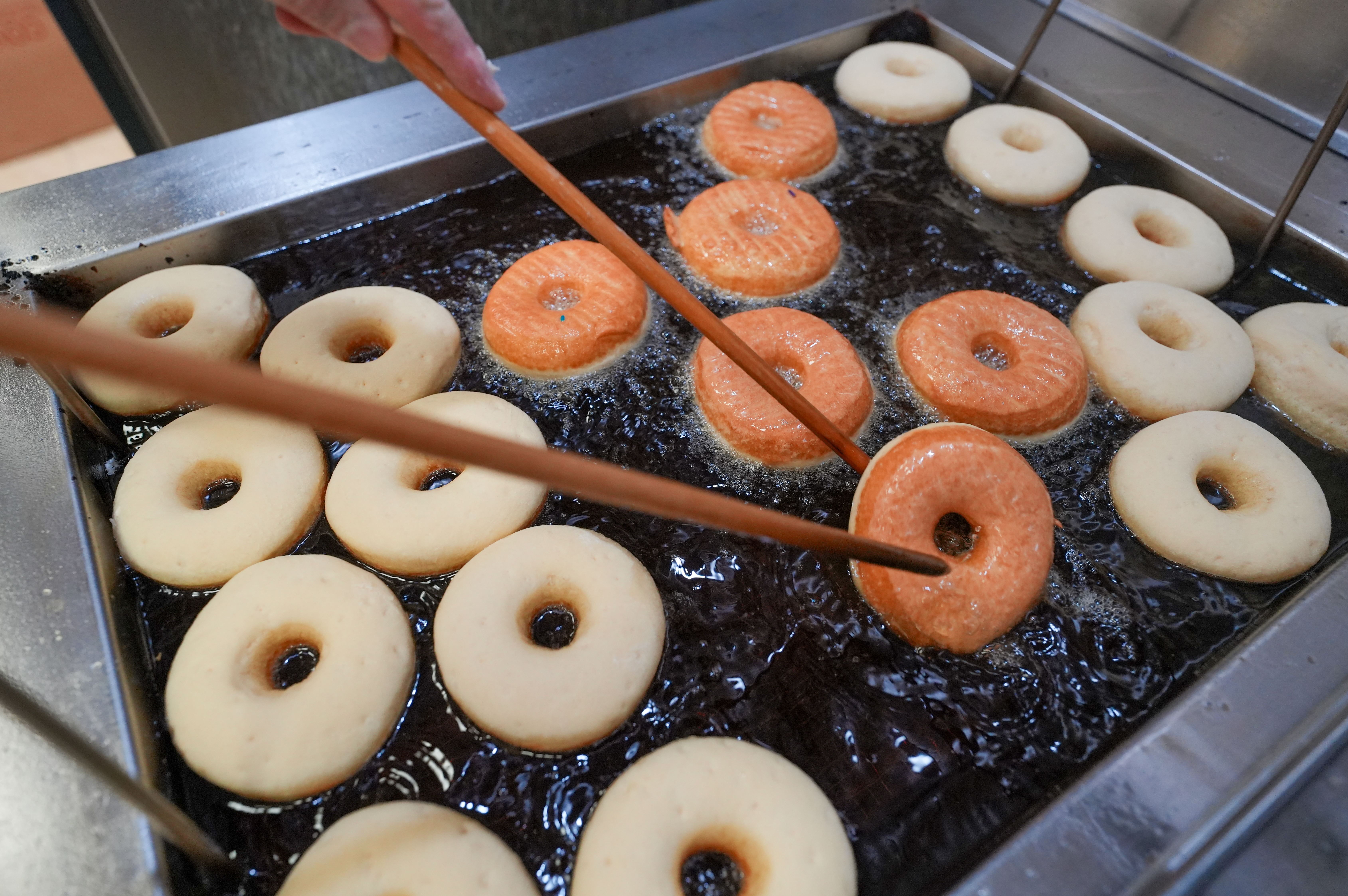
Tyler Greene, Cathy’s son, flips doughnuts in a deep fryer at Cathy’s 14th Street Bakery in Ocean City, N.J., on Aug. 13, 2026. Tim Hawk / For The Inquirer
Doughnut summers
Admittedly, frying doughnuts at a family-run bakery did not entirely prep Sessa for the fictional kitchen he’d step into as a teenage Bourdain. In Tony, the Flagship is full of cocaine, dirty jokes, and smashed dishes. Cathy’s, by contrast, was basically Disney World.
Still, Sessa said the job helped him understand what motivates chefs to endure grueling hours and nonstop kitchen injuries. Like Bourdain, the actor was a self-styled troublemaker, nearly getting kicked out of his South Jersey high school before earning a hockey scholarship to Massachusetts’ prestigious Deerfield Academy, where he would eventually be discovered by director Alexander Payne and land his breakout role as a boarding school kid in 2023 Christmas comedy The Holdovers.
Cathy’s kept him disciplined.
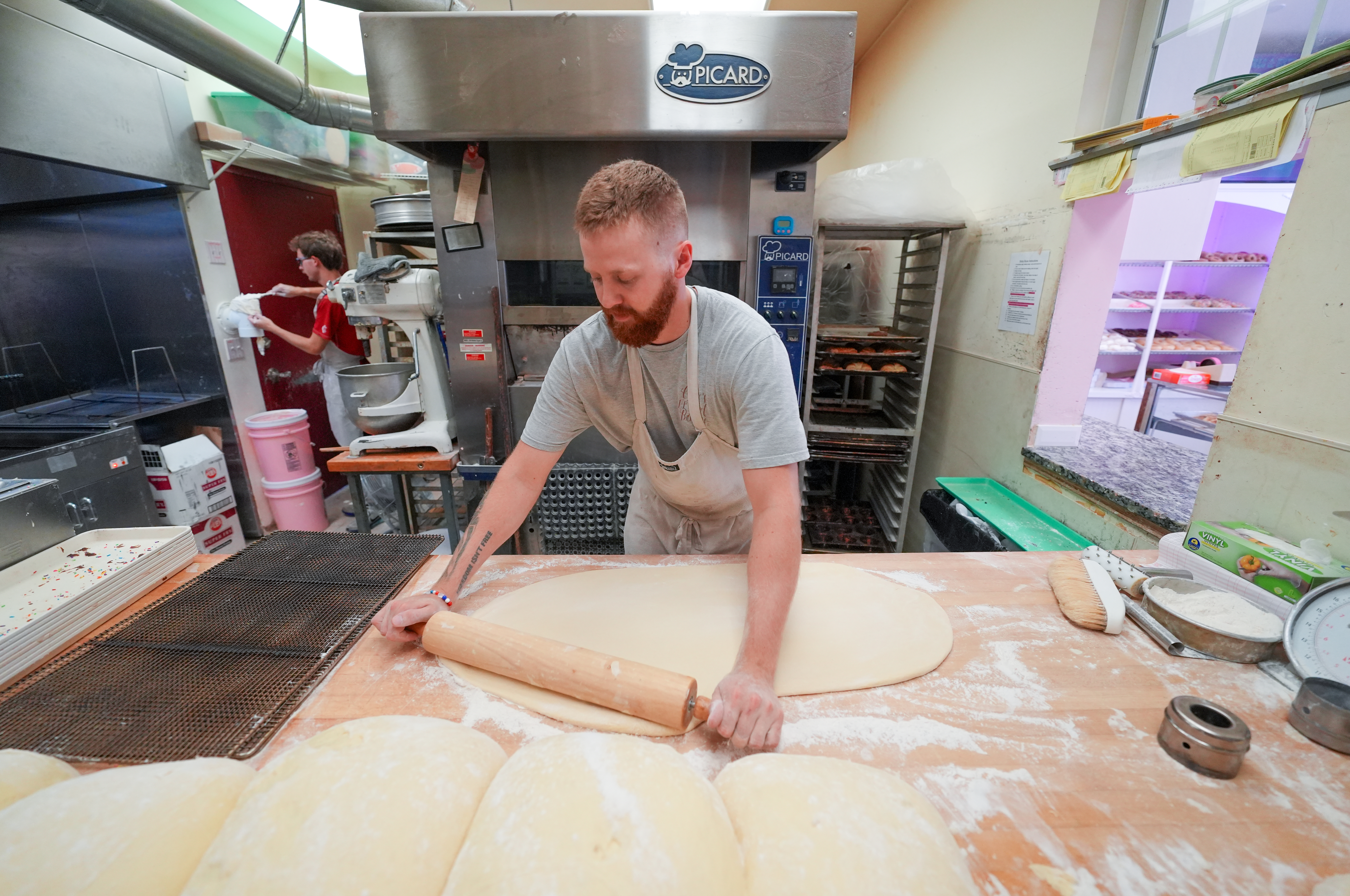
Sessa used to clock in atthe bakery at 4:30 a.m. to prep the day’s first doughnuts, rolling out and aerating one batch of dough while minding another batch as it proofed. In between, he’d fry up a third.
Tyler Greene rolls out the dough for donuts at Cathy’s 14th Street Bakery in Ocean City, N.J., on Aug. 13, 2026. Former Cathy’s dishwasher and junior baker Dominic Sessa plays Anthony Bourdain in the new A24 biopic “Tony.”Tim Hawk / For The InquirerA variety of doughnuts are for sale at Cathy’s 14th Street Bakery in Ocean City, N.J., on Aug. 13, 2026. Former Cathy’s dishwasher and junior baker Dominic Sessa plays Anthony Bourdain in the new A24 biopic “Tony.”Tim Hawk / For The Inquirer
At its busiest, Greene said, Cathy’s sells between 1,200 and 1,400 doughnuts a day. Sessa drew on the rush — and the high stakes — while acting in Tony.
“I related to the integrity working in a kitchen demands,” he said. “If I didn’t show up on time, everything would be messed up, and everyone would know it was [because of] me.” Plus, there was “something so gratifying” about placing doughnuts in the display case and watching customerssnap them up.
Antonio Banderas (left) as a chef-mentor with Dominic Sessa as Anthony Bourdain in “Tony.”A24
Greene said Sessa shined when it came to the rhythm of baking and could manage the flow of the stationabout as well as she could. When they’d roll out dough side by side, Greene would quiz him on three-digit by three-digit multiplication. Sessa, she said, always answered correctly “off the top of his head.”
“He was a real smart kid,” Greene said.
Things didn’t always run smoothly. Once, Sessa recalled, he nearly ruined the bakery’s trash cans by throwing out a batch of dough with too much yeast in it. He had gotten away with the mistake — until the dough proceeded to nearly quintuple in size. “It was billowing out of the cans, on the ground, seeping into the kitchen,” said Greene. “It was pretty funny.”
The stress of the job didn’t detract from Sessa’s favorite part: small-town notoriety.
Passersby love to peer into Cathy’s kitchen from the street. “Kids were always interested in watching the guy who rolls the doughnuts out,” Sessa said. “It made me feel like a celebrity.”
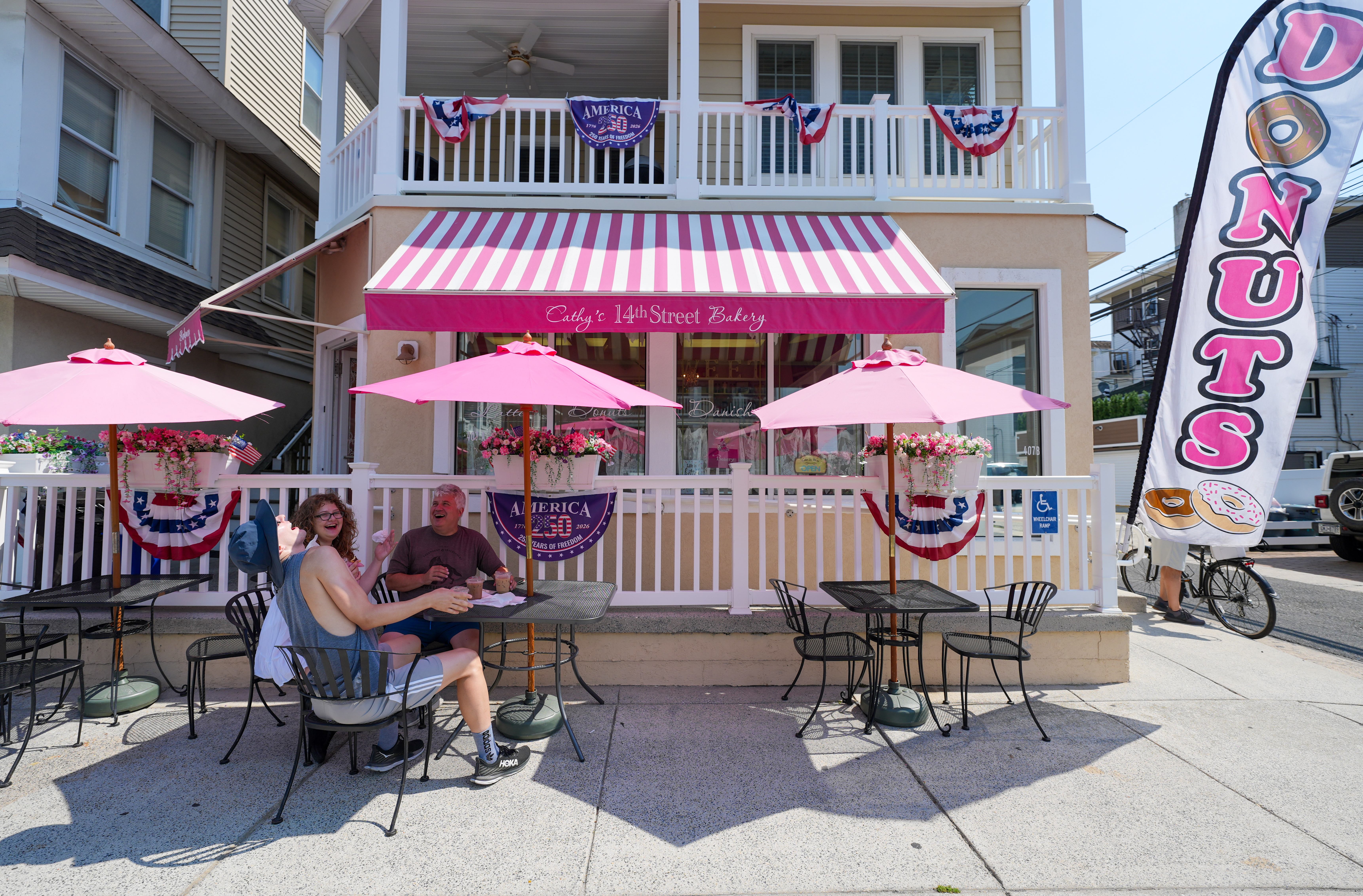
The outside of Cathy’s 14th Street Bakery in Ocean City, N.J., on Aug. 13, 2026. Former Cathy’s dishwasher and junior baker Dominic Sessa plays Anthony Bourdain in the new A24 biopic “Tony.”Tim Hawk / For The Inquirer
Drinking on the beach and baking hungover
As much as Tony spins a hero’s journey for a young Bourdain (who ends the movie — spoiler — by enrolling in culinary school), it also foreshadows his struggle with substance use.
Dominic Sessa as Anthony Bourdain in “Tony.”A24
Bourdain, who died from suicide in 2018 at 61, had spoken candidly about his addiction to heroin and cocaine before getting sober in the 1980s. In Tony, we see the fledging chef try cocaine for the first time at his dishwashing station at Flagship with Sal(Leo Woodhall), a hard-partying coworker who relishes in showing Bourdain his favorite vices.
Sessa’s Ocean City summers followed a similar pattern. Before The Holdovers, the actor was crossing the causeway to buy booze at Circle Liquors in Somers Point.
“All of my friends were doing the same thing” as Bourdain in Tony, Sessa said. “We would just work so we could get paid enough to buy alcohol, drink on the beach all night, go into work hungover, sleep it off after our shift, and do it all over again the next day.”
“We were all under 18 so we felt invincible,” Sessa said. ”It was paradise.”
Cathy Greene, owner of Cathy’s 14th Street Bakery in Ocean City, N.J., fills a box with donuts for a customer, on Aug. 13, 2026. Former Cathy’s dishwasher and junior baker Dominic Sessa plays Anthony Bourdain in the new A24 biopic “Tony.”Tim Hawk / For The Inquirer
Antics aside, Greene is proud of the role her bakery played in helping Sessa get into character (even if she hasn’t seen Tony yet). She just isn’t sure about cashing in on his star power. “I don’t want to be the one who is like, ‘Oh, I had Dominic Sessa here,’” Greene said. “But it’s pretty cool.”
You can order 10 different margaritas, a tequila-spiked rendition of a Clover Club, and whole barbecued dorade for the table at East Kensington’s newest bar.
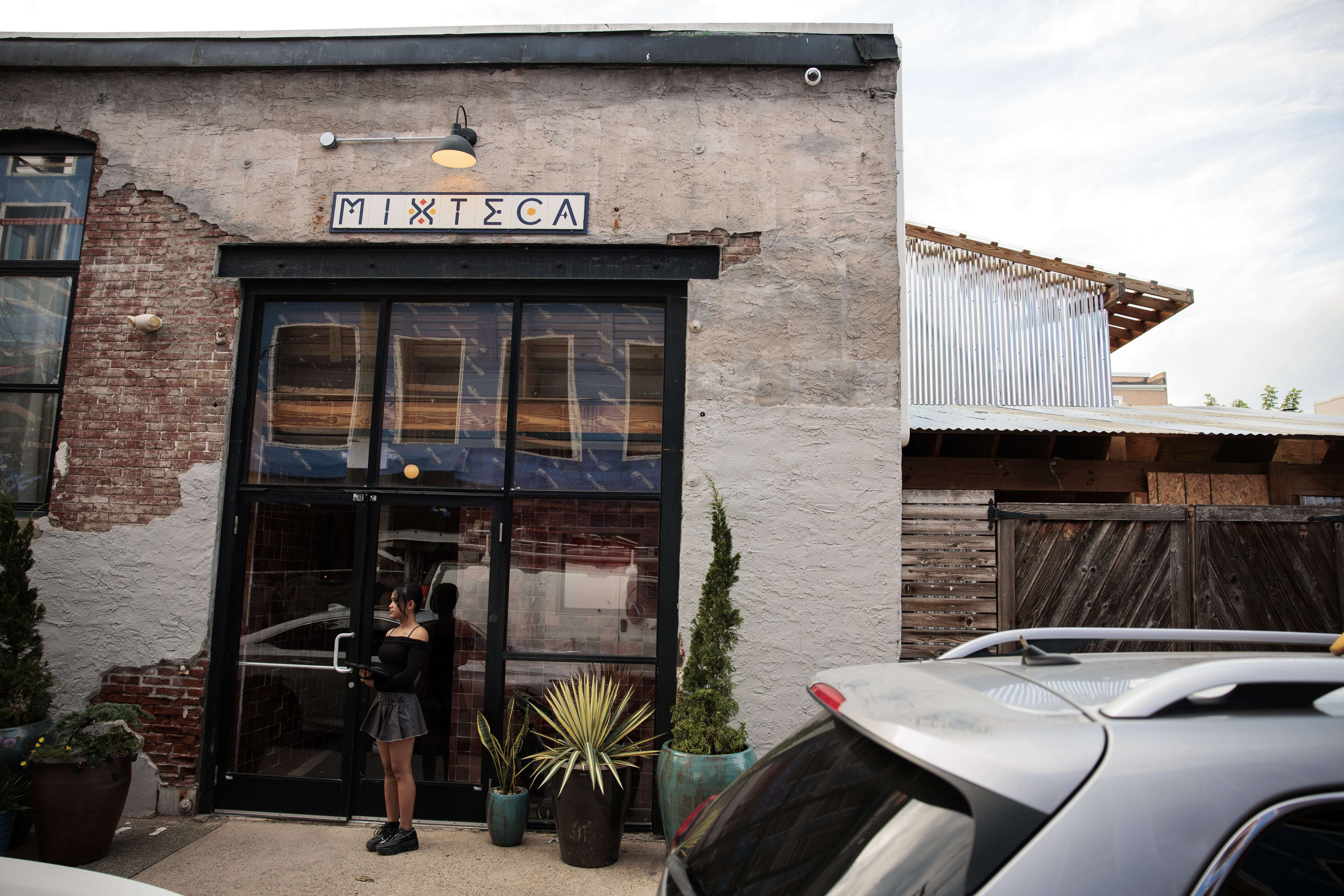
Mixteca — an agave-focused coctelería from two James Beard Award-winning bartenders — opened at 2113 E. York St. in late August, breathing new life into the space formerly occupied by the acclaimed neighborhood barMartha.
Mixteca — named after the artisan-rich region of central Mexico — is as much a tribute to Lopez’s heritage as it is an outgrowth of Lopez and Bell’s relationship. Bell worked his way up at PDT from Lopez’s barback to lead bartender and eventually owner, after buying the speakeasy and its brand from co-founder Brian Shebairo.
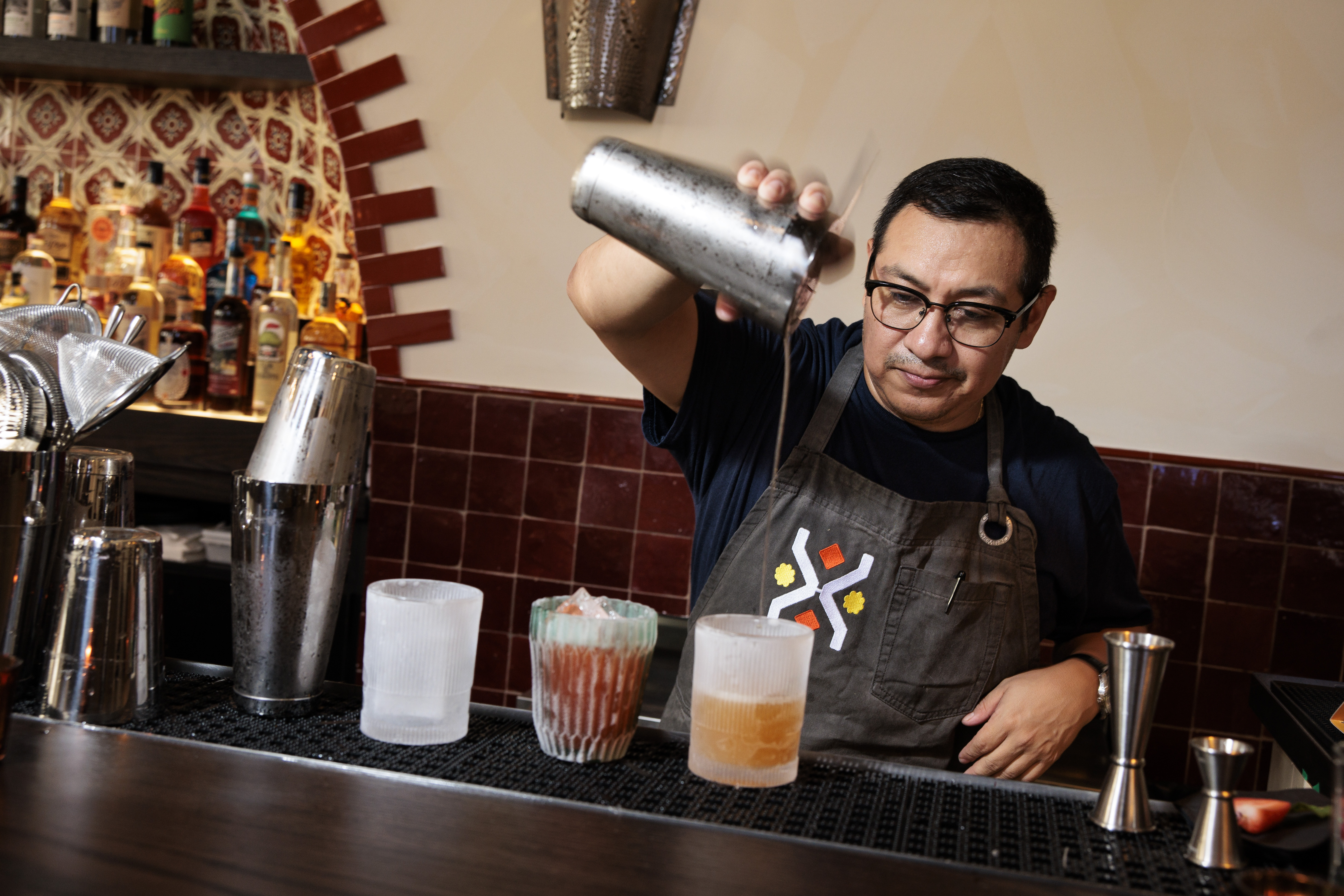
Victor Lopez pours cocktails at Mixteca in East Kensington.Monica Herndon / Staff Photographer
Lopez “is one of the best cocktail makers I’d ever worked with,” Bell said. “We’d play these games with him back in the day at PDT where we’d make him a drink, and he’d correctly guess the components.”
In New York, Mixteca is a bar first, with an extensive drink list of inventive takes on classic cocktails prepared with Latin American flavors, like a tomatillo gin and tonic or a Negroni infused with palo santo, a wood used for spiritual cleansing across Latin America. In lieu of a full food menu, Lopez and Bell partnered with Los Angeles-based Tacos 1986 to serve a handful of tacos and quesadillas.
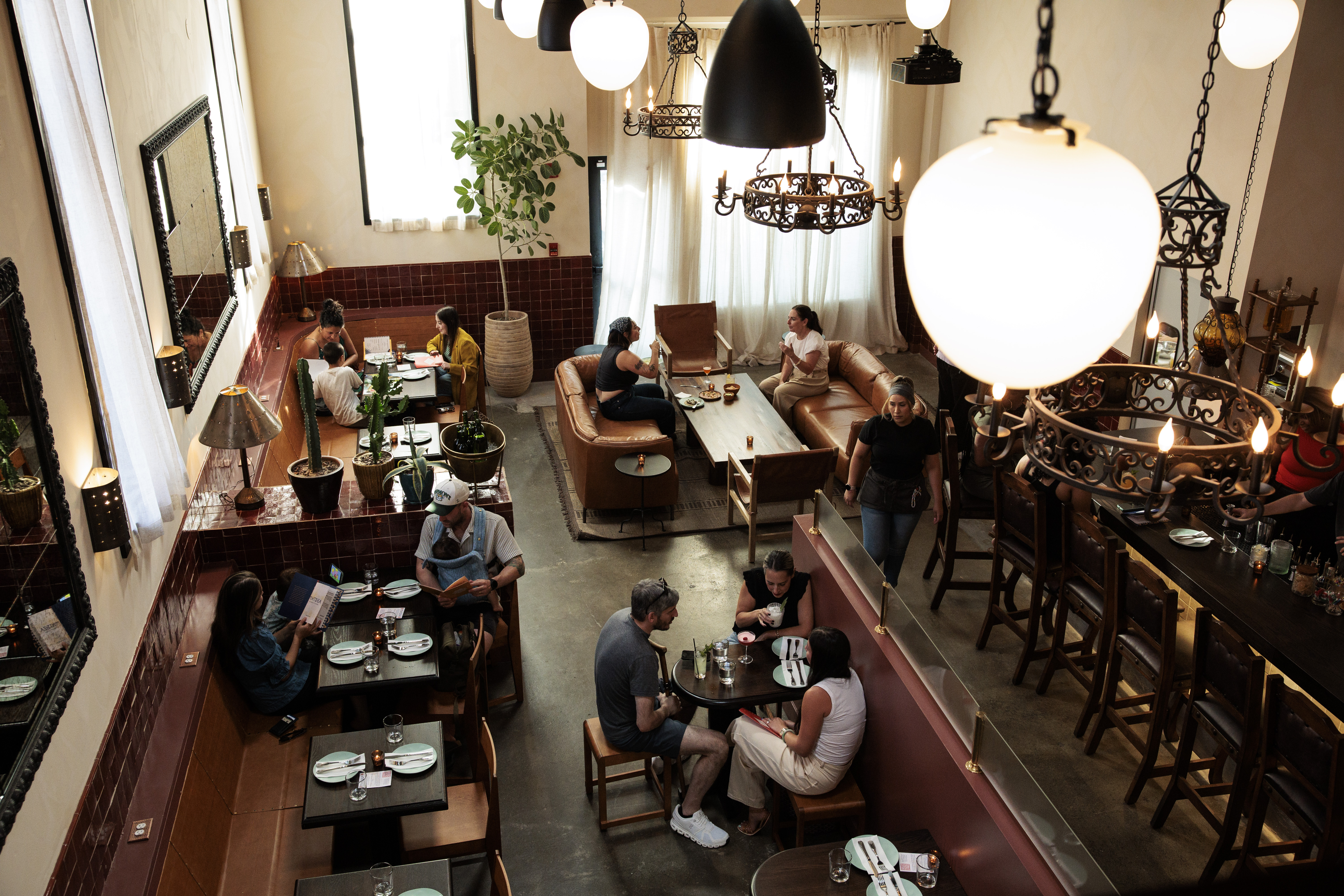
The dining room at Mixteca on a friends and family night Aug. 26.Monica Herndon / Staff Photographer
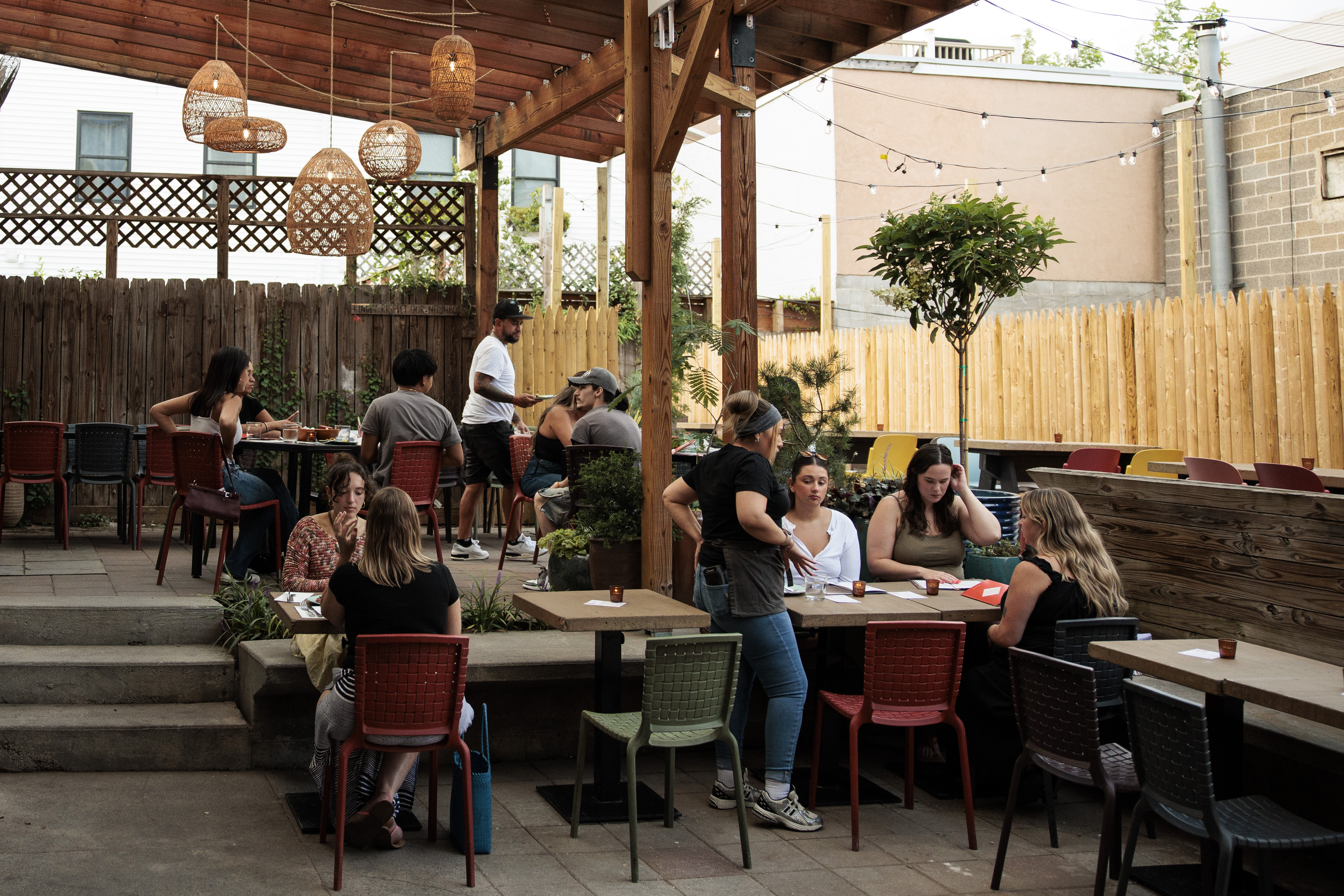
Mixteca in Philly, meanwhile, is equal parts bar and restaurant, with a full-fledged food menu of Poblano-inspired share plates and nearly double the number of cocktails. The space seats 100 people across its airy, bench-lined main dining room, dimly lit mezzanine, and large patio outfitted with string lights and rainbow-colored chairs. The restaurant has an eye-catching centerpiece: a large arch over the center bar made of intricate ceramic Talavera tiles imported from Puebla. They almost create a halo over the shelves upon shelves of alcohol.
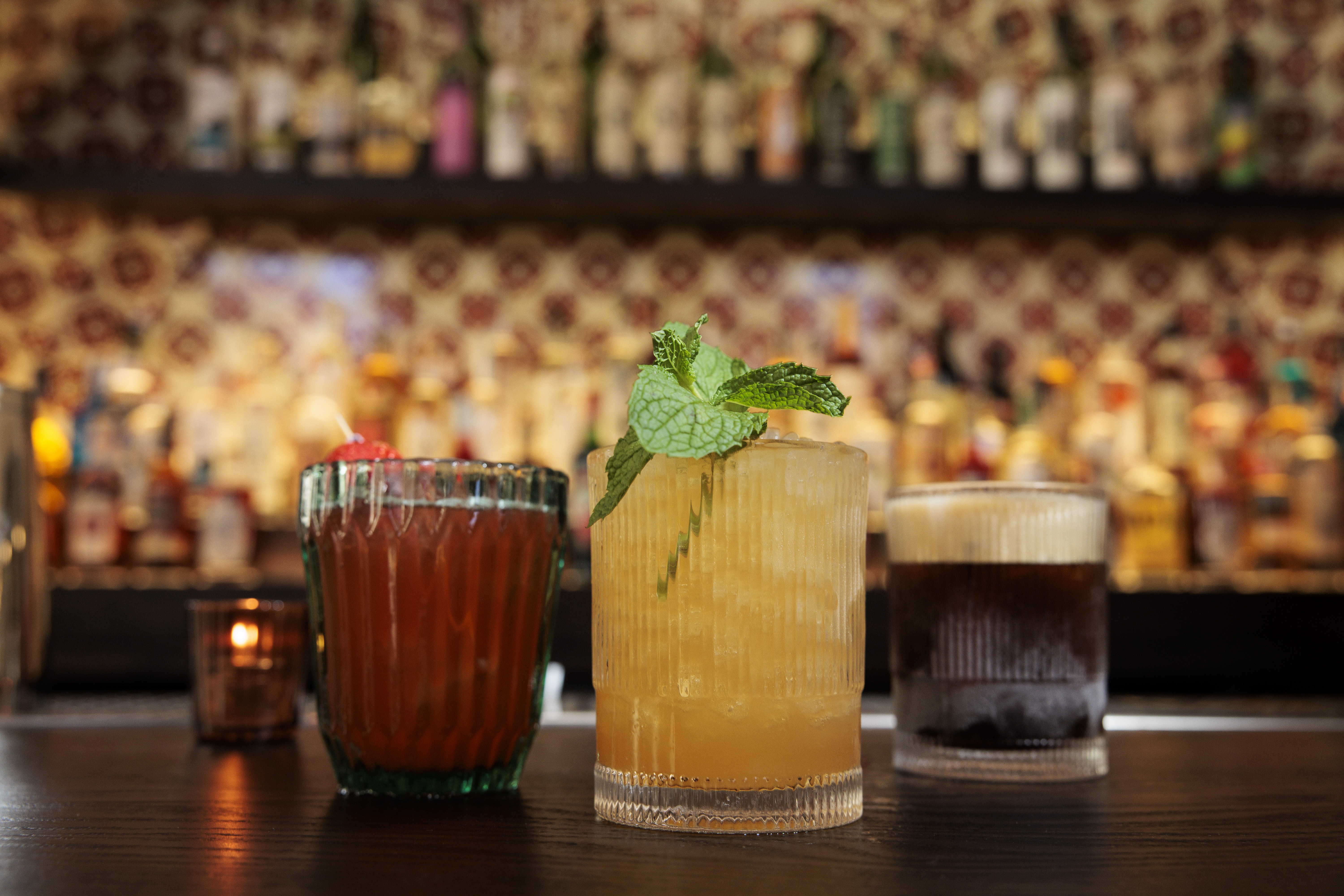
The strawberry margarita, Fish House Punch, and carajillo cocktails at Mixteca.Monica Herndon / Staff Photographer
“The high ceilings, the exterior, the energy of the neighborhood … it was perfect,” Bell said. “There’s a chaos to New York that can be exhausting, and I don’t see that in Philly.”
Lopez needed even less convincing: “I told Jeff, ‘I’ll probably move to Philly because I love it.’”
Classic cocktails with an agave twist
Mixteca’s Philly menu uses the New York location’s as a starting point for an array of drinks that draw deep on mezcal and tequila.
The restaurant has the same house margaritas on the menu — classic, made with Cointreau; and spicy, made with wasabi, cucumber, and hot honey — plus seven new flavored options, such as guava and blackberry, made with fruit juice.
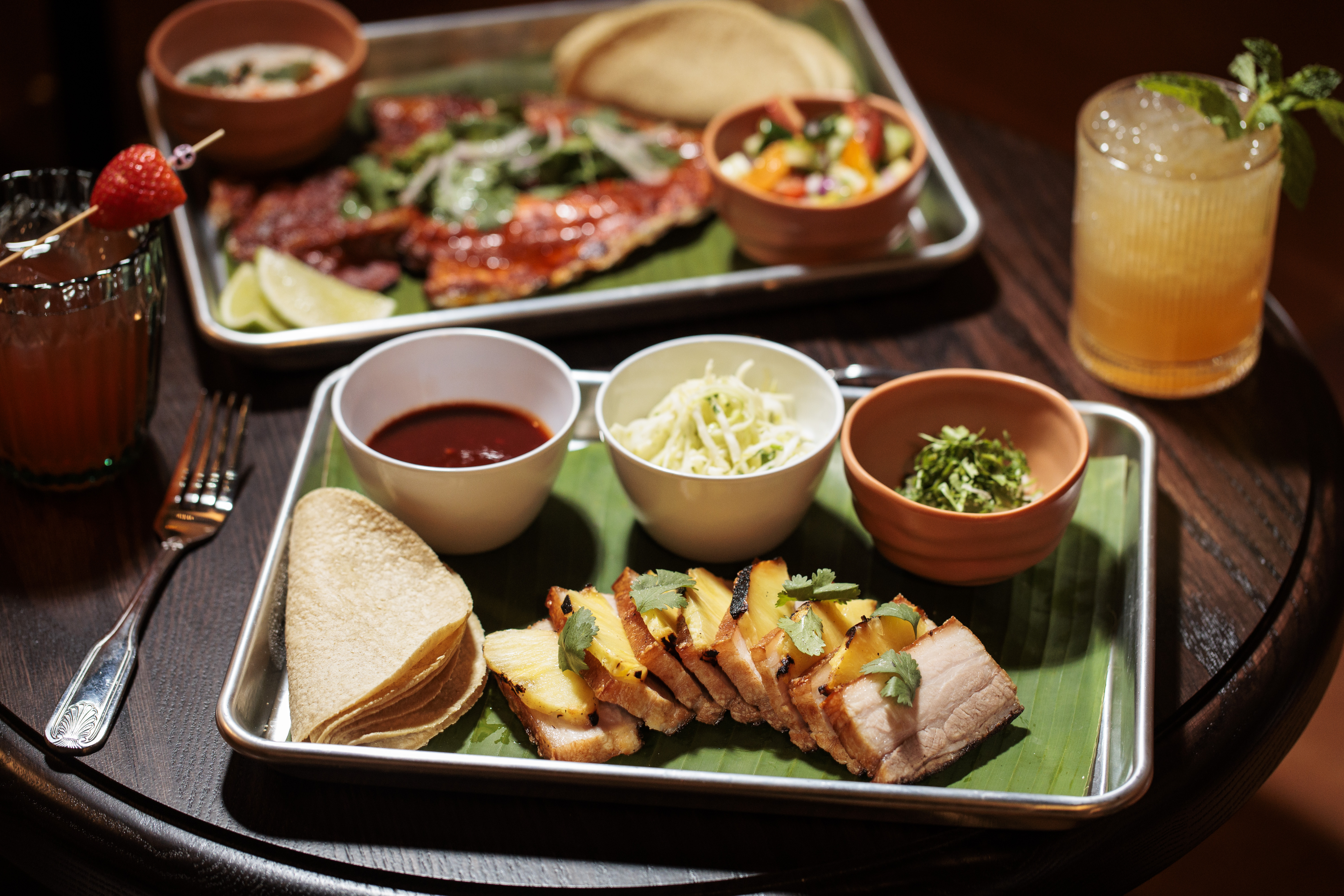
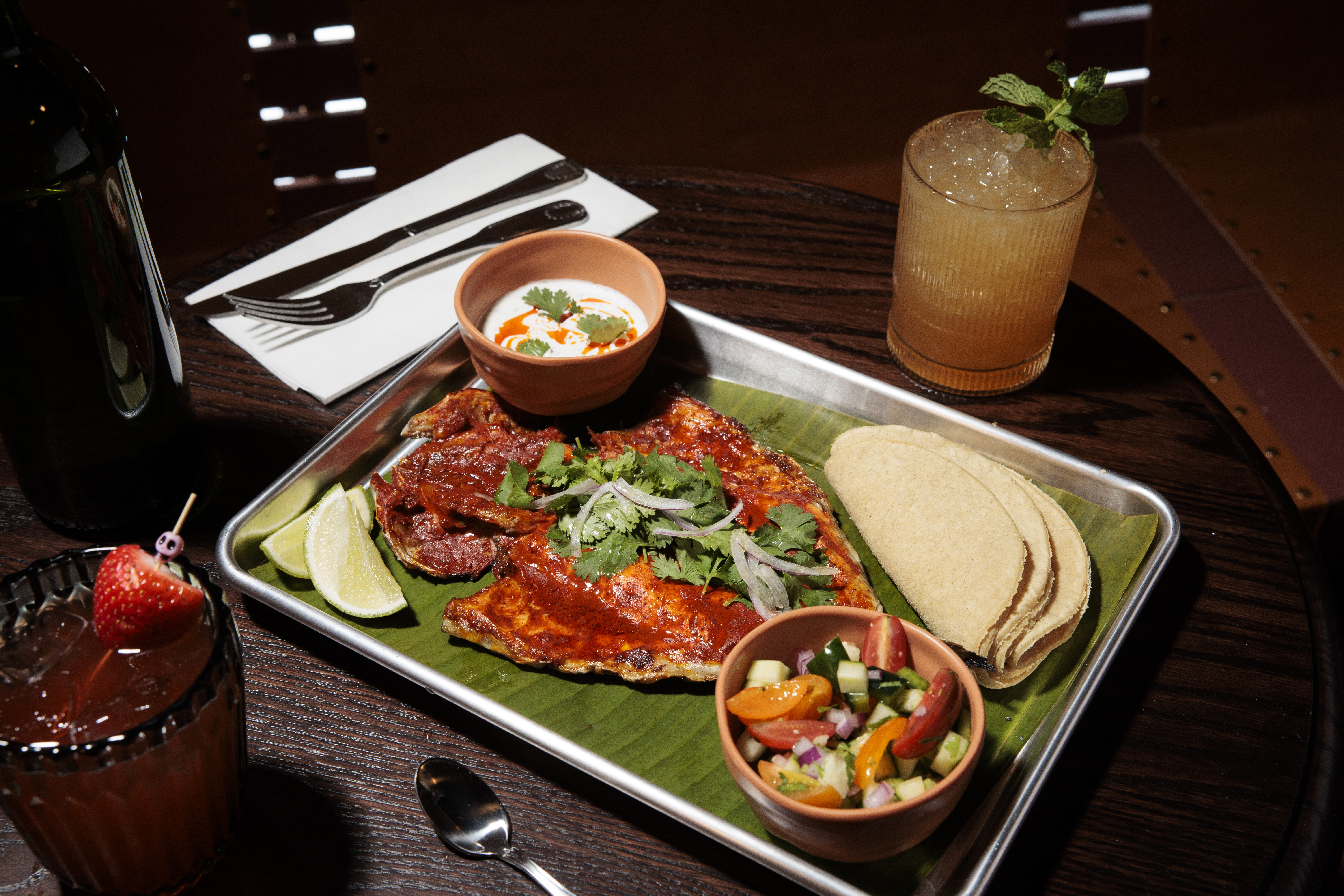
The aorade asado at Mixteca. The Philly location is equal parts bar and restaurant, with a full-fledged food menu of Poblano-inspired share plates.Monica Herndon / Staff Photographer
The Philly location’s 18 signature cocktails include classics like rye whiskey Manhattans and espresso martinis as well as agave-centric counterparts, like the aptly named Puebla York (made with reposado tequila, mezcal, Cynar amaro, and cassis) and a cold brew carajillo, the popular Mexican cocktail made with tequila and vanilla-forward Licor 43.
Lopez also created versions of two timeless local cocktails: a mellower, peach-infused Fish House Punch that swaps brandy for reposado and Oaxacan rum, and a foamy raspberry Clover Club that uses white tequila instead of gin. Both go down easy.
The patio at Mixteca on a friends and family night Aug. 26.Monica Herndon / Staff Photographer
Though no executive chef heads up Mixteca’s kitchen in Philadelphia, the food menu got the stamp of approval from Lopez, who said the flavors were “the closest” to what he grew up eating as a kid in Mexico. Highlights include a bright hamachi and yellowtail ceviche; steak, mushroom, and chicken tacos served on made-to-order corn tortillas; and a whole dorade asado designed for sharing. Served with warm tortillas, white salsa, and a crisp tomato-cucumber salad, the fish sits at the center of a table like a prized catch of the day.
“We’re showing up to a party that’s already happening. We’re not the hosts,” said Bell. “We want to ingratiate ourselves.”
The exterior of Mixteca, in the former Martha space in East Kensington. Monica Herndon / Staff Photographer
Mixteca, 2113 E. York St., 215-714-3148, cocteleriamixteca.com. Hours: 4 p.m. to midnight Monday through Wednesday; 4 p.m. to 2 a.m. Thursday to Friday; noon to 2 a.m. Saturday; noon to 10 p.m. Sunday.