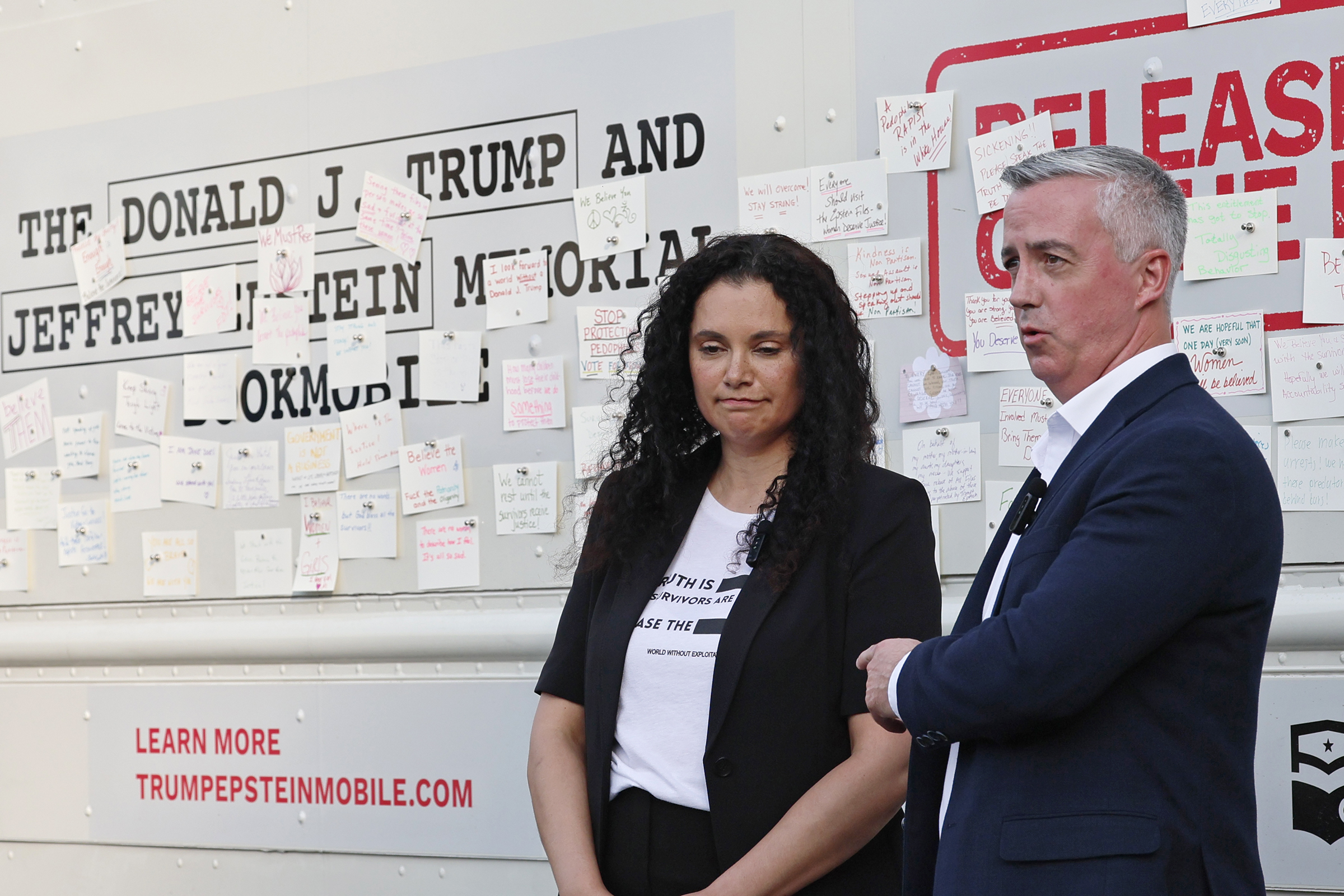
Democrat Bob Harvie thumbed through hundreds of pages bound together in a booklabeled “The Partially Redacted Epstein Files” and said he was disgusted with what he read —or at least what he was able to read.
Entire blocks of text regarding the investigation into Jeffrey Epstein, the financier and convicted sex offender who died in prison in 2019, were marked black.
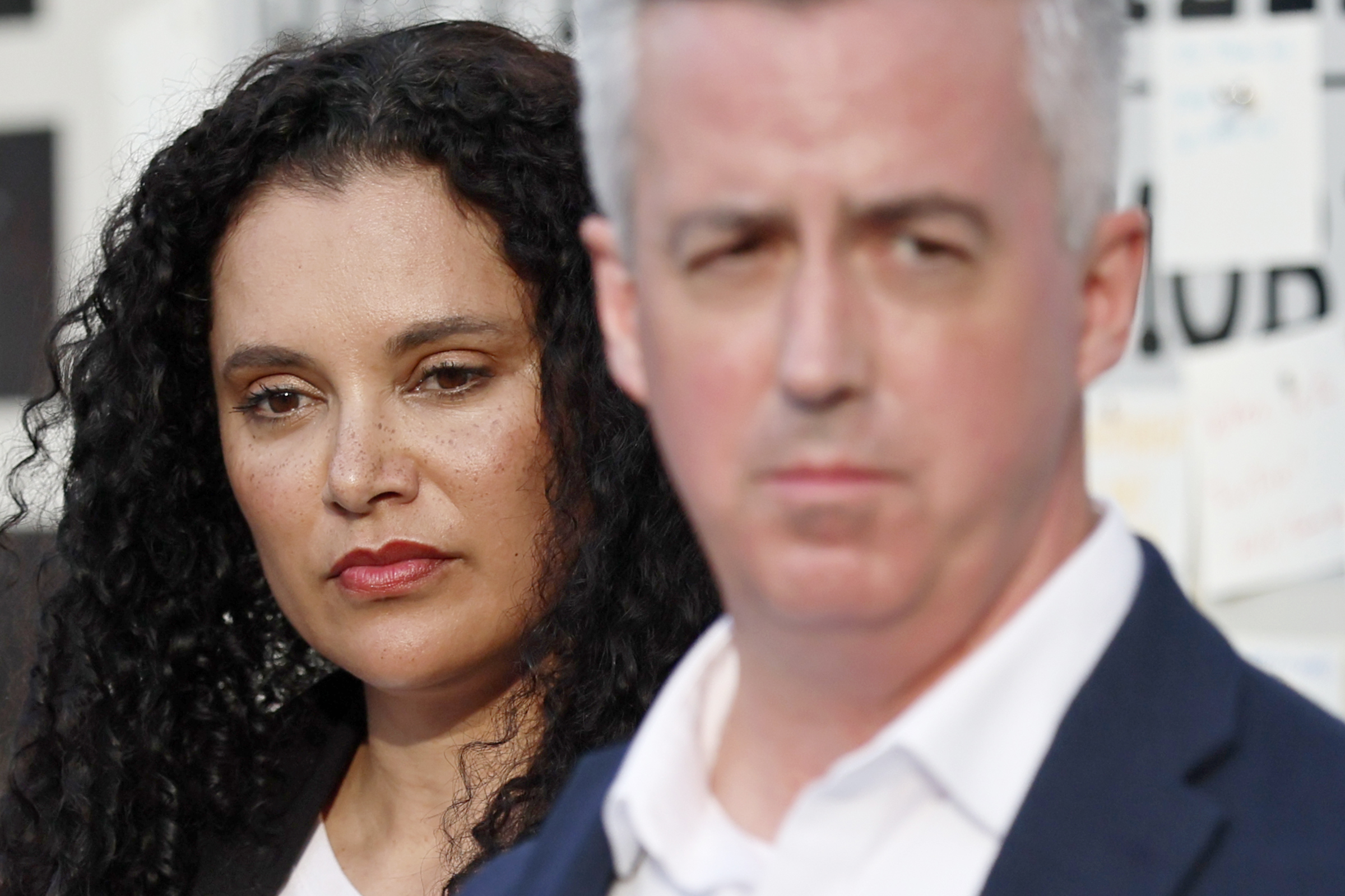
But survivors of Epstein’s predatory behavior, including Sharlene Rochard, who appeared with Harvie Friday in Bristol, are heroes for illuminating what has been blocked from the public, the congressional candidate said.
Harvie pledged to push “very, very hard” to release the full, unredacted files related to Epstein’s crimes if elected.
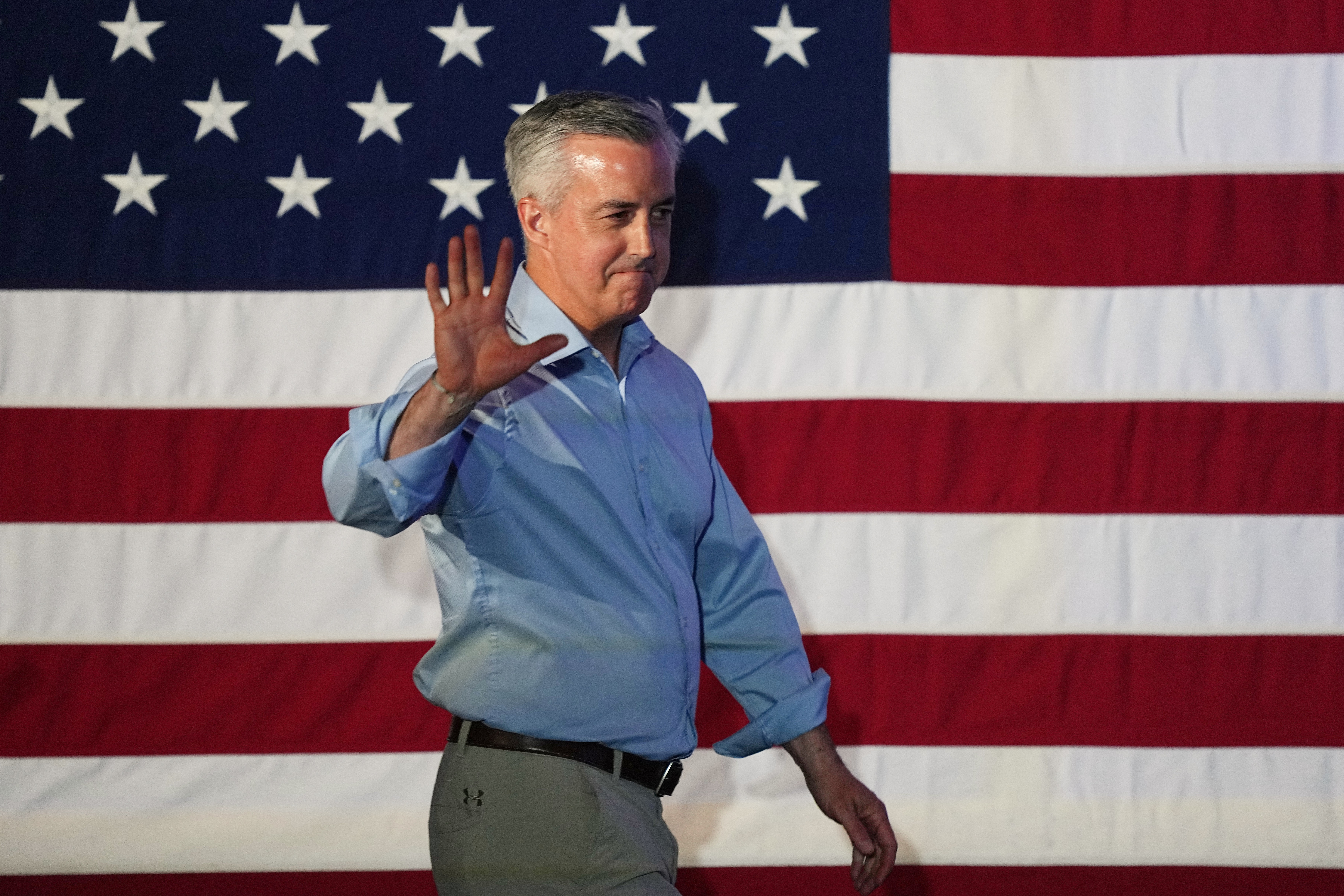
The Bucks County commissioner is running against Republican U.S. Rep. Brian Fitzpatrick to represent the 1st Congressional District, one of two swing districts in the state that Rochard visited Friday to campaign for Democrats. She’ll be hitting another the following day.
“These are files, but I’m in these files, and that is my life in these files,” Rochard told Harvie. “And I need justice. We need accountability, and we need some transparency, and we need people likeyou.”
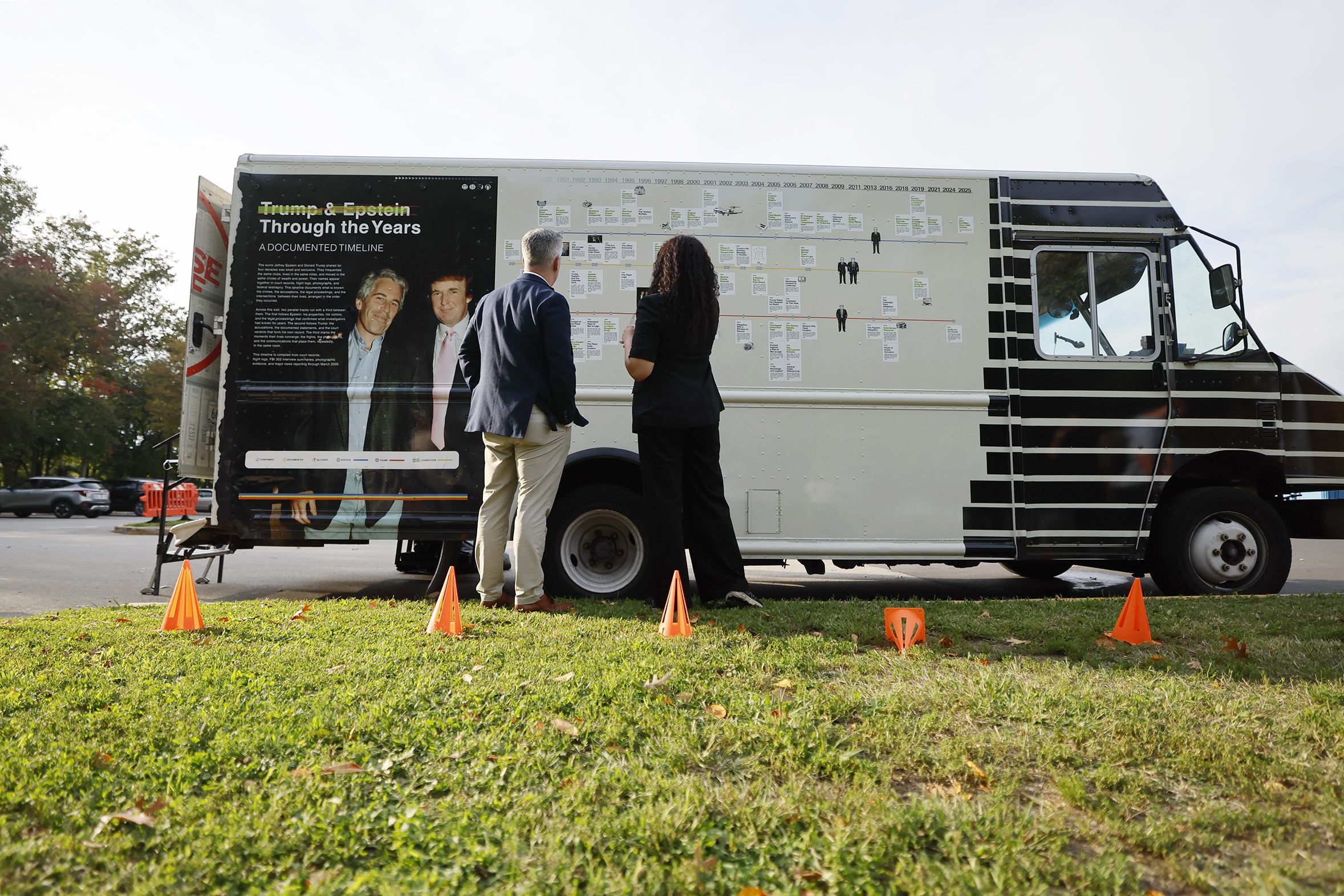
Rows of files were contained inside a traveling bookmobile parked in front of the Bristol waterfront. Plastered on the outside of the truck was a decades-old image of President Donald Trump with his arm around Epstein.
Reminding voters of Trump’s history with Epstein has been a campaign tactic used by Democrats in competitive contests across the country, but Harvie said the issue of justice for survivors should go beyond partisan politics.
“I don’t care what party they’re from,” Harvie said. “I don’t care what office they hold or held. I don’t care how much money they have. I don’t care. We need to do everything we can to protect the victims and honor them and shine a light on this part of our society.”
Sharlene Rochard, a survivor of Jeffrey Epstein’s sexual trafficking and abuse, and Bob Harvie during a news conference at the Donald J. Trump and Jeffrey Epstein Memorial Bookmobile in Bristol.Elizabeth Robertson / Staff Photographer
Earlier in the day, Rochard visited Harrisburg, where she was welcomed by Democrat Janelle Stelson, a former news anchor who promised to “take on the culture of corruption across the government” if elected over incumbent Republican U.S. Rep. Scott Perry in the 10th District.
Rochard was slated to appear Saturday in Bethlehem with Democrat Bob Brooks, who is running against U.S. Rep. Ryan Mackenzie in the 7th District, one of the most competitive contests in the nation.
The truck arrived in Pennsylvania one month before Election Day as Trump continues to plummet in popularity among likely voters in the state. It’s an officially nonpartisan project of Institute for Primary Facts, a nonprofit that builds public art installations, and DEFIANCE.org, a group dedicated to ending sexual exploitation of children and adults.
Rochard, who was born in Canada, began traveling to the U.S. as a teen to model when she met Epstein and was with him in New York, Florida, and on his private island in the U.S. Virgin Islands, she said. Though she’s unable to go into details about her trafficking experience because she is involved in ongoing legal action, she now works alongside fellow survivors to advocate for the files to be exposed.
Every Pennsylvania lawmaker voted to release the Epstein files last year, including Fitzpatrick and the other vulnerable Republican incumbents whose districts Rochard was touring this week.
In a statement last year, Fitzpatrick said he is “unequivocally behind the victims and their family members who suffered immensely” from Epstein’s crimes.
“He 100% stands with the victims, and will support disclosure and transparency every single time,” Heather Roberts, a spokesperson for Fitzpatrick’s campaign, said Friday.
A couple dozen people trickled through the bookmobile during its Bristol stop, though multiple people interviewed entered with familiarity about the files and were already convinced of a strong connection between Trump and Epstein.
“I’m dumbfounded that there are people who don’t believe the victims,” said Deb Crasnick, 69, of Langhorne.
Sharlene Rochard, a survivor of Jeffrey Epstein’s sexual trafficking and abuse, and Bob Harvie at the Donald J. Trump and Jeffrey Epstein Memorial Bookmobile in Bristol on Friday. Elizabeth Robertson / Staff Photographer
Crasnick found out about the event from her friend Diane Grant, 71, of Bensalem, who has been following the tour on social media. But Grant, who called the revelations disturbing, worried the tour’s effectiveness may have limits.
“People have their mindset. Nothing said or shown in there will change it,” she said.
“The economy keeps me up at night,” said Tracey Marshall, 57, who lives in Falls Township. “We need a change.”
Rochard said the purpose of the tour goes beyond Election Day.
Trump has called the Epstein case “a hoax” and said that the files that have been publicly shared are “enough,” a notion the survivor is hoping to dispel with the tour.
“This is something that has happened to me,” Rochard said. “I’m not a Democratic hoax. I am a real person, and we need some justice.”
Bucks County Democrat Bob Harvie is asking TV stationsin the Philadelphia area to stop airing advertisements from U.S. Rep. Brian Fitzpatrick, calling them misleading to viewers.
In letters sent Thursday, an attorney for theDemocrat’s campaign highlighted two attack ads from Fitzpatrick’s campaign related to Harvie’s time as a county commissioner.
He said the ads relied on dubious reporting from a source who has personal connections to Fitzpatrick, the incumbent Republican who has represented the 1st Congressional District for five terms. Harvie is challenging Fitzpatrick for the Bucks County-based seat, one of four in the state that both parties are targeting ahead of November.
In one of the ads, for example, Fitzpatrick’s campaign cited a headline from Patch.com, the hyperlocal news organization, that said “Bob Harvie was the lone vote to abolish local police funding on the Board of Commissioners.”
Harvie opposed a roughly $43,000 purchase of “civil unrest protective equipment” for the Bucks County Sheriff’s Office in a 2024 vote, attorney Timothy Ford said in the letter, but voted to approve every other law enforcement spending request, including about $31,000 for a sheriff’s deputy vehicle and about $44,000 for a police interceptor utility vehicle.
The legal action comes after revelations from Politico that the author of multiple Patch articles Fitzpatrick is using in his campaign ads is Dave Sommers, who received occasional payments from Fitzpatrick’s campaign over the years, though not in the most recent financial reporting cycle.
“Sommers’ claim that Mr. Harvie voted to ‘abolish local police funding’ is a deliberately false characterization of the official and public record of the Bucks County Commissioners’ Meeting,” Ford wrote.
Harvie’s campaign asked the TV stations to scrutinize any future advertisements that refer to Sommers’ work.
“These advertisements rely on reporting from a highly uncredible and biased source with a penchant for publishing out-of-context, false statements that mislead voters and damage Mr. Harvie’s reputation in the community,” Ford wrote.
Sommers had previously been charged with stealing an election sign for a previous Fitzpatrick primary challenger and attended the lawmaker’s June wedding, Politico reported.
Representatives for the Fitzpatrick campaign did not respond to The Inquirer.
Several public polls put Harvie and Fitzpatrick in a tight race, but the Cook Political Report, a nonpartisan group that provides election analysis, indicates the seat will likely remain in Republican control.
This summer, Harvie’s campaign sent a cease-and-desist letter to Fitzpatrick and his campaign for what it said were defamatory allegations that falsely suggest Harvie was the subject of an FBI investigation. A PAC supporting Fitzpatrick that used similar language in its social media posts, news releases, and video content also received a cease-and-desist order and was slapped with a lawsuit.
The practice of sending these kinds of letters is common for campaigns, and some go ignored.
In another ad Harvie’s campaign complained about in the letter, Fitzpatrick referenced a Patch headline that said “Bob Harvie Voted to Give Himself a Significant Taxpayer-Funded Pay Raise.”
As chair of the Bucks County Board of Commissioners, Harvie approved an annual 1% increase in salaries beginning in 2024 for commissioners and several other local offices. State law requires commissioners to set salaries prior to a forthcoming election year for most county-level roles, including their own.
“There was nothing ‘significant’ or unusual about the pay raise that Mr. Harvie and his fellow Commissioners approved,” Ford wrote. He added that the raises were approved across party lines, including support from the Republican commissioner.
Almost two-thirds, 64%, of self-identified Democrats backShapiro seeking higher office, a strong consolidation of support within the party’s base that still leaves room for other prospective candidates. But more than one in five Republicans also support a potential White House run by the governor, a sign of Shapiro’s moderate appeal in a key battleground state.
Those who want him to run ranked his character and competence as their highest factors, with 41% of respondents giving those as reasons they would want him to run. Nearly 20% said they were satisfied with Shapiro’s performance as governor.
“I like him. No scandals. He’s an honest man, and he has a nice, wonderful family, and he doesn’t lie,” said Michael Koller, a 77-year-old Democrat in Pittsburgh. “I think he’s helped the people of Pennsylvania just by being a good governor.”
The survey, conducted Sept. 15 to 21, comes just six weeks before his matchup against Republican State Treasurer Stacy Garrity, whom he has far outpaced in both polling and fundraising. It also arrives before any prominent Democrats have formally declared candidacy for the nation’s highest office, with nearly all vowing to wait until after the midterm elections to make a decision.
Shapiro has said he is laser-focused on winning in November as well as helping fellowDemocrats flip four hotly contested U.S. House seats and take over the state Senate for the first time in more than 30 years. But his fundraising prowess and recent book publication suggest he is well positioned for a run. In interviews with reporters, Shapiro has never outright denied his interest to become commander in chief.
(function(){function e(){window.addEventListener(`message`,function(e){if(e.data[`datawrapper-height`]!==void 0){var t=document.querySelectorAll(`iframe`);for(var n in e.data[`datawrapper-height`])for(var r=0,i;i=t[r];r++)if(i.contentWindow===e.source){var a=e.data[`datawrapper-height`][n]+`px`;i.style.height=a}}})}e()})();
And yet despite Shapiro’s 60% job approval rating in a politically divided state, poll respondents highlighted the disconnect between his relatively high popularity as governor, where he is focused on the needs of Pennsylvanians, and their interest in him as a possible president, who would oversee the entire country and control foreign policy.
A balancing act on Israel
Kathrine Sidiqi, 77, a Democrat who lives in Delaware County, regards Shapiro as a “competent governor” who impressed her with a quick reopening of I-95 in 2023 after a fiery gasoline tanker crash threatened to close the transportation corridor for months. He expedited government procedures and got it reopened in just 12 days. “Stuff works,” she said.
However, when asked if she would support Shapiro for president, Sidiqi said no.
“I am Muslim, and he is too much of a supporter of Israel for me to do that,” she said. “I have nothing against him being Jewish … but he seems to have an outdated opinion of what’s going on.”
Sidiqi said she does not want the U.S. to provide any taxpayer money for weapons to Israel, a view shared with 60% of Pennsylvania likely voters who are against providing additional American economic and military support to Israel, according to the poll.
Among Democrats, whom Shapiro would first need to win over in a presidential run, 63% of poll respondents said they would support a candidate who opposed aid to Israel.
More than 70,000 Palestinians have been killed and nearly all Gazans have been displaced in the three years since Israel launched its war against Hamas, the militant group that carried out the Oct. 7, 2023, terror attack that killed more than 1,200 people, according to the Council on Foreign Relations.
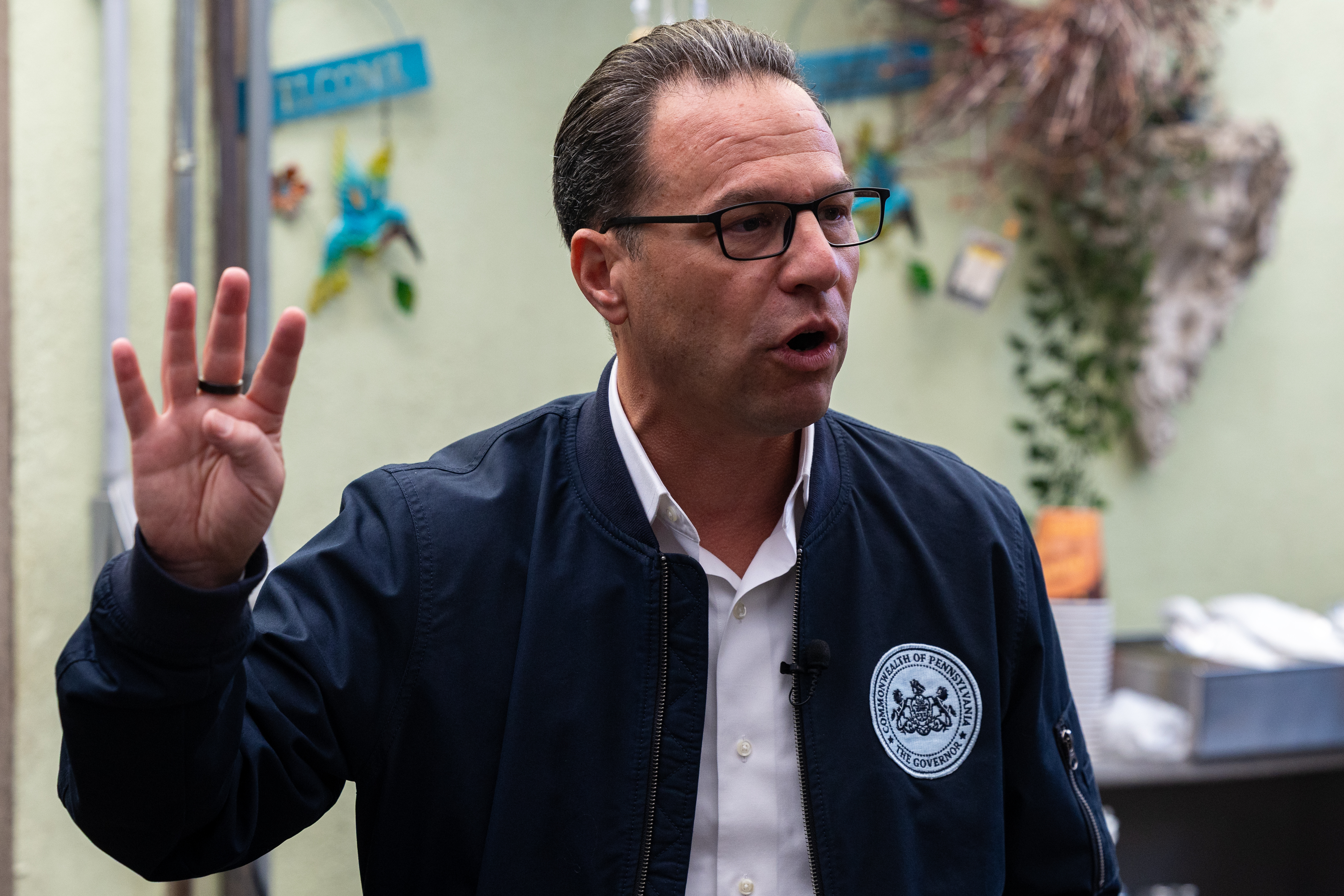
Gov. Josh Shapiro talks to patrons alongside Michigan Gov. Gretchen Whitmer out in the back patio of Sam’s Morning Glory Diner in South Philadelphia on Friday, Sept. 25, 2026. Aidan T. Gallo / Staff Photographer
The war in Gaza has bitterly divided Shapiro’s party, and his positions on Israel may have a played a role in preventing his nomination as vice president in 2024. Shapiro in his book called questions about his relationship with Israel from Vice President Kamala Harris’ team “offensive.”
Shapiro, Pennsylvania’s third Jewish governor, has said his views on the topic have evolved from when he was in college and wrote that peace with Palestinians was “not possible.” The governor now favors a two-state solution, with Israelis and Palestinians “living peacefully side by side, being able to determine their own futures and their own destiny.”
The governor has also repeatedly spoken out against antisemitism at campus protests against Israel and called for an encampment at the University of Pennsylvania to be disbanded in 2024.
(function(){function e(){window.addEventListener(`message`,function(e){if(e.data[`datawrapper-height`]!==void 0){var t=document.querySelectorAll(`iframe`);for(var n in e.data[`datawrapper-height`])for(var r=0,i;i=t[r];r++)if(i.contentWindow===e.source){var a=e.data[`datawrapper-height`][n]+`px`;i.style.height=a}}})}e()})();
Multiple respondents brought up Shapiro’s Jewish faith unprompted— sometimes in connection with Israel — and questionedwhether the country is ready for a Jewish president.
“I think a Jewish candidate is going to have a hard time winning the election,” said Michael Biello, a 68-year-old Democrat in Philadelphia. “I like his views. I like his policies. I like everything. I just think his religious affiliation will stop him from winning because I think the rest of the country, especially the middle of the country, will rally against him.”
Shapiro is one of several potential contenders who could make history as the first Jewish president, along with former Chicago Mayor Rahm Emanuel, Illinois Gov. JB Pritzker, Georgia Sen. Jon Ossoff, and Michigan Sen. Elissa Slotkin.
An arsonist — who said in a 911 call he would “not take part in [Shapiro’s] plans for what he wants to do to the Palestinian people — attacked the governor’s mansion last year during Passover while Shapiro and his family were inside. (The arsonist’s family said he had spiraled into a mental health crisis.)Since then, Shapiro said, there have been a half dozen more terroristic threats against him and his wife “because of how I worship.”
In his memoir, Where We Keep The Light, published earlier this year, Shapiro wrote that since the Oct. 7 attack in Israel, he and his family “feel both a responsibility and pride demonstrating our faith and living it out loud.”
Hailey Brinnel, who is Jewish, said she does not believe Shapiro’s faith alone would hinder a potential campaign.
“People didn’t think New York was ready for a Muslim mayor,” she said, referring to the 2025 election of Mayor Zohran Mamdani. “New York right now has really been changing what I come to think of as someone who’s electable. So I do not think it’s out of the question now.”
Brinnel, a 31-year-old Democrat, said she will “always love” Shapiro and said she believes he has strong appeal to older, more centrist Democrats. But she is more interested in whether ideologically progressive candidates are electable.
“After seeing the success of Zohran Mamdani and different democratic socialists, it makes me at least curious if we should be moving in a more progressive direction.”
How does Shapiro compare with Trump and Vance?
Several respondents highlighted Shapiro’s support for education, healthcare, and business development work during his first term as governor as reasons he would make a good president. His recent orders on data centers, which face majority opposition in Pennsylvania, have also been a point in his favor among voters.
“I appreciate that he went and he asked what other people wanted, and then he advocated against the data centers,” said Mac Alasad-Murphy, a 27-year-old attorney in Haverford.
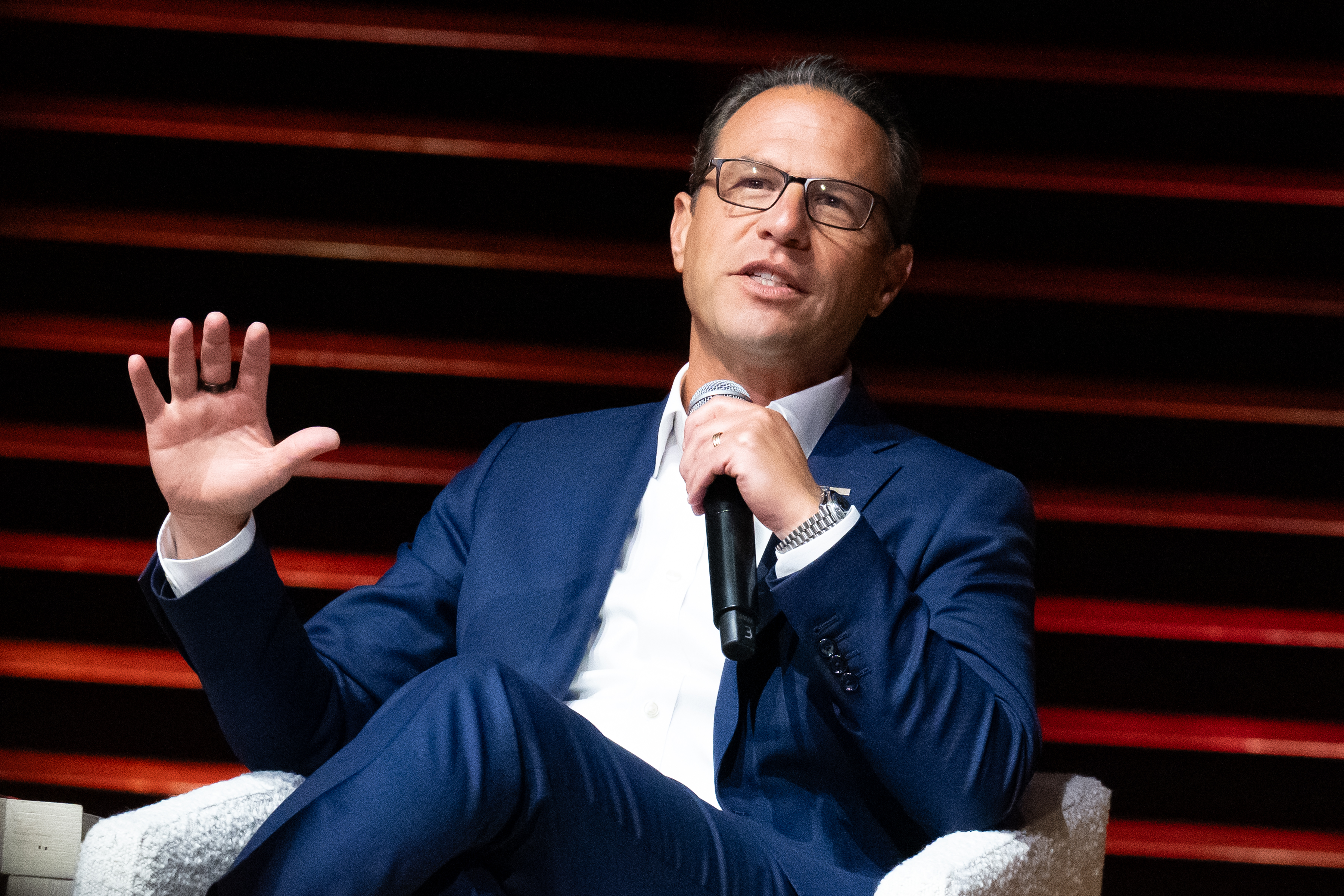
Pennsylvania Gov. Josh Shapiro speaks during a discussion on free expression and civil dialogue at the Kimmel Center in Philadelphia on Wednesday, Sept. 9, 2026nErin Blewett / For The Inquirer
Alasad-Murphy, a Democrat, said she believes Shapiro is capable of approaching complicated situations by listening with a careful and cautious ear.
“He does a really good job of meeting with the people and trying to get an understanding of what the community he’s serving actually wants,” she said.
(function(){function e(){window.addEventListener(`message`,function(e){if(e.data[`datawrapper-height`]!==void 0){var t=document.querySelectorAll(`iframe`);for(var n in e.data[`datawrapper-height`])for(var r=0,i;i=t[r];r++)if(i.contentWindow===e.source){var a=e.data[`datawrapper-height`][n]+`px`;i.style.height=a}}})}e()})();
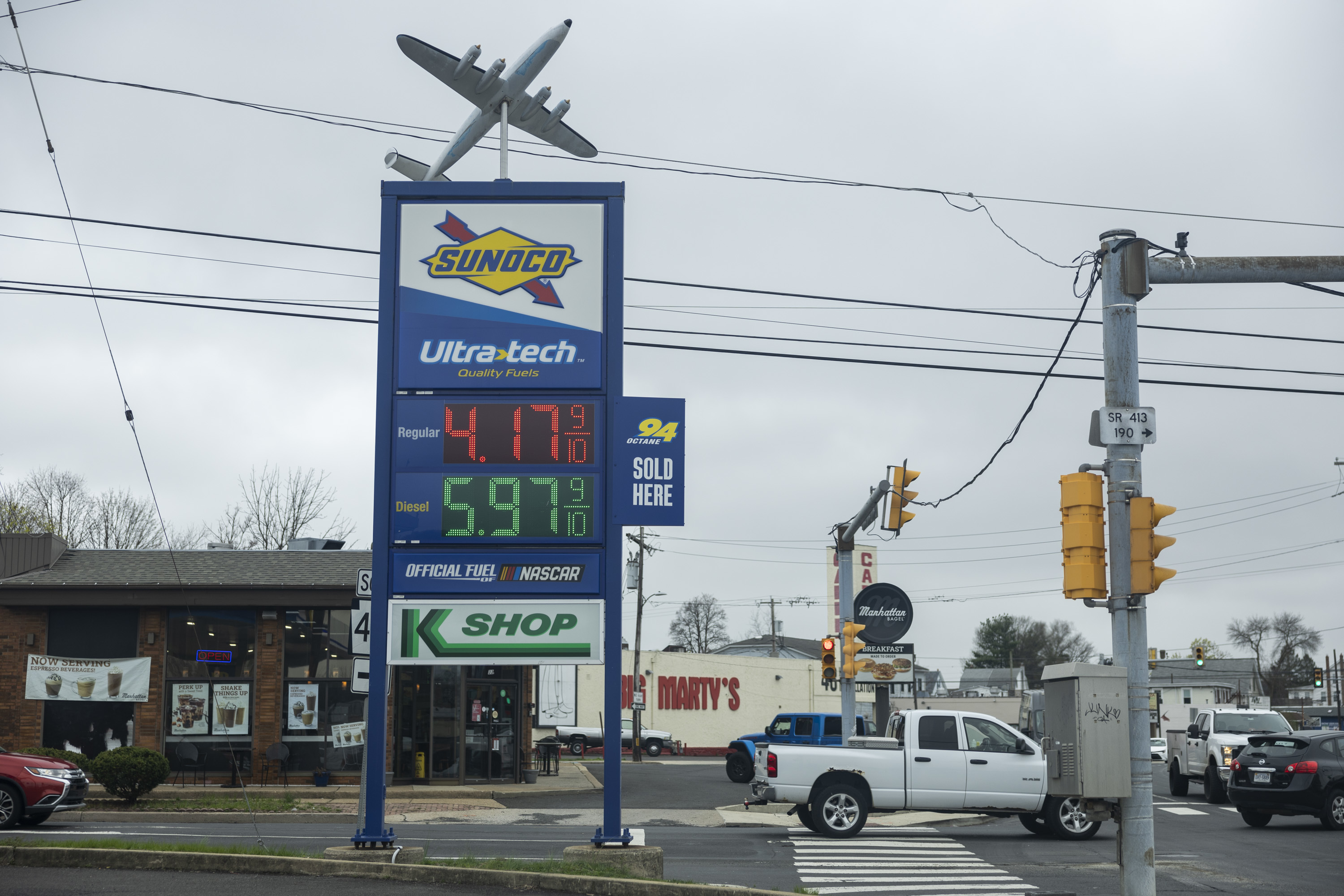
Shapiro’s 63% favorability rating trounces that of President Donald Trump, who has pushed for more data center construction even amid opposition from Republican voters. As gas prices climb to $4.55 in Philadelphia, just 38% of likely Pennsylvania voters have a favorable view of the president while they see him taking little action on the economy and cost-of-living concerns, their top issues.
Vice President JD Vance has a slightly higher favorability rating than Trump, 44%, as he is increasingly seen as the Republican front-runner in a 2028 primary. Almost half of respondents view Vance very or somewhat unfavorably.
Among voters in the poll who opposeda potential Shapiro run, 21% said they dislike him personally and 19% they dislike his policies and views.
Susan Roller, 72, of Lancaster, disagrees with Shapiro’s support for abortion access and vaccine policy.
“Our current governor doesn’t respect life at all stages, especially pre-born children, and is trying to push through a lot of health initiatives that would take away our freedom of choice,” said Roller, who is a Republican.
Before making her decision, with the 2028 primaries more than a year away, Alasad-Murphy, the Haverford voter, said she wants to understand Shapiro’s plan to tackle the country’s biggest problems.
“I couldn’t say just because I like him and I like what he’s done for Pennsylvania that I would like what he might do for the country. Those are two completely different things,” she said.
But his temperament and willingness to work across partisan lines to pass legislation go a long way, she said.
“He’s very level-headed. He’s very respectful toward others, even when they don’t see eye to eye. And in the current political climate, I think that having stability and respect is really important,” she said.
Pennsylvania Gov. Josh Shapiro and Michigan Gov. Gretchen Whitmer, stopped by a Bella Vista diner on Friday morning to pump up Democratic volunteers to turn out voters, with less than six weeks until the high-stakes midterm elections in both of their swing states.
On the menu: Electing Democratic candidates to Pennsylvania’s four nationally-watched U.S. House seats that could determine control of Congress, and flipping the state Senate to Democratic control for the first time in more than 30 years.
Shapiro is also seeking a second term as Pennsylvania’s Democratic governor this November, and maintains a sizable polling and fundraising advantage over his Republican opponent, state Treasurer Stacy Garrity.
“I know we’re in a moment of tumult right now, where chaos and cruelty and corruption is just enveloping our lives. The good news is in 39 days, you’ve got the power to change that,” Shapiro told the group of a couple dozen volunteers from voter protection groups. Servers at Sam’s Morning Glory Diner, wearing T-shirts with messages condemning President Donald Trump and supporting former Vice President Kamala Harris, whisked by with plates of omelettes and pancake stacks.
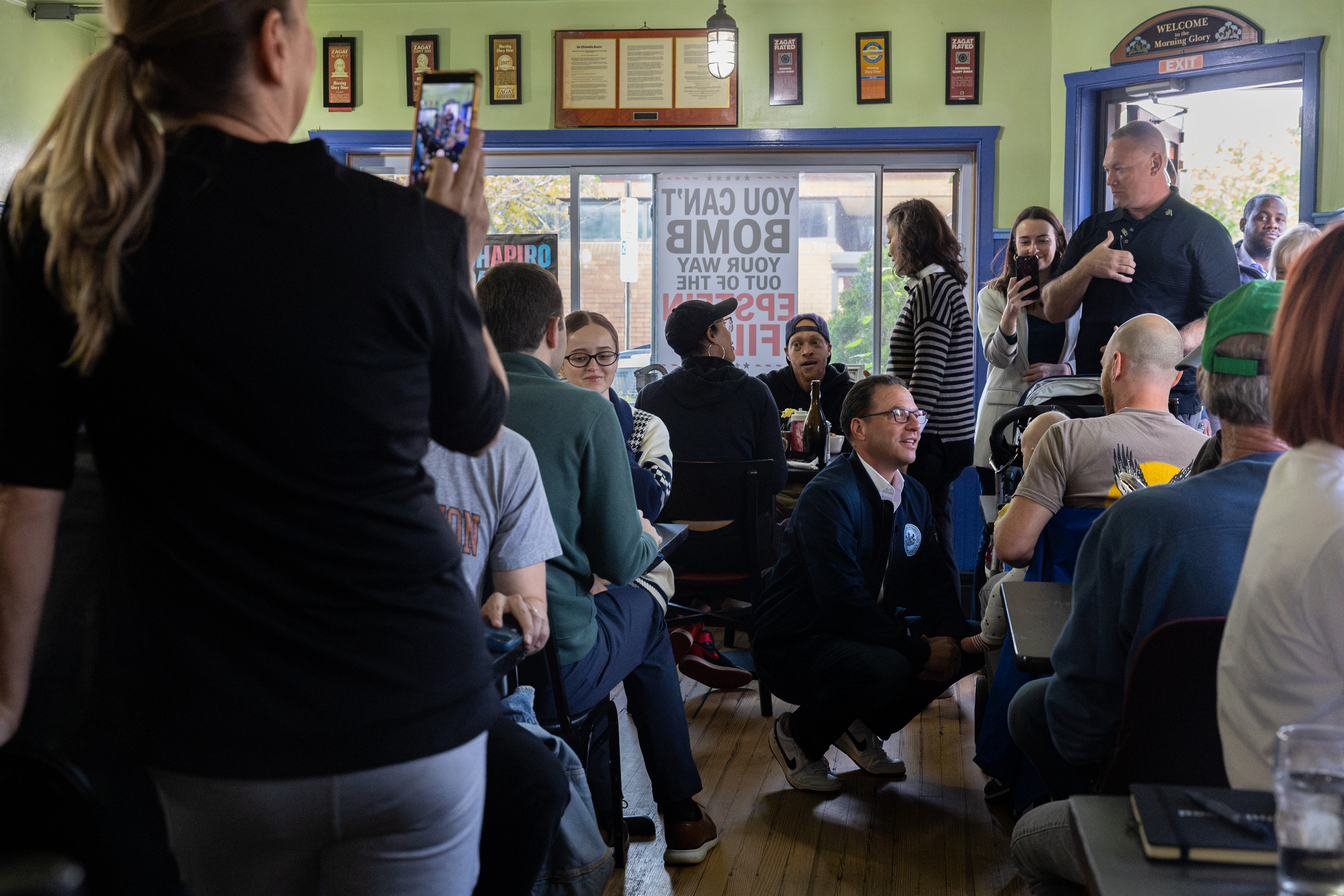
Gov. Josh Shapiro talks to patrons alongside Michigan Gov. Gretchen Whitmer out in the back patio of Sam’s Morning Glory Diner in South Philadelphia on Friday, Sept. 25, 2026. Shapiro is canvassing to get Pennsylvania Democrats elected up and down the ballot as the midterms are upcoming in November. He wants to flip the state Senate for Democrats to take back control. Whitmer is present to support Shapiro’s re-election campaign.Aidan T. Gallo / Staff Photographer
Shapiro also assured voters that elections in Pennsylvania will be conducted fairly and accurately, following a CNN report that Trump’s Department of Justice is sending a surge of election monitors to oversee polling locations.
“We’re prepared again in court, and we’re also prepared should they try and bring personnel into certain communities, particularly minority communities, to try and intimidate people, make it harder for people to vote, or make them worried about showing up to vote,” he said.
State election officials are coordinating with the Pennsylvania National Guard, the Pennsylvania State Police and local law enforcement to protect voting access, he said.
“We will do everything in our power to stop Donald Trump from interfering with this election and ensure, whether you vote by mail or you vote in person, you will have access to the ballot box, and it will be protected,” he said.
Gov. Josh Shapiro meets with patrons alongside Michigan Gov. Gretchen Whitmer inside Sam’s Morning Glory Diner in South Philadelphia on Friday, Sept. 25, 2026. Shapiro is canvassing to get Pennsylvania Democrats elected up and down the ballot as the midterms are upcoming in November. He wants to flip the state Senate for Democrats to take back control. Whitmer is present to support Shapiro’s re-election campaign.Aidan T. Gallo / Staff Photographer
Whitmer is nearing the end of her second term as Michigan’s governor, and like Shapiro, has been floated as a contender in the 2028 Democratic presidential primary.
The two have been coy about any future pursuits. Shapiro has demurred on his ambitions for higher office, saying he’s focused on his reelection, though he’s also said he will “be a part of that conversation” about who Democrats should nominate for president. Whitmer previously said she had no plans to run in the Democratic presidential primary in 2028 but later walked it back, saying “never say never.”
But on Friday in South Philadelphia, there were no signs of rivalry. Whitmer said she was in town to help support Shapiro’s reelection effort. Shapiro praised Whitmer, saying she has been a guiding light for the kind of governor he wanted to emulate.
Whitmer, Shapiro said, is ”someone I have looked up to, someone who knows how to get stuff done in her state, and someone who I think leads with integrity, with purpose, with drive and determination.”
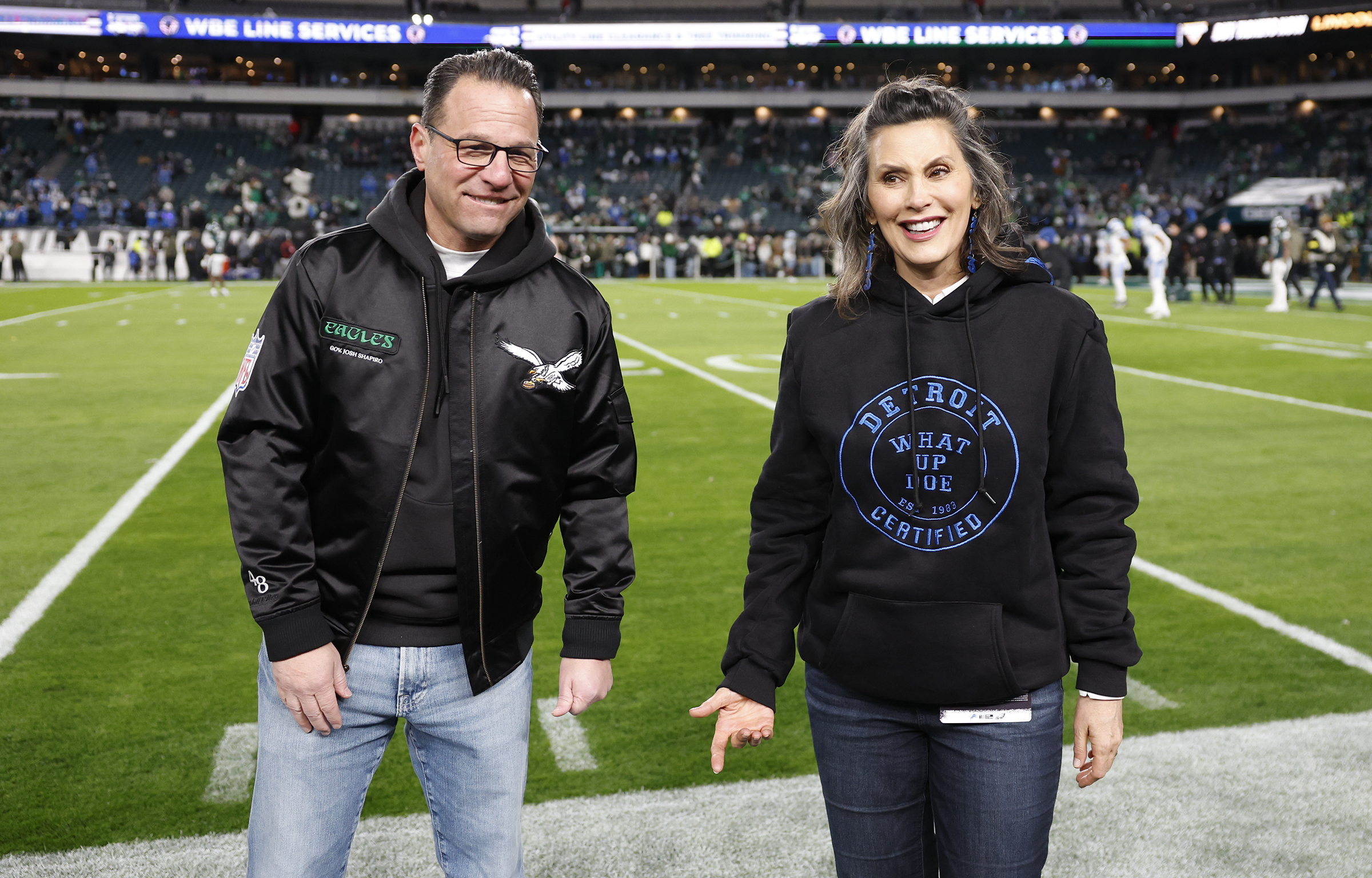
The two appeared together publicly last year at an Eagles-Lions football game at Lincoln Financial Field, as part of what Whitmer called a friendly rivalry between the NFC championship contenders.
Pennsylvania Governor Josh Shapiro (right) and Michigan Governor Gretchen Whitmer before the Eagles played the Detroit Lions at Lincoln Financial Field on Sunday, Nov. 16, 2025, in Philadelphia, PA.Yong Kim / Staff Photographer
During the 2024 presidential election, Shapiro also visited Michigan to stump alongside Whitmer for Harris’ campaign.
On Friday, Whitmer called Shapiro a “good friend and colleague.”
“When Washington, D.C. is making life harder — whether it’s through tariffs or a war in Iran that’s jacking up the price of everything — it’s the governors that are protecting our rights, that are making sure we keep more money in our pockets. It’s the governors who are solving problems,” she said. “You got one of the best in the country.”
After talking with patrons, Shapiro said he planned to sit down with Whitmer to eat something at the restaurant. Featured on Sam’s Morning Glory Diner menu on Friday: “Shapiro 2026″ and “2028 sausage, eggs and gravy.”
Gov. Josh Shapiro has raised more than $60 million toward his reelection effort since he took office, his campaign said Tuesday.
According to the campaign, those preliminary figures mean that the first-term Democratic governor has added $13.3 million to his war chest since June, as he maintains a significant fundraising edge over his Republican opponent Stacy Garrity.
Filings on Tuesday showed Garrity had raised around $1.8 million this cycle, with her campaign coffers nearing $3 million. After spending $1.5 million, she will enter October with roughly $1.4 million cash on hand.
So with a massive cash advantage, where will Shapiro’s campaign money go? And could anyone else benefit from his spending?
Even as he pulls ahead in polls, Shapiro has spent heavily on advertising. His campaign has promised he’s keeping his foot on the gas through Election Day in efforts to secure his own victory andelect Pennsylvania Democrats up and down the ballot in hopes of flipping the state Senate and electing Democrats in four battleground congressional districts. He’s donated roughly $5.7 million in total to the state party to fuel theeffort, an additional $2.5 million since June, according to his campaign.
Beyond the November election, he’s widely expected to launch another campaign as a 2028 presidential prospect. Although the law prevents him from transferring his gubernatorial campaign money into a political action committee that funds a run for president, that doesn’t mean he’ll spend all his fundraised money before this year’s election, experts said.
In the governor’s race, the first checks he owes are paying for campaign staff salaries, spending money on advertising, and renting leases for field offices, among other costs, according to campaign experts. As a careful politician, he’d likely also want to reserve a fair amount of cash for surprise developments in the race, they said.
But after all of Shapiro’s receipts are accounted for, experts said, a potentially large stock could remain available, presenting him with options for how to spend it — if at all.
Daniel Weiner, the director of elections and government at the Brennan Center for Justice, said Shapiro has several options available.
“It is incredibly common for candidates who are not facing an especially competitive race to still try to raise money hand over fist and amass a war chest,” Weiner said. “It can be used to fund a future run for office of one sort or another. It can also be used, increasingly in this era of very deregulated money in politics to just build a general political machine.”
Keeping it in the party
Shapiro, who has maintained high favorability among both Democrats and Republicans, has established himself as a formidable fundraiser, bringing in dollars from across the commonwealth and the nation. Donors can give him as much as they’d like, since there is no limit on political contributions in Pennsylvania, said Matthew Foster, a professor of political science at American University.
“There’s a lot of ways for politicians to use political cash to help their allies and to help their team,” said Michael Beckel, an expert on money in politics at Issue One, a Washington, D.C.-based bipartisan nonprofit. “They can spread that money around to help people who need it. And there’s certainly a lot of people who might potentially want help from a big name like Governor Shapiro.”
Pennsylvania law allows Shapiro to transfer endless amounts of money from his campaign account to other state candidates. His campaign said he had not given any money directly to state candidates,but that he has supported them in other ways.
He is also not allowed to transfer money from his gubernatorial campaign to any congressional candidates.
Instead, he has poured money into the state party.
Pennsylvania Gov. Josh Shapiro accepts the endorsement for a second term as governor at the state Democratic Party’s winter meeting in Harrisburg on Feb. 7, 2026.Gillian McGoldrick
Since last fall, Shapiro has given $5.7 million to the state Democratic Party and its election effort. That money is used to benefit Shapiro as well as state Senate and congressional candidates by pooling funds for their field offices, signage and volunteers.
“A donation to the state party historically has helped get the vote out statewide,” said Philadelphia-based Democratic strategist Adam Erickson.
Plus, donating to the state party versus national groups helps to ensure the money is spent on Pennsylvania races, Weiner added.
Pennsylvania Republicans have held on to the state Senate for more than 30 years, even as the House chamber and governor’s mansion have swapped partisan control and are currently both occupied by Democrats.
This year, Democrats have “a strong opportunity to flip the state Senate,” Erickson said, but that the effort will take “an unprecedented amount of spending” from Shapiro and the state party.
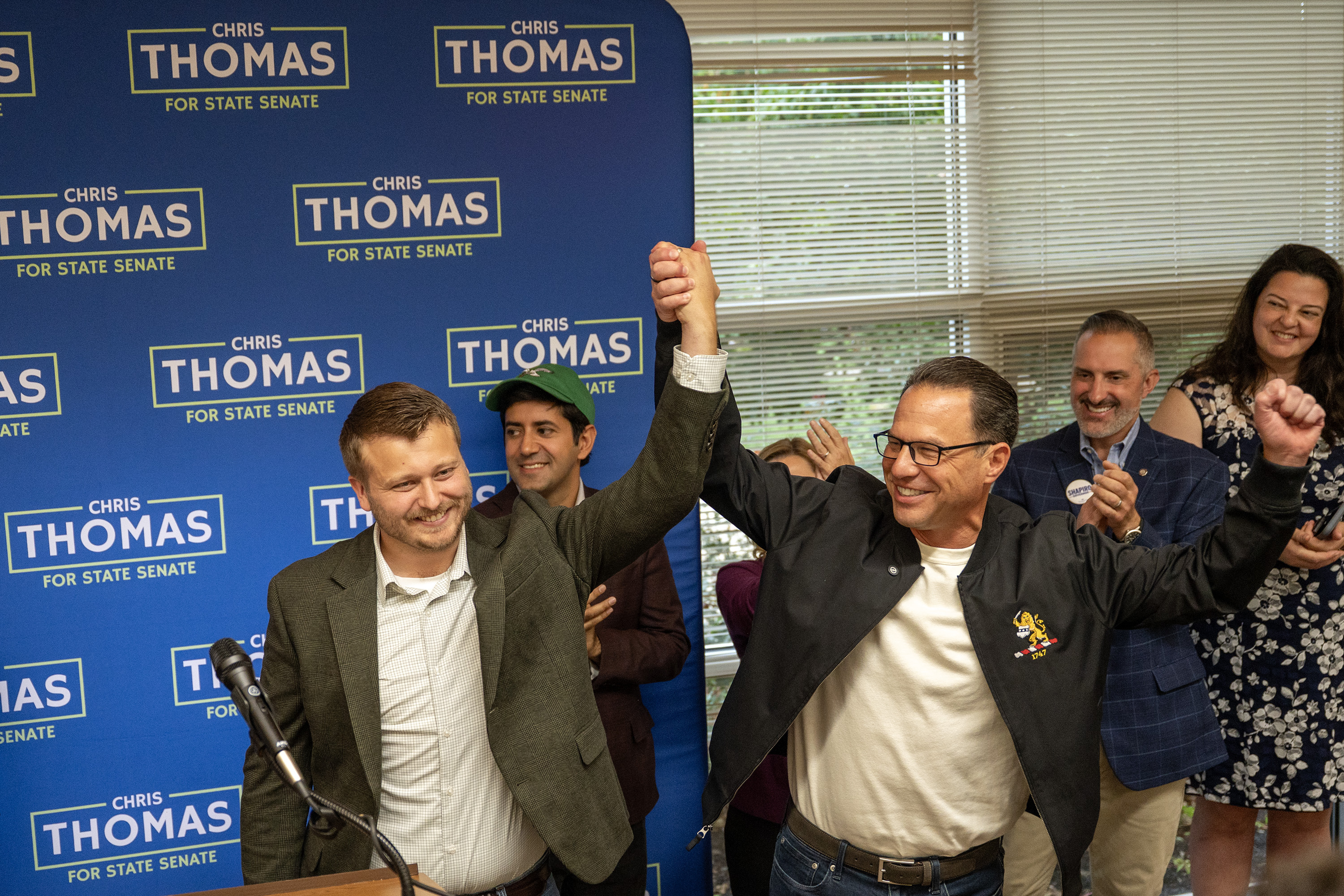
Often, Shapiro has appeared alongside candidates at campaign events, rather than donating to them. On Sunday, Shapiro joined Democrats in Chester and Montgomery Counties to kick off door-knocking and phone-banking efforts benefitting several legislative candidates, such as state House candidate Elizabeth Moro in Chadds Ford and state Senate candidate Chris Thomas in Harleysville.
“Under Governor Shapiro’s leadership, the Party is rallying support all across the Commonwealth and putting Democrats in a strong position to win everywhere this November,” said Manuel Bonder, a spokesperson for Shapiro’s campaign.
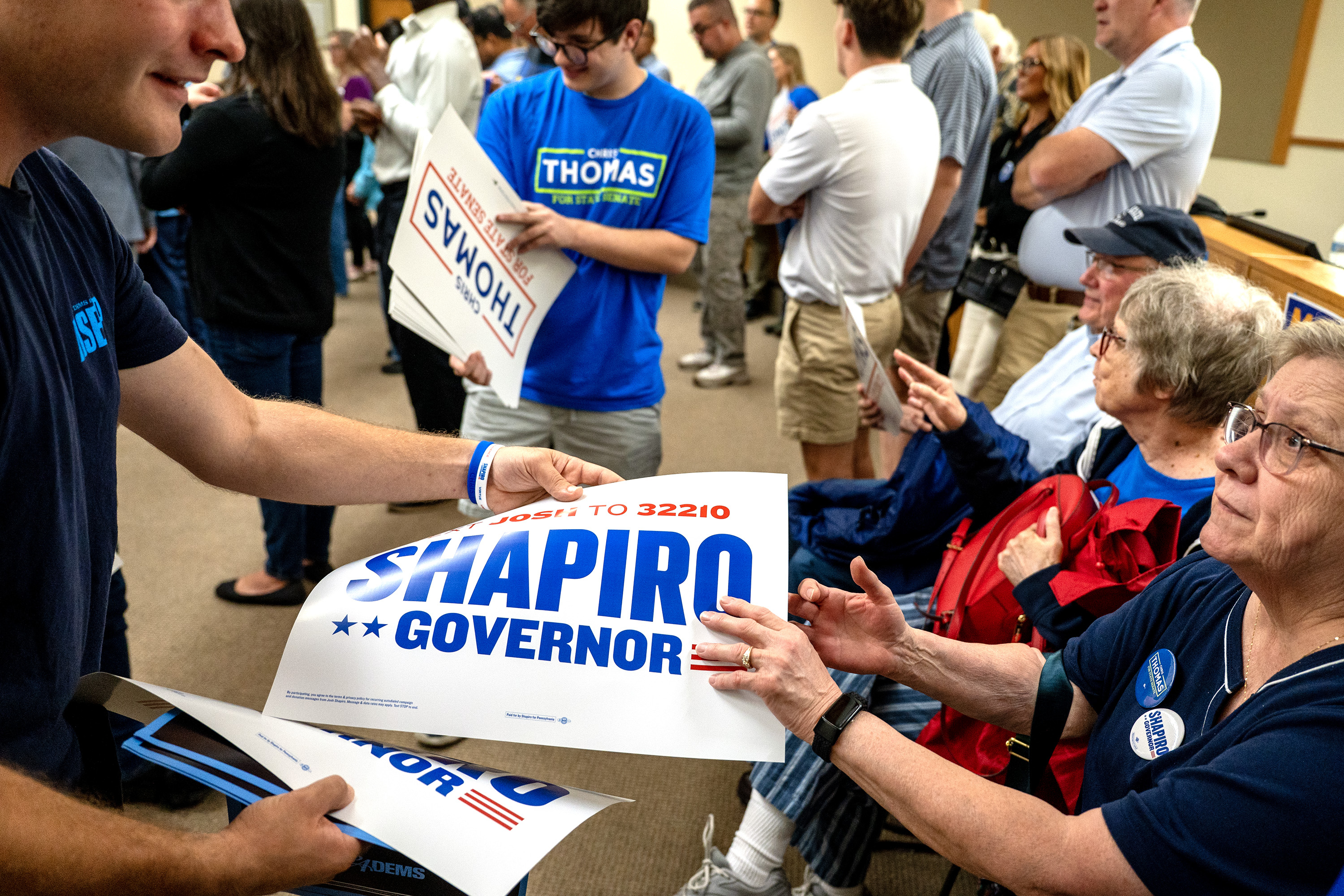
Campaign volunteers hand out sign to supporters of Gov. Josh Shapiro and Democratic Pa. Senate candidate Chris Thomas at a rally in Towamencin, Montgomery County before heading out to canvass Sunday, Sept. 29, 2026. Tom Gralish / Staff Photographer
Tim Ford, an attorney who handles legal concerns for Democratic campaigns in Pennsylvania, said Shapiro’s sizable bank account is “also a flex to show he’s capable of raising this kind of money,” and another clue that he may be eyeing a higher office.
If Shapiro does choose to run for president, he’s not allowed to legally transfer his state-level campaign fundraising to a federal political action committee associated with his campaign.
“One thing that I think people get wrong is they believe that he’s raising money for his next office,” Erickson said.
Governor Shapiro (left) and Democratic congressional candidate Bob Brooks (right) greet supporters during a campaign event at the United Steelworkers Union Hall in Bethlehem on July 26, 2026.David Maialetti / Staff Photographer
That would put him at a slight disadvantage compared to any sitting federal elected officials who can spend their campaign funds on a presidential run and who are also speculated 2028 presidential contenders, including U.S. Rep. Alexandria Ocasio-Cortez and U.S. Sens. Mark Kelly and Jon Ossoff, who has been the top fundraiser this midterm cycle.
Still, Shapiro’s cash stockpile “sends a message that he’s been a successful fundraiser,” Beckel said. “While past performance doesn’t guarantee future results, he certainly would try to [leverage] that to his advantage to say, ‘I’ve been a successful fundraiser in the past, I will be a successful fundraiser in the future’.”
Former staff or associates could create a federal super PAC, a type of political action committee that can take in and spend unlimited contributions but must do so independently of a candidate and without directly coordinating with the campaign. Shapiro could repurpose his state campaign account into that super PAC, Weiner said, but he would have no say on the messaging in ads or how money is spent.
While this practice of loose coordination skirts the spirit of the law, Weiner said it often goes unenforced.
“In theory, super PACs are supposed to be independent from candidates, but in practice, they work hand-in-glove with them,” he said.
Former staffers of Maryland Democratic Gov. Wes Moore, another potential 2028 contender, have established the Unity First PAC. Moore has headlined fundraisers for the group, but is not technically in control of the PAC.
California Democratic Gov. Gavin Newsom, who may also run for president, launched a super PAC called Campaign for Democracy. The PAC has poured $1.7 million into state party and legislative committee races, mostly in South Carolina, where Democrats will hold the first contest of the presidential primary race in 2028.
There are no official records that Shapiro, or those associated with him, have created a super PAC, according to FEC filings.
Super PACs have earned a negative reputation in some circles, particularly among Democrats who view them as a means to give wealthy donors outsized influence on elections. But in 2028, Shapiro and other Democrats will be under pressure to use all the tools available to them, Weiner said.
It’s a difficult bind, said Faith Williams, who works on anti-corruption and accountability efforts at Common Cause, a democracy-focused nonprofit.
“Our system is not good,” she said. “But at the moment everyone is playing in it, and that I think that makes it even harder to reform it because it’s hard to have the genuine desire to reform a system that currently benefits you.”
Shapiro could also develop a nonprofit organization with his campaign funds. The 501(c)(4) groups, which can spend on political ads but cannot make electoral activity their primary focus, are under no legal obligation to disclose their donors. In some cases, this opens the door to donations from so-called “dark money” groups, or those that obscure the role of their funders.
Experts pointed out that he could also use his leftover money for his second gubernatorial inauguration or donate it to charity. And, in an unlikely maneuver, Williams said Shapiro could refund his donors and ask everyone to donate again to a federal campaign.
But the best way to get from Pennsylvania to Pennsylvania Avenue, Erickson said, would be to ensure success in the statewide elections this year.
“Playing a large role in flipping the state Senate will put him in the best position going into 2027 and beyond for any larger aspirations,” he said.
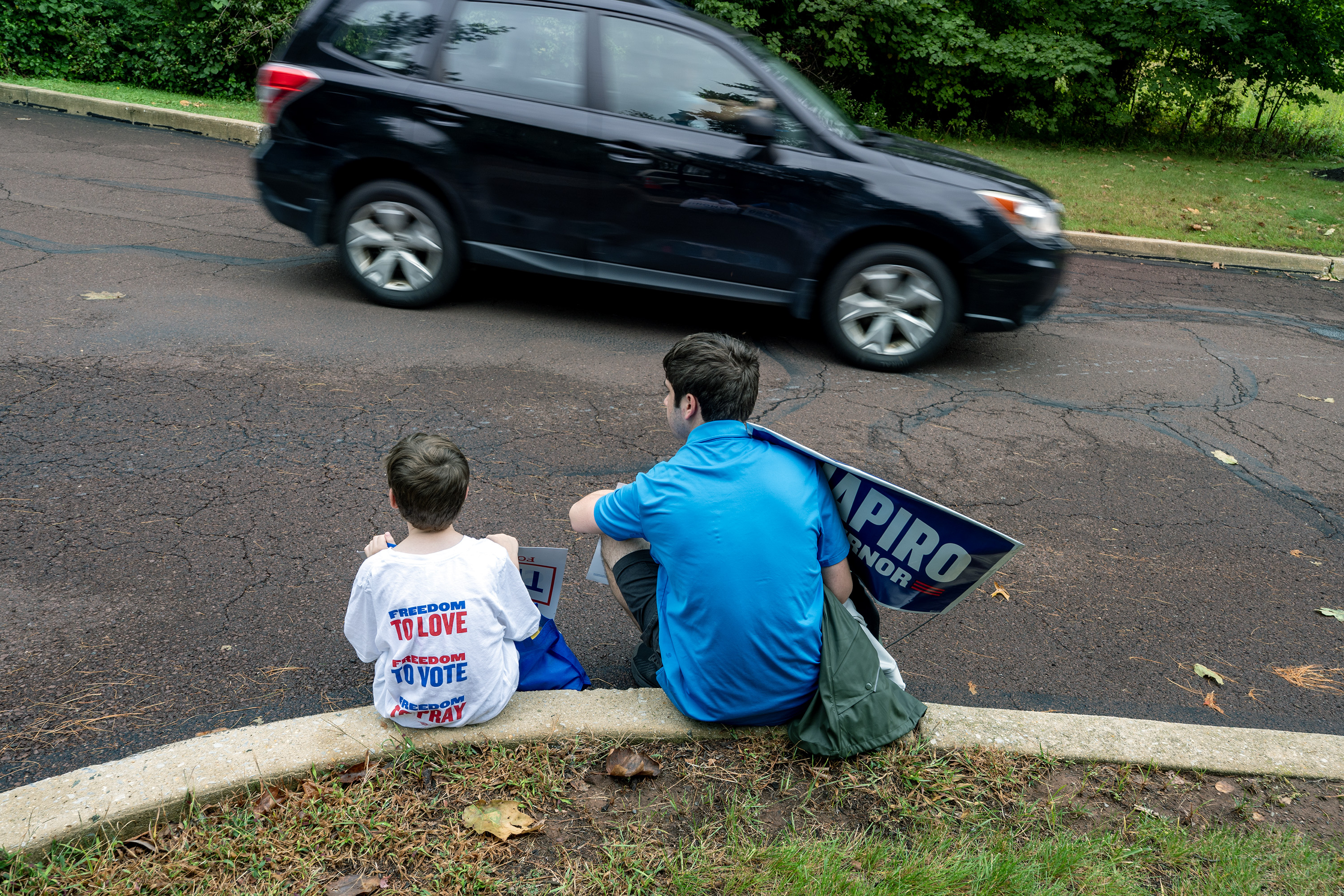
Brothers Desmond DeBaun, 5, and David Hayman, 16, after a rally with Gov. Shapiro and Democratic Pa. Senate candidate Chris Thomas in Montgomery County Sunday, Sept. 29, 2026. Tom Gralish / Staff Photographer
In a video shared to his social media platform on Friday, President Donald Trump reinforced his endorsement for Republican Stacy Garrity in her bid for Pennsylvania governor, while panning Democratic Gov. Josh Shapiro as an incumbent “who does not have what it takes.”
“Stacy has been really special [and] has my complete and total endorsement,” Trump said in the video, posted Friday afternoon to Truth Social, praising her tenure as the state’s treasurer and applauding her military service and career in business. “She’s somebody that is going to do a fantastic job.”
The video was posted in a string of more than a dozen similar endorsements on Friday afternoon for Republican congressional candidates in Alaska, Florida, Georgia, Michigan, North Carolina, and Texas.
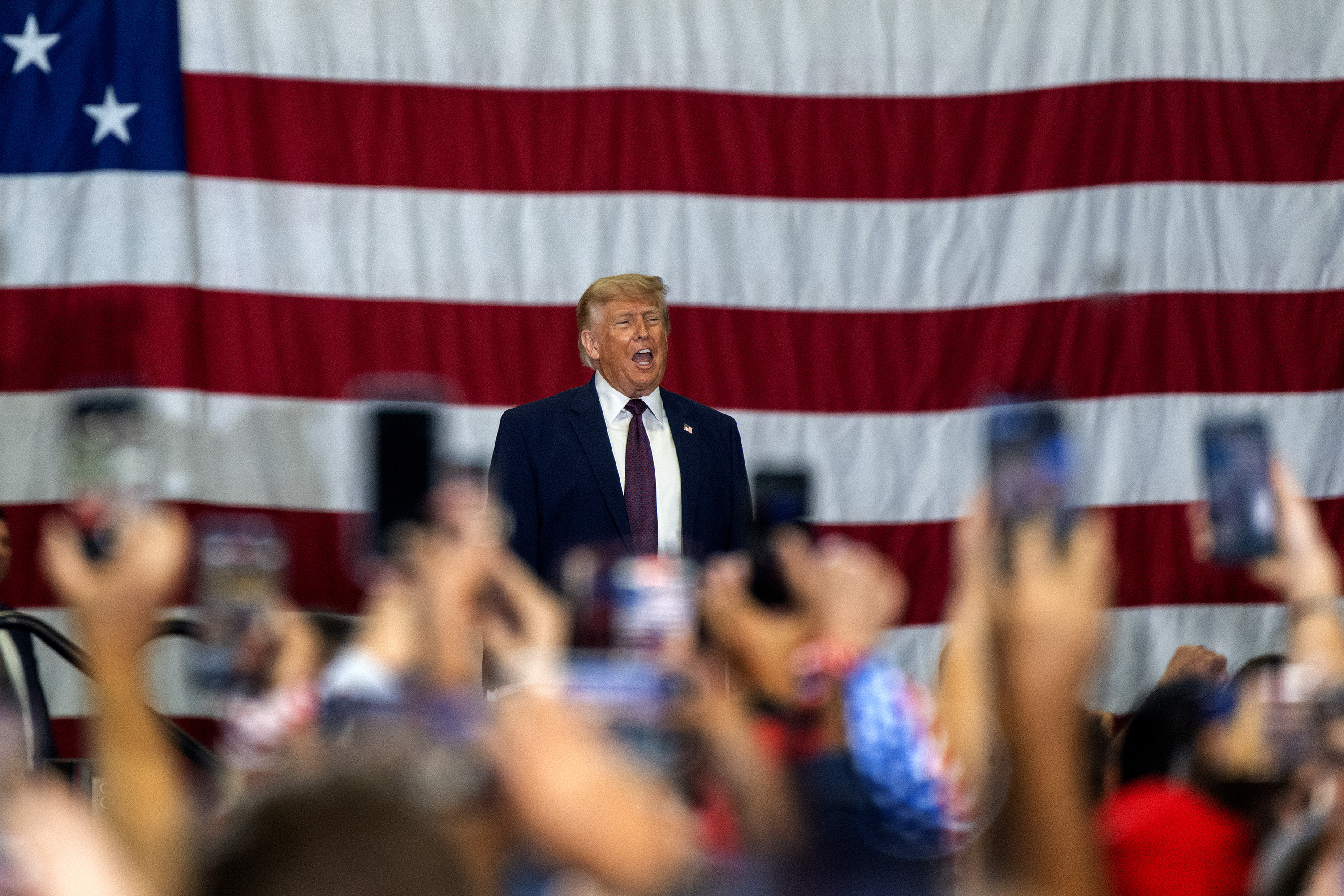
President Donald Trump visits Mack Trucks in Macungie in the Lehigh Valley Tuesday, June 23, 2026.Tom Gralish / Staff Photographer
Trump followed the endorsement videos on Truth Social with a post about his approval ratings, and another post featuring a video touting his own accomplishments in office. The endorsement blitz came less than seven weeks before the Nov. 3 midterm elections, in which Democrats are vying to retake control of Congress.
In Pennsylvania, Shapiro — who has maintained a double-digit lead over Garrity in multiple public polls and has a commanding fundraising advantage — is seeking to use his advantage to secure Democratic wins in four nationally watched congressional seats, and to flip the state Senate to Democratic control for the first time in more than 30 years.
In the video Friday, Trump swiped at Shapiro, who is viewed as a likely contender for the 2028 presidency and who has been critical of the president’s administration.
“Your current governor does not have what it takes,” Trump said. “His reputation is far better than he is — that I can tell you and everyone knows it.”
Gov. Josh Shapiro addresses the audience during a rally for congressional candidate Bob Brooks at the United Steelworkers Union Hall in Bethlehem, Pa. on Sunday, July 26, 2026.David Maialetti / Staff Photographer
It remains to be seen whether Garrity will receive additional national support or financial backing in the weeks before the election.
In June, he seemed to forget her altogether duringa speech in Macungie, Pa., where he celebrated Republican U.S. Rep. Dan Meuser and even name-checked Shapiro but did not mention Garrity.
On Friday, Trump said Garrity “will work tirelessly to grow Pennsylvania’s economy, cut your taxes, slash regulation and bring jobs, opportunity, and wealth to the Commonwealth of Pennsylvania.”
A spokesperson for Garrity did not immediately respond to a request for comment about Trump’s video, but she reposted his endorsement video on her X account.
“Donald Trump’s illegal attempt to undermine our Constitution and prevent eligible voters from making their voices heard in this election by voting by mail has failed,” Shapiro said in a statement posted to X on Monday night in the wake of the ruling.
In March, the president issued an executive order that directed the U.S. Postal Service to help decide which voters should receive mail ballots. Shapiro, a first-term Democrat running for reelection this fall, had used his power as governor to join Pennsylvania as a plaintiff in a multistate lawsuit against the Trump administration, arguing the limits would unfairly prevent thousands of voters from being able to cast a ballot and would unconstitutionally violate states’ rights to administer elections.
Since 2019, under a state measure known as Act 77, any voter in Pennsylvania may request to vote by mail ballot. The ruling Monday means nothing will change for those who were planning to vote by mail, whether by submitting their ballot through the mail or over the counter at their county’s election office. Eligible residents may also vote in person at their polling place on Election Day.
“Counties will continue to administer free, fair, safe, and secure elections. And I’ll stand ready to continue protecting your right to vote — no matter what the Trump Administration tries next,” Shapiro, a likely contender in the 2028 presidential race, wrote on X.
The deadline to register to vote in Pennsylvania’s contests, which include the governor’s race and four competitive congressional seats that could help determine control of the U.S. House, is Oct. 19. The last day to apply to vote by mail is Oct. 27. Ballots must be received by Nov. 3 at 8 p.m. to be counted.
Trump’s directive stemmed from his long-running grievance against mail voting, despite repeatedly utilizing the method himself. He had instructed states to develop an approved list of voters, to prevent noncitizens from voting, and ordered the Postal Service to withhold mail ballots from individuals not on the approved list.
On Tuesday, he called America’s mail voting system a “disaster” and said the justices who voted to block his order, some of whom he had appointed, “are merely a shell of their original selves” in a post on Truth Social, his social media platform.
At the Republican Party’s midterm convention in Dallas last week, Trump asked attendees to pledge that they would vote whether they are “registered or not” and to “try to cheat like hell like they do,” despite no evidence of systematic voter fraud by either party.
Pennsylvania Democrats and election officials in the state had doubted the viability of Trump’s order throughout the court proceedings — but said the renewed debate could still instill concern among voters that their ballots might not be tabulated.
Secretary of State Al Schmidt, a Republican appointed by Shapiro, called the effort an “unprecedented federal overreach” into Pennsylvania elections during a news conference Tuesday, and cheered the announcement.
“This ruling is a major victory for Pennsylvania voters and, importantly, provides much needed finality for voters and counties ahead of this year’s election,” he said.
In New Jersey, Democratic Gov. Mikie Sherrill also applauded the Supreme Court’s decision.
“This is another win for New Jersey voters and another loss for Donald Trump’s attempt to rig elections.”
One year ago, Utah Gov. Spencer Cox was on his way to deliver one of the most sobering speeches of his political career.
The conservative activist Charlie Kirk had been assassinated at a university in the state, and the nation was teeming with emotion — grief, vengeance, and celebration all mixed together.
Amid a flurry of messages of support from other leaders, Cox, a Republican, said he spoke to Pennsylvania’s Democratic Gov. Josh Shapiro, who had experienced political violence of his own, and offered advice on how Cox could comfort a jostled community.
“I called him on the way to the press conference, and he told me to ditch my talking points and to speak from the heart,” Coxrecalled on the eve of the anniversary of Kirk’s killing. “I’m grateful for that advice. I took it, and it was really important in that moment.”
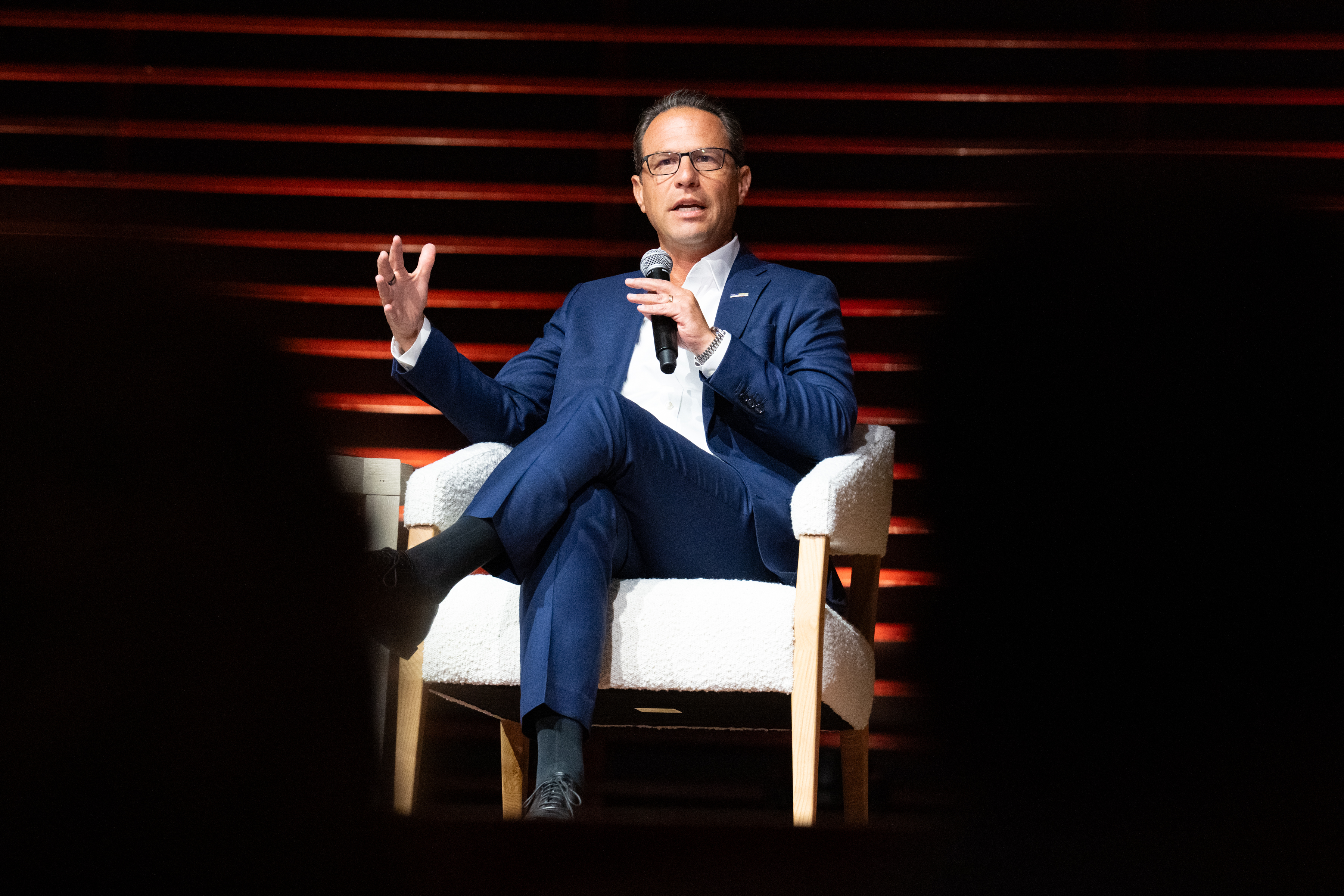
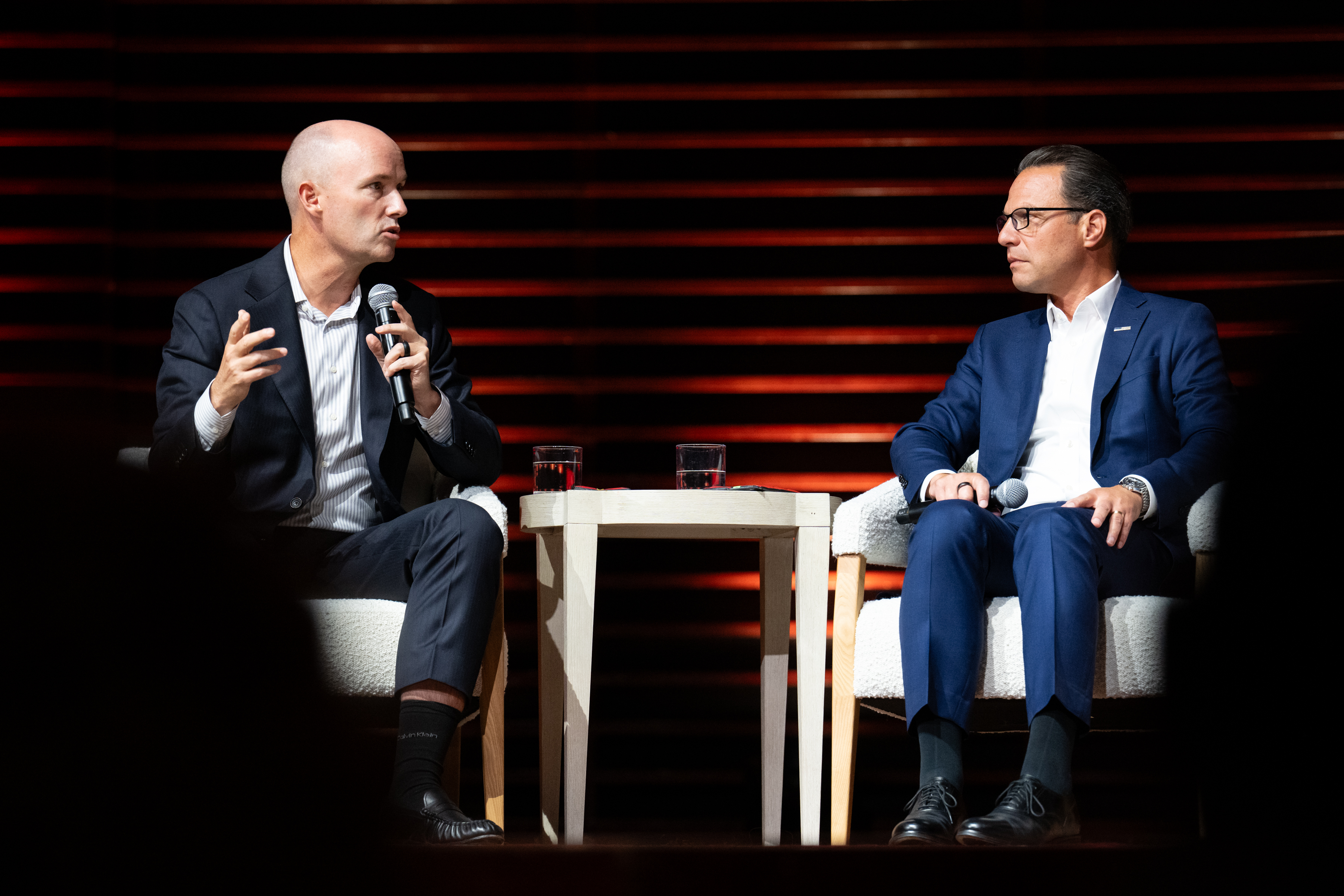
The event, moderated by New York Times journalist Lulu Garcia-Navarro, centered on how all members of society can hold respectful and productive conversations, even with people with whom they disagree. It comes less than two months before the midterm elections,as Democrats and Republicans wage heated campaigns for control of Congress and governors’ offices around the country, including in Pennsylvania.
Shapiro, who along with his family narrowly escaped an arson attack on the governor’s mansion last yearwhile they were staying there to celebrate Passover, said Americans should be “deeply concerned” about political violence and should not allow it to be rewarded or take deeper root in our nation.
Since that April 2025 attack, threats have persisted, largely related to his Jewish faith, he said.
“We’ve had six different people arrested in the last six or seven months for making terroristic threats against me and my wife, against our family, and oftentimes it’s rooted in an attack on me because of how I worship,” he said.
“I have a like a split-screen in my brain. I know that the incidents of political violence are rising. I know that the incidents of hate speech and hate crimes are rising, particularly against American Jews,” he said.
Angrier rhetoric, he said, gets rewarded with online engagement and campaign donations.
“Yet the other side of my brain gets to be governor in the greatest place, I think, in this nation, in the toughest swing state in the union, and as I go all across this commonwealth, I am met by good, decent people who offer prayers to my family, in ways that I don’t worship,” he said.
“The talk of celebrating this man’s death, no matter how profound a disagreement over a policy should be, he left behind a wife and two children,” Shapiro said at the time. “No one should be celebrating that. No one. I think that kind of rhetoric is unhelpful on every level.”
“I would say to my friend Governor Cox,” he said, “I hope he recognizes the power that he has from the perch that he occupies and the respect that you’ve earned across the country, and you use that power to help heal our politics and bring us closer together.”
Cox, who has said Trump is “not interested in uniting the country” despite endorsing him in 2024, has ruled out a 2028 presidential run of his own but quipped Shapiro may be interested.
“Somebody someday is going to run for president,” he said. “By the way, I just want to be clear, it may be somebody in this room. It’s not me.”
The audience cheered for Shapiro, who smiled and said “Cox for president” into his microphone.
Cox also praised Shapiro’s ability to “get stuff done” with a divided legislature, using the Pennsylvania governor’s signature slogan.
“That’s going to be on a campaign ad,” Garcia-Navarro said.
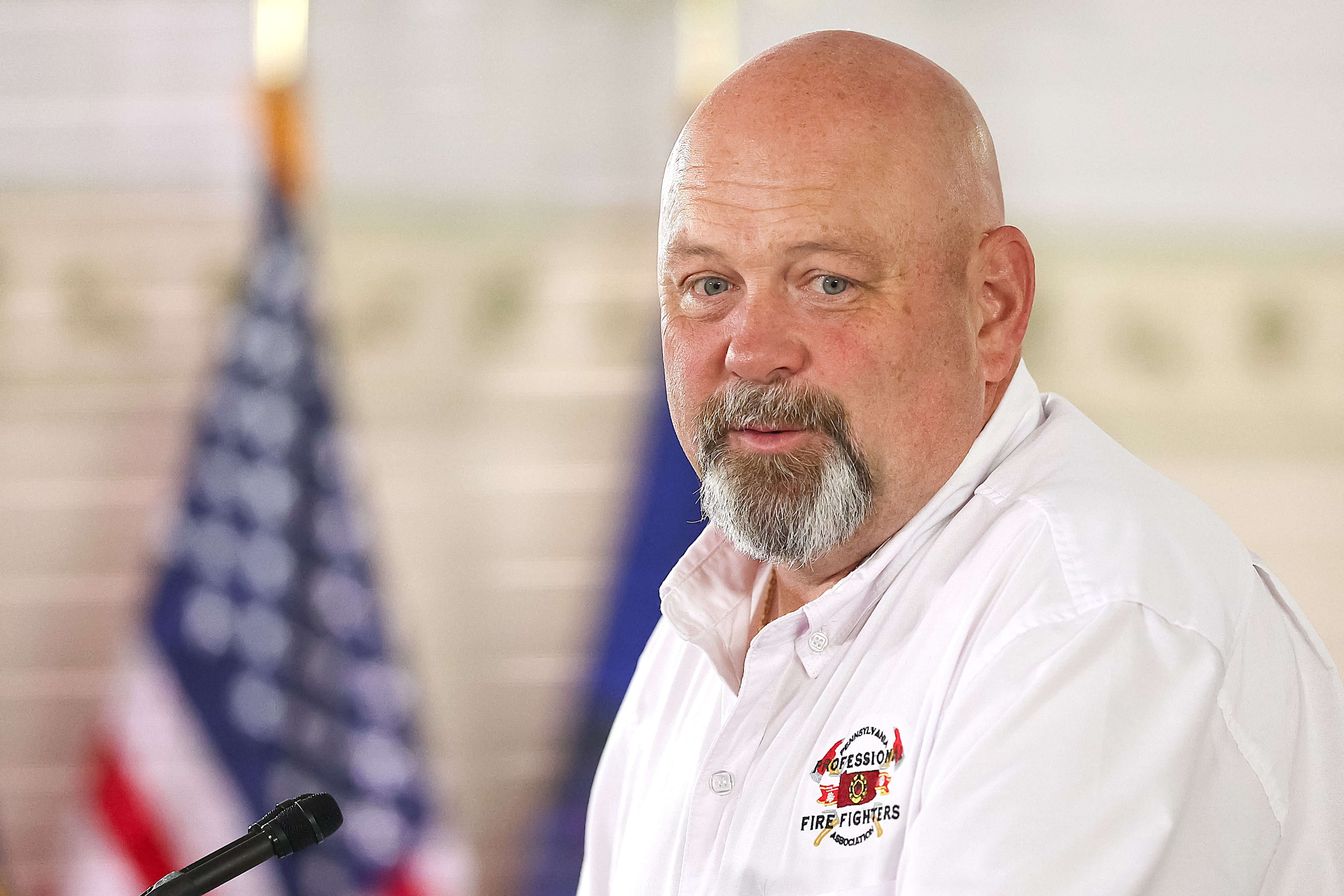
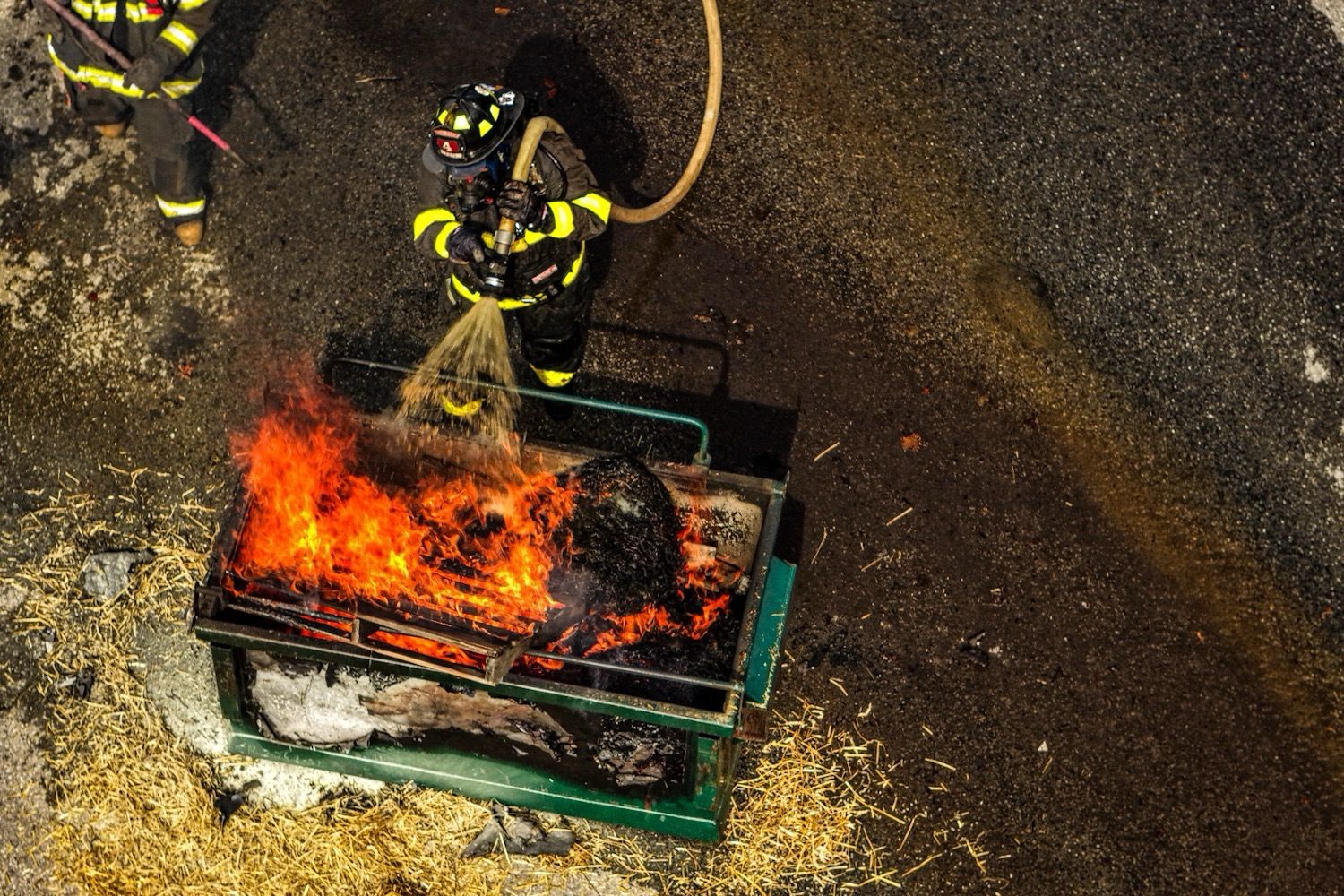
Clad in fire safety gear, Lehigh Valley Democrat and retired firefighter Bob Brooks promised to “smoke out the billionaires and their lobbyists” in his first ad of the general election, released Tuesday.
Brooks, a union leader who spent 20 years as a Bethlehem firefighter, blasted the “dumpster fire” in Washington that has led “working people get burned.”
Brooks, a retired firefighter and union leader, is challenging Republican U.S. Rep. Ryan Mackenzie in the 7th Congressional District, one of the most competitive House seats in the nation. The race’s victor will help determine control of the narrowly-divided chamber.
With a focus on economically populist ideas, such as raising the federal minimum wage, while avoiding culture war issues, Brooks has managed to attract support from across the party’s ideological spectrum including Gov. Josh Shapiro and U.S. Sen. Bernie Sanders.
A screenshot from a new campaign ad for Bob Brooks, a Democrat running for a House seat in the 7th Congressional District, in which he is depicted extinguishing a dumpster fire.Courtesy of Bob Brooks campaign
In July, Brooks also welcomedU.S. House Minority Leader Hakeem Jeffries to the district to support his campaign.Meanwhile, Brooks has campaigned on progressive ideas, promising to ban corporations from giving to political action committees that help finance candidates, as well as supporting Congressionalterm limits and bans on lawmakers trading stocks while in office.
Brooks’ ad borrowed a phrase from his GOP opponent, whose campaign in July referred to Brooks’ “dumpster fire candidacy.”
“At every step of his career, Bob Brooks has put himself first, his politician buddies next, and his own workers last,” Mackenzie’s campaign managerAndres Weller said in a statement.
Brooks’ campaign said it is planning to spend at least $1 million in September on the ad, running on broadcast television in the Philadelphia media market and on streaming platforms.
That’s a significant expenditurefor Brooks’ campaign, which raised a total of $2.3 million, according to financial disclosure reports from July.
He’s behind Mackenzie, who has $4.5 million, in overall fundraising. But Brooks added roughly $1.2 million to his stockpile between April 30 and June 30 — after his first-place finish in the competitive Democratic primary, while Mackenzie only took in about $631,000.
Ben Hummer would like to own a house one day in Pittsburgh. He dreams of a two-bedroom, one-bathroom town house where he can live near his job.
But for now, Hummer, 29, rents his 500-square-foot, one-bedroom apartment, and his monthly rate since he moved in has continued to increase by $50 each year, making the goal seem further out of reach.
“Anything that could increase the supply and affordability of housing in the Pittsburgh area would be massive,” said Hummer, who works in human resources.
Like most voters in Pennsylvania, according to a recent poll from The Philadelphia Inquirer, the New York Times, and Siena University, the economy and cost-of-living concerns are the most important issues deciding Hummer’s vote in the 2026 governor’s race between incumbent Democratic Gov. Josh Shapiro and his Republican challenger, state Treasurer Stacy Garrity.
And as Election Day draws nearer, both campaigns are focusing their messaging on these kitchen table issues.
(function() { var l = function() { new pym.Parent( ‘nyt-afford__graphic’, ‘https://media.inquirer.com/storage/inquirer/ai2html/nyt-afford/index.html’); }; if(typeof(pym) === ‘undefined’) { var h = document.getElementsByTagName(‘head’)[0], s = document.createElement(‘script’); s.type = ‘text/javascript’; s.src = ‘https://pym.nprapps.org/pym.v1.min.js’; s.onload = l; h.appendChild(s); } else { l(); } })();
Two years ago, it was the cost of eggs, gas, and groceries that were top priorities among the electorate in Pennsylvania and elsewhere. Voters’ trust in President Donald Trump’s ability to bring down high prices propelled him back to the White House, sending Democrats scrambling to hone an affordability pitch that could land in time for the high-stakes 2026 midterm elections. But in that same time, prices have continued to climb; gas prices have topped $4 per gallon; and tariffs instituted by Trump — who called affordability “a hoax” at a Pennsylvania rally last year — have driven up the cost of every day life. Now both parties are latching on to a focus on affordability.
As he mounts a reelection campaign, Shapiro — who holds a commanding lead in polls — is highlighting his accomplishments during his first term that his campaign says has given Pennsylvanians more money back through tax cuts and wage increases for childcare workers.
Meanwhile, Garrity has recently shared her own plan, called “Turnaround PA,” to make living more affordable with an outline of how she’d lower prescription drug costs, reduce property taxes, and aim to cut energy bills to get there. But she’s also closely aligned with Trump, who has endorsed her in the race and has dismal markings from voters on two of their top priorities: the economy and cost of living.
(function(){function e(){window.addEventListener(`message`,function(e){if(e.data[`datawrapper-height`]!==void 0){var t=document.querySelectorAll(`iframe`);for(var n in e.data[`datawrapper-height`])for(var r=0,i;i=t[r];r++)if(i.contentWindow===e.source){var a=e.data[`datawrapper-height`][n]+`px`;i.style.height=a}}})}e()})();
That puts her in a difficult spot to challenge Shapiro, said Mark Zandi, the chief economist at Moody’s Analytics.
There’s no easy answer for Republicans to win on economic issues in the midterms, but Zandi said his best advice is to focus on what is in the governor’s control and draft ideas that mitigate the fallout from Trump’s policies.
Hummer, a Democrat who plans to vote for Shapiro this fall, said he trusts the governor to handle the economy and cost of living issues better. More than half of likely Pennsylvania voters in the Inquirer/New York Times/Siena poll agree.
Fifty-five percent said Shapiro would do a better job of handling the state’s economy, and 56% said they think Josh Shapiro would do a better job of handling cost-of-living issues.
“I’m well aware he’s limited in his options to do things, but I would say he’s kept a steady hand on the wheel of the Pennsylvania economy — to the extent that he can,” he said.
Garrity pitches affordability as Republicans seek to overcome Trump’s ratings
Among other proposals, Garrity has pitched a “first-time homebuyer assistance initiative,” which could help house seekers like Hummer and would provide qualified buyers 3% mortgage interest rate support from the state.
She also has proposed cutting taxes by seeking a constitutional amendment that exempts Pennsylvania seniors from paying school property taxes and gives voters the final say over whether to increase property taxes. Her plan would also “reprioritize state spending for property tax relief.”
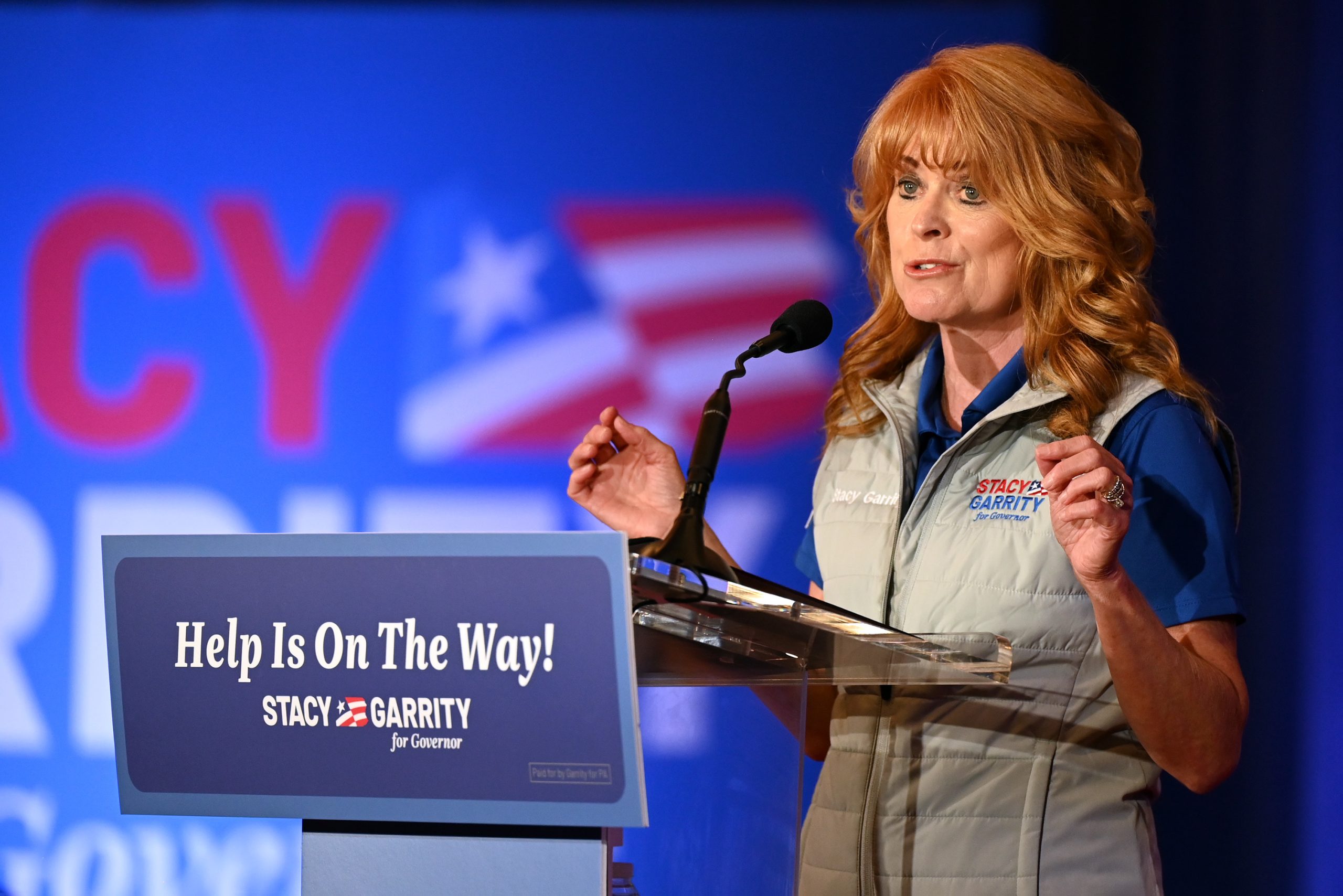
State Treasurer and Republican candidate for governor Stacy Garrity holds a rally in Bucks County on Sept. 25, 2025, at the Newtown Sports & Events Center.Tom Gralish / Staff Photographer
But there’s no free money, Zandi said. “If you’re giving tax cuts over here,” he said, “you’ve got to figure out how to pay for it … and that means you’re cutting spending.”
Garrity’s plan also would address rural healthcare, and she would “aggressively pursue available federal funding to strengthen rural healthcare.”
But there’s little money left in the pot after Trump cut government spending in last year’s federal budget. His One Big, Beautiful Bill Act directed a reduction in Medicaid spending by $1 trillion over 10 years, starting after the midterm elections, and rural hospitals and nursing homes are more dependent on federal funds. Additional dollars would likely need to come from Harrisburg.
For Pennsylvanians like Caitlyn Needham, 28, the consequences of an unexpected medical bill on top of a limited income meant she went without substantial meals for weeks.
“I have a rabbit, and she had a medical emergency [in November],” she said. “So for two months, the only thing I could afford to eat while paying off those bills was peanut butter and jelly sandwiches for breakfast, lunch, and dinner.”
Needham, a cake decorator in Pittsburgh, said she’s always been frugal and saved a little bit of money from each paycheck, but increasing expenses are pushing her budget to the limit. She said she plans to vote for Shapiro this November.
“Pennsylvanians need a relief valve before things get worse,” she said. “So many people are one bad week away from not being able to keep their housing, or losing their medical coverage, or losing their job because their car broke down and they can’t afford to get service. It’s like everyone is just one accident away from not being able to live.”
(function(){function e(){window.addEventListener(`message`,function(e){if(e.data[`datawrapper-height`]!==void 0){var t=document.querySelectorAll(`iframe`);for(var n in e.data[`datawrapper-height`])for(var r=0,i;i=t[r];r++)if(i.contentWindow===e.source){var a=e.data[`datawrapper-height`][n]+`px`;i.style.height=a}}})}e()})();
“If you’re trying to infer I’m out of line with the president, I don’t think I am,” she said last month during a news conference she held on data centers.
In a statement, she blasted Shapiro’s handling of the economy, saying he has put a tax burden on families and tied businesses up with unnecessary regulations.
“Josh Shapiro’s Pennsylvania is simply unaffordable for the commonwealth’s hardworking families,” Garrity said. “He allowed utility and energy costs to skyrocket due to his unwillingness to expand generation capacity and instituting policies that benefit our neighboring states instead of us.”
Shapiro emphasizes his record is separate from national picture
Shapiro, the incumbent, is leaning on his record on economic policy.
According to his campaign, his administration created more than 25,000 jobs during his first term and brought in $41 billion in private-sector investment.
“Governor Shapiro is fighting for all Pennsylvanians — and he has a track record of creating jobs and economic opportunity, putting money back in Pennsylvanians’ pockets, and standing up to Washington’s reckless, cost-raising policies,” said Samantha Reposa, a spokesperson for the campaign. Garrity, she said, “fully supports the failed economic policies that are raising costs and hurting working families across the commonwealth.”
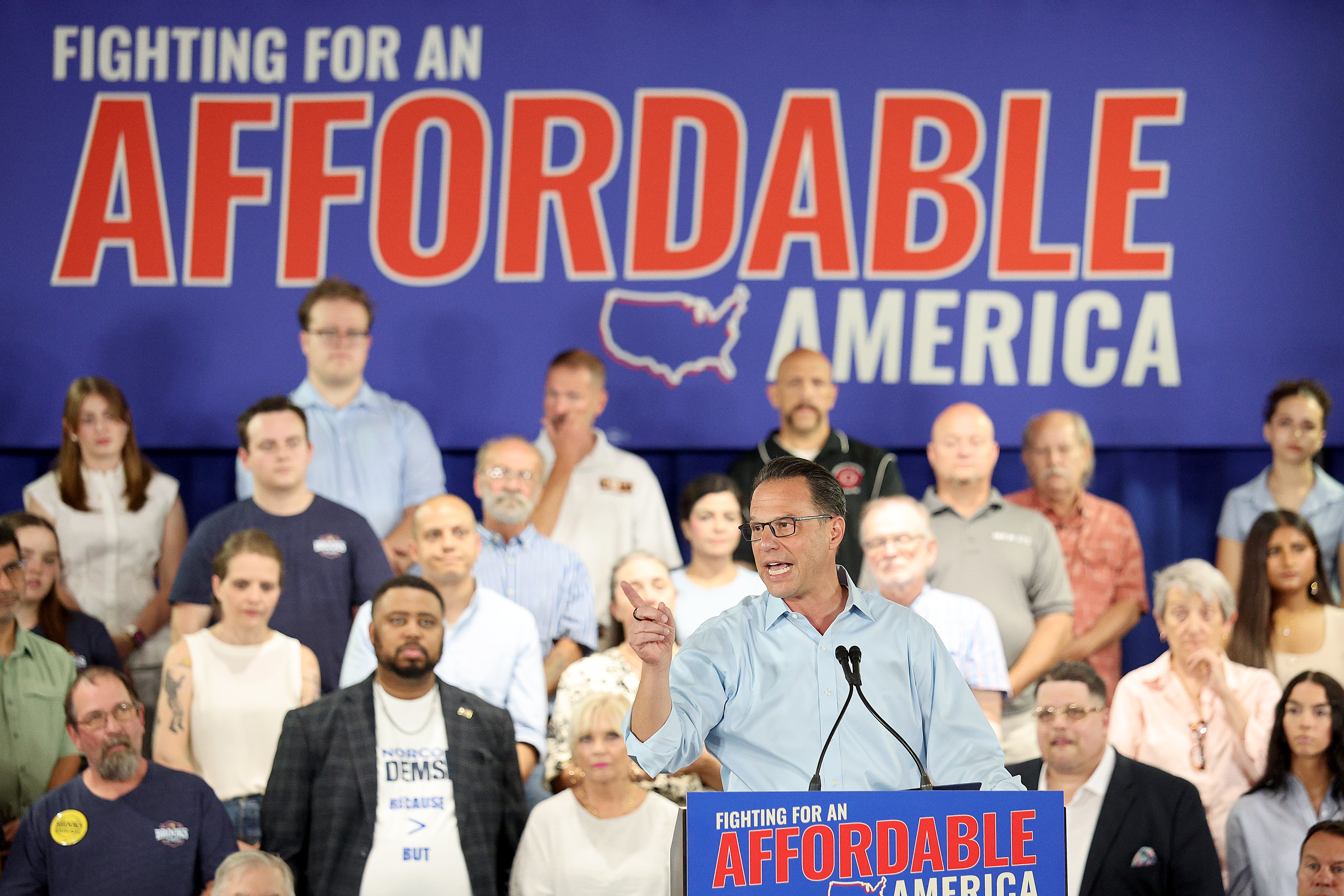
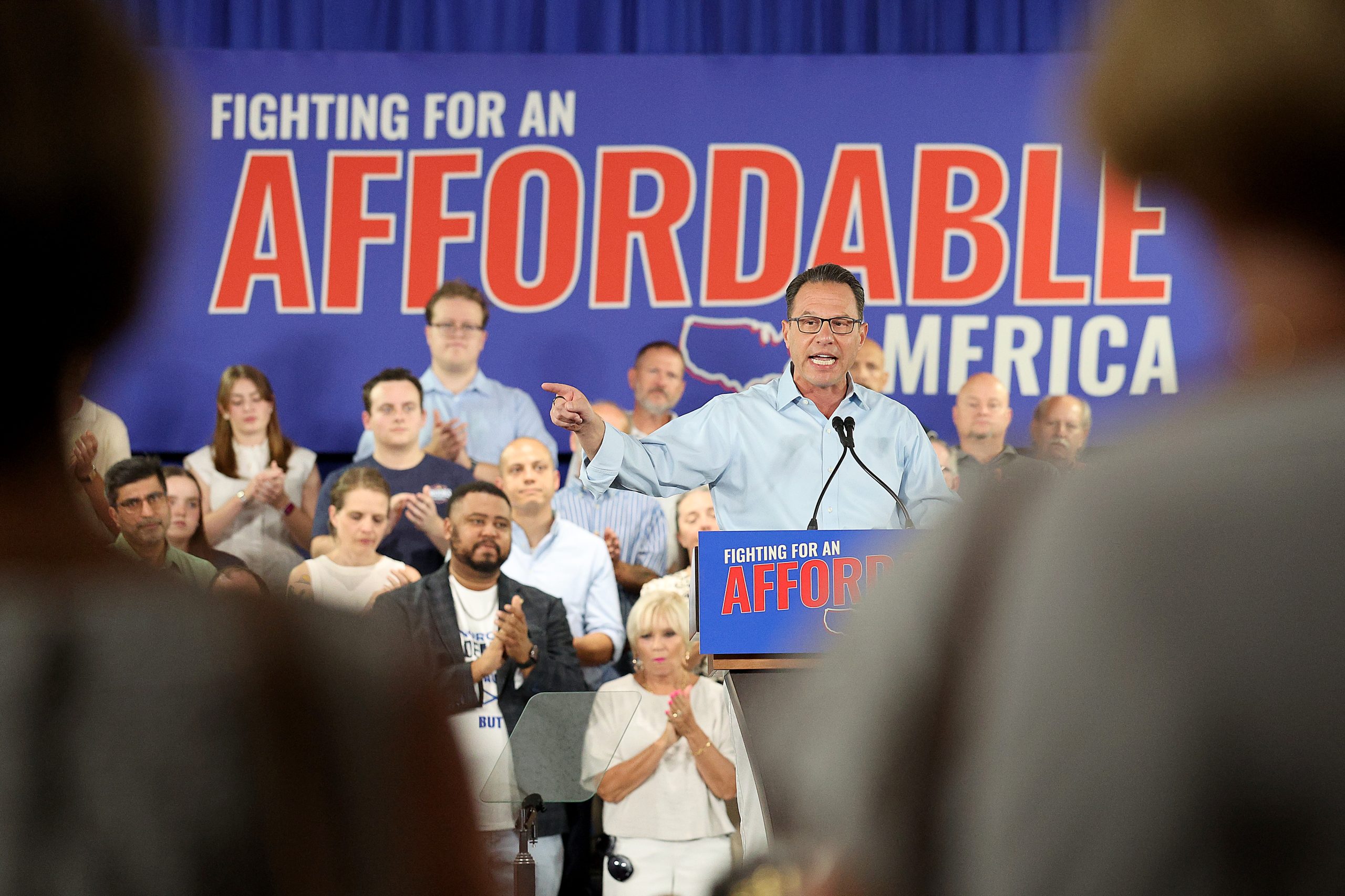
Gov. Josh Shapiro addresses the audience during a July 26 rally for congressional candidate Bob Brooks at the United Steelworkers Union Hall in Bethlehem.David Maialetti / Staff Photographer
His campaign released a Spanish-language digital ad focused on benefits of the Working Pennsylvanians Tax Credit and the Property Tax/Rent Rebate Program, which is targeted toward seniors and people with disabilities.
“If you’re working, you get to keep more of your money. Up to $800 more, more money in your pocket. And right now, every little bit helps,” a woman in the commercial said in Spanish.
Ultimately, Zandi said, “it’s very difficult for lawmakers at any level of government to change the picture on affordability, at least any time quickly,” because those issues are due to broader national and international forces.
There’s also no one-size-fits-all approach for a governor to tackle the costs of education, housing, energy, childcare, elder care, healthcare, and groceries.
“Each issue that makes up the affordability crisis requires its own set of solutions and efforts, so it feels like a laundry list of policy steps, and it is,” he said. “But that actually is probably the only way to make a difference.”
For many Pennsylvanians, paychecks feel like simply treading water: By the time all expenses are covered, there’s little money left to save and build toward the future.
“It just seems that money doesn’t go as far as it used to,” said Thomas Schank, 49, of Scranton. “I’ve gotten raises at work over the last two years, but everything else went up also, so really, no net gain.”