Like a lot of great art, the sculptor Donna Dodson’s latest work was born of childhood trauma.
Growing up in the Midwest, Dodson would play chess with her older brother on a beautiful, hand-carved onyx chess set gifted to them by their grandparents — the siblings engaging in long, heated battles, again and again.
And again and again, Dodson would inevitably fall short.
“The humiliation of always losing created kind of a fire in me,” the 58-year-old, Massachusetts-based artist joked recently in a phone interview.“I think me making this chess set is somehow reclaiming my agency and dignity,” she said, referring to her art Match of the Matriarchs, which is a 24-by-24-foot chess set.
The set, which appears in an exhibition of the same name at the Museum for Art in Wood, has the artist turning her attention to one of the world’s oldest games, examining — through the lens of chess — power, matriarchy, and the role of women in society.
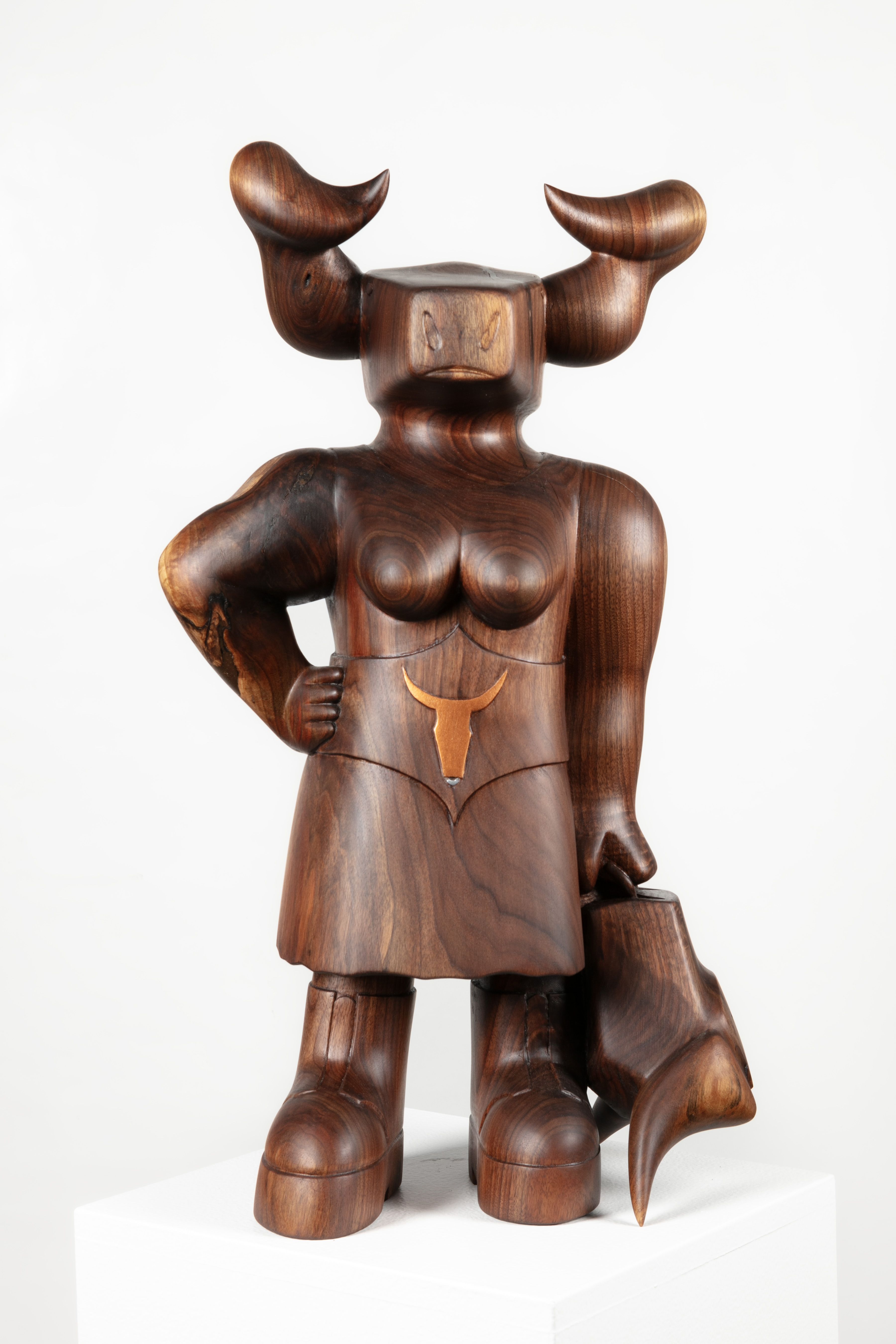
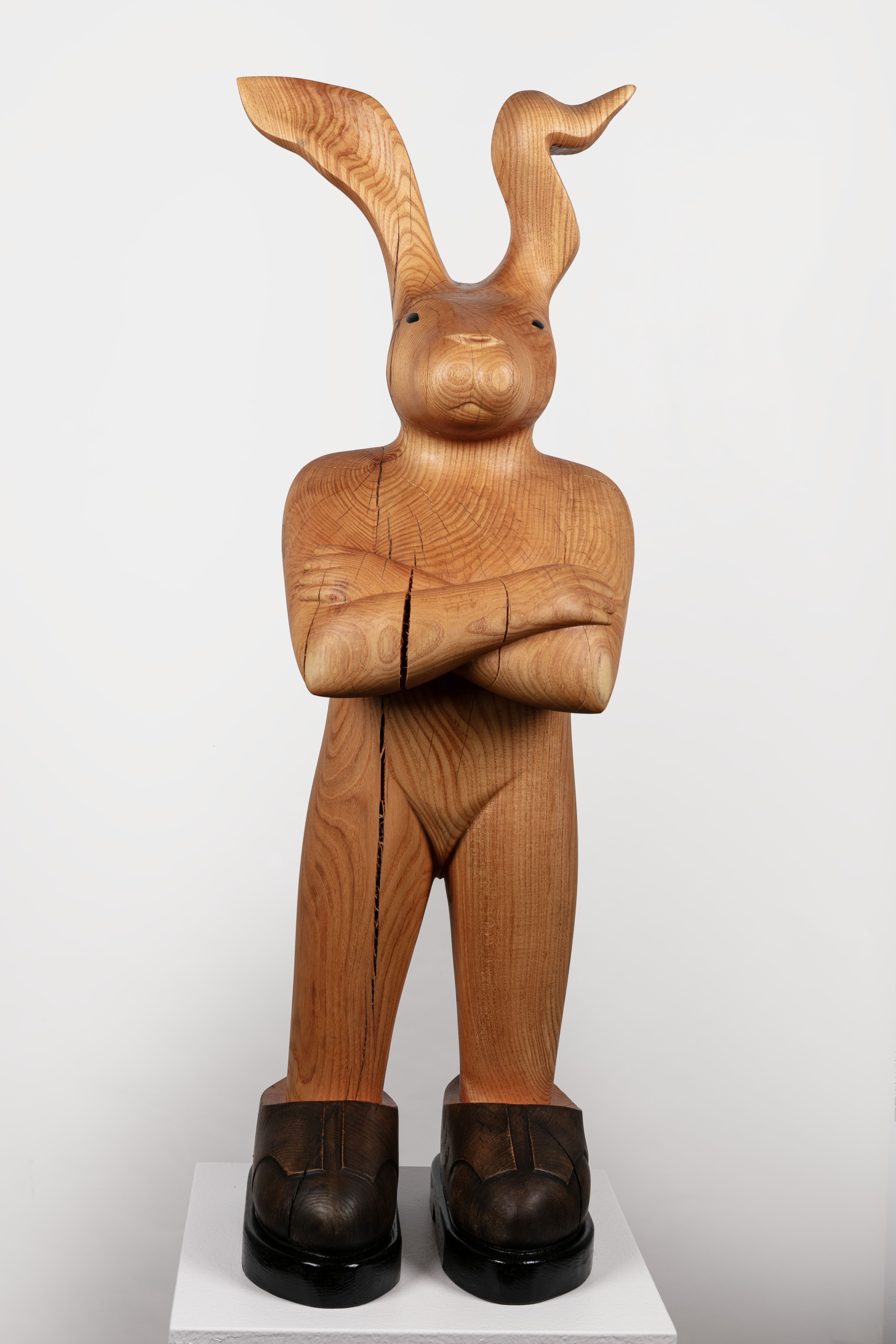
The exhibition is centered on a life-size, 32-piece chess set — all the pieces are women and range from roughly four feet to six feet in height. Dodson handcrafted them from salvaged wood.
The pieces sit atop a massive board that will involve some kind of interactive element — the details of which are still being finalized before the show opens in November.
Including what is believed to be the world’s only life-size chess set featuring all women pieces, the show aims to “transform the traditionally hierarchical game into a speculative arena of matriarchal power and ecological symbolism,” according to the museum’s program notes.
“Minotaur,” a 31-inch-tall piece from sculptor Donna Dodson’s upcoming exhibit “Match of the Matriarchs” at Philadelphia’s Museum for Art in Wood.Brian Wilson
“By placing the feminine at the forefront of a game so deeply associated with power, conflict, and hierarchy, Dodson asks us to reconsider its origins — and to wonder what may have been lost as the game evolved over time,” said Jennifer-Navva Milliken, executive director and chief curator at the Museum for Art in Wood.
A second, smaller chess set — on a board roughly 12 feet by 12 feet — will be fully interactive, with visitors encouraged to stage their own matches, moving the pieces as their strategies demand.
“By playing a game, or inviting viewers to come in and rearrange [the] art work, it creates a new art work every time,” Dodson said.
In addition to Dodson’s work, the show will include about nine other artistic chess sets — including one designed by famed Pennsylvania artist Wharton Esherick, as well as a micro-set with pieces that can only be moved using tweezers.
Prior to its debut at the Museum for Art in Wood, Dodson’s piece was on display at the Boston Sculptors Gallery and, most recently, at the World Chess Hall of Fame in St. Louis — though the Philadelphia version will include expanded programming.
From candy striper to artist
Dodson was never the artsy kid in school, she says. She attended Wellesley College in New England with plans of becoming a doctor, even working as a candy striper for a time. Her medical ambitions dwindled as she began to take to art in her mid-20s, along with her childhood love for chess.
It wasn’t until she met Joseph Wheelwright, the noted Boston sculptor who would go on to become her mentor and teach her woodworking, that she returned to the game.
Wheelwright, who died in 2016, would ask her to play during lunch breaks, and though he, too, would “clobber” Dodson — even while handicapping himself by taking several of his pieces off the board — the matches no doubt served as inspiration for Match of the Matriarch, she said.
In Philadelphia, Dodson has found a fitting setting for her exhibit.
The city is home to Jennifer Shahade, an author and three-time national chess champion, whoseartwork will also be featured in the exhibit.
“She has created a number of conceptual works and videos that recontextualize chess and chess sets as art,” Dodson said.
The exhibition also coincides with the Philadelphia Museum of Art’s presentation from Marcel Duchamp — an artist famously infatuated with the game of chess who also occasionally incorporated the game into his work.
The Museum for Art in Wood exhibit comes on the heels, meanwhile, of a worldwide resurgence in the game spurred by both the pandemic and the 2020 release of the Netflix series The Queen’s Gambit, which starred Anya Taylor-Joy and drove a wave of new interest in chess, particularly among girls and women.
“Tomboy,” a 42-inch-tall piece from sculptor Donna Dodson’s upcoming exhibit “Match of the Matriarchs.”Brian Wilson
Dodson partakes in some form of chess daily, playing a weekly game in Maynard, Mass., where she now lives, as well as online.
“I’ve become much more knowledgeable about the current chess community, what’s going on in the chess world, and have met some of the real-life champions in chess, which is all super exciting,” she said.
Dodson, who will be present Nov. 7 for an artist talk at the museum, said she hopes the game’s universal charm will make the exhibit accessible to a wide audience.
“I think a lot of people don’t feel comfortable going into art museums — they don’t feel that they know enough [about art] or whatever,” she said. “So I think the whole chess theme is very accessible — there’s a whole worldwide chess community of people who play for fun, play as a hobby, their kids play, their grandfather plays.”
“Donna Dodson: Match of the Matriarchs” runs Nov. 6 through March 21, 2027, at Museum for Art in Wood, 141 N. 3rd St., Philadelphia. museumforartinwood.org
“It’s a great art, is rowing. It’s the finest art there is. It’s a symphony of motion. … When you near perfection, you’re touching the Divine.”
— George Y. Pocock, renowned rowing coach and boatbuilder
“If you want to be a Schuylkill Dragon, don’t be a schmuck.”
— Judy Gernon, 81
Boathouse Row, on the Schuylkill, is the epitome of old-money elegance — a Ralph Lauren catalog come to life.
Home to more than a dozen of the city’s storied rowing clubs, it’s atimeless civicfixture. Opulent brick houses with palatial decks. American flags fluttering from poles. Young rowers with sinewy physiques andwell-earned tans, milling about the docks.
There’s a reason it is considered one of the city’s most iconic settings, the subject of postcards and poetry.
Boathouse Row, a picturesque scene located along the east bank of the Schuylkill.TOM GRALISH / Staff Photographer
About two miles upriver, meanwhile — far from this extravagant scene — sits another boathouse, of far less renown.
To get to it, you have to trek through knee-high grass, past the porta-potties and discarded car tires, and the mosquitoes as big as Buicks. Go past the chain-link fence choked by weeds and the dead trees the city hasn’t yet gotten around to clearing, and soon enough, you’ll reach it.
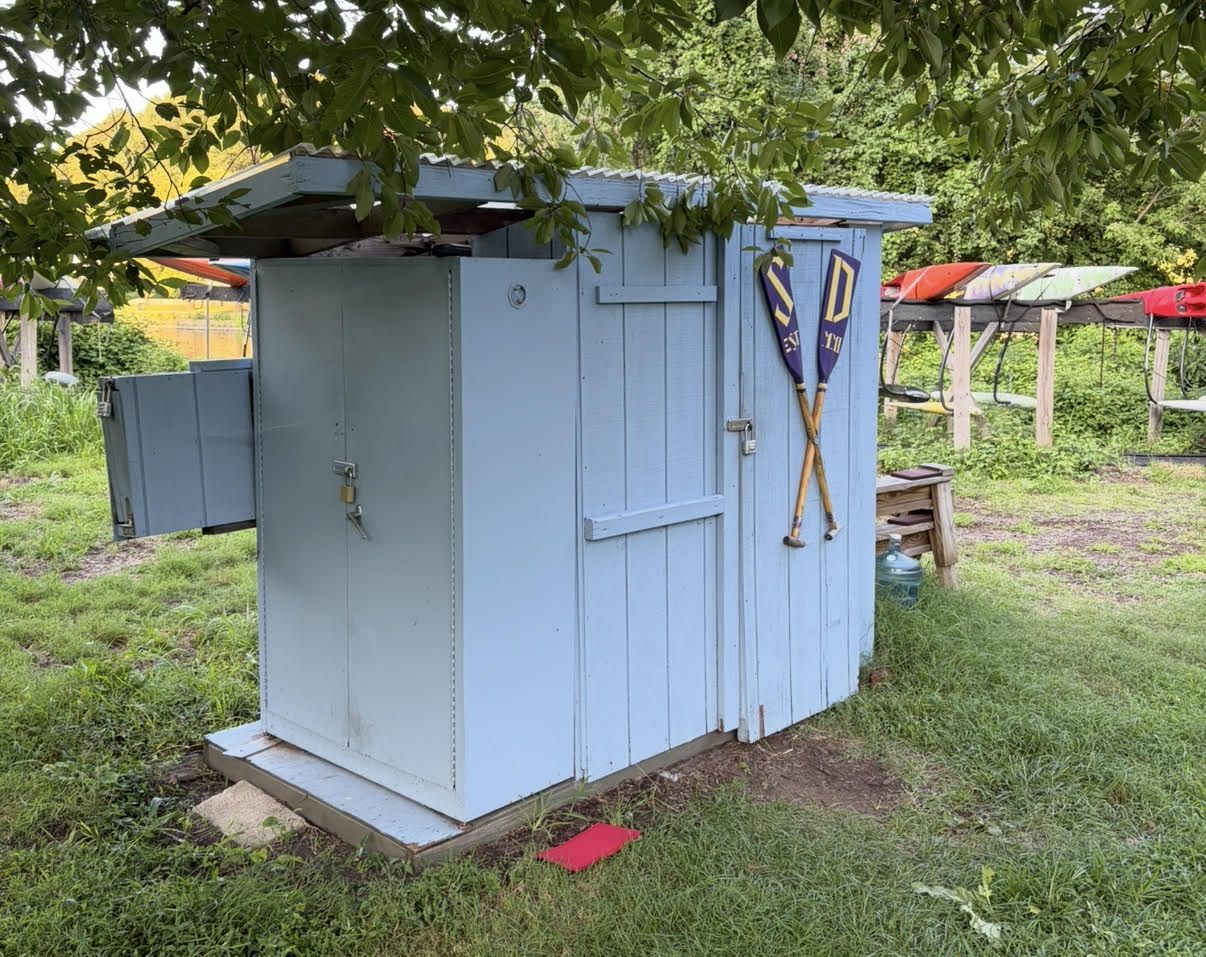
The humble headquarters of the Schuylkill Dragons.
It is 4 feet by 6 feet. It is packed with faded life jackets, water jugs, a smattering of rusted, secondhand tools. The only thing WASPy about it are the actual wasps — which, at the moment, have infested a corner of the small structure.
It is damp and dirty, thick with dust and cobwebs.
To the ladies of the Schuylkill Dragons — the city’s oldest all-woman dragon-boating team and its unlikeliest sports dynasty — there might be no better place on earth.
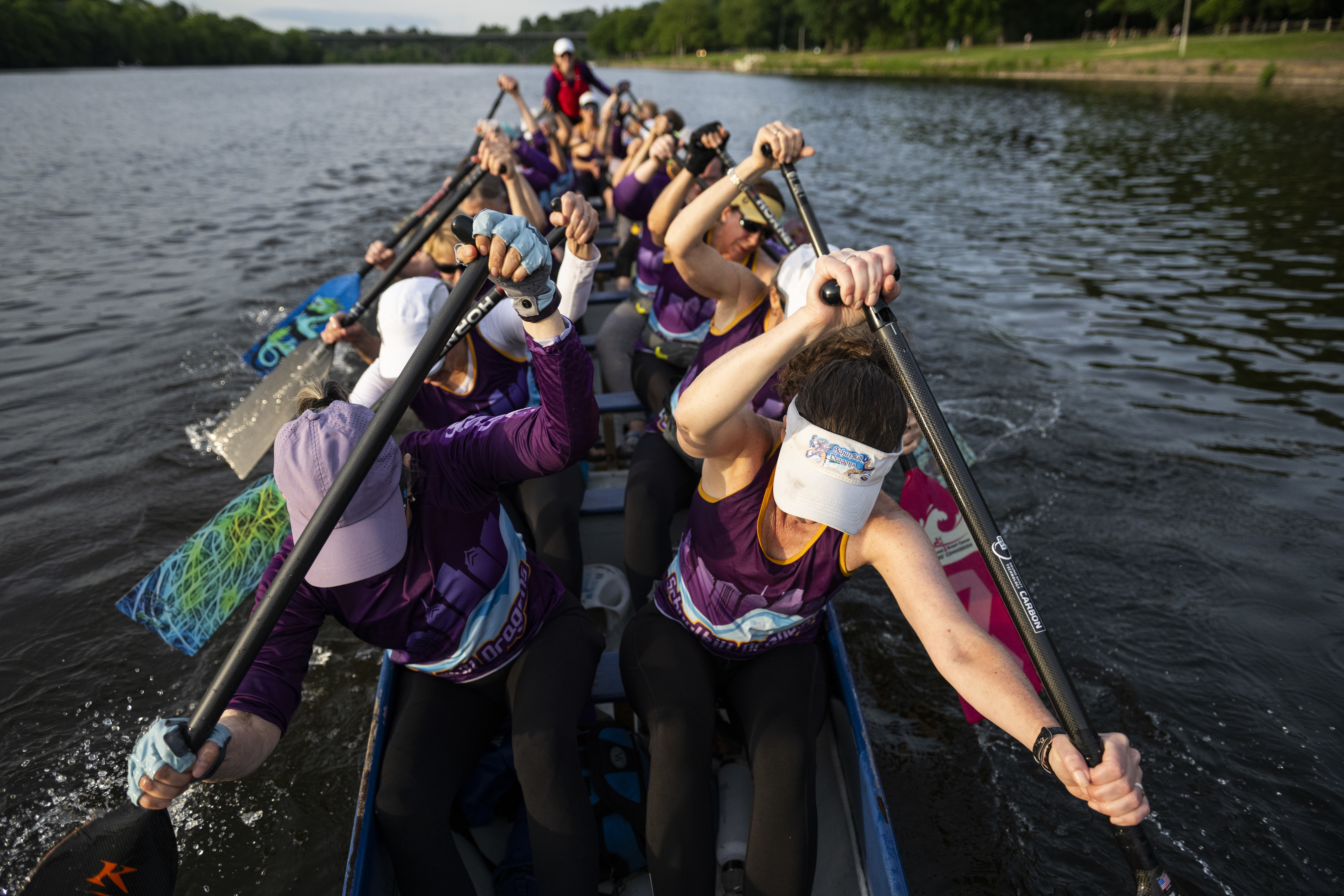
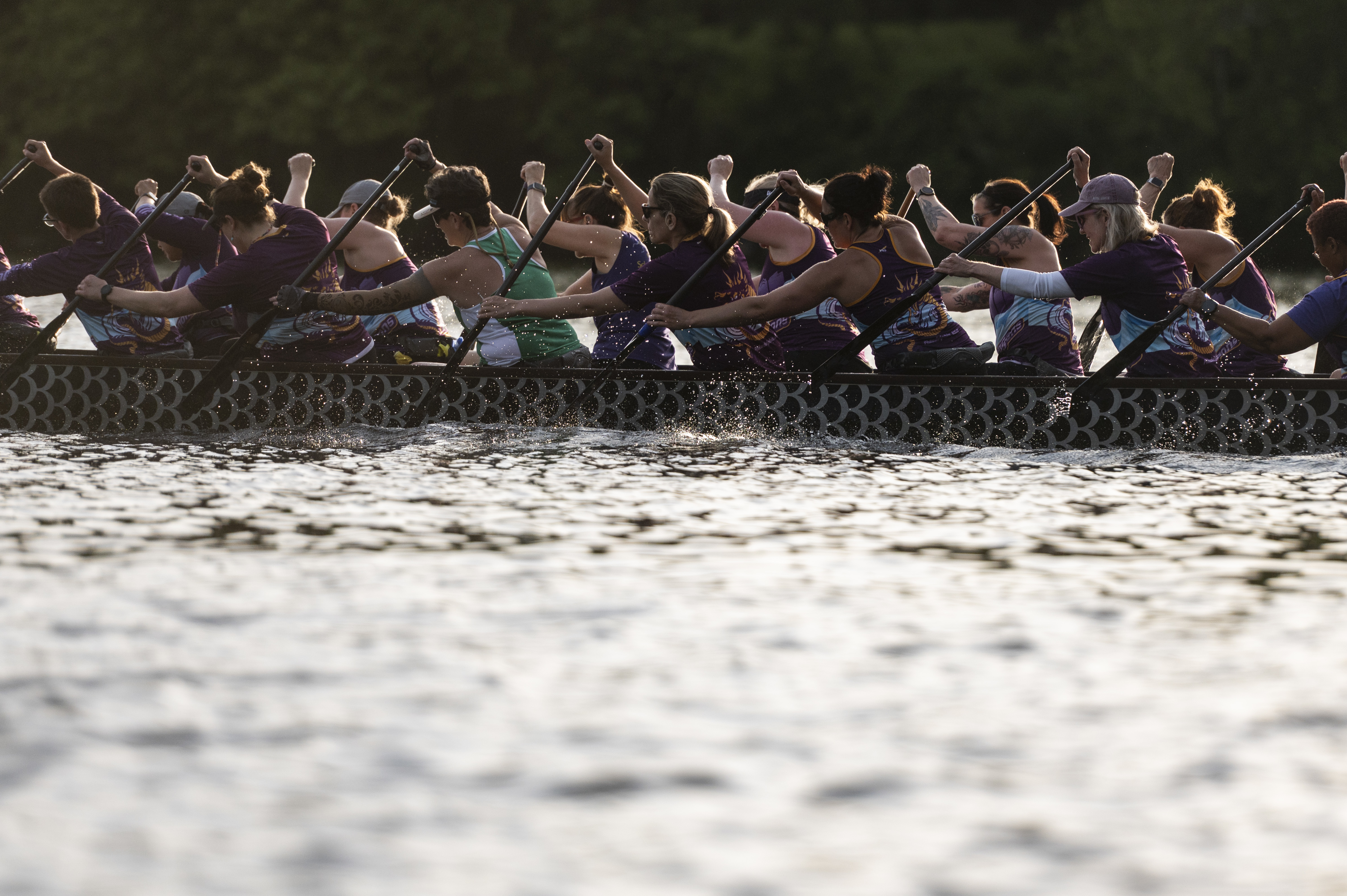
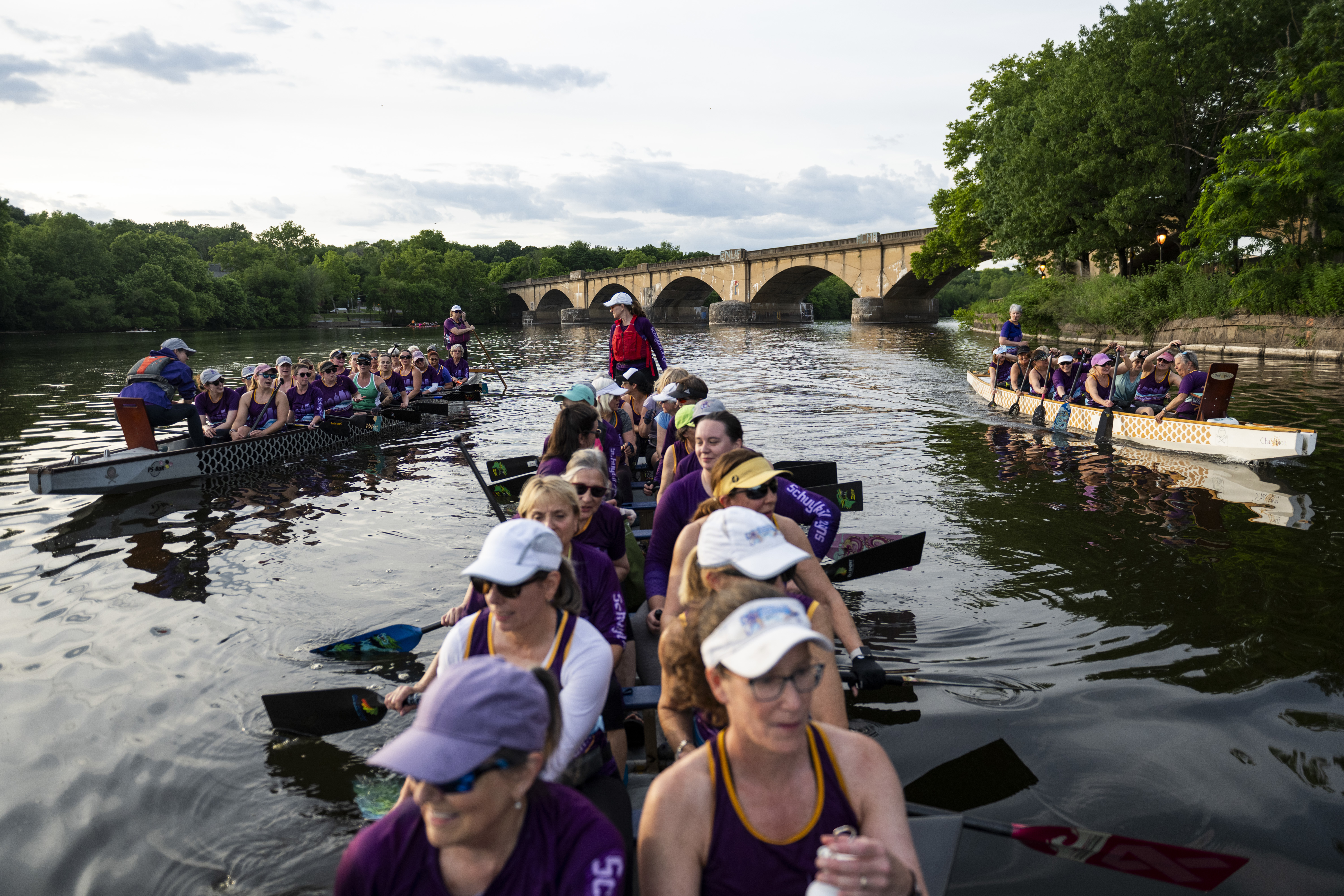
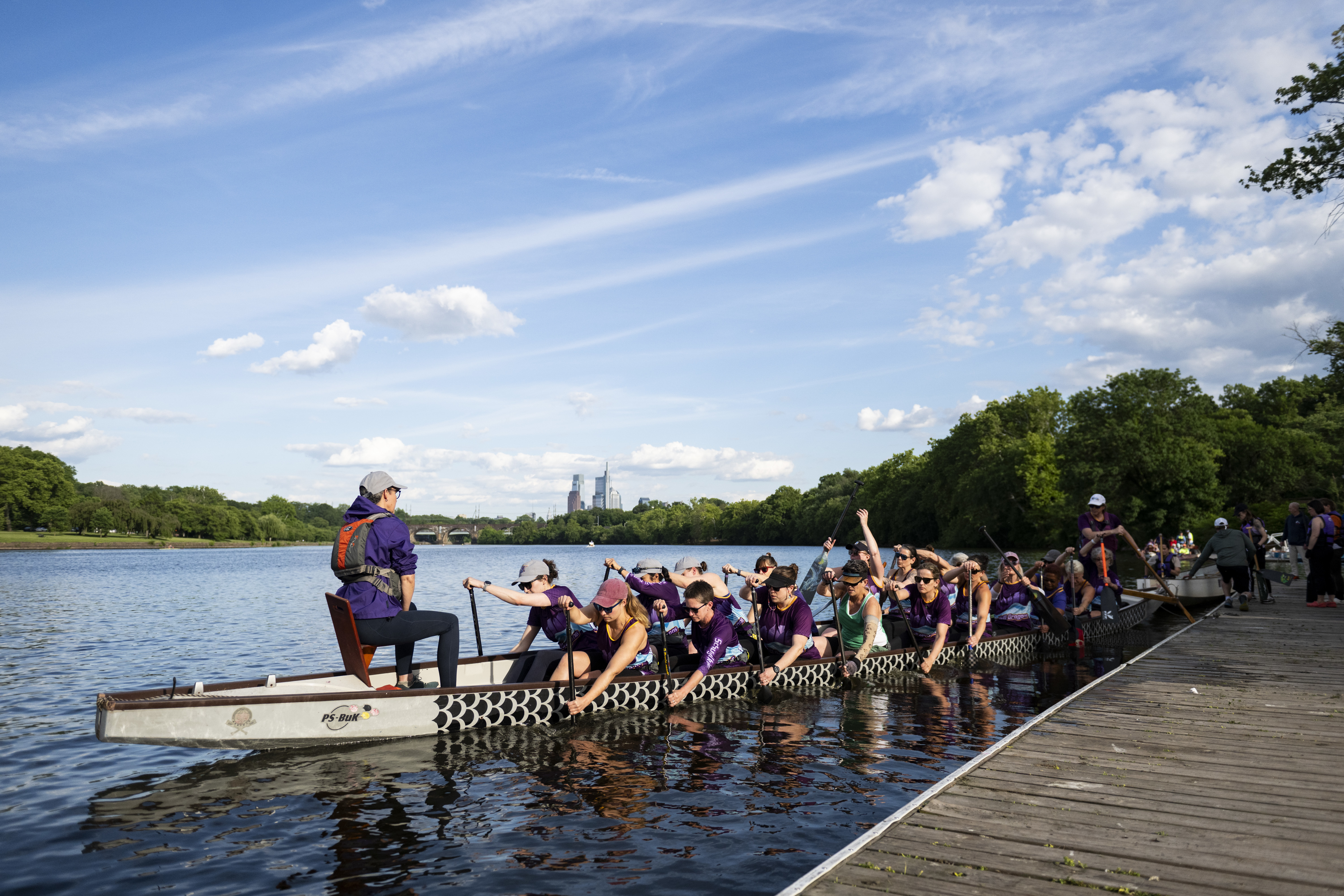
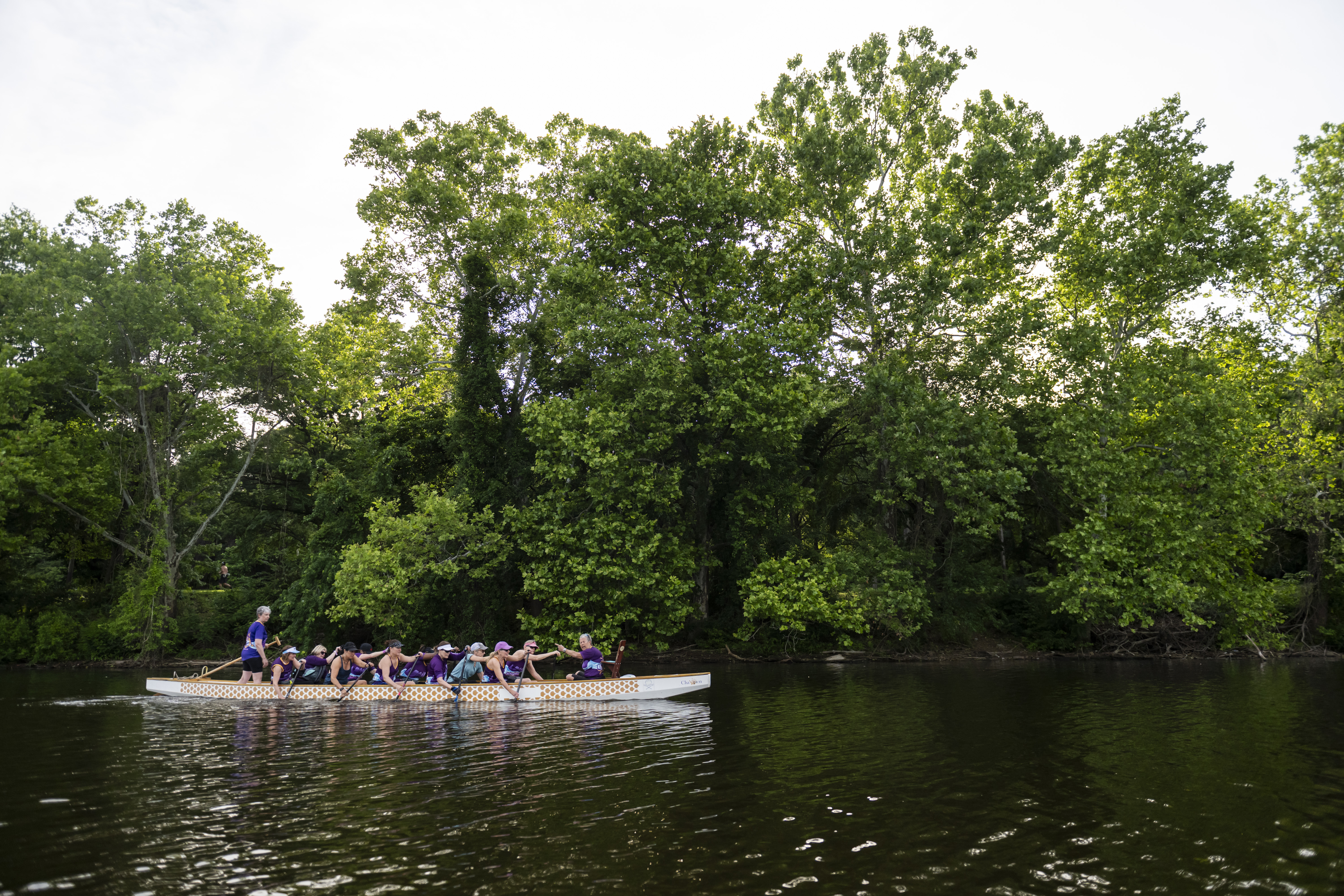
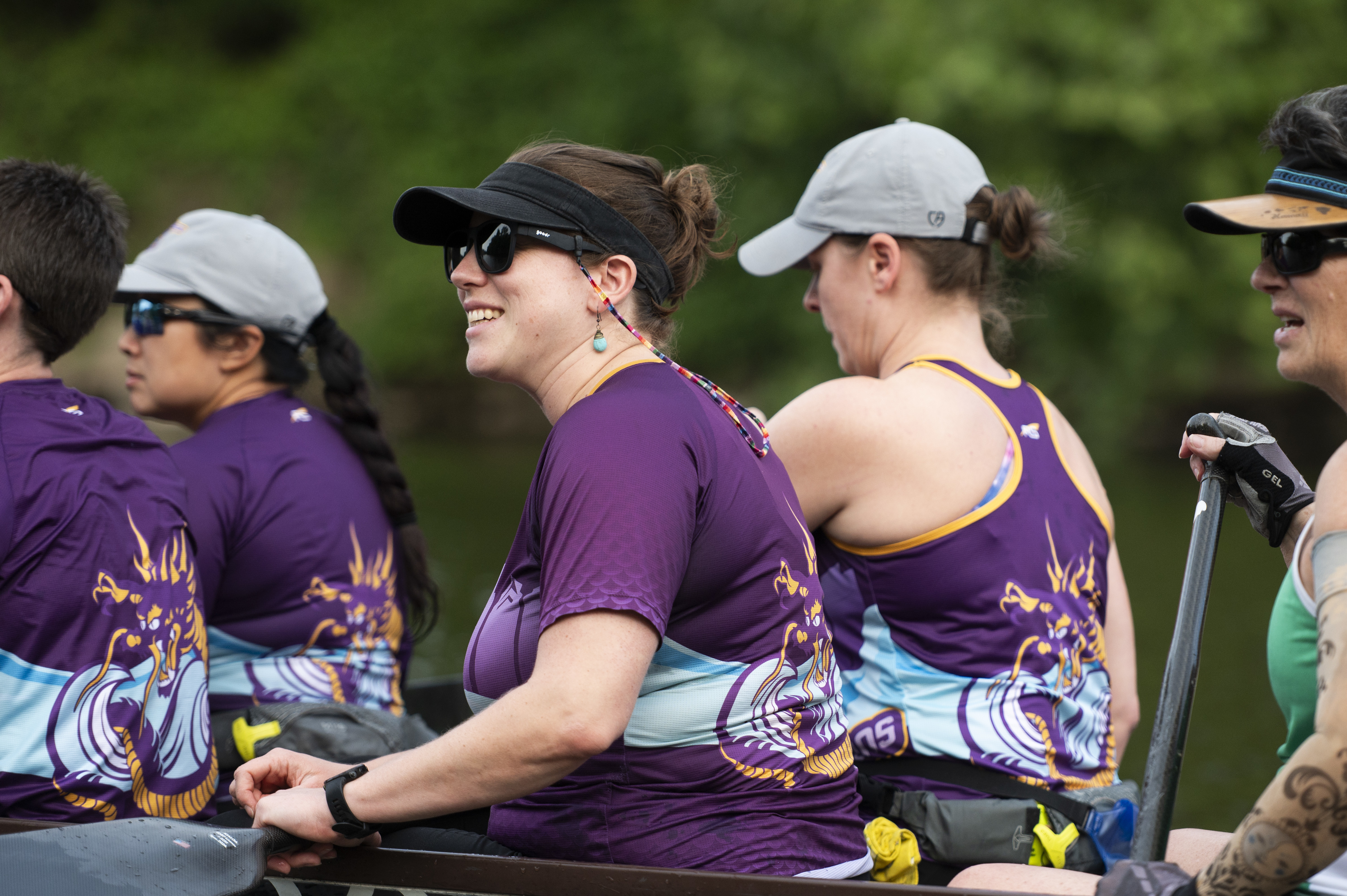
The Schuylkill Dragons on June 2, 2026.Allie Ippolito / For The Inquirer
A ‘dump truck’ on the water
My introduction to the Schuylkill Dragons came on a Saturday morning this summer, at a team practice along the Schuylkill.
As I followed the team down a dirt path toward the water, a tiny white-haired woman in her 80s sidled up to me.
“It’s a good thing you didn’t come last Thursday,” she said, “‘cause it was raining like a b—.”
The “boathouse” of the Schuylkill Dragons stands on the west bank of the Schuylkill, near the team’s dock. Members of the team built the structure in 2015.Dugan Arnett
For 25 years, the Dragons have been rumbling their way up and down the Schuylkill.
And for 25 years, they have been the river’s most immovableforce — a sweatin’, swearin’, swaggerin’ group of bandits that no one has quite figured out how to tame.
“Underestimate them at your own peril,”says Bob Mina, a longtime member of the Philadelphia Dragon Boat Association.
Many are in their 60s, 70s, and 80s, and — having endured some of life’s cruelest challenges: cancer, divorce, the loss of spouses — do not find it particularly daunting to propel a two-ton boat upriver until their backs and shoulders scream.
There is Cindy Roberts, a65-year-old retired preservationist known for growling loudly throughout races. And Sue Ferry, 64, who goes by the nickname “Machete” — due to the fact that she once brandished one at practice and used it to hack a path through the weeds to the team’s boat ramp.
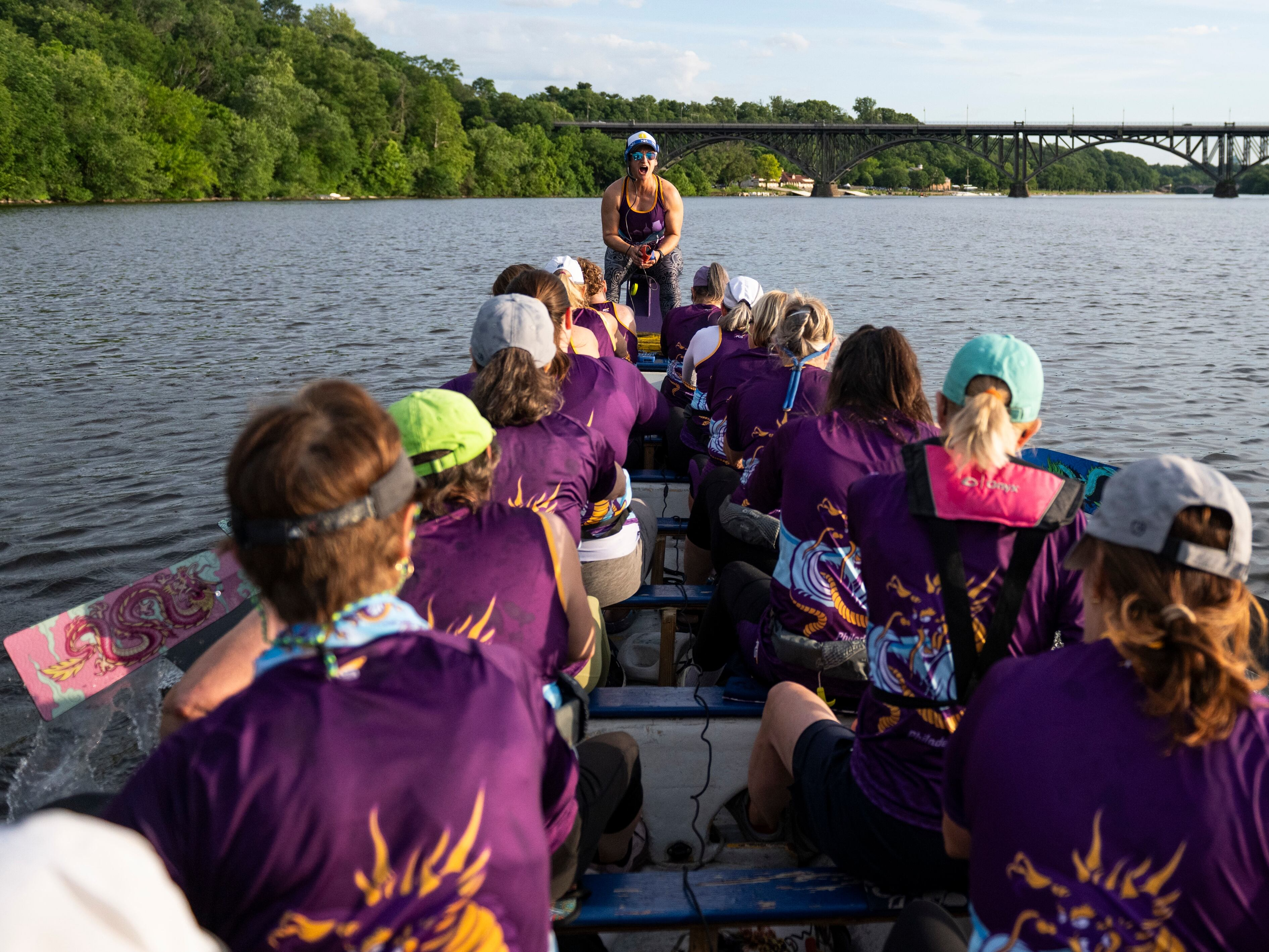
Judy Gernon, drummer with the Schuylkill Dragons, yells out calls during a practice ahead of an forthcoming race.Allie Ippolito / For The Inquirer
There is “Crazy Judy” Gernon, a tattooed 81-year-old former Army brat who stands 5-foot-1 (“and a half”) and has never met a sentence she felt couldn’t be enhanced with an expletive (or six). A while back, the team had to convince her to stop flashing people on the river.
Nothing has been able to slay the Dragons. Not injury (they’ve been known to schedule their hip-replacement surgeries around dragon-boating season). Not the city’s rowers (with whom they regularly clash), or the younger, fitter teams they routinely find themselves lined up against (the Dragons have won medals across the globe and are widely considered the gold standard for women’s dragon-boating in the city).
Even their own coaches have occasionally found themselves at the mercy of the Schuylkill’s Bad News Bears.
Years ago, the team was led by a man who worked as an attorney for a prominent pharmaceutical company, a guy with a reputation for navigating the corporate world with iron-fisted efficiency.
“What cracked us up is he had no qualms going into some office and firing everybody there,” says Crazy Judy.
“But to work with a women’s dragon-boating team? He couldn’t say s— if he had a mouthful.”
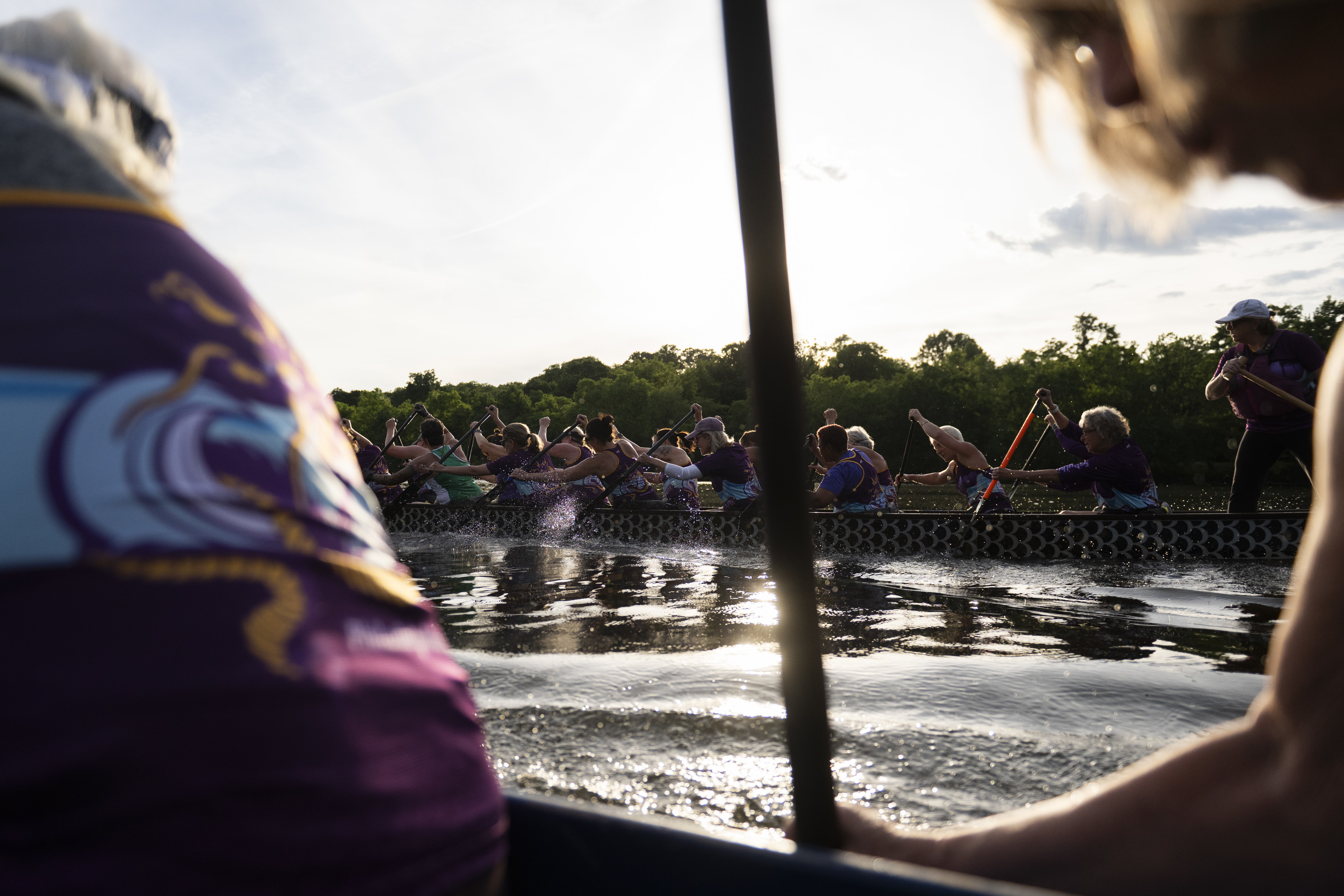
The Schuylkill Dragons on Tuesday, June 2, 2026.Allie Ippolito / For The Inquirer
‘Renegades’ of the river
Since hosting its first regatta in 1835, the Schuylkill has been a national hub for U.S. rowing. It has produced Olympic rowing medalists and national collegiate champions, been the training ground for clubs with names like Vespa and Crescent.
It was into this hallowed setting, meanwhile, that the Schuylkill Dragons arrived, in 2001, with all the subtlety of a right cross.
Though not the first dragon-boating team on the river — at least one men’s team started in the mid-1980s — the Dragons quickly established themselves as the most colorful.
“We were like renegades,” says Patti Miller, 72, one of the Dragons’ founding members. “We were a novelty: Who are these Schuylkill Dragons?”
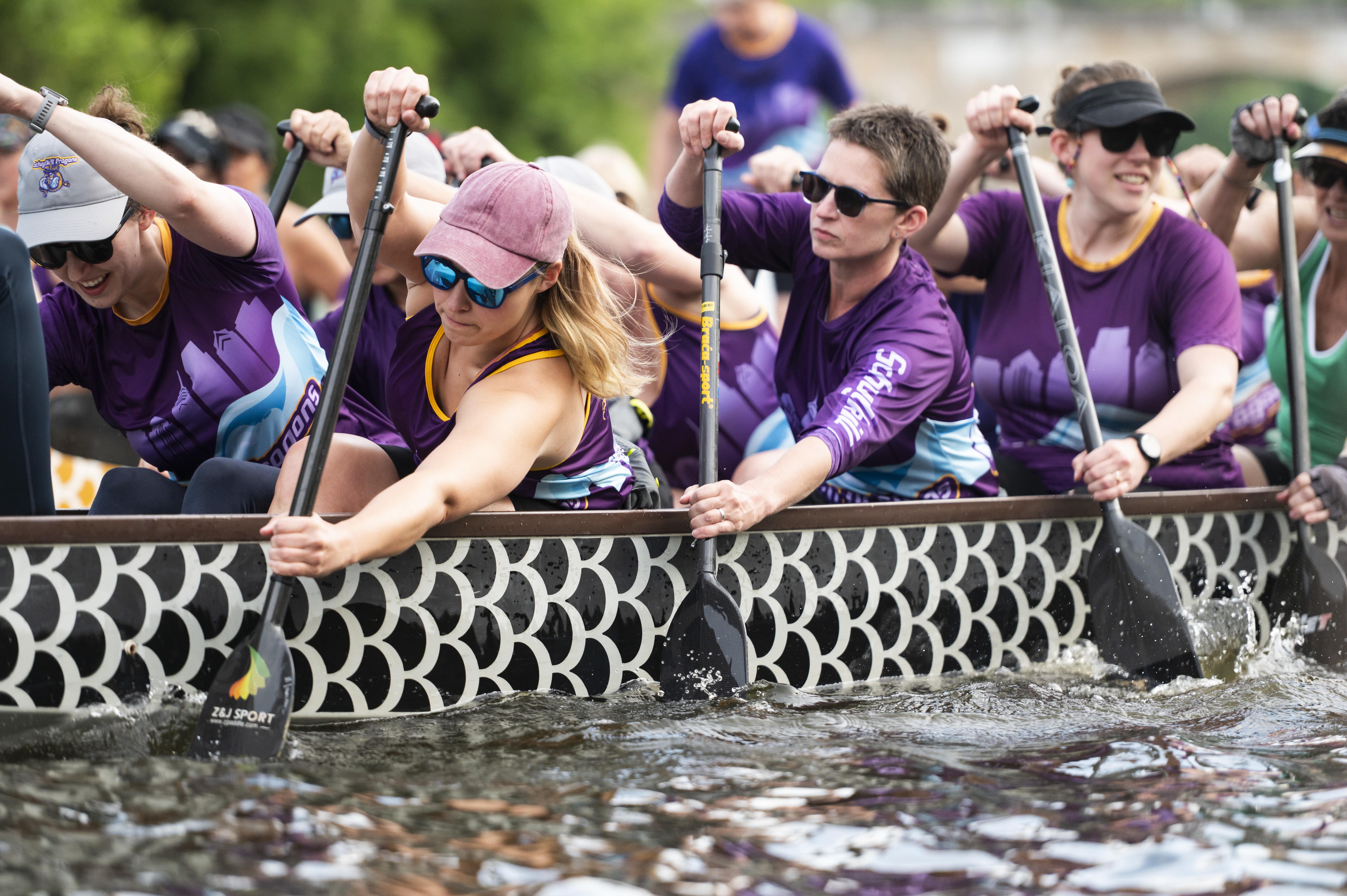
If rowing is jazz — smooth, elegant — then dragon-boating is a half-dozen teenagers in a garage, thrashing on electric guitars and banging on drum kits.
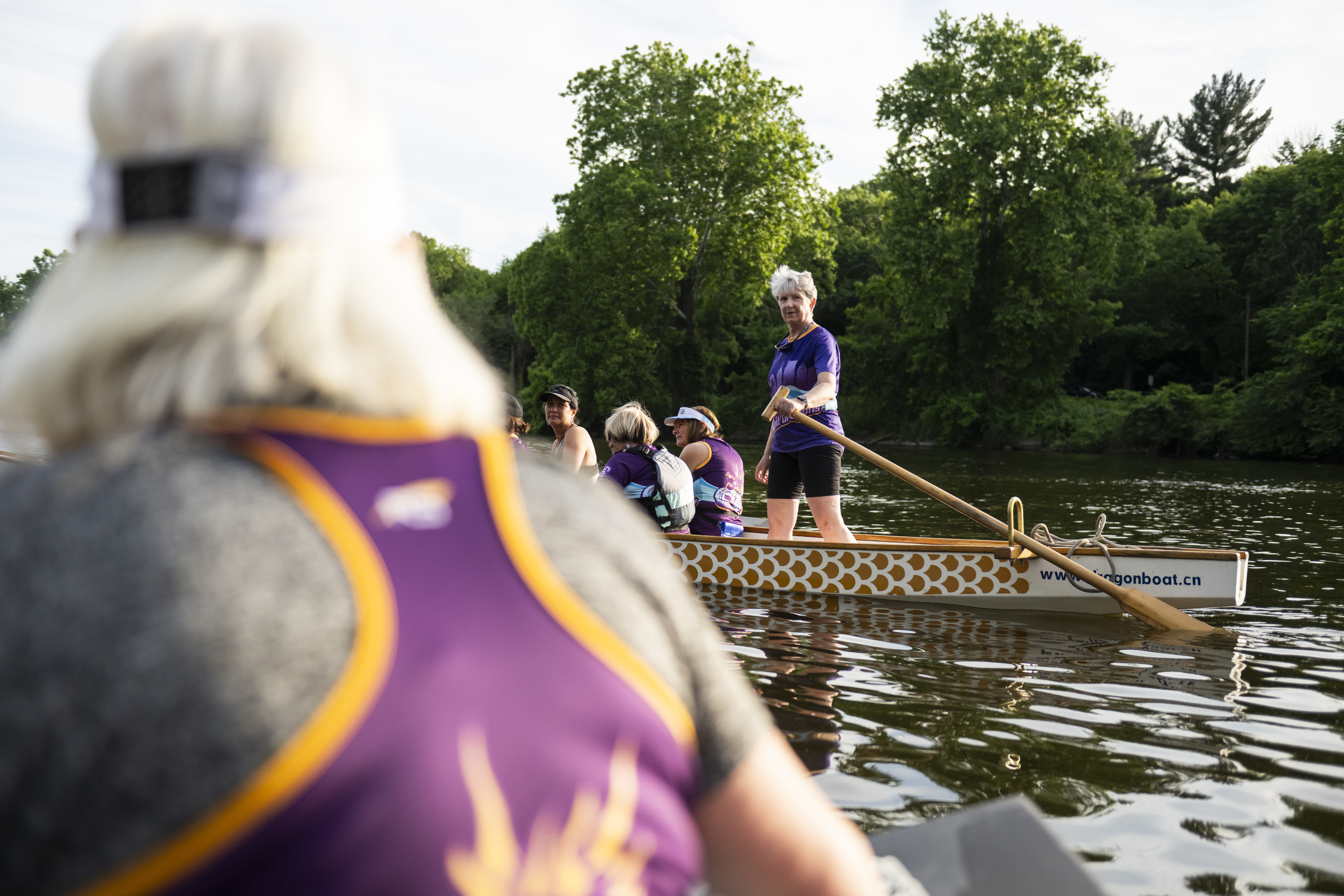
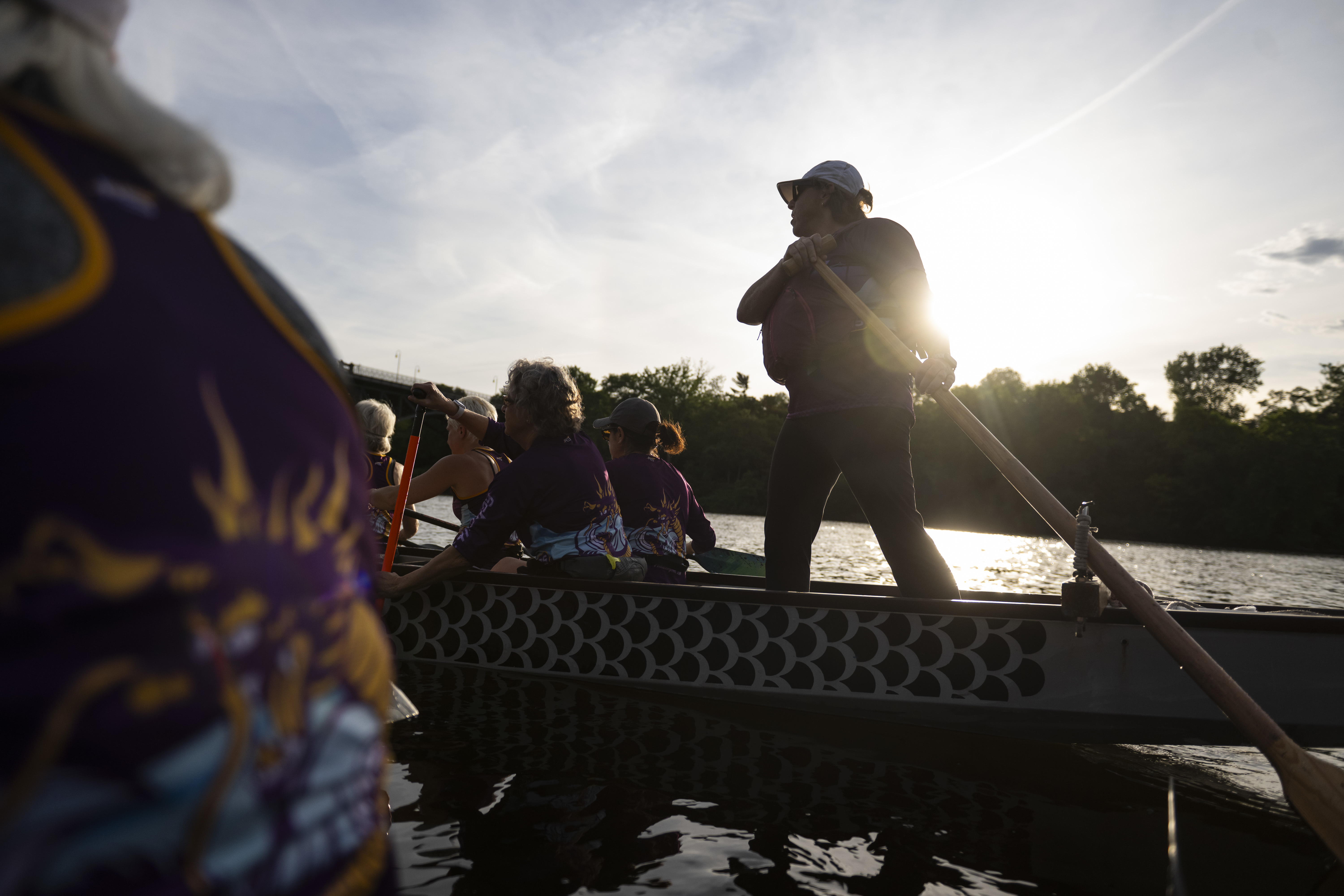
Their stroke is urgent and aggressive. Their boats — usually adorned with large dragon heads and tails — are massive, measuring some 40 feet in length. Unlike rowing, which typically includes no more than eight people to a boat, dragon boats hold 22: 20 paddlers, a drummer (who sits up front, banging a drum to set the paddling pace and barking instructions through a microphone) and a steersperson (stationed in the back and responsible for keeping the boat on course).
Amy Virus, a 52-year-old member of the Dragons, explains it this way:
The Schuylkill is like a smooth-running highway, the rowers and kayakers minding their own business.
“And then a dump truck gets on,” she says, “and gets in [everybody’s] way.”
Video: The Schuylkill Dragons are Philly’s oldest all-woman dragon-boating team
The early years weren’t always easy. To find members, the Dragons handed out flyers and published classified ads in the newspaper: Women wanted to paddle on the Schuylkill.
For years, the team was stationed on the Kelly Drive side of the Schuylkill, their boats tied to a tree on the river’s bank. Before each practice, the women — many postretirement age — had to rappel down a rock wall to board the boat.
Introducing dragon-boating to the Schuylkill, meanwhile, was a little like releasing a pack of honey badgers into a wedding reception.
Years ago, a group of male dragon-boaters — who’d apparently done a little too much prerace imbibing — managed to tip their boat during a race, sending themselves spilling into the river. When a police boat arrived to pull them out of the water, they managed to sink that boat, too.
Lora Dunnigan, one of the coaches of the Schuylkill Dragons, on Tuesday, June 2, 2026.Allie Ippolito / For The Inquirer
It was “basically like West Side Story on the water,” says Mina, of the PDBA, of the rower-dragon-boater tension. “Only without the jaunty musical numbers.”
When the Dragons first started on the river, the mostly male rowers would report the team to the Schuylkill Navy — the river’s rule-enforcement body — for rules violations. Or scream at the women to get out of their way.
Today, the two groups seem to have reached an uneasy detente, though plenty of Dragons believe the rowers would be happy if they packed up their hulking boats and disappeared forever. Says Meg Fasy, 62, “They’re looking at us like we’re a bunch of old broads, I’m sure.”
Which is not to say, of course, that the Dragons do not give as good as they get.
Not long ago, when the team encountered a group of younger male rowers on the river during practice, one Dragon couldn’t help herself.
“I’ve got shoes older than you!” she bellowed.
The Schuylkill Dragons on Tuesday, June 2, 2026.Allie Ippolito / For The Inquirer
‘I was better than they were’
Because many came of age before Title IX, the Dragons are, for some, the first team they’ve ever been a part of.
Growing up in Massachusetts, Susan Wilson — the Dragons’ oldest member at 83 — spent childhood evenings playing street baseball with the boys in her neighborhood — long, glorious hours chasing fly balls under a fading New England sun.
But at a certain point, the boys all joined organized teams, and Wilson was relegated to the bleachers — a development particularly unjust, she explains, considering “I was better than they were.”
When she eventually discovered dragon-boating several decades later, in her late 50s, it was a revelation.
“The first night I went out on the water, there were whitecaps [and] hail,” says Wilson. “And I went, ‘Oh, yes, this is for me.’”
One after another, members credit the Dragons with bringing them out of their shells, with instilling in them a newfound confidence.
As a young mother, Karen Anderson, 72, says, she was so competition-averse that during her kids’ youth sporting events, “I’d hope for a tie, so everyone left happy.”
Now?
“I never know what’s going to come flying out of my mouth,” she says. “It’s made me really like a crazy woman when I’m racing.”
Consider Marina Della Putta Johnston. On land, she is a mild-mannered, 62-year-old former Italian Studies lecturer at Penn. On water, she’s “The Marinator” — a nickname earned following a race in Sarasota, Fla., in which the boat she was steering inadvertently clipped that of a rival team, dumping its occupants into the lake.
“They flipped,” Johnston says, “and we kept going.”
Beneath all their bluster, the Dragons care deeply for one another.
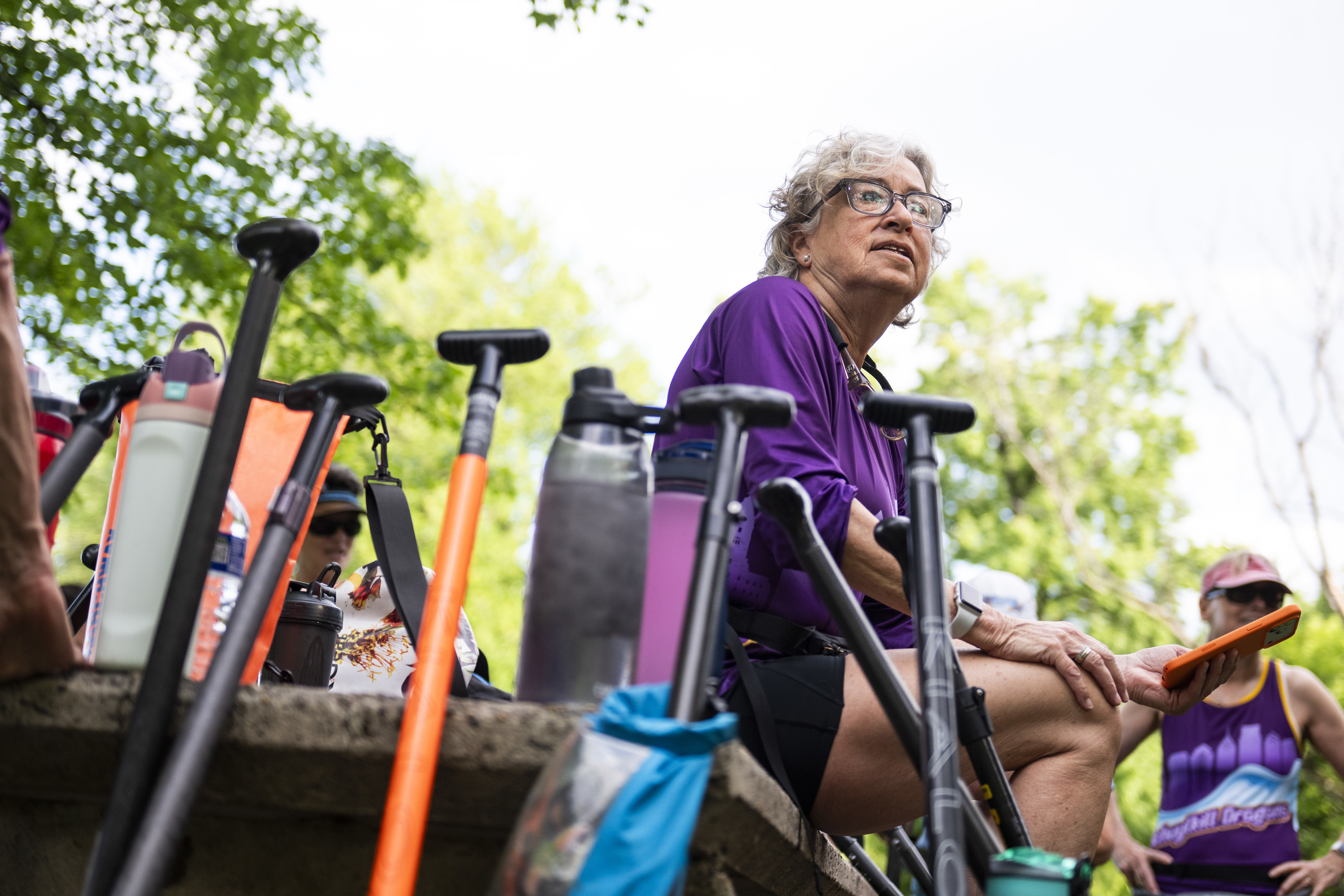
Stacy Kent Wyckoff, a member of the Schuylkill Dragons, an all-woman dragon-boating team, sits with teammates before the start of practice on the Schuylkill on Tuesday, June 2, 2026.Allie Ippolito / For The Inquirer
They arrange meal trains when a teammate is sick or injured. They check in on one another. When her husband’s health was declining in 2022, says Stacy Kent Wyckoff, 66, it was the Dragons who helped her through her grief.
“It was just a very healing thing to jump into,” she says.
This is another Dragons specialty — moments of quiet tenderness amid all the grunting and growling and middle-finger salutes.
Two years ago, at a team camp in Florida, a few Dragons were driving from their hotel to dinner. In the passenger seat, 79-year-old Phoebe Wood — who is typically about as sentimental as a court order — suddenly grew nostalgic.
“I just want to say,” she announced, “that I love everyone in this car.”
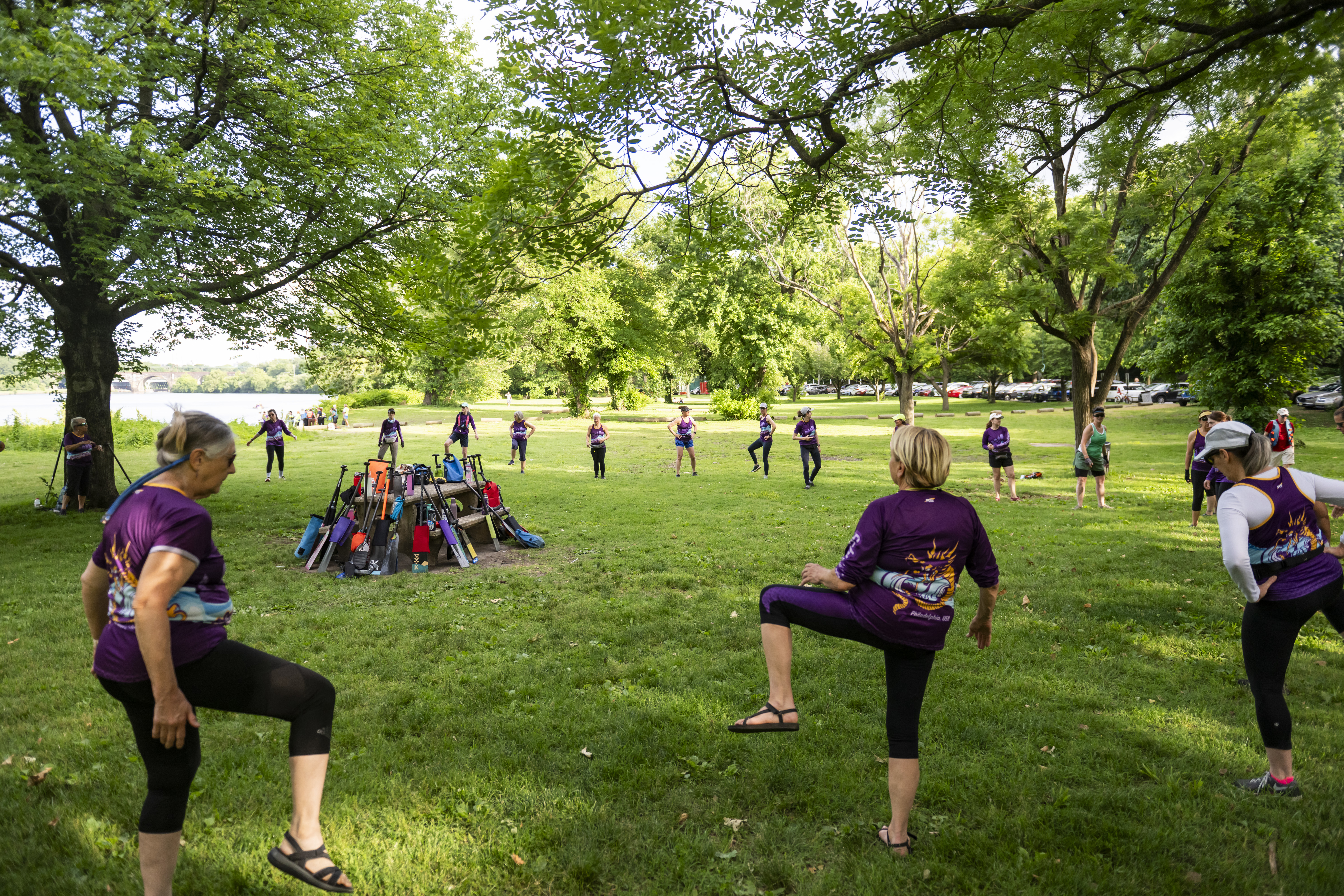
The Schuylkill Dragons warming up before a practice on June 2, 2026.Allie Ippolito / For The Inquirer
‘Solemn and deadly’
At competitions, some teams arrive at the starting line light and loose — laughing, dancing. The Dragons prefer a different approach: “Looking solemn and deadly,” says Wood.
Talking is almost always prohibited in the boat, even at practice — the better to stay focused.
Today, the team has a standing offer: $20 to anyone who pukes during a race.
The Dragons train four days a week in the summer — Tuesday and Thursday evenings, plus Wednesday and Saturday mornings. In the winter, many team members travel more than an hour each weekend to Pottstown, where they train indoors in a simulation paddling pool. Each spring, a group of Dragons attends a grueling preseason dragon-boating camp in Florida, enduring hours-long days on the water.
The Schuylkill Dragons on June 2, 2026.Allie Ippolito / For The Inquirer
They have competed across the world — Hungary, Canada, Italy. Members have paddled for Team USA at the dragon-boating world championships, considered the sport’s Olympics.
“If you want to race seriously,” says Mina, “that’s the club you want to go to.”
Indeed, it is not for the faint of heart.
The Dragons have paddled with torn rotator cuffs, artificial hips, wonky knees. You could field a marching band with all the Dragons who are currently in physical therapy for one ailment or another. One local paddler with emphysema used to lug her oxygen tank with her onto the boat.
The Schuylkill Dragons launch off the dock at the start of a practice on Tuesday, June 2, 2026.Allie Ippolito / For The Inquirer
Today, Philadelphia is home to more than a dozen competitive dragon-boating teams, many of which share a pair of docks on the Schuylkill’s western bank, off Martin Luther King Jr. Drive.
And while this growth has been viewed very much as a positive, it has occasionally resulted in what the husband of one team member refers to as “Dragon Drama.”
For the Dragons, much of that drama has involved another of the city’s longstanding women’s dragon-boating teams, a rivalry that — like many great conflicts — is rumored to trace its origins to failed romance.
Years ago, according to one version of rivalry lore, the then-coaches of the two teams became romantically involved — which was fine, up until the relationship came to an unceremonious end.
“Then it became, ‘Kill the Dragons!’” says one longtime member of the rival team.
For a long time, the two teams wouldn’t acknowledge each other. Or, conversely, would acknowledge each other too much — lobbing insults from their respective boats before races.
The iciness has since thawed — to a degree.
“We might like them off the boat,” says Anderson. “But on the water … we want to beat their asses.”
The Schuylkill Dragons on June 2, 2026.Allie Ippolito / For The Inquirer
‘You ever heard of dragon-boating?’
The team built its own boathouse, over a single weekend in 2015. They own three dragon boats — long, massive vessels of wood and fiberglass — which they store, patch, and repair themselves. Whereas the clubs of Boathouse Row havestocked bars and gleaming workout facilities — the University of Pennsylvania’s College Boat Club recently underwent a $13.5-million renovation — the Dragons have 70-year-old Julie Regnier, nicknamed “MacGyver” for her proficiency with a two-by-four and a can of epoxy.
Says Linda Breitstein, a 72-year-old Dragon: “These are not women who are used to saying, ‘I’ll call the man to take care of everything.’”
Keeping the team competitive, meanwhile, has required a constant commitment to recruiting, a duty the Dragons have embraced with the intensity of a Southeastern Conference football coach on the hot seat.
They’ve plucked new team members from the gym, from the community garden, from dinner parties. They are not above cornering a fit-looking stranger in the cereal aisle of their local grocery store and extolling the virtues of dragon-boating.
Emma Thomas, center, has served as the Schuylkill Dragons’ tireless team president since 2025. The job includes everything from organizing team events to facilitating the team’s annual training camp in Florida to – on occasion – weed whacking. Thomas joined the team in 2021.Allie Ippolito / For The Inquirer
Once, Anderson found herself at a Bucks County hospital. Her daughter had just gotten out of surgery, and was being wheeled into the post-operation room, but Anderson couldn’t take her eyes off the attending nurse.
“She was tall and she was fit and she had some muscles,” says Anderson, now one of the team’s three coaches. “And I said, ‘I’m going for it.’”
“Excuse me,” she said, as her daughter lay unconscious a few feet away. “Have you ever heard of dragon-boating?”
The nurse joined the team soon after, bringing a neighbor with her.
Though the Dragons are open to women of all ages — their youngest member is 23 — the team has long trended older. As of last year, the average age of the team sat somewhere in the neighborhood of 60.
Lately, there’s been a conscious push to bring in younger paddlers — “our succession plan,” says one former member of the team’s board of directors.The team has instituted an annual rookie camp to scout new members;of the six paddlers who received invitations to join the team this summer, five were under the age of 40.
Short of that, the Dragons have developed a backup plan for ensuring the team’s longevity.
When Crazy Judy told coach Stacey Scanlan recently that they’d have to find a replacement for her eventually, Scanlan shrugged.
“Just don’t die,” she replied.
A steerer on the Schuylkill Dragons, an all-woman dragon-boating team, practices with the team on the Schuylkill.Allie Ippolito / For The Inquirer
The race
On a Saturday afternoon in July, the Dragons gathered in an asphalt parking lot near Baltimore’s Inner Harbor, one of a dozenteams across the Northeast competing in the Charm City’s Dragon Boat Challenge.
It was not going well.
Earlier in the day, the team had finished third in a race they’d hoped to win; afterward, they’d stalked silently to their team tent, pulling out knitting needles or hardcover books and keeping largely to themselves.
Now, as they boarded their boat for the regatta’s final event — the 2,000-meter, the sport’s longest and arguably most grueling race — they vowed to salvage their day.
The Schuylkill Dragons’ final competition of the season takes place Saturday, Sept. 19, at the Mercer County Dragon Boat Festival. The Dragons are among nearly 70 teams competing in the event. Allie Ippolito / For The Inquirer
Ten minutes later, they’d done it, cruising to an easy victory in the eight-team race.
Their smiles returned. They bumped fists. They slapped the side of their boat.
“What a show!” someone yelled from the crowd.
At the awards ceremony a few minutes later, the event’s teams gathered near the water. One by one, they stepped forward to collect their medals. But when it was the Dragons’ turn, the team was nowhere to be found.
“Schuylkill Dragons…” an MC called over a microphone.
“Schuylkill Dragons, are you still here?” he said, finally. “Do you want your medals?”
Far across the parking lot, however, the Dragons were lost in their own little world, giggling and dancing to “Funkytown” and looking to all the world like there was nowhere they’d rather be.
Even by rock and roll standards, the egos and drama within Tuna and the Rock Cats are something to behold.
Sometimes, in the middle of a show, the band’s lead guitarist — St. Claude — will decide that he’d prefer to play Christmas music, and begin performing “Jingle Bells.”
Roux, on clarinet, is a prodigy. But Annie, who plays the chimes, can be volatile; sometimes, if it gets too hot during a show, she’ll simply lie down onstage, refusing to continue.
“Annie also plays guitar,” says Samantha Martin, the band’s founder. “But she wants to beat up the keyboard player, and we can’t have brawls onstage.”
Behind the meowsic
Despite this artistic anarchy — or perhaps because of it — Tuna and the Rock Cats have become an extremely hot ticket. Billed as the world’s only all-cat band, the Georgia-based group has been selling out venues across the country for years — strumming guitars, pawing piano keys, and batting at chimes from Seattle to St. Louis.
When those quickly sold out, a fifth show was added.


Eli Milton Gizmo (Name Pending) handles drums for the band. Samantha Martin describes the cat as “not the brightest, but he’s very pretty.”Photo courtesy of Weekly Whiskers
Martin, a former wildlife educator, has been directing this Meowtly Crüe for about two decades, in addition to training animals for TV and film.
Early in her career, she gravitated toward “misfit” animals: snakes, spiders, rats. (“Rats will never let you down,” she explains.) But then she eventually met Tuna, a cat “so brilliant I said, ‘Let’s give this cat thing a try.’”
The band’s first show was in 2006, at an art gallery in Chicago. The group had only three members then, but when people heard there was a troupe of cats ready to perform, they lined up to get in.
The show, Martin says, was “horrible.”
Which is to say, it went fabulously.
“People loved that the show was horrible,” Martin says. “They love the fails more than the successes.”
Since then, she’s taught an array of cats to “play” a variety of instruments, some better than others. During performances, Martin joins the band onstage, giving visual and verbal cues — she mimes a tapping motion when she wants a cat to paw its instrument, for instance — and doling out treats for a job well done.
How are the Rock Cats, musically?
That depends who you ask.
While their commercial success is undeniable, critical acclaim has been mixed. One reviewer, in Seattle, described the group’s style as “an unpredictable assortment of instrument clanging,” adding that “rarely does it sound like the cats are playing the same song, let alone an actual, fully realized piece of music.” Another bemoaned the fact that, at a Christmas-themed performance, the band did not actually play much holiday music — though this critique seemed a bit harsh.
They are, after all, cats.
On the road
Tour life is not all bottle-service and Fancy Feast.
Packed onto their tour bus at any given time are Martin, tour manager Ashley Murnan, tour assistant Amanda Fenick, feline care coordinator Willie Zamora, roughly 15 cats, and a chicken named Cluck Norris, who plays the cymbal.
While the cats largely have the run of the bus, “the humans have a six-foot, coffin-sized bunk in a drawer,” says Murnan. Earlier on their current tour, in Baltimore, their generator — which powers the entire bus — went out for two weeks, putting them 10 days behind schedule.
And this is to say nothing of the challenge inherent in managing 16 distinct personalities — a mixed bag of climbers, swatters, and what have you.
“The band is chaos,” says Martin. “They’re all over the place.”
She never misses a show.
Martinhas performed with a broken foot, with cancer, and with a voice so raspy it could hardly be heard through her microphone. Once, she paid to have the band’s broken-down tour bus towed from Wisconsin to Chicago in order to get to a show on time.
“It was a $2,000 tow,” she says, “but we made it.”
Twix is one of three guitarists for the (mostly) all-cat band, Tuna and the Rock CatsPhoto by David Soder (Courtesy of Rock Cats Rescue, Inc.)
Despite the drama, Martin adores the cats, all of whom were once orphans, rescues, or strays. When they’re not touring, they live with her in Georgia, where she cooks them fresh chicken and salmon and turkey. (Martin also runs a nonprofit — Rock Cats Rescue, Inc. — that partners with local organizations to get cats adopted.)
Even Miki — her impossibly apathetic trumpet player who was found abandoned in a discarded Huggies box — has stolen her heart.
“They put a roof over my head,” she says. “Granted, it’s leaky and the gutters are falling off.”
Pennsylvania State University this week announced the opening of the Paterno Family Football Experience Room, named for the school’s iconic — and deeply polarizing — longtime football coach.
The backlash quickly followed.
According to a university news release, the new exhibit — which will be part of the Penn State All-Sports Museum inside Beaver Stadium — will include a slate of features, including Paterno’s original office desk and personal artifacts from his six-decade tenure at the school.
“Penn State Football’s history belongs to generations of student-athletes, coaches, staff, and supporters who helped build this program,” Pat Kraft, Penn State’s vice president for intercollegiate athletics, said in a statement. “This room gives us an opportunity to preserve that history, present it thoughtfully, and create an experience that connects the proud tradition of Penn State Football with its future.”
The release did not directly address how the university settled on the name of the new exhibit, saying only that the school’s athletics department “received a lead gift from an anonymous donor supporting the creation and naming of the Paterno Family Football Experience Room.”
In an email Wednesday, Leah Beasley, a Penn State deputy athletics director, declined to comment further, directing a reporter to the original news release.
The Paterno Family Football Experience Room is set to open to the public Thursday.
The announcement of the new attraction comes 15 years after Paterno’s coaching career came to an abrupt end, when he was fired in 2011 by Penn State’s Board of Trustees over the program’s handling of child sexual abuse allegations involving longtime assistant coach Jerry Sandusky. Paterno died in 2012 at the age of 85.
And on Wednesday, it quickly rekindled the discourse surrounding Paterno’s complicated legacy.
Critics on social media expressed their disbelief at the university’s decision to name the museum after a man who played a role in one of the biggest scandals in college sports history.
“The WHAT Family football experience room!??!?!?!?!?” wrote one user on X.
“Incredibly tone-deaf,” wrote another.
“Yeah I think I’ll pass on the ‘Paterno family football experience room,’” said another.
In an interview Wednesday, Penn State booster Michael Kirschner — who along with wife Patty helped fund the Paterno desk exhibit and historical display in the new project — said he supported the use of the Paterno name.
“I am OK with it,” he said. “Those of us who sit on the Paterno side realize that the character of the man was not such that he would do something like that, and he’s done so much for Penn State that we have an allegiance to him that is lasting.”
Brandon Short, a former Penn State football captain and NFL linebacker who now serves on the school’s Board of Trustees, also praised the announcement.
“As a two-time football captain, PSU Trustee, and Letterman, I’m proud to see the Paterno Family Football Experience Room coming to Beaver Stadium,” Short wrote in a social media post. “Been working on this for a while — grateful it’s finally happening. We Are!”
On the field, Paterno’s success was indisputable. From 1966 to 2011, the coach amassed a 409-136-3 career record, becoming the winningest coach in major college football history. He led the Nittany Lions to two national titles, five unbeaten seasons, and 37 bowl appearances.
But to many, those achievements were far overshadowed by the coach’s role in the case of Sandusky, who was accused of using his association with Penn State football to groom boys for sexual abuse.
Sandusky was eventually convicted of 45 counts of sexual abuse involving 10 boys over the span of 15 years. (Last week, a judge agreed to a hearing in the case after a man said he wanted to recant his allegations against Sandusky.)
In a 2012 report commissioned by the university, former FBI Director Louis Freeh found that Paterno, school president Graham B. Spanier, athletic director Tim Curley, and vice president Gary Schultz “failed to protect against a child sexual predator harming children for over a decade.”
“The most powerful leaders at the university … repeatedly concealed critical facts relating to Sandusky’s child abuse,” the report said.
Shortly after the release of the Freeh report, then-Penn State president Rodney Erickson announced that the seven-foot statue of Paterno in front of Beaver Stadium was being removed, calling it “a source of division” and “an obstacle to healing.”
The coach’s name still adorns the university’s main campus library, The Pattee Library and Paterno Library — and many within the Penn State community have remained vocally supportive of the coach and his legacy.
What effect, if any, the exhibit’s name has on prospective interest remains to be seen — though Kirschner, for his part, doesn’t appear overly concerned.
“The lines to see the exhibit,” he predicted, “will be longer than the lines to the Creamery.”
The announcement Tuesday that Philadelphia’s Academy of Natural Sciences of Drexel University would be closing its museum doors later this month figures to leave a dino-sized hole in the city’s cultural landscape.
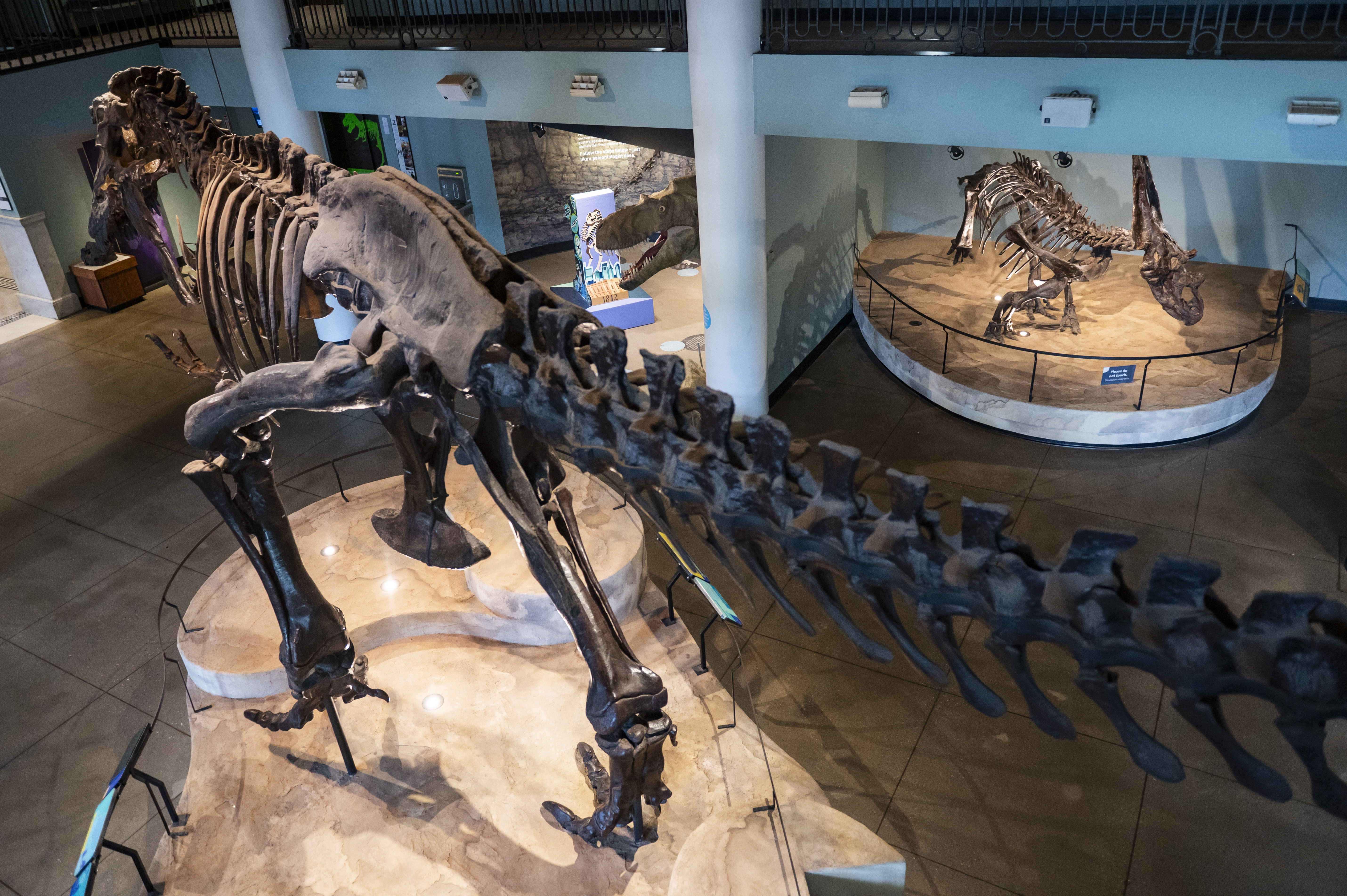
For years, the two-century-old museum has been a dinosaur enthusiast’s dream. In all, more than 30 species are highlighted in the heralded Dinosaur Hall — many in full skeletal representations. The permanent exhibit boasts a Torosaurusskull, dinosaur eggs, and a touchable T. rex bone fragment.
There’s still time to visit: The last day open to the public with regular business hours will be Sept. 27. There’s also a “Dinos After Dark” event slated for Sept. 18, complete with a beer garden and pay-as-you-wish pricing.
For those hoping to get their fossil fix in the future, meanwhile, rest easy: There remain other places in and around Philly with plenty of dinosaur-related programming.
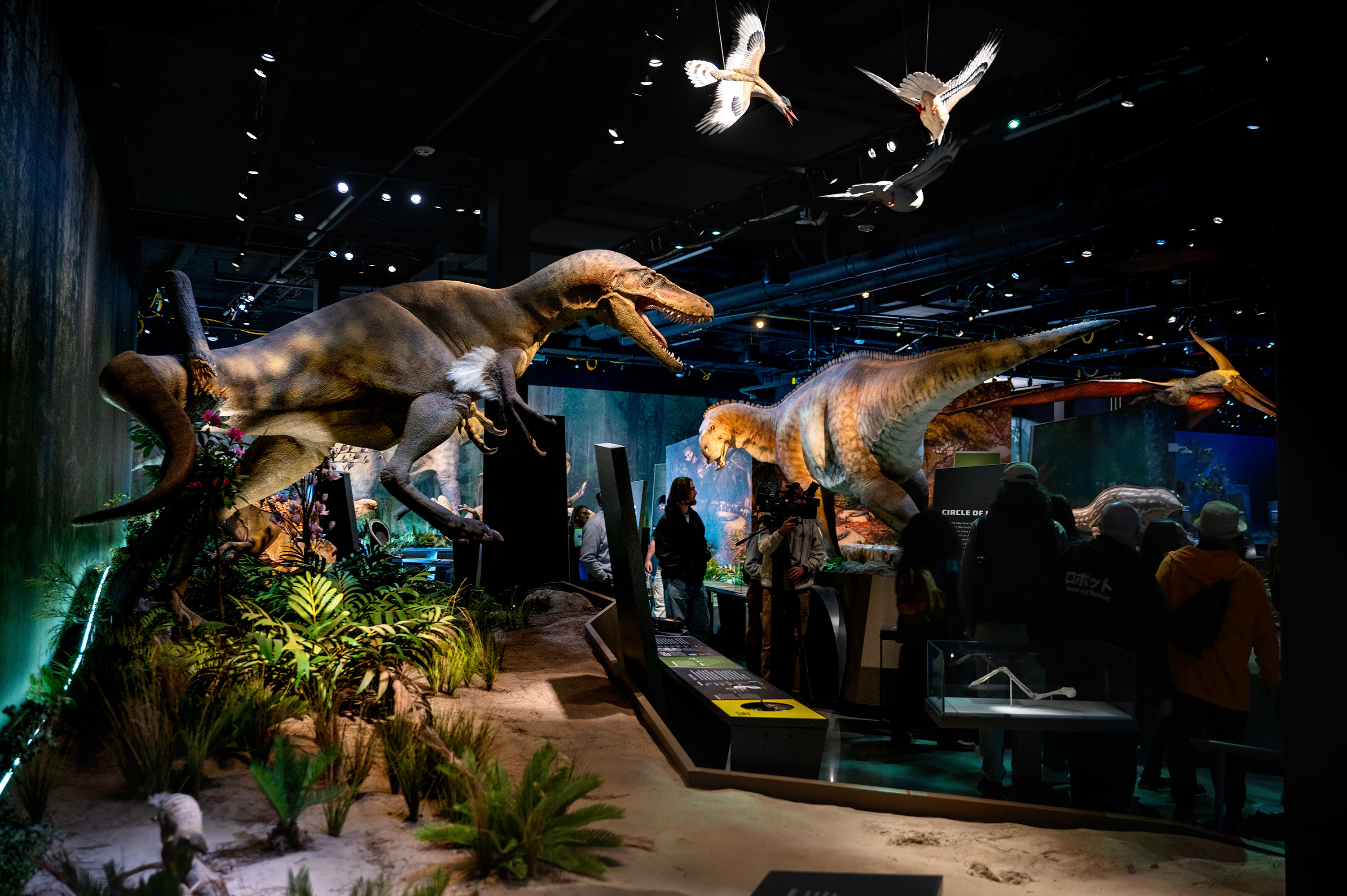
Life-size depictions of creatures that roamed the area 66 million years ago in the “Dinosaur Coast” prehistoric life dioramas produced by Gary Staab at the Edelman Fossil Park & Museum of Rowan University during a media preview March 5, 2025.Tom Gralish / Staff Photographer
Edelman Fossil Park & Museum
Located just across the Delaware River in New Jersey — less than 20 miles from downtown Philadelphia — is Rowan University’s Edelman Fossil Park & Museum.
Opened a year and a half ago, the museum boasts a lineup heavy with dinosaurs and other extinct creatures: There’s fossil teeth from the Cretolamna, an ancient shark that inhabited the state; a hadrosaur egg fossil; and full-scale renderings of dinosaurs from up and down the East Coast.
“We really feature the dinosaurs and other extinct creatures from New Jersey and Pennsylvania,” said Kenneth Lacovara, paleontologist and EFM’s founding executive director.
For an additional cost, patrons can also join a fossil hunt at the museum’s 45-foot-deep quarry in Mantua, which over the past century has turned up more than 100,000 fossils.
🕒 Open daily from 10 a.m.-5 p.m., 💵 $29 for ages 13+, $24 for ages 3-12, free for ages 2 and under, 📍 66 Million Mosasaur Way, Mantua, N.J. 08080, 🌐 efm.org
North Museum of Nature and Science
The Lancaster museum’s “Dinosaur Discovery Hall” exhibit seeks to get visitors up close and personal with “the fossils, minerals, and plant species in prehistoric life,” according to the venue website.
There’s a focus on the T. rex, and in the Paleontology Gallery, you can handle real bones and fossils.
🕒 Wednesday and Thursday, 10 a.m.-3 p.m., Friday through Sunday, 10 a.m.-5 p.m. 💵 $13 for general admission, 📍 400 College Ave., Lancaster, Pa. 17603, 🌐 northmuseum.org
New Jersey State Museum
The museum’s ongoing “Written in the Rocks: Fossil Tales of New Jersey” takes visitors more than 3.5 billion years into the past.
The star of the show might be the Dryptosaurus — reconstructed in life-size form for the first time — but there’s also a life-size cast of a Hadrosaurus foulkii and a Mosasaurus maximus, plus a look at Ice Age creatures.
🕒 Tuesday through Sunday, 9 a.m.-4:45 p.m., 💵 Free, 📍 205 W. State St., Trenton, N.J., 08608, 🌐 nj.gov
Wagner Free Institute of Science
In 1891, the Wagner purchased a collection of Camarasaurus bones from the Colorado quarry of Edward Drinker Cope — which Cope’s assistant traveled to Philadelphia to help arrange. Today, the remains are still on display at the museum.
🕒 Tuesdays through Fridays, 9:30 a.m.-4:30 p.m., and select Saturdays, noon to 4 p.m., 💵 Free, 📍 1700 W. Montgomery Ave., Philadelphia, Pa. 19121, 🌐 wagnerfreeinstitute.org
Please Touch Museum
Though Philly’s favorite hands-on museum isn’t currently hosting any fossil-related exhibits, the pint-sized dinosaur lovers in your life might enjoy the upcoming “Dino Day” later this month — a celebration of all things dino.
Kids can handle fossils, dig for bones, and take part in dinosaur-themed arts and crafts during this one-day event.
🕒 Sept. 12, 💵 $24 for general admission (discounts available), 📍 4231 Avenue of the Republic, Philadelphia, Pa. 19131, 🌐 pleasetouchmuseum.org
Montour Preserve Fossil Pit
There are worse places to go fossil hunting than this roughly 400-million-year-old one-acre site of exposed shale located three hours northwest of Philly.
Once upon a time, the site was covered by water, and while you probably shouldn’t expect to come away with any velociraptor bones — the most common finds at the site are the fossils of small sea creatures — the site is free to the public, and visitors are welcome to keep any fossils they find.
🕒 Open daily from dawn to dark, 💵 Free admission, 📍 374 Preserve Road, Danville, Pa. 17821, 🌐 montourpreserve.org
After a summer of nonstop action — the World Cup, Major League Baseball’s All-Star Game, the festivities surrounding the nation’s 250th birthday — things have finally calmed a bit in Philadelphia.
But that doesn’t mean there’s not plenty still to come this fall.
The area will once again host a variety of festivals and markets in the coming weeks and months, celebrating everything from food to the arts and everything in between.
Now entering its fourth year, the festival celebrates Muslim-owned establishments in and around Philly. Last year’s version featured more than 100 vendors and 6,000 attendees.
📅 Sept. 19,📍King of Prussia Mall, 160 N. Gulph Road, King of Prussia, Pa. 19406, 🌐 phillyhalalfoodfest.com
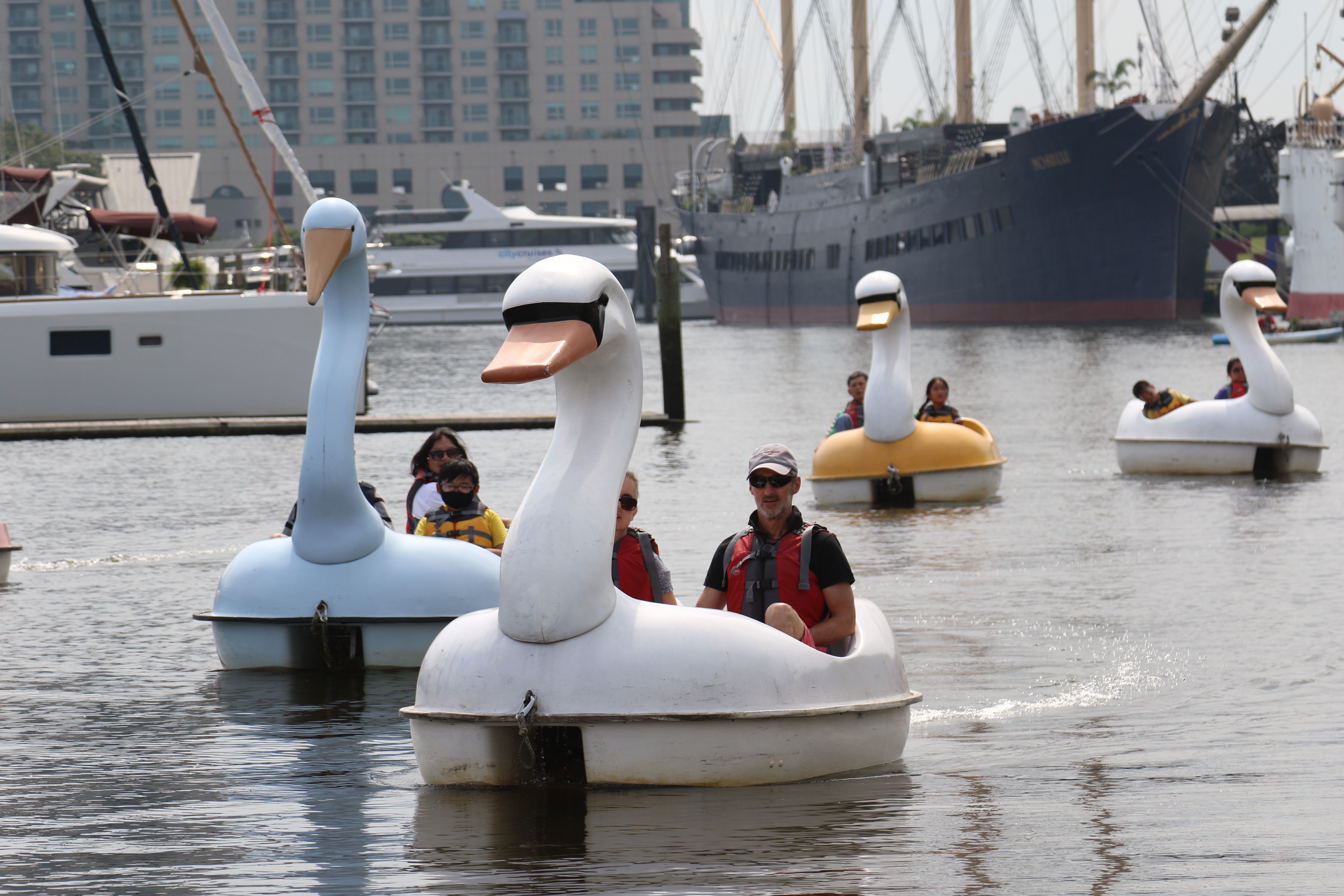
Scene of the swan boats from the 2023 Delaware River Festival held both in Philadelphia and Camden.Partnership for the Delaware Estuary
The event combined two former festivals, the Partnership for the Delaware Estuary’s Coast Day and Alliance for Watershed Education’s River Days Festival. Expect lots of family-friendly activities, from ferry rides and pedal boats to crafts and water-related education. Events take place at both Penn’s Landing on the Pennsylvania side of the river, and Wiggins Park on the New Jersey side.
📅 Sept. 26, 10 a.m. to 4 p.m., 💵 ,📍101 N. Columbus Blvd., Philadelphia, Pa. 19106 and 2 Riverside Dr., Camden, N.J. 08103, 🌐 delawareriverfest.org.
Held at Allens Lane Park, this fourth-annual festival features live performances, food, an art market featuring the work of local vendors — but also the opportunity to make some art yourself, with stations for painting, printmaking, and ceramics.
📅 Oct. 3, 11 a.m. to 4 p.m., 💵 Free,📍601 W. Allens Lane, Philadelphia, Pa. 19119, 🌐 allenslane.org.
First Fridays return to the Cherry Street Pier, complete with artist studio tours, markets, and exhibit openings along the Delaware River. Upcoming dates are Aug. 7, Sept. 4, Oct. 2, Nov. 6, and Dec. 4. Events begin at 4 p.m.
📅 Various dates, 💵 Free,📍121 N. Columbus Blvd, Philadelphia, Pa. 19106, 🌐 cherrystreetpier.com
Since 1987, St. Nicholas of Tolentine Parish has held this annual event dedicated to Italian culture. The day kicks off with a 10:30 a.m. Mass and subsequent neighborhood religious procession, and there’s plenty of live music, Italian food, and family-friendly activities.
This three-day event in and around Philly’s Gayborhood celebrates National Coming Out Day. Things kick off Oct. 9, with a variety of pre-parties and kickoff events. The following day, Oct. 10, is a night of dancing at Voyeur Nightclub, and the festival concludes with a parade on Oct. 11.
📅 Oct. 9-11, times vary, 💵 Prices vary by event,📍Various locations, 🌐 phillygaycalendar.com
The fall market this year celebrates its 10th year at Dilworth Park near Philly’s City Hall. Held over three days in October, this pet-friendly event brings a slew of artists and makers together, from jewelry and photography to glassware and woodwork.
📅 Oct. 9-10 (noon to 8 p.m.) and Oct. 11 (noon to 6 p.m.), 💵 Free,📍1 S. 15th Street, Philadelphia, Pa. 19102, 🌐 madeinphila.com
A day of celebration in honor of one of Pennsylvania’s most iconic foods: the Dutch breakfast meat, scrapple. Reading Terminal Market turns into a scrapple haven, as vendors offer a variety of scrapple-themed items. There’s live entertainment, cooking demonstrations — even a scrapple-sculpting competition (held Oct. 15, the Thursday before the festival).
📅 Oct. 17, 10 a.m.-5 p.m., 💵 Free entry, pay as you go,📍1136 Arch St., Philadelphia, Pa. 19107, 🌐 readingterminalmarket.org
The fifth annual Philly Bike Ride kicks off at the Philadelphia Art Museum on Saturday, Oct. 17.Courtesy of Philly Bike Ride
Now in its fifth year, this annual ride takes cyclists past some of the city’s top landmarks. The 20-mile course is closed to traffic, making it a great event for riders of all ages and experience levels. Afterward, celebrate with food trucks and a beer garden. Registration is required; early-bird prices (through July 12) range from $43 to $200.
There’s live music all day, pumpkin decorating for kids, and a variety of items from local shops, crafters, and artisans. Local vendors will be on hand, with a beer garden from Wissahickon Brewing.
📅 Oct. 17, 11 a.m. to 5 p.m., 💵 Free admission,📍Ridge and Midvale Avenues, Philadelphia, Pa. 19129, 🌐 discovereastfalls.org
Last year’s inaugural event went so well that organizers are running it back. Main Street will be taken over by local artists and vendors, food trucks, live music, and — ahem — a mac and cheese crawl.
The 23rd Street Armory hosts this annual celebration of all things coffee. More than 20 roasters have already been lined up (with more expected soon) for this two-day event that also includes food and live music.
📅 Oct. 17-18, 9 a.m. to 4:30 p.m., 💵 Tickets are $25-$73,📍22 S. 23rd St., Philadelphia, Pa. 19103, 🌐 phillycoffeefestival.com
More than 100 artists, crafters, and vendors are expected at this year’s annual family-friendly festival held at Croft Farm. Mechanical Brewery will have a beer garden, plus there’s free pumpkins, a petting zoo, and live entertainment.
📅 Oct. 18, noon- 4 p.m., 💵 Free entry, pay as you go,📍100 Bortons Mill Rd., Cherry Hill, N.J. 08034, 🌐 chnj.gov
This free event gives visitors a peek behind the scenes of the Community Arts Center in Wallingford. There’s 30 vendors, plus demos and tours, art activities for children, and a pumpkin-painting contest — plus live music. For a full schedule of the day’s events, check out the Community Arts Center website.
The Braid Mill in Germantown hosts this fourth annual fall festival, with food trucks, wine and cocktails, local bands and DJs, and a craft marketplace. Early-bird tickets are available at a steep discount if purchased before Oct. 1.
📅 Oct. 25, noon-5 p.m., 💵 $20 for entry ($12.51 before Oct. 1), pay as you go,📍346 E. Walnut Lane, Philadelphia, PA 19144, 🌐 phillyflannelfest.com
The first-ever Inquirer Food Festival was held last year at the Fillmore in Fishtown. This marks the event’s second year.
The city’s premier food festival returns to the Fillmore this fall, featuring a lengthy lineup of top area restaurants. Sao, Pine Street Grill, and The Bread Room are among the participants already confirmed for this year’s event. There’s also an empanada-making workshop from chef Jezabel Careaga, with music from DJ Na$h, plus the chance to try off-menu dishes.
📅 Nov. 14, 11 a.m. to 6:30 p.m., 💵 Ticket prices vary,📍29 E. Allen St, Philadelphia, Pa. 19123, 🌐 foodfest.inquirer.com
The company announced this week that it will be holding a retrospective of the artist’s film work, with screenings of a pair of Parton-starring films — Steel Magnolias and The Best Little Whorehouse in Texas — in her honor. Screenings begin Friday and run through Sept. 2, the company said.
In all, roughly 200 AMC locations nationwide will hold screenings.
Participating Philadelphia-area theaters include AMC Cherry Hill 24 and AMC Voorhees 16 in New Jersey, and AMC Neshaminy 24 in Bensalem. Tickets will be offered at discounted prices and are available through the AMC website.
The two films are among several that Parton appeared in between 1980 and 2015, a list that also includes 9 to 5, in which she starred alongside Jane Fonda and Lily Tomlin, and received three Golden Globe nominations.
The 1982 musical comedy The Best Little Whorehouse in Texas saw Parton play a brothel madam alongside Burt Reynolds, earning her another Golden Globe nomination in the process.
In 1989’s Steel Magnolias, Parton stars alongside Julia Roberts, Sally Field, Shirley MacLaine, and Daryl Hannah.
A longtime star of the music, film, and television industries, Parton’s death has brought a wave of homages this week from everyone from Taylor Swift to Amazon founder Jeff Bezos. Her death followed a brief battle with cancer, a family spokesperson has said.
Parton was a 10-time Grammy Award winner, and her 55 Grammy nominations make her the third-most nominated woman in the awards’ history, according to the Associated Press, trailing only Beyoncé and Swift.
In addition to AMC, Regal Cinemas will be screening both films, as well — though screenings will be limited to Parton’s home state of Tennessee.
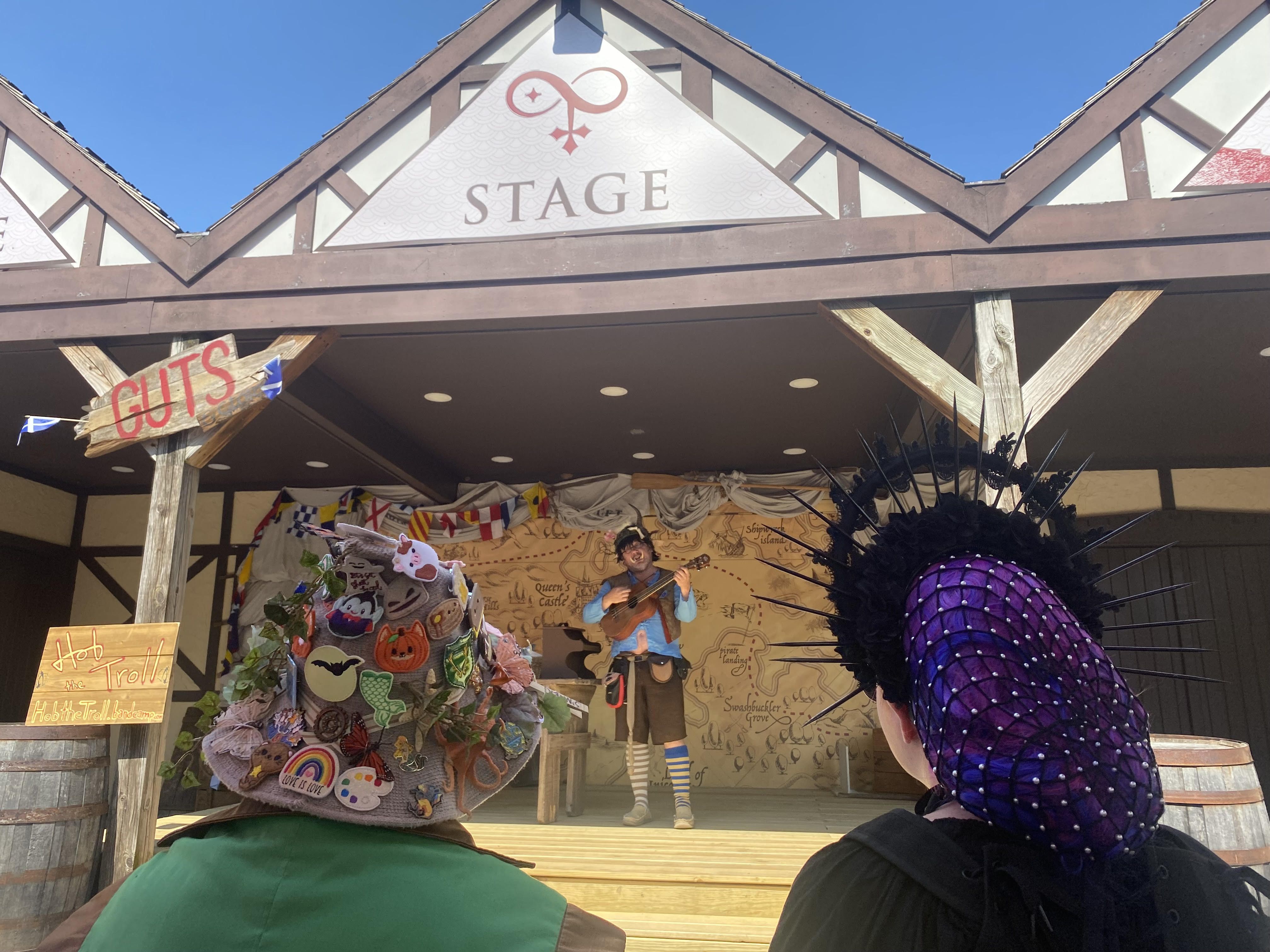
Get your lances and chain mail ready — it’s time, once again, for the Pennsylvania Renaissance Faire.
Spanning 35 acres of the Mount Hope Estate and Winery in Manheim, the faire draws around 200,000 guests annually and features dozens of costumed cast members, loads of era-specific food and drink, and enough drama to fill a scroll or two.
The faire is open Saturdays and Sundays from through Oct. 25, with tickets on sale now.
This year’s storyline centers on Queen Elizabeth, whose journey to Mount Hope has made waves in that it’s expected to conclude with a decision: Who will the queen take as a spouse?
As the faire’s website teases, “candidates are put forward, choices are made, sides are taken, [and] conflicts, resolutions, and hijinks ensue.”
Here’s everything you need to know before making the trek to Lancaster County:
Dates & times for the 2026 Pennsylvania Renaissance Faire
The faire is held Saturdays and Sundays through Oct. 25, rain or shine. Gates open at 11 a.m. and close at 8 p.m. — though merchants close at 7 p.m.
📍 2775 Lebanon Road, Manheim, Pa. 17545
🕒 Aug. 16–Oct. 26, Saturdays and Sundays, 11 a.m.–8 p.m.
Schedules for the 2026 Pennsylvania Renaissance Faire
“Daily Writs” — or individual weekend schedules — are available on the festival website.
A series of special events — including a pub crawl, a “Bard’s Breakfast,” and a pair of escape rooms — are also scheduled, though additional tickets are required.
Joe Penn portrays Sheriff Jacob Perry at a previous iteration of the annual Pennsylvania Renaissance Faire.Ron Fary
Tickets to the 2026 Pennsylvania Renaissance Faire
Tickets are available through the Renaissance Faire’s online ticket sale website, parenfaire.com. Prices vary by age and date.
Through Sept. 13: $38.95 for ages 12+; $21.95 for ages 5-11.
Sept. 19-Oct. 25: $42.95 for ages 12+; $23.95 for ages 5-11.
Children 4 and under are free.
Discounted tickets are available for those in the military, law enforcement, fire and EMS, medical workers, government employees, and educators. Discounted “sunset tickets” — with admission after 4 p.m. — are also available.
“Royal Hound” tickets, which admit dogs pending the approval of registration, are $8 per animal.
Tickets can only be purchased through the event’s website.
The Pennsylvania Renaissance Faire runs on Saturdays and Sundays from now until Oct. 25 in Lancaster County.
Themed weekends at the Pennsylvania Renaissance Faire
Each weekend features a different theme, a schedule is found here, with a activities ranging from costume contests to scavenger hunts to trick-or-treating.
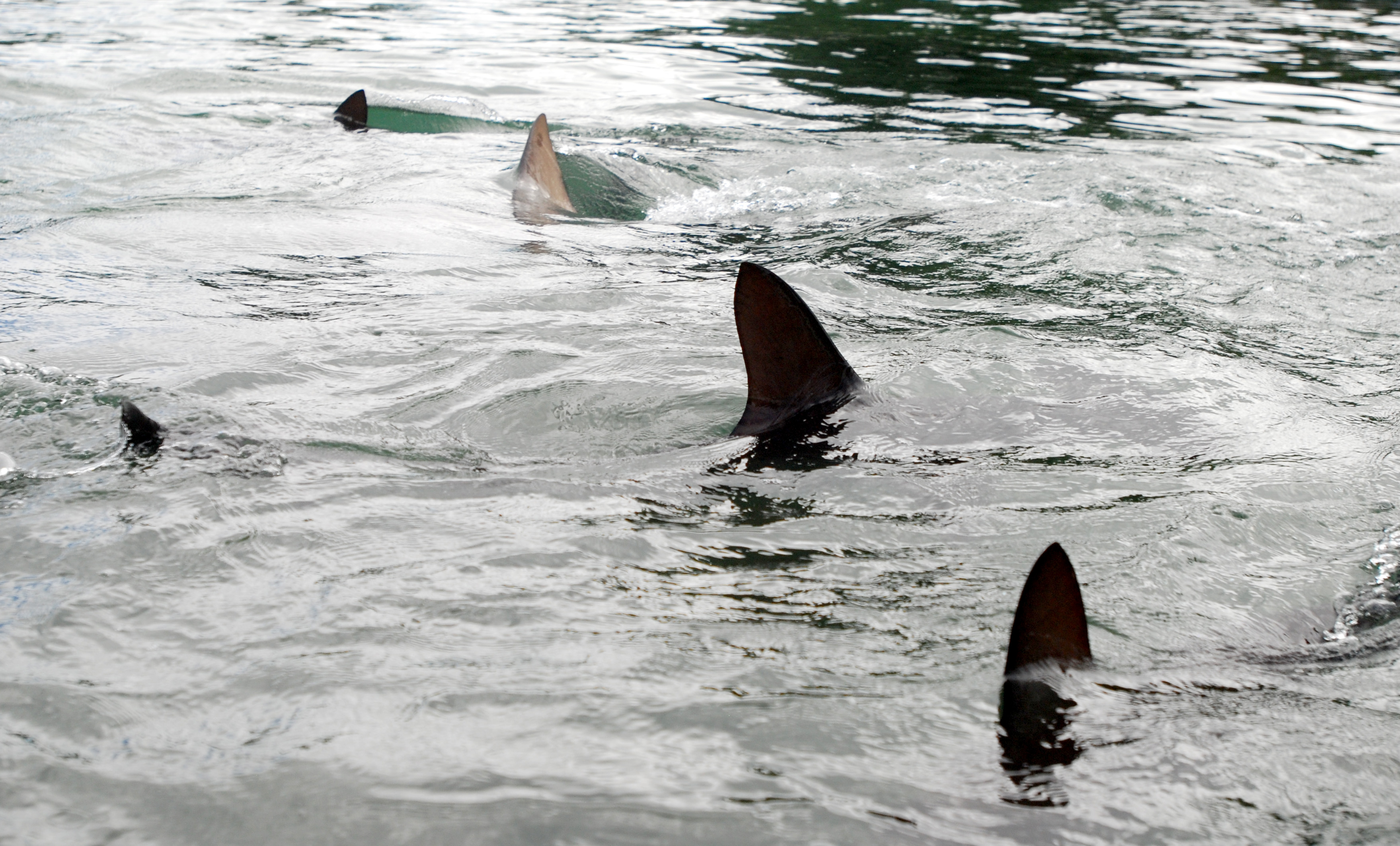
While walking along a stretch of beach in Sea Isle City earlier this week, a woman reported coming upon something you don’t often see in the South Jersey locale: Nearly 30 small dogfish sharks, all dead, washed up on shore.
They were small — maybe a foot in length. And some had small red marks on their bellies, according to reports.
Was this the result of something deadly in the water? Some new kind of apex predator? The approaching apocalypse?
Probably not, it turns out.
Michelle Greenling made the discovery on Wednesday morning, she told CBS Philadelphia, as she walked a 10-block stretch of the town’s beach. The first couple shark corpses weren’t particularly surprising, she said.
“But when I saw three and four and five,” she told the outlet, “I knew something was up.”
Greenling was initially worried that the sharks had been affected by something in the water.
But that does not appear to be the case, experts said.
Having examined photos of the dead sharks, Thomas Grothues, director of the Rutgers University Marine Field Station in Tuckerton, was confident they could be traced back to a fairly common occurrence.
Basically, when commercial fishing boats inadvertently scoop up fish that its crew is not actively targeting, workers are required to release them back into the water.
“This is super consistent with a commercial bycatch of fish,” said Grothues. “You can get 200 in a trawl [net] easy, and most of them will live — they’re pretty tough. But if a catch is huge and they’re sorting it, then sometimes the weight itself can kill sharks that wouldn’t normally die.”
Lawrence Hajna, media director for the New Jersey Department of Environmental Protection, offered a similar explanation.
“These occurrences are not uncommon in the summer when these fish forage near the shore and sometimes get caught inside sandbars as the tides goes out,” Hajna said in an email Thursday. “It is also possible they were discarded as bycatch from a commercial or recreational fishing trip.”
As for whether the curious incident requires any investigative follow-up?
Hajna said that the agency is not investigating the situation, “as this does not appear to be an unusual event.”
Corey McMillan, Luke Elrath, and Jeremy Stock were longtime friends. All in their mid-to-late-40s and all self-described “motorheads,” the South Philadelphia residents loved to spend their free time restoring old vehicles and, over the years, had come to amass a small assortment of trucks, cars, motorcycles, and bicycles.
It was a side passion, started as a way to save money on mechanic fees or escape — for an hour or two, at least — the stresses of daily life.
The issue was, this was Philly, where century-old rowhouses dominate the local housing stock and a home garage is notoriously difficult to come by. While they all owned at least one classic vehicle, none had a garage of his own.
Then, last spring, came a crazy idea.
What if we bought one ourselves?
Making do
Through the years, the three friends had done their best to make it work: They’d tinkered on sidewalks or rented out space in under-the-table — and sometimes dubious — commercial garages. Elrath was so desperate for spacethat, for a time, he used the living room of his apartment as a workshop for bicycle-related repairs.
“I’d roll back the [rug] and get to work on the hardwood floor,” hesaid.
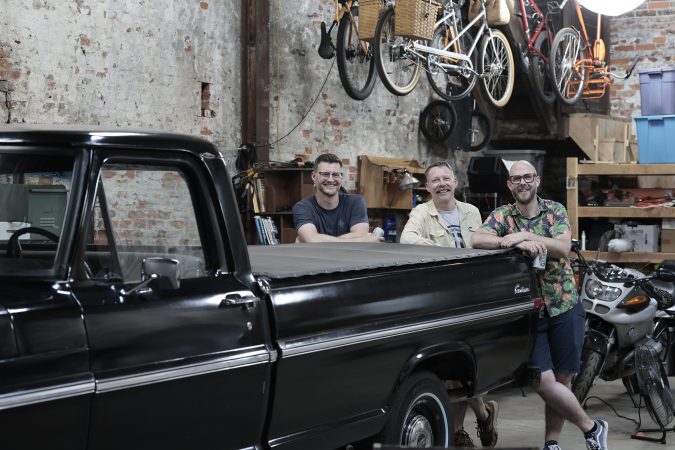
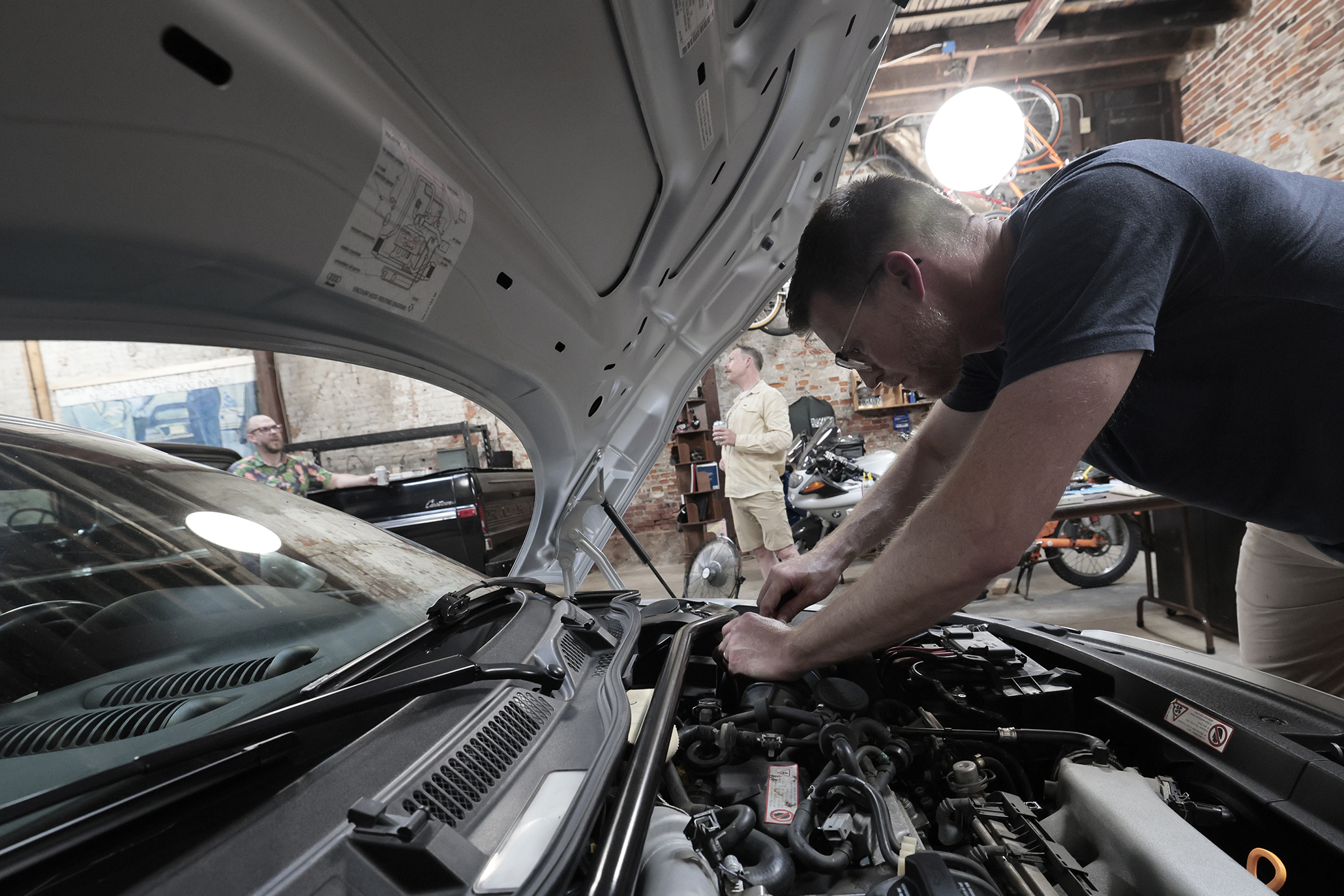
Jeremy Stock (right) works on his 2001 Audi TT Roadster as Luke Elrath (middle) and Corey McMillan (left) chat in their South Philadelphia garage one evening earlier this month. The group bought the garage together so they would have a place to work on their cars, trucks, motorcycles, and bikes.Elizabeth Robertson / Staff Photographer
As the years passed, they’d largely accepted this as the price of city living, making do however they could.
McMillan, 49, kept his 1970 Ford Truck at his family’s place in the Catskills, working on it only when he could make the trip up from Philadelphia. For the 2001 Audi TT Roadster he was restoring, Stockfound a cramped space over the river in Haddonfield that was “so small I couldn’t work on the car at all.” Elrath rented a spot in a garage that doubled as a storage unit for the Mummers — grateful to have even that.
“If that was all I had for the next decade, I’d consider myself at least lucky for that,” hesaid.
Then, one day this spring, McMillan — who by day works as a professor at the University of Pennsylvania — stumbled upon a curious Instagram post.
It was a property listing, for a sizable South Philly garage. 3,000 square feet. Brick walls and a reinforced concrete floor. Located on a narrow, nondescript residential street. Listed for $380,000.
Notably, it was located within a mile and a half of each of their homes.
‘Absolute heaven’
McMillan texted the listing to his two buddies, who over the course of the day traded a flurry of bemused texts — daydreaming of what they’d be able to do with a space all their own.
“It was a full day of talking about it like what would we do if we won the lottery,” said Stock, 46, who works in marketing technology for a pharmaceutical company.
It was all in fun, insists McMillan. “Just kind of like, Haha, isn’t this funny?”
Butwhen Stock woke up the next morning, there was something about the idea he couldn’t shake.
I just can’t get this out of my mind, he texted the group.
Neither could Elrath, it turned out. Or McMillan, who was already preparing for how he might broach the idea with his wife.
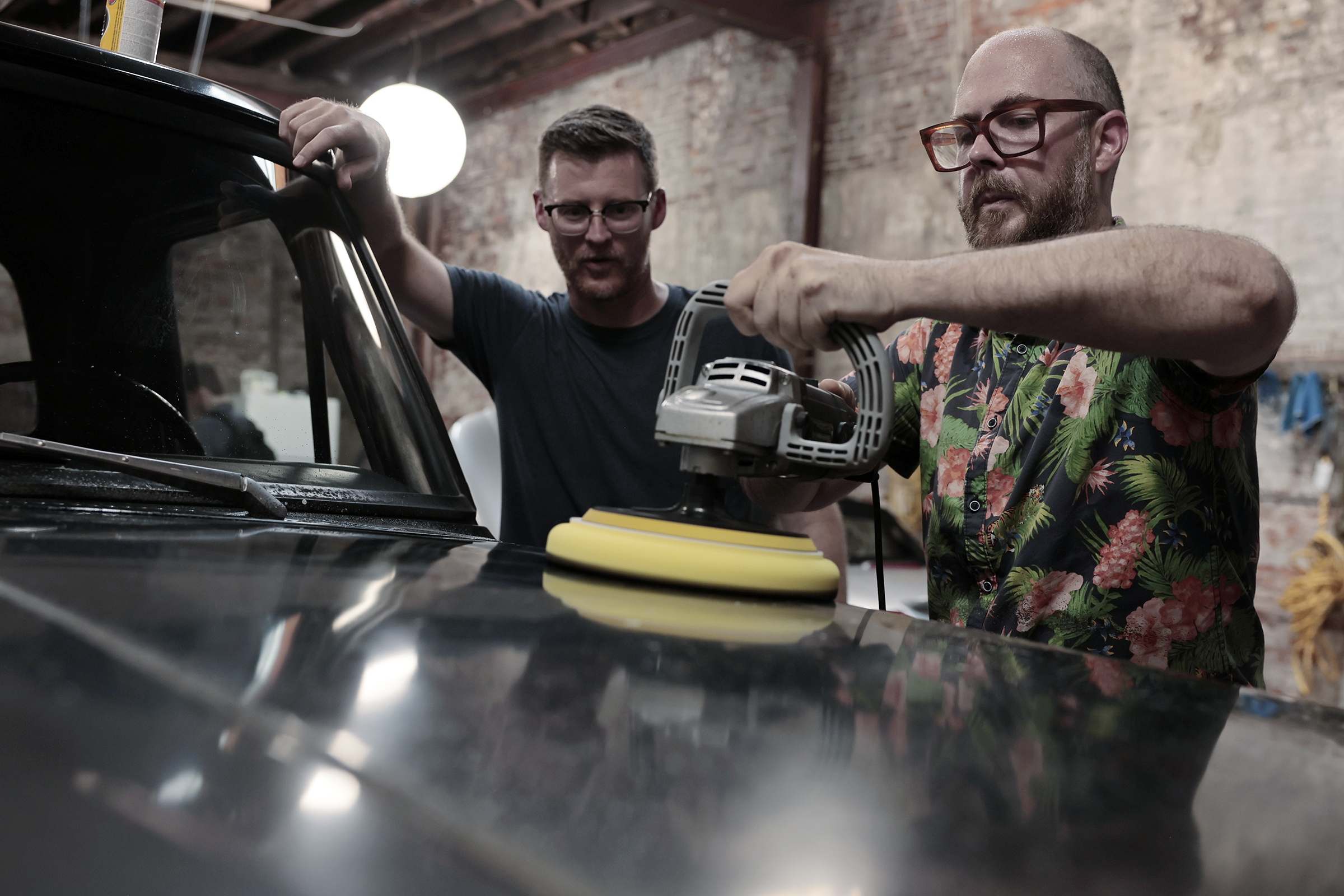
Jeremy Stock, a former detailer, (left) guides Corey McMillan as he restores the paint on his 1970 Ford F-100 truck nicknamed “Boone” in their South Philadelphia garage earlier this month. Elizabeth Robertson / Staff Photographer
That weekend, the three of them went to look at the space.
It was a cavernous, nearly windowless structure. There was no heat or air-conditioning. A rusted beer fridge stood in the back. In one corner was a small bathroom, which was easy to find considering it had no walls — just a toilet and sink anchored to an elevated patch of concrete.
“Absolute heaven,” Stock said.
Gettin’ wrenchin’
Soon enough, the three were running the idea past their wives. And though it took a bit of getting used to — “Buying a second property was not on my 2026 bingo card,”said Danielle Burrows, Stock’s wife — everyone ultimately bought in.
Not long after, McMillan was meeting with a transactions lawyer, who helped navigate the three-way purchase, and, suddenly, they were signing the sale documents — the proud owners of a South Philly garage.
“It all happened so fast,” said McMillan. “It didn’t feel real. It still doesn’t.”
They began moving their things in early June, said Stock, “and immediately got to wrenchin’.”
Recently, McMillan brought his Ford Truck from the Catskills to the garage, and has begun working on it a couple times a week. Elrath, 49, who works as a subject matter expert investigating bicycle crashes, has three motorcycles and a slew of bicycles on-site, and tries make it over to the garage five days a week to tinker with them.
Stock is preparing to take ownership of a 1970 Triumph TR 6, a sporty British roadster in need of significant work, which, he says, will “be a nice multiyear project that we’re going to take on.”
“As the budget allows,” his wife quicklyadded.
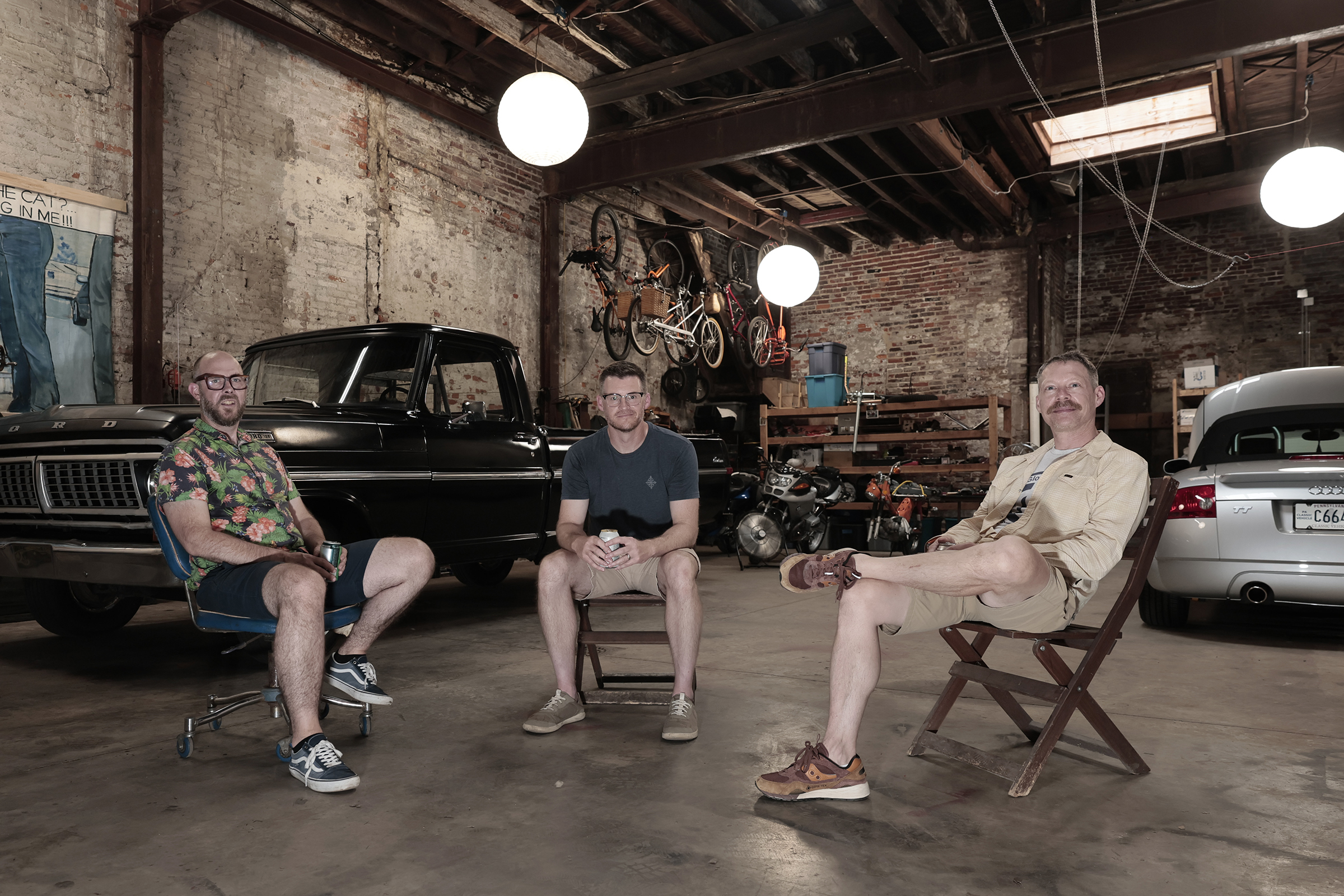
From left, Corey McMillan, Jeremy Stock, and Luke Elrath in their South Philadelphia garage.Elizabeth Robertson / Staff Photographer
Settling in
On a recent evening inside the garage, the three friends still seemed in awe that it had all come together so nicely. So far, they agreed, it’s been a revelation. Working side by side, they’re able to share tools and the technical know-how they’ve accumulated through the years. Maybe best of all, it’s been an excuse to see each other regularly. Their wives have begun using the hashtag “GarageWives” in the friends’ group chat.
A month and a half in, meanwhile, the place isstarting to feel like home. McMillan’s wife found a used espresso maker. Someone brought over some old speakers. There arerumors of a potential couch.
There isstill plenty left to do; there are plans to add a lift, and the rotting wood floor of the upstairs hay loft needs replacing.
On this night, however, they seemed perfectly content as they worked on their respective vehicles in satisfied silence — the only sound the clank of tools, the hum of a pair of floor fans, and the sweet crack of a fresh fridge beer.